Thinking Differently, Solar Power and Clay Making

I usually spend a bit of time making clay over the summer when the humidity is low and the air temperature is high. It’s a good time for drying out the clay slip after it has been ball milled.

All my so-called ‘clay’, is actually ground up igneous stones. I crush the very hard ‘granitic’ rocks in the big jaw crusher first to reduce them down to 12mm. gravel size, then through the small jaw crusher to get it down to sand size and finally it goes into the big ball mill for a few hours to reduce it to a very fine slip with water and 3% of Australian white bentonite. It is the only ingredient that I buy in for this home-made, locally sourced, native porcelain body.

IMG_0942 IMG_0939 IMG_0941

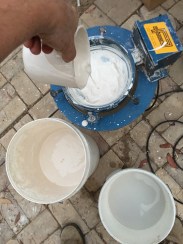
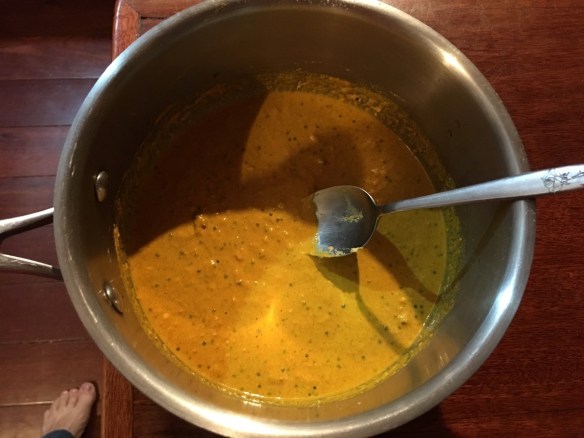
After ball milling, I test the pH and adjust it if necessary, it usually needs to be reduced a little, as the ball milling breaks down the structure of some of the felspars and micas in the stone. This releases tiny amounts of alkali into solution in the slip. The effect of this is to constrain the plasticity of the porcelain and inhibit the ageing plasticisation. Once adjusted to the correct level, the slip is stirred and then put through a fine sieve to remove any oversized particles and any foreign matter that has crept in during unloading. Thick slip is very slow to pass through a very fine mesh, so I resort to using a sieve vibrating machine to shake the sieve while the slip pours through. It’s quite amazing just how fast this process becomes with a little vibrational energy to keep the larger particles moving and not sitting and blocking up the fine mesh. ‘Vibro energy’ a really great focussed use for very small amount of electrical power.

Without the rock crushers and ball mills, I couldn’t make this local ‘native’ porcelain. In the past I always used to feel a bit guilty about using electrically powered machinery, as I was brought up in a family where ‘green issues’ were openly discussed, long before the ‘greens’ were invented as a political movement and ‘green’ came into the environmental lexicon. I’m not too sure what my parents actually called their lifestyle back then. Possibly ‘environmentally conscious’? Anyway, I’m happy to be called a ‘Greeny’ now and all that early environmental awareness has stuck with me. Give me the boy till he is 7! Now I am getting used to thinking differently about electricity as we are slowly becoming a fully electrified solar-powered household.

Electricity was always made with coal here in Australia and most of it still is. You have to specifically request to be put on a green power contract, and then pay a premium tariff for the pleasure of not using coal. 25 years ago, you couldn’t buy green power. Everything was coal, coal, coal, so I decided to make an effort to use the absolute minimal amount of electricity and we were very successful. We learnt to run a very lean electrical household. We have a very modest ‘LED’ screen television. A very efficient fridge that runs on 1 kW per day and a front loader washing machine, also very efficient. All in all we average an electricity usage of around 3.5 kWh per day. Very modest. We have chosen not to buy home theatre,  a dish washer or air con.  We have had solar hot water for the past 30 years, Solar electricity for the past decade and a Tesla battery since the start of the year. To the best of my knowledge, we have completely removed ourselves from the coal economy now.

When we did buy power from the utility, up until last year, it was always a battle to buy ‘clean’ green energy. They just hadn’t thought about it and weren’t prepared for the transition. It was a dinosaur industry. People like us wanted to buy clean energy, but they hadn’t put any plans in place to create any. It was all about business as usual. As the requests grew louder, some clean energy was slowly introduced, such that you could buy just 10% of your electricity as so-called ‘green power’, but it turned out that it was only hydro power from the Snowy Mountains Scheme. This was electricity that was always being generated since the 50’s and sold into the grid as part of the usual mix. But then the bean counters and ‘The Men in Suits’ got involved and thought why don’t we sell Steve Harrison the electricity that he is already buying, but sell it to him at twice the price. If he is silly enough to pay for it!  I wasn’t, so I didn’t.

We waited a long time, until the first wind farm was built just South of here. Then there was an offer that you could buy 20% of your power bill as wind energy, so we did, and continued to increase the percentage every year or so as more clean energy was built and made available. I remember that we were early adopters and had to go on a waiting list to get a higher percentage of clean energy. However, the energy company kept sending us supposedly attractive offers to change back to a cheaper dirty black power contract. This just reinforced to me that the market for green power was stronger than that for coal power. Apparently they had too much coal power and couldn’t get rid of it all.

Then there was government intervention to support the coal industry and then privatisation that was supposed to make every thing more efficient and cheaper. And what happened? The price went up about 200% here. A complete failure of market forces and competition.

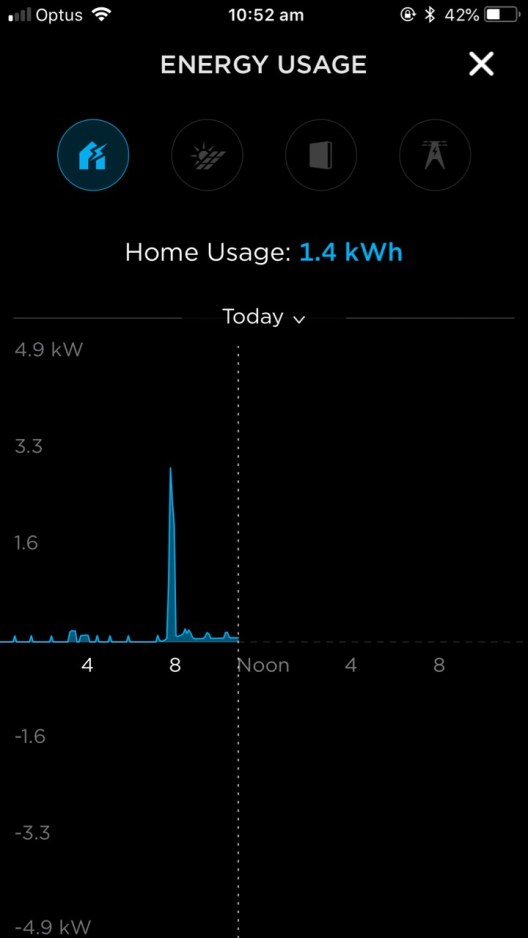
Today I check in on our power usage on my phone app. I see that we are making about 5kW of solar power, not too bad, seeing that we are just a month off the winter solstice. We are only using a few hundred watts intermittently, that’s the fridge compressor switching on and off. There is a spike at 8am. That’s the toaster and electric jug for breakfast. It’s probably hard to live any kind of normal life and use significantly less power then this on a regular basis.
IMG_0964

Back to my clay tests and I pour them out onto the drying bed to stiffen up. Again I’m using solar and wind energy in this very passive way now to remove the excess water from the slip and reduce it to a plastic state. The sun shines for free every day. The wind blows most days, slowly the water is evaporated from the slip and it becomes stiffer and plastic. It’s gentle, it’s energy neutral and it’s free!

IMG_0287

Nice.

I’m very lucky to be able to live this rewarding, creative life in carbon constrained times. We are preparing ourselves for a creative, energy passive future, but it’s funny that trying to live a simple life gets quite complicated at times.
Chillies

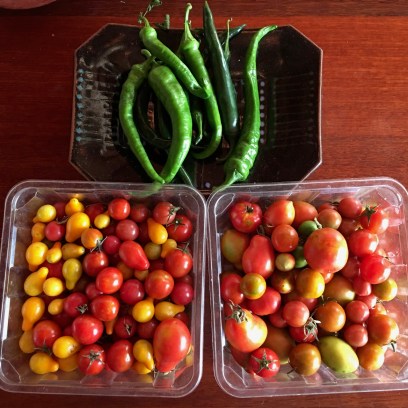
Even though we are just two weeks away from winter, we are still managing to harvest a small bowl of little ripe tomatoes every few days. There are loads of chillies too. The chickens are still laying an egg each, almost every day, so we decide to have tomatoes and eggs on toast – with some chilli.

IMG_0878

IMG_0822 IMG_0831

Tomatoes with chilli simmered in a little olive oil has to be the best accompaniment for fried eggs. It’s so aromatic and tangy. It has to be one of my favourite winter breakfasts, and the pan juices are just crying out to be mopped up with some nice bread.

IMG_0833

Chilli seems to make so many dishes sing. We grow a range of chillies and capsicums each spring, but they are quite slow to grow for us and don’t decide to fully ripen the whole crop until autumn. I decide to look them up in my favourite plant book, “The Oxford Book Of Food Plants”. We were given our copy as a gift from the late John Meredith in The seventies and it has been an invaluable guide to information on the origins of food plants. I google this book and find that it is still available 2nd hand;

Oxford Book of Food Plants by S. G. Harrison (1970, Hardcover)

Pre-owned: lowest price

 $5.04
+ $2.99 Shipping
  • Get it by Tue, May 22 – Wed, May 30 from South East, United Kingdom
  • Good condition

With an authoritative name like S. Harrison, it would have to be a good read!

Pages 128/129 are all about peppers and chillies, including black pepper.

IMG_0921

Capsicums or sweet peppers (Capsicum Annum) are described as an annual plant grown from seed and originated in tropical America. This spices includes all the larger fruited kinds and are often picked while still green. These ‘peppers’ vary greatly in their pungency. In General, the larger the variety, the milder the flavour. In some parts of Europe, these fruits are called ‘Paprika’, while in Spain they are called ‘pimento’. The fruits  can be very high in vitamin ‘C’. Although often quite round in shape like the ‘bell’ pepper, they can be long and pointed. I don’t know what they are called in Korea, but there were huge quantities in the street markets, sold by the sack full. I believe that they were the hot variety of the annum family. They were quite large, long, tapered and pointed, and ripened to a very dark mahogany red colour.

IMG_0890 IMG_0882 IMG_0883

On the other hand, ‘Red pepper’ or ‘Chilli’ (Capsicum Frutescens) is a perennial plant or can be in the tropics, but the frost kills it here. It has less vitamin ‘C’ than capsicums. Pungency is described as being variable, but in general, it is much greater than in the capsicums. There are two main forms. The short spiky variety where the fruit often stick upwards. Sometimes called ‘birds eye’. These a smaller and smooth skinned.

The other main variety is longer and narrow with undulating skin and the fruit hang down. S Harrison in The Oxford Book Of Food Plants describes the longer gravitationally influenced variety as ‘red peppers’ while the short spiky gravitationally resistant variety he calls ‘chillies’. We grow them both and call them both chillies – long or short.

IMG_0722 IMG_0885

I like the flavour of chillies , but I’m not any kind of masochist, just hot is hot enough. once I break out in a sweat, that’s hot enough. Two of our small hot chillies is about my comfort level in a meal.

Last night we had steamed capsicums stuffed with both red and green chillies, along with brown rice and some other condiments! Keeping it all the family!

IMG_0863 IMG_0867

IMG_0868


Another Little Portable Wood Fired Kiln Leaves the Workshop

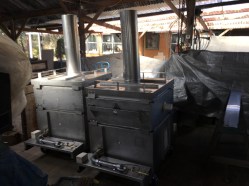
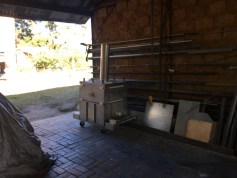
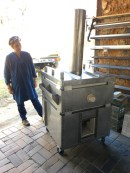
We have been keeping busy rolling out the latest batch of little portable wood fired kilns. Another little wood fire Gem leaves for a new life of fun and fulfilment for another potter. All the remaining kilns are set up with gas burners for dual fuel firing.

IMG_0876 IMG_0843

I spent most of last week making the burners and fitting them to the kiln on removable mountings that slide into place when needed.

These are the last of the first batch and while I wait for collection of these first orders, I start on the 2nd batch. There isn’t enough room in my small kiln building workshop for more than seven kilns at a time and still be able to move around safely and engage in productive work.

IMG_0875 IMG_0877 IMG_0861

I go to the garden after work and pick a load of vegetables for dinner, do a quick bit of weeding and do a little watering, as it is still incredibly dry with no rain storms to speak of for 14 months. The dams remain dry.

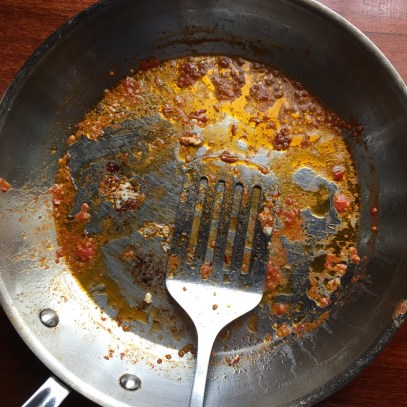
I cook a fresh snapper for dinner, steamed on the stove top in a big frypan with a little garlic, lemon juice and white wine.

IMG_0848 (1).jpg


Wood Cutting Working Bee

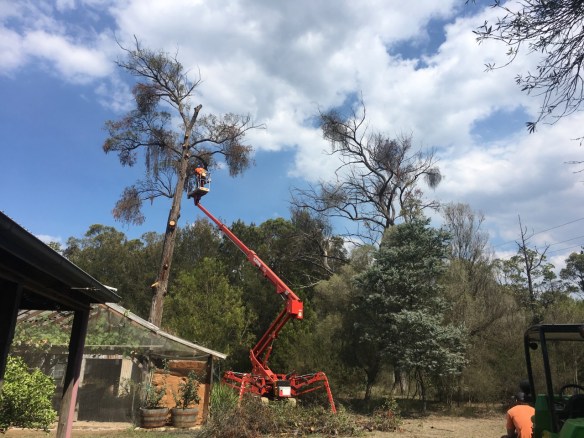
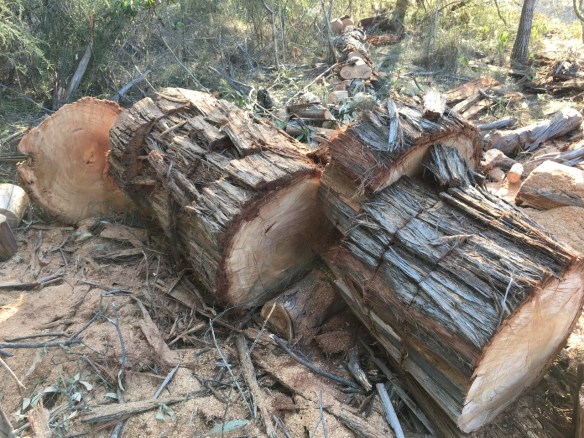
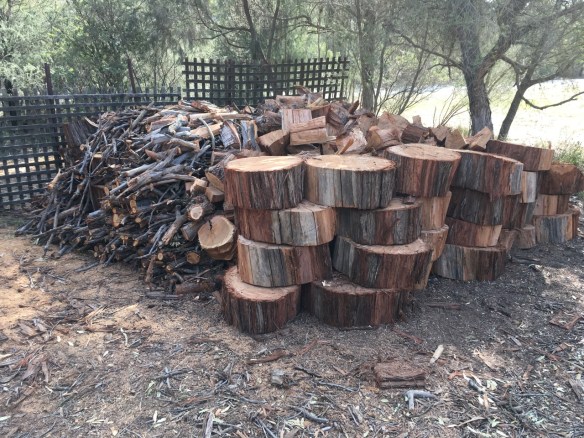
We have recently had 3 big dead eucalypt trees removed by our local arborist. One was struck by lightning, and the other two were killed by mistletoe. We paid the minimum, to just have them dropped to the ground. We took it on our selves to cut them up and remove all the blocks to storage and seasoning.

IMG_0655

IMG_0674

We spent several days cutting up al the logs into small sizes, such that we could manage to move them. Janine and I spent a week whittling away at the big number one log and   finished the first tree by ourselves, but then had the wonderful assistance of some friends and pottery students for a day.

We have been so lucky to have these people volunteer their help for a day and come along to give us a hand in shifting all the logs that Janine and I had spent the week cutting up. It’s a huge task to lift and load several tonnes of wood and then shift it and stack it for seasoning.

IMG_0738IMG_0739

This is all very vigorous work and we sweat copiously in the heat. The larger, straight pieces were all cut to kiln size ‘hob’ length, while all the scrappy, small or bent pieces were all cut to 200mm. length for splitting for the house kitchen stove. The main central log was over 600mm dia. So it was too big to manage at ‘hob’ length of 700 mm. So I cut it to 200mm. just so that we would be able to manage the lifting and stacking. I rigged up a couple of planks , so that we could roll the bigger lumps up onto the truck to be carted to the wood shed and splitter.

IMG_0744IMG_0750

This should keep us going for a few years in the kitchen stove.

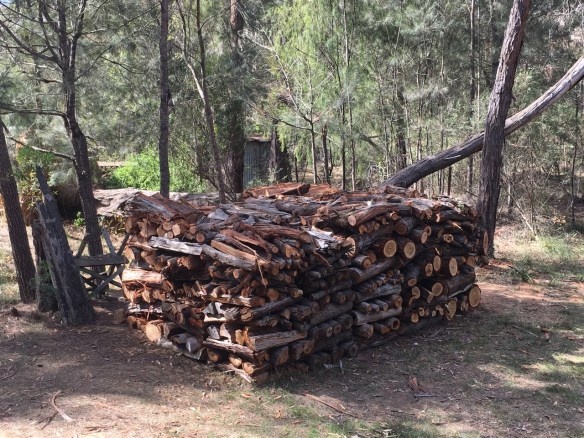
All the smaller dia. logs were cut to ‘kiln hob length’ of 650 to 700mm to suit the fire-box of the kiln, and then stacked for seasoning. A year or two should do it.IMG_0752

There is about 7 or 8 tonnes in this load of 19 stacks about 1200mm high.


Mid Autumn and the Chilis are Ripe

Up until last week we seemed to be in a perpetual summer. The temperatures were holding up in the mid 30’s and everything is so, so, dry. We haven’t had any meaningful rain storms since the March before last, that’s 13 months ago. so now we are using our drinking water from our rain water tanks to water the garden.

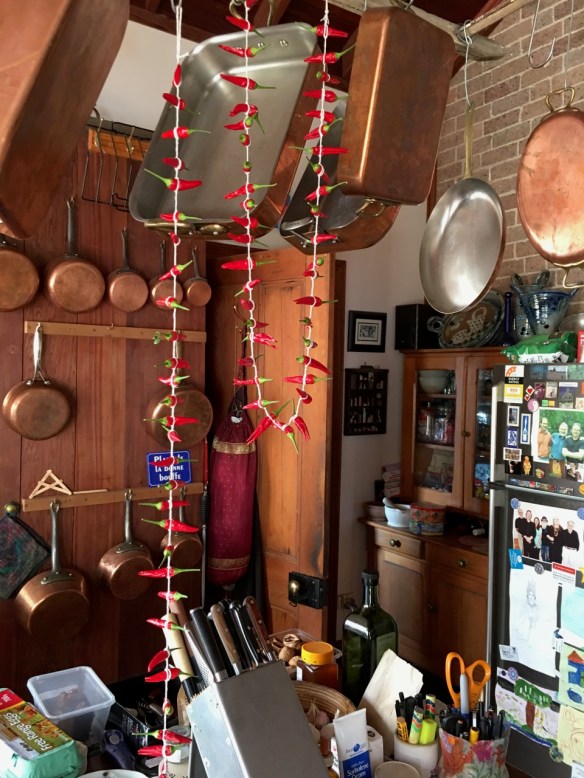
This extended ‘Indian summer’ has brought on the chilli crops. We now have many more chilis than we can eat, so we are starting to give them away to neighbours and friends,  and hang them up to dry for use later in the year.

IMG_0722

IMG_0724

One row of plants is quite enough for us. They seem to bear quite heavily, all culminating now in autumn. We’ve been picking them steadily all summer, from when they were quite green and only just big enough. Now they are fully ripe and have developed their full heat. We have grown 3 varieties this year.

IMG_0726IMG_0732

Small smooth round Thai chilli, crinkly hot cayenne, and mildly heated paprika  capsicums.

Mustard Pickles

Mustard Pickles are an odd thing. You need cucumbers from the heat of summer, and cauliflowers from the dead of winter to be flowering and bearing at the same time. I have no idea how this might have originated in history. I can only imagine that it is a modern invention. Sometime since global transport was invented, so that food stuffs could be hauled from warm to cold climates and vice versa.

I can’t make this kind of pickle to the traditional recipe. I choose to only make from what I can grow, so this is the time that we have our first early cauliflowers coming on. We have had our first plantings of cauliflower roasted, stir-fried, steamed, gratin’d, and as cauliflower soup, but still they come. So it’s time to pickle the last of the first plantings. When I think of cauliflower, I think of that thick, yellow, acidic/astringent/sweet/salty mustard pickle.

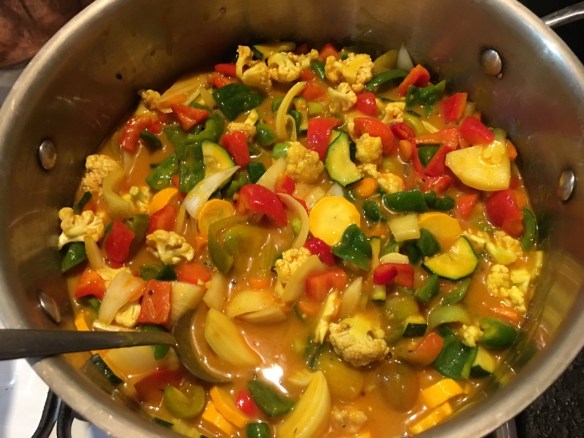
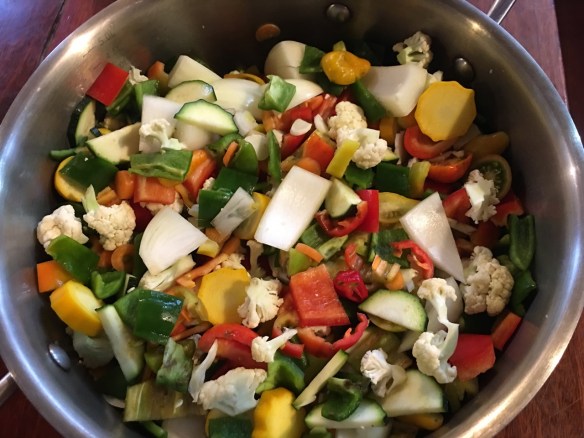
Cucumbers are listed as an essential engredient, But the cucumbers have all shrivelled and died in the hot and dry summer, weeks ago. So I do what I always do on these occations and I do what I can, with what I have. I have the last of the zucchinis, yellow, green and black. They will replace the cucumbers. I have capsicums, long and bell, both green and red, some sweet and some hot peppers, yellow, lime-green and red. Chilli  and onions, the last of the tomatoes, round red, pear shaped yellow and not quite ripe green. Plus some small carrots and a small celery plant. The last few items are not usually included in mustard pickles, but this is what I have. So this is what I will use. I decide to leave out the beetroots. I have lots of them, but I want the pickle to turn out yellow-ish, not red! This is not the usual blend, but its my own home grown autumnal blend. Zucchinis will work fine instead of the cucumbers.

Pickling has been used since the most ancient of times to preserve food from the summer harvest bounty, well into the winter and salting was always the preferred mode. If you add 2.5 % of the weight of the veggies as salt and massage it through the mix, the vegetables will sweat out their juices and then pickle themselves in their own brine over night, while at the same time setting up a natural ferment of lactic acid that consumes the sugars and stops any bacteria from growing in the acidic, low pH environment over the next few days.

Modern mustard pickles however, use a mix of salt, sugar and vinegar to preserve the vegetable mix. I wash and then chop up all the vegetables into small bite sized chunks, place them all in a 5 litre pot and add a good handful of salt. The mix is left to sweat out its juices overnight.

IMG_0711

IMG_0713

After sitting in its own brine over-night, I pour off all the salty liquor and rinse a couple of times. When rinsing, I fill the pan with water, just to cover the vegetables, I pour off the water into a measuring jug and measure the amount water needed to fill the gaps between the veggies. This tells me that the 3 litres of chopped vegetables in the pan leaves 1.12 litres of gaps that need to be filled with the pickling liquid. So that is how i know how much pickling mix to make, as I’m not using a recipe with exact volumes of vegetables. I’m just making something by the seat of my pants and improvising. It doesn’t matter, it always tastes good, and I don’t want to make up too much or too little to cover the vegetables. Having rinsed all the salt off the vegetables,
I prepare a pickling mix of ;

1/2 cup of flour

2 teaspoons of mustard powder

1 table-spoon of Tumeric

2 teaspoons of black mustard seeds

2 teaspoons of white mustard seeds

1 teaspoon of curry powder

1/2 teaspoon of home-made dried cayenne pepper flakes

1/4 teaspoon of home-grown and dried hot chilli granules/flakes.

IMG_0716

I add Just enough cider vinegar to make a thin paste, that when heated, thickens, while being constantly stirred. Add a spoonful of salt and another of sugar to taste. This is then poured over the vegetables and the whole lot brought to the boil and simmered for just a few minutes to complete the thickening of the sauce and vegetable mix.

Pre-heat glass jars in the oven and simmer the lids. Spoon the thickened mix into the hot jars and seal with sterilised lids while still hot. Perfect! Don’t worry if the liquid seems a little bit thin. It will thicken when it cools.

IMG_0717

IMG_0718

Serve as a condiment with a well aged cheddar style cheese or with cold meats. My own particular favourite cheese is 32 months aged, ‘Epicure’ Cheddar style cheese from New Zealand. Bitey and flavour-some. An excellent combination!

Sterilised in this way, these pickles will last all year, till the next cauliflower glut. If you don’t eat them all first!


Boiling and boiler-making

The first batch of new little wood fired dual/fuel kilns takes shape in my workshop. I could say ‘rolls off the assembly line’, but I’d be telling a lie. My kiln shed is only just big enough for 8 of these little gems at one time and there is definitely no assembly line, just a kind of organised chaos as all the parts get made individually and then assembled. I have 9 kilns ordered this time round. I can’t fit them all in comfortably, or even uncomfortably, so I decide to split the work into two parts. The 6 large and then 3 small units.

I spend an extraordinary amount of time making all the fiddly parts that go into handles and locating lugs etc. I spend 3 days on these parts, even with a bit of help from my lovely Swiss intern Catherine assisting. There are 100 lugs to be manufactured for just one small part of the first 6 kilns. Each part needs to be filed on all 4 sides and also have the corners filed down and rounded for safety, then a safely edge folded over to make it extra safe. In all there are about 1,000 individual actions that need to be performed on these tiny bits, just make one small part that no-one even realises is there.
That is until it is not there!
After three days of this monotony, I need a day in the garden!
IMG_0578 IMG_0582 IMG_0584
IMG_0609
While all this industry is going on, there is still gardening to be done to continue the flow of food from the garden in 3 months time. The equinox is the time to plant garlic, as well as leeks, brocoli, cabbage and Kale. Cauliflowers and Brussel sprouts were already planted in January. Today I am planting radish seeds to make sure of a continuous supply of salad next month. The lettuce seeds are already up and thriving.
The 2nd planting of corn is all over and we are onto the 3rd crop now. The few small 2nd cobs on the old corn plants are rather small, but I pick them and dry them in the sunny kitchen window to dry them out. when they are fully dried, I’ll mill them up into polenta for winter comfort food.
IMG_0602 IMG_0612
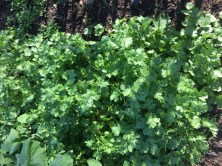
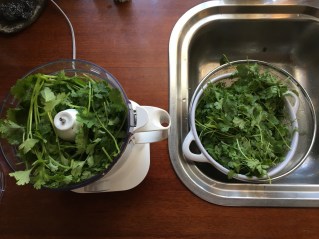
Today, I also harvested half of the coriander crop, as it is at peak leaf just now. This is the seed from the summer planting, which was the seed from the spring planting etc. I decided to make a coriander based green chilli paste.
Recipe;
A bucket of fresh picked coriander leaves
A hand full of green onions
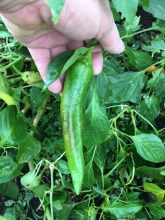
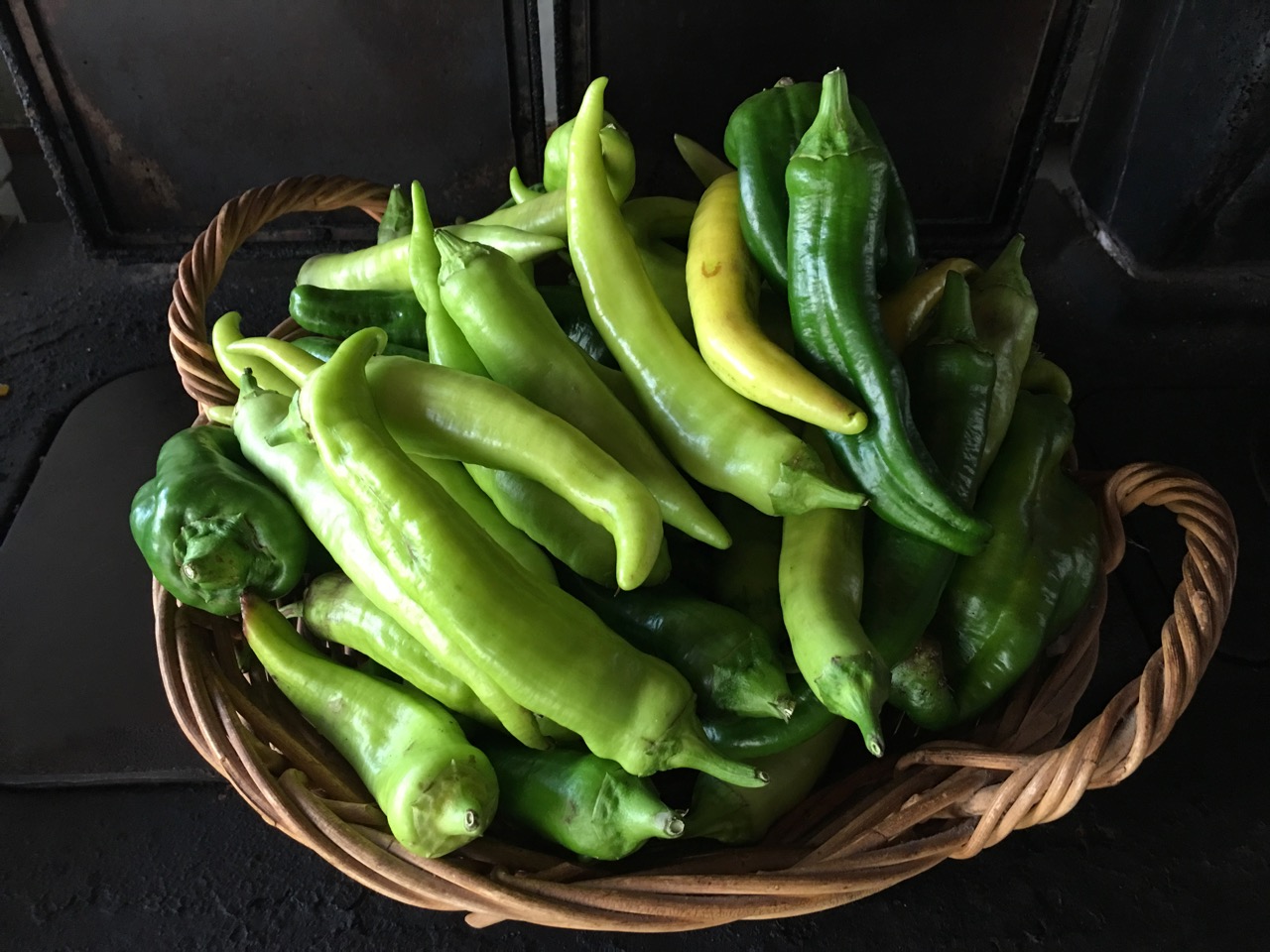
4 long green chillis (hot)
The juice of one each, lemon and lime
Some salt to taste, I keep this to the minimum, but without it the full flavour profile insn’t realised.
Salt is evil stuff, it hardens your arteries and causes hypertension. It is added in far too greater quantities than is really needed to every processed convenience food. We all get way too much of it without even realising it! It’s up there with sugar as a harmfull ingrediant, simply because we eat too much of it.
We don’t buy any junk food, and hardly ever buy much processed foods, but it is still very wise to limit the intake of salt. As a result we don’t have high blood pressure. I think that the two are related.
Still, a tiny pinch of salt goes really well with just a few particular foods like; tomatoes, eggs, curries, pickles and this coriander paste.
IMG_0605 IMG_0607 IMG_0608
I manage to fill 2 plastic tubs with the concoction. It’s tangy, spicy, hot and very aromatic. 3/4 of it goes into the freezer in this way, so that it will keep for the rest of the year, as needed. The rest goes into the fridge for immediate use.
Items like pesto and coriander paste are not cooked, so can’t be sterilised with heat to preserve them. We don’t own a freezer, so we have to limit what we choose to freeze. This raw paste, pesto, bone marrow stock concentrate and a couple of meals, cooked in excess at the time to be frozen for emergency meals.
The last of the summer beetroot crop needs to be dealt with before it bolts, so I give them a fast roiling simmer for a few minutes to boil them and soften them a little and then drained and straight into hot bottles from the oven with preserving vinegar. i.e. cider vinegar with a spoon full of sugar plus a 1/2 of salt and brought to the boil with a few spices like, cloves, cinnamon, star anise, pepper corns, bay leaves, chillis and mustard seeds. Such a mix is variable and is different with every batch, as it takes my fancy. Pour the mix over the sliced beets and cap straight away while almost too hot to touch. They vacuum seal as they cool.
IMG_0594 IMG_0595
Best wishes from Steve the industrious, well-preserved, boiler and boiler-maker.

The Equinox and Preserving Autumn in Jars

The Autumn equinox has just passed and the vegetable garden is doing well despite the prolonged dry spell. We have now had a little rain, but the dams are still very low or empty.

There are still some summer crops lingering on even though the night-time temperatures are falling, some of the days can still be quite hot. We pulled out a lot of spent summer plants and made room for the winter season plants.

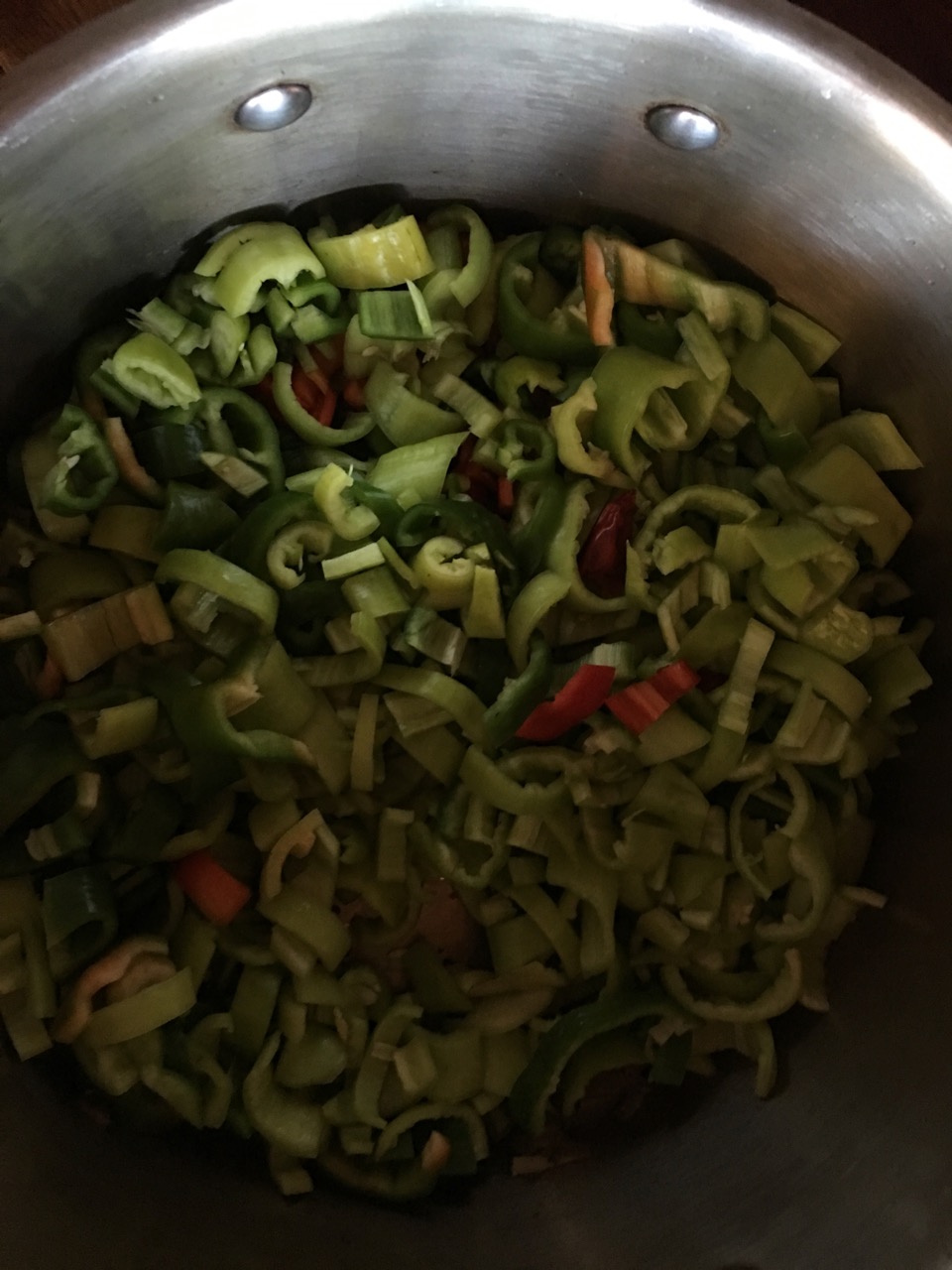
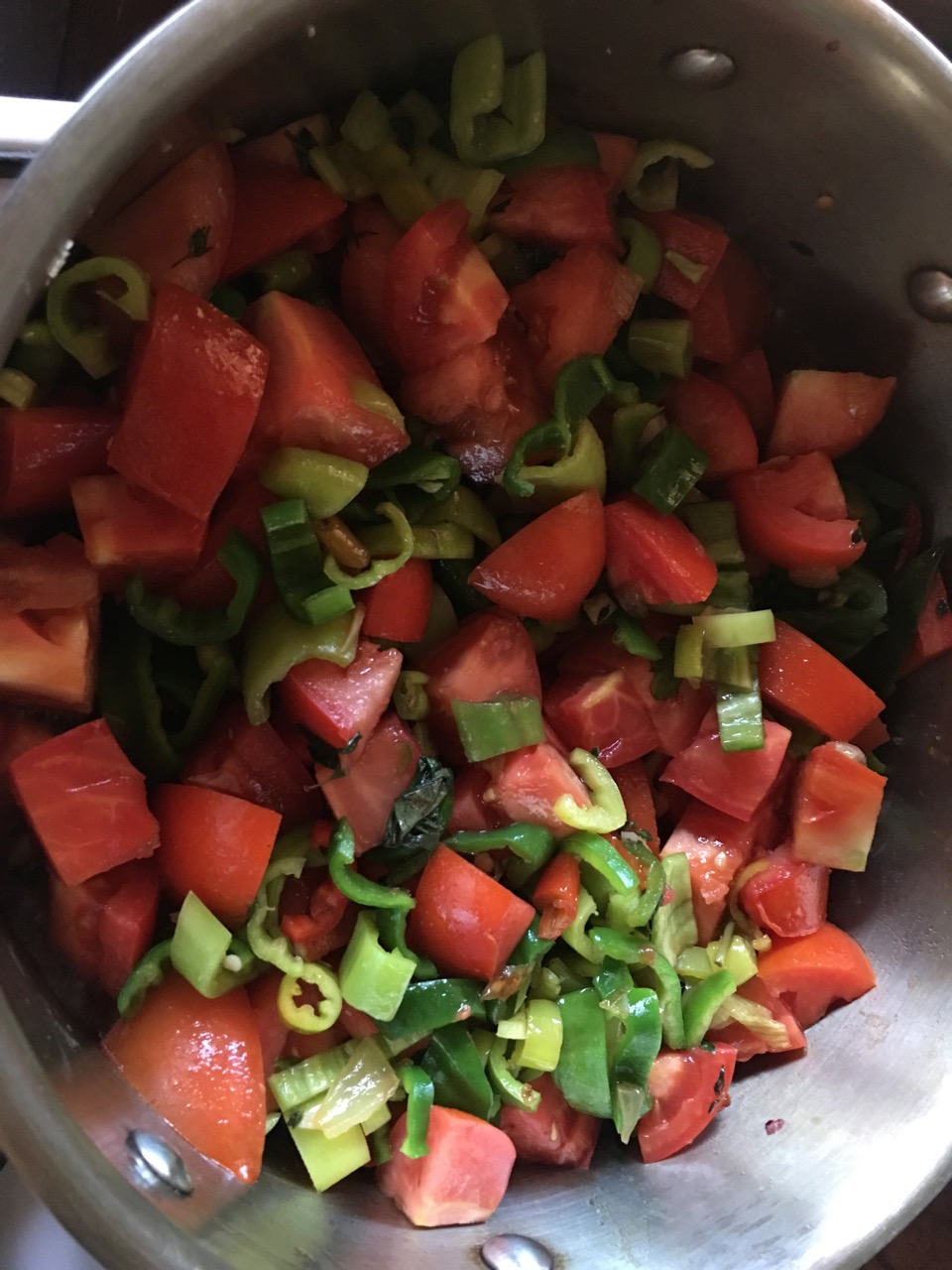
We have already harvested the first cauliflowers and broccoli. We still have some late lingering tomatoes and the last planting of corn to go. But the capsicums, aubergines and chilis are thriving. I managed to get some late zucchini seeds in after Xmas and they have been producing modest numbers of fruit, so ratatouille and all its variations is still on the menu. There is even enough for me to make a couple of batches of passata pasta sauce.


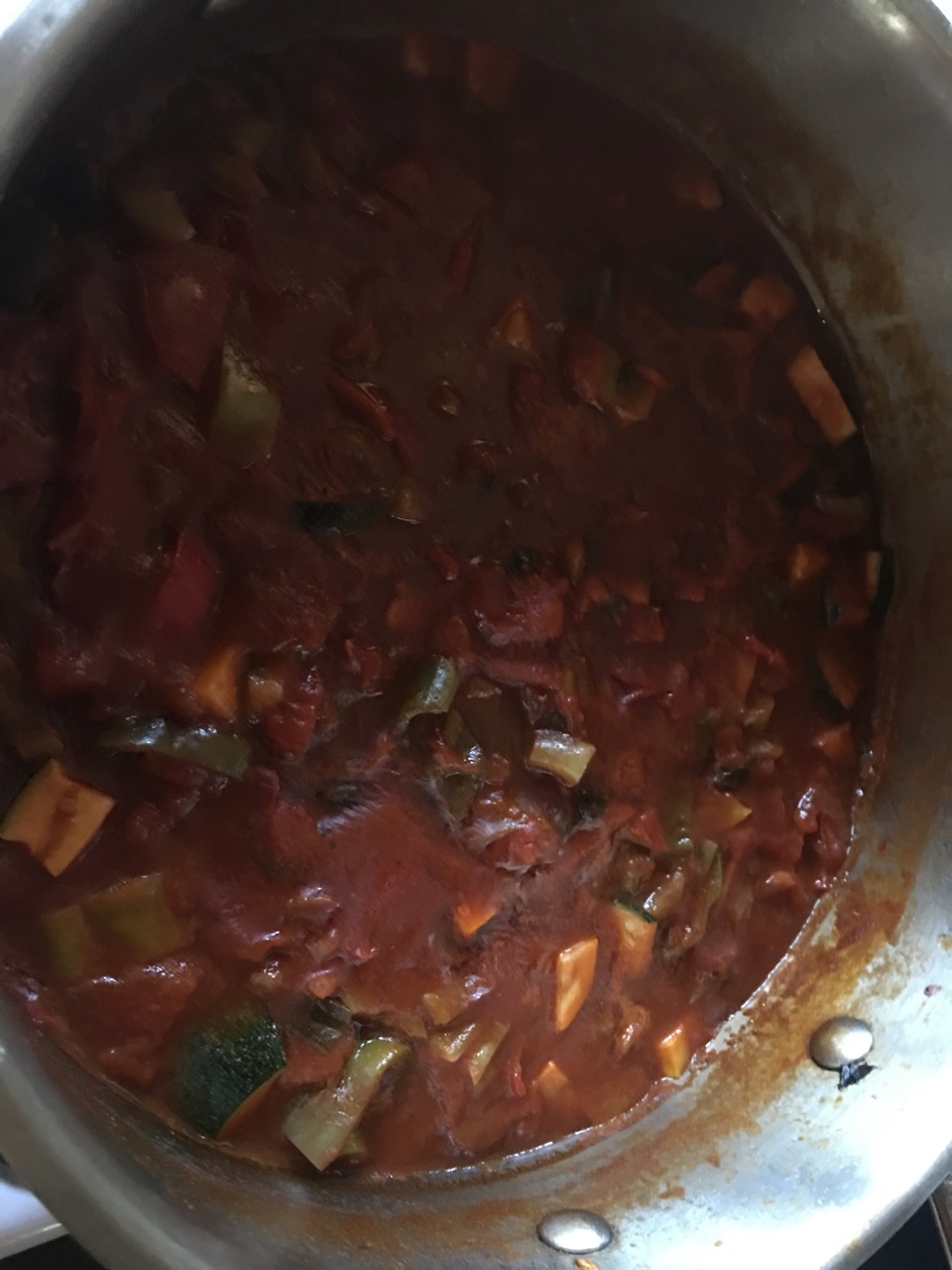
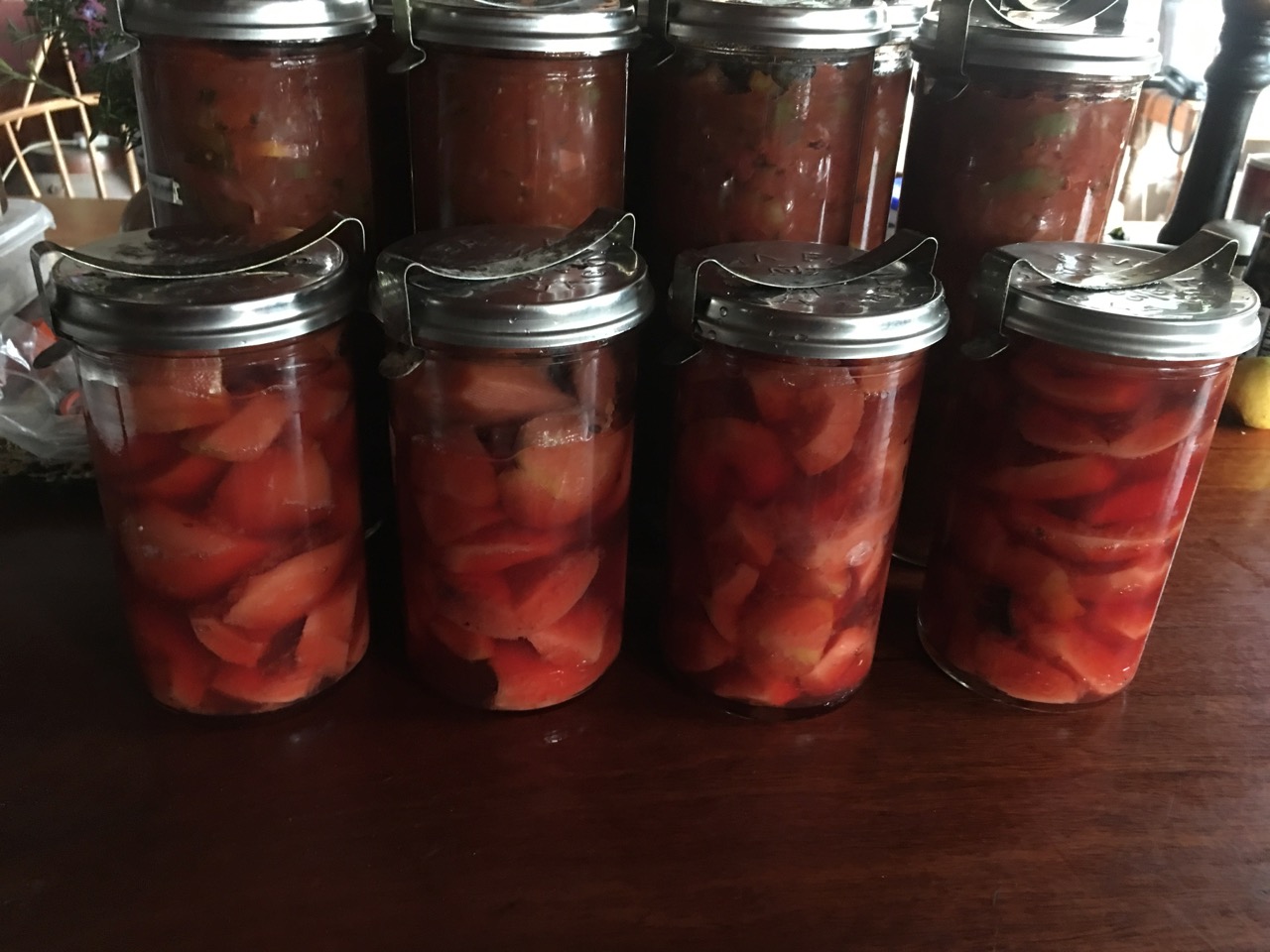
I use some of the last remaining brown onions from our Xmas harvest and a few small knobs of our garlic, lightly browned in good olive oil. The smell fills the house. It’s one of life’s simple pleasures. Hot olive oil with onion and garlic frying. I simmer all the roughly chopped veggies down with a bottle of red wine to make a chunky style pasta sauce. Once its been reduced well and thickened up some what. It is ladled into our 40-year-old, glass Vacola jars and lidded and clipped down to be simmered for 40 mins to be sterilised and vacuum sealed. In this way, it will keep for a year at least, if not longer, if required.

The spring clips are removed the next day after the jars have cooled over night. We test the seal to make sure that they are all perfectly vacuum sealed. Then they are transferred to the pantry cupboard.

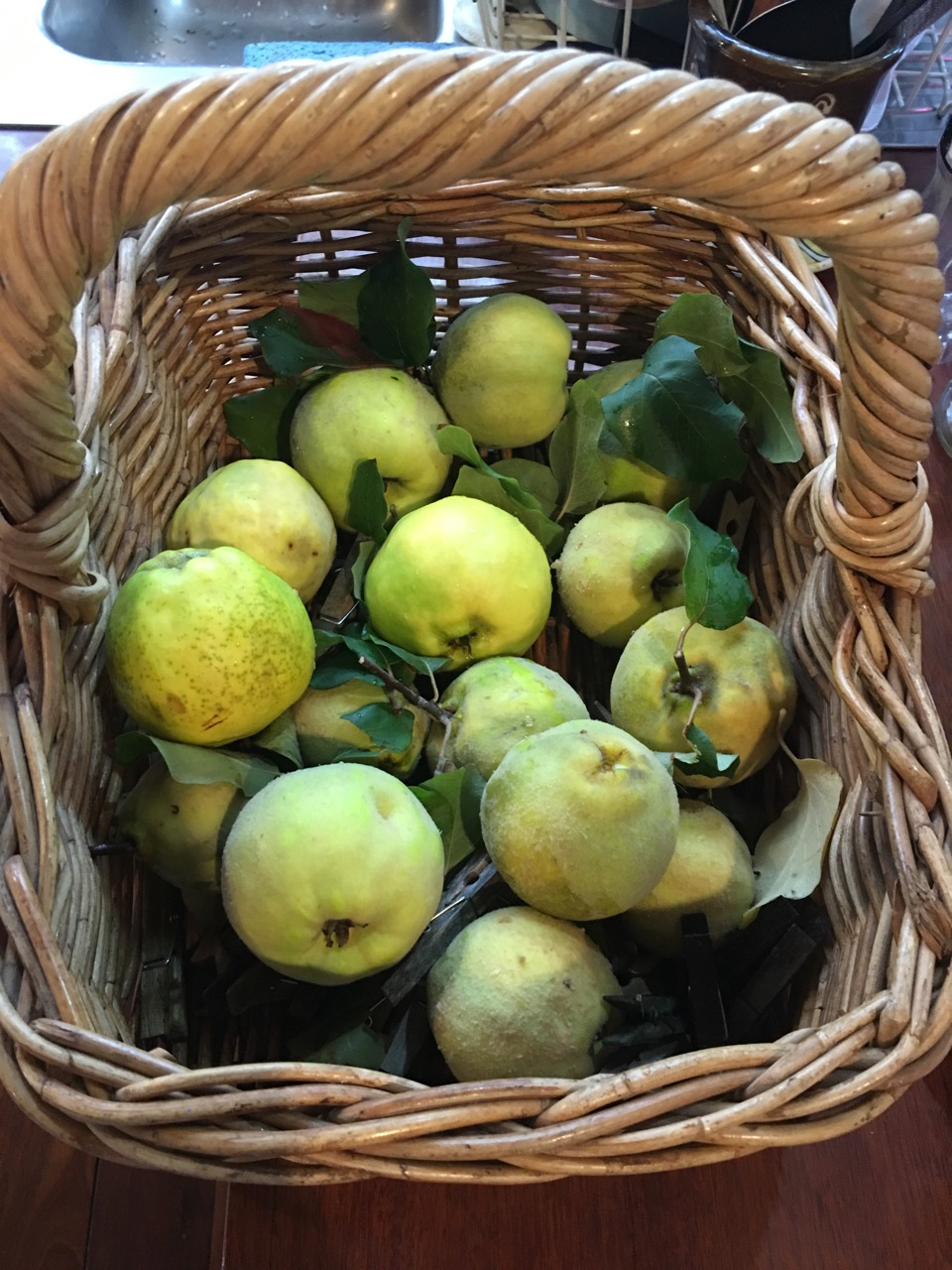
Autumn is also the time for preserving quinces. The quince crop is very small this year due to the drought, but there are a few fruit to pick. This is only because Janine was out in the garden early and netted and bagged the fruit to prevent the birds from getting them. The birds have been very aggressive this years, as I assume that the drought has driven them to hunger. We have more wallabies coming into the orchard too, looking to find extra tucker during the dry. Not to mention the influx of fruit bats or flying foxes, that have migrated up from the colony in Picton recently, possibly also driven by hunger?

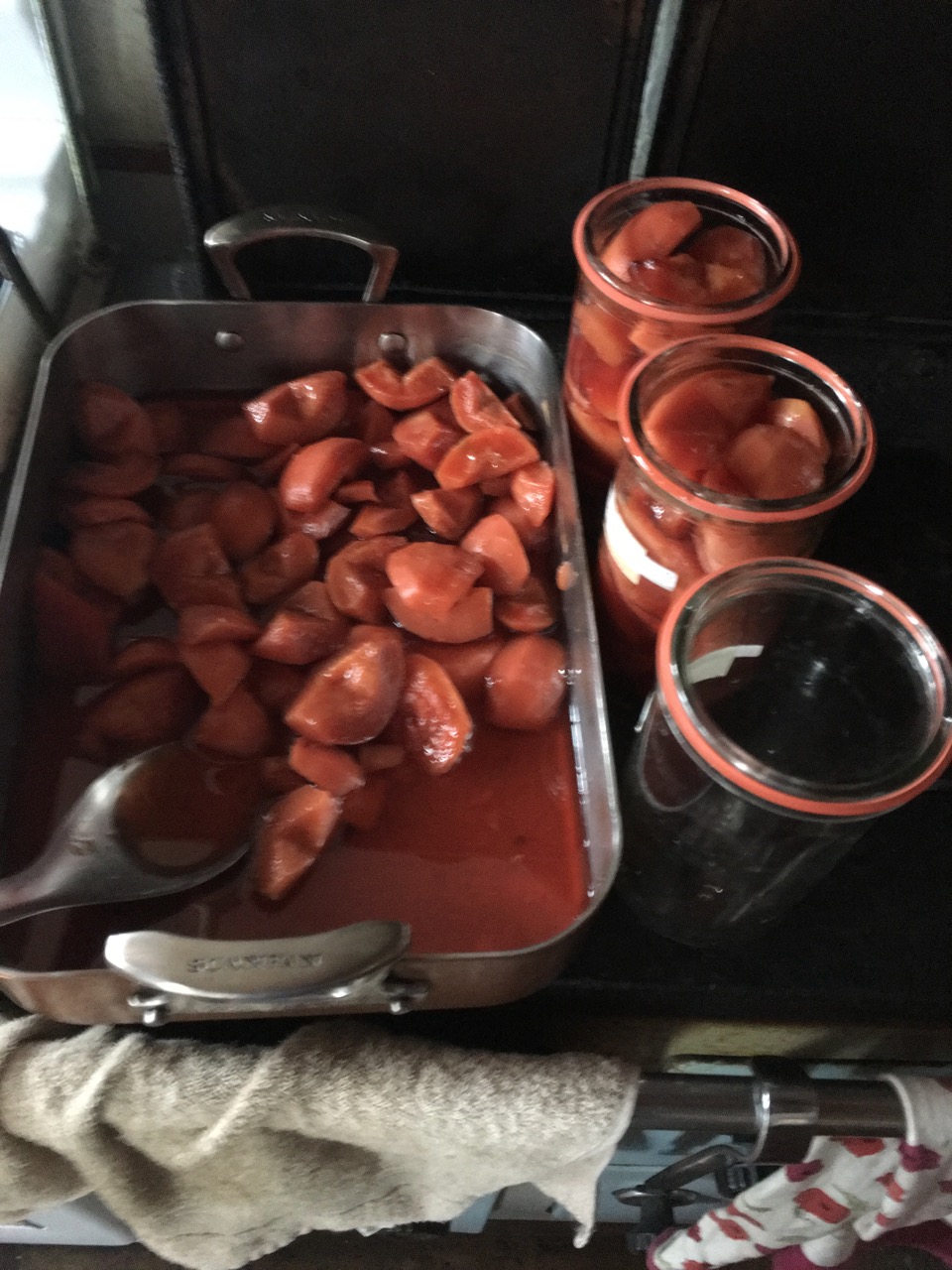
The quinces are washed to remove the ‘fluff’ coating then peeled, cored and sliced. I baked them in a light sugar syrup with some cloves, cinnamon and star anise, and after baking, they turn an inviting ruby/russet colour.  We have some immediately for desert and then again for breakfast the next day. Totally yummy! The remainder are vacuum sealed in ‘Vacola’ jars for use later in the year.


We have harvested the last two late season almond trees and spend the evening de-husking and shelling the small late crop. We have 14 almond trees in our nuttery. We have many different varieties, from very round and almost spherical, to very long and thin. Some are hard shell and others paper shell. Some are slightly salty tasting, while others are somewhat bitter, I suspect that this bitterness is from the naturally occurring cyanide that is found in all the almond/peach related stone fruits. What ever it is it doesn’t seem to be doing us any harm over the past 40+ years of eating them.


Warm autumn wishes from Steve the nutter.

Firing on Sunshine

We have had our new Tesla battery for a couple of weeks now and we have just done our first electric kiln firing on sunshine.

We have had 3 kW of solar PV panels on our kiln shed roof for over a decade now, but we have only recently managed to get our hands on a new PowerWall 2 lithium battery, after being on the Tesla waiting list for over a year. The battery is working perfectly, just as we imagined, and now allows us to run our house and pottery almost totally independent off the grid. We had decided to stay connected to the grid however, as we generate far more solar electricity than we use ourselves most of the time, and up until recently we got a very handsome rebate payment for the power that we sold.

Now that the generous rebate program has ended, it is much better for us to store our daytime solar electricity excess and use it ourselves at night, instead of paying the premium cost of buying back ‘green’ power from the grid at night.

Of course we don’t have to buy ‘green’ power. We just choose to, because we made a decision 13 years ago to remove ourselves from the coal economy. Which we have done. We are of the belief that global warming is real and that it is man-made. Burning coal to make electricity is a very big part of the problem, and green power is going to be part of the solution. It’s affordable, it’s here now and it’s the future. In addition to going solar, we have also declined to use concrete slabs in our building construction and we choose to drive the smallest fuel-efficient car that we could afford.

When we put the first Australian made solar panels on our roof 11 years ago, we didn’t do it to make money. We did it for ethical reasons. However, as it turns out, we paid off the panels and made a slight profit over the decade, because we were paid one or two thousand dollars a year for the power we sold to the grid, but we also didn’t have an electricity bill for that decade. A saving of many more thousands of dollars. These original PV panels still have another 15 years of full productive life in them, before their output starts to decline. I’ll be long dead before they stop working. We recently added another 3kW of PV at the same time as the battery. As I intend to buy a fully electric car as soon as they become available at an affordable/reasonable price.

So now with everything in place, we have just completed our first electric kiln firing using our own solar power, firing through the day on sunshine up until just after lunchtime and then into the afternoon on a mix of solar and battery, then ending in the evening mostly on the battery power. Yes, it works. You can fire on sunlight. The future has arrived!

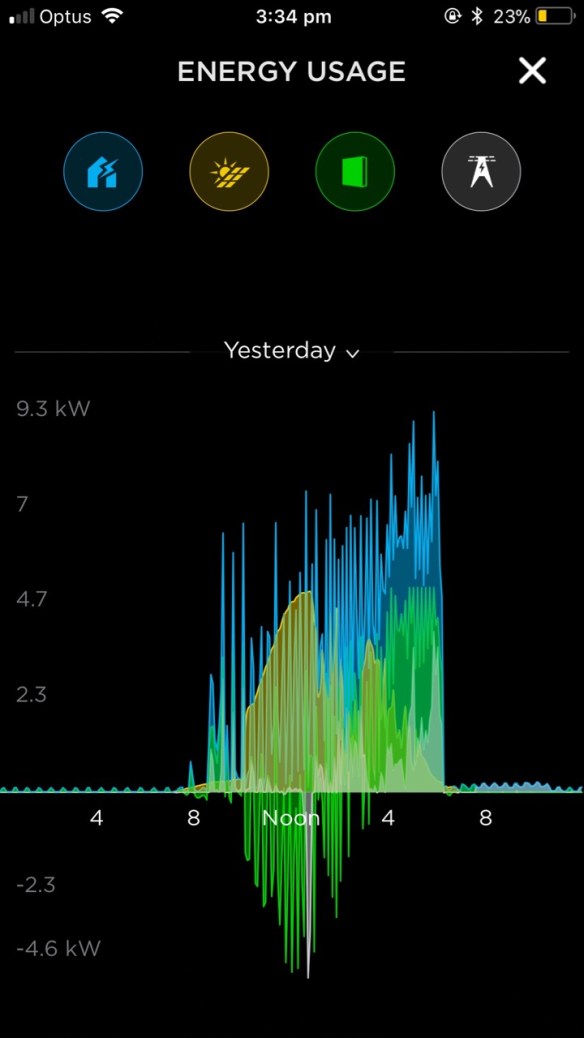
Below you can see a graphic of our power usage though the day.

IMG_0522

The high blue spikes are the electric kiln switching on and off. The golden-yellow hump in the middle, above the line is the solar panel output from the roof. The green areas below the line is the battery being charged up from the solar PV panels in the morning and corresponds perfectly with the yellow solar area above the line, up until noon. The solar panels are both firing the kiln and charging the battery up to noon.

After 12 noon, there was some cloud that came over and the solar output dropped down. By about 3 pm. the PV panels no longer generated sufficient power to both fire the kiln and charge the battery. After 3pm the clouds cleared and solar output increased again and fired the kiln with the assistance of the battery. From 4 pm onwards, the battery fired the kiln with assistance from the solar. Solar production ceased at about 6.30 and the firing finished at about this time also, more or less solely on battery power.

The small zigzag ripple on the base line is the household usage, mostly this comprises the fridge compressor switching on and off. I should also point out that I was also working in the kiln factory throughout the day and using some very heavy 3 phase sheet metal machinery, welders and plasma cutter. This is included in the blue spikes. The lower line of blue spike peaks is the kiln alone, and the higher level of blue spikes is the kiln and the heavy electrically powered machinery working at the same time.

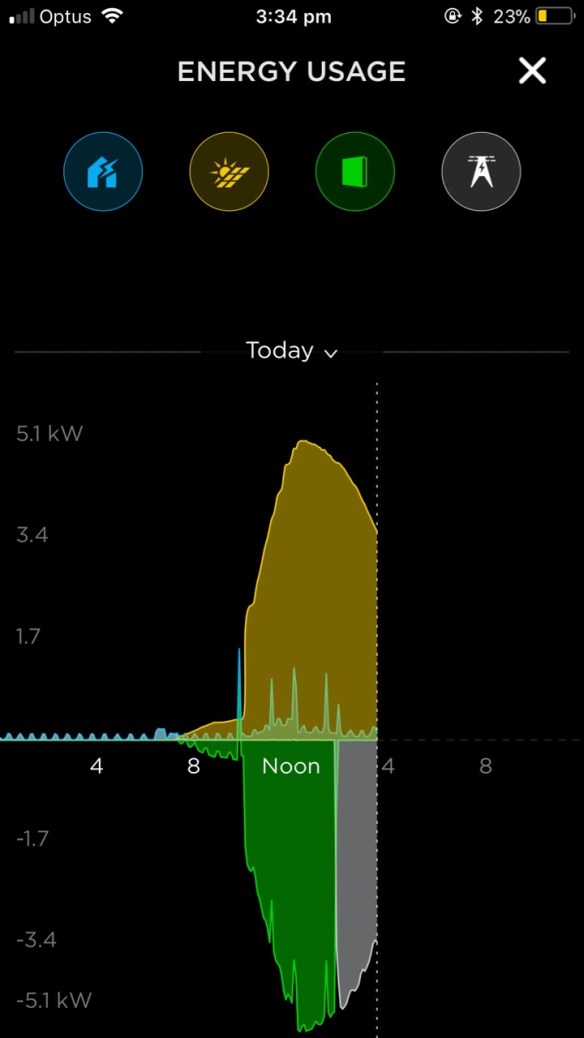
The following day, the PV panels charged the battery back up to full power again by about 1.30pm. Solar output is shown in yellow. The battery shown in green is being charged below the line. Once the battery is fully charged, the solar output is then switched to sell back into the grid for the rest of the day. Shown in white below the line. Household usage is shown in Blue above the line. You can see that we run a very energy-efficient household. The blue spikes represent the toaster and jug in the morning, then the washing machine and then me using the heavy 3 phase welders, and sheet metal machines intermittently in the kiln factory through the day.

By way of explanation, I downloaded this screen shot at 3.30 pm, so that is why the graph suddenly stops.


IMG_0521

From this brief explanation I hope that I have illustrated that it is possible to live a ‘normal’ life, carry on working and fire an electric kiln, all from a solar array and a lithium battery.

Food for thought?

Some technical details;

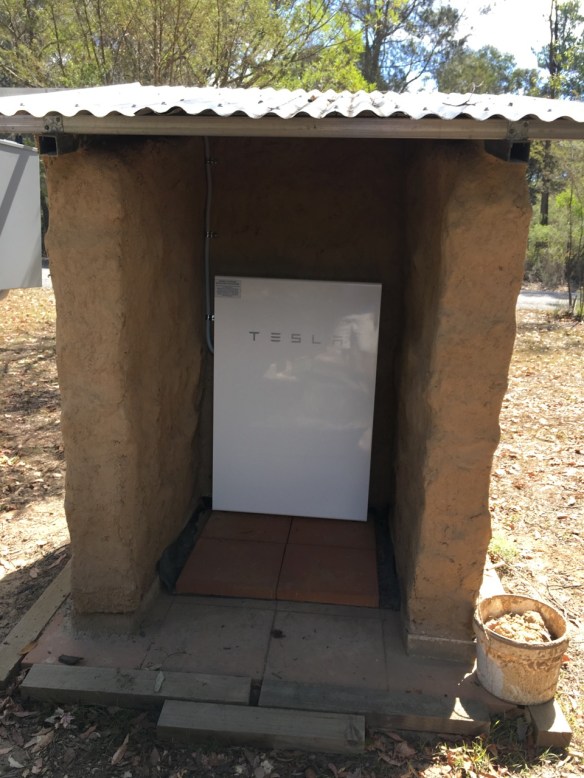
The battery is a Tesla Powerwall 2 lithium-ion battery with a 15 kWh rating.

The solar array is 6 kW. Made up of 3kW of 11-year-old BP solar panels made in Sydney, and 3kW of new ‘Tindo’ solar panels made in Adelaide. In both cases, we paid a premium to purchase Australian made panels to support Australian industries and Australian jobs. If there had been a comparable Australian battery. I would have bought that instead.

The Tesla Powerwall 2 lithium-ion battery is 15 kW/h rating. Made in the USA. The closest Australian contender was ‘ZPower’  also from Adelaide, but at almost 3 time the cost, it was out of our price range. All these things will change quickly and dramatically over the next few years. Watch this space. You can be sure that whatever will replace our battery at the end of its life in 15 to 20 years time, hasn’t even been thought of yet, never mind being built!

The kiln is one that I made myself. It is a half metre cube 500mm. x 500mm. x 500mm.  constructed out of light weight RI bricks.


New Solar PV and Battery Installed

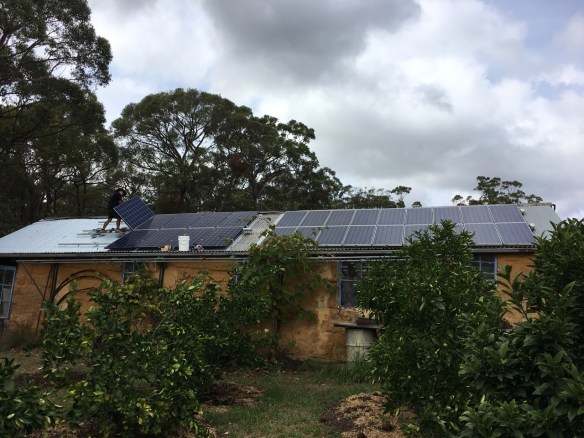
We have had our solar power installation upgraded from 3,000 watts to 6,000 watts of panels. The old panels are now 10 years old and have worked perfectly for the decade and still produce to their specification at midday. We were told to expect a 10% drop in output over the first decade of their life and then a steady drop-off in output for the next 25 years. There doesn’t seem to be any noticeable decline as yet. So we are really happy with them.

At the time we paid a little bit extra for them, to get Australian made PV panels, made in Sydney at that time. These have been faultless with 0% failure so far. This is not to say that any other panel wouldn’t be just as good. I don’t know, so I can’t say. However, it is our intension to support Australian industries and employ Australians wherever we can, so we paid the small extra premium for locally made product and that has worked out well for us so far.

On this principal, we decided to buy Australian made panels again. As I understand it, there is only one tier-one PV panel manufacturer here. ‘Tindo’ in Adelaide. They are still just 10% more expensive than the imported Chinese PV units, so I had no hesitation in choosing to employ Australians and support Australian industry once again. It isn’t worth saving $600 to put Australians out of work.

IMG_0354

Over the decade the efficiency of the PV has increased significantly. The new panels are almost twice as efficient as the older ones, so the new installation is much smaller. 12 PV panels instead of 18.

We now have 6 kW of PV and we decided to buy a battery to store our own power and use it directly ourselves. Now that the solar feed-in tariff is so low and the price of green power is increasing, it makes sense for us to make the move. In fact we decided to do all this 13 months ago. It has taken Tesla over a year to supply the battery. We ordered the new Tesla PowerWall 2 as soon as it was announced. Tesla is good at advertising and self-promoting, but a bit slow to deliver. Anyway, it’s here now. It’s installed and working just as it should. The battery filled up on the first sunny day and has been powering the house since then. Once the battery fills up in the morning, it then starts to sell the excess back to the grid. Even today, when it is overcast and raining and the PV output is way down, the battery has filled up by early afternoon and we are now exporting again.

IMG_0357

IMG_0358

We bought our original PV array 10 years ago to extract ourselves from the coal economy, which we did. Now we are able to be independent from the grid. The new latest version of the PowerWall 2, has a built-in function to isolate us from the grid when it goes down. In the past the system shut down when the grid went down. Now we are able to stand alone and continue to run everything directly from the panels during the day, whenever there is sunlight, and from the battery at night. If there is a blackout, we won’t know about it.

We have enough power now to charge an electric car – at some stage in the future.