Q1. You are known around the world not only as a potter, but also as a kiln builder. What fascinates you most about building kilns?
Initially, I just wanted a way to get my pots fired. But kilns are very expensive pieces of equipment, so I decided to learn how to build my own, as I couldn’t afford to buy a commercial one. I learn a lot over the first few years, and found that I could build very good quality kilns for my self. However, my friends and colleagues all wanted me to build kilns for them, too so I started a kiln building business as a side project to help me to pay the mortgage. I’ve found it hard to make my entire living from just selling pots its too unreliable.
As time went on, I realised the carbon debt that I was building up, so I decided to try and find ways to minimise the damage that I was doing by making my ceramics and selling kilns. So I have spent 50 years developing my low emission/no smoke wood firing designs. One other aspect of wood firing besides the aesthetic qualities that are specifically inherent in the process, Which I love and admire so much about the fired surface, is that wood fuel is a carbon neutral fuel. This is so important these days in our carbon constrained, globally heated society. In a very small way, I’m trying to make the world a better place through my work.
Q2. Tomorrow, your new works will be loaded into the kiln here in Yanggu. What thoughts and emotions do you have before a firing?
I am always a bit anxious. There is so much at stake. So many hours have been spent making this work. I always hope for the best, but I am also ready to accept that there will be some disasters as well. There is two months of work at stake here. Am I mad? or is there some kind of poetry being created here? I’m hoping so! However, Nothing is perfect. Nothing is ever finished, and Nothing lasts!
Q3. You have worked with clay from many places around the world. What makes Yanggu clay special to you?
I was so impressed when I came here for the first time 10 years ago, to find a place with such a strong unbroken tradition and history of porcelain making going back 700 years. However, the main thing that struck me was the amazing quality of the porcelain clay that is found here. It is so responsive and beautiful to work with, but also it can be so beautifully subtle when it is glazed and fired.
Q4. After spending time as an artist-in-residence at the Yanggu White Porcelain Museum, what has inspired you most here?
Besides the clay. It’s the people! The management, the staff and the other residents. It is such a collegiate environment. Everybody working in together but while also working independently on their own projects.
Q5. You have often expressed your admiration for the Korean Moon Jar. What first drew you to it?
I first saw images of moon jars when I was a ceramic student at Art School and was impressed with their beauty, but didn’t really understand them and their inner meaning and symbolism until later. I was brought up in a family strongly influenced by Buddhist/Quaker values. A very thoughtful and spiritual environment. As I matured and found my own way in the world. I developed an interest in living not just an organic and wholesome life style, but an environmentally sustainable one as well. It was at this time that the spiritual side of making art came into focus for me. It was about this time that I re-discovered the Korean moon jar, and finally understood their special place in the world as a symbol of not just beauty, but also spiritual content. So I started to read up on Confucian philosophy and found that I already had so much in common with this way of thinking and being, from my childhood upbringing.
Q6. What do you think the Moon Jar can teach people today, in our modern and fast-paced world?
I believe that all the tenets of Confucian philosophy are just as important today as they ever were. If not more so! We need to slow down, and consider our actions and their implications for the world as a whole and the others in it. We are desperately in need of a more ethical, calm and considered approach to life. Modern politics has failed us in this regard. It has been corrupted by commercial interests.
Considering the simplicity, restraint and elegance of the Korean big white jar helps to create a state of mind where the really important things in life become more evident. Because the most important things in life are not ’THINGS’!
Q7. Your exhibition will open at the Yanggu White Porcelain Museum this October. What do you hope visitors will feel when they see your work?
I would like to think that they might feel the sense of respect and calm that I have tried to embed in the making of these simple, elegant objects. However, I am reconciled to the fact that most people will rush past them without really seeing them, just as I did, before I stopped to consider the essence of living a well examined life. I have tried to live a life of minimal consumption and ethical values. I try and do everything that I can to be independent, self-reliant, organic and sustainable. Whether of not any of this is conveyed in the final work is probably doubtful, unless they read my artists statement.
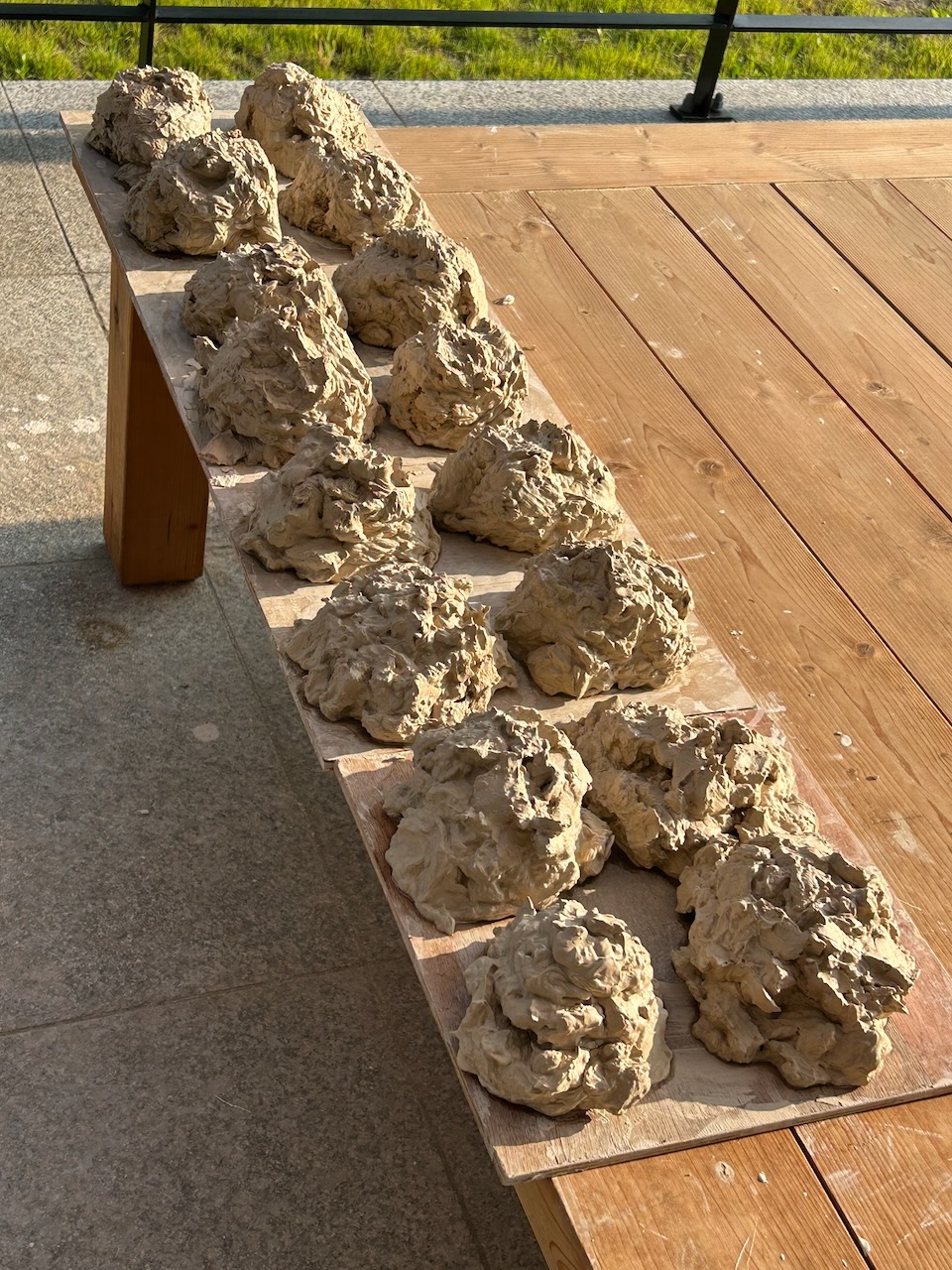
I think that I have made my last big jar. There may be a few more smaller size jars to come, to use up my leftover turnings, after I have re-cycled them. As I will have to clean out my studio, back to spotlessly empty in a few weeks time. I can’t leave anything behind. So waste not!Recycling turnings as a thick slurry out in the wind, before pugging.
I have been finding that it is just too dangerous for me to keep flipping 10 to 15 kg bowls over, whilst held out in front of me, doing the top-hatting technique. Too much stress on my lower back, arms, shoulders and solar plexus. I was afeared of getting some sort of hernia.
Earlier, a week ago, I had a minor miss-hap on the bike. Riding down into the village of Bangsan, (2km.) to do a little shopping in the micro-market. So called because it’s much smaller than a mini-mart. They stock nothing fresh, just dried and canned goods, but they do have fresh milk.
I was just coming to a gentle halt outside the shop, when my tyre got caught in an invisible, perfectly sized, small groove in the gap between tarmac and curb. I was almost stationary, but as I arrived at a slight angle to the kerb, it flipped me off my bike sideways, causing a rather nasty stretch of my solar plexus muscles and around to my rib cage side. I thought that it would just mend itself and go away if I ignored it and didn’t stress it any more. And it has – very, very, slowly. I can do everything except lift heavy weights out in front of me, or swivel sideways!
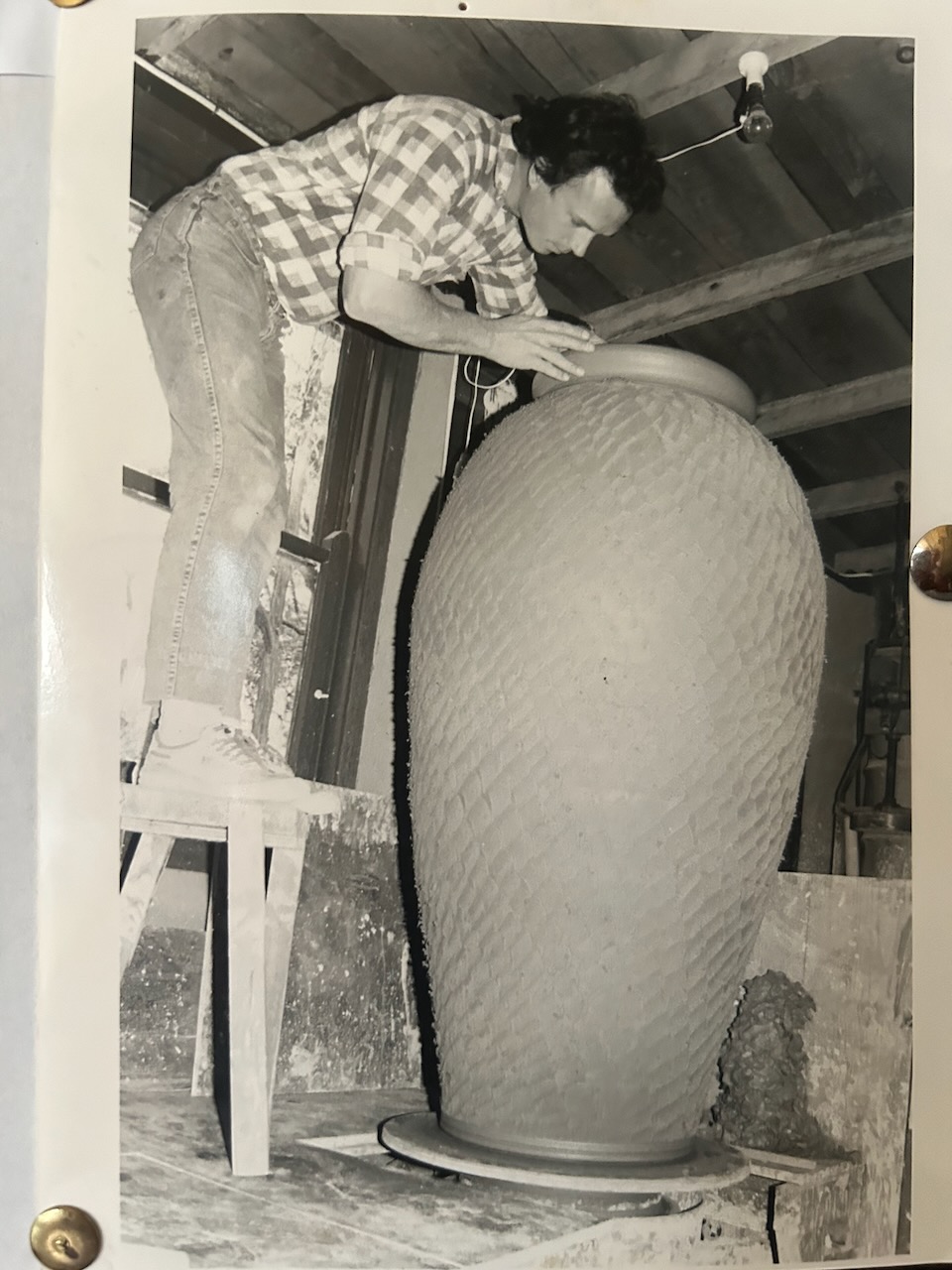
So I have made the last few big jars by coil and throw technique. Years ago, I developed my version of this technique, a form of throwing without water. A sort of hand building on the wheel method. I needed another way of making larger work back then, After I damaged myself during the re-building the burnt-out pottery that we lost in the 1983 fire. My wrists and arms were so damaged from jack hammering out stone from the footing trenches, and then followed that up spending a few months pounding 4 inch nails into solid hardwood frames. My wrists have never been the same since!
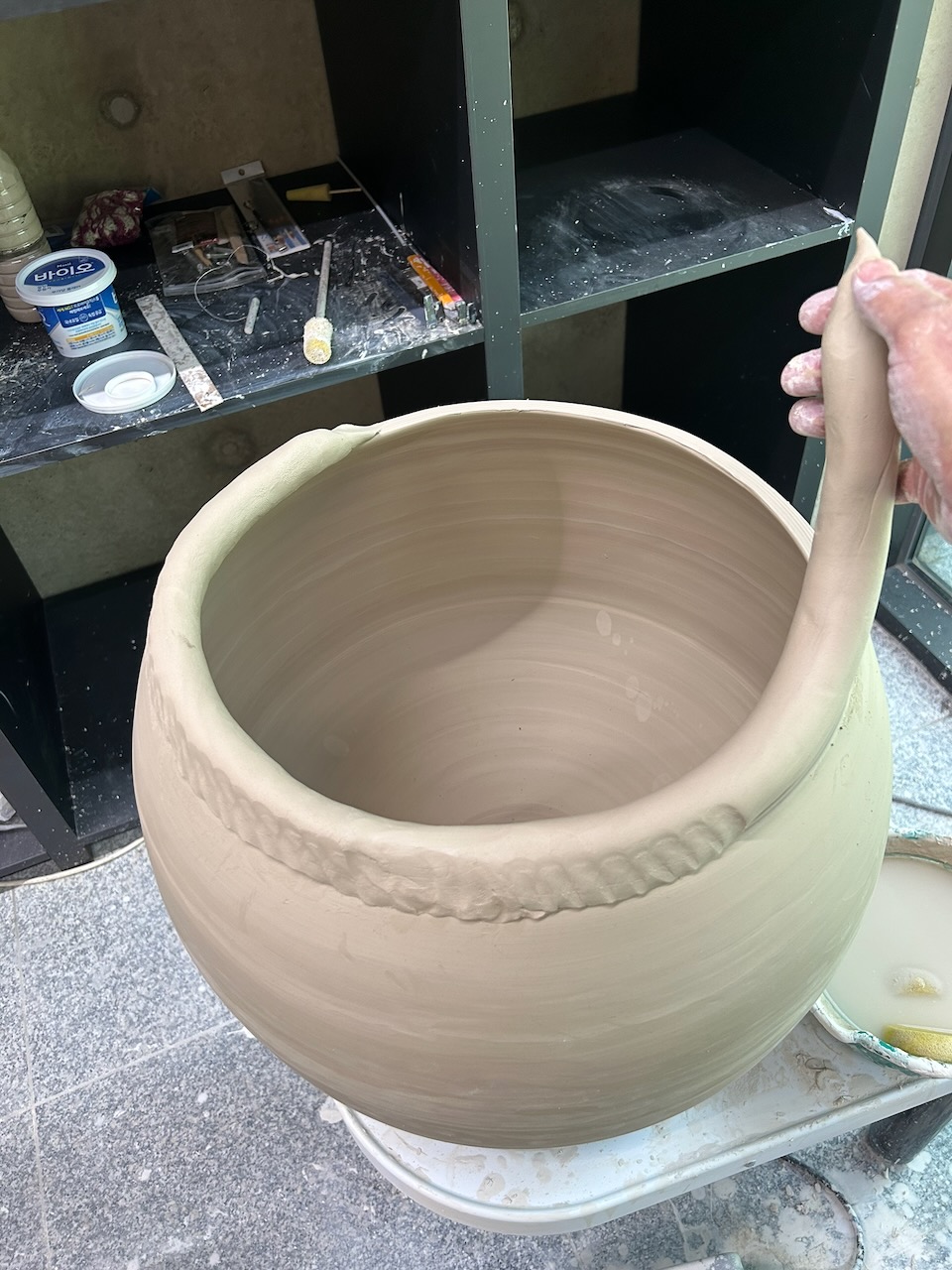
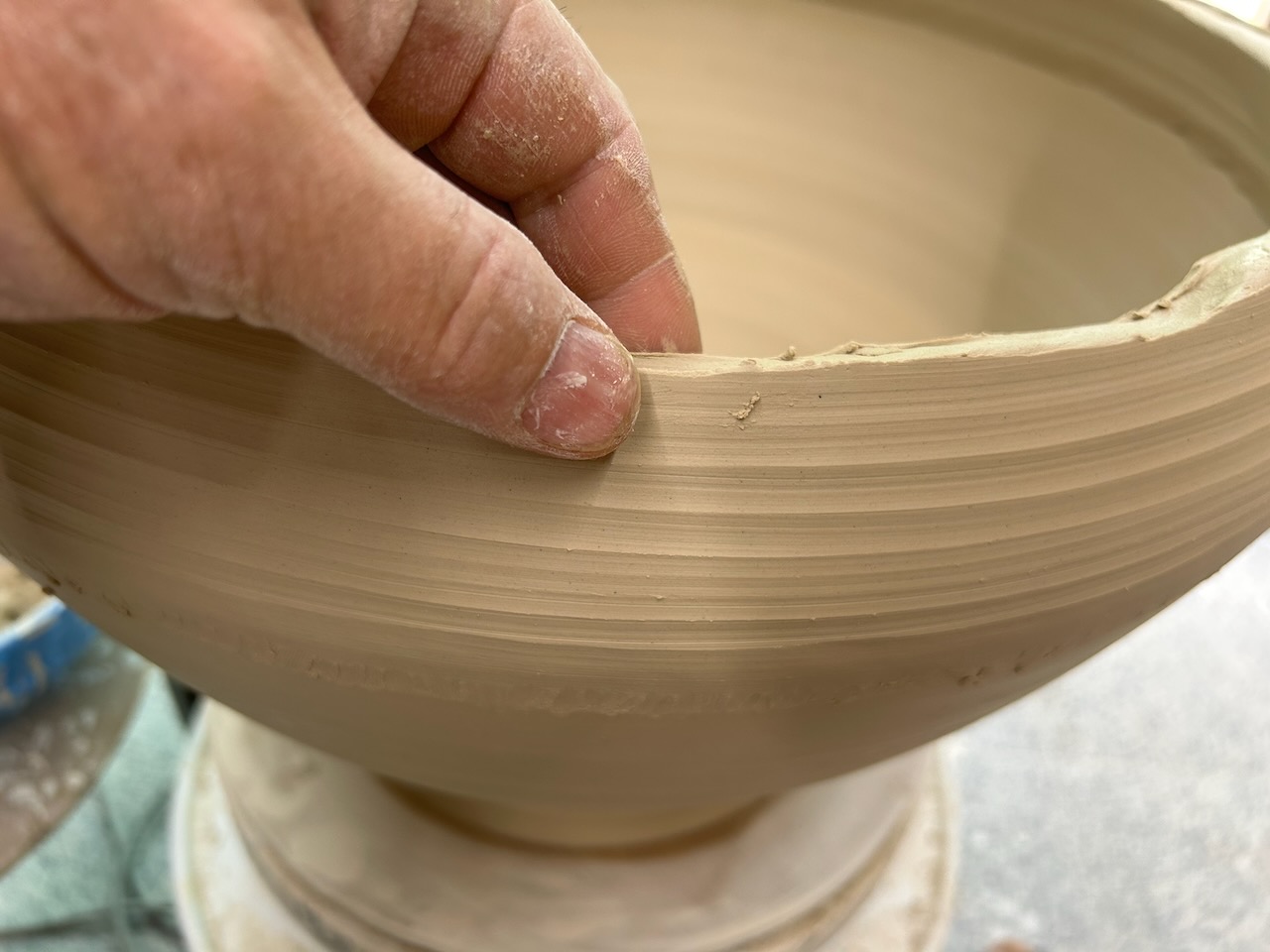
So I’m back to the gentle basics of coiling. Something more appropriate for an old man with a worn out body. I pinch on the coil, evenly, all around the rim. Then with the wheel turning very slowly, I allow the coil of clay to pass between my fingers and thumb, very gently and slowly thinning it a little and coaxing it up wards. I repeat this slow, gentle, thinning process, until the clay is ’thrown’ into the correct shape. Finishing it off with a metal rib to smooth out my finger marks. If I use a heat gun to warm it, and have it rotating in the door way in a gentle warm breeze, I can add up to 6 coils in a day and finish the jar off. As there is no water used in the process, the clay stiffens quickly and is ready to take another coil every hour or so, if the weather is warm. Which it has been here.
Not the traditional way here, but my way, and the one that works best for me at this time. Creative variation?
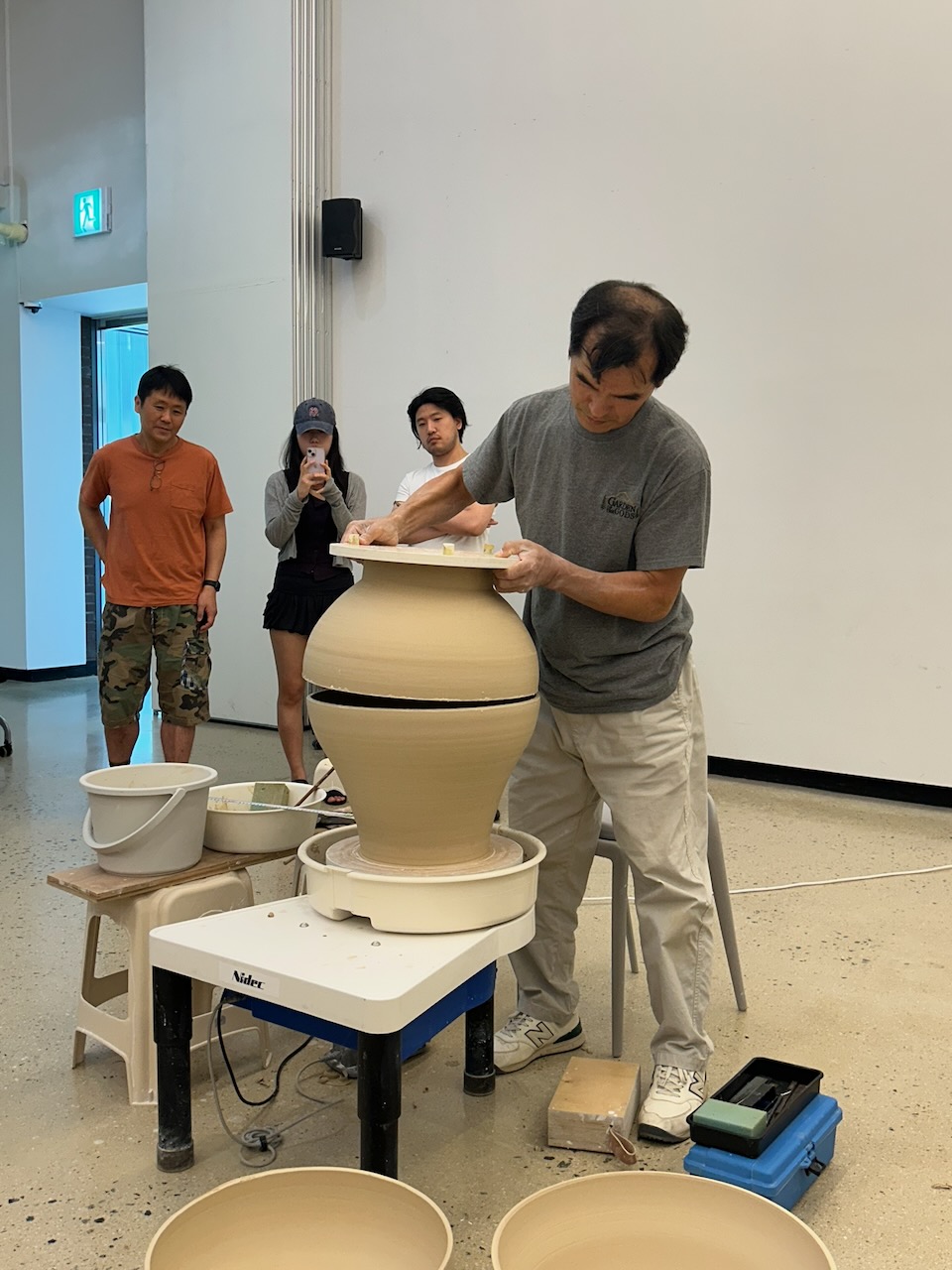
We had a demonstration here yesterday of moon jar making by a well respected maker. I did notice though, that he only used 6 kgs of clay, kept the demo small, and only made a very vertical version of the shape. All well thought out and considered variations to make the demo easily achieved with little chance of a collapse or any failure in public. He was definitely not pushing any boundaries! he was beautiful to watch, very skilful and assured.
This demo was all part of the 20th birthday celebrations here at the Yanggu Porcelain Museum. There is something happening every day, all week. I don’t go into town for everything. I have too much to get done here in the studio, but I sometimes go in there for the afternoon session.
I had just about run out of coffee, and was thinking of how to buy some more. It’s a problem here. Everyone drinks instant. Just a few of us want percolated real coffee made from roasted beans. The problem is that no one sells coffee beans! You can’t buy roasted ground coffee, or roasted whole beans. not here in Bangsan from the micro mart – not too surprising for such a small village shop. BUT, I can’t find it in the near by city of Yanggu either. Not even in the big supermarkets there. You can only buy whole roasted beans online from Seoul. I can’t buy online from Seoul, as I don’t have an on-line account. I can’t get an account without a bank account. I can’t get a bank account without a resident visa. I can’t get a resident visa…..
So I asked my neighbouring artist in Studio 4, to buy it for me, and have it delivered. Everything arrives next day here. It’s an amazingly efficient service. But, My lovely neighbour has now left. Her time was up and she has gone. She was so busy in the last few hectic days here cleaning and packing up, that she forgot to order the coffee for me. So what to do?
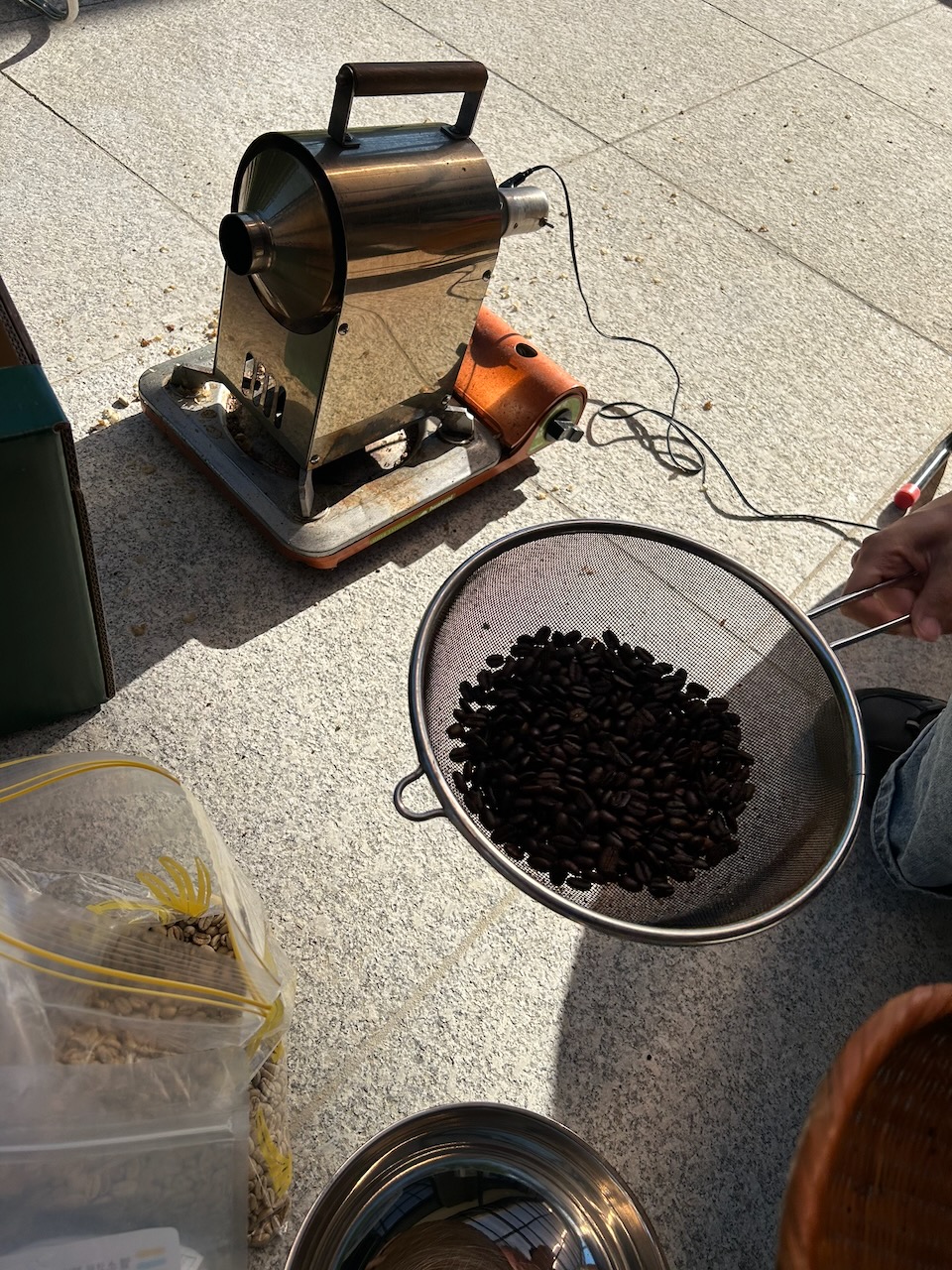
Fortunately, the artist in studio 2 is back. She has been away for the past few weeks. It just so happens that her mother is a chef and has run a restaurant, so her daughter has borrowed her mini coffee bean roasting machine. She gets the raw beans from her Mum too. She suggests that we do a batch together and share the result. I’m in! It is such a very cute little machine. I want one! It sits on top of a portable camping stove. It has a tiny motor to keep it rotating slowly. It takes 2 cups of beans at a time. We roast them until the outer ‘paper’ shell cracks and get blown off with a gentle ‘popping ‘ sound. We continue until there is a continuous crackling/popping sound and smoke starts to come out of the opening. Then it’s off with the gas flame and pour the smoking dark beans out of the roaster and into a food sieve or woven basket, and shake and pour the hot beans from one to the other through the air, blowing on them to cool them down. It takes a few minutes and smells so amazing. I always say that the best part of coffee is the smell of the freshly ground beans in the morning! This is it, turned up to eleven! We have to do it outside on the verandah, otherwise the smoke would take us out.
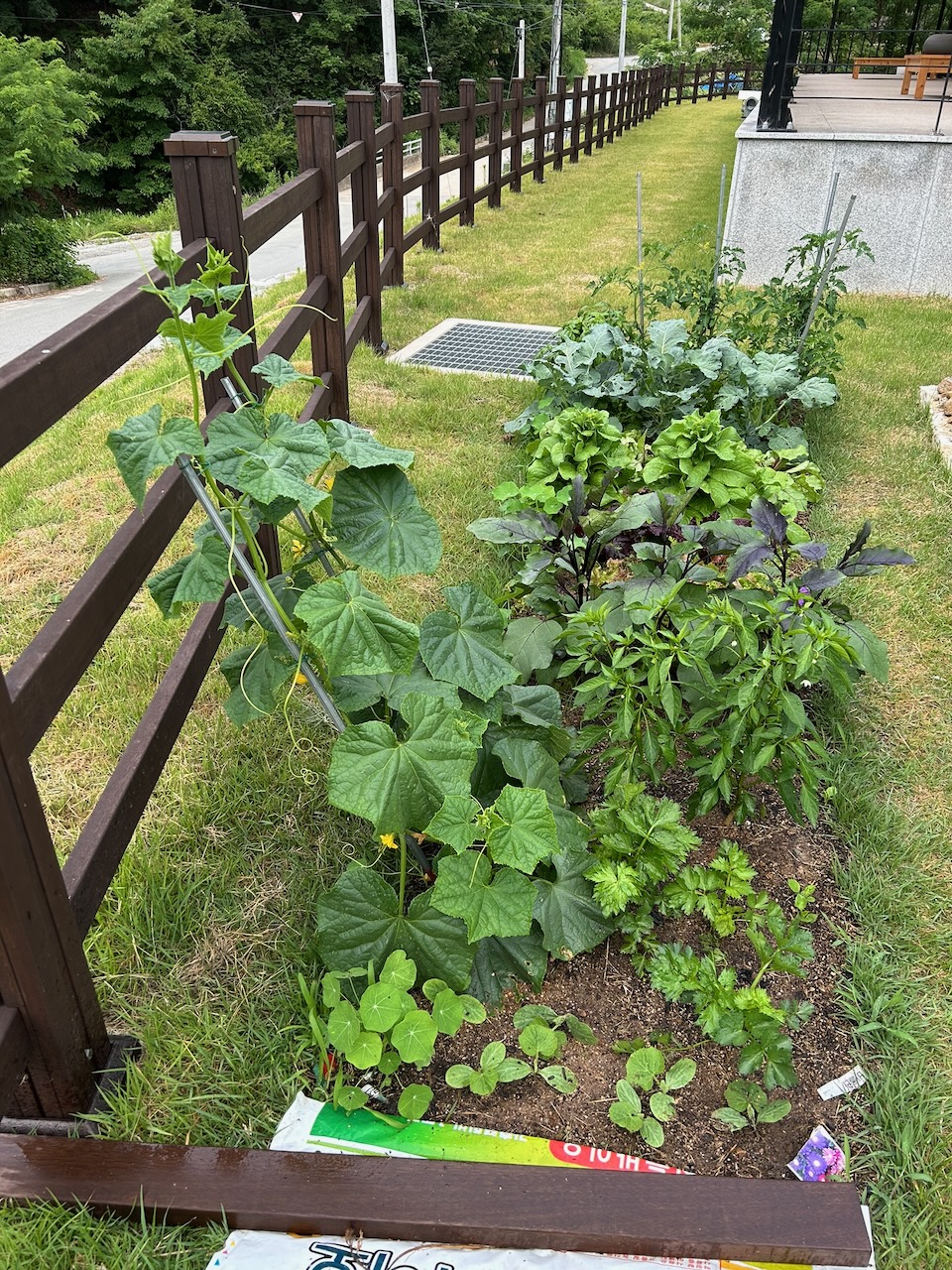
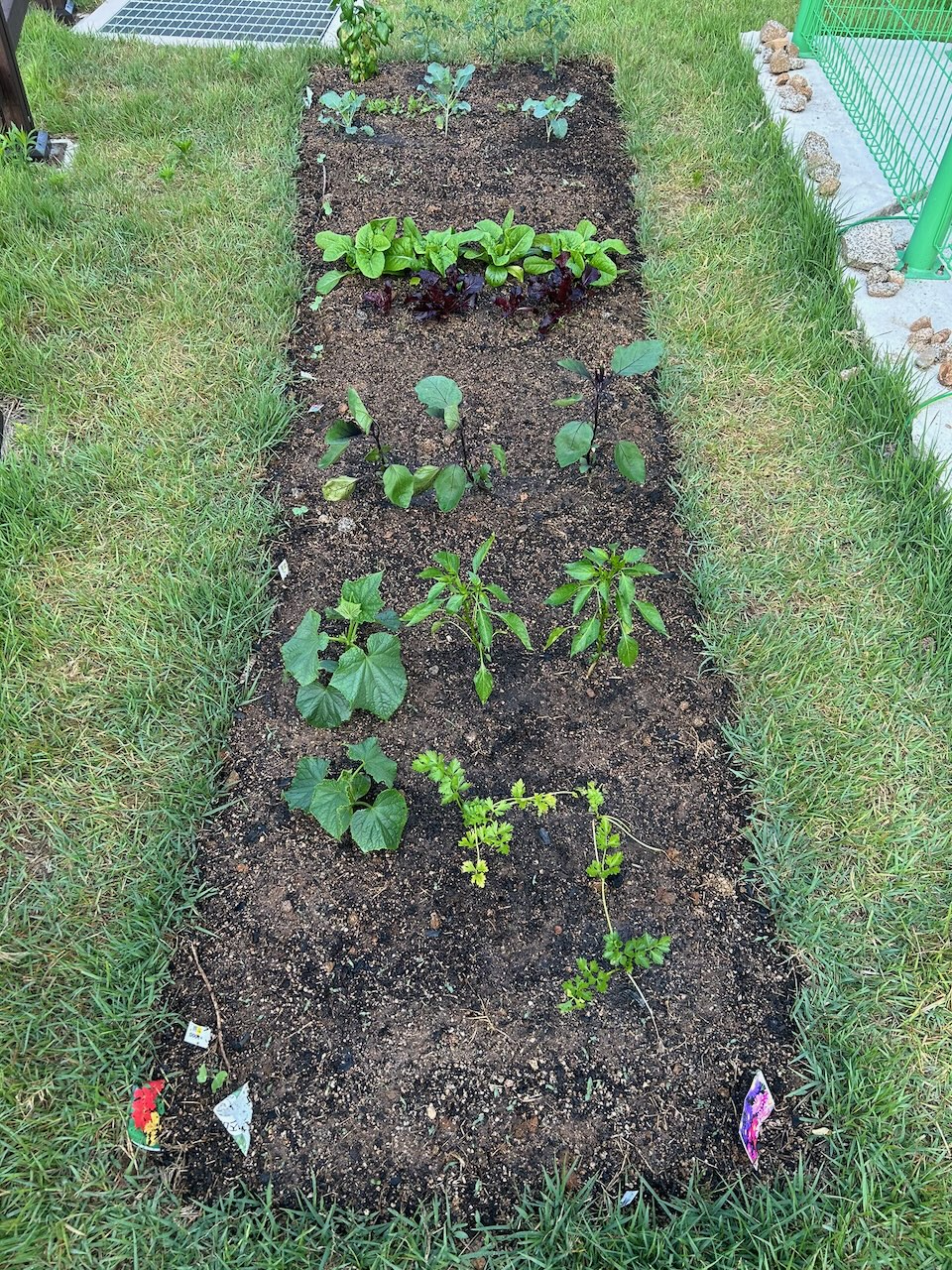
My garden is growing very well, I have been harvesting lettuces, rocket, sweet basil and cucumbers, so far. And I have my first tomato turning red.
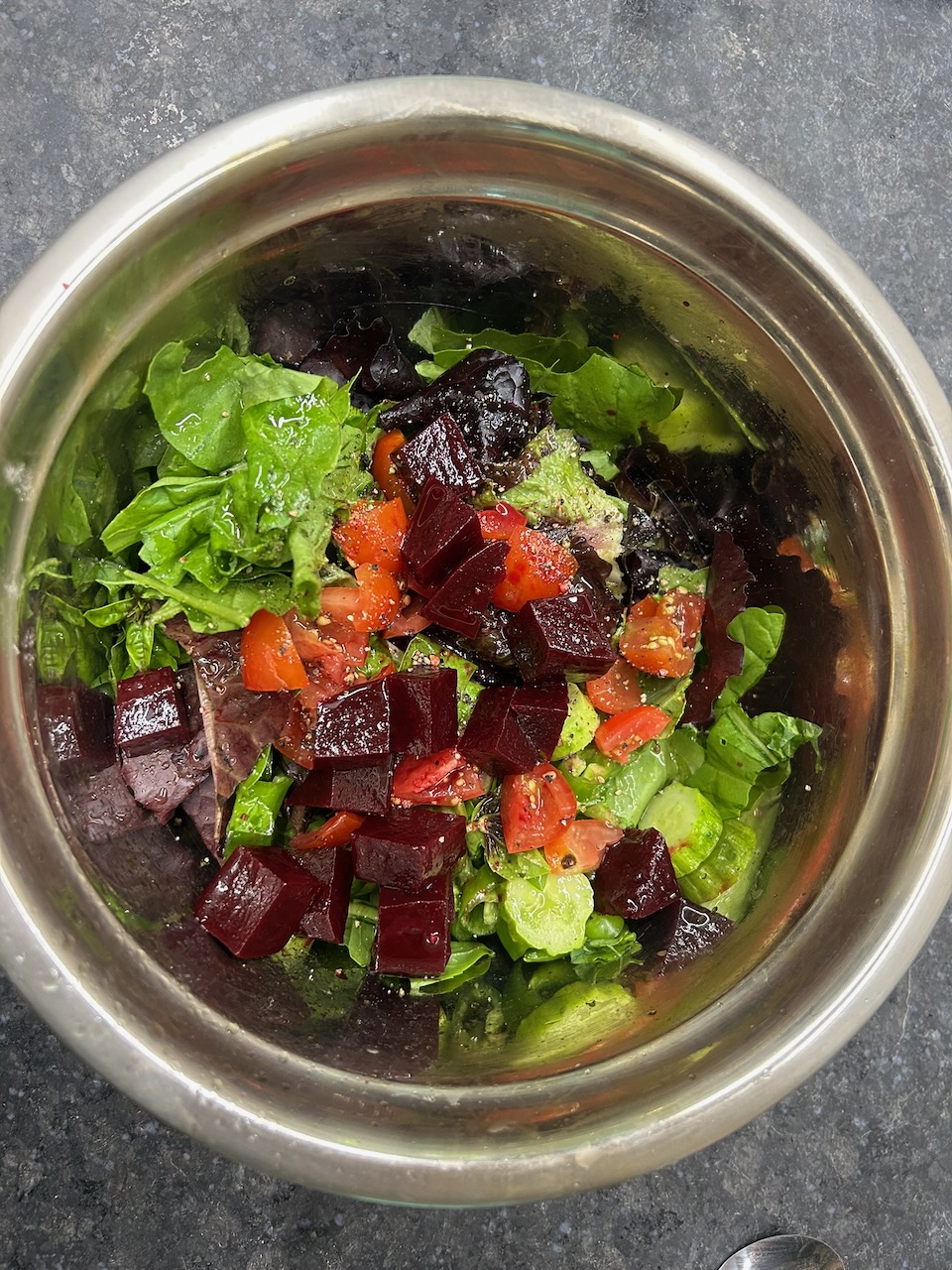
I planted this garden for all the residents. So salads are on the menu everyday in this hot weather. My cucumber plants have climbed up their stakes and reached the fence, from now on they can grow along the fence rail.
Everything has grown so much faster than I imagined it would. I have planted more seeds to take the place of the vegetables that I harvested. as soon as a space becomes available. It’s the smallest garden that I have ever tended., but its quite appropriate. It’s such a cute little garden, It’s so poetic !
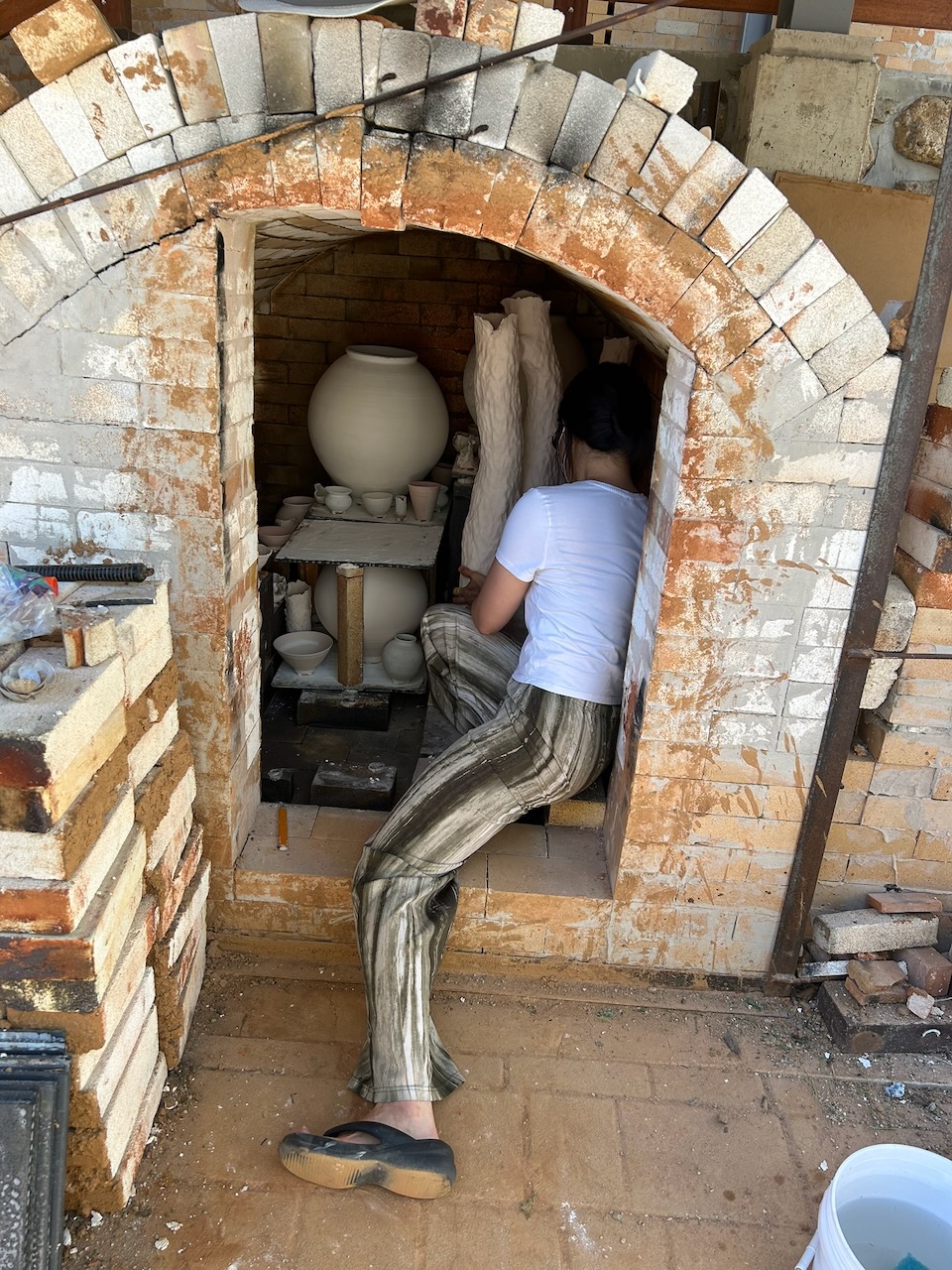
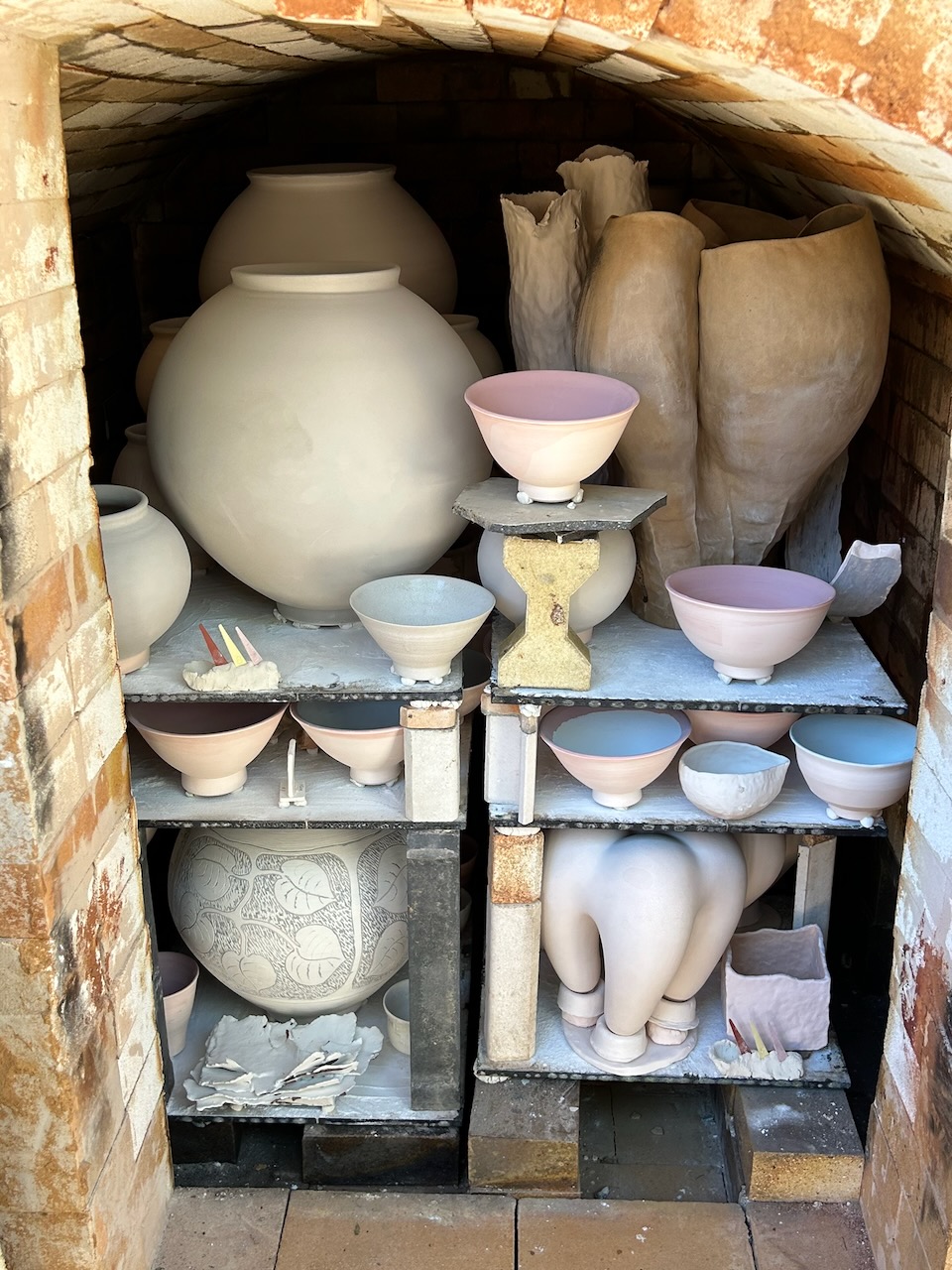
I have just done to first of my two planned wood kiln firings. We packed the kiln with a mix of all the residents work on Tuesday. Everyone turned up with their foam boxes of precious wares to be committed to the kiln. It’s always a bit of a dilemma packing other peoples work into the wood kiln, or any kiln for that matter. I have an idea of how I would like to pack the kiln, and if it were just my work, it would all go to plan – more or less. However, when working with a group, there is such a diversity of shapes and sizes, all bets are off, and we just have to make the best pack that we can with what has turned up.
I think that we did pretty well, combining my big round moon jars with 4 foot high sculptures and shelves of domestic items. I have to keep in mind how the flames will pass thorough all this work, so I’m constantly mindful of not just the shapes of the pots, but equally, and perhaps more importantly, the shapes of the gaps between the works that will determine how the kiln fires with regards to even heat distribution. I think that we did pretty well.
The chamber was all packed with pots by early afternoon. There was a little delay before finishing, as the film crew that made a documentary about me and my interest in Moon Jars, when I was here last year, have returned to make a 2nd doco about my residency here. I didn’t know anything about this until the day before, when I was told that they’d be here. They spent half a day filming me at work in the studio last week and are now back to get footage of the packing, then firing. I can only suppose that they’ll be returning to film the unpacking as well? I’m not involved, only to the extent that I’m in the film. It has all been organised by the Porcelain Museum Director and the Residency Manager, as a way of promoting Museum? I gather that it’s for television and local promotion for tourism? Not too sure? I’m completely in the dark with so little language. I just do what I’m asked to do on the day.
So this brings me back to the kiln packing. The kiln was almost full when they arrived, so I had to unpack the top shelf and repack it for the camera – 6 times! All from different angles, close up and distance. “That’s great, just one more time please!” etc. Then there was the interview. My talking head close-up, and then “could we just repeat that with a distance view? Now we’ll use 3 cameras, left, right and just off centre. No don’t look at the camera, just straight ahead over there. Talk to the wall! OK, but the truck just drove past, so we’ll do that again.” After an hour of this I had completely forgotten what I had planned to say and I really don’t know which parts will be cut together, so I hope that it makes some sort of sense in the final cut?
While they were filming, my colleagues were measuring and stacking wood for the firing, then wheel barrowing it over from the wood store to the kiln site. They all worked hard and made up for the lack of attendance the day before. The last bit of filming was me bricking up the door and smearing the clay slip over the cracks to seal it and make it more or less air tight, ready for firing. We arranged to start the fire at 6 am the next day.
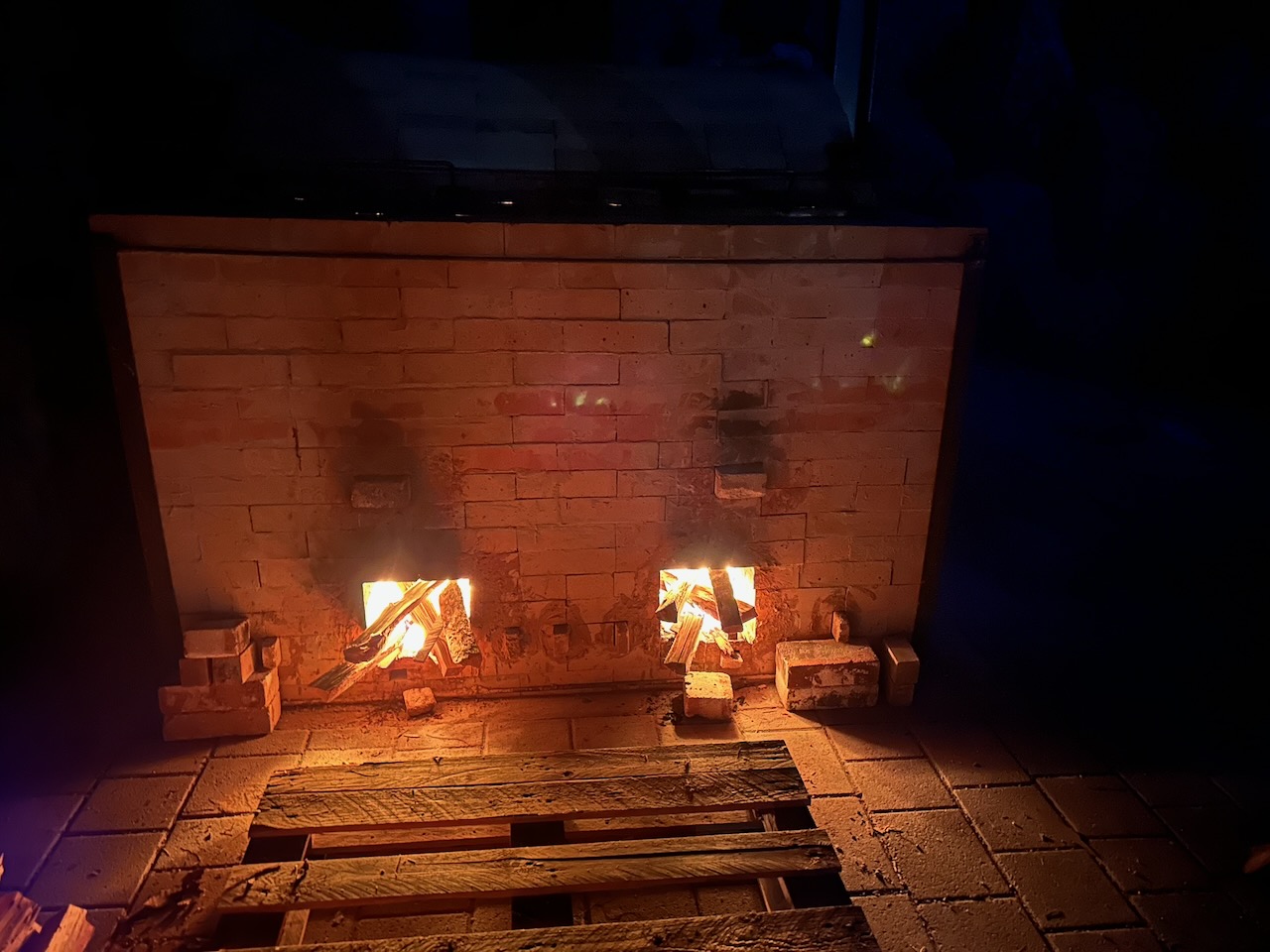
I woke up at 3:45, I knew that i wouldn’t go back to sleep, so got up and made my way to the kiln and lit it by 4:00 am. I really like the quiet of the very early morning, pitch black and silent, an hour later, there is a pale glow in the sky and the bird song starts up. minimal at first, just a couple of tweets, but slowly builds to a crazy racket of intensity, then it subsides again as they all depart for their day of foraging.
One by one my colleagues turn up. First is Yoju, from the studio next to mine. She is a night bird, and has been up all night working. Then the others drift in. We have all brought something to share for breakfast. There is some discussion and a general plan for the day is developed. As we plan to fire through to about midnight. Yoju and I will take a break in the middle of the day for a quick snooze, so that we will be OK for the late finish. The firing goes well and I feel that it is in safe hands when I depart at 2:00. I sleep for 1 1/2 hours and wake refreshed. So good to go for the late night finish.
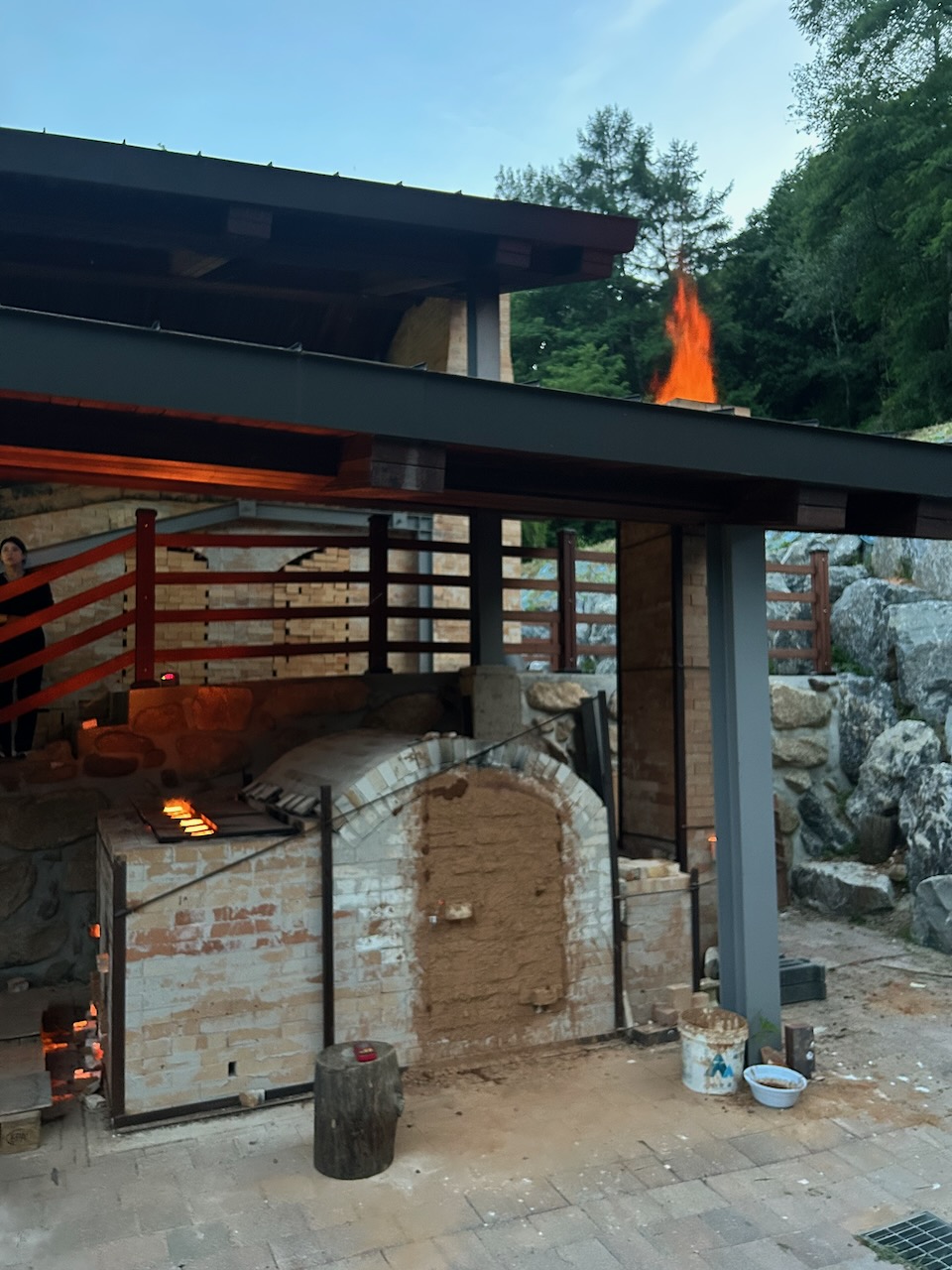
We ran out of oak 1/2 way through, as we knew we would, so fired on 2/3 pine and 1/3 oak until we ran out, then finished on just pine. The pine made a lot of smoke at times. Not at all to my liking, but what else could I do? I didn’t want to oxidise to reduce smoke and ruin 2 months of my work and of the others also. So we made smoke just like a local! Far from Ideal. Mr Choi the Residency manager turn up for a lot of the 2nd half of the firing. He told me that he had finally got a reply from the wood supplier, that the new delivery of oak will be here next week. Hopefully in time for my next firing? No one else has these philosophical issues about smoke, pollution, global warming, etc. PM2.5 particles are more or less unknown here. It’s my issue and I have to deal with it. So I do as much as I can without being difficult to my hosts and boring to my colleagues. I state my concerns and leave it at that.
The firing finishes up at 10pm. 18 hours total, 2 hours earlier than I had scheduled for. But the kiln was firing easily and going up well with no real effort. Perfect. Just the way I would like it to be. So I didn’t interfere. I could have closed the damper and stalled it, but for what? Everything seemed to be good and 18 hours is long enough, 20 wouldn’t make a lot of difference, as most of the work is glazed. My next wood kiln firing in 2 weeks time will be only my work, as 3 of the residents are leaving here tomorrow, and another is away. So the next firing will only really be my work and mostly unglazed outside, so I can do what I like.
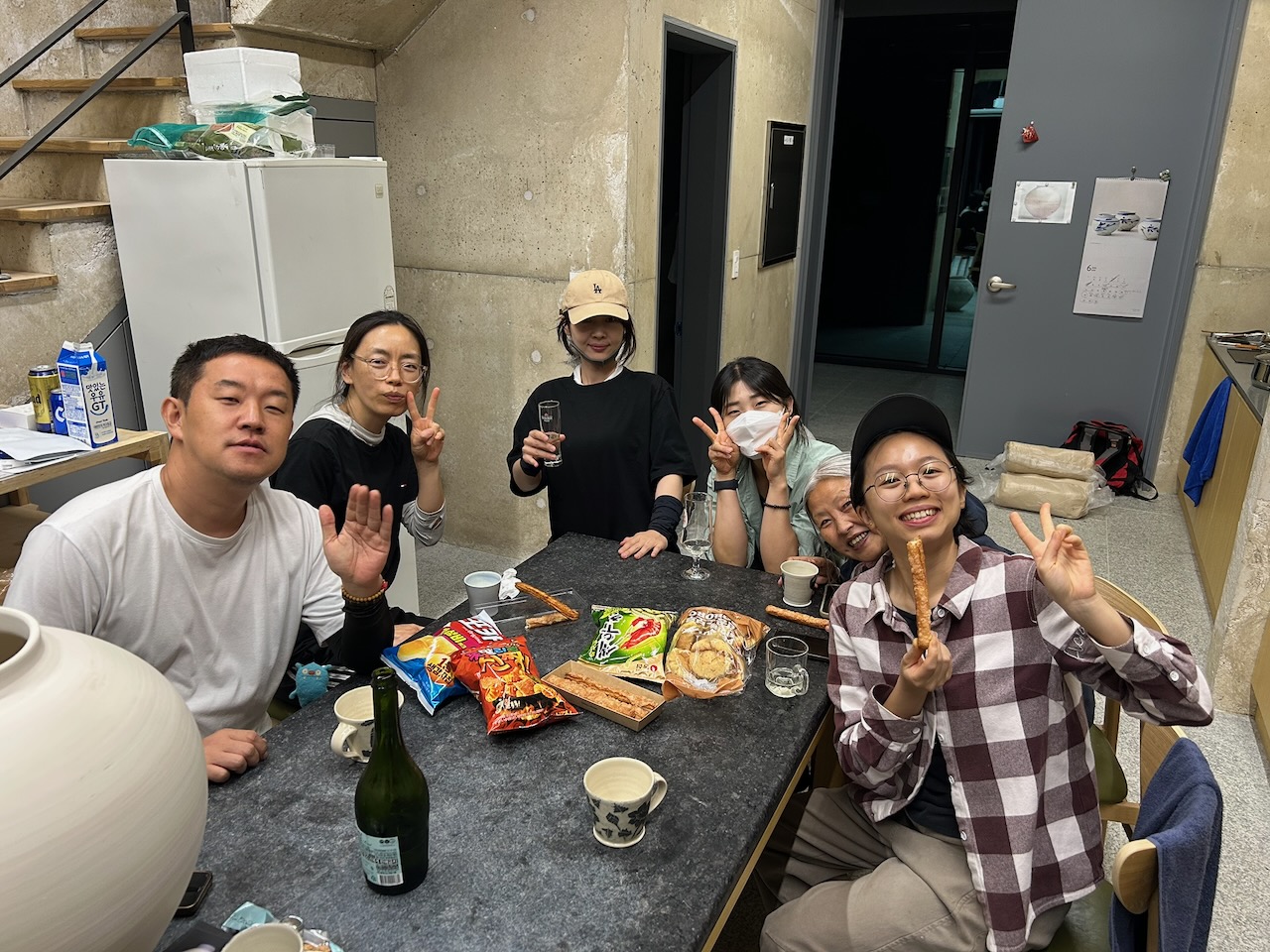
After we burnt down and closed everything up, opened the air damper in the chimney, and cleaned any left over wood from around the kiln, we all adjourned to my studio for a bottle of Champagne, some nibbles and a de-brief on the days events. We finished up at 11.30.
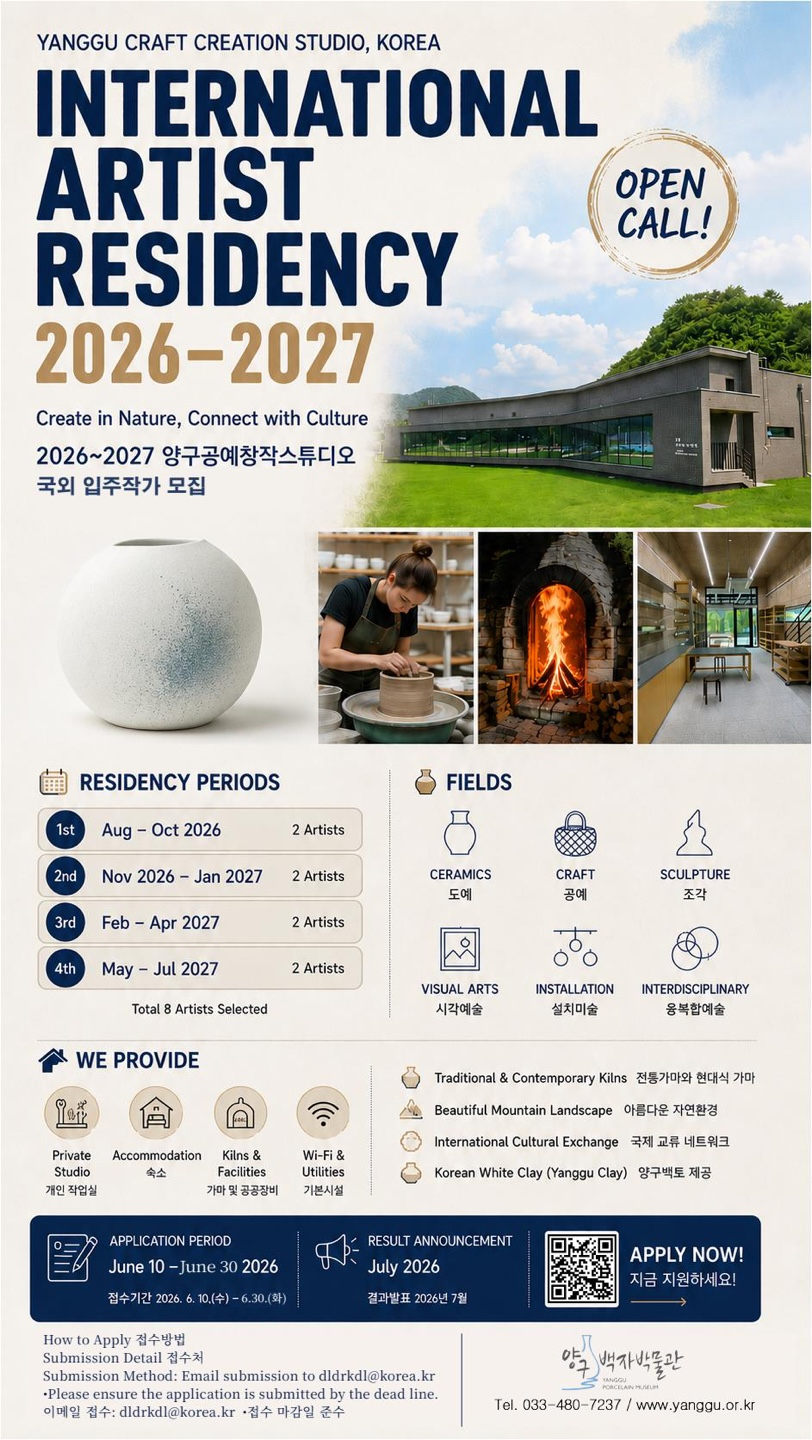
The Yanggu Creative craft Residency is calling for applications for the coming year 2027.
The Residency has 6 studios, 2 or which are open to international artist applications for a period of 3 months. The residency is free of charge, but you must pay for your own expenses like food, transport, electricity etc.
Call for International Artist: Yanggu Baekto Village Craft Studio Residency Program
Residency Overview A. Eligibility
International applicants: University with a 4-year or higher major in art B. Length of Residence
C. Number of recruits 8 international artists in total D. Residence Yanggu Baekto Craft Creation Studio – Private Studio : 37.44㎡ per artist – Kiln Room: 72.72㎡ – Laboratory: 53.10㎡ – Common corridor and terrace
Application Period and Submission
A. Application Period June 10, 2026 – June 30, 2026 B. Submission Method Email: dldrkdl@korea.kr ※ Please write the “Yanggu Baekto Village Craft Studio Residency Application Form
Required Documents
Applicants must submit the following documents: Residency Application Form Residency Work Plan Artist Statement / Self-Introduction Consent Form for Collection and Use of Personal Information Certificate of Graduation (or Expected Graduation Certificate) Portfolio including: Curriculum Vitae (CV) Approximately 10 recent artworks Artwork descriptions Artist statement Any additional relevant materials Certificate of Foreigner Registration (if applicable) Submitted materials will not be returned. Additional documents may be requested if necessary.
Responsibilities of the Artist in Residence
Selected artists are required to: Use the studio primarily for artistic creation and research. Maintain and care for studio facilities and surrounding environments. Comply with residency regulations and contractual obligations. Donate approximately one artwork upon completion of the residency, subject to review and approval by the Yanggu White Porcelain Museum Collection Committee. Utility Costs: Each resident artist is responsible for paying their individual electricity expenses. Residency Fee There is no residency fee.
Selection Process
Document Review July 2 – July 10, 2026 Results Announcement Applicants will be notified individually by email during July 2026. Residency Agreement Residency agreements will be signed during July 2026. As the residency program is organized into four separate sessions, selected artists will be admitted according to their designated residency period.
Provide support
A. Use of kilns and equipment B. Opportunity to participate in exhibitions organized by the Yanggu Ceramics Museum (based on the review of the Advisory Committee) C. Supporting the firing of traditional wooden kilns D. Provided by Yanggu White Clay E. Access to research materials on white clay and white ceramics F. Utilization of Museum Equipment and Facilities
Additional Information
A. If the submitted information is found to be false, the period of residence may be canceled. B. The applicant is responsible for any errors or omissions in the application form or any penalties caused by failure to contact them. C. Application timeline is subject to change. Applicants will be notified individually of any changes. D. Inquiries: Yanggu Ceramics Museum Office ☎ +82-33-480-7237 이메일 : dldrkdl@korea.kr
Yanggu Baekto Village Craft Studio Residency Program Application Application
Pursuant to the public notice for the artist residency program at the “Yanggu Baekto Village Craft Studio” established by Yanggu-gun, I hereby submit my application and agree not to raise any objections to the outcome of the selection process.
Date: 2026. . .
Applicant: (Signature)
To: Governor of Yanggu County
※ Submitted documents will not be returned. Work Plan for the Residency Period
Please provide a detailed and specific annual work plan. Applicants may use a separate or self-prepared format.
Examples:
Creative Activities: Working with White clay to explore and expand the material’s unique characteristics. Exhibition Plan: Scheduled for 0000 at 00 Gallery, Seoul – aimed at expanding the discourse on 00. Activity Plan: Planning and conducting cultural art lectures at the museum; engaging in exchange with 00. Others: Another exhibition scheduled for 0000, aiming to deepen the dialogue on 00. Personal Statement
※ Writing Guidelines
Please write freely in the given format, ensuring to include your academic background, professional and research experiences, and notable achievements. The statement must be written using a word processor and should not exceed two A4 pages.
Date: 2026. . .
Applicant: (Signature) Artist CV
Consent to Collection and Use of Personal Information
Data Collection Organization: Yanggu Porcelain Museum Scope and Purpose of Collection: Name, Date of Birth, Address, Email, Contact Information
Purpose of Use: Verification of submitted supporting documents
I hereby apply for the Yanggu Baekto Village Craft Studio residency program and give my consent for the collection and use of my personal information.
Date: 2026. . .
Applicant: (Signature)
To: Governor of Yanggu County
※ Submitted documents will not be returned.
2026 Yanggu Craft Creation Studio Resident Artist Agreement Article 1 (Contracting Parties)
Provider: Yanggu County (Yanggu White Porcelain Museum)
Resident Artist: Article 2 (Contract Period)
The contract period shall be as follows: From , 2026 to , 20___.
The initial contract start date for Resident Artist is , 2026. - Domestic Artists: The contract is valid for one year and may be extended for up to two years upon review by the selection committee. - International Artists: The contract period shall be three (3) months.
If the result of the review or the renewal date falls within the designated move-out period after contract expiration, it shall be included in the extension period. (However, if renewal is not approved within the move-out period, the artist must vacate within 10 days from the date of notification.) Article 3 (Facility Usage Fee)
Facility rental for the operation of the Yanggu Craft Creation Studio shall be provided free of charge.
All operational costs and material expenses, including utilities (excluding water), shall be borne entirely by the resident artist. Article 4 (Cooperation Obligations) Resident artists must actively support and cooperate with various programs planned and operated by the Yanggu White Porcelain Museum, including:
Development and operation of programs necessary for the advancement of Yanggu Baekto Village.
Development and operation of educational programs in collaboration with local residents and students.
Participation in programs for the promotion of regional ceramic culture.
Other related support and cooperation activities. Article 5 (Obligations)
Must reside at the studio for at least 20 days each month.
Must maintain decorum appropriate to the use of public facilities.
If a violation of obligations is discovered, residency may be revoked, and various supports may be restricted. Article 6 (Facility Management)
Responsible for the maintenance and care of all equipment and furnishings in the used facilities.
Must thoroughly manage all ceramic production equipment provided and installed by Yanggu County.
Must ensure proper environmental maintenance around the facilities. Article 7 (Support Provisions)
Support for repairs and defects in buildings or facilities used by the resident artist.
Support for selling resident artists’ works or products through the museum shop of the Yanggu White Porcelain Museum.
Access to equipment owned by the Yanggu White Porcelain Museum.
Provision of research materials related to Yanggu White Clay and Yanggu White Porcelain.
Yanggu White Clay may be provided for a fee (up to 210 kg per year). Unauthorized transport outside Yanggu is prohibited; violations will result in confiscation and future restrictions.
Participation in exhibitions planned by the Yanggu White Porcelain Museum may be granted following deliberation by the advisory committee.
Additional support necessary for studio operation may be provided through prior consultation. Article 8 (Artwork Donation) Resident artists may donate one piece of work annually or upon completion of the residency period. Donated works shall be subject to acceptance by the Yanggu White Porcelain Museum’s acquisition review committee. Article 9 (Contract Termination and Departure)
If the resident artist wishes to terminate the contract.
If the artist violates the terms of the contract or becomes incapable of fulfilling obligations.
If the Governor of Yanggu deems contract termination appropriate.
Resident artists must vacate the premises within 10 days of receiving notice.
Upon departure, all facilities and equipment must be restored to their original condition. Article 10 (Responsibility for Disputes) Yanggu White Porcelain Museum shall bear no responsibility for any civil or criminal disputes arising between resident artists or between a resident artist and a third party. Any such disputes shall be resolved by the parties concerned at their own responsibility and expense. Article 11 (Contract Execution) This contract is prepared in duplicate, with one copy retained by each party. It takes effect from the date of signing. Date: _, 2026 Resident Artist Name: ______ (Signature) Address: ______ Yanggu County Name: Director, Yanggu White Porcelain Museum (Signature) Address: 5182, Pyeonghwa-ro, Bangsan-myeon, Yanggu-gun
I am now just over half way through my sojourn here in Korea. 5 weeks to go. How am I going?
Well, I’m only certain of two things, and that is Death and Taxes. I’m hoping that nether of them catch up with me here to spoil my stay!
Amazingly, I am just about where I would like to be in terms of my progress. I have almost finished all the throwing. From now on it will be all about drying, bisqueing, glazing and wood firing. Thankfully I don’t have to cut, split and stack all my own wood!
So far I haven’t really left my studio/flat for more than a few hours in 6 weeks. I work all day, everyday, and its starting to pay off. My making skills and my ability to see in advance what is happening to these massive lumps of spinning jelly-like, floppy, sericite paste, as it slowly degrades under the force of gravity back down towards the wheel head. I have learnt to feel what is about to happen and what I need to do in the precise moment and order to get the outcome that I want. Knowing when to stop is a key lesson. Perfection is out of my reach at this level, ‘good enough’ turns out to be the highest level of things that I can achieve at this time. But I’m OK with that. I’m just so glad to be able to be here and have this humiliating experience of failing at almost every turn. But I hope to achieve just a few elegant jars to leave behind, that I can be proud of.
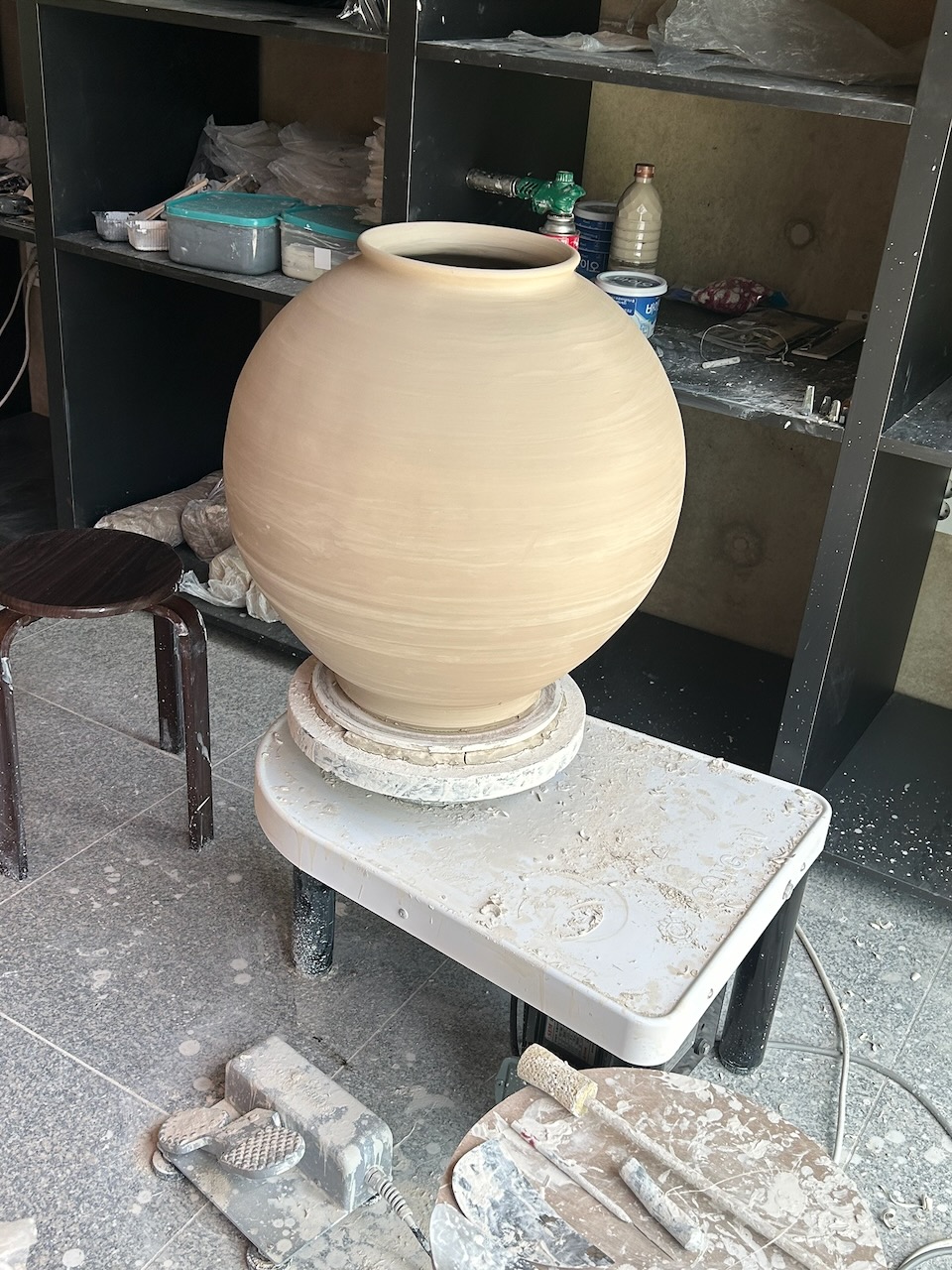
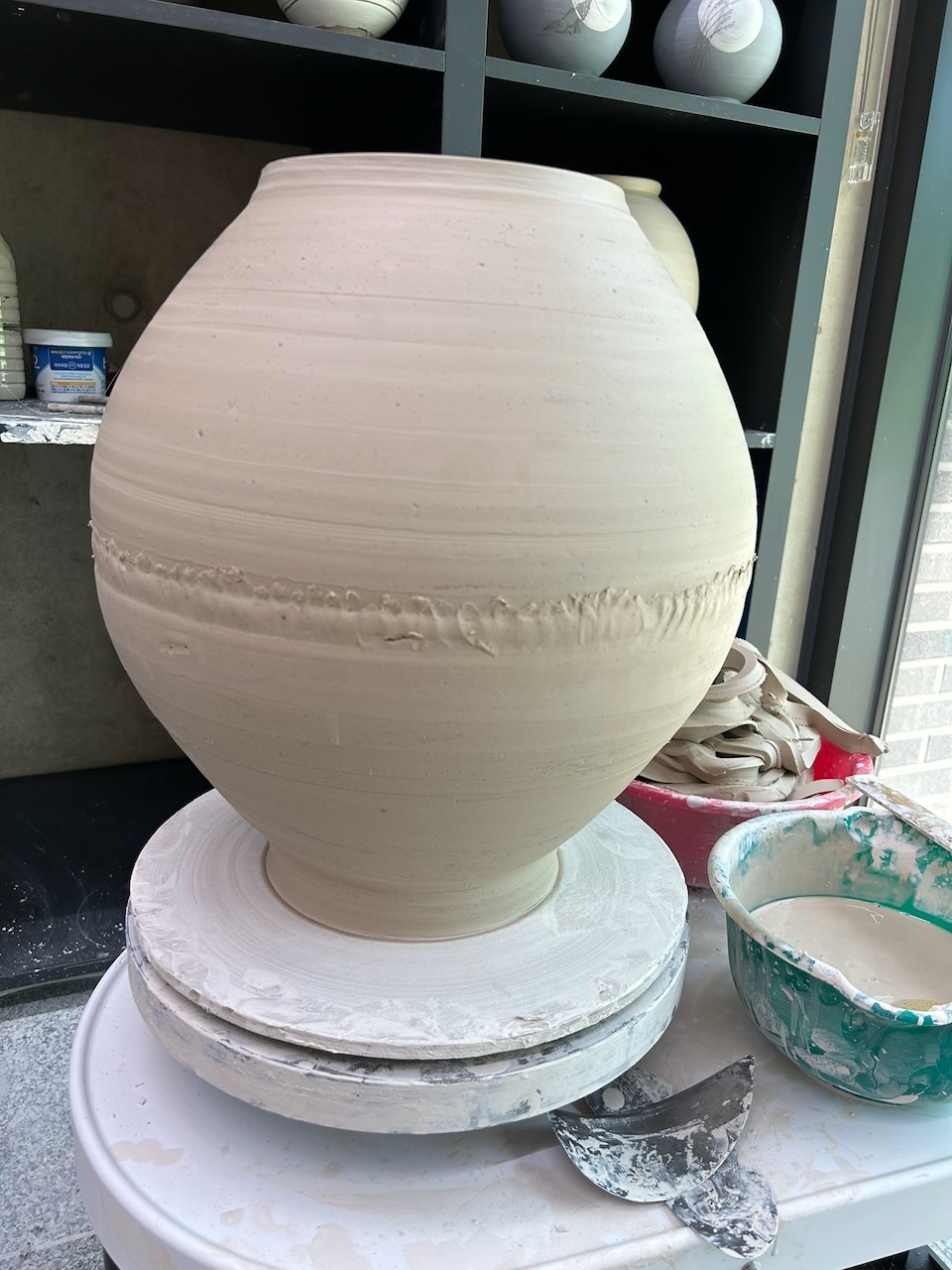
Making a ‘good-enough’ Moon Jar is quite demanding for various reasons. Firstly, they are huge, needing 10, or 12 or 15 kilos of clay to make just one half. Secondly, They are made from porcelain clay that is quite floppy and non-plastic, compared to stoneware or earthenware clays. Thirdly, the shape is a very difficult one to master, even with good plastic clay. The aim is to make a very open, wide, fully rounded, bowl shape with a very small foot. This is the shape most likely to squat down and collapse if not made carefully. That is why it is made in two pieces. But even then, it’s not easy in porcelain.
So when these three elements are combined, throwing large lumps of floppy clay, into a very wide shape, but with a tiny foot, there isn’t much to hold it up. I can only offer ‘good will’ and the little bit of skill that I have to help it along.
I’m in awe of those early Korean potters here who managed this impossible feat of throwing, while working on a wooden kick wheel with absolutely no momentum, working these huge, beautiful rounded, flowing forms, while kicking with both feet, one towards, and one away, alternately, to keep the wheel moving. Keeping both feet in action while holding your hands steady in space is something akin to ballet. BUT, not just holding those hands steady, Actually applying considerable pressure to the clay the slow it right down as well.
I could have made more progress, if I’d worked alongside somebody who knew what they were doing. All I’ve got up my sleeve is what I’ve retained from watching some good Korean throwers here in Bangsan in 2018, eight years ago, during a Moon Jar conference. Not a lot was learnt, and most of it forgotten, What I’m learning here now is invaluable, as every mistake and failure is painfully burnt into my memory banks.
You really have to have your wits about you. I’m learning how to best approach this difficult task. The order of moves, the thickness of the clay in different parts at different stages of the lifting and opening of the evolving shape. If it were just a simple ‘vase’ shape, coming up off the wheel in a straight line up and out, like an inverted cone, it would stand up more easily, but two of these straight sided vase shapes won’t make a sphere. A sphere needs to have a small elegant foot ring, then opening up and out in a curve, away from the wheel head towards the horizontal, then curving around and back, upwards to the rim. An ‘ogee’ line of curve. A completely impossible shape to be self-supporting in soft, floppy non-plastic porcelain. Who was the genius who first thought of this extravagance in white porcelain?
I’ve dropped a few shapes while getting it right, but I have a better appreciation of the way to best get it done now. Added to the above is the tendency for the non-plastic porcelain clay to absorb water and dry out on the surface causing your fingers to ‘stick’ or ‘grip’ every so often. All throwers have experienced this at some point, but with small pots made from plastic clay, it is recoverable. If this happens while making a moon jar, it is the end of that pot. A stretch and wobble in the form that cannot be corrected is established and there is nothing that can be done to recover it. I’ve tried. Best not to waste any time on it. Just stop, wedge it up and start again. I’ve learnt to hold a wet sponge in my hand between my fingers, and to give a little gentle squeeze more or less continuously, to keep the surface lubricated, but only just so, to avoid any ‘sticking’, but not too much so as to saturate the surface and cause the form to go weak at the knees, resulting in slumping and collapse.
Another lesson was learning to ‘condition’ the new wooden plywood batts. Fresh batts appear to be OK, and would be for every other purpose, but not for large porcelain moon jar bowls. I lost two in a row before I realised that the fresh wood didn’t allow the clay to ’stick’ to the surface well enough. So that when I flipped the bowl over, up-side-down to place it on top of the base bowl, it just peeled off the batt onto the floor. Hard lesson, well learnt. I scrubbed the batts with clay slip and saturated the surface before using them again. success two days later. But so many little set-backs, one after the other, leading to losses is disheartening. But good life lessons in perseverance!
I have also come the the conclusion that 15 kgs is my maximum limit for lifting and flipping over large bowl forms. Any more might lead to a hernia?
I’ve also learnt to be very careful in staging my drying and stiffening technique to make the best connection between the two halves. I’ve had a few crack along the joint in drying. One from not taking enough care to get the consistency and stiffness just right at the time of joining. Too soft and the shape distorts or worse, collapses. Too dry and the pot stands up to the stress of joining and paddling, but the joint can be too dry and fail in drying. I learnt to stiffen the body of the form, particularly the lower section that will have to take all the weight, while keeping the rims soft and moist for adhesion. This is not just about drying it out, but allowing the natural tendency of clay to ’set’ as some kind of thixatropia sets up between the clay particles. Letting the form sit quietly over night aids this. So making a large jar takes time and patience.
However, if the rims are kept too soft, there is a good joint, but as the pot dries, the wetter rim part shrinks more than the rest of the pot, pulls in and the curve flattens out at the mid point of the sphere, making a flat spot. I’ve seen hints of it in a few of the old Moon Jars in Museums, but also on many contemporary moon jars. A successful join, but a compromised form.
So far I’ve made beautiful round spheres with cracks in their joints after drying, as well as well joined bowls, that didn’t crack, but with less than successful round forms, lacking elegance. They both met my hammer.
Another issue that I have had to come to terms with is picking up the joined form, which is now 20 kgs or more, leather hard, slightly soft and a little bit slippery and then turning it over, up-side-down, so as to be able to trim the foot. This kind of weight should really be a two person job. But Janine’s not here! So I have developed a way to do it on my own, slowly and carefully, but it is at the limit of my capacity now at this age. I’m not the man I once was. so I have to look after myself. Fortunately I have developed a large tummy in my advancing age, and this has turned out to be very useful in supporting the shape while I lean back and very gently manoeuvre it up-side-down with my hands. Note to self! Don’t wear a shirt with buttons!
A good Moon Jar is a complex piece of work, requiring sound throwing technique, staged drying, good timing, humidity management, correct joining and compression, careful turning and slow, even drying. And all this before we even start to think about glazing and firing! Yes, there certainly is some madness! But when it works, there is poetry!
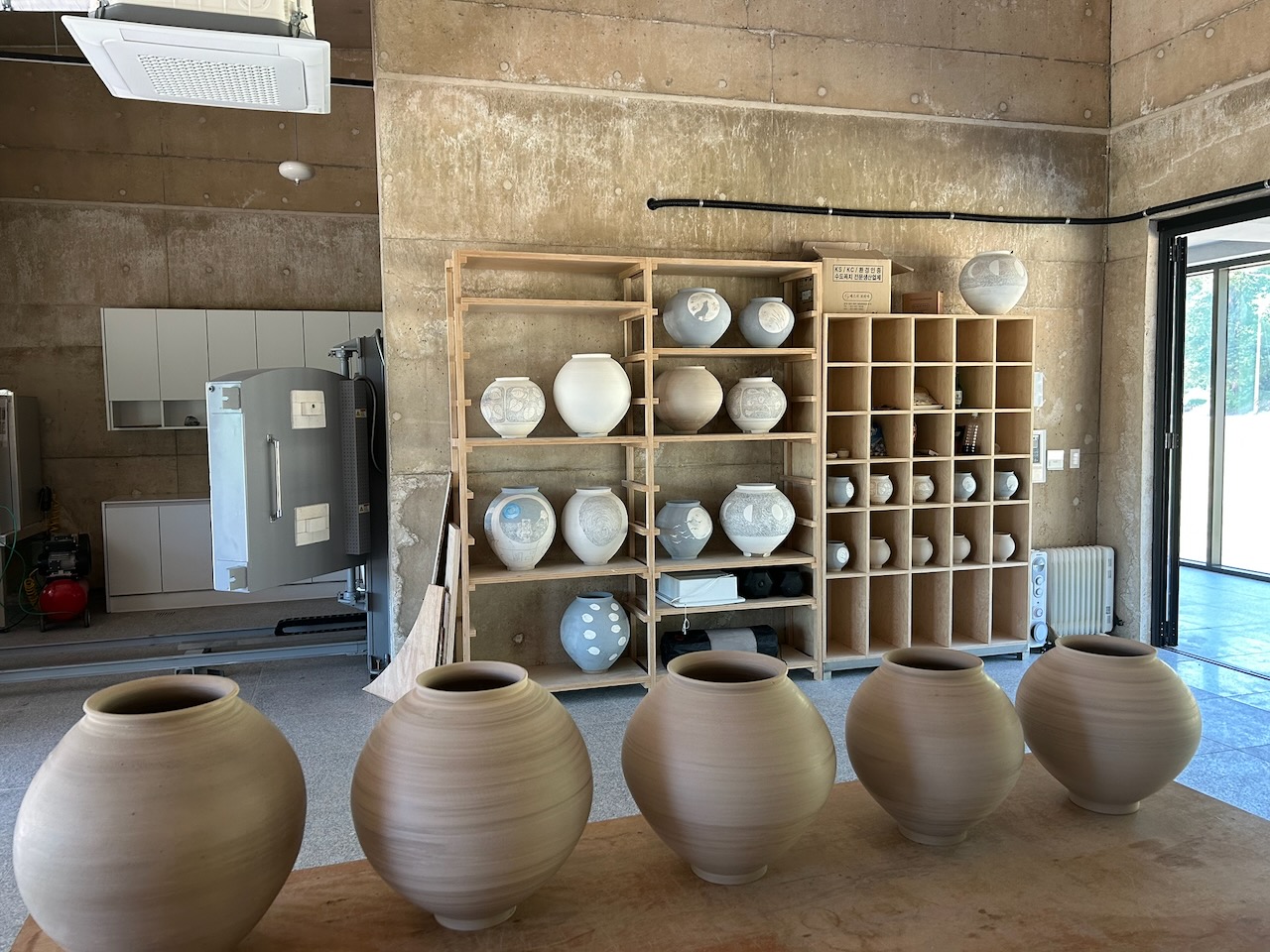
I have made about 25 good large jars now, another dozen medium sizes and about 40 smaller jars. a couple of days ago, I had my first bisque firing with half of my work in it. I used the large trolly kiln up in the other studio area, up the hill. I booked the Museums truck to drive them up there, instead of walking up there and back 20 times carrying one jar at a time! Nothing broke or chipped on the way thankfully.
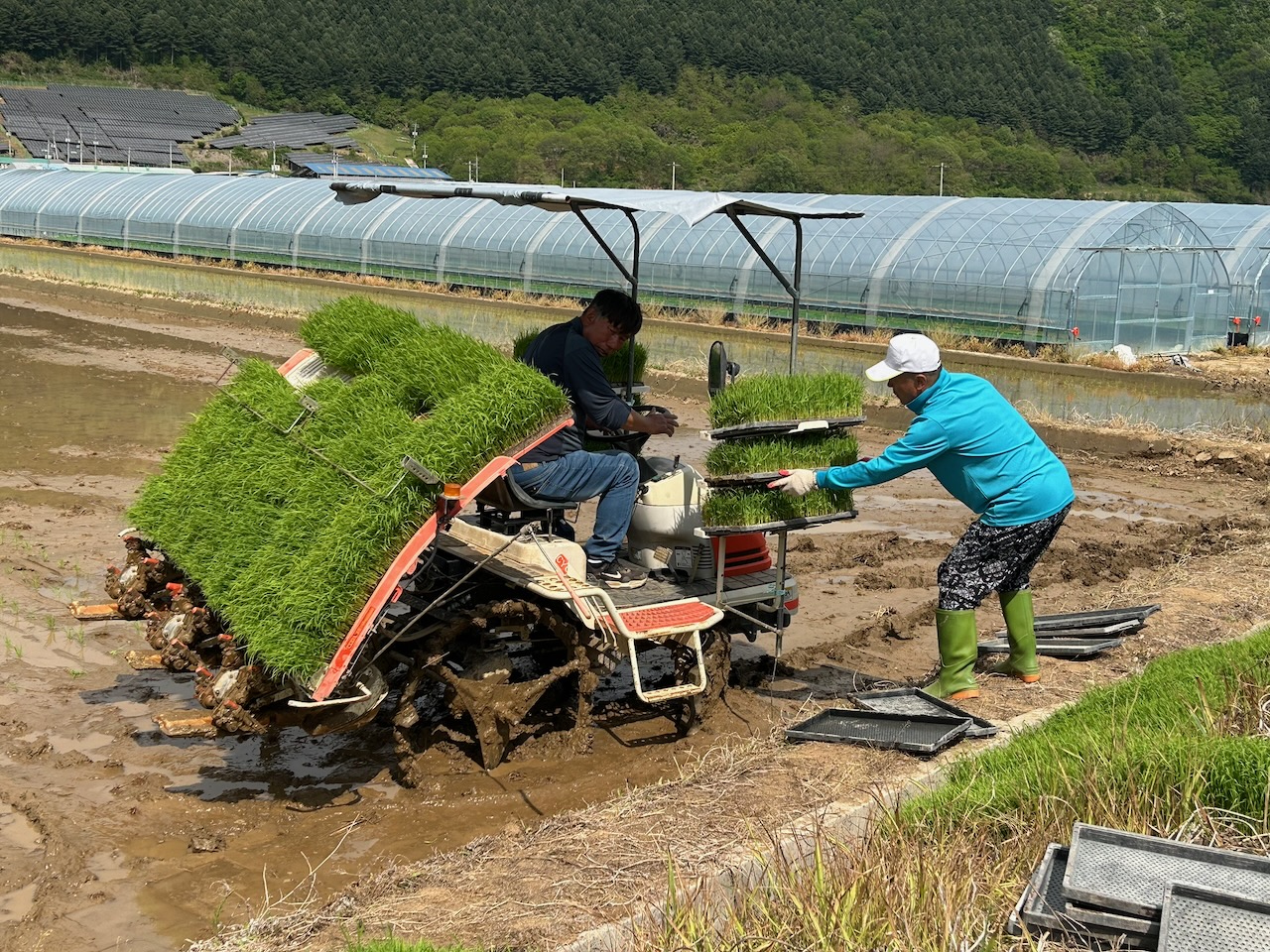
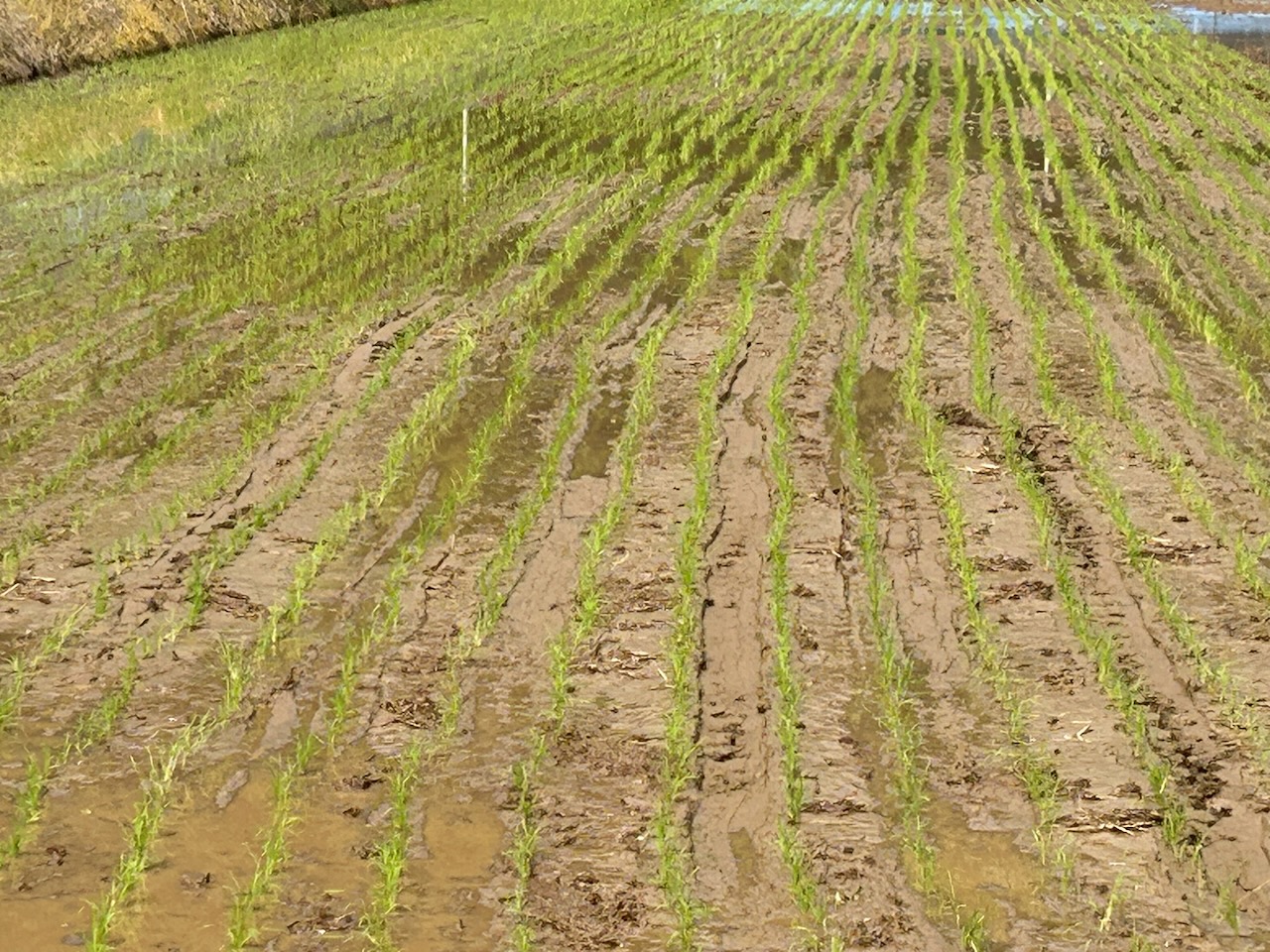
When I arrived here it was the end of winter and the fields were being ploughed getting ready for the spring planting. They have to wait until may around here to be safe from the last frost. I watched them prepare the paddies, plough them twice, to mulch in the previous crop stubble, flood them and then rotary-hoe them again a couple of times. They spend a lot of time working and reworking the walls of the field by hand with a shovel. Building up the edges above water line and then patting the surface down, compressing it with the back of the shovel. It takes hours. However, they save time elsewhere, by avoiding the back breaking work of planting out the rice seedlings. Forty years ago, I was in Japan and watched women doing this back-breaking work. These days they have very cleaver machines that they load up with trays and trays of seedlings. The machine then proceeds slowly across the paddy planting 10 seedlings every second at a spacing of 200mm, apart, doing 2 metre wide rows with each pass. It’s a beautiful thing to watch. So fast and efficient.
I’ve also watched the landscape change from brown to green as the frosted, burnt pasture responded to the warmth and light. There was a tall pasture that had over wintered here, shooting up to a flowering head. At first I assumed that it was a grain crop, but soon realised, as they mowed it down, that it was a fodder crop for making hay. I walked down the lane to get a good look at it, it turned out to be rye, which takes the cold well and is over-wintered here. The smell from the paddock was so sweet, almost sickly sweet. There was so much sugar stored up in those emerging flowering heads. Harvested before it set into grain and turned to starch. They make huge round bales and plastic coat them. I’m assuming that with some residual moisture, it must be some form of silage? Stored for next winter’s fodder?
I miss being able to harvest my own vegetables from my own garden. So much so, I planted one just outside the studio. A mixture of some seedlings to get things going quickly and some seeds in-between to fill out the space as the first plants mature and are harvested. This garden isn’t really for me, as I will be gone in 6 weeks time, before most of the produce matures. I created it for the other residents that will still be here after I leave.
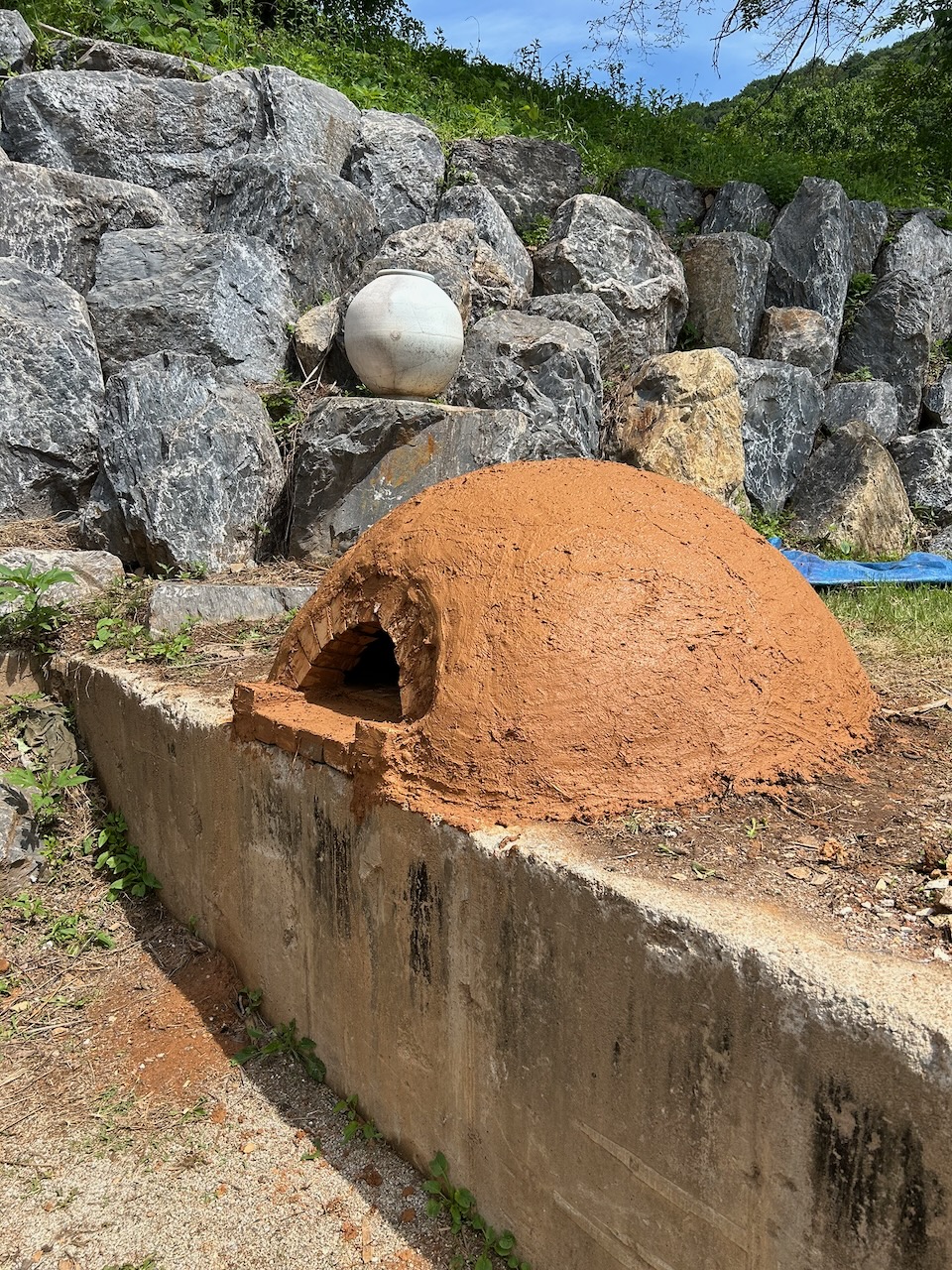
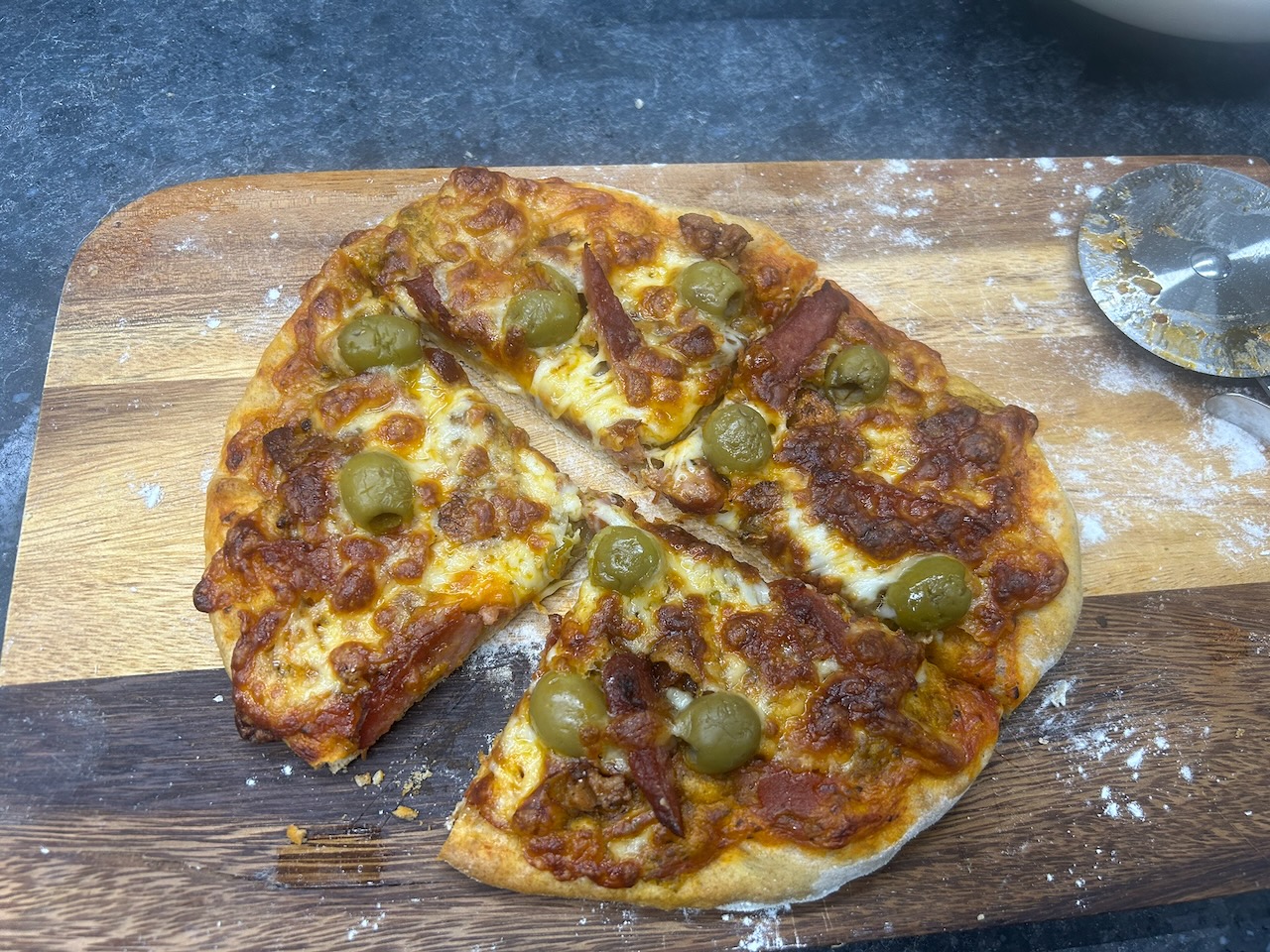
I have also found time to build a wood fired pizza oven. Using a lot of broken bricks that were sitting around in small piles here and there, up around the wood kiln area. I built the oven up on top of a retaining wall, just opposite my wood kiln, so we can cook pizzas while we fire through the night. Again, this little side project isn’t really for me, but my contribution to the creative community that will be living, working and creating here for years to come into the future. At a time when a lot of the world is in so much conflict and every thing that we thought was stable is starting to come apart at the seams. I am so lucky to be an Australian, Sitting out on our own in the Pacific, we are missing out on so much of that conflict. However, when the pooh hits the propellor, nowhere is safe!
Here the Koreans are technically still at war. There are still landmine warning signs in various places around here, as there was never any really complete clean-up of the mines after the conflict ground down to a stand-off. Something they take for granted around here, but I found it quite shocking when I first encountered one of those land mine warning signs on a strand of wire, not too far from here. on something almost like some sort of old disused fence. Luckily I had my phone and its translation app to tell me to stay well away. We are only a few kms from the final DMZ line here.
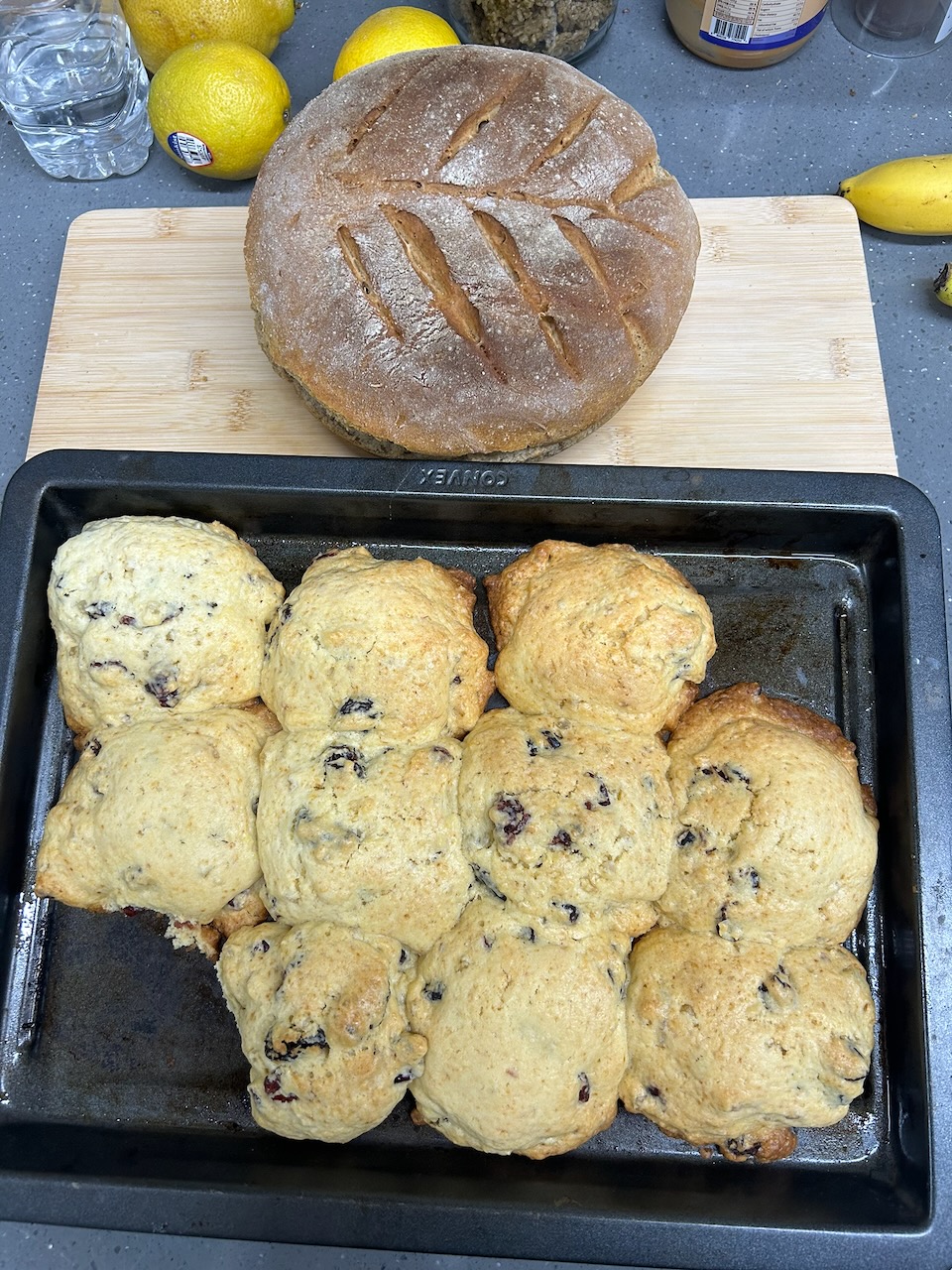
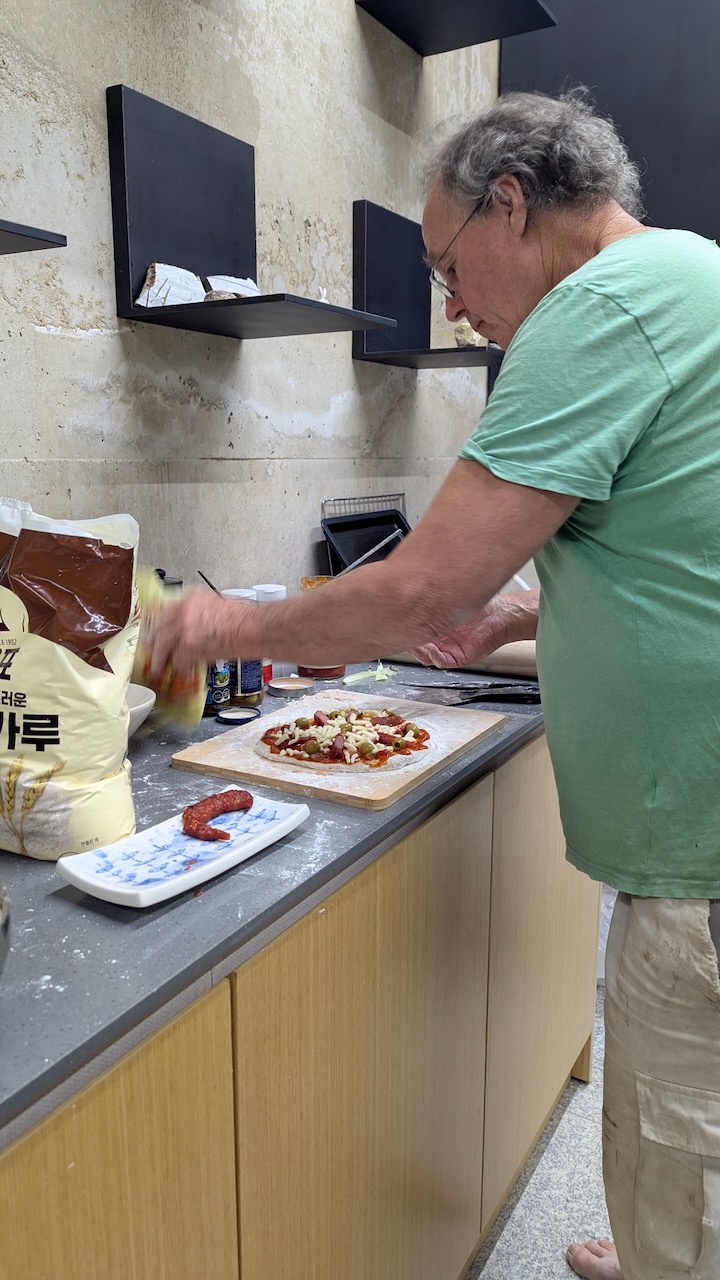
As the social norms that we thought might sustain us are broken, the rule of law is degraded and there is a huge up-sweep in the far right of politics, based on miss-information, fear, lies, xenophobia, hate and miss-trust. These events can lead to some feelings of insecurity and alienation. I want to counter that, by creating things that bring people together. Every Friday, I bake bread there in my tiny studio to share with the other residents. A wholesome mixture of wholemeal and rye, that you can’t buy around here. I have also started to host a weekly pizza night in my little space. Last week we also shared a kimchi a pancake night, made by the lady next door, using my huge bag of kimchi that I was given when I arrived here, while I contributed banana pancakes with a little ice cream and cinnamon on top. I have also made rock cakes to share at morning tea and marmalade, as such a thing doesn’t exist here. I like to have a little on my homemade toast, whenever I feel a little twinge of nostalgia for home.
I want to help create a sharing, supporting community out of these individual artists. We are mostly here for a short time, so there is a constantly changing group dynamic. I replaced someone. Another person left after I was here just one month, I only met her once! Two more artists will leave at the end of this month, and I will leave and the end of next.
However ephemeral life is, I want to leave a positive trace behind – at least for a while. I want to leave this artists residency in a better, more inclusive, comfortable and fun creative state than it was when I arrived.
Sometimes I feel that I must be mad to be here. Relocating to a foreign land where I don’t know the language, or many people at 74, just to satisfy my curiosity about an ancient ceramic iconic white jar ceramic form. The result of which will most likely have no bearing on my career at all. As, while I’m here studying Moon Jars with some intensity, there is a show of Moon Jars on in Sydney from which I was excluded, even though I have shown my Moon Jar inspired forms in that gallery in the past, and sold them there. But for some reason, unknown to me, my work isn’t thought to be good enough or appropriate for this show. I can’t pretend that I’m not feeling left out from a show I feel I should have been represented in.
But shit happens and life goes on. If this is the worst that can happen to me, I’m incredibly lucky! I know that I am!
I also know that stuff happens to us all at times. We just have to knuckle down and get on with it. Life goes on. Next?
I’ve been here in the Porcelain Village Residency for one month now. Actually, it was one month last Monday, but I was too busy to write anything down till now. In fact, as of now, its only one more week and I’ll be half way. Tempus fujit! This is my 10th visit to this place. A decade of my life circling and returning, just like the moon and earth. The attraction always pulling me back. I always think that this will be my last visit, but…
I’ve just made my 40th Moon Jar, so that’s good. Actually, I’ve made more than that, but smashed a few up. Especially the earlier ones. As they were not up to scratch. They got slaked them down for re-use, as the unique sericite clay here is very special and hard won, so not to be abused or wasted on inferior pieces. If there is no hint of poetry, then they get the hammer. My most important pottery tool is not my hand crafted stainless profile tool, that I would be lost without, nor my kidney shaped modified special throwing sponge, or my razor Sharpe tungsten turning tool. No! My most important tool is my hammer as it turns out. Can’t allow any feelings of attachment for a bad form. No matter how much effort I put in to it. Even if has taken 3 days to make. If there is no joy or love conveyed in the form, no sense of warmth and communication. If there is no sense of flowing, complete lyrical form and balance. If it isn’t speaking to me. In essence, no poetry, then where is my hammer?
I have to feel proud of the pots that I make and take responsibility for them, as many eyes are on me, simply because I’m the foreigner here. The only non-Asian resident. It could be said of me that I shouldn’t really be here making my weird tributary jars based on the traditional Moon Jar form. Which aren’t really Moon Jars at all, as I’m not Korean, and don’t fully understand the culture. I have been told that there was some ‘chat’ online by ‘important’ people, that for ‘others’ to even think of making something and call it a Moon Jar, is some sort of cultural imperialism and miss-appropriation of cultural identity and some sort of theft of an iconic national ceramic form?
I haven’t seen the discussion, as I’m not on any social media, but it did make me think about what I’m doing here and why. I interrogate myself fairly often about how I live and what I consume, and how I might be more conscientious about my choices. I quizzed myself deeply over a period of some months, before I eventually applied for this position. For several reasons, not only the cultural theft angle, but also the carbon debt incurred in international flights. Added to that the fact that my presence here has robbed some young and talented artist of a place here and a chance to learn, go on and make important work. I don’t brush this off, or take it lightly. I was quite conflicted. Should I be here?
What helped me to decide positively was the remark, made last year, from the director of the Porcelain Museum in the nearby town, when he saw what I was making back in Australia. We exchange emails periodically. In my early exploration of this iconic form. I was calling what I was making an ‘homage to the Big White Jar’. As I’ve always had a fascination for them, but could never bring myself to make a ‘copy’ of one – even for my own use and satisfaction. But after a decade of visits here, getting more deeply connected to this place through its special 800 year sericite history. As it was the stuff of the soil here that brought me here way back then, as part of my 15 year, ‘5 Stones’ ceramic adventure.
The Museum Director said to me that what I was doing was different from anything else being done there, and that it would make an interesting addition to the canon. So there was an invitation to follow up on. “Why don’t you apply to come and do that kind of work here?”
Because I’m from Australia, I’m in the opposite hemisphere. I live in the opposite seasons, I live apparently up-side-down on the bottom of the world. It got me thinking that the way to look at the Big White Jar, was from the opposite point of view. So I made them black with a coating of black slip. The dark side of the Moon Jar?
Because I have been doing a lot of sgraffito over the last few years, and because Koreans have a long history of the same technique, which they call ‘Buncheong Ware’, sgraffito seemed appropriate! The significant difference for me, as an antipodean, is that I do it in reverse. The Korean wares are made in dark clay and white slip is applied. I was making white pots and applying black slip then carving back to create my images. I think that it might have been this that caught The Directors eye? Who Knows? I don’t!
Emboldened by this positive response though, I decided to apply for this residency. As I understand it, The Director of the Porcelain Museum is not on the board here, or on the committee for the selection of artists for this residency. So I had to convince several other academic and cultural advisors who actually are the ones making the decision. I was quite unsure as to my suitability for this placement, as the application form clearly stated that applicants should ideally be under 40 years of age, and have at least a 4 year degree level. ie masters or better. I fail the first part, but fortunately I was OK on the last bit. I also had to supply 10 images of recent work, not made in an educational institution, or as part of any course of study. I could tick most of the boxes.
Now since I’ve arrived and started work here, more things have transpired. The Director of the museum has offered me a show in the Museum’s Art Gallery. He feels confident that I will make significant work while I’m here. No pressure! I feel a little awkward about this, as other residents don’t get this offer. They get to show their work here in the Porcelain Village, where the residency is situated. We have a smaller on-site gallery here specifically for our use. The Porcelain Village Residency Gallery. I feel that it has created some sort of barrier between us. Why am I getting special treatment? And I can’t answer that, but I carry a twinge of guilt about it, even though I have made no overtures to be treated differently.
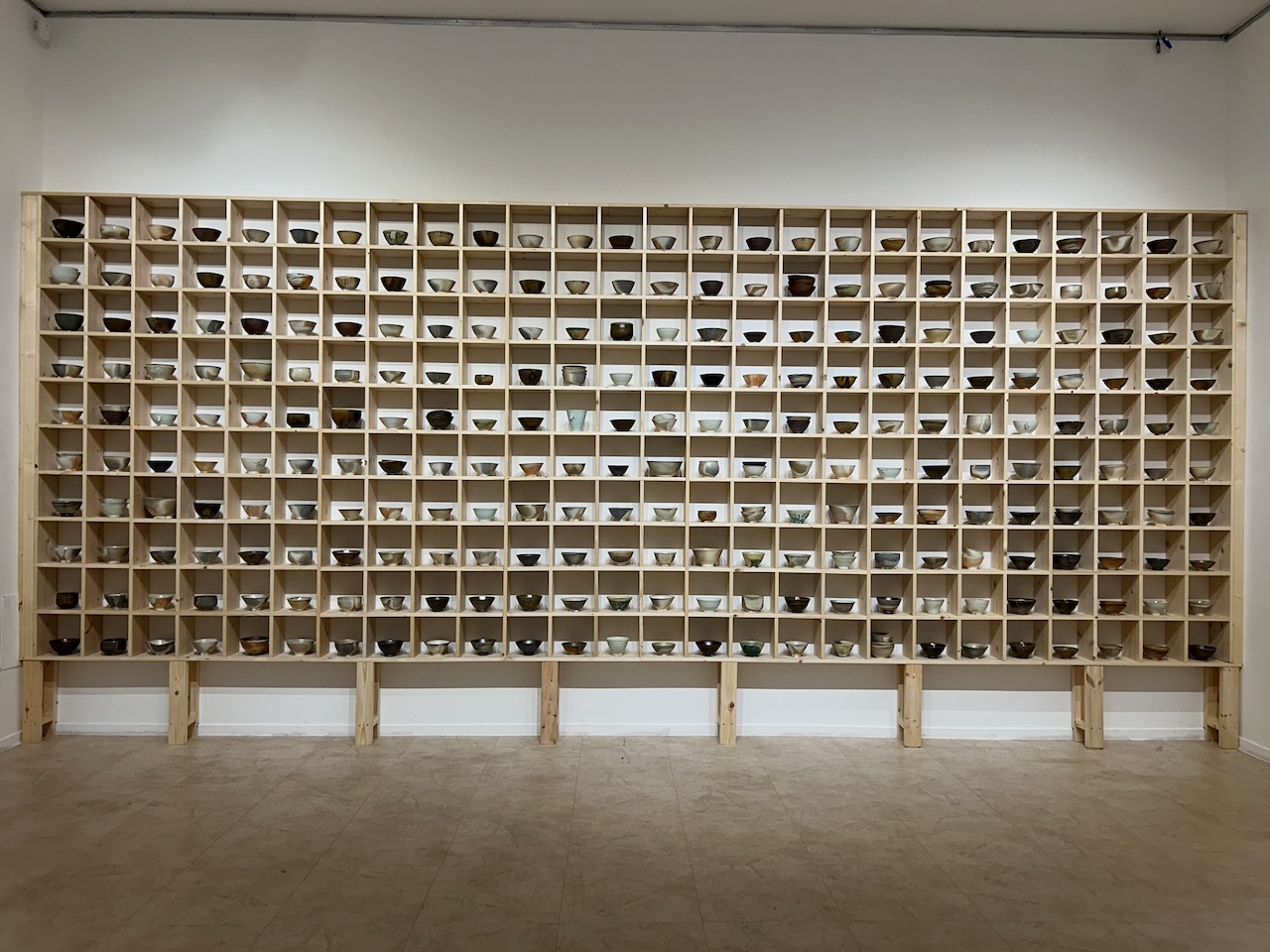
The Director has explained to me that because of the smaller, clean firing, low smoke, wood fired kiln that I built for the Porcelain Museum 2 years ago. There has been some interest in this aspect of the Museum activity. There are now 5 other versions of this kiln built, or in the process of, in Korea as a result, with more in the planning stage. He told me (through his ‘Chat GPT’ interpretation software) that it has had an effect on how some people view the institution now. I assumed that he was talking about the environmental aspects of cleaner wood firing? The Director has his own version of the kiln at his home studio, and has recently had a show of 300 wood fired porcelain bowls in a posh big city Art Gallery. So he is fully onboard with the concept of heavily reduced porcelain created without much, if any, smoke.
He intimated that the fired results from the wood kiln that I built here are significantly different from the traditional kilns. Heavier reduced, with quite a sweet grey/black carbon inclusion that works perfectly against the white porcelain, showing subtle hints of pink to orange flashing, and yet these effects are produced with virtually no smoke. Not many people have seen work quite like this around here before now apparently.
Two years ago, when I built the kiln. I fired it using the local pine that everyone uses around here, and managed to fire it with a little smoke, however, keeping a clean, smoke free reduction using pine took a lot of concentration, and a lot of effort. I suggested at that time, that my kiln would fire cleaner with the use of hard wood instead of pine. Eyebrows were raised! So we sourced some local oak tree timber. This is not considered suitable for kiln firing here and is therefore a lot cheaper, and as it turned out, It worked very well. I also suggested that the local Acacia species that grows on the hill sides around the pottery, in fact, right outside my studio window, would also be worth trying, but this suggestion has not been taken up – yet!
The use of local oak instead of pine, has allowed us to virtually eliminate smoke, while still creating beautiful reduced effects on the porcelain surface and a lovely ash deposit. These are aesthetic qualities not usually embraced in the traditional Moon Jar aesthetic. In fact there is some push-back from conservative thinkers about this black surface on white porcelain. The Shock Of The New! They’ll get used to it!
It is quite lovely in its own right. Not the usual traditional look, but still very beautiful! I’d like to see some of my large white jars come out of the kiln like this. The Director has encouraged me to follow this route, rather than the black slip train of thought that I started with. So I am now making work that I hope will come out largely flashed with grey to black carbon inclusions, but without slip. Time will tell.
He tells me that as I have created the conditions for this new surface quality to be created. This surface belongs to me when I’m here, so I should make use of it and take delight in making my version of the iconic Korean Moon Jar with an Australian wood fired surface.
So I’m set free from my worries about cultural theft and imperialism. I’m invited, even encouraged, to follow my own interests and ways of working, thinking and making. while adapting to local materials and fuels in my efforts to make the big white jar of my crazy dreams. Whether or not there is, or will be, any poetry in these pots of mine is yet to be discovered. The hammer will decide.
When I arrived here at the end of winter. I was wearing a T shirt, a shirt and a jumper, and feeling a little bit under-dressed. Now a month on, the weather is changing weekly, even daily. One month on, I’m now down to bare feet, shorts and a singlet. I’m told that the rainy season is about to start, half way through June through to half way through August, it will rain almost every day and the humidity will be 100% for most of July. Nothing will dry, everything starts to go mouldy. The only way to dry washing reliably is to use a dryer.
I’ve taken this onboard and decided to make the largest size of jars first and then work down in size to the smaller sizes last. This is totally the opposite way around for me at this time. Usually, I’d prefer to make a lot of smaller pieces first up, so as to get a feel for the sericite clay bodies that they offer here, and get to learn all about their shortcomings. Like photo-sensitivity – cracking if exposed to direct sunlight! Sounds impossible, but it is true. I’ve had to change my habits a bit to cope. The first one that I put out in the direct sunlight one afternoon, split open like a ripe fruit! It isn’t some hitherto unknown life-form, just that if the clay is exposed to direct sunlight, the clay dries out more on that side too quickly, and hair-line cracks form. Sometimes large cracks! This stuff isn’t clay of course. I have to keep reminding myself. It’s ground up rock dust that appears to be plastic in the same way as clay, but actually isn’t.
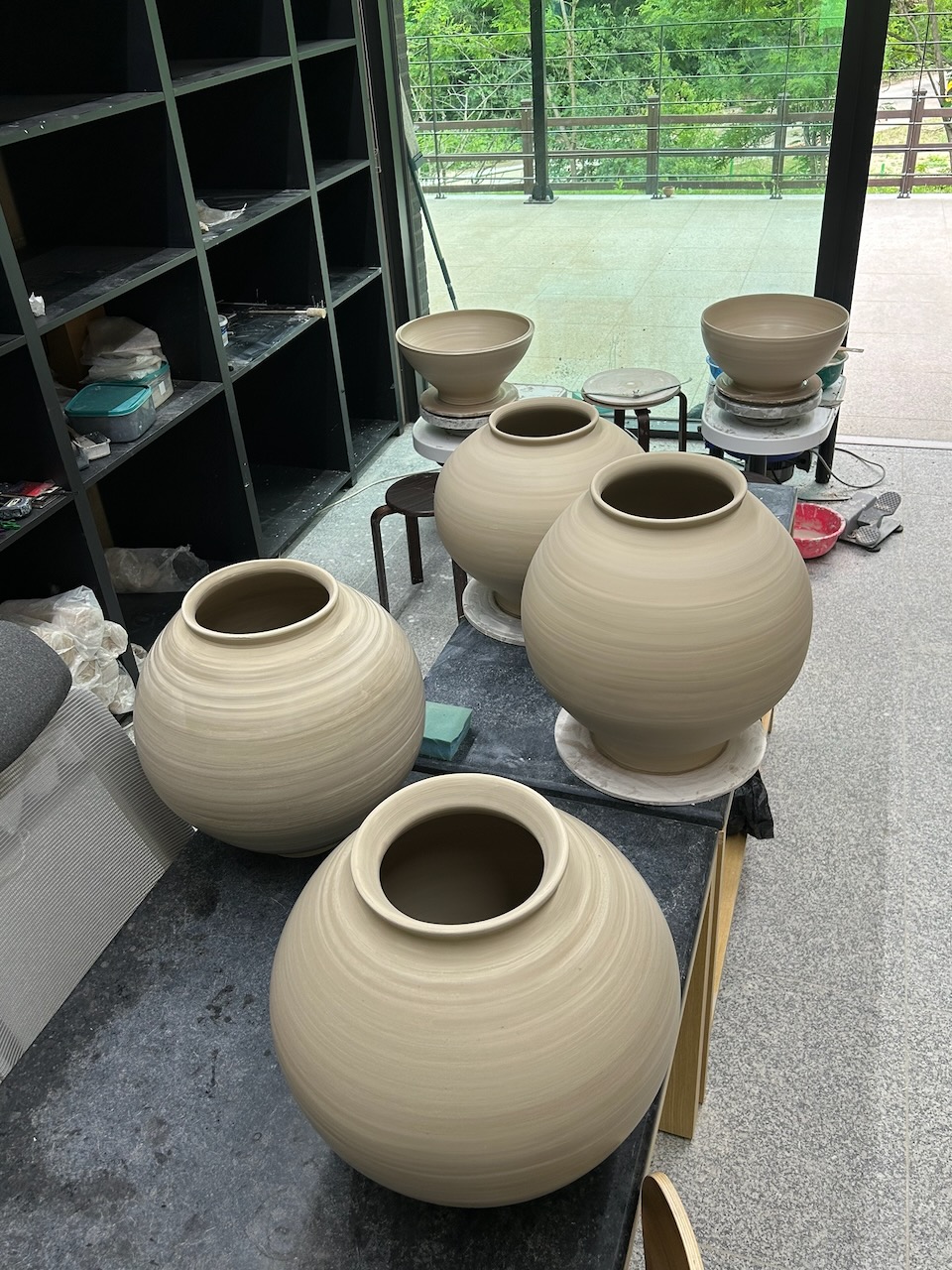
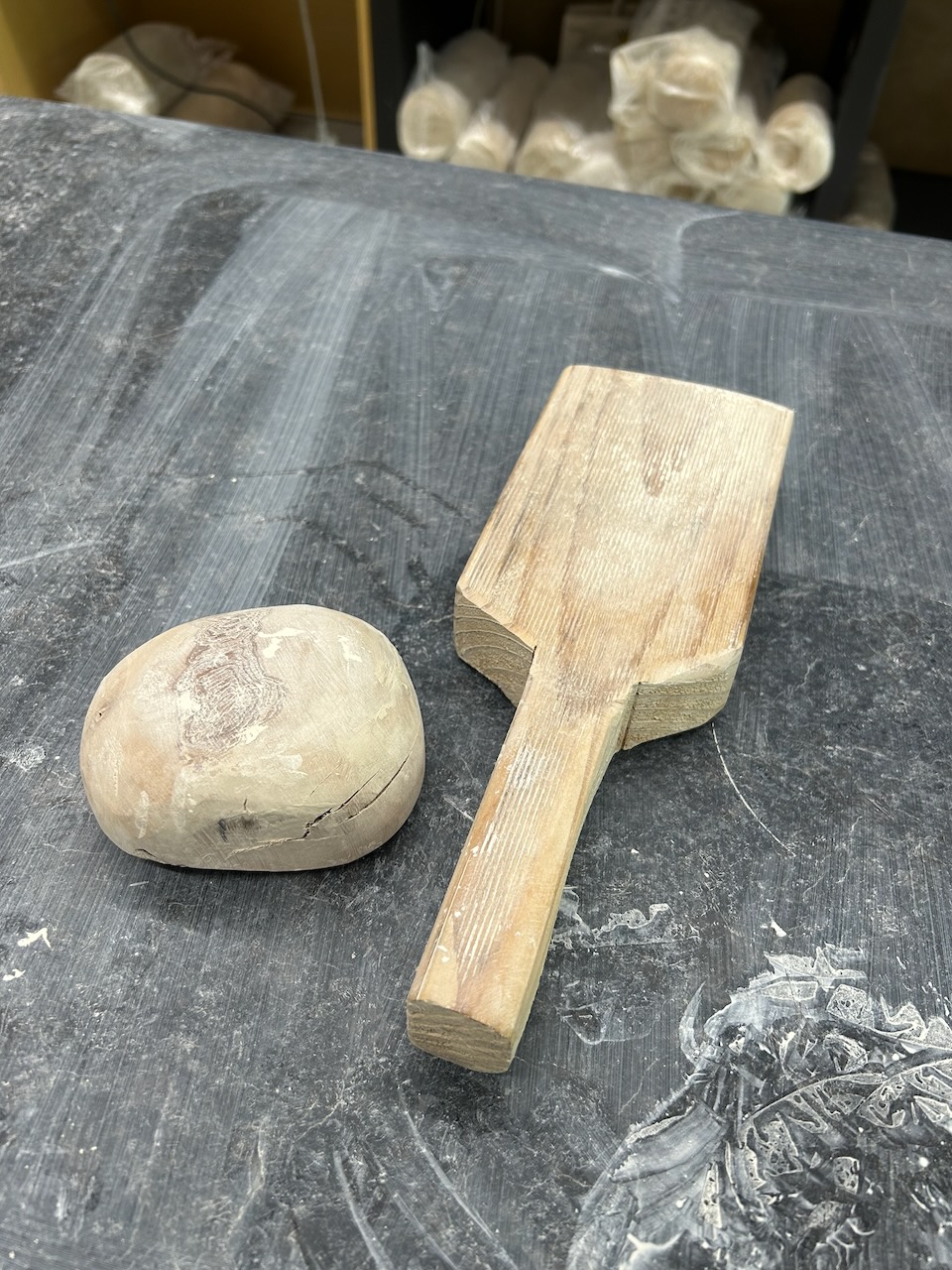
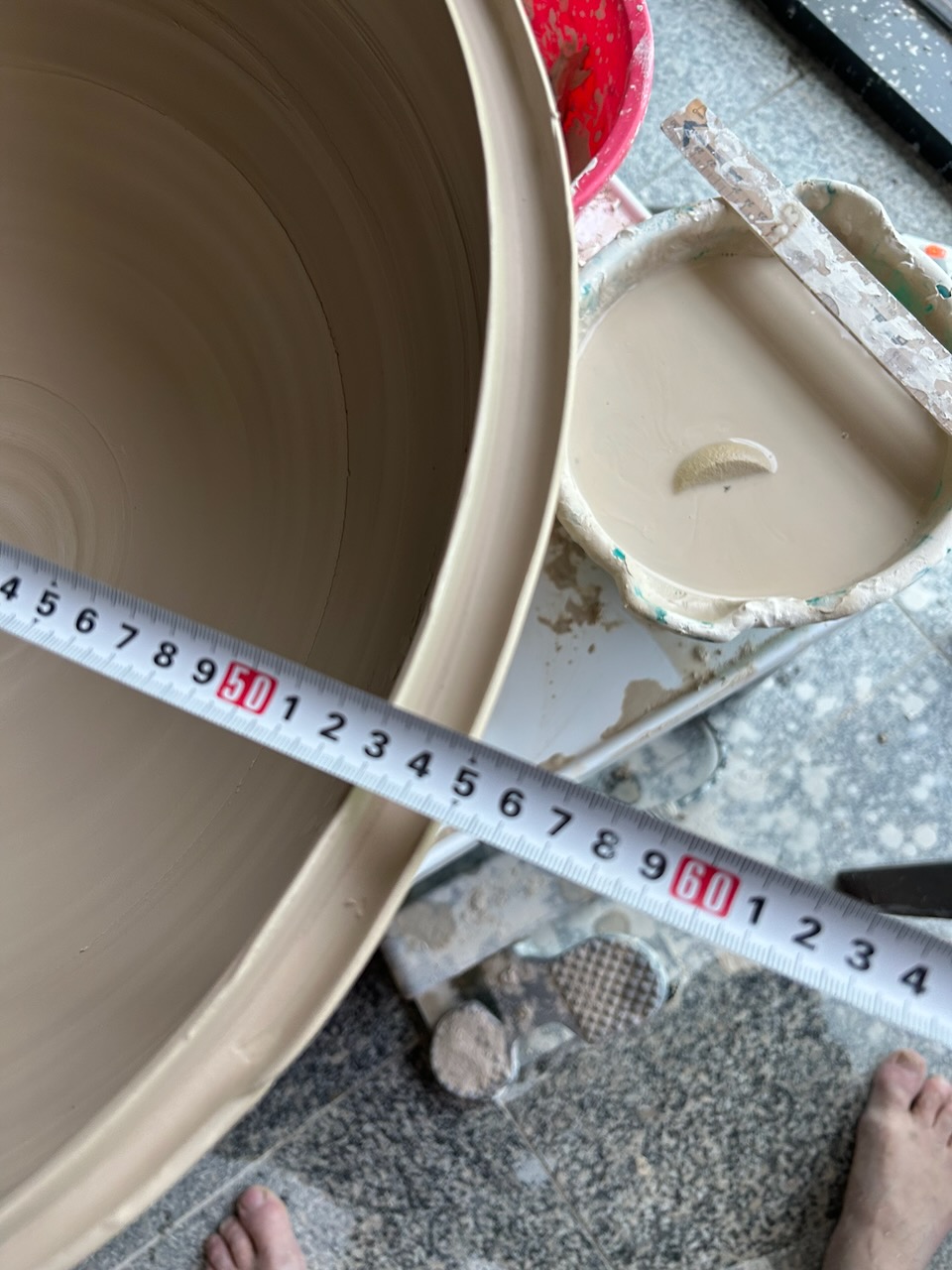
Amazingly, I can manage to throw 10 kg lumps of the stuff into 450mm dia. bowls with a small foot, two of which are joined together, one on top of the other, in what potters call ‘top-hatting’. Once joined by pinching the two parts together, I then use the hammer and anvil technique, incorporating a wooden block on the inside of the form and a wooden paddle on the outside, to beat the joint together, compressing it. This should make a secure joint if done well. Or, a horribly distorted wobbly pot if not. It takes a little bit of nuanced practise to get it joined securely, but not altered from its intended form.
A bowl of 450mm. is considered to be the ideal size to throw, or so the potters around here tell me. This should give a finished jar of approx. 400mm dia. The size of some of the ancient archetypes. So that is what I’m doing.
Throwing larger lumps of 15 kgs can result in a larger jar to impress people. I’ve had a go at it and lost a couple to slumping at the end of the throwing process, this stuff is rather floppy and doesn’t hold up well. I have completed one larger jar of 550 mm dia. to my own satisfaction.
Making really big ware is for the younger testosterone driven youngsters who need to impress to get noticed. I used to do it, but I’m neither young, nor needing to make an impression any more.
These days, I just want the satisfaction of making something elegant and beautiful that I can be proud of. Because, lets face it. All these pots will be staying here. I won’t be carrying a dozen 15kg jars home in my hand luggage on Jetstar!
The other residents here, Museum staff, and Korean friends will be the beneficiaries. My contract states that the Museum has the rights to the first choice of anything that I make here to add to their collection. After that…
I don’t know if my work will be for sale at the exhibition at the end of my stay? I haven’t counted those chickens yet!
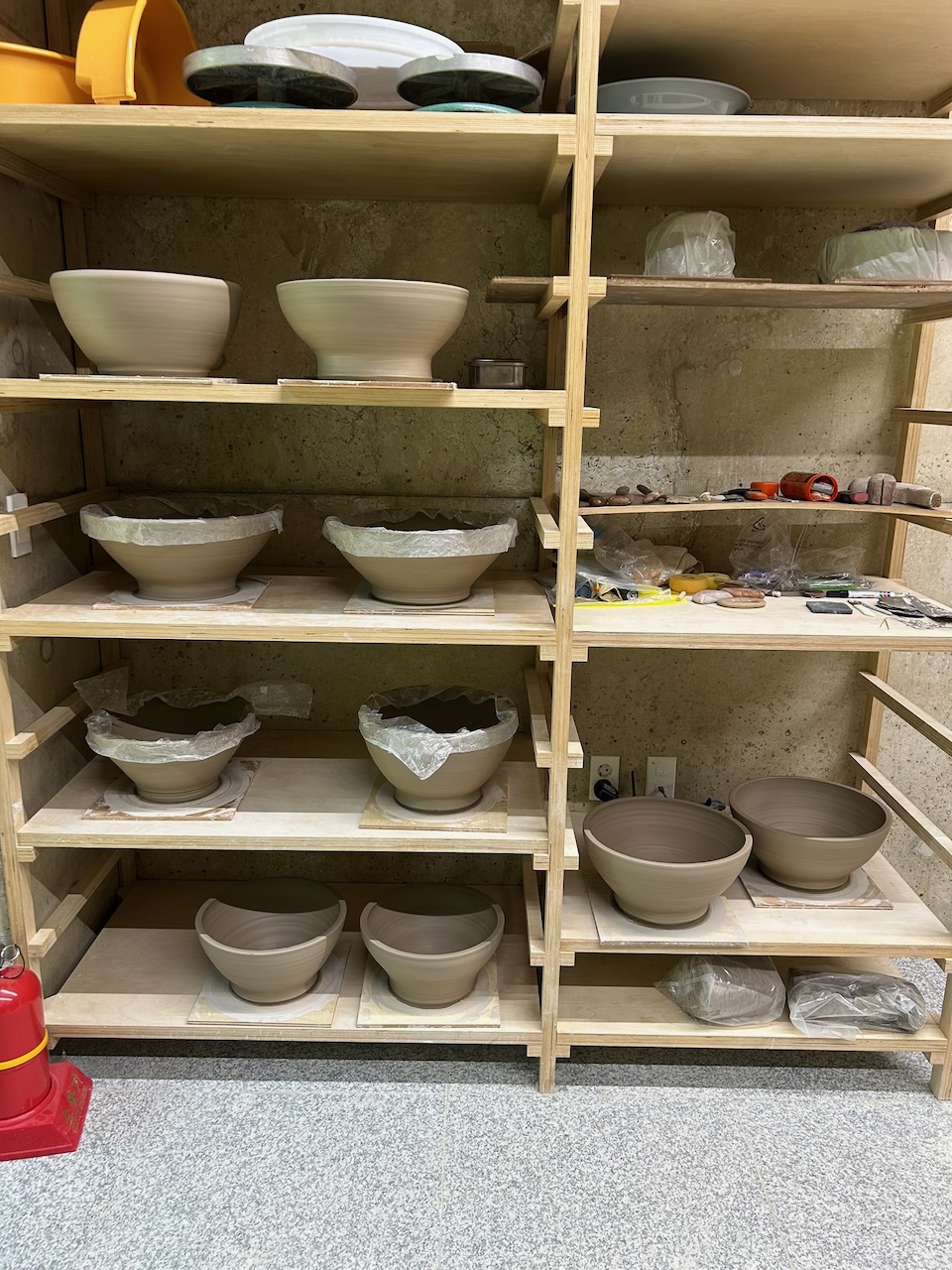
I’m slowly filling all the shelving available to me in my studio, then the corridor outside, and finally in the kiln room.
It’s a race against the on-coming monsoon rains, to get all the big work done and more or less dried in time, before the rainy season. At home I know my clay and its short-comings, as well as its strengths. I have a certain confidence with it. I have a tendency towards the ‘go fast and break stuff’ sort of work schedule. I do usually stop before I break stuff though, but I do get a lot done! Here however, everything is different, from photo-sensitivity, through kidney shape warping if there is a breeze blowing through the studio. and there usually is, because there are no windows in the studio. Just big doors at both ends, so there is usually quite some breeze flowing through. I’ve learnt to leave the freshly potted big jars on the wheel, running on slow to keep the pot rotating and keeping it from drying out on one side only while the initial drying takes place. Also Being a 200# mesh fine porcelain paste body, it has a capacity to blow up if heated too quickly, and then to crack later on in the firing if fired too fast! Temperamental!
If any of these big jars actually survive, I’ll be proud of them.



You must be logged in to post a comment.