Spring in the Garden

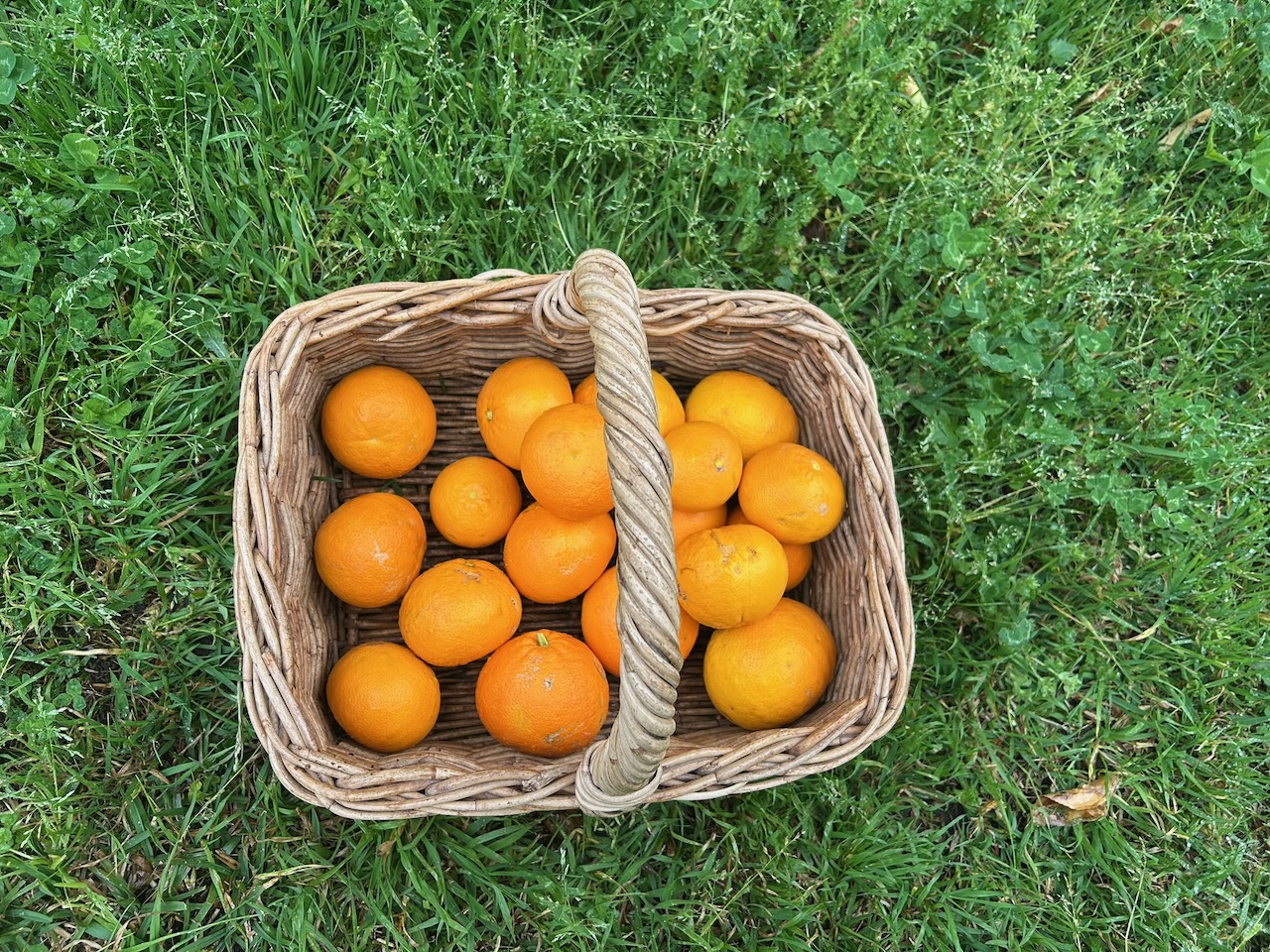
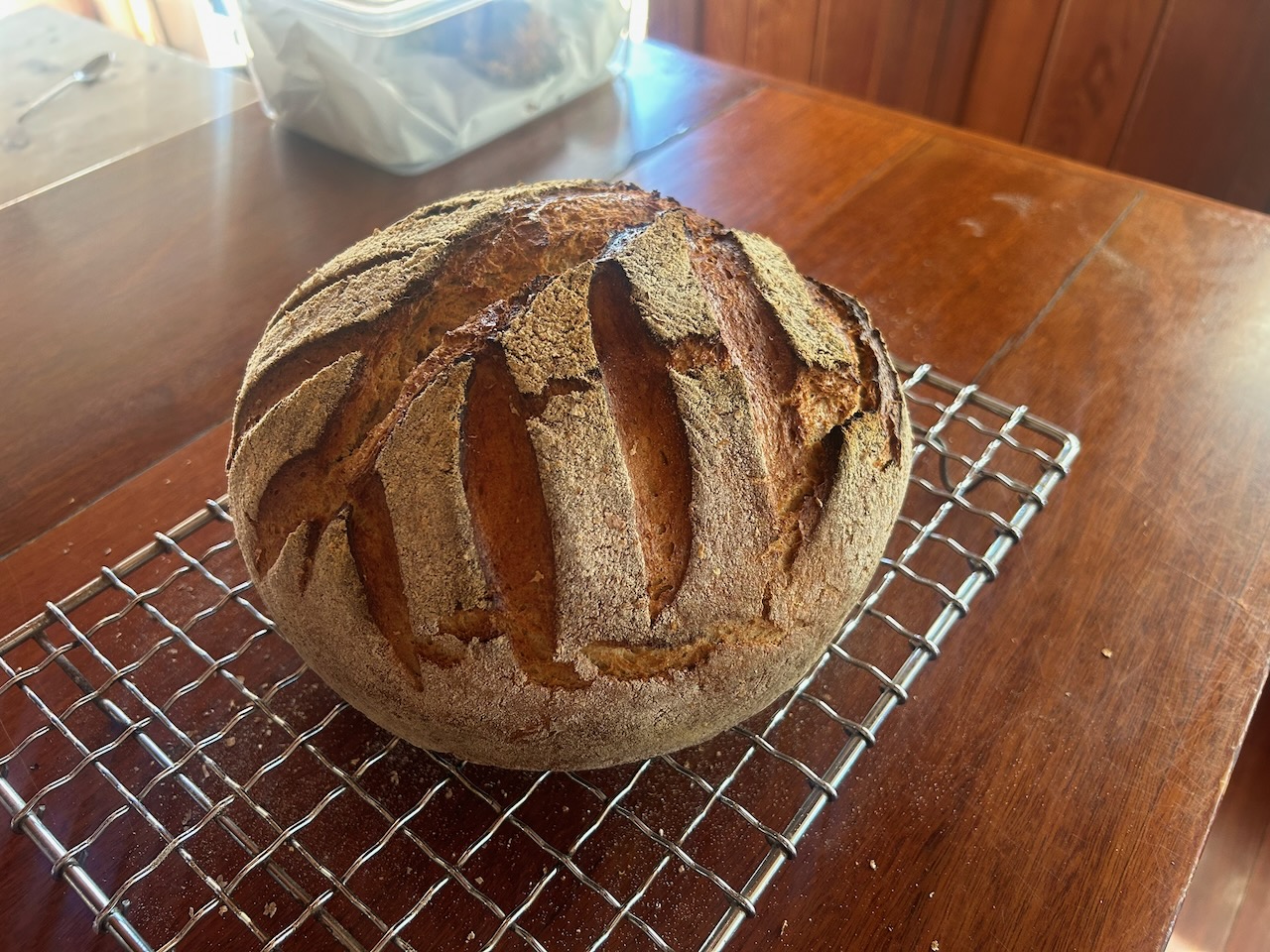
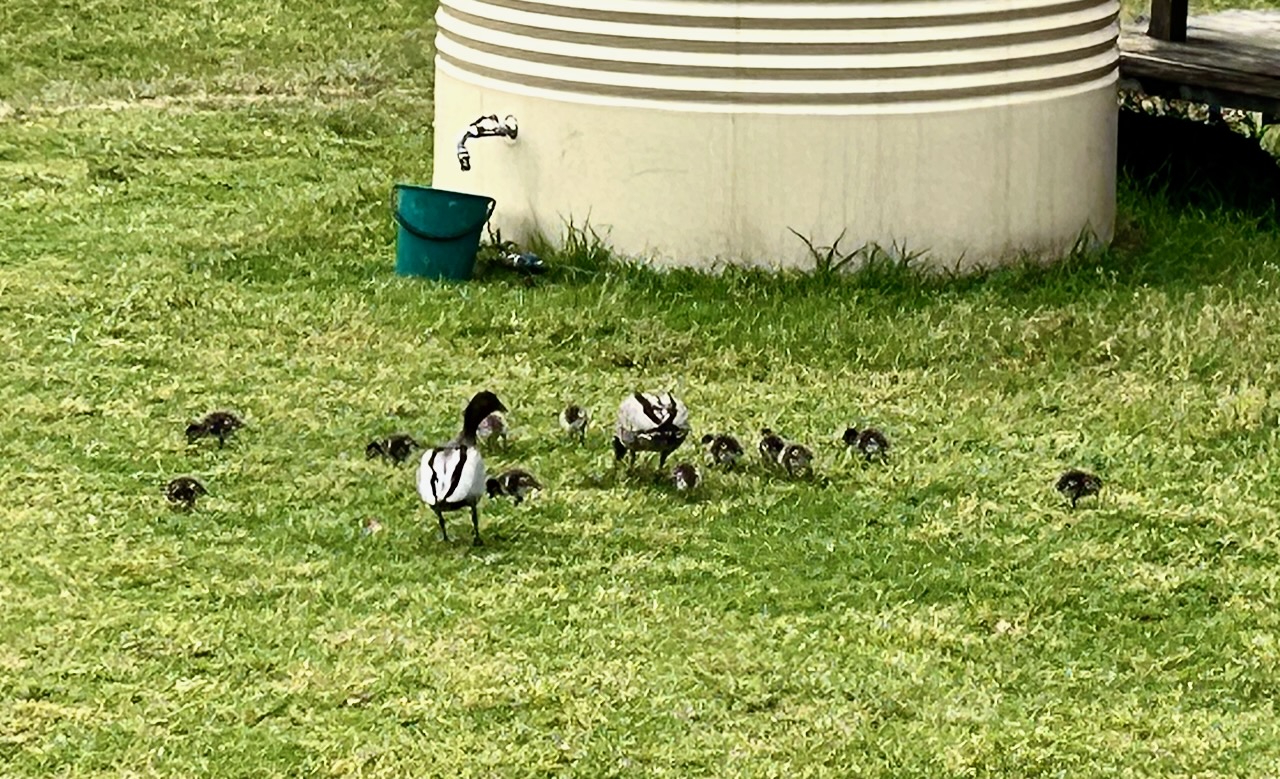
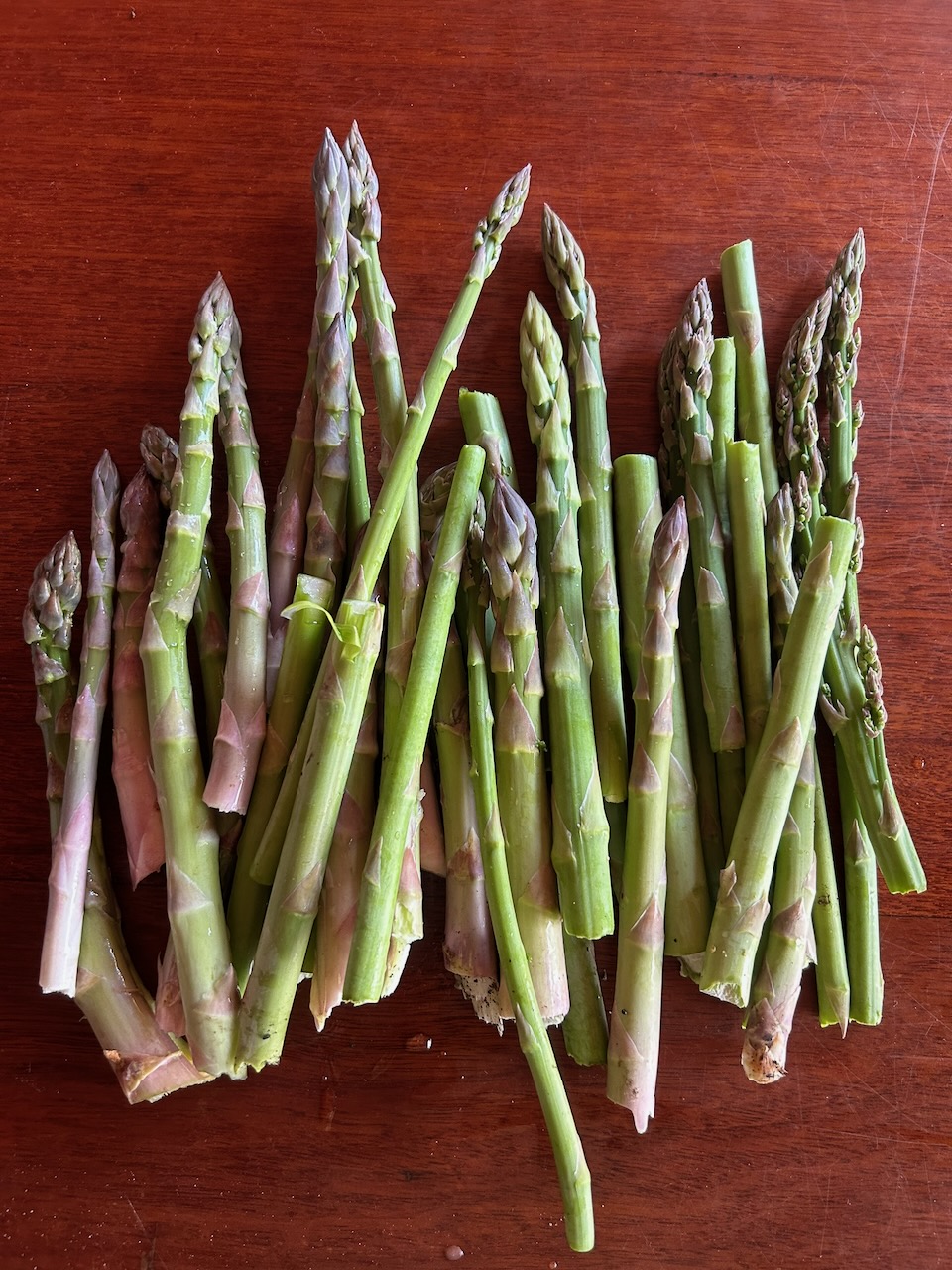
The weather is suddenly very hot like summer, but will turn cool again tomorrow, or so we are told… It’s too soon to be this hot. We are having to water the garden every evening to keep things growing well. The heat has brought out all the pollinators, they are so busy in the garden. The newly hatched ducklings are busy exploring the lawn, the asparagus is shooting up, and the artichokes are heading-up and filling out in the veggie patch, the last of the Seville oranges are fully ripe in the orangerie, marmalade is being cooked in the kitchen, the first of the new season cherry flowers have set small nascent fruit, the rye bread is out of the oven and all is well in our very special, self-created, highly-curated, fantasy world. Where we live the life that we choose, We keep mostly to ourselves, without having to deal with the complexities of local politics. 

We grow all of our own vegetables, keep healthy, free-range, happy chickens, collect our own rain water, deal with our own sewage and feed ourselves organically, with wholesome food, grown, prepared and cooked respectfully and in tune with the cyclic nature of the natural world.
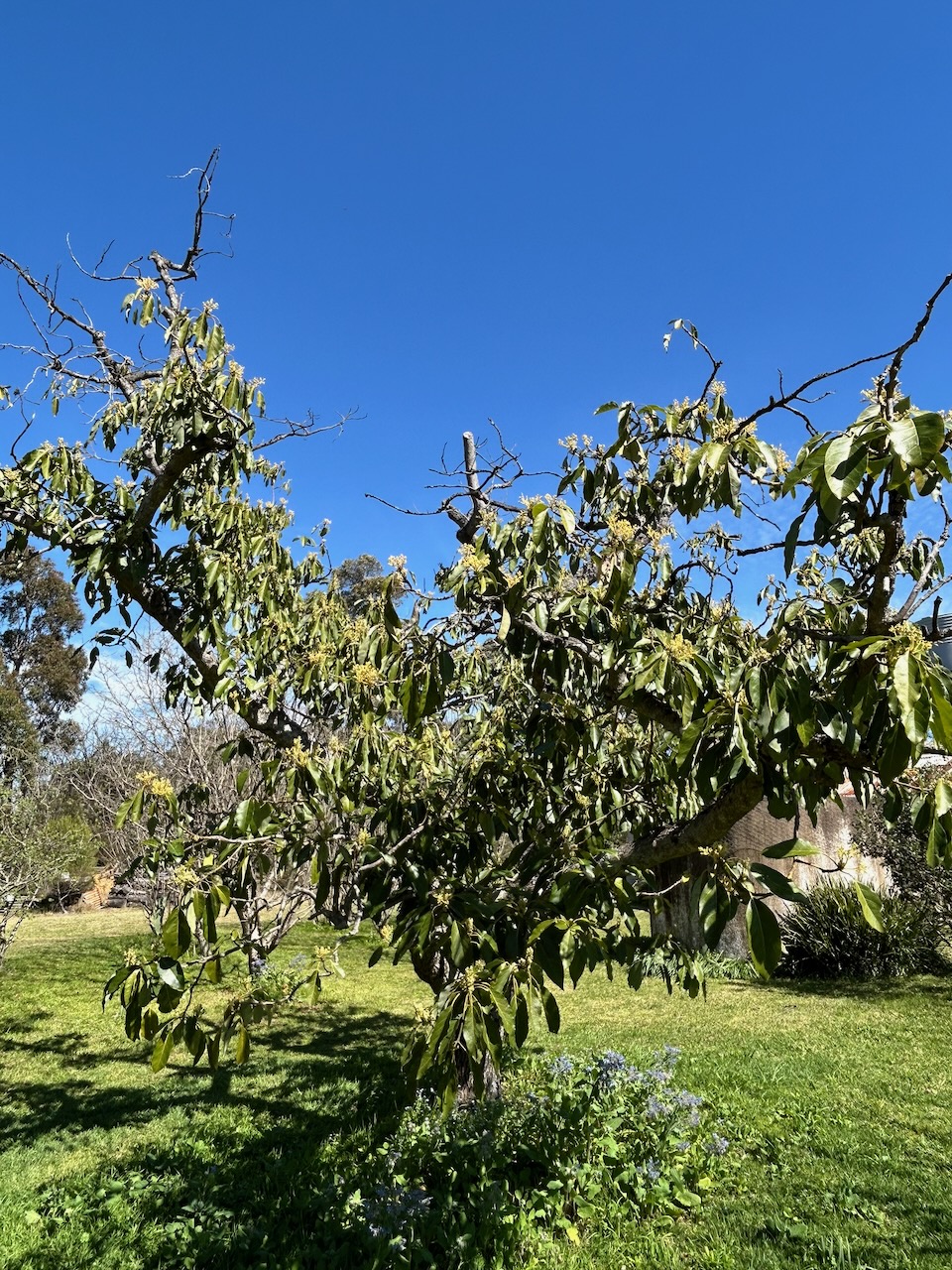
The bees and other pollinators are all out and being busy. I’m checking out the new avocado trees, half of these new, one year old trees, have decided to flower on their first anniversary of being planting out. Being grafted means that they have more mature wood, but producing flowers in their first year is pretty special. Our 50 year old Fuerte avocado tree is in full flower as well, so I’m hoping for a good, well pollinated crop. The old Fuerte tree has an understory of self germinated ‘wild’ borage plants that are also flowering now. Very pretty!
Close examination of the avocado flower heads reveals that there are no European honey bees interested in the avocado flowers, They are all working the borage flowers down below. The avocado flowers are being worked over by a few different pollinators. The main insect doing a majority of the work is the yellow and black striped hover fly. There are hundreds of them being very thoroughly busy. But there are also a number of other little hard working flighty characters, some so small that I can’t even really get a good glimpse of them. There is a wind blowing, so the flowers are moving about a lot. The smallest little critter is about 3mm long and blackish, so small that I can’t make out its features at all clearly. Small enough to be a native stingless bee, but I can’t be sure. We are probably too far south for that. Another pollinator is the ‘Delicate masked bee’, Very narrow in shape, with very long antennae. But there are also Leaf cutter bees, Blue banded bees, and an unidentified blue carapace small bee or beetle, too flighty to photograph clearly, plus some of what looks like blow flies.
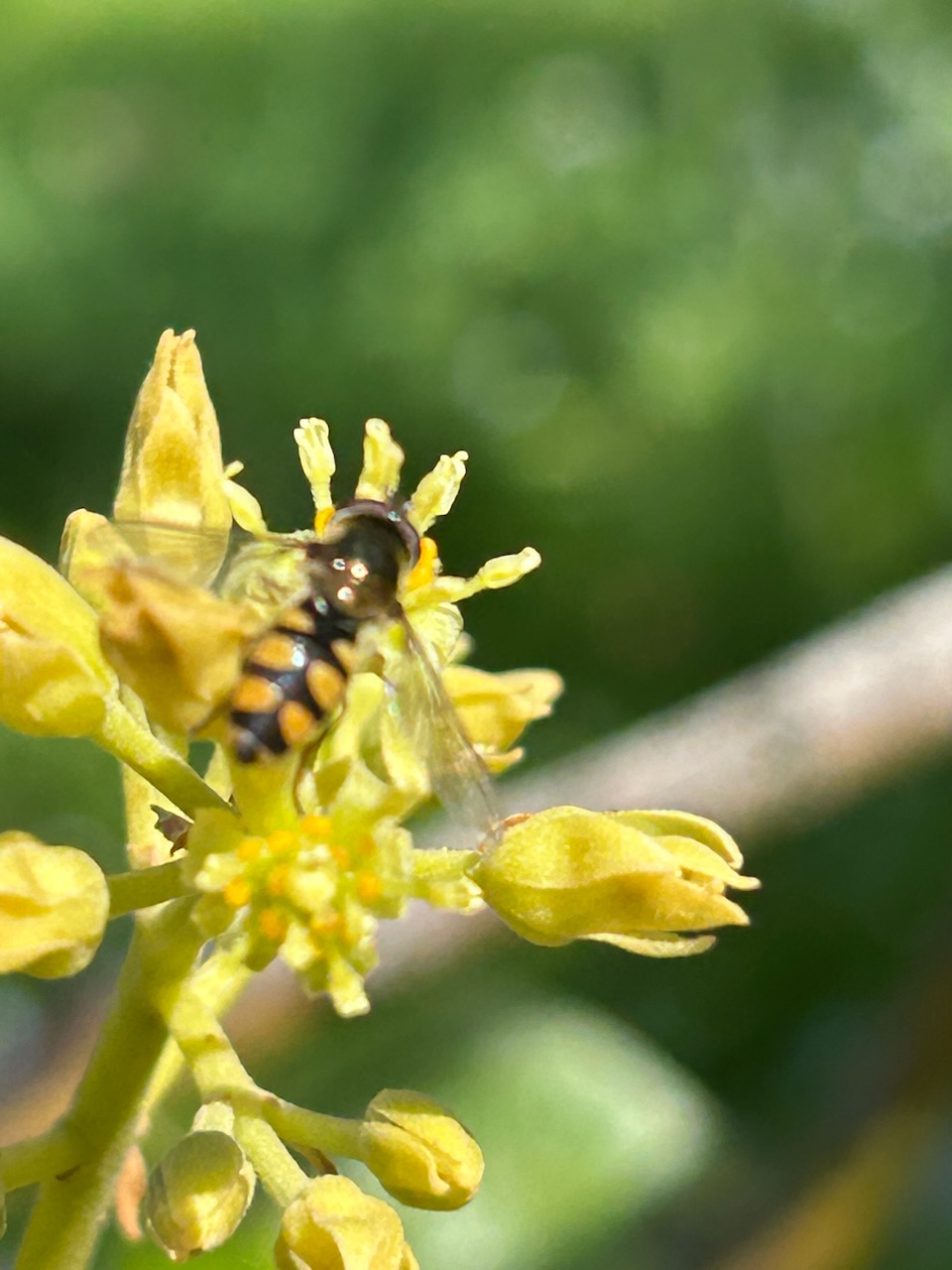
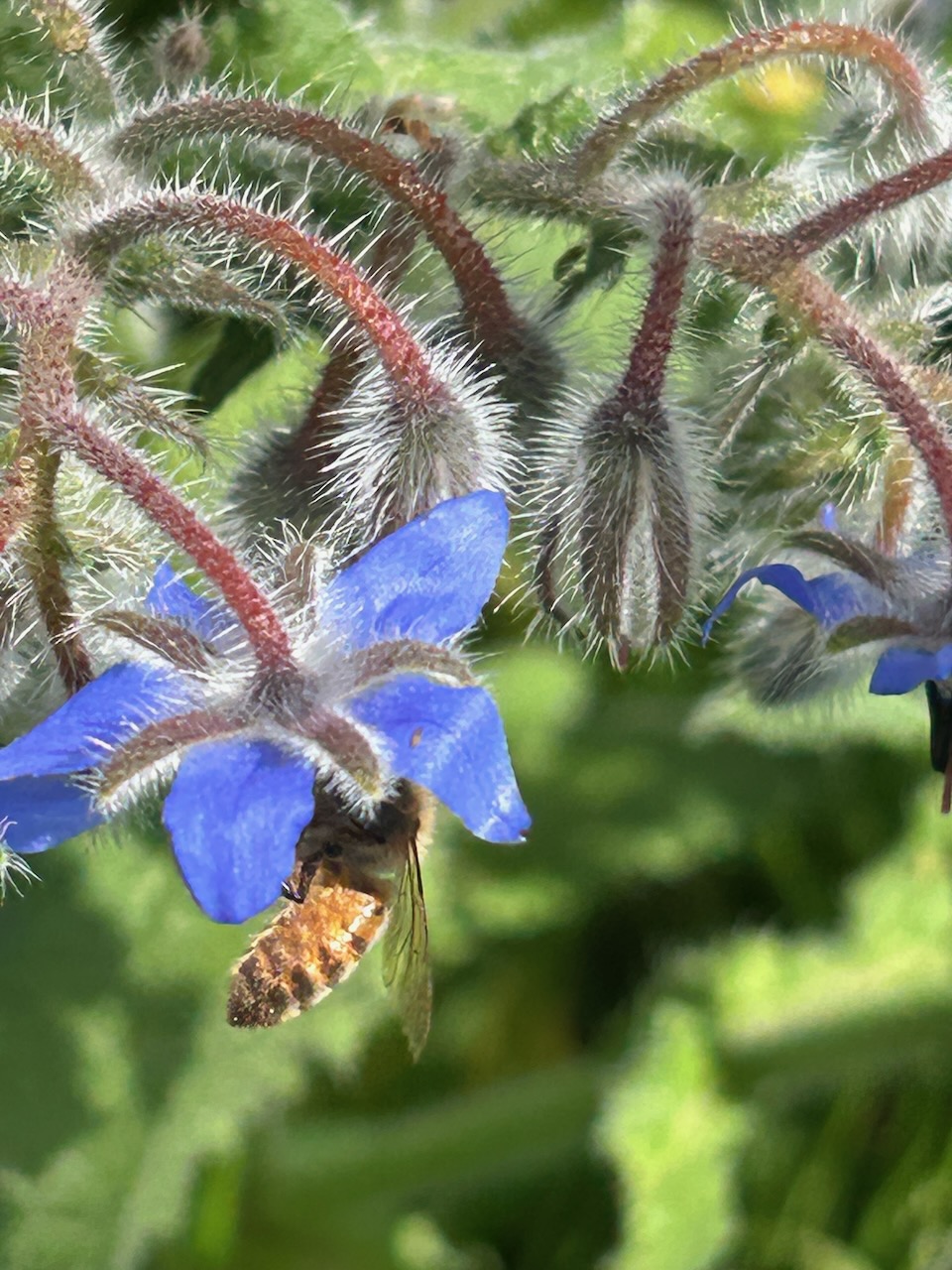
Surprisingly, I have read somewhere that houseflies and blowflies are some the most significant pollinators of avocados according to one author. But it was all hover flies everywhere here today, even on the daisies and working the cherry tree blossom. Honey bees appear to be in decline around here now, but there are still a few. There was a time when there were so many working the bloodwood trees out on the road, that we could hear them clearly buzzing on mass from inside the house!

First thing in the morning, when I open the bedroom curtains and look out into the Chekov orchard of very large, 40 years old, mature, cherry trees, I see a collective noun of finches working the orchard. So Charming! They swarm past in a flutter of activity. Constantly on the move across the lawn and in under the trees. This manic behaviour is probably a survival mechanism, it’s hard to hit a moving target. The trees are full of blossom. It’s a wall of white/pink flowers. There are also a very happy and lively group of superb wrens, very flighty and very busy. I assume that they don’t want the nectar in the flowers. They have the wrong kind of beak for that, so they must be catching little bugs. They move so fast in a sweep of chirpy, whistely, twittering crishendo of life celebrating spring. I can’t see what it is that they are eating, but having spent the previous day looking very closely at the avocados and lots of other flowering plants in the garden, I can assume that they are eating tiny bugs. If those bugs are important pollinators? I hope that they don’t eat too many! But as it is spring and breeding season, they are probably after protein? It all passes so fast. In a moment they are all gone. Suddenly all quiet again.

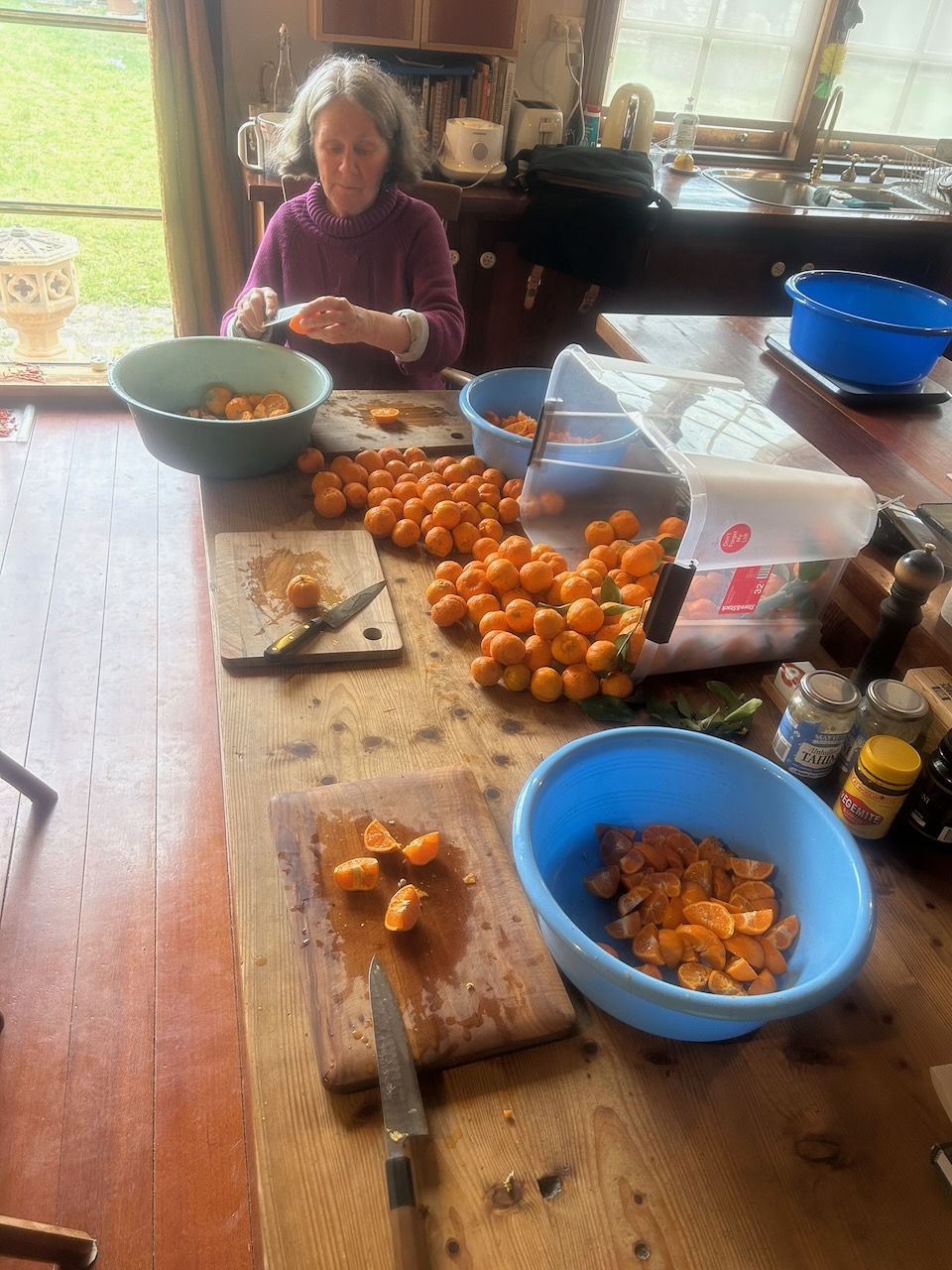
Janine, Geordie and I spent half a day peeling and juicing 40 kilos of mandarins this week, for his seasonal, artisanal, pure fruit cordial business. He creates his adult cordials with what is in season locally. Mature, sophisticated flavours using a range of herbs and spices added into whatever fruit is in season to achieve an interesting and unique flavour profile. Some of the fruit comes from our orchards throughout the year, when we have enough for his needs. Our citrus grove is now almost completely harvested, but he also gets fruit donated to him by his customers. Whatever is in peak season at the time.
In the pottery, I have finished throwing more new work. I have bisqued all the previous work now, using the excess of recent sunshine. I used the big, newly refurbished, but very old, aluminium framed, electric kiln. It may be 30+ years old, but it is all new inside now, with new home-made, hand-extruded ceramic element rods and home-made electric heating element coils. It’s now the best kiln in the pottery.

I’ve started glazing, been at it for a few days now, so should be finished tomorrow. I am planning to do a wood kiln firing for the last time until after the summer heat has subsided. There is a forecast of 3 cooler and possibly rainy days next week, so that will be a perfect time to fire.

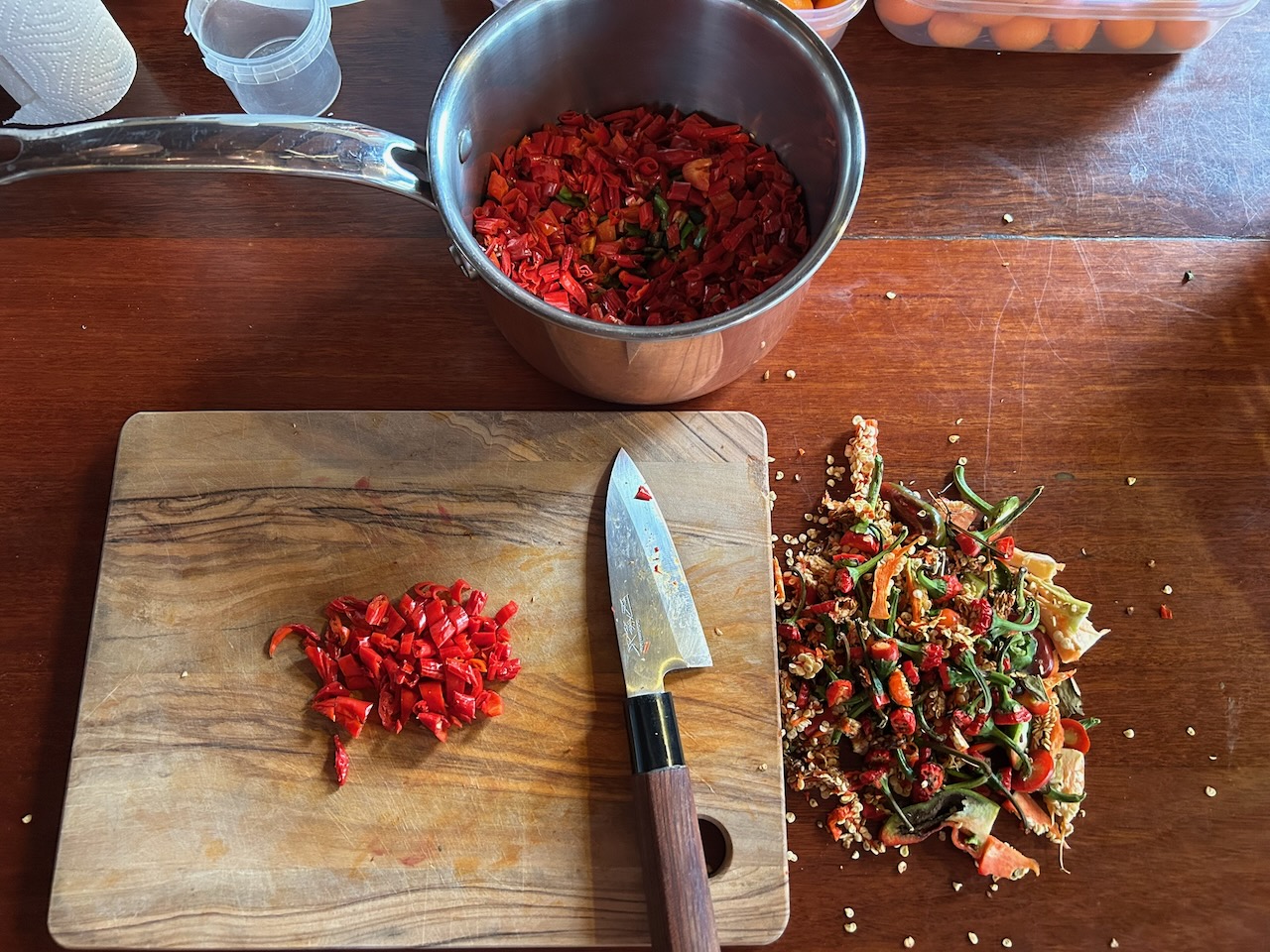
In the kitchen, I made another batch of chilli sauce. The last for this season, from the Korean chillis that I grew during the summer. This time, I decided to take the seeds out to make it quite mild, and then add some salt, sugar, garlic and vinegar, so it’s a sort of sweet chilli sauce. It’s super delicious – if I do say myself. Sweet, savoury, salty, tangy delicious. It’ll be great condement to go with cold meats like roast beef, but also useful to add to soups, sauces and stocks.

De-seed ther chillis until you get 250g of chilli, add 3 cups of vinegar, 2 cups of water, 2 cups of sugar, 2 tea spoons of salt and 6 cloves of garlic. This last item of garlic coud easily be doubled, as the garlic is hardly noticible in the finished sauce. Cook for 20 mins over moderate heat and bottle in sterilised jars.
Spring has sprung straight into summer heat

We have been told that last northern summer was the hottest on record and our winter here in the southern hemisphere was also the hottest on record. There’s a pattern here. I need to take notice and prepare for what will most probably turn out to be a longer, hotter, drier summer. More drought and more fires?

We are pretty well prepared here for the very likely increased fire danger, having been there and done that in the past and learnt from it. However, who knows how and when it will come and under what conditions.

This week I started testing and running the various fire fighting pumps to make sure that we are all OK and prepared for any sudden and unexpected fire event. I need to know that everything is in working order after the long hiatus of non-use since last summer. Petrol goes ‘stale’ if kept too long, so I need to syphon out any old fuel from the engines and refill them with fresh petrol, then run them and switch off the fuel line while the engine is running to drain the carburettor of fuel before shutting down and leaving it ready to restart reliably in any emergency. It all takes time, but is absolutely necessary if you live in the bush like we do, situated between two densely forested National Parks

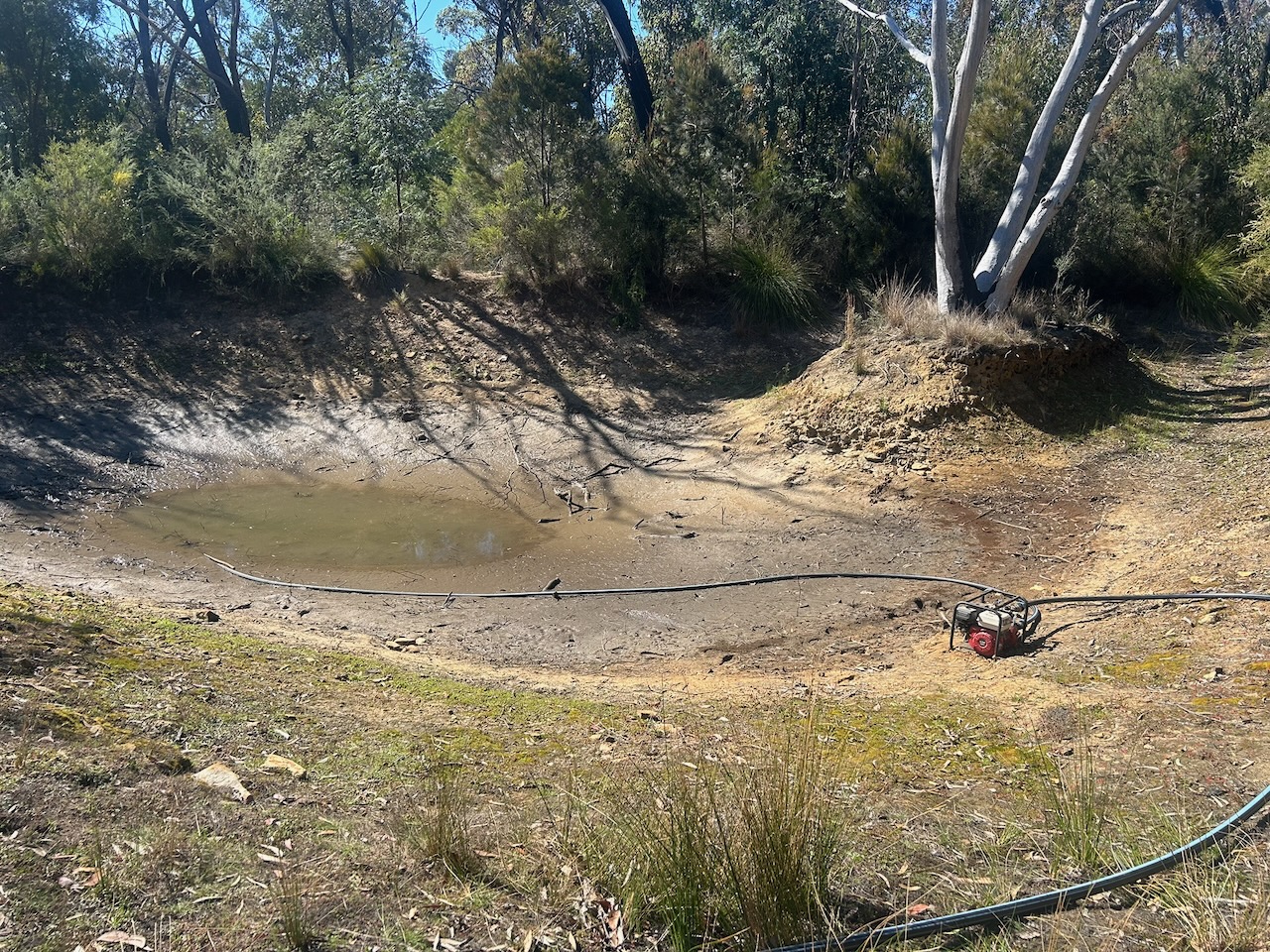
As we haven’t had the usual winter rain here, all the dams are almost empty. Not a good way to start a hot dry summer. We need the water for irrigation of the vegetable garden and the orchards, but obviously for fire fighting as well.

I use one of our 4 petrol powered fire pumps, that is not permanently installed in one position to run the wall and roof sprinklers on a specific building. One is for the house protection system. A second for the pottery and barn, and the third for the railway station and carport. All these buildings have wall mounted sprinkler systems installed and huge 30,000 or 40,000 litre water tanks connected. 

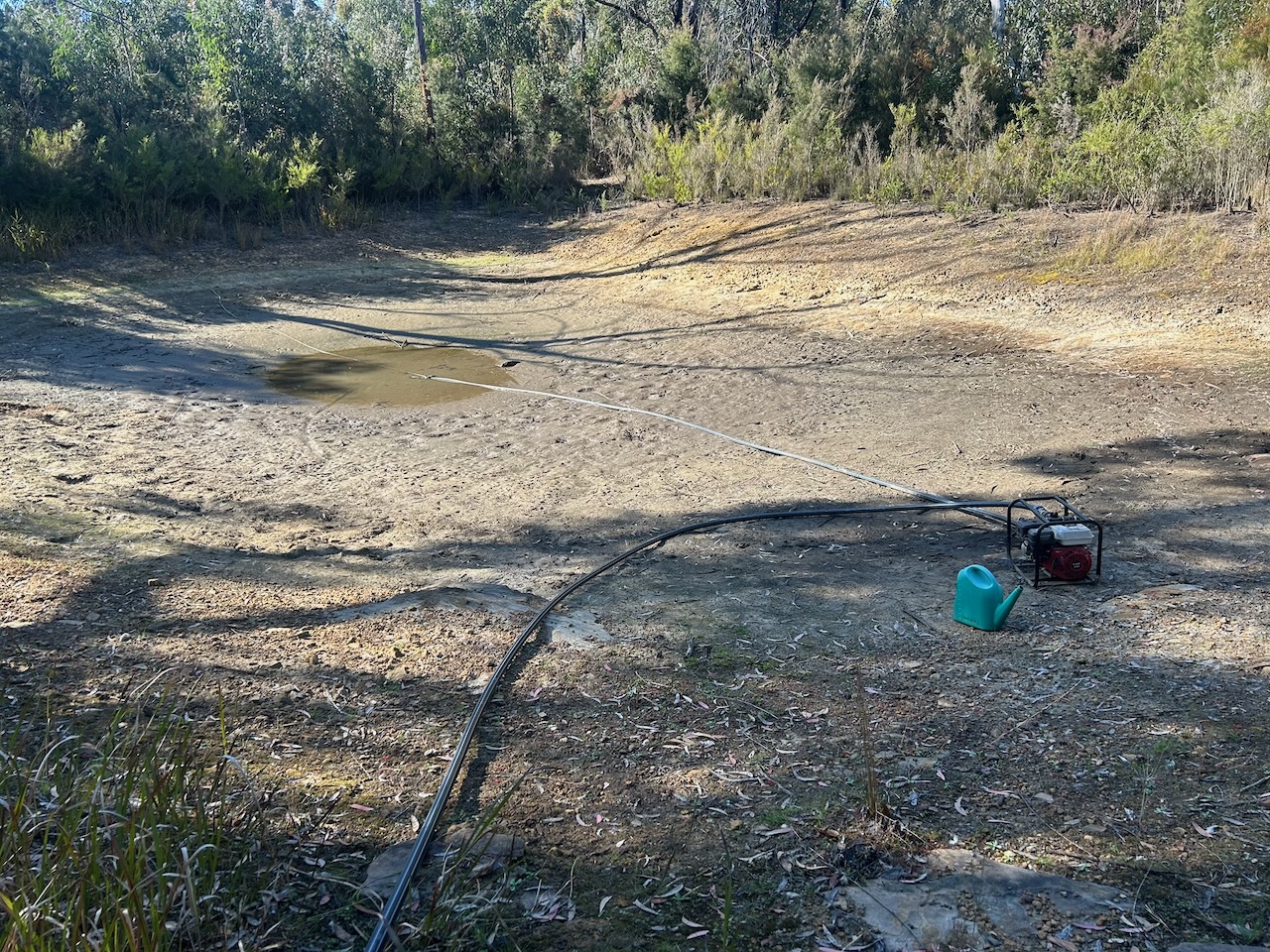
Using the portable fire pump unit, I can put it in the wheel barrow and take it down to the lowest dam to pump water uphill to the middle dam, accumulating all the water together, in that dam, and then from there, up to the top dam, where the big fire fighting pump is installed. This pump runs the underground system of buried polypipes, taking water to every part of our land, where I have installed metal stand pipes along the line to connect 20mm hoses for ground based sprinkler systems.

The bottom dam is pumped almost dry, leaving just  a small amount of residual water for the yabbies.

The pump is then moved up to the middle dam and repeated, pumping all of this water up to the top dam. It takes most of the day to empty each dam. approximately 6 solid hours of pumping. Refilling the fuel tank every 2 hours. It costs me $60 in fuel at these current elevated prices due to Trumps war on everyone. I’m a bit shocked at the price of fuel. I only go to the petrol station a couple of times a year these days, so it’s a shock. I’d rather run the fire pump on our own solar PV, but I’d need a very long and very thick, 3 phase, 5 core, extension lead. This would not only be extremely expensive, but too heavy to lift.

I do have a 30 metre, 5 core, 3 phase, cable to run the electric wood splitter that I rebuilt and converted from a petrol driven to electric after the fire. But this is impossible to lift. I have to drag it out bit by bit, to get the business end down to the closest wood pile next to the pottery. I wouldn’t want to have to manage anything 3 or 4 times longer and heavier. And, that wouldn’t be feasible in a fire situation.

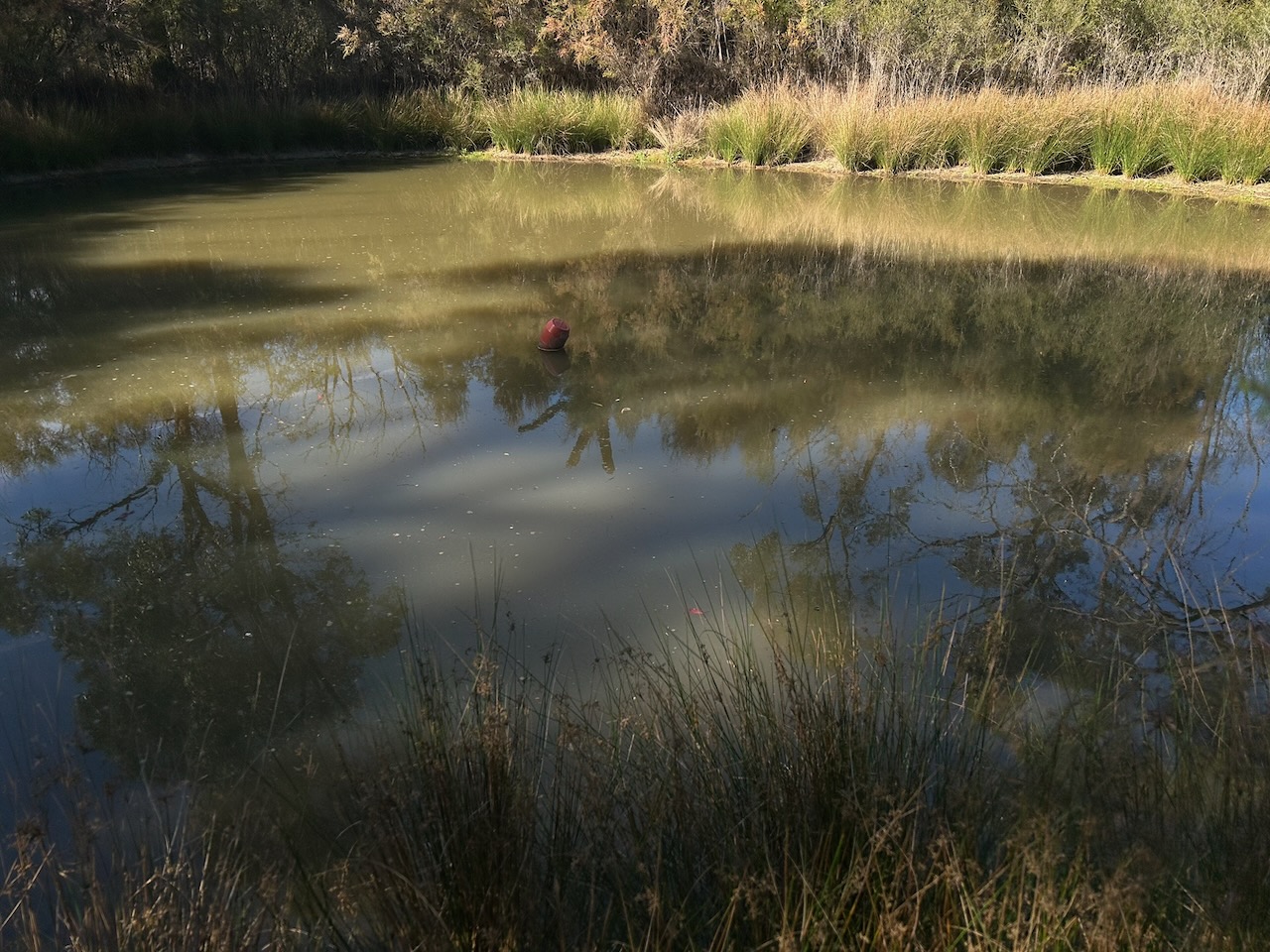
By concentrating all our ground water reserves from 3 dams into one. It reduces the available surface area for evaporation to 1/3 , so making the stored water last longer into the summer.

Each of the individual dams had evaporated down to just half a metre depth of water. By concentrating all the dam water up into the small top dam, it is now a metre deep. This amount or water will probably last us til just after new year. After that, we will have to rely on our tank water storage.

We have two very large water tanks of 100,000 litres each, down in the bottom corner of our land at the lowest point. These collect the rain water off the roof of the barn and the pottery.  We started out with just the one tank, These are two very large roofs, so quite efficient at collecting rain water and storing it. However, if it doesn’t rain for long periods, we do manage to use most of this water, like we did in the last drought. We pumped the first concrete tank down to just 200mm depth remaining before it rained again. That was a warning to me that one large tank wasn’t enough, because there had been periods earlier on when it rained for a week and that first tank had over flowed for days. So I added a second tank to catch and store that overflow water. 

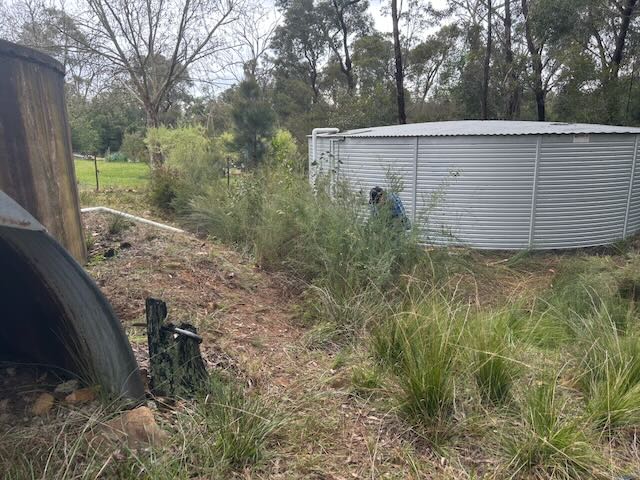
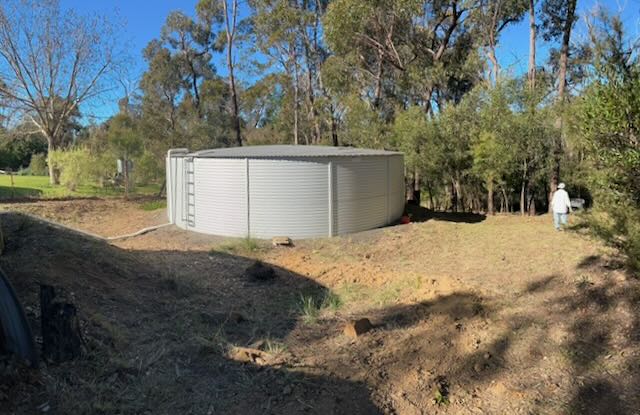
Over the years, under growth had built up and grown quite thick all around those two tanks. The newer 2nd tank is not concrete, but a tin tank lined with a plastic bag inside. This will be a bit vulnerable in a bush fire if there is a build-up of fuel load in front of it. So on my return from Korea. We set about clearing out all the accumulated vegetation. It was a big job over 3 days to get it all clear again. but will be safe now for a few more years. 

We managed to get all this undergrowth cleared away and piled up and burnt before the fire season started, so were able to burn it all in a pile safely.

Of course any sane, rational person with an interest in fire safety around their home, would keep it all mowed and spotless with regular maintenance all year using the whipper-snipper/strimmer, and digging out the tougher bits with a mattock!. But clearly, I’m too lazy to get off my fat idle butt! 

I tell myself that I will do it soon, maybe later, but just not today and then a year (or 2, or 5) passes by and there is suddenly a small forest to deal with. It’s just like cleaning out the kitchen grease trap. It doesn’t get done regularly enough, and then it’s a big issue. Welcome to being human.

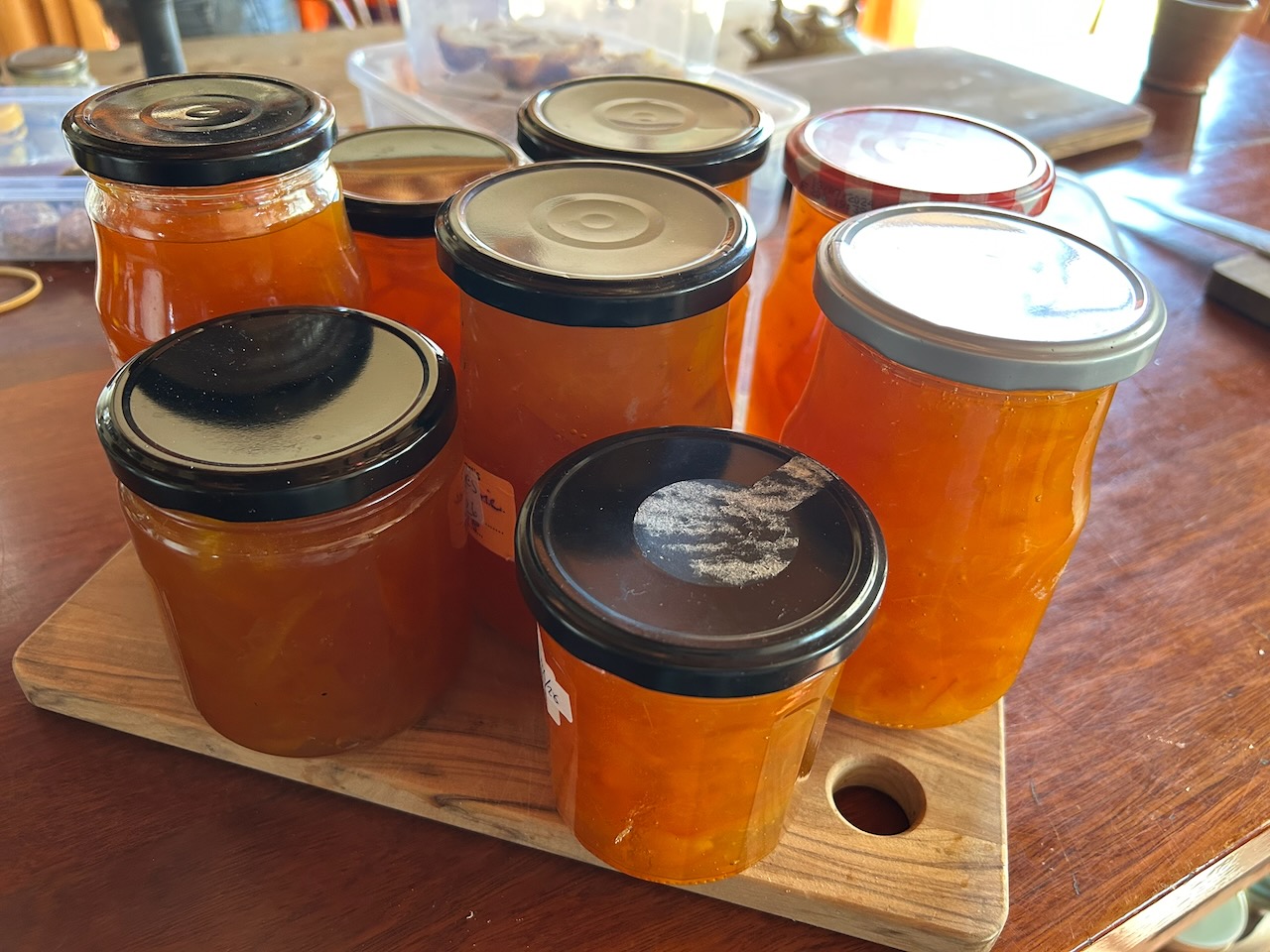
The citrus season is coming to an end. I still have a few Seville oranges on the tree, so there will be at least one more batch. I have made 4 so far since my return, just enough to get us through the year ahead – almost.

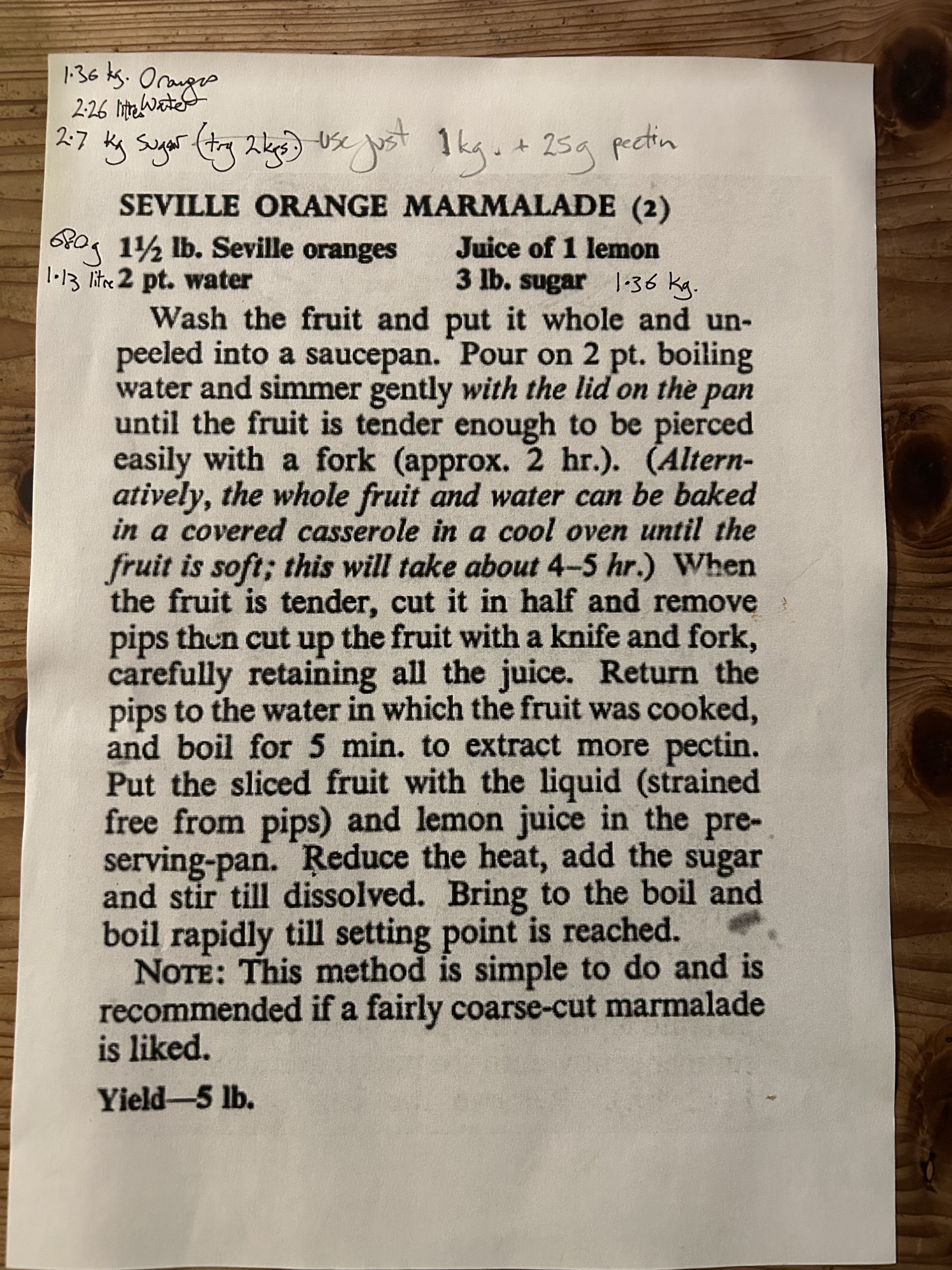
For the past few years I have been using the ‘Mrs Beeton’ recipe for boiled whole fruit that was sent to me by our friends Bill and Anne. They get some of our fruit each season in return.

Of course, I can’t help my self, I have changed the recipe to remove 60% of the recommended sugar in the recipe, down from 2.7 kgs to just 1 kg. It’s sweet enough at this level. At least for me anyway. I find most jam and conserves way too sweet for my taste.  It’s the easiest and consistently reliable recipe I’ve adapted to. I have added just half a packet of pectin (25 g) to make up for the missing sugar. 

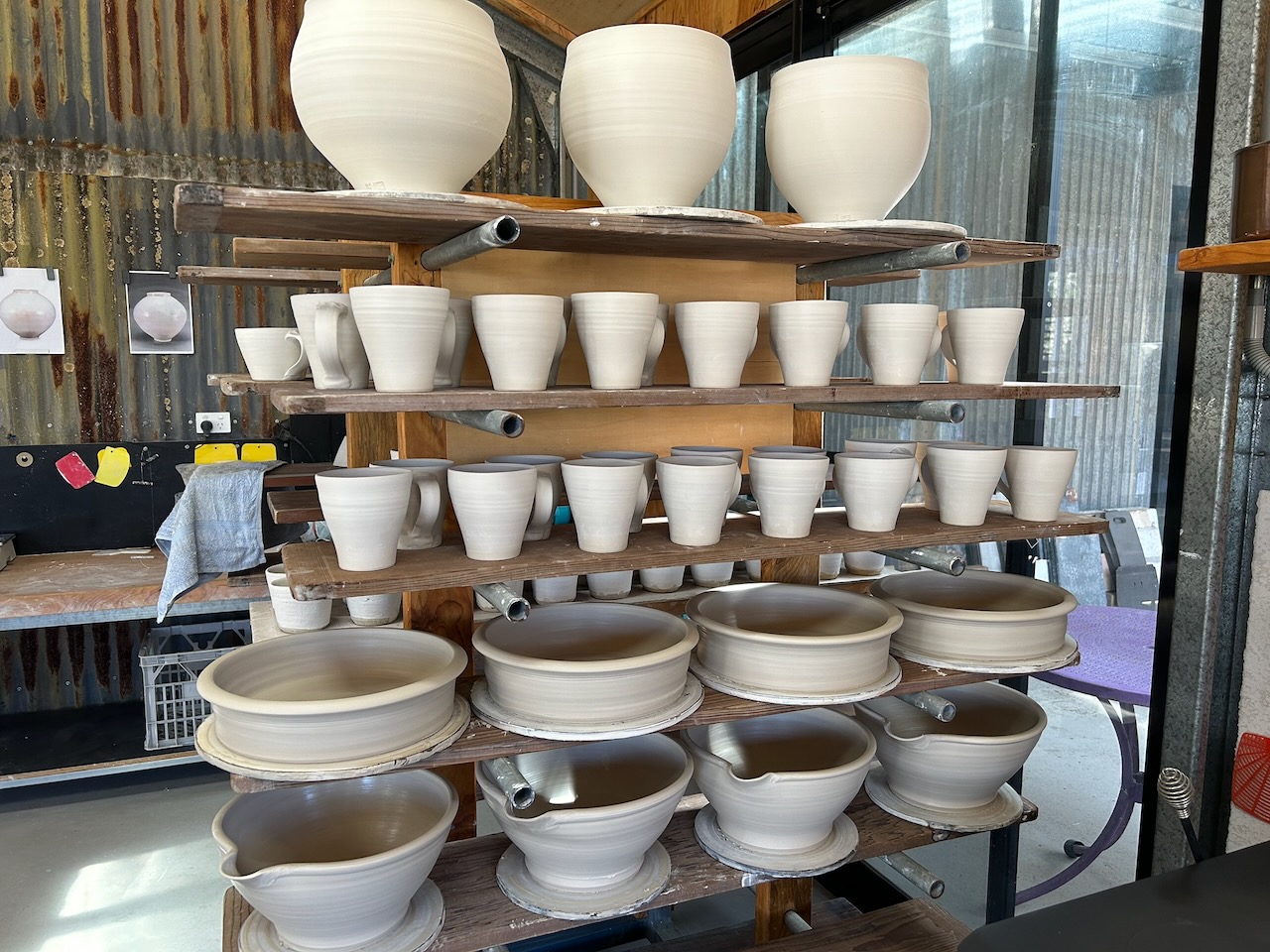
In the pottery, I have been making a range of domestic wares , getting ready for the end of year open studio sale. Most recently I have been making cups and saucers. So very old fashioned, but rather romantic and quaint. I make them every so often, as I really like them as a project. They require careful measurement and skill. So they are very rewarding when you get them right. I have also been making baking dishes and mixing bowls.

I have started glazing, getting ready for a wood kiln firing, before it gets too hot and late in the year. I should have got it done earlier, but was too tied-up playing catch-up on all the jobs around the orchard prior to spring and then getting the garden up to date, cleaned out, weeded and replanted with the summer crops. 3 Months away has put me behind schedule with regard to the seasons. But everything gets done eventually, usually a little bit late, but I don’t pretend to be perfect, just committed to this chaotic, wholesome, DIY, organic, post modern peasant’s, artist’s life.

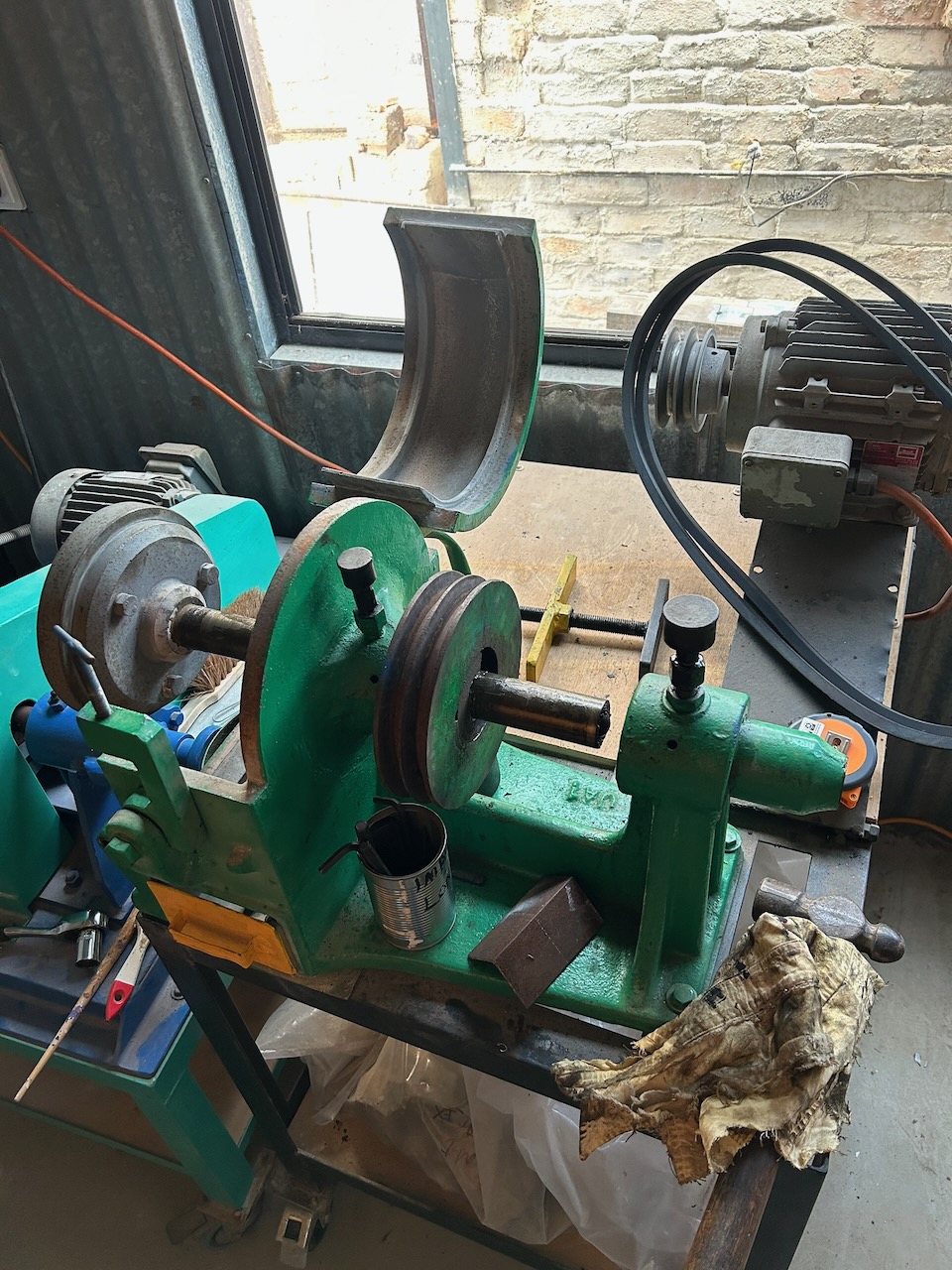
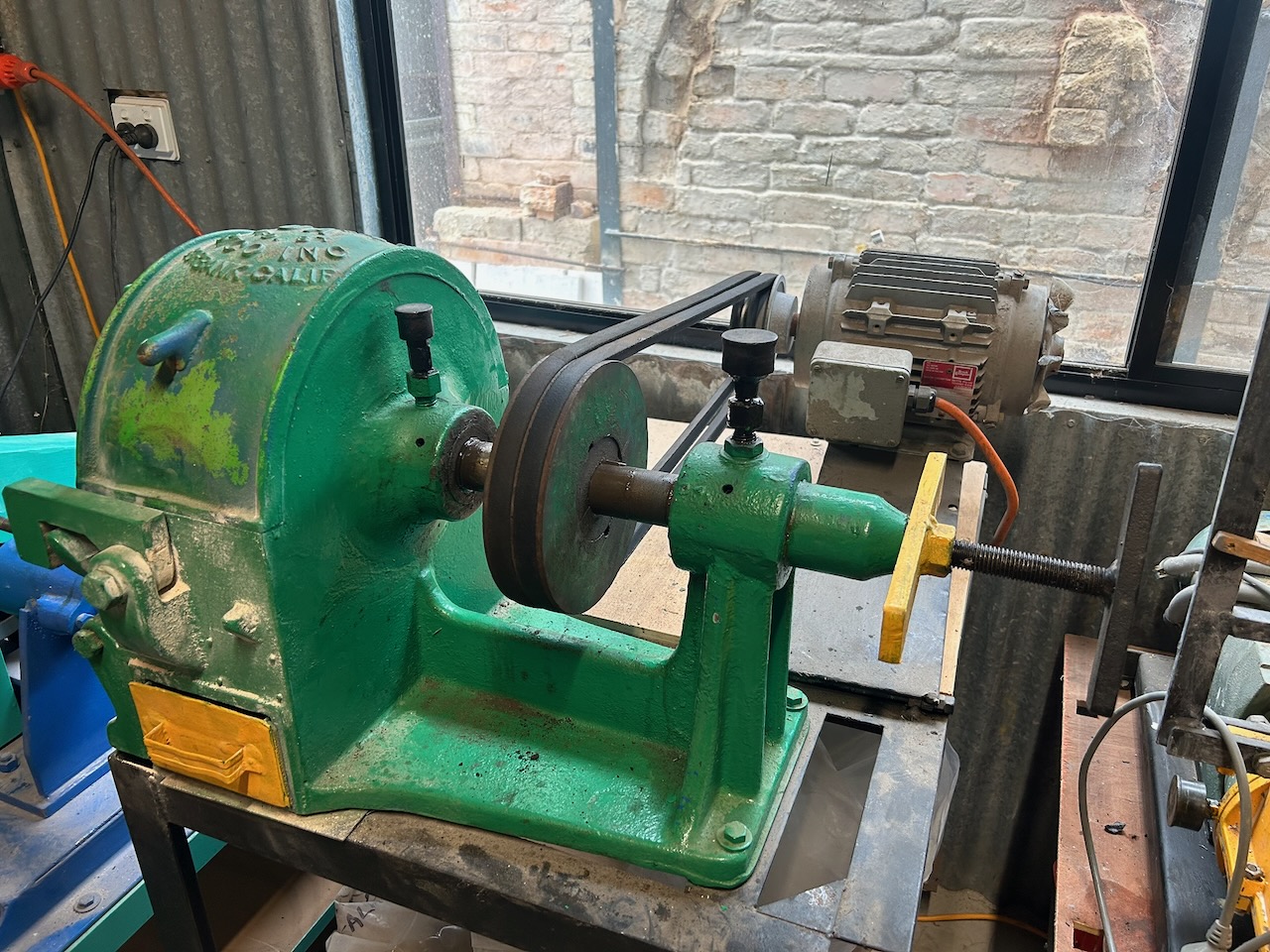
In my ‘spare’ time I finally found time to finish the long awaited repair job on the disc-disintegrator rock crusher. I cleaned it and repaired it to almost going condition after the fire, but the rubber belts got melted in the fire, so it got almost finished, repainted and all greased up and ready to go – well almost, but for the missing twin drive belts. The problem was that the belts need to go around the drive shaft, but the shaft is fully enclosed in the mechanism. This means removing the shaft to slip them in. But to remove the shaft I have to push it out through the plain bronze bearings. Over the many long years of use. It’s about 100 years old. The shaft has been a bit worn into place with a slight ‘lip’ built-up, or rather worn-in, which stops its from moving laterally. So to get it moving, it needs to be hammered out. I tried this, but not wanting to break it…

I gave up at this point some time ago and thought that cleaning the grease trap sounded somewhat easier and a more attractive proposition, followed by scrub clearing and brick cleaning. I had just finished scrubbing the pavers on the south side of the pottery, all covered in slippery moss, using chlorine bleach, when I realised that I was just procrastinating. So I went back in (2 years later) and figured out how to remove that shaft. One thing leads to another, and I needed to remove the drive pulley first, but that necessitated removing the rusted on collar, which was held in place with corroded grub screws… which led to having to work out a way of releasing the embedded keyway spline, to slide the pulley off. It also required dis-assembling and removing the front metal casting of the mill to allow the space for the shaft to move outwards… The front casting bolts were rusted in place, so needed several applications of RP7 and light oil, plus some gentle heating and then tapping with a copper ‘drift’ to get them in an agreeable state of mind to start moving.

Days later, it’s all done and a going concern again. 

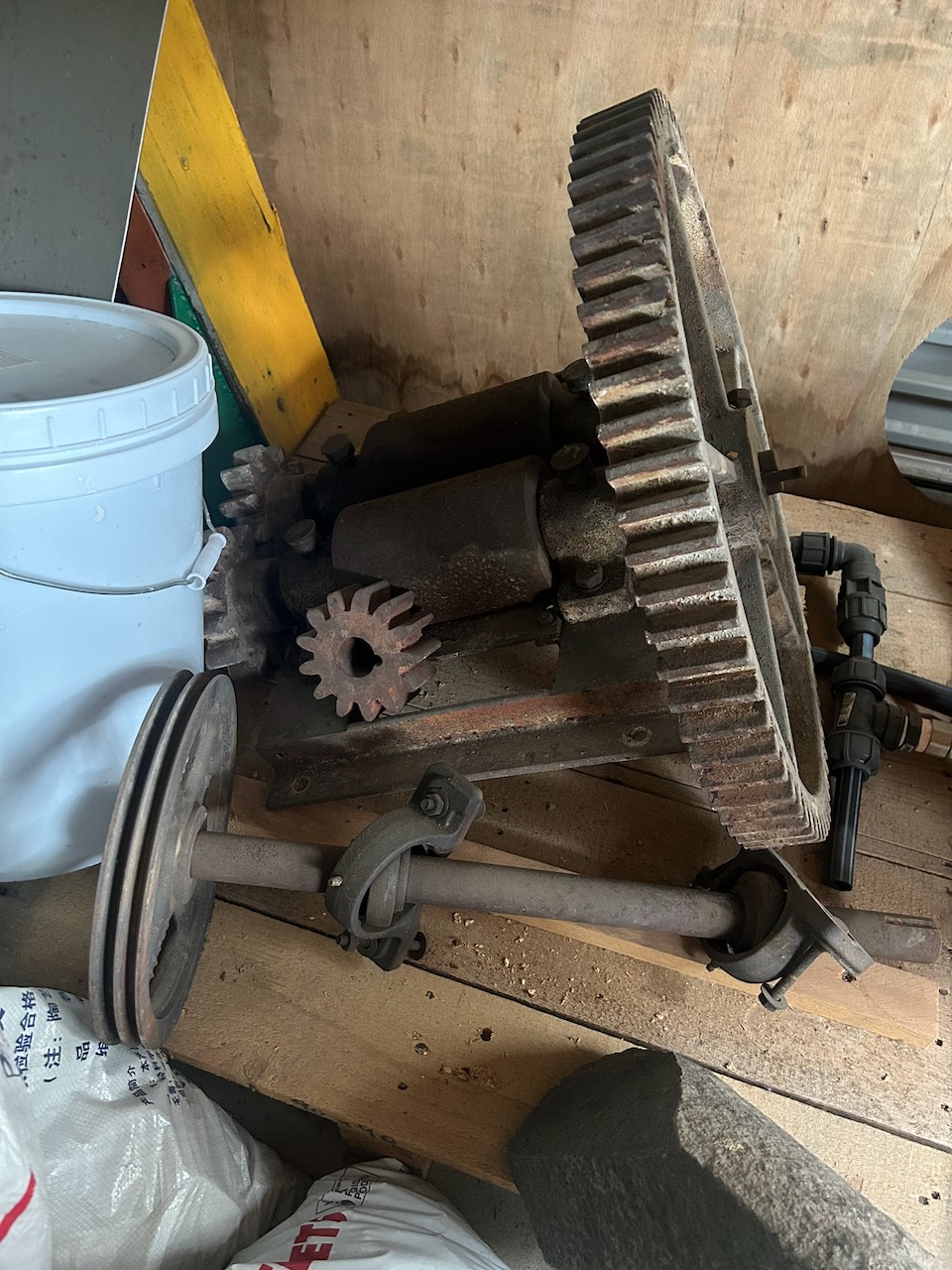
Now, I just need to confront the last burnt out rock crusher machine. The roller crusher, which Is so very useful, and sadly missed, as I used to use it a lot in the old pottery for softish materials, like shales and pumice. Maybe I’ll get round to fixing that one when the grease trap needs cleaning again?

🙂