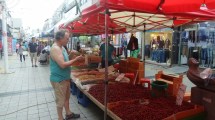
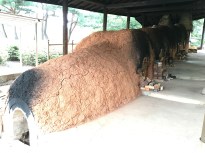
After visiting the Post Office I take Jun Beom and his wife out to lunch, at a restaurant of their choice – for some noodles! After lunch we go to the bank to get the cash to pay Miss Kang tomorrow and then to the bus station to buy my ticket back to the Airport and walk along the street market near the bus station. We travel home via the big wood kiln that has been packed, fired and unpacked in my one week away.


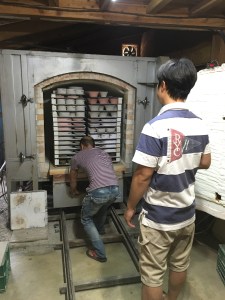
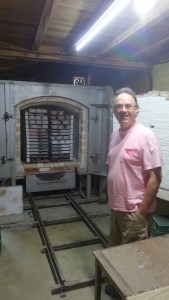
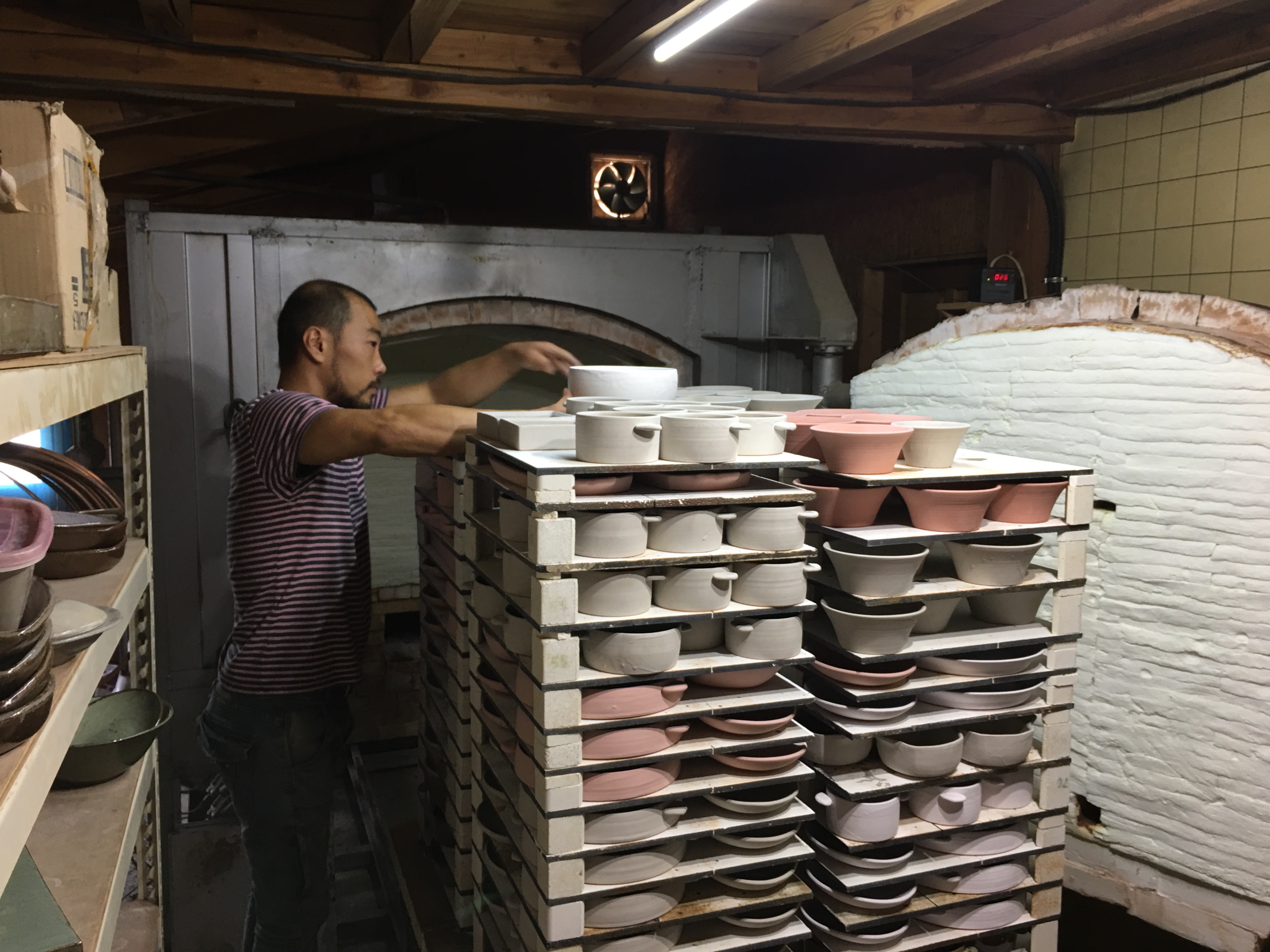
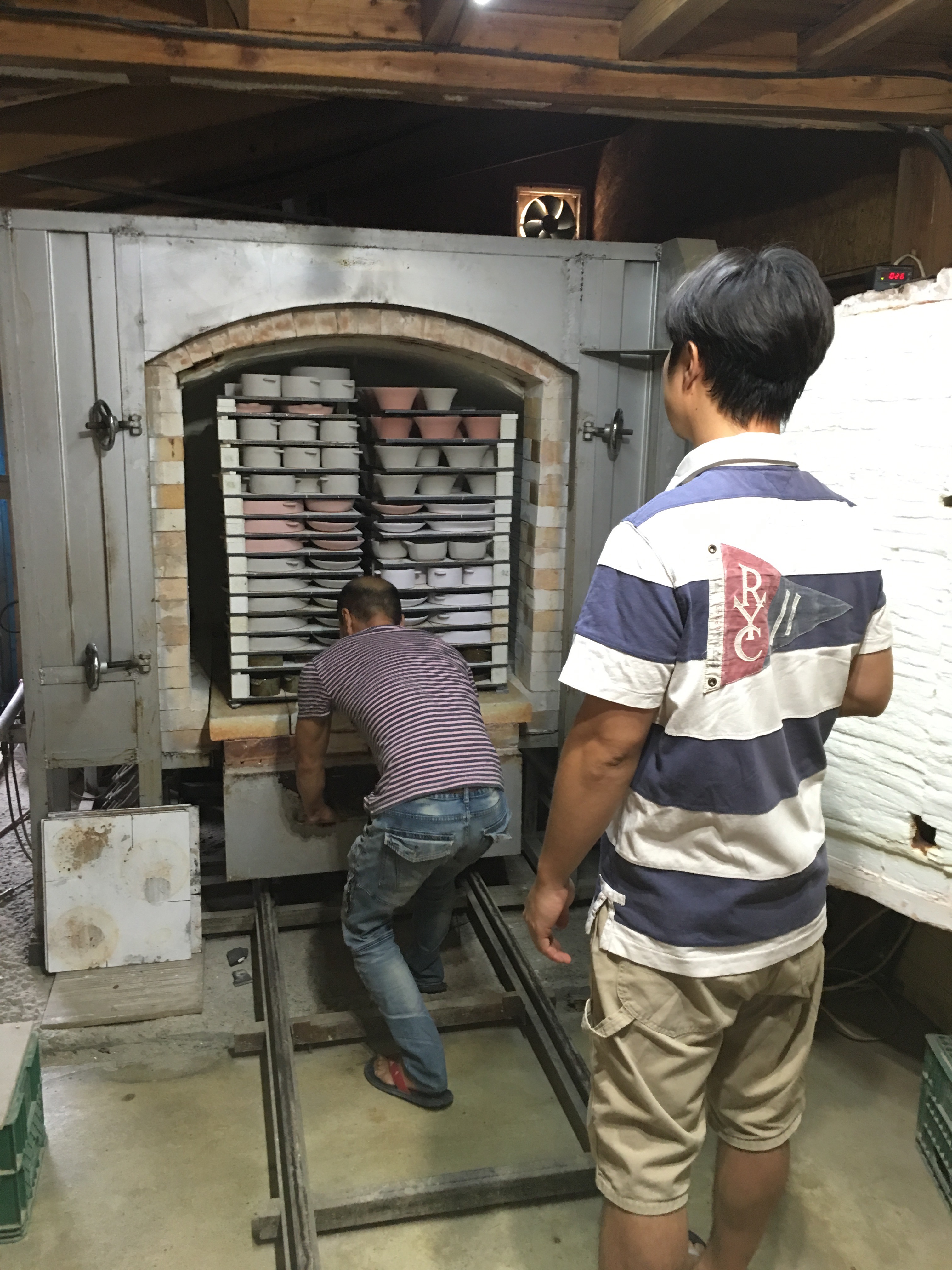
We collect my glazed bowls from the workshop, that have dried overnight and take them to Mr Seo, Seung-gyo’s workshop. He is just finishing packing his kiln and has left some room on the top shelf for my few bowls. We arrive and they go straight onto the top shelf, the door is closed and the burners lit. The firing will finish tonight at midnight and the pots will come out tomorrow, midday.
We go out for dinner with 5 of Jun Beom’s potter friends. They order for me as I can’t read the menu. It turns out that we are all having the same thing. Fried pork and spicy noodles. The meal is hot. It has loads of chilli in it. I’m OK with the heat of chilli in food, as we grow chills every year at home in Australia. We don’t make our meals too hot, but with just enough heat to know that there is chilli in it. I am finding this meal hotter than I would prefer. I break out in a bit of sweat on my brow, but manage to finish the bowl full. I look up to find that it has been too hot for a couple of these local guys too. They haven’t finished their bowl full.
I earn some cultural credit points for finishing. They are all sweating too. I don’t know if it was some kind of ‘blokey’ test, or if it was just a normal meal out for a bunch of potters. Apparently they meet up every Monday night to talk about life as a potter. They have a self-help group. They all pitch in when something is a bit too big for just one studio. They can tackle bigger contracts this way. I’m impressed. They tell me that life is tough for potters here now. A lot of their contracts have been lost to China. It’s the same everywhere, Japan and Taiwan too. No-one can compete against the low-cost base of Chinese industry.
There is a lot of good-natured chat and laughter that I can’t follow, but I can’t help but laugh too. It’s infectious. I finally get back to the air b&b at 11:30. Way past my bed time normally. I get in to find a collapsible bike in the room. No matter how quiet I am sneaking in I still wake the guy in the other bunk. He jumps up! He’s a bit startled. I say Hi! I’m sleeping here tonight, which shouldn’t be too much of a surprise, as my suitcase is next to my bunk, and my bag of dirty washing is on the bed. I’m dead tired and fall straight to sleep after my shower.
My Peddles in the next bunk has closed every door and window in the place and has the air-con set to glacial. It is a hot night but I’d rather get a bit of fresh air in the room. I drift off to sleep straight away, but wake in the middle of the night. Mr Peddles has turned off the air-con and the air in the room is so ‘close’ and stifling. I feel like I can’t breath. I get up and open the sliding doors onto the deck and also the window next to my bed. I can taste the freshness of the cool night air as it slowly creeps in and through the room. I sleep right through till my alarm wakes me. Mr Peddles is still asleep.
I get up and shower and I’m out the door in minutes. I have to meet Miss Kang early, as we are driving back up to Yanggu today to collect my pots, which should be out of the kiln today. It’s going to be a big days drive for her. We are off and heading out of the city and into the country side. I’ve been sitting next to Miss Kang for about 100 hours now in this little car as we have plied our way this way and that. Up and down the country. We have managed inadvertently to almost circumnavigate the greater part of South Korea in my quest. Miss Kang tells me that I can call her by her first name now! We have moved from ‘vous’ to ‘tu’! So, I do! There is some small progress! She asks me if visiting cards are expensive in Australia. I tell her that I don’t know, but that I think that they are probably pretty cheap if ordered over the internet. Why?
She has been wondering why I have home-made cards? I think what she really means is, why do I have such crappy cards, but she is far too polite to say that. I answer that I do everything that I can myself. This is all part of my philosophy of self-reliance. Ah, yes! She has been thinking about this. We spent quite a few hours over the past week talking about this. At least I did and she listened. Very politely. I think that she is trying to tell me that most people here in Korea will take a dim view of such ‘different’ visiting cards.
There is a very strong tradition here of exchanging cards when you first meet. It’s a ritual. The card must be offered with two hands and received the same way. You have to study it and show that you are taking it all in. It should be printed on a stiff, robust quality card. Perhaps even with a slightly glossy or textured finish. Mine isn’t this kind of card. I think that she is concerned about how I present myself, so that I can make the very best first impression.
I respond that it isn’t too important to me. I believe that anyone who judges me entirely by my card, probably isn’t going to be very helpful anyway. If they don’t respond to what I have to say. If they aren’t listening, then they aren’t my kind of person. I can probably get by without them. I won’t loose any sleep over it. Self-reliance is more important to me. If I can do something myself I will. Even if the things that I make are not as good as the manufactured ones that I might buy.
For instance, I make my own chairs, they are not as good as bought ones. They are quirky and pretty rough, but they have ‘character’. My character! I also make my own fire bricks for my kiln. They are definitely not as good as the bought ones, but the are mine and they work OK. I don’t need to have the ‘best’ of things. It’s more important to me to have ‘my’ things.
She tells me that she is impressed by my philosophy. She has thought about it a lot over the past few days. She has been helping her mother work in her garden. Her pottery studio is situated out-of-town at her parents farm, where her mother still maintains a garden. Her parents don’t live on the farm any more. They’ve retired into town, but her mother still goes there to work a few days a week. She thinks that it is a better and more healthy life style. We talk about a lot of things along the way, but mostly to do with lifestyle choices, meaningful work and a healthy diet.
She tells me that there is very strong social pressure in Korea for young women to skip meals and then to take vitamin tablets to stay healthy. What do I think about this? I give her the predictable, obvious response. If you eat a lot of fresh green vegetables from your Mother’s garden and add in a few whole grains, then some fish. You will be fine. You won’t need any extra vitamins. All the meals that you have ordered for us when we have been travelling have been exceptional in terms of a healthy diet. It seems to me, from my very short stay here, that the traditional Korean diet is fantastic. Forget the diet pills. They’ll probably do you some harm rather than any good. Eat fresh healthy food, mostly vegetables and avoid the deep-fried stuff.
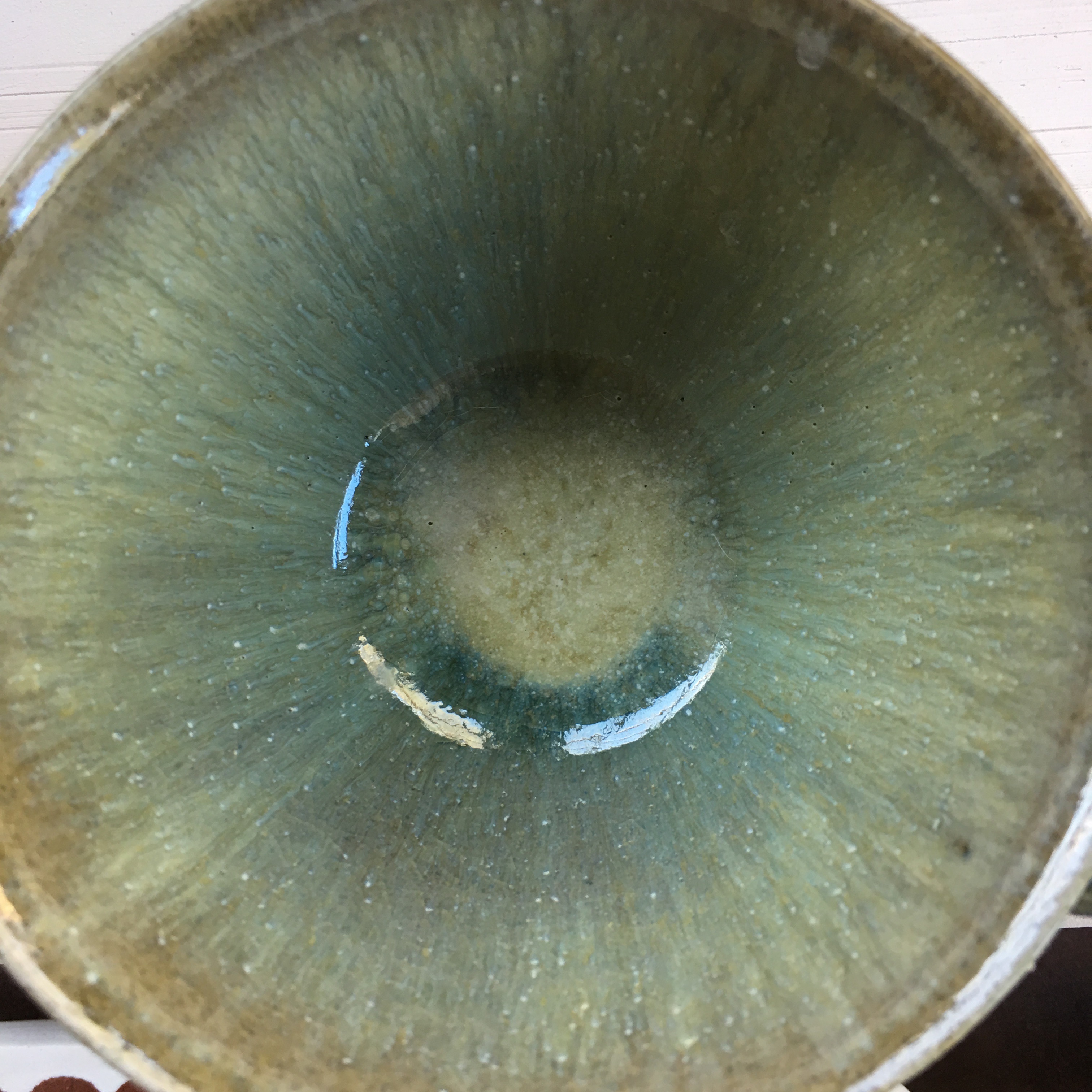
When we arrive in Yanggu around lunch time. We go into the pottery studio and there are my pots, all set out on the table in front of me. I go over and start to examine them. Unfortunately, most of them have not fired very well. There is a lot of crawling, even though there are 3 different glazes. Mr Jung knows we are here and comes in. He apologizes for the poor results. He says that they are ready to go to lunch. We should go now as we are booked in.
While we are walking to the restaurant. He apologizes to Miss Kang along the walk. It appears that the day after we left, Mr Jung woke up with some sort of paralysis. He is apologising because this ‘event’ has left him unable to swallow properly. He is warning us that he may dribble while eating. He has only just been discharged from hospital. He has spent the week there. He has almost completely recovered now. Over lunch, I learn 2nd hand, through translation, that this ‘event’ that has happened, was a lot worse earlier, but there is much improvement now. The doctors have warned him that he must cut back his work load and stress levels. He must also change his diet quite a lot. I don’t know how to understand all this. The word ‘stroke’ comes to my mind but also ‘Bell’s palsy’. I just don’t know. Miss Kang either doesn’t know the specific medical terms in English, or which english words to use, or Mr Jung isn’t using any specific words that she can look up to translate. So I’m a bit in the dark, but I do feel for Mr Jung and whatever has happened to him. He seems to be walking alright and speaking clearly, so maybe it isn’t too bad?
We return to the pottery workshop and look at my pots more closely. My Jung explains that because he wasn’t here all week. My pots were dried, bisque fired, glazed and then packed into the glaze kiln and fired by the assistants in Mr Jung’s absence. As he wasn’t here to check any of it, the glazes were applied a bit too thick and then packed into the glaze kiln a bit too damp, or so he assumes. Hence the crawling. He has however, filled 3 little jars with glaze so that I can touch them up and re-fire them when I get home.
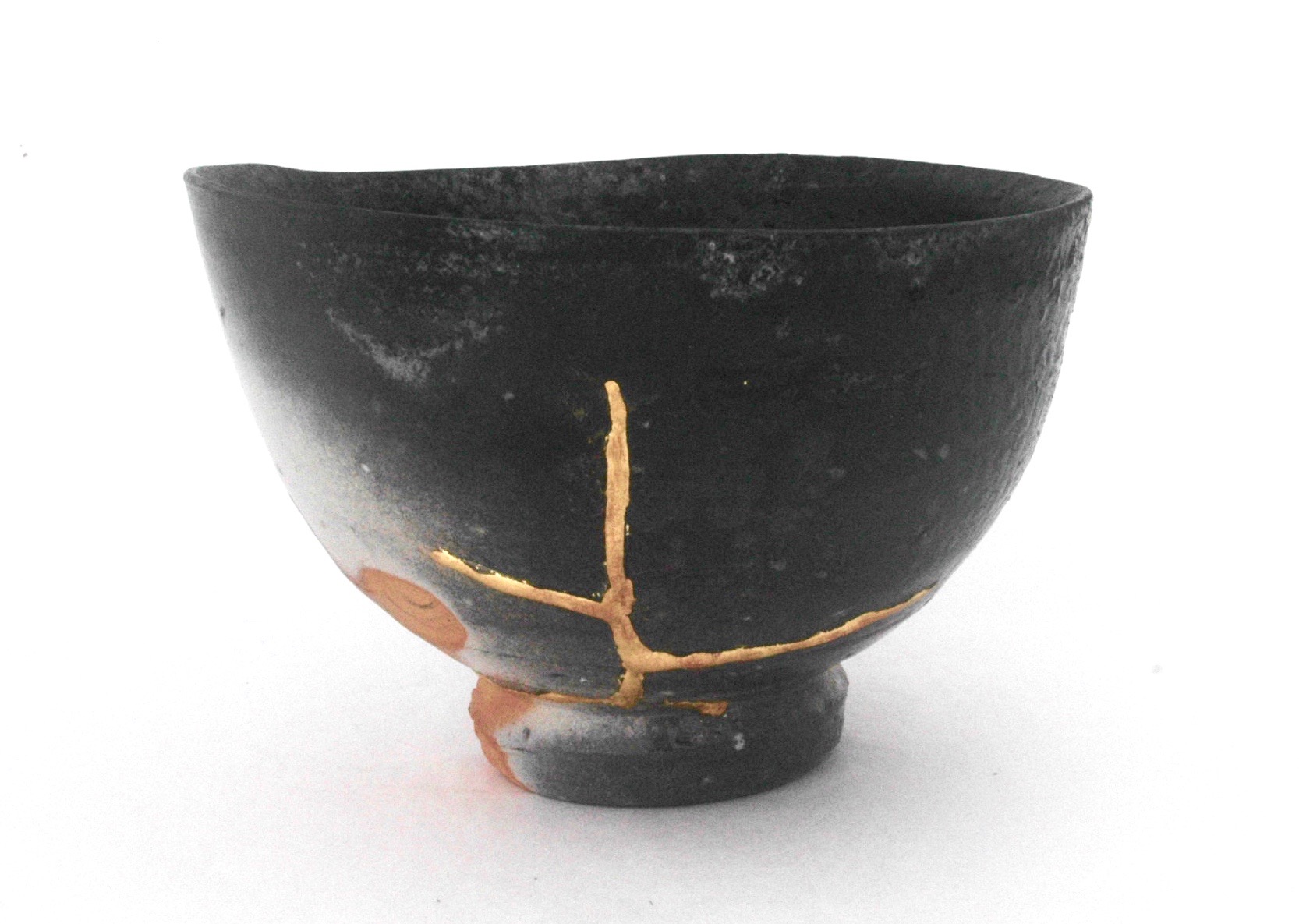
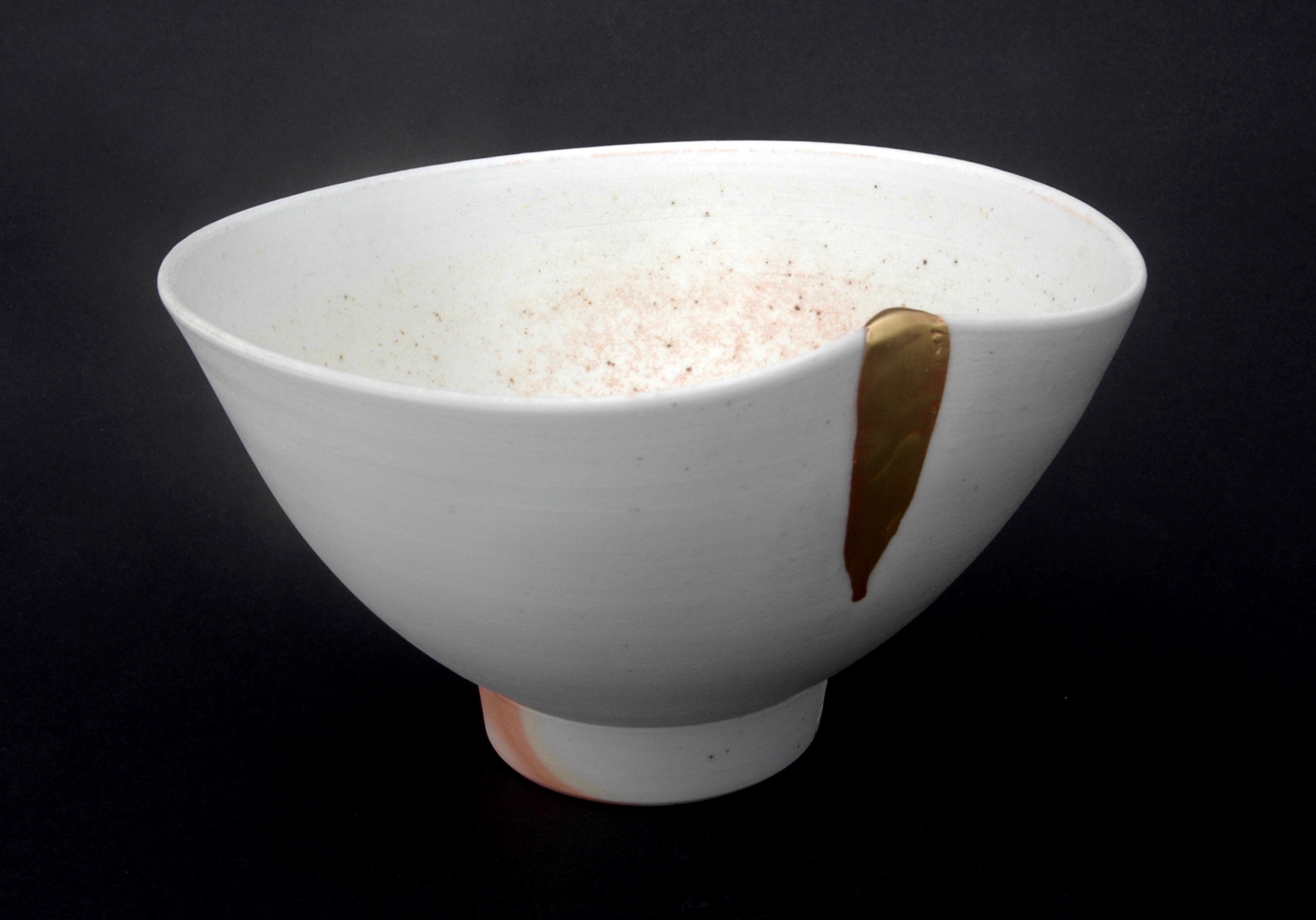
After a good examination of the pots I find that there are 4 that are OK and that I can show. That’s enough. I’m happy with that. My Jung asks me if I’m sure. I am! 4 will be OK. He says that he will keep the others and re-fire them himself. One will surely turn out OK so that he will have one for his museum collection. I say that he should choose one of the 4. He refuses. I should take them home with me for my exhibition. A roll of bubble wrap has appeared and a cardboard box, but I decide to wrap them well and carry then in my back pack as hand luggage. This method has worked with other batches of pots that I have made in China and Japan recently. No-one will be more careful than me in moving these precious things around.
We retire to the lounge area for a coffee. I have brought my laptop with me this time, as I promised to show Mr Jung a presentation of my work, local geology, studio and house and garden etc. I have spent half a day during the week, collating a 30 page journal of technical information and photographs about my local single-stone porcelain materials for him. I have taken a lot of it from my PhD thesis. I hand it over to My Jung, he flips through it. stopping at the pages of analysis data. It’s all in English, so I imagine that it will be difficult for him to read. BUT!
He surprises me completely. When he’s sees the electron microscope results and micrographs. He stops dead and turns to look straight at her and says completely clearly in English, that I can understand from where I’m standing behind them. “Did he do all this himself”? I’m shocked! He can speak English very well. Either that, or I’ve suddenly learnt to speak colloquial Korean fluently! But in a weird twist, that surprises me even more, Miss Kang doesn’t realise that he has just spoken to her in English instead of Korean. She translates it anyway out of habit.
“Mr Jung wants to know if you did all this technical research yourself”? I go along with it and answer, that she should tell Mr Jung that the answer is, Yes. I did! He nods, but raises his eyebrows. Maybe a hint of dis-belief? It appears that I have been paying my translator for nothing. I only needed a driver after all. I could have caught the bus!
I explain that a lot of this is taken from my PhD. I did all the electron microscope work using the equipment at Uni of NSW. Yes. It’s all my own work. I really enjoyed doing my PhD. I had a fantastic supervisor who was right on my wavelength. He supported my research in every way, and without interfering and getting me to do his research for him. I have friends who had withdrawn from research degrees because their supervisor was trying to force them to do work the they weren’t interested in. I was very lucky!
Mr Jung has been able to follow almost all of what I have been telling Miss Kang to tell him. It’s a good thing that I have nothing but admiration for the man and have always been totally polite in all my dealings. I carry on as if nothing has happened. Miss Kang continues to translate. I’m the only one that realises what has just happened. I feel a bit odd!
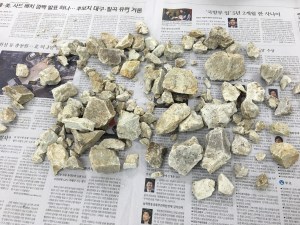
Mr Jung asks me to show him my presentation. He makes a phone call and two other men appear. One of them is an architect and I’m not sire about the other one. They are here to watch as well, along with one of his staff members. They all sit politely, occasionally asking a few questions and at the end they give a soft applause of clapping. That’s never happened before! We say our thanks and prepare to leave. Mr Jung shows me the porcelain stones that he has washed. I go to collect them in a plastic bag and take them with me, but he stops me. He tells me that they are not dry enough yet. He will post them to me. I offer, through the medium of translation – continuing the charade, that I can dry them myself and carry them in my luggage. No! Apparently, I can’t do that. I will have to wait until he posts them. OK?
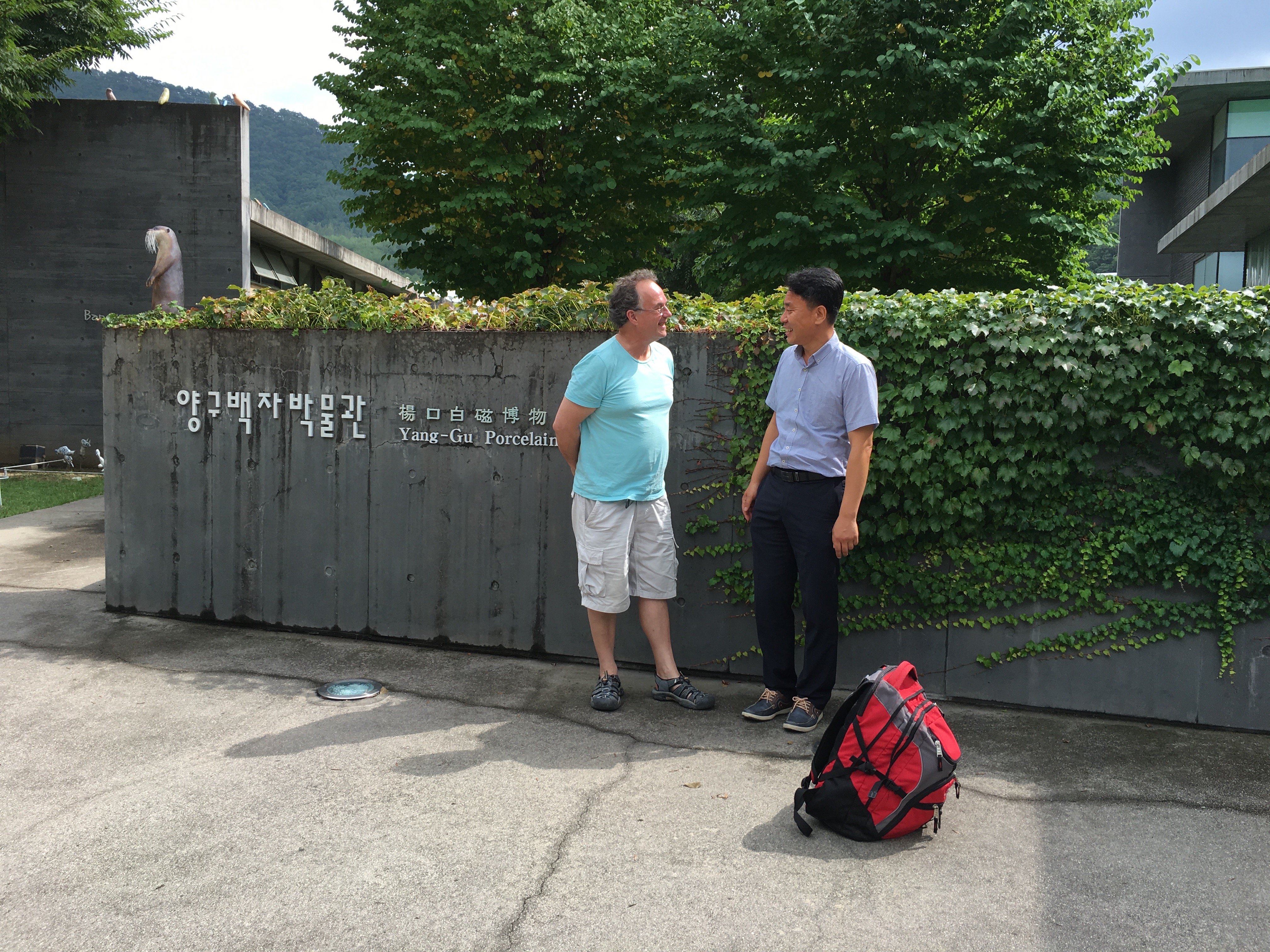
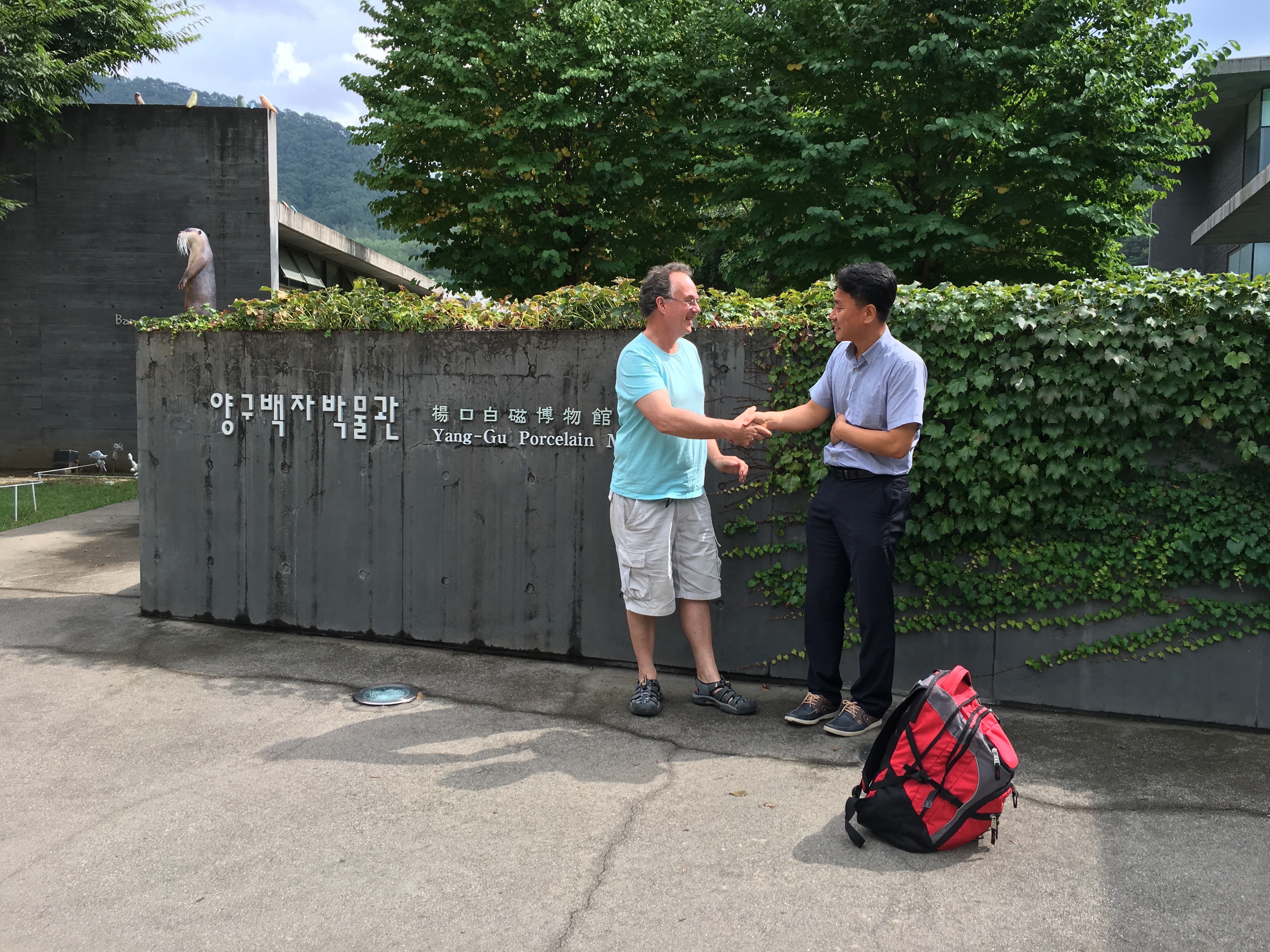
We stop outside the building for the obligatory photos. I offer my phone to Miss kang to take a photo for me as well. She juggles 3 phones and takes a sequence on mine that I feel really captures the total sincerity that has evolved between us in this short time. We are possibly the only two men with this common interest in the world and we have finally met after 15 years of similar research. I feel a strong connection to My Jung. He’s a very thoughtful, creative and helpful person. I like him.

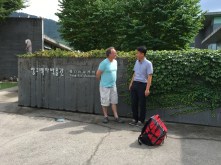
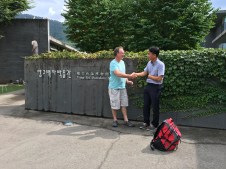
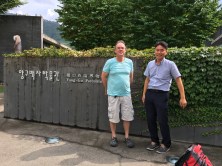
I’m a bit sad to say good-bye. But we really must leave now, as the drive is a long one. On the way home we approach an intersection without traffic lights, but only a flashing orange light. I take it that this means take caution, slow down and watch for cars. She doesn’t slow down very much and suddenly we are on the cross roads and there are two cars on our left coming out of no-where and travelling at speed. She brakes and swerves, but too late. Fortunately, the other two cars are able to swerve onto the other side of the road and just miss us – just. Luckily for us all, there were no cars coming the other way. My heart is pounding. The adrenalin rush is severe, almost painful. I’m completely shocked!
We stop and take a break. My driver is tired. We stop at the next truck stop for another coffee and a brisk walk up and down the parking area. I make an effort to keep talking to her all the way home, asking her questions, remarking on the scenery. I don’t want her to drift off again. It would be such a shame to die here, like this, and inconvenient for everyone else to have to cope with.
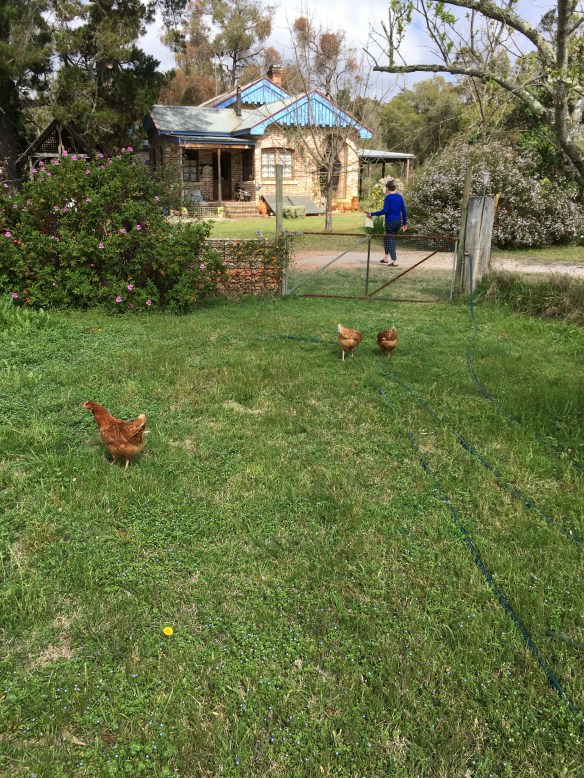
She is wide awake now and for the rest of the trip, which is uneventful. We break up the next 3 hrs in the middle with another loo stop to discharge the coffee from the last rest break. We talk of all sorts of things. I tell her about the building of the new chicken run. Making it fox-proof and dog-proof using thick galvanised steel mesh all around at floor level, dug deeply into the ground. I tell her of my plans to plant out all the summer vegetables on my return, as it will be the middle of September and starting to warm up. I usually get all the early vegetable seedlings started about this time. Sometimes there is a late frost in October and once in November. Then we have to start again, but that doesn’t stop me. The reason that I chose to leave the city and live in the country was so that I could have a very large vegetable garden and an orchard, as well as a pottery studio and wood fired kiln.
She listens as she usually does, making occasional comments. I have become used to her saying something along the lines of. “Thats very interesting” and “I’ll have to think about that”. This time however, She responds at length. She has been considering all our conversations of the past week. She tells me that she has been helping her Mother in the garden with the weeding.
She tells me that she will think about a change in her life, maybe spending more time at the farm and studio. She’s ready for a change, but will still need a job for some cash. I suggest being a translator and tour guide for specialist pottery tourists like me. There must be other potters who would pay for the particular service of an educated, ceramic specialist, tour guide?
On the way home, she gets several calls, a friend, her sister and boyfriend. But also one from Jun Beom. We are invited to dinner at his wife’s parents house. Her Father has caught a one metre long fish today, so we are all invited. We go to the pottery first. I collect my fired, glazed pots from My Seo’s firing. 4 out of 5 are OK, 3 are very good. I can show these. I offer one to Jun Beom, but he refuses it. I offer one to Miss Kang and she almost grabs it off me. Apparently she is pleased! So, I have 4 pots from this firing too. They are all dully bubble wrapped and packed into my back pack. I can’t fit them all in without unpacking my sweater and rain coat. I won’t need them again now.
The Tae Baek mountain stone body was creamy yellow when raw, but has fired to a very clean, bright white translucent body. I’m very pleased with it. If all goes well, I will have some Australian wood fired versions of it to compliment it later in the year. Everything is shaping up nicely. Better than I could have possibly imagined. I owe special thanks to Claudia, for introducing me to her student, Jane in Australia, who introduced me to her brother in Korea, Jun Beom, he in turn introduced me to Miss Kang and everything flowed from there. Thanks also to Byongchan from Sturt workshops, who introduced me to Mr Jaeyong from Tae Baek.
I knew that Cheonsong was going to be difficult, but couldn’t imagine just how frustrating and negative it was going to be. However, I did end up getting some clay from them. I didn’t even imagine that I would be able to get to Yanggu, as the reputation was quite formidable. This turn out to be the most rewarding experience. I hadn’t even heard of Tae Baek or Siila Mountains before arriving here. They were just lucky breaks. I really do hope that Mr Jung will end up posting me some samples in due course. Funny that he wouldn’t let me have them when I was there?
This has been a very successful Korean end of my research trip. I have travelled 37,000 kms in the last month. I’m ready to go home and sort all this material out. I also have a long list of jobs to finish when I get home. I have a large kiln ordered. I have 3 weekend wood-firing workshops booked in a row in late September and early October, then the Southern Highlands open studios weekends coming up. I can’t see myself getting to any of this porcelain stone and having some more time for research until the New Year.
I get home to the b&b late. It’s always the same here. Everyone is so friendly, and they stay up so late. I’m back by 10.30 and start to pack my bags. I leave very early tomorrow morning on the 7.00am bus to Incheon Airport via seoul. It’s a long 3 1/2 to 4 hr trip depending on the traffic. I need to be there 2 to 3 hrs early to make sure all goes well. I fly out in the early afternoon. I’m all packed and sorted and in bed by 11.30.
I’m up at 5.45 and all ready to go. Jun Beom picks me up and takes me to the bus station. I want to thank him in some meaning full way. More than just a handshake and a bow. At least with Sang Hee, I was employing her and I could give her a bowl. Jun Beom wants nothing from me. He says it’s all right – relax! We sit and chat until the bus arrives. I thank him profusely again. He just waves it off. “Its OK!” He says. It doesn’t seem enough.


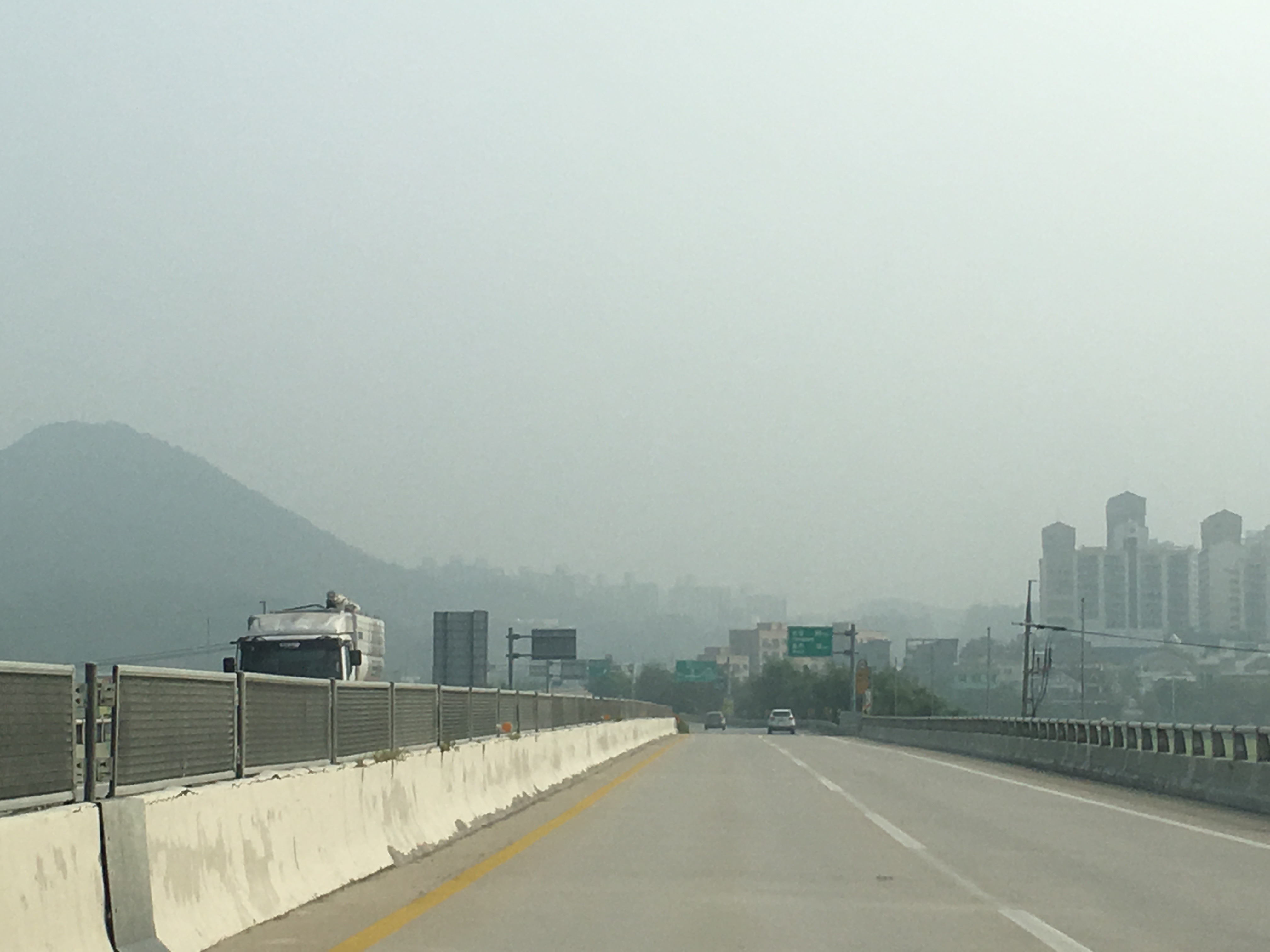
The traffic in the morning peak hour is appalling. It’s stop start all the way along the free way. Grid lock! The air quality is appalling. Out in the country side we have enjoyed much better air than this. It was always slightly over cast looking. I thought at first it might be cloud, but it was consistently always the same, pale, yellowish, photo-chemical smog. During our driving epic. Miss Kang and I talked about this too. She claimed that all the polluted bad air was blown in across the water from China. Some of it might be, but it wasn’t as bad out in the country side. Here however, in towards Seoul the visibility drops down to a few km or less. I can’t see the sky scrapers in the distance at one point. I know that they are there, I just can’t see them any more after we have passed them. I’d hate to live here in this air. Miss Kang does. She is breathing this air all the time. I’m sure that the majority of it is self-generated here in Seoul by all the industry and traffic. I hope that she will be OK into the future. She has been a very good guide, translator and driver. I can recommend her!
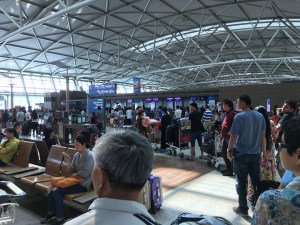
It’s a very good thing that I Caught the early bus to the airport, because when I get to the check-in. I can’t believe the queue. It stretches about 100 metres back from the zig-zag webbing lanes, back out into the foyer of the check-in area. I walk and walk, along the queue. Stopping every now and then to enquire if this is still the same queue. it is! I don’t want to spend an hour or two standing in the wrong queue. I have purchased the cheapest flight combination possible, so have to travel back to Australia via China. the queue is for all the people wanting to go to China.
I’m just so lucky to have been taken to Australia when I was young. We complain a lot, but there aren’t many places that I have been that are better than this when everything is considered. I don’t live near the beach, or have a view. But life is what you make of it. I have my beautiful partner and son, my workshop/business, my gardens and orchards.
I am so very lucky to have such a good life!
And a bag full of porcelain.
Best wishes from Steve in Korea










































You must be logged in to post a comment.