Home Again

I have had an amazing time in Korea. I was very lucky to meet such supportive and helpful people. Every thing had gone well this time and I am returning with a suitcase and back pack loaded with beautifully fired porcelain. So different from my last visit, in terms of the fired result.
IMG_7204 IMG_7201

IMG_7175

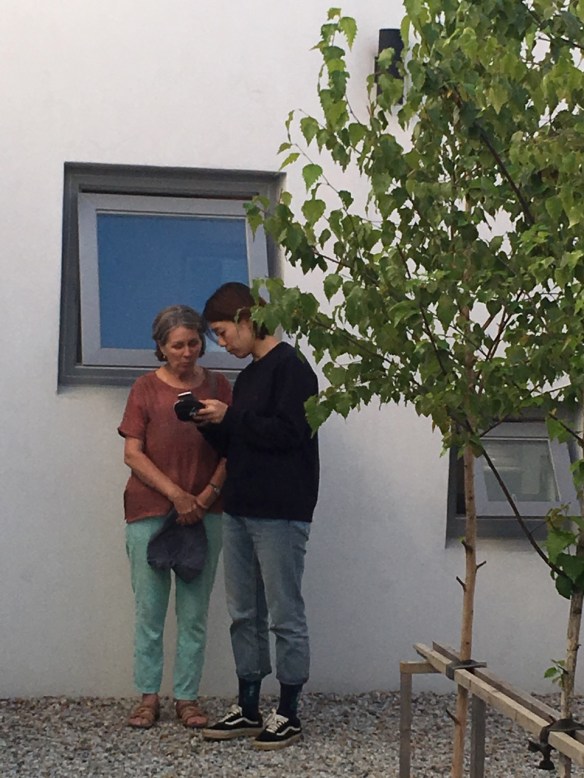
My last day starts foggy and overcast, but clears up.  I was walking back across the lawns from the research centre , back to the pottery workshop building , when I bumped into one of the support staff. A lady who I thought spoke very little English. I had heard her say “Australian Honey” out loud on my 2nd day in the workshop. I had given a small jar of honey to one of the staff members who had just helped me with a problem. I took several small jars of Australian varietal honey with me specifically to use as gifts. This lady saw the jar and read the label out loud. I heard this from the other side of the room and got another jar out of my back pack and presented it to her.

She asked if it was for her. I replied. “Yes, it’s a gift for you”.

She thanked me profusely, and that was the end of the matter. I didn’t have reason to speak to her again personally until now. She stopped me on the lawn and said to me in her basic English. “You leave today?”  I replied. “No, not today, tomorrow morning, very early, 7am.”

She explained to me that she only spoke a very little English, but wanted to thank me for the honey and say that I was nice to have around. She reminded me that I had helped her to move a heavy shimpo potters wheel, so she could do some cleaning under and around it.

It was very nice of her to say so, and to venture to initiate the conversation in a language that she was not proficient in. She told me that she was not Korean, but originally came from Japan and married a local Korean farmer.

I replied “So desu ka!” Is that so!, She did a double-take, blinked and replied “Anatawa Nihongo hanasamasuka?” Can you speak Japanese? I replied “sumimasen, watashiwa, Nihongo arimasen…choto dake” Not really – just a little.  It’s true, I don’t speak Japanese, but I can speak a few words, however, when I get my ear in, after I’ve been in Japan for a week or so. I realise that I can recognise a lot of words in what is being said around me, and I often know what it going on. Japanese is the only foreign language that I ever tried to learn by doing a bit of study. Some of it has stuck.

Suddenly we were off on a tangent talking in a weird mix of Japanese, English and Korean using my phone app. It was a completely unexpected, but warm and rewarding moment for both of us. I came away thrilled and very pleased at the intimate level of communication that had just evolved so organically and unexpectedly.

IMG_7177 IMG_7202

I go back to my room and start to clean up and pack my bags. I have a few clay samples that I have been drying on the heated floor of my room. I eventually get everything back into my bags, plus, I’ll be leaving with an additional 20 bowls and 5 kgs of clay. I’m ready for the early start tomorrow.

The sunset is lovely. The sky is clear. The last rays illuminate the rice and the poly tunnels, that so define this place. It’s a beautiful way to remember this pleasant valley.

IMG_7107

Inhwa and her husband turn up very early the next morning to give me a lift with another student to the bus terminal at Yang gu. My Jung turns up too! He has stopped off on his way to work, to say a final Good Bye. My return trip to Incheon airport out of this remote place on 3 busses all connects perfectly and I arrive at the airport earlier than I had allowed for. My return flight is uneventful, I just want it to be over with really. Sitting in a seat for 12 hours is very dull. Although I do manage to find a couple of hours sleep during the night. Probably my best effort so far at sleeping sitting-up while flying. Possibly because  didn’t sleep much the night before.  Maybe I’m getting better at this? Not that I want to practice it any more. I’m over it.

I’m home just before the solstice. I unpack my pots to show Janine and take a walk around the garden. The early peach has started to flower. It’s so amazingly early. The first job is to move some more big logs into the wood shed, closer to the splitter. The last time that  Idid this, a month ago. I smashed my finger. it still isn’t healed. The chickens are happy to come along and help with this job. But only because there are always a lot of bugs and creepy-crawlies under the bark for them to eat. They love the wood splitter. It provides fresh protein that wriggles all the way down. Yum!

IMG_7210 IMG_7231

IMG_7213 IMG_7223

They have absolutely no fear of machinery like the splitter. They really want to get their heads in there as soon they can, to get the first peck, but sometime the splitter blade hasn’t even finished coming down. I’m constantly brushing them away, but they swivel around and are straight back. They trust us – foolishly.

I think that they have no fear, because they have no brain. But they are sweet things to have around and they are good company.


Thank Goodness for Inhwa

The rain is gone, so on my walk to work along the river, I notice that the flow is greatly reduced and back to its clear normal flow. The waters must be fairly clean, as there are otters living and breeding in the river. Whereas in other more industrialised areas of Korea, the otter numbers declined over the past 30 or 40 years, before making a slight recovery recently, due to increased environmental protection. Here the numbers have remained largely unchanged presumably due to the remoteness of the site. The village celebrates the otters with a fountain in the village square. I ask the assistants working here if they have seen them? They tell me that, yes, they have, but otters are quite shy of people, so you have to be patient and sit quietly. Mr Jang, Duck-jin, the pottery teacher, here in the centre, even has a video on his phone that he made last winter. For that matter, so does Inhwa and her husband, Mr Kim.

I’m at the studio early. I walk around to the gas kiln area but the door is still firmly shut and wound up. I settle at my work bench to do some writing while I wait. It isn’t long before Mr Jung comes in with one of my small bowls. and hands it too me. It’s perfect, or seems so at first glance. No warping, no slumping, no pin holes, no runs and no rubbish fallen into it from above. That’s a pretty good result. The colour isn’t too bad either. I really glad now, that I double-dipped the glaze! I was a bit concerned at the time that it might crawl again, and then when Mr Jung come in after the bisque and told me that I had probably made all my pots too thin and that this means that they might slump in the kiln at high temperature. That put the angst into me. He didn’t mean to phase me out, but at that point, there was no way that I could make any more and get them through in time. So first impressions are good. Mr Jung intimates that this is just one that he has stolen from the kiln for me to see. The kiln won’t be opened properly for another hour or more. I sit and wait.

My Jung is at the door, he calls my name to get my attention. He always calls me ‘Harrison’. I’m getting used to it now. It’s a very Asian thing. Last names first. We go to the kiln area. The door is open and pots are being taken out. I can see more of my work appearing one by one. They are cool enough to touch right away. I examine each one briefly as it is handed to me. I can see a few coming out that have minor faults like a pin hole or some slight warping. A couple from the bottom front of the setting have come out a bit neutral in colour, lacking reduction, so they look just a touch anaemic. A creamy body, with a yellowish-green glaze instead of the pale blue over grey that indicates good colour for these materials in good reduction. I start to carry them inside to give them a better examination. Mr Jung calls me back. He switches on the diamond buffing pad machine, so that  we can polish all the foot rings. It only takes a couple of minutes. Then we carry them inside. The machine does a beautiful job.

IMG_7166

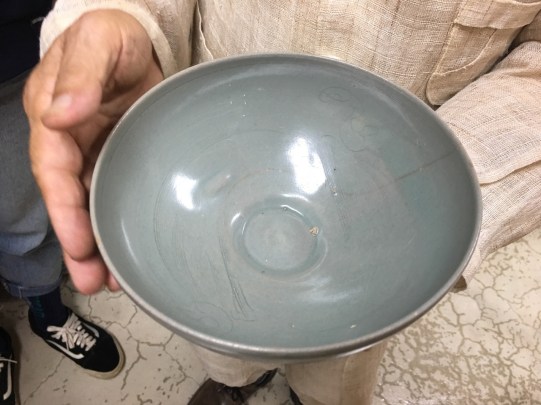
I examine each one, not just carefully, but thoroughly, in good light. I find that I have come out of it with 22 firsts and 11 minor seconds. That’s great. I was hoping to take home a dozen of various sizes, so I’m on track. I offer Mr Jung first choice for his collection in the porcelain museum. He replies to me at length through Inhwa, who has just walked in, that he will need some time to work his way through them, before making a selection. He asks me through Inhwa, how many he can choose. I say that he can have as many as he likes. He jokingly puts out his arms around the whole lot. We laugh. I’m flattered. He thinks for a bit and then says, “how about 5?” I Reply “yes, of course, choose 6, you have first choice.” He tells me that he has got some plans for a bigger extension for the Museum. He will have a lot more space to show contemporary work soon. Maybe next year? 6 will be good. He settles in for a good scrute. But his phone rings and he is called away.

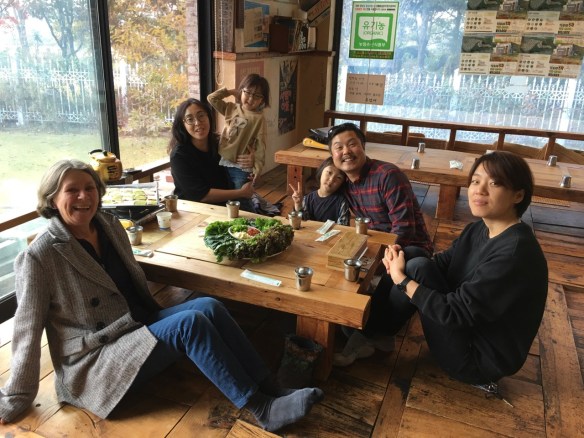
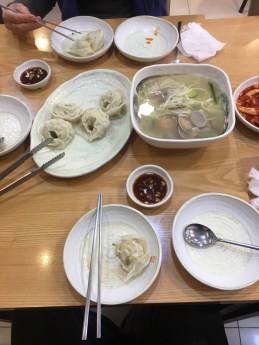
 Inhwa and her husband Kim, Deok-ho, have arranged to take me to lunch. It’s their turn. We go to the Chinese inspired Korean eatery. Every time I’m taken out to lunch by some of the staff, we go to a different place. It seems that every house along the central part of the village is a restaurant! We just seem to walk along the street and then without notice someone in our group will just walk up to a door, open it and walk straight in, and sure enough, it isn’t a house at all, but a large dining room or rooms. I don’t have the nerve to go up to one of the other buildings that I haven’t been into as yet and just walk in expecting a meal. What would I say if I just walked into someone’s home and the family were all just sitting there watching telly in the lounge room? It’s all because I can’t read Korean. there is probably some sort of sign that I’m not aware of?

We sit down, on the floor, as you do, at the end of a long table. There is an old couple at the other end. I smile and they smile back. They are very weather-beaten and a bit ragged looking. The man starts to talk to me in a friendly sort of way, in Korea of course. I have no idea, but Inhwa steps in to rescue me. She explains that this couple are farmers and they see me walk past their place most days. Apparently, She tells me through translation, that I smiled at them, waved, and said my “anyohaseyo” to them, then nodded my head in a modest bow in passing. Perfect! They knew that they would like me from that moment onwards. So now we get to have lunch together. Thank goodness for Inhwa. On my last visit it was Miss Kang who made sense of my life here for me. If it weren’t for Inhwa, this time I’d have no idea what was going on, and this opportunity would have just floated by in the ether. The farmers are beaming at me as Inhwa recounts some of what I’m doing here. Lots of nods, smiles and affirmative “huh”, grunting sort of noises.

We all nod and smile and get on with our lunch. Inhwa confesses to me that she is now quite embarrassed, as she has lived here in this village for the past 3 years of her studies in the research centre and she has seen this couple many times, but never spoken to them or even said “Hi” until now.

I explain that I know that I am the foreigner here. I look different. I can’t speak the language, and I’m not part of the farming community. I represent “The Other”. I suddenly arrive on the scene and I am a totally unknown quantity. I fall into “The Stranger Comes to Town” scenario. It’s one of the oldest plot lines from Hollywood. I know from my own experiences, back home  in Australia, when I arrived in my own small village, that small isolated villages, mostly inhabited by older people can be quite conservative places.

We were treated with suspicion by the locals for quite some time. We were different in every way, even though I was an Australian. Thank goodness that I wasn’t from overseas and spoke another language to boot! So, I understand what it is like to be the stranger in town, and the best bet is to engage warmly from the first instance, even though I’m not the warm, friendly, Type A personality, outgoing sort of person. I make an effort and I’m pleased that it seems to have paid off. It transpires over lunch, that these humble farmers have actually been to Australia for a visit too! Small world indeed.

A Rainy Day in Bangsan

I wake up and its raining, not too heavy, but I can hear it on the roof and dripping from the overflowing gutters. I walk to the workshop in a light drizzly mist. I spend the day turning my bowls. It’s perfect slow drying weather.

Mr Jung is the man who runs the Bangsan/Yang gu Porcelain Museum and Research Centre. He is extremely open-minded and has a very inclusive policy of engaging with outsiders, so as to make The Research Centre relevant, lively, contemporary and internationally recognised. This is exactly what I have experienced here. I must say that while I have been here there has been a steady stream of local, interstate and foreign visitors coming through the place. The level of creative work that is being produced by the research students is excellent.

I get all my pots roughed out and almost finished. They will need just one more thinning out when they are almost dry – but not quite bone dry.

I have a little time before closing, so I go to the Museum gallery and display area, to look at some of their stock and browse some of the literature. There isn’t anything there in English, but there is a thick, hard-cover book on the archaeology of the Yang gu/Bangsan area. I browse through it looking at the pictures. It looks pretty interesting. Shame that there is no English translation. Then it crosses my mind that there is. I have it in my pocket. I use ‘word lens’ on my phone. I select the app and hover the phone over the required Korean text and it magically appears in English on the screen in real-time as I move it along. I make my way through the first part of the book, looking at and reading the captions of the pictures. That way, I get another free thousand words, sans effort!

IMG_6955

It looks like there might be something in there worth taking in. The book is just too big, too heavy and a bit expensive to buy and take home, or post. I want to save my weight limit for my pots. I just photograph some of the more interesting pages and decide to read them later.

It’s time to go, but the weather has turned pretty nasty with thunder and lightning. I rug up in a plastic bag poncho and open my umbrella, but I fear that the wind will destroy it, before I reach my digs. On the way home, I stop to try and capture the lovely image of the rain buffeting the rice seedlings.  I have 2 goes at it, the second being a short video. But I fear for the safety of my umbrella and my phone, so stop at that.

Later in the evening, when I have time back in my room. I down-load the Korean language images to my lap top and read them back off the screen in English using my phone language translation app. It’s a slow way to read a book in another language, but I muddle through, as I have lots of time in the evenings. It even surprises ME! as being one of the weirdest things that I have ever done to get research information!

DSC02743

The next morning the weather is all clear again and I see that the river is running brown with silt washed down off the higher fields, possibly even silt washed down from North Korea over the border. I don’t know how far the catchment of this river extends into the North. There are a couple of hardy blokes fishing with a net, down by the stepping stone crossing. I stop and watch them for a while, but they don’t seem to catch anything. The technique that

IMG_7090 IMG_7086

they are using seems to be for one man to stir up the stones and sediment on the bottom and try to dislodge something into the flow and then the other man tries to catch it in their net. It doesn’t seem to be working. Perhaps they are fishing for some sort of shell fish or yabbie/crustacean?

IMG_6910 IMG_6982

My bowls are finished now and ready for the bisque kiln tomorrow. I have ordered a stamp that says ‘Yang gu’ in Korean text, and have marked all my work with this and my own personal seal. I ordered it through the mail order service of the amazing Miss Kang, who arranged everything for me and had it ready for me when I arrived at her house on the way here.

Tomorrow comes soon enough. I see the kiln packed during the day and started firing last thing before we all leave for the evening.  The next day, after cleaning up my work space, I go over to the kiln room to see how the firing is progressing? I assume that it was set to steam all the pots dry overnight and will be firing properly now, possibly reaching temperature in the afternoon?

IMG_7004

When I get over there, they are already unpacking the kiln! it has fired up and cooled down over night! I’m staggered. How is this possible? It doesn’t fit in with all my other pottery experience, where we molly-coddle the pots through the difficult trauma of the firing process, taking it quite slowly, making sure that we don’t blow anything up by going too fast or causing cracks. I guess that they do this all the time and they know what their clay will take. The kiln is electric fired and has a computer ramp controller, so it fires exactly the way that they have set it to. By the feel of the bisque, I’m guessing that it was only fired to 800 or 900oC.

I can only assume that because everything was dry before packing the firing could proceed quickly. It is summer here and very warm days and nights. And all the pots are made of powdered stone and not sticky plastic clay, so they can breath quite easily. Any way, most things come out OK. I have 5 out of my 40 or so with minor cracks, most inflicted before packing, by me I think. One has a crack around the edge of the foot, which I haven’t seen in my work before and another has a tiny hair line crack in the centre of the foot, underneath. This is a remnant clay shrinkage/drying problem.

I’m happy. I have 36 pot to be going on with. I said at the beginning that I would like to get 12 good pieces to take home if I can. Looks like I’m on track at the moment, but never count your chickens!

I spend the day glazing and fettling. I go over them 3 times to get them as smooth and dribble free as possible. The glaze looks to be a mixture of porcelain stone and possibly limestone?  I also feel that there might be some wood ash in there too? I think this because it has a definite grey cast to it and micro tiny black flecks that I some times see coming through my 60 or 80# mesh screen when I sieve our ash. The glaze seems to be very thin, so I dip them twice. It also helps to get a more even coating.

IMG_6967

When they are dry, my pots go over to the gas kiln shed for glaze firing. The packing seems to take all day on and off, with so many other things happening throughout the day. It’s all packed by 6.00 and ready for firing.  The gas kiln is fired manually, so it will have to wait until tomorrow to be fired through the day. It’s about an 11 hour firing to cone 7 or 1230/1240oC. in reduction. They use a digital pyrometer and draw trials to measure the temperature and heat work. They told me that they fire too cone 7, but they don’t use cones here?

IMG_7006 IMG_7010 IMG_7050

This facility has a comprehensive range of very good equipment and the staff are really hard-working, efficient and friendly. I couldn’t have found a more fertile and supportive place to study.

best wishes from Steve in Bangsan, Korea.

Making a Start, Starting to Make

Making a Start, Starting to Make

The first thing that I did after I arrived here was to go to the clay room and get some recycled clay, so that I could throw some chucks. This is the first thing that I do everywhere I go. It’s a pity that they are so heavy and bulky, otherwise it would save a lot of time to just pack them in my bag and carry them with me.

IMG_6791

I make a range of sizes that will suit the pots that I pain to make. I get these out in the sun as soon as they are made. I will need them dried and stiffened, so that they can take and hold the pots on top of them during turning.  The chucks are thrown very thick and heavy, so they are quite slow to dry and stiffen up,. They need to get drying as soon as possible.

The next thing that I do is to throw my bowls. These are made from the best white sericite porcelain. I throw them quite thinly, because I can. Most porcelain looks best when it is very thin, so that the light can shine through and show off its translucency. However, this local and very ancient sericite porcelain stone body Is very highly fluxed and distorts really easily, so it best to make these pots a little bit thicker for structural reasons. This mica throws really well and is a joy to work with. They will dry out on the rims quite quickly unless they are covered with light plastic sheeting over night. The next day I get them all out in the sun again. The first of the smaller bowls are ready before the chucks are really quite dry enough. I wrap the bowls and leave the chucks out in the sun while I go to lunch with the staff.  When I come back they are ready. Its early summer here now, so the days are long and quite warm at 27oC. I’m staggered to find that Miss Kang and her boyfriend have returned yet again. They have been invited to come to lunch with us all again. I ask how the stars were last night? She tells me that they didn’t see too many, as it was a cloudy night, but it was a lovely experience up on the mountain. I gather that this is where they camped?

After lunch we all go back to work and Miss Kang and friend leave to set off on their mountain climb. I start my turning and get all the first batch roughed out quite quickly. Then I return to the wheel to throw some more. I need to have a continuous supply of work coming, depending on the drying time, so that I can be continuously busy and not waste any of my time here.

My next task is to try something larger. I make some 200 mm bowls and then, last thing, before the workshop closes at 6.00 pm, I make some 300 mm bowls. That will keep me busy for a day or two of turning. My days are filled with a mix of throwing and turning, wrapping and unwrapping. I stroll to and from the workshop along the little farm roads that wander like I do around the fields and streams, eventually always ending up down by the river.

Each trip I try and take a different route. I have tried crossing the river using the stepping stones that are provided to save the kids who live at this end of the village from walking all the way up to the bridge and back to get to school. I can tell that it isn’t used very much these days as the grass has grown high and almost covered the path. I suppose that it is because it is school summer holiday? I have plenty of time, so I take the long way around and walk past different farms and get a different view of the valley. Although it is different in detail, it’s more or less the same in general. Every farm is growing more or less the same things, at the same times, in the same way. A mixture of poly tunnels and rice fields. Very little is grown  out in the open. Potatoes, garlic, spring onions and sweet corn are all out doors. Whereas chillis, melons and tomatoes are under the protection of the poly tunnels. I can’t but notice that the melons are grown in such a way that the fruit will develop on a mat to keep it off the ground. I one greenhouse, I saw that they had little plastic dishes set out to rest the melons on, to keep them up off the matt, so as to get perfect shape as well as no dirt or discolouration and unripe white skin colouring from developing underneath.


IMG_6897 IMG_6986

I turn all day the next few days, I slowly it dawns on me that I’m not turning like usual. I start to realise that I have finally taken the edge off my favourite yellow handled carbide  turning tool. Its taken a couple of years, but it has now lost its razor edge. It’s still sharp, but the ultra fine edge has gone. I check it against a couple of tools that I don’t use much and, yes, it’s gone. Luckily, I have brought a small diamond file along with me in my kit. I have carried it since I bought my first few carbide tipped porcelain tools. I have to break it out of its plastic bubble wrap packaging. It works a charm. I’m surprised, but not shocked. This tool is my favourite and has lasted a couple of years without sharpening. On the other hand. I have to sharpen my hand made carbon steel custom tools every hour. They are great tools, easy to make, but easy to  make blunt too, with a bit of porcelain stone work. Fortunately they are very easy to sharpen. I always carry a small mill bastard file in my kit as well and step outside often to give the edge a little touch-up as required. I always go out side to sharpen my tools, as I don’t want any iron filings to turn up in my clay. It strikes me that I’m a bit like a butcher in this way, constantly adding a little bit of a fine edge to my knives as required.  At the end of a day of using these little round handle-less gems, I have to sit for a while, out on the sunny bench and re-shape them, because they soon develop a flat spot on the curve after a day of constant use and sharpening in the same place. The sweet spot, where I use it the most, in the centre of the curve. It’s a pity that I have never seen any large flat carbide shapes like this for sale anywhere. I guess that there are not so many people using these ‘inner’ tools to justify a production run?

IMG_6864  IMG_7096

The walk home is lovely, it’s balmy and there is a lot of bird call. The sun is setting and it makes the rice crop glow. It’s a peaceful, beautiful time.

IMG_6867

Alone, Like a Shag on a Rock

I’m here in the very pleasant little village of Bangsan, just outside of yangggu. Porcelain stone has been mined here since the 1300’s. It isn’t known exactly when. But a ‘stash’ or ‘horde’ of porcelain and silver ware was unearthed up on top of a local mountain when some workers were building a fire break. The box contained a few porcelain pots, two of which have inscriptions carved into them. One indicates quite clearly that it was made in the Koryo dynasty. 918 to 1392. I know this because the Yang gu Porcelain Museum on-site here has the pieces in its current exhibition. I’m lucky to be here at just the right time.

IMG_6934 DSC02730

There is still some of the porcelain stone still around. At one stock pile site that I walked up to. It was stacked up in rows of stock piles that dated back centuries. Apparently, This was all the reject stuff that wasn’t good enough for the pots of Royal Patronage, possibly because it had a few iron spots? This material has sharp edges and looks hard, but shatters easily. It is mentioned in historical documents as being transported out of here to other places for manufacture of porcelain under Royal decree at the rate of 70 to 80 tonnes per year, since the Koryo dynasty. Usually transported down the river twice a year at times of high water in spring and autumn, although some porcelain was made here onsite too. Large amounts of the stone were won and stock piled, then suddenly the trade seems to have stopped and the stock piles remained untouched until recent times.

Although the original mine site  of this particular stock pile is completely unknown. That is, until very recently. It was known to have been mined somewhere around here. There is an ancient kiln site across the river from where I sit and write just now. The site has been excavated and preserved. Covered with an impressive shed to keep the weather and shard hunters out. Then, just behind it. Higher up the hill, there is a museum of the sherds that were unearthed during the dig. Porcelain has most certainly been made on site here for a very long time.

DSC02695 DSC02701 DSC02705 IMG_6953

Now this following part must be taken with a grain of salt, as it is third-hand via interpretation. So maybe I’m completely of the mark, but as I understand it. A few years ago the current source of the Yang Gu sericite was discovered. There was a bad flood that changed the banks of the river that flows through the village here. It exposed some material that looked promising. A few years later, there was a severe drought and the river level dropped dramatically. This allowed Mr Jung, the Director of the Porcelain museum here, to get in and excavate some samples. It turned out to be sericite, so a large machine was brought in and the lens of sericite was removed to higher ground and stock piled.

It seems that the old kiln was built on the banks of the river here for a reason. I notice that there is a leat let into the banks of the river just below the kiln. Possibly to run a water driven clay crushing hammer in the past? I’ve seen exactly this in other countries like China and Japan, where porcelain is made! It all comes together?  There are a few examples of replica water hammers around the village. Non of them working, just for show these days.

IMG_6785 stock pile (1)

The original Yang Gu sericite material from the stock pile site is a hard, glassy, stone like many other porcelain stones that I’ve seen. However, the new material is somewhat softer and more friable. I can crush it with my fingers. I imagined, when I first saw and felt the raw material in the stock pile. That it might be some sort of kaolin based clay. It reminded me of my ‘Mafia’ deposit of halloysite/illite/quartz/felspar, near Mittagong at home. However, this proved to be completely wrong. I’ve had my samples from my last trip analysed and the material here is almost totally composed of sericite and some quartz. I must say that it is amazingly plastic, for a body that is almost completely free of clay. I say almost, because the material is so glassy and fusible at high temperatures, that Mr Jung has brought in some sericite with a kaolin component to firm it up a bit at stoneware temperatures. This material comes from JinJu farther south. I really had no idea of just how plastic mica could be. This place is pretty special. I consider myself very lucky to be able to be here and enjoy these amazing experiences.

I am being housed during my stay here, in a student residency building about two kms away from the workshop. I am currently the only person in the place, as it is the first days of summer and all the other residents are away on summer holidays. I do the 2 km walk each day to the workshop and back along the river.

The river is very lovely. It’s low water at the moment, but still running consistently and clear. I can see from the detritus that is hooked up on the iron work along the top of the old bridge, that high water can be at least 7 metres high and possibly more. There is a water bird working the shallow shingle rapids along the river bed. He’s very fast and efficient. He seems to be catching something every minute of so. I see him sunning himself on one occasion sitting alone, up on a rock. I know how he feels.

DSC02691  DSC02708

This morning the weather was foggy and overcast. There was a beautiful mist hovering around the mountains. Their silhouette is reflected in the water of the rice fields. The rice has doubled in size  since I arrived. Lots of water and some warm weather is all it needs.

IMG_6917 IMG_6923

So Much Water, So Far From Home.

I’m back in Korea again. This time I’m up in the north of the south. I came to Korea last year to do some preliminary research and to suss out what might be possible, but mainly to visit as many single stone porcelain sights as possible. It was an amazing trip and I learnt more than I had hoped for. I discovered sites that I hadn’t previously known of and got to make some nice pots along the way.
From my reading and research, it seems that Korea might have been the place where porcelain was invented, some time around the year 900. That places it about 100 years earlier than the development of porcelain in China.
Before commencing this research, I had believed that China was the source of porcelain development and the technology had spread overland to Korea by osmosis. Some doubt has now been cast on this theory and it just might have been the other way around?
I certainly don’t know. I’ll wait for the evidence to be further developed to see what happens. It makes no difference to me. I don’t see it as a race. But an excellent example of human ingenuity. 
In my own Walter Mitty world. They both came across the idea at more or less the same time, quite independently. Just as I did, more or less by accident, or good fortune. Although I do concede the truism that the harder you work, the luckier you get. McMeekin  just seems to have stumbled on his porcelain deposit from word of mouth, possibly over a beer at the Mittagong pub? Who knows. I don’t believe that this sort of information is recorded. Luckily, whatever the circumstances of the insight, he was the right person, in the right place, at the right time.
I do know that when I arrived in my small hamlet of Balmoral, I asked around of the locals, if there was any clay deposits in the area. The best people turned out to be the local bull dozer driver and the back hoe operator. They spent their days digging the dirt in other peoples places and seeing just what is under the surface. They had lots of insights. Unfortunately, non of them lead to usable material at that time.
So now I’m back here specifically to work the YangGu sericite porcelain clay. There has been porcelain made here around these hills for centuries. I’m just not sure how long as yet. That is one of the things that I’m here to find out. However, what I really want to do is to get my fingers into the stuff and make some pots. The Yang Gu porcelain stone has been mined out of these hills for eons, possibly since the 1400’s? However, no one knows just where the stone was mined. It’s a mystery still. Most likely under ground, as there is no sign of any material like it on the surface and enigmatically, no shafts have been found. However, as we are so close to the border here. the material just might be located just over the hill in the North?
DSC02706 (1)
The walk to and from the studio to my dormitory is very pleasant. I get to walk past lots of little farms. There is a lot of poly tunnel agriculture here. I guess because the summer is short and the winter is very long and very cold. So a bit of extra warmth from the poly tunnels gets things started early when the ground outside would be just still too cold. I’m told that the frost penetrates down to 1 metre here.
There are several crops of beautiful garlic coming along. The outer leaves are just starting to turn colour, so they will be ready for harvest very soon. It must have been dry here lately, as I can see that this farmer has the sprinkler on the crop, irrigating it, to keep it growing a bit longer to fill out the bulbs.  
IMG_6808 IMG_6830
As I walk to the village I can hear cookcoos calling from the forrest all around. All of the valley floor here has been levelled and terraced everywhere that you look. It must have taken hundreds of years of man and women hours to get the landscape so well prepared for rice culture. The terraced paddy fields go all the way up to the steep sides of the hill.   Intermixed with poly-tunnels. Then some enterprising farmer has even ploughed the slope up the hill side, where it was possible. I’m not too sure that this is a very good idea, as when the big rain events come. He will loose most of his top soil. The forrest on the hills is all heavily planted with timber species. I’m told that all of this forrest was totally cleared all around here during the Korean war of the fifties. The hills from here to the border were denuded of all vegetation so that any enemy attack could easily be seen coming. 
 IMG_6903 DSC02683
We are only a kilometre or two from the front line here. Now called the DMZ. At various times throughout the day I can hear loud speakers booming out the insane propaganda from over the border in the North.  I can’t understand it and the locals tell me that they don’t even hear it any more. It’s just so much background noise, like heavy traffic passing. What is really tragic, is that a poverty stricken country like the North would waste so much energy in such a totally futile exercise.
There is a lot of water still issuing from the hills here in the form of spring water. It has all been harvested and channelled into culverts. It makes it’s way down across the valley floor and is diverted here and there in to smaller channels, ducts and eventually into local ditches that work their way around the paddies.  
IMG_6904 DSC02741
The rice seedlings have just been planted out and are starting to shoot upwards. The fields are kept flooded while the rice establishes itself. Once the top field is filled and is completely flooded. the excess water then flows down from ditch to ditch and field to field into the next, and so on. Once all the farmers fields are flooded. The excess water is returned to the fast flowing channels so that it can be used by the next farmer down the valley.
The water eventually makes its way down to the river in the valley floor, where some enterprising farmers who don’t have access to a spring fed flow. Pump the water out of the river and it starts its irrigating journey all over again.  
In the evening the setting sun shines on the flooded rice and there is a peaceful harmony about it all. This enterprise of growing wholesome food, the tinkle of fast flowing water, the quiet of the evening, the last feeble rays off the sun and me walking home in the fading light after a productive day in the workshop, its a beautiful time. As I turn into the little valley where I am staying I notice that there is a very prolific bird sound. I am staying right up at the head of this little valley, so It’s a long walk. A couple of kilometres. The forest here is alive with some sort of birdlife that I don’t know. There must be thousands of these birds, all calling and responding with a kind of hooting sound. Maybe it’s mating season?
 IMG_6869 IMG_6868
I can sense that there is no other wild life up here in this valley or the woods that surround it on all sides, because all the farmers fields are wide open. There are no fences to be seen most of the time. I guess that this also means the there is no issue of pilfering either. All the farm equipment is left out in full view, even power tools. It’s a lovely feeling to be in a place where there is so much neighbourly trust and respect. On the road I suddenly see a very small frog. I would have missed it except for its luminous green and black colouring. I decide not to touch it. Anything this colourful, hiding in plain sight without a care, must be very confident that no bird will eat it. I suspect that it is vey toxic. I only take its photo and not its pulse. As I walk further, I can see that there a whole lot of them that have been squashed on the road. Not only does their (possibly) poisonous skin make them totally unafraid of predators. They have no road sense either. Tragically for them, poisonous skin doesn’t deter cars.
As I walk up past all the poly tunnels, rice paddies and vegetable plots I nod and say “Anyohaseyo” to each of the people that I meet. I got a few double takes on my first trip, but now they recognise me and word has spread that I’m here and only sleeping in the dormitory building at the head of the valley. At first they responded in fast, staccato Korean. But I can only shrug my shoulders and look helpless. I can’t speak any Korean past the first few words of airpot language that we all learn to be able to get around. They smile back at me and we each go on about our own tasks. 
I’m still quite amazed that even though it is summer and it hasn’t rained since I’ve been here, and there a people watering their plants, it’s obviously a dry time, but as I walk, I can hear the river rushing, then up the valley I can hear the irrigation ditches channelling the gurgling spring water. I’m suddenly struck by the fact that here is so much water, so far from home.
Best wishes from Steve in Korea

Korean Coda

It appears that I lied. 
That wasn’t the final episode of my Korean sojourn, The Kim Chi Chronicles. It was only the penultimate instalment. There is a coda to follow the Epilogue. I got here to find that all my parcels had arrived home safely, most of them before I did. The Korean Postal Service is very fast and efficient! I now have the largest collection, if not the only collection of glazed and fired, single-stone porcelain pots in the world – as far as I know. During the coming year I will make pots out of the stones that I have shipped back here to complete my show of  ‘5 Stones’ to be held at Watters Gallery in East Sydney, next August. 
I want to have pieces that I have made on-site in all these various countries around the world, as well as pots made here in my workshop from the same materials and fired in my wood fired kiln here. These pieces will have some unglazed areas on the outside to show the effects of wood firing and surface flashing. I have already started this part of the show with the clay bodies that I have shipped back from earlier trips. There only remains the 2 places from this last trip to Korea, via my quick few days stop-over in Cornwall. If the last few firings of unglazed, wood-fired porcelains, are anything to go by, I can have great hopes for the next few.  
The rough ash-laden surfaces of the unglazed pieces near the front of the kiln are completely different from the clean, white, fully glazed surfaces of the gas-fired work, that was made on-site in the local potteries, where these stones were found. I think that they will be a great foil to each other and show the full potential of the materials in different hands. I intend to preview a limited number of these pieces from the different sites at home here during the Southern Highlands Open Studios Weekends. We will be open on the first two weekends in November. 
dsc_0002_01 dsc_0006_01_01
I’m very fond of the way that my own local porcelain stone with it’s peculiar surface reactions to wood firing, has the ability to turn both red/orange with the wood fired flashing effect and also jet black with carbon-inclusion, both at the same time, when fired in my kiln. I’m keen to see how these latest acquisitions respond?
dsc_0009_01  dsc_0038_01
I have so many fond memories of Korea now and some friendships that I would like to continue with.  Over the time that I spent in Korea, I was encouraged to learn to use the Kakao Talk app. This is the phone app that everyone uses over there. I have since learnt that it also does a really good instantaneous job of translation. I only have to just touch the screen with my finger and the Korean text message magically appears as English! That’s pretty clever. The translation is better than that from Google translate. I copied it across and tried it out on both, Kakao Talk does it better. i.e., making more sense. There are always some words that don’t work, but I can guess the meaning from the context.
img_2898 img_2891
So I am now in a continuing, intermittent dialogue with my friends over there. I also discovered a lot of photos that people over there had sent me on KakaoTalk. I spent an hour in the street markets in Yeoju with Jun Beom and Mia. Suddenly I find that they have sent  some images of me at the markets. That was a nice surprise.
img_2896
I really like street markets and street food. There is always something special or even fantastic to surprise and amaze. Like dried fish, all beautifully bound and hung in vertical streams and a man making cigarettes one at a time in a small semi-automatic tobacco rolling machine. I have no idea how he was selling them. He appeared to be assembling them in boxes of 100 or 200, not  too sure. But maybe you could buy them in bundles by weight, singularly or by numbers  like 20. I don’t know, because no one bought any while I was there. I believe that smoking is bad for you. There is no longer any doubt in my mind, even though the tobacco lobby is still insisting that there is no problem. It doesn’t cause cancer and that it isn’t addictive. It’s just like the fossil fuel lobby, currently still claiming that fossil fuels don’t cause any global warming. They have vast wealth to throw lawyers at the problem and sue the pants of any government that tries to stop them. 

Capitalism is good at lots of things, but in my opinion, any one who owns shares in a tobacco company has no ethics and should be ashamed of their greed. Profiting from death and disease is nothing to be proud of. I understand that there is still one or two tobacco companies that are continuing their legal actions the Australian Government over our tobacco marketing and advertising laws. 

img_2885 img_2906
On a brighter note, the amount of chilli for sale in the market was amazing.  As soon as I entered the street where the stalls were. The first thing that I noticed was the sting in the air of chilli dust. I could smell it. It was in my nose and eyes long before I could see any of it for sale. There were a few stalls that were busy grinding the whole chills into powder. I noticed that many of the workers de-heading the chills, before they were being ground, were working bare-handed. No gloves. I sincerely hope that they don’t get an itchy eye and want to rub it. I’ve been there and done that and lived to regret it. I’d like to say that I learnt and that it’s the sort of thing that you only do once. But regrettably I can’t. I am a repeat offender, or slow learner. I’ve discovered that even an hour or two later, my fingers are still quite lethal anywhere near my eyes.    
img_2903 img_2904
I was particularly taken by the beautiful presentations of bulk garlic. As a garlic grower, myself. I’m always interested in seeing how different cultures present and store garlic. These were really big bundles, beyond plaits. They were bound up using rope!  These big bundles of garlic seemed to be for sale for Au$23 A bargain!
img_2913 img_2912
img_2909
There were also chickens and even puppies for sale. It’s always wise to remember that a puppy isn’t just for Christmas. It could be for dinner! 
Best wishes from Steve, now safely home again in Australia.

Kim Chi Chronicles – Chapter 7. Epilogue

After visiting the Post Office I take Jun Beom and his wife out to lunch, at a restaurant of their choice – for some noodles! After lunch we go to the bank to get the cash to pay Miss Kang tomorrow and then to the bus station to buy my ticket back to the Airport and walk along the street market near the bus station. We travel home via the big wood kiln that has been packed, fired and unpacked in my one week away.

_talkm_owskeshvag_fjokkgjbbdavgkyyynvx6k_i_b0ox4iweoxl11 img_3334

img_3292 img_3303

img_3310 _talkm_owswmirm1y_qktnwnkxk6ntrkx4sc3amk_i_5iz9r7lwgmb8

We collect my glazed bowls from the workshop, that have dried overnight and take them to Mr Seo, Seung-gyo’s workshop. He is just finishing packing his kiln and has left some room on the top shelf for my few bowls. We arrive and they go straight onto the top shelf, the door is closed and the burners lit. The firing will finish tonight at midnight and the pots will come out tomorrow, midday.

We go out for dinner with 5 of Jun Beom’s potter friends. They order for me as I can’t read the menu. It turns out that we are all having the same thing. Fried pork and spicy noodles. The meal is hot. It has loads of chilli in it. I’m OK with the heat of chilli in food, as we grow chills every year at home in Australia. We don’t make our meals too hot, but with just enough heat to know that there is chilli in it. I am finding this meal hotter than I would prefer. I break out in a bit of sweat on my brow, but manage to finish the bowl full. I look up to find  that it has been too hot for a couple of these local guys too. They haven’t finished their bowl full.

I earn some cultural credit points for finishing. They are all sweating too. I don’t know if it was some kind of ‘blokey’ test, or if it was just a normal meal out for a bunch of potters. Apparently they meet up every Monday night to talk about life as a potter. They have a self-help group. They all pitch in when something is a bit too big for just one studio. They can tackle bigger contracts this way. I’m impressed. They tell me that life is tough for potters here now. A lot of their contracts have been lost to China. It’s the same everywhere, Japan and Taiwan too. No-one can compete against the low-cost base of Chinese industry.

There is a lot of good-natured chat and laughter that I can’t follow, but I can’t help but laugh too. It’s infectious. I finally get back to the air b&b at 11:30. Way past my bed time normally. I get in to find a collapsible bike in the room. No matter how quiet I am sneaking in I still wake the guy in the other bunk. He jumps up! He’s a bit startled. I say Hi! I’m sleeping here tonight, which shouldn’t be too much of a surprise, as my suitcase is next to my bunk, and my bag of dirty washing is on the bed. I’m dead tired and fall straight to sleep after my shower.

My Peddles in the next bunk has closed every door and window in the place and has the air-con set to glacial. It is a hot night but I’d rather get a bit of fresh air in the room. I drift off to sleep straight away, but wake in the middle of the night. Mr Peddles has turned off the air-con and the air in the room is so ‘close’ and stifling. I feel like I can’t breath. I get up and open the sliding doors onto the deck and also the window next to my bed. I can taste the freshness of the cool night air as it slowly creeps in and through the room. I sleep right through till my alarm wakes me. Mr Peddles is still asleep.

I get up and shower and I’m out the door in minutes. I have to meet Miss Kang early, as we are driving back up to Yanggu today to collect my pots, which should be out of the kiln today. It’s going to be a big days drive for her. We are off and heading out of the city and into the country side. I’ve been sitting next to Miss Kang for about 100 hours now in this little car as we have plied our way this way and that. Up and down the country. We have managed inadvertently to almost circumnavigate the greater part of South Korea in my quest. Miss Kang tells me that I can call her by her first name now! We have moved from ‘vous’ to ‘tu’!  So, I do! There is some small progress! She asks me if visiting cards are expensive in Australia. I tell her that I don’t know, but that I think that they are probably pretty cheap if ordered over the internet. Why?

She has been wondering why I have home-made cards? I think what she really means is, why do I have such crappy cards, but she is far too polite to say that. I answer that I do everything that I can myself. This is all part of my philosophy of self-reliance. Ah, yes! She has been thinking about this. We spent quite a few hours over the past week talking about this. At least I did and she listened. Very politely. I think that she is trying to tell me that most people here in Korea will take a dim view of such ‘different’ visiting cards.

There is a very strong tradition here of exchanging cards when you first meet. It’s a ritual. The card must be offered with two hands and received the same way. You have to study it and show that you are taking it all in. It should be printed on a stiff, robust quality card. Perhaps even with a slightly glossy or textured finish. Mine isn’t this kind of card. I think that she is concerned about how I present myself, so that I can make the very best first impression.

I respond that it isn’t too important to me. I believe that anyone who judges me entirely by my card, probably isn’t going to be very helpful anyway. If they don’t respond to what I have to say. If they aren’t listening, then they aren’t my kind of person. I can probably get by without them. I won’t loose any sleep over it. Self-reliance is more important to me. If I can do something myself I will. Even if the things that I make are not as good as the manufactured ones that I might buy.

For instance, I make my own chairs, they are not as good as bought ones. They are quirky and pretty rough, but they have ‘character’. My character!  I also make my own fire bricks for my kiln. They are definitely not as good as the bought ones, but the are mine and they work OK. I don’t need to have the ‘best’ of things. It’s more important to me to have ‘my’ things.

She tells me that she is impressed by my philosophy. She has thought about it a lot over the past few days. She has been helping her mother work in her garden. Her pottery studio is situated out-of-town at her parents farm, where her mother still maintains a garden. Her parents don’t live on the farm any more. They’ve retired into town, but her mother still goes there to work a few days a week. She thinks that it is a better and more healthy life style. We talk about a lot of things along the way, but mostly to do with lifestyle choices, meaningful work and a healthy diet.

She tells me that there is very strong social pressure in Korea for young women to skip meals and then to take vitamin tablets to stay healthy. What do I think about this? I give her the predictable, obvious response. If you eat a lot of fresh green vegetables from your Mother’s garden and add in a few whole grains, then some fish. You will be fine. You won’t need any extra vitamins. All the meals that you have ordered for us when we have been travelling have been exceptional in terms of a healthy diet. It seems to me, from my very short stay here, that the traditional Korean diet is fantastic. Forget the diet pills. They’ll probably do you some harm rather than any good. Eat fresh healthy food, mostly vegetables and avoid the deep-fried stuff.

When we arrive in Yanggu around lunch time. We go into the pottery studio and there are my pots, all set out on the table in front of me. I go over and start to examine them. Unfortunately, most of them have not fired very well. There is a lot of crawling, even though there are 3 different glazes. Mr Jung knows we are here and comes in. He apologizes for the poor results. He says that they are ready to go to lunch. We should go now as we are booked in.

While we are walking to the restaurant. He apologizes to Miss Kang along the walk. It appears that the day after we left, Mr Jung woke up with some sort of paralysis. He is apologising because this ‘event’ has left him unable to swallow properly. He is warning us that he may dribble while eating. He has only just been discharged from hospital. He has spent the week there. He has almost completely recovered now. Over lunch, I learn 2nd hand, through translation, that this ‘event’ that has happened, was a lot worse earlier, but there is much improvement now. The doctors have warned him that he must cut back his work load and stress levels. He must also change his diet quite a lot. I don’t know how to understand all this. The word ‘stroke’ comes to my mind but also ‘Bell’s palsy’. I just don’t know. Miss Kang either doesn’t know the specific medical terms in English, or which english words to use, or Mr Jung isn’t using any specific words that she can look up to translate. So I’m a bit in the dark, but I do feel for Mr Jung and whatever has happened to him. He seems to be walking alright and speaking clearly, so maybe it isn’t too bad?

We return to the pottery workshop and look at my pots more closely. My Jung explains that because he wasn’t here all week. My pots were dried, bisque fired, glazed and then packed into the glaze kiln and fired by the assistants in Mr Jung’s absence. As he wasn’t here to check any of it, the glazes were applied a bit too thick and then packed into the glaze kiln a bit too damp, or so he assumes. Hence the crawling. He has however, filled 3 little jars with glaze so that I can touch them up and re-fire them when I get home.

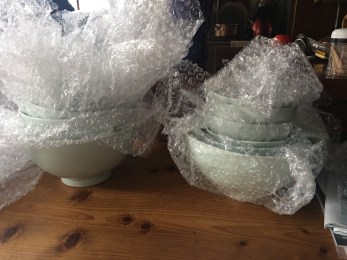
After a good examination of the pots I find that there are 4 that are OK and that I can show. That’s enough. I’m happy with that. My Jung asks me if I’m sure. I am! 4 will be OK. He says that he will keep the others and re-fire them himself. One will surely turn out OK so that he will have one for his museum collection. I say that he should choose one of the 4. He refuses. I should take them home with me for my exhibition. A roll of bubble wrap has appeared and a cardboard box, but I decide to wrap them well and carry then in my back pack as hand luggage. This method has worked with other batches of pots that I have made in China and Japan recently. No-one will be more careful than me in moving these precious things around.

We retire to the lounge area for a coffee. I have brought my laptop with me this time, as I promised to show Mr Jung a presentation of my work, local geology, studio and house and garden etc. I have spent half a day during the week, collating a 30 page journal of technical information and photographs about my local single-stone porcelain materials for him. I have taken a lot of it from my PhD thesis. I hand it over to My Jung, he flips through it. stopping at the pages of analysis data. It’s all in English, so I imagine that it will be difficult for him to read. BUT!

He surprises me completely. When he’s sees the electron microscope results and micrographs. He stops dead and turns to look straight at her and says completely clearly in English, that I can understand from where I’m standing behind them. “Did he do all this himself”? I’m shocked! He can speak English very well. Either that, or I’ve suddenly learnt to speak colloquial Korean fluently! But in a weird twist, that surprises me even more, Miss Kang doesn’t realise that he has just spoken to her in English instead of Korean. She translates it anyway out of habit.

“Mr Jung wants to know if you did all this technical research yourself”? I go along with it and answer, that she should tell Mr Jung that the answer is, Yes. I did! He nods, but raises his eyebrows. Maybe a hint of dis-belief? It appears that I have been paying my translator for nothing. I only needed a driver after all. I could have caught the bus!

I explain that a lot of this is taken from my PhD. I did all the electron microscope work using the equipment at Uni of NSW. Yes. It’s all my own work. I really enjoyed doing my PhD. I had a fantastic supervisor who was right on my wavelength. He supported my research in every way, and without interfering and getting me to do his research for him. I have friends who had withdrawn from research degrees because their supervisor was trying to force them to do work the they weren’t interested in. I was very lucky!

Mr Jung has been able to follow almost all of what I have been telling Miss Kang to tell him. It’s a good thing that I have nothing but admiration for the man and have always been totally polite in all my dealings. I carry on as if nothing has happened. Miss Kang continues to translate. I’m the  only one that realises what has just happened. I feel a bit odd!

img_3443

Mr Jung asks me to show him my presentation. He makes a phone call and two other men appear. One of them is an architect and I’m not sire about the other one. They are here to watch as well, along with one of his staff members. They all sit politely, occasionally asking a few questions and at the end they give a soft applause of clapping. That’s never happened before!  We say our thanks and prepare to leave. Mr Jung shows me the porcelain stones that he has washed. I go to collect them in a plastic bag and take them with me, but he stops me. He tells me that they are not dry enough yet. He will post them to me. I offer, through the medium of translation – continuing the charade, that I can dry them myself and carry them in my luggage. No! Apparently, I can’t do that. I will have to wait until he posts them. OK?

We stop outside the building for the obligatory photos. I offer my phone to Miss kang to take a photo for me as well. She juggles 3 phones and takes a sequence on mine that I feel really captures the total sincerity that has evolved between us in this short time. We are possibly the only two men with this common interest in the world and we have finally met after 15 years of similar research. I feel a strong connection to My Jung. He’s a very thoughtful, creative and helpful person. I like him.

img_3445 img_3446

img_3448 img_3449

I’m a bit sad to say good-bye. But we really must leave now, as the drive is a long one. On the way home we approach an intersection without traffic lights, but only a flashing orange light. I take it that this means take caution, slow down and watch for cars. She doesn’t slow down very much and suddenly we are on the cross roads and there are two cars on our left coming out of no-where and travelling at speed. She brakes and swerves, but too late. Fortunately, the other two cars are able to swerve onto the other side of the road and just miss us – just. Luckily for us all, there were no cars coming the other way. My heart is pounding. The adrenalin rush is severe, almost painful. I’m completely shocked!

We stop and take a break. My driver is tired. We stop at the next truck stop for another coffee and a brisk walk up and down the parking area. I make an effort to keep talking to her all the way home, asking her questions, remarking on the scenery. I don’t want her to drift off again. It would be such a shame to die here, like this, and inconvenient for everyone else to have to cope with.

She is wide awake now and for the rest of the trip, which is uneventful. We break up the next 3 hrs in the middle with another loo stop to discharge the coffee from the last rest break. We talk of all sorts of things. I tell her about the building of the new chicken run. Making it fox-proof and dog-proof using thick galvanised steel mesh all around at floor level, dug deeply into the ground. I tell her of my plans to plant out all the summer vegetables on my return, as it will be the middle of September and starting to warm up. I usually get all the early vegetable seedlings started about this time. Sometimes there is a late frost in October and once in November. Then we have to start again, but that doesn’t stop me. The reason that I chose to leave the city and live in the country was so that I could have a very large vegetable garden and an orchard, as well as a pottery studio and wood fired kiln.

She listens as she usually does, making occasional comments. I have become used to her saying something along the lines of. “Thats very interesting” and “I’ll have to think about that”. This time however, She responds at length. She has been considering all our conversations of the past week. She tells me that she has been helping her Mother in the garden with the weeding.

She tells me that she will think about a change in her life, maybe spending more time at the farm and studio. She’s ready for a change, but will still need a job for some cash. I suggest being a translator and tour guide for specialist pottery tourists like me. There must be other potters who would pay for the particular service of an educated, ceramic specialist, tour guide?

On the way home, she gets several calls, a friend, her sister and boyfriend. But also one from Jun Beom. We are invited to dinner at his wife’s parents house. Her Father has caught a one metre long fish today, so we are all invited. We go to the pottery first. I collect my fired, glazed pots from My Seo’s firing. 4 out of 5 are OK, 3 are very good. I can show these. I offer one to Jun Beom, but he refuses it. I offer one to Miss Kang and she almost grabs it off me. Apparently she is pleased! So, I have 4 pots from this firing too. They are all dully bubble wrapped and packed into my back pack. I can’t fit them all in without unpacking my sweater and rain coat. I won’t need them again now.

The Tae Baek mountain stone body was creamy yellow when raw, but has fired to a very clean, bright white translucent body. I’m very pleased with it. If all goes well, I will have some Australian wood fired versions of it to compliment it later in the year. Everything is shaping up nicely. Better than I could have possibly imagined. I owe special thanks to Claudia, for introducing me to her student, Jane in Australia, who introduced me to her brother in Korea, Jun Beom, he in turn introduced me to Miss Kang and everything flowed from there. Thanks also to Byongchan from Sturt workshops, who introduced me to Mr Jaeyong from Tae Baek.

I knew that Cheonsong was going to be difficult, but couldn’t imagine just how frustrating and negative it was going to be. However, I did end up getting some clay from them. I didn’t even imagine that I would be able to get to Yanggu, as the reputation was quite formidable. This turn out to be the most rewarding experience. I hadn’t even heard of Tae Baek or Siila Mountains before arriving here. They were just lucky breaks. I really do hope that  Mr Jung will end up posting me some samples in due course. Funny that he wouldn’t let me have them when I was there?

This has been a very successful Korean end of my research trip. I have travelled  37,000 kms in the last month. I’m ready to go home and sort all this material out. I also have a long list of jobs to finish when I get home. I have a large kiln ordered. I have 3 weekend wood-firing workshops booked in a row in late September and early October, then the Southern Highlands open studios weekends coming up. I can’t see myself getting to any of this porcelain stone and having some more time for research until the New Year.

I get home to the b&b late. It’s always the same here. Everyone is so friendly, and they stay up so late. I’m back by 10.30 and start to pack my bags. I leave very early tomorrow morning on the 7.00am bus to Incheon Airport via seoul. It’s a long 3 1/2  to 4 hr trip depending on the traffic. I need to be there 2 to 3 hrs early to make sure all goes well. I fly out in the early afternoon. I’m all packed and sorted and in bed by 11.30.

I’m up at 5.45 and all ready to go. Jun Beom picks me up and takes me to the bus station. I want to thank him in some meaning full way. More than just a handshake and a bow. At least with Sang Hee, I was employing her and I could give her a bowl. Jun Beom wants nothing from me. He says it’s all right – relax! We sit and chat until the bus arrives. I thank him profusely again. He just waves it off. “Its OK!” He says. It doesn’t seem enough.

img_3434 img_3442

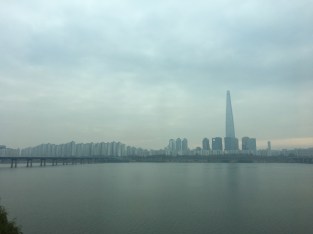
The traffic in the morning peak hour is appalling. It’s stop start all the way along the free way. Grid lock! The air quality is appalling. Out in the country side we have enjoyed much better air than this. It was always slightly over cast looking. I thought at first it might be cloud, but it was consistently always the same, pale, yellowish, photo-chemical smog. During our driving epic. Miss Kang and I talked about this too. She claimed that all the polluted bad air was blown in across the water from China. Some of it might be, but it wasn’t as bad out in the country side. Here however, in towards Seoul the visibility drops  down to a few km or less. I can’t see the sky scrapers in the distance at one point. I know that they are there, I just can’t see them any more after we have passed them. I’d hate to live here in this air. Miss Kang does. She is breathing this air all the time. I’m sure that the majority of it is self-generated here in Seoul by all the industry and traffic. I hope that she will be OK into the future. She has been a very good guide, translator and driver. I can recommend her!

img_3466

It’s a very good thing that I Caught the early bus to the airport, because when I get to the check-in. I can’t believe the queue. It stretches about 100 metres back from the zig-zag webbing lanes, back out into the foyer of the check-in area. I walk and walk, along the queue. Stopping every now and then to enquire if this is still the same queue. it is! I don’t want to spend an hour or two standing in the wrong queue. I have purchased the cheapest flight combination possible, so have to travel back to Australia via China. the queue is for all the people wanting to go to China.

I’m just so lucky to have been taken to Australia when I was young. We complain a lot, but there aren’t many places that I have been that are better than this when everything is considered. I don’t live near the beach, or have a view. But life is what you make of it. I have my beautiful partner and son, my workshop/business, my gardens and orchards.

I am so very lucky to have such a good life!

And a bag full of porcelain.

Best wishes from Steve in Korea

The Kim Chi Chronicles – Episode 6, Siila Mountain

The very next day Jun Beom turns up early at the b&b and tells me that he has been doing some research of his own. In actual fact, there is a porcelain stone mine right here in Yeoju. I already know this, because Mr Jung Du-sub, at YangGu showed me the scrap-book of his exhibitions, and explained to me through the amazing translation medium of Miss Kang, that he collected some white porcelain stone from Yeoju. The very place that we had set off from at the start of the week. Well, I said. “I must go there.” The stone that Mr. Jung collected was quite siliceous and refractory looking porcelain, so he used it as a kind of irregular grog to give a rough texture to his otherwise quite fine work. He tells me that he had to go there and collect some because it is mentioned in the early records of the Royal Court as being a site where special porcelain stone was found.
Jun Beom asks “Do I want to go and have a look for it”?
He tells me that it isn’t far away, we can drive to the base of the hill and apparently it’s only a quick 20 mins walk to get there. It’s going to be a very hot day today, up in the 30’s, so we had better set off early. “It’s not a problem, just a quick walk”!
OK, I agree, lets get going, but not until we have had a good breakfast of fried eggs on toast, coffee and some fresh fruit at his house.
We eventually set off at 10.30 and it’s getting quite hot already. We drive to the spot where the path up the hill starts. Luckily there is a map at the start, showing the various paths up and along the mountain. I have learnt from my very enjoyable, but wasted morning spent wandering with Miyuri san in Kyushu, looking for a porcelain stone site, up on spooky, misty ‘black-hair’ mountain. That if you see a map, photograph it on your phone and take it with you. It will save you an hour or two of miss-directed wandering.
So I do just that and I’m glad that I did, because it shows that I am capable of learning a new trick – even at my age. And, on this occasion, it saves us from wasting a couple of hours going in the wrong direction in the intense heat.
img_3257
We start off in the lower left hand corner of this map and  walk all the way to the top right hand corner.
We set off up the hill. It’s steep. It varies from ‘quite’ to ‘very’, and in places even ‘f@#$%ng steep. We are starting to puff a bit as we trudge onwards and upwards. We are carrying a shovel and a sack too. Nothing  suspicious about that!
img_3260
 We get to the top and start to follow the ridge. The path continues along a highly silicious, intrusion that has formed this mountain. We walk for some time and I’m starting to think that we might have gone too far, if it’s only 20 mins away. It’s not!. We walk for an hour, consulting my phone map every 10 mins to make sure that we are going in the right direction. Whoever told Jun Beom that it was only 20 mins away, had clearly never  been here.
Along the way, I see a number old workings, on both sides of the ridge, where potters have been exploiting this material in the past. But there are no fresh excavations.
img_3262
Just about the time that I’m starting to think about going back, because we have almost reached the far end of the mountain track. I can hear cars passing by below us  not too far away and I know that the mountain walk stops  where the free way cuts through the base of the foothill. Then suddenly, there it is. I’m relieved. It’s a lot farther than we thought or were told.
img_3268
I can’t see any way of getting down into the workings. All the edges at this end fall away into the clay pit very steeply. If I where to climb or fall in. The only way out would be to follow the contour down the hill to find the exit. So we decide to walk around the edge of the pit to try and find the other end, where machinery must have made their entry. Because the hole is so big that it wasn’t all carried out by hand in a sack, like we are about to do. This huge hole has been quarried by machines.
We set off along the ridge track for another 50 metres. We have lost sight of the pit, but we know that it must be there, nearby to our right. We stop and decide to go straight down the very steep slope through all the dense undergrowth and pine tree forest. We swing down, holding onto roots and branches to stop us sliding in the loose scree and humus. We go quite a way. We stop. it isn’t here! Where has it gone? A quarry can’t just disappear. We haven’t come across a track or road that might have led back up into the mine.
We feel that we have come down the hill much too far and our only way out with certainty is to go back, but it isn’t east going. We are on all fours hauling our selves back up, root by branch, occasionally sliding back down again on a flow of loose rubble. We are forced to take a slightly different way back up to take advantage of the better gradient or firmer foot holds. I’m keeping a pretty close eye on where I need t be heading, since I lost sight of my old foot holds that I made on the way down.
img_3270
Suddenly, it’s right there in front of us. It’s the quarry. We went past it by about 6 metres on the way down. It was obscured by the thick brush and undergrowth. I walk straight into the workings and discover a nice fresh wombat-hole-like, shovel-sized excavation that some other potter, or potters have made in the last few years.  Perhaps it was Mr. Jung?
We scrape out half a dozen kilos of the whitest fraction into our sack and make our way out and around to go back up. It is quite a bit slower going back up when you have to hang onto the sack as well as the tree trunks and stems of bushes. We devise a method of throwing the sack up the slope, above our heads and metre or two ahead of us, and then scrambling and hauling ourselves up the cliff-like, almost vertical slope of loose scree and rubble, Until we reach the sack. Then propped against a pine tree trunk, I throw the sack a bit farther up the incline. Eventually, we emerge back onto the track, with a sigh of relief. We are saturated with sweat from the heat. We’ve been at this now for a few hours and it must be past mid-day. The sun is at its apogee and we are feeling like we are cooking. We are out of water and it’s still a long walk back to the car yet.
We set off, taking turns to carry the sack. We swap it for the shovel. I wouldn’t have brought a shovel. I wanted a garden trowel, but Jun Beom couldn’t find one. So this is the only thing that he could find at short notice. It’s not heavy, but it is awkward, and when we see another walker coming our way along the track. I feel compelled to sling the shovel onto my shoulder, like a miner of old, with jun Beom out in front with our sack of booty, held over his shoulder in a similar stance. I feel like a complete idiot, out here in the baking sun pretending to be some sort of miner. He must think that I’m some sort of mad-dog, but in actual fact I’m actually an Englishman!
We have to stop every so often to take a rest. The view from up here is tremendous.
img_3271
We get back to the car, with only one wrong turn. It’s taken us 3 1/2 hrs. So much for 20 mins! I’ve earned this stone sample. When we arrive back at Jun Beom’s place we have no problem in emptying a bottle of water each. He offers me a towel and some of his clothes, a T shirt and some shorts. We are totally saturated in sweat, soil and rock dust. It’s clogged onto us like a paste. I revel in the fresh clean water, washing my hair as well. I emerge feeling human again. Jun  Beom has turned on the air-con and the living room is now delightfully cool. After Jun Beom has showered, we sit and drink more water. he offers me orange juice, but its too sweet and thick. The juice tastes just too strong for me now. What I really need is the water to re-hydrate. I end making a shandy of orange juice and 2/3 water, the juice has just that little kick of sugar that seems just right in a small quantity right now. I’ve burnt a lot of calories on the climb, but lost a lot more water as sweat.
img_3280
We put all our smelly clothes into the washing machine and then I spread all our rocks out on Jun Beom’s floor to dry. The day is baking hot outside, but the humidity is also quite high too. Things still take a long time to dry.
I sort out all my samples that I have collected over the last week, as well. I spread them all out to dry along with todays haul.
I spend a couple of hours hand sorting the Tae Baek Mountain sample, but now that it is all crushed I ought to call it Broke Baek Mountain stone. I sort it into pure white and slightly iron stained samples. I will make the purest, whites stones into the body to get the best translucency and use the slightly iron stain stones to make the glaze.
img_3288 img_3289
It’s anything but rocket science, but I know from working with my own porcelain stone materials back home in Australia, that this slow, painfully dull and boring couple of hours will be extraordinarily worthwhile in terms of the  finished results that  will be able to achieve. I’ve done this with much larger volumes than this and with materials with a grain size of just a few millimetres. I once sorted 40 kilos of fines using tweezers.
Took two days with plenty of breaks, where I just had to get up and walk away and go and weed the garden. This is an extreme example, but if you don’t get serious and give it a try, you don’t get extraordinary results.
No one notices this by the way. It doesn’t rate a mention, and I’m too cautious to mention it in public lest people think that I’m a bit loony. But I discuss it with my close friends, as they already know that I’m nuts and accept me as I am.
One potter once asked me if I’d sell her some of my milled stone clay. I said that I hadn’t even though about selling any. It’s just too precious. There are too many hours of work involved in making clay like this. She said try me! I said something along the lines that it would have to cost somewhere around a couple of hundred dollars for a 5kg pack. Needless to say I didn’t make a sale!. Later, when I though it through more thoroughly, I was very pleased, because I came to realise that the clay cost me so much more than that to make. Before I aged it for the couple of years that it needs to get some workability.
Even though I have never sold any, I have actually given some away to students who are keen to try it on the odd occasion when they attend my classes, but I’m very cautious about that and I ask them to return the trimmings to me, so that I can recycle them.
After lunch I decide to write that letter to the Southern pottery site and send the ‘letter of proposal’ that was requested earlier, last week. I don’t use letter head, or even letter format. Just send an email saying what I said originally, but adding the proposed dates of my show at Watters Gallery next year.
I add the closing sentence that I am writing a book of all my experiences in the research of single-stone porcelain from all around the world that will accompany the exhibition. This implies that because their conditions are so strict. I won’t be able to include any piece of theirs in my show which will feature quite a few pieces that I have been able to make in other places in Korea, But it also means that Although they will miss out getting any mention in the show and catalogue. There will definitely be a chapter in the book on my negative experiences as well. So, really it doesn’t matter to me one way or the other, as I now already have all the other work that I need. He’s made himself irrelevant.
The rest of the day is spent in glazing my pots that made before I left on my week-long sojourn with Miss Kang. I decide to simply use a clear glaze and keep the work simple and consistent with all the other work that I have made in the other countries. I think that the material should speak for itself.
Jun Beom gets a phone call during the afternoon from the Southern Pottery Manager. He tells him that he will post a sample of their clay to me at Jun Beom’s address!
My response is that;
A/ I don’t believe him.
B/ If he does. He had better send it express mail as I leave in 3 days and I won’t be here for the last two.
I return to the b&b and go to bed early as I’m feeling completely wreaked from lack of sleep and the long hike.
Miracles will never cease! I arrive at the pottery the next day to pack up all my dry samples for postage back to Australia. These are all clean quarry rock samples collected from deep in the ground, with no top soil or humus contamination, so I am confident that they are safe to post to Australia. I have had no problems posting samples back from China or Japan in the past. But I did get one of my parcels that I sent from England opened for inspection by customs, but not quarantine. This was the stone from Cornwall, from William Cookworthy’s pit. This pit has been open and abandoned for many years, with lots of brambles and bracken invading the site and creating humus and compost. I also think that cattle grazed the site.
I’m a cautious kind of guy. I don’t want to cause anybody any trouble. I certainly don’t want to be responsible for importing any dangerous soil-borne diseases into Australia. So in the case of the Tregonning Hill stones. I scrubbed them thoroughly in water to get them very clean, then soaked them in chlorine bleach overnight, before drying them at 150oC to 180oC in the oven for an hour. I felt that this would probably kill any pathogens that might be lurking in any crevices. It probably also killed any beneficial bacteria that might have been there too. But I’d rather be safe. Funnily. It is this box that gets opened by customs!
I’m busy packing my samples into plastic bags and weighing them when the mail man arrives with my box from Cheongsong in the south. I’m quite amazed, stunned even. I open it to find a wooden box, not unlike the sort of box that a pot might be presented in – only rougher. I open that to find 3 kilos of clay wrapped in plastic. No note, nothing but the clay. Well! Wonder of wonders!
Jun Beom drives me and my precious cargo of 4 samples to the Post Office. I don’t use the wooden box from Cheongsong. It looked a bit iffy, lets say roughly made. I don’t think that it is safe to post to Australia. I’m sure that it hasn’t been heat-treated or sterilised in any way, so I discard it.
I have no problem with posting pots from Japan, packaged in beautiful hand-crafted wooden boxes. The first few times I brought them back to Australia in my hand luggage so that I could declare them and have them confiscated easily, if it was necessary, but each time the Border Force people let me keep them saying more or less that this kind of wooden product isn’t likely to carry any bugs. So from then on I felt OK about posting them home and haven’t had any trouble with them.
I’m about to test the System. I buy a suitably sized Post Office cardboard post-pack box. I fill it perfectly with my samples. I fill out the customs declaration form stating that the parcel contains “Korean Porcelain stone and porcelain clay”. That should do it!
The lady behind the counter processes and weighs the box. She reads my form and suddenly stops dead. Looks up at me gravely and asks me through Jun beom, If I’m aware of Post Office rules regarding posting this kind of material? I say no, please tell me! She looks very stern and informs me that “Australia has severe rules about posting anything that might contain soil!” I release quite a sigh of relief. I tell her, no worries. I’ve done this before and its quite OK, I’ll take the risk! She franks it and I swipe my card. It’s gone.
If there really is a rule about exporting porcelain stone from Korea. No one has told the Post Office!
PS. my parcel arrived home safely and before I did.
Sweet dreams from Steve in Korea

Episode 5a. The Five bicycle guys – a slight digression.

This isn’t really an episode in itself, but it is a different topic all together, but it all happened on the same day. I’ve divided it and posted it separately, as the original piece was becoming long enough to be a book in it’s own right. It didn’t need to made any longer. So here is the ‘footnote to chapter 5’

I get home to my air-b&b room to find 5 young Korean guys partying. This b&b specialises in advertising to cyclists who use it as a one-nighter while on cycle tours. I’ve had several of them in here with me over the time, sometimes two at a time, but most usually just one. The place has 3 pairs of double bunks. These cyclists are always quiet and tired after a days peddling. They shower and go to bed early, often leaving early. One guy arrived and showered, washed all his lycra, hung it out in the landing and then went out for a walk. I thought to myself. That’s strange! Needing a walk for some exercise after a long day of cycling. He came back with 2 beers and packet of twisties! That was his dinner, after peddling all day! Oh to be young!

However, tonight its party night apparently. Which is a bit strange as it’s Sunday night. Don’t they work tomorrow? Or is it some sort of public holiday tomorrow? I never know what is going on. I’m a complete outsider here. Mystified by the language barrier and always on my best behaviour, so as not to offend anyone inadvertently. I keep to myself.

The party boys invite me to join them, so I do sit and chat to them for a short time. I want to be sociable, as we are going to be sharing this very small space together – possibly for days? I refuse the white spirit that’s offered after sniffing the bottle. I’m tired and only really want to go to sleep. I accept a small cup of local rice wine. I’ve had it before and liked it. Light, cold and tangy it’s alright on a hot night. They don’t really speak much English past “G’day Mate!”  and “owsitgown?”. I give them my best ‘onyohasio’. Then that’s just about it.

Four of them soon loose interest in me and go on to talk among themselves in a very loud, drunken, exchange of good will, jokes and bon homme. They are quite uninhibited in their laughter. One of them sits opposite to me across the fire. He has been to Australia and worked in Perth for a couple of years. It turns out that he can speak excellent English, as a result of this. He asks me why I am here and I tell him that I’ve come to study pottery. Ah! Yes, of course. YeoJu is famous for its pottery industry. That makes sense. There isn’t much else here for a foreigner! He tells me that when he was in Australia he worked for two years in a pottery factory in Perth. I ask if it was a potters studio, or a factory? He  thinks for a while, digesting this distinction in English and replies that it was a small creative factory. Somewhere in between.

He asks me if I make pottery myself and I reply that I do. He asks if I have any work to show him. So I get out my phone and show him my web page, under the menu of ‘exhibitions’ , with some pots on it. He looks and admires. Scrolls down a bit. Thinks for a while and then says. “You could sell these you know, they’re not bad. Actually, they’re OK”. And then,  “Yeah. I think that you could definitely be able to sell these”.  “I’m a web designer”, he tells me. “I’ll make you a web site and you can start to sell these things”. I tell him that I do already sell them.

Is it the beer? Hubris? The difference in cultures, or just plain shift in meaning through translation. I don’t know, but he launches in to a long lecture of how everything is going online and that I need to have an on-line presence. If you are not on Facebook, Instagram, Linkedin and Twitter, then you don’t exist. People have very short attention spans and they need constant reminders to keep interested. If it isn’t you popping up on their feed, then it will be someone else who will get their dollars. No one browses for web sites anymore, that’s dead. You have to push the feed to them, or some such jargon.

I’m not really interested. it’s not for me. Anyway, I’m tired! I’ll let someone else get those ephemeral, floating, discretional, shallow dollars. I’d rather just be in the studio making my pots for my own enjoyment and growing my vegetables. That’s the life I’ve chosen. I have no intention of going on to ‘etsy’ to market what I do.

I can see it now;

“Lovely hand crafted, single-stone, native porcelain bowl. Clay aged for 4 years. Wood fired in a hand-made kiln made from handmade fire bricks made from locally prospected white bauxite. Wood fired, using wood from trees planted specifically for the purpose, grown and hand tended, on-site for 40 years, before cutting and seasoning for 2 years. fired with loving care in a 20 hour overnight firing, calling on almost 50 years of experience in firing and glazing.

Nice piece, $10.55 or nearest offer!”

I reply with my own sermon of lifestyle philosophy. I see my job as making objects of small, concentrated, intense but gentle beauty and interest, for an extremely small market of informed people. Many of whom have no money to buy them because they are artists themselves. But that’s OK, they appreciate them and that is what counts to me. No one really understands what I do and how I go about making them. And if they did, they probably wouldn’t believe it anyway. I’ve had the most rewarding life doing this. The times that I’ve spent in conversation with special people who are on the same wave-length, discussing local provenance, self-reliance and integrity in life choices have made it all worthwhile. Money doesn’t come into it. It’s not about money!

I’d still be happy to make all my pots the same way, even if I couldn’t show them in a gallery. Selling, is not the reason for making them. I put my pots out there in exhibitions,  because I think that it is important that the work be able to be seen, but I don’t sell all that well, I’m used to that. I know that I’m never going to be able to make a living at this. I’m not the sassy, pushy, street-smart person, who markets themselves well. I earn my money by other means. Whatever it takes. ‘Means’, means kilns in this case! I get by OK. I’m happy doing it this way. I’m self-employed. I’m in control of my own destiny. These are my choices.

It’s more important to have a meaningful life that I can be proud of than chasing those 15 minutes of fame or anything as totally meaningless as money. Lets face it, the stuff is empty. It has no real value. After the basic necessities of life are provided for. Whether you drive a Hummer or a Hyundai. It doesn’t really matter. as long as it gets you there reliably. That is the important thing, all the rest is ego. Don’t let yourself be sucked in by the advertising! It’s cleverly designed to keep you dissatisfied and poor. Choose a life of integrity, which involves some service to others and be content with some frugal comforts. This is the road to happiness!

I grow all my own food and do almost everything that I can by myself. I am trying to be as self-reliant as possible. I choose to do it frugally. Without a reliance on too much money. The time spent earning money is a waste of time. The great money chase ruins lives and is a complete waste of a life. Life is short. Don’t waste it on trivia. Look deep for your own meaning. It often doesn’t need a lot of money. I’ve read that service to others is the most rewarding thing that can give meaning to a life. I think that this might be pretty true.

He listens, he sounds almost interested. He asks me to expand on this low-income, frugal lifestyle of self-reliance. So I do. Eventually, he asks me if I’m married. I tell him no! But I have a long-term partner. I told him that we are not married, but have a child together. We waited 10 years before we engaged on bringing a new life into the world. It was no accident. We planned it. We had to be sure, to be confident. Confident that we could afford it and that our life and the world was stable enough to bring a new life into it.  It’s all worked out OK and our child is now grown up. A beautiful person who we admire and are proud of. He has his own life and will probably start his own family soon.

He seems amazed at this revelation. How can this be? It’s against all the rules. I reply that those rules only apply to the people who believe in rules. I don’t, they are not my rules. I will decide that for myself. Janine and I are the masters of our own destiny. This is quite possible and reasonable in Australia at the current time. Of course there were those in our village who shunned us. The constipated, stifled, right-wing, conservative neanderthals. They stewed in their own bitter juices of anguish. We were immune. They are welcome to their views. I wasn’t listening. We made our own peaceful and beautiful way without them. You have to be some kind of strong-man or woman, to go it alone, but it can be done if you concentrate and stay on focus. Strength isn’t about muscle. It’s all about how and what you think.

He listens and thinks a long time, then says that he is considering what I have said.

This appears to be at the heart of the emotional/intellectual/existential problem for the weekend cyclist Mr. X. It turns out that he is on the horns of a dilemma. He is getting on and so is his fiancé. Her parents want them to get married and start a family. They  want grandchildren. So are selfishly putting pressure on him. He is obviously not convinced that this is the only and best option. So we reach the crux of the matter. Is his relationship strong enough? I have no idea and it’s non of my business anyway.

He asks me straight. What I would do? I reply that I can’t tell him what he should do. Only he knows the answer to this question. I suggest that he look very deeply into himself when he is sober and think about what options he can live with.

I add that I have lived through this same situation years ago. I wasn’t sure. I was definitely uncertain. I thought about my situation. About children, about all the other people involved, but ultimately it was me. I was the one who had to live with the consequences of my conclusion. I thought long and hard. I took my time, and eventually the answer clarified for me. I made my resolve. I’ve lived with that decision ever since and I am completely happy with the outcome. We all have to mature and grow up at some point. Think very hard about your choices and don’t be pressured or rushed. You will have to live with the repercussions of your determination forever and so will two or three others.

I have just had a long conversation, not unlike this. We discussed the meaning of life – if any, and what we are here for. The answer to this, I am pretty certain, is that life has no purpose, other than to reproduce itself. The selfish gene! This imperative got us to survive the long, lean times. But what now? Seeing that there are too many of us already, perhaps it’s a good time to consider negative population growth. NPG. This didn’t go down too well with the group of friends that I was gathered with for a meal on another occasion, as some of them had chosen to have a lot of children. In fact I got a very hostile response from a mother of eight. She was quite strident in her invective.

So, how should we live? How do we make the best decisions in life. There are no answers to these dilemmas, we just have to muddle through. But I do believe that we have a responsibility to think long and hard, so as to make the best decisions. Whatever that is for each individual. He doesn’t answer, just stares into the darkness. But I can see that he is considering it.

This isn’t any kind of answer to my bike-man, but it is all I have. He seems quite satisfied with it though and eventually thanks me. He says that he knew that he had to come on this ride. He is so glad that we have had this conversation. I say that I really need to go to bed now. It’s midnight already and I’m dead tired. I’m pretty sure that if I go on, I won’t be making any sense!

I stand to leave. All the others farewell me while still offering some more white spirit. I decline. I leave the rabble of noise and good humour. A tale full of sound and fury, but signifying nothing. My colleague of the last hour, Mr. Peddles, stands up and offers both his hands in a sincere gesture of parting. We shake hands. “I knew that I was meant to come here tonight. This is like the Buddha moment for me now. “ I must say that I’m a bit shocked by that, but let it pass as I’m determined to make my way upstairs to my bunk.

I stand to take my leave. He asks again. What would you do? A lot of things are said in an unguarded moment. But I pass. I don’t really know anything about his situation, but I do know that he will have live with his decision for a very long time. I wish him well with his existential dilemma. I certainly don’t know the answer for him. “You have to make your own decision, be true to your heart, but don’t rush it. Take your time!”

I’m not drunk after my one cup of wine, but I’m pretty sure that they are. I wonder what the outcome of it all was. Did he even remember our conversation the next day?

I’ll never know! I try to sleep, but the noise from down stairs is consistent and quite loud. I must say that it never erupted into anger, like it might have in Australia, when a group of young men get drunk. It always sounded good-natured. Just loud outburst of laughter!

The last time that I remember waking up because of the noise was at 3.30 am when I looked at my phone. After that I don’t have anymore recollections of time, but someone came into the room and zipped, or unzipped a bag. No one climbed up onto the top bunk to sleep as I was expecting. I sleep after that. However when I awake at 7.30. The place is empty. Everyone is gone and I am alone. They have finished whatever they were up to. None of the beds have been slept in. The party is over and they have packed up and gone. God knows how they managed to keep their balance on bicycles when still probably pissed. I wonder what happened to them?

I do hope that they are all alright.

fond regards from Steve in Korea