
I’m here in Singapore to teach a Master Class in my very own flavour of environmental ceramics, using local rocks to make local glazes for local potters. I’m also here to give a seminar about this work. There is a tea bowl conference and exhibition. I’m here because people buy my bowls to use as tea bowls. I don’t call myself a tea bowl maker. I haven’t been trained, so I can’t really call myself a maker of tea bowls, I’d feel that I was a fraud if I did. However, if people want to buy my bowls for use in the tea ceremony, then I’m pleased about that and happy to sell them one. I’m also here to take part in all the other related activities that go with conferences, but more of that later.
I’m here alone, because The Lovely checked her Passport, that 6 months ago had almost a year of life in it, and that seemed OK at the time, but is now so close to being out of date, having less than 5 months left on it, that I can’t check her in online at the Airline web site. A bit of a cock-up there. I should have checked in and confirmed, as soon as I bought the tickets. I thought that there would be plenty of time for that later, and there should have been. So it’s my fault. I won’t let it happen again.
We are flying on the cheap, very cheap no-frills, cheap, new Asian low-cost airline, Poverty Air. They offer you nothing, no service, no frills, no meal, no drinks, no movie, just a seat on a plane and it’s quite a small, narrow, hard one at that, with little leg room. But it’s cheap. Their flight path and service, if you can call it that, isn’t very convenient, but it’s cheap. What they do offer is a very cheap fare, and my-goodness it’s cheap! Imagine Ryan Air with all the luxury removed! I agree with the terms and conditions. It’s cheap and I expect nothing. I feel that it will be OK because it’s only a very short flight to asia from here, just 10 or 12 hours, depending on the route taken. Ours is a bit of a round about one to fit in with their scheduled flights to get us to where we want to go, But Hey! It’s cheap!
So Janine has no valid pass port, she can’t get on the plane with me. I go alone. She has already applied for her new Passport online and paid the extra $350 for an overnight/24 hr. Express Processing, so she will follow me in a couple of days.
I arrive and soon check out the place. I have done a quick look around the area here surrounding the pottery site and found what I think is an aplite rock, just like the bai tunze that I found at home near Mittagong. It looks so similar I have high hopes that it will make some nice glaze. It looks to be a little bit darker than mine, so I don’t think that it will be as pale when fired. But the cleavage planes and the texture look remarkably similar. It might make a dark green ‘Northern’ Celadon, but who’s to know? I’m no geologist, but it does look promising. I also found some white granite that is being used as road gravel here. There is a large amount just outside the gate to the pottery, so I also tested that. Steven Low, who has organised this Masterclass at the Thow Kwang Pottery Jungle has also located a few samples of commercially available rock gravel as well as a local white sandy clay. I will test all of these if time allows.
I need to crush all these samples down to very fine dust so as to be able to make glaze tests out of them. All I have to work with is one kitchen mortar and pestle made out of granite and a dozen helpers throughout the day. I will need more than this if we are to get it all done. Steven takes me to the village street markets, where we buy another 4 stone mortars and pestles. He has arranged to get a steel stamping tube mill welded up, to be used for primary crushing and it is there when we get back with the mortars and pestles. So we are all set to go.
We all sit around in the shade and crush the samples. It’s very boring work, so I’m really pleased to have some wonderful, helpful people sharing the work load with me. The day before my Masterclass is due to start, many of the participants have turned up, they are here for the whole event and are happy to put in an hour or so to help me get it all done. I am very grateful. We only have one of my home-made stampers and 5 granite, food-grade mortars and pestles from the markets to work with. But with so much good will and great helpers, it all gets done. I couldn’t have done it all just by myself. Not in this time frame. So thank you very much to all those who helped me. I’m so grateful.
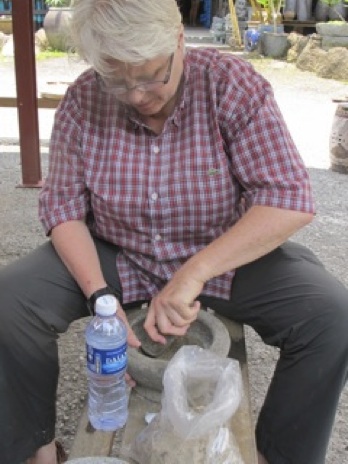
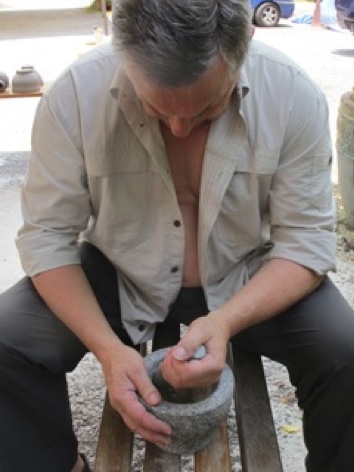
We don’t get all the materials tested during the Masterclass. There isn’t enough time. There is a bit of theory to explain, as the system that I have developed to analyse the various rocks and ashes for stoneware firing as glaze material is a little complex. If you haven’t done it before, it might seem a bit difficult to follow. So, the first tests take some time, but once everyone gets the hang of it, we get a lot done.
The class is over-subscribed. I have almost 30 students, but only 4 sets of scales and equipment, so we work in teams of 7 or 8 per table. It’s a great atmosphere of cooperation and fraternity. Eventually we run out of time, there is another session booked in for this room in the afternoon. We still have a few of the samples left untested. I go back each evening after work in the pottery and complete a few more samples until they are all finished by the end of the week. I’m interested to know the results.
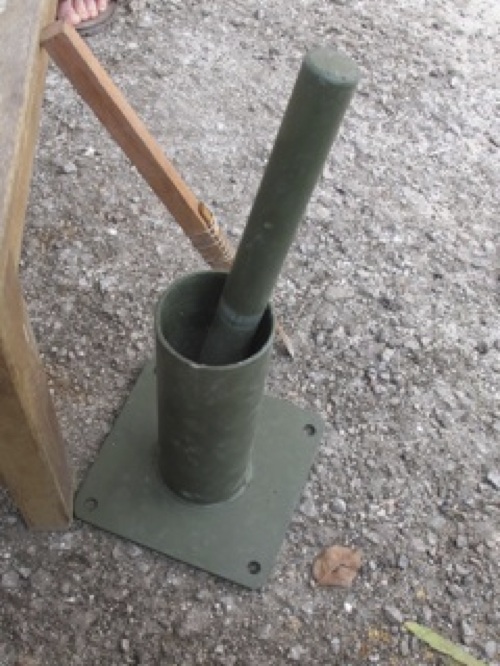

Stamping mill Stone mortars and pestles

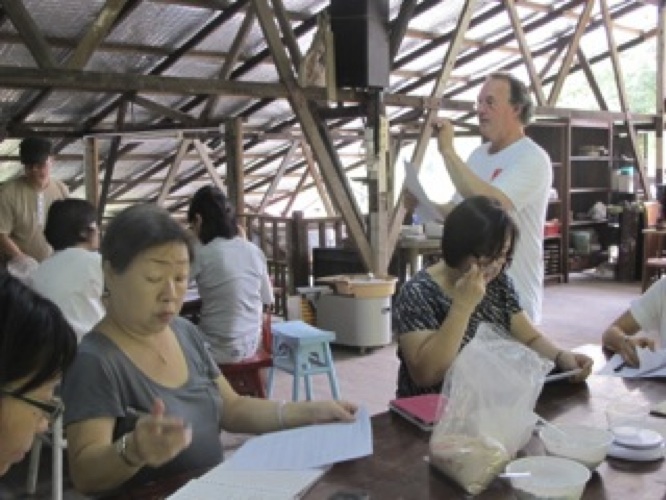 Demonstrating where to start
These photos of me by Merrie Tonkins, from Qld, who was helping me on the day as assistant.

A few of the finished test tiles ready for firing.
My other, or real, reason for being here is to make pots and to fill, pack and fire this Dragon Kiln. We are being hosted for some of the time at the Thow Kwang Dragon kiln Pottery. This is the last remaining working dragon kiln in Singapore. There is another kiln close by, but it closed down some years ago and is now rented out as workshop space to local artists. ‘The Thow Kwang Dragon Kiln Pottery Jungle’ is in a small patch of what used to be jungle up in the North West of the island.
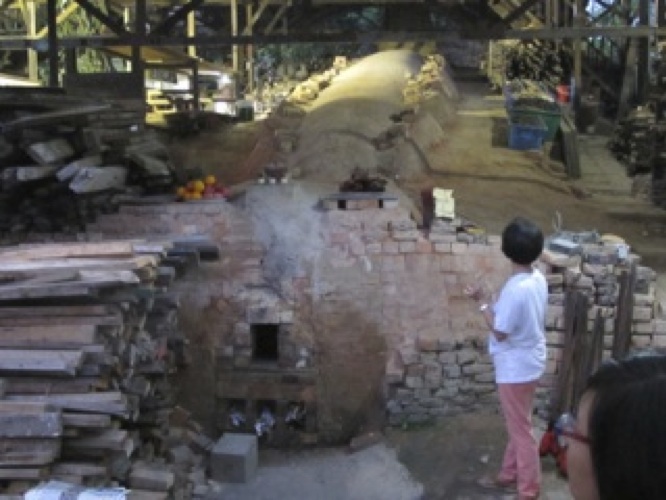
It’s a marvelous old structure, built into the slope and mostly underground to get the earth as support for the arch that runs the full length of the kiln. Just the stoke holes are visible at floor level. The kiln is 1.8 metres high inside, but only 500 mm. is visible above the elevated ground level.

Over the years, all the other kilns have been closed down and/or demolished. The sites leveled and used for modern developments. This last remaining old Dragon Kiln is threatened too. It’s a shame. It ought to be recognised as an historic site. It’s part of the Nations Heritage of this place, but I don’t think that the bean-counters in the Government are interested or listening. Cash is King here! And money doesn’t just talk, it shouts.
The Dragon Kiln has a 3 year extension on the lease for the site just now, but it can be revoked at any time. No one knows what will happen, but as this is Singapore, it is inevitable that the site will be concreted over in the not too distant future. The place used to be surrounded by dense jungle with a lot of wild life in it. There were jungle fowl, wild boar, monkeys and loads of birds. All living and thriving in this last remaining eco-system. However, the Singapore Development Authority decided in their wisdom to clear the jungle and replace it with a modern designer, jungle-inspired garden walk, designed by a famous German landscape architect. So Appropriate. So local.
Everything was bull dozed and replaced by what a German designer thought would best represent the concept of ‘jungle’ in the modern world. Once the real jungle was removed. It’s basically lawn with a few shrubs. This narrow garden strip, follows what used to be the old creek. Which is now concreted over and filled with imported stones, so that it looks ‘natural’ The rest of the site is being concreted over and high-rise is being built on it.
The new road is completed, and the first two concrete high-rise blocks are built, there are 9 more planned around the site. The district is not called Thow Kwang Pottery Jungle any more. It has a new identity now, The new road that circles the old kiln site is now called ‘Clean-Tech Loop’. Could anything be more insulting and anal? There is no wild life left here now, just a few birds to be seen. But the German designer has thoughtfully placed photographs of each of the animals that used to live here on plastic profile boards all along the walk so that we can be reminded of what was once here just a year or so ago, before its habitat was destroyed in the name of rampant development. Clean fucking Tech Loop indeed!
Welcome to Singapore!
For the pottery making part of the workshop, I chose to make my pots for the firing of the old Dragon Kiln from the local clay. This isn’t particularly smart. I know nothing about this clay. This is clay that was recovered from the local clay pit right outside the pottery, just before it was bull dozed, to become part of the new Post Modern Jungle-free, ‘jungle’ garden walk. In some way it is an ‘homage’ to the old ways, the old folk, the potters and throwers, to the labourers and unskilled workers that this place employed, before they were displaced by the bankers. I think of all that lost culture and history, all the lost techniques and skills. All bulldozed over and concreted in this very time of ours. We did this! We let it happen.
The clay that I’ve chosen is completely unprocessed, it is totally natural, yellow and sticky, straight from the ground. The ground that supported this venture for over a hundred years. It’s very soft and very gritty with huge chunks of organic matter and stones up to 10 mm dia or more. It is a little difficult to throw and to deal with. Probably better suited to making the old, large, thick jars, rather than small functional bowls as I am making, but I decide to give it a go and I persist. The alternative is to use clay imported from Australia. I didn’t come all this way for that. So I persist.
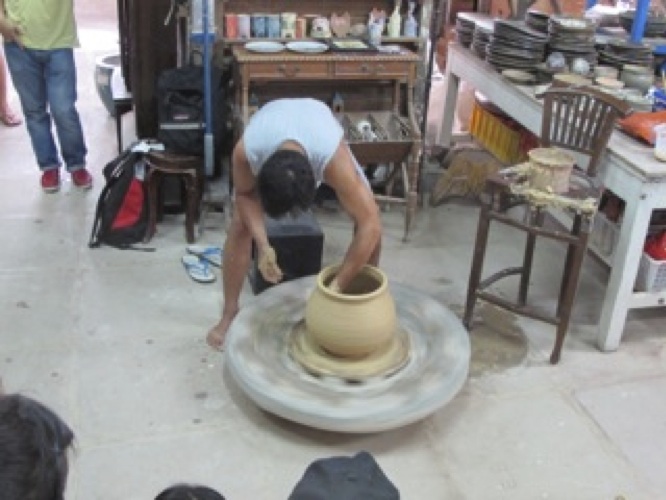
I choose to use the very old, traditional, floor level, 4ft dia. wide, kick wheel. It is essentially a very heavy flat disc. You kick it up to speed with your foot and the momentum keeps it going. You then bend over it, legs akimbo, in a torturous way that can’t be too good for your back, and throw the clay into a pot, as best that you can. As the wheel slowly looses momentum. You have to stand up and kick the wheel up to speed again to give it enough momentum to finish the pot. I made 7 bowls ‘off the hump’, from one big lump of clay, in this way. I was quite surprised that they came off quite well. I’m used to using a kick wheel at home, but not one like this! So the transition wasn’t too hard. However, I’m glad that it was only for 15 mins or so. I don’t think that my back would last all day working in this method.
Still, my pots have a nice soft, gentle undulating quality to them that I like a lot, and it’s mostly due to this method of making. I put my row of pots out in the sun to dry and turn them an hour later. The weather is very hot here and also quite humid, so the pots dry out relatively evenly without getting dry rims. Quite surprising to me. If I were working like this at home in 30oC heat, the rims would be bone dry in 10 mins.
Once my bowls are turned, I put them back out in the sun to dry further. They are eventually packed directly into the huge dragon kiln and the firing is started a few hours later around dark, full of raw pots, just made that day, some still quite moist. The kiln is slowly steamed over-night and then, in the morning, when all the pots are quite dry, the firing is allowed to gain speed and more wood is introduced more often.
The firing starts to go quite quickly, up to temperature by the following evening. More or less neutral to oxidised atmosphere. The fuel is industrial timber off-cuts and building demolition timber. The final temperature is achieved around mid night, and then the rest of the tunnel kiln is side stoked well into the night, stoke hole by stoke hole, metre by metre, it progresses up the slope, all the way along the kiln and finishes just before dawn.


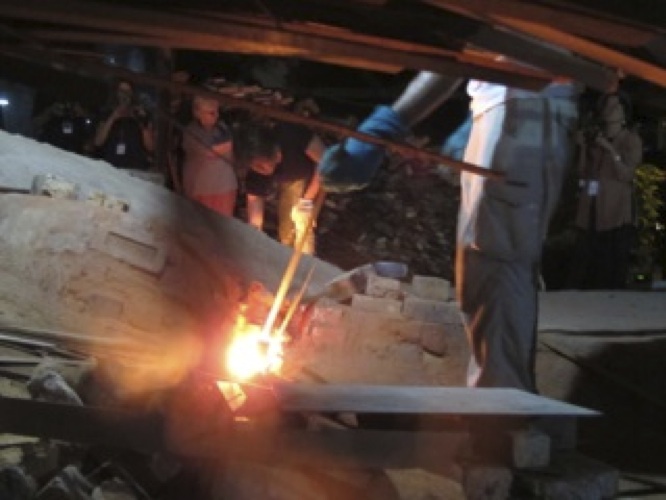
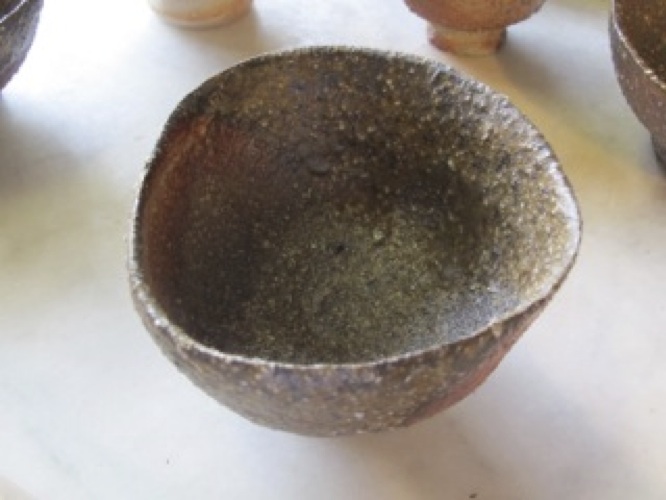
The kiln takes two days to cool and I’m amazed that my pots turn our rather well for an unknown clay, thrown on an unknown wheel, with an unknown glaze and an unknown ash and fired in an unknown kiln. Luckily, the locals here have us all well organised and keep everything loosely under control. It all goes smoothly enough and I’m really glad that I’m just an innocent bystander and not at all responsible for any of it. I can enjoy myself.
I sell my 3 bowls in the ‘Chawan’ Exhibition in the city and all of my bowls from the dragon kiln at the on-site exhibition at the Dragon Kiln site. So I’m very pleased with this outcome. I give a few away to people who have helped me while I’ve been here. It is strange being here and traveling alone without Janine. I haven’t travelled alone since the 80’s. She is still back at home, waiting for her passport. We Skype each day to keep in touch. But it’s not the same without The Lovely!
They appear to have lost her new passport somewhere and can’t give her tracking number for it either. Sheer, utter incompetence! Someone ought to be hauled over the coals for it, but no-one will be. After two frustrating weeks, they eventually tell her that the Passport will have to be declared ‘lost’ and will be cancelled next Monday. That’s something, but not too much. It means that she will not be able to get to meet up with me here in Singapore. The whole adventure will have finished and be over. I’ll be in Japan by the time that she has the new passport and can then buy a new ticket. That is if they can get her a new passport and if the new one doesn’t end up ‘lost’ in transit as well? It means that we will forfeit two Poverty Air flights, as they are cheap and not transferable.
The only benefit, if I can call it that, is that I get to have an empty seat next to me each flight. So I have a smidgen of extra space to expand into.
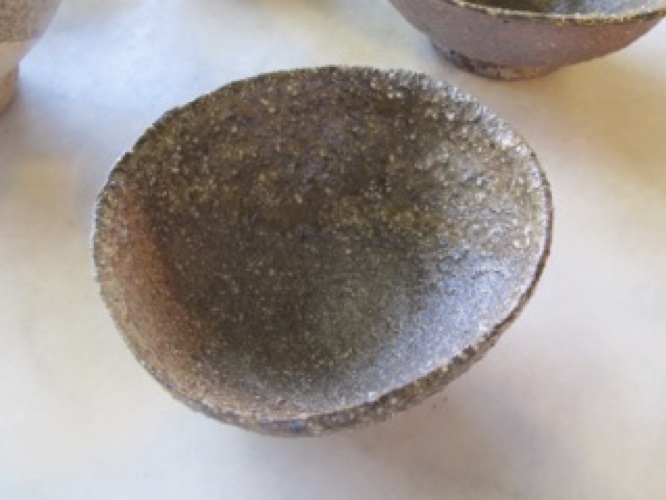
I have accumulated a quite a few things over the time I’ve been here, things that I can’t carry with me. Mostly catalogues and tourist brochures, but there are also 2 pots. Just what I need!
I have navigated my way through the maze of shopping center’s to find a very small post office on the third floor of the 2nd tower of the 2nd mall just down the road from the hotel.
I’ve been told where it is by the staff at the hotel, but I doubt that they’ve ever been there themselves? I walk and I walk. It’s a long way. I walk so far that even though I’ve been told that it is in the second mall, I feel that I must have walked too far by now. Maybe I’ve walked through the first Mall and into the second Mall already. Maybe I’ve gone too far?
I can’t help but feel that I must have missed it. I ask directions. No! You are still in the first Mall! Keep walking! I do, and it’s very dull. Eventually, I ask again and I am told that I am close. It’s such a relief. How much plastic shit can one man walk past without expiring? Every shop appears to be either a women’s clothes shop or a shoe shop. Or so it seems.
Eventually I find the Post Office. It’s hidden away around a corner, in a back area. But there it is! It’s very small, with only two girls working in there. But they turn out to be quite efficient and it all gets weighed, stamped and sealed, then off into the bag.
So my parcel is sent and my load a little lighter for my flight this afternoon. I’m very relieved.
Our hotel must be located in some of the ugliest, most concreted, un-natural ‘dead’ location of tourist shopping hell. Ringed by freeway overpasses and tower blocks. There is no-where to walk except to the nearest shopping mall. Which is connected to yet another shopping mall. You can walk all day in glacial air-conditioned comfort on concrete and terrazzo, endlessly, without seeing the sun or breathing fresh air, or seeing greenery or anything that resembles the natural world, unless it’s a photograph, and then it’s of somewhere else.
Luckily, I have no interest in venturing into the dead heart of this dystopia. The ‘Sensoria’ and ‘Vivocity’ Disney-Like plastic and concrete escapist unreality. In fact, I was looking for something to buy as a memento of my visit to this place. Something quintessentially Singaporean, but I couldn’t find anything that would not insult my senses and degrade me later through its ownership. There is nothing here but concrete and plastic and most of that is from China. This is a totally artificial environment, built around misrepresentation and fakery with strict governmental control, keeping everyone and everything in order. It’s the antithesis of my DIY natural philosophy of independence and self-reliance.
Welcome to Singapore!
I suppose that the people who are living here and doing well, making a lot of money in their business’s are happy here. I don’t think that I would be. I’ve been spoilt with too much open space and relatively clean air, a big garden and orchards. I can’t see myself wanting to pay 2 or 3 million for a 100 Sq. m. Apartment on the 9th floor, with nothing to do but work or go shopping. Of course not everyone is happy with the strict authoritarian system here. There was a riot here earlier in the year in the Indian district. Apparently, it shocked the authorities. How could it be that everyone isn’t blissfully happy here? Well, the poor, low-paid labouring classes for instance. The ones doing all the work building the city, repairing it and keeping the city going in every small detail. They can’t afford to buy into the dream.
They aren’t buying apartments or going shopping in the malls It’s street food and rough dossing for them.
Welcome to Singapore!
The taxi driver told me that this is the most boring place in the world. There is nothing to do here other than work and shop. He would love to leave here and live somewhere else, but he can’t, he has no way out. he also told me that there are about 5.5 million people in Singapore and that the Government wants to increase the total number of citizens in the next decade by almost 2 million more. I ask why. It already seems to be over-crowded here. He tells me that the Government is concerned that the percentage of Malaysian muslims in the population is increasing rapidly. They are having lots of children. There is a concern that they will soon out-number the ethnic Chinese part of the population and take political control. This can’t be allowed. So there is a big campaign to import emigrants from mainland China, to boost the number of ethnically Chinese citizens. It doesn’t sound too sustainable to me, but I have no say in the matter and it’s none of my business either. I can see the next step being the Fijian solution?
Welcome to Singapore!
A couple of young potters have asked me if it is possible to come to Australia. Once they are over 30, all I could tell them was that it is only possible to come as a tourist or student for short-term. There is no migration, unless you can get 100 points by being a preferred occupation, like doctor, lawyer, nurse etc. Potters don’t make the cut. Or, of course, the other option is that you emigrate with 100 points by being a millionaire!
Welcome to Australia!
Finally, yesterday, I found a lovely little piece of pottery in Little India. A small pouring bowl of 7cm. dia. Unglazed, low fired and slightly flashed porous clay. Probably fired to 800 oC by the feel of it. Thrown off the hump and cut off with a twisted thread leaving a nice shell pattern on the foot and un-turned. Very understated, basic and honest. But of course, it’s not from here. It’s made in India! The shop keeper asked me for 50 cents. I’m a tourist, I knew I was being ripped off blind, but I am comfortably well off in my own chosen frugal life, so I gave him a dollar. I think I have the better part of the bargain.
I get to fly out of here tonight.
I posted it home in the parcel by sea mail. The lady at the Post Office said that it will probably take a month. It ends up taking 6 weeks.
I brought a bit of spending money with me, but haven’t found anything to spend it on, so will convert it into Yen for Japan. There is nothing here that I want, so my money has remained in my pocket. My biggest expense each day is the $1.30 per trip on the metro into various parts of the city and back. The Metro has interesting carriages that are all totally open all the way along. It is the first time that I’ve been on a train like this. It’s a very good, clean, fast, cheap and efficient system. I like it.

Oh! Yes, we did go to Raffles one evening and have a Singapore Sling. We bowl up at the front door to be met by the biggest, boldest Seek Indian Gentlemen, replete with turban and loads of bling. He speaks with such a deep, rich Anglo/Indian Raj sort of accent. I’m quite impressed. He informs us politely and with a big smile that we are in the wrong place. This is the entrance to the Hotel. We need to go back out this entrance and around the back to the public entrance, where we can find our way to the Long Bar. We find our way and order our Singapore Slings for $33. It wasn’t worth it. What a rip off! Don’t waste your money, if you are given the chance! Go somewhere else and get a G&T at a more reasonable price. We left and went to Little India for dinner where it is hot, hectic, crowded, cheap and delicious. Later, we all went up the tallest building here and had a beer at the top in the bar for $20. Not my idea, but I went along for the ride. It also wasn’t really worth it either, but you get conned into doing these things at conferences.
I wouldn’t be bothered doing it again.
The most comfortable place here is the Botanical Gardens. We spent a day ‘off’ there. That was a nice bit of open space and greenery. I think that it might be the only bit of open space greenery in Singapore?
Best wishes from
the singular hot and sticky potter in this tropical heat!

















You must be logged in to post a comment.