Thinking Differently, Solar Power and Clay Making

I usually spend a bit of time making clay over the summer when the humidity is low and the air temperature is high. It’s a good time for drying out the clay slip after it has been ball milled.

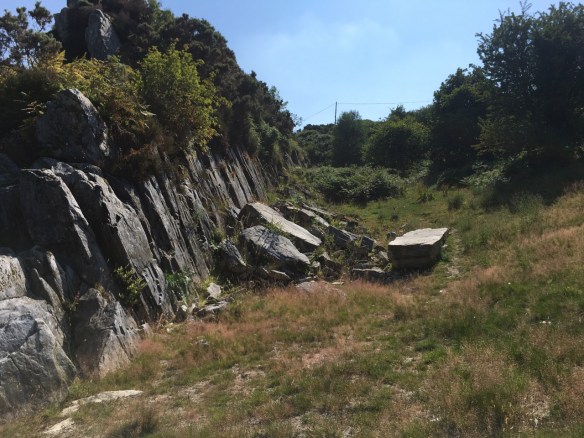
All my so-called ‘clay’, is actually ground up igneous stones. I crush the very hard ‘granitic’ rocks in the big jaw crusher first to reduce them down to 12mm. gravel size, then through the small jaw crusher to get it down to sand size and finally it goes into the big ball mill for a few hours to reduce it to a very fine slip with water and 3% of Australian white bentonite. It is the only ingredient that I buy in for this home-made, locally sourced, native porcelain body.

IMG_0942 IMG_0939 IMG_0941

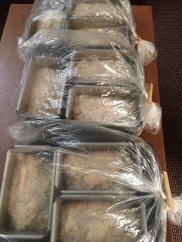
After ball milling, I test the pH and adjust it if necessary, it usually needs to be reduced a little, as the ball milling breaks down the structure of some of the felspars and micas in the stone. This releases tiny amounts of alkali into solution in the slip. The effect of this is to constrain the plasticity of the porcelain and inhibit the ageing plasticisation. Once adjusted to the correct level, the slip is stirred and then put through a fine sieve to remove any oversized particles and any foreign matter that has crept in during unloading. Thick slip is very slow to pass through a very fine mesh, so I resort to using a sieve vibrating machine to shake the sieve while the slip pours through. It’s quite amazing just how fast this process becomes with a little vibrational energy to keep the larger particles moving and not sitting and blocking up the fine mesh. ‘Vibro energy’ a really great focussed use for very small amount of electrical power.

Without the rock crushers and ball mills, I couldn’t make this local ‘native’ porcelain. In the past I always used to feel a bit guilty about using electrically powered machinery, as I was brought up in a family where ‘green issues’ were openly discussed, long before the ‘greens’ were invented as a political movement and ‘green’ came into the environmental lexicon. I’m not too sure what my parents actually called their lifestyle back then. Possibly ‘environmentally conscious’? Anyway, I’m happy to be called a ‘Greeny’ now and all that early environmental awareness has stuck with me. Give me the boy till he is 7! Now I am getting used to thinking differently about electricity as we are slowly becoming a fully electrified solar-powered household.

Electricity was always made with coal here in Australia and most of it still is. You have to specifically request to be put on a green power contract, and then pay a premium tariff for the pleasure of not using coal. 25 years ago, you couldn’t buy green power. Everything was coal, coal, coal, so I decided to make an effort to use the absolute minimal amount of electricity and we were very successful. We learnt to run a very lean electrical household. We have a very modest ‘LED’ screen television. A very efficient fridge that runs on 1 kW per day and a front loader washing machine, also very efficient. All in all we average an electricity usage of around 3.5 kWh per day. Very modest. We have chosen not to buy home theatre,  a dish washer or air con.  We have had solar hot water for the past 30 years, Solar electricity for the past decade and a Tesla battery since the start of the year. To the best of my knowledge, we have completely removed ourselves from the coal economy now.

When we did buy power from the utility, up until last year, it was always a battle to buy ‘clean’ green energy. They just hadn’t thought about it and weren’t prepared for the transition. It was a dinosaur industry. People like us wanted to buy clean energy, but they hadn’t put any plans in place to create any. It was all about business as usual. As the requests grew louder, some clean energy was slowly introduced, such that you could buy just 10% of your electricity as so-called ‘green power’, but it turned out that it was only hydro power from the Snowy Mountains Scheme. This was electricity that was always being generated since the 50’s and sold into the grid as part of the usual mix. But then the bean counters and ‘The Men in Suits’ got involved and thought why don’t we sell Steve Harrison the electricity that he is already buying, but sell it to him at twice the price. If he is silly enough to pay for it!  I wasn’t, so I didn’t.

We waited a long time, until the first wind farm was built just South of here. Then there was an offer that you could buy 20% of your power bill as wind energy, so we did, and continued to increase the percentage every year or so as more clean energy was built and made available. I remember that we were early adopters and had to go on a waiting list to get a higher percentage of clean energy. However, the energy company kept sending us supposedly attractive offers to change back to a cheaper dirty black power contract. This just reinforced to me that the market for green power was stronger than that for coal power. Apparently they had too much coal power and couldn’t get rid of it all.

Then there was government intervention to support the coal industry and then privatisation that was supposed to make every thing more efficient and cheaper. And what happened? The price went up about 200% here. A complete failure of market forces and competition.

Today I check in on our power usage on my phone app. I see that we are making about 5kW of solar power, not too bad, seeing that we are just a month off the winter solstice. We are only using a few hundred watts intermittently, that’s the fridge compressor switching on and off. There is a spike at 8am. That’s the toaster and electric jug for breakfast. It’s probably hard to live any kind of normal life and use significantly less power then this on a regular basis.

IMG_0964

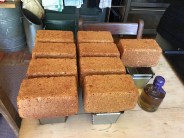
Back to my clay tests and I pour them out onto the drying bed to stiffen up. Again I’m using solar and wind energy in this very passive way now to remove the excess water from the slip and reduce it to a plastic state. The sun shines for free every day. The wind blows most days, slowly the water is evaporated from the slip and it becomes stiffer and plastic. It’s gentle, it’s energy neutral and it’s free!

IMG_0287

Nice.

I’m very lucky to be able to live this rewarding, creative life in carbon constrained times. We are preparing ourselves for a creative, energy passive future, but it’s funny that trying to live a simple life gets quite complicated at times.

Chillies

Even though we are just two weeks away from winter, we are still managing to harvest a small bowl of little ripe tomatoes every few days. There are loads of chillies too. The chickens are still laying an egg each, almost every day, so we decide to have tomatoes and eggs on toast – with some chilli.

IMG_0878

IMG_0822 IMG_0831

Tomatoes with chilli simmered in a little olive oil has to be the best accompaniment for fried eggs. It’s so aromatic and tangy. It has to be one of my favourite winter breakfasts, and the pan juices are just crying out to be mopped up with some nice bread.

IMG_0833

Chilli seems to make so many dishes sing. We grow a range of chillies and capsicums each spring, but they are quite slow to grow for us and don’t decide to fully ripen the whole crop until autumn. I decide to look them up in my favourite plant book, “The Oxford Book Of Food Plants”. We were given our copy as a gift from the late John Meredith in The seventies and it has been an invaluable guide to information on the origins of food plants. I google this book and find that it is still available 2nd hand;

Oxford Book of Food Plants by S. G. Harrison (1970, Hardcover)

Pre-owned: lowest price

 $5.04
+ $2.99 Shipping
  • Get it by Tue, May 22 – Wed, May 30 from South East, United Kingdom
  • Good condition

With an authoritative name like S. Harrison, it would have to be a good read!

Pages 128/129 are all about peppers and chillies, including black pepper.

IMG_0921

Capsicums or sweet peppers (Capsicum Annum) are described as an annual plant grown from seed and originated in tropical America. This spices includes all the larger fruited kinds and are often picked while still green. These ‘peppers’ vary greatly in their pungency. In General, the larger the variety, the milder the flavour. In some parts of Europe, these fruits are called ‘Paprika’, while in Spain they are called ‘pimento’. The fruits  can be very high in vitamin ‘C’. Although often quite round in shape like the ‘bell’ pepper, they can be long and pointed. I don’t know what they are called in Korea, but there were huge quantities in the street markets, sold by the sack full. I believe that they were the hot variety of the annum family. They were quite large, long, tapered and pointed, and ripened to a very dark mahogany red colour.

IMG_0890 IMG_0882 IMG_0883

On the other hand, ‘Red pepper’ or ‘Chilli’ (Capsicum Frutescens) is a perennial plant or can be in the tropics, but the frost kills it here. It has less vitamin ‘C’ than capsicums. Pungency is described as being variable, but in general, it is much greater than in the capsicums. There are two main forms. The short spiky variety where the fruit often stick upwards. Sometimes called ‘birds eye’. These a smaller and smooth skinned.

The other main variety is longer and narrow with undulating skin and the fruit hang down. S Harrison in The Oxford Book Of Food Plants describes the longer gravitationally influenced variety as ‘red peppers’ while the short spiky gravitationally resistant variety he calls ‘chillies’. We grow them both and call them both chillies – long or short.

IMG_0722 IMG_0885

I like the flavour of chillies , but I’m not any kind of masochist, just hot is hot enough. once I break out in a sweat, that’s hot enough. Two of our small hot chillies is about my comfort level in a meal.

Last night we had steamed capsicums stuffed with both red and green chillies, along with brown rice and some other condiments! Keeping it all the family!

IMG_0863 IMG_0867

IMG_0868


Another Little Portable Wood Fired Kiln Leaves the Workshop

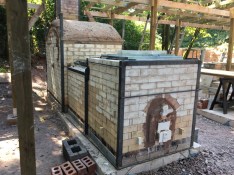
We have been keeping busy rolling out the latest batch of little portable wood fired kilns. Another little wood fire Gem leaves for a new life of fun and fulfilment for another potter. All the remaining kilns are set up with gas burners for dual fuel firing.

IMG_0876 IMG_0843

I spent most of last week making the burners and fitting them to the kiln on removable mountings that slide into place when needed.

These are the last of the first batch and while I wait for collection of these first orders, I start on the 2nd batch. There isn’t enough room in my small kiln building workshop for more than seven kilns at a time and still be able to move around safely and engage in productive work.

IMG_0875 IMG_0877 IMG_0861

I go to the garden after work and pick a load of vegetables for dinner, do a quick bit of weeding and do a little watering, as it is still incredibly dry with no rain storms to speak of for 14 months. The dams remain dry.

I cook a fresh snapper for dinner, steamed on the stove top in a big frypan with a little garlic, lemon juice and white wine.

IMG_0848 (1).jpg


One Minute in My Life

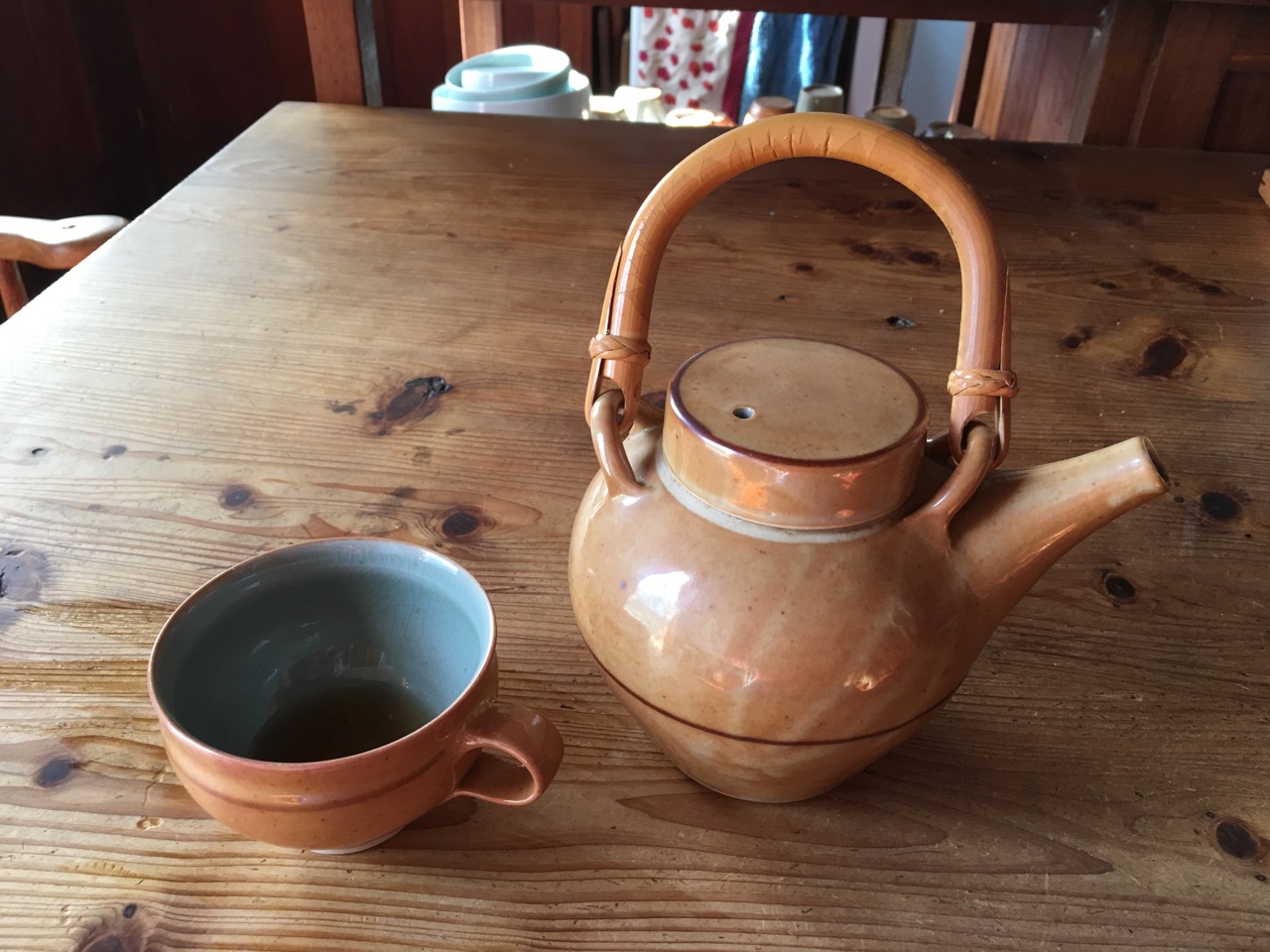
At breakfast I finish my coffee and see the shadow of my fingers through the porcelain bowl that I’m drinking from.

I’m moved to capture the fleeting moment on my phone.

IMG_0823

IMG_0827

I realise that it is a bit of a multicultural moment. I’m drinking Italian style coffee grown in New Guinea in the French style with milk at breakfast from a bowl made by and Englishman living in Australia, thrown and fired while in China. The table is made from Japanese cedar, grown in Australia.

At least the organic full cream milk was produced locally in Picton from our local dairy, but the cows are Friesian and Jersey.


Stihl Crazy After all These Years

As we have been whittling our way through this epic journey of felling, cutting, splitting and stacking all the wood from the 5 huge, dead, eucalyptus trees in and around our 7 acres. We experience a curious sense of exhausted comfort in working our way through the last tree. Tomorrow should see the end of it.

We couldn’t have done this so quickly without the help of friends and students to do some of the carrying and stacking. We worked quite hard today in the light showery sprinkles of rain to get half-way through the last tree. It’s hard to say exactly how much wood we have processed and stacked to season in the last 3 weeks of part-time labour, but I imagine that it must be somewhere approaching 20 tonnes. I’ve gone through almost 8 litres of bar and chain oil and the same of two-stroke mix in maintaining the saws. Chain saws are such a great invention. They make so much work possible. I couldn’t have done all this without them.

IMG_0788

IMG_0792 IMG_0795

IMG_0736

IMG_0794

Of course we were aided at every moment by the chickens. They know the sound of the chain saw and the splitter, and as they are free ranging all day, every day. They know where we are and what we are doing from the sounds that we make. It only takes minutes for them to turn up. Freshly split wood means fresh bugs and termites.

IMG_0796

After all this work, we reward our selves with a high carb, but low GI meal of solid wholemeal pasta topped with a home-made tomato passata sauce and a side dish of lightly steamed broccoli from the garden. All this without the addition of oil, salt or sugar. Not to mention, there are no preservatives, pesticides, or fertilisers used along the way. This is wholesome, fresh, homemade, nutritious food. Simple and plain, but not boring. A green garnish of fresh-picked basil and parsley completes the meal.

IMG_0800 IMG_0802

IMG_0803

Our little small holding here produces fuel for our stove and kilns, but also fuel for our bodies. Real work with a defined and obvious purpose, that leads to a positive and creative outcome along with home-grown and home made whole foods, these are all part of a well-considered complete life. I’m not sure if all this is working, but we are certainly having a good go at it.

Autumn has finally arrived

The weather is finally taking the calendar seriously. We have had our first seriously cold evening of the year. We even lit the fire, and although it was nice, it wasn’t really necessary and we hardly stoked it as we weren’t that cold, but it was a nice thing to do, quite comforting. It seems that summer has lasted 7 months now. I’m sort of pleased that we can now have some cooler weather.

I have been finishing off half a dozen little wood fired kilns, but have been held up waiting for some parts. So in the mean time, we have continued our wood cutting epic effort. We have almost finished cutting up, removing and stacking all the timber from the dead trees that we had taken down by the arborist. It’s been a mammoth job and will provide us with wood fuel for some years to come.

Having burnt off so much energy during the day, we feel that we can afford the calories and have pizza for dinner. I make up some rye flour dough during the afternoon and it is risen and proved by evening. I roll you a couple of thin bases and we use what we have in the fridge as toppings.


I start with a very basic wash of tomato passata sauce and then a sprinkling of finely chopped garlic. We build up the pizza with a few olives, capers and sliced artichoke hearts, topped with some cheese.

10 mins in a very hot oven does the trick.

IMG_0781

We make another one with sour cream, smoked salmon and red onion.

IMG_0783

We have a couple of slices from each one and put the rest in the fridge for lunch tomorrow. Home-made comfort junk-food is very nice once in a while.

Citrus Season Starts

We have the first of the citrus coming on now. Lemons, limes and lemonades. The trees are so loaded that a few of the breaches have snapped under the weight. Janine has made the first batch of lemon and lime marmalade. I use the spent skins of some of the excess to give my copper pans a good clean. After washing up, I give them a quick wipe over with the lemon skin and a dash of salt.

It brings them back to a shiny new look in seconds.

IMG_0770

IMG_0771  IMG_0772

Wood Cutting Working Bee

We have recently had 3 big dead eucalypt trees removed by our local arborist. One was struck by lightning, and the other two were killed by mistletoe. We paid the minimum, to just have them dropped to the ground. We took it on our selves to cut them up and remove all the blocks to storage and seasoning.

IMG_0655

IMG_0674

We spent several days cutting up al the logs into small sizes, such that we could manage to move them. Janine and I spent a week whittling away at the big number one log and   finished the first tree by ourselves, but then had the wonderful assistance of some friends and pottery students for a day.

We have been so lucky to have these people volunteer their help for a day and come along to give us a hand in shifting all the logs that Janine and I had spent the week cutting up. It’s a huge task to lift and load several tonnes of wood and then shift it and stack it for seasoning.

IMG_0738IMG_0739

This is all very vigorous work and we sweat copiously in the heat. The larger, straight pieces were all cut to kiln size ‘hob’ length, while all the scrappy, small or bent pieces were all cut to 200mm. length for splitting for the house kitchen stove. The main central log was over 600mm dia. So it was too big to manage at ‘hob’ length of 700 mm. So I cut it to 200mm. just so that we would be able to manage the lifting and stacking. I rigged up a couple of planks , so that we could roll the bigger lumps up onto the truck to be carted to the wood shed and splitter.

IMG_0744IMG_0750

This should keep us going for a few years in the kitchen stove.

All the smaller dia. logs were cut to ‘kiln hob length’ of 650 to 700mm to suit the fire-box of the kiln, and then stacked for seasoning. A year or two should do it.IMG_0752

There is about 7 or 8 tonnes in this load of 19 stacks about 1200mm high.


Mid Autumn and the Chilis are Ripe

Up until last week we seemed to be in a perpetual summer. The temperatures were holding up in the mid 30’s and everything is so, so, dry. We haven’t had any meaningful rain storms since the March before last, that’s 13 months ago. so now we are using our drinking water from our rain water tanks to water the garden.

This extended ‘Indian summer’ has brought on the chilli crops. We now have many more chilis than we can eat, so we are starting to give them away to neighbours and friends,  and hang them up to dry for use later in the year.

IMG_0722

IMG_0724

One row of plants is quite enough for us. They seem to bear quite heavily, all culminating now in autumn. We’ve been picking them steadily all summer, from when they were quite green and only just big enough. Now they are fully ripe and have developed their full heat. We have grown 3 varieties this year.

IMG_0726IMG_0732

Small smooth round Thai chilli, crinkly hot cayenne, and mildly heated paprika  capsicums.

The First of This Years Little Wood Fired Kilns Goes Out the door

I have been busy working away at the first batch of little portable wood fired kiln for this year. I had too many to fit in the workshop in one go, so divided them into 2 batches. The first batch of 6 is almost finished. I had to finish one in a hurry to catch the boat to Tasmania last week.

IMG_0668 IMG_0671

The rest of the little ‘Daleks’ are calling out “incinerate, incinerate!” But they are toothless, as I haven’t welded the stainless steel fire-box grates or made the burners as yet, so we are all still safe. They still need another weeks work on them to fit out all the additional features, but he main body of each of them is complete.

IMG_0721If you are one of the dozen people who contacted me and asked to be on my build list for this year. This is where I am up to. I will be contacting the first 6 customers who have paid their deposits in the next week or so.