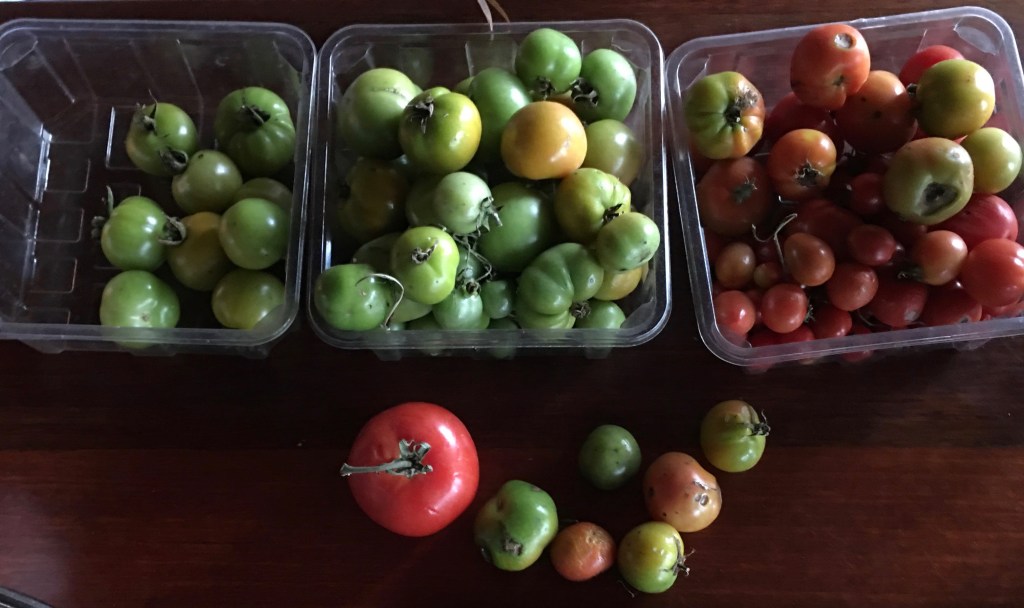
The seasons seem to have changed quite a bit over the 44 years since we moved here. In the Southern Highlands we used to have 4 distinct seasons in the seventies. A proper winter of frosts with occasional snow, a hot summer and very pleasant spring and autumn. I understand that aboriginal society measured 6 seasons each year, while one gardening expert on the ABC Radio National was saying that he felt that there were 5 seasons. Whatever!Over our time here everything has changed, these days we seem to be having 9 months of summer and hardly any winter to speak of at all. We rarely have that many frosts now, just a few light ones and not that many overall.This winter we are having tomatoes still growing all through these mild, supposedly coldest months. Here they are still flowering in July. Alongside the cauliflowers.
It’s so strange to have both tomatoes, broccoli and cauliflowers in the same basket at harvest in the evening before we retreat inside to cook dinner.
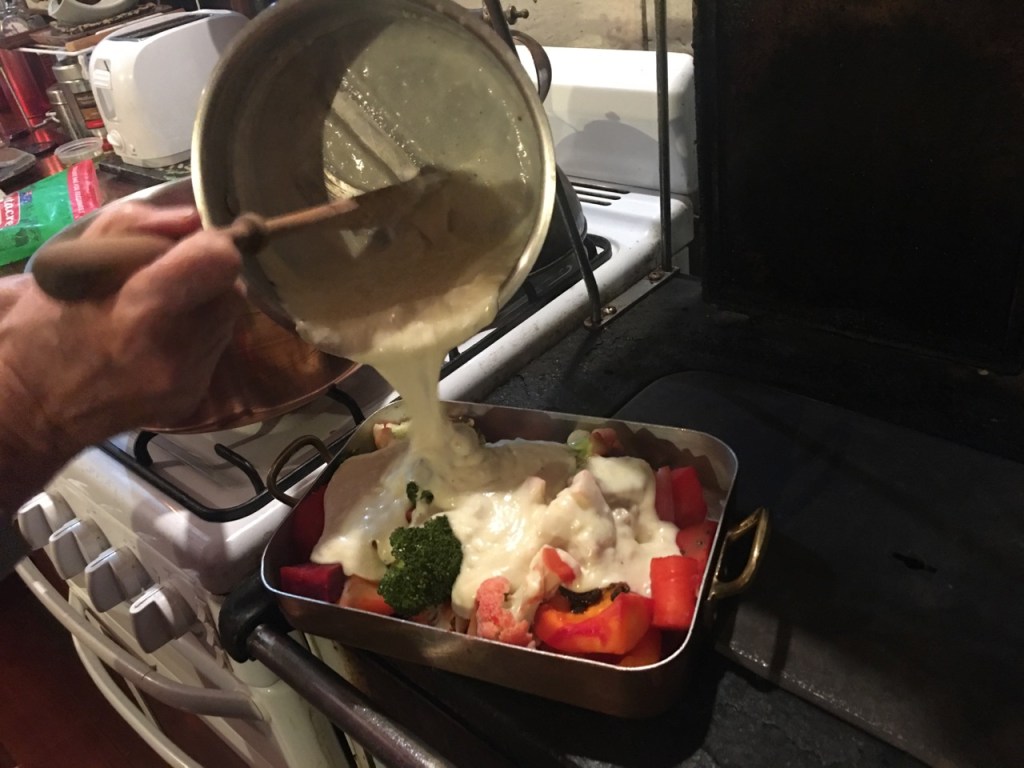
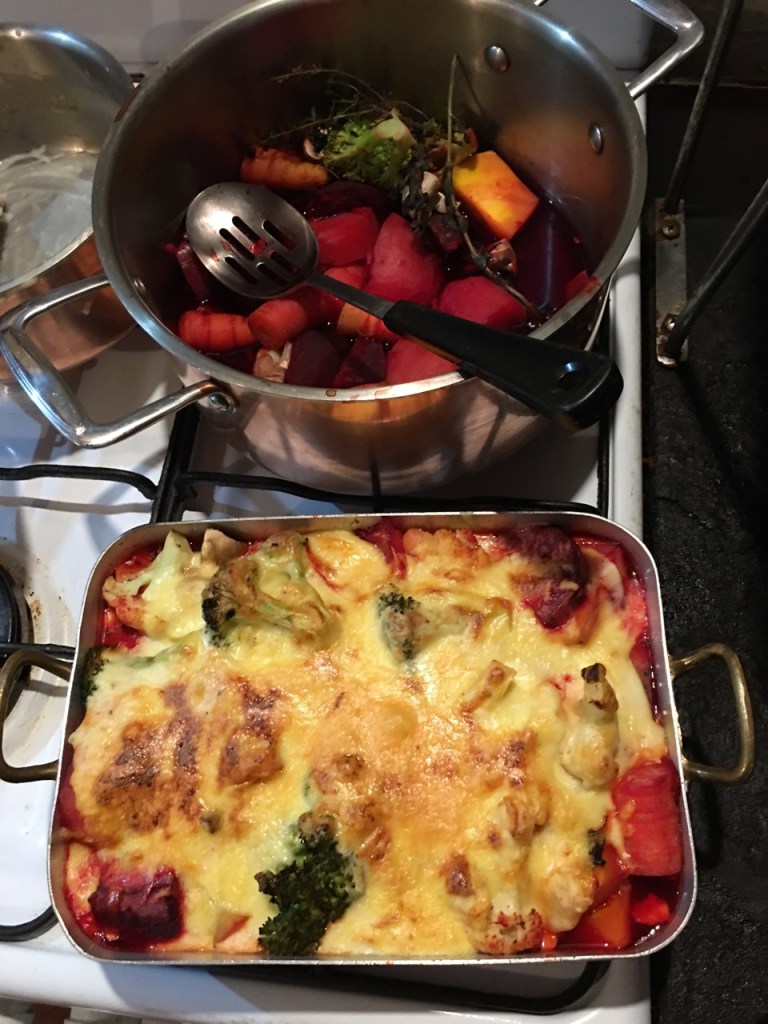
There aren’t that many traditional recipes that call for this unseasonal combination. Cauliflower au gratin is a seasonal favourite, as is baked vegetables in a béchamel sauce.
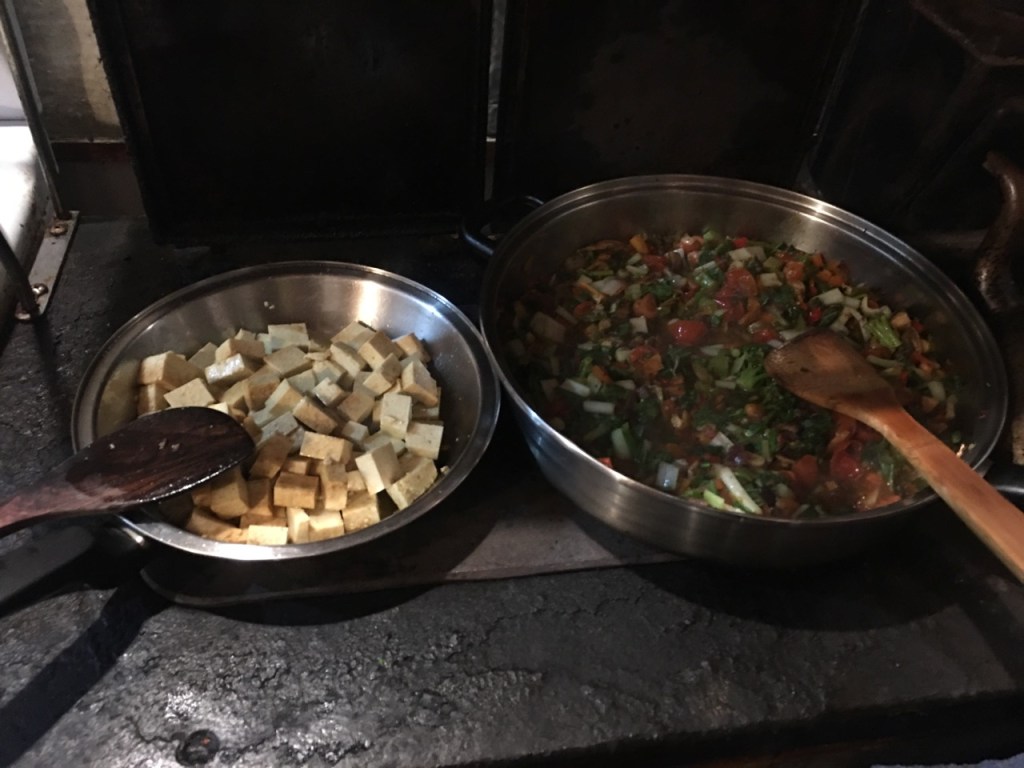
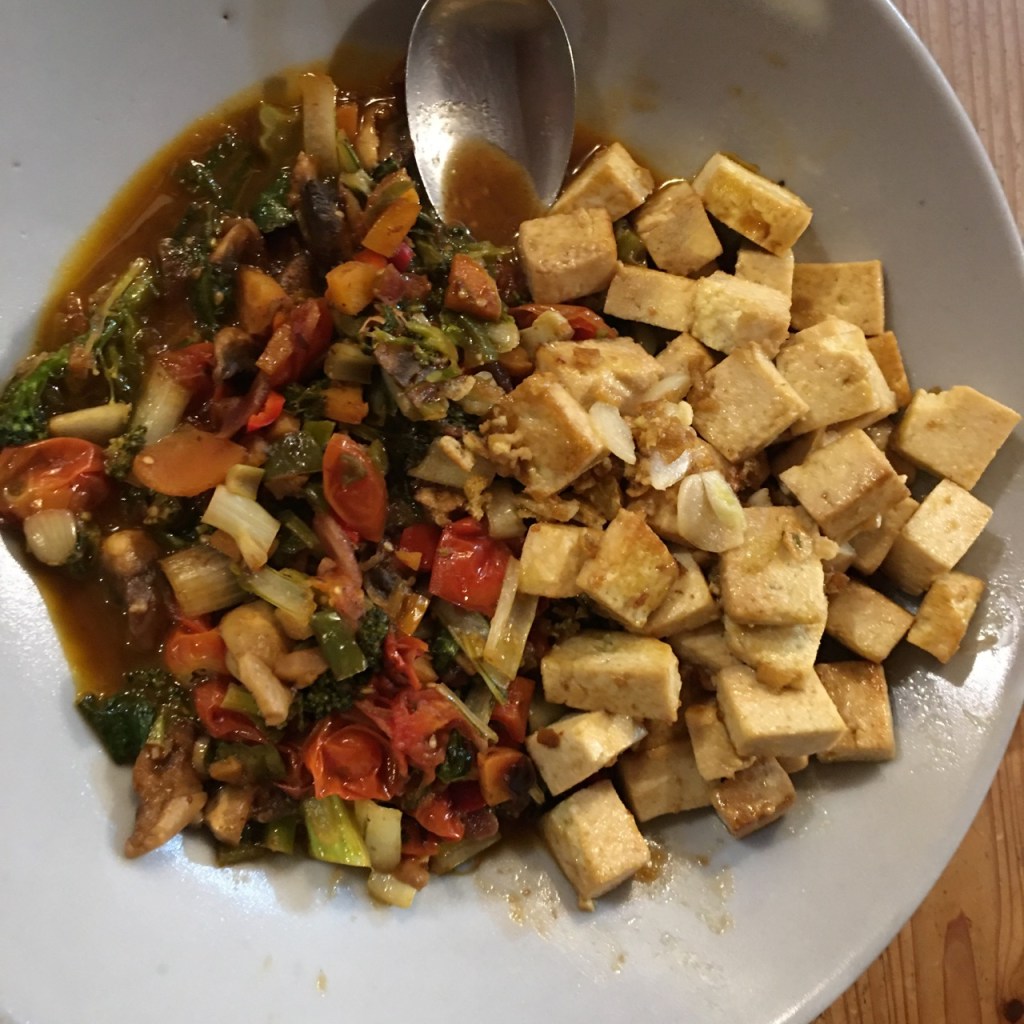
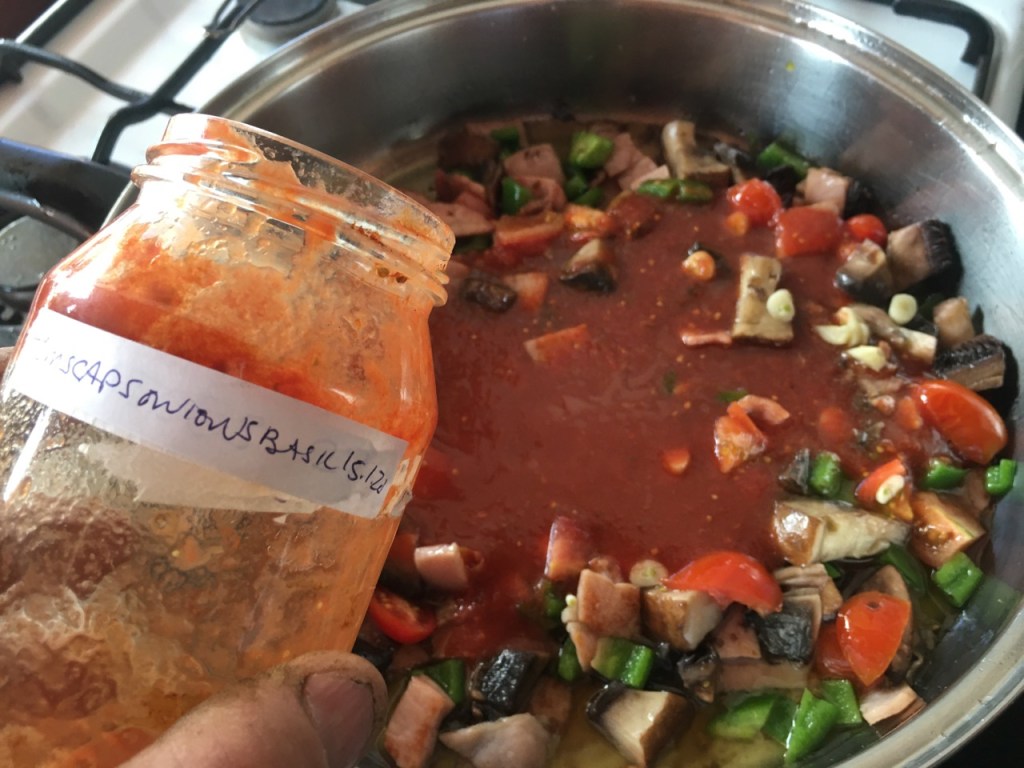
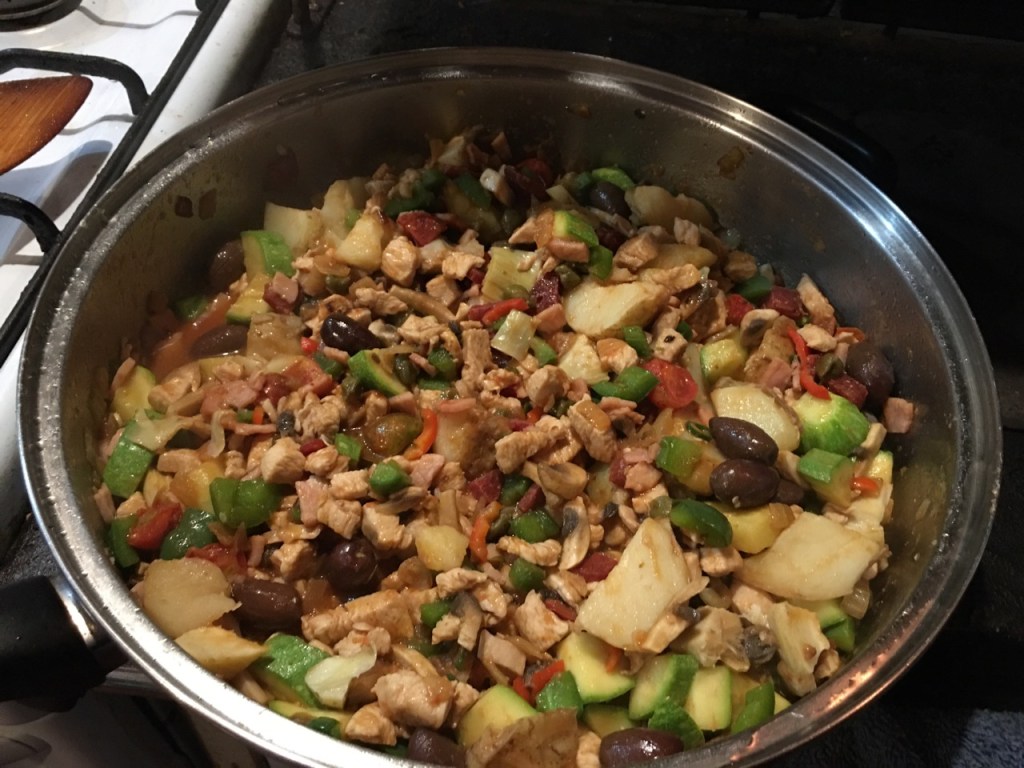
The tomatoes get used in veggie stir fry, mostly vegetarian, sometimes with tofu, occasionally with a small amount of meat. other-times with some chicken and purple Congo potatoes. These are the last of our home grown potatoes. No more now until the new crop. We always cook with loads of our homegrown garlic. Then for a change, with homemade tomato ‘sugo’. This is of course completely out of season, that is why we make it each summer when the huge tomato glut is on . Preserving tomatoes as sugo or passata, gives extra life and ‘zing’ to almost any winter meal. There aren’t sufficient tomatoes in these cold months to make sauce, just enough to add interest in salads and stir frys.
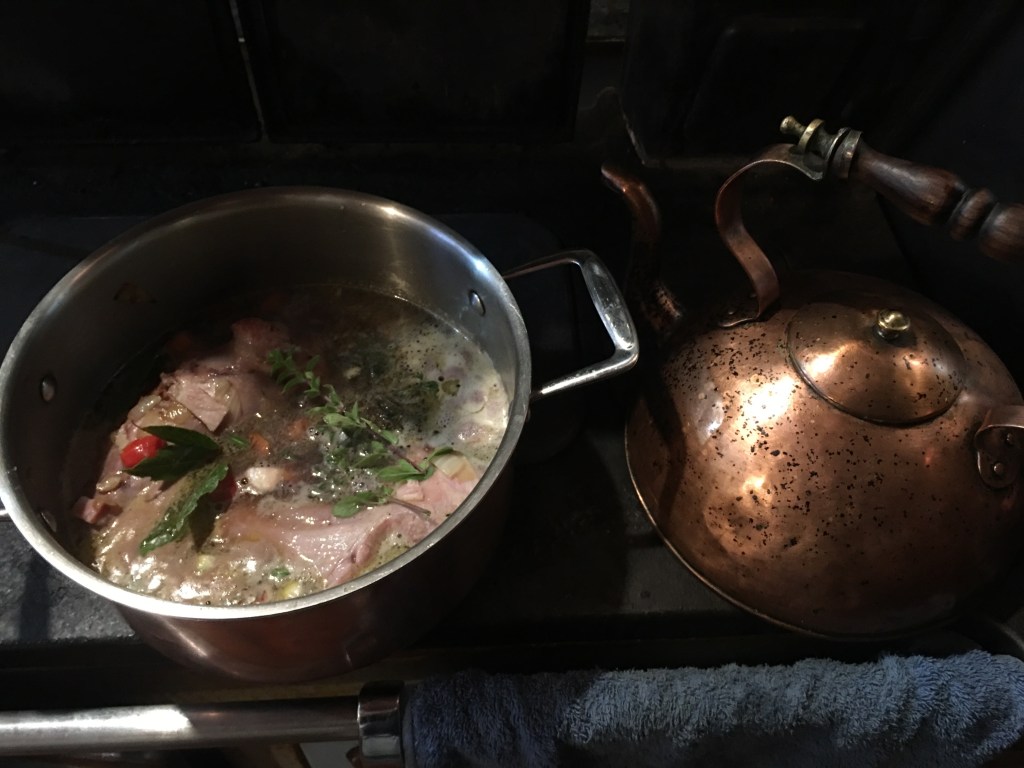
Lamb shanks are always a nice comforting meal on a cold winters night.
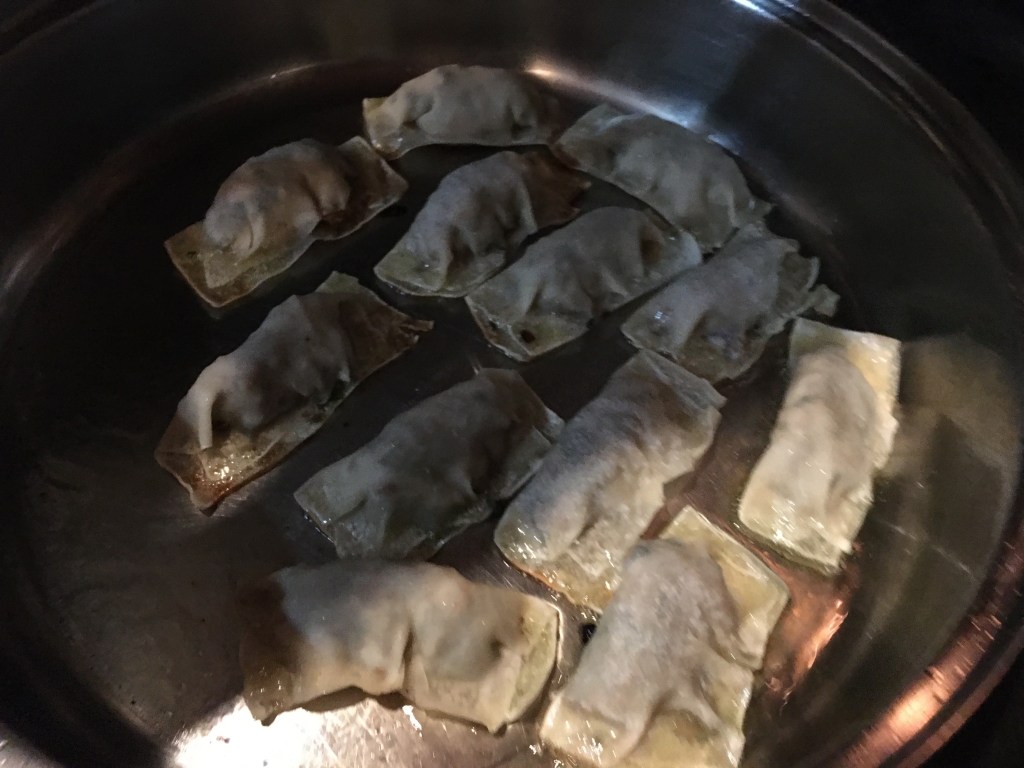
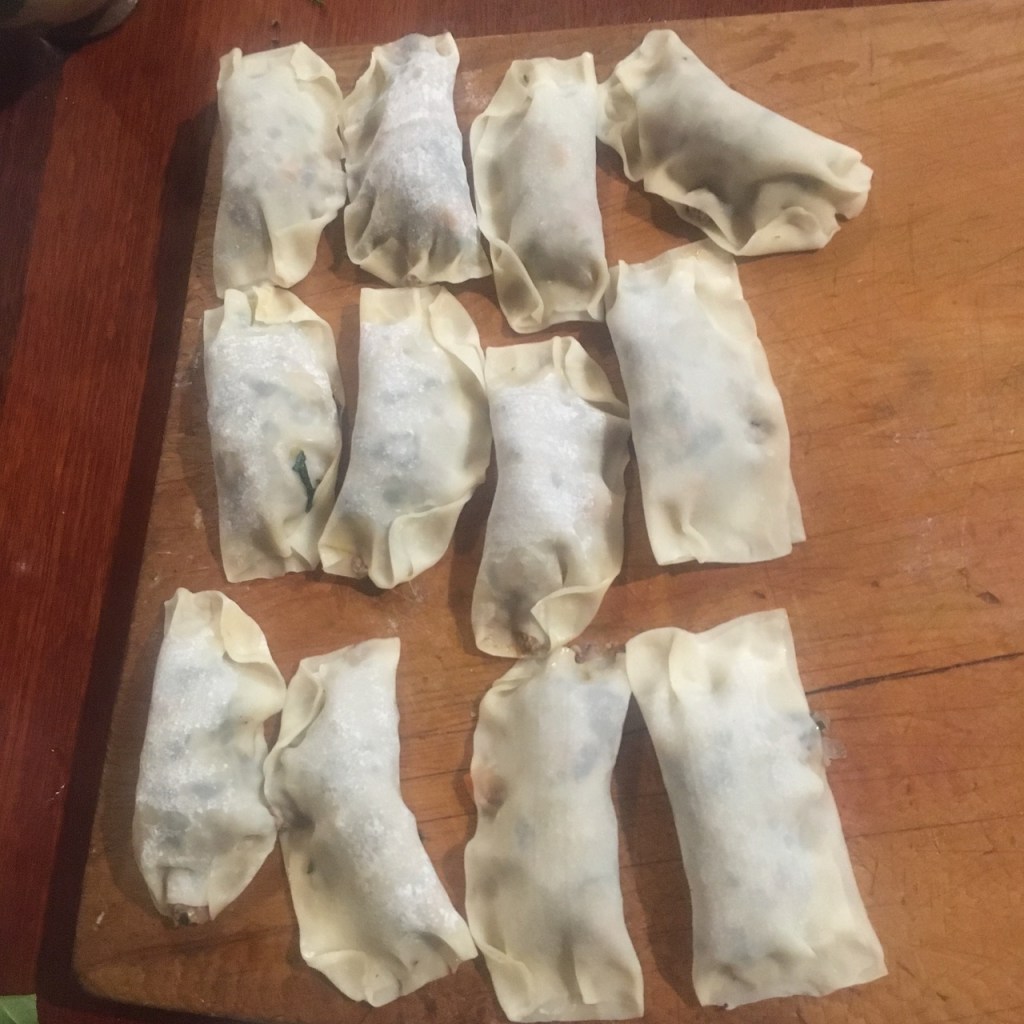
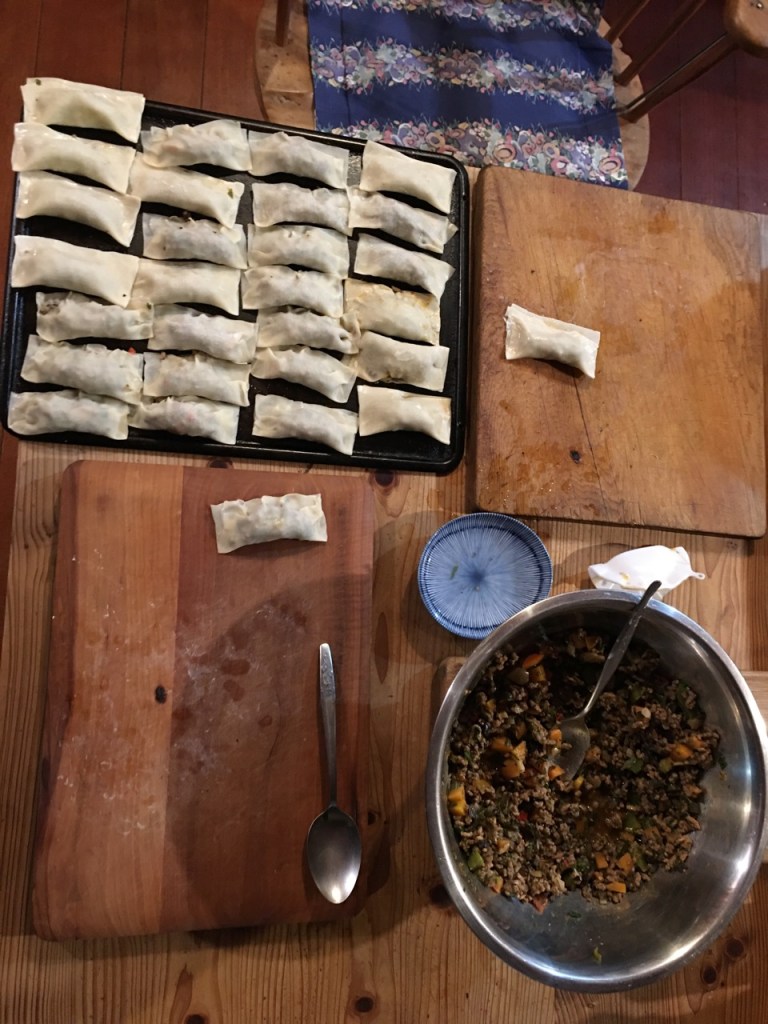
Every now and then, I put a bit of effort in and make homemade ‘Gyoza’ or dumplings and sometimes sage leaves fried in butter and then finished in a creamy pasta sauce, just for a change.
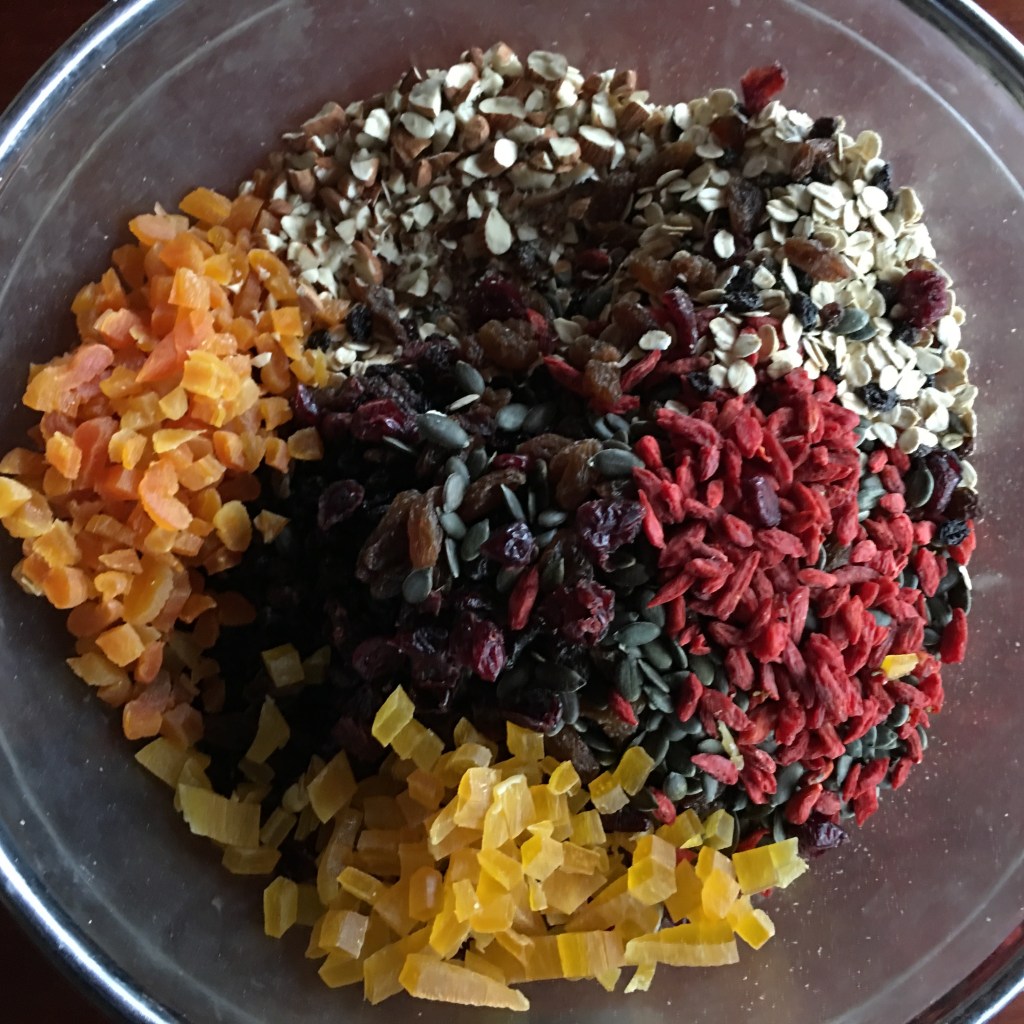
Breakfast is usually porridge and or homemade muesli.
I vaguely remember reading Michael Pollan a decade ago writing about a healthy diet and he wrote something along these lines;Eat vegetables, mostly grains, only use meat occasionally as a flavouring. Don’t eat anything that has more than 5 syllables in its name, and nothing that your grandmother wouldn’t recognise. Never eat anything that doesn’t rot!
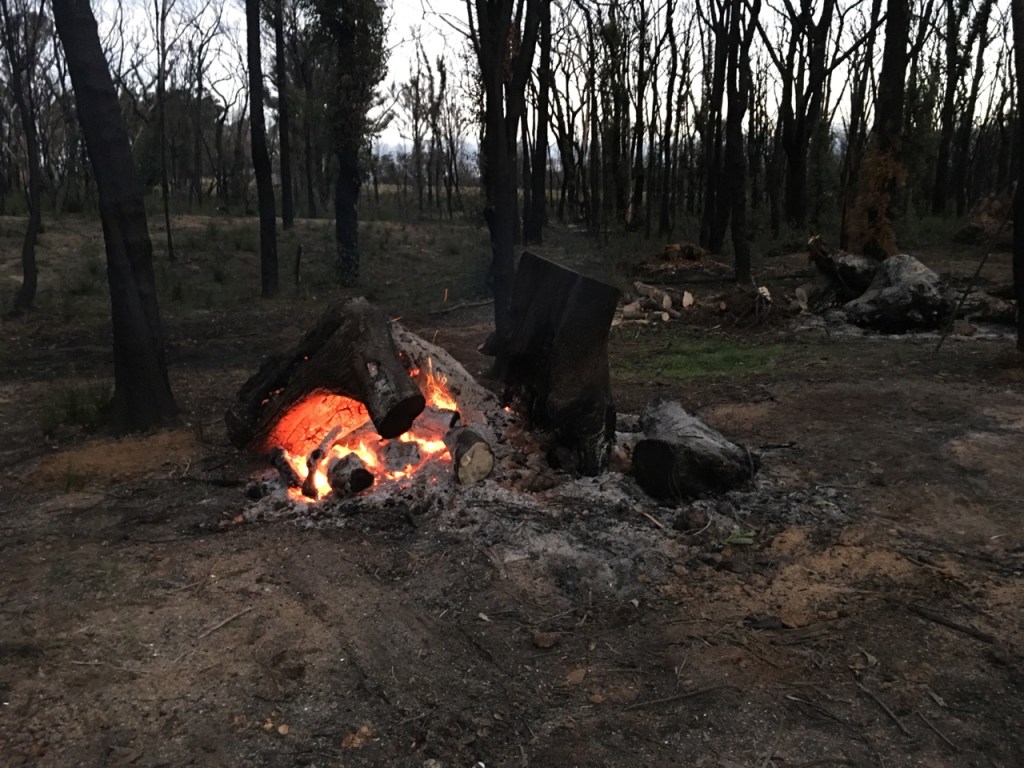
When we started this huge enterprise of the clean-up. We didn’t wait for the NSW Government to organise something for us. We got stuck in ourselves on day one. We had a lot of help and support from our friends. That really helped me get over the initial shock and depression. It’s still there and I’m still working on it, my next appointment with the shrink is on the 4th. She tells me that my anxiety and lack of sleep is probably related to PTSD. Part of the on-going clean up is dealing with the 16 tip truck loads of burnt bush and stumps. We had 16 big piles dumped on the southern side of the house site. We have been burning one pile a week since the beginning of winter, when the fire bans were lifted. We have cleared all the dead trees from around the house area, and a little further afield to where we store our fire wood. It’s important to prune and clear all these dead trees where we work, as they are constantly dropping bits of dead branches, not just in windy weather, but particularly on still days when we are out there working. They can crash down without warning. I don’t want to be hit by any falling limbs while I’m working. We cut up the logs into usable lengths that we will use to fire the kiln for the next few years.
All the smaller, twisted, dead and burnt detritus from the fire had to be burnt in discrete piles to be safe. We have been working on it intermittently for months now. Last week, we burnt the last pile. It consisted of mostly small stumps that hadn’t burnt fully in previous burn piles. These root balls don’t burn well because of all the soil and clay embedded in with the roots. The free burning wood all burns away leaving these lumps dispersed around the pile. Once isolated from the glowing embers, they go out and just sit there.
I spent last week pushing them around with the little tractor, collecting them all together. Janine and I would then spend the best part of the day setting into them with mattock and pick, to loosen the soil and rocks from around the roots. We can’t do this all day, it’s too heavy, so we do a bit at a time and them go back to raking up or chainsawing other wood. Then after a rest, we go back to the pick and mattock. Once the root balls are reduced in size and the weight is brought below 200 kgs, I can pick them up with the tractor bucket and drop them. This loosens more soil and so on. Once they are substantially relieved of their soil, I can place them on the smouldering ember pile and start off another day of burning stumps. The last fire went for 5 days in this way. working on collecting all the remnant root balls and removing soil, then piling them up for the next days burn. It’s mind numbingly dull work, but somehow pleasing to see the site finally get cleared up and the stumps gone.
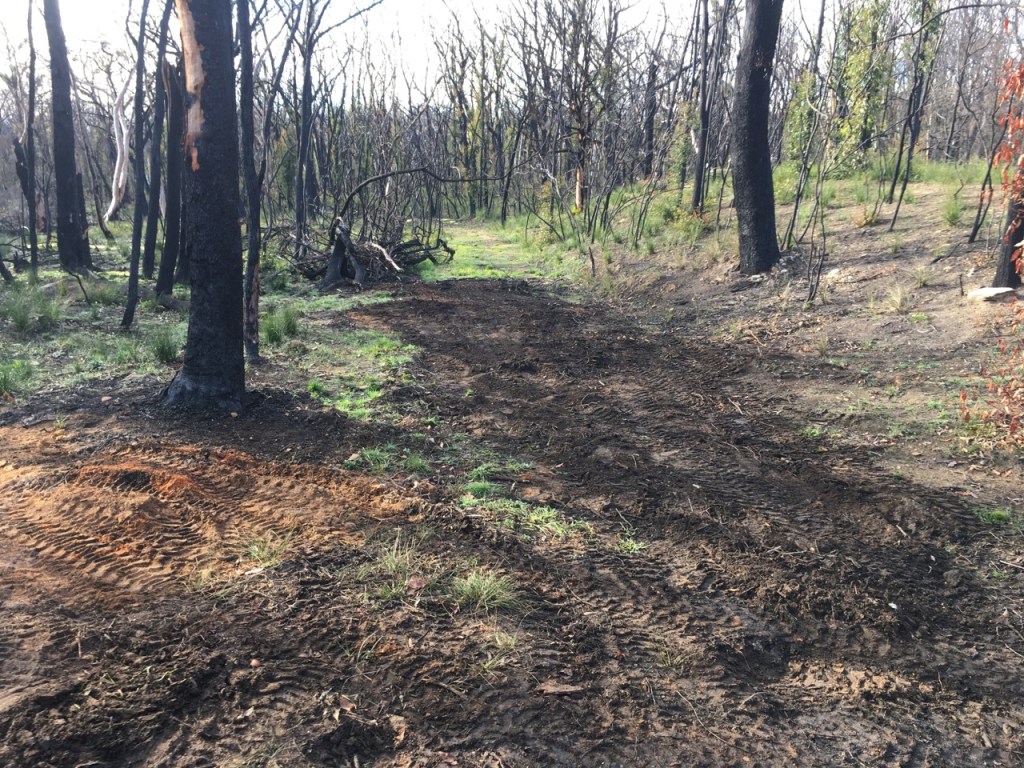
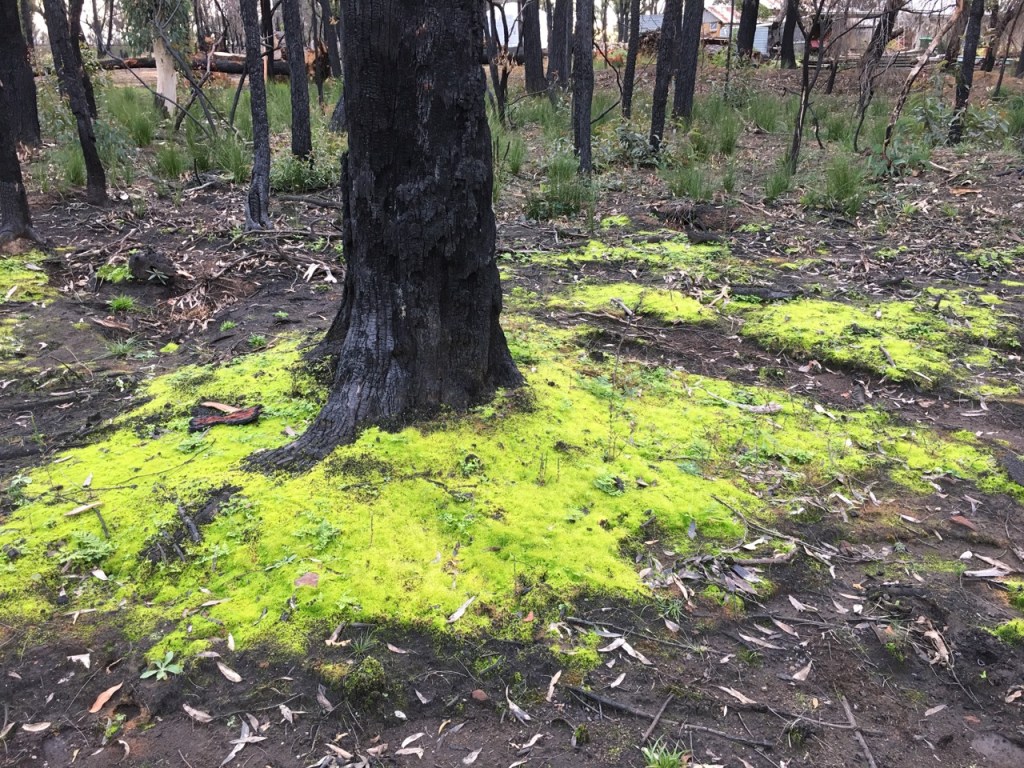
After that effort there were still a number of very large logs and stumps that were beyond me and the efforts that I could muster using my toy tractor/mower. So when Ross came last week with his excavator, we got him to pile all the remaining extra large bits into a big pile and this should be our last big burn. We really need to get this done before the return of the fire bans at the beginning of spring in just a few weeks. I don’t want to have look at this depressing mess for another year. I’m hoping that we will get a bit of rain in spring, and with the warmth we might see a bit of greenery come back. All we have that is green is a few patches of moss or fungus that I have never seen before, presumably enriched by all the ash and nutrient from the fires.
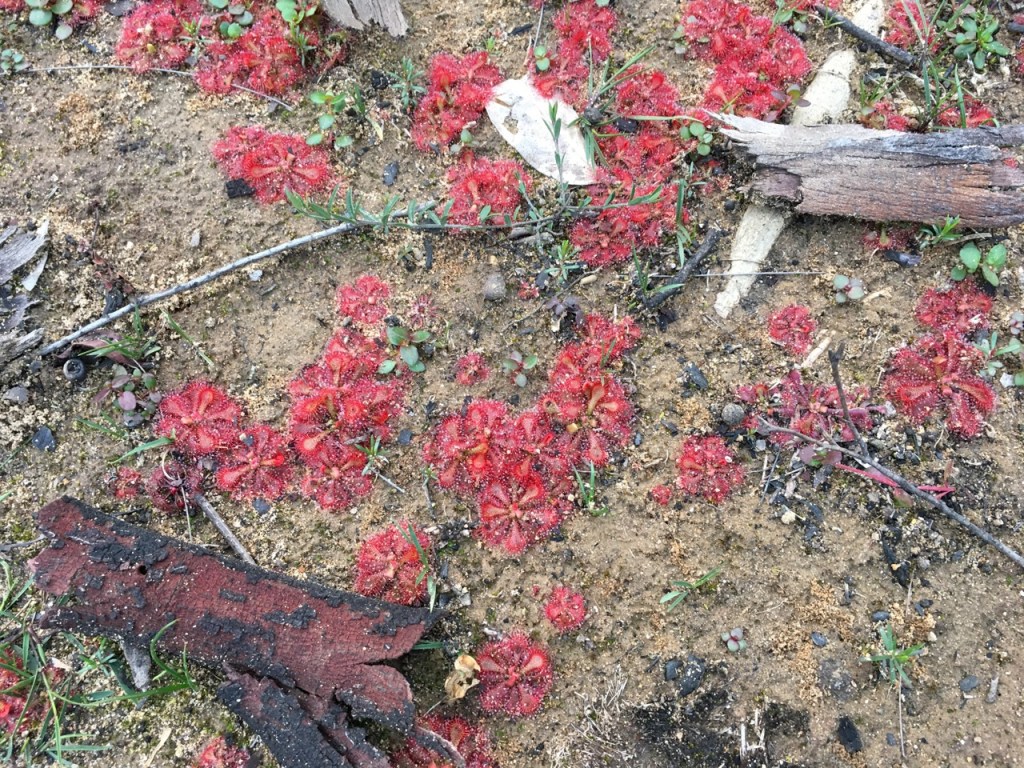
The drosera is also coming back very well. I’m told that they can live for up to 50 years. They are a carnivorous plant that traps tiny insects on the sticky hairs on their surface.
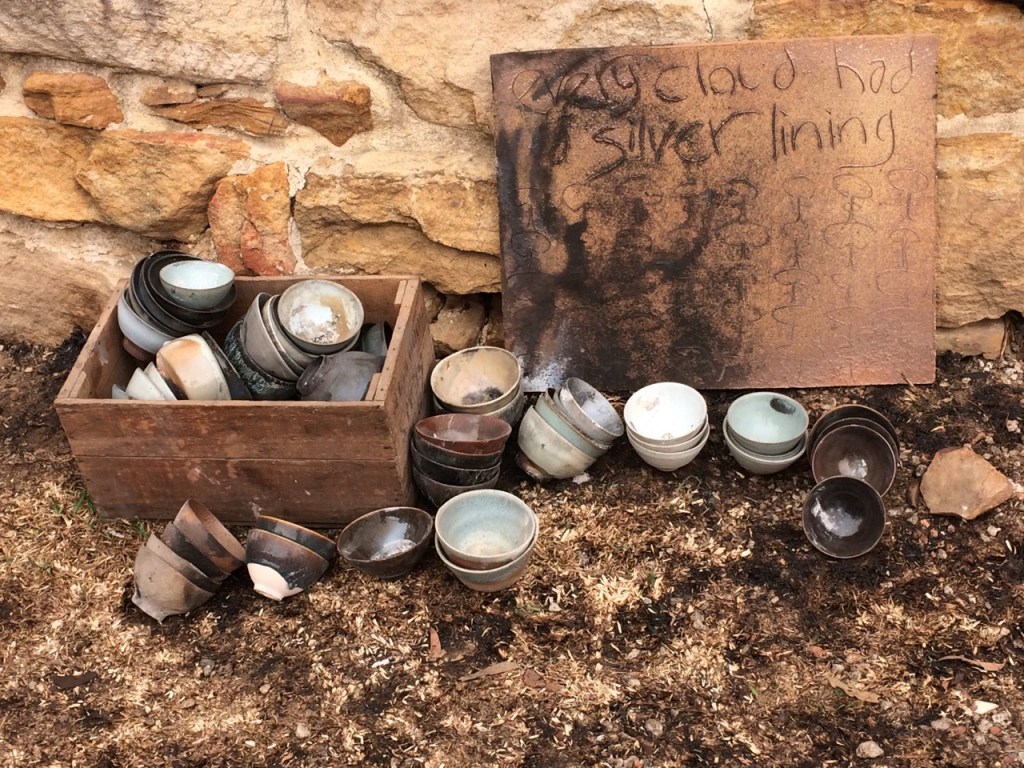
It’s started raining, so will be working inside today. I have to put stickers with my initials, number and price on each of the pots for my virtual show at Kerrie Lowe Gallery starting next week.
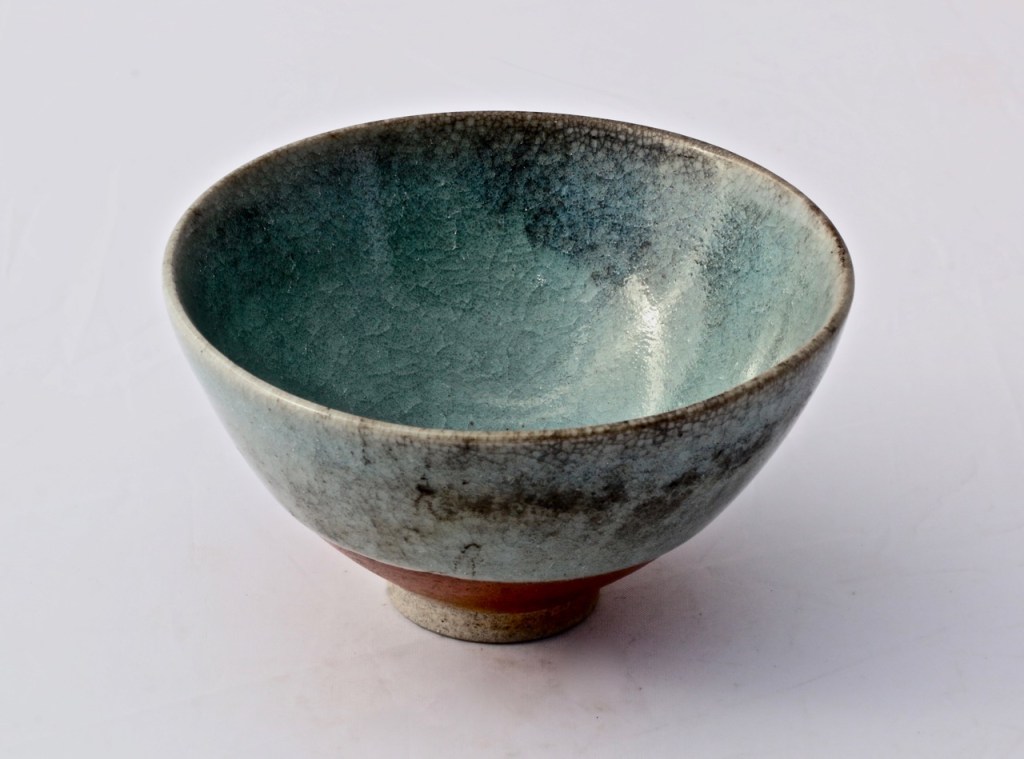
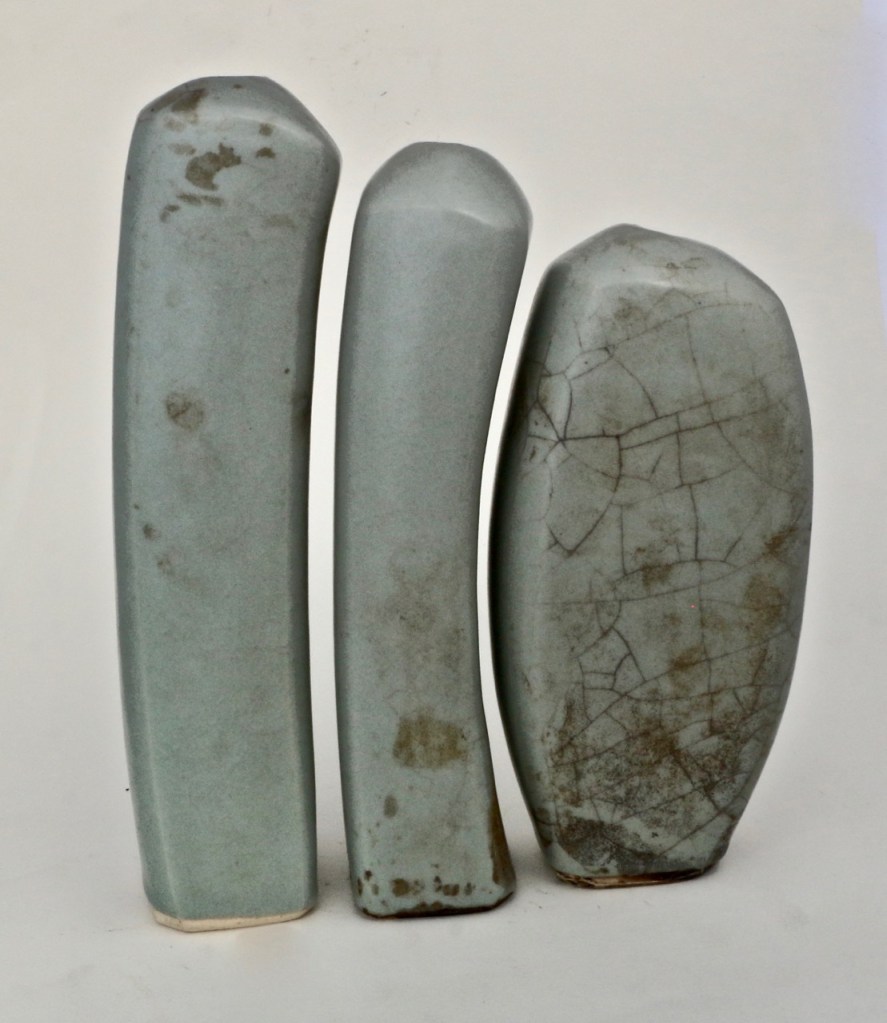
Blue icy crackle glaze with post firing carbon inclusion and sooty patina.
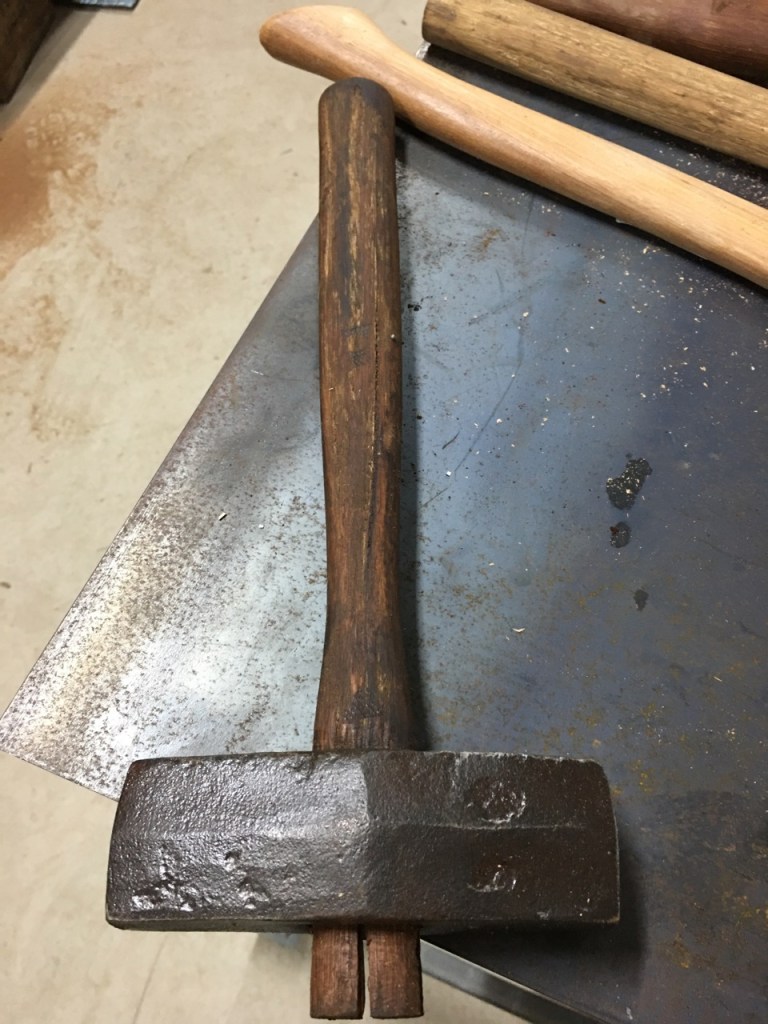
A few weeks ago I was stealing time from the clean-up to put new wooden shafts in a few of my burnt and roasted heavy tools. Like masons lump hammer, pick and sledge.
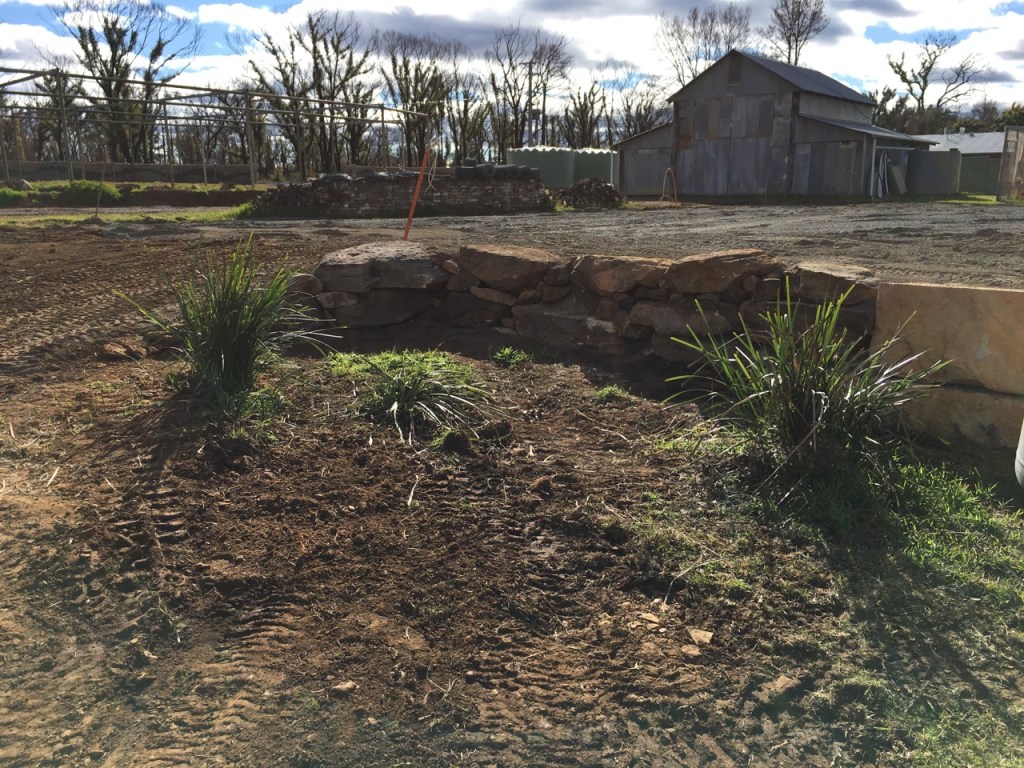
This week we had the chance to get the excavator here for another day. Every plant operator in the district around here is fully employed in the clean-up. Our Good friend Ross rang and said he was fully booked, BUT, had a chance to get here for a day between other jobs, to help us finish the stone wall around the proposed new pottery site. We were thrilled. Spare earth moving equipment at any time around here is rare, and then to get access to it at a reasonable price is exceptional.
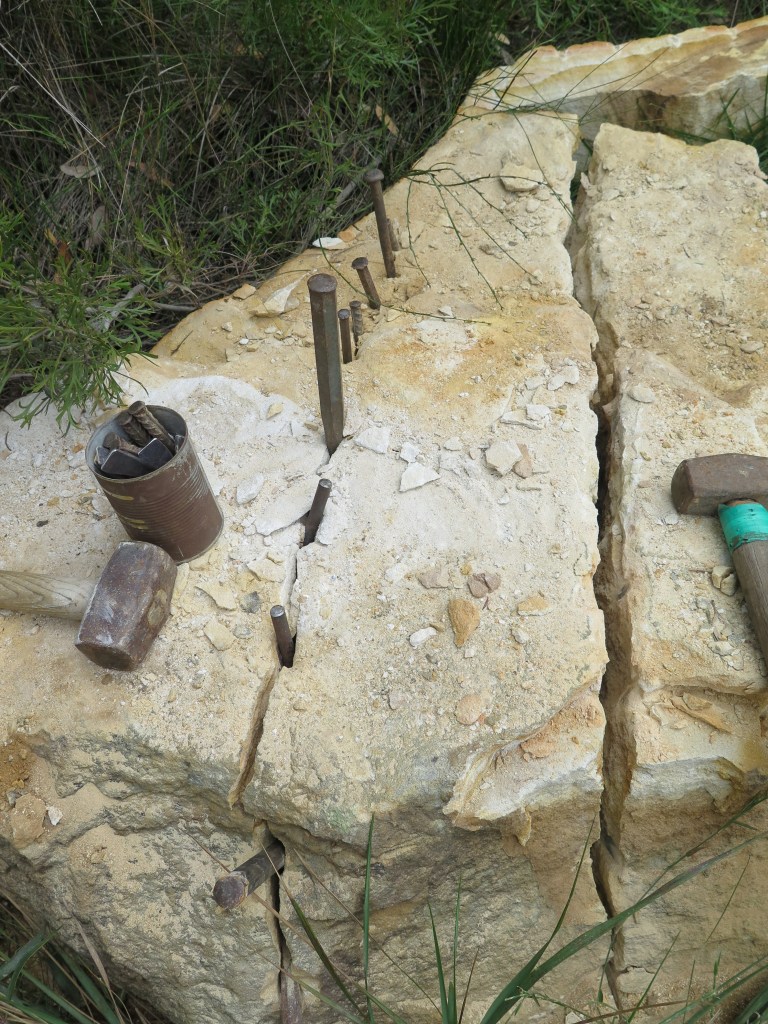
I am very keen to live a self-reliant life. I pride myself on having done almost all the trades around here over time. I only employ trades when it is required by law, – like electricians for instance. But, there are some jobs that are just too big for me to handle alone with my crow bar, chain blocks, tripod, little ute crane and toy tractor. Moving 1 tonne stones is one of them. My only way to handle these big sand stone floaters that I dug out of the vegetable garden area 20 years ago, was to get out the stone masonry tools and using a lot of small ‘gads’, to split the bigger stones into smaller pieces, so that I could lift them with my little tractor.
This has worked well in the past, when I wasn’t so pressed for time, but now that I’m flat out busy with the clean-up and re-construction. I just couldn’t find the time to cut and split all these stones. Hence, I was very pleased to see my good friend Ross turn up with his small excavator, to pick up the stones as they were and move them to the last little bit of the retaining wall that needed finishing.
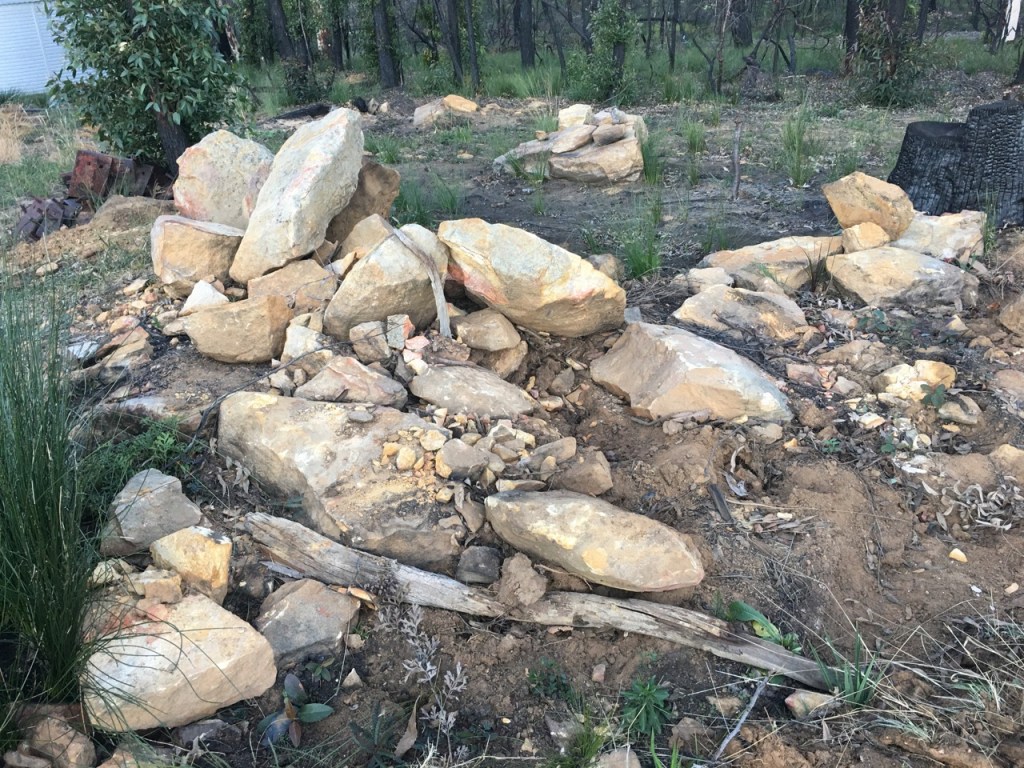
The ‘natural’ shaped stones look a bit rough juxtaposed with the large cut blocks, but they are 100% local off our site here. I dug them out of the ground 20 years ago, when I cleared the land for the new vegetable garden. Working together, Ross and I managed to get both sides of the retaining wall done in one day.
We managed to move and place about 20 large sandstone floaters into position and back fill the site with soil and batter the edges into ramps, that will allow easy access by our zimmer frames and/or wheel chairs into the future.
This ground work is now complete and ready for the foundations of the new pottery. We finally got our building approval certificate from the local council on the first of this month and paid the deposit on the 5 different kit-form, metal framed, farm sheds.
Kit-form, metal framed, farm sheds are not my favourite buildings. I fact they are really pretty ugly in my opinion, dull, flat and boring. But they are cheap! At my age now. I can’t consider building from scratch on my own as an owner-builder, like we did in the early 80’s when we built the last pottery. So, I have decided to buy 5 different shapes, sizes and heights of farm sheds, then bolt them all together, like ‘Lego’, or more precisely, like ‘Mechano’! Such that we will end up with an unusual building with a bit of character. The plan is to have 3 of them in a row, all the same width, but with different heights, then to add two more at right angles, to make a ‘U’ shape and create a central courtyard. The last two will be different widths and heights to the others. One lower and the other higher. This will create a more organic and interesting shape or cluster. Rather than the usual long flat factory unit look that most of these metal sheds end up looking like, dull, boring and predictable. We anticipate getting started on the building in a few weeks time, as we are now in a queue, waiting for our kits to be manufactured at the factory.
I am well underway with the orchard’s bird proof netting frame.
When it is finished, it will cover 600 Sq, Metres of orchard, sufficient area to plant 30 fruit trees. This will give each fruit tree 20 sq. metres. This is more personal space than I am entitled to in a restaurant or shopping mall under the new Covid19 restrictions!
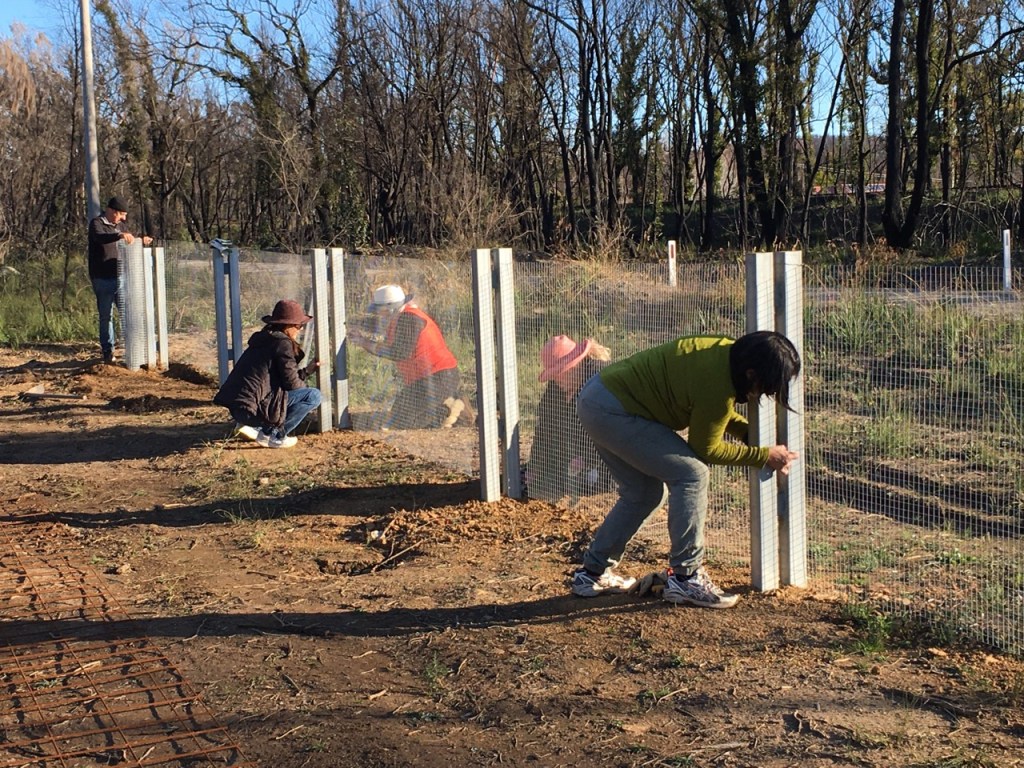
The other thing that we have been doing this last few weeks is working on the front fence, whenever we have a spare day. This project is now almost 3/4 done. A few weeks ago, before the recent increased restrictions, we had a group of potters here to help on the weekend. We managed to finish adding all the galvanised mesh to the metal framework on the last southern end of our new ceramic, fire resistant fence. Janine and I have been putting in the odd day here and there as time allows. It’s a good job to have sitting in the back ground, as I can pick it up where I left off at any time. However, I’ll be pleased when it is complete.
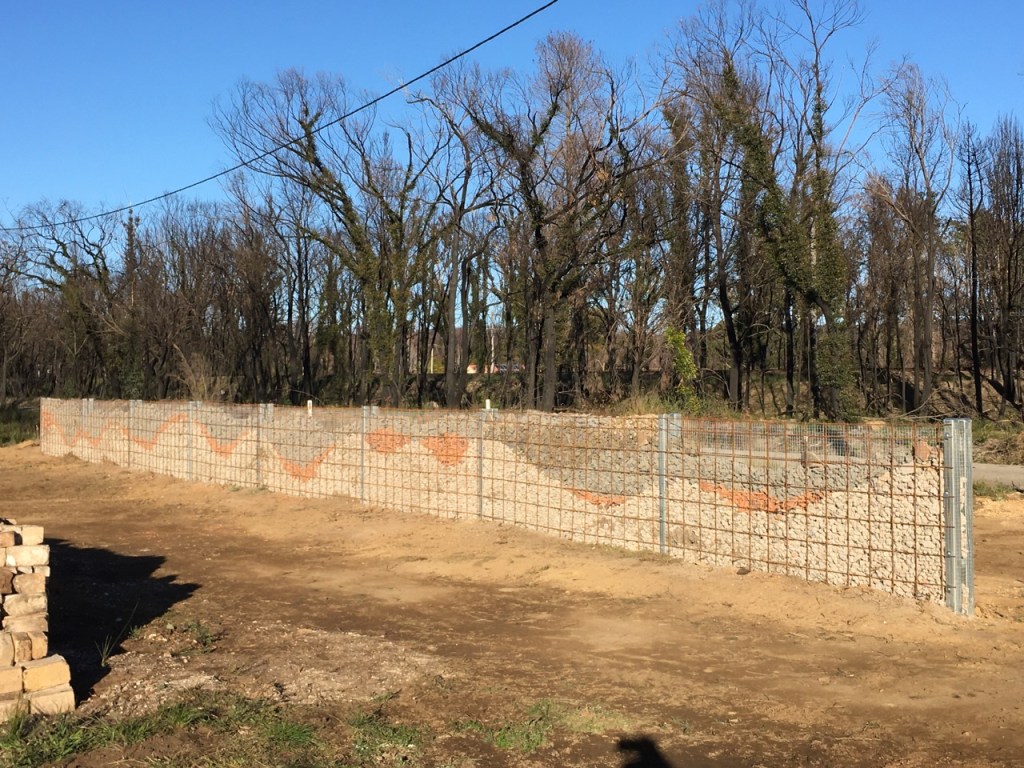
I seem to have ended up working on 4 jobs at once. This allows me to be always fully busy in making or fixing something all the time, even while I wait for parts to be delivered, or other stuff to turn up. Such is my life in these complex times. At least working hard like this alone keeps me self isolating safely. I’m constantly searching for cheap or frugal solutions to complex problems. For instance, Janine and I spent an hour, smashing up old bits of terra cotta with mallets, to make orange coloured gravel to add a detail to our ceramic wall. It was a dirty, dusty job, and our wrists ached afterwards, but it was worth the effort.
Another job I have been tackling over for the last month is the cleaning, sorting and selecting all the burnt pots that we were able to salvage from the ruins of our pottery and barn.
Almost every porcelain pot shattered, not too surprisingly! I only have one piece that has survived. It now lives in the kitchen.
The pots that did survive were all rougher stoneware bodies. Not too surprising there either.
I have spent the last few days documenting, cataloguing and labelling the best of them for my exhibition at Kerrie Lowe Gallery, opening online on the 31st July. All the pots will be physically present in the Gallery, but it will be a virtual show only, with no opening, due to the Covid19 restrictions.
If you are going into Sydney to buy ceramic supplies from Kerrie, you can see the pots in person, but you must follow Kerrie’s instructions about social distancing and numbers of customers allowed in the gallery at any one time. Check opening hours before turning up.
This is a lovely triptych that survived the inferno. It has a very satiny smooth guan-like glaze enhanced with a smokey patina and sooty crackle.
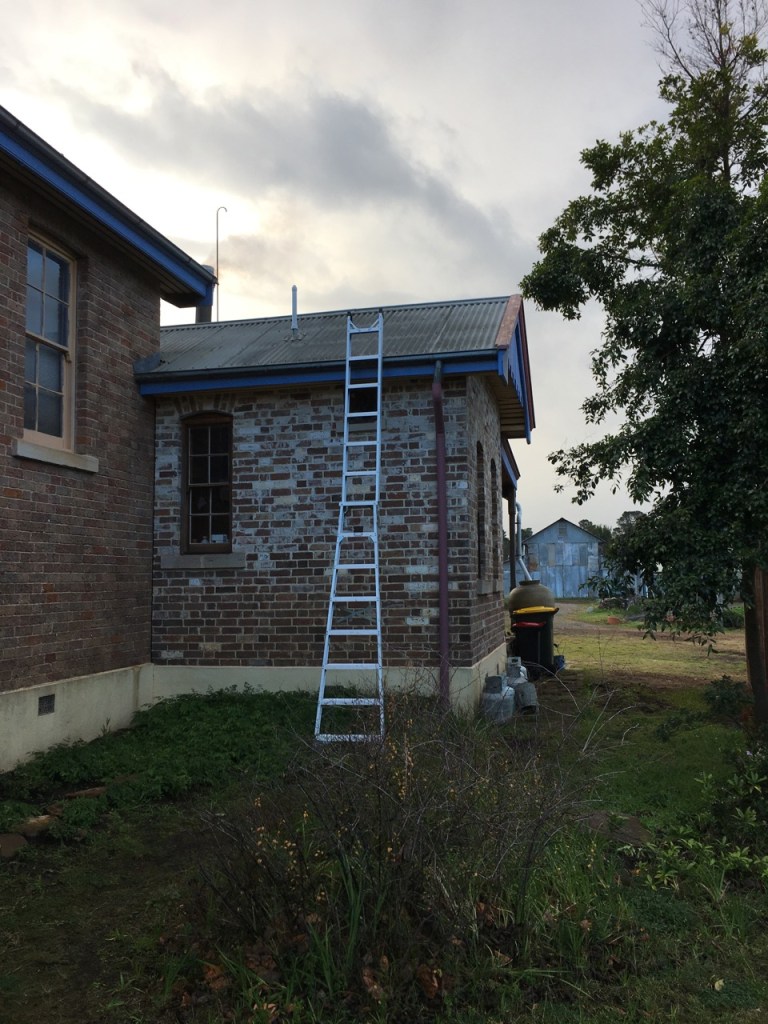
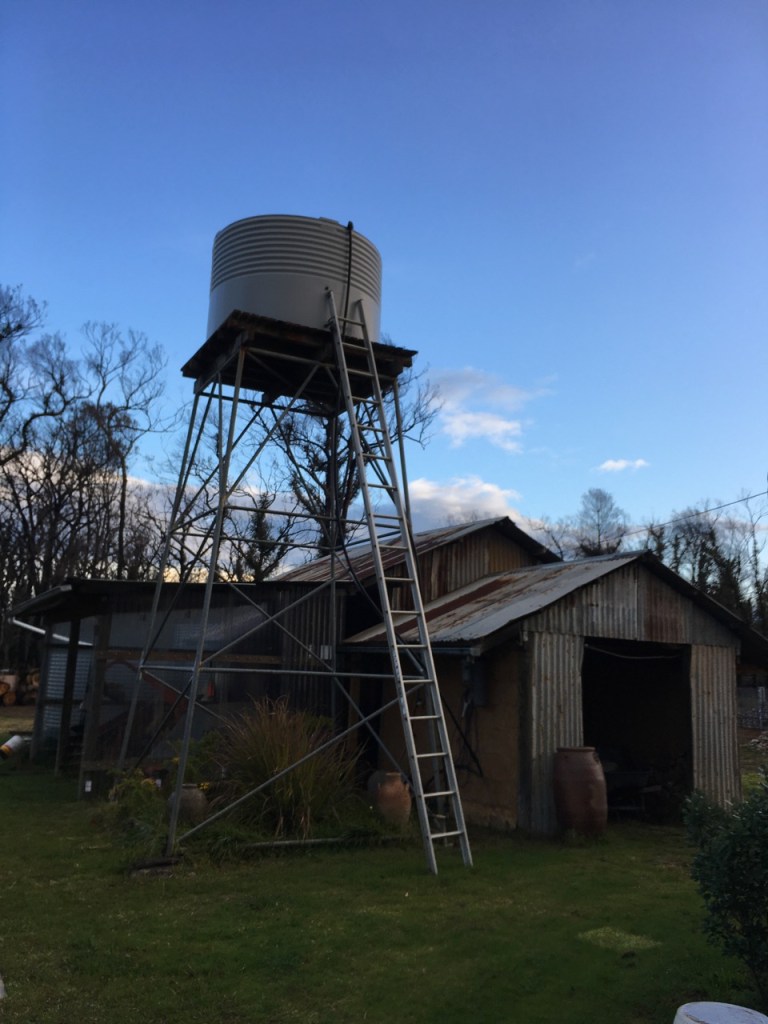
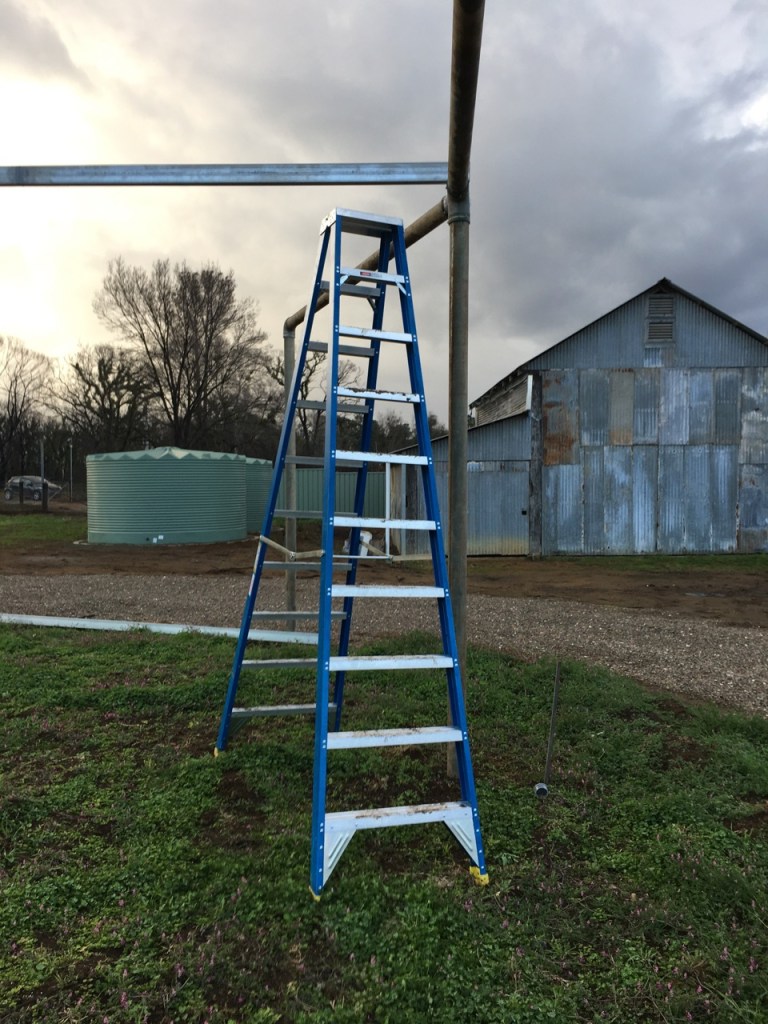
Someone recently told us that we shouldn’t be climbing up ladders after we turned 60!!!!!That was 8 years ago. I re-roofed the old pottery and re-guttered the barn, both shortly before they burnt in December.The barn is now re-roofed and re-guttered. I’ve spent a lot of time up ladders since then, cleaning gutters and doing all the various maintenance jobs.I own a lot of ladders. Different lengths and formats for different jobs, ranging from one to six metres long. I’m up and down all day. Good thing that I was only just told that I should have stopped all this almost a decade ago.
Recently I have been building a metal frame to hold up the 2nd hand and recycled, plastic, bird-proof netting, that was donated to us for the new orchard cover. This involved burying 100mm dia. metal posts in the ground to 600 mm deep and then installing cross-members between them, also 100mm. dia. I bought a truck load of 40 second hand metal pipes, 5.5m long that were recovered from the HMAS Melbourne before it was scrapped. They had been used as irrigation pipes before I got them. I only needed to cut off the thick reinforcing rings off the end of each pipe to get the joints to fit on the pipes.
Warren suggested that we should get orchard framing made into an olympic demonstration sport! I could see that these old pipes would work OK for my purposes, as they came with an assortment of 90 degree elbows and some ‘Tee’ section joints.The last part was to lift up 8m long galvanised steel beams, 100mm x 50mm. These were quite heavy and unwieldy. Because I’m cautious. I went out of my way to buy yet another ladder, this time a 3mm tall step ladder, so that I wouldn’t have to stand on the last top step of my biggest 2.4m. step ladder, to get those heavy beams up on top of the 3.5m. high pipework frame.
I thought that I was doing quite well for an old guy. This higher ladder gave me a much better and safer working position while I screwed all the beams down to the frame securely.Of course I didn’t attempt do this on my own. I had my best friend Warren here to help me.We got all the beams up in one day! I’m very leased with my new tall ladder. So much safer than standing on the top step of the shorter one.
Yesterday, while moving a little short step ladder in my workshop. I bumped a gas bottle and knocked a steel beam off a tall shelf.It came down on my head, splitting it open with lots of bright red sauce. I saw stars, but remained conscious on the floor. I managed to get myself to the house and Janine drove me to Emergency where I got 10 stitches in my head.Ladders are so dangerous! Especially those little short plastic ones.
Now that things have settle down a little. We have lodged our pottery rebuilding plans and DA application with the Council. It’s just a matter of time now, as we sit and wait.
What could possibly go wrong?
While we wait, I have set about doing a bit of repair work on a few of my burnt out tools. There are so many burnt and buggered tools and pieces of machinery, left ruined by the fire that I will have repair work for many years to come – if I ever get around to fixing them.
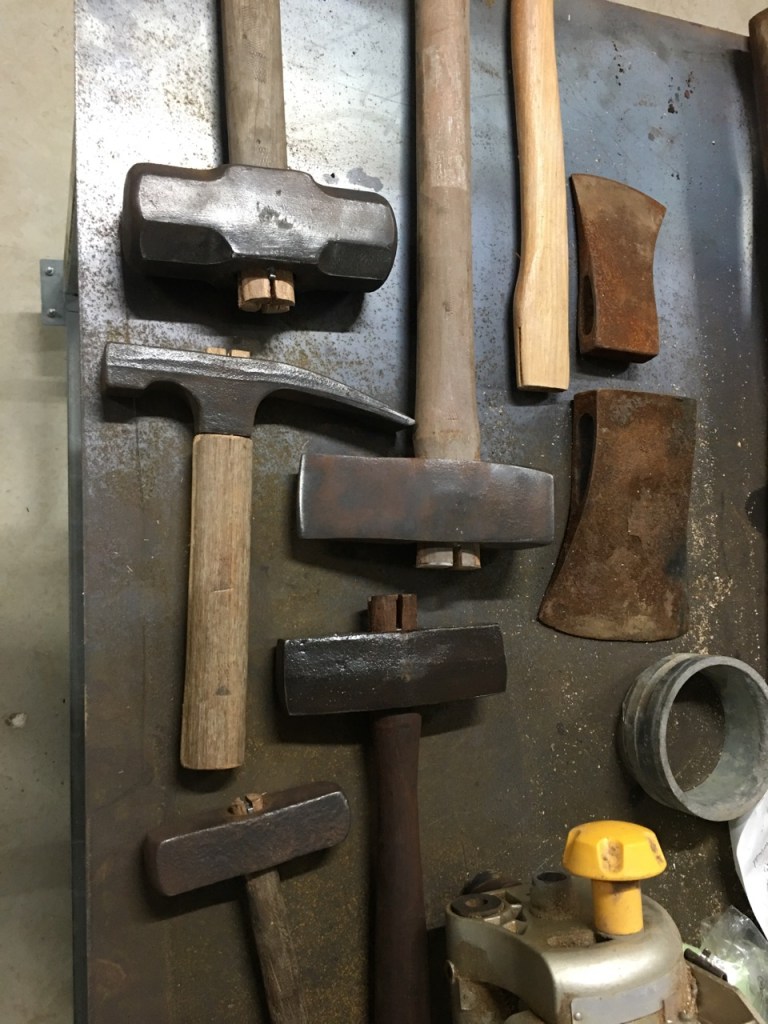
I decide to ease into it gently by re-shafting a few of my tools that I now realise that I need to get the project moving. Some hammers, mallets, block buster, sledge and sketch hammer, tomahawk, axe etc.
I found a few old bits of timber in the barn when we were repairing it last week, even a few hardwood tool handles, and a hickory axe handle dating back to the 70’s or 80’s? I set to work re-purposing the split and shattered, used block-buster shafts, cutting the them in half and making shorter handles for other tools out of them.
I get a lot done in a couple of hours of entertaining handiwork. I feel great afterwards. I feel like I have achieved something. Not exactly the feeling I had after spending 9 hours preparing the many, many pages of building application forms for the council building app. But that was last week, and this is now. Something positive, no matter how small, is gratefully accepted and engaged with.
Getting shafted was never so much fun.
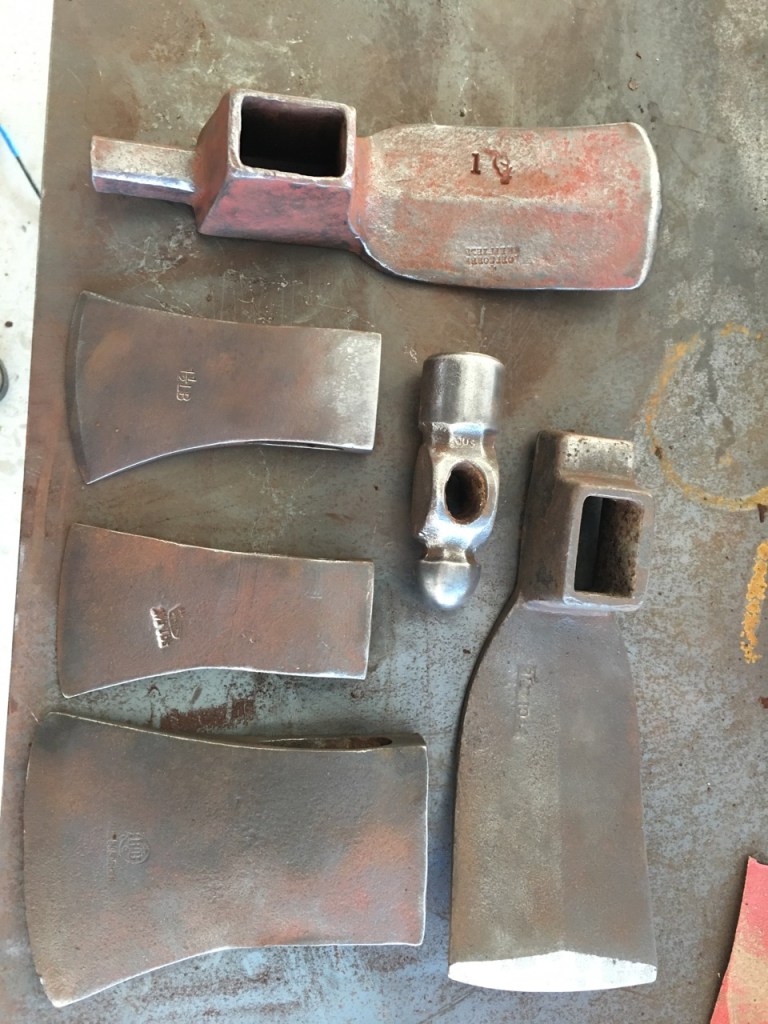
These tools were all burnt, rusted and flakey yesterday, just like the axe heads in the image above. They too will come good with a little TLC.
I have a lot of other tools that are on my ‘to-do’ list, all lined up outside on the stone wall.
These few items are the next lot of heads that are on my work bench.
They all look a lot better after and bit of wire brushing. My big problem with the adzes is that I can’t buy an adze handle anymore from the hardware shop. I might have to carve them myself, but I’d rather just buy them, as i have quite enough to do already.
Dawn breaks clear and rosey pink, a few scuds drift over and the days graft begins cold and clear. We sweat and toil till dusk and the day rewards us with a fiery sunset reminding us of our overworked muscles.
Such is our current ‘new’ life. One remarkable thing that happened today was that we saw a plane fly over.
It was a bit of a surprise, as we used to see and hear them many times a day in our previous life. There were so many that we didn’t bother to look. In fact we didn’t really notice them at all. They were omnipresent. Now they are a novelty.
6 months ago we had them thundering slowly overhead at low altitude, flaps down and roaring, just above a stall speed to deliver their pink fire retardant all around us. But that was then and this is now, so this solitary plane was a notable surprise.
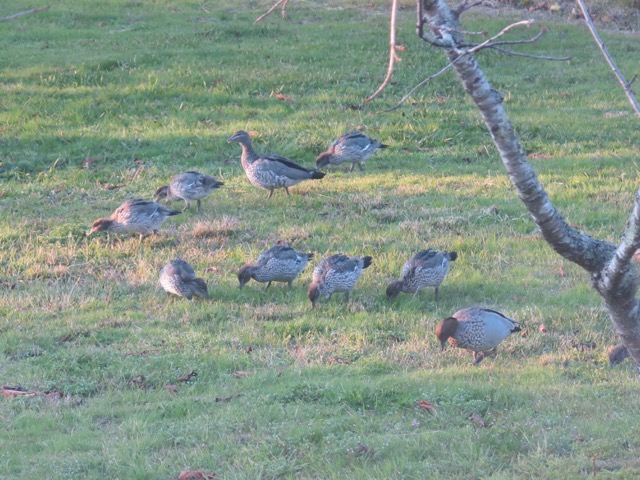
A lovely event this week was the appearance of a clutch of baby wood ducks grazing in the Chekov orchard. For decades, we had wood ducks breeding here in the cherry orchard and on the dams. At that time we had a big eucalyptus tree with a hollow branch hanging over one of the the dams. A perfect breeding site that was used every season by many generations of wood ducks. Tragically, that tree blew over in a huge storm 10 years ago. Since then, the wood ducks haven’t bred here. They are apparently quite choosy about where they nest. Since the catastrophic fire. All the old trees with dead, hollow branches considered suitable by wood ducks as a nesting site have been burnt. Their choices are very limited now. The fire removed all the forest around here. There is no under growth or shrubby nesting sites for small birds, and no hollow branches considered suitable by wood ducks to breed in. So they are not so choosy any more. This pair seem to have lowered their expectations and managed to raise this batch of babies somewhere closer to the ground.
They usually hatch about a dozen little ones, but they loose almost one baby duck per day to predators in the early days. These ducklings seem to be about 3 weeks old and are now too big to be taken by curawongs, but hawks, powerful owls or a fox could still take them. So they are still very cautious.
At the moment, we have seven survivors grazing each morning. They are particularly shy of people, even after over 40 generations of breeding here on this little farm holding. You’d think that they would have got used to us by now, as we always keep our distance and never chase them. Once their kids have fledged and gone their own way, the parents will be a lot more tolerant of us walking around in their orchards, amongst their cherry trees and on their dam banks, or walking on their grass.
It’s nice to see them back. I can only suppose that, because of the total loss of grass and suitable sites due to the fire, our grassy orchards and partially full dams are now the best option for them to breed in again. We keep out of their way and give them plenty of space to graze peacefully, as we want them to return permanently. These pictures were taken through our bedroom window, as we can’t get close enough to them to photograph them outside.
When I get a bit of time and energy, I should look into what kind of nesting box wood ducks prefer, then get a couple set up in trees somewhere near the dams. Then hope they like it.
Life goes on. But in the mean time, I have a pottery to build and a new orchard to plant, and so we graft from dawn till dusk.
It is half a year now since the fire on the 21st December, right on the solstice. We have been in clean-up mode ever since. All the black from around the house is now cleaned up and dead with. Be that cutting up into suitable lengths for fire wood for later, or piling up and burning in bonfires. We have almost finished the burn piles. We started with 16 big tip truck loads of stumps, twisted branches and blackened gnarly undergrowth, all too difficult to deal with in my damaged and exhausted PSD state.
The house is now clear and no longer dangerous to walk around, as we were always wary of falling dead and burnt branches. We haven’t even thought about dealing with the burnt bush further from the house. It will have to wait. I have a couple of years work ahead of me just around the house here. We just won’t go there without a hard hat.
So now it is the solstice again. The winter solstice this time and we have passed from high summer through into deepest winter. Something to look forward to is that the days will now start to get longer, although the coldest days (and nights) are yet to come. A full six months has passed, half a year, I have been working hard every day, but not much seems to have been achieved. We still don’t have a pottery. I guessed, with no real evidence or insight, only the past two bush fire events that burned our previous potteries down, that it would take at least a year to rebuild. That was based solely on past experience. but I was a lot younger then and had so much more energy. Now i’m so much older, I can’t keep up the pace I want to achieve. I’m smart enough to know when to knock off. No more working with torches or under lights. At least not very often!
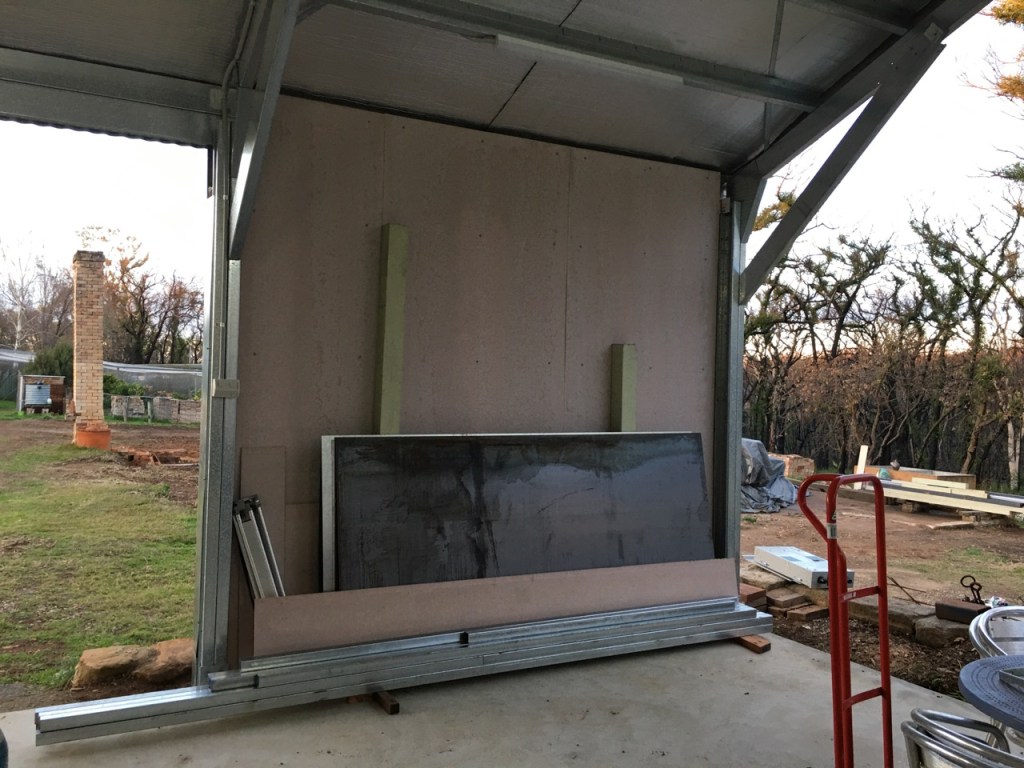
These last few weeks we have insulated the new car port walls with earth wool insulation and then lined the walls with fibre cement sheeting (fibro). I installed it back to front with the textured side out and left it untouched with it’s slightly pink mottled face as the finished surface. It looks OK. I have been trying to make this brand spanking shiney new industrial shed look somehow slightly softened and more comfortable in these rustic surroundings. I think that it’s working. I’m trying to do it without spending very much money either. That’s a challenge.
The wall cavity has been stuffed with 100mm of recycled beer bottles as brown fibreglass.
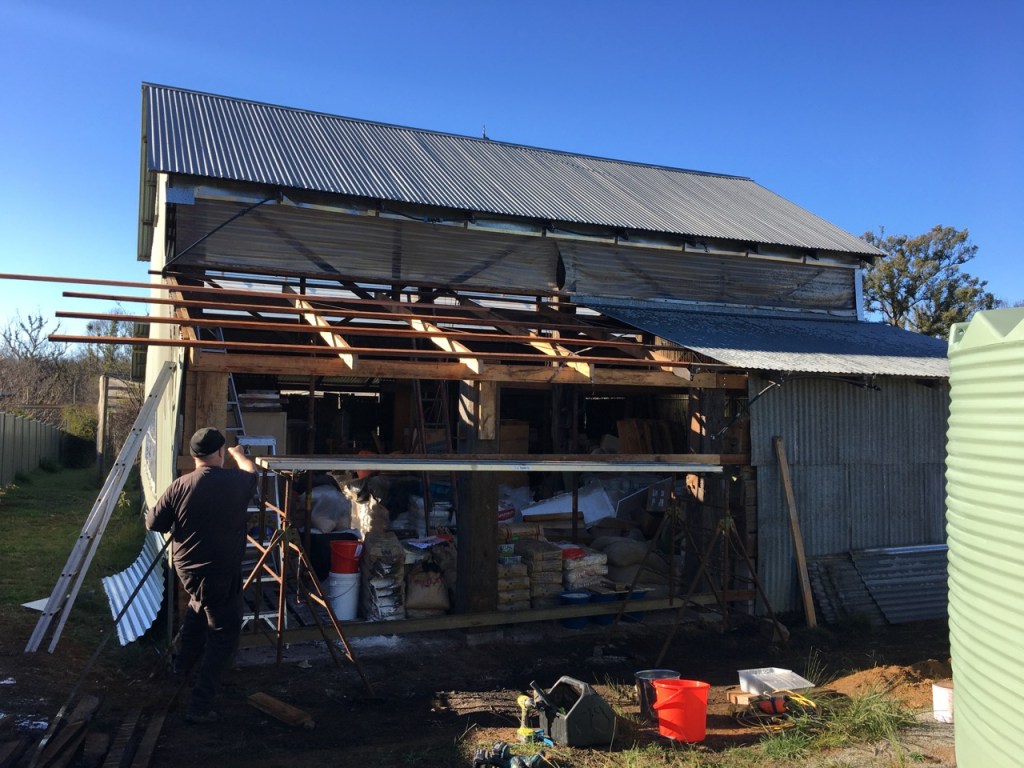
Since lining the carport I have been working with my friend Colin the environmental builder. We have dismantled the burnt-out north western corner of the barn and rebuilt it with my new square peg post and another recycled one that Col had in his yard.
We removed the roof and walls and replace all the timbers with new ones that we milled from one of the old stringy bark eucalypt trees when we hired the portable saw mill a few months back. It’s a very rewarding feeling to be able to rebuild this old barn using timber grown here on-site and personally milled and adzed into shape. I really like the concept of embedding something of the old native plant garden into the new shed. it’s all good quality hard wood, so theoretically it should last a hundred years. as long as we can keep the next fires at bay.
We removed the two burnt out posts, then placed the new adzed post in position. I lifted it with the little crane that I have on my truck and raised it up to about 45 degrees, then pulled the post up into place using my chain block.
I will reinstate the 4 water sprinklers on the western walls once the building is finished next week. I only need to install the guttering and replace the polycarbonate. Then I’m done. This old barn now has it’s own 2 new water tanks and will have it’s own high pressure fire pump to run the sprinklers. I decided to reuse all the old burnt corrugated galvanised iron wall sheets. They look suitably rustic and appropriate. The new gal roof sheets look a bit too shiney just now, but as they are old fashioned galvanised zinc coated, they will age to a dull grey, non-reflective surface, just like the old sheets that are next to them.
The half dozen burnt roofing sheets will be re-used on the new pottery workshop walls where it won’t matter if they have a little damage, as they won’t need to be totally waterproof.
On Friday, we got our DA approval for our plans for the new pottery building from the Council – with 9 pages of conditions attached! It seems like a lot of fiddle and extra work, but I’m pleased that we have approval to get going with the new building. This is a big step in the right direction. And after only 6 months! I had a few discussions with the inspector who kept asking for more detail. I eventually had to redraw the plans and colour them in, with a colour code ‘key’, to show all the different materials that I intended to use.
Everyone that I have had to deal with at the council has been incredibly helpful and supportive. We are so lucky!
The trees are just starting to make new shoots since the rain, but half of the rees are dead and will need to be taken down for safety – sometime in the future.
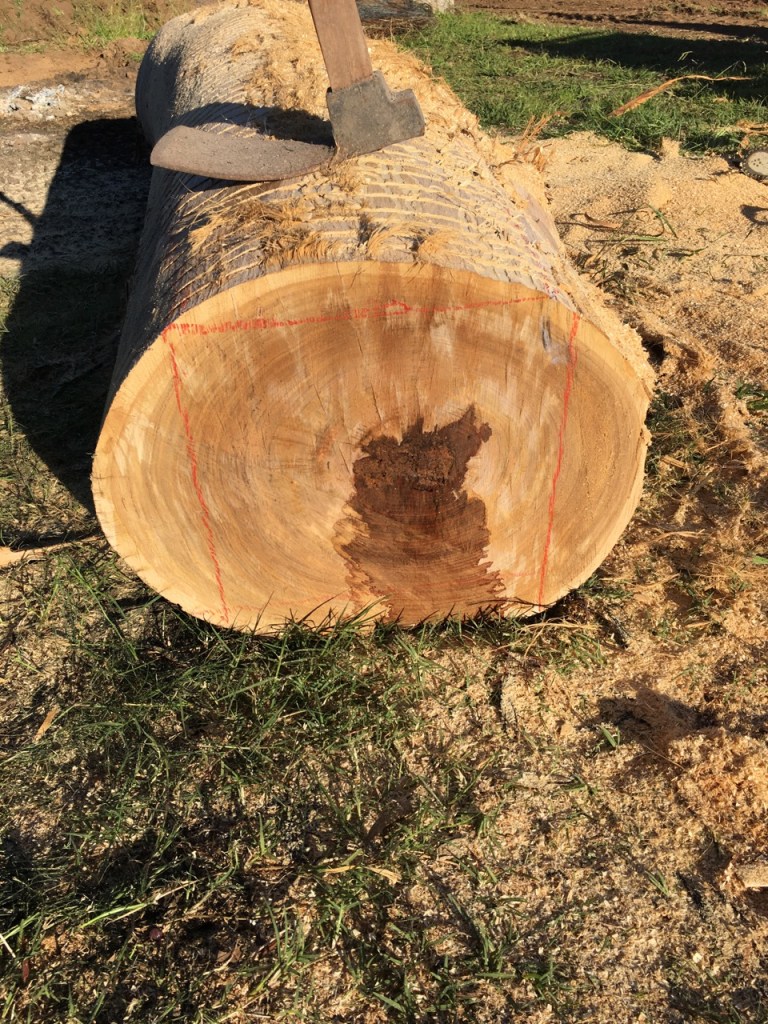
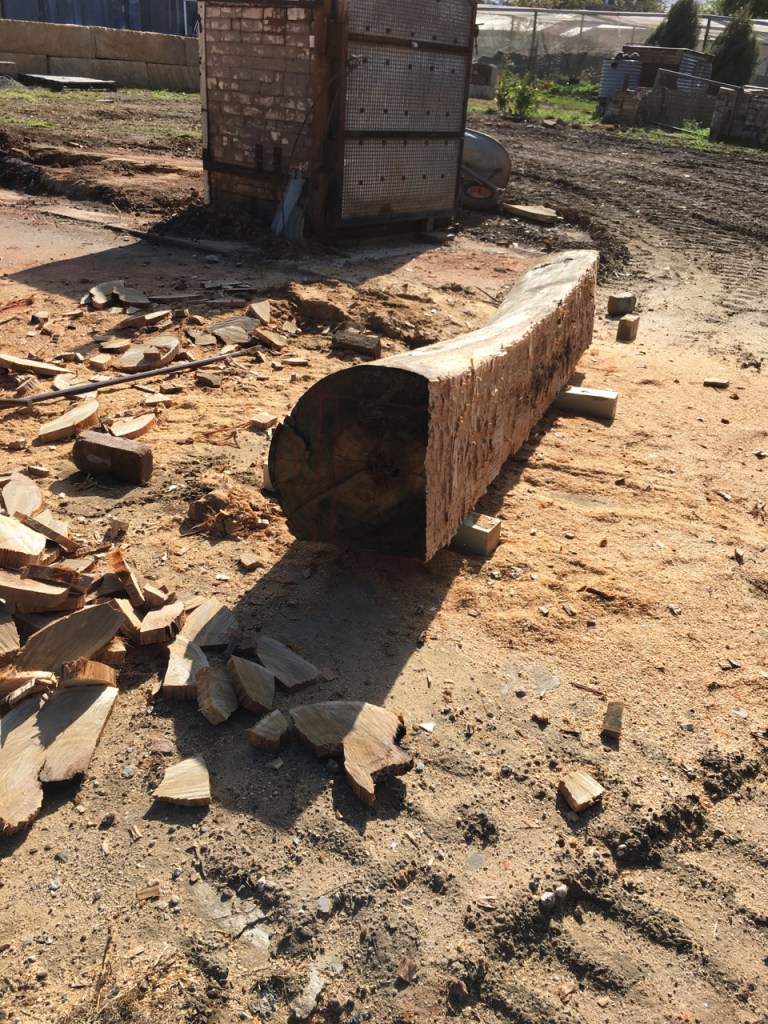
Over the last month I’ve been slowly working away at squaring up a big stringy back log that was burnt in the catastrophic fire that swept through here in December.
Our barn was badly burnt in that fire and we lost one corner, completely burnt out. As I stayed to defend our property from the flames. I was able to put out the flames after the fire swept through and I managed to save the barn. God knows how! The immense energy of the flames from the fire burnt everything in its path, but the roof and wall sprinklers on the barn were just enough to keep the building from bursting into flames, However embers lodged in the corner of the tin walls and set fire to the massive 300 x 300 mm. hard wood bridge timbers that I used as uprights.
It’s more or less impossible to set fire to a 300mm. square old hardwood timber post in any usual circumstance. However, if you have a once in a lifetime catastrophic fire fanned by 70 to 80 km/hr winds from the dry north, at 50 to 60oC , then anything is possible. The main fire front swept through burning almost everything in it’s path, I had taken refuse in my kiln for safety and didn’t dare emerge until after the main fire front had passed by. The yard and all the garden was ablaze. Every tree was on fire, thick smoke was everywhere. I come out of my kiln-like bunker. It took me some minutes standing under the house’s roof and wall sprinklers spray to cool off sufficiently to get my thoughts back in order. I realised that both the railway station and barn were both on fire fanned by the roaring wind.
I hosed out the station fire for the first time and ran to the barn carrying buckets of water, as the pump delivering water to the wall sprinklers on the barn had stopped working. There was no other pump or hose system over there on the opposite side of the property to use, so my immediate thought was to run there carrying buckets of tank water from the station tank. Each time I returned to the station, it was back on fire, as the insane wind had fanned the remaining embedded embers back into flames. I would put it out, then return to bucketing water to the barn. This cycle went on for an hour or two, until the station was well and truely out and although the barn was still smouldering, I had stopped the fire from spreading to the whole building. I eventually got it out, but the big corner posts, were almost completely reduced to charcoal.
So one of my on-going jobs over the past couple of months has been to set aside a large stringy bark tree trunk. I cut it to length and start to square it up to make a replacement square post for the corner of the barn. I got one face done, then I fell into the electrical cable trench and sprained my leg. That was the end of my timber milling efforts for a month or so,
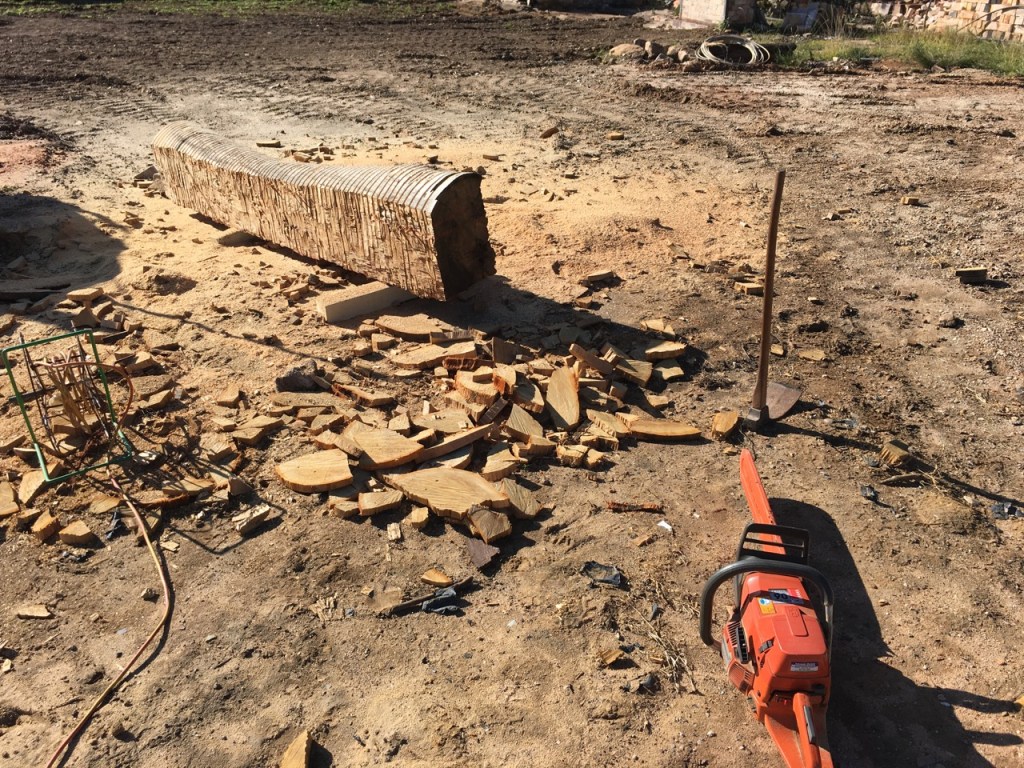
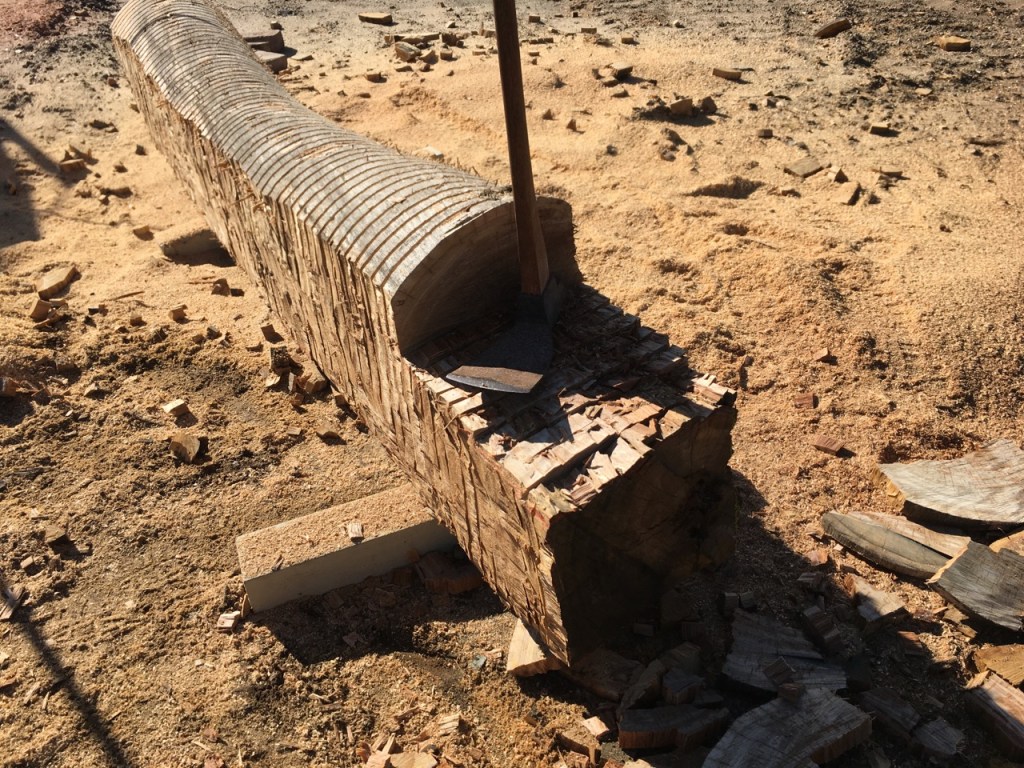
I’m mostly well again now and this week I have come back to the job of squaring off the massive hardwood post. Extracting the square post from the curved, round log. I can only manage just one face each day, as It’s hard on my ageing back and shoulders.
Today I finished the last face. It’s pretty ugly, not exactly square, or smooth, but I don’t have the luxury of unlimited time to get it perfect. I have left most of the chainsaw depth cuts in the surface, as this indicates how it was made and is an honest surface for such a huge square post extracted from a curved round log.
While I was working today, adzing the final surface mostly flat. I was drawn to think of the timber cutters that worked these ridges and gullies 150 yers ago. I’m not a pimple on the arse of one of these hardy pioneers. They really knew how to work hard. My wimpy efforts are an embarrassment compared to the excellent quality of the sleepers that were snagged out of the Bargo gully behind us here in the 1850’s. All of their beautiful handiwork is gone. The last of the hand-cut sleepers have been replaced with steel sleepers now. The white ants and time took their toll. But what an achievement, these 50 kms of hand-hewn sleeper-laid train tracks that were felled, cut, adzed and broad axed into perfectly square clean shapes are just a memory. The snigging tracks that wound down into the gullies are all over grown and lost to memory now. But I remember them, Janine and I walked them in the 70’s when some of them were still visible, simply because some of the older locals still used them to get down into the creek.
My efforts don’t compare in any way, but hewing this square post into existence with just a small salute to the past has been a rewarding effort. The new corner post will hopefully tell someone in another generations time of the way in which it was made.
I have booked my friend, the local carpenter and environmentalist, Col McNeill to help me with the rebuilding. It will be a big effort for us to man-handle this massively heavy post into place, but that is next weeks job.
Our Hyundai Ioniq plug-in hybrid electric car has surprised us and out performed our expectations once again.
Last month, we achieved 593 kilometres to the litre fuel economy. But now, because of the lock down and the fact that we haven’t driven any long trips, where we would usually drive out on the battery and return on the petrol engine, we have found that we achieved 655 km per litre in May. Quite unexpected, but very pleasing.
This exceptional fuel economy is of course due to the fact that we have only made short trips to the shops for the last coupe of months. We have been limited to the 150 km. district from Campbelltown to Moss Vale for our basic needs.
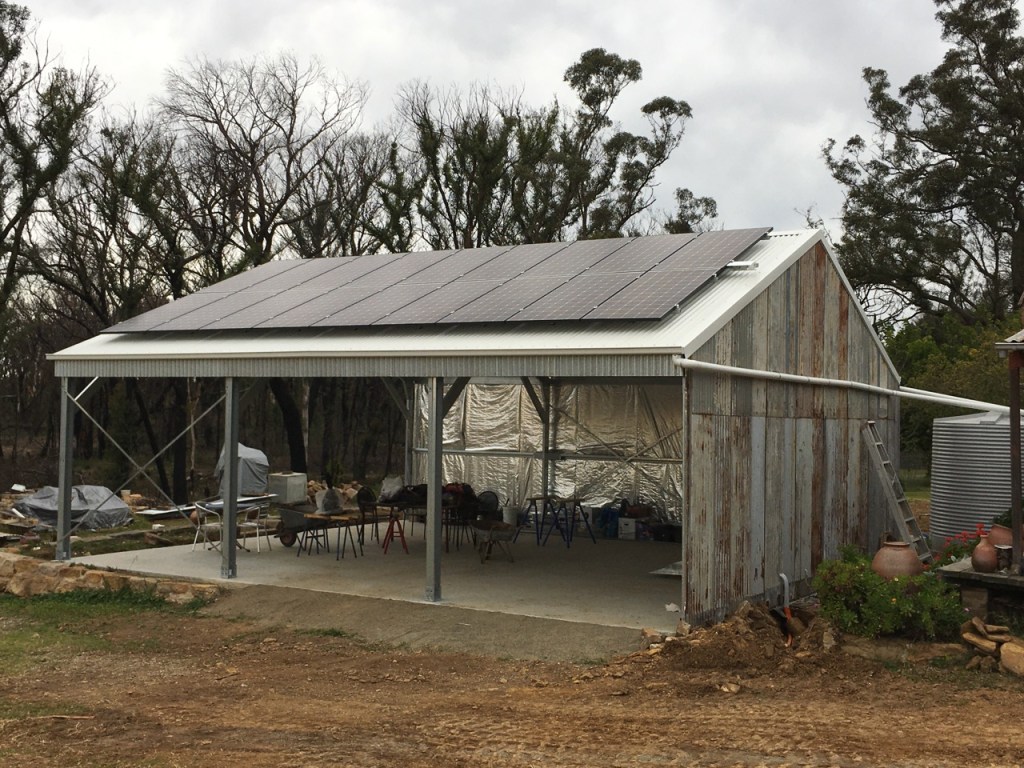
The other good news is that we got the solar panels back on our roof last month, so we are now recharging the car directly from the PV panels on the roof during the day and from the battery at night. These days, we only connect into the grid to sell our excess. We have micro inverters on each solar panel, so we generate 240 volts directly into the house/workshop micro grid, we use the power from the PV panels directly into whatever appliance is being used at the time. If we are not consuming enough, the excess is then directed automatically to the battery to top it up if necessary, and only then is any excess directed to the grid for sale.
Shortly after re-installing the new solar panels on the new carport/workshop roof, we got the electrician to wire in the new fast charger for the car. This doubles the speed that we can recharge the car, as we were previously forced to use the standard 10 amp, 3 pin, outside power point to charge the car for the past 5 months. Things are starting to happen now.
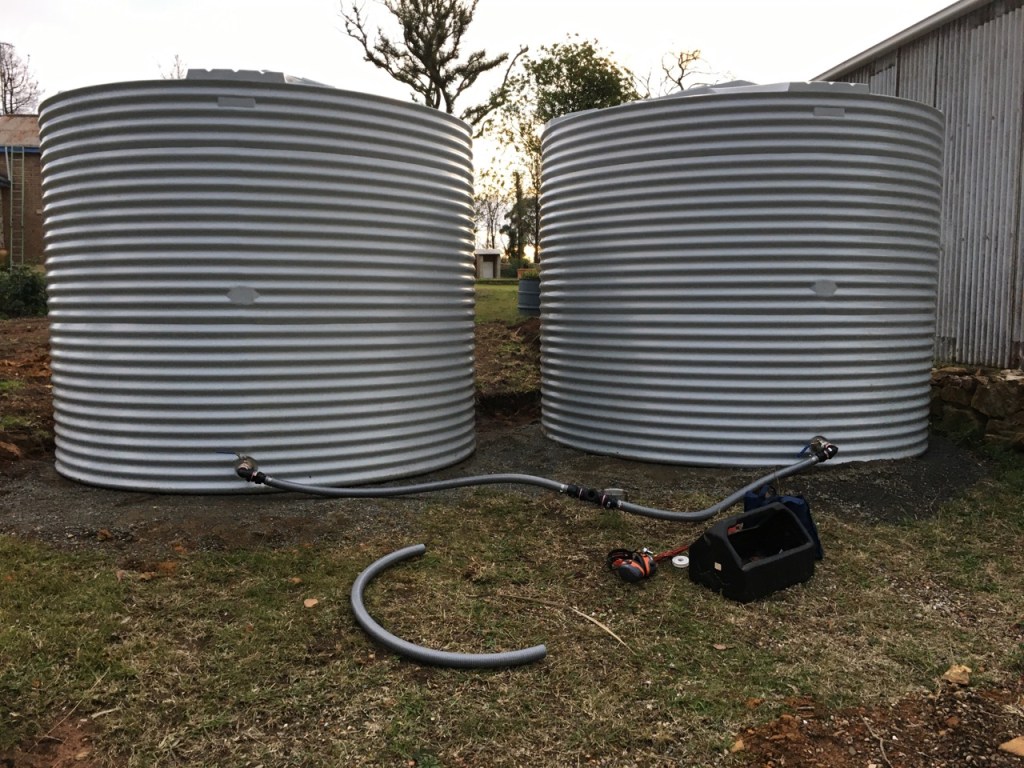
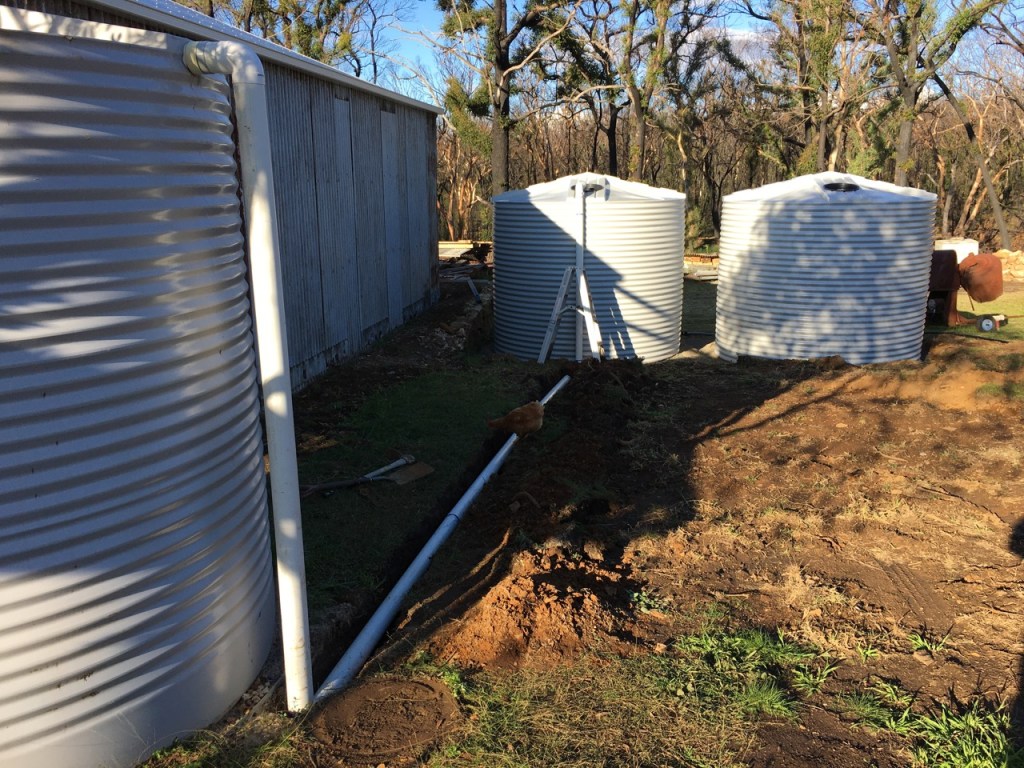
Next, we took delivery of two new water tanks to go on the new shed. These are 10,000 litre tanks, bringing the storage capacity for theses two sheds up to 32,000 litres. Enough capacity to supply a high pressure fire fighting pump for about 4 hours at full volume. I have to install wall and roof sprinklers on these two sheds sometime in the not too distant future, so that we will be prepared for the next catastrophic fire event.
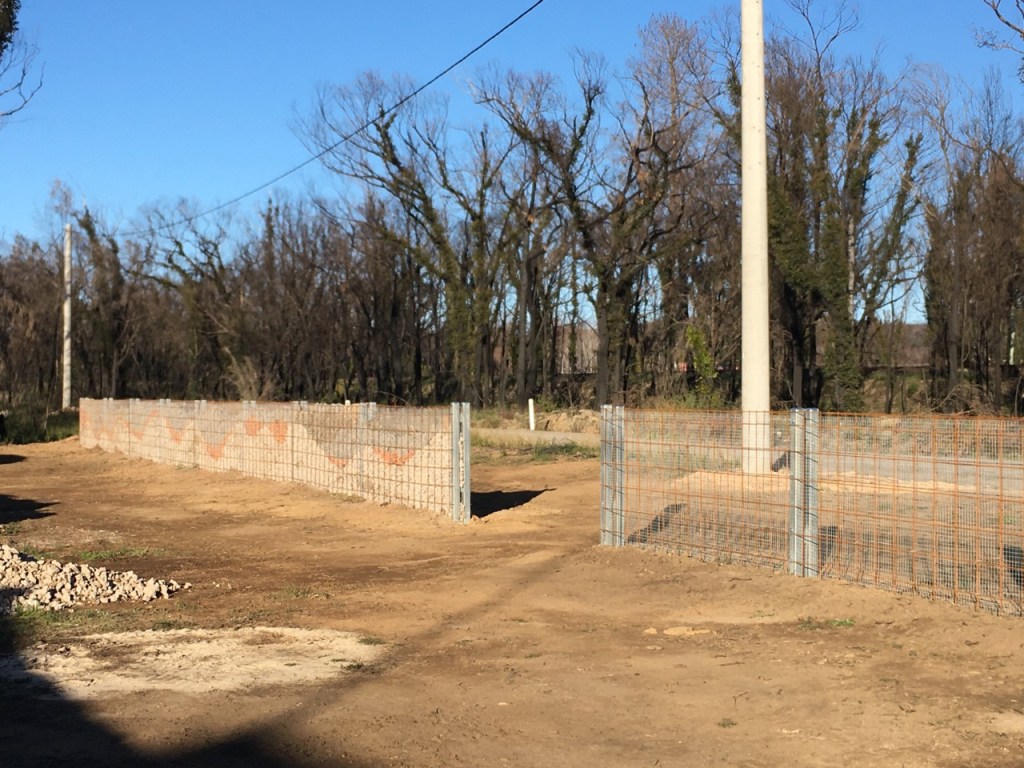
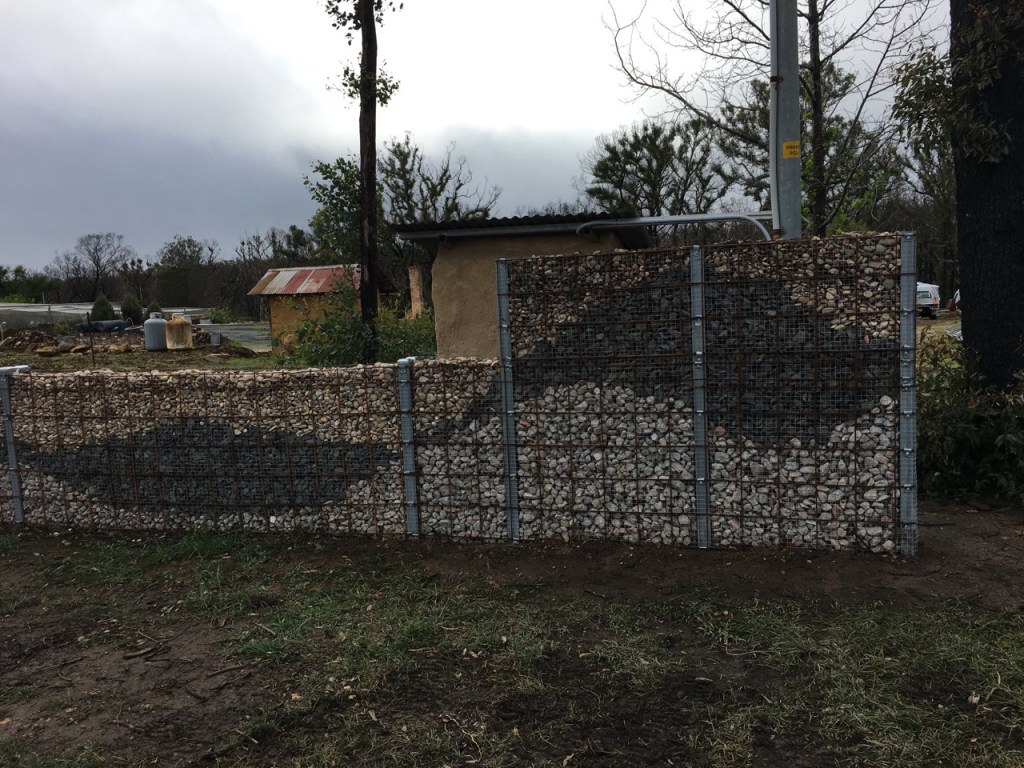
Lastly, we finally finished the north end of the new gabion stone filled wall. I needed to increase the height of the wall where it terminated at the battery shed and the power pole where the Tesla ‘gateway’ and the electrical meter box are located. The gateway and meter box were destroyed in the recent fire, with all the plastic components melted and electronics ‘cooked’.
This new wall height extension should help to elevate this in the future?
We started on the south end, but haven’t achieved much so far. All the poles cemented into the ground and half of the wire frame completed. It’s keeping us busy.
It’s almost 5 months since the catastrophic fire that cleaned us up and changed our life forever.Shit has Happened!Next! So Let’s move on. Get over it. We have to get on with being in the here and now. The new normal will now be massive fires at intervals set by the new hotter climate. We need to acknowlege this, internalise it and re-build appropriately. We have decided to re-construct eveything in Steel frame and steel cladding. This won’t eliminate the risk or reduce the wild-fire exposure, but when the fire returns – eventually, as it will, in the next catastrophic event, we will be better prepared with buildings that are less likely to burn. Our first attempt at building something new – a car port. A galvanised steel structure, is now complete. The council has been out here to inspect it and given the final approval and ticked it off. We have had the solar electricians out here this week and installed the 6.6 kw of solar PV on its roof. So we are not buying any of the ‘green’ wind power from the grid any more. We are now back to using our own self-generated solar power. It has taken 5 months to get back here. It’s a nice feeling to be getting back to self reliance in electricity and food. We decided to use re-cycled galvanised iron to clad the new building.
It makes the rather bright looking new building a lot less shocking. It blends in with the charachter of all the other buildings on the site. The inside is still rather bright, a bit ‘2001- a shed oddesy’, but I intend to line it in times to come when funds and time permit. That will tone it down a bit.
Because my leg is still healing. I can’t do too much – especially on ladders and up on roofs. So I have been grounding myself with working on the stone stairs leading up the retaining wall to the new pottery. These stairs will link the new pottery to the wood kiln shed below.I have found a lot of my stomemasons tools that went through the fire. Luckily, being mostly wrought iron, thay survived the fire in reasonable order, just very rusty.I have enough ‘gads’ to be getting on with, so I can cut up the big stone slabs into smaller sizes more suited to stone step treads in a set of steps.I’m not up to lifting big lumps like this anymore, so I’m using the tractor’s bucket to do the heavy lifting these days.
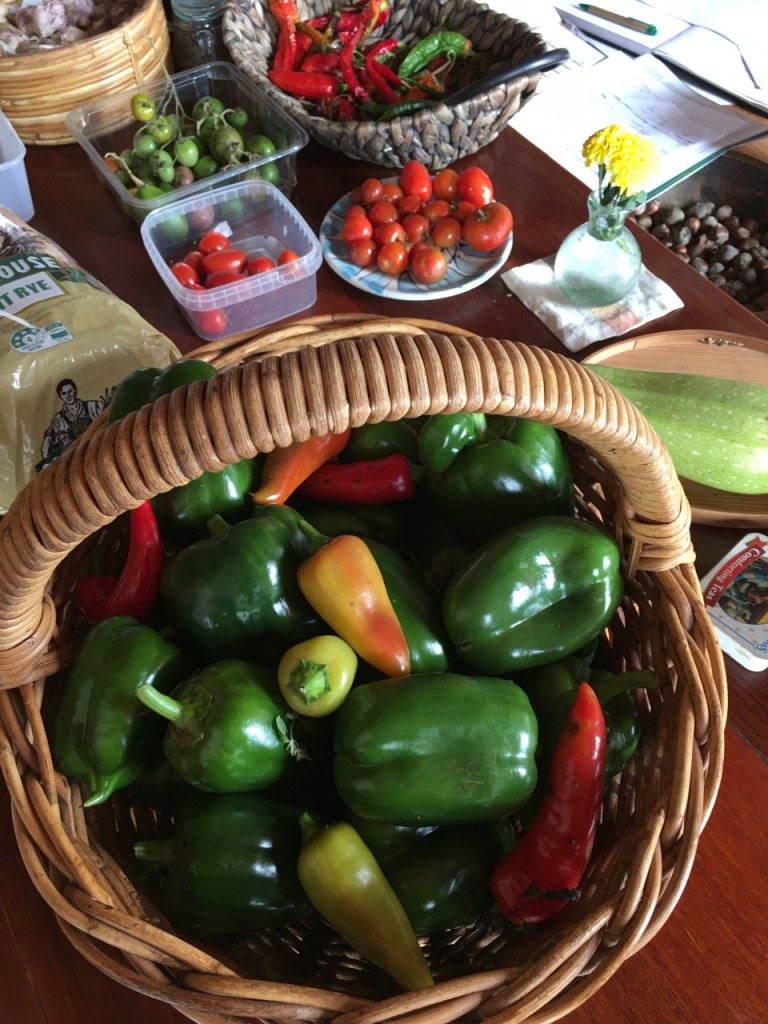
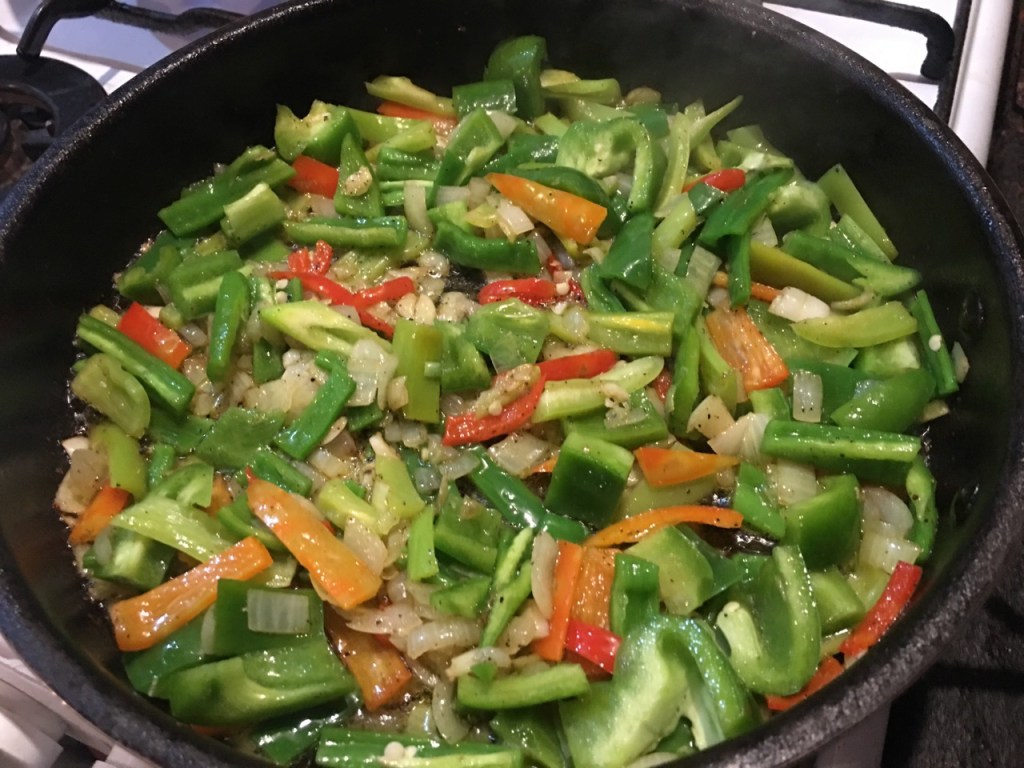
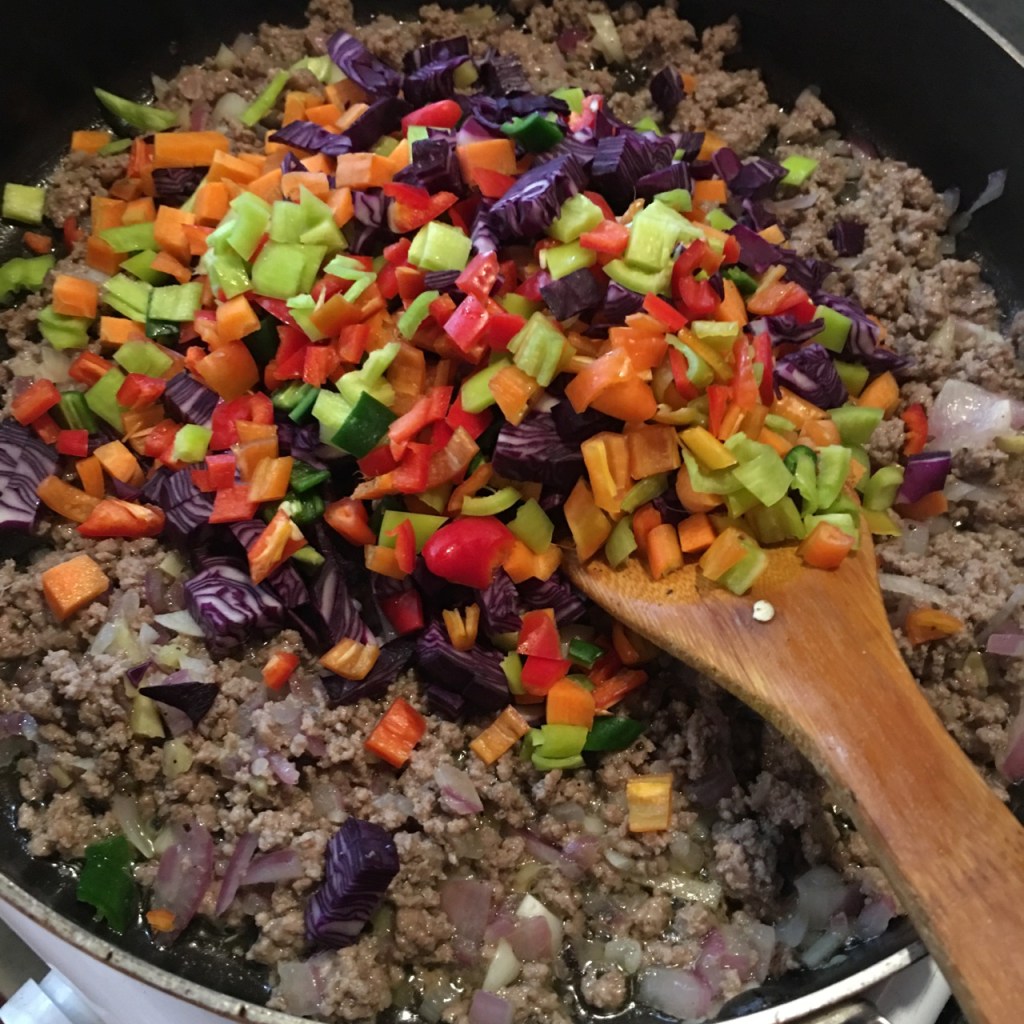
The weather is holding out, only a few frosts as yet, so we are still harvesting all our green food from the garden. We are making a lot of stir-frys at the moment. Ones that use a lot of capsicums! We make a big double batch and make gyoza dumplings from half, then stuff capsicums the next night with the rest.













































You must be logged in to post a comment.