New wood fired kiln takes shape

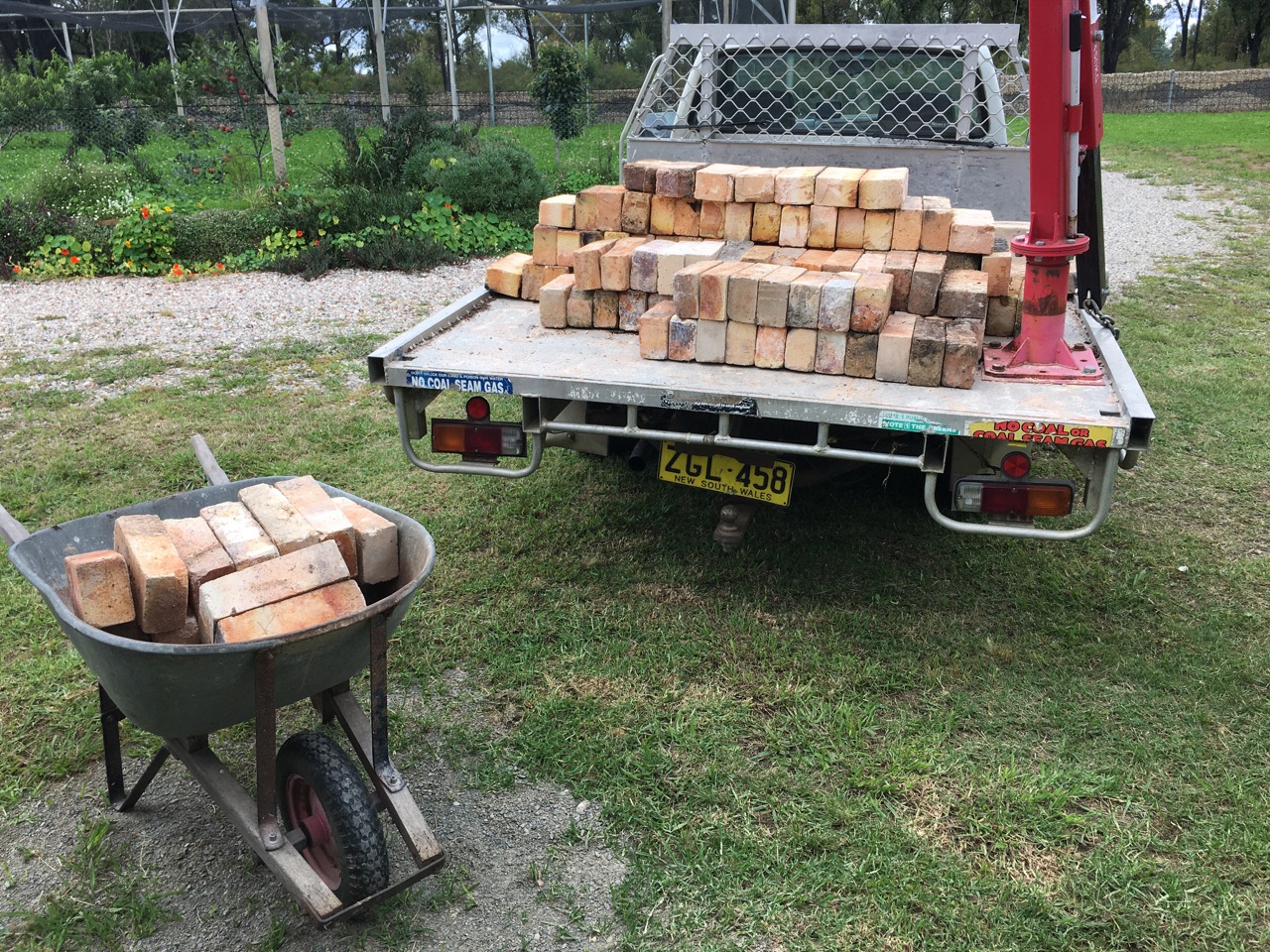
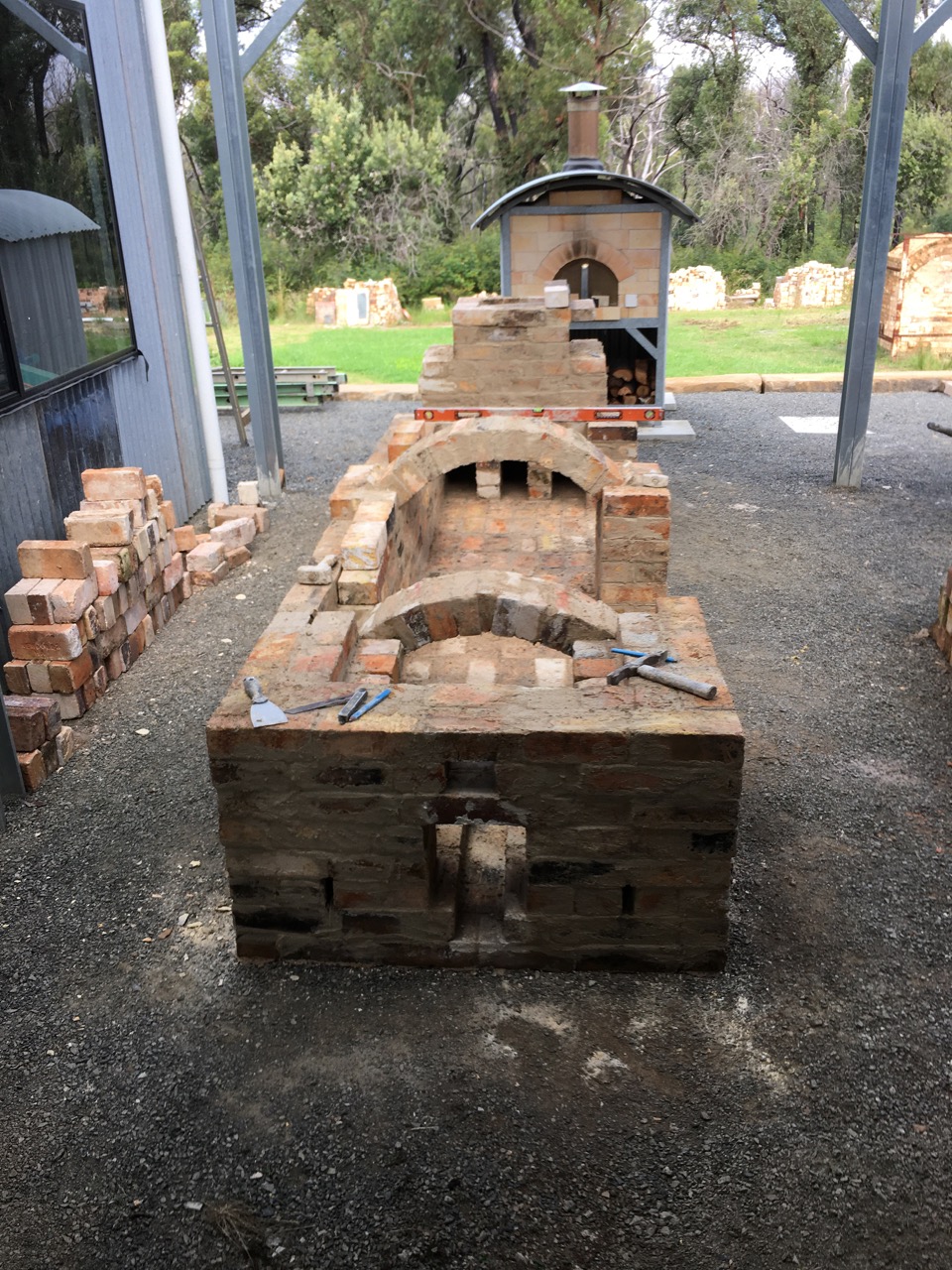
I have been working on the new wood fired pottery kiln now for the past week and a half. Each morning Janine and I start with cleaning bricks and loading them onto the truck for the trip up to the new pottery shed. From there they are wheel barrowed down the alley to the newly covered court yard kiln area.We clean and stack about 150 bricks each time. As we clean the bricks, we sort them into different types and sizes. 


All my fire bricks are very old and I have been using all the same bricks over and over for the past 45 years. I was lucky enough to buy several thousand fire bricks for just $100 way back in 1974. I already had a couple of small gas fired kilns and a small wood fried kiln in my parents back yard. I didn’t live there any more, but continued to use my studio in a little garage sized shed below a cliff at my mothers home. I saw an add for fire bricks for sale in the paper. People looked in the newspaper to see adds in those days before screens. I went to see the bricks in the old ‘Mcillraiths  enamelled cast iron bath tub factory in Alexandria. I think that they had merged with ‘Metters’ and were closing down and moving to a new site where they would only enamel pressed metal baths. Those were the days before plastic baths.


The fellow in charge of dismantling the factory had been the manager before closure. He needed to get rid of the four large 5 metre square and 6 metres tall enamelling kilns, as they were just about the last things in the factory to be removed. I looked at them and shook my head, thinking that ere was no way I could shift that many bricks. I had only come on the off chance that there were some small number of bricks that my students at the old East Sydney Tech College (now called the National Art School) could obtain to build their own small kilns after graduation. I told the guy in charge of disposal this, and that the job was way too big for me. He had originally wanted $1 a brick in the add, but there were 20,000 or so of them. He had had no offers and was very keen to get rid of everything, as the factory needed to be empty by the end of the month, the kilns and some old machinery were the only items left in the place.

He sweetened the deal by offering to sell the lot to me for $1,000. I said No, thinking that although that was a very good price, I just couldn’t see how I could do it. Having said no way!  He then offered to dismantle all the kilns and stack them on pallets for me. I continued to say NO!, more in disbelief than anything else. He said, “you drive a hard bargain Son!” OK then, I’ll organise a semi, palletise them, load them all onto the semi here with the fork lift and deliver them to your factory.”I told him that I didn’t have a factory or a fork lift, anyway I don’t need that many bricks. He countered with OK $500! He saw me shaking my head, I couldn’t believe what was happening. He must have been extremely keen to get out of his contractual predicament. I assume that he had already made his money on the sale of all the scrap iron and useful machinery? I was still shaking my head, when he said OK! $100 delivered. I said yes!


They arrived all in one go on a huge semi-trailer truck. The truck was loaded 2 pallets wide and two pallets high. Over twenty pallets of fire bricks. It took 5 friends and me all afternoon just to unload them onto the foot path. The next day my friend Len Smith came over and we hired a brick elevator/conveyor and laid it more or less horizontally up the sloping driveway so that as Len loaded the bricks onto the conveyor at the street, I was at the other end to catch them and ran around stacking them on the ground at the top of the hill. I paved my parents driveway 3 layers deep in fire brick to get them all off the side of the road.    That’s how I ended up with 20,000 fire bricks and could afford to build a 3 chamber climbing kiln in the rented property out at Dural the next year.


As we wheel barrow these very familiar fire bricks that I have handled so many times to the kiln site. I sort and stack them in piles around the kiln into their different uses. House bricks for the foundations, Heavy fire bricks for the fire box and floor, light weight Insulating refractory bricks for the lining of the chambers and finally plain light diatomaceous insulating bricks that are only good for low temperatures, less than 1,000oC, these are only used as the outer skin of the chamber as insulation.
After lunch I mix up a wheel barrow load of clay and sand mortar, then I spend the afternoon laying those bricks. It’s a full day.
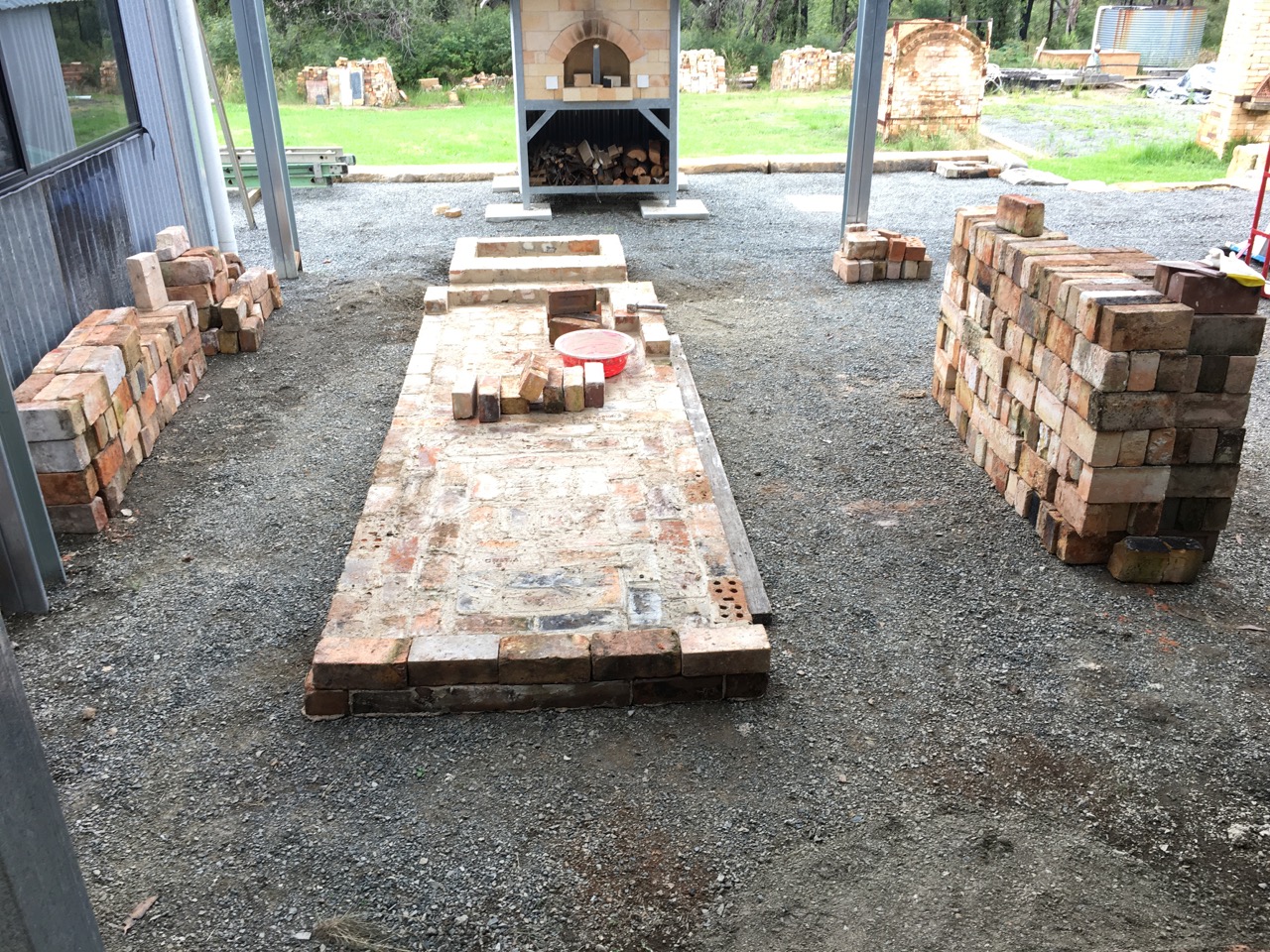

The chickens are all over the job keen to see what is going on. They are so inquisitive! They are always pecking at the gravel floor to get grit for their crop.Then they took an interest in the pile of yellow ‘fat’ sand that I’m using for the clay and sand mortar mix.Today they suddenly started to take an interest in the mortar. They decided that it was just what they needed in their diet. They have eaten so much of it over this past week, that their pooh has turned white with all the kaolin. As have their faeces, faces and beaks. They are now truely, sticky beaks.


After 5 days work, I’m now up to the level of the throat arches that divide the fire box from the first chamber, then between the 1st from 2nd chamber. It’s slow going, but my excuse is that I’m an old guy now, about to turn 70 and can’t do all that I used to when I was younger. I didn’t need that catastrophic bush fire in my life at this time, but life is what it is and you have to take it in your stride. Resilience is all about facing up to reality and keeping on going in the face of hardship and set backs. I just turn up everyday and do what I can.


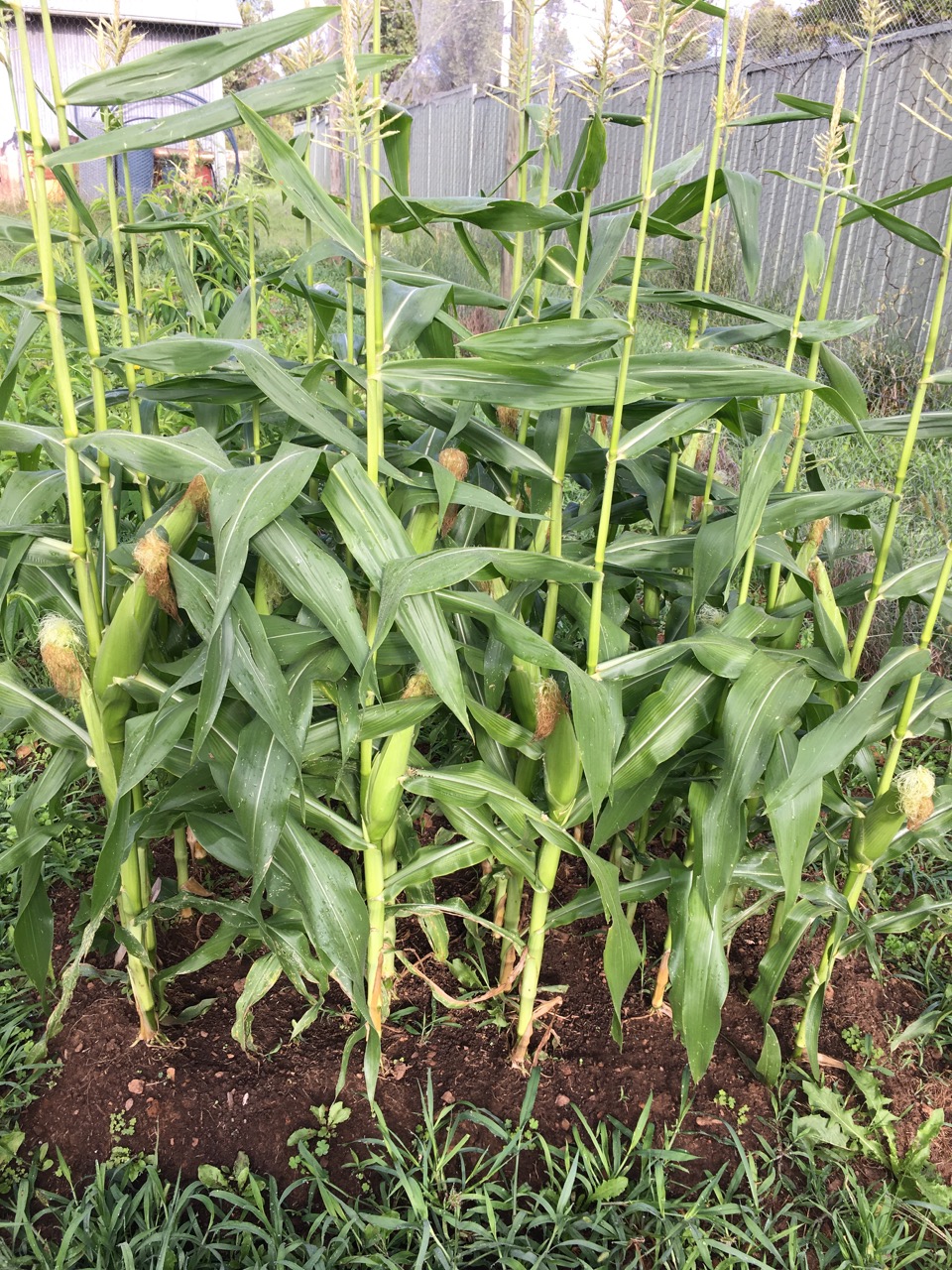
We are eating sweet corn almost every day. When the cobs are so fresh and young, I just eat them raw. They are sweet and juicy.


This time of year, we also have an excess of zucchinis. This week we made zucchini fritters with garden fresh tzatziki.

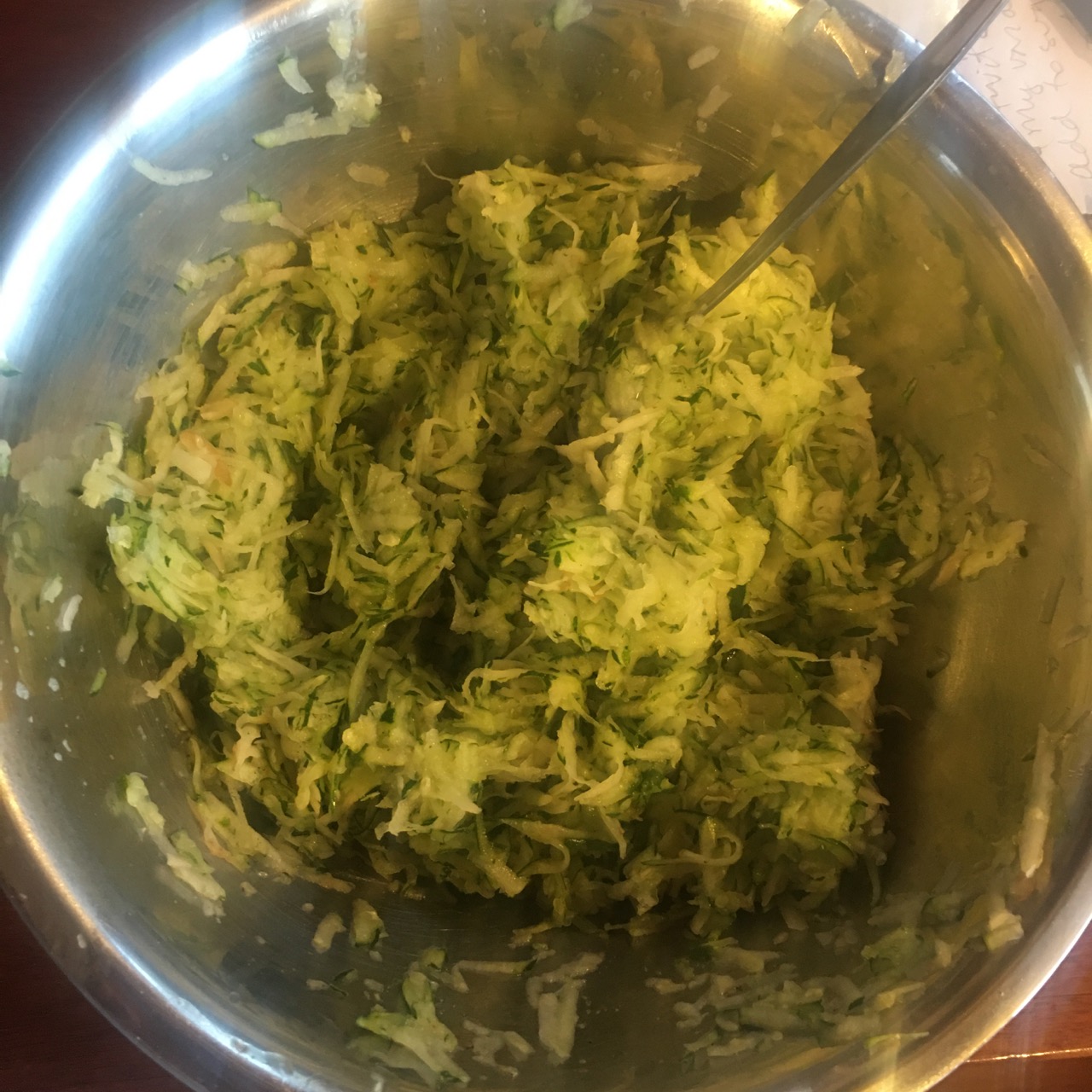
Grate two medium zucchinis and one small potato. Wring out the juice, and add one egg and a tbspn of flour.
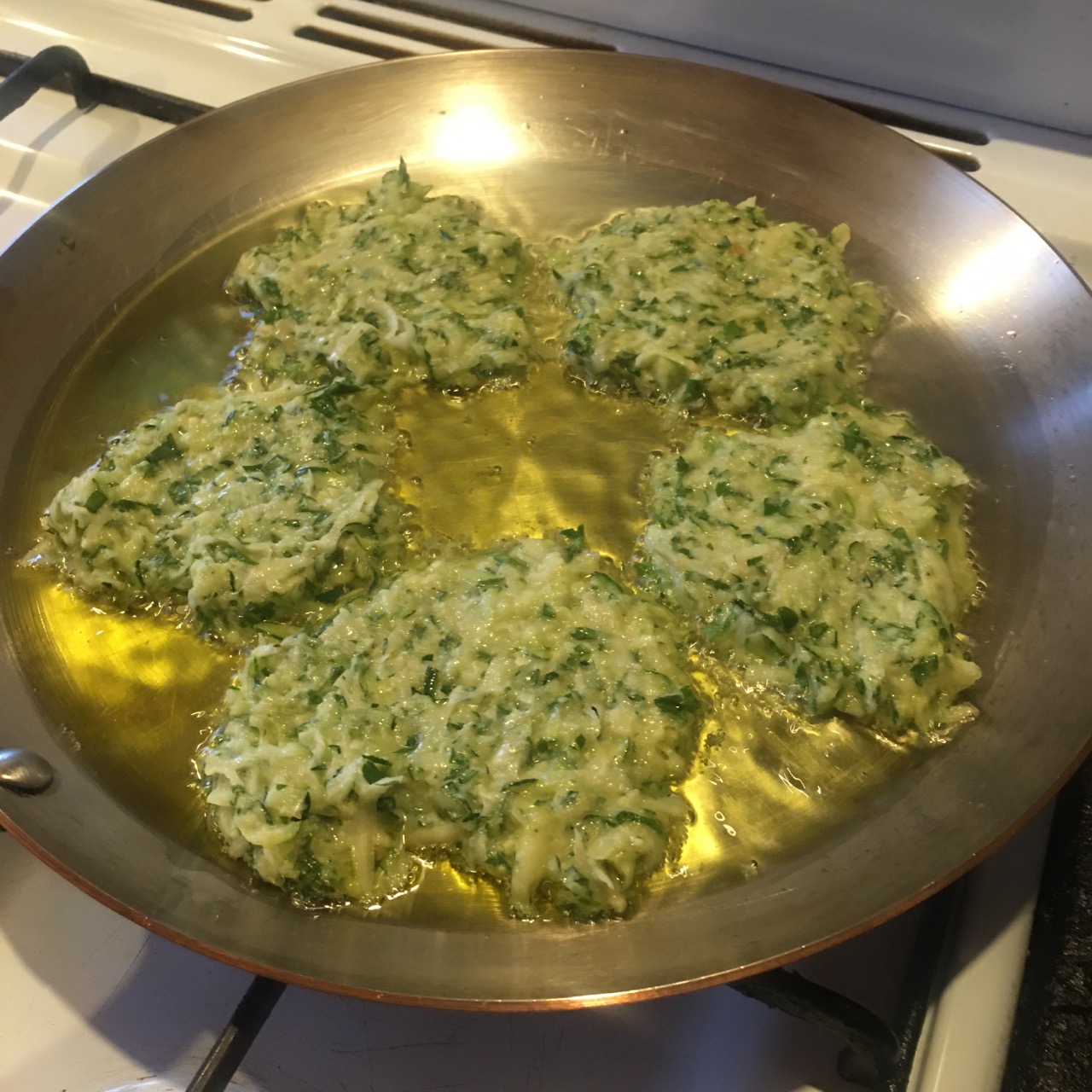
Pan fry in a little olive oil. It’s a great way to use up those pesky zucchinis that got away and are past their best for BBQing or steaming. Just as long as the seeds haven’t become too well developed. If they have, just slice them long ways and scoop out the seeds and use the outer layer of zucchini.
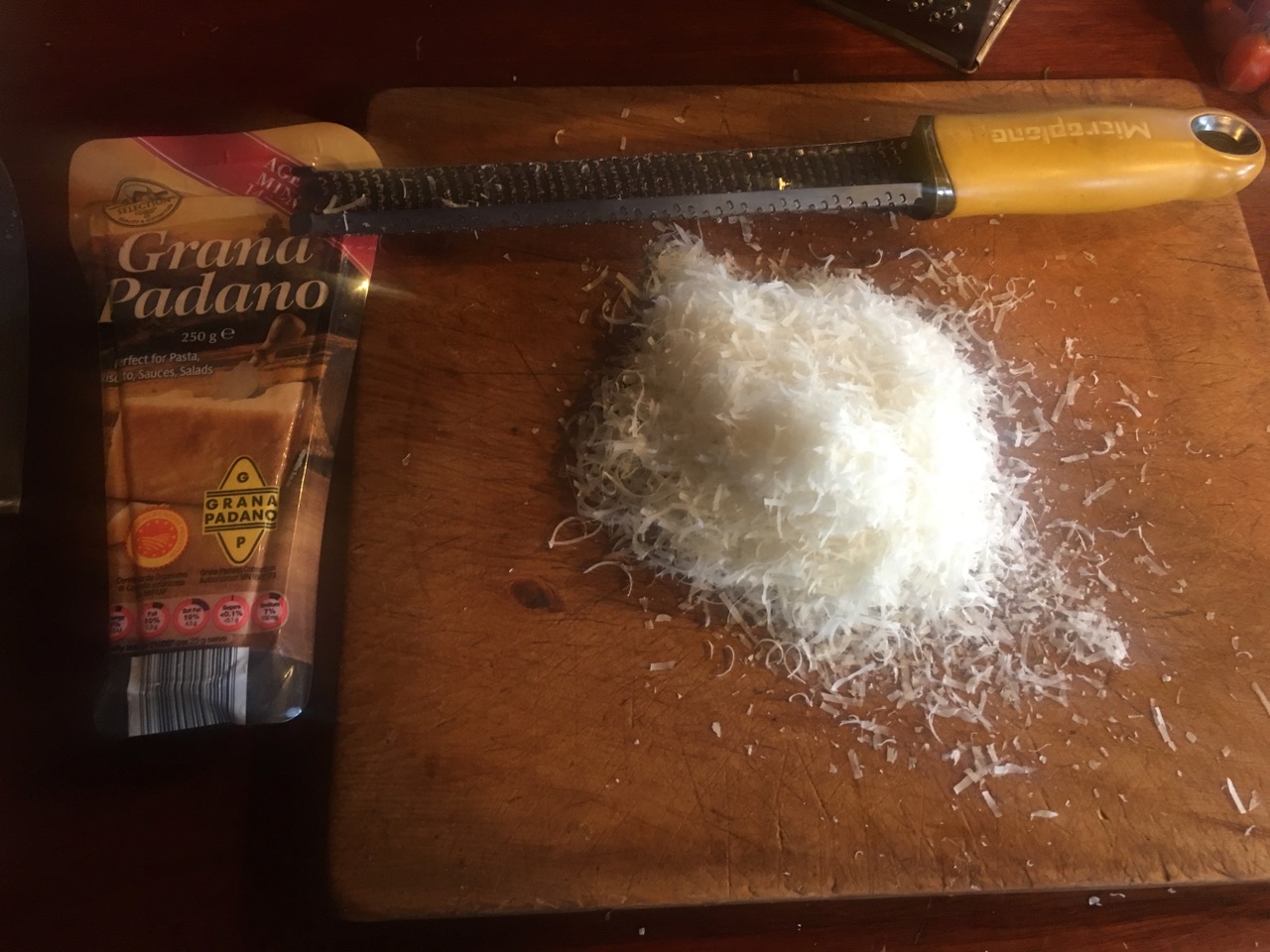
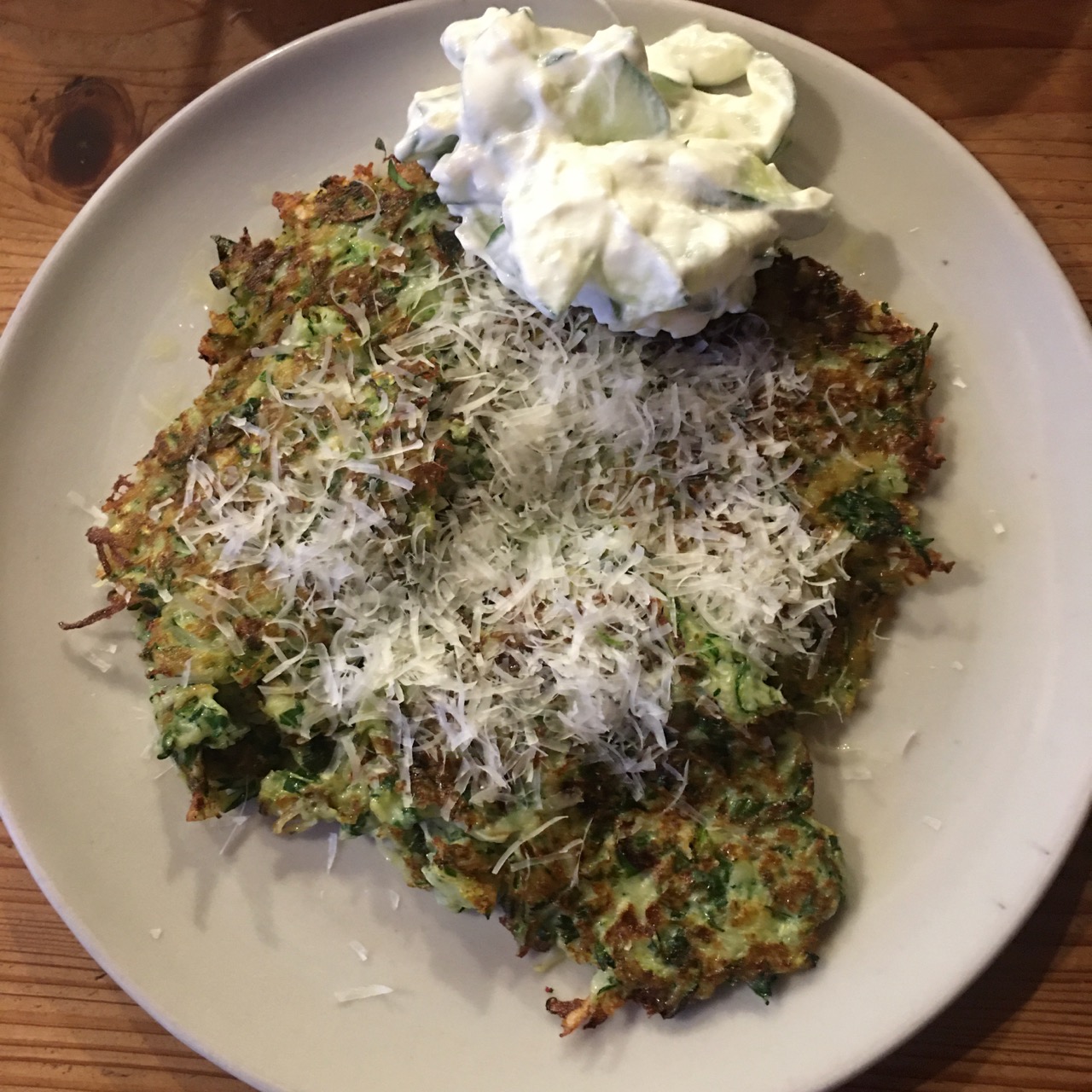
 

Top with a little grated parmesan and serve with garden fresh tzatziki. I slice the cucumber pretty finely, dice up the garlic and crush it to a paste with the side of a broad chefs knife along with a sprinkling of salt. This really liberates the full flavour of the garlic. Mix with thick Greek yogurt and its ready to serve in no time while the fritters are cooking.I love these kinds of immediate, garden-fresh meals. Simple, tasty, very healthy and quick, with very little cleaning up.  

This is just about as close as it gets to self reliance, served on Janine’s hand made plates, straight from the garden and onto the plates within the hour. The only thing that we bought was the parmesan. It keeps well in the fridge for ages and serves as a finishing touch on many meals.
A new year, a new beginning

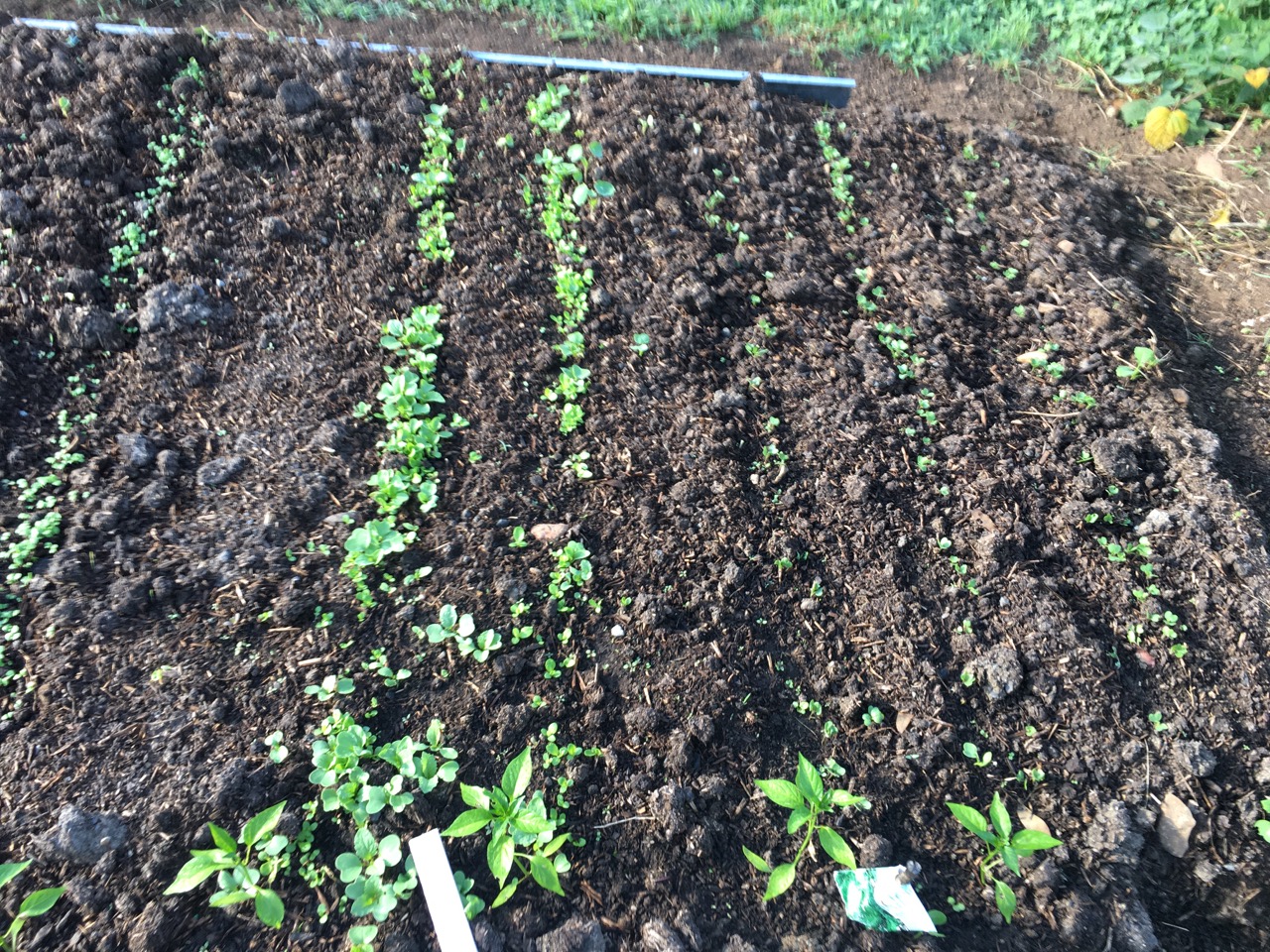
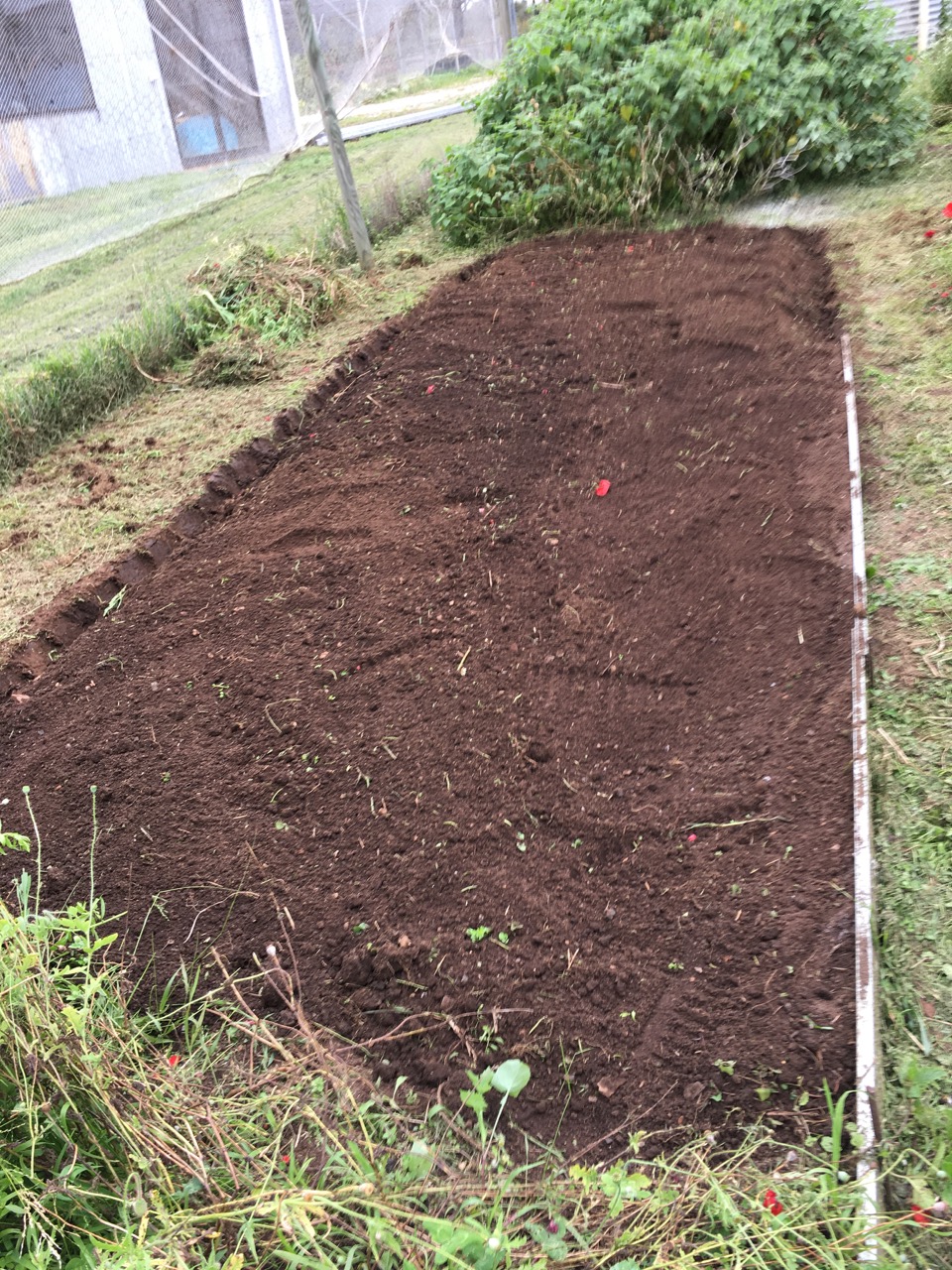
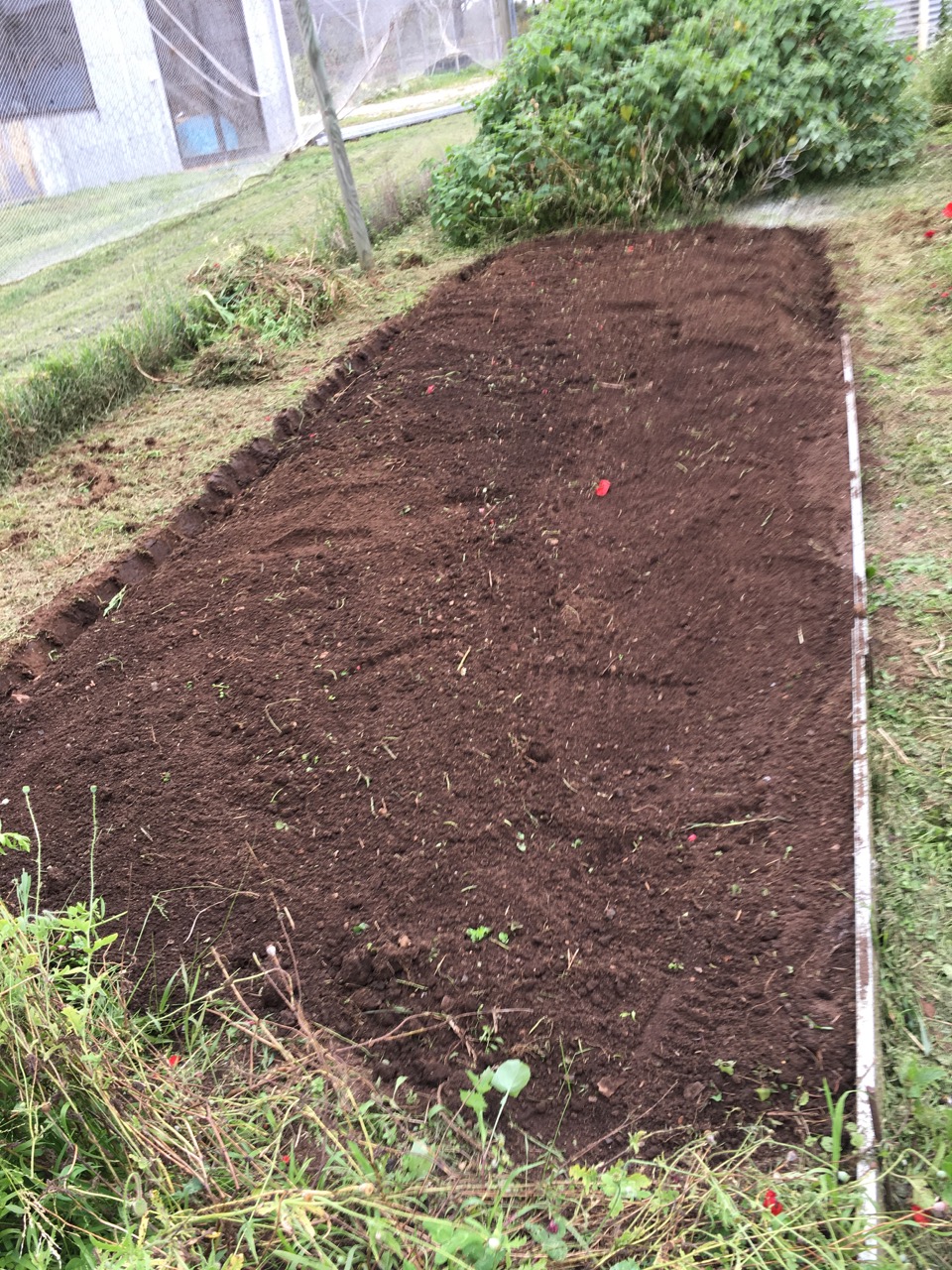
Two weeks ago I got into the garden and cleared out a lot of veggies that had gone to seed and even more weeds that had slowly crept in during the time I was otherwise distracted by the more pressing jobs of bushfire recovery and re-building. I’m back now and making more time for the garden. It’s only taken two years, but we managed to keep the vegetable garden going all that time, sort of limping along, but being productive in a minimal way. There are still 3 of the 4 beds that need the same severe clearing out, thorough weeding, composting and restarting with fresh seeds.The new bed is now starting to turn green with the newly emerging shoots of basil, chilli, sweet corn, radish, beetroot, carrots and cabbages.

The weather couldn’t be more perfect just now. It might be the beginning of summer, but it hasn’t become too hot yet to plant out some more summer veggies.It is also time to think ahead and consider that autumn is just a few months away. If we want to get some good cauliflowers, Brussel Sprouts and cabbages going. Now is the time to think about it.

When we first came here in 1976 there was a hardware shop in the nearby village of Thirlmere. It had been there since before the war. It was run by the elderly Middleton Bros. Their business was started by their father a generation before them, who had originally taken a horse and dray from farm to farm, orchard to orchard. Selling hardware and iron mongery items door to door, Eventually building up a clientele sufficient to start a shop front in the village.

His business grew over the years and expanded eventually taking over the three or four shops next to it, until it occupied a considerable slice of the main road shop-fronts. The Middletons eventually sold everything from hardware and building materials through fencing wire and agricultural supplies like fertiliser and chook feed, bales of hay to galvanised water-tanks, household items and small electrical goods. They even had a haberdashery dept. and a tiny supermarket.

On our first visit there we bought a large galvanised laundry tub there as well as a pepper grinder and even ordered our first galvanised water-tank for the old School plus all the plumbing fittings that were required to go along with it. I picked up a hardwood adze handle/shaft which was still priced in pounds, shillings and pence.

The conversation went something like this;

“This says that it costs one pound, two and six. How much do you want for it now?

Mr Middleton smiled kindly and said, “Let me see now. One pound, two and six That would convert as $2.25″

“But this is 10 years later!” I replied.

“That’s OK, $2.25 will do”

We walked through to the haberdashery dept, and Janine asked the lady, in her 60′s then, who had worked there all her life, woman and girl, if she stocked circular section, leather drive belts for foot operated treadle sowing machines. As Janine thought that if anywhere would have one it might just be here. The lady politely replied. “What size would that be, large or small, stapled or bonded?” She had several in stock to suit the various machines that had been on the market over the years!

Mr Middleton stocked real charred-hide blood and bone fertiliser with the blackened fragments of hide, hair and bone chips all in there, direct from the abattoir in those days!

We bought seeds from the gardening dept. and I remember well that he gave me the following advice. That we should plant out the brassica seeds on Boxing Day and trans-plant them on Empire Day!!!! – which is now Australia Day.

So loosely, this translates as germinate brassica seeds on the summer solstice, around the 26th of December and transplant the seedlings once they have their second set of leaves, a month later on the 26th of January.

This was very good advice and I have followed it ever since with good results.

The Middleton brothers were kindly souls, always polite and attentive. They wore aprons over their suits and ties. Card dealers eye shades over their foreheads and sleeves held back from their cuffs with silver, metal, expandable, spring-loaded, sleeve retainers. For want of a proper name. I don’t know what these items of apparel are really called.

They seemed to have fashioned themselves on old-fashioned, out-back, western, casino croupiers. An odd, but somehow comforting, look after a while, when we got to know how helpful, friendly and attentive they were, it just became normal.

I really miss them!

Of course things have changed, the weather is getting warmer, the summers longer and the winters shorter. Fewer frosts and less severe. Added to that, there has been a lot of effort put into breeding new varieties of vegetables to remove their bitterness. Plants like aubergines used to have to be salted to remove some of the bitterness. This hasn’t been the case for a long time. The new varieties are quite sweet. In the case of Brussel sprouts. when I was younger, they were quite bitter. These days that bitterness has more or less been bread out and I don’t believe that it’s a good thing.


The bitterness in vegetables had some health giving benefits. The older heritage varieties of brassicas. The ones that still have their bitterness still in them, The ones where it hasn’t been bred out yet. These are thought to be very good for you.

Prof. Mark Mattson, of Johns Hopkins University has written a few articles about this. I read one in New Scientist magazine a while ago. “Whatever doesn’t kill you makes you stronger”. To summarise. The bitter principal in these veggies stimulates your immune system and tones you up. The Brassicas have several bitter phytonutrients that are produced by the plant to make them unappetising to predators – like us, as well as caterpillars. Sulforaphane is one such protective phytonutrient that gives them the particular sulphur smell. It has anti-cancer functions and is an antioxidant. Sounds pretty good to me. But yes, they are bitter.I steam them briefly, then stir fry them in olive oil, garlic and herbs. It works for me.

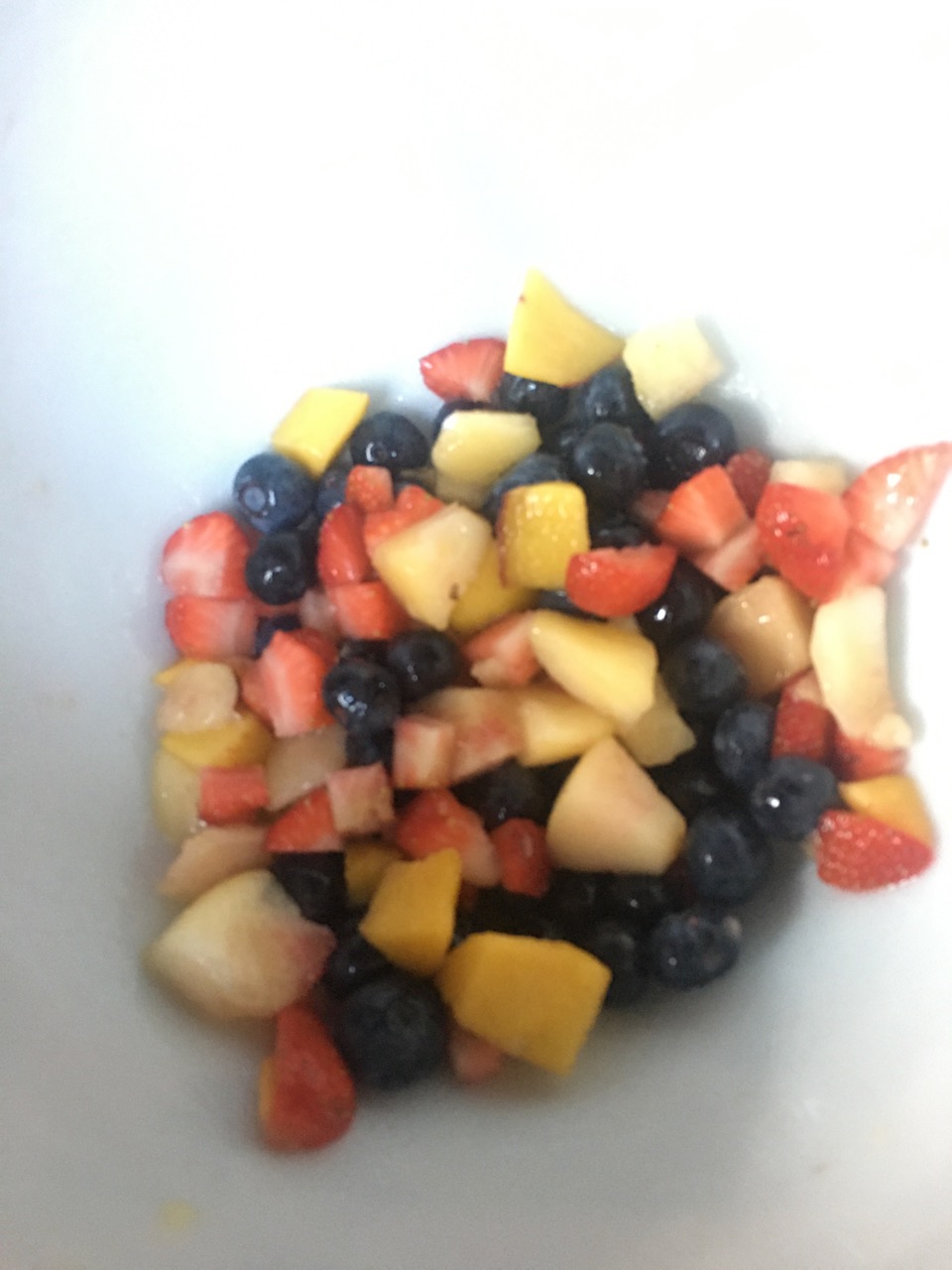
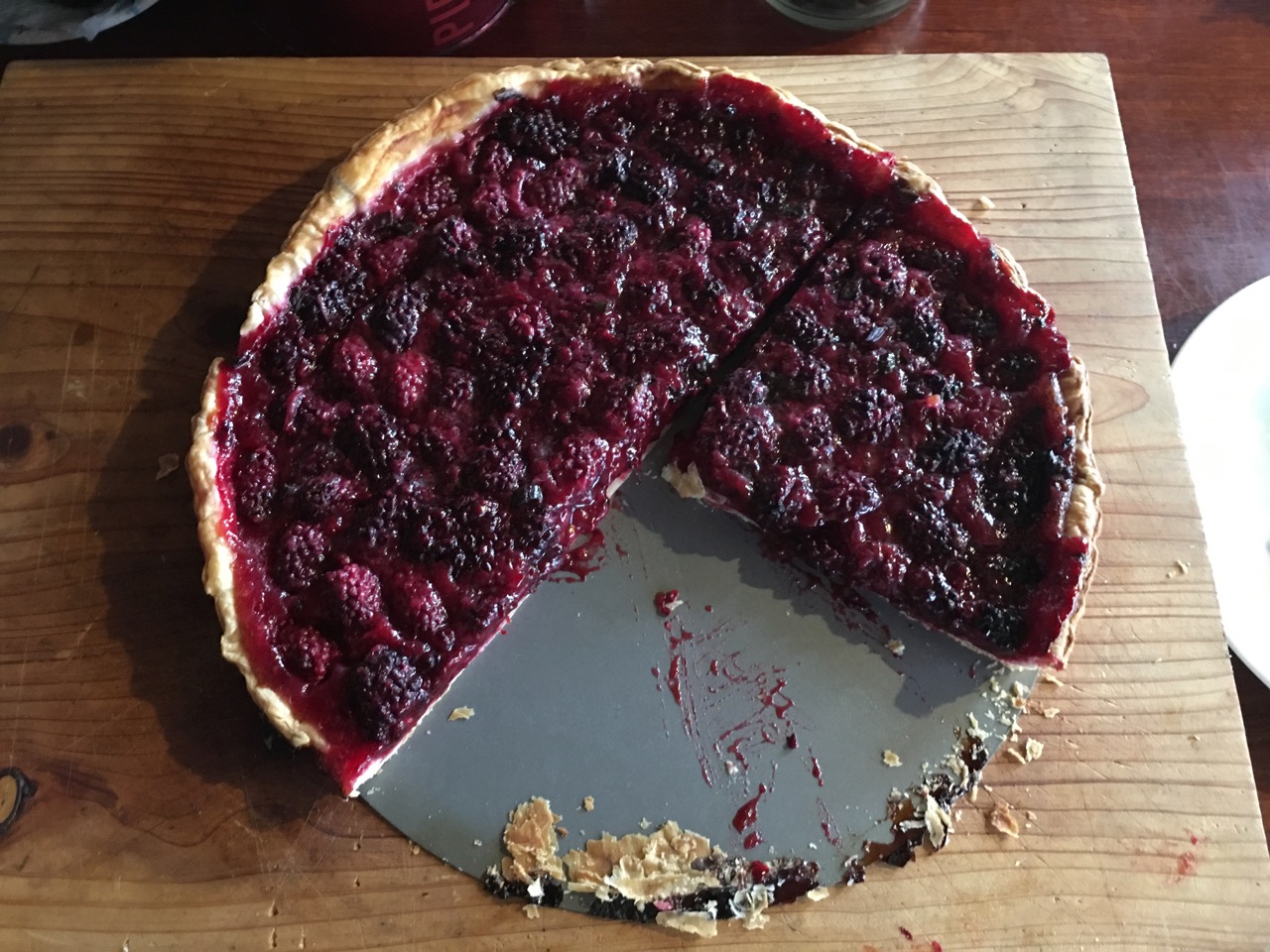
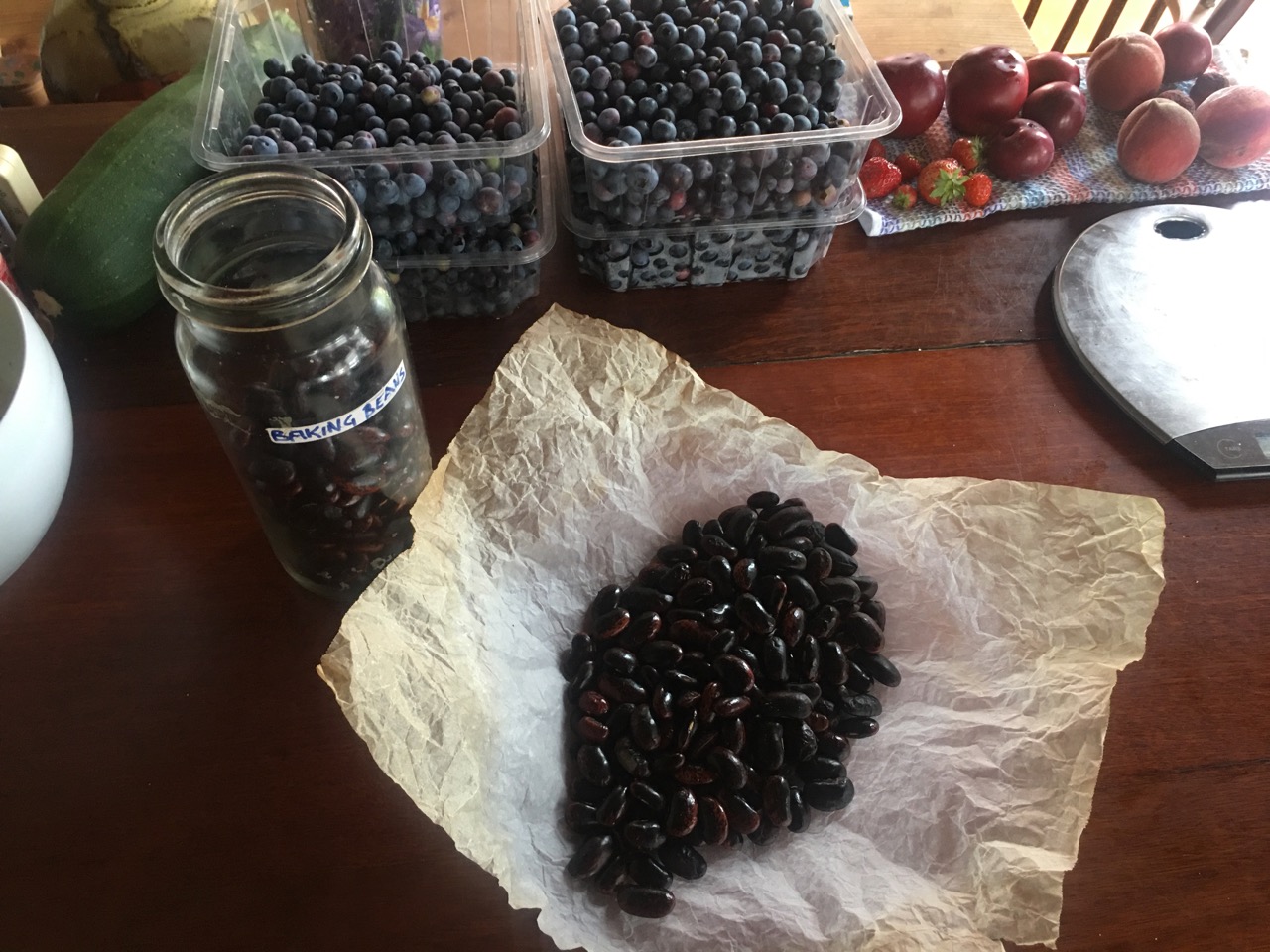
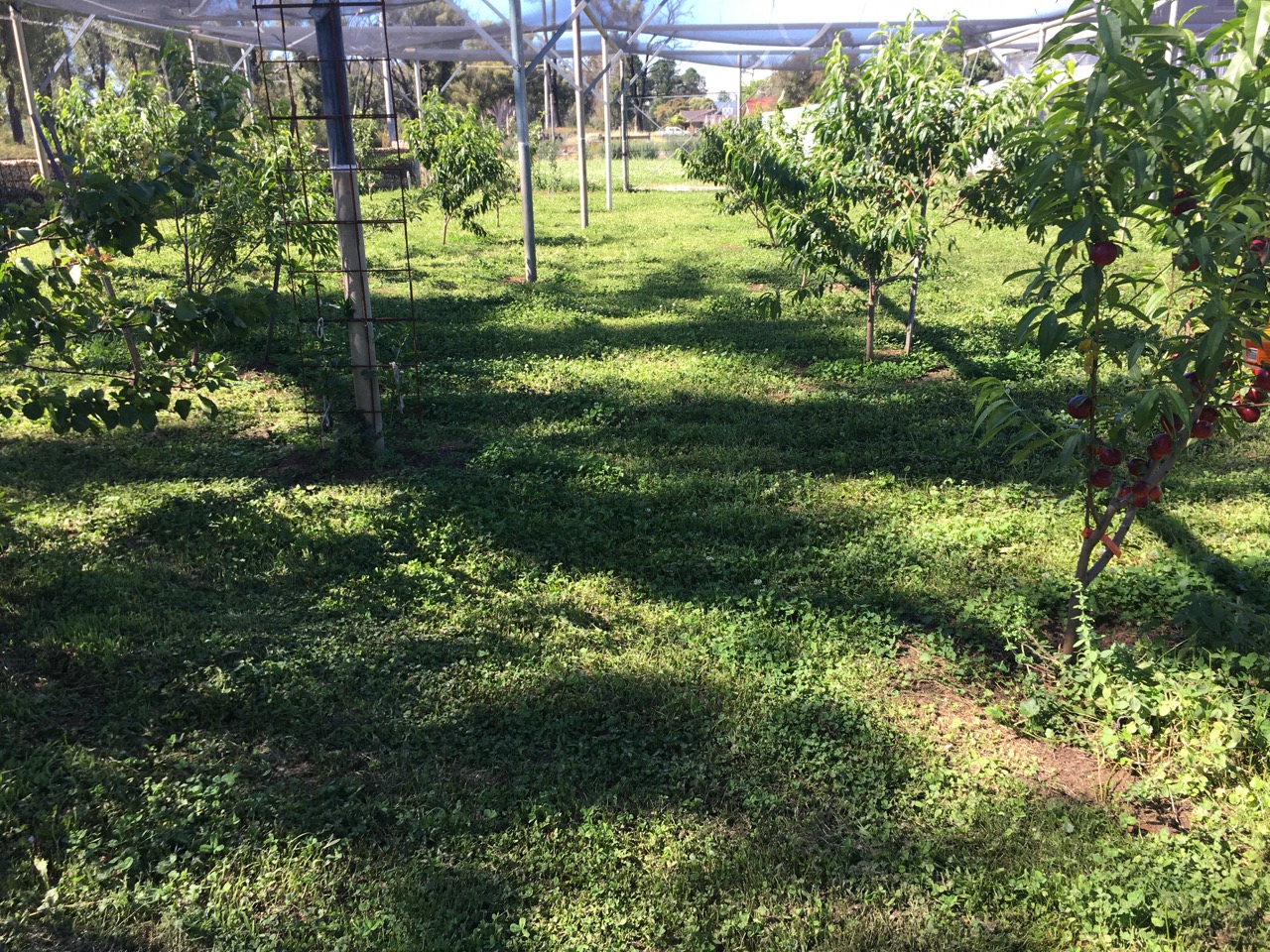
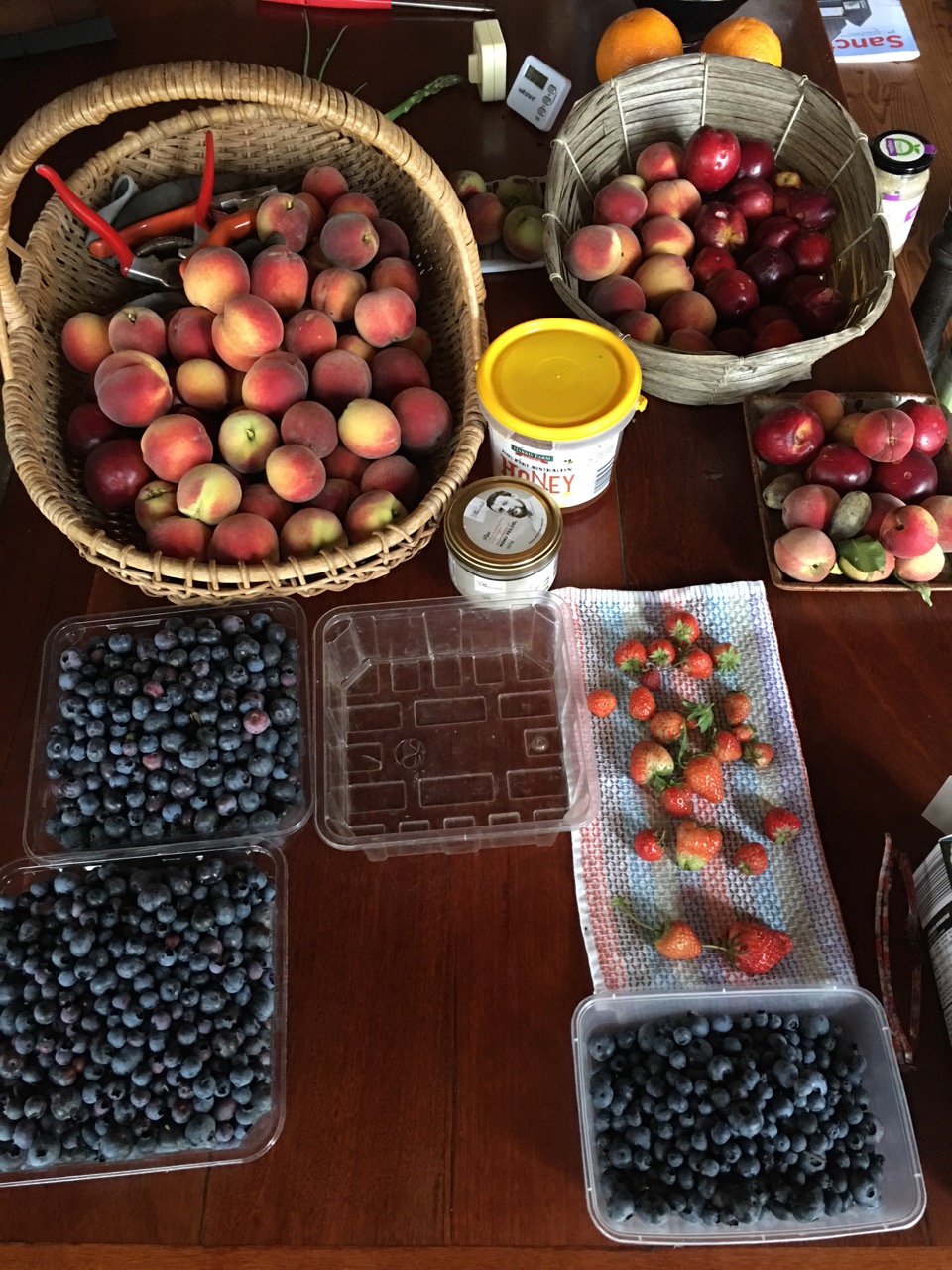
The new stone fruit orchard has really hit its straps now and we are eating strawberries  peaches, nectarines  and blue berries. Mostly as fruit salad in the mornings, but also as fruit tarts that I cook for morning teas and deserts.


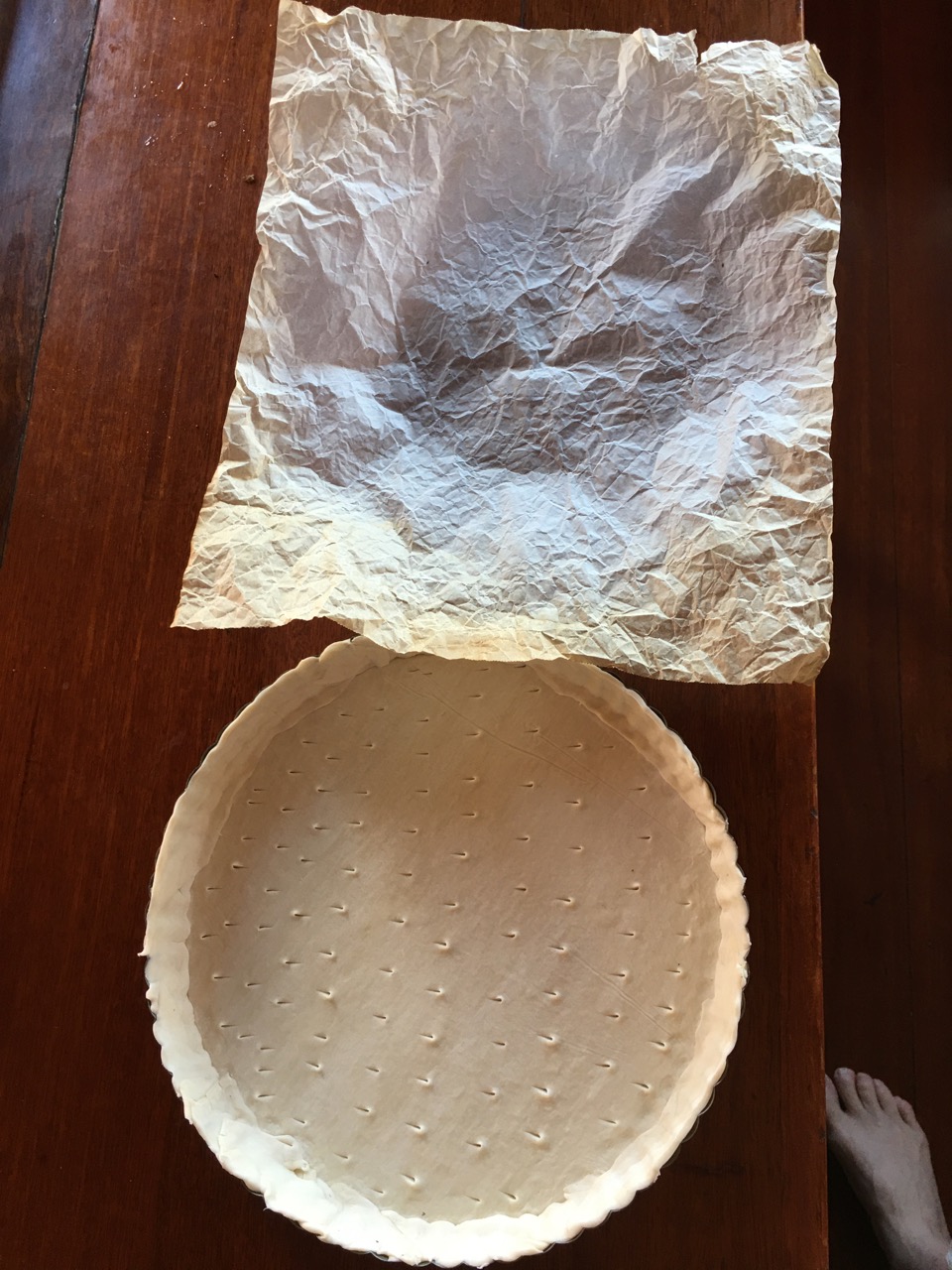
I have managed to get about 10 uses out of the crumpled sheet of baking paper that I use for blind baking the pastry casings with baking beans. I flatten it and put it aside for later use. I think that it will out last the berry season. I’ll shout myself a new piece of paper new season. Waste not, want not.


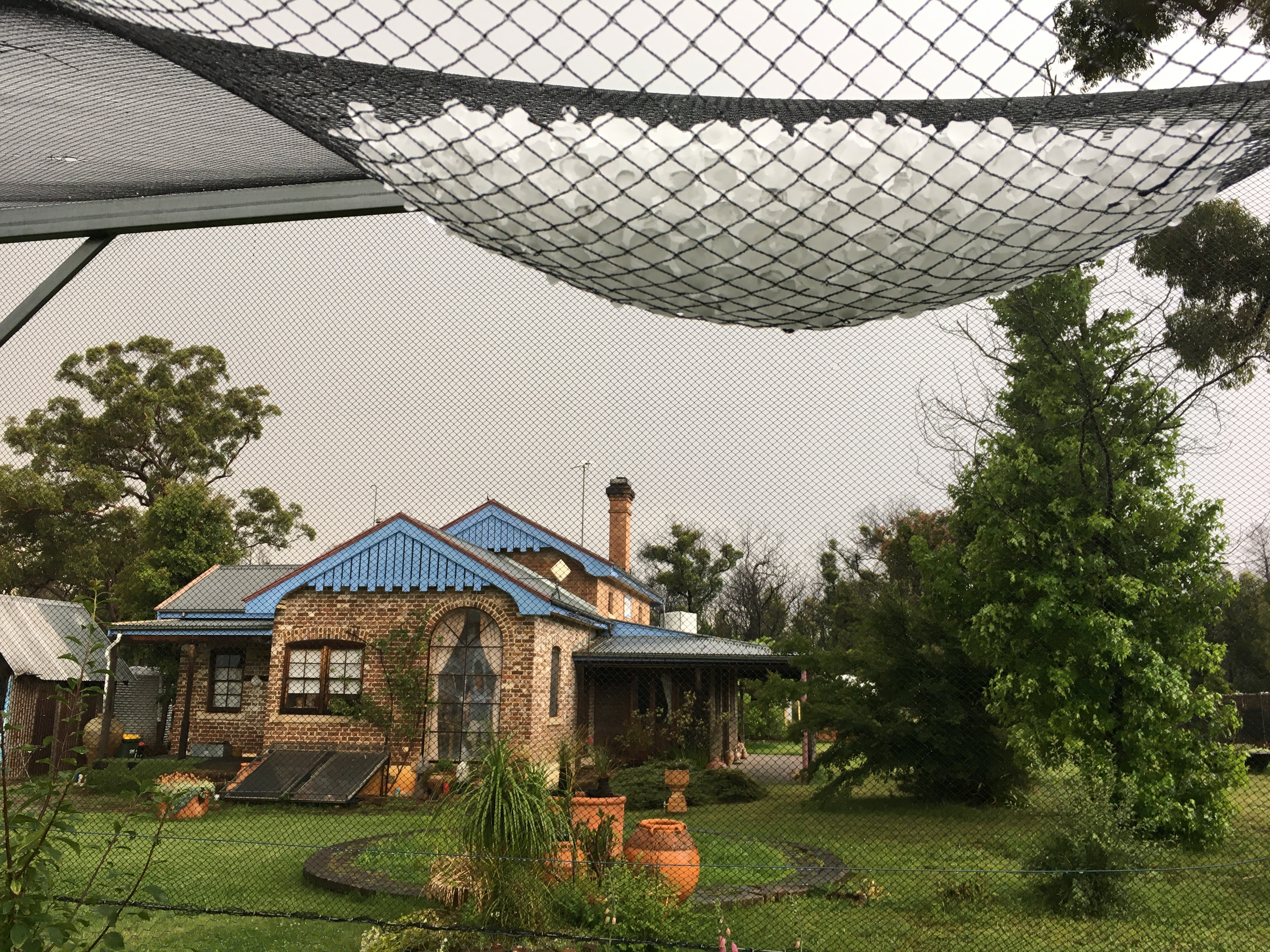
Between Xmas and New Year, we had a massive thunder storm with severe hail between 20mm and 30mm dia.. It was so big and it came down so hard and fast that it filled up the nylon roof netting over the orchard and veggie garden. Being too big to fall through, it just piled up and got caught there in mid air, causing the netting to be weighed down and sag into circular hammock shapes. Fortunately, because if we hadn’t netted the garden and orchard, there would have been nothing left of the plants and fruit trees.


As the latest sowings of seeds germinate and appear, its a reminder of the perpetual cycle of life and renewal. A new beginning for the new year.


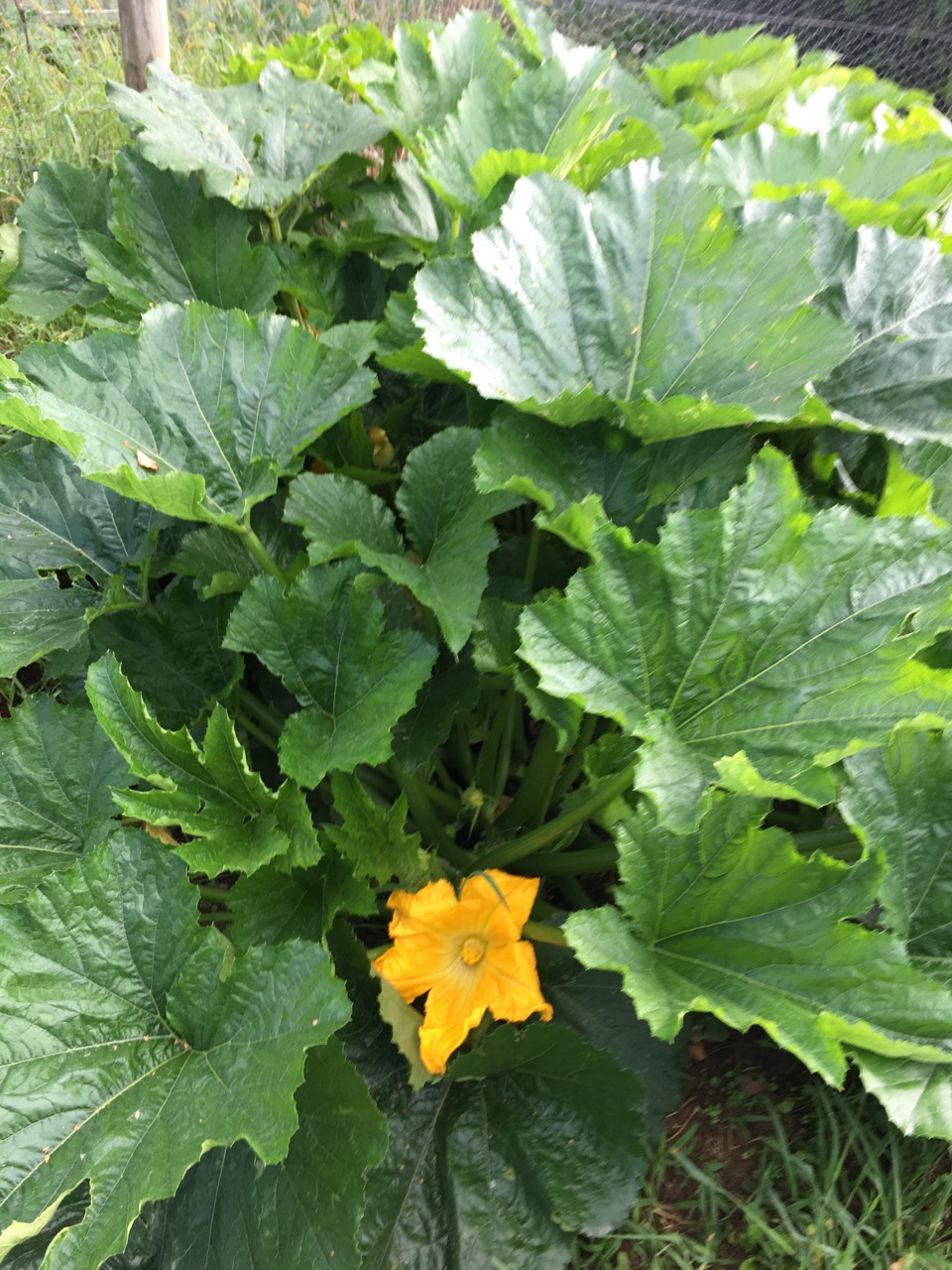
Besides fruit, almost every other meal must involve zucchinis, squash or sweet corn. The tomatoes are not quite ready yet, but are so close. Once they start to come on, then we will enter the phase of summer dining where every other meal will be some form of ratatouille  🙂

Good Day Sunshine, some good news to end the year.

We have been busy – always busy, but we have managed to organise a few impromptu get-together parties with our neighbours, the ‘creatives’ of Balmoral Village. We have all been fire-affected in some way, some more than others, but we have survived and we are looking forward. We organised these dinners to ‘catch-up’, share news and ideas, but mostly to take some time out to celebrate each others company. We cleared out the big central room in the new pottery because it has beautiful light and plenty of space. We can fit 10 at the big glazing bench, 11 or even 12 at a pinch. It’s been very enjoyable to share time and food in this way. Although just as much work preparing and then washing up and cleaning, then setting everything back in its place, as it is building the space.


This week I booked the electric car in for its third service. It been amazing driving around these past 3 years on sunshine. It’s a plug-in hybrid, so it does have a petrol engine in there as well as the battery and electric motor. We can do all our local running around entirely on sunshine, but every now and then we go a little farther afield and we come home on petrol. When the battery is fully charged and the fuel tank is full, it has a range of over 1100 kms. However since that first fill 3 years ago, we have not filled the tank since, as it took us the best part of half a year to use the fuel up. It’s not good to store petrol for so long. It can go gummy, or ‘off’. Since then we have only put $20 in the car every 3 months or so, even that is a bit long, but it seems mean to pull into the service station and only put $5 in each month. We seem to have settled into some sort of routine of going to the petrol station quarterly.


We charge the car and our Tesla battery from our solar panels on the shed roof. We produce a maximum of 5.3 kW of electricity on the best sunny days, but much less in overcast and rainy weather. However, this size of Solar PV installation is enough to charge our car, run our house and pottery, even fire the electric kiln, AND we still have some excess to sell to the grid on an average day. These days, we earn over $1000 per year, (it used to be double that) while living, driving and firing our kiln for free. We went solar in 2007. We haven’t paid an electricity bill since. The system has well and truely paid itself off over that time. Interestingly, as more and more people connect SolarPV to the grid, the price that the utility pays us for our power has progressively gone down. Years ago, we used to get 60c or 70c kWh. Over the past 4 years the price that we get has dropped from 21 cents per kW/hr, down to 19, then 17 and now 10 cents. I can see it being 7 or even 5c next year. It’s great that more and more people are going solar. If not fully, like we have, but every little bit helps get more coal power and its pollution out of the system.We didn’t go solar to make money, but it has turned out that we have. We went solar to try and minimise our reliance on the fossil fuel economy. That has certainly worked out very well.
Our power bill tells the story.


We consume less than 1 kWh per day on average over the year. We have spent our life here honing our self-reliant skills to consume everything minimally. Our 0.91kWh is about 1.5% of the ‘average’ 2 person household, yet we live in a very old house, (128 years old) not a new solar passive one, and don’t ‘want’ for anything. It can be done.

The utility charges us about $1 per day to be connected to the grid. Their ‘access’ charge. This has been steadily increasing over the years, while the feed-in tariff has been gradually dropping. At the moment we pay $1 a day to be connected to earn $3 per day. I can see a time when this balance reverses. I guess that’s when we start to think about the 2nd battery and disconnect from the grid. I’ve read that this is called the death spiral of the electricity industry, but I can’t see it happening, as it takes a lot of effort and planning to live a life of minimal consumption like we do.


All this rain has the garden growing very well. I’ve been putting in a lot of effort in the veggie patch recently. It’s looking more loved now and providing us with all our green food. The warmer weather combined with the rain has the grass growing it’s head off. Janine and I spent half a day each yesterday mowing to keep it under control. We haven’t had to mow this much for years. All the greenery is very soothing on the eyes.
All in all, the COVID plague aside, it’s looking like a pretty rosy year ahead.

After The Fire – 2 years on

Now that the pressure is off for taking part in the Open Studio events, we can relax a little. We were lucky. We managed to get sufficient glazed work finished to put on a reasonable show.The next big job is to re-build our wood fried kiln, so that I can make the work for the PowerHouse Willoughby Bequest commission. As we are in need a bit of a rest after two years of constant work and anxiety about finances, materials, parts, Local Council regs, electricians and final inspections. It’s good to have this time before Xmas to do a lot less.

Janine is spending a few hours each day back in our lovely new and very comfortable pottery studio, making a few orders from the Open Studio weekends, but principally because I have promised to make a bathroom vanity sink for our neighbours new house. As we were fully occupied recovering from our own bush fire ordeal, we couldn’t help them rebuild their house very much. So making them a bathroom basin is my best gesture towards recovery.
The basin is too large for our tiny electric kiln, so will need to be bisque fired in the bigger gas kiln. We can’t afford to fire the kiln with just one pot in it, so Janine is making work to fill the kiln and make the firing more economical  We are not pushing ourselves, just taking it slowly. A few hours a day is enough. There are so many other jobs that need our attention, just to keep the veggie garden and orchards in good nik and under control. Mowing is the main job these days, as it keeps on raining and getting warmer, so the grass grows quicker.

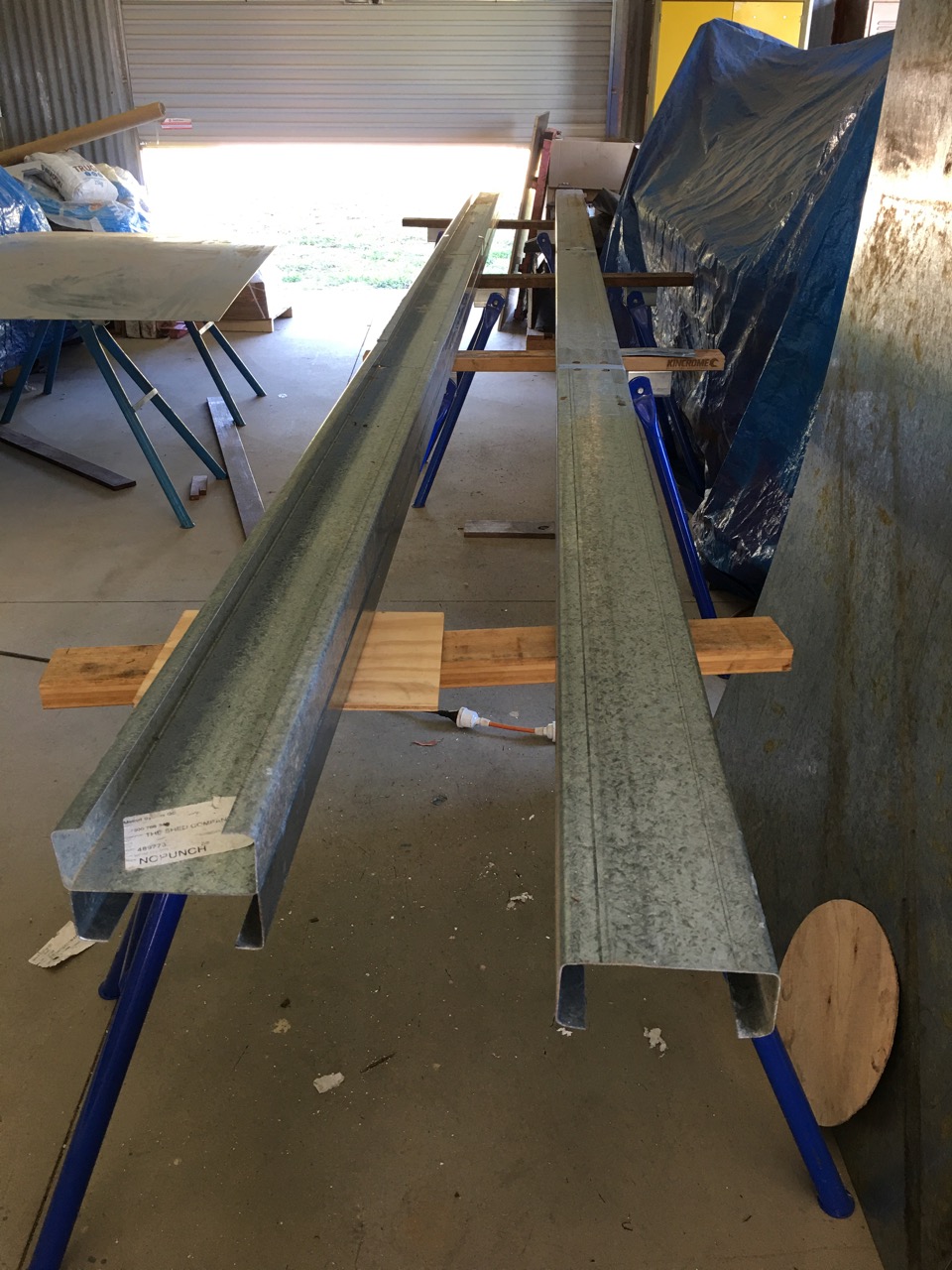
While Janine enjoys the luxury of the new pottery. I am out in the maintenance shed welding together a pile of pressed metal ‘C’ purlin off-cuts. joining them together to make useful longer lengths. I am joining up to 7 small bits into one 6 metre length that is more useful. I will bolt these ‘recovered’ lengths back to back with some new material to make a composite ‘H’ section. These will make very strong uprights and purlins for the new wood kiln roof.

I don’t particularly like working with steel. It’s heavy, sharp, noisy and dangerous stuff to move around, but it surely does a great job of being strong and resilient  These thin beams will span great distances. The specific thing that I love about steel is its ability to be welded back together to make it larger and stronger. I’m told that a 25mm weld can hold over a tonne. That’s strong. And if I accidentally make a mistake and cut a piece of steel too short. Well, if it were a piece of wood, it would be wasted. I would have to use it up in another job where a shorter length was needed. You can’t join timber back together. However in the case of steel. It can be welded back together and the joined pieces can be stronger than the original – if its done properly!So I have saved all the off cuts from the pottery shed frame that the builders threw onto the rubbish pile. I put them aside and Janine later stacked them carefully so that now they can be put to good use making the kiln shed frame and roof. Reuse, recycle, up-cycle  waste not want not. etc. I take a great deal of pleasure in being able to forestall waste in this way with this kind of ‘thrifty’ building work. It has been being self reliant like this that has got us to where we are now in life on our small income from our creative endeavours.
In the mornings we work in the vegetable garden, clearing out swathes of overgrown weedy stuff that has more or less finished its productive life. 

Then when the sun gets up higher, we have lunch and stay inside for the afternoon doing our ‘inside’ jobs until the heat of the day has subsided. Sometimes this heat culminates in a thunderstorm, two days ago we had hail with the thunder storm. This is something like the summer weather that we used to get decades ago. Possibly the last time that we had strong La Nina conditions?
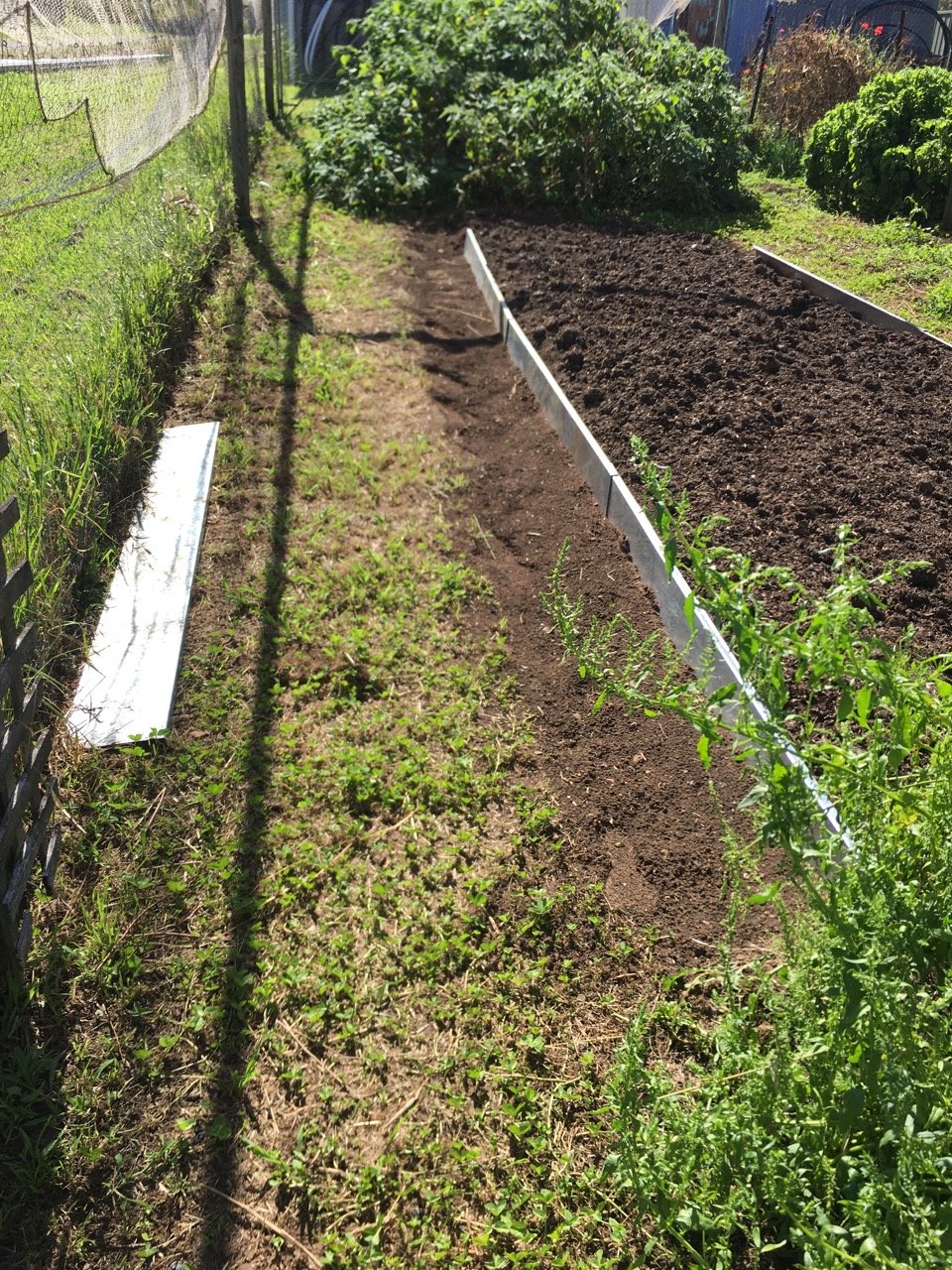
If I have to be stuck inside at these times, I spend time making something useful that will improve our lives. Today it was some garden bed edging that I cut and folded out of scrap galvanised sheet steel that had been laying about since the fire. We have decided to shrink the garden beds a little bit to make them narrower. This will result in making the garden paths wider. Once this is completed, we will be able to drive the ride-on mower through the veggie garden and save hours manhandling the whipper snipper around the current narrow paths which is becoming quite tiring work for me these days. Especially as it needs doing almost every week.

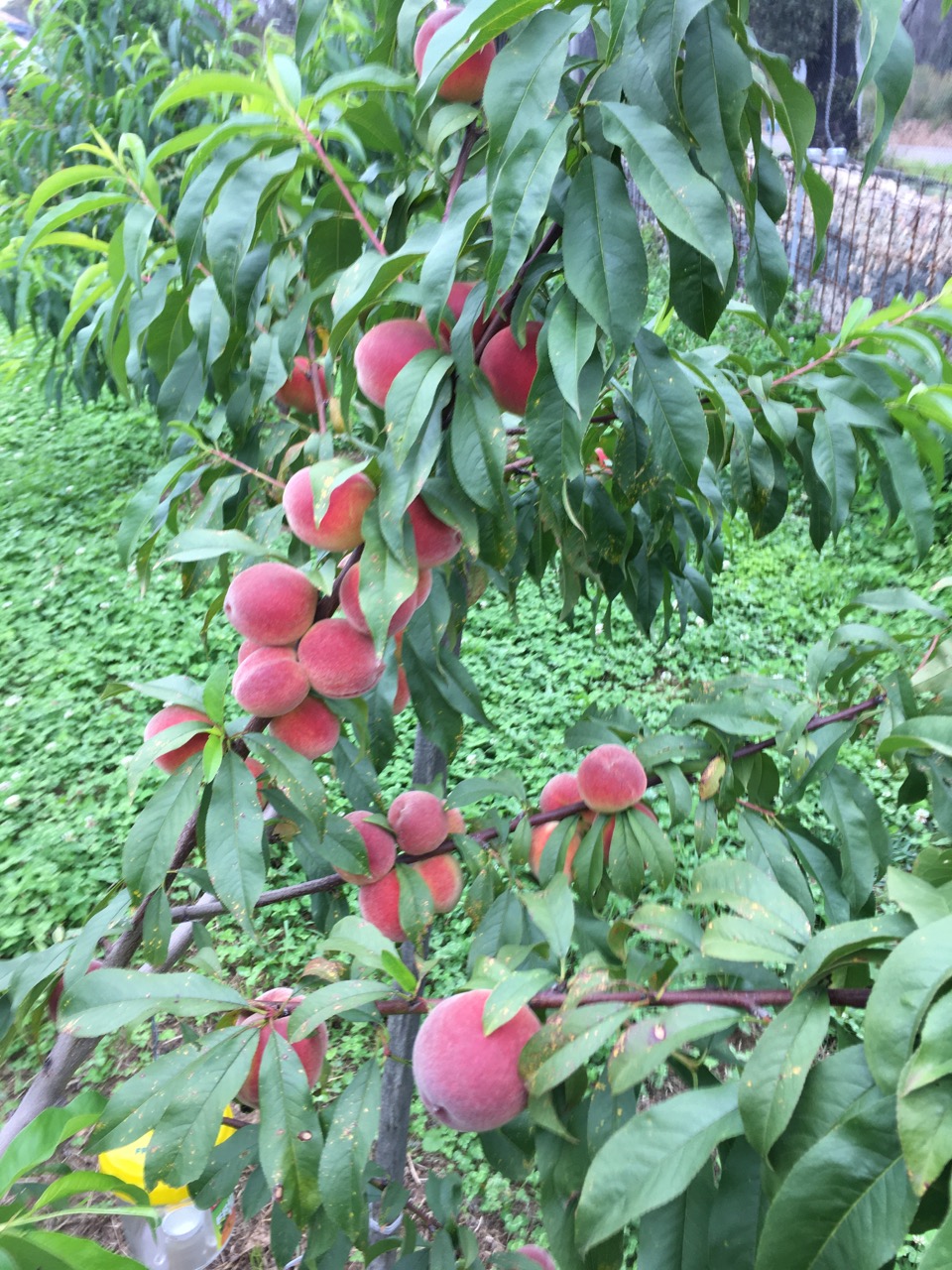
Everything that we have done since the fire has been oriented towards making our future life here easier. Building the new pottery on a cement slab floor for the first time, so everything can be on wheels – possibly including us in our dotage! We have chosen all dwarf root stock grafted fruit trees for the new orchard, so no more climbing up step ladders to prune and harvest fruit. We planted these dwarf grafted whip-sticks in August 2020. These trees are now 16 months old and in their second summer. Some of them are doing really well and have set plenty of fruit. So much so that I had to go around a month ago and pick off half of the crop and compost it before it drained the vitality from the young trees.  I picked off over 100 small apples, peaches and necturines. I also did a summer pruning of some of the tallest leggy shoots to keep the trees in a sound open vase shape to promote good growth and development in the future.

Even though I thinned out the crop, we were still able to pick about 40 peaches and twenty necturines this last week.

We are also picking loads of blue berries at the moment. Half a kilo every second day. We have to find ways to use them up, as there are too many to eat as fruit salad in the mornings now. We preserve some and I have started to make blue berry tarts now, as the youngberry and logan berry crops are more or less finished. They never make it past Xmas. But this year in particular the constant rain and the hail really ruined the usual large harvest. Who’d be a farmer or an orchardist?
Two years on we have worked ourselves into a really good place. It can only get better. The past is the past. We are not looking back. Everything is in place to create some beautiful and meaningful moments in our life.

Self Reliance, Rock Glaze and Crushers

Each week I attempt to crush and mill another local igneous rock for use as a glaze ingredient.This week I stopped off on the way to Mittagong Post Office to collect another stone, on the hill behind the post office.I passed it through the rock crushers that I have pains-takingly restored after the fire. Luckily, all these machines are made of very solid steel plate or cast iron, but more importantly, they were situated in the breezeway between the two buildings. Being largely out in the open with very little flammable material around them, just a polycarbonate roof over them. So they didn’t get too hot.They weren’t warped or melted. This meant that I was able to restore them, not just scrap them.New motors, bearings, seals, pullies and belts were required. The metal work was largely saved because I poured used engine oil all over them, straight after the fire and before it rained on them. With the assistance of my friends Warren Hogden and Len Smith, Along with my friend Dave and his crane truck, we were  able to lift them out of the rubble and up to a safe place, out of the way of the demolition crew and then tarp them in their oily state. This was just enough protection to stop them from rusting and flaking really badly.  
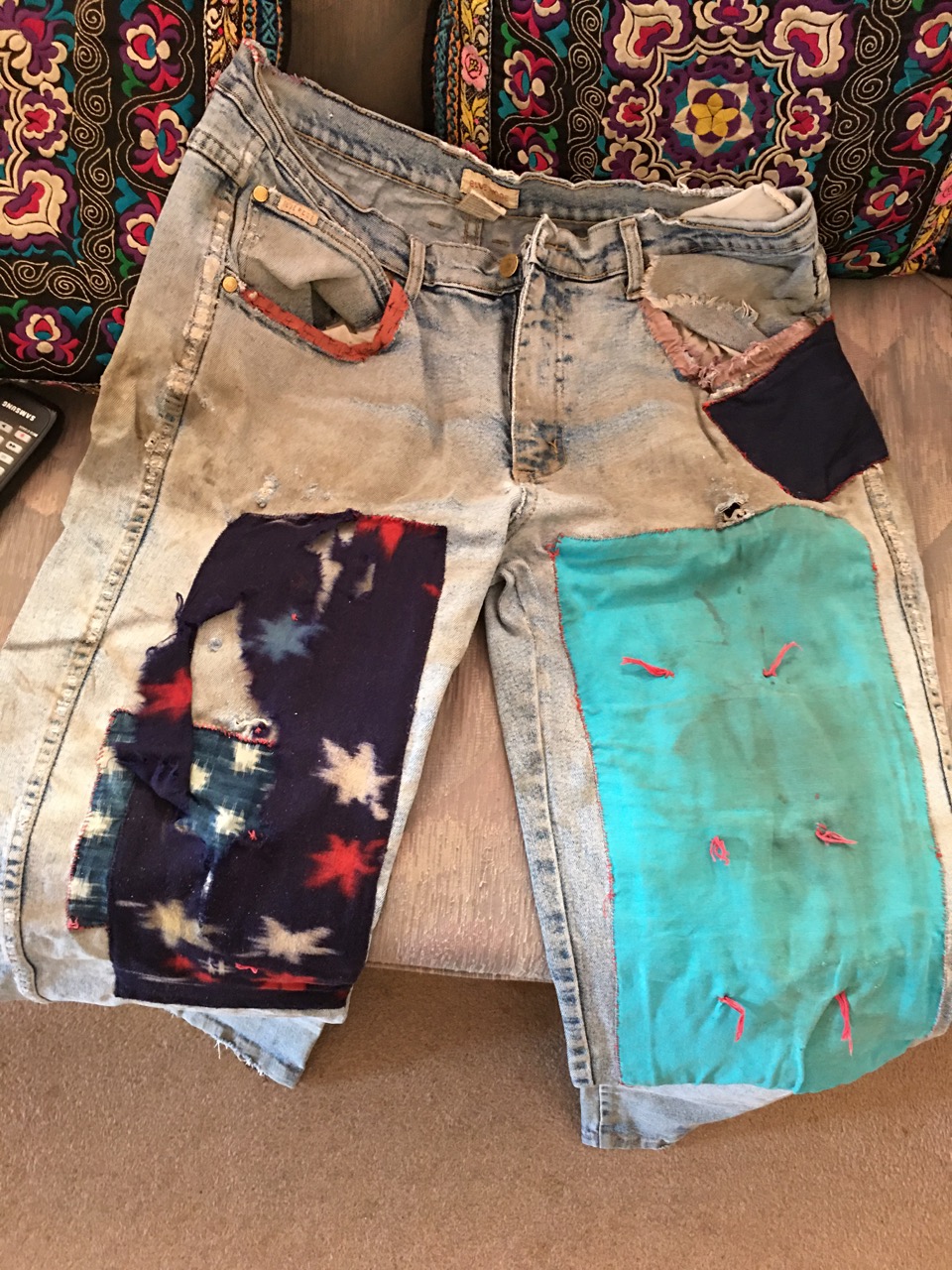
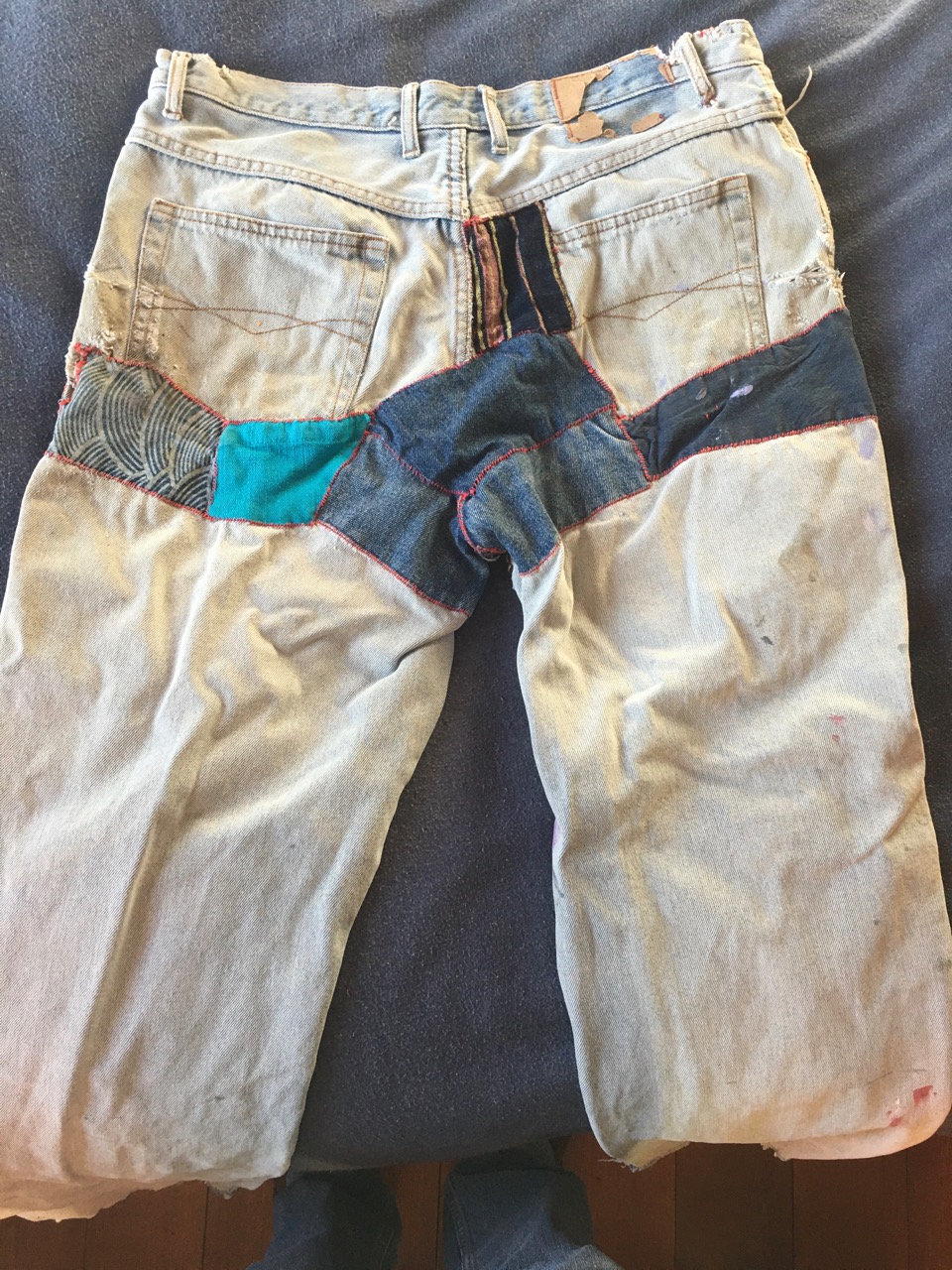
One very important aspect of my philosophy of self-reliance is never throwing anything out simply because it is no longer fashionable or is showing signs of wear. I keep working on my possessions, maintaining and repairing them, until they are really worn out, or past repair. In this regard, I have spent a lot of time patching and stitching my worn out work clothes and repairing some of my treasured pottery machines. Particularly the rock crushers. These things are as scarce as hen’s teeth and really worth working on. The Japanese have a word, ‘mortainai’ that means ‘making do’, I have written about it on this blog previously. It really sums up this repair and reuse philosophy.A year of part-time evenings has seen both my work jeans and the rock crushers back at work. These jeans are many years old and have patches over their patches, over their patches, especially on the knees.


My jeans mostly wear out at the knees and thighs, I have also had to reline the pockets, as the pockets are made from the lightest grade of cotton cloth that wears out in no time flat if you keep your car keys in there.

It’s just one more example of built in obsolescence. A product designed to fail. The retailers hope that i will just ditch the whole pair and buy another – in the latest fashion style! Well I won’t and don’t. I repair, re-use and re-cycle. I like to make them last me a decade. They start out as being for ‘best’ , going out etc. Then after a couple of years, they start to get a bit past their shiny best, they are worm in the pottery and for gardening. Finally after another 3 or 4 years, they are reduced to the welding workshop, rock crushing and angle grinding. This really takes it’s toll and they require more patches more often. In the past I have finally given up on them when I grew out of them and had to go up to another size. Then they became rags for painting and cleaning. These days I don’t get any bigger, so size isn’t the death knock that it used to be. Hence I a back log of three pairs of these patched jeans that just keep on being repaired and worn again and again.


But its not just the pockets, knees and thighs. They also wear out in the butt.


I think that ongoing hand stitched repairs like this are an important aspect of my creative expression. I exhibit my pots , but no one ever sees these creative endeavours. They are strictly utilitarian and for home use only, but this doesn’t meant that they are any less important. I kintsugi my pots and I patch my clothes. It’s the same thing.


After I had got the rock crushers going. I left it at that, as I wasn’t ready to crush any stones at that time. But the machines were ready.
At least I thought so. I didn’t have the time to test them all out with rocks. I didn’t even have any rocks at hand to try out. I was satisfied when the new motors were installed and the new drive belts were fitted in place, just to see the machines rotate successfully. That was all I got to do. Now is the testing time.


Straight off, there was one casualty. The smallest laboratory jaw crusher just doesn’t seem to work at all. I got it 2nd hand from a junk yard. I tested it, the motor ran, the shaft turned, it whirred and clanked, but now that I go to use it, nothing happens when I put rocks in. They just sit there bouncing around. Luckily, I only paid $250 for it. I’ll need to pull it to bits and find out why. But  that will have to wait till later, much Later… I have  other machines that do actually work and they are enough to get me started. What’s most important is that I can get some local stones powdered so that I can get a glaze firing full of test pieces done.


There were a few hiccups with the other machines before I got them all working. The big jaw crusher was found to be running back wards. I hadn’t noticed this when I first wired it up, as the degree of oscillation movement is very slight, but the first time I put stones in it, I noticed that it was very slow to engage with the rocks, it still crushed the chunks down to blue metal sized pieces, but very slowly. It was really only because I know this machine very well as I have rebuilt it previously over years and am familiar with it, such that I noticed its lack of performance. Luckily, it is a simple exercise to reverse polarity of a 3 phase motor. It works properly now.


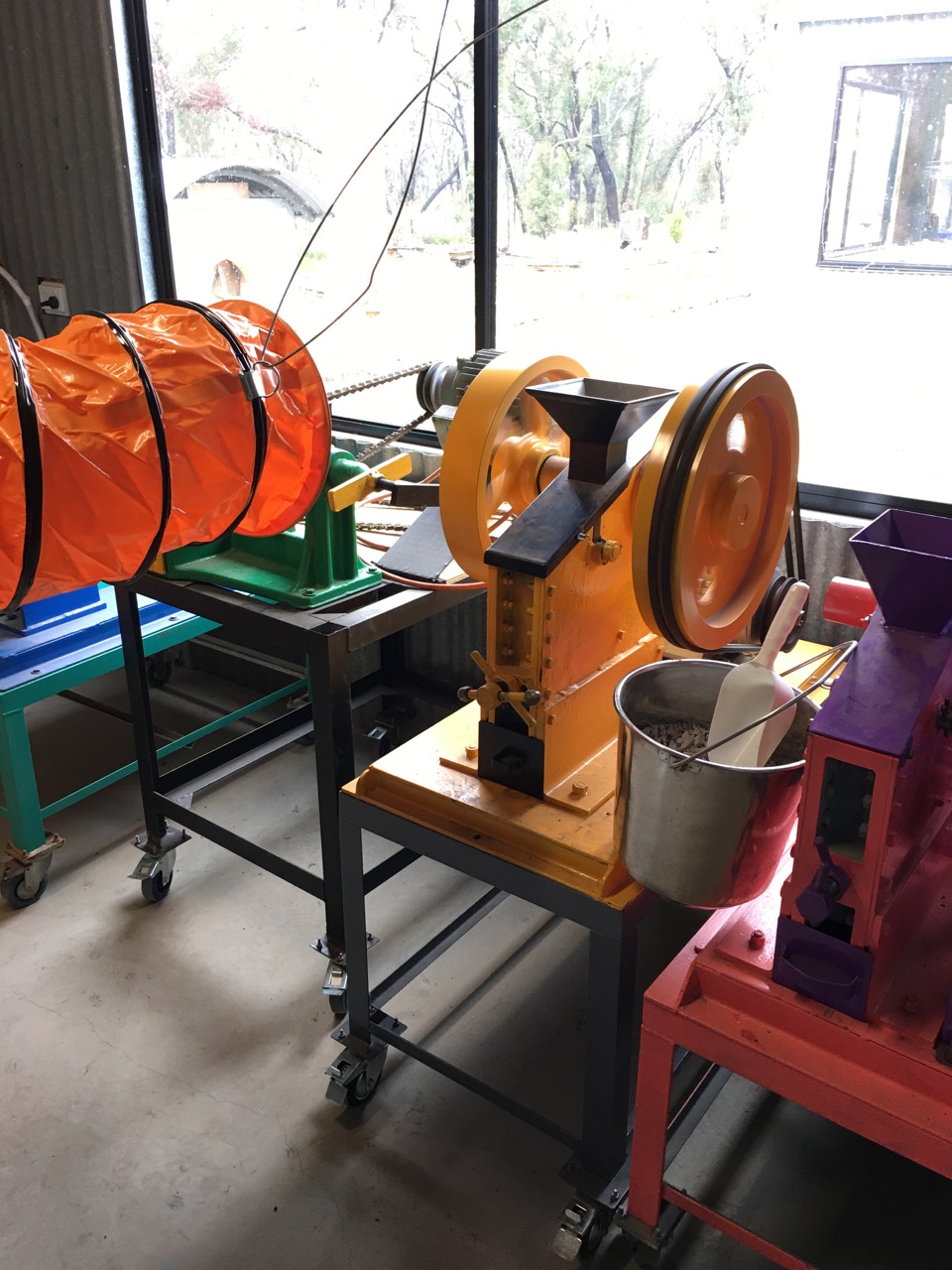
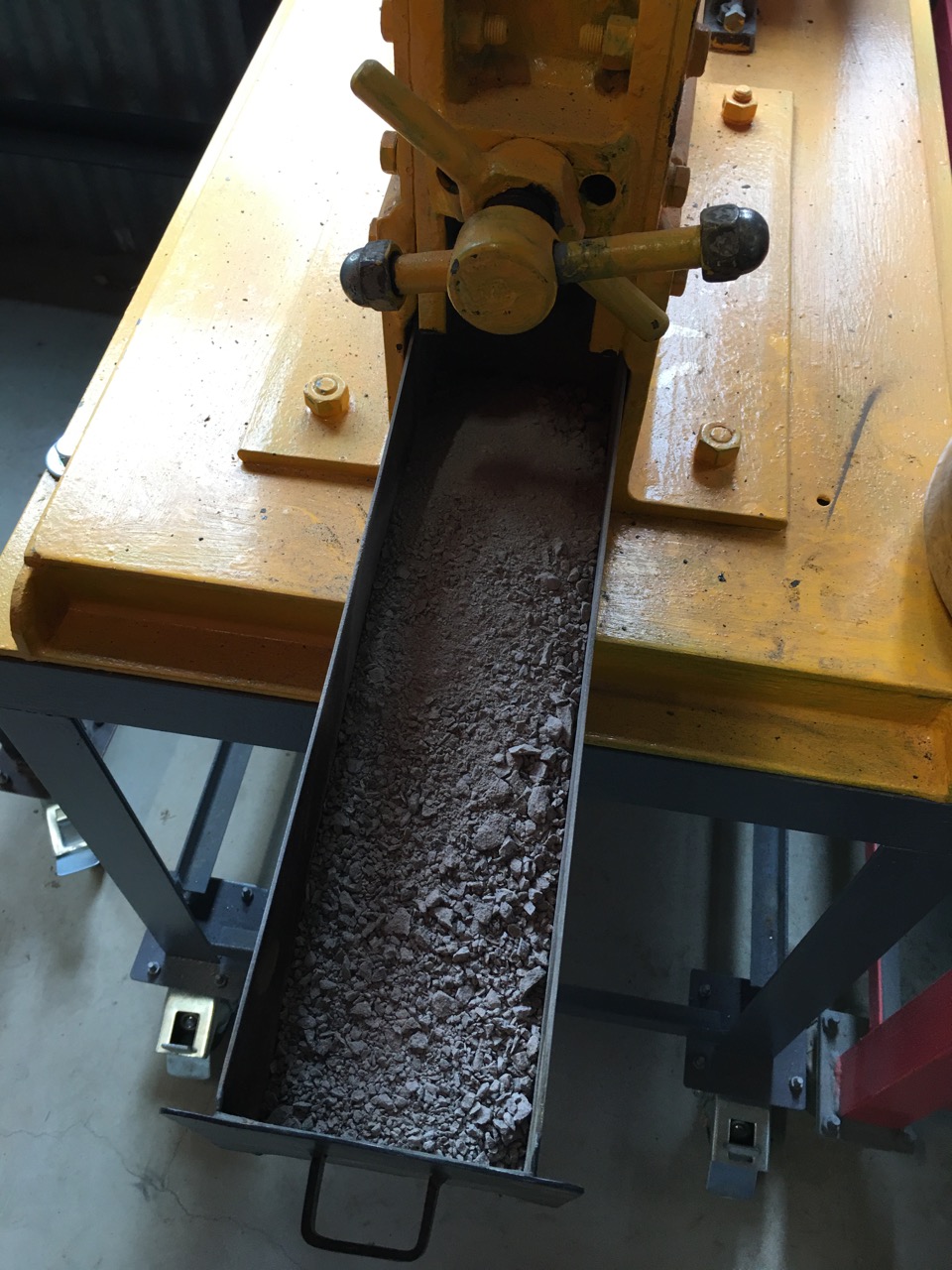
The small jaw crusher, which I use as a 2nd stage crusher, takes the blue metal sized lumps and reduces them to grit.

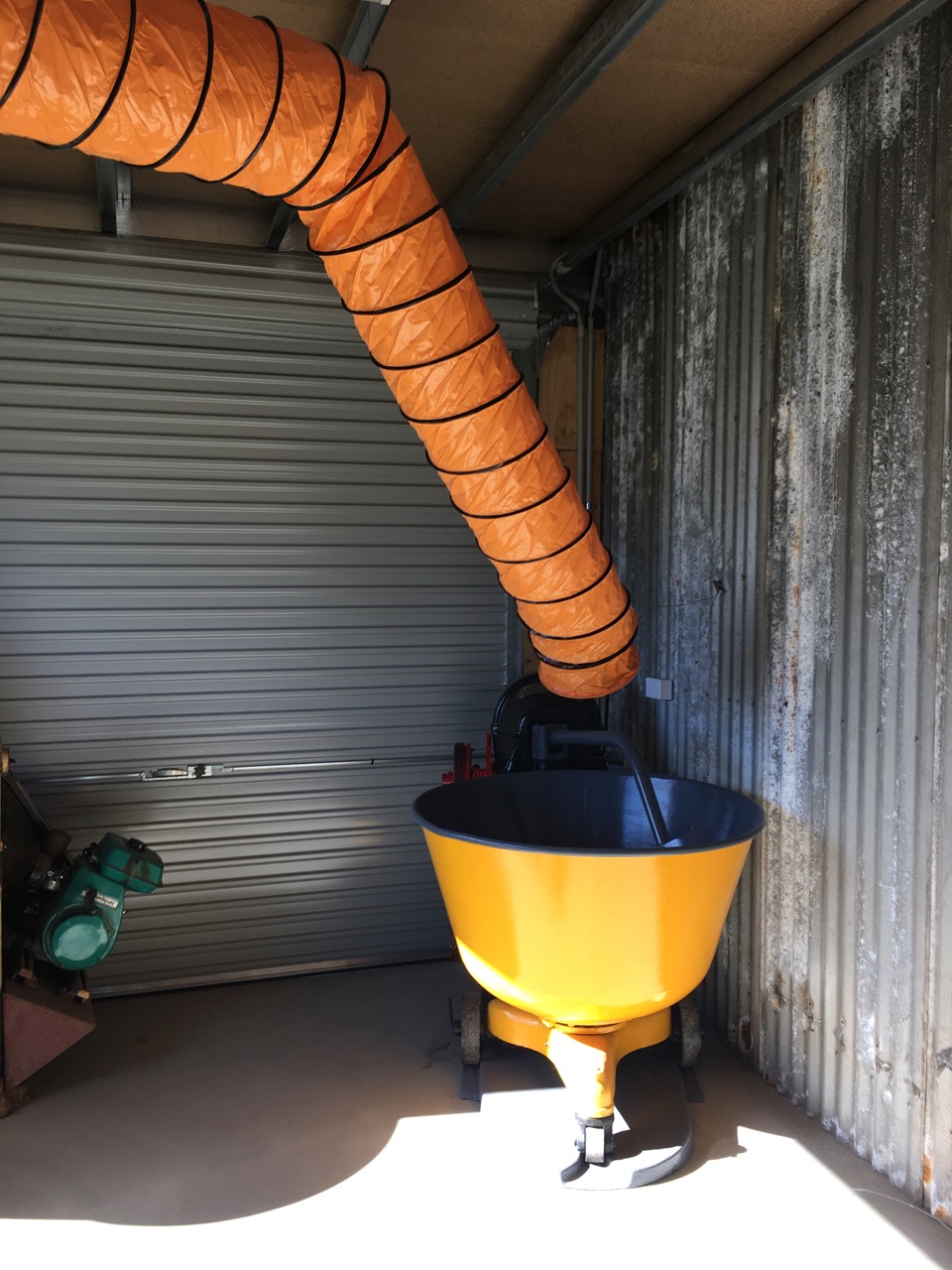
This little machine is now painted industrial yellow, but was formerly dark blue and orange in the old pottery. Me painting my machines a different colour is a bit like a lady dyeing her hair. A change is as good as a holiday. It cheers me up to see all the brightly coloured machines. Like big kid’s toys!


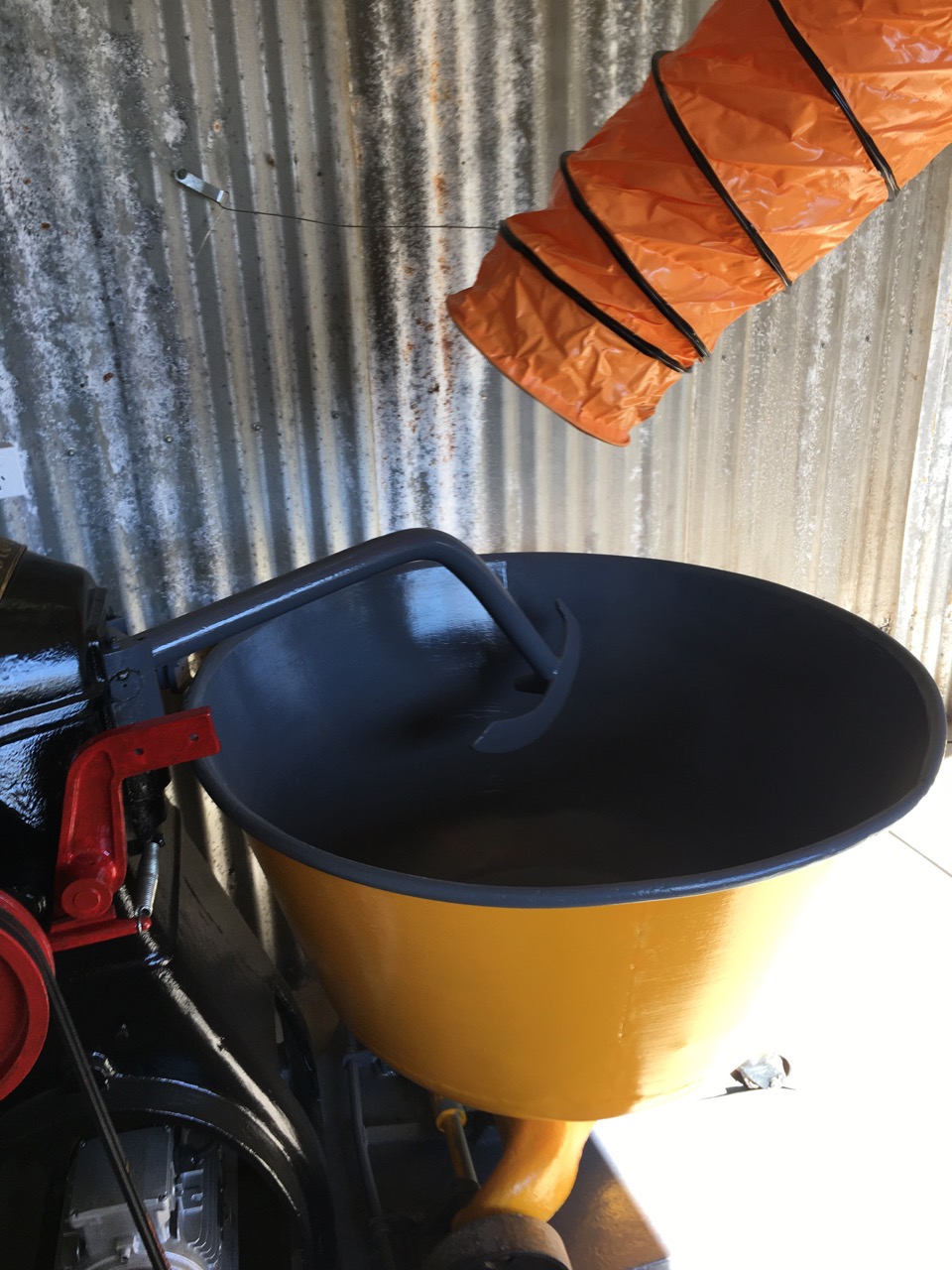
I move the negative-pressure ventilation, dust extraction hose from machine to machine. I have found that the end of the tube is quite friendly and affectionate. If I get too close to the end of the bright orange ducting, it attaches itself to me with the pressure of the suction. It’s not too strong and easy to remove from my shirt, but it is very friendly and persists in wanting to get attached to me. It’s quite amusing. It keeps on seeking out my shirt every time I get close while I’m working. I keep brushing it off, it keeps wanting to nuzzle-up and attach itself to me. Maybe it’s my pottery-workshop-cabin-fevor, after all these months of lock-down. Janine says that I need to get out more! But it’s nice to be wanted!  🙂
The output of this machine is from 6mm down to dust. I bought the little, now-yellow,  crusher direct from the manufacturer, ‘Van Gelder’ back in 1983. When we used to make things here in Australia back in those days. This company has now gone to the wall. It’s a shame, as it was established back in the 1800’s to support the late gold rush and the follow-on mining activities here. They were located in Silverwater in what used to be Sydney’s industrial manufacturing heartland. 
The owner at the time said that they were just hanging on, all the workers were getting old and heading for retirement. He wasn’t sure how he was going to pay out all the retirement funds. He told me that he would probably sell the site and move out of the city to some where much cheaper. Before I left with my brand new crusher – which is still the most expensive piece of pottery equipment that I ever bought. He added my name and the serial number of my machine into his manufacturing log book. It was a quarto sized, beautiful old leather bound journal, that was showing a lot of wear around the edges. It contained a list of every machine that had ever been built by that company. I felt honoured to be on that historical list. It has occurred to me since then, whatever happened to that company’s records and in particular, to that journal?
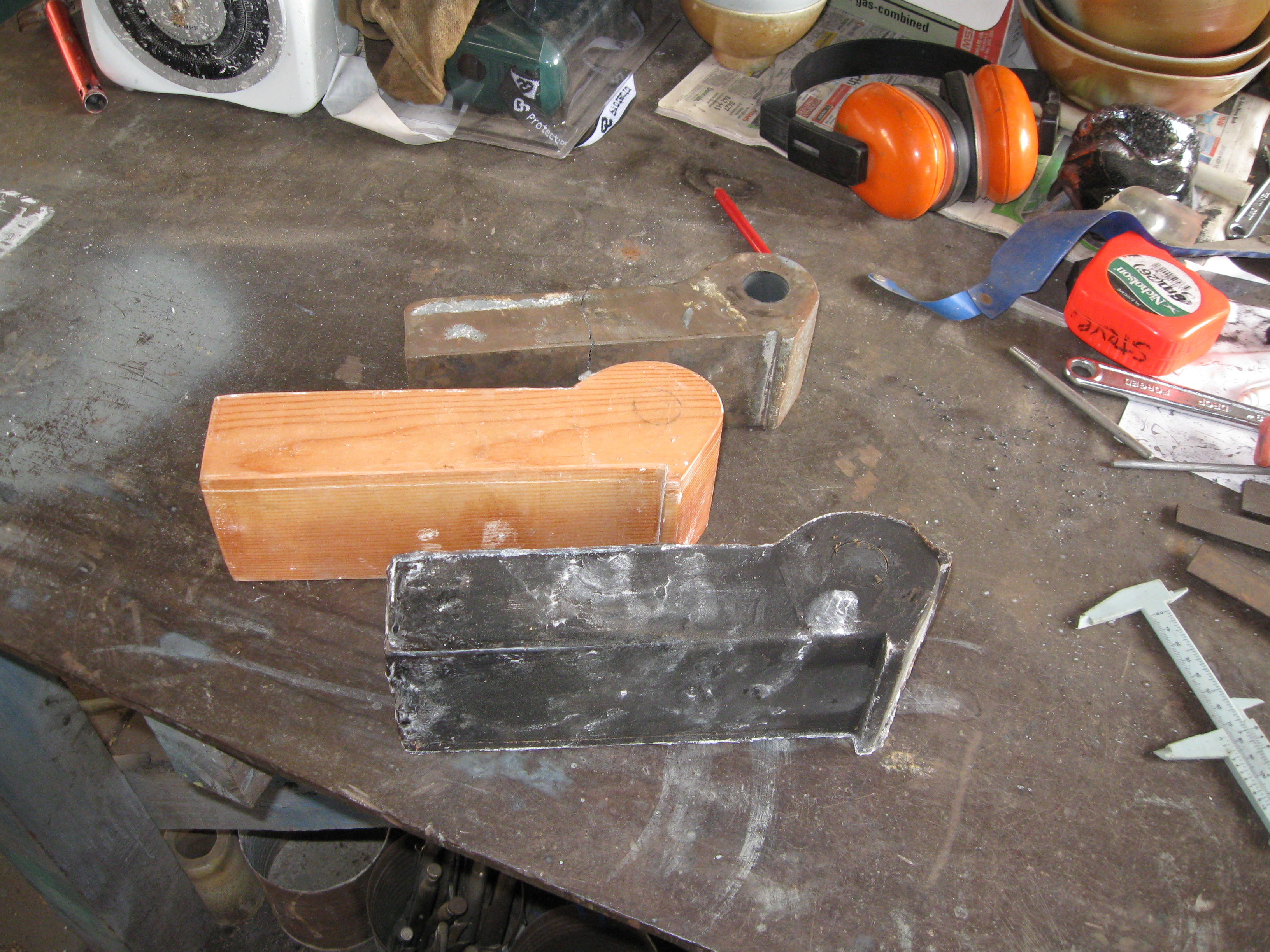
In 2009,  the cast iron static jaw broke in half, presumably from metal fatigue?  I googled ‘Van Gelder’ and found them up in Gosford. We had an email exchange, but the new owner was completely disinterested in helping me out by selling a new jaw. In fact almost rude. Such a different experience from the old owner!  So I decided that I’d make my own – only better than the original. Cast iron is brittle and not the best choice for a machine part that is under constant impact. I decided to make a new one myself. I tried casting one in bronze. I started out by making a wooden replica that was 17% larger. Making a plaster cast of that wooden piece, then casting a copy of that wooden one in wax, so that I could do a lost wax bronze casting.


The original is at the top. the larger wooden model is in the centre. The cast wax model is at the bottom.
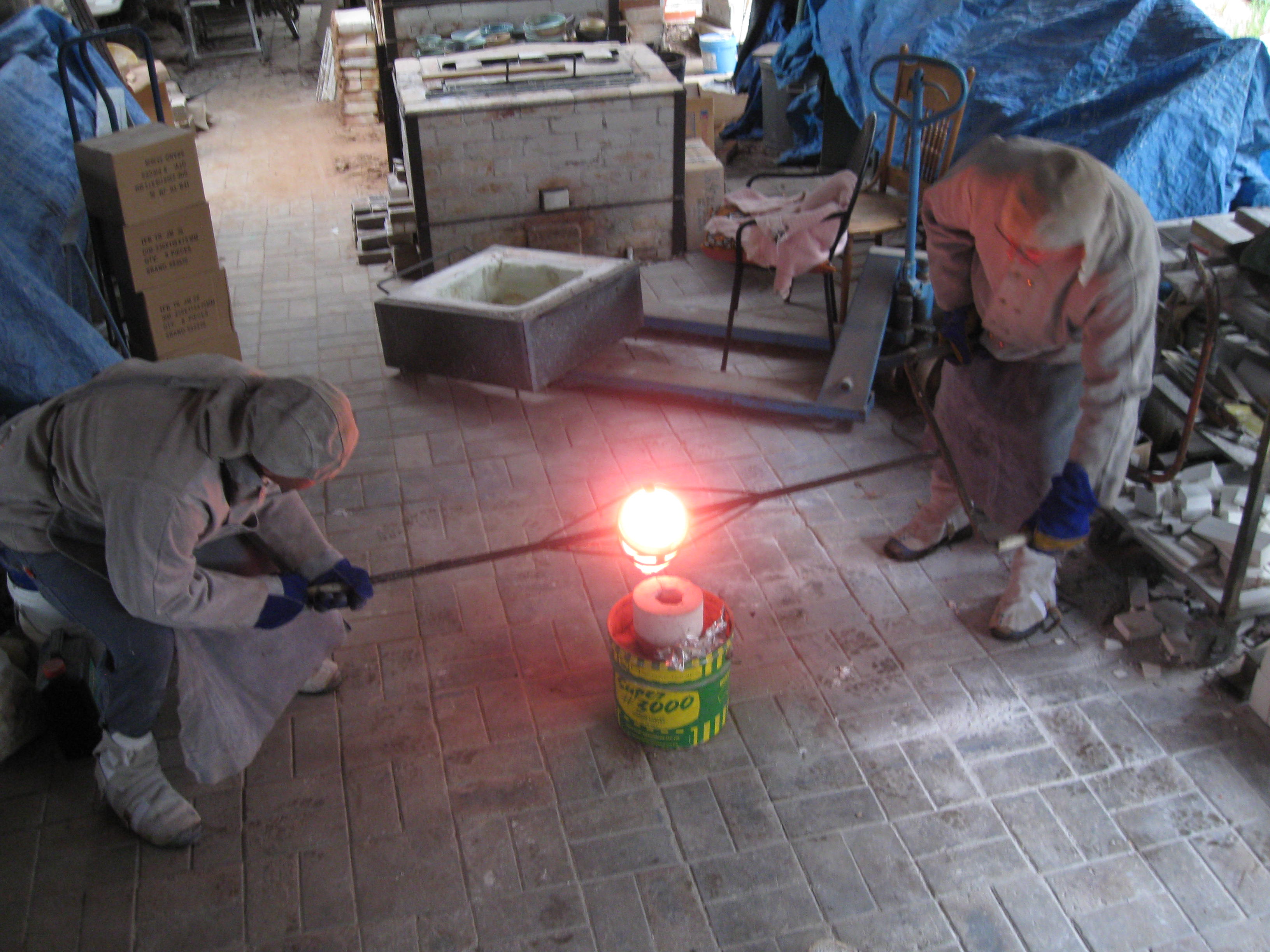
I built a small foundry, and with the assistance of my good friend Warren, we cast a blank, which needed a lot of machining.


I decided to also make another jaw out of steel. 
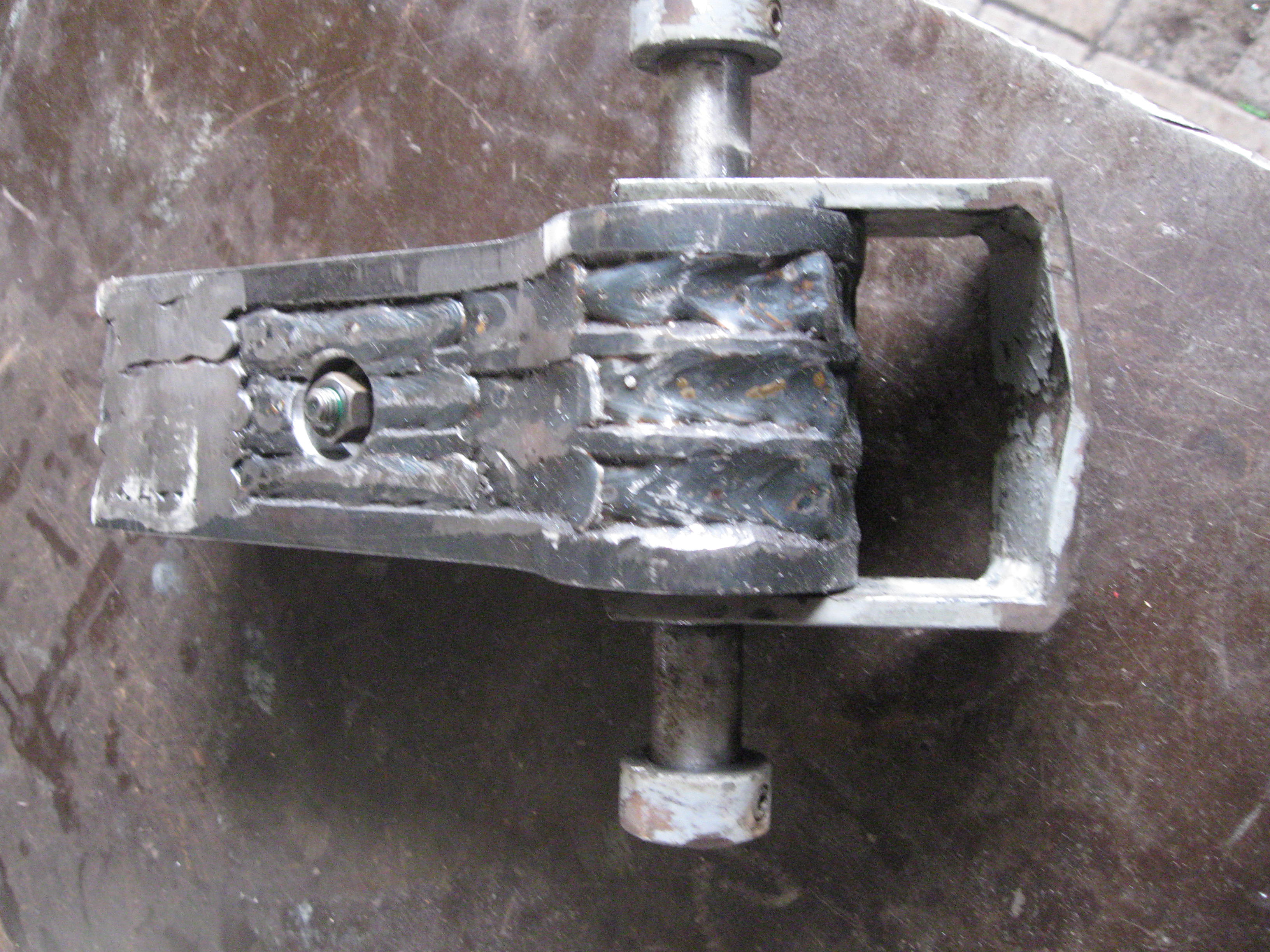
I made the steel jaw out of a series of 3/4” or 19mm. steel plates welded together to make up the 3” or 76mm thickness of the jaw. I was able to drill out the hole for the shaft in each plate before I welded the plates together and then ground them down to a smooth finish where it was necessary to fit the housing. This was quicker and easier for me to complete. This new jaw is still going strong. I had never attempted to weld 3/4” steel plate before. I was really chuffed that it worked. I decided to go with the steel jaw instead of the bronze jaw.


So it’s working again now beautifully. Producing  a grit that is suitable to go into the disc mill.


The grit from this small Van Gelder crusher is then reduced further in the ‘Bico’ disc disintegrator mill, down to something close to a sand-like size. Interestingly, ‘Bico’ crushers are still available in the USA. I googled them, they are still in business and the identical machine is still for sale on their web site in a slightly newer version. I bought mine many years ago 3rd or 4th hand, no history and unmounted. It obviously hadn’t been used for a long time and was seized up, but I managed to get it moving again after a bit of work.


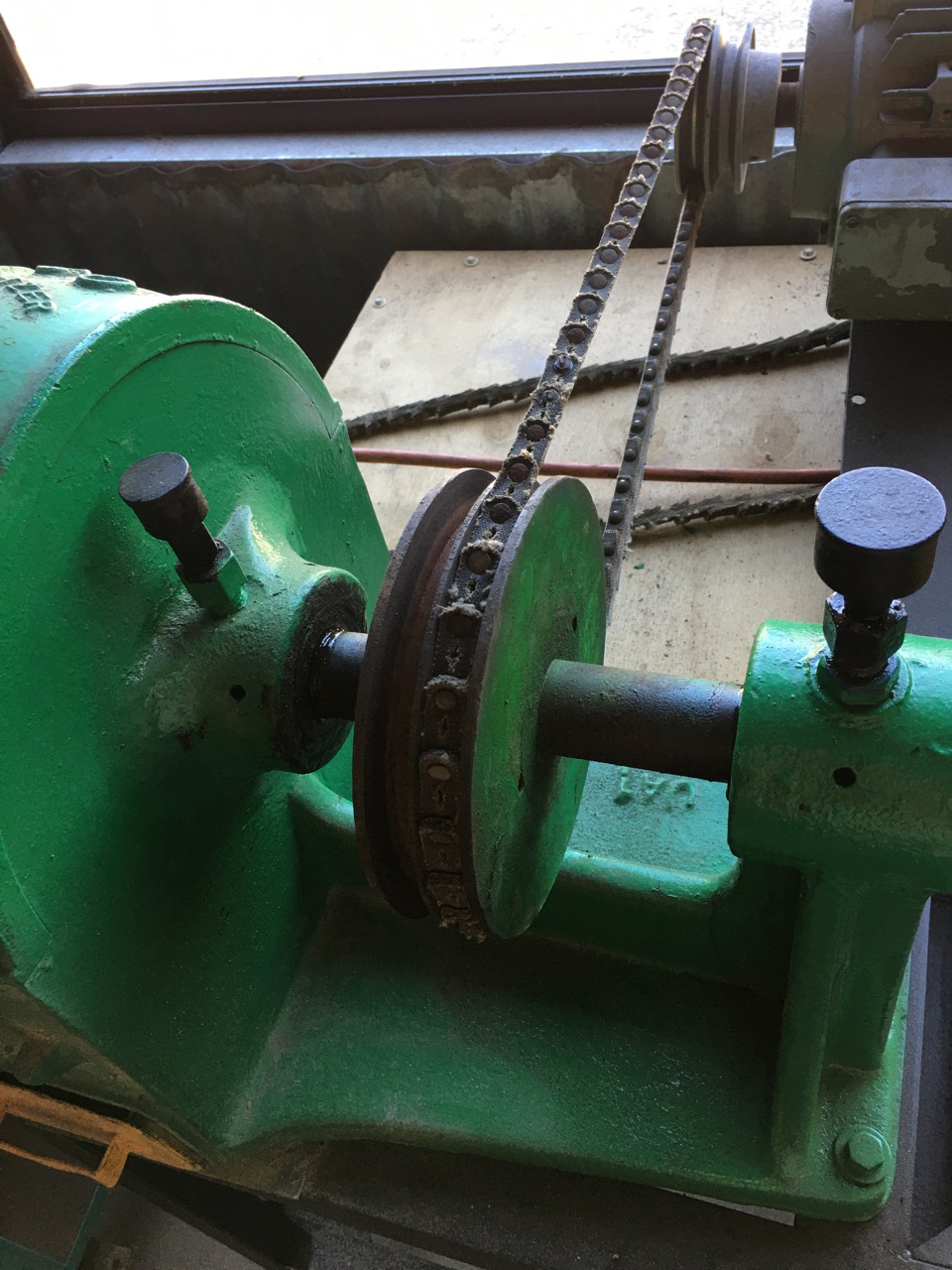
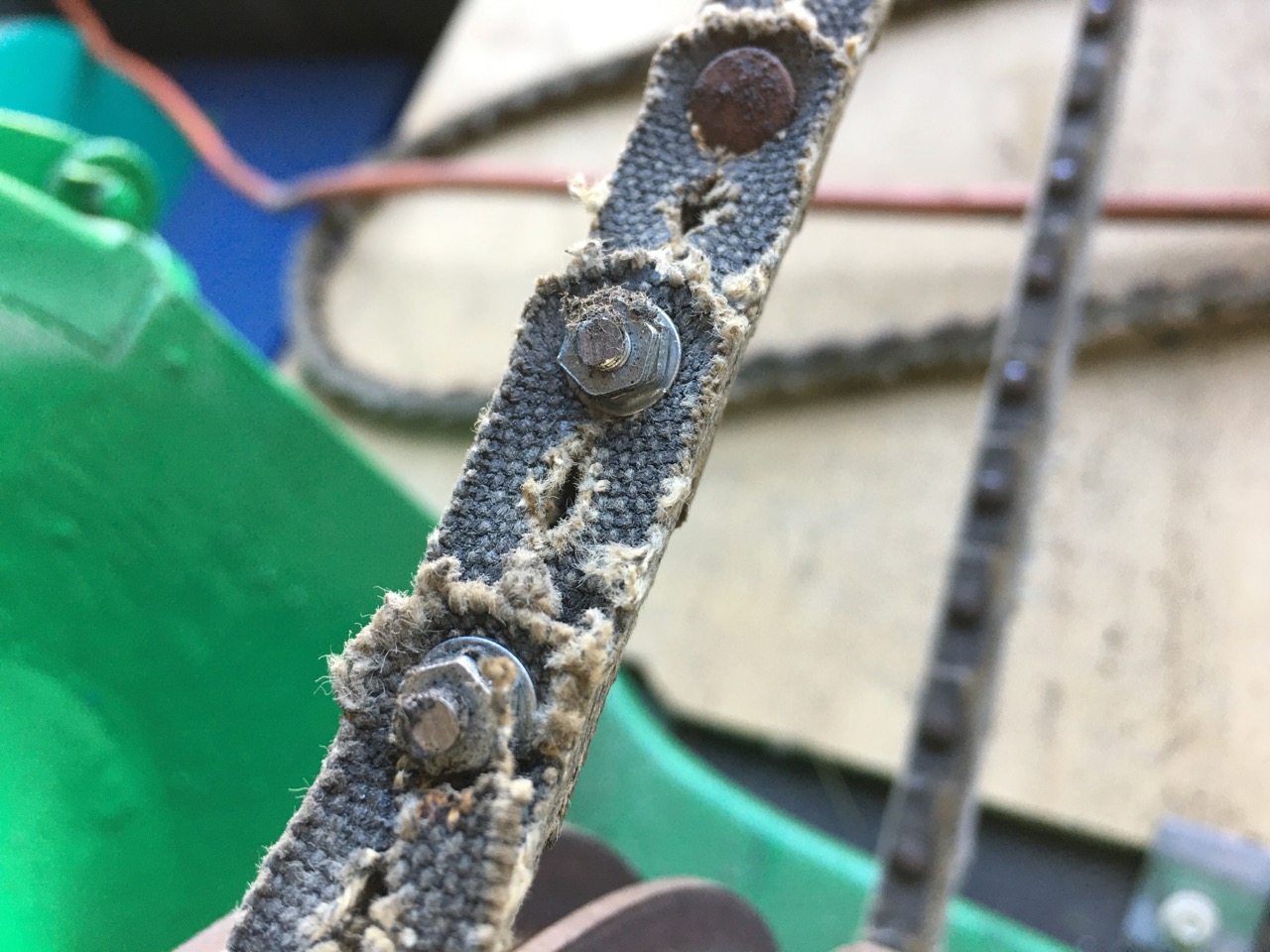
To get this disc mill working again, I also had to learn how to make, break and fit segmented leather drive belts, as the drive pulley is completely enclosed within the cast iron frame of the machine. I had to thread one open end of the broken belt through the frame and then rejoin the belt. I couldn’t find any way to extract the rivets easily from the segmented belt, so I just cut the head off two of the rivets and then replaced them with small bolts and washers. It seems to have been successful. It works! But I’m not too sure for how long?


I put ‘locktite’ on the threads, so I’m hoping that they won’t come loose during work.


This sandy stone grit then goes into the ball mill for 4 hours to be ground down to fine dust, ready to be made into glaze.


It’s quite a process and takes all day. And just like a time-saving kitchen appliance, it needs to be cleaned up after use. This cleaning and relocating of the ‘friendly’ dust extractor proboscis from machine to machine takes more time than the actual crushing.Such is modern convenience.

Ventilation

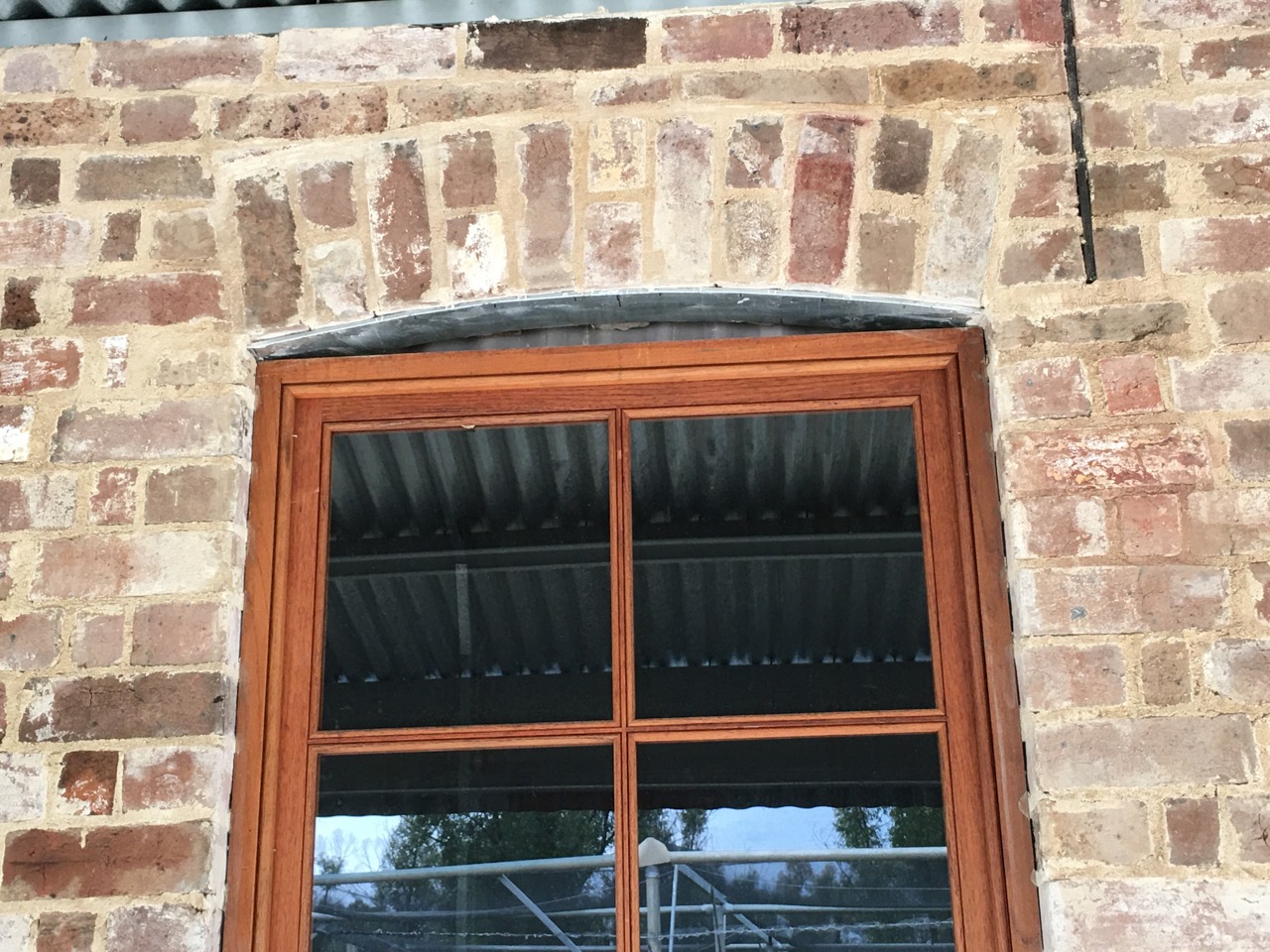
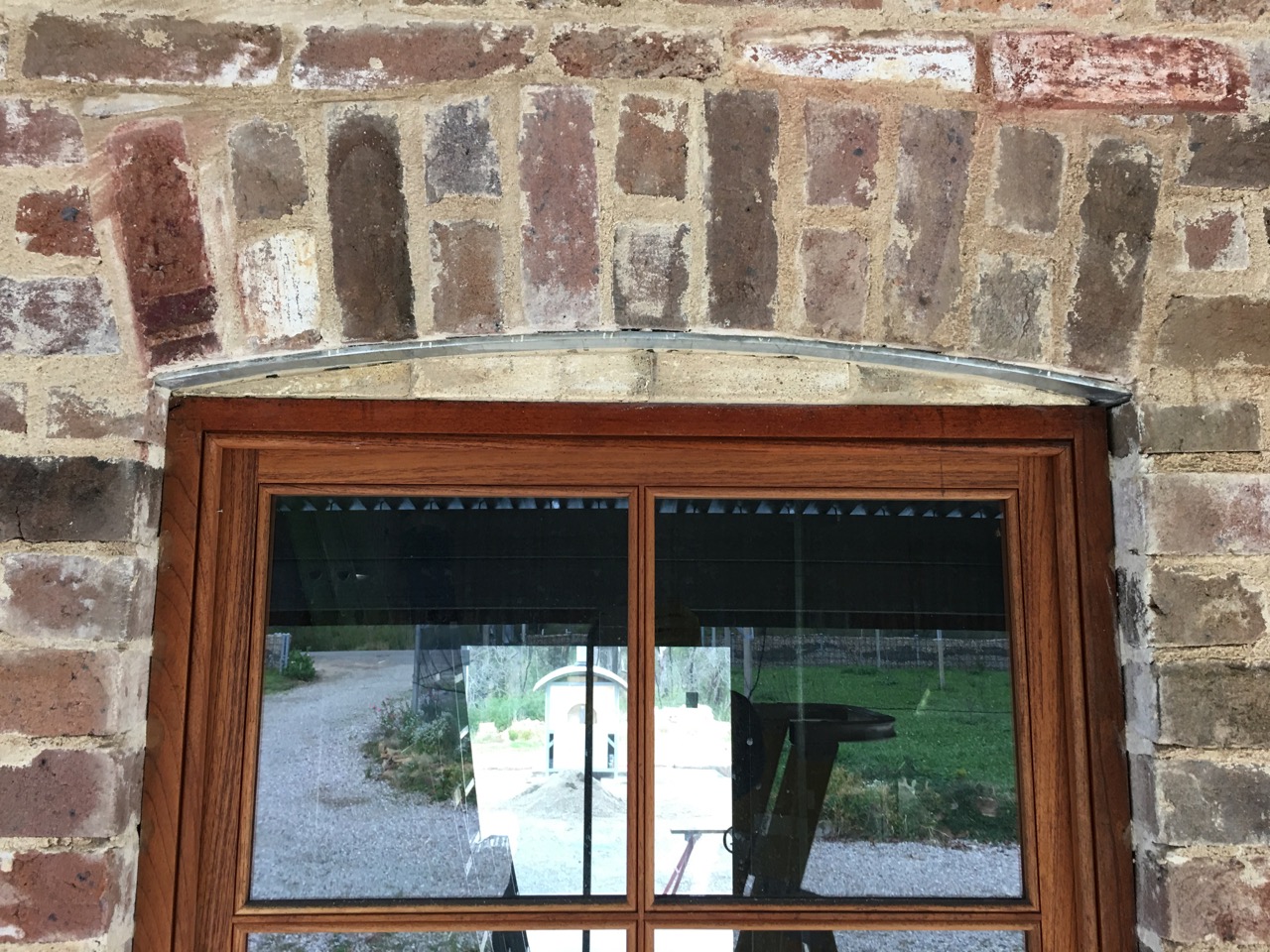
There are now lots of small jobs to convert our cheap and nasty metal framed farm shed into a functional pottery studio. I had to fill the little gap above the wooden windows, between the metal lintel bar that supports the arch brickwork. This is to stop sparks and vermin getting into the cavity. It also looks better and more ‘finished’, but really, I just had to get it done to complete the building so as to get our final approval and occupancy certificate. 

The next most pressing job was to install OH&S ventilation. A fan in the materials processing rooms to take the dust away from the rock crushers and clay mixers. I never had to worry about forced air ventilation in the past, as the machines were more or less outside in the breezeway between the two pottery buildings. Now that I have them all in the one sealed room. It is essential that I fabricate and install good ventilation.


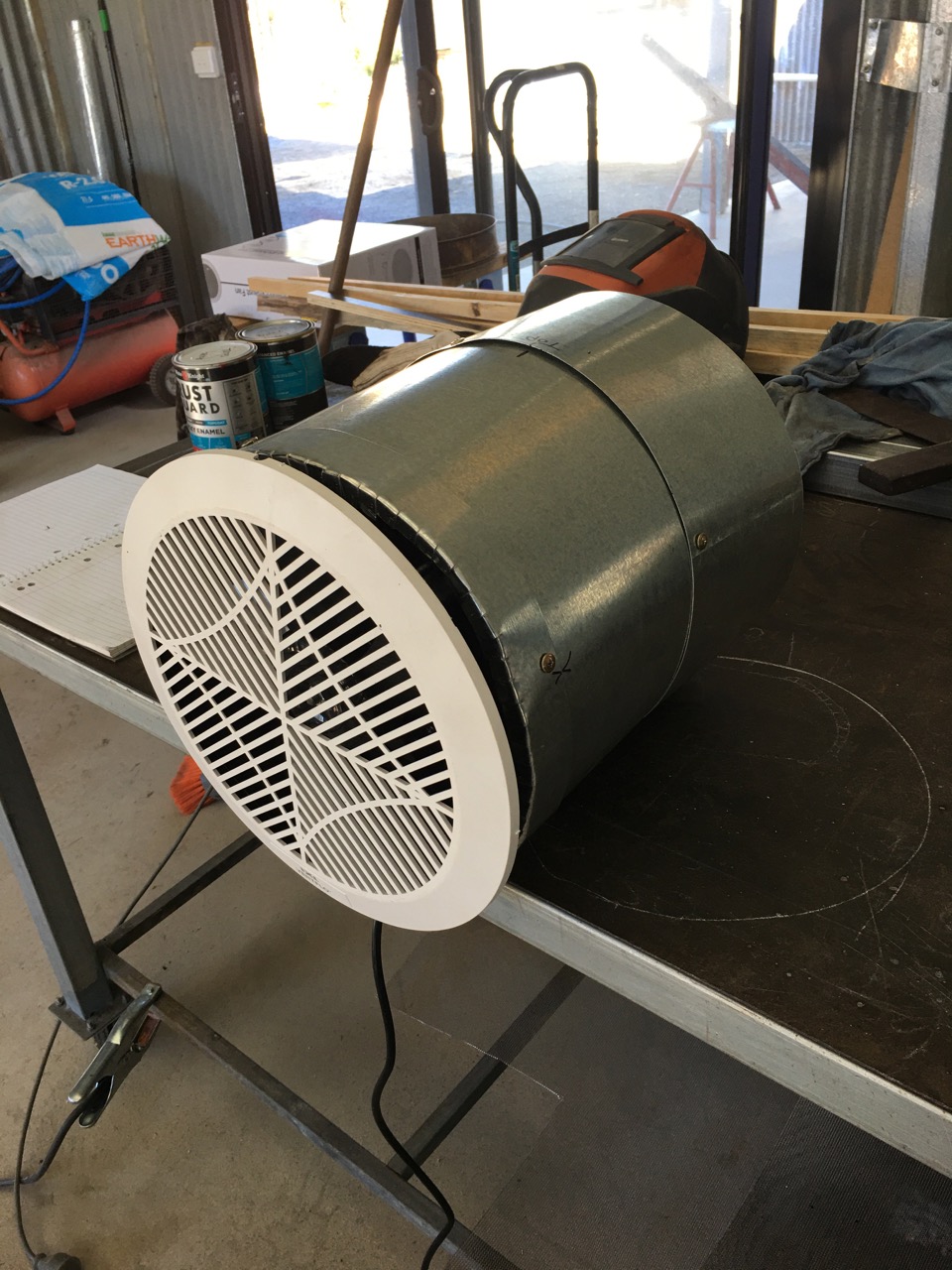
This metal tube has some 2nd hand/re-cycled 1.5mm stainless steel mesh inserted to stop sparks and insects getting into the building.


And a cheap batroom fan in the other end that will be inside the room.

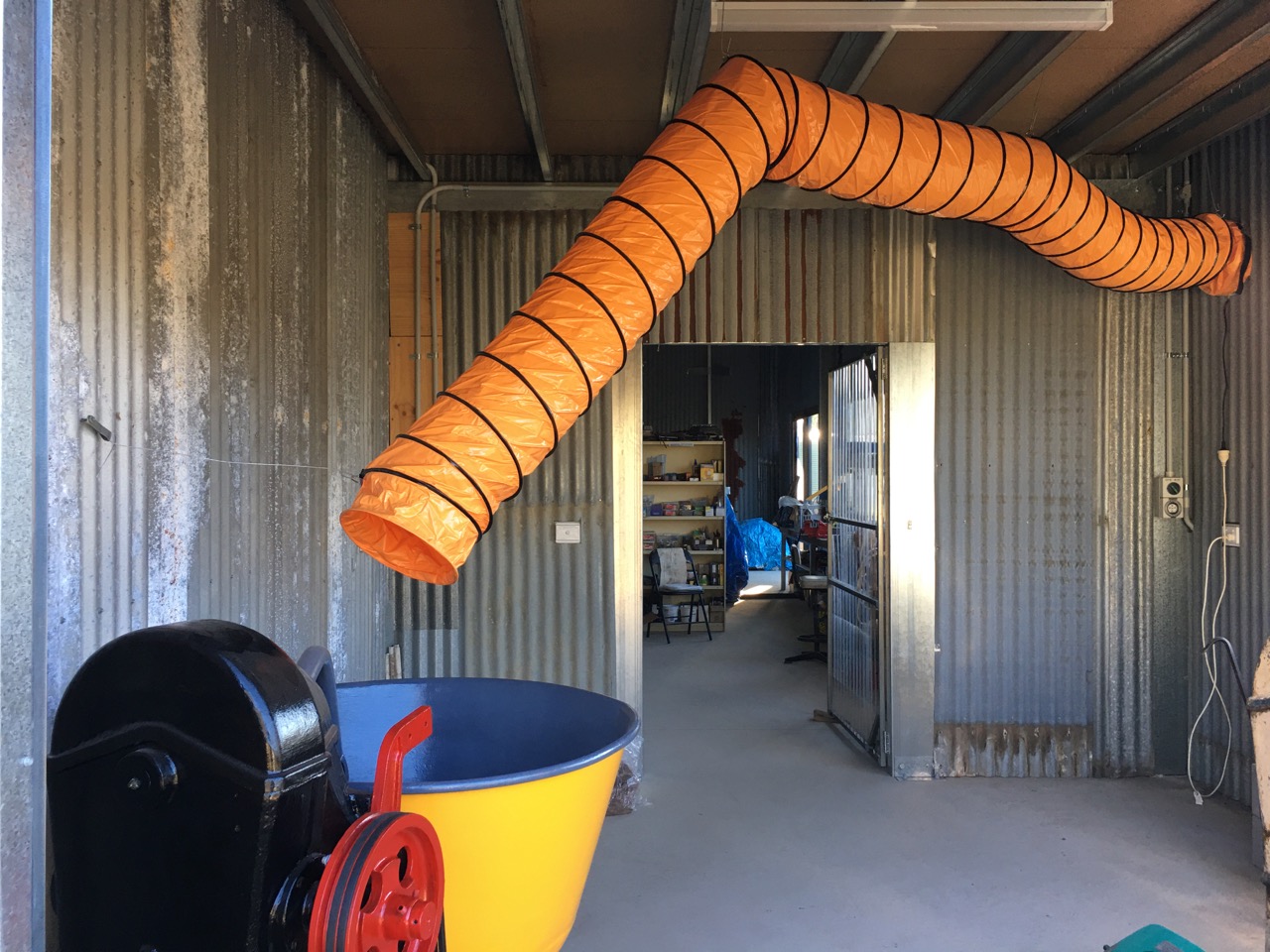
Connected to a long flexible air hose.


With the exhaust fan embedded in the wall, I can direct the cheap flexible suction vent hose to any machine in the room.

I have no idea how other people might achieve this sort of dust extraction, but this is one cheap alternative solution, and mostly home made.

Clay? What OH&S risk?

A Week in the Kitchen

We have been very busy working in the new pottery shed building benches and starting to fit it out as a functioning pottery. But we have also been needing to get into the garden and do a bit of maintenance as well. Everything needs to be done NOW, but we have a limit on our time and energy levels. We muddle through, lurching from crisis to crisis. Everything gets done eventually. I console myself about my ineptitude and clumsiness, by keeping my eyes on the very long view.
We have also been continually busy in the kitchen. In this cold weather we are eating less salads and eating more comfort food. This week I made roasted bone marrow stock with loads of garden Mirepoix veggie stock and a bottle of red wine. This can’t be done in one go. I do it one step at a time, evening by evening. Each night when we light the wood fired kitchen stove, this cooks dinner, warms the house and allows plenty of free extra heat for cooking things like stock that need long cooking time and reduction. 


The browning the marrow bones on the stove top, sharing the hot plate with Janine’s Minestrone.


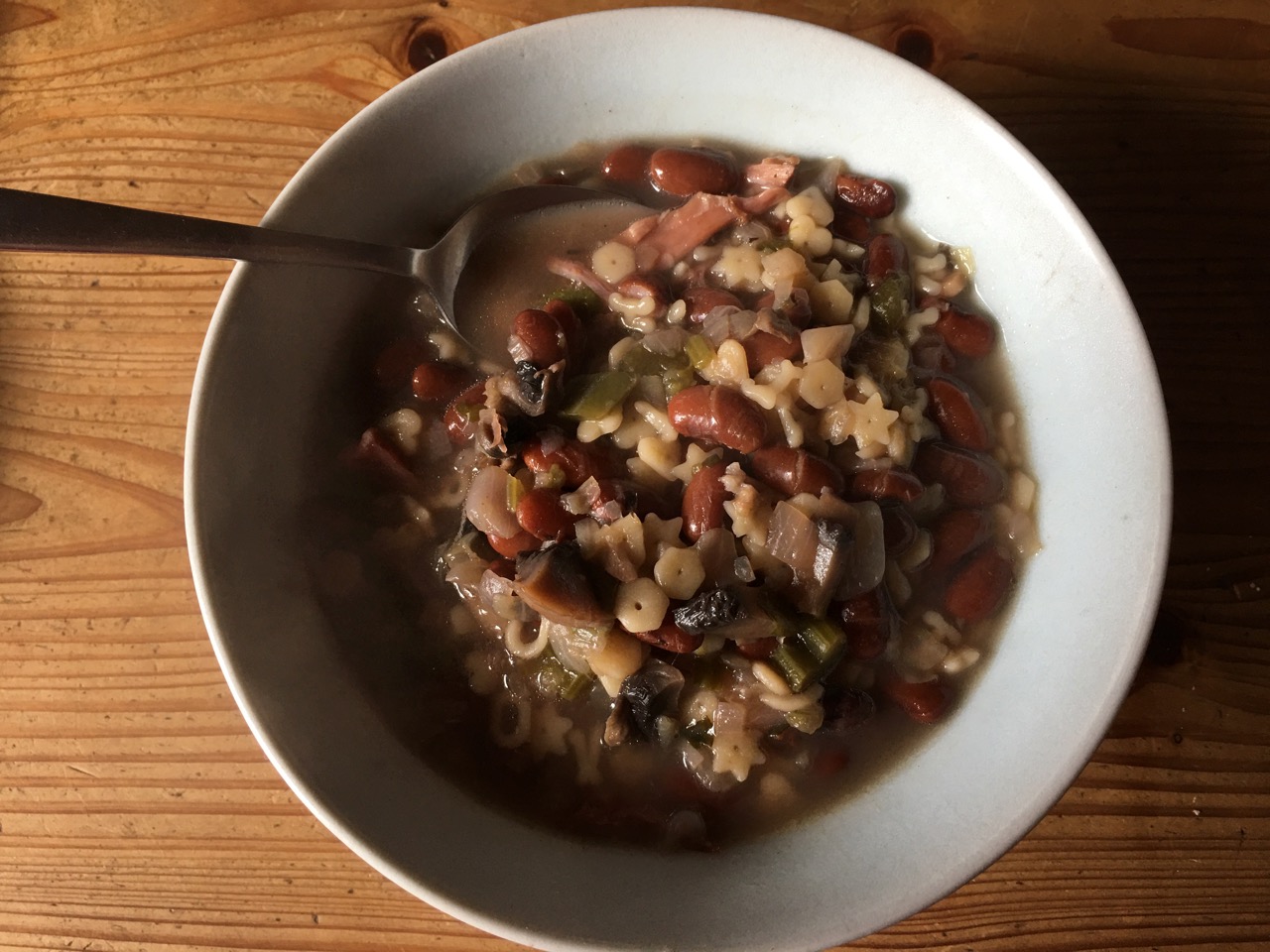
Janine’s minestrone made with our summer harvest of dried beans and our vegetable stock base. The only purchased item was the alphabet pasta, left over from a kids meal.


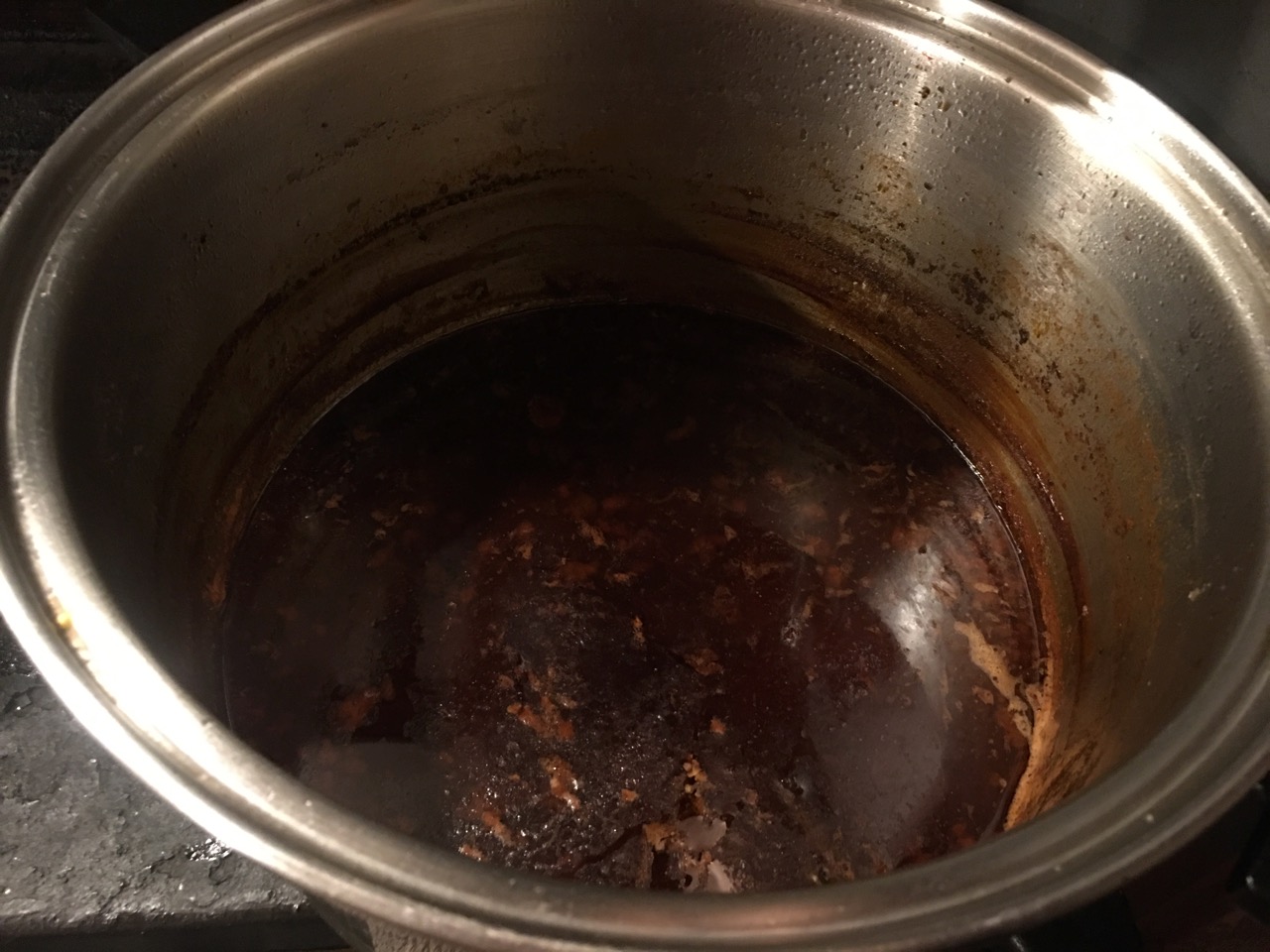
You can see the various tide line levels on the side of the pot, as I simmer it down from three large boilers of 5 litres each, all reduced down to fit in this one pot and then reduced again to just 600 mls of jellylike concentrate. A spoon full of this flavour bomb, is a home made stock cube substitute, only better, being low salt. 
I saw some nice bratwurst and also some pork mushroom and garlic sausages at the local butcher. I bought one of each and we shared half each, cooked with parsnip and spud mash, red cabbage and julienne carrots with garlic. Sausages are not very healthy food, they are stuffed full of salt, fat and preservatives, so I rarely buy them. The only time I eat a sausage is over at the Village Hall at the occasional fund raising get together event. So buying a sausage was a quite unusual event. I can’t remember the last time I bought a sausage from the butcher. It must be two or three years.

Our hybrid take on the old favourites, banger (singular) and mash and bubble and squeak.


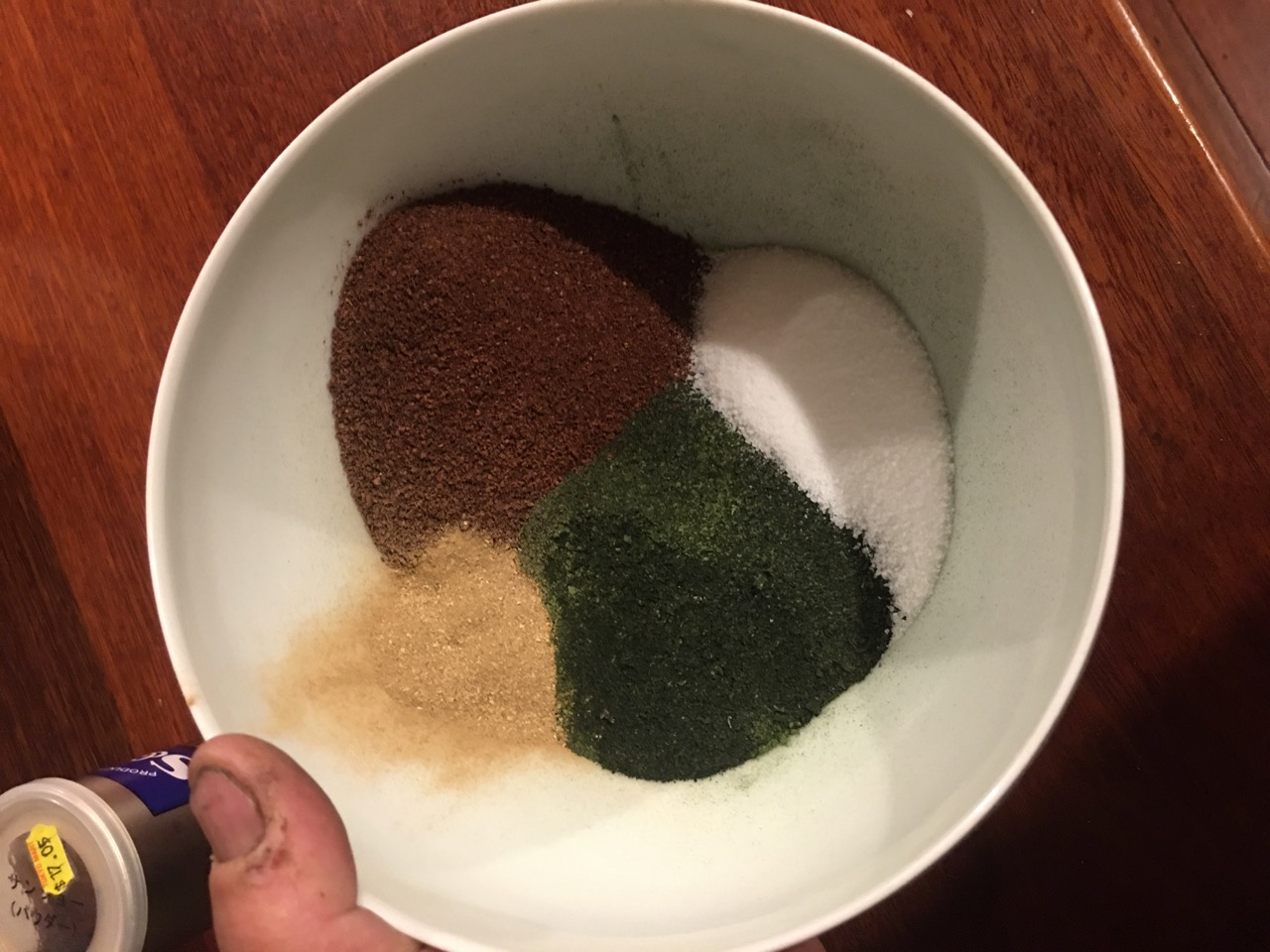
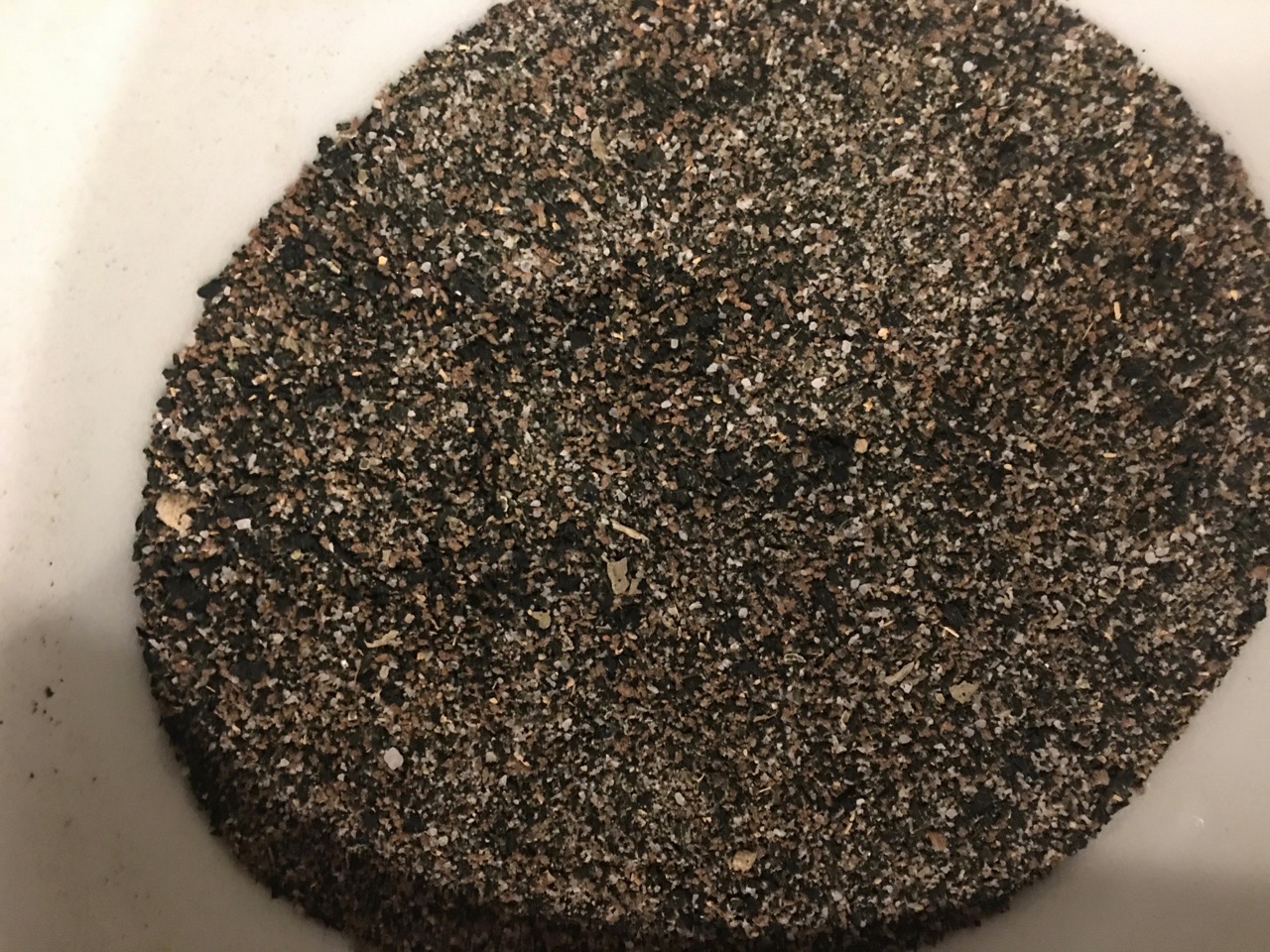
I also took time out one evening to dry, mill and grind some sea vegetable kelp and added to it some ‘lite’ potassium chloride salt, with Sumac and a small amount of Japanese sansho pepper. This is all mixed together to make a low sodium, salt substitute seasoning. Being mostly vegetable based, it has loads of flavour but little ‘bite’ from the low salt level.


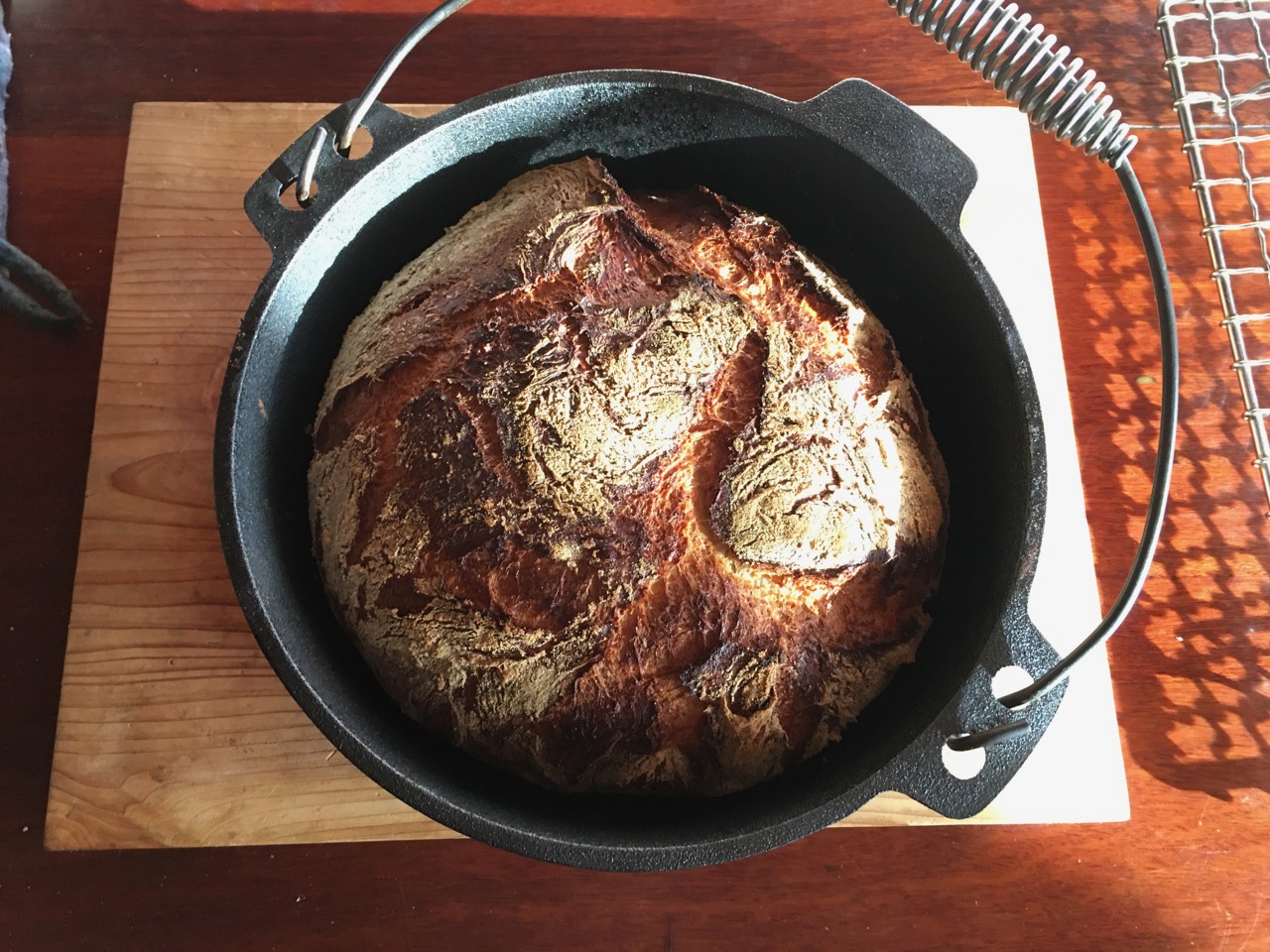
I also bake bread twice a week. We can eat a loaf between us over 3 to 4 days. I vary the flour as I run out of one, I buy something different for the next batch. I alternate between 100% rye, rye and Wheat blend and straight wheat. I think that I prefer the rye/wheat blend the best.


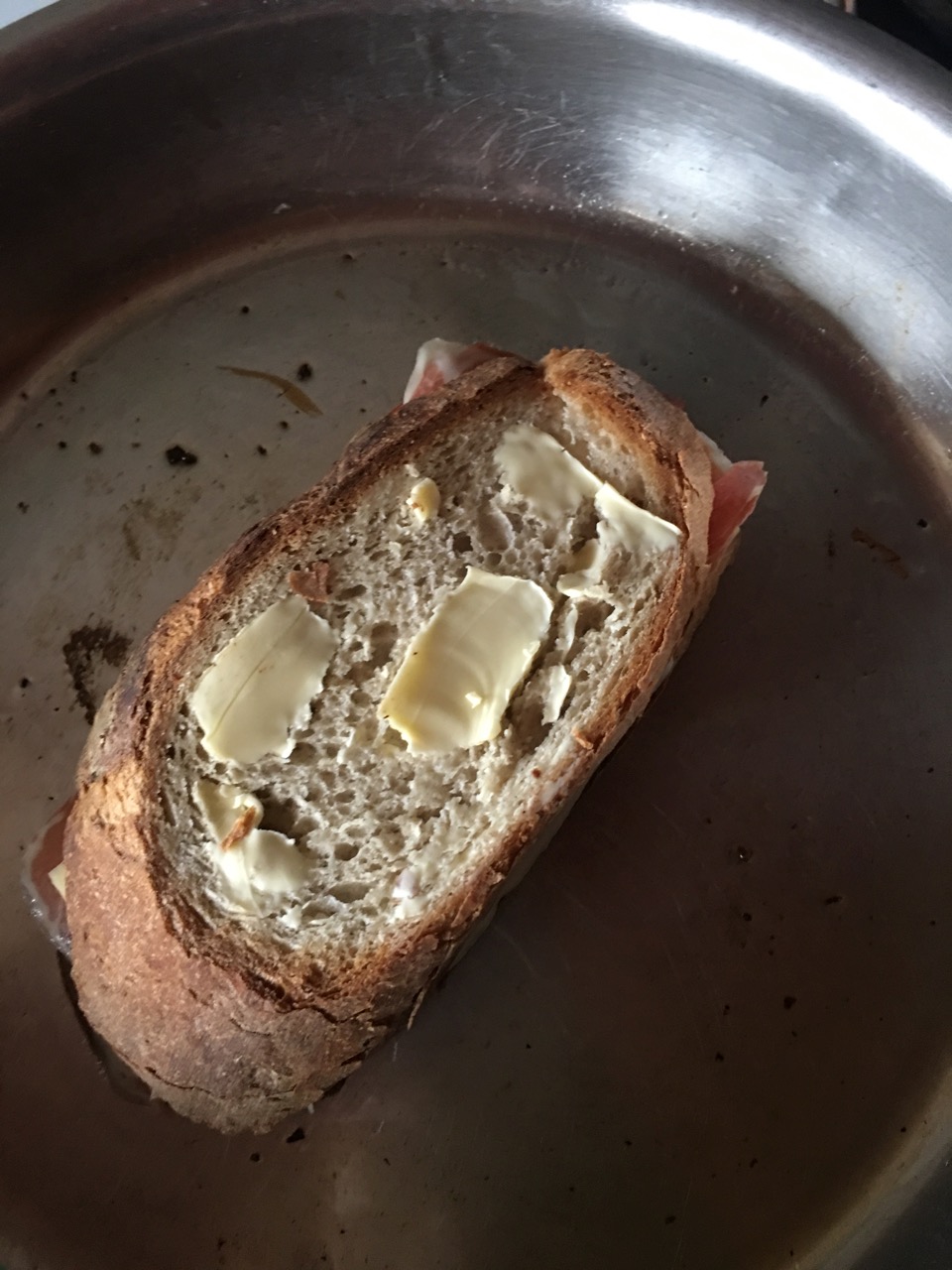
At lunch time, I made a croque Monsieur. Not just a ham and cheese sandwich, but pan fried and served hot and so warming on a cold day.

Bugs au Vin

A few months ago a baby rabbit managed to find its way into the netted vegetable garden. I don’t know how it got in, but it did. I first realised that there was a rabbit in the garden when a new batch of germinating seeds and seedlings suddenly disappeared overnight! A few days later, I flushed it out while wartering. I was watering a dense patch of plants when suddenly a rabit scampered out of that patch when the water from the hose hit it. It ran off down the garden and disappeared into another dense patch.I flushed it out again and chased it towards the open gate, but it swerved away at the last moment and hid higher up in another bed.I spent some time running back and forth chasing it about, but it steadfastly refused to run out the door. I eventually gave up when I got puffed out from the running.
I thought that maybe we could encourage a friend with a dog to visit us, and then the dog could do the running and chasing.On Sunday we spent the day in the garden. Firstly, I decided to get the whipper snipper mower out and clean up all the garden paths. Once that was done, I continued to mow some of the big clumps of weeds that had grown up in and around other fallow beds.After lunch, I kept on with the mowing, eventually getting the the point that there was only 2 dense patches of plants left. At the top of the garden there is a patch of gooseberries, and at the bottom of the garden, the asparagus patch was still full of weeds, as we hadn’t got around to weeding it yet.
Earlier in the morning we had spent some time chasing Bugs Bunny up and down the garden. Both large garden gates were full open, but the rabbit refused to go out through them. We gave up again as it being just too difficult. Back to the mowing.
It came to me that if I kept on mowing the big clumps of weeds, then there would be nowhere left for the rabbit to hide. it would have to run out to find new cover.I chased it again. but with no success. He refused to leave. When there was only one clump of weeds left in the asparagus. I could see Peter Rabbit hiding there. Just like Farmer McGregor, I caught him.
And dispatched him quickly. 


We have carrots, celery, onions, garlic, kale, parsnips, brussel sprouts and capsicums in the garden currently, and he had feasted on them all. In fact he ate everything that wasn’t covered by netting. We had netting within netting trying to keep some small plants and seedlings safe until they were more advanced.As he was fattened up on these veggies, I decided that it was best to cook our Bugs Bunny with exactly those veggies.I made a classic French style ‘Bugs au Vin’ sort of stew, all good, local, low carbon miles, garden produce, including our organically fed Peter Rabbit and half a bottle of good red wine. 


I know I’ve been rabbiting on about this, but I hope that you have been Lapin it up.  He was quite nice, although a little tough. I could have cooked him a bit longer. My good friend Leonard suggested that I should serve up my ‘Rabbit au Vin’ in a Hares fur bowl 🙂

This is all part of our self reliant life style.

Mottainai, repairing the old wood fired kitchen stove

Our 45 year old wood fired kitchen stove is again in need of some repair.I have been working on this stove for 35 years. It was already out of production when we bought it second hand from a local farmer in the 70’s.The first thing to go was the cast iron grate under the firebox. My enquiries revealed that the Northburn company was bought out by Rayburn and closed down years before, but that there was still some spare parts available in the UK. An estimate for a new cast iron grate was more than the whole stove! I quickly realised that I would be needing more of these replacement ash pit grates in coming years. So I had better solve the problem now, and importing the last one from England wasn’t going to be the long term answer.


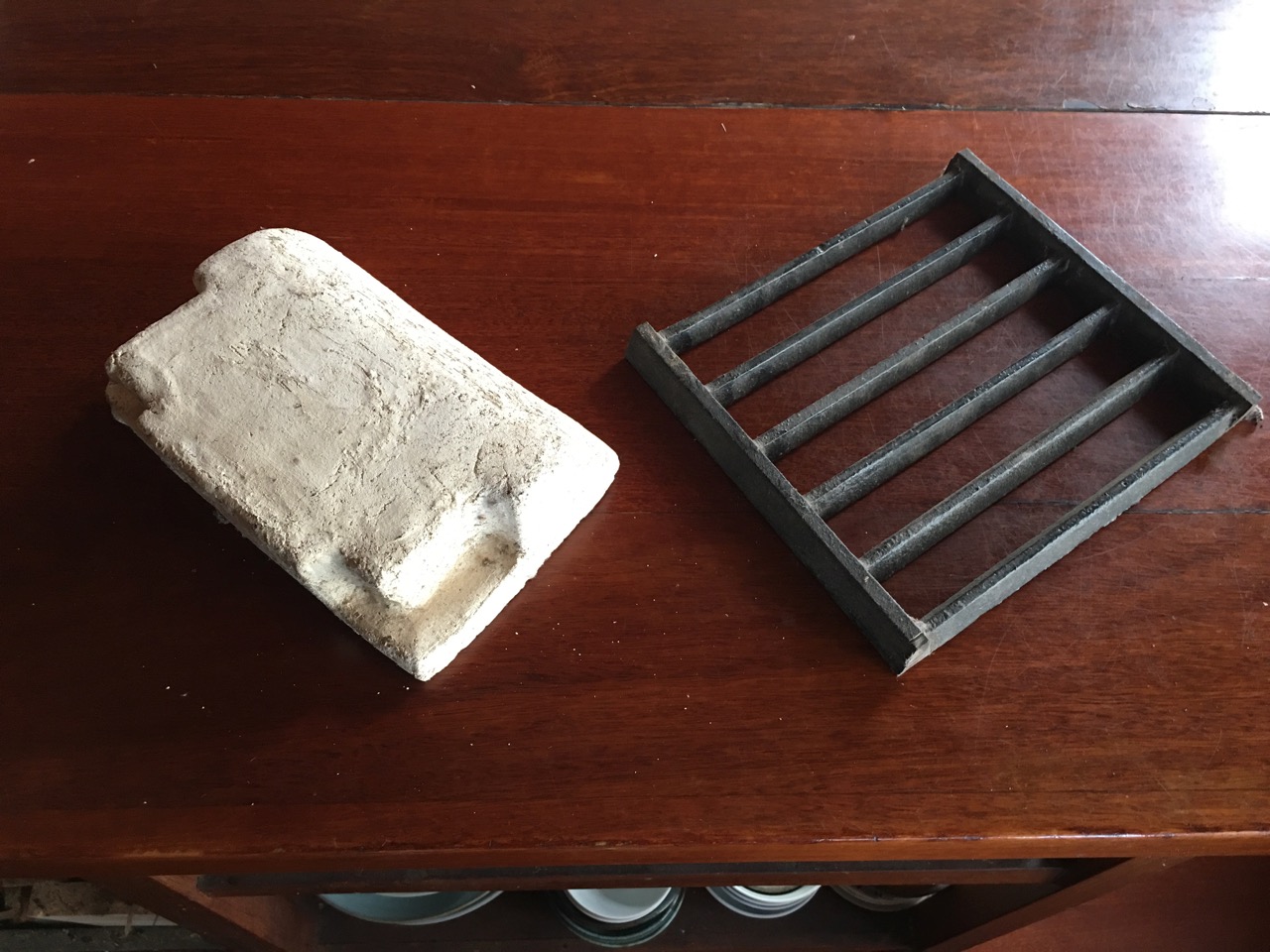
I worked out that cheap, local, cast iron drain covers could be cut up into 3 section and yield a decade of spares for $10. $3.33 each. About a dollar a year seemed good value. I have been using this solution ever since. When the fire brick in the front of the fire box crumbled, I reassembled the bits and filled in the missing parts with fresh clay and made a plaster cast of it. After that I was able to pop out a few each decade and pre-fire them in our potters kiln always keeping a few in stock under the kitchen hot water cupboard. Interestingly, the home made ones lasted longer than the original. Perhaps because I made ours out of my best home made  high alumina grog and sillimanite clay mix that I used to make our own kiln shelves. Good stuff, and seemingly better than the original.

 
At some point in the past, many years ago I replaced the fibre rope seal around  the hot plate. As this was almost certainly made of asbestos, given its age. I took it very seriously and got Janine out of the house. closed the doors and windows to stop any draughts, then soaked the fibre with water to kill dust. I wore long sleaves and a hospital theatre hair net cap and a dust mask. I lifted the wet but stiff fibre rope out and placed it into a plastic bag, sponged down the whole stove top and replaced the seal with modern kevlar fibre rope stove door seal. Then washed my clothes.
The next part of the fire box to crumble was the fire wall between the fire box and oven. This was a thick cast iron sheet of metal. As it cracked up and started to fall apart I was wondering how I could get another one cast in cast iron. Then I thought, if I could use a home made kiln shelf in its place. I cut up a big 400mm x 400mm. kiln shell to custom fit the exact shape of the original. it fitted in pretty well. Snugly in fact. I thought that it might last a few months, giving me time to find a long term solution. To my surprise, it is still there and the stove works perfectly with its new heat shield. Its been in use for many years now, so will probably last for quite a while into the future. I have plenty more to replace it when the time comes. 
I was less successful with the large single piece fire box brick that makes up the left side of the firebox. it is a couple of inches thick and deeply embedded into the structure of the stove, such that to take it out and replace it would be a total rebuild job. Being the lazy opportunist that I am I decided that I would just repair the crumbled hole with a home made ceramic fibre and clay castable to fill the gaping hole, then cover the entire surface with another kiln shelf. This one needed to be longer then ti is wide, and a bit thinner to fit in easily. I found that I had a commercial kiln shelf of just about the right dimensions and cut it to fit. It worked perfectly for a few months and then cracked in half, then the two halves cracked, and so on… Yesterday it became apparent that it had all fallen to pieces the night before during the cooking of dinner. 
I extracted the parts and not having any other commercial shelves that were easily adapted since the fire cleaned up out. I decided to do a bit of a Japanese inspired ‘mottainai’ repair and stich it all back together with some old kanthal high temperature kiln element wire. ‘Mottainai’ is a bit hard to translate , but loosely means that something is too good to waste, so a little effort is worth being put in to save it and restore it, It also implies a bit of ‘waste not, want not’ and a stitch in time etc. It suits my life philosophy of living gently and minimal consumption.It survived last nights dinner cooking firing, so I’m hopeful that since it is now made up of several pieces instead of being one large sheet, it is now comprised of many expansion joints. It might work. I hope so. 
This was a first class commercial kiln shelf, supposedly with very good chemistry and excellent thermal shock resistance, but it seems a little bit too thin to take the combination of heat shock and small occasional impacts from wood stoking. I’m even more impressed with my own home made kiln shelf on the opposite side of the firebox that has been taking the same impacts and heat shock stresses for some years now.

Making a Crust

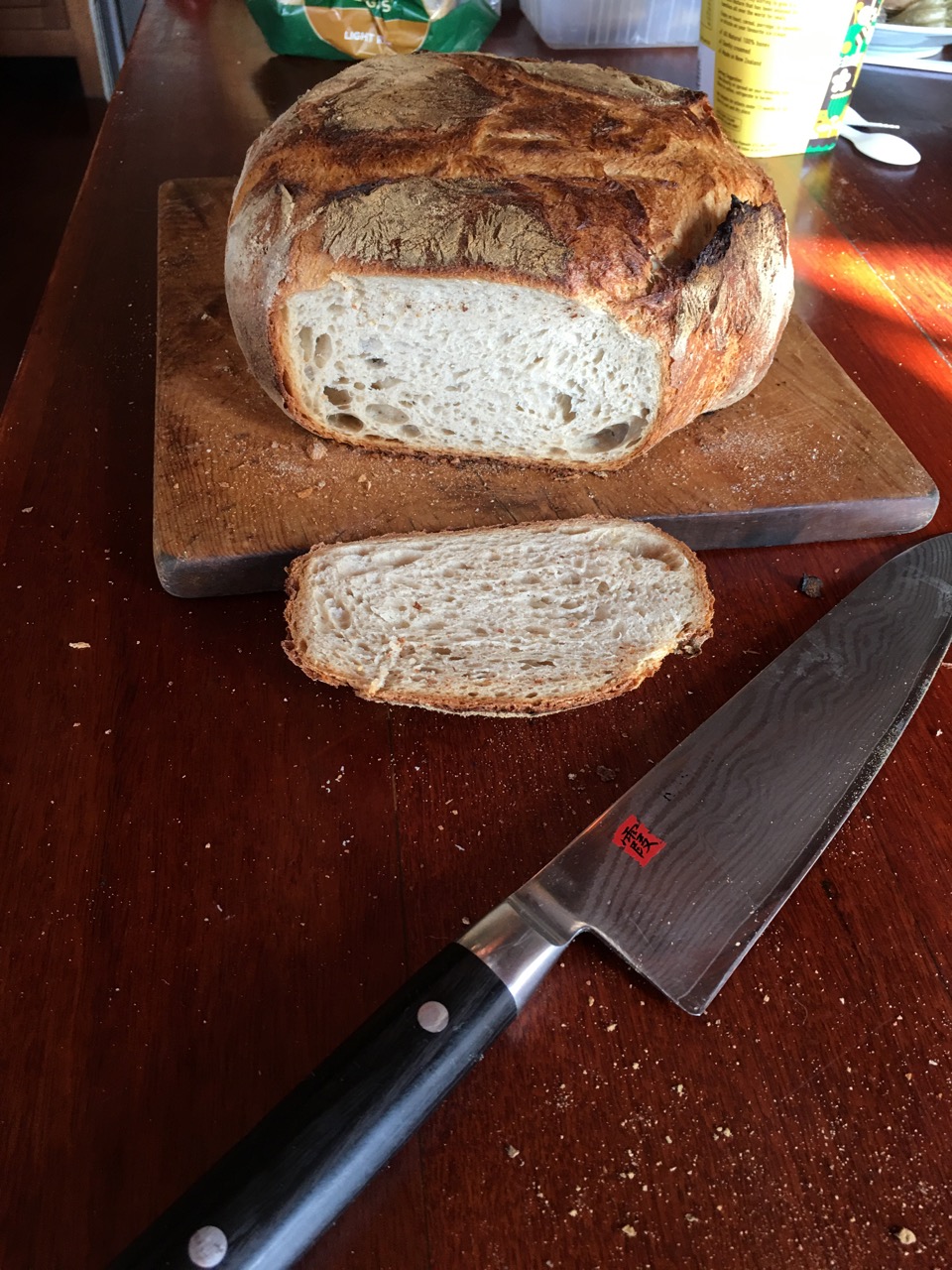
I was up very early this morning to put the bread on. I like to get it on early, so it can go in the oven during breakfast and be out ready for lunch.Everybody who makes bread has their own way or technique. We have been making bread for the past 45 years. My mother taught me how to make bread and she taught me what she knew, as she used to bake her own bread for us when we were kids.
I grew up on home made crumbly, stoneground wholemeal flat loaves. I have never been really happy with the results of our own loaves, there was always so much room for improvement. I’m always interested in learning from others how they make bread. Some years ago, I was told by a fellow teacher at an Art School where I was working part time that his wife made really nice bread, she had been a profession baker. He told that the best results came from baking the bread in a closed environment to get a good crust.
He told me that his wife used a cast iron camp oven to bake in. I didn’t own such an item, but googled it and they cost upwards of $100 at the time. That was way beyond my discretional expenditure budget so let it slip. 
Janine and I have owned a bread making machine for 20 years. Actually, we have worn one out and are now onto our 2nd one. They save a lot of time, but we don’t like the square loaves with the hole in the bottom, so we decided long ago to use the machine to only make the dough, which it does very well.

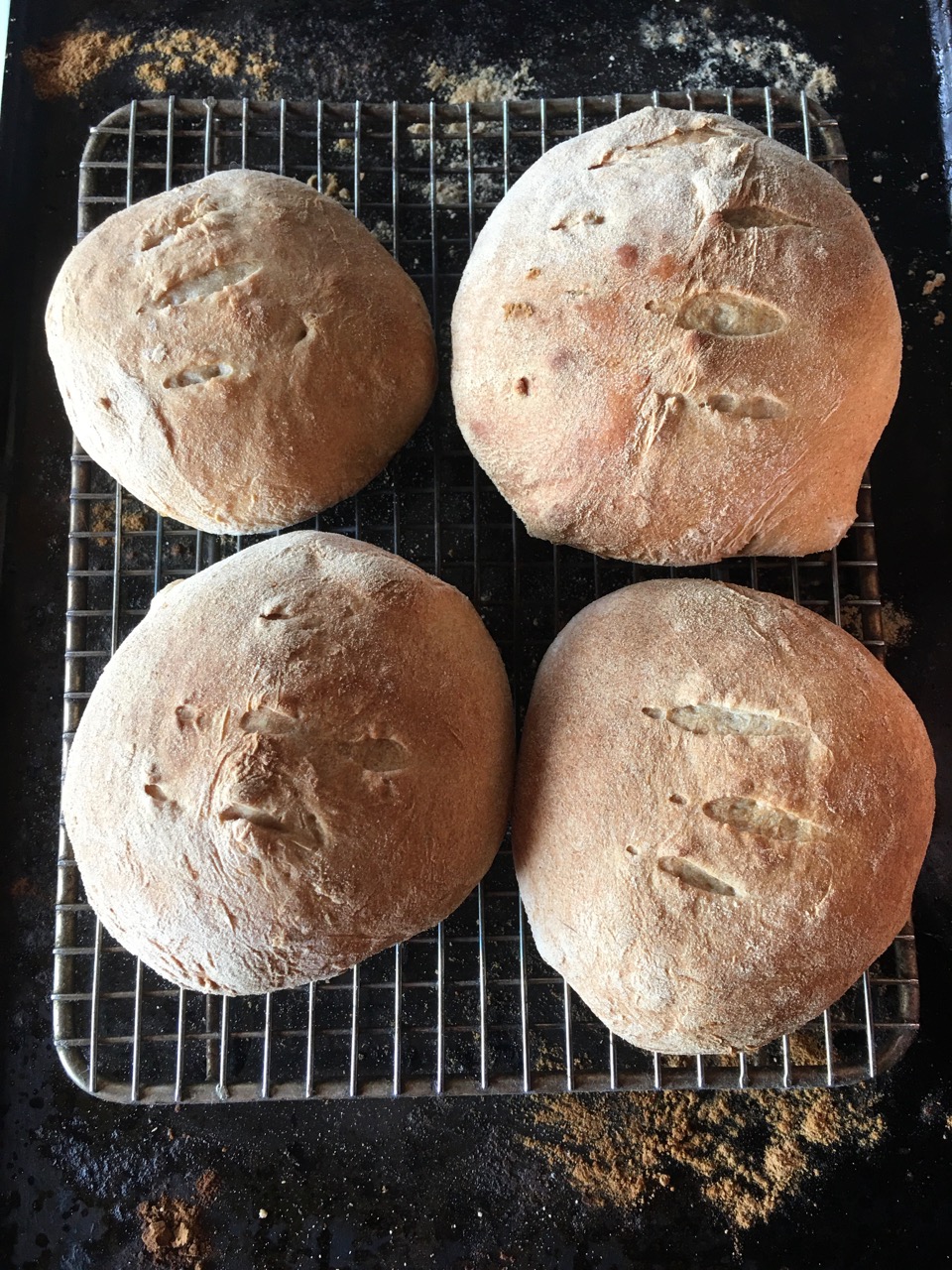
I like rye bread, but Janine finds it too heavy, so we compromise and I make a 50/50 mixed loaf of rye and wheat flour. The bread machine, or should I say the dough machine takes 1 1/2 hours to prepare the dough, which is OK for us. We can put it on and go out to work, then return to take the dough out and bake it our selves in our own tray in the home oven. Sometimes we make a platted loaf, other times we make buns or rolls, all free form just as my Mum did.


My son made excellent bread in his restaurant. from sour dough that they developed there over the years. They even went to the trouble of importing a special variety of wheat directly from the farmer in western NSW and getting it specially milled one tonne at a time for the restaurant. It was worth the effort. The bread was excellent. I even stopped baking bread when I could call in and pick up a loaf of yesterdays bread. A time that I believe caught the bread at its best. He made the dough in the evening after service, let it prove over night and baked it in the now cooling wood fired oven first thing in the morning, before stoking up the oven for the days service. That all ended when the restaurant closed due to Covid.
My grandfather told me that the best bread was proved over night, a slow fermentation. He also told me that in commercial bakeries they blow steam into the oven to help create a better, crispier crust. I don’t know if this is true, but I believed my grandfather, but couldn’t ever figure out how I might achieve that.
I spoke to another bread maker who we stayed with in Wales, He made fantastic bread at home. He even sold his bread locally to his various friends and neighbours. David made a sour dough in a rather fluid form, a very stiff liquid.  David made a bread with loads of seeds in it. I loved it and we even asked him to bake extra loaves for us when we left to take with us.
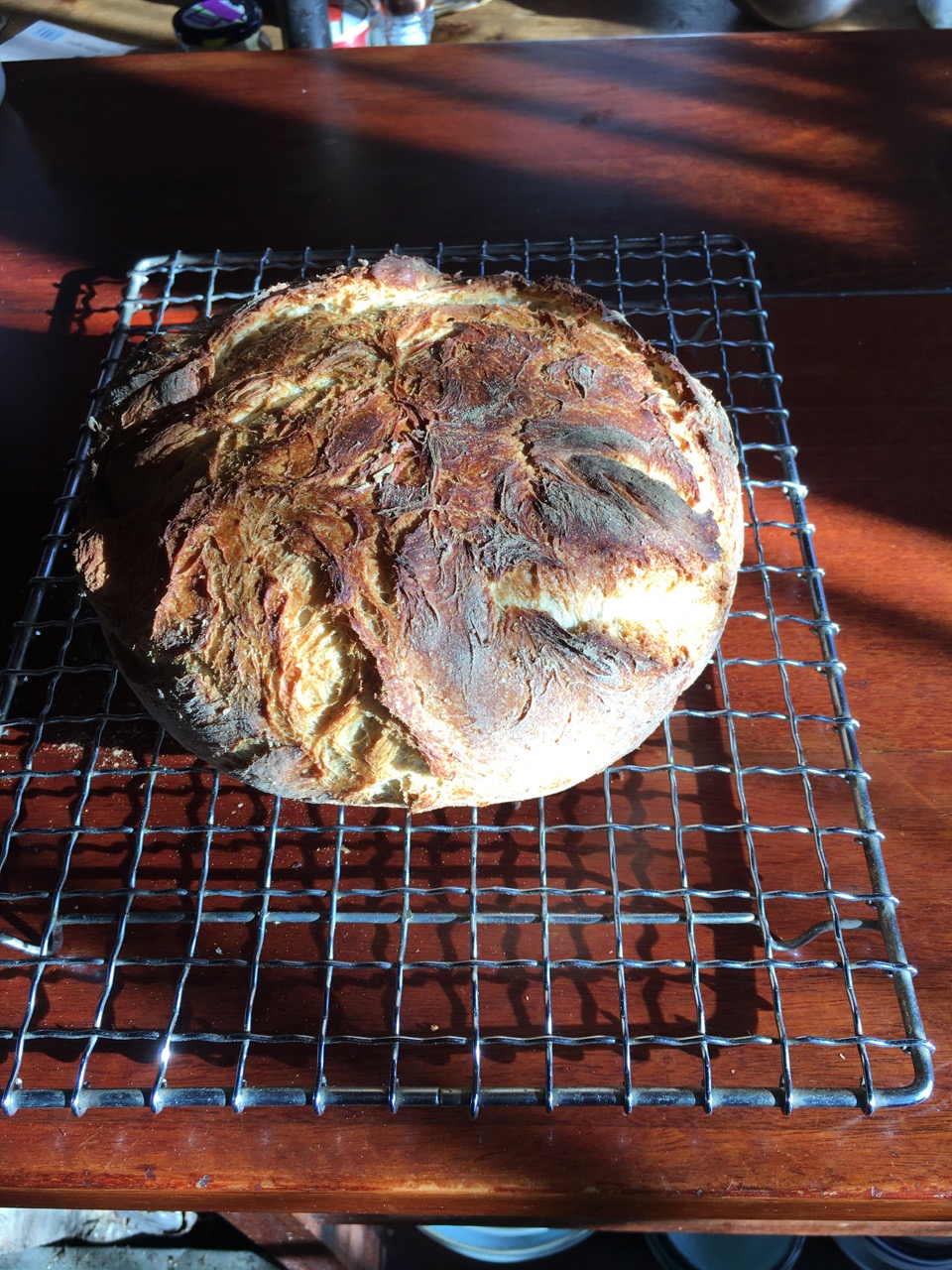
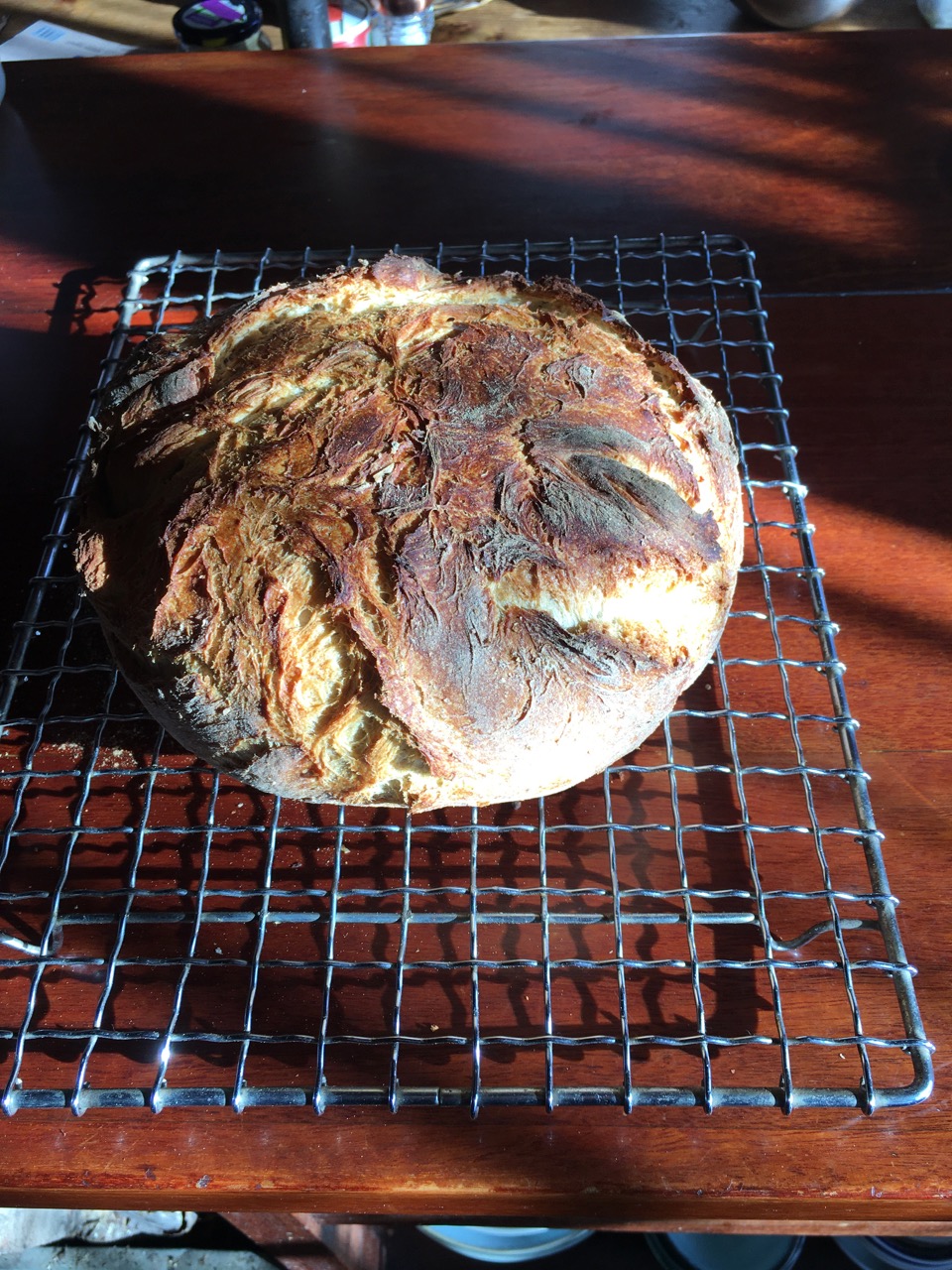
I’m really lazy about things that aren’t absolutely essential to my daily routine. I can buy a good rye bread in Bowral from the artisan bread shop, but I don’t always go to Bowral, and I won’t drive that far and back just for bread. That would be a crime against society in the form of wasted energy. So I have developed a system that suits me, my energy levels and my available time. We make our dough in the machine early in the morning, then bake it in the oven in a metal pot. I first experimented using a metal casserole, but instead of the usual loaf, I got a wide flat round sort of facaccia loaf. A little bit like the flat loaves that my mother baked. What I did learn from this experiment was that baking in a cassarole gives a better crust.


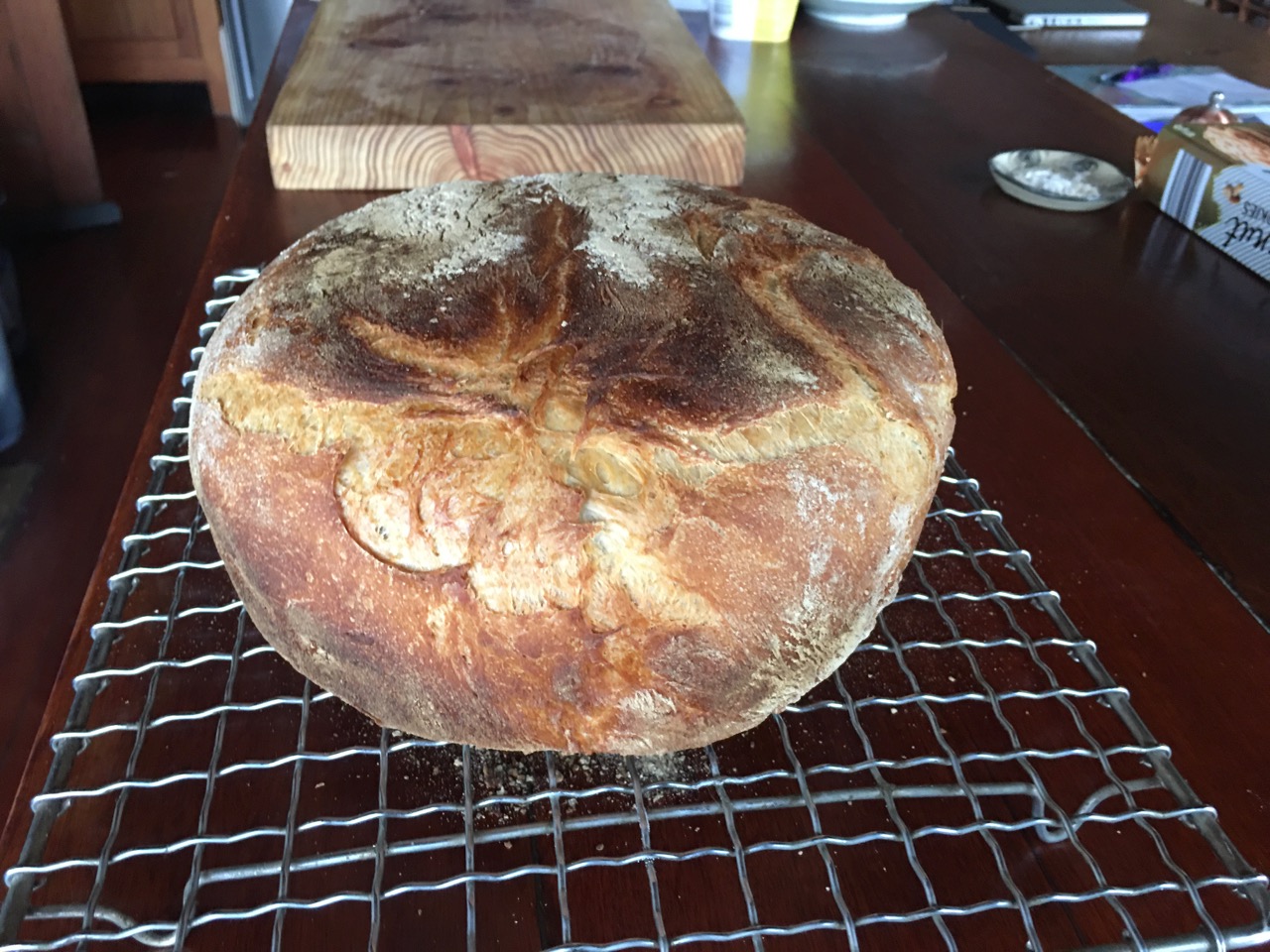
What I needed was a smaller diameter metal pot, so when I saw that a certain supermarket that has a garage sale down the centre isle, had a special on cast iron camp ovens. Under $20 if I remember correctly. Using this camp oven, I could bake a tighter, smaller, round loaf with a good crust.I recently visited one of my ex-students who I taught at the National Arts School in the late 70’s. He is long retired from making pottery, but still had some pottery gear that he hadn’t had the heart to get rid of, even though he hadn’t used it for years. He called me after the fire to ask if I wanted it. I did and we visited him recently to pick it up, as we are now in a position to accept bits of useful equipment. We actually have a shed to put it in now.
Tony told me how he made bread. He does an over night ferment and then bakes in a cast iron lidded pot. His bread was very good. He advised me to take the lid off half way through the baking to let the crust become a little bit caramelised and crispy – even a little bit burnt. The initial baking time with the lid on steams the crust a little bit and sets up the crust, then the 2nd half of the baking with the lid off gives a nice brown crisp crust. It does work. Or at least it works for me in our oven with our Aldi pot. I don’t know anything about the technology of fermenting flour and yeast, or even of baking. I haven’t studied it. What I’ve learnt about making home made bread, I was taught by my mother, then augmented by our own experiments and what i learnt from others. It’s all a bit hit and miss experiments. Mostly misses. But this seems to work best for us.


Early this morning while I was preparing the dough machine. I noticed that there was a really good red sky, warning me about something?

I wonder what.