Category Archives: travel
Home Again
I have had an amazing time in Korea. I was very lucky to meet such supportive and helpful people. Every thing had gone well this time and I am returning with a suitcase and back pack loaded with beautifully fired porcelain. So different from my last visit, in terms of the fired result.


My last day starts foggy and overcast, but clears up. I was walking back across the lawns from the research centre , back to the pottery workshop building , when I bumped into one of the support staff. A lady who I thought spoke very little English. I had heard her say “Australian Honey” out loud on my 2nd day in the workshop. I had given a small jar of honey to one of the staff members who had just helped me with a problem. I took several small jars of Australian varietal honey with me specifically to use as gifts. This lady saw the jar and read the label out loud. I heard this from the other side of the room and got another jar out of my back pack and presented it to her.
She asked if it was for her. I replied. “Yes, it’s a gift for you”.
She thanked me profusely, and that was the end of the matter. I didn’t have reason to speak to her again personally until now. She stopped me on the lawn and said to me in her basic English. “You leave today?” I replied. “No, not today, tomorrow morning, very early, 7am.”
She explained to me that she only spoke a very little English, but wanted to thank me for the honey and say that I was nice to have around. She reminded me that I had helped her to move a heavy shimpo potters wheel, so she could do some cleaning under and around it.
It was very nice of her to say so, and to venture to initiate the conversation in a language that she was not proficient in. She told me that she was not Korean, but originally came from Japan and married a local Korean farmer.
I replied “So desu ka!” Is that so!, She did a double-take, blinked and replied “Anatawa Nihongo hanasamasuka?” Can you speak Japanese? I replied “sumimasen, watashiwa, Nihongo arimasen…choto dake” Not really – just a little. It’s true, I don’t speak Japanese, but I can speak a few words, however, when I get my ear in, after I’ve been in Japan for a week or so. I realise that I can recognise a lot of words in what is being said around me, and I often know what it going on. Japanese is the only foreign language that I ever tried to learn by doing a bit of study. Some of it has stuck.
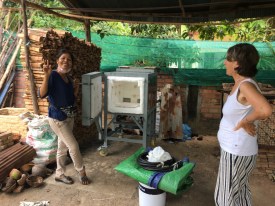
Suddenly we were off on a tangent talking in a weird mix of Japanese, English and Korean using my phone app. It was a completely unexpected, but warm and rewarding moment for both of us. I came away thrilled and very pleased at the intimate level of communication that had just evolved so organically and unexpectedly.

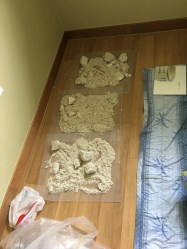
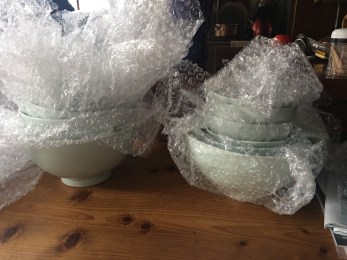
I go back to my room and start to clean up and pack my bags. I have a few clay samples that I have been drying on the heated floor of my room. I eventually get everything back into my bags, plus, I’ll be leaving with an additional 20 bowls and 5 kgs of clay. I’m ready for the early start tomorrow.
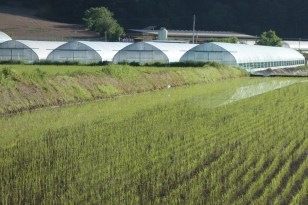
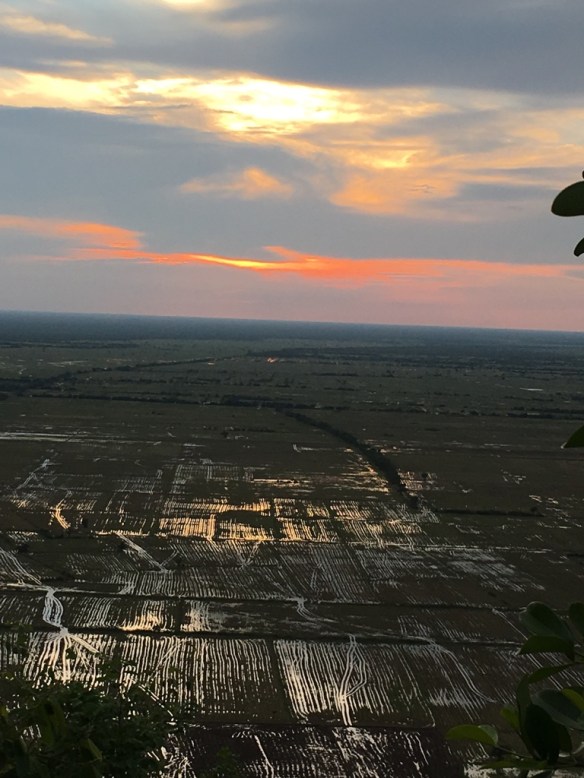
The sunset is lovely. The sky is clear. The last rays illuminate the rice and the poly tunnels, that so define this place. It’s a beautiful way to remember this pleasant valley.

Inhwa and her husband turn up very early the next morning to give me a lift with another student to the bus terminal at Yang gu. My Jung turns up too! He has stopped off on his way to work, to say a final Good Bye. My return trip to Incheon airport out of this remote place on 3 busses all connects perfectly and I arrive at the airport earlier than I had allowed for. My return flight is uneventful, I just want it to be over with really. Sitting in a seat for 12 hours is very dull. Although I do manage to find a couple of hours sleep during the night. Probably my best effort so far at sleeping sitting-up while flying. Possibly because didn’t sleep much the night before. Maybe I’m getting better at this? Not that I want to practice it any more. I’m over it.
I’m home just before the solstice. I unpack my pots to show Janine and take a walk around the garden. The early peach has started to flower. It’s so amazingly early. The first job is to move some more big logs into the wood shed, closer to the splitter. The last time that Idid this, a month ago. I smashed my finger. it still isn’t healed. The chickens are happy to come along and help with this job. But only because there are always a lot of bugs and creepy-crawlies under the bark for them to eat. They love the wood splitter. It provides fresh protein that wriggles all the way down. Yum!

They have absolutely no fear of machinery like the splitter. They really want to get their heads in there as soon they can, to get the first peck, but sometime the splitter blade hasn’t even finished coming down. I’m constantly brushing them away, but they swivel around and are straight back. They trust us – foolishly.
I think that they have no fear, because they have no brain. But they are sweet things to have around and they are good company.
Thank Goodness for Inhwa
The rain is gone, so on my walk to work along the river, I notice that the flow is greatly reduced and back to its clear normal flow. The waters must be fairly clean, as there are otters living and breeding in the river. Whereas in other more industrialised areas of Korea, the otter numbers declined over the past 30 or 40 years, before making a slight recovery recently, due to increased environmental protection. Here the numbers have remained largely unchanged presumably due to the remoteness of the site. The village celebrates the otters with a fountain in the village square. I ask the assistants working here if they have seen them? They tell me that, yes, they have, but otters are quite shy of people, so you have to be patient and sit quietly. Mr Jang, Duck-jin, the pottery teacher, here in the centre, even has a video on his phone that he made last winter. For that matter, so does Inhwa and her husband, Mr Kim.
I’m at the studio early. I walk around to the gas kiln area but the door is still firmly shut and wound up. I settle at my work bench to do some writing while I wait. It isn’t long before Mr Jung comes in with one of my small bowls. and hands it too me. It’s perfect, or seems so at first glance. No warping, no slumping, no pin holes, no runs and no rubbish fallen into it from above. That’s a pretty good result. The colour isn’t too bad either. I really glad now, that I double-dipped the glaze! I was a bit concerned at the time that it might crawl again, and then when Mr Jung come in after the bisque and told me that I had probably made all my pots too thin and that this means that they might slump in the kiln at high temperature. That put the angst into me. He didn’t mean to phase me out, but at that point, there was no way that I could make any more and get them through in time. So first impressions are good. Mr Jung intimates that this is just one that he has stolen from the kiln for me to see. The kiln won’t be opened properly for another hour or more. I sit and wait.
My Jung is at the door, he calls my name to get my attention. He always calls me ‘Harrison’. I’m getting used to it now. It’s a very Asian thing. Last names first. We go to the kiln area. The door is open and pots are being taken out. I can see more of my work appearing one by one. They are cool enough to touch right away. I examine each one briefly as it is handed to me. I can see a few coming out that have minor faults like a pin hole or some slight warping. A couple from the bottom front of the setting have come out a bit neutral in colour, lacking reduction, so they look just a touch anaemic. A creamy body, with a yellowish-green glaze instead of the pale blue over grey that indicates good colour for these materials in good reduction. I start to carry them inside to give them a better examination. Mr Jung calls me back. He switches on the diamond buffing pad machine, so that we can polish all the foot rings. It only takes a couple of minutes. Then we carry them inside. The machine does a beautiful job.

I examine each one, not just carefully, but thoroughly, in good light. I find that I have come out of it with 22 firsts and 11 minor seconds. That’s great. I was hoping to take home a dozen of various sizes, so I’m on track. I offer Mr Jung first choice for his collection in the porcelain museum. He replies to me at length through Inhwa, who has just walked in, that he will need some time to work his way through them, before making a selection. He asks me through Inhwa, how many he can choose. I say that he can have as many as he likes. He jokingly puts out his arms around the whole lot. We laugh. I’m flattered. He thinks for a bit and then says, “how about 5?” I Reply “yes, of course, choose 6, you have first choice.” He tells me that he has got some plans for a bigger extension for the Museum. He will have a lot more space to show contemporary work soon. Maybe next year? 6 will be good. He settles in for a good scrute. But his phone rings and he is called away.
Inhwa and her husband Kim, Deok-ho, have arranged to take me to lunch. It’s their turn. We go to the Chinese inspired Korean eatery. Every time I’m taken out to lunch by some of the staff, we go to a different place. It seems that every house along the central part of the village is a restaurant! We just seem to walk along the street and then without notice someone in our group will just walk up to a door, open it and walk straight in, and sure enough, it isn’t a house at all, but a large dining room or rooms. I don’t have the nerve to go up to one of the other buildings that I haven’t been into as yet and just walk in expecting a meal. What would I say if I just walked into someone’s home and the family were all just sitting there watching telly in the lounge room? It’s all because I can’t read Korean. there is probably some sort of sign that I’m not aware of?
We sit down, on the floor, as you do, at the end of a long table. There is an old couple at the other end. I smile and they smile back. They are very weather-beaten and a bit ragged looking. The man starts to talk to me in a friendly sort of way, in Korea of course. I have no idea, but Inhwa steps in to rescue me. She explains that this couple are farmers and they see me walk past their place most days. Apparently, She tells me through translation, that I smiled at them, waved, and said my “anyohaseyo” to them, then nodded my head in a modest bow in passing. Perfect! They knew that they would like me from that moment onwards. So now we get to have lunch together. Thank goodness for Inhwa. On my last visit it was Miss Kang who made sense of my life here for me. If it weren’t for Inhwa, this time I’d have no idea what was going on, and this opportunity would have just floated by in the ether. The farmers are beaming at me as Inhwa recounts some of what I’m doing here. Lots of nods, smiles and affirmative “huh”, grunting sort of noises.
We all nod and smile and get on with our lunch. Inhwa confesses to me that she is now quite embarrassed, as she has lived here in this village for the past 3 years of her studies in the research centre and she has seen this couple many times, but never spoken to them or even said “Hi” until now.
I explain that I know that I am the foreigner here. I look different. I can’t speak the language, and I’m not part of the farming community. I represent “The Other”. I suddenly arrive on the scene and I am a totally unknown quantity. I fall into “The Stranger Comes to Town” scenario. It’s one of the oldest plot lines from Hollywood. I know from my own experiences, back home in Australia, when I arrived in my own small village, that small isolated villages, mostly inhabited by older people can be quite conservative places.
We were treated with suspicion by the locals for quite some time. We were different in every way, even though I was an Australian. Thank goodness that I wasn’t from overseas and spoke another language to boot! So, I understand what it is like to be the stranger in town, and the best bet is to engage warmly from the first instance, even though I’m not the warm, friendly, Type A personality, outgoing sort of person. I make an effort and I’m pleased that it seems to have paid off. It transpires over lunch, that these humble farmers have actually been to Australia for a visit too! Small world indeed.
Making a Start, Starting to Make
The first thing that I did after I arrived here was to go to the clay room and get some recycled clay, so that I could throw some chucks. This is the first thing that I do everywhere I go. It’s a pity that they are so heavy and bulky, otherwise it would save a lot of time to just pack them in my bag and carry them with me.

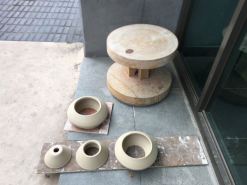
I make a range of sizes that will suit the pots that I pain to make. I get these out in the sun as soon as they are made. I will need them dried and stiffened, so that they can take and hold the pots on top of them during turning. The chucks are thrown very thick and heavy, so they are quite slow to dry and stiffen up,. They need to get drying as soon as possible.
The next thing that I do is to throw my bowls. These are made from the best white sericite porcelain. I throw them quite thinly, because I can. Most porcelain looks best when it is very thin, so that the light can shine through and show off its translucency. However, this local and very ancient sericite porcelain stone body Is very highly fluxed and distorts really easily, so it best to make these pots a little bit thicker for structural reasons. This mica throws really well and is a joy to work with. They will dry out on the rims quite quickly unless they are covered with light plastic sheeting over night. The next day I get them all out in the sun again. The first of the smaller bowls are ready before the chucks are really quite dry enough. I wrap the bowls and leave the chucks out in the sun while I go to lunch with the staff. When I come back they are ready. Its early summer here now, so the days are long and quite warm at 27oC. I’m staggered to find that Miss Kang and her boyfriend have returned yet again. They have been invited to come to lunch with us all again. I ask how the stars were last night? She tells me that they didn’t see too many, as it was a cloudy night, but it was a lovely experience up on the mountain. I gather that this is where they camped?
After lunch we all go back to work and Miss Kang and friend leave to set off on their mountain climb. I start my turning and get all the first batch roughed out quite quickly. Then I return to the wheel to throw some more. I need to have a continuous supply of work coming, depending on the drying time, so that I can be continuously busy and not waste any of my time here.
My next task is to try something larger. I make some 200 mm bowls and then, last thing, before the workshop closes at 6.00 pm, I make some 300 mm bowls. That will keep me busy for a day or two of turning. My days are filled with a mix of throwing and turning, wrapping and unwrapping. I stroll to and from the workshop along the little farm roads that wander like I do around the fields and streams, eventually always ending up down by the river.
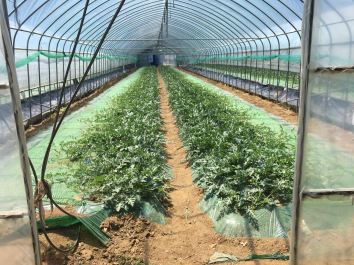
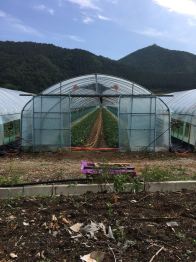
Each trip I try and take a different route. I have tried crossing the river using the stepping stones that are provided to save the kids who live at this end of the village from walking all the way up to the bridge and back to get to school. I can tell that it isn’t used very much these days as the grass has grown high and almost covered the path. I suppose that it is because it is school summer holiday? I have plenty of time, so I take the long way around and walk past different farms and get a different view of the valley. Although it is different in detail, it’s more or less the same in general. Every farm is growing more or less the same things, at the same times, in the same way. A mixture of poly tunnels and rice fields. Very little is grown out in the open. Potatoes, garlic, spring onions and sweet corn are all out doors. Whereas chillis, melons and tomatoes are under the protection of the poly tunnels. I can’t but notice that the melons are grown in such a way that the fruit will develop on a mat to keep it off the ground. I one greenhouse, I saw that they had little plastic dishes set out to rest the melons on, to keep them up off the matt, so as to get perfect shape as well as no dirt or discolouration and unripe white skin colouring from developing underneath.

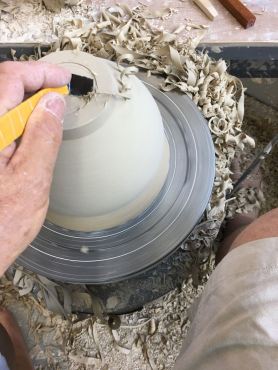
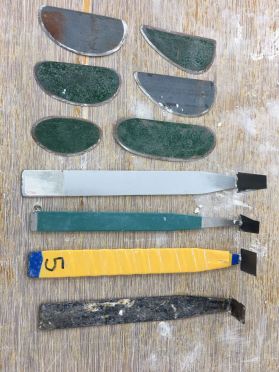
I turn all day the next few days, I slowly it dawns on me that I’m not turning like usual. I start to realise that I have finally taken the edge off my favourite yellow handled carbide turning tool. Its taken a couple of years, but it has now lost its razor edge. It’s still sharp, but the ultra fine edge has gone. I check it against a couple of tools that I don’t use much and, yes, it’s gone. Luckily, I have brought a small diamond file along with me in my kit. I have carried it since I bought my first few carbide tipped porcelain tools. I have to break it out of its plastic bubble wrap packaging. It works a charm. I’m surprised, but not shocked. This tool is my favourite and has lasted a couple of years without sharpening. On the other hand. I have to sharpen my hand made carbon steel custom tools every hour. They are great tools, easy to make, but easy to make blunt too, with a bit of porcelain stone work. Fortunately they are very easy to sharpen. I always carry a small mill bastard file in my kit as well and step outside often to give the edge a little touch-up as required. I always go out side to sharpen my tools, as I don’t want any iron filings to turn up in my clay. It strikes me that I’m a bit like a butcher in this way, constantly adding a little bit of a fine edge to my knives as required. At the end of a day of using these little round handle-less gems, I have to sit for a while, out on the sunny bench and re-shape them, because they soon develop a flat spot on the curve after a day of constant use and sharpening in the same place. The sweet spot, where I use it the most, in the centre of the curve. It’s a pity that I have never seen any large flat carbide shapes like this for sale anywhere. I guess that there are not so many people using these ‘inner’ tools to justify a production run?

The walk home is lovely, it’s balmy and there is a lot of bird call. The sun is setting and it makes the rice crop glow. It’s a peaceful, beautiful time.

Alone, Like a Shag on a Rock
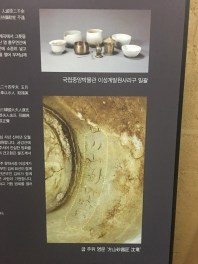
I’m here in the very pleasant little village of Bangsan, just outside of yangggu. Porcelain stone has been mined here since the 1300’s. It isn’t known exactly when. But a ‘stash’ or ‘horde’ of porcelain and silver ware was unearthed up on top of a local mountain when some workers were building a fire break. The box contained a few porcelain pots, two of which have inscriptions carved into them. One indicates quite clearly that it was made in the Koryo dynasty. 918 to 1392. I know this because the Yang gu Porcelain Museum on-site here has the pieces in its current exhibition. I’m lucky to be here at just the right time.

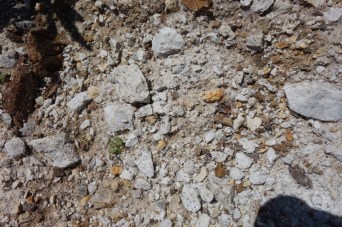
There is still some of the porcelain stone still around. At one stock pile site that I walked up to. It was stacked up in rows of stock piles that dated back centuries. Apparently, This was all the reject stuff that wasn’t good enough for the pots of Royal Patronage, possibly because it had a few iron spots? This material has sharp edges and looks hard, but shatters easily. It is mentioned in historical documents as being transported out of here to other places for manufacture of porcelain under Royal decree at the rate of 70 to 80 tonnes per year, since the Koryo dynasty. Usually transported down the river twice a year at times of high water in spring and autumn, although some porcelain was made here onsite too. Large amounts of the stone were won and stock piled, then suddenly the trade seems to have stopped and the stock piles remained untouched until recent times.
Although the original mine site of this particular stock pile is completely unknown. That is, until very recently. It was known to have been mined somewhere around here. There is an ancient kiln site across the river from where I sit and write just now. The site has been excavated and preserved. Covered with an impressive shed to keep the weather and shard hunters out. Then, just behind it. Higher up the hill, there is a museum of the sherds that were unearthed during the dig. Porcelain has most certainly been made on site here for a very long time.

Now this following part must be taken with a grain of salt, as it is third-hand via interpretation. So maybe I’m completely of the mark, but as I understand it. A few years ago the current source of the Yang Gu sericite was discovered. There was a bad flood that changed the banks of the river that flows through the village here. It exposed some material that looked promising. A few years later, there was a severe drought and the river level dropped dramatically. This allowed Mr Jung, the Director of the Porcelain museum here, to get in and excavate some samples. It turned out to be sericite, so a large machine was brought in and the lens of sericite was removed to higher ground and stock piled.
It seems that the old kiln was built on the banks of the river here for a reason. I notice that there is a leat let into the banks of the river just below the kiln. Possibly to run a water driven clay crushing hammer in the past? I’ve seen exactly this in other countries like China and Japan, where porcelain is made! It all comes together? There are a few examples of replica water hammers around the village. Non of them working, just for show these days.

The original Yang Gu sericite material from the stock pile site is a hard, glassy, stone like many other porcelain stones that I’ve seen. However, the new material is somewhat softer and more friable. I can crush it with my fingers. I imagined, when I first saw and felt the raw material in the stock pile. That it might be some sort of kaolin based clay. It reminded me of my ‘Mafia’ deposit of halloysite/illite/quartz/felspar, near Mittagong at home. However, this proved to be completely wrong. I’ve had my samples from my last trip analysed and the material here is almost totally composed of sericite and some quartz. I must say that it is amazingly plastic, for a body that is almost completely free of clay. I say almost, because the material is so glassy and fusible at high temperatures, that Mr Jung has brought in some sericite with a kaolin component to firm it up a bit at stoneware temperatures. This material comes from JinJu farther south. I really had no idea of just how plastic mica could be. This place is pretty special. I consider myself very lucky to be able to be here and enjoy these amazing experiences.
I am being housed during my stay here, in a student residency building about two kms away from the workshop. I am currently the only person in the place, as it is the first days of summer and all the other residents are away on summer holidays. I do the 2 km walk each day to the workshop and back along the river.
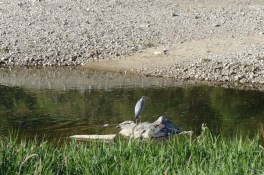
The river is very lovely. It’s low water at the moment, but still running consistently and clear. I can see from the detritus that is hooked up on the iron work along the top of the old bridge, that high water can be at least 7 metres high and possibly more. There is a water bird working the shallow shingle rapids along the river bed. He’s very fast and efficient. He seems to be catching something every minute of so. I see him sunning himself on one occasion sitting alone, up on a rock. I know how he feels.

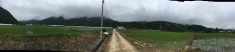
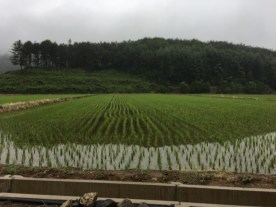
This morning the weather was foggy and overcast. There was a beautiful mist hovering around the mountains. Their silhouette is reflected in the water of the rice fields. The rice has doubled in size since I arrived. Lots of water and some warm weather is all it needs.

So Much Water, So Far From Home.


The dull thud of distant artillery and the sharp crack of small arms fire
We are here in Cambodia and on our first night we are awoken several time with the realisation that something strange and possibly quite bad is going on.
We keep hearing the dull thud of distant artillery. Not constant, but quite intermittent, just so much so that we drift off to sleep again and then are re-awoken by the sharp crack of small arms fire, not all that far away.
Having read up a bit on Cambodia before arriving here, our minds are full of Pol Pot and the civil war. Then, just a week before we set off. There was a documentary on the idiot-box about the assassination of a local journalist who had been campaigning for civil rights, and against nepotism and corruption in the government. He was shot by the secret police who staged it as some sort of ‘hit’ over an unpaid debt.
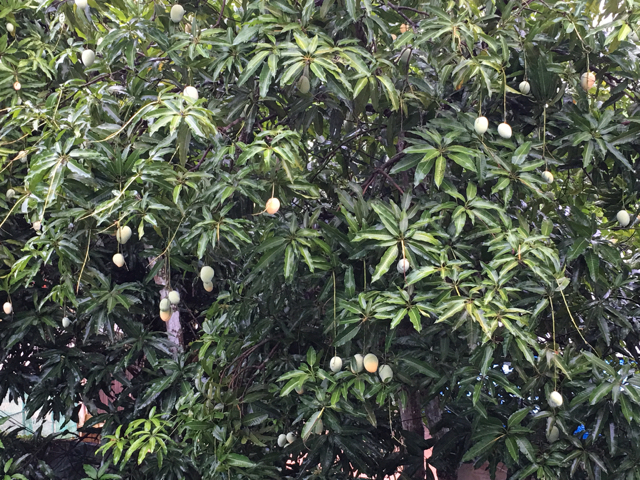
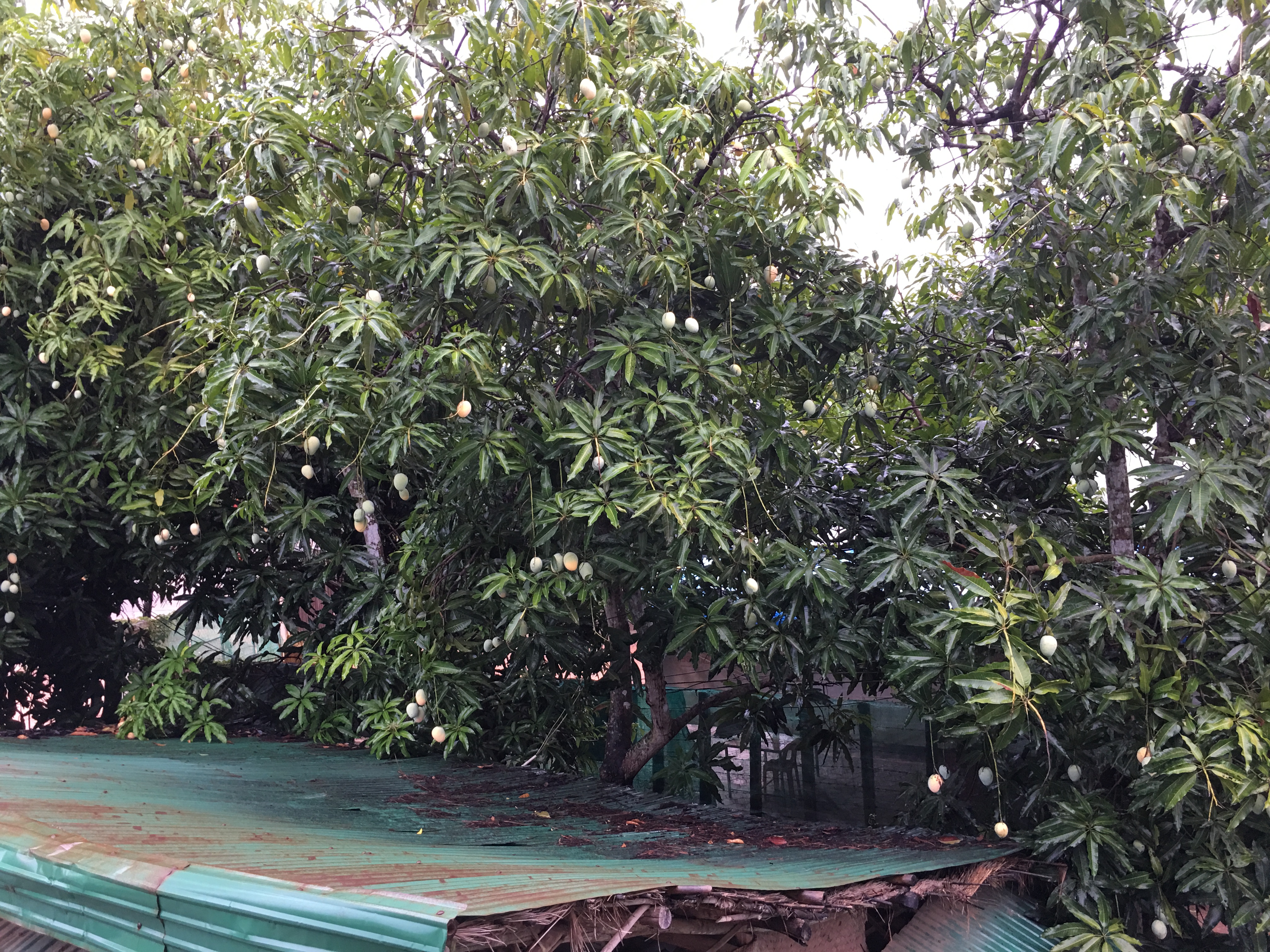
So, our minds were fertile ground for a disturbance. We didn’t sleep well. However, in the morning we awoke, eventually, to find that the house is under the shadow of a huge mango tree and the fruit is in full season just now. When the ripe fruit drops and hits the ground, it makes a dull thud, but when it falls onto the flimsy tin roof of the pottery shed, it makes a sharp metallic report, not unlike distant small arms fire.
It was a great relief and we were able to sleep well after that, even with the noise.
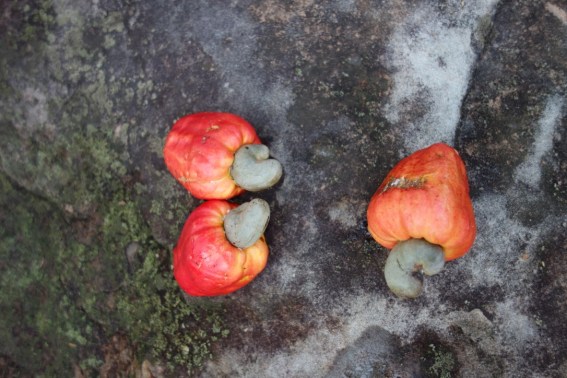
We soon get accustomed to eating half a dozen fresh mangoes for breakfast each morning. We even make tropical mango and banana pizza for the family before we leave.
A Visit to the Mountain
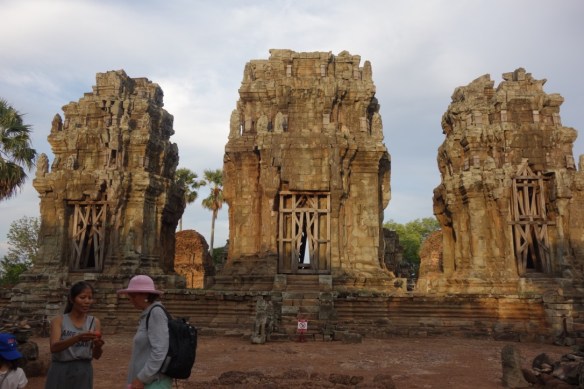
We have just enough time left to take the afternoon ‘off’ and Paruth suggest that we should all go to the mountain. There is a temple at the top of the mountain, and we still have one more day left on our temple passport tickets. Entrance to the temples is free for citizen. It’s only visitors like us who have to pay.
Aproaching Nirvana on one Leg
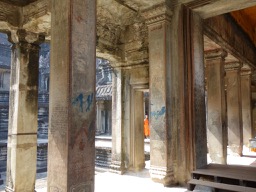
I’m inclined to take the risk of being totally boring now and tell a little story about our brief visits to the Angkor Temples and Palaces. I’m sure that everyone has seen a doco or read a book about these amazing places, but until I got there, I didn’t really understand the scope and scale of them. They are quite impressive.
As we are ahead of schedule and coping well with all the variations in alterations that we are encountering, we take ‘off’ another morning and hire a tuk tuk to take us to the temples that are just half an hour away. These are some of the most famous temples in the world. I’m told that Angkor Wat is the largest in the world? It is one of the most important world heritage sites.We set off early, as we want to be home before the afternoon heat sets in.
There has recently been a steep increase in the cost of the temple visitors passes. It costs us about $170 for the two passes. Our driver knows what most people want to see and the best way to approach it and in which order. He’s used to it. We trust him. There are a lot of temples around Siem Reap, not just the famous ones like Angkor Wat. Over the three trips that we make, we venture to the West, North and East from Siem Reap.
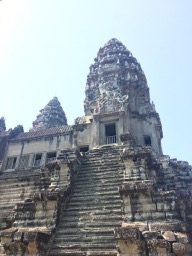
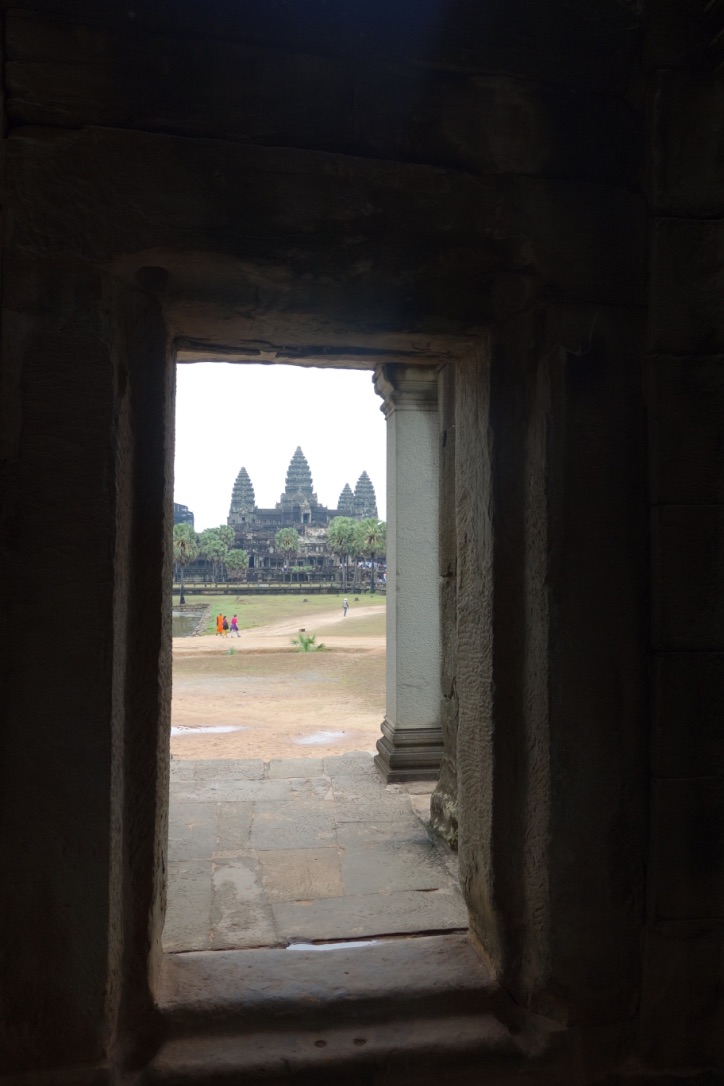
Of course we go to Angkor Wat first, everybody does, and I must say that it is a very impressive place. Actually, it’s a Palace and not a temple. It’s huge! The experience was a bit spoilt though by people like me being there. I’m spoiling it for others too. There are just too many people to be able to see things without being nudged or shoved. It proves quite hard to get a photo of some of the carvings that are situated in passageways. I’m a pain in the arse to someone else who is trying to do the same thing. Luckily as we arrived early. We beat the rush, but it soon starts to fill up.
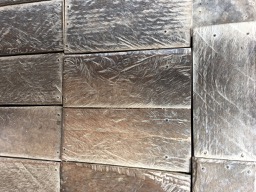
In the busiest areas, they have laid down timber walk ways and wooden stairs to protect the ancient stone from being worn away by people like me! I rather like the polished wooden boards. As the morning wears on, more and more people arrive, It’s so crowded, there is an hour wait to go to the upper temple. Instead, we decide to leave. This proves to be a very good decision. As the other temples are not so crowded and busy. We will return on another day.
Even though there are a lot of people here, patience is rewarded. But there is always one person who unexpectedly steps into the frame!
The next temple that we visit is Angkor Thom.. There are a lot fewer people even though it is a lot later in the day. I think that I like this temple a lot more. I’m quite taken with all the buddhas faces.
We move on to other temples near by. In places the tress have taken root. There was once a building under this tree. It’s now inside it. These trees are well rooted and it’s not just the trees!
In the early morning there are fewer people around, so some of the local inhabitants make use of the privacy, but there is always some paparazzi around.
Visiting a buddhist temple can lead one to some deep introspection. Like “Does my arse look big in this temple” while ascending the stairway to heaven.
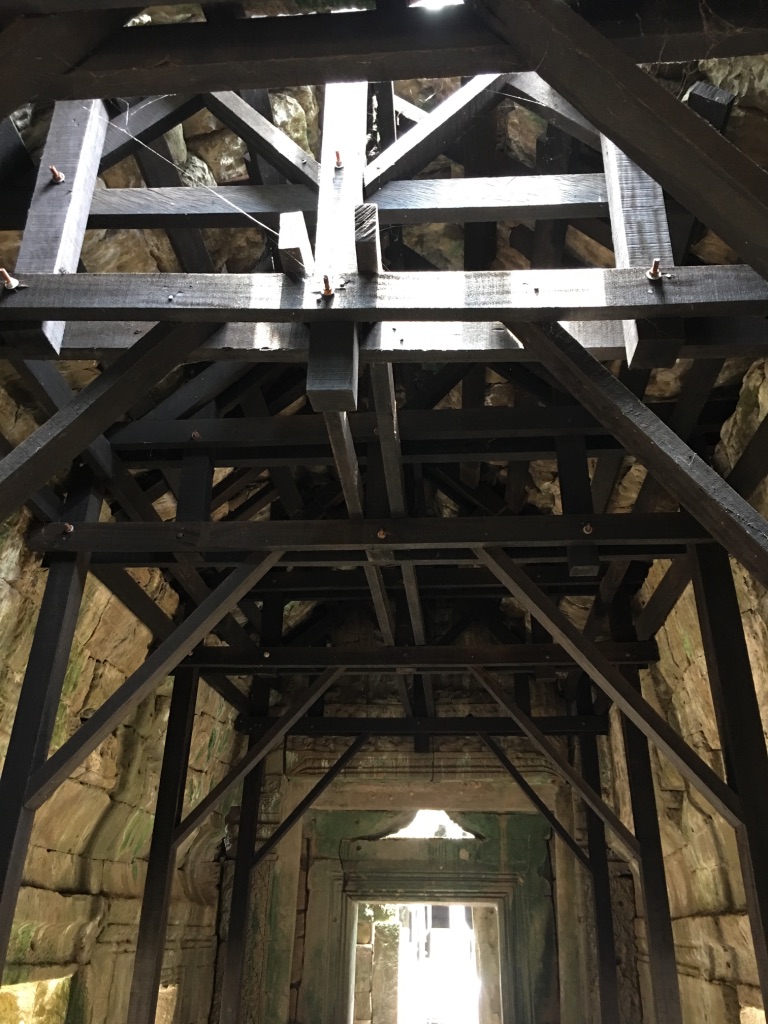
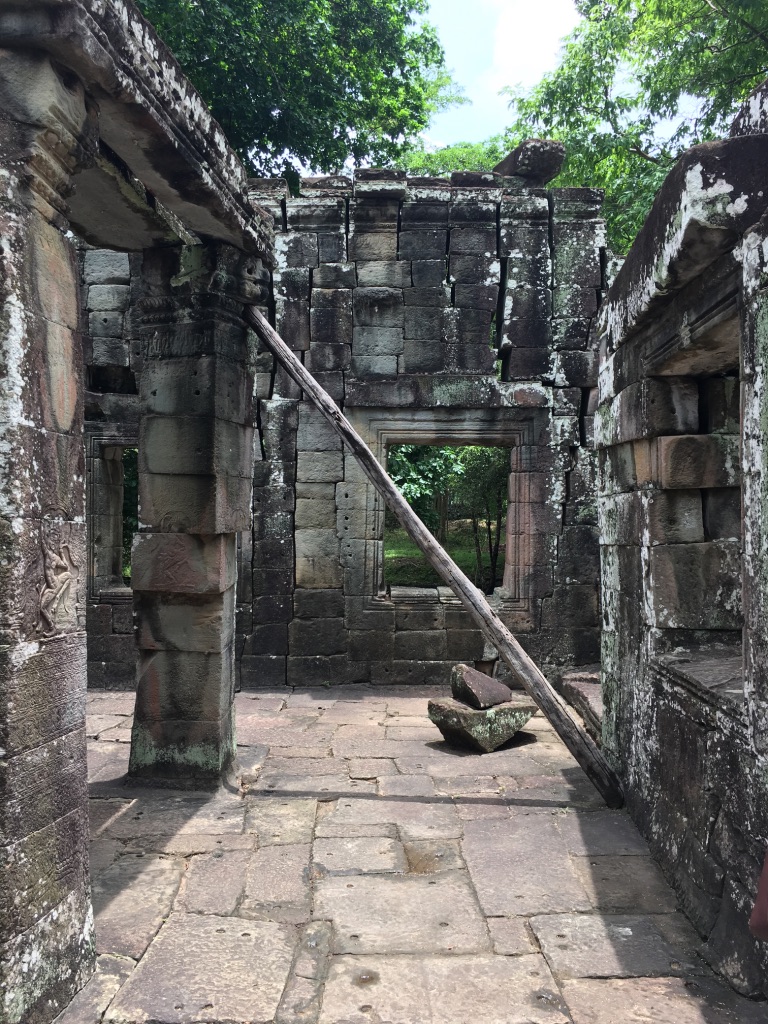
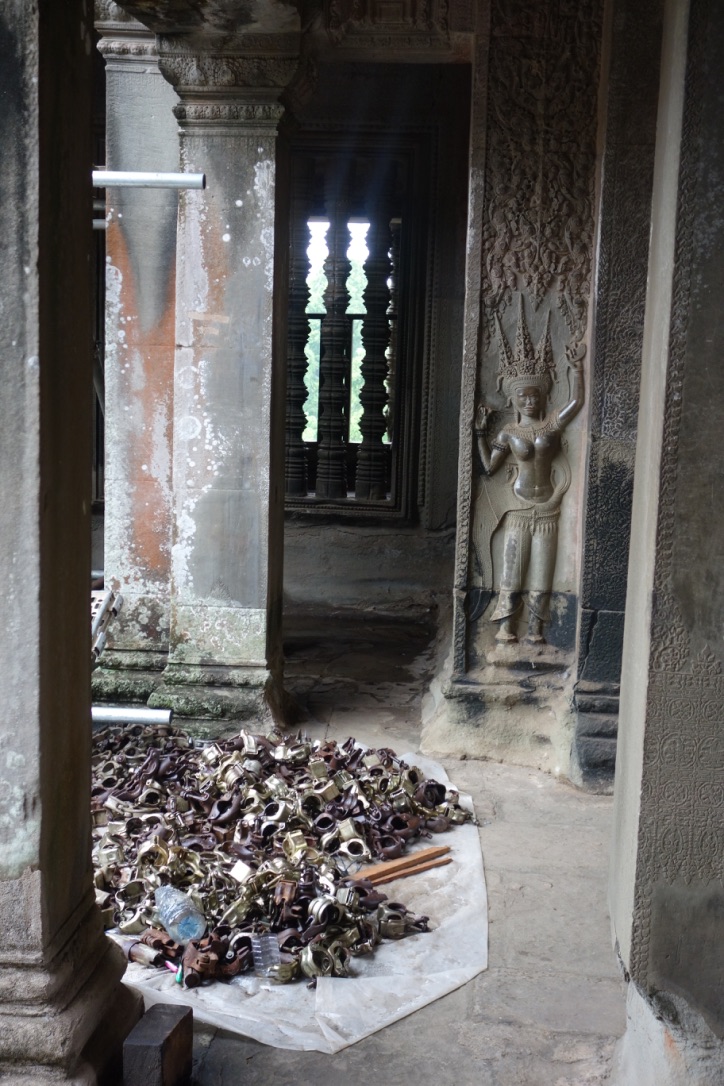
There is quite a lot of reconstruction and repair work being done on parts of all the temples. Some more substantial, well-financed and better executed than others!
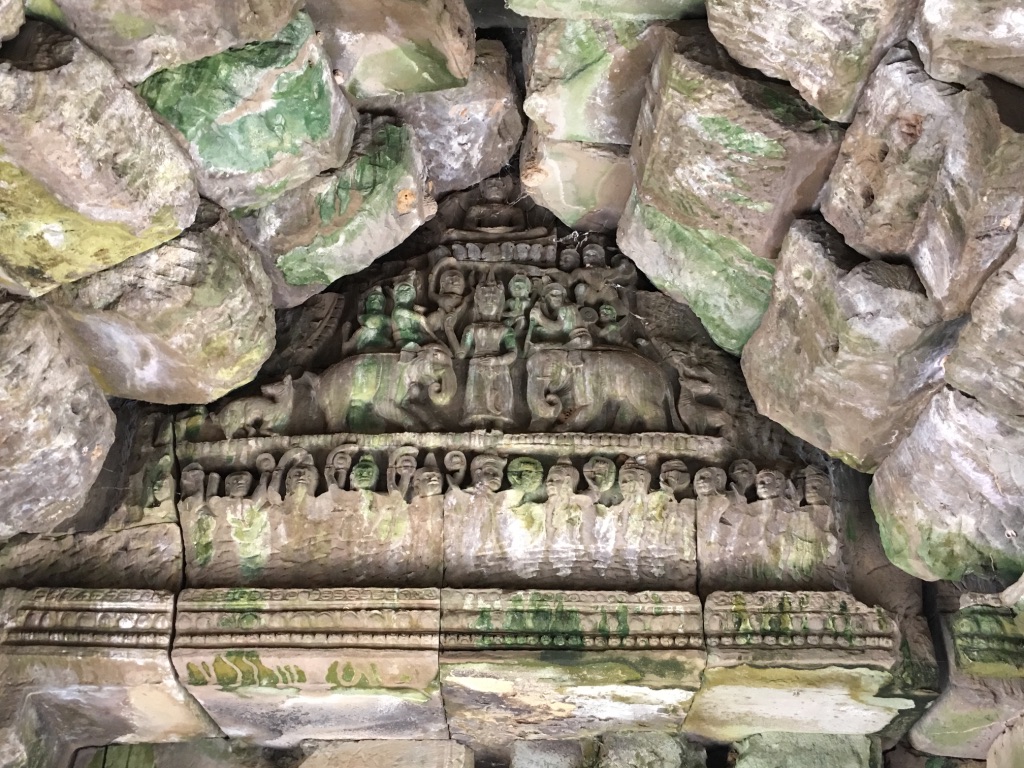
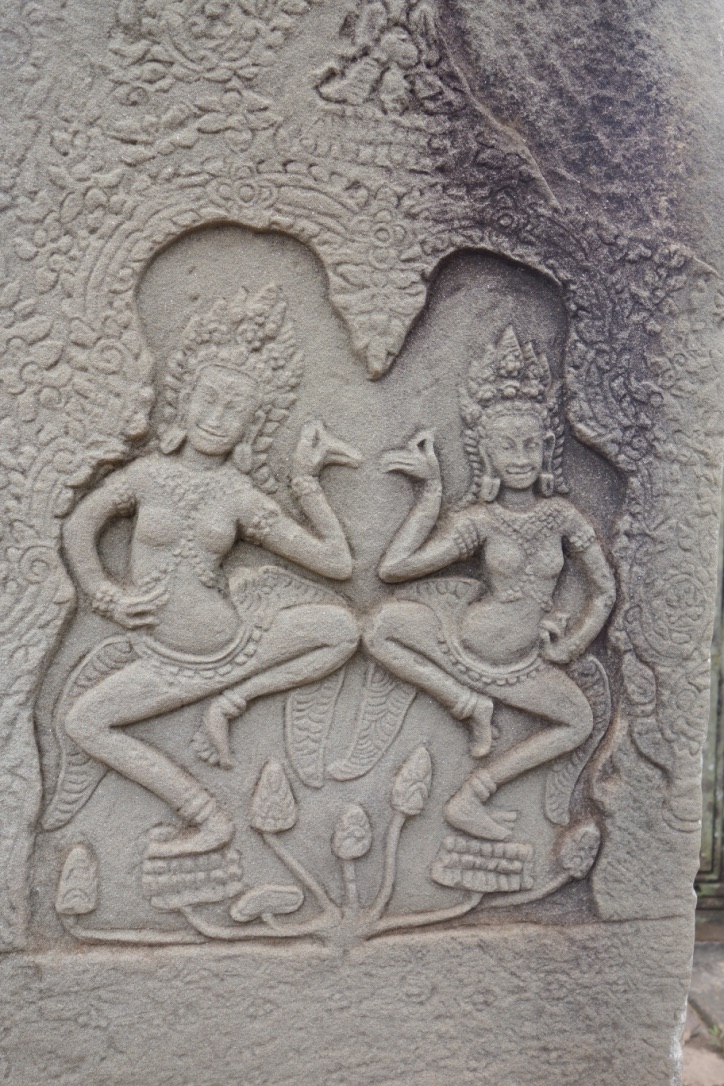
All the walls are covered in carvings. There are a loads of them on all the temples. Far too many to take in, in three 5 hour visits.
I’m here contemplating buddhist teachings and right there in front of me is the salient reminder that no matter how hard we strive, we are still shackled by our desires! This important message from the deity does not escape my attention.
Maybe I’m going about this the wrong way? Maybe I should be approaching Nirvana on one leg?
The sculptures show us how. Now, if Janine and I just practice in our spare time. Maybe…?
Changing the World, One Kiln at a Time, or 3
Nina and I have come to Cambodia as volunteers to help a potter here with her kiln. She is a single mum with kids and could use a bit of help. There are many things that we could do and ways that we could volunteer, but we have been asked to come by someone with local knowledge, who knows the situation here and also knows my particular skill set. I have been working on this private program for some years now. Restoring pottery equipment for someone who then sends it all over to Cambodia as donations to potters workshops. Now the time has come to put our feet on the ground and get more involved.
We are not working under any particular program or an NGO. We have come at our own expense as a private aid gesture to hopefully, pass on some low tech solutions that will be acceptable and that may prove to be incorporated into the local knowledge base long-term?
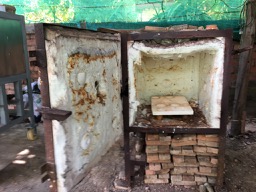
This potter, Paruth, has had some help previously from another Australian potter, Bronwyn Kemp, about 8 or 9 years ago. Bronwyn came over here and helped build a small gas-fired kiln from what was, more or less, scrap iron and fence wire. She did an amazing job and the kiln has been worked to death since then, sometime being fired twice a day. However, time and work take their toll, and this fantastic little kiln has had its day and is in need of some restoration and repair. The floor has collapsed, so the potters simple solution was to build up a pile of small local red bricks under the kiln to support the old floor. Fantastic! A really creative solution that solved the problem. However the roof has also collapsed in as well and will need a total rebuild.
We have organised, through another Australian, Ian Brookes, to get some kiln building materials delivered to the site in advance of our visit, so that we can get a lot done during our two-week visit. From the photos sent to me previously, I thought that this little kiln had potential to be rebuilt. However, as a safety precaution, we are also planning to build a new and slightly more robust kiln that will have the potential to last 25 years?
I sent scale drawings with dimensions of the metal work that would need to be ordered in and welded prior to our arrival, but this turned out to be too difficult for the local steel worker to manage. So we abandoned the attempt to get the steel work done in advance and just concentrated on getting the necessary materials all collected together, so that when we arrived, we could be most productive.
As it turned out, the metal work that was done prior to our arrival wasn’t done very accurately, as our welder wasn’t particularly literate or numerate. The kiln frame was the wrong size and constructed at 90o to the plan. However, with so much already invested in the construction and with so little time. I sat down and resigned the kiln concept to fit what had been done already and luckily. I was able to make a suitable plan that could accommodate everything that we had without too much loss of function or efficiency.
So the new kiln will be a bit shorter than planned and a little bit tighter in width, but it should be OK. Ian Brookes had sourced some zinc metal primer paint in advance of our visit, so we were able to prime and rust proof the mild steel kiln frame before lining it. This should make it last a lot longer.
We had also arranged to have two sheets of Stainless steel delivered in advance so that we could make a kiln cladding that would last as long as the primed frame. Funnily, stainless steel is actually quite easy to get in Cambodia, as many things are made out of it these days. Our welding man is only 100 metres up the street from the pottery and he is very proficient with TIG welding stainless steel balustrades and safety grills.
It takes us 3 days to get the kiln frame welded up. A door made and hinged onto it, then painted and panelled in stainless. I have worked it out, so that there will be just enough stainless steel sheeting left over, so that I can put a new roof and floor in the old kiln as well. If we have enough time?


There doesn’t seem to be any concept of OH and S here. The welder works without any of the usual safety gear that I use at home. Not even shoes, just thongs. His only concession to some sort of safety is to wear sunglasses when welding. He will be deaf and blind in 10 years. I give him my ear plugs and get Paruth to explain to him that it is important to preserve what he still has. She tells me he doesn’t care. When I return the next day, I can see that my ear plugs are thrown in the dust pile. I say that I will leave all my safety gear that I have brought with me and donate it to him. She says not to bother, he isn’t interested. he will just throw them away. I feel bad about this, but can’t see what else I can do to help him learn more about his safety and health. I’ve sown the seed. I won’t be here to keep reminding him.
Once the kiln is finished, quite late in the evening, the welder man delivers it by walking it down the road on its castors in the evening traffic. The next few days are taken up with lining the kiln. It’s a very hot, sticky, sweaty job in the 40o heat and 80% humidity. I drink a lot of water. Janine and Paruth help all the way through the procedure. Paruth makes notes and takes loads of pictures, should she ever need to make repairs herself in the future.

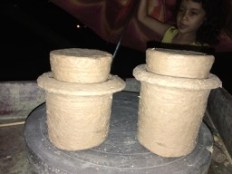
The kiln will need a spy hole and bung, so I decide to make one on-site from the local clay, opened up and made more thermally shock resistant by wedging in a huge amount of rice husks and a lot of sandy clay that has been sieved out of the normal throwing clay that they use here. This will make the clay more open structured and porous.
I make a couple of examples using an improvised tapered profile tool to set the constant taper for both the inner and outer form. Then I teach Paruth how to do it. She makes another 3 sets. So now we have spy holes and bungs for both kilns and a few spares. But most importantly, Paruth now has the knowledge and skills to make any number of them that may be required into the future. Teach a man to fish!


By the end of the first week, the new kiln is done and I turn my attention to revamping the old kiln. It needs to be stripped down and cleaned, then the new stainless steel panels need to be installed in the floor and roof, and finally the lining restored. As most of the
ceramic fibre is still intact. I decide that the best option is to just install new 1400oC hot face lining over the older damaged lining. However, I install 3 new layers of floor and roof to complete the job.


I wouldn’t normally use ceramic fibre for the floor. I’d prefer to finish the floor with a layer of light weight insulating refractory bricks for long-term durability. Unfortunately, the insulating bricks that I ordered turn out to be wrongly labeled and when we open the pack, we find that they are very heavy and dense 70% alumina fire bricks! These are not suitable for this kind of kiln. So another change of plan, You have to be flexible and work with what you have. I decide to make the floor entirely out of fibre and lay an old kiln shelf down to support the props. It’ll work fine and be lighter and a bit more fuel-efficient.

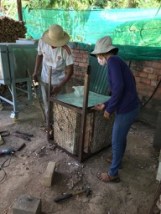
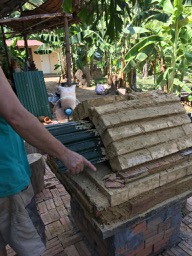
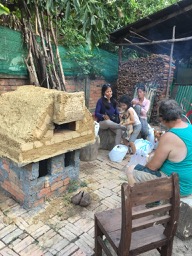
I suggest that as we have 3 spare days left. I’d like to see the temples, but I can also fit in time to build them a wood fired pizza oven. This turns out to be the most popular suggestion that I have made on the entire trip! We cobble together a few bricks and a sheet old roofing iron to make an arch form-work. The oven is almost completed in one day but needs a second day to finish it off, as it is getting too dark to see properly as I try to chisel the final key stone bricks into shape to complete the arch.
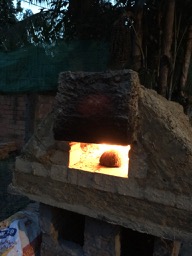
We cover the bricks with a layer of rice husks and the sandy clay to act as some sort of insulation layer, then light it up and start to pre-heat it.


You must be logged in to post a comment.