The Glorious Weeks of High Summer

We have entered the glorious weeks of high summer, where it’s just too hot to do much physical activity in the middle of the day. Having both had skin cancers removed – fortunately at early stages, we are careful to wear long sleeves and a hat when we are out. We start early in the garden and orchards, as we want to be out of the sun before it gets too hot in the middle of the day. We work until lunch time and then stay inside until the heat has passed in the afternoon, then we get back out there and do some more.

The jobs vary, but they are never-ending. There is always something to be done, often needed in a hurry. The morning starts with picking fruit. We have passed peak young berry and although we are still getting some each day, we are no longer picking kilos a day. At the peak, our biggest day was 3 kg. We will continue to get less and less, picking only every second day now, up until Xmas day, or thereabouts.

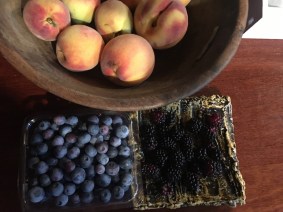
We have reached peak blueberry season today with 2 x 200mm. plastic containers of blueberries. We have about 20 plants, some doing well and others not so well. They are high maintenance and very demanding.

IMG_3688

Blueberries won’t do well unless all their demanding criteria are met. They need to grow in a bog of fresh seeping, acid water, or at least watered every second day. They also need to grow in acid conditions, preferably a very well-drained situation. So here, where we are, up on top of this dry, stoney, drought ridden ridge, there is no natural place for them. We have tried them in the ground in a couple of places, even mulching with huge amounts of acidic leaf litter and the addition of a little sulphur powder to the soil, but they are not happy, even though we water them well, I suspect that they are not sufficiently well drained. They are growing, but not too well, hardly putting on any growth. They do flower and set fruit, but only in moderate amounts. They have only grown 700 mm. high in half a dozen years. Our second attempt, also in the ground in the vegetable garden, where we dug in copious quantities of acidic leaf litter and she-oak mulch, they did much the same, they didn’t thrive, but we do get some fruit from them.

Our best effort to date was to plant them in tubs filled only with naturally acidic leaf litter and detritus from the wood pile and from around the wood splitter, this being almost entirely made up of coarse, fibrous woody compost-like material. These 7 plants have grown 1.2 metres in one year and have flowered and set a great crop. They still need to be watered regularly, but boy are they productive. I’m still finding it hard to believe that a plant can grow so well in nothing but tree bark and saw dust! A medium that has no soil in it. It’s certainly well-drained and is naturally acidic. It seems to be just a matter of keeping up the water to them.

IMG_3685 IMG_3680

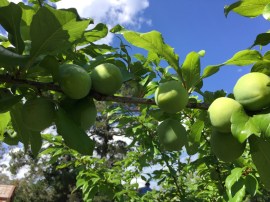
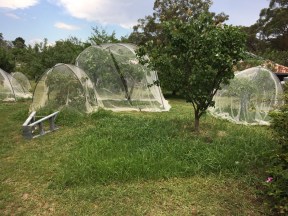
We have just started to pick the first santarosa plums along with the last of the apricots. Now that the apricots are over for us, the net is no longer needed there and we have decided to move this big net off the apricot tree this morning and along with its poly-pipe hoops and have set it up over the second plum-tree. The elephant heart plum.  These plums are still green now, but will be turning red soon, and that red colour always attracts the birds. So far we have managed well with the birds this season.
IMG_3679 IMG_3684

Once the poly hoops are set up and the netting transferred, I drag the last of the netting over and manage to trap one luscious Janine and two chooks under the net. Now we can relax a bit. All that is left to do is to move the DAK pots and fruit fly lures across from the other tree. I try and keep at least one fruit fly lure inside every net. I spend $50 each year on fruit fly trap re-fills and a bag of dynamic lifter. Even growing your own fruit isn’t free + the hundreds of hours spent in the maintenance and watering, but this isn’t really work. It’s better described as fun and recreation, otherwise you wouldn’t do it.

IMG_3677 IMG_3674

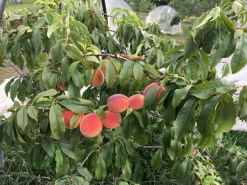
The late peaches are ripening, I suspect that it won’t be long and we will have these on the menu too. The late peaches are luscious, dense, yellow fleshed and so flavorsome. They put the super early white peaches to shame for flavour, but the early peaches are always first, so we are so glad to get them and really appreciate them for their sweetness. We don’t realise how thin the flavour is because we are so looking forward to eating them after 12 months without peaches. Now in the midst of the high summer heat and ever so long days, the solstice is just a few days away, we are getting picky. For instance, we have stopped picking and eating the mulberries, there is always so much more and better fruit at this time of year. We let the birds have most of those, we just take the easy low hanging fruit these days.
IMG_3687

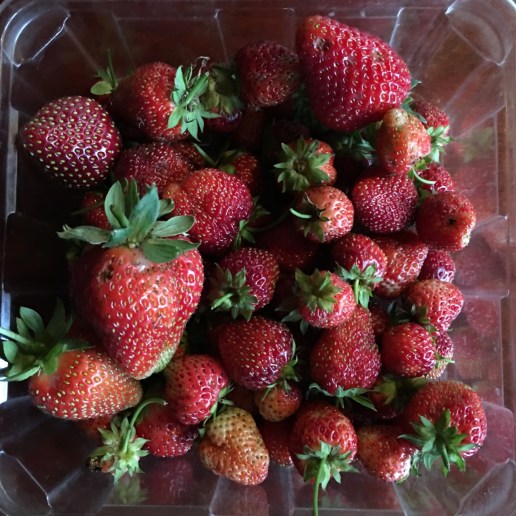
The strawberries are still continuing to produce regular pickings since spring, never too many, but just regular and steady, we have the strawberries mulched with pine needles that Janine sweeps up from under the big pine trees after every storm. We have a constant pile of it down where the truffle trees are growing. We use it for litter in the chook run and in their nesting boxes. After I rake it out of the chook rum every few weeks, along with a load of pooh all mixed in with it, it gets wheel-barrowed to the citrus grove and used for mulch around the trees in there. Nothing is wasted, everything has a use and a re-use.

IMG_3682 IMG_3686

Looking back at our mornings work, I can see that there is a lot of grass grown up under where the netting has been. I get out the whipper-snipper thing and see to it, then think that I should also do all the paths in the veggie garden while I’m out here and into it. Couch grass never sleeps in this hot weather. I can’t afford to let it get a hold in the garden beds. One thing leads to another. There is no end to jobs. But the sun is right up there now and its almost 12-ish and time to put the mower away and go inside for lunch and then some inside work till it cools off. It’s a good thing that the days are so long right now, otherwise we wouldn’t be able to get it all done.

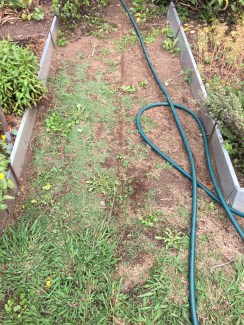
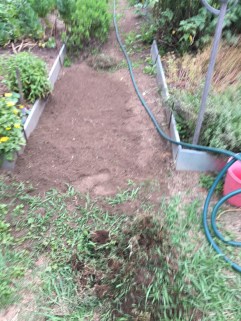
I get out there again and dig out a nasty patch of couch grass that has got a hold of part of the garden path. I set too with the mattock and dig it out roots and all. It’s hot sweaty work, but very rewarding when you look back after you’ve finished!
IMG_3639 IMG_3646

This is a job that won’t need doing again for another year in this spot, but there are still 3 more patches just like it at the other ends of the pathways.

I must have been wicked!

The First Ripe Tomato of the Summer

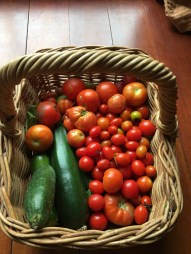
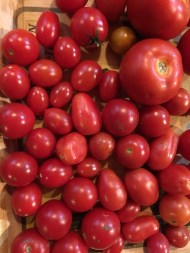
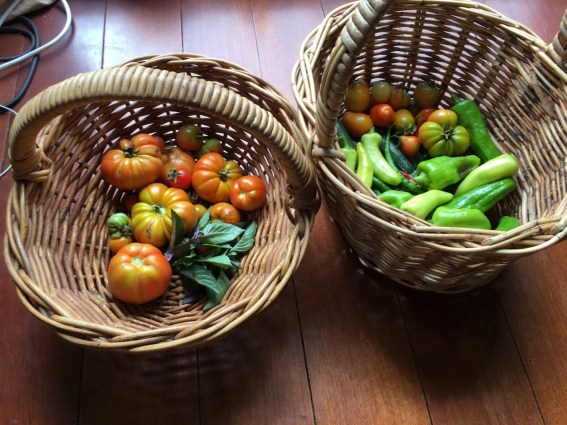
This is a special occasion for us. To get the first red ripe tomato on the 16th of December!

We have had a ripe tomato before Xmas before, maybe a couple of times in the last 5 years, but usually either just a day or two before Xmas or more likely in the week before New Year.

This is very early for us. I did buy 6 seedlings from the nursery when we returned from Korea in October and planted them out under our temporary closhe to beat the frosts and get them started extra early. See a previous posting;
Back Home in the Garden   Posted on
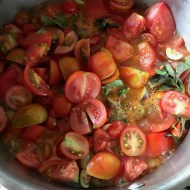
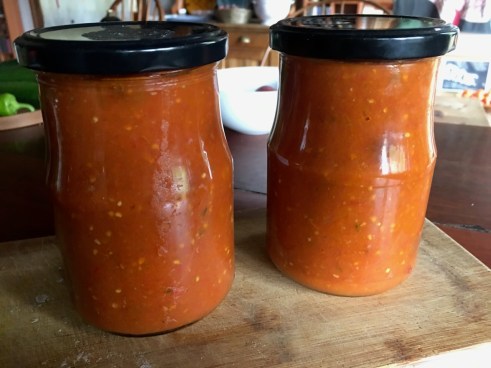
I have since planted another 20 plants, the most recent as recently as last week. I want to have plenty of fruit for making tomato passata in the summer. We are down to our last 4 jars from last summers harvest left in the pantry now. We’ll just make it through the year. perfect!

IMG_3629  IMG_3630


The deliciously sweet tang of vitamin ‘C’

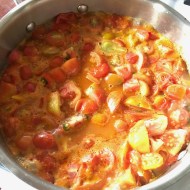
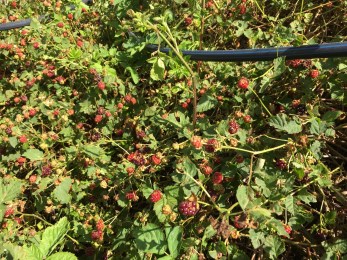
After the early peaches have peaked, it is time for the maxed-out berry season. This week we will pick a couple of kilos of youngberries from our canes each day, some times its 3 kgs in a pick. Janine has developed several recipes for using these deliciously tangy, sweet acidy berries, but there are so many that come into season so quickly, we can’t eat them all fresh from the canes. The best way to cope with the peak is to preserve them in vacuum jars. We use them later to make fruit jelly desert, or a jar of the preserved pulp is used in a berry baked sponge desert in the winter.

IMG_2567 IMG_4027

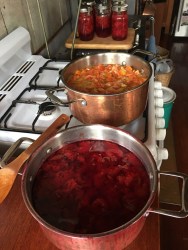
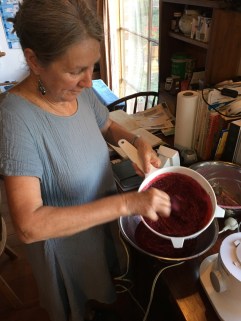
Yesterday we picked just over 3 kgs. The panty is already well stocked, she made red berry juice by heating the berries in a big pan. No added water, just simmered in their own juice, sieved through a kitchen mouli, to remove the seeds, then bottled while still hot. It’ll keep for a year in the pantry.

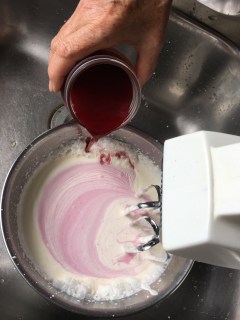
Another favourite at this time is to use the berry juice to make a fruit/suger syrup for use in icecream. Berry ice cream is a very nice desert. Janine makes this very simply by mixing some berry juice sryup in with a packet of pure cream, then whipping it and freezing it. The mixture needs to be taken out of the freezer twice a day and re-whisked the next day to make it more fluffy. That’s it, cream suger and berries. Couldn’t be more basic, simple and deliciously fruity and tangy, totally natural and no added chemicals. Maybe the sugar and the dairy fat content of this recipe should carry a warning not to over-do it! A very small bowl of this after a nice meal in summer is pretty special.

IMG_3573  IMG_3574

IMG_3608  IMG_3611

IMG_3626

Peak Peach

We have reached peak early-peach season now. We are picking more than we can eat for breakfast and desert each day. When we get to this point of the harvest, it’s time to start preserving the excess for later in the year.

We still use the very old-fashioned vacuum preserving jars that we bought 2nd hand in the 1970’s. They are easy to use and keep the food well-preserved for a very long time without any extra energy being applied to keep them. Once heated and sealed, we store them in the pantry for the winter months when there is no fresh fruit from the orchards.

To store them most efficiently, we should segment them to get more into the jar, but preserving them whole retains the stone and the lovely marzipan flavour that comes with that. Marzipan flavour from peach stones and almonds is actually a very weak kind of cyanide. How can anything so poisonous be so delicious? Clearly there isn’t very much of it in there.

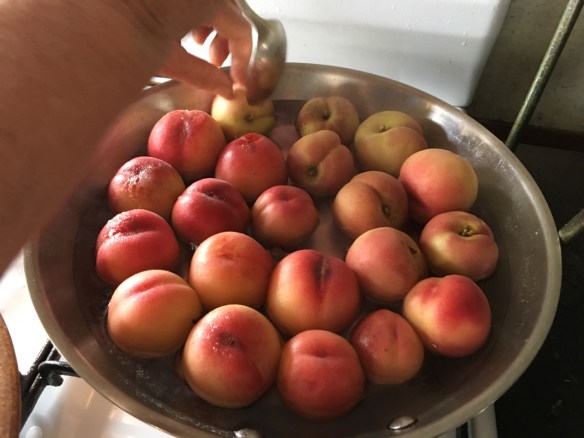
Janine poaches them for a few minutes before placing them in the jars and sealing them, followed by a slow-rolling simmer. Hey presto.

IMG_3601IMG_3602IMG_3603IMG_3604IMG_3605

The ‘Vacola’ company hand book  tells us that to get the first quality result necessary to win a prize at the local agricultural show or to take out a first at the CWA meeting. The fruit should never quite be brought to the boil, but kept at 99oC for an hour or so to sterilize it, but not overheat it and cause possible shrinkage  of the beautiful geometric packing order of the fruit!!!

Country women must have had a lot of spare time on their hands?

The First Week of Summer – Salad Days

We have just finished our first week of summer. Wow! bush fires and heat waves. What a way to start. Of course it’s not the earliest that we have had bushfires here with the new weather pattern of global warming bringing on regime of 9 months of summer. We have had a bush fire here in our village a few years back in October 2013. That is so early in the season for a wild-fire. So this is our new life, we think that we are prepared. We have done what we can.

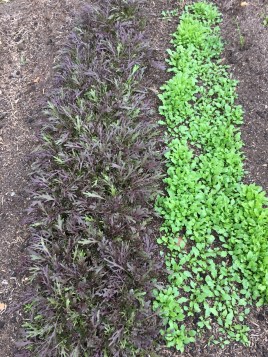
I heard on the news that they had 47oC in the north. How can you live with that? I’m sure that it would kill off our vegetable garden. I have been constantly sowing and re-sowing successive plantings of salad greens so that we can always have a few green leaves in our salads. We have planted several types of rocket this year; normal, narrow leaf, broad leaf, red leaf and wasabi rockets varieties. These along with 3 varieties of radishes, Japanese Mizuma greens, baby spinach, shiso, and 3 types of lettuces. it makes for an interesting variety of salads.

IMG_3513 IMG_3514

IMG_3515 IMG_3516

IMG_3518 IMG_3519IMG_3520

Peak Cherry Season

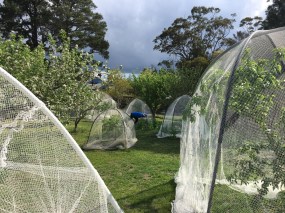
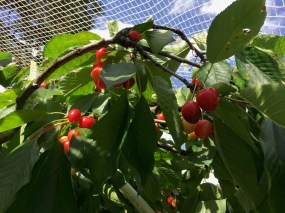
In this last week of spring, we are in peak cherry season here. We made the effort to cover the trees with netting a few weeks ago, so now we are reaping the benefits. If we don’t cover the fruit trees as the crops come into season and ripens, then the birds will take it all. We have learnt that we need to get the nets over the trees before the fruit colours – about a month in advance. We move the nets from tree to tree as the season progresses. Now, this week, there are simply too many cherries for the two of us to eat fresh at this time.

We eat as many as we can straight from the trees each day, but at this time of year we can’t keep up. If this is the worst problem that I have to cope with in my life, I have nothing to complain about.

IMG_3186 IMG_3465

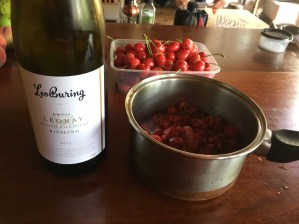
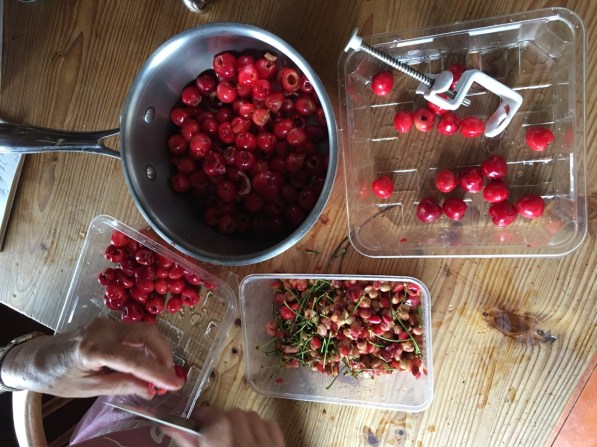
These last few days we have been stoning the excess of cherries and cooking them to preserve them. We have tried a couple of different recipes. For the first batch we de-pipped them and then brought them to a low simmer and added a spoonful of honey, a dash of white wine and a little squeeze of lemon juice. By blanching like this we can preserve them by either freezing them or keep them in the fridge for some days. We also tried blanching them in a small amount of cheap supermarket moscato wine. It is sweet and slightly acidic and does much the same job. much of a muchness.

We sit and work together at this time-consuming but very rewarding job. If you don’t put the effort in, you can’t claim the reward. Although it isn’t at the fore-front of our thinking at all times, we are cognisant of this very important attitude to life in general every day as  we plan our days work. We work with our hands, but also with our minds engaged in this self-reliant, mundane, seasonal work, quite simply because we have a long-term philosophy. We will continue to enjoy this beautiful after-dinner desert treat several times over the coming months.

IMG_3470

IMG_3471 IMG_3457

IMG_3491 IMG_3459 IMG_3492 (1)

Hard work is it’s own reward. The real hard work was put in 40 years ago, when we dug the dams and installed the irregation lines, then  fenced the orchards.
It was only then that we could plant the cherry trees. Now we can enjoy the litteral fruits of our labours.

Veggies and Flowers

When we came here 43 years ago. There was next to nothing here, Only the derelict shell of the old school classroom. We had to work 7 days a week for the first few years just to pay the 23% interest rate on our money-lender mortgage on the property. It was a huge impost, an exorbitant interest rate, but they were the only people who would lend us the money.

Because of this huge level of debt, In those first few years I had to work the equivalent of 8 working days in each week. Seven full days and two nights, that equaled an extra day. I got part time work at 4 different art schools, then on Saturdays and Sundays, I flew out into western New South Wales each weekend to different towns, all over the state to build pottery kilns on-site as weekend workshops. Janine worked a couple of days and one night at Liverpool TAFE college. It was a killing work load, but we managed to pay off the first of the two mortgages early and save a load of interest.

During the school holidays, we were able to establish an orchard and a vegetable garden around the house. We were complete novices in the vegetable garden, but learnt by doing. The gardens started out as a way of growing wholesome, fresh food cheaply on site.

A few years later, I got to see a few French period films set in the south of France. “My Father’s Glory and My Mother’s Castle”, based on books by Marcel Pagnol. These films and others like it, (Jean de Florette) opened my eyes to the possibility of growing both flowers, vegetables and fruit trees, all in the same garden. Our life is much more under control now, and we are finally solvent, with more time to relax and enjoy the fruits of our labours.

In the past few decades we have introduced a lot more flowers into the edges of the garden beds and these are now self seeding and well established year on year.

IMG_3157 IMG_3232

IMG_3250

IMG_3281

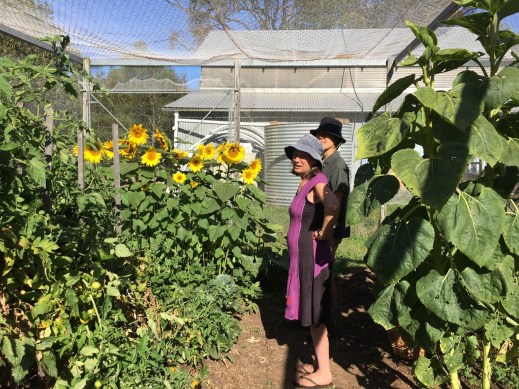
So now we grow herbs, grape vines, fruit trees and vegetables all in the same space. It is all netted over now, mostly with hail proof, fine bird netting. However, we have incorporated side panels of 35 mm hexagonal, galvanised wire mesh in the walls that allows all the little insect feeding birds easy access. We get all maner of finches, fire-tails and wrens flittering through in waves thoughout the day. They do a great job of cleaning up all the little pests and grubs, without touching the food crops. It this way we don’t have to use any insecticides.

So here we are arriving at some sort of way station on the journey that we set out on together over 40 years ago.

It’s nice, but I keep in mind that nothing is ever finished, nothing is perfect and nothing lasts.

Garlic Harvest Time

It’s the first of November and it’s time to harvest the early garlic crop. We plant garlic from March through to June and it takes about 6 months for the crop to mature. Over the years, we have tried many different varieties of garlic as they became available to us, but a few have always done better than others for us here with our specific terroir. The large ‘Russian’ garlic does well here, but I don’t particularly like the flavour. I find that it has a somewhat metallic aftertaste, which I find unpleasant. So although it grows well here I don’t plant it. The large white ‘Melbourne market’ variety does well, but is a little bland. The smaller growing red skinned variety, which I was told came from China after the opening-up to the West in the 70’s, does well and although it is only small, it is quite intense in flavour. I like the taste, but it is so fiddley to peel. Last year was not a good year for garlic for us and this variety grew so poorly to be only just worth harvesting. I didn’t bother to even attempt to peel it. I just put it whole into the garlic press and expressed the pulp as best I could and used it straight like this, even mixed with a little of its paper coating. The Italian pink seems to grow quite well and its of medium size and medium flavour. I plant the mall each year and let them fight it out, to see which one does best in each years different climate and rainfall conditions.

We have lifted half of the crop and have about 70 good knobs to hang up to dry from this first plot. There are also another 20 or 30 smaller bulbs that aren’t worth plaiting or hanging. We put them in a small basket on the kitchen bench top for use straight away.

IMG_3277

IMG_3278

IMG_3306

Back Home in the Garden

We are back home again now and the garden needs a bit of TLC. I get all around the beds with the strimmer mower cleaning all the paths and edges and then plant out the summer vegetable seeds and seedlings. Because there is always the possibility of frosts until November, we put a few temporary cloches over the most sensitive seedlings to give them an early start.

IMG_3007

IMG_3009

IMG_3010

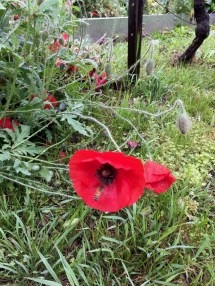
The early poppies are starting to bloom now, always a good sign of the warmer weather.

IMG_3016

From Side-stoking in Stoke to Wwoof-ing in Wales

Before we leave Stoke-on-Trent, we have to go to a local English restaurant and try the local fare. I have been told – and I don’t know if this is an urban myth or not – but the most popular dish in Britain is Chicken Tikka Marsala with mushy peas!

I haven’t even seen it on any menu, but I live in hope. We do try the local Indian and have a very nice meal. Shame about the mushy peas though!

IMG_1575

From Stoke we make the drive across country to Wales, which isn’t very far, half an hour and we are over the border. I read somewhere that there is no place in the UK that is more than 75 miles from the sea. That doesn’t seem very far, about 120 km. That is about as far as we live inland from the south coast beaches. We’ve been known to go to the beach for the day with Geordie when he was young. The difference is that we don’t have British traffic and narrow lanes.

The drive is uneventful and we are soon with our friends Annie and David. Annie is the daughter of Sally and John Seymour. The seymours were at the forefront of the post war self sufficiency movement in Britain. We met Sally Seymour when she called in to see us at our home here in the late seventies. She had our names from a common friend who she had known in the UK.

We didn’t know who she was, but welcomed her into our house as a guest. Only in conversation over the next day or so did it become apparent to us who she was and that we already owned a couple of her books, as we have always had an interest in Self-reliance. That is why we moved here, way out in the sticks, where we could afford a derelict ruin with acres to make our projected lifes ideals come to fruition.

Sally came and visited us a few times over the next decade and even stayed and worked in the pottery with Janine for a few months while I was away studying in Japan in the 80’s. Apart from all the hard physical work of pioneering self-sufficiency in Britain with her husband John Seymour, she also raised 4 children. Their life is a very inspiring story and can be read in a series of books, 3 of which we own.

IMG_2349 IMG_2350

Sally is also an accomplished potter. She learnt from her mother who was largely self-taught, as I understand it. Sally did al the illustrations for their books.

There is a new edition of ‘Fat of the Land’

IMG_1782 (1) IMG_1783 (1)

These books are available from Carningli Press; <http://carninglipress.co.uk/index.php&gt;

Sally had a stroke a few years ago and now lives with her Daughter Annie and Annie’s  husband David on part of the original farm that Sally and John bought back in the 60’s.

Annie and David are continuing on with the family tradition of self-sufficiency. Annie makes pots and David makes furniture. Together they work a few acres with extensive vegetable gardens and fruit trees.

IMG_1775 IMG_1834

We help Annie pick black currents. A very labour intensive job, as they are very tiny and are suck to the bush very tight. Each tiny little individual berry has to be individually pinched and picked off the cane. after picking, the currents are spread out in trays on the kitchen table and carefully sorted to remove any extraneous material that might have found its way into the bowls. Some of the currents are washed and frozen, others boiled for deserts and puddings and some are dried for storage.

We work in the sunshine in the garden while David goes about making the days batch of  a dozen sourdough loaves. The drought is all mixed by hand in small batches. The drought is left to ‘prove’ and rise in plastic bags to keep it humid and draught free, and from developing a hard, dry top which will prevent it from rising well.

David’s small organic bread-making business is just one of many small income streams that they survive on. All the bread is sold locally to people within just a few miles of their home. Mostly people come and collect directly, but David does make a few deliveries to a some customers a bit farther away, when he goes out to do other jobs.

IMG_1824 IMG_1770

IMG_1773 IMG_1776

It’s a pleasure and an honour to be able to take part – in just a very brief way – in this wholesome and creative life experiment. it’s also great to be able to catch up with old friends like this, spending time doing the most menial of jobs while catching up on news and gossip.

We  have a day ‘out’ to visit a local archaeological site. An archaeologist has been working around here for the past 30 years, every summer, he brings his students from the University to do a dig locally. He has been looking for the site(s) where the Stone Henge capping stones came from 5,000 years ago. It is well-known that the capping lintels came from Wales and more specifically from the Preseli mountains around here near the Carningli peak.

This year he has finally found the exact site. They have unearthed a finished lintel stone ready for transport. It is all set up on wedges ready to have the wooden rollers inserted underneath. It is sitting on a flat stone-flagged path which leads directly down to the river at the bottom of the slope. Apparently, mineral analysis has proven that this is the exact same stone as is found on-site at Stone Henge. The rest of the excavation on site has been re-filled, but they left the stone uncovered.

To my mind, this answers two questions, where they came from and how they were moved. It’s pretty obvious to me that if they built a flat, paved, stone path down to the river, then they were floated away on a raft from here. Presumably to be shifted to a larger boat down near the coast and then sailed around to Wiltshire.

IMG_1841

IMG_1843 IMG_1845

Later we visit the standing stone ‘Dolman’ burial chamber. This grade stone triptych and capping stone would have originally been buried under a hill of soil.

IMG_1854

IMG_1852

On the way home we call in to visit the local Community Hall, where archaeologists have excavated one of the oldest and best preserved roman era pottery kilns in Wales. it was covered by the stage in the hall for many years, now it’s all cleaned up and preserved behind glass. Back in the day, it seems that it was just too much work to pull it down, so they built the stage over it.

IMG_1789

Fond regards from Old South Wales.