Kintsugi

Kintsugi is the traditional Japanese art of repairing damaged pots with gold.

I am surprised and delighted to find out that there will be a kintsugi workshop held here in the next 2 days. Kintsugi is the ancient technique of repairing old broken porcelain pots with gold and lacquer. It is astonishingly beautiful where it is done well and I have often wondered how it was done. In fact, just before we left Australia to come on this trip, we had a wood kiln firing and I had 2 nice pots with cracks in them. I decided to repair them as best I could, using araldite and gold leaf. As I didn’t know any better. I did a rather clumsy repair with the two-part resin bond which worked out sort of OK and then ordered a packet of gold leaf. The gold leaf only arrived in the post one day before we left. I was so busy packing that I didn’t have time to open the letter. It is sitting waiting for me to return so as to finish the job.

I have always admired pots with chips and cracks that had been repaired with lacquer and gold. It shows such respect for a treasured object. The philosophy of kintsugi is based in the honour that is shown to objects, everyday objects and the respect shown to things that are old or even damaged. It is linked to the idea of wabi-sabi in Japanese Zen Buddhist practice. A beautiful thing that is broken in some way is still a beautiful thing, just as it always was. Being shown the respect of a tasteful and respectful repair, makes it even more beautiful.

 A beautiful thing that is broken is not necessarily rubbish, but something worth showing respect to and honouring by giving it a new life as an even more beautiful repaired object.

Years ago, I was told of a story of a Japanese shogun that had a very valuable Chinese tea bowl, which got broken. He loved that bowl and sent it back to China to be repaired. It was returned with a lot of metal staples holding the parts together. He was bitterly disappointed and asked someone to invent a method of repairing his cherished bowl in a more elegant way.

Although it was developed in Japan for the repair of valuable tea ceremony objects, kintsugi has found favour all around the South East Asian area over time.

I spend 2 days in an intensive workshop with the local Kintsugi Master. I take along some cheap, cracked and chipped pots that I found in the rubbish pile at the workshop here.

First, we learn how to clean the pot, prepare the surface, repair the crack with the special bonding agent and then leave it to set overnight. Once the repair is secure, for big cracks or for pots that are broken into many pieces, or for pots with small pieces missing the procedure takes longer, as the missing parts need to be filled and worked up, back to the original contour. This can take many days for a big job, as there is so much drying time between layers.

IMG_3300 IMG_3306 IMG_3337

On the second day I learn how clean and prepare the surface again so as to accept the  lacquer. A red lacquer is used to build the surface of the repair, as gold reflects well off a red background. Once this part is completed satisfactorily and the lacquer is ‘going off’ and getting ‘tacky’. The gold is applied so that it will stick to the prepared surface. This is then left to dry well before burnishing. We don’t manage to finish all our pieces in the 2 days. I will return later to collect my dried and stabilised pieces. I manage to get one simple one completed and take home with me. It’s a really great experience and couldn’t have come a better time for me. I’m cleaned and prepared and ready to be filled with Kinsugi information. I can’t wait to get home to try it out on my own pots.

IMG_3366 IMG_3381 IMG_3385

IMG_3386

A repair done on a large, chipped antique porcelain bowl by the master using both gold and platinum.

IMG_3359

IMG_3362

Traveling South to Kyushu

We say a temporary good-bye to Kyoto with its cherry blossoms all finishing up. Mostly on the ground. Its raked gravel gardens and Maiko make-over girls. We’ll be back, we always seem t find an excuse to return here.

IMG_5751 IMG_5752 IMG_5798 IMG_5810

We take the long train ride south to Kyushu. We leave Kyoto, and after a while the concrete high-rise scenery starts to diminish slightly and is replaced with low-rise. After a very long while we realise that the buildings are far less common and there is farm land starting to appear. It’s not that there isn’t any farmland near the bigger cities. There is a small, very small, plot of rice being farmed only 1 kilometre from Kyoto’s main central station. Amazing!

As we rumble on, we pass through farming districts and extensive fields of golden crops already for harvest with their heads golden of bearded barley ripening in the sun. I can’t imagine that harvest time for these crops is very far off.

IMG_3254 IMG_3256

We also see farmers out in the flooded fields with their mini tractors and rotary hoes, working up the inundated mud, presumably preparing the silt for the coming planting of the rice crop. Ploughing now, if you can call this ploughing, is to kill off the weeds and any competition for the young rice seedlings that will be planted soon.

When I was last here 6 months ago, they were smack in the middle of rice harvest in the autumn. We arrive in the far south in Kyushu, not too far from Kumamoto, about an hour away. Everything here is OK, different strata or geological sequence? We only had a level 2 shake up here. So the kilns are still standing and all the pots are still on their shelves.

It’s all foggy, rainy and damp when we arrive and the hills are coated in a beautiful mist.

Our first visit here is to a place near Karatsu on the North West coast. We visit an old pottery studio that has existed in this little secluded valley for a couple of hundred years. The old lady tells us that her family have always been potters here since the arrival of the Korean potters 400 years ago. The war Lord Toyotomi Hideyoshi launched 2 failed invasions of Korea in 1592 and 98. Each time he captured and brought back prisoners of war. Some of whom were potters. One in particular found and developed the first porcelain pottery in Japan in 1616. Exactly four hundred years ago this week.

She is a sweet old thing and at 83, has seen a bit of life. Her son is now the resident potter here. She tells us that there were once 300 houses in this valley, most of them making pottery and farming rice and vegetables. Now there are only 5 houses here and only one potter.

They are in the middle of packing the kiln when we arrive. It’s a well-loved old nobori-gama wood fired, 3 chambered climbing kiln.

IMG_3271 IMG_3272

They pack the pots on rice husks to stop them sticking to the kiln shelf during firing, as rice husk is composed mostly of silica, which is refractory. It also creates a shiny ‘flash’ of colour on the exposed clay at the foot of the pots.

IMG_3273 IMG_3270

Later, we travel home to Arita via the ‘Hitakata’ ancient kiln site. This little valley once had a number of korean potter families working and farming here. But they are all gone now and only the archaeology remains. This site has been fenced off now to stop looters from stripping the site of old artefacts.

IMG_3267

IMG_3268 IMG_3265

It was one of the first Korean kilns built here way back in the late 1500’s. It is set in a beautiful forested glade with a small but fast flowing stream nearby. Quite idyllic! This kiln was built without the use of fire bricks. It was constructed out of rammed earth. The local soil here doesn’t look particularly refractory, so it probably had a short life and needed to be rebuilt often.

I can’t read the Japanese on the information board, but the illustration shows 9 steps or doorways into the tunnel-like chamber. My teacher back in 1973, the Japanese potter Shiga shigeo, to whom I was apprenticed,  trained near Kyoto after the war and his teacher,  Saburo Saito had a 3 chambered climbing kiln, all made from rammed local refractory clay and home-made bricks. I was told that the fire-box needed rebuilding after every firing and the first chamber arch was likewise re-built after every 2nd or 3rd firing. This was the traditional way back them and is still used by some potters even today, if they are keen on reproducing the old effects.

Janine and I made all of our own fire bricks to build our wood fired kiln. The current kiln has had twenty firings and is still going strong. However the time will come when it needs to be pulled down and rebuilt.

Such is the way of the world.

Nothing is ever finished, nothing is perfect, and nothing lasts!
Fond regards from Steve and Janine in the shaky isle of Kyushu.

The Shosei-en Garden

We decide to make the pilgrimage to the shosei-en Zen garden before we leave Kyoto.

This garden has a very long and chequered history. It started its life as a beautiful orange grove , called the ‘Kikoku-tei’, somewhere in the Heian era around 800 to 900 AD. Built by the son of Emperor Saga. In the 1600’s the Tokugawa shogunate ‘acquired’ the land and passed it to the Higashi Hinganji Zen temple. Perhaps to appease their conscience?

Anyway, whatever its past history, god had her own way and it was completely burnt to the ground in 1858, and then just to prove that she really meant it. She did it again to what was rebuilt 6 years later. Get the hint!

In the early years of the Meiji restoration around 1870 to 1900 Everything was rebuilt and restored to what we can visit today. A beautiful, tranquil space, right in the middle of Kyoto, just a few hundred metres from Kyoto’s busy main station.

There is a very pretty tea house on the lake – lovely !

IMG_3143

IMG_3146IMG_3147

IMG_3159


A Brief Visit to Tamba

The small village of Tamba is situated up in the hills somewhere inland between Kyoto and Osaka. It is more or less indistinct, except for the fact that it has a very long tradition of pottery making going back 800 hundred years.

The village lies along strangling secluded valley. It isn’t really close to anywhere in particular and is about an hour and a half from Kyoto by train to Aino station and then a 25 min bus trip to the village of Tachikui. Tachikui is the name of the village where the tradition of Tamba pottery technique is centered.

There are about 35 pottery workshops speed out along the valley. This valley doesn’t look all that different from any other Japanese farming valley, with a small river flowing along the valley, with paddy fields along either side. The small winding road hugs the bottom of the surrounding hills to maximise the area available for growing crops and vegetables in the fertile soil of the valley floor. The big difference in this valley is that there are lots of chimneys sprouting from the various sheds along the hill-side. These sheds are unique in that their roofs follow the contour of the slope of the hill to maximise the draught available for the firing of the kilns.

IMG_3105

The kilns here are unique, in that they are essentially ‘Korean’ style kilns. Shaped like long tunnels sitting on the side of the hill. They are known locally as ‘snake’ kilns or ‘split bamboo’ kilns, as this is a reasonable description of their shape. They have a door way every few metres along the tunnel to allow access for the pots to be passed in during the packing of the kiln and then again during the unloading after firing. There are 9 doorways all together and the whole kiln is 47 metres long.

IMG_3109

The kiln is fired with wood in the old fashioned way. After all, it is an 800 year old tradition. The fire is kindled from the fire mouth at the front of the kiln and the fire is progressively increased in intensity, with more and more wood being introduced into the front fire mouth until the full heat is achieved at the front of the long tunnel.

IMG_3110

IMG_3112

Once the top temperature is reached at the front, then wood is introduced into the small circular stoke holes situated all along the kiln, every 50 cm. or so. This takes the temperature of each subsequent section of kiln up to the top temperature required to melt the glazes in a short time and is very efficient of wood fuel. The whole process from start to finish takes just 48 hours.  12 hours of gently steaming. Then 24 hours of firing the main stoke hole at the front of the kiln and another 12 hours of side stoking.

IMG_3123 IMG_3125

IMG_3124

Because this kiln is situated on such a steep slope, there is no need for a chimney as such. The whole steeply inclined tunnel kiln chamber creates its own draught up the slope. The end of the kiln is fashioned into a kind of ceramic colander, so the flames just escape to the atmosphere from the grid of holes at the back off the kiln.

IMG_3132

IMG_3131

This is the village community kiln, has been on this site for hundreds of years. This particular construction is just a year old. The old kiln on this site threatened to fall down from lots of use over many years, so was demolished and rebuilt as a community effort less than a year ago. This is its 2nd firing. It is fired just twice a year, with many potters contributing work  to fill it, and taking turns in the firing schedule shifts.

IMG_3113

IMG_3106IMG_3137

It is a wonderful community effort and we are pleased to be here to witness it at this time. We are very lucky. Tamba is one of the 6 ancient kiln sites of Japan. It is a special place, but well past its prime just now. But still, it’s great to be here to witness this community event.

best wishes from the two ancient potters from Australia, doing their ceramic hajj.

San-sho Pepper

I love San-sho pepper. It seems to be quite hard to find in Australia. We can get some that is already ground, from the Japanese supermarket in Sydney, but it is quite old by the time that we get to it and has lost a lot of its flavour. I’ve always been happy with it, but I didn’t know how good it could be fresh.

We are lucky enough to stumble onto a place where they are preparing some fresh san-sho pepper. We get to see, smell and taste the whole seeds, as well as the freshly ground san-sho pepper directly after being ground.

I didn’t know that it has a high citrus note in the aroma when it is fresh. It’s great stuff. It’s hot and spicy and so delicious. Be careful however, because if you get too greedy like me and take too much, then it suddenly overdoses the taste buds in the tip of my tongue and my tongue goes numb. It’s powerful stuff. Restraint is the key.

A little goes a long way.

IMG_2862IMG_2864IMG_2865IMG_2868

We Go To The Markets

We go to the markets in the grounds of the Kitano shrine and see some amazing thing, but not what we expected.

On our way to the bus station we see men at work.

IMG_3215IMG_3220

IMG_3217

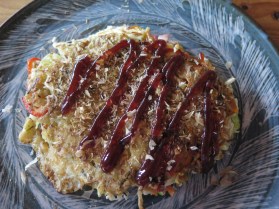
At the markets, we see how okonomiyake is really cooked here in Kyoto, or at least one of the versions of it. best of all we get to eat it and it is delicious.

IMG_3230 IMG_3231

We meet the amazing cat lady and her fashionista cat.

IMG_3226

We see lots of old pots, a few of which I buy. But only the smallest sake cups, as we still have 5 weeks to go and I don’t want to be carrying too much.

IMG_3224 IMG_3225

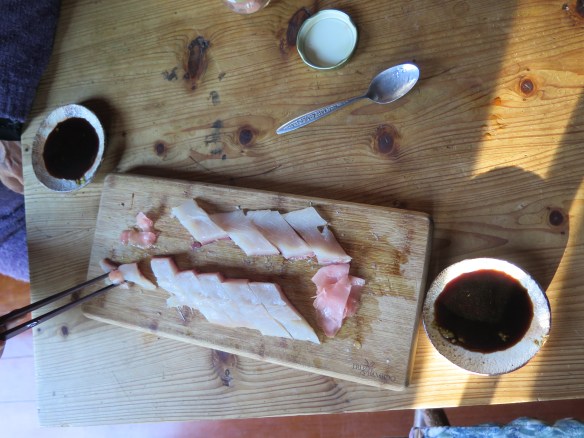
We end an amazing day with a meal of fish grilled over charcoal. Oishi des!

IMG_3242

IMG_3243

Templed Out

The Lovely and I continue our temple sojourn around Kyoto. From Gold to silver, from dry  to wet. From gravel to moss, from austere tea house to dense bamboo thicket. We’ve come to visit the Bling-By-The-Lake again. It is cosily nestled into the side of the hills that surround Kyoto on the North Western side. There are people everywhere here today. They come in waves that coincide with the arrival of the bus or trains. However, there is always the possibility of finding a quiet place and moment to take in the atmosphere and be still while being there with it.

IMG_2898

Ofcourse, there are other beautiful vistas beside the lake and its bling. We walk around the lake and up through the gardens. This thins out a lot of the visitors straight away. The whole place is so well kept. I starts me wondering how many gardeners that it takes to keep a place like this clean and tidy as well as weeded and pruned?

It doesn’t take long to find the work going on all around us, but very discreetly, just slightly out-of-the-way, but there in plain sight, if you take the time to see.

IMG_2894 IMG_2993

IMG_2905 IMG_2947

We take the opportunity to take tea in the garden. No one else seems interested in this simple pleasure today, so we have the garden to our selves.

IMG_2948 IMG_2951

We take the walk between the Golden Temple and Ryoanji Temple, famous for its raked gavel garden. It’s an easy 15 min stroll. The crowds thin out toward lunch time. Everyone seems to go off to have lunch.

IMG_2994

We spend some time here taking it all in. It is certainly serene. Although people are coming and going like gentle waves and tides all the time. It is possible to just sit and stay focussed and let it all pass.

I leave with a sense of quiet.  I go to the loo and see this warning on the ‘sharps’ disposal bin in the cubicle. “While applying your make-up, don’t drop your baby in the sharps bin. Or if you do, don’t try to remove your lost child by hand, you might get jabbed. Do not drop your cigarette butts in the ‘sharps’ bin after the baby”. What kind of world is this? Why would this warning be necessary, unless it has happened once? It’s a jarring juxtaposition with the raked grave outside.

IMG_2972Next, we go to the silver pavilion, which isn’t, but it has a lovely garden. The Silver Pavilion is situated right across town on the other side of the city nestled into the hills on the North Eastern side.  We take the time to do the full walk. It’s a very beautiful garden and looks all the more impressive now in spring, after some rain and a warming climate. The mosses are glowing and wet under the forest canopy. The last time I was here, it was autumn and quite dry, so the mosses were very thin on the ground.

IMG_3022IMG_3024

IMG_3019IMG_3005IMG_3007

IMG_3010

As we leave the Silver Pavilion precinct we encounter the all the usual marketing and merchandising. Selling us some object that we don’t need to clutter up our lives to celebrate the non-acquisitional nature of true buddhist philosophy! Actually, I’m not a Buddhist. I don’t believe in reincarnation or the cycle of life. I believe that we are here just once. So make the most of it now! While saying that, I do still find comfort in the concepts explored in Zen. Be here now! The past is finished and gone, so don’t dwell on it. The future hasn’t happened yet, so don’t worry about what hasn’t happened and may not happen. There is only Now. Live to the full. I attempt to live this way, but mostly fail. Still, it doesn’t hurt to try.

We take our leave ‘karate’, empty-handed and head out along the Philosophers Path. This is a lovely winding, gentle walk along the canal, from the Silver-less Temple back toward the city. The cherry blossom is still lingering on some late trees and the petals drop down into the water and float along  with the steady current of the canal in a soft pink carpet.

IMG_3027

This walk culminates back near the Nanzen ji temple, so we make our way there. This is one of the first Buddhist temple sites Established in Kyoto. It is quite extensive and is a National Cultural Asset. It was established in the mid twelve hundreds and subsequently burnt down and re-built in 1600. It also has a raked gravel garden with rocks and mosses, but not as imposing as Ryoanji. However, because this temple is quite out-of-the-way and a long walk from anywhere. There are very few people here. So it is very quiet and peaceful.

IMG_3185IMG_3186

IMG_3183IMG_3187

It’s been a very full couple of days of long walks around this lovely city. We finish up by visiting the Kodai-ji Temple in the evening to experience the gardens under artificial light. There is a bit of a projected light show in one of the pavilions, but the best part is the garden walk up the hill and around the extensive site. Very beautiful with the almost full-moon rising. A lovely day and night and we have the sore feet and legs to prove it. What more could you want?

IMG_3037IMG_3048

reflections on the pond.

IMG_3054  IMG_3070

Crouching dragon, Where’s the tiger?

We end the day with well-earned gyoza, Kimchi and a beer.

IMG_3214

The Temples of Kyoto

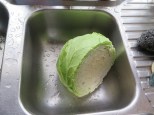
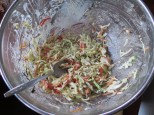
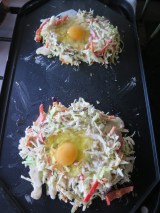
We have a lot of good cabbages coming along just now so we decide to have a cabbage pancake, our version of okonomiyaki from Japan. We slice the rest up finely into a cabbage salad with sesame and shiso dressing.

IMG_2805 IMG_2807

We follow this delight from our garden with sushi in Tokyo.

IMG_2809 IMG_2811

Followed by a full Japanese delightful mixed meal in Kyoto.

IMG_2884

We spend a day walking the temples of Kyoto. We re-visit our favourites, because they make us feel somehow centred and located in a place that we know as familiar, but also because a half hour spent sitting quietly there is very relaxing and grounding. There are temples here dedicated to anything and everything. There are temples featuring gold, silver – or the lack of it, rock, gravel, bamboo, water, moss. You name it there is a temple or shrine here dedicated to it.

IMG_2899

Gold in water, Gold in spring, Gold in winter, Gold inside and out.

IMG_2918 IMG_2917

We spend a couple of days visiting a lot of them. It’s so good to revel in the non-acquisitive nature of buddhism.

There is an ancient tree in a shrine by the side of the road. It is very old and needs a little bit of health-care. There are a team of workers and flying arborists, trimming, lopping and preserving what can’t be lopped. It will give this old tree a new lease of life.

IMG_2812 IMG_2818

I’m so pleased to be back in Japan.

Two Special pots

I’ve been able to spend a bit of time to clean up a couple of doubtful pots from the ‘zone of death’. They cleaned up rather well  I think. I was a quite surprised. I thought that they were stuck to the kin shelf. the pots from the floor were covered in charcoal too early and are just too dull and lacking interest. However there are always a few nice surprises. These are they.

DSC_0035_01DSC_0034_01DSC_0025_01DSC_0029_01


A Nice Firing

We have just unpacked our latest firing with mixed results. The wood for this firing burnt well and got us to temperature in 12 hours with a good, constant reduction, but it produced a mass of  very slow burning embers, so even with all the mouse holes open we ended up with a load of embers which buried the potential ‘gems’ of the firebox area beneath their cloistering bed and smothered the jewels of the firing that should have come from the exciting ‘zone of death’, This area, close to the ember pit can produce some excellent dramatic qualities, but instead, on this occasion, all the potential jewels did not reach their full potential. They all survived intact, but as blackened bisque instead of shining gems. The jewels of the kiln are now more like Swarovski than De Beers.

IMG_2769IMG_2772

The back of the kiln was a little under-fired, so there are a few pots from there that just need a little more heat. They can be reheated, ‘microwaved to perfection’ in our little wood kiln, the next time we get it out for a spin. The rest of the setting was very good – by our standards. There are half-dozen really nice pots, nearly all of which were Janine’s. But I have some small bowls that are good enough to show at Watters Gallery, so I’m happy.
So, a good firing. We are so lucky!
Two of Janine’s vases
DSC_0046_01 copyDSC_0045_01 copy
Three of my new bai-tunze paste little bowls with limpid porcelain glaze and subtle wood ash deposit and bright body flashing.
DSC_0013_01 DSC_0015_01 DSC_0023_01
After the firing, I picked, washed and sliced open 300 small tomatoes and dried them for use later in the year. These things are so delicious, that I end up eating a few handfuls of them as soon as they emerge from the oven. It’s a slow patient process using the lowest possible heat that the oven is capable of. I turn it down manually, so that it only just remains alight. It takes all day turning and rotating them often with the oven fan on.
IMG_2764IMG_2765
 IMG_2766
6 trays of little tomatoes, cut in half, butterfly-style, all tries out and shrinks into just 3 litre tubs of sweet, sharp, crunchy, sour and very delicious dried tomatoes.
I make a vegetable stir fry for dinner. Garlic and chilli with capsicum, celery, carrot, beetroot and aubergine. A little block of frozen marrow bone stock from the freezer and a little fish and oyster sauce.
IMG_2761IMG_2760IMG_2762
Best wishes from the 2 well-fed, lucky potters