Peak Cherry Season

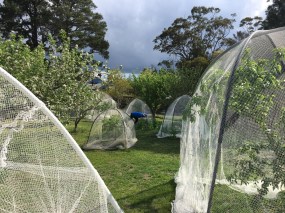
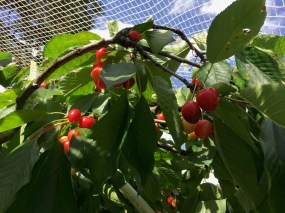
In this last week of spring, we are in peak cherry season here. We made the effort to cover the trees with netting a few weeks ago, so now we are reaping the benefits. If we don’t cover the fruit trees as the crops come into season and ripens, then the birds will take it all. We have learnt that we need to get the nets over the trees before the fruit colours – about a month in advance. We move the nets from tree to tree as the season progresses. Now, this week, there are simply too many cherries for the two of us to eat fresh at this time.

We eat as many as we can straight from the trees each day, but at this time of year we can’t keep up. If this is the worst problem that I have to cope with in my life, I have nothing to complain about.

IMG_3186 IMG_3465

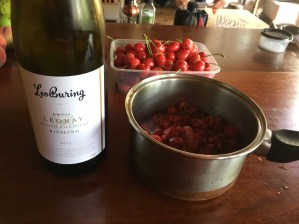
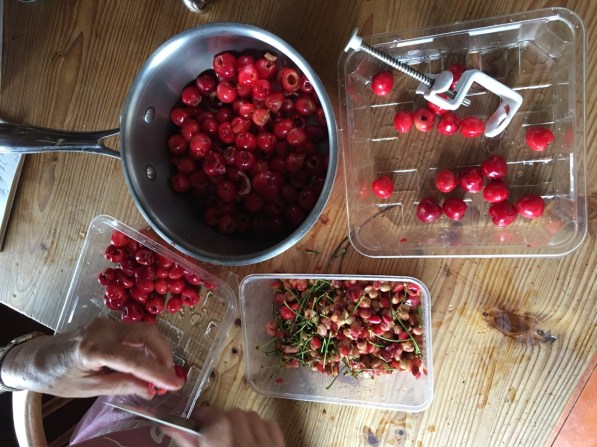
These last few days we have been stoning the excess of cherries and cooking them to preserve them. We have tried a couple of different recipes. For the first batch we de-pipped them and then brought them to a low simmer and added a spoonful of honey, a dash of white wine and a little squeeze of lemon juice. By blanching like this we can preserve them by either freezing them or keep them in the fridge for some days. We also tried blanching them in a small amount of cheap supermarket moscato wine. It is sweet and slightly acidic and does much the same job. much of a muchness.

We sit and work together at this time-consuming but very rewarding job. If you don’t put the effort in, you can’t claim the reward. Although it isn’t at the fore-front of our thinking at all times, we are cognisant of this very important attitude to life in general every day as  we plan our days work. We work with our hands, but also with our minds engaged in this self-reliant, mundane, seasonal work, quite simply because we have a long-term philosophy. We will continue to enjoy this beautiful after-dinner desert treat several times over the coming months.

IMG_3470

IMG_3471 IMG_3457

IMG_3491 IMG_3459 IMG_3492 (1)

Hard work is it’s own reward. The real hard work was put in 40 years ago, when we dug the dams and installed the irregation lines, then  fenced the orchards.
It was only then that we could plant the cherry trees. Now we can enjoy the litteral fruits of our labours.

Veggies and Flowers

When we came here 43 years ago. There was next to nothing here, Only the derelict shell of the old school classroom. We had to work 7 days a week for the first few years just to pay the 23% interest rate on our money-lender mortgage on the property. It was a huge impost, an exorbitant interest rate, but they were the only people who would lend us the money.

Because of this huge level of debt, In those first few years I had to work the equivalent of 8 working days in each week. Seven full days and two nights, that equaled an extra day. I got part time work at 4 different art schools, then on Saturdays and Sundays, I flew out into western New South Wales each weekend to different towns, all over the state to build pottery kilns on-site as weekend workshops. Janine worked a couple of days and one night at Liverpool TAFE college. It was a killing work load, but we managed to pay off the first of the two mortgages early and save a load of interest.

During the school holidays, we were able to establish an orchard and a vegetable garden around the house. We were complete novices in the vegetable garden, but learnt by doing. The gardens started out as a way of growing wholesome, fresh food cheaply on site.

A few years later, I got to see a few French period films set in the south of France. “My Father’s Glory and My Mother’s Castle”, based on books by Marcel Pagnol. These films and others like it, (Jean de Florette) opened my eyes to the possibility of growing both flowers, vegetables and fruit trees, all in the same garden. Our life is much more under control now, and we are finally solvent, with more time to relax and enjoy the fruits of our labours.

In the past few decades we have introduced a lot more flowers into the edges of the garden beds and these are now self seeding and well established year on year.

IMG_3157 IMG_3232

IMG_3250

IMG_3281

So now we grow herbs, grape vines, fruit trees and vegetables all in the same space. It is all netted over now, mostly with hail proof, fine bird netting. However, we have incorporated side panels of 35 mm hexagonal, galvanised wire mesh in the walls that allows all the little insect feeding birds easy access. We get all maner of finches, fire-tails and wrens flittering through in waves thoughout the day. They do a great job of cleaning up all the little pests and grubs, without touching the food crops. It this way we don’t have to use any insecticides.

So here we are arriving at some sort of way station on the journey that we set out on together over 40 years ago.

It’s nice, but I keep in mind that nothing is ever finished, nothing is perfect and nothing lasts.

Chair bodger

One of my hand-made steamed and bent Windsor chairs has suffered a broken arm recently. I made this chair from the one piece of wood, cut from a Japanese cedar tree that died in the drought in our garden. It was probably about 80 years old. It was a fine tree and the wood was too good to waste. So I decided to make a chair out of it.
As this tree was only small. It was hard to find a good piece of straight grained timber. for the lang arm. There was a fault in the way that I made it. I couldn’t find a piece of straight-grained timber that was of the correct dimensions for the job, so I used what I had. There is only so much straight grained timber in one tree. My tree had quite wavy grain. I compensated a little by sawing it out along the grain on the band saw, instead of just in a straight line on the table saw, but there just wasn’t a long enough section for me to use without the grain running off along the grain.
I used this piece where the grain ran off on the bend. It worked really well for almost a decade, but finally split when someone put a bit too much pressure on it, possibly leaning back on the back two legs and stressing the bent back. (I wasn’t home at the time)

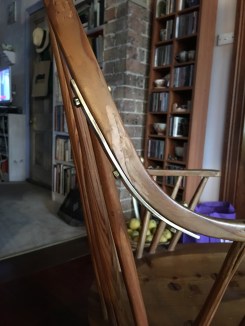
I glued the broken arm back together, but it started to part company on the bend and split again within a year, even with careful use. I re-glued it, clamped it securely for 24 hrs. until the glue was well and truly set, then decided to reinforce it with a brass strip behind, where the split had re-started.

IMG_3297 IMG_3295

It’s a broken chair, no doubt about it, but its a well-loved and valued chair that I spent a lot of time building, all the way from cutting down the tree, seasoning, sawing, cutting out, carving the seat base and spindles then fabrecating and assembling the whole thing. This chair has an added history. It means something to me so I used brass to give the repair some added value. A bit like the way that I use gold to repair one of my beautiful, but damaged bowls. What I’ve done here is like kinsugi, but it isn’t kinsugi, because kinsugi means gold repair.

Maybe this is some kind of brass chair bodging variation on kinsugi. Perhaps I should call it brassugi?

IMG_3298 IMG_3299

Garlic Harvest Time

It’s the first of November and it’s time to harvest the early garlic crop. We plant garlic from March through to June and it takes about 6 months for the crop to mature. Over the years, we have tried many different varieties of garlic as they became available to us, but a few have always done better than others for us here with our specific terroir. The large ‘Russian’ garlic does well here, but I don’t particularly like the flavour. I find that it has a somewhat metallic aftertaste, which I find unpleasant. So although it grows well here I don’t plant it. The large white ‘Melbourne market’ variety does well, but is a little bland. The smaller growing red skinned variety, which I was told came from China after the opening-up to the West in the 70’s, does well and although it is only small, it is quite intense in flavour. I like the taste, but it is so fiddley to peel. Last year was not a good year for garlic for us and this variety grew so poorly to be only just worth harvesting. I didn’t bother to even attempt to peel it. I just put it whole into the garlic press and expressed the pulp as best I could and used it straight like this, even mixed with a little of its paper coating. The Italian pink seems to grow quite well and its of medium size and medium flavour. I plant the mall each year and let them fight it out, to see which one does best in each years different climate and rainfall conditions.

We have lifted half of the crop and have about 70 good knobs to hang up to dry from this first plot. There are also another 20 or 30 smaller bulbs that aren’t worth plaiting or hanging. We put them in a small basket on the kitchen bench top for use straight away.

IMG_3277

IMG_3278

IMG_3306

Back Home in the Garden

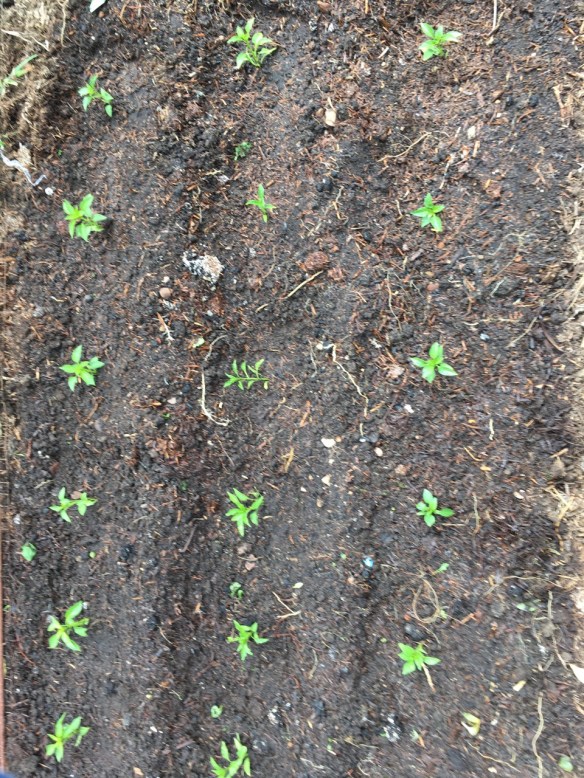
We are back home again now and the garden needs a bit of TLC. I get all around the beds with the strimmer mower cleaning all the paths and edges and then plant out the summer vegetable seeds and seedlings. Because there is always the possibility of frosts until November, we put a few temporary cloches over the most sensitive seedlings to give them an early start.

IMG_3007

IMG_3009

IMG_3010

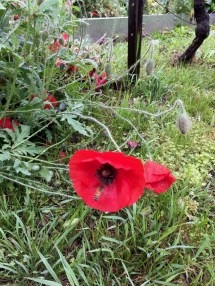
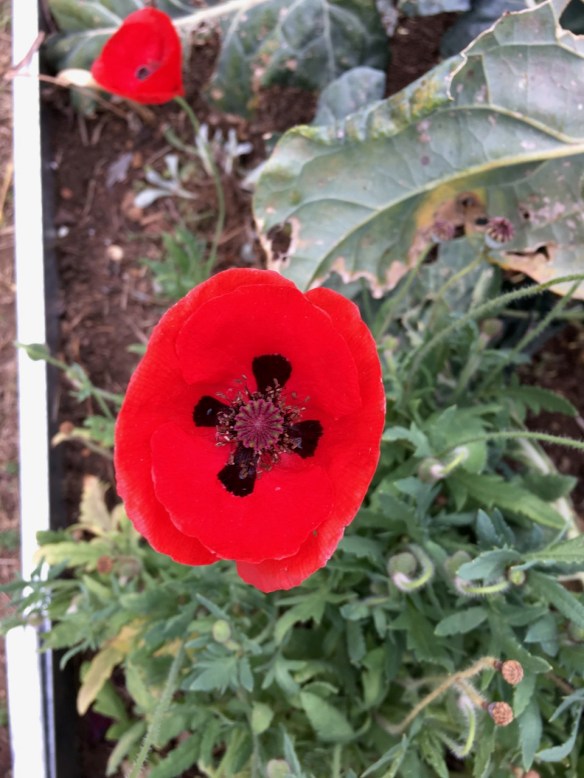
The early poppies are starting to bloom now, always a good sign of the warmer weather.

IMG_3016

Moon Jars

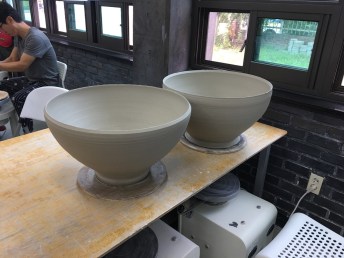
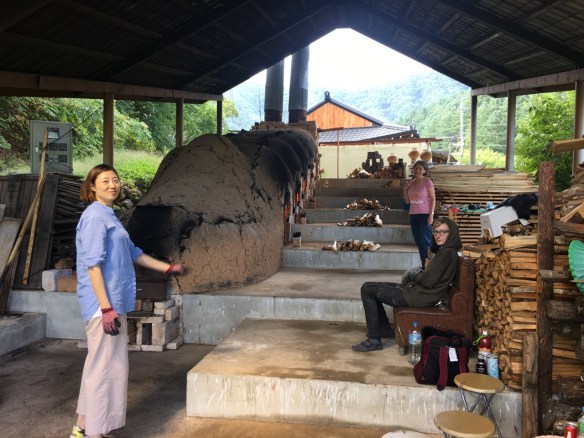
While the long wood firing is in progress, there are simultaneous demonstrations of Moon Jar making by 3 exceptional makers. These mysterious white porcelain globes, have fascinated people for centuries, including potters in the West like Lucie Rie, and Bernard Leach.

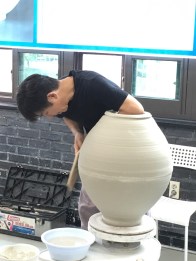
There is Mr Cheol Shin, The traditional potter who we met a week ago in his workshop while he was wood firing. He is the maker who threw 1000 jars to learn how to make them well and with feeling. He tells us that it was only after that epic effort, was it that he felt confident that he could interpret this elusively simple form with sufficient understanding and confidence to do them justice. He is such a confident thrower, that he makes a dozen ‘halves’ on the first afternoon and then with time up his leave, he make 20 large dishes as well.

IMG_2686 IMG_2764

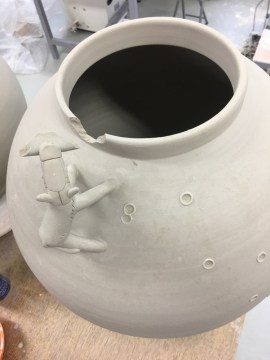
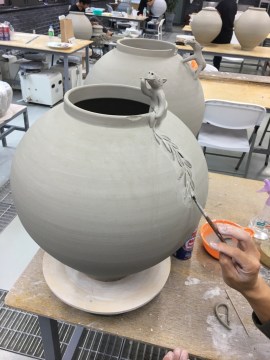
Mr Changhyeon Jeon,  makes Moon Jars with a modern, humorous take on the ancient tradition. His work is great fun, although to my mind he seems to be taking the whole forum very seriously indeed rarely smiling. It seems to be Mr Cheol who is cracking all the jokes during the throwing demos. He is very relaxed and very confident. Mr Changhyeon, on the other hand works on quietly, being very careful and studious. He isn’t interested in volume, only making two jars in total, but each with applied sculptural additions. He has been developing a long series of moon jars with little whimsical horses, that climb up on his pieces and bite a chunk out of the rim. He was commissioned to make a number of pieces for the Korean Pyeongchang Winter Olympics last year. In that series, his horses broke off pieces of the rim of the jars and made skies, snow boards and a luge, then took off down the steep sides of the pots.

IMG_2799 IMG_2807

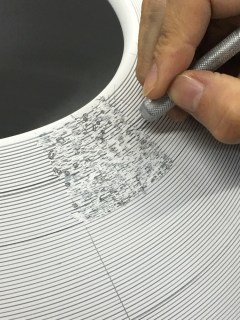
And then there is Mr Jung Hong Park, he makes Moon Jars with a very modern twist. For a start, he is working with black stained porcelain. His technique is to transfer high-definition, digital NASA images of the moon’s surface onto his forms. The detail is stunning and the time it takes to create the image is astonishing. I watched him work on and off for the 3 days and he managed to finish just a couple of square inches of the image. I congratulated him on the effort and he told me that this was only just the first layer of slip inlay, He will come back over it and inscribe another layer – or more. He works with ten different colours of slip, graduated from white to black, to get the fine-grained digital effect. He told me that he will spend up to 2 months to finish the image. Making the form for him is less important, it’s all about the totality of the enterprise, of which the image plays an important part. I’m impressed by his ability to concentrate and apply himself to this sustained project over such a long period of time.

 IMG_2818 IMG_2800

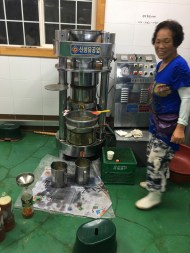
After work, on the way to our accommodation, we pass the local co-op. The light is on and I can see a lady inside working. I go in and see what she is up to. There are a number of machines in there, some are clearly for working with chilis. There are machines specially for removing the seeds, others for course. medium and fine grinding the powder, depending on the desired outcome.

IMG_2627 IMG_2628

Tonight she is renting the oil processing machines. She has brought in her crop of ‘perilla’. I grow a variety of this plant at home myself. I call it ‘shiso’ and use it in salads, as a garnish and as an ingredient in pickles. It has a very distinctive flavour. The variety grown here is not the same and tastes similar but different. Here however they let it grow to full maturity and let it go to seed. The seeds are collected and pressed for their oil. They call it wild sesame here because the oil taste very similar to sesame oil, only milder and slightly sweeter. The mature leaves are used along with lettuce leaves to wrap the meat and pickles in the dish called ssambap.

 IMG_2625 IMG_2811

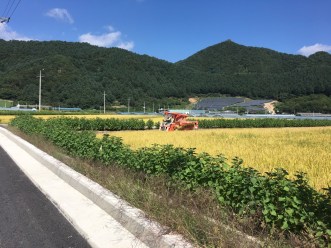
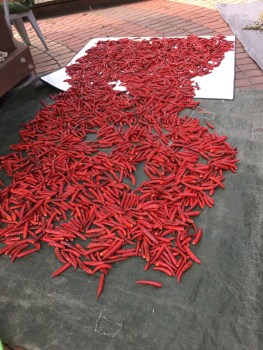
We see a hedge of perilla growing around the edge of a ripe crop of rice being harvested, and some real sesame being dried on the pavement in the village along with other recently harvested crops of chilis and herbs spread out on tarps to dry. You don’t want to see a good bit of unused pavement being wasted on a nice sunny day in autumn.

IMG_2813 IMG_2582

IMG_2694IMG_2696 (1)


The Yanggu Porcelain Museum wood kiln firing

After we have spent out time in Seoul, we set off to travel up to the geographical centre of Korea, right up against the DMZ to a small town, or large village, called Bangsan. They have been mining porcelain stone here for centuries. The earliest written records of porcelain making in this valley date back to 1391. The ancient kiln site is now preserved under a roof, but still accessible. The site where the porcelain stone was stock piled and sorted ready for shipping to Seoul is still there, however, it has been desecrated by someone in living memory. I don’t know the exact details or circumstances, but what a shame. The Korea war raged up and down the country for a few years, back and forth. Maybe it was then? I don’t know.

IMG_2863

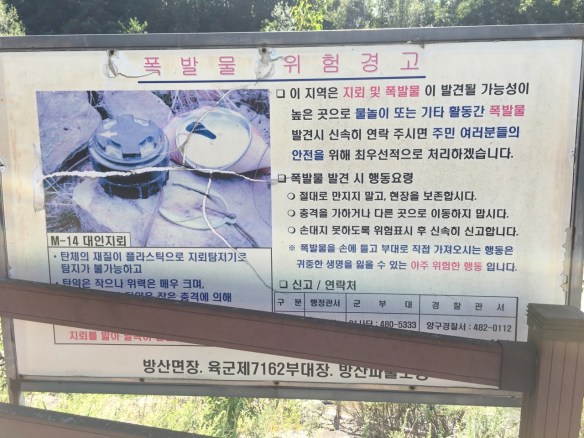
There is a very ominous sign post on the banks of the river just 50 metres from the back entrance to the Porcelain Museum. It looks to me to be a warning sign about land mines. I get out my phone and use the translation app to read the text. Sure enough, it tells me that land mines can still be found here exposed after floods or washed down off the hills after heavy rains. It tells me how to identify them and not to touch them. As If! I can only suppose that some small kiddies might pick one up if un-accompanied? We are so lucky in Australia.

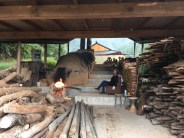
Our trip up here took us all day on 3 different busses and about 6 hours with waiting for connections. We have arrived early, before the forum is due to start, as we want to put pots in the long wood firing that will be held in conjunction with the conference. The Museum has a couple of 5 chamber traditional wood kilns that are fired a few times each year.

We pack all day and work into the night. One of the residents potters living in the student accommodation village ‘Daewoong’ is in charge and is assisted by a visiting potter from Poland ‘Gosia’. Not her full name, but one that she feels that we can pronounce. The firing will go for 100 hours or 4 days, all through the forum and demonstration days.

IMG_2650

IMG_2662 IMG_2675 IMG_2678

On the days when we are not involved in the forum, we do a 6 hour shift in the stoking. Janine ends up getting in more time at the stoking than me, as I’m constantly involved with the translator and publisher, or if not with them I’m speaking at the forum. I turn up one day to find that it is a fully female crew on shift.

IMG_2754

As the firing progresses on to the final stages and the side stoking of the 5 chambers.

IMG_2741


A Funny Thing Happened on the Way to the (Porcelain) Forum

We are spending a few days in Seoul to do a little cultural sightseeing, visiting some of the Art Galleries and Museums, and searching out some interesting shops and small private galleries that show a range of hand-made objects, and not just ceramics.

It’s always great to be in a very different place and experience different cultures first hand. We are here alone without any real Korean language skills, just following our noses I can’t help but notice as we walk to the station that they seem to have chosen one of the most expensive way to wash their high-rise windows.

IMG_2419 IMG_2423

Two large cranes for a day, a Sunday at that, must cost a small fortune?

I’m more accustomed to seeing blokes abseil down the glass fronts of these big buildings, or stand in a mechanical hoist that is lowered down from the roof.

IMG_3217 IMG_2392

As we approach the station we see the first of the first of what is going to be a very common sight over the next few weeks. People make use of every space to dry their autumn harvest. In this case Chilis, and this is in the middle of the city of Seoul. Every spare bit of space is utilised.

We are very lucky to discover a very nice small shop that sells handmade ‘Jogakbo’ Korean patchwork fabrics and Korean paper lamps. We spend half an hour in there even though the shop is quite small. It has a lot of very interesting small things stashed away in intriguing little nooks and crannies. We really enjoy the paper cut-out lanterns, lamp shades and wall installations.

IMG_2540

IMG_2409 IMG_2411

Their patchwork seems to feature a lot of pastel colours and at times some very bright colours, but I’m rather drawn to the most simple unbleached, off-white, hemp and ramie fibre fabrics. Simple and restrained, they speak to me of tranquility, even though the surface is intrinsically busy. I see parallels in my life in this material. I’d love a large, wall-sized piece, but they are too expensive.

We settle on a couple of small things that are more in tune with our budget. One in pastels and another in a very restrained, if somewhat Piet Mondrianish style.

IMG_3002 IMG_3003 IMG_3004

IMG_3001 IMG_2383 IMG_2417

We dine in a little cafe just down a lane, not too far from our hotel. It offers just about the best hand-made, small production, Indian Pale Ale that I  have ever tasted, and it’s made locally too! Sweet, sour, bitter and spritzig, with wonderful fruity hops. The hops are so lively, that I suspect that it has been double hopped, late in the ferment. I don’t know much about beer making, although I do make beer at home myself, but I’m a complete amateur and just use a ‘Coopers’ kit. However, my son Geordie is right into brewing his own mash from basic grains, as is my friend David in Wales. He even grows his own hops in his garden.

See,; ‘From Side-stoking in Stoke to Wwoof-ing in Wales’, on this blog a few weeks back.

For the rest of our trip here we only drink Fermented white rice wine, soju or whatever local Korean beer there is in the little village cafes that we frequent. Although when I take my friends Jun Beom and his wife out to lunch, he chooses us a bottle of soju made from sweet potatoes. A first time for me. Not that different in flavour from the rice originated equivalent. Or so it seems to my uninitiated taste buds.

The next two days are spent with our friend Miss Kang, she is only available on weekends now, since she got a full time job. We are lucky that she has the time to spare to see us. I am eternally grateful to her for being my translator and driver a few years ago. She was fantastic in that role. We have continued to keep in touch and are now friends. This is the 4th time that I have visited Korea and managed to catch up with her.

She drives us to Icheon a few hours away to visit a common friend and see his new gallery. Icheon is a pottery town. It seems to be almost exclusively involved in the business of making and selling pots. After lunch we go for a walk to visit a few of the other workshops and galleries. There is a small ceramic festival on today in a new part of town where a new pottery suburb has been built. It’s so new that not all the streets are tar sealed yet and not all the allotments have been fully developed. The festival/ street party is to get the community involved and make a bit of an advertising splash. As this area is so new that they need to make themselves and their whereabouts known to the wider community.

Miss Kang takes us to one gallery/workshop where the owners name is ‘Mium’. They have built their workshop and gallery as a square shape with a square courtyard in the centre, with square windows. Miss Kang explains to Janine, using her phone, that the Korean letter ‘‘ is a plain consonant and is pronounced ‘mieun’, so they have used this as a central motif, not only in their work, but also in the design of their workshop.

IMG_2478

IMG_2479 (1)

Next, we are taken to a Master Moonjar Maker. He has a fantastic workshop and gallery too. He is firing his wood kiln today. We can see this from afar, as it is very smokey. We are introduced, and it is expained that we are here to take part in the Yanggu Porcelain Museum, Special Annual Porcelain Forum. The potter, Cheol Shin, looks amazed for a second, then shakes my hand. He tells me, through translation, that he is very pleased to meet me, and knows that I am coming to Korea, because he will be one of the speakers /demonstrators at that forum too. What an amazing piece of synchronicity! He is a really nice guy, so friendly, but without Miss Kang and Jun Beom to help us, we wouldn’t know.

IMG_2425 (1) IMG_2428

IMG_2430 IMG_2432

Apparently, he made 1000 large Moonjars, before he was prepared to call himself ‘Master’. I believe that he is certainly entitled to give himself that title now.

IMG_2435 IMG_2436

IMG_2437

Next, Miss Kang and Jun Beom take us to the local HaeJu Ceramic Museum. We meet the Director, Mr KiHwan Um. He seems a rather eccentric kind of fellow. I like him. After some polite social introductions and an exchange of name cards, an explanation of our mission here and my past research, he shows us around and gives us a special personal tour of the exhibits, but more importantly, the stock rooms. There are rows and rows of old and new pots. He just happens to have a collection of Song dynasty pots in his collection. Amazingly, we are expected to handle them and comment.

IMG_2454 IMG_2457

IMG_2458

IMG_2466

IMG_2467

We end our tour in the international section. He asks if I have any images of my work with me. I regret that I don’t, as I wasn’t aware that I’d be coming here, this is just a fluke meeting. I do have a few images on my phone though. I show him what I have of my show at Watters Gallery last year. I am suprized when he asked me, through Miss Kang, if he can obtain one of my Australian Native single-stone porcelain bowls for the Museum. I’m flattered.

Before we leave Icheon, we bump into a couple of Australians, Tony and Gail,  who have come here to do a week-long, hands-on workshop in Onggi making. There are apparently 5 Australians here for the workshop. Lucky them.

I love Korea. I am always happy here. We’ve only just arrived and I havent even left yet, but I’m already thinking of ways to come back. It’s a funny thing.


Korea is such a great place

Janine and I have been invited back to Korea. I have been here several times to do research into Sericite porcelain. I was invited last year to give the Key Note address to the first International Porcelain Conference, along with other speakers from Japan and China, as well as local Korean presenters.

I have spent all my life researching the use of local stones and other endemic materials for use in ceramics. A somewhat weird but very interesting and rewarding hobby. I have spent the best part of the last 20 years specialising in research into the use of Sericite in single stone porcelain bodies. That research got me the guernsey to last years conference. While I was there, I gave a copy of my latest book ‘5 Stones’ to the director of the Porcelain Museum and Research Centre. It turned out to be a very rewarding gift, as Mr Jung, the Director of the Museum must have been impressed, he invited me back again this year to speak about the book.

The Yanggu Porcelain Museum and Research Centre together with sponsorship from the Yanggu Gangwondo Min Ilbo Daily Newspaper have bought the rights to translate and publish the book in Korea. We get free return tickets and an advance royalty so that we can meet with the translator and publisher to set out the ‘tone’ and final content of the Korean edition. The book is about my 15 year research in 5 countries investigating endemic sericite porcelain and its history over a thousand-year period.

The story takes place back and forth between China, Korea, Japan, the UK and Australia with plenty of asides and digressions as I blunder about like the proverbial bull in the China shop smashing my way through cultural niceties and taboos with some incompetence and plenty of ignorance. It’s not so much a scholarly work as a light-weight travel journal. I’m not too sure what the translator will make of the puns, ceramic in-jokes and Australian/Western cultural references. I have already done a Korean-sensitive re-write and edit to make it specifically more appropriate to a Korean reader. As it stood in the original edition, about a third of the book took place in Korea, as Korea is such a culturally fertile place for porcelain with its extensive ceramic history.

I was so lucky to have all the stars align for me a few years ago when I first decided to go to Korea and try my luck in finding a few sites where porcelain had been independently invented and developed locally. I couldn’t have been luckier as it turned out. One of my past students from the Art School, ‘Clauda’, has now become a very popular teacher herself and just happened to have a Korean student in her class. When she heard that I was planning a research trip to Korea, she asked her student ‘Jane’ if she had any contacts that might be helpful to me. It just so happened that Jane’s brother is a potter in Korea. He invited me to visit him and offered me work space in his studio. He also knew an under-employed ex-employee/friend who could speak good English and was interested in a temporary job as my driver and translator.

It couldn’t have worked out better. I was beyond lucky. Miss Kang turned out to be the most amazing person. Creative, enthusiastic, engaged, interested and as a ceramic graduate, knew enough about my interests to make excellent decisions and able to do research into each topic that I mentioned in our conversation as we drove about the country. I found her to be very quiet and reserved at first. Very measured in all her conversation. However, over the first few days of being crammed together in her small car, we developed a working relationship that turned out to be very productive.

As it turned out, my two-day offer of work organically developed into a very long road trip that lasted a couple of weeks and covered a lot of the county, as Miss Kang followed up leads on her phone, ‘googling’ and ‘Navering’ various locations and key words. Initially, she had no knowledge of sericite or single stone porcelain. Her knowledge was all of contemporary Korean ceramics. Together we learnt many things about Korean historical porcelain and its development. We discovered several historical porcelain stone sites and were able to collect a lot of samples for me to post back to Australia for analysis.

I had initially offered her this small job to drive me from near Seoul, down to the south of the country to visit an ancient porcelain site, stay over night and then she would return home, leaving me there to do research. I was to meet up with another Korean potter, Mr Ji, a contact that I had made remotely, by email, from Australia. Mr Ji lived locally, and it was he who was to take me to another site and so on, following whatever leads I could find. It was my intension to do all this other follow-on research by public transport. However, Miss Kang became interested in the detective work of the research and stayed on for the duration of where-ever the leads took me. I couldn’t have been more fortunate. She turned out to be one of the most resourceful people I have ever worked with. I couldn’t have written the Korean chapters of the book without her research.

Through this chain of fortuitous events, my book ‘5 Stones’ became a reality along with my exhibition at Watters Gallery of my porcelain. So here we are in Korea again for the 5th time. We have been given our return air fares to make another presentation at this years porcelain forum, meet the people involved in the funding and production of the book. Work with the translator, catch up with Mr Jung in Yanggu, take part in an extended wood firing in the Porcelain Centres traditional 5 chambered wood kiln, then also spend a weekend with Miss Kang in Seoul, as she has now become a good friend and we couldn’t visit Korea these days without taking time to catch up with her.

Korea is such a great place for me to be.

Cornwall and Devon

After leaving Wales, We drive to Cornwall to meet up with our old friend Joanie. It was Joanie who volunteered to be my ‘get-away-driver’ last year on my last visit. This time we know where we need to go and what to do to collect another few kilos of Sericite porcelain stone. It’s a trivial matter this time, rather than the week-long epic of last year.

While we have a few days with Joanie, we decide to walk over the causeway to St Michael’s Mount. It’s a really interesting place, we end up spending the entire day there and miss the return tide window of opportunity, so have to catch the small boat back at high tide.

IMG_1884 IMG_1901

The tide comes back in while we are still at the summit and we see people wading back  across the causeway in chest high water, until it becomes impossible.

IMG_1920

We enjoy lunch and afternoon tea on the island taking in the full tour of the old house/castle. A really enjoyable and informative day taking in all the history of the ancient site.

After a few very relaxed days with Joanie, we move on to Devon to visit our friend and fellow wood firer, Svend Bayer at this new pottery kiln site in Kigbear. Svend has decided to sell up in Sheepwash and move on to the next phase of his life. We really love the ancient thatched roof, cob cottage in Sheep wash, but times change, as do we, everything changes. We must adapt. It really is an exquisite place. So romantic!

We are lucky enough to get to see assembled, an amazing collection of Svend’s best works, collected over the last few years of firings here at Sheepwash.

IMG_2063 IMG_2061

IMG_2084 IMG_2086

IMG_2087

We are totally privileged and very lucky to turn up at just the right time to see all these wonderful, master works, before they are all exhibited and sold.

Svend’s new kiln, as might be expected, is pretty big. There are 5 potters sharing the kiln  firings at Kigbeare with Svend. It’s his way of training the next generation of wood firers, passing on the baton, by mentoring these lucky, and committed, next generation potters. It’s a huge kiln!

IMG_2025 IMG_2029

IMG_2035

IMG_2038

We are lucky to turn up on the day of the un-packing of the kiln. There are pots everywhere. So many nice things to temp us. It’s the end of an era and the beginning of another. We are so lucky to be here to experience this moment.

We spend a few days here. The next day Svend takes us to see the local Museum at Bideford, with a great collection of local earthen ware pots.

IMG_2069 IMG_2072

IMG_2073

Earthenware pots have been made here for hundreds and hundreds of years. This is the home of the famous Fremington terracotta clay.

We call in at the Post Office after visiting the gallery, as the post office is just across the road. I have 5kg of sericite porcelain stones in a cardboard box all taped up and ready for post. I can’t carry this extra weight home on the plane. Svend is visibly shocked to hear that I just paid Au$250 for postage! he enquires how I can do this? I reply that last year I did the same and when I got home I processed the stones into its unique porcelain body and managed to get 3 very good pieces out of the firing. I sold them for $900, $750 and $500 respectively, through my Show of ‘5 Stones’ at Watters Gallery in Sydney. They were nice pieces and found good homes. The return covered the cost of the postage, but not the 3 months of processing, making and firing.

Still. I don’t do this to make money. If I wanted to make money, I’d have got a job. I want to live an interesting, engaged and well-considered life. As long as we can get by, I’m happy.

Tomorrow we travel on, making our way slowly back towards London.