Tomatoes for 5 Months

We are now just back from our 5 weeks in Japan continuing our research into single stone porcelain. We were lucky enough to get to many more sites on this visit, where porcelain stone is, or has been mined. See my earlier posts below.

I have been able to make a few nice pots while I’ve been here. Actually, I made a lot of pots, but destroyed all of inferior work that wasn’t up to scratch and didn’t make the cut.  I’m not here to make rubbish. I want to make things that I can be proud of, nothing less. My rejected pots have all been crushed up to dry powder, packed into boxes and shipped back home for a possible 2nd life. My best work was glazed and fired onsite and also shipped home. All my efforts are currently in containers at the port or on the high seas. I will see them again in 2 months. Hopefully they will still look as good when we are reunited.

This work is all a part of my 10 year project to go to all the places in the world where single stone porcelain has been made and then make some work at each of these places, out of the material that is to be found there. These works will then be shipped back here to Australia, where I will exhibit the whole body of work from all the sites along-side my own single stone porcelain pots, that I have made here, in one big show. I’m rather hoping that it will look good when all amassed together in one show. Only time will tell. I’m almost finished. Next year should see the end of it.

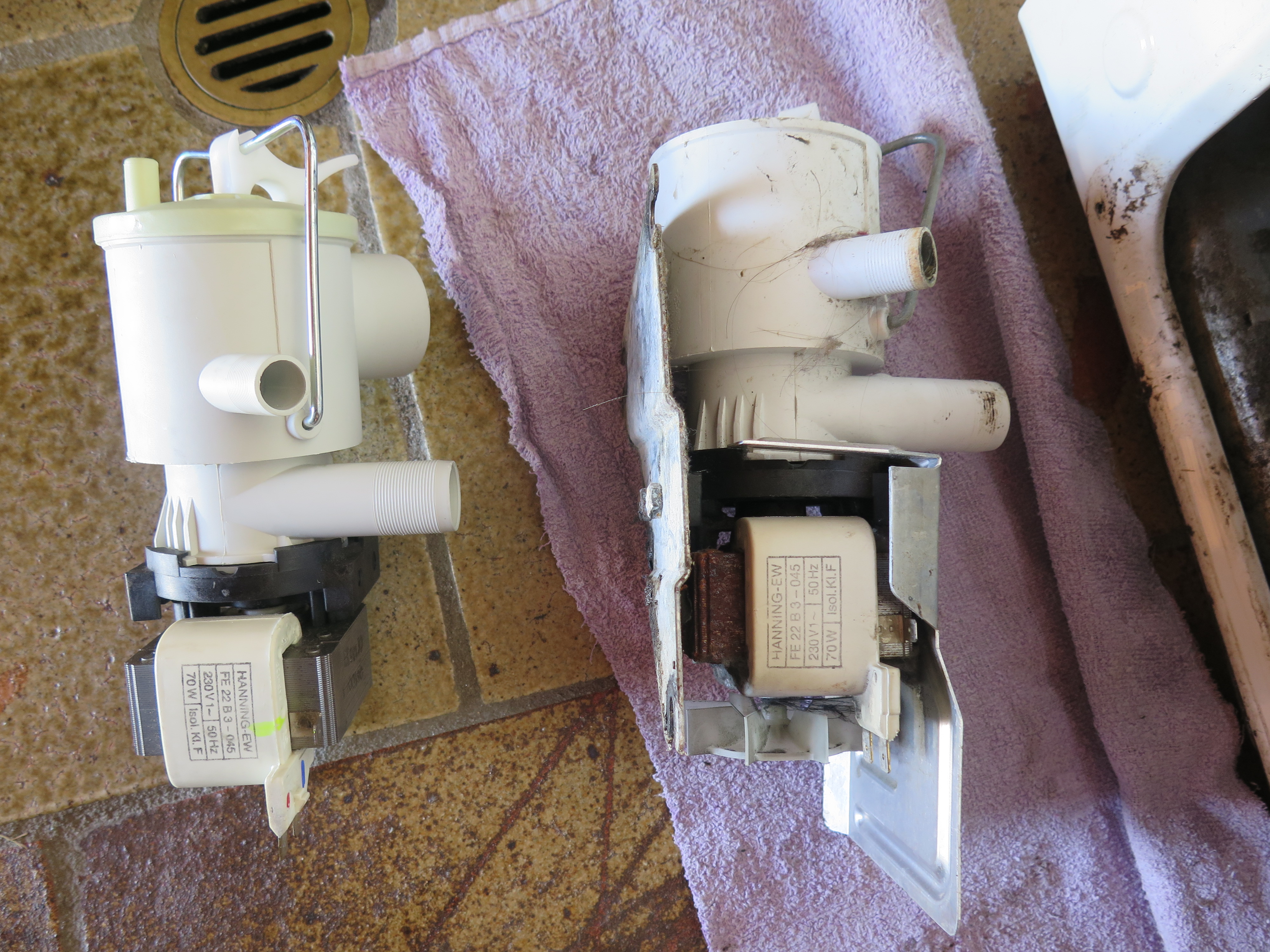
As soon as we are back home and settled in. We unpack our bags and put on a load of our soiled clothes into the washing machine, which grumbles and squeeks as it grinds along. I can’t complain, this machine is over twenty years old and still going – just. I think that it is the leaking water pump that is the problem. I have a new one in stock. I ordered it months ago when I noticed the water starting to leak from underneath. It took months to get here. It arrived just a week before we left on our long trip. I didn’t have time to install it before we left. Now that I’m back, I will have to make time.

After the basics are dealt with, then it’s straight out into the garden to check out how all the plants have fared while we have been away. Apparently it has been very dry for most of the time, with just one proper fall of rain. Annabelle Slougetté has been living here in our absence and has kept everything alive for us.

IMG_3723  IMG_3717

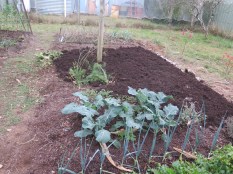
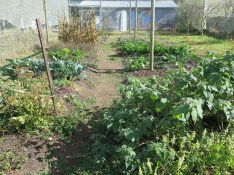
The first thing that I notice when I get into the garden, is how dead so much of the garden is. The last of the summer corn, has finished, dried out and turned up its fibrous toes. We made an effort to mulch as much of it as we could in the week before we left and this has really paid off for us. There are so few weeds now. A couple of days of intensive work will bring it all back into healthy production again, as there are loads of winter vegetables coming on. I made an effort to get all these planted early in the season, at the end of summer/early autumn. So, now we have broccoli, brussels sprouts, cabbage and spinach ready to pick.

Surprisingly, many of the late summer plants are still lingering on and still producing food. Others, their time being up, have gone to the big veggie patch in the sky. They will soon be headed into the compost bin, where they will rot down and be fertiliser for next seasons crop of summer vegetables.

As I look around, I see that there are still some little yellow tomatoes ripening on the old, almost dead, vines. We have been picking tomatoes now for 5 months, pretty amazing for us. So this is global warming?

This will likely be the last pick, as the plants have lost all their leaves and are pretty much dead now. Interestingly though, there are still some small new tomato plants germinating and growing up. One is even flowering, but I can’t believe that this will amount to anything, as the first day of winter is only 2 days away. The first frosts can’t be too long after that.

We  used to get our first frosts at the beginning of May, now its the end of May or early June and possibly later? A couple of years ago, we went right through winter with only minimal frosts, to the point that we didn’t get any apples on any of the trees the following summer. Apples need a minimum number of frosts (or winter chilling hours) to develop the hormones that are necessary to make the flowers fertile.

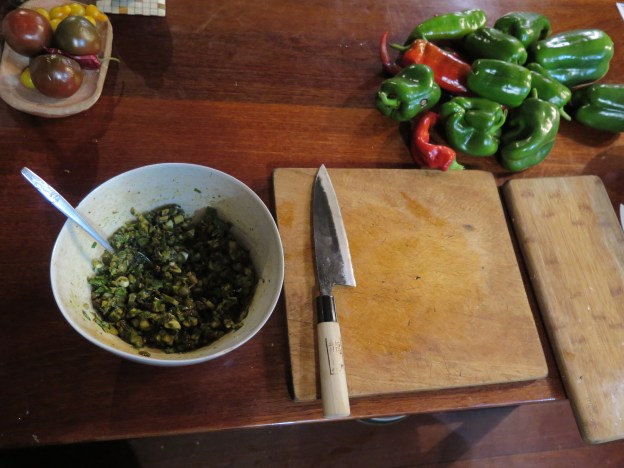
I go straight back out into the garden with my basket and fill it with little yellow tomatoes, the last of the lingering sweet basil and a load of capsicums and chillis.

IMG_3749

I set about making a tomato/caps/chilli salsa by browning a few onions in good olive oil and adding 6 small knobs of garlic. The ones that are so small at 20 to 30mm. dia. that it really isn’t worth peeling them. They will add heaps of flavour to this mix and the small amount of skins and paper will be removed when I strain the whole batch. I let them softening down along with all the diced fruit over a long time at low heat on the wood fired kitchen stove.

IMG_3750

I will  pass it all through the kitchen mouli sieve to take out all the tomato and capsicum  skins and seeds, then reheat it to sterilise it and bottle it in heated glass jars. It will keep for a year or so, but probably won’t last that long. It’s too delicious, although very ‘hot’ with chilli flavour. It will make a great addition to winter stocks and sauces over the coming cooler months.

This little effort marks the end of our summer preserving for this year. I’m very pleased, as I wasn’t expecting there to be any fruit left to preserve. This simple garden-to-kitchen-to-pantry excercise grounds me and resets my emotional and spirituual compass to ‘home’ after being away. This is what I do. This is what I live for. This is me. The self-reliant potter/gardener.

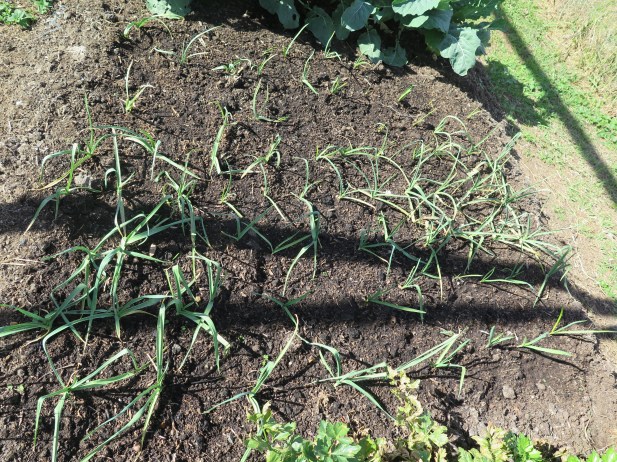
A close inspection of the garden beds reveals a lot of little germinating seedlings of onions, carrots, beetroot and rocket. I planted these seeds just the week before we left. I also planted a few hundred cloves of garlic. Most of which have now germinated and are showing their green shoots. Peas are also up and growing quite strongly, I hope to see them flowering soon.

IMG_3718  IMG_3722

IMG_3721

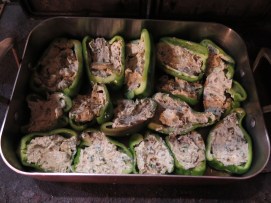
There are a lot of capsicums ready to pick, so I decide to stuff them with ricotta and bake them in the oven, as the stove is lit, we are making hot water and warming the house up as well, seeing that we are now home and the weather is so windy and cold. Such a change from the weather in southern Japan, where it was almost summer and the weather was balmy to hot.

IMG_3726

IMG_3725 IMG_3728

I make a stuffing out of whatever we have at hand in the fridge. Before we left I had bottled some little cucumbers and some dried tomatoes. I add these into a lump of fresh ricotta. I add a few cloves of our garlic, along with a few capers and an anchovy or two, a few olives, a shallot and some parsley. I dice it all up and mash it together with some veggie and herb salt substitute. I would like to add a little bit of finely diced feta cheese to give it a little bit of chewy texture to the cheesey mix, but I don’t have any at this time. I’ll add to my shopping list for next trip into town. There are plenty of capsicums left to pick, so we will be having a meal, not unlike this one again in the coming days or weeks. I like to use what I have in the garden and pantry. Our main food expense these days since we lost our chickens and ducks is protein, which these days consists mostly of fish.

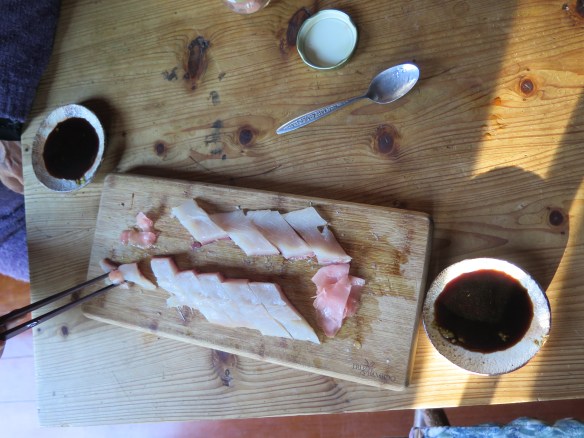
The fresh fish truck is up from the coast today, so I buy a small piece of super-fresh sashimi grade kingfish, we have a small fillet for lunch. I skin it and slice it up and we have it with a little soy sauce, wasabi and pickled ginger in vinegar. Yum. Itadakimas!

IMG_3746

Back From The Mountain

We spend a bit of time looking closely at the Nabeshima pots on display, and it is true that there is very little texture in the pale blue gosu, natural cobalt ore, background pigment.

IMG_3471

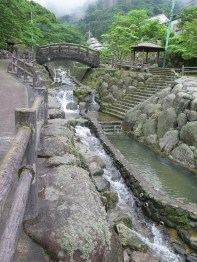
We make our way back down the mountain past the noborigama kilns and other pottery workshops and display rooms. As it has been raining for a day or two, the stream is running quite noisily. Our guide, Tsuru san is very knowledgeable about the ceramic history of this area. Born and bred here, she knows more than we can take in.

IMG_3475 IMG_3458

The water driven clay crushing hammers are working hard, unattended, pounding the soft porcelain stone to powder all through the day and night without a power bill.

IMG_3452 IMG_3463

The fish seem unperturbed.

From Okawachi, we drive to another interesting site of early Arita porcelain development. We go to visit the re-constructed Korean climbing that is said to be the one used by the originator of the porcelain industry here, Li Sampei or Ri Sam Pei.

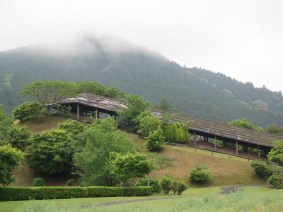
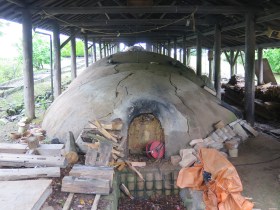
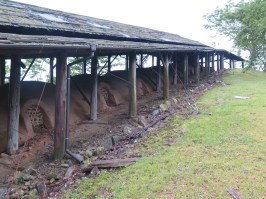
Its a magnificent kiln stretching all the way to the top of the hill, with a slight bend in it  to suit the lay of the land form, just as the original one did, as excavated by the archeologists.

IMG_3493 IMG_3495

IMG_3497 IMG_3504

IMG_3506

On our way home, we call in to visit the Rice Field Potters Kiln. Unsurprisingly, it is set in the middle of some rice fields on a gentle side slope. It has also been reconstructed recently from the information gleaned from an archeological dig on the site. This kiln dates from the time when potters didn’t work full time, but fitted their firings into the rhythm  of the season along with rice and vegetable farming. They were the original self-reliant potters.

IMG_3522

I really love the way that this old kiln wriggles and snakes its way up the slope. If I were a self-reliant, wood-firing gardener/potter, I’d love to own a kiln like this one. Come to think of it. I am, and I do!

IMG_3526

Both of these kilns were built with dog-legs in them to follow the natural surface contours of the local terrain. They are both used intermittently by the local potters groups to keep them working and alive.

It’s been a long day and we have just enough energy left to visit the local sake brewery for a tasting. I can’t decide which one is best, so I am forced to taste them all before I can decide. A total lack of knowledge about sake can be an advantage sometimes?

Tracking the Elusive Wild Felspar

Porcelain stone occurs in many of the hills around here in Arita, where the local white granite has weathered down into a softer white to off-white, mixture of kaolin, silica, felspar and specifically sericite. Sericite is a white, plastic mica. This means that it is throwable on the potters wheel as well as vitrifying to a translucent glassy matrix when fired. A very rare and specific combination of qualities.

Today I ventured up into the hills to look for some felspar/porcelain stone deposits that I’m told are all around here. Most were closed because they were worked out of the most precious ultra white material. The deposits around here were very small and used by the potters in the immediate locality. Each little district had its own small mine. This used to give the different villages a slightly different quality to their work. However, ultimately, none of them could compete with the large-scale and very high quality sericite that is being mined at Amukusa, just a couple of hours from here. Economies of scale and the quality of the product, along with increased specialisation of the work force made every one concentrate on producing saleable product and abandon self-reliance.

We can drive up the mountain to the scenic lookout and then park the car and go on foot. This is the ‘Black Hair Mountain’ and I’m told that it is a very spooky place. It’s a dark, wet and cloudy day and the Mountain is shrouded in mist. I’m not spooked, because I don’t believe in ROUS ‘Rodents of Unusual Size’ ‘Fire Swamps’ and ‘ Lightning Quicksand’. The Princess and I press on, the track is very wet and slippery after last weeks constant rain. In dry weather we could have gone a bit farther by car, but not today. So we walk. The little track wanders around the contour of the hill and would have been quite manageable at the time when it was in use and repaired to handle constant traffic of the ore down hill. We head off up the hill on a stone staircase to get to the top. It takes some time before we realise that we are on the wrong track. We go back and try again.

IMG_3541

This time with more luck. We find a diagrammatic map along the way that shows us the location of the old mine, but not in much detail. Up the hill, over the bridge across the river. Through the ‘Fire Swamp’ and the valley of ‘Lightning  Quicksand’. We keep going until we reach the water fall and then it shouldn’t be too far, according to the map, and then there ought to be another bridge to cross back to the other side of the river. Through Dead Mans Gulch. Then up along The Valley of No Return,  up the sacred mountain to the water falls and then a righthand fork should lead you straight to it. We do and it does – more or less.

Except that I lost my nerve when we didn’t find any sign of a mine after such a long trek. The road became very narrow and washed out after some very heavy rain. There were trees across the track. The sound of crunching twigs under foot coming from the forest around us and an owl hooted, while a black raven swooped overhead. It was quite obvious that nobody had come this way for a long time. This was indeed the path less trodden!

We retraced our steps and consulted the map. This time I photographed it. It seemed that we were almost there when we turned back. We tried again and this time found that the turn off to the old mine was just another 100 metres up and around the side of the mountain. What we found was a rusty steel mesh gate with large red warning signs all over it. I can’t read Japanese, so what I read into it, was that this is the place that you are looking for. ‘Keep going, it’s just a little way on from here”. Almost there!

Of course it could also have said. “This is the old dangerous mine site. No Entry! or  “proceed with caution!” Or maybe it said that the bridge is closed because if you tread on it, it will collapse!

IMG_3550 IMG_3551

So we did. It meant swinging out over the stream to get around the gate. Then onward and upward. We knew that we had reached the correct place when we found the boarded up mine shaft entrance.

There was plenty of spalls all around on the ground outside. So no need to go in. The material looks just the same all over the world. Similar colour and texture, similar fracture angles, but the hardness varies due to the amount of weathering and decomposition of the felspars down into kaolin.
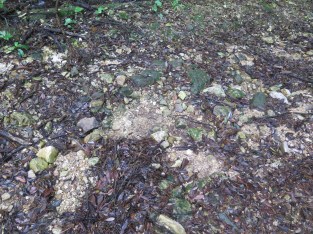
IMG_3548 IMG_3554

The softer the stone, the greater the degree of weathering and the more refractory it will be with an increased kaolin content. so it will be more plastic, but less fusible at high temperature. The harder it is, the more fusible it will be and the more vitreous at high temps, but the less plastic to work with. Somewhere half way between is a good compromise, or a blend of two different stones will achieve the same result.

This stone is quite hard to break and is probably quite high in felspar, sericite and quartz. It feels to me to be a useful glaze stone. We walk back down the mountain, happy trekkers with a pocketful of samples. I learn the next day that the reason that this site was closed, was because there was a mine collapse 30 years ago and a number of miners were killed there. Very sad, but not spooky.

News travels fast. The next day, Mr. Akio Kanaiwa san. A retired geologist and lecturer in ceramic chemistry from the Ceramic University here, specialising in porcelain stone, calls in to see me. Miyuri san, the local cultural guide here in Arita has met him and mentioned me and my special interests to him. We get along very well and in just a few minutes we manage, even with so little language, to exchange our views and knowledge about porcelain stones. We both can read chemical analysis, X-ray micrographs, SEM data files and ceramic Seger formulas. He shows me some of his research that he has brought along. As he flips through his files. All in Japanese. I can read them out to him. He realises that I know exactly what he is trying to tell me in chemical terms. The only  thing that I can’t do is understand his excited Japanese Arita dialect. It turns out that I am the only person that he has met that has his own Denver cell for froth floatation separation and purification of ceramic minerals. The only difference in our techniques is that he uses pine oil and I use kerosene. Amazing!

We arrange to go on a geology excursion the very next day with Tsuru Miyuri san as our translator. It turns out to be a very full day, as Akio Kanaiwa san has a quite a few sites that he plans to take me to. I am thrilled. We both really enjoy our time together with Miyuri san. She is amazing, such good value. She is so knowledgeable about ceramics in Arita and her English is excellent, so she is so good to have along on a trip like this. We go to site after site. He really knows his stuff. Through Miyuri, we exchange ideas and analysis data.

At one point we all have to stop and laugh, as Kanaiwa san and I find ourselves agreeing on the importance of secondary mullet crystals in the development of strength, translucency and slump resistance in porcelain bodies. Miyuri san, who is quite faithfully translating our conversation, back and forth, is stunned and mystified by what she is having to say, as she doesn’t understand a word of the technology involved. When Miyuri doesn’t know the word or a suitable work-around sentence to convey the meaning, Kanaiwa san and I revert to writing the chemical symbol or formula. It’s a wonderful, positive, cultural exchange.
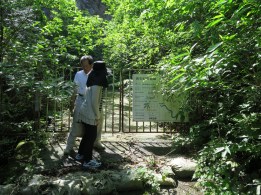
IMG_3555 IMG_3557

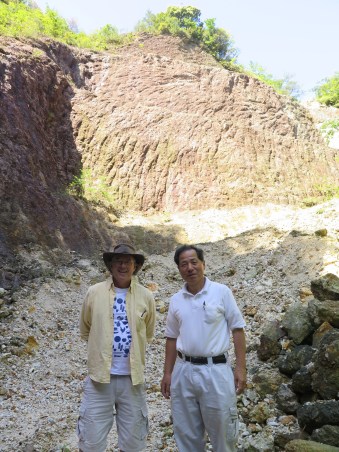
Miyuri san explains to Kanaiwa san how I collect most of my materials where I live in Australia and my amazement at how similar they all are to these minerals that we are looking at there. The only difference is that these minerals are mostly much cleaner and lower in iron. Only one of the sites is still being used, an open-cut quarry where an interesting felspar/quartz stone is being mined for use in electrical insulators and industrial tiles. It is called ‘The Dragon Gate’ mine. There is a lot of iron present here, but it is in bands and veins, so could be sorted out or extracted.
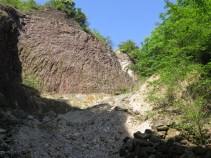
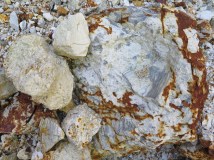
IMG_3561  IMG_3566

IMG_3563

Our last visit in the afternoon was to a glaze stone mine in Takeo. The ‘3 splits’ mine. This name causes a lot of muffed laughter. Apparently it is not really the true name of the mine. It is named after the combination of hills and valleys that look like the gap between someone legs. This is a name that can’t be said by a lady. A more literal translation might be ‘fork’, as in ‘a fork in the road’, but more likely ‘crutch’, as in the gap between a persons legs? I don’t end up knowing what it is called. Perhaps it’s 3 cracks? Because if you go up the crack it ends in a tunnel?

No one will say it in English. So I’m calling it the 3 splits mine.

Kanaiwa san says that I look like Indiana Jones or Harrison Ford in my hat. I reply that I can’t afford a whip, but my name is Harrison.

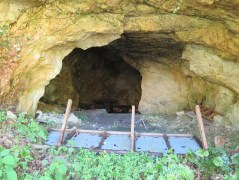
IMG_3585 IMG_3586

There had been several attempts at mining here over the last few hundred years. Some open-cut and others in deep shafts and drives. All closed now. Again, the shaft is barred by a wire fence that declares that this is the correct place alright. The fence seems to have fallen over at one of the mine shafts, so I can’t read the sign that might say ‘don’t enter’. So there is nothing to stop me. – Except the fact that it is all flooded inside.

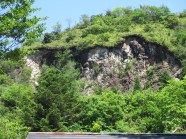
IMG_3588 IMG_3589 IMG_3592

IMG_3593

The water is a pretty translucent  pale blue. Just like blue celadon over porcelain!

I explain that this is the most dangerous site that we have visited yet. Not because of the risk of mine collapse, scrambling through flooded water or drowning, but because of the crumbly asbestos fence!

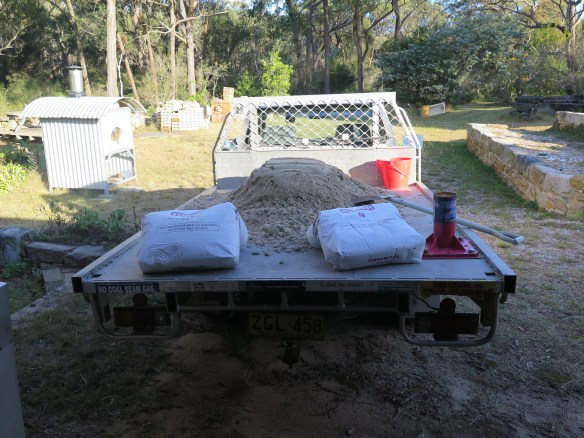
A Nice Firing

We have just unpacked our latest firing with mixed results. The wood for this firing burnt well and got us to temperature in 12 hours with a good, constant reduction, but it produced a mass of  very slow burning embers, so even with all the mouse holes open we ended up with a load of embers which buried the potential ‘gems’ of the firebox area beneath their cloistering bed and smothered the jewels of the firing that should have come from the exciting ‘zone of death’, This area, close to the ember pit can produce some excellent dramatic qualities, but instead, on this occasion, all the potential jewels did not reach their full potential. They all survived intact, but as blackened bisque instead of shining gems. The jewels of the kiln are now more like Swarovski than De Beers.

IMG_2769IMG_2772

The back of the kiln was a little under-fired, so there are a few pots from there that just need a little more heat. They can be reheated, ‘microwaved to perfection’ in our little wood kiln, the next time we get it out for a spin. The rest of the setting was very good – by our standards. There are half-dozen really nice pots, nearly all of which were Janine’s. But I have some small bowls that are good enough to show at Watters Gallery, so I’m happy.
So, a good firing. We are so lucky!
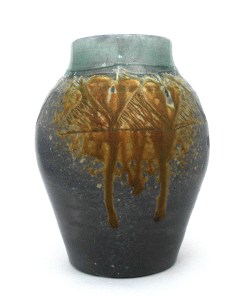
Two of Janine’s vases
DSC_0046_01 copyDSC_0045_01 copy
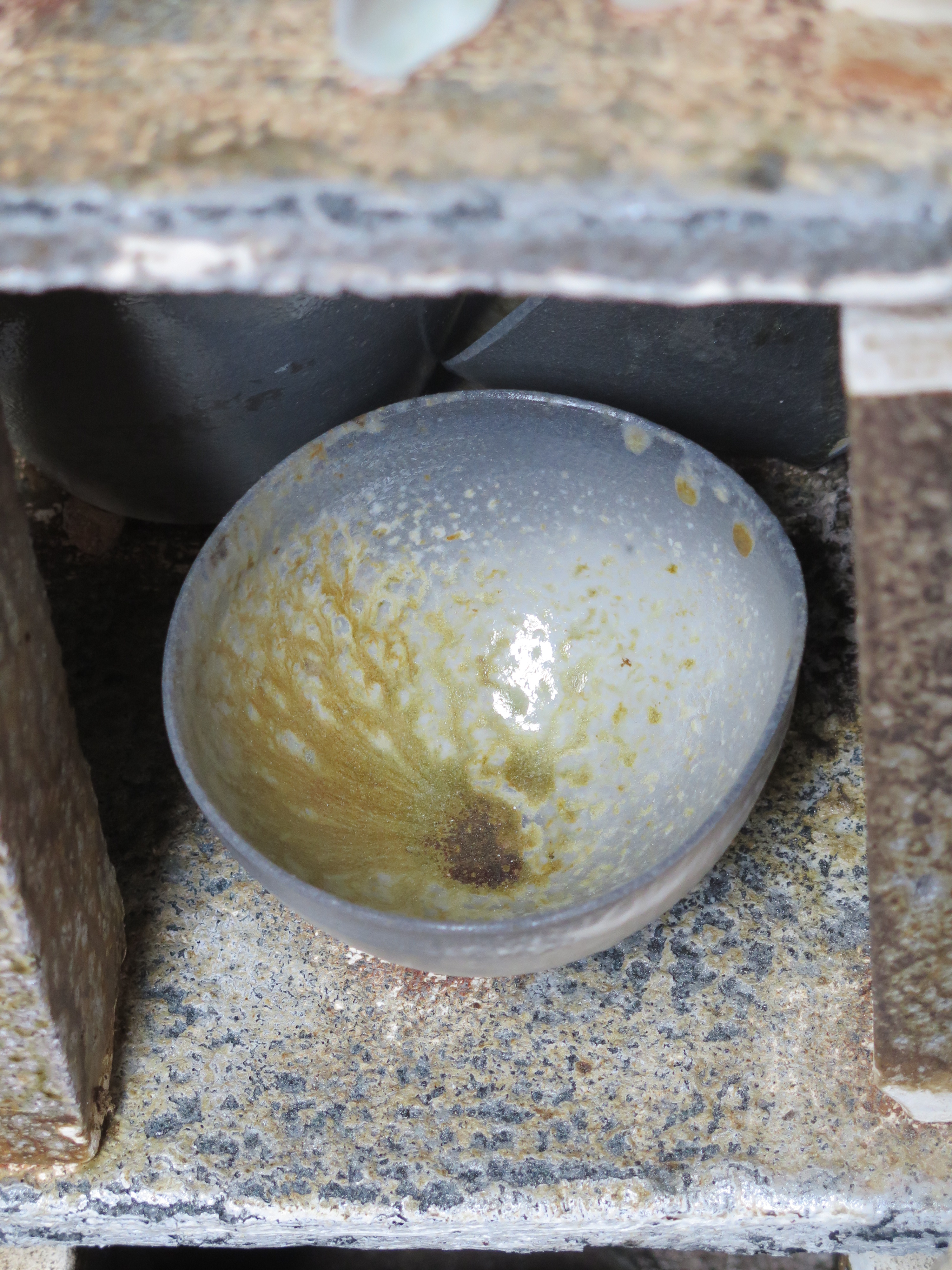
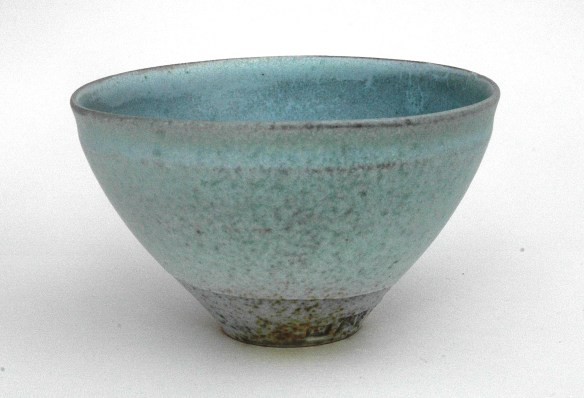
Three of my new bai-tunze paste little bowls with limpid porcelain glaze and subtle wood ash deposit and bright body flashing.
DSC_0013_01 DSC_0015_01 DSC_0023_01
After the firing, I picked, washed and sliced open 300 small tomatoes and dried them for use later in the year. These things are so delicious, that I end up eating a few handfuls of them as soon as they emerge from the oven. It’s a slow patient process using the lowest possible heat that the oven is capable of. I turn it down manually, so that it only just remains alight. It takes all day turning and rotating them often with the oven fan on.
IMG_2764IMG_2765
 IMG_2766
6 trays of little tomatoes, cut in half, butterfly-style, all tries out and shrinks into just 3 litre tubs of sweet, sharp, crunchy, sour and very delicious dried tomatoes.
I make a vegetable stir fry for dinner. Garlic and chilli with capsicum, celery, carrot, beetroot and aubergine. A little block of frozen marrow bone stock from the freezer and a little fish and oyster sauce.
IMG_2761IMG_2760IMG_2762
Best wishes from the 2 well-fed, lucky potters

Free Fuel

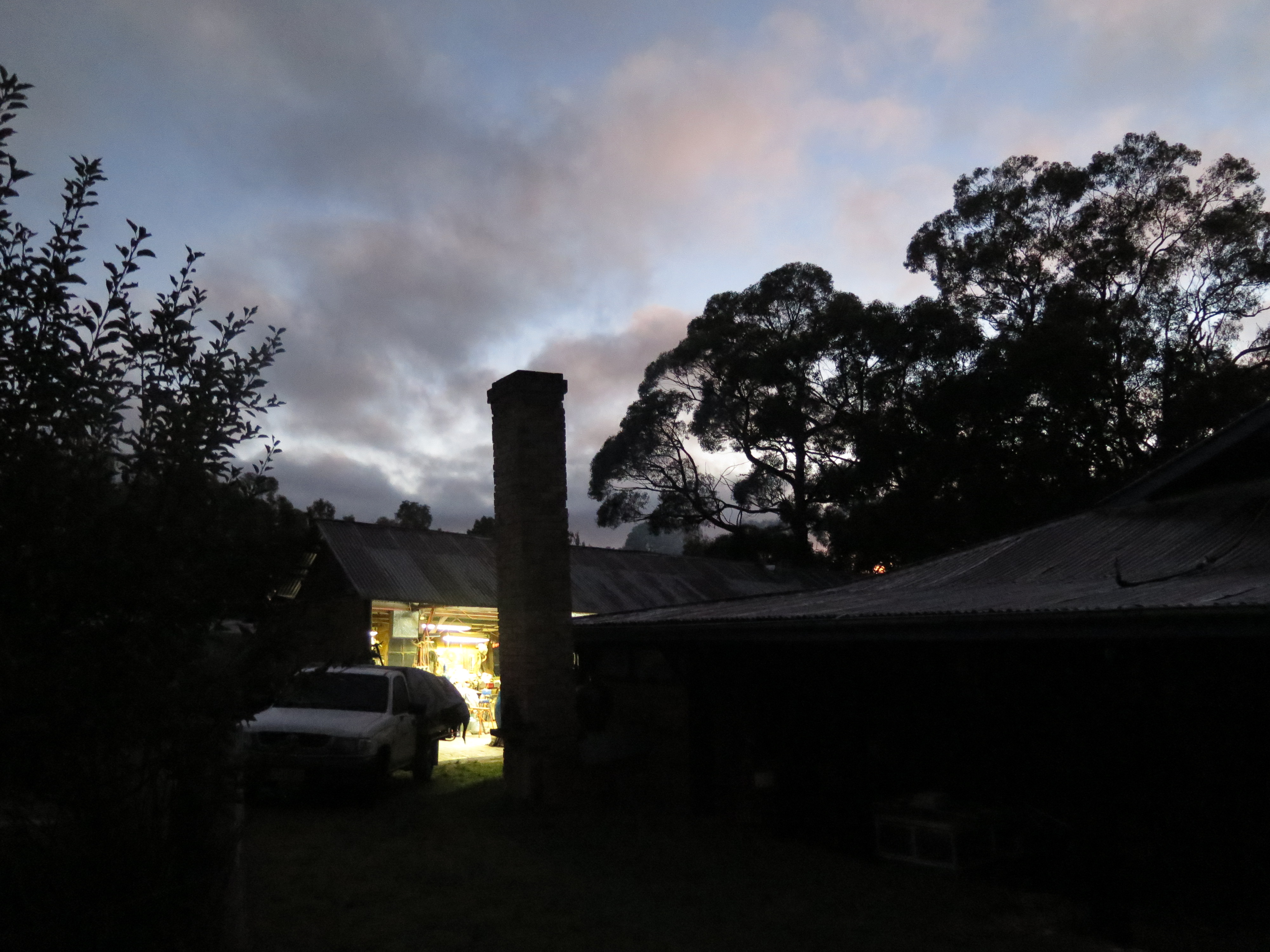
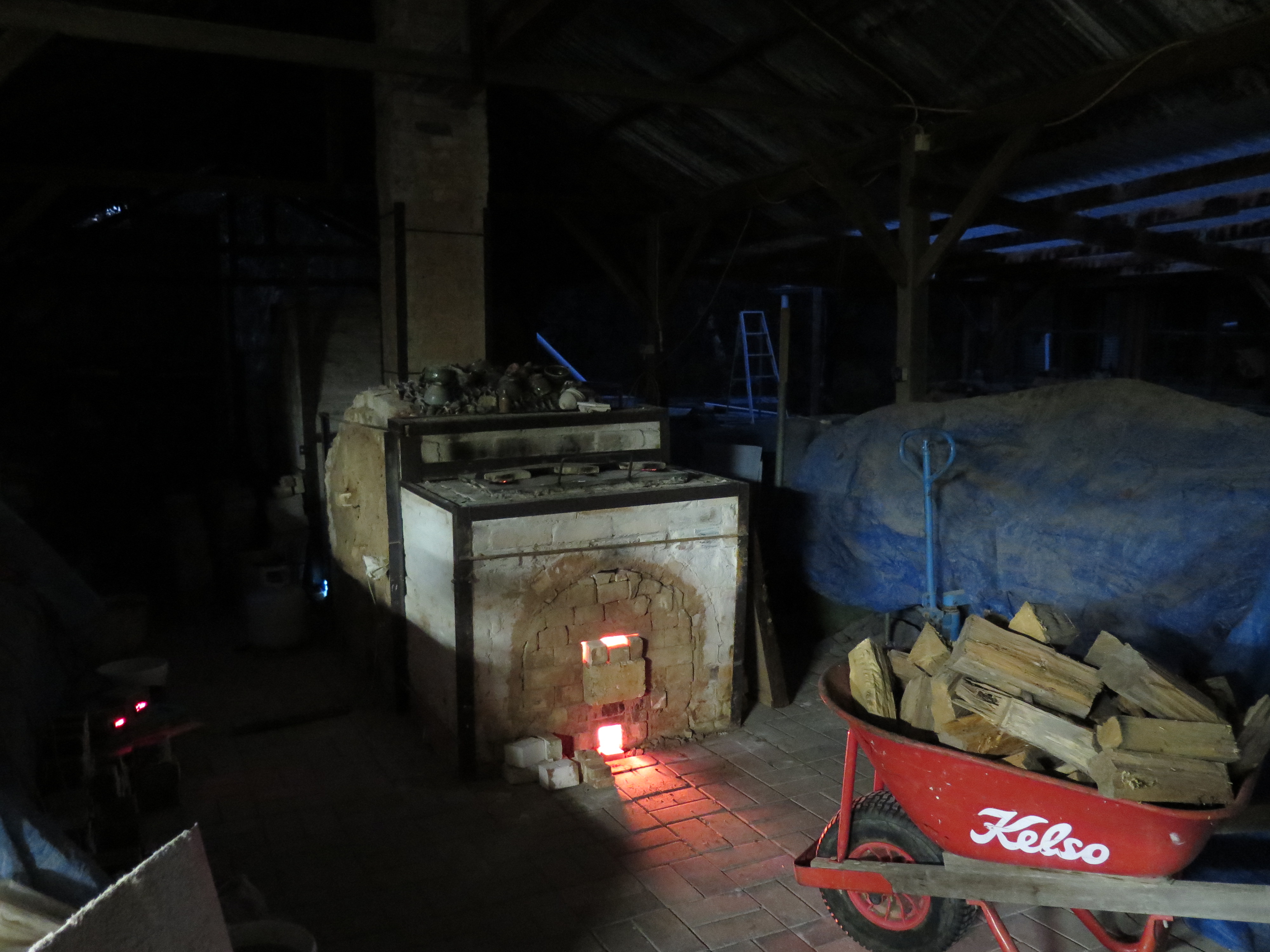
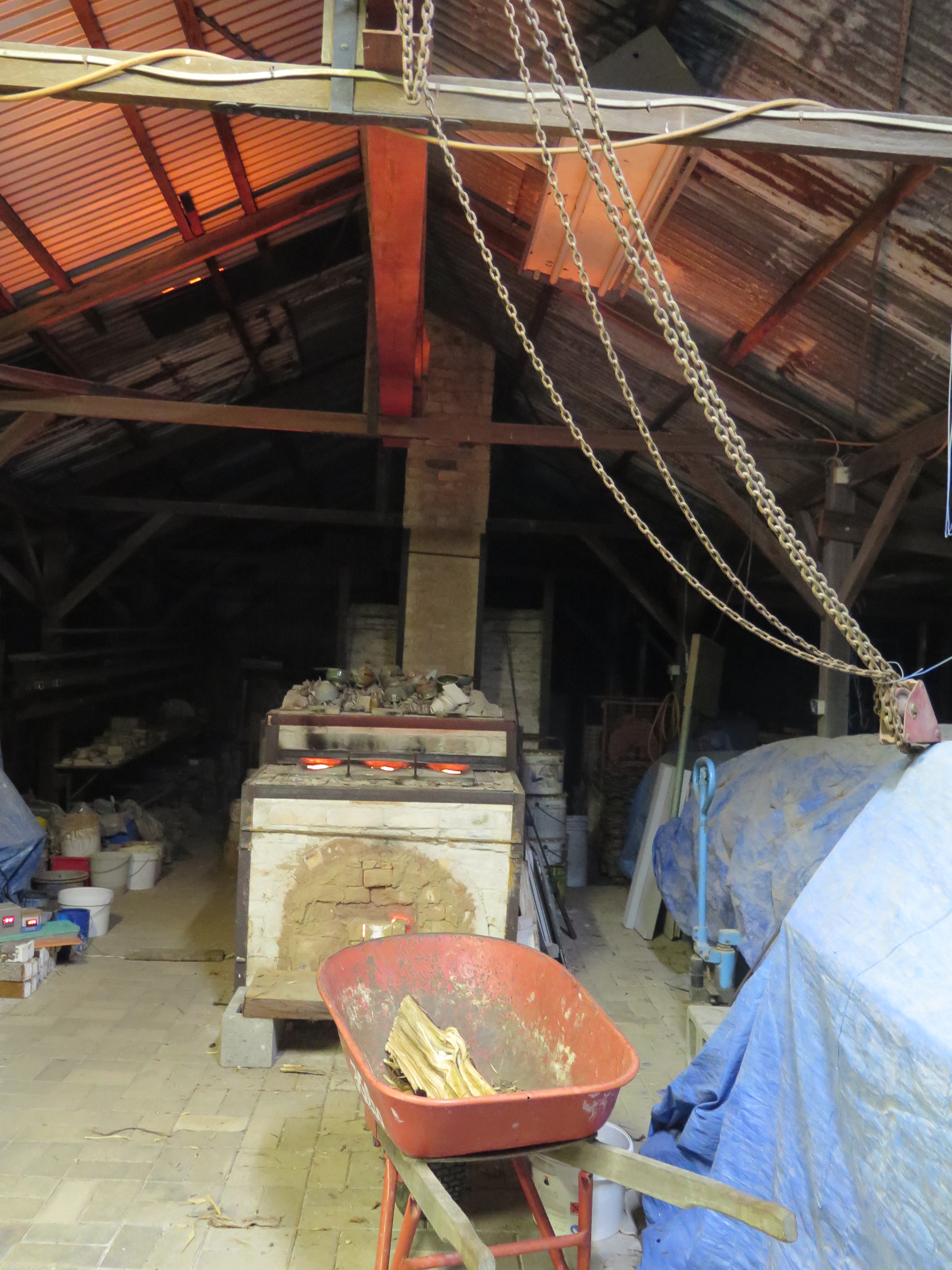
It’s dark and quiet. I’m here alone in the very late night, or very early morning. I’m in the kiln shed firing our wood fired kiln. It’s not 5 am yet and I’ve started our 8th wood firing for this year. We can’t start our firings too soon in the year, as there is a fire ban in place until the end of March or sometimes April, depending on the year and the state of the forest and the immediate past rainfall. I have fired our kilns during the summer in years gone by. But only after a good fall of rain, when the fire danger is reduced to low/medium risk. When the bushland all around is wet, there is no chance of my kiln starting a fire. If I want to fire over the summer period. I pack the kiln and seal it up, then wait for rain. It can take a month or more, but I can’t take any risks when there is a fire danger.
IMG_2741 IMG_2743 IMG_2747
We are firing the mid-sized kiln of 1.25 cu. m. We don’t fire the big kiln anymore. At 4.6 cu. m. it is just too big for us now and the amount of pottery sales that we can make these days. We have found that it is better for us to fire the this kiln more often and get all our tests through in reasonable time so that I can continue my research into my local raw materials, especially the development of my single stone porcelain bodies and glazes. Now that we have a reliable small wood kiln that can fire our tests in at any time, it just takes 3 hours, this will make our testing and research regime a lot easier.  As the night marches on relentlessly into the early dawn, the birds start carolling, mostly magpies by the sound of it. They just love the dawn and make a big fuss about it. Dawn seems to be some time after 5 am when it is still quite dark, and before 6 am, when I can switch off the light and make entries into the kiln log without needing the light on. The birds are carolling madly now as it gets lighter in the eastern sky. It’s a tremendously beautiful sound, so gentle and lulling. It’s like some pure form of happiness made audible. It’s infectious. I feel happy! Why are they so infectiously happy? Are they celebrating the fact that they are still alive and not eaten during the night by some predator?
IMG_2756 IMG_2757
IMG_2759
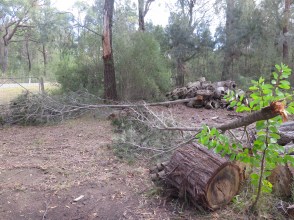
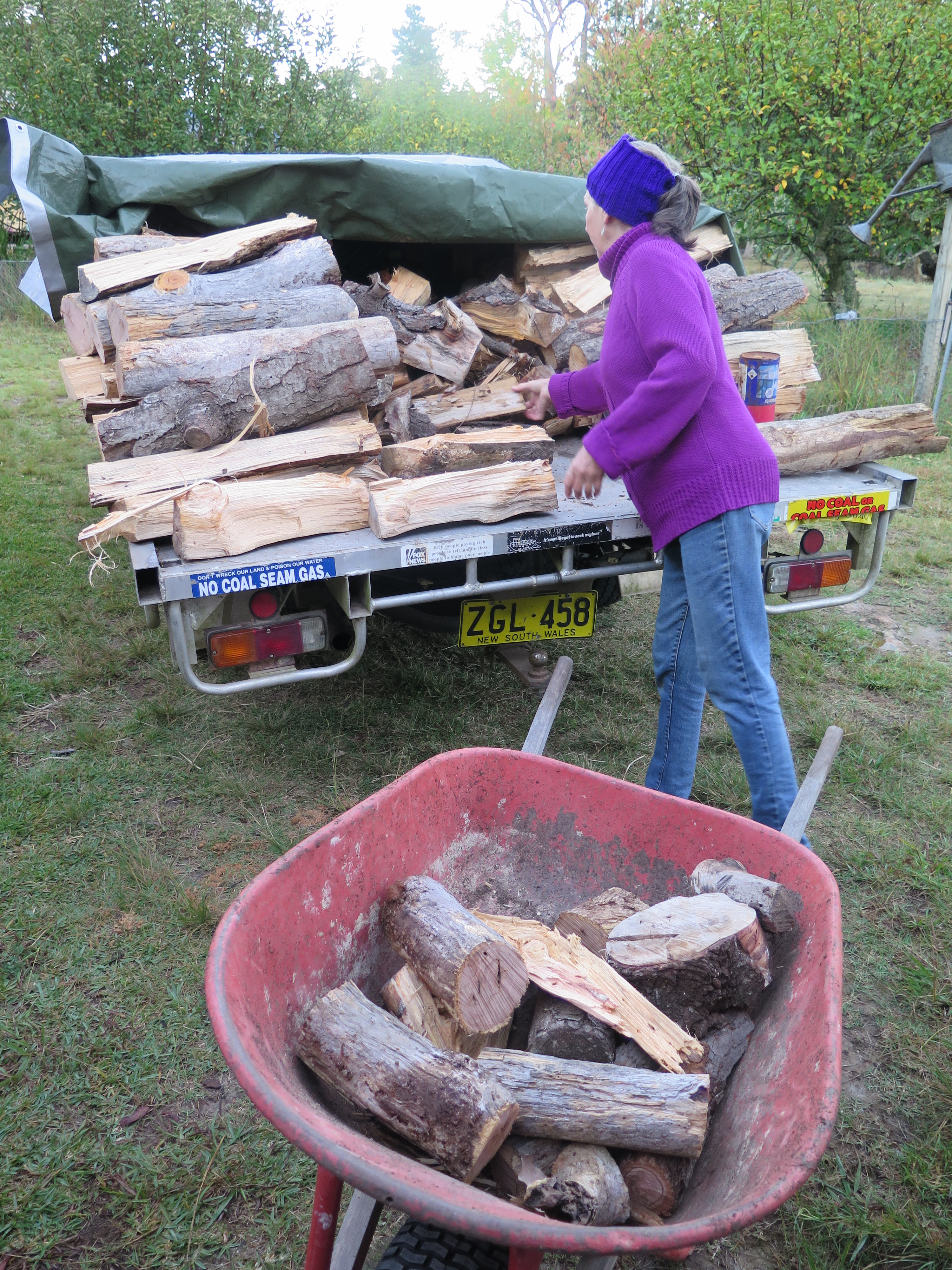
In this unique firing, I’m burning a type of timber that I don’t know anything about. I’ve been given a dead tree by the local tree-lopper guy. I don’t know what sort of tree it is, as it has no leaves or bark, but I know that it is not something that I have come across before. This is nothing unusual, because there are thousands of different tree species and as a rule, I only burn the local trees from around here. Mostly trees that Janine and I have grown here on our 7 acres of highland sclerophyll forest over the years. However, because I’ve lived in this little hamlet here for over 40 years. I have met a lot of people and they know that I have a wood fired kiln, so every now and then someone turns up with an offer of free wood for the kiln, just to get rid of it and not have to pay the dumping fee at the local council recycling centre, which is also located at the other end of the shire and 45 minutes drive away and is quite a drive. We are located at the opposite end of the shire from the recycling centre.
What I do know about this dead tree is that it is interesting. It is quite light in weight like a soft wood such as pine, but it has a strange twisted, interlocking grain like a hard wood such as a eucalypt. It turns out to be quite hard to split, even using the hydraulic splitter. It’s quite a tough wood. I’m hoping that it will burn well. But this is not knowable in advance until I actually get it into the fire box and see what happens over time. I have a lot of wood already cut, split and stacked ready for firing. I have several stacks, each about enough for a firing. I have stringybark, paperbark, ironbark and she oak all ready and prepared as well as a firings worth of radiata pine, from a load of trees brought here by a local contractor who was asked to clear a building block to make a house site. I naively said “yes. Bring the trees here, sure, I’ll take them”!
It turned out to be 8 truck loads in his 8 tonne truck. He had more, but I just ran out of space to dump it safely. He kindly sawed off the root ball, de-limbed them all and cut them to the 6 metre length of his tipper tray so that they would stack and carry efficiently. I have no way to know if each load was the full 8 tonnes or not, but it surely was a very large pile of logs by the time the last load was dumped here. It took up all of my wood storage space and then some. I could hardly move the ute and wood splitter around. I simply had to start at the far end and whittle away at the pile until I could make a space large enough to turn around in. Then I worked my way cutting and splitting all the way up one side to clear the driveway, back up to the road. I have been working my way through this huge 1/4 acre pile of trees for a while now and there is still a big pile of logs left to work through.
DSC01083 DSC01079
These logs are free fuel. Something not to be sneezed at in these days of increasing energy prices, but only free as long as you already have a spare 1/4 acre of forest clearing, a couple of chain saws, a tractor to drag the piles apart safely, a hydraulic wood splitter and a ute to transport the cut wood around, and then a wood shed to keep it all dry once it is cut and split to be stored and seasoned, then, ultimately I can burn it for “free”!
This firing has a lot of tests in it, as all my firings do. If I don’t have time to make some new tests and follow-up on new ideas. I feel like there is something wrong, something missing. After a lifetime of potting. It’s 48 years now since I got to throw my first pot on the potters wheel and was hooked. Any firing without tests in it is an empty firing. It’s the test pieces. The promise of something new revealed, that makes the unpacking extra special and not just plain mechanical work. It is the stimulus of expectation that makes the difference. I know that I should be aware of my all too human failing of expectation, just observe it and let it pass, but it just hangs around until I see those tests.  As it often turns out, they are not very special, but every once in a while there is something interesting that makes it all so much more rewarding and worth while. It’s probably something like a kind of addiction. Hanging out for that next hit of pleasure, that next intellectual/aesthetic indulgence. It can just be a test ring or a shard. The object itself isn’t all that important, it’s the internal machinations and the thought processes that it provokes.
I have 10 new body pastes in this firing, but so as to keep it all under control. I am using all my reliable and well-tested rock glazes on them. Glazes that have proved to be suitably stable and beautiful. I can’t afford to use unknown bodies with unknown glazes on them. That would be asking for trouble. I have set up a system where I am testing each of the 10 new porcelain body recipes with each of my 10 rock glazes. Each new clay recipe/variation glazed with 10 well-known glazes. A hundred bowls in all. This should reveal something. I don’t know quite what yet, but I’m keen to find out. Even if there is nothing special or ’showable’ it’ll still be something to cross off as not worthwhile, so then I can work on something completely different. I suspect though, that there will be something in there. I just don’t know which one. This firing hopefully will reveal the best, or most likely contender for further refinement.
I’d like eventually, to be able to make something that is both meaningful and beautiful — on a shoestring
All will be revealed in a few days.
This is the life of a frugal self-reliant potter. Nothing is ever finished, nothing is perfect, nothing lasts.
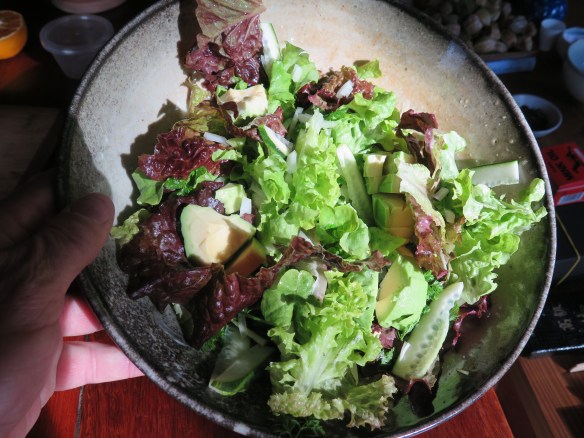
Its just like a good salad!
IMG_2416
Best wishes
Steve

The Last Beta Firing? Success at iteration 7

Janine has just completed the 7th firing and design iteration of the little wood fired kiln. It worked well and there are now no more obvious and glaring changes that need to be made to the design. Of course there are a lot of little issues that will need to be tweaked over the coming months. But I can’t see anything that will require a major rebuild. I think that this design as it stands now is a good one. – Until I think of something better!

The verandah of the pottery now has a collection of these little prototypes all parked there out of the weather. They all work well enough at lower temps, so I will use them for our raku firing weekend workshops. The image shows a very full wheel barrow of wood, enough for two or more firings to stoneware.
The design that I have ended up with is now ready for a limited production run.
This last firing of Janine’s was more or less perfect. Except that we managed to crack a kiln shelf. Janine had a lot of flat ware, so I retrieved a kiln shelf from the rack that hadn’t been fired for over 20 years. I think that the shock of a fast firing and possibly moisture absorbtion that couldn’t escape fast enough was the problem, as this hasn’t happened before. I would usually like to season a new kiln shelf more gentle. Perhaps by rubbing in salt and pepper with a little olive oil might work next time?:) By lunch time we’re famished. Because I managed to catch up with the fresh fish man, we have ultra-fresh sashimi grade tuna. So its sashimi for lunch.
IMG_2609
I also make fresh pippies in white wine, chilli and saffron sauce for dinner. What more could you want to celebrate a successful firing day. Followed by a fresh salad from the garden. We have a local grower of saffron now, so we support them.
IMG_2583
I have been making a new batch of spy holes for my kiln factory. I throw them on the wheel, very slowly, out of a very coarse mix of crushed high alumina grog and a small amount of kaolin to bind it. The mix is so aggressive that my hands are starting to hurt after just one pot-board full. This mix really takes your skin off. But that’s OK. 20 or so will last me for another year. If I wanted to make any more I’d have to wear gloves. I’ve heard some potters claim that they throw till their fingers bleed, but I’m not that stupid. I know when to stop.
I fire the spy holes in the little wood kiln. This little wonder fires cone 8 on the bottom shelf, cone 9 in the middle and cone 10 at the top. A perfectly useable working stoneware temperature range. Certainly OK for a 3 to 3 1/2 hour firing schedule. My bowls turn out well too. Some nice, soft, pastel glazes.
I’m really pleased that everything has come to a clear resolution at this time. As for the next couple of months. I’m fully booked on other projects and I wont have any time to play with this little kiln for a while. In the evening we de-seed chillies for drying in the kitchen window, along with beans and corn, destined for drying and grinding for polenta. I also finish drying some tomatoes in the oven. Once dried in this way they have the potential to keep almost indefinitely, but they never do. They are so yummy that I eat them like lollies. They never last the year. It’s great to add a handful into winter stocks. They add that certain piquant, sharp sweetness to sauces or a ragu.
This is just another day in the mixed household of self-reliance.
Best wishes from Mr. Beta and Ms Better

Pan Fried Figs in Apple Toffee

Because we are now past the solstice, it is time for the figs to begin to ripen. We enjoy them cooked in a little butter with a squeeze of lemon juice and a dash of our own preserved, concentrated apple juice. It slowly simmers down to a concentrate of apple toffee with soft poached figs.

It is pretty amazing, but last nights figs in preserved rich red preserved plum juice was  even a little better I feel. It’s all so hard to say, as every bit of it is so, fragrant, soft and delicious. Wonderfully soft and engaging while being a little bit sharp and sweet and delicately textural. It’s one of the few times where a little bit of ice-cream goes so well. It improves it and extends the texture, mouth feel and flavour.

So simple, so flavourful, so easy. Plant yourself a fig tree and enjoy the benefits – if you can keep the birds away!

Nina had to spend quite some time bagging the fruit to protect it from the birds.

IMG_2584

Sugo and Passata

The summer is over and we are now firmly into the autumn. The leaves on the fruit trees in the orchards are turning yellow and dropping, but there is still plenty of action in the vegetable garden. In this late season, the little yellow tomatoes are doing well and sprawling all over the garden beds, putting down adventitious roots as they go and still flowering and fruiting well. They sprawl about the place like drunken revellers at the end of a very boozy party, making a mess and refusing to leave. I’ve picked a wicker basketful full of these little wonders. They are slowing down now, but I can still fill the basket once a week.

IMG_2496

 I am engaged in the repetitive task of boiling them down into tomato sugo, then sieving the result and heating it again to reduce it further and concentrate the full flavour of summer tomatoes. I will find lots of uses for it in the coming months for the winter stews and casseroles. Then in spring and even early summer I will use it up in all manner sauces. We don’t get our first ripe tomatoes here until around, or even after Xmas, but even then, they start of in a very shy way, only giving us just enough ripe fruit for our salad lunches.
The really productive time for tomatoes is now, right at the end of the season. So it’s sugo and passata making time.
I make my own version of preserved tomato pulp. I add in onion, garlic, capsicum, chilli and basil, as these are all producing well at this time of year, so it makes sense to incorporate all that I have in the garden that is compatible.
If I’m pressed for time, and aren’t we all, always pressed for time? I just make a quick boiled down sugo or sauce. Mostly tomatoes, placed in a big stew pan and brought to the boil. Seeds and skins all left in and the whole lot ladled into heated glass jars straight from the oven. This works OK, but the flavour from the seeds and skins that are left in there is not as good as when they are removed. It seems to make the sauce a bit thin and sharp somehow? So, I’ve found that it is worth the effort to pass the whole lot through the rotary moullii sieve. But time is always in short supply, so time has to be made for a good passata. Passata sauce has to be sieved. I believe that ‘passata’ means passed through a sieve in Italian? Passata = passed? Whereas ’sugo’ just means sauce.
I haven’t made sugo for two years now. I prefer the flavour of passata, so that is what I plan to do again this season and every year. But the best of intensions often get side tracked or even de-railed completely. So when everything goes temporarily pear shaped. I can still make sugo. I have tried to make time to get every batch of this autumns tomatoes twice cooked and moulied. so far I have been successful and have let other things go temporarily to make the time for it. Something has to give and that something is watching the grim offerings on what Peter Rushforth use to call ‘The idiot box’! No loss there.
I like to add some herbs of whatever takes my fancy. I must say that my favourite is always basil, sweet basil, and plenty of it, but I also vary it with sweet marjoram, thyme and or bay leaves. And of course pepper, but very little salt, just a touch. I make my own salt substitute mix, but that’s another story for another blog.
IMG_2500
 I like to brown some brown onions in olive oil to start with. We are getting to the end of our own onions by this time of the year. I’ve never been very successful with growing a years worth of onions. The small seeds soon get swamped out with weeds and it’s a lot of work to get them up and above the competition, so that I can mulch them to suppress the weeds. I do what I can, but it’s never enough. Still, we do get some onions to dry for 3 or 4 months use.
I dice the onions very fine so that they will break down easily and eventually pass through the fine mouli easily. I soften them out slowly in Australian olive oil and when they are translucent, I add in a few knobs of our smallest, under-size garlic. We grow a few hundred knobs of garlic each year and about a quarter of them never reach a suitable size, for one reason or another. They remail small, about 1.5 to 3 cm acress, not worth plaiting and hanging. They all get sun-dried and then stored in a large wooden bowl on the kitchen counter. I top and tail them and cut them in half, crush them with the side of a knife to break down the fibres and release all the flavour and them drop them into the pot with skins and all. It will all get sieved out at the end, so it won’t matter. Peeling small garlic cloves is a really slow and in this case an almost pointless job as I’m going to sieve it anyway. So this is my easy, fast solution to the small garlic clove problem. How to use everything that we grow, the good, the ugly and the undersized!
IMG_2396 IMG_2398 IMG_2399
I put on two medium sized boilers of tomatoes, capsicum, chilli, basil mix. This time there is even a few zucchini’s in there and a couple of very ripe aubergines. It is easily reduced down to just one medium boiler of passata after it has all been passed through the mouli. I re-heat it all and bring it to the boil for a few minutes and then let is simmer slowly to reduce and concentrate. It also sterilises it. Meanwhile I get the glass jars washed and ready to pre-heat in the oven to 120oC for 10 minutes or so and I simmer the lids equally.
IMG_2503 IMG_2406 IMG_2504IMG_2505IMG_2424 IMG_2509
The easiest part of the whole exercise is to pour the concentrated liquid puree into the jars and screw on the caps. As they cool, I can hear the sharp, loud ‘clack’ noise as the whole lot shrinks and creates a vacuum in each of the jars in turn, sucking down the ‘pop-top’ lid, to indicate that it is now vacuum sealed These jars will now keep for up to 12 months without any further energy being applied to them. It’s a wonderfully fast and efficient way to preserve food. It’s the cooking and sieving that takes the time, but spread over a couple of evenings, it’s not such a big job and I really enjoy it. It’s a seasonal special event. Something to be looked forward to and relished because it’s a real, honest, creative activity. It might also be supremely healthy, tomato juice concentrate, loaded with lycopene, especially the way that we do it, entirely organic and free of any fertilisers, sprays and preservatives. Even if lycopene isn’t as healthy as some people claim, passata is still amazingly delicious.
I don’t think that many people are aware of this kind of activity these days and how important it is to take control of your own life and take as much personal responsibility for your actions and your own health as possible. It doesn’t get exhibited, or advertised, talked about or reviewed. It is not sexy or marketable. It is just one of the small invisible things that we do to make a tiny part of our larger life here.
The really big job as always, is the washing up!
IMG_2507
Best wishes
The saucy Ms Sugo and her concentrated Mr Passata

The Chalking Room Floor

I have just finished building a new kiln for the National Art School in Sydney. Used another pallet of lightweight refractory bricks and turned the empty pallet that they came on into another arch formwork. Every kiln I build is custom built for the customer to suit their specific requirements, so every kiln seems to turn out just a little bit different. Hence I need to make a new arch formwork for most of them. I have stacks of different sized formers in stock, just waiting for someone to order a kiln that is the same cross-section, rise and dimension. But it rarely happens. It’s a lot of work to make the shuttering for each kiln, but it is absolutely necessary if you want a beautiful arch that won’t drop spalls down onto your work during the firing. I really like to recycle the empty pallet and its nails, into something positive with a real purpose, instead of just burning it.
Arch formers are actually quite lovely things in their own right if they are made with care and attention to detail, and yet nobody sees them. They remain an invisible, but necessary part of the creation of a beautiful object.
IMG_2318 IMG_2320
IMG_2321 IMG_2323
IMG_2394
Warren tells me a story about the medieval tradition of the chalking floor or the tracing floor. A special room in a cathedral, where in ancient times the master masons would plan out the architectural details of a building and snap out chalk lines of the dimensions of the job at hand, directly onto the plastered stone floor in real time and one-to-one scale. These plans were then transposed to the workmen on the job in many seperate, small details, so that no one person, except the master mason knew the whole story and how the design, angles and dimensions were achieved.
I chalk out the details of the arch to be built onto the steel workbench top with boilermakers chalk and this is then transposed onto the pallet wood that I have just dissassembled and recovered for re-use. Warren watches me working out the details. Swinging the radius with a trammel line and dividing the inner arc by the taper of the brick unit size. It’s medieval in its simplicity and complexity. Nothing has changed in one thousand years. A plumb line, a straight edge, a measure and some chalk. The end result is beautiful and elegant. I now know the size, taper, and number of arch bricks that I need to cut to make a perfect arch, as well as the angle and dimension of the springer bricks that will support the arch.
However, unlike the ancient masons, I will use a diamond blade saw bench and a steel jig to do the precise cutting.
IMG_2316
The Lovely comes down to the workshop with freshly chilled, dark grape juice drinks for us on this very hot day and asks what I am doing, looking over at me chalking out my secret mens business. I explain that if I tell her, then she will have to die!
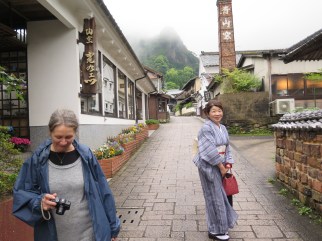
Only the master mason can know the secret of our techniques. Nothing personal, it’s just the medieval Master Masons traditional Lore.
She tells me that I can make my own dark grape juice in future.
But she can’t tell me the recipe otherwise I’ll have to die! Seems fair.
fond regards from Mr and Mrs Mason

Vendange

It’s autumn now and the grapes are fully ripe. We have been dealing with them in batches over the last few weeks. Yesterday we made the last pick. The Vendange is over for another year. All safely picked, juiced, heat-treated, sterilised and bottled. The rich red dark grape juice bottled in this way will keep for 12 months easily. We make it now in the autumn and drink most of it as a refreshing cool drink next summer in 9 months time.

We have preserved dark grape juice from both our shiraz grapes as well as our isabella fragolino varieties. They both make good dark grape juice, but I think that I prefer the slightly foxy, aromatic density of the fragolino juice to the somewhat austere and peppery shiraz. We abandoned making wine from our grapes sometime ago, as it takes a lot of effort for something that is just plain ordinary and we can buy good wine quite cheaply here in Australia. We have learnt to be selective about where we expend our limited energies, so as to get the best return on our efforts.
IMG_8529IMG_2106IMG_2107
After a lot of experiments, we have learnt that dark grape juice is the best that we can do with what we’ve got, although, this year, early in the season, The Resourceful One also tried her hand at making very early season verjuice.
IMG_2363 IMG_2364 IMG_2366
We macerate the grapes and sieve out the fresh unfermented ‘must’, skins and seeds. The pure juice is heated on the stove to sterilise it and then bottled into heated jars, fresh from the oven. It all takes time, but this is the quickest and most efficient way that we have found to deal with the harvest, that gives and exceptional quality of product. It also has the added benefit of requiring no energy to store it for a year and keep it beautifully preserved for when you really appreciate it.
IMG_6349
We have been out and when we return in the evening, we find Annabelle Sloujetté’s ute spread-eagled across the front of our house. She has her own key and has let herself in. She is on her way somewhere, or back, and slides her ute into a sort of parked position in the front garden. She asks where Janine is and I have to say that I don’t know. She was here with me just a minute ago. “Ah! Slougetté responds. ‘Miss Flit’. That is why I call her Miss Flit. She flits in and she flits out, never stays still long enough to carry on a complete conversation. A complete conversation with ‘Miss Flit’ is like a Dickens serialised novel. It takes time and you have to be patient as it evolves.”
We end the day with a vegetarian BBQ. Nothing special, just quick and simple, place your sliced, freshly picked vegetables on the barbie and turn them when they are softened, Zucchini, aubergines, little golden nugget pumpkin and capsicums. They couldn’t be fresher and cooking outside at this time of year in the evening is a delight. The cooling breeze has arrived and the aromas emanating make my mouth water in anticipation. I make an autumn salsa out of our little, late-season, yellow  tomatoes, some garlic and chillis, while the bbq looks after itself. The girls are tête-à-tête, deep in gossip.
I plate up to table and we eat them with relish. I like a spoonful of my piquant home-made spicy plum sauce on my bbq’d veggies, but quince paste also works well I think.
IMG_2359
When we wake, she is gone. Only her tell-tale signature circle work on the front lawn tells the tale of her visit.
Best wishes
From Mr and Mrs Flit