East Meets West, West Eats Meat

Having not eaten any meat for 4 months, we have suddenly gone from sublime to ridiculous, famine to feast, from sashimi to steak.

Xmas has come and gone and we spent a quiet day together, as our son is the sous chef at Biota dining. The only 2 hat restaurant in the Southern Highlands. He did Xmas lunch for 160, so started at dawn and finally finished at 9pm.

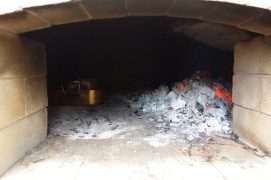
We had our family get-together Xmas lunch on Boxing Day. We envisaged a small meal of vegetables from our organic garden with a little meat, almost as a side dish, cooked in the outside wood fired oven and enjoyed outside, under the shade of the grape vines. This wasn’t to be, as our son turned up with a barron of beef and half a pig, which he set about butchering into sections of ribs and pork belly.

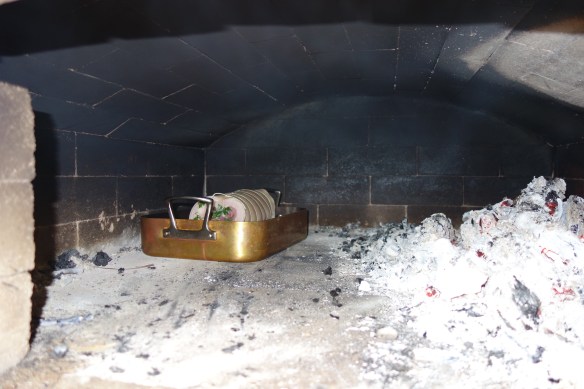
He made a rolled pork belly roast stuffed with trimmings and herbs from the garden, with loads of roasted garlic and we roasted this slowly during the day at the back of the oven.

Geordie slowly roasted the 5 point rack of 90 day aged beef, very gently over an extended period. This became our lunch along with our usual BBQ’d garden vegetables.

The rolled roast and ribs, along with half a dozen pizzas, went to the village musicians who turned up later in the evening.

DSC01712DSC01708DSC01709

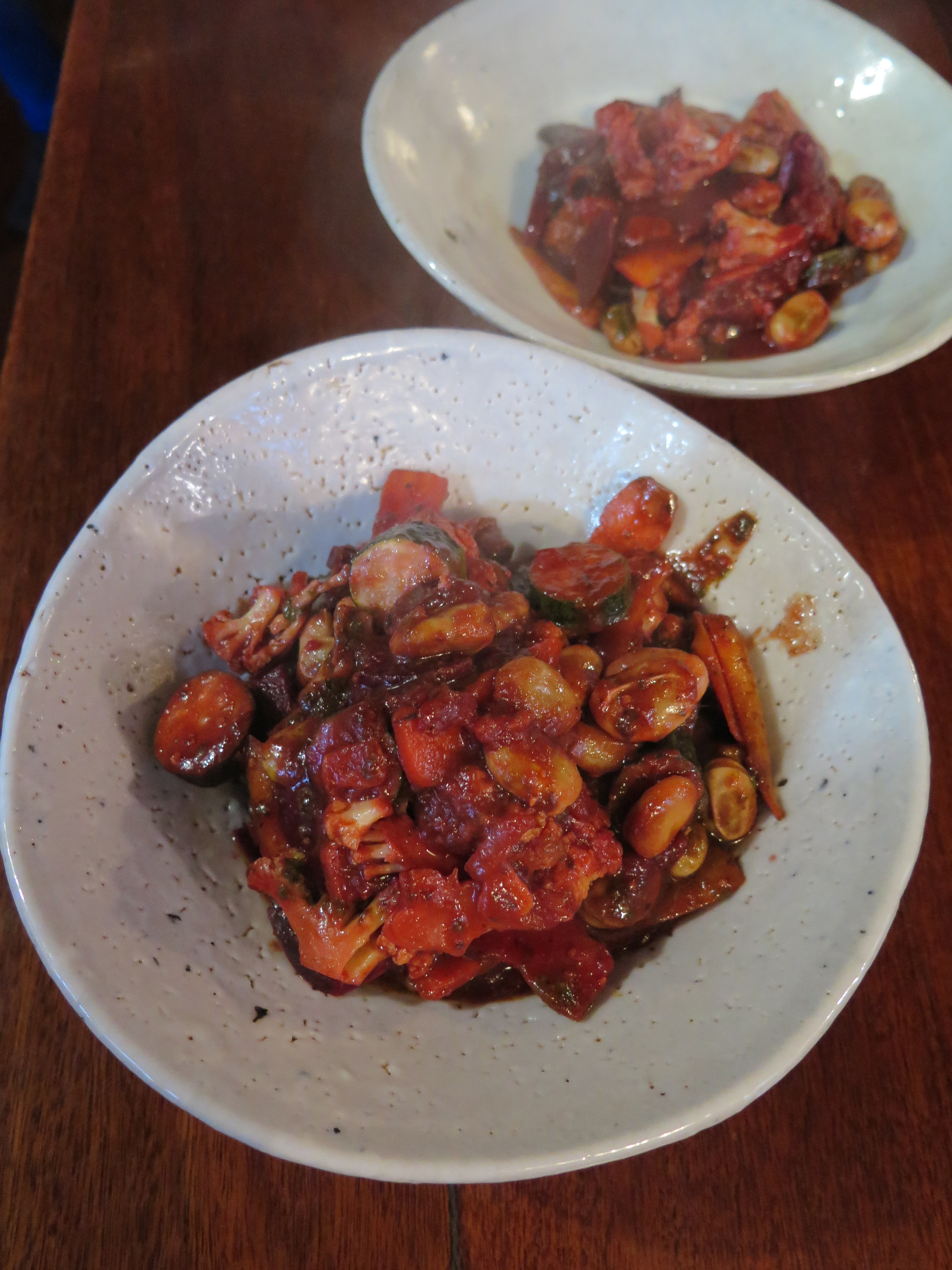
We braised the full rack of pork ribs in a mix of last summers preserved tomato sugo, red wine, cloves and star anise, onions, with garden herbs and bay leaves. This was simmered in the lightly stoked oven for a long time until very tender and then the sauce was drained and strained, and then added back to the pan with the addition of a few spoons fun of our fruit jelly to sweeten it and gell it up. This was poured back over the ribs to finish them to a sweet, fragrant, tender, sticky perfection. Yum!

I’ve never cooked a full side of pork ribs before, as there are only two of us here, there isn’t much need and we don’t usually eat so much meat. But it’s Xmas, the season of excess, and tonight we have the Village Musicians meeting here for their extended ‘session’. We hosted them here last month as well and they seemed to like it, so we invited them back. It just turns out to be the night of boxing day. So I stoke up the oven when they arrive and we sit under the grape vines and listen to their songs, while I bake 6 pizzas and finish off the ribs.

Now it’s time for a day ‘off’ and a little snooze.
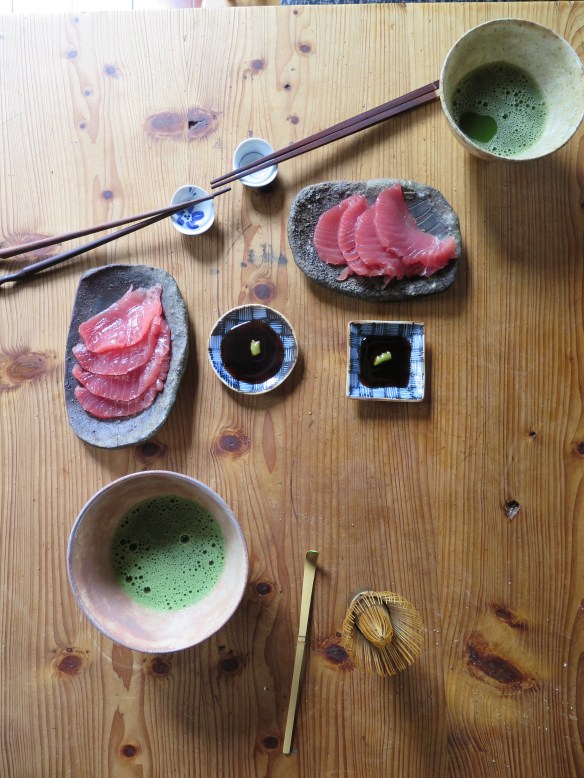
No Meat for 4 months

Through the cooler months of the year we plan to eat some red meat about once a month, but after I returned from China in May, where I had meat in everything. It seemed that every meal I chose seemed to contain some small amount of meat or more probably offal. I got a bit over it, so I thought that I’d skip meat for a while. Then when I was working in Japan in August. I seemed to get invited to a lot of BBQ’s or  ‘celebration’ meals that involved red meat. This was quite an eye opener for me, as I remember when I first went to study in Japan in the early 80’s, I hardly saw any meat for sale, never mind eating any. Now, 5 trips and 35 years later. The supermarket fridge displays are loaded with just as much red meat as there is fish. How things have changed.

Since I have returned, I haven’t been to the butchers at all. It’s now 4 months since I had any meat. I just haven’t felt like I needed any. I’m NOT a vegetarian. I eat what my body tells me that I feel like eating. That is mostly fish and fresh vegetables.

So, at the weekend I was over at the Village Hall, where I am one of the trustees. We were there for the Village Xmas Party. At some point I casually mentioned to my neighbour John, that this fund-raising sausage sandwich was the first ‘supposedly’ red meat that I’d had in months. I’m giving the local butcher the benefit of the doubt here in crediting him with actually putting some small quantity of meat in his sausages, although from the pale creamy/yellow colour of them. I can only imagine what else might be in there, and I’m pretty certain that it isn’t meat. At the butchers, I notice that those pale anemic things are called sausages, while the red meat filled intestine tubes all have other exotic names like ‘bratwurst and salsiccia’.  I asked why and was told that it is illegal to call anything with that much meat in it a sausage. The laws governing ‘sausages’ are strict and you can’t put very much meat in them. I didn’t dare ask what is actually in them, but I suppose that it is mostly fat, gristle and bread crumbs?

Anyway, My neighbour John was shocked, appalled and quite taken aback at this fact and looked at me after my ‘confession’ with that pitying look that said “You poor, hapless, tragic bastard”! He was polite in not actually saying that to my face. But his face said it all. He asked me, “What do you eat when you aren’t eating raw vegetables then”? I told him that I fast 2 days a week!

His eyes rolled back in his head!

He said. “Come to dinner tomorrow night and I’ll feed you up”!

We duly turned up with our bottle of red wine. A very nice one in fact, and were treated to an exceptionally nice meal of medium rare, fillet steak in pepper cream sauce, served with a side of diced peppers and mushrooms stir fried in butter and mash potato made with lashings of salt, butter and parsley. It was sensational! John knows his steak. He also knows how to ‘read’ me. He knows I don’t often eat red meat and along with that he guessed I rarely buy cream, I never use salt and hardly ever use much butter. And he is right. So he decided to slam dunk me with the full trifecta.

And I’m glad he did. It was delicious.

In our turn, we invited them over for a nice salad and a glass of rain water, or maybe a few slices of sashimi and a bowl of green tea!

Best wishes from the now, very well fed, poor, hapless, tragic bastard.

IMG_1751

Finally, the rain comes

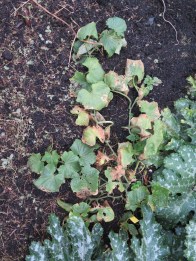
We have had a week of swelteringly hot days, all up in the high 30s. Yesterday was 39oC way too hot to work out side, so we got up very early and got started working by 6am. We gave up and came inside at 11.00 am. It was just too hot. We have been watering the vegetables morning and night, but they are still suffering. Many of the plants like beans, celery and  cucumbers have dead, dried patches on their leaves.

IMG_1740IMG_1737

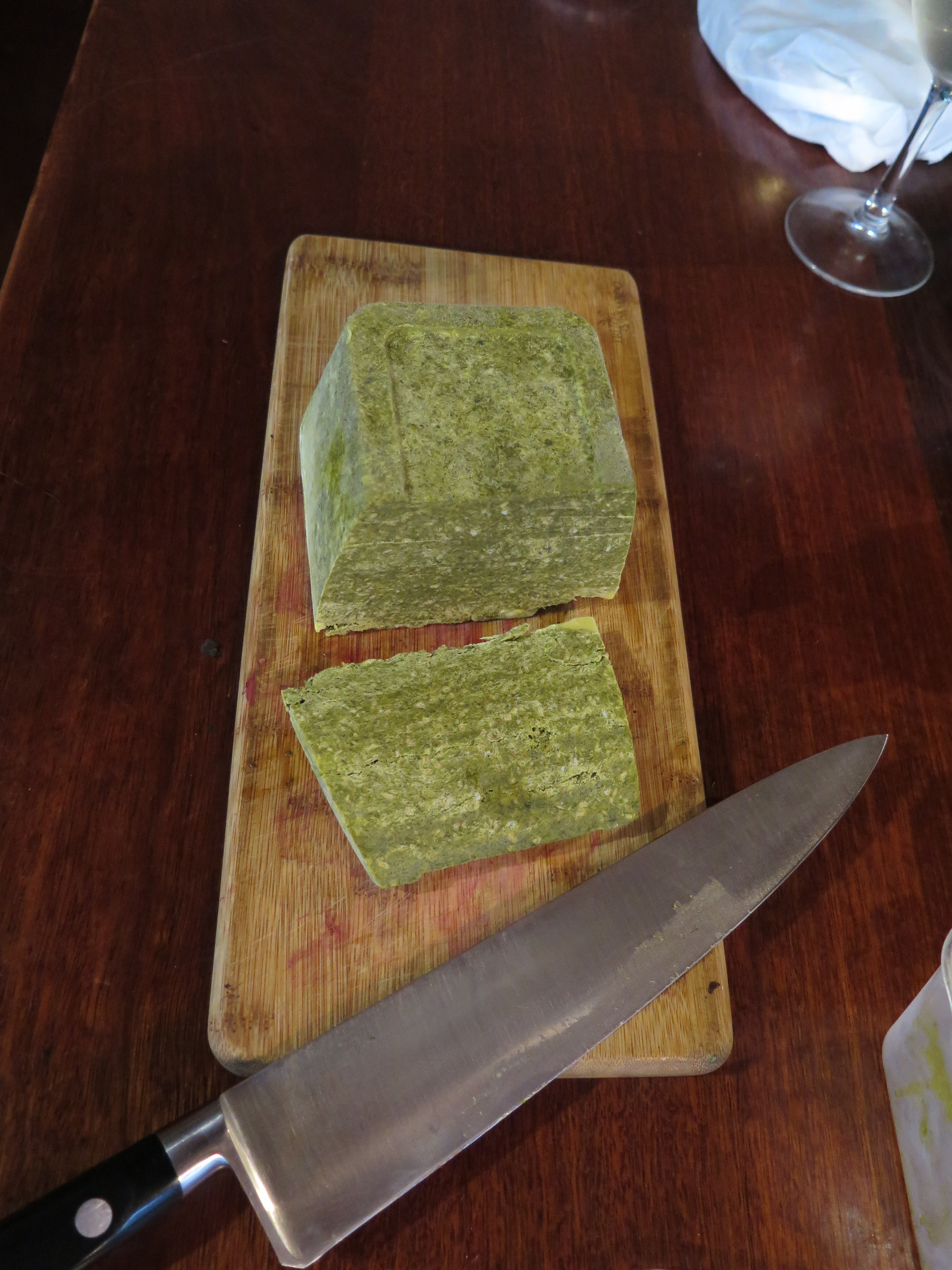
But at least they are still alive, so that is success. I gave the sweet basil its first hair cut. I tip pruned all the florets that were trying to flower and filled a large basket with the leaves. I like to make a kind of pesto-like paste. to go into the freezer, so that there will always be basil to add to sauces later in the year. We also make real pesto with garlic, pine nuts and parmigiano cheese, but what I’m making here now is just basil, garlic, a little salt and olive oil paste. It freezes well and keeps all year, so that when I need some basil flavouring in winter, I can open the freezer and take out the tub of this frozen basil paste, tap it upside down to drop it out of the container and then slice off a block of almost fresh basil concentrate. Beautifully green and flavourful. The rest is returned to the freezer for later.

I’ve been known to make up to six or seven of these half litre containers during the summer. As long as I never let the basil flower and keep pinching out the growing tips, the plants seem to thicken up and keep producing more leaves. Once you let them set flowers, they stop growing.

This stuff is fantastic. I love it. It’s one of there few things that we keep in our small freezer section of our fridge. Because it isn’t cooked, we can’t preserve it any other way, other than drying the leaves, which I have also done, but dried leaves are different. This stuff is magic. So intense. The little bit of garlic and salt really brings it to life. And it is surprisingly easy to slice from the block when frozen. Having very little water content and being mostly oil, it doesn’t set hard like ice, but more sort of leathery?

All the mid season peaches are now gone. We only have one tree of late peaches yet to come on. It is netted and we wait for them to ripen. All the berries are now over with over 20 kilos picked this year and safely all preserved, vacuum sealed and stored in the pantry. This recent heat wave has brought on the plums and they are just wonderful, sweet and tangy with that fabulous combination of acid and sugar that make your mouth water. We eat the first of them straight from the tree. Such a great taste, warmed by the sun, the juice trickles down our chins. They are mouth waveringly good. There are too many ripening all at once, so Janine has been stewing them and we have them for breakfast with a little yoghurt.

IMG_1719

We are in direct competition with all the birds at this time of year. The Lovely and hard working Janine has been moving the nets around and bagging some of the fruit, keeping one step ahead of the birds, while I have been so busy with orders. It’s a lot of work, but worth it. Having beautiful fresh, organic, clean food that we have grown ourselves, is a major part of our enterprise here.

We work outside very early and then again in the late afternoon and evening. Working inside during the heat of the day. Janine has mown the stone fruit orchard and I have mown the citrus grove and vegetable garden. Everything is looking good and now the heat is over for the time being with a cool change arriving and bringing with it some beautiful, cooling rain. I emptied the rain gauge this morning and we have had 33 mm. Just enough to flow down and top up the dam for a few more weeks of hand watering. The combination of cooler temperatures and soaking rain will bring all the plants back to life and put on a growth spurt.

IMG_1722

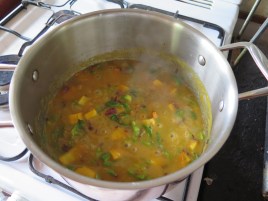
I bought a kilo of live mussels from the fish-truck man, so we are having mussel and vegetable soup for lunch. I usually just do the simple favourite, mussels in white wine, but as we have so many beautiful vegetables at the moment, I make a combination of green peppers, green and yellow zucchinis, red shallots and fresh sweet basil sauce. I bring it all to life with a jar of our preserved tomato passata concentrate from March. This batch was made with tiny yellow tomatoes, onions, capsicum, garlic and olive oil.

I cook it off and add the mussels to the boiling broth. It fills the kitchen with its steamy fragrance. It’s a great indulgence, but we  have earned it. Everything except the mussels from our own labours in the garden.

IMG_1721IMG_1724

IMG_1732

The First Tomatoes of the Year, Ratatouille

Yesterday, we harvested the first ripe tomatoes of the year. This is only the second time that we have managed to get ripe tomatoes before Xmas. The only other time was last year. Global warming, What global warming?

We also made our first pickings of our large green capsicums and smaller yellow banana capsicums, added to the sweet basil and yellow and green zucchinis, we have the makings of the first ratatouille of the summer. The egg plants bushes oblige us with the first few small aubergines and suddenly, there is our dinner in a basket.

The weather is very hot now 39 0C during the day. Our friends in Adelaide have had 4 days in a row of  41,42,43 and 41 oC. Way too hot to be able to work effectively outside. I make clay while the sun shines, inside under cover of a roof, but still sweltering. Porcelain slip dries very well on the drying bed in this weather. It’s a good time to make single-stone porcelain.

In the evening we sit outside and cook our produce, Ratatouille with the addition of a small jar of last years concentrated tomato, onion and basil ‘sugo’. I lightly brown our new-season onions in olive oil and then add in our crushed garlic. The roughly diced vegetables are added and turned in the oil a few times to coat them, then the sugo is added and the lid placed on to allow it all to simmer and soften for a few minutes.

We sit and chat into the cool of the evening. A nice chilled glass of rosé goes very well with this simple, fresh and very delicious Post Modern Peasants repast. The flavour of summer!

We have really earned this meal. We started making this meal three months ago, when we spread the compost and planted the seedlings. Now it’s payback time. It explodes in our mouths and takes us back to last summer. I can feel myself starting to relax into the idea of taking a little time off over the solstice break. This is a well earned, beautiful moment.

I am grateful!


Approaching the Solstice

As we approach the solstice the weather has turned hot and we are getting days in the mid thirties oC. Everything becomes desiccated very quickly if we don’t water morning and night. As the longest day will soon be here, it’s time to lift the onions and the early potatoes.

We plant most of the onions around the shortest day at the winter solstice and harvest near the summer solstice. So that is now. We aren’t very good gardeners, as we try to do too much, so there isn’t always time to do things ‘properly’, but we manage our time as best we can and everything that needs to get done usually does. We don’t plan things out meticulously and then follow through on the plan with Germanic precision. Rather we kind of lurch from crisis to crisis, doing what really needs to be done NOW and can’t wait any longer. I remember that I planted two packets of brown onion seed in late June,  but only a smattering of seeds germinated. I don’t know why. So I planted another packet in late July, when I realised that I wasn’t going to get any more strike from that first germination. The second attempt was also very patchy. As it takes a few weeks to realise that things haven’t worked out as you planned, there isn’t always time left to get the next planting done and germinated in time. So it was very late, at the beginning of August. The last day before I left for Japan, that I sprinkled two more packs of onion seed, a different brand this time, and then flew out for a month or so. When I returned, the unattended seeds had all struck, but were a bit crowded. I was so busy catching up with everything else on my return, I left them to get on with it. They are now ready to lift, but rather small, as they didn’t get enough cold weather to grow out well. I’m calling them salad onions now, small but juicy and sweet. I’m not too sure how they will keep.

The garden girl has been lifting the early potatoes, Nicola and Maris Piper. We don’t get huge crops, using only compost and some chicken manure to fertilise them. But the soil is soft and fibrous, and rich with worms. It looks and smells great, so I’m happy with that. We get about 8 potatoes for every one that we plant, maybe 1 kg per spud. I’m told that commercially, they get 8 to 10 kgs per plant? I’m not too concerned. We do everything organically with a view to growing just enough to support ourselves. This isn’t a business. It’s real life, a life where we aim to be as sustainable as possible. We get more than enough spuds to keep us going all year, more then we need actually. So the ones that get a bit shrivelled and start to get long sprouts on them after storage for a long time, just simply get replanted, back into the garden. They become the winter crop, down in the frost free area of  the Pantry Field.

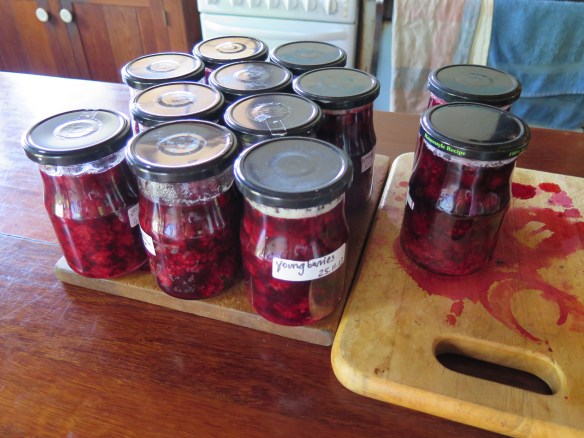
All the young berries have finished now, as have the raspberries, there are just a few boysenberries left under netting. We picked over 20 kilos of berries this year. We ate a lot of them, but most of them were sterilised and went into vacuum sealed jars for use later in the year.

We have a good crop of cabbages coming along, so we are developing recipes for using cabbage. Finely sliced and cooked in okonomiyaki, shredded in a salad with mint and vinegar dressing, or served with shiso, rocket, mizuma and roasted nor paper strips and dressed with a sesame oil, mirin, rice wine vinegar, sake and soy.

Annabelle Sloujettè called in and introduced us to a commercial brand of pre-fried Chinese noodles in a plastic pack. Not the sort of thing that we would normally think of buying. She made a cabbage salad with these crunchy noodles and a lovely tangy home made dressing. We were very impressed. It was really delicious. She stayed over and we talked late into the night. In the morning we had coffee with her before she left.

She likes a big coffee to start the day.

IMG_1672

It’s a Busy Time of Year

I have only just delivered the last kiln off the factory floor and now I’m back in there welding up the next one. I want to get into and out of the galvanisers before Xmas, so that I can work on it over the summer break, so as to get a head start on next years orders. The galvanisers shut down for a month over the summer as does the local steel supply yard, and many other businesses as well.

IMG_1600

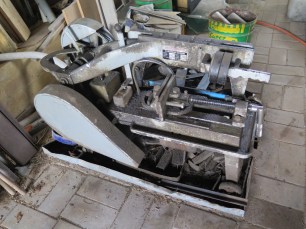
I have the next frame all tacked up already. I can cut the sections and start to weld the bones of it together while the old faithful automatic hacksaw does it’s job, slowly and relentlessly.

IMG_1598

When I made my first kiln. I cut all the steel out with a hacksaw blade by hand. It took two days. I don’t think that I’ve been so bored in all my life. When that initial kiln was sold, the first thing that I did was to spend my profits on a 4″ angle grinder and this wonderful old ‘chug-a-lug’ cast iron automatic hacksaw. It has been the most important thing that I have ever bought, with the possible exception of my home. It has worked continuously and reliably for 35 years. All I have ever had to replace are the blades, about once a year. It is such a fantastic invention. It cuts while I weld. and the angle grinder cleans up the edges.

I don’t want to get caught with no options, so I’m getting in early, as early as I can and doing all the welding and ordering of parts now. Then I will have the luxury of setting my own agenda of work and relaxation over the summer. We have relatives visiting from inter state and also from overseas, so we’ll be busy relaxing as well as working.

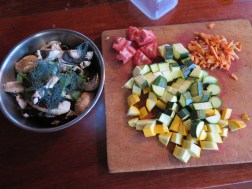
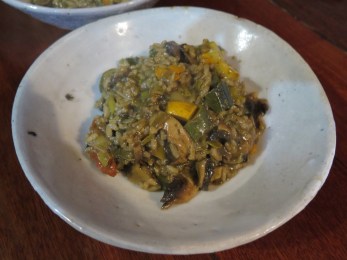
There a lot of veggies starting to bolt in the sudden heat, so we are try to eat them as fast as we can. i made a risotto last night with lots of garden produce. I used leeks instead of onions because that is what we have plenty of just now, and loads of fresh veggies, so much so that the result wasn’t really a risotto, as it only contained half cup of carnaroli rice, but a large bowlful of carrots, zucchinis and some mushrooms.

Veggieotto, with a little rice added. Cooked in fish stock from the bones of our dinner from a few nights ago.

IMG_1583 IMG_1586IMG_1590

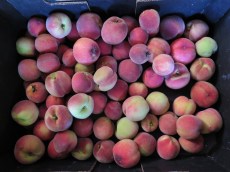
We are now picking from our 3rd tree of peaces. Well protected by plastic bird netting. We get all the fruit form these trees. they are the newer low chill varieties that we have been forced to grow now. These are the third generation of peach trees that we have grown here now over the 40 years of our Post Modern Peasant Enterprise. Modern varieties of peach trees seem to have a productive life here of 15 years. The Lovely decides to make a peach cobbler for desert to follow our veggieotto.

IMG_1576

IMG_1587

We have also made our first large pick of young berries. Up until now, we have been eating what we picked each day, but the season is suddenly in full swing now, so we get up very early and go out to do the harvesting before it gets too hot. We spend 3/4 of an hour and pick 7 kgs in one go. They are really coming on. The lovely Lady of Household Management, Ms Janine Beeton, can’t be beat’n when it comes to household frugality. She has them all sorted, cleaned, steamed and bottled by mid morning, while I’m cutting steel. The vector of post modern peasantry and petit-capitalism.

IMG_1573

IMG_1574

IMG_1579

It’s a busy time of year.

Aioli

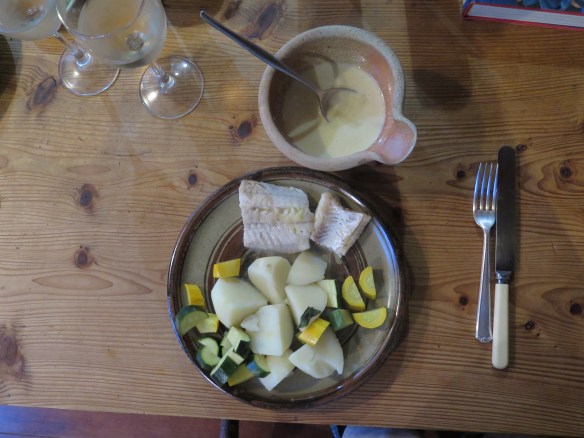
As we have an excess of fresh garlic just at the moment. I decided to make aioli sauce as the accompaniment to the steamed fish and new potatoes that we are having for dinner.

Aioli is a very ancient form of sauce, a bit like mayonnaise, but flavoured with garlic. It’s a great addition to lots of meals. Tonight we are having fresh ‘Ling’ off the fish truck that comes up to the Highlands from the coast, 3 days a week. He arrives at 6.00am and is sold out by 1.00 or 2.00 pm. I get there just in time to get the last piece of ling and some fresh mussels.

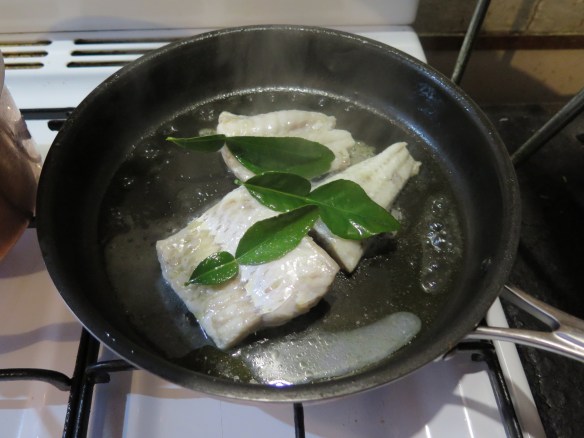
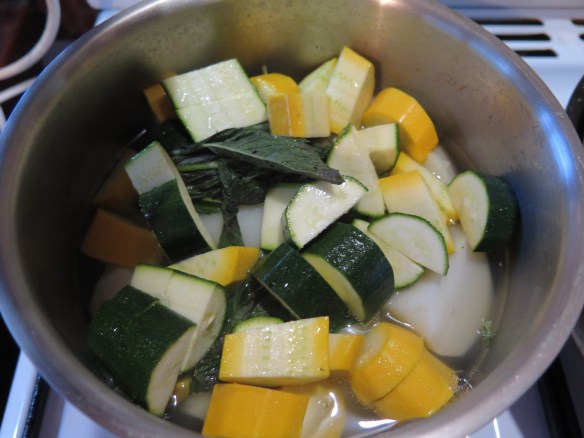
I decide to steam the Ling with a few drops of olive oil, to stop it sticking, then add a few fresh leaves off the Kaffier lime tree on top. I deglaze with a crisp white wine and serve it with our steamed new potatoes and  zucchini, picked fresh from the garden.

IMG_1512

We have both green and yellow zucchinis at the moment. They are the first of the summer vegetables to come into full production so early on the  the season. It’s still late spring. It isn’t even summer yet, but we have just had our first 40+oC day for the season. It forces us to be out watering both morning and night to keep the young summer vegetables from drying out and being set back.

IMG_1513IMG_1509

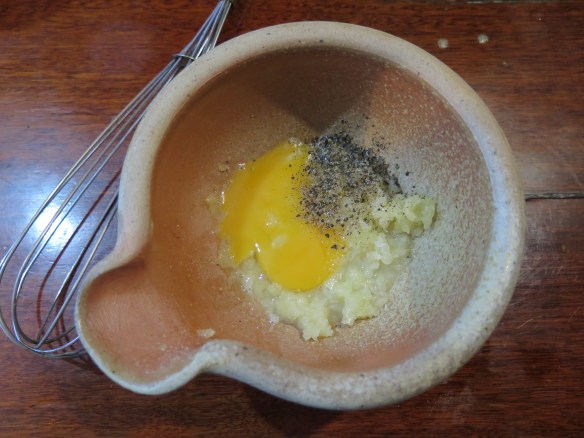
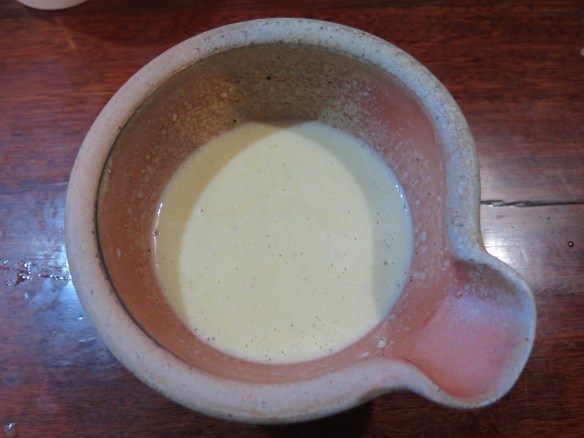
I peel and then crush the cloves of one small knob of our fresh garlic, then add the juice of half a lemon, one egg yolk from our son Geordie’s chickens and whisk it all up together into a mucilarge. I then proceed to add just a few drops of olive oil to the mix, a few drops at a time while whisking with the other hand. This continues until a thick white, bulked-up consistency is achieved. It takes quite a lot of oil to bring this about.. Don’t worry if it takes a long time, just keep on adding a few more drops of the oil at a time. Don’t get frustrated and add too much in one go. To make a mayonnaise-like emulsification sauce, you need to be patient. Just add a few drops at a time and keep whisking. It will eventually emulsify.

IMG_1510

This is a very ancient recipe, dating back into prehistory. It is to be found all over the south of Spain, France and northern Italy. It was apparently, originally, just a mix of garlic and olive oil to begin with. It was later found that the addition of a little egg yolk, stabilised the emulsion and thickened it considerably. It benefits from the addition of a little salt and some freshly ground pepper to taste.

IMG_1511

Rick Stein has suggested that the garlic be crushed with the side of a large chef’s knife and then chopped fine, crushed again with the side of the knife and very fine chopped and worked into a paste. A rather nice craftsman-like way to do it. I like it. For those without the patience or the knife skills, a garlic press works well enough. I actually like  it to be a little chunky and rustic. I also like it to have a lot of garlic in it.

Anyone can buy that anonymous, mild, made not-to-offend, finely milled, bland paste from the supermarket. It has too much salt and is loaded with preservative. What I’m making here is real life food, home grown, home made, organic, rough, chunky and strong flavoured.

However it is made, it is just right NOW at this time of year, when the garlic is so fresh and oily. Later in the year when it dries out and goes rather leathery, it just isn’t the same. At this time of year, aioli is a great accompaniment for lots of things that we grow and eat. It goes very well with fish and potatoes.

IMG_1514

Aioli probably lasts quite a long time in the fridge, but we’ve never managed to keep it long enough to find out. It’s deliciously piquant.

We haven’t had any red meat since August, I’m starting to think that it would be nice to have a couple of lamb cutlets with aioli.

Panforte

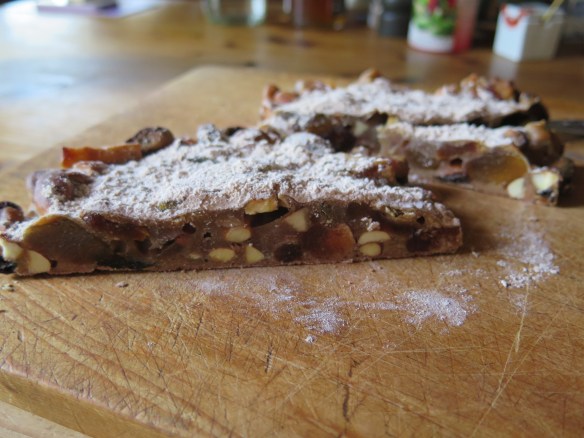
During our open studio weekends, I made Panforte to serve to guests that stayed on for coffee. Sometimes, however, we were so busy that I didn’t get time for chat and coffee, being constantly engaged in discussing pots,  glazes, forms and firing techniques at the wrapping bench. So two cakes lasted the whole weekend, instead of the usual ten minutes.

I was taught to make panforte with a very simple recipe. It isn’t really a cake, it’s something closer to a bread, but with lots of spices and a little sweetness. The ones that are commercially available here from Italy are a lot sweeter and much softer than this rather traditional version.

I suspect that there are as many different recipes for Sienna cake as there are housewives that cook it in Sienna. However, after watching a recent cooking show from Italy with interviews with some of the locals, it was teased out that in the new/modern Italian household of 2 parents and 1 child, with both parents working, there isn’t a lot of home cooking going on any more. That has been left mostly to Nona. The microwave and pre-packs reign supreme these days in modern busy households , just as they do in Australia.

So here is my variation on an old fashioned, not so sweet, rather chewy, recipe for Panforte. It’s not so surprising that I think that it is a little like a sweet kind of bread, as the name panforte means ‘bread-strong ‘. I think that the strong part refers to the fragrance and flavours of the spices?

I was originally taught to use;

1 cup of flour

1 cup of almonds

1 cup of dried fruit

and one cup of honey – So easy to remember!

What could be more wholesome, natural and simple? Well, that is what attracted me to the recipe, but I found it a little lacking in dried fruit and way too sweet for my taste. So I altered it over time, a little bit at a time, slowly arriving at the following recipe, which I currently use.

1 cup of flour

1 cup of almonds, crushed with the side of a large knife or roughly sliced

1 cup of dried apricots, roughly sliced

1 cup of glacé cherries

1 cup of tiny dried currents

1 cup of other mixed dried fruits and candied peel. I made my own dried candied peel. It keeps really well in the fridge and last for ages. see;

Fruits of the Solstice

1/4 cup of honey, which is then topped up with hot water and dissolved. I use local bush honey. We used to use our own when we had the bees. Sometimes I use Tasmanian ‘Leatherwood’ honey, as it is particularly fragrant and compliments the other spices.

There is a concoction of dried spices added to the mix, and these are not weighed or really measured. I suppose that they may have been once upon a time, but I’ve completely lost track of what that might have been.

These days I add a generous shake or small spoon full of some or all of the following;

Cinnamon powder. This is the most important, so more of this. Maybe 2 level tea spoons. Then there is powdered cloves, also important, but very strong, so a lot less is added. Maybe half to one teaspoon, then there is ginger, nutmeg and mixed spice. Mix and match as you think fit.

All the dry ingredients and spices except the honey water, are dry mixed together in a large hand made pottery mixing bowl.

As soon as the warm honey water is mixed in, stir it all together well to incorporate all the dry fruit and flour, so that it is homogenous. Do this quickly because as the mixture cools down, it starts to ‘set’ as the honey become more viscous, then it becomes harder to pour it out in the the baking ring.

I made a few stainless steel baking rings, some for my sons restaurant, and a few for us. I keep giving them away and making more. I use a ring that is about 200 mm dia and 20mm high.

IMG_1454.JPG

Grease a baking tray and the rings. I use olive oil to avoid using butter. I like butter. No! I love butter, but I’d rather enjoy my small allocation of butter in other ways. Olive oil works well in this way and the strength of the spices masks any minimal olive flavour residue.

I sprinkle a 50/50 mixture of flour and icing sugar, mixed with some cinnamon and clove powder onto the tray and pour the soft cake mixture into the ring onto of the flour mix. Use any left over mix to sprinkle on top.

IMG_1455

Bake for about 40 minutes at 180oC. Check if it’s done by inserting a knife. Allow it to cool on a wire rack, then wrap it up in lunch-wrap paper. It keeps for ages in the fridge, but only if you forget about it. Otherwise it gets eaten very quickly, as it is very popular.

IMG_1457

IMG_1459.JPG

It’s a lovely special treat that I make a couple of times a year, so as to keep it special.

IMG_1505


Buckotto

We have had a couple of very good week ends of Open Studio, with lots of visitors and good sales. This is the best Open Studio that we have participated in. The Open Studio Trail has been operating now for about 10 years and we have participated in 5 of them. We would have been involved in more of them, but they fell on times when we we’re away or unable to take part for one reason or another . So this has been good for us to see a strong response to our domestic pots.

It has been frenetic, but very good. we are looking forward to a slightly easier and quieter time for the next little while. We have a lot of other small, deferred jobs to catch up on, as well as a kiln to finish building. It has been sitting in stasis for the past two weeks while we concentrated on the pottery.

IMG_1466IMG_1472

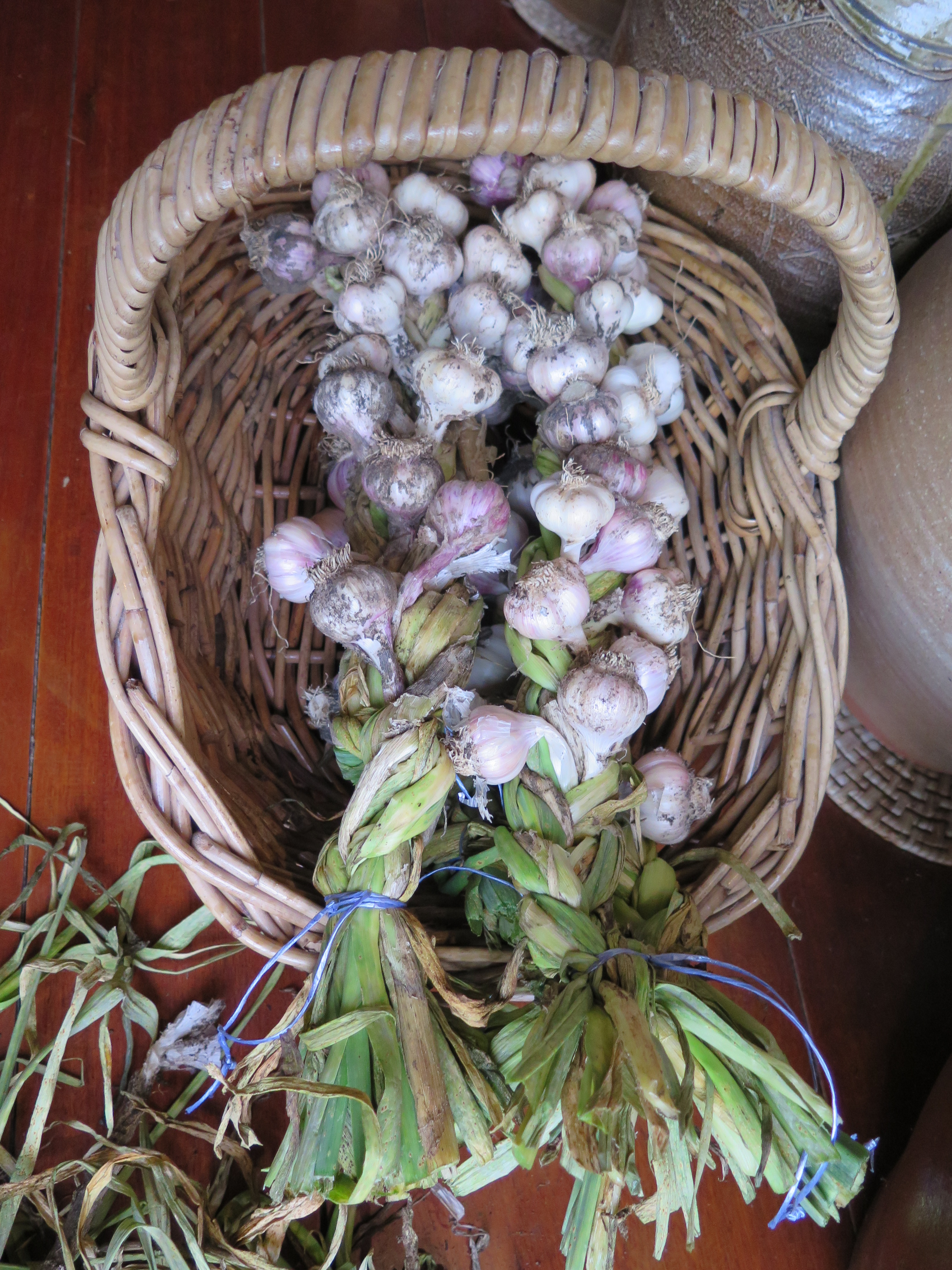
The Lovely has been busy dealing with the new garlic. We have had it spread out to dry all over the place from in the sun on the front verandah to the kitchen floor in front of the big window. The best of it is all peeled and plaited now and hung up in the kitchen to finish drying. We have 10 plaits holding anything from 15 to 20 knobs and another equal number of knobs that were too far gone to be able to plait and they are currently stored loose in wicker baskets in the kitchen window to finish drying along with the last of the broad beans.

IMG_1471

I love the fresh, oily, new season garlic. It just pops out of its soft skin so easily. I have been eating garlic sandwiches, made with heavy, dark rye bread. A dusting of veggie salt and freshly ground pepper and it’s all I need. There is only a month or so where it stays like this, so fresh and wet and oily. Once it dries out and the skin becomes papery, then the magic is gone and it becomes just plain ordinary garlic for the next 6 months, until it declines into its older, leathery dried out state with green shoots. This is when it is time to replant the next crop.

We save the largest and strongest bulbs for planting out for next seasons supply. These go back into the ground around about March, as soon as there is any sign of a green shoot. I usually see a few wild shoots appearing in the garden at this time. Some rogue cloves that have escaped captivity. They set the agenda, when they shoot up out of the ground, it’s time to replant the next years crop. We can still keep on eating the remainder of our stock from the kitchen plaits until it is all used up. We rarely last out the year, usually falling short by a month or two, but this year we made it right to the end by buying a plait from one of the members of our local ‘Seed Savers Group’.

We have had a few changes in the weather with a few warm days following some rain and the first of the spring crop of Safron milk-cap mushrooms (Lactarius deliciosus,) has appeared in the garden. They grow in conjunction with pine trees, and as we have some magnificent Caribbean pines growing beside our house, we get a good supply of these lovely wild mushrooms all through the year, but mainly in spring and autumn. This one may end up in a risotto for dinner.

IMG_1483IMG_1484

I have recently been experimenting with making a variation on risotto using buckwheat. I bought a kilo of organically grown buckwheat and have been finding ways of using it. I originally bought it to make my own ‘soba’ noodles. However, ‘buckotto’ has turned out to be my favourite use for it.

IMG_1469

We have plenty of beetroot, carrots, broad beans and zucchinis at the moment, so tonights dinner will be pink veggie buckotto. I make it just like any other risotto, by first slow heating some finely chopped onion in good olive oil and later adding some of our garlic. Cooking them though for some time so that they are soft, translucent and glowing, but not browned or burnt. Add a cup of the small triangular buckwheat grains to the mix and stir till coated with oil. I add a cup of white wine and add in the various sliced up vegetables in order of required cooking time, stirring often. Today, I have a pan of fish stock on the go to keep the mixture lubricated. I also have a few jars of our own preserved tomato passata left in the pantry from last summer, so I add in half a small jar of this and a slab of frozen basil pesto from the freezer.

IMG_1474

We only have a very small freezer attached to the top of our small domestic fridge. We have chosen not to own a separate freezer to save using electrical power unnecessarily. When we preserve our summer excess from the garden we do it by cooking and vacuum sealing the produce in glass ‘Vacola” jars. Basil pesto of course, isn’t cooked, so it is one of the few things that go in the freezer. I made 7 tubs of the stuff last summer. It’s great to be able to go to the freezer and grab a chunk of distilled summer garden essence and add it to a meal so much later in the year.

I keep the dish moving, so that it won’t stick as it thickens up. it’s a beautiful, rich vegetable flavour with a creamy texture and some chewy vegetable chunks.

IMG_1476IMG_1478

A great meal for a late spring evening. Ever so simple. Quick and easy and very tasty.

I believe that it is even quite healthy.

Tonight My Fingers Smell of Garlic – Again

The first of our open studio weekends is over and we were quite busy all day, each day, with only one 10 minute gap between visitors all day each day. Not quite enough time to be able to make and eat a sandwich. We had to take it in turns to eat and go to the loo.

IMG_1390

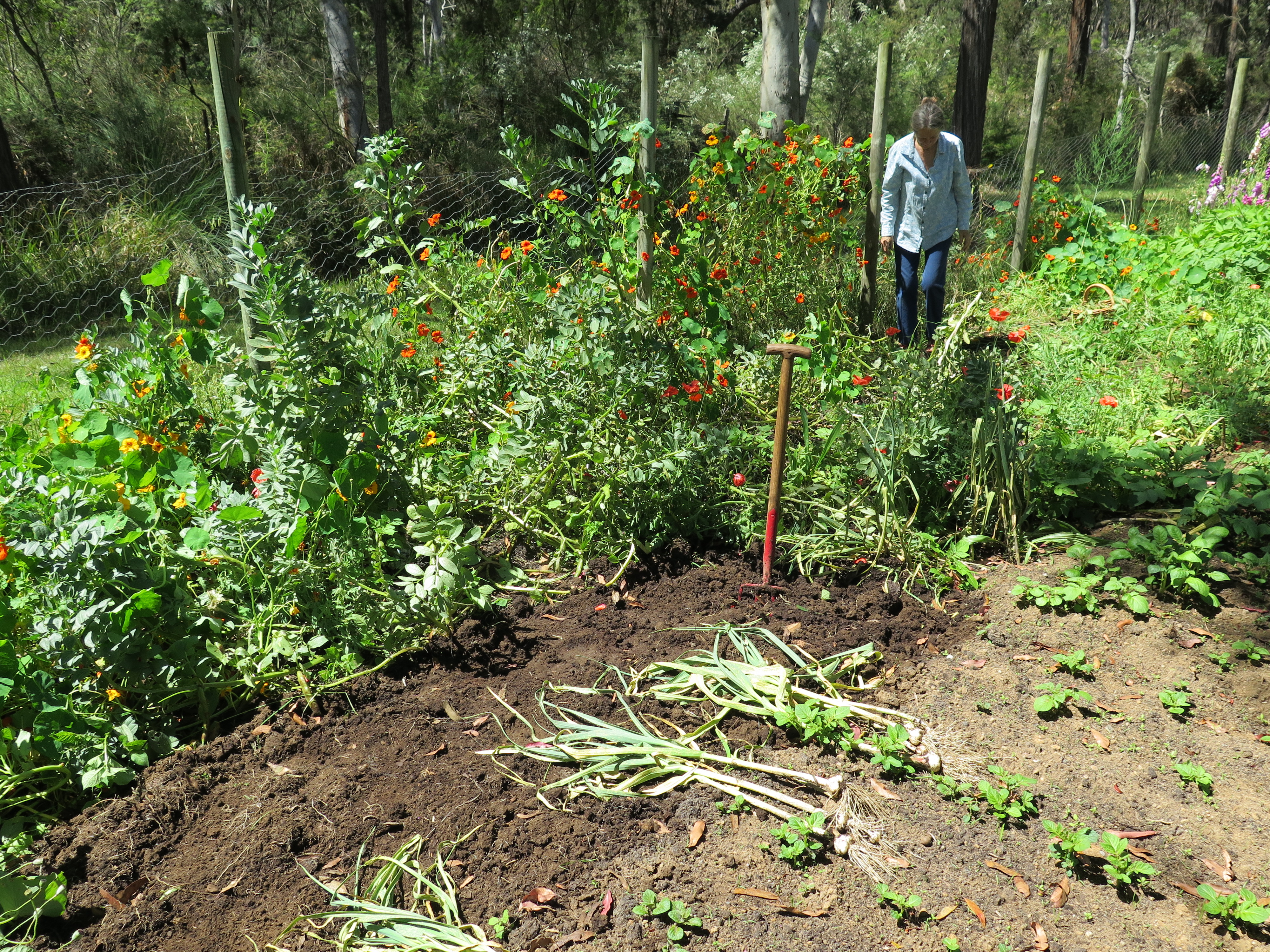
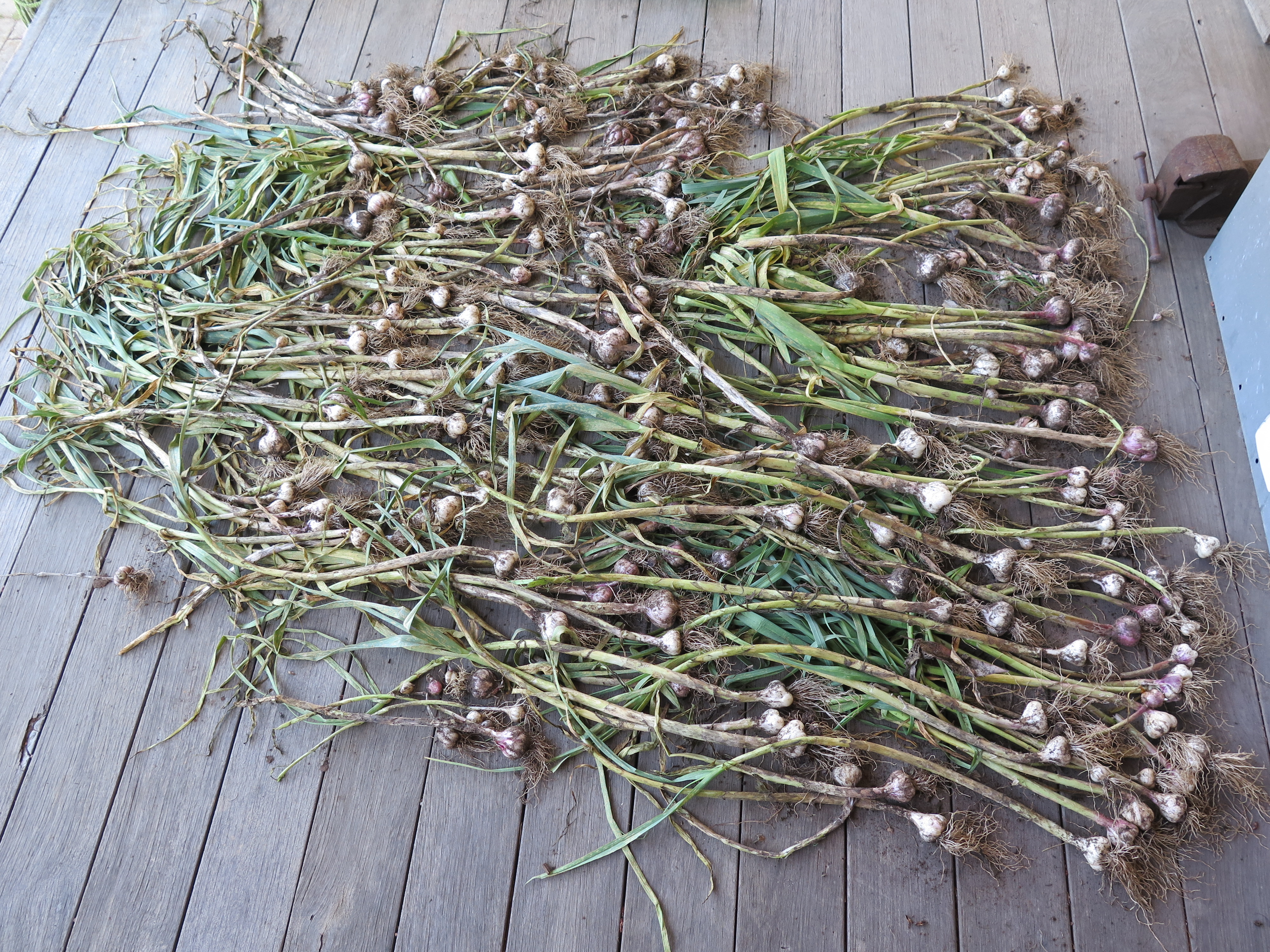
Now that the pressure is off. It is time to lift the garlic crop for this year. As I got them in early, they were ready to be lifted and dried a couple of weeks ago. Now is the first clear space I have had to be able to get into the garden and spend a couple of hours digging over the plot, weeding and sorting them all out.

Janine had managed  to get into the main garden last week and dig up the small plot that I planted out up there. I planted about 100 cloves from our larger knobs in the kitchen. A mix of all the different types that we have collected over the years. Red, white and pink varieties in both hard and soft stem types. She managed to find the time to preen them and spread them out to dry, before plaiting the largest of them and hanging them up on the kitchen wall by the wood stove chimney to finish drying. We have 3 plaits of about 15 knobs each. With another 50 smaller knobs all cleaned and dried and placed in a large colander on the kitchen bench top for immediate use over the next month or so.

IMG_1430IMG_1428

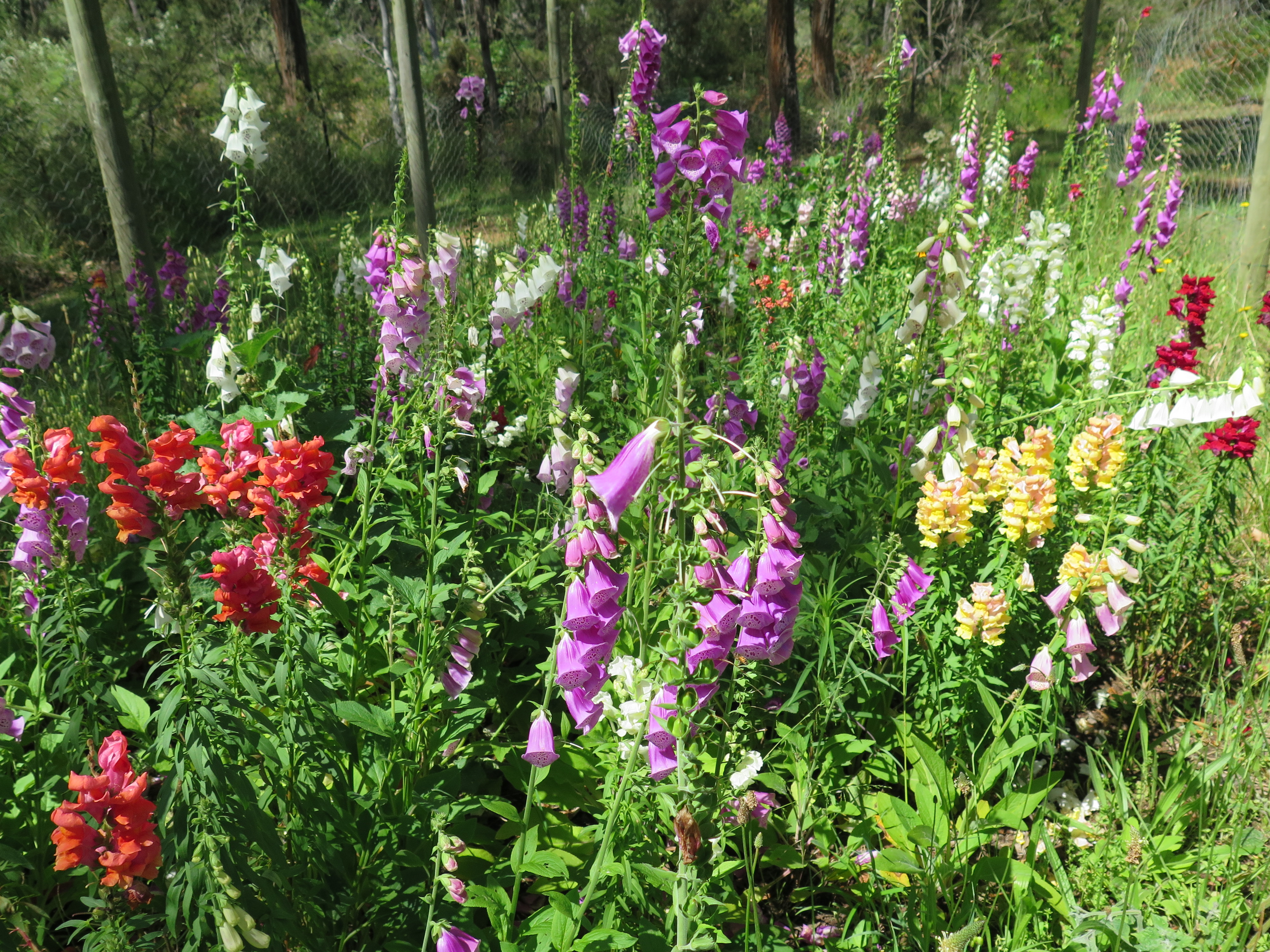
While I dig the garlic, The Lovely gets stuck in at the other end of the plot, up by the patch of English cottage garden flowers that I planted for her as a surprise 2 or 3 years ago. They take a while to get established, but are flowering well now. It bit past their best, but still lovely. A very nice back-drop to our work today. At some point in the future, I am going to reverse these two garden beds and lift all the cottage garden flowering plants and move them to the vegetable end, and vice versa. This will refresh the soil and the vegetables and flowers will both benefit from the change. Janine starts to harvest the last of the broad beans. Pulling out the spent plants as she finishes stripping the last of the beans off each one. It’s nice to be able to spend this time, working together in the garden.

IMG_1424

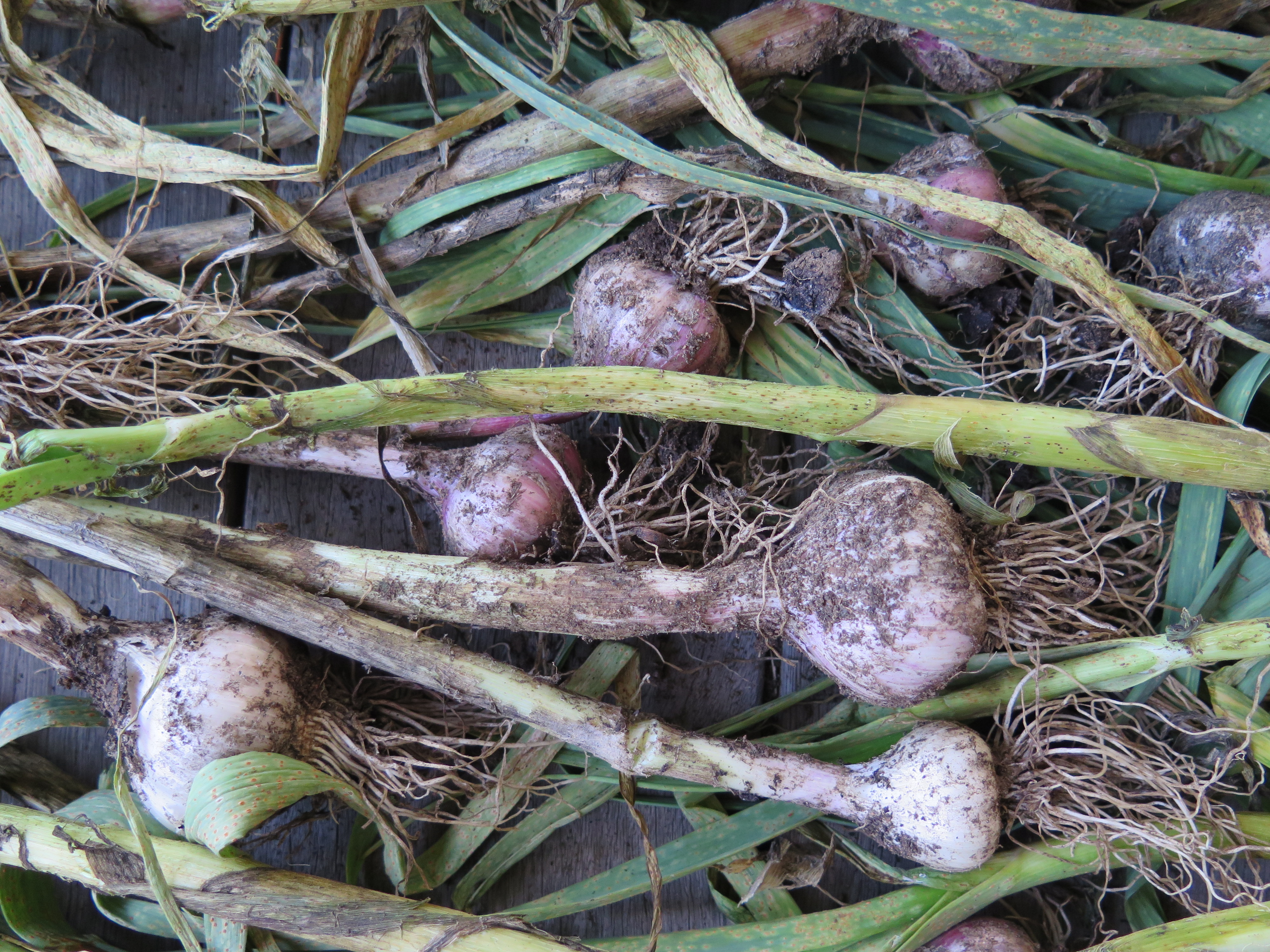
I bought half a dozen ‘new’, named varieties of organically grown garlic and planted them out in serried rows, down here in the Pantry Field garden. They had grown quite well, with some being obviously much stronger growers than others. I bought 3 knobs of each and planted out the individual cloves. These have now grown up into about 150 knobs of differing sizes. It would have been best if we had managed to find the time to harvest them a week or two ago. They had started to dry out and the tops had begun to lean over. Then we got so busy and it started to rain. We had 3 inches or 75 millimetres of rain last week and this was enough to reduce the dried tops to a liquid mush. The earliest varieties had lost their ‘paper’ coating and are starting to ‘burst’ or spread out. They’ll be fine for eating, but without any substantial stem. we won’t be able to plait them and hang them up. So more individual knobs for use directly from the bowl kitchen bench top.

IMG_1435

I’m not too sure how this will affect their ‘keeping’ capacity? We’ll find out during the coming year as this hasn’t happened before. I’m glad that we have had this fine, sunny day today, combined with a day ‘off’, so that we could get the crop in and start it drying out. There is a certain sense of achievement, satisfaction and security knowing that we have to years supply of garlic safely in hand.

IMG_1440

Some people have asked me what we do with so much garlic. Well, we eat it. We seem to get through the 200 to 300 small knobs pretty easily during the year. What we grow isn’t the largest or most presentable garlic. Not like what you might see for sale in the green grocers. But it is our own, organically home-grown produce, clean and free from any sprays, pesticides or preservatives. That is the kind of self-reliance that our enterprise here is all about, and a day ‘off’, spent in the garden is a good day indeed. This is fun for us. It doesn’t involve going out, driving anywhere, or spending any money. What more could you want?

IMG_1441

Our friend Annabelle Sloujetté has turned up from the south coast, bearing gifts of oysters and a couple of beautiful blackfish. I steam them with some of our fresh little garlic cloves, a little olive oil, a couple of sliced large dark field mushrooms, two sliced zucchinis, some pepper and a squeeze of lemon juice. A splash of white wine finishes it off.

IMG_1443IMG_1450

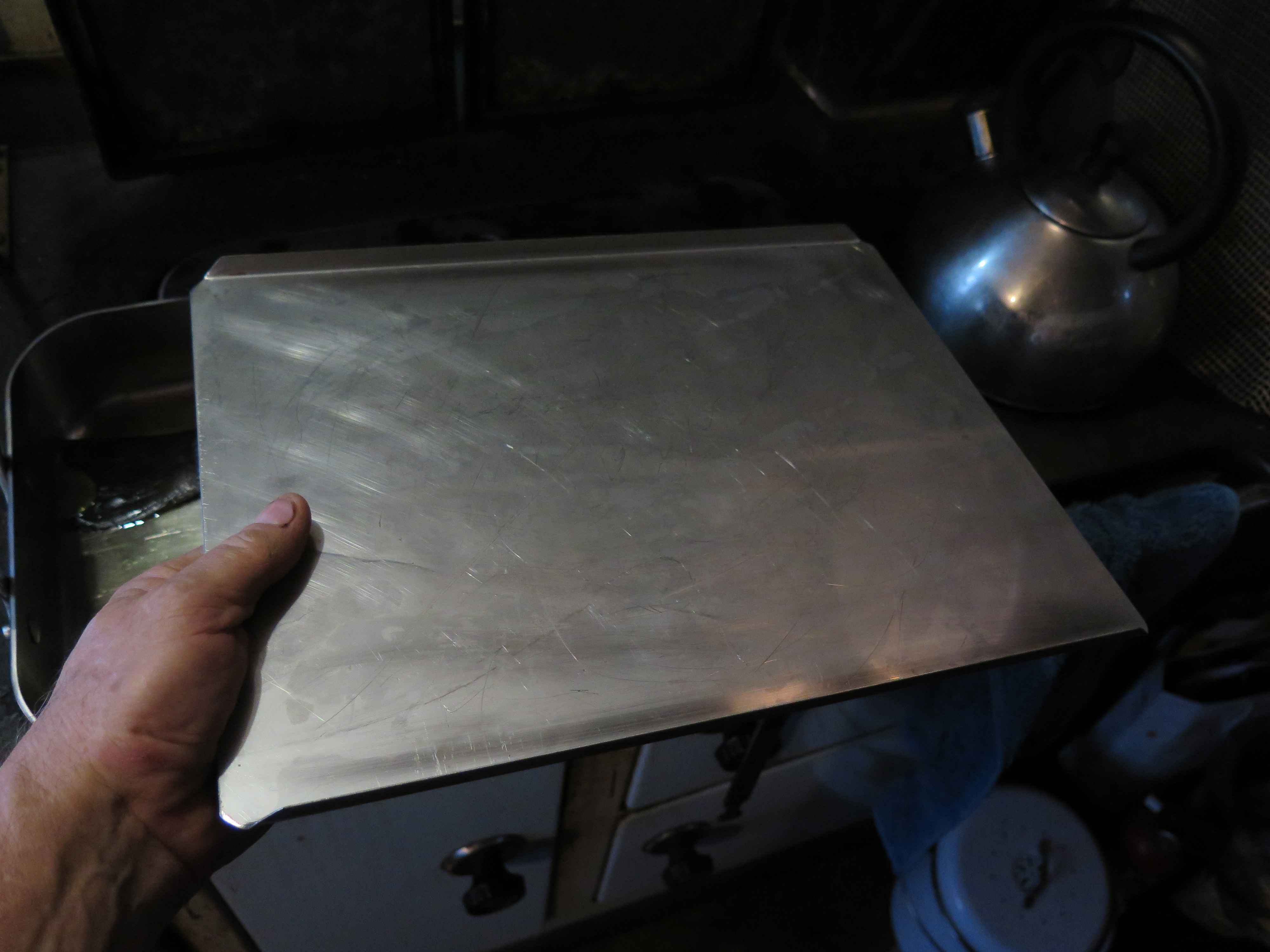
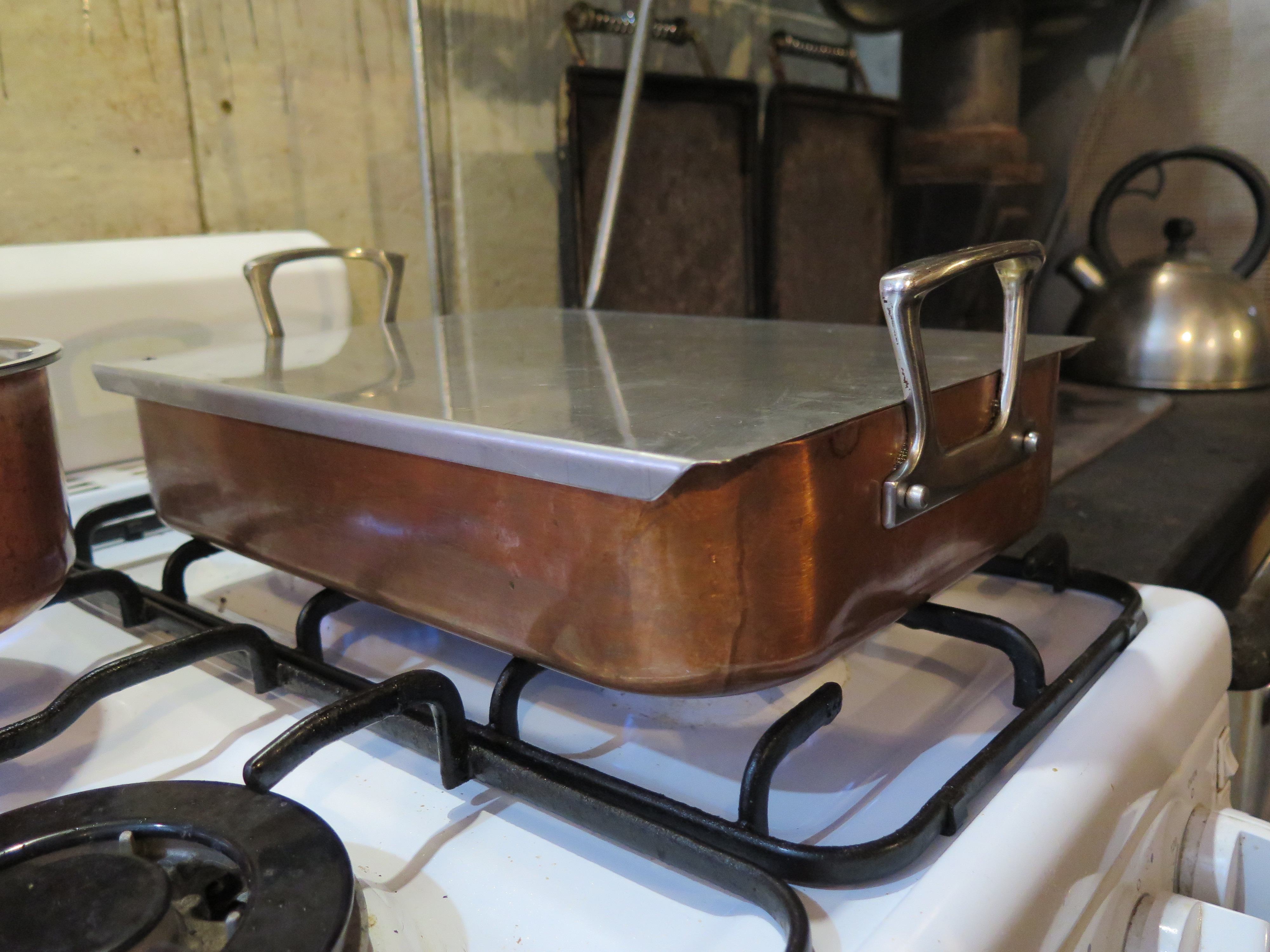
These fish are a really good size for blackfish, so I choose to cook them in the big rectangular copper baking pan, but it doesn’t have a lid. In the past I have used a sheet of al-foil to cover the pan on occasions, but I really don’t like to use aluminium cooking foil. It’s an environmental disaster, so we rarely use it. I decide to run down to the kiln shed and quickly make up a folded stainless steel, custom-made, lid for the pan. I’ve been meaning to do it for a long time now. So now is the time.

IMG_1445IMG_1449

I choose a small piece of stainless off-cut, that is almost the right size. I measure it exactly and use the guillotine to slice off a few centimetres, I use the pan break to fold a slight return on two sides to help keep it flat when it is heated, then hand-file and smooth the edges. I measure it so that it will fit exactly between the two handles and sit snuggly on the flat rim.
It takes me 7 1/2 minutes to get it done and I’m back in the kitchen before the others have  finished cleaning the new potatoes that we harvested today along with the garlic and broad beans.

I lift my hand to my face to wipe my brow after I have run back up from the workshop. Ah, Yes! I remember that smell. I have been digging and cleaning garlic all day, so tonight my fingers smell of garlic – again!