Buckotto

We have had a couple of very good week ends of Open Studio, with lots of visitors and good sales. This is the best Open Studio that we have participated in. The Open Studio Trail has been operating now for about 10 years and we have participated in 5 of them. We would have been involved in more of them, but they fell on times when we we’re away or unable to take part for one reason or another . So this has been good for us to see a strong response to our domestic pots.

It has been frenetic, but very good. we are looking forward to a slightly easier and quieter time for the next little while. We have a lot of other small, deferred jobs to catch up on, as well as a kiln to finish building. It has been sitting in stasis for the past two weeks while we concentrated on the pottery.

IMG_1466IMG_1472

The Lovely has been busy dealing with the new garlic. We have had it spread out to dry all over the place from in the sun on the front verandah to the kitchen floor in front of the big window. The best of it is all peeled and plaited now and hung up in the kitchen to finish drying. We have 10 plaits holding anything from 15 to 20 knobs and another equal number of knobs that were too far gone to be able to plait and they are currently stored loose in wicker baskets in the kitchen window to finish drying along with the last of the broad beans.

IMG_1471

I love the fresh, oily, new season garlic. It just pops out of its soft skin so easily. I have been eating garlic sandwiches, made with heavy, dark rye bread. A dusting of veggie salt and freshly ground pepper and it’s all I need. There is only a month or so where it stays like this, so fresh and wet and oily. Once it dries out and the skin becomes papery, then the magic is gone and it becomes just plain ordinary garlic for the next 6 months, until it declines into its older, leathery dried out state with green shoots. This is when it is time to replant the next crop.

We save the largest and strongest bulbs for planting out for next seasons supply. These go back into the ground around about March, as soon as there is any sign of a green shoot. I usually see a few wild shoots appearing in the garden at this time. Some rogue cloves that have escaped captivity. They set the agenda, when they shoot up out of the ground, it’s time to replant the next years crop. We can still keep on eating the remainder of our stock from the kitchen plaits until it is all used up. We rarely last out the year, usually falling short by a month or two, but this year we made it right to the end by buying a plait from one of the members of our local ‘Seed Savers Group’.

We have had a few changes in the weather with a few warm days following some rain and the first of the spring crop of Safron milk-cap mushrooms (Lactarius deliciosus,) has appeared in the garden. They grow in conjunction with pine trees, and as we have some magnificent Caribbean pines growing beside our house, we get a good supply of these lovely wild mushrooms all through the year, but mainly in spring and autumn. This one may end up in a risotto for dinner.

IMG_1483IMG_1484

I have recently been experimenting with making a variation on risotto using buckwheat. I bought a kilo of organically grown buckwheat and have been finding ways of using it. I originally bought it to make my own ‘soba’ noodles. However, ‘buckotto’ has turned out to be my favourite use for it.

IMG_1469

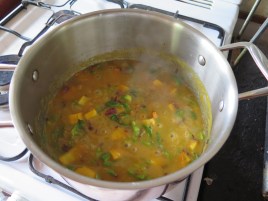
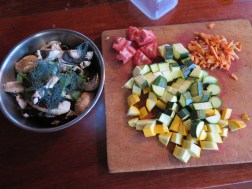
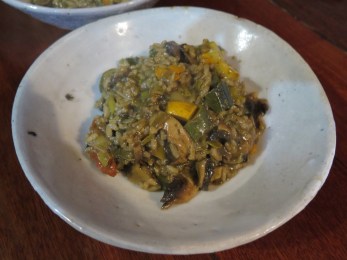
We have plenty of beetroot, carrots, broad beans and zucchinis at the moment, so tonights dinner will be pink veggie buckotto. I make it just like any other risotto, by first slow heating some finely chopped onion in good olive oil and later adding some of our garlic. Cooking them though for some time so that they are soft, translucent and glowing, but not browned or burnt. Add a cup of the small triangular buckwheat grains to the mix and stir till coated with oil. I add a cup of white wine and add in the various sliced up vegetables in order of required cooking time, stirring often. Today, I have a pan of fish stock on the go to keep the mixture lubricated. I also have a few jars of our own preserved tomato passata left in the pantry from last summer, so I add in half a small jar of this and a slab of frozen basil pesto from the freezer.

IMG_1474

We only have a very small freezer attached to the top of our small domestic fridge. We have chosen not to own a separate freezer to save using electrical power unnecessarily. When we preserve our summer excess from the garden we do it by cooking and vacuum sealing the produce in glass ‘Vacola” jars. Basil pesto of course, isn’t cooked, so it is one of the few things that go in the freezer. I made 7 tubs of the stuff last summer. It’s great to be able to go to the freezer and grab a chunk of distilled summer garden essence and add it to a meal so much later in the year.

I keep the dish moving, so that it won’t stick as it thickens up. it’s a beautiful, rich vegetable flavour with a creamy texture and some chewy vegetable chunks.

IMG_1476IMG_1478

A great meal for a late spring evening. Ever so simple. Quick and easy and very tasty.

I believe that it is even quite healthy.

Tonight My Fingers Smell of Garlic – Again

The first of our open studio weekends is over and we were quite busy all day, each day, with only one 10 minute gap between visitors all day each day. Not quite enough time to be able to make and eat a sandwich. We had to take it in turns to eat and go to the loo.

IMG_1390

Now that the pressure is off. It is time to lift the garlic crop for this year. As I got them in early, they were ready to be lifted and dried a couple of weeks ago. Now is the first clear space I have had to be able to get into the garden and spend a couple of hours digging over the plot, weeding and sorting them all out.

Janine had managed  to get into the main garden last week and dig up the small plot that I planted out up there. I planted about 100 cloves from our larger knobs in the kitchen. A mix of all the different types that we have collected over the years. Red, white and pink varieties in both hard and soft stem types. She managed to find the time to preen them and spread them out to dry, before plaiting the largest of them and hanging them up on the kitchen wall by the wood stove chimney to finish drying. We have 3 plaits of about 15 knobs each. With another 50 smaller knobs all cleaned and dried and placed in a large colander on the kitchen bench top for immediate use over the next month or so.

IMG_1430IMG_1428

While I dig the garlic, The Lovely gets stuck in at the other end of the plot, up by the patch of English cottage garden flowers that I planted for her as a surprise 2 or 3 years ago. They take a while to get established, but are flowering well now. It bit past their best, but still lovely. A very nice back-drop to our work today. At some point in the future, I am going to reverse these two garden beds and lift all the cottage garden flowering plants and move them to the vegetable end, and vice versa. This will refresh the soil and the vegetables and flowers will both benefit from the change. Janine starts to harvest the last of the broad beans. Pulling out the spent plants as she finishes stripping the last of the beans off each one. It’s nice to be able to spend this time, working together in the garden.

IMG_1424

I bought half a dozen ‘new’, named varieties of organically grown garlic and planted them out in serried rows, down here in the Pantry Field garden. They had grown quite well, with some being obviously much stronger growers than others. I bought 3 knobs of each and planted out the individual cloves. These have now grown up into about 150 knobs of differing sizes. It would have been best if we had managed to find the time to harvest them a week or two ago. They had started to dry out and the tops had begun to lean over. Then we got so busy and it started to rain. We had 3 inches or 75 millimetres of rain last week and this was enough to reduce the dried tops to a liquid mush. The earliest varieties had lost their ‘paper’ coating and are starting to ‘burst’ or spread out. They’ll be fine for eating, but without any substantial stem. we won’t be able to plait them and hang them up. So more individual knobs for use directly from the bowl kitchen bench top.

IMG_1435

I’m not too sure how this will affect their ‘keeping’ capacity? We’ll find out during the coming year as this hasn’t happened before. I’m glad that we have had this fine, sunny day today, combined with a day ‘off’, so that we could get the crop in and start it drying out. There is a certain sense of achievement, satisfaction and security knowing that we have to years supply of garlic safely in hand.

IMG_1440

Some people have asked me what we do with so much garlic. Well, we eat it. We seem to get through the 200 to 300 small knobs pretty easily during the year. What we grow isn’t the largest or most presentable garlic. Not like what you might see for sale in the green grocers. But it is our own, organically home-grown produce, clean and free from any sprays, pesticides or preservatives. That is the kind of self-reliance that our enterprise here is all about, and a day ‘off’, spent in the garden is a good day indeed. This is fun for us. It doesn’t involve going out, driving anywhere, or spending any money. What more could you want?

IMG_1441

Our friend Annabelle Sloujetté has turned up from the south coast, bearing gifts of oysters and a couple of beautiful blackfish. I steam them with some of our fresh little garlic cloves, a little olive oil, a couple of sliced large dark field mushrooms, two sliced zucchinis, some pepper and a squeeze of lemon juice. A splash of white wine finishes it off.

IMG_1443IMG_1450

These fish are a really good size for blackfish, so I choose to cook them in the big rectangular copper baking pan, but it doesn’t have a lid. In the past I have used a sheet of al-foil to cover the pan on occasions, but I really don’t like to use aluminium cooking foil. It’s an environmental disaster, so we rarely use it. I decide to run down to the kiln shed and quickly make up a folded stainless steel, custom-made, lid for the pan. I’ve been meaning to do it for a long time now. So now is the time.

IMG_1445IMG_1449

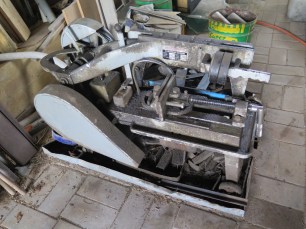
I choose a small piece of stainless off-cut, that is almost the right size. I measure it exactly and use the guillotine to slice off a few centimetres, I use the pan break to fold a slight return on two sides to help keep it flat when it is heated, then hand-file and smooth the edges. I measure it so that it will fit exactly between the two handles and sit snuggly on the flat rim.

It takes me 7 1/2 minutes to get it done and I’m back in the kitchen before the others have  finished cleaning the new potatoes that we harvested today along with the garlic and broad beans.

I lift my hand to my face to wipe my brow after I have run back up from the workshop. Ah, Yes! I remember that smell. I have been digging and cleaning garlic all day, so tonight my fingers smell of garlic – again!

Spring and The Man for All Seasons

The broad beans that I planted before leaving for Japan have come to fruiting. They have been slow arriving, but now they are in full fruit. We have had 3 picks from them so far and there will be more, but with the increase in heat and day length, there are no more flowers, so as we pick the last beans from each plant we pull it out and add it to the compost pile.

There haven’t been quite enough of them to get tired of them yet, we have managed them quite well. I don’t think that there will be many left at the end of the season to dry for later use. only just enough to save for next years seed.

The garlic that I planted in March is wilting now and drying off, so it is time to harvest it and lay it out for drying. This will have to wait for next week, as we are flat-out busy cleaning up the pottery and setting out our pots for the Open Studio Weekends coming up. We are pretty much ready now with only minor adjustments left to do today. I did all the lighting and most of the pricing yesterday.

IMG_1382

Next to the garlic I planted a long row of peas which The Lovely enjoyed while I was away in Japan. They are all over now, so I planted potatoes in that spot a few weeks ago. They are all starting to show their first leaves now. They went in a month late, but I was so busy when I got back that I just couldn’t do everything at once. Pot making, kiln building, wood splitting, kiln firings, studio cleaning, weeding, mowing, planting and harvesting.

IMG_1216IMG_1217

IMG_1363IMG_1346

IMG_1352IMG_1359

I have been back a while now and just about caught up. The garden is pretty much fully planted out with the summer vegetables and we have already picked our first cucumber, zucchinis, picked our first sprigs of basil and had a couple of meals of artichokes. Janine lifted some of the earliest garlic that had self-sown on the edge of the path, a few knobs that we missed last year, that had grown into splendid plants. They are all dried, plaited and hung up next to the stove in the kitchen. It’s so nice to have fresh garlic again. I forget just how juicy and oily it is when it is this fresh. This is the first year that we have had our own garlic last the full year. We had just 2 little dried out knobs left in the colander on the kitchen bench when Janine picked that first plant.

IMG_1365IMG_1384

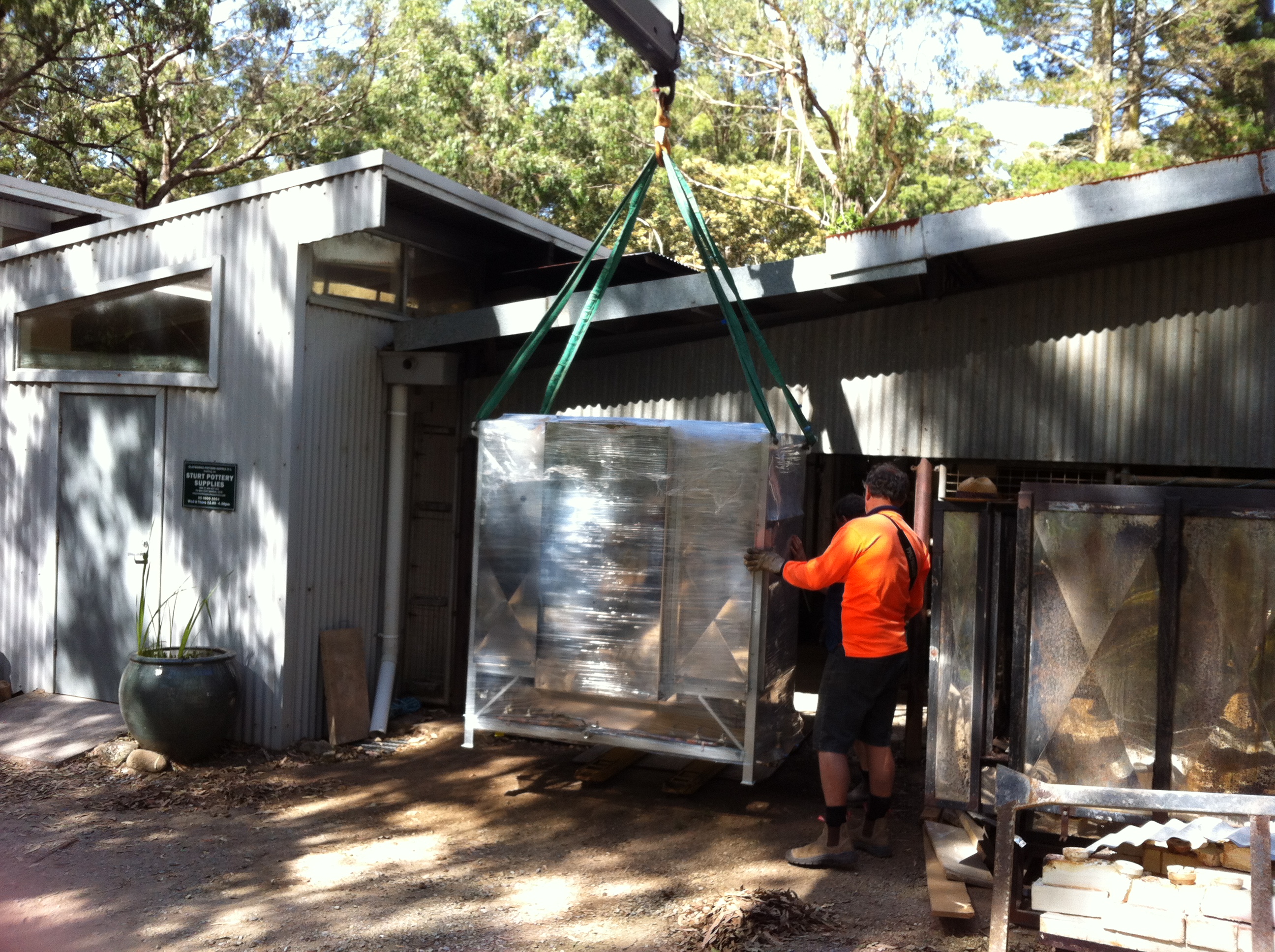
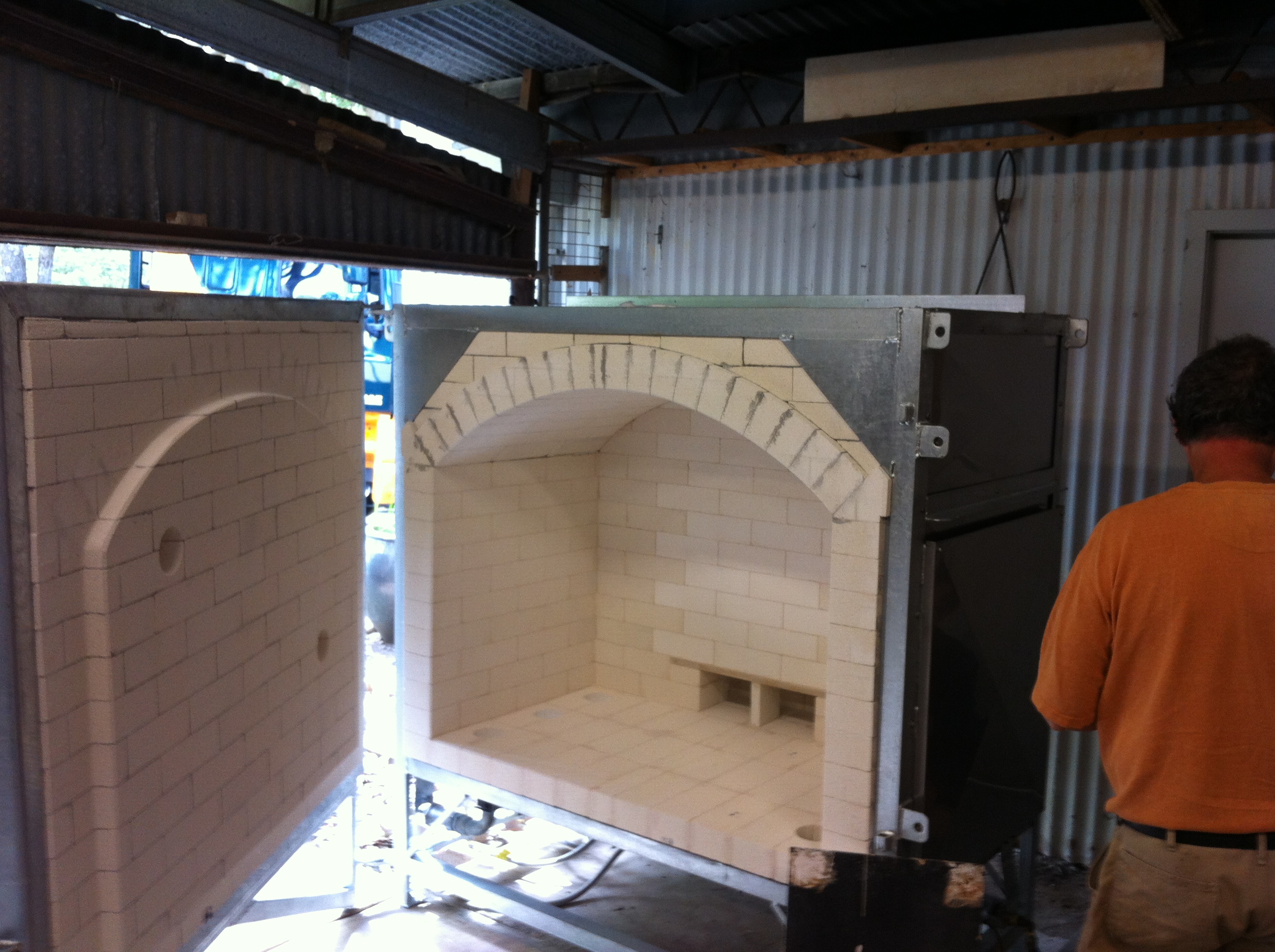
I have managed to make progress on the big new gas kiln for Sturt Workshops. It is all panelled and bricked up now. I had my very good friend and right hand man Warren down for a few days to give me a hand, as there is just too much to do at this time of year and I’m only one man.

Warren is an amazingly creative person. So skilful at so many things. He was apprentice of the year in his trade course. For two years in a row! Then he worked as a stonemason in Canada for a while, then as a fencer on his return, a panel beater, and a potter/sculptor, this was when I first met him. He worked in the sculpture department of the National Arts School for some years and then studied horticulture and set up his own business. An amazingly creative, restless spirit.

I taught Warren in the ceramics course at The National Arts School, back in the 90’s. On the first day of the year, I started my class by getting the students to make some good, basic, pottery tools. I took them all over to the sculpture workshop, where there were woodworking and metal working tools and vices. They were encouraged to get to know how to use these simple tools, so that they could make and sharpen their own tools. A little bit of self-reliance, that I had decided to inject into the course syllabus.

I handed out some small pieces of thin stainless steel sheet and a pair of tin snips to each of the students, so that they could cut out a small kidney-shaped profile tool. By the time I had turned around, Warren had cut out a perfect kidney shape. He held it up to me and said,

“Do you mean like this”?

I said “Yes! Exactly like that. Do you want a job”!

He replied, “Maybe, it depends what it is”

We have worked together on a casual basis ever since. When I have too much work on, it’s great to get Warren down here to give me hand. Apart from being amazingly skilful, he is great fun and we laugh a lot. Working with Warren puts a spring in my step.

Having been a panel beater, Warren is excellent with sheet metal and with the State Medal in MIG welding under his belt, he is a very useful man to have in a kiln factory. He has a great eye for detail and is very careful and accurate with his hand-work skills. This in conjunction with a few years as a mason, makes him ideal at the very fine and precise type of brick laying that I do in my kilns. It’s great to have The Man for All Seasons here in the Spring.

IMG_1323IMG_1337

IMG_1342

Open Studio

Janine and I invite you to visit us at our home, pottery and garden for our annual Open Studio Sale. We can also offer a walk around our organic vegetable garden and orchards.

We have been busy working at all sorts of activities over the past year including making some new domestic wares. Please feel free to call in and visit us if you are in the area. Keeping it in the family, Why not consider making a day of it and travel down to Bowral and have lunch at Biota Dining, the only 2 hat restaurant in the Southern Highlands, where our son Geordie is the sous chef.

<http://www.biotadining.com>

image001 image002IMG_1370

IMG_1143

Janine King and Steve Harrison invite you to their Open Studio Weekends at Balmoral Village

As part of the Southern Highlands Arts Festival we will be opening our studio on the weekends of, Sat 7th and Sunday 8th of November, and again on the Sat 14th and Sunday 15th of November, open from 10.00 am till 5.00 pm

We are studio No.3 on the top right hand corner of the downloaded map page.

The program and the map of the studios is available from the website below;

Follow the festival on Facebook  www.facebook.com/SHAFAST

There will be yellow flags and yellow and black Studio Art Trail signs from the entrance into the village leading to the 3 open studios in Balmoral Village.

Hoping to see you here,

Best wishes

Steve and Janine

Time For Some Fun


Last week I attended my friend Alan Parkes funeral. Alan was a good mentor, a stonemason and sculptor. He taught me how to cut and dress stone, so that I could create all the sandstone features for my home, when I built it way back in the early seventies. I still have those stone masons tools that I forged all those years ago. I have Allano’s pitching tool, that he gave to me, I am forever grateful for his kindness and support. All the other tools I have forged myself.
I have been slowly building stone retaining walls for the new pottery workshop Pavillion building. It’s been a slow process, because I have had to dig nearly all the stones out of the ground myself over the years that we have been living and gardening here. When even I make a new garden bed or make a new orchard area, I have to dig some enormous sandstone floaters out of the ground. I pile them up down at the bottom of our land, until the time is right for some more stone work.
That time is now. It’s time to have some fun and in memory of Alano I get out my skutch, point and bucket of gads. I originally made myself 10 gads, back in the seventies, but when I get my bucket of stone working tools out from the workshop, I find that I only have 5 left,  I’ve lost one at a time over the intervening period, so now I only have a bare minimum of them left. The first thing that I do is make another set of 10 more. That should see me out for another 40 years of quarrying and masonry work! Just like the last lot.
IMG_1258IMG_1261
IMG_1264IMG_1265
I set about breaking up the big floater that I cut in half a while ago, so that I could put the citrus grove fence right through the middle of that space. The rock just happened to be smack-bang in the way, so I cut it in half and cut up the piece that was now in the way and used it to make the lower part of the stone retaining wall that I plan to finish off this weekend. Using just my small 4 lb hammer and a dozen gads, I cut it up into 4 large blocks and another half-dozen, smaller blocks. They are really enormous lumps of stone and I need to use the tractor to move them to the site. The largest is about 200 kilos. It’s longer than the 1200 mm bucket on my tractor. I have to secure it with heavy snigging chains, to make sure that it doesn’t fall out of the bucket during the bumpy ride over to the building site on the other side of the kiln shed and pottery.
It is amazing what one man can achieve with just a 2kg hammer, a dozen small gads – and a few hours!
IMG_1298  IMG_1299
IMG_1303IMG_1304
Using crow bars, levers, rollers, the tractor and the help of my good friend and faithful retainer, Warren, we build the retaining wall. In two days, we cut and lay 20 metres of stone wall and two sets of stone stairs. It’s great fun and ever so rewarding. We get so much done working together and we manage to laugh a lot while we are at it, even though the work is physically very demanding. The Lovely Janine is here too, supporting, passing, carrying, sorting stones, getting gravel and lime in the ute, raking up, finishing the details and finally sparging and cleaning our messy lime mortar work in the afternoons, once the mortar has started to set a little. The weekend goes so fast. It’s been really tiring but also energizing to be so productive in a free and creative way. We don’t really know what we are doing, but we enjoy doing it all the same. It all goes so well. Mostly because I spent the last two days before-hand splitting up the stones and cutting and dressing those blocks, then carting then onto the site in preparation. The largest stone is 450 mm high x 300 mm deep and 1500mm. long. It takes a bit of maneuvering to get it into place, but it can’t resist the hydraulics of the tractor and two crow bars.
IMG_1311 IMG_1312 IMG_1307 IMG_1308
IMG_1314 IMG_1310 IMG_1313
Even though I have used, the tractor, chain blocks, crow bars. levers, wedges and rollers and a mate to help me. My back is still telling me that I have done too much. But if I don’t do too much, then I don’t get enough done.
We finish the job and are all cleaned up, well before dark. The Lovely had picked the 2nd picking of the early pink cherries. Yum! We need to be vigilant, as the birds soon realise that they are ripening and will clean out the lot if we don’t net them. But netting will have to wait for another day. Today we are being masons, not orchardists! The Gorgeous One manages to find time during the days hectic work, to bag a good deal of the crop, so as to allow it to ripen in its own good time and mature, before the pesky birds get them all.
IMG_1318
As it is getting dark, we come inside for hot showers, a change of clothes and a well earned beer. For dinner we have a simple light meal of cubed silken tofu with todays fresh picked, early season garlic, some finely diced spring onion fresh from the garden, finely diced fresh ginger and a drizzle of light soy sauce. This has to be one of my favourite light meals.
IMG_1317
I am someone who benefitted greatly from the generosity and good will of Allano Parkes. He left his mark on me, and inadvertently on this small piece of land of ours. I am really quite taken by the concept of self-reliance. So being taught to be able to dig up stones and turn them into a visually pleasing and environmentally sensitive, carbon-neatral, building material is a real thrill. Apart from the occasional use of the tractor to do the heavy lifting, there were no power tools used on this job. All the cutting was done using the small 2kg hammer and gads, while all the fine dressing was done using the bitch-pick and pups as well as the skutch hammer. We ache all over from the exertion and the use of muscles that don’t get used like this very often, but when we take the time to stand back and admire our achievement at the end of the day, they are all good aches!
fond regards from the part-time mason and his masonette

Two Wood Firings in One Week

Two Wood Kiln Firings in One Week

I have decided that I can fit in one extra firing before the Southern Highlands Arts Festival – Arts Trail, Open Studios weekends on the 7th & 8th of November, then again on the 14th & 15th.

The kiln is unpacked and repacked while it is still warm.

IMG_1016IMG_1034

IMG_1037IMG_1040

IMG_1045

For some unexplainable reason, I wake up just after 3 am in the morning. Or is it still very late at night? I’m not too sure, but I’m wide awake, so I get up and walk down to the pottery workshop in the dark. It is quite overcast tonight/this morning, as there are no stars to be seen up in the blackness where the sky ought to be.

IMG_1215

It’s so pitch black and very quiet, it seems a shame to make any noise at all. I decide to only put one light on and work in the soft ambiance and stillness. I make the kindling fire from the scraps of wood that fractured off from the bigger logs as I was splitting them yesterday. I spent most of the day yesterday in cutting, splitting and then, with Janine’s help, stacking it. We stacked half of it onto the truck. A very full load without sides on the tray. I drove it down to the kiln shed, covered it with a tarp against the possibility of rain overnight.

IMG_1208IMG_1211

IMG_1223

I cut all the straight log wood into hob lengths, avoiding the branched bits. These, I cut around and leave aside for splitting into small short pieces for use at the beginning of the firing, when I start the fire on-the-floor of the firebox. This first stage of the firing gently heats the pots up from cold, but also serves to build up a pile of embers in the base of the firebox which is necessary to ignite the big logs later on in the firing process.

Every part of the tree is used. I don’t like to use branched bits for the longer hob wood, as it doesn’t split easily or well, often coming apart into horrid, sprawling, jagged pieces that are difficult shapes to stack and stoke, so I have developed a technique of spacing my chain saw cuts to get the maximum number of full length ‘hob’ wood pieces from the straight grained sections of the log and a smaller number of knotty, branched bits left in-between for use as floor wood lumps. I usually walk along the log with my metal measuring stick and mark off all the cuts with a red wax crayon. This takes a little time, but makes the cutting and sizing much faster and more accurate overall.

IMG_1214IMG_1225IMG_1232

The kindling fire starts well and develops slowly into a full firebox of burning chunks, after 3 hours, there is enough ember built up in the lower part of the fire box, (‘the ash-pit’) on the floor, to support the fire starting off on the hobs, in the upper part of the firebox (‘on the hobs’). The long, thick pieces of wood introduced onto the ‘hobs’ from the top of the firebox, are held suspended by the brick ‘hobs’ just above the burning embers in the ash pit, placed here, they soon catch alight and start to burn fiercely. This takes the firing to another level, where the wood burns cleanly and thoroughly, allowing the temperature to rise evenly and steadily, up until it is time to begin reduction at about 1000oC.

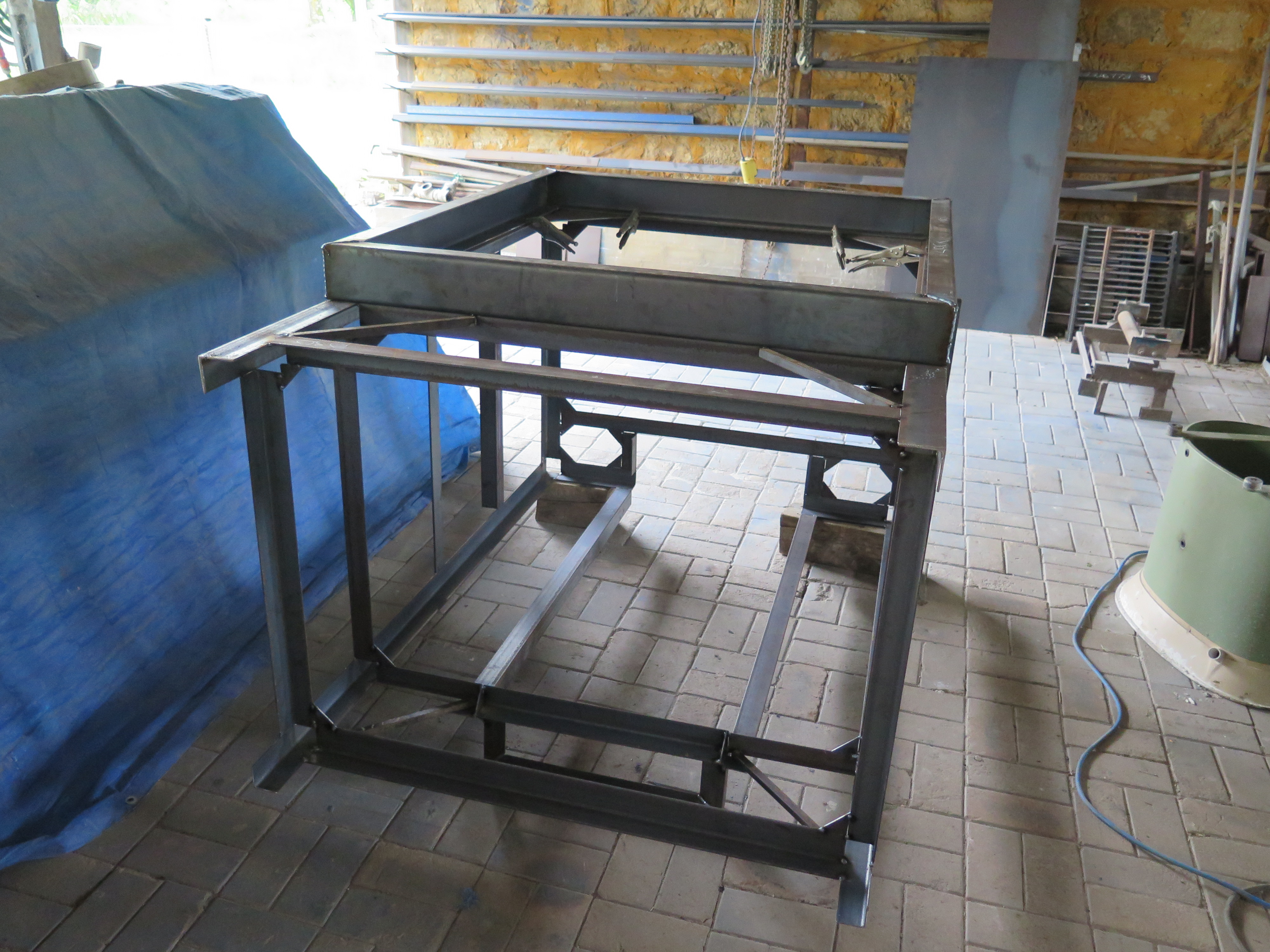
After cutting and stacking the kiln wood yesterday, I spent the rest of the afternoon in grinding, fettling, filing, acid-etching, washing and baking the newly galvanised kiln frame for Sturt Workshops prior to etch-priming. This is all mindless dull work that I have done a hundred times before, if not more and a good time to allow my mind to settle and watch itself wander, constantly returning to the hand/arm action of simple brushing. Paint on, Paint off. I don’t need to be in a buddhist temple in Kyoto to practice mindfulness. Any place will do, but it helps to be able to make the time for it and it alone.

IMG_1222IMG_1227

IMG_1228

Although it is very early in the morning, I’m keeping myself occupied in fiddling with the very small fire in the fire box. I need to watch it carefully, as at this stage it can easily go out if it is left for any

period of time unattended. As I sit and carefully place each new small piece of wood on the pyre, I suddenly realise that it is starting to rain. No wonder that there were no stars in the sky. This is no problem for me, as I took the precaution to cover the wood outside on the truck last night. I’m using freshly split pine, which although being felled two years ago, is still damp inside when split from the log. I don’t want it to get any wetter until the firing is up to 1000oc. or more, then it won’t matter if   the wood is wet and may even be of some use in creating the ‘reduction’ atmosphere in the kiln, which changes the colour of the clay bodies and glazes. Such is the odd nature of burning wood in a potter’s kiln. Pottery may seem superficially to be a simple craft activity, but there is a whole world of science, chemistry and associated technologies that need to be learnt, assimilated and internalised, so that you can then work intuitively and creatively in the medium.

In this firing I have 3 large jars and then a lot of bottles, with a few shelves of smaller domestic pots underneath. This firing isn’t very efficiently packed, but there is no easy way to get these big round jars into a more-or-less square box of a kiln chamber. That is just the way it is, so I do the best that I can with what I have to work with.

IMG_1049_1

I have done this so many times, that I have judged the amount of wood needed, down to the the last half wheel barrow load. The firing proceeds smoothly and evenly right up to top temperature of 1300oC or cone 10 flat, in 16 hours. Because I started so early this morning, there is time for a hot shower and a relaxed dinner back up in the house, even a bottle of wine to celebrate. This is civilised kiln firing. Perhaps even Laid back ?

We bake a whole snapper for dinner with some freshly picked broad beans from the garden. The are perfect just now. Sweet and juicy without any starchiness at all, just the way that I love them. This is the 2nd pick and there will probably another couple before they get too big. The first few beans are eaten raw as an entre, perfect with a glass of chilled white wine. We bake a few potatoes, sweet potato, red onions and some pumpkin. Our garden feeds us very well!

IMG_1237IMG_1239

IMG_1240IMG_1241

I bake the fish with some mushrooms and slices of lemon and serve it dressed with a sauce of melted butter with finely chopped anchovies, capers and green olives.

It’s a tough life, but some one has to have a go at it.

Tomorrow I will start to grind, sort and clean all the pots from the last firing, spend a bit more time in the garden and add another coat of paint to the kiln frame waiting in the factory.

Never a dull moment!

fond regards from the multi-tasking Steve and Janine

Hitting the Ground Running

I’m just back from Japan, It’s been a great trip. I’ve been away since late August. I’m back just in time to discover that my friend and mentor, Allan Parkes has just died. Such an interesting and creative person.

For the first time, I decided to rent some studio space in Japan and make some work there. It was very good. I hope that I’ve learned something while I’ve been away, but one never knows. Only time will tell. I tend to take things in and let them blend and simmer for a while, then hope that something will percolate back out again in some dilute form that will enhance and extend what I already do with what I know. If nothing useful emerges, then there is nothing lost, as I really enjoyed my time there. As I alway do. I have a strong affinity for Japan, the people, the food, the creative endeavours of all those people that I have met and/or whose work I have seen in the Galleries.

IMG_1005IMG_1013IMG_1011

I had one day to unpack and do my washing, then straight in to the pottery and kiln factory. I have a large kiln ordered, so it’s straight into welding mode. I have to earn some money. I weld up the steel frame and get it off to the galvanisers in just 4 days. While the kiln is away. I get stuck into glazing all the bisque fired pots that I left here in the pottery, before I went to Japan. So it’s glazing, decorating and kiln packing. Then wood stacking, kiln shelf grinding, cleaning and washing. Finally the kiln is packed and ready to fire.

IMG_1187

It’s 5 o’clock in the morning and the early bird chorus is just starting. I’m down in the kiln shed firing the kiln, I like to get an early start for my firings. For some very intimate psychological/physiological reason that I don’t really understand, I seem to like to get an early start, when it’s dark and quiet and I have the whole world to myself. Well, almost. There is of course the odd rooster in the distance and the bird song. The birds seem to start calling to each other even before I’m aware that that there is any change in the light levels, but they are so much more sensitive to the natural world than I am. We have all learnt to live in an un-natural modified environment with electric lights, refrigeration, supermarkets, air con, and flat screens. I eschew most of this for the frugal comfort of home grown vegetables and a wood fire for warmth and cooking. Of course I do have electric lights and a fridge. I’m not a ludite, but I’m trying to keep my life as simple as I can, while still engaging with the modern world.

IMG_1190

Half an hour later, I can start to see a slight lightening of the sky and instead of it being jet black, it starts to have a very pale light grey to bluish tinge to it. I’m sure that if I had to live without any modern ‘conveniences’, that I’d soon adapt to my circumstances and start to see the dawns approach, just like the birds. But at this stage I’m happy in my hybrid world, sitting on the edge of my small hamlet, with access to everything that a modern first world economy has to offer only half an hour away and I’m also happy to live here quietly and ignore most of it.

Electricity is great. We make all of our own. In fact we make about 3 times more than we use, and sell the excess 2/3rds into the grid for money. Having fresh drinking water on tap is also a great thing. We catch all our own rain water from our roof and store it for later use. Hot water on tap has to be the greatest luxury ever invented. I consider it the basic standard of civilisation. If you have hot water, you probably have peace and stability. We make our own hot water from a combination of solar panels and a boiler fitted into the back of our wood fired kitchen stove. We also own a fridge, a small one, but we don’t own a freezer, even though we have a large kitchen garden and could find a use for one. We thought about it and decided against it, as it uses too much electricity. We always have something fresh to pick and eat from the garden. We eat what is in season in the garden, what we have over, we vacuum preserve it in ‘Vacola’ jars and store it away in the pantry.

IMG_1000IMG_1001IMG_1129IMG_1130IMG_1167
I’m perfectly aware that the way we live is both very hard work and a great luxury. We are in control of most aspects of our life and that is our greatest luxury. However, Just like everyone else living in a capitalist economy, we have to earn money to pay the bills that constantly accrue. Such things as Council rates, insurance, registration, taxes etc. There are lots of once-off bills that occur throughout the year, but add up to be our major expenses over-all. As we don’t have conventional jobs, cash flow can sometimes be a problem, but we manage by living quite frugally. Luckily, most of the things in life that we aspire to can’t be bought for cash, but are earned through hard graft and personal effort.

IMG_1194

This wood firing will be the last that we can fit in before the Southern Highlands Arts Festival Open Studio Weekends, that are slated for the first two weekends in November. It gives us a couple of weeks to unpack the kiln and then fettle and grind all the pots. With any luck, we should have just enough time to unpack the kiln,  then clean up the studio ready for the opening.

Best wishes from Steve who is glad to be back home again and hitting the ground running
Vale Allan Parkes

Allan Parkes was a really good person to get to know. I was very lucky to have spent 25 years working with him at the old East Sydney Technical College. He was a great character. I really enjoyed our conversations. He seemed to be very well-educated, but I remember him telling me that he was brought up in the  country on a  property, with an absent father, who was away working in Sydney, earning the money to support the venture. So perhaps Allan was home schooled? Whatever his formal education, he had a wonderful speaking voice with particularly clear diction. Perhaps a result of some private schooling? (I learned at Allan’s funeral service that he was educated remotely by the ‘school of the air’ and by correspondence schooling. His beautiful diction and hand writing were a result of his self imposed and determined effort to ‘improve’ himself. A defiantly independent individual.) He was very well read and could converse on a wide range of topics. He always seemed to be borrowing books from the Art School Library on a regular basis.

He was a fine mentor in my early days there at the ‘Tech’. He was one of the ‘elders’ who helped grow me up. I admired him and remember him very fondly.

He came and stayed with us at our home in Balmoral Village on one occasion in the 80’s and gave me a lesson on how to cut and dress sandstone, to make the window sills for our house. I learnt a lot in a very short time and went on to carve all the sandstone window sills for our house over the next 9 months. I’m a slow worker. Allan gave me one of his pitching tools which I still have and even now, 30 years later, it still gets occasional use, as I’m currently building a new stone retaining wall at our property.

IMG_1133

He often greeted me with “Hello Citizen” A reference to the French republic, but there was a lot more going on there, not all of which I ever got to the bottom of, but I enjoyed listening to his stories of working as a drover up in the Gulf country. I remember stories of restoration stonework on some big churches, carving the gargoyles for the Government House in The Domain. Very interesting and sad stories of his time as a news correspondent in Burma during the war. Some very brief descriptions of his detention and torture by the Japanese forces there. His discussions of French faience pottery. The need for more colour in the brown and green 70’s ceramics (which was a very accurate and timely prediction, that later came to pass), he was interested in organic gardening, native plant propagation, red wine, water-colours, sculpture. So many topics. He was so erudite, cultured, well read and he had a beautiful hand. We have a few notes and letters from him and even though they are hastily draughted, the lettering is exquisite.

IMG_1134

I met him, when I first enrolled at ESTC in 1971. At that time he was the Technical Assistant in the Ceramics Dept. He was immediately engaging, supportive and helpful. Always ready with some advice and ideas to get the most out of my time there. Although he was only the TA in the Dept. he actually taught me more than some of the full-time staff that were employed there.

I recall going to him early in my first year as a student at the Tech and complaining about how I was so unhappy with my work that had just emerged from the kiln. He put one hand on my shoulder, looked me straight in the eye and said, “I know that you might feel disappointed just now, but I know that you will go straight back out there and make a better one”. I didn’t know that at all! But once he told me, I realised that I could, and so I did.

I didn’t know his history and what he had gone through in the war at that time. I must have appeared to him as a soft, spoilt, indulged, whingeing, middle-class brat, but he didn’t tell me that. What he told me, was to get over it and go and make another one, only not just one, but ten more. Good advice, well received, and because I did, we got on really well after that.

Janine and I used to call in at his home in Concord West at times during the 70’s when we lived in Dural and found ourselves passing by. He was still married to Helen in those days and we met Freya Marc and Manon there. Helen used to lend me her books on Native plant propagation and cultivation. It was Helen and Allan, who introduced us to the work of Edna Walling and that had yet another great effect on our lives. We are still keen native gardeners to this day.

Janine and I have spent some time reflecting and remembering Allan with great fondness during the past week, since we heard of his passing. He was so very good to us both at different times during our student years and then later in different ways. He always seemed so European in outlook, while also being so quintessentially Australian. He drank red wine when everyone was drinking beer. He drank beer when everyone switched to red, when wine became trendy. When boutique breweries evolved and both wine and beer became trendy, he drank cognac. A true individual, he owned a vehicle for his stone mason’s business, when no-one else could afford one, later, he caught public transport when everyone else drove.

He was never far from a roll-your-own cigarette, always rolled rather shakily from some intensely dark, very strong, Dutch tobacco. Later, when his hands became a bit too shaky for roll-your-owns, he switched to cigars.

He was a good artist and multi-skilled. I knew him as a sculptor in stone, ceramics, ice and butter. He often crafted images in butter or ice for use as center-pieces in table settings for big events in the food school at ESTC. This is an ancient tradition that very few people were aware of and skillful in – except of course Allan. He was also a very good water-colourist as well. I remember seeing his design sketches for the new sandstone drive-in gate at ESTC. He did a beautiful design and accompanying water-colour image. I didn’t know until recently, that he had also painted in oils in his latter years.

image005

image006

Allan was asked to repair the gargoyles on Government House in the Domain. He refused the job to re-create the old European originals. Instead, he submitted all new designs based on Australian native animals. I remember going there one day to visit him on-site. He was just finishing off the echidna corner piece. He had a natural gift for sculpture, which he honed through hard work and practice. The gargoyles looked strange up close when viewed on the ground, but suddenly emerged in perfect perspective once they were installed up in the parapet and viewed from 50 feet below. How did he know how to get that sense of perspective just right? He was very good!  Allan also designed and built the copper cockerel weather-vane on the roof of the old circular library building at ESTC. This image was later adapted to become the logo for the Art School. As far as I know, it’s still up there. Look for it the next time you visit the National Art School.

Allan left his mark in so many ways on the people that he interacted with and on the very real structural fabric of Sydney itself. Not many people can say that.

So we all have our own Allan in our minds eye and memories. We all come here today to add our own little bit to the complex picture of the complete man.

Citizen Parkes, well-read, complex, deep, richly informed, engaging.

Fondly remembered, sadly missed.

IMG_1138

A funeral service will be held for Allan at Rookwood Cemetery, West Chapel, on Tuesday 13th of October at 2.00pm.

Schrödinger’s Bell

I’ve re-located to Kyoto now. Only for a few days, as there is a potter that I need to meet. I’m staying at the Chitta Guest Inn, here in Kyoto. It is located just a few minutes walk from the Kyoto central station, which makes it ideally suited to walk to the Higashiyama, potters district, or to catch any bus or train to anywhere. The lady who runs this Inn is Kahori Inada. She is a really helpful person, with a bright outgoing, talkative personality, and she speaks English really well. Which is a great help when you need to call someone who doesn’t, she has done English translation for me on the phone and made appointments for me. A fantastic service. The place is very well-kept and clean. Shoes off, and tatami mats all through. Sleep on the floor on a futon. I see in the foyer, that she got a 8.8 out of 10, review on ‘trip-advisor’.

Keep in mind that this place is low-key, for young back-packers. It has shared toilet and shower facilities down stairs. No problem for me. It has wifi, TV and air-con that I don’t use. The cost is Y3,500 per night. That’s about Au$40! where else in an advanced country can you find a fantastic, basic, private room for that amount of money, so close to the centre of town. It’s pretty amazing as far as I’m concerned. So that is why I keep returning here. I thoroughly recommend it.

The Inn is located directly opposite the large temple of Higashi-Honganji, so I can’t help but hear the temple bell in the morning. In Arita, the temple bell rang at 6.00 am. and then every 35 seconds for ten minutes. 17 strikes.

Here the temple bell is so much larger. It resounds for longer. Almost one minute. So it sounds only ten times, but it starts at 5.20 am. and then 10 strikes on the minute until 5.30 am.

IMG_0880IMG_0871

I decide to go over the road and have a good look at it. While I’m there I decide to sit a while in the main temple. It’s huge. The main room is divided into three sections and is just completed being fully restored. The floor area is 12 x 14 tatami mats + side spaces that double that capacity. That’s 336 tatami or 700 Sq. m. While I’m here, there is only one other person in this gigantic space. I sit quietly for a while. contemplating my time here.

IMG_0870IMG_0878

I’d love to show you a picture of this beautiful place, but god has forbidden it apparently. All I can show you is the outside areas, as god isn’t too concerned about that? God is a funny concept!

I wander around amid all the construction works. This re-building program has been going on for years now and is almost complete. I can see from the signage, that re-construction is due for completion in 2016. I finally locate the bell in the corner of the grounds. It’s a beauty, but hard to photograph, as I can’t get a clear shot, due to the position of the workman’s service huts or ‘dongers’, as we’d call them in Australia, placed right up close to it. What I can see is that there doesn’t appear to be any mechanical apparatus or mechanism attached to the big log that hangs from its chains, ready to swing into action. There is just a long white rope. So maybe here I will find that robed, dedicated Monk at dawn, doing his daily ritual?

IMG_0873IMG_0874

IMG_0875IMG_0876

The next day I’m up at 4.45am., dressed and ready and out the door with my camera in hand by 5.00 am. As soon as I’m outside, I Suddenly hear it. A bell striking the hour, but it’s a long way off and only faint. I haven’t heard this particular bell previously from inside my room. I make my way over to the Higashi-Honganji Temple. I walk the road to the gate that is normally open, but find that it is shut tight. I can’t see any indication or signage, as to when the temple is open, but clearly it isn’t now. I wait patiently outside the gate, just in case it opens, but it doesn’t. Only a minute to go, then there it is. Deep and resounding and lingering too. A very fulfilling sound and feeling. I feel it in my solar plexus. I stand and let the sound immerse me. At this early hour, there is only the occasional passing vehicle. I linger on, eyes closed. The next strike and then the next…

Was it Monk or machine? I for one will never know! It’s a bit like Schrödinger’s bell, I can’t look to see the outcome. It will always be both.

What is the sound of one hang(ing log) clanging?

Fond regards from Steve in Kyoto.
The Harvest

I started here a month ago. Empty pot boards, clean wheel head, heaps of storage racks all waiting for pots. 100 kgs of clay waiting in its plastic packs. I’m here in a fertile frame of mind and ready to experience and learn. I’m here to harvest what I can from this fertile environment.

IMG_0425

Now after weeks of intensive work I’ve made about 115 kgs of premium Arita porcelain clay into about 100 pots. I’ve ruined 3 of them by accident and turned all the others into fine, thin, beautiful bowls. I’ve gone through them over and over as the turning, re-turning then finishing and polishing has progressed. I’ve narrowed them down to just a dozen nice ones to be fired and glazed.

It doesn’t seem like much for a months work, but I’m quite happy with what I’ve learnt. Ideas and experiences are mingling and germinating. It’s what I’m taking away in my head that counts. The work that I’ve done here is the best way of getting it in there. I haven’t come here to take pots home. I’ve come to learn some skills. I think that I’ve done that, and of course I didn’t spend every day at the wheel. I managed to get out to visit people and places of interest on a lot of days, and that was very good. It was great to get some insight into this place and the people that make it all happen.

IMG_0433IMG_0435

I’ve also eaten a lot of wonderfully flavoursome food. Most of it I cooked myself, in my little kitchen, often for me alone, but also for others who dropped by at times. I quite enjoy cooking , and Japanese food is a favourite influence on what I cook at home.

IMG_0239IMG_0256

I cook a bastardised version of Japanese food at home using the ingredients that I grow in my garden and what I can get hold of locally and substituting the closest things that I can find to make an approximation of what I have in mind. I’m not very good at it, but I enjoy doing it and everybody eats it politely and compliments me on what I cook for them. Japanese people are so polite!

IMG_0712

I don’t cook for myself every night. sometimes I get to go out. I’ve had a coupe of meals out. Sushi, sashimi, tempura, shiso and kelp salad, It’s all so lovely. But it costs money. So I get better value by staying in and cooking for myself. It’s no problem. I love cooking and very good sashimi and fresh vegetables are readily available in the local supermarket. You can’t beat it, fresh, delicious and cheap! What more could you want?

IMG_0560IMG_0925

IMG_0927IMG_0930

IMG_0931

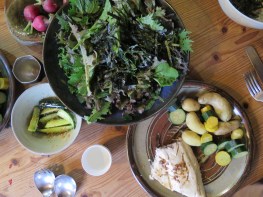
I did manage to find some good salads finally. I took a while, but I got there eventually. Mostly I just bought the salad greens from the supermarket and made them myself, but occasionally , when I saw what looked like a good salad, I’d lash out. Hang the expense! A ten dollar treat every now and then didn’t break the bank.

IMG_0928IMG_0929

Mizumi salad, with tofu skin and roasted seaweed, Yum!

Not only is the salad delicious, but the plate is a joy to examine after I’ve eaten its contents. Beautifully warped, with a thick application of white slip, over a dark iron body, under the clear glaze. Beautiful.  Sugoi!

Before I finish up at Tatsuyas workshop. I decide to spend my last day making glaze tests. I have collected a few pieces of Izumiyama stone from the access ramp at the quarry site on a previous visit there last week. I crush it in Tatsuyas huge stone mortar. I ask him if he has a mortar and pestle. He nods and shows me a 100mm dia one that he has made himself for grinding pigments. He has several of them. But they are just too small and light for crushing rock. Then we go outside and there in the garden is the mother of all mortars. It’s huge. It has to be about 50 kgs and carved out of a solid block of volcanic rock. I’ve seen little versions of these in Asian markets in Sydney and other countries around the world. I have used them for my lectures/demos in Singapore and Taiwan recently. This has the be the biggest one that I have ever seen, let alone used.

IMG_0681IMG_0682

I set to work and make some tests out of the powdered stone with limestone and wood ash added in various proportions. I’m keen to see how it melts. It isn’t any use to me. I won’t be using the glazes, but I’m inquisitive to see how it melts from an intellectual point of view.

Finally its time to leave. My time is up. When I arrived here 5 weeks ago, the rice crop was green and lush, and starting to bolt upwards. Now it is all yellowing and has set its heads of golden grain. As I set out to leave on the train, I see that the first of the harvesters is starting their work.

IMG_0049IMG_0491

I say good bye to Tatsuya san and Miyuri san. My place here is going to be taken by another Australia, Keiko Matsui. She arrives and I leave. It’s an all Australian event here this month with a brief visit by Nicky Coady and her friend Erica during my time here.

This image by Keiko Matsui

This image by Keiko Matsui

I must say that I’m quite sad to be leaving but I have achieved everything that I set out to, and then some more on top of that which I just couldn’t have imagined before arriving here. Thanks to my friends, Tatsuya and Miyuri san.

I am very grateful.  Thank you!