45 seconds in the life of China

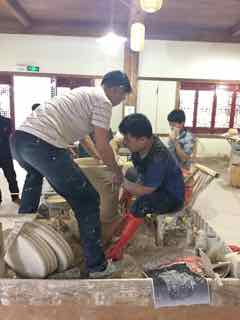
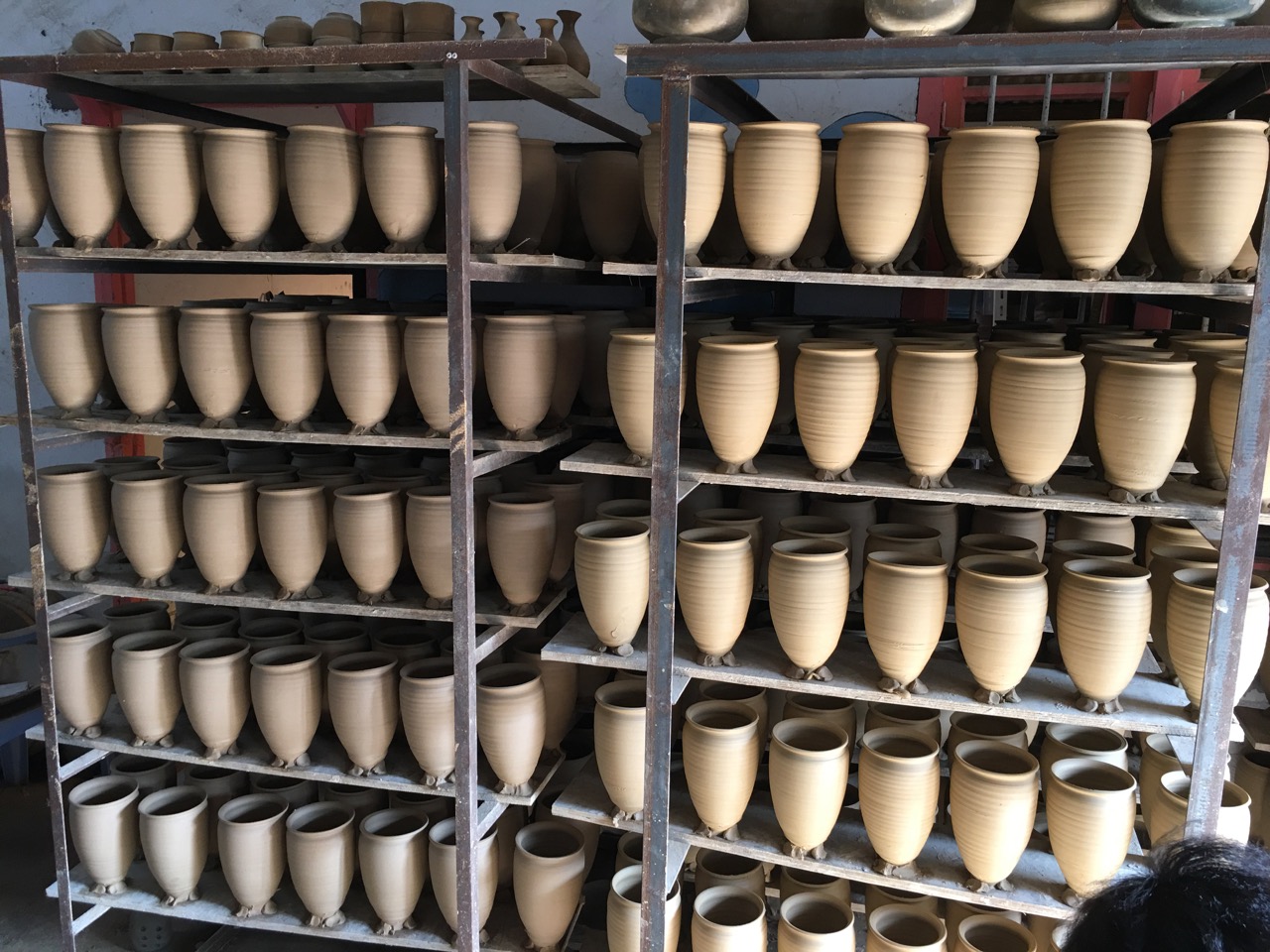
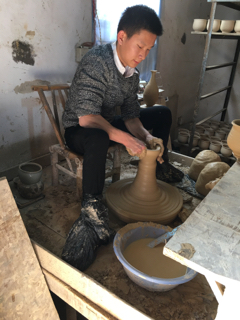
We have just watched an amazingly skillful potter make upwards of 700 pots in a day without seeming to put any effort into it, and without getting any clay splatter on himself either. Amazing!

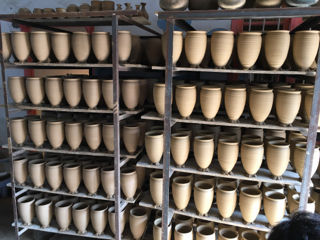
This potter fills the workshop shelving to capacity in one day, then moves on to another workshop. He’s a professional thrower. Everyone here is a specialist. I explain to my guide and translator, Chen, that I do everything myself. He is amazed when I tell him that I do everything myself from digging the clay(stone), crushing and grinding it, to making the fire bricks for my kiln by hand. He just can’t get his head around it. Why don’t I just employ a specialist to do the boring bits? I tell him that it isn’t like that in Australia. There aren’t any specialists to call on.

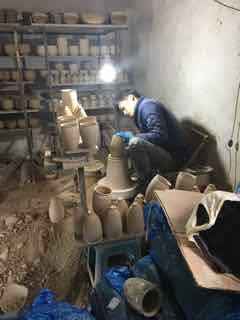
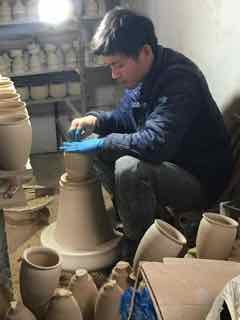
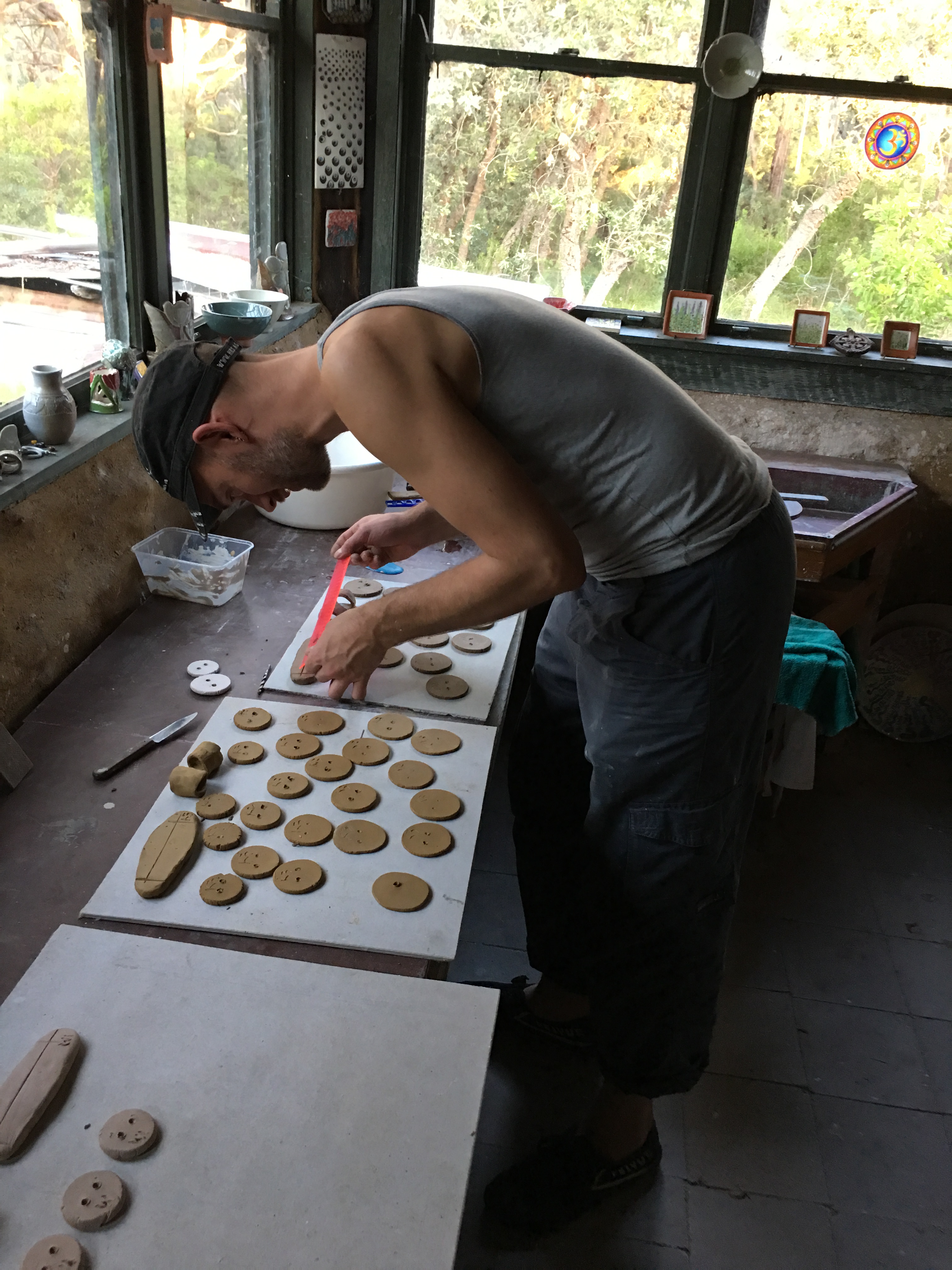
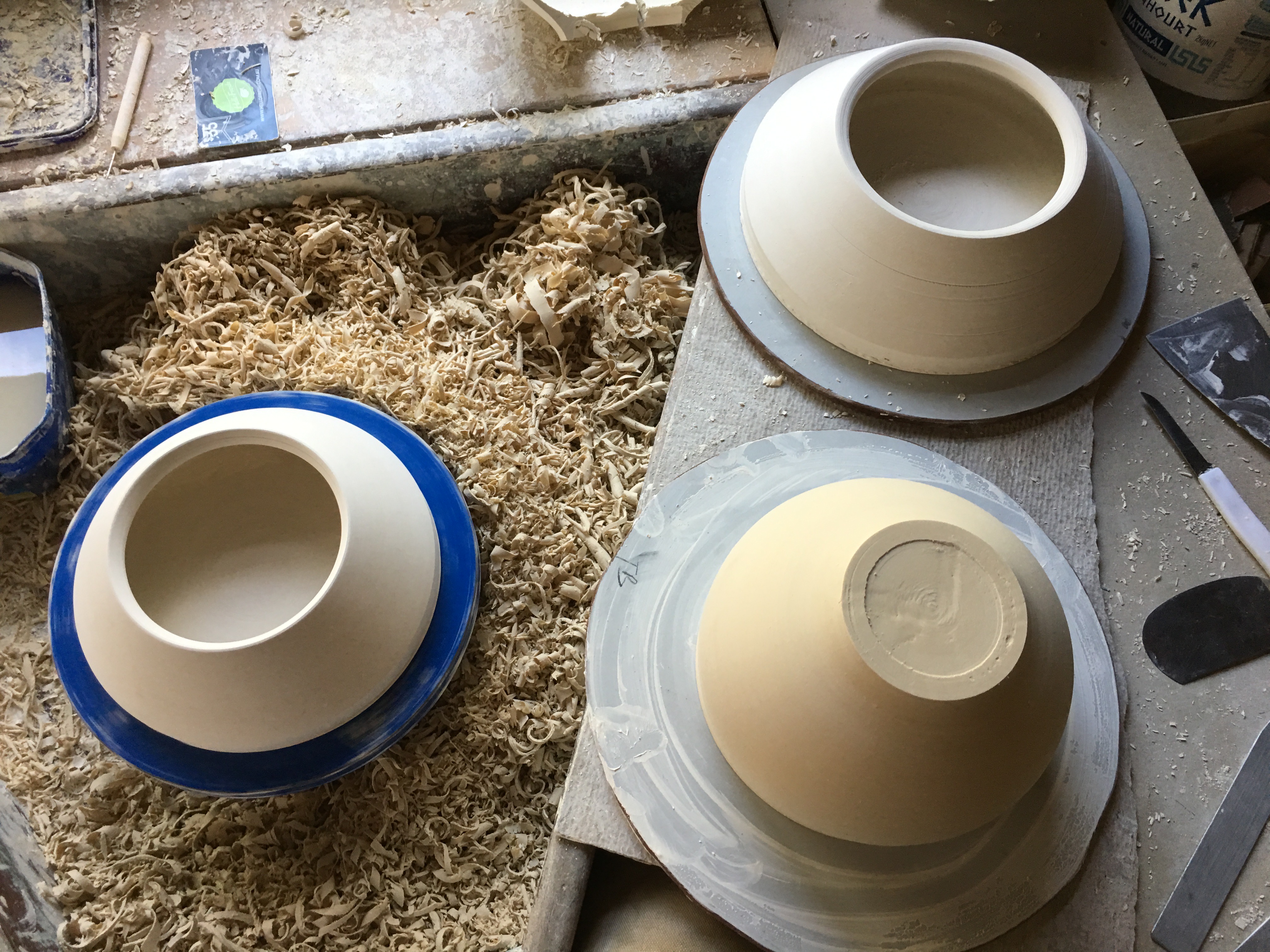
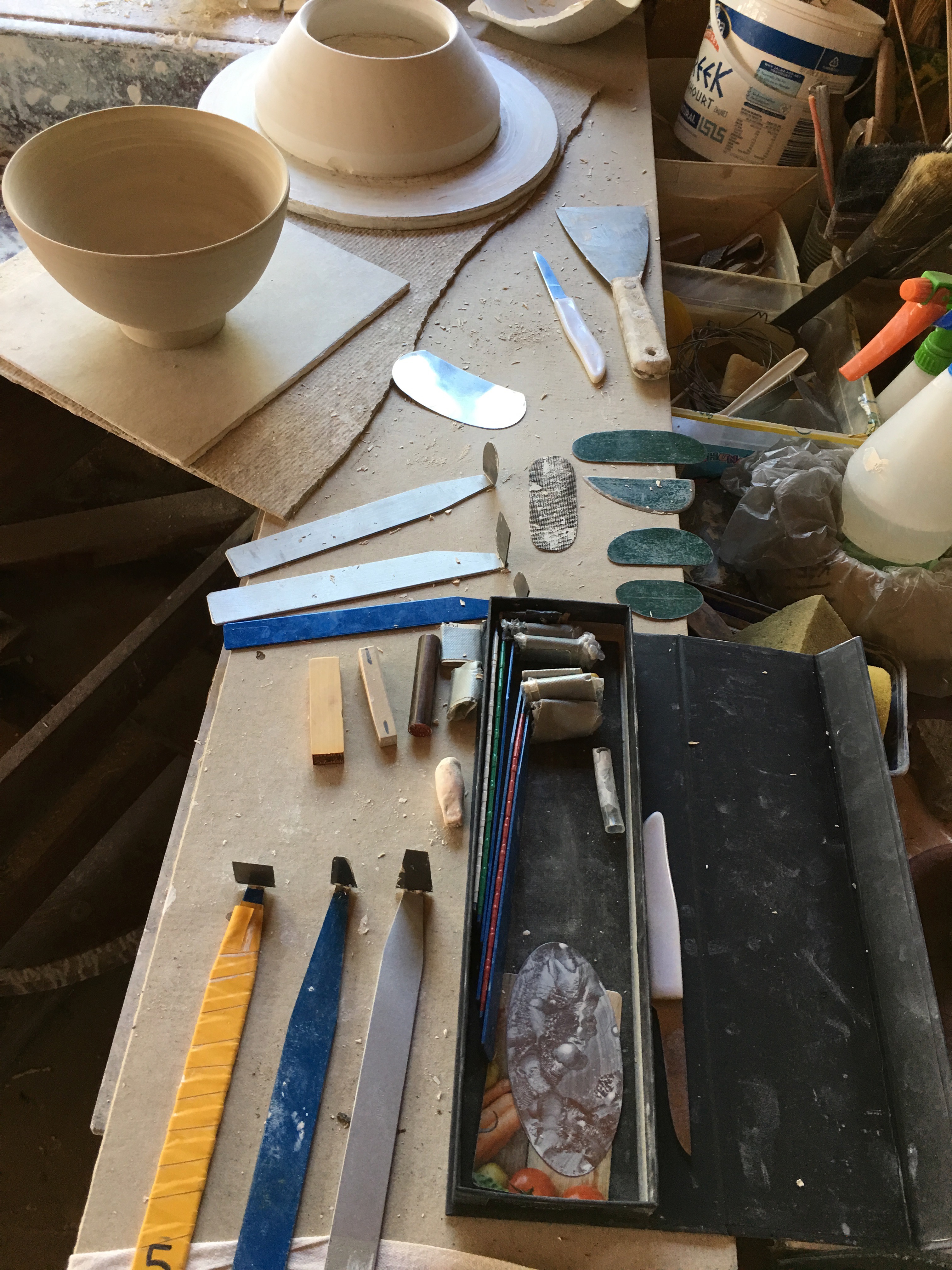
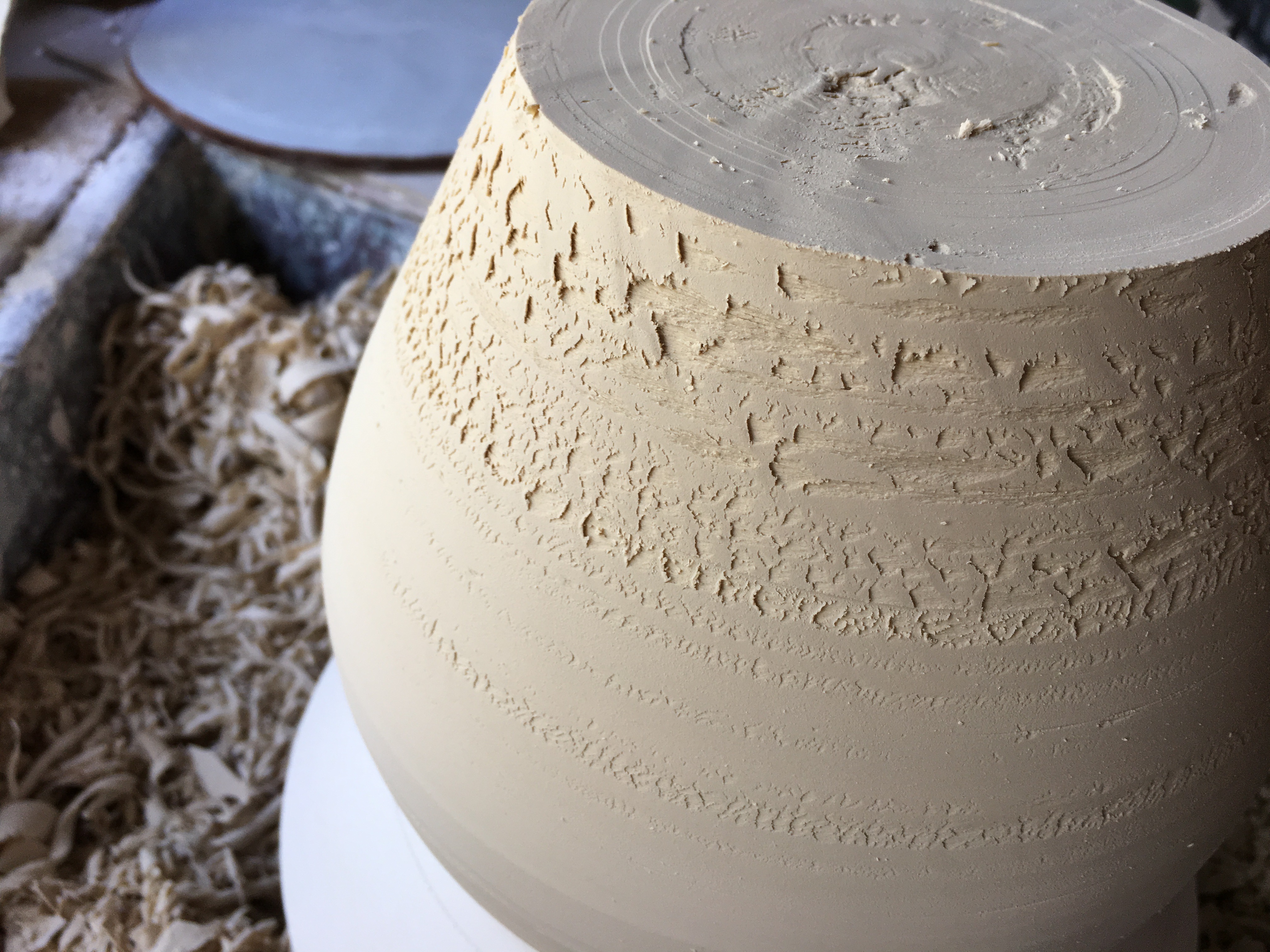
Two days later we are back in the same workshop to see the ‘turner’ at work. He has arrived now that the pots are firmed up to trim the bases. He works in tandem with the ‘thrower’, following on behind him with a 2 day gap. They work together but never meet. Always separated by the drying period. The thrower has thrown 3/4 of a tonne of clay into these flower pots on this occasion. The turner guy has to trim them up into shape, removing the excess clay from the base and correcting the form if necessary around the rim and foot. He gets through 10 double-ended turning tools each day. Wearing them down to a level of bluntness where they no longer work efficiently enough and slow him down. He travels with a bag full of them.

I ask the turner guy through my friend and interpreter, Chen, how all this works out. The turner removes about a 1/4 of the weight of the pot. The bases are thick when thrown off the hump. The thrower doesn’t use a wire. It slows him down too much. He just twists the pot off the hump with a flick of his fingers, leaving a very thick base. The turner has to remove all of this. It takes the turner almost twice as long to turn the bases, as it takes the thrower to make the pot. However, the turner gets paid almost twice as much. The thrower gets 1.5 rmb. per pot. That’s 30 cents. The turner gets 2.5 rmb per pot. That’s 50 cents. The turner will be here for almost 2 days to clear the shelves.

It works out that these highly skilled guys are earning about Au$200 each day. That’s really good money in China. But their job-life expectancy is very low. They burn out fast. I ask politely through Chen, how long will he be doing this? 10 years is enough. It’s far too boring to do it for very long! What will he do next? He is saving money to start his own business. This is only a means to an end. A better future awaits him somewhere.

I ask what he does at night i.e. does he have a hobby or other interests? No! He just watches television while he sharpens all his blunt tools ready for the next day. I ask why he doesn’t use tungsten tipped tools? He replies that he doesn’t understand the question. After some probing, it transpires that he hasn’t even heard of such a thing. Everyone here uses these cheap, locally made, mild steel, black-smithed turning tools. They are cheap and readily available and easily sharpened with a hand file. They also go blunt very fast. He is used to spending a few hours each night filing them sharp.

IMG_5261
IMG_5265


I notice that he uses a rubber glove and the cut-off fingers of a rubber glove on the other hand to stop the abrasion of the clay from wearing out the skin on his hands, just the same as I do. However, I only use the rubber finger stall on one finger

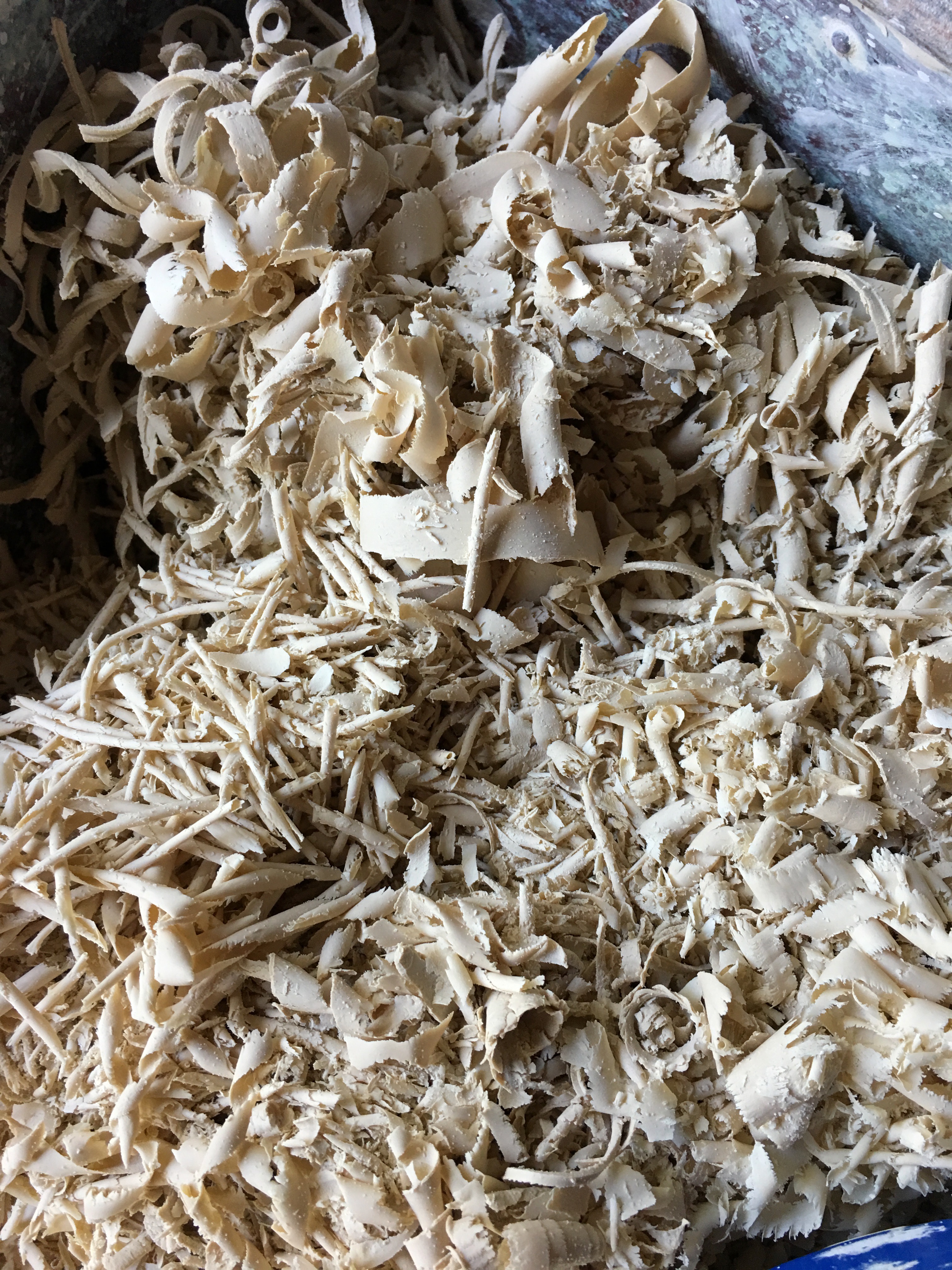
I ask him what he thinks about all the dry clay dust floating off the turnings. Why isn’t he wearing a mask? He is generating a small mountain of dust all around himself. I can’t even see the wheel, as all the turnings are piled up and flowing down and away in a cascade of dust. He doesn’t understand this question either. I explain, through Chen, that clay dust causes lung disease if inhaled over a long period of time. He replies that he has never heard of this theory. Neither has Chen. I leave it there. I have sown the seed.

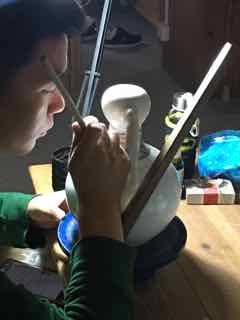
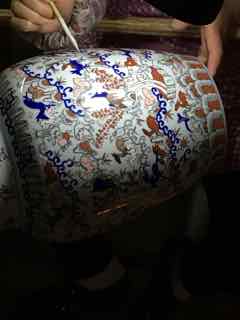
When these pots are bone dry the glazer will turn up and spray the glaze on them. That will take a couple of days. Finally they will be passed on to the decorating girl. She seems to work 7 days a week and hand paints each one. She does about 100 per day. It’s a never ending job. The thrower will be back next week, as soon as the shelves are emptied. This team seem to keep half a dozen potteries busy.

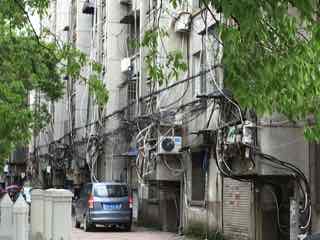
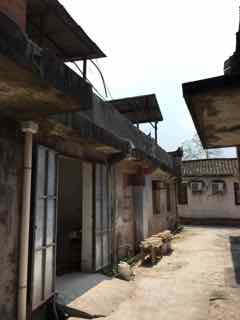
On the way home I can’t help but photograph the amazing wiring that is in use here. As the holder of a limited electrical licence, I’m quite in awe. I love the dual function of clothes line and high voltage wiring.

IMG_5586
IMG_5585
IMG_5602
IMG_5295

China is an amazing place. I’ve been thinking about these amazing potter specialists here. As I place my own few pots out in the laneway, in the sun to dry. I’m thinking, one pot every 45 seconds! I reflect that I have been here for 2 weeks and so far only managed to make forty-five pots that are second grade. That’s 45  2nds! I live in hope.

From the Jaded Economy to the Jade Empire

I’m safely returned from my most recent sojourn in China. I was there to experience the amazing porcelain stone that they have there. This is an amazing rock! When milled up into a fine paste and wetted down. It releases its clay and mica content into solution in a water suspended state. This ‘slip’ can then be processed into clay body as we know it. These days, this slip is stiffened up to plastic form in a filter press and then pugged and bagged. But it was only 12 years ago when I was here that I saw it being pounded and crushed by water driven wooden hammers, then blunged by hand and stiffened on drying beds. Things have changed a lot in a decade. Everything is mechanised now.

The finest grade of white translucent porcelain is now the best that it has ever been. I was able to spend a few weeks throwing and turning this remarkable ultra fine, extra white, clay body called Gao Bai Neantu. This clay is now so good, it’s a real eye opener. Twelve years ago, this mica-based, clay-like, material was good, but difficult to work with. Now the plasticity is so much better, while the degree of fine cracks is much lower. I’ve been lucky enough to see and experience it go through all of these amazing changes and improvements on my various visits over that time.
However, the same can’t be said for the air quality. The pollution is still just as bad as it has ever been, with some days when the visibility was down it just a couple of kilometres, the sun came up all orange and we are not in a big city, but out in the country side. I found it difficult to breath on a couple of days and was constantly coughing.
IMG_5103 (1)  IMG_5109 (1)
We get to watch a bloke who throws 700 pots a day. And he does it without getting any clay on himself. He wears plastic shopping bags tired around his shoes, ad the design of the potters wheel means that his feet are in the slops tray. Otherwise he is immaculate. We time him at 45 seconds per pot. It’s not really believable unless you see it happen in front of you. We saw him at 5.00 pm. at the end of his day, when he was tired and at this slowest and wearing whatever splashes of clay had landed on him throughout his busy day! Which was none!
IMG_5183 (1) IMG_5185 (1)
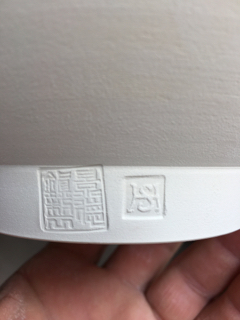
I stamp my work made here with the ‘Made in Jingdezhen’ workshop stamp. I’m renting studio space in the ‘Fragrant Garden Studio’. Everyone is so very helpful and accomodating. Its an amazing experience. I’m a lucky man.
IMG_5455 (1)
Among other things that I accomplish while I’m here, collecting samples of porcelain stone and visiting clay makers and processing sites. I get to make 45 or so porcelain bowls. 12 of which make it to a first class finish from the stoneware kiln. I stash them into my back pack, wrapped in bubble wrap and carry them as carry-on luggage.
I’m here representing the old ‘running dogs’ of capitalism. but I find that the young puppies of Communist inspired capitalism are no longer penned in and are now set free. Everyone is busy and hoping to get rich. There is so much energy here and so much enthusiasm. I can’t see anything stopping them. The puppies are out. They are inquisitive and they are starting to wander. Meet the new running dogs.
 IMG_5615 (1) IMG_5431 (1)
Amazingly, on the return trip. I get allocated a seat on the plane in the middle row of 4. where I am the only passenger. I get to sleep laying down across all 4 seats all night!
I said that I was lucky!
It helps that I was the very last person to book onto the flight, really late, just before they closed the gate. I get there with just 9 minutes to spare. I’m left with 3 spare seats beside me.
IMG_5675 (1)


Best wishes from the tired old bitch of capitalism, fat, bloated and complacent, snuggled up by the fire and giving the occasional half-hearted bark at the passing new running dogs.

Porcelain, blah, blah, blah!

Not all porcelain is white.

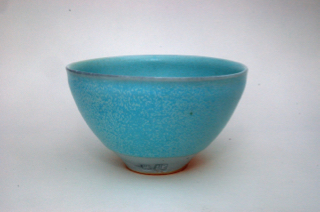
The countryside around Mittagong is one of the few places where native porcelain stone occurs. 15 years ago, I discovered porcelain stone and it has enabled me to develop my wood fired porcelain and proto-porcelains made from this native rock. They aren’t the most translucent or the whitest of porcelains. But they are mine. I’m not pretending that just because I dig the stuff up, it makes for good pots. Good pots are made by good potters, by skill, judgement, intuition and innate ability, coupled with loads of practice. The ‘stuff’ doesn’t necessarily come into it. I’m not a good potter, but I enjoy what I do, and sometimes I think that I’m getting better, as some of my pots turn out to be quite lovely. But only some. There is still a lot of luck involved.

During the development of this work it became obvious to me that if I wanted this ground-up rock to have any sort of plasticity. It would need to be aged for several years. I set about doing this in ernest, over a decade ago.

This work is my attempt to produce a local product. Something that has all-but disappeared from Australian and other first-world economies in recent years. This work, with all its limitations and faults, and all its local character, can be described using the French word, ‘terroir’ that expresses some of this unique quality of ‘locality’.

The search for a personal aesthetic based on the essence of my locality and life experience is also the search for the essence of the potter. This is such an unpopular and old-fashioned concept, but I believe that this work grows out of the fact that I have lived and worked here for over 40 years. I’ve walked a lot of this country. I’m assuming that this is not an issue for most other potters, but it is for me. I exist and work, intimately connected to this place where I live.

I am a ceramic lacavore, I have chosen to limit myself to the 50 km palette of materials. I grow a lot of my own wood. I make the fire bricks for my kiln by hand, from local refractory white bauxite. My glazes are made from the porcelain stone or other local igneous rocks, shales, gravels and ashes, all crushed, processed and milled in my workshop inefficiently, in small batches often by hand, in a workshop built by my partner Janine and myself from mud bricks that we made from local clay. We also grow all our own green food in our extensive vegetable gardens and orchards.

It couldn’t be more wholesome, corny, or sickeningly idyllic. Homespun, organic and self-reliant as it all is, it is not for everyone, in fact, it’s most likely not for anyone these days. The sixties are over! But it suits me, someone who still believes in romance, passion and ideals. I’m firmly rooted in the  truth, i.e. (pre)post-truth era!

Many potters these days love to use the international, trans-global, ultra-white, concoctions of porcelains. These ‘international roast’ of clay bodies. They are very good! So white! But a lot of the work starts to look a bit the same for it. One local show of porcelain was apparently described as just so much ‘blah, blah, blah!’ recently, I wasn’t there, but I think that I know what one of those ‘blah’s might mean. One gallery director said that any work that values the material that it is made from or the method of its making can never be considered as Art.

Fair enough, I call myself ‘potter’, not artist, just a person revelling in the innate qualities of my own unique, wood fired, local porcelain stone. The wood firing draws out some unusual and interesting surfaces, not normally identified as those of porcelain. So what is porcelain anyway? Seeing that it is concerned with material ‘stuff’, it can’t be Art. The Orientals would have us think that it is all about the sound, what one hears when a porcelain bowl is struck. So, therefore its all about glaze fit. I don’t mind a bit of crazing, in fact I quite like it. So my work doesn’t always ‘ring’. One definition involves light shining through the thin sections. So that’s translucency. However, most people would think of the supreme whiteness, but porcelain isn’t always white, mine certainly isn’t. My pots don’t always ring and they don’t always show light through either. So my work only contains a bit of ‘blah’! Maybe it’s not porcelain?

I’ve come to the conclusion that I don’t really know what defines porcelain. What I do know is, that whatever it is that I’m crafting here in my pottery through old fashioned techniques and lots of attention to detail, but mostly a lot of time. It ends up having some lovely qualities that I can’t seem to achieve any other way.

It’s mine, it’s local, it’s ethically sourced, it’s low carbon, it’s pretty much unique to here and I love it. Blah, blah, blah, blah, blah!

What else do I need to know?
DSC_0006 copy (1) DSC_0038_01 copy 2 (1)

DSC_0048 copy 2 (1) DSC_0056_01 copy (1)

Environmental fellowship

We have had a Danish potter staying with us for the past month. He won the Environmental Ceramics Fellowship for for 2016, but for both of us it was just too difficult to complete it last year, so we postponed to this year.

He is a potter from Denmark who is interested in sustainability and new ways of exploring how to make a living in this new digital age. He has his own web presence in Denmark where he markets Potters wheels, kilns and clay bodies, as well as making his own work. He is a digital native. Whereas, I am, on the other hand, a dig-it-all-native. Making everything myself from the ground up – and that is what he is here to learn.

We crushed porcelain stone in the big jaw crusher to make single-stone porcelain body. We made clay tests to investigate unknown clays. We worked in the gardens and orchards. Ate all our own produce. Cooked up some wonderful meals. Lauge is a great cook, so that helped. We went on a geology excursion to look at some of the local stone deposits. Harvested the shiraz grape crop and made dark grape juice from the grapes.

IMG_4683 IMG_4684.jpg

All in all, the month flew by and it all went too fast, leaving so many things un-explored. A month just isn’t enough time to experience everything that we do here.

Janine and I are planning to do some volunteer aid work overseas soon. So we are working towards this by making clay tests out of the local clay that has been posted over to us to process. Our Guest lends a hand in everything that we do.

IMG_4764  IMG_4766

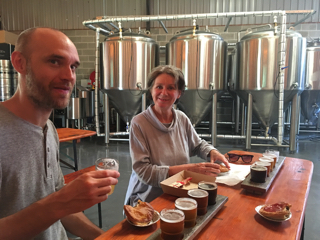
We decide to go exploring and looking at a few rocks for making glazes. Then, to complete the true ‘Australian’ experience, we take him to the local micro-brewery and have a meat pie with tomato sauce, accompanied by a tray of the brewery’s sample beers for lunch. Fantastic! I haven’t eaten a meat pie since I was a kid, so it was an experience for me too!

 IMG_5065 (1)IMG_5068

IMG_5006 (1)

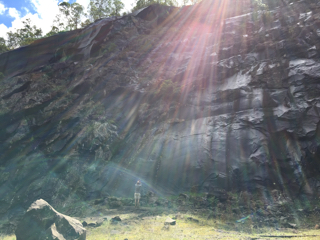
You have to look closely at the image of the analcime basanite deposit above to focus on the small figure in the foreground.

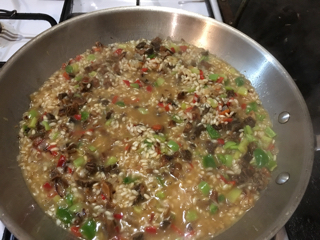
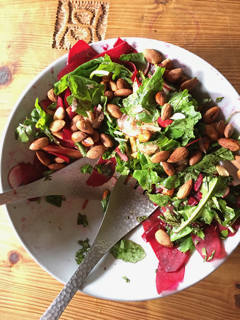
We cook and eat what is in season in the garden this autumn equinox. An autumn garden risotto, a fresh garden salad of shaved beetroot, cucumber, raddish, quince. Served with wasabi rocket, lettuce, beetroot tops, chilli and crunchy pan-roasted almonds.

IMG_4977 (1) IMG_5076

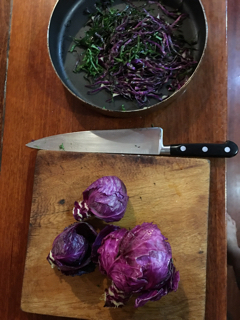
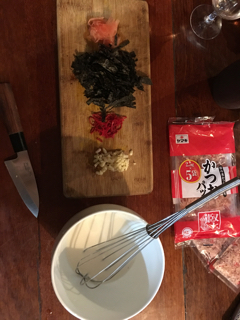
We also make an alternate version of okonomiaki, using some very firm, third pick, red cabbage, our own home grown eggs, garlic, chilli and shiso. Everything from the garden. Red cabbage is too slow to cook straight off as a cabbage pancake. So I pre-cook the cabbage to soften it down before I blend in the pancake mix and all the other ingredients. It’s not really a traditional Japanese okonomiaki. It’s an improvised Aussie OKA-nomiaka. Served with mayonnaise and Japanese okonomi sauce. Topped with bonito flakes and some Japanese pickled ginger.

IMG_5072 (1) IMG_5074 (1)

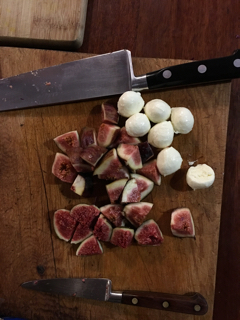
We finish the meal with fresh figs and soft white cheese. We do this desert a lot at this time of year while the figs are coming on. We try it with all manner of different soft cheeses. Boconcini isn’t the best, but you don’t know these things until you try them out. We’ve tried it with blue cheese, fetta and soft white goats cheese which was best.

IMG_5073

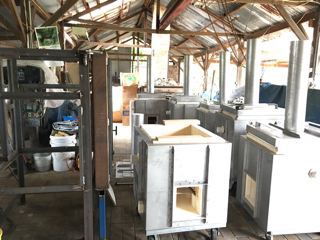
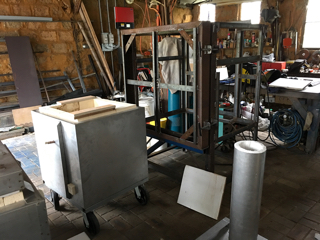
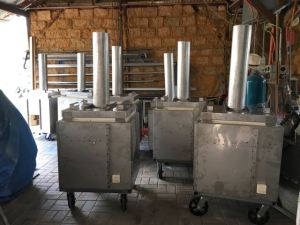
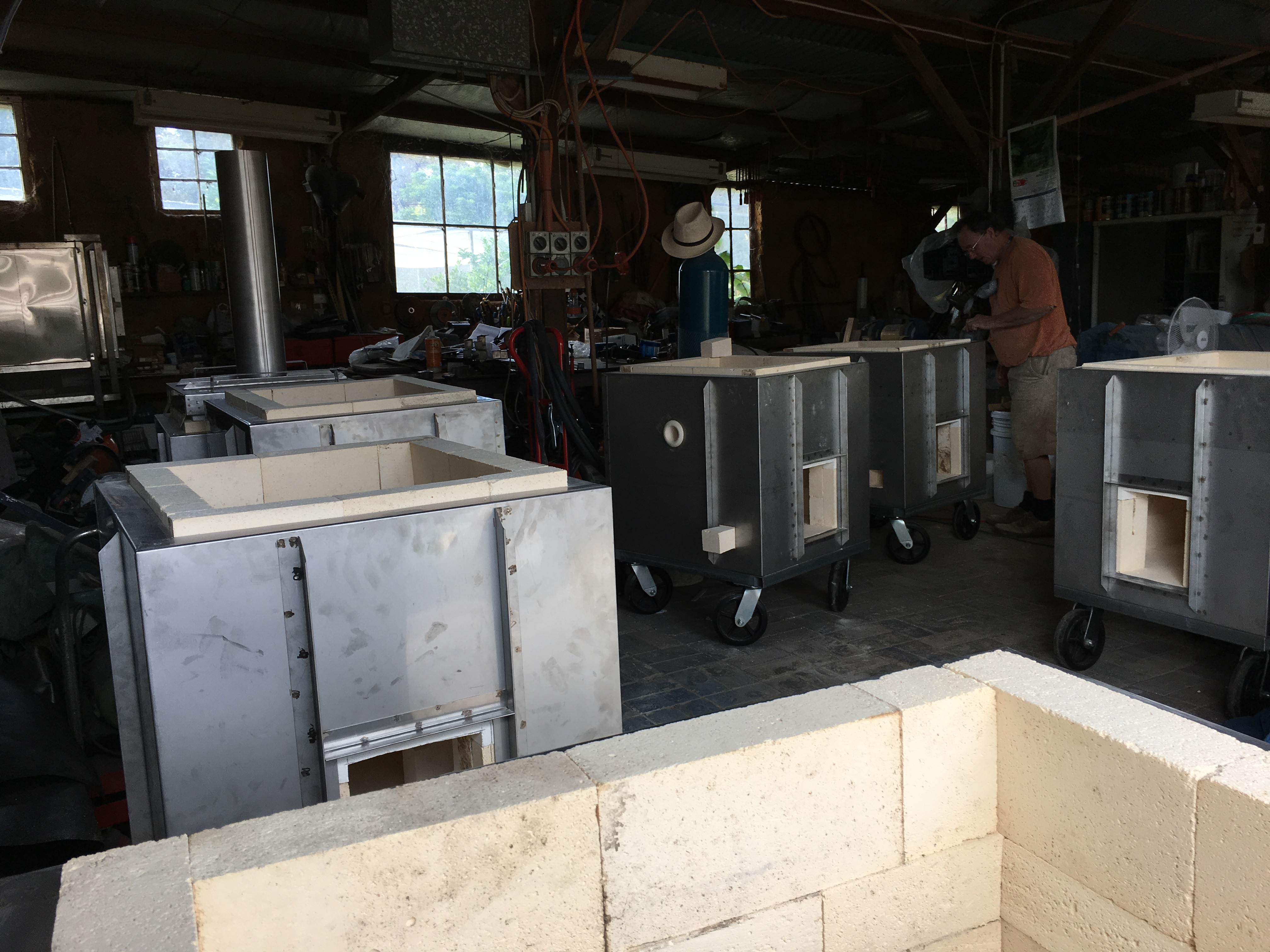
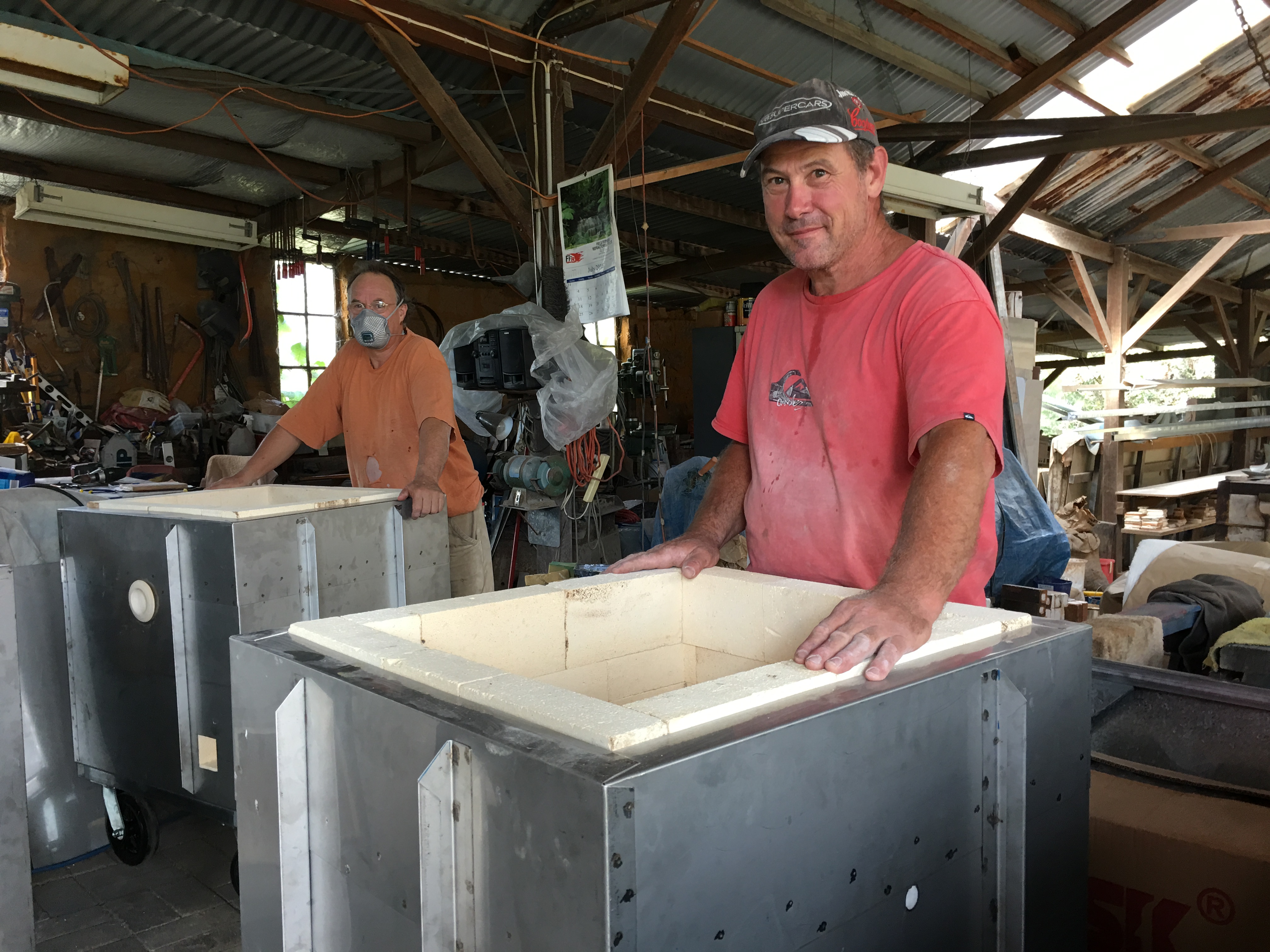
Lauge helps me finish off the internal fittings for the 8 little dalek kilns. These are now  almost all delivered, leaving space for me to start welding up my 2nd kiln job of the year. There is just enough room to get both jobs in the factory at the same time, but it takes a little bit of planning and maneuvering to get everything into the tight space.

Now the shed is almost empty, with the big new frame gone off to be galvanised and all the little ones gone to good homes:)

IMG_4999 (1) IMG_4998 (1)

IMG_4997 (1)

Writers Week

Janine and I managed to get all our work done and we spent last week at Writers Week. As always it was a thoroughly engaging time. So many great stories and discussions. 84 sessions to choose from, so many topics and so many books, so many writers. We find ourselves entertained, inspired, engaged, and challenged.

A thoroughly rewarding week out of the workshop and into the realm of ideas.

This year there was a lot of discussion about the death of the book, it cropped up again and again in different forms and forums, but that was the steady undercurrent this year. I’m not too worried. I believe that the book will survive in all its various forms for a long time to come. I’m sure that it will see me out.

I’m not digital native, so I still like to handle the thing in itself, to feel the weight, the smell and the texture of paper and ink. but then again, I’m very old-fashioned. I stubbornly insist on writing letters on nice paper with ink and a fountain pen. Sure its old-fashioned and out-dated, but so is making pots out of clay! Plastic replaced ceramics last century for all intents and purposes, but pots still persist as an art form and a better quality product. So that is how I see the book. Invoices have all graduated to electronic form, as have cheques and banking. Email has replaced most letters and fair enough. Electronic books are OK, but not for me. Not just yet anyway.

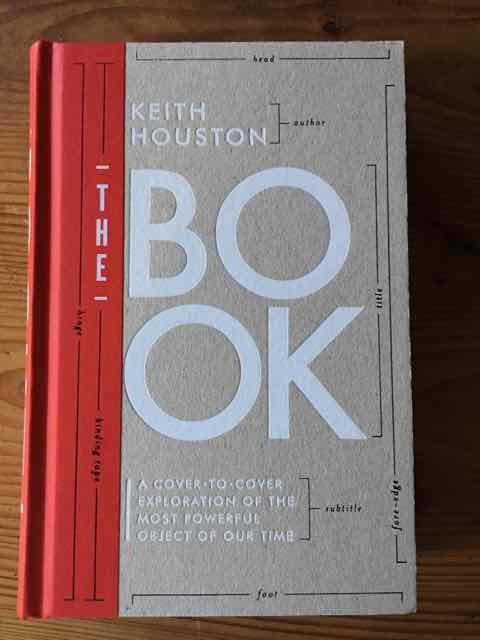
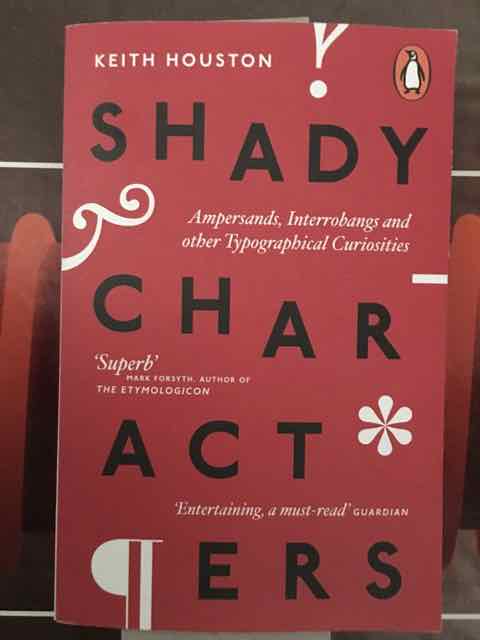
The book as an art form will persist for a very long time. I even attended a session on ‘The Book’. I even bought the book on ‘The Book’! and it’s a beautiful thing, as I also have his earlier book on some lesser known typographic characters.

IMG_4973 IMG_4974

You can just imagine the Sumerians saying,  “I don’t get these Egyptians, I can’t see papyrus catching on. I just love the smell of clay, and the texture and weight of a good clay tablet!

Exterminate! Exterminate!

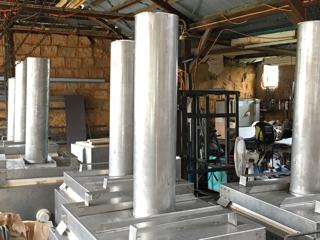
I walk down to the kiln factory and see a posse of Dalek like wood kilns all ready to surround me on their little wheels and steam punk chimneys. After all I am The Doctor!

My first job of the year is almost complete. These kilns are almost ready, just a few minor finishing touches and internal fit-out to do, then a sweep, clean and polish. I hope to have my tardis small sized workshop back to begin the next job.

img_4784  img_4788

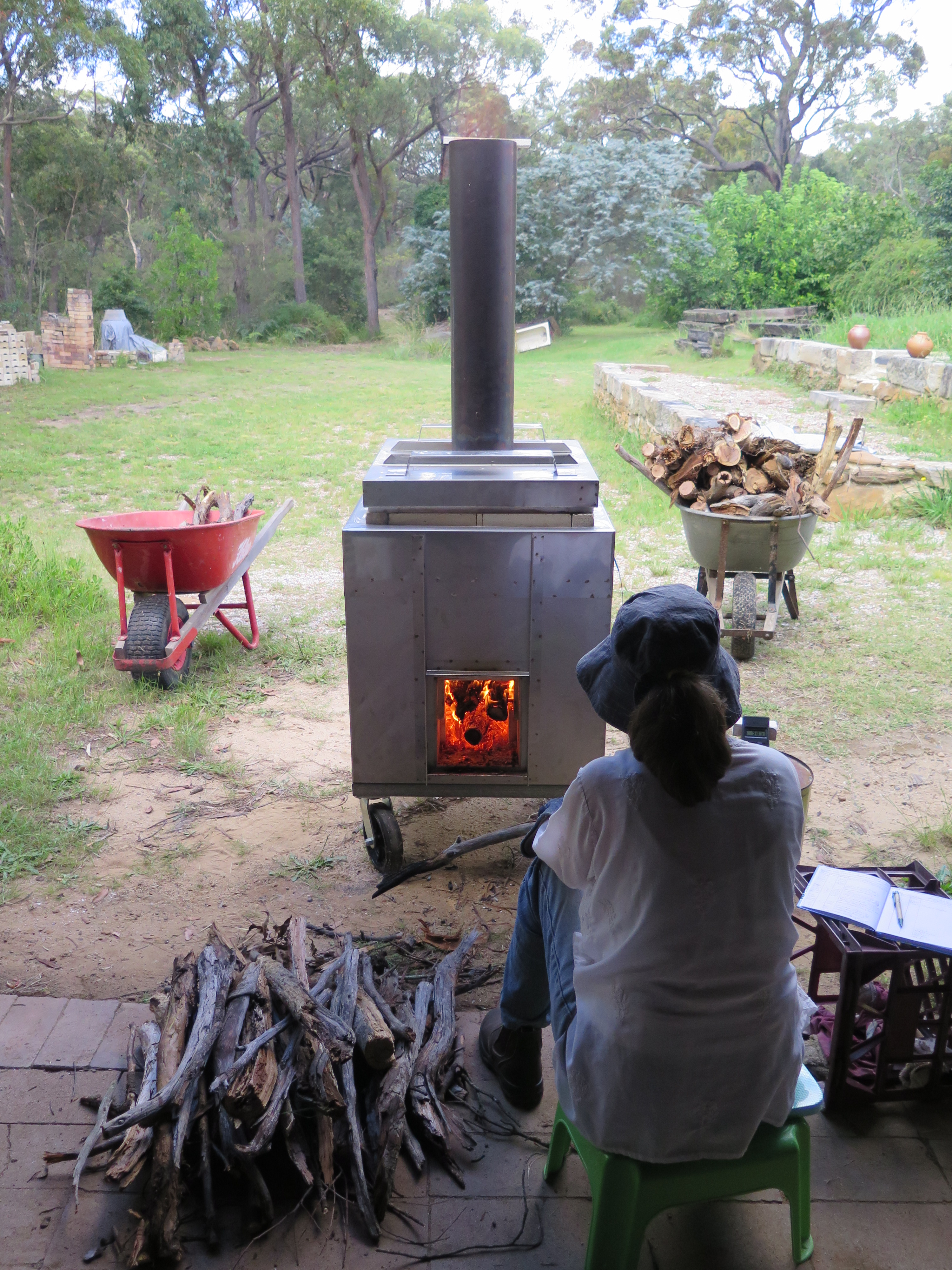
I have had one of my customers down to do the first firing of these new dual-fuel models. It went well. We fired to cone 10 down in 2 hours, with a temperature distribution of cone 8 to 10. All very good. We used 2/3 of a 9 kg BBQ bottle of gas. At $20 to $25 per bottle, depending on where you buy it. That’s a $16 firing to stoneware in reduction. I’m very happy with that.

A very nice little project

img_4809-1

The kiln works out to be 130 litres volume with gas and 90 litres in wood fired mode.

More Portable Woodfired Kilns – The Dual Fuel

I have been working on my portable wood fired kiln designs and tweaked it a little bit more. I am up to design variation No.9 now, and working on number 10.  I have designed a way to have these kilns fired by both wood or LP gas, but not at the same time! It’s a simple method of changing the setting so that it can work with either fuel, with just some minor adjustments.

My first kiln building job of this year is to make a number of these little kilns for customers who ordered them at the end of last year. So I’m starting the year running at full speed. For some unknown reason, my year has become booked out right at the start. 11 kilns booked in and deposits paid. My next available slot is in December!. This will be for delivery in Feb 2018! I can’t believe that I could be so booked out, almost a year in advance. It’s crazy.

I heard a lovely little story about a tiny company that makes hand made cars, called ‘Morgan’. They make a small number of individually hand made cars each year. A frustrated customer, when told that he would have to wait a year for delivery,  exclaimed “you don’t sell cars. You ration them!” It seems to be getting a bit that way with hand made kilns.

img_2223

My small factory space is completely full of these little gems. I must say that I’m really happy with the way that they are turning out. We have been using one of these little kilns ourselves all last year and it works a treat, firing to stoneware in reduction in just 3 1/2 hrs. and using just a wheel barrow full of wood to do it.

img_4752 img_4742

I have so much work to get through that I get my very good friend and righthand man, Warren, to come down and give me a hand for a few days. Warren is an amazing person. He can do almost anything, and he does it really well. So many fantastic skills. We laugh a lot and get so much work done. It’s alway great to have Warren helping me.

Between a Rock and a Hard Paste

We have been sweltering here in 40 oC heat for a couple of weeks now. We were very fortunate to be blessed with 3 days of rain in the middle. It saved a lot of our plants from just shrivelling up. Fortunately, we don’t have any bush fires near here this time. However, I did start up the fire fighting water pump and sprayed water through the sprinkler system that I have installed on all the building here, in this case, on the pottery tin roof. I used it on the worst couple of days, to cool it down a little. It is good to run the pump every now and again to keep it in good working condition and cycle the fuel through the carburettor to make sure that it doesn’t ‘gum’ up.

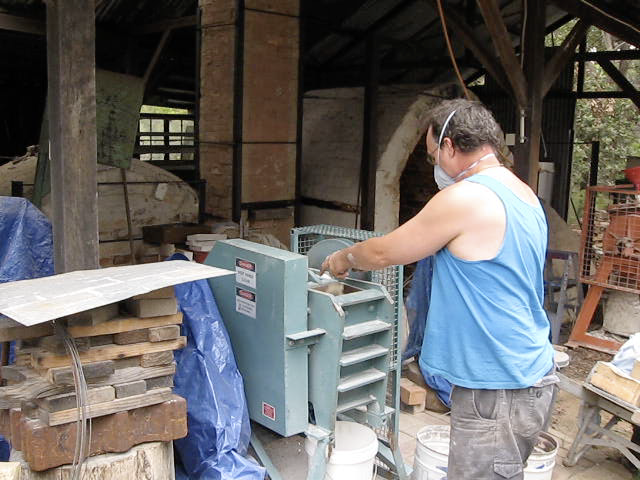
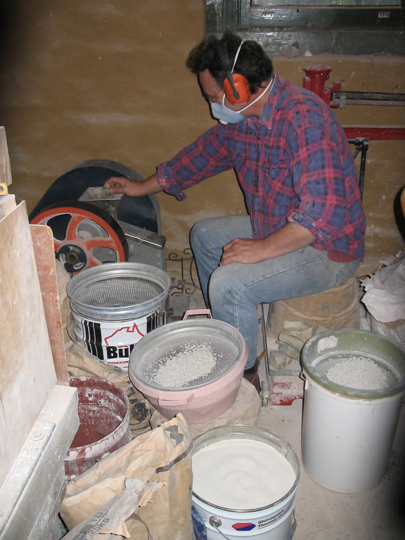
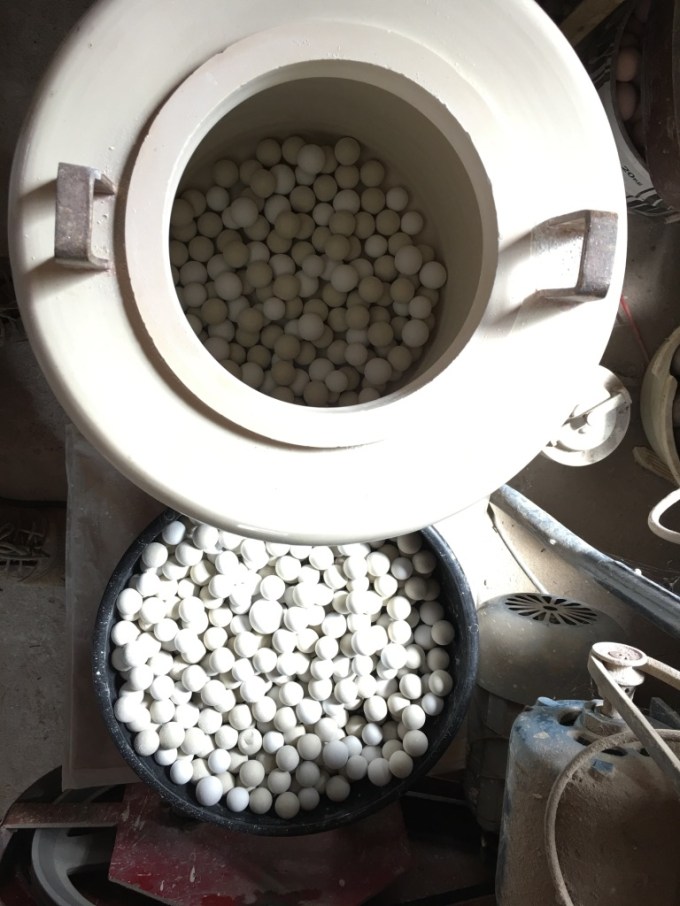
I’ve been making use of the hot weather to crush and grind my collected porcelain stones. They have to be put through the big jaw crusher first, then the small crusher, then sieved to remove any over sized pieces and these are put back through the crusher again. Once it’s all of a suitable size, it goes into the ball mill to be ground down to a very fine paste.

pastedgraphic-4 pastedgraphic-3

unadjustednonraw_thumb_2b3a

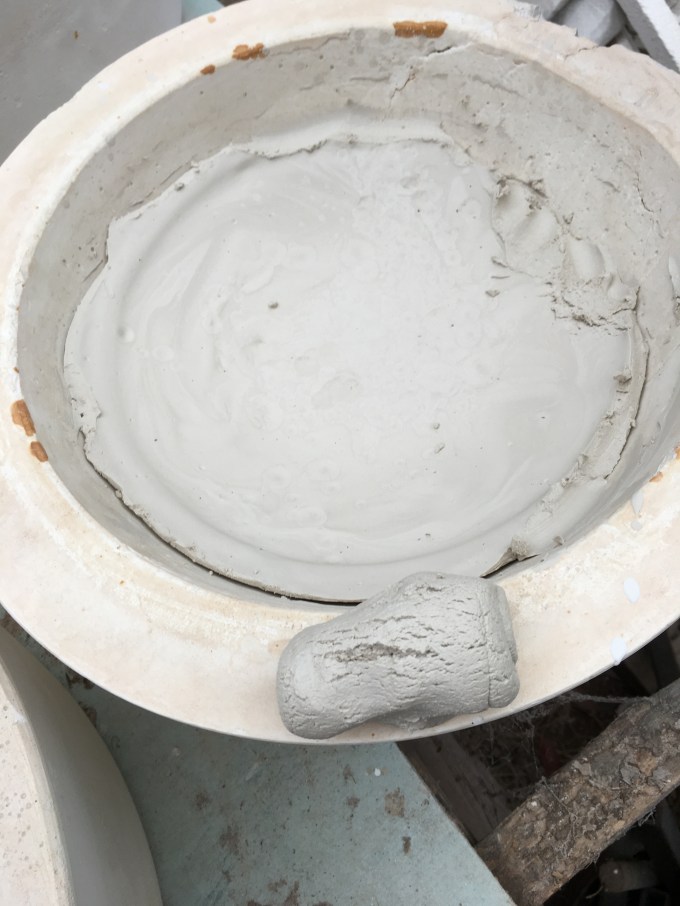
Once it’s out of the mill. I let it settle and flocculate for a few days and then remove any excess water from the top and it goes into a plaster basin to dry out until it is firm – sort of plastic. Except that it never really gets to be fully plastic. This is because it is just ground up rock dust and not clay. It does have a very small percentage of clay in the stone due to weathering of the minerals, but it is not a lot. It really takes years for this stuff to become workable in any normal sense of the word as potters might understand it.

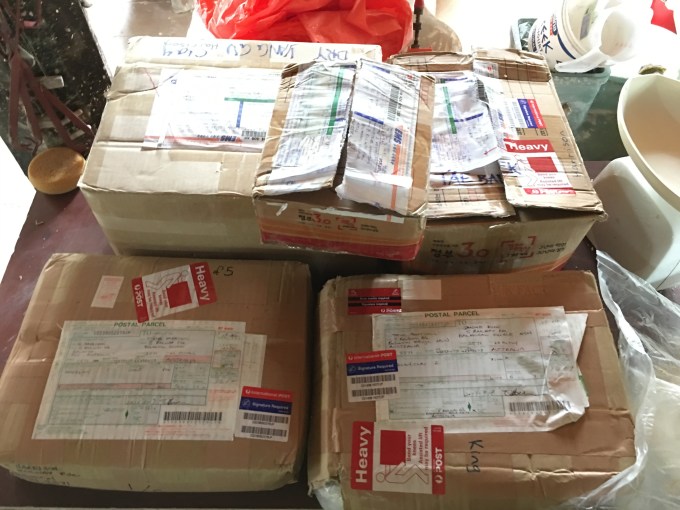
If I were making bulk clay for stock, I’d be using the big ball mill and pour out the slip onto the drying bed on filter cloth. Once firm, I’d lay it down for several years in a cool dark place, but I don’t have that luxury on this occasion. I have posted these stones back from overseas on my recent trip. there are only just a few kilos of each sample, so the batches are quite small. Just enough to make a few pots out of each. I’d like to have more mineral to work with, but it costs about $100 to post a few kilos of stones back from places like Cornwall, Korea, China and Japan. So I have to work within my budget, as many countries have abandoned sea mail postage and the only option is now air mail. On one occasion, I was offered a cheaper option of ‘slow’ air mail. It made me wonder how the plane stayed up in the air if it was flying slowly?
img_4656 img_4657

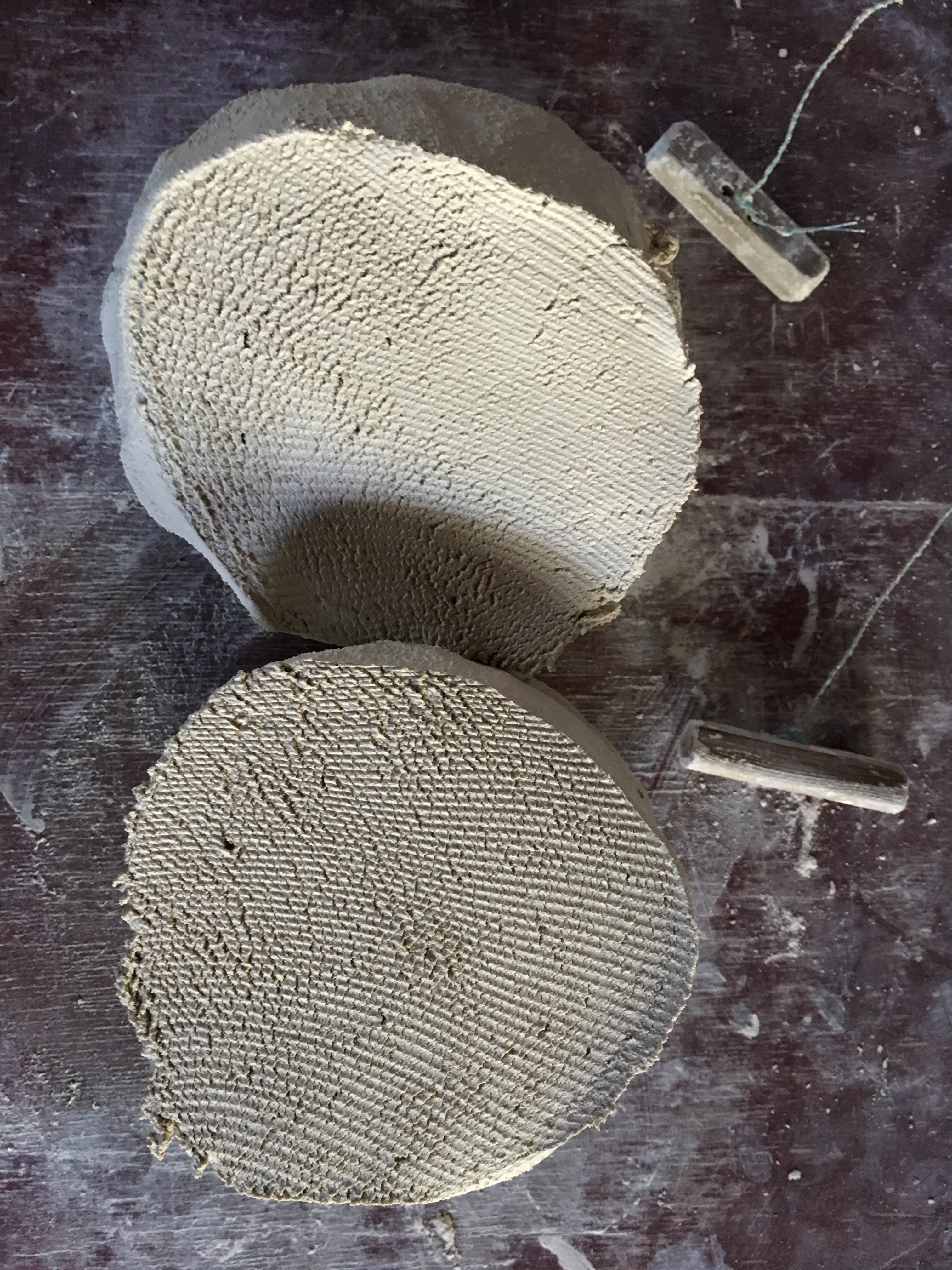
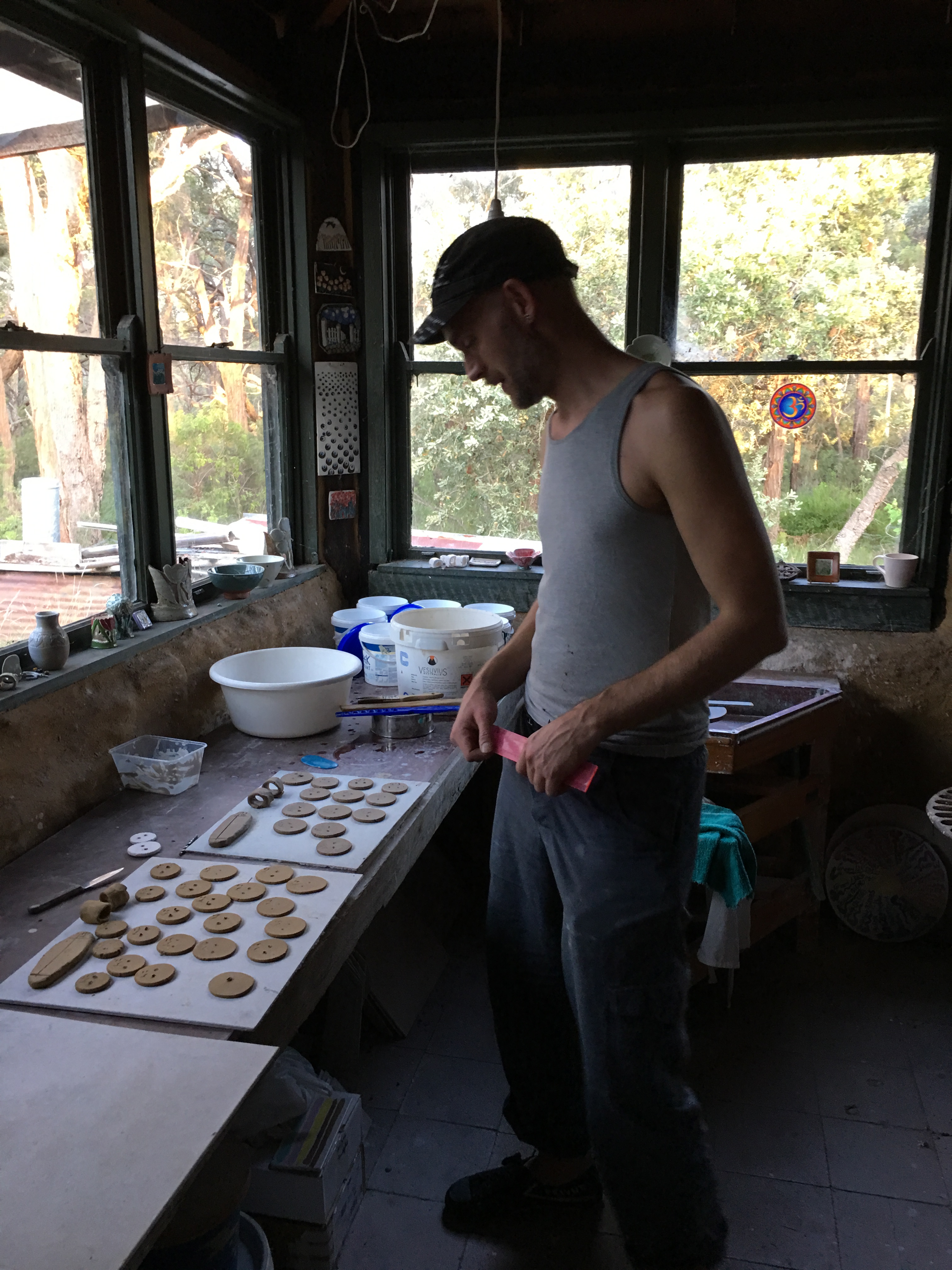
As these bodies are not aged, they respond to being worked something like ‘halva’! it just snaps if you bend it. It has to be coaxed along very slowly and gently, sort of seduced into changing shape.  I can’t even cut it in any normal way with a wire, it just tears! I can’t throw anything large out of this stuff, but I don’t need to. I only need a few excellent fired examples of the stuff to include in my exhibition at Watters Gallery in August, called ‘5 Stones’. This will be an exhibition of single-porcelain from all around the world, from the five places where single-stone porcelain was independently discovered and developed.

img_4662 img_4664
When it comes time to trim the shapes into some sort of elegant form. The paste just tears and chips, instead of turning off in fine strips. The pot has to be very firm and almost bone dry to turn to a fine finish. However, I do need to remove some of the bulk of the weight from the base to get it to dry without cracking, so some leather hard trimming is necessary, and what a mess it looks to begin with! But it does clean up OK when it is dryer. I do struggle with some of these rock-paste porcelain bodies. I’d be a much better potter if I could spend all my time working with this stuff, but I have to do other things, like building kilns, to make a living. No complaints! I have a wonderfully creative, independent life. I’m very lucky. But I do suffer from the feeling that I could always do better. Nothing is ever finished, nothing is perfect and nothing lasts! This is reality.
img_4660 img_4658
img_4661 img_4659
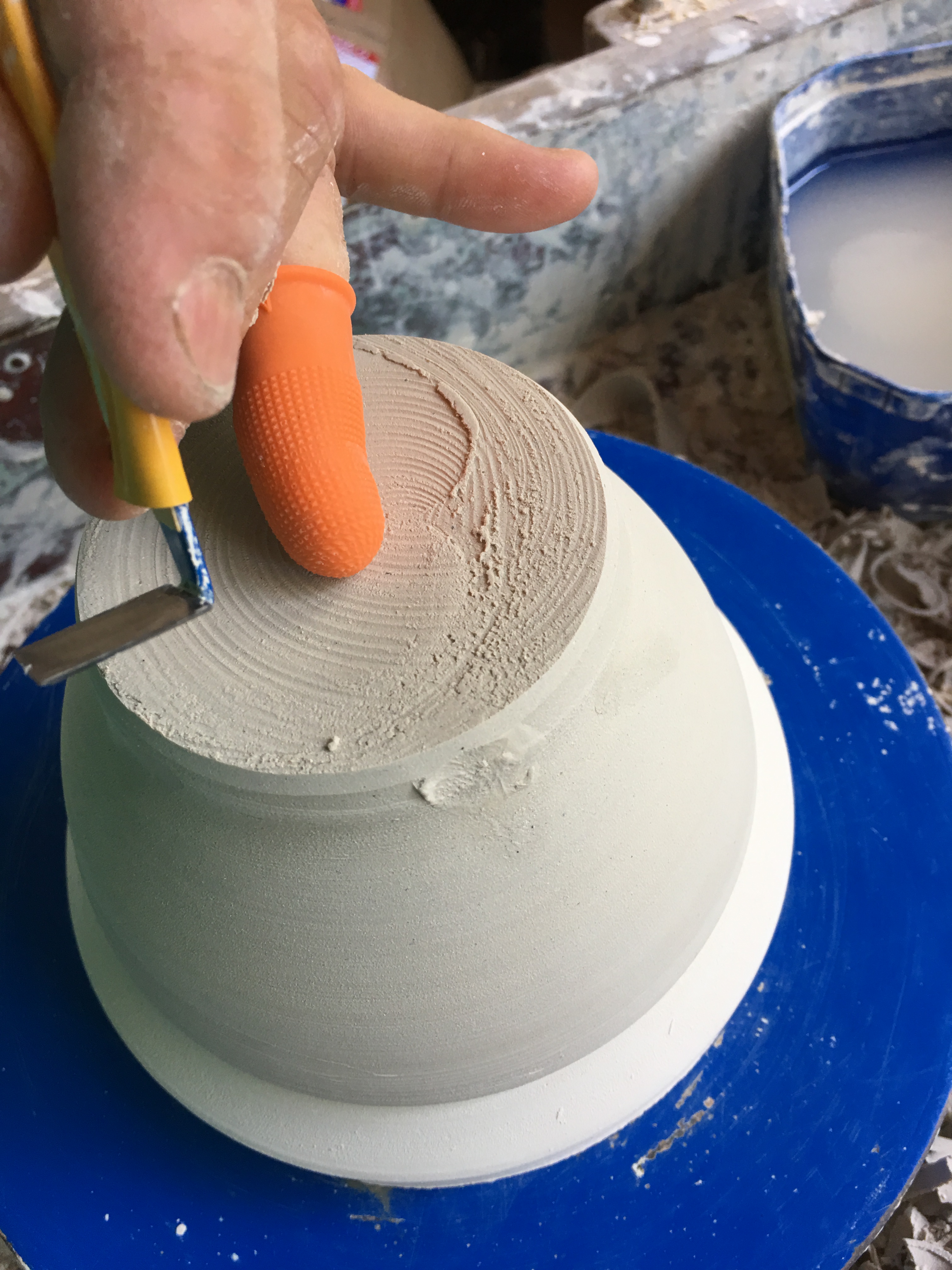
These dry rock dust bodies are so aggressive and abrasive, they make normal turning tools go blunt after just one pots is turned. I have to use tungsten carbide tipped tools to withstand the grinding effect on the cutting edge. The ‘clay’ is really just rock dust paste, so it is very abrasive to my fingers too! I have had to start wearing rubber finger stalls to protect my finger tips. Otherwise the ‘clay’ grinds off the skin from my fingers and they wear through and start to bleed.
img_4670
I’ve spent the past 15 years researching these places and going there, making contact with individuals and working in-situ, where that is still possible and also posting home the raw stones to be processed here in my workshop then fired in my kiln. This will produce a very different look and feel from the work made on-site.
I have written a book about my travels and porcelain experiences during this research. I have 90,000 words written, with just two more chapters left to write. It will be around 150/160 pages, in full colour, soft cover. I hope to have it for sale for under $50
It will be launched at the opening of my show at Watters Gallery in August.

Tomatoes and Stale Bread

We recently had a lot of people here for our house concert. After we cleared up the next day, we found that we had a lot of food left over. We found that we had a half loaf of Italian bread. We decided that we would have a lunch of tomato on toast.

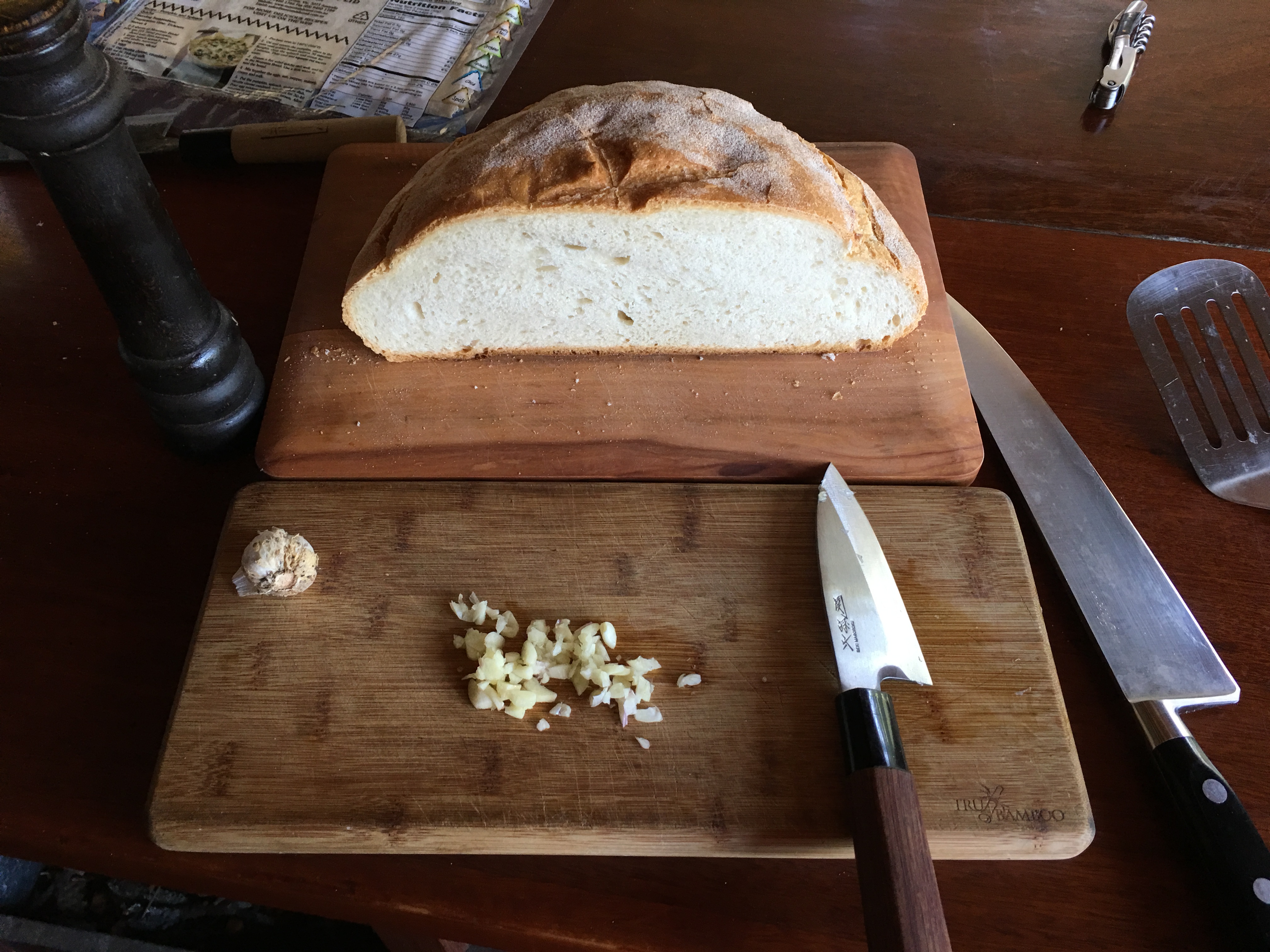
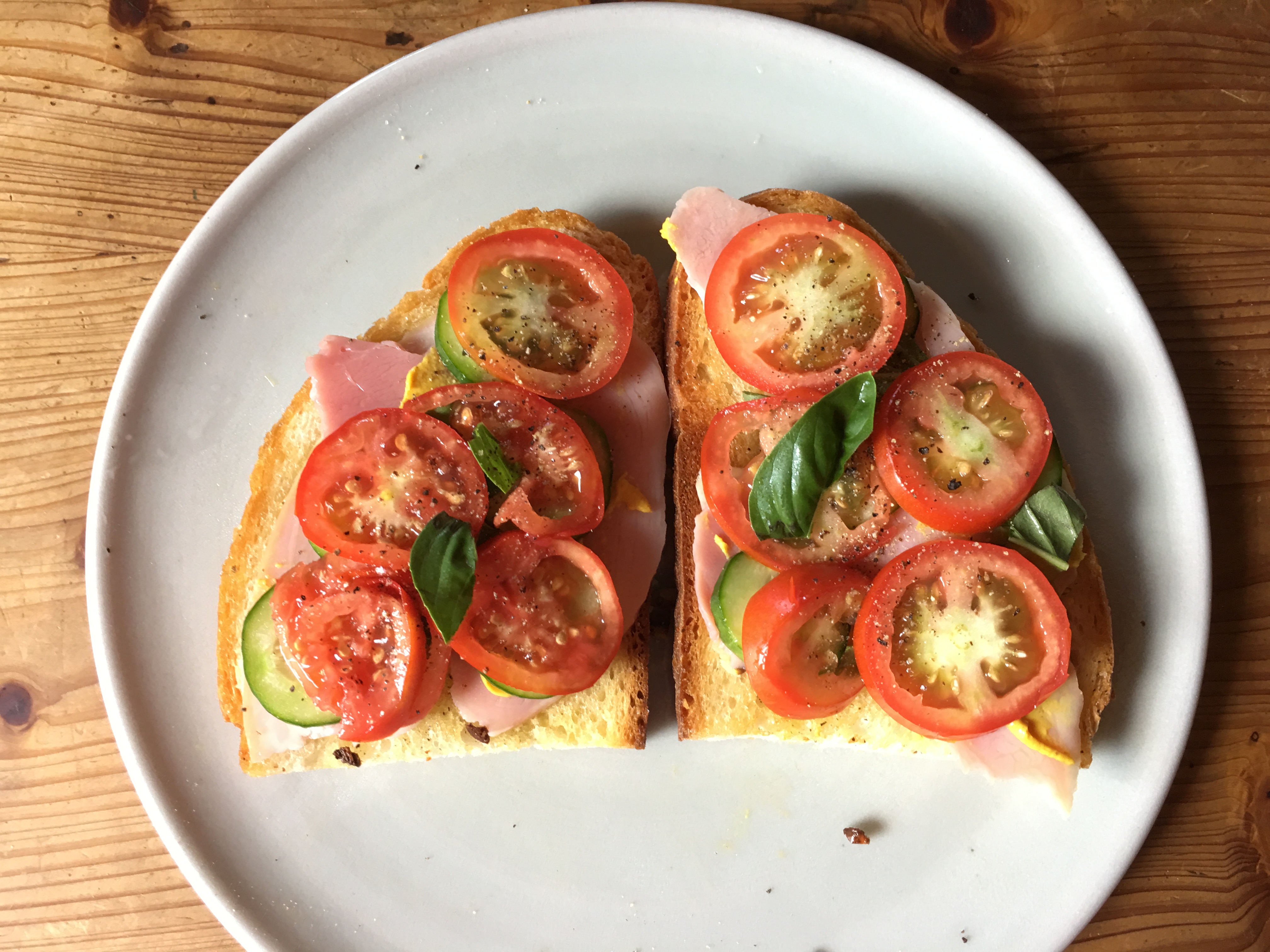
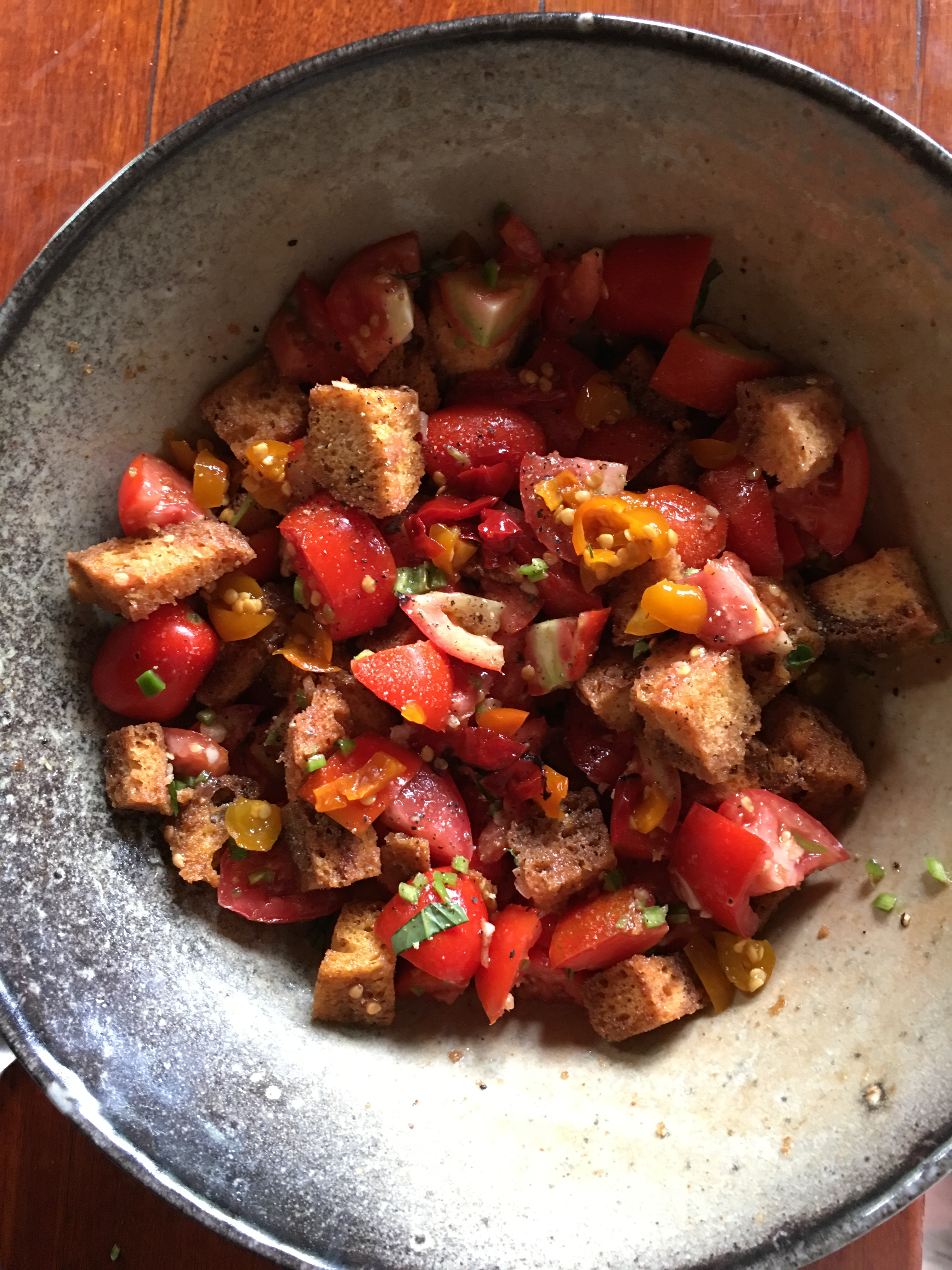
I pan fried the bread in a little olive oil with garlic and chilli. Then a slice of ham, sliced fresh, ripe garden warm tomatoes and cucumber, a few fresh torn basil leaves, plus a little fake salt and real pepper . WOW! delicious.

img_4558 img_4559

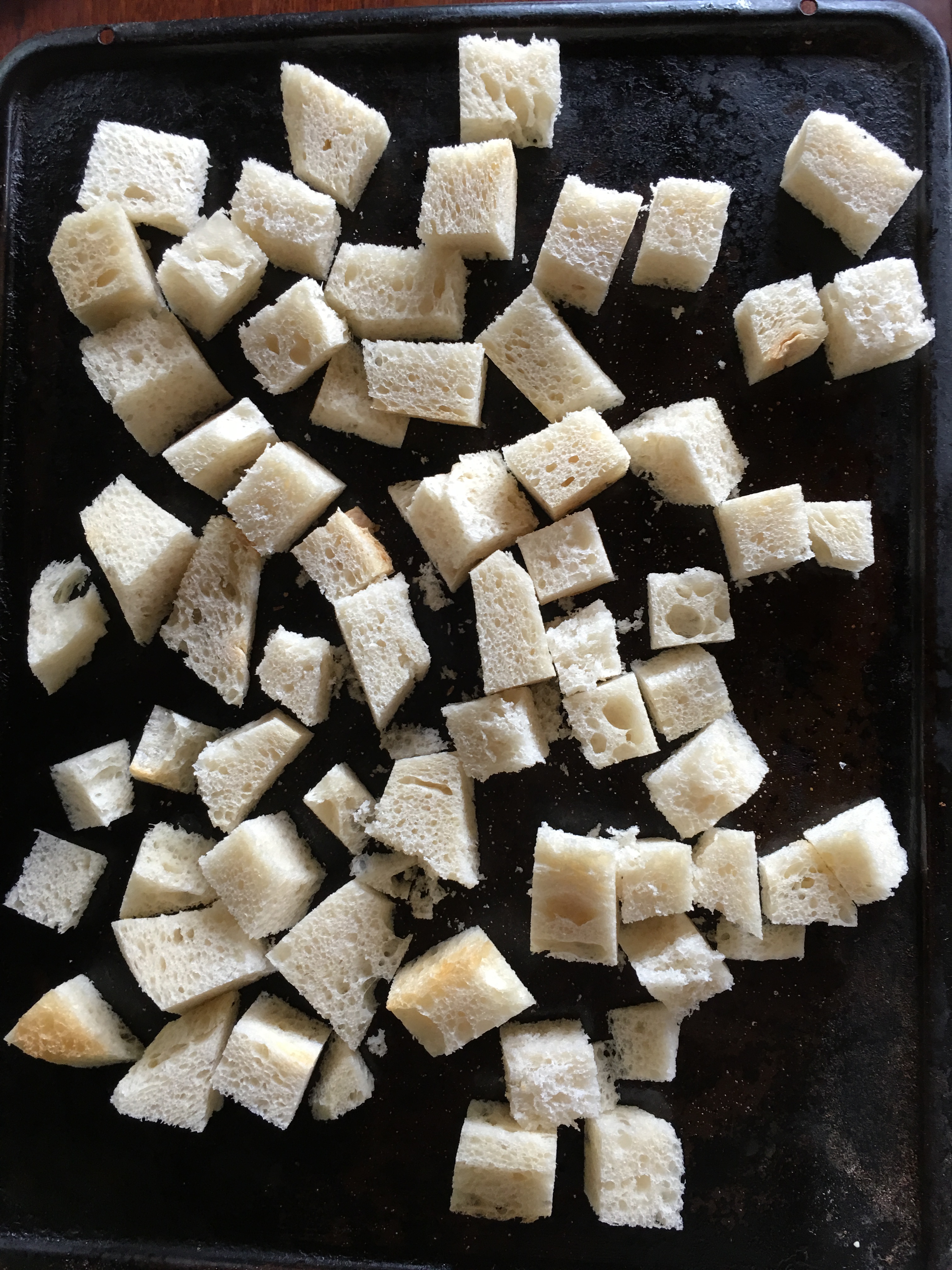
With what was left over, I cubed it and toasted it in the oven, so as to make a tomato and crouton salad. The roasted croutons were mixed with oil and balsamic vinegar dressing and then finely sliced red onions from the garden, with chilli, capsicum, and lastly big chunks of tomatoes. all tossed together with the seasoning s of your choice.

The croutons become softened on the outside with the tangy oil and vinegar, while remaining crunchy on the inside. This with the fresh fruity aromas of the herbs and tomatoes. It makes a great salad. So summery!

img_4577 img_4581

Platform Heal

We bought the old Balmoral Village Railway Station building to save it from demolition back in the 70’s. The local ‘Loopline’ train line had been closed to passenger trains and all passenger services were replaced by a bus service. The line was still open to the odd freight train, or it was used as an alternate line to the main line if there was a derailment on the main line, which actually happened in 1978.

For a whole day and night we got all the Sydney to Melbourne train traffic off the main line diverted along our old loopline tracks. We got to see the Sydney to Melbourne Inter-capital Daylight Express and the Southern Aurora rumbling along past our house at 20 kms hr. on our old, little used, light gauge tracks.

We live on this old and now closed line. It was originally the main line south for about 50 years. It came through here in about 1864 and was replaced by the new main line in about 1916. The old line through here is now just a ‘loop’ off the new line.

The original line was difficult for some of the older steam engines, as the gradient was very steep. Digging cuttings through the hard rock of these steep hills was time-consuming and expensive. There is an extremely deep cutting just up the road from here. I was told that it was the deepest railway cutting in the Southern Hemisphere when it was built. This cutting allows the line up through a difficult part of the terrain to the next village that was originally called ‘Big Hill’.

Our village was, at the time, a place to keep and maintain an extra steam engine. When the Sydney train arrived here. The spare locomotive was hitched on to the train and used to pull the carriages up this steepest part of the line. Even so, it was a very slow and difficult job to get the train up the big hill.

There is an old story, and I can’t vouch for its truth, about a bush ranger stepping up onto the very slow-moving train at the front and robbing everyone on the train as he walked down through the carriages, and then hopping off again, not too far from where he got on!

There were originally 7 stations along this part of the original train line, now the ‘loop’. We live right in the centre of the loopline. As we are half way between the two ends of the loop. It was decided that a School would be built at the half way point to service all the children of the track ‘fettlers’ and engine maintenance men that were stationed here.

The school was opened in 1893 and operated full-time until the line was relocated to the new route in 1919 and the population started to decline, as the railway men and their families slowly moved away. The school then operated as a part-time school for a few more years, and then closed. It reopened during the Second World War as a part time school, sharing a teacher between here and the now named village of Hill Top, higher up the line. The school closed permanently at the end of the war. The station remained open until the line was closed to passenger traffic.

Once the line was closed to passenger traffic and the bus service instigated. It was decided to tender all the stations along the line for demolition. The first station to be offered up to tender for demolition was Hill Top station, next door. We heard on the grape-vine, that the only bidder just wanted the tin off the roof to build a chook shed, so only offered $2, won the bid, took the iron off and burnt the building down to comply with the clause that stated “remove to ground level”.

When the Balmoral Village station came up for tender next, we were keen to see it preserved and not destroyed, so we bid the ridiculous price of $250 to make sure that we would win and could preserve it. $250 was about half the cost of the wood to build a new one. We won of course. No-one in their right mind would pay that much for what amounted to a little old wooden shed.  A very old wooden shed indeed. It is thought to have been installed in 1864 or there-abouts, when the line opened. Making it the oldest building in the village. We thought it worth saving.

We measured it up and built footings to suit, then hired a crane and low-loader. We picked it up and drove it home to the school in one piece. Then lifted it into place. It was the biggest job that I have ever attempted and it all went like clockwork. It turned out to be the least troublesome thing that I have done. However, I did spend a lot of time planning, preparing and choreographing it.

Once we realised that we now owned all (both) of the public buildings in the village and there is no water works to buy. We could put a motel on Pall Mall and charge all passers-by to pay $200 dollars to pass ‘GO’!

Instead, we decided to sand blast off all the old flaky paint when we sand blasted the old School classroom. We had hired all the equipment for the weekend and had some spare time and ‘shot’ left on the Sunday evening, so we cleaned it back. I bought undercoat and we made some top coat our selves. We bought a one gallon tin of pale yellow oil based gloss top coat, then added an equal amount of turps mixed with mica and talc dust 200# that we had in the pottery for making our glazes. This gave us 2 gallons of paint. This rock dust saturated oil paint is still as good as new today. No drying out or flaking off. The stone particles guarantee that there will be no UV penetration. The little weatherboard waiting room is still in good shape. Well the paint job is anyway.

Interestingly, we noticed that after we cleaned and painted the waiting room. The train line fettlers that passed along the line each few days, saw the station building in its new location and new clothes and waved to us and we waved back. They saw that we thought that the building had some historical merit and was worth saving and restoring.

After that no more stations were offered for demolition. All the others have now been restored and painted creamy yellow! Personal activism does work sometimes.

Well that was 40 years ago, and the poor old wooden sleepers on the platform have been weathering away. I have no idea how old they are. Not 153 years I shouldn’t think. I’m sure that they are not original. Perhaps they were replaced in the 60’s when there was a derailment at the station when a goods carriage came off the line and ploughed into the end of the station destroying the Ticket Office building. Perhaps the original sleepers on the platform were replaced when the platform was repaired?

They are sill in good shape where they are under cover of the verandah, but the exposed ends are rotting away. We have our wet weather clothes line under the verandah and Janine has stopped using it because she feels that it is too unsafe.

I take a day ‘off’ and go down to the timber yard and buy new ‘treated’ sleepers. I slowly remove each of the old sleepers a few at a time, and replace them with the new ones. It all goes pretty much to plane and is finished by the end of the day. However, I still have to put up the new guttering.

Everything goes to plan, except that I drop one of the old heavy hardwood sleepers on my recently damaged and recovering finger, which splits it open again.

No good turn ever goes un punished. I’ve healed the platform, I now have to wait for my hand to re-heal.

img_4508 img_4506

img_4510 img_4509