Low Temp Wood Firing Workshop

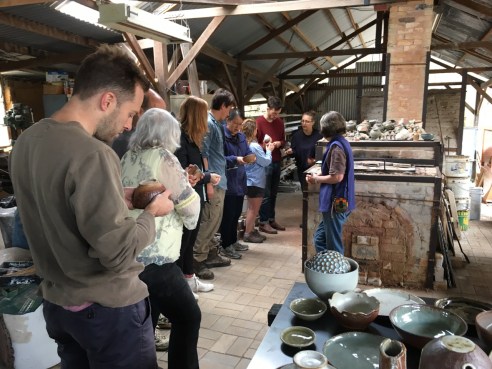
We have just completed our 4th wood firing workshop for the season. We still have 4 or 5 to go before spring, the hot weather and possible fire bans arrive.
 

We hosted 11 potters in our workshop for a low temperature ‘raku style’ firing day. We have re-arranged the order of the kilns for this event, placing all the small ‘Stefan Jakob’ style ‘IKEA’ Garbage can kilns up on the stone wall. In this way the potter doesn’t have to bend down to stoke the firebox, but instead, can sit in a more relaxed fashion in a chair while stoking the kiln. This is much easier for some of us of advancing years.


The larger and heavier brick lined portable kilns have to stay firmly on the ground where we can wheel then out for firing and then back again under cover for storage.

We were blessed with a beautiful day with no wind and beautiful sunshine – almost hot. Such a great day for an out door workshop. The week preceding had been dreadful with strong, icy southerly winds blowing off the snow.

Everyone seems to be happy and some excellent results are achieved. We are now about half way through our firing workshops for this year. 4 down and 6 to go.


Have Wheel, Will Barrow

Now that the wheel barrow is back up and running again, and I have some time again. I get around to planting the new avocado tree.

We have an avocado tree. We have had it growing in the yard between the cherry orchard and the hazel nut grove. It’s been growing well for the past 40 years and usually has a good crop of avocados each winter. We pick about half a dozen or so each week. It has to be done at least a week in advance of when you want to eat them, as they take 7 to 10 days to finish ripening up after picking.

IMG_7541 IMG_7545

IMG_7410

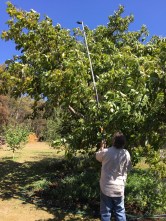
The tree has grown quite large over the years, so we now need a step-ladder and  extendable, long-handled, pruning secateurs to reach up to the top to get at them. We get out there, Janine underneath where we think that the fruit will land. I get up close to it with the long secateurs. When fully extended, this gadget gets to fruit up to 6 metres high and is quite unwieldy to handle up above your head with arms outstretched. I cut the stem and Janine catches the fruit in a towel that she has stretched between her arms, like a fireman blanket. It works quite well – usually. Unless the avocado hits a branch on the way down and spins off at a tangent.

We have been eating avocados for the past couple of months now and there are still plenty up there in the upper branches. Because they don’t ripen until they are picked. It’s the best fruit tree that we have. We can decide when we want to eat the fruit at our convenience. We have had an unseen avocado last up in the dizzying heights of the upper branches for 5 months and suddenly dropping off in December.

I learnt a few years ago that avocados are self fertile. BUT, you get a better fruit set if there are other different varieties close at hand. Avocados come in two families. Type A and B. It is best if you have one of each. So I decided to buy another tree. We currently have a variety called ‘bacon’ which is the cool hardy one. Hence it has survived the snow fall and the deep frosts of the early years. However, now with global warming and reduced frosts here, it seems to be doing very well. I don’t know how long avocados live, but 40 years is a good effort for a fruit tree growing at the very edge of its range, and lets face it, they are a tropical fruit. So we have been very lucky as well as industrious.

When I went to buy the second tree, it soon became apparent that you can’t just go out and buy an avocado tree these days in Australia. The fruit is so damn popular (and expensive) that people are planting vast orchards of them and the growers are flat-out keeping up with the demand. Selling thousands at a time to commercial plantations. I had to put my name down with a few growers, then wait a year for the chance to pick up one of the left-overs from large orders.

One year on and we now have 5 more trees. Making a balance of early and late fruiters and a balance of 3 of each type A and type B varieties. This latest tree, that was delivery last week, has been harden off by the back door, next to the water tank. It is now ready to plant. This one is a small-sized tree, only expected to grow to 2.5 to 3 metres, and is a bit frost tender. Depending on how big it grows, I’m hoping to be able to keep it protected for the first few years.

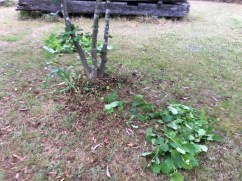
It gets a big, wide hole excavated for it and this is then filled with a mixture of old rotted manure and compost into the soil. Avacados are rich feeders. It also gets a steel mesh tree guard up to 1 metre high to stop the kangaroos from eating it in the first few weeks. The kangaroos took the top clean out of another tree that I planted on its first night, before I got the tree guard in place. They love to try anything new.

Some of the earlier trees that I planted in the autumn are now just about to burst their new buds into spring growth. They seem like they are growing very well.

If all goes well. In the future we might expect an avocado season of over 6 months.


 IMG_7547

IMG_7548

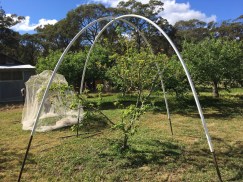
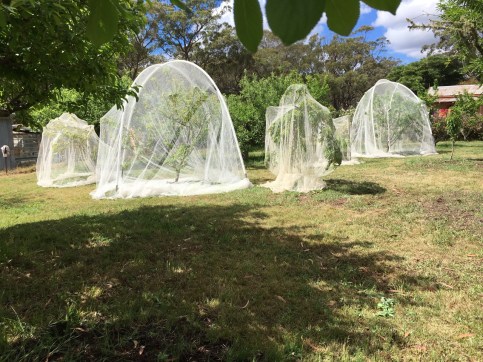
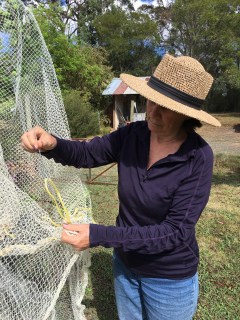
I shrink-wrap the wire frame to protect the tender little thing for the next month, until the cold winds blow them selves out and spring starts proper.

Catch-up

I’ve been so busy with the final stages of writing, editing and printing the book. Not to mention the organisation and documenting of all the work in my exhibition. It’s been a busy 15 years and a very hectic last 4 or 5 months.

So now it’s catch-up time. Janine has been carrying the major part of the load of running the house and garden recently. I need to inflate the tyre on the old wheel barrow, that has gone flat. On inspection it looks more like a repair job. But on closer examination, I find that the tyre has completely perished and isn’t worth repairing. It looks like a new tyre and inner tube will be the answer. At the garage, these turn out to be almost as expensive as car tyres! I’m shocked. I decide that the answer is to buy a new Chinese solid rubber, non-inflatable, wheel. $32 sounds like a bargain, until I get it home and find that it is made for the new 25 mm dia. axles that are now standard. My barrow is 30 years old and has a 19mm axle. It doesn’t fit.

Minor hiccup. I just happen to have a length of 25 mm steel bar in the shed. I cut it to length, clean off the flaky rust and hey-presto! It slides through the tyre, but  it doesn’t fit in the mounting brackets on the wheel barrow. Much too big! I have to grind off the old rusty bolts and then hold the brackets in the vice while I heat them up to red-hot with the oxy-torch and re-forge them into shorter, but larger dia. shapes to suit the new axle. It all goes smoothly enough, but then I find that the larger axle/bracket combination needs longer bolts. I don’t have any that are the right length, so I make some out of Stainless steel Boker bar and stainless steel nuts that I have in the kiln factory for kiln repair work. I’ll be retiring very soon from major kiln work. So I won’t be needing this kind of stuff in stock anymore. The last problem is that the spacers that locate the wheel in the centre of the shaft, don’t fit on the new larger axle. No problem. I cut a couple of pieces of sq. RHS to size and we’re away.

What could have been a 15 minute job has taken 2 hours. But it is up and working again. Hopefully, for another 30 years!

IMG_7521 IMG_7520

Book launch and porcelain show opens

Last night we had the book launch and the opening of my new show at Watters Gallery in Sydney It was well attended, a few red spots appeared and we sold about 20 of the limited first edition print run of 50 copies. A good start.

Grace Cochrane gave a beautiful introduction to the show and the book describing their inter-connectedness. The show looks very well spread out on all the plinths that the gallery could muster. There are 81 works in the show, occupying all the ground floor space in the main gallery.

IMG_7515 (1) IMG_7516

IMG_7519 IMG_7518


It’s a very good feeling to see it all come together at last, and I am very grateful to all the people in half a dozen countries who contributed to the research and through them to a successful conclusion to this creative endeavour.

My New Book – 5 Stones

IMG_7383205 pages, 125,000 words, full colour, soft cover. Written, collated, printed and bound on the kitchen table. A very limited edition hand made book.

I have spent the last few weeks and months editing and formatting my new book. This will be my 6th book and 7th if I include my contribution to Handbook for Australian Potters.

This new Book is titled 5 Stones, and details my recent research into single stone porcelain. The book will be launched by Grace Cochrane at the opening of my show at Watters Gallery on Wednesday 16th of August from 6 to 8 pm. I have a selection of single stone porcelain from all 11 sites on show in the exhibition.

15 years ago, I discovered a white porcelain stone near where I live. It made me think about where else porcelain has been discovered and when. Over the past 15 years, I have travelled to each of the places in the world where porcelain was originally discovered/invented independently from first principles and found that they all had something in common, and that thing was a stone called ‘sericite’. It turns out that originally, porcelain wasn’t made from the white clay at all. Kaolin wasn’t involved. All the original porcelains were made from a special type of stone called mica.
My travels led me to China, Korea, Japan, Cornwall, France and Germany. I even developed communications with academics in California, Alaska and London. Then finally back to Mittagong in Australia. Near to where I started.  I have made my porcelain pieces out of these weird and interesting materials in remote villages, artist studios, back rooms, workshops, even factories. Where-ever I could track down and find amenable people using this ancient technique who were open to collaboration. 
At each site that I visited I made works out of the local porcelain stone, but I also used the opportunity to collect samples of their stone and posted these rocks back to Australia where I could process them myself and make local, contemporary versions of these ancient porcelains. I collected native porcelain stone material from 11 sites around the world and have made what I think are beautiful pots from them, both on-site, where that was still possible and back at home in my own workshop. 
This exhibition shows results of my firings and 15 years of research into these single-stone native porcelains. To coincide with this show I have written a travel journal documenting my travels. My book, titled ‘5 Stones’ will be launched at the opening by Grace Cochrane. The book stands alone in its own right as a travellers tale, as it has its own characters and arc of narrative, but also helps to illuminate the story behind the actual works on display in the show.
I have works in the show that were fired on-site in clean conditions to give very white and translucent pieces and I also have the same materials fired at home in my wood fired kiln with very different results.
4 of the 11 examples are made from porcelain that is no longer available, as 2 of the sites are lost forever and another two have complications.
I consider my self very lucky to have been able to get my hands on all of these ancient and very special porcelain materials. This will be the first and only time that all these porcelain ‘clays’ have ever been shown together in the one place.
DSC_0002_00004
Unglazed and flashed wood fired Arita porcelain
DSC_0003_01_00005
Wood fired and celadon glazed Japanese porcelain, fired in my kiln in Balamoral.
DSC_0022
Korean porcelain made onsite in Korea
DSC_0006_01_00007
Woodfired Japanese porcelain
DSC_0005_01_00006
My woodfired local Joadja porcelain, showing some carbon inclusion on rim and base.
DSC02831
Korean porcelain stone body, woodfired in my studio.
IMG_7238
Amakusa porcelain from Japan, made in Arita.
DSC_0025_01_00009
My local Joadja Aplite porcelain, wood fired with a lot of ember and ash contact. The intense carbon inclusion reduces the translucency.
DSC_0029_01_00010
My local Joadja Aplite porcelain, wood fired with ember and ash contact.

Frosty Mornings, Lovely Days.


We wake to a cracking frost this morning. We have had a few good ones these last few weeks. It’s neither good nor bad, it’s just what it is. The frost has killed off every soft and vulnerable plant in the garden that were struggling on through the cold weather and short days. Plants like basil, just turn up their toes at the slightest hint of cold, quite early on in the season. The first really cool shift in the weather makes them lose a lot of their leaves. The next cold snap, especially if there is a cold wind with it and they are gone till we replant them in the spring.

Tomatoes hang on a lot longer, but the first light frost or near frost makes them lose their leaves. Funnily the lingering un-ripe fruit isn’t affected and can be brought into the kitchen and ripened on the window sill over the next few weeks.

Nasturtiums and capsicums seem to be able to tolerate a light frost and remain intact, although not exactly thriving. However, this mornings beauty has put an end to everything that was gamely battling on. This spells the end of the lingering autumn stragglers.

DSC02767 IMG_7325

What is great about a period of good solid frosts, is that they benefit the plants that have excellent frost tolerance and even rely on the freezing to establish the ‘chill-factor’ chemicals in the new growth that will emerge as fruiting buds in the spring. Some varieties of fruit trees need a good chill to become fertile. All the older varieties of plants like apples, pears, the stone fruits and particularly hazel nuts, need to get a hundred or more hours of below 4oC temperatures. If they don’t, the flowers cannot become fertile in the next growing season. A few years ago, we had a winter here without frost and didn’t get any fruit set on any of the apples or pears.

Hazels and filberts have slightly different origins, with one being rounder and the other more ovoid. Filberts have a longer skirt on the outer shell. They both seem to have originated in Asia minor/Turkey, but have been developed into stronger and more prolific bearers of larger nuts over the long period of domestication.

Hazel/filbert nuts are reliant on a high number of cold nights to establish their chill factor chemistry. A lot of work has been done on breeding local varieties of low chill factor nuts here in Australian in the post war period. In Australia, we just don’t get the sort of winters that are common in north America and Europe. However, we just happen to have a hazelnut farm research station near us here in the Southern Highlands.

We have been able to buy grafted varieties of local hazels that have been bred to fruit in warmer low chill areas like here. We have these low-chill fruiting hazel/filbert nut trees inter-planted in the nut grove with others that are inoculated with French black Perigord truffle fungus. We are hoping that the spores will spread to all of the other hazel/filbert trees at some time in the future.

IMG_7326

A good bit of cold weather really helps to colour up the citrus and sweetens the Brussel sprouts. In the mean time the frost looks great on the surviving plants until the sun comes up and melts it away.

  DSC02766 DSC02771

DSC02772 DSC02774

DSC02777

The sun shines and the days are glorious, as long as there is no wind.

When the weather changes and the wind blows off the snow. There is no frost but the days can be bleak. When we came here, the locals described it as a lazy wind. It doesn’t blow around you, but rather, straight through you.

My Last Wood Firing

I have just completed my last wood firing before my show at Watters Gallery that is coming up very soon. Opening on the 16th of August. I managed to sneak in one of my own firings through my kiln in-between the two low temperature wood firing weekends. I woke up exceptionally early for this firing for some unknown reason. I usually get started early around 4.00 am, but on this occasion I’m wide awake at 3.00 am. So I get up and down to the kiln and get started. No reason to just lay in bed waiting for 4 am. It all goes very well, smooth and easy. Everything just so.

I have all the wood prepared before hand and stacked on the truck just outside the kiln shed. I work through the hours of the late night/early morning. There is a solid  chill in the still air. It gets decidedly colder closer to the dawn. I have to wrap a towel around my neck in place of a scarf. I didn’t bring a scarf down to the kiln shed with me when I came dawn, and I don’t want to go back into the bedroom and risk waking Janine.

The kiln isn’t warm enough yet to give off any heat, even though I’m snuggling up close to it, there is very little reward. I can hear the dawn about to break in the sudden emergence of bird song from the surrounding trees. The birds know what time it is, even though it is still dark to my eyes.

 IMG_7310 IMG_7308

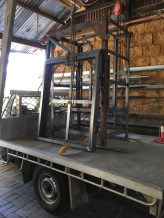
I loaded my truck with hob wood for this firing yesterday and parked just outside the kiln shed. One load like this is enough to fire my kiln. Today I’m using a mixture of half local pine, one quarter Stringybark from our land and the other quarter is cherry ballard from just near the wood shed. Although the truck is just outside, I can’t see it in the dark, as there is no moon showing through the cloud tonight. However, as the dawn breaks the truck become visible, and through out the day, as the firing progresses, we slowly whittle away at the stack until it is almost gone. Just enough in reserve to allow for contingencies. The chickens are always hanging around to help us do what ever it is that we are doing. Today they are fascinated by kiln firing and wood stacking. You never can tell when a termite or cockroach might appear from under the bark of a piece of wood.

IMG_7312 DSC02752 DSC02760 DSC02755

The morning breaks to reveal a lovely frost.

DSC02763

DSC02764

Weekend Woodfiring Workshop

Winter brings on the season of wood firing workshops. We can fire our wood fired kilns almost all year round. With the only exception being the days of total fire bans in summer. We cope with this restriction, by packing the kiln as soon as the work is ready to fire and then we sit and wait until the fire restrictions are lifted, usually after a patch of rain. The pots can sit in the kiln comfortably for any length of time, as long as the kiln is sealed, so that no little animals can get in. We haven’t had  to wait long, a few weeks at most.

However, we can’t run a workshop kiln firing schedule on this basis. If we book in dates to run a wood firing weekend, then it has to go ahead as planned. Everybody has made their plans around the dates and is relying on it. We can’t cancel at the last-minute due to a fire ban. Our solution is to only book dates that are outside the likely fireban season.

We have had 3 weekend firing workshops over the past month since I returned from my last research trip to Korea. We were lucky to be blessed with fine weather most of the time. We are getting cold frosty nights, but many of the days are wind-free and warm in the sunshine.

We spend most of the week in-between each workshop in preparation, cleaning up and transforming the space into a safe, functional firing environment. We also spend a lot of time collecting and preparing the wood. We use mostly dead wind-fall branches from our eucalyptus forest around the house and dams. throughout the year, these branches fall to the ground and need to be collected up and stacked, out-of-the-way, so as to keep the ground clear for mowing through the hot months for bushfire protection. This stack then needs to be sorted and cut or broken-up to a suitable length. The smallest twigs go to kindling and the first part of the firing. Thicker pieces up to 50 or 60 mm. dia. are used as-is for the main part of the firing, and anything larger is cut to length with the chain saw and taken up to the wood shed and split into suitable thickness, then returned to the kiln site. It all takes time, but the chickens help. They just love to be at the centre of the action.

We tell ourselves that all this exercise it is probably good for us 🙂

IMG_7279 IMG_7291

IMG_7281

Throughout the year I get fire bricks, stainless steel sheets and all sorts of other material delivered here on Pallets. Some of them. The ones with beautiful straight-grained wood, get dismantled and used for building things. It takes quite a bit of effort to dismantle a modern pallet. They are assembled with gang nailed corners and hot glued nails from the nail gun. I spend a fair amount of time priseing them apart and de-nailing them to save the wood in good re-usable condition. A successful pallet re-cycling session gives me a great sense of achievement – and usually a sore back and shoulders from all the bending, lifting, stretching, levering and hammering. But it’s worth it. I hate to see good wood wasted. It’s just another small step towards self-reliance, through making do, recycling and making the most of what we’ve got.

IMG_7283 IMG_7305

As we have 11 workshops booked in for this winter. We will need a lot more wood, than has fallen from the trees around the house over the summer. Janine has been making expeditions out into the ‘wild woods’ farthest from the house to drag back dead limbs to add to our stock. For this firing I also called in to visit the local mower shop. He gets a lot of his machinery delivered on Pallets and he has to pay to take them to the tip/recycling centre, So they are happy for me to remove them for them.

IMG_7306

One of these pallets is a monster. It has bearers with a cross-section of 200 x 100 mm. and beautiful solid decking of 25 x 150 or 200. All beautifully straight-grained and knot free. I made an effort to keep it all as pristine as possible. It’s so nice that I think that I may be able to make a beautiful chair out of it for the house. There are of course also a lot of ugly pallets. These are easy to deal with, because all I do is chainsaw off the ends of each side and the pallet falls apart into perfectly usable thin lengths of fire wood.

The students turn up knowing nothing of all this. The wood is ready and stacked in the trailer on-site. The kilns are all prepared and the glazes are out on the table. The days events proceed calmly and in an orderly fashion. Every thing happens as planned and the sun is warm in the middle of the day. Everyone seems happy.

IMG_7324

The result of all this effort on everyones part is some beautiful pots.

Marmalade and Mushroom Sauce

I’m home and it is mid winter. Everything is dull and bleak. The sun is low in the sky and the days are short. The trees are bare and there isn’t a lot of variety in the garden. I can pick a goodly sized parsnip and carrot. A hand full of broccoli and some Brussel sprouts. This will be dinner with the addition of some potatoes from the kitchen store.

We have the basket of goodies at the sink ready to wash when our neighbour John drops in on an errand. He sits down for a chat and we share a beer. He tells us that his favourite butcher has just given him a kilo of eye fillet in exchange for a favour. He asked what we will be eating for dinner. I show him the garden bounty, all freshly picked at the sink.

He looks quite concerned. “Are you really going to eat that! That’s it for dinner?”

Yes indeed. That is what we are going to eat. “Why?”

He mutters something along the lines of “You poor hapless bastards!” “for f*%$#’s sake, don’t you have any real food in the house?”

He tells us that we should come to his place and he’ll feed us up. He adds, “Bring your veggies, I’ll cook the steak.”  We do, and he does. He has a special sauce for the steak. It’s delicious. He asks us what we think is in it. I can see mushrooms. I can taste a soupçon of ginger, there is pepper and salt, all the usual suspects, but there is something else that I just can’t guess. It turns out to be a spoonful of our very own marmalade that we gave them the week before. It’s a really interesting and delicious sauce.

Home Again

I have had an amazing time in Korea. I was very lucky to meet such supportive and helpful people. Every thing had gone well this time and I am returning with a suitcase and back pack loaded with beautifully fired porcelain. So different from my last visit, in terms of the fired result.

IMG_7204 IMG_7201

IMG_7175

My last day starts foggy and overcast, but clears up.  I was walking back across the lawns from the research centre , back to the pottery workshop building , when I bumped into one of the support staff. A lady who I thought spoke very little English. I had heard her say “Australian Honey” out loud on my 2nd day in the workshop. I had given a small jar of honey to one of the staff members who had just helped me with a problem. I took several small jars of Australian varietal honey with me specifically to use as gifts. This lady saw the jar and read the label out loud. I heard this from the other side of the room and got another jar out of my back pack and presented it to her.

She asked if it was for her. I replied. “Yes, it’s a gift for you”.

She thanked me profusely, and that was the end of the matter. I didn’t have reason to speak to her again personally until now. She stopped me on the lawn and said to me in her basic English. “You leave today?”  I replied. “No, not today, tomorrow morning, very early, 7am.”

She explained to me that she only spoke a very little English, but wanted to thank me for the honey and say that I was nice to have around. She reminded me that I had helped her to move a heavy shimpo potters wheel, so she could do some cleaning under and around it.

It was very nice of her to say so, and to venture to initiate the conversation in a language that she was not proficient in. She told me that she was not Korean, but originally came from Japan and married a local Korean farmer.

I replied “So desu ka!” Is that so!, She did a double-take, blinked and replied “Anatawa Nihongo hanasamasuka?” Can you speak Japanese? I replied “sumimasen, watashiwa, Nihongo arimasen…choto dake” Not really – just a little.  It’s true, I don’t speak Japanese, but I can speak a few words, however, when I get my ear in, after I’ve been in Japan for a week or so. I realise that I can recognise a lot of words in what is being said around me, and I often know what it going on. Japanese is the only foreign language that I ever tried to learn by doing a bit of study. Some of it has stuck.

Suddenly we were off on a tangent talking in a weird mix of Japanese, English and Korean using my phone app. It was a completely unexpected, but warm and rewarding moment for both of us. I came away thrilled and very pleased at the intimate level of communication that had just evolved so organically and unexpectedly.

IMG_7177 IMG_7202

I go back to my room and start to clean up and pack my bags. I have a few clay samples that I have been drying on the heated floor of my room. I eventually get everything back into my bags, plus, I’ll be leaving with an additional 20 bowls and 5 kgs of clay. I’m ready for the early start tomorrow.

The sunset is lovely. The sky is clear. The last rays illuminate the rice and the poly tunnels, that so define this place. It’s a beautiful way to remember this pleasant valley.

IMG_7107

Inhwa and her husband turn up very early the next morning to give me a lift with another student to the bus terminal at Yang gu. My Jung turns up too! He has stopped off on his way to work, to say a final Good Bye. My return trip to Incheon airport out of this remote place on 3 busses all connects perfectly and I arrive at the airport earlier than I had allowed for. My return flight is uneventful, I just want it to be over with really. Sitting in a seat for 12 hours is very dull. Although I do manage to find a couple of hours sleep during the night. Probably my best effort so far at sleeping sitting-up while flying. Possibly because  didn’t sleep much the night before.  Maybe I’m getting better at this? Not that I want to practice it any more. I’m over it.

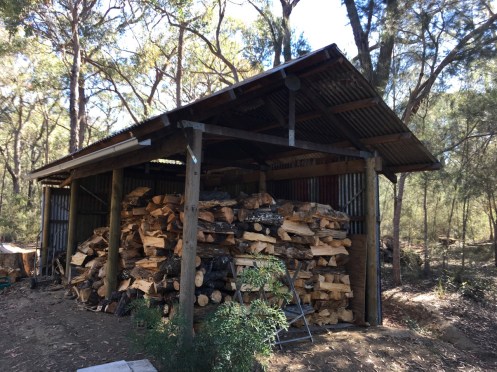
I’m home just before the solstice. I unpack my pots to show Janine and take a walk around the garden. The early peach has started to flower. It’s so amazingly early. The first job is to move some more big logs into the wood shed, closer to the splitter. The last time that  Idid this, a month ago. I smashed my finger. it still isn’t healed. The chickens are happy to come along and help with this job. But only because there are always a lot of bugs and creepy-crawlies under the bark for them to eat. They love the wood splitter. It provides fresh protein that wriggles all the way down. Yum!

IMG_7210 IMG_7231

IMG_7213 IMG_7223

They have absolutely no fear of machinery like the splitter. They really want to get their heads in there as soon they can, to get the first peck, but sometime the splitter blade hasn’t even finished coming down. I’m constantly brushing them away, but they swivel around and are straight back. They trust us – foolishly.

I think that they have no fear, because they have no brain. But they are sweet things to have around and they are good company.