Making a Start, Starting to Make

Making a Start, Starting to Make

The first thing that I did after I arrived here was to go to the clay room and get some recycled clay, so that I could throw some chucks. This is the first thing that I do everywhere I go. It’s a pity that they are so heavy and bulky, otherwise it would save a lot of time to just pack them in my bag and carry them with me.

IMG_6791

I make a range of sizes that will suit the pots that I pain to make. I get these out in the sun as soon as they are made. I will need them dried and stiffened, so that they can take and hold the pots on top of them during turning.  The chucks are thrown very thick and heavy, so they are quite slow to dry and stiffen up,. They need to get drying as soon as possible.

The next thing that I do is to throw my bowls. These are made from the best white sericite porcelain. I throw them quite thinly, because I can. Most porcelain looks best when it is very thin, so that the light can shine through and show off its translucency. However, this local and very ancient sericite porcelain stone body Is very highly fluxed and distorts really easily, so it best to make these pots a little bit thicker for structural reasons. This mica throws really well and is a joy to work with. They will dry out on the rims quite quickly unless they are covered with light plastic sheeting over night. The next day I get them all out in the sun again. The first of the smaller bowls are ready before the chucks are really quite dry enough. I wrap the bowls and leave the chucks out in the sun while I go to lunch with the staff.  When I come back they are ready. Its early summer here now, so the days are long and quite warm at 27oC. I’m staggered to find that Miss Kang and her boyfriend have returned yet again. They have been invited to come to lunch with us all again. I ask how the stars were last night? She tells me that they didn’t see too many, as it was a cloudy night, but it was a lovely experience up on the mountain. I gather that this is where they camped?

After lunch we all go back to work and Miss Kang and friend leave to set off on their mountain climb. I start my turning and get all the first batch roughed out quite quickly. Then I return to the wheel to throw some more. I need to have a continuous supply of work coming, depending on the drying time, so that I can be continuously busy and not waste any of my time here.

My next task is to try something larger. I make some 200 mm bowls and then, last thing, before the workshop closes at 6.00 pm, I make some 300 mm bowls. That will keep me busy for a day or two of turning. My days are filled with a mix of throwing and turning, wrapping and unwrapping. I stroll to and from the workshop along the little farm roads that wander like I do around the fields and streams, eventually always ending up down by the river.

Each trip I try and take a different route. I have tried crossing the river using the stepping stones that are provided to save the kids who live at this end of the village from walking all the way up to the bridge and back to get to school. I can tell that it isn’t used very much these days as the grass has grown high and almost covered the path. I suppose that it is because it is school summer holiday? I have plenty of time, so I take the long way around and walk past different farms and get a different view of the valley. Although it is different in detail, it’s more or less the same in general. Every farm is growing more or less the same things, at the same times, in the same way. A mixture of poly tunnels and rice fields. Very little is grown  out in the open. Potatoes, garlic, spring onions and sweet corn are all out doors. Whereas chillis, melons and tomatoes are under the protection of the poly tunnels. I can’t but notice that the melons are grown in such a way that the fruit will develop on a mat to keep it off the ground. I one greenhouse, I saw that they had little plastic dishes set out to rest the melons on, to keep them up off the matt, so as to get perfect shape as well as no dirt or discolouration and unripe white skin colouring from developing underneath.


IMG_6897 IMG_6986

I turn all day the next few days, I slowly it dawns on me that I’m not turning like usual. I start to realise that I have finally taken the edge off my favourite yellow handled carbide  turning tool. Its taken a couple of years, but it has now lost its razor edge. It’s still sharp, but the ultra fine edge has gone. I check it against a couple of tools that I don’t use much and, yes, it’s gone. Luckily, I have brought a small diamond file along with me in my kit. I have carried it since I bought my first few carbide tipped porcelain tools. I have to break it out of its plastic bubble wrap packaging. It works a charm. I’m surprised, but not shocked. This tool is my favourite and has lasted a couple of years without sharpening. On the other hand. I have to sharpen my hand made carbon steel custom tools every hour. They are great tools, easy to make, but easy to  make blunt too, with a bit of porcelain stone work. Fortunately they are very easy to sharpen. I always carry a small mill bastard file in my kit as well and step outside often to give the edge a little touch-up as required. I always go out side to sharpen my tools, as I don’t want any iron filings to turn up in my clay. It strikes me that I’m a bit like a butcher in this way, constantly adding a little bit of a fine edge to my knives as required.  At the end of a day of using these little round handle-less gems, I have to sit for a while, out on the sunny bench and re-shape them, because they soon develop a flat spot on the curve after a day of constant use and sharpening in the same place. The sweet spot, where I use it the most, in the centre of the curve. It’s a pity that I have never seen any large flat carbide shapes like this for sale anywhere. I guess that there are not so many people using these ‘inner’ tools to justify a production run?

IMG_6864  IMG_7096

The walk home is lovely, it’s balmy and there is a lot of bird call. The sun is setting and it makes the rice crop glow. It’s a peaceful, beautiful time.

IMG_6867

Alone, Like a Shag on a Rock

I’m here in the very pleasant little village of Bangsan, just outside of yangggu. Porcelain stone has been mined here since the 1300’s. It isn’t known exactly when. But a ‘stash’ or ‘horde’ of porcelain and silver ware was unearthed up on top of a local mountain when some workers were building a fire break. The box contained a few porcelain pots, two of which have inscriptions carved into them. One indicates quite clearly that it was made in the Koryo dynasty. 918 to 1392. I know this because the Yang gu Porcelain Museum on-site here has the pieces in its current exhibition. I’m lucky to be here at just the right time.

IMG_6934 DSC02730

There is still some of the porcelain stone still around. At one stock pile site that I walked up to. It was stacked up in rows of stock piles that dated back centuries. Apparently, This was all the reject stuff that wasn’t good enough for the pots of Royal Patronage, possibly because it had a few iron spots? This material has sharp edges and looks hard, but shatters easily. It is mentioned in historical documents as being transported out of here to other places for manufacture of porcelain under Royal decree at the rate of 70 to 80 tonnes per year, since the Koryo dynasty. Usually transported down the river twice a year at times of high water in spring and autumn, although some porcelain was made here onsite too. Large amounts of the stone were won and stock piled, then suddenly the trade seems to have stopped and the stock piles remained untouched until recent times.

Although the original mine site  of this particular stock pile is completely unknown. That is, until very recently. It was known to have been mined somewhere around here. There is an ancient kiln site across the river from where I sit and write just now. The site has been excavated and preserved. Covered with an impressive shed to keep the weather and shard hunters out. Then, just behind it. Higher up the hill, there is a museum of the sherds that were unearthed during the dig. Porcelain has most certainly been made on site here for a very long time.

DSC02695 DSC02701 DSC02705 IMG_6953

Now this following part must be taken with a grain of salt, as it is third-hand via interpretation. So maybe I’m completely of the mark, but as I understand it. A few years ago the current source of the Yang Gu sericite was discovered. There was a bad flood that changed the banks of the river that flows through the village here. It exposed some material that looked promising. A few years later, there was a severe drought and the river level dropped dramatically. This allowed Mr Jung, the Director of the Porcelain museum here, to get in and excavate some samples. It turned out to be sericite, so a large machine was brought in and the lens of sericite was removed to higher ground and stock piled.

It seems that the old kiln was built on the banks of the river here for a reason. I notice that there is a leat let into the banks of the river just below the kiln. Possibly to run a water driven clay crushing hammer in the past? I’ve seen exactly this in other countries like China and Japan, where porcelain is made! It all comes together?  There are a few examples of replica water hammers around the village. Non of them working, just for show these days.

IMG_6785 stock pile (1)

The original Yang Gu sericite material from the stock pile site is a hard, glassy, stone like many other porcelain stones that I’ve seen. However, the new material is somewhat softer and more friable. I can crush it with my fingers. I imagined, when I first saw and felt the raw material in the stock pile. That it might be some sort of kaolin based clay. It reminded me of my ‘Mafia’ deposit of halloysite/illite/quartz/felspar, near Mittagong at home. However, this proved to be completely wrong. I’ve had my samples from my last trip analysed and the material here is almost totally composed of sericite and some quartz. I must say that it is amazingly plastic, for a body that is almost completely free of clay. I say almost, because the material is so glassy and fusible at high temperatures, that Mr Jung has brought in some sericite with a kaolin component to firm it up a bit at stoneware temperatures. This material comes from JinJu farther south. I really had no idea of just how plastic mica could be. This place is pretty special. I consider myself very lucky to be able to be here and enjoy these amazing experiences.

I am being housed during my stay here, in a student residency building about two kms away from the workshop. I am currently the only person in the place, as it is the first days of summer and all the other residents are away on summer holidays. I do the 2 km walk each day to the workshop and back along the river.

The river is very lovely. It’s low water at the moment, but still running consistently and clear. I can see from the detritus that is hooked up on the iron work along the top of the old bridge, that high water can be at least 7 metres high and possibly more. There is a water bird working the shallow shingle rapids along the river bed. He’s very fast and efficient. He seems to be catching something every minute of so. I see him sunning himself on one occasion sitting alone, up on a rock. I know how he feels.

DSC02691  DSC02708

This morning the weather was foggy and overcast. There was a beautiful mist hovering around the mountains. Their silhouette is reflected in the water of the rice fields. The rice has doubled in size  since I arrived. Lots of water and some warm weather is all it needs.

IMG_6917 IMG_6923

So Much Water, So Far From Home.

I’m back in Korea again. This time I’m up in the north of the south. I came to Korea last year to do some preliminary research and to suss out what might be possible, but mainly to visit as many single stone porcelain sights as possible. It was an amazing trip and I learnt more than I had hoped for. I discovered sites that I hadn’t previously known of and got to make some nice pots along the way.
From my reading and research, it seems that Korea might have been the place where porcelain was invented, some time around the year 900. That places it about 100 years earlier than the development of porcelain in China.
Before commencing this research, I had believed that China was the source of porcelain development and the technology had spread overland to Korea by osmosis. Some doubt has now been cast on this theory and it just might have been the other way around?
I certainly don’t know. I’ll wait for the evidence to be further developed to see what happens. It makes no difference to me. I don’t see it as a race. But an excellent example of human ingenuity. 
In my own Walter Mitty world. They both came across the idea at more or less the same time, quite independently. Just as I did, more or less by accident, or good fortune. Although I do concede the truism that the harder you work, the luckier you get. McMeekin  just seems to have stumbled on his porcelain deposit from word of mouth, possibly over a beer at the Mittagong pub? Who knows. I don’t believe that this sort of information is recorded. Luckily, whatever the circumstances of the insight, he was the right person, in the right place, at the right time.
I do know that when I arrived in my small hamlet of Balmoral, I asked around of the locals, if there was any clay deposits in the area. The best people turned out to be the local bull dozer driver and the back hoe operator. They spent their days digging the dirt in other peoples places and seeing just what is under the surface. They had lots of insights. Unfortunately, non of them lead to usable material at that time.
So now I’m back here specifically to work the YangGu sericite porcelain clay. There has been porcelain made here around these hills for centuries. I’m just not sure how long as yet. That is one of the things that I’m here to find out. However, what I really want to do is to get my fingers into the stuff and make some pots. The Yang Gu porcelain stone has been mined out of these hills for eons, possibly since the 1400’s? However, no one knows just where the stone was mined. It’s a mystery still. Most likely under ground, as there is no sign of any material like it on the surface and enigmatically, no shafts have been found. However, as we are so close to the border here. the material just might be located just over the hill in the North?
DSC02706 (1)
The walk to and from the studio to my dormitory is very pleasant. I get to walk past lots of little farms. There is a lot of poly tunnel agriculture here. I guess because the summer is short and the winter is very long and very cold. So a bit of extra warmth from the poly tunnels gets things started early when the ground outside would be just still too cold. I’m told that the frost penetrates down to 1 metre here.
There are several crops of beautiful garlic coming along. The outer leaves are just starting to turn colour, so they will be ready for harvest very soon. It must have been dry here lately, as I can see that this farmer has the sprinkler on the crop, irrigating it, to keep it growing a bit longer to fill out the bulbs.  
IMG_6808 IMG_6830
As I walk to the village I can hear cookcoos calling from the forrest all around. All of the valley floor here has been levelled and terraced everywhere that you look. It must have taken hundreds of years of man and women hours to get the landscape so well prepared for rice culture. The terraced paddy fields go all the way up to the steep sides of the hill.   Intermixed with poly-tunnels. Then some enterprising farmer has even ploughed the slope up the hill side, where it was possible. I’m not too sure that this is a very good idea, as when the big rain events come. He will loose most of his top soil. The forrest on the hills is all heavily planted with timber species. I’m told that all of this forrest was totally cleared all around here during the Korean war of the fifties. The hills from here to the border were denuded of all vegetation so that any enemy attack could easily be seen coming. 
 IMG_6903 DSC02683
We are only a kilometre or two from the front line here. Now called the DMZ. At various times throughout the day I can hear loud speakers booming out the insane propaganda from over the border in the North.  I can’t understand it and the locals tell me that they don’t even hear it any more. It’s just so much background noise, like heavy traffic passing. What is really tragic, is that a poverty stricken country like the North would waste so much energy in such a totally futile exercise.
There is a lot of water still issuing from the hills here in the form of spring water. It has all been harvested and channelled into culverts. It makes it’s way down across the valley floor and is diverted here and there in to smaller channels, ducts and eventually into local ditches that work their way around the paddies.  
IMG_6904 DSC02741
The rice seedlings have just been planted out and are starting to shoot upwards. The fields are kept flooded while the rice establishes itself. Once the top field is filled and is completely flooded. the excess water then flows down from ditch to ditch and field to field into the next, and so on. Once all the farmers fields are flooded. The excess water is returned to the fast flowing channels so that it can be used by the next farmer down the valley.
The water eventually makes its way down to the river in the valley floor, where some enterprising farmers who don’t have access to a spring fed flow. Pump the water out of the river and it starts its irrigating journey all over again.  
In the evening the setting sun shines on the flooded rice and there is a peaceful harmony about it all. This enterprise of growing wholesome food, the tinkle of fast flowing water, the quiet of the evening, the last feeble rays off the sun and me walking home in the fading light after a productive day in the workshop, its a beautiful time. As I turn into the little valley where I am staying I notice that there is a very prolific bird sound. I am staying right up at the head of this little valley, so It’s a long walk. A couple of kilometres. The forest here is alive with some sort of birdlife that I don’t know. There must be thousands of these birds, all calling and responding with a kind of hooting sound. Maybe it’s mating season?
 IMG_6869 IMG_6868
I can sense that there is no other wild life up here in this valley or the woods that surround it on all sides, because all the farmers fields are wide open. There are no fences to be seen most of the time. I guess that this also means the there is no issue of pilfering either. All the farm equipment is left out in full view, even power tools. It’s a lovely feeling to be in a place where there is so much neighbourly trust and respect. On the road I suddenly see a very small frog. I would have missed it except for its luminous green and black colouring. I decide not to touch it. Anything this colourful, hiding in plain sight without a care, must be very confident that no bird will eat it. I suspect that it is vey toxic. I only take its photo and not its pulse. As I walk further, I can see that there a whole lot of them that have been squashed on the road. Not only does their (possibly) poisonous skin make them totally unafraid of predators. They have no road sense either. Tragically for them, poisonous skin doesn’t deter cars.
As I walk up past all the poly tunnels, rice paddies and vegetable plots I nod and say “Anyohaseyo” to each of the people that I meet. I got a few double takes on my first trip, but now they recognise me and word has spread that I’m here and only sleeping in the dormitory building at the head of the valley. At first they responded in fast, staccato Korean. But I can only shrug my shoulders and look helpless. I can’t speak any Korean past the first few words of airpot language that we all learn to be able to get around. They smile back at me and we each go on about our own tasks. 
I’m still quite amazed that even though it is summer and it hasn’t rained since I’ve been here, and there a people watering their plants, it’s obviously a dry time, but as I walk, I can hear the river rushing, then up the valley I can hear the irrigation ditches channelling the gurgling spring water. I’m suddenly struck by the fact that here is so much water, so far from home.
Best wishes from Steve in Korea

Wintum, A time for a clean out and change over

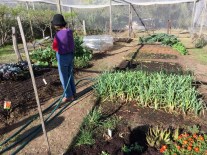
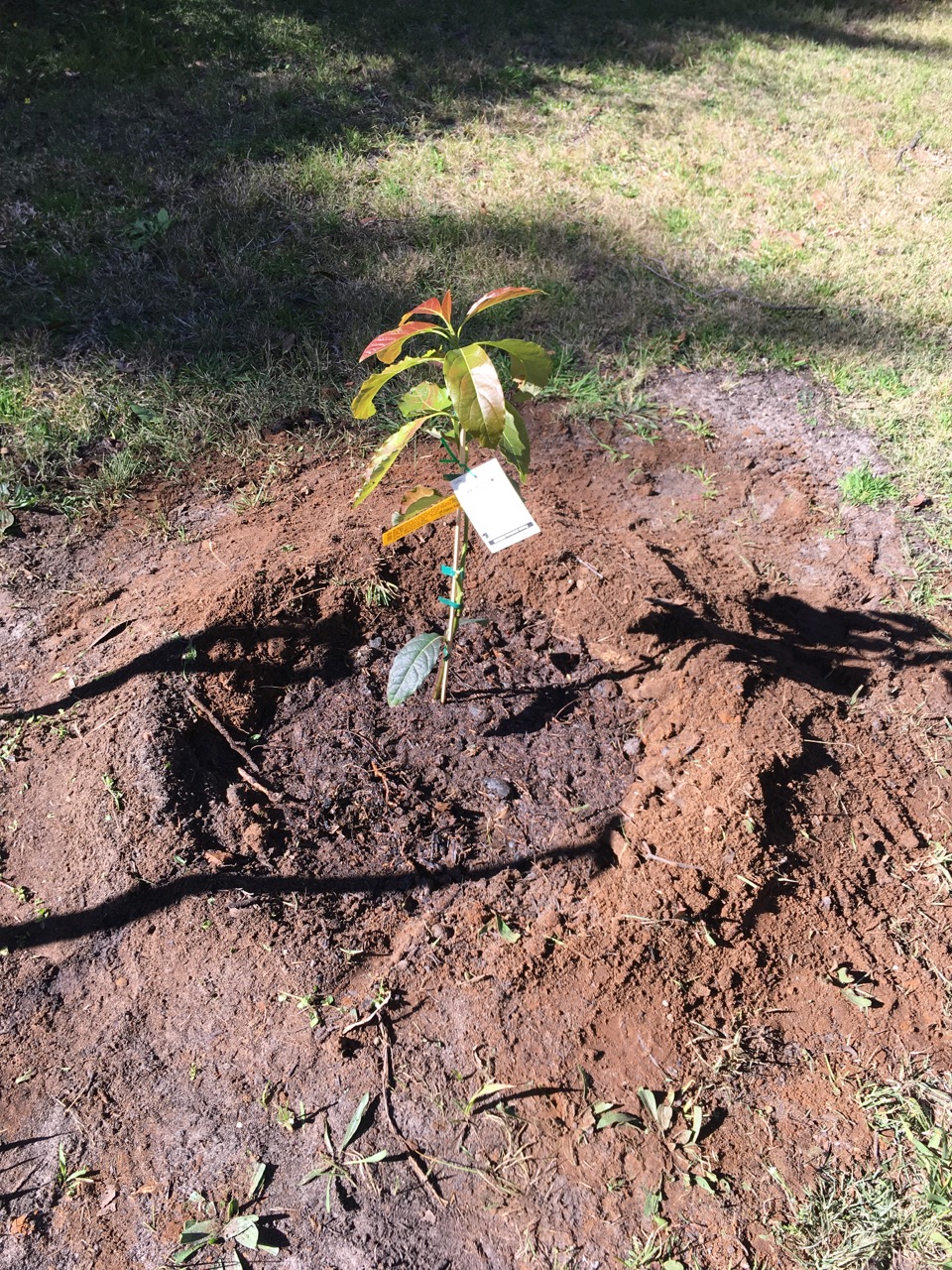
Here we are on the last day of autumn, on the threshold of winter. All the garlic that I planted on the evening before setting off for China is up and thriving. Garlic loves to get an early start. Late Feb and early March seems to suit it best around here. I know this because this is when all the old, last-years cloves that  missed harvesting, all start to shoot up, looking for the last of the warmth as the days get shorter. If these little fellows know that it is time to shoot up, then this must be the time. So in they go, or went in this case. I didn’t get time before leaving in the hectic weeks before setting off. So it was a case of do it now in the evening dusk or miss out. I’m glad that I made the effort now.

IMG_6568  IMG_6571

Its a very much smaller crop than I have managed in previous years. This time about 100 plants. It’ll have to do. At least it is something. I realise that I can’t do everything. I’m very happy with what I have achieved.

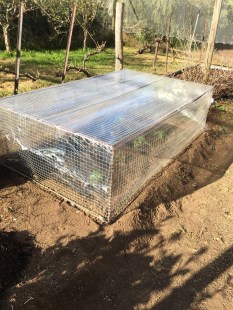
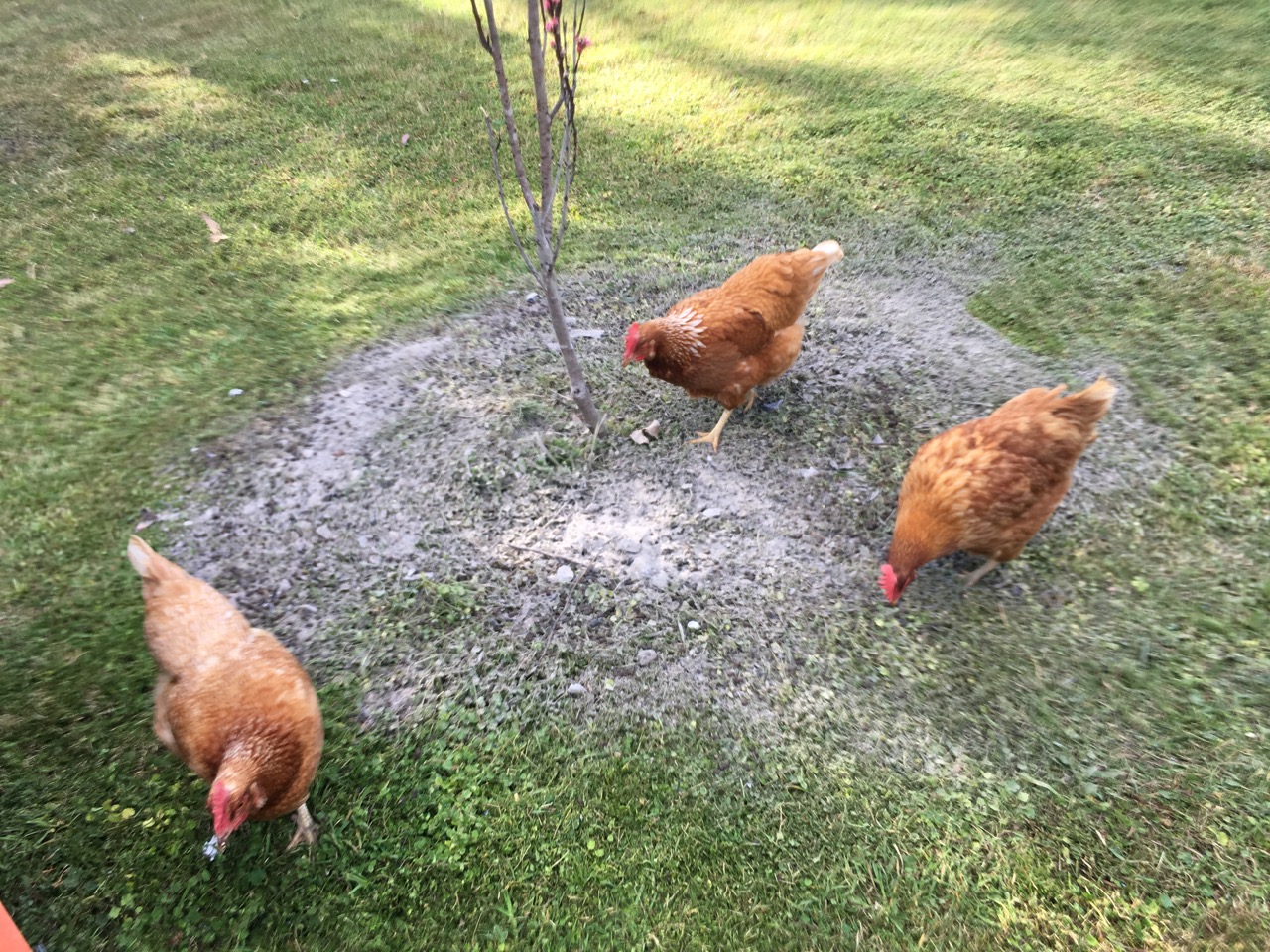
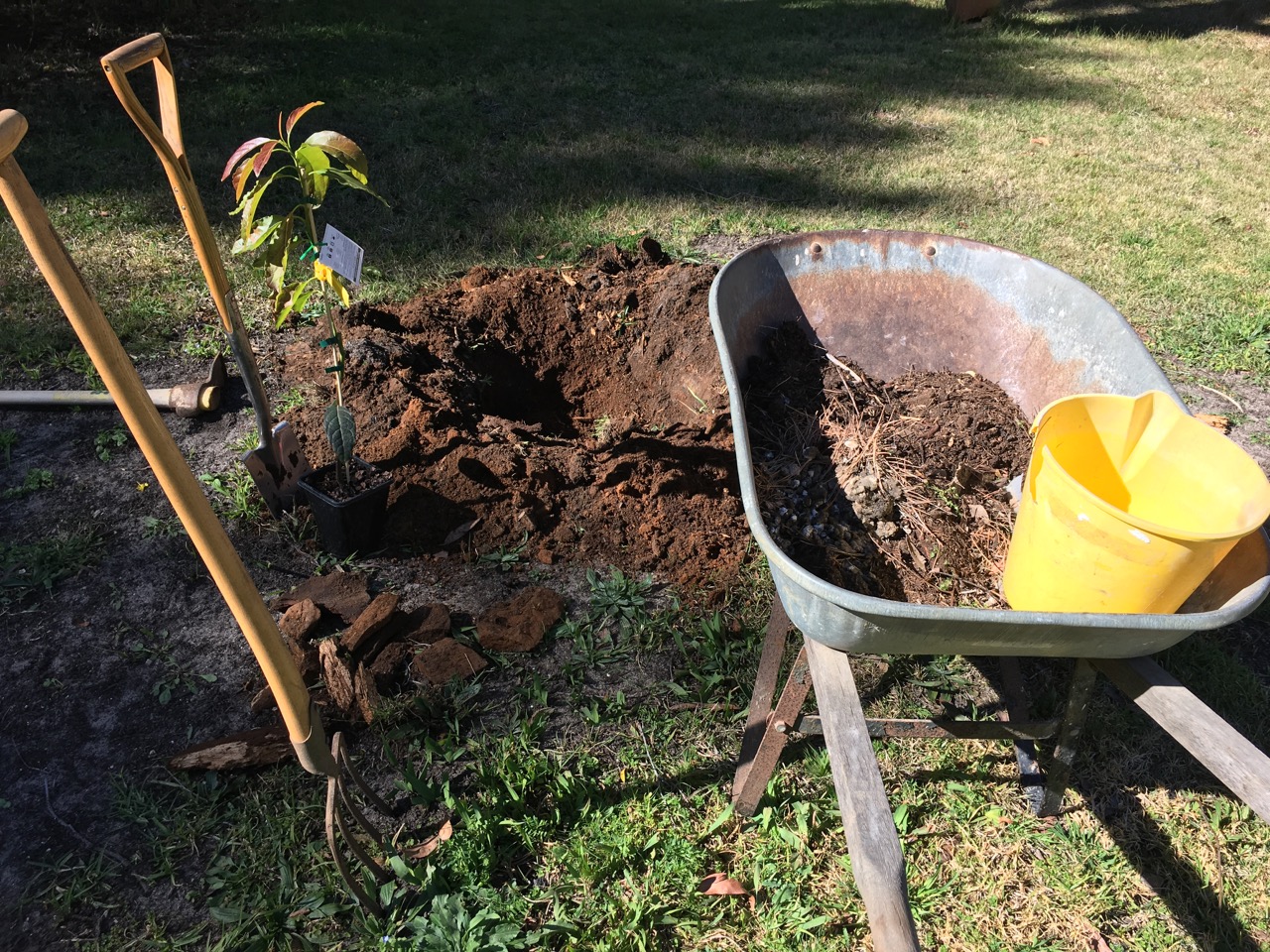
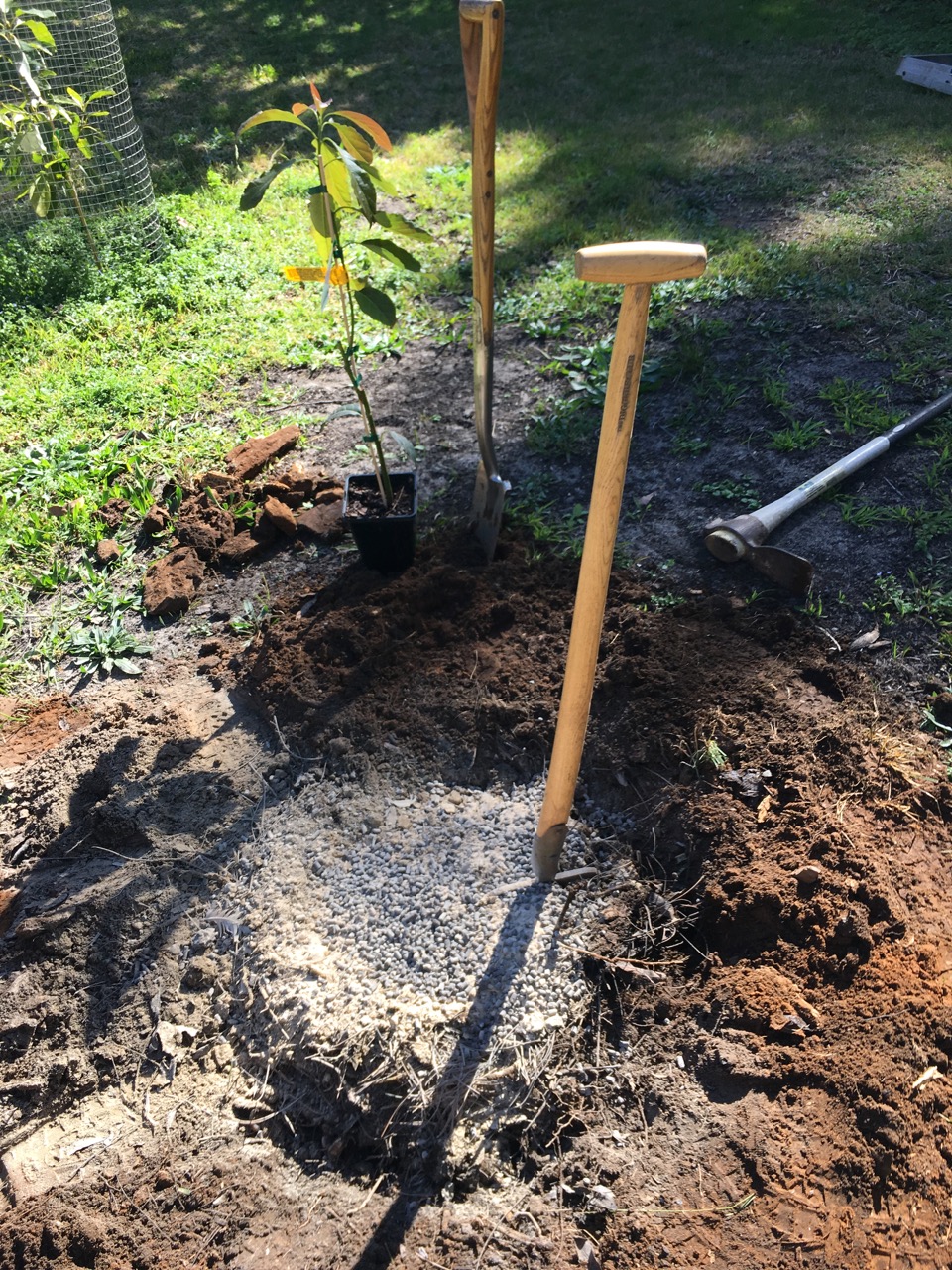
When I returned from our little break away in Canberra, but before we left for Cambodia. Apart from building a kiln and making some more porcelain stone bodies from my recycled turnings. Janine and I managed 2 half days in the garden. Cleaning out all the old dead and finished summer plants. It was all cleaned out and taken to the big compost heap behind the pottery. This is one of the chooks favourite places. They can spend hours in there. They really want to get into the vegetable garden to ‘help’ us! But alas, they are kept locked out. We don’t need their kind of help in there just now.

  IMG_6563.jpg  IMG_6562

The chooks like to see what is going to the compost and ambush Janine on her way demanding to see what is nice and possibly edible in the wheel barrow. They decide that un-ripe, green  and sour golden berries are just what they love. and as long as we peel of the paper coating, they gobble them down.

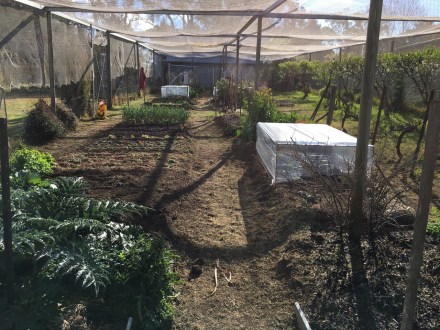
We prune off all the dead asparagus fronds and top dress the 2 beds with compost. It all starts to take on a look of care and attention again, instead of the wild riot of form and colour that was there at the end of the rampant summer growth. Janine mows the orchard while I wheel-barrow compost and spread over the garden beds and all around the citrus trees.

IMG_6567 IMG_6566

I will be time to start pruning the orchards and grape vines soon. But before I can do that, I have some Korean sericite porcelain to make. Everything in its own time.

Nothing is ever finished, nothing is perfect and nothing lasts.

However, for now, the garden and orchards look loved again.

IMG_6659 IMG_6660  IMG_6661

Damn those Omega 3’s

I have just finished my latest kiln. It’s a thing of beauty and will be someones joy, if not forever, then for probably somewhere around 30 years. All of my earlier kilns. The ones that I continue to know the whereabouts of, are still performing well after this length of time and a bit more.


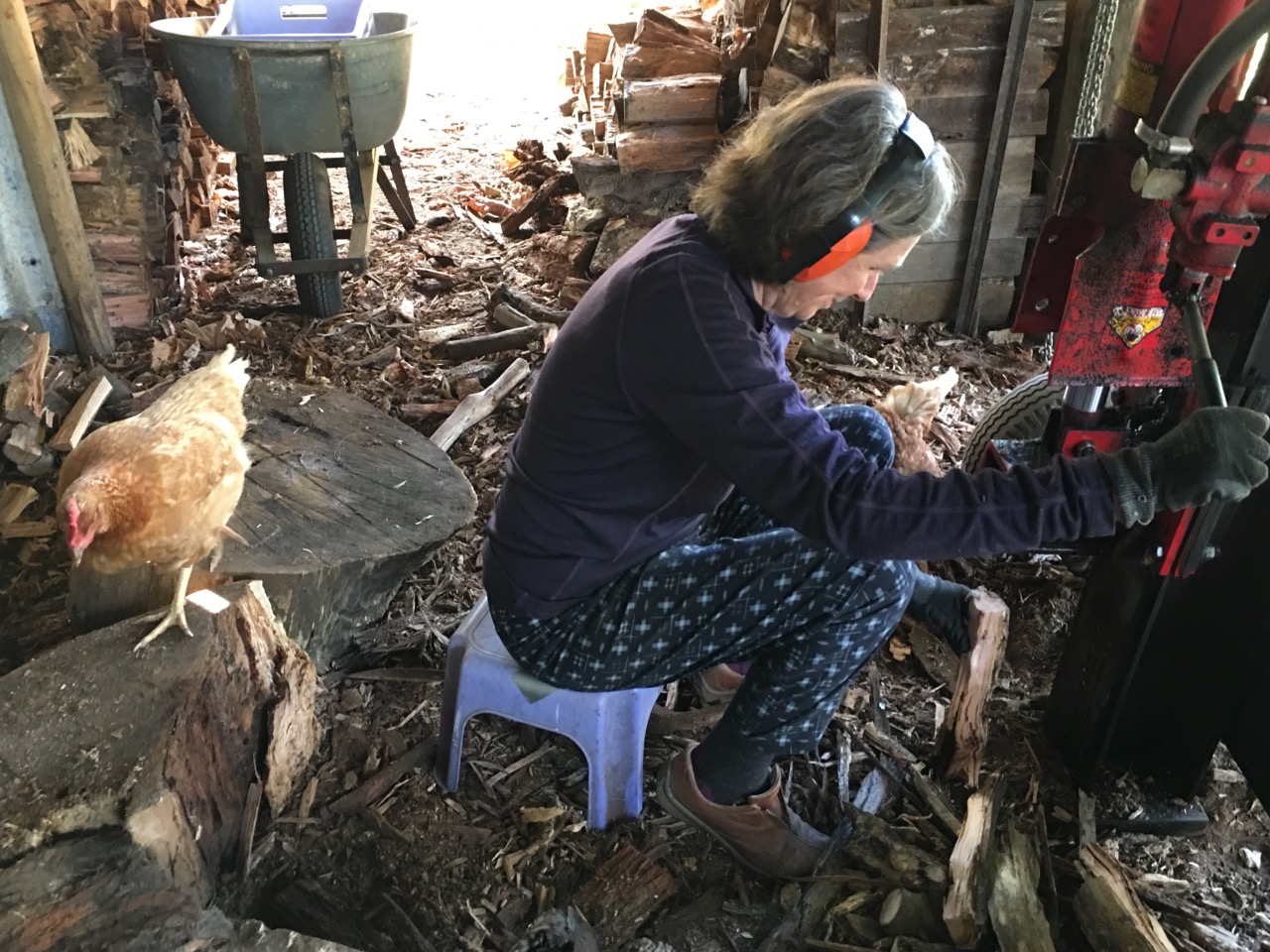
We have been working on the winter fire wood supply. I help Janine to move a few loads of big round blocks of wood from the wood pile yard into the wood shed for splitting to keep up the winter wood supply.

Just when you least expect it, the worst thing happens. I just manage to trap my little finger in-between a big block of hard wood and the steel frame of the lifter. Bang! my little finger on my left hand is crushed. I flick off the leather glove and blood is flowing freely from the end. I think that I’ve lost the nail. It’s one of those events that is so painful that I can’t speak. I just head for the house. I’m nauseous and a bit dizzy. It really hurts now. I wash it under the sink in flowing cold water to make sure that it is clean of any debris or foreign matter. I had a glove on, so it ought to be pretty free of grit. I wash it in disinfectant and put a bandage on it, but it won’t stop bleeding. It keeps on seeping through.

I’m feeling a bit weird. I need to lay down.


Luckily, I had just finished turning the last of my recent batch of sericite porcelain stone pots. The shelves are full and I can pack a bisque tomorrow with the driest pieces. Luckily they are not very heavy, so I can do it one-handed.

I have a night of fitful sleep, as I keep waking up when ever I touch anything with that hand. In the morning I change the dressing and it is still bleeding. It hasn’t clotted yet. Damn all that oily fish!. Fortunately, it stops by the afternoon, that’s 24 hrs! It’s not aching now either. It only hurts now when I touch it. So I’m starting to feel a lot more confident about it.

Janine makes a super-nice omelette with our eggs to cheer me up. They are so amazingly rich and yellow.

Welcome home

We arrive back home at the end of Autumn. The pistachio tree has turned red in our absence and the liquid ambers are loosing their leaves. We head straight to the chook house to see how the girls have been faring without us. Perfectly well it appears. They have changed their allegiance to Annabelle Slugette, because she has been living here, working in the pottery and feeding them treats for the past few weeks. Hens live for food! I know that it is only cupboard love, but I do feel a little bit abandoned. I’ll need to find them a few snails or other special treats to win their hearts ( and stomachs) back.


We head to the garden to see what there is for dinner. We find our selves in that special period of the year when there are just a few summer vegetables hanging on, while the winter crops are just starting, so we pick the last zucchini and the first cauliflower. There are only a couple of weeks when you can eat this combination of garden produce. The chillis have ripened a lot more while we have been away, so we pick some and dry them.


The next day I’m back at work in the pottery. I have  to slake down all my turnings that have dried out while I’ve been away. Clay slakes down so much faster when it is bone dry. I have lots of small batches to deal with. I have been working on my collected samples of porcelain stones from all around the world and I have to keep all the turnings from each batch of pots made from each special rock completely separate and well-marked, so that I don’t get mixed up or confused about which is which. I have 10 buckets marked with masking tape and felt fen, so as to keep it all under control.

I start with the first 5 batches. I slake, blunge and sieve them all through a 100# mesh screen, then flocculate them and decant the excess water, it takes a while to get its all done. Eventually, they make it out onto the plaster drying tubs that I use for small batches of re-cycling like this..


I’m not just dealing only with turnings here. Many of my pots don’t even get to the turning stage. These ultra-fine, ground stone bodies, with virtually no real ‘clay’ content, based solely on mica and quartz, with just a little illitic material. Consequently, they have no dry strength. They sometimes just split as soon as they are placed on the chuck, some don’t even get to the chuck, as they split during drying. Other decide to part company with themselves after the first turning at the ‘roughing out’ stage.


Some others tear themselves apart after the second trimming. Only a few make it to the final turning and bisque kiln. The only good thing about pots cracking during drying, is that at least I can re-work the material and have another go at making something that might survive to the kiln. What happens in the glaze kiln is another matter. I’ll find that out for these samples soon enough!
 

The dull thud of distant artillery and the sharp crack of small arms fire

We are here in Cambodia and on our first night we are awoken several time with the realisation that something strange and possibly quite bad is going on.

We keep hearing the dull thud of distant artillery. Not constant, but quite intermittent, just so much so that we drift off to sleep again and then are re-awoken by the sharp crack of small arms fire, not all that far away.

Having read up a bit on Cambodia before arriving here, our minds are full of Pol Pot and the civil war. Then, just a week before we set off. There was a documentary on the idiot-box about the assassination of a local journalist who had been campaigning for civil rights, and against nepotism and corruption in the government. He was shot by the secret police who staged it as some sort of ‘hit’ over an unpaid debt.

So, our minds were fertile ground for a disturbance. We didn’t sleep well. However, in the morning we awoke, eventually, to find that the house is under the shadow of a huge mango tree and the fruit is in full season just now. When the ripe fruit drops and hits the ground, it makes a dull thud, but when it falls onto the flimsy tin roof of the pottery shed, it makes a sharp metallic report, not unlike distant small arms fire.

It was a great relief and we were able to sleep well after that, even with the noise.


We soon get accustomed to eating half a dozen fresh mangoes for breakfast each morning. We even make tropical mango and banana pizza for the family before we leave.

A Visit to the Mountain

We have just enough time left to take the afternoon ‘off’ and Paruth suggest that we should all go to the mountain. There is a temple at the top of the mountain, and we still have one more day left on our temple passport tickets. Entrance to the temples is free for citizen. It’s only visitors like us who have to pay.

After work is finished for the day we shower and get ready for our evening visit to the mountain temple.
On our way out-of-town towards the mountain, we pass along the flood plain of the Tonle Sap lake’s high water mark. This extended riparian zone is densely populated and extensively farmed at the moment, as it is the dry season and all of this flood plain is fertilised and enriched each year by the silt deposited by the  flooding. We pass a beautiful Lotus farm. We have to stop and stroll along the elevated wooden plank walkways. There are several little thatched shelters along the path, that you can rent these little private spaces for a fee to relax on an hourly basis. It’s a lovely scene.
UNADJUSTEDNONRAW_thumb_3103
We drive through what appear to be impoverished villages, with seriously cramped living conditions in very small stilted houses and shacks. Life looks tough for these people. We stop to buy some bottled water and a coconut to drink. Paruth tells me that the lady she has just spoken to tells her that food is in very short supply here just now. Everyone is hungry at this time of low water. There aren’t many fish to catch just now and not every one has access to sufficient land to grow rice.
UNADJUSTEDNONRAW_thumb_310f
UNADJUSTEDNONRAW_thumb_310e
As we travel on along the road, we pass a lucky family who obviously has some land, as they have their rice harvest all spread out to dry on a large blue plastic tarpaulin. The rice gets raked over a few times a day to expose all the grain to the air and sunshine to finish drying it all out before being bagged.
We arrive at the foot of the mountain, leave the tuk tuk and scale the 7,000 steps up the mountain (or so it seems) in the afternoon heat. We are here to see the sunset on the temple at the top of this mountain. When we finally arrive at the top I realise that there is actually a road that goes all the way to the top, as a couple of cars arrive while we are there. There is an ancient shrine just below the top. I presume that this might be the earliest religious site up here, but there is a little complex of brick and stone temples dating from the angkor period. They glow in the light of the afternoon setting sun.
 UNADJUSTEDNONRAW_thumb_3135
UNADJUSTEDNONRAW_thumb_314e
There are a few monks living up here and it appears that there is an old orchard of fruit trees and of particular interest to me is the fact that there is a cashew nut grove up here. I’ve never seen a live cashew nut tree and these trees just happen to be in fruit right now. I know from reading and my interest in gardening, self reliance and whole foods etc, that the farming of cashews is a very poisonous business. The pods that hold the precious nuts, contain a toxic juice that burns the hands of the workers that collect them and shell them.  Paruth tells us that the fruit that supports the nut is delicious and can be eaten raw. We pick some and eat them. The fresh fruit is slightly sweet, delicious, vaguely like an apple in taste, but softer and juicy, with a dry aftertaste. Quite dry! Everyone who eats the fruit, coughs a minute after swallowing. It happens to everyone who tries it. It makes us all laugh.
UNADJUSTEDNONRAW_thumb_314f  UNADJUSTEDNONRAW_thumb_3150.jpg
UNADJUSTEDNONRAW_thumb_3152
You have to be carefull to wash your hands after touching the juice, as it can be irritating and can stain clothes black.
We walk to the edge of the mountain and look down on the paddy fields below in the setting sun.
UNADJUSTEDNONRAW_thumb_2f15
We travel back home and get some take away BBQ pork from a local restaurant. It comes with a basil sauce and some salad. No one seems to like the basil sauce. I finish my share and I am the only one to eat the salad.
NEVER EAT SALAD!
I know the rules, only eat well-cooked food and boiled water. But I’ve been here for two weeks now and nothing has happened so far, so I get slack.  I soon pay the price. I’m up all night on the loo with the runs. I wake with a head ache and feeling very tired and weak. It’s food poisoning! I don’t even feel like drinking water, but I force myself too. It’s a good lesson. Never eat un-cooked food. As it turns out though, it wasn’t the salad. It was the basil sauce, as we discover. Paruth fed all the left over basil sauce and rice to her dogs after dinner and they both threw up and were very quiet all the next day, apparently feeling quite unwell.
I know how they feel!

Aproaching Nirvana on one Leg

I’m inclined to take the risk of being totally boring now and tell a little story about our brief visits to the Angkor Temples and Palaces. I’m sure that everyone has seen a doco or read a book about these amazing places, but until I got there, I didn’t really understand the scope and scale of them. They are quite impressive.

As we are ahead of schedule and coping well with all the variations in alterations that we are encountering, we take ‘off’ another morning and hire a tuk tuk to take us to the temples that are just half an hour away. These are some of the most famous temples in the world. I’m told that Angkor Wat is the largest in the world? It is one of the most important world heritage sites.We set off early, as we want to be home before the afternoon heat sets in.

There has recently been a steep increase in the cost of the temple visitors passes. It costs us about $170 for the two passes. Our driver knows what most people want to see and the best way to approach it and in which order. He’s used to it. We trust him. There are a lot of temples around Siem Reap, not just the famous ones like Angkor Wat. Over the three trips that we make, we venture to the West, North and East from Siem Reap.

Of course we go to Angkor Wat first, everybody does, and I must say that it is a very impressive place. Actually, it’s a Palace and not a temple. It’s huge! The experience was a bit spoilt though by people like me being there. I’m spoiling it for others too. There are just too many people to be able to see things without being nudged or shoved. It proves quite hard to get a photo of some of the carvings that are situated in passageways. I’m a pain in the arse to someone else who is trying to do the same thing. Luckily as we arrived early. We beat the rush, but it soon starts to fill up.

In the busiest areas, they have laid down timber walk ways and wooden stairs to protect the ancient stone from being worn away by people like me! I rather like the polished wooden boards. As the morning wears on, more and more people arrive, It’s so crowded, there is an hour wait to go to the upper temple. Instead, we decide to leave. This proves to be a very good decision. As the other temples are not so crowded and busy. We will return on another day.

IMG_5922  IMG_5987IMG_5993 

Even though there are a lot of people here, patience is rewarded. But there is always one person who unexpectedly steps into the frame!


The next temple that we visit is Angkor Thom.. There are a lot fewer people even though it is a lot later in the day. I think that I like this temple a lot more. I’m quite taken with all the buddhas faces.


We move on to other temples near by. In places the tress have taken root. There was once a building under this tree. It’s now inside it. These trees are well rooted and it’s not just the trees!


In the early morning there are fewer people around, so some of the local inhabitants make use of the privacy, but there is always some paparazzi around.


Visiting a buddhist temple can lead one to some deep introspection. Like “Does my arse look big in this temple” while ascending the stairway to heaven.

There is quite a lot of reconstruction and repair work being done on parts of all the temples. Some more substantial, well-financed and better executed than others!


All the walls are covered in carvings. There are a loads of them on all the temples. Far too many to take in, in three 5 hour visits.


I’m here contemplating buddhist teachings and right there in front of me is the salient reminder that no matter how hard we strive, we are still shackled by our desires! This important message from the deity does not escape my attention.


Maybe I’m going about this the wrong way? Maybe I should be approaching Nirvana on one leg?


The sculptures show us how. Now, if Janine and I just practice in our spare time. Maybe…?

Changing the World, One Kiln at a Time, or 3

Nina and I have come to Cambodia as volunteers to help a potter here with her kiln. She is a single mum with kids and could use a bit of help. There are many things that we could do and ways that we could volunteer, but we have been asked to come by someone with local knowledge, who knows the situation here and also knows my particular skill set. I have been working on this private program for some years now. Restoring pottery equipment for someone who then sends it all over to Cambodia as donations to potters workshops. Now the time has come to put our feet on the ground and get more involved.

We are not working under any particular program or an NGO. We have come at our own expense as a private aid gesture to hopefully, pass on some low tech solutions that will be acceptable and that may prove to be incorporated into the local knowledge base long-term?

This potter, Paruth, has had some help previously from another Australian potter, Bronwyn Kemp, about 8 or 9 years ago. Bronwyn came over here and helped build a small gas-fired kiln from what was, more or less, scrap iron and fence wire. She did an amazing job and the kiln has been worked to death since then, sometime being fired twice a day. However, time and work take their toll, and this fantastic little kiln has had its day and is in need of some restoration and repair. The floor has collapsed, so the potters simple solution was to build up a pile of small local red bricks under the kiln to support the old floor. Fantastic! A really creative solution that solved the problem. However the roof has also collapsed in as well and will need a total rebuild.

We have organised, through another Australian, Ian Brookes, to get some kiln building materials delivered to the site in advance of our visit, so that we can get a lot done during our two-week visit. From the photos sent to me previously, I thought that this little kiln had potential to be rebuilt. However, as a safety precaution, we are also planning to build a new and slightly more robust kiln that will have the potential to last 25 years?

I sent scale drawings with dimensions of the metal work that would need to be ordered in and welded prior to our arrival, but this turned out to be too difficult for the local steel worker to manage. So we abandoned the attempt to get the steel work done in advance and just concentrated on getting the necessary materials all collected together, so that when we arrived, we could be most productive.

As it turned out, the metal work that was done prior to our arrival wasn’t done very accurately, as our welder wasn’t particularly literate or numerate. The kiln frame was the wrong size and constructed at 90o to the plan. However, with so much already invested in the construction and with so little time. I sat down and resigned the kiln concept to fit what had been done already and luckily. I was able to make a suitable plan that could accommodate everything that we had without too much loss of function or efficiency.

So the new kiln will be a bit shorter than planned and a little bit tighter in width, but it should be OK. Ian Brookes had sourced some zinc metal primer paint in advance of our visit, so we were able to prime and rust proof the mild steel kiln frame before lining it. This should make it last a lot longer.

We had also arranged to have two sheets of Stainless steel delivered in advance so that we could make a kiln cladding that would last as long as the primed frame. Funnily, stainless steel is actually quite easy to get in Cambodia, as many things are made out of it these days. Our welding man is only 100 metres up the street from the pottery and he is very proficient with TIG welding stainless steel balustrades and safety grills.

It takes us 3 days to get the kiln frame welded up. A door made and hinged onto it, then painted and panelled in stainless. I have worked it out, so that there will be just enough stainless steel sheeting left over, so that I can put a new roof and floor in the old kiln as well. If we have enough time?

IMG_5909 IMG_5911 IMG_5914

IMG_5918 IMG_6021

There doesn’t seem to be any concept of OH and S here. The welder works without any of the usual safety gear that I use at home. Not even shoes, just thongs. His only concession to some sort of safety is to wear sunglasses when welding. He will be deaf and blind in 10 years. I give him my ear plugs and get Paruth to explain to him that it is important to preserve what he still has. She tells me he doesn’t care. When I return the next day, I can see that my ear plugs are thrown in the dust pile. I say that I will leave all my safety gear that I have brought with me and donate it to him. She says not to bother, he isn’t interested. he will just throw them away. I feel bad about this, but can’t see what else I can do to help him learn more about his safety and health. I’ve sown the seed. I won’t be here to keep reminding him.

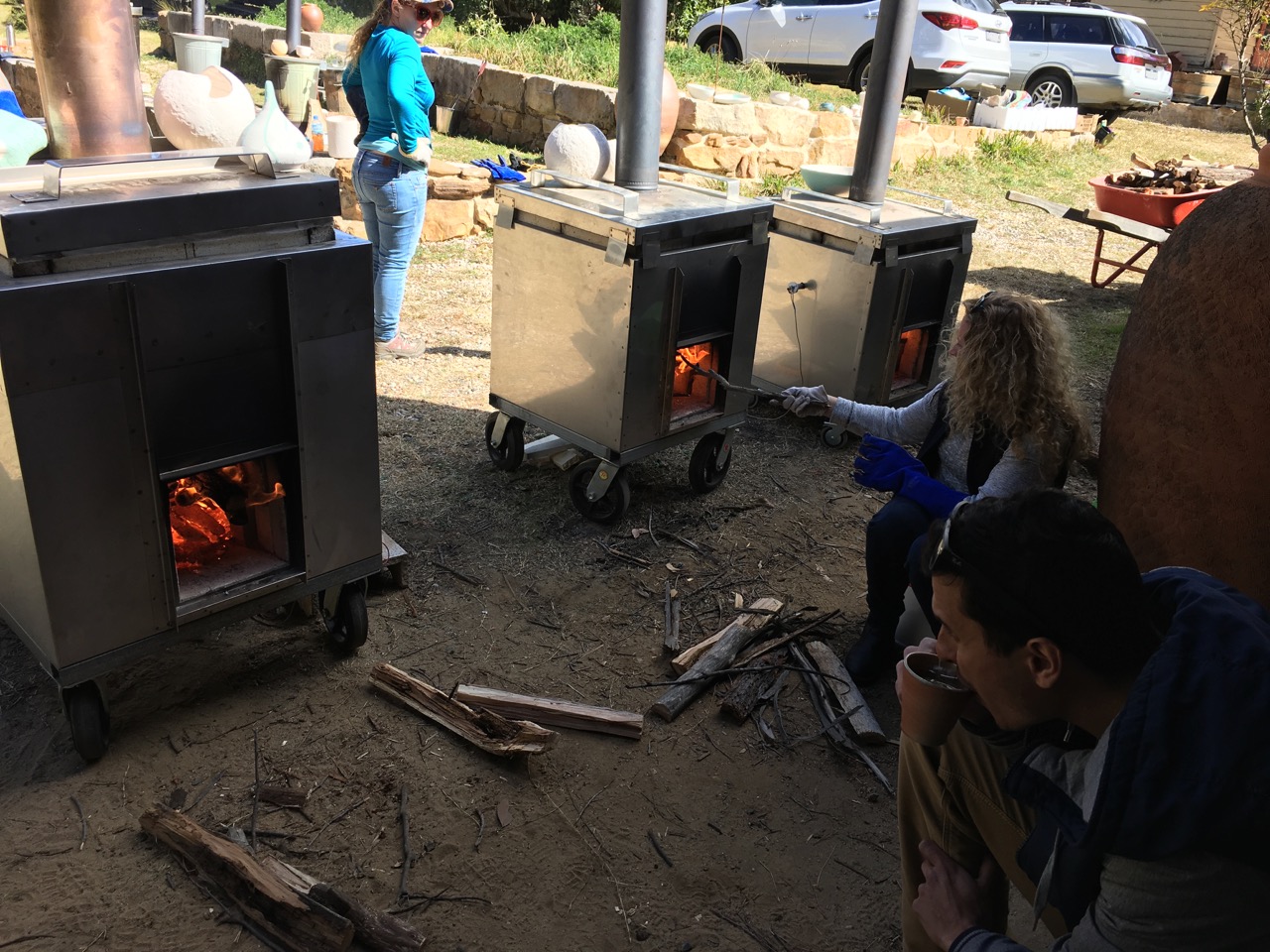
Once the kiln is finished, quite late in the evening, the welder man delivers it by walking it down the road on its castors in the evening traffic. The next few days are taken up with lining the kiln. It’s a very hot, sticky, sweaty job in the 40o heat and 80% humidity. I drink a lot of water. Janine and Paruth help all the way through the procedure. Paruth makes notes and takes loads of pictures, should she ever need to make repairs herself in the future.

IMG_6040 IMG_6061 IMG_6091

The kiln will need a spy hole and bung, so I decide to make one on-site from the local clay, opened up and made more thermally shock resistant by wedging in a huge amount of rice husks and a lot of sandy clay that has been sieved out of the normal throwing clay that they use here. This will make the clay more open structured and porous.

I make a couple of examples using an improvised tapered profile tool to set the constant taper for both the inner and outer form. Then I teach Paruth how to do it. She makes another 3 sets. So now we have spy holes and bungs for both kilns and a few spares. But most importantly, Paruth now has the knowledge and skills to make any number of them that may be required into the future.  Teach a man to fish!

IMG_6115IMG_6120 IMG_6116 IMG_6146 IMG_6147

By the end of the first week, the new kiln is done and I turn my attention to revamping the old kiln. It needs to be stripped down and cleaned, then the new stainless steel panels need to be installed in the floor and roof, and finally the lining restored. As most of the

ceramic fibre is still intact. I decide that the best option is to just install new 1400oC hot face lining over the older damaged lining. However, I install 3 new layers of floor and roof to complete the job.

IMG_6140 IMG_6289DSC02485 (1)

I wouldn’t normally use ceramic fibre for the floor. I’d prefer to finish the floor with a layer of  light weight insulating refractory bricks for long-term durability. Unfortunately, the insulating bricks that I ordered turn out to be wrongly labeled and when we open the pack, we find that they are very heavy and dense 70% alumina fire bricks! These are not suitable for this kind of kiln. So another change of plan, You have to be flexible and work with what you have. I decide to make the floor entirely out of fibre and lay an old kiln shelf down to support the props. It’ll work fine and be lighter and a bit more fuel-efficient.

IMG_6124 DSC02489

I suggest that as we have 3 spare days left. I’d like to see the temples, but I can also fit in time to build them a wood fired pizza oven. This turns out to be the most popular suggestion that I have made on the entire trip! We cobble together a few bricks and a sheet old roofing iron to make an arch form-work. The oven is almost completed in one day but needs a second day to finish it off, as it is getting too dark to see properly as I try to chisel the final key stone bricks into shape to complete the arch.

We cover the bricks with a layer of rice husks and the sandy clay to act as some sort of insulation layer, then light it up and start to pre-heat it.

IMG_6314 IMG_6432 IMG_6438

IMG_6447 IMG_6460 IMG_6469

IMG_6518

We pre-heat the oven with old dried coconut husks, which is the cheapest, readily available fuel around here, and end the day with a pizza dinner. Everybody seems more excited about having Pizza for dinner than they are about the two new kilns! Everyone is here, the kids, the helpers, Paruth, the welder and Janine and I. We make 7 pizzas during the evening.
We experiment with what we can find in the local market. We make Cambodian pizzas. My favourite is pineapple, mango and banana with a sprinkling of palm sugar as a desert pizza.