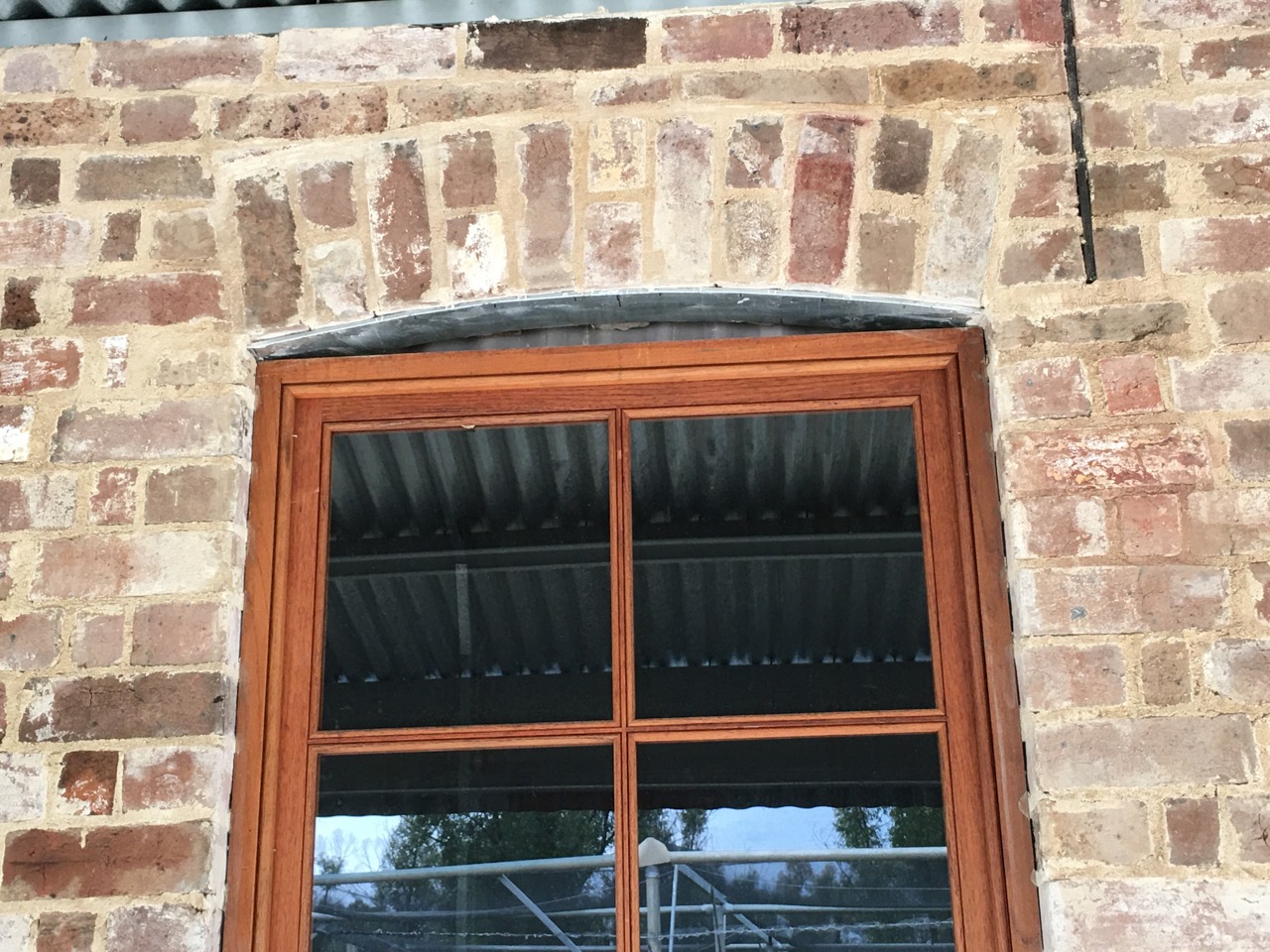
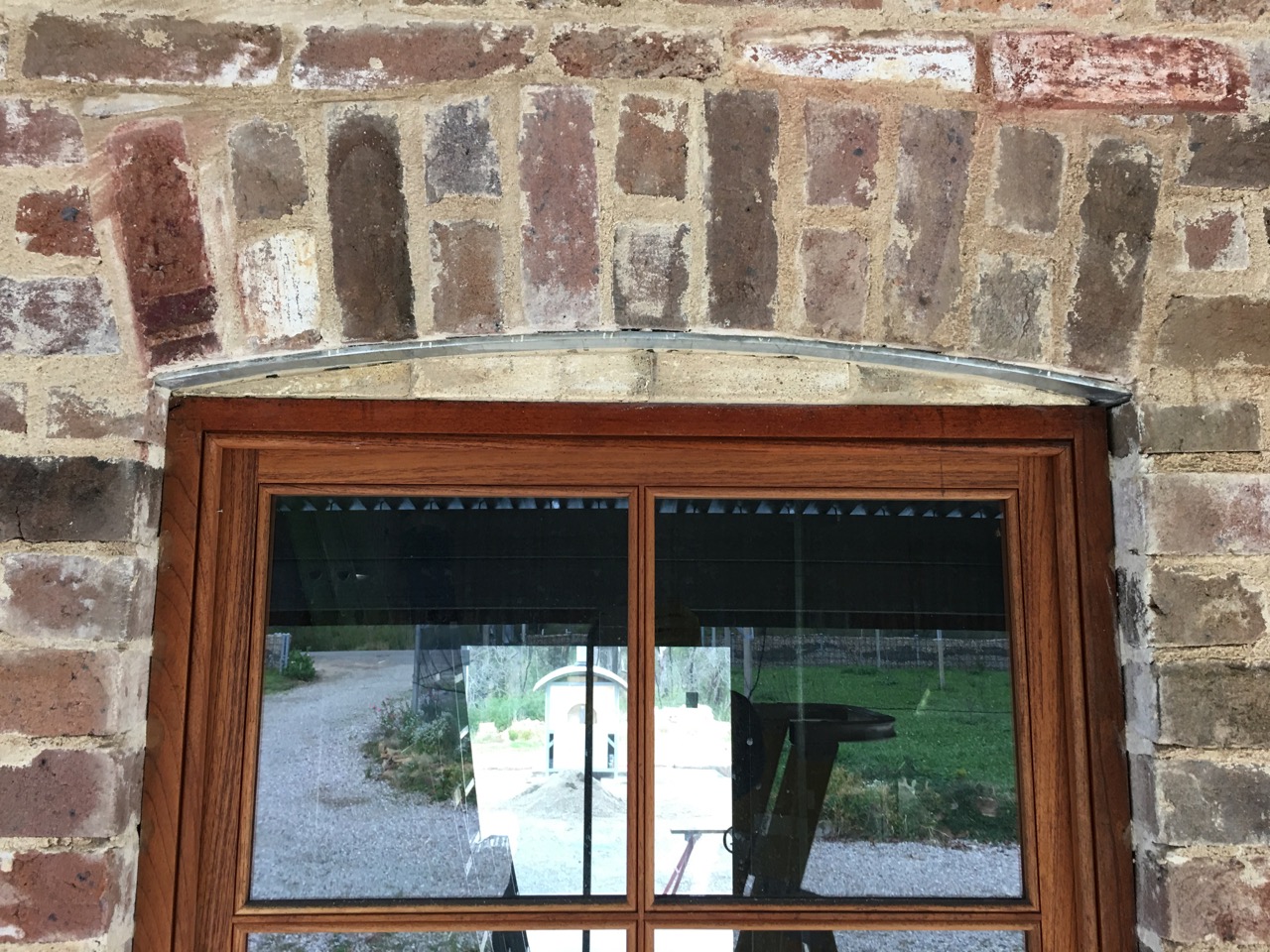
There are now lots of small jobs to convert our cheap and nasty metal framed farm shed into a functional pottery studio. I had to fill the little gap above the wooden windows, between the metal lintel bar that supports the arch brickwork. This is to stop sparks and vermin getting into the cavity. It also looks better and more ‘finished’, but really, I just had to get it done to complete the building so as to get our final approval and occupancy certificate.
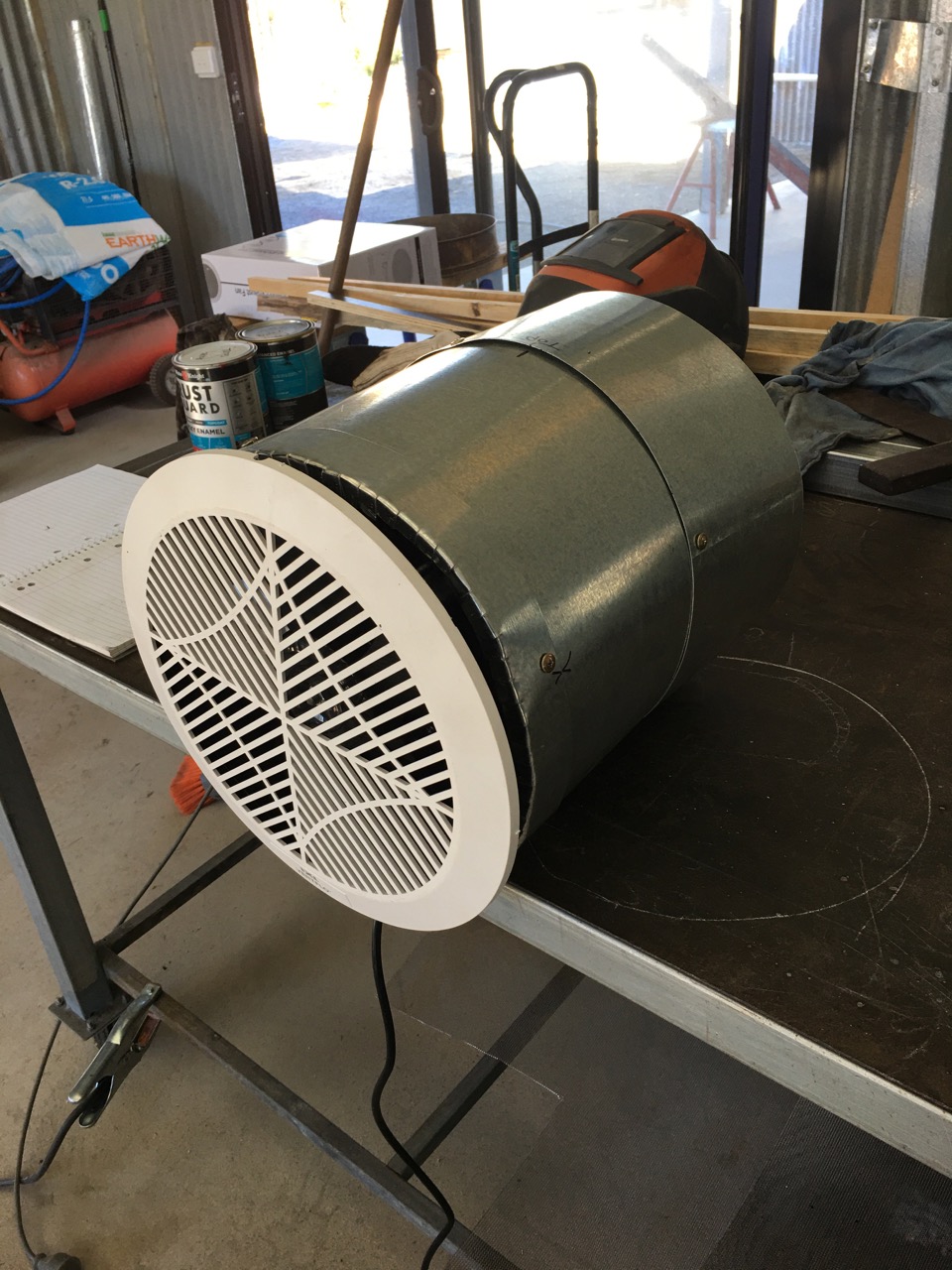
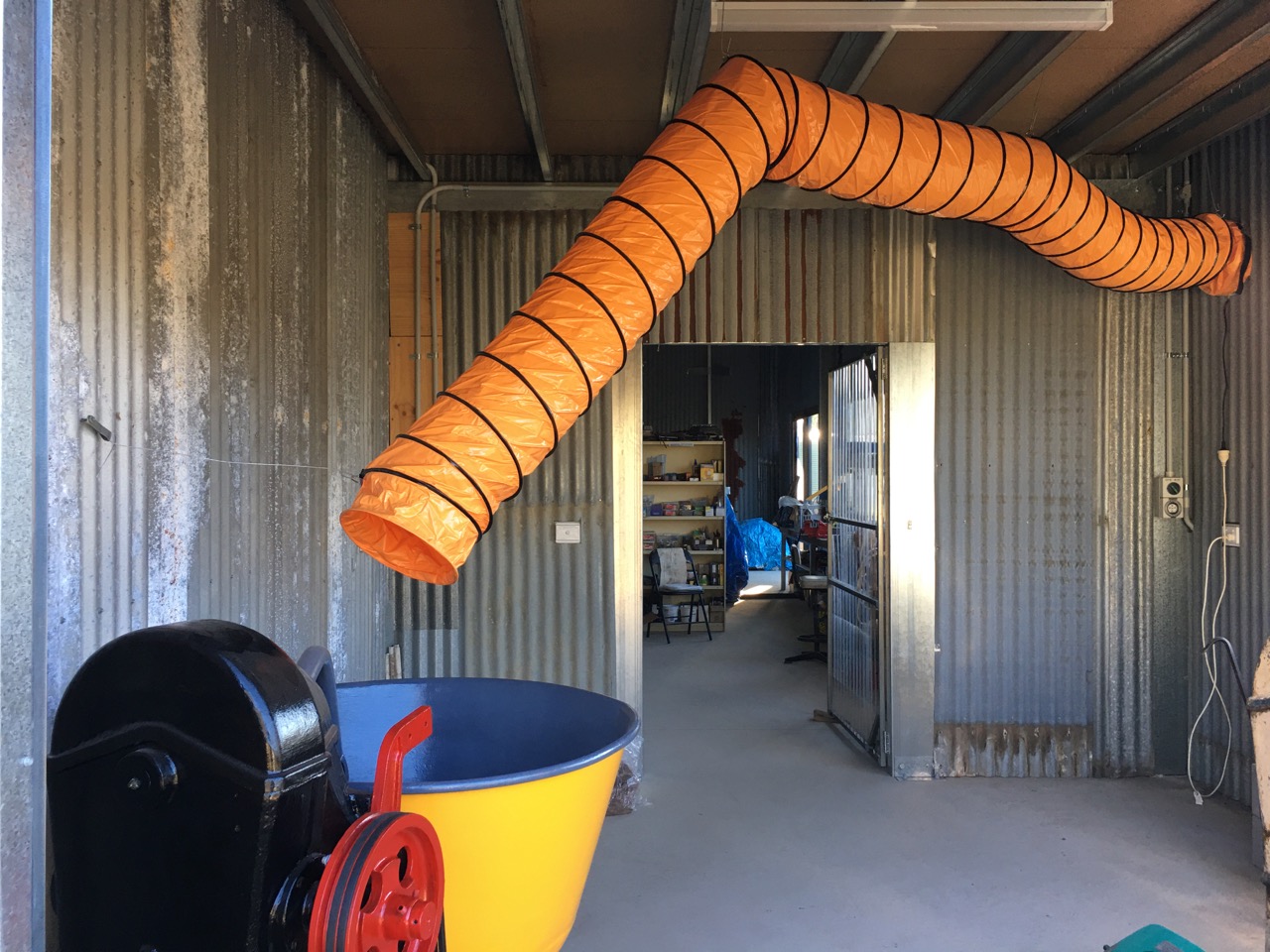
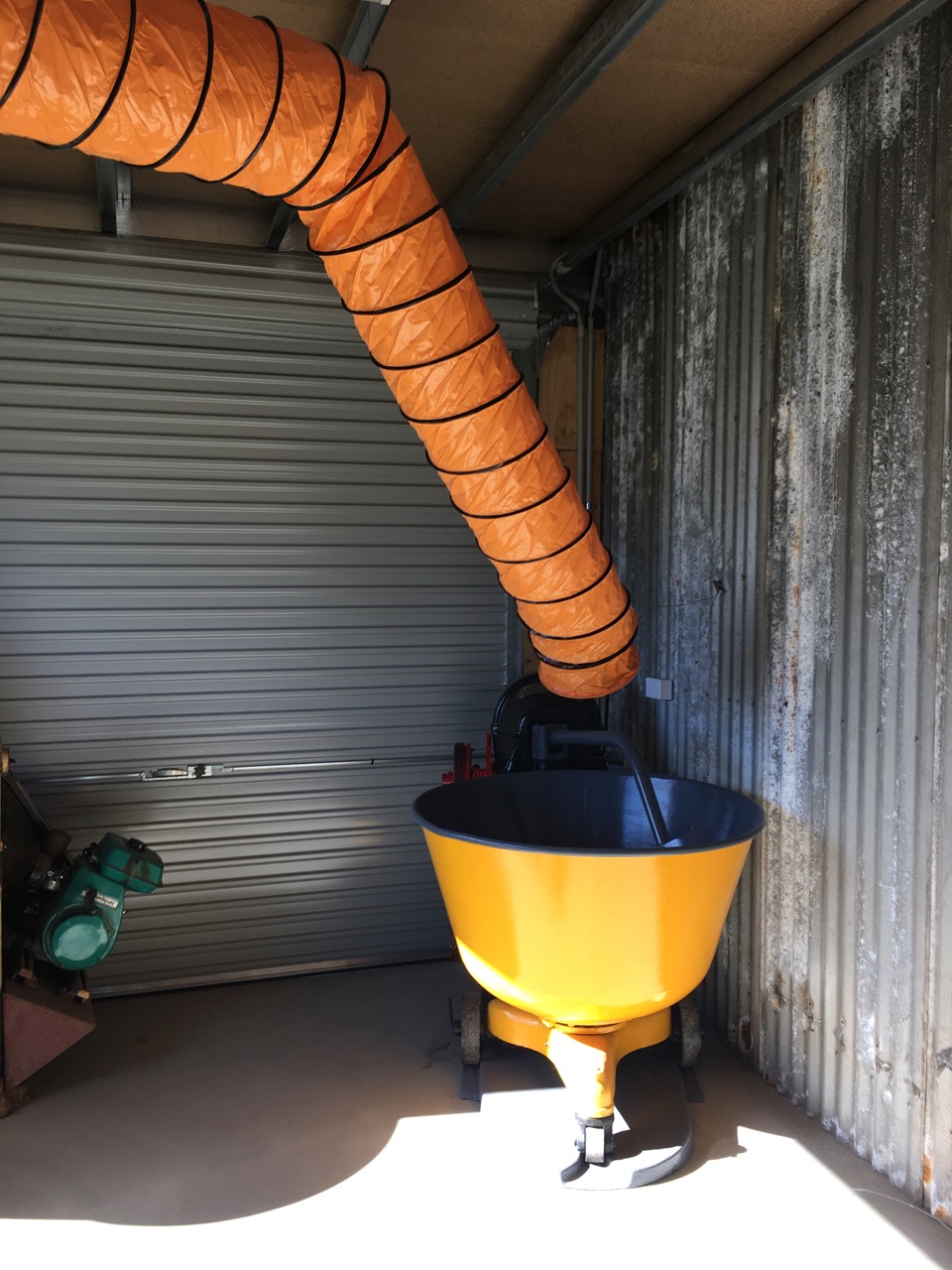
The next most pressing job was to install OH&S ventilation. A fan in the materials processing rooms to take the dust away from the rock crushers and clay mixers. I never had to worry about forced air ventilation in the past, as the machines were more or less outside in the breezeway between the two pottery buildings. Now that I have them all in the one sealed room. It is essential that I fabricate and install good ventilation.
This metal tube has some 2nd hand/re-cycled 1.5mm stainless steel mesh inserted to stop sparks and insects getting into the building.
And a cheap batroom fan in the other end that will be inside the room.
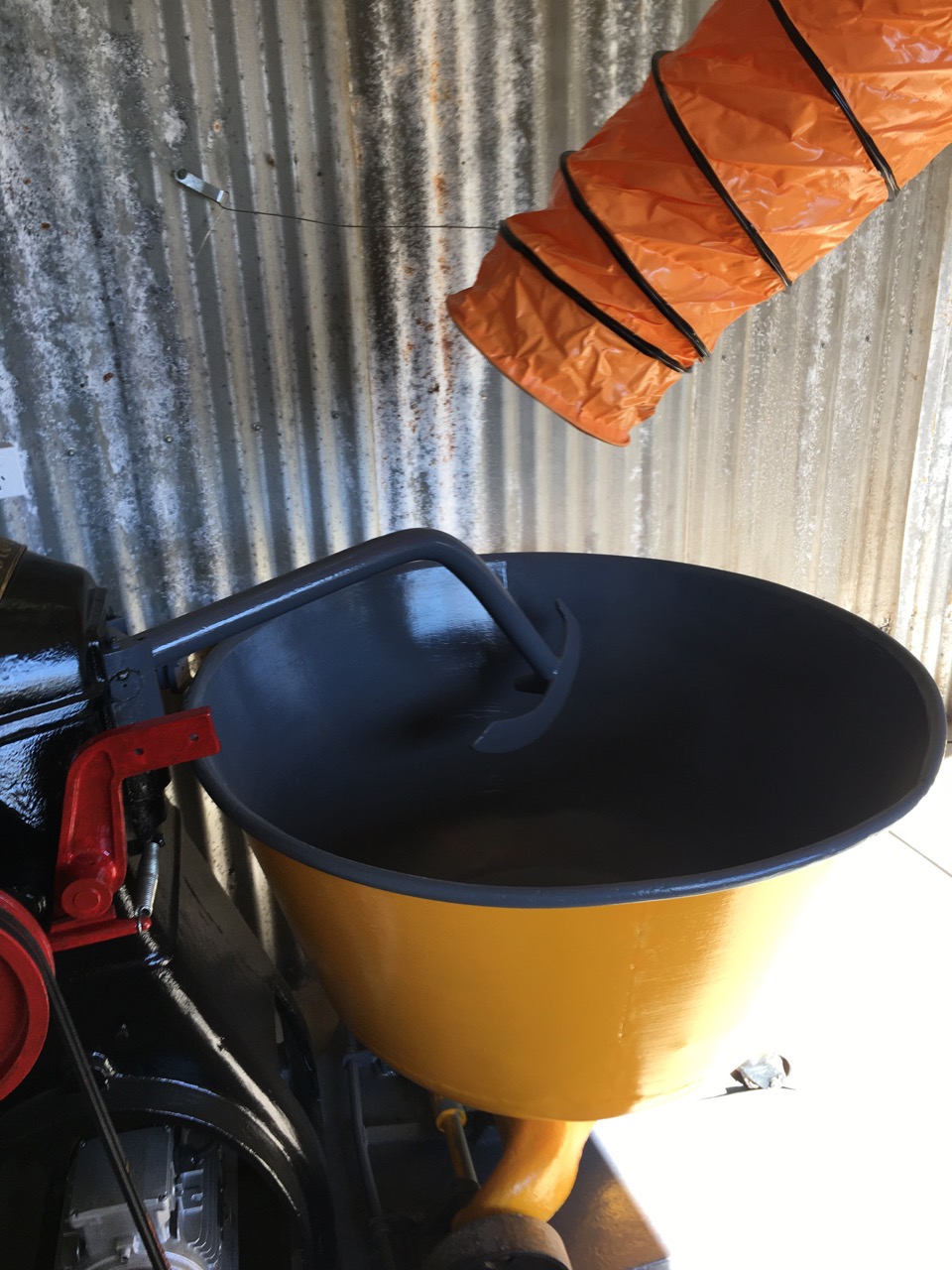
Connected to a long flexible air hose.
With the exhaust fan embedded in the wall, I can direct the cheap flexible suction vent hose to any machine in the room.
I have no idea how other people might achieve this sort of dust extraction, but this is one cheap alternative solution, and mostly home made.
We have been working a bit frantically to get all the things on the list completed so that we can get our final inspection, which, if our building passes, will entitle us to get our occupancy certificate. Once we have this, we can legally move in and fill the place up with pottery equipment and start to use the space as it was intended. The Council Building Inspector called in today in the late afternoon. He gave our work a good scrute and declared that we had completed everything on the list to his satisfaction. He issued us with a carbon copy of his Final Inspection Report and was very complementary about the way that we had transformed a cheap, kit form, tin shed(s) into an interesting building. He commented on our sandstock brickwork and the arch window that visually links the new pottery shed to the Old School building and our use of recycled, old gal iron to enhance the visual amenity of this historic site. I was chuffed. We celebrate with a dozen oysters off the fresh fish truck that come up from the coast on Wednesday, Thursday and Friday, paired with a couple of cheap sushi trays.
Now we can legally move in. Actually, he didn’t comment on the fact that we already had moved in our kilns, clay mixers, rock crushers and ball mills, the benches, pan break and guillotine, they are all in there and ready for work. I have been using the maintenance shed for a couple of months now to restore my machines and actually make the components to fit out the rest of the building.
One of the first things on my list now, is to make some clay, so that it can ‘age’ for a while, to improve its plasticity, so that when we start to make pots again, the clay will be more workable and respond better on the potters wheel. Having a bit of time to age is very important for freshly made clay, when it is made from powdered materials.
Ageing isn’t so important when clay is made by the wet method involving a slow stiffening back from a liquid mix where the raw material is in the crude natural form straight from the ground.
It might be worth explaining here a little bit about clay. When clay is in its natural crude form, it has a multitude of fine, flat, hexagonal particles, sort of laminated like pages of a book. When the clay is soaked in water and stirred into a watery ‘slip’ or slurry, these flat sheet like crystals are slowly liberated one by one and flake off from the ‘book’. This process takes time. The finer the particles, the more ‘plastic’ and workable the clay can be, realising the best of its potential, but it also takes a long time to get the water in between the various surfaces.
Stirring the clay and water mix or ’slip’ up into a fine slurry, sieving it to remove any unwanted particles and then letting the slip sit and settle takes time. Sometimes, the clay particles in the slip don’t settle out due to gravity allowing the water to come to the top where it can be decanted off. If the slip doesn’t settle out, then the mixture has to be tested, measured and treated. This involves measuring the pH of the slip. Usually, the clay will need a small addition of an acid to change the pH to very slightly acid.
Clay particles have an electrostatic charge on their surface. Clay chemistry is very complex, but suffice to say briefly here that clay particles are a little bit like small magnets. What is needed is to get the positive and negative charges to balance so that they attract each other and not to repel. If they are repelling each other the clay will never settle, but stay suspended and cloudy forever. Once acid treated they can be made to become attractive and will form larger clumps that are affected by gravity, and so settle to the bottom, allowing the water to be forced up where it can be decanted off. This process is called ‘flocculating’ . Think of a mob of sheep forming a flock.
I’ve tried many different ways of flocculating my clay particles. Old red wine that was undrinkable due to cork taint, there isn’t much red wine that I wont drink, but cork taint is one that isn’t drinkable, then I’ve tried cheap commercial vinegar, even cheaper imitation vinegar, dilute brick cleaning acid from the hardware, or epsom salts, but my ‘go-to’ dilute acid is the water in our old pottery water tank full of rain water ( carbonic acid) that has been affected by the constant fall of gum tree leaves onto the old pottery iron roof. This caused the roof to rust and created a moderately acidic solution of carbonic and tannic acid. It came out of the tank pale brown, like cold black tea. When I used this water to make slip I didn’t need to add extra acid. I much prefer this natural method of flocculation. It suits my life philosophy of living naturally as possible and treading gently combined with minimal consumption. Once the clay has settled to the bottom and the excess water removed, the thick slurry can be placed out side in the sun and wind to stiffen.
This wet method using crude clay is a very slow process. So to speed thing up potters use can use dried powdered kaolin and powdered non-plastics like felspar and silica blended together in a set recipe in the dry state and then just enough water is added to bring the mix to the required plastic consistency. This is akin to making a cake. Although fast, this method doesn’t wet all the available fine particles and the clay doesn’t develop its full potential plasticity. Its a compromise like everything else in life. This dry mix method is fast and efficient and with a tiny addition of some extra plasticiser like bentonite, the preemptive addition of some acid to the water and a period of ageing, then a reasonable result can be obtained. That is what I intend to attempt this coming week.
When life settles down a little and we have more time, I will make the next batch of clay body by the wet method, using my larger ball mill to mix the liquid slip and allow the slip to sit as a liquid in a large plastic drum for some time and then slowly dry the slip out. This is designed to realise the maximum potential plasticity of the clay body, and is what I have been doing for the past decade to get the most out of my porcelain stones. As they are not inherently plastic, they need all the help that they can get. Tragically, In the fire I lost several tonnes of milled porcelain stone body that I had been ageing for up to 10 years for use in my dotage.
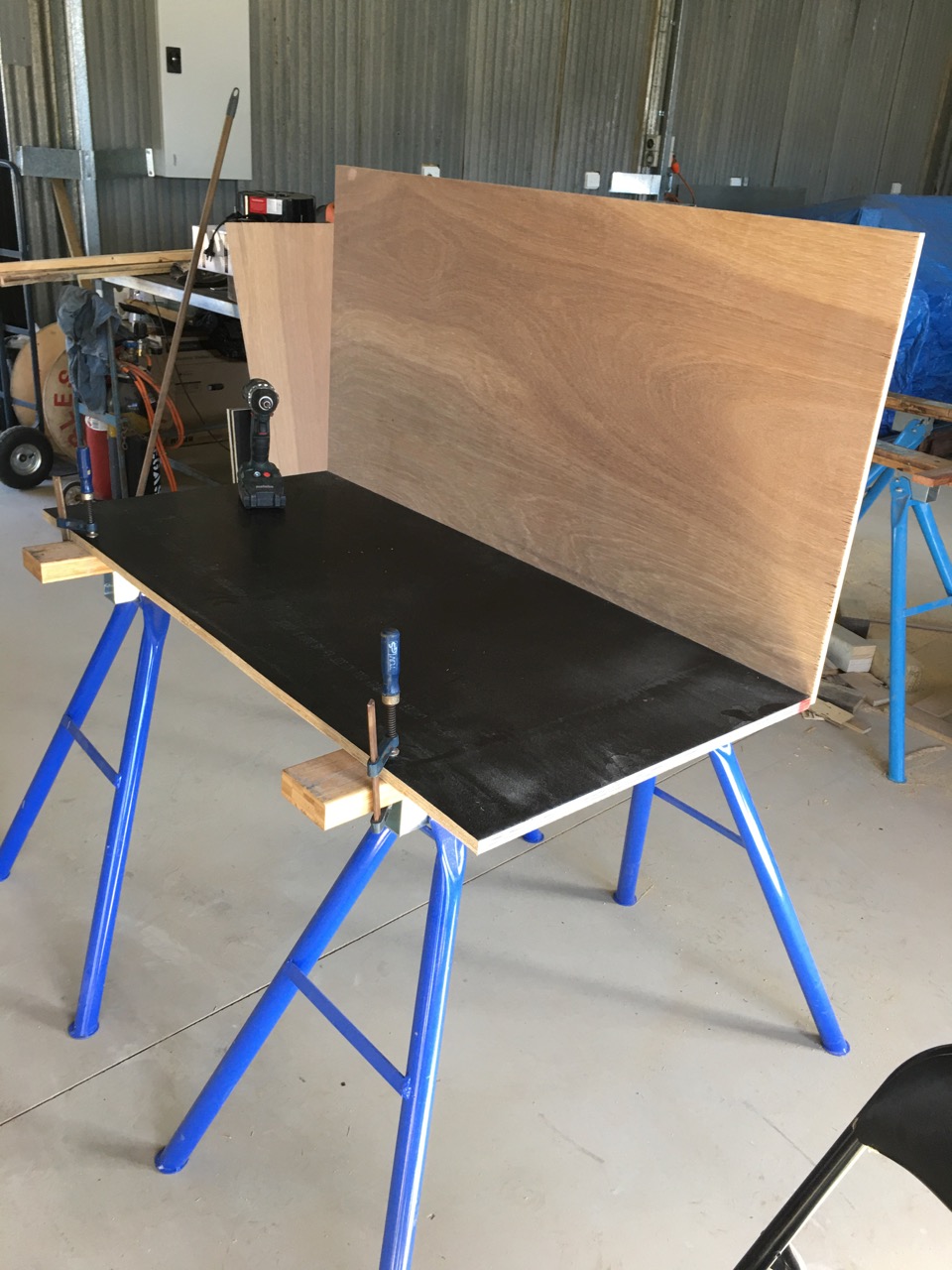
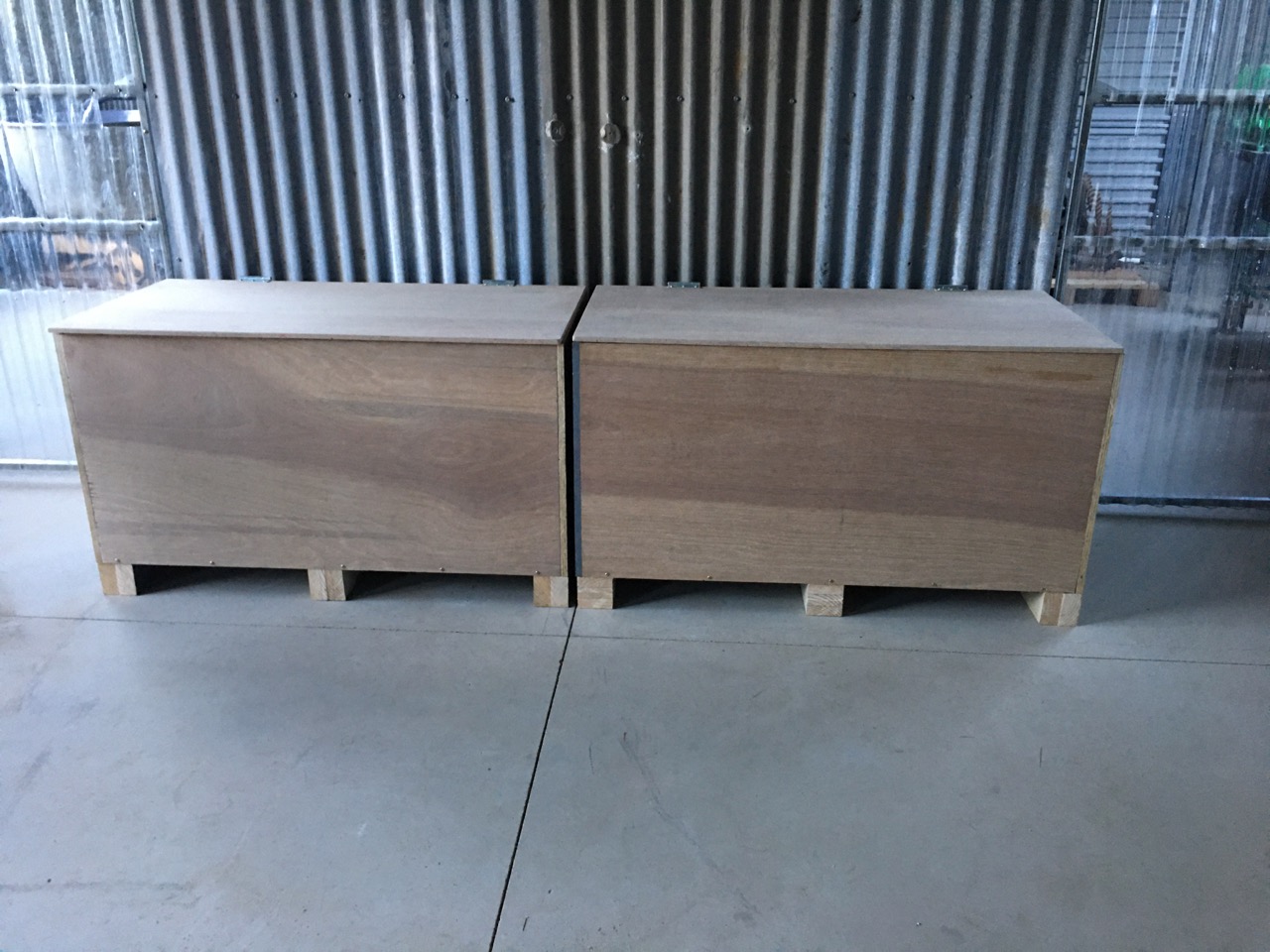
Before I can make this first batch of quick and dirty clay, I want to make a clay storage box to keep it in. Clay ages best somewhere cool, dark and where it will keep damp with a minimal amount of condensation, that means no direct sunlight, so a plastic lined, heavy duty wooden box has worked well for us for the past 35 years.
Luckily, back in 1983 when we were building our last pottery shed, after our 2nd fire, I saw two packing cases on the side of the road placed there outside a factory for the taking. 1200mm x 1200mm x 900mm. Big enough to hold a tonne each. We would fill them and when we had used up the first tonne of clay, we would make another tonne to replace it, and then use the other box full while the freshly made tonne was left to age and improve. We kept up this swap and go method of ageing our clays for many years. Unless I can find two more suitably sized packing cases on my way to the timber-yard today, I’ll be buying a couple of sheets of ply wood and a big sheet of heavy duty plastic, to make some new clay storage boxes.
I still need to line them with plastic – maybe tomorrow?
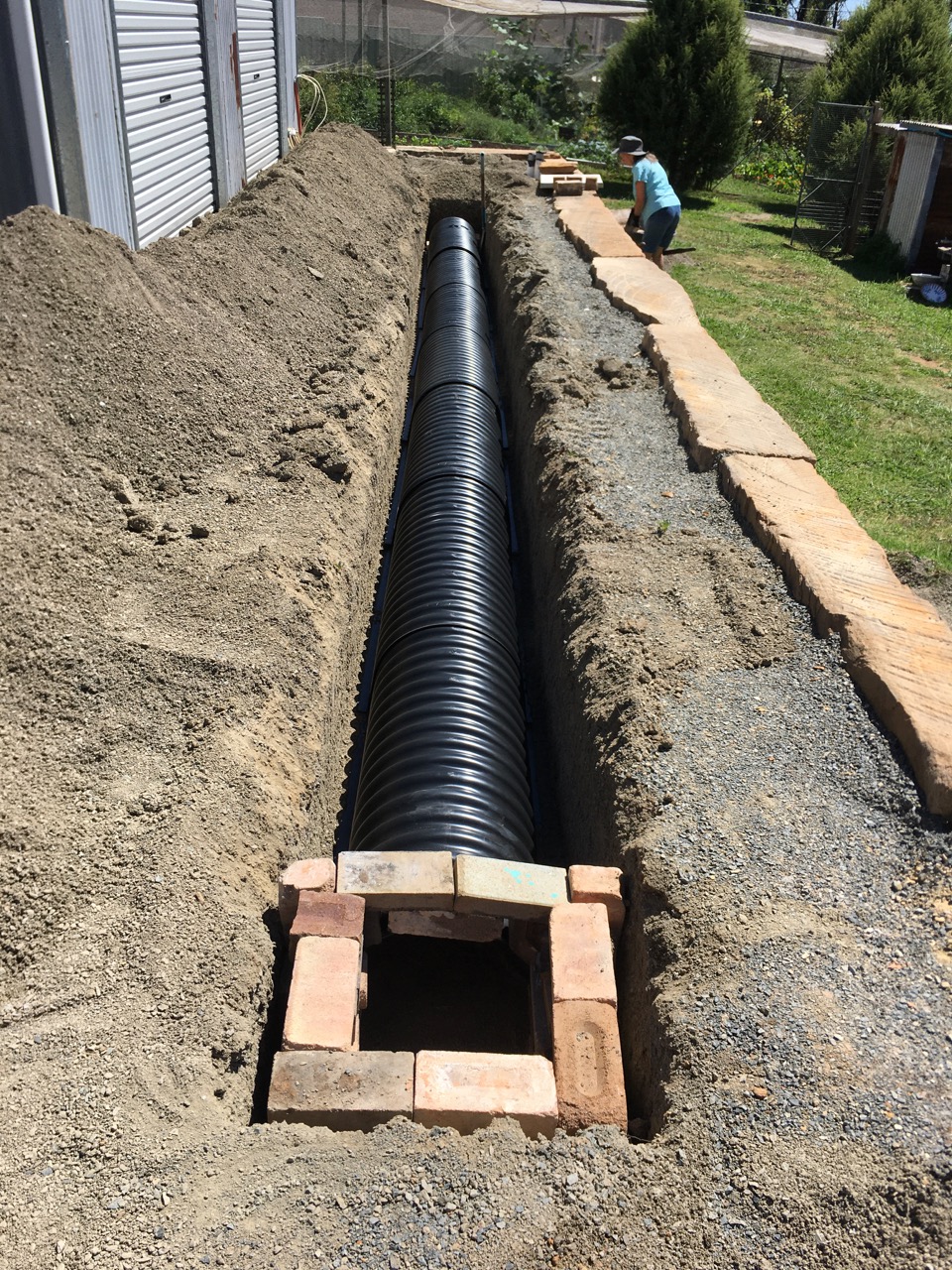
There are still a lot of small jobs remaining that we have to complete before we can call the Council Building Inspectors and apply for a final inspection. We need the final inspection to get our Occupancy Certificate, then we can be potters again instead of being stuck in this perpetual builders labourer mode. One of the main jobs on the list was to bring water down form the big new water tanks up near the street in front of the barn down to the pottery. This sounds simple if you say it quickly, but like all jobs it develops a life of its own. Firstly I needed to dig just over 100 metres of trench to bury the plastic water pipe. The trench has to go down the side of the new shed and around the back, across the back retaining wall, across the courtyard and finally up to the North wall of the pottery studio and into the sink inside. I wasn’t going to have a sink in this new pottery. We had lived without one in the old pottery for the past 36 years, just using buckets to bring in water from the water tank outside. This avoided any problems with silting up, or clogging up of the drains. However, it was the building inspector who came to do the site visit who talked me into it. He told me that it was a simple matter of getting an S64 certificate, nothing! Well it’s something! But once committed, I’m following through. First we needed a seepage trench 600mm x 600mm by 10 metres long, then a grease trap, ’S’ bends etc. It all takes time and money and a lot of effort, but we are almost there with the pottery sink and all that it entails.
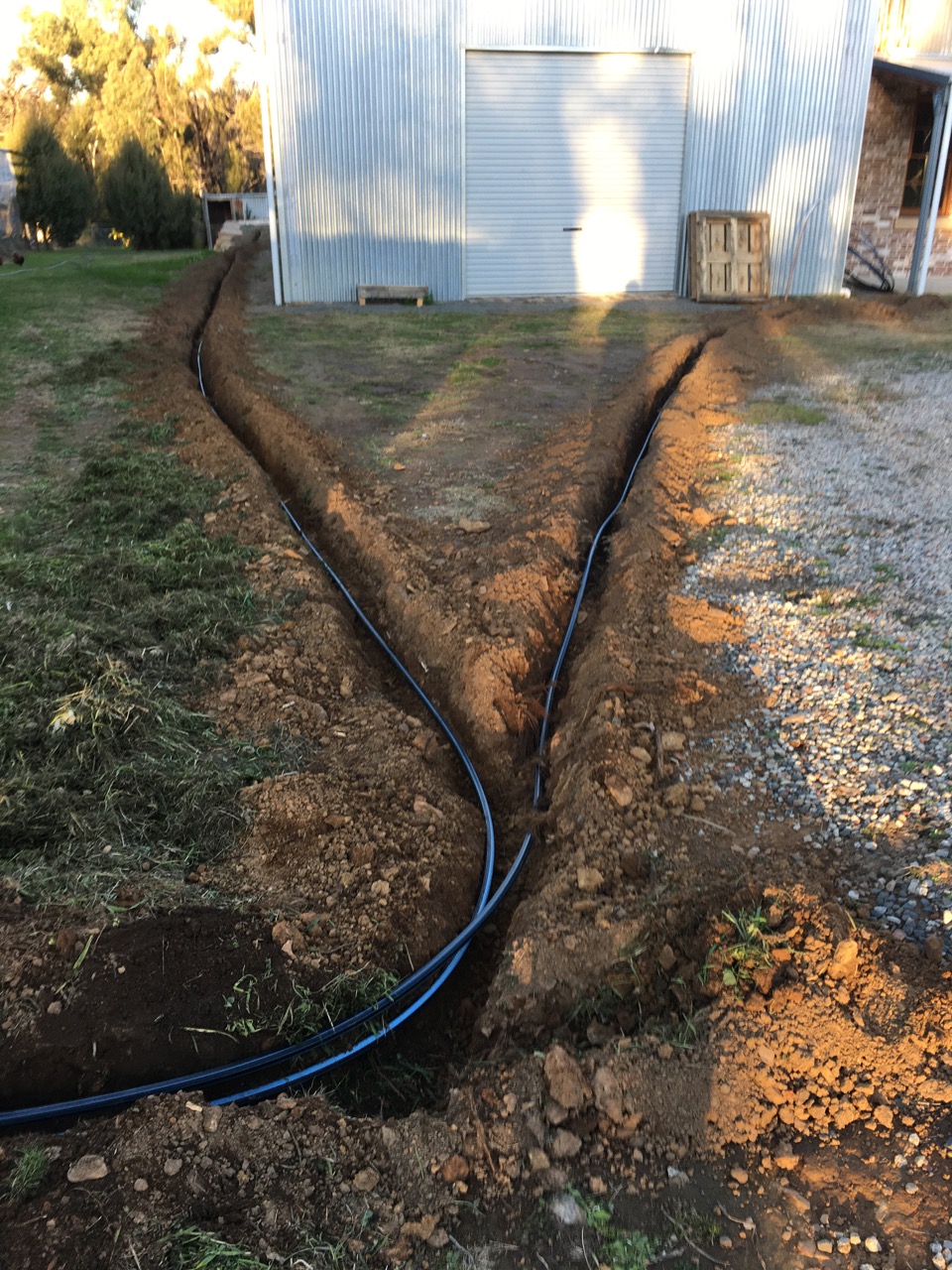
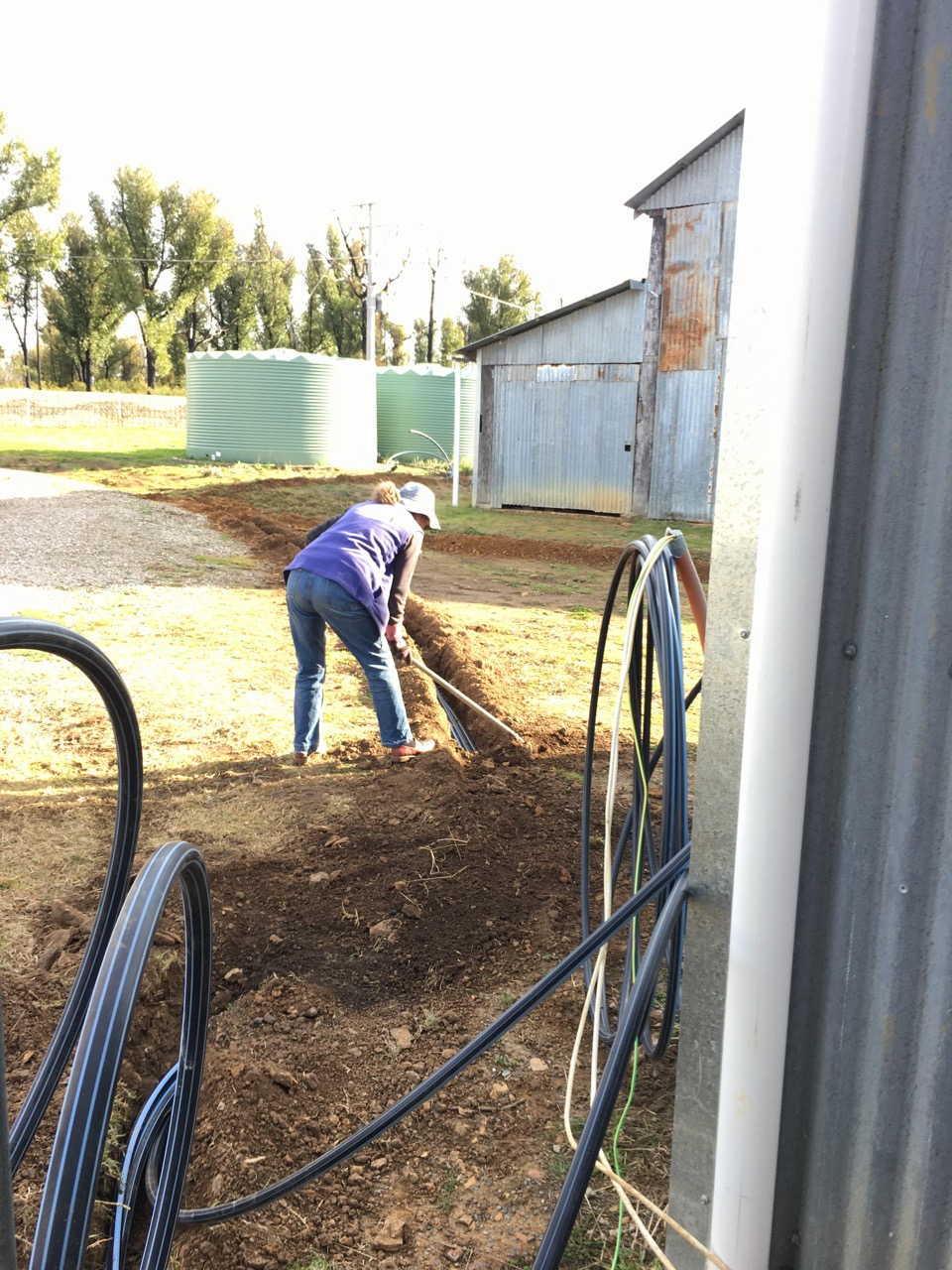
We are lucky that have very good friends who have a half share in a trench digging machine, so I asked to borrow it for a day last Saturday. It’s a fantastic gadget. I was able to dig the 100 metres of trench in a little over 2 hours. I hit a lot of flat iron stones that are very common in this soil. They sit horizontally in layers not unlike shingles, so digging through them is quite an effort with a mattock and crow bar. The last time I did it manually to do a short 11 metre trench for some storm water pipe on the barn, it took me most of the day, and I ended up digging a trench 300 mm deep x 300 mm. wide flaring open towards the top as I prised out the multiple pieces of flat stone. I only need to bury 9cm. pipe, but the hole was more like the Suez canal! So on this occasion the powerful machine makes short work of such matters as flat iron stone. But there is always a down side, and that is such that as the machine loosens and evicts each large flat stone, it jambs the drive mechanism. So I had to put it in reverse to spit the stone out. It does this easily, but in so doing, it spits the stone and all the dirt along with it back into the trench just dug. I proceed onwards and will deal with that later. I was finished with the machine by lunch time. I spent the rest of the afternoon digging the flat stones and soil out of the trench and cleaning it of rubble and roots. Sunday was spent laying the pipe work. I decided that if I was going to dig such a big trench, to save time and effort later, I would put 4 different pipes into the trench at this time, so that I can use those other pipes to supply high pressure water from the fire pump to the fire fighting sprinklers on the walls and roof of the new shed. Fitting the sprinklers doesn’t need to be done now in the midst of winter, but laying the pipes now is a good idea.
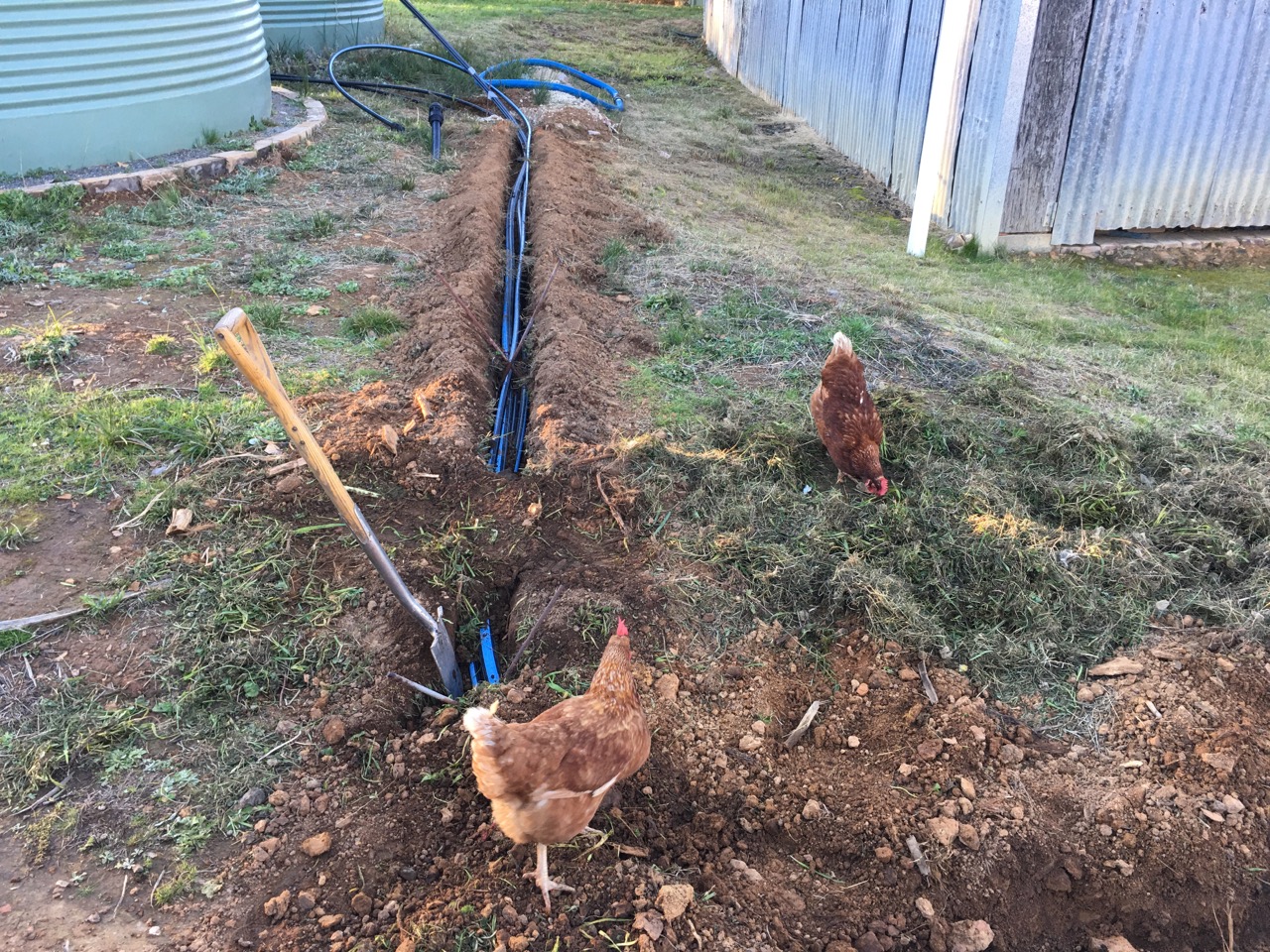
I put in a 2nd trench to the front of the pottery shed to take the fire fighting sprinkler line to the front of the shed while I was at it. This is all taking more time now and is a bit off putting and seems a bit like a waste of time seeing that I’m in such a rush to get this shed finished and passed, but it will be so much easier later when I get up to that job. With the trenches filled with the 4 different pipes, it was time to refill the trench and cover the pipes. The chickens love to be busy where ever there is fresh dirt exposed.
While I was involved in the plumbing side of things, taking the sprinkler lines up the walls, attaching them and caping them off. Janine and the chickens back filled the trenches.
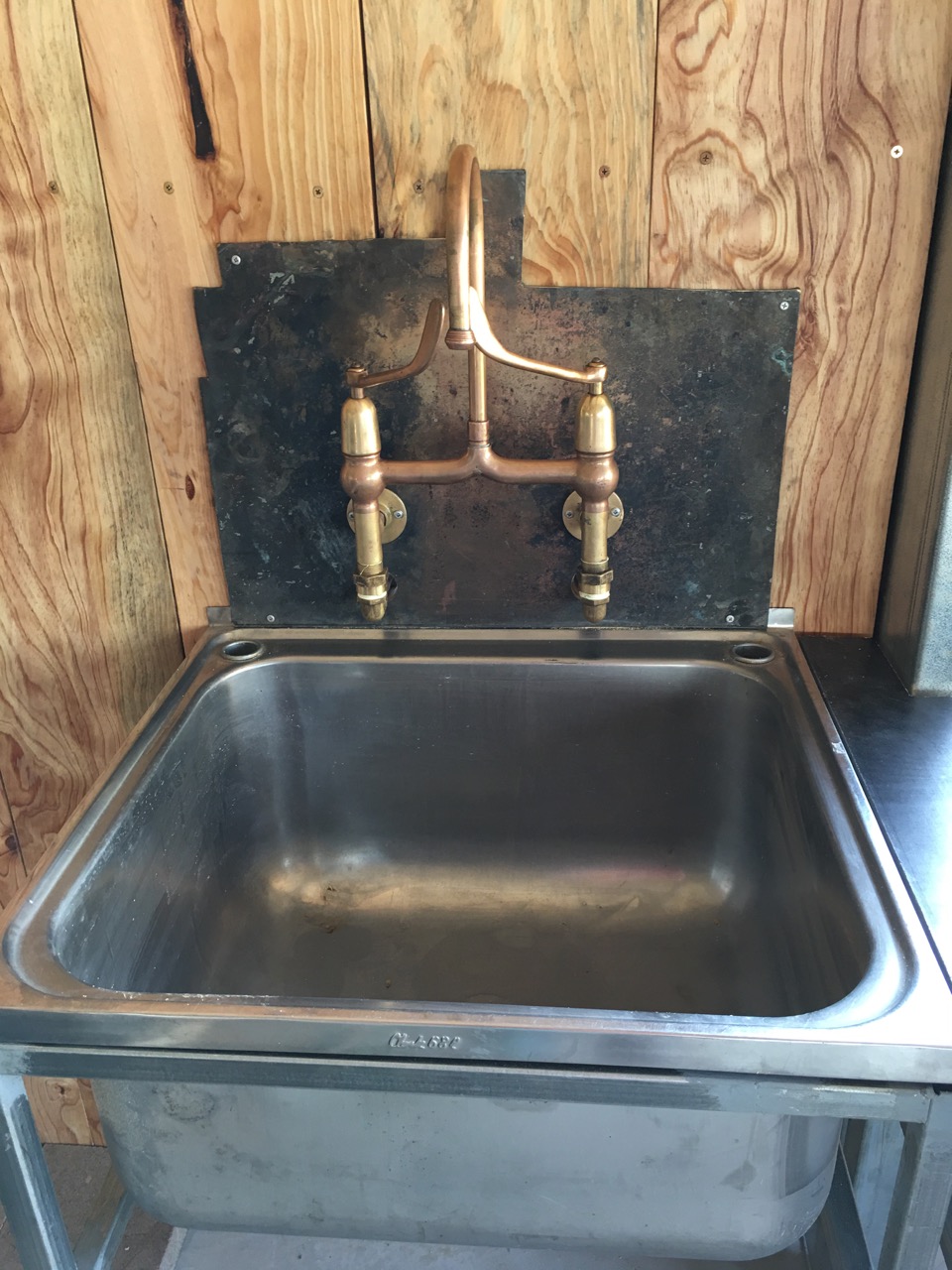
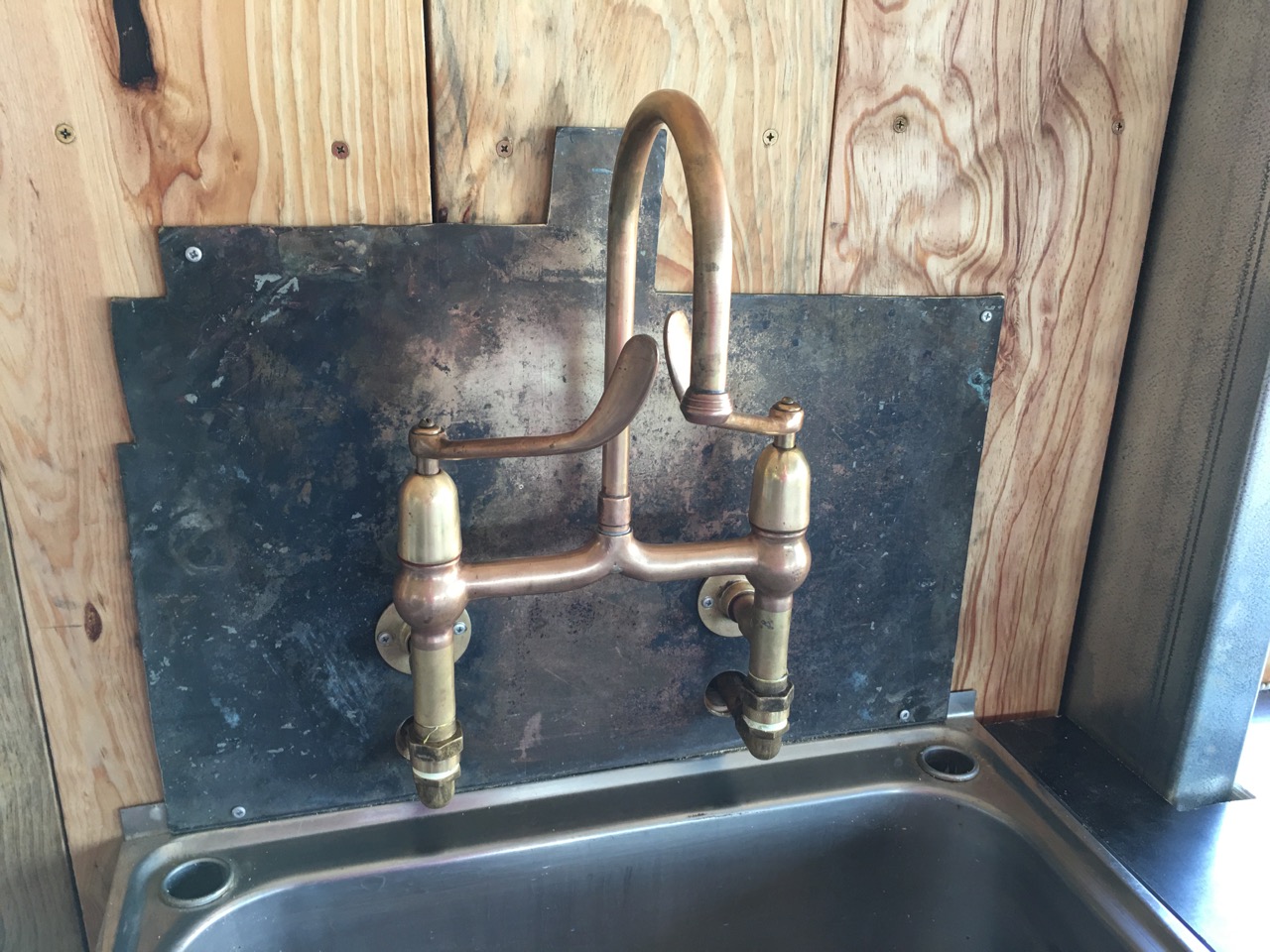
The last part of this job is to run the pipe into the studio and install the goose neck mixer and taps. We found this set of old hospital taps in a junk shop 40 years ago and bought them for $40 to use in our house when we were building the kitchen way back then. It turned out that they didn’t fit in the place that we envisioned them to go when the time came, so I put them in storage in the barn wrapped in an old tea towel, and there they sat until now when we remembered them. Luckily for us, they were stored in the part of the barn that didn’t burn down. The barn caught fire, but I was there on hand and was able to fight the fire and stop it from spreading too much, so I managed to save most of the barn. These taps included.
I gave them an overhaul, I pulled them to bits and replaced all the seals and washers, then lubricated all the working parts, reassembled them and gave them a good clean and polish. They never looked so good. I had an old piece of 6mm thick solid brass plate given to me many years ago. It was an off cut from a big job at an engineering place that closed down. I couldn’t ever really find a use for it that justified cutting it. So it just remained stored in my kiln factory. After the fire, I saw it sticking out from the ashes, all bent and twisted and a little bit melted in one corner. Luckily it was on the floor in a part of the shed that didn’t get too hot, in amongst metal machinery and up against the mud brick wall.
I spent the best part of a day straightening it out and hammering it flat. Well, as flat as I could get it. I gave the centre part a bit of a polish to show that it really is brass, and left the rest with its fire-scarred patina. It makes a suitably steam punk splash-back for the ancient taps.
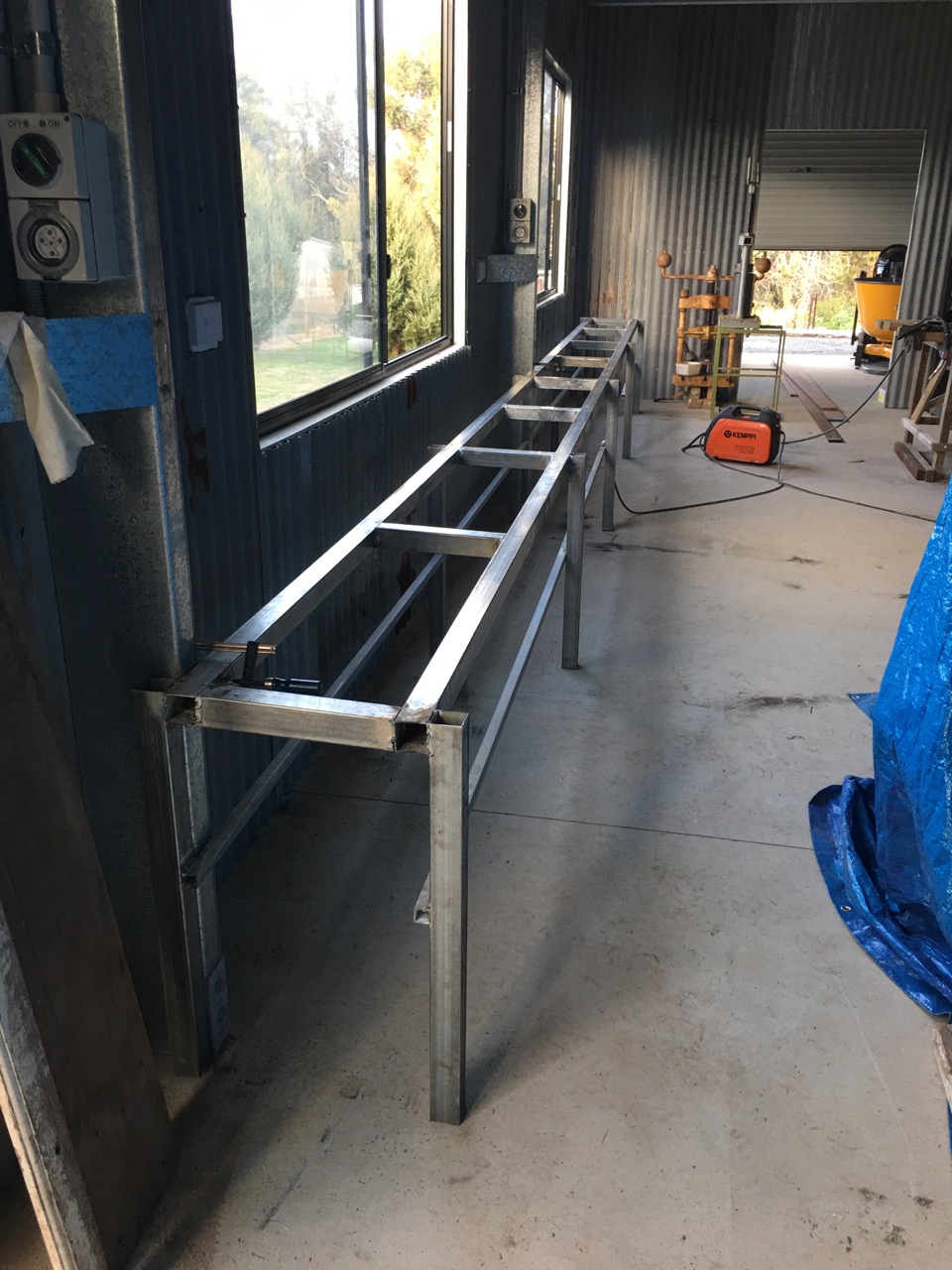
For the past couple of weeks we have been fully occupied with building benches and tables in the pottery studio and the kiln room/mill room.I decided to build all the benches with steel frames to minimise the amount of wood in the building. In the old pottery, we had the benches and tables made of wood, but with a material called ‘plasply’, for the bench tops, which was a kind of concrete formwork plywood. It had a water proof coating that was very hard wearing. We could pile up thick wet slurry and let it stiffen and dry, and also place big platters upside down to stiffen on their rims. The moisture didn’t cause the ‘plasply‘ to warp or rot. It proved to be a really great utility surface.As far as I know, ‘Plasply’ isn’t available any more. It was an expensive Australian made quality product. We had that board on our benches and they lasted 36 years of constant work and scraping and sponging of clay off them. These days, I can buy a similar product, but it is made in China now. It is a fraction of the cost these days, which is easier on the budget, but I’m concerned that they may not be as water proof, flat, stable and long lasting as the old stuff. Time will tell. I used the 17mm thick ply version for the bench tops. They are all screwed down onto the metal frame and the whole unit is very solid.
The benches wrap around the walls of the studio, and incorporate a shelf underneath. The shelf space can accomodate both 20 litre and 10 litre buckets.
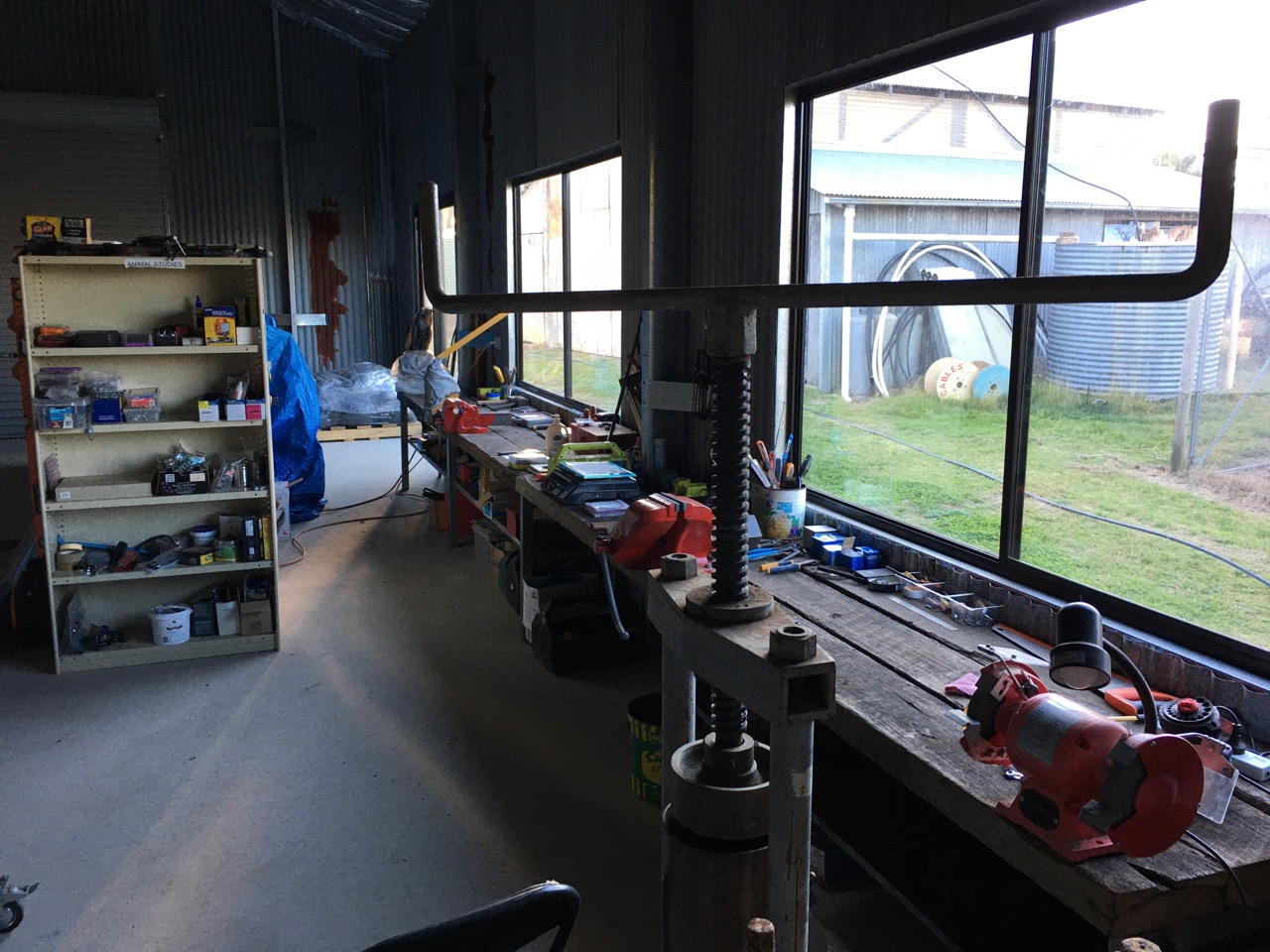
This bench with the 250mm x 80mm thick re-cycled hardwood planks will be my heavy work bench for maintenance, hammering, drilling and sawing. I was given these slabs just in time to be able to incorporate them into this bench top. They look and feel just right. This work bench has filled up with tools and ‘stuff’ in the process of building the other benches.
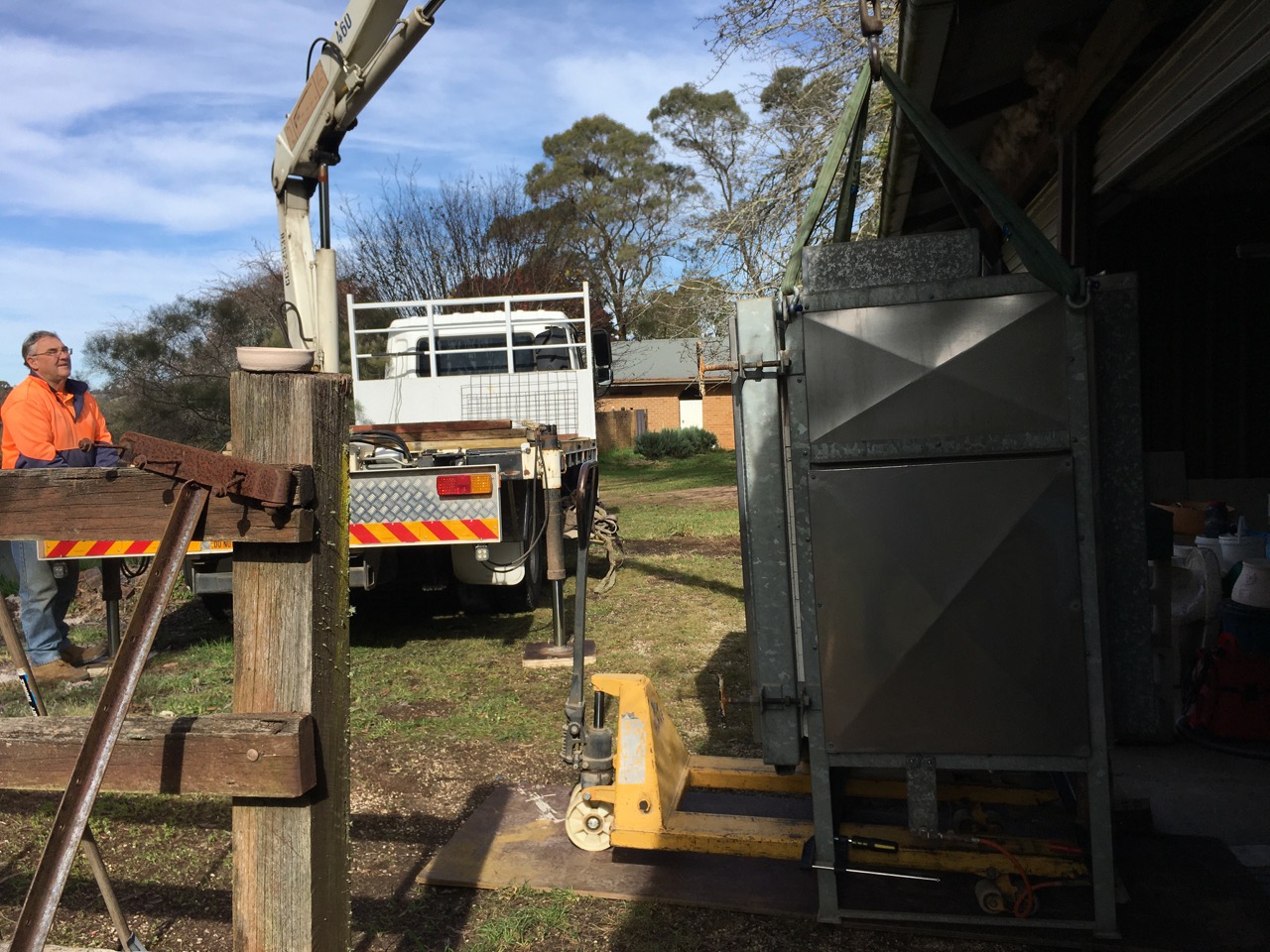
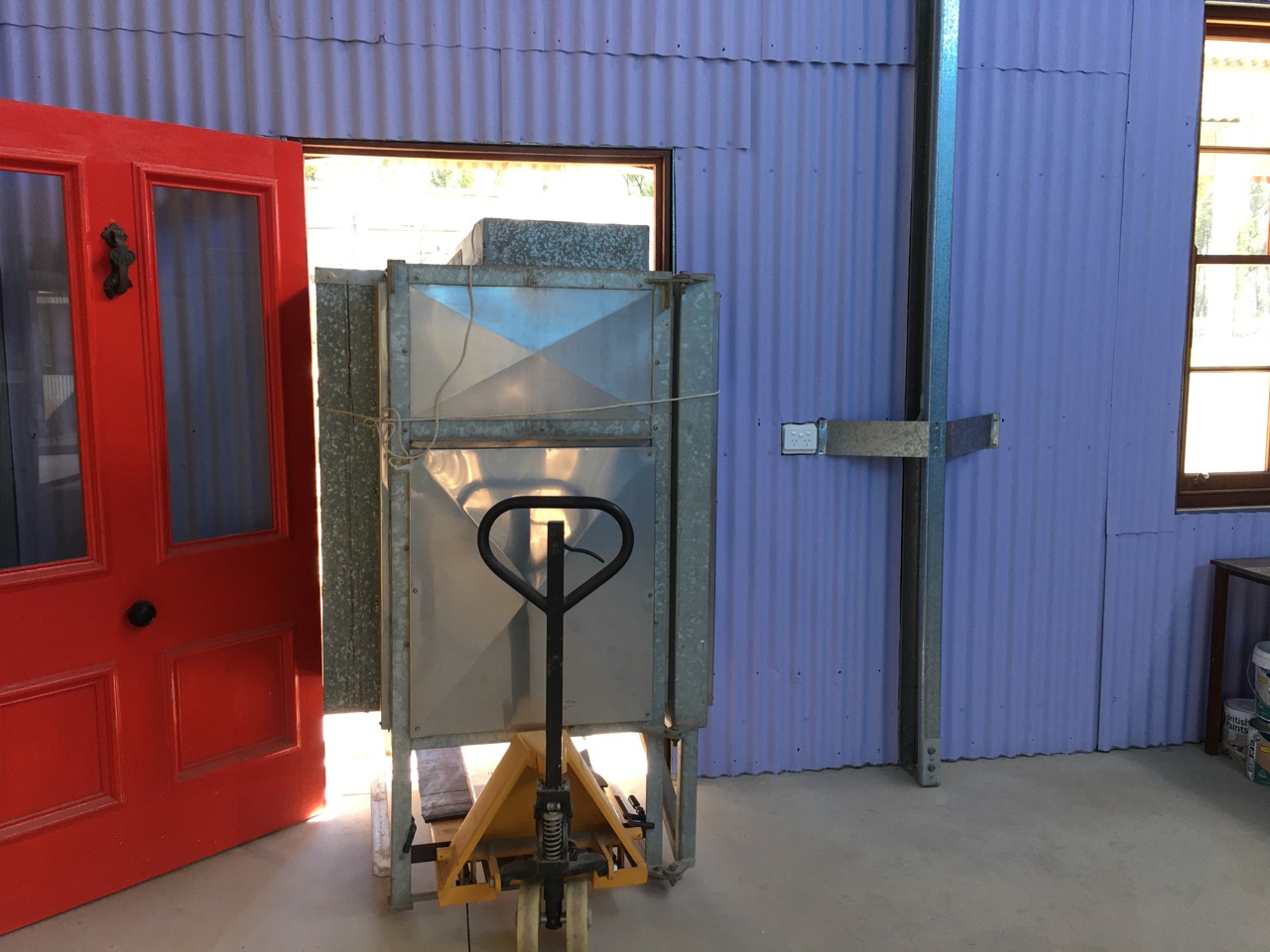
I thought that I would have been finished by now, but the jobs just keep on coming. As soon as I finish one lot of jobs and clear the list. It occurs to me that there are still a host more to be completed. Not just that, but every job takes twice as long as I estimate. As I haven’t built a pottery for over 36 years. I’m completely out of touch with building. I have to accept that I’m incompetent at estimating. I have completed the benches in the studio and the kiln room, but still have the gallery room to do. A few weeks ago, an ex-student and friend called me to tell me that she had to vacate her rented studio and wanted advice about what to do with her kiln. I had built her kiln 26 years ago and my ex-student had looked after it very well. I told her that I was interested to buy it back off her, as I will be in need of a good kiln very soon. Of course, I have the skill and experience to build myself another one easily enough, but buying back one of my own kilns, that is still in excellent condition would save me 6 to 8 weeks of extra work, possibly more at this time, as I don’t have a fully functioning kiln factory any more. Janine and I made a trip to see the kiln to check it out, and then hired my friend Dave and his small truck to go and collect it. I measured the kiln precisely, to make sure that it would fit through the door of the pottery. It worked out that we had 20 mm. to spare if we took the door lock handles off. It was do-able if we worked carefully and slowly.
The kiln in its former home of the past 17 years. It has had two owners, before being here, it lived in Ryde for almost 10 years. A genuine 2 owner that was only used on Sundays and never fired in the rain!
It just fits.
Settled into its new home here.
She was so sad to see it go. She would have preferred to keep it if she could. I promised her that she has visiting rights any time. I also told her that I will sell it back to her in a few years, once she is more settled in a better and more permanent place and as soon as I can get established again and can build myself a new one to replace it. So I am saved 6 to 8 weeks of work, but straight away I realise that I now have to finish the gas line, fabricate and install ventilation ducts and manufacture a tall flue for the chimney, to clear all the combustion products from the building.
Swings and roundabouts. The jobs just keep coming.
I need two of me just to keep up with the multiplying job list.
We have been very busy working in the new pottery shed building benches and starting to fit it out as a functioning pottery. But we have also been needing to get into the garden and do a bit of maintenance as well. Everything needs to be done NOW, but we have a limit on our time and energy levels. We muddle through, lurching from crisis to crisis. Everything gets done eventually. I console myself about my ineptitude and clumsiness, by keeping my eyes on the very long view. We have also been continually busy in the kitchen. In this cold weather we are eating less salads and eating more comfort food. This week I made roasted bone marrow stock with loads of garden Mirepoix veggie stock and a bottle of red wine. This can’t be done in one go. I do it one step at a time, evening by evening. Each night when we light the wood fired kitchen stove, this cooks dinner, warms the house and allows plenty of free extra heat for cooking things like stock that need long cooking time and reduction.
The browning the marrow bones on the stove top, sharing the hot plate with Janine’s Minestrone.
Janine’s minestrone made with our summer harvest of dried beans and our vegetable stock base. The only purchased item was the alphabet pasta, left over from a kids meal.
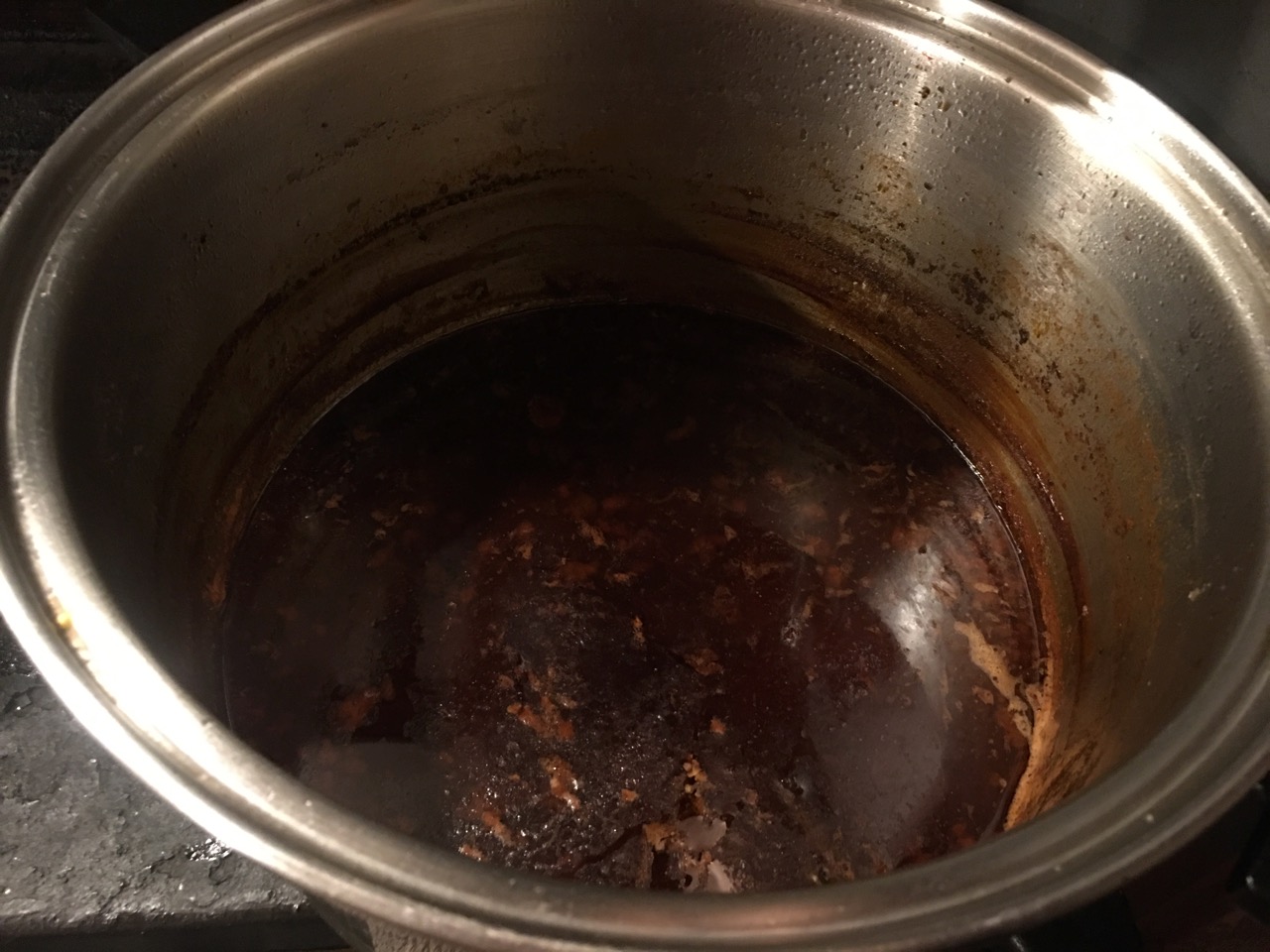
You can see the various tide line levels on the side of the pot, as I simmer it down from three large boilers of 5 litres each, all reduced down to fit in this one pot and then reduced again to just 600 mls of jellylike concentrate. A spoon full of this flavour bomb, is a home made stock cube substitute, only better, being low salt. I saw some nice bratwurst and also some pork mushroom and garlic sausages at the local butcher. I bought one of each and we shared half each, cooked with parsnip and spud mash, red cabbage and julienne carrots with garlic. Sausages are not very healthy food, they are stuffed full of salt, fat and preservatives, so I rarely buy them. The only time I eat a sausage is over at the Village Hall at the occasional fund raising get together event. So buying a sausage was a quite unusual event. I can’t remember the last time I bought a sausage from the butcher. It must be two or three years.
Our hybrid take on the old favourites, banger (singular) and mash and bubble and squeak.
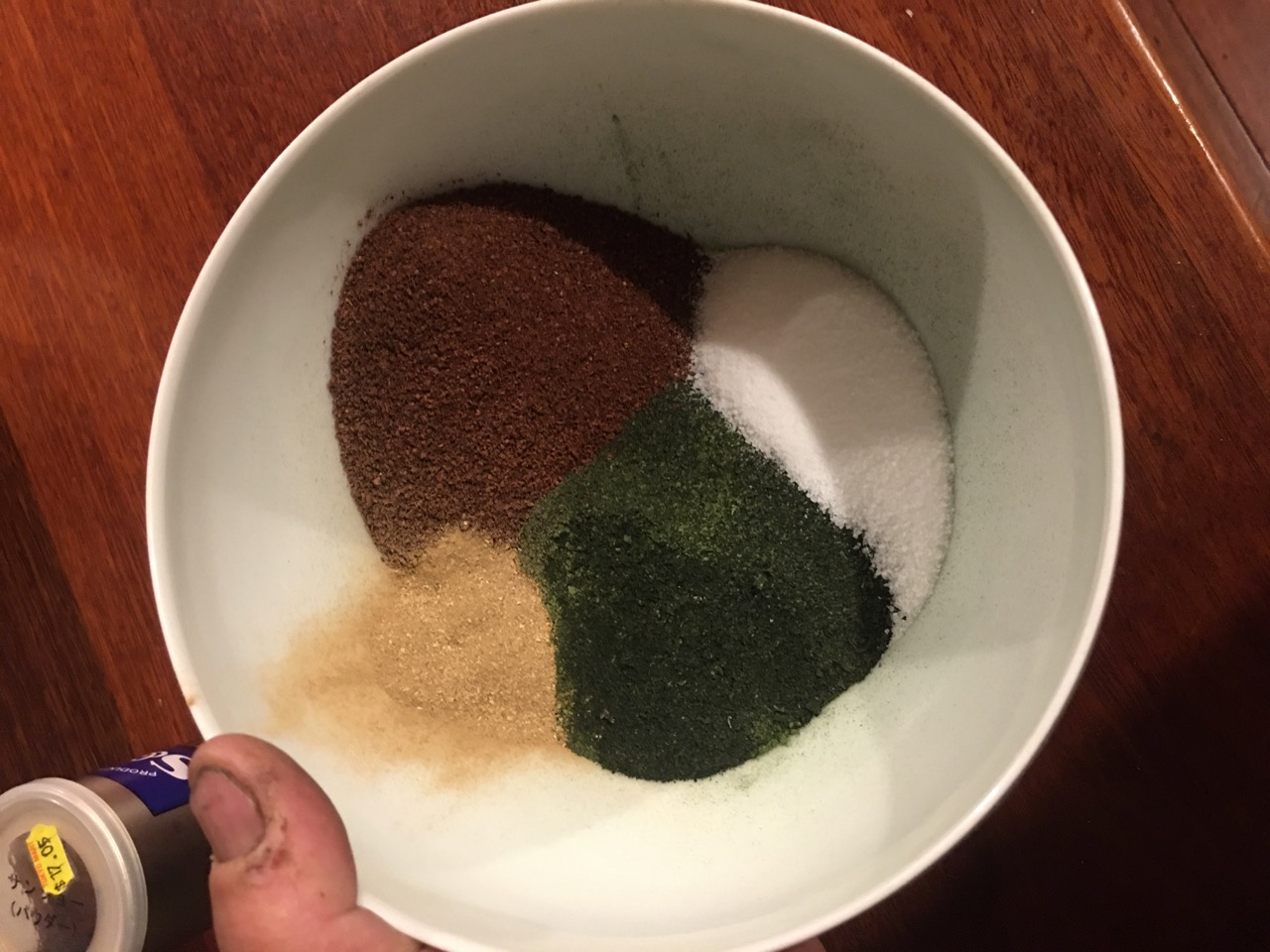
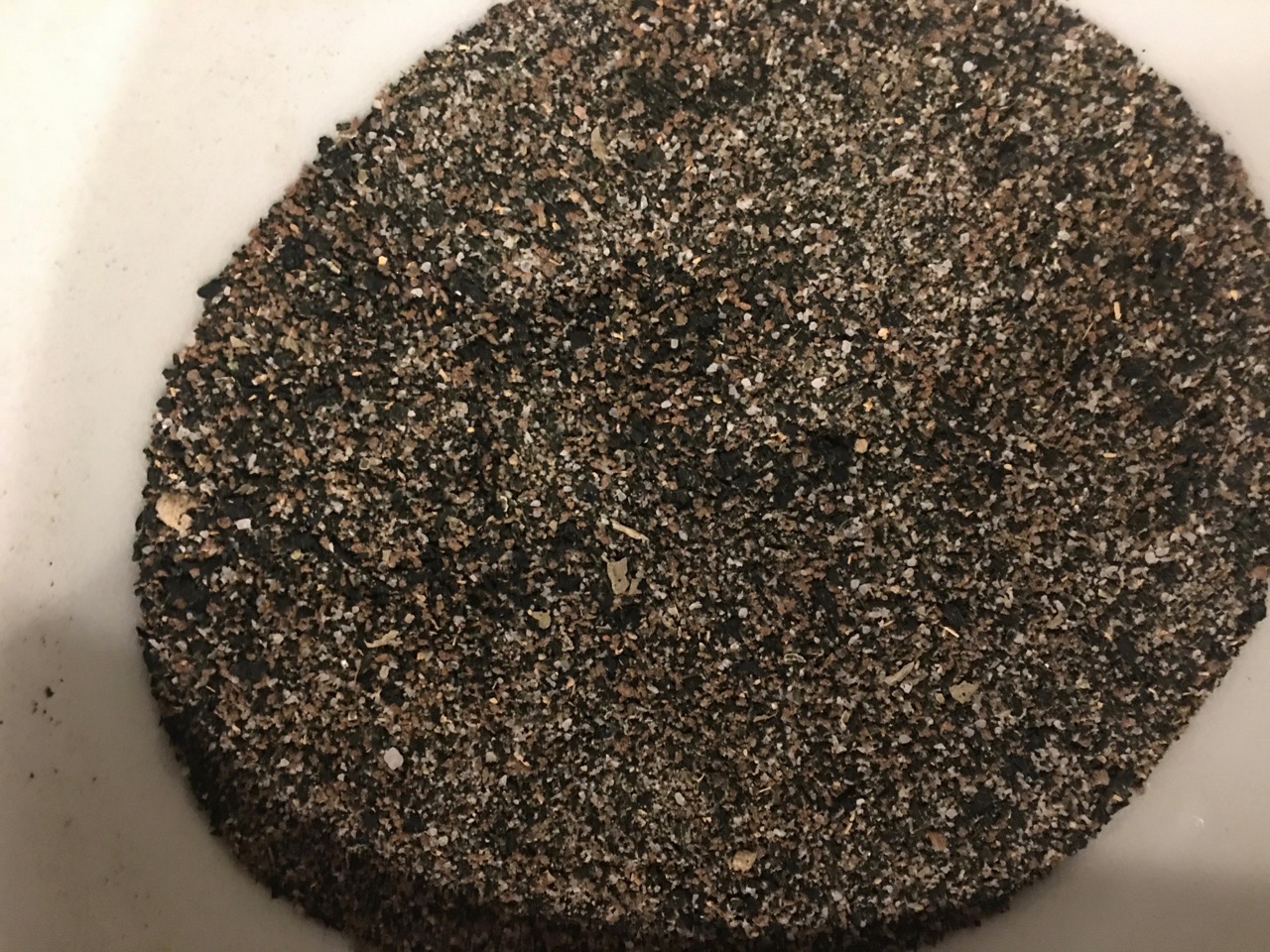
I also took time out one evening to dry, mill and grind some sea vegetable kelp and added to it some ‘lite’ potassium chloride salt, with Sumac and a small amount of Japanese sansho pepper. This is all mixed together to make a low sodium, salt substitute seasoning. Being mostly vegetable based, it has loads of flavour but little ‘bite’ from the low salt level.
I also bake bread twice a week. We can eat a loaf between us over 3 to 4 days. I vary the flour as I run out of one, I buy something different for the next batch. I alternate between 100% rye, rye and Wheat blend and straight wheat. I think that I prefer the rye/wheat blend the best.
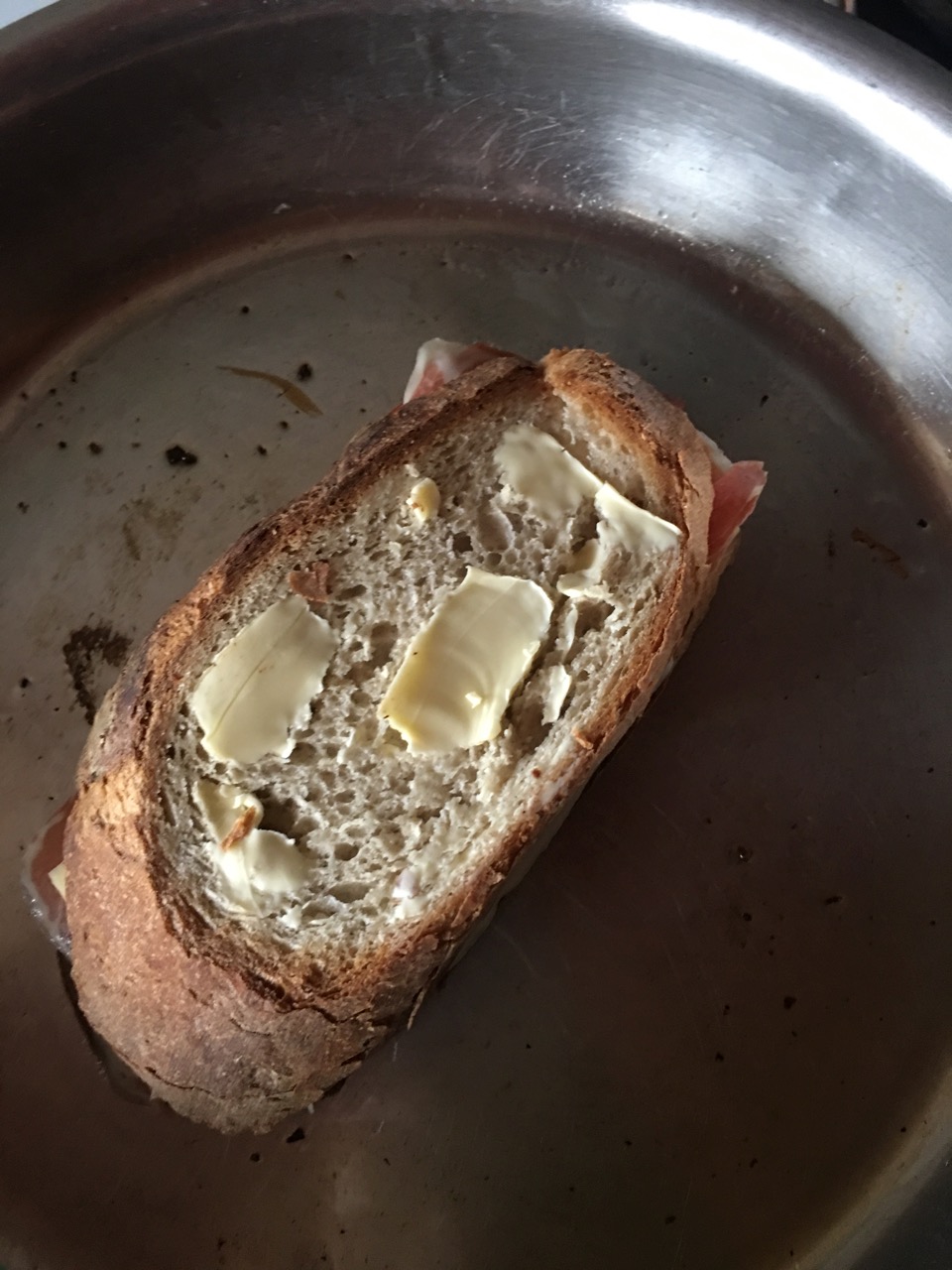
At lunch time, I made a croque Monsieur. Not just a ham and cheese sandwich, but pan fried and served hot and so warming on a cold day.
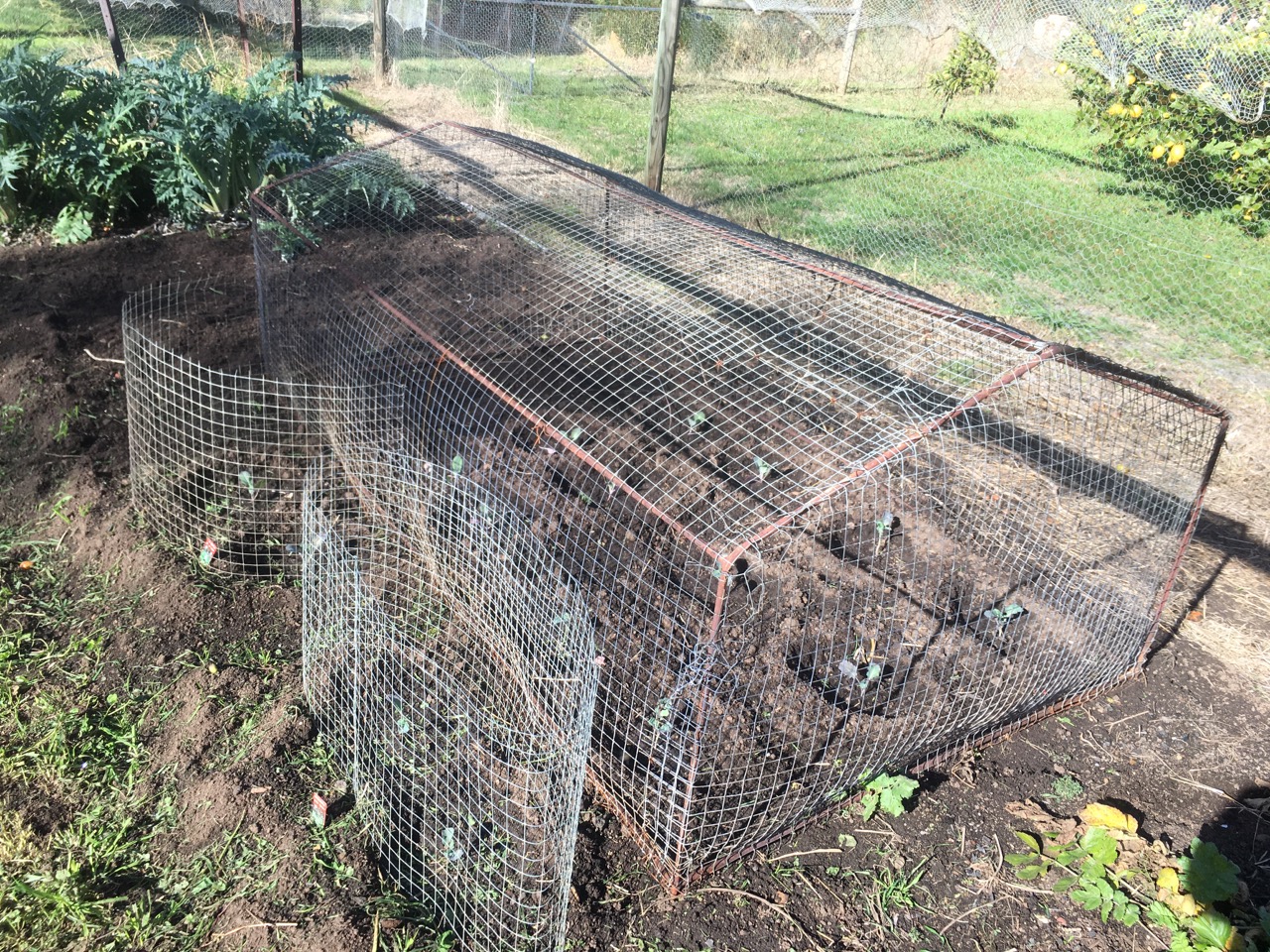
A few months ago a baby rabbit managed to find its way into the netted vegetable garden. I don’t know how it got in, but it did. I first realised that there was a rabbit in the garden when a new batch of germinating seeds and seedlings suddenly disappeared overnight! A few days later, I flushed it out while wartering. I was watering a dense patch of plants when suddenly a rabit scampered out of that patch when the water from the hose hit it. It ran off down the garden and disappeared into another dense patch.I flushed it out again and chased it towards the open gate, but it swerved away at the last moment and hid higher up in another bed.I spent some time running back and forth chasing it about, but it steadfastly refused to run out the door. I eventually gave up when I got puffed out from the running. I thought that maybe we could encourage a friend with a dog to visit us, and then the dog could do the running and chasing.On Sunday we spent the day in the garden. Firstly, I decided to get the whipper snipper mower out and clean up all the garden paths. Once that was done, I continued to mow some of the big clumps of weeds that had grown up in and around other fallow beds.After lunch, I kept on with the mowing, eventually getting the the point that there was only 2 dense patches of plants left. At the top of the garden there is a patch of gooseberries, and at the bottom of the garden, the asparagus patch was still full of weeds, as we hadn’t got around to weeding it yet. Earlier in the morning we had spent some time chasing Bugs Bunny up and down the garden. Both large garden gates were full open, but the rabbit refused to go out through them. We gave up again as it being just too difficult. Back to the mowing. It came to me that if I kept on mowing the big clumps of weeds, then there would be nowhere left for the rabbit to hide. it would have to run out to find new cover.I chased it again. but with no success. He refused to leave. When there was only one clump of weeds left in the asparagus. I could see Peter Rabbit hiding there. Just like Farmer McGregor, I caught him. And dispatched him quickly.
We have carrots, celery, onions, garlic, kale, parsnips, brussel sprouts and capsicums in the garden currently, and he had feasted on them all. In fact he ate everything that wasn’t covered by netting. We had netting within netting trying to keep some small plants and seedlings safe until they were more advanced.As he was fattened up on these veggies, I decided that it was best to cook our Bugs Bunny with exactly those veggies.I made a classic French style ‘Bugs au Vin’ sort of stew, all good, local, low carbon miles, garden produce, including our organically fed Peter Rabbit and half a bottle of good red wine.
I know I’ve been rabbiting on about this, but I hope that you have been Lapin it up. He was quite nice, although a little tough. I could have cooked him a bit longer. My good friend Leonard suggested that I should serve up my ‘Rabbit au Vin’ in a Hares fur bowl 🙂
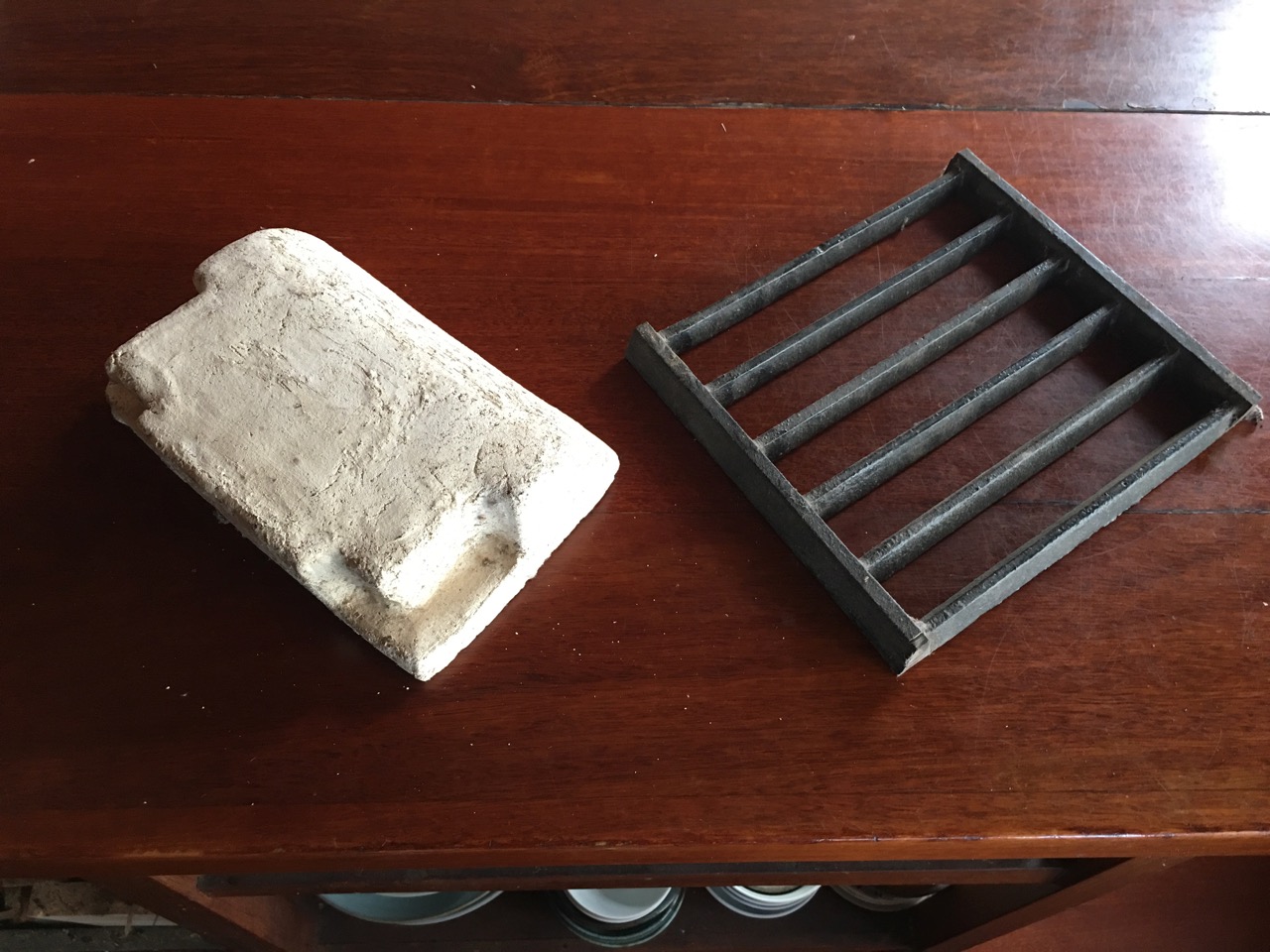
Our 45 year old wood fired kitchen stove is again in need of some repair.I have been working on this stove for 35 years. It was already out of production when we bought it second hand from a local farmer in the 70’s.The first thing to go was the cast iron grate under the firebox. My enquiries revealed that the Northburn company was bought out by Rayburn and closed down years before, but that there was still some spare parts available in the UK. An estimate for a new cast iron grate was more than the whole stove! I quickly realised that I would be needing more of these replacement ash pit grates in coming years. So I had better solve the problem now, and importing the last one from England wasn’t going to be the long term answer.
I worked out that cheap, local, cast iron drain covers could be cut up into 3 section and yield a decade of spares for $10. $3.33 each. About a dollar a year seemed good value. I have been using this solution ever since. When the fire brick in the front of the fire box crumbled, I reassembled the bits and filled in the missing parts with fresh clay and made a plaster cast of it. After that I was able to pop out a few each decade and pre-fire them in our potters kiln always keeping a few in stock under the kitchen hot water cupboard. Interestingly, the home made ones lasted longer than the original. Perhaps because I made ours out of my best home made high alumina grog and sillimanite clay mix that I used to make our own kiln shelves. Good stuff, and seemingly better than the original.
At some point in the past, many years ago I replaced the fibre rope seal around the hot plate. As this was almost certainly made of asbestos, given its age. I took it very seriously and got Janine out of the house. closed the doors and windows to stop any draughts, then soaked the fibre with water to kill dust. I wore long sleaves and a hospital theatre hair net cap and a dust mask. I lifted the wet but stiff fibre rope out and placed it into a plastic bag, sponged down the whole stove top and replaced the seal with modern kevlar fibre rope stove door seal. Then washed my clothes. The next part of the fire box to crumble was the fire wall between the fire box and oven. This was a thick cast iron sheet of metal. As it cracked up and started to fall apart I was wondering how I could get another one cast in cast iron. Then I thought, if I could use a home made kiln shelf in its place. I cut up a big 400mm x 400mm. kiln shell to custom fit the exact shape of the original. it fitted in pretty well. Snugly in fact. I thought that it might last a few months, giving me time to find a long term solution. To my surprise, it is still there and the stove works perfectly with its new heat shield. Its been in use for many years now, so will probably last for quite a while into the future. I have plenty more to replace it when the time comes. I was less successful with the large single piece fire box brick that makes up the left side of the firebox. it is a couple of inches thick and deeply embedded into the structure of the stove, such that to take it out and replace it would be a total rebuild job. Being the lazy opportunist that I am I decided that I would just repair the crumbled hole with a home made ceramic fibre and clay castable to fill the gaping hole, then cover the entire surface with another kiln shelf. This one needed to be longer then ti is wide, and a bit thinner to fit in easily. I found that I had a commercial kiln shelf of just about the right dimensions and cut it to fit. It worked perfectly for a few months and then cracked in half, then the two halves cracked, and so on… Yesterday it became apparent that it had all fallen to pieces the night before during the cooking of dinner. I extracted the parts and not having any other commercial shelves that were easily adapted since the fire cleaned up out. I decided to do a bit of a Japanese inspired ‘mottainai’ repair and stich it all back together with some old kanthal high temperature kiln element wire. ‘Mottainai’ is a bit hard to translate , but loosely means that something is too good to waste, so a little effort is worth being put in to save it and restore it, It also implies a bit of ‘waste not, want not’ and a stitch in time etc. It suits my life philosophy of living gently and minimal consumption.It survived last nights dinner cooking firing, so I’m hopeful that since it is now made up of several pieces instead of being one large sheet, it is now comprised of many expansion joints. It might work. I hope so. This was a first class commercial kiln shelf, supposedly with very good chemistry and excellent thermal shock resistance, but it seems a little bit too thin to take the combination of heat shock and small occasional impacts from wood stoking. I’m even more impressed with my own home made kiln shelf on the opposite side of the firebox that has been taking the same impacts and heat shock stresses for some years now.
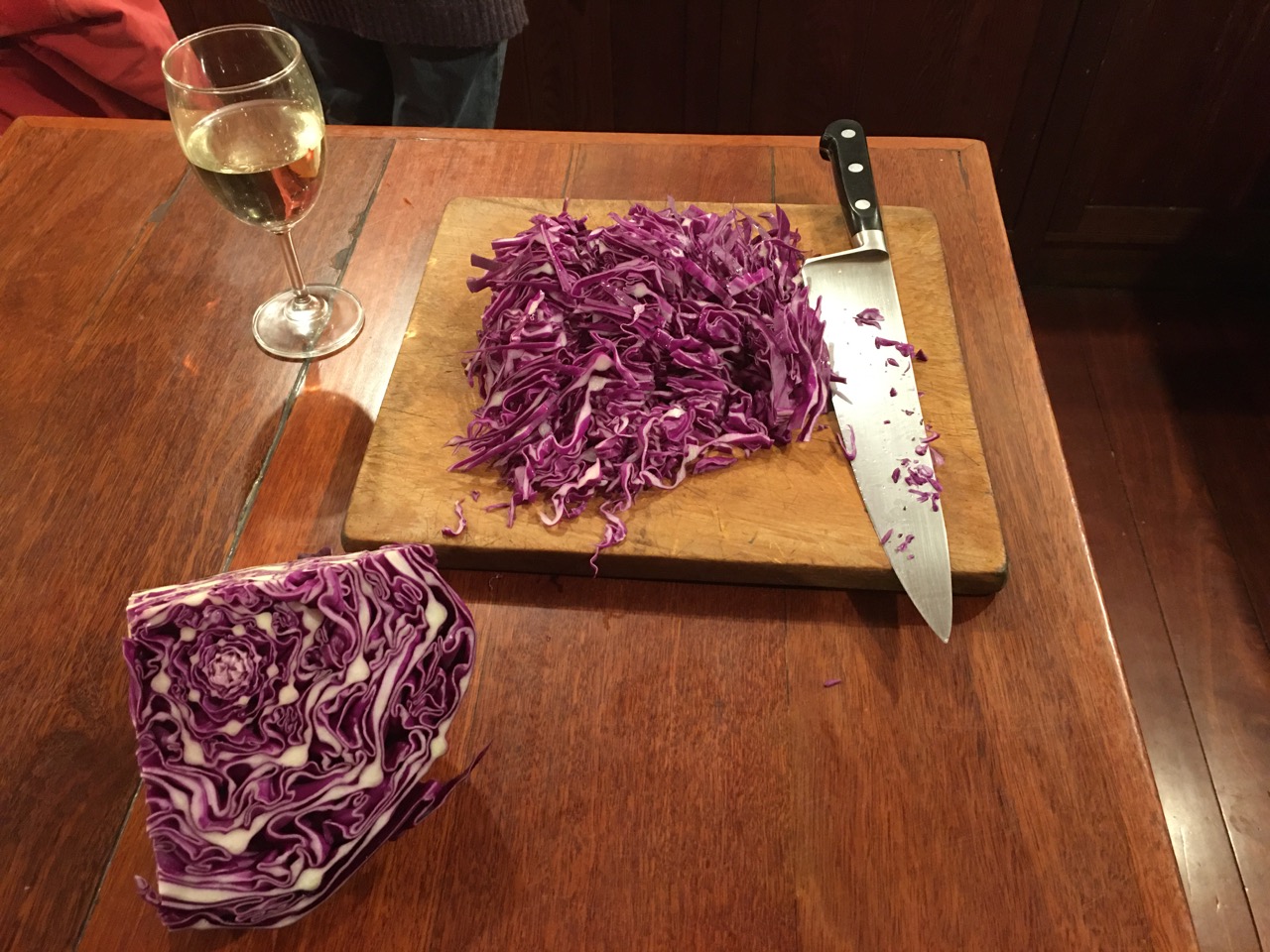
We have survived the longest night of the winter. The frosts have cut the last of the soft plants from the garden. We have harvested the last tomatoes from the dried brown burnt stems of the last surviving tomato plants. We come inside earlier these days at 4:30 and light the fires in the kitchen stove and the lounge room heater. We have just picked the first of the red cabbages for our dinner.
Fortunately for us, we have almost finished all the immediate outside work on the new pottery shed, at least until spring, and we are now concentrating on working inside each day in the relative warmth and comfort of the passively heated and draft free environment of the new pottery. It’s quite amazing how warm it gets in there with no heater on, with just the sunshine in through the north facing windows. It is particularly noticeable that there is no draught inside from the gusty cold chilling wind outside. This is the first pottery that we have had out of the 4 of them that has had no draughty gaps somewhere in the walls, roof or around the doors. Our first 3 buildings burnt down over the 47 years of our life together as potters, All the previous potteries were all home made buildings, as we have never had sufficient money to employ builders. These earlier buildings were created from recycled and scrounged materials, plus home made mud bricks, all with ill fitting and odd shaped windows and doors and no insulation. The last pottery did at least have silver paper in the roof, but no insulation, as it was just too expensive for us at the time. This new pottery is just a tin shed, but the wall cavity is stuffed full of insulwool and all the doors and windows are mostly BAL rated commercial units. We have done all this to get a high BAL fire rating and to prevent this one from burning down in any coming catastrophic bush fire, of which there is bound to be one sometime in the future. This past week I have been lining the pottery studio room with the timber planks that we milled from our own home grown pine trees. Janine and I planed them and sanded them over the past few weeks and now we have had the satisfaction of actually installing them in the metal frame shed. This is just about the only timber in the whole complex of 5 the rooms of the new pottery. It looks great, It is just so nice to have some timber in the place to give that warm natural look and feel. It’s even better to have some of our own home grown timber in the throwing room. The place where we will spend most of our time.
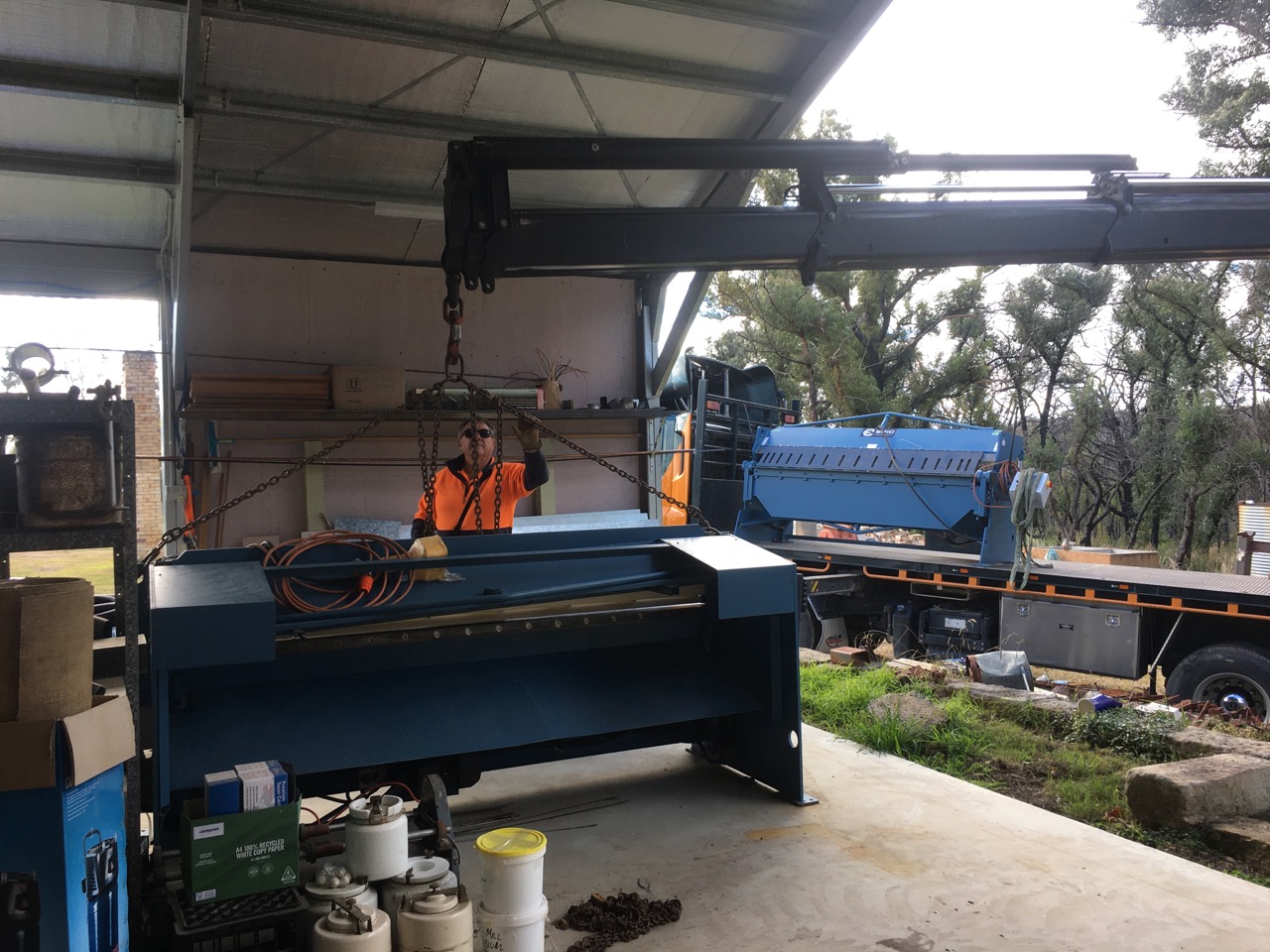
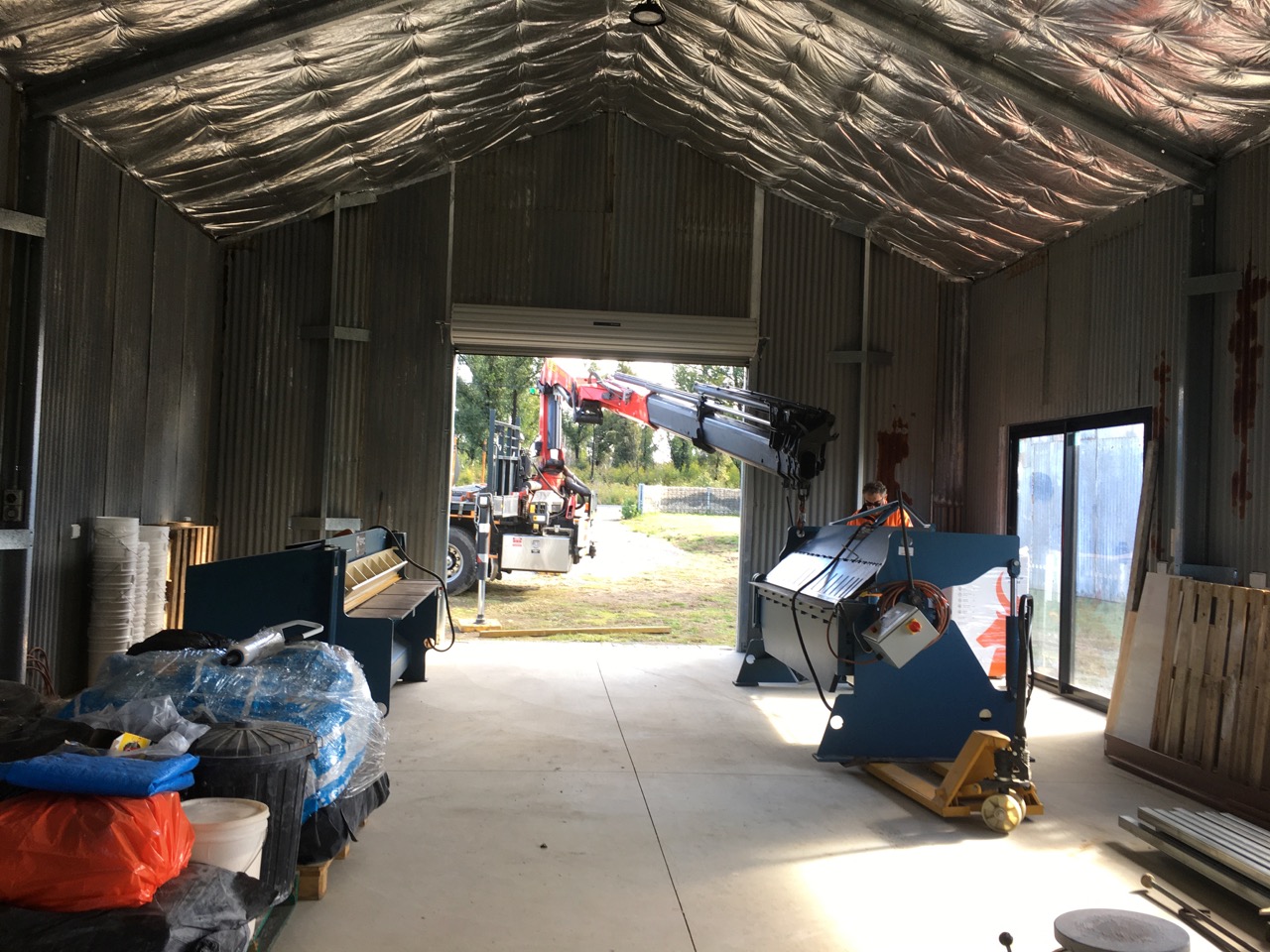
As the big maintenance shed is now almost finished, and I had access to my friend Dave’s big crane truck, as he was working just down the street from me. i got him to move my pan break and guillotine into the new shed while the opportunity presented itself.
Dave picked them up from their temporary home in the new car port building that we hastily built as soon as possible after the fire to house all the equipment that I was busy trying to restore and protect from the elements.We installed them in their new, and hopefully permanent, home in the big new shed. We only just finished the ceiling of this shed a month ago, so this is very timely. It’s also important, because my friend Dave is selling his truck at the end of this month EOFY. After that time it would be a whole lot more difficult to get jobs like these done.
Such an incredible machine, so powerful! This big crane can lift a tonne up to 16 metres from the truck and lifted my big 3 tonne pan break 9 metres into the shed
. Everything seems to be moving along at speed now. I’m beginning to feel positive and optimistic again
. Janine made a beautiful morning soyachino coffee with a gingko leaf
I had it with my piece of toast and some delicious goats milk curd, creamy smooth and with a delicate acidity. Lovely.
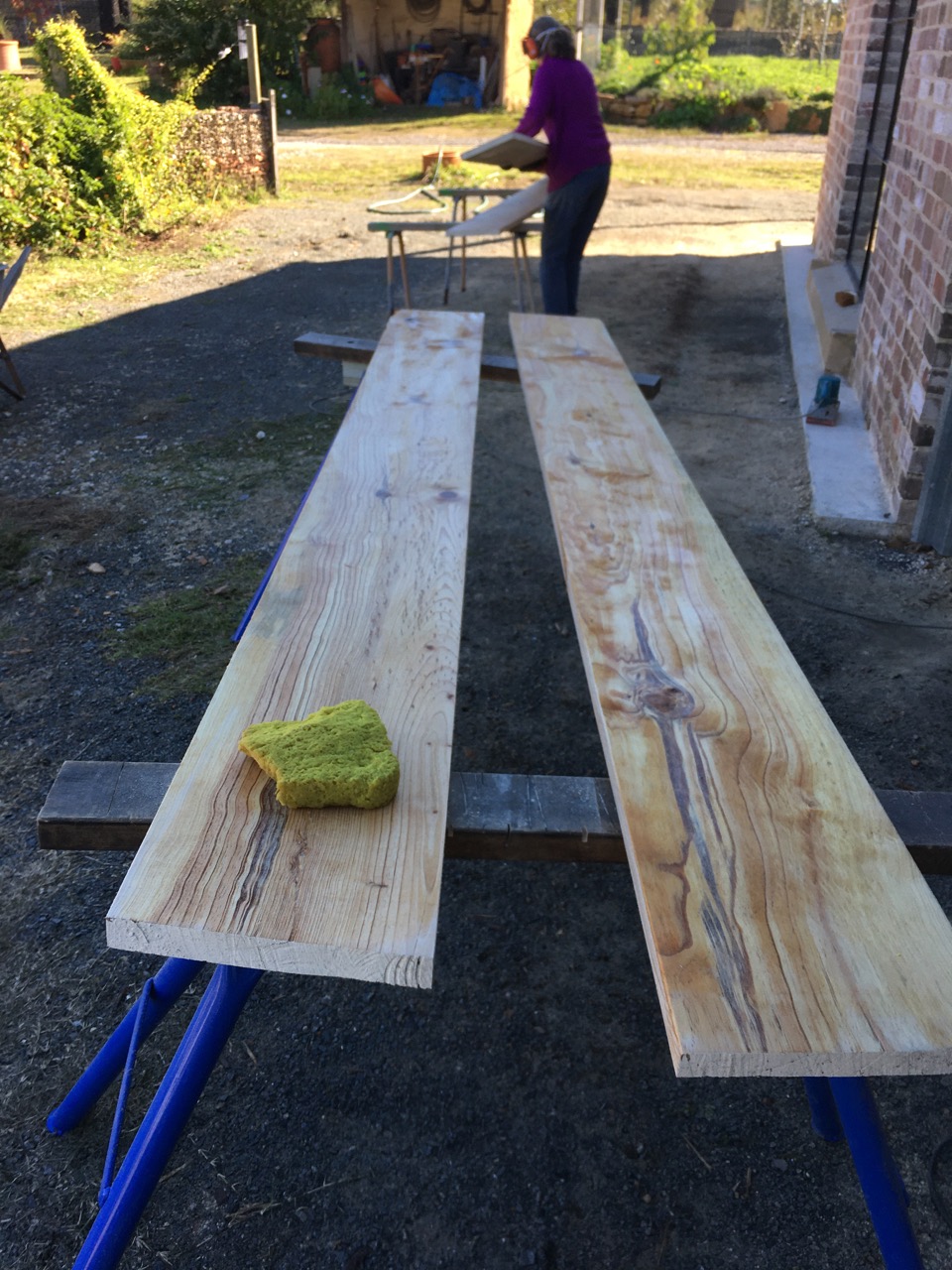
We have been spending some time, on and off, over the past 3 weeks in planing the stack of pine lining boards that we milled out of the dead pine trees that used to grow over our house. Killed by the fire. I couldn’t just let them go. I needed to use the wood for something positive. I also wanted to incorporate something of the old into the new studio. An act of reconciliation. Creating something positive out of this disaster. A creative, positive gesture.
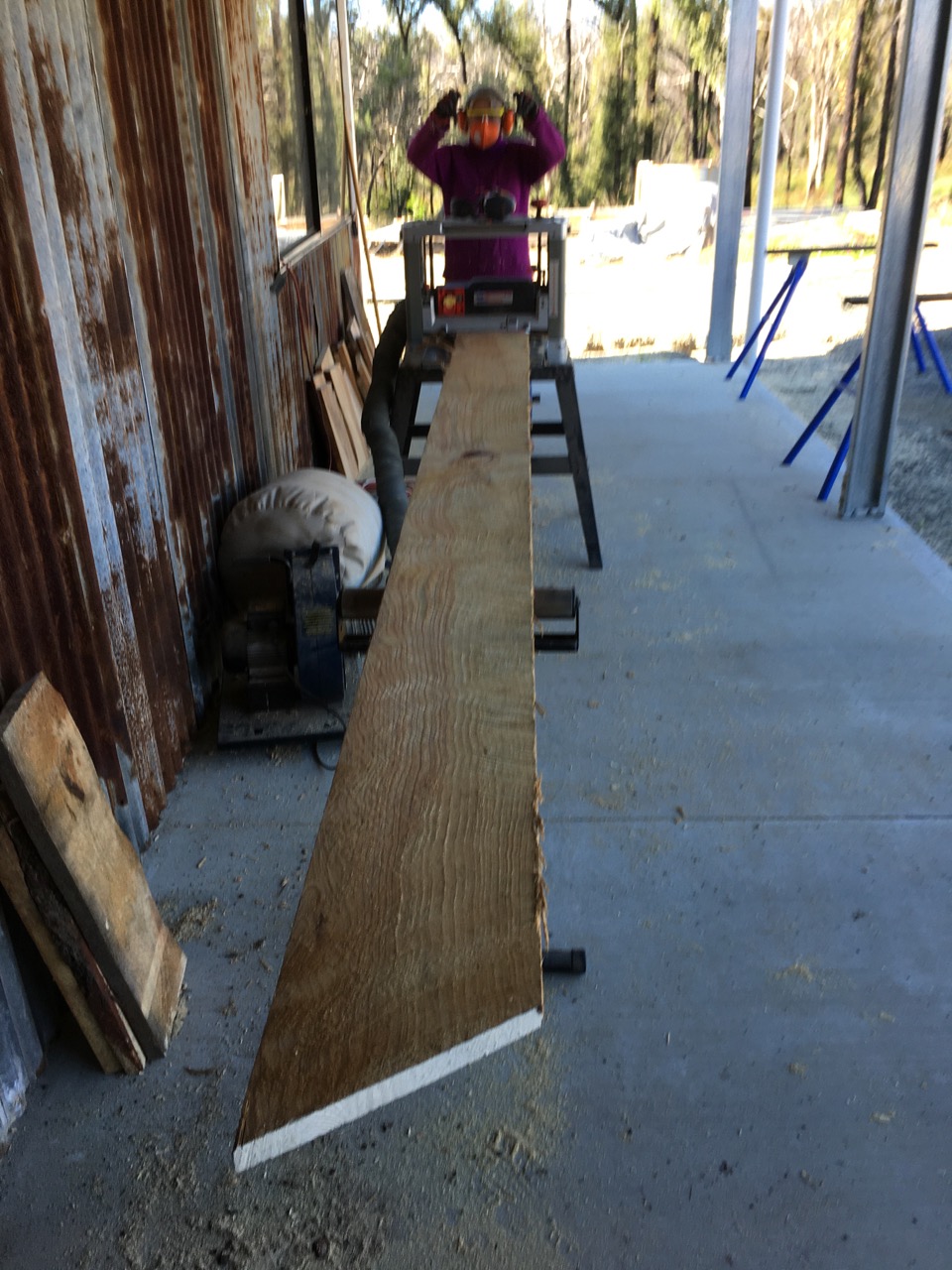
Having sawn the planks to 250mm x 30mm. out of the logs last February, they are now dry enough to use, and we are now ready for them. We spent a week pushing them through the planer machine, thinning them down 1/4 of a millimetre at a time, because the machine is only a toy, and the blades are blunt. We only need to remote most of the circular saw teeth marks. I don’t want them perfect – they’re not, they are full of natural imperfections like knots, resin filled hollows, splits and what might be felling shakes? Half a day at this was enough each day, as there was always so much else to get done. Plus we both have sore arms from a bit of over use.
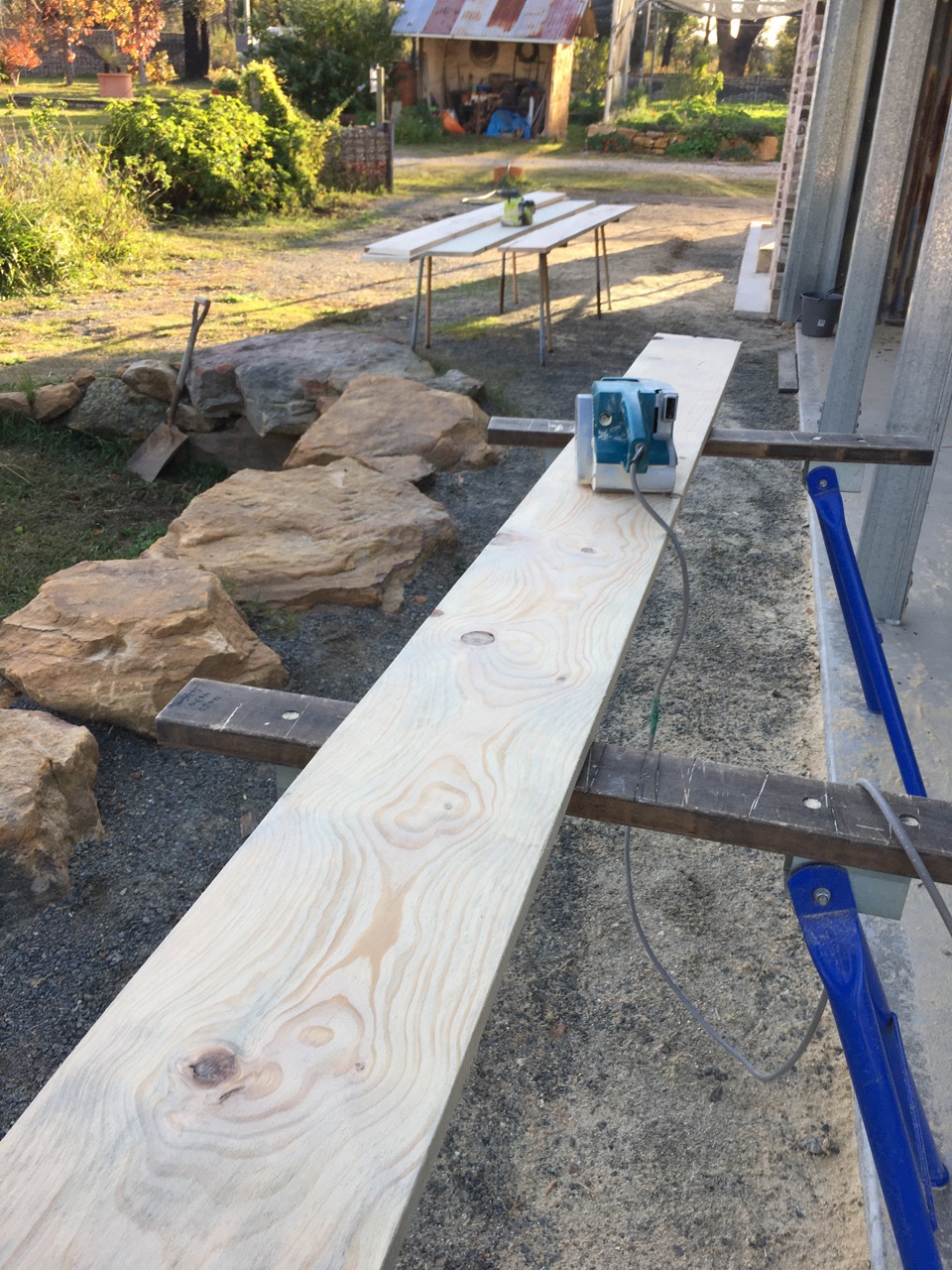
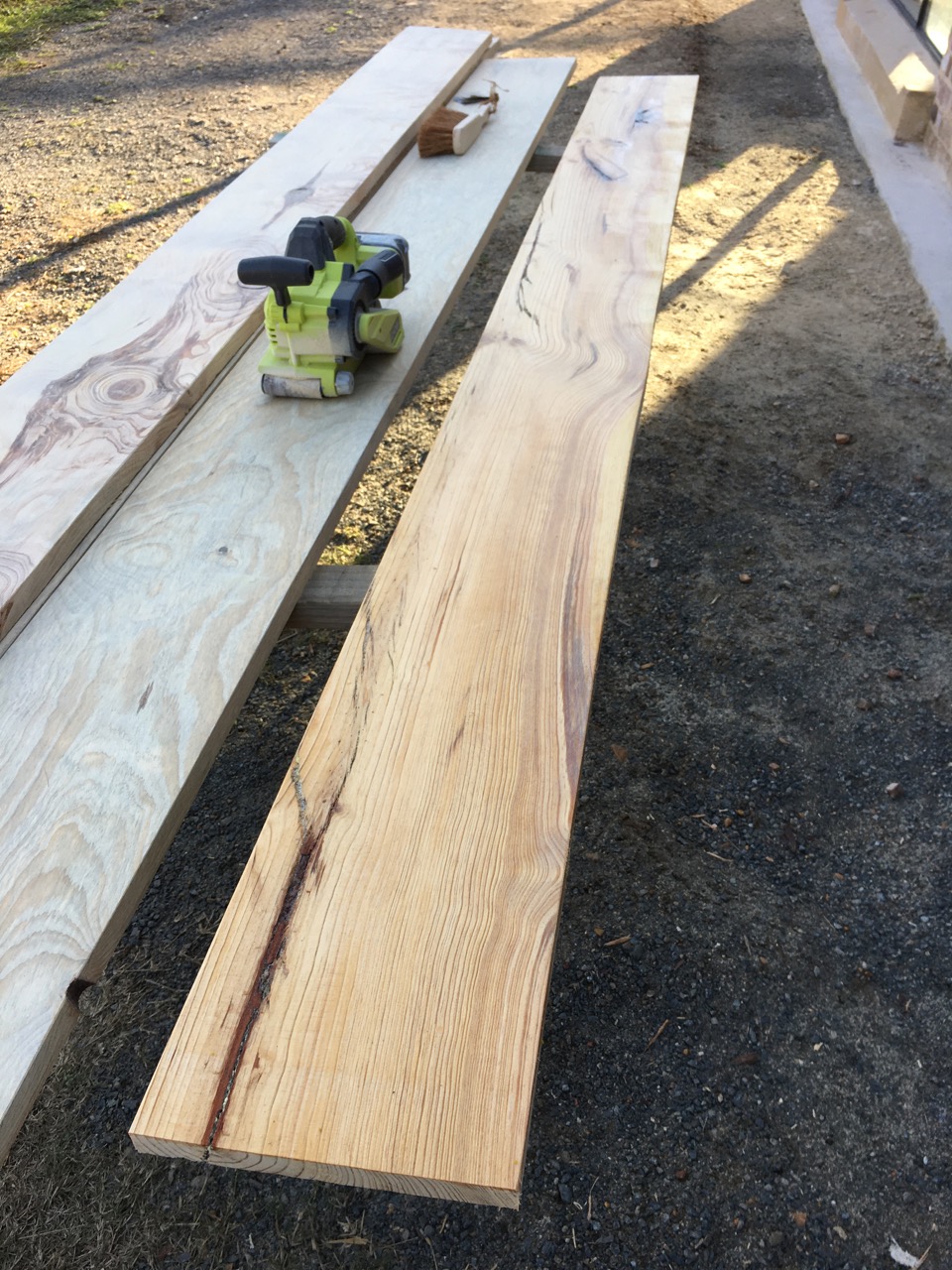
Last week we spent half of each day sanding the boards. First with a belt sander using a 40# grit belt, then again with a 60# belt. We could only work at this work for a few hours a day as the vibration from the sanding machine affected our hands. Too much of this kind of work can cause pins and needles in our fingers. This is natures way of telling you to stop doing whatever you’re doing. So we did.
We used an orbital sander the next day to get a finer finish, we used a 80# paper for this session. After this finer sanding, we wet the boards to raise the grain and stood them up in the pottery to let them dry over night. After drying out, the next day we sanded them all again using a 100# paper. This final sanding left them pretty silky smooth, but still with a lot of their ‘natural’ character. There are 120 boards to be done 4 times over. That’s why it has taken a week.
My friend Len Smith gave me all his power tools when we started to rebuild after the fire. Len built his own house, so had collected all the tools that you need to do this sort of work. I used to have a similar set. Having Lens tools allowed me to get a lot done, and saved me a lot of money. Thanks Len! This week I started to put the first few planks up on the wall. It’s very slow work, as each plank has warped around the knots, so has wobbly edges. Fortunately, Len gave me his circular saw and his electric planer. Even so, it still takes time to get the individual warps in each plank to match fairly evenly. Added to that the planks also have some degree of wind and camber. In other words, they have warped in 3 dimensions, like a snow ski and a banana on its side simultaneously. I don’t aspire to perfection. I want a more natural feel. I’m not perfect. We all have our quirks. I don’t expect my pottery studio to be perfect. I want it to express something about me, just like the work that will be made in it.
12 boards up in three days, tediously slow, but kind of rewarding. I’m happy doing this work slowly by myself. Although I’m in a rush to get this epic job finished. I don’t want to miss out on any of the joy of actually doing it, enjoying the feeling of achieving something at each completed stage. This is a hand made shed for potters making hand made pots. It has to have the apropriate character. Although we purchased 5 commercial kit form steel sheds, for speed and convenience, we have given them a character or quality that reflects us. Hopefully it reflects all the thought and effort that we have put into it.There is an aphorism about the journey being more important than arriving. I really feel that to be true just now.
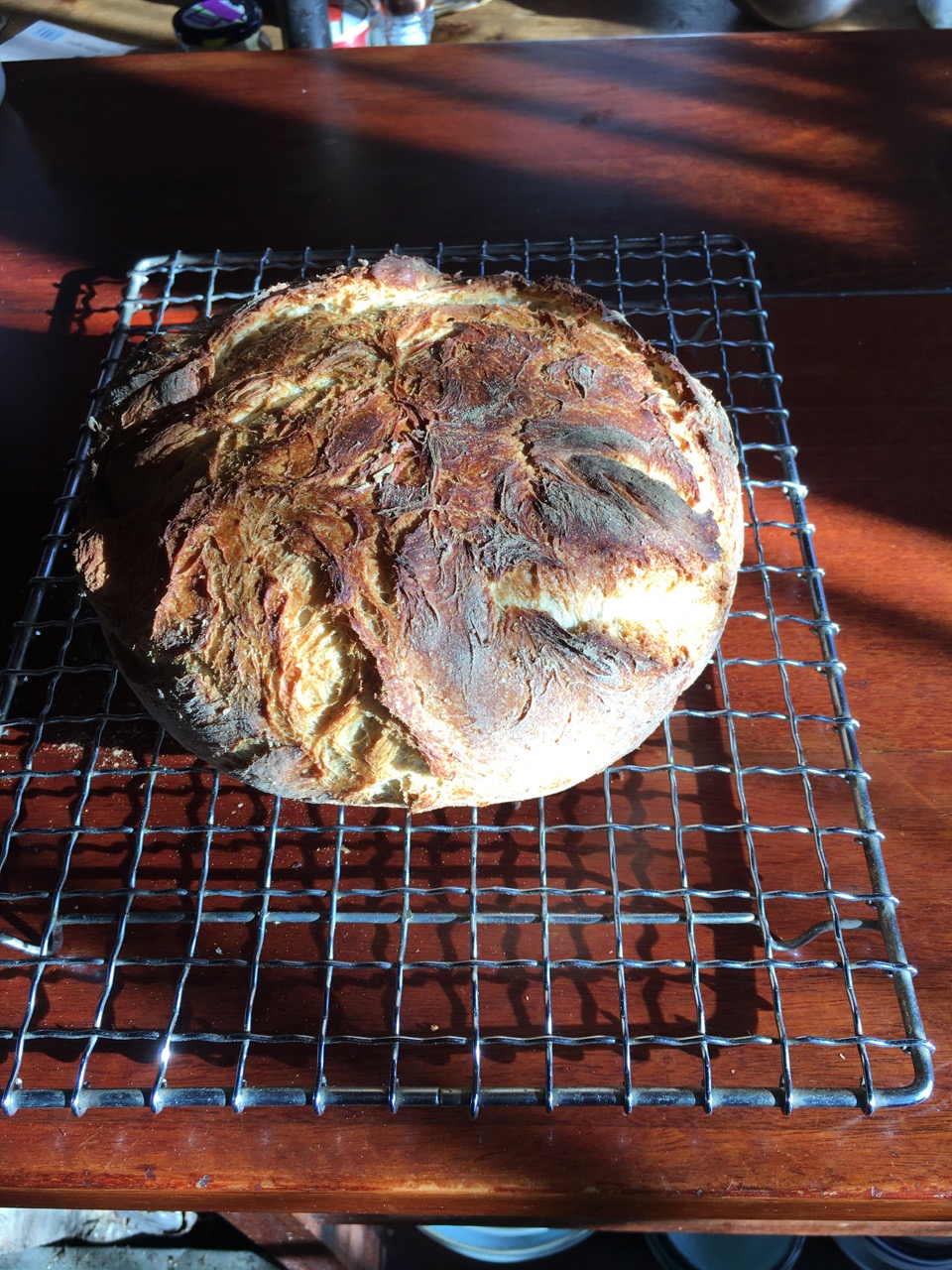
I was up very early this morning to put the bread on. I like to get it on early, so it can go in the oven during breakfast and be out ready for lunch.Everybody who makes bread has their own way or technique. We have been making bread for the past 45 years. My mother taught me how to make bread and she taught me what she knew, as she used to bake her own bread for us when we were kids. I grew up on home made crumbly, stoneground wholemeal flat loaves. I have never been really happy with the results of our own loaves, there was always so much room for improvement. I’m always interested in learning from others how they make bread. Some years ago, I was told by a fellow teacher at an Art School where I was working part time that his wife made really nice bread, she had been a profession baker. He told that the best results came from baking the bread in a closed environment to get a good crust. He told me that his wife used a cast iron camp oven to bake in. I didn’t own such an item, but googled it and they cost upwards of $100 at the time. That was way beyond my discretional expenditure budget so let it slip. Janine and I have owned a bread making machine for 20 years. Actually, we have worn one out and are now onto our 2nd one. They save a lot of time, but we don’t like the square loaves with the hole in the bottom, so we decided long ago to use the machine to only make the dough, which it does very well.
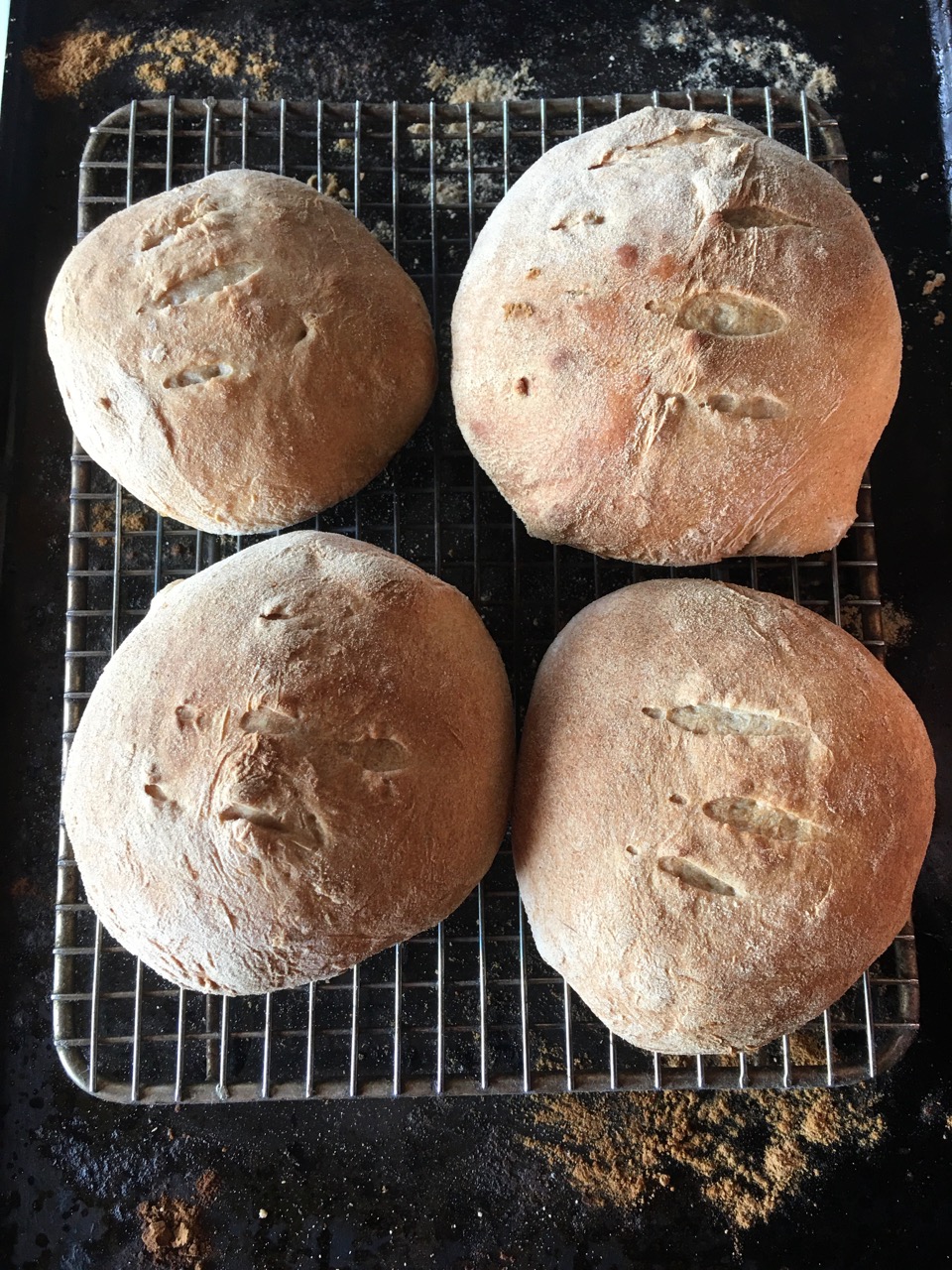
I like rye bread, but Janine finds it too heavy, so we compromise and I make a 50/50 mixed loaf of rye and wheat flour. The bread machine, or should I say the dough machine takes 1 1/2 hours to prepare the dough, which is OK for us. We can put it on and go out to work, then return to take the dough out and bake it our selves in our own tray in the home oven. Sometimes we make a platted loaf, other times we make buns or rolls, all free form just as my Mum did.
My son made excellent bread in his restaurant. from sour dough that they developed there over the years. They even went to the trouble of importing a special variety of wheat directly from the farmer in western NSW and getting it specially milled one tonne at a time for the restaurant. It was worth the effort. The bread was excellent. I even stopped baking bread when I could call in and pick up a loaf of yesterdays bread. A time that I believe caught the bread at its best. He made the dough in the evening after service, let it prove over night and baked it in the now cooling wood fired oven first thing in the morning, before stoking up the oven for the days service. That all ended when the restaurant closed due to Covid. My grandfather told me that the best bread was proved over night, a slow fermentation. He also told me that in commercial bakeries they blow steam into the oven to help create a better, crispier crust. I don’t know if this is true, but I believed my grandfather, but couldn’t ever figure out how I might achieve that. I spoke to another bread maker who we stayed with in Wales, He made fantastic bread at home. He even sold his bread locally to his various friends and neighbours. David made a sour dough in a rather fluid form, a very stiff liquid. David made a bread with loads of seeds in it. I loved it and we even asked him to bake extra loaves for us when we left to take with us. I’m really lazy about things that aren’t absolutely essential to my daily routine. I can buy a good rye bread in Bowral from the artisan bread shop, but I don’t always go to Bowral, and I won’t drive that far and back just for bread. That would be a crime against society in the form of wasted energy. So I have developed a system that suits me, my energy levels and my available time. We make our dough in the machine early in the morning, then bake it in the oven in a metal pot. I first experimented using a metal casserole, but instead of the usual loaf, I got a wide flat round sort of facaccia loaf. A little bit like the flat loaves that my mother baked. What I did learn from this experiment was that baking in a cassarole gives a better crust.
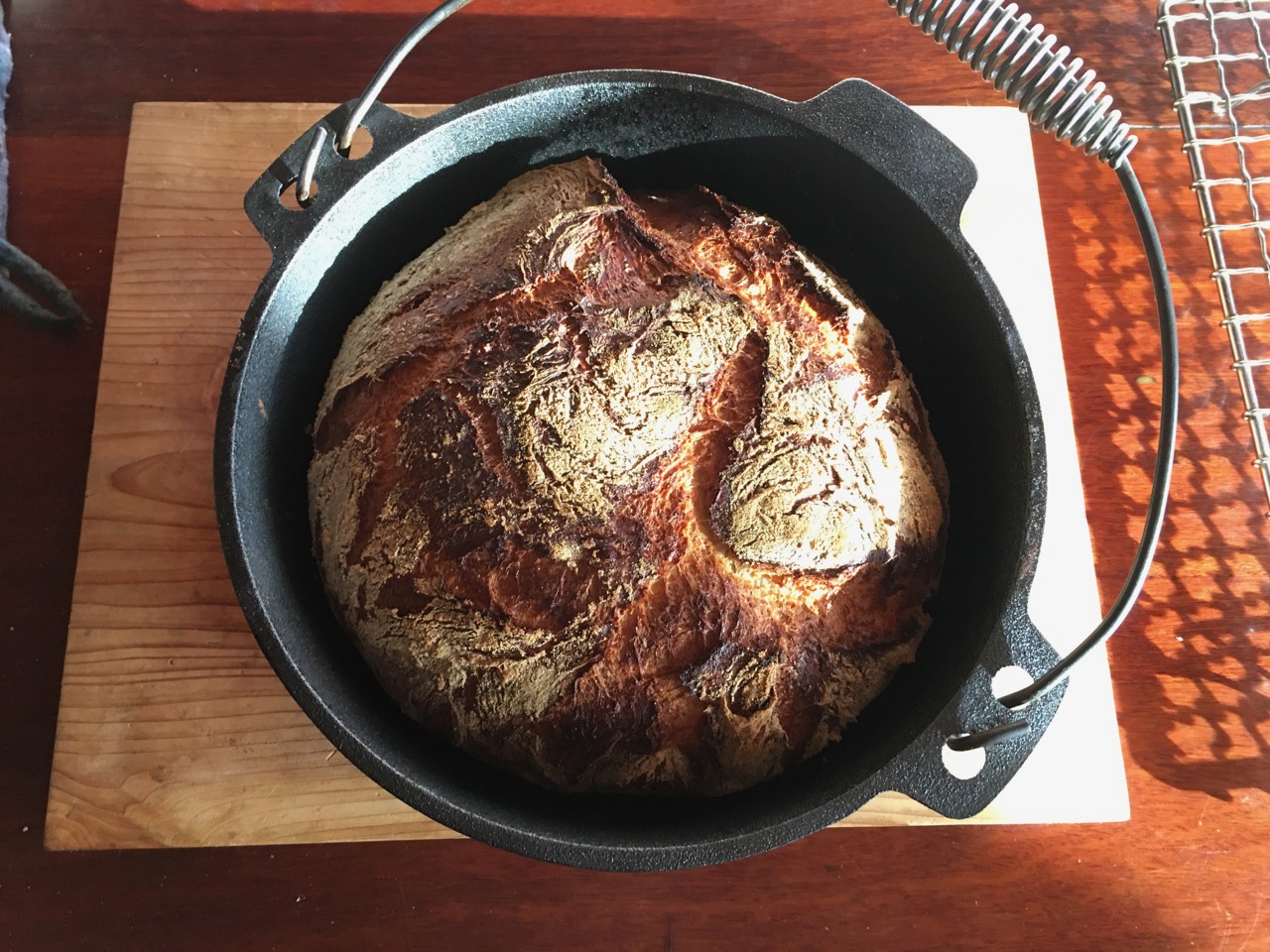
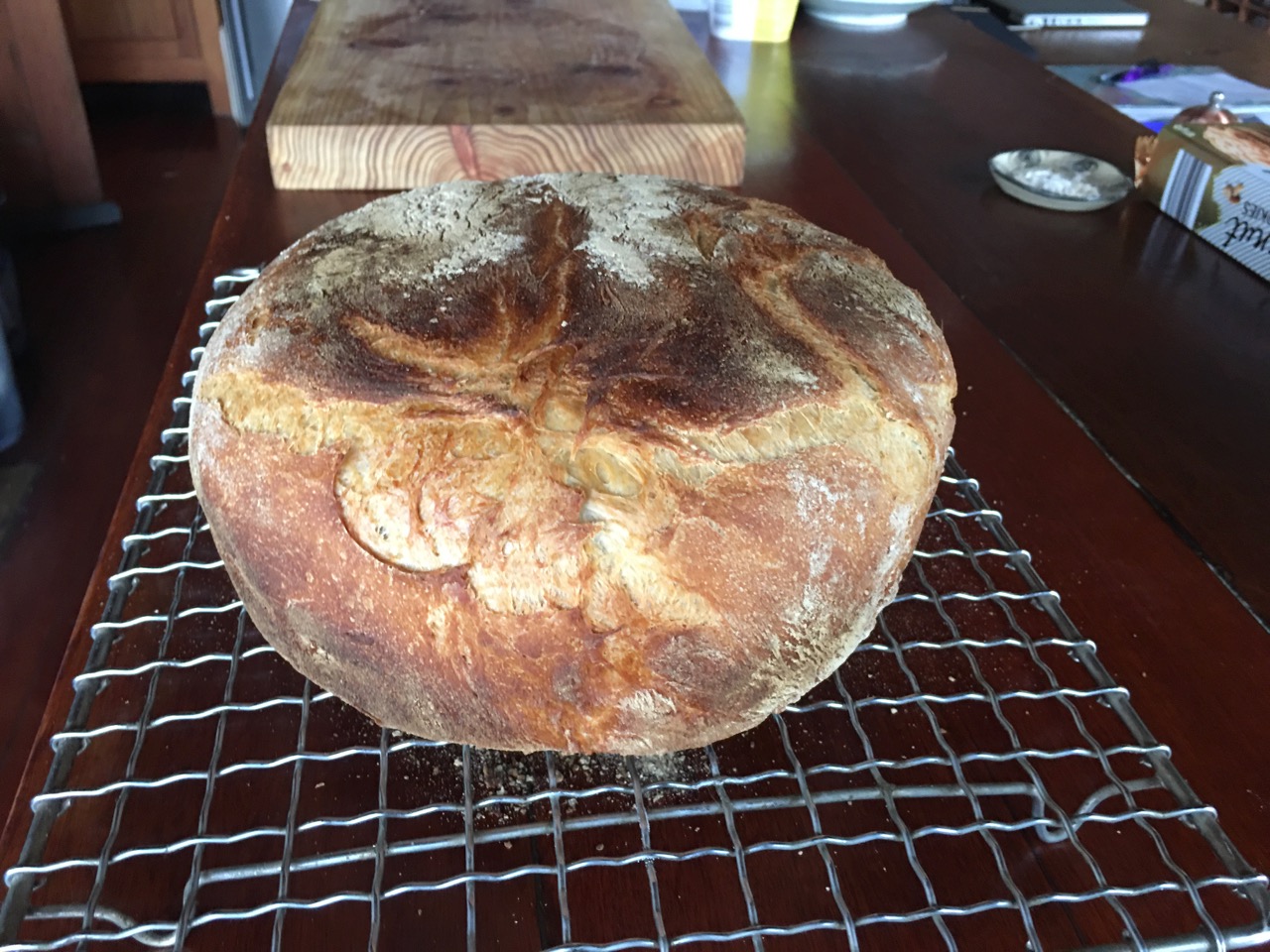
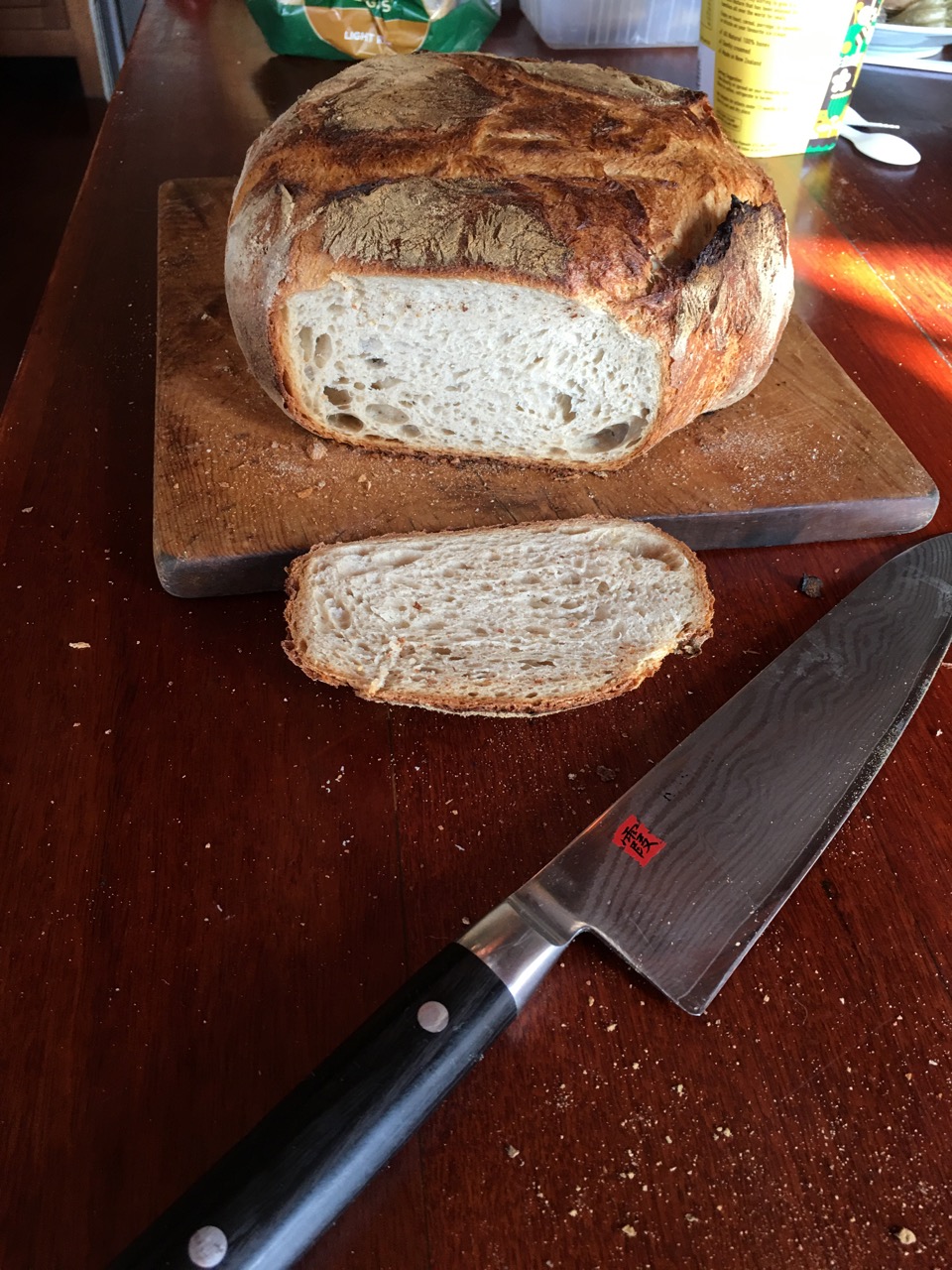
What I needed was a smaller diameter metal pot, so when I saw that a certain supermarket that has a garage sale down the centre isle, had a special on cast iron camp ovens. Under $20 if I remember correctly. Using this camp oven, I could bake a tighter, smaller, round loaf with a good crust.I recently visited one of my ex-students who I taught at the National Arts School in the late 70’s. He is long retired from making pottery, but still had some pottery gear that he hadn’t had the heart to get rid of, even though he hadn’t used it for years. He called me after the fire to ask if I wanted it. I did and we visited him recently to pick it up, as we are now in a position to accept bits of useful equipment. We actually have a shed to put it in now. Tony told me how he made bread. He does an over night ferment and then bakes in a cast iron lidded pot. His bread was very good. He advised me to take the lid off half way through the baking to let the crust become a little bit caramelised and crispy – even a little bit burnt. The initial baking time with the lid on steams the crust a little bit and sets up the crust, then the 2nd half of the baking with the lid off gives a nice brown crisp crust. It does work. Or at least it works for me in our oven with our Aldi pot. I don’t know anything about the technology of fermenting flour and yeast, or even of baking. I haven’t studied it. What I’ve learnt about making home made bread, I was taught by my mother, then augmented by our own experiments and what i learnt from others. It’s all a bit hit and miss experiments. Mostly misses. But this seems to work best for us.
Early this morning while I was preparing the dough machine. I noticed that there was a really good red sky, warning me about something?









































 Tonight my Fingers Smell of Garlic
You must be logged in to post a comment.