Last weekend we fired the new wood kiln for the first time. Not the best firing that I have ever had, but OK for a first firing. There is always a bit of a learning curve getting to know how a new kiln works. Becoming familiar with its particular traits and ‘personality’. We are also using pre-burnt wood from the bush fire. Burning in the kiln, what was recovered from the trees in our front garden. It’s strange and burns quite differently from the trees that we are used to burning from our forest that were unburnt.
This image taken by Warren Hogden
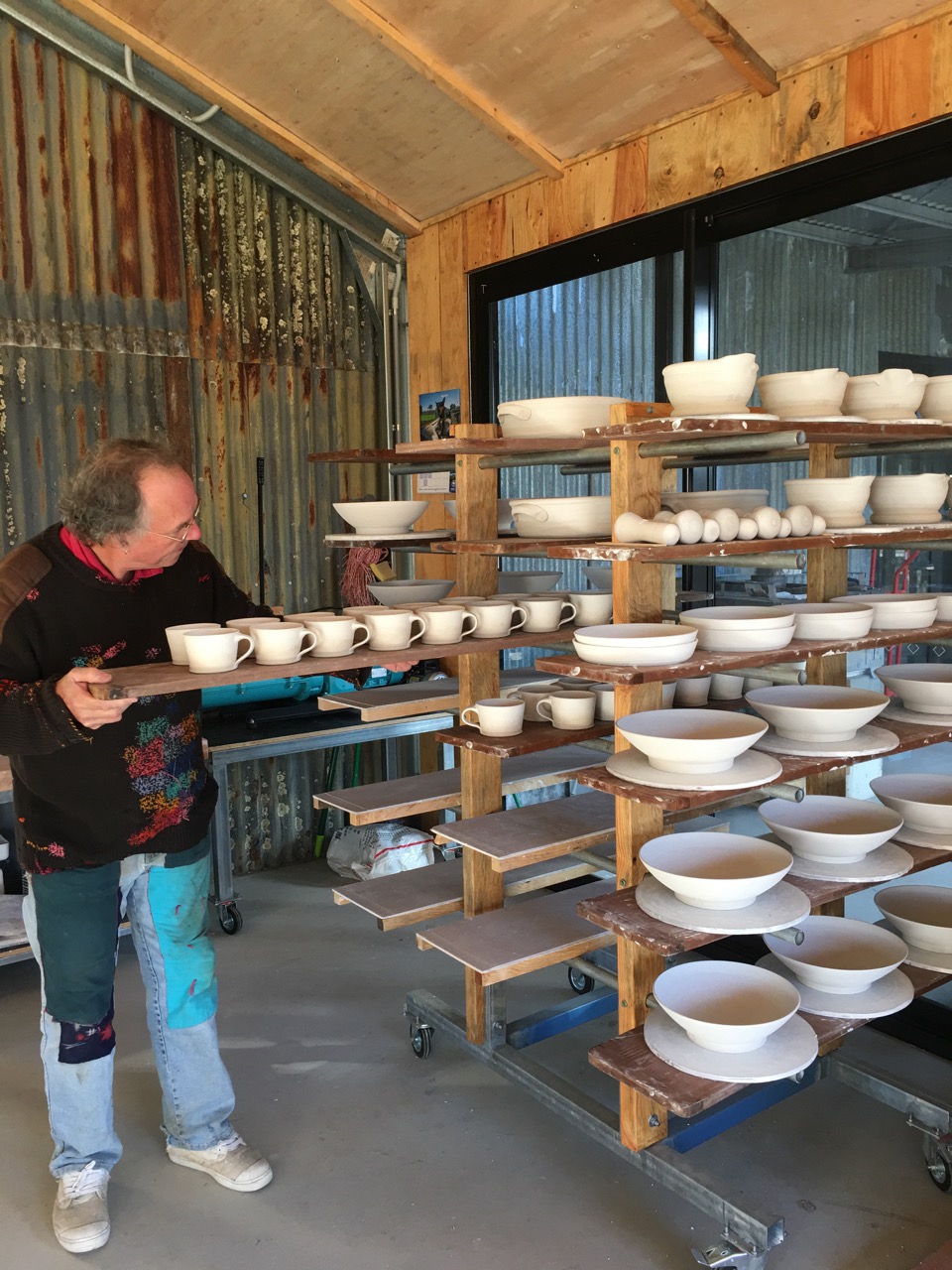
We fired for 14 hours through the day, and into the night. A very comfortable time frame and just about standard for the sort of firings that I have developed over the decades in this style of kiln.
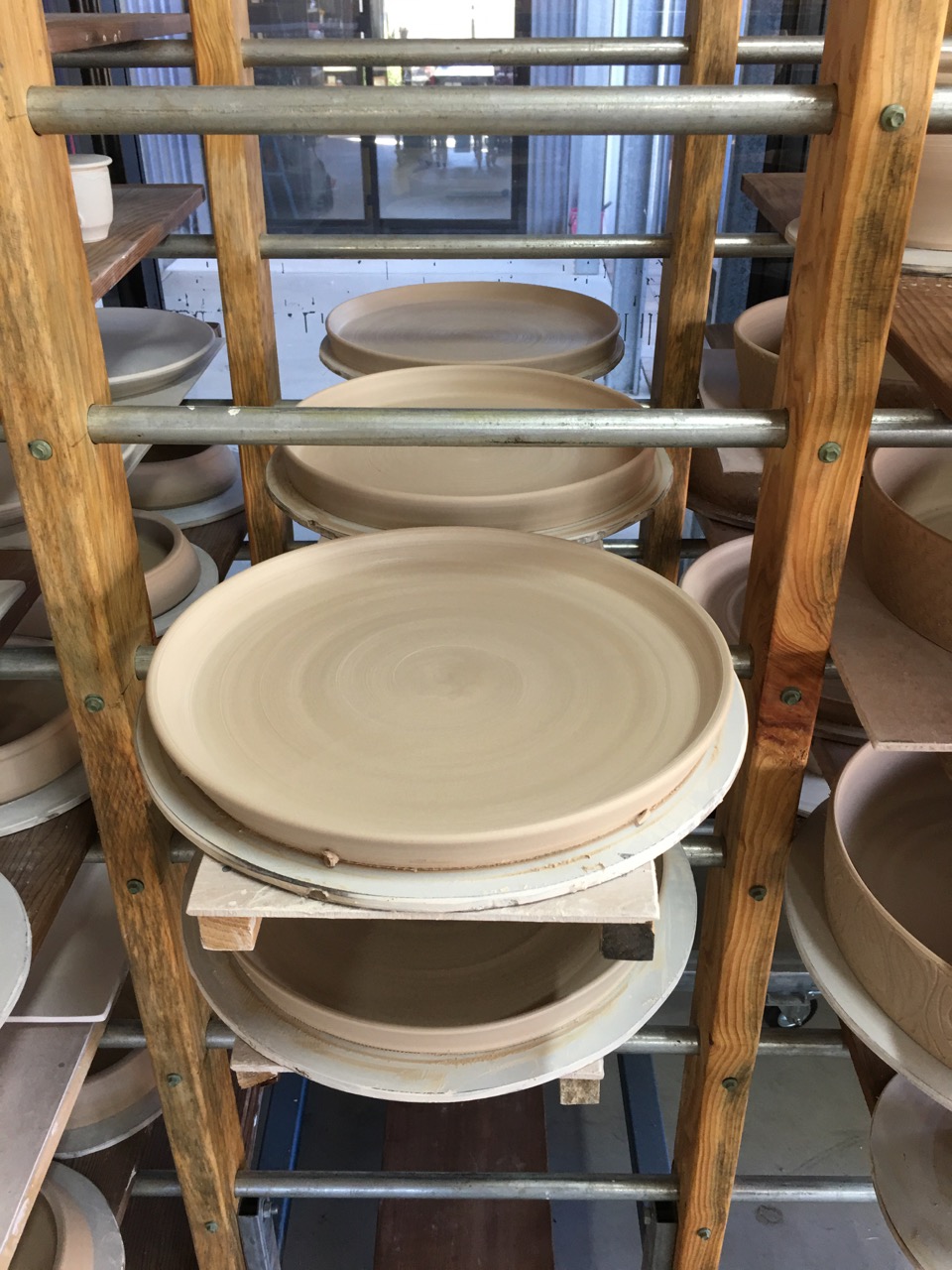
There were a few losses. Two of my large 450mm dia. porcelian platters dunted on cooling. There is always a possibility of this with very large flat ware, and especially so with glassy, dense porcelain bodies.
Despite these couple of losses. I managed to get a few more nice pots out for the show at Sturt Gallery next weekend.
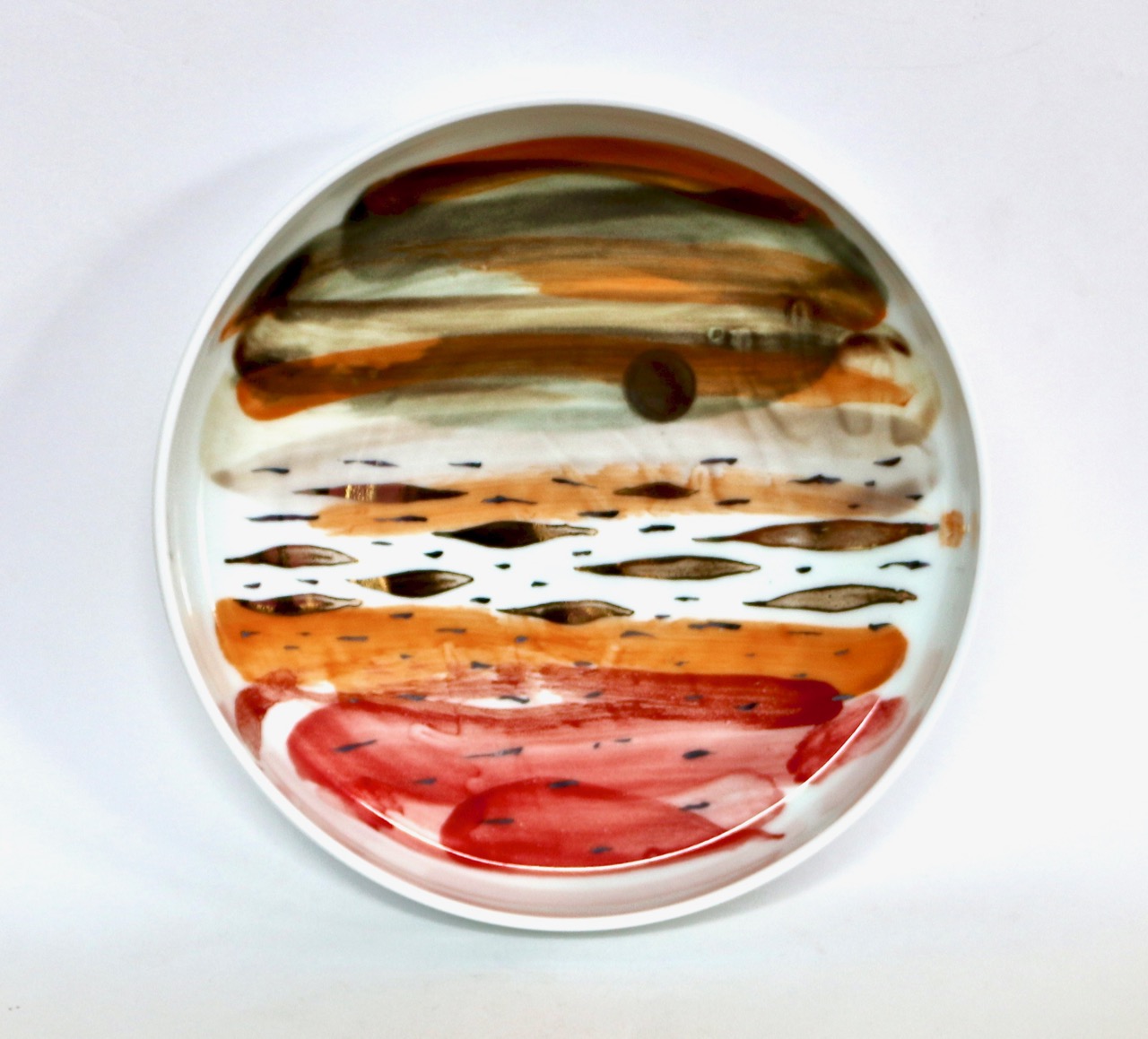
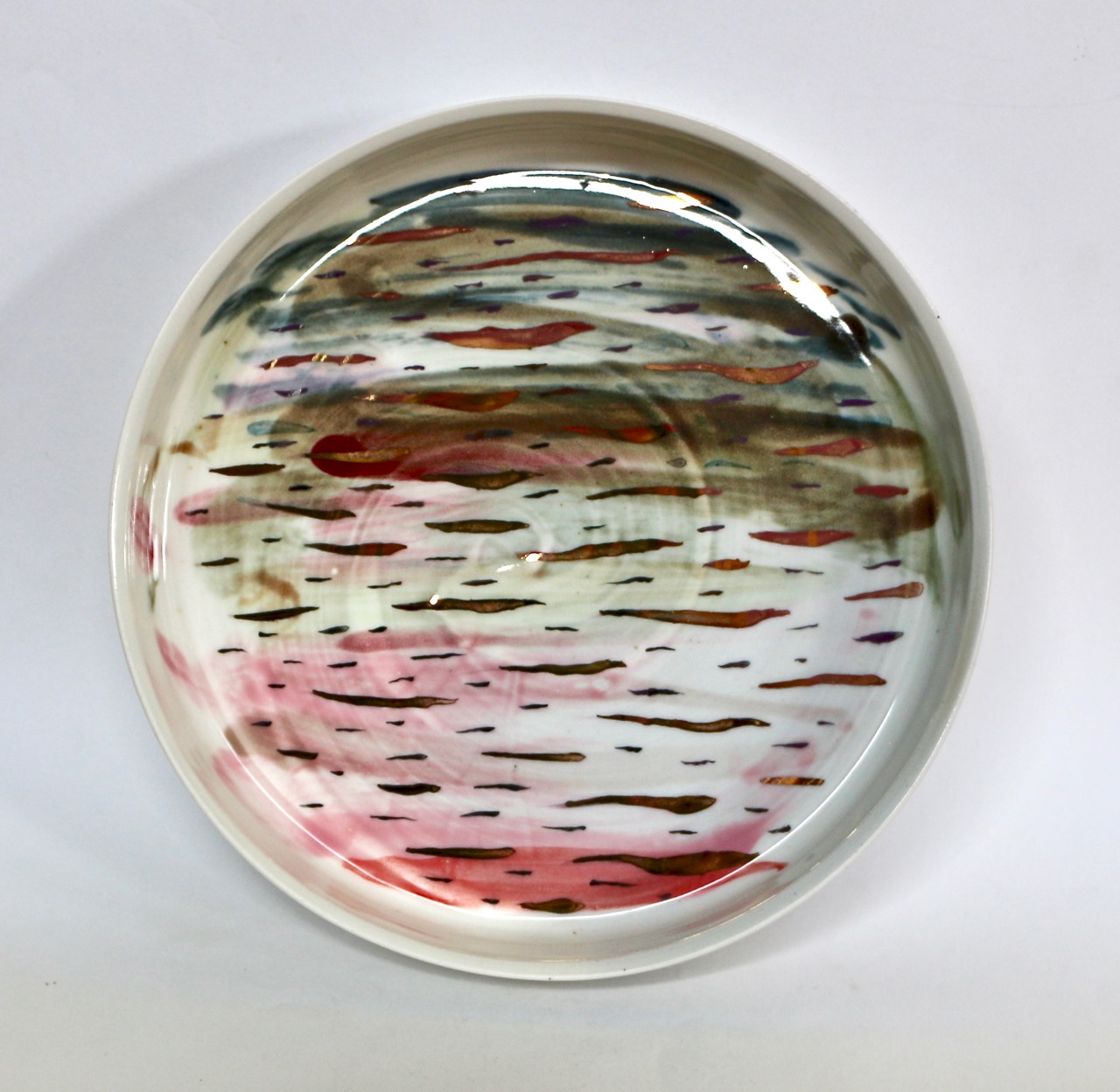
Inside and out shots of this deep dish. I have been using 5 tones of home made cobalt pigments and washes
I used the iron rich soil from the side of the road off the top of Mt Gibralter near here in one mix. This moderates to inky blueness of the cobalt.
I also made another batch of smalt-like pigment with local iron rich ochre with metalic flakes of iron oxide that I scraped off some of my burnt machinery that I was recovering for re-use. The mild steel parts that got burnt in the fire and then left in the rain for a year before I could find the time to get back to them, had rusted badly.
I flaked off the worst of the rust and collected it in a container for use as pigment. It’s a nice idea to re-use some of my old ruined equipment and incorporate it into my new work creatively. I think that this flakey iron oxide is probably mostly FeO and some Fe3O4, with very little Fe2O3.
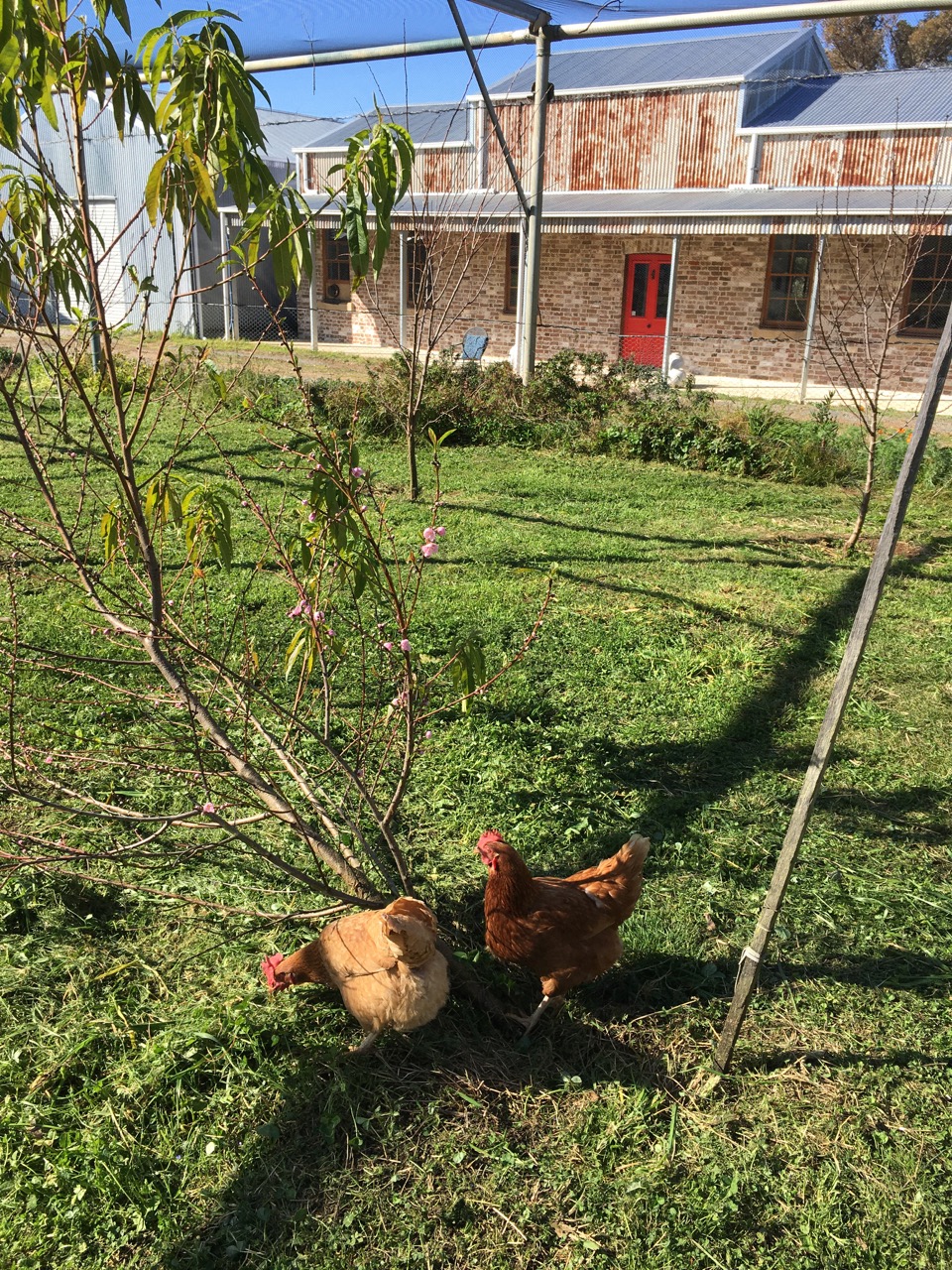
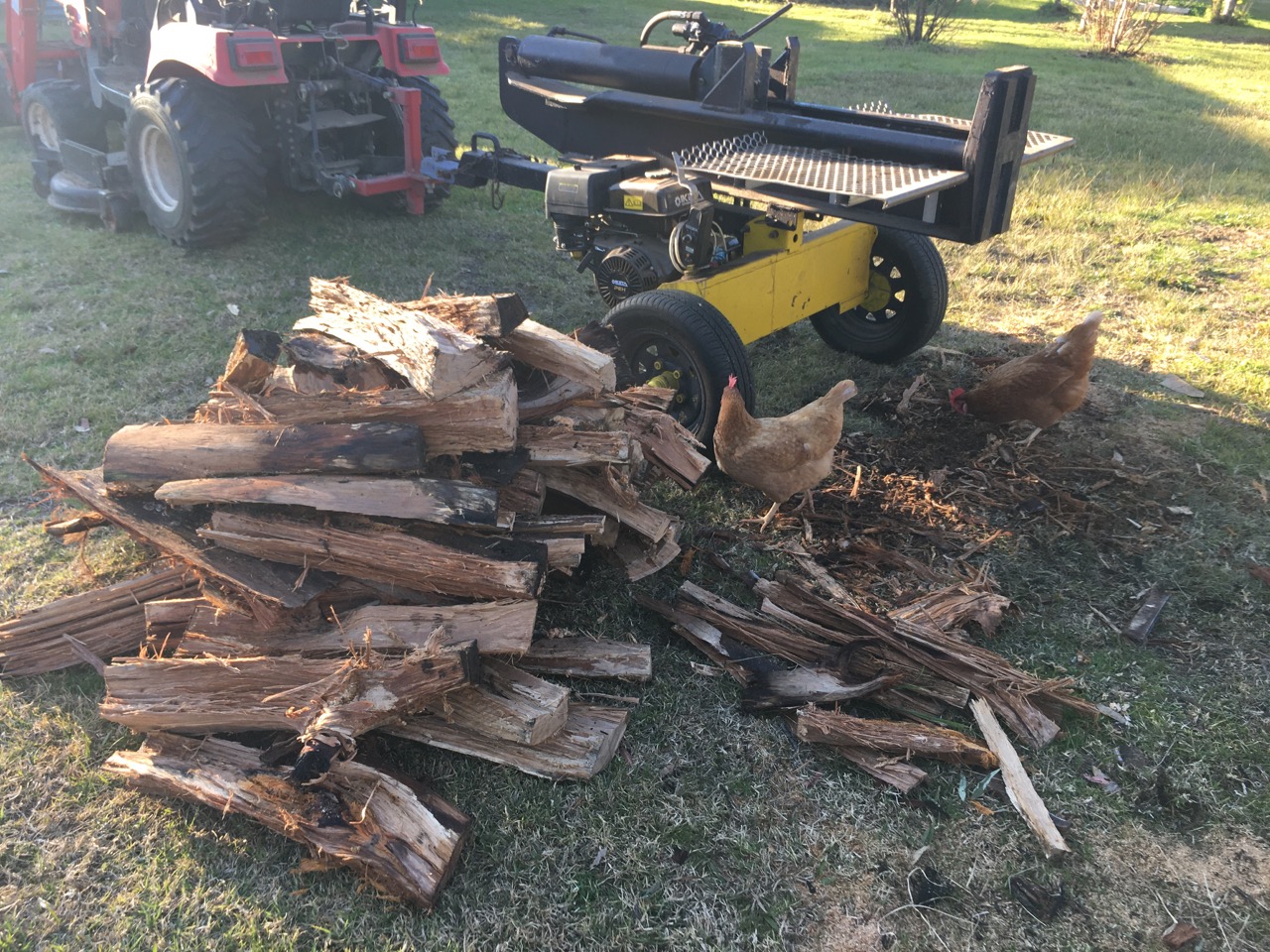
Since the firing, I have been out splitting more wood for the next wood firing, helped by the chickens of course. They even followed me into the workshop where I had 2 girls in a man shed!
We have been eating our way through a magnificent crop of spinach that has lasted since last spring, all through summer into autumn, and now into winter. However, I can see that it is getting taller and thinner, and is starting to bolt and will be all flowers and seed heads as soon as the days get just a bit warmer and the day length longer.
So I have planted a row of new seeds to get a follow-on crop. These have been a bit slow to germinate, as it is a little too early and the ground is still very cold. We are past the solstice now, so the days are getting longer and they will get a good start for the next summer season. That is if they don’t bolt straight to seed – which is a distinct possibility.
I have also planted broad bean seeds for a spring crop. They are quite particular about their flowering and bean set requirements. If I plant them too early, they will come up and flourish and flower, but not one single bean will set on those prolific flowers, not until the weather is warm enough and the chemical enzymes switch on. Then and only then will they set fruit. They can flower for a month or more waiting for that chemical trigger. Then they set beans for about a few weeks only and suddenly stop as soon as the weather gets too hot for them.
I should have also planted some peas, but I have been too busy making work for my joint show with Sandy Lockwood and Meg Patey at Sturt Gallery in a couple of weeks. I‘ll get round to it as soon as the show is up and running. I have put so many things on hold for this show. I’ll be flat out busy for some weeks catching up. But then, I’m always a bit busy. I’m that sort of bloke.
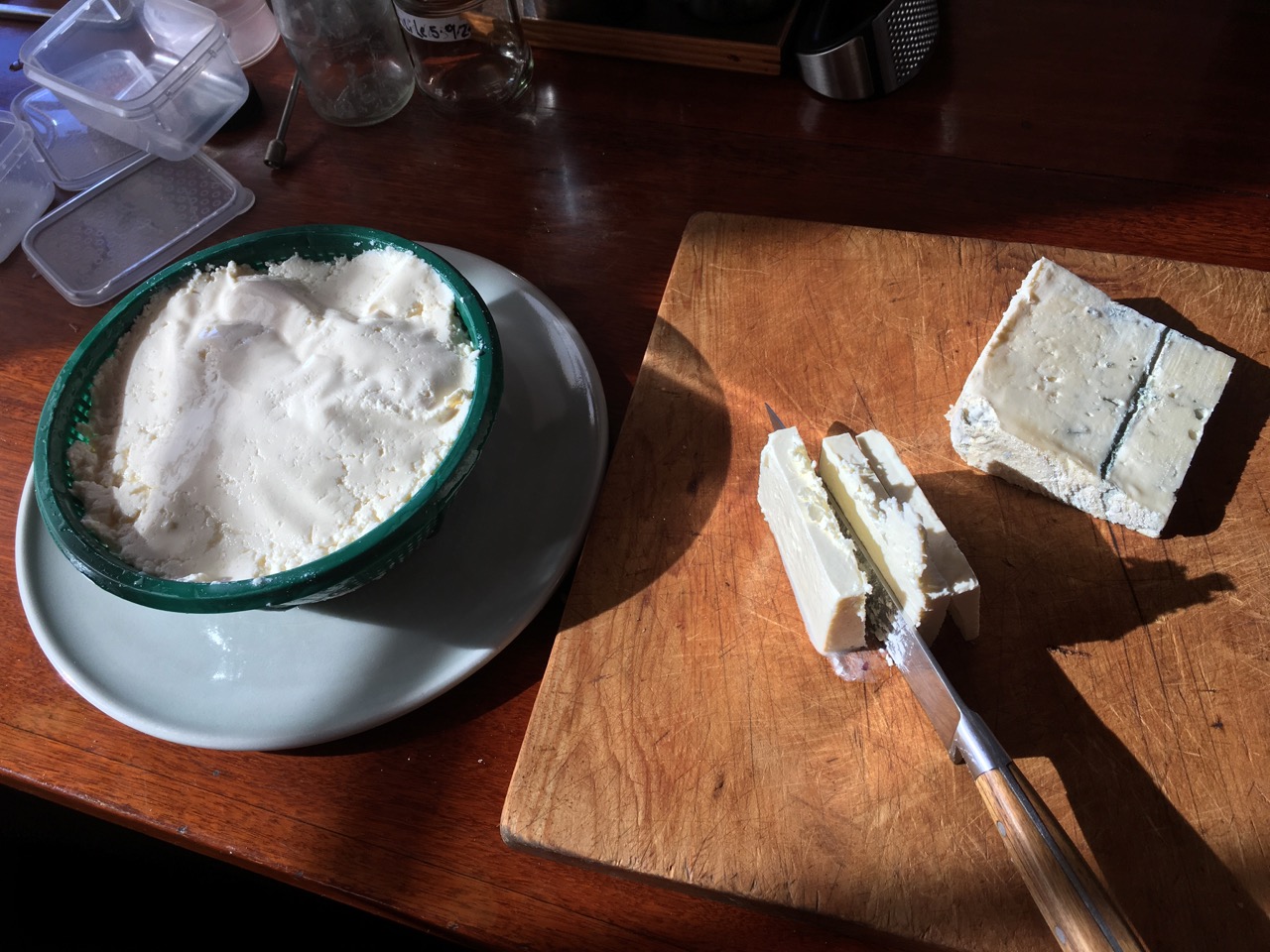
I picked an arm-full of spinach for dinner, about 30 or so leaves. I finely chopped the stalks and sautéed them in a little EV olive oil with onion and garlic. Janine came into the kitchen and stopped dead in her tracks. “That smells delicious! What are you cooking? Just smelling that makes me hungry! What is it?” I tell her that it’s just olive oil, onion and garlic so far, but it sure smells like every great meal that you can remember. There is something so essential and flavourful about it. I’m starting to make a simple spinach and 3 cheeses dish for dinner. I don’t want to see any of that wonderfull spinach go to waste. it’s a simple, quick and healthy meal. I gently fry the onion mix for a few minutes to get it soft, then add all the roughly chopped spinach leaves and a tiny dash of water, turning them often to steam them and sweat them down to a soft state. Once softened, I add 100 grams of gorgonzola dolce for the delicious sharpe tang and a little sweetness, some grated cheddar which melts out into the sauce and finally, I add half a block of fetta, as small cubes, this is for some texture in the finished dish, as fetta doesn’t really soften. It also adds the only salt in this dish. It all mellows out into a lovely creamy sauce all through the sweated spinach.
I served this with a few steamed potatoes dressed with a little olive oil. A simple and quick evening meal.
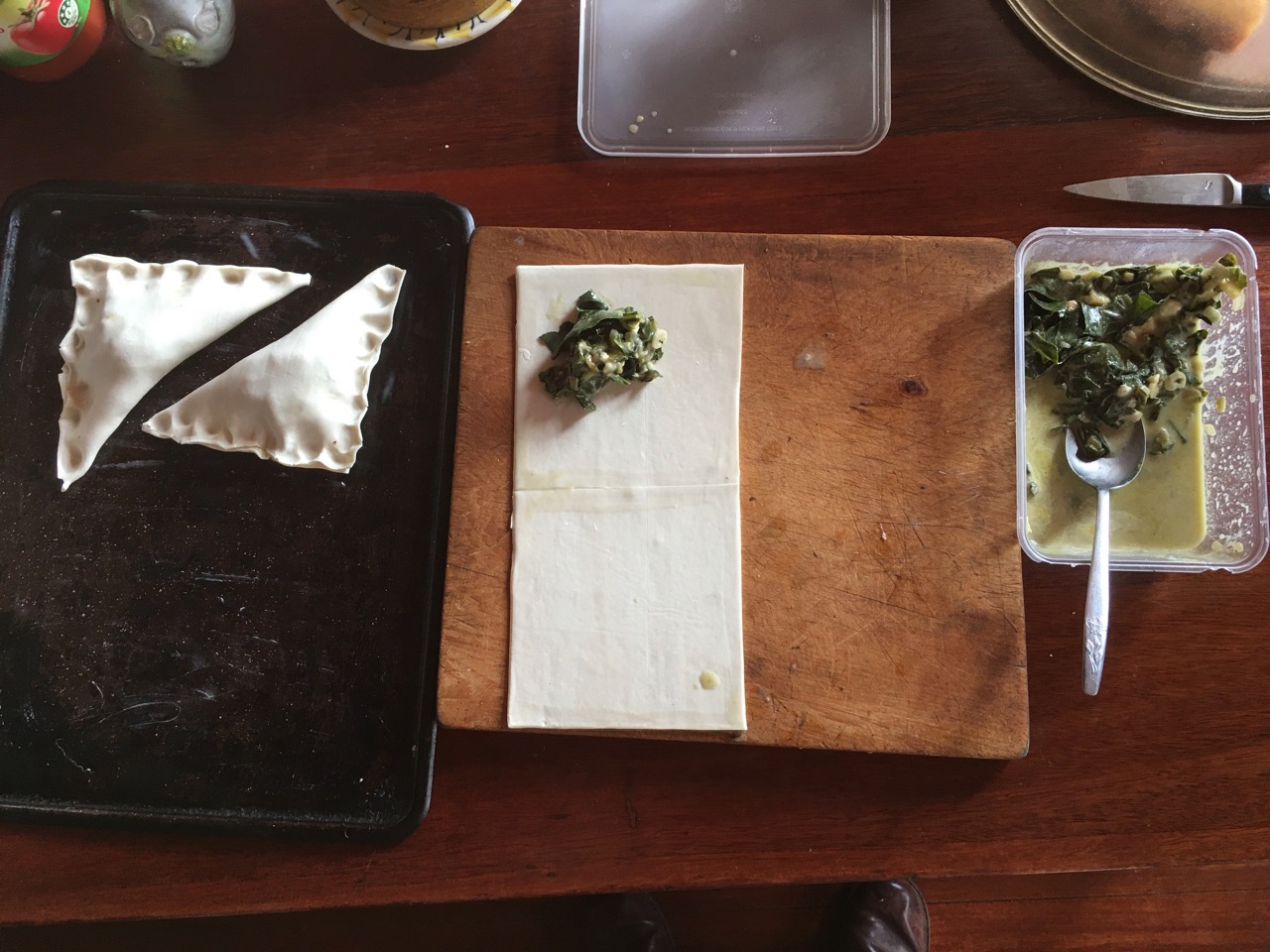
We have a little left over that I put in the fridge for lunch tomorrow. I take one sheet of puff pastry cut into small squares, add a dollop of the spinach mix and fold over diagonally, then bake at 180 for 15 mins or until golden. These little traditional parcels make a warming and easy lunch instead of a sandwich. Nothing left over and nothing wasted.
While I wasn’t cooking lunch and dinner, I have been making pots for my show at Sturt with Sandy and Meg, opening on the 24th.
Sericite porcelain dishes with pigments and on-glaze gold, platinum and copper lustres
The Winter Solstice has come and gone and the days are going to start getting longer and the nights shorter, but the coldest part of the winter is probably yet to come.
We had a crackerjack frost a few days ago, Everything so shimmering silver/white. This mornings frost was much more mild, with just a light dusting of white in the open spaces, less so under the bare branches of the cherry trees in the Chekov orchard. The winter is really just starting, so there will probably be a few more frosts yet where that came from.
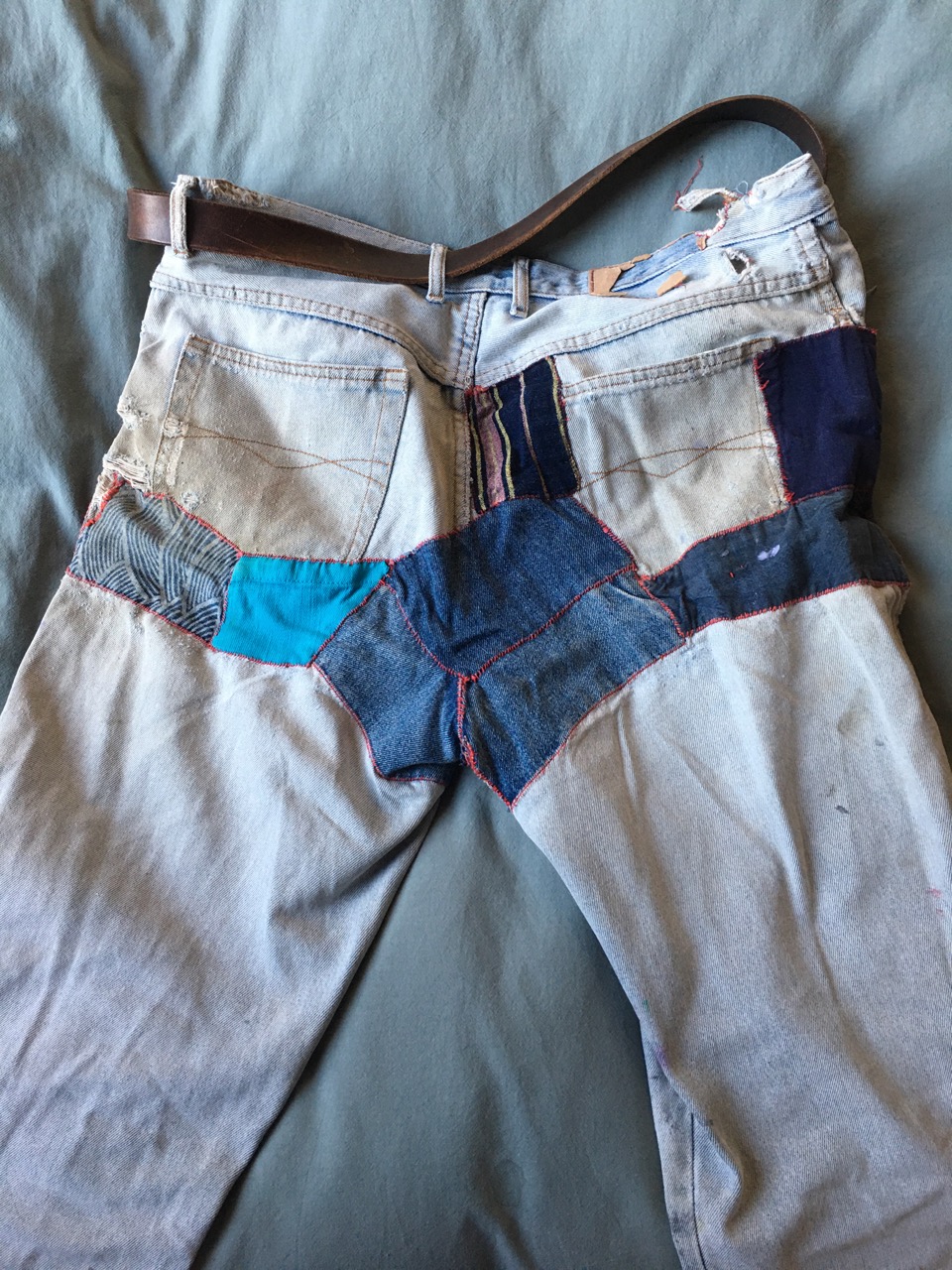
In the evenings, as there is nothing worth any attention on the idiot box. I have started to repair another pair of jeans.
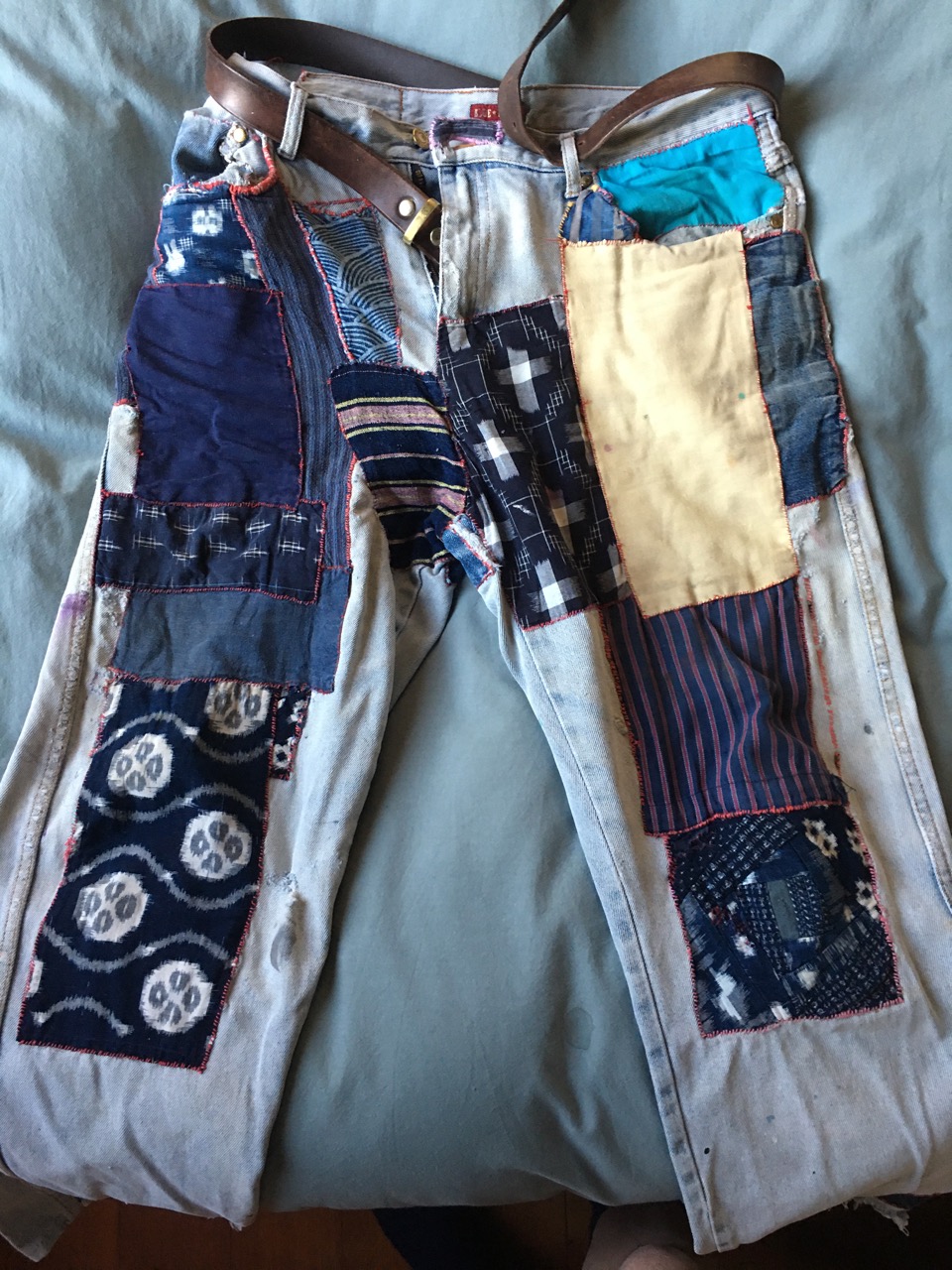
These jeans are about 4 or 5 years old and the front of the thigh part has worn through. That is the most usual place for wear for me. They were the cheapest brand of jeans.
I had already replaced the pockets with some excellent, robust, pale yellow, linen cloth that should outlast the original flimsy thin cotton that wore through in just two years. Initially in the pocket where I carry my car keys, but then the other pocket as well, just after that. Then it was the edge of the pocket where the new linen lining meets the blue denim.
I reinforced that edge with some red Japanese silk, It look great when it was fist done, but it isn’t really up to it, and is already starting to wear through, so will also need to be redone in the future.
This time I added a front panel of indigo dyed cotton that I bought in the markets in Kyoto a few years back.
Every time I go to Japan, I keep my eye out for street or temple markets where I can find lengths of indigo dyed, or other interesting old fabrics. These are usually some old piece of clothing that someone has unpicked. The hems and loose threads along the edges where they were stitched together are often still visible. Much of this old cloth was woven on small looms in bolts that were only 13” or 330 mm wide. The clothes were assembled by stitching these long thin strips together, to get a wider fabric.
It is an interesting phenomena that cloth dyed in indigo does not rot easily, nor is it eaten by bugs. It seems to last for ages. It certainly makes good patches for work wear like shirts and jeans.
This pair will be good for another 5 years if I keep up the maintenance. The pair that I’m currently wearing to work in the pottery are over ten years old now and still going OK. They have patches on the thighs and knees, as well as new pockets.
My woollen jumper was new in 2004, or 2006. I can’t quite remember. It has quite a few patches of repair, where I have darned the holes where moths have eaten through it, or sparks from welding spatter, or possibly damage incurred during stoking the wood kiln have made holes in it. They all get mended in what I think is a complimentary colour to make a colour spill pattern. It’s a work in progress, It’s 16 or more years old and still very warm and wearable. I like to make things last. i never want to throw anything out until it is really worn out. Repair and reuse, before finally recycling.
I just took a selfie of my Sunday morning jeans. I never take selfies. This must be the first time I’ve put one up on this blog. I’m dressed up to receive some very good friends for Sunday lunch, so I’ve got my best pair on. I’ve been working on these jeans for many years now. I still work in them, but this morning they are straight from the wash and are lovely and clean and suitable to welcome our close friends in. I wouldn’t wear them to try and pass through customs in. But my friends know and understand me. They won’t be affronted.
Actually, I think that work like this is verging on Art. If not a work of art, then its certainly involves some aspect of creativity. I don’t just slap on ‘iron-on’ patches from a sewing shop. I mix and match the patterns and colours to suit my mood and proclivity. Well, that’s my story and I’m sticking to it.
Even the arse end has some good work on it. This wear can be attributed to sitting on the wooden saddle-like seat of the ‘Leach’ treadle potters wheel. The slight swivelling/rocking motion of kicking the treadle with one lag seems to cause the butt end to wear out?
This last week we have made new batches of clay bodies to re-stock the clay boxes. I made a batch of the Mittagong halloysite porcelain from the mafia site.
This weathered stone is pretty well kaolinised, or in this case ‘Halloyositised’. This makes the stone somewhat crumbly and easily crushed, because the mica and felspars are broken down and weathered from igneous stone to clay-like substance, this causes the loss of some of the alkali fluxes. The stone can then becomes slightly clay-like and less stone-like. However, this creates a minor problem, because as the stone becomes more friable and easily crushed. It can’t be put through the jaw crusher, as the increased clay content causes the crusher to clag up and jam.
There are two options. The first is to calcine the stone in the bisque kiln and then it will become dry and brittle and easily passed through the crushers and ball mill, but this will completely eliminate the plasticity. So I only do this if I intend to make it into a glaze. If I want to make a porcelain body, I need to retain the plasticity, so the way to extract the clay fragment is to soak the sample in water and then stir it up into a liquid slip. This is called ‘blunging’. However, to make it smooth I need to pass it through a fine screen to eliminate all the unweathered stone fragments that are mostly mica, felspar and silica. In this case, I want all these minerals in the finished porcelain body to create the flux to make it melt and become translucent. This problem is solved by then ball milling the grit residue on the screen and then remixing to two together. This is a rather long and tedious job and I used to do this before I got a roller mill.
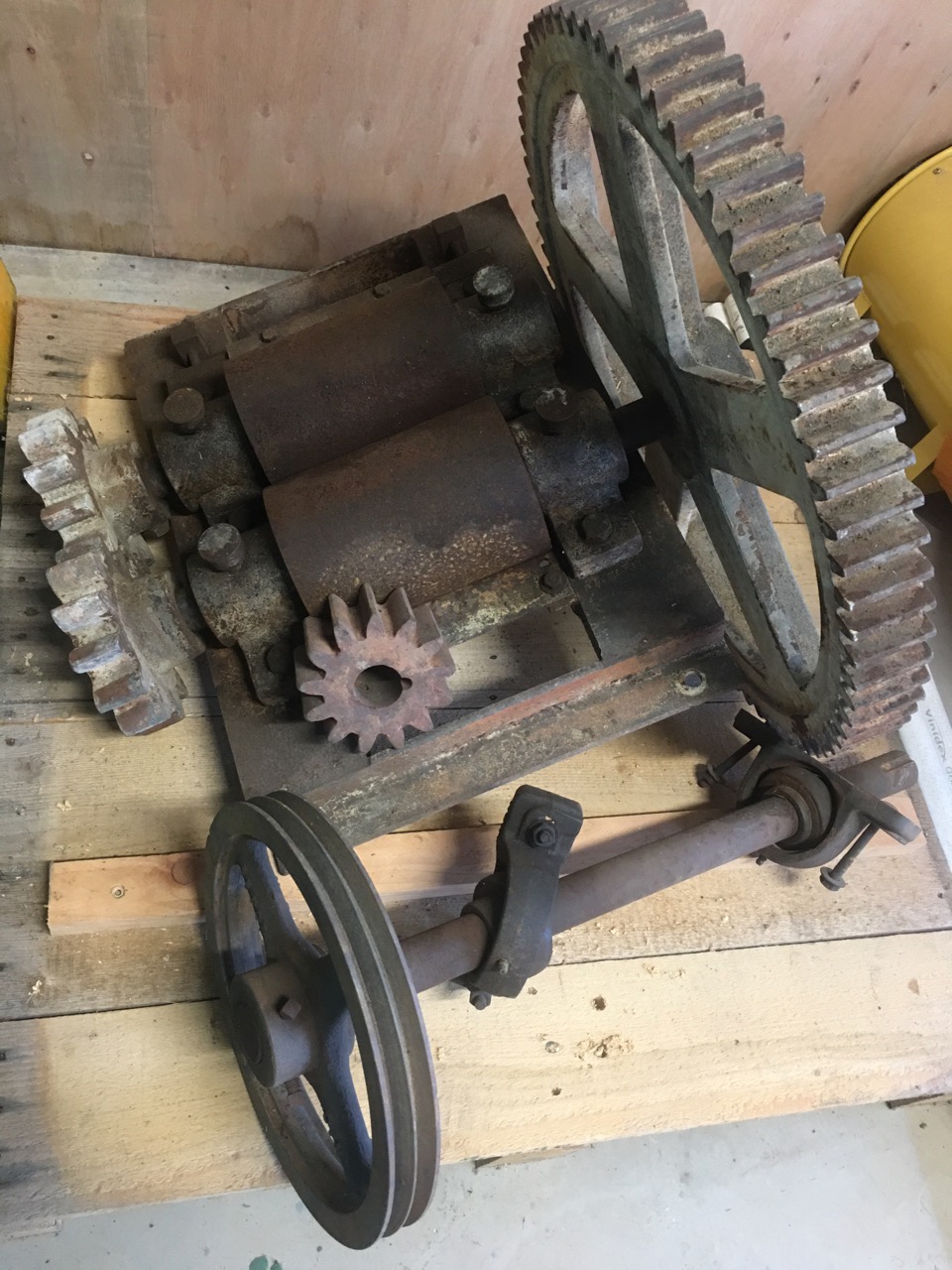
The best machine for this kind of material is a roller crusher. I actually have one of these, but it was burnt in the fire and I haven’t managed to find the time to rebuild it. It is still sitting on the crusher room floor in pieces waiting for a quiet period when I get bored 🙂 so that I can find the time to repair/rebuild it. Watch this space. Everything gets done eventually.
In the meantime, in the absence of any mechanical assistance. I decided to crush all the material by hand in the large mortar and pestle, before ball milling it all into a fine porcelain clay body. I used to do this when I was at Art School, as a mortar and pestle was the only piece of crushing equipment that I owned at that time. I still hand-crush small samples up to a few hundred grams for initial testing of field samples. It is quicker than cleaning out one of the bigger machines after use. It’s just like all those kitchen gadgets that are supposed to save so much time, but end up taking longer when you factor in the cleaning and drying, and then reassembly time before returning the gadget to the ‘stuff-that-is rarely-used’ cupboard.
Once reduced to a suitable size, it goes into one of the the mills.
After ball milling, I pass the slip through a 100# screen to remove any coarse particles that may have escaped milling. This halloysite porcelain sample has some iron contamination, so appears a little yellowish in the slip form. This slight iron staining helps create a lovely mahogany ‘flashing’ on the surface during wood firing. The Mafia halloysite is quite variable and is prone to severe warping during the early stages of firing when the halloysite tube-like clay crystals break down and re-form as fractured platelet shards. In this unstable state, the pots can warp and/or crack, so I have found it wise to blend it with some of my other porcelain clay or plastic kaolin to help stabilise the body.
In this most recently collected Mittagong halloysite sample, the site had been eroded badly in the recent rains and all the best and whitest, material had been washed away. Simply because it was the most friable and easier to dissolve in water. Because the remaining material was less weathered and darker than I wanted, I blended it with some more reliable local kaolin based porcelain.
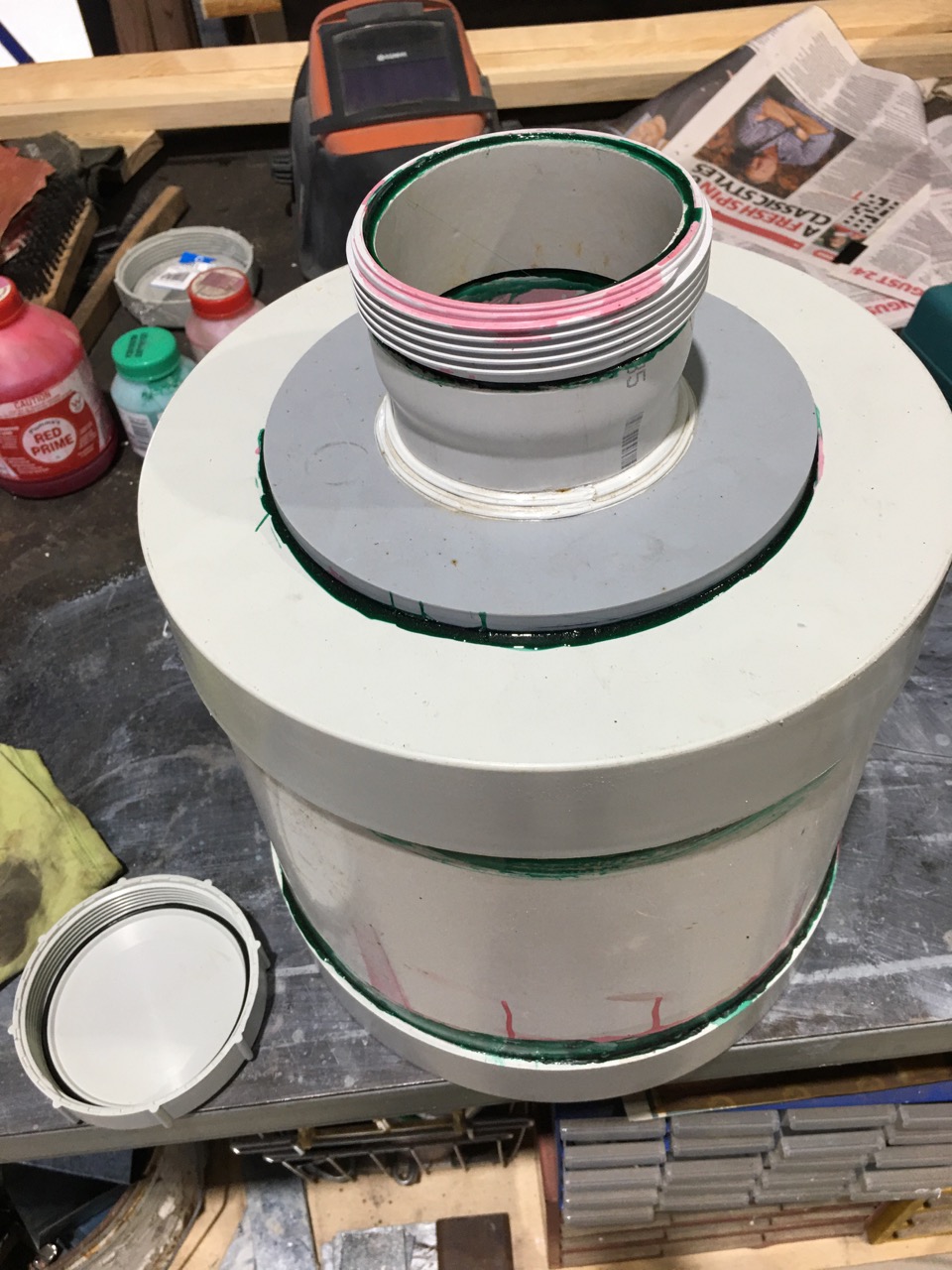
I have been finding the loading and unloading of the porcelain balls into the larger porcelain ball mill jar quite hard on my back as I age. I have had to load the balls in and out in small handfuls. It takes time and requires and lot of bending and effort. So recently, I built myself a couple of new PVC ball mill jars. These a significantly lighter, although the porcelain balls still weigh quite a bit. For these lighter PVC jars, I made a stainless steel mesh inset for the spare lid. I can easily change the lids and simply up-end the jar over a bucket and let the charge all drain out. I partially refill them with fresh water, roll them along the floor to rinse the balls clean then re drain into the bucket.
The jars are then ready for a refill and to be used again. The balls never leave the jar. So much quicker and easier.
These new PVC jars are made from cheap, standard, over-the-counter, plumbing parts. They are larger, but lighter, than the old one, and I made them so that I can fit two of them on the roller at once. So now I’m able to get more done in the same amount of time..
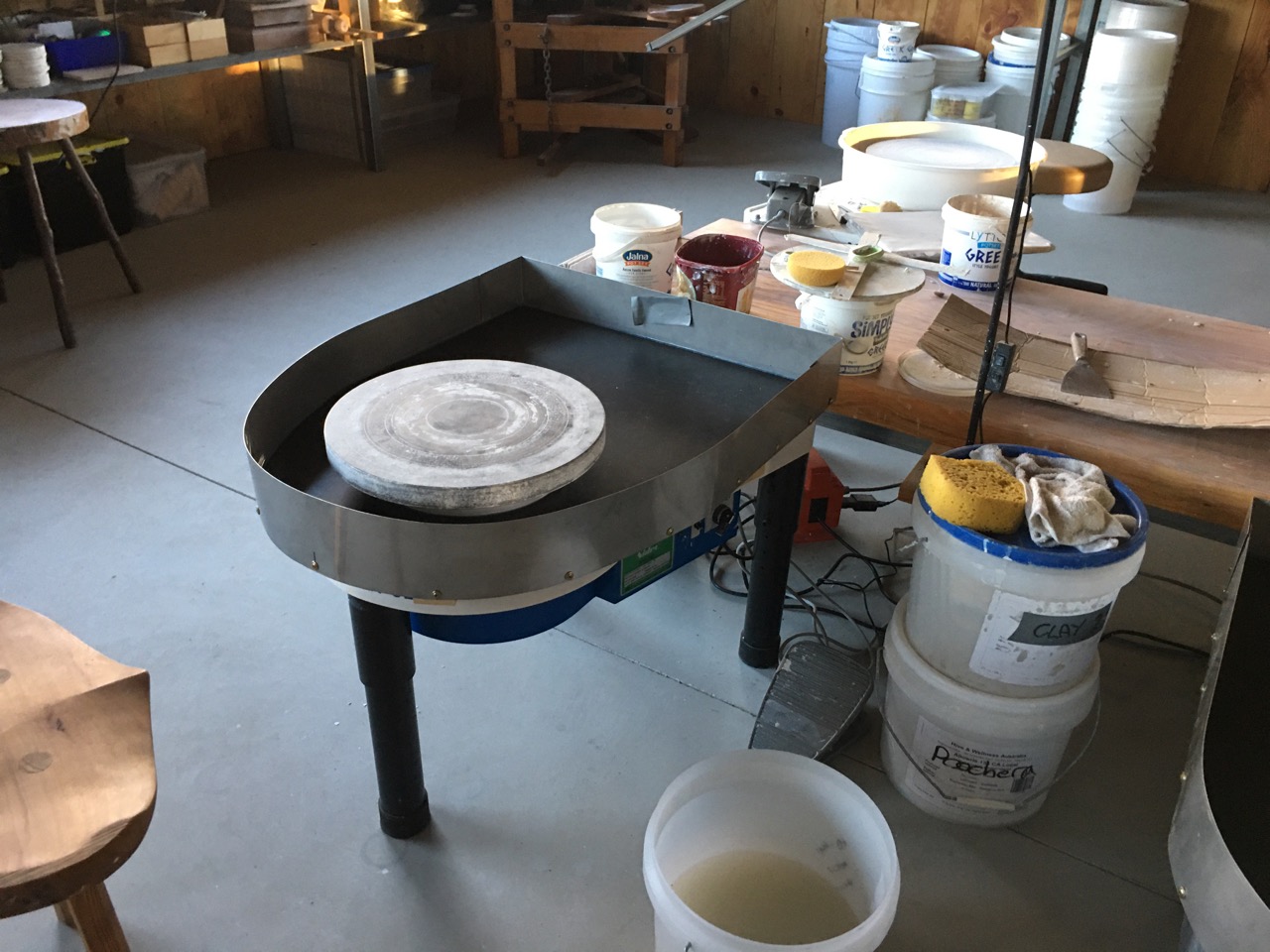
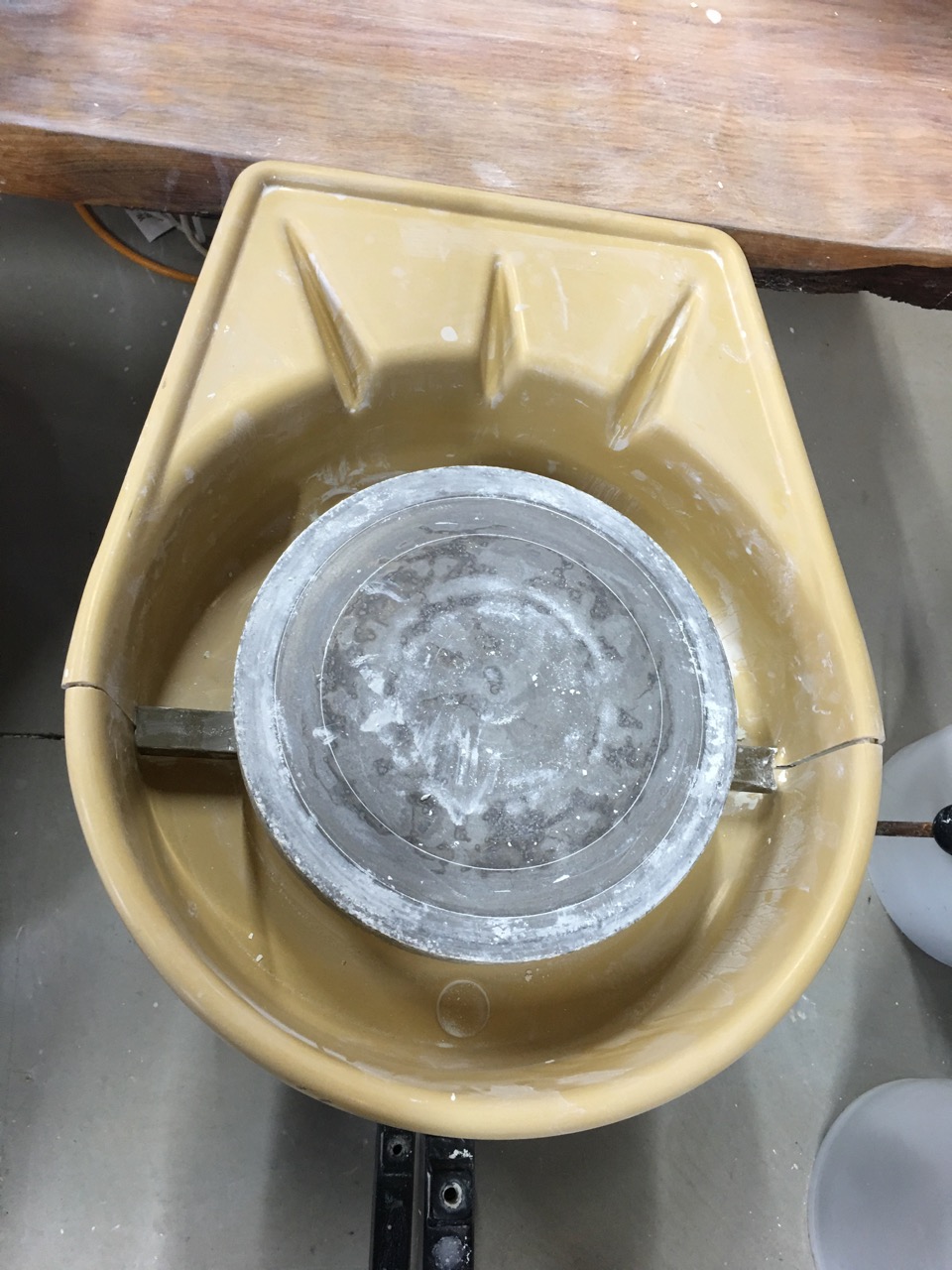
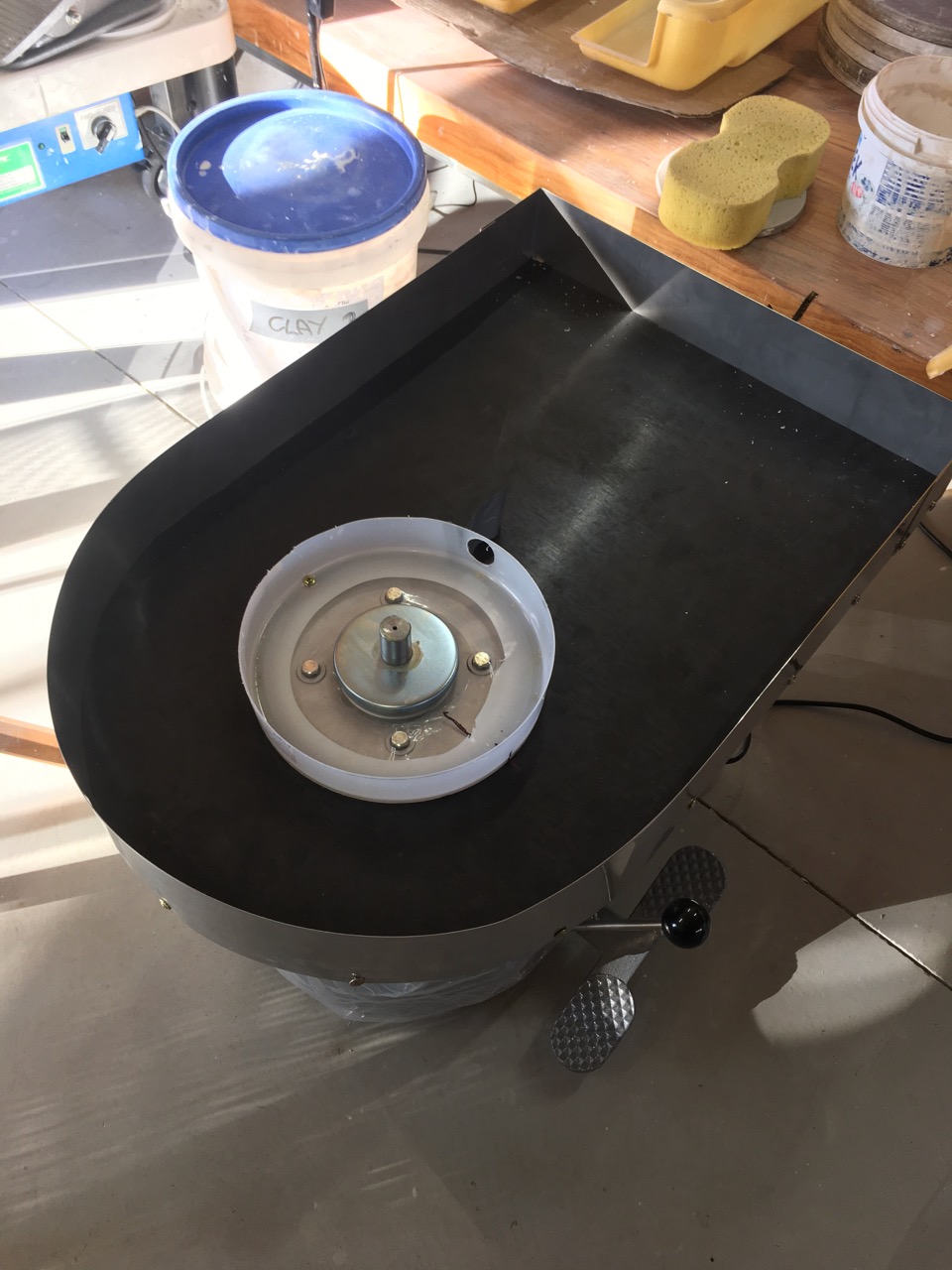
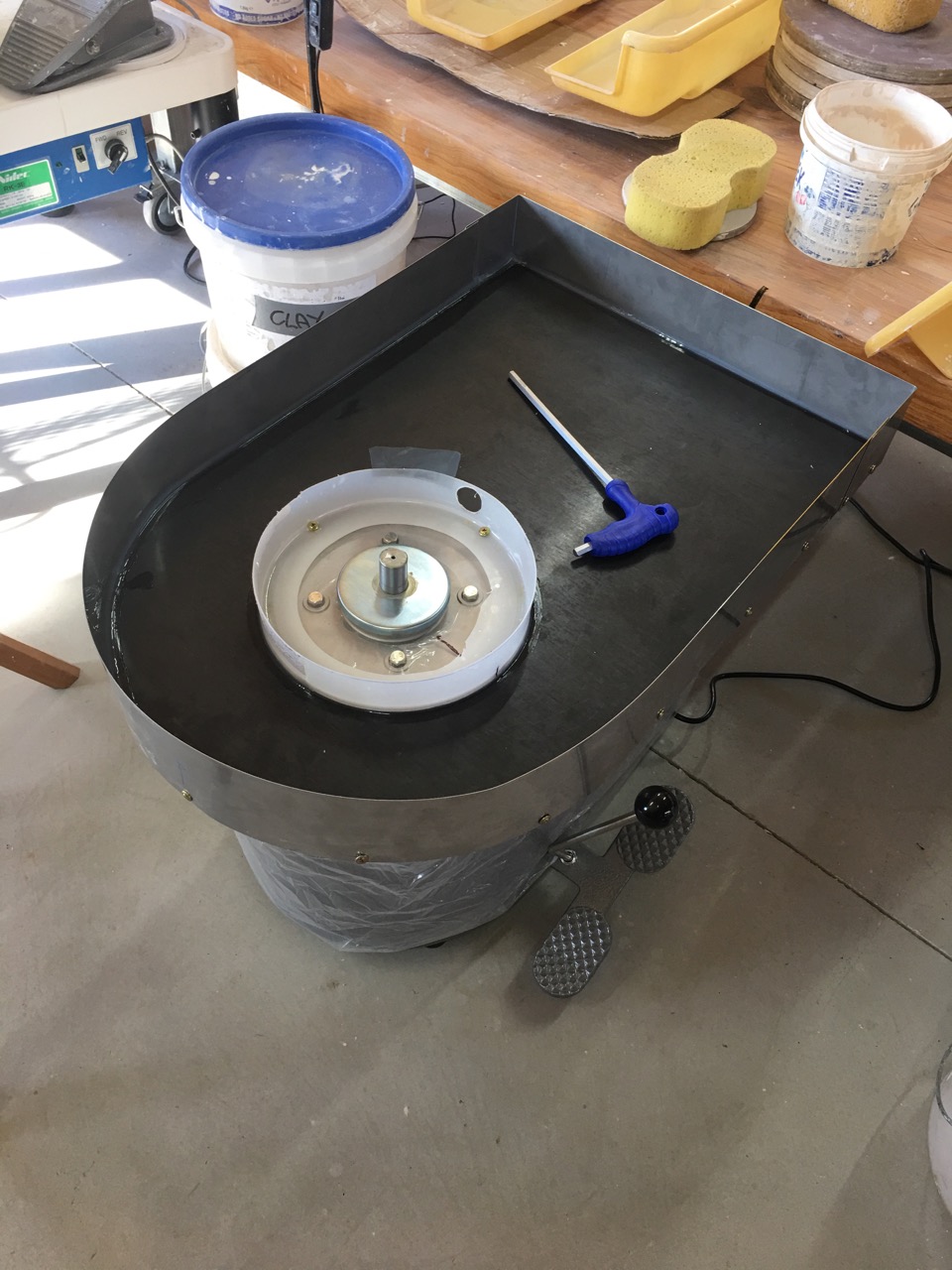
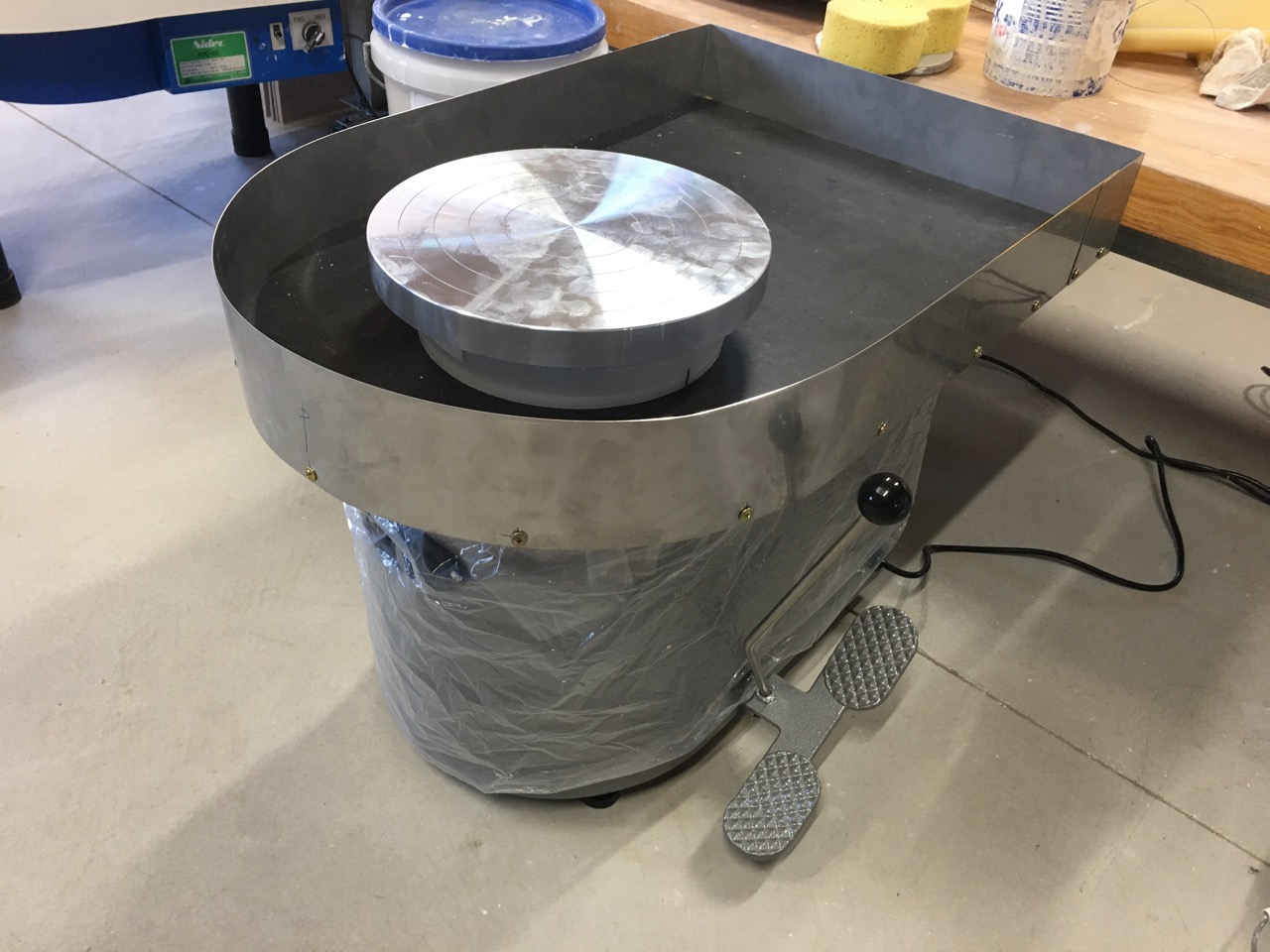
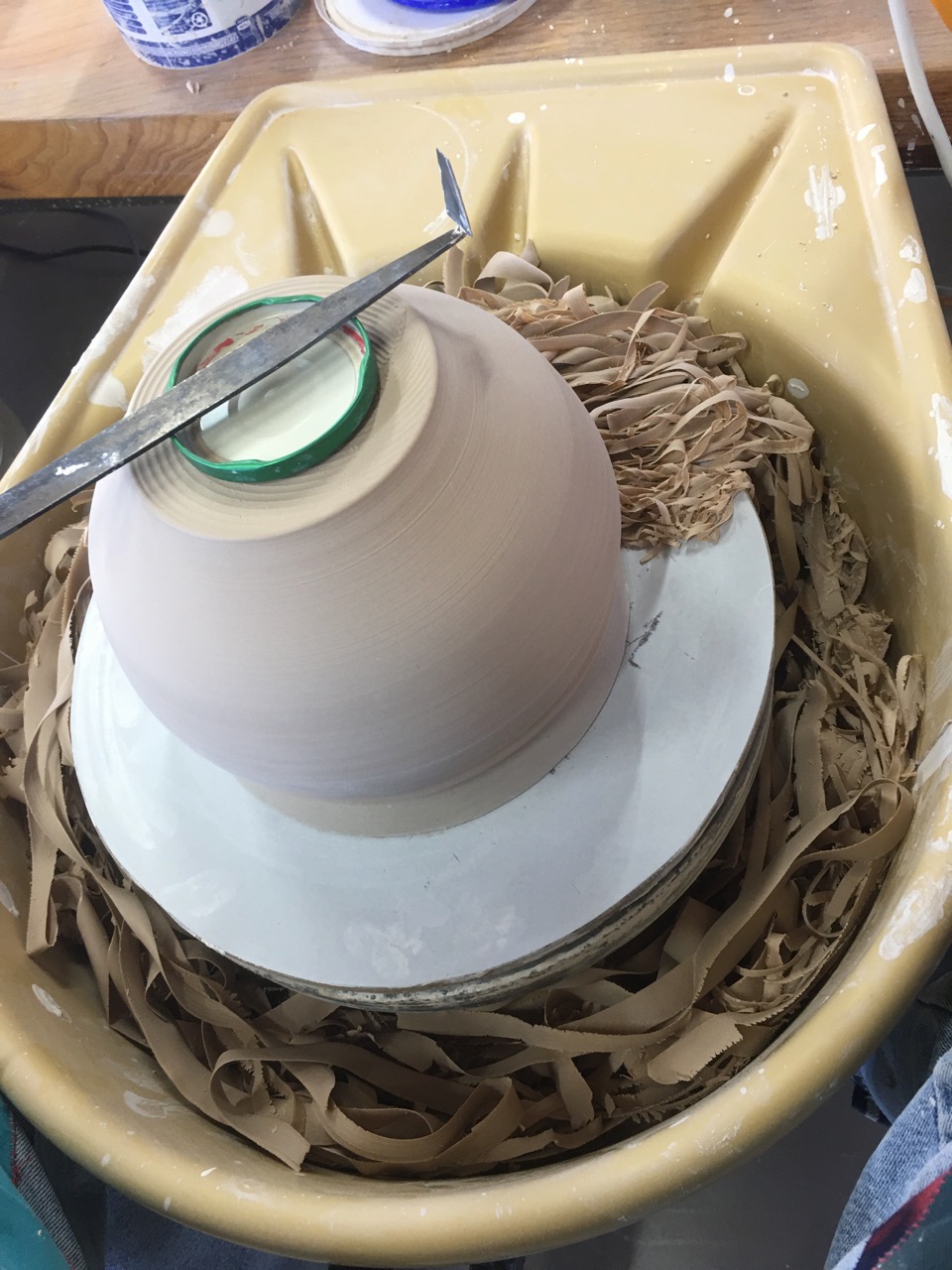
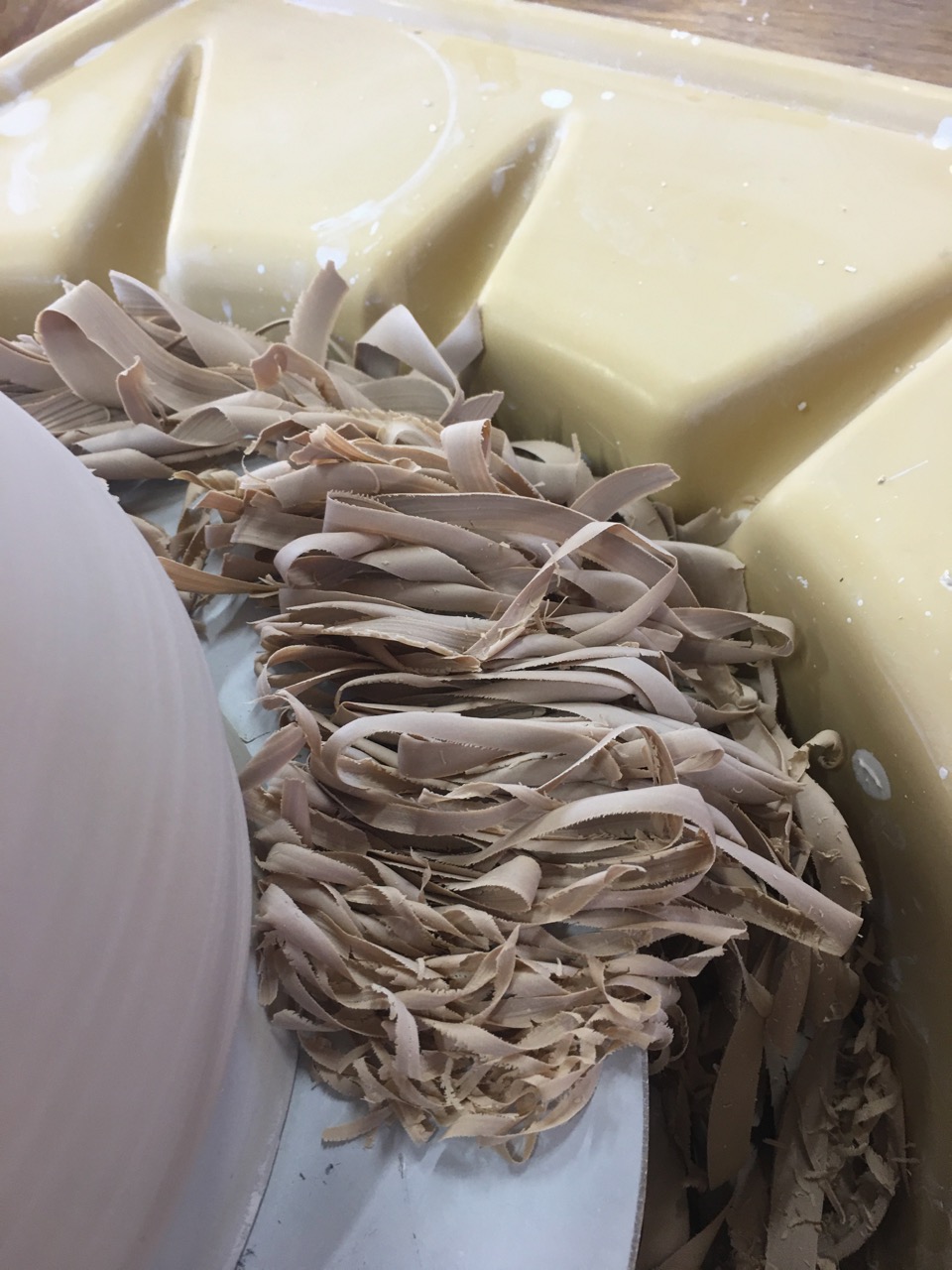
As I have been throwing and turning the porcelain. I have been collecting the turnings, they pile up like so much fettuccini pasta strands in the hopelessly small Shimpo wheel tray that need to be emptied every few minutes. In the old pottery, I took the plastic trays off and had the wheels in enclosures, so that all the turnings just spilt out onto the floor, but it was a big job to clean it all out and wasn’t suited to the sort of work that I now do, that involves using a large number of different, experimental, small batch, sericite and halloysite porcelain bodies.
So I persist with the tiny tray so that I can recycle each different sericite porcelain body separately to maintain its integrity.
I have been collecting and drying the turnings, then calcining them in the bisque kiln and finally ball milling them to a fine powder to make a porcelain glaze from the porcelain body.
The raw, dried turnings
The same turnings after being fired in the bisque kiln. The low temperature oxidised firing turns the calcined porcelain slightly pink.
The powdered glaze material in the ball mill after milling, ready to make porcelain glaze. 80% porcelain body and 20% lime.
A simple glaze recipe, Self reliance all the way along the line. DIY.
Nothing is perfect, nothing is ever finished and nothing lasts.
This week we have experienced the longest night, and also the coldest day – so far.
We awoke to a fantastic white shimmering frost. All the paddocks were bright white for a couple of hours until the sun light reached them and burnt it all off. The sun rises at such a shallow angle in winter, it takes a long time for the sunlight to get higher in the sky, and then cast its bright energy onto the fields.
We have been making work for the first firing of the new wood kiln. This job was one of many put on hold while we made work for the ‘Pop-Up’ Open Studio weekend. Now that this is safely behind us, and with a little bit of liquidity to keep us afloat. We can concentrate on making the work for the wood firing.
I started last week by chopping wood and making clay. Now we are enjoying the fruits of that labour. I started with making the largest pieces, as these will take the longest time to dry, especially in mid-winter.
These big platters and dishes are 400 mm. dia. Janine has started by making some press moulded square dinner plates. These are an order that has flowed on from the Open Studio sale last Xmas.
I have also managed to get a couple of half-days in the veggie garden, so it is starting to look loved again.
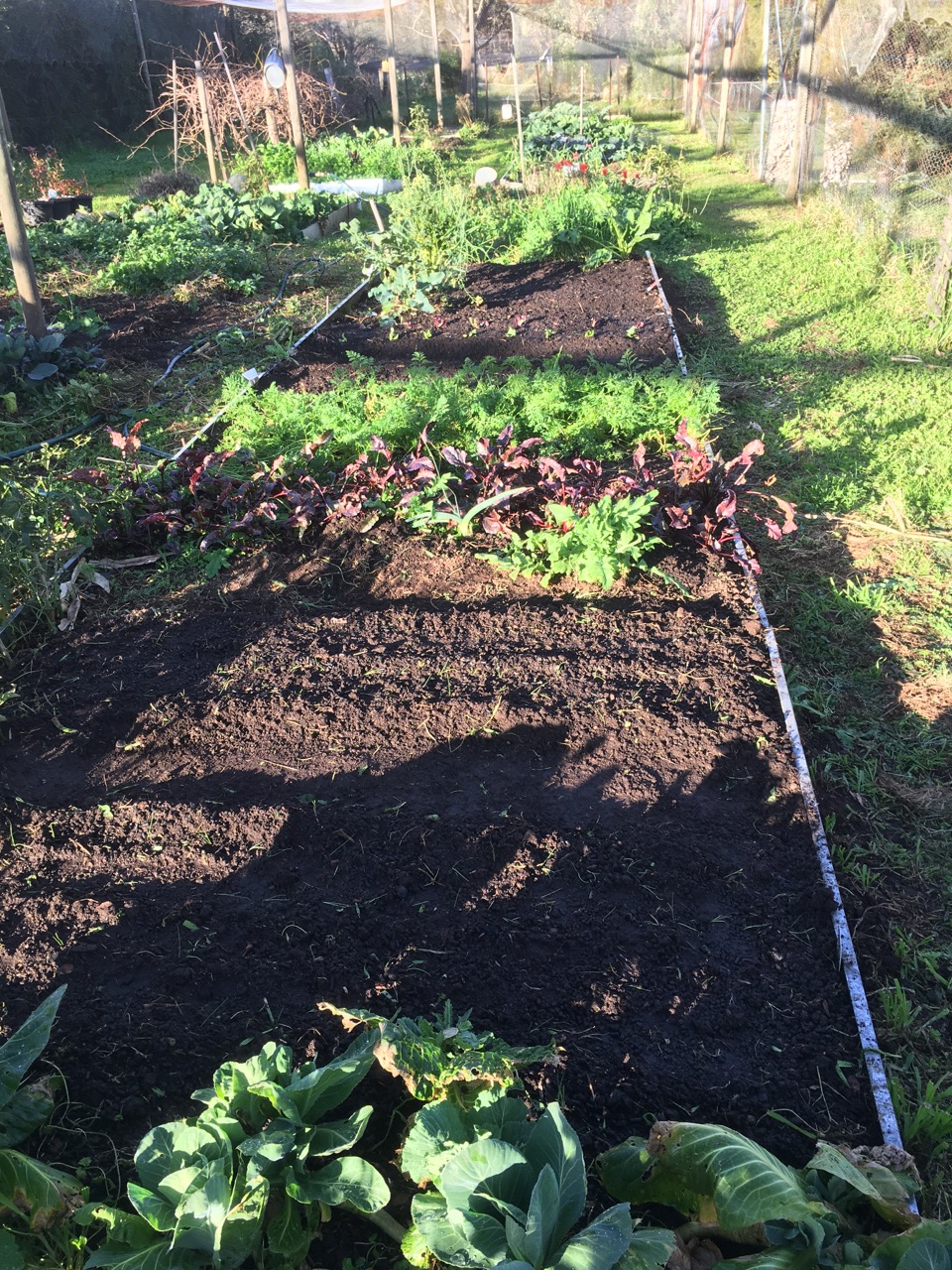
The garden always looks so much better when there are a few rows of carefully weeded and tended seedlings and sprouting seeds coming up. I just made it, getting these leeks, onions and garlic in before it is too late. It is really too late for a good garlic crop, but this is the 3rd planting, so we will be OK. I also put in broad beans, peas and transplanted seedlings of Brassicas that I managed to sow 6 weeks ago. Everything is a bit ‘just-in-time’, but it will do to get us through this tough time of transition from Bushfire residue chaos into New, comfortable and productive post-fire life.
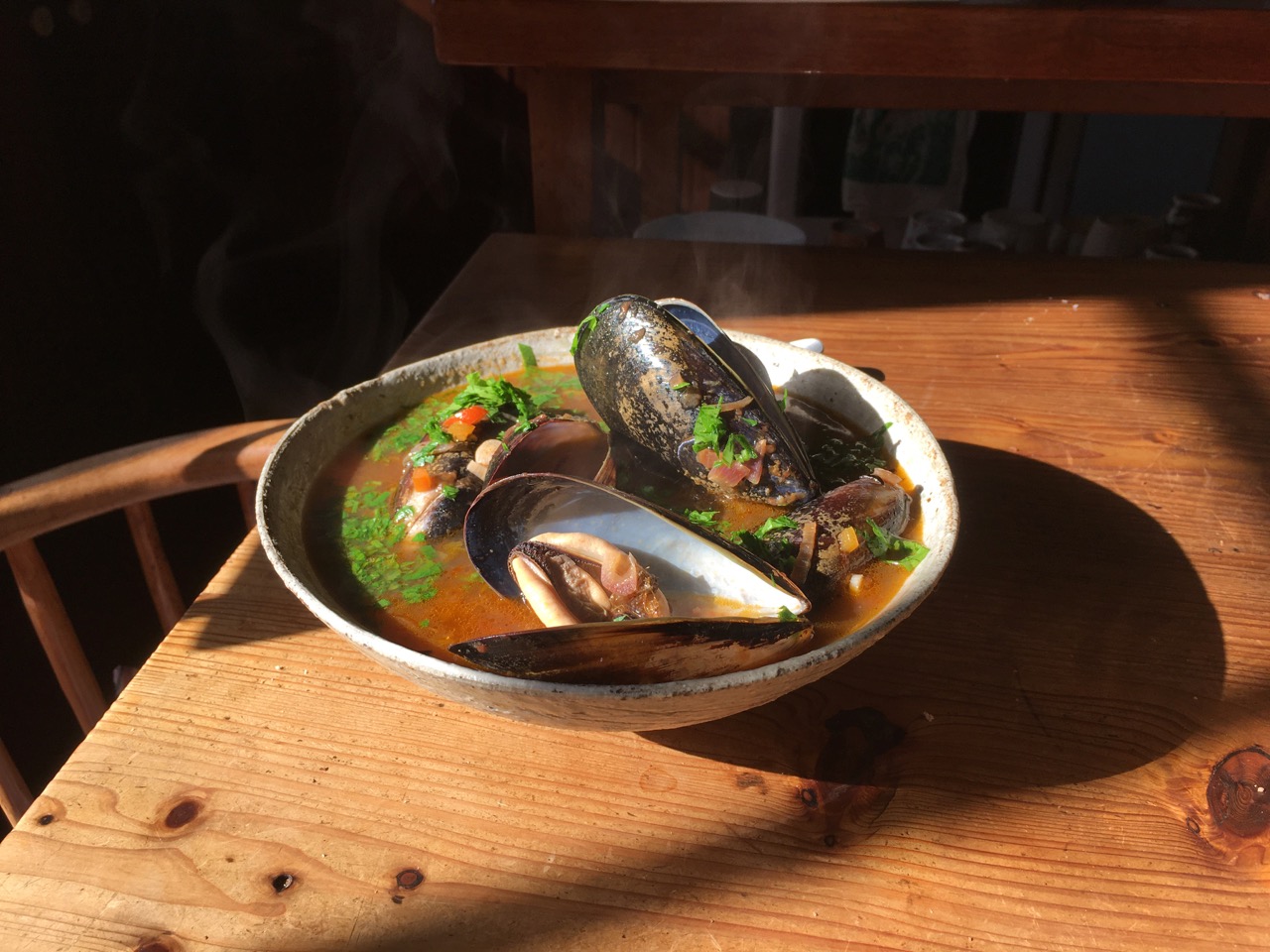
We have been enjoying a few very nice meals recently. Janine cooked 2 big spinach and cheese pies to feed all our helpers over the long weekend pot sale. But at the last minute a couple of our friends, Warren and Trudie, caught Covid and couldn’t turn up to give us a hand. Luckily our other friends Susan and Dave stayed on for an extra day to help us out. Because we had fewer people here, there was an excess of pre-cooked food, like two spinach and 3 cheeses pies, a lovely dish of mussels in rose wine and home made tomato passata, flavoured with a liberal sprinkling of chillis.
Ricotta, plus coarsely chopped Fetta for texture and the sharp spike of gorgonzola to lift the flavour profile and stop it from being too bland.
Janine and I were eating spinach and cheese pie for days. I tried reheating and serving it in a few different ways. One favourite was serving a slice with a home made tomato passata sauce bottled in the past summer, this was served with slices of chorizo, olives and capers. That was my favourite combination, combined with side of a small amount of sautéed mushrooms in garlic and olive oil.
Now that the Open Studio Long Weekend is over. I can get back to the issue/problem of the pug mills.
Success! I made two batches of clay for wood firing and processed them through the two refurbished pug mills.
They both worked just as they should. Instead of taking a whole day to pug the clay through the small 75mm pug mill, as we did a month ago.
This time, using the 100 mm vacuum pug mills we were able to get the clay pugged all through twice, to insure even mixing in record time.
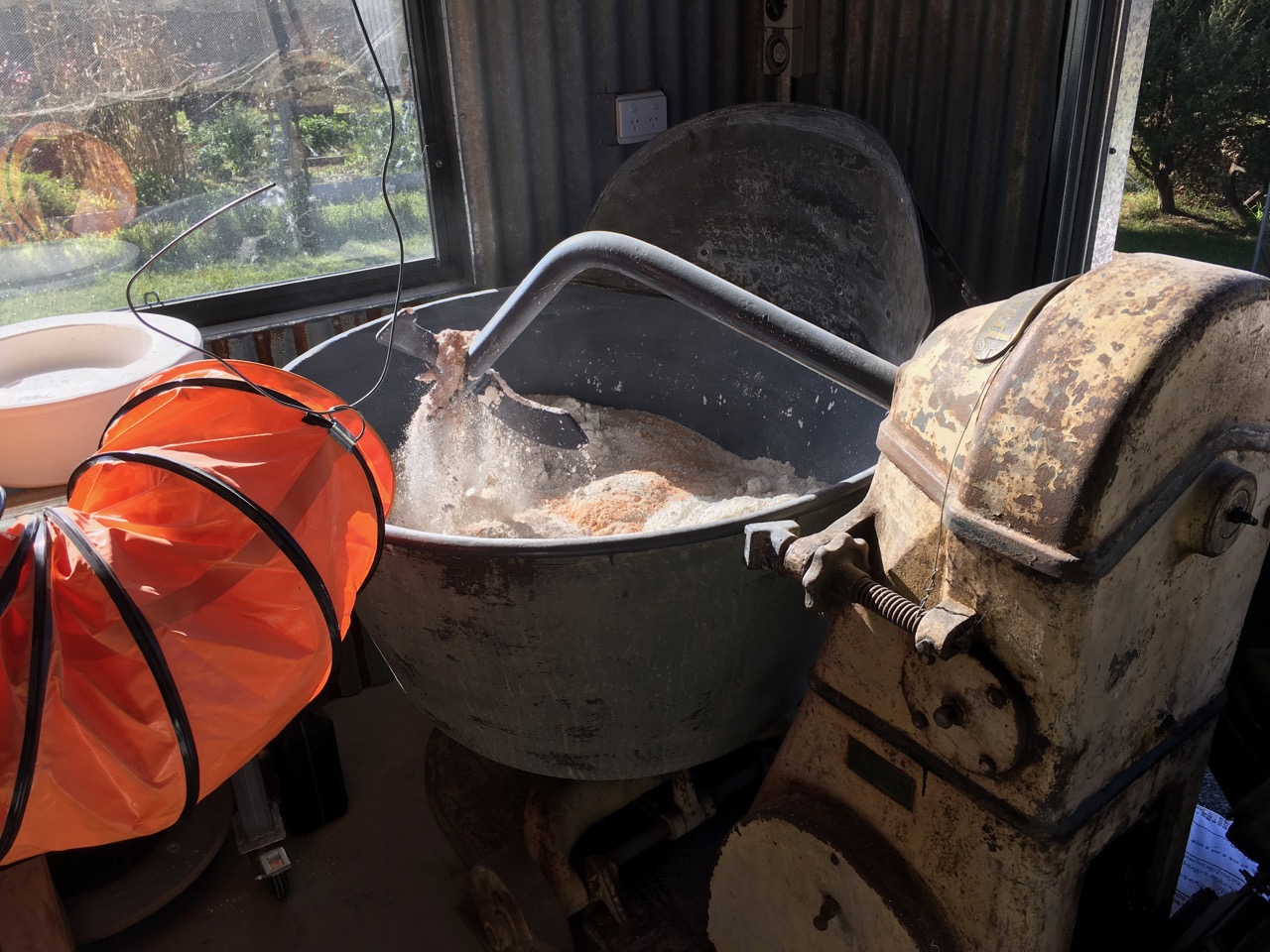
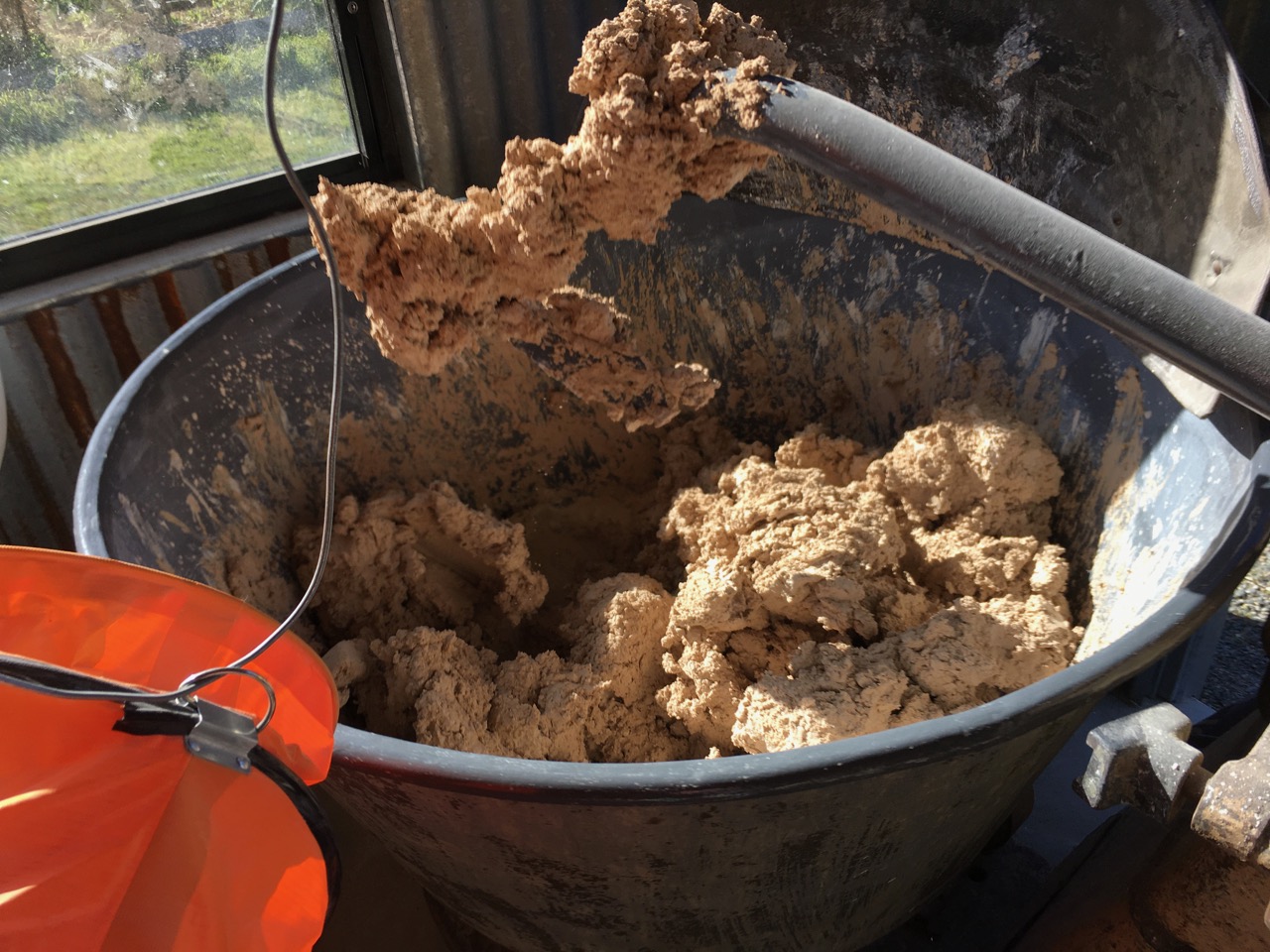
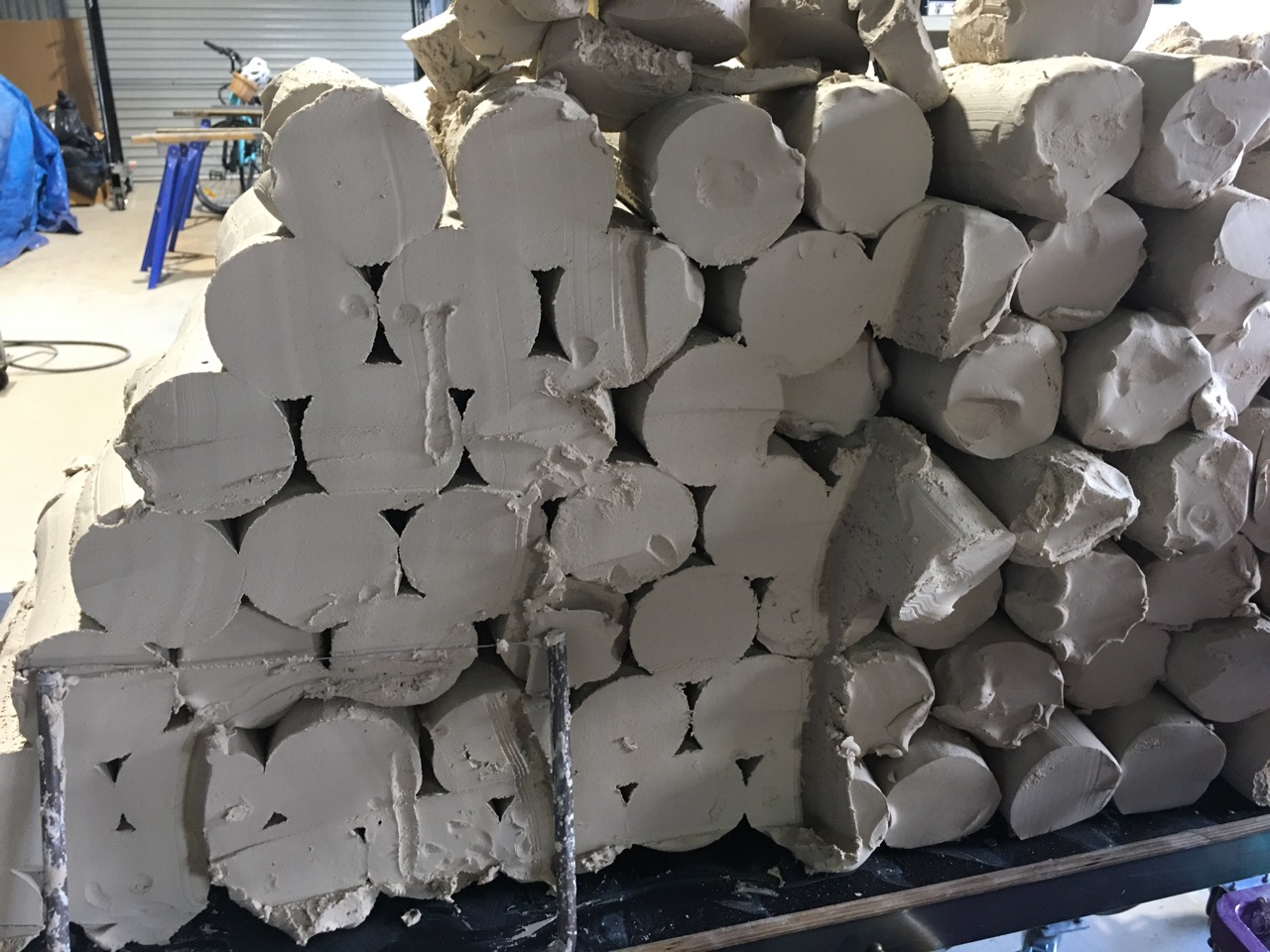
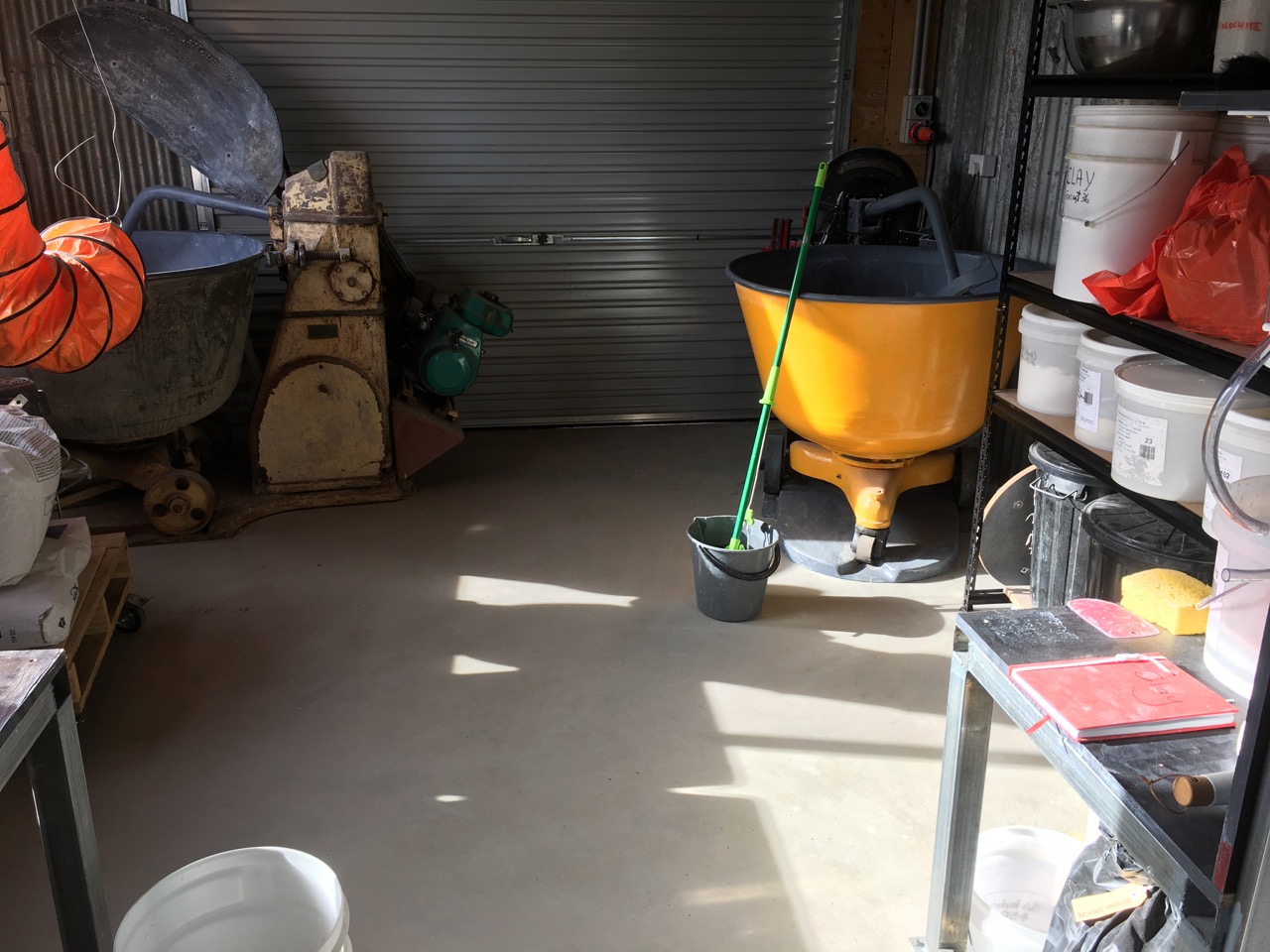
I made a batch of 140 kgs of iron stained wood fired stoneware body in the dough mixer that I bought from my long time friend John Edye after he retired.
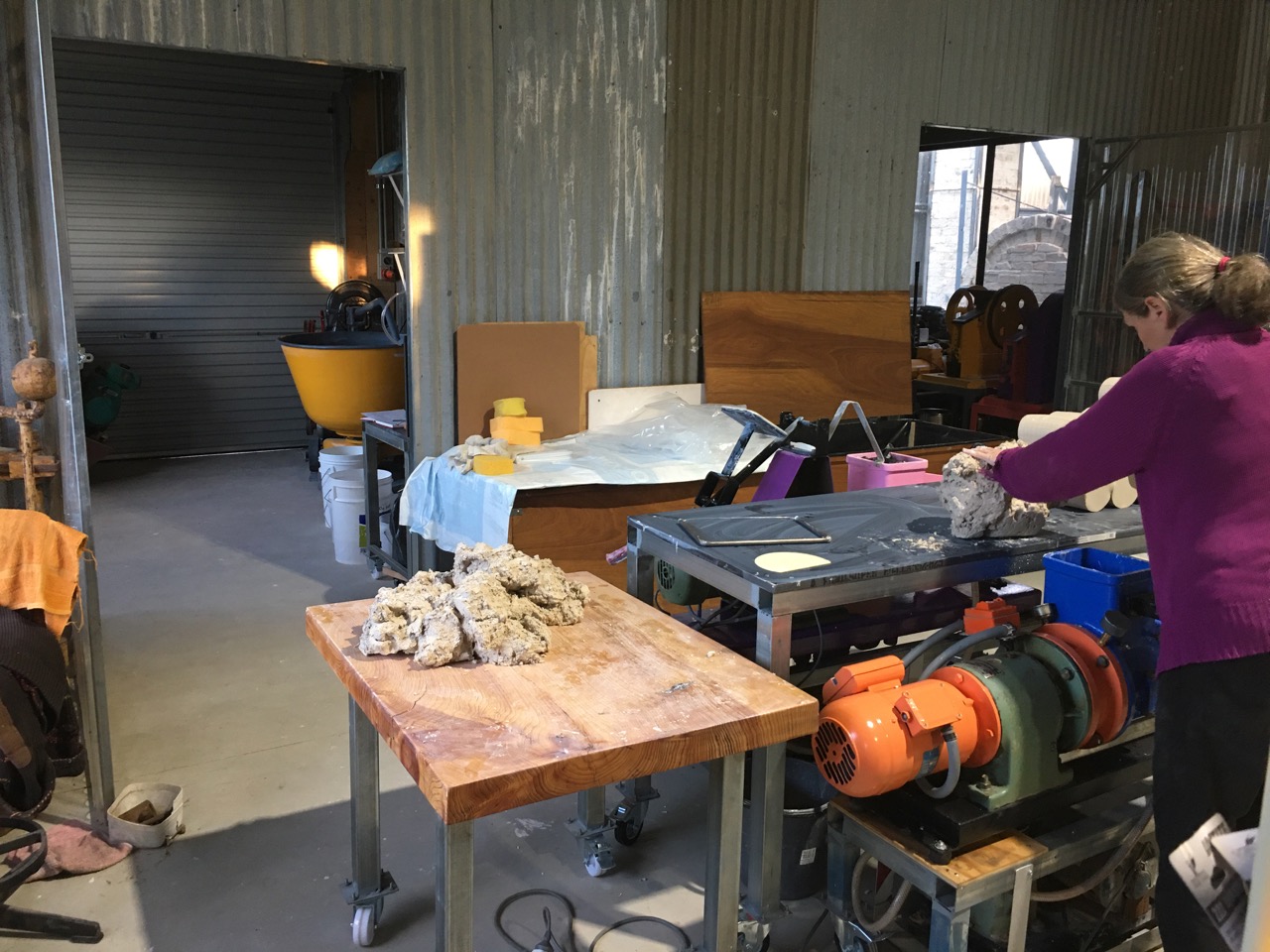
The clay mixing room is loosely sealed and has a vacuum nozzle positioned over the machine that is in current use. This removes a great percentage of the dust from the building, keeping a slight negative pressure in the mixer room and stopping any dust from migrating into the pugging room.
After the clay is removed from the dough mixer, it is placed on the clay trolley and wheeled out of the mixer room and into the pugging room, where it is pugged twice, blended, bagged and boxed.
I scrape, scrub and then sponge out the dough mixer bowl clean as soon as the clay is removed from the bowl. It is best to do it as soon as possible, while the clay is still moist.
It makes the job a whole lot easier. I take charge of mixing the new clay body batches in the vacuum sealed clay mixer room while Janine does all the pugging in the next room.
The fresh clay is then pugged through John’s 100mm. Venco pug mill that dates from the mid ’70’s. This pug mill is the first model of this size made by Geoff Hill.
It is currently disguised as a very large pretend musk stick!
We pug the clay through twice. The first time we stack all the pugs up in a pyramid fashion, then chop all the ends off the clay sausages, working our way back through the batch of clay to minimise any slight variations from batch to batch. Taking clay from the first, middle, and last pugs and blending them back through the machine.
It turns out that Geoff Hill learnt a lot in the building of this first model. And soon made changes to improve it’s design.
We bought our first 100mm. Venco about 6 months to 1 year later than John and we ended up with the second, re-designed model.
As it turned out the second model worked faster and was quieter than the first model.
I didn’t realise this at the time, but as we now have one of each of these earlier pug mill models running side by side, we can experience the differences.
When I made the second batches of clay. The wood fired porcelain clay body. Janine used the pug mill that we were given from our lovely friend Jane in Melbourne.
With its new reconditioned motor now in place, it works beautifully – now!
This is a later model pug mill. Possibly built a decade later than John’s pug. It is much quieter, runs a touch slower, but is much faster and is self feeding.
It runs a little bit slower, but pugs the clay a lot faster.
It doesn’t need a lever plunger to force the clay into the barrel. The clay is just naturally drawn into the pug barrel. This is how we experienced the use of our old original Venco pug mill from 1978.
I attribute this to the design of the blades as they are set up on the shaft. The newer model has the blades a little bit closer together, so that there are no ‘dead’ spots and is a great improvement.
After pugging both batches of clay and storing it all away in the plastic lined clay boxes. Janine puts the chooks to bed and then goes to the house to light the kitchen stove and start dinner.
I wheel the pug mills out of the way, and then wheel the clay bench and pug sausage tables both out of the way. So that I could wet mop the floor and get it scrupulously clean, before wheeling everything back in place. Ready for the next batch.
The mixer room is also mopped clean.
This practice, keeps the clay room spotlessly clean and minimises air born dust diseases.
I’m actually too old to die young now, but I still want to protect everybody else that comes here to visit.
Sandy Lockwood, Meg Patey and I will be having a show together at Sturt Gallery in 5 weeks time.
Save the date.
We will be giving an Artists talk at Sturt after the opening to explain the work and answer questions.
This is very new work for me, as all the pieces are decorated and have been made in response to my experiences during the 2019 catastrophic bush fire event that I endured and my engagement with recovery therapy since that time. Difficult work for me.
Janine and I had a very good Open Studio Weekend Sale.
We are part of an artist collective organised by a local lady called Erin Adams, she came up with the idea of the ‘Pop-Up’ Open Studios artists collective and herded all of us cats into a cohesive group. A tremendous job of work on her part, and we are very grateful to her for her organising ability.
Over this long weekend, we had over 30 visitors each day, for the 3 days, and almost everyone bought a pot, so we were chuffed.
The weather leading up to the weekend was awful. Freezing temperatures and blowing a gale. We had power outages, with trees blown down over power lines, for 2 days beforehand.
I was starting to think that no one will turn up. Nobody would want to brave all this weather to come out here.
As it turned out. Lots of people came out to Balmoral Village to see us. Most of the ‘Open Studios’ are located in and around the towns of Mittagong and Bowral here in the Southern Highlands. It is a well recognised tourist destination for people from Sydney, and it is easy to flit around and visit all of those local studios about town, without having to spend much time driving between them. You are also in close proximity to cafes, restaurants and coffee shops.
As we are 25 km out of town, it’s a half hour drive to get out here and the same to get back again. So we appreciate the effort that the locals put in to get out here. However, what was amazing was the number of people who drove down from Sydney to come and visit us. About 2/3 of our visitors were from the greater Sydney area. So Thank You very much to all of you who made the long drive of 2+ hours or so each way.
Luckily, we had our friends Susan and Dave here for a few days to help us clean up, set up, and then help us with selling and wrapping for the first couple of days. It made the job go so much easier. Thank you Susan and Dave!
I had made a batch of Tea Pots for the sale and sold most of them. I like making tea pots, they are an interesting challenge. You need to make all the different parts in the correct proportions to fit together in a unified design, but they also need to perform their function properly once fired.
The shelves are greatly depleted now. I love making pots, so its great to have space to make more things.
In the past couple of weeks, I developed a new high calcium porcelain glaze that has a lovely ‘streaking’ quality. I works well with a thin, soft pigment wash.
The pigment highlights the texture of the glaze. It also feels very soft and buttery to the touch.
In the days leading up to the Open Studio, I baked a loaf of bread in the pottery wood fired oven and although it took longer than it would have in the house oven, it turned out very well. This new oven has its own personality and will take a few goes to get used to.
I prepared the dough in the house as usual, and then put it in a cast iron pot in the pottery oven.
I also made a couple of panforte cakes for the open weekend, to share with visitors. Panforte translates from the Italian as ‘strong bread’. It is a small, solid, flat loaf of sweet bread, filled with dried fruits and held together with some honey and flavoured with a few spices like cinnamon and cloves. The recipe was listed here in an earlier blog. Search ‘panforte’ on the home page search box.
The dried fruits are measured out and mixed with the flour, before adding the honey water and spooned into my homemade stainless panforte rings on a buttered baking tray.
Spoon the mixture into the rings and press it down to fill them well, then bake at 180oC for 40/45 mins.
When the cakes come out of the oven, I sprinkle on a mixture of castor sugar, cinnamon and flour as a decoration. Served in thin slices, they go very well with tea or coffee.
Now that the Sale is over, it’s back to work. Our first job is to chain saw logs to refill the wood shed with fuel.
We have been so busy potting to get everything ready, we burnt a lot of wood in the house and studio stoves, to keep us warm during this very cold start to winter. We burnt so much wood, that we started to run low in the wood shed.
So today was wood chopping day. Out with the chain saws, the wheel barrow and the mini tractor.
We have no shortage of dead trees after the fire, but they need to be chain-sawn into short lengths and then carted to the wood shed where they are split and stacked, ready for use.
A good days work and ready for the next job. This is self reliance. Nothing lasts, nothing is perfect and nothing is ever finished.
Janine and I have been hard at work making pots, glazing and firing, getting ready for next weekends Open Studio Sale.
Everything else has been put on hold, while we clean up the studio and finish glazing and firing to get pots on the shelves ready for next week.
We will be Open from 10:00am til 4:00pm. each day , Saturday, Sunday and Monday of the long weekend.
A few weeks ago, it was starting to get cold enough to warrant lighting the wood stove in the pottery studio.
We bought the stove last year in spring when it was the last one in the shop and on sale, reduced by a couple of hundred dollars.
Although it sat there in the pottery uninstalled all year. It turned out to be a good decision.
I saw the same model on sale recently, at the beginning of Winter, for $500 more than we paid.
So I finally got around to installing the chimney and roof flashing in time for this recent very cold spell.
We have had temperatures drop down to just 2 oC this last week, the first week of winter, with so much more to come as the winter proceeds. The stove has had a bit of use each day this week keeping us warm while we work.
This new model of wood burner incorporates an oven as well, so Janine baked a cake during the week to test it out and it worked really well.
I’m looking forward to more fresh baked cake and coffee while we work in future!
Over the past couple of weeks, we have been making pots, working towards the June Long Weekend ‘Pop-Up’ Open Studio Weekend.
I have finished building work for a while. I need to be making pots, no more work on the house until later in the year. I still need to fireproof the facia and eves of the roof against ember attack. The roof is now completely watertight. That’s the first step complete. Andy came back to help me fit the last sheet of roofing iron and then screw down the ridge capping, while I followed behind peening the ridge capping into the corrugations of the roofing iron. A very solid, proper, solid job of roofing. I’m glad that roof work is now over for some time.
In the pottery we have been throwing and turning domestic items like cups, bowl and plates to fill out the shelves for our Open Studio Sale.
I made 100 cups.
On the on-going pug mill front. I stripped down the big blue pug mill and took the motor off and sent it away to be re-wound and repaired – if that is at all possible? I should know in a weeks time. In the mean time, I took the worn-out vacuum pump off the purple pug and swapped it for the good one that was on the blue pug. So now I have a good working 3” purple pug that we are using for our white stoneware clay and the buggered vacuum pump is now on the blue pug mill that has no motor. A matching pair of non-goers. Well for the time being at least. I will get back onto that problem after our Open Studio Sale.
The blue pug is hoisted up onto a tressle to keep all the new, clean gear box oil down in the gear box while I take off the motor. There is no easy, clean way to drain the oil without some mess, so I’m leaving it here for the time being. Hopefully the motor can be rebuilt and back on the machine within a week or so?
I rang my friend John Edye recently and enquired about the 4” Venco Pug mill that he had for sale a while ago. I bought a lot of his equipment last year when he retired. I didn’t make an offer on the pug mill, as I thought that I was going to get a couple of pug mills from other friends. As these have proved to be a little bit problematic. A rang John and asked if the big pug was still for sale and amazingly it was. I’m so lucky! I bought it over the phone and made the trip up to John’s place to pick it up. Luckily, it isn’t as far away as Melbourne and I could do the return trip all in one day. John assured me that it worked, but that it had a lot of corrosion inside the barrel. I’ve dealt with that before over the years by fill ing the worst holes with a home made epoxy based filler, or ‘wick-in’ thread sealant, that seeps into crevices and sets in the absence of air.
When I got the pug mill home, I was able to lift it off the truck and straight onto a wheeled, steel pug trolley that I had welded up in advance. I even had a vacuum pump cradle welded on underneath for the pump. These machines are way too heavy for me to lift, so having them on a mobile trolley is the way to think about them.
It’s interesting that this machine is the first model of Venco 4” vacuum pug mill and presumably dates from the late 1970’s. It has an inline plunger handle and all the castings are different from the later models.
I had a bit of trouble getting all the bolts loose to strip the pug down to clean it out. A few bolts needed the impact-driver to get loose and one snapped off, requiring the hole to be drilled out and the thread re-tapped. Slow and a little bit tedious, but all do-able.
The pitting is deep, but hasn’t gone through the wall and with a little bit of maintenance, will see me out I’m sure. I cleaned everything back to the metal. There was a lot of flakey white aluminium oxide to clean off.
Some etch primer, followed by a couple of coats of paint and it is all back together now and ready for work. I’m not too sure how John will take the new colour scheme I’ve chosen to cheer up the clay making area of the workshop? Pink, purple and mauve, with a little bit of black detailing. I like it!
When all of this clay making machinery trouble is all sorted out, it will make our life so much easier. I am committed to making almost everything myself. To be as self-reliant as possible, in food, in water, in electricity, in wood fuel, and this extends to clay and glaze making in the pottery. The principal difficulty that I am dealing with here is that I’m trying to replace in a couple of years, what it took me to build up over the past 40 years of life experience. I don’t remember it being so difficult in the past, but I guess that I was only dealing with one or two problems per year over that extended time. Now I’m trying to do everything at once. It is a bit easier this time around as I have more life experience and more skills, but I’m so much older now and I don’t have the same energy that I used to. I certainly find it harder to go back down to the workshop at night, after dinner and continue working. Although I still do sometimes!
Janine and I will be opening our new pottery and gallery space on the long weekend in June.
We will be taking part in the Southern Highlands ‘Pop-Up’ Open Studios long weekend.
We have been working hard, both on and in the building.
We will have new work ready in time for the Long Weekend 11th, 12th, 13th of June.
If you can find the time to come and visit us, we’d love to see you here.
We’ll have cake and coffee to share and a chance to give you a guided tour of the new workshop. It’s almost finished and everything is coming together.
If you want to make a day of it, or even a full weekend away. There are over a dozen other artists studios, all open here in the Southern Highlands over the weekend.
If you have your own social network, please feel free to send this poster out to your friends as well.
We look forward to seeing you at some time over the long weekend.
You must be logged in to post a comment.