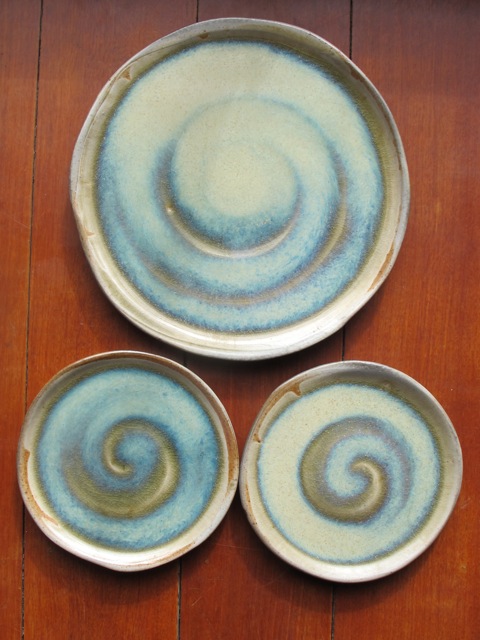
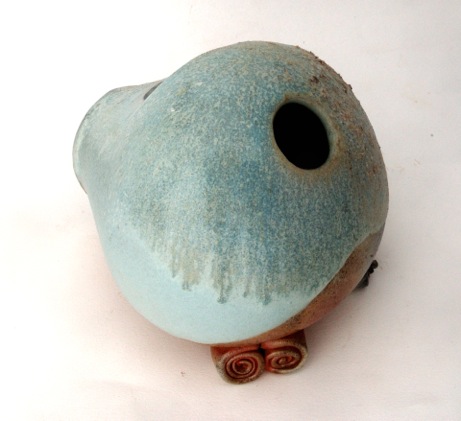
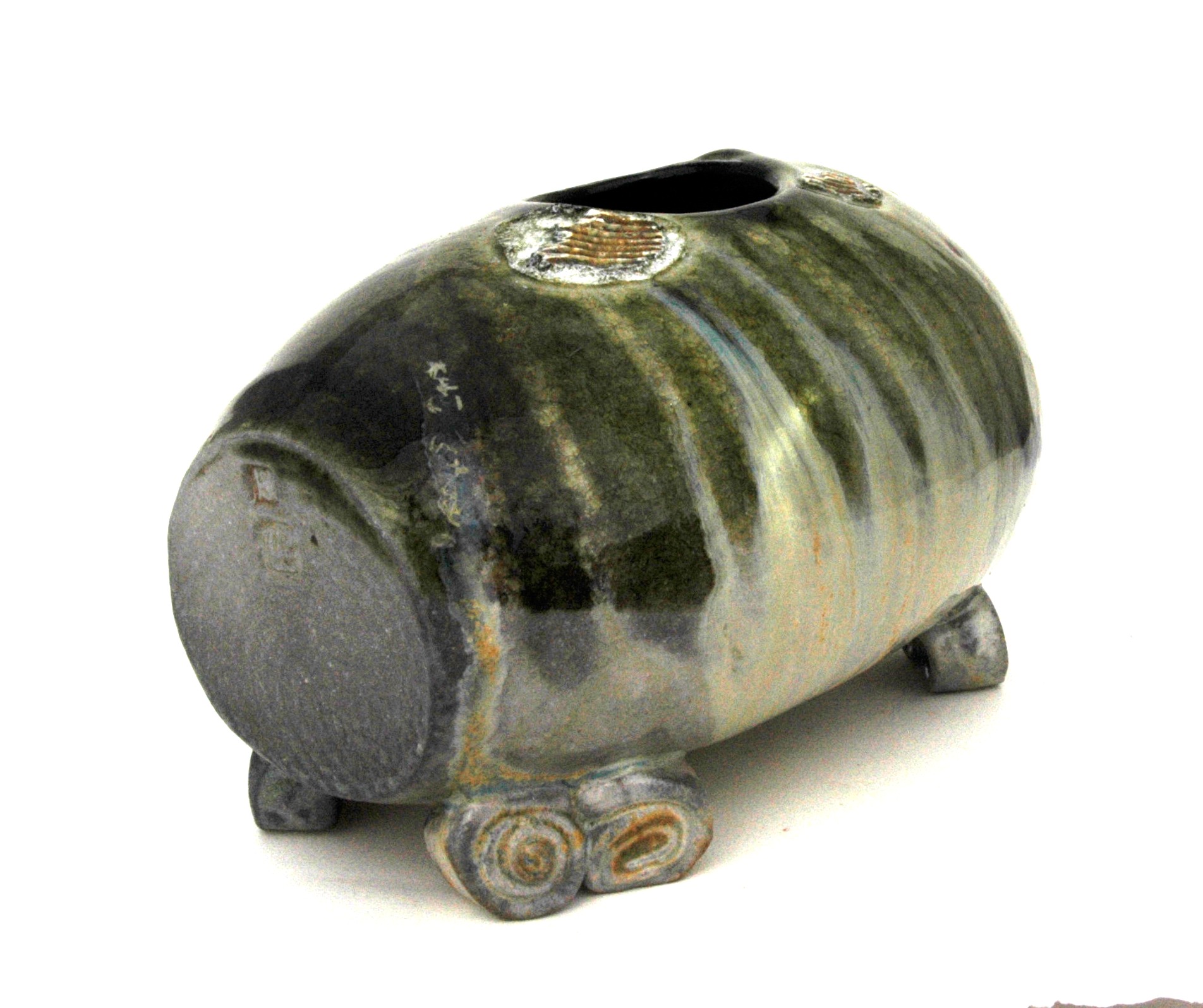
Nothing is Perfect!

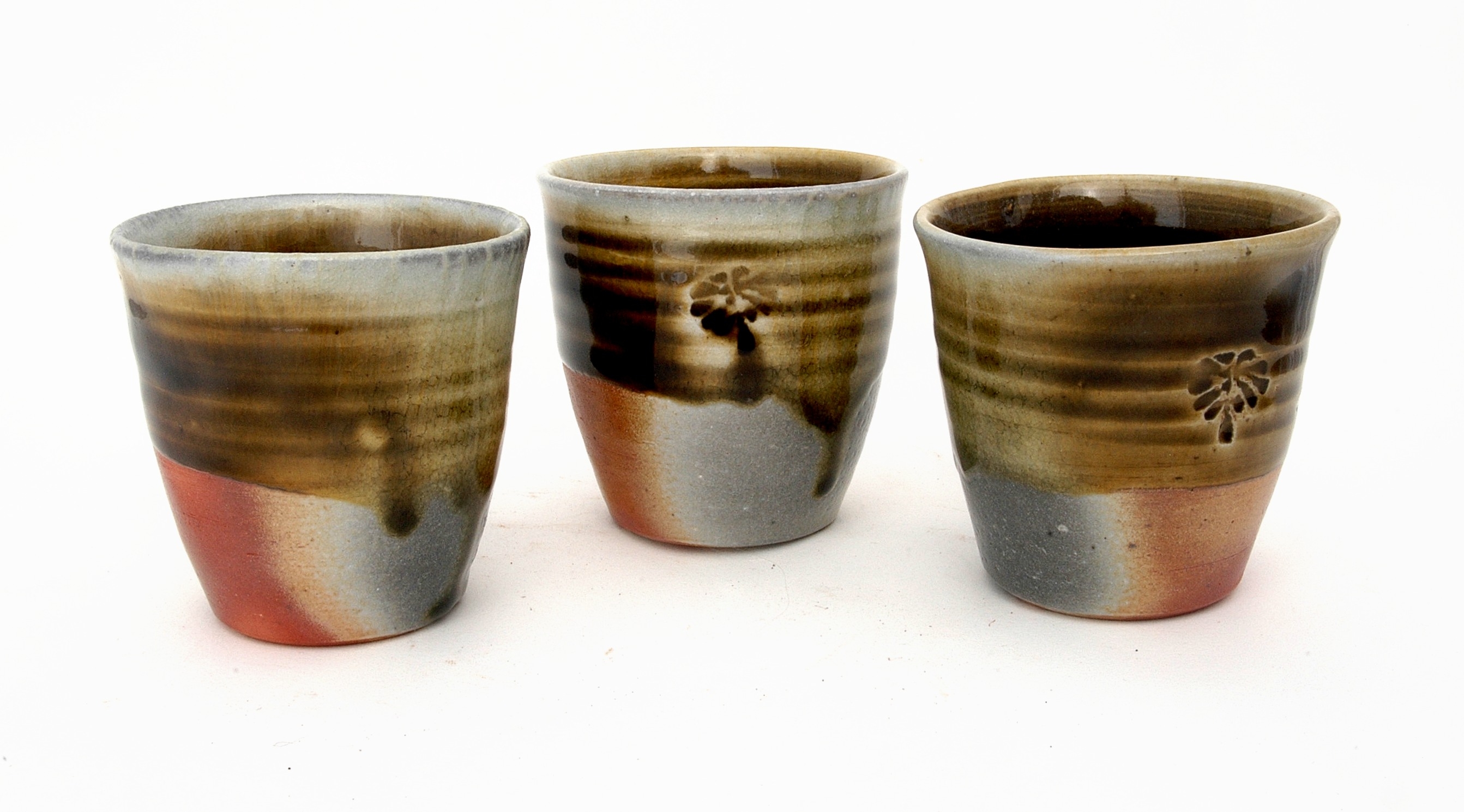
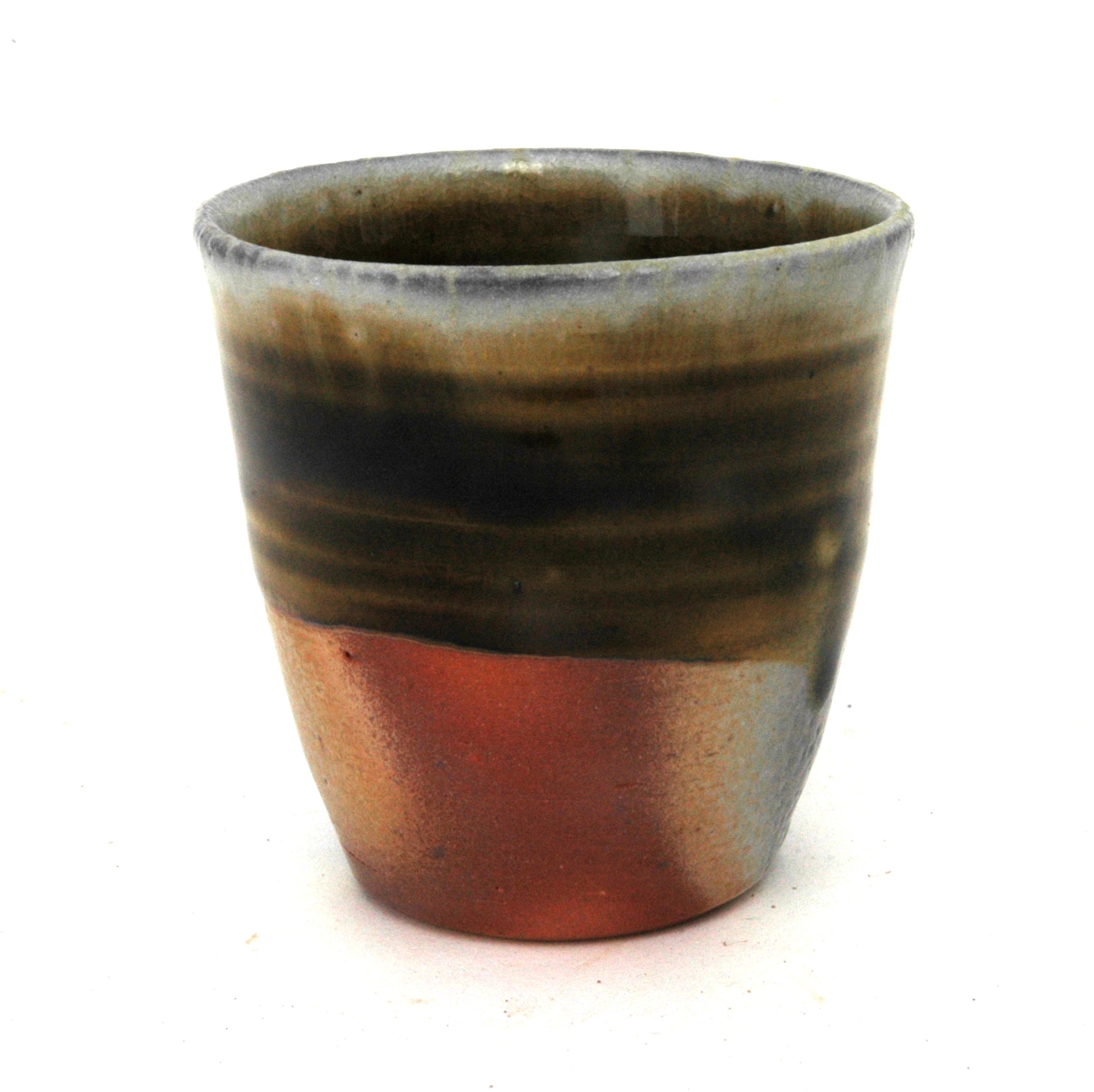
We have just had our latest wood firing and all went well, as usual, thank goodness. We do our best, but we can make no guarantees, only mistakes!. We found that only a few pots made from an imported Japanese porcelain clay dunted. Glazed only on the inside too. Maybe that was the problem? Apart from this it was a very good firing!

thumb_DSC01088_1024thumb_DSC01087_1024 thumb_DSC01079_1024 thumb_DSC01083_1024

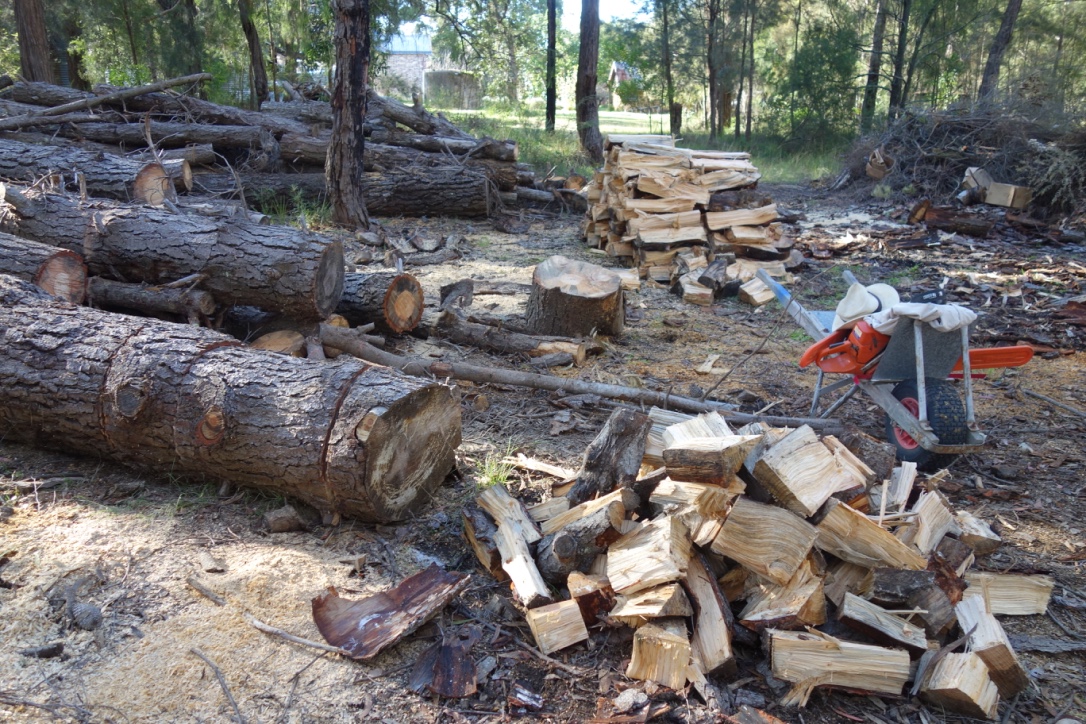
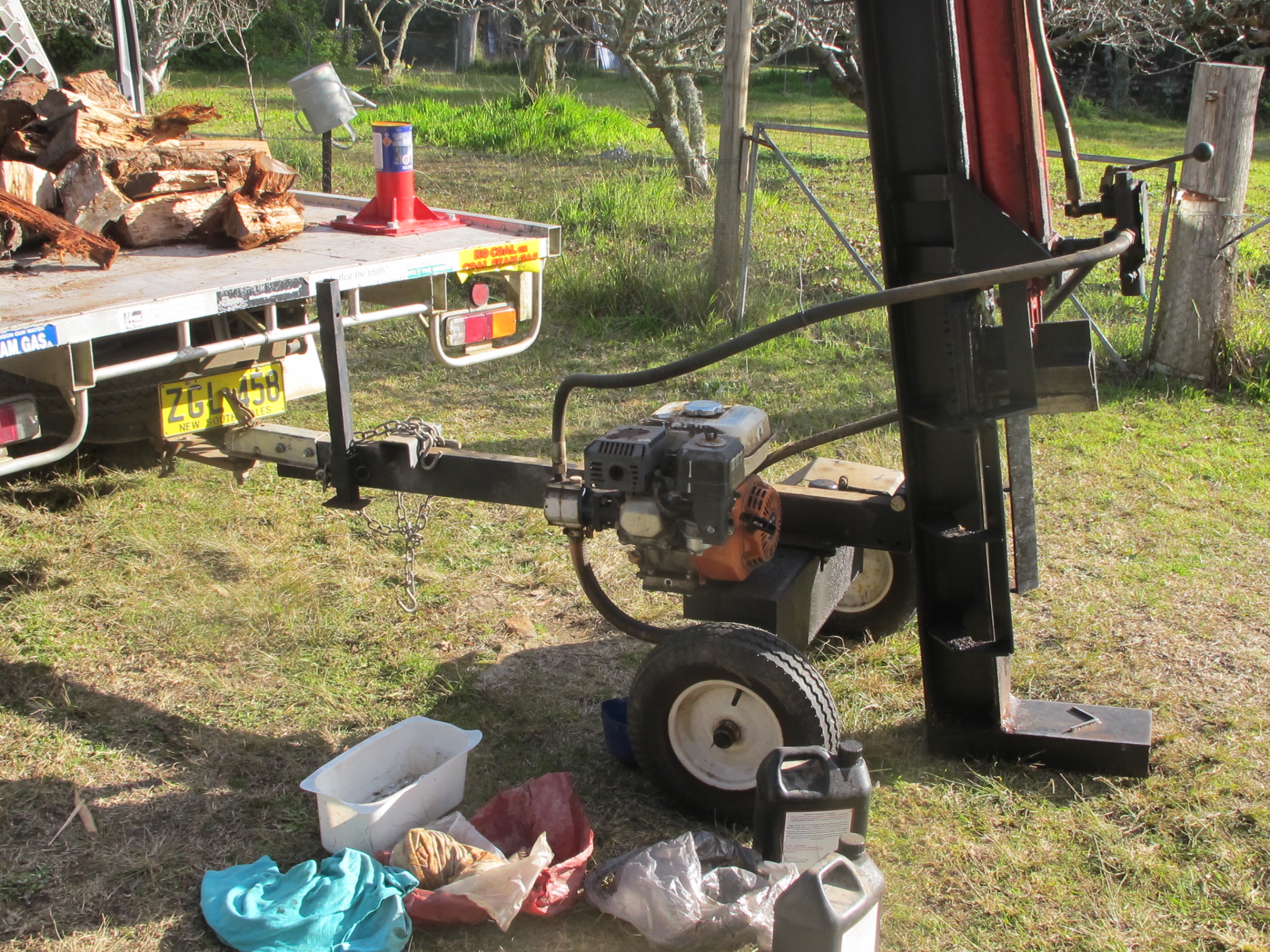
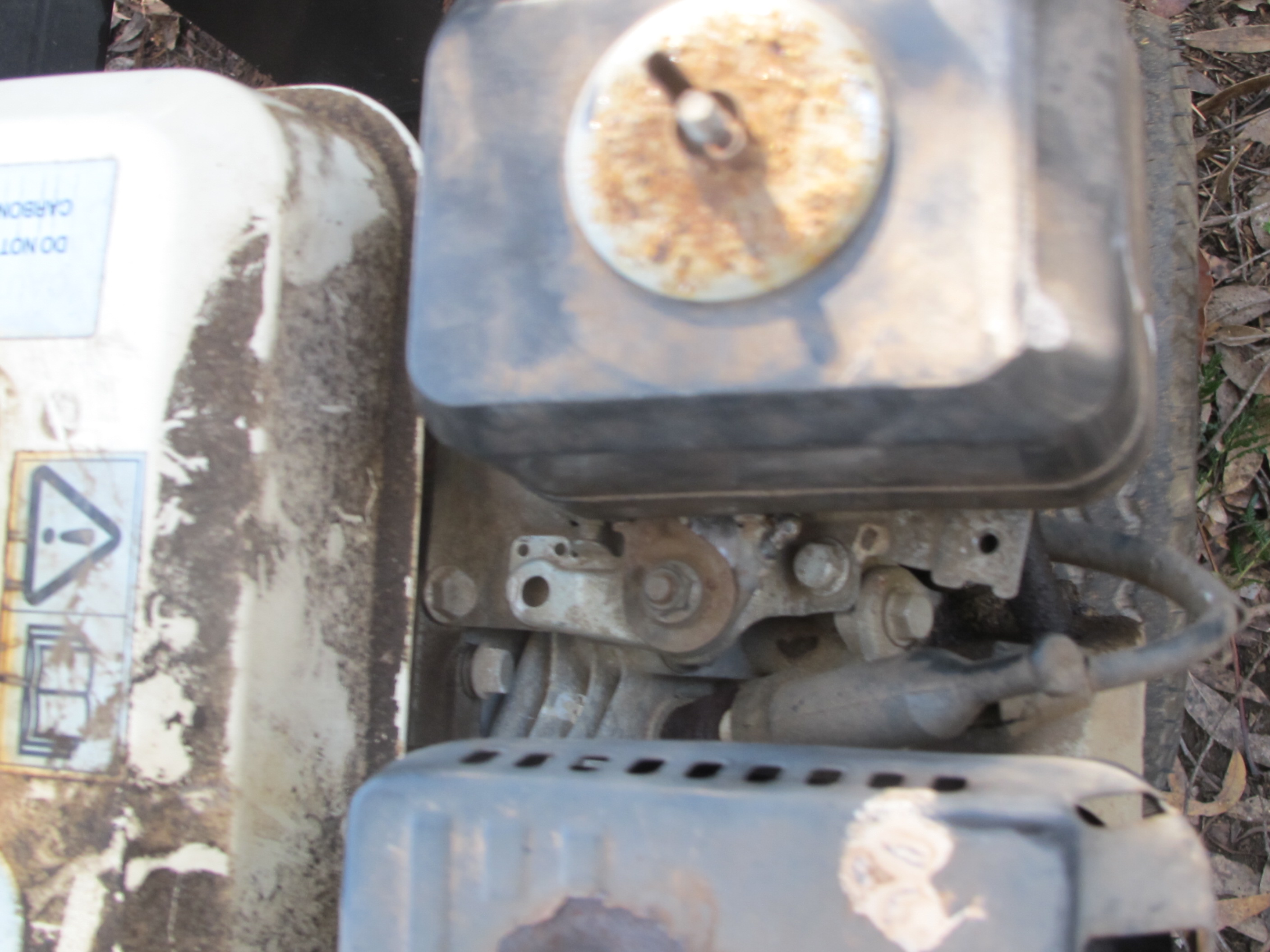
After the firing we get out and about and get stuck into some timber cutting and splitting. I’m up and out early with the chain saws, long before any one comes to help. Chain saws are dangerous enough without anyone else being around to watch out for and keep at a safe distance. We split about half of the 40 or so lengths that I have cut and prepared, but then the throttle lever on the splitter motor comes off in my hand. Cheap Chinese made splitter! So work has to come to a halt for the day while I fix it. We spend the rest of the time stacking and moving all that we have split over to the kiln shed. When everyone is gone. I take the splitter motor to bits looking for where the bolt or screw has fallen out. How could the throttle lever just come off in my hands? I can’t see where it has come from. Where it ought to be, but there ought to be an obvious spot with tell-tale wear marks, to indicate where it belongs. A place with a missing bolt! Just like in an Agatha Christie novel. there ought to be some clues, but the more I look, the less I know. I can’t believe it. Surely I’m not this inadequate and simple that I can’t see a missing bolts hole. I have removed half the engine, the air cleaner, and part of the carbie!

All the mechanism is installed under the air filter on one side and the muffler on the other. All the linkages are under the petrol tank. Everything is hard to get to and nothing is clear. There are metal wire linkages and tiny little, fine wire, return springs. I can’t see where any of it really belongs and to make it harder, the days are so short and it is starting to get dark.
IMG_0759 IMG_0752

Then, finally, it dawns on me. It hasn’t fallen off because of a missing bolt or nut. It has simply shattered in half from metal fatigue and the rest of it is still all attached. It has cracked in half. I need to remove more of the engine to get all of it off, so that I can weld it back together again. I can’t do it on the machine, next to the carburetor, and all that fuel! I take a couple of photos as I go to remind me later on when I’m re-assembling it. So that I can get it all back together again in the right order.

Years ago, I used to write all of this kind of thing down in my day book – sort of diary thing, but now I just take photos. Because I can! When I was young, my first car was an old, classic, red, MG sports car. When I had to pull the engine down the first time. I wrote everything down, step by step and recorded all the detail that I thought was going to be necessary to re-assemble it. I numbered and bagged all the parts in sequence. I had never had to do anything like this before and my father wasn’t much interested or even around to give any guidance, so I just muddled through with the help of my older brother, who also had absolutely no experience of this kind of motor mechanics, but make encouraging noises and was supportive, especially when it came to lifting the donk out. We were completely incompetent and naive, but we managed to get it all back together again and it worked! it was quite a triumph for us. Especially for me.

When it was all done and back together. I had one nut left over, and to this day I still don’t know where it belonged. but the car still worked! Nothing is perfect!

Today, I get this small engine all stripped down and then set about welding the shattered pieces back together again. I think about making a new one, but the thing is so complex and folded in so many different places with so many holes and little tags and bits sticking out, that I decide to just repair it. Nothing is perfect! I don’t know how long it will last. Nothing lasts! It is only very thin pressed metal material. I can’t give it too many amps. I don’t want to burn a hole through it, and I can only weld one side too, because it has to have a flush face on the other side, so that it will swivel properly on it’s seating.  I weld it as best that I can, after testing the amperage on a test piece, so as to get the best result. I get good penetration! What more could a man want! But there is a little burn-through in one spot on the weld, so I have to grind it back a little to get it flush and smooth.

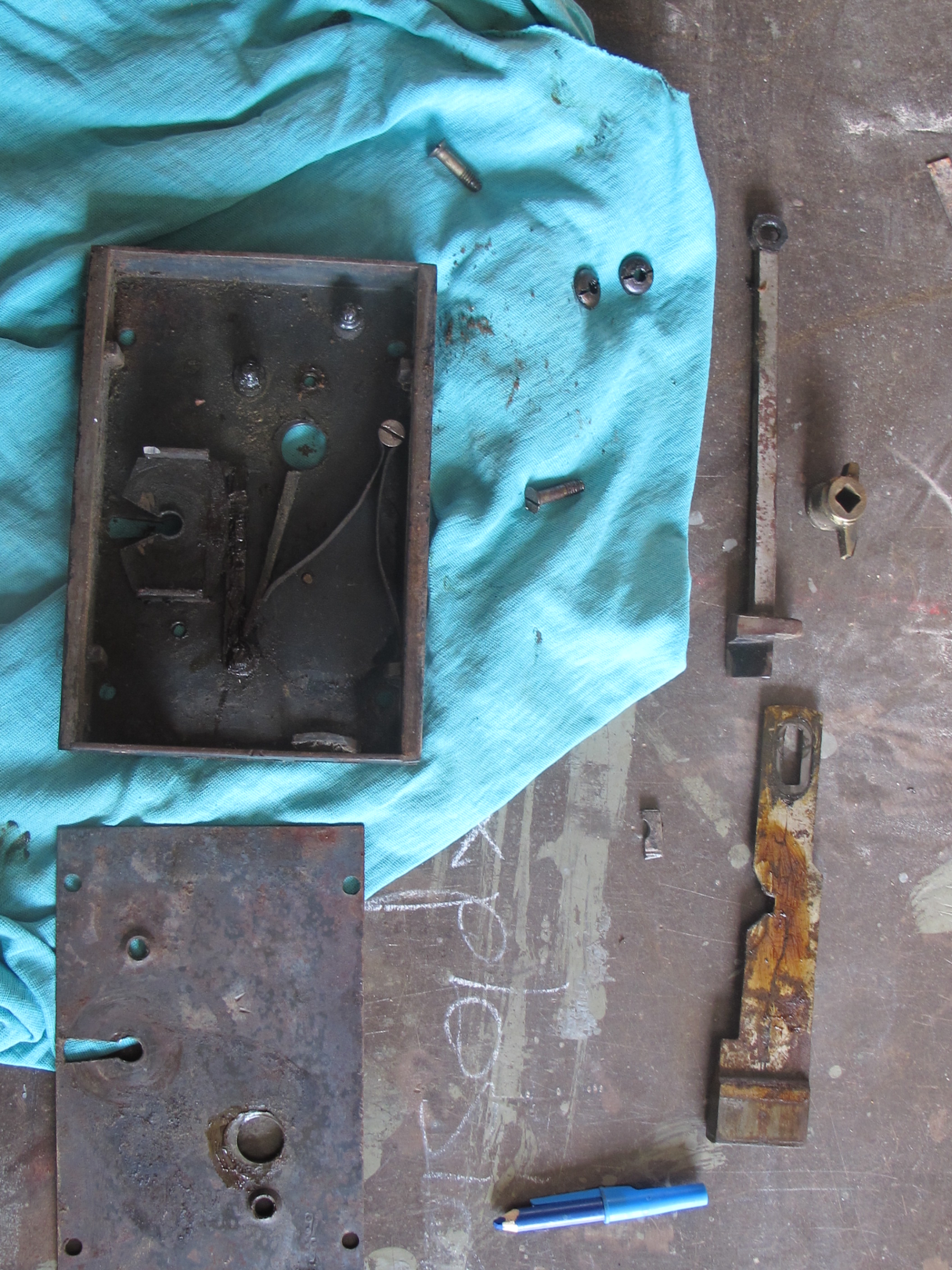
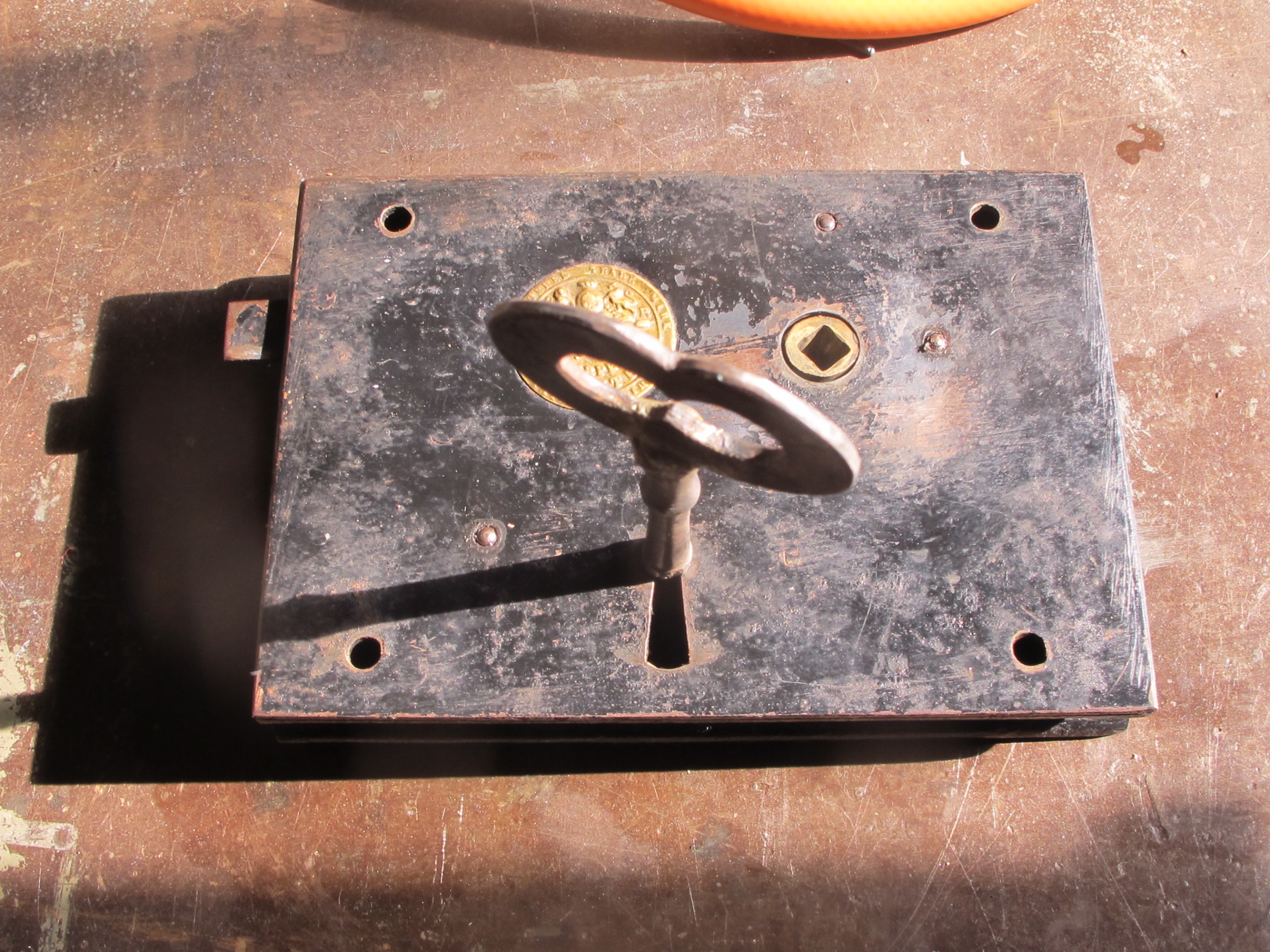
I manage to get it all back together before dark and back into the shed. It’s a bit of a rush, but there are no medals for giving up! I give it a trial run and it works OK. Time will tell if it continues to work for the long term. I go up to the house in the dark and the key snaps off in the lock. This is just what I need! One of the joys of living in a 122 year old house is doing the maintenance. I leave it till morning to take the lock off and fix it in daylight. I can’t see well enough in the dark and fixing locks, with all the fine moving parts is something that needs to be done in a clear frame of mind and good daylight. Fortunately it isn’t too difficult and it turns out to be something that I have had to do before, so it is relatively simple and straight forward and it is all back into working order pretty quickly and before lunch time. Nothing is perfect and nothing is ever finished.
IMG_0661IMG_0669 IMG_0670

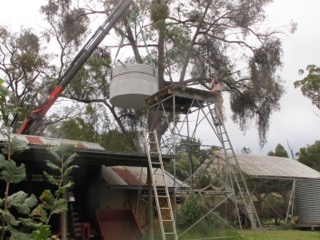
Because crap things always seem to come in threes, at least that is how it appears today. The water tank springs a leak. It has been leaking with a slow drip for a year or more now, but today, it springs a proper leak and The Lovely comes in to tell me that as she walked past the tank stand just now, and it felt like it was raining. This happened a couple of days ago too and she thought that she might have been imagining it. But today she is sure. We go and have a look. The timber tank stand deck is all wet underneath, just as it has been for a few years now, where the slow drip is, but now there is a little fountain pissing from the far side. It’s only very tiny, but it is surely a leak in the side of the tank now. I get the ladder and check it out at close quarters. The water has corroded through the zink coated corrugated steel sheeting. My highly imaginative and creative thinker thought that she was imagining it a few weeks ago when she felt a little fine water spray on her as she walked past the wood shed near by the tank stand. At that time, she imagined that it might be a cicada pissing from high up in a tree, or some other explanation. But now we know that it is real and not imagined. It’s a very tiny, fine spray of water from the pin prick sized hole, but once these things start. It’s always terminal.

I order a new tank, it’s all so specific these days. The height, the diameter, the colour, the inlet, the outlet side etc. It all goes on and on. This is not a current or popular size and configuration however. We will have to go on the waiting list. He rings me back the next day, They have one of those in stock it seems and so I can drive in and pick it up. Amazing! It has to be pretty much the same, because I don’t want to have to change over all the plumbing into a new configuration. When working up a 6 metre ladder. right at the top, it’s scarry enough.

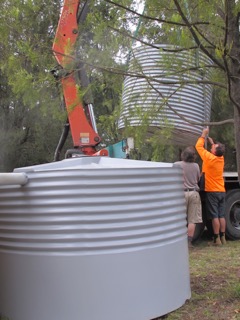
I ring my friend Dave with the crane truck. he can come very late today on his way home. I drain all the water out of the tank and strip it of all its fittings and connectors. I swap all of these onto the new tank. Now we have no water in the house to cook, wash or flush with until it is all put back to rights. I hope that Dave doesn’t forget. He rings to say that he will be a little late, but he is here before dark. Which is good, if you are working on a narrow ladder rung, right at the top of a 6 metre ladder, up from the ground, you don’t want to be doing it in the dark.

It all goes smoothly and all the fittings that I swap over are all in the correct place and in the right direction, or orientation for further use.
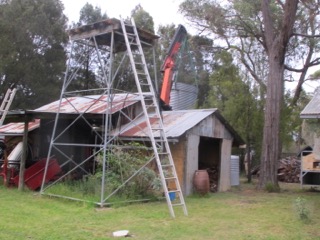
IMG_8806IMG_8802 IMG_8808 IMG_8812

The old tank comes down and the new one goes into its place without a hitch. I only have to reconnect the inlet and outlet pipes.

Once it is back in place, Dave leaves for another job, I have to start the pump to refill it with water again, so that we can get on with our normal life.

The Wet One thinks that this tank is only a few years old. I think that it is probably a bit more than that, but not too old. Not more than ten years!  Nothing lasts. However, when I check out the paperwork, it turns out that it is actually 20 years since we put it up on the tank stand. The earlier tank had lasted 21 years and would have lasted longer, but the tank stand rusted out first and fell, crashing to the ground with the water tank still on it. Needless to say, neither survived, nor did the wood shed that it landed on.

I’m just a bit concerned that this new water tank is made of plastic and not galvanised steel like all the others have been. I wasn’t ever happy with the first tank that was made of galvanised steel and sealed with lead solder! But it did last for over 20 years and our first storage tank lasted for over 30 years, but the zink finally corrodes and they start to leak, so we replaced them with new ones. These newer tanks were made from zincalume coated steel, so couldn’t be soldered, that’s good, but they had to be sealed with silicon rubber glue. Not too happy about that either. Nothing is perfect! The last metal tank that we bought was lined with a plastic membrane heat sealed on to the inside of the zincalume sheets. It was called aquaplate, but didn’t last any longer and it was silicone sealed as well. Nothing is perfect!

Plastic is in everything. It’s OK while it lasts, but what will happen to this plastic tank when it finally gets eaten away by the sunlight or what ever is its fate? Can it be recycled? Al least the steel ones can be. I still have and use my parents old galvanised steel water tank. They bought it second-hand in the fifties, so it’s been in constant use in this family for over 60 years and is clearly a lot older, it shows no signs of corrosion yet. It was made out of thick steel plate and hot dipped in molten zinc. That was a product made to last. I have been told that it was a ships tank, but I don’t know. In future I may have to weld up my own tank and get it hot dipped galvanised, just like I do with my kilns. I like things that are made to last as long as possible.

However, I’m also aware that nothing is ever finished, nothing lasts and nothing is perfect.

You live and learn!

Best wishes

Steve
Why Not Both?

Jingdezhen in China has a very long history of making porcelain. Over one thousand years in fact. They had already celebrated their millennium of porcelain making when I was working there ten years ago. The special thing about this place is the clay. It isn’t clay!

What they use here is a ground-up stone. When they crush and finely grind the local stone down into a very fine paste, it becomes plastic. This is like magic. Stone doesn’t usually become sticky and plastic like clay unless it’s very special. This stone is largely composed ofsericite mica, and it is special. It is reasonably rare stuff to find en-mass, in its pure white form. It has a flat plate-like crystal structure, not unlike clay, only much coarser. When these microscopic plates are wetted, they slide about against each other in a similar way to the way that clay does. Of course it’s so much more complicated than that, but this is a blog and not a treatise. Sufficient to say that there are very few places in the world where this kind of thing can happen. Here in China is one of them and the initial place where it was first discovered. Once the knowledge was well-developed in china, the information spread to Korea, where they discovered and developed similar materials, then eventually to Japan. When the War Lord Hideyoshi invaded Korea and brought back potters as war trophies!. My, how the level of respect for potters has fallen! I don’t recall any solder capturing and bringing back any potters as trophies from any recent wars that we have been engaged in!

One of these ‘renditioned’ Korean potters discovered a similar weathered stone on the southern Japanese island of Kyushu, and so porcelain making started up there as well. I have visited these sites and made pots there and I intend to go back again and make a more substantial body of work there, just as I have done here in Jingdezhen, that I can bring back and exhibit all together back in Sydney. Hopefully at Watters Gallery.
My interest in these porcelain stones is all based on the surprise discovery 15 years ago, when I stumbled upon a very small deposit of pale rock in the side of a track, out in the bush. I collected a very small sample and crushed it down to dust so that I could test it for use as a glaze ingredient. It made a lovely pale blue glaze of the family of glazes that could be described as being like ‘celadon’ or ‘guan’. These are ancient Chinese archetypes of fundamental combinations of simple ingredients. They are the simplest of glazes, but just about the most difficult to re-create with the depth and subtlety that the Chinese potters achieved at the apogee of their ceramic development, during the Song Dynasty.
I recognised that my initial glaze tests, although crude, had potential to be developed into something special, but more than that I noticed that most of the tests were ‘crawled’. This would normally mean that there was too much clay in the recipe, but this recipe had no clay in it at all. It was just hard rock. Very hard rock. I had to use my jaw crusher, disc disintegrator and then 16 hours in the ball mill to grind it down to a fine powder. I asked myself. “How could such a hard rock have any plasticity. Does it have any plasticity?” I quickly ran to the pottery and mixed a little of the precious powdered rock dust with some water and worked it up in to a paste, then proceeded to try to throw it on the potter’s wheel into a small bowl form. It could just about be done. It was rough and misshapen, but it was a bowl. I fired it and to my astonishment, it fired into translucent porcelain. I coudn’t have been more surprised!. 100% rock dust and water became white, translucent porcelain!
I know the date that I did this experiment, because I scratched the date into the bottom of that first pot.
IMG_0334_1
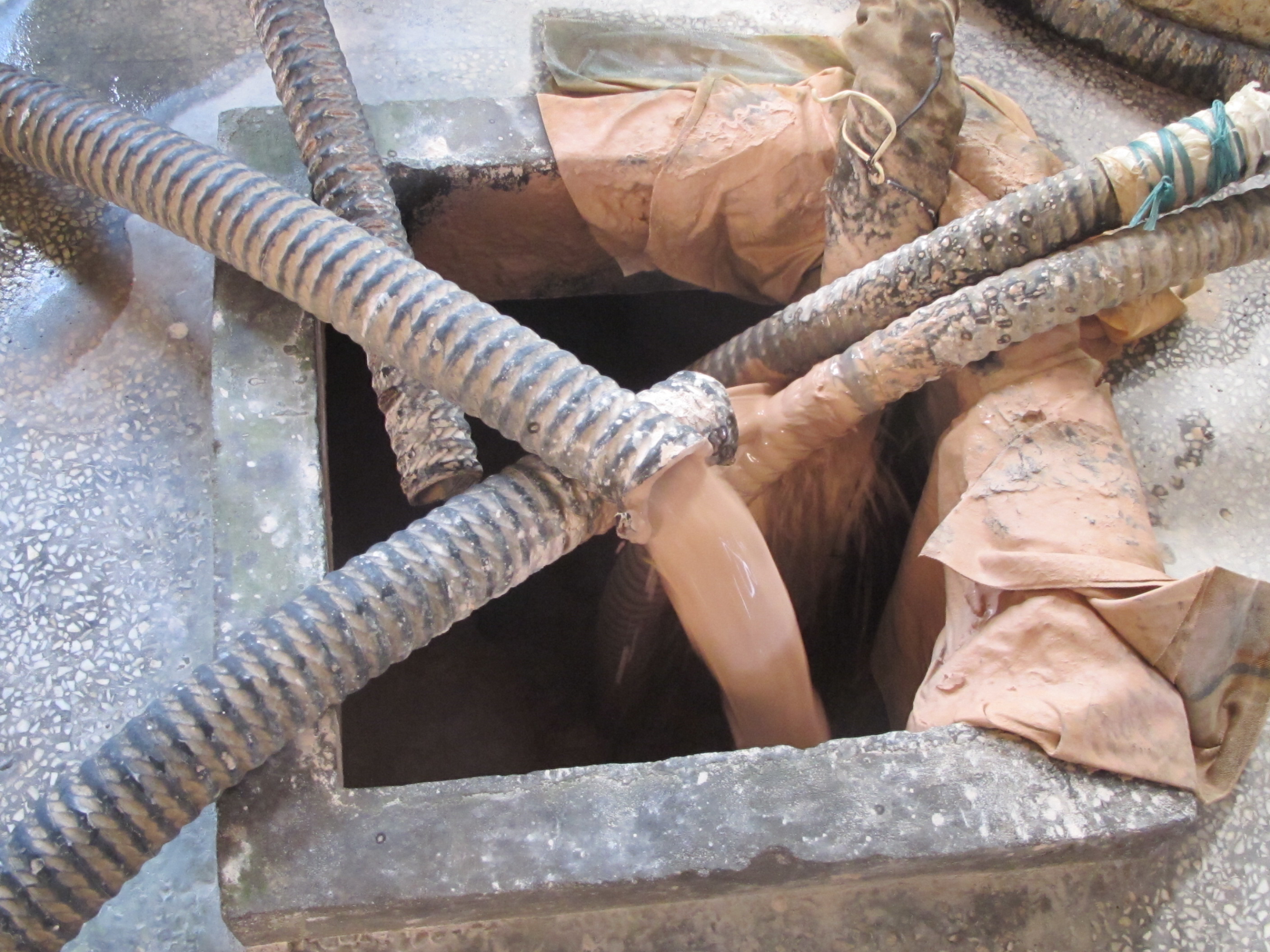
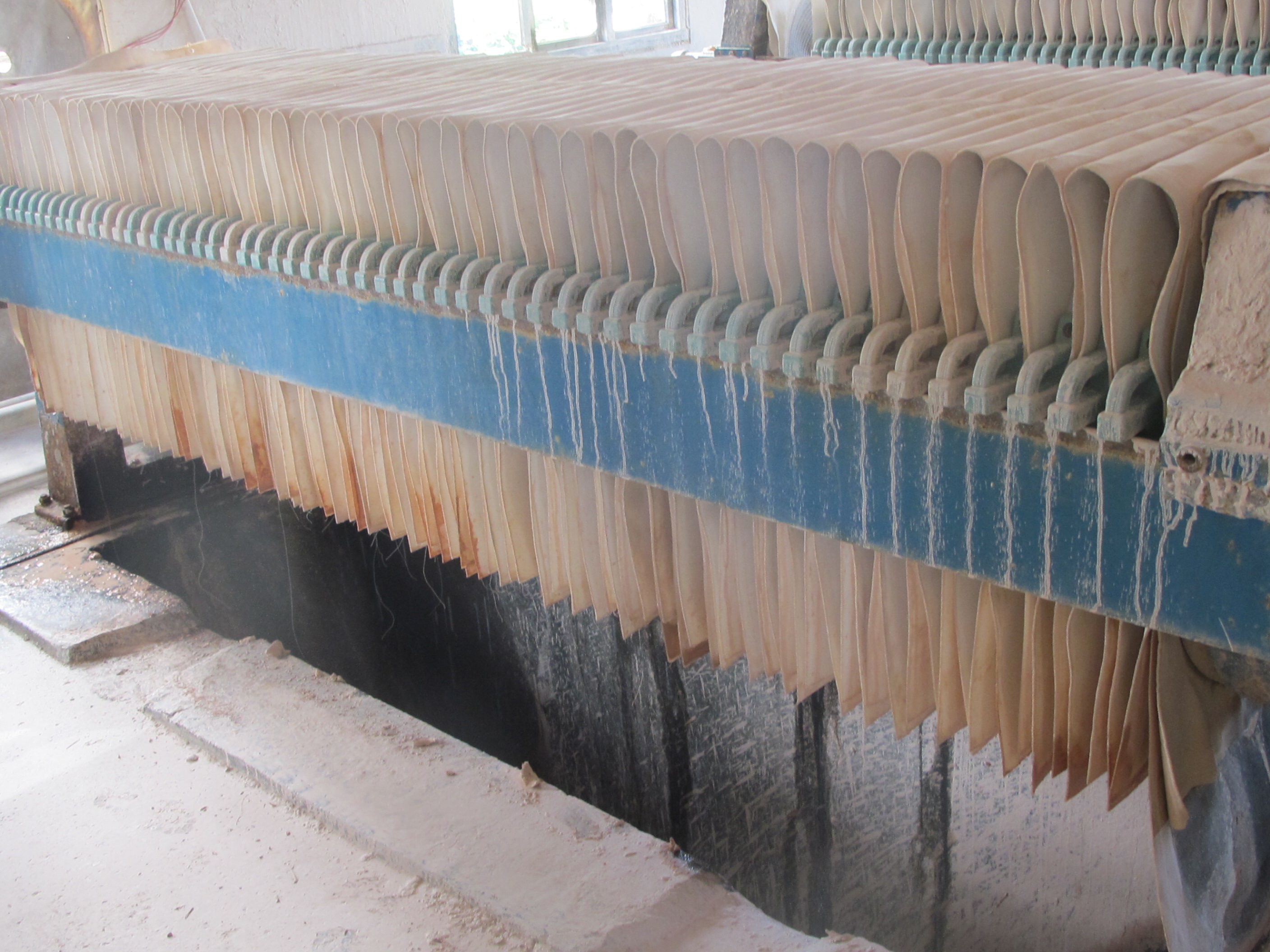
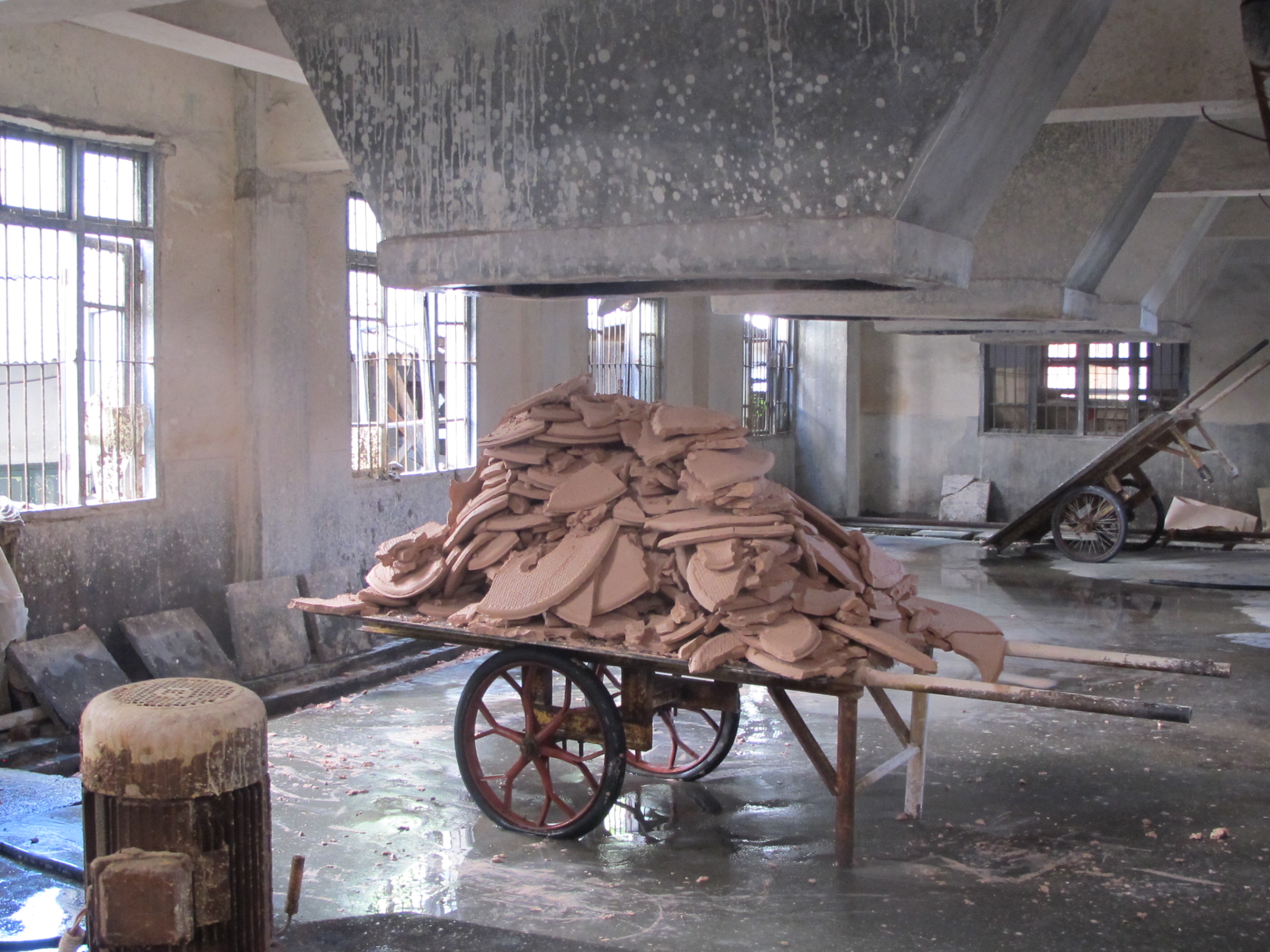
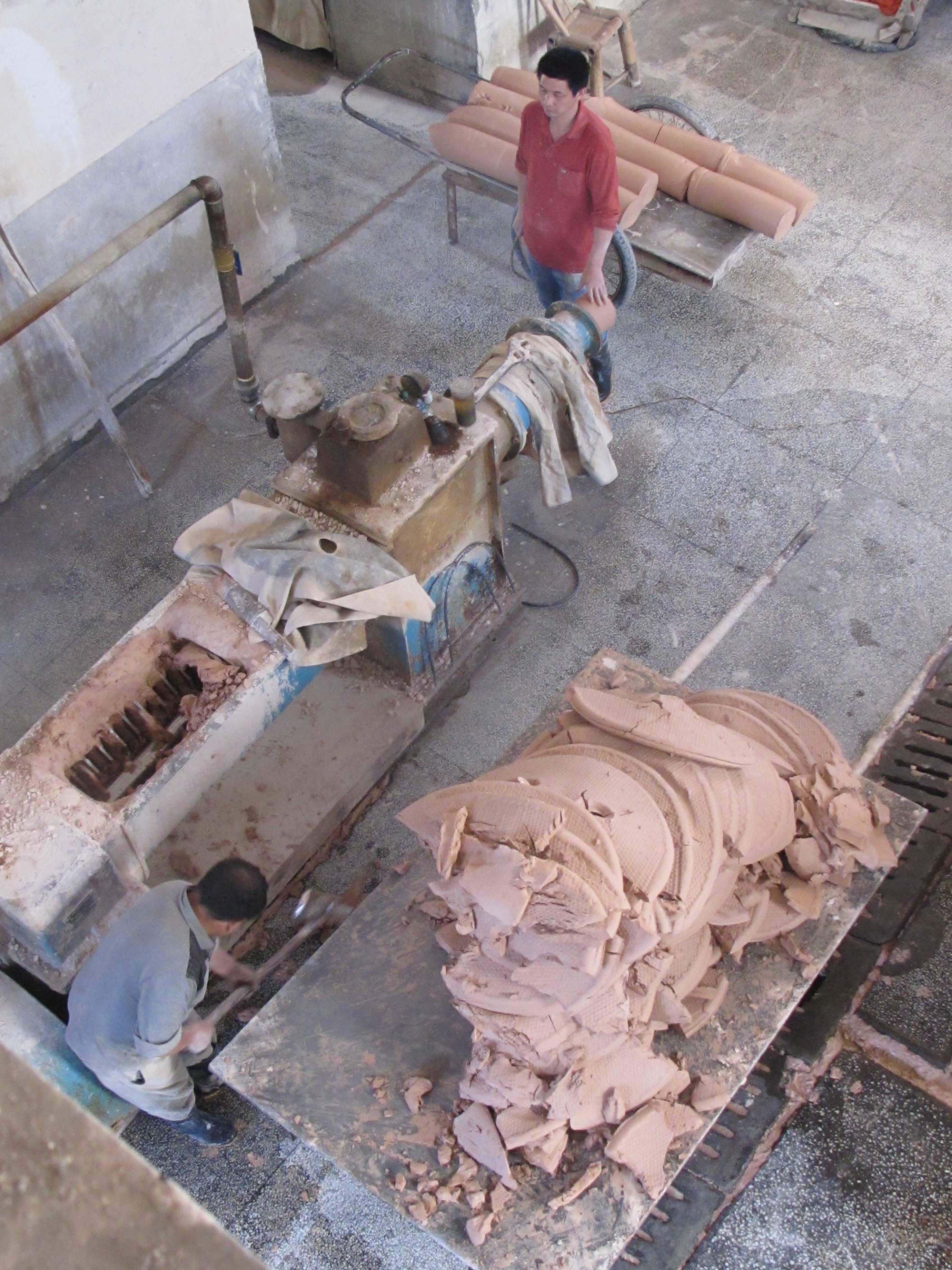
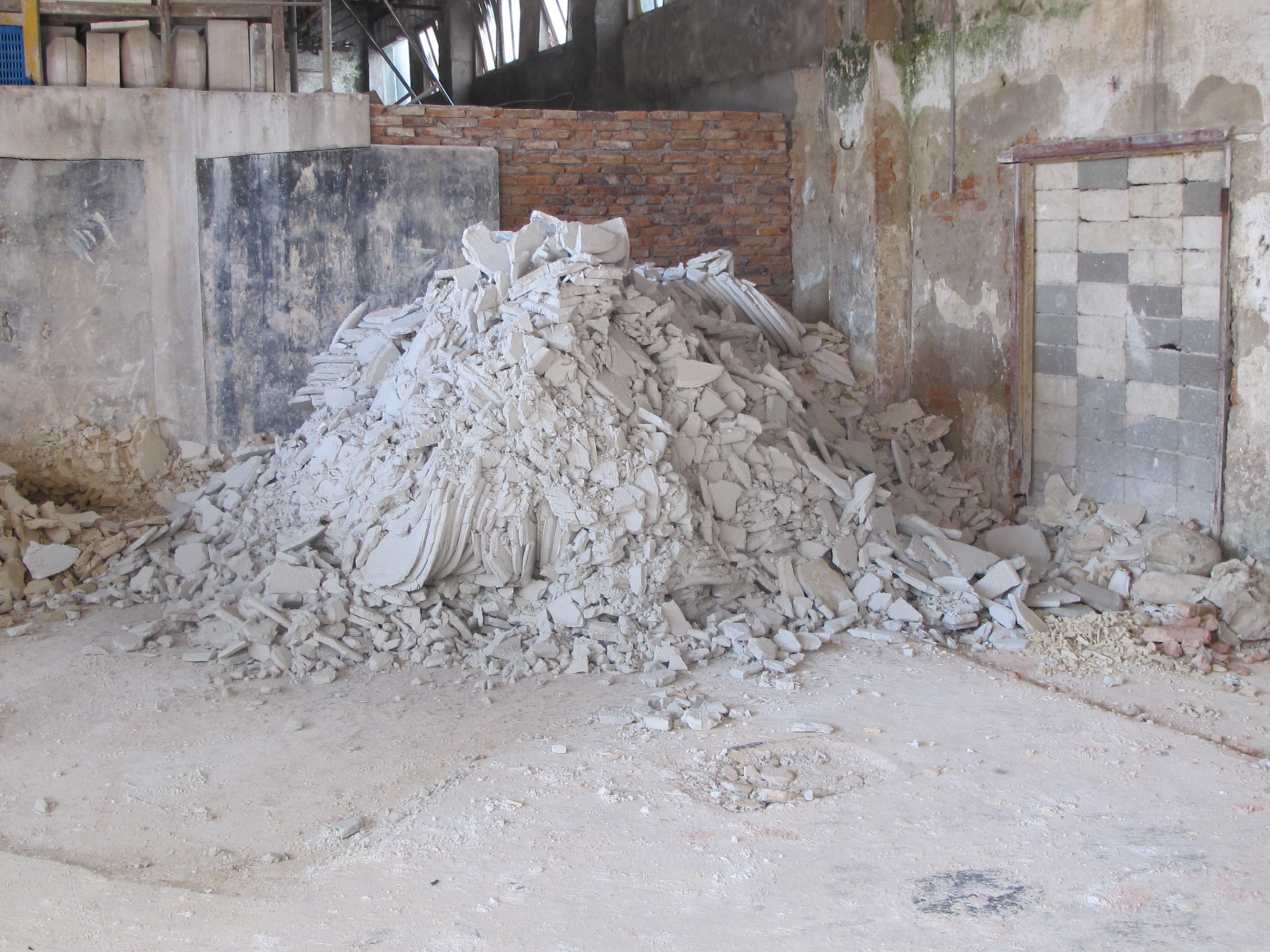
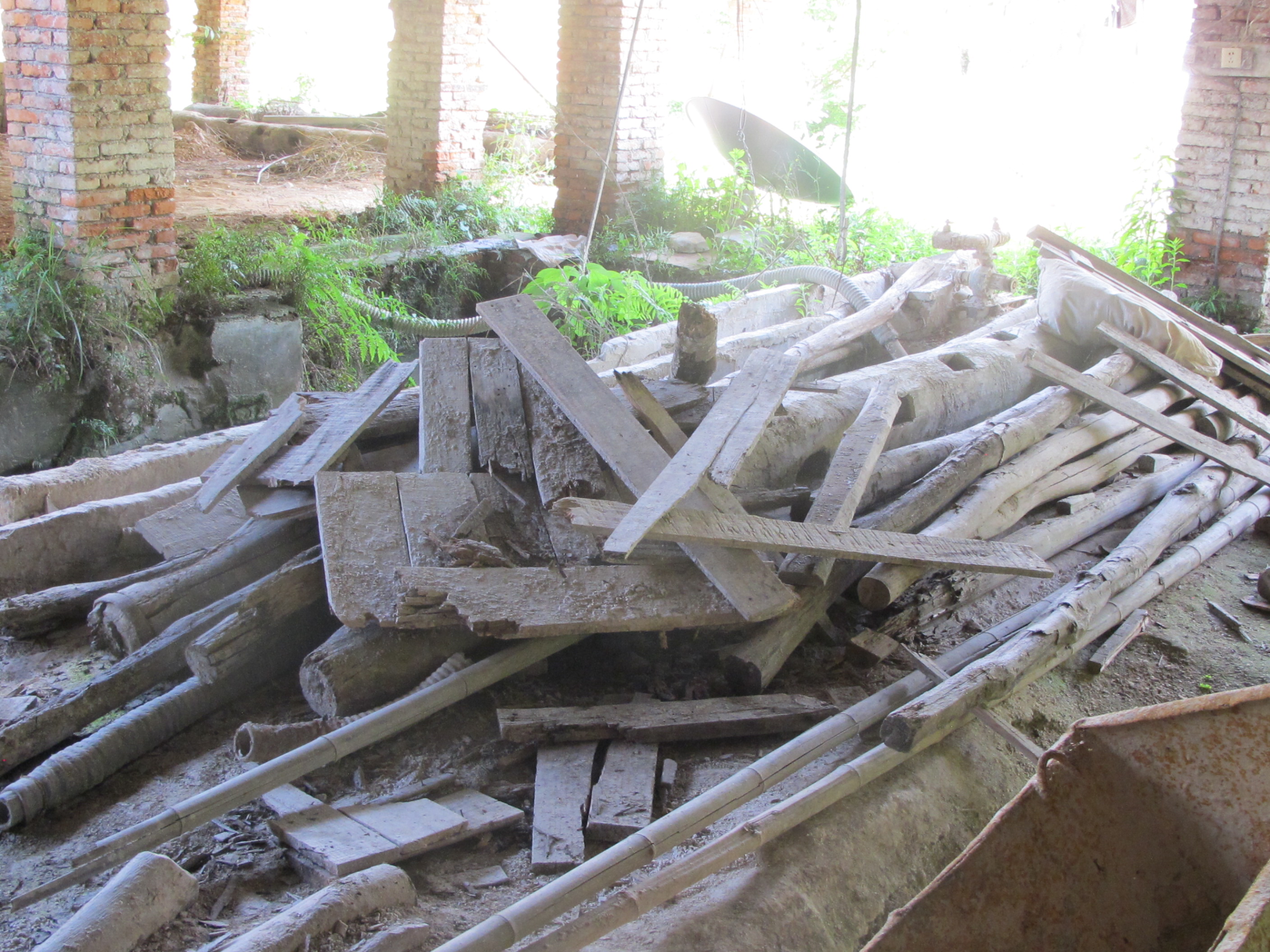
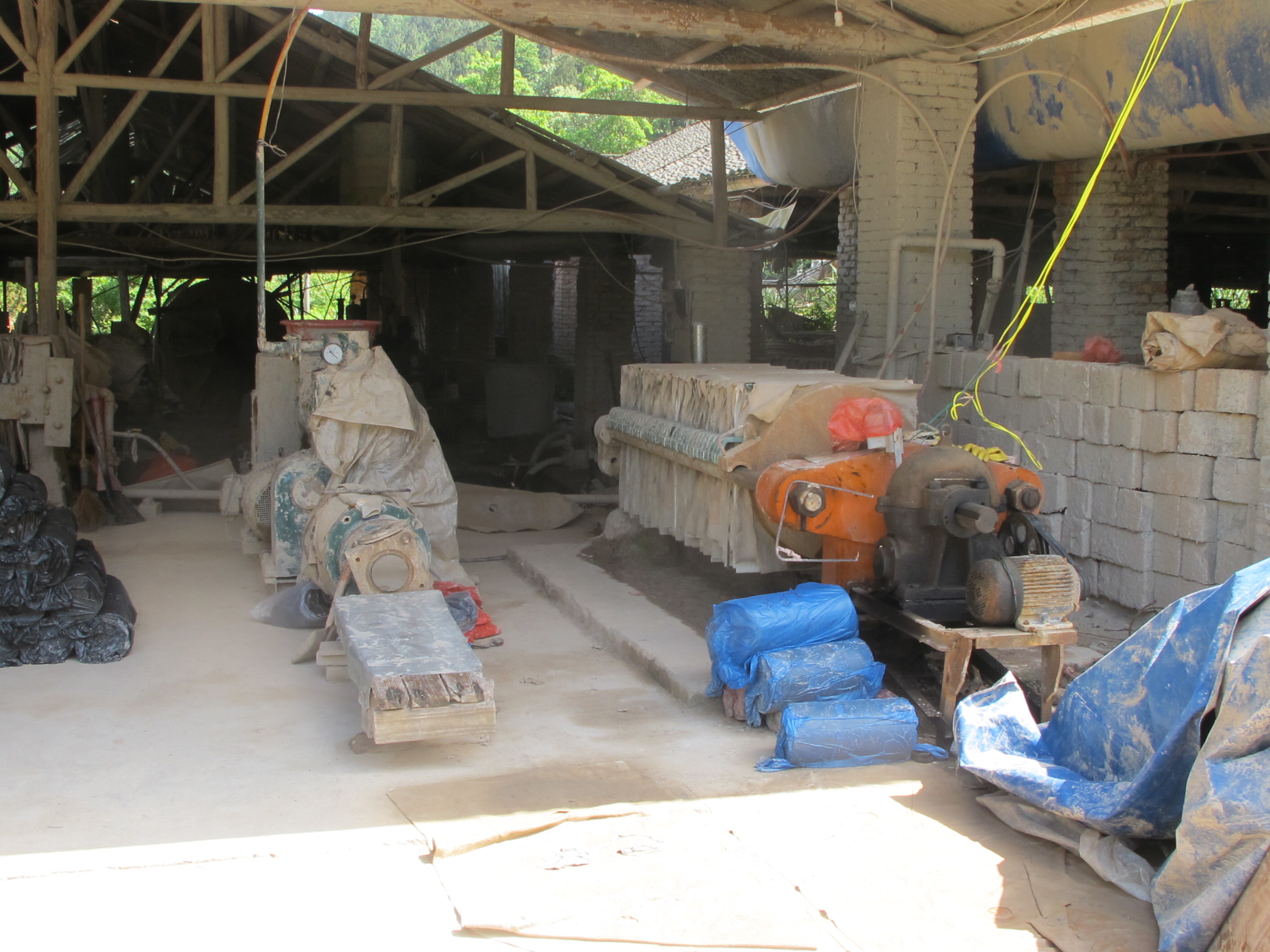
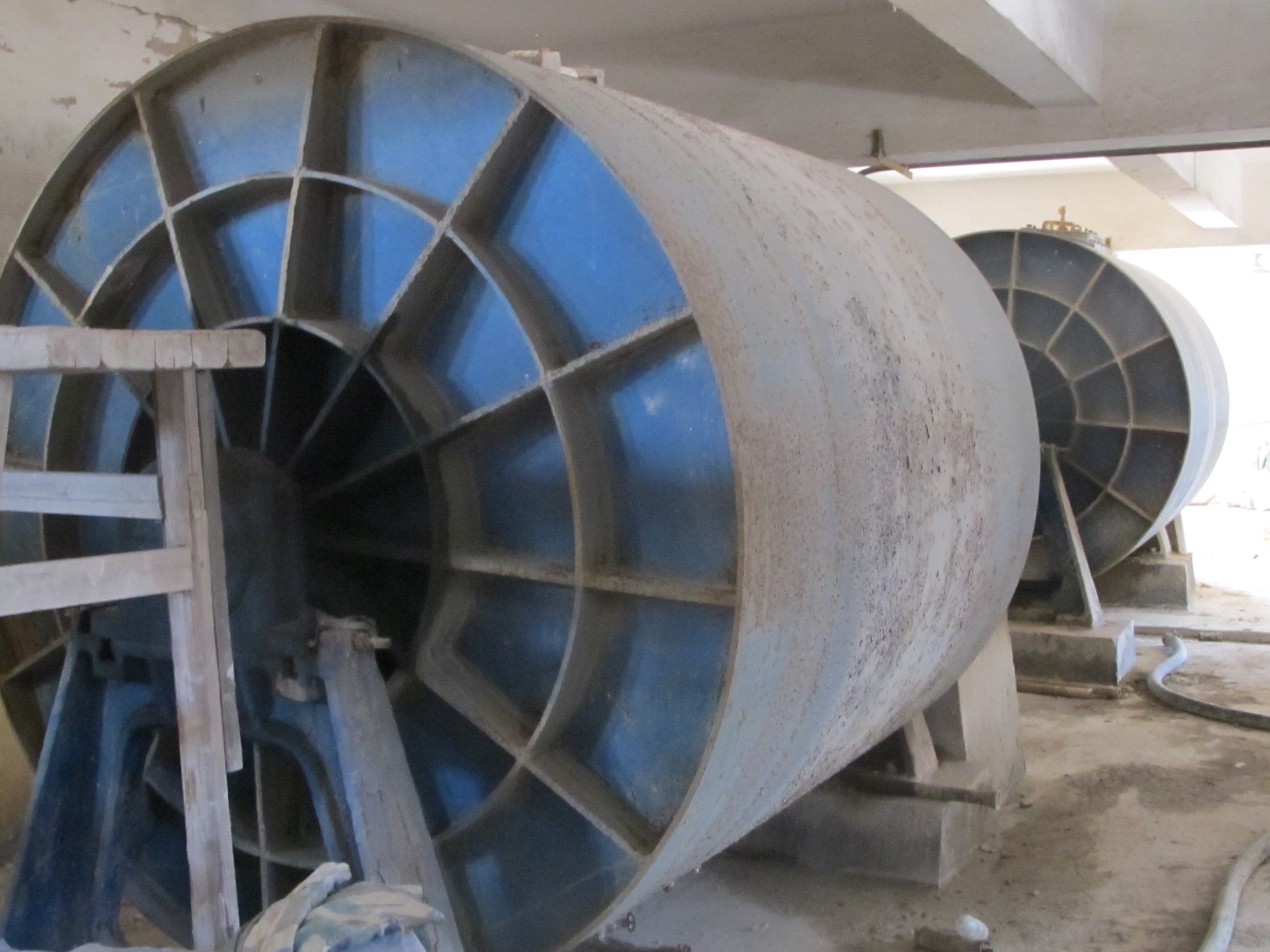
After 25 years of fossicking around this shire. I had finally found something really exciting and with a lot of potential to carry my work forward for a long time to come. So here I am in the clay making facility in Jingdezhen. The home and origin of single stone porcelain. They don’t do all the production here anymore. Some of the large machines sit idle now. It seems that they only do the final stage of blunging (washing) the clay into a slip and sieving it through a very fine mesh to remove any unexpected rubbish that may have crept in during transport and storage. This ensures that there will be very few ‘iron’ spots in the finished product. The liquid clay ‘slip’, is then pumped into a filtering machine to de-water it back to a plastic, workable state. This de-watering procedure is called filter-pressing. This filter pressing (stiffening) is done in very large  filtration dryers until it is ‘plastic’. ie. stiff enough to fashion into shapes, by moulding  or throwing on the potters wheel.
IMG_0317_1IMG_0326_1
Once the clay has been stiffened in this way, it is dropped out of the filter press and is taken to the extruder, to be pugged into well mixed sausages for storage and ageing.
IMG_0318_1IMG_0319_1IMG_0324_1IMG_0315_1IMG_0329_1IMG_0335_1
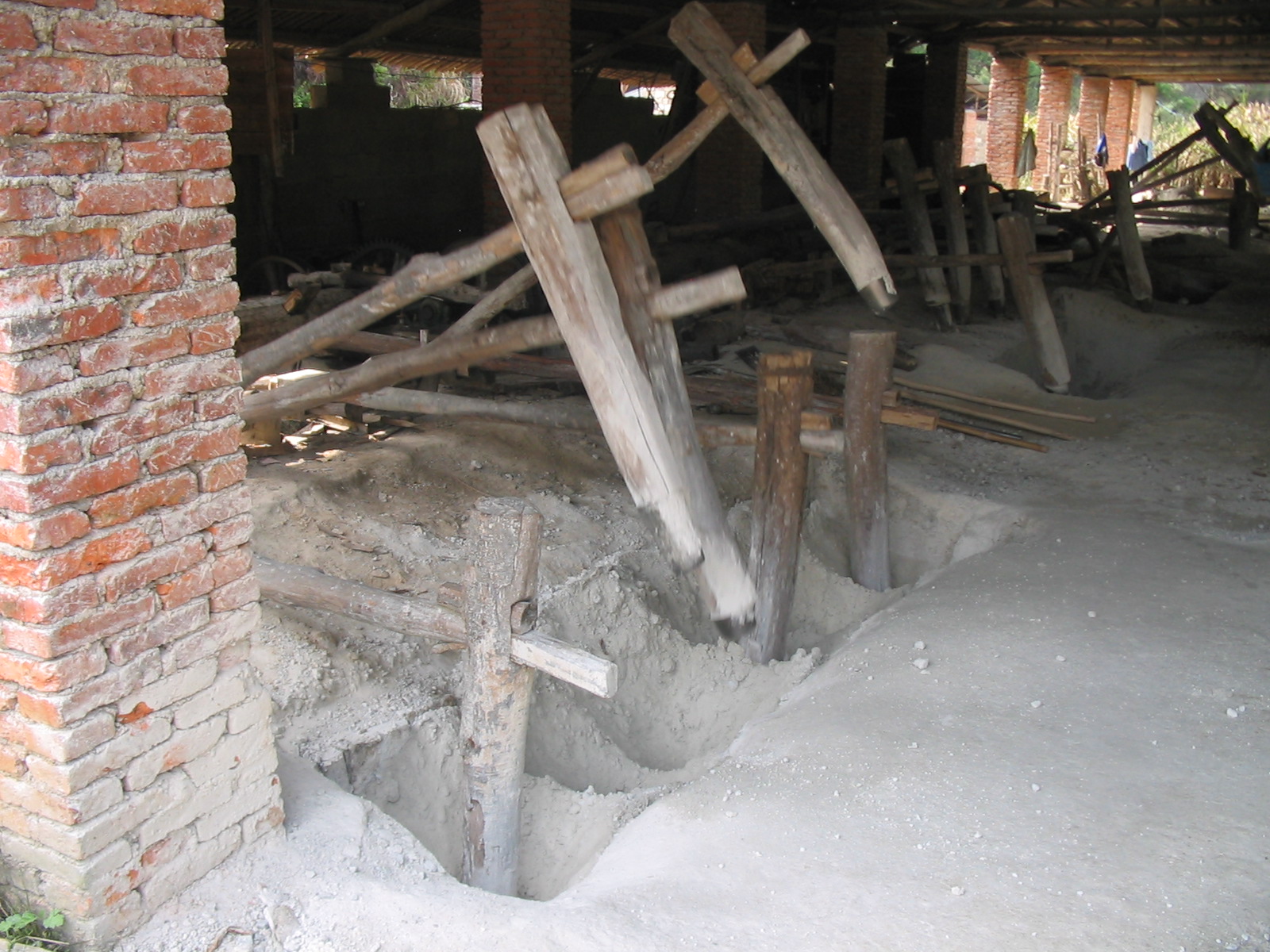
The ‘clay’ (milled stone) material is trucked-in as a partially processed material these days. It used to be all processed here, but now it undergoes its primary crushing, milling and stiffening out-of-town, closer to the mine. When I was here last, all of the crushing was done by water powered, wooden hammers. these were typical of the water hammers that are to be found all over Asia, where-ever there is a suitable stream and work that needs doing. The powdered rock dust was then slaked in water and left to sit and dissociate, allowing the water to penetrate into the flakey, plate-like structure of the mineral. Breaking it down into a slurry with enormous surface area and also allowing the local bacterial to colonise the surfaces and work their magic to help enhance the workability and plasticity of the finished ‘clay’. This thick slurry was then stiffened slowly in the air and eventually formed into little white blocks or bricks called ‘bai-tunze’, or ‘white brick’. This is the form that it was delivered to the pottery clay processors.
IMG_4166IMG_4167IMG_4168IMG_4169
But that was then and this is now!
IMG_0189IMG_0190IMG_0192_1IMG_0193_1
Apparently the water hammers were working here up until last year some time. Due to pressure to increase production and through-put, these ancient water hammers were ripped out and the leats that brought the water were filled-in and concreted over. 3 phase power has arrived now and all the work should be being done by jaw crusher, huge ball mills and filter presses. but when we arrive, we find the place devoid of activity. The power is down and has been all day, possibly yesterday also. and who knows when it will be restored? A lone woman sits by idly and bored and waits. Perhaps the old water hammers had some advantages? They may be a bit slow, but they ran for free and all day and night as well. So why no both?
IMG_0194_1IMG_0181
Jingdezhen native sericite stone.
IMG_0199IMG_0201
This stuff is beautiful to work with, fine and smooth and so much more plastic and supportive on the wheel. I like it a lot. Of course my stone isn’t semi-plastic sericite, it’s just plain old hard, weathered, aplite. A quick cooled acid rock. It doesn’t become very workable without a lot of effort and time applied. However, I have found that after 6 years of storage in a cool dark place, it comes out not too different to the fresh stuff from Jingdezhen. I just need to buy some time! Time is the most expensive ingredient in my work.
Best wishes
from the patient and timely Old Rocker

Be Careful What You Wish For!

Only a few weeks ago, just after Easter. The Lovely and I were driving back from Canberra, our Nations Capital. It’s a little over a two-hour drive up the freeway. It’s pretty boring but fortunately not too long. I was thinking out loud and said to Janine. “You know, I should try and go back to China and do a little more research into the original bai-tunze porcelain stone that they have worked on and developed for over a thousand years now. I should go back to the Fragrant Garden Studio where I worked a decade ago and make some bowls out of their native stone. That would be a good project. I could exhibit them along-side my own native porcelain stone pots.” The Lovely just nodded and said something like. “Yeah. Go ahead, that sounds good.”

Then two days later, I got an email from China inviting me to take part in a Tea Bowl Exhibition in Fuzhou, China, all expenses paid!
Be careful what you wish for!
How could I say No? Not only that, but I had recently been appointed as an external supervisor to a PhD student studying at the The Australian National University in Canberra, who is researching the origins of the southern oil spot tenmoku tradition of glazes in China. He wanted me to meet him in China and to undertake a research trip to the original sites. This hadn’t worked out last year, but now was perfect timing for such an investigation.
We set about planning it all. After the exhibition was over, a week in Jingdezhen for me to do my porcelain research and then a week in Jian to do the tenmoku research. It all fell into place in a week!
Then a shock message that the exhibition had been cancelled. Such a shame! But I had made other plans and was primed to carry them all out. I decided to go anyway, pay my own ticket and my colleague was also suitably inclined. We’d done all the prep and made all the other bookings, so we decided to go anyway, We had made lots of connections and arrangements, So off we go.
We fly into Beijing and wait for our connection to Jingdezhen. Beijing is a very large airport. I suppose that I’m looking at a post-olympic, trophy, prestige building, meant to impress and it does!  While wandering around the airport looking for the domestic terminal sign, I see this sign, that tells me that I am here!. So helpful! I already know that I’m here. I just don’t know where ‘here’ actually is. This terminal is over a kilometre long. I need to know where here is, in regard to everything else and as the sign has no reference to any map, it is just about useless.
IMG_0002_1
you are here!
We arrive in Jingdezhen and make our way to the hostel that will be our home for the next week or so. The first thing that we do is to check out the surroundings and get our bearings. It’s been a decade since I was last there working and a lot has changed in that time. Ten years ago, this part of the city was all two-story, old buildings. Now there are so many astonishingly tall, high-rise apartments creeping out from the city into the suburbs. My old view from the back balcony of my flat, that I shared with quite a few factory workers at that time, has completely changed. I find it hard to recognise much. Slowly I re-familiarise myself with the old laneways and paths and get my bearings.
IMG_0385
My old house, where I lived ten years ago, with the upstairs, roof-top balcony, that was actually the kitchen and bathroom area,
In 2005 I could just walk out onto the main street outside the pottery precinct gate and find any number of little street-food kitchens set up and cooking an amazing range of delicious street food. I could go to a different little mobile kitchen, based on a bicycle or possibly a tricycle every morning and never repeat myself and never get more than a few hundred metres from home. I love the food in China. In this part of China the food tradition is of the hot and spicy kind. Every meal seems to be cooked with chilli, even breakfast. I love it!
thumb_DSC00249_1024IMG_0079_1
IMG_0003_1IMG_0306_1
Chilli in breakfast, lunch and dinner, grits and jowls and bit of bowels, with steamed greens. Yum!
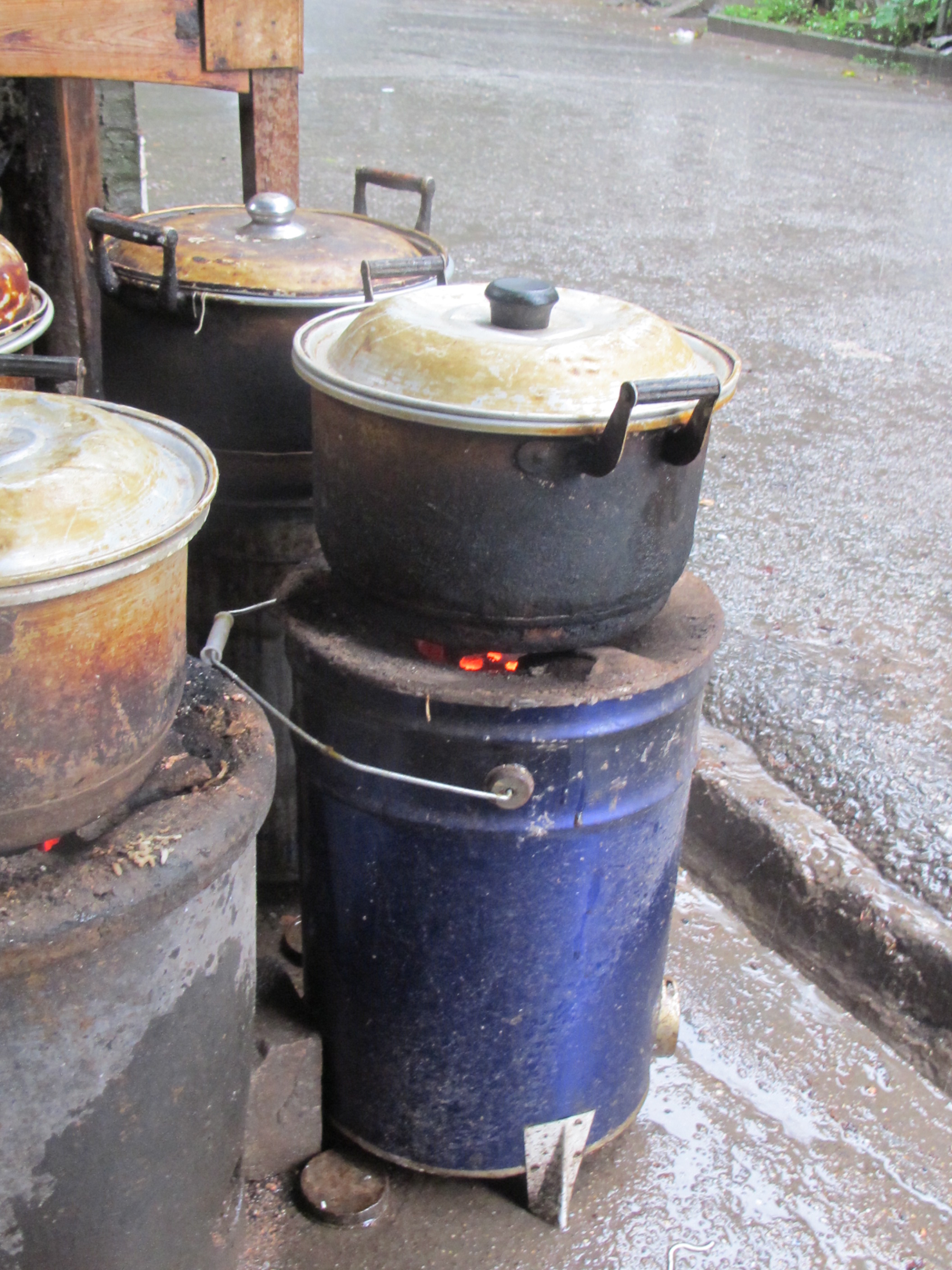
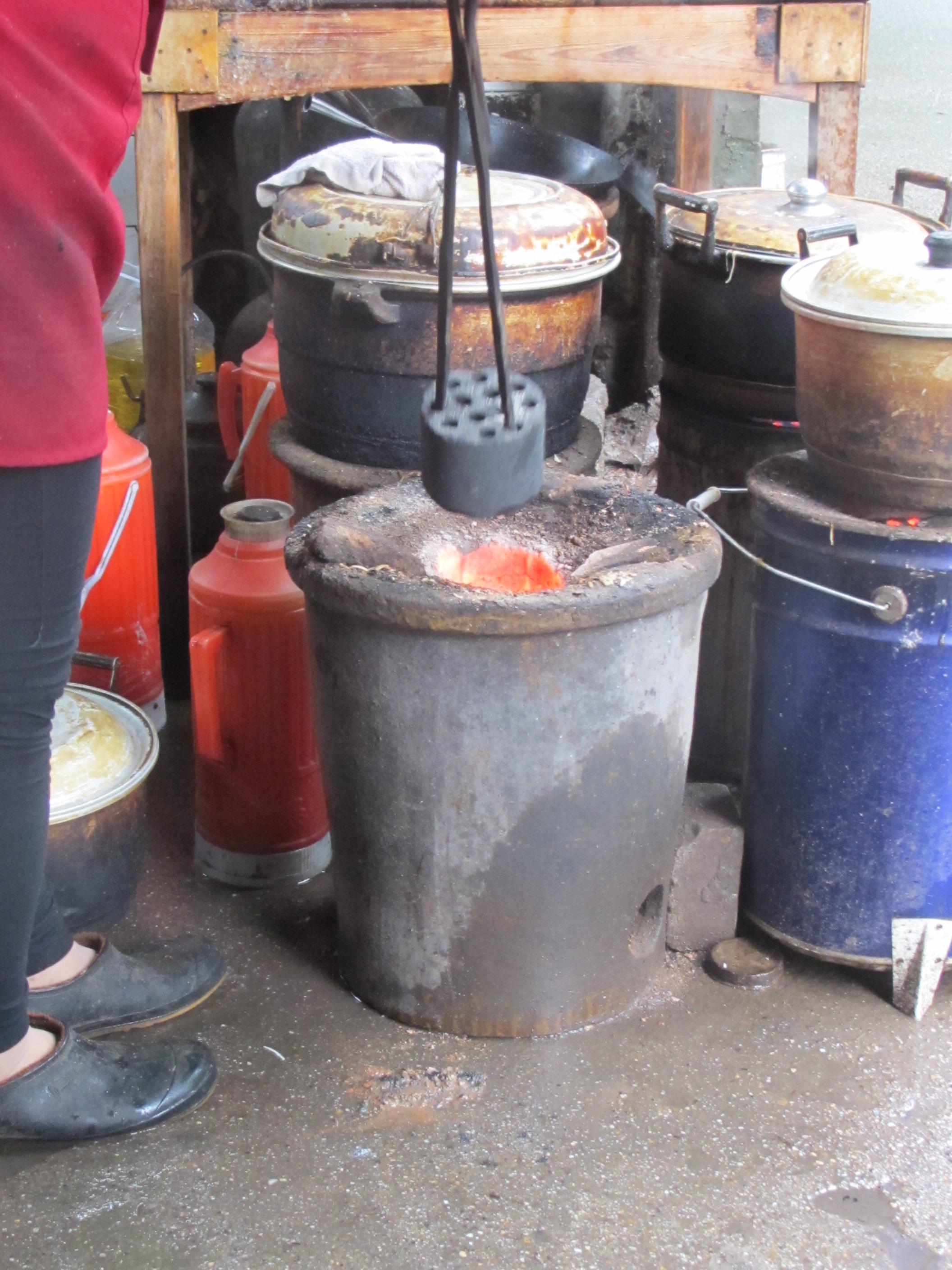
In those days, all the old homes didn’t really have kitchens and bathrooms as we understand the terms. Often, the sink was out in the laneway and shared with 2 or three other houses. The only cooking facility available to most people in those old dwellings at that time was a pressed coal dust briquette, that was lit in a small circular stove, possibly a recycled 20 litre vegetable oil tin. This contraption would take one pot on top and burn for a very long time, possibly an hour or more. No one would get up and light a full briquette in the morning to boil an egg or make a cup of tea and leave the stove burning in an unattended house. such a waste of money and heat, and possibly dangerous too!
IMG_0056_1IMG_0061_1
IMG_0063_1
These briquettes are made from low-grade coal with lots of clay in it. This poor cool is powdered and then pressed into a circular block with extruded holes through it to help it burn efficiently. when its spent and all the coal is burnt out, what is left is a soft, bisque fried clay block. Out in the street there was a steady stream of working men and women stopping off on their way to work to buy a few hot dumplings or a steamed bun. They were usually riding bicycles or possibly motor scooters. There wasn’t a peak hour in those days, as there weren’t so many cars and the cars that there were, were all fairly small and compact copies of Japanese ‘bongo’ vans. The miniature brick on wheels design.
Well everything has changed. There is a peak hour now! There are loads of new cars on the street and they are big ones, just like our standard family sedans. Loads of them and they are so big. It’s hard to find many bicycles any more, even motor cycles and motor scooters have almost been phased out in favour of silent, clean electric motor scooters. A lot of people live in modern high-rise now with conventional western kitchens and bathrooms. They have electricity for micro waves and electric jugs. People can cook their own tea and dumplings, or noodles before driving off to work in their car. All this convenience, has meant the disappearance of many of the street food sellers. They are still there, but in little clusters in off-road open spaces. We were able to find a different place to eat each morning, but some were so well hidden off the beaten track, that we wouldn’t have found them without being tipped off to their location. (A little like Canberra really!)
All the old industrial high-rise is being replaced with new high-rise.
IMG_0106_1IMG_0386_1
IMG_0396_1IMG_0112
IMG_0030
This place is in the midst a very severe period of renewal and change. Most people seem to be looking prosperous and happy There are innumerable little private workshops springing up everywhere. Wherever there is an old empty building, someone has moved in and done it up and it’s now a shop out front and a workspace out the back. Ten years ago, these buildings were mostly empty or just used for storage.
IMG_0047_1 IMG_0050_1
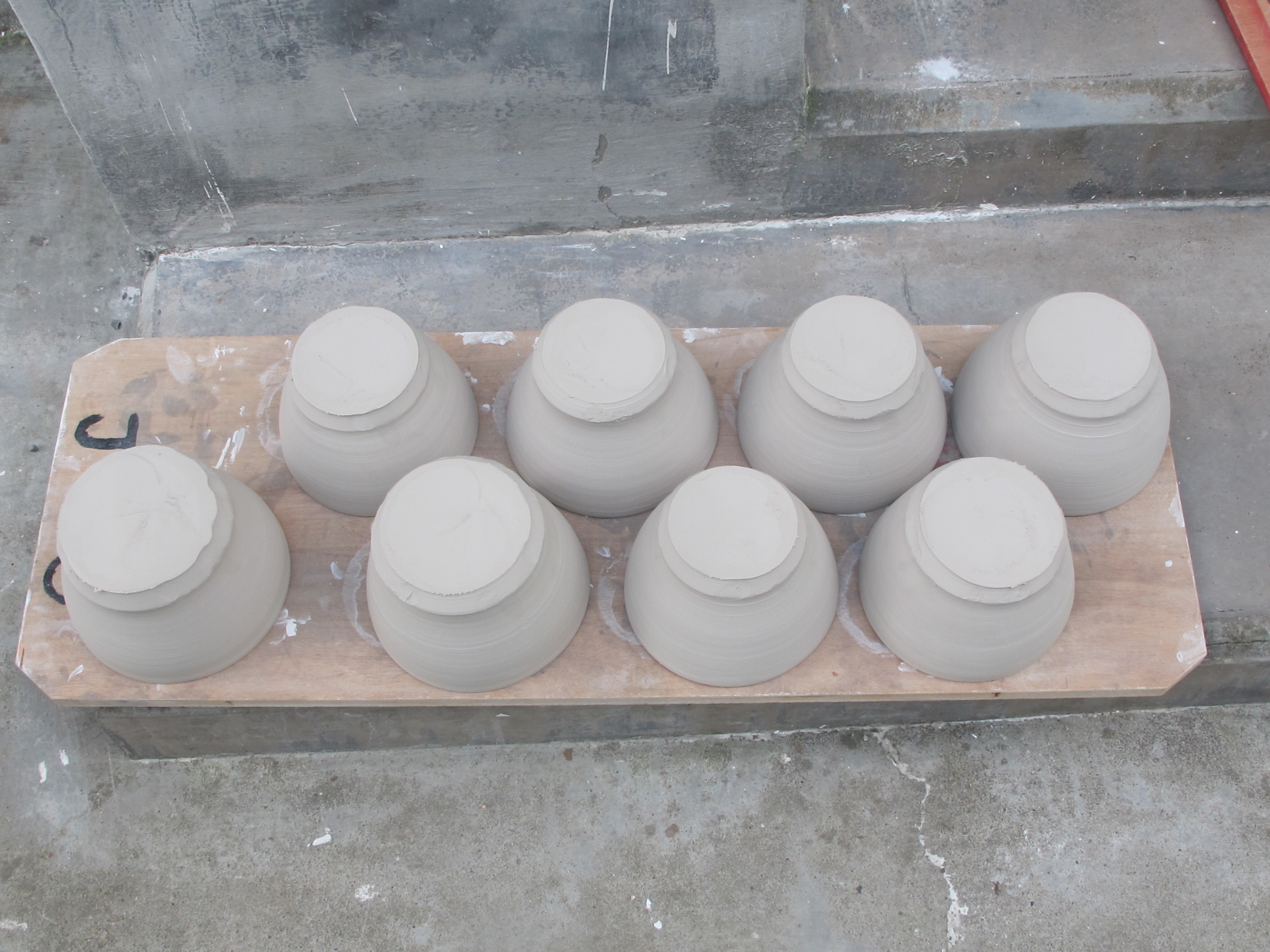
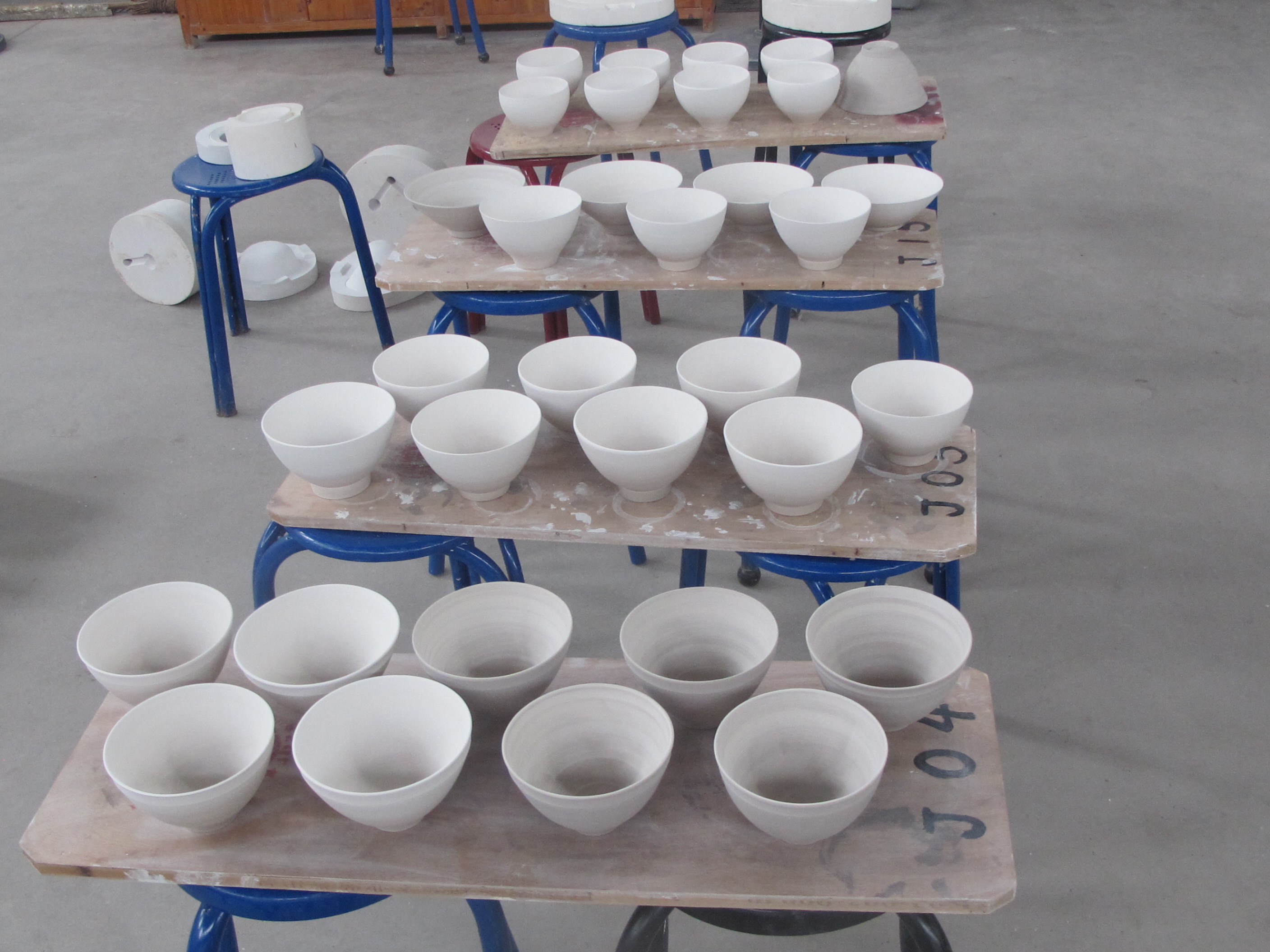
We set to work the next morning and I make 40 bowls on the small pot boards available to me. I make 4 different shapes. I get them out into the sun hoping to be able to start turning them as soon as possible. We are here in the rainy season, so things are slow to dry, but I get most of them over onto their rims by evening. I don’t have the luxury of a slow, even, controlled drying.  The next morning I start to turn the forms so as to rough out the forms to reduce the weight at the base and speed the drying. These one-stone porcelain bodies are quite non-plastic, but I must say that this particular one is very good compared to my own ball-milled ‘Joadja’, ground stone body back at home. The difference being that where as mine is made from a hard, glassy, dense ‘aplite’ or fast cooled granite-like material. This material here in Jingdezhen is a weathered sericite mica and develops a lot more plasticity. Even so, you can’t turn bodies like this when they are leather hard. They just chip and tear. These ‘clays’ , if it’s possible to call them that, need to be molly-coddled a bit and turning is best done at the almost bone dry stage. This allows a better smoother finish, but creates a lot of dust. In Japan, they use a vacuum fan in front of the wheel to create a negative pressure to remove the dust for the workers safety. Here there is no such concern. OH&S is a distinctly ‘western’ luxury concept at work.
IMG_0069_1
I finish all the turning and get them all out into the sun to dry on the third day. I cull them all down to 20, then another cull down to 12. That is all I will be able to carry out on the plane in my back pack. We plan to raw glaze them tomorrow and then into the stoneware kiln the next day, fired over night and unpacked the next morning. We are due to fly out at lunch time. We are cutting it fine, but it is doable. And we do it. It all runs like a Swiss watch. We are greatly aided by Liu Danyun,  The daughter of Master Liu, the owner of the Fragrant Garden International Ceramics Studio, she is most helpful in every way and does all our translating, phone calls, bookings and other organising for us. She is a wonderful friend !
IMG_0135_1 IMG_0136_1
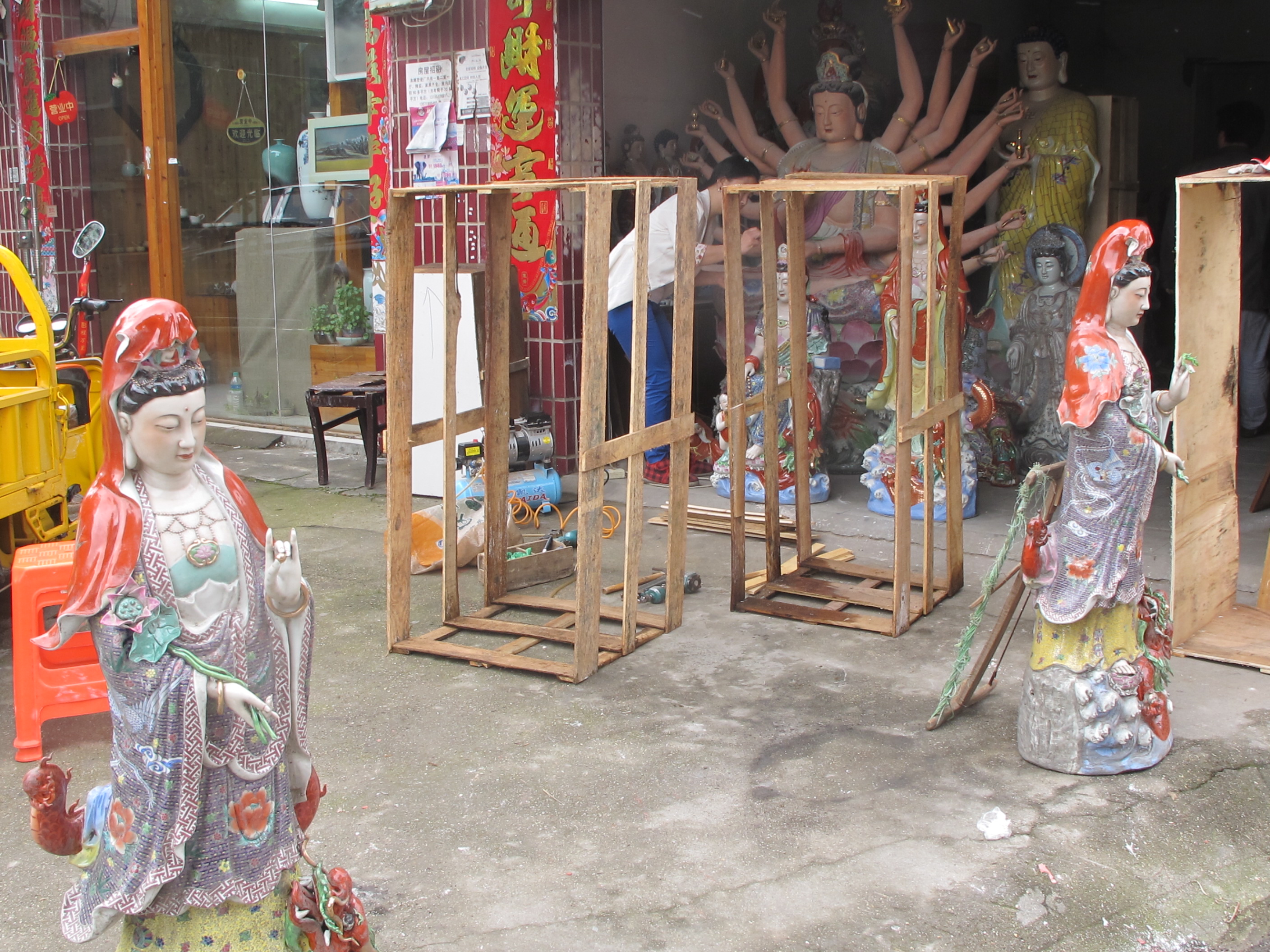
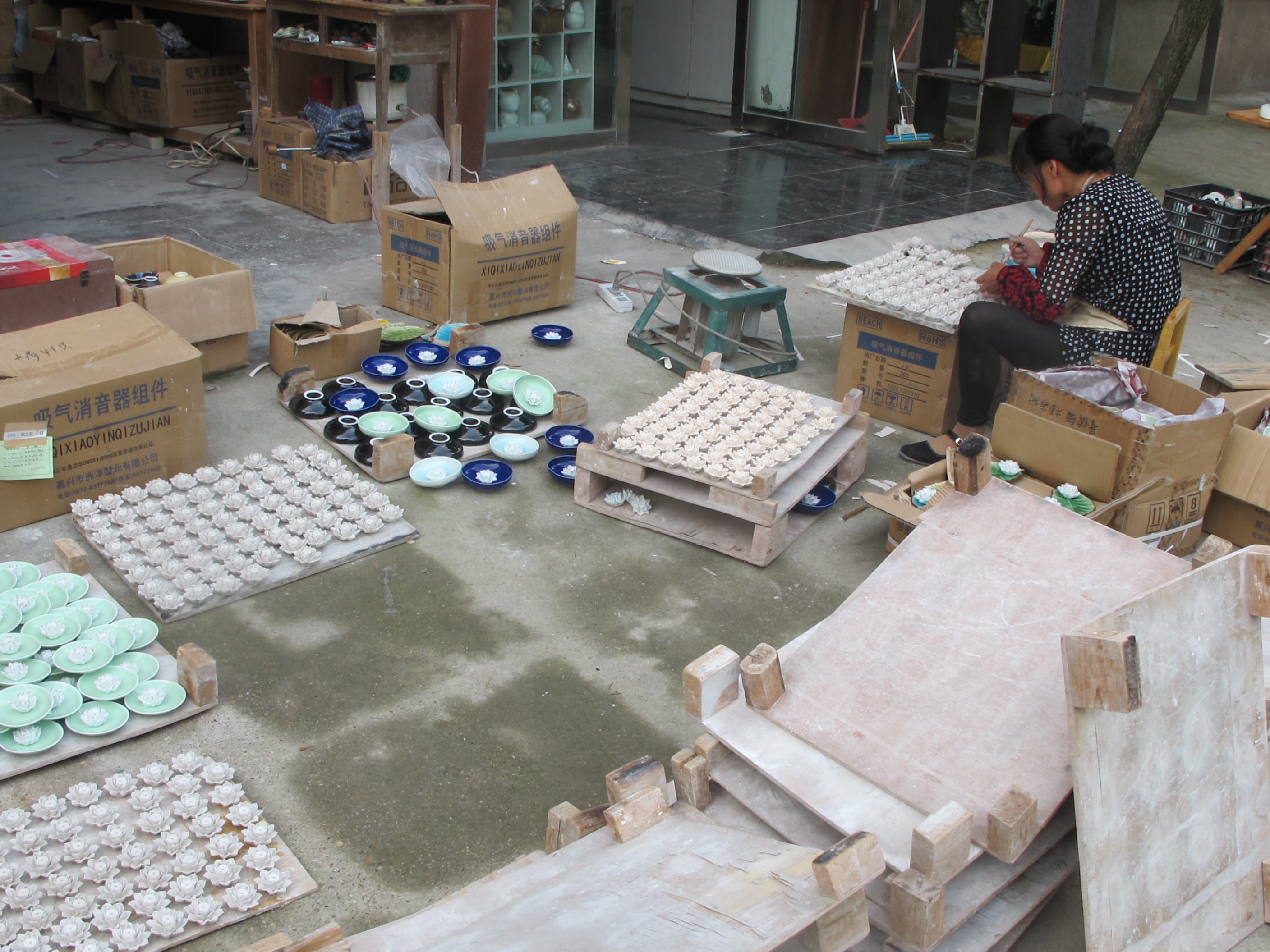
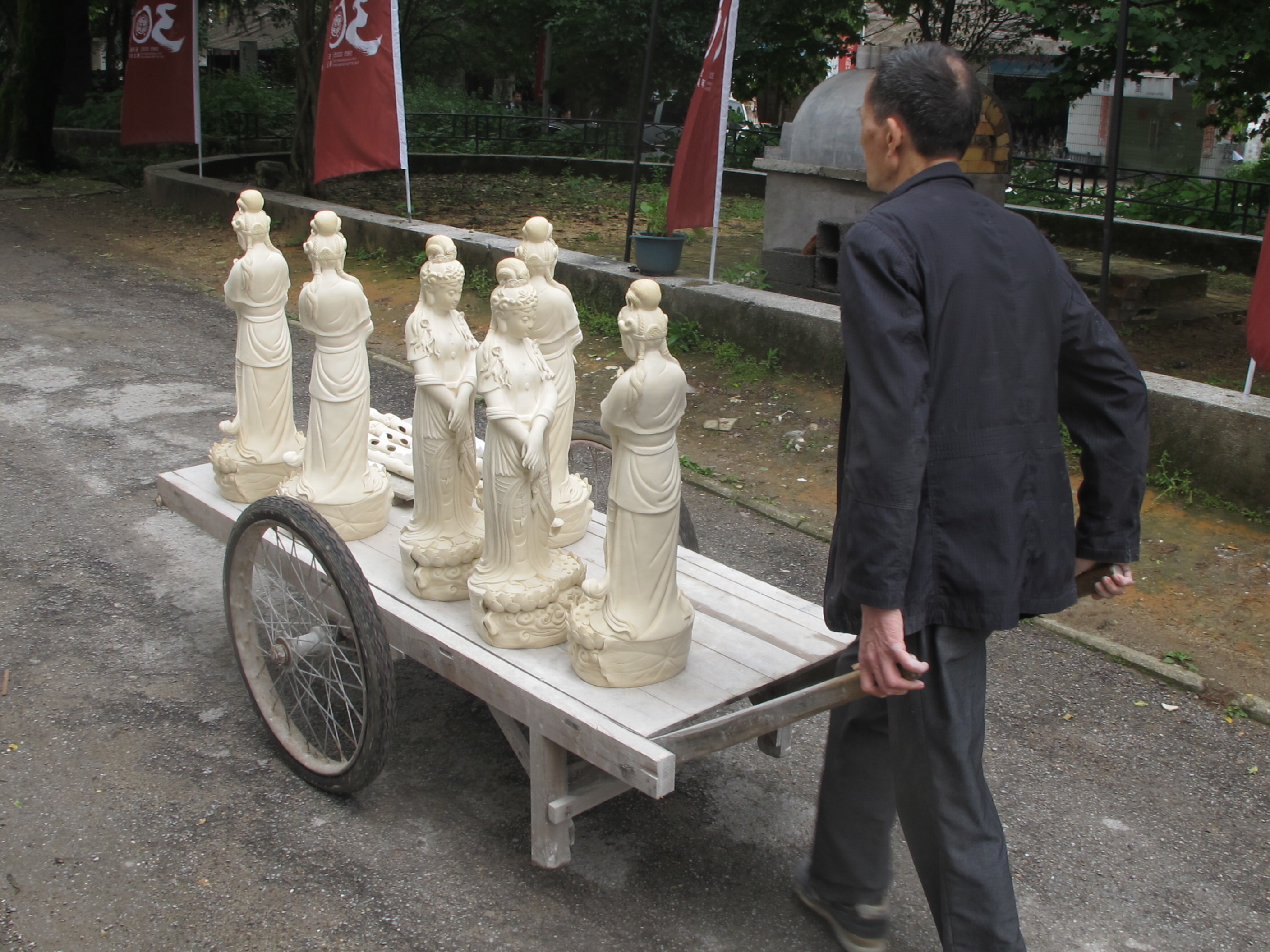
Although there has been enormous change over the ten years since I first came here, with so many technological advances, Some things haven’t changed very much. Pots are still moved from studio to studio and studio to kiln on wheel barrows, but change is catching up there too! Not very many studios have their own kiln, most places still use the public kilns, and there are quite a few to choose from in the pottery precinct. You probably don’t have to move your work more than 100 metres to find a kiln to fire them, a glaze workshop to glaze them, a box maker to fit them or a crate maker to package them securely for transport.
IMG_0345
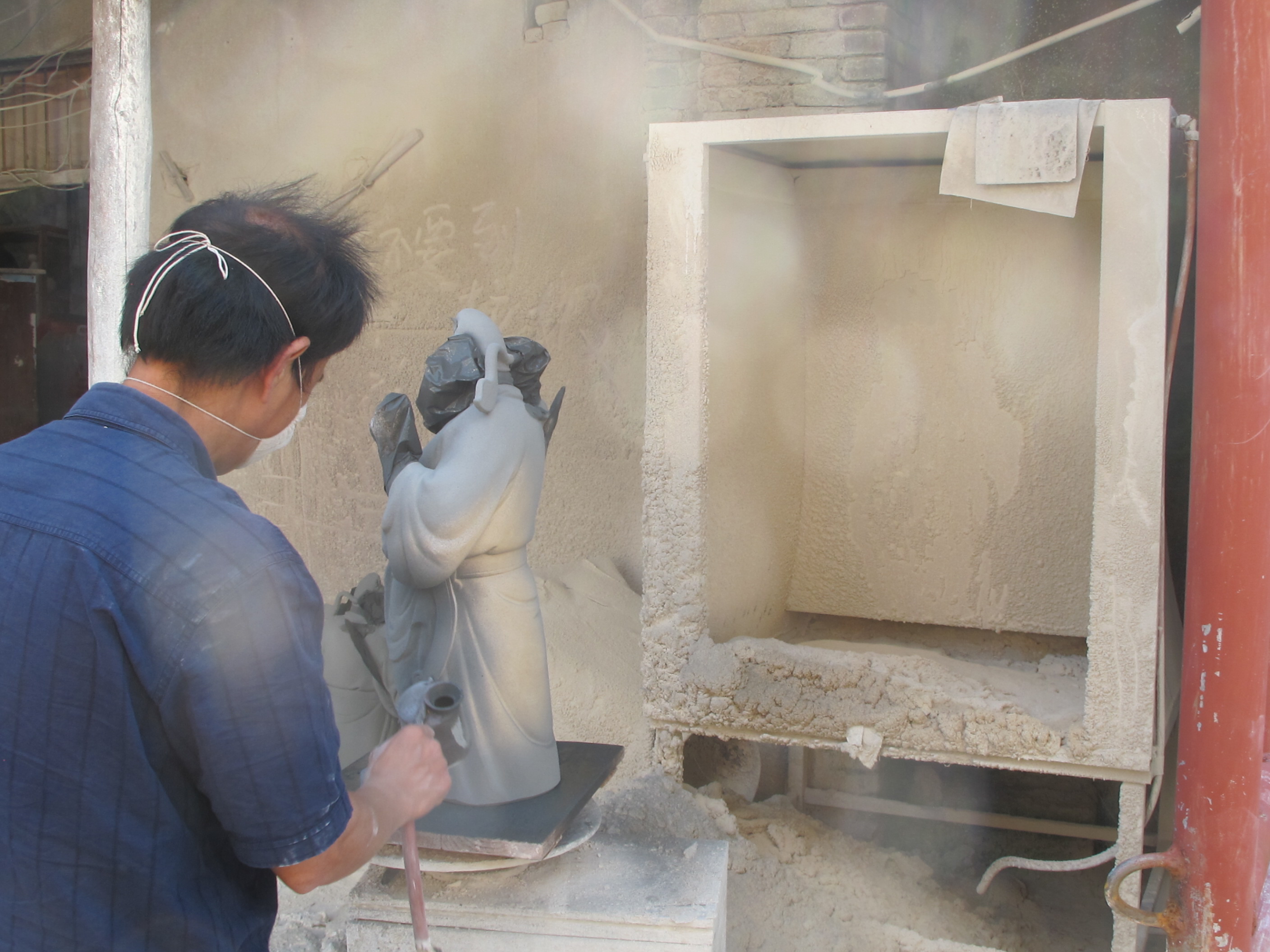
Although they now have sophisticated spray booths, and the use of dust masks is more common. They don’t always were the mask or turn on the fan and water pump!
The privately owned and run kiln firing services are amazing. These kilns are packed and fired every day, with one trolley being packed while the other is in the kiln firing. They seem to crack the door open at very hight temperatures, even while there is still a decent, strong, bright glow in the kiln, so as to crash cool it.
IMG_0163 IMG_0278
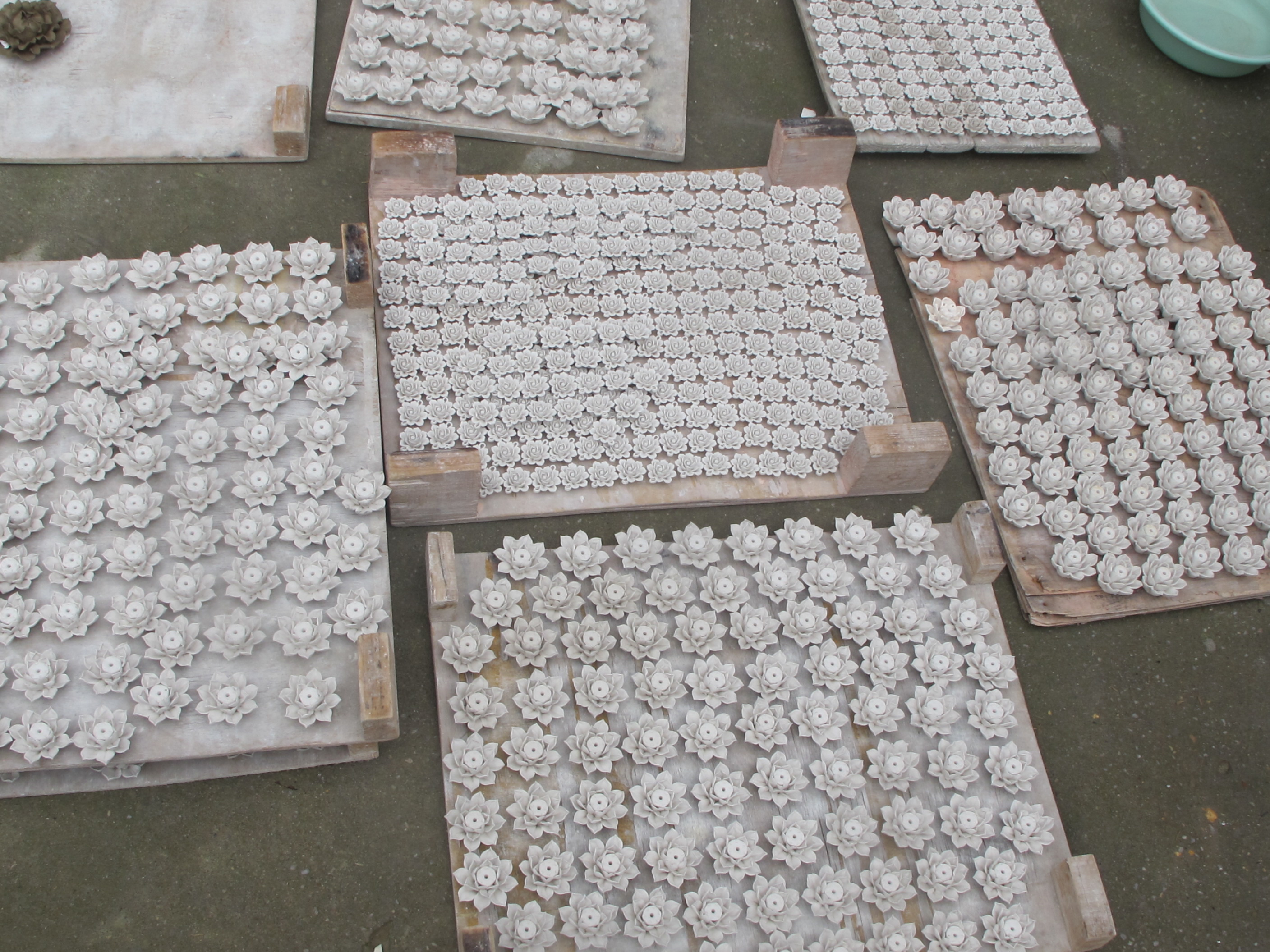
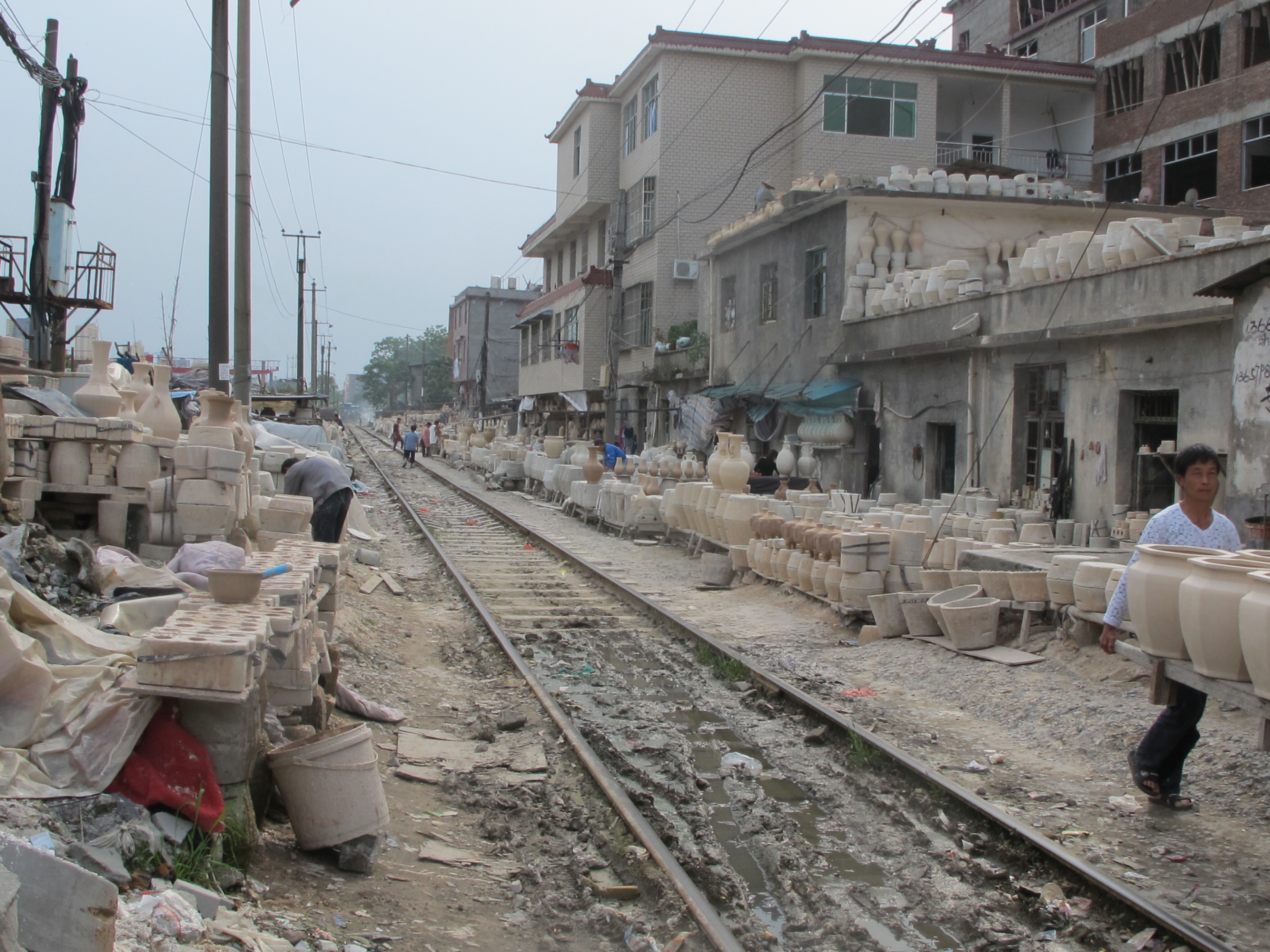
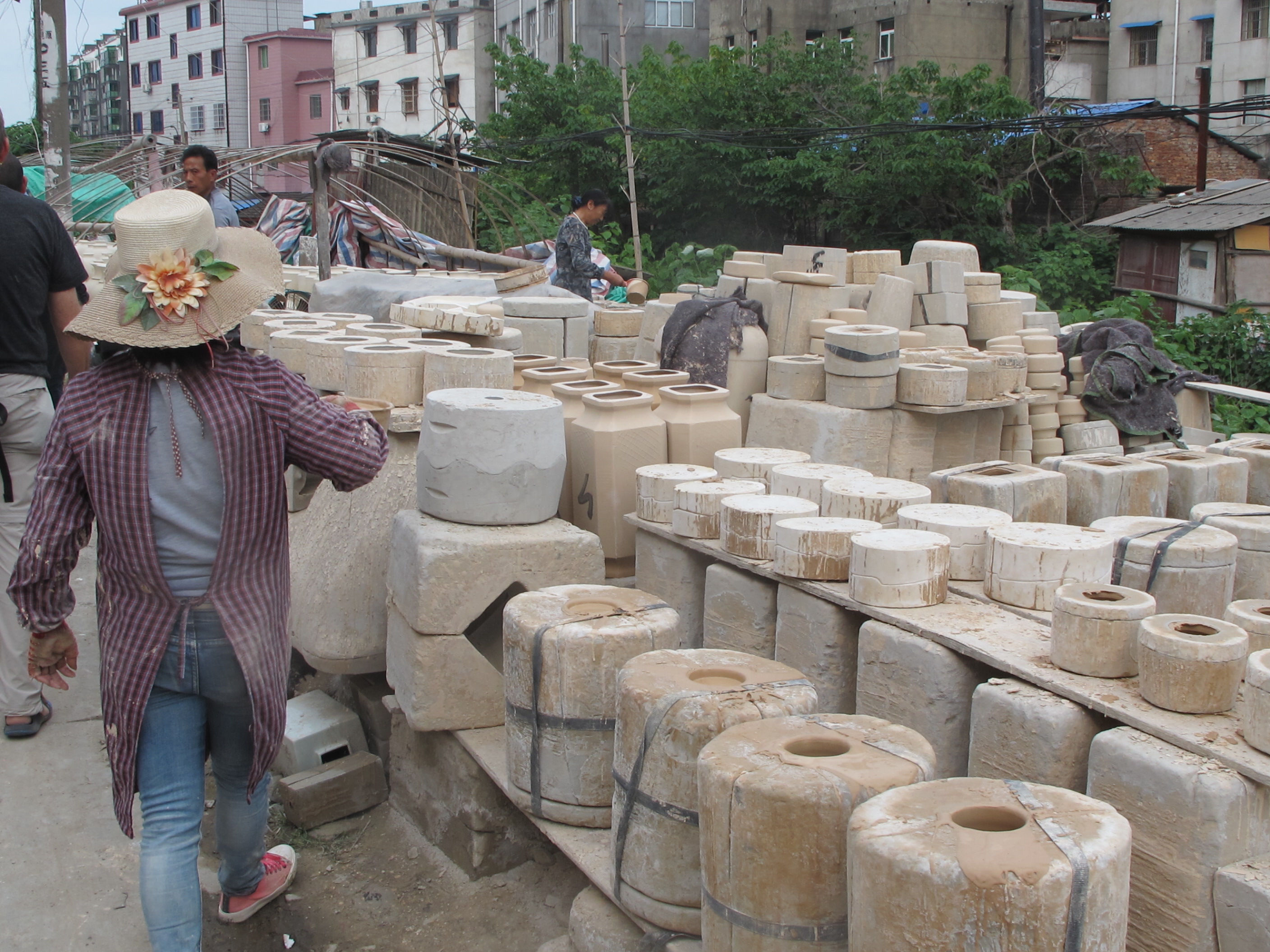
Where ever you go there are pots stacked out on the street to catch the breeze and some sunshine to speed up the drying. The pavement is also used as additional studio space in fine weather. Even the street and train line is used as extra workshop drying areas. Nothing is wasted!
IMG_0115_1 IMG_0134
IMG_0088_1IMG_0093
Where ever you go there are pots stacked out on the street to catch the breeze and some sunshine to speed up the drying. The pavement is also used as additional studio space in fine weather. Even the street and train line is used as extra workshop drying areas. Nothing is wasted!
IMG_0051_1IMG_0082 IMG_0081IMG_0561_1
IMG_0557IMG_0562_1
I’m quite in awe of these people’s ability for hard work, creativity and efficiency in some very difficult circumstances. It’s such an inspiring environment. I don’t want to come and live and work like this permanently, but I’m so very grateful that I have the chance to come and work here on these occasions and experience this life. It grounds me and makes me realise how lucky I am.
Best wishes
from Steve in Jingdezhen

Growing Old Together

Potting, throwing, making clay, kiln packing, kiln firing, kiln unpacking, more wood cutting splitting and stacking, gardening, weeding, pruning, composting. It’s been a busy couple of weeks.

Recently we have been doing something different everyday. There is always the garden and the pottery, then the house and land maintenance, but we are also doing weekend workshops over the winter months. We have just completed the 4th weekend in a row, only nine more to go, with a possible tenth.

IMG_8895

IMG_9126 IMG_9123

We started off the week in the pottery making pots. It’s always fun to get in there and let a few days slip by un-noticed in the joy of making. Clay is such a tactile and responsive medium. I’ve started to make some white tenmoku bowls out of my native bai-tunze porcelain stone. I also make a pot-board full of stoneware bowls and another of blended kaolin/stone based porcelain body. I finish up by making a board of Black ware tenmoku bowls. I plan to fire these unglazed in the wood kiln so that they will come out jet black. I think that this contrast of matt black and glossy white will work out well together. It’s just an idea. I’ll have to see how it goes. It’s starting out looking OK.

thumb_IMG_2576_1024

The kiln that I welded up last week is back from the galvanisers already. A 7 day turn around! unheard off!. What has gone wrong? It usually takes these buggers at least 2 weeks and more, usually 3 or 4. I’ve even waited 6 weeks for one of my jobs to get through their process. Still, it’s back here now and I’m very pleased, it takes the pressure off. I drove up to Sydney on Monday morning to collect it – to make sure that it was done. I have spent an hour or two each morning this past week grinding, etching, sanding, filing, priming, undercoating, and finally two coats of top coat will go on the inside to make sure that it is really well rust proofed inside for years into the future.

The customer has no idea what has gone on inside this kiln frame. It’s all covered over in Stainless steel, but I know that it is the best way to insure that this kiln will last a working life time and more. I don’t have to do it. I decide to do it, because it’s the right thing to do. No one will ever know, but I know. I build them as if I was going to own it myself. I want it to last for 20, 30 or maybe 40 trouble-free years.

IMG_9251

I know that this effort will be rewarded. I have some kilns out there in Universities and TAFE colleges that are fired on a regular basis, every week and have been now for almost 30 years. I know their history and I also know that they have had only minimal maintenance issues over that time. I’m proud of that. If I buy something, I want it to last, all my life if necessary, with no built-in obsolescence. I want it to work perfectly, for as long as possible, and then to only need minimal attention.  Something like the replacement of the thermocouple or temperature meter. This is my aim, and I’m all-in to go for it as best I can. It’s the product that I want to own!

Another little wood fired raku/midfire portable wood kiln rolls of the production line. This one fitted with all-terrain 200 mm. tyres, for wheeling over wet lawn and/or soft gravel.

IMG_9250 IMG_9253

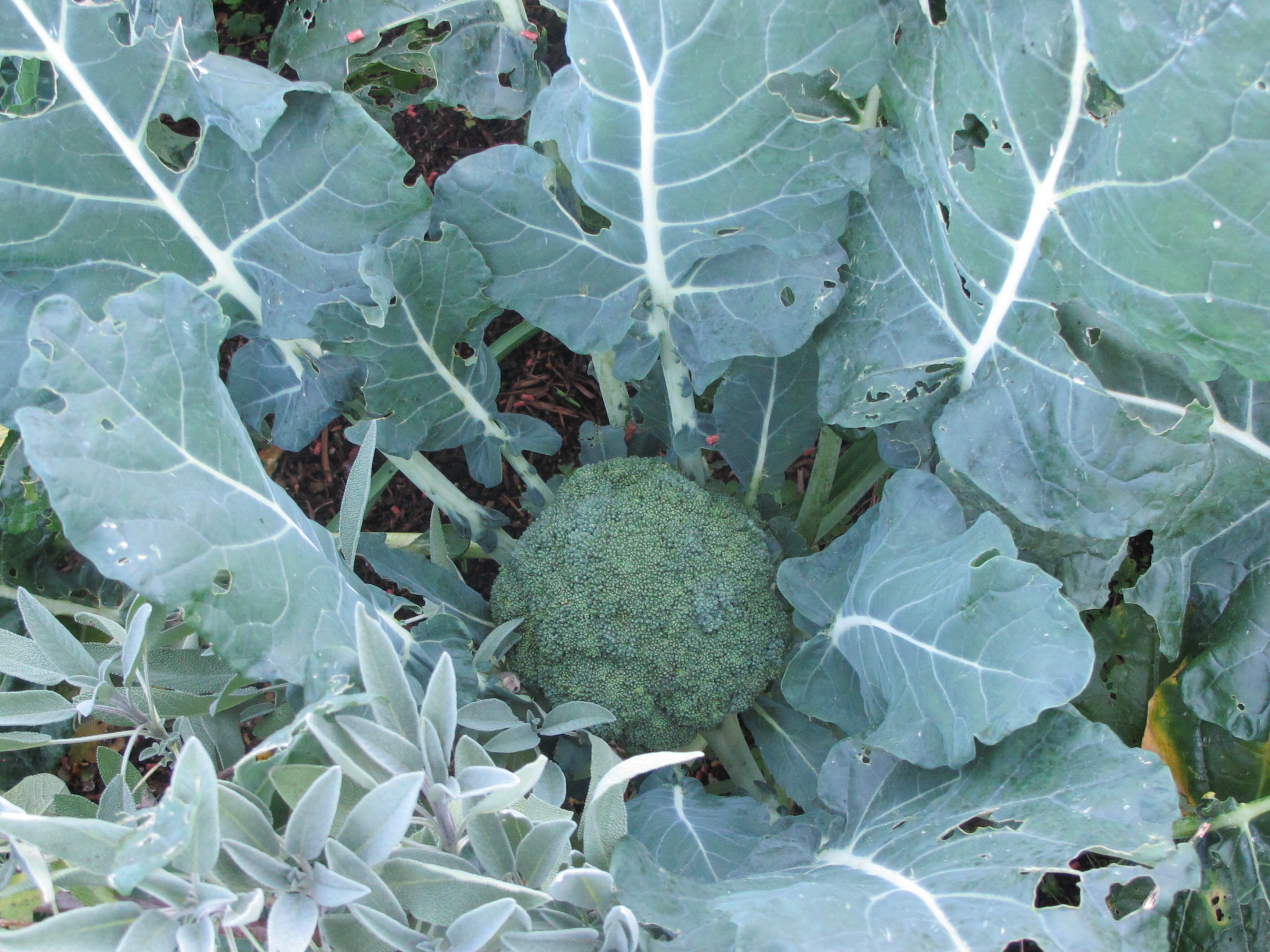
I started weeding the last of the tomatoes from the summer garden and made a huge couple of heaps of compost of all the weeds and old tomato and spinach plants. At this time of year, the Worrigal greens (tetragonis) seem to spread everywhere. It’s a native plant that is something like spinach, but growing prostrate, and spreading wildly. It seeds prolifically at this time of year and there will be numerous seedlings appearing in the spring.

IMG_9173IMG_9174 IMG_9175

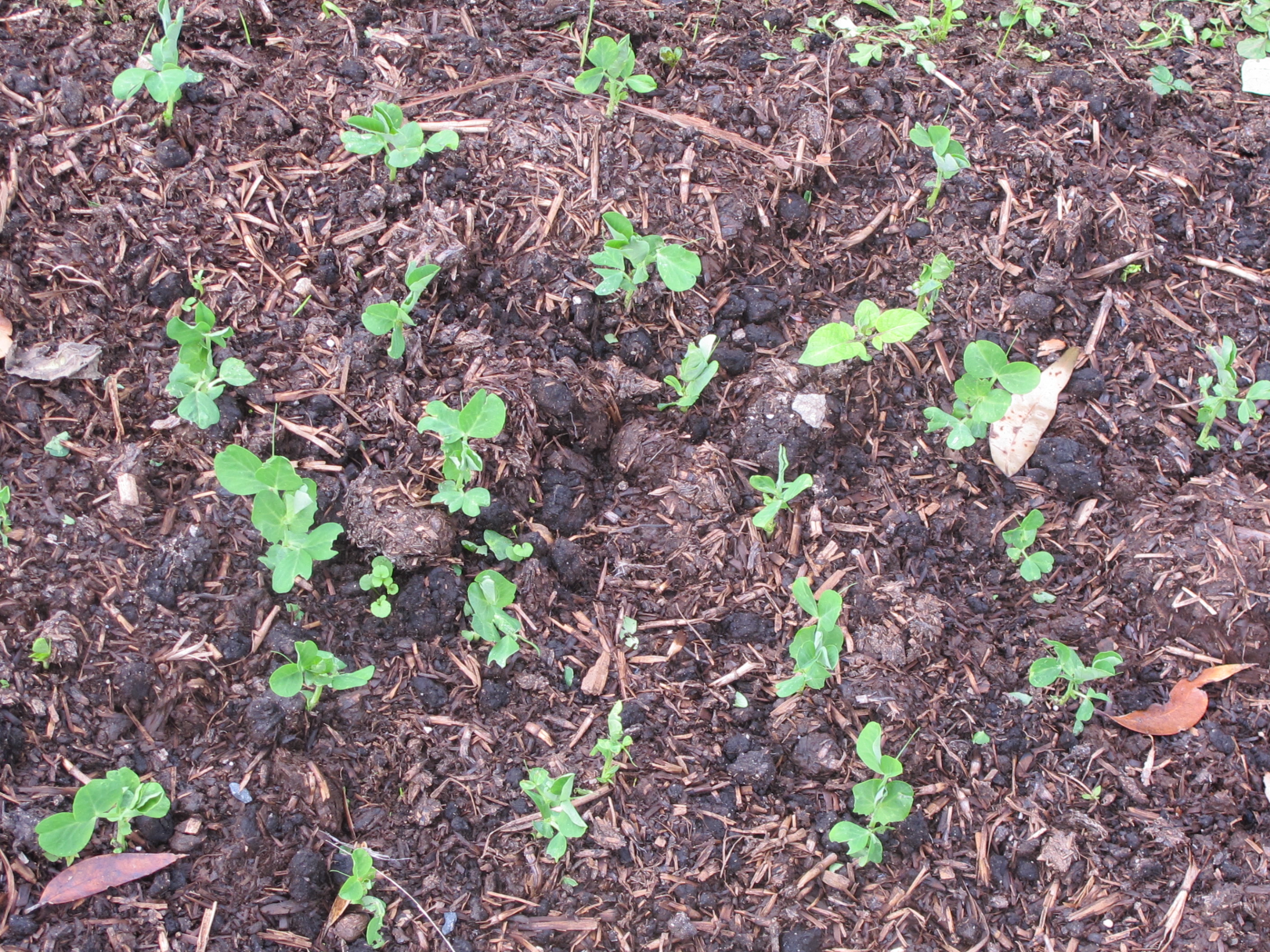
The garlic that I planted in March is all up now, early, mid-season and late varieties. All seem to be doing well. I also planted bush peas and broad beans on either side to accompany them and to fix a little nitrogen as well, while they are at it. We’ll see how the rest of the year pans out, and if the rainfall continues.

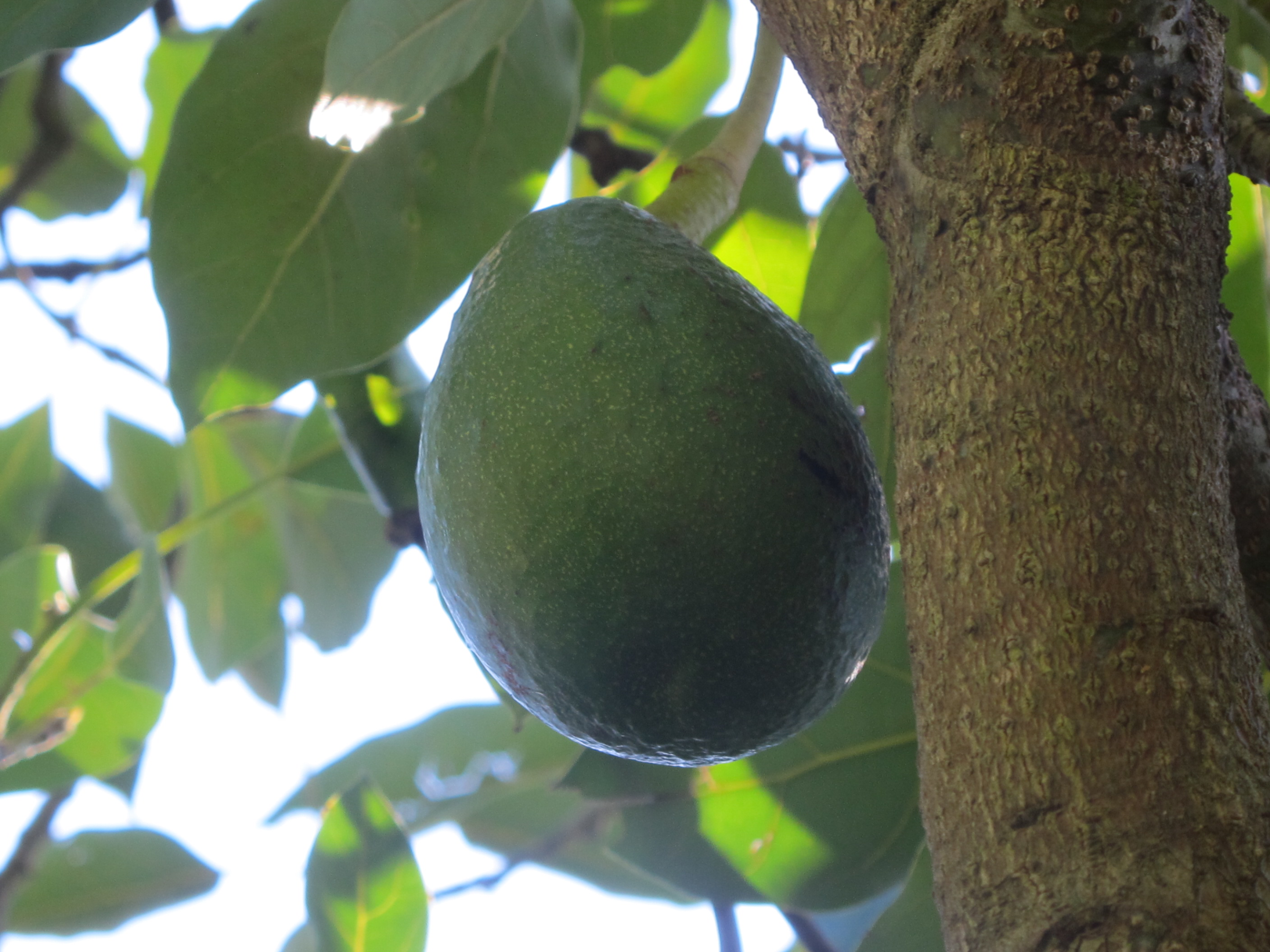
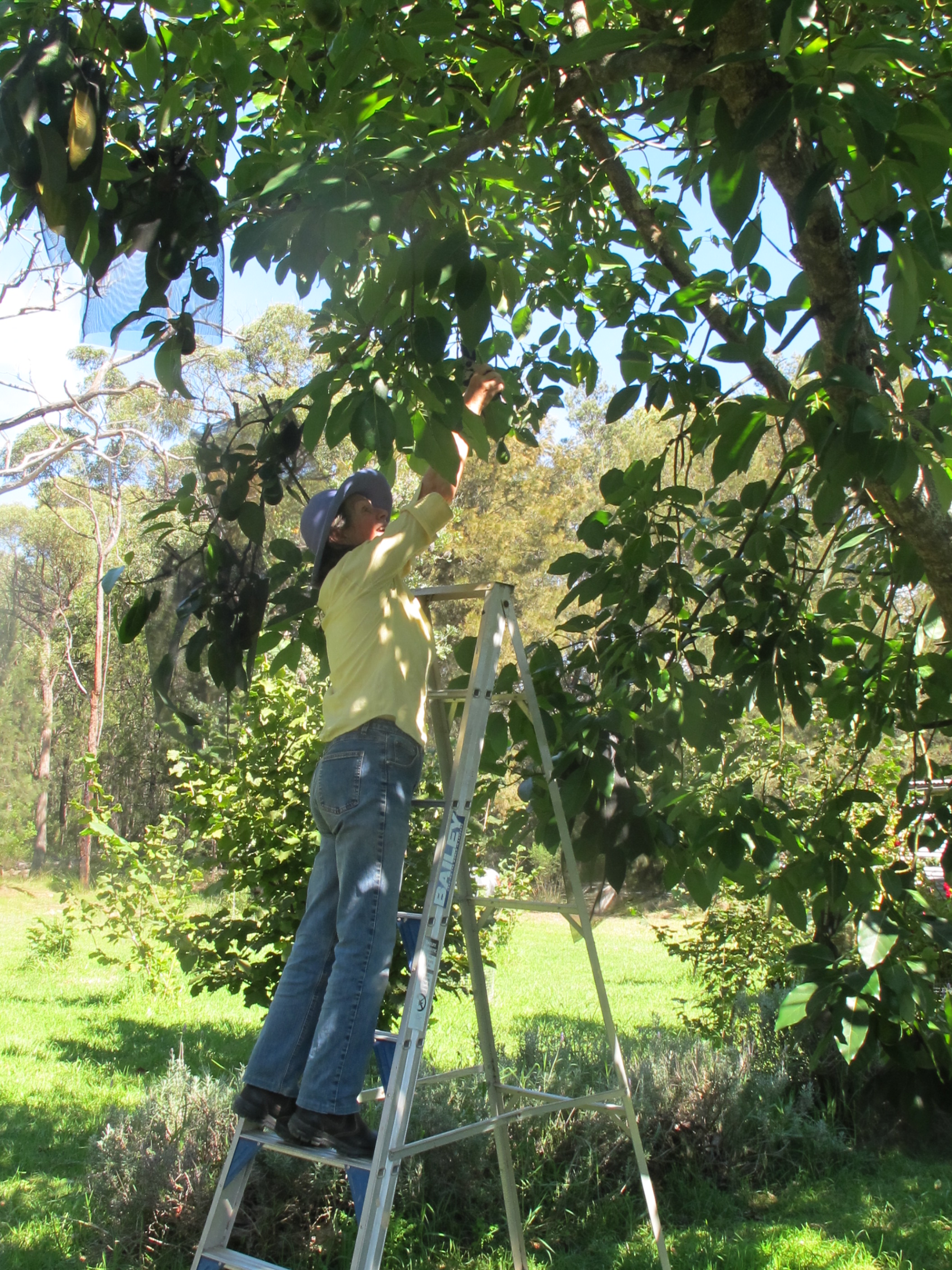
One plant that has thrived in all this rain has been the avocado tree. We have a bumper crop this year, hundreds! We’ll eat what the hail, birds and possum don’t ruin.

IMG_8928IMG_8926

We had such a sustained hail storm last Saturday week. During one of our wood firings. The hail on the tin roof was so loud that I went and put on my industrial ear muffs! One of the potters measured the decibels with her phone app at 89 decibels. That’s as loud as my chain saw, according to the warning sticker! The hail continued and lapsed, then returned 3 times in all during the afternoon and evening. It will have made a mess of the avocados. However the vegetable garden is entirely under cover of both chook wire and small mesh plastic netting now, so I was able to look out of the kiln shed window and watch the hail bounce off the fine plastic netting. After the storm, I wandered out for a quick look, there was no noticeable damage to any of the vegetables. That netting was such an exertion of time, money and effort, but it was worth it in every way. This is part of the pay-back now. All those vegetables saved from a shredding from the hail.

IMG_9136 IMG_9256

In the evenings, early mornings, or whenever I can fit it in throughout the day, I manage to find a little time to play my cello. It’s a beautiful thing. It’s changing over time as the wood ages and settles in.

We are growing older together, Nina, me and this cello, the difference between us being that it’s the cello that is getting better with age !

IMG_9258 IMG_8998

Fond regards

Pau Harrison

It’s The Season For Wild Passata

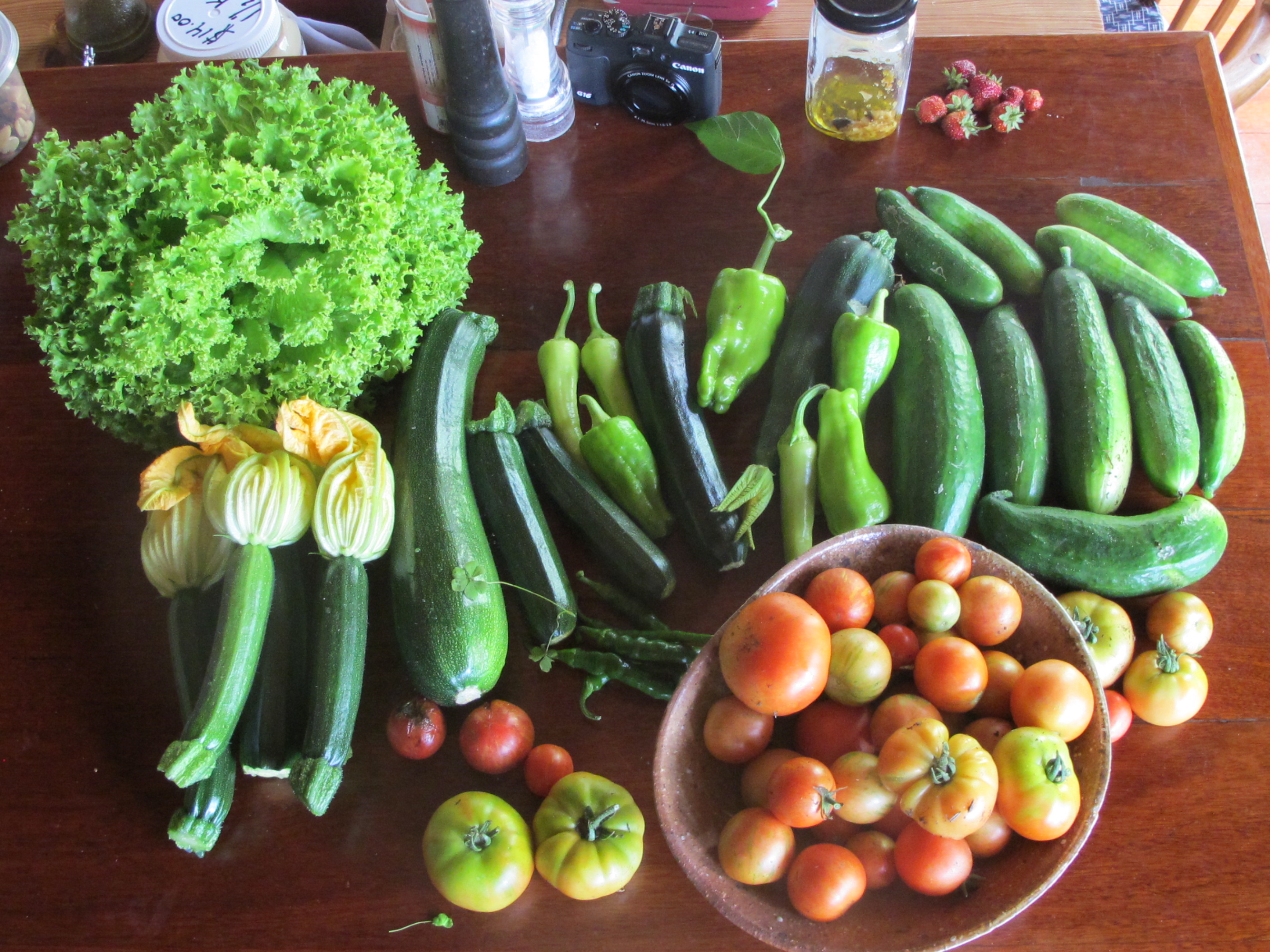
Another on-going job besides kiln maintenance at this time of year, is keeping up with the tomato crop as it slowly sprawls and proliferates all across the garden beds and over the lawn and down the pathways. They keep on flowering and producing loads of ever-smaller compact, flavoursome, little zingers. full of intense tomato flavour, but very small. These little beauties take a long, back-bending, time to pick. There is no easy way. I’ve tried kneeling and I’ve tried bending, but the problem is that there are so few places to put your feet, when the plants spread all over the place. I’m always aware of not crushing the fruit or the plant stems, which set down adventitious roots all along the way to feed and nourish the ever-expanding crop. It takes a long time, as there are so many of them, but it’s worth it. It doesn’t take too long to fill the first box.

IMG_8746IMG_8747IMG_8593IMG_8594

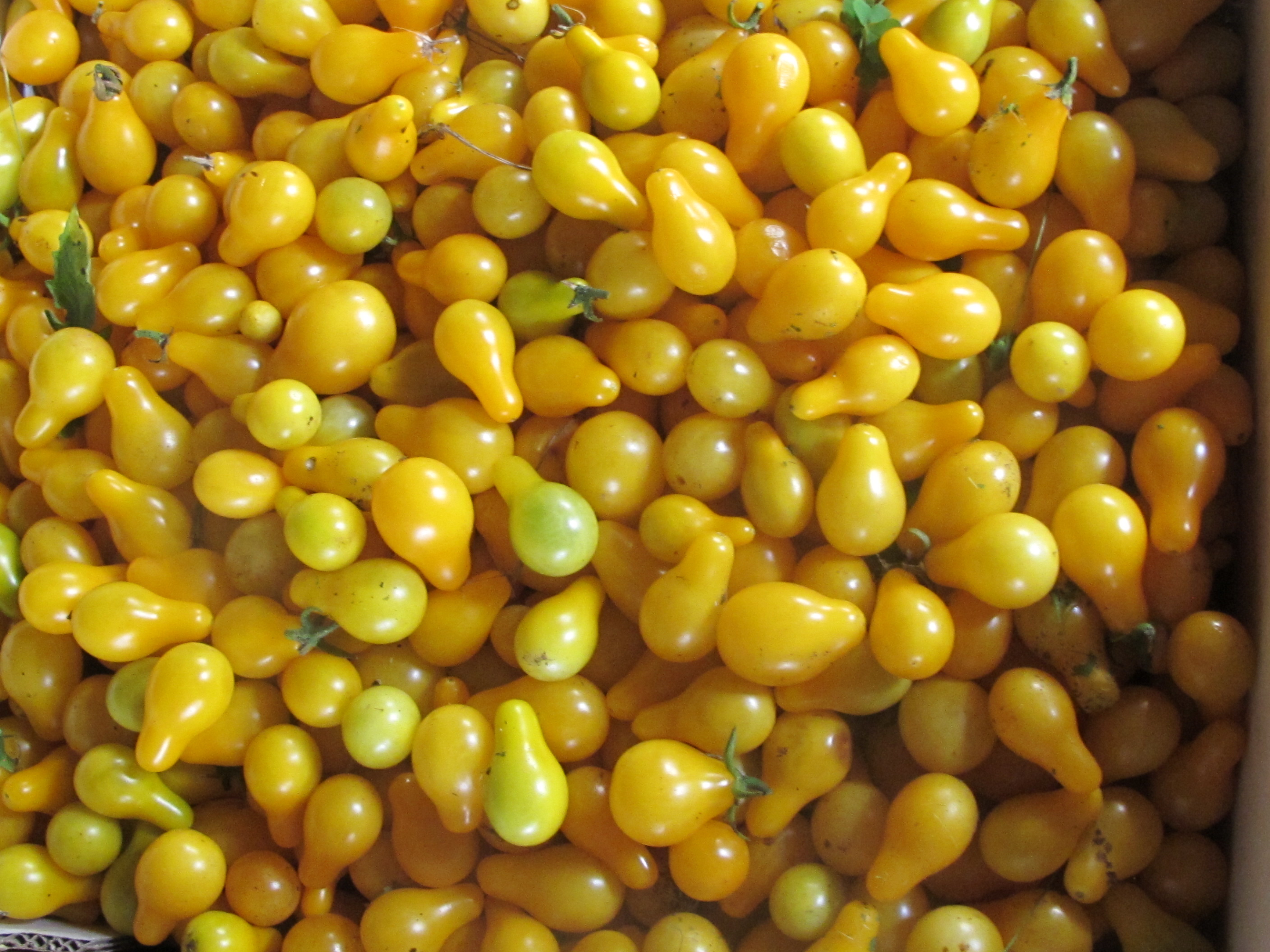
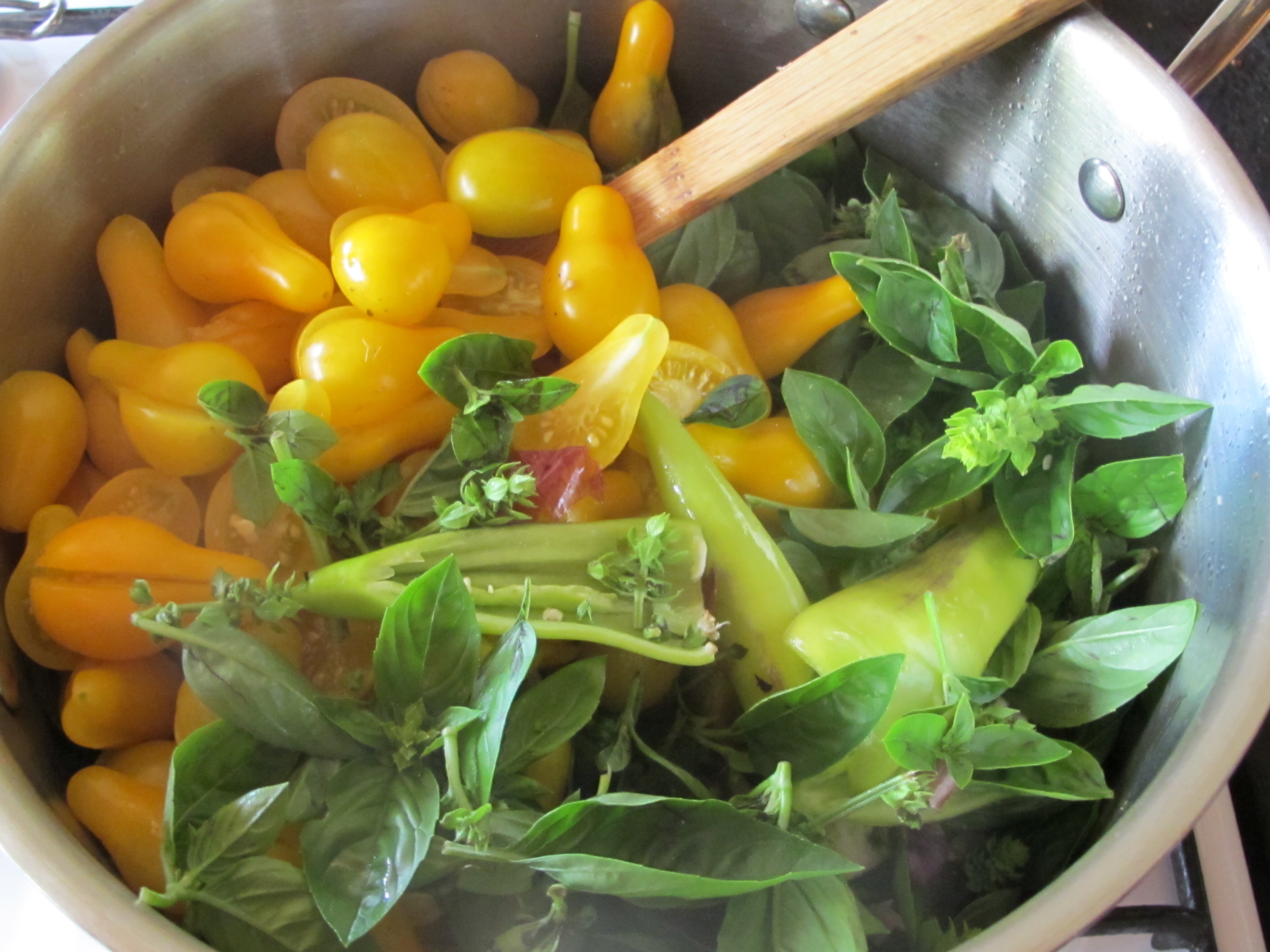
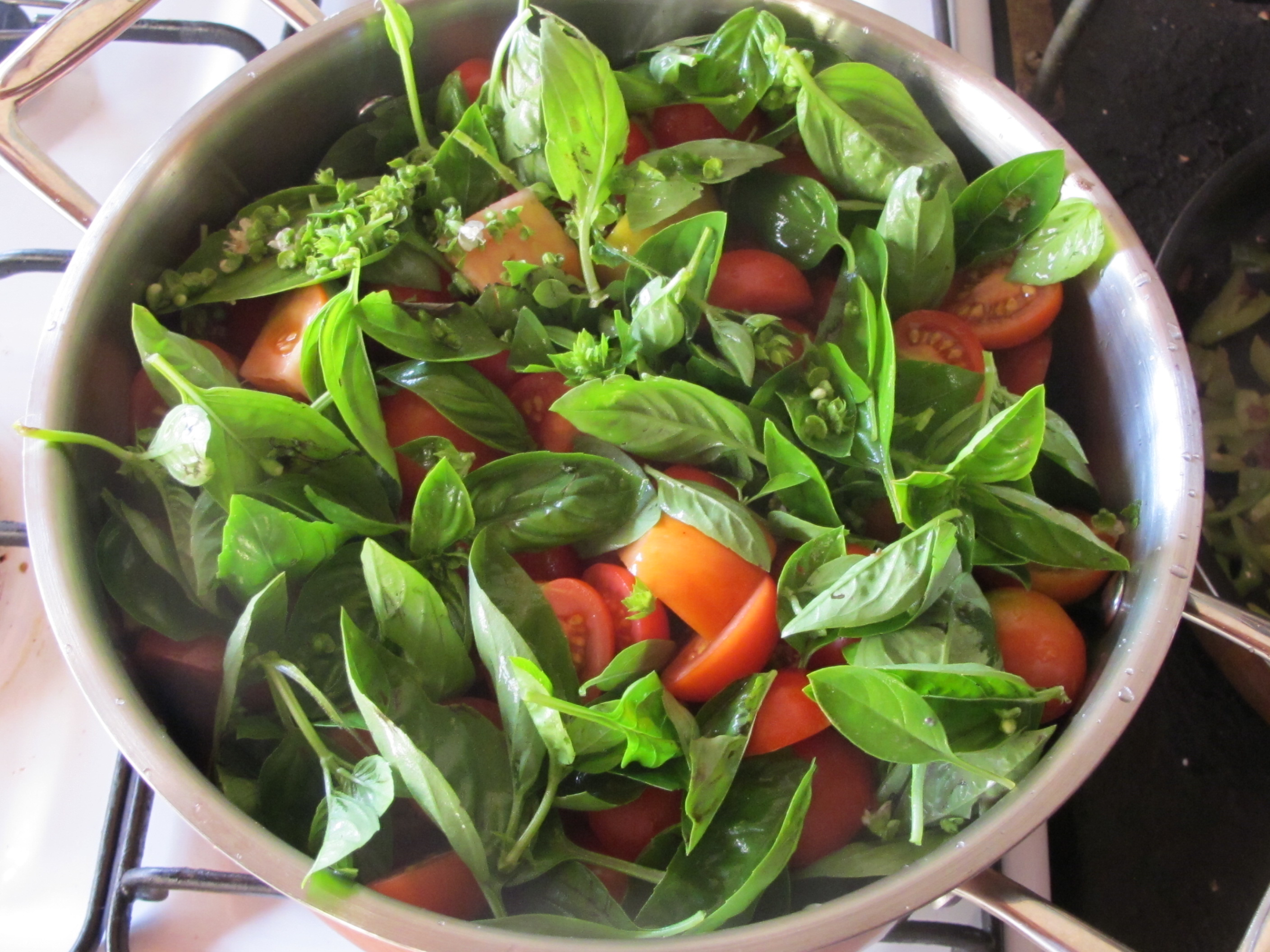
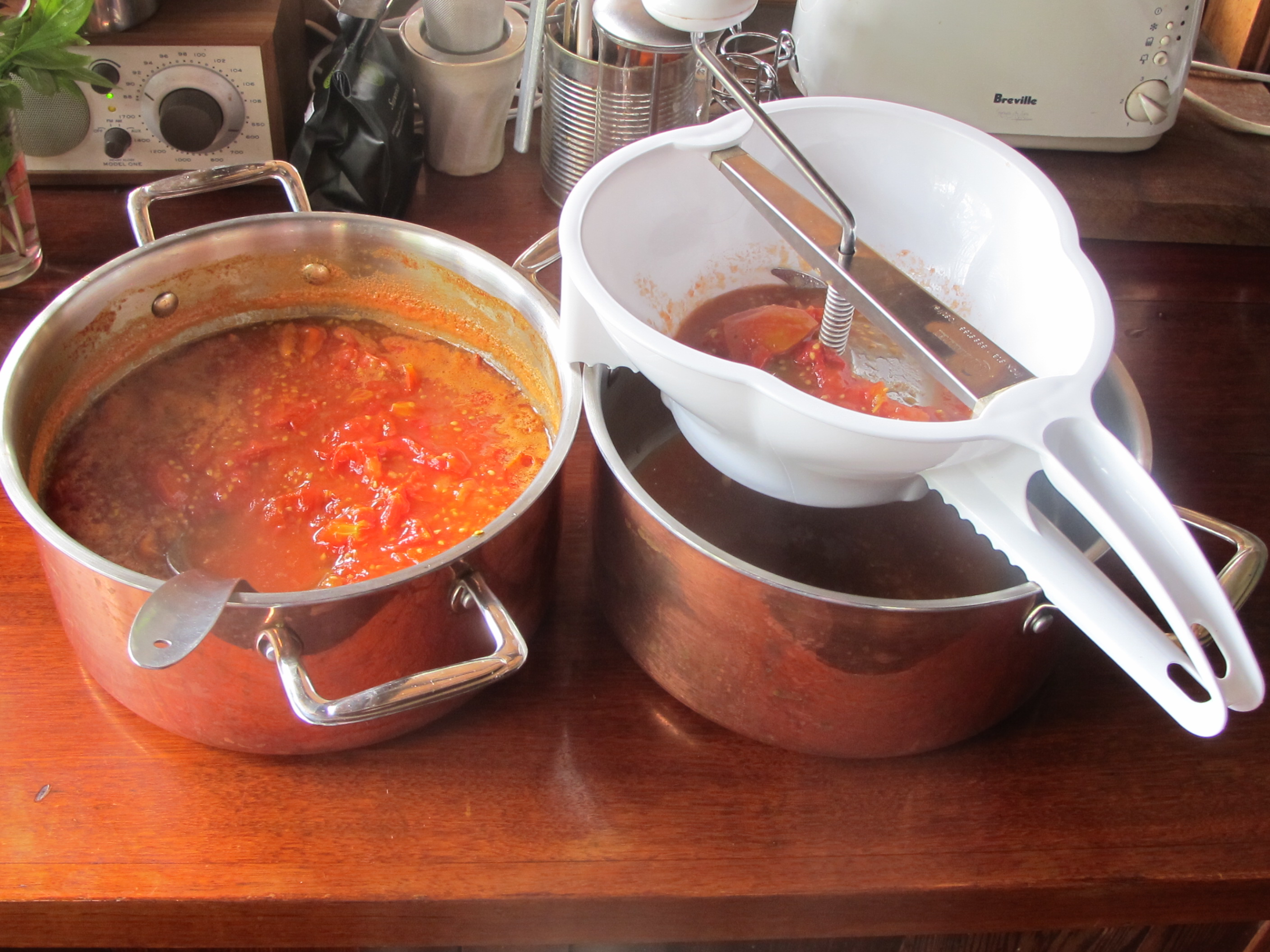
I don’t get all of them, there are just too many, but I fill the basket. it’s enough. We can do this every few days at this time of year, and do. Batch after batch, we slowly fill the pantry cupboard shelves. After cleaning and washing the tomatoes, I simmer them down in the evenings when we light the stove. I make them into tomato passata, some times just straight tomatoes if I’m pressed for time, but on other evenings, when I can make the extra time. I brown our own onions in good EV olive oil and then add garlic, capsicums and basil with the tomatoes. It makes a richer flavour, but the extra fibre takes a lot longer to pass through the mouli sieve. Sometimes it’s just a batch of the prolific little yellow tomatoes, they don’t have the same level of acidity in them, so the piquancy is somewhat less, but they are still worth the effort. A more usual batch is a mix of all of the above. It just depends on what there is the most of on the day. Every batch is slightly different and makes for a natural variety throughout the coming year.

IMG_8776IMG_8473IMG_8786IMG_8787

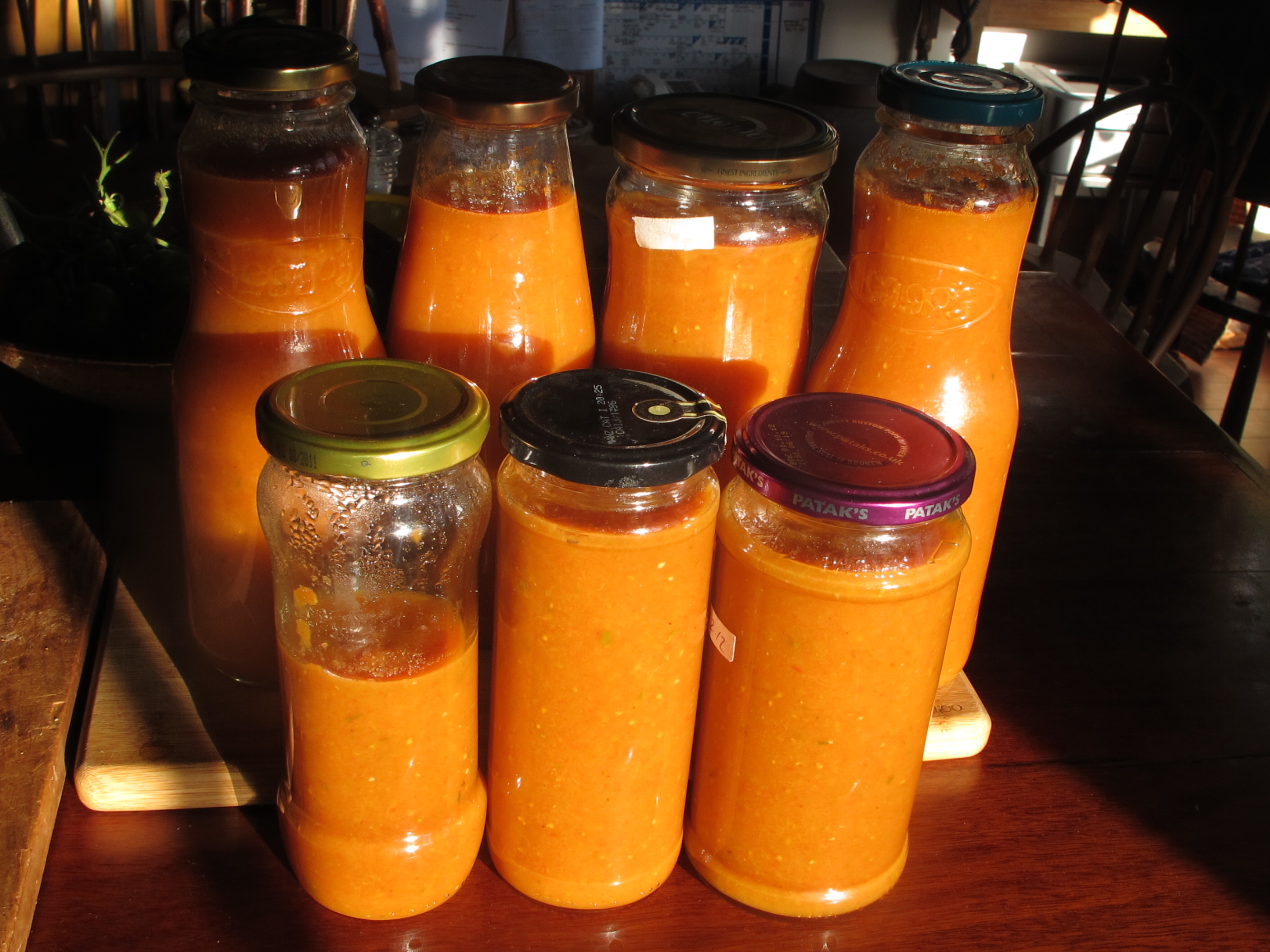
After sieving out the skins and seeds, the sauce is placed back on the stove to be reduced and concentrated a bit more, by about a third. This intensifies the flavour considerably. I try to make enough passata to last the whole year, so that we don’t have to buy any later on. This has been the case for a long time now. I haven’t needed to buy any pasta sauce for some years. This is one of the few things that we have been completely successful at achieving during our long experiment here. Self-reliance in passata!

IMG_8860IMG_8589

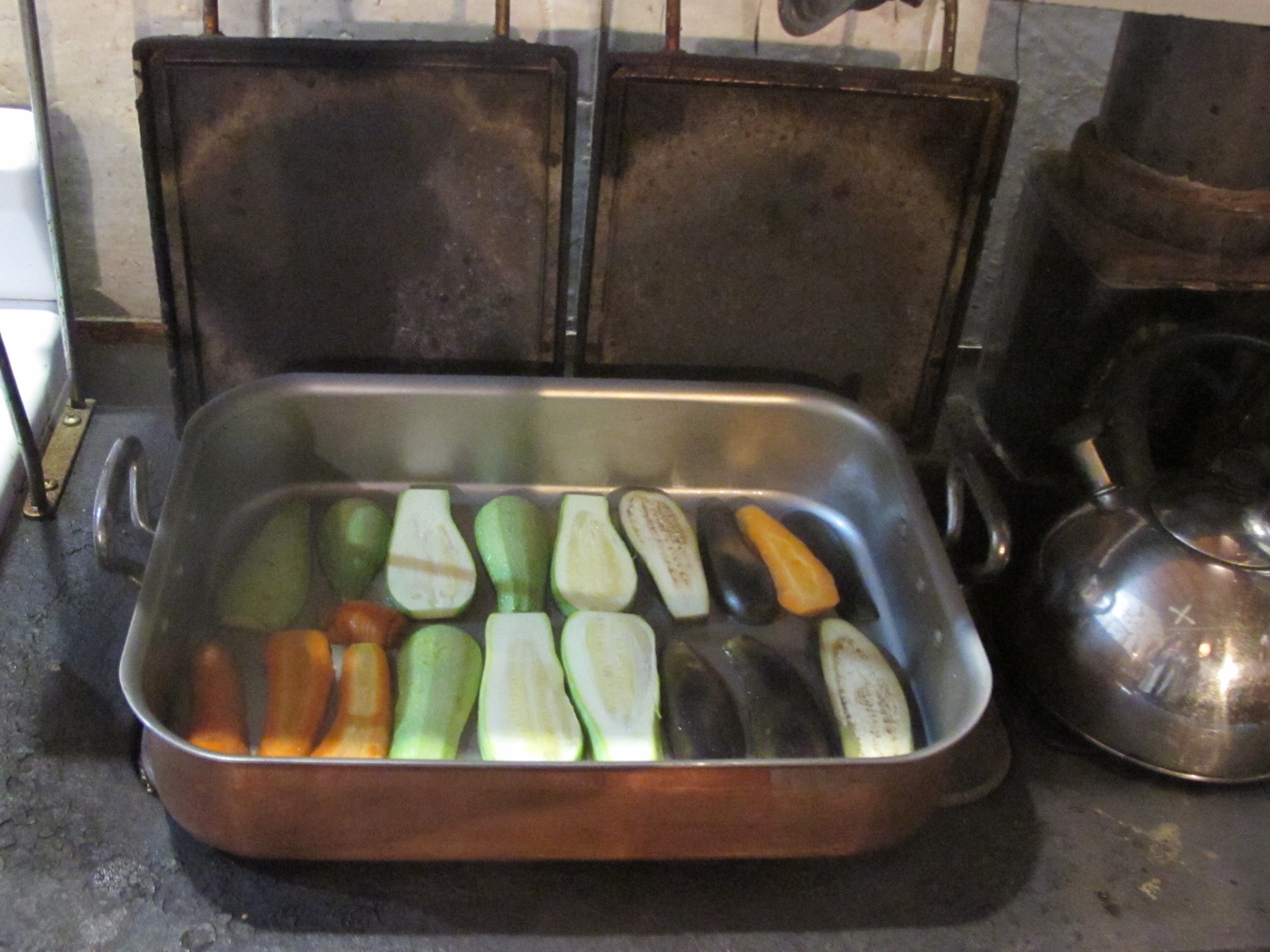
For dinner this night, I bake some carrots, zucchini and aubergines, fresh from the garden and serve it with a helping of tuna steamed with fresh Thai basil leaves, wasabi and a squeeze of lemon. While the oven is hot I use the heat to dry some of the small tomatoes. After an evening when we have guests and make a dozen pizzas. I use the remaining heat to dry a few trays of tomatoes. Dried tomatoes are great, full of concentrated sweet acid flavour. They keep really well without any extra energy needing to be applied. We use them in stews and soups and where-ever we need that little extra hit of added flavour.

IMG_8750IMG_8682 IMG_8821 IMG_8823

Indulging myself in this kind of self-produced and preserved, essential larder-filling activity is one of the reasons that I came here, to a place like this, miles away from services, where there was clean air and a lot of space to live out an imagined ideal. It takes a few hours a day of extra work and then occupies our evenings after dinner at the stove, but what could be better and more rewarding? I could of course be sitting, watching some brain-dead and fake commercial television show about how the cook?

IMG_8600IMG_8885

It seems to have worked out OK for us. We have managed to earn a living from various and diverse means, all more or less associated with pottery making. We have tried making and selling pots, ceramic tiles, making and selling clay to other potters, building kilns, writing books, doing weekend workshops and part-time teaching. None have proved to be sufficient in their own right, but all combined together, has provided us with a self-reliant, if unreliable income through most of the years. This combined with gardening and orcharding, as well as eliminating most tradesmen from our budget by doing all our own building and maintenance, means we have been able to continue to live out this self-reliant, utopian, creative adventure for the past 40 years together.

I beats working for a living.

Best wishes from Dr. Do-Little and his Ms Abundance

The Pig’s Ear, Chalk and Cheese

My new batch of native bai tunze porcelain stone clay body is ready – if you can call wet rock dust a ‘clay’? Whatever it is, it’s all lifted from the drying bed and stored in plastic bags waiting for pugging. I have been up in Sydney all of last week teaching a MasterClass in porcelain bowl making. I took along a couple of samples of my homemade porcelain bodies for my students to try. I got to throw this batch for the first time during this week. It was lifted on Sunday and thrown on Wednesday. Not a long time for ageing, but it was surprisingly good for something so fresh. It had quite a bit of stretch to it for milled stone but showed its true character by tearing with lots of stretch marks and little cracks as it was pushed to extremes.

IMG_8361

 IMG_8362
IMG_8363
IMG_8364
On the potters wheel it held up reasonably well for something so thixotropic. I had found that I needed to dry it out a little more before throwing because of the thixotropy effect of the kneading. This kind of milled stone body with lots of alkali present has very low plasticity and a very narrow range of Atterburg limits. This means that it goes from being too wet to hold its self up properly, to so dry that it becomes crumbly in a very short space of time, so drying is critical. I have learnt to keep it on the soft side until I need to use it and then stiffen it up to the desired consistency just before throwing.
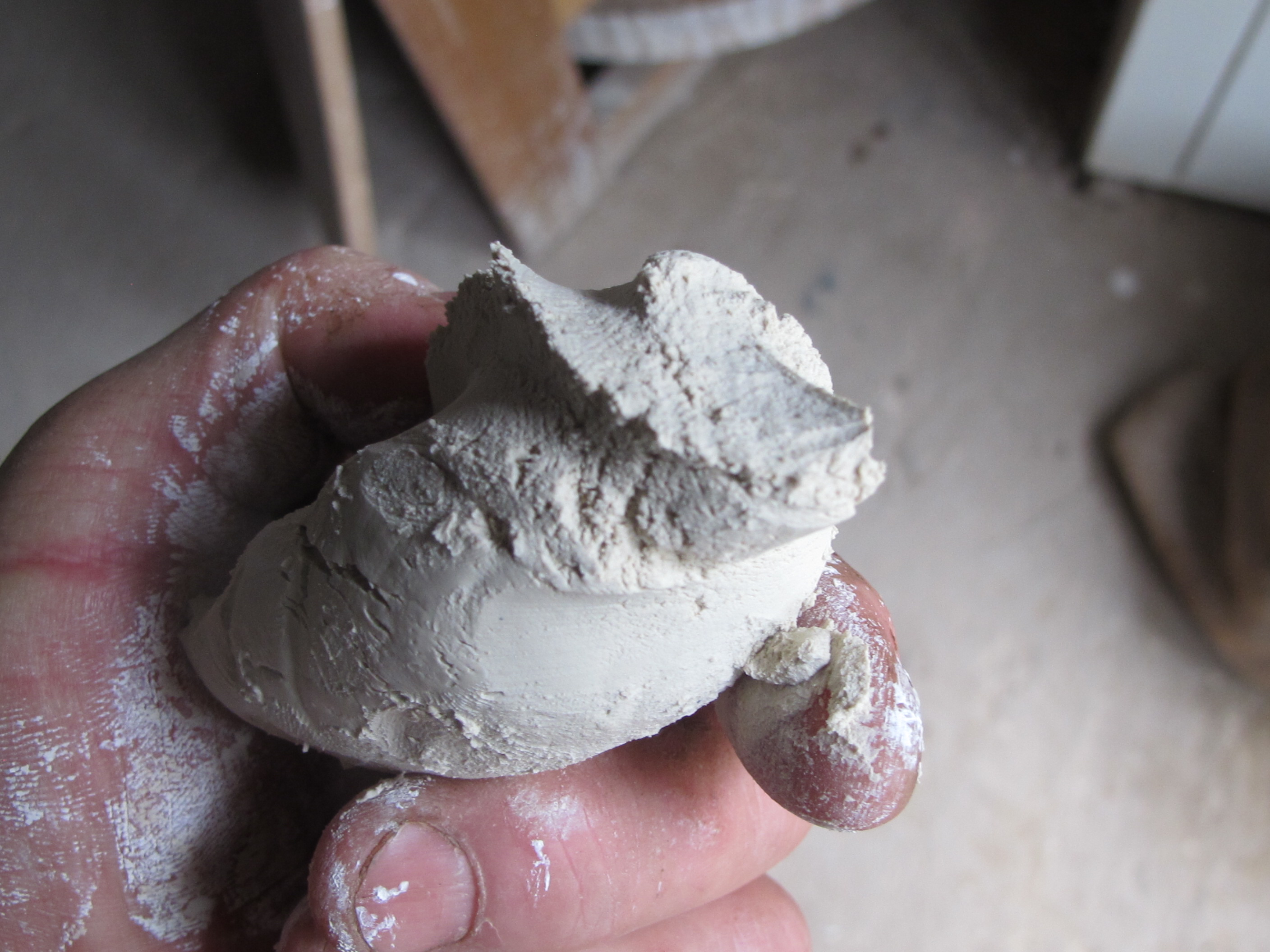
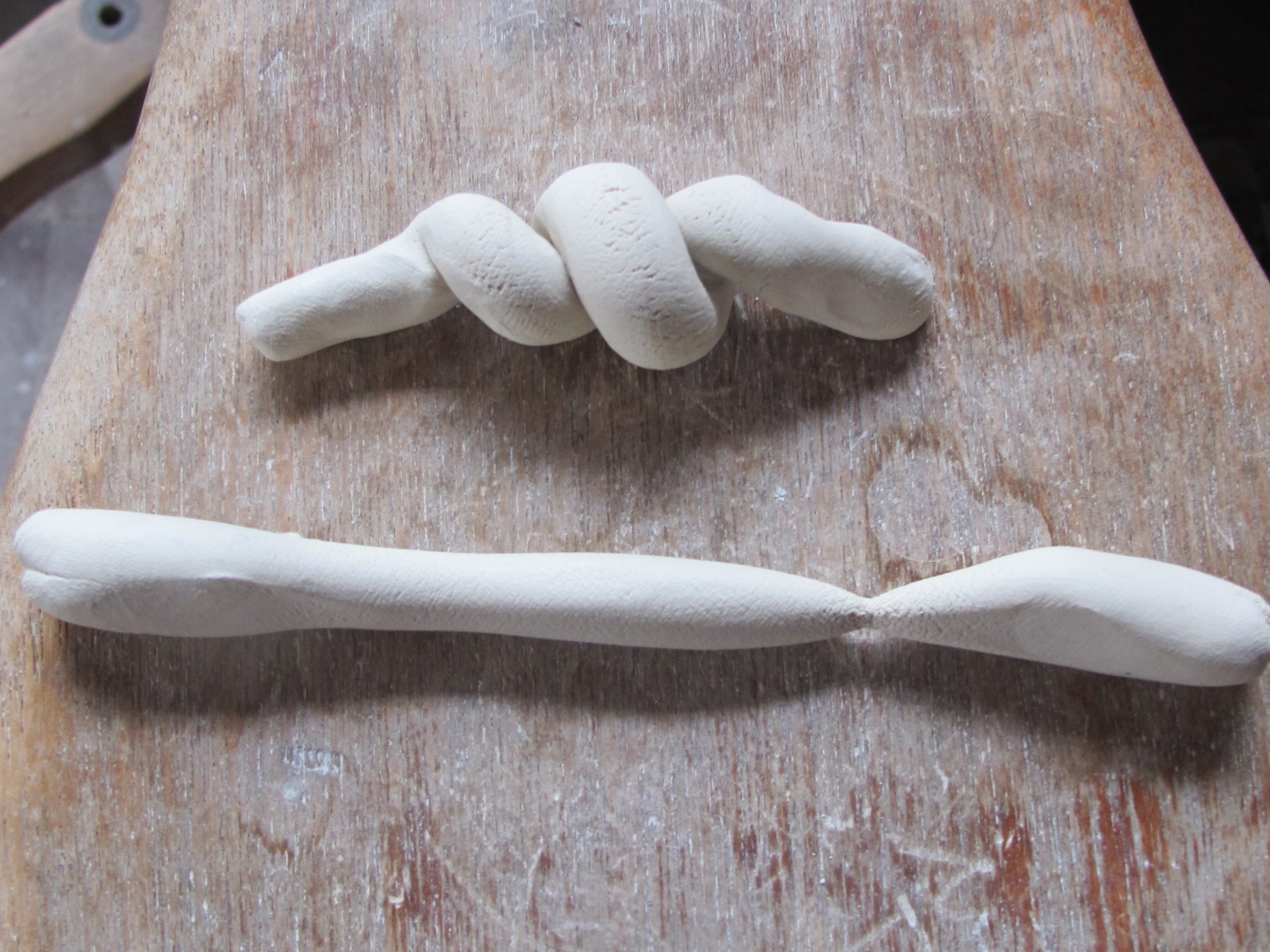
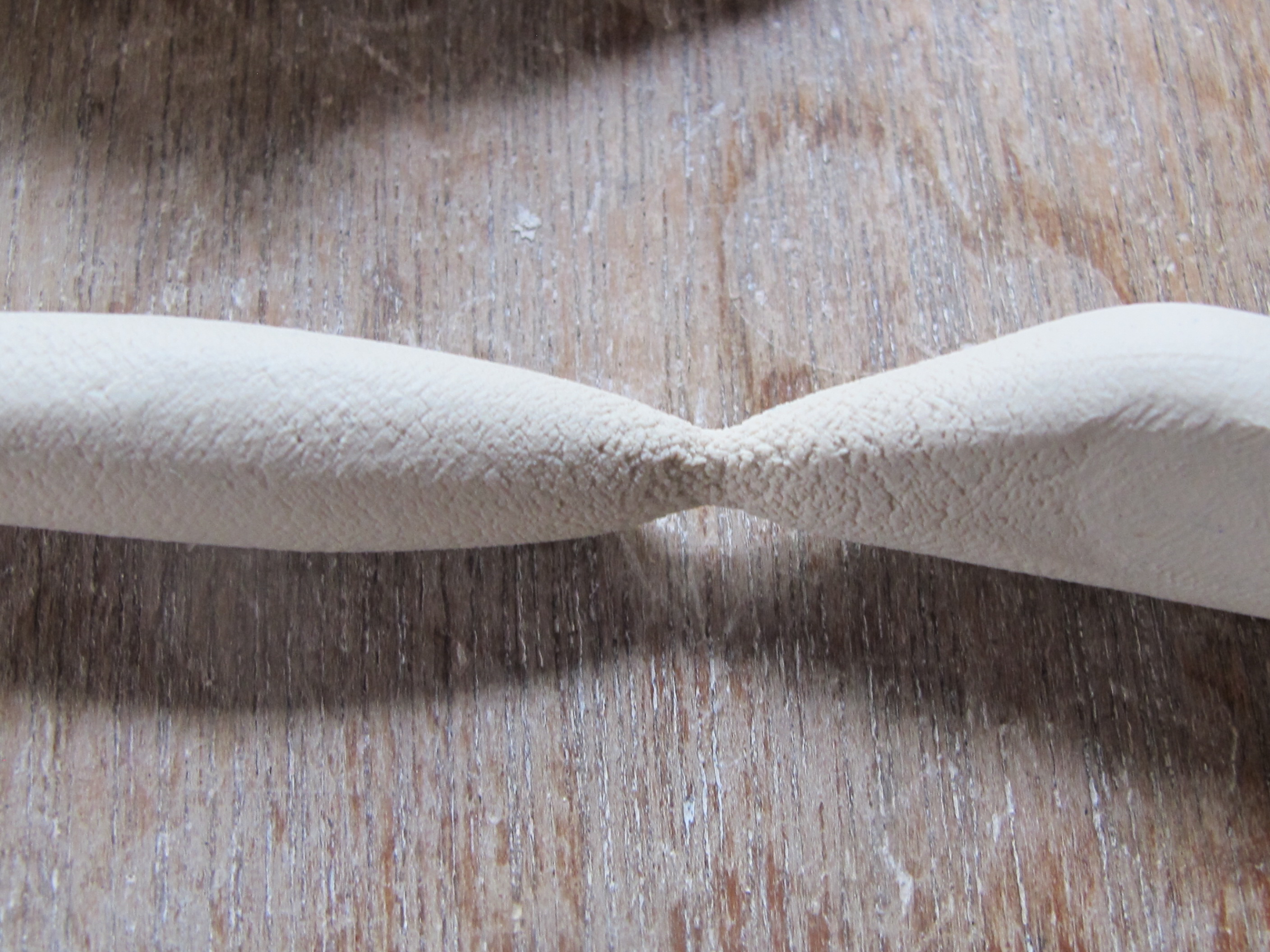
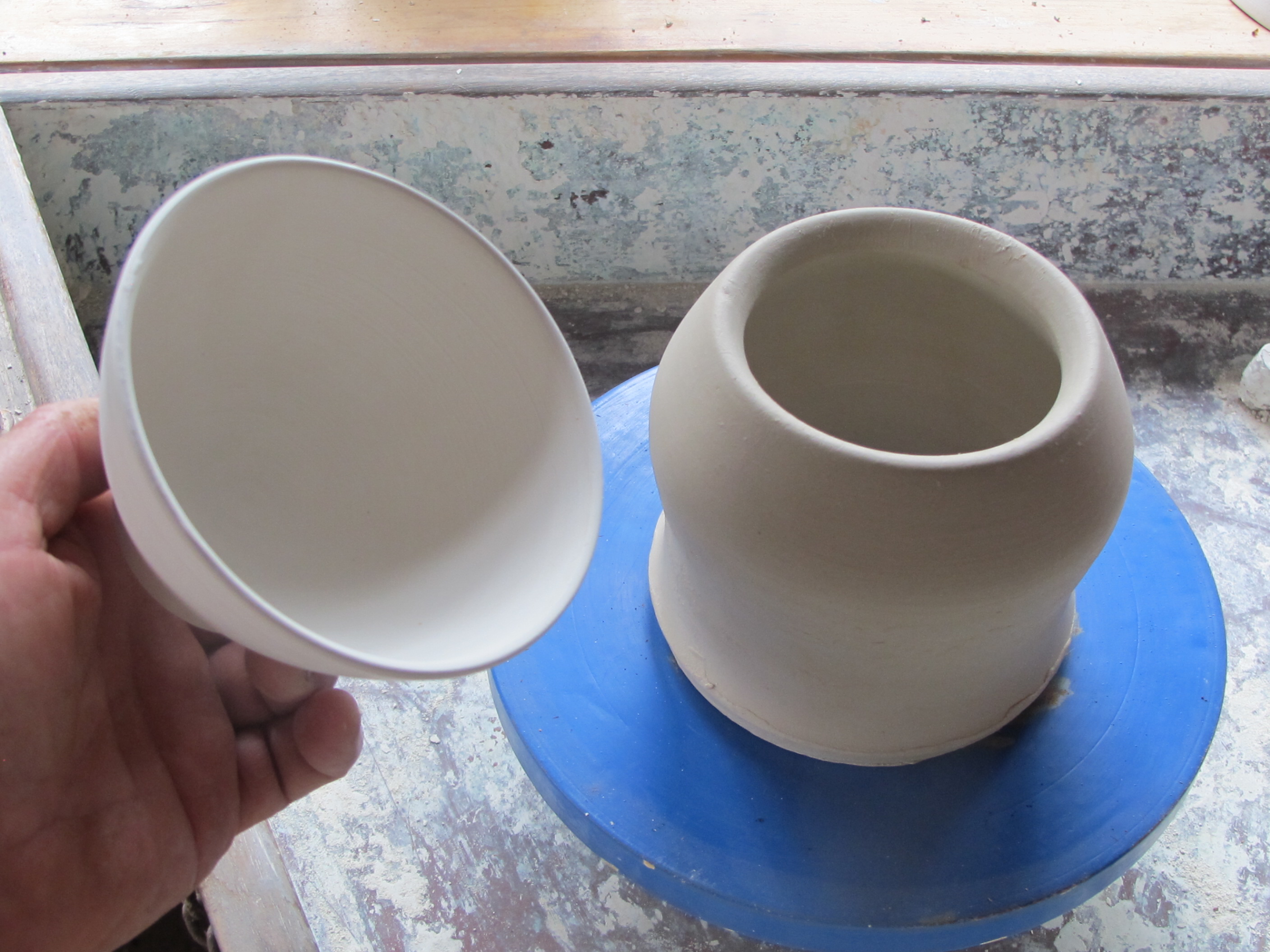
Conventional potters kneading doesn’t always give the desired result with this kind of paste. In fact, it doesn’t knead well at all. I learnt to wedge and knead clay in the traditional Japanese spiral fashion a long time ago when I did my apprenticeship with a Japanese potter. I became quite proficient at it. I had to. He was very demanding. As it’s turned out, this is one of the two things in life that I can do well, so I’m not embarrassed about my spiral kneading/wedging skills, in fact I considered myself competent.
So when a new teacher came to the National Art School in the early/mid seventies to teach there and we shared a class together. I got to learn something new. Gillian Grigg was very well trained in Stoke on Trent and later, topped off with a Masters degree from the Royal College of Art in London. She was a gifted artist and potter with an amazing range of excellent skills. Everybody was in awe of her capabilities, while she was was quietly diffident and understated. It transpired that one day we were sharing a class and the subject of porcelain came up. I mentioned that it was hard to knead, but could be done well with some practice and proceeded to demonstrate what I had learnt. Gillian watched and then quietly mentioned that she had been taught in Stoke that the technique of cutting and slapping the clay together, called wedging was proven to be a superior technique to spiral kneading.  As this was not what I had learnt, I was surprised to hear this. Gillian assured me that this was what had been demonstrated to her during her studies in Stoke.
Gillian spoke quietly, but carried a big stick of knowledge, experience and skills, so I listened, but I was very confident that I had good skills, perhaps too full of hubris and youthful inexperience though? We set about providing an experiment for the class. We divided a bag of porcelain clay between us and set about preparing it by our own methods. After 5 minutes of this we cut our block of clay in half and swapped half our clay with each other. We then proceeded to throw a pot out of each ball of clay. I had to admit that Gillian’s clay was noticeably much better than mine. Tighter and more workable. I learnt something that day and it’s stuck with me. Thank you Gillian! We were like chalk and cheese, she so full of fine, natural talent, acquired knowledge and hard won experience, while I was a young ceramic kelpie with too much energy and not enough knowledge or experience.
To this day I finish my preparation of these milled rock paste bodies with a session of cut and slap wedging. This new batch of bai tunze is much better for it. It’s a little tricky to get the moisture content just right, but once it is, it throws on the wheel with the plasticity of a soft-ripened cheese – double brie perhaps? After it’s been resting out of the fridge for a while!
When I am preparing the minerals for this body, I carefully choose to use the tannin stained black water from the water tank below the pottery that collects the most eucalypt leaves. This water comes from the tank a dark slate grey to black/brown colour like over brewed black tea. I choose this water because the tannin helps to create good plasticity. It reduces the pH of the batch as it is being made and neutralises the alkali that is released from the stone during milling, as the combination of alkalinity and fine non-plastic particles produce thixotropic effects. i.e. it turns into warm brie on the potters wheel.
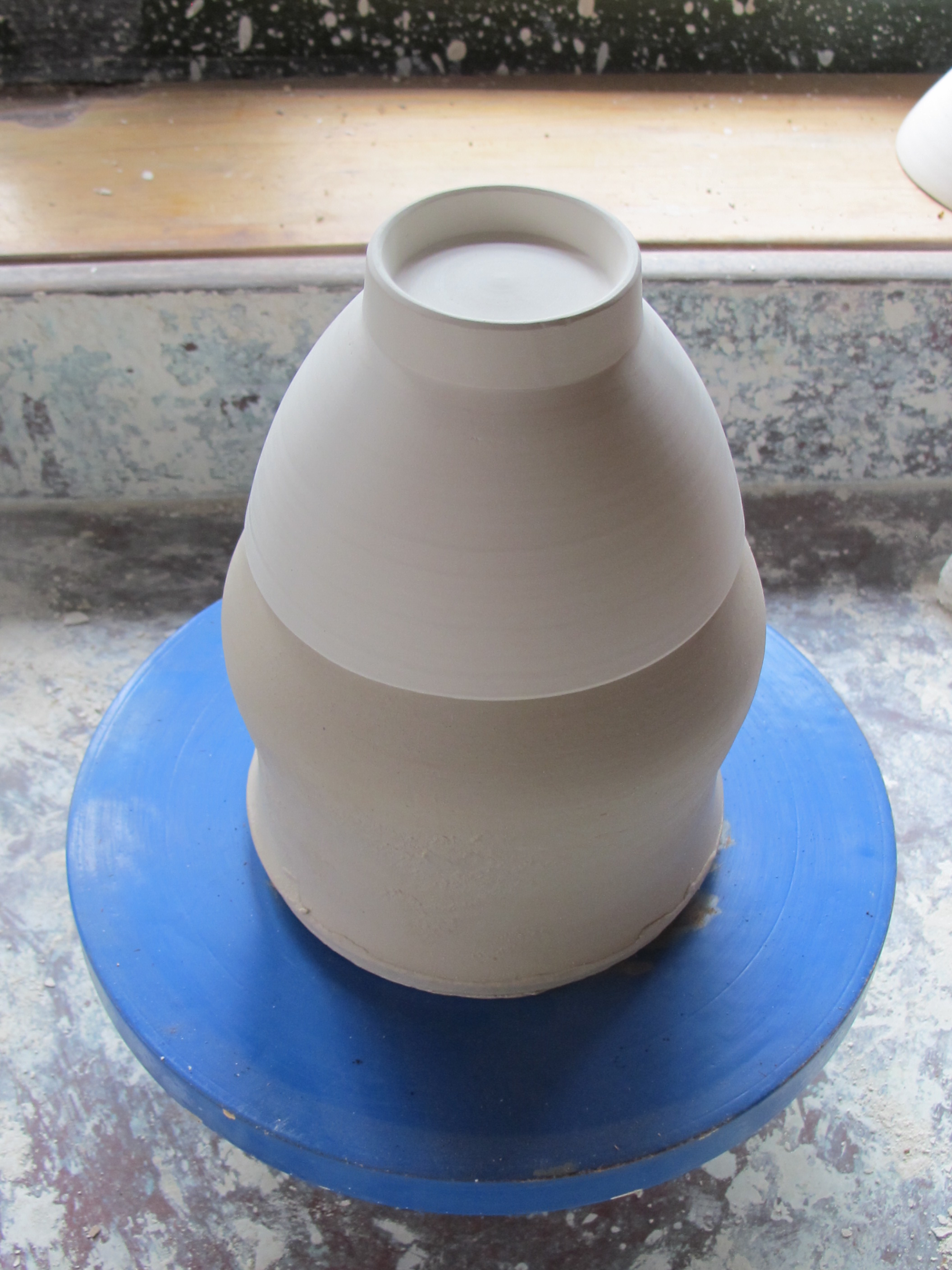
Throwing this clay is an exercise in coaxing a stiff non-plastic paste up into a simple form and leaving it thick at the base to support the rim.  It’s not a pretty sight, but if the form is well planned it can be coaxed into something by judicious turning later. When the pot is dried to leather hard it can be turned roughly to reduce weight and create a more even thickness, but this kind of non-clay material just isn’t sufficiently plastic to allow conventional turning. It tears and rips apart into torn chunks like cutting through Tasmanian Mersey Vally cheddar cheese. Very crumbly with no real internal cohesion. Roughing out is all that is possible at this stage. This clay turns from brie to cheddar, then to chalk over time while drying. The pot is left to dry to almost bone dry before it can be turned to a smooth, fine, finish. Turning bone dry requires very sharp turning tools that need to be re-sharpened regularly, as the stone fragments wear away the metal and blunten it very quickly.

IMG_8396

I have seen some potters in Japan using tungsten carbide tipped turning tools that hold an edge very well for a long time and I got to try using one in Tatsuya San’s workshop last year. I bought one after that, but I find it a bit heavy and cumbersome, as I’m used to making my own tools out of high carbon steel, re-cycled, packing case strapping. They are quick and easy to make and easy to keep sharp with a few strokes of a file. I like that they are so light and flexible. I guess that it’s just what you get used too. Perhaps I like them because I can make them myself from re-cycled material, forestalling waste and re-purposing industrial discards. It is one small part that adds to the bigger picture of self reliance.

IMG_8358

IMG_8357

Turning pots bone dry is just a little tricky also, as you need to use a specially designed leather-hard clay ‘chuck’ to hold the pot perfectly and intimately with exquisite contact detailing, such that the bone dry and very fragile rock dust bowl form won’t crack due to the stress and pressure of the turning and trimming. This process can also be quite dusty as well, so measures have to be taken to minimise the dust. I tend to turn while there is still just a small fraction of moisture still in the pot. In workshops where they turn like this day-in and day-out, they install exhaust fans to collect the dust in a dust extractor where it is collected for recycling. Turning dry clay like this is like cutting through chalk. Actually, it’s more like grinding away at a chalk surface and reducing it to powder to reveal a form encased or hidden within.  I’ve come to like turning, it’s the other thing that I’m OK at.
From the Journeyman on the remarkable journey from Cheese to Chalk and then on to the Pig’s Ear. (porcellana). Porcelain was named for its similarity the Italian sea shell (cowrie shell), ‘porcellana’. Named for its pale white, translucent quality. However, the shell porcellana was named for it’s similarity to the pale white translucent nature of a pigs ear. Hence Porca – lain. I wonder if I can make a ceramic purse out of it?
Best wishes from the potter with the cheesy grin, who’s bringing home the bacon.

Make Clay While the Sun Shines

Warning! This post could be very boring if you are not a potter – and maybe even if you are?
Contains technical terms and traces of nuts.
.
Making clay while the sun shines is a very good idea and ought to be possible in summer, but not this summer.
This has been the most amazing summer that we have had for many, many years. It’s hot, just like every year, but this year it has rained more than we can remember for a long time. We are having a great time. The rain combined with the warmth has made everything grow its head off. We have plenty of water in the dams and drinking water tanks, plus lots of food coming from the garden. We only have to water the garden every few days, as it usually rains in between at some point. Sometimes it rains hard enough to wet the soil sufficiently that we don’t need to water for a few days.
IMG_8261
Earlier in the summer it was raining very hard and very often, but now that pattern has changed to occasional showers. So it is now dry enough under cover to get my milled porcelain stone slip to dry on the drying beds and in plaster basins. I’m aware that it is not wet like this everywhere. There are bush fires raging down south, while I’m clearing ditches to guide the excess water away from the pottery. When it is this wet, the humidity is so high that it is very hard to dry liquid clay slip. It just tends to sit there and go mouldy while rotting the fabric membrane underneath that separates the clay from the brick bed.
IMG_8270
After 40 years of pursuing my project of self-reliance, I have decided to modify slightly my fundamentalist, hard-line approach of ‘total commitment to maximum achievable’ self reliance, to a more relaxed and flexible approach of ‘substantially committed to’ self-reliance.
In this regard I have recently decided to allow myself some slack and buy in more processed product to allow for an easier life as I age. For example, When I returned from my studies in Japan, late last spring, it was getting a bit late to put in seeds and start a summer garden from scratch, so I decided to compromise and buy some punnets of vegetable seedlings to get the garden up and growing, while I planted my seeds and waited for this second planting to come along as a second, follow-up crop. This worked well and I’m very pleased with the serried plantings and how they are growing and providing a steady flow of tomatoes, sweet corn and zucchini etc.
It’s a small compromise, but once compromised, why not go with it?
IMG_8172IMG_8183
IMG_8240IMG_8241

IMG_8242IMG_8244

Blanched French beans served with fresh, home-made basil pesto.

Blanched French beans served with fresh, home-made basil pesto.

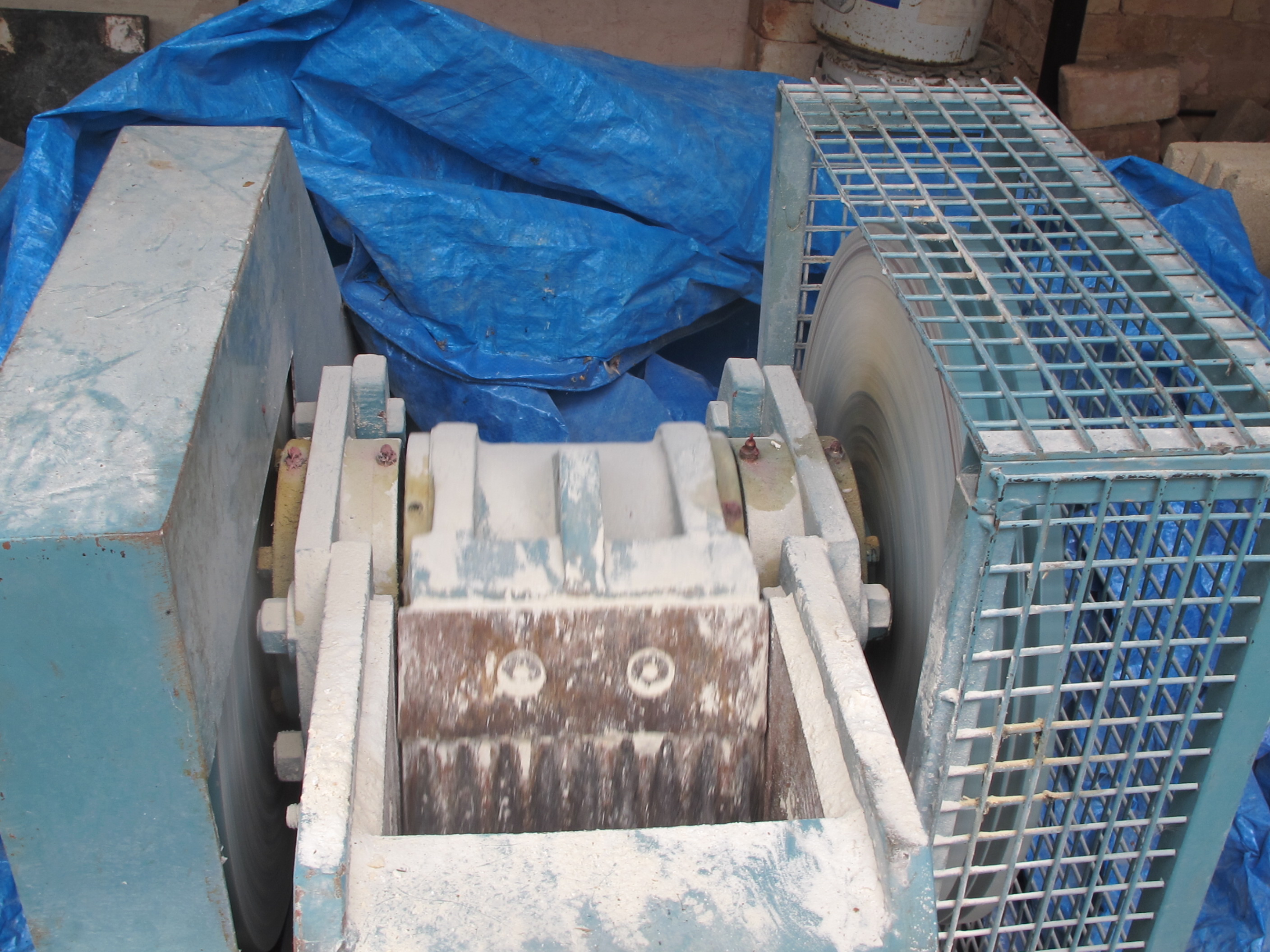
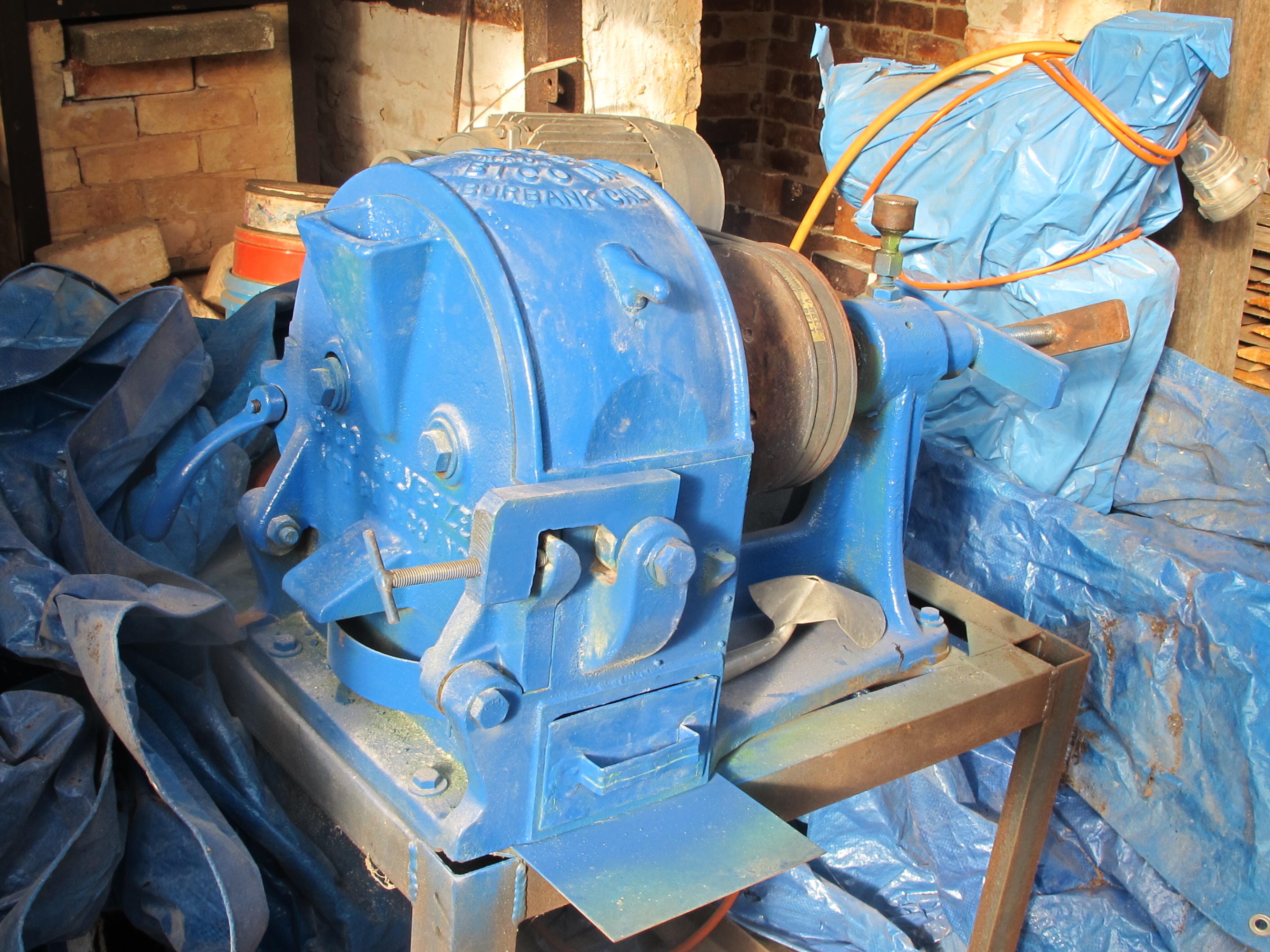
I have decided now to addapt this freer approach to my ceramic materials and my creative work. I have previously only used the rocks, shales and clays of my own local shire and I am still completely committed to this ‘local’ concept. I had found during this long extended period of research that although I tried very hard to locate everything that I needed to make my ceramics from only the materials that I discovered around me. I could not find any pale plastic throwable clay in a quantity that was useable. However, what I did find, was plenty of hard igneous rocks to make glazes and in the end I managed to make two really special, unique and very interesting stoneware clay bodies from self-processed, local rock dusts. To achieve this, I realised that I would need to add some bentonite (a very sticky clay) to bind and slightly plasticise these powdered rock bodies to make them useable. These rocks are so hard, that they need to be crushed first in a large jaw crusher, then a small laboratory jaw crusher and following that I put the grit through a disc mill and finally in the ball mill for 16 hours to get it really fine. Using this rather slow, convoluted and old-fashioned technology, that I obtained as industrial cast-off, from auctions and junk yards, I can process my finds from large rocks down to 200# powder in about 24 hours. It’s the drying out of the liquid clay slip from the ball mill that is taking the longest time and slowing the process down. Not helped by the continuing wet weather.
I never thought that I’d find myself complaining about rain!
IMG_8137IMG_8263
Warning, there are traces of nuts showing in this image!
IMG_8265IMG_8221
I pass the thin liquid slip through 100# sieve before settling out the solids.
IMG_8211
So, bentonite was my first compromise. It may not be local, but it is Australian. I have bought 3 x 25 kg bags of bentonite during my career. I also found that I needed to buy in alumina powder to use as shelf wash. This wasn’t absolutely essential, it was just very much better than all the alternatives, so another compromise. I’m still using this original 25 kg. bag of Al203. I use it sparingly, so It will last a very long time.
Recently, I decided to get some kaolin to add some slight increase in plasticity to my ground up local native porcelain stone bodies. This is not a local material either, as it comes from 300 kms away, but it’s closer than the bentonite. There must be something closer, I just haven’t found it yet. Proceeding on from my initial tests. I have decided to add 15% of this plastic kaolin to my ground porcelain stone body, it makes an enormous difference to it’s workability very quickly. I completed the first small batch tests of 5 kg each last year, before I went to Japan. So now I am making the larger 100 kg batches to see how they work on a larger scale. The tests were very promising, so I am eager to see them perform and feel them on the wheel. I was encouraged to follow on with this blending idea when I saw them making their porcelain body in Arita in Japan recently, using imported New Zealand kaolin. But I’m not prepared to go that far for some kaolin.
I have been told that the most famous porcelain body in Australia, which is exported all over the world, is made from Chinese kaolin, Indian felspar and American bentonite. At least the water is Australian!
IMG_8247
To aid the drying process of my ball milled (bai tunze) porcelain stone slip, to a stiff plastic, usable porcelain body, I make two batches. One of 30 kg in the big ball mill as a liquid slip. This slip has to be thin enough to allow the grinding down of the very hard rock granules from the crushers. After milling I allow the thin liquid to sit and settle for a day or so, to allow the very fine ceramic fragments to flocculate. I drain off the free water from the top of the settled clay material. At the same time I make a second 5 kg. batch in the smaller ball mill which is dry milled. I then add this dry material to the wet batch and mix them together. This significantly stiffens up the slip. I can then put it out on the drying bed or plaster tubs to firm up.
I drag my finger through the stiff slip to make it dry into usable square plastic blocks that are easier to pick up and store for pugging.
IMG_8272IMG_8214
IMG_8290
However, because of the very wet summer continuing on like it has, I’m finding that the clay just won’t dry as usual. The humidity is just too high. I’m having to lift the very soft plastic mass off the sodden brick drying beds and place it in the open air to get a little air movement over it to finish it off to a stiff plastic condition. Perhaps the extra 15% of kaolin content is slowing the drying a little as well?
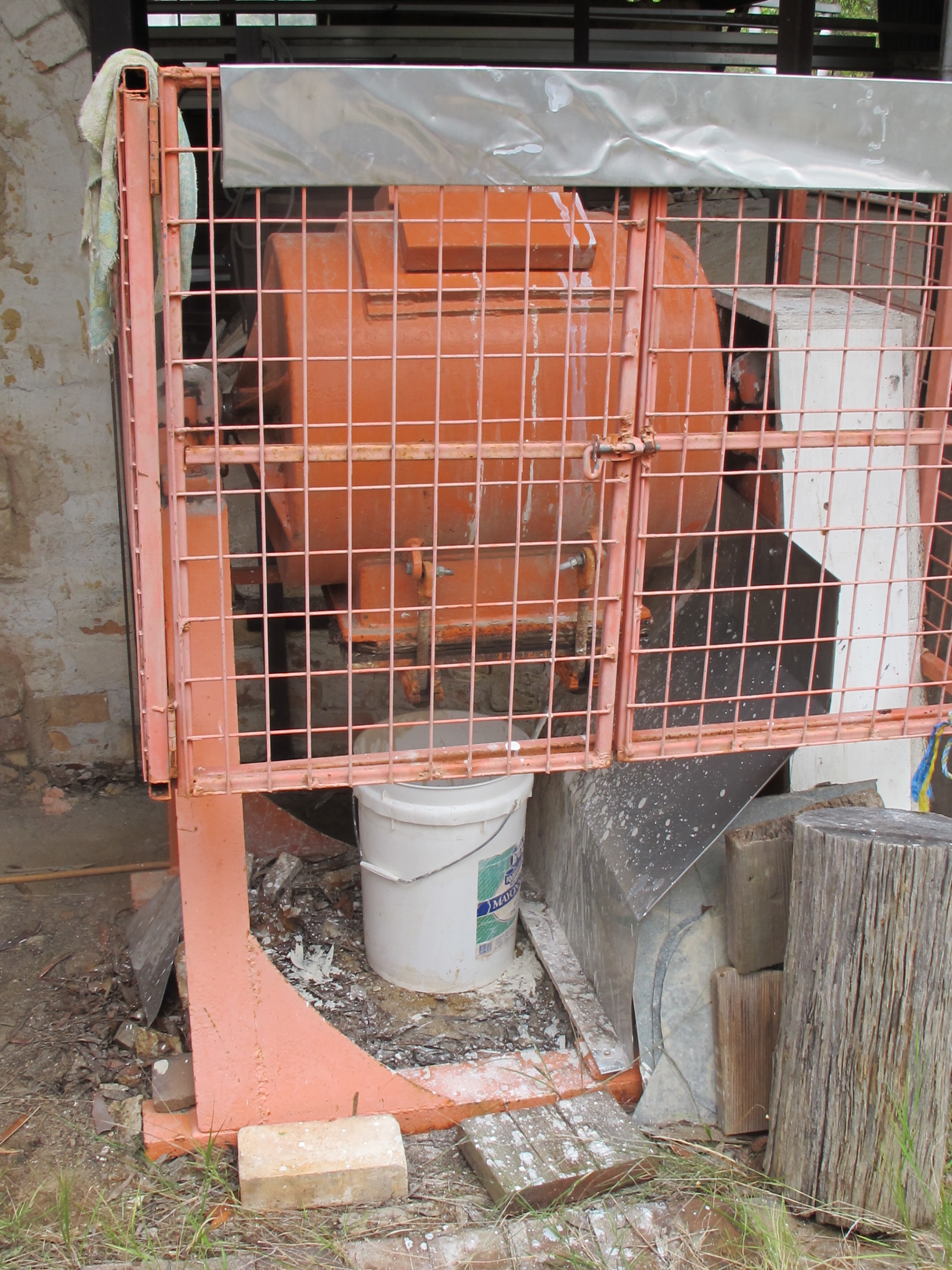
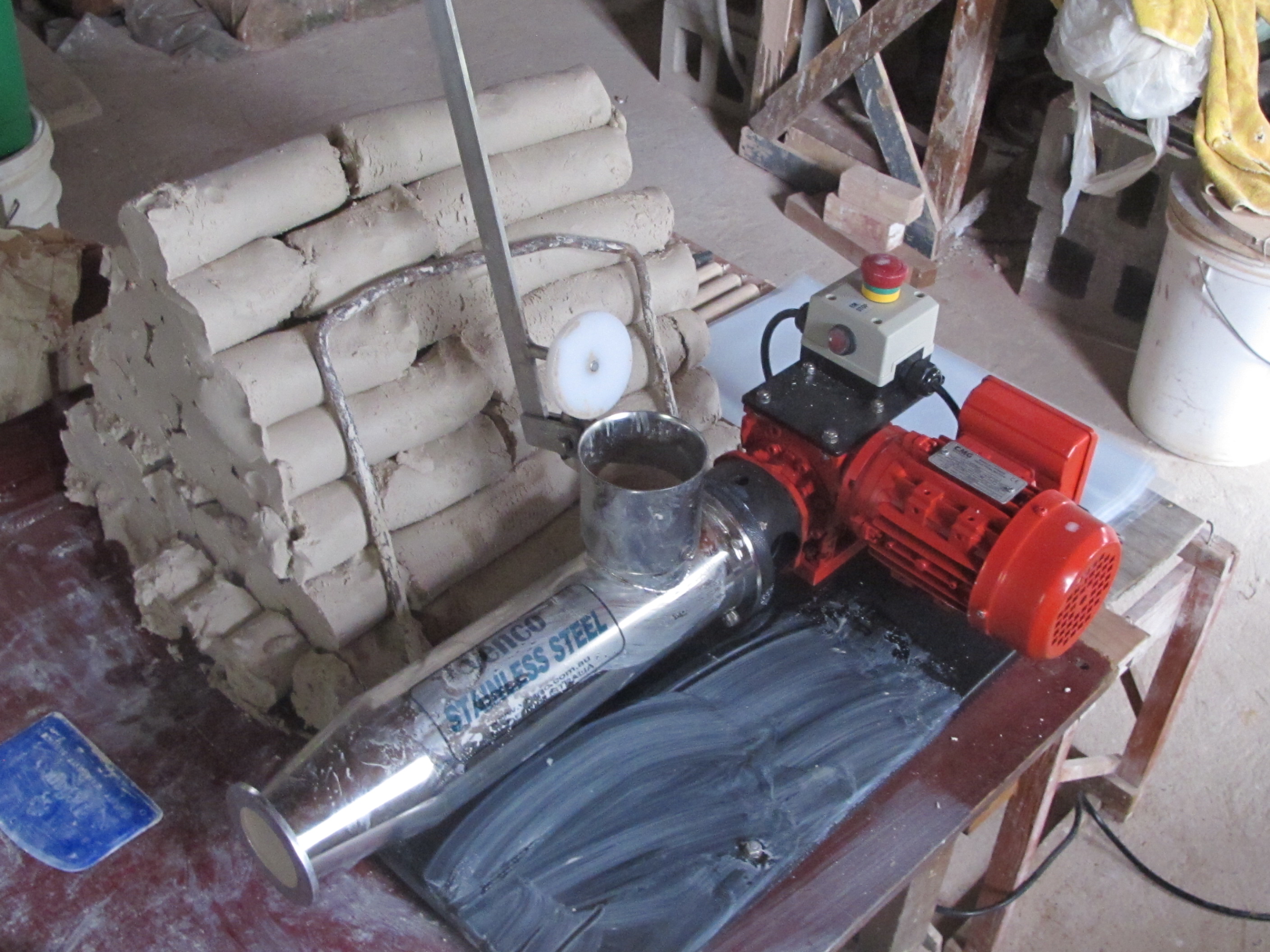
I have been using my new ‘VENCO’ stainless steel mini pug mill to pug the small batches of clay. It’s fantastic, quiet, fast for it’s size and ideal for small batches of porcelain body like the stuff that I’m making. And so much easier on my wrists than hand wedging.
IMG_8295IMG_8299
As part of this sudden loss of intellectual rigour and convenient relaxation of my philosophical standards, I hope to make my life a little easier in my latter years. However, I can’t help somehow feeling a bit like the philosopher Bertie Russell reneging on his death-bed. I am fully aware that this is where the similarity ends. I am no philosopher, and hopefully I am not on my death-bed either – just yet. I just feel like I need to extend my range and have the ability to work with an extended palette of interesting materials for my creative work. 15% of non-local kaolin isn’t going to change the fabric of my work in any noticeable way, but it will make the act of throwing a lot more pleasurable for me and extend what I can make.
So I have decided to start using materials that I have discovered that are outside of my shire and my previous 50 km radius of interest. Over the last 20 years I have experimented with my immediately available local materials, non of which are mentioned in McMeekin’ s book. I have worked on them to the point that I couldn’t think of any more variations that I could make to gain any further insight into these materials. Only extreme ageing could improve their plasticity, I’m too old to wait for that solution to work for me. I’d taken these materials as far as I could imagine. Another potter would certainly find new things to do with these materials, but I feel that I have lived and worked on this restricted palette for long enough. I want to experiment with some ‘new’, and therefore interesting materials that I don’t know anything about.
IMG_8266IMG_8280
To this end, I just went to collect some felspar from a site that I came across a few years ago, near my friend’s house, it’s 150 kms away. I only sampled it at that time, because it wasn’t within my target area, but it looked very interesting all the same and I can’t pass an interesting bit of soil by without at least looking at it and taking a preliminary sample. The initial testing proved that it was felspar and although quite weathered, it still has quite a bit of alkali, so it might turn out be very useful. I’m extending my range, making more flexible choices and hopefully making my life a little more interesting and a little easier.
I have a few different projects in mind for the future.
Best wishes
from the potter making many a slip twixt the mill and the lip

Go Slow, Look fast


The Pots from our own firing a week or so ago have all been cleaned and sorted out now in the spare-time that we can find between weekend workshops and work in the garden and orchards. We forwent the leisurely mushroom, egg and bacon brunch and got stuck into cleaning pots early instead. There’ll always be time for that leisure day sometime in the future – when I find myself bored and with nothing to do!
Janine got some really nice little cups with dramatic carbon sequestration and loads of natural ash deposit all over the fire-face. The clay body flashed red and the carbon inclusion is dark charcoal grey and black. A really lovely dramatic result for her.  I think that they are stunning little gems.
DSC_0001_024DSC_0001steve Harrison 2DSC_0002
She has used one of her older North coast, wild beach, pumice glaze. It varies from batch to batch, just as ‘wild’ glazes should. Varying from pale green celadon-like, through darker bottle greens into this transparent ‘honey’ brown on this occasion.
It’s a complex function of the natural variations of the materials, where they are collected and how they are processed, but also what they are blended with and in what proportions, plus the firing and the wood. I love this unknowable and unpredictable quality, so have absolutely no intension of trying to regulate or control this wild beach girl.
 DSC_0004DSC_0005
I love the way these little cups have flashed to a lovely warm red and yet picked up so much grey carbon during the firing, making for such a great contrast.

DSC_0006 DSC_0009

Some of these cups are so grey with sequestered carbon, that it makes them look as though they are on a dark clay body. but they’re not. In fact they are only glazed to half way, and the wood ash during the firing has glazed them all over in some places.
DSC_0024
DSC_0025
I have some nice rough country kitchen plates, glazed with the fluid blue/cream ash glaze. Some very nice ikebana vases fired in the front of the kiln in the ‘Zone of Death’ for the exhibition in Taiwan and three lovely tea bowls for the exhibition in Singapore. Plus two nice faux shino tea bowls for a group show at Kerrie Lowe Gallery in Sydney. So the pressure is off. I have everything that I need and more. This life of self-reliance and DIY seems to have worked out OK for us. However, it’s a bit late now after almost 40 years together and living here to go back and make any changes. We have committed to this life and it has been good to us.
IMG_4470
The ash glazed plates will mostly go into use in our kitchen, but there will be a few for sale in the pottery and on our ‘Gallery’ menu on the blog, when I get around to it. I threw them with a feeling of being fast and loose so that the throwing marks are quite distinctive. They were actually thrown reasonably slowly, I just wanted them to look ‘fast’. This was to show off the pooling effect of the ash glaze at high temperature. They have turned out well and I’m happy with them. I wrote about making them 6 weeks ago in ‘Give Peas a Chance’, when I was throwing them.
 img_4059
 There is an inevitable time lag between throwing the wet clay on the potters wheel, drying it to leather hard ready for turning the bases into a smooth shape and creating a ‘foot’ ring, if required by the form, then thoroughly drying them out before bisque firing. The biscuit firing is heated slowly up to 1000oC in the solar powered, electric kiln. Then after slow cooling, the pots are unpacked, fettled and prepared for glazing. The water based glaze mixture is made from sieved wood ash from the kiln and/or kitchen stove firebox, mixed with ground up local stones. In this case the application is quite thick because the glaze runs and pools at high temperature. After the glaze is dry, the pots are packed into the wood fired kiln to be heated up to 1300oC in reduction atmosphere over approximately 20 hours of constant stoking.
It’s amazing that potters will actually come here to work through the night firing the kiln with us and be happy for the experience! Potters?!!
The pieces below were in fact fired in my own firings, squeezed in-between the regular weekly workshop firings.
 DSC_0007_014DSC_0007steve Harrison 2DSC_0016
DSC_0009

DSC_0023_013DSC_0023steve Harrison 2
DSC_0025_007DSC_0025steve Harrison 2
DSC_0049_012DSC_0049steve Harrison 2

DSC_0044

These 3 Ikebana vases have come from the kiln looking pretty good. I’m very lucky! They all say wood fired, but they are each different in their own way. The first 2 are made from my washed basalt gravel sediment paste body. Black and mat and exerting a strong influence on the glazes that I apply over them. The 3rd from red flashed stoneware that has picked up a lot of carbon inclusion during the firing.
I made a number of these vases, so I have a few to choose from. I will put these others up in the gallery.
DSC_0002
DSC_0034
DSC_0060
DSC_0067
.
The tea bowls that I have selected for the exhibition of ‘Chawan’ in Singapore are a mix of shapes and styles.

DSC_0012_015DSC_0012steve Harrison 2

 This bowl is of the more open ‘summer’ style of tea bowl.
It is gently undulating with a softness of form and surface, but with superb strength of character. It speaks quietly but looks as if it knows something about a big stick.
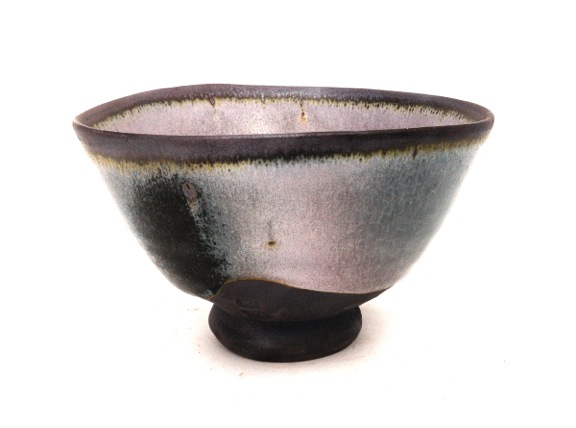
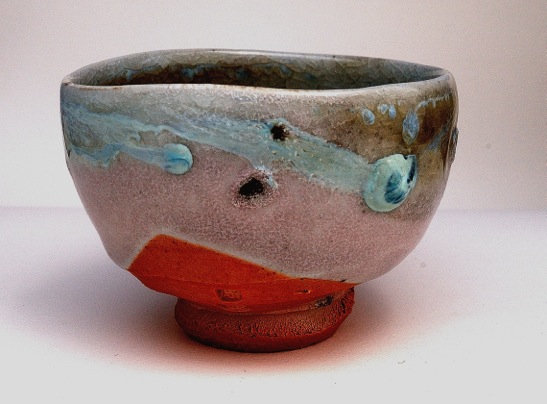
It is made from my washed basaltic gravel sediment body paste. It is very unusual. It fires dark charcoal grey to matt jet black. The extraordinarily high iron content makes it quite tricky to fire to high temperatures in reduction without melting it. When it survives, it is amazing. I love it. The body seeps its iron into what ever glaze is covering it and it changes them. In this case the glaze is an ash and rock combination that fires to a mushroom pink colour, with hints of grey and chocolate. Where the wood ash from the flame during firing impinges on the surface, it can bleed into the glaze base and turn it transparent so that the black body underneath is revealed. This bowl was very fortunate in the kiln. It was enhanced beyond what I put in the kiln, through the firing experience and emerged with a range of surface colours from matt pink to perlucent grey through to transparent black. The rim shows a saturated iron chocolate brown, where the glaze has run away from the rim during firing.
The surface exhibits four seasons, dry matt black, clear glossy transparent black, soft satin pearlescent blue/grey and densely matted soft mushroom pink. I love it!

DSC_0022_01

This bowl although new, looks old.
It has had a tough short life and shows it experiences clearly on its surface. However, it still carries itself with grace and poise, despite its scars and marks of surviving the experience of the firefront. A bit like life.
It has superb strength of character. A strong, beautifully textured foot that illustrates the roughness of the clay beneath, while draping itself in a luxuriously soft, satiny, pink/grey cloak of wood ash and granite glaze, with highlights of runny pale blue opalescent ash glaze.  It’s a closed ‘winter’ bowl and feels wonderful in the hands.

DSC_0062

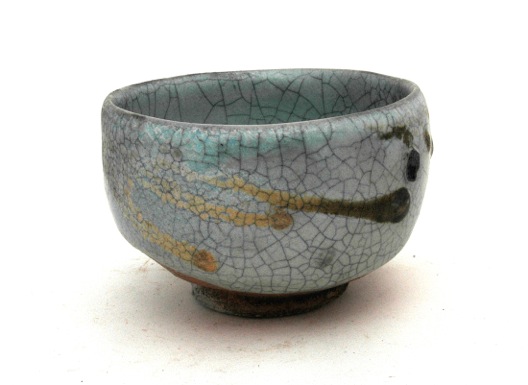
This ‘winter’ bowl is glazed from my local native ‘bai-tunze’ porcelain stone body, converted to a glaze by the addition of our local limestone deposit and a small amount of ash. The resulting glaze is of the ‘guan’ / ‘celadon’ family of glazes. it is pale blue/turquoise green where it is applied thickly over a pale clay and a more sombre grey where thin. this stoneware body has a small amount of iron present, just enough to colour the clay grey in reduction with a charcoal carbon inclusion where it is exposed directly to the wood fire flame. the ash that has melted over it during firing varies from golden yellow to mat brown and contrasts beautifully against the thicker turquoise glaze on the rim.
It has a quiet contemplative feeling and a subtle restrained beauty.
I’m quite happy with these three different bowls, made from 3 different ground or washed rock bodies and with 2 different wood ashes and ground rock glazes.
This next bowl is a response to some wonderful work exhibited by Toni Warburton, where she re-imagined traditional grey shino with a completely contemporary take that involved making grey shino images, textures and colours at earthenware temperatures. These were ceramic paintings/sculptures that imaged the aesthetics of the old wares. They were exhibited at the Australian Ceramics Assn. exhibition; “The Course of Objects – The Fine Lines of Enquiry”.
I really liked this work very much. I couldn’t have thought in this way. But, once having seen it, it spurred my imagination. I’ve always had a reluctance to try my hand at shino. It’s been so overdone and especially by wood firers, and why not? it’s an amazingly good and ever so attractive glaze surface. But, exactly because everyone is doing it, or has done it, it suffers from over exposure. I don’t want my work to be indistinguishable from everyone else’s.
I really admire the original pieces made in Japan in the Mino area in the last two or three generations by Arakawa and his followers and imitators. If Shino is what happens when you take the local stone and apply it over the local clay, then that might have some area left to be explored here in the Southern Highlands and its surrounds. It won’t be shino, but it will be one of the local aesthetic variations that are possible to conceive of in this place, at this time.
I decided to try my local granites. aplite, porphyry and other acid volcanics and their derivatives, just to see what would happen. I even drove out of my shire to access some acid volcanics next door.
I’m thinking that if I apply this simple formula of ‘use what I have’, then do the best that I can with it. I just might get something interesting.
So this is what I have started to do. I don’t know what I’m doing with shino, I’n a novice, but I know my materials, so something has to happen. Let’s hope it’s good.
This winter bowl was fired in the ‘Zone of Death’ at the front of my kiln firebox. It’s blushing with embarrassment at being so lucky to have survived the ‘zone’ in a first attempt at Faux Shino.
It’s called ” Me No Know Mino”
DSC_0048_018DSC_0048steve Harrison 2
I think that there is a bit of potential here.
Watch this space.
This new work will be shown at the Kerrie Lowe Gallery in Newtown in a few weeks time.
Best wishes from the slow moving Faux Peasant and his Wild Beach Girl.

Old Slag and a Tosser

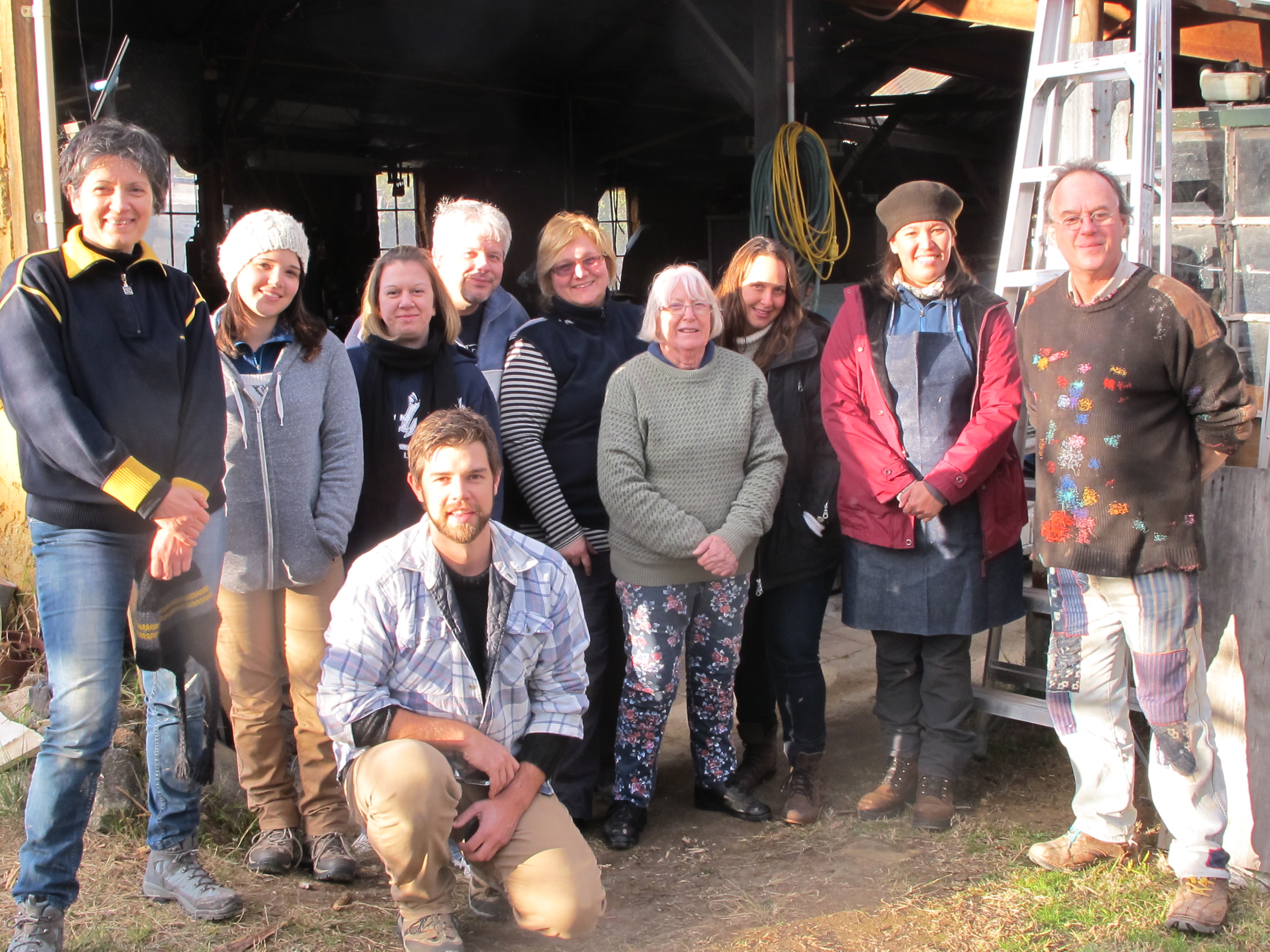
We have another weekend wood firing workshop. Another amazing group of wonderful people. Everyone so engaged and enthusiastic. I have to cut split and stack more wood. Prepare the kiln and its furniture, kiln shelves and props. Check out all the fittings and structural elements to make sure that it all goes smoothly. The fire box lid lining is on its last legs, but will last a few more firings. It takes a few hits from our enthusiastic new stokers, with well-meaning, but miss-placed logs at high temperature.

IMG_4594

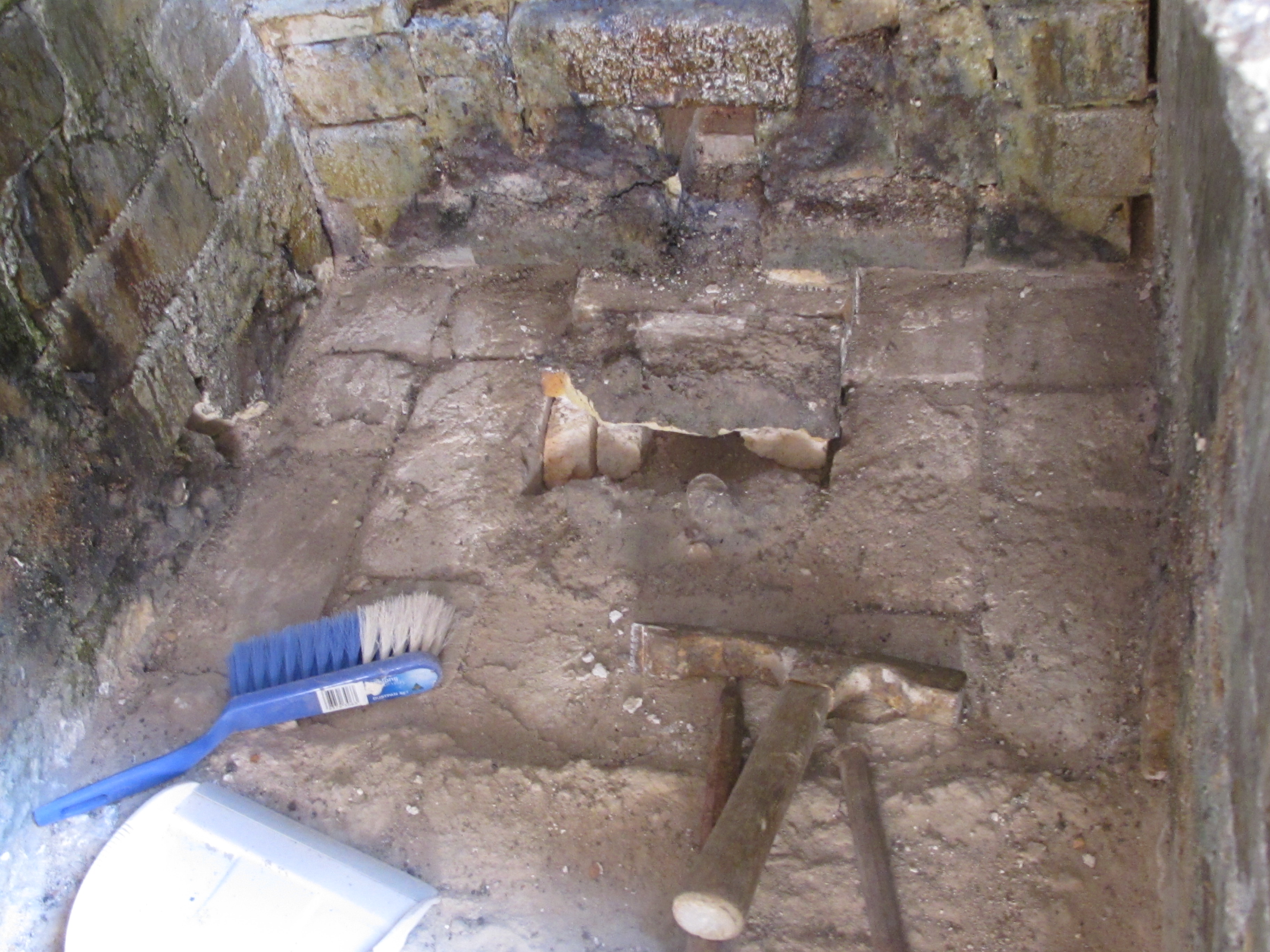
Before we can fire the kiln again, There is maintenance to do. I have to get inside the fire box of the kiln to chip out the molten ash glaze slag from the last firing. This has to be done after every firing. The ash from the firing collects in the base of the firebox and accumulates to the point that it melts into a molten slag at the high temperatures at the end of the firing. It forms flows of liquid natural ash glaze that pool into the floor bricks. This is the same natural ash glaze that decorates our pots during the wood firing and gives them their distinctive wood-fired look.

There is alway some minor repair work required after each firing . Sweeping out the dusty ash and charcoal, chipping out the slag that threatens to block off the air holes. This is normal maintenance. However, when I get inside the firebox this time I see that the last firing had such fluid ash glaze formed at the end of the firing that it has run and pooled into the very important mouse hole in the base of the ash pit. This hole is most important to keep the ember level under control during the firing. It has to work properly, otherwise I can’t control the fire as easily and everything could go pear-shaped.

On close inspection I find that the ash glaze slag has completely filled the air hole and sealed it off completely. To avoid this occurrence, I place a special little kiln shelf ‘lid’ over the hole to deflect most of the ash to the periphery of the hole and this usually works. But the combination of wood that I have used this last time has created a very fluid slag and every thing had disappeared into a grey/brown puddle of lava. I can’t even see the ‘lid’ or the hole beneath it. I work on the principal that I know that it is under there. I have to climb into the firebox base armed with a 2 kg hammer and cold chisel, a crow bar and a skutch hammer. I have protective goggles over my glasses and a dust mask as I set to work in this cramped space, hammering and chiselling as best I can without being fully able to swing the hammer properly. I bash, chip hammer and prize my way through the glassy, lava-like slag. It is brittle and smashes into jagged, conchoidal, shattered spalls. Bits fly everywhere. It’s in my hair and all through my clothes. I have to be careful not to cut my fingers trolling through the pieces, tossing them back into a bucket in the kiln chamber. I finish by sweeping up the small fragments and dust. It’s a crap job, stuffed into this small space with all the dust and sharp edges, but it has to be done and no-one else, including the kiln fairy, is likely to volunteer. I keep putting it off, hoping that the kiln fairy will do it, but no such luck there. It’s all part of being self-reliant. I often put it off till the last minute, because I just don’t enjoy it, other times I get stuck into it first thing. It all depends on my energy levels and state of mind. There is no avoiding it. It just has to be done.

IMG_4590

IMG_4591

Although it doesn’t look it, it’s actually all cleaned out and ready for more work.

I’m lucky and very grateful that this is the worst job that I have to put up with. It’s certainly the least glamorous job in the pottery. It’s all very well, sitting in the sun being creative and making lovely things that are visually engaging and wonderfully tactile. Unpacking the kiln is like Xmas, but no-one daydreams of all the hard graft that goes into ‘creativity’. Don’t give up your day job!

We have a -2 oC frost overnight, during the firing. It keeps us sitting up close to the kiln during the midnight to dawn shift. Our European friends will call us pathetic wimps. That isn’t cold! Minus 40 is cold. I know that, but we are in Australia, the land of heat and sunshine, draughts and heat waves and not used to the severe European cold. Minus 2, certainly felt cold enough to me. If it got colder than this on a regular basis, I’d build a different shed. One that had walls!

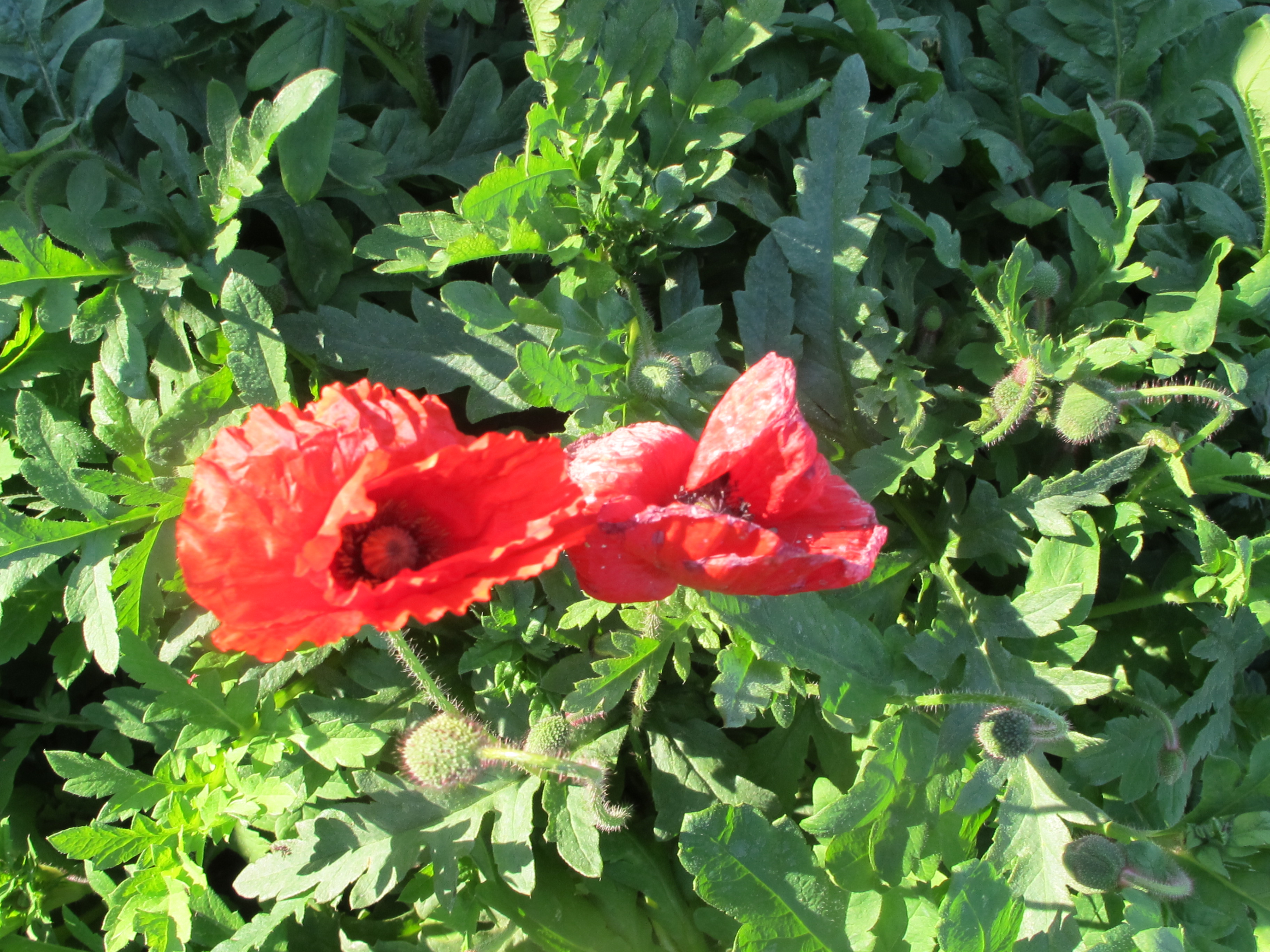
A quick walk around the garden reveals that the last 2 rows of very late potatoes in the garden have now had it. The frosts are coming regularly now. Not severe, but light and regular. I think that this must put an end to these spuds, but they still have a few green leaves. I don’t need the space just now, so will leave them to their own devices, till spring. I can’t see anything coming of them. However the single red Flanders Poppies growing among them seem to love it.

IMG_4620IMG_4656

IMG_4643IMG_4603

IMG_4604

IMG_4619

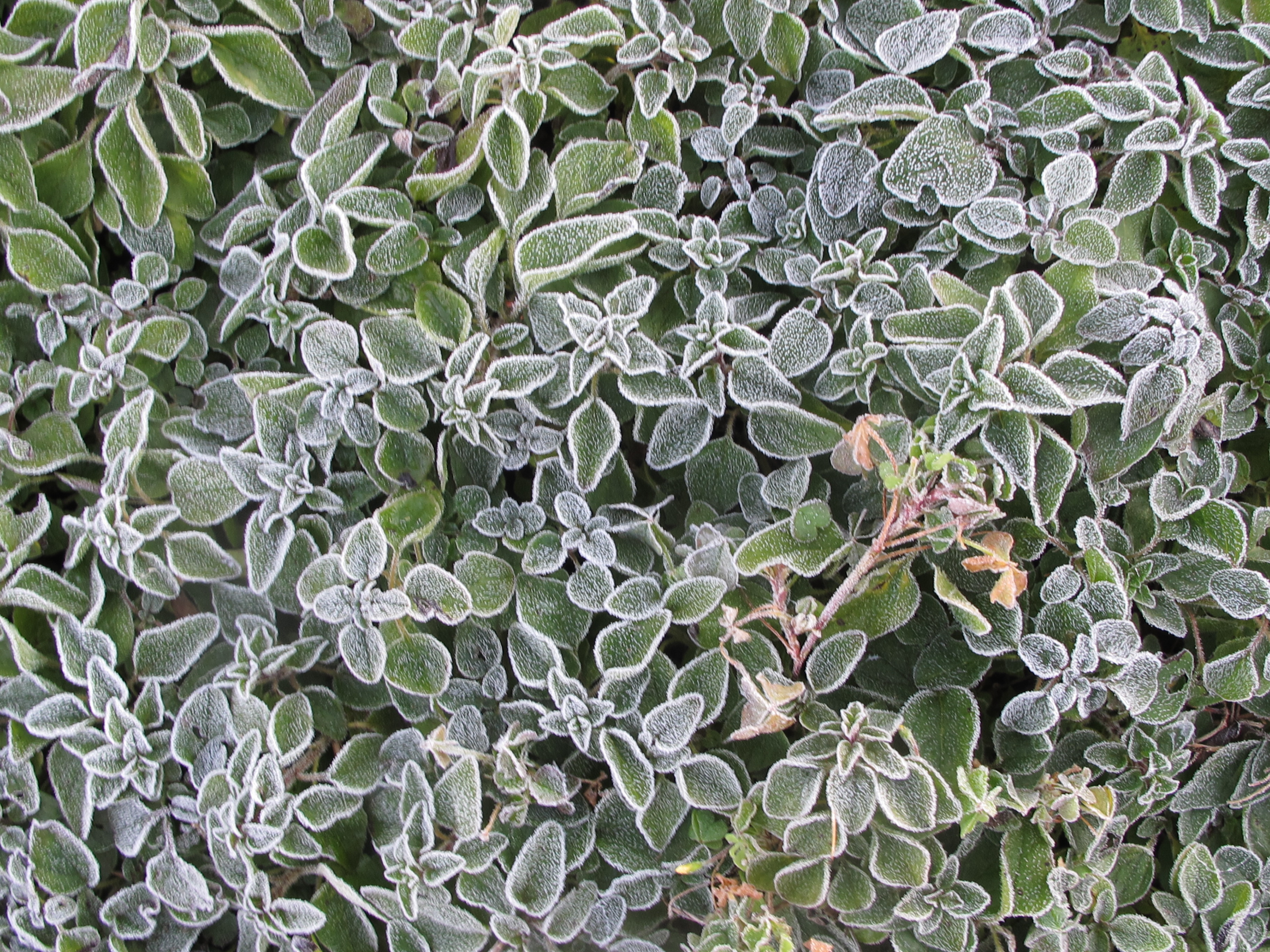
There are lots of pretty images in the garden of leaves tinged with white frost and ice crystals. The ground crunches under foot as I walk about. There have been several frosts like this one now. It’s good. It will finish off a lot of bugs like the fruit fly, that can over winter in milder climates. This ‘chill’ will help all the old varieties of fruit that need their winter chill to become fertile in the spring.

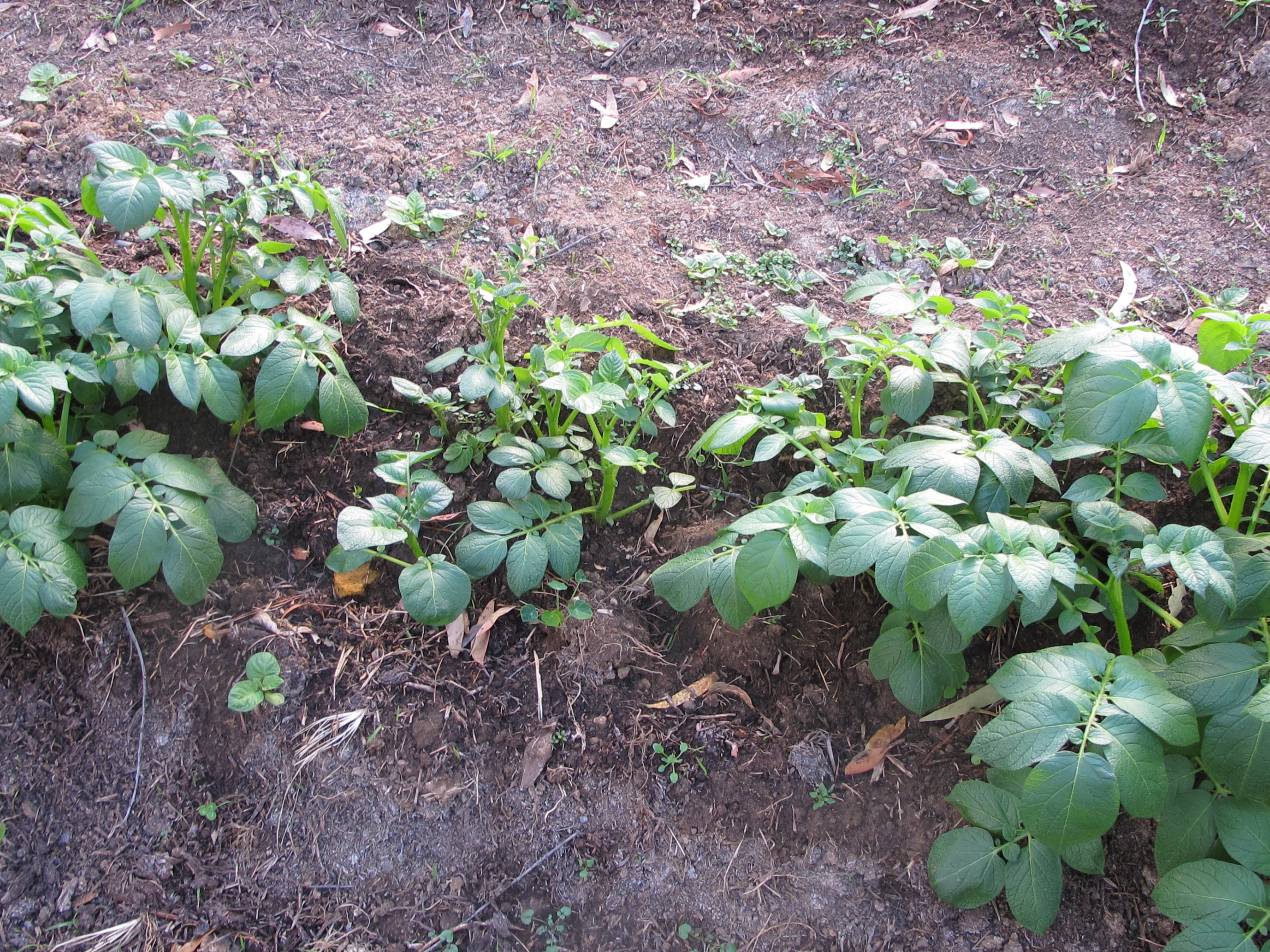
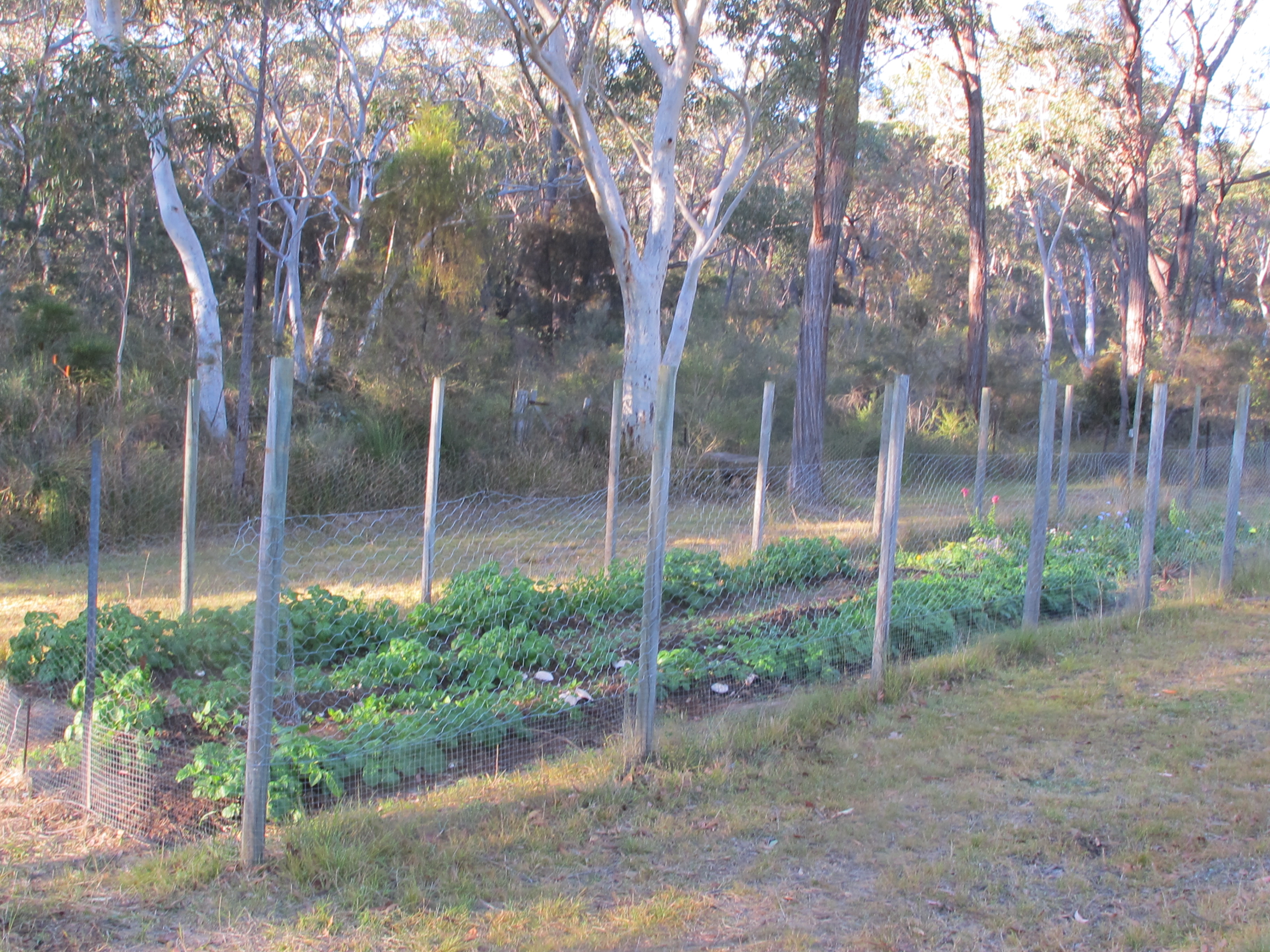
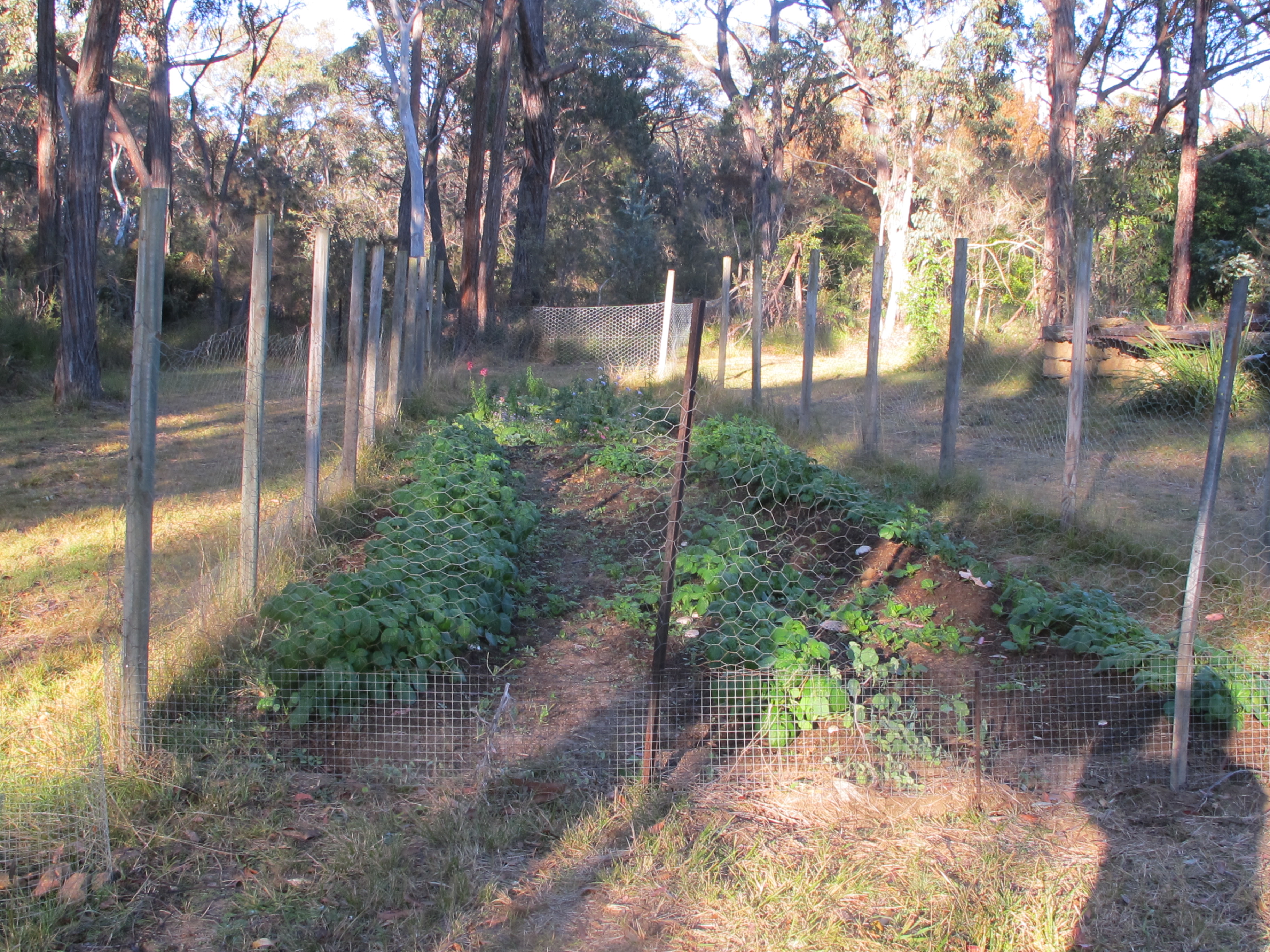
I walk down to the Pantry Field garden. It’s situated down at the bottom of our land, in a clearing in among the tall eucalypts. the tree cover of the tall crowns gives a modicum of protection. I have a quick look around and see that the frost hasn’t penetrated here as yet. The big potato crop is still doing just fine, no frost damage. But on closer inspection I see that a lot of the tender tops of the plants aren’t burn’t off, but completely missing. Nibbled off by our resident Eastern grey kangaroos that wander through here attracted by the grass, tree cover, undergrowth protection and the availability of 4 dams to choose from for water. No wonder that they hang around. They treat the place like they own it, and they do! They were here first. We haven’t fenced our land at the boundaries at all. It is all open for them to pass through and enjoy. What we have decided to do is to fence off the various islands of garden and orchard, to keep some possibility of getting a crop to ripen. These plants haven’t been attacked till now, so now is the time to do something about it, If I don’t, they all be gone in a week or so.

IMG_4612IMG_4611

IMG_4628IMG_4629

IMG_4630IMG_4639

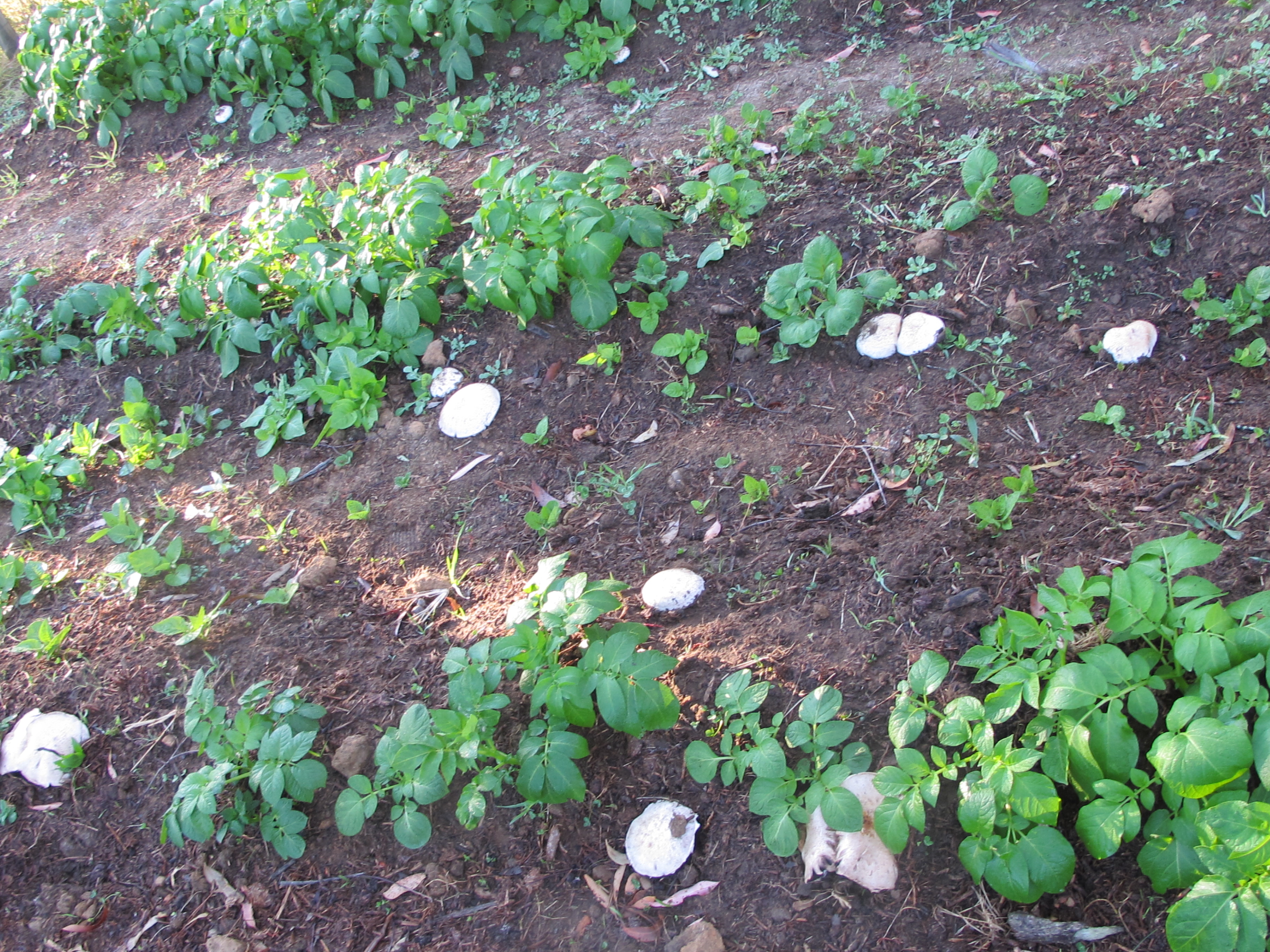
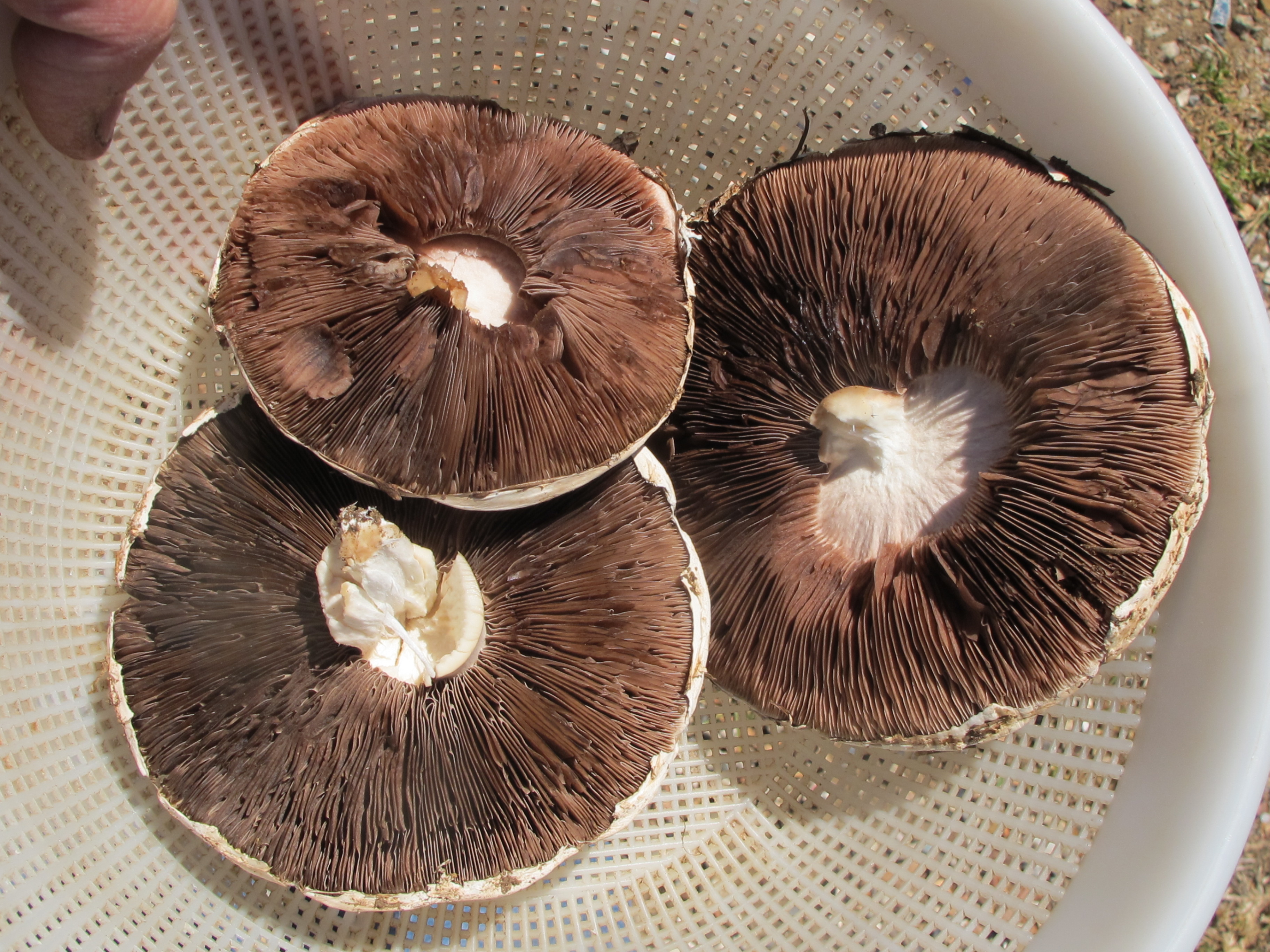
I make it a priority to extend the fencing wire up to 1.5 metres. Up until now we had got by with only rabbit proofing fencing. Wire mesh that we could step over. Now I need to make a taller fence with a walk in gate, plus an openable end to allow the tractor to be able to get in and out for tilling once a year. While thinking all this through I see that there are another crop of mushrooms coming along. I can count about twenty or more. We’ll be changing our diet slightly now and for the next few weeks to include Mushroom soup, mushroom sauces, mushroom risotto, mushroom in white sauce and eggs and bacon for that leisurely late brunch. If we can find a day that we can declare to be leisurely?

Fond regards from the old fun-gi