Carving Out a Living

While our pots are drying, we go on an expedition to visit a few of the local potteries in the area. This whole city is dedicated to the making of porcelain. there are thousands, if not 10’s of thousands of small workshops all over the city. We go to one of the nearby potters districts. We have come in this direction because there is a potter here that we want to meet. I am travelling with a PhD student from The ANU in Canberra and his interest is in tenmoku. The potter we have come to visit is the local Master of the Northern ‘Leaf’ Tenmoku Style, which they call ‘temu’ around here.

The original dark glazed and buff bodied Northern tenmoku bowls were first made by potters in the Tianmu mountains in Northern China and were used by the buddhist Monks in the near-by monastery for drinking green tea. Monks who came to this monastery left with a knowledge of Buddhism and also a penchant for the drinking of green tea. They also took away the distinctively shaped bowls with the out-turned lip and tiny foot that is the defining character of this style. the ’Tenmoku’ form. The name ‘tenmoku’ seems to be applied to just the dark glaze these days, but it is really the name of this particular shape of bowl. Such that you can have a white tenmoku, or a blue tenmoku, even a hare’s fur tenmoku, because it has a glaze that is a little reminiscent of the fur of the local wild Hare.
IMG_0244_1 IMG_0250_1
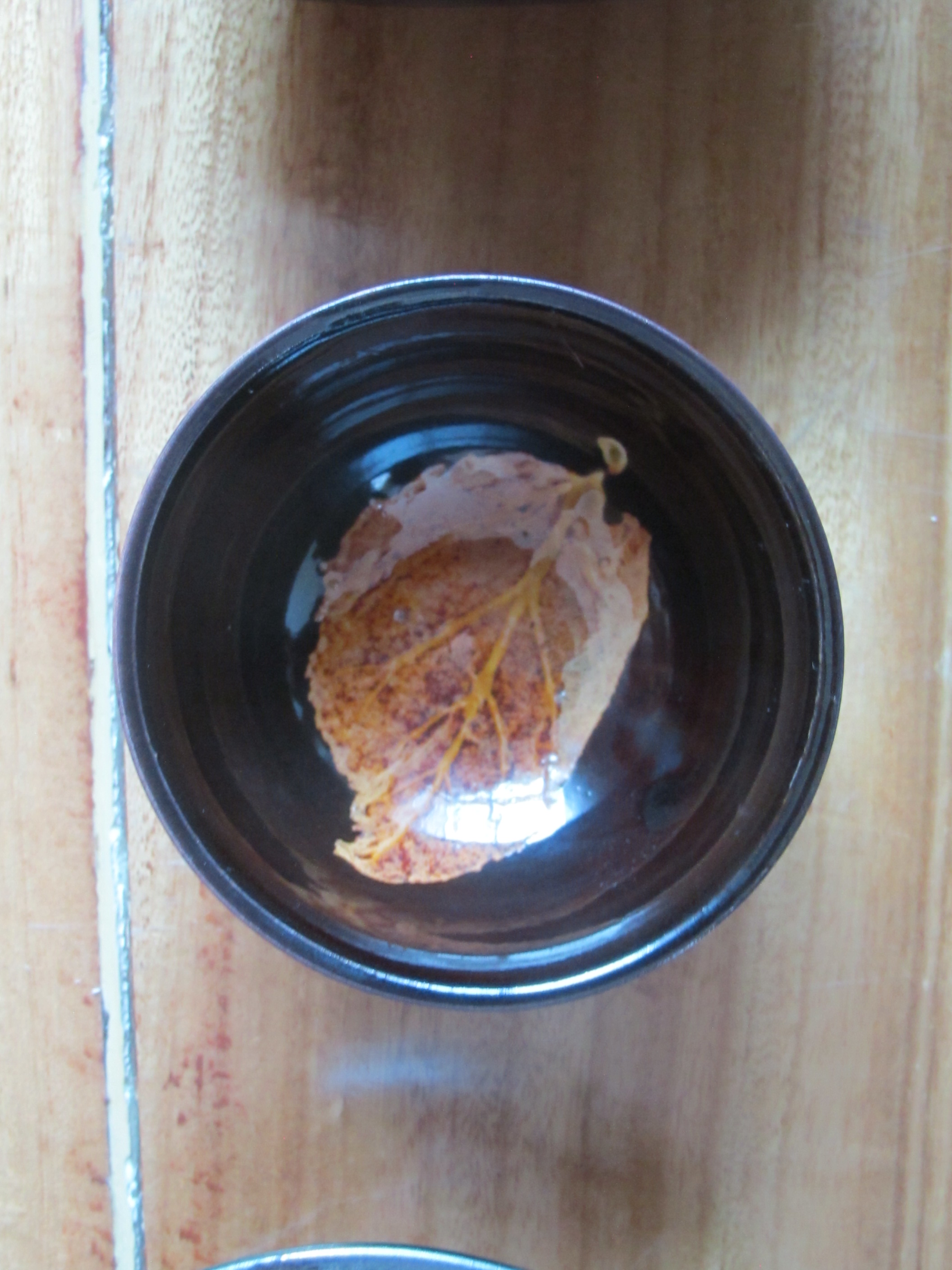
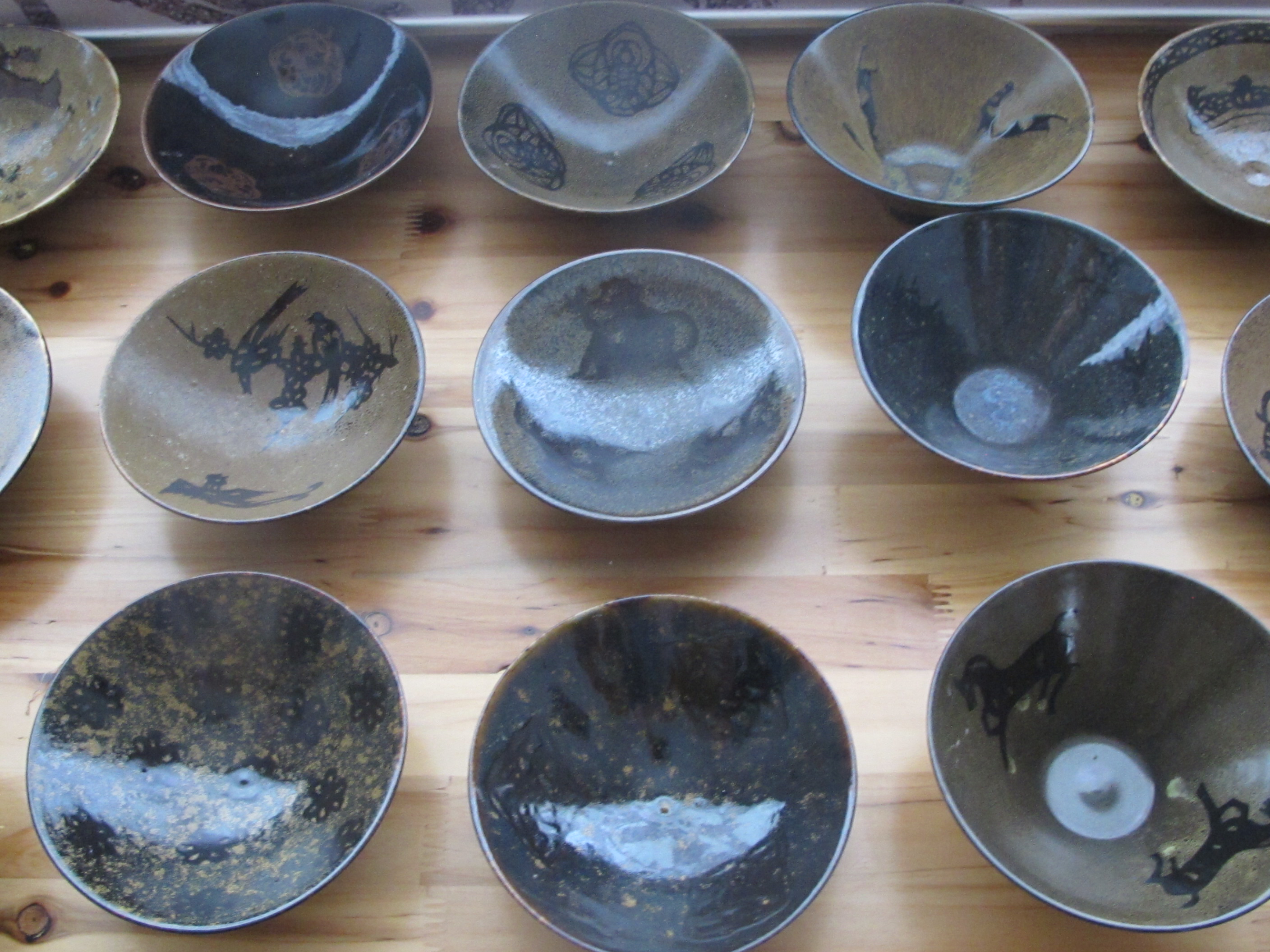
This potter, Master Liu, has dedicated his life to the study of ‘leaf’ tenmoku. a very ancient variant of the form. He seems to be doing quite well for himself these days. He has assistants working in and around the studio. He has his own large gas kiln and a few electric kilns. The show room is new and 5 stories high and quite well appointed, a new two story house, all set in a little ‘muse’, just off the main street. The technique of ‘leaf’ tenmoku is one where a leaf from a particular tree or bush is placed on the surface of the flat black glaze and when fired, the leaf burns out and leaves only a few microns of ash which in this case, contains some special elements that colour the black glaze, so that the imprint of the original leaf can be seen in the glaze surface as a silver or golden ‘X-Ray’ style outline of its radial structure. I ask if any leaf will do and am told, “No, only the leaves of one very special plant will give the effect”. But that’s all I’m told.
IMG_0237_1 IMG_0235
He has taken the old technique to another level, where he can reproduce the effect so reliably that he cuts the leaves into the shape of various animals or even peoples profiles. It’s an acquired taste, but certainly skilful. Clever as hell. Gulley Jimson might say.
IMG_0245 IMG_0247
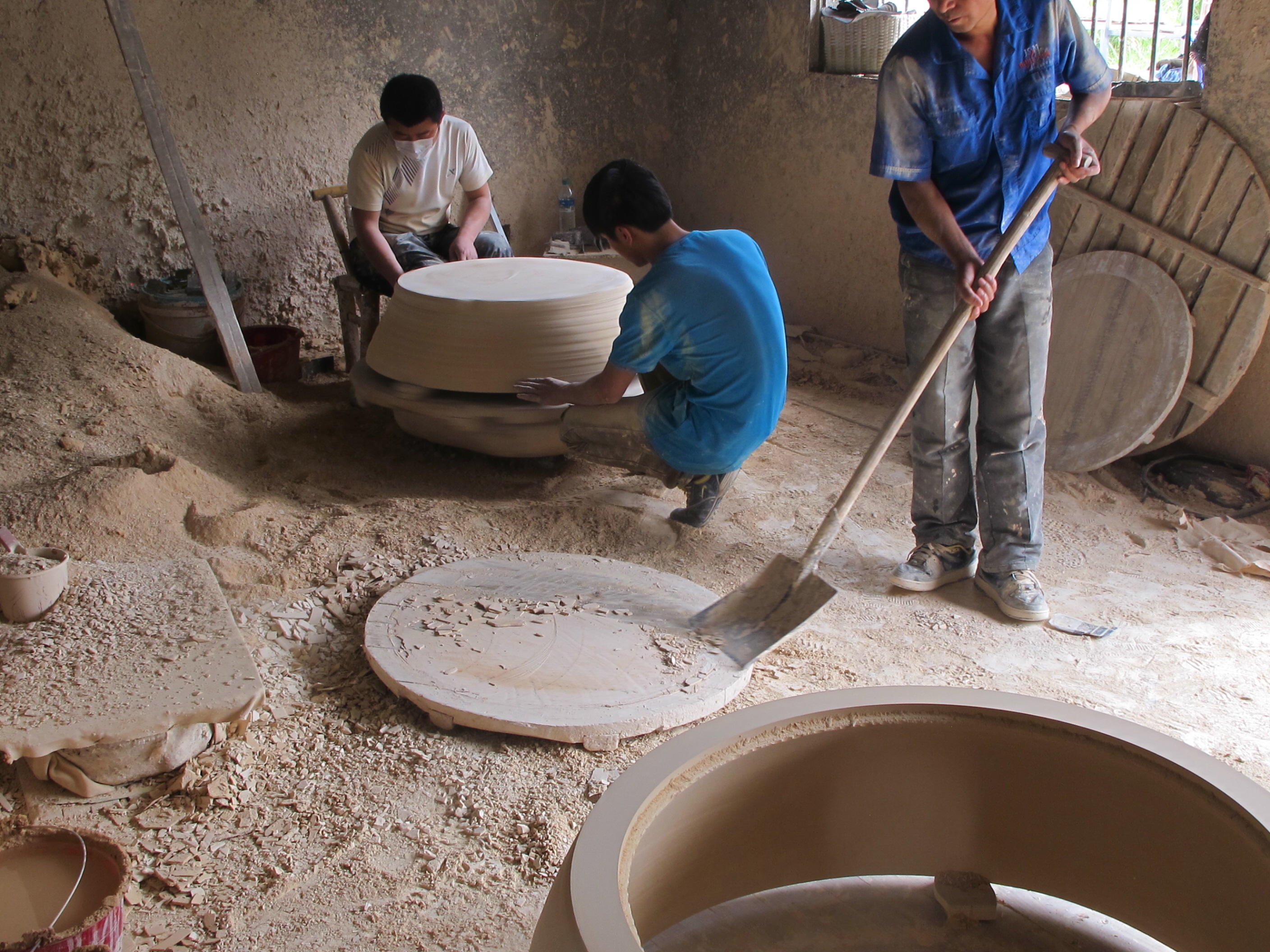
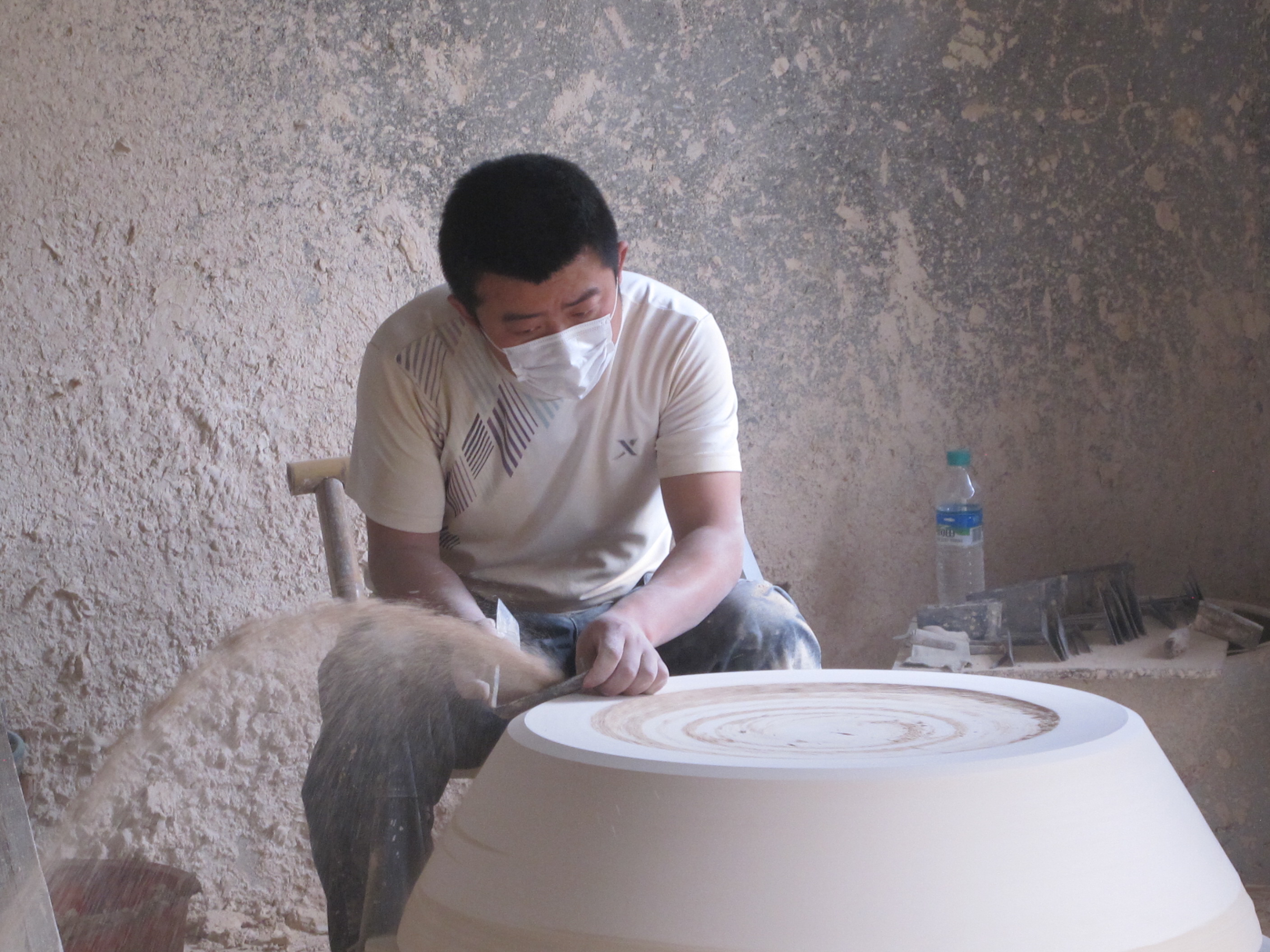
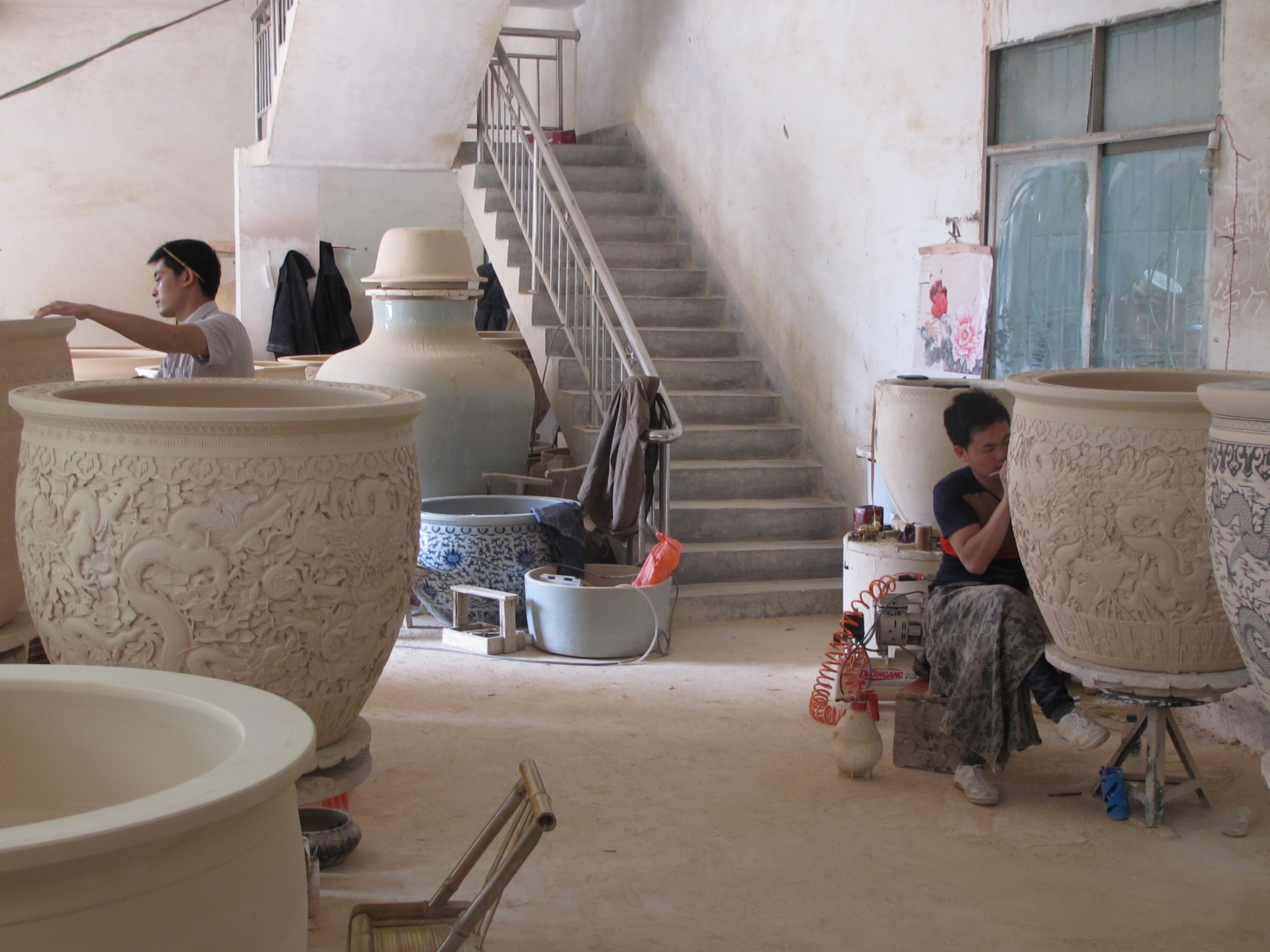
Later, we visit a bunch of local big-pot throwers. Today they are not throwing, but turning their dried, thrown sections of very large planters. It is just an amazing sight to watch these young masters at work. They are just incredible. They make it all look just so simple, and it probably is, if you are born to it and spend all your life involved with it and practising..
IMG_0461 IMG_0464_1
 IMG_0481_1IMG_0485
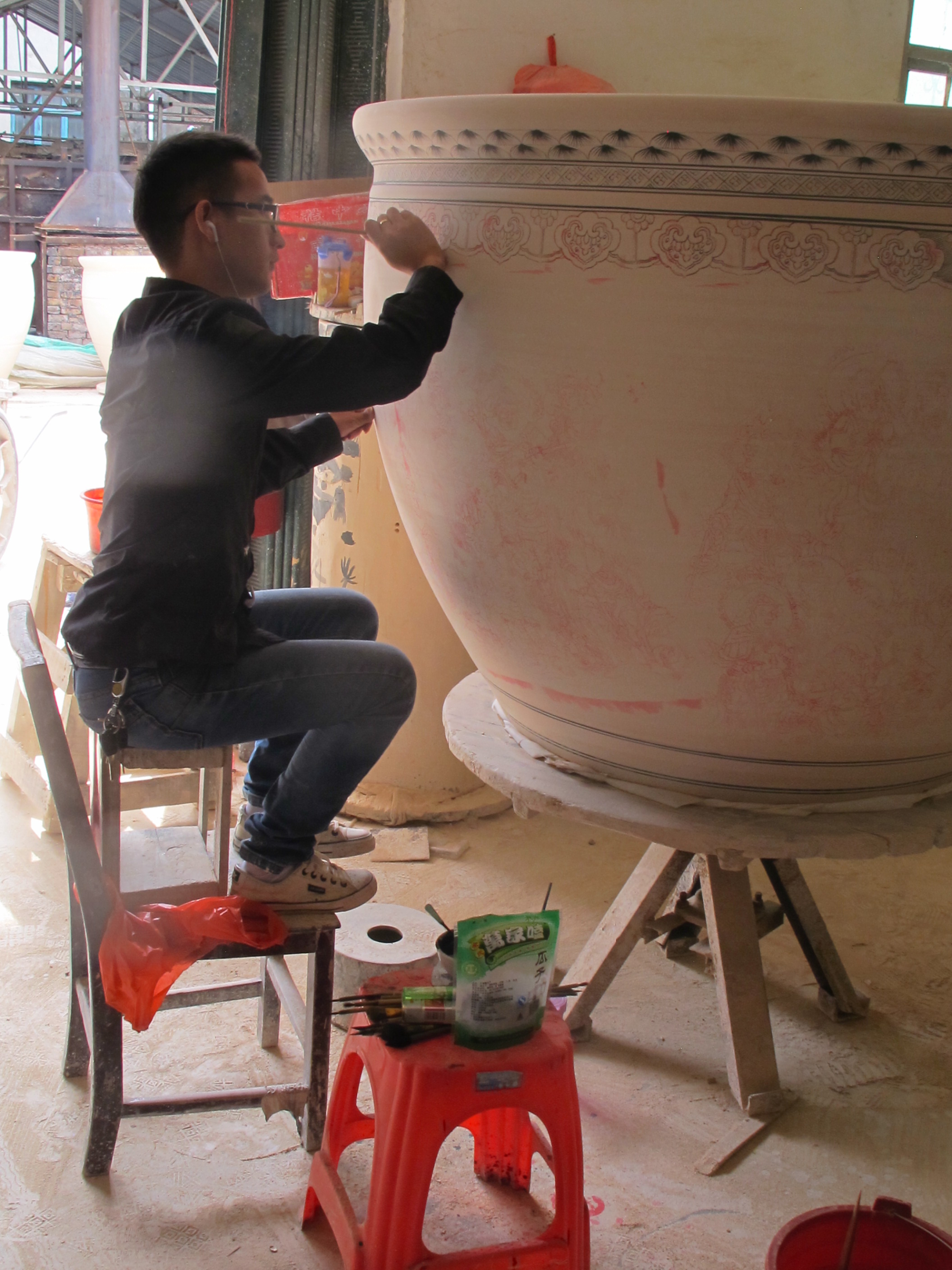
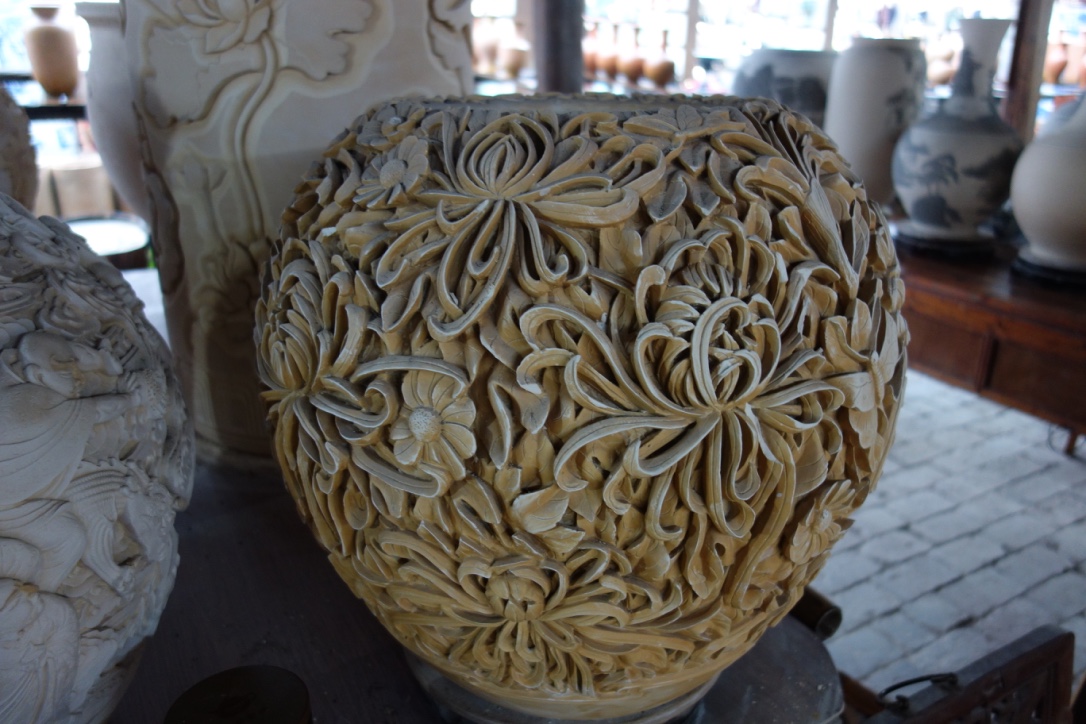
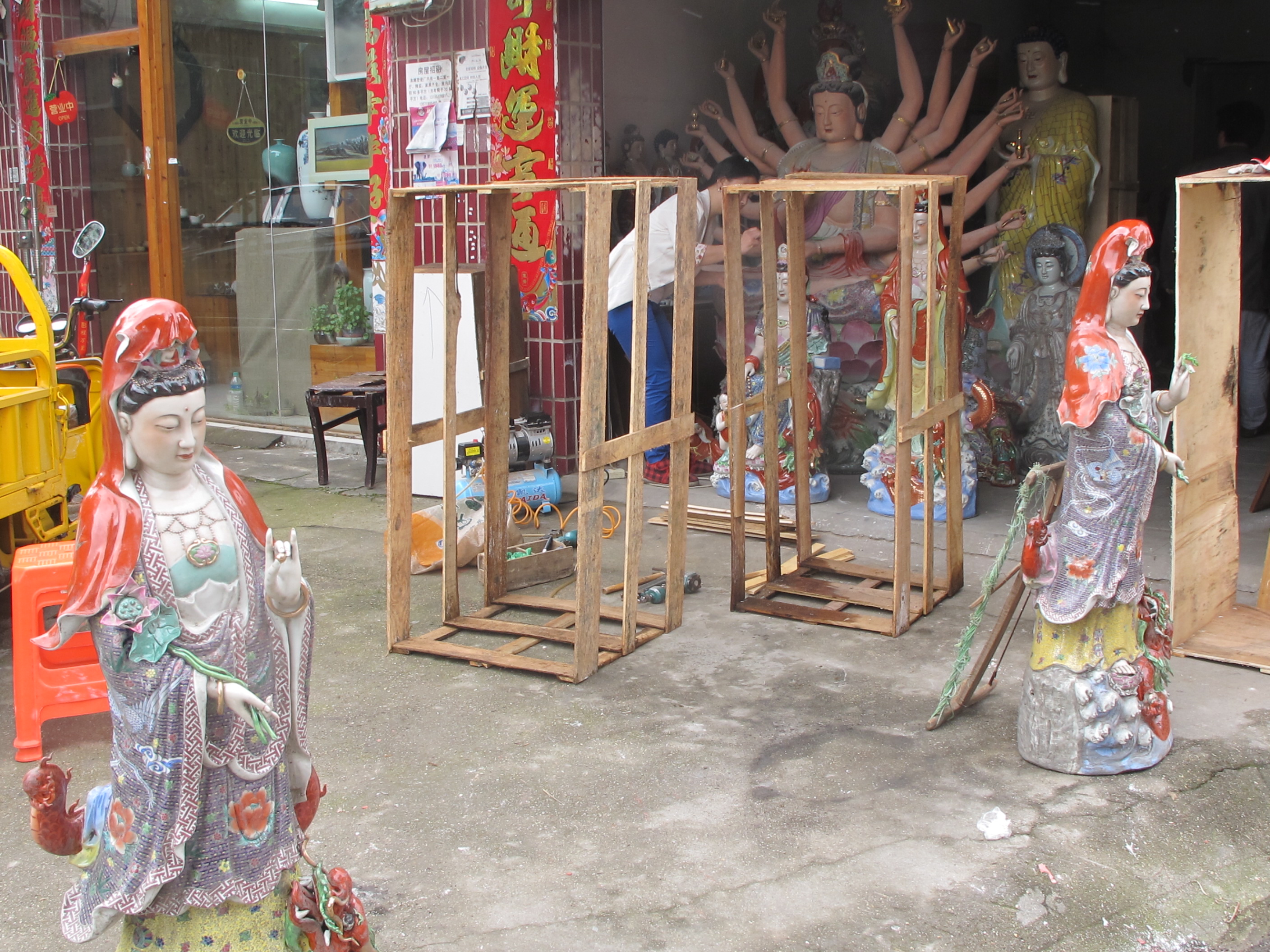
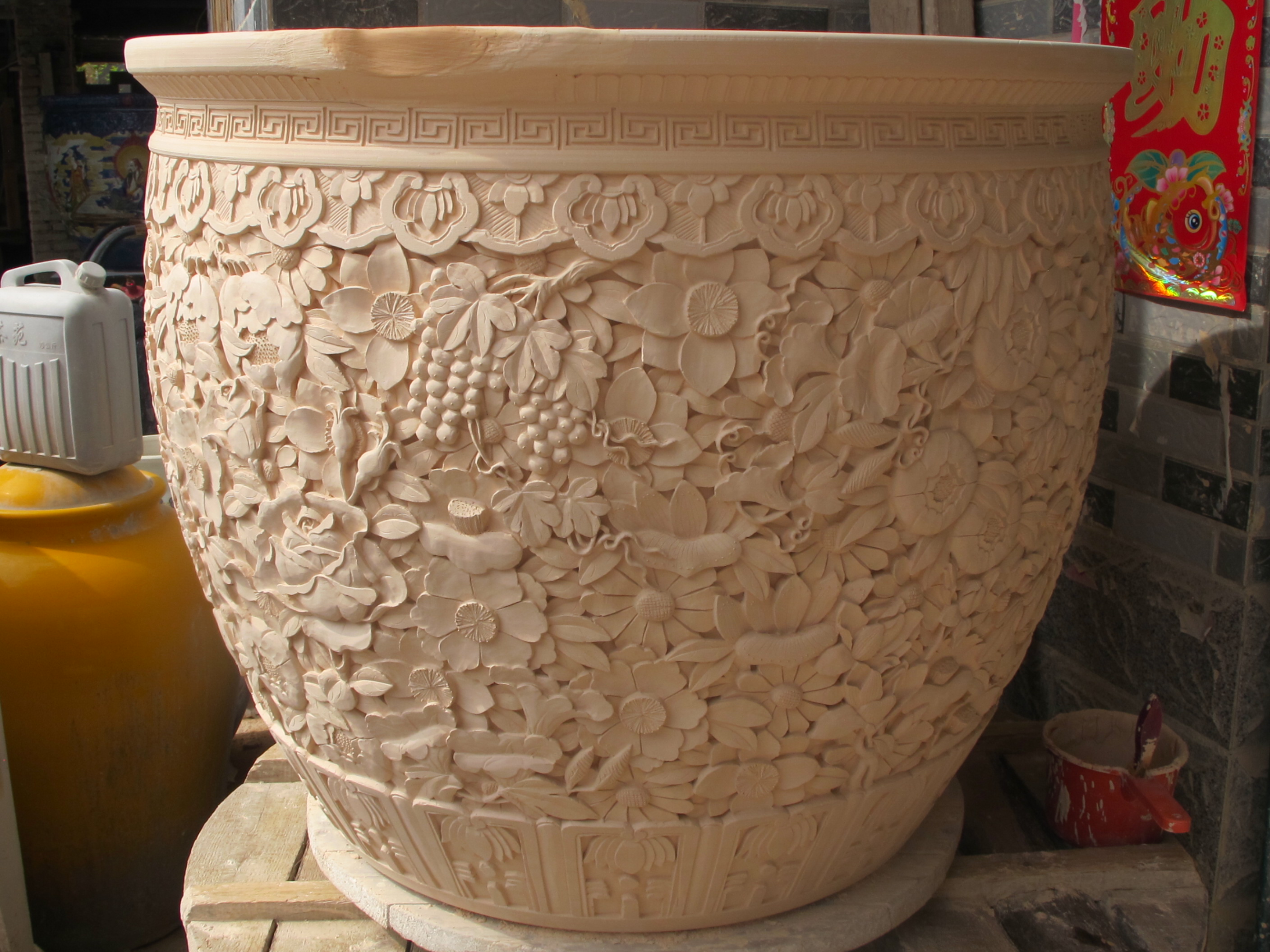
After assembly, they are either carved or painted, then raw glazed. Apparently it takes a week to carve or paint one of these giants with such fine detailed work. Some are just blue on White, while others are polychrome.
Amazing technique!
IMG_0505_1 IMG_0508_1
IMG_0510_1 IMG_0514_1
IMG_0519_1 thumb_DSC00354_1024
After this, there is nowhere else to go, nothing more to see that can top this schwarzenegger-esque extravaganza. I’m exhausted just watching! The amount of material that is churned off in the turning is prodigious. there is a business right there in just collecting all those huge piles of turnings and recycling them, back into clean, iron free, plastic porcelain clay again. We take paradise…..
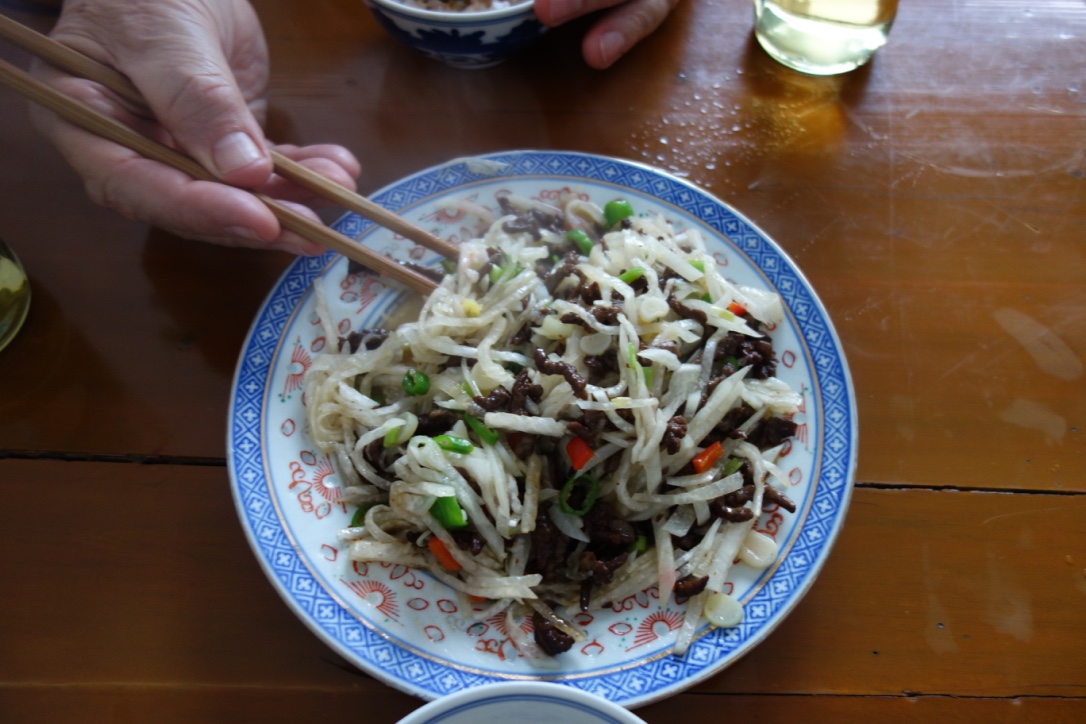
All that’s left is to have dinner. Egg and tomato stir fry and finely sliced large white radish stir fried with some sort of meat and chilli.

So very nice. Delicious!
thumb_DSC00404_1024 thumb_DSC00405_1024
Best wishes
Steve in Jingdezhen
Why Not Both?

Jingdezhen in China has a very long history of making porcelain. Over one thousand years in fact. They had already celebrated their millennium of porcelain making when I was working there ten years ago. The special thing about this place is the clay. It isn’t clay!

What they use here is a ground-up stone. When they crush and finely grind the local stone down into a very fine paste, it becomes plastic. This is like magic. Stone doesn’t usually become sticky and plastic like clay unless it’s very special. This stone is largely composed ofsericite mica, and it is special. It is reasonably rare stuff to find en-mass, in its pure white form. It has a flat plate-like crystal structure, not unlike clay, only much coarser. When these microscopic plates are wetted, they slide about against each other in a similar way to the way that clay does. Of course it’s so much more complicated than that, but this is a blog and not a treatise. Sufficient to say that there are very few places in the world where this kind of thing can happen. Here in China is one of them and the initial place where it was first discovered. Once the knowledge was well-developed in china, the information spread to Korea, where they discovered and developed similar materials, then eventually to Japan. When the War Lord Hideyoshi invaded Korea and brought back potters as war trophies!. My, how the level of respect for potters has fallen! I don’t recall any solder capturing and bringing back any potters as trophies from any recent wars that we have been engaged in!

One of these ‘renditioned’ Korean potters discovered a similar weathered stone on the southern Japanese island of Kyushu, and so porcelain making started up there as well. I have visited these sites and made pots there and I intend to go back again and make a more substantial body of work there, just as I have done here in Jingdezhen, that I can bring back and exhibit all together back in Sydney. Hopefully at Watters Gallery.
My interest in these porcelain stones is all based on the surprise discovery 15 years ago, when I stumbled upon a very small deposit of pale rock in the side of a track, out in the bush. I collected a very small sample and crushed it down to dust so that I could test it for use as a glaze ingredient. It made a lovely pale blue glaze of the family of glazes that could be described as being like ‘celadon’ or ‘guan’. These are ancient Chinese archetypes of fundamental combinations of simple ingredients. They are the simplest of glazes, but just about the most difficult to re-create with the depth and subtlety that the Chinese potters achieved at the apogee of their ceramic development, during the Song Dynasty.
I recognised that my initial glaze tests, although crude, had potential to be developed into something special, but more than that I noticed that most of the tests were ‘crawled’. This would normally mean that there was too much clay in the recipe, but this recipe had no clay in it at all. It was just hard rock. Very hard rock. I had to use my jaw crusher, disc disintegrator and then 16 hours in the ball mill to grind it down to a fine powder. I asked myself. “How could such a hard rock have any plasticity. Does it have any plasticity?” I quickly ran to the pottery and mixed a little of the precious powdered rock dust with some water and worked it up in to a paste, then proceeded to try to throw it on the potter’s wheel into a small bowl form. It could just about be done. It was rough and misshapen, but it was a bowl. I fired it and to my astonishment, it fired into translucent porcelain. I coudn’t have been more surprised!. 100% rock dust and water became white, translucent porcelain!
I know the date that I did this experiment, because I scratched the date into the bottom of that first pot.
IMG_0334_1
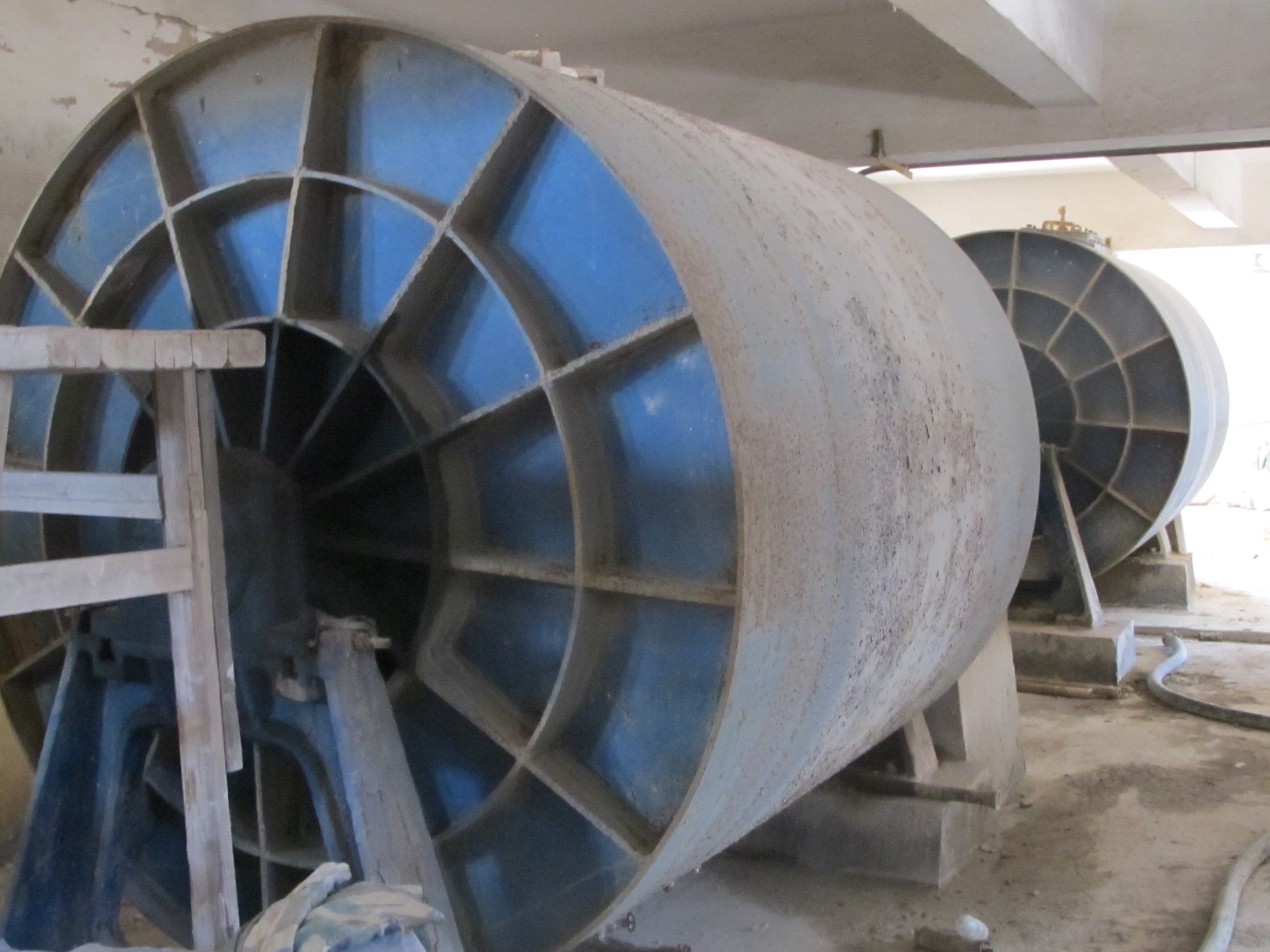
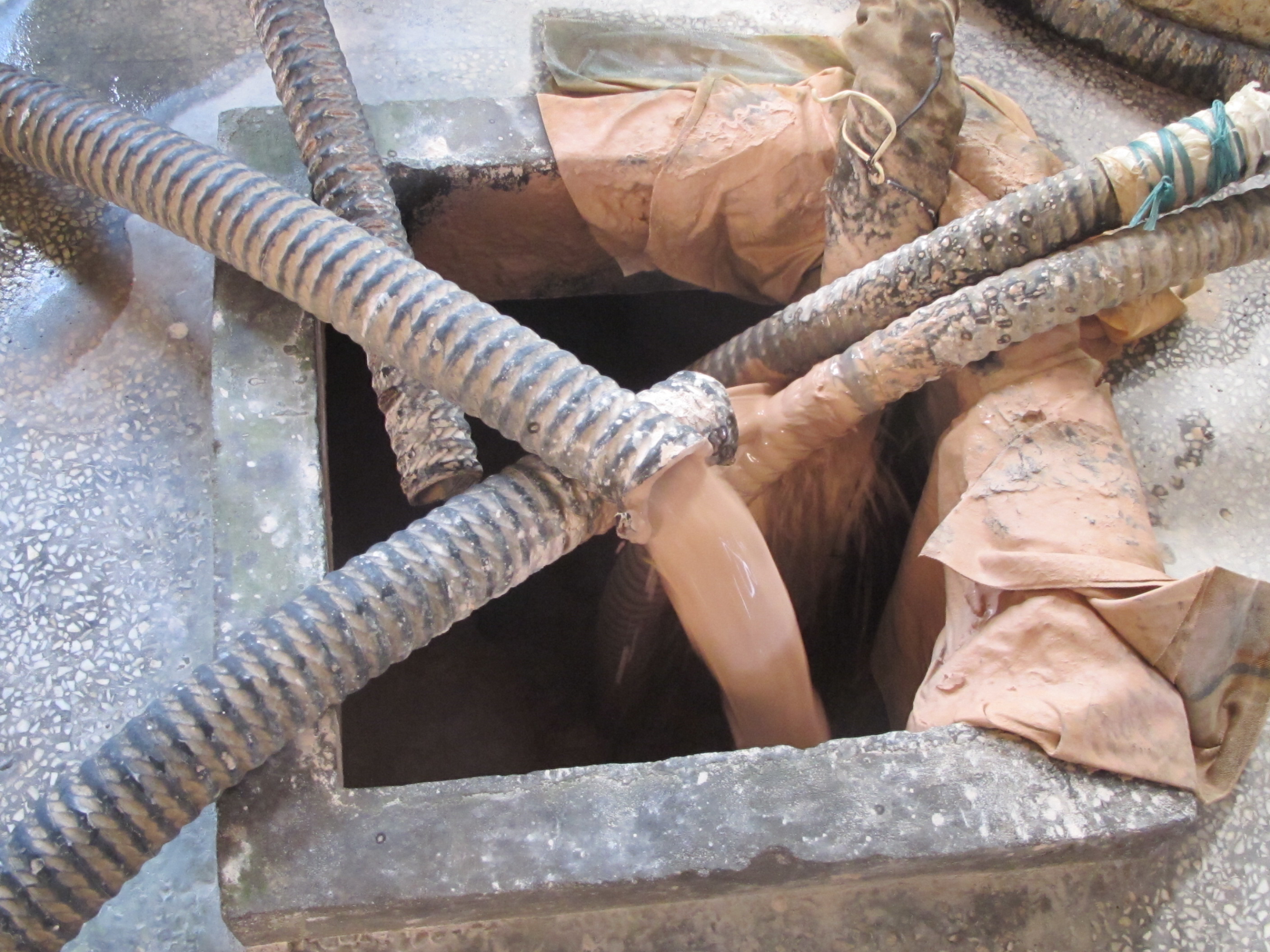
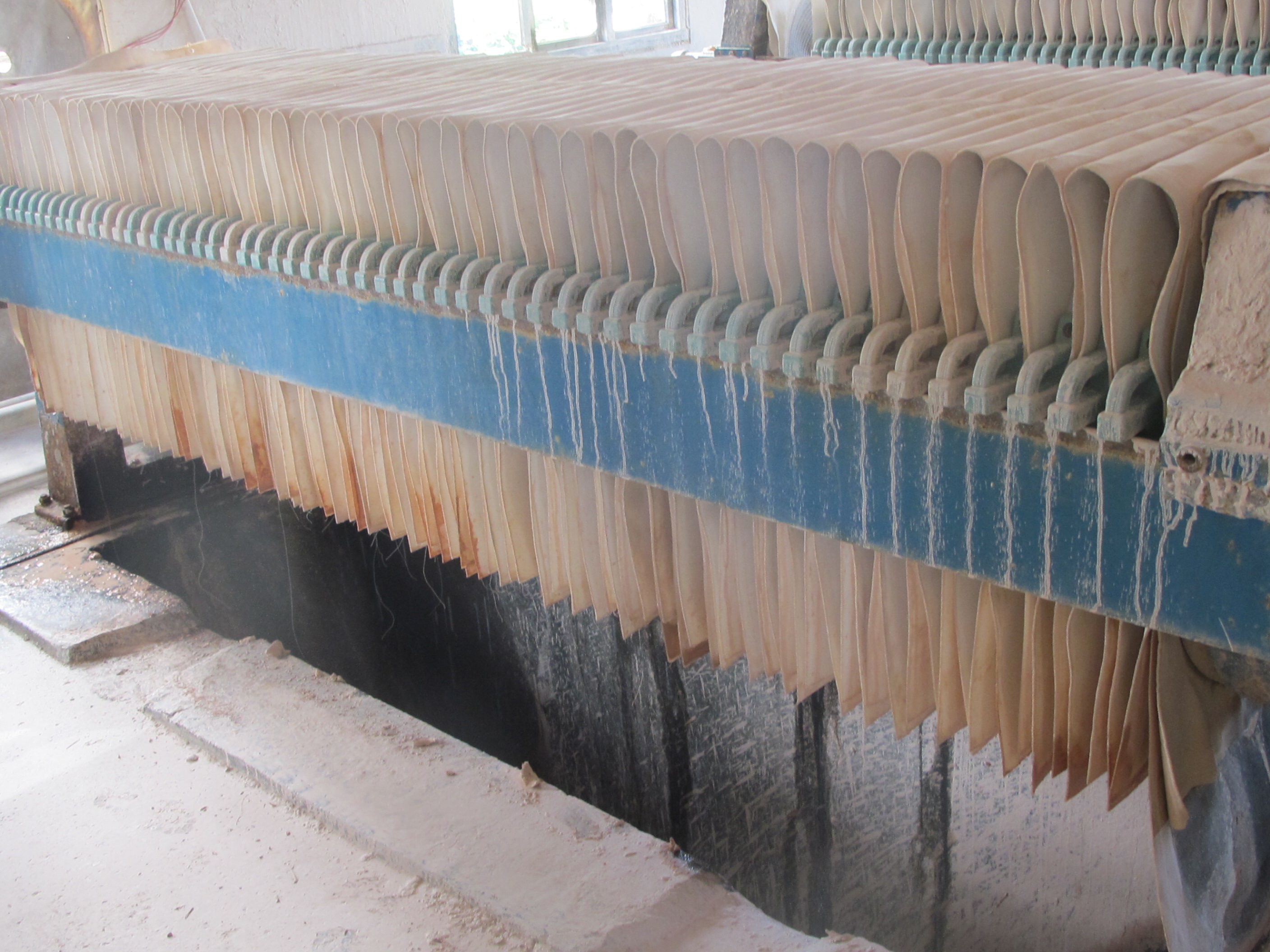
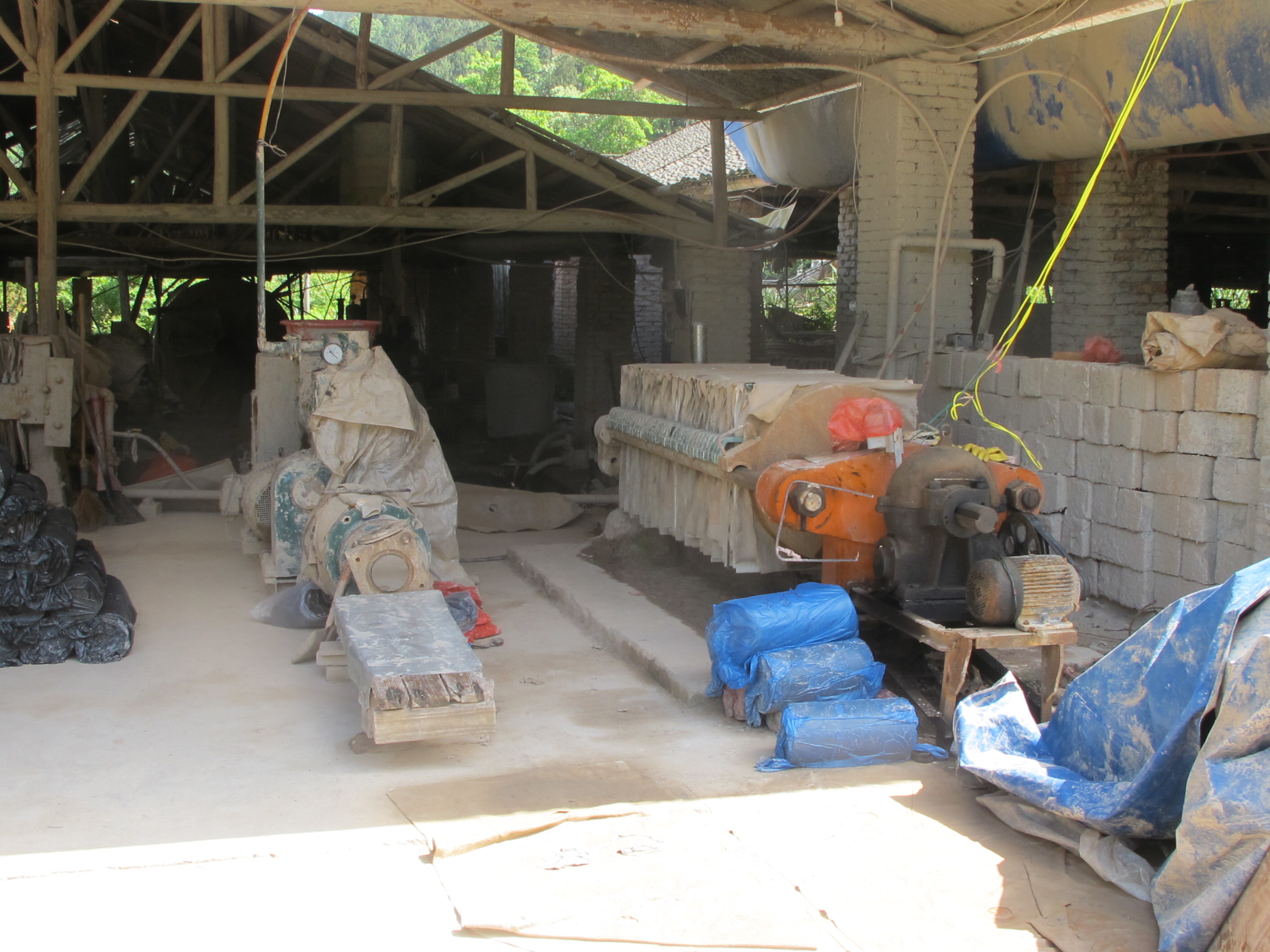
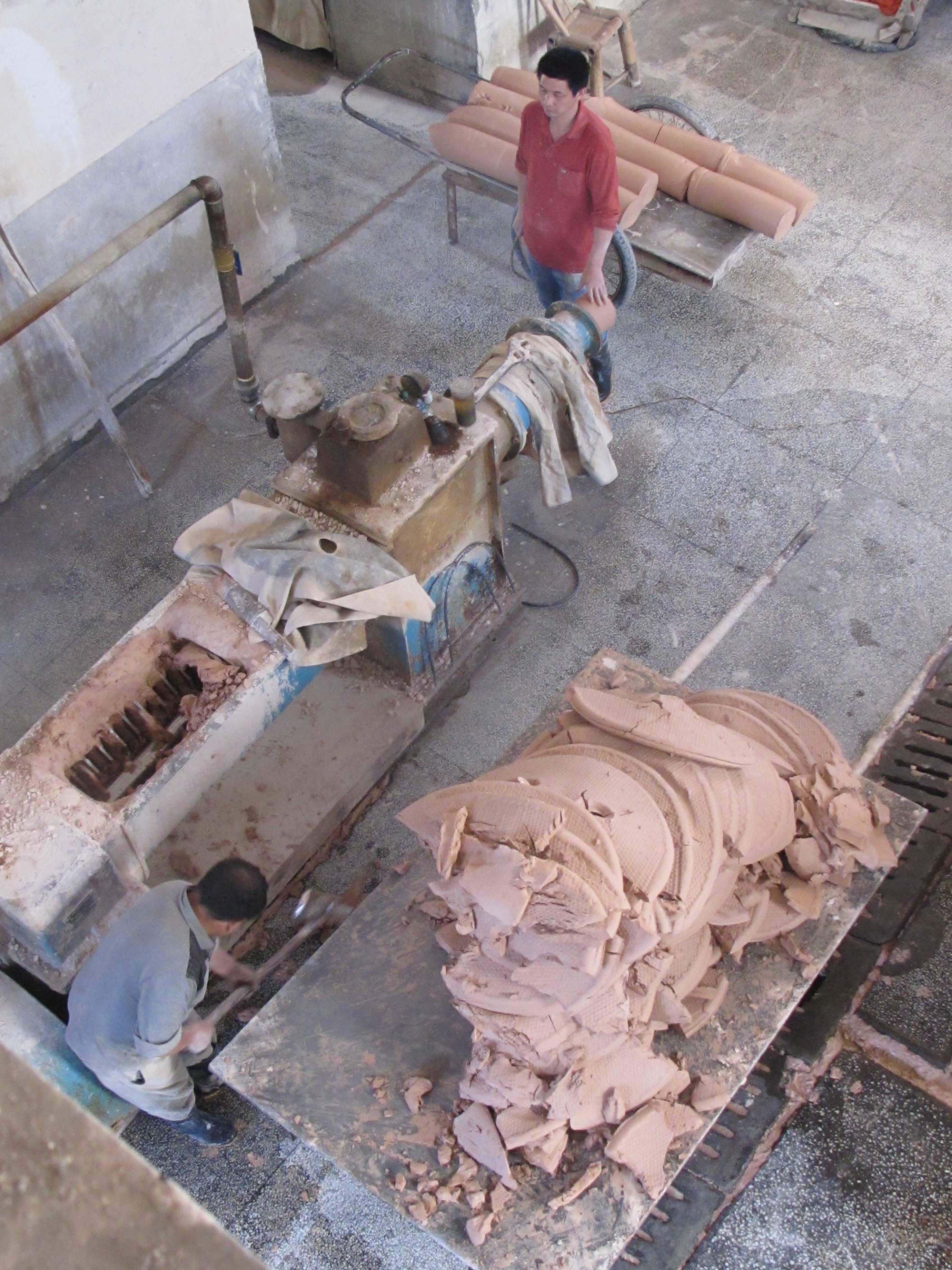
After 25 years of fossicking around this shire. I had finally found something really exciting and with a lot of potential to carry my work forward for a long time to come. So here I am in the clay making facility in Jingdezhen. The home and origin of single stone porcelain. They don’t do all the production here anymore. Some of the large machines sit idle now. It seems that they only do the final stage of blunging (washing) the clay into a slip and sieving it through a very fine mesh to remove any unexpected rubbish that may have crept in during transport and storage. This ensures that there will be very few ‘iron’ spots in the finished product. The liquid clay ‘slip’, is then pumped into a filtering machine to de-water it back to a plastic, workable state. This de-watering procedure is called filter-pressing. This filter pressing (stiffening) is done in very large  filtration dryers until it is ‘plastic’. ie. stiff enough to fashion into shapes, by moulding  or throwing on the potters wheel.
IMG_0317_1IMG_0326_1
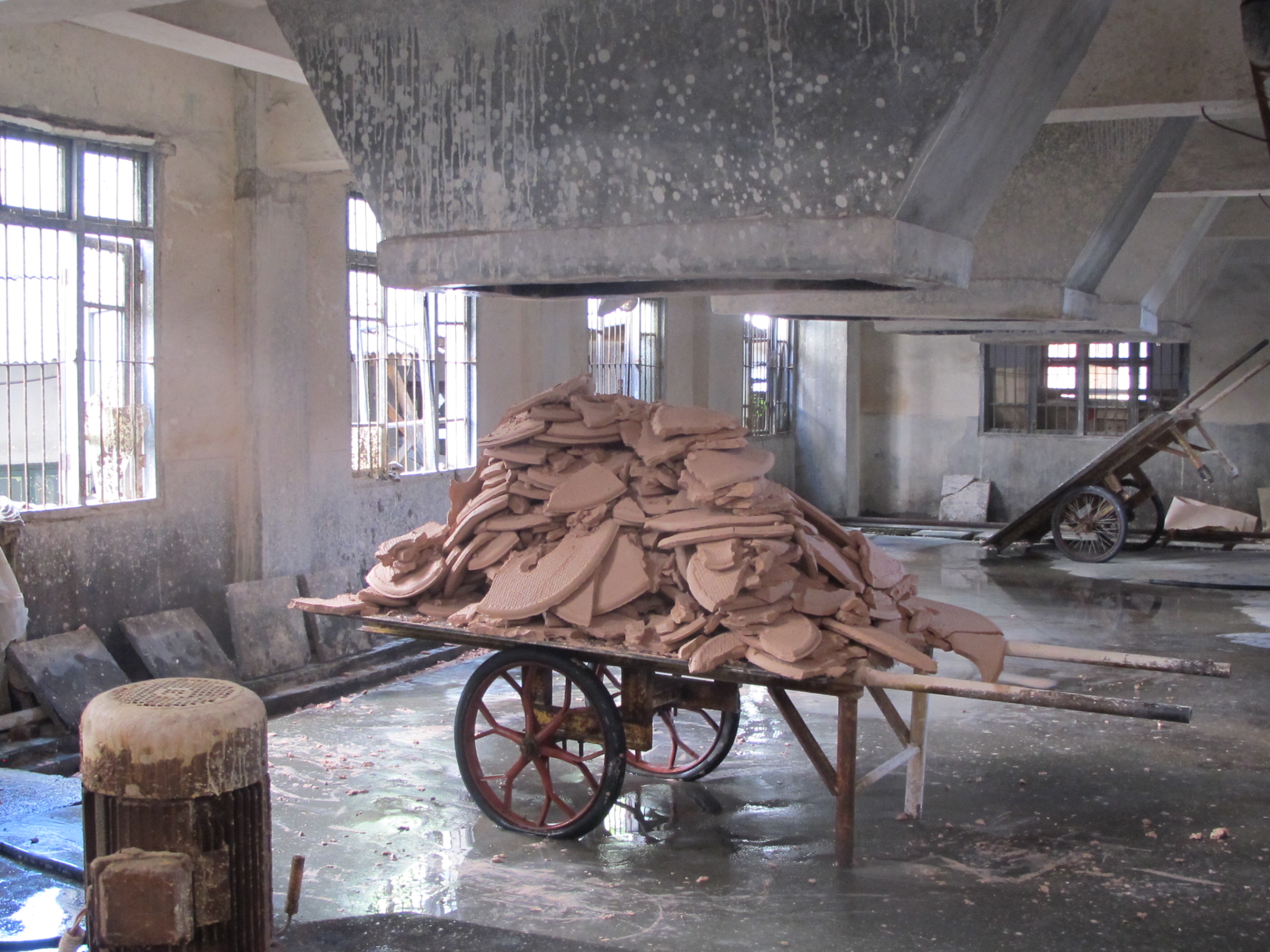
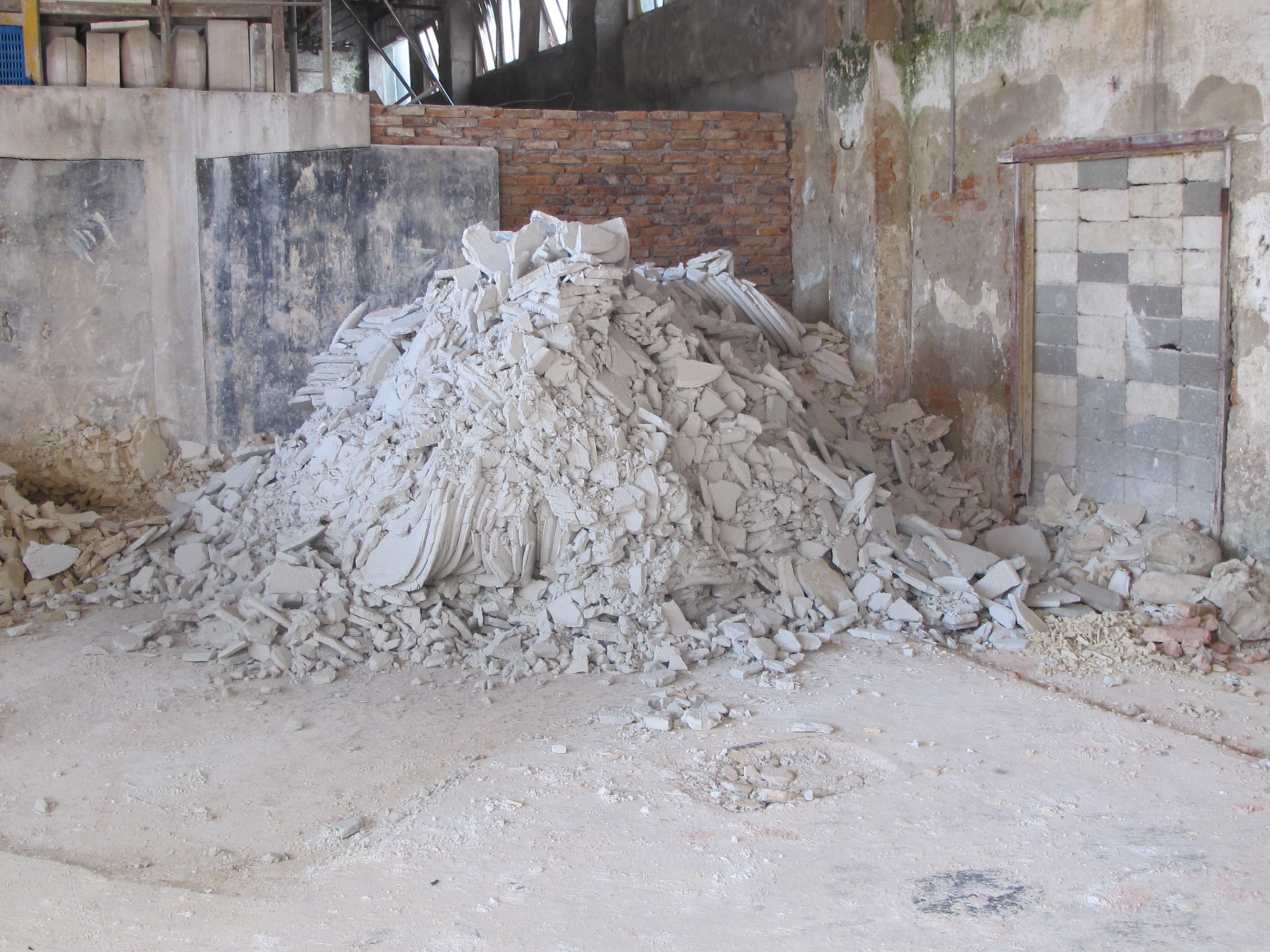
Once the clay has been stiffened in this way, it is dropped out of the filter press and is taken to the extruder, to be pugged into well mixed sausages for storage and ageing.
IMG_0318_1IMG_0319_1IMG_0324_1IMG_0315_1IMG_0329_1IMG_0335_1
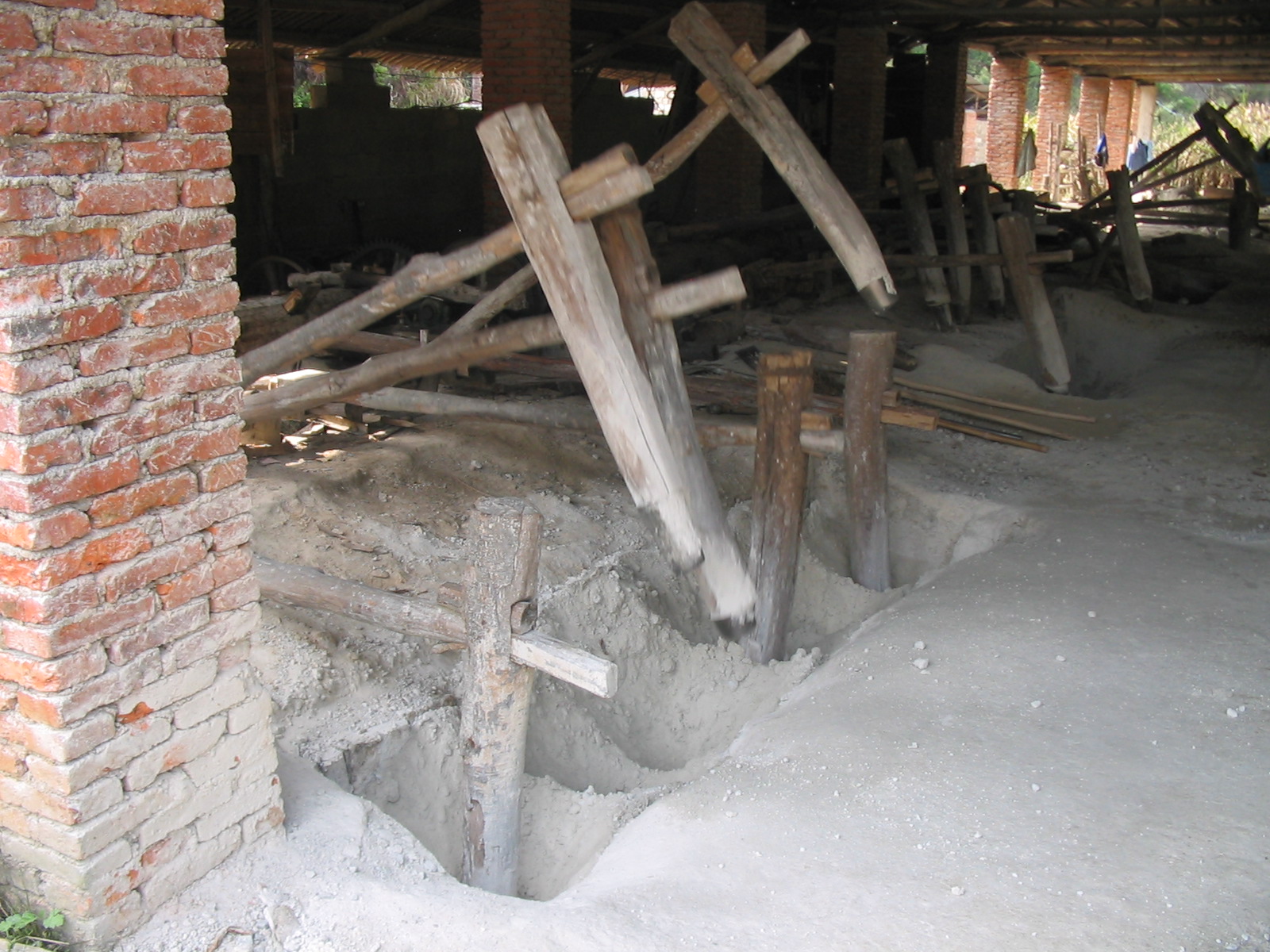
The ‘clay’ (milled stone) material is trucked-in as a partially processed material these days. It used to be all processed here, but now it undergoes its primary crushing, milling and stiffening out-of-town, closer to the mine. When I was here last, all of the crushing was done by water powered, wooden hammers. these were typical of the water hammers that are to be found all over Asia, where-ever there is a suitable stream and work that needs doing. The powdered rock dust was then slaked in water and left to sit and dissociate, allowing the water to penetrate into the flakey, plate-like structure of the mineral. Breaking it down into a slurry with enormous surface area and also allowing the local bacterial to colonise the surfaces and work their magic to help enhance the workability and plasticity of the finished ‘clay’. This thick slurry was then stiffened slowly in the air and eventually formed into little white blocks or bricks called ‘bai-tunze’, or ‘white brick’. This is the form that it was delivered to the pottery clay processors.
IMG_4166IMG_4167IMG_4168IMG_4169
But that was then and this is now!
IMG_0189IMG_0190IMG_0192_1IMG_0193_1
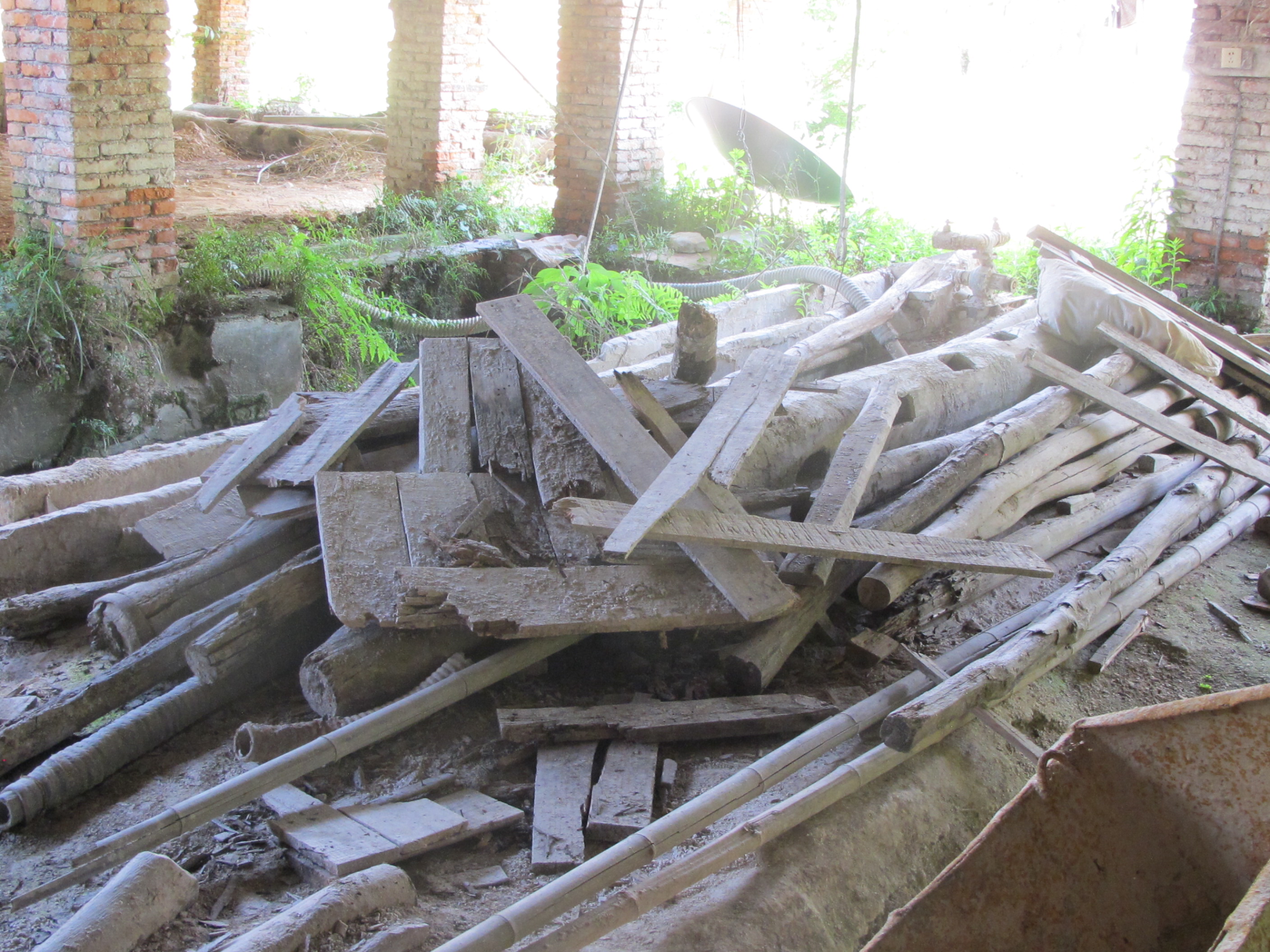
Apparently the water hammers were working here up until last year some time. Due to pressure to increase production and through-put, these ancient water hammers were ripped out and the leats that brought the water were filled-in and concreted over. 3 phase power has arrived now and all the work should be being done by jaw crusher, huge ball mills and filter presses. but when we arrive, we find the place devoid of activity. The power is down and has been all day, possibly yesterday also. and who knows when it will be restored? A lone woman sits by idly and bored and waits. Perhaps the old water hammers had some advantages? They may be a bit slow, but they ran for free and all day and night as well. So why no both?
IMG_0194_1IMG_0181
Jingdezhen native sericite stone.
IMG_0199IMG_0201
This stuff is beautiful to work with, fine and smooth and so much more plastic and supportive on the wheel. I like it a lot. Of course my stone isn’t semi-plastic sericite, it’s just plain old hard, weathered, aplite. A quick cooled acid rock. It doesn’t become very workable without a lot of effort and time applied. However, I have found that after 6 years of storage in a cool dark place, it comes out not too different to the fresh stuff from Jingdezhen. I just need to buy some time! Time is the most expensive ingredient in my work.
Best wishes
from the patient and timely Old Rocker

Be Careful What You Wish For!

Only a few weeks ago, just after Easter. The Lovely and I were driving back from Canberra, our Nations Capital. It’s a little over a two-hour drive up the freeway. It’s pretty boring but fortunately not too long. I was thinking out loud and said to Janine. “You know, I should try and go back to China and do a little more research into the original bai-tunze porcelain stone that they have worked on and developed for over a thousand years now. I should go back to the Fragrant Garden Studio where I worked a decade ago and make some bowls out of their native stone. That would be a good project. I could exhibit them along-side my own native porcelain stone pots.” The Lovely just nodded and said something like. “Yeah. Go ahead, that sounds good.”

Then two days later, I got an email from China inviting me to take part in a Tea Bowl Exhibition in Fuzhou, China, all expenses paid!
Be careful what you wish for!
How could I say No? Not only that, but I had recently been appointed as an external supervisor to a PhD student studying at the The Australian National University in Canberra, who is researching the origins of the southern oil spot tenmoku tradition of glazes in China. He wanted me to meet him in China and to undertake a research trip to the original sites. This hadn’t worked out last year, but now was perfect timing for such an investigation.
We set about planning it all. After the exhibition was over, a week in Jingdezhen for me to do my porcelain research and then a week in Jian to do the tenmoku research. It all fell into place in a week!
Then a shock message that the exhibition had been cancelled. Such a shame! But I had made other plans and was primed to carry them all out. I decided to go anyway, pay my own ticket and my colleague was also suitably inclined. We’d done all the prep and made all the other bookings, so we decided to go anyway, We had made lots of connections and arrangements, So off we go.
We fly into Beijing and wait for our connection to Jingdezhen. Beijing is a very large airport. I suppose that I’m looking at a post-olympic, trophy, prestige building, meant to impress and it does!  While wandering around the airport looking for the domestic terminal sign, I see this sign, that tells me that I am here!. So helpful! I already know that I’m here. I just don’t know where ‘here’ actually is. This terminal is over a kilometre long. I need to know where here is, in regard to everything else and as the sign has no reference to any map, it is just about useless.
IMG_0002_1
you are here!
We arrive in Jingdezhen and make our way to the hostel that will be our home for the next week or so. The first thing that we do is to check out the surroundings and get our bearings. It’s been a decade since I was last there working and a lot has changed in that time. Ten years ago, this part of the city was all two-story, old buildings. Now there are so many astonishingly tall, high-rise apartments creeping out from the city into the suburbs. My old view from the back balcony of my flat, that I shared with quite a few factory workers at that time, has completely changed. I find it hard to recognise much. Slowly I re-familiarise myself with the old laneways and paths and get my bearings.
IMG_0385
My old house, where I lived ten years ago, with the upstairs, roof-top balcony, that was actually the kitchen and bathroom area,
In 2005 I could just walk out onto the main street outside the pottery precinct gate and find any number of little street-food kitchens set up and cooking an amazing range of delicious street food. I could go to a different little mobile kitchen, based on a bicycle or possibly a tricycle every morning and never repeat myself and never get more than a few hundred metres from home. I love the food in China. In this part of China the food tradition is of the hot and spicy kind. Every meal seems to be cooked with chilli, even breakfast. I love it!
thumb_DSC00249_1024IMG_0079_1
IMG_0003_1IMG_0306_1
Chilli in breakfast, lunch and dinner, grits and jowls and bit of bowels, with steamed greens. Yum!
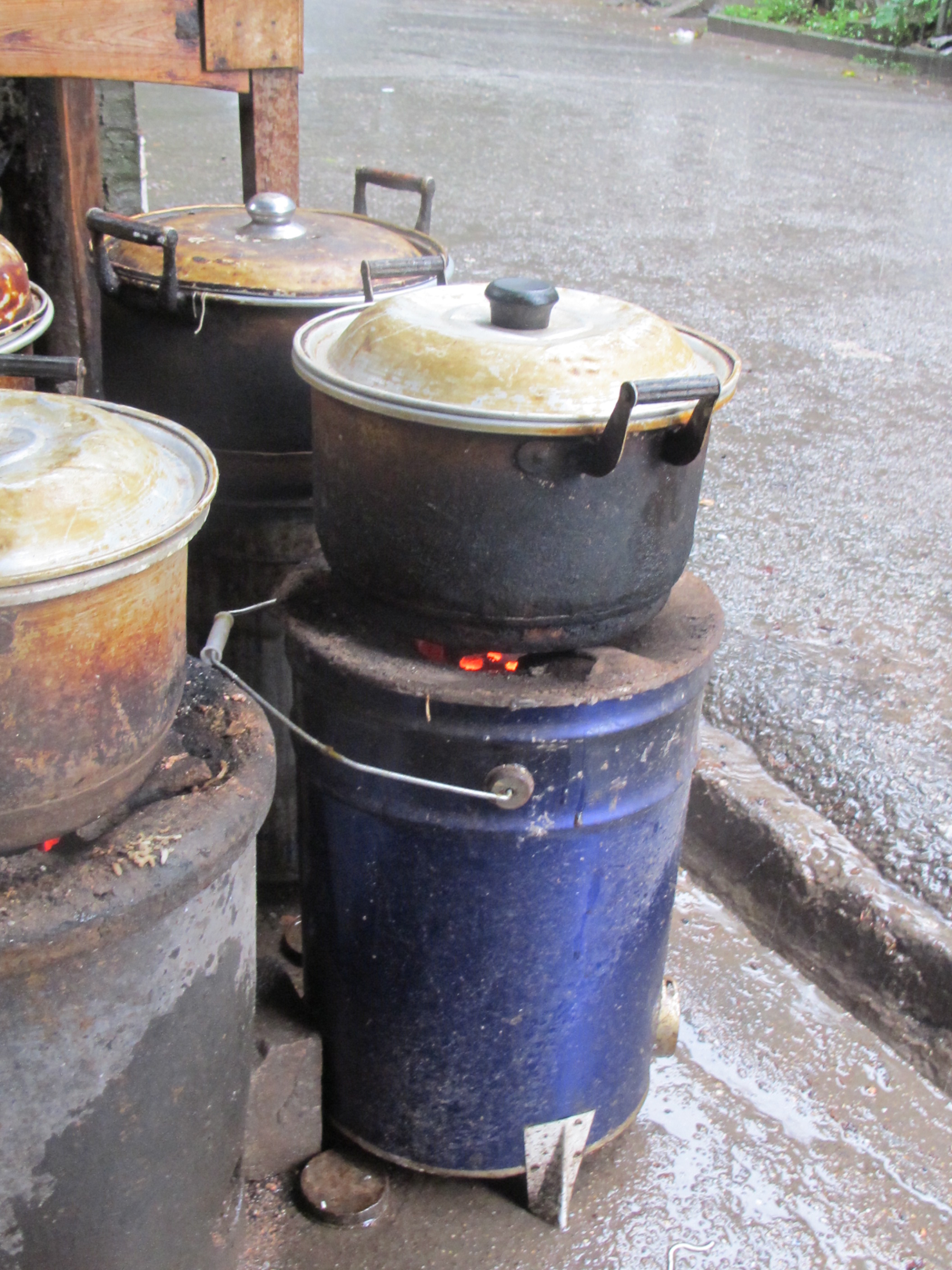
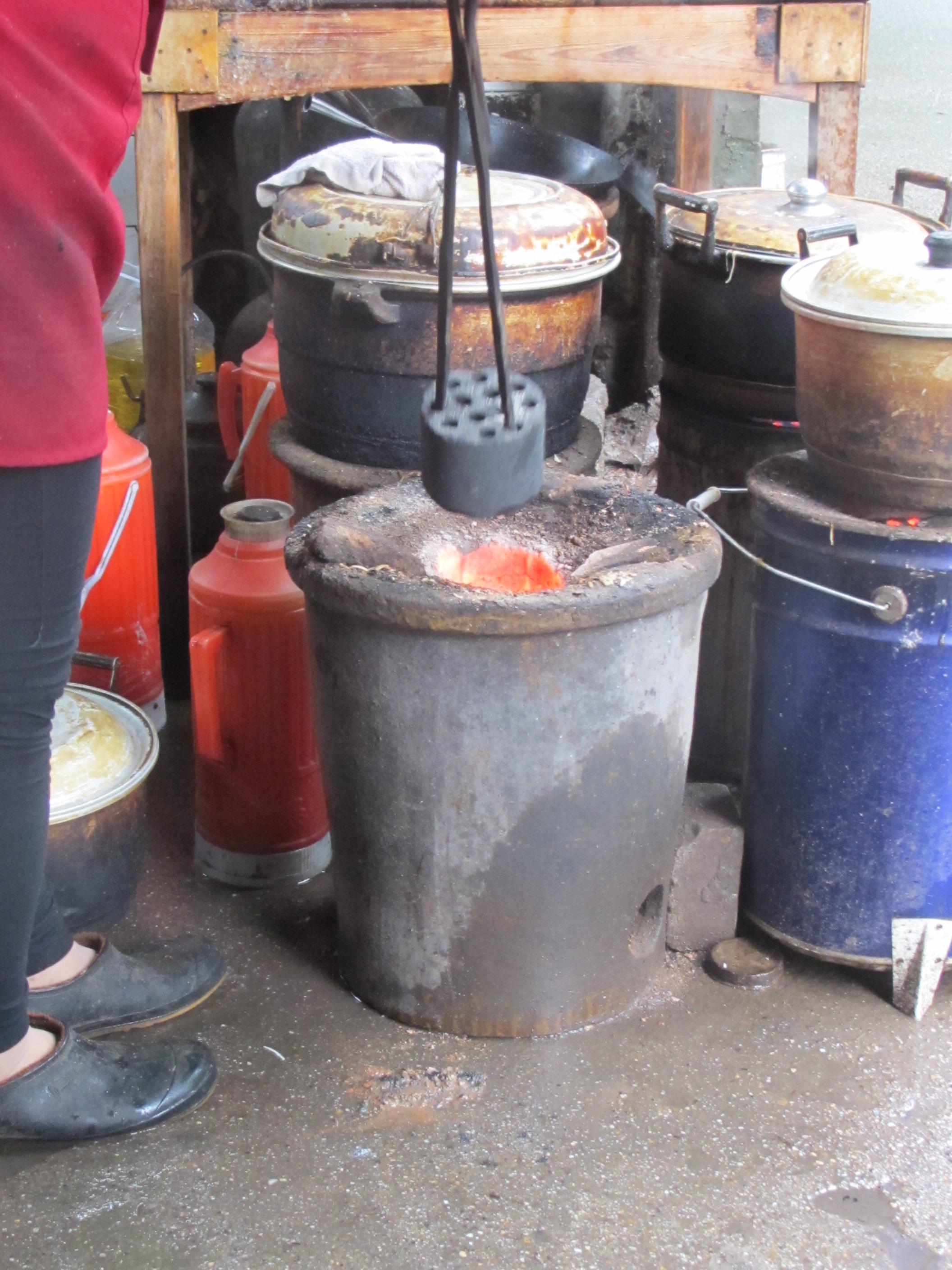
In those days, all the old homes didn’t really have kitchens and bathrooms as we understand the terms. Often, the sink was out in the laneway and shared with 2 or three other houses. The only cooking facility available to most people in those old dwellings at that time was a pressed coal dust briquette, that was lit in a small circular stove, possibly a recycled 20 litre vegetable oil tin. This contraption would take one pot on top and burn for a very long time, possibly an hour or more. No one would get up and light a full briquette in the morning to boil an egg or make a cup of tea and leave the stove burning in an unattended house. such a waste of money and heat, and possibly dangerous too!
IMG_0056_1IMG_0061_1
IMG_0063_1
These briquettes are made from low-grade coal with lots of clay in it. This poor cool is powdered and then pressed into a circular block with extruded holes through it to help it burn efficiently. when its spent and all the coal is burnt out, what is left is a soft, bisque fried clay block. Out in the street there was a steady stream of working men and women stopping off on their way to work to buy a few hot dumplings or a steamed bun. They were usually riding bicycles or possibly motor scooters. There wasn’t a peak hour in those days, as there weren’t so many cars and the cars that there were, were all fairly small and compact copies of Japanese ‘bongo’ vans. The miniature brick on wheels design.
Well everything has changed. There is a peak hour now! There are loads of new cars on the street and they are big ones, just like our standard family sedans. Loads of them and they are so big. It’s hard to find many bicycles any more, even motor cycles and motor scooters have almost been phased out in favour of silent, clean electric motor scooters. A lot of people live in modern high-rise now with conventional western kitchens and bathrooms. They have electricity for micro waves and electric jugs. People can cook their own tea and dumplings, or noodles before driving off to work in their car. All this convenience, has meant the disappearance of many of the street food sellers. They are still there, but in little clusters in off-road open spaces. We were able to find a different place to eat each morning, but some were so well hidden off the beaten track, that we wouldn’t have found them without being tipped off to their location. (A little like Canberra really!)
All the old industrial high-rise is being replaced with new high-rise.
IMG_0106_1IMG_0386_1
IMG_0396_1IMG_0112
IMG_0030
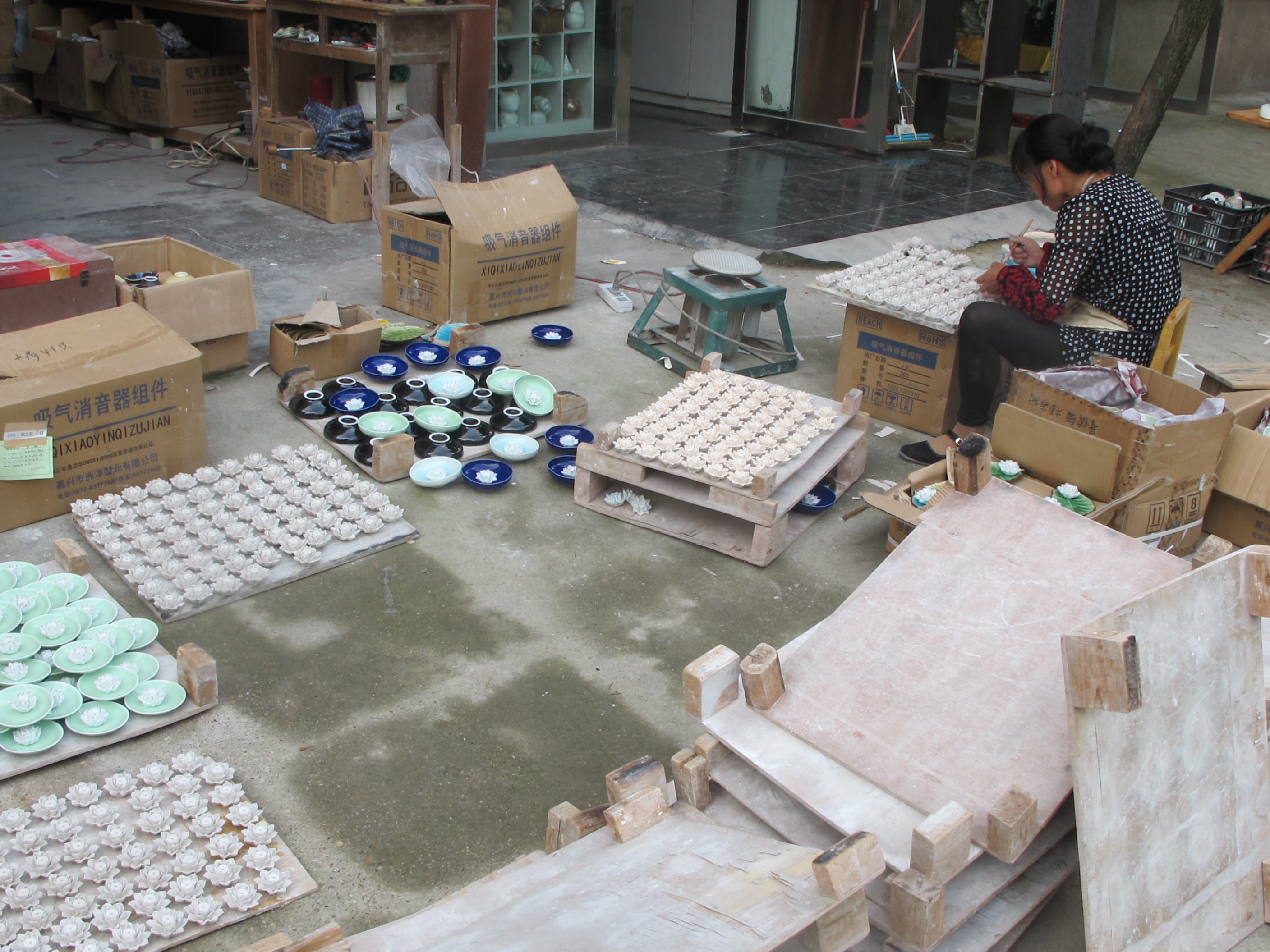
This place is in the midst a very severe period of renewal and change. Most people seem to be looking prosperous and happy There are innumerable little private workshops springing up everywhere. Wherever there is an old empty building, someone has moved in and done it up and it’s now a shop out front and a workspace out the back. Ten years ago, these buildings were mostly empty or just used for storage.
IMG_0047_1 IMG_0050_1
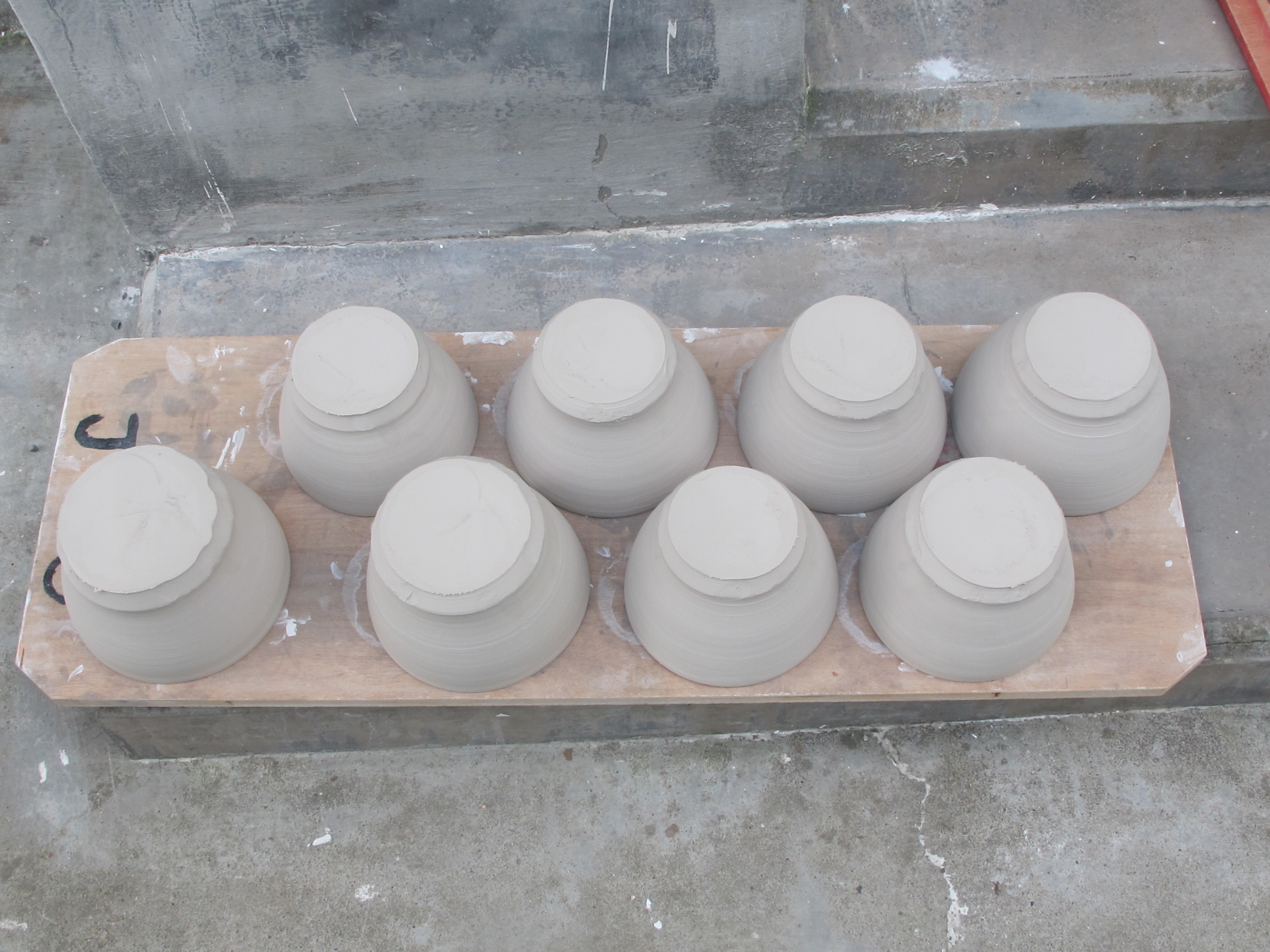
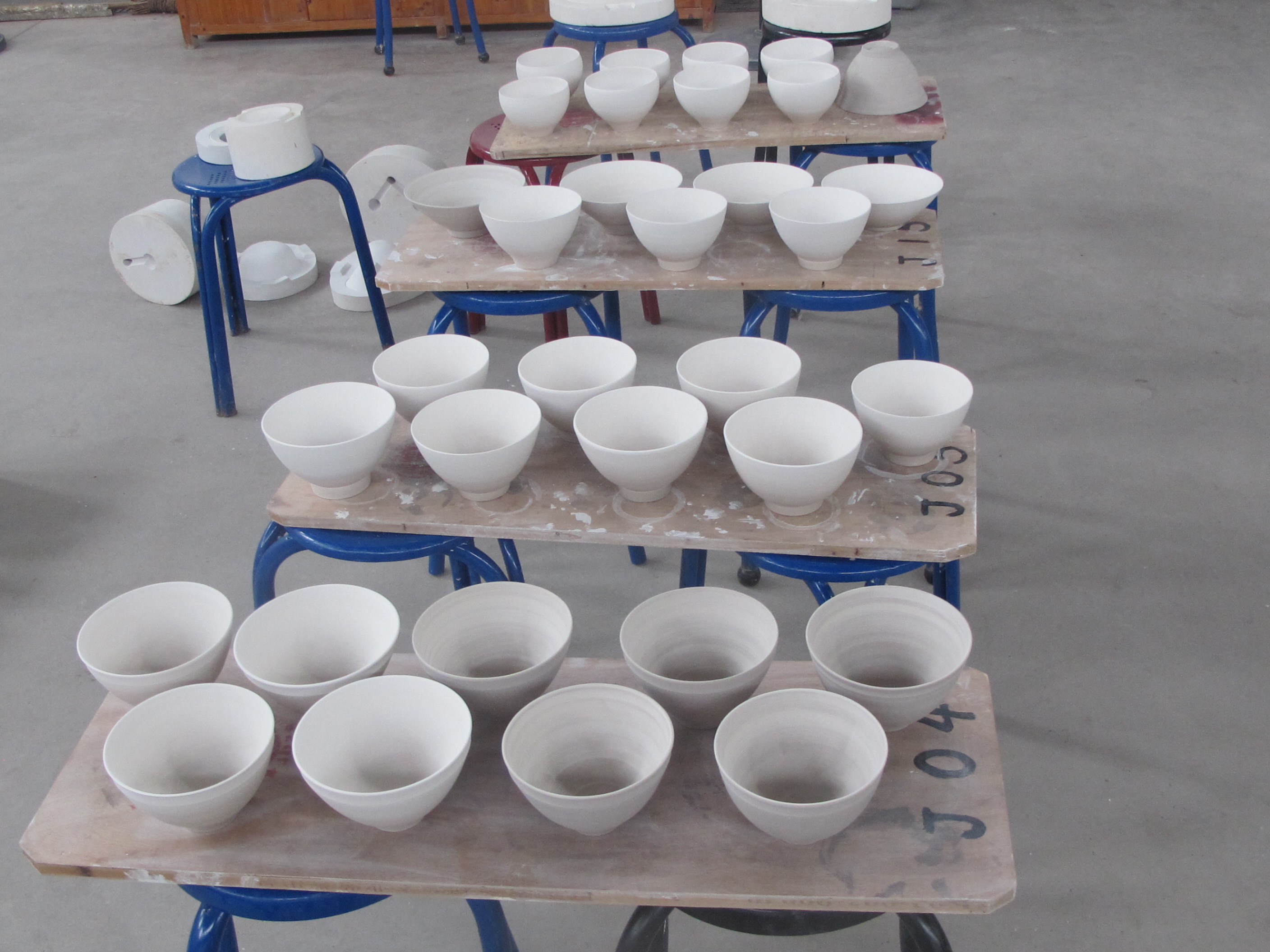
We set to work the next morning and I make 40 bowls on the small pot boards available to me. I make 4 different shapes. I get them out into the sun hoping to be able to start turning them as soon as possible. We are here in the rainy season, so things are slow to dry, but I get most of them over onto their rims by evening. I don’t have the luxury of a slow, even, controlled drying.  The next morning I start to turn the forms so as to rough out the forms to reduce the weight at the base and speed the drying. These one-stone porcelain bodies are quite non-plastic, but I must say that this particular one is very good compared to my own ball-milled ‘Joadja’, ground stone body back at home. The difference being that where as mine is made from a hard, glassy, dense ‘aplite’ or fast cooled granite-like material. This material here in Jingdezhen is a weathered sericite mica and develops a lot more plasticity. Even so, you can’t turn bodies like this when they are leather hard. They just chip and tear. These ‘clays’ , if it’s possible to call them that, need to be molly-coddled a bit and turning is best done at the almost bone dry stage. This allows a better smoother finish, but creates a lot of dust. In Japan, they use a vacuum fan in front of the wheel to create a negative pressure to remove the dust for the workers safety. Here there is no such concern. OH&S is a distinctly ‘western’ luxury concept at work.
IMG_0069_1
I finish all the turning and get them all out into the sun to dry on the third day. I cull them all down to 20, then another cull down to 12. That is all I will be able to carry out on the plane in my back pack. We plan to raw glaze them tomorrow and then into the stoneware kiln the next day, fired over night and unpacked the next morning. We are due to fly out at lunch time. We are cutting it fine, but it is doable. And we do it. It all runs like a Swiss watch. We are greatly aided by Liu Danyun,  The daughter of Master Liu, the owner of the Fragrant Garden International Ceramics Studio, she is most helpful in every way and does all our translating, phone calls, bookings and other organising for us. She is a wonderful friend !
IMG_0135_1 IMG_0136_1
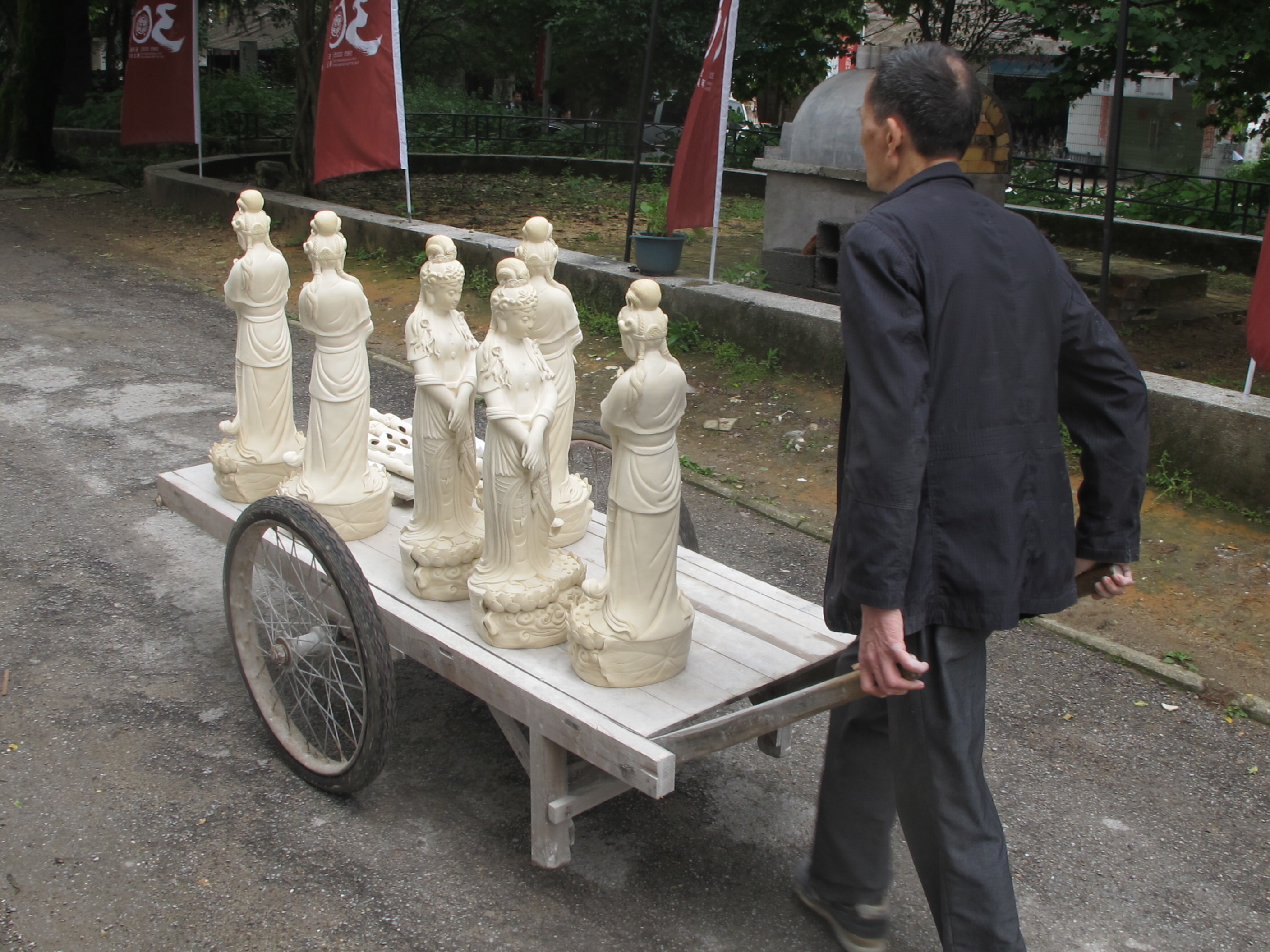
Although there has been enormous change over the ten years since I first came here, with so many technological advances, Some things haven’t changed very much. Pots are still moved from studio to studio and studio to kiln on wheel barrows, but change is catching up there too! Not very many studios have their own kiln, most places still use the public kilns, and there are quite a few to choose from in the pottery precinct. You probably don’t have to move your work more than 100 metres to find a kiln to fire them, a glaze workshop to glaze them, a box maker to fit them or a crate maker to package them securely for transport.
IMG_0345
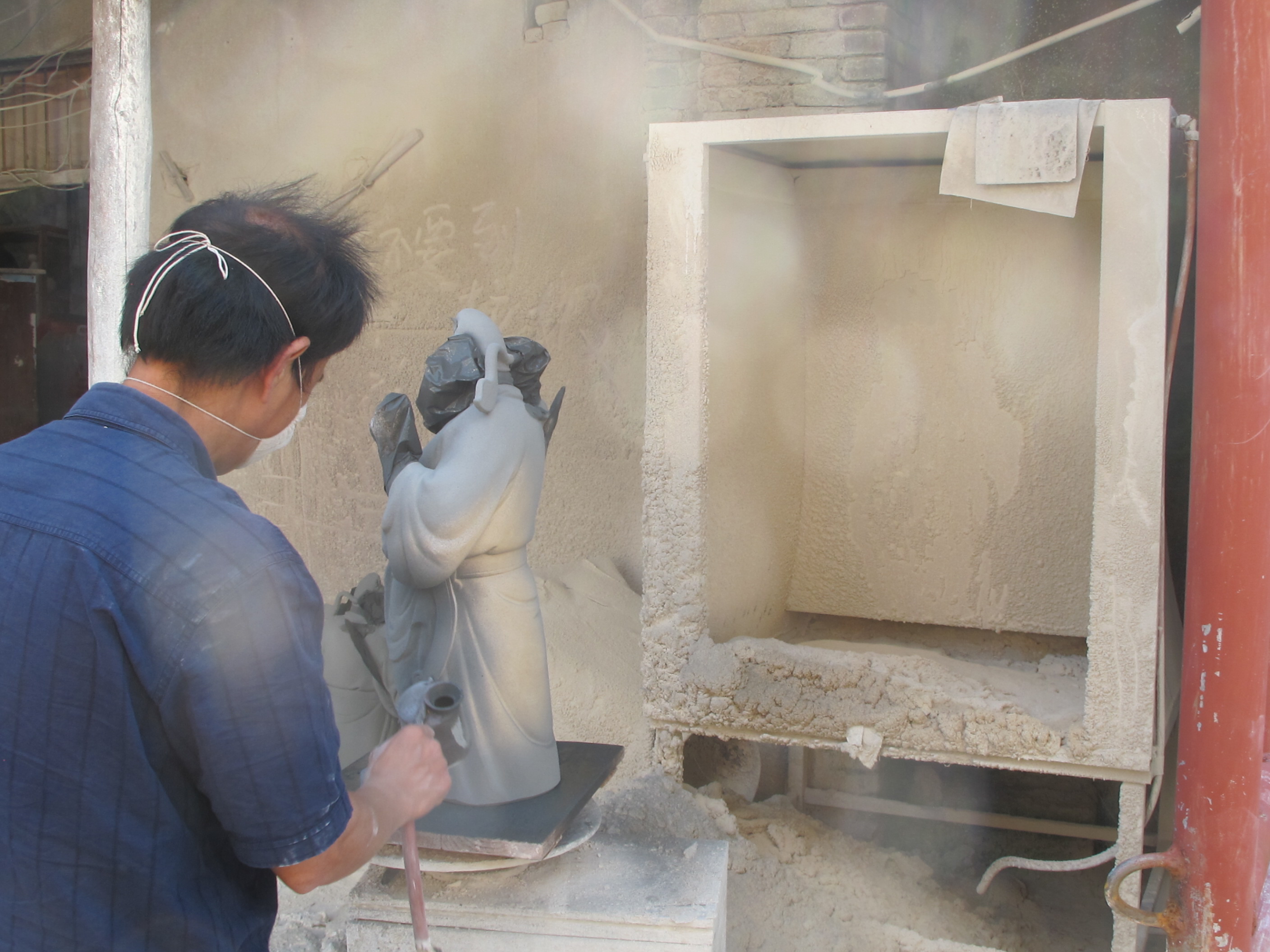
Although they now have sophisticated spray booths, and the use of dust masks is more common. They don’t always were the mask or turn on the fan and water pump!
The privately owned and run kiln firing services are amazing. These kilns are packed and fired every day, with one trolley being packed while the other is in the kiln firing. They seem to crack the door open at very hight temperatures, even while there is still a decent, strong, bright glow in the kiln, so as to crash cool it.
IMG_0163 IMG_0278
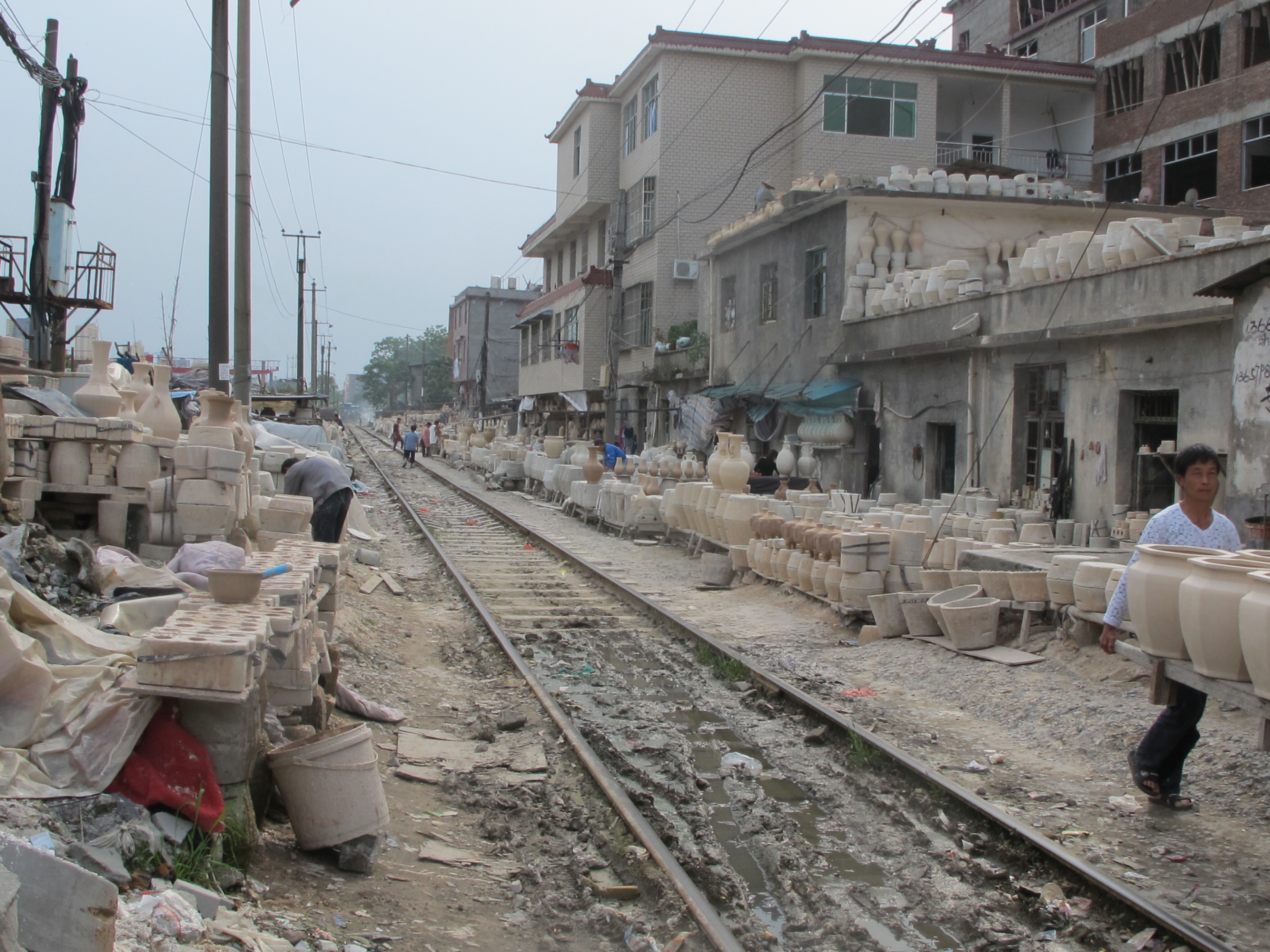
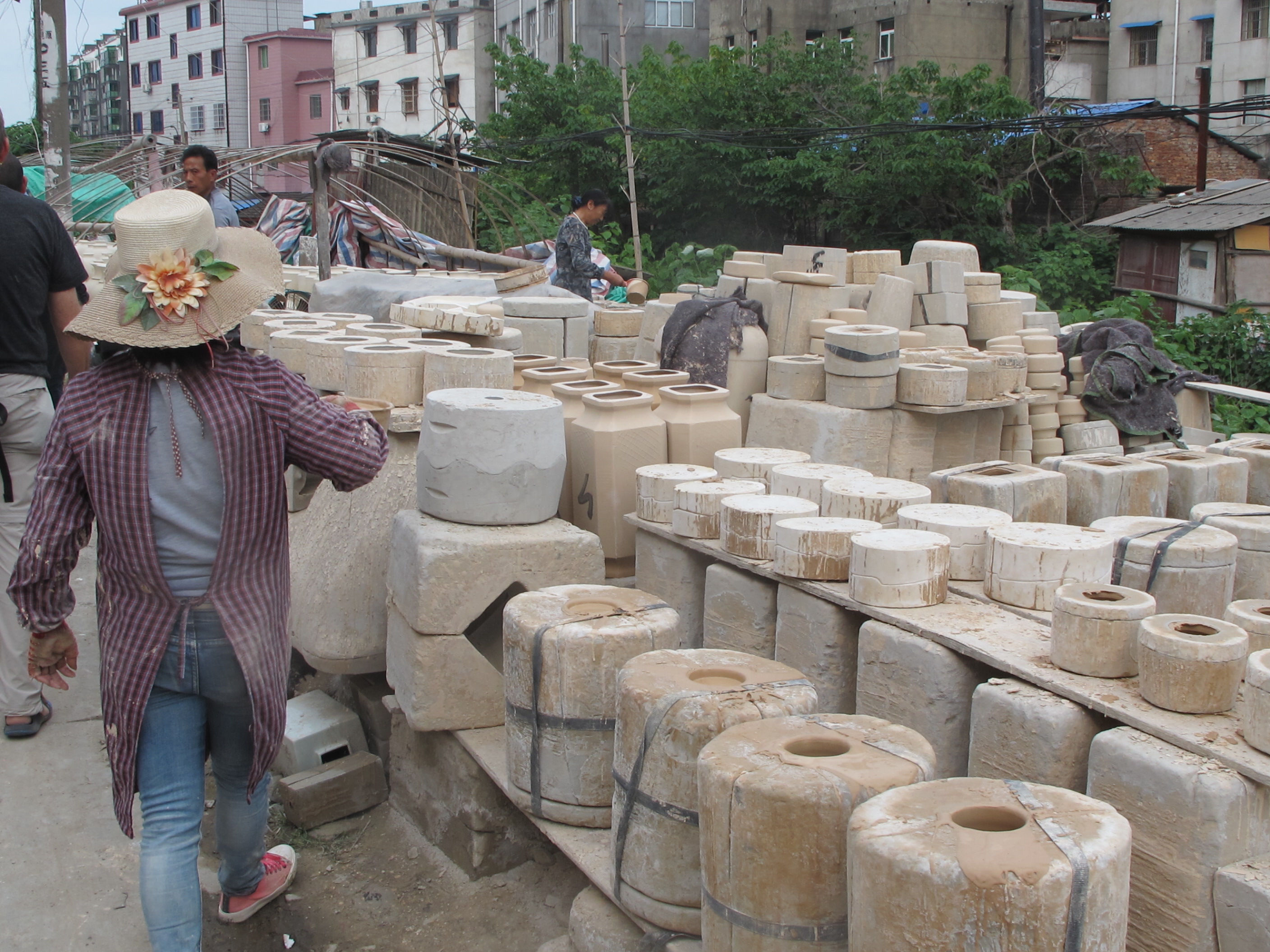
Where ever you go there are pots stacked out on the street to catch the breeze and some sunshine to speed up the drying. The pavement is also used as additional studio space in fine weather. Even the street and train line is used as extra workshop drying areas. Nothing is wasted!
IMG_0115_1 IMG_0134
IMG_0088_1IMG_0093
Where ever you go there are pots stacked out on the street to catch the breeze and some sunshine to speed up the drying. The pavement is also used as additional studio space in fine weather. Even the street and train line is used as extra workshop drying areas. Nothing is wasted!
IMG_0051_1IMG_0082 IMG_0081IMG_0561_1
IMG_0557IMG_0562_1
I’m quite in awe of these people’s ability for hard work, creativity and efficiency in some very difficult circumstances. It’s such an inspiring environment. I don’t want to come and live and work like this permanently, but I’m so very grateful that I have the chance to come and work here on these occasions and experience this life. It grounds me and makes me realise how lucky I am.
Best wishes
from Steve in Jingdezhen

Growing Old Together

Potting, throwing, making clay, kiln packing, kiln firing, kiln unpacking, more wood cutting splitting and stacking, gardening, weeding, pruning, composting. It’s been a busy couple of weeks.

Recently we have been doing something different everyday. There is always the garden and the pottery, then the house and land maintenance, but we are also doing weekend workshops over the winter months. We have just completed the 4th weekend in a row, only nine more to go, with a possible tenth.
IMG_8895

IMG_9126 IMG_9123

We started off the week in the pottery making pots. It’s always fun to get in there and let a few days slip by un-noticed in the joy of making. Clay is such a tactile and responsive medium. I’ve started to make some white tenmoku bowls out of my native bai-tunze porcelain stone. I also make a pot-board full of stoneware bowls and another of blended kaolin/stone based porcelain body. I finish up by making a board of Black ware tenmoku bowls. I plan to fire these unglazed in the wood kiln so that they will come out jet black. I think that this contrast of matt black and glossy white will work out well together. It’s just an idea. I’ll have to see how it goes. It’s starting out looking OK.

thumb_IMG_2576_1024

The kiln that I welded up last week is back from the galvanisers already. A 7 day turn around! unheard off!. What has gone wrong? It usually takes these buggers at least 2 weeks and more, usually 3 or 4. I’ve even waited 6 weeks for one of my jobs to get through their process. Still, it’s back here now and I’m very pleased, it takes the pressure off. I drove up to Sydney on Monday morning to collect it – to make sure that it was done. I have spent an hour or two each morning this past week grinding, etching, sanding, filing, priming, undercoating, and finally two coats of top coat will go on the inside to make sure that it is really well rust proofed inside for years into the future.
The customer has no idea what has gone on inside this kiln frame. It’s all covered over in Stainless steel, but I know that it is the best way to insure that this kiln will last a working life time and more. I don’t have to do it. I decide to do it, because it’s the right thing to do. No one will ever know, but I know. I build them as if I was going to own it myself. I want it to last for 20, 30 or maybe 40 trouble-free years.

IMG_9251

I know that this effort will be rewarded. I have some kilns out there in Universities and TAFE colleges that are fired on a regular basis, every week and have been now for almost 30 years. I know their history and I also know that they have had only minimal maintenance issues over that time. I’m proud of that. If I buy something, I want it to last, all my life if necessary, with no built-in obsolescence. I want it to work perfectly, for as long as possible, and then to only need minimal attention.  Something like the replacement of the thermocouple or temperature meter. This is my aim, and I’m all-in to go for it as best I can. It’s the product that I want to own!
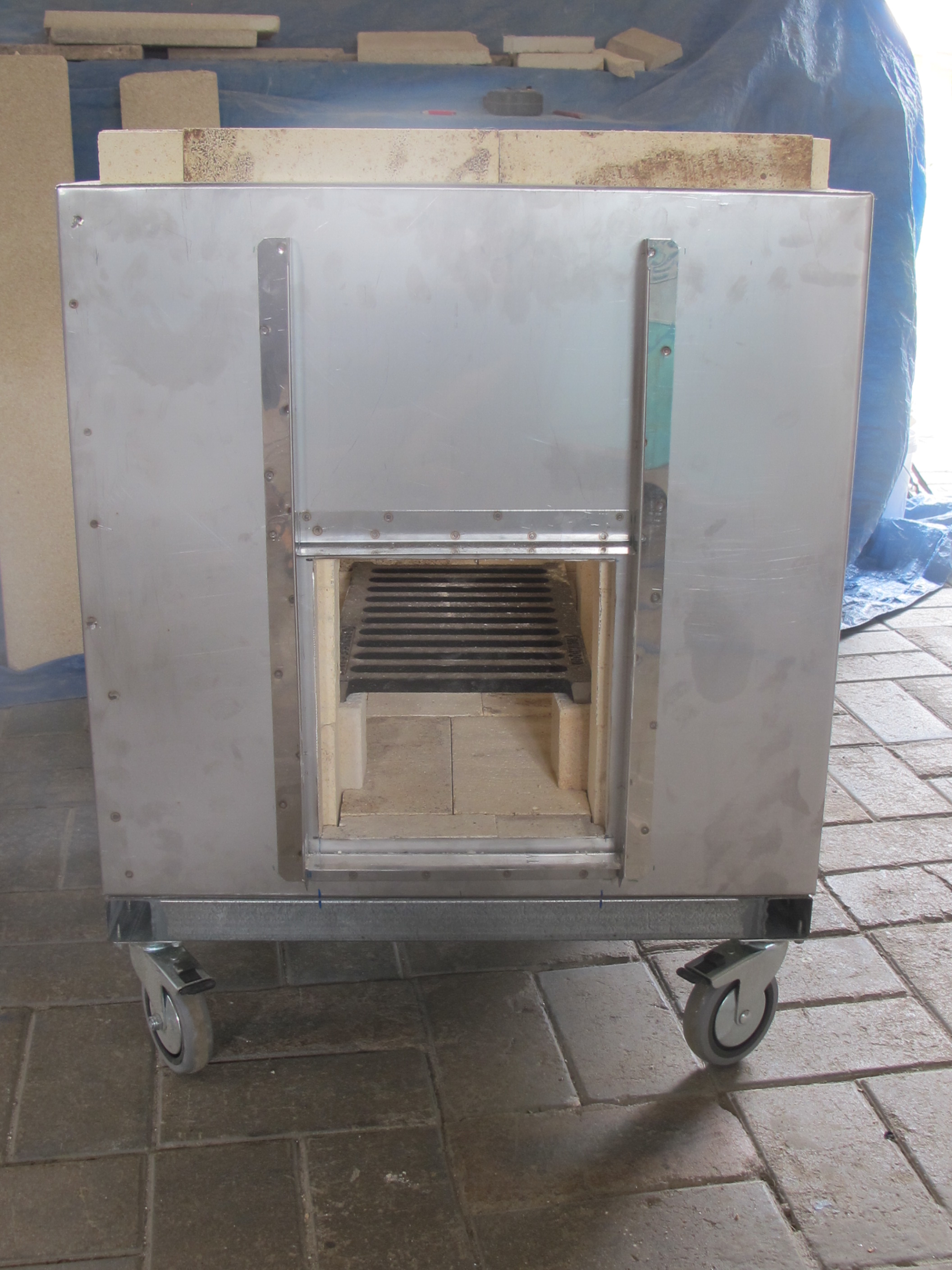
Another little wood fired raku/midfire portable wood kiln rolls of the production line. This one fitted with all-terrain 200 mm. tyres, for wheeling over wet lawn and/or soft gravel.

IMG_9250 IMG_9253

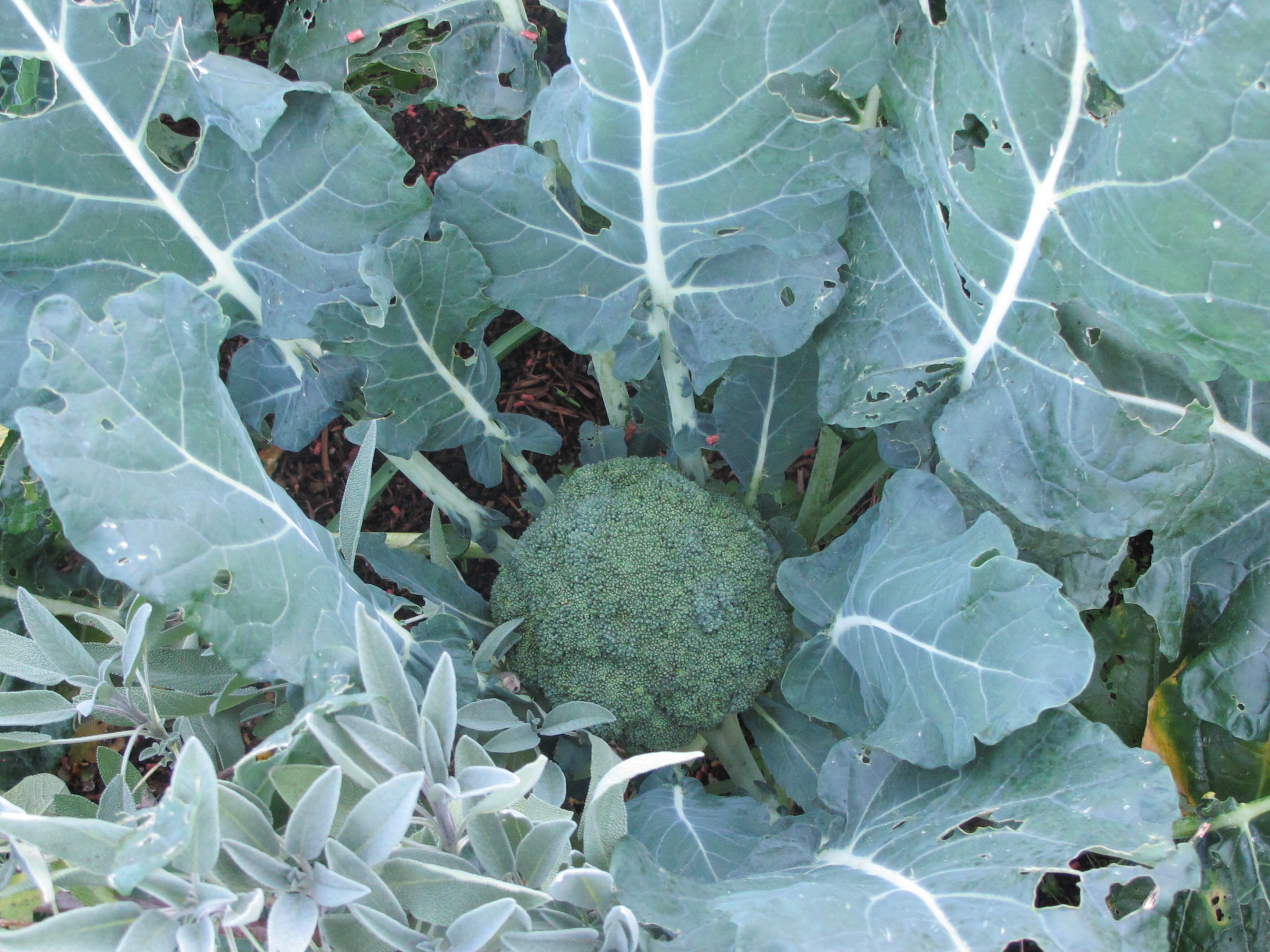
I started weeding the last of the tomatoes from the summer garden and made a huge couple of heaps of compost of all the weeds and old tomato and spinach plants. At this time of year, the Worrigal greens (tetragonis) seem to spread everywhere. It’s a native plant that is something like spinach, but growing prostrate, and spreading wildly. It seeds prolifically at this time of year and there will be numerous seedlings appearing in the spring.

IMG_9173IMG_9174 IMG_9175

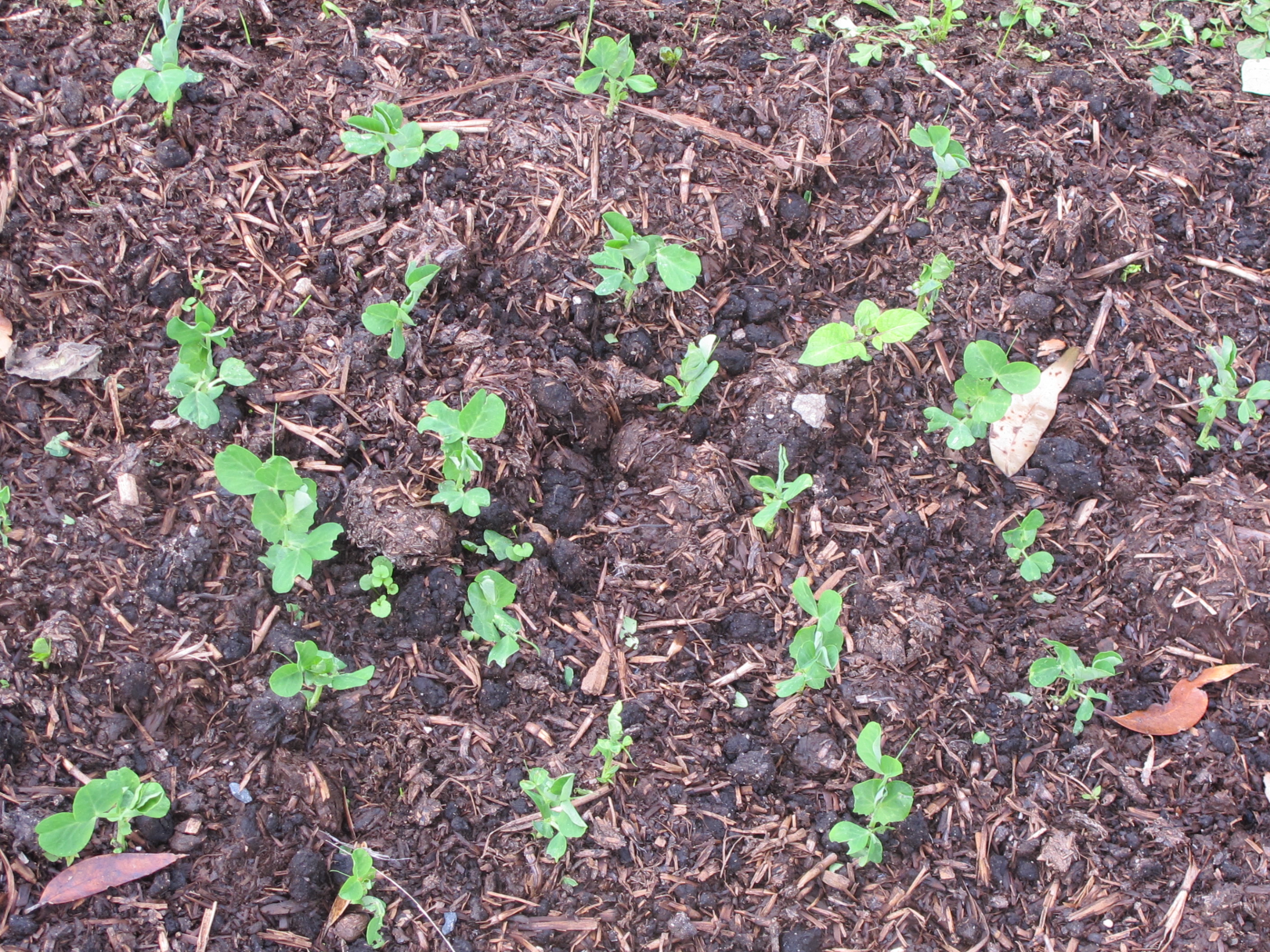
The garlic that I planted in March is all up now, early, mid-season and late varieties. All seem to be doing well. I also planted bush peas and broad beans on either side to accompany them and to fix a little nitrogen as well, while they are at it. We’ll see how the rest of the year pans out, and if the rainfall continues.

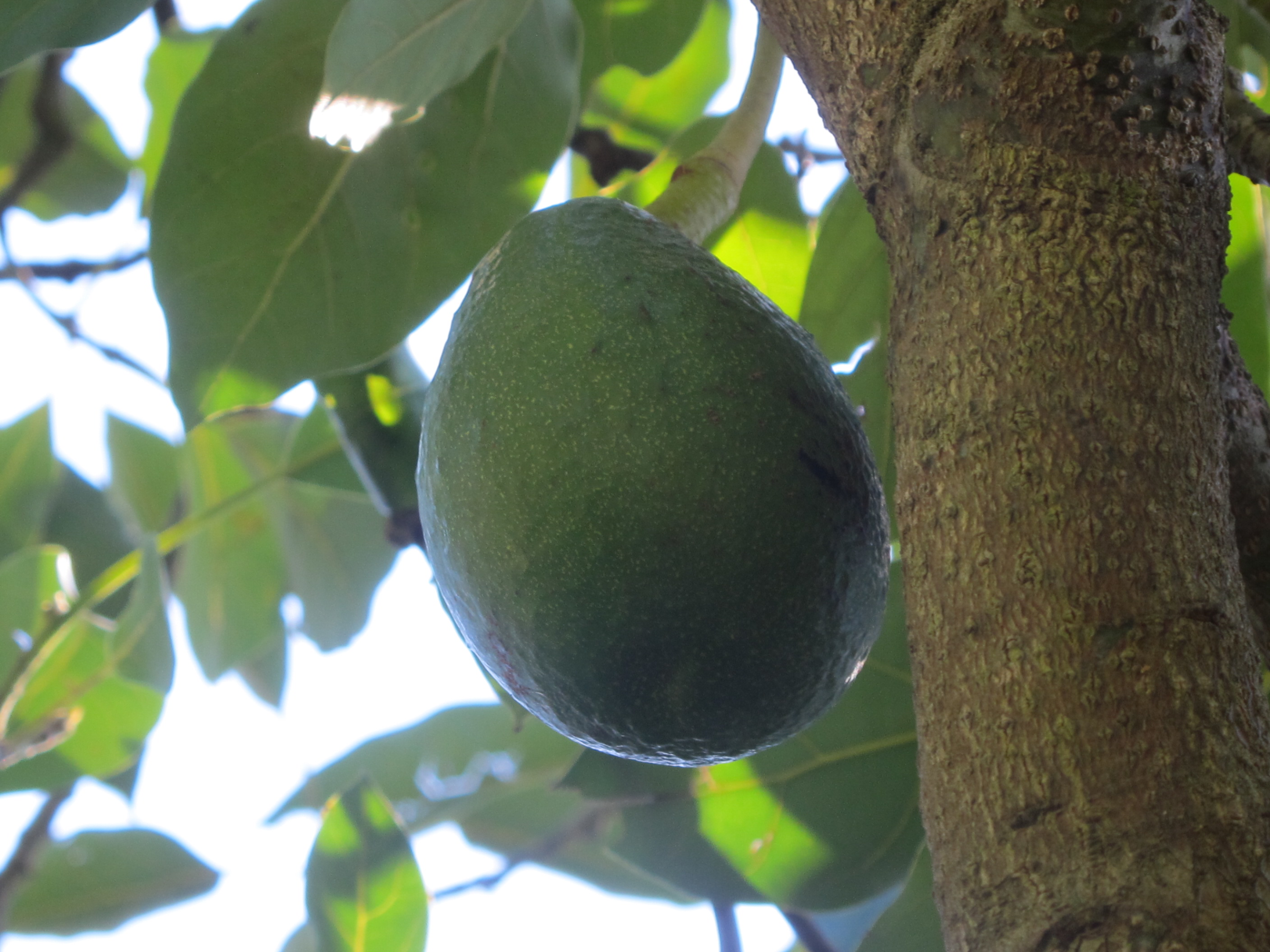
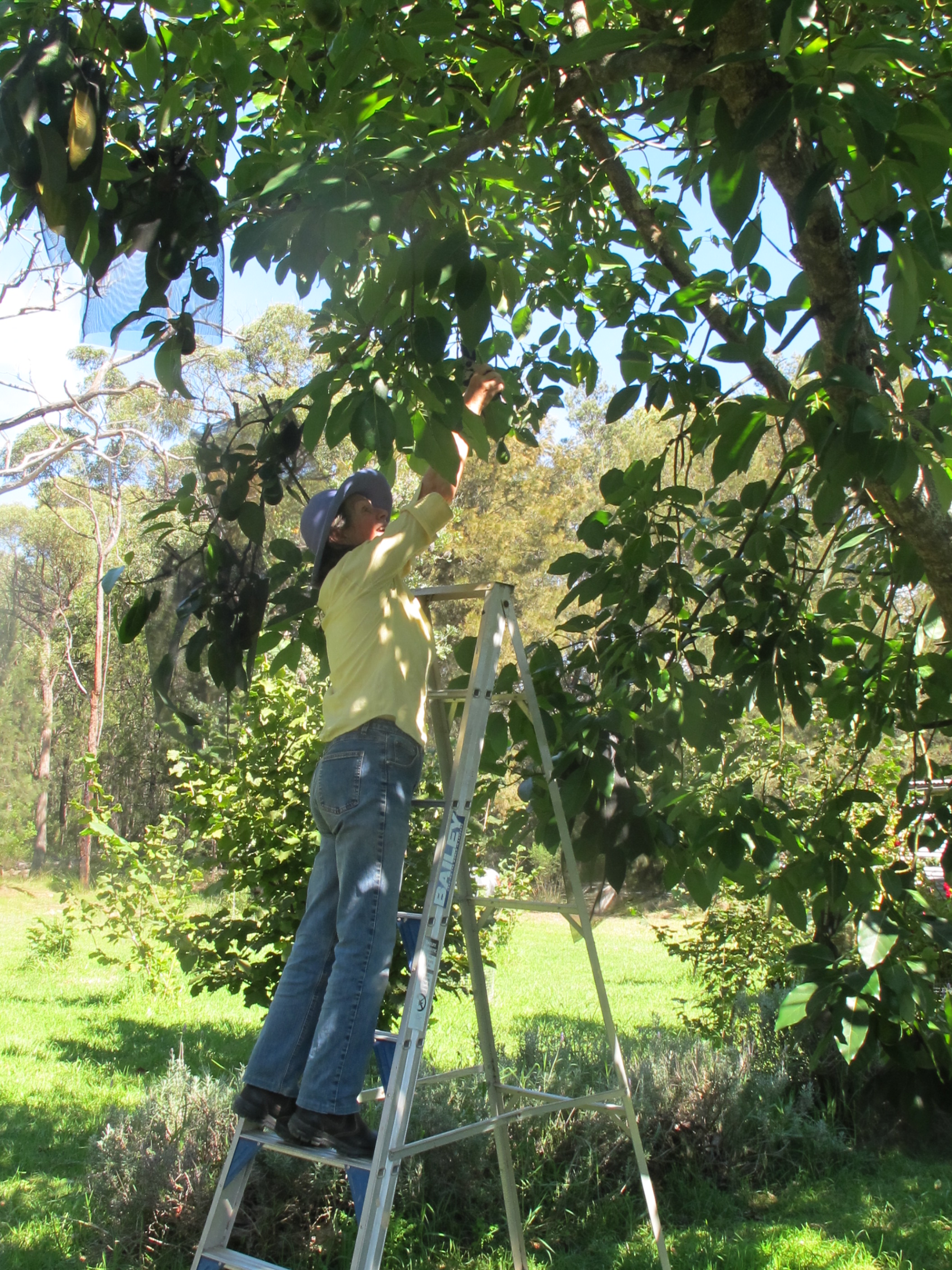
One plant that has thrived in all this rain has been the avocado tree. We have a bumper crop this year, hundreds! We’ll eat what the hail, birds and possum don’t ruin.

IMG_8928IMG_8926

We had such a sustained hail storm last Saturday week. During one of our wood firings. The hail on the tin roof was so loud that I went and put on my industrial ear muffs! One of the potters measured the decibels with her phone app at 89 decibels. That’s as loud as my chain saw, according to the warning sticker! The hail continued and lapsed, then returned 3 times in all during the afternoon and evening. It will have made a mess of the avocados. However the vegetable garden is entirely under cover of both chook wire and small mesh plastic netting now, so I was able to look out of the kiln shed window and watch the hail bounce off the fine plastic netting. After the storm, I wandered out for a quick look, there was no noticeable damage to any of the vegetables. That netting was such an exertion of time, money and effort, but it was worth it in every way. This is part of the pay-back now. All those vegetables saved from a shredding from the hail.

IMG_9136 IMG_9256

In the evenings, early mornings, or whenever I can fit it in throughout the day, I manage to find a little time to play my cello. It’s a beautiful thing. It’s changing over time as the wood ages and settles in.

We are growing older together, Nina, me and this cello, the difference between us being that it’s the cello that is getting better with age !

IMG_9258 IMG_8998

Fond regards

Pau Harrison

Note to self: Don’t buy plastic crap

Now that the weather is closing in, it’s a lot cooler and the days are shorter, and for some unknown reason, it keeps on raining. We have gone from bush fire protection and hazard reduction, to digging drainage ditches. Fortunately we have missed the flooding that is happening just now up the north coast and in Queensland. I suppose that it helps that we live on top of a high ridge of hills. We are very well-drained here.

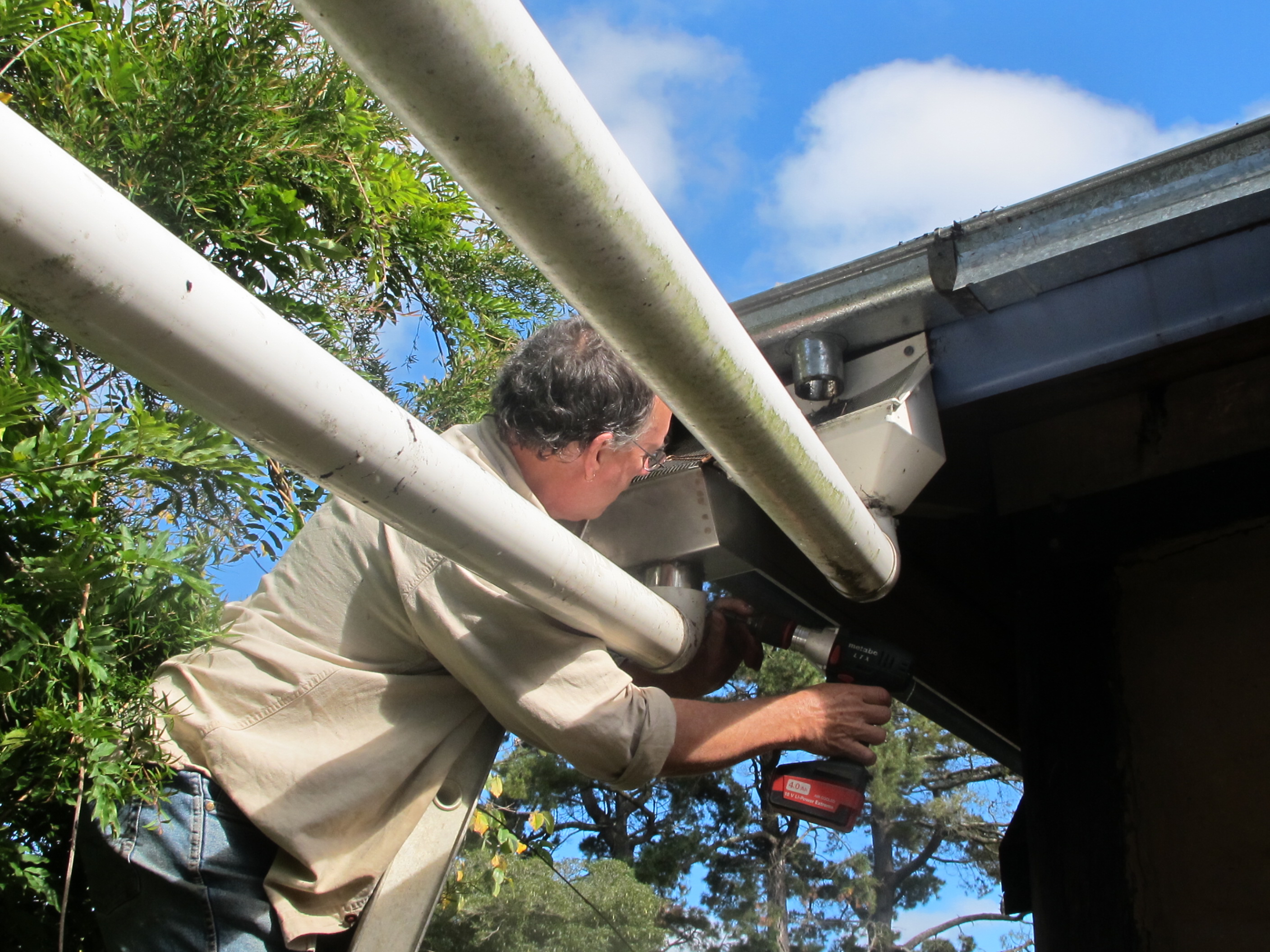
One good thing about constant rain, is that we don’t have to be worried about bush fires or bother to water the garden, but that time saved is now spent in unclogging drains and cleaning gutters and downpipe sieves.
Some years ago, I thought that I’d save some time and buy a plastic gutter sieve/storm water head thing. What a piece of short-term rubbish that turned out to be. I should have known better. Actually, I do know better, but I’m lazy. I just gave in and bought the easy option. I’ve learnt my lesson – yet again. Now just a couple of years later, it’s all cracked and broken and has become an embarrassing piece of plastic junk, destined for land-fill.
IMG_9237
Last week we were at the monthly meeting of the Royal Society. This month’s lecture was from Professor Richard Banati  about the fact that plastic never really decomposes, it just breaks down into smaller and smaller pieces and traces of it can be found in all life forms where it is ingested along with other food, it builds up in the higher order species and all of it is destined to end up in the top predator. Guess who that is?
Here is a reprint of the Royal Society promo.
“The talk by Professor Richard Banati from ANSTO and Sydney University Faculty of Health Sciences. Plastics in our environment.
 
Estimates suggest that the planet could have another 33 billion tonnes of plastic by 2050. 33 billion tonnes of plastic is equivalent to filling 2.75 billion garbage trucks enough to wrap around our planet 800 times if lined up end to end.
 
Scientists estimate that more than 250,000 tonnes of large size plastic litter the ocean surface, this does not take into account  the micro plastics which are  plastic fragments derived from the breakdown of larger plastic debris, both at sea and on land. Over time, a culmination of physical, biological and chemical processes can reduce the structural integrity of plastic debris, resulting in fragmentation of  2-3 mm in length and 0.1mm in diameter.
 
The whole issue of product life cycle analysis has so far focused on the litter aspect and not the contamination that cannot be seen without studying at the atomic scale.
 
Richard and his team at ANSTO are collaborating with scientists from Monash University and University of Tasmania and studying whether the trace elements typically found in plastic and  in the stomach of birds, these trace elements are also found in the growth of young bird feathers like the annual rings in trees, thus indicating the effects of degrading plastics in the food chain may affect birds, marine animals as well as humans.        
 
This is an important chapter of how we deal with plastic waste as hazardous, threatening the health of people and wildlife.?
 
Professor Banati said that the only way out of this mess is to stop producing the stuff. Not too likely I don’t suppose. We are all addicted to the stuff through our ignorance, indifference and/or laziness.
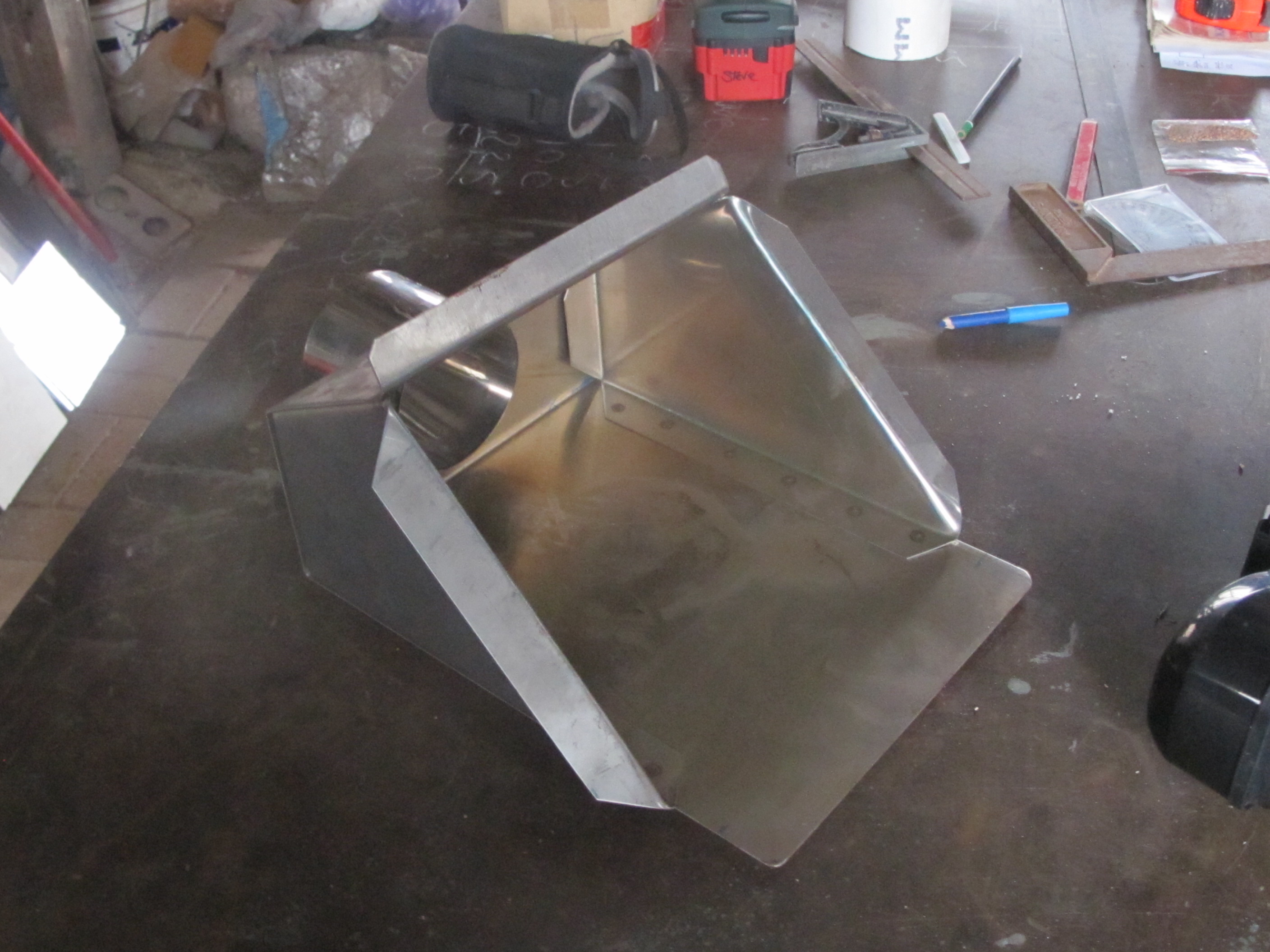
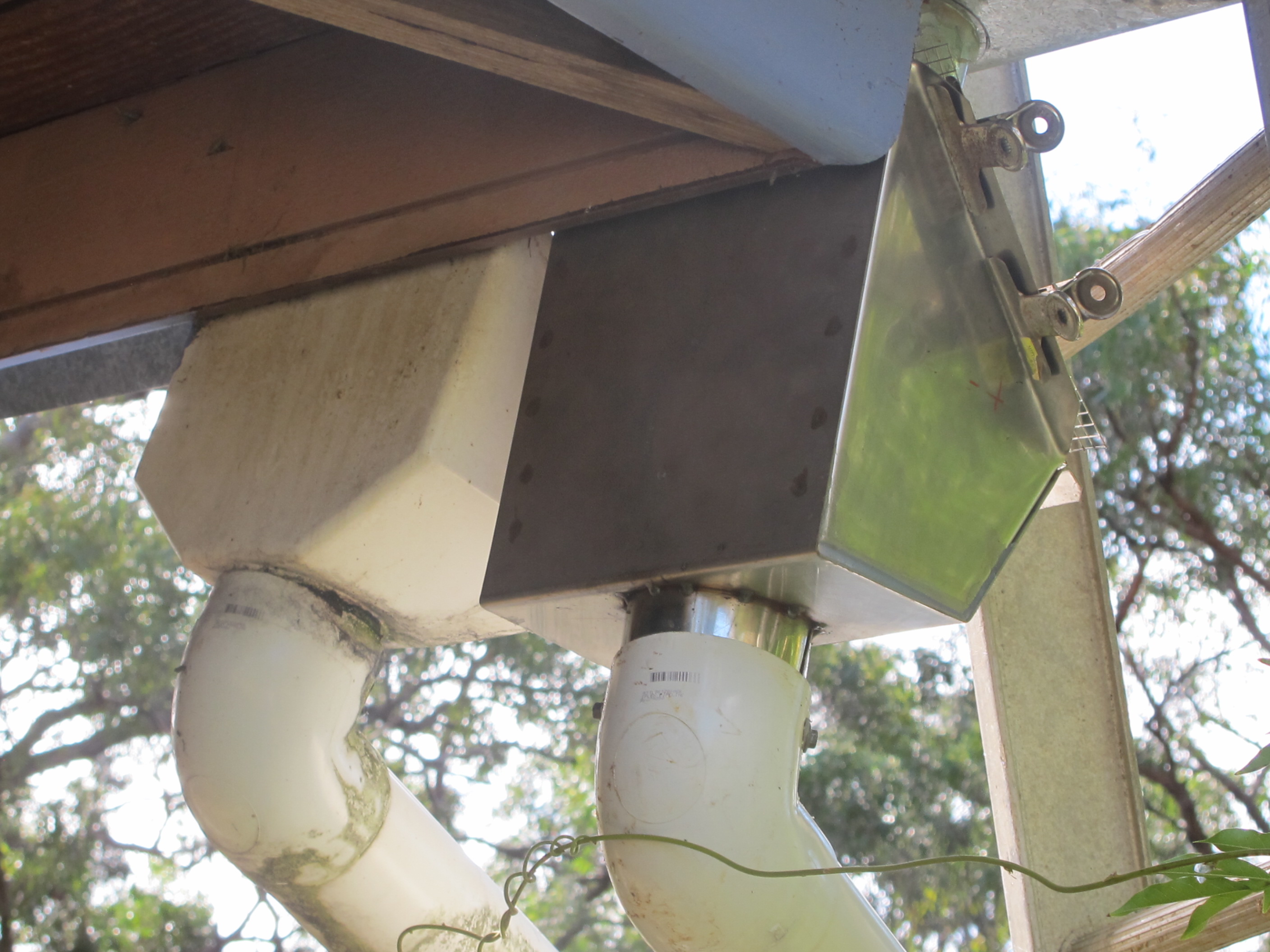
Anyway, I try not to buy too much plastic crap, but I’m only human and I am lazy with it too, so now I have the job of fixing this broken plastic gutter fitting. It’s all cracked and the collar is broken off, it’s dead. It’s going to land fill. My only real option is to replace it. But not with another plastic one, not again! I decide to use some of our left over off-cuts of kiln building material that I am so reluctant to take to the metal recyclers, just in case I can find another useful life for the little bits here and there, around the place. It doesn’t take long and I find just the right piece of off-cut stainless steel sheet. I adapt my idea in my mind at the concept level and change the dimensions of what I was imagining, to suit what I have. I sketch it out in chalk on the welding bench. I re-design it to use all of what I have with no loss through cutting, then I go searching for some other little bits of stainless sheet off-cuts to make the sides.
IMG_9222 IMG_9220
An hour later I have a rather nice stainless steel rain water head with a 45 degrees diagonal stainless steel leaf-sieve clipped on and ready to go up on the roof. It’s rather rough, but a joy to behold for me, because it is waste forestalled and made entirely out of scrap destined to go to the recyclers, except that it has now been re-imagined and re-purposed into something that will last longer than me or the building that it is now attached to.
IMG_9238IMG_9241IMG_9244IMG_9245
I’m no plumber, but this doesn’t have to hold water, just redirect it. I think that it will actually work OK. I don’t have any plumbing training, but I do have a little bit of imagination, some determination and a desire to subvert the system.
Now all I have to do is make a duplicate to replace the one next to it, for when it breaks. Which can’t be too far off?
But then, I’m still stuck with plastic plumbing pipe.
Note to self, don’t buy plastic crap – if there is an alternative.
Nothing lasts, nothing is ever finished and nothing is perfect.
and this could not be more true when applied to plastic roof and gutter fittings.
Best wishes
Steve the lead-free plumber who is trying to reduce his dependance on plastic.
.
Dr. Steve Harrison PhD. MA (Hons)
hotnsticky@ozemail.com.au

blog; tonightmyfingerssmellofgarlic.com

http://www.wattersgallery.com/artists/HARRISON/Harrison.html

Potter, kiln surgeon, clay doctor, wood butcher and Post Modern Peasant.


A world tour of our garden, in 3 meals.

Breakfast, Lunch and Dinner, a world tour of our garden, in 3 meals.

Gardening is a very enjoyable activity. It gets us out into the fresh air, it’s good exercise and It provides most of all we eat each day. As the autumn progresses towards winter, the cooler weather encourages us to seek out more warming cooked meals. We indulge ourselves in reflecting on the people and places that inhabit our collective memories. Our conversations trigger memories of these people and places. Fond recollections of some past events and friends remembered through pots and food. We don’t attempt to make Italian, Spanish, Japanese or any other type of national cuisine. We make Australian food. Real food, home-grown, eaten fresh where possible, but when preserved, we do it without any added chemicals or preservatives. Preserved in glass jars, not plastic. and all home cooked. We just take the influences that we recall and weave them into our dietary choices, them combine our thoughts with what we actually have available to us from the garden.

This is what happened yesterday, in between, potting, gardening, wood cutting, kiln building and building maintenence. There is time for everything, in its own time.

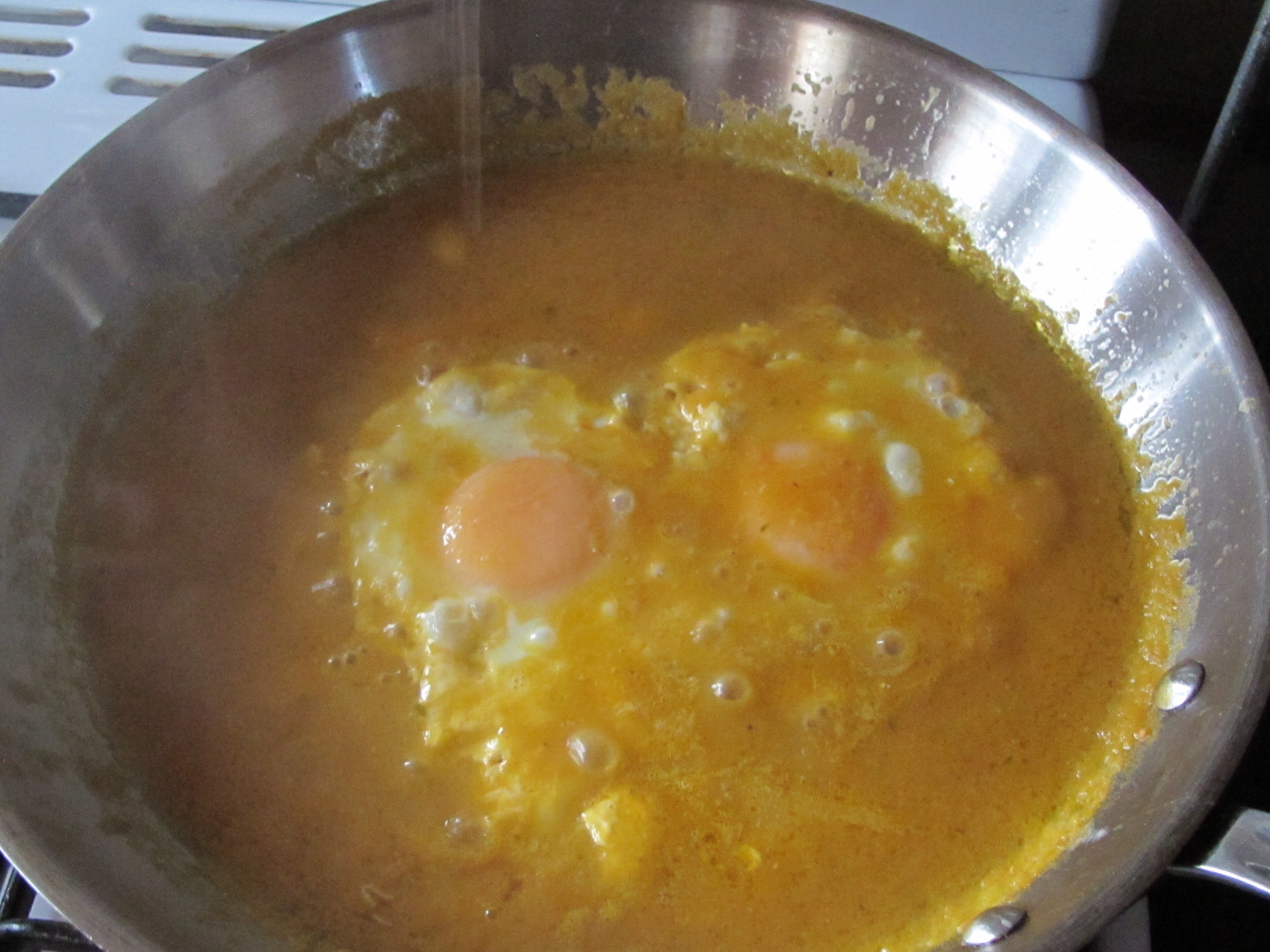
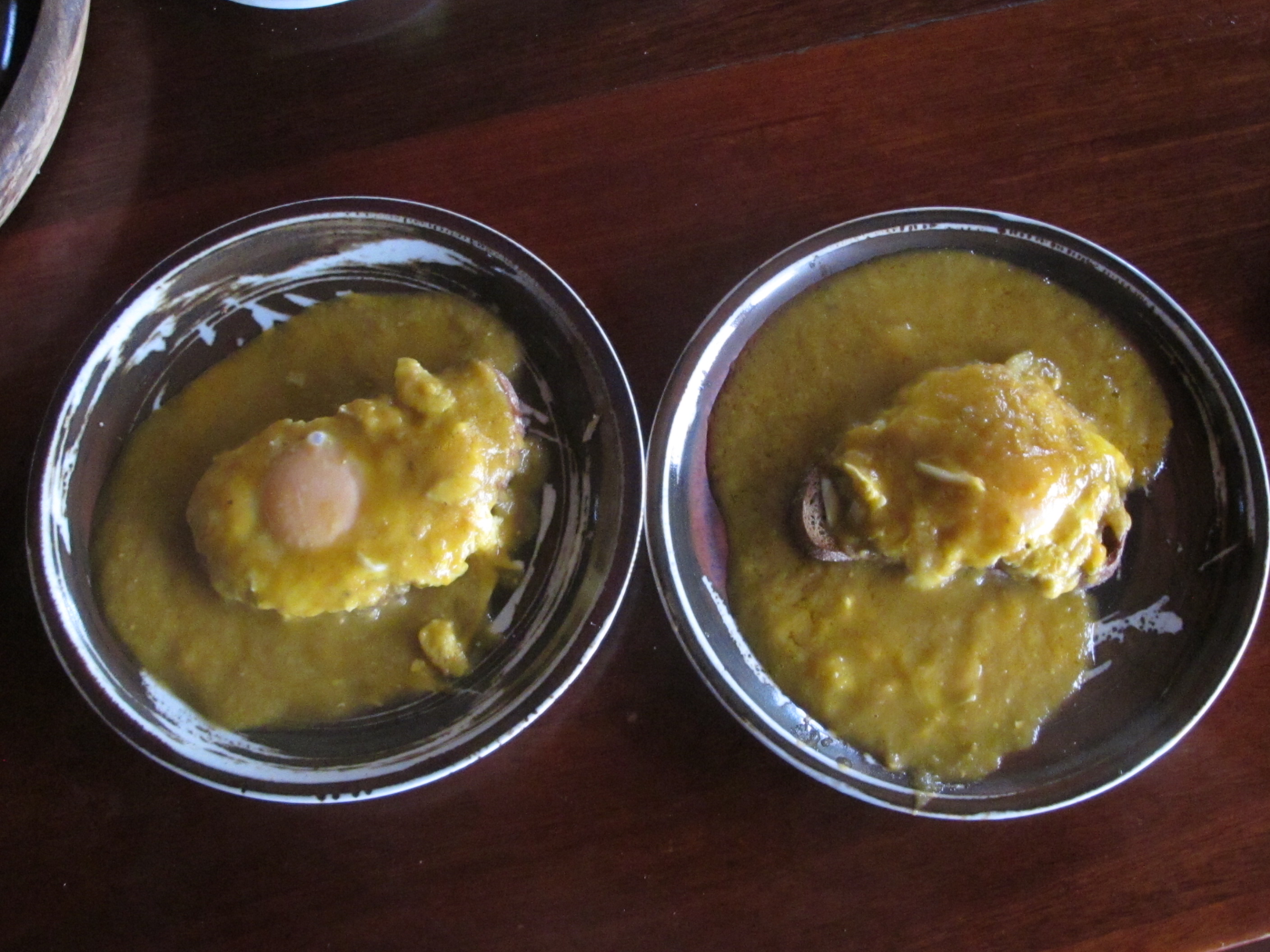
For breakfast I cooked eggs in passata with a few cloves of garlic warmed in good olive oil first.  The passata I used on this occasion was made from little yellow, pear-shaped tomatoes that I preserved a couple of months ago, at the height of summer. The passata is heated up and the eggs cracked in and covered to gently simmer until the whites are firm. I served it up on a piece of rye sour dough toast.

I must say that it was just right for a cool, misty, foggy, morning breakfast. A little cracked pepper makes it perfect.

IMG_9225 IMG_9227

IMG_9229

IMG_9230

We don’t quite lick the plates, but there is certainly nothing left.

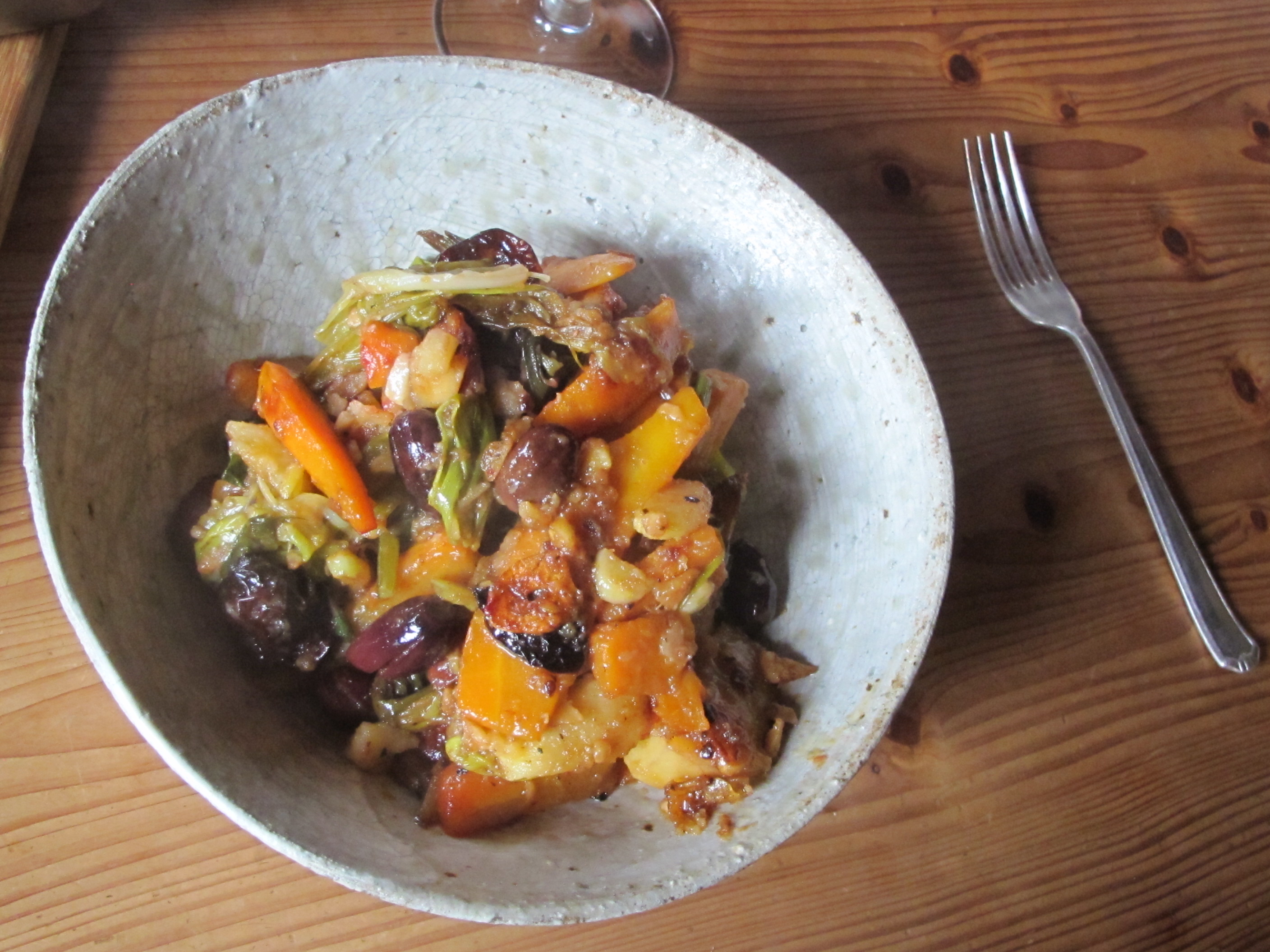
For lunch I made and hotch potch from the left over baked vegetables that Nona Nina made for last nights dinner. Brussel sprouts, parsnip, leeks, carrots, pumpkin, onions, zucchini and beetroot. We had that garnished with preserved spicy plum sauce from our summer orchard fruit.

IMG_9128 IMG_9160

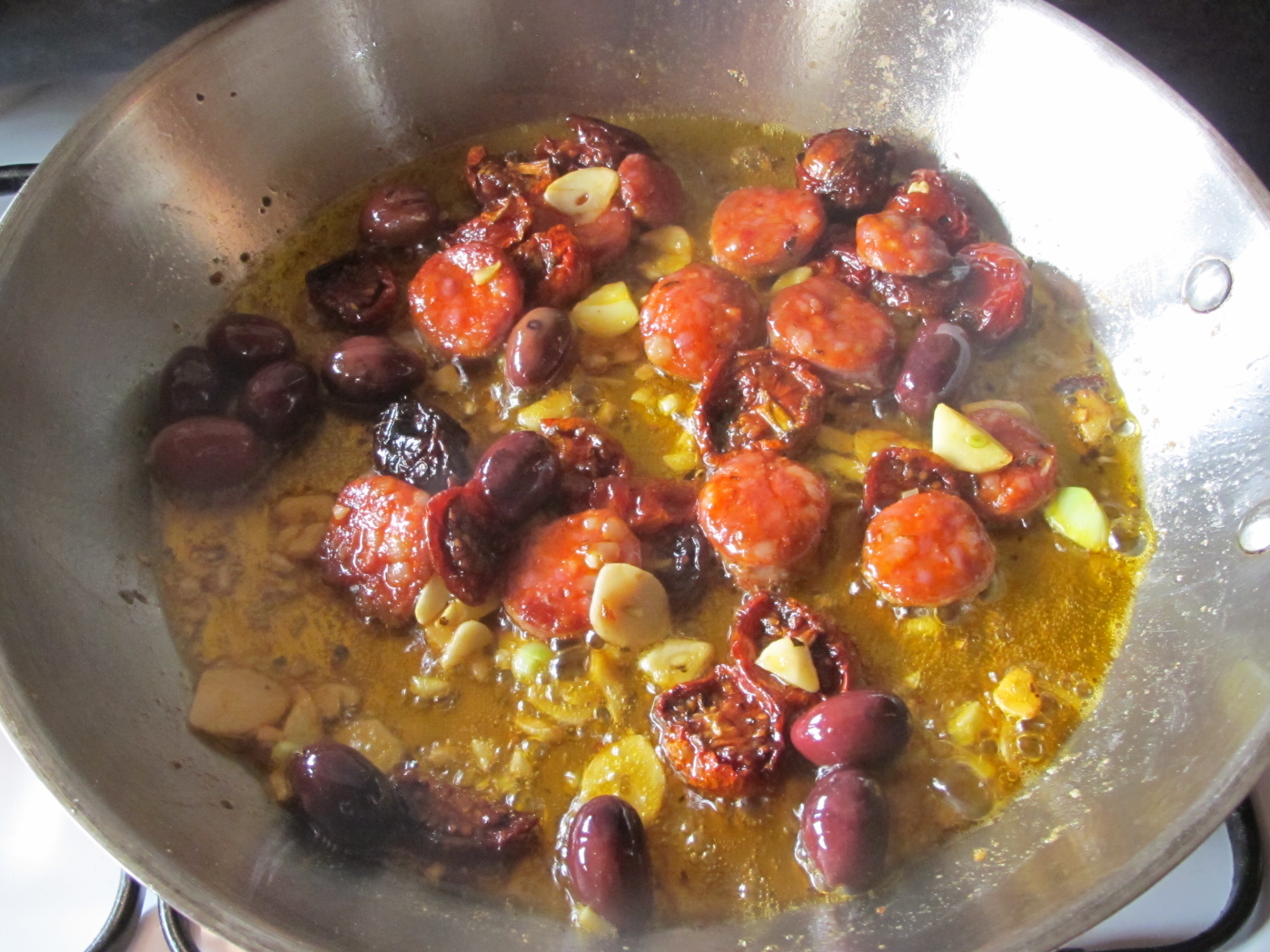
These left-overs were added to some chorizo sausage, our garlic, olives and home-made dried tomatoes from the summer excess. A lovely way to use up everything that we have in different and interesting combinations. We haven’t bought any meat since Xmas as far as I can recall. We aren’t vegetarians, but we don’t eat a lot of meat. So this is our little indulgence, veggie hot-pot with chorizo. Hot, spicy and nicely warming.

IMG_9213 IMG_9215IMG_9217

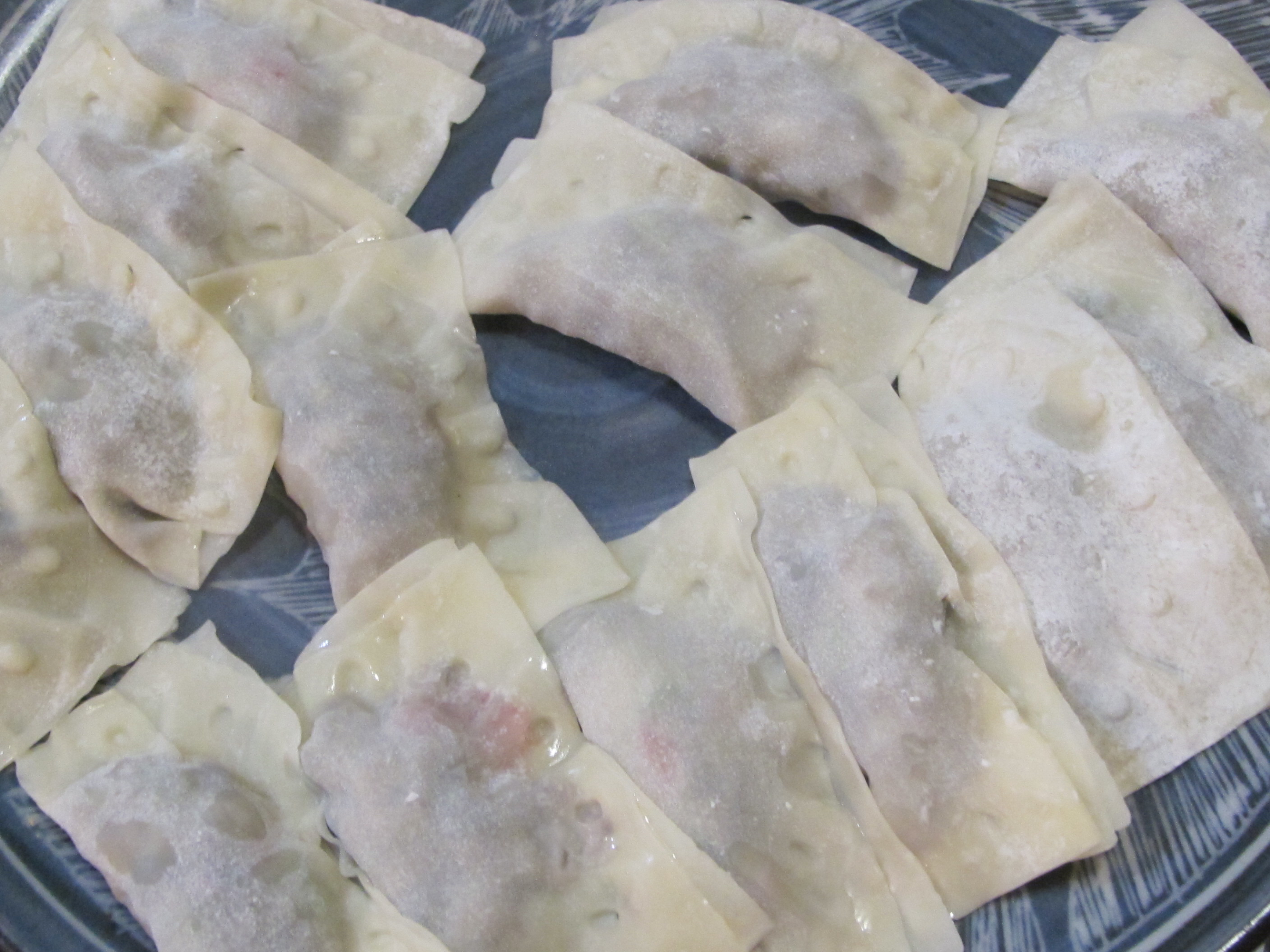
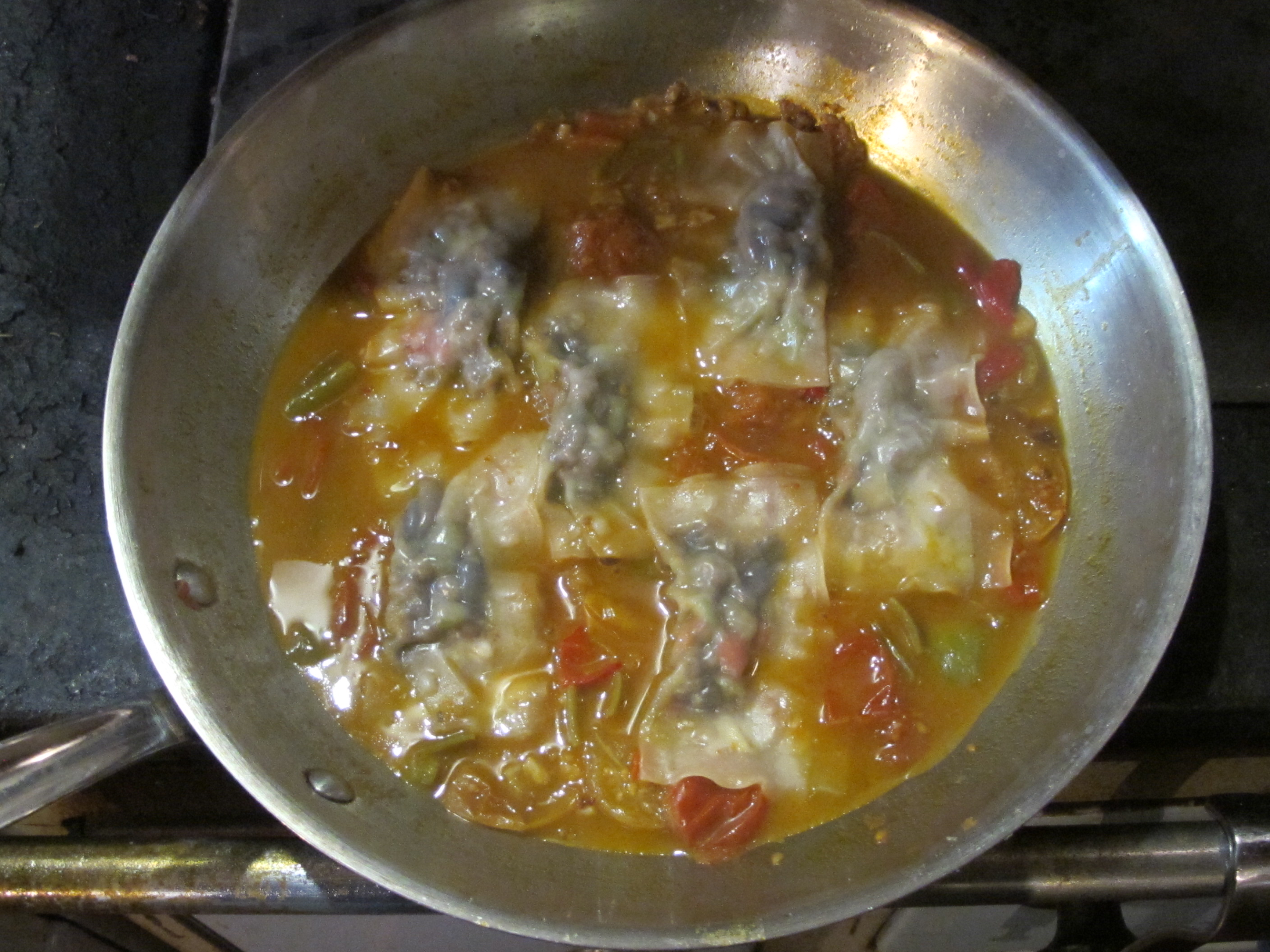
For dinner we decided to have Gyoza. I had previously bought 500g of lean pork and asked the butcher to mince it for me. I divided it into 4 parts and froze 3 of them for later. The 125g of pork mince is just the right amount to make gyoza for two. We fry the pork with lots of garlic in olive oil and some finely diced garden veggies. Then Ninako fills the small parcels with the mixture and I simmer and steam them in a sauce made from the last of the small red and yellow tomatoes from the garden, a few beans and some chillies. When this is reduced down, it makes a delicious simmer sauce.

IMG_9115IMG_9116

IMG_9117

IMG_9118

IMG_9119 IMG_9122

It all mellows out very nicely. 7 each is just the right number of gyoza dumplings for one hungry potter. This sauce, although not culturally authentic, is very well matched to what we are enjoying, and most importantly it is entirely ours, from our garden. This is our Australian ‘gyoza’ influenced local dumpling experience. I’ll have another go at it some time in the future, and I’m sure to enjoy that too. Nothing is ever finished, nothing is perfect and nothing lasts. This meal certainly didn’t!

It’s such an indulgence to tour the world of our recollections with such wholesome and tasty food, and almost entirely from our own produce.

We are very lucky people and I am grateful.

I have arranged to donate one of my recent bowls from my Watters Gallery exhibition to the fund-raiser appeal for the Nepalese victims of the recent earthquake. The pot will be auctioned soon. Please see below;

I believe you will have heard about the recent devastating earthquake in Nepal.

With the help of Vicki Grima, The Journal of Australian Ceramics editor, I am organising a fundraising project called CLAY FOR NEPAL (#clayfornepal15) to raise funds for the Nepalese people affected.

The first part of the project is an AUCTION of ceramics from around the world.

In conjunction with the AUCTION, Adriana Christianson, has offered to help me organise a BUY NOW STORE offering more affordable items for immediate purchase.

Both events will be happening from Friday 15 to Sunday 17 May 2015.

AUCTION: www.stores.ebay.com.au/clayfornepal

BUY NOW STORE: www.clayfornepal.bigcartel.com

PREVIEW of available works for both events here

Thank you for your support,

Vipoo Srivilasa

contact :

AUCTION: vipoo@vipoo.com

BUY NOW STORE: mail@adrianachristianson.com

All funds collected, less any event expenses (eBay and Paypal fees), will be donated to Oxfam, Nepal Earthquake Relief Appeal.

Vipoo Srivilasa is authorised by Oxfam Australia to collect funds for the benefit of Oxfam.

Vipoo is a very nice and thoughtful bloke who has taken on this endeavour of his own volition. It’s a credit to him and I am proud to be associated with the enterprise. Janine and I have donated cash through the Red Cross, but this is a way that we can do more, by doing what we do best. Which is making beautiful, thoughtful, meaningful objects.

 Best wishes

from

Stevbu and Ninako, gardeners of local produce and international flavours.

Play is the Best Part of Work

Our New Small Wood Fired Kiln

There is an amazing potter in Switzerland called Stefan Jakob, who specialises in raku firing. <http://www.raku.ch>

He has been to Australia a few times. He is the inventor of the IKEA garbage tin raku kiln. It is a really impressive little kiln that is cheap, compact and very efficient of wood fuel. It fires raku really well and is such great fun.  It is such a great idea that I wish that I had thought of it:)

We organise wood firing weekend workshops here through the winter months and some of them are for wood fired raku. However, Janine uses these little wood fired kilns to do her earthenware glaze firings.

IMG_4202 IMG_0724IMG_4131        IMG_4204

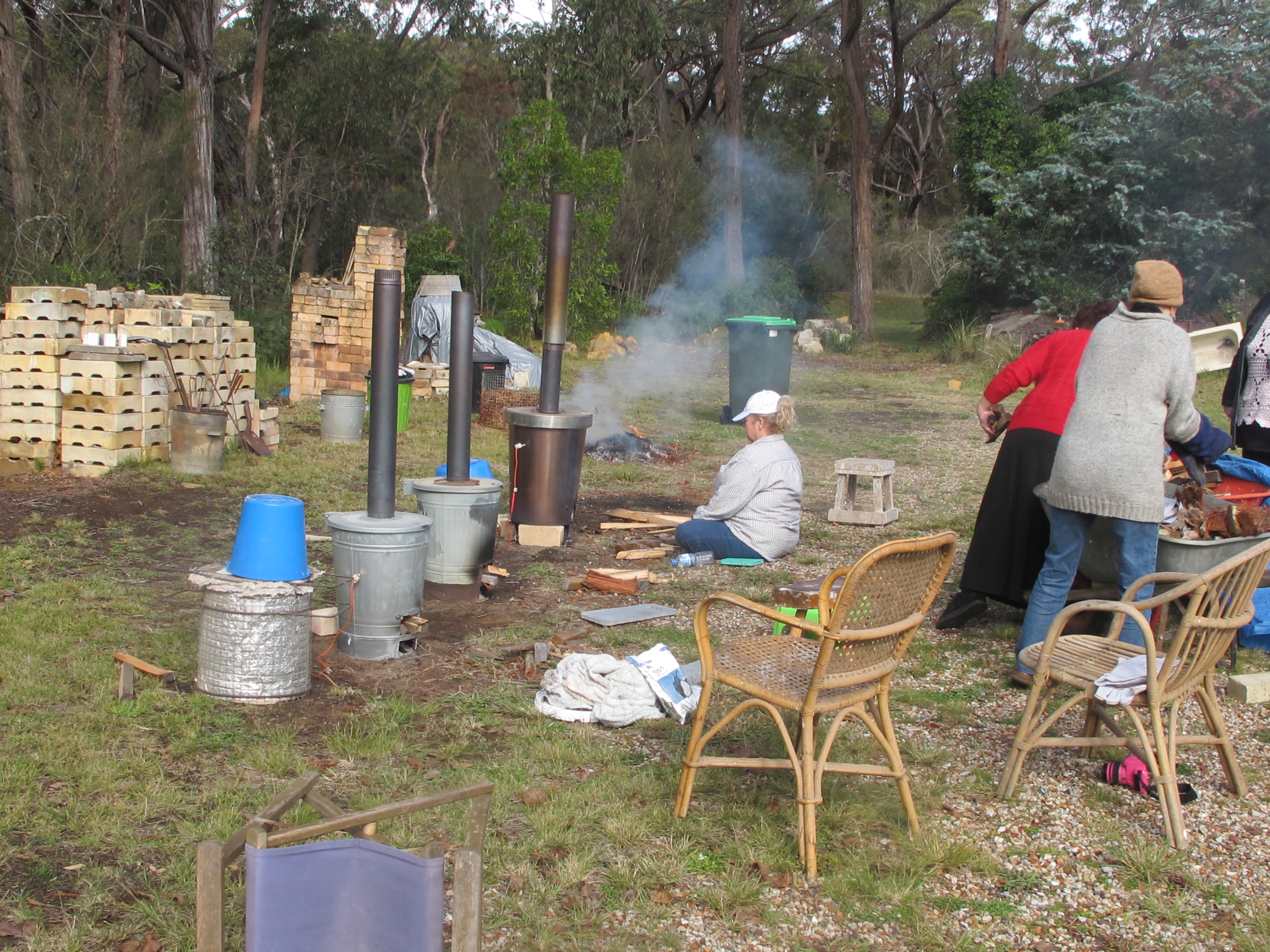
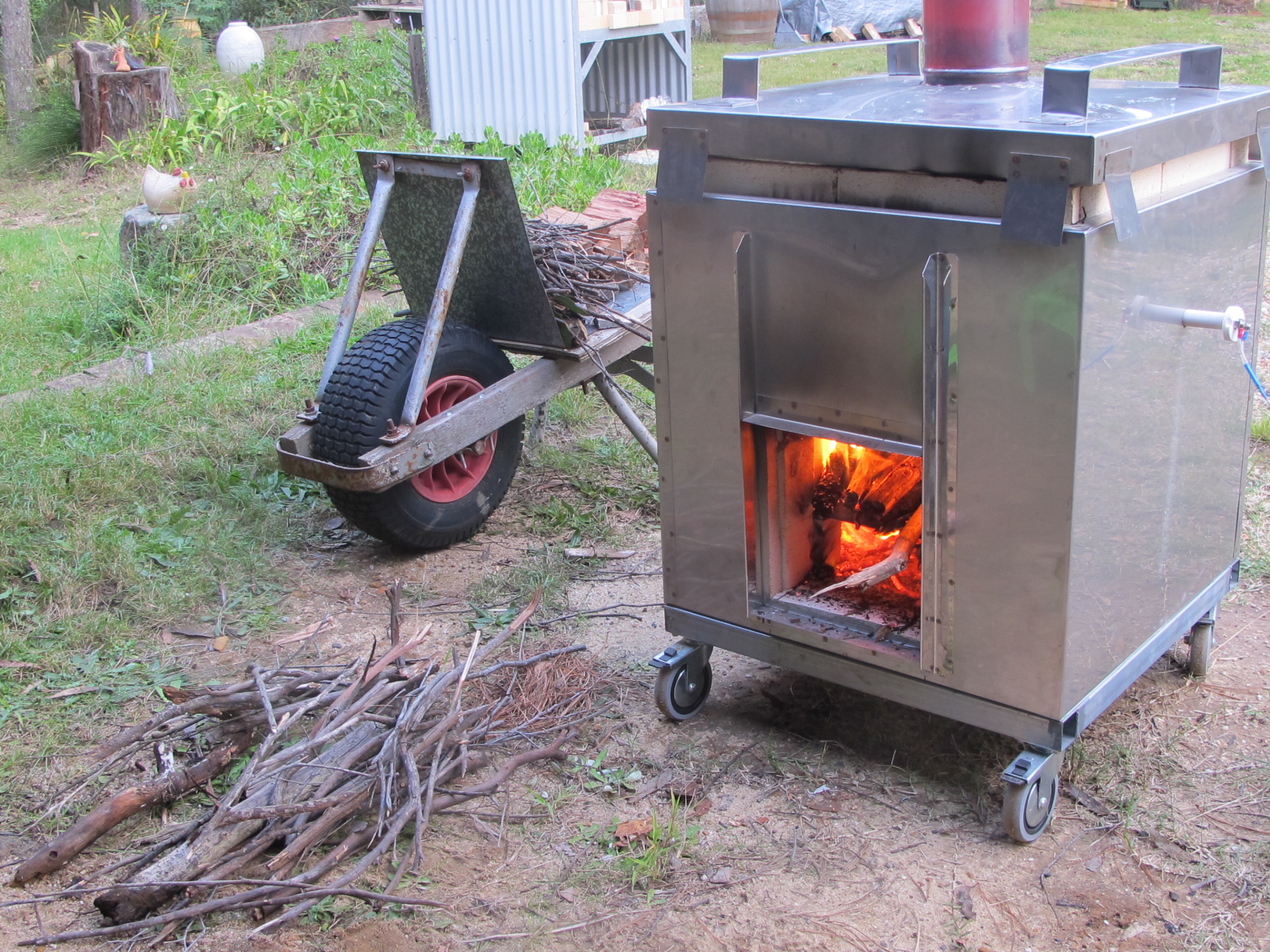
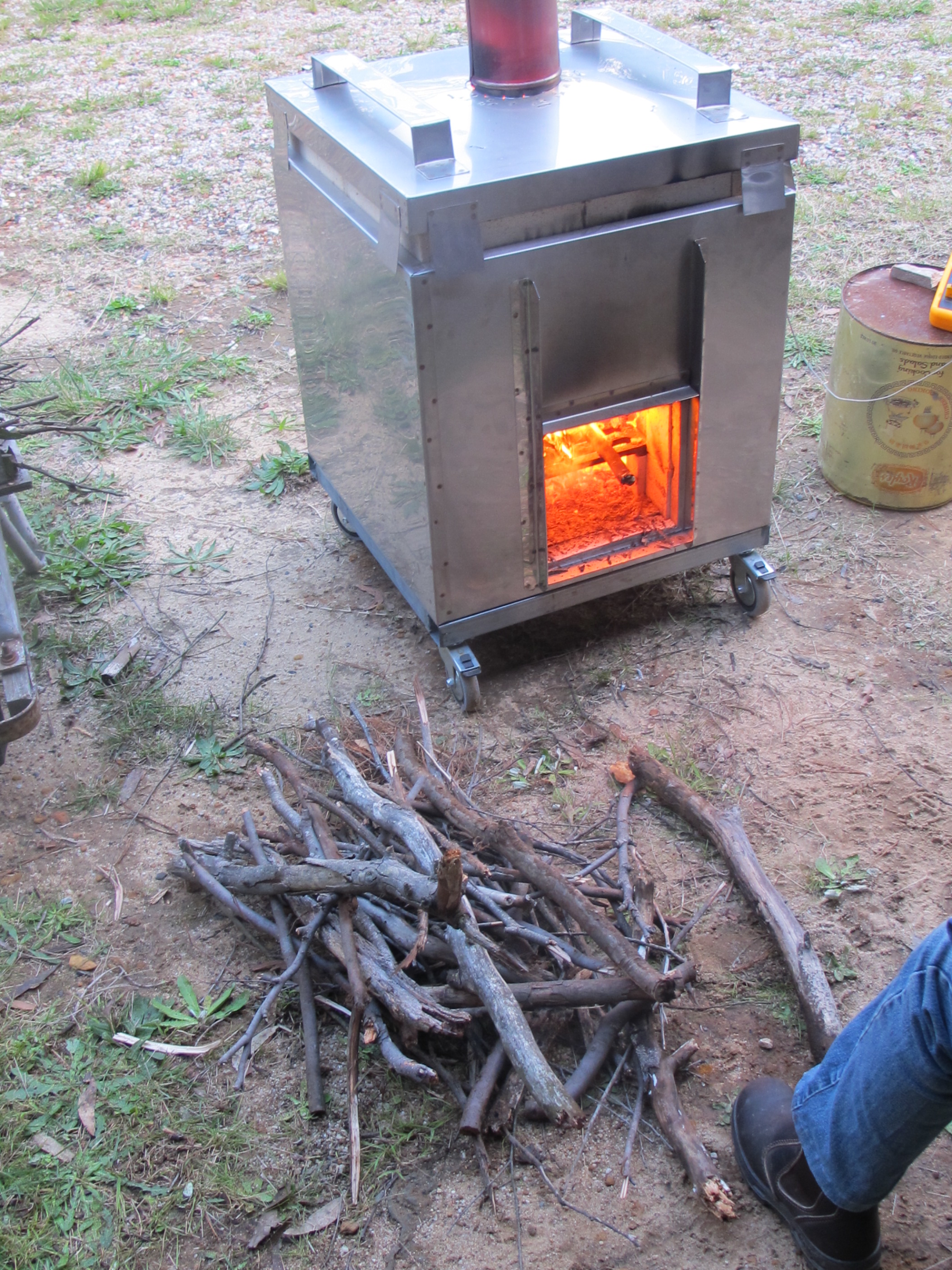
Stefan worked with us here on a few occasions on his visits and he gave us one of his kilns each time he stayed. Having seen them work, it got me thinking that there might be another way of thinking about small efficient, portable, wood fired kilns. The only drawback to his fantastic idea is that the internal size of the garbage can is quite small and limited. So I decided to build a slightly larger size version of his concept. I made one lined in ceramic fibre like his original, but square and about 5 times larger in volume, so that we could fire larger and taller pots for the potters who come here for our raku weekend workshops.  Now I have just finished a couple of slightly larger square ones lined in light weight refractory insulating bricks. The great advantage of custom building the stainless steel box is that it can be whatever size and shape you think you might want.

  IMG_4192

Because this RI brick version is a little too heavy to lift and carry around like the garbage can kilns, I made this one in a custom-built stainless steel box on a galvanised RHS steel tube frame and lockable castor wheels. It has all the same advantages of the smaller fibre lined garbage tin kilns in that it is great fun, portable, very quick to fire, very efficient of the wood fuel and being top loading it is very safe, quick and easy to load and unload for raku.

IMG_8513

I’m always busy. The kiln factory is full with a large gas-fired, front loading kiln, a relocatable top loading gas kiln with an extension ring and two of the new small wood fired raku kilns.

IMG_8510

IMG_8511

We had our first firing in it the other day, just to test it out and it worked really well.  Just 45 minutes up to 1100oC from cold, and then a 15 to 20 minute turn around for the raku. We used such a small amount of fuel, fallen branches/brush wood from the garden. Our big gum trees are alway dropping dead branches around the yard, so it was just 5 minutes work to collect enough for the firing.

IMG_9189IMG_9185IMG_9186

This kiln sailed up to temperature so easily that I think it will be no trouble to take it up to 1200oC mid-fire and even stoneware in the future – when I get a bit more time.

 IMG_9191

This is about half of the amount of fuel that was used to get to 1100oC

IMG_9192

I don’t propose that it will give any wood fired effects in such a short firing time, but it will melt glazes perfectly well. I did some research on one of my locally collected milled stone glazes a while back and I tried firing my little test kiln to stoneware in just 30 minutes with a 10 minute soak. I was able to do 6 firings to stoneware in one day and learnt a lot. If I kept a close eye on the temperature and used test rings to gauge the melting, I was able to get some lovely, soft looking, satiny matt glazes. So it is possible.

With so little at stake in a small kiln and the firing being so quick and easy, there is nothing to loose and everything to gain.  But more than that, it’s important to me to be able to make my ideas come to life and experiment with different concepts in my own way and in my own time. Play is the best part of work.

Home Made Chainsaw Saw Mill

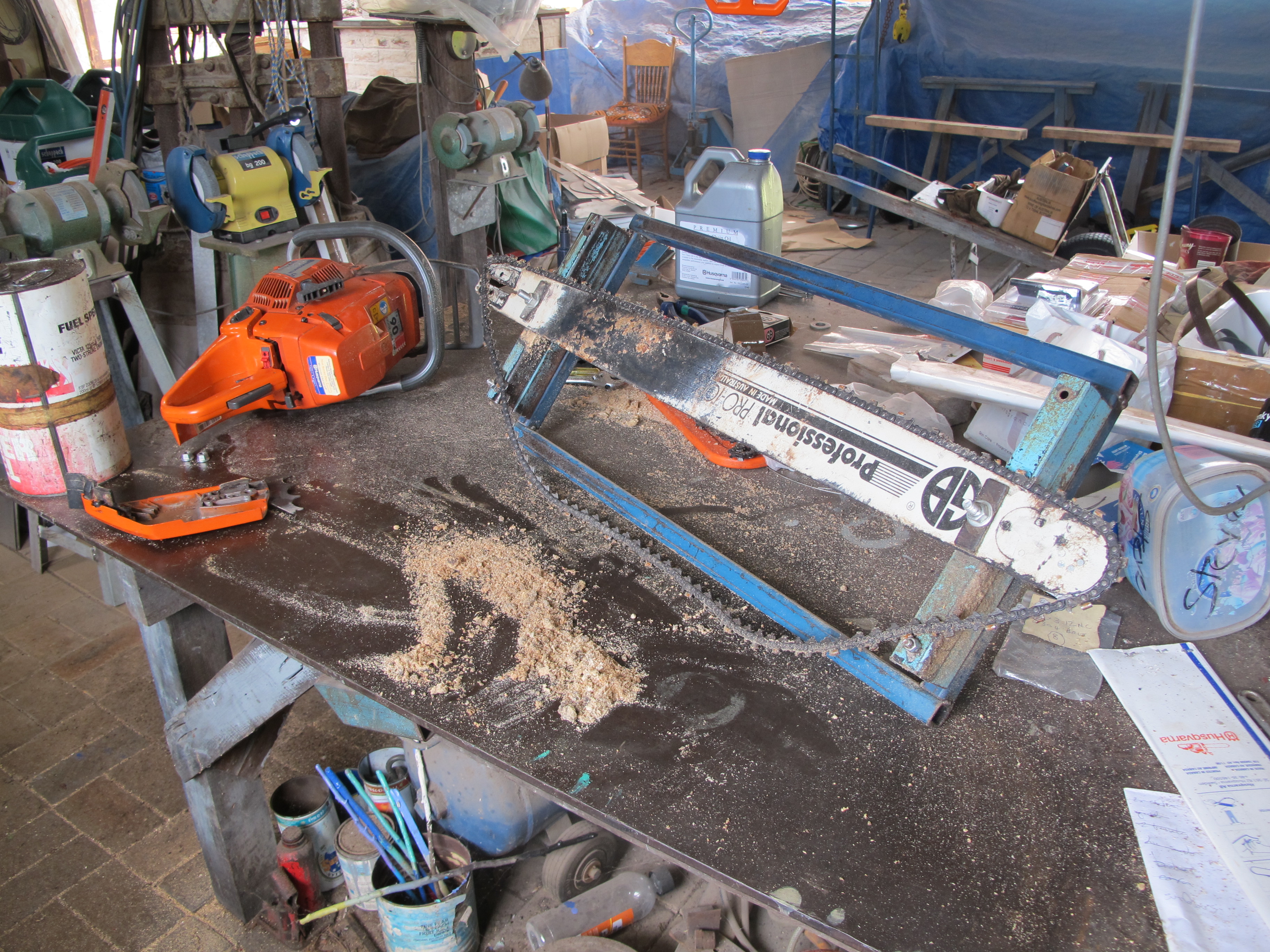
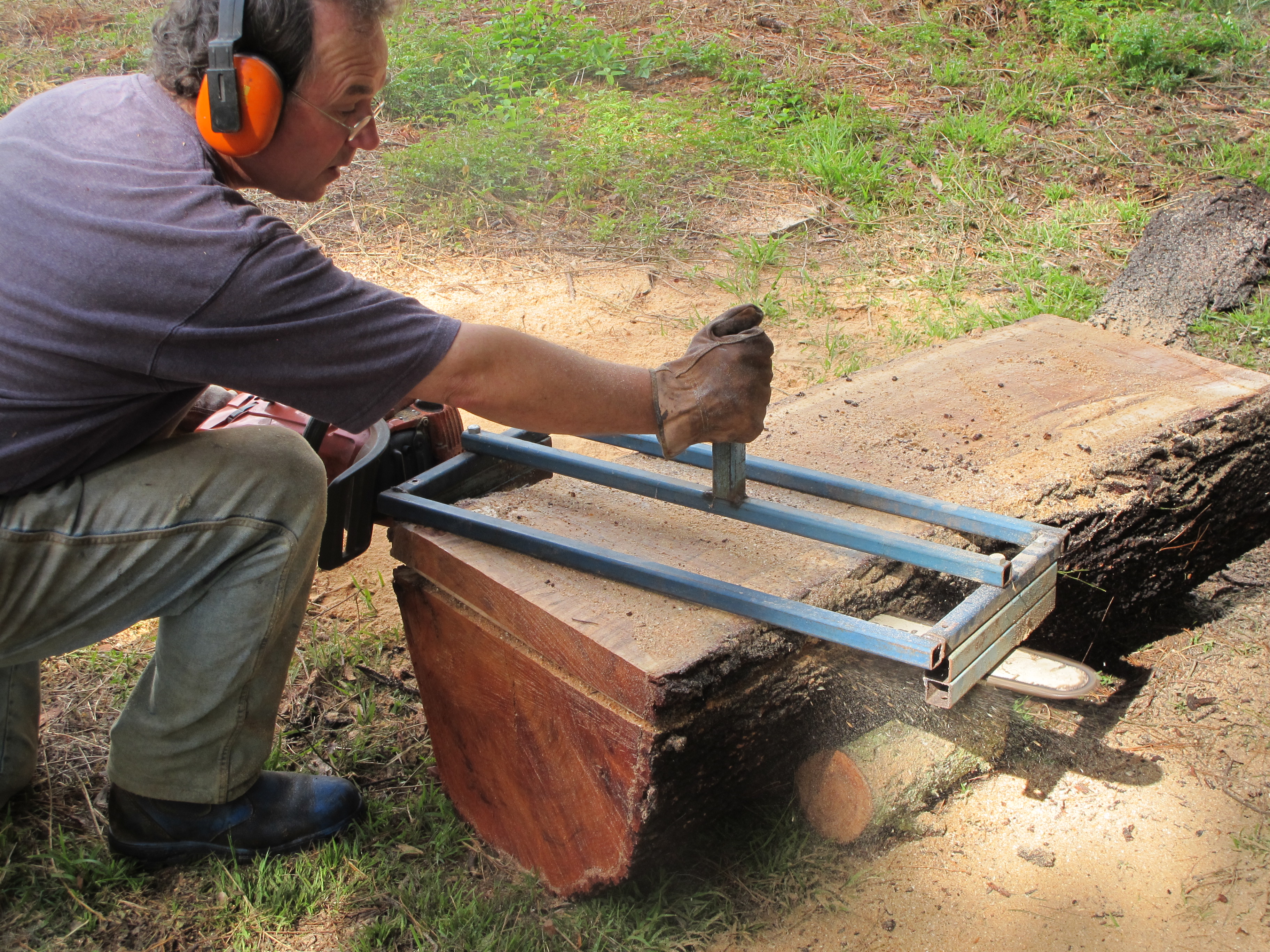
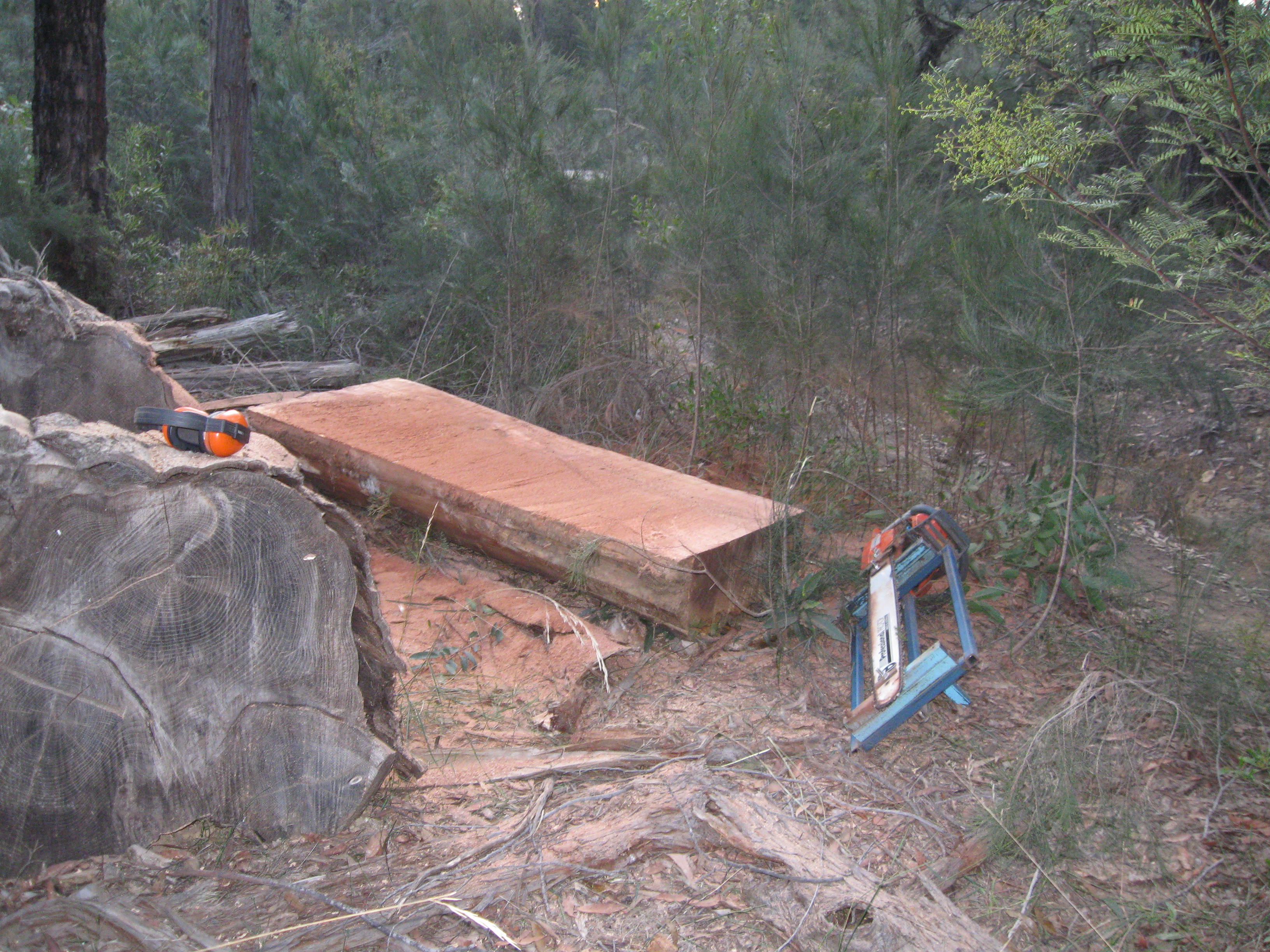
Over the past few weeks I have had over 500 hits on my article on self reliance including a little bit about milling my own timber. So I thought that seeing there is so much interest in building a home made saw mill attachment for a chain saw, I ought to put up a post with some more detailed explanation, including a few dimensions and some images to help explain what I did.

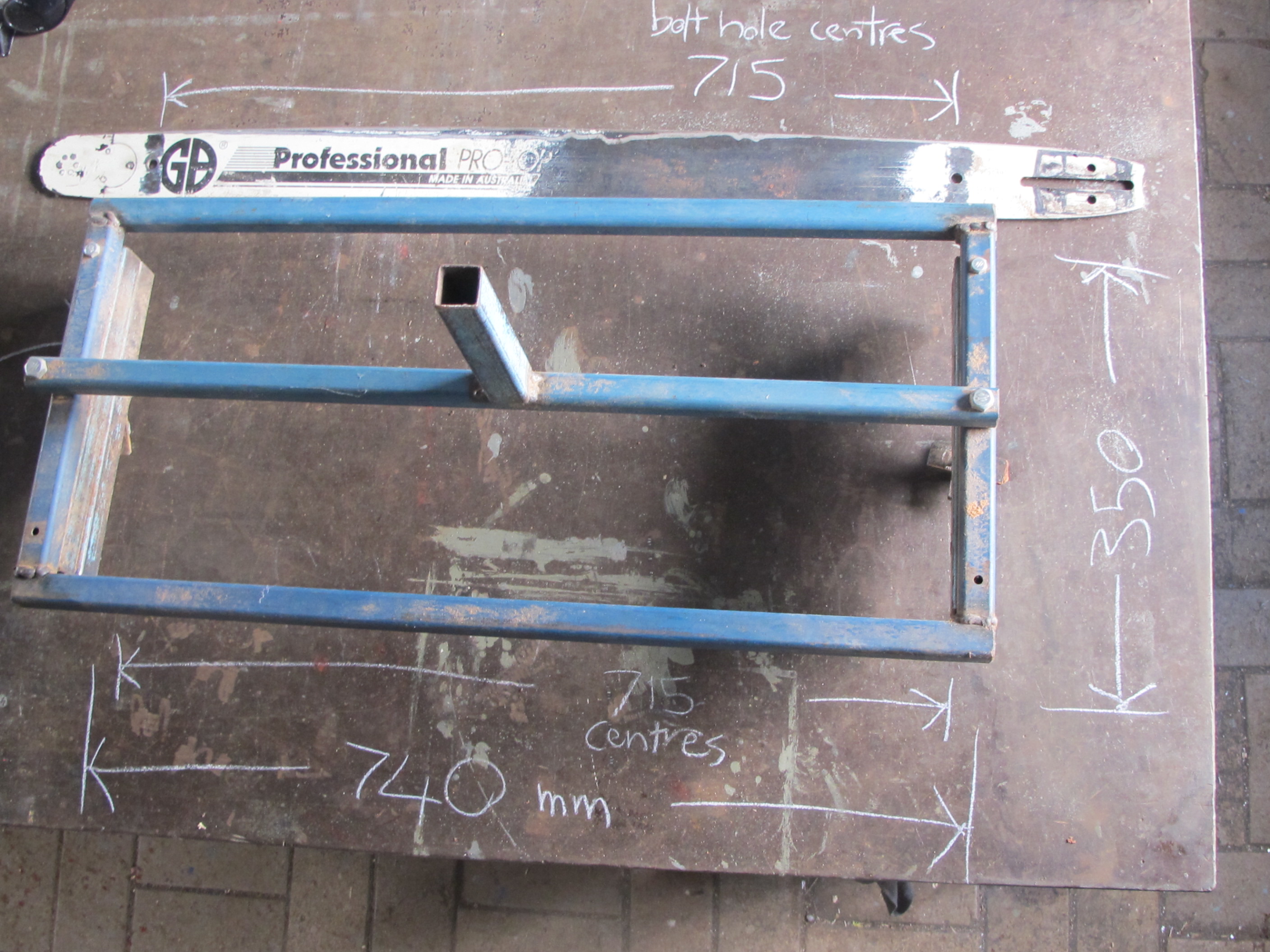
It’s pretty basic unit made out of scrap steel sections that I just happened to have laying about on the day, but it works really well for what I need it to do and that is to turn logs that are too good to burn, into usable milled planks. I haven’t studied this kind of gadget at all. This is my first attempt at building one. It seems to work OK, so i haven’t got around to making another one or changing it. If I was to, I would perhaps add a bit of rubber tube over the upright centre handle, just for comfort.

Since I moved here, I have built my own house and pottery building. We made all our own floor boards and made all the windows and french doors. I also made all of the kitchen furniture to go into it, chairs, tables stools etc.

All you seem to need is a few basic tools, an inquisitive mind, some perseverance and a bit of spare time to figure things out. The saw is an old (15 years) Husqvarna  371 60 cc. and the milling bar is about 900 mm. long. The effective cut is about 600 mm.

So here are a few pictures with measurements chalked onto the bench.

IMG_9167

IMG_9168

IMG_9169IMG_9170IMG_9171

IMG_9166

IMG_6220

IMG_6221

IMG_6208IMG_6209

IMG_6212

IMG_2291IMG_2292

A Sudden Outbreak of Normality

We are just back from Canberra, it’s late afternoon and it’s straight into the garden to see what there is to pick. We’ve been away for 5 days. It has been raining a lot of the time we have been away. The rain gauge has 32 mm in it and there are puddles on the road coming in. It’s the end of the warm weather now and I manage to pick a full basket full of small red and yellow tomatoes. This will be the last picking large enough to fill a boiler and make tomato passata. From now on we will only be able to get a few each day, enough for one meal at a time.

IMG_8995
There is a sudden outbreak of normality, and we find ourselves back at work and play simultaneously.
Nina lights the wood stove to make some hot water and I start to wash and prepare the tomatoes for sauce. There is still some sweet basil lingering on in the garden. I have been keeping it well tip pruned to keep it from flowering. this seems to prolong its productive life right up until it gets so cold that it just drops all its leaves and dies. A huge bunch of sweet basil goes in with a bit of thyme and a chilli, olive oil and onions. In a few months time we will be opening these jars of passata and remembering the summer as we savour the sweet, acid, piquant flavour of the tomatoes in the passata. Each 10 litre boiler reduces down to about 3 or 4 jars of passata after boiling, sieving through the moulii and re-heating and reducing the volume to concentrate the flavours.
IMG_8996
We have to get cracking, we have a kiln ordered and several weekend woodfiring workshops coming up. We unpack the kiln that we fired before we left and get out all our new hand made kiln door bricks, which have fired very well. As the whole side of this kiln is the door, it makes it all a lot easier on my back, knees and neck, to be able to pack most of the pots without having to get inside the kiln, now that I’m starting to feel my age.

I clean out the firebox and check all the new brickwork and bracing for cracks and then clean all the props and shelves, ready for the re-packing for the workshop.

IMG_8985IMG_8988
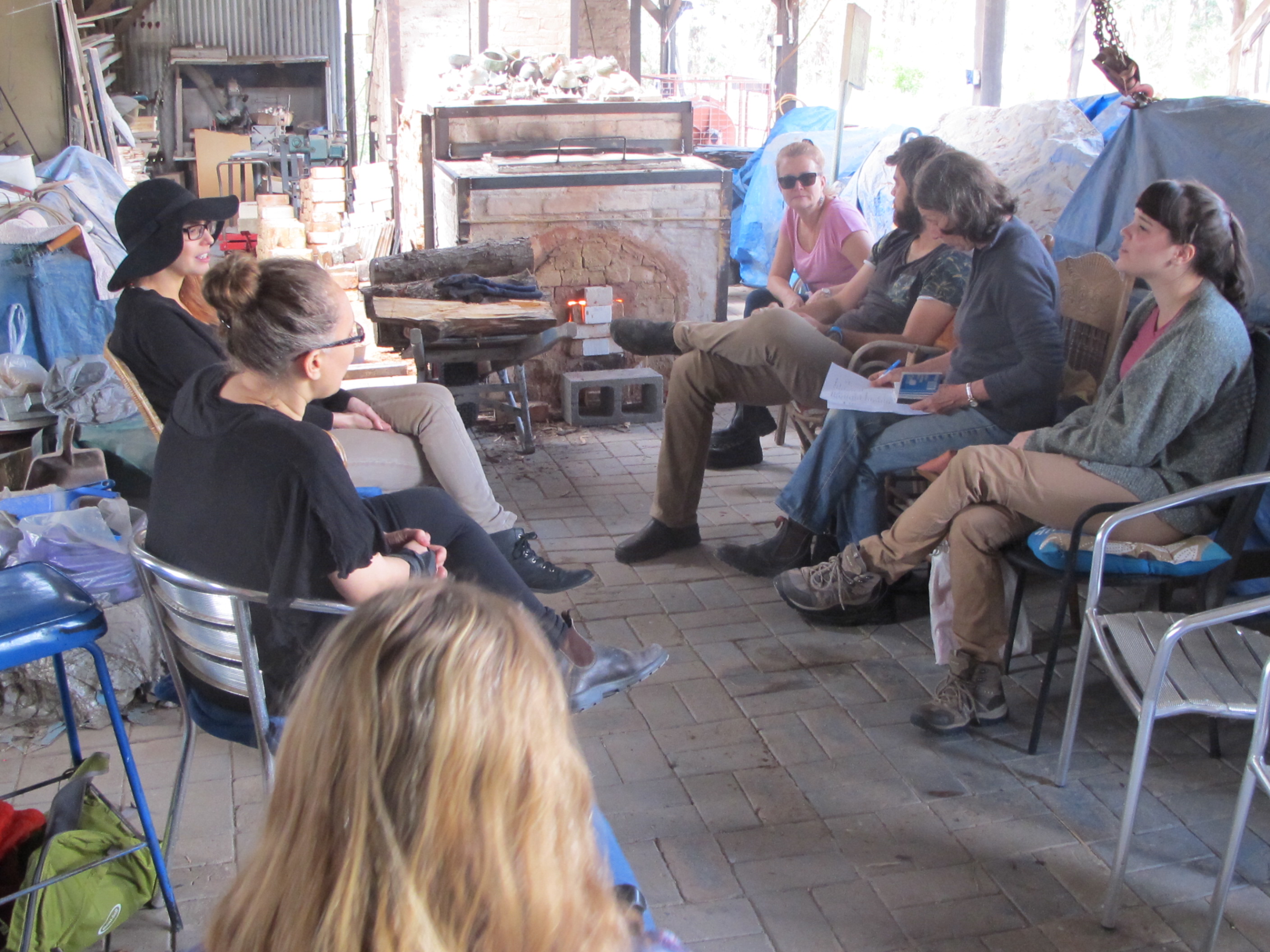
All our wood firing enthusiasts arrive and we pack the kiln and get it on in the early afternoon. With lots of helpers rolling out the little balls of wadding, it all goes smoothly and quickly.
IMG_8999IMG_9007
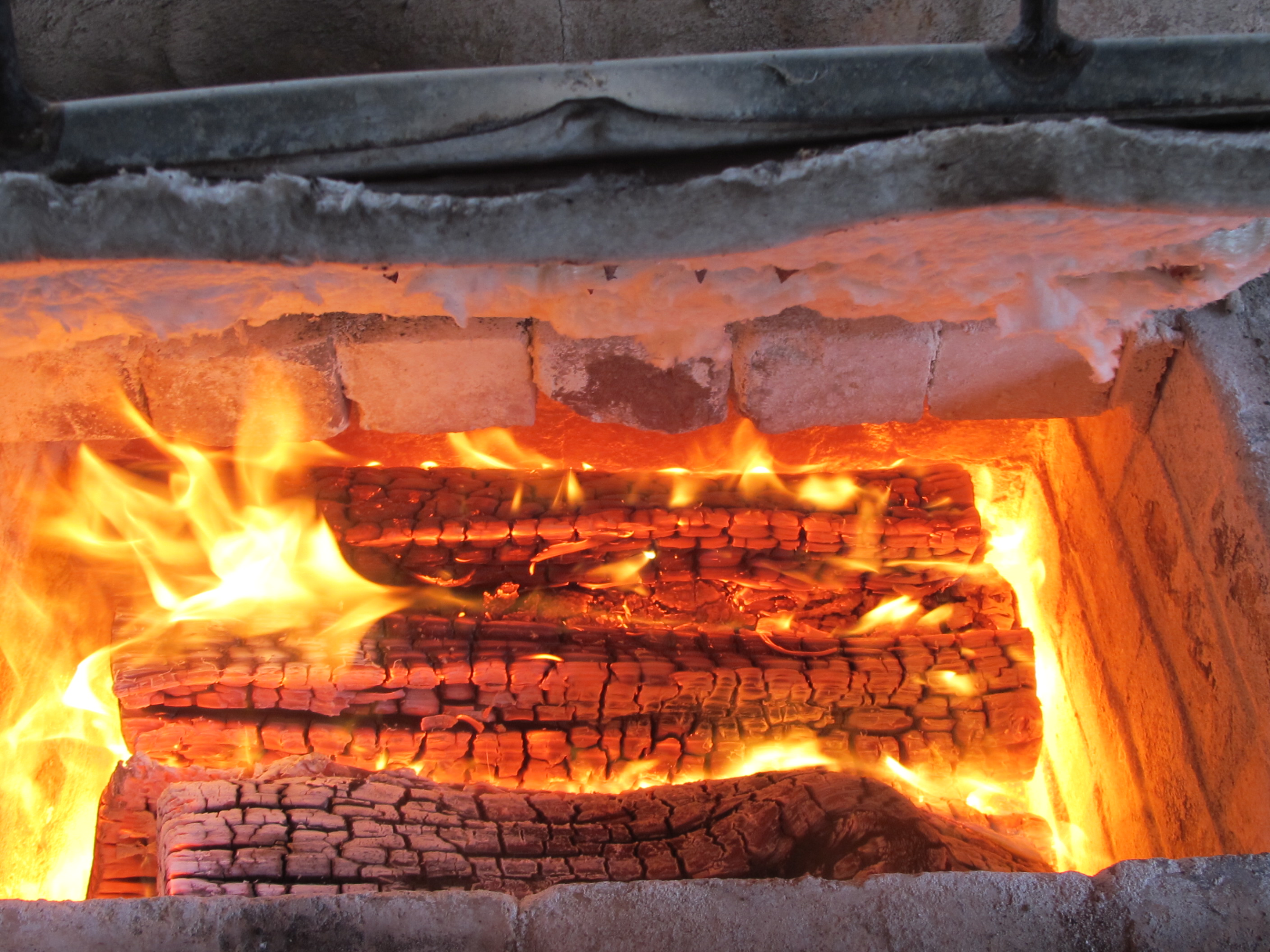
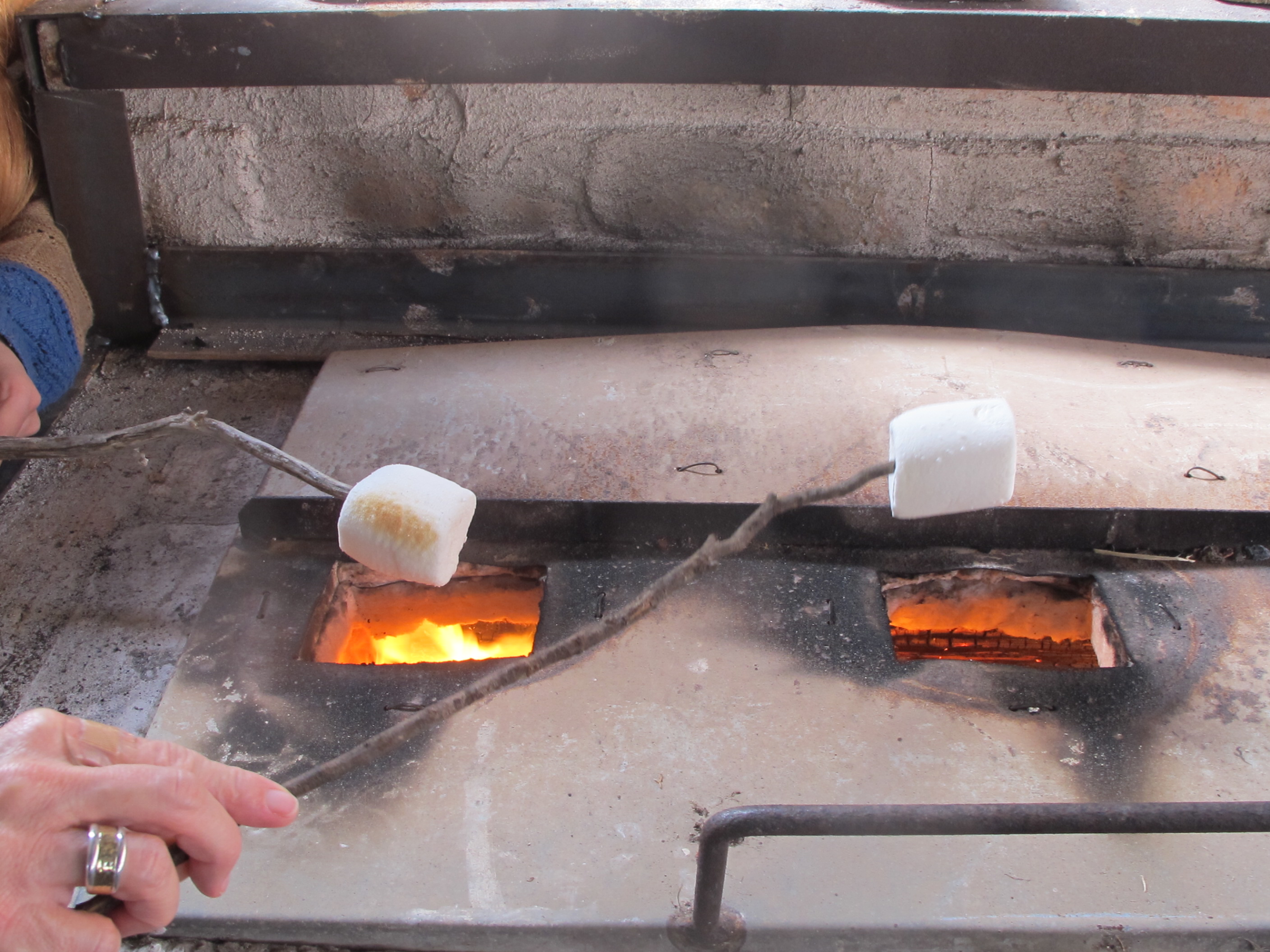
We light up and fire the kiln over-night and into Sunday. There seems to be a ritual developing of cooking marshmallows over the hot firebox on Sunday morning to cap off breakfast. I don’t know where it started, but it seems to be becoming a regular event.
IMG_9011IMG_9010
IMG_9017IMG_9015
IMG_9020
On the Monday, as the kiln cools, I start welding up the metal work for the kiln that I have ordered, now that I have the pottery kiln shed to myself again.
IMG_9026IMG_9024
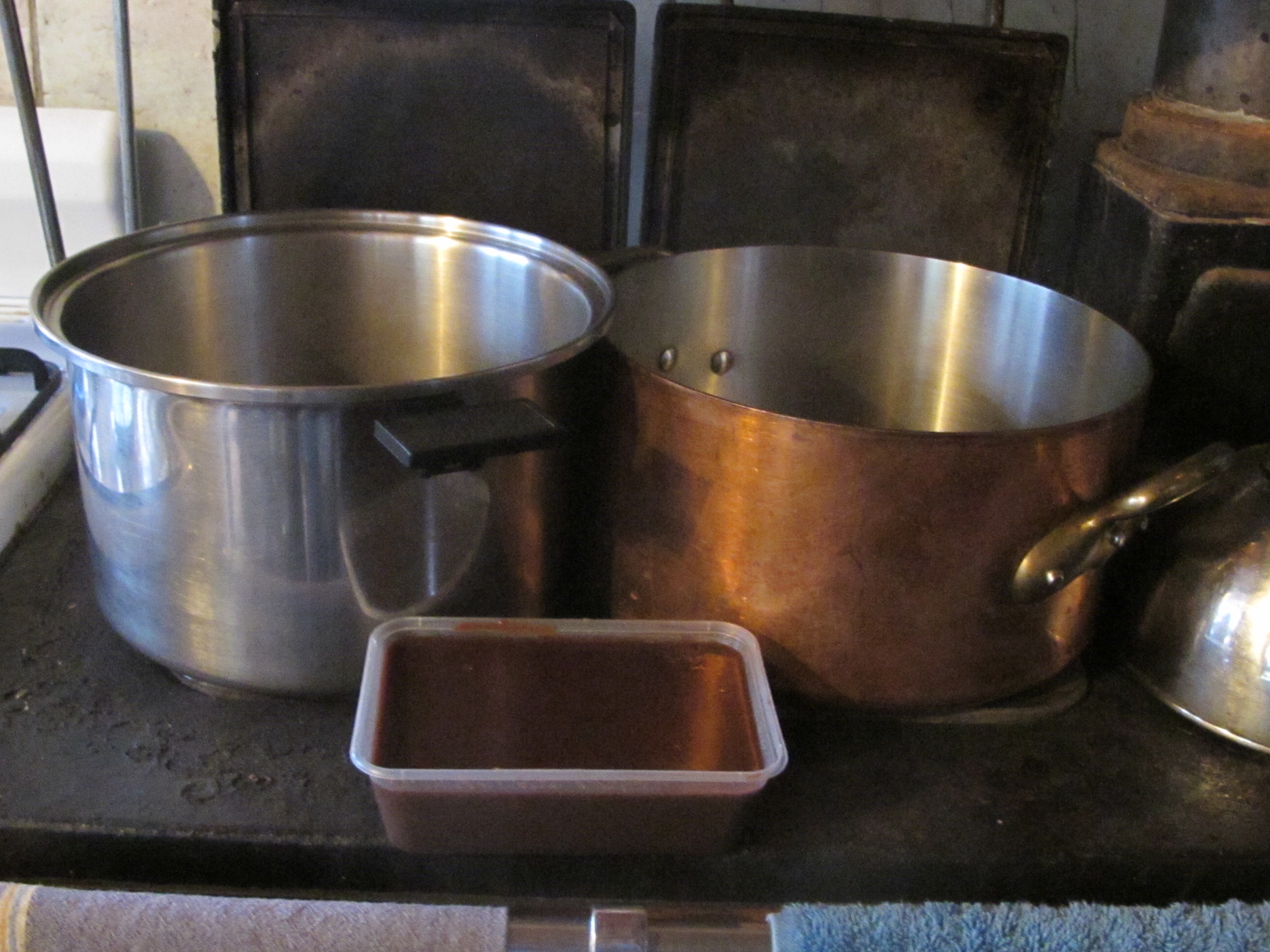
In the evening I start to make a big batch of roasted marrowbone stock. I fill 2 of our 10 litre boilers with the roasted bones and a mirepoix of garden vegetables and herbs. Over the next two evenings,
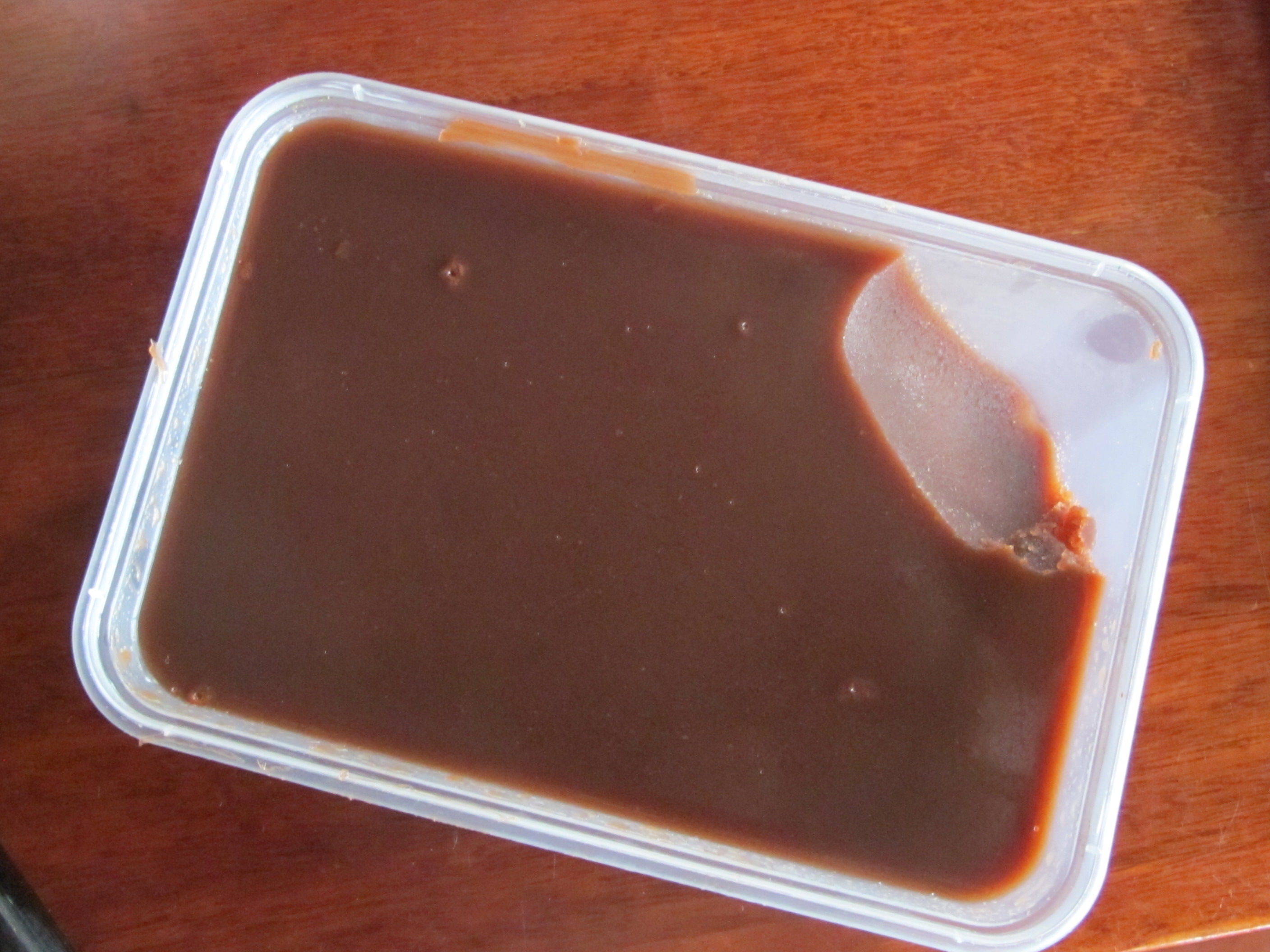
I end up reducing the 20 litres of initial stock down to just 500 mls of luscious concentrated jelly. The addition of a bottle of red wine helps fill out the flavours. It goes into the fridge and I take a spoonful of it when I need it instead of buying stock cubes.
IMG_9035IMG_9064
Firm, jelly-like consistency, intense flavour.
IMG_9029IMG_9032
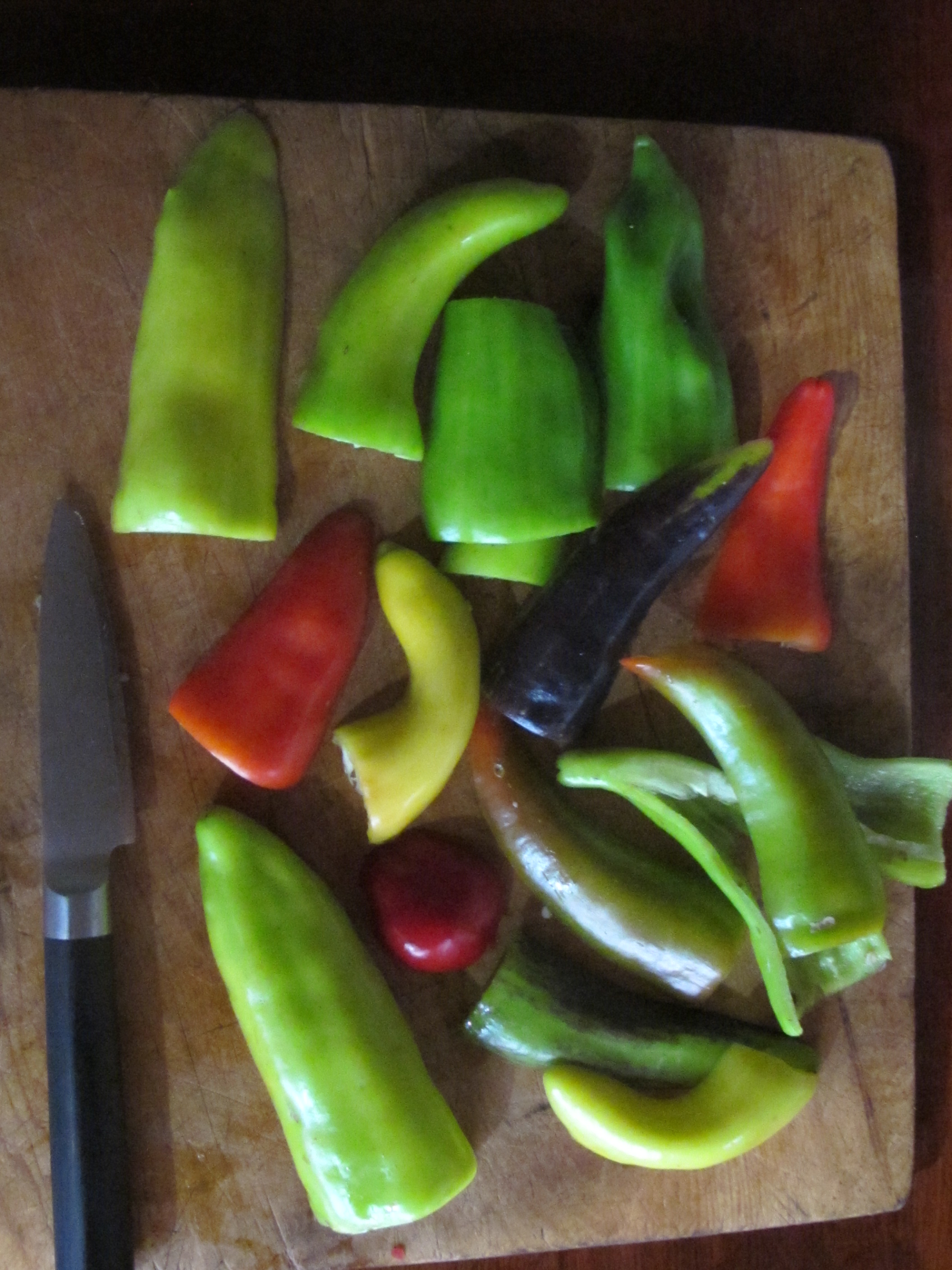
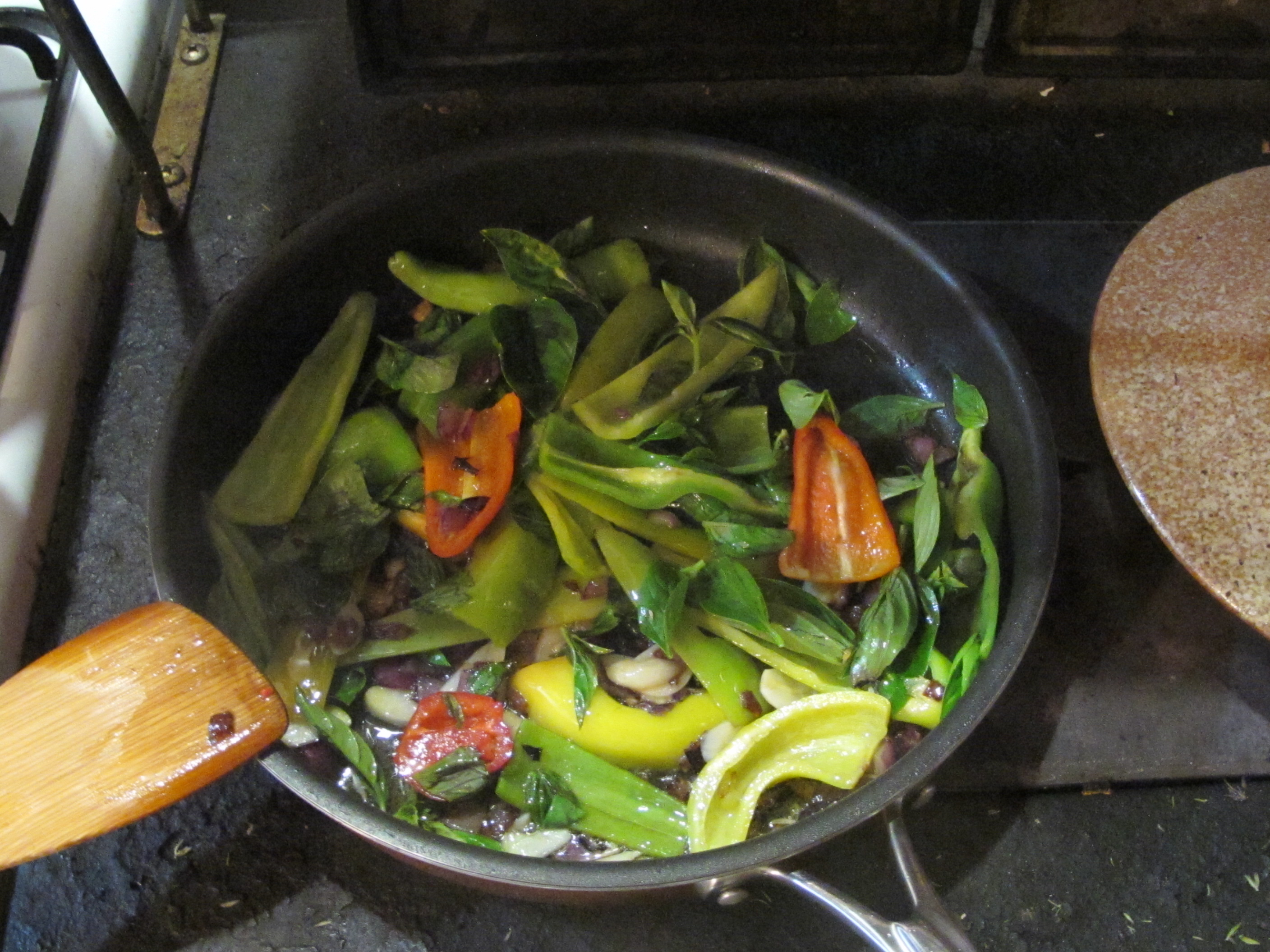
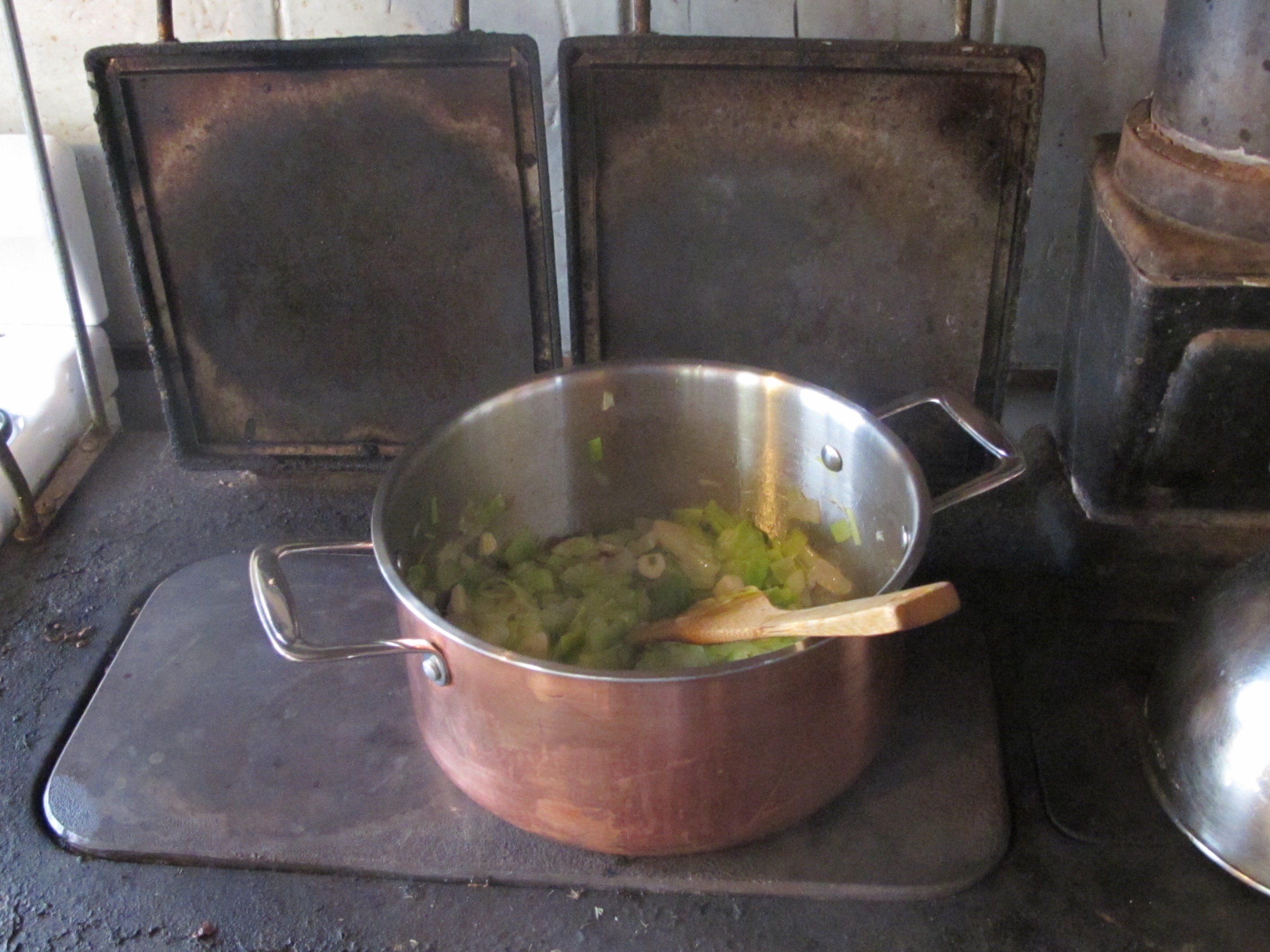
One night we have a dinner of pan fried capsicums with garlic, olive oil, tomato and basil. The next night it is a lot cooler, so the Mademoiselle makes the first minestrone of the season, using our kohlrabi, cabbage and leeks from the garden and our dried beens that we shelled a few nights earlier, with our friend Elizabeth, sitting on the lounge watching the idiot box.
IMG_9045IMG_9048
IMG_9050IMG_9051
Carrots, celery, leeks. A great base for the minestrone and also for the stock mirepoix.
IMG_9061
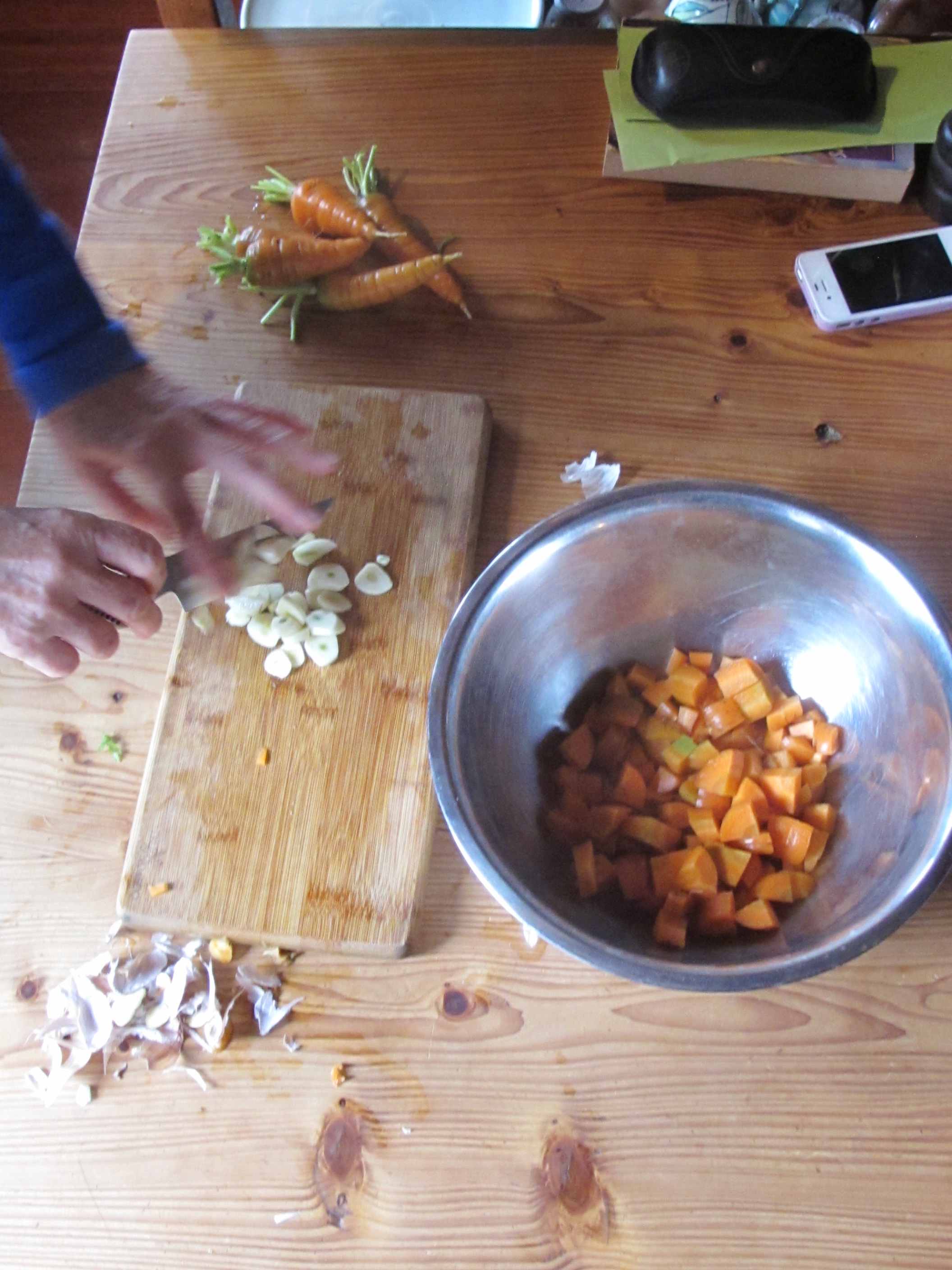
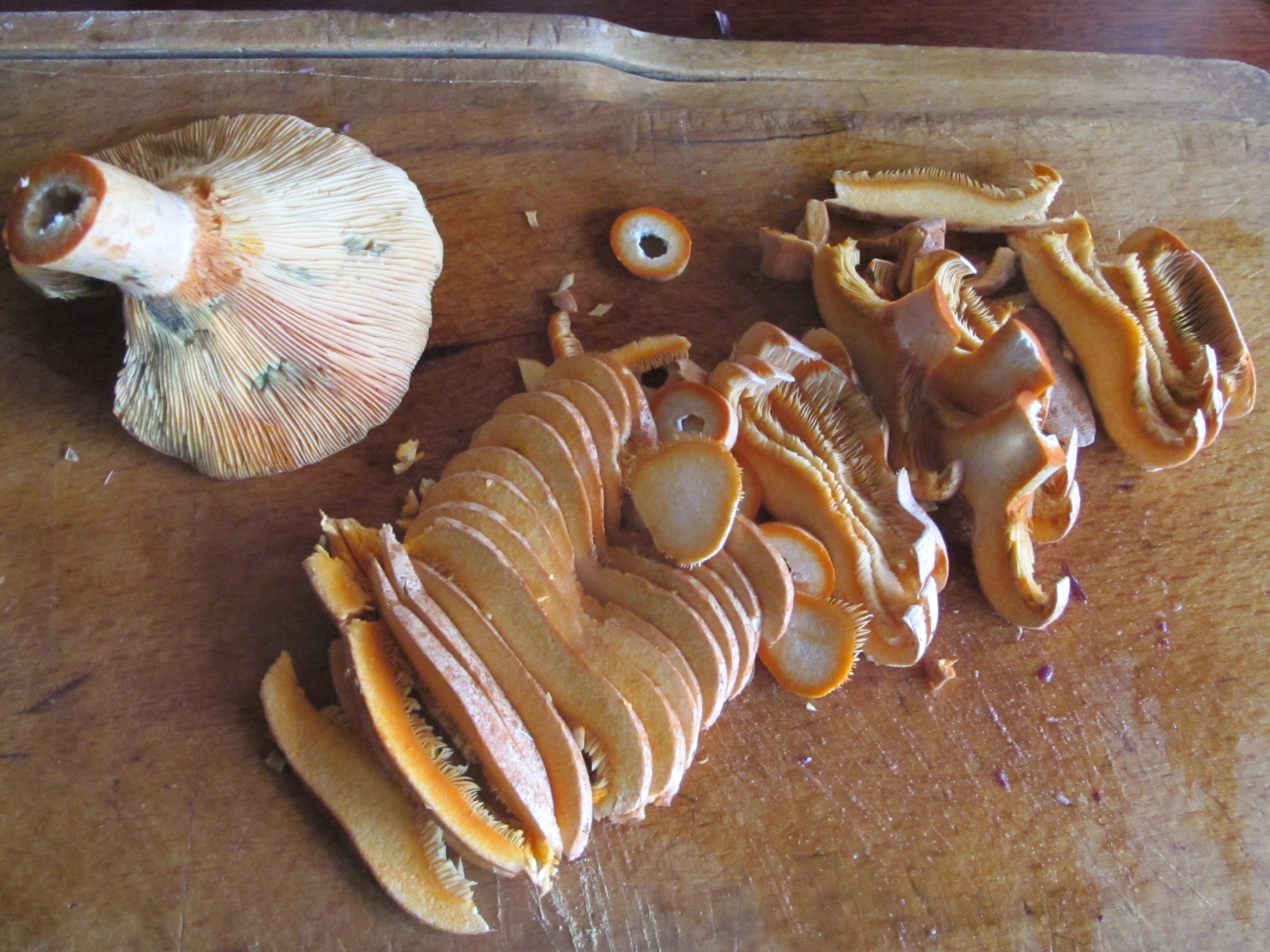
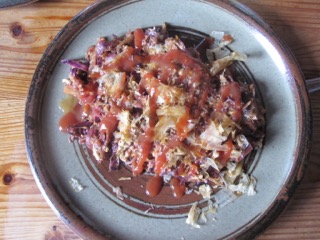
I use the other half of the cabbage to make a kiln builders lunch of okonomiyaki, Japanese style cabbage pan cakes. But on this occasion, without any flour, just held together with a few local organic eggs that we got from our friend Marg, who runs a certified organic garden. I add some saffron milk-cap mushroom from the garden. The first of the season for these mushrooms. I also add some of our pickled ginger and a few of our sun-dried tomatoes in oil. It’s not Kosher Japanese. Just the idea and influence of Japan. We use what we have at hand from the garden and our preserves from the pantry. It reminds us of our Japanese friends and the good times we’ve had together..
IMG_9055IMG_9062
IMG_9068IMG_9067IMG_9069
Best wishes
from the Oka Nomiyaki and his Mini Strone

The Axeman Cometh, but Lucie Takes the Cake

It’s the season for music festivals. Starting with the Goulburn Blues fest, then the Illawarra folk fest. then comes Womad and Port Fairy, which are followed the next weekend with the Blue Mountains Blues and Roots Fest and culminates with the National Folk Fest over the long Easter Weekend for 5 days. It’s a tough life, but someone has to live it. We drove the 2 hours down to Canberra and camped in the back of our van for the 5 days. This year we caught a few interesting performers. There were many, but I can only write about a few.
I particularly liked Lucie Thorne.
I didn’t know what to expect, but straight off. It’s not what I’m not expecting. If I have any preconceptions at all, this isn’t it. Just going on her bio in the program and what I see on stage before she begins. She starts off slow and quiet, and then continues like that. She beguiles us, she lulls us, she woos us and cajoles us, she casts her magic, slowly, we are enveloped in her spell. She coaxes us along with her, we share a small part of her life. The part that she’ll let us see and will sing about. She presents us with her vulnerabilities, her angst, her wishes and dreams. What more could you want? This is both tender, intimate and brutally honest. I’m in.
IMG_8969
She plays an electric guitar, hollow body with an  arch top. But I don’t know anything about guitars. She plays without a pick, with just her fingers, but not folk pattern style, just her own idiosyncratic, sort of erratic, but not, style, guided by the narrative, she emotes through her fingers and the amplified guitar, but Oh! So gently. She has a soft, breathy, low, almost spoken lyric style. Her own voice, her own style. An absolute original talent.
She is backed by a very sensitive drummer, Hamish Stuart, who plays to her strengths and is so minimal that he just fills in the gaps in the music enhancing, and supporting, but never over shadowing her. A great combo. <http://www.luciethorne.com>
This union of low-key elements and understated passion reminds me of the later music of Chris Whitely,
<http://en.wikipedia.org/wiki/Chris_Whitley> The ‘Hotel Vast Horizon’ period. The same breathy vocal style, the minimal guitar, the restrained in-fill drumming. But where-as Chris Whitely was the guitar ‘AxeMan’ in his younger days, she is, in comparison, the young female guitar ‘cake-splade’, softer, gentler, less damaged, more refined, but just as emotive. I say less damaged, but when we caught her performance, it was first thing in the morning. It must have been a very late night for her previously. She looked a bit ragged. I’d never heard of her previously, but now I will keep a look our for her.
IMG_8967
After I saw Chris Whitely burst onto the scene doing his ‘Living with the Law‘ tour early on. I kept an eye out for his tours. He could make his old 1940’s timber resonator guitar talk. Lightning fingers, but as the heroin took its toll over the years, he developed a more abridged and concentrated minimal style. Moving from Robert Johnson to minimalist jazz influences. I saw him half a dozen times and bought 12 albums, before he died, tragically young. I hope she does a lot better.
A Thoroughly enjoyable hour of my life, well spent. I buy 2 of her CD’s direct from her. After the show, we chat. Up close, she is just as I imagined and described. Gentle and vulnerable, but tough. Quite direct and honest when we ask questions. Very genuinely appreciative when we buy the CD’s.
The very last show of the night for us oldies, is the 11.00 to 12.00 slot. It all continues on till after 3 in the morning, but we aren’t up for that. We need our sleep. We are staying up for a couple of old blues men. I haven’t heard of these two blokes either. They are in Canberra at this time because they have just spent 3 days in the National Sound Archive, having their repertoire recorded for the National Estate, so they must be interesting. They are Frank Povah and Chris Cruise. They grew in the country but moved into Darlinghurst/Kings Cross in Sydney in their youth to play in jug bands, then blues bands. They look to be in their late 70’s now and have a few miles on the clock. They were exceptionally good. These guys really knew their stuff. Not always my stuff, but so well done. A repertoire from the 20’s, 30’s and 40’s, acoustic country blues. Wooden music. I’m really glad that I stayed up for it.
It’s a great pity that they didn’t have a CD for sale. Exceptional musicians.
IMG_8965
Another musician that we saw at ‘The National’ was Tift Merritt. She sings her soft rock songs with a slight hint of Country and Western. I think that it’s the lap, or peddle steel guitar backing that gives it that feel. I’ve never been particularly taken by either style, country or western, but she carries it off very well. Beautifully musical and easy listening with some very hummable melodies and memorable riffs. Most enjoyable.
Best wishes
from DJ Nina and her base accompaniment