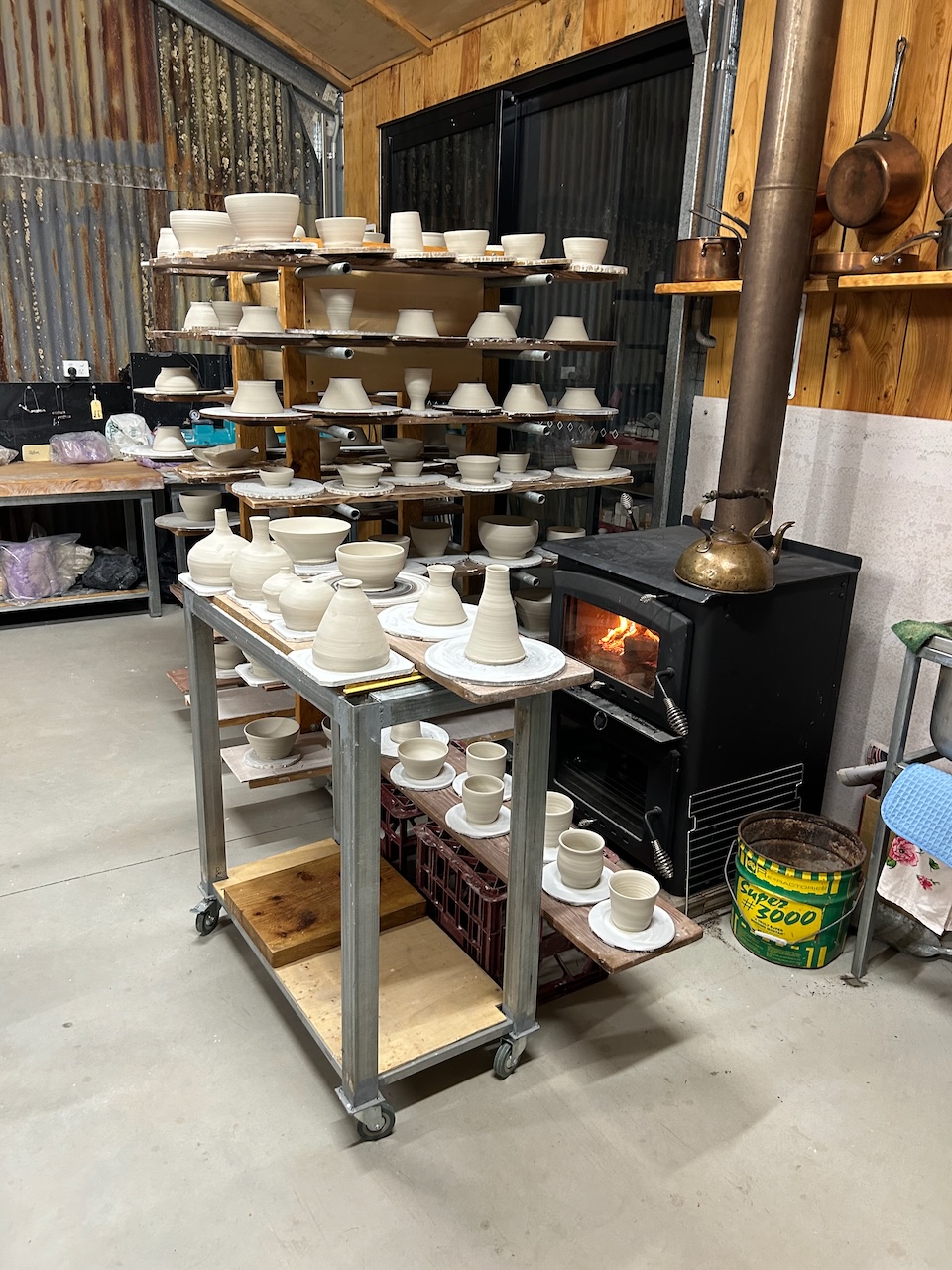
Clay making and tatami floor tea room

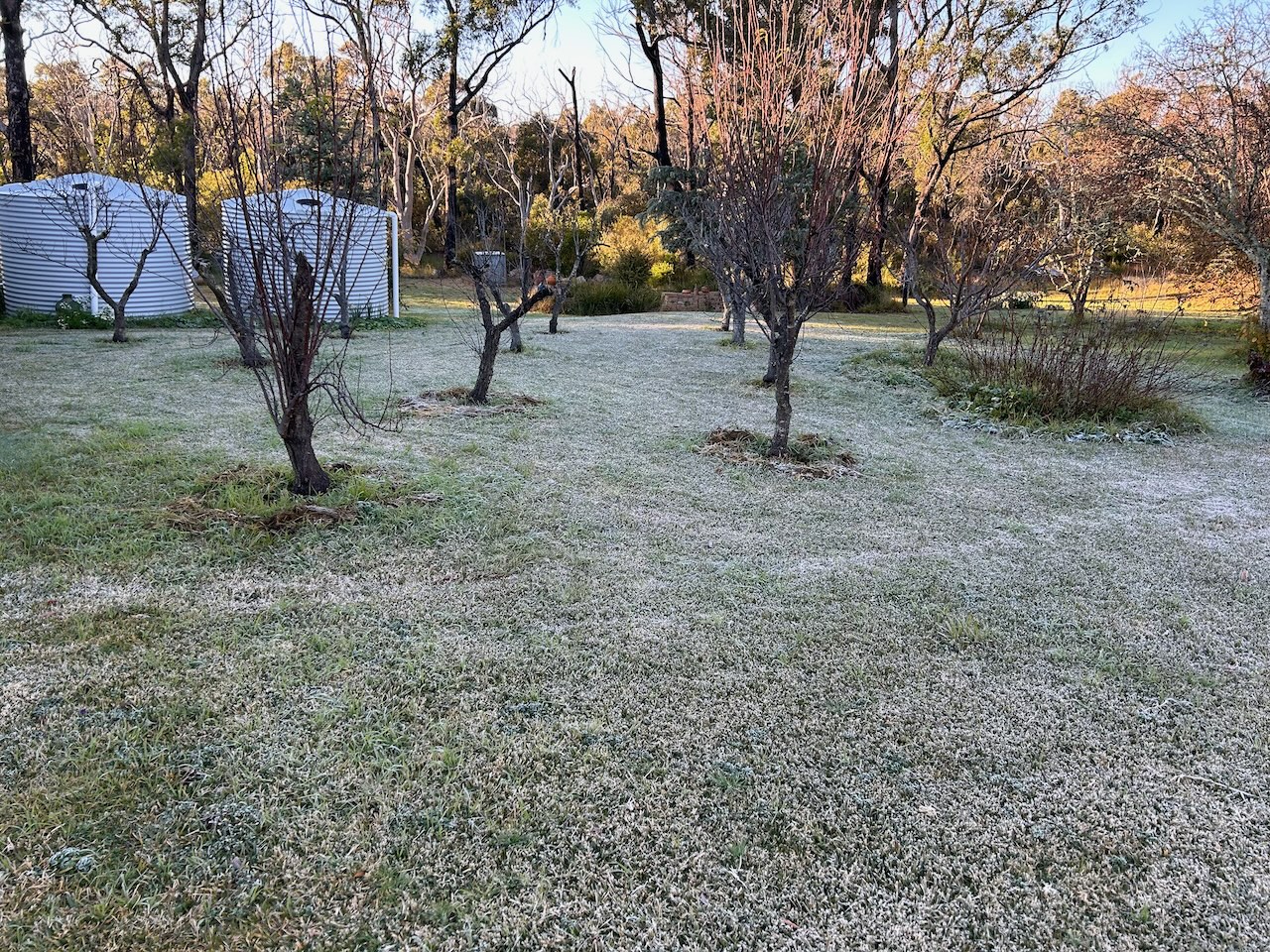
We have been having some good cleansing frosts this last week or so. White and crunchy, this is good to clean out any remnants of fruit fly in the orchard. It also helps to set the chemical clock in the stone fruit trees that need a few hours of very cold weather to make the next seasons flowers fertile. This is called their ‘low chill hours’.

Inside, it’s been a busy time, as usual here. Janine is back from her trip up north, and I have been cleaning out the loft area above the clay making and rock crusher rooms. There is a space up there that is sort of a loft, but it was never intended to be a useful space. Just a way of enclosing the noise and dust from clay making and rock crushing in the small ground floor rooms. The space above them just had ’stuff’ stored up there. Mostly left over insulation bats and silver paper sisalation. Plus half a dozen mixed sheets and off-cuts of thin bracing ply wood, that I had used for the ceilings of the throwing room and gallery.

The only access to this ‘loft’ area was, until recently, by bringing in a ladder. A while ago the idea crossed my mind that we could use it as a place where students could sleep over when they stayed to do wood firings. 

In the past, before the fire, they used to pitch tents in the orchard, or stay in local bnbs. Sometimes, even sleeping in their cars.

We recently built a stair case to get up there safely. Using a lot of scrap timber, heavy duty ply, and our own home grown and milled pine boards that we had left over and stored. It turned out really well and cost next to nothing. I built it in two days with assistance of Janine’s brother John, a retired carpenter. I couldn’t have done it alone. John was the brains and I only assisted.

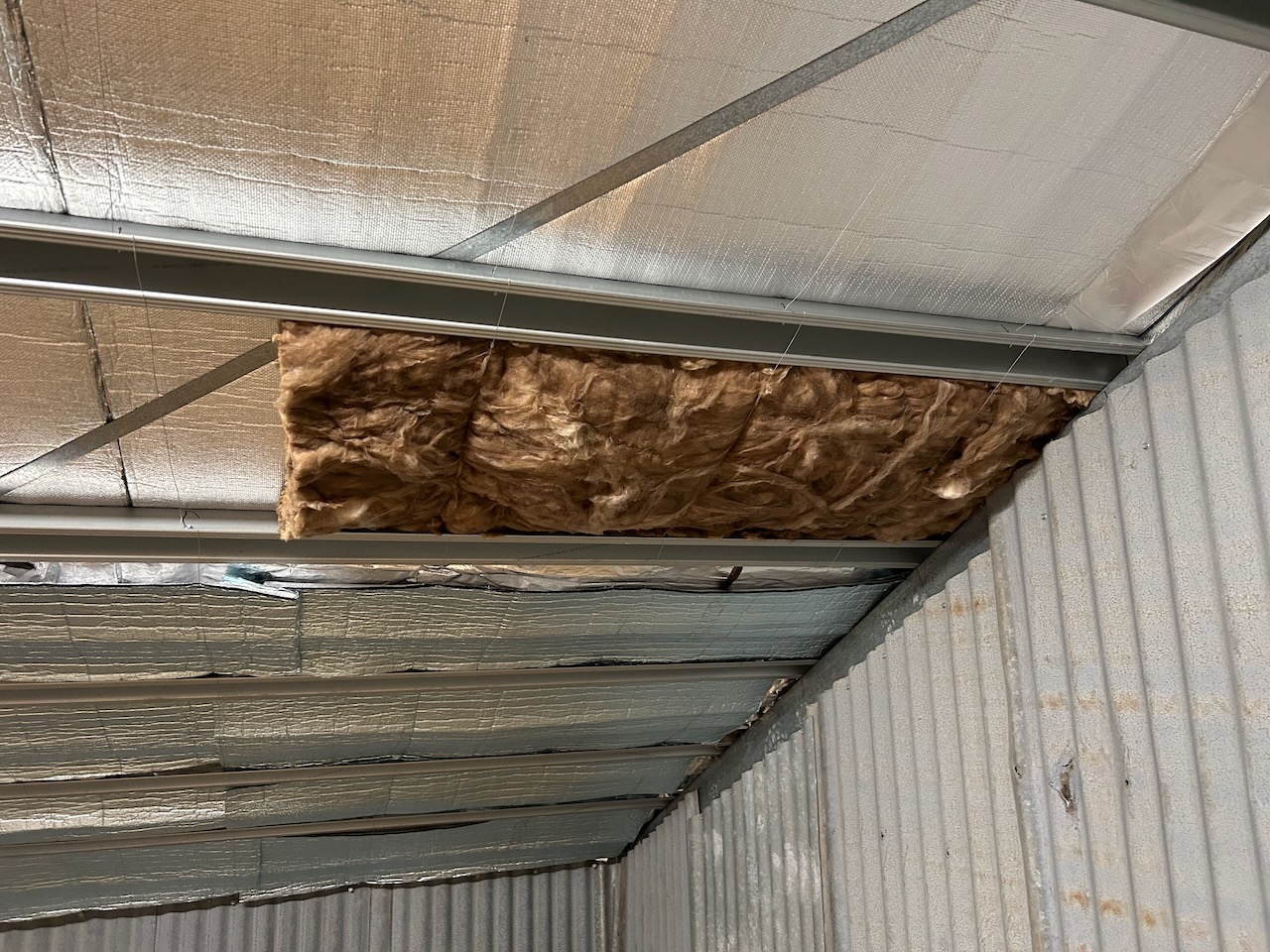
So while Janine was away I began cleaning it out and used the left over rockwool to insulate the ceiling/roof and then panel it with the ply wood. Amazingly, I didn’t have to buy anything to do the job. I was able to do it all by using what was already stacked up there! Even down to the box of ’TEK’ screws.

I started by building a safety railing/balustrade along the edge, using some off cuts of poly carbonate from the car port wall. 

Stuffing the rockwool into the roof was a bit like easing a compliant orangutang into the roof cavity, all soft and fury.

I used old tomato stakes from the garden to act as the extra several pairs of hands needed to hold up the ply wood, while I got the first few roofing screws into the sheets to secure them in place.

We were gifted the tatami mats from a lovely friend who didn’t need them anymore. They work really well in our new loft space. Both as a tea room space and as a place where students can choose to sleep, if needed.

We have also installed 2 single beds up there as well, on the other side.
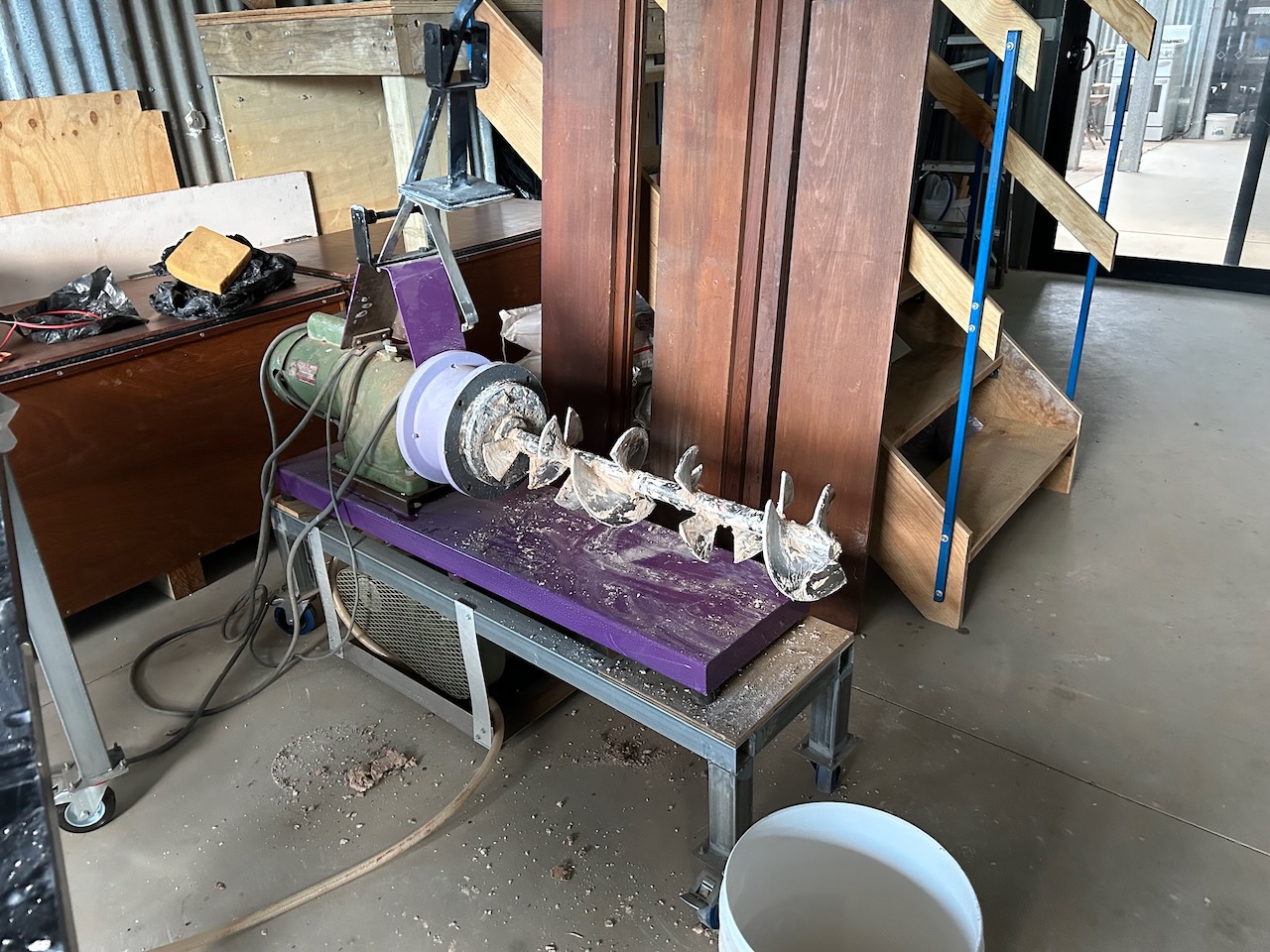
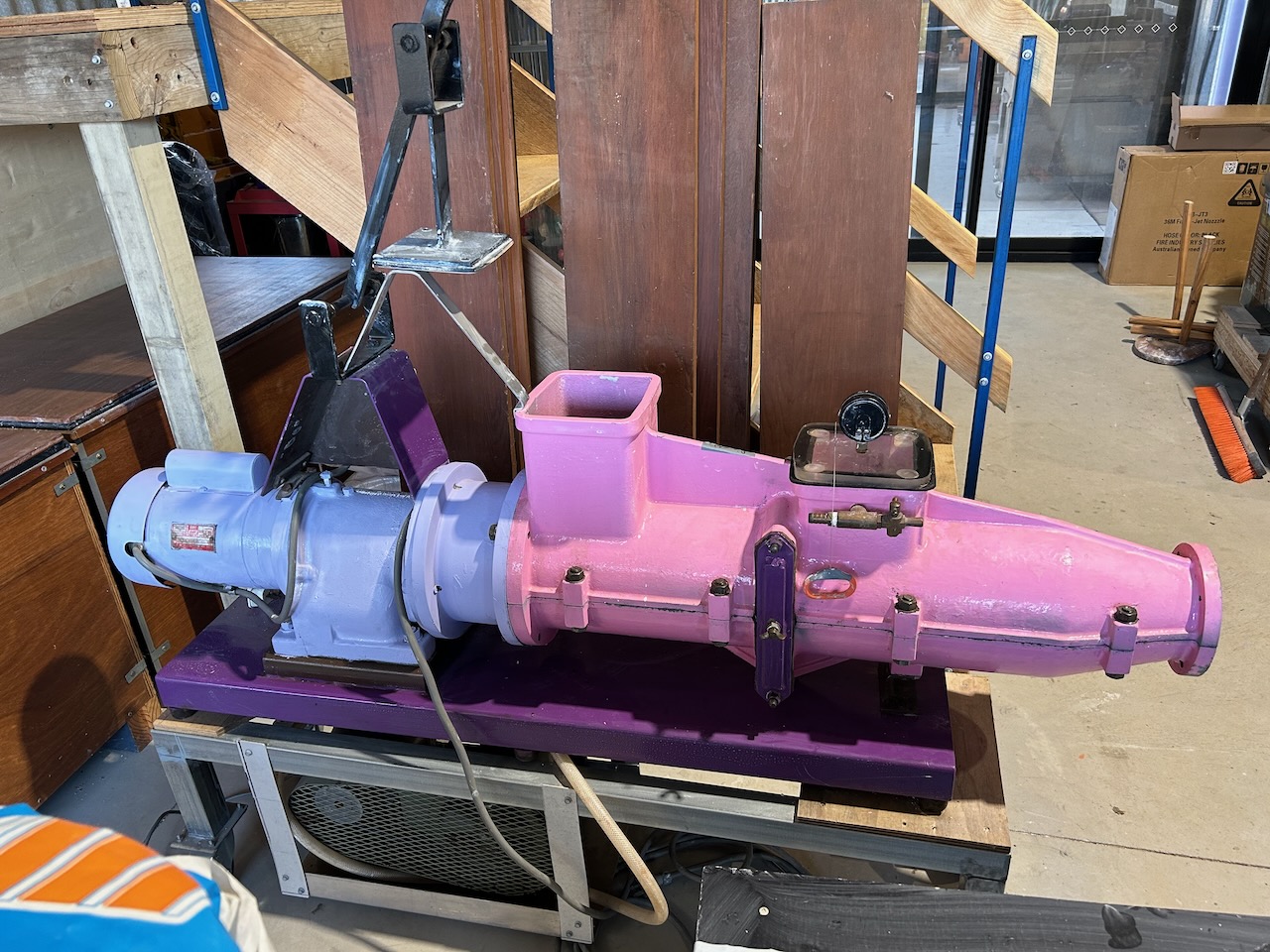
A couple of years ago, I bought an old Venco pug mill from my friend John Edye, who has retired from making now. I cleaned it of aluminium corrosion and painted the inside with metal primer. I have use it for 2 years now and this week, I pulled it down, and cleaned it out to change clay bodies, and inspect the lining.
I was so happy to see that the wire brushing and priming that I had done previously was holding very well indeed. Nothing needed doing. So I put it all back together again and made a new batch of wood firing clay body for an up-coming workshop.

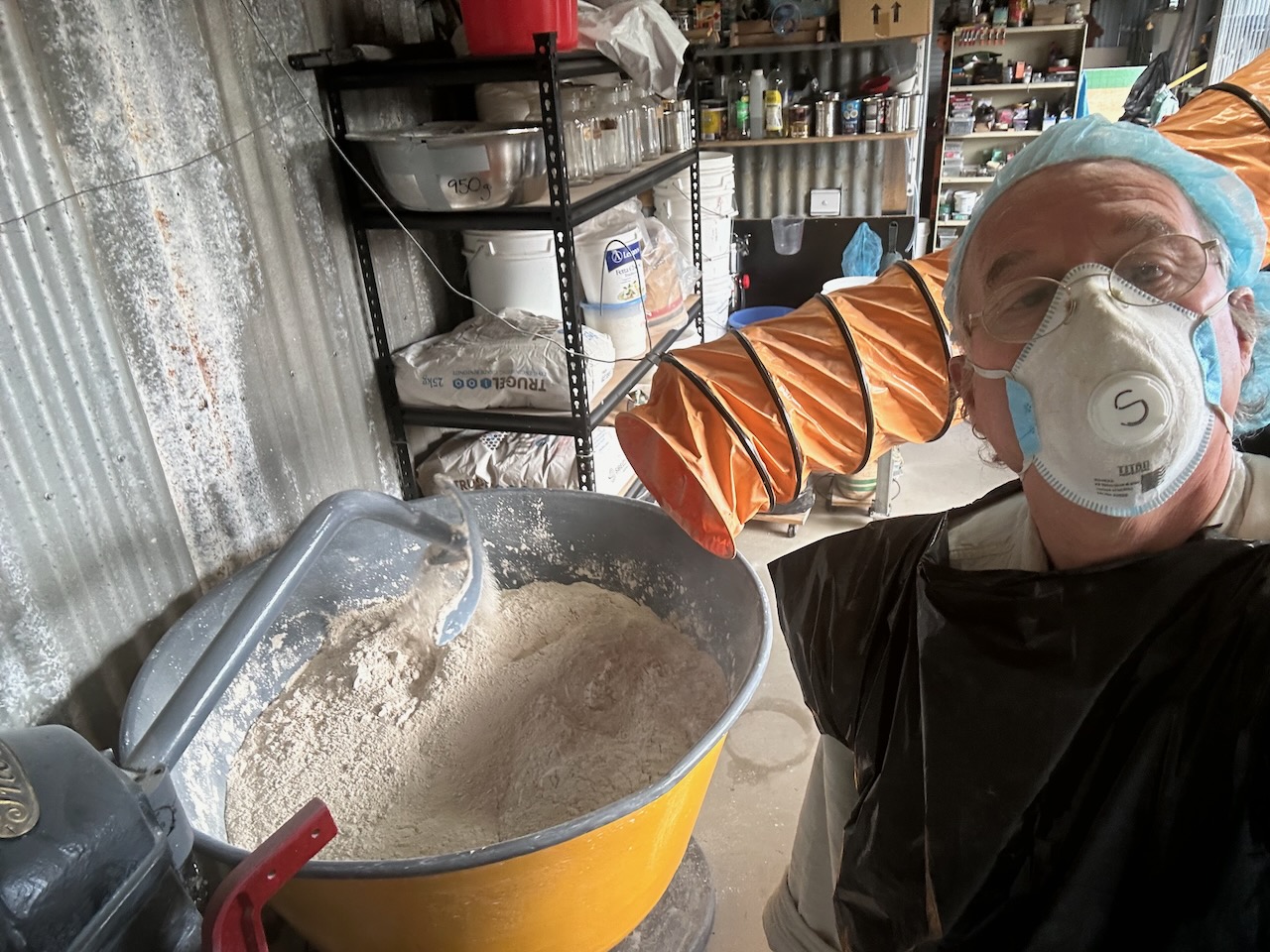
Clay making is a dusty business. I wear some OH&S clothing to minimise the dust in my hair and on my clothes. There are probably expensive versions of this stuff, but I use a garbage bag with holes cut out for my head and arms, then a theatre hair net and a standard dust mask. I have an exhaust fan with a flexible ’snorkel’ that hovers over the mixer and sucks most of the airborne dust out of the room. It works

After all the clay has been twice pugged, bagged and stored. We move all the machines out of the way and mop the floor clean, before reinstating everything as it was before and ready to go again.

Winter Weekend Workshops

The ‘Pop-Up’ Open Studio sale is over and everything in the pottery has been put back to rights again. 

I can now think about when we can do the winter workshops.

This year has becoming somewhat shortened and a little bit complicated, by the pop-up, and the fact that we have been invited to work in Korea later in the year, possibly in September, or maybe October. We don’t have a set date as yet. So we can’t plan to hold any workshops much past August.

Weekend Workshops;

1/  Wood Kiln Throwing and Firing.

We are offering a combined 3 weekend workshop. 5 Days.

Throwing for wood firing, July 20/21 followed by a wood firing, Includes 15 kg of my specially formulated, home made wood firing clay.

Firing, 3rd/4th August. 

Unpacking Sunday 11th August.  $700. includes clay

The 2 week gap gives a couple of weeks to dry the pots, bisque and glaze them ready to return for the packing and firing weekend.

Pack the kiln. Saturday 3rd, then fire overnight into Sunday 

Unpack the kiln on Sunday 11th August.

If these dates fill, we may offer another weekend later on in the year? But timing is tight until we get fixed dates for the kiln building workshop in Korea.

2/ Sericite Porcelain Workshop

We are offering a weekend of throwing and turning fine porcelain. 

Throwing and turning fine white translucent sericite porcelain August 24/25th. $350 includes 15kgs of amazing white translucent sericite. Sorry FULL! It filled over night!

I have started a waiting list for the weekend of 27th/28th July for a second workshop.

I have 20 bags (15kg bags, enough to run 2 workshops) of a sensational, white firing and very translucent, single stone sericite paste body that has been in my barn since before the 2019 fire and COVID. Now with 6 years of age on it, it’s in very good condition, and throwing beautifully. 

Luckily, this clay was not stored in the old pottery, otherwise it would have been burnt like all the rest of my aged sericite stash, some of it was over a decade old at the time of the fire. Lucky also that this clay was in the part of the barn that didn’t burn. Such a fluke.

We are so lucky to have some of this aged fine clay available to us to share. 

3/ Introduction to glazes and glazing. Saturday 10th August. $125

A one day basic course on glazes and glazing techniques for beginners. Not too much theory, just half a day, then half a day of practical techniques. Glaze theory and chemistry can be very tiring, so I am limiting it to just half the day, followed by some practical techniques.

This is a one day workshop to keep it tight and manageable, if you are new to glazes and glazing. A good intro for a beginner.

Introducing the glaze raw materials, why we choose them, how we weight them and mix them, and then how we apply them.

4/ Introduction to clay bodies. Sunday 18th August. $125

A one day basic course on clay materials and clay body formulation for beginners. Not too much theory, just half a day, then half a day of practical clay testing techniques. Theory and chemistry can be very tiring, so I am limiting it to just half the day, followed by some practical techniques.

5/ Introduction to kilns, materials and firing schedules. Sunday 1st Sept. $125

A one day basic course on kilns, and firing for beginners. This course is all theory. So we will be breaking it up with coffee breaks and a look at at some different kinds of kilns and fuels, and their uses. We have several electric, gas and wood fired kilns here to examine and get to know. 

If you are interested in any of these weekend workshops. Please email me and I’ll send you more details. <hotnsticky@ozemail.com.au>

First in best dressed. Enrolment is only secured after payment is made. 

Sorry! but this is the only way that I can make sure of the numbers that is fair to everyone.

Tea bowl exhibition in Seoul, Korea

I currently have one of my bowls in a tea bowl exhibition in Seoul, South Korea.

This bowl was fired at the front of my wood fired kiln. During the firing the ash glaze ran just a little bit too much and stuck the bowl to one of its pieces of wadding. Luckily, I was able to chip it off without breaking the bowl. I repaired the damage using the ancient Japanese technique of ‘kintsugi’, using gold to repair precious pieces of ceramic.

Using pure gold to repair a damaged pot shows respect for the item. It honours the piece by giving it time and resources, and finally finishing it off with a coating of pure gold. By showing it respect, I choose to give it a greater value than it would have had, if it had come out of the kiln intact.

The pot is damaged, but it is still beautiful. It has Value, and it is Unique. It is Honoured even though it is Damaged. It’s possible that repairing a damaged thing can make it more beautiful and precious than if it hadn’t been through its ordeal.

I see these damaged and repaired objects as self portraits. I went through an ordeal and although I was damaged, and am not the same, I am still working. I’d like the think that I’m also improved by the experience, although I’m not too sure about that. My pots that I repair are certainly more beautiful, interesting and valued.

Open Studio Sale this weekend

On the Long Weekend I will be opening our Gallery for the ‘Pop-Up’ Open Studio Arts Trail.

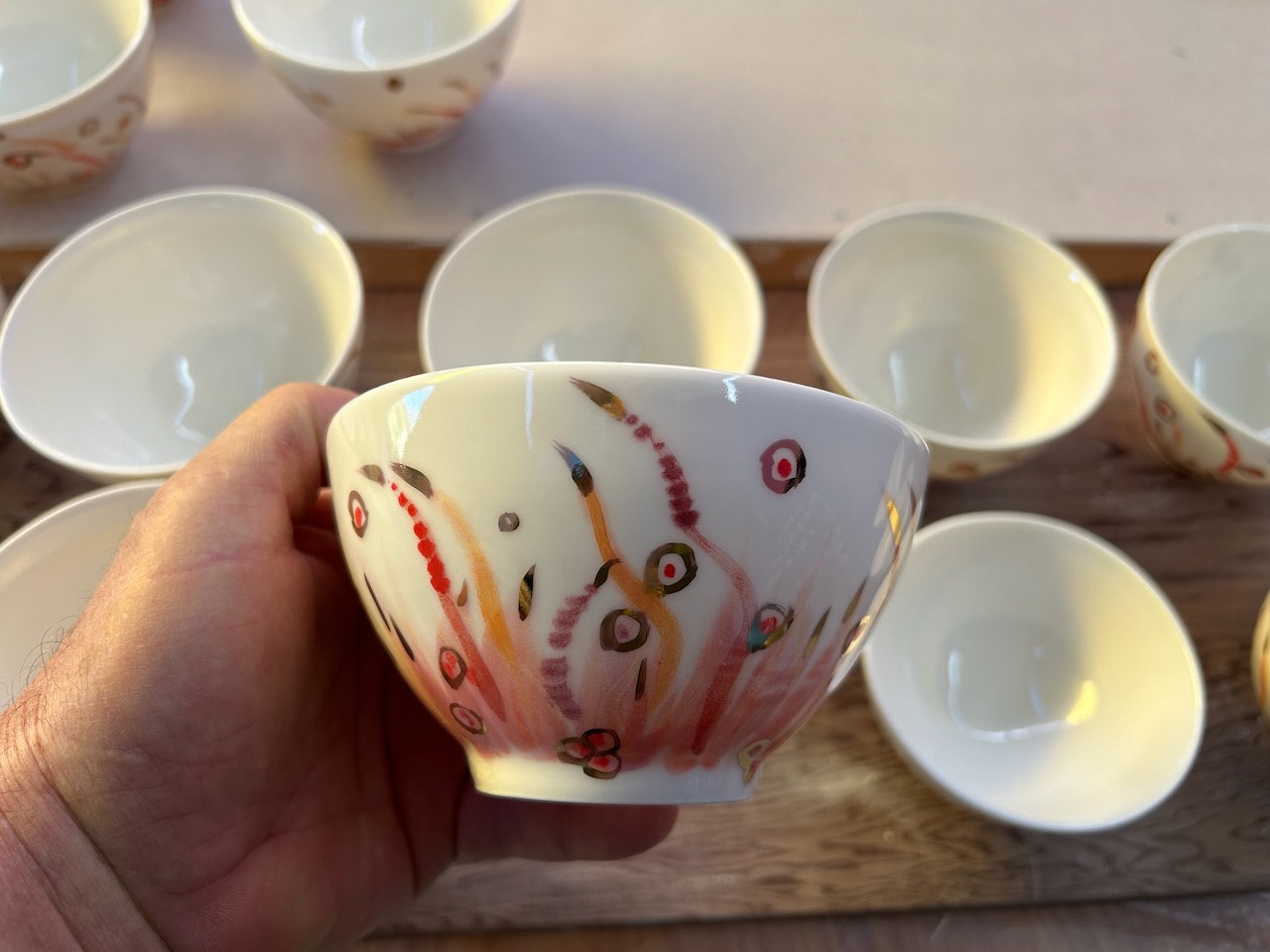
I have been hard at it making new work for this show. I have been making some very fine and thinly potted bowls decorated with the motif of “From Flames to Flowers’. This is a motif that i developed without knowing last year after undergoing some remarkable EMDR trauma therapy. 

One week I was painting flames on my pots, the sorts of images that had been haunting my dreams since the fire, then the next week, after just a few sessions of EMDR, the flames had morphed into flowers. To be truthful. I had made a concerted effort to plant patches and strips of English cottage garden beds around the garden and driveway since the fire to try and make the place a bit more cheery and less blackened. I really needed cheering up, having been burnt out 3 times in 50 years.

I really like the motif, so I am still using it. It still cheers me up. It’s optimistic and positive. I have added a little bit of gold lustre to give it a bit of ‘bling’ as well.  I have been using some lovely translucent sericite porcelain, so that when I hold the pots up to the light, I can see the painting on the out side of the bowl from the inside, not just the outline of the image, but even the colours of the flowers. They are pretty special to me.

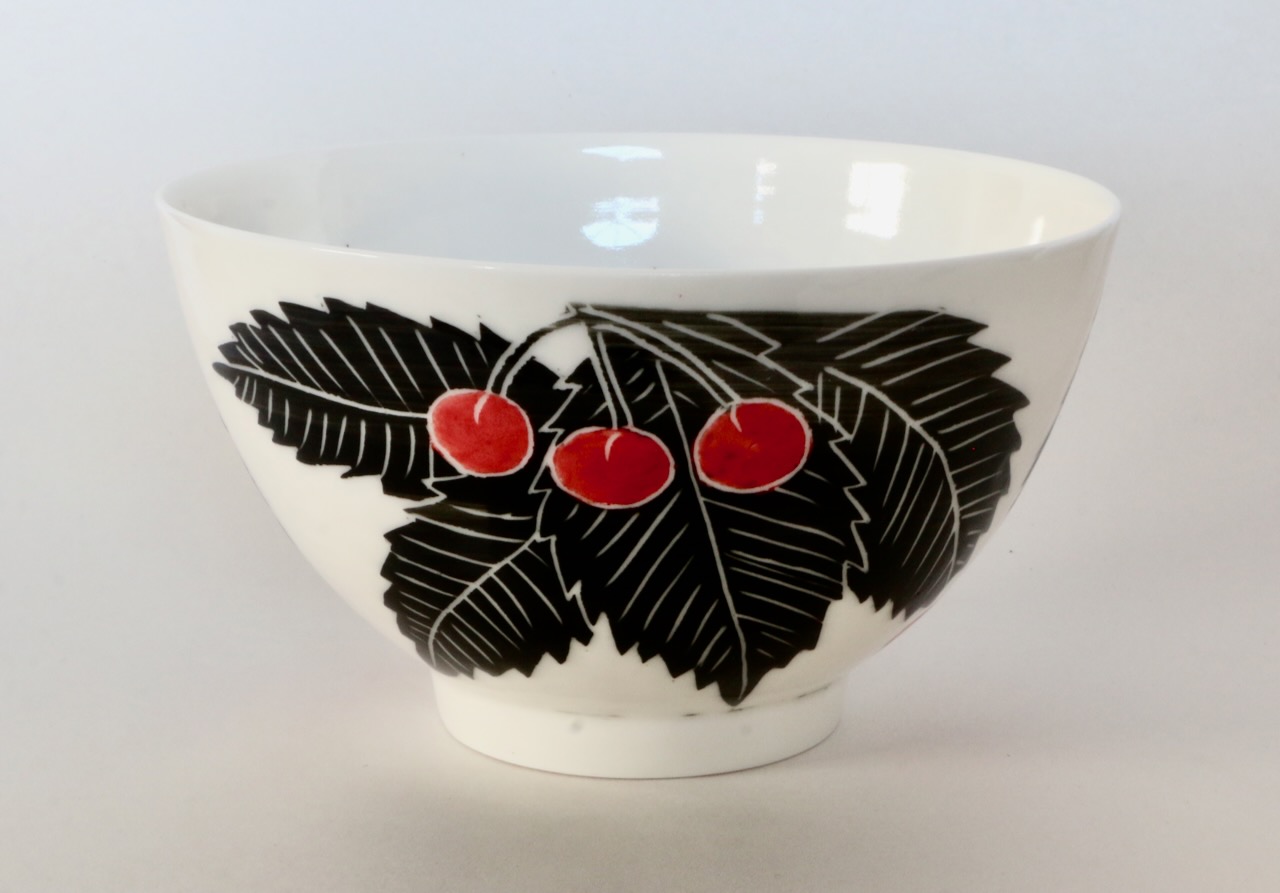
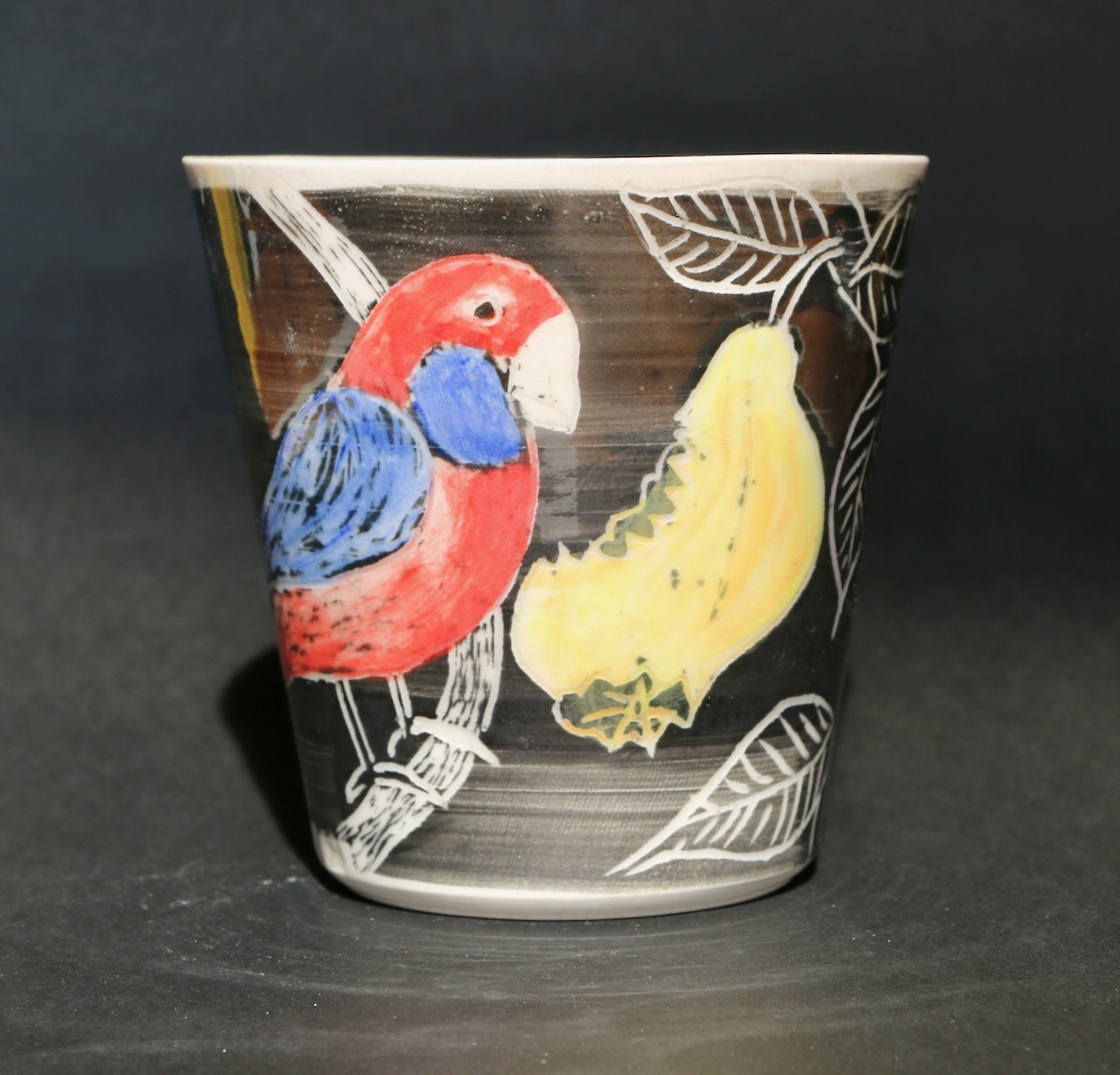
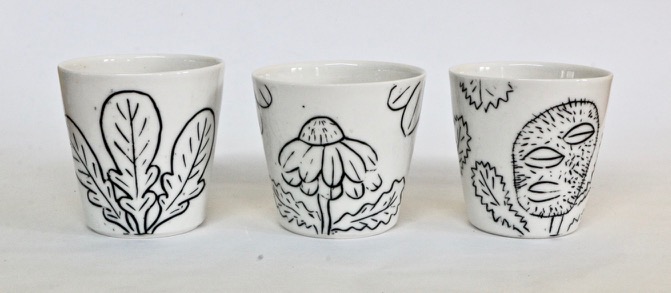
The other work that I have been doing is black and white sgraffito graphic decoration, again mostly on porcelain, but I have also made some stoneware mugs. They are still in the kiln as I type. They’ll still be warm on Saturday morning, coming straight from the kiln.

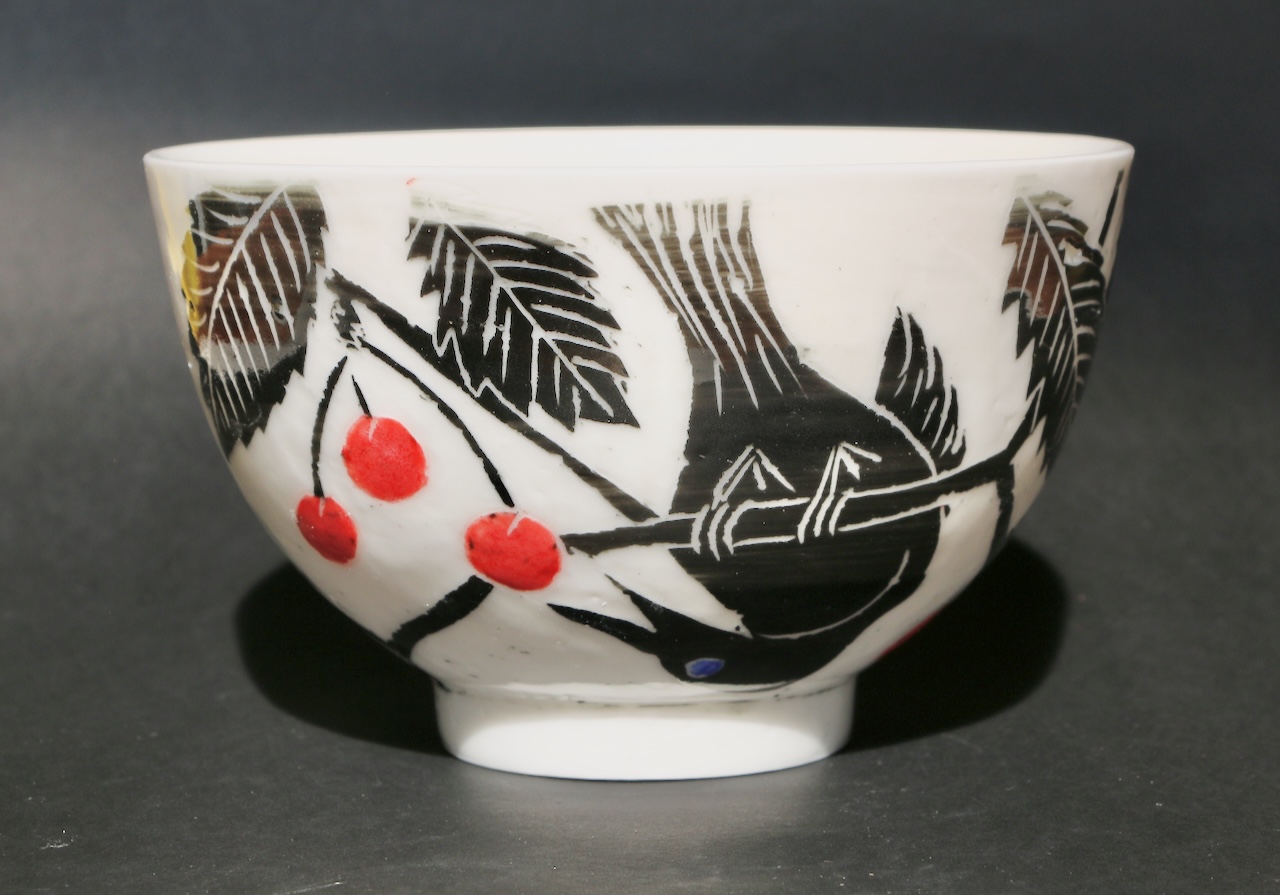
The motif for this series are the cherry trees in our Chekhov orchard, and the blue/black bowerbirds that come and steal our fruit. The Cherry Thief. The subject is as old as gardening itself. I remember that William Morris designed some wall paper back in the 1880’s called ‘the strawberry thief’. This new work of mine is totally unrelated in Character, and very different, but the subject is exactly the same.

I call the series, ‘Plant it and they will come’. And they do come.

When we came here 48 years ago. There were hardly any birds here, just a few kookaburras. As we developed the gardens and orchards, dug dams, made compost heaps and planted native shrubs, we created habitat, and they came!  Suddenly we had to start thinking of how we might cover our fruit trees and vegetable beds from the marauders! 

Within a few years, we had hundreds of birds living here, working the rich environment, with dams for water, open spaces to forage in, trees and shrubs for cover, and fruit to eat. We created this oasis and they occupied the territory. We planted it and they came!

I will be open from Saturday to Monday over the long weekend, from 9 to 5 each day. Please call in if you are in the area.

I have plenty of off-street parking, tea, coffee and cake, toilet facilities, and we are wheel chair friendly. There will even be a glass of wine in the afternoons.

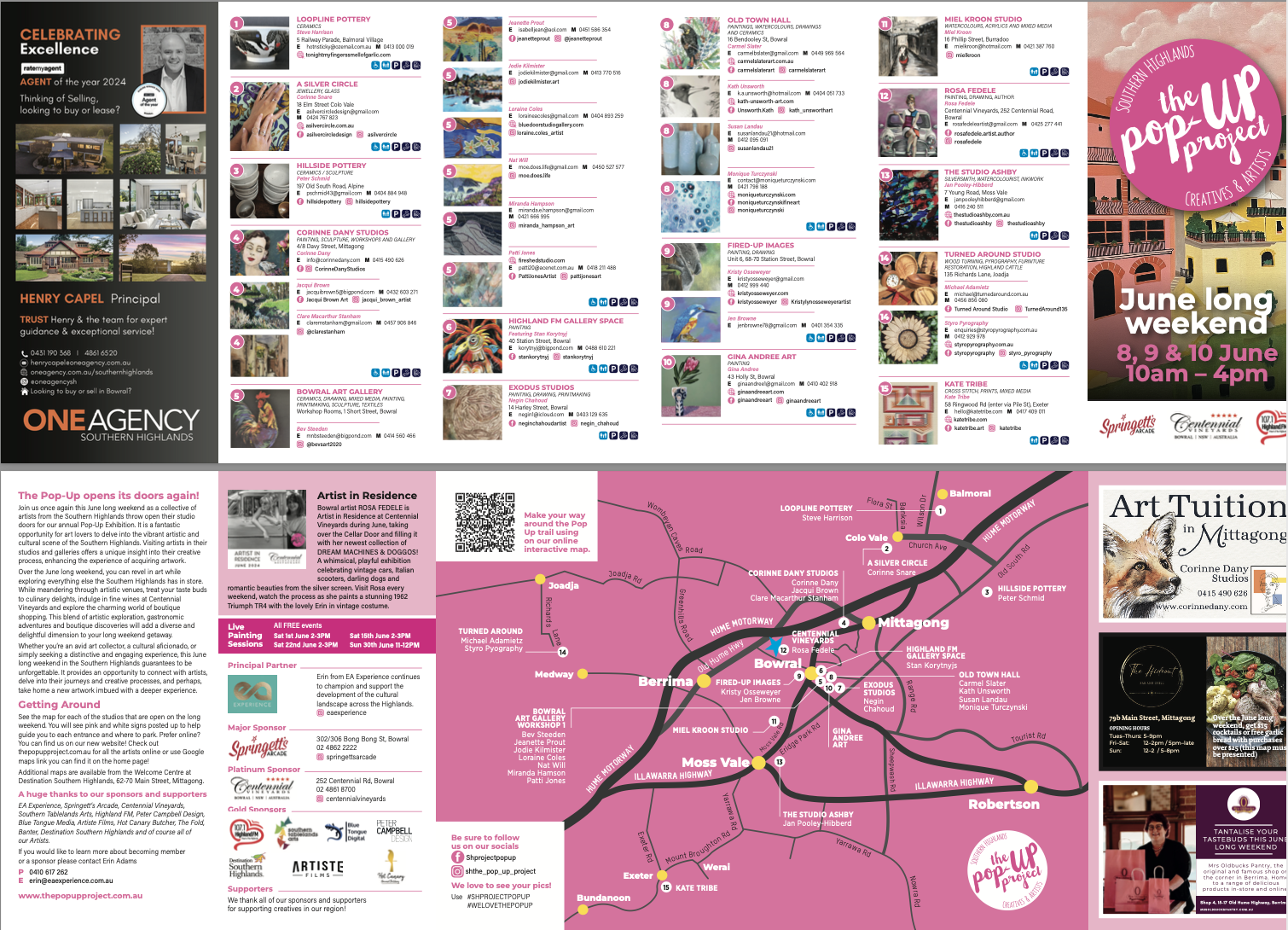
Pop-Up, Arts Trail, Open Studios

I will be opening our studio gallery on the long weekend in June for the ‘Pop-Up’, Open Studios Arts Trail. 

The 8th, 9th and 10th of June.

See Arts Trail Map attached below; I am Studio Number 1 on the map.

I have been making some completely new work for this years Winter ’Pop-up’ Open Studio, Arts Trail.

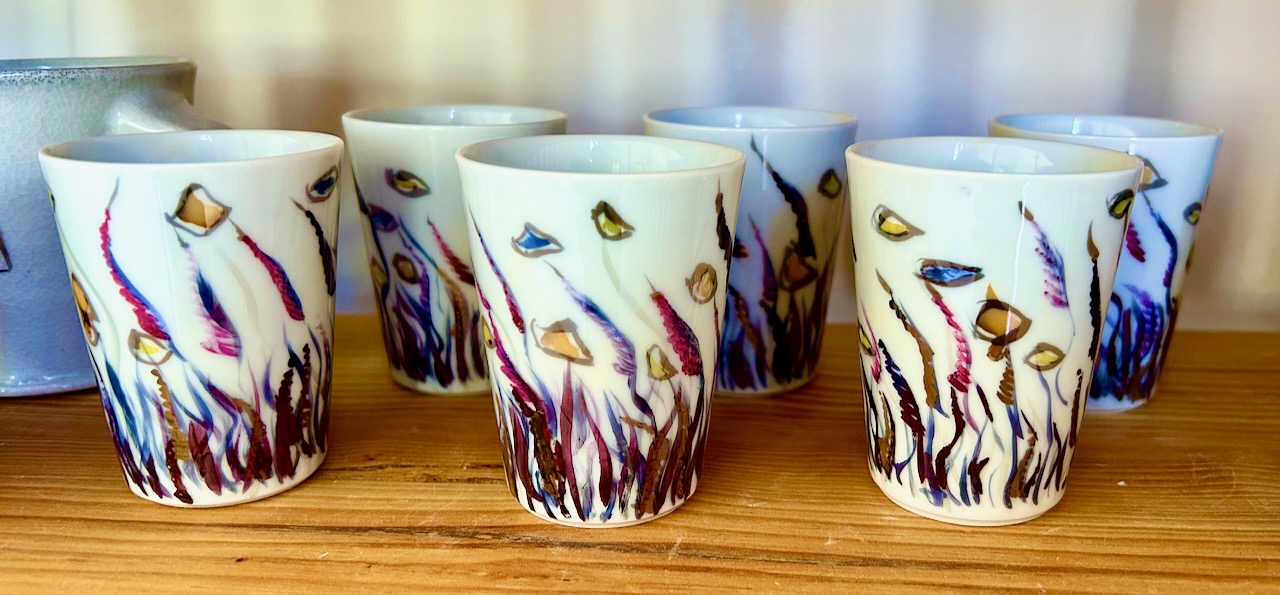
I have plates, dishes, beakers and bowls all decorated with the theme of –

‘Plant it and they will come’.

Kiln Firing in Korea

Janine and I are recently returned from Korea where we were invited to take part in the Mungyeong Ceramics Festival, where I delivered a paper to the ceramics conference there about low impact wood firing.

My paper concentrated on my research into small down draught fire box design, intended to minimise smoke and pollution as much as possible. I also presented my current work on afterburners and scrubbers to try to minimise particulate pollution from our kiln chimneys.

I believe that these topics will become more important over time as Global Heating and carbon in the atmosphere starts to become obvious and difficult to ignore. Even to conservatives.

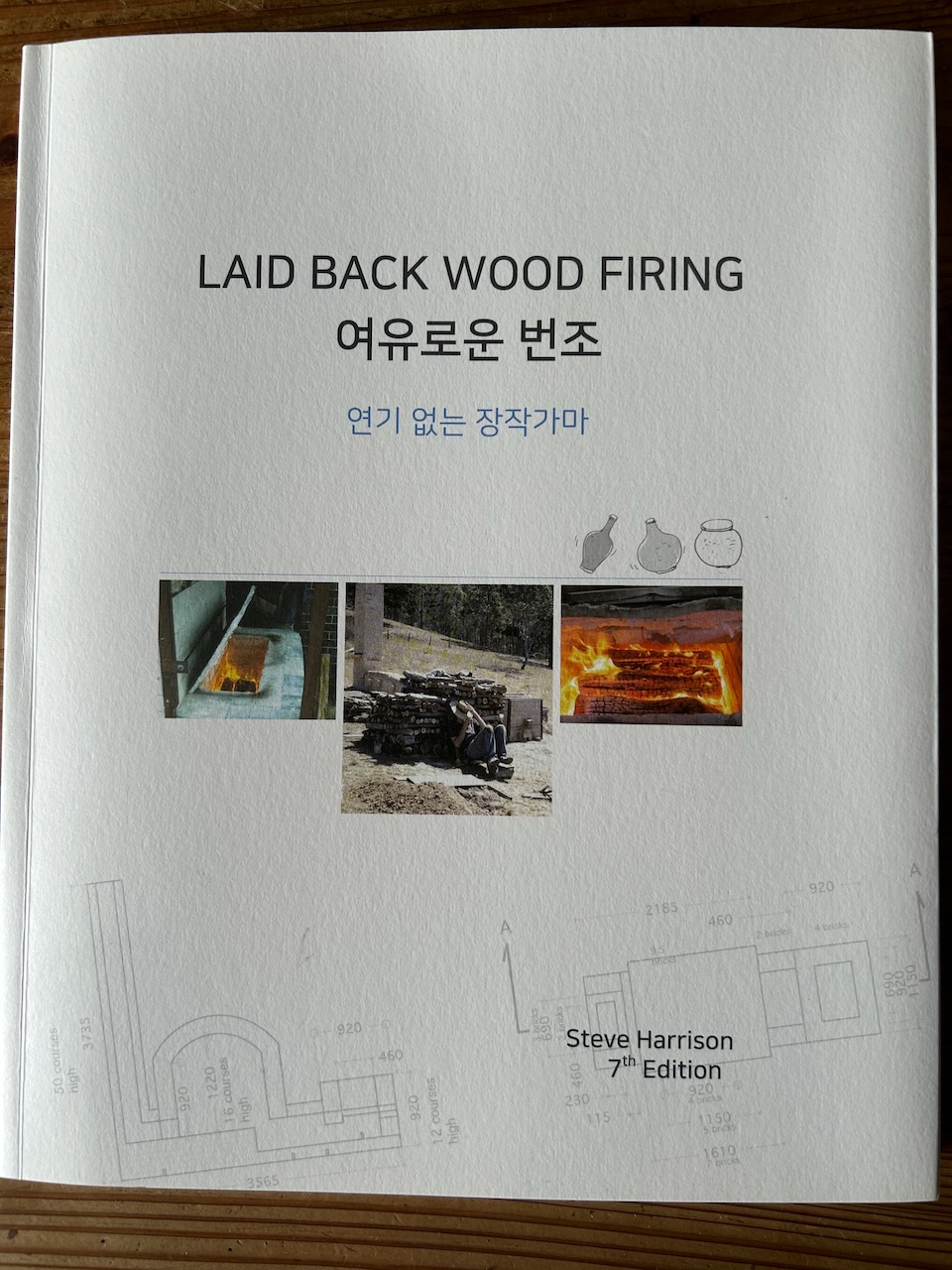
My paper was well received and I got some good interrogation during the question time afterwards. My book ‘Laid Back Wood Firing’ was  translated into Korean about 5 years ago and has been available there for some time, so some people there had read it and were up to speed with the concept.

Janine and I will be returning to Korea later in the year to build one of my small Bourry Box kilns as a demonstration of how it can work. It will be built alongside several older traditional wood fired kilns. They are interested to compare the smoke from our firing and also the fired results afterward with that from the traditional kilns.

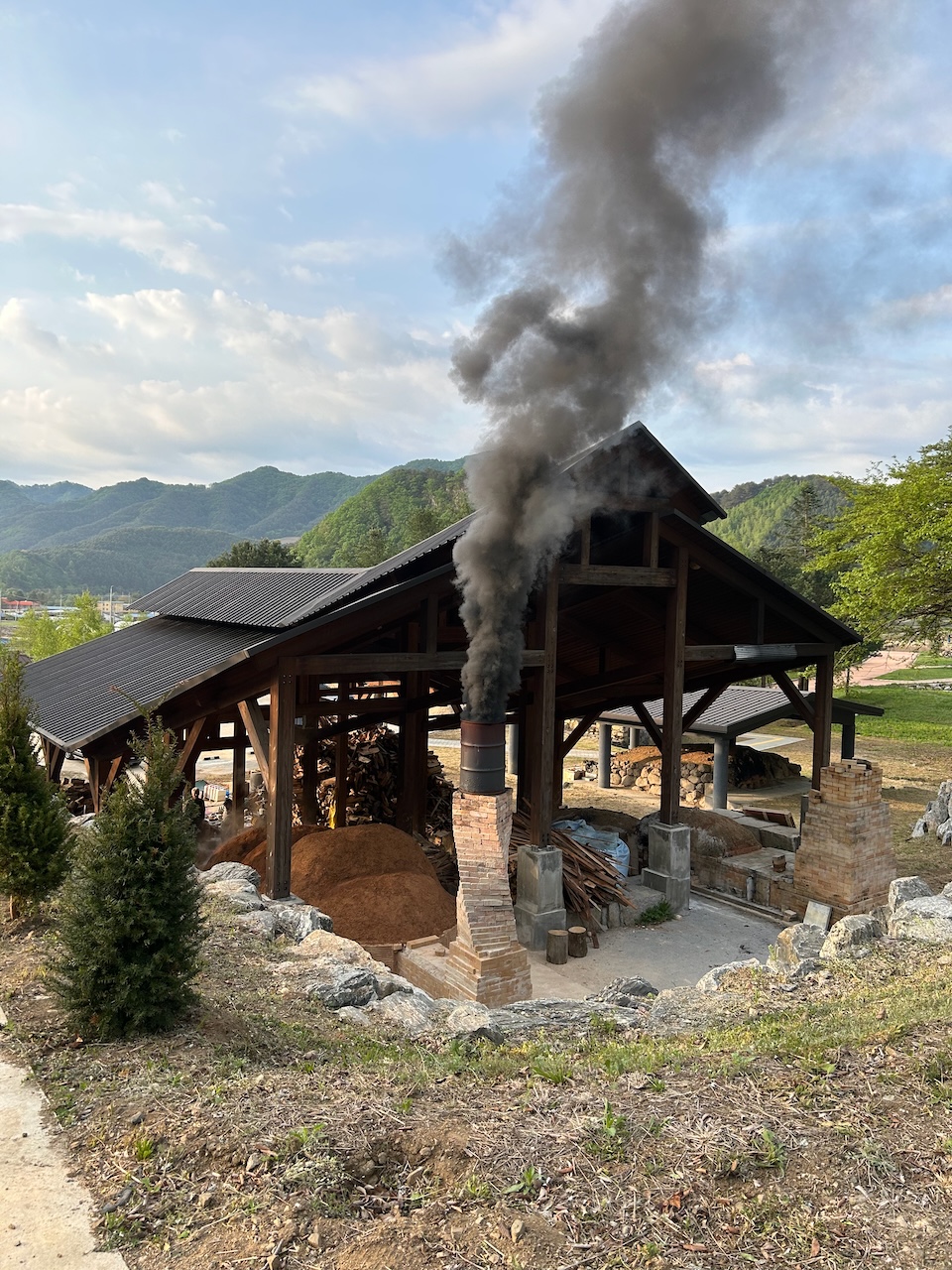
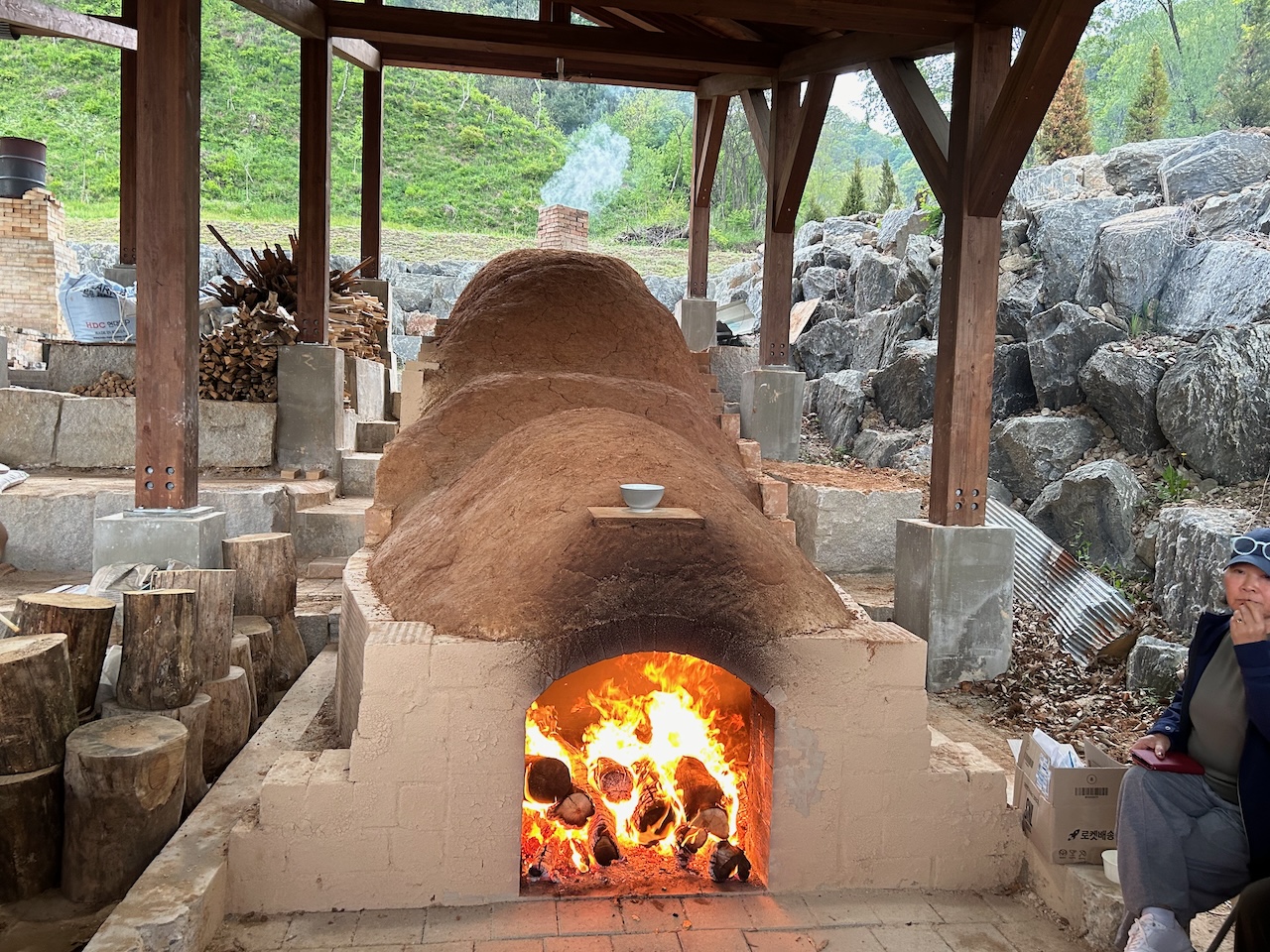
The most recently built, traditional, multi-chamber kiln was fired while we were there. It smoked all the way through the firing. I’m pretty sure that we can do better!

Its a really beautiful kiln to look at, and is constructed using the very old method of using cone shaped hand made ‘bricks’.

The cones were all made on site by the students/residents in the ceramic research centre at the Yanggu Porcelain Village.

The use of cone shapes allows for a rather nice dome shaped top or 3D arch over each of the fire box and 4 chambers.

The freshly built kiln took just 24 hours for it’s first firing – all 4 chambers to stoneware, absolutely no technology was use. No pyrometers or cones, just an experienced firing crew and home made draw trials of glazed tiles pulled at 30 minute intervals after orange heat.

This kiln was so new, it was still wet, and steam was coming out of all the cracks all the way to top temperature.

Side stoking is always a dirty business. Hard to get around that. It’s the nature of the beast.

That is why I have chosen to build a single chamber bourry box fired kiln as the demo model.

It will be a larger sized chamber, so I have designed it with 2 fireboxes side by side.

Only time will tell if it works the way I intend and if it impresses them.

When you are in Seoul and the air quality is rated as ‘fair’, but you can only see for 1 km through the smog. I makes you think about what a bad day might be like. Smoke from wood firing is not the big problem in the scheme of things.

But every little bit counts.

Two Sericite Porcelain Workshops completed

We have just completed the 2nd of our sericite porcelain workshops.  They both went well and everyone seemed to get something out of it.

We advertised it as intermediate to advanced level, and everyone was suitably skilled to be able to handle the slightly more complex and difficult advanced techniques.

We were aiming to teach those advanced techniques, and everyone was keen to extend their skills.

The weather has cooled down a lot recently, so we had to light the stove to get the air a bit warmer in the studio over night to speed up the drying process. At the end of the first days throwing. I lit the fire and kept it going until after 10pm with the ceiling fan running all night. With this combination of warm air and moving air , we managed to get nearly all the pots dry enough to start turning on Sunday morning.

As my contribution to our shared lunchtime meals. I cooked a couple of tarts to be shared for our lunches. 

I made one savory home grown spinach and cheese tart from our garden with 3 cheeses. Ricotta, for the main filling with finely diced fetta for a little bit of texture, then some gorgonzola for a little of that tangy flavour that it imparts.

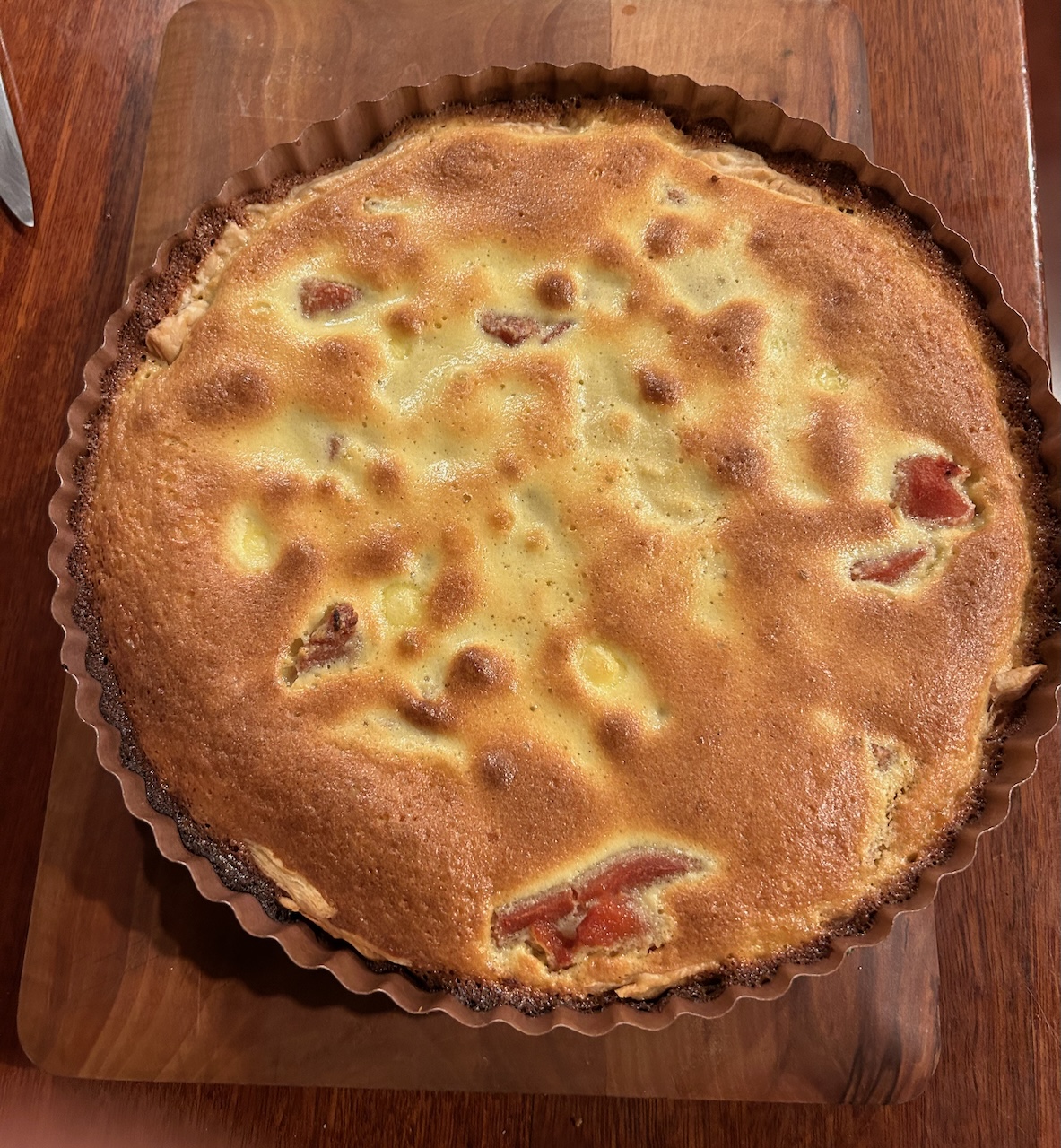
The other tart was sweet for after lunch, and made from our home grown and preserved quinces in an almond frangipane base.

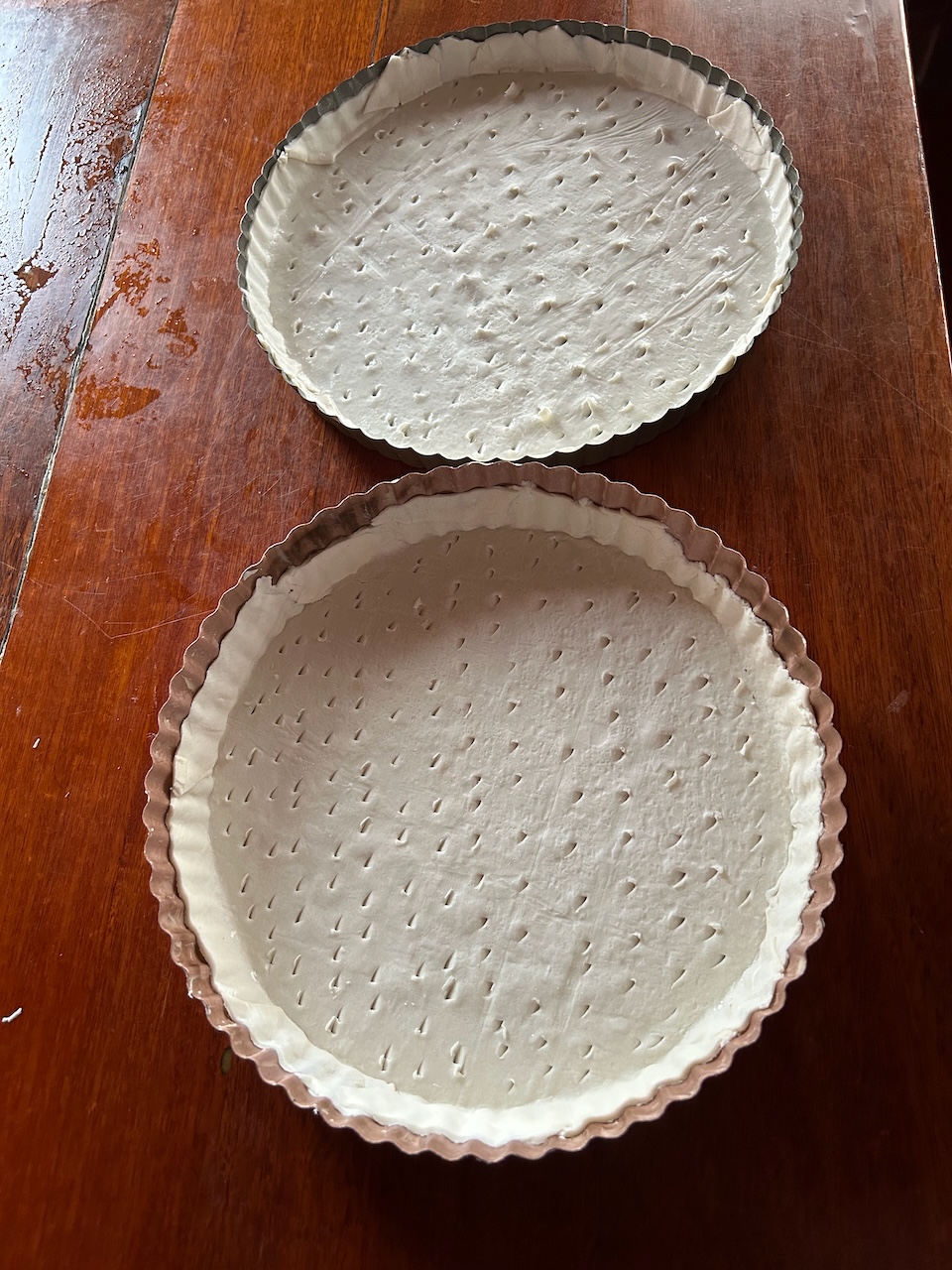
Both made in blind baked puff pastry casings. They dissapeared pretty quickly. It’s a very good feeling to be able to share our preserved summer garden goodness and excess with others.

During the week inbetween the workshops, I continued to make and fire my sgraffito porcelain pieces that I have been working on for a while. 

It’s good to see more of them coming out of the kiln now, all shiny and transparent with the images of the bowerbirds stealing our cherries from the Chekov orchard.

I will be taking part in the ‘Pop-Up’ Southern Highlands Arts Trail Open Studios sale on the long weekend of 8th, 9th and 10th of June. Save the date!.

1st. Weekend Workshop Throwing Class completed

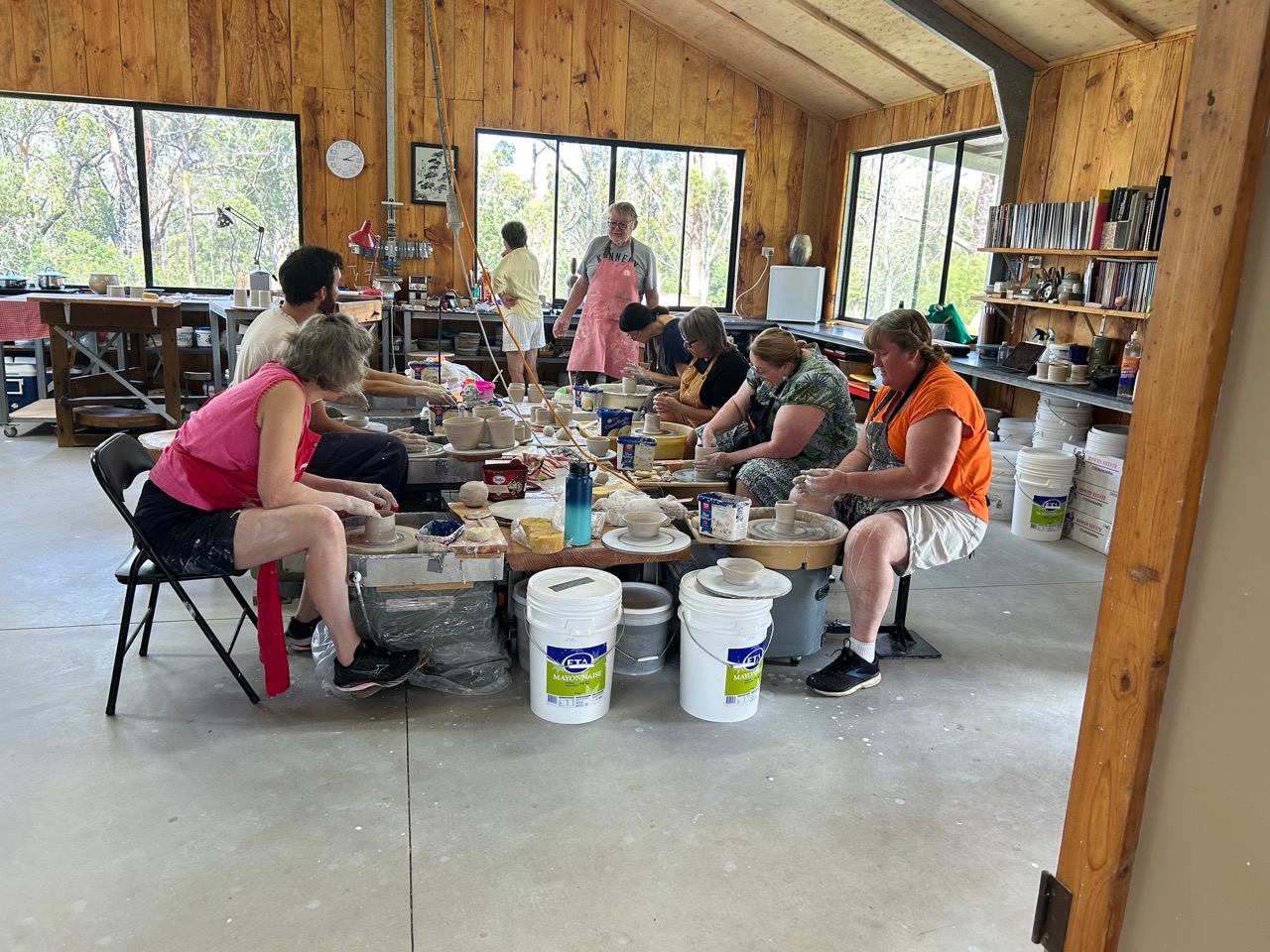
We have just completed another weekend workshop. This time a throwing class. I advertised one and filled two weekends, so we will back in the studio again with the 2nd group next weekend for the 2nd one.

Everyone seemed to enjoy them selves and got something out of it. We had Len Smith here with us for the weekend to have 3 tutors for the 8 students. Len has so much teaching experience, it’s great for the students to have a third point of view. He’s also great company.

I spent the week pugging clay and prepping the throwing room, and during the time in-between, I kept on with my sgraffito decoration, and got a solar powered, stoneware glaze firing done.

These red and black cups are experiments in a combination of Sgraffito and inlay.

Just black slip inlay on these cups.

Just sgraffito on this bowl

In the evenings, I made another batch of tomato passata. I have now run out of our re-cycled ‘pop top’ jars and so I have started to use the old ‘Fowler’s’ vacuum jars with clip top lids. I made a 7 litre boiler full, and reduced it down to 5 litres, enough to fill 7 of our No.27 Fowler’s jars. I have no idea how Fowlers came up with their numbering system, but as they are so old, I suspect that it represents fluid ounces? 

I Googled it and 27 imperial fluid ounces = 770 mls. So that sounds like it ought to be right.

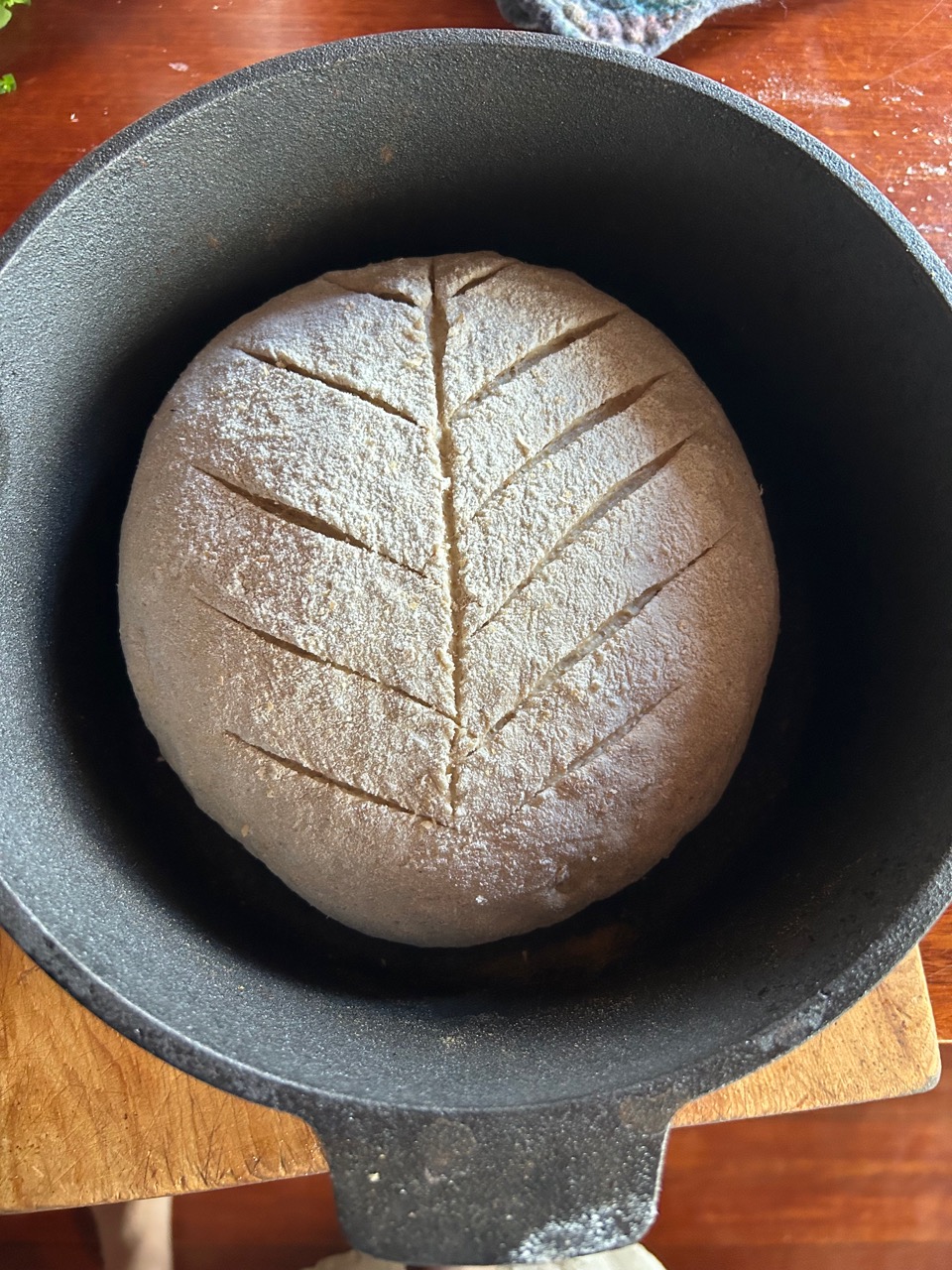
I also made this weeks loaf of rye bread.

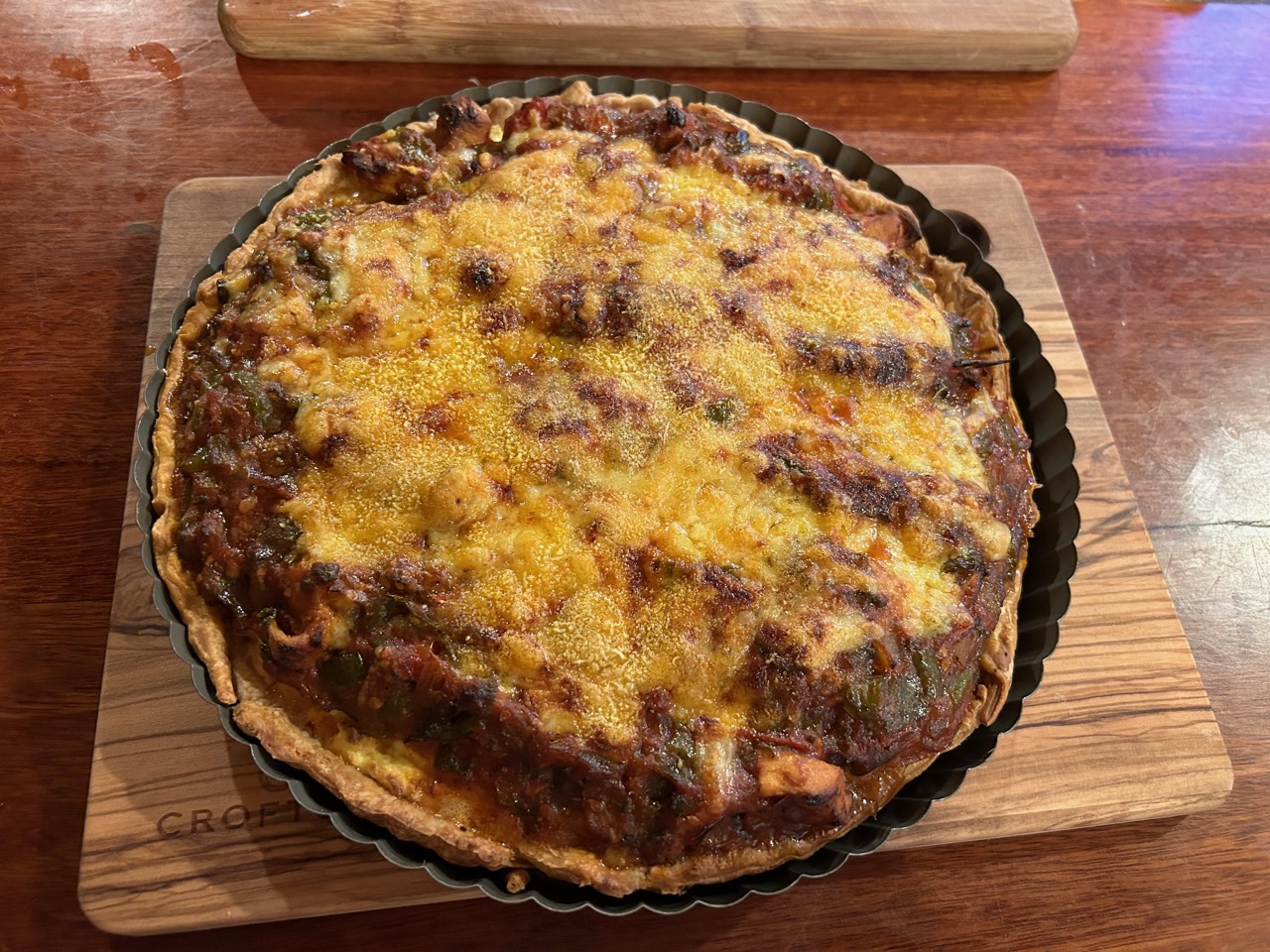
For the workshop lunch, I made a flan or tart with a baked cottage cheese base and a ratatouille topping. That didn’t last very long.

The coming week will be more of the same as we repeat it all over again.

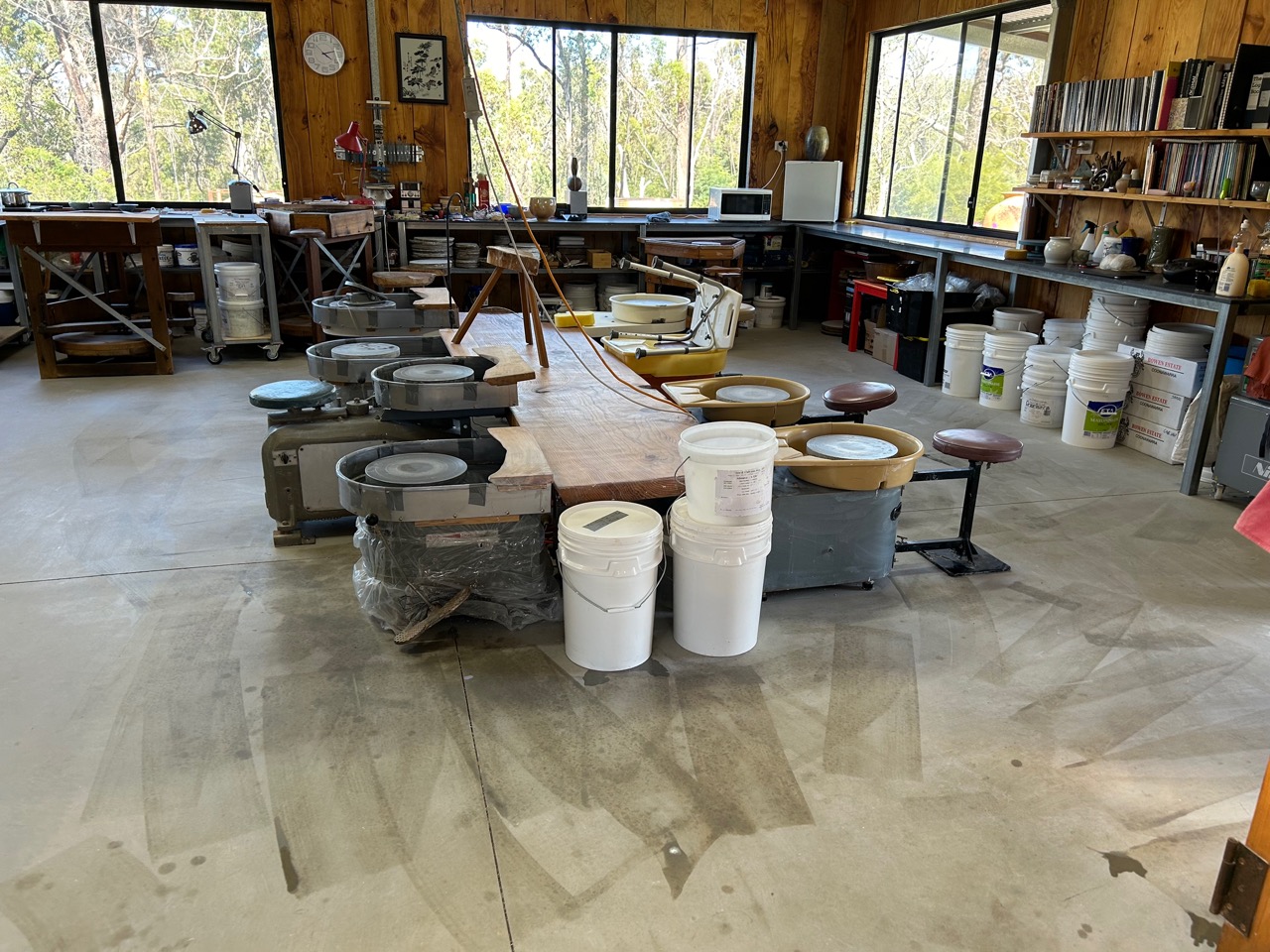
The workshop is all cleaned and mopped and ready to go.

The workshop looks beautiful tonight in the glow of the pink sunset.

This image of the workshop by Janine 

The End Of Summer

It’s the end of summer, and all of the fruit is finished in the orchards, this month we have been busy with other jobs.

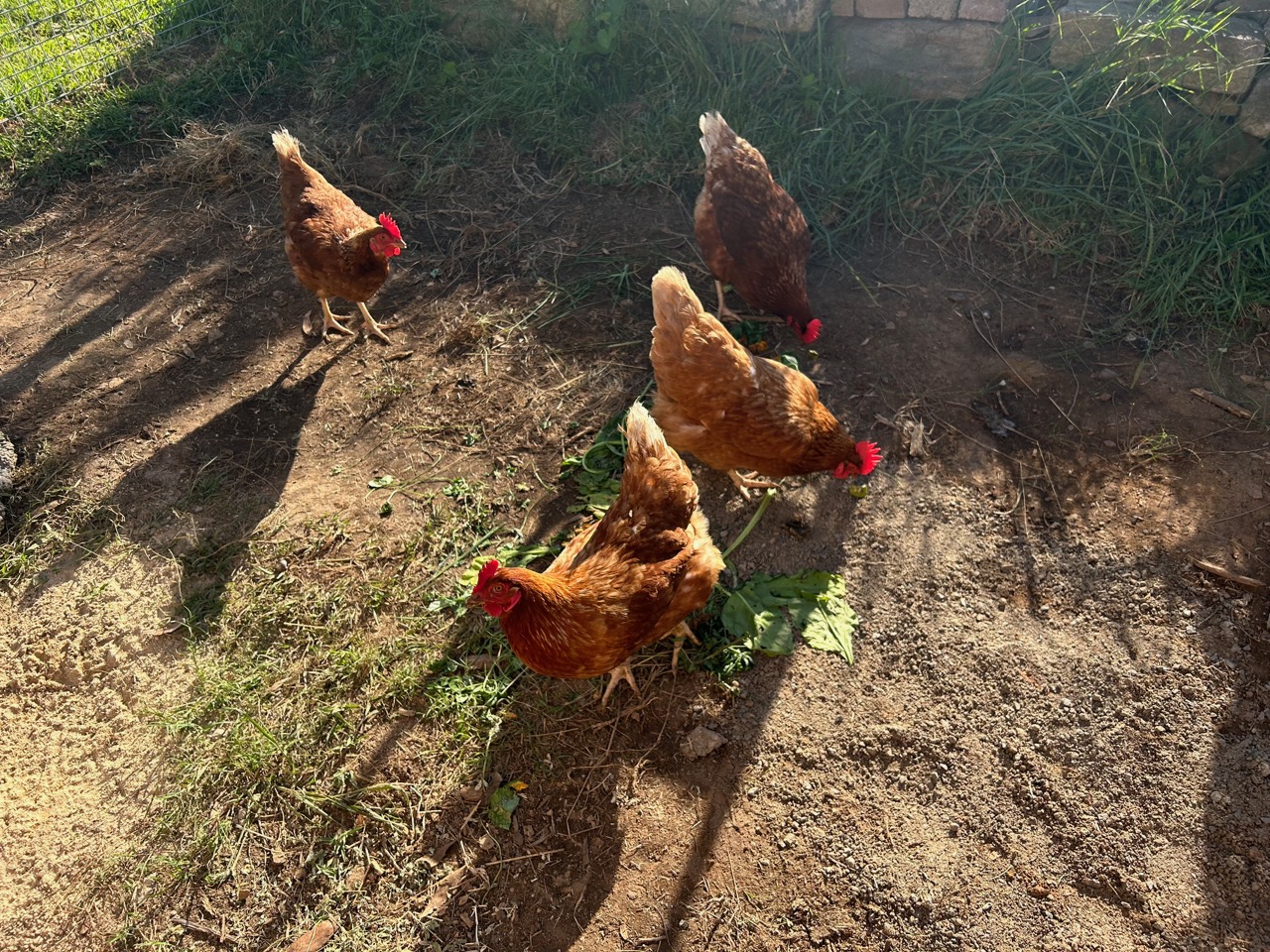
I have been going to build a new chicken run and chook house for a long time. The old one was very small, built in just one day straight after the fire by our good friends Cintia and Andy who came to volunteer their help at what ever was most needed. The old, very solid, and palatial chicken house was attached to the garden shed, which was part of the pottery extension. In the fire everything burnt to the ground.

Andy and Cintia knocked up the replacement house out of whatever we could find on site that wasn’t burnt. At 1.8 metres square, it wasn’t really very big, but was OK for just 2 surviving chooks.

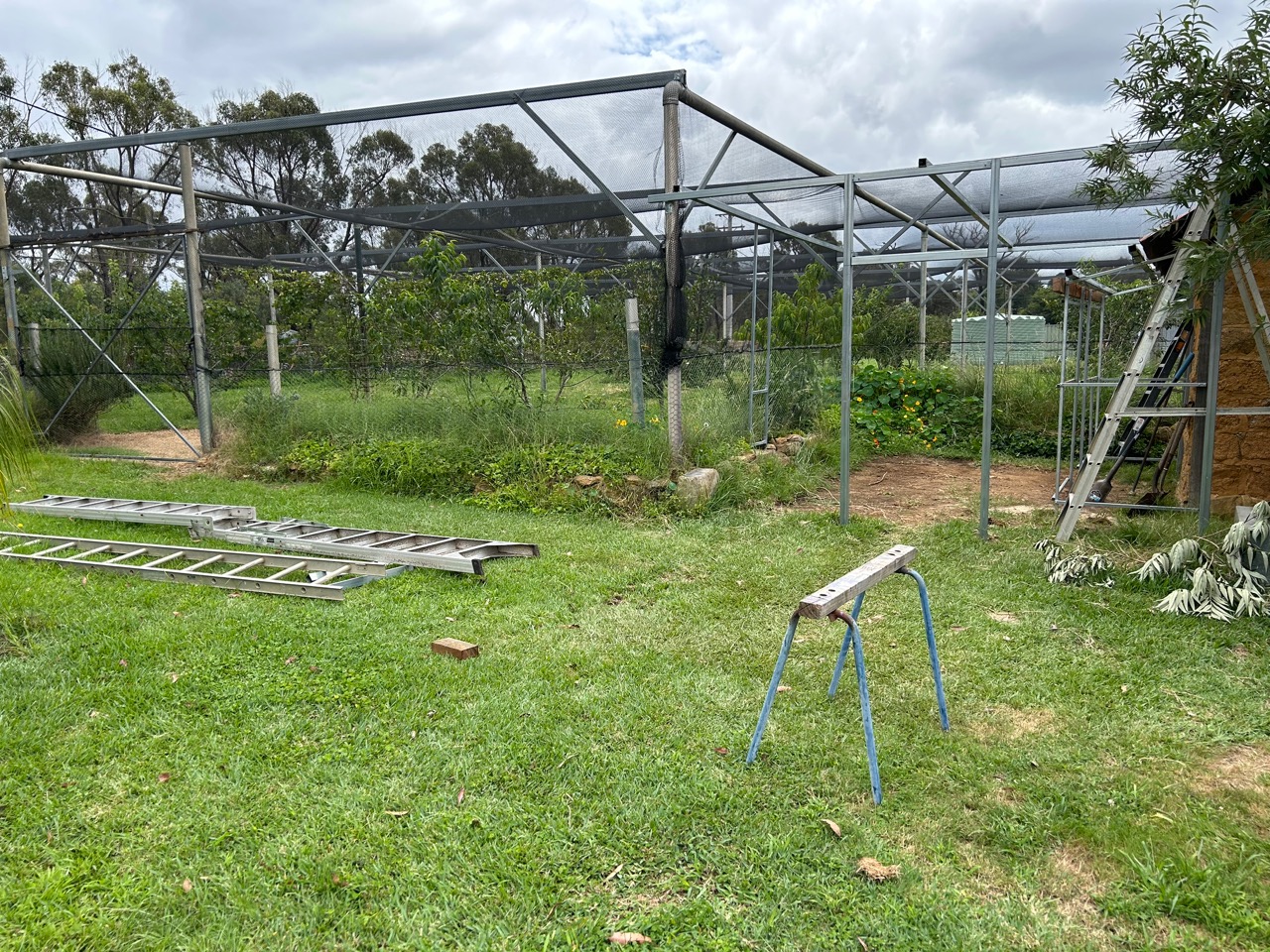
This weeks new chicken mansion is built into the gap between the new orchard and the old mud brick garden shed. It has access through a small gate into the covered orchard, where the chickens can explore and scratch all day in safety, without being swooped on, or chased by local dogs or foxes.

Janine suggested to paint it pink, so I thought to name it ‘Gallus Hilton’. Then she thought it might be better pale mauve, So it might get called ‘The Gallus Palace’.

What ever we call it, the new chook shed and run is the best one of the 4 that I have built here over the 48 years here. It’s still rusty recycled iron colour. I re-used the old corrugated roofing iron that we took off the Old School roof when Andy helped me to re-roof it last year. 130 year old roofing iron still has a lot of life left in it yet, as well as so much embedded history on this site.

It did occur to me that it is a bit strange that a man over 60 might need 4 different ladders to build a simple chook shed

This new run is 6m x 4m. So plenty big enough to be comfortable if we are away and they are locked in. It is completely fabricated out of steel, so shouldn’t burn in the next fire.

When its too hot outside in the middle of the day or raining, then I divide my time between the kitchen preserving excess garden produce, or over in the pottery.

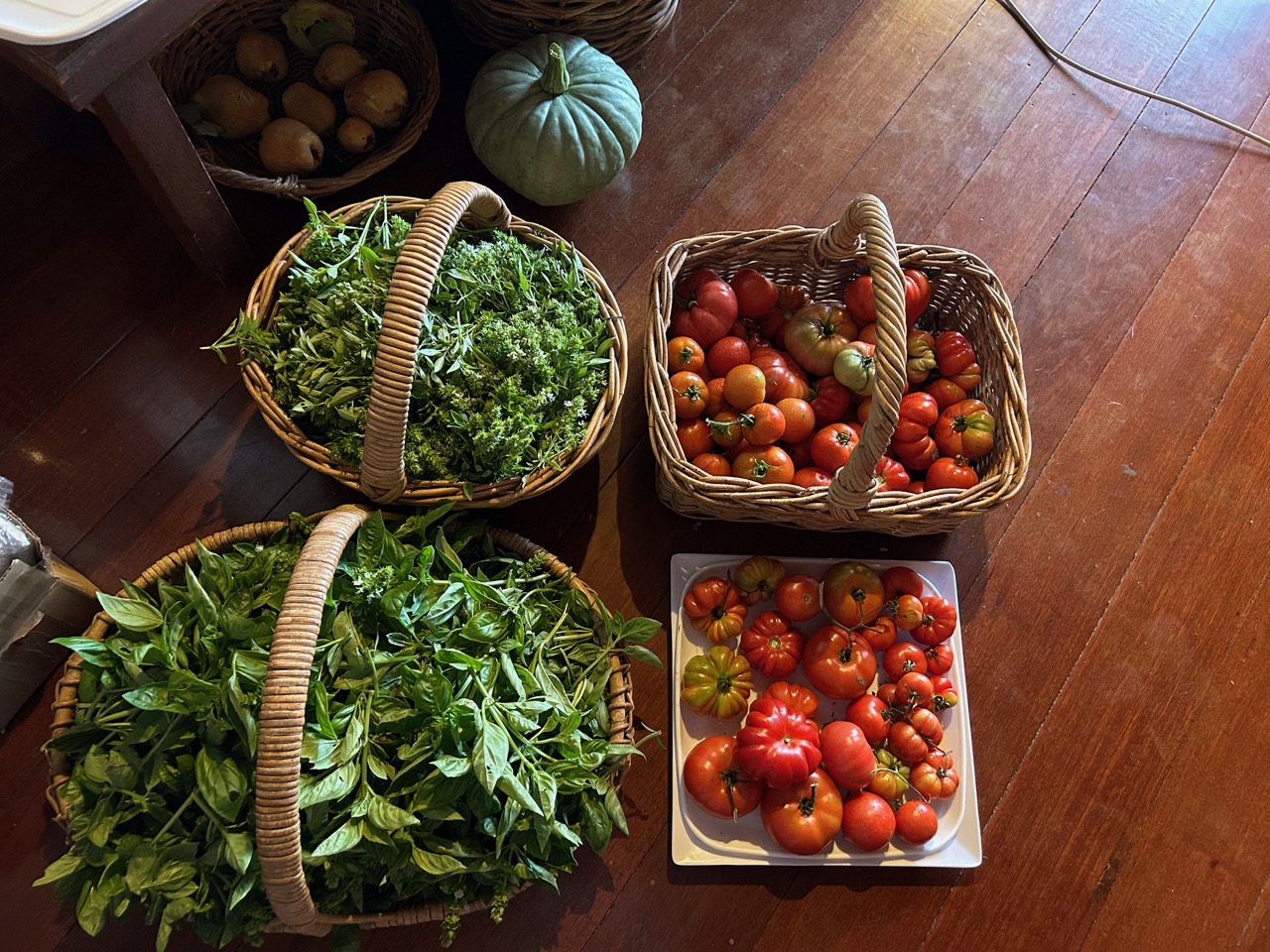
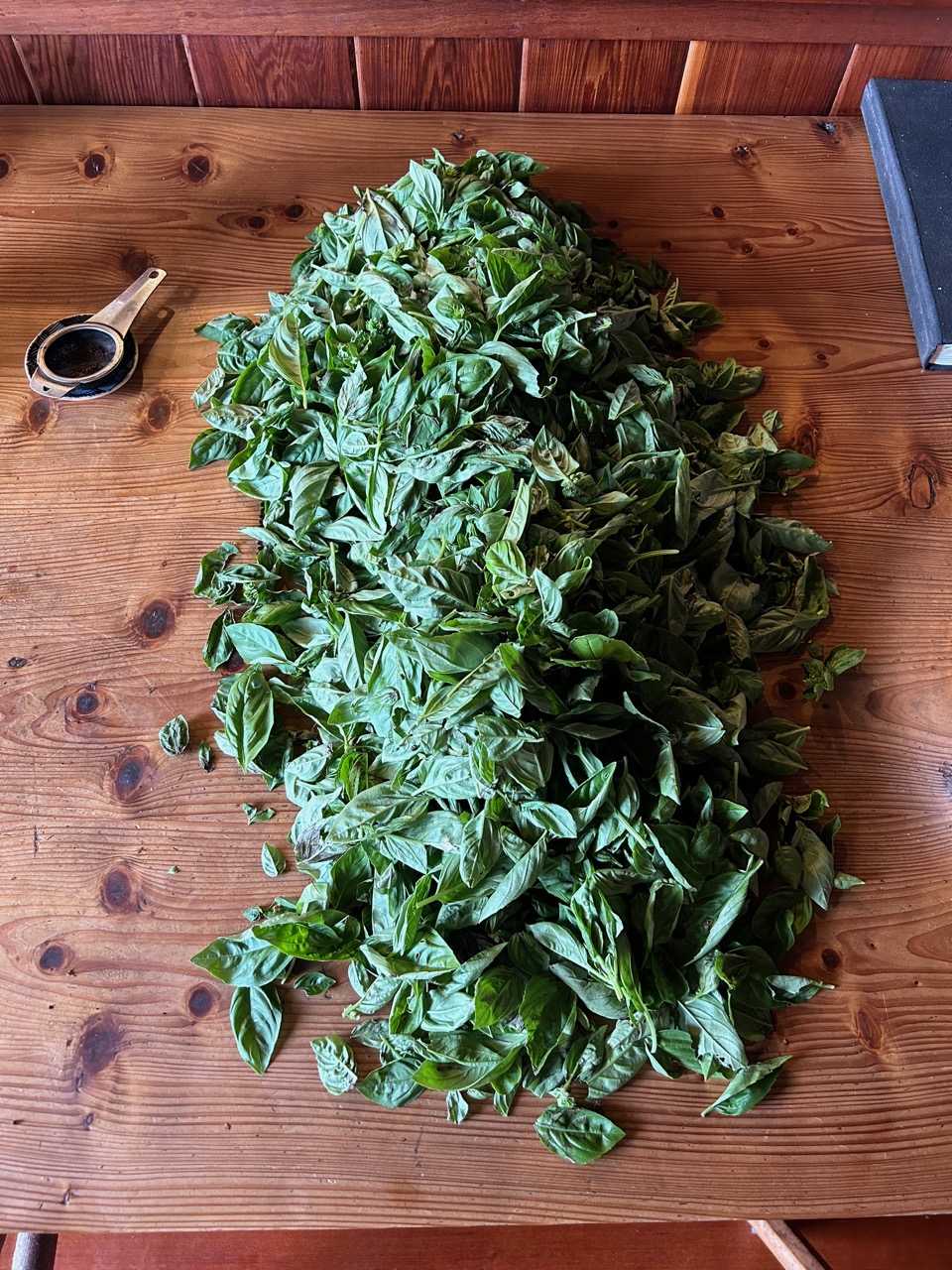
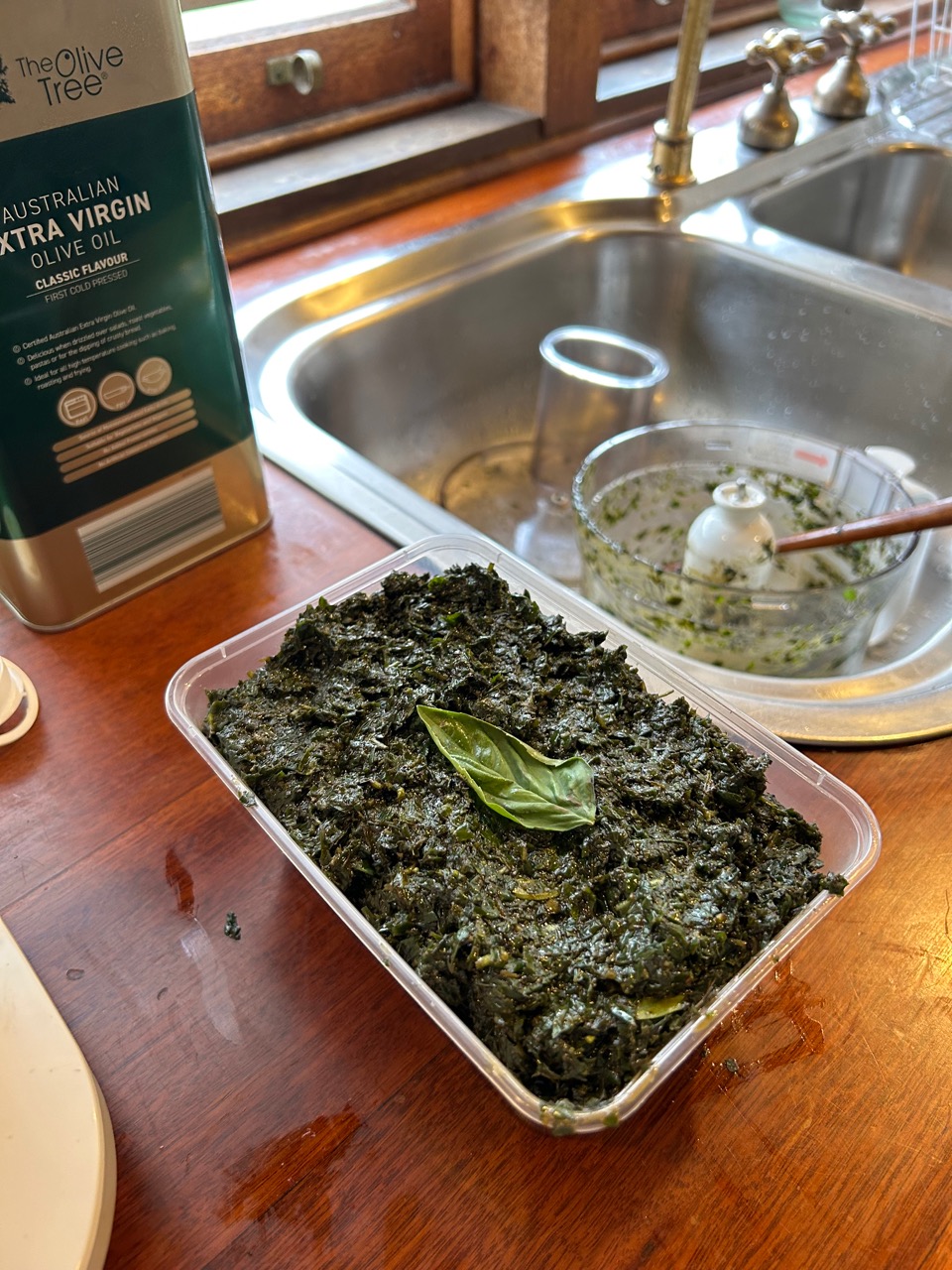
The sweet basil crop in peaking just now in the garden, so its time to make pesto.

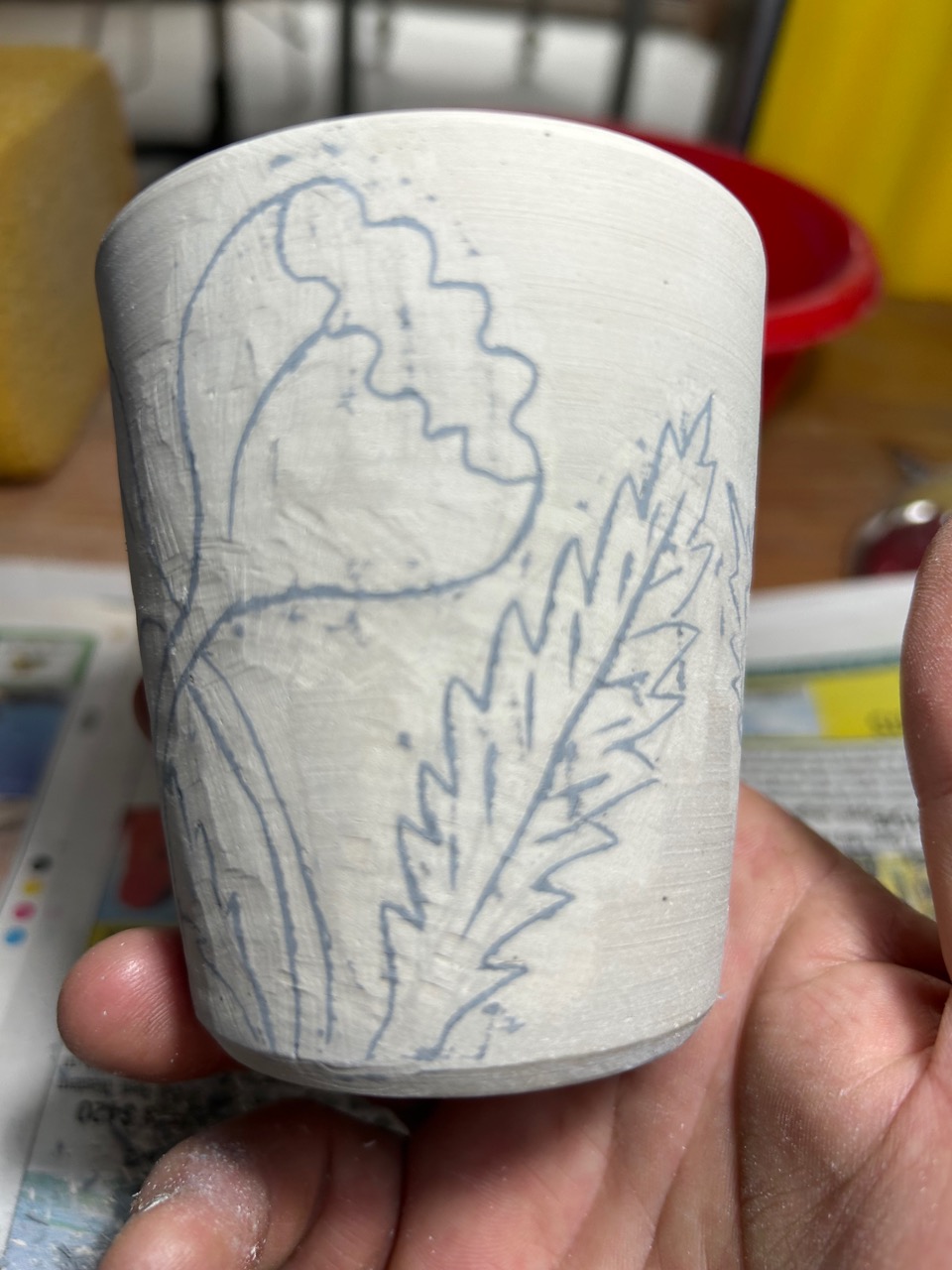
In the pottery, I’ve been extending my sgraffito on sericite work to include the negative/positive slip inlay. I tried mixing the two techniques and introducing some underglaze colour as well. I don’t know how these will turn out, as I’m packing the glaze kiln tomorrow.

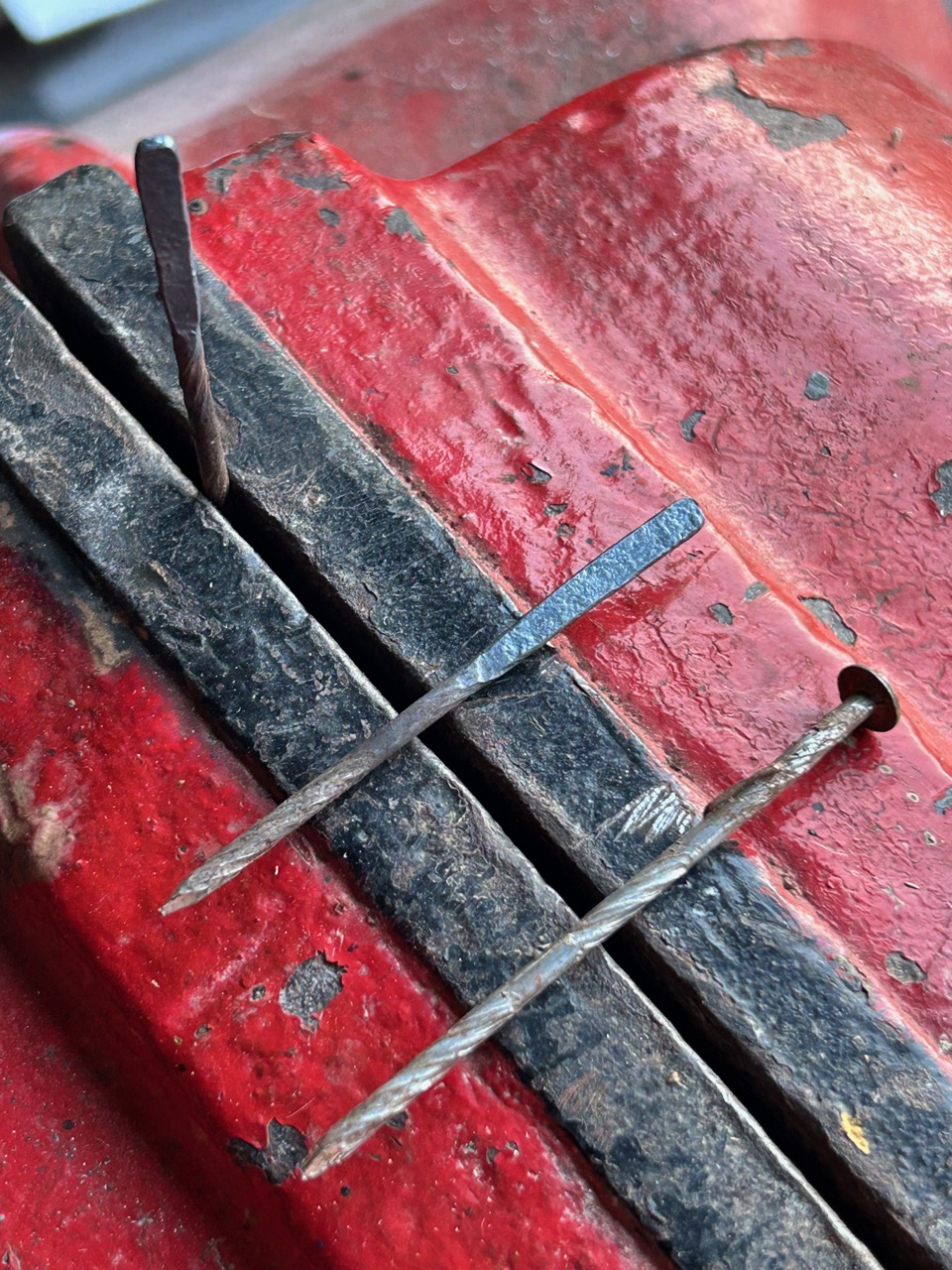
I’ve found that the sorts of sgraffito tools for sale here are somewhat limited, so I have been forging and hammering my own from rusty nails. They are rather nice, somewhat rustic and I can make them any size. 

Janine has been using our current excess of passion fruit to make passion fruit and cream flummery. It’s quite easy to make, just passion fruit and cream whipped up together and then frozen. Janine takes it out of the freezer every so often and re-whips it to keep it light and fluffy while it freezes.

It goes quite well with our excess of blueberries as a desert.

That was summer!

We may have already passed 1.5 oC of warming

A recent article in ‘Nature’ magazine indicates that we may already have passed 1.5 degrees of warming in around 2012. Using a unique sponge that grows in the sheltered waters of the Caribbean. Researchers have calibrated its growth over the past 300 years. Using the analysis of isotopes of calcium and strontium that the coral-like sponge lays down at slightly different sea temperatures. The article suggests that we have been underestimating the actual degree of global warming by half a degree, and that we are actually approaching close to 2oC in warming.

Its a short but really interesting article.https://www.nature.com/articles

</d41586-024-00281-8?utm_source=Live+Audience&utm_campaign=fe78015ca6-briefing-an-20240209&utm_medium=email&utm_term=0_b27a691814-fe78015ca6-51985668&mc_cid=fe78015ca6&mc_eid=c5c85747a1>

Another really interesting article this week was in The London Review of Books;

A National Evil – the curse of goitre in Switzerland. https://www.lrb.co.uk/the-paper/v45

</n23/jonah-goodman/a-national-evil?utm_source=Live+Audience&utm_campaign=35be6dee93-briefing-dy-20240208&utm_medium=email&utm_term=0_b27a691814-35be6dee93-51985668>

Apparently there is/was a really serious lack of iodine in the soils of Switzerland, which over centuries had caused severe goitre in the population. The Swiss used to have the highest level of Cretinism in the world because of this missing trace element in their soils. Most of the country was scraped clean of its top soil during the great ice age. The only part of the country that didn’t suffer this debilitating disorder was in the low lying areas, where the soils hadn’t been so depleted.

All sorts of explanations were put forward. 

“landscape, elevation, atmospheric electricity, snow melt, sunlight (too much and too little), ‘miasma’, bad beer, stagnant air, incest and ‘moral failure’. They collected information on the minutiae of life in affected areas, then cross-referenced their reports, following the contemporary medical wisdom which held that all diseases had multiple causes. Did groundwater interact with sunlight to produce goitre? Might a certain combination of air pressure and elevation create a cretin? In 1876, a list of the most promising theories was published; it featured forty different hypotheses.”

All wrong. It wasn’t until 1915, that a local doctor proposed that it was caused by a lack of iodine, and was shouted down. However, Eventually another doctor in an isolated area did a few unauthorised experiments in his remote local area, adding very small amounts of iodine to salt and distributing it in his local area, and miraculously, the goitres disappeared and no more cretin children were born. It seems amazing that it was just 109 years ago that this breakthrough occurred. 

There is a very sad film made in 1933 by Luis Bunuel, called ‘Land without bread’ about a very remote area, high in the basque country of Spain. In part, it mentions the terrible effects of goitre, where the same problem as afflicted the Swiss also occurred. Isolation and subsistence farming being the principal reasons.

Australia has very ancient soils that are largely depleted of iodine, goitre was a problem here for some people in the early days of development here, Those who were living away from the coast, and didn’t eat fish. During the last century iodine deficiency almost disappeared here because during the time of glass bottle milk deliveries, all the bottles were recycled and sterilised using iodine, so infinitesimal amounts of iodine were left as a residue in the bottle after cleaning and refilling. This was just the right amount to keep us all in good shape. 

When glass bottles were phased out in the mid 70’s in favour of single use plastic, Thyroidism and goitre were reported to be on the increase again. So in the decades since, doctors have been recommending that industry, and people in their homes, use iodised salt to correct the deficiency. It has worked. 

I don’t buy commercial bread, I bake my own – sans salt, nor do I buy any mass produced/baked food items, or ready-made/junk food, so my embedded salt intake is low. I buy iodised salt. However, because I don’t use much table salt with my meals and I don’t usually cook with it. I have to make sure that I do get that very small trace of iodine in my diet. Fish is our main source of protein, so that helps, but I also buy kelp powder to use at the table. This seems to keep my blood pressure is on the low side. At my last test it was 101 over 62, which is on the lower side of normal, and I have just enough iodine. It seems to work.

Life is a big experiment and there are no certainties, except death and taxes. Our income is so low that we don’t have to pay high taxes, but that still leaves death as a possibility?

Nothing is ever finished, nothing is perfect and nothing lasts forever.