Back home from Korea

I’m back home from my work in Korea. I managed to drop a firebrick on my foot on the 3rd day. I couldn’t wear a shoe after that, as the big toe had swollen up so much, such that I had to wear a plastic ‘flip-flop’ thong to keep working. I went to the local convenience store in the village and bought alcohol disinfectant spray for cleaning the toe, over-sized bandaids, gauze bandage and medical tape. I was amazed that such a tiny village shop had everything that I needed.  
The next day, the local government health clinic was open and my friends took me to the clinic to see the doctor. I needed them to translate for me. The doctor told me that I had kept it very clean and to try and keep it elevated, not to walk on it too much and that if it started to throb or get red. I should come back ASAP. As a precaution, he prescribed and also issued me with 2 different antibiotics, for 3 times a day, enough for 10 days. I don’t like to take any antibiotics if I don’t absolutely need to, but I certainly didn’t want to end up with medical complications while in a foreign country, so I took them.  I didn’t want to risk getting toe-main poisoning and it spreading up my leg to Knee-monia and possibly even dick-theria.The doctor offered me an X-ray, but I assured him that I could still bend the toe. I had to demonstrate that for him, so that he was satisfied. 

My friend got out his credit card to pay, but there was no charge!!!! I’m a foreigner here. I don’t pay taxes here. I should pay for such a terrific service. Korea is an amazing place!

My foot was still swollen, and I was still wearing a plastic flip-flop thong on my foot right up until I left Korea. I even had to attend the official opening of the exhibition in my formal black thong. The nail has since died and come off. I’m so lucky that I have such good friends and that it wasn’t worse.
The garden has grown such a lot while I was away, and badly needs a lot of weeding. Apparently there was a lot of rain and the temperature was quite mild. So plenty of late autumn growth. I got stuck into the weeding straight away, just an hour at a time each day. Weeding always involves such a lot of bending. I’m of an age where this is not so comfortable any more. So I space out my efforts, I didn’t want to over do it. 
The second day, I decided to wear knee pads so that I could get closer to the weeds, to minimise the bending. I also wore light gloves to save my fingers. So I am learning to change my old habits to make living here the way that I have so far, and want to continue to do into the future, a more achievable prospect. This is a really hands-on life style, doing almost everything the old fashioned way, by hand, honouring local gardening lore and organic traditions with green environmental knowhow/theories.  A permanent garden/orchard/vegetable patch, including chickens, all inter-woven and based on sustainable living principals, but with a nod to modern conveniences where necessary, like a cultivator and a mower. 
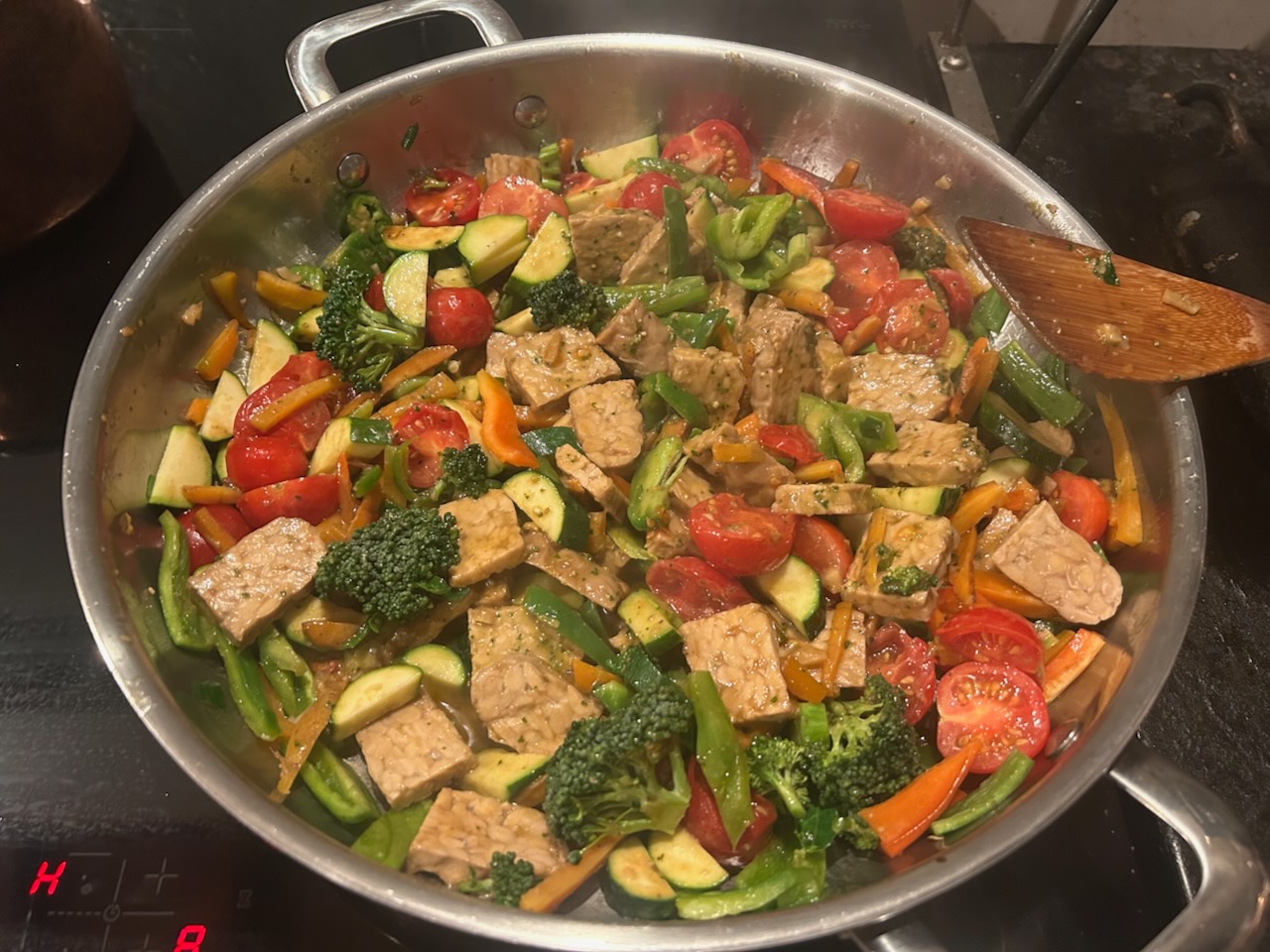
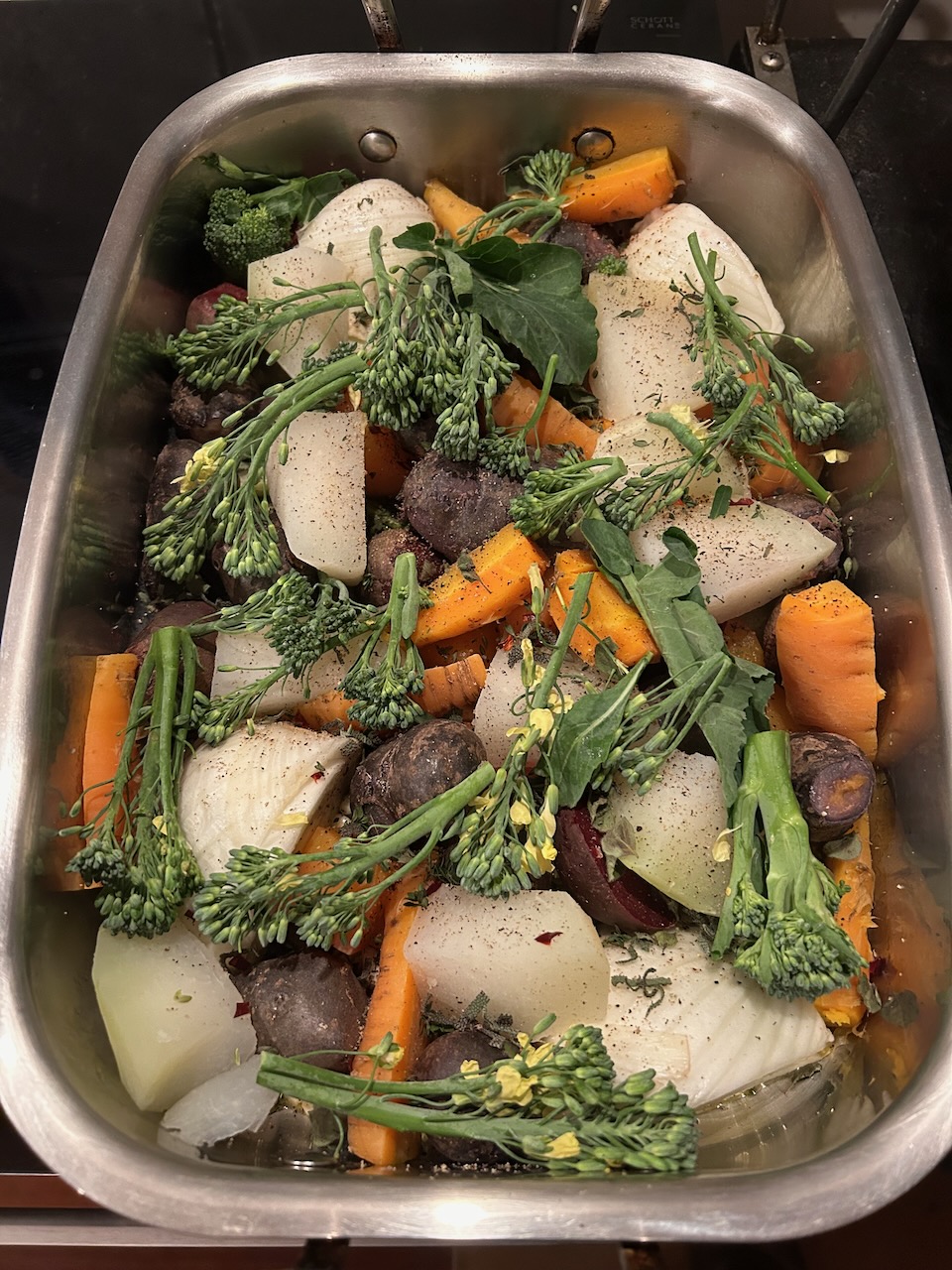
We can still pick all of our salad lunches and our nightly dinner from the garden each evening, it’s just that the flavours have changed to winter forage now. We have all the usual winter greens, broccoli, cauliflower, carrots, beetroot, cabbage, pumpkin and kohlrabi. We cook a lot of vegetable stir fry, tofu, okonomiyaki, Japanese style cabbage pan cake, baked mixed vegetables, and cauliflower au gratin etc. We have also just celebrated the start of the cold winter season with an old fashioned baked dinner. Our first red meat meal since last winter.

  Other than weeding the garden, there is also a lot of mowing, so an hour or so of that each day too. The garden work fills half the day. I’m using the electric ride-on mower for the bigger areas that have become deep in luscious growth. But I also use the electric strimmer for all the edges where the ride on can’t get to. It’s a good feeling to know that all the work is being achieved powered by sunshine these days instead of fossil fuels. Janine fills in the gaps with the electric push mower, to get in under the branches of the fruit trees and other similarly appropriate places for that mower.


We have worked hard at planning and finally becoming a fully solar electric household. We started back in 2007, when the cost of solar panels finally became affordable for us. When I was a teenager, the only solar panels were to be found on space craft and satellites. We’ve come a long way and Australia can be proud of the world famous, ground breaking research into refining solar panel technology done by Professor Green at the University of New South Wales in Sydney. We have slowly increased our solar PV over the years, until now we have 17kW of PV panels and two 15 kWh batteries. Sufficient to charge 2 electric cars, run the house and pottery workshop, Fire our electric kilns and if carefully managed, also selling the excess back to the grid. Although we try to minimise our exports, as we only get paid 5 cents per kWh. It’s better to use it all ourselves. We haven’t paid a power bill since 2007, and spend more money on petrol for things like the chain saw and fire fighting pumps than we do on our Plug-In Hybrid car.
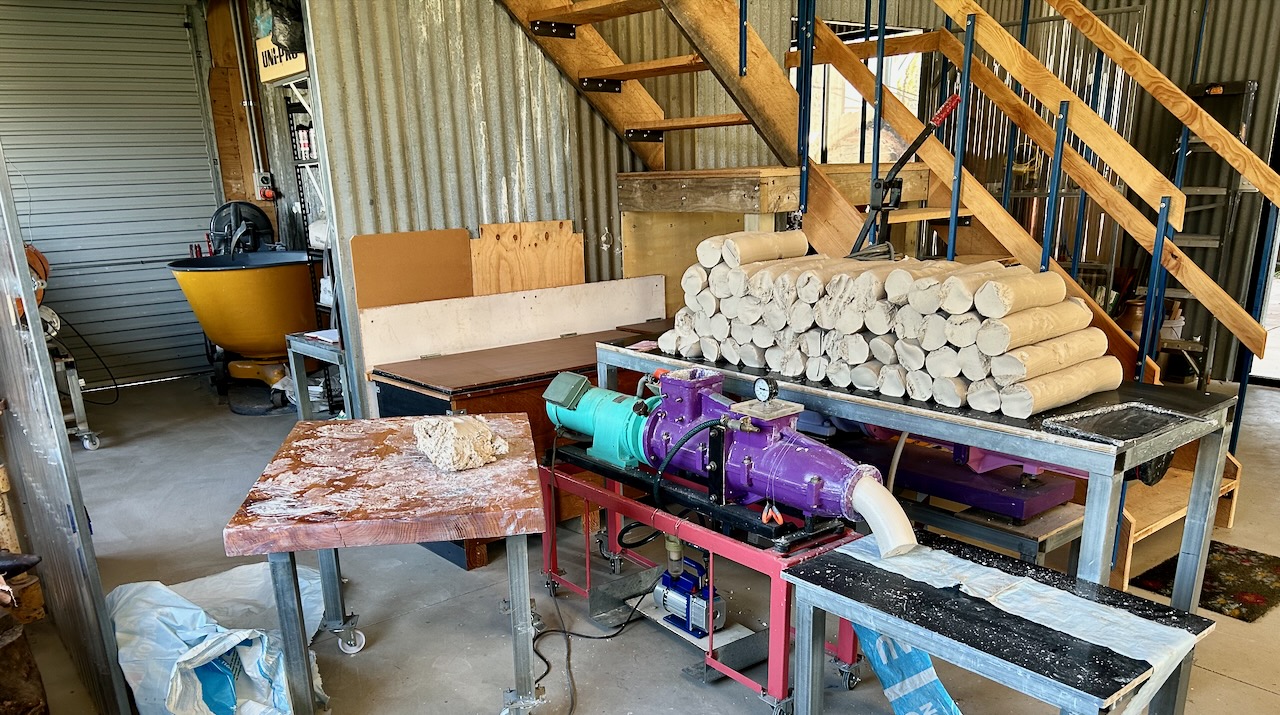
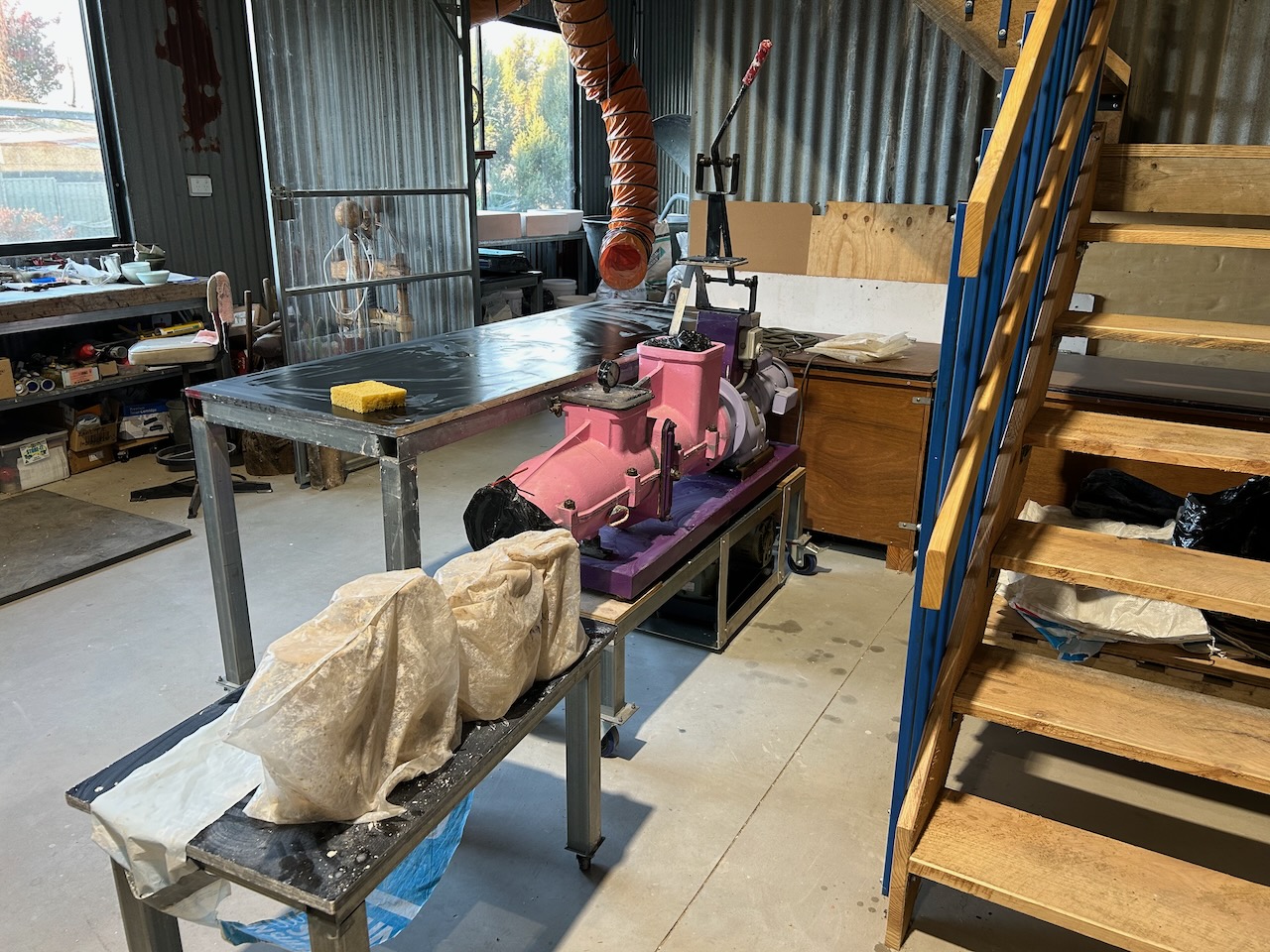
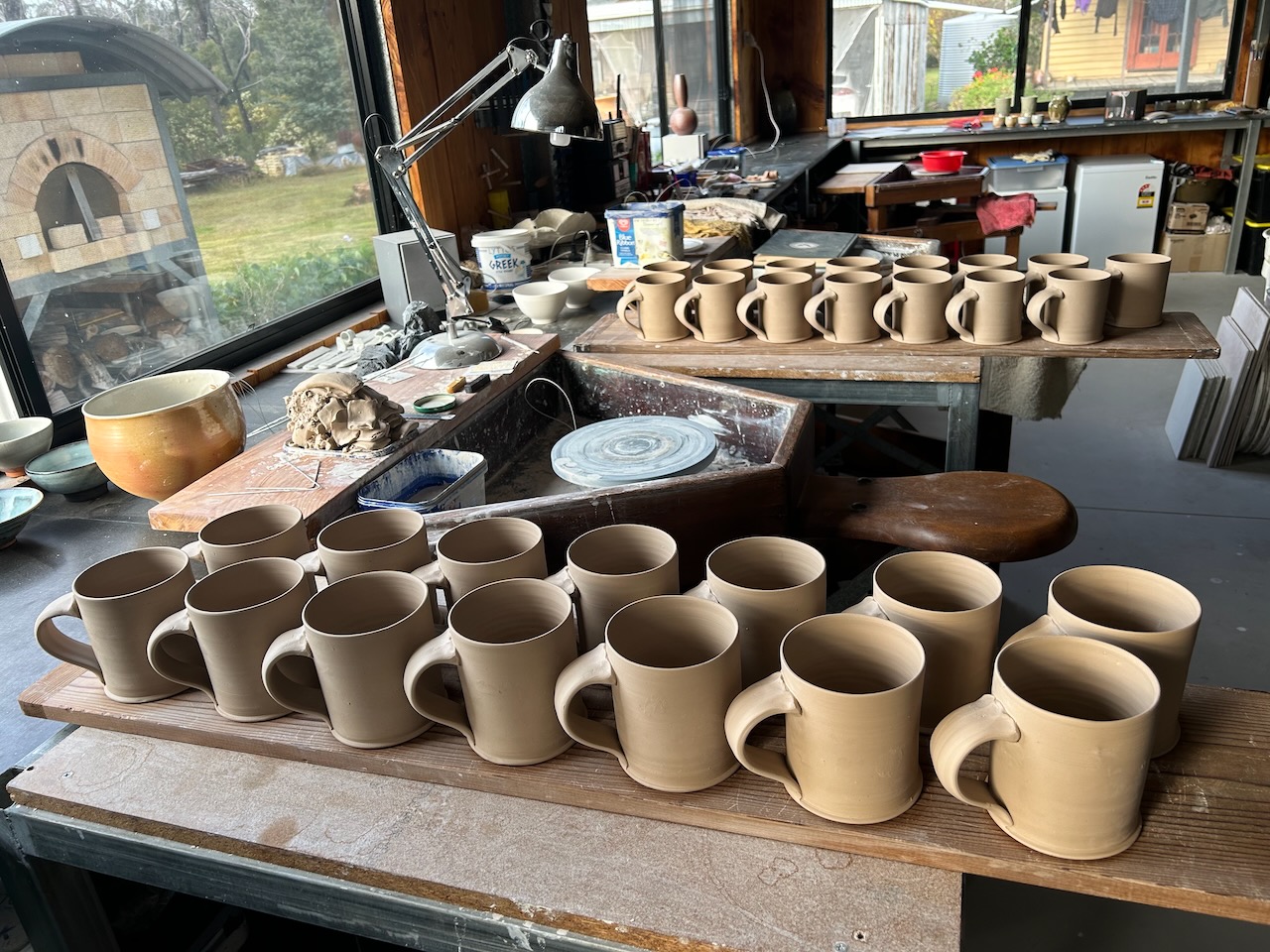
Now that the garden and grounds are back under control, I’m also back in the pottery, making pots again, for the other half of each day, making again is fun and half of my existence. My start back on the potters wheel was delayed by a day, as the pug mill had seized up from being left for too long without use. I had to hand scrape the clay from the barrel nozzle and take out the vacuum screens to remove hardened clay from the mesh.  Quicker and easier than a complete strip down, but still time consuming. It somehow feels like a bit of a waste of time, but any other option is far worse, I’m so grateful to my friends who passed on their old pug mills to me after the fire. You know who you are. Thank You! I’m very grateful to be so lucky to own my very old, re-furbished, Venco pug mills. 

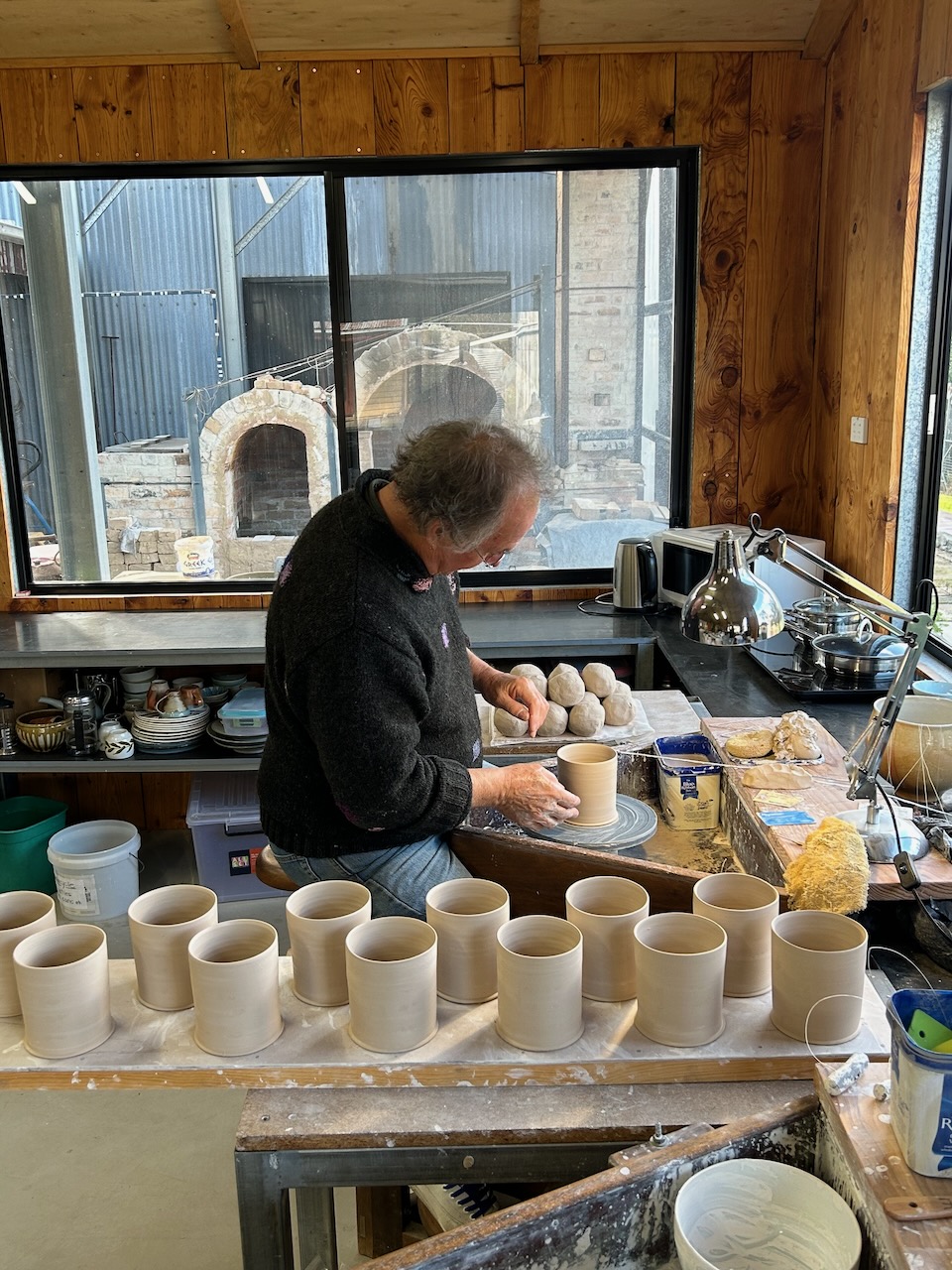
The next day I’m back on the wheel throwing perfectly de-aired and beautifully mixed plastic clay. My old wrists are too worn out to hand wedge all my clay any more. I did manage a lot of hand wedging for the first year back at work here, during lock down. I couldn’t buy a new Venco as they were out of production, and the large 100mm. model is still un-available! I don’t know where I get the energy and enthusiasm to keep on working like this into my older years, other friends and colleagues have retired, but I was determined not to let the 3rd bush fire in 50 years and loss of another pottery workshop stop me. I’m still here and still creating the things that I love. So out of desperation and necessity, I hand wedged my clay to my lasting detriment. My ageing wrists have never really recovered. Even throwing slowly on the kick wheel, causes just a little bit of a twinge, so I have to modify my hand position slightly to cope. We have a few Shimpo electric potters wheels, mostly used for our weekend workshops, that run on our solar power, but I really prefer the old ‘Leach’ treadle style kick wheel for all the smaller domestic pots.

Winter brings on the citrus crop, so we start the season by making 2 batches of marmalade, lemon, lemonade and lime marmalade and then tangelo and navel orange marmalade. The Seville oranges aren’t ready yet. They come on later in the season. They make the very best marmalade.

It’s hard to believe, but today, in winter, at the end of the first week of June, I picked a ripe red tomato. We still have self sown tomato plants flowering. We have had ripe tomatoes in June before. It all depends on the severity of the frosts. At this stage we have had a frost during the week, but because the vegetable garden is fully netted to keep out the birds, that netting seems to just take the edge off the frosts, allowing us to still harvest tomatoes so late in the season.

It’s so good to be home again! We have a quotidian flock of wild wood ducks, that have decided to take up residence on the front lawn, sometimes up to 30 or so of them. They seem to like it here. Plenty of grass to eat and 4 dams to explore. Why wouldn’t they? They were probably all born and raised here over the years. They do pooh all over the lawn, so we have to watch where we step and wipe our feet at lot. We have a shoes-off household, so no problem about the house, but a lot of pooh gets tramped into the pottery workshop when we have weekend workshops and open days.

If this is my biggest problem in life. I’m so, so lucky!

Nothing is perfect, nothing is ever finished, and nothing lasts.

My New Korea 3

My project to introduce clean, low emissions, wood fired kiln technology to Korea has gone pretty well. The third firing that I did using local hard wood was excellent. In fact, better than I had hoped for. I was actually surprised how well it went. I’m a cautious person, So I was a bit surprised, I wasn’t going to dare to change anything, just stick to my technique and decisions. It worked! So that was good!

I’m always prepared for things to go wrong when trying new things. Very few things in life ever turn out perfectly, and this last firing came close, but the was no cigar! The bottom back shelf was still a little bit under-fired. However, no-one complained!

The day after the kiln was unpacked, I went down to the kiln shed early the next morning, before work, and took out the bag wall. I eliminated one complete layer off the top, and removed one full brick from the cross-section. I re-arranged the smaller number of fire bricks with bigger gaps between them, so as to allow more flame to pass straight across the bottom of the chamber and allow more heat to the bottom back shelf.

Over the three firings that I did here, I got better results each time, as I tuned the kiln settings and chose better wood, more appropriate to fire cleanly in this design of kiln.

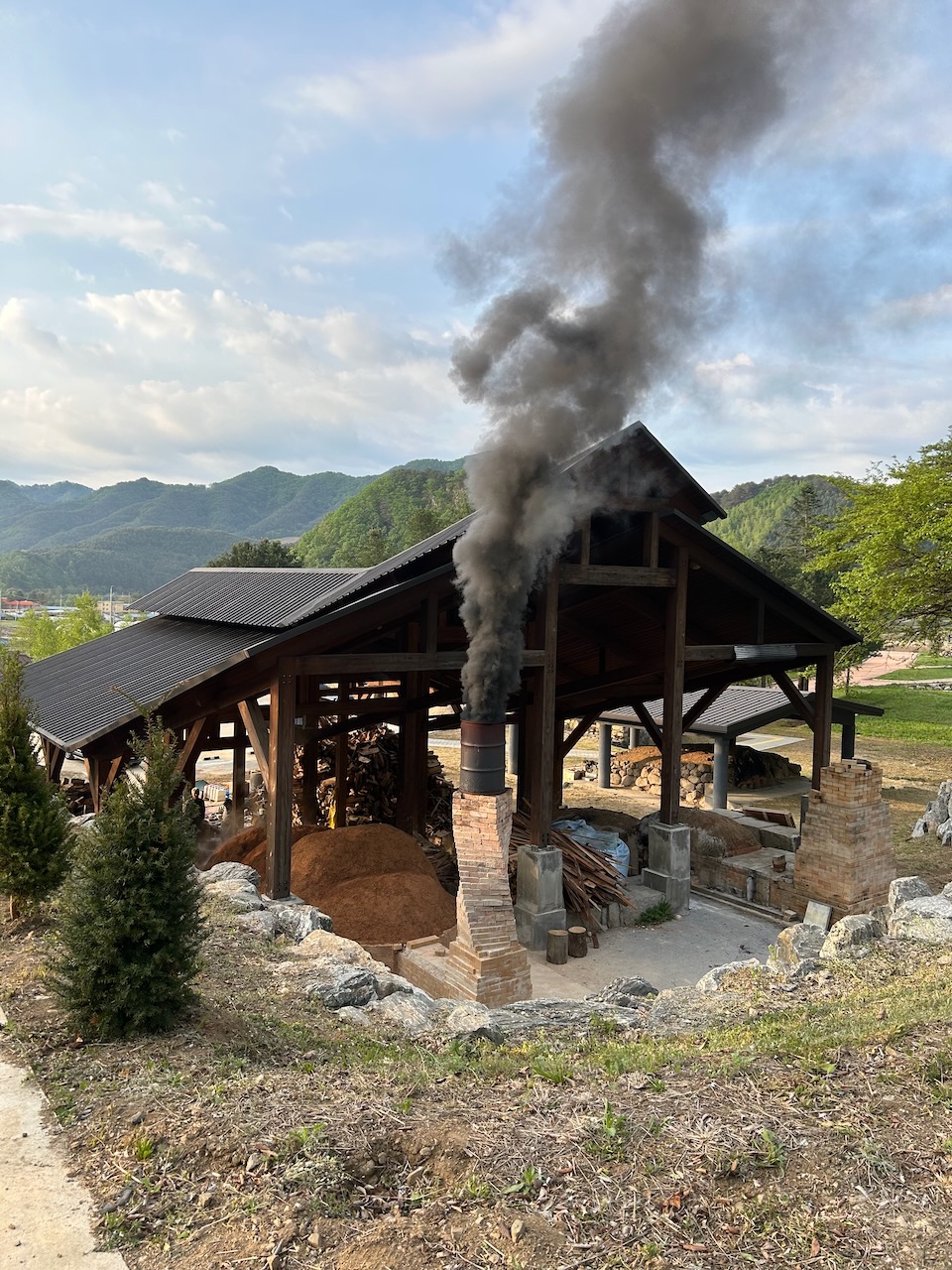
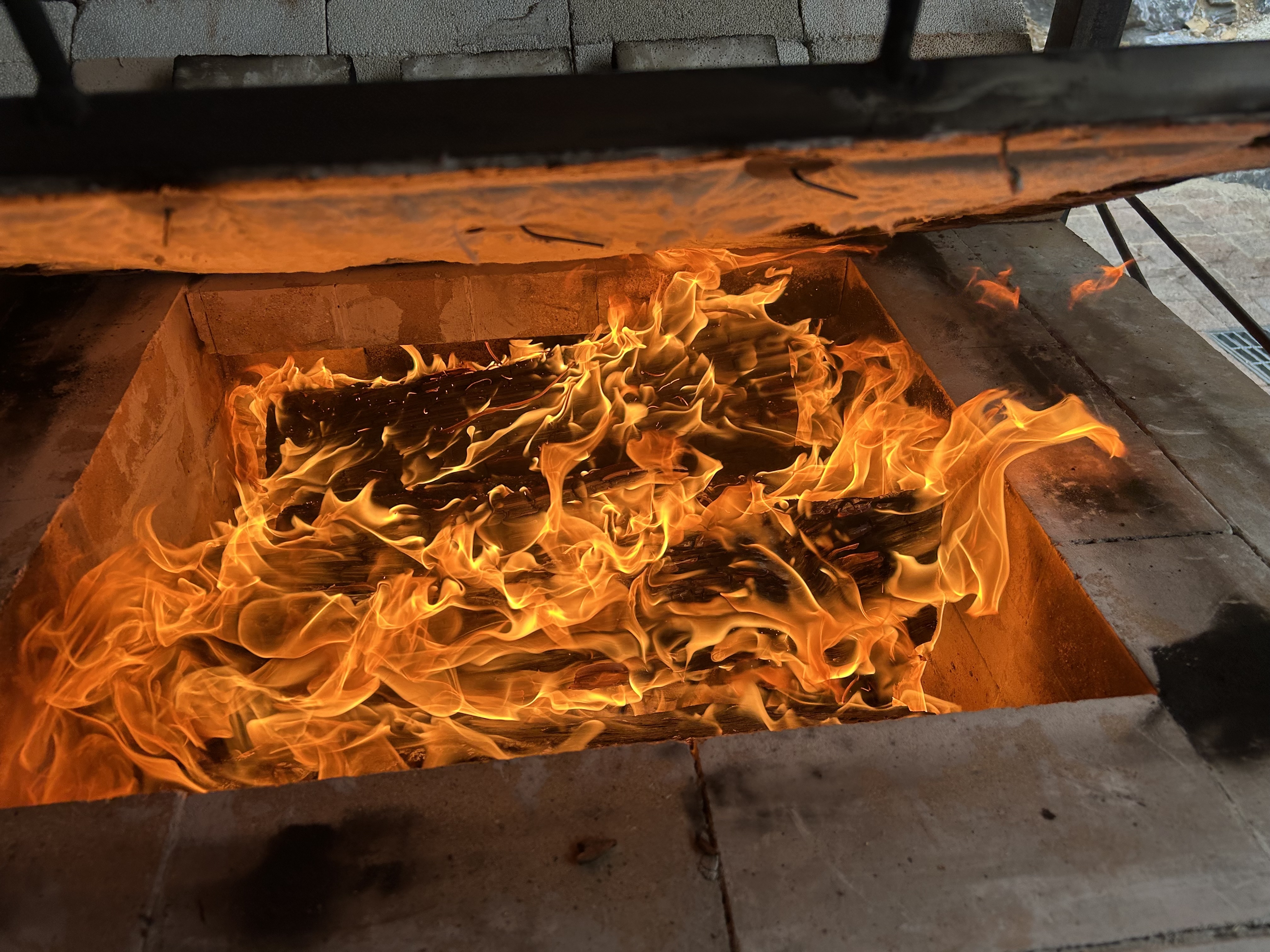
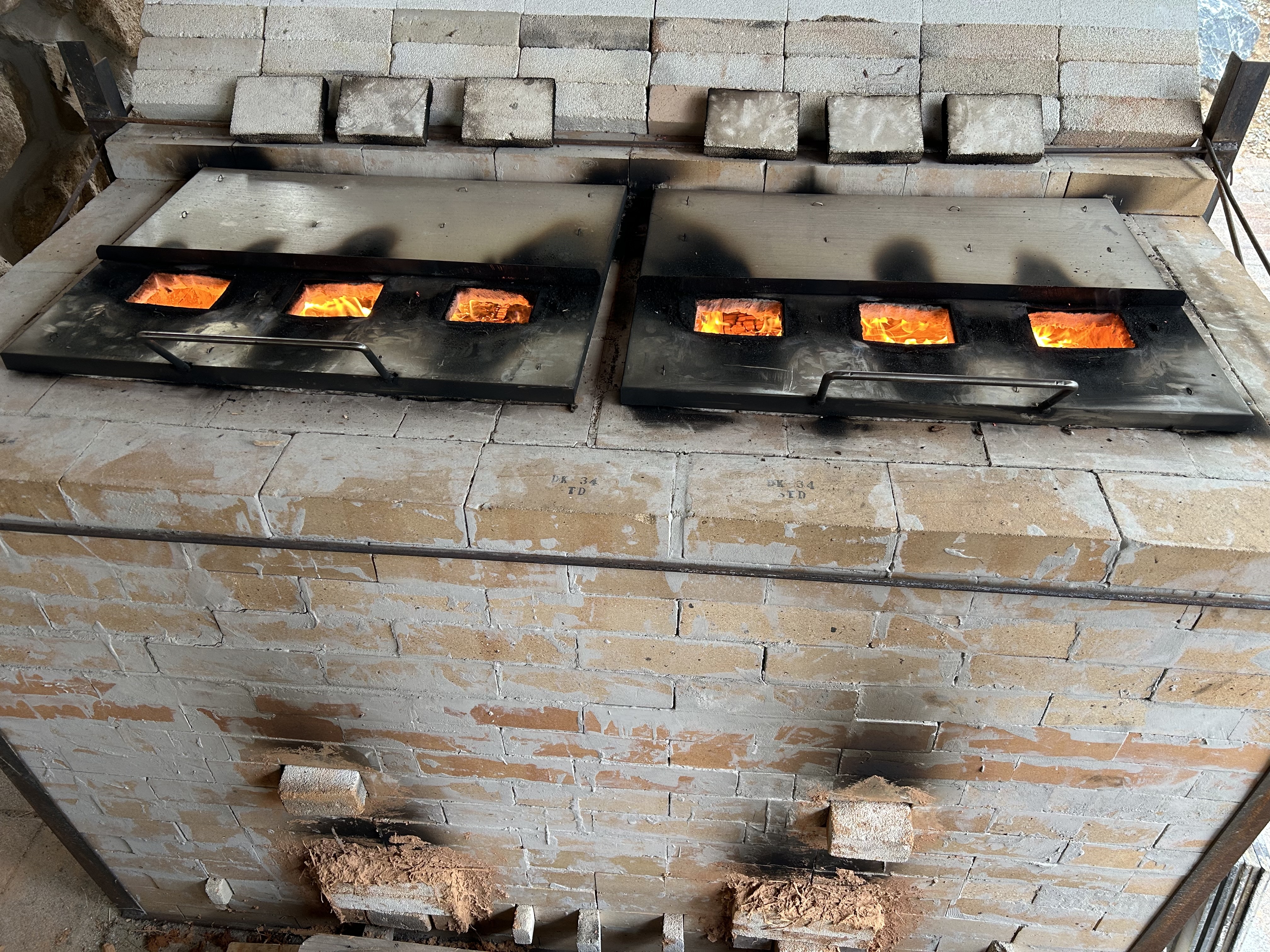
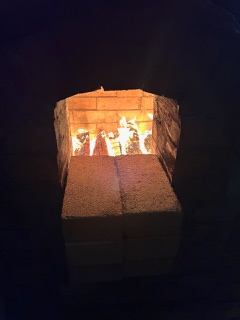
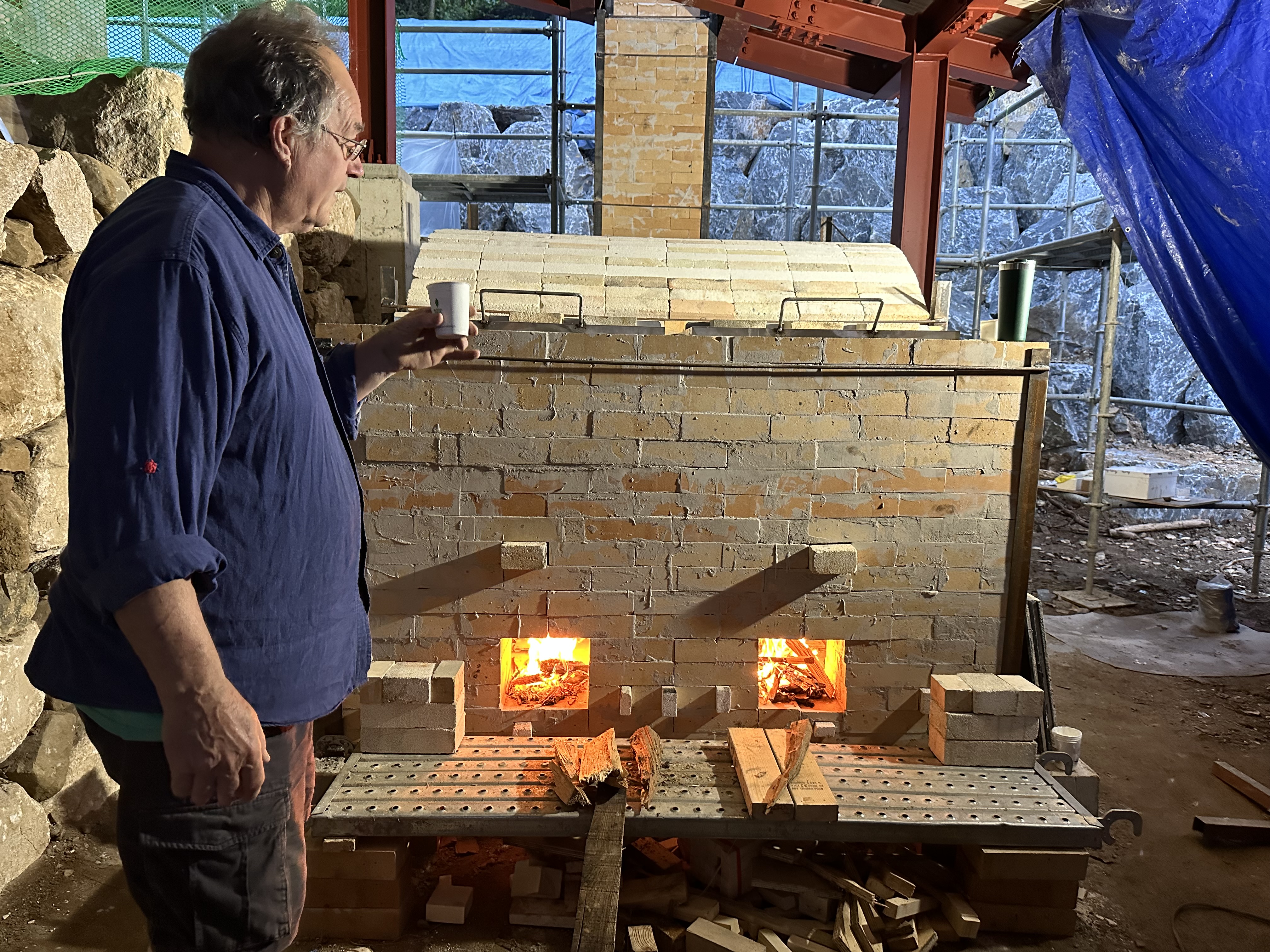
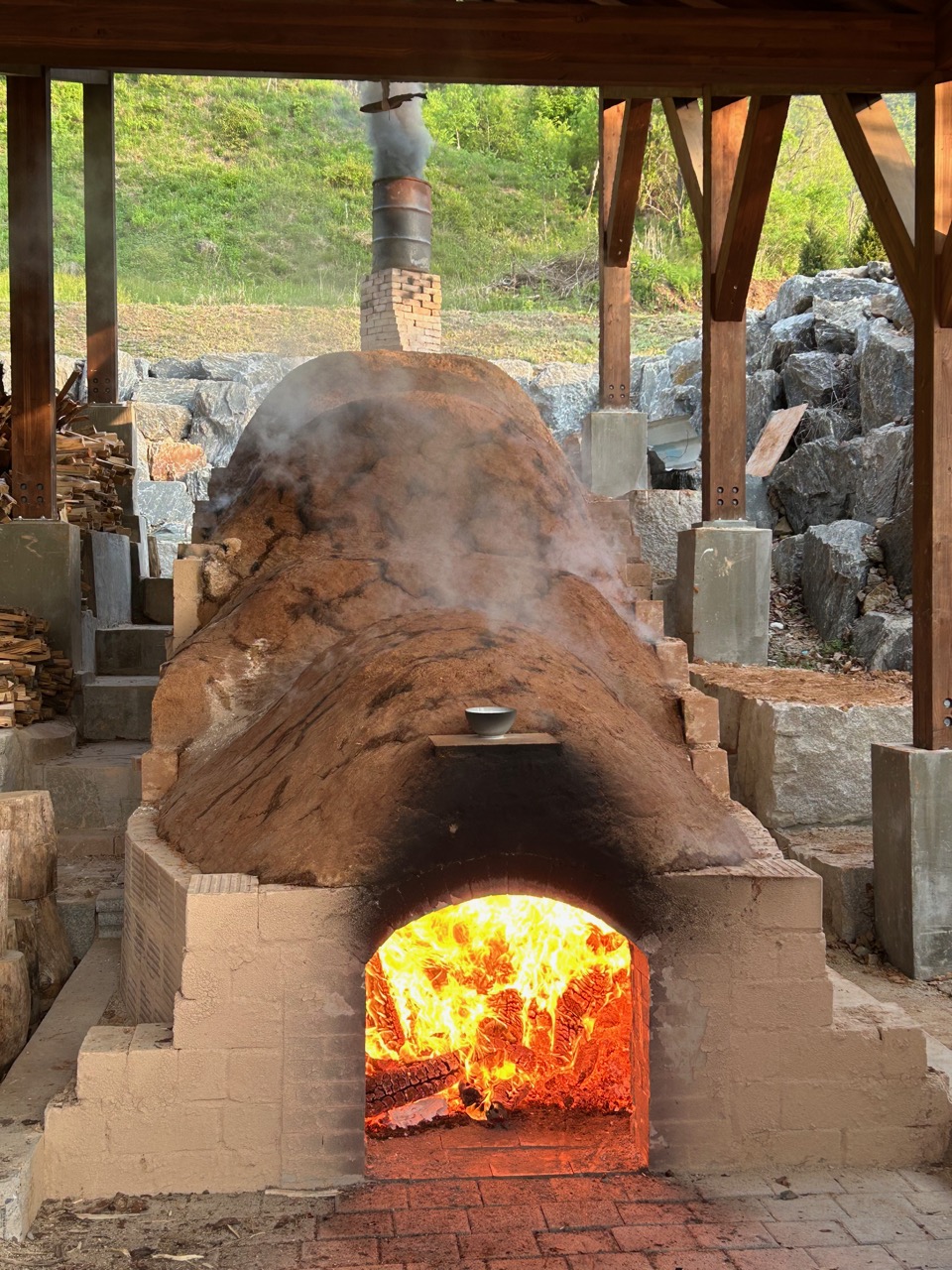
Below is an image of my kiln firing to stoneware in reduction near top temperature. There is no smoke coming from the top of the chimney.

My chimney isn’t particularly tall, but it is wide. Short and thick, does the trick! Or so I’m told!

I calculated the height and cross-section of the chimney based on theory. The total volume of the hot gasses enclosed in the chimney volume, as opposed to the same volume of cold air on the outside. Chimneys work because the cold air outside is forced in at the firebox by air pressure, and this pushes the lighter hot air up and out of the top of the chimney. It’s all about volume, not just height.

Below is the traditional kiln next to mine being fired the traditional way. Koreans are used to making loads of smoke. It just seems so natural to them. They were quietly amazed that I could fire with so little smoke and still reduce. One of the traditional kiln firing team, A National Treasure potter from his own local region, went straight home and built a copy of my kiln for himself. So I consider that a success!

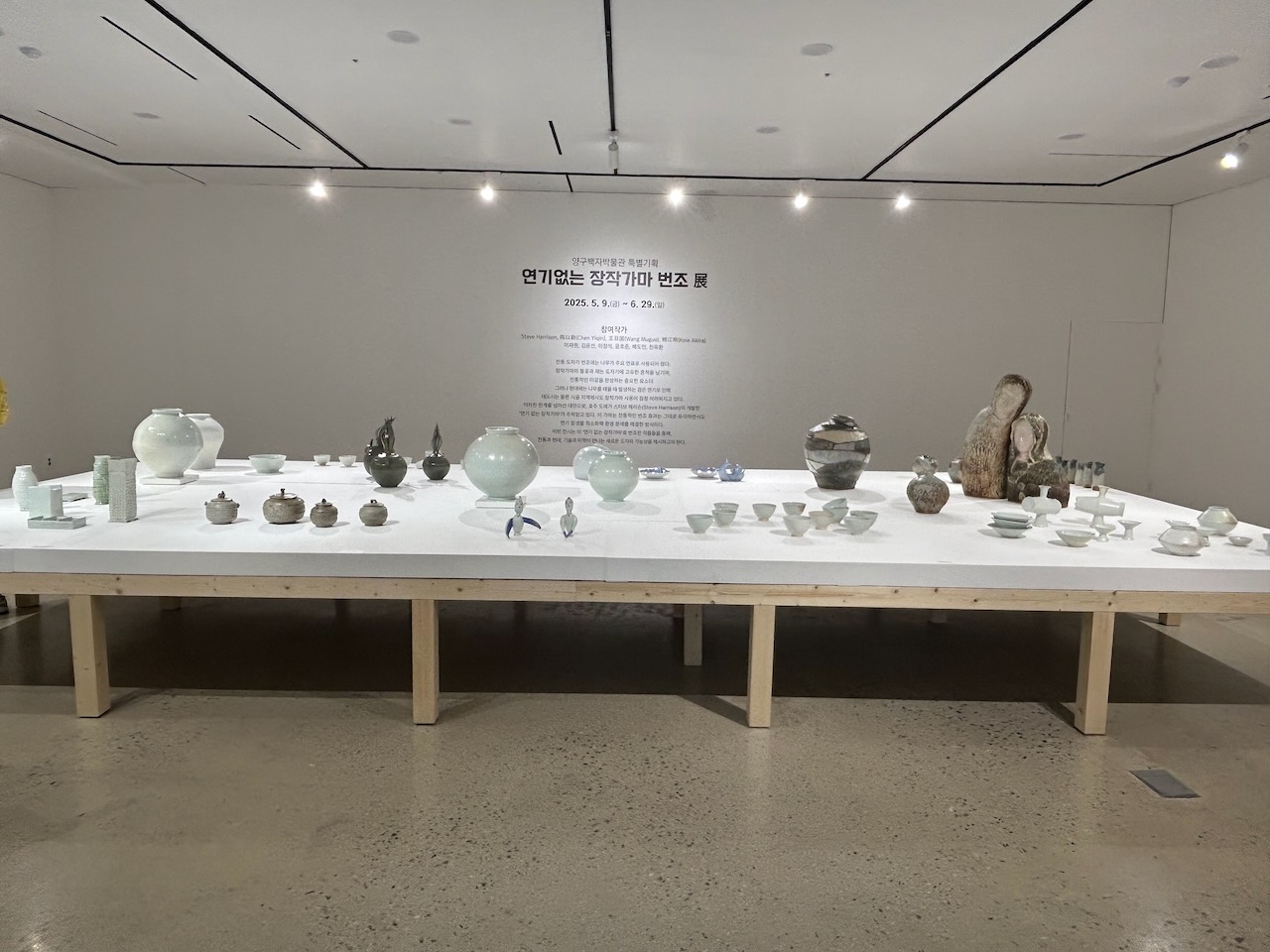
So my introduction of new ideas, with appropriately successful results, was well received. My host, Mr Jung, had organised the local TV station to make a documentary film about my visit, the firings and the subsequent exhibition of the fired works. Several international potters from France, Japan and China were invited to make work for me to fire, as well as a few local potters. After the kiln was unpacked and the work fettled, it was put on show in the Porcelain Museum. The exhibition is on until late June in the Porcelain Museum. The Museum Director released a short promotional video of the firing in time for the exhibition opening, which he posted up on-line and got over 4,000 hits the first day. So he is very happy.

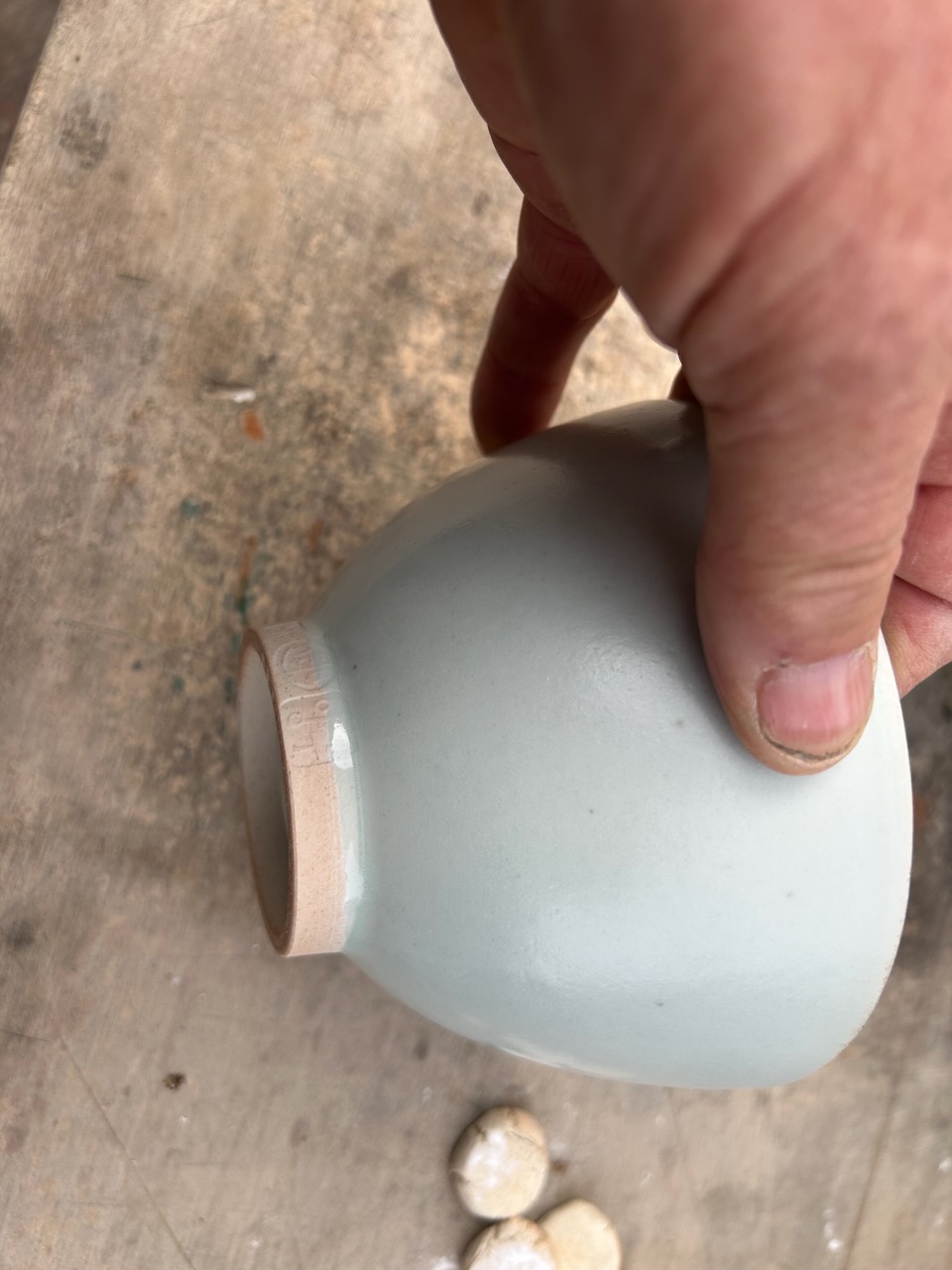
One of my bowls from the firing, with the Korean location name stamp and my name in Korean

The Staff of the Museum took me out to dinner after the event. They are all such a pleasant bunch of people, I really enjoy their company, They are great people. As I don’t have more than a simplistic grasp of ‘Airport’ Korean. All our conversations are carried out using translation software on our phones. The local Korean app is called ‘Papago”.

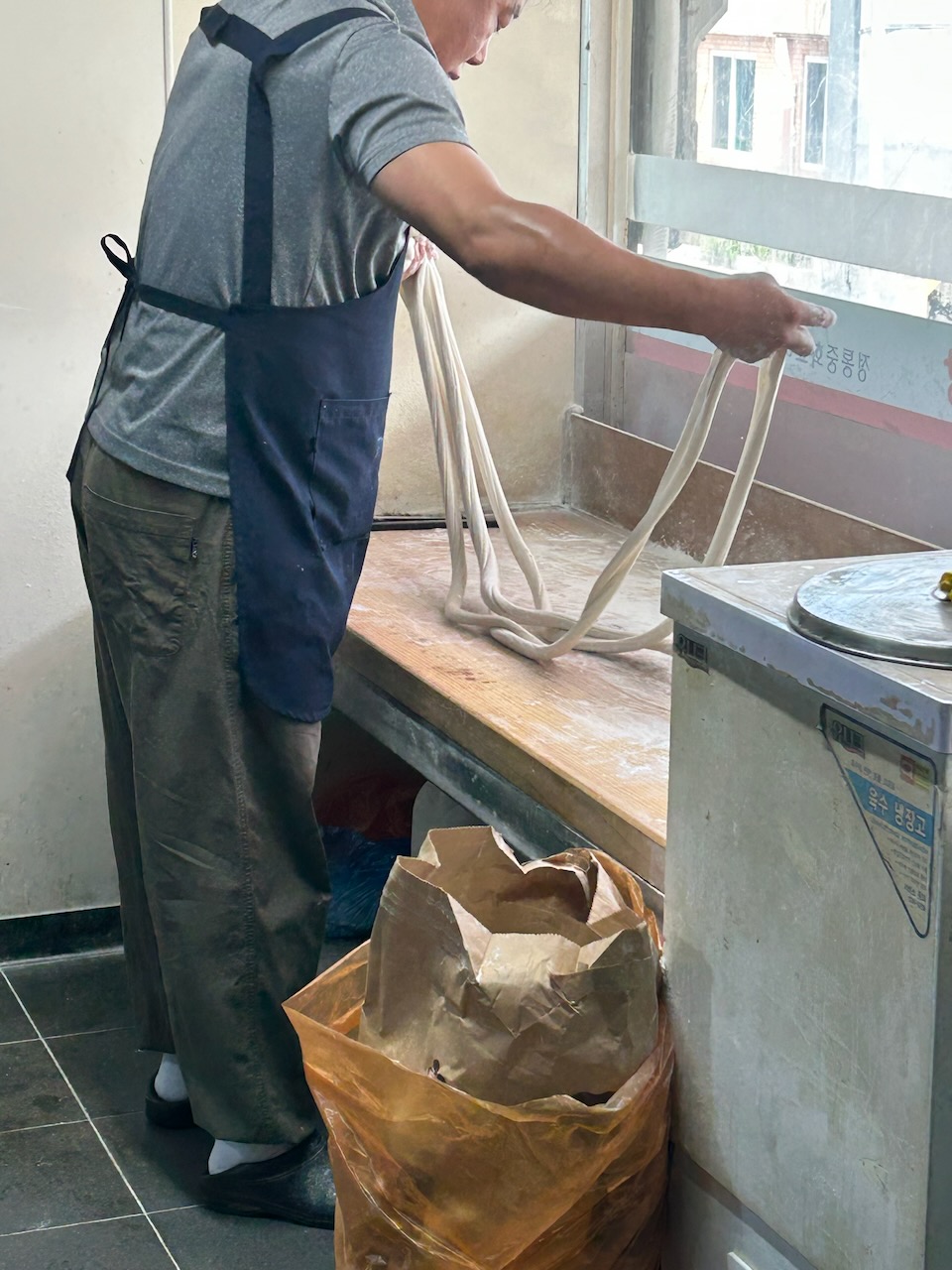
We went to a local restaurant where the chef makes his own hand made noodles. It’s worth going there just to watch him work. It’s an entertainment in itself!

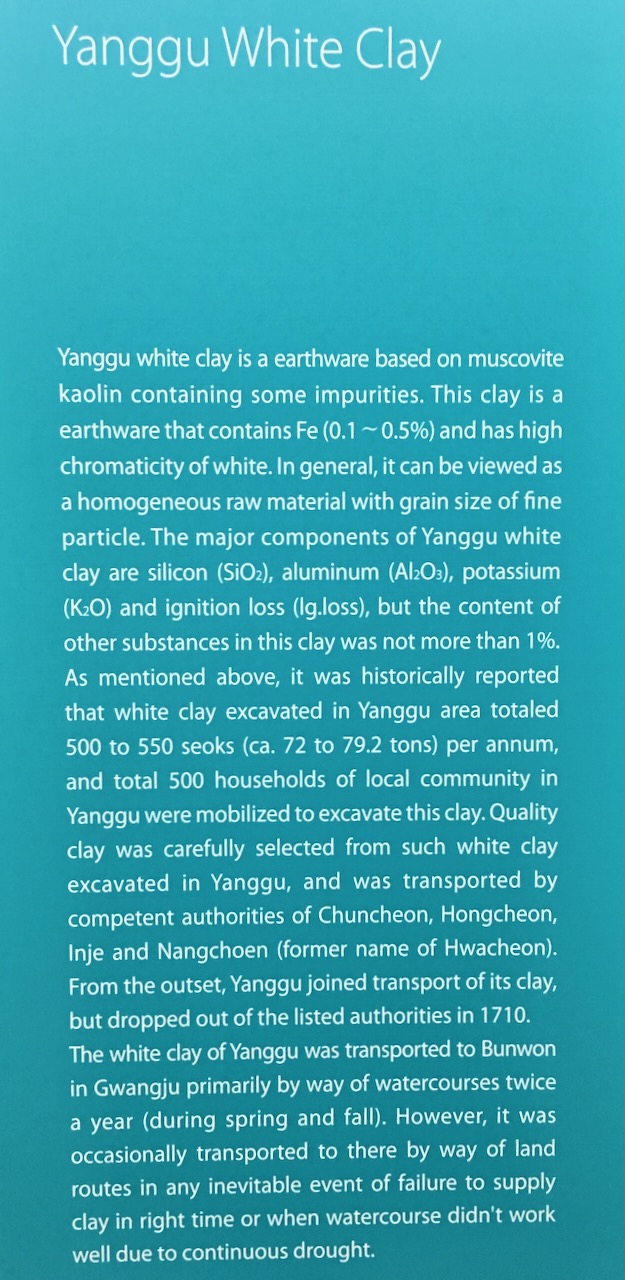
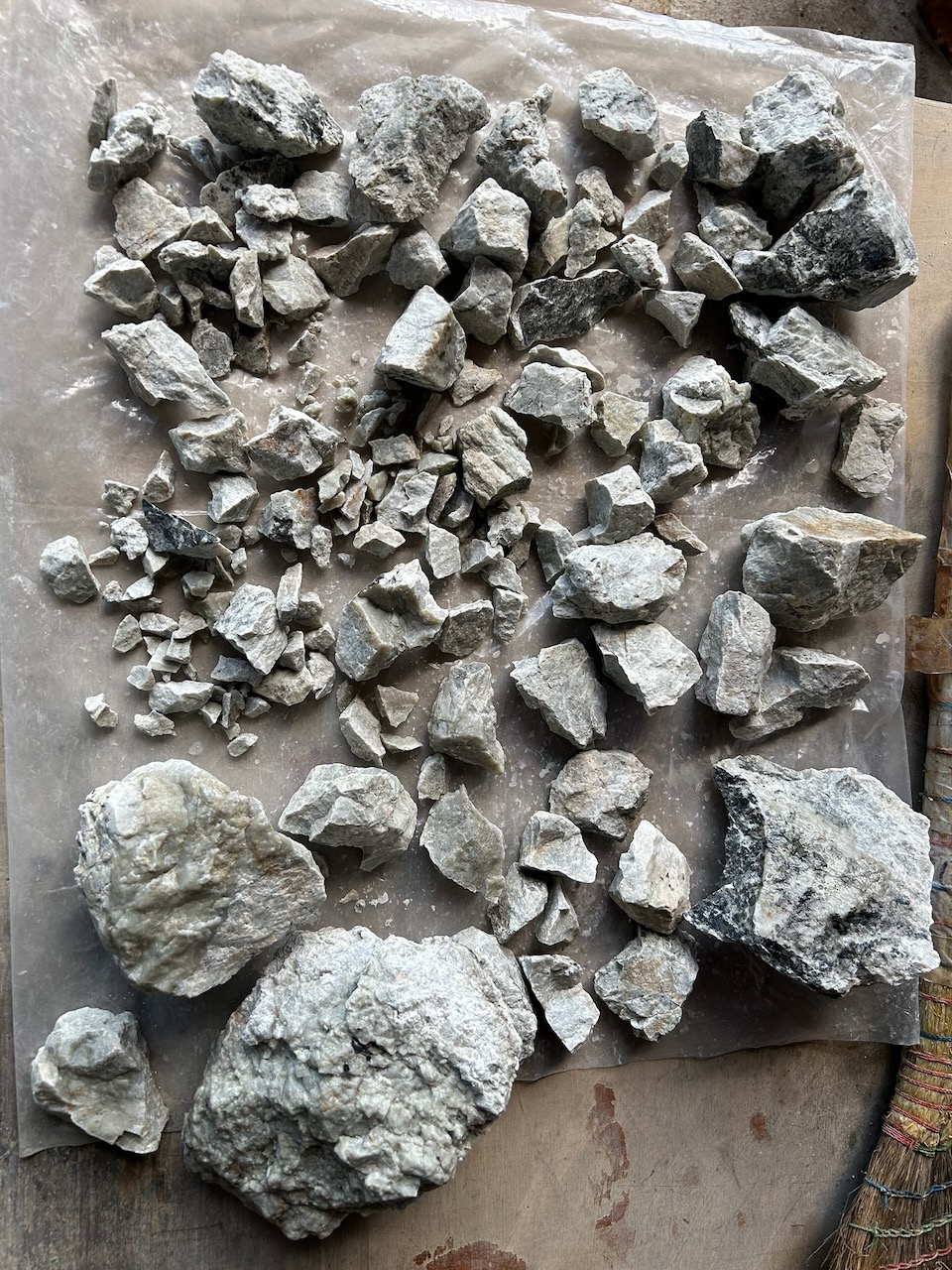
Before I left, I made my usual pilgrimage up the mountain to the historic site where porcelain stone can be picked up off the ground. I collect a bag full each visit, (10kg) take it back to my room and wash it thoroughly, scrub it well, to get any dirt off the stones, then soak it in chlorine bleach over night to make sure that they are sterile, before bringing them home. It only needs to be put through the rock crusher, then the ball mill with enough water to make a slip, and then stiffened back up to a plastic state before throwing it on the wheel. 

Throwing stones! Powdered porcelain stone mixed with water, nothing else!

There is nothing quite like sericite. It’s such a unique material.

After finishing my work at the Porcelain Museum, I travelled up to the northern suburbs of Seoul, to meet up with my friend Sang Hee. She took me to her mothers farm, where we spent the morning weeding some of the rows of vegetables.

And a salient reminder that you never step over a fence line here! Even though you are in the suburbs. Not everywhere has been thoroughly de-mined and checked to make it 100% safe.

My last day was spent in Seoul, getting ready to fly out the next day. I went into the tourist area and got a couple of new name stamps made, as I lost all my older name and workshop stamps in the big fire.

Another very rewarding trip in every way. I’m so lucky to be able to do this work!

Nothing is ever finished, nothing is ever perfect and nothing lasts!

My 2nd New Korea

I’m working in Korea in this little artists village community on the edge of a country town. There have been potters here making and mining porcelain stone for 800 years. The village is located away from the township, such that the smoke from the traditional wood fired kilns is not a concern for the township residents. It was great forethought in its time to start to locate all the wood kilns up into this side valley.

But it doesn’t stop there, this has been a long-term plan and as with all long-term plans, it is evolving and adapting with current thinking and social mores. Hence my involvement here with the constriction of my low-emissions wood kiln firing designs and techniques. I was commissioned to start this work here, back in 2019, I was all set to come, but before I could start, we had the fire, then covid intervened. So I was unavailable for some years. But I’m back here again now the the plan is back on track.

My demonstration firing was very successful. In previous firings here the only fuel available to fire the kilns with was very dry 5 year aged local pine. The standard fuel here that everybody uses. It is a statement of fact here that dry pine is the only fuel that works in a kiln! 

Last year when I was travelling around, I visited a famous potter’s studio, where they fired with wood. He had built a special pine fuel drying kiln, to desiccate his very thinly split fuel. He told me that it was his special secret, and that only desiccated pine could raise the temperature of the kiln easily. Other potters struggle with ordinary wood, but he had discovered the answer. I decided not to mention that I sometime throw water over the dry pine to get a better result! He had no concerns about making smoke. That was taken as a norm. All kilns make smoke, don’t they!

In the kilns that I have built here, the 5 year seasoned pine burnt furiously and it was very difficult for me to minimise the smoke. I managed it, but wasn’t at all happy with such dry volatile fuel. I enquired about alternatives. There is hard wood available in the form of oak and acacia. But no one uses it for kiln firing as it doesn’t work!!! That was the local opinion anyway! Meaning that it doesn’t work in the traditional kiln designs, used here, using traditional techniques. I thought that it might just be ideal for my purposes, for use in the down draught firebox.

For this most recent firing I had requested that both pine and oak be available, to give me options. There is also the possibility of using local acacia wood, But I was told that this is not considered be be a useful fuel for kilns. That made me more interested in trying it out. I said that it is one of the better fuels back in Australia, but that hasn’t cut any ice here as yet – apparently.

When I arrived, the oak and pine were stacked neatly in front of the kiln. A lovely sight. I started by using just 100% oak. Initially, I found that the oak burnt black and then smouldered. Just as everyone else had found. But I was perfectly sanguine about this, because my local stringy bark timber back in Australia does the same. In fact the locals wouldn’t cut it for use in their open fire places because of this. I quickly found that a blend of 80% oak with 20% pine was a good combination to get started with, using the flashy pine to keep the oak burning. This combo worked well from 700 up to about 1000 oC, when I cut the use of the pine back to just 10%, and finally at 1100oC, I was using straight oak.

This series of combinations got the kiln firing well, while still burning quite cleanly with almost non-existent traces of smoke from the chimney. Just the occasional waft of pale grey smoke.

Problem solved. I was able to fire up to cone 9 in reduction with virtually NO smoke, while firing in reduction. This is a notable achievement here. A lot of chatter and comment, firing in a wood fired kiln with no smoke, by using the oft’ maligned local oak. Applause all round. Who’d have thought?

Maybe the local acacia might even have been better? But that is a project for another visit.

There are two ceramic university campuses that are keen to follow up on this, as they are located in cities, and there is no possibility of being able to make smoke in their location. Downdraught oak firing might just do the trick.

Word gets about it seems. During the cooling period I got news that the opening of the kiln would have to be delayed from one day to the next, then from the morning of the appointed day, to the afternoon, as the Federal Minister of Culture wanted to be there to see the results unpacked, and he could only be available in the afternoon of the 8th. So when in Rome… I delayed the opening at his masters pleasure.

I’m certain that this is no accident. Of course, I don’t know, but it smacks of ‘realpolitik’ strategising. I’d bet that the Director of the Museum has organised this as a media event to promote the Museum. Politicians fund the things that they see, are involved in, understand, AND if it looks like a successful vehicle to advantage their own career. They want to be seen associated with it. 

Just a thought! Call me cynical! But…

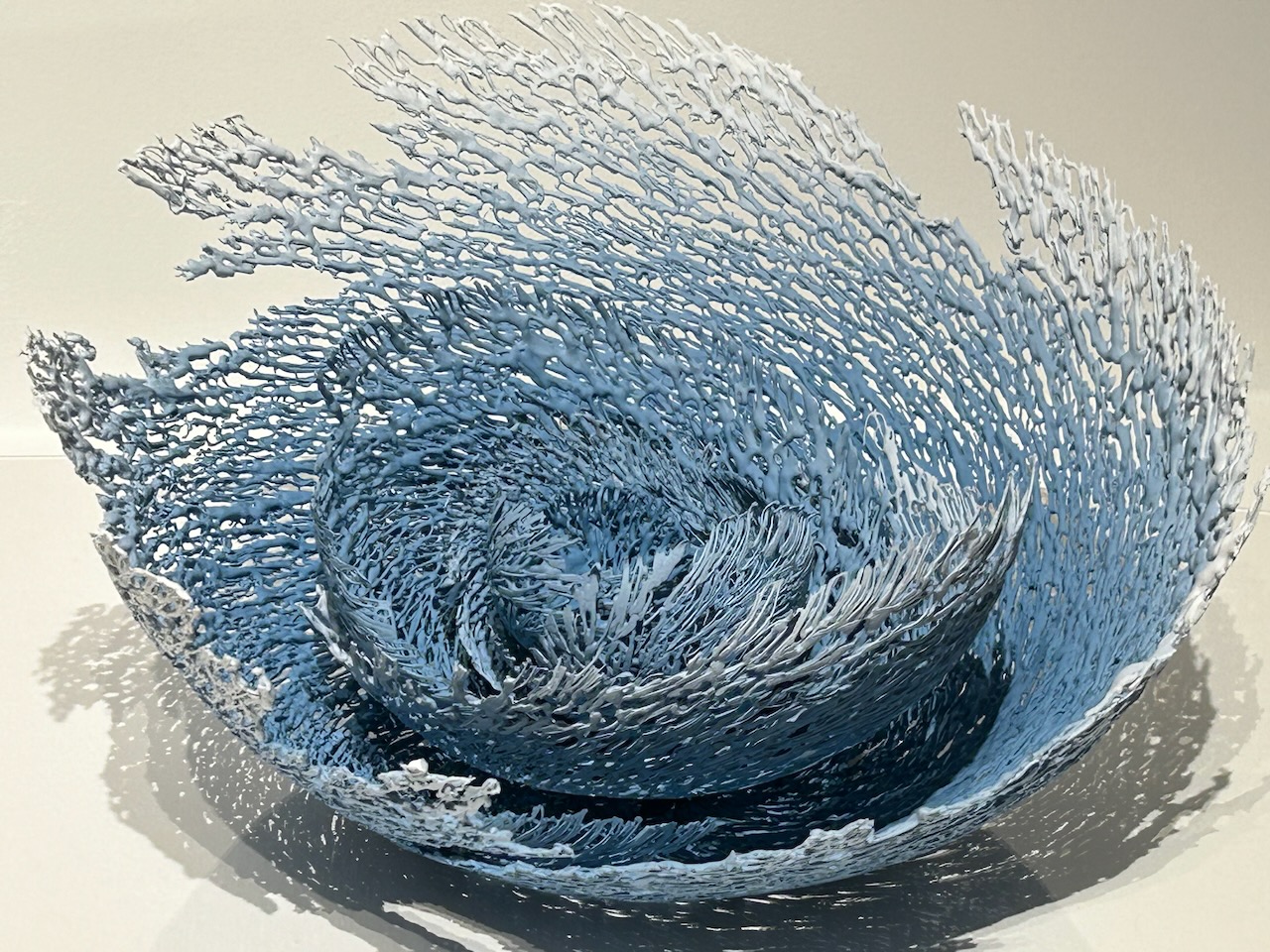
I remember some years ago. I collected some porcelain stone from here and took them back to Australia and made a large bowl out of them. I glazed the bowl with a subtle blue celadon glaze that I made incorporating kangaroo ash. A kangaroo had died on my property, so I calcined it and retrieved the local source of phosphorous from the bones. Phosphorous is known to enhance the optical blue in certain pale iron glazes like celadon.

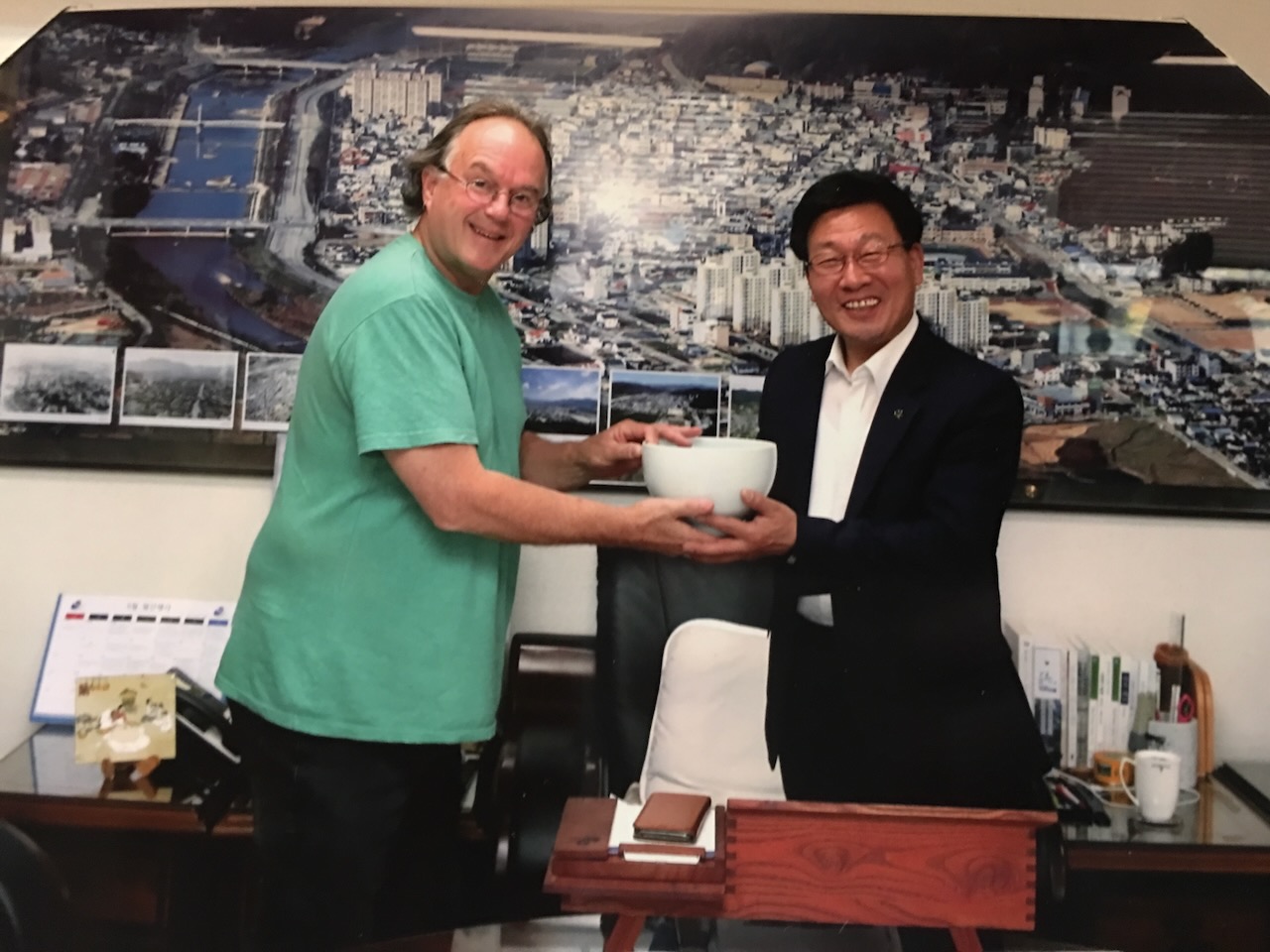
I gave it as a gift to the Museum Director along with the story. This was my own private Cultural Exchange project. His Korean stones collected from this historic site, made into a pure sericite clay body glazed with my Australian kangaroo blue glaze. He loved it. He was so taken by it that he called the Premier and made an appointment for us to meet him and make the bowl a gift to him. Thus bringing the Museum into his field of vision.

We turned up just before the appointed time for our 15 mins of fame, and were eventually ushered into the Official Office along with newspaper reporters, translators, aids and other staff. I was duly introduced to the Premier, a little bit of small talk. He had been very well briefed and made appropriate comments. Then it was down to brass tacks. I handed over the bowl and he graciously accepted it on behalf of the Korean People. He said straight away that he knew next to nothing of Ceramics, but understood the significance of the effort that had gone into such an art work and its cultural exchange significance. He thanked me again and shook my hand. There was a flurry of flash bulbs going off to record this staged event.

He asked me how I came to be researching Korean Porcelain from this remote place. I replied that Korean porcelain is unique in the history of world ceramics. I came here because of the history of the place and the pots that were made here. You can only learn so much from books. I had to come to experience it. He smiled, so you knew about Korean porcelain from back in Australia? I said yes, once I learnt about it, I had to come. The Porcelain Museum here is one of the very few places in the world where this kind of study can take place. Mr Jung, The Director, is very supportive, open and inclusive. He runs a great institution. 

The Premier was reflective for a second, then said. I believe that you can build pottery kilns that fire with wood and make no smoke. This is important for the environment. Mr Jung has asked me for more funding for this kind of project. If the Museum is so famous internationally, attracting research like yours,

I will fund it! 

The next day, the newspapers had the Premier on the front page announcing the success of his funding initiative for his international artistic ceramic exchange program, for the very successful, now internationally recognised, Yanggu Porcelain Museum. Every one wins. The Premier gets all the credit and is in the paper looking like a hero. The Museum Director got his funding. I enjoyed the research and achievement of making the lovely bowl. The premier mentioned before we all left, that the best place to keep such a unique bowl, would be in the porcelain museum.

Back to the present time and hence the sudden flush of offers of work to build similar such kilns from established potters and university campuses. Once it is shown to work, it gets it’s own legs. Word travels fast. These days it travels electronically with likes and re-postings. It’s very fast.

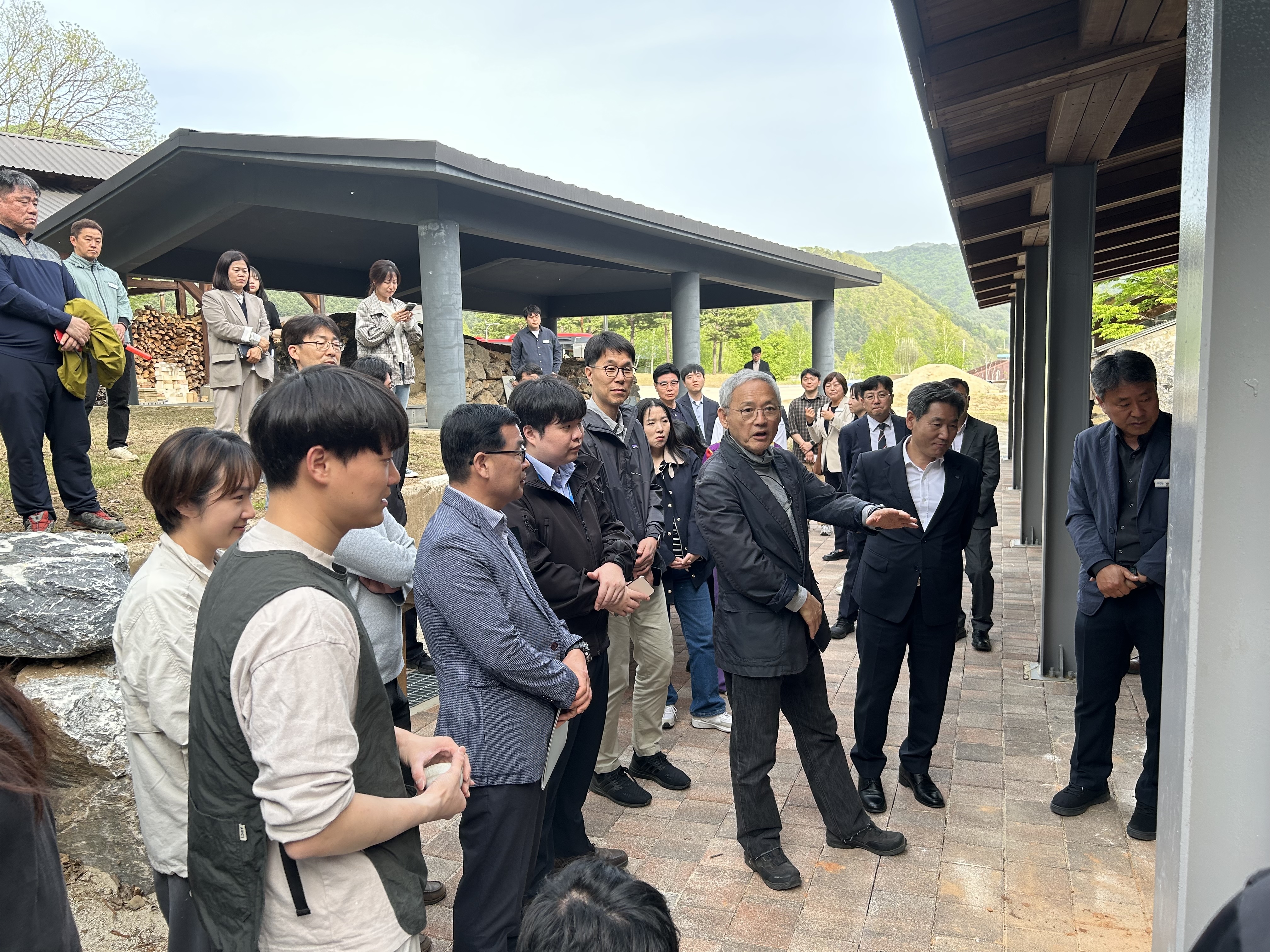
The Minister of Culture is coming for a visit to the Museum and will be at the opening of the kiln. The kiln has cooled more than enough waiting for him to arrive. I’m introduced to the minister, he asks me in Korean – if I can speak Korean. I recognise the phrase, so I’m onto it, but my recall of Korean standard reply phrases is so slow, that before I can make my clumsy reply, he already knows my answer, so swiftly continues in English. “So we will have to speak in English then!”. I nod my thanks.

We make some small talk. He’s been briefed on hisc way here about the nature of the project and asks me if it is going well and I reply yes. That’s the depth of our interaction. That was my 15 seconds of fame! The photographers elbow in and I’m shifted sideways. The minister looks quizzically at the kiln and my Jung explains something in Korean. The Museum team are then given the go-ahead to unpack the kiln.

The firing is unpacked and everyone ‘oohs’ and ‘arrhs’, the other potters here each look in and turn to me with BIG smiles and thumbs-up. Huge sigh of relief. Everyone is all smiles. The pots are mostly well fired, but I’m interested in the minutiae of the detail. I’m looking not just for colour, but for the depth of colour in the celadons. Not just a shiny surface, but a certain quality of soft melt and satiny quality there. I want to get in and see the flame path and the flashing on the exposed surfaces and kiln shelves. Where is the ash deposit and how has it melted. None of this is possible with 50 people crowding around and flash guns going off. 

Its a bit like a crime scene or perhaps an archaeological dig. You don’t want a rabble of untrained people trampling all the evidence and the details. Just like an aboriginal tracker, I want to read the ephemera, the subtle traces and shadows, but that isn’t going to happen. The pots are whipped out and shown to the Minister, with total disregard of their place in the kiln and their fire face and lee side qualities. 

It’s just a little bit of a shame, as I’d like to learn more than I am able to in this situation. Looks like I’m the only one who isn’t ecstatic! I am really pleased that everyone else is so happy with the result, but I know that I can do better. But I need to read the surfaces to be able to learn what I need to be better at it the next time round.

In a perfect world, I’d like to go slowly and examine each pot in detail. These pots aren’t just trophies and trinkets, they are also part of my research, or at least they were when they went in! But this has become a media event now, and that is also very important, possibly more important, because it may well result in continued or even better funding into the future. A topic far more important than one firing and a few glazed pots.

The firing is a success, no doubts. Everyone is happy. They all leave feeling uplifted and maybe just a little bit happy and warm inside to know that they have been somewhere where there is some sort of mysterious, but positive, environmental action taking place. Even though they don’t understand what it is.

Back at the Museum tomorrow, I’ll have to have a quiet look at all the work as we are setting up the show. But the exact context will be lost, however, I can fill in some of the missing info using my experience. I’m so pleased that everyone is happy, but I could have learnt more to help them with the next firing, as the kiln still needs some fine tuning.

What I could see quite clearly, was that the oak ash was very refractory. I’m guessing that it is very high in SiO2. We may need to burn a bit more pine in the mix to introduce some CaO (calcium flux) into the eutectic to get a softer surface from the ash deposit. I was burning 20% pine in the early stages without smoke. I might have to keep that up for the whole firing? As pine ash has a lot of calcium in it.

All grist for the mill in the future. I could also see that the floor at the back was still a little bit under-fired, so I was up at 5,30 this morning and went down to the kiln and took out the bag wall and rebuilt it one layer lower and with one full brick removed, to make larger gaps. I will see how this works after the next firing. I also placed one brick in the middle flue hole to force the flame out to the corners more. All little fine adjustments that I hope will make it fire more evenly.

Another option for the refractory silicious ash problem might be to place a few tiny pre-fired stoneware cups containing a spoon full of Na2CO3 (washing soda) in the front of the kiln. This will mimic a few years of charcoal built-up and decomposition at high temperatures, where sodium vapours are released from the burning embers. The soda will sublimate and slowly volatilise throughout the firing, reacting with the silicious ash as it is being laid down and help it to melt. or I hope so anyway. Everything is an experiment!

I could also use common salt to get a similar effect, but sodium chloride creates a slightly different look. I don’t want to change the look of the ceramic surface from wood fired into salt glaze pots. But anything and everything is worth a try. At least once. I first came across this light salting technique being used in La Bourne in France, back in 1974, where they had been doing it for centuries. As a naive student, I thought that it was a very clever idea that I hadn’t come across before. Many potters have used it since. In fact, it has become part of the standard repertoire. 

With the influence of the Minister of Culture on the front pages and the release of the TV doco soon, there will almost certainly be more enquiries about this firing method. It is my intension to try and leave the kilns here in good condition and with useful, technically accurate kiln firing logs that the students here can use to do their own firings in the future. Hopefully we can work together ‘virtually’ via ‘Kakao’ talk or Zoom to achieve the best result possible. It could be a whole lot easier if they would just read the book, or at least the first chapter on how to fire!

All that is required now is for some young enterprising Korean potter to pick it up and run with it, develop a small business building these kilns for whoever wants one.

Maybe firing a downdraught fire box kiln with local oak will become a thing? I have shown that it is possible. It is now one other possible strategy for potters and academics in the field, to follow to be able to keep on wood firing here into a cleaner, carbon constrained, and environmentally friendlier future. 

All I need to do now is to introduce them to the concept of the after-burner/scrubber to minimise PM 2.5 particulates, not just smoke. But that is a bridge too far at this time and for this visit.

My new Korea?

I’ve been invited back to Korea to build and fire another of my low-emission wood fired kilns and to do another demonstration firing of one of my previous kilns. The first of these firings was filmed by Korean TV for a documentary to be shown later in the year.

The firing for this kiln was done using the same 5 year old, very dry seasoned pine timber, that I used last year with the other kiln that I built. 

It’s a considerable challenge to burn very dry timber like this, loaded with volatile resins, and not make loads of smoke. Not the best fuel for a clean, low-emission kiln firing demonstration. But that is what I was given to work with, so I did my best. It is possible to keep it fairly clean, but there is definitely some smoke. It takes a lot of skill. 

Not recommended for the beginner. Still, everyone seems to be happy enough. The results were excellent!

It is possible to wet the wood to slow down the combustion and clean up some of the potential smoke, because water actually aids combustion when it is introduced at temperatures above 1100 oC. It’s hard enough too explain this concept of ‘water gas’ to students in Australia, using English language, which I’m better at than I am at Korean. Impossible using ‘kakao’ translation app in Korean. I started to try, but gave up after a few minutes.

A week later, I moved from Yanggu to Bangsan and went to work on my other kiln job. 

While I was doing the 2nd demo firing, a famous celadon potter from down south drove 8 hours up to see and experience the firing. He had read the Korean translation of my book ‘Laid Back Wood Firing’ and was very keen to see it in action. He was clearly impressed, as he offered me a job to come back and build one for him later in the year. I declined. I have had 3 offers of kiln building work here this trip and two on the last trip. This could be my new Korea.

But I’ve decided that I’m too old for this sort of thing now. Kiln building is to labour intensive, it’s hard on my back. Especially on all the lower than waist height layers of brickwork, and it’s also somewhat stressful for me to organise all the important details in another language. There are tight deadlines and budgets, and doing it all using the phone translator app adds to the complications. I don’t need to do it to make a living any more. 

I only came to do this job as a favour for my friend here, Mr Jung, the Director of the Yanggu Porcelain Museum and Research Centre. He has always been so supportive of me in my porcelain research interests. Mr Jung is keen to promote cleaner wood kiln firing. Tradition wood kilns here belch black smoke from start to finish. The two old traditional kilns built in the museum grounds in the township of Bangsan can’t realistically be fired anymore, because of residents complaints about the smoke. They are beautiful objects, like sculptures in their own right. The museum is located right on the main street, in the centre of town, making the smoke problem difficult to ignore. If I lived next door, I’d complain too.

 2 items of beauty.

As with all things, these matters are complicated. Porcelain has been mined here and pots made and fired on this site for 800 years. It’s a hugely important cultural site. That’s a lineage impossible to ignore. However, the times they are a chang’in. Every one is aware of our carbon constrained, global heated, industrially damaged climate now, and air pollution is a huge problem, particularly in Seoul. There was a time when I first visited here, that everyone claimed that all the pollution was blown in by the westerly wind from China. It wasn’t Korean pollution! A convenient excuse to do nothing.  (No-one seemed to notice that the wind wasn’t a problem on Sundays when there was much less diesel traffic in the city). But people have wised up. They want change. They want cleaner air.

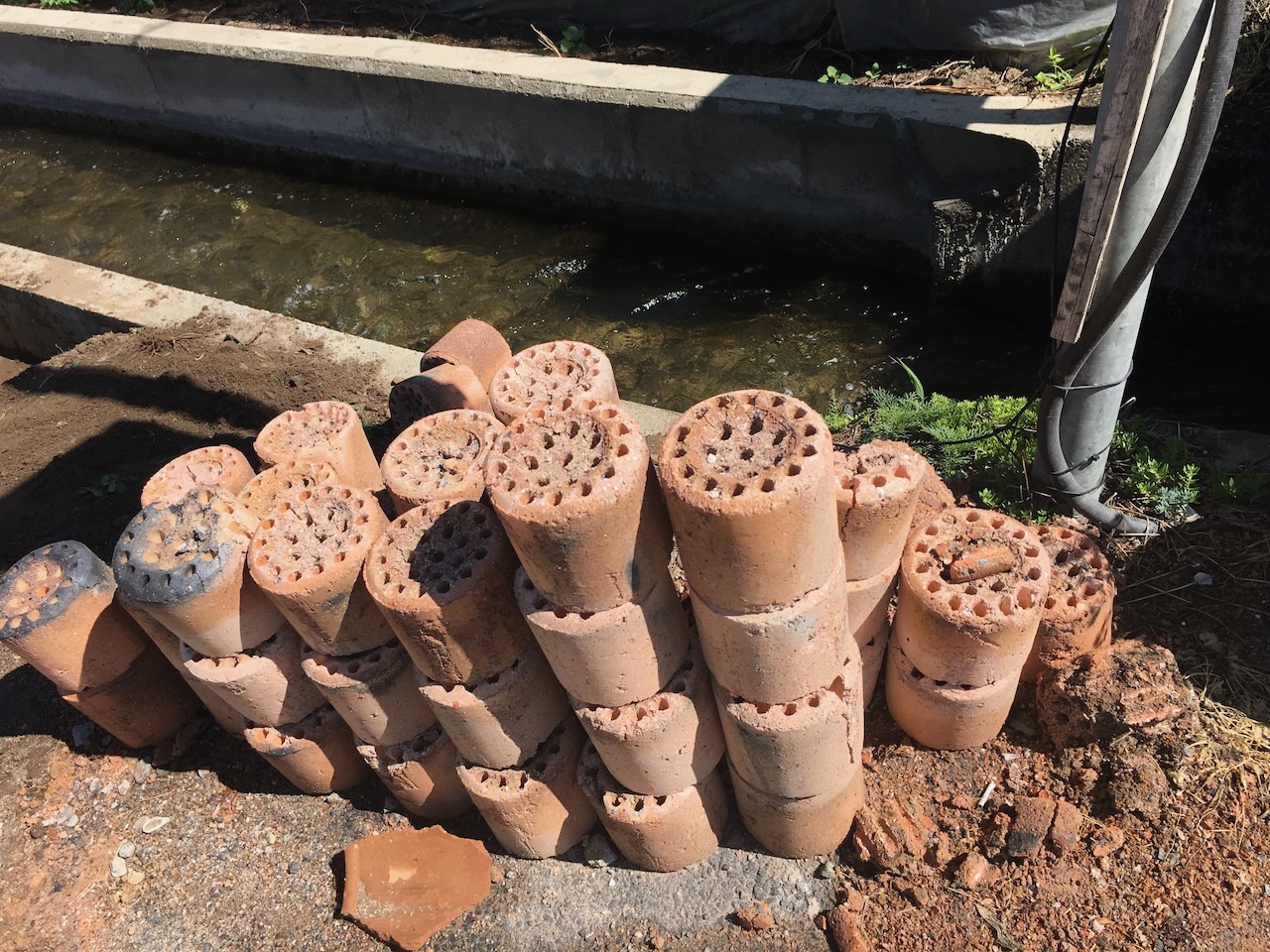
Just after my first visit here, some years ago, burning pressed coal briquettes was banned as the main heating and cooking method here. The government did this by bringing gas to the town. They weren’t so stupid as to just ban coal. (See below). They offered a solution first up. Janine and I were working here at the time, and were particularly impressed by the speed and efficiency of the operation. The gas installers team progressed from one end of the main street to the other, about half a kilometre, digging the trench, laying in the pipes, installing side take-off lines to each house, company, or cafe as they progressed, testing the section, then back filling and finally re-tarring the road surface as they went, from laneway to laneway, in 50 metre sections, day after day. The whole street was done while we were there. No one was inconvenienced for more than a day or two.

I reflected on this and couldn’t help but think of Australia and making the comparison. It took 2 months for our local council to re-work the intersection of the street entry into our village at the level crossing. Less than 50 metres of tarred road. Terms like glacial come to mind. I think that the difference is that here, Korean’s work on contract and our local council workers were on wages, so no rush. 

The lord Mayor of Brisbane also comes to mind, declaring homelessness illegal in Brisbane. Genius! give this man a PhD and a Nobel Prize! He did absolutely nothing to offer any alternative. No grand plan. No long-term thinking. No considered strategy. No forethought. No low income housing construction budget. Just get that problem out of my sight. I can only hope that he will ban cancer and war next!

No wonder we are the big brown dumb land that sells black and red dirt.

Back in The Porcelain Research Centre, the Director had a grand plan that involved long term thinking and strategy. The old disused army barracks on the far edge of town, up in a seperate little spur valley became available. He somehow organised to get it included into the Museum plans and therefore long term budget. Over the years he has relocated all the wood kilns and several more as well, to make a small porcelain village. With specialised facilities for wood firing. both traditional and modern innovative designs. 

There are 6 seperate, self contained house/studio buildings, for research students and their families, a central communal meeting place/cafe, A huge accomodation block for visitors and guests during big events, Plus a seperate family guest house. 

On this visit, I got to see inside the huge new, almost complete, student residency building, with 6 self contained single studios and living quarters, 3 either side of a massive central kiln room and glazing lab. Korean students can come to study for periods of 1 to 3 years. Foreign students can come from 1 to 3 months. 

The construction phase is almost complete. They are just doing the landscaping now. This is becoming a very impressive place to come and study. 

As I understand it. Local Korean ceramic students that are accepted into the program here are usually supported by their university to come here for higher degree research study up to 3 years for a PhD. They don’t have to pay any rent, but they have to cover the cost of their own firings and food. I’m unaware of the cost for international students, as the building isn’t ready yet, so there haven’t been any so far.

I’d come and work here again, as an artist in residence, if I didn’t now have an even better studio and creative environment back at home in my new workshop, just sitting there waiting for me. Now Janine and I are in a position to invite students to come and work and study in our studio from time to time. Regrettably, we can’t off the same standard of on-site accomodation as they do in Korea.

New Student accommodation building.

Is there any wonder that I love coming here to this supportive, creative, artistic environment so much?

K-Pot Journal 4

After the successful firing of my kiln, which could have been better, but served well as a proof of concept firing. I have a couple of other jobs lined up while I’m in Korea. One of them was for an institution, but the person in charge hadn’t applied for permission to build a kiln there until last week, so no permission was forthcoming – at least not in time. I couldn’t build a kiln in an institution without permission, just in case it was refused, or so slow in coming that it would be approved for the next financial year, either way. I wouldn’t be able to get paid for any work done now. So I decided to move on to the next job.

One of the potters working on the big kiln in Bangsan Porcelain Village, named Mr Kim tells me that he has built a downdraught firebox wood kiln at this home on the east coast, but it didn’t work all that well. We have been discussing this over dinner in the evenings. I show him my plans for the Bangsan kiln and all the mathematics that I use to work out all the dimensions for the various openings, firebox, flues, throat and chimney etc. He asks me to come with him after this job here is over, he’ll drive me to his place and I can look at his kiln and make any suggestions that I can think of to help him improve it. He tells me that he’ll drive me back again afterwards as well. This is good news, as my suitcase is now approaching 30 kgs with the load of sericite stones that I have recently added to it. Catching public transport is a bit of an ordeal with such a heavy bag. I decide to go through it and jettison everything that is not essential. I get rid of 5 kgs in that effort.

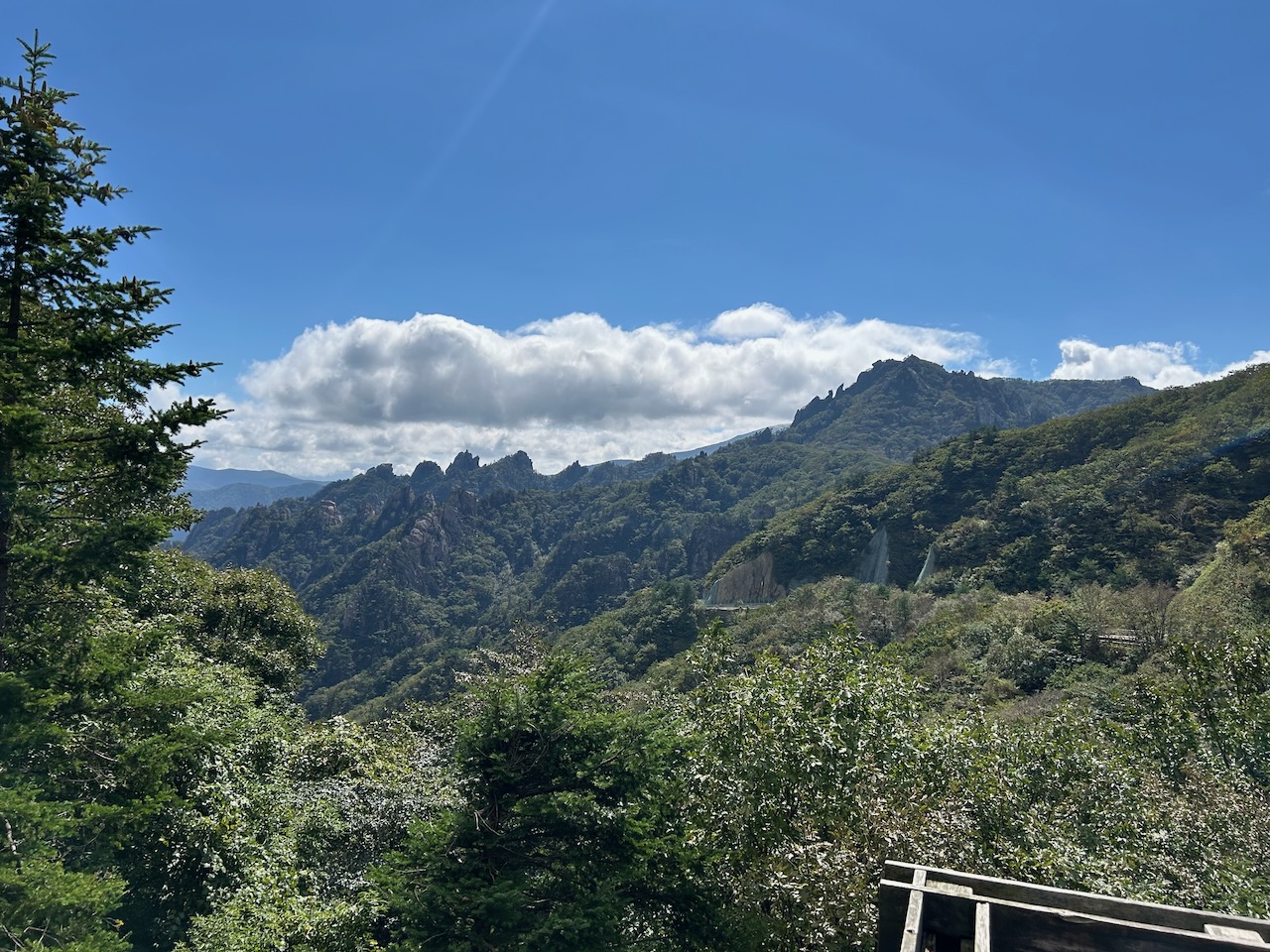
We set off to cross the country, over the mountain range that runs down this part of South Korea. We stop at a famous lookout to view back to where we have just come.

I look over the edge of the viewing deck and unsettlingly, I can see what appears to be the previous wooden deck that has collapsed into the ravine below us!

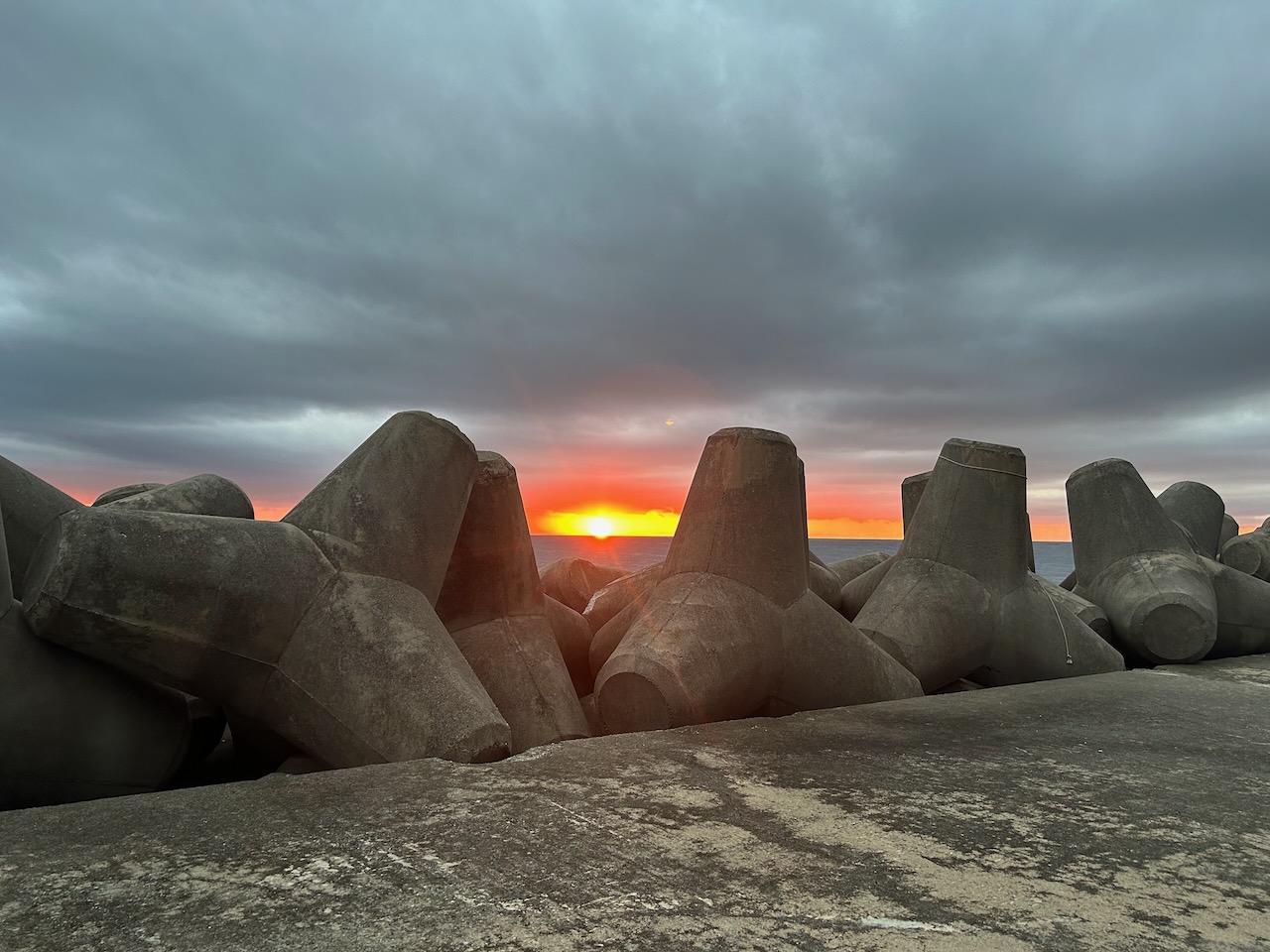
The trip is several hours to the East Coast and it turns out that Mr Kim owns a hotel and restaurant on the top of a cliff over-looking the sea. He tells me that I can stay in one of the empty rooms for the next few days while he shows me around. We dine in the restaurant run by his daughter and son-in-law and the next day at dawn we are off for a walk down to the harbour to see the sun rise.

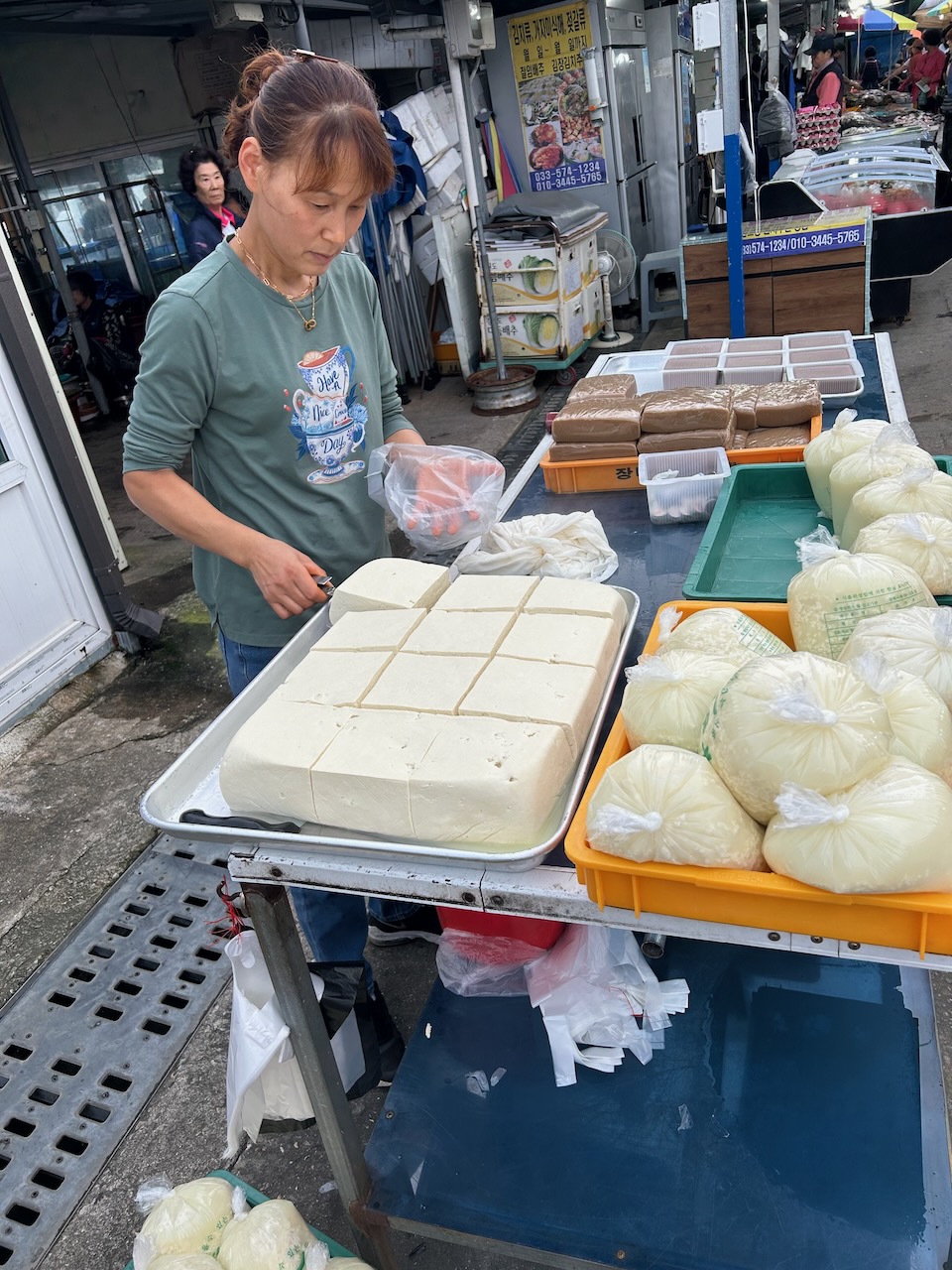
After our walk, mr Kim takes me to the local fish markets, where we buy fish, tofu, vegetables, chillies and pickles for the restaurant.

If you ever think that you might need 20 kgs of dried chillis. I know where to get it.

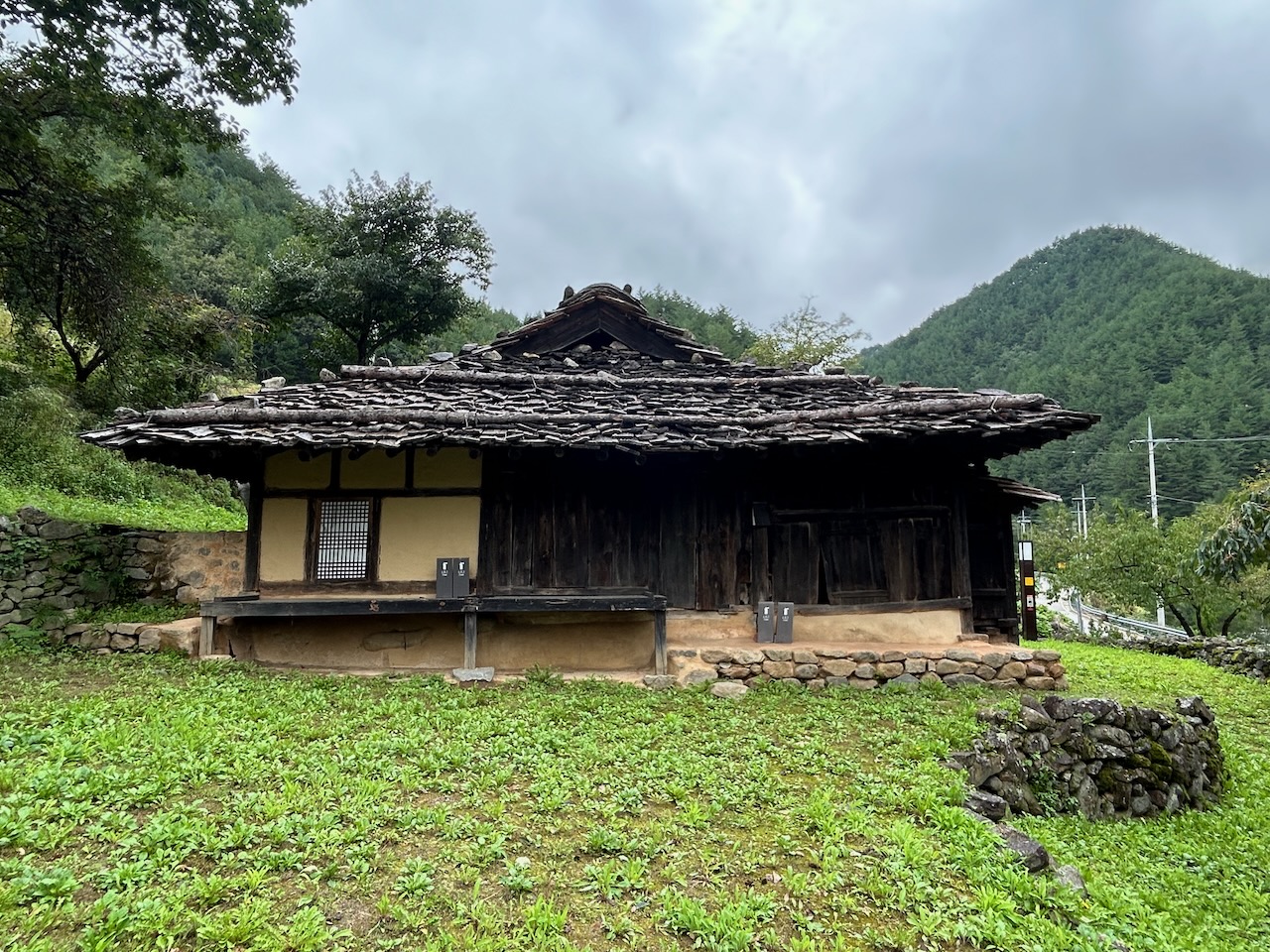
Mr Kim tells me that he built the hotel 20 years ago, and moved his growing family here from their first home that he built up in the mountains an hour inland from here. He studied architecture and engineering at university and set up his practice high in the mountains where they were snowed in for 3 months of the year. It is a very old subsistence farming area with a lot of ’National Trust’ Listed and preserved farm buildings that date back hundreds of years. These old farm houses were preserved because the climate is so difficult up there, no one could be bothered to pull them down and rebuild on the site. Mr Kim operated his practice during the winter lock-down through the internet. Korea has really excellent internet coverage and speeds. He and his wife raised 3 children up there. He tells me that he will take me up there to see the old place. He still owns it. He tells me to bring a jacket.

We drive up the narrow, winding, mountain roads full of mist and fog, the air is getting colder. I can feel the chill in the air deepen. I’m glad that he warned me to bring a jacket. We drive for an hour or so until we crest one of the mountain peaks and discover a clearing with a very ancient farm house on it. There are row upon row of stone buttressed retaining walls to make garden beds on the steep hilly terrain. Generations of farmers have toiled here in this soil, so high up on this mountain. I can feel the aches and pains of all this endeavour, solidly secreted in this soil, and in these terraces.

The old house is a combination of earth and timber. The roof is made of timber shingles that have been split from massive slabs of wood. It’s a beautiful old farm house.

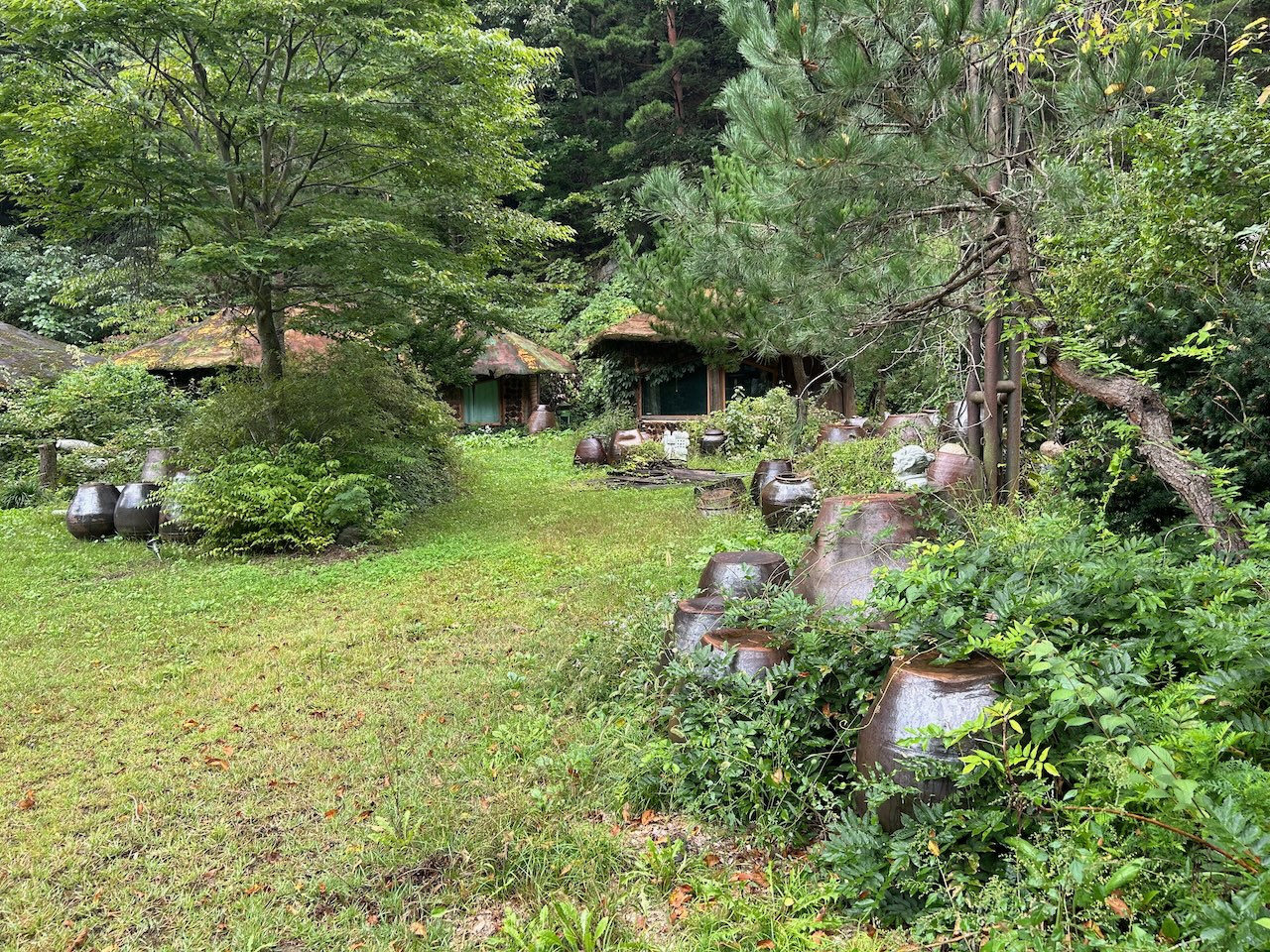
We drive on over the next hill and come to a stop in the narrow street. He hops out and ushers me across a narrow little bridge over a torrent and into a grassy clearing between a few old hexagonal pavilions. There are row upon row of old ongi jars lined up around the edges of the grassy clearing. It hasn’t been mowed for some time and everything is quite derelict looking – but very familiar. 

I’m struck by an intense feeling of deja vu! 

I turn to him and say the strangest thing.  “I’ve been here before”. I’ve lived here! Actually, I’ve slept in that building over there and had a meal in that building there!”  

It’s so unbelievable. I can’t believe it. At first, I’m not even sure if what is coming out of my mouth somewhat unintentionally is really true, but the more that I look and take it all in, the more that I’m sure. Yes. I’ve stayed here! But this place is so remote! It’s almost impossible!

Mr Kim is taken aback. His eyes are wide. He is shocked at what I’m saying, and so am I, Because it couldn’t possibly be true. Am I just joking?

Is there some sort of lost-in-translation effect happening? He doesn’t believe me. He tells me “No one comes up here. There is nothing here. Most of these farms are abandoned.  How could it be?”

I’m perfectly sure of it now, as I look around and take in more of the details, it is all coming back to me. Yes! I’ve stayed here 8 years ago! Mr Kim looks puzzled, then his face lights up. “Yes, of course. I let a young potter live here 8 years ago rent free, if he rebuilt my wood fired kiln for me in lue of rent.”  He was Mr Jaeyong Yi!

When I came to Korea for the first time in 2016, my translator, guide and driver. Ms Kang SangHee drove me up here from Cheongsong way down south. We were on a mission to find ancient sites where sericite porcelain was first developed. I had met Mr Jaeyong Yi down there in Cheongsong. He had invited us to stay with him in his house, in the mountains, as it was on our way to Taebaek up north to visit another sericite location. I wrote all about that adventure up here in Taebaek, back then in my first Korean blog,

 ’The Kim Chi Chronicles – part 3, 16/9/16 on <’tonightmyfingerssmellofgarlic.com’>

Mr Jaeyong Yi was most hospitable and looked after us very well at that time. The grounds are not as well kept anymore, now that no one lives here. But it still has a charm about it.

We walk around and laugh at the impossibility of it all and the absurdities of life.

Our next stop is to drive down the coast for another hour farther south to catch up with an old friend that we both know. HyeJin Jeon, was a PhD student in the Yanggu Porcelain Research Centre in Bangsan some 6 or 7 years ago. I bumped into her a couple of times on different trips to Korea during her studies there. We became friends and kept in touch by email over the years. She graduated with her PhD a few years ago, and has recently been appointed as the Professor of Ceramics at the Gangneung University on the East Coast. Its not that far further south from where we are. 

HyeJin Jeon is very pleased to see us and gives me a big hug. It’s been 6 years since I last saw her in Bangsan.

She shows us around her faculty, then the three of us spend the day going around all the Museums and ancient buildings in Gangneung city. We stay on for dinner and drive home in the dark. It was very nice to catch up after so long. I’m pleased that she is doing well.

The next day, Mr Kim shows me his kiln, I go over it, I measure all of its critical features and then spend an hour drawing up a sketch and working out the exact proportions of its openings. I come to the conclusion that the flue needs to be bigger, much bigger. Bigger by 3 times! This is the major problem. But the fire box could also be larger again by half as well. These alterations wont be easy, but are doable. I also suggest that it might be better in the long run if he starts again from scratch. I give him the plans for my kiln that I built in Bangsan as a starting point to help him get the best outcome. He looks at my page of calculations and announces. “ You are not just an artist, you are a scientist!”

Instead of driving me back up to Bangsan, after some discussion, we decide that it will be best if Mr Kim drives me to the local station, so that I can catch a train across to Yeoju and visit both Mr Lee JunBeum and my old friend, former driver, translator and guide, Kang SangHee. 

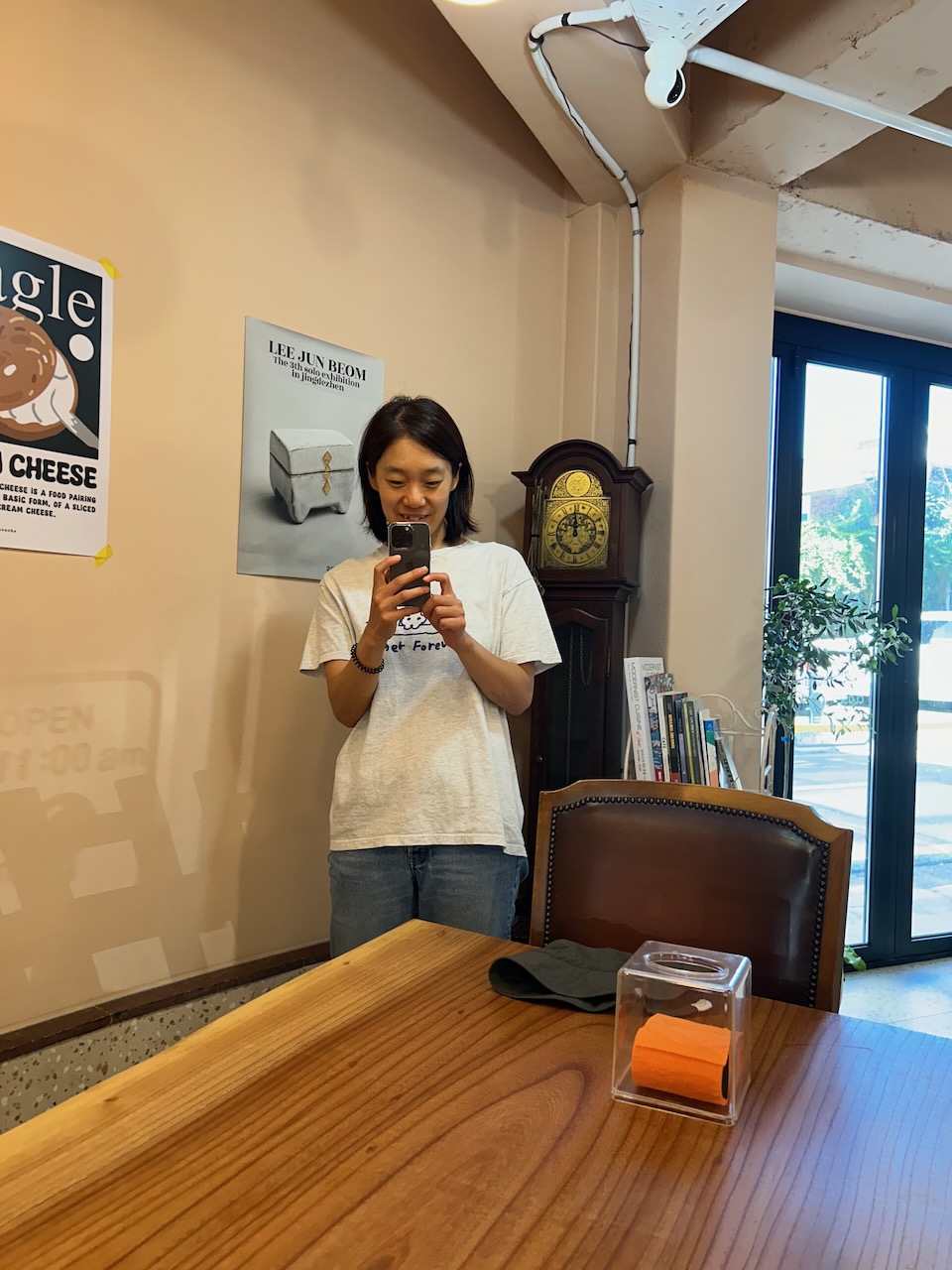
It’s good to see Ms Kang SangHee again too, I catch her taking my picture when I’m not looking, so I reciprocate.

We meet up in Mr Lee’s wife’s cafe and bakery, where Ms Kang is helping her bake the days bread. 

We spend the day travelling to all 3 sites of the ceramics Biennale. There are some very impressive ceramics on show. Later, I am able to help JunBeom with his new kiln. The least that I can do to show my appreciation for all his help.

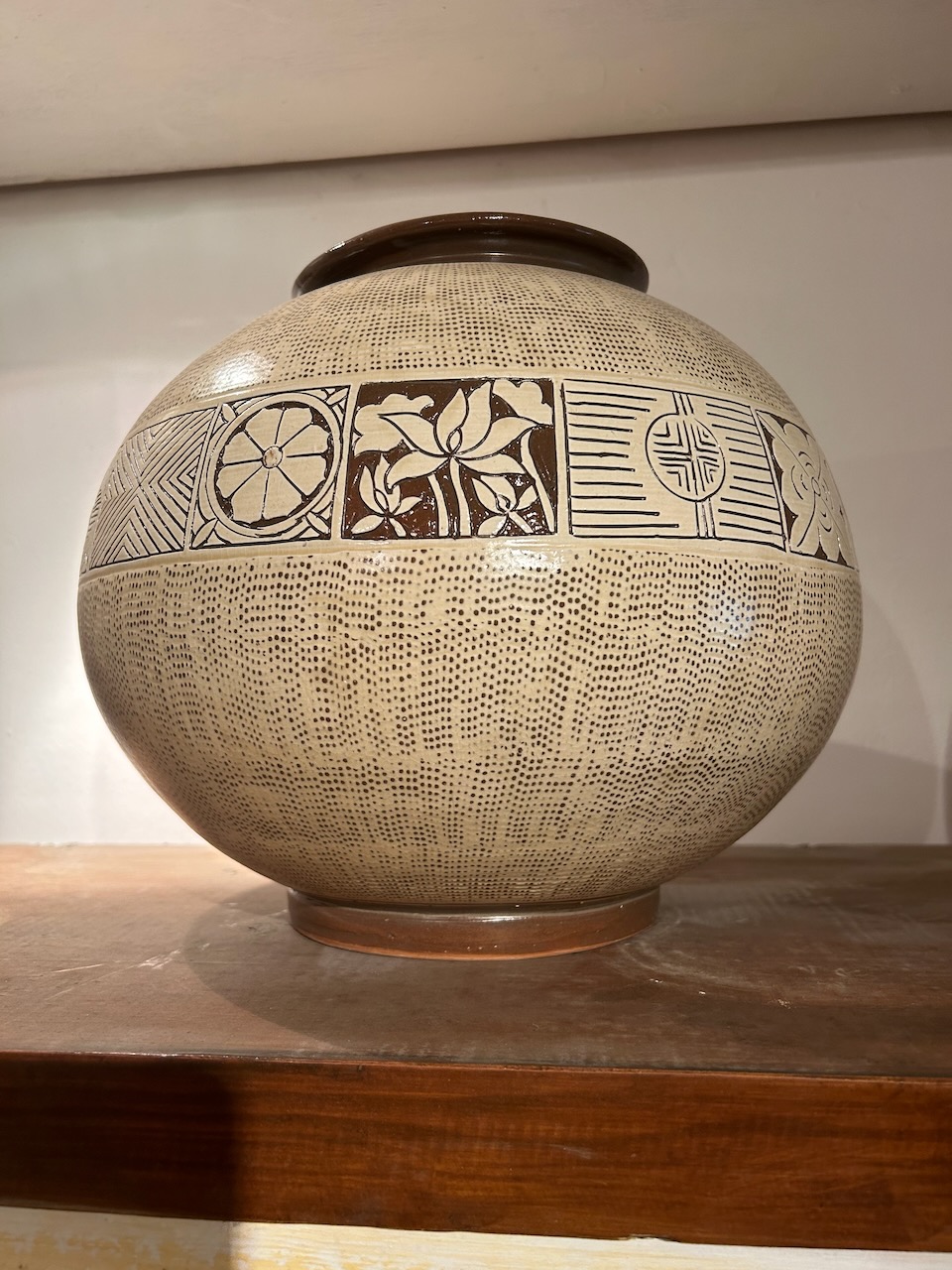
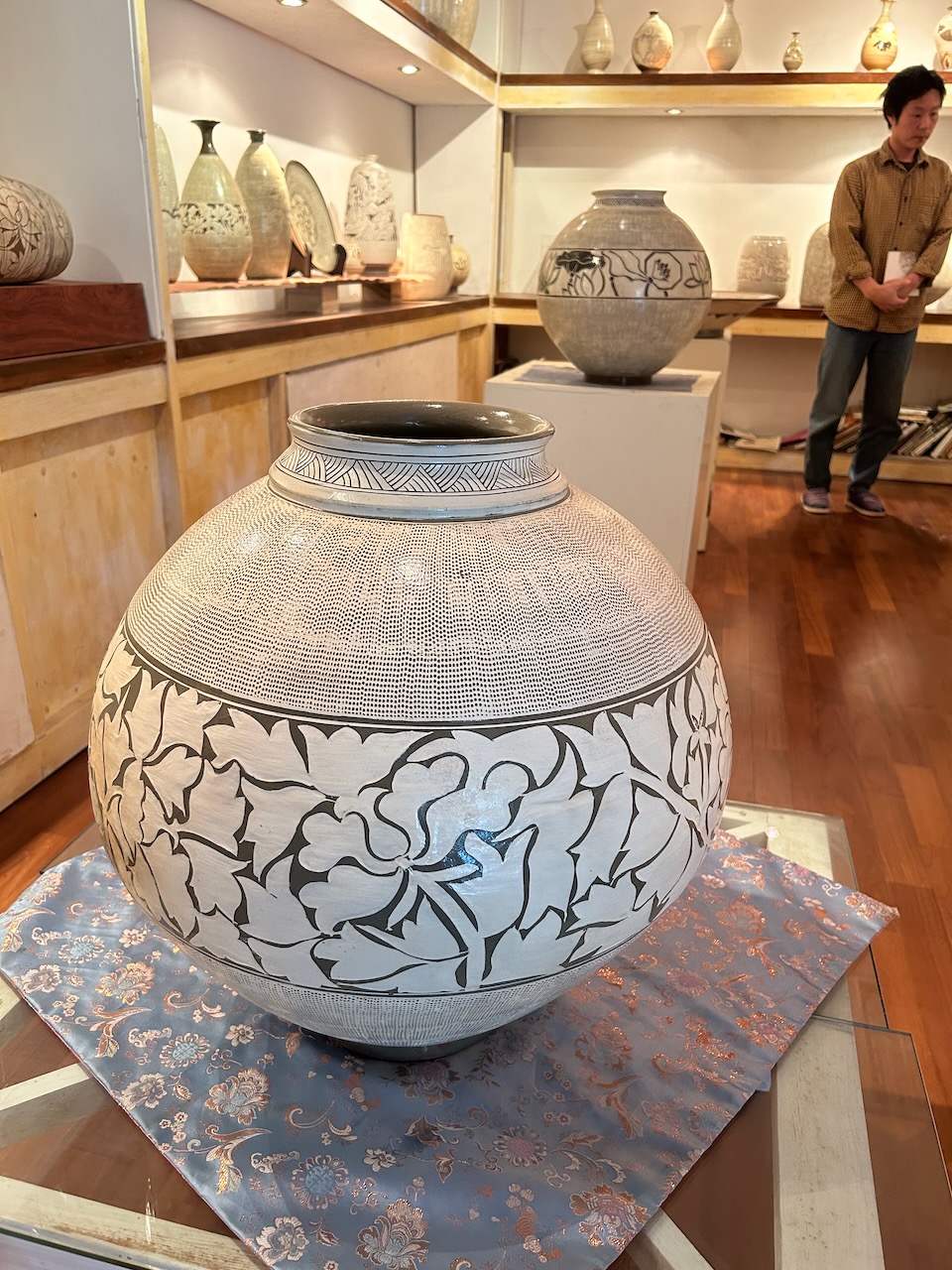
The next day JunBeom and Yoomi drive me to visit the National Treasure potter of traditional sgraffito slip decoration, called Buncheong.

His name is Park Sang Jin and they get a long chat in Korean, insight into which I get through occasional translations from Jun Beom, then we all get a guided tour of his workshop, gallery and kilns.

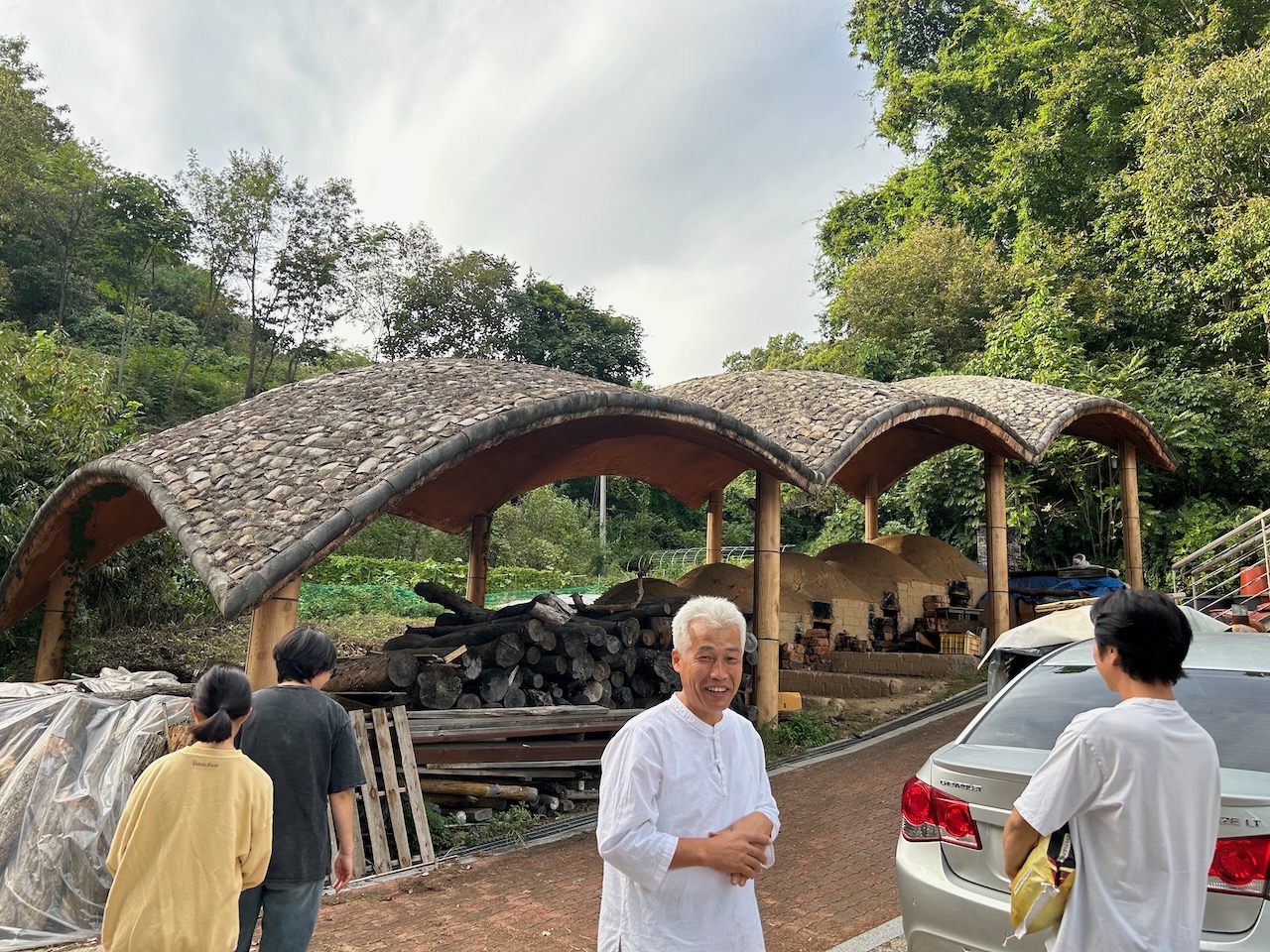
On my last day in Korea we travel south to the city of Andong to visit the other Mr Kim, Kim SangGe, we worked closely together on the Bangsan kiln and he invited me to visit him if I was ever in Andong. He has an amazing roof structure over his workshop and kiln shed. Possibly cast concrete, but with a decorative layer of old weathered and broken roof tiles applied as a kind of mosaic. It’s really beautiful. Artists are just so imaginative and creative in everything that they do. I wish that I’d thought of doing that! Mind you, I don’t have access to thousands of old weathered and broken roof tiles, nor the funds to have an undulating concrete roof cast in-situ. Not the sort of thing that I could ever own, but I’m very pleased to be able to visit.

Mr Kim Sang Ge, serves us a special tea made from dried Tibetan chrysanthemum flowers. Interesting, but not particularly flavourful or tasty. He asks if I like it, and I reply yes – just to be polite, what else can I say? He then gives me the whole packet. I thank him warmly, but I know that I can’t bring it back into Australia, so I give it to Jun Beom when we get home. It was very generous of him and I appreciate that. 

Mr Kim led the kiln building team that built the 5 chamber kiln in Bangsan that Janine and I experienced firing back in April this year, see my blog entry;  <Kiln Firing in KoreaPosted on 13/05/2024>

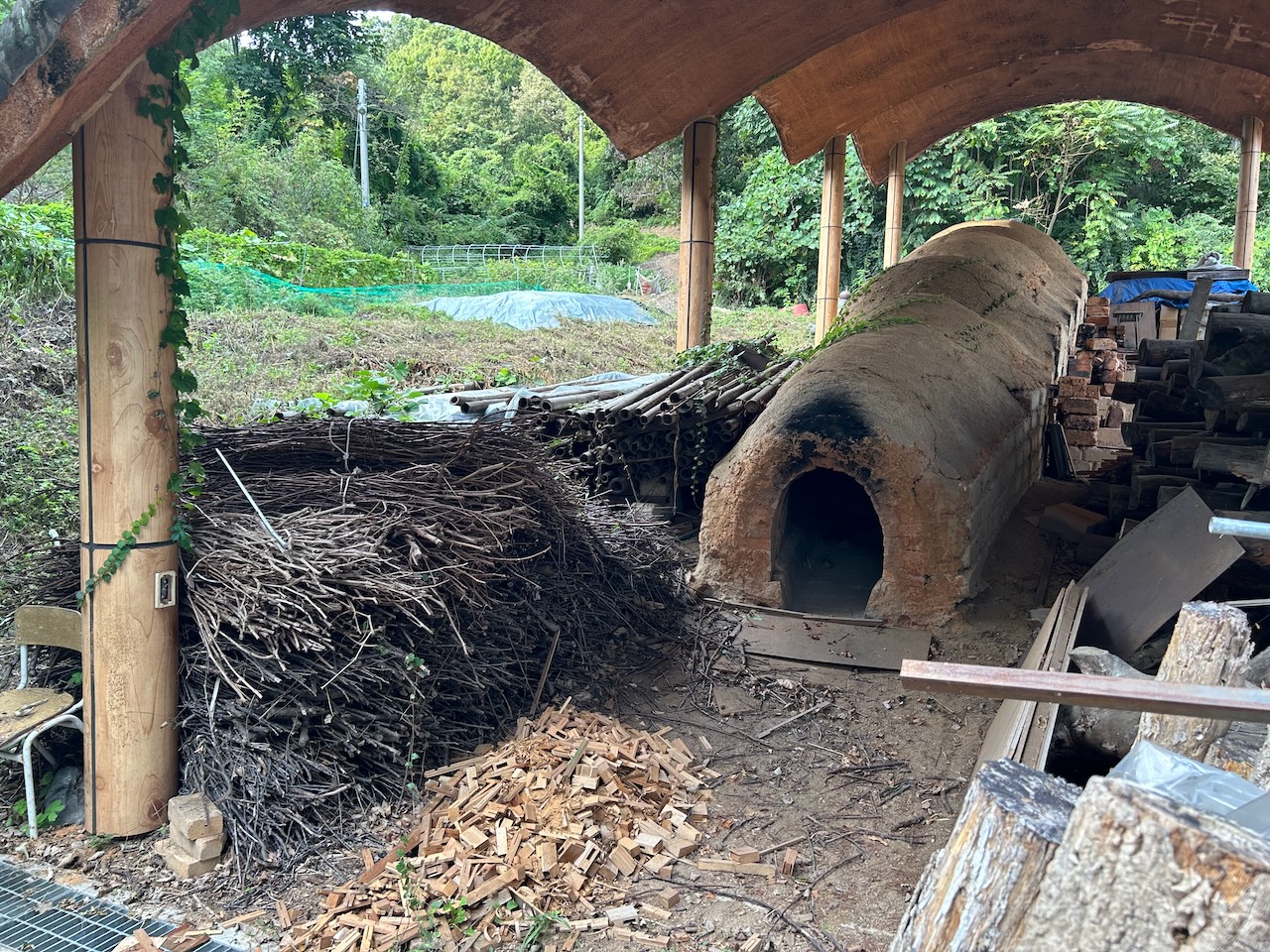
Mr Kim’s kiln is made from thousands of hand made cone shaped raw clay fire brick blocks to form the domes of each chamber, plus an equal number of rectangular blocks used for the walls.

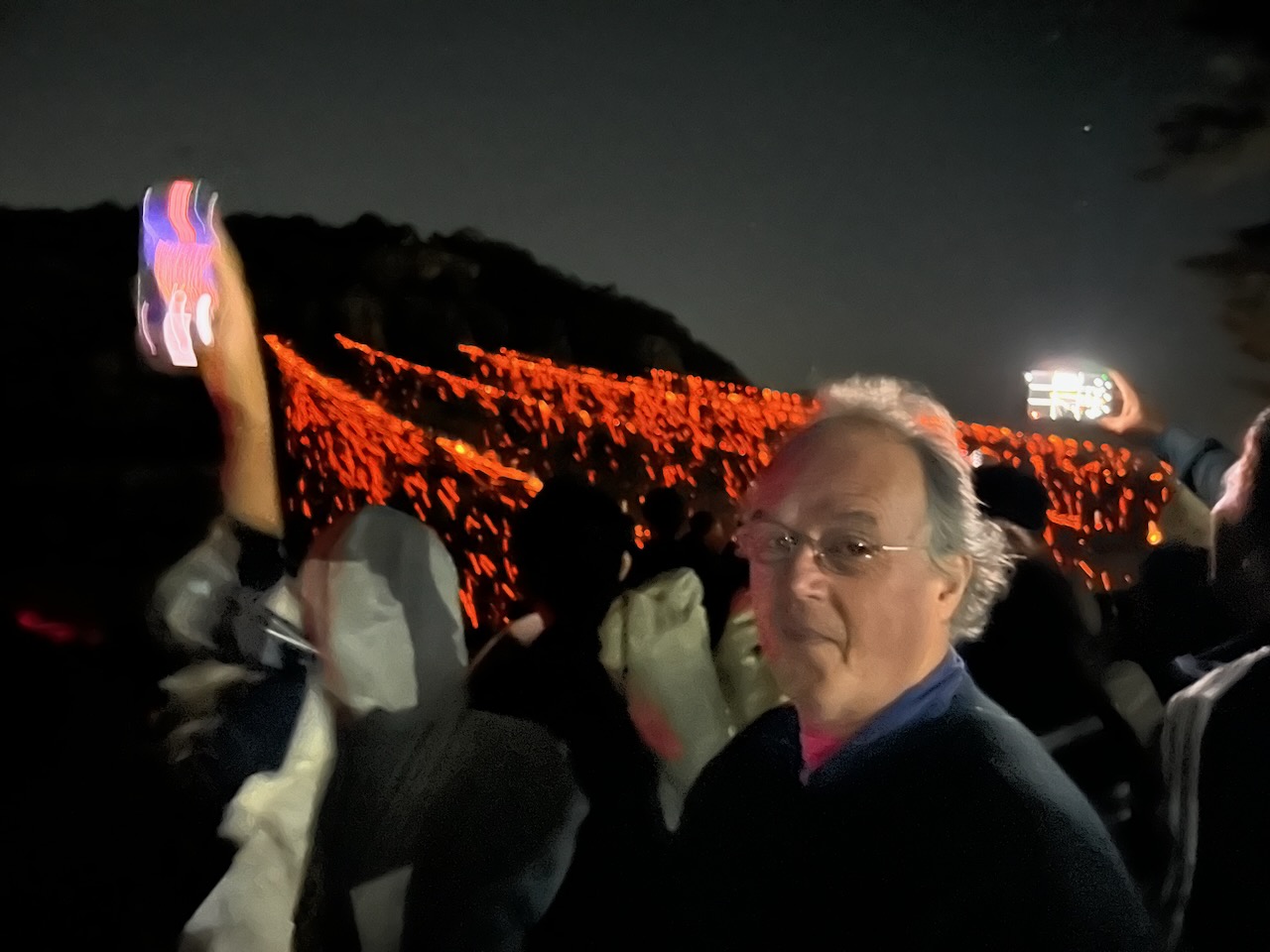
Mr Kim takes us to see the spectacular fire ceremony that takes place this time each year as part of the Traditional Harvest Festival in Andong. There is a tiny traditional Hanok Village of small, earth and timber, thatched roofed buildings, set in the bend of a river, opposite some steep cliffs. it’s an idillic spot, exceptionally beautiful. Each year at this time the ancient founders of the village are remembered by hoisting ropes up across the river, over to the cliffs and hanging burning hand made flares made from leaves and twigs. The sparks flutter down from the ropes into the river in the night sky. It’s quite dramatic. There are no modern fireworks going ‘bang’! Just the gentle cascade of sparks down from the sky.

I’ve been so lucky to have been able to witness so many wonderful things on this trip. Not my usual artist in residence stay in just one place or a simple conference presentation.  One of my planned kiln jobs evaporated, but was replaced with a multitude of very different experiences. I am very grateful to all my Korean friends! Thank you!

Nothing is perfect, nothing is ever finished, and nothing last forever.

K-Pot Journal 3

In the evenings after the days kiln work and dinner, we are all allowed into the Porcelain Museum pottery room, so that we can all make some pots to put in the first firing of my kiln. I don’t know whose idea this was, but it’s a very good one. Everyone has contributed to its construction, and as it’s such an unusual kiln for these parts. It’s a very good idea for everyone to get to see a pot of theirs fired in it. NO Pressure!

It turns out that there are two ‘National Treasure’ potters in our crew here. But everyone is a famous potter from their own regional district. They all come together to do these big kiln building events at special places around the country. A loose conglomerate of like minded and highly skilled artists all contributing their own particular skill set to these big projects.
We pack the kiln with our bisque fired and glazed pots, with other contributions from the research students as well. There is only just enough pots to fill the kiln. I could have fitted more work in if there was any. But there is just enough.

Interestingly, they don’t use digital pyrometers or pyrometric cones here. Traditional firing is judged by colour, sound, smell, smoke and flame. Using years of experience with a particular type of kiln, to judge the progress of the firing. They do however use small glazed tiles as draw trials to gauge the degree of glaze melt, and something that I haven’t come across before, and that is the use of a small amount of stiff glaze paste, that is rolled between the fingers into a small length of pasta sized rod and set in some wadding. This little 3mm dia. rod of glaze will melt at top temperature and fall over, in much the same way that we use pyrometric cones as pyroscopes. 

I suddenly realise that I’m really out of my depth here. I usually rely on a digital pyrometer to tell me how I’m going. Now I have to go back to basics and look and listen very closely to the fire to make my decisions. Luckily I’ve also done this before too, so I’m OK, but would prefer the  reassurance of a pyrometer to confirm my decisions. Until very recently, we used ‘handheld’, battery operated, digital meters. This meant that you had to go over to where it was and switch it on, to see the LCD display the temperature. They are cheap – very cheap – $10 to $15, pretty reliable and because they are intermittent, they teach you how to look and listen to the kiln, to watch the fire and see how the wood is burning. How the flame is developing, and not just stare at the screen. Since the big fire here. We lost everything, and I bought 240 volt LED permanent temperature displays, online from China for $30, so I have recently become addicted to screen watching in my dotage. Luckily, I still retain some of my mental capacities, well learnt and polished to a finely detailed finish. So just like my stick welding skills, my firing skills are soon retrieved from the dustbin of the recesses of my mind. 

In the late 1960’s, when I built my first kiln. No one owned a pyrometer. They were just so expensive. They were totally out of reach. I made a lot of mistakes along the way, but I learnt a lot. I wouldn’t recommend this learning strategy. Using an intermittent pyrometer is the better way to learn so much faster and without the losses that I incurred. My first pyrometer was an analogue, needle indicator, galvanometer. They were quite inaccurate and it taught me not to trust them. A wise decision. They are nearly always wrong. I use them to tell me if i’m going in the right direction. Up or Down. That’s it! I leave the decision as to wether the kiln is finished or not to the use of draw trials, test rings and pyrometric cones.

It is very important to me to fire this kiln well, not just get it to temperature, but do it in a steady, constant, reduction, so that all the usual reduced stoneware glazes that they use here will come out as they expect. BUT, most importantly, to fire the kiln with as little smoke as possible. As that is the main reason for me to be here doing this. This kiln is a demonstration of low emission wood firing.

I must admit that as the only fuel here is 5 year old very dry and seasoned pine wood, that burns very fiercely and fast, I have my work cut out to keep the kiln in reduction, but to minimise the smoke at the same time. As it turns out, I can never get to the stage of filling the hobs with progressively combusting wood, as it is designed to do. I ask if there is any hard wood available and I’m told that it can be obtained, but not at short notice. In fact hard woods like oak and acacia are cheaper than pine, so they will get some in for the next firing. But for now, I have to carefully juggle the wood level in the fireboxes. This means constant attention to detail, so this is not really a Laid Back Wood Firing at all, but a rather busy one. AND, not a smokeless wood firing, as the cover of my book in Korean translation falsely claims!

I manage it reasonably well, but each time I stoke and there is a little burst of pale grey/brown smoke from the chimney. There a howls of jeering from the kiln builders next door. However, although it is smoke, it is nowhere near the column of black smoke that issues from the traditional kilns here. Young Mi, one of the resident researches here translates for me during the firing. She tells me that the jeers are just in good humour, and that the chatter is all about how little smoke there actually is and how clean it is. I have surprised them. 

Another resident confides in me that he expected to see flames come leaping up out of the fire box as soon as I lifted the lid. He is also surprised how enclosed, slow and gentle the firing process is.

 These 4 images by Kim Young Mi.

I prepared 8 stacks of timber for the firing, expecting to use it all, but as it turned out, I only got to use just over half of it.  In the afternoon, when I go to look in the spy hole, all the little glaze rods have melted. The firing is over in just 9 hours. Too quick! I didn’t realise how fast the temperature was rising without a pyrometer. The colour in the chamber is still looking rather yellowish, and doesn’t have that bright pale glow that I’m used to. I wonder what temperature that glaze stick actually melts at? 

Note to self!  Next time I come here for a firing I’ll bring my own pyrometric cones and a hand held digital pyrometer.

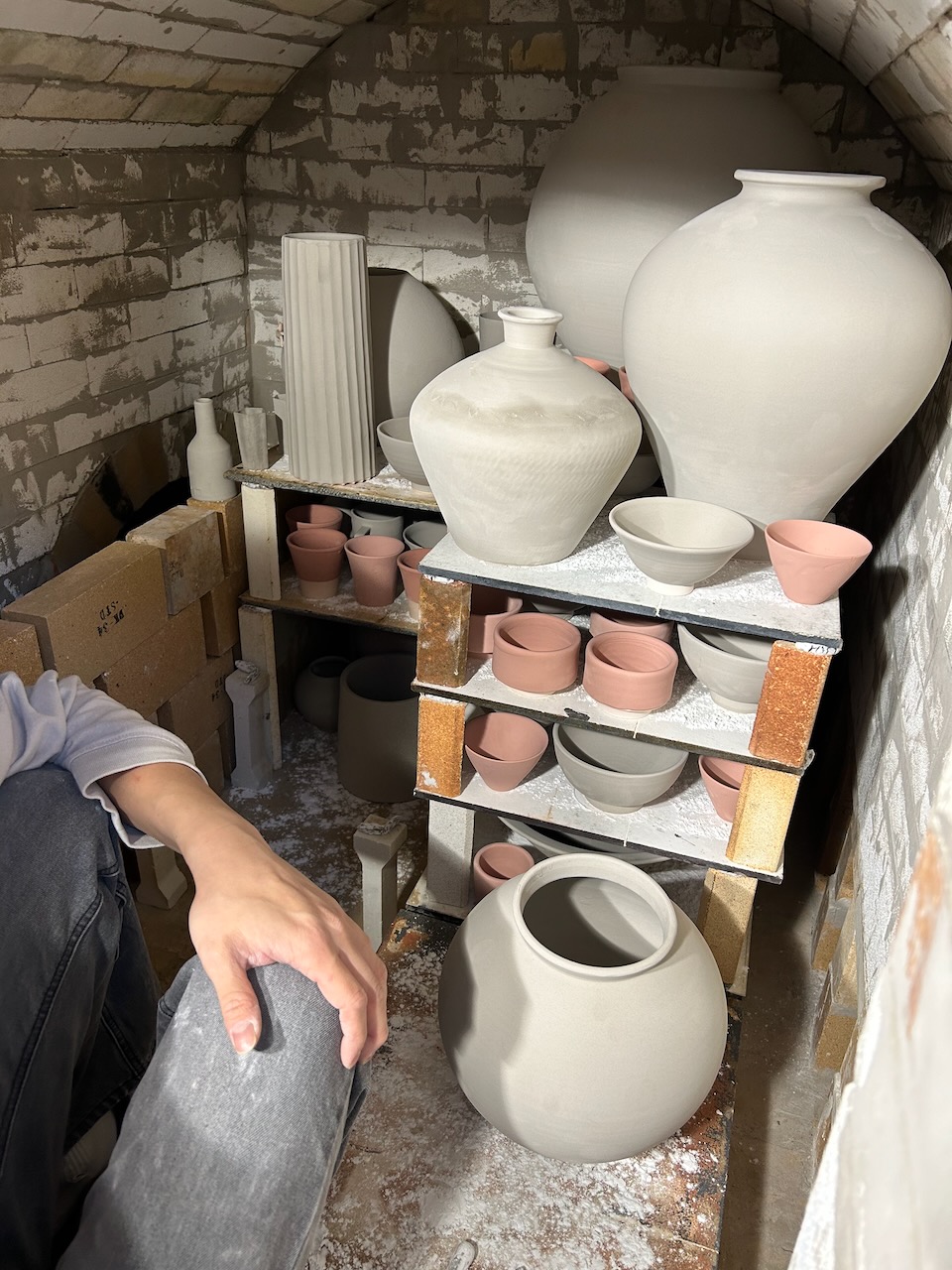
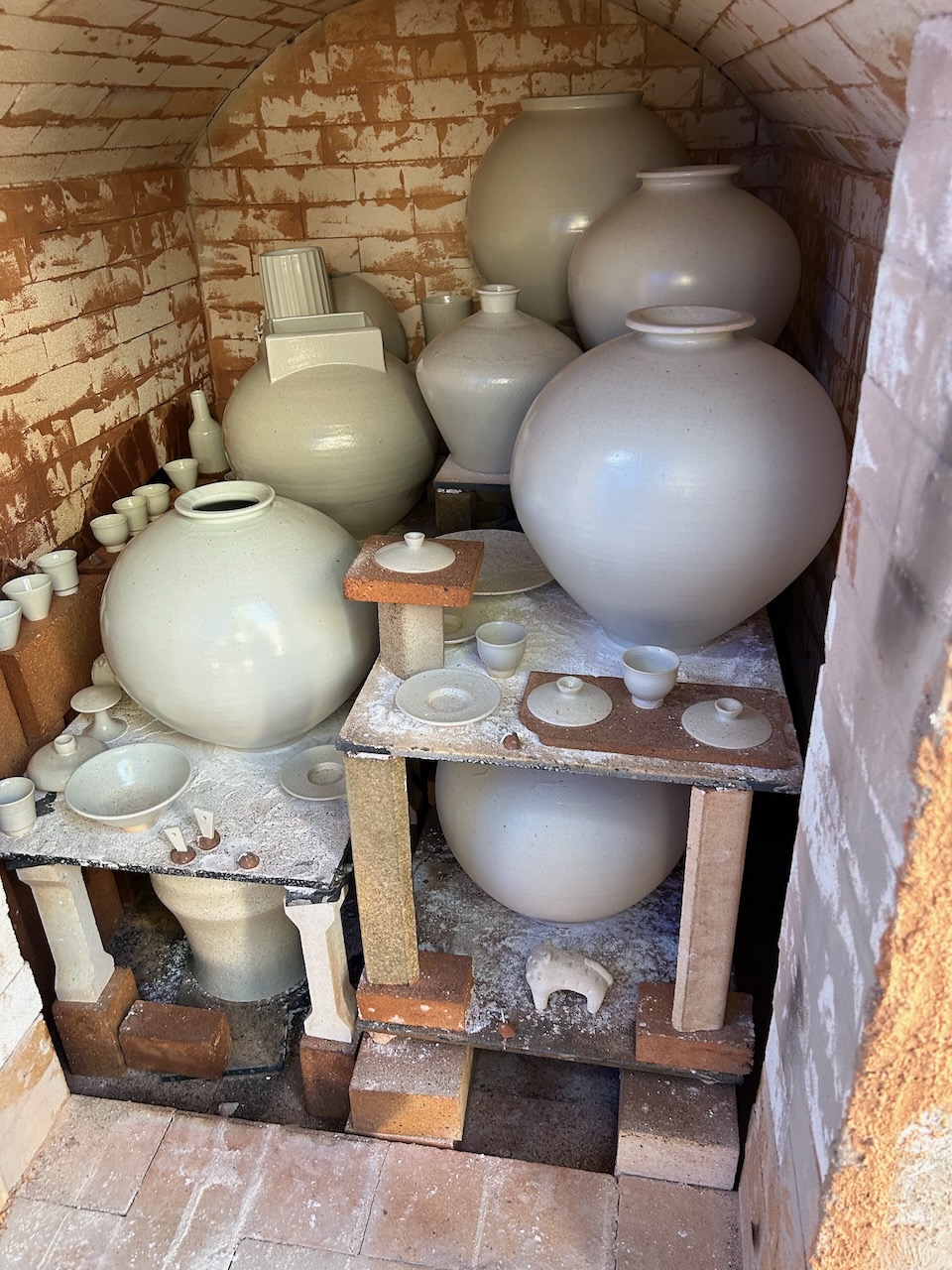
The firing turns out OK. The glazes are pale, grey-blue celadons and off-white, grey/white guans. As I only burnt 4 stacks of wood, possibly 250 kgs of wood, there is no obvious ash deposit, just a little dusting of ash on the glazes facing the fire.

The bottom back shelf is under-fired, but I can remedy that by firing a bit slower and also adjusting the bag wall gaps and height. I hope to be invited back to fire it a couple of times in quick succession, at some later stage, to get to tune it and get an even temperature throughout.

Meanwhile, life goes on in the rest of the village, with the rice harvest in full swing, and autumn vegetables ripening in peoples gardens. I’d love to get in there and pick some of those beautiful vegetables.

Work has been progressing on the big kiln next door. It is more or less finished, but may need some extra work on it. I’m not too sure there. It will certainly need to be pre-fired to remove all the arch shuttering that is built into each of the 5 chambers. It’s a massive kiln!

Who knows if, or when I’ll be back? What does the future hold. Watch this space


Before I leave this beautifully creative place, I make my usual pilgrimage up the mountain to the ancient site where all the sericite porcelain stone was stock-piled in ancient times. The site has been tragically decimated by a local former. I imagine to stop it being declared an historic ‘National Trust’ site of importance? The whole site was bulldozed some years ago, but remnants remain in the soil. Particularly after heavy rains, the white stones stand out from the brown soil and are easily collected. I make a point of hiking up there and seeing what is available for me to collect. I return with 10 to 15 kgs of stones in my back pack and start the process of meticulously scrubbing the stones to remove any particles of dirt. Then I rinse then several times, until the water runs clear. Finally I soak them overnight in bleach to kill anything that might be harmful to the environment in Australia when I return. 

Back home, I put them through the jaw crusher and then into the ball mill and let the slurry sit and flocculate for a month or two, before stiffening and plastic ageing before use sometime next year.

K-Pot Journal 2

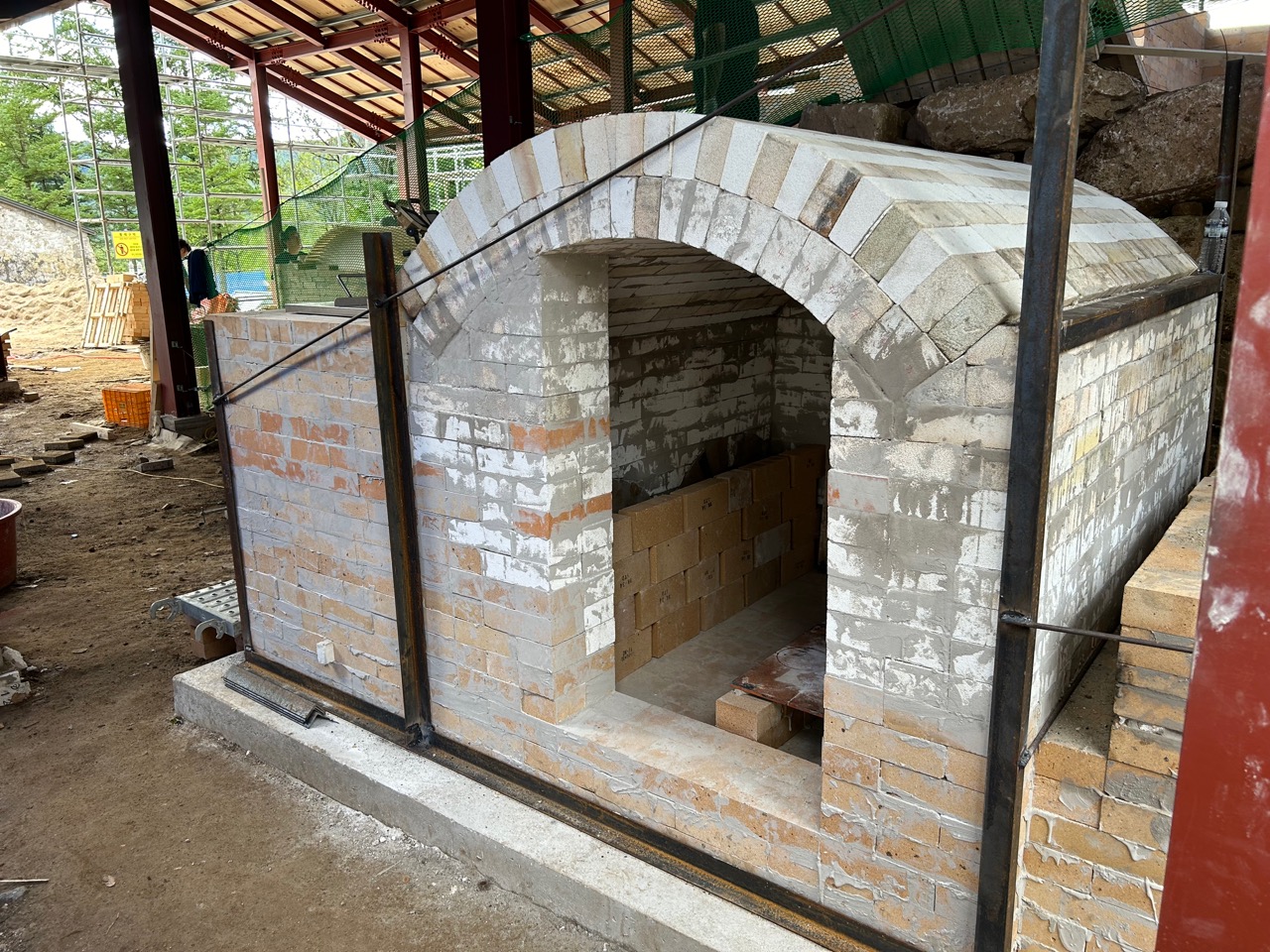
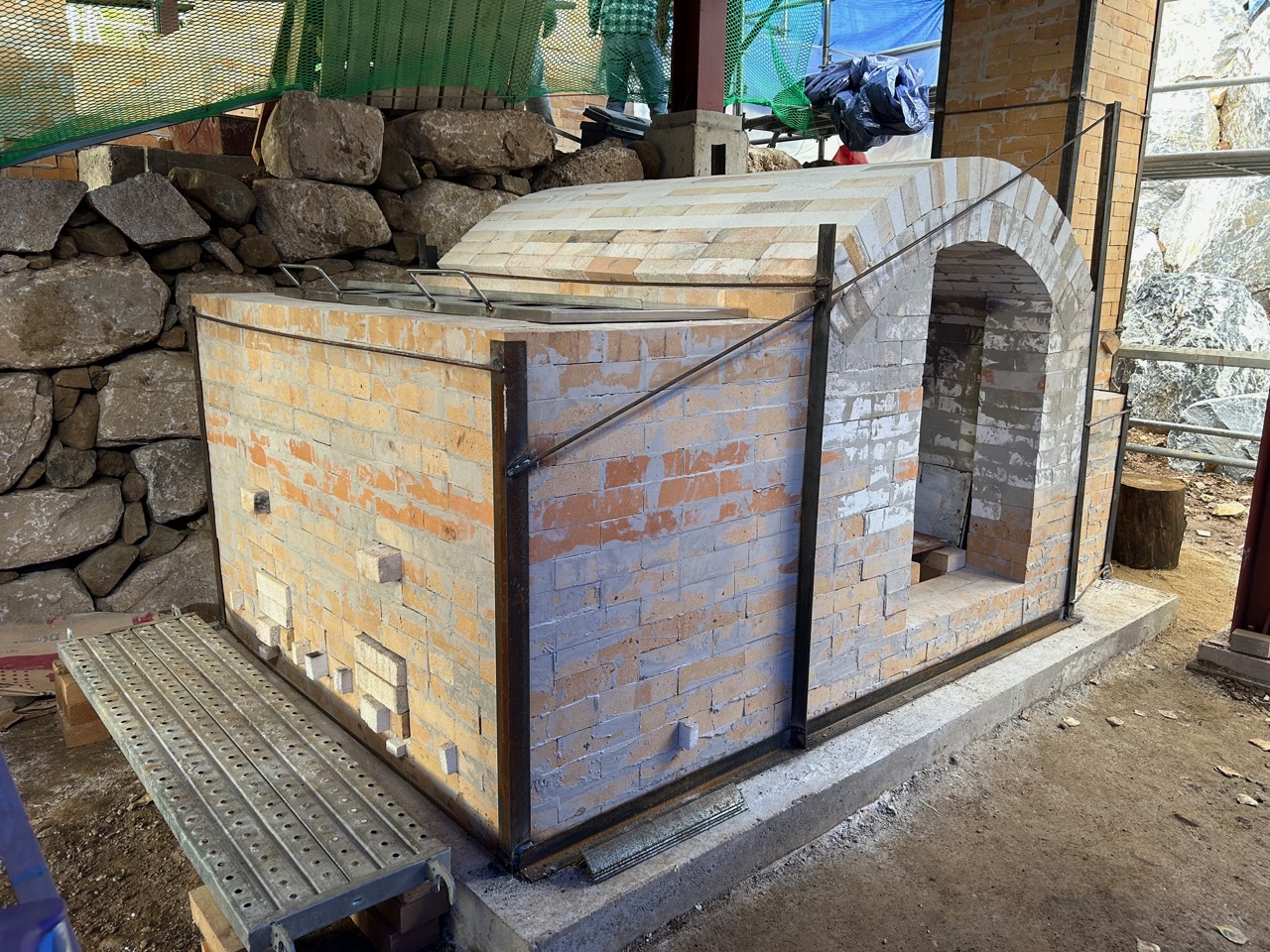
Building my kiln went pretty easily. 

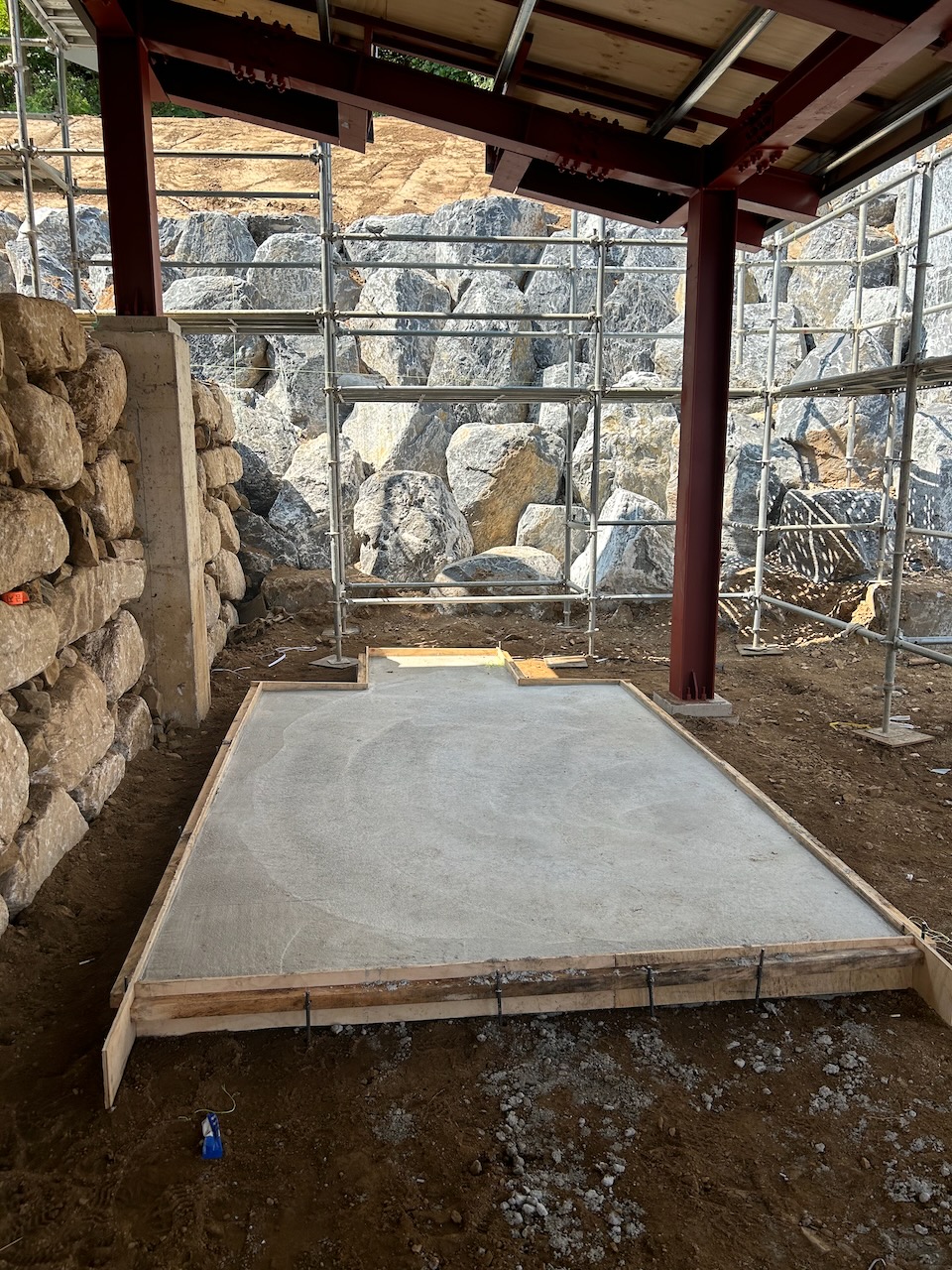
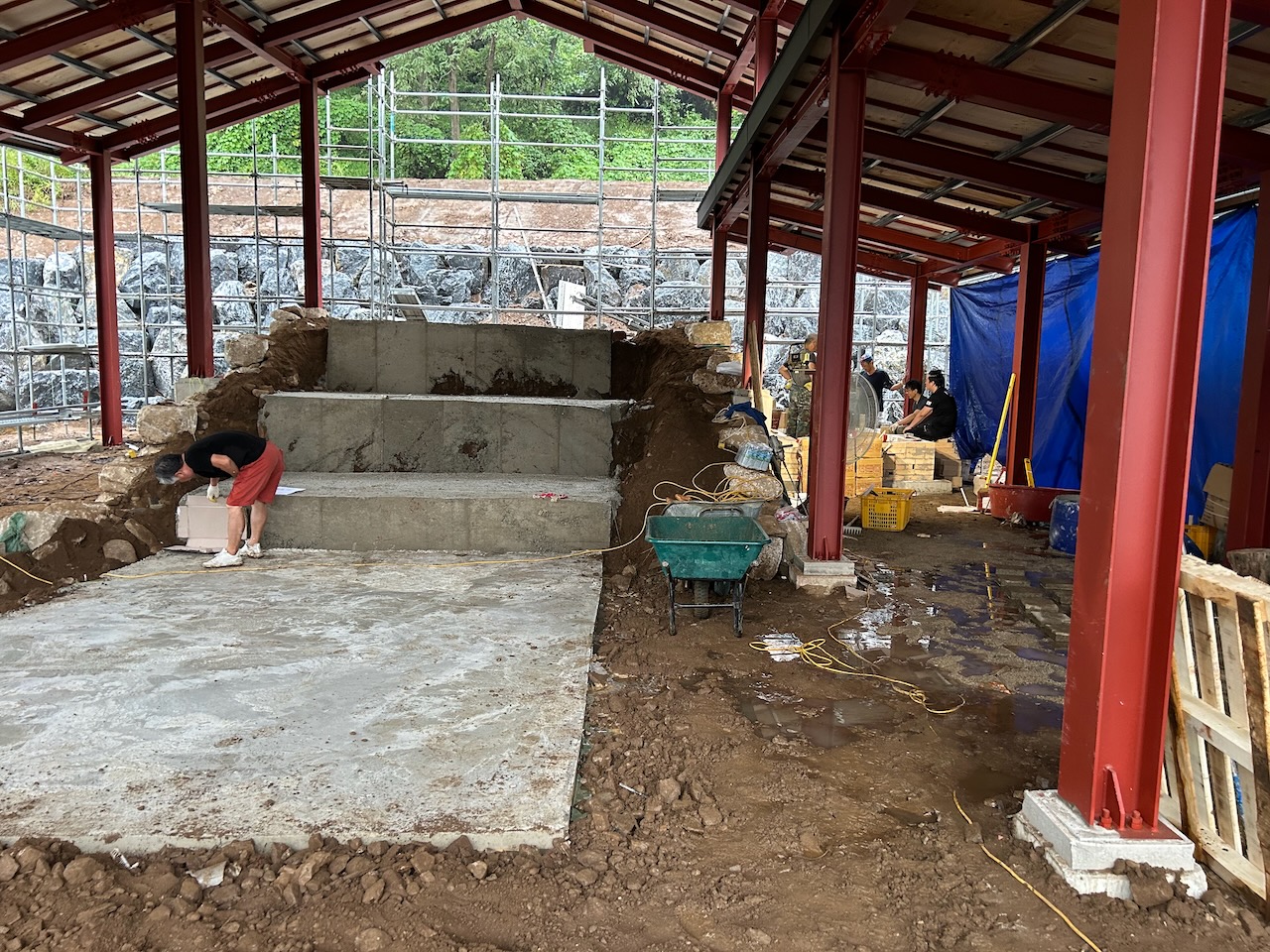
Because the kiln shed wasn’t finished on time, the team of 8 professional kiln builders that are contracted to build the massive North Korean designed 5 chamber kiln that is going in the new shed next to mine, are all sitting with nothing to do for a couple of days, as the slab for their kiln hasn’t even been cast yet. The slab for my kiln was cast the day before I arrived, but as they were still finishing the roof of the shed I wasn’t allowed on site because of the danger of falling objects. So nothing happened for the first day for any of us. We all went into the nearest big town half an hour away to buy groceries for the coming week.
There is almost nothing fresh available here in this little village. There is a junk food ‘convenience store’ that mostly sells soft-drinks, tinned coffee, beer and cigarettes, and a very small ’supermarket’ where you can drop off the first word and buy dried and canned foods that aren’t particularly super in degree or range.

No one sells fresh vegetables, and understandably so, as everyone here, with exception of the dozen museum staff and research students, is involved in farming vegetables. I suppose that they either grow what they need themselves, or swap with neighbours who do. Either way there is nothing fresh in the two tiny shops here.

In the bigger nearby town of Yanggu, there is a choice of bigger grocery shops and one real supermarket. We travel there and get a weeks supply of almost everything that we can think of, that we might need to feed ourselves for the coming week. We spend about $700 on these 3 trolleys of various food items. It even includes shoju and beer! I notice that they sell red wine in there. So return by myself while the others are loading the cars, and buy 4 bottles of red wine, mostly of cheaper origins like Chilean and South Africa There is nothing from Australia available. 

I don’t enjoy shoju at all, but quite like the fermented rice wine called makoli and the local beer, but I feel that there might be an occasion when there will be an opportunity to share some claret in the coming evenings together. It turns out that I’m spot on with this decision. The bottle doesn’t go very far when shared 9 ways!

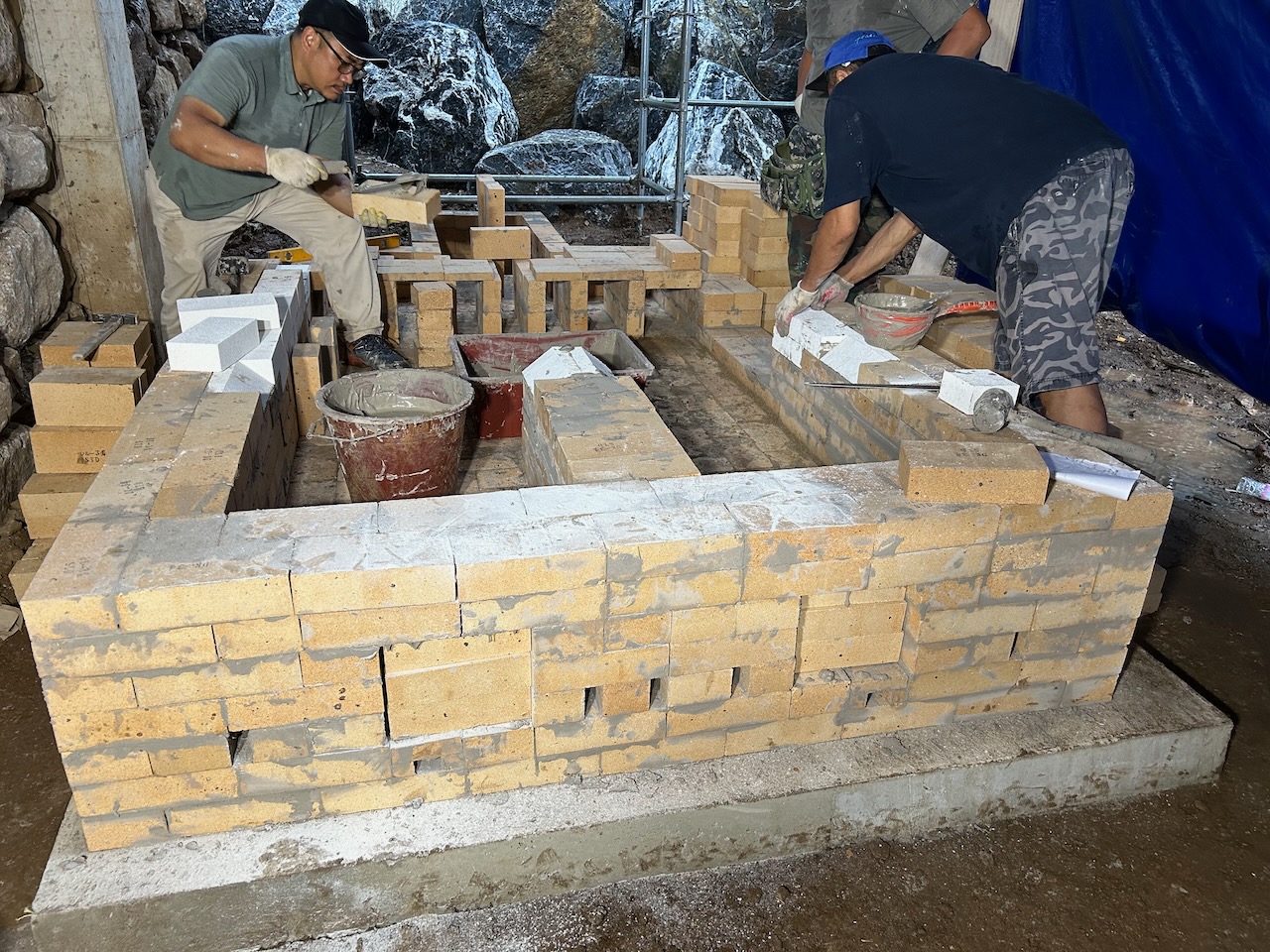
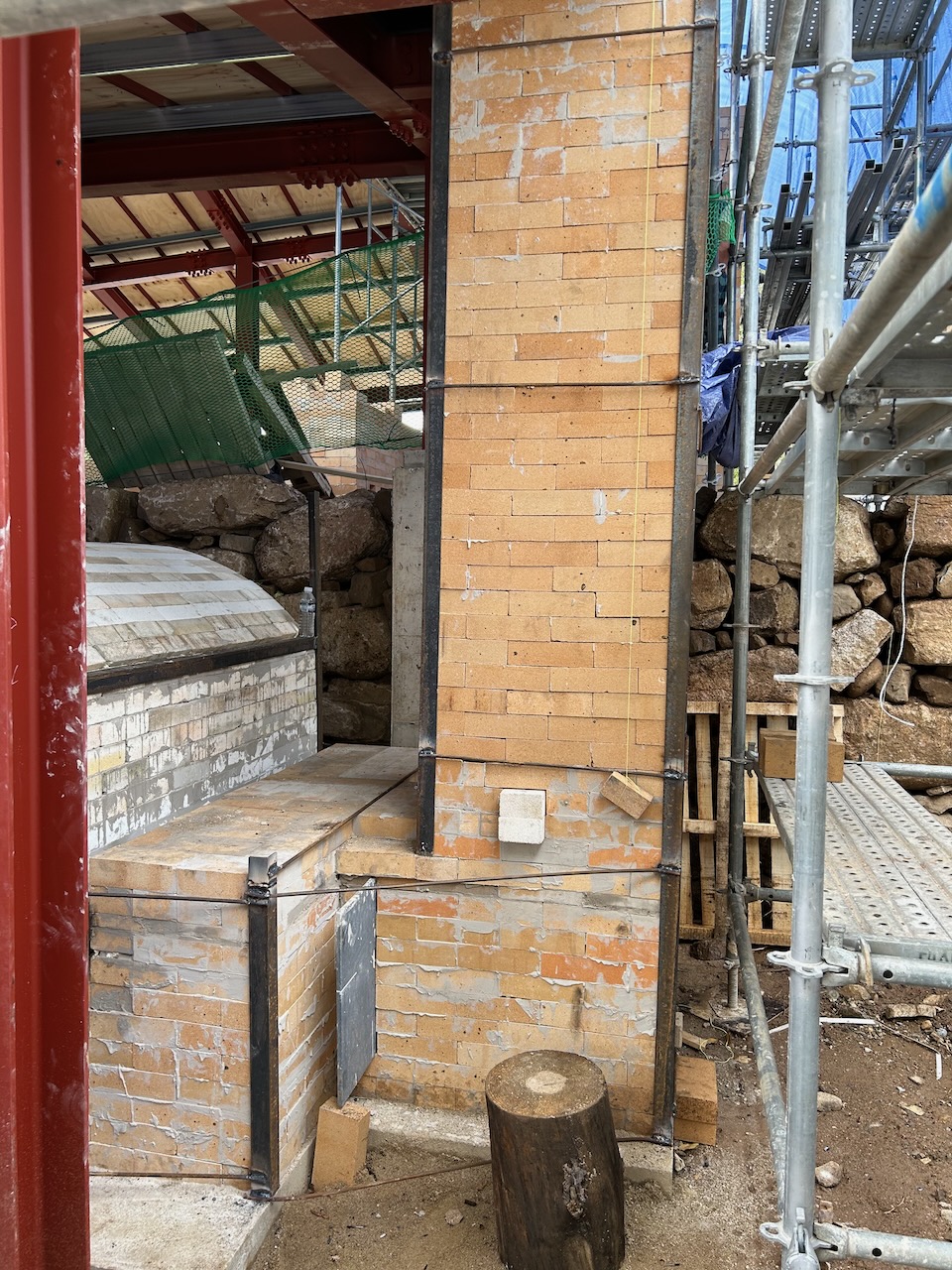
The first day of brick laying, with many helpers goes really fast and I lay out the parameters for the design and using a string line and plumb bob weight, I make sure that the chimney will be directly below the roof opening. This laying out is the slowest part of kiln building. Getting everything square and level before we start. 

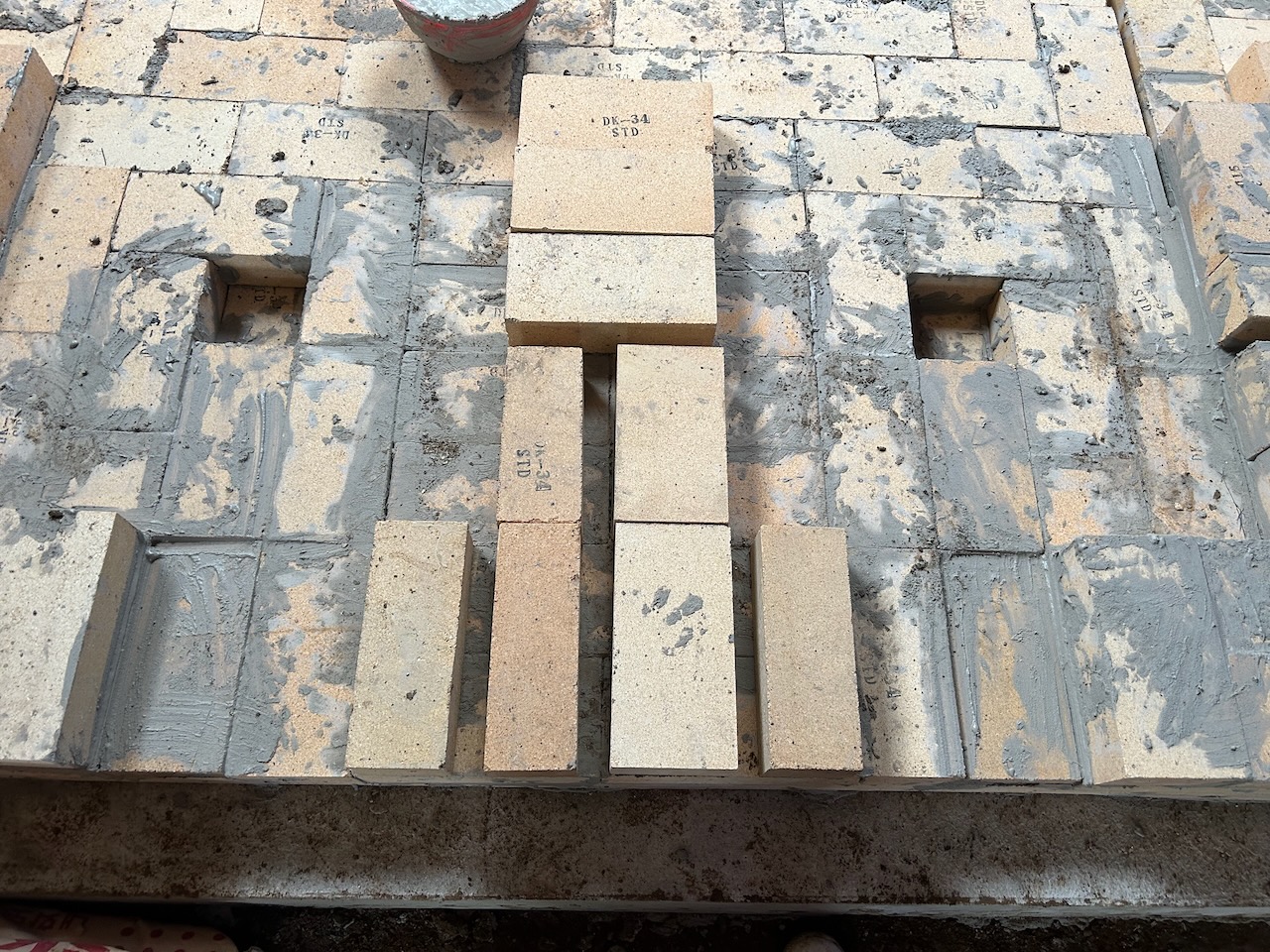
Many hands make light work and we lay the two floor layers in record time. I introduce these Korean professional kiln builders to ‘herring bone’ pattern floor bricklaying technique. They don’t seem to recognise what I’m doing, but using my phone and a translation app, I explain it to them as best that I can, and one of them googles/navers it and announces that it is called herring bone, and they all nod approval, discussing it in detail in Korean chatter as we work. This pattern helps to avoid any straight through cracks developing from left to right or front to back as the kiln shifts and moves as it expands and contracts during its firings. 

2 days later,  I notice that they have decided to use it in the base pattern of brickwork of their kiln foundations as well!

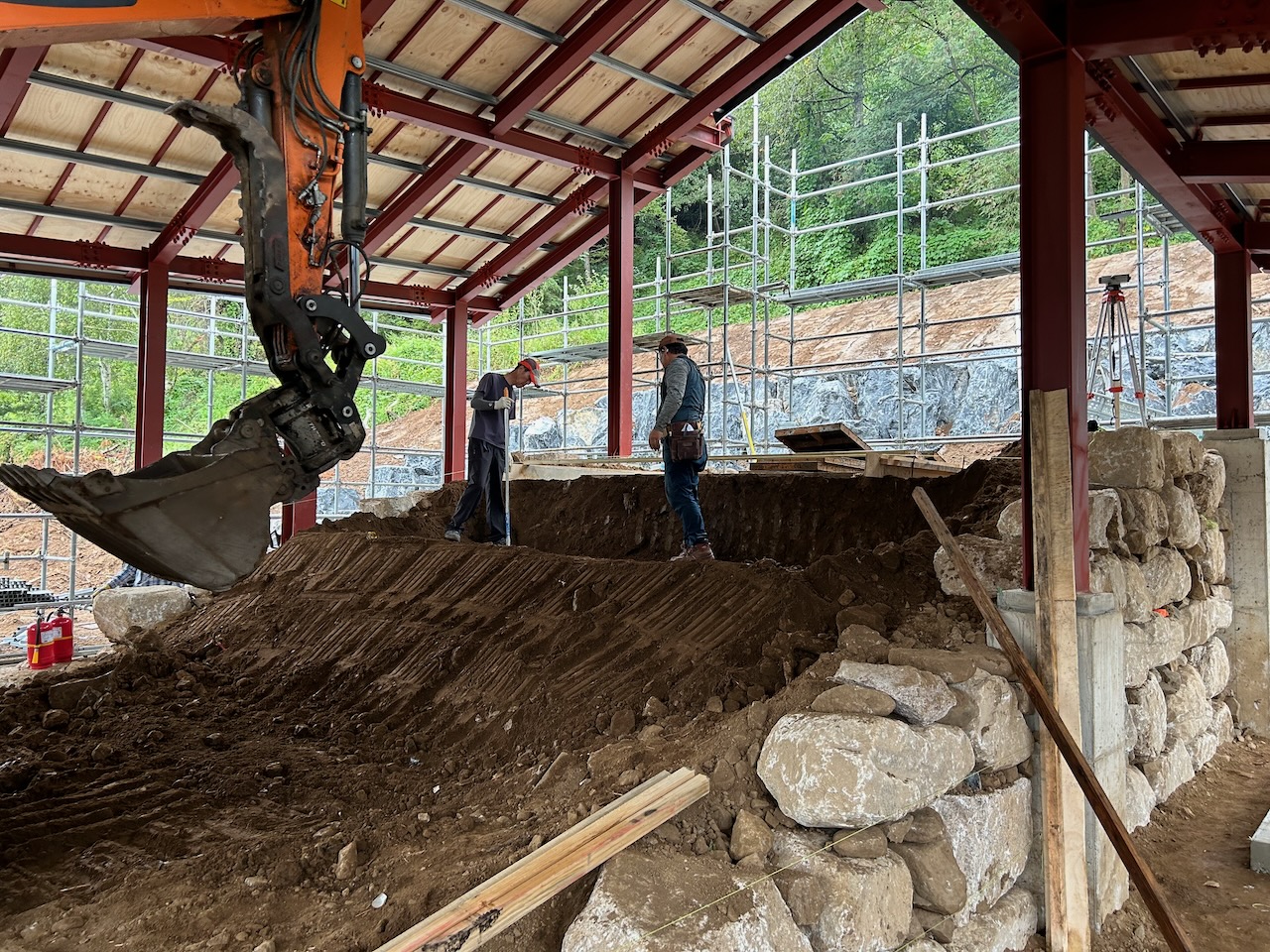
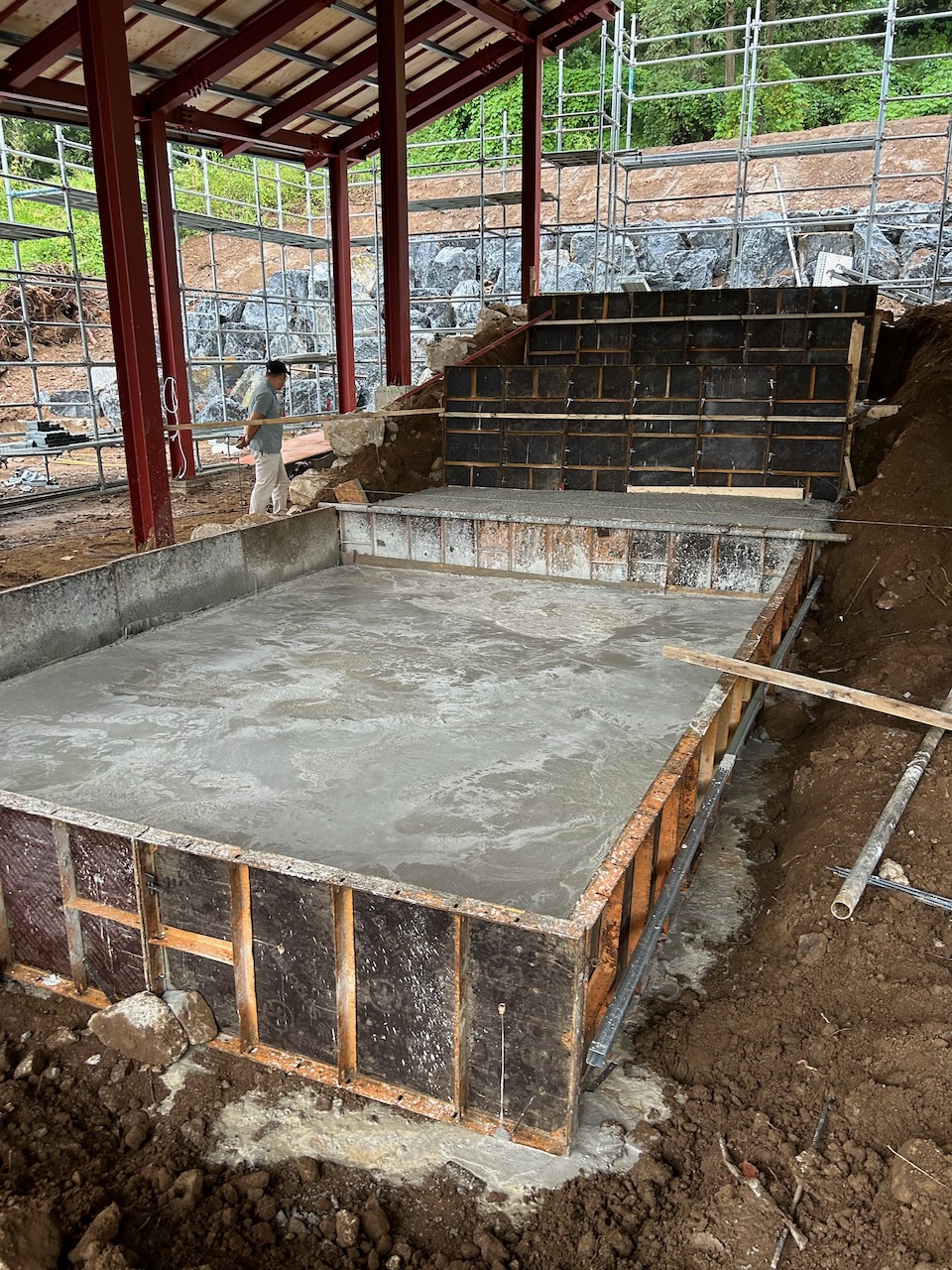
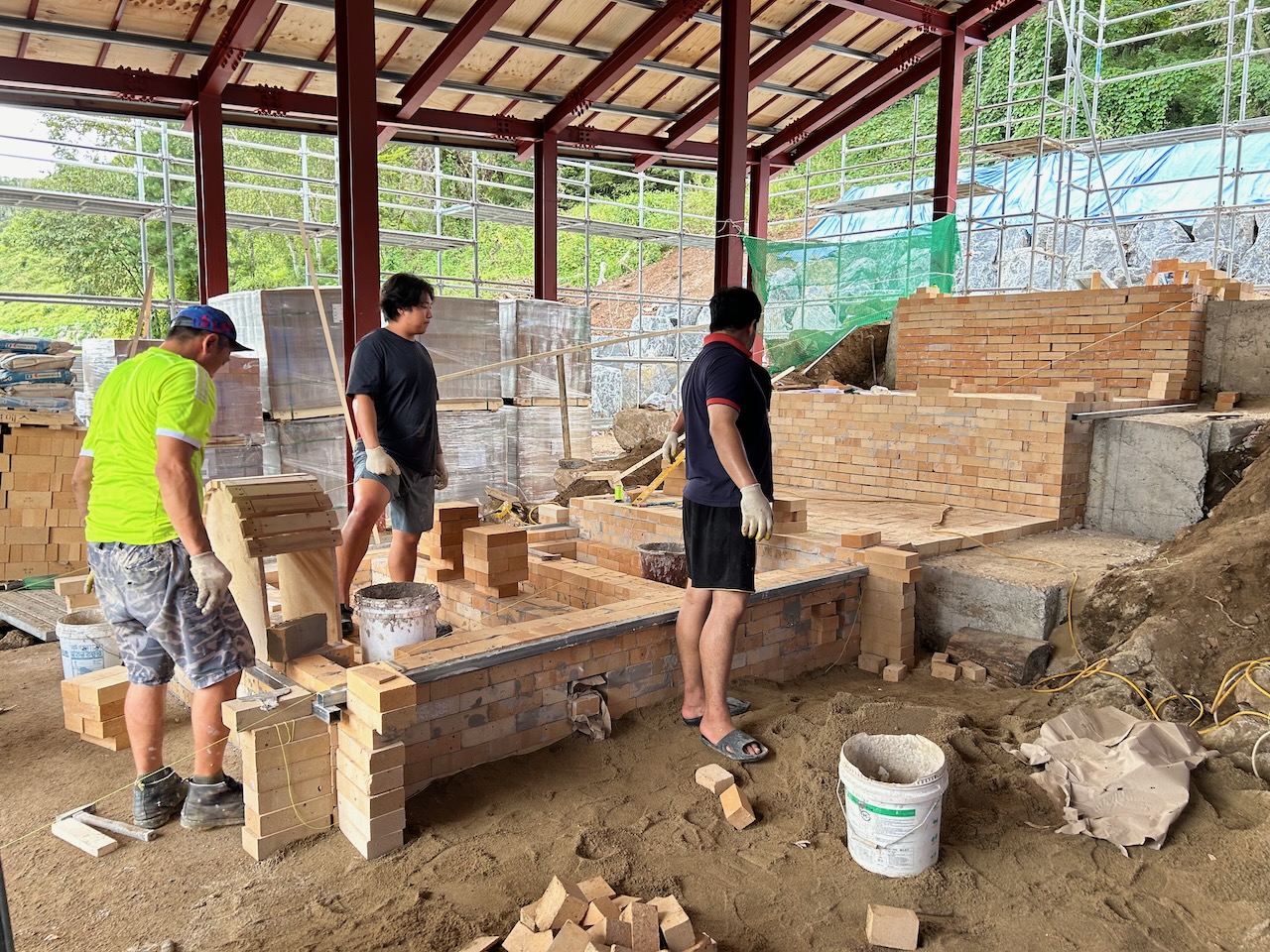
I get this unexpected extra manpower help with my brickwork, as the slab for the big kiln next door is not yet cast. In fact, the local builders are still relocating soil for the earth ramp of the man-made slope and then framing the formwork for the slab. Unbelievably, they get the freshly tamped earth roughly level and tamped down, then all framed-up with formwork and the cement cast by late in the afternoon. I’m pretty amazed by this fast work. However, I do notice that there is no steel mesh used in the slabs, and with it cast on top of freshly placed earth substrate, Will it crack in due course? I have no idea, but hope for the best. These Korean workers sure are fast. Going on this, I can only suppose that there is no steel in my slab either.

I am working flat out, as fast as I can to lay down bricks in their final positions to be laid with mortar seconds later, by one of my several helpers. They are professionals and are so quick. I’m hoping that I don’t make any mistakes working at this speed, as there is no room for any error. It gets particularly stressful when I have to lay out all the mouse holes and tertiary air inlets in under the floor and in the first layer of the walls. They need to be precisely positioned to work effectively, and I have no time to second guess if they are exactly right or not. working with four bricklayers calling for bricks keeps me thinking of four different parts of the kiln at once. Mouse holes, stoke holes, tertiary air inlets, flue holes and the door openings are all required in this first layer, and all at the same time. I’m used to working at a much slower pace and thinking everything through thoroughly. There is no time to think here at this speed. Luckily, I’ve done this before a time or two, so everything goes well.

By the end of the second day, we have the walls well and truely started and up a few courses. I have the luxury of having two of these  enthusiastic helpers dedicated to using both of the diamond saws, cutting the hard fire bricks to special sizes to facilities the special openings that  I need for the tertiary air inlets. These guys have never seen a kiln like this one with so many holes in it. Traditional wood kilns here are very basic in their construction, often, just straight through tunnels, or multiple chambers, one after the other with only the flue holes to think about. They keep asking me how it will all work, and I am at a loss to be able to explain the intricacies of the design to them with my limited Korean and just some charades to do the explaining. It will have to wait until dinner time, when I can get out my lap top and show them some images of finished examples.  Everyone here has a phone with a translation app. I’m constantly turning round to face a phone screen to talk into, to give yet another explanation of a detail in the brick laying pattern.

I briefly have these 7 blokes on my team, and there is just one bloke stripping the form work and measuring the step dimensions and figuring out the layout for the big North Korean designed kiln next door. The cement slab is still fresh, soft and still very wet.

The next day, They are all going flat out on the big kiln, sorting out the necessary steps up the slope and making sure that the first layers will match the brick dimensions needed to align with the next step of brickwork. It’s a massive job. The kiln will have 5 chambers and a huge firebox with two arched openings at the front. They waste no time, and with 8 skilled workers the job flies up.

I am left to work on slowly on my small kiln, with occasional help from one of the bigger kiln team and someone to cart bricks and cut special shapes on the diamond saw when necessary. We work well together, and there is a lot of laughter, good natured banter and good will towards me. At the end of each work session, there are more questions about how it will work. I suspect that they think that I’m a bit mad, or at least quite quirky, expecting the fire to burn up-side-down and not roast my head off as a soon as I open the stoke-hole lid in the top of the fire box. Fire always burns upwards in their experience.

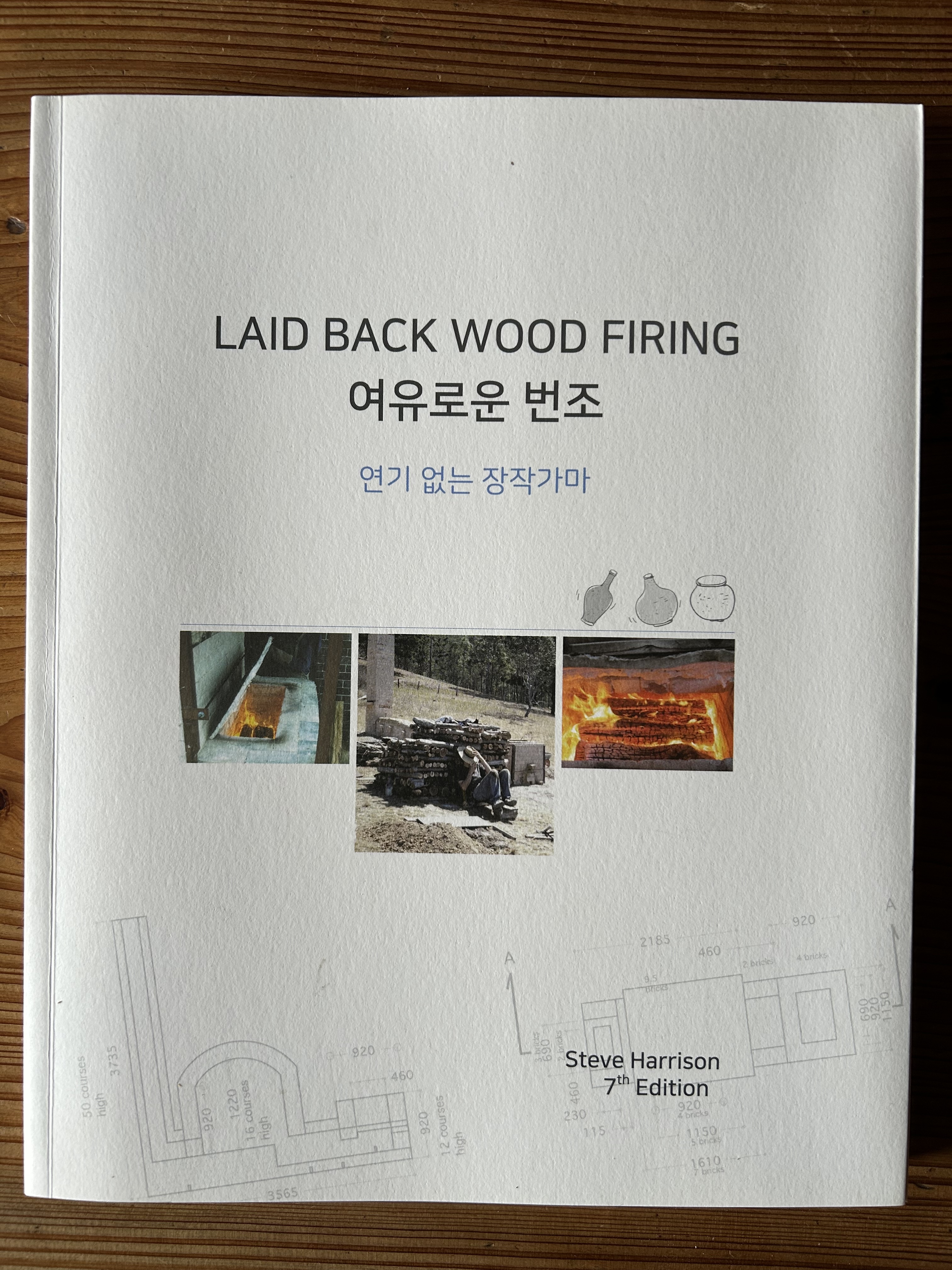
None of them has read my book on downdraught fire box kilns that The Director here of the Research centre has had translated into Korean about 5 or 6 years ago. Not a big seller apparently, among the traditional wood kiln building community?

I ask Mr Jung, The Director of the Porcelain Museum and Research Centre, to bring a copy of the book over to the kiln site, the next time that he visits, he does and it is passed around at morning tea time. A couple of the guys flip through the pages, but I don’t think that any one actually reads it in any detail. After dinner, I get out my lap top and show them images of other projects like this one to help explain what I’m try to achieve.

I build an arch formwork and set it in place on a stack of firebricks, using hand cut special wooden wedges that I place on top to adjust the formwork to the exact level needed, and also to allow me to pull them out and drop the wooden form work down free of the finished brick arch, to allow me to slide the formwork out of the chamber. This excites a little bit of interest in a couple of the bigger team, as they don’t appear to have ever seen this before. 

I have read in older books, perhaps Leach’s Potters Book? That they just leave the form work in place in the big oriental kilns and burn it out later, before the first firing. I though that this was a bit wastefull. So I have never done this, always removing the formwork to be used again in another kiln in the future. When I tap out the wedges and drop the form work, there is a little intake of breath and a smile from Mr Kim who is assisting me at the time. He smiles broadly and taps me on the shoulder, thumbs up. He’s impressed. word spreads and my position in the social order rises slightly. At dinner, some one asks me how old I am. I tell them I’m 72, nodding all round. From this time onwards, I’m always ushered through doorways first and given the front seat in the car when we go somewhere. I’m accepted as one of them as a professional kiln builder, but I’m also the oldest member of the team. So as such I garner a little bit of extra respect as well.

I finish the brickwork on my kiln by the end of the week and start to engage with all the multitude of little jobs that are needed to complete the kiln. I need make a load of ceramic buttons to attach the ceramic fibre insulation to the firebox lids. I also need to get a local company to cut and fold some thin stainless steel sheet to make the fire box lids.

I ask to be given a lift into the bigger nearby town of Yanggu, to buy steel angle iron and round bar to weld on the bracing. It all goes pretty smoothly, and in a couple of days the kiln is all braced in steel. Using a little portable stick welder I slowly work my way around the kiln, cutting and fitting the pieces together. I haven’t used a stick welder for 20 years. I’m a bit rusty on it, but it soon comes back to me. I’ve only used much more modern MIG and TIG welders in my kiln business for the past couple of decades. I have been spoilt by their speed and convenience, but I manage.

In some miraculous way, I manage to weld the 10mm dia. steel rod handles onto the 0.8mm. thick, or should I say thin, stainless steel sheet lids, using the little stick welder. This isn’t normally possible. The heat needed to melt the 10mm steel handle, is far too hot for the thin sheet and would normally burn a hole clean through the thin sheet. I’m aware of this, so prefabricate a small piece of angle iron backing plate that I clamp inside the lid to absorb most of this excess heat. I do burn a couple of small holes through here and there, but mostly it works well and I get the impossible done before lunch. More kudos from the pros on site.

 They are treating me as an equal. It’s turning out to be a very good job.

K-pot Journal

K-pot Journal

There is a world-wide phenomenon in international popular music that has taken the world by storm in the past decade or so called K-pop. A style of popular Korean music, loosely based on traditional Korean music styles, but greatly influenced by loads of Western music styles like hip hop, R&B, rock, jazz, even gospel, reggae, electronic dance, folk, country, disco, and classical. Every body seems to know about K-pop, this Korean cultural export.

I don’t know much about K-pop and Korean popular music, I come here to study ceramics, so I thought that I’d call this blog K-pot! On my first visit to Korea, 8 years ago, I wrote a blog called ‘The Kim-chi Chronicles’ (Sept 2016), This blog is its latest incarnation.

This is my 7th visit to Korea, since I first came here in 2016. I was here only 6 months ago for a ceramics conference, where I presented a paper on low emissions wood firing. This involves using a kiln with a downdraught firebox (Bourry box) which is capable of firing with relatively little smoke. Of course there is always some smoke when burning wood, but this style of kiln design keeps it to a minimum most of the time.

In Australia, where I have done most of my research, I use hard wood, eucalyptus trees for fuel. Eucalypt hard woods are heavy and dense. They burn slowly and steadily. Perfect conditions for low smoke emissions. Here in Korea, they have a lot of different softwoods in the form of pine trees/conifers. They burn fast and furiously, so it is a challenge to minimise smoke during firings.

People here have asked me what is the secret addition that you have incorporated into the kiln? As if there is some sort of afterburner, that they can add to their own kiln to clean it up. There is no secret addition! It is a complete kiln design incorporating the virtues of the down draught firebox that burns the wood more or less in stages, so that there is no intense emission of volatiles that causes smoke in most other kilns.

So I am here again in Bangsan, in the Yanggu Porcelain Village, this time not as an artist-in-residence, as I have been in the past, but as a kiln building tradesman, a glorified refractory bricklayer. I have been tasked with the job of building a small kiln here that demonstrates that wood burning kilns can be fired with a minimum of smoke.

This project was first floated way back in 2018, when the director of the Yanggu Porcelain Museum and Research Centre, Mr Jung Do-Sub, asked me if I would be interested in such a project. The Museum had purchased the rights to publish my book, Laid Back Wood Firing, and had it translated into Korean. They have also published my other books ‘5 Stones’, and ‘Rock Glazes, Geology and Mineral Processing for potters’.

Unfortunately, The translator took someone else’s advice and renamed the book “Smokeless Wood Firing”. Which is of course not true. all wood creates some smoke when being burnt. My project is to keep the smoke to a minimum. Calling the book ‘smokeless woodfiring’ only creates false expectations, and room for criticism and disappointment.

As a result of the books’ publication, there was some interest in getting one of my kilns built at the Yanggu Research Centre as a demonstration model. Like other places in the world, There is a growing interest in cleaning up the environment, at least from the grass roots level, not from there polluting industries, who are being dragged kicking and screaming to be made to be kept to account. It is this citizen-lead interest that is putting pressure on political leaders to make some sort of gesture to seem to be doing something, while still taking large donations from the polluters to keep the status quo.

The result is a very slow transition to clean up the environment. The results can be seen here in this tiny, remote village. When we were last here before ‘Covid’, in early 2019. The streets were being dug up and gas pipe lines being installed to every home and business. Previously, most home heating and commercial cookery was being done using pressed coal briquettes. Dirty, inefficient and polluting. The immediate result is much cleaner air.

These days the smoke from the wood fired kilns looks just as polluting, now that the residents have paid to have cleaner gas installed, to eliminate their smoke, why shouldn’t the residents want cleaner air, and less smoke pollution from every source? The traditional kilns here are very smokey, producing black smoke all the way through the firing schedule, from start to finish, particularly at the end of the firing, when the extra chambers of the climbing kilns are being fired by ‘side stoking’ methods.

There are two climbing kilns here in the centre of the village behind the research Centre and Museum. One of them right next to an ancient kiln site, where porcelain has been made since the beginnings of porcelain making here, hundreds of years ago. With an ancient tradition of pottery making here in the village, using these old kilns going back many hundreds of years, it’s hard to suddenly say NO! Just stop doing it. So the Director of the Museum, was thinking a decade in advance of this possible occurrence.

He managed to secure access to an abandoned military base, a few kilometres out of town, up a small valley, well out of the village, where a new

Smoke from one of the traditional kilns here.

‘Porcelain Village’ is being built. When I first arrived here 8 years ago, in this new development, the buildings were still very new and my room still smelt of fresh paint, and all the facilities were still being installed in what had been the officers quarters. One of the stone barracks was being converted to a meeting room and coffee shop. The Museum director had big plans to build several different styles of kilns out here to add to the research facilities available to the students. That has since then, mostly all come to pass. However, the plan keeps changing and expanding and getting more complex.
The Museum Director is a very smart guy, a good strategic thinker and politically very savvy.

The first kiln built up in the valley was a tunnel kiln. I didn’t see this kiln being built, as I have been away for 5 years because of the COVID lockdown, and then the huge catastrophic bush fires that burnt our pottery. It has taken me 5 years to recover, so that I could finally accept Mr Jung’s offer to come and build them one of my kilns.

The second kiln built here was a traditional low-firing, earthenware wood kiln, the design of which, originated in Jeju Island off the far South Coast of Korea. It is built out of basalt stones. The only available material on Jeju Island, so is limited to very low firing temperatures. A kind of tough earthenware.
Hand made fire bricks stacked to dry in front of the Jeju basalt stones kiln

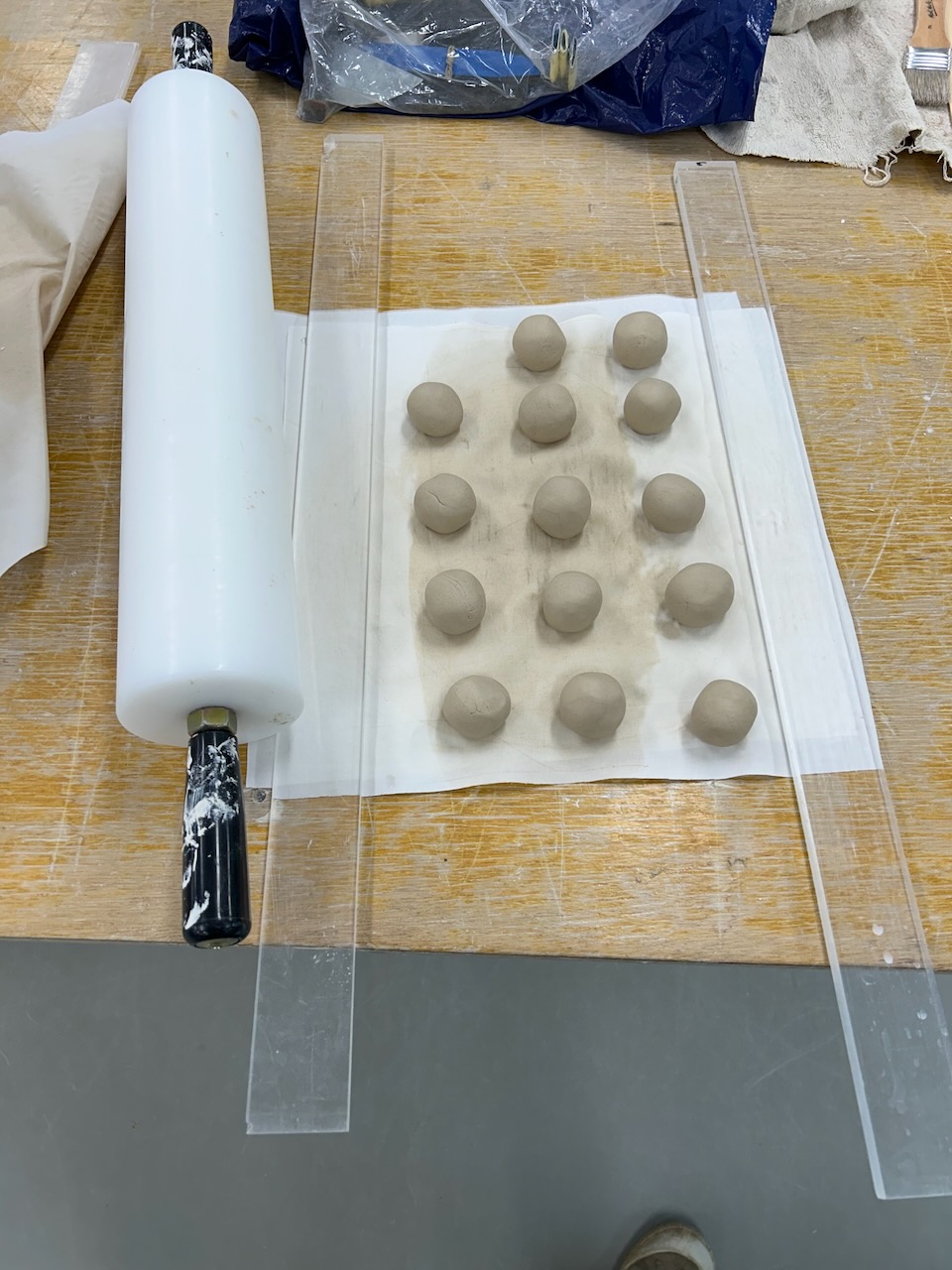
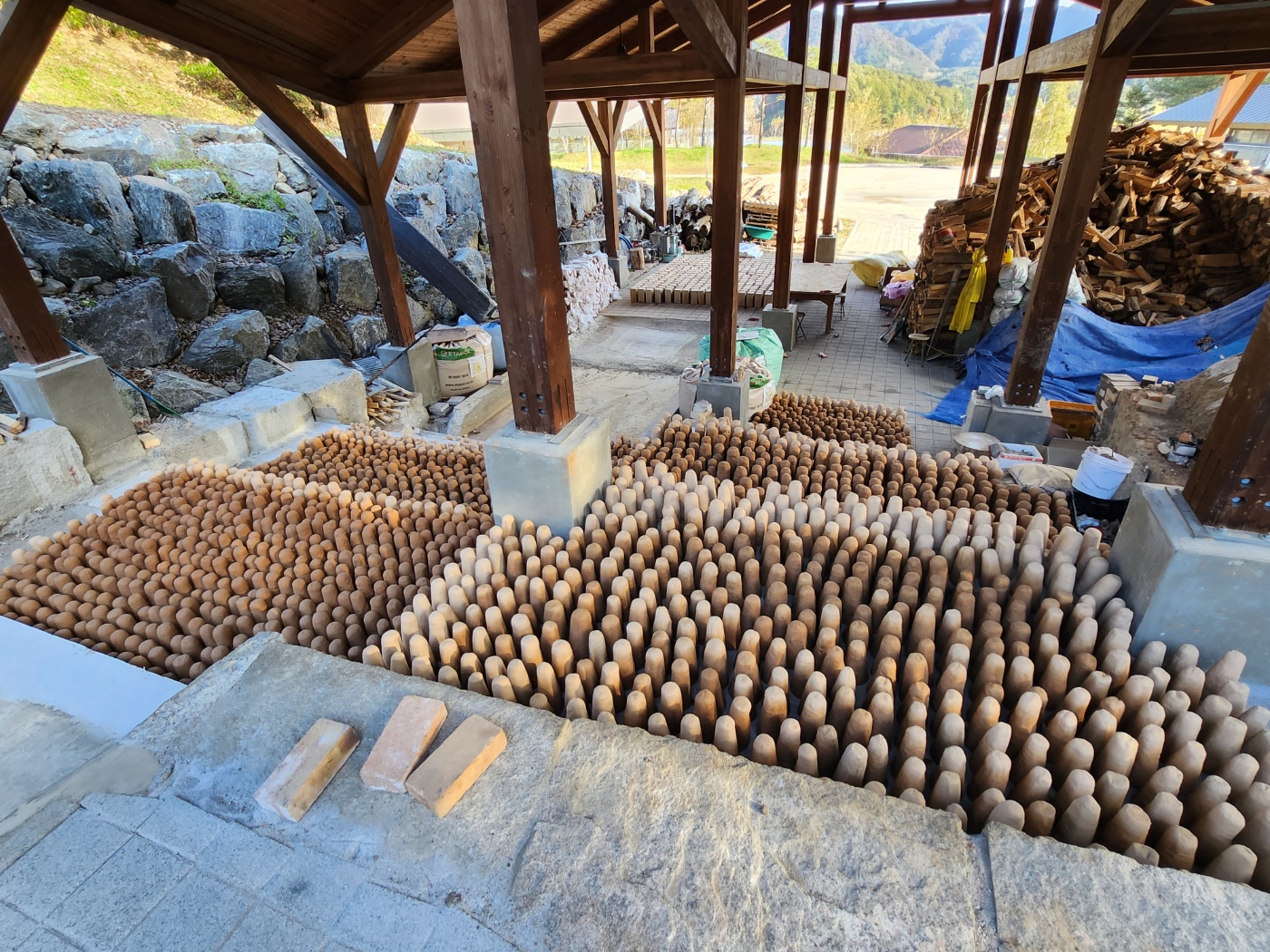
The third kiln built here was a traditional 5 chambered climbing kiln, built almost entirely out of hand made blocks and bricks for the walls, and hand rolled cones of local fire clay for the dome and arches.


Hand made clay cone shaped bricks set out to dry in the kiln shed.

The 5 chamber domed climbing kiln getting ready for its first firing

There are 3 independent, self contained workshop/residencies for artists and their families, and another building with 4 bedrooms and 4 studios, suitable for single student residents. Each of the studios has it’s own electric kin and pug mill. There is a huge communal clay processing and kiln firing building with 2 large gas kilns, and finally a very large conference/residence building that can sleep up to a dozen people with large multiple bathroom, toilets, and even a sauna and laundry.

As far as I can ascertain, all the residents/students here have already completed MA hons degrees from their university, and have come here to study for up to 5 years to gain their PhD in porcelain research. It appears that they get rent free access to all the facilities here and only have to pay for their gas and electricity bills. An amazing deal. Such great support for the Arts here! In exchange, they are expected to take part in communal activities like the making of the hand made fire bricks for the last kiln built here. or making the years supply of small test tiles for glaze testing.

There are plans for the local government to develop and sell off several privately owned and developed house and pottery studio sites, next to the research facilities. There may be up to 8 or 10 of these house sites. 2 of them have now been taken up, and buildings are currently underway. It will become a small porcelain village and creative community.

My wood fired kiln is small compared to the vast climbing kilns here. But it is actually quite a large kiln of 85 cu. ft. or 2.5 cu. m. Very large for a single potter to fill regularly in Australia. However, I expect that it will be filled by group effort here, just like all the other big kilns. Mine will be the 5th wood kiln to be built on site here. A demonstration model of what might be possible in terms of reducing smoke pollution in wood firing, while still achieving reduced stoneware wood ash effects.

I only hope that it all goes to plan, However, I am mentally prepared to accept some smoke, as all the wood here is very dry pine, that will burn intensely, so I will have my work cut out to get a good clean result. I will be severely embarrassed if it all ends up going pear shaped in the firing. So far the kiln looks good and is built to the specifications that I usually rely on when designing similar wood kilns. But knows what will happen when I fire it with very dry pine fuel. I can only guess, but I imagine that there will be some smoke.

My finished kiln with 2 Bourry style downdraft fire boxes side by side.
Ready for K-pot firing. I have to wait and see what my decisions were like.

Tea bowl exhibition in Seoul, Korea

I currently have one of my bowls in a tea bowl exhibition in Seoul, South Korea.

This bowl was fired at the front of my wood fired kiln. During the firing the ash glaze ran just a little bit too much and stuck the bowl to one of its pieces of wadding. Luckily, I was able to chip it off without breaking the bowl. I repaired the damage using the ancient Japanese technique of ‘kintsugi’, using gold to repair precious pieces of ceramic.

Using pure gold to repair a damaged pot shows respect for the item. It honours the piece by giving it time and resources, and finally finishing it off with a coating of pure gold. By showing it respect, I choose to give it a greater value than it would have had, if it had come out of the kiln intact.

The pot is damaged, but it is still beautiful. It has Value, and it is Unique. It is Honoured even though it is Damaged. It’s possible that repairing a damaged thing can make it more beautiful and precious than if it hadn’t been through its ordeal.

I see these damaged and repaired objects as self portraits. I went through an ordeal and although I was damaged, and am not the same, I am still working. I’d like the think that I’m also improved by the experience, although I’m not too sure about that. My pots that I repair are certainly more beautiful, interesting and valued.

Kiln Firing in Korea

Janine and I are recently returned from Korea where we were invited to take part in the Mungyeong Ceramics Festival, where I delivered a paper to the ceramics conference there about low impact wood firing.

My paper concentrated on my research into small down draught fire box design, intended to minimise smoke and pollution as much as possible. I also presented my current work on afterburners and scrubbers to try to minimise particulate pollution from our kiln chimneys.

I believe that these topics will become more important over time as Global Heating and carbon in the atmosphere starts to become obvious and difficult to ignore. Even to conservatives.

My paper was well received and I got some good interrogation during the question time afterwards. My book ‘Laid Back Wood Firing’ was  translated into Korean about 5 years ago and has been available there for some time, so some people there had read it and were up to speed with the concept.

Janine and I will be returning to Korea later in the year to build one of my small Bourry Box kilns as a demonstration of how it can work. It will be built alongside several older traditional wood fired kilns. They are interested to compare the smoke from our firing and also the fired results afterward with that from the traditional kilns.

The most recently built, traditional, multi-chamber kiln was fired while we were there. It smoked all the way through the firing. I’m pretty sure that we can do better!

Its a really beautiful kiln to look at, and is constructed using the very old method of using cone shaped hand made ‘bricks’.

The cones were all made on site by the students/residents in the ceramic research centre at the Yanggu Porcelain Village.

The use of cone shapes allows for a rather nice dome shaped top or 3D arch over each of the fire box and 4 chambers.

The freshly built kiln took just 24 hours for it’s first firing – all 4 chambers to stoneware, absolutely no technology was use. No pyrometers or cones, just an experienced firing crew and home made draw trials of glazed tiles pulled at 30 minute intervals after orange heat.

This kiln was so new, it was still wet, and steam was coming out of all the cracks all the way to top temperature.

Side stoking is always a dirty business. Hard to get around that. It’s the nature of the beast.

That is why I have chosen to build a single chamber bourry box fired kiln as the demo model.

It will be a larger sized chamber, so I have designed it with 2 fireboxes side by side.

Only time will tell if it works the way I intend and if it impresses them.

When you are in Seoul and the air quality is rated as ‘fair’, but you can only see for 1 km through the smog. I makes you think about what a bad day might be like. Smoke from wood firing is not the big problem in the scheme of things.

But every little bit counts.