The summer heat arrives

We have been suffering 30 degrees in the shade, each day for the past couple of weeks now, with only occasional respite for a day or so, then back the the heat again.

The heat has brought on the stone fruit. We have now finished all the apricots, and are half way through the plums, with the peaches just beginning. We diligently went through the stone fruit orchard a few times during spring, picking off a lot of the small emerging fruit, before it got too big. 

It takes a lot of weight off the small, thin branches of these young trees, but also allows the remaining fruit to grow larger. There are just two of us here, so we have all the fruit that we need for a couple of months.

In the vegetable garden, the asparagus is almost finished its first full flush of growth, we now have just occasional spears shooting up. We collect them over a week or so in the fridge to get enough for a meal these days.

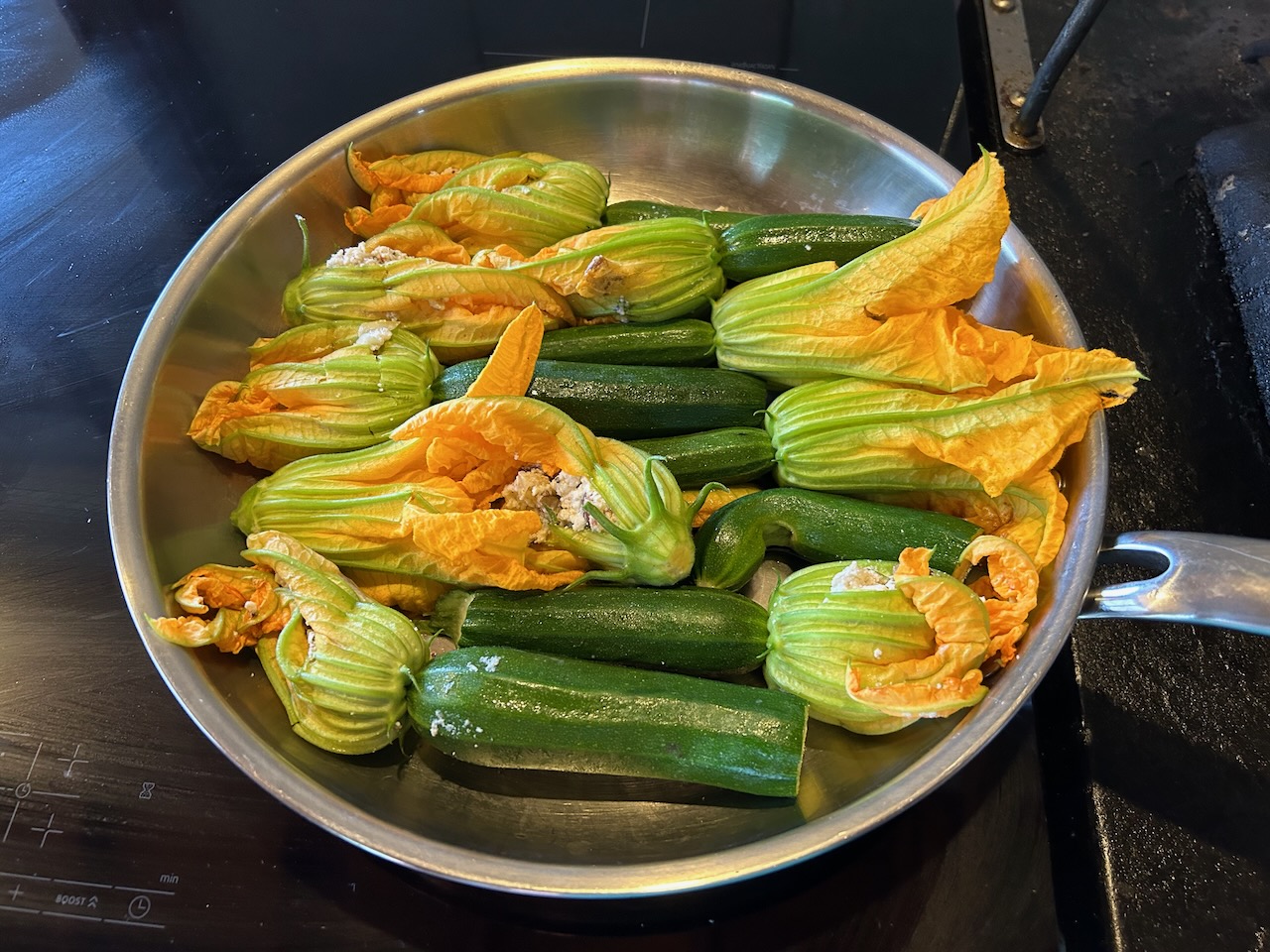
The zucchinis are in full flower now. They are the first of the summer vegetable plants to come on. I make an effort to pick the small emerging fruit as soon as it flowers. I pick the fruit with the flower still on and use them for stuffing.

I stuff them with a mixture of mostly ricotta, but with added gorgonzola, diced fetta, plus a few capers, olives and artichoke hearts. Then pan fry them for a few minutes and finish them off by steaming them with the lid on and a splash of white wine.

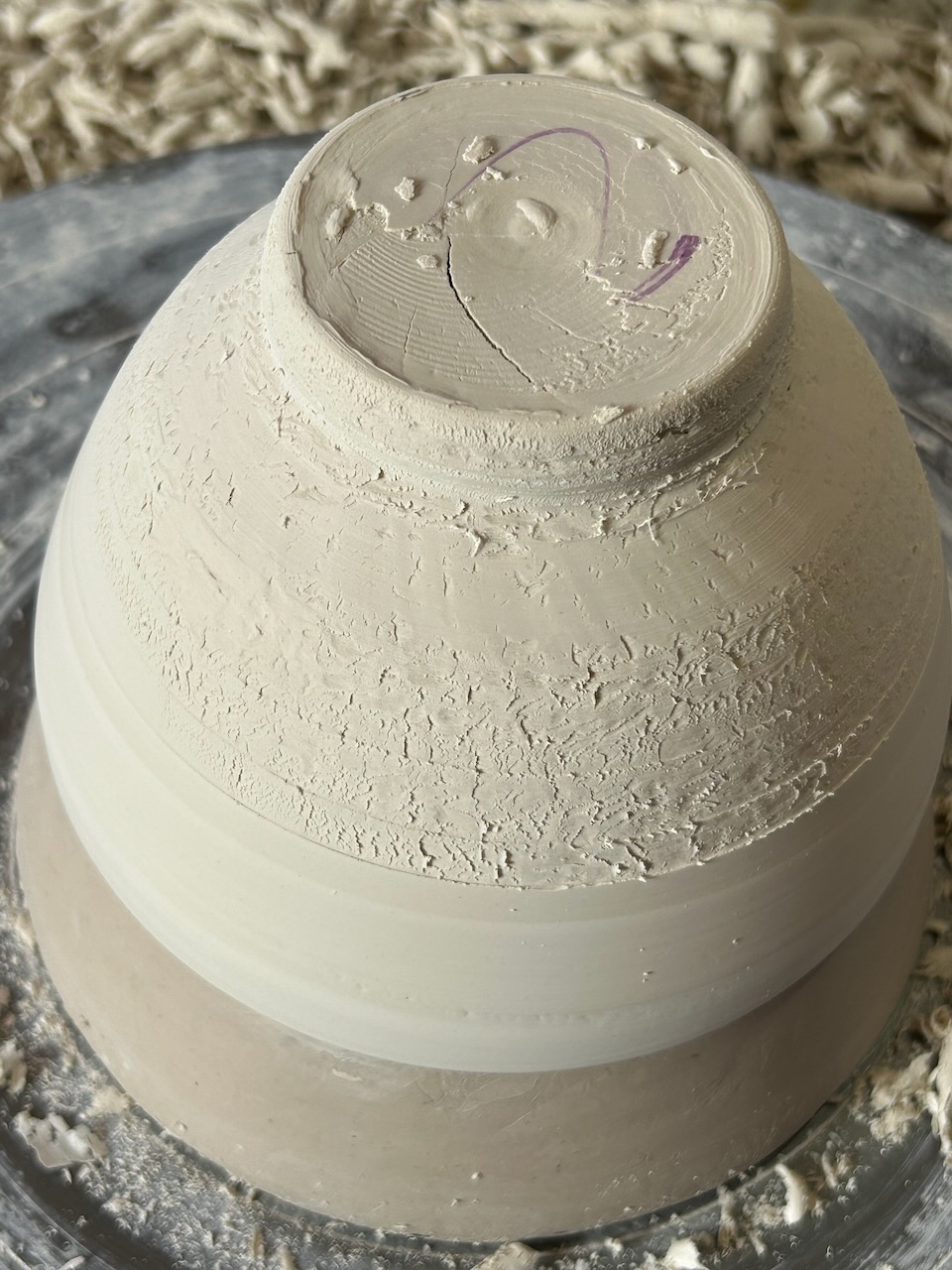
We are usually up very early to do the garden work, before the heat sets in, watering, weeding, harvesting etc, then breakfast. We spend the rest of the day keeping to the shade, under the verandah, or inside the pottery shed, out of the heat. This week, I’ve been making clay for the summer school workshops. Mixing, Pugging, blending, and twice pugging, bagging, and then cleaning everything up and mopping the floors spotless. Ready to go again.
Two batches = 250kgs of plastic clay. It’s a big job and takes all day, sometime it’s two half days, with a break over night to recover from the heavy lifting of the 25kg bags of raw material.

I’ve had my old dough mixer for over 45 years, and re-built it twice after fires. It came from a bakery that closed down in Western Sydney out near Parramatta. In it’s first incarnation, I ran it using a petrol engine. Then after the first fire here, I converted it to a 3HP single phase electric motor, with a loose fitted belt as a safety ’slip-clutch’. It is now properly set up with a 3 phase, 5 HP electric motor.

It’s a beautiful old thing and I’m proud that I have been able to rebuild it twice after each fire and keep it going all these years. I still have to make another couple of batches of clay, as we have been over-subscribed for our summer school, and will now be running it 3 times in a row, with a waiting list for another on the way.

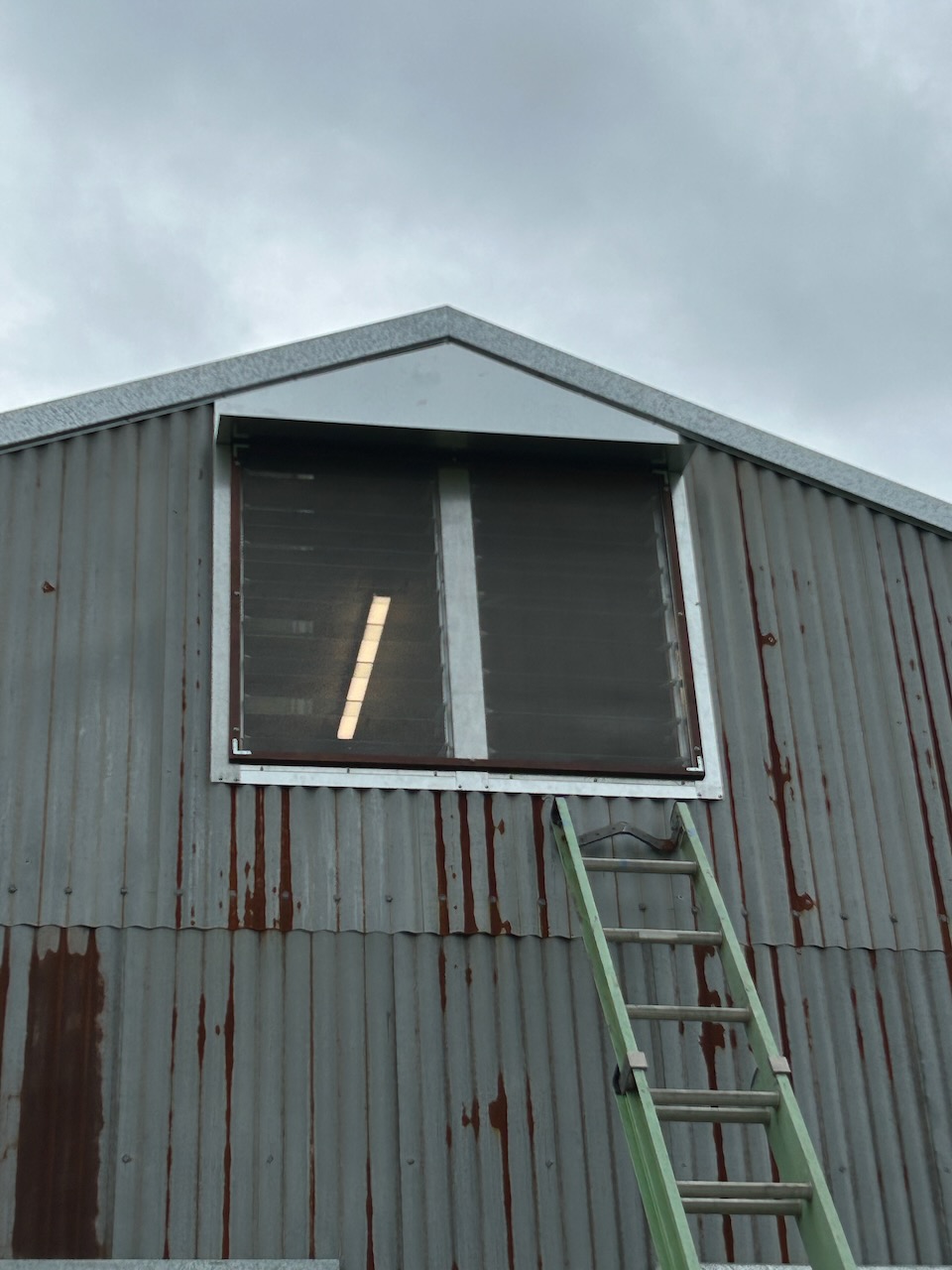
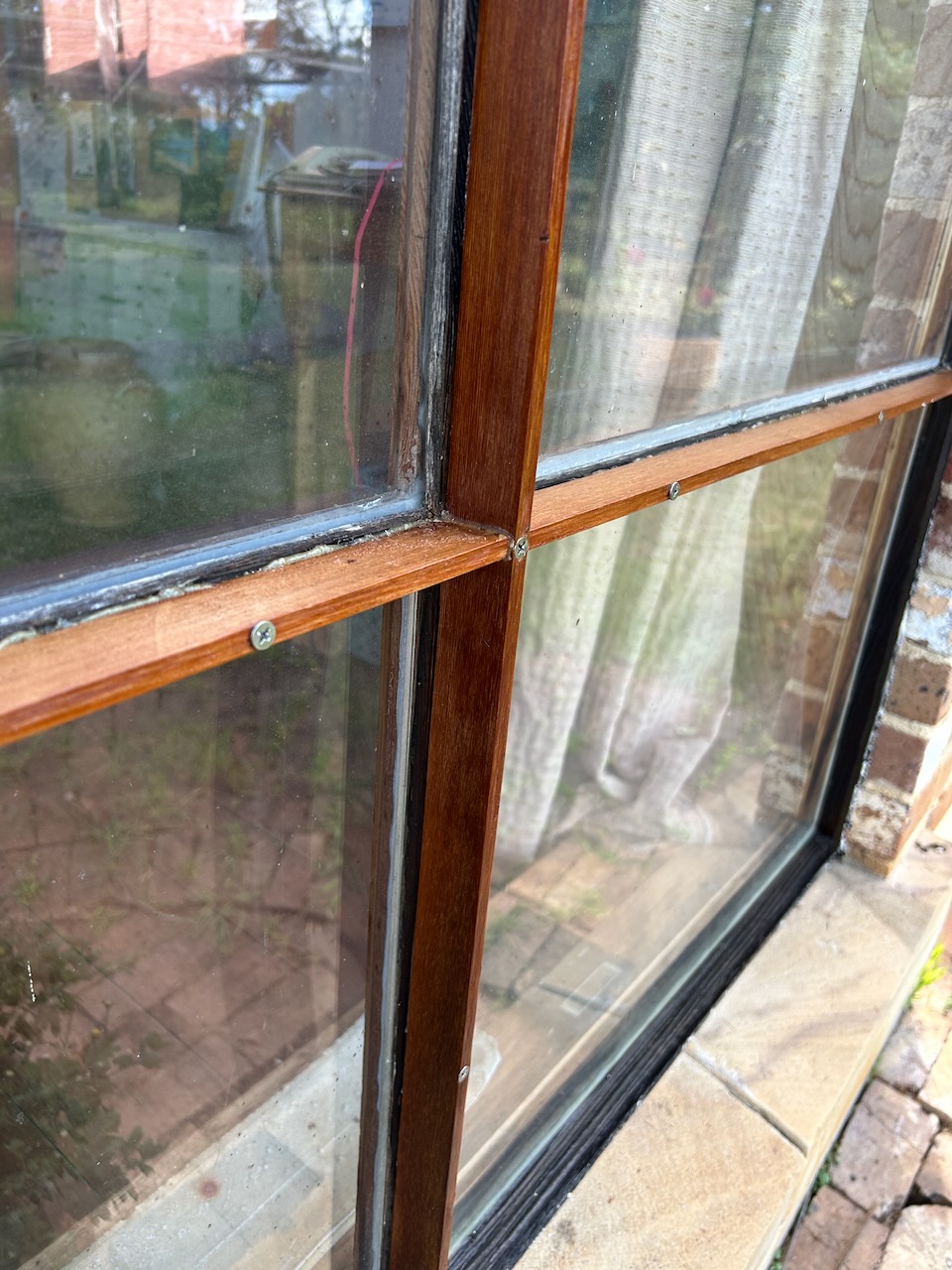
Last week I finally got around to building the stainless steel mesh fly screens for the front windows on the pottery.  I bought the roll of mesh soon after building the pottery, 3 or 4 years ago. But then it rained for the next 4 years, so there was no risk of bush fire for a few years. Now I have finished a lot of the other jobs that needed to be done to finish the pottery. I have finally got my self back to the window fly-screens job. I found that I had some left over ‘merbau’ hardwood decking planks, that I have used to make all the door frames. It has some sort of fire rating and is allowed for door frames. I rip-sawed it down to thin strips and them planed them smooth to make fine battens to hold the SS mesh in place. This will stop sparks getting to the cedar windows when the next fire comes. Hopefully i will be here to start the fire pumps and run the sprinkler systems that I have installed all along the western faces of all the buildings here.

The windows needed to be thoroughly cleaned and then re-painted, to bring them up to scratch, before they would be hidden, and inaccessible behind the fly-screen. It turned out to be a three day job, working only in the mornings, as the afternoon sun beats down on the verandah in the afternoons.

I made home-made gyoza for dinner and spent the afternoons inside the workshop cleaning and restoring the old platform scales that we used to use in the old pottery for weighing heavy bags of raw materials up to 100 kgs. These platform scales were bought at the closing down sale of ‘Coty’ cosmetics in Surry Hills in 1978. They got badly burnt in each of the fires, but are made mostly of cast iron. The damage this time was pretty severe, well beyond me to do anything with then at the time. Just after the fire I had too many very important jobs to do to get us back up and running. I was also pretty run down. But now I’m better and felt ready to give them another a go. Cleaning, grinding, loosening seized parts and then oiling/greasing and re-assembling it all and painting them in traditional black and red livery. The brass work had started to melt and sag. I had to take it all off and hammer it straight again, then polish it back to its gleaming original state.

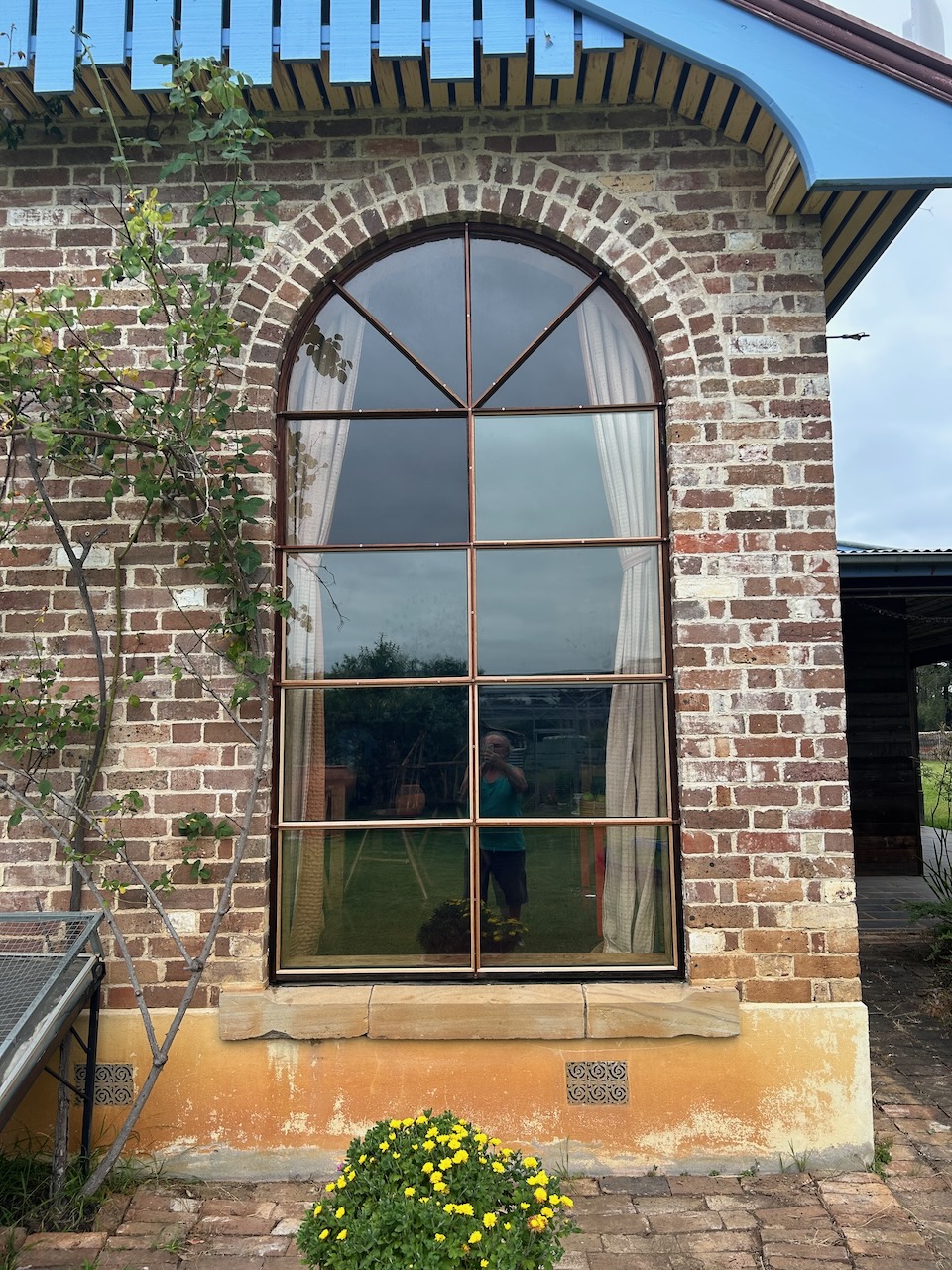
The next big job on my summer list is to replace all the glass panes in the big arch window in the kitchen of the house. I made this window by hand, 35 years ago, without knowing what I was doing, or how to do it. I learnt as I went along. I taught myself how to steam and bend wood to make the big arch top of the window frame. I ended up making the 200mm x 50mm. arch out of 4 different 12mm x 200mm. planks, all steamed and bent at the same time and then glue-lammed together to keep the tight bent shape of the arch. Steaming and bending such big pieces of wood is a two-person job. I was assisted at that time by my sister-in-law Sue, as Janine and her brother were working on some other project together.

I recently commissioned 12 new double glazed and argon filled panes made from metal coated special low’e’ glass. These will replace the old 3mm plain glass that was all I could afford back in the 80’s. I’ve been told that it would cost me in the vicinity of $20,000 to get a custom built window of these dimensions specially made today.

My aim is to try and get my old cedar window frame re-modelled, extended and strengthened to take the thicker and heavier glass before the end of summer, but there is no rush or rigid time frame, it’ll get done when it’s done. Whenever that is.

I have started by extending the old glazing bars with deeper cedar ribs, glued and screwed onto the old cedar glazing bars. That part is now completed. Luckily, I found that I had quite a few old pieces of western red cedar that I could saw down to size and then plane to do the job, so far at no cost. But I did have to buy new stainless steel screws! 

When I built the original window, I used a waterproof window wood glue called ‘resorcinol’, or some word very similar to that. It was eye wateringly expensive and came in very small packets of 2 parts. One of dry crystals and the other of a liquid, to be mixed and used very quickly after mixing. It was stated to be water proof and capable of taking high stress. It has lived up to its reputation. The window is still strong. I haven’t seen it or heard of it for years, so this time around, I’ve used a 2 part epoxy boat builders wood glue. Lets hope that it last another 35 years.
In this hotter weather, we picked our first tomatoes of the season, from self-sown plants. It’s always a challenge to get a ripe tomato before Xmas. The early seedlings that I planted before leaving to work in Korea, all got burnt off in the severe frost in late September.

I’ve been baking extra loaves of bread to give away as Xmas presents. There are always too many jobs and more work than can be done in a day. I come to enjoy a little nap after lunch too, which doesn’t get anything done quickly, but is very nice and relaxing, almost necessary these hot days.

Nothing is ever finished, nothing last for ever and nothing is perfect.

Blackware, Blossom, Black truffles and Brassicas

The nights are getting slightly shorter every day. The dawn comes a little earlier each morning and its now just on light when I wake up.

It a very nice feeling to sense the return of the sun, even though it’s just a hint.

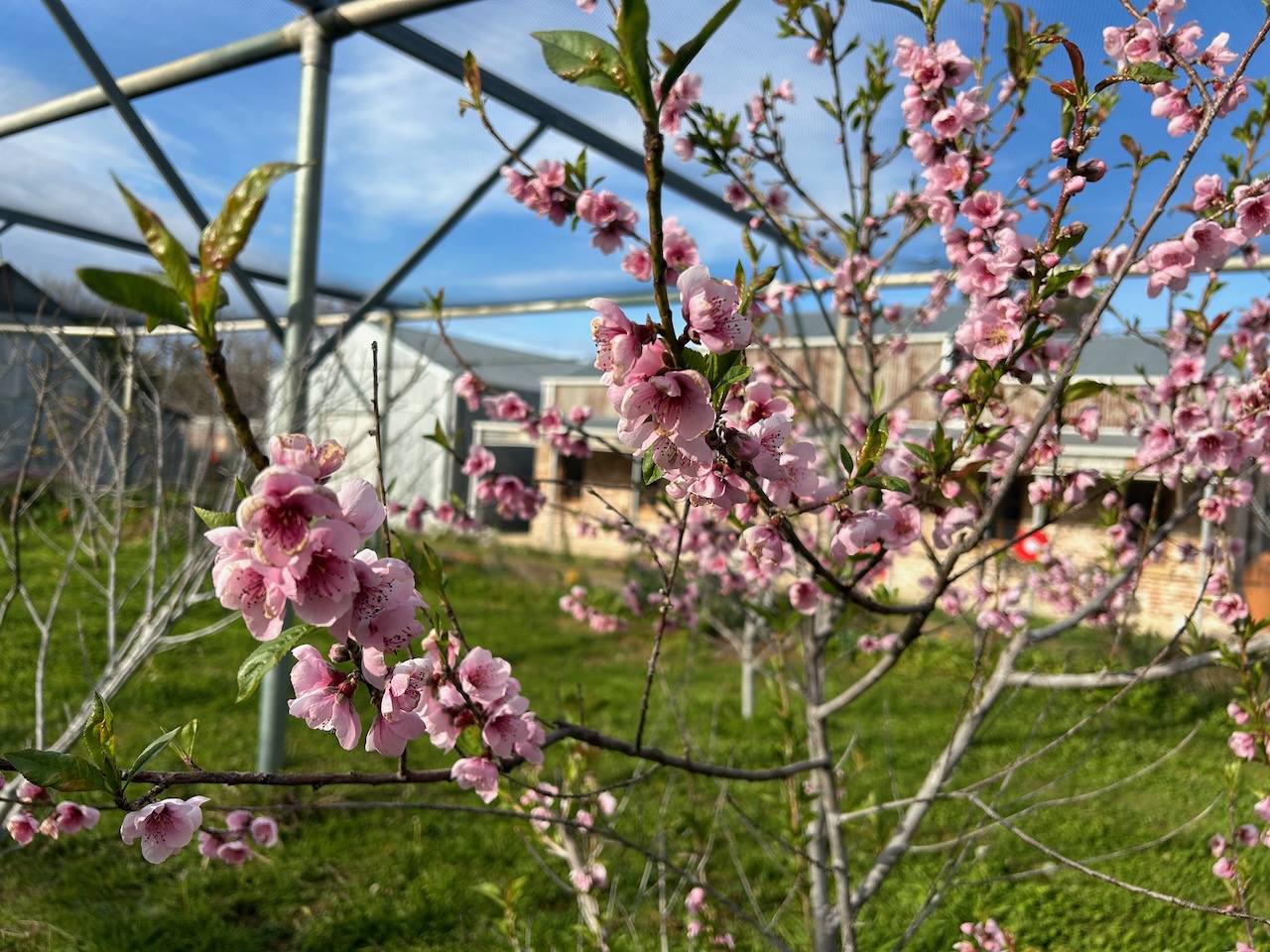
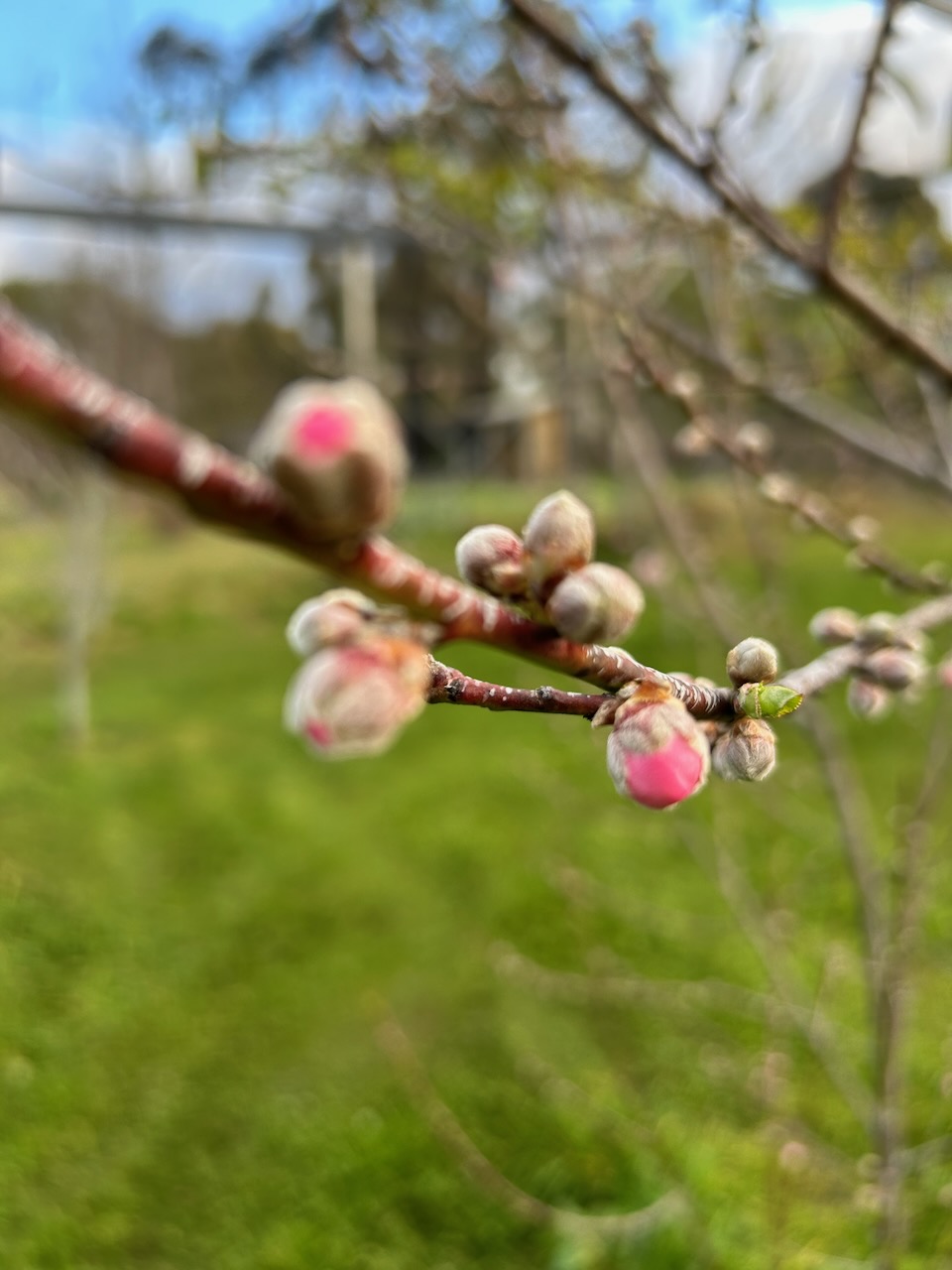
The trees in the stone fruit orchard are starting to bust into flower. This time last month there was only just the one very early peach, but now there are several trees in flower. The almonds, peaches, nectarines and the first plum tree.

We also are enjoying a very pleasant display from my floral border plantings around the pottery retaining wall. 

Earlier this week, we ate the first of the new season asparagus. However, our main garden produce remains the brassicas, and will be for some time to come.

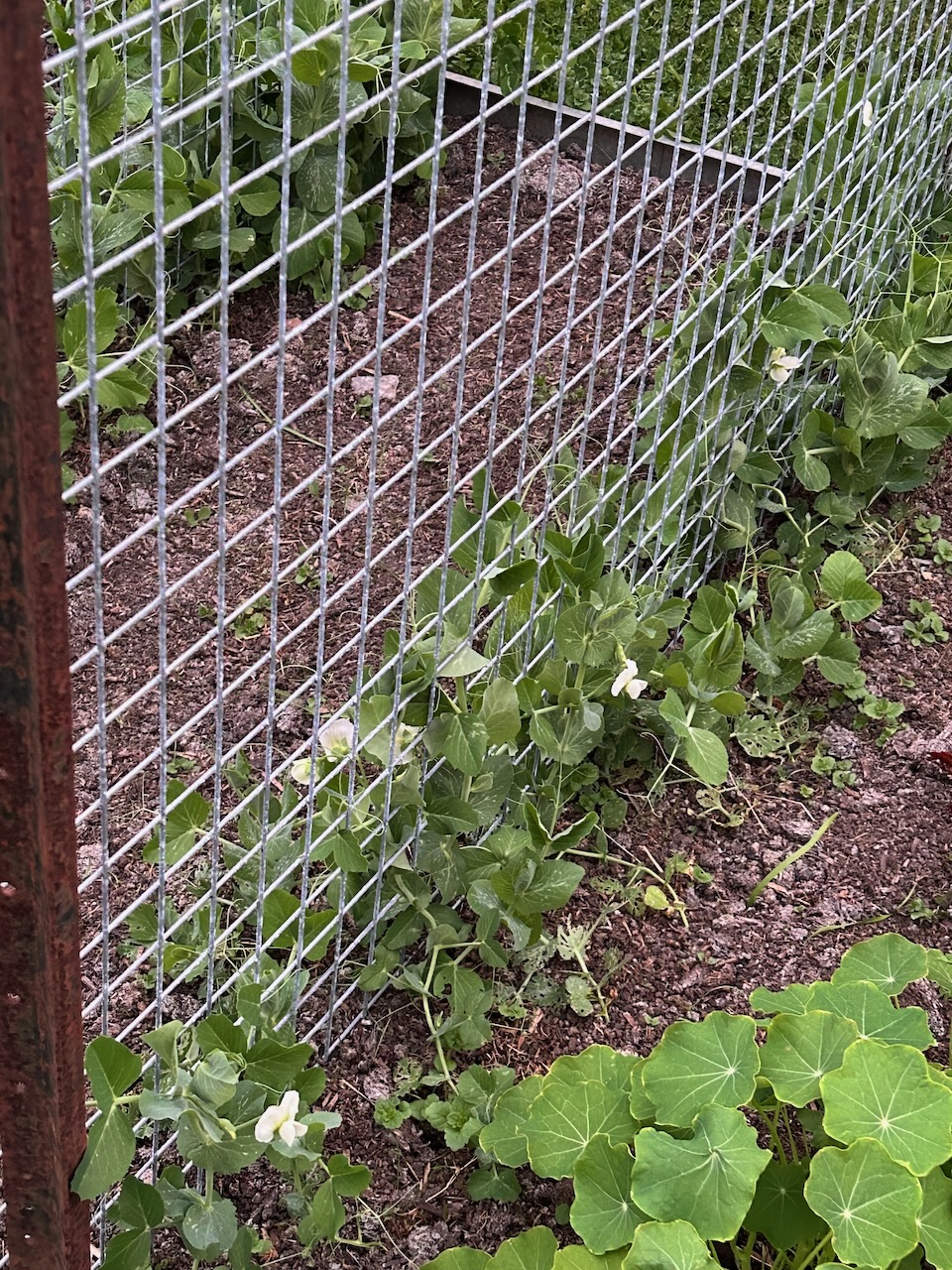
The peas have just started to climb the new twin wire trellis and have also opened their first flowers. So much to look forward to.

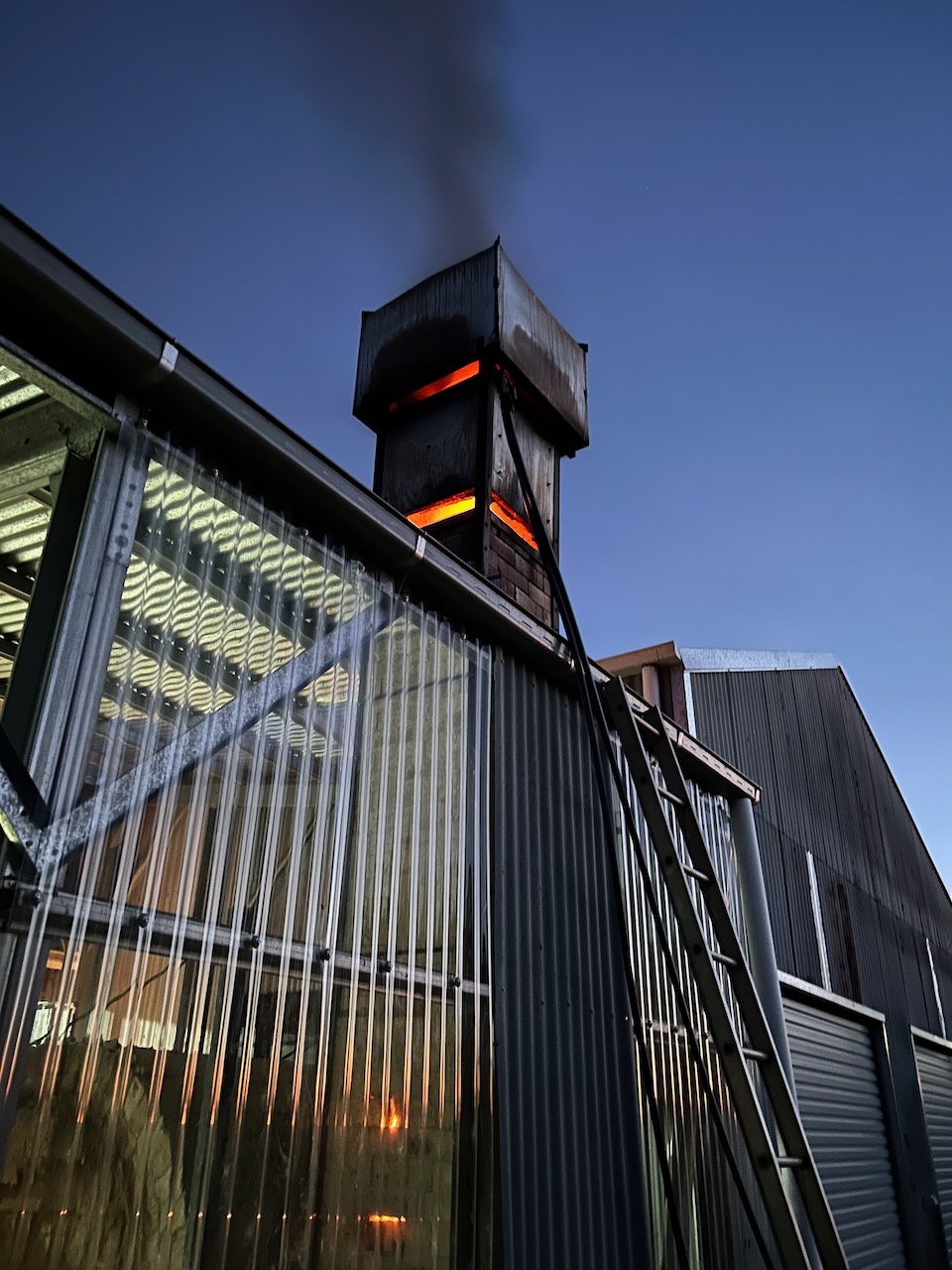
Last week we had a firing in the wood kiln with a bunch of amazing students. The weather held, and although it was crisp, it wasn’t too cold for the over night shifts.

After the unpacking, we all got stuck in and spent a couple of hours after lunch carting, stacking and splitting wood.

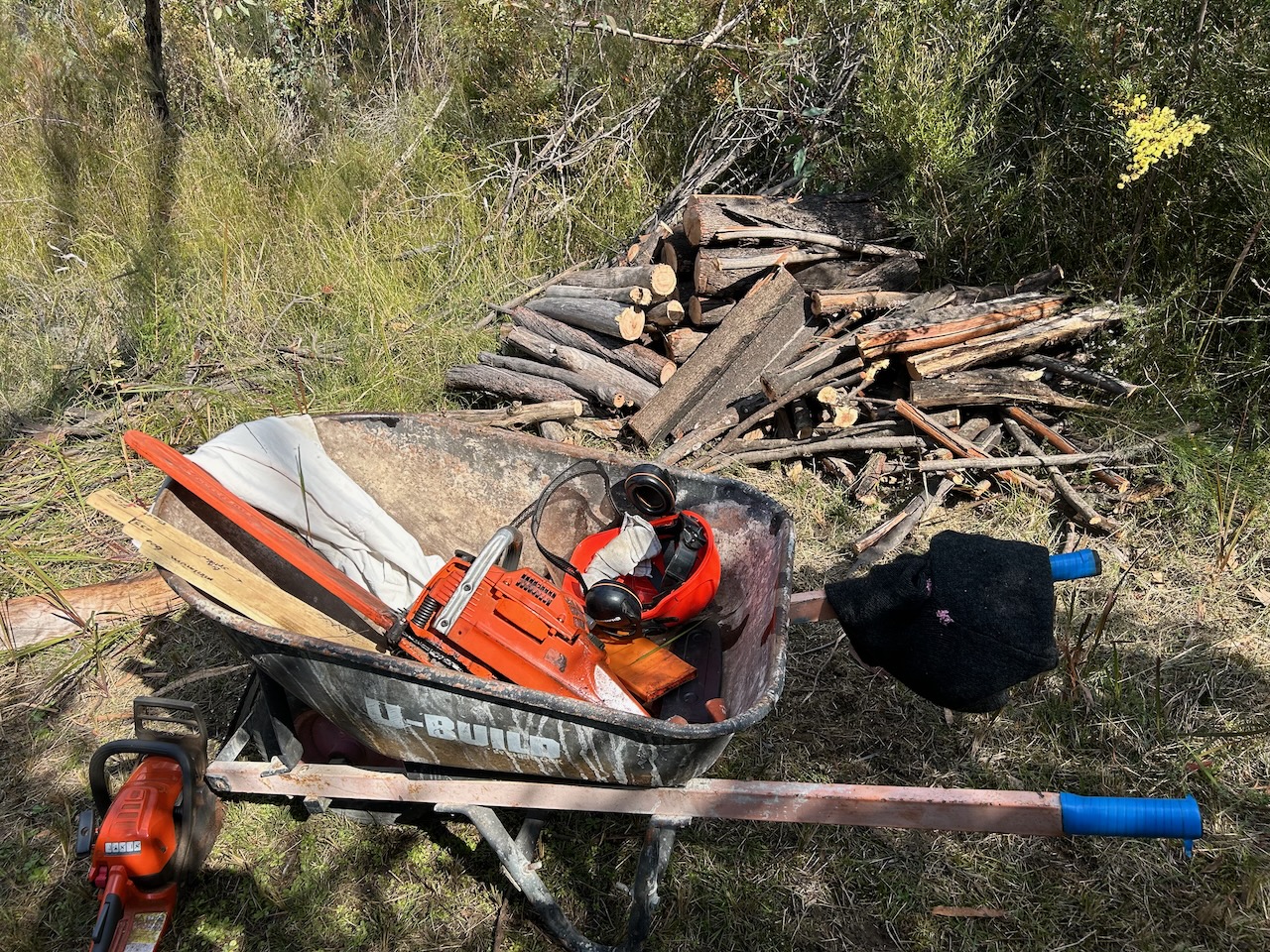
I had spent a couple of days during the cooling period, chainsawing fallen dead trees out in our forest. I had to do a bit of clearing to make a turning circle, and then snigging out the logs with chains into the clearing, to be cut up into ‘hob’ lengths for our bourry box fire box.

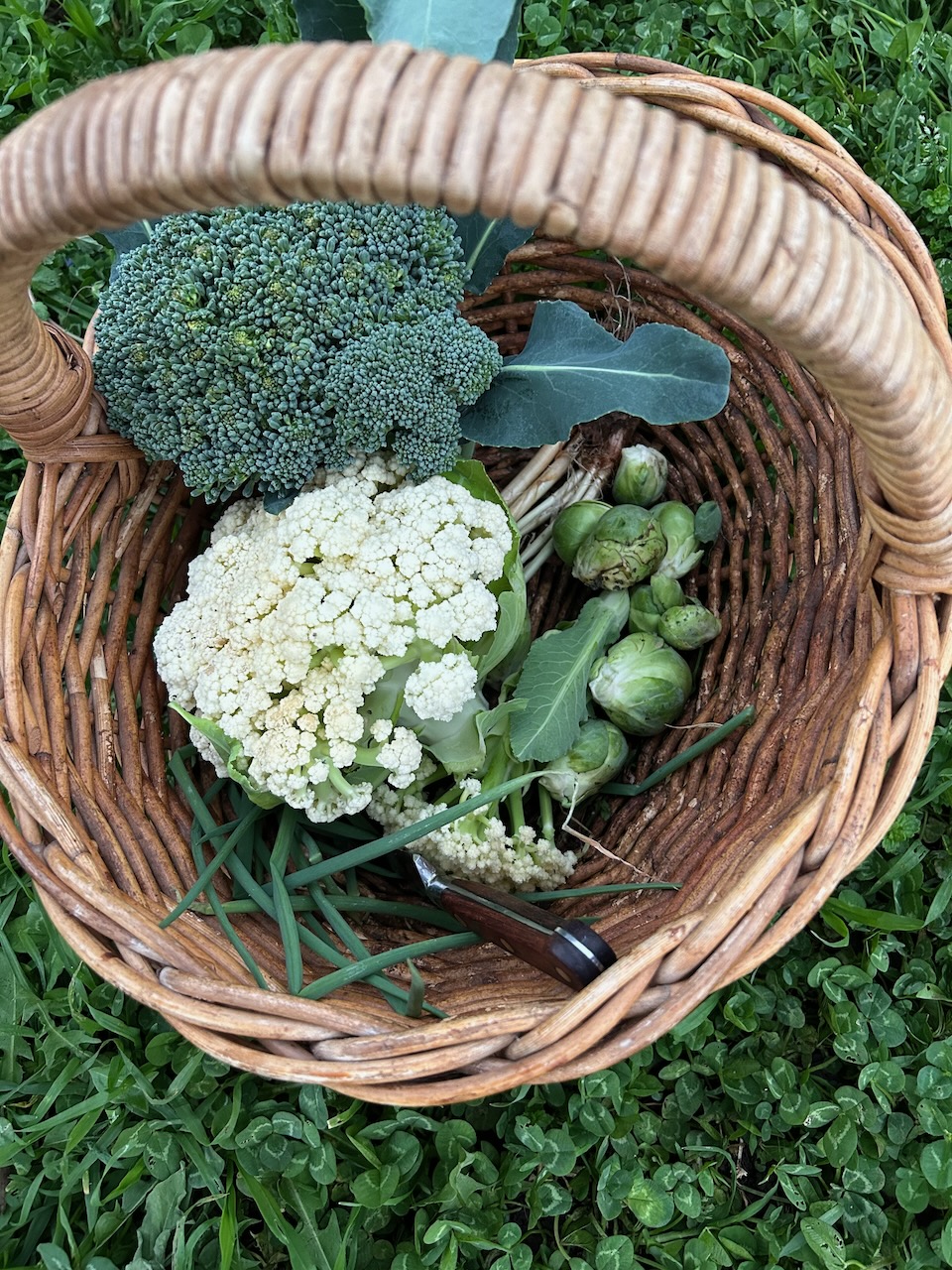
In the garden, I’m picking winter veggies, mostly brassicas and then dining on roasted vegetables.

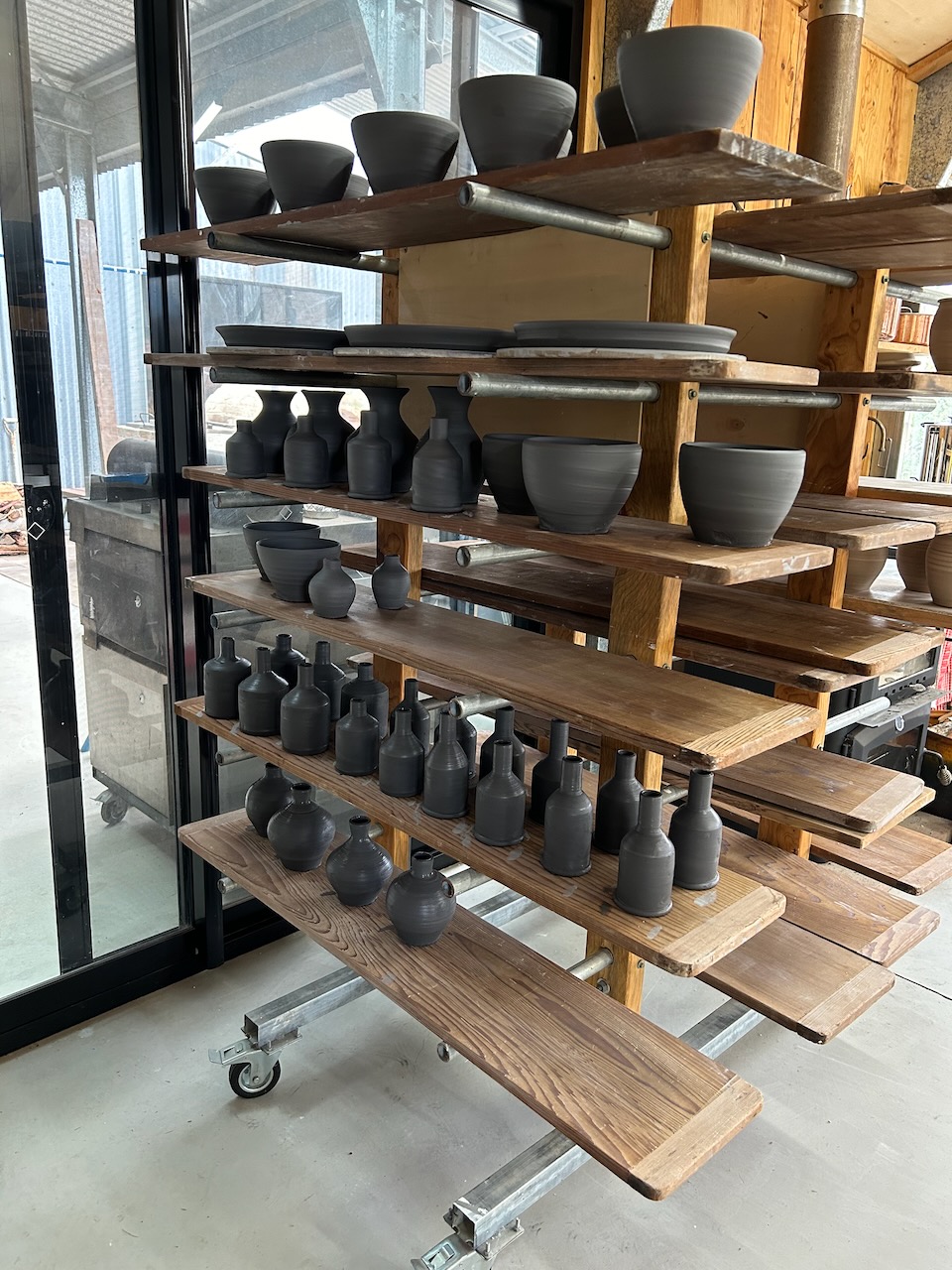
In the pottery, I have been making some small batches of experimental new clay bodies based on my local weathered basaltic gravel that I make my Balmoral Blackware from. Just small 5 kg batches. I have no idea how they will turn out, but there is only one way to find out, and that is to make some pots out of them and fire them. I’m planning to fire them in the wood kiln before I go to Korea to work next month. If I can find the time to fit it all in in time. If not, then it will be when I get back.

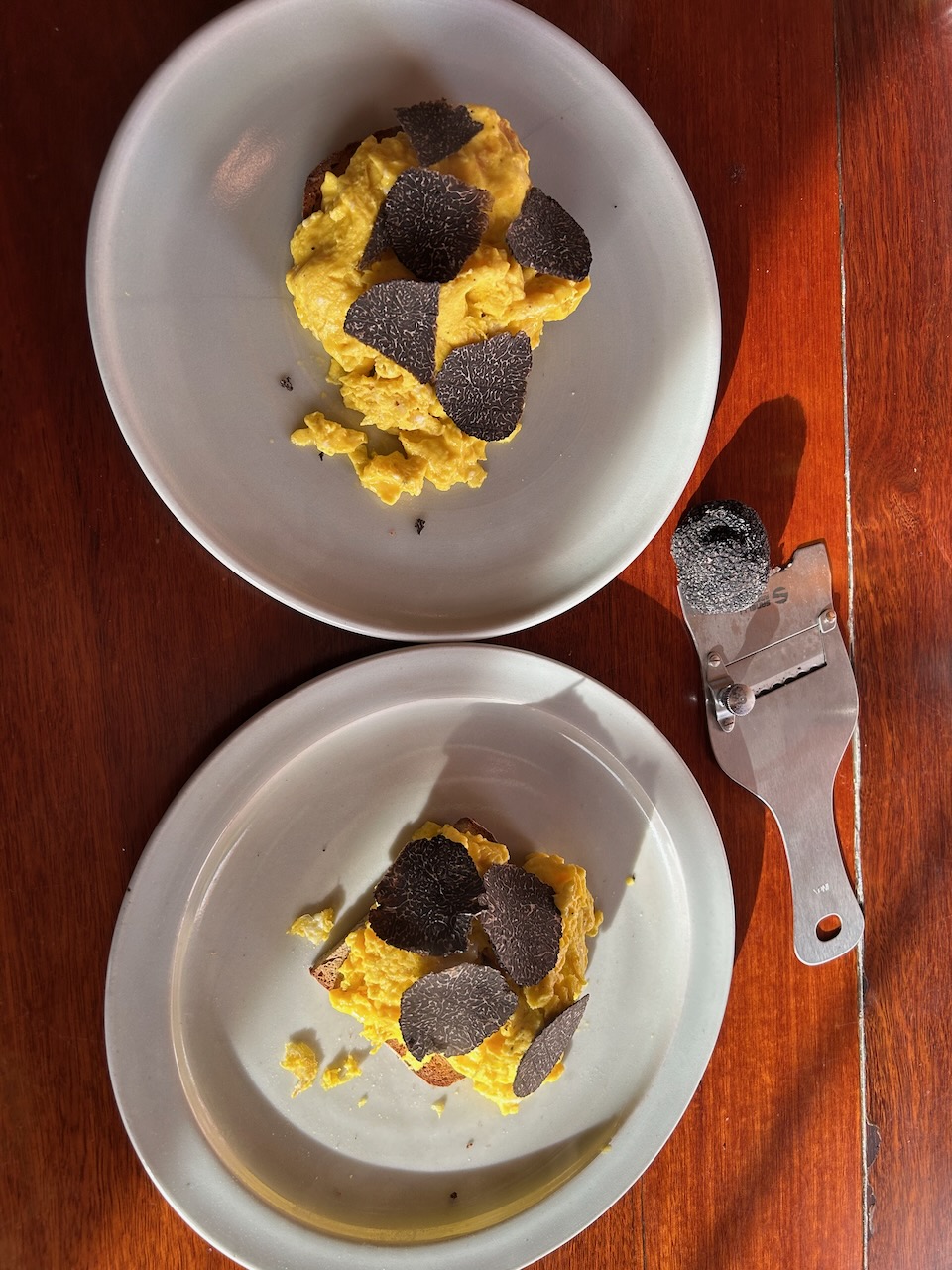
Winter brings on the truffle season, so we are enjoying French Black truffles very thinly sliced over our beautiful chickens scrambled eggs. Just another black treat in this season. 

We keep the truffles in a container of rice in the fridge, so that we can the full truffle flavour in the eggs and the rice. The infused rice is used for truffle flavoured risotto for dinner.

I think that I prefer soft scrambles eggs on toast with the truffle shaved on top, but as we have two good sized truffles this year, we also try dicing and micro planning the truffle into the egg mix. I think that we get slightly more flavour in the eggs this way, but I rather like bending over my breakfast and inhaling deeply to catch the delicate fragrance while I can see the round black slices on top of the deep yellow of the eggs. It’s a feast for both the eyes and the nose.

Roll on the seasons. Next stop is spring!

Nina the Gleaner, purple potatoes and okonomiyaki

At the start of this month we had the first buds and then flowers open on the earliest peach tree. Luckily I thought to spray all the fruit trees with lime sulphur last month, as that has to be done before bud burst. I really need to get in there and finish the winter pruning. I have done all the peaches and cherry trees in the veggie garden netted area.

June for spraying lime sulphur, July for pruning, August to start spraying copper (Bordeaux) for leaf curl fungus. Winter is a busy time when nothing is happening!  

There is a lot of work in being low impact, organic, nature friendly and carbon neutral. I haven’t had any spare time to do any composting around the fruit trees so far. So I will give them a hand full of chicken manure and some dolomite and wood ashes this time round. All of the chicken run scratch litter and manure mix has been going around the almonds trees so far this year. With only 4 chooks, there isn’t a lot to go round and with over 60 fruit and nut trees to manage, I buy a few bags of dynamic lifter composted chicken manure pellets, so as to give every tree a bit of a boost. They all get a good dose of wood ash in sequence throughout the winter, as we clean out the ashes from the various wood stoves and burn piles.

The wheel barrow has a garbage tin full of wood ash, a bag of composted chook pooh pellets and a bag of dolomite. I work my way about the orchard spreading the goodness around the drip line.

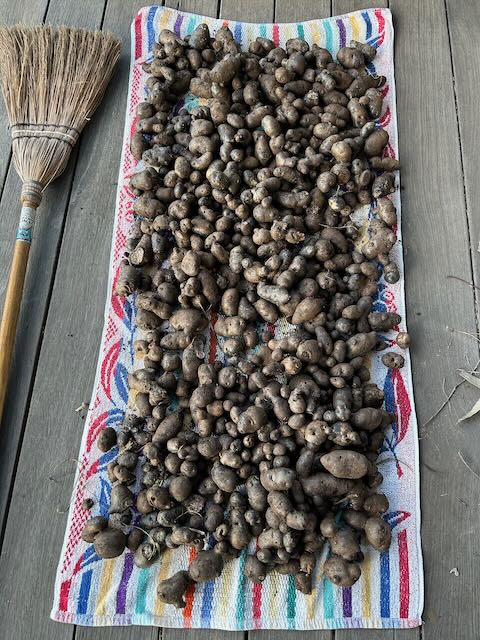
Janine harvested our Purple Congo potatoes, I caught her down gleaning the last of them from the southern end of the garden, just before I got stuck in and weeded and tilled it over, then covered it in compost to put it to bed to fallow until spring.

When we were in Germany a decade ago, we stayed with an extended family of potters who had gleaning rights with a local farmer, a concession that had been going on for generations I believe.

We spent a day helping them glean a paddock that had been harvested of its potatoes, but there were lots of undersized or slightly damaged ones that were there for the picking. 

I remember seeing a Van Gogh painting of ‘The Potato Gleaners’, and there we were in Germany engaging in this very ancient practice.  I really enjoyed it, fore-stalling waste. I wrote about it at the time on my blog. Gleaning is a very ancient right. It was established in France in the 1500’s and protected by the constitution. Today, I suppose that the equivalent would be dumpster diving? No need for either of us here to dumpster dive, because we have developed this positive, creative, environmentally friendly lifestyle. We grow all of our own green food, vegetables and fruit. 

It’s a lot of work, but very rewarding when I get to look at what I’ve achieved after a day of work in the garden. The effort gives me a lot of pleasure, even though I have all the aches and strains from the work, but then I think of all the loads of vegetables flowing to us over the year, and there is always a bit of excess to share with our neighbours. Planting seeds is such a positive, hopeful and uplifting act of rebellion. 

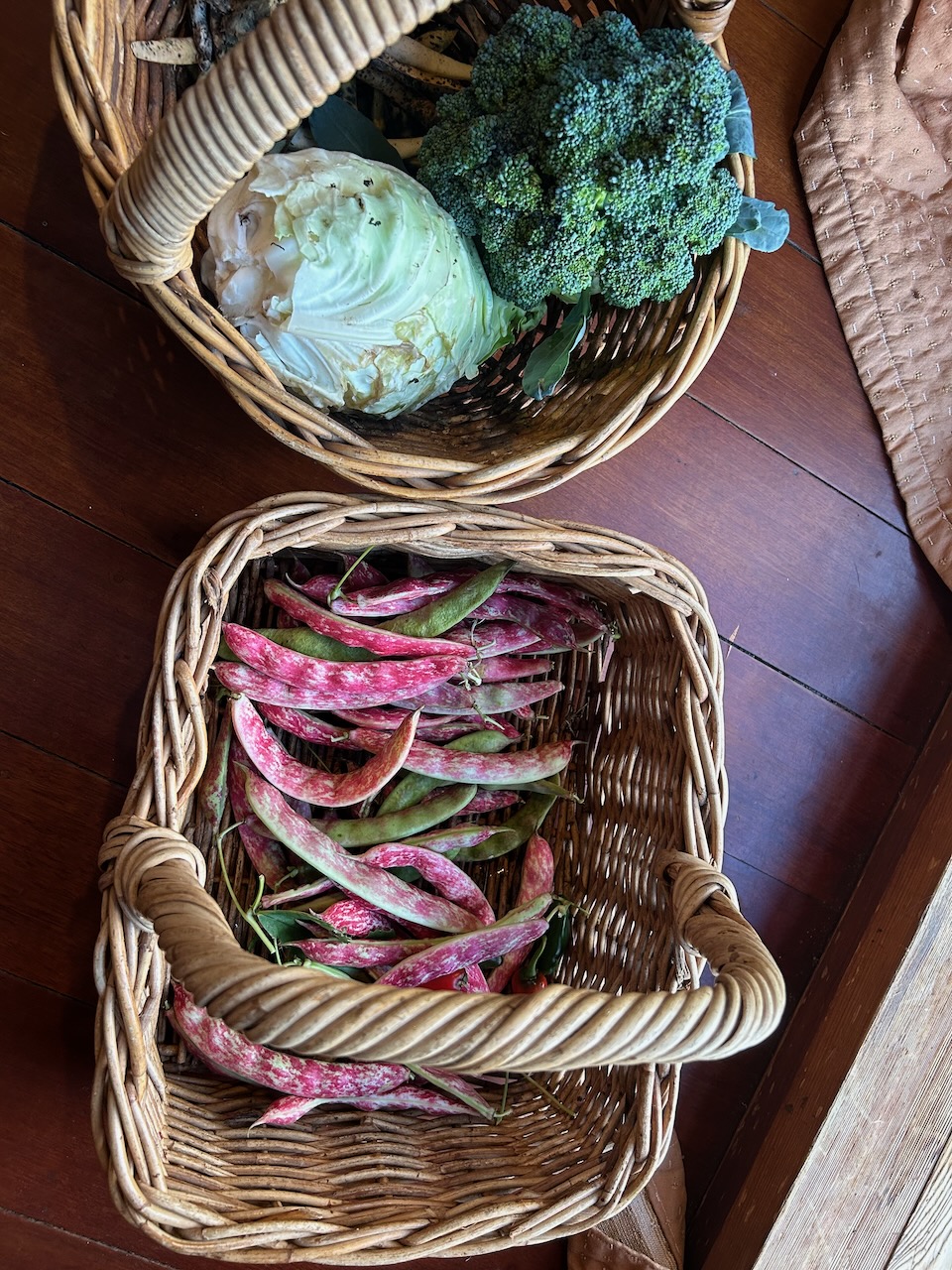
Broad beans, garlic and brassicas are all growing well, and planted in series to ensure a continuous supply of some sort of food throughout the seasons.

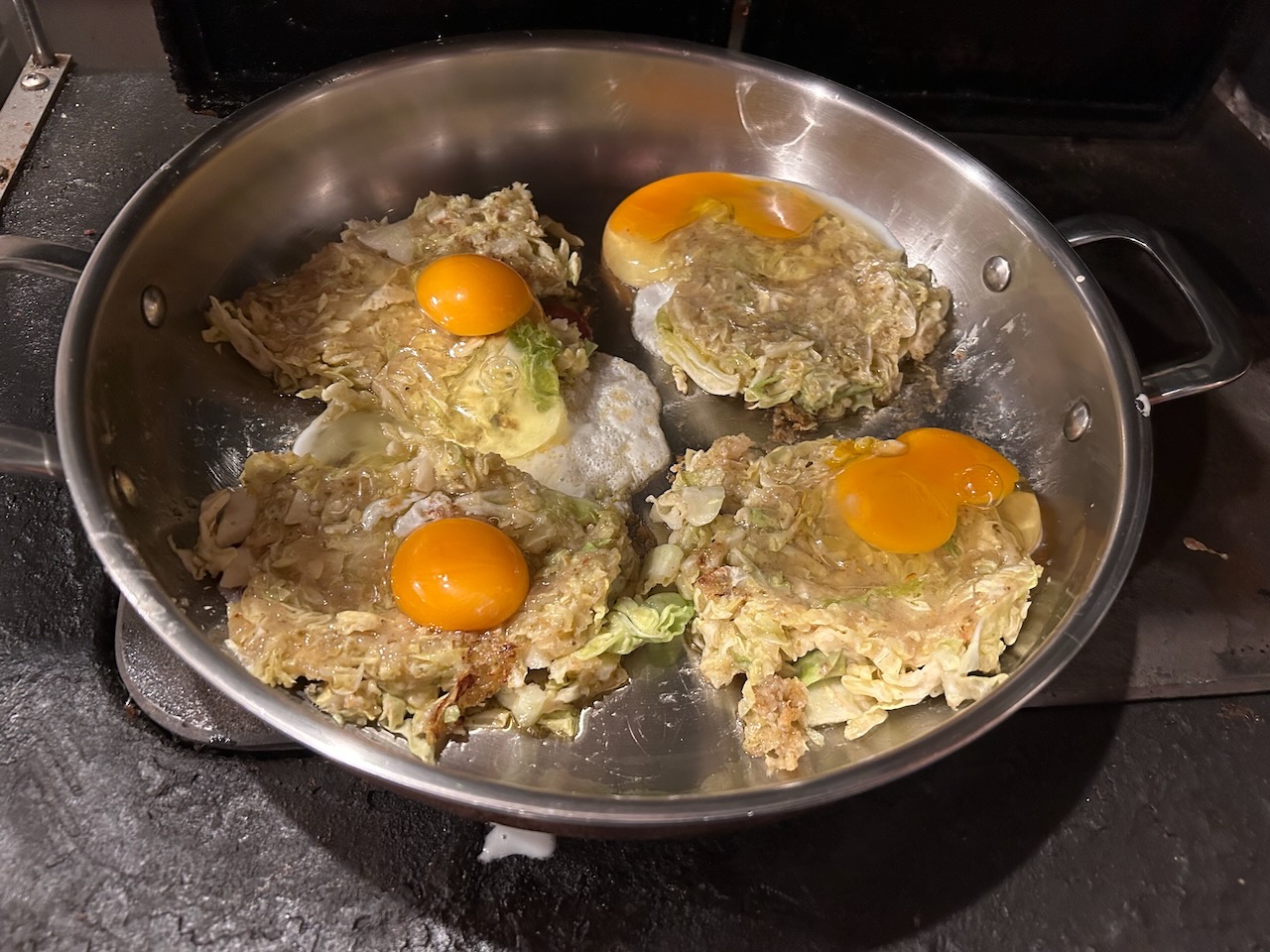
Now in mid winter, there are plenty of cabbages, cauliflowers, broccoli and brussel sprouts. One delicious option for us is to make okonomiyaki. The Japanese traditional cabbage pancake. We are not au fait with all things Japanese, but I have a keen interest in the culture and I have visited many times to study ceramics there. Okonomiyaki is a quick and easy meal that uses cabbage in a different and interesting way.

I’m told that okonomiyaki is literally translated as ‘you choose what you want’. Yaki means cooked or burnt as in pottery being yaki, or fired, and there is the character for ‘no’, which means ‘of’ stuck in the middle, so maybe ‘oko’ and ‘mi’ are to do with you and choose?

I take it to mean that I’m cooking a cabbage pancake and you can choose to add whatever you want to go in the mix. But it’s always cabbage, egg and pork!

The Koreans have a similar traditional cabbage pancake made with kinchi pickled cabbage, ‘panjun’ (sp) not too sure about the true pronunciation or the spelling there, but it tastes delicious no matter how you spell it..

Although there are minor differences throughout Japan from north to south, okonomiyaki remains pretty much the same everywhere. I’ve had it in Mashiko to the north of Tokyo and also in Arita in Kyushu in the far south. I first tasted it in Imbe in 1986, more or less smack in between. Always delicious and very recognisable. 

Apparently within Japan there is hot debate between various cities such as Osaka and Kyoto, as to who makes the better and most ‘authentic’ okonomiyaki. As an outsider, I have no opinion on the matter. I love them all.

My Japanese friend has suggested to me that it should be made with grated Japanese mountain potato starch, to get the best texture, but as that isn’t readily available here, that I have been able to find. She told me that I can mix in a small % of tapioca starch to give the mix a creamy texture. 

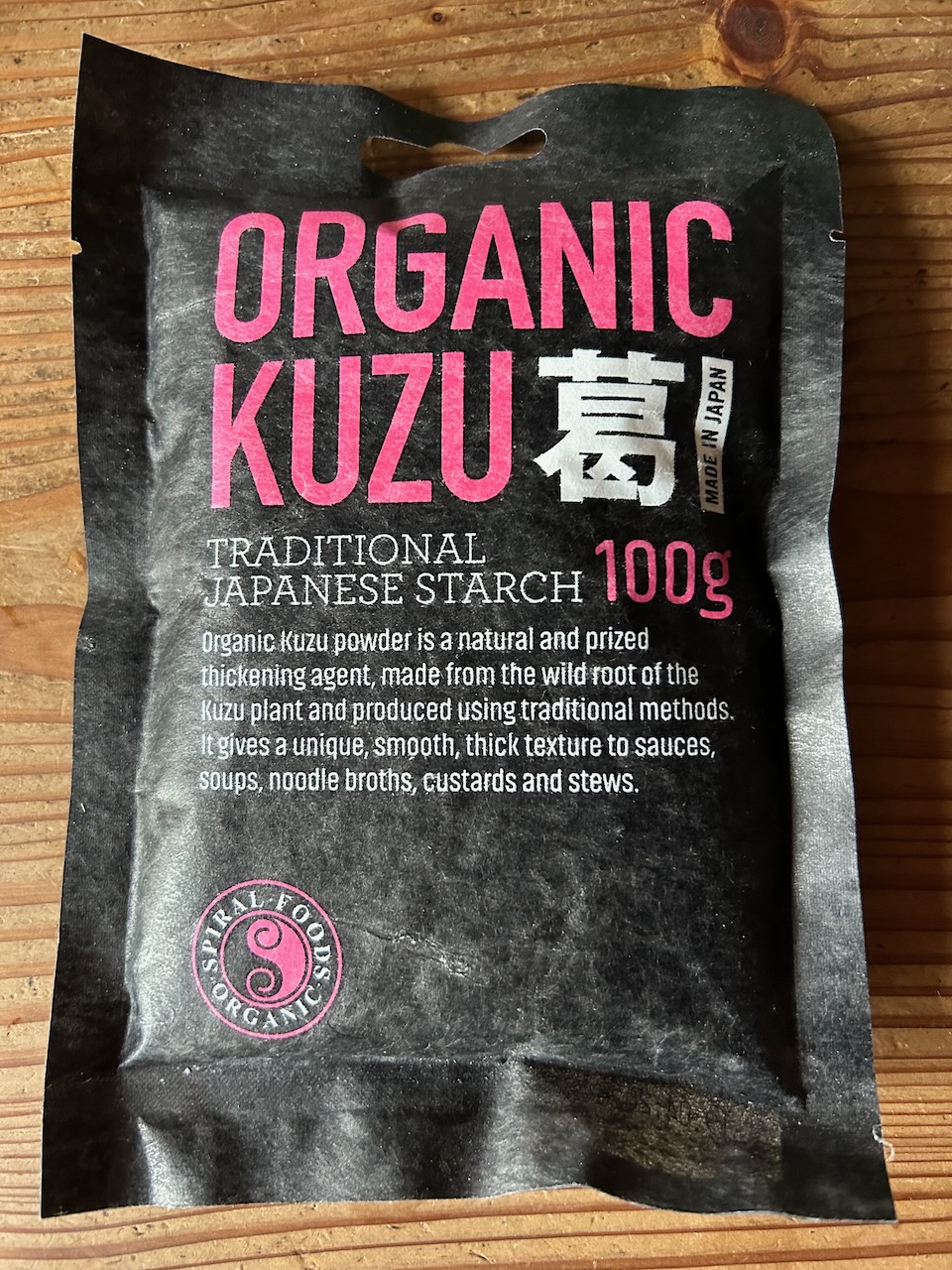
I tried Japanese kuzu powder and corn flour, but that made the pancake too sticky and glutinous. My okonomiyaki is an Australian multi-cultural work in progress. The home grown organic cabbage is really the high light, freshly picked and snappy crisp, it’s great. I’ve tried different varieties of cabbage, the best ones are the light and slightly curly types like savoy. Dense cabbages like red cabbage need to be par-boiled to soften them beforehand otherwise they are still a bit tough and chewy after the quick light cooking of the pancake.

The traditional recipe calls for a thin slice of pork and then an egg cracked over the top towards the end of cooking. I have plenty of fresh eggs, but not always fresh, thinly sliced pork. However, I can usually find some Italian style, dried, salted and lightly smoked, thin slices of pork in the deli shop. That makes a suitable substitute. No self-respecting Japanese person would recognise the mess that I end up serving, but it tastes OK, it’s fresh and it’s healthy. Ne!

It’s been an honour, joy and privilege to have had the pleasure of managing and curating these 7 acres, along with Janine for the past 48 years. I am so lucky to live and work in such a great place.

1st. Weekend Workshop Throwing Class completed

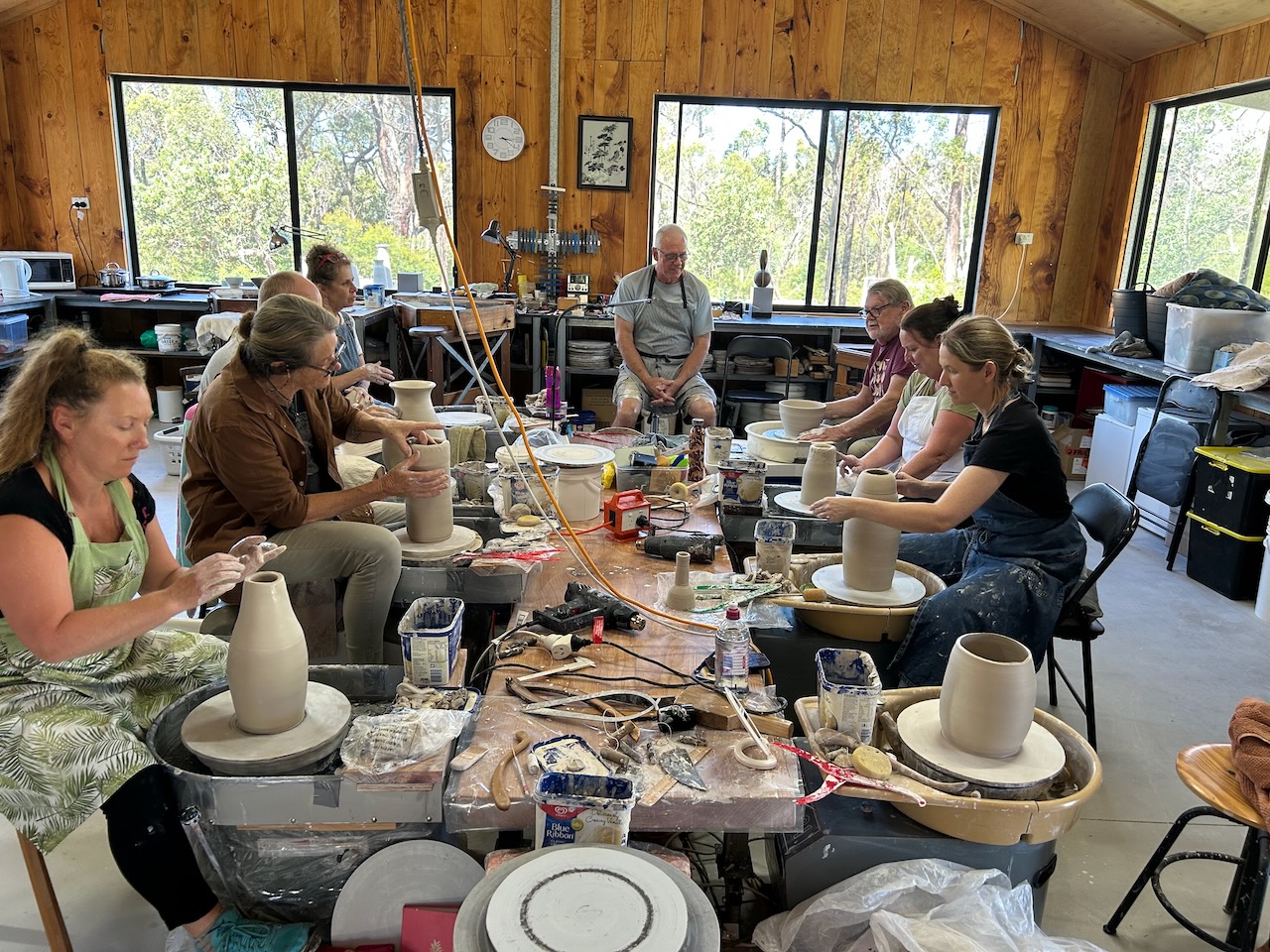
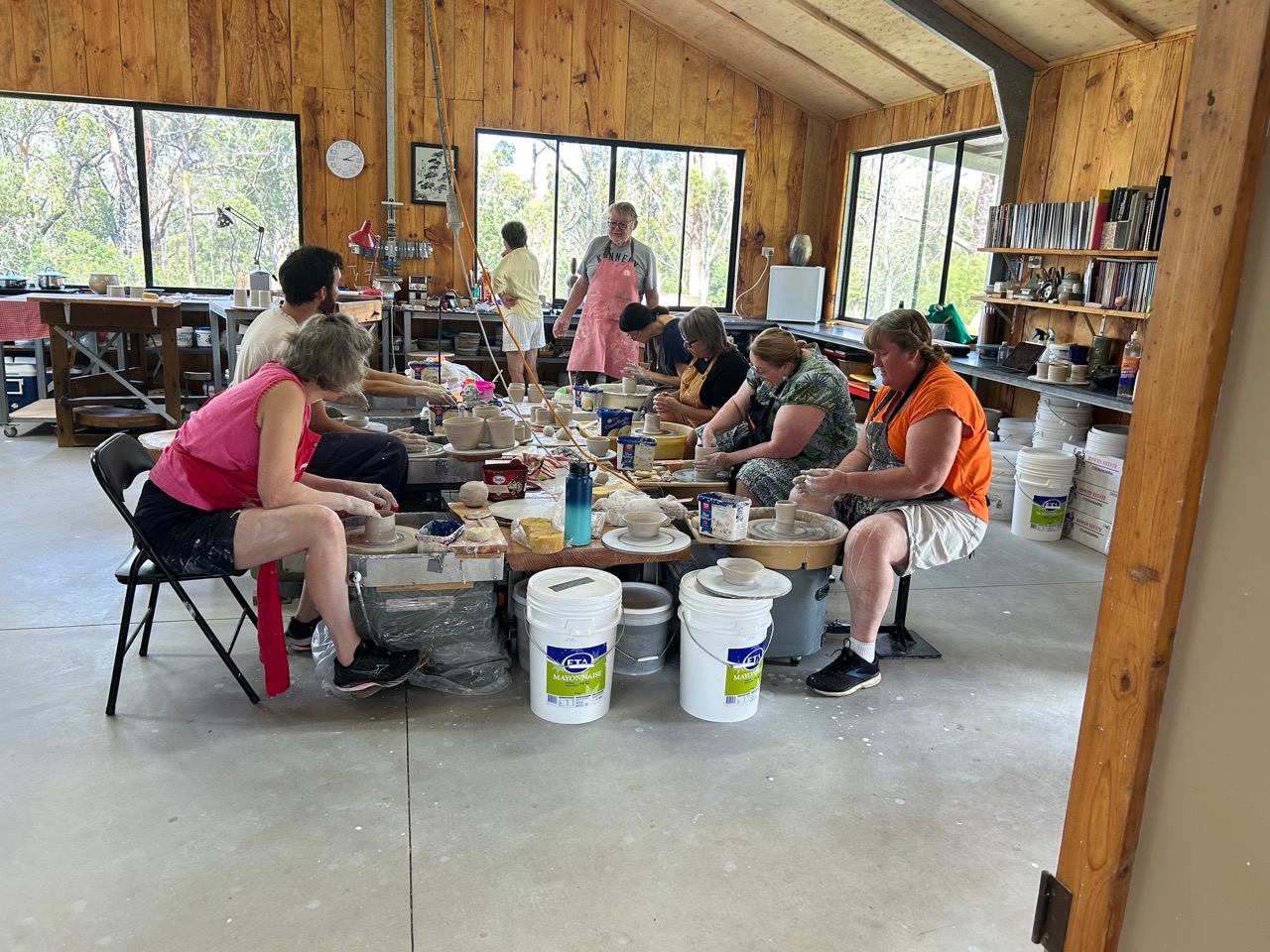
We have just completed another weekend workshop. This time a throwing class. I advertised one and filled two weekends, so we will back in the studio again with the 2nd group next weekend for the 2nd one.

Everyone seemed to enjoy them selves and got something out of it. We had Len Smith here with us for the weekend to have 3 tutors for the 8 students. Len has so much teaching experience, it’s great for the students to have a third point of view. He’s also great company.

I spent the week pugging clay and prepping the throwing room, and during the time in-between, I kept on with my sgraffito decoration, and got a solar powered, stoneware glaze firing done.

These red and black cups are experiments in a combination of Sgraffito and inlay.

Just black slip inlay on these cups.

Just sgraffito on this bowl

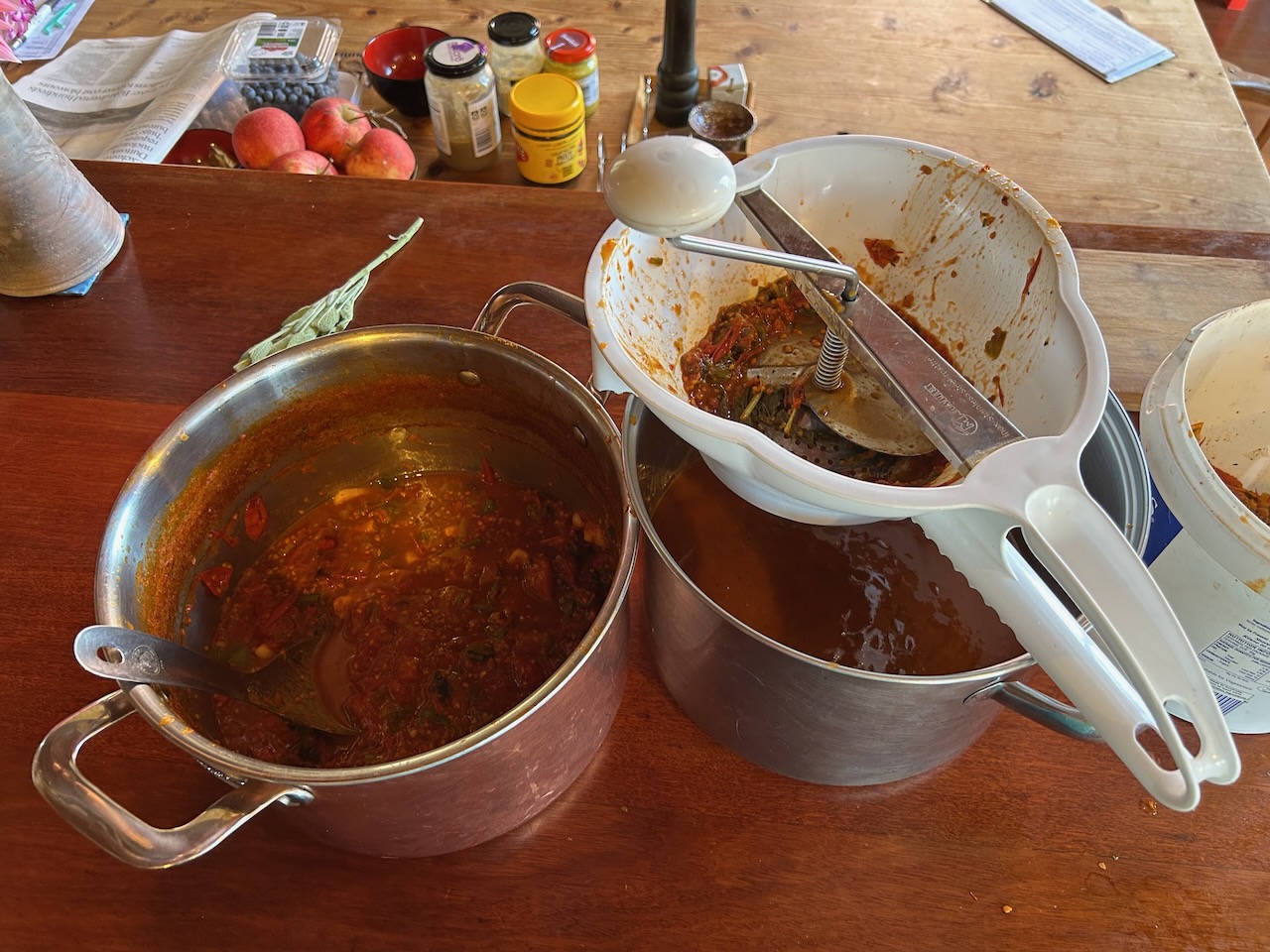
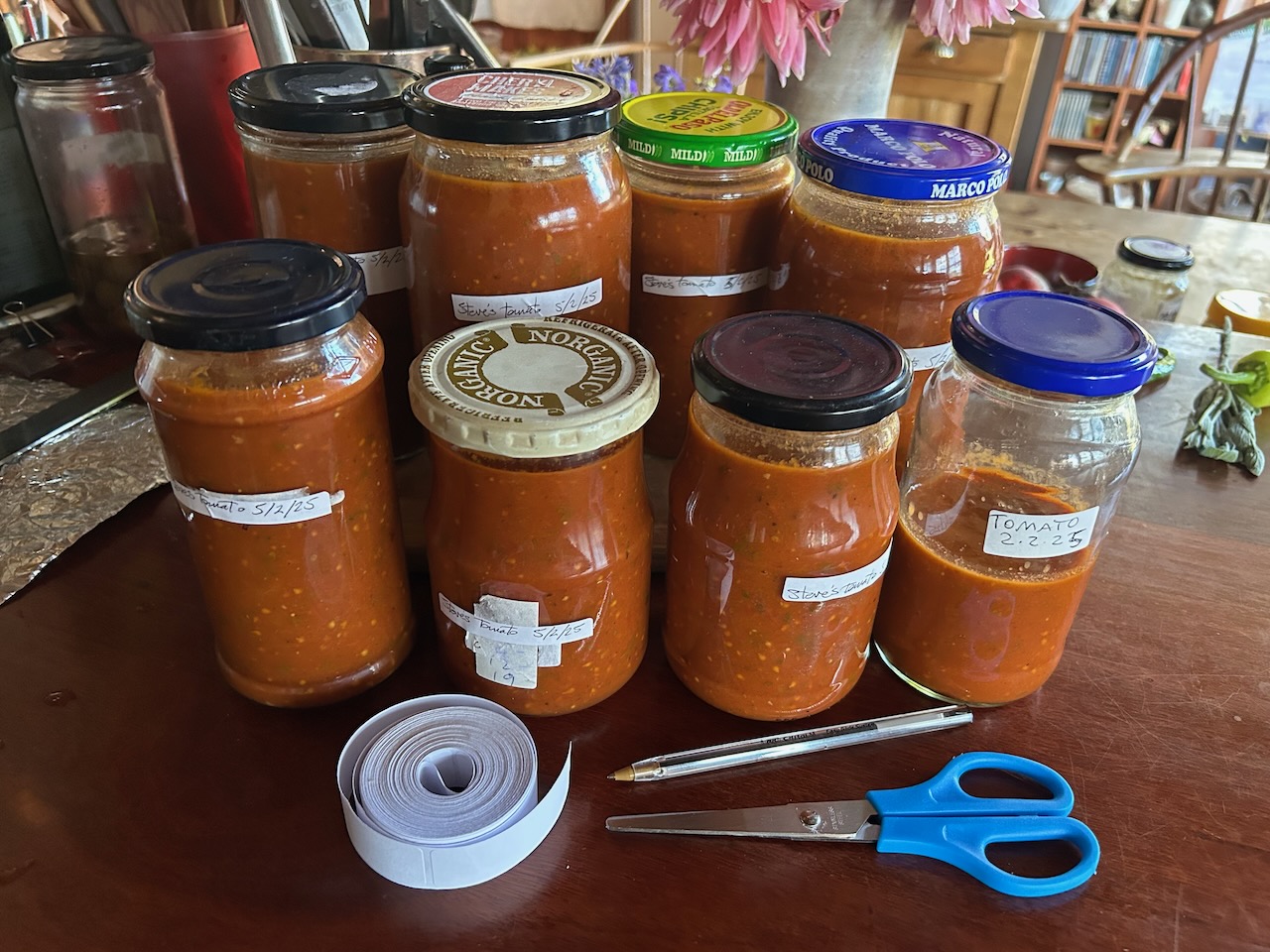
In the evenings, I made another batch of tomato passata. I have now run out of our re-cycled ‘pop top’ jars and so I have started to use the old ‘Fowler’s’ vacuum jars with clip top lids. I made a 7 litre boiler full, and reduced it down to 5 litres, enough to fill 7 of our No.27 Fowler’s jars. I have no idea how Fowlers came up with their numbering system, but as they are so old, I suspect that it represents fluid ounces? 

I Googled it and 27 imperial fluid ounces = 770 mls. So that sounds like it ought to be right.

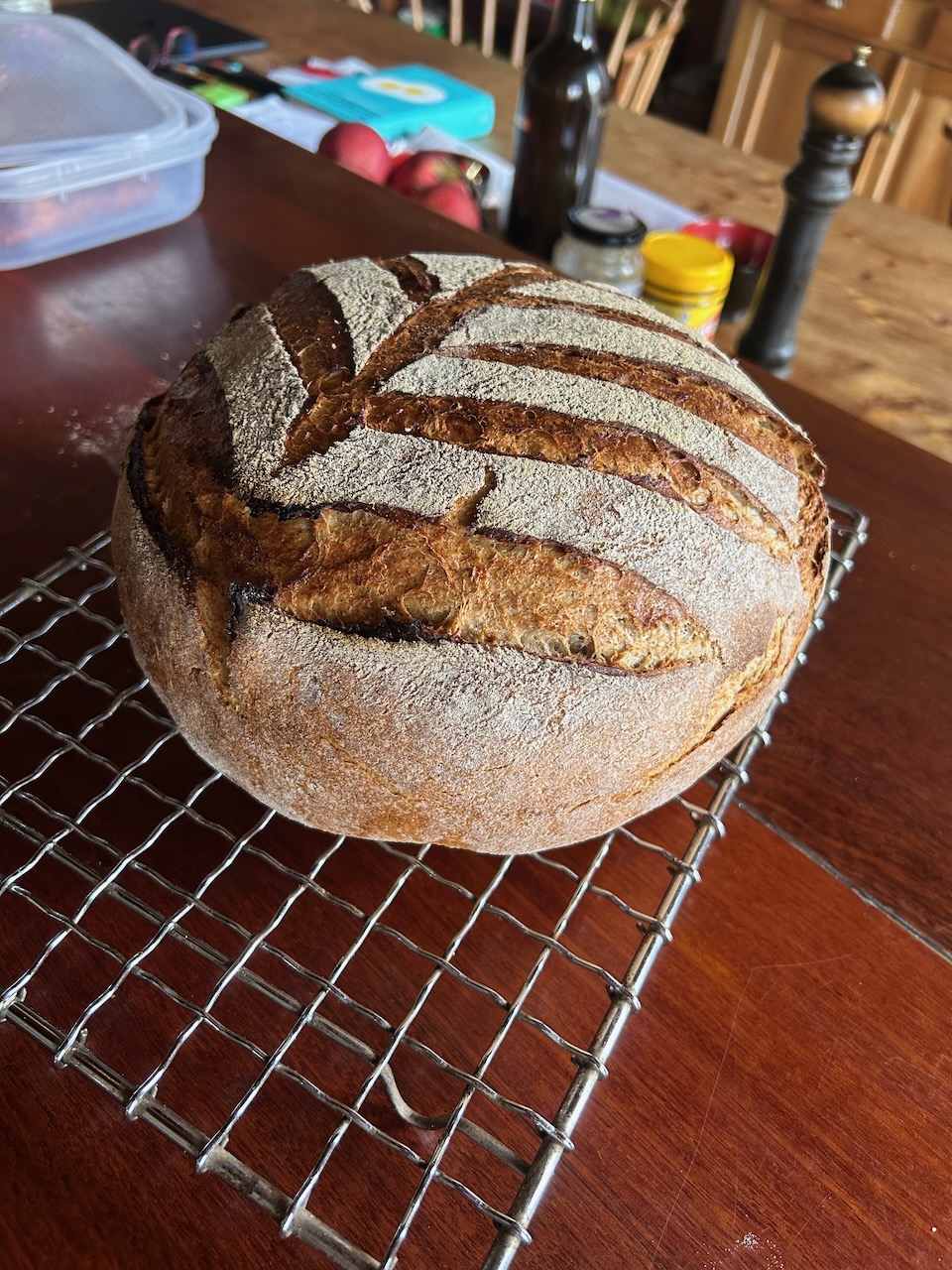
I also made this weeks loaf of rye bread.

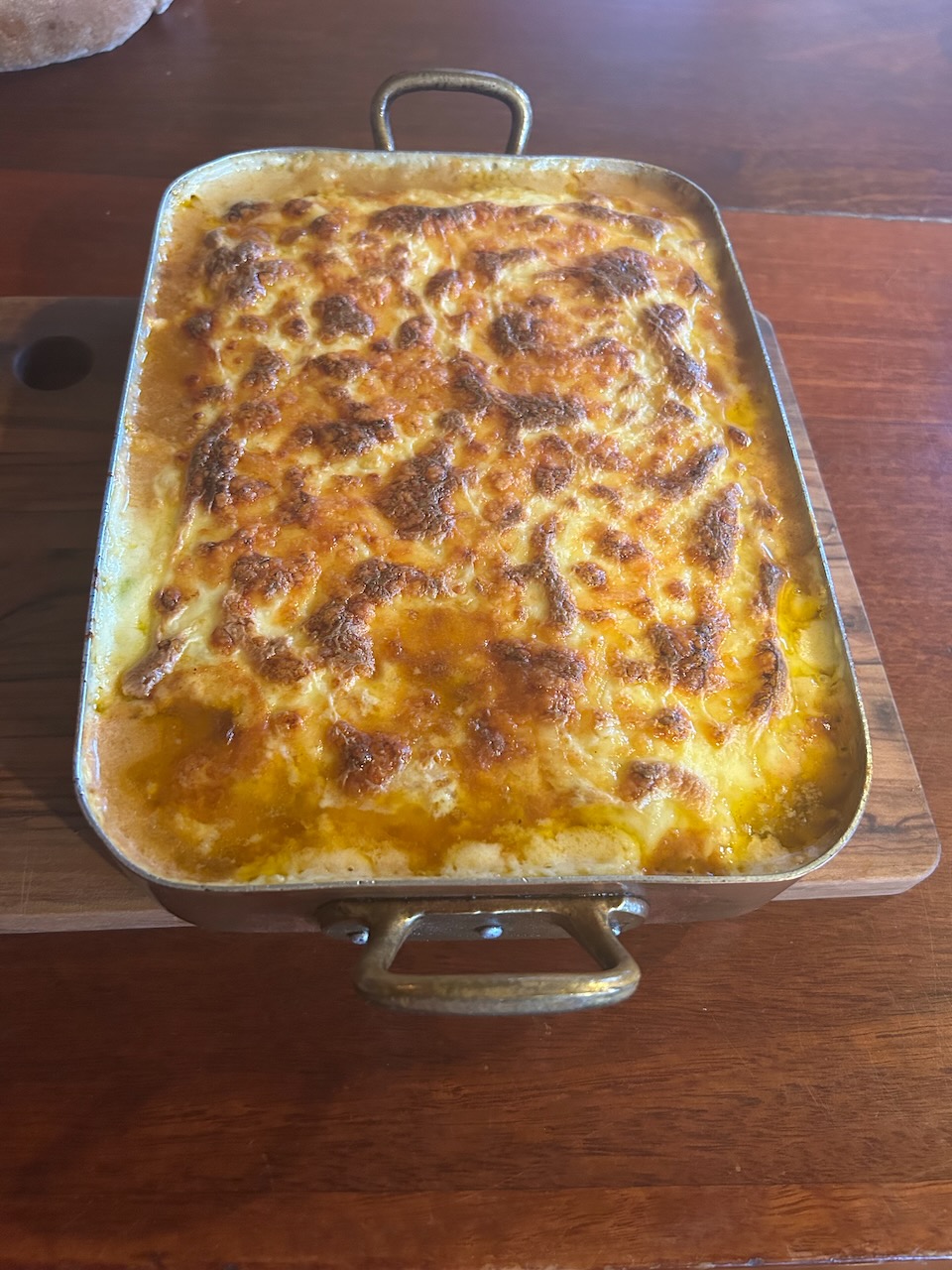
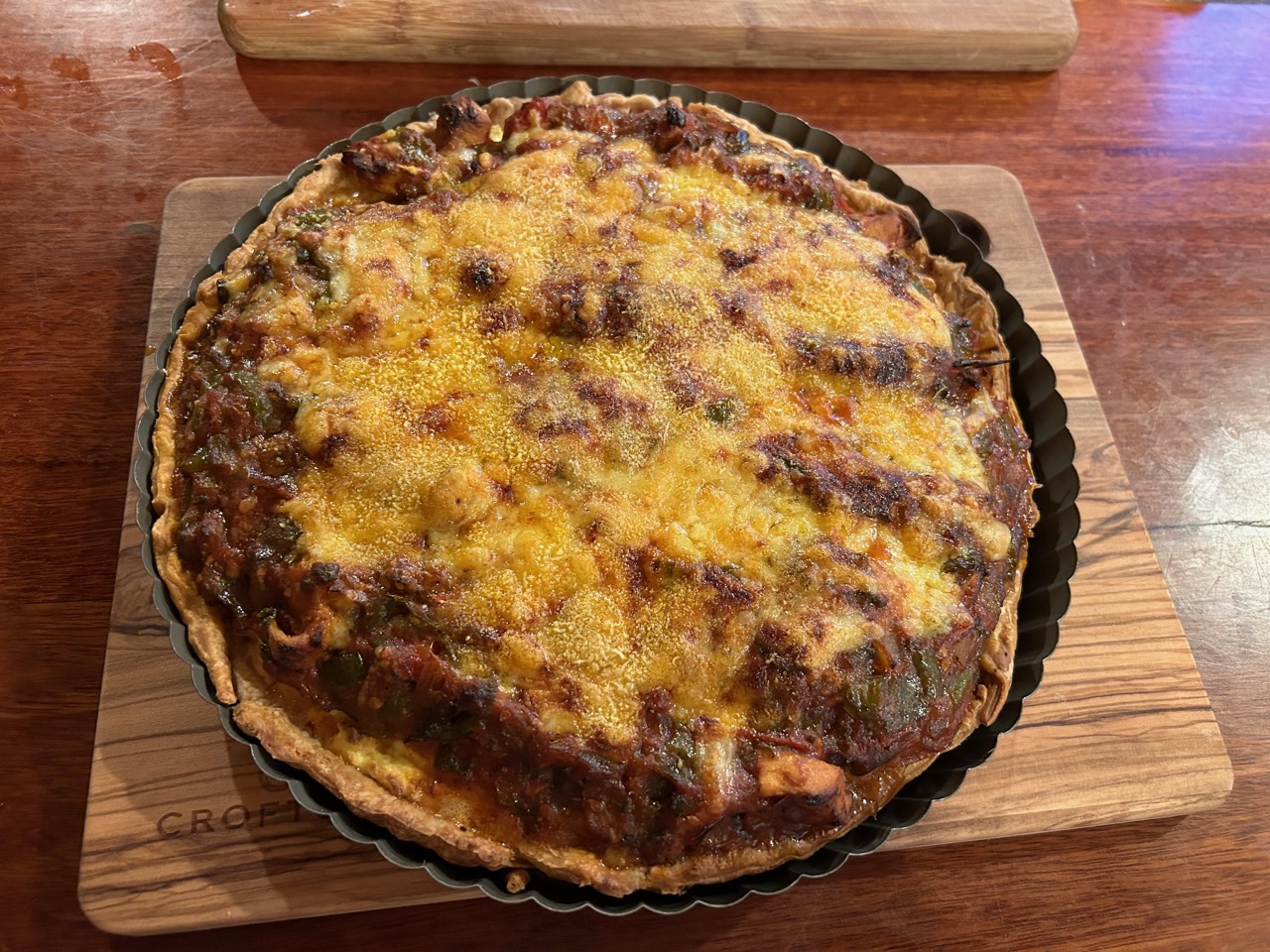
For the workshop lunch, I made a flan or tart with a baked cottage cheese base and a ratatouille topping. That didn’t last very long.

The coming week will be more of the same as we repeat it all over again.

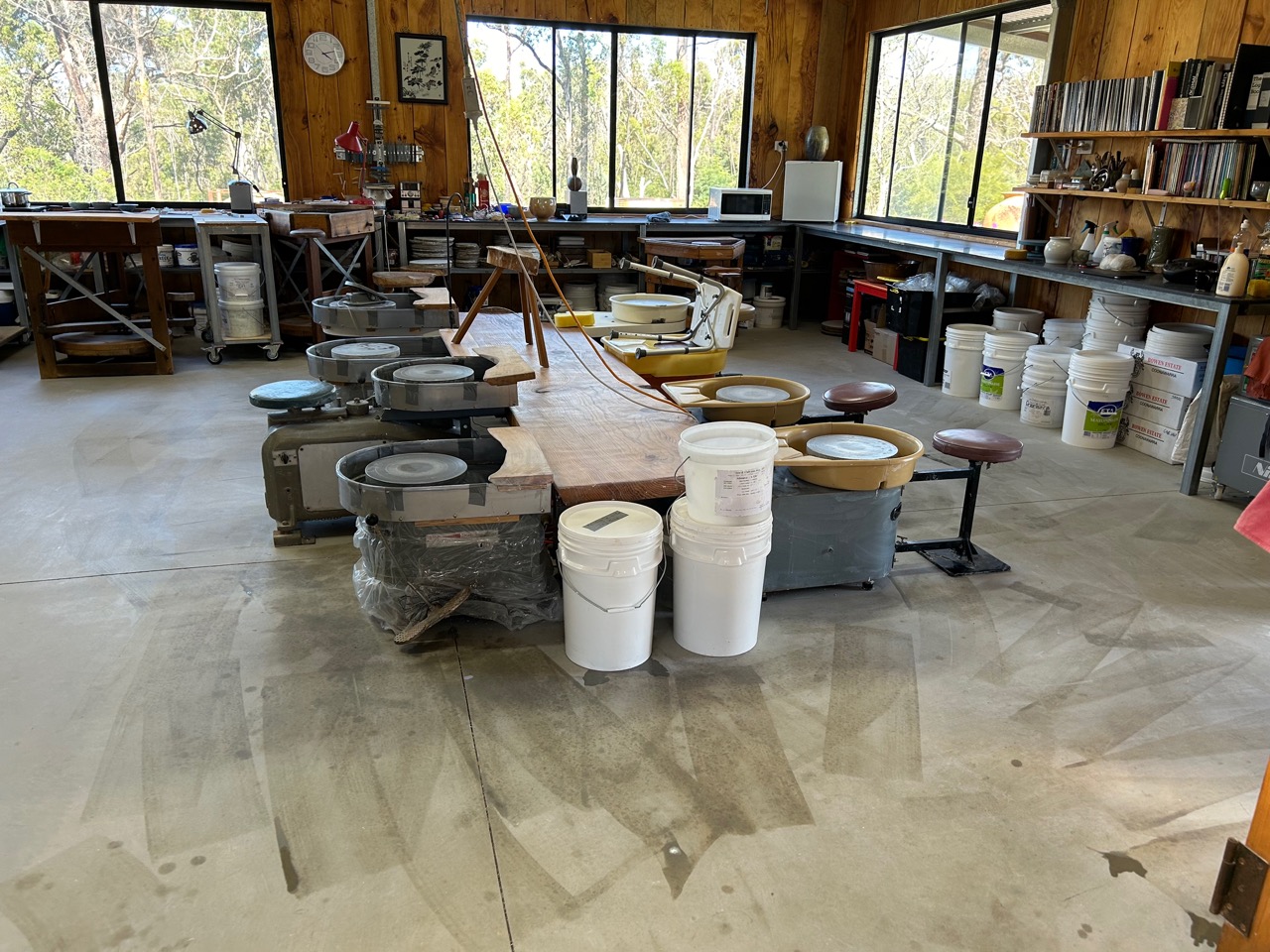
The workshop is all cleaned and mopped and ready to go.

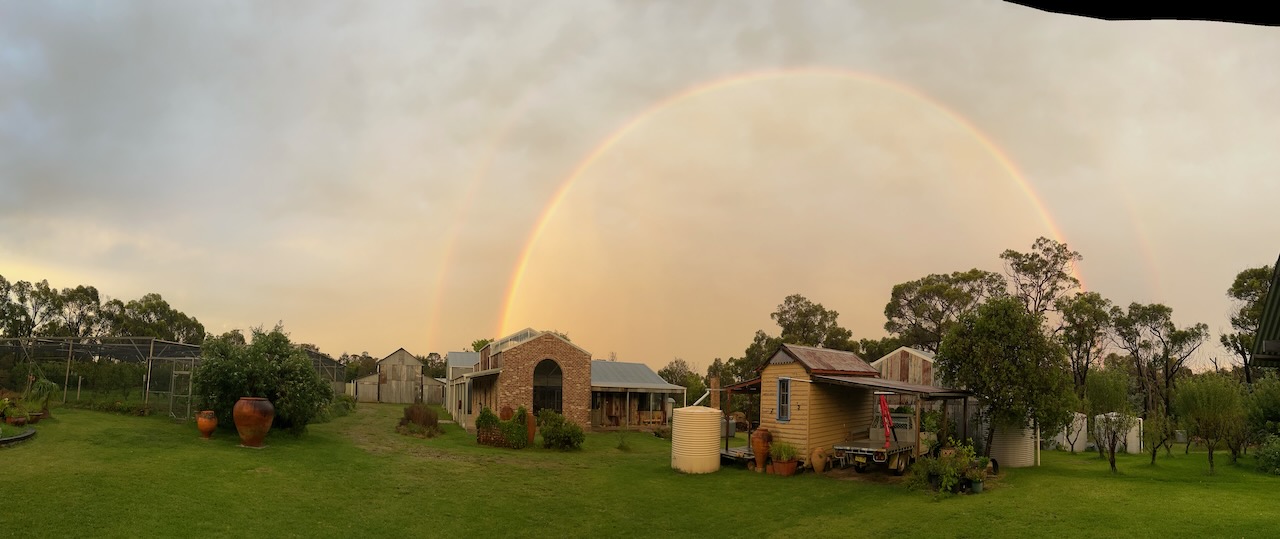
The workshop looks beautiful tonight in the glow of the pink sunset.

This image of the workshop by Janine 

Finally, a use for red mud?

I saw this podcast link in ’Nature’ magazine today. Nature is a science journal that reports on various issues relative and important to scientific research.

I have subscribed to various science journals during my life. I prefer to read about scientific research than the trivia of day to day politics and its meaningless point scoring.

It reminded me of a research project that I did at the National Art School, way back in the 1970’s. 

I was contacted by a guy from an aluminium mining company, who explained that new environmental laws were going to cost the company a lot of mullah to comply with.

He explained that the main by-product of aluminium processing is red mud. The red mud is essentially red iron oxide and some other clay-like minerals that are extracted from the bauxite to gain the aluminium oxide. Bauxite ore is an almost equal mixture of iron and aluminium with some aluminosilicates related to clay.

It occurs widely as little red spheres. It is deadly to walk on, as it rolls around freely like ball bearings. I have found loads of small deposits of bauxite all around my shire here while I have been doing my own ceramic material research. The parent mineral is everyday clayey soil, which when exposed to tropical weathering conditions of very wet weather and high temperatures, can have almost everything leached out of it. Every mineral and element that can be dissolved in water, gets leached out over time and is evaporated up wards through the soil profile, and washed away, so all the alkalis, alkali earths and silica are removed, leaving largely iron and alumina. 

The process of extracting the alumina leaves the iron deposited as a slurry it in huge lakes or dams. These never fully dry out properly to become solid and stable. The company wanted to know if I could find a productive use for this semi dried slurry cake?

I couldn’t. It was too high in iron to make any sort of useful glaze and had absolutely no plasticity, to make it into any kind of interesting form. The best solution I could find was to mix it with a little bit of clay and silica, then fire it in a heavy reduction atmosphere to turn the refractory iron oxide into an active flux that would bind all of the other impurities with the clay and silica to form a solid black block.

I suggested that the company might build a brickworks on the site and start producing black bricks. The guy scoffed at my idea, asked if I was joking and I never heard from them again. No payment was even forthcoming. Thus ended my early flirtation with big business.

Now 40 years on there might just be a solution in the pipeline? Not a big deal in the scheme of things, but every little bit of progress counts towards a better, cleaner future. Only the first 10 minutes of the podcast is about green steel production.

Podcast: toxic red mud into ‘green’ steelToxic waste from aluminium production can be turned into iron, a key ingredient in the production of steel. There is an estimated 4 billion tonnes of ‘red mud’ in landfills worldwide. “It is actually a big problem,” sustainable-metallurgy researcher Isnaldi Souza Filhotells the Nature Podcast, “because red mud is associated with pollution, contamination of soil and contamination of water.” The method developed by Souza and his colleagues uses hydrogen plasma instead of fossil fuels to extract iron from the red mud, which could help to reduce carbon emissions from steel production.Nature Podcast | 24 min listen
Reference: Nature p
aper
Subscribe to the Nature Podcast on Apple PodcastsGoogle Podcasts or Spotify, or use the RSS feed.

There were two other interesting science based items that have stuck in my mind from the last year of Royal Society meetings. Just in case you are unsure about ‘The Royal Society’, it’s not a monarchist support group, or Charlie’s cheer squad. In fact it is a society to promote science.

Wikipedia tells us;

 “The society fulfils a number of roles: promoting science and its benefits, recognising excellence in science, supporting outstanding science, providing scientific advice for policy, education and public engagement and fostering international and global co-operation. Founded on 28 November 1660, it was granted a royal charter by King Charles II as The Royal Society and is the oldest continuously existing scientific academy in the world.[2] 

I have been honoured to be invited to give two lectures to the Southern Highlands branch of the Society in the last decade.

At one meeting last year, we had a lecture from the redoubtable Ken McKracken, about long term climate effects caused by sun spots and other celestial effects. The essence of the talk that I took away was this. There are very powerful long term effects on the earths climate that have various cycles, from one year to decades, to centuries, up to 20,000 years. One in particular runs over approximately 30 years, and evidence was presented from earth core samples that showed pollen and other markers that there is a general oscillation from above average to below average rain fall, alternating over this 30 year cycle. The upshot being, we have just finished a 30 year dryer cycle and are entering the next 30 year wetter cycle. I was a touch sceptical, but as this year was meant to be the return of El Nino and a hotter dryer period according to the BOM. It certainly started off that way. Hot and dry, so much so that i stopped work on other projects and spent time finishing off the bush fire protection system o nthe barn and pottery. However, since then all we have had is wet, wet, wet. Maybe I’m inclined to take more interest and will follow this thread of thought over the next few years.

Of course, I am fully aware of Aristotle’s warning that one swallow does not a summer make.

Then, just this morning I see this article in The Guardian, discussing the possible breakdown of the current El Nino before the end of the year and the return of yet another La Nina event next year.

Watch this space, as they say.

Another interesting talk at the Royal Society came from a scientist involved in nuclear fusion research. We have been told that a break-through in nuclear fusion is just 20 years away, and we have been told this repeatedly for the past 60 years. In this lecture we learnt that it might be up to 100 years away, so that was refreshingly new. He explained that when the break-through comes it will very likely involve the development of hundreds of small fusion reactors, rather than one big one, largely because the reactors will only run for a few days or weeks, and then need to be shut down to be rebuilt over years. So a lot of reactors will be needed to keep a steady supply. Most interestingly to me, was his statement that because the fusion process releases such unimaginably large amounts of energy so quickly. It won’t all be able to be used in real time, so there will need to be a lot of research put in to develop very large scale batteries to store it and release it steadily over time. 

Keeping in mind that fusion research has already cost, and will cost multi billions, trillions and gazillions of dollars more. It crossed my simple mind that wouldn’t it be better to just abandon the most expensive part – which is the fusion research, and just go straight to the more useful and affordable battery research, as we already have very cheap solar and wind forms of electricity generation?

Oh! and the last point he mentioned was that because current fusion research indicates that these reactors need a steady supply of radioactive tritium gas to make the fusion process work, then the reactors become highly radioactive, just like todays ordinary fission reactors. So a very long and costly process to repair and rebuild them each time they are shut down. Ignore rightwing shock jocks and their politician cronies telling us that fusion power is clean and avoids the radioactive concerns associated with todays fission reactors!

I can’t see it ever happening, not in 20 or even 100 years, but as I won’t see either of these time frames come to fruition, it won’t be a concern for me. I can see a place for big battery research though.

I said above that there would be no recipes. BUT…

Just to show that even Greenies can lie just as well as any politician, here is a recipe for zucchini fritters from the garden!

We all have so many of these lovely, productive fruits at this time of year, its hard to keep up with them at times. One reliable stand-by is zucchini fritters.

We were invited to go to a friend’s 60th birthday party in the Village Hall at the weekend. We decided to take along our contribution in the form of these fritters

Have about equal amounts of zucchinis and potatoes, although you can eliminate or minimise the potato if you want to reduce your carbs.udo If you do you’ll ned to add some other form of plasticiser to bind it all together – a little flour perhaps?

As these were not for home consumption to be served directly to the dinner plate, Where it would be OK to be a bit fragile and crumbly, but needed to be a little more robust, Janine used equal proportions. 

Grate the zucchinis and place in a bowl, take out one handful at a time a squeeze all the moisture out of the pulp and place in the mixing bowl.

Pre-boil the potatoes and mash them, add to the zucchini. Season to taste as you prefer, salt, pepper, chilli flakes, sesame seeds, finely chopped cornichons, parsley and or sweet basil?

Make the mixture into small balls and roll in polenta, this gives a nice crunchy texture to the coating after pan frying in a little sesame oil or olive oil.

They are delicious. A lovely summer treat.

Summer fruit harvest with pork and beans.

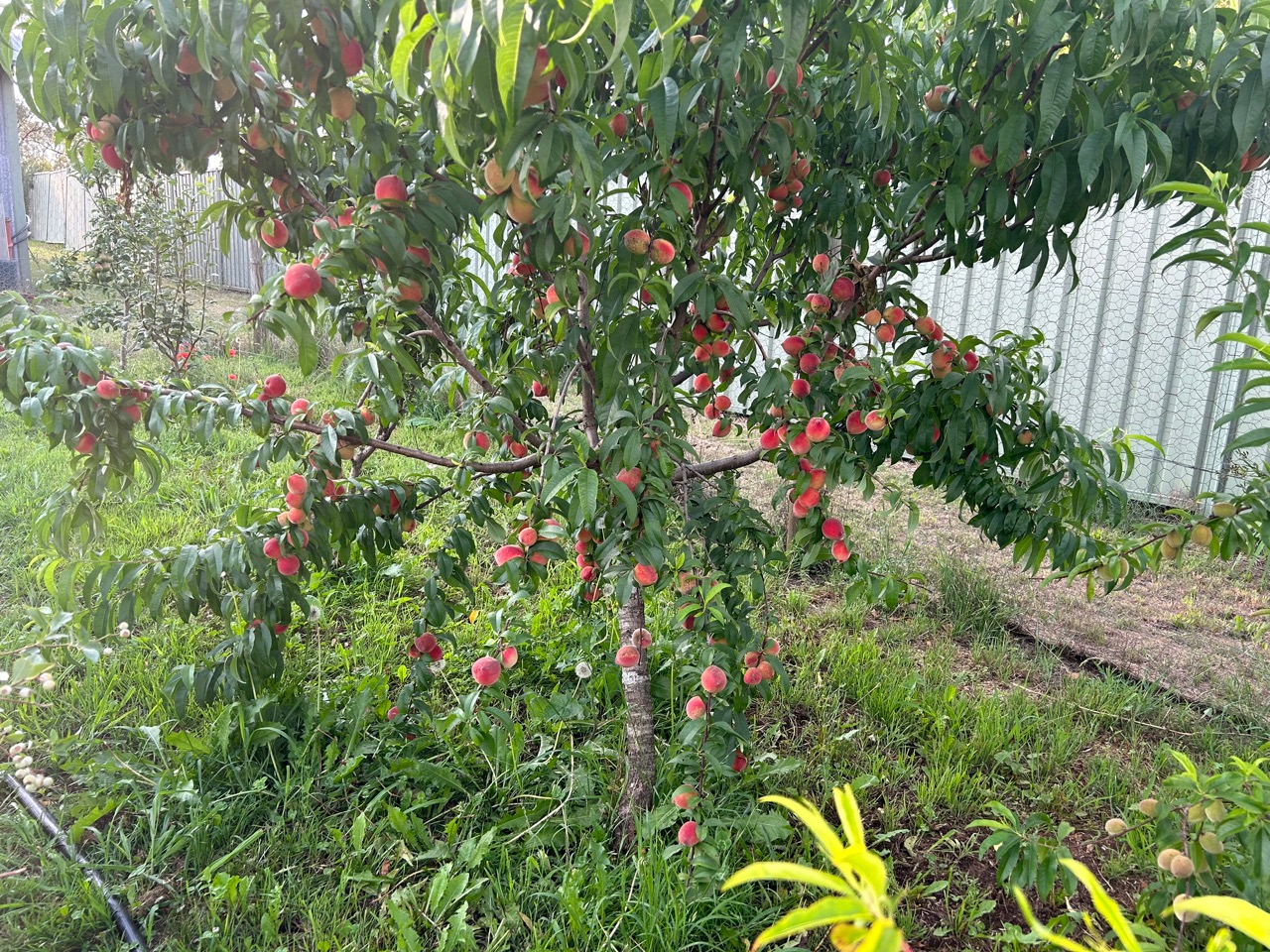
December brings on the summer and the stone fruit harvest. We have all of the newly planted, now 4 years old. stone fruit trees in the new post fire orchard coming into fruit. We chose to plant all dwarf rootstock, low chill, hot weather tolerant, varieties. They are doing really well and everyone of them has fruit on them this year. Some of them set fruit from year one, but as this isn’t good for the health of the tree, I picked all the fruit off, bar one piece, just get a taste of what was to come. Fruit trees do better if they are left to grow on for a few years and put all their energies into developing a sound, strong branch structure and deep root system. As their first 3 years were all very wet here with the la nina event coinciding with their planting, They grew very well indeed and we hardly had to water them very often.

So now we have a surfeit of peaches and nectarines, on these pretty little bundles of red and green. All the fruit needs to be eaten now or very soon, so we have fruit salad for breakfast. 

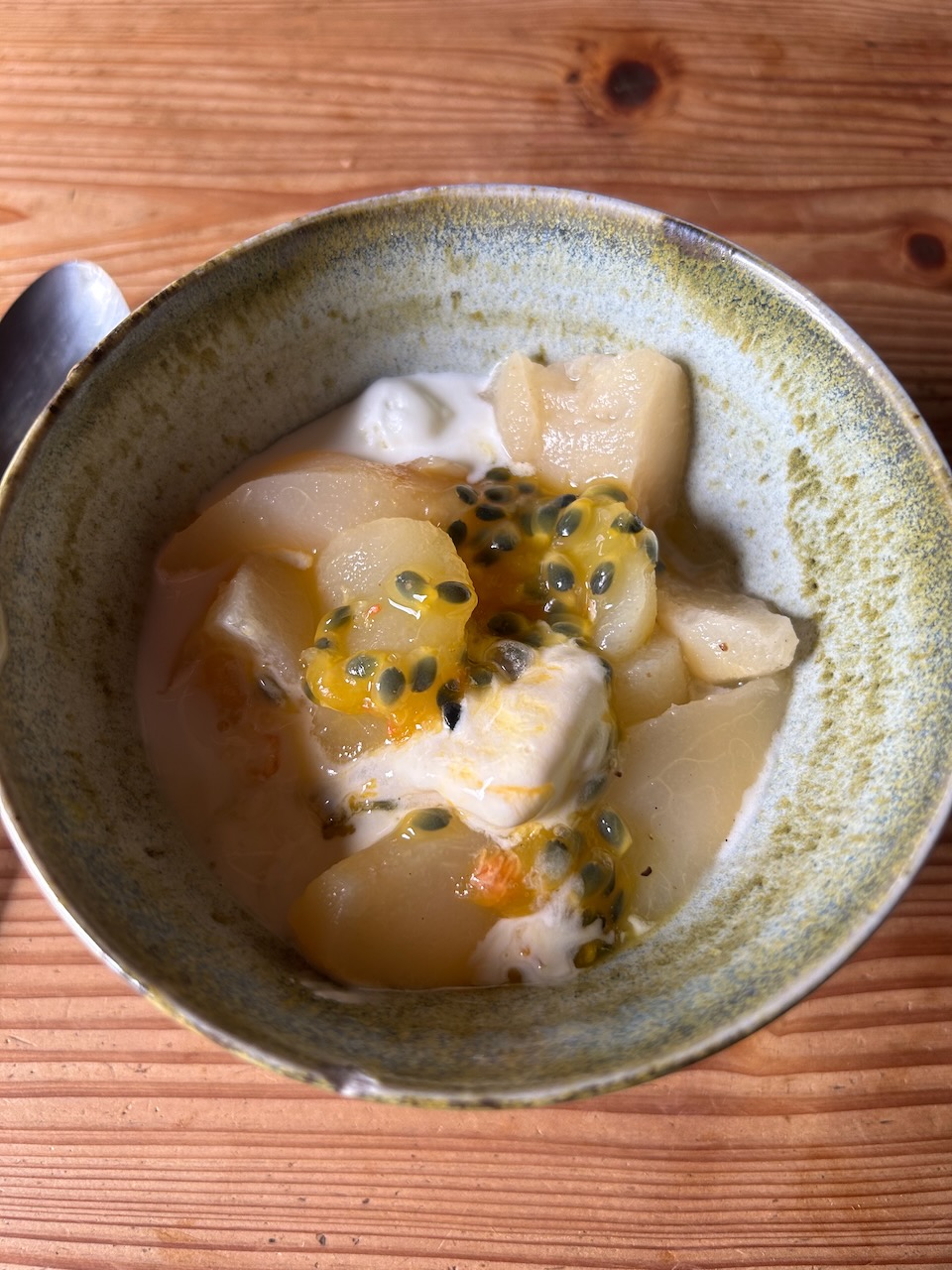
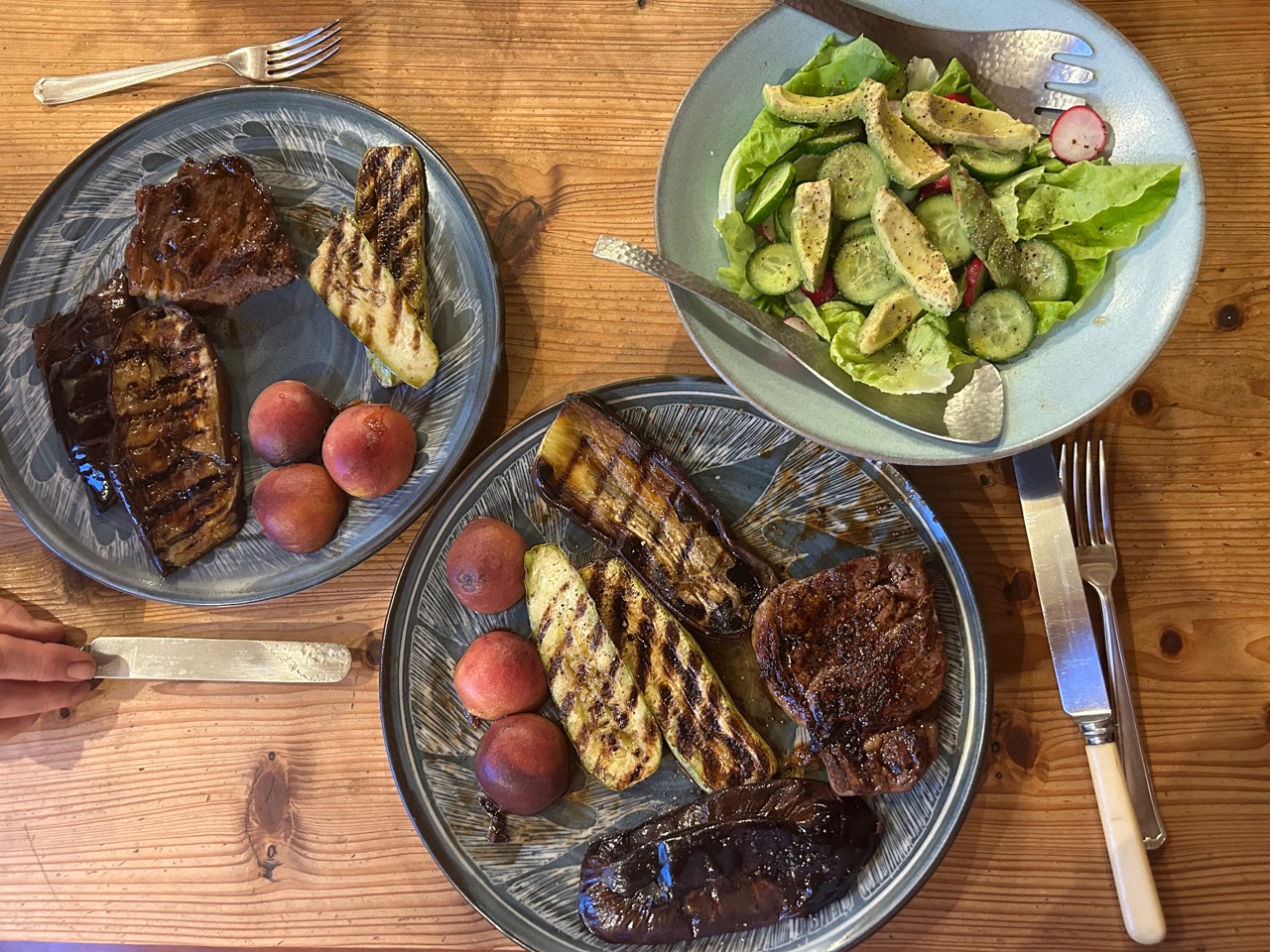
BBQ’d peaches and or nectarines with dinner, and stewed fruit for desert. There is always a pressing problem with the fruit fly. I was a bit slow in getting all the fruit fly trap and lures re-charged with refreshed baits this year, so there is a bit of fly in the fruit. We cut this out and cook it up to kill the wrigglers. The rest of the otherwise undamaged fruit is stewed for breakfast or desert. 

This old fly trap has about 100 dead male fruit flies in the bottom from the early spring flourishing. I empty them out and replace the old bleached white bait with a new bright pink one. We have about 14 of these traps of various ages. I bought a few new ones each year, as the orchard grew. now I just buy refills for the bait.

You can tell their ages by the bleached out colour of their lids.

We picked the very last of the broad beans. I thought that I had picked them all last week, but I only had a boy-look. Janine went back through the crop and found another meal for us. I decided to cook that very old favourite of pork and beans. So called favourite of the cowboys on the trail in the old west. I first became aware of this combination watching old black and white western cow boy movies as a kid. I had no idea what it all meant, but it did cross my mind briefly – very briefly. Why were they eating pig when they were herding cattle?

Why weren’t they herding pigs if that is what they wanted to eat? Fortunately, my nascent and emerging tiny brain managed to accept and cope with this difficult dilemma, and moved on. 

Now fast forward to my early interest in cooking and coming across the wonderful Italian recipe of chorizo, beans and tomatoes, obviously with extra chilli and garlic, it goes without saying. It’s become one of our springtime/hungry gap favourites. The beans are usually all dried from last summer, as is the bottle of reduced tomato sugo or passata. As we don’t have our own pig, just chickens. I use what we have in the fridge. At this time, we only have some bacon, so that is what I use. With the shops being a good 50 km round trip away, we don’t drive there frivolously. So bacon it is.

Home grown beans, home grown sweet basil, home grown garlic and home made passata from home grown tomatoes. WARNING! A pig was harmed in the making of this meal.

Desert is fresh picked cling stone yellow fleshed peaches soused with a dash of amoretto half an hour before. Perfection!

These days I’m up in the early mornings from 5.30 and work outside until the sun gets too hot, possibly around 9.00am. Sometimes I am out in the garden working, or more recently. I have been updating our fire fighting capacity with extra sprinklers on the walls of the pottery, barn and big work shed. I have installed the ‘spare’ fire fighting pump that  I used to transfer water from dam to dam.

It is now more or less permanently in place to protect the pottery and barn with a high pressure water sprinkler system. This system used to be powered by an electric pump, I found out at my expense that electric pumps are useless in an emergency, even though I have solar power and a battery, when the fire came and burnt the pottery, it shorted out the power to the barn and only then did it catch fire.

So now everything is dual powered. We have electric pumps for hand watering the garden beds and running the roof cooling sprinkler on top of the roof. But for fighting is completely petrol driven and independent. Because you cant let petrol engines sit idle. They need to be started and run regularly. I have every thing in a dual system now, so that I can start up the fire pump when we are both want to water the garden and orchard trees at the same time. The fire pump handle that duel drain on its reserves of power with no problem, whereas the one horsepower electric pump struggles.

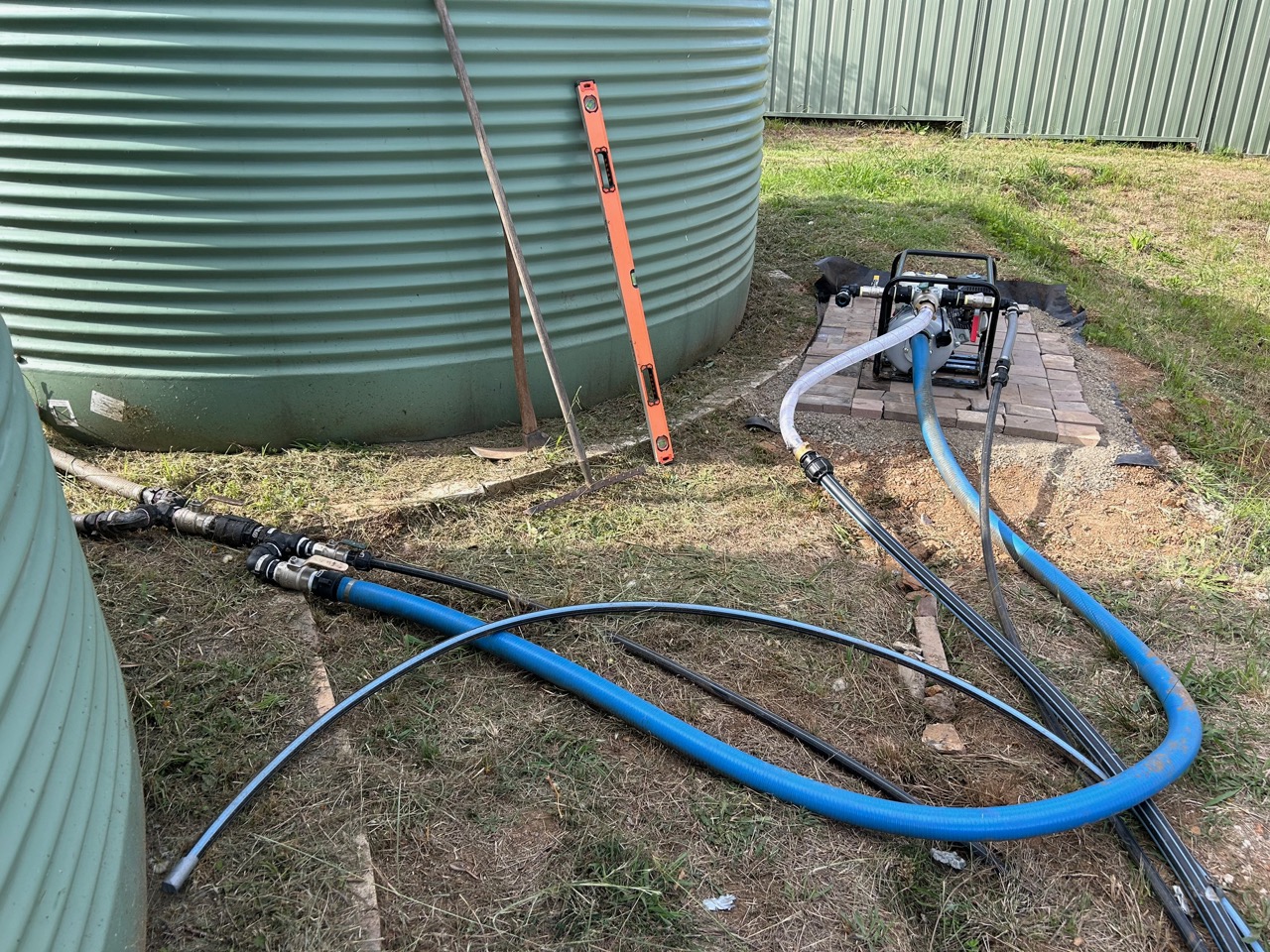
Inspired by all the talk of the Roselle spaghetti junction new motorway tunnel. I installed my own water fed spaghetti junction.

Situated directly behind, and close coupled to, the two 25,000 litre water tanks, it should be safe from fire there? Only time will tell. If you look hard at the image of the pottery shed, you will see the water misting out of the wall sprinklers along the verandah and up on the roof.

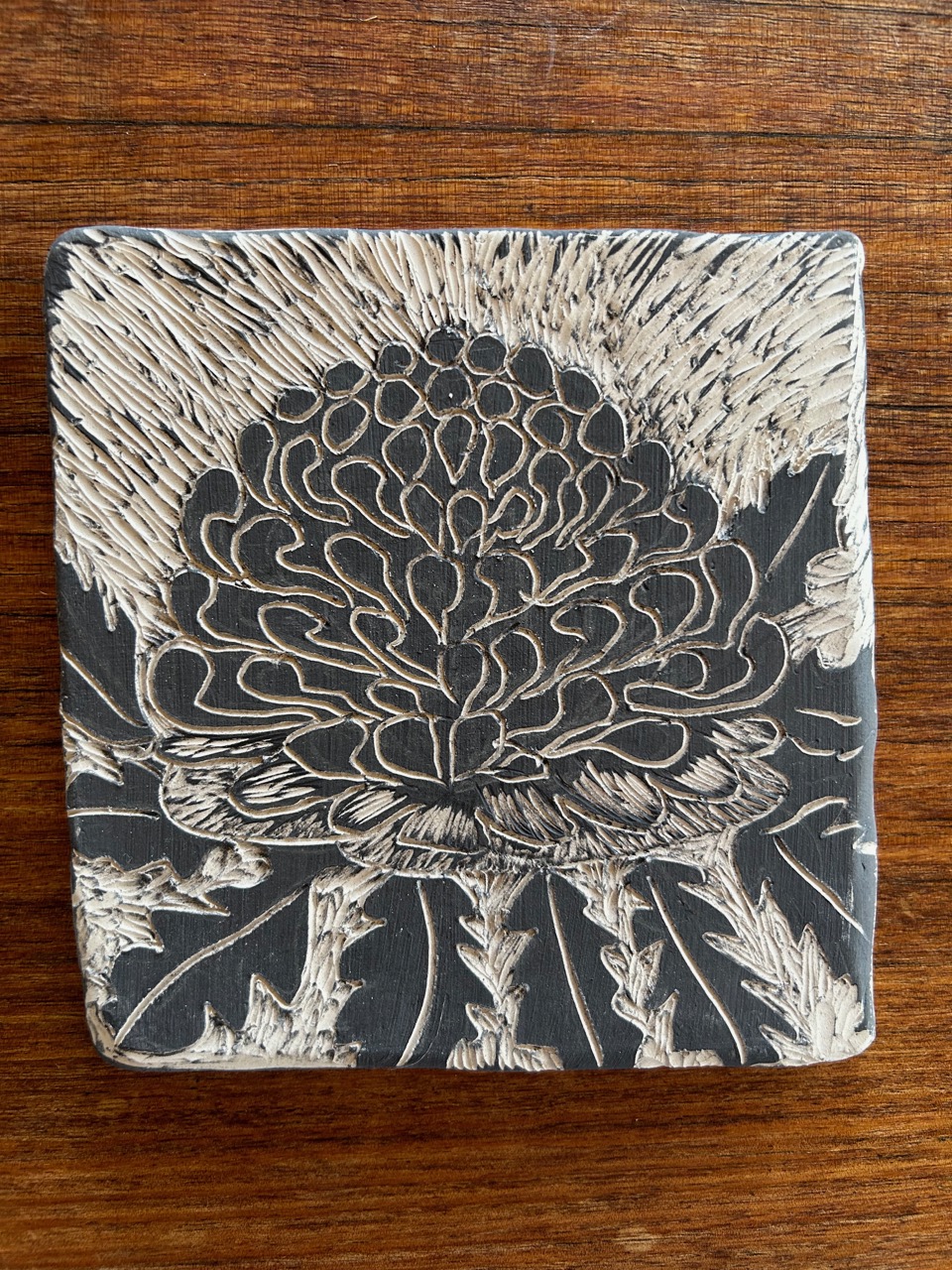
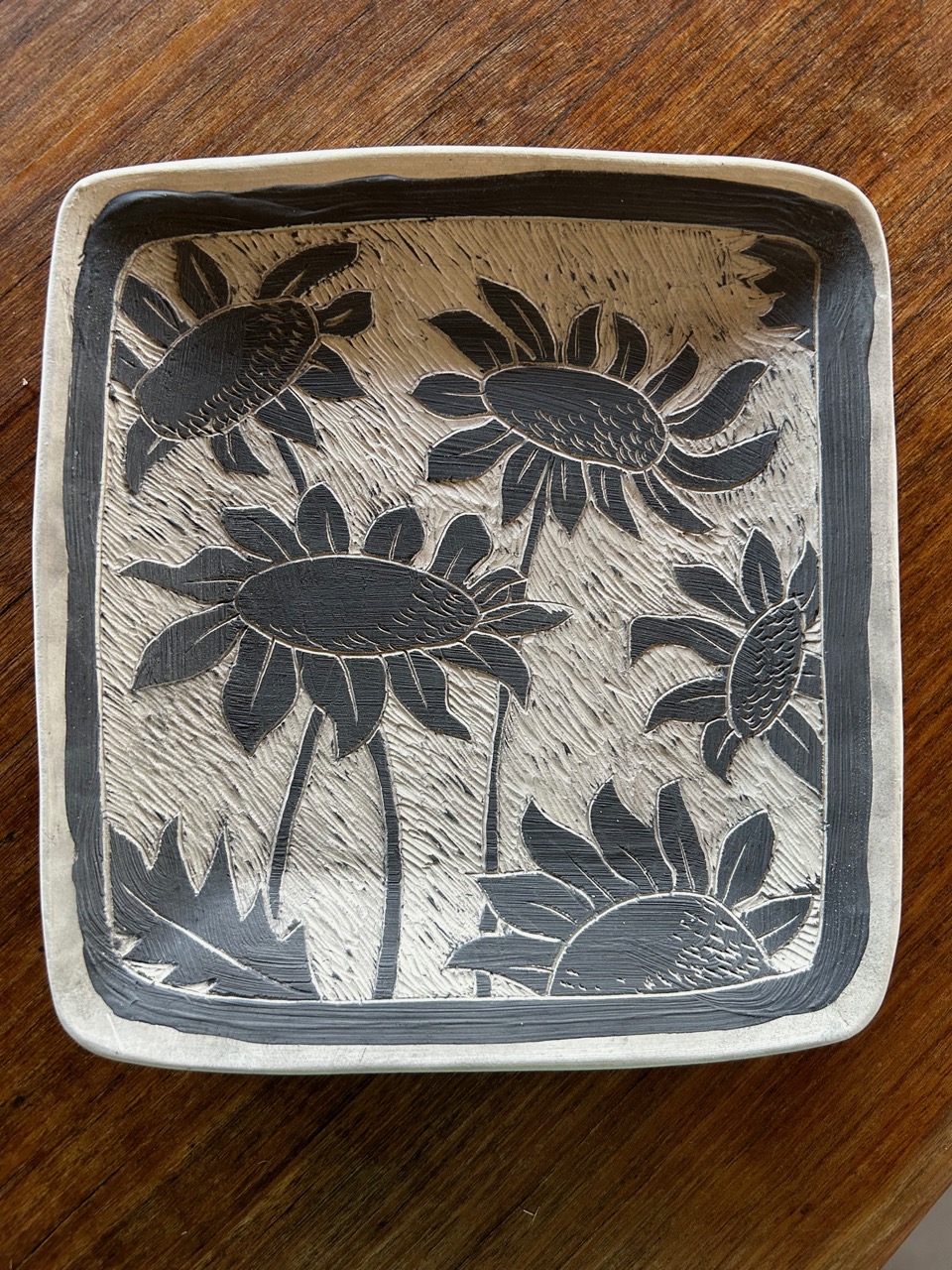
I’ve been spending the hottest part of the day inside working on the ongoing sgraffito project. I’ve finally run out of pre-slipped, press moulded dished and tiles. I’ll have to get on the wheel again soon and make more shapes to decorate.

Inspiration keeps on blossoming

Everything is relative

We are having a short break from the pottery studio for a week to work around the garden, before the next few weeks of weekend workshops. It’s the last week of spring and we are only now getting the time and energy to plant out the summer garden. It will be a smaller garden this summer, as we are forecast to be heading into a long dry ‘el nino’ period. The previous one lasted some years and culminated in a severe drought with bush fires.

We spent the last summer of el nino drought watering our vegetables and garden plants from our rain water tanks, as all the dams had dried up. Luckily for us, we had invested in two huge storage tanks 20 years ago, when I was working and had the money to invest in our future water security. People mocked us, but we have never had to buy water in our life. We are attempting to be self reliant in as much as we can. Rain water and solar electricity are at the top of the list.

Last drought, we emptied one of the very large 125,000 litre water tanks and were half way through the other when the rains returned. Luckily, we didn’t have to buy water. Some people that we used to know years ago, had planted out an extravagant and sophisticated English garden told us that they were spending $300 per week back then, buying water to keep their garden alive and thriving. Three large truck loads of water were delivered and pumped into their tanks each weekend. It was the wrong kind of garden for this area, at this time. They also got a 100 metre deep bore drilled to get access to some underground water, but it dried up, and had to be evacuated, all the pumps and piping had to be hauled out with a crane and hole re-drilled down another 20 metres, to find a more permanent source of water, which then turned out to be iron bearing and needed to be oxidised and treated before it could be used on plants.

We learnt from this and decided to live a more simple and frugal existence, more in keeping with the natural environment. Every part of modern life does damage to the environment. Our aim is to keep that damage to a minimum where we can.

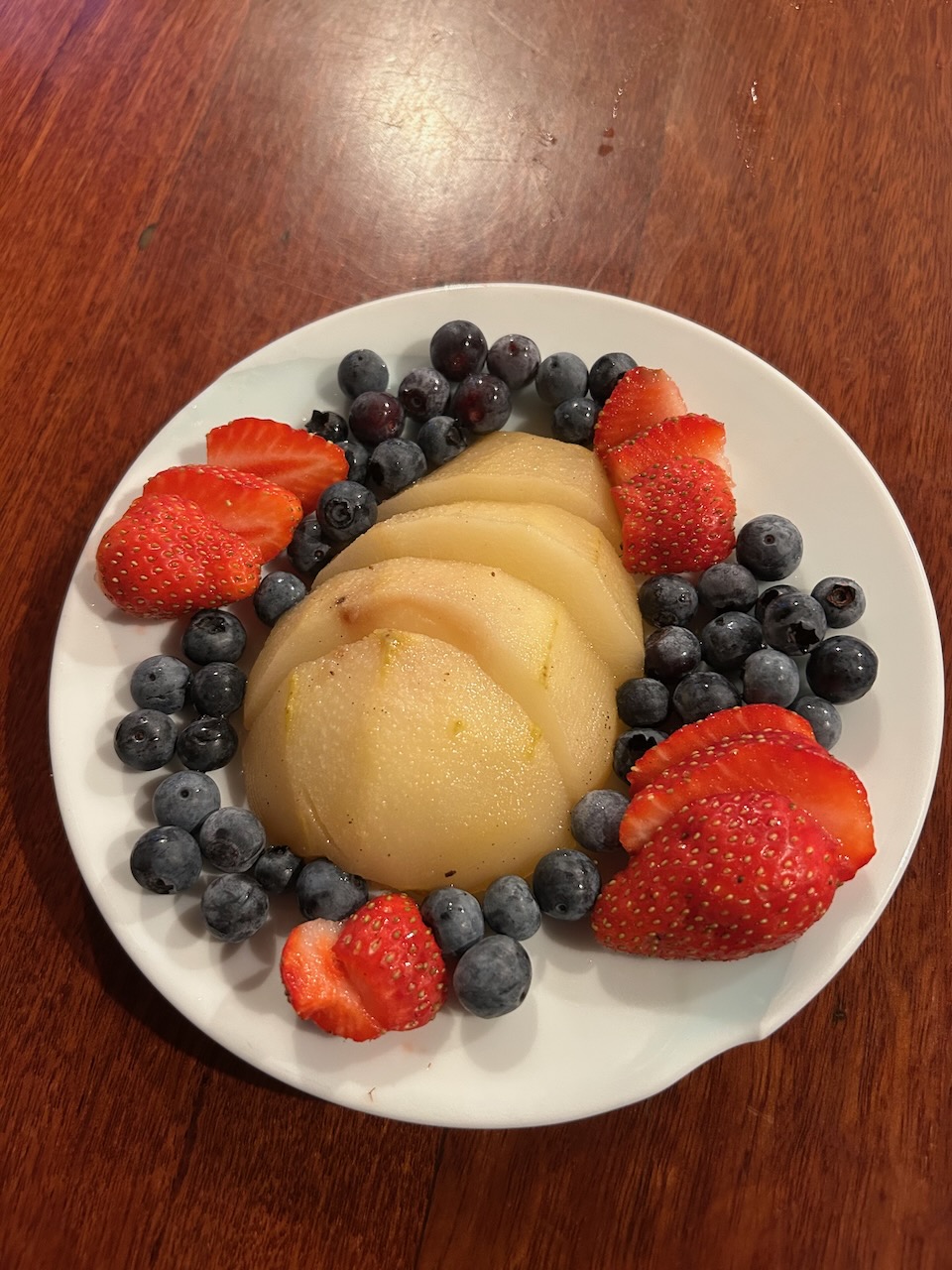
We have been enjoying the very early fruits from the garden as our breakfast fruit salad, Cherries, blue berries and strawberries. They are all growing under cover in the vegetable garden enclosure, safe from birds, so we get them all. Except for what the snails eat.

We had a good crop of mulberries this year and I was able to get my share despite the birds taking everything that they could. It’s the first fruit to come on out there in the orchard, so the birds are very hungry after the winter. They are also looking to feed their new babies hatching out in the spring time. This year we shared the crop. I was able to make 3 mulberry pies over the couple of weeks while the crop lasted. Being a huge tree, we have no way of netting it, so we share. The youngberries come on next and because they are a bunch of canes , and not too high we can net them to get most of the fruit. The birds are resourceful and learn how to land on the netting, pushing it down and then pecking the fruit through the net.

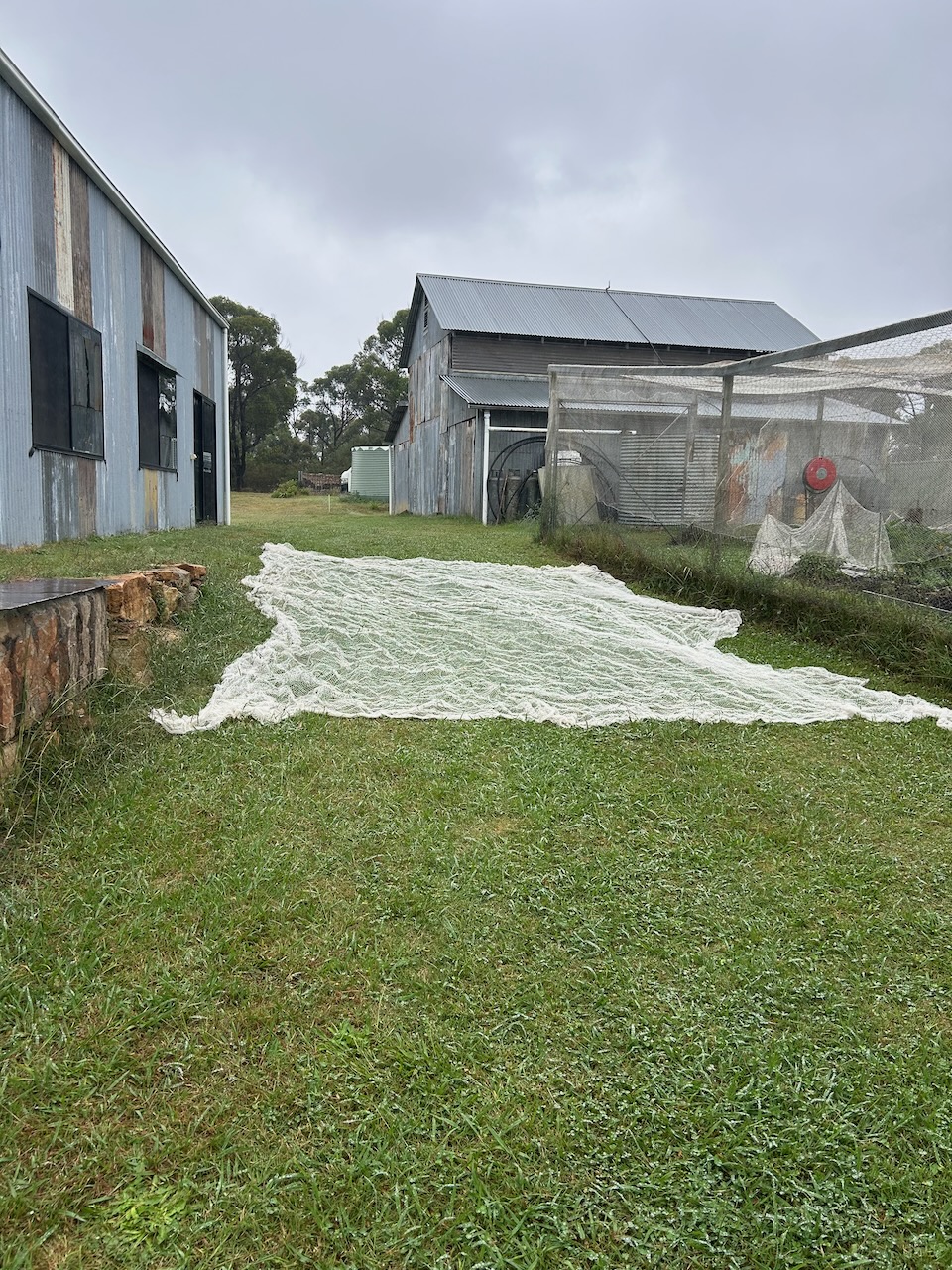
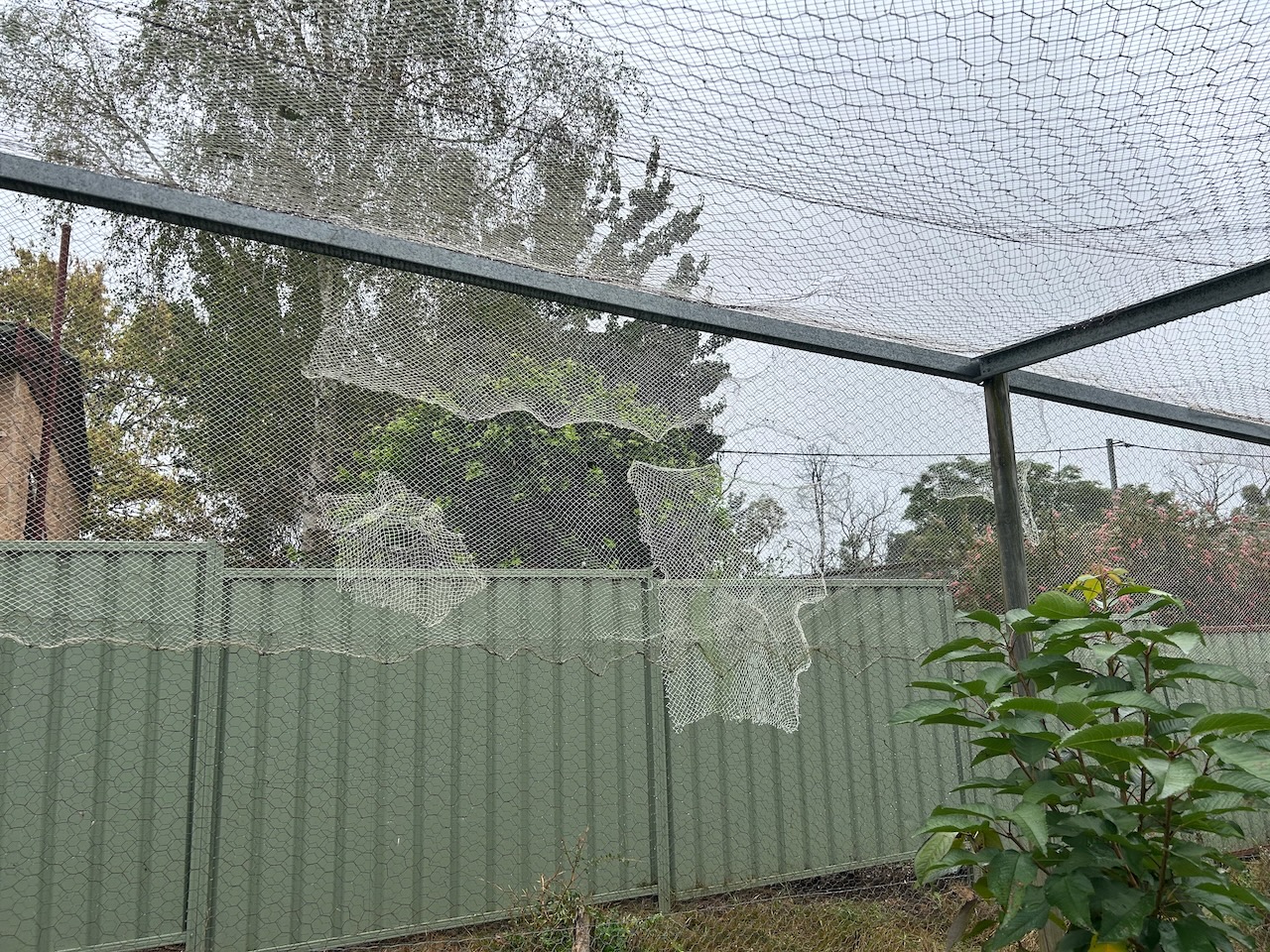
We also netted the apricot tree, as it has a reasonable crop of fruit coming on. Who knows how the rains will turn out? If there is no natural water from the sky, the dams won’t be enough. We have netted it just in case anyway. You never know what might happen. What we do know is, no net = no fruit. So we net.

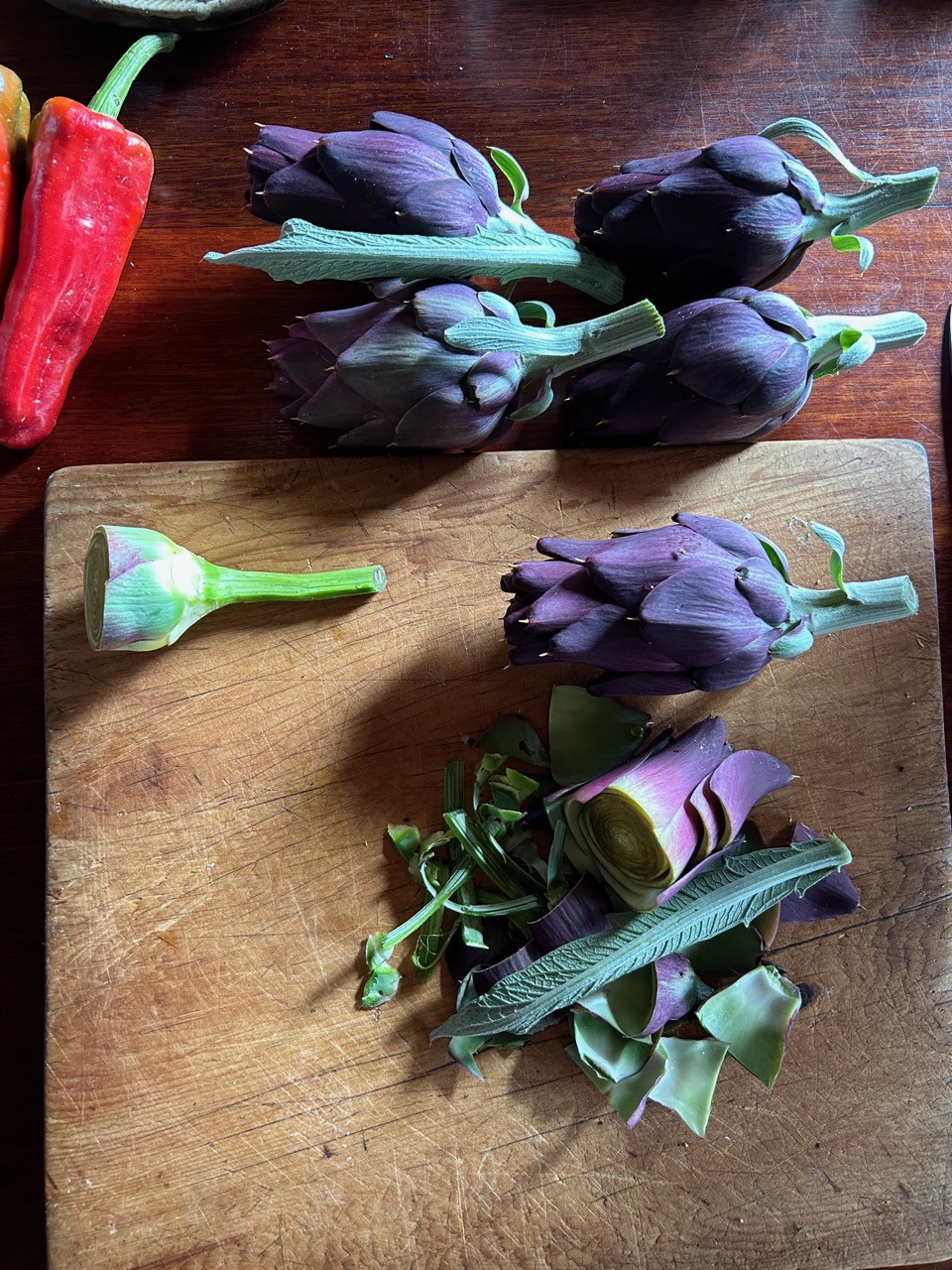
We have finished the last of the globe artichokes. The purple variety are the last to mature. They are a lovely seasonal treat. This year we have been having them on pasta for a slow lunch.

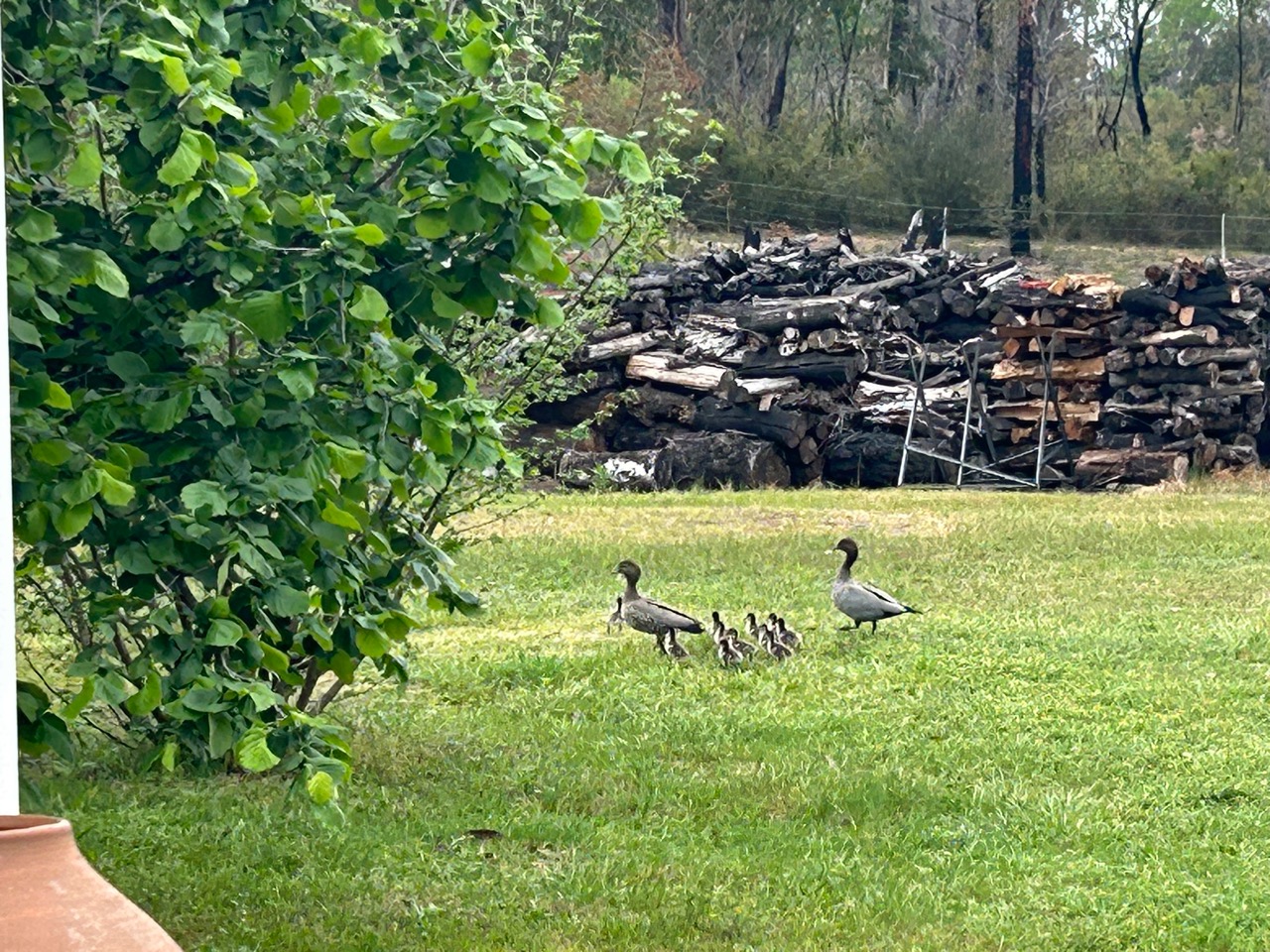
Spring also brings a return of the wood ducks. This season so far, we have had 3 hatchings. They start of with a dozen littlies and day by day the number decline. I assume that they are taken by bigger birds, although I haven’t seem one taken. They are very timid and wary by nature, so we keep out of their way while they have young. Choosing to walk the long way around if we encounter them in the garden or orchards. I think that they are probably lucky to get 2 or 3 to maturity by the end of spring. We have learnt from experience that if you don’t make eye contact, they are less likely to run or fly away. They will stay and keep a very close eye on you but not move. As soon as you turn your head to look at them, then they take off.

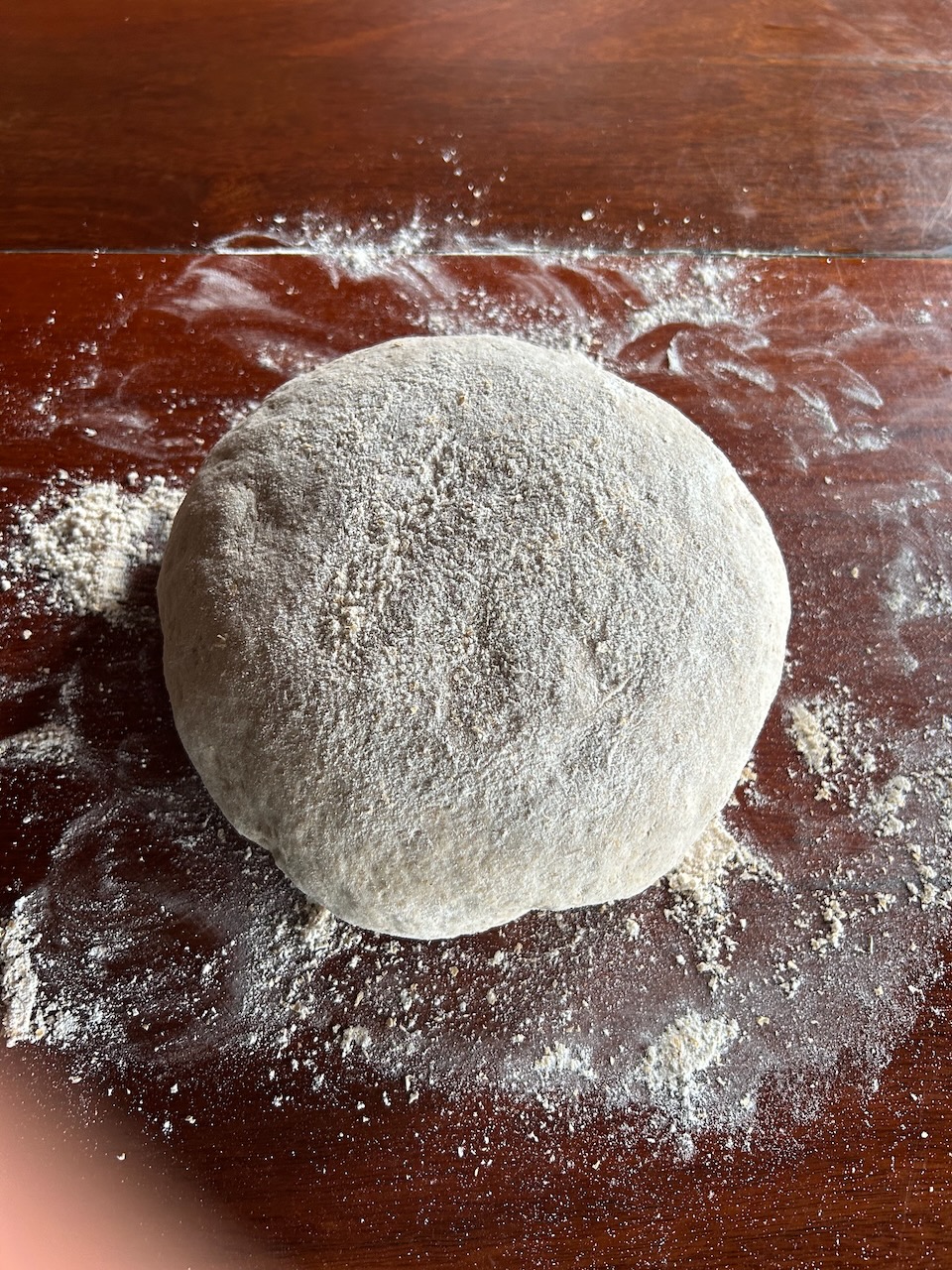
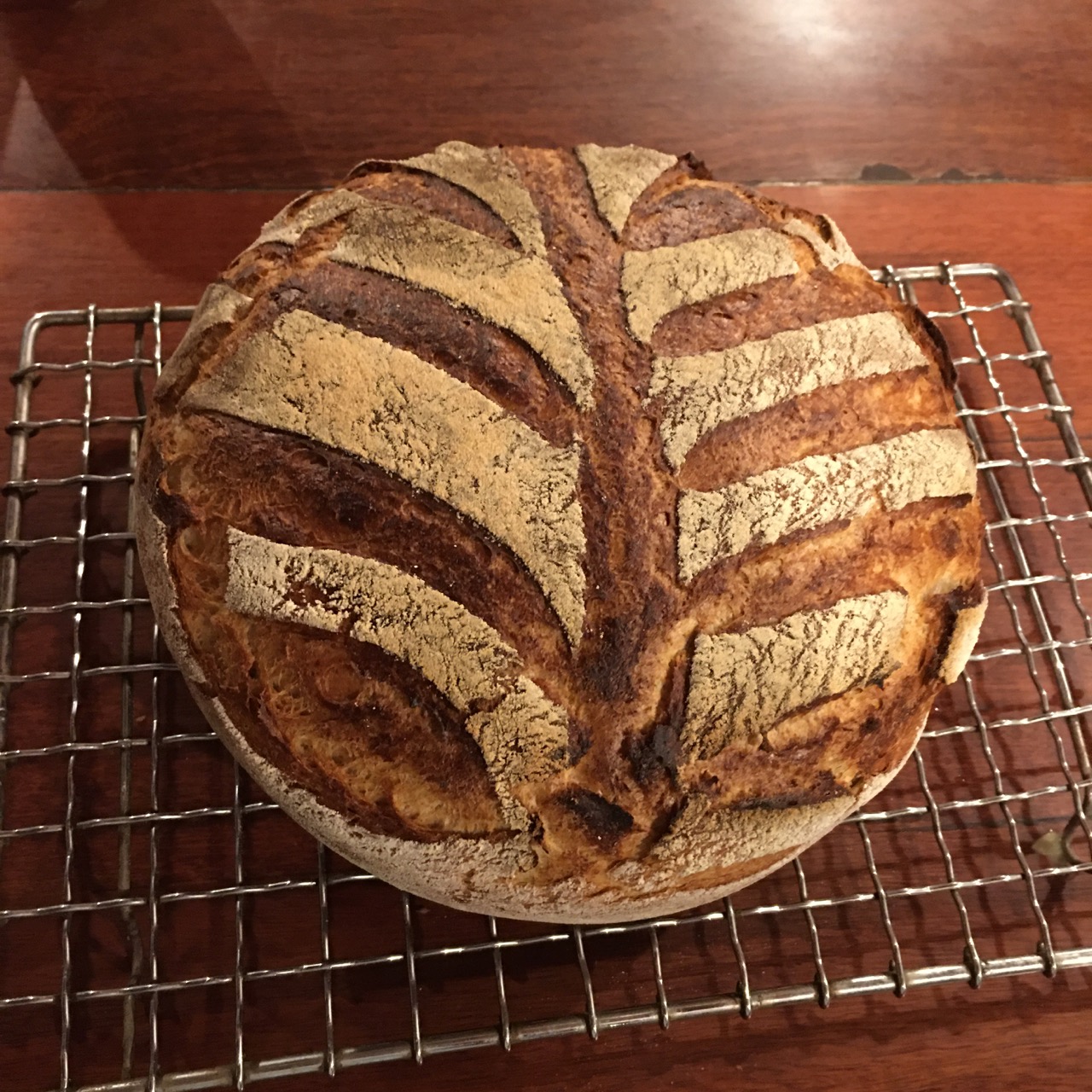
I’m still baking my bread each week. It’s a 50/50 blend of wholemeal and rye. It works out well for me, the way that I have developed it. To save time and make it an easy proposition, I sort of cheat. Sort of! But not really. I use a bread making machine to mix the dough on the ‘dough-only’ setting. It takes 1 1/2 hours to mix, prove, knock down and rise the dough. Then it switches off. I turn up and knock it down one last time and pop it in a cast iron, ‘Dutch-oven’ baking pan and bake it in the oven for 20 mins at 240oC with the lid on, then another 20 mins with the lid off. It works for me.  I can be outside working while the dough is being nurtured and pampered in the machine. We are on to our 3rd bread machine. They last about 10 to 12 years before they burn out, or wear out the bearing. At one loaf a week for 10 years, that’s a 500 loaf life span.

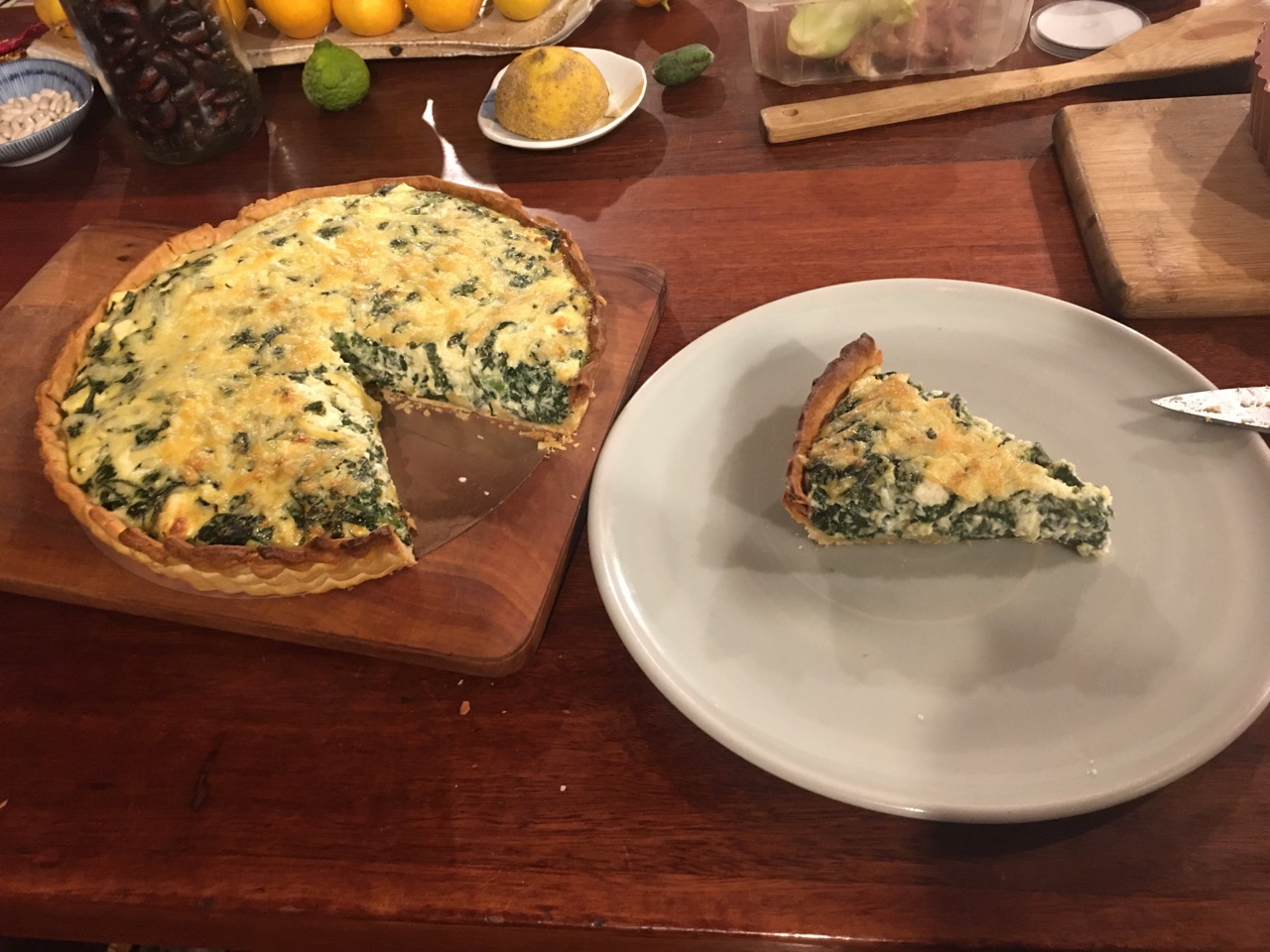
We picked the last of the spinach. Just tiny leaves from the spinach trees, as they bolt skywards heading to seed. I made the last spinach pie for a while. I will need to plant some more. I should have them in the ground by now, but life was too busy to do it all. I have just put in the seed this weekend.

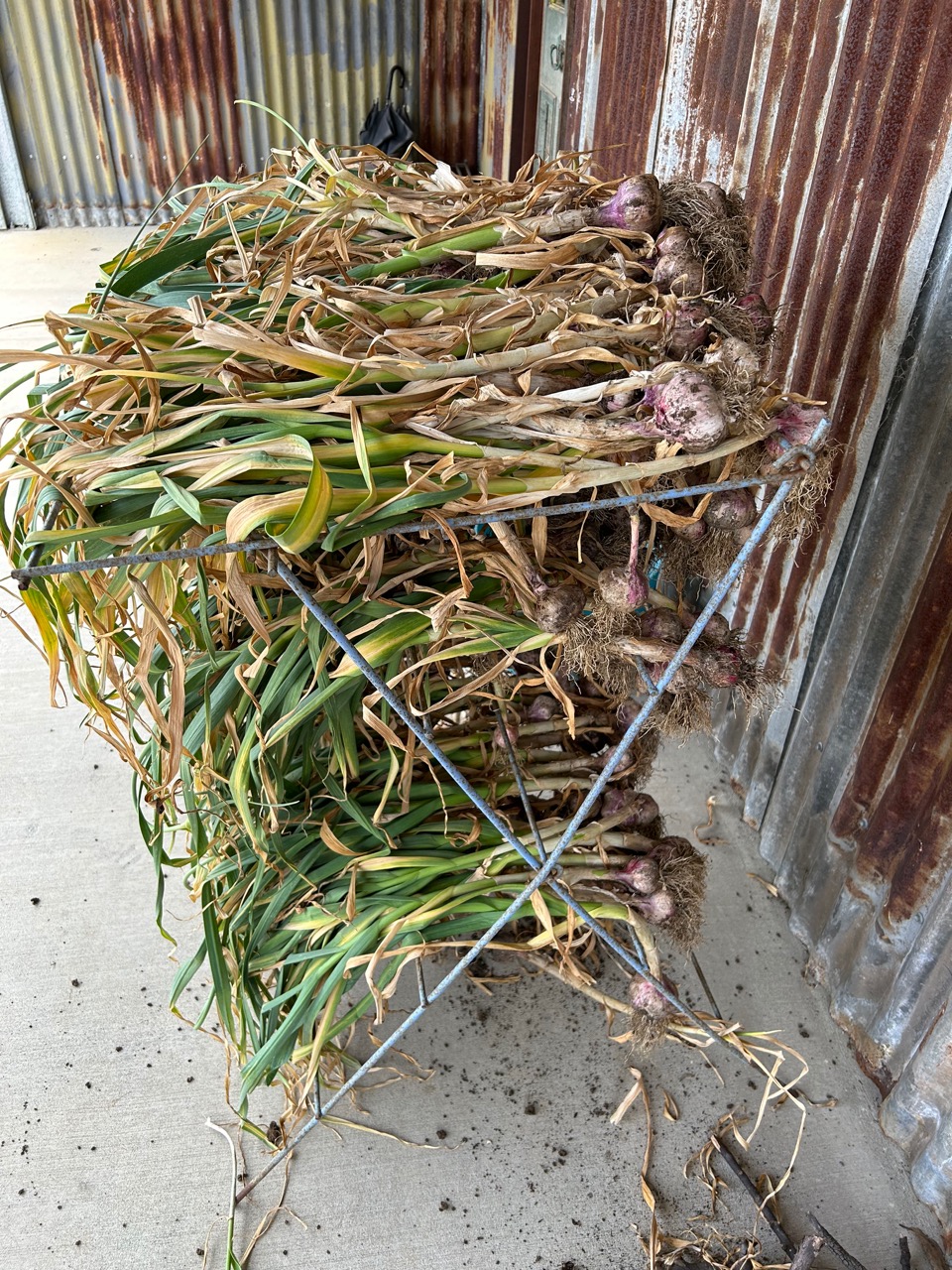
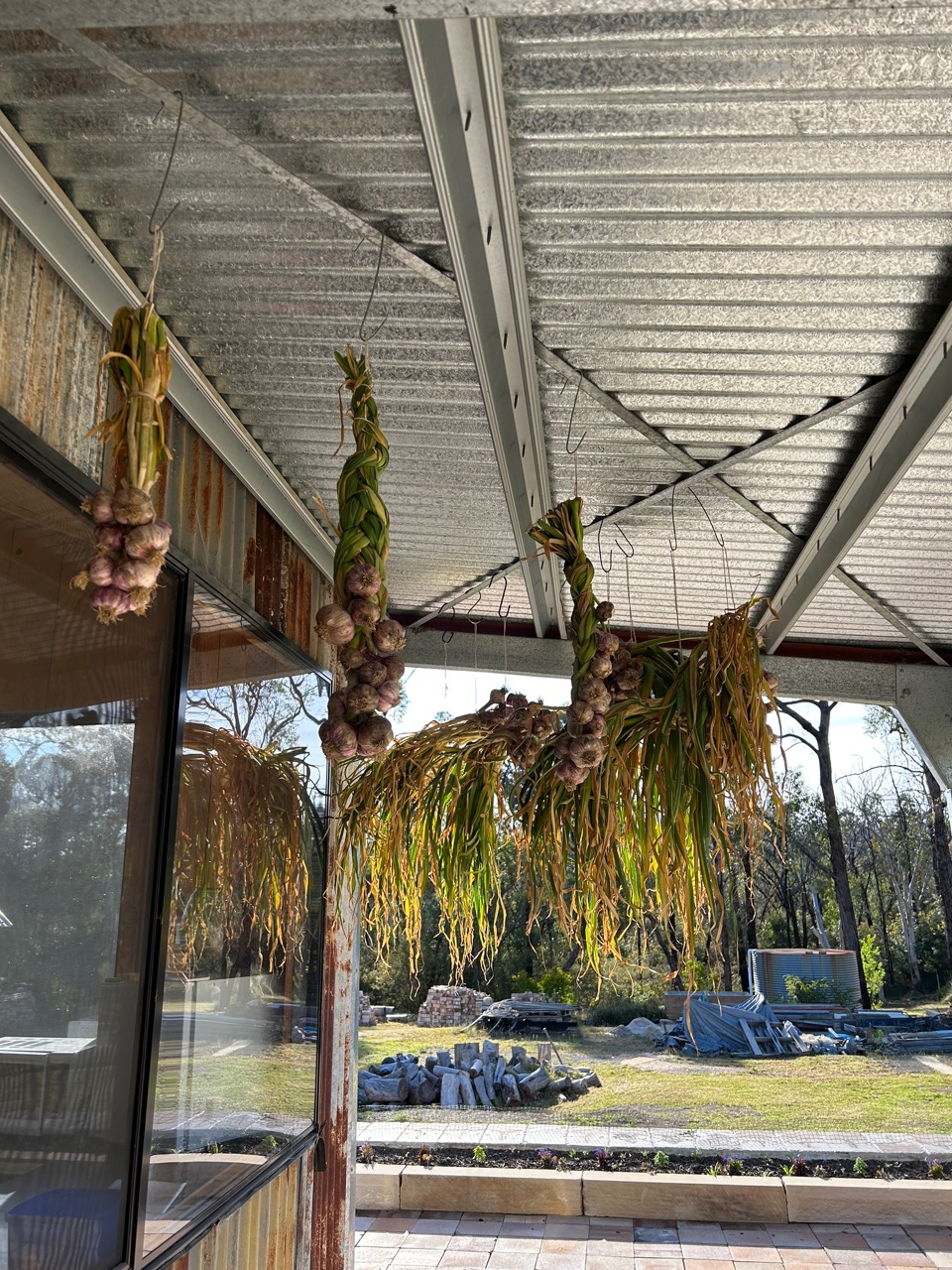
Janine has found the time to plait this years small garlic crop, just half a dozen plaits and a big bowl full of tiny knobs that are too much trouble to plait. Those small garlic knobs sit in their bowl on the kitchen work bench are used first. The biggest and best are kept for replanting in March. Its a very small crop and wont last us through the year. But can’t complain, at least we have some.

I catch myself thinking that things could be better. More or better sized garlic, more regular rain. But things are really pretty perfect for us. I have to remind myself that I’m not in Palestine or Ukraine being bombed. Be happy with what you have.

Winters End – The Last Truffle of the Season

Today we finished off the last truffle of the season. It was romantic, mysterious, fragrant, exotic and delectable. It really elevates the humble scrambled egg into something special without taking anything away, just adding loads of romance and aroma. The warmth of the freshly cooked eggs releases so many aromatic oils and esters from the tiny black fungus. It fills my nostrils as I bend over doing the shaving. It’s a good thing that we only get to eat these delicious little morsels in the winter months, otherwise we may become somewhat blasé about it all. As it is, they are still a very special seasonal treat, If somewhat expensive. We can only afford to live this decadent gourmet lifestyle on our frugal budget because we have a son in the industry.

We are also probably making our last batch of marmalade too, as we have picked most of the Seville oranges now and eaten nearly all of the other citrus fruit. Although this is the beginning of spring, it is also the end of winter in another way, so it’s the end of the winter crops like citrus. We try and live with the seasons, so that’s it for the big citrus splurge in our diet. 

It is one of the blessings of living in the Southern Highlands, that we have 4 distinct seasons. For instance, this morning we had another frost. This might possibly be our last really cold morning, but you never know with the climate emergency developing as it is, anything could happen.

I peel off the thin yellow layer of the skin without taking too much of the pith. I want the pith off!  With my pile of curly peels, I end up with what can only be called ‘bitter and twisted’ .

Janine removes the pith and cuts up the juicy centre to add to the pan. The first pan is on for 30 mins. before we get the 2nd pan on the stove and the difference in colour is dramatic, it  gets richer and deeper as it cooks. We try to use as little sugar as possible, while not making it too bitter and acidic, we also need enough sugar to make it ’set’. It takes about an hour of steady simmer to get it to thicken sufficiently. It’s worth all the effort, it tastes delicious, with just the right consistency. Seville oranges aren’t all that nice on their own. They are OK, but they really come into their own when it comes to making marmalade.

The stone fruit orchard is growing up well. This is its 3rd year and the trees are starting to look a lot more settled and established, with thicker trunks. I have been pruning them into open vase shapes where possible, but some of them have a very narrow vertical habit. They are all grafted onto ‘dwarf’ rootstocks, so they are keeping to a compact size. Most of them are now about 1.5 to 1.8 metres high, with an expected total height of 2.5 metres eventually. But I am well aware that plants can’t read their own labels! So there are bound to be variations.

We had a really great 1st Weekend workshop in the new pottery. It worked very well. The new studio is a great space to teach in. The light is good and the layout works ergonomically for 10 people, 8 students and 2 teachers. After everyone left I got stuck in and started making more pots for myself. The Open Studios, Arts Trail is coming up at the end of the year, so I need to get back to work making pots for that. I started back at it by making 30 straight sided mugs.

I spent a few days since the recent weekend workshop, in the afternoons, in my spare time, splitting and dressing sandstone blocks, to make some garden bed edging along the recently finished slate capping on the big sandstone retaining wall around the new pottery. It’s just another one of those jobs that has been in the offing and waiting for the ‘right’ time. I chose this ‘right’ time from what is left of my other time! Once the little wall was in place I shoveled in a load of top soil and planted seeds and a few seedlings to make the edging look a bit more settled and finished. I sprinkled in a packet of English Cottage Garden seed mix for good measure and 30 caper seeds, one every 600mm. Capers need an elevated, well drained, sun baked, dry, harsh environment to thrive. They take 2 years to establish, then persist for many more as long as they are cut back and pruned hard in the winter to stimulate good growth in the spring and summer, as flowers and fruit are produced on the new years growth. The elevated and exposed wall seemed like a pretty good place to try them out. I have read in a few books that they thrive on top of stone walls in the Med’s dry summers. I have no expectations, but if something comes of it, I’ll be pleased. If not, then I’ll chalk it down to another one of life’s enriching experiences. The stones look nice anyway, regardless of whether the plants grow or not!

After the soil was shoveled into the new beds, Edna the chicken, who had been helping me all day, came along and decided to help me some more by scratching a lot of it out again. I had to make some impromptu wire covers to protect the small seedlings from being excavated!

I’m happy with the result. 3 days work and $50 bucks goes a long way. I’m hoping that it will look greener in time for the November Arts Trail, Open Studios event.

Faire Chabrot

As the weather has been cold. We decided to have a baked dinner. This months meat meal is a very small piece of fillet steak.

Baked with a load of vegetables from the winter garden, and of course, a Yorkshire pudding in the old fashioned tradition of using all the meat juices from the baking pan. The proper way! After baking, the meat is placed in the warming oven to rest, while the baking dish is then reused to bake the ‘pudding’. 

Non of those shop bought, frozen, pissy little cup cake things, masquerading as Yorkshire pudding, to be microwaved to a perfection of stogy, doughy sog.

The batter for proper Yorkshire pudding has to be made up and hour or so at least before hand. It’s the first thing that you have to do before starting to get a baked dinner ready. Even before washing and prepping the veggies, or spiking the meat with cloves of garlic. It has to be mixed and left to rest, then stirred occasionally throughout the baking time, so as to get a light and fluffy pudding with a thin crispy top.

recipe;

2 table spoons full of plain flour

1/2 a cup of milk

2 eggs

(See previous blog post 17/08/2014. ‘Don’t get to know the farm animals too well’)

Janine learnt this method from my Yorkshire mother, who learnt it from her mother etc.

She was a good student and makes a very nice Yorkshire pudding. My mother would approve.

It ends up being a huge meal, but we have been working hard, cutting and splitting fire wood all day, so it’s very tasty and easy to eat.

I also made a lovely mussel soup this week. I used a lot of fresh herbs from the garden, some white wine and a bottle of our preserved tomato passata from last summer.

It was very good with the mussels, and with a lot left over in the pan, made a warming lunch time soup the next day.

After eating all of the mussels, there was a little soup left in the bowl, so I was inclined to engage in the ancient French tradition of ‘faire Chabrol’. 

By pouring a little of my red wine into the bowl and drinking the mixture straight from the bowl.

I’m warned that this is not a practice to engage in, in polite society. It’s strictly for peasants. Welcome to the home of the Post Modern Peasant.

It’s catching!

The next day at lunch, we had the same broth, sans mussels. But in another very old tradition, I added broken pieces of old bread into the soup to fill out the meal. And, in keeping with the tradition, I finished with a little red wine. Faire chabrot!

Itadakimasu!

Winter Solstice and the First Truffle of the Season

We are well and truly in the months of winter now. We had a week of crackling frosts, then they were driven away by a week of freezing winds. That didn’t help me to get out and about in the garden at all, so I stayed inside working in the studio, out of the wind.

We celebrated the winter solstice with a dinner here in the big decorating room in the pottery, at the big work bench, converted for the day into a refrectory table. We can seat a dozen pretty comfortably in there. It is such a big, almost empty space, that it doubles up very well as our entertaining area. It is huge and uncluttered, as opposed to out house, which is small and compact, and none of the rooms in the house were designed to seat 12 people for a meal. We have however, had over 30 souls in there for a house concert, crammed in cheek and jowl. But that was only for listening to music, not a sit down meal.

On this occasion, I cooked pizzas for everyone, as it is cold outside, it was a good time to light up the old wood fired pizza oven and crank out a few pizzas. 

I try and stay clear of the usual suspects. My favorite this time was wilted spinach and oven roasted pumpkin from the garden, with a few olives. I prepared everything before hand, picking, washing and wilting the spinach before everyone arrived. I spent the morning in the kitchen prepping. The pumpkin was finely sliced, diced and roasted in the new solar electric oven, with olive oil salt and pepper and some finely diced garlic, also from the garden. These crunchy little gems melt in your mouth and smell and taste delicious.

We have been enjoying the first truffle of the season for our breakfasts this last week. We buy only one truffle each winter. It’s a special indulgence. They are hard to buy around here directly from the growers, who prefer to sell in larger amounts directly to restaurants. Luckily we have a son who is a chef and has access to the trade, so we order one each season through him. We take what ever comes. I only ask for something less than $100. At $1 a gram, it can quickly add up, but usually we get something around $30 to $50 worth. However, this year, the price has gone up to $1.50 per gram, and what turned up in our order is a beauty! 50 grams. That is about 50mm dia. and the biggest that we have had the privilege to enjoy so far. 

This is a 4 or 5 meal truffle!

We store the truffle in a container with the eggs for tomorrows breakfast and a cup of rice that will be the next nights risotto dinner.

The best way to enjoy truffle in my opinion is just simply grated over very soft scrambled eggs.

We spent the weekend cutting and splitting wood for the kiln and house. These are logs still sitting in the yard, left over from the bushfire clean-up.

Yes, We are still dealing with the aftermath of that horrible event. It’s still all around us, in the dead trees still standing, but on this occasion, we are cleaning up logs still sitting on the ground from burnt tress that were felled for safety reasons by the State Government clean Up squad that came through after the fire to ‘make-safe’ the area where people might be living and working around their houses.

Some of the logs were particularly straight grained, so were ideal for splitting very fine for the side stoking of the 2nd chamber of the new wood kiln.

Others were gnarled and knotty with many forked branches, so I cut these short for use in the house stove. You can see the new pottery up in the distance. We are clearing up further from the core area around the house now, So we are making some progress.

It was a full day and by the end of it I was conscious that I was very tired and needed to stop before I ended up hurting my self. I have damaged my hand in the splitter years ago, by working on into the gloom in the evening, just trying to get the job finished in one day. 

As the shadows lengthened. I called it quits. I will finish the job another day.

What started the day as a 3 big piles of twisted logs and butt ends, ended with several small er piles of split timber kiln fuel. 

49 years ago, when we started out together on this creative journey. All we had was a two metre long, ancient, two man cross-cut saw and a block buster hammer. My, how things have changed! I still have the big cross cut saw, it hangs up on the wall in the barn. I still have the block buster head too, however it has had countless wooden shafts, broken and replaced since then. My days of swinging the block buster are numbered, but it still gets some sporadic use for small jobs that are too small to be bothered getting out the tractor and hydraulic splitter. It’s a bit like kitchen gadgets that take more time to clean up than the time saved using them. I still admire and appreciate many old things and ways of being, but splitting wood with a hammer is not one of them.