Metric Marmalade

July means that it’s time to get to work in the orchards. There is pruning to do. I usually wait until most of the trees loose their leaves before pruning as a rule, but with such a range of trees in this family orchard of mixed fruits, there are some that have lost their leaves a month ago and others that are still in leaf. 

In a perfect world, I’d treat each tree as an individual and consider its best needs, one by one. 

But this is reality, and I have a lot to do everyday through the seasons. Winter is also wood kiln firing season. I want to fire my wood kiln at least once each month to get through all the pots that I’ve been making since my return from the work that I did in Korea. So the orchard pruning/spraying/fertilising is all compressed into one day, as needs must. I have my friend Andy coming tomorrow to help me do some of the last outstanding jobs to finish off the pottery shed. It needs flashing installed over the windows. Something the shed builders didn’t bother to do. Slack arses! So I’m finally getting around to it 5 years later.

I choose a day at the beginning of July and get stuck in to the orchard jobs. Every tree gets pruned for shape and strength, removing any dead wood, crossed branches and water-shoots, I also open up the centre to let light and air in and allow good ventilation. I prune to an outward pointing bud, and hope for the best. I’m not so interested in maximising the crop of fruit. In fact we have more than enough fruit set each season, as we give a lot away. 

Yesterday during pruning, I noticed that I was pruning off branches from an apple tree with full vigorous growth of leaves still on, and then followed by a peach that was so advanced in its dormancy, that it had bud swell. I really need to give the trees a good saturating spray with lime sulphur before bud burst to suppress mildew, fungus and leaf-curl on the various trees. Lime sulphur spray stinks of rotten egg gas smell, and is best kept off your skin and clothes, so I wear a face shield, hat, rain coat and gloves, just in case.

One of the apples gets white powdery mildew, a couple of the peaches get leaf curl. It’s a mixed bag. After lime sulphur spray, I go around and spread composted chicken manure for its nitrogen, dolomite powder for its mixed, subtle calcium/magnesium content, and some wood ashes for the potassium that encourages healthy fruiting. 

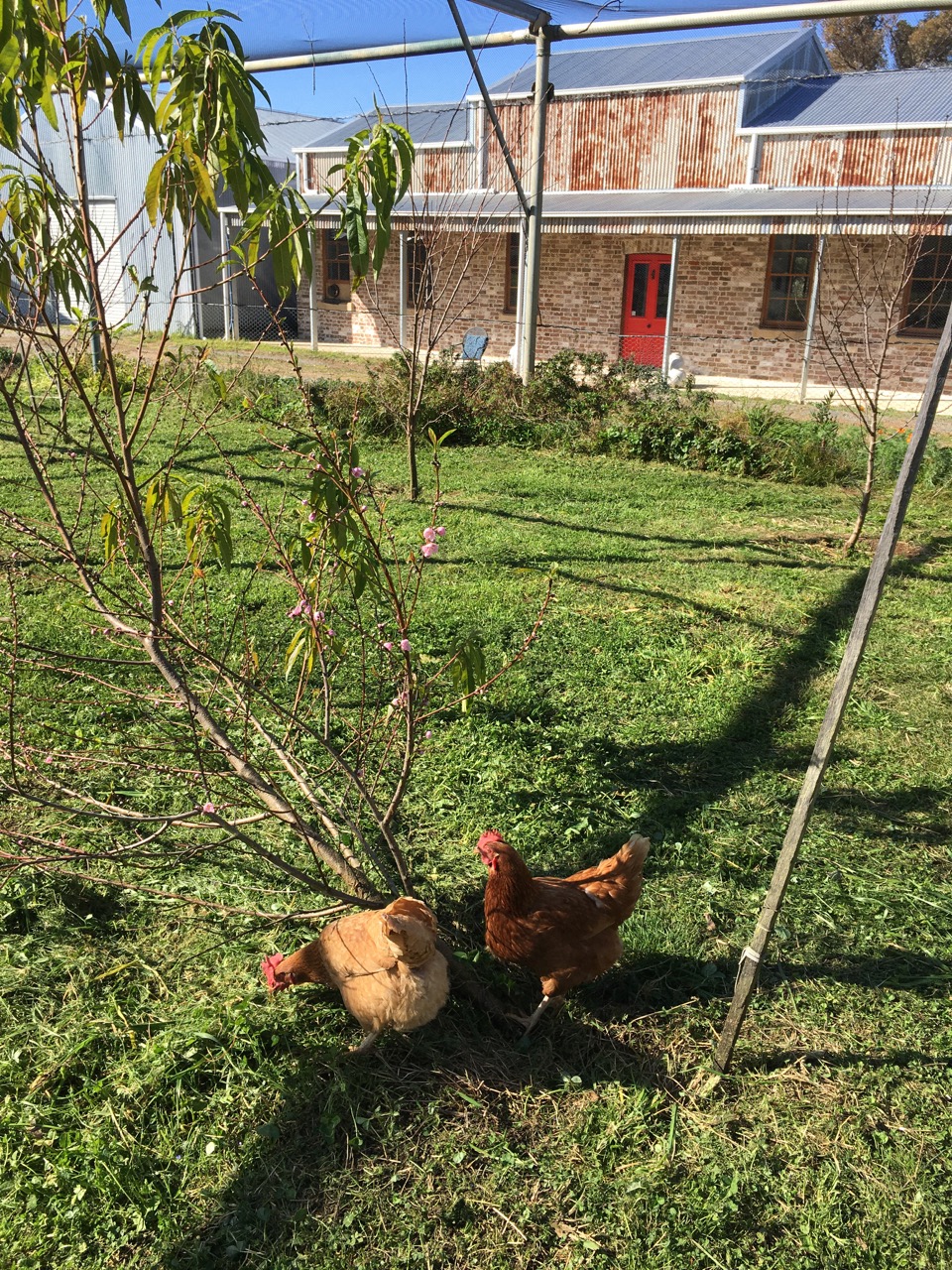
The chickens have the stone-fruit orchard all to them selves everyday to roam and scratch around in. Always finding something interesting to chase and squabble over. They are forever dropping their pooh and enriching the soil as they go about scratching, so a little extra lime every now and then to sweeten the soil is a good plan.

In a few weeks time, I’ll also start the first of the Bordeaux sprays, to suppress the leaf curl fungus, through into spring. Peaches and nectarines are particularly vulnerable to this fungus. Bordeaux spray (copper sulphate mixed with lime) helps to control this. Both Bordeaux and Lime sulphur are registered organic sprays.So I can feel safe using them on our food. However, I like to use the minimum amount, as copper can build up in the soil over time.

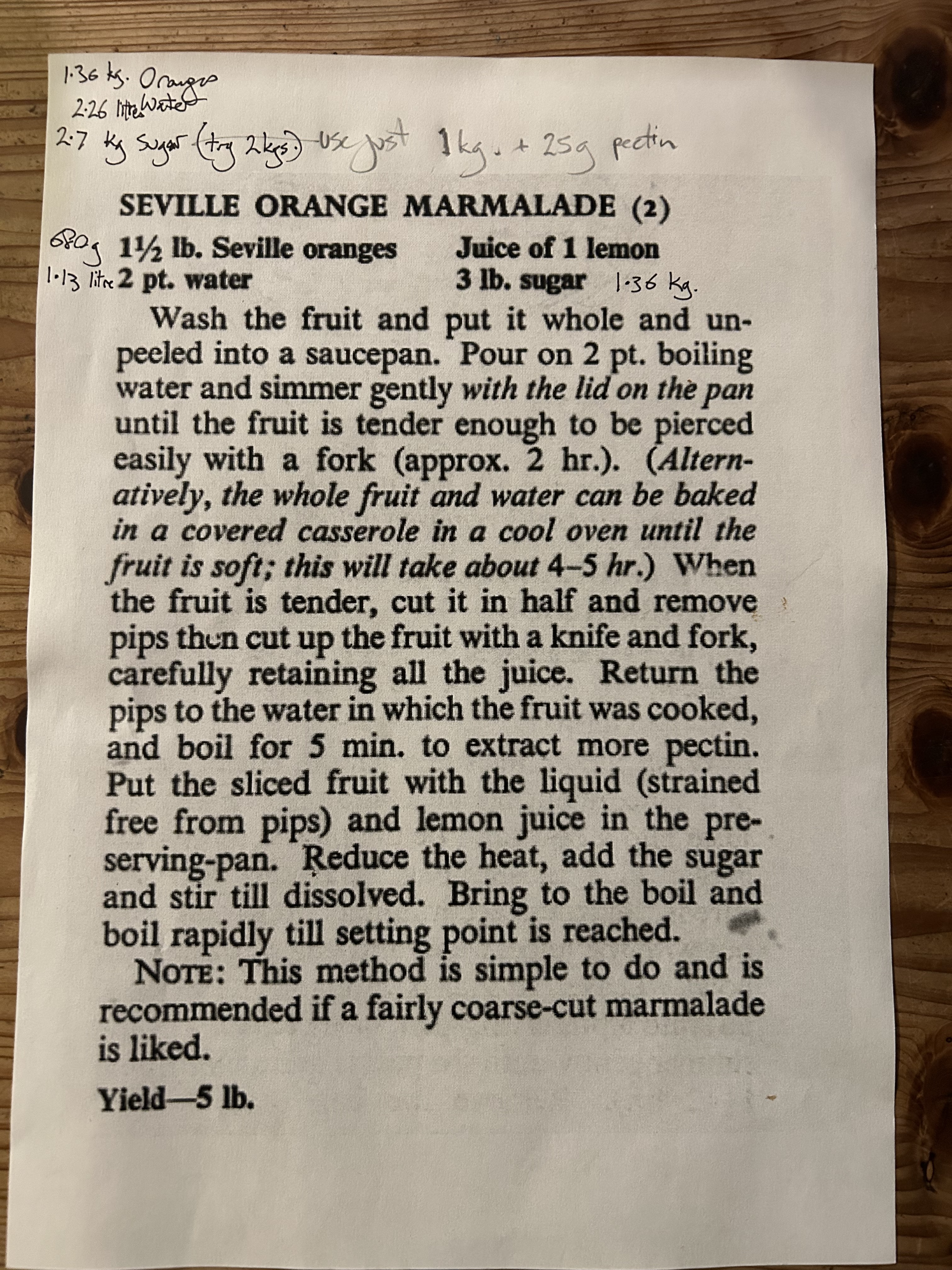
Out of the garden and into the kitchen. Winter is also peak season for citrus fruits. We have been making batches of marmalade since the season started back at the beginning of June. This week I have been trying out an old recipe that I got out of Mrs Beaton’s cook book. I have the paperback facsimile edition from the mid seventies. I was encouraged to try it out by my friend Bill who makes lovely marmalade. I occasionally post him a box of Seville oranges and he later returns a jar of his latest batch of marmalade. A good arrangement. 

This year I’m giving one of Mrs Beaton’s recipes a try. There are a few in the book. This is No.2 as recommended by Bill. I doubled the quantities, to make it worthwhile spending the time on it. However. I couldn’t bring myself to use 3 lbs (2.7kgs) of sugar. So I reduced it to 1 kg and added 25 grams of pectin to make up for the reduced sugar. After converting it to metic and doubling all the quantities, it still tastes great!

It’s a good recipe and in this slightly altered form, with much less sugar. I still find it very sweet. I’m glad that I didn’t bother trying it in the original. I wouldn’t have enjoyed eating it at all. Boiling the whole fruit for 2 hrs and letting it sit overnight to cool gives it a very old fashioned sour flavour from the peel that we don’t get by just boiling the peel and juice for a short time.
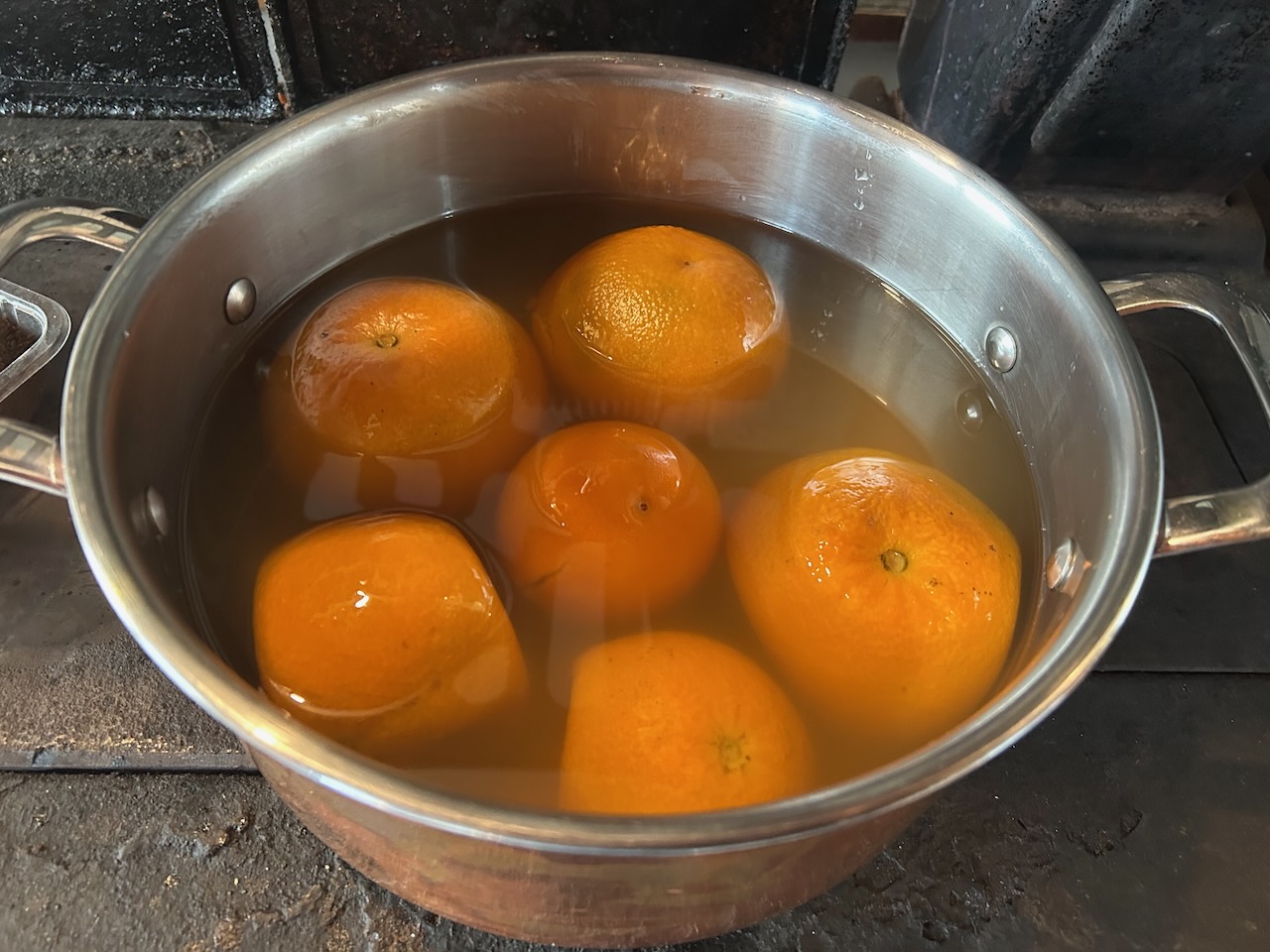
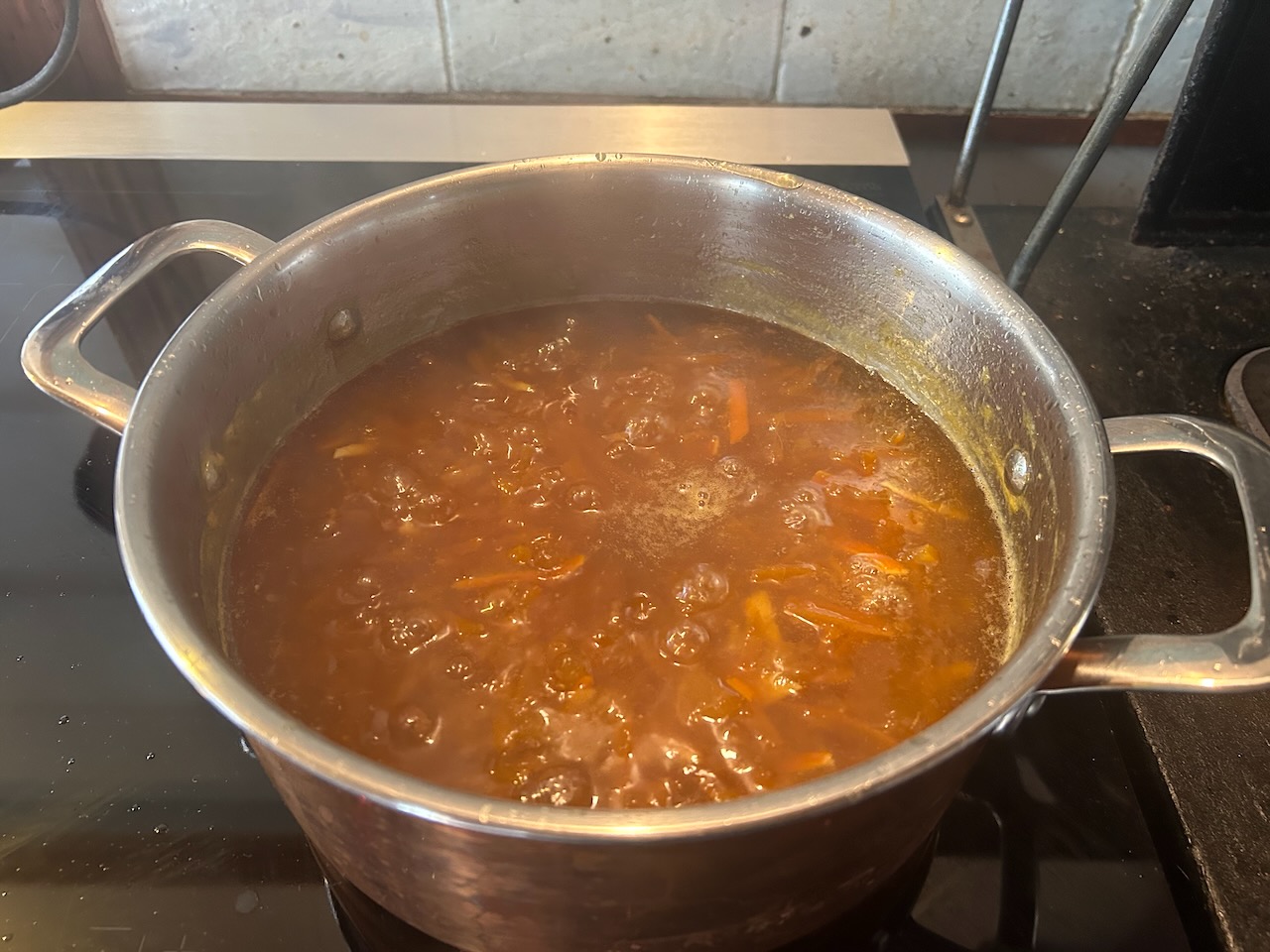
This recipe gave me 3.5 litres of marmalade = 6 medium sized jars. Worth the effort. We had visitors while I was cooking it up. They all walked into the kitchen and each remarked on how wonderful the smell was as they entered. We were able to give them a large box of mixed citrus to take with them.

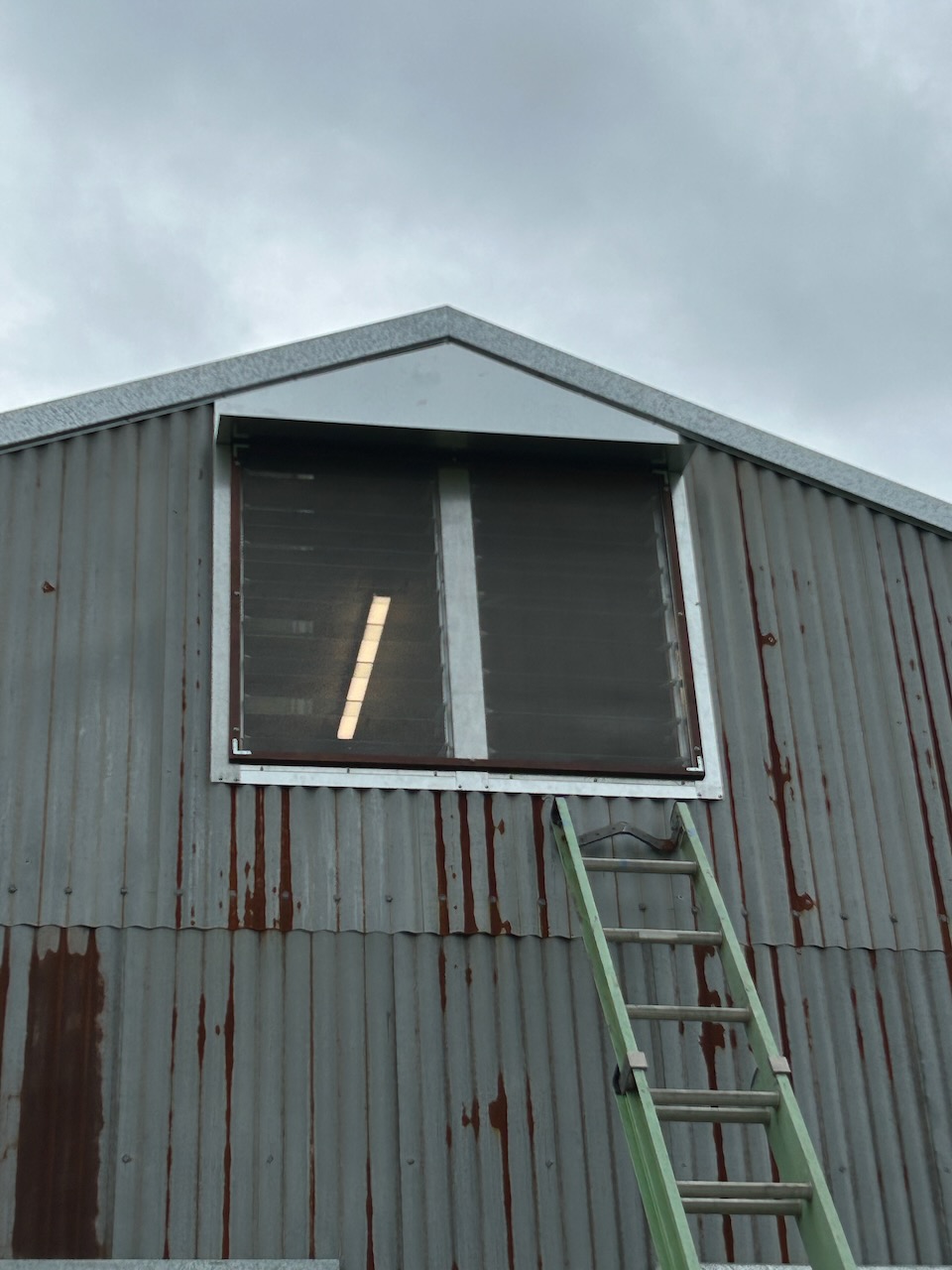
Out of the kitchen and onto more pressing practical matters, I made my own new flashing for the pottery shed windows from two sheets of  2440 x 1220 x 0.9mm sheets of galvanised steel, that I cut and folded on the guillotine and pan break, custom fitted for my windows. The lengths of flashing have to be marked and then cut out to perfectly fit into the curves of the corrugated iron sheeting on the walls. In a perfect world. The shed builders should have fitted flashing above the windows before they installed the outer wall sheeting. But they didn’t bother to do anything at all, so the window seals around the edges leaked. But not any more.

Andy and I marked out, hand cut and fitted the curves exactly to match the variations in the mixed 2nd hand gal sheets. A slow, but rewarding job. We couldn’t use a template, as almost every sheet is different across the wall. Until I collected all this mixed corrugated iron roofing fro mall around Sydney and the Highlands. I didn’t realise how many different profiles of corrugated iron there were. I just thought that it was all the same. But every company has their own individual variation of the profile.

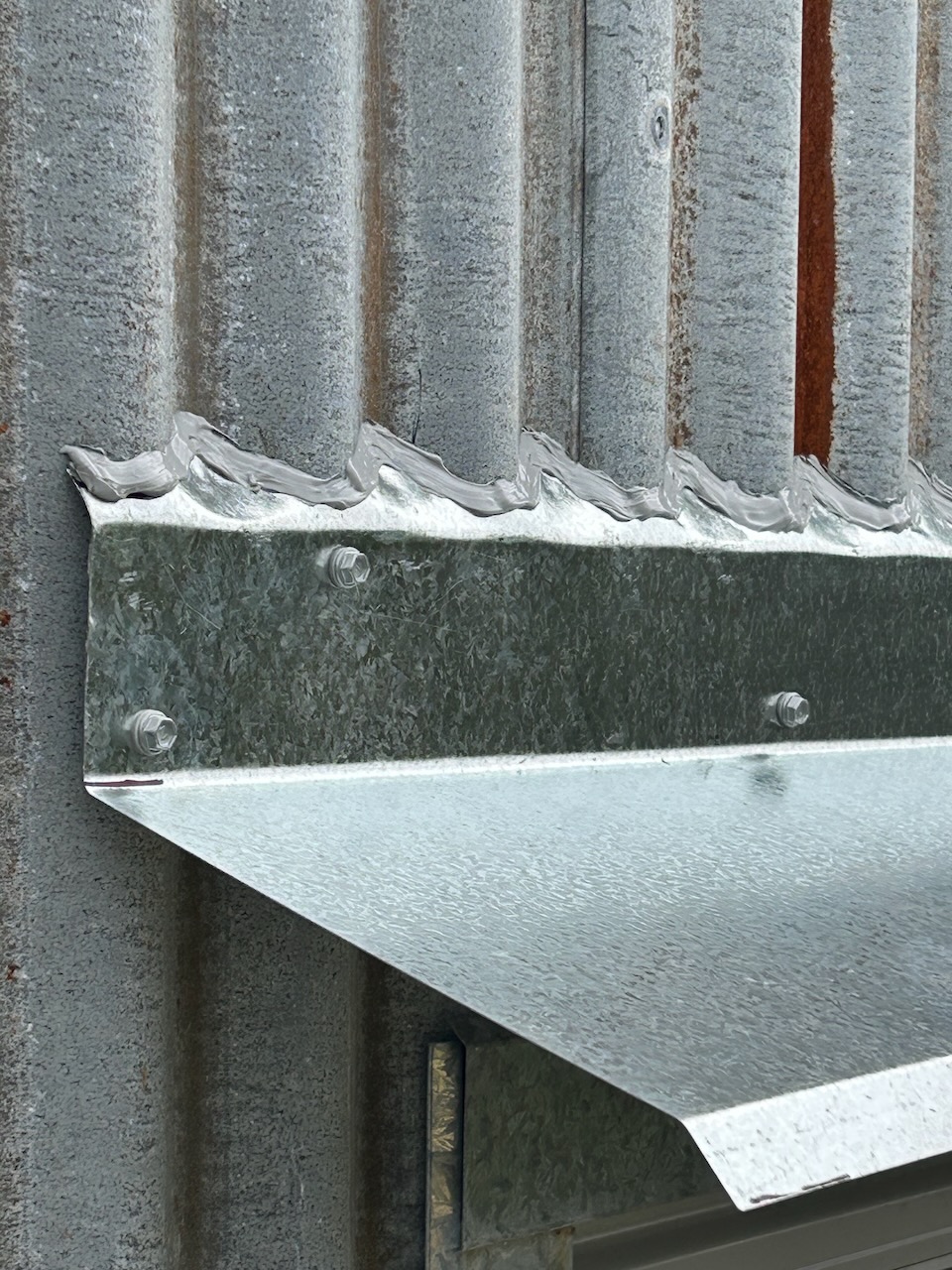
We spend a day going around the building and fitting the new flashing above all the openings. We can’t take off all the cladding to do it properly. As it should have been done. So we add the flashing onto the wall sheeting and cut it into the profile and seal it with silicon. It’s quicker, but still takes us all day to do 5 double windows and 3 garage sized roller doors.

Bit by bit I’m getting the shed finished. It’s only taken 6 years to get this job finally complete.
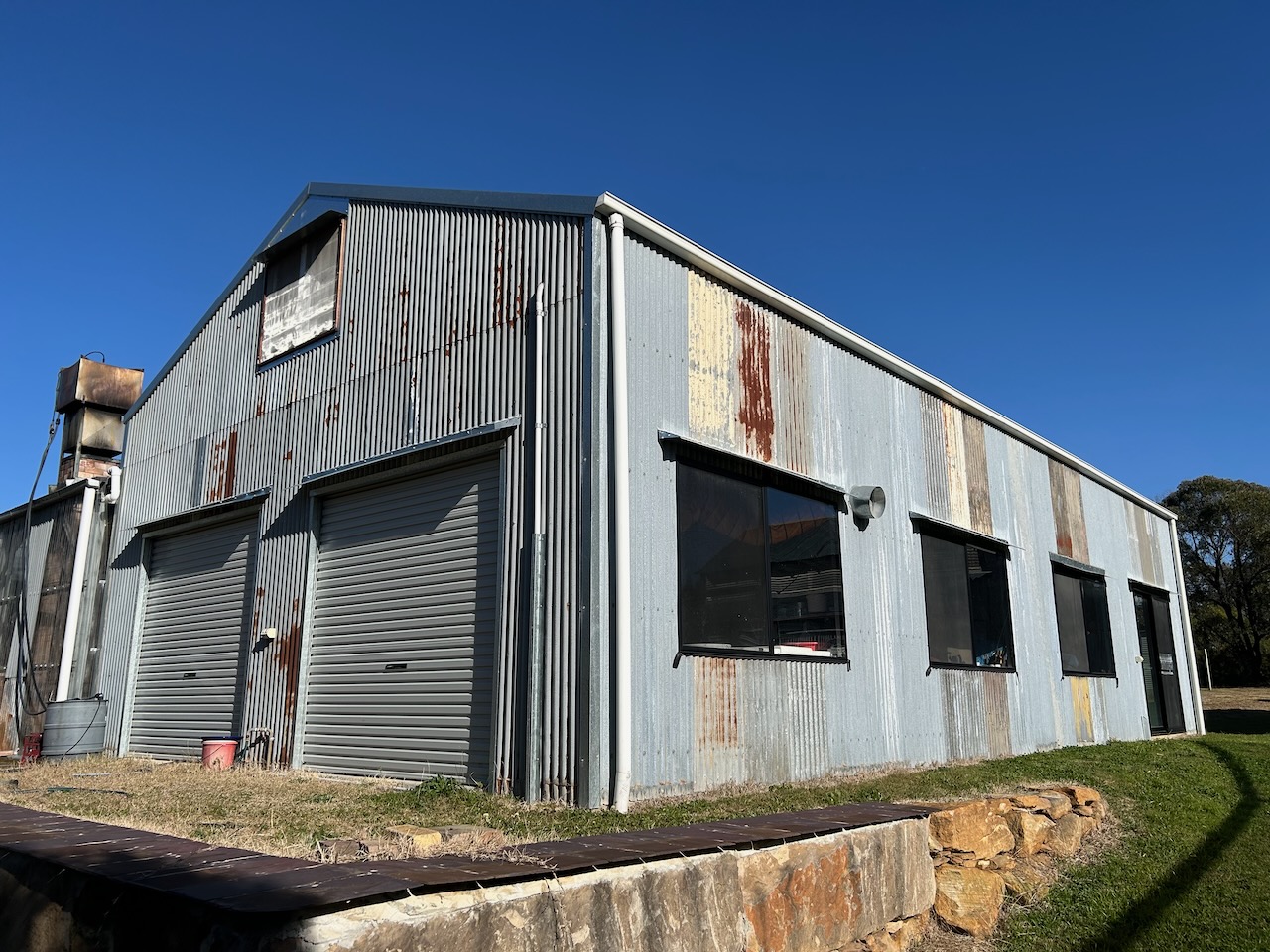
All the flashings acting as mini-awnings above every opening.

Nothing is ever finished, nothing is perfect and nothing lasts.

Summer jobs and cooking up some delicious fun

Those first two big-pot throwing summer schools took all of our time and effort to start the year. Since we finished them, a couple of weeks ago, we have had time ‘off’, playing catch-up in the garden and orchards. 

We have been mowing, watering and harvesting, for the past two weeks. We have been dealing with that harvest since then, picking fruit, bottling tomatoes, making passata, roasting pumpkin cubes, bottling pears and making pear and apple juice, then picking and drying prunes. 

Diced pumpkin cubes, roasted with olive oil, garlic, salt and pepper.

Everything comes on in earnest in January. There is a lot to deal with all at once, so we are eating very well. I really look forward to that first ripe pear. Just like I do that first ripe tomato of the season. The kitchen is a busy place every day. We spaced out the gap between the two pairs of workshops to give us time to do all this ’self-sufficiency’ work. I had also booked in a couple of other jobs that were needing to be done. So our two  weeks off, has really been ‘full-on’!

Pears poached in a little white wine, cinnamon and sugar, served with fresh picked passionfruit and a little ice cream. These are the tangible benefits of self-reliant living and gardening. 50 years in the planning, execution and nurturing. 5 minutes in the eating.

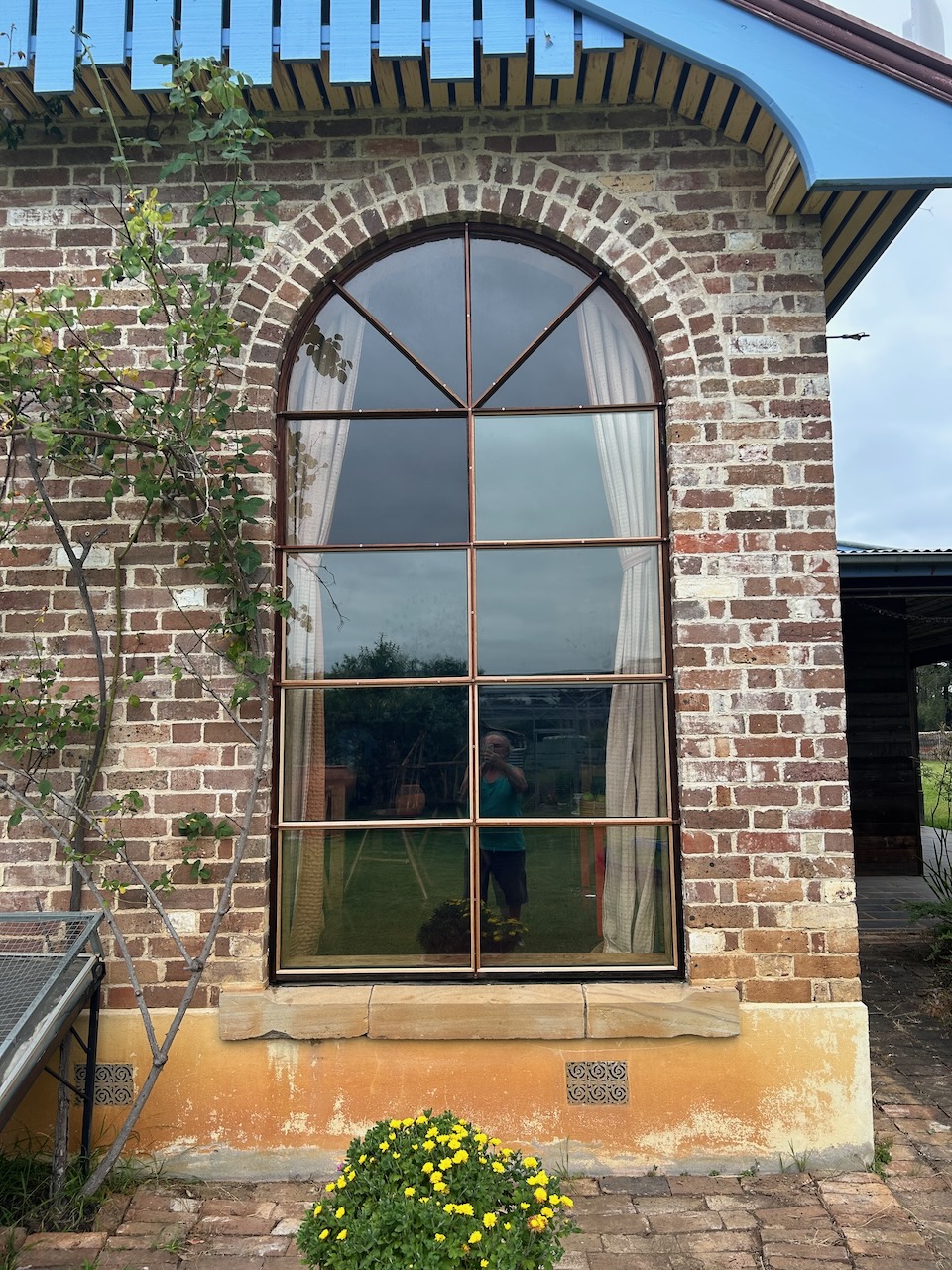
I ordered some double glazed, argon filled, metal coated, low energy, toughened, window panes to replace the 3mm. plain glass that is in our big arch window in the house. That fancy energy efficient glass arrived just before Xmas. The big window has been working well, letting light in, but keeping the rain out for almost 40 years, since I built it, and glazed it myself all those years ago. At the time, I tried to find double glazed glass for it, but to no avail. I also tried to buy special ‘stick-on’ glass coating mentioned by Amery Lovins, when he was here giving a lecture tour back then. But no one seemed to be aware of any such product here in Australia, not even ‘3M’ who I was told made it.

So we just lived with it as it was, eventually adding a huge sheet of thin perspex to the inside to create a semi-sealed air gap, but although that did work to some extent. There was room for improvement, and the unsealed gap always fogged up in wet weather, causing the wooden sill to get very wet and start to rot on the surface, so something had to be done.

Luckily, there is now a factory in town, that makes these fancy window panes. There was a one month wait while they were made to order. Back in December, I spent time rebuilding the structure of the glazing bars to make them deeper in preparation. We have managed to install 7 of the new double glazed panes so far. 5 to go. Interestingly, I have spent over $200 just on special window glazing silicon and wooden glazing beading to complete the job.

I booked a few days of help from my friend Andy, who is a local architect and environmentally conscientious builder. A rare breed! He has been very kind in offering us loads of assistance since the fire. He also offers good council and advice on environmental/building matters. I asked Andy to help me install two louvre windows up  in the big pottery shed loft. I bought some louvre mechanisms and the ground glass panes online, then I built a couple of hard wood window frames to mount them in. I also made all the custom flashings to go around them. Andy did all the outside ladder work on the day, cutting the hole in the wall and we installed them without too much trouble. It gives plenty of ventilation up there to take the heat out of the loft, but also brings in so much light and the view is good too.

We haven’t quite finished setting it up again yet, but it has been transformed into a lovely, light and airy, comfortable place now.

I have to ‘fix’ a kiln for a friend, even though I am retired, this is a special favour, then it will be back into the workshop for the next two summer schools. I’m looking forward to getting back into making pots for myself again. I have a few batches of experimental clay bodies that have been ageing for some months now. I’m keen to try them out. Especially to see how they will look in the wood fired kiln.

The summer heat arrives

We have been suffering 30 degrees in the shade, each day for the past couple of weeks now, with only occasional respite for a day or so, then back the the heat again.

The heat has brought on the stone fruit. We have now finished all the apricots, and are half way through the plums, with the peaches just beginning. We diligently went through the stone fruit orchard a few times during spring, picking off a lot of the small emerging fruit, before it got too big. 

It takes a lot of weight off the small, thin branches of these young trees, but also allows the remaining fruit to grow larger. There are just two of us here, so we have all the fruit that we need for a couple of months.

In the vegetable garden, the asparagus is almost finished its first full flush of growth, we now have just occasional spears shooting up. We collect them over a week or so in the fridge to get enough for a meal these days.

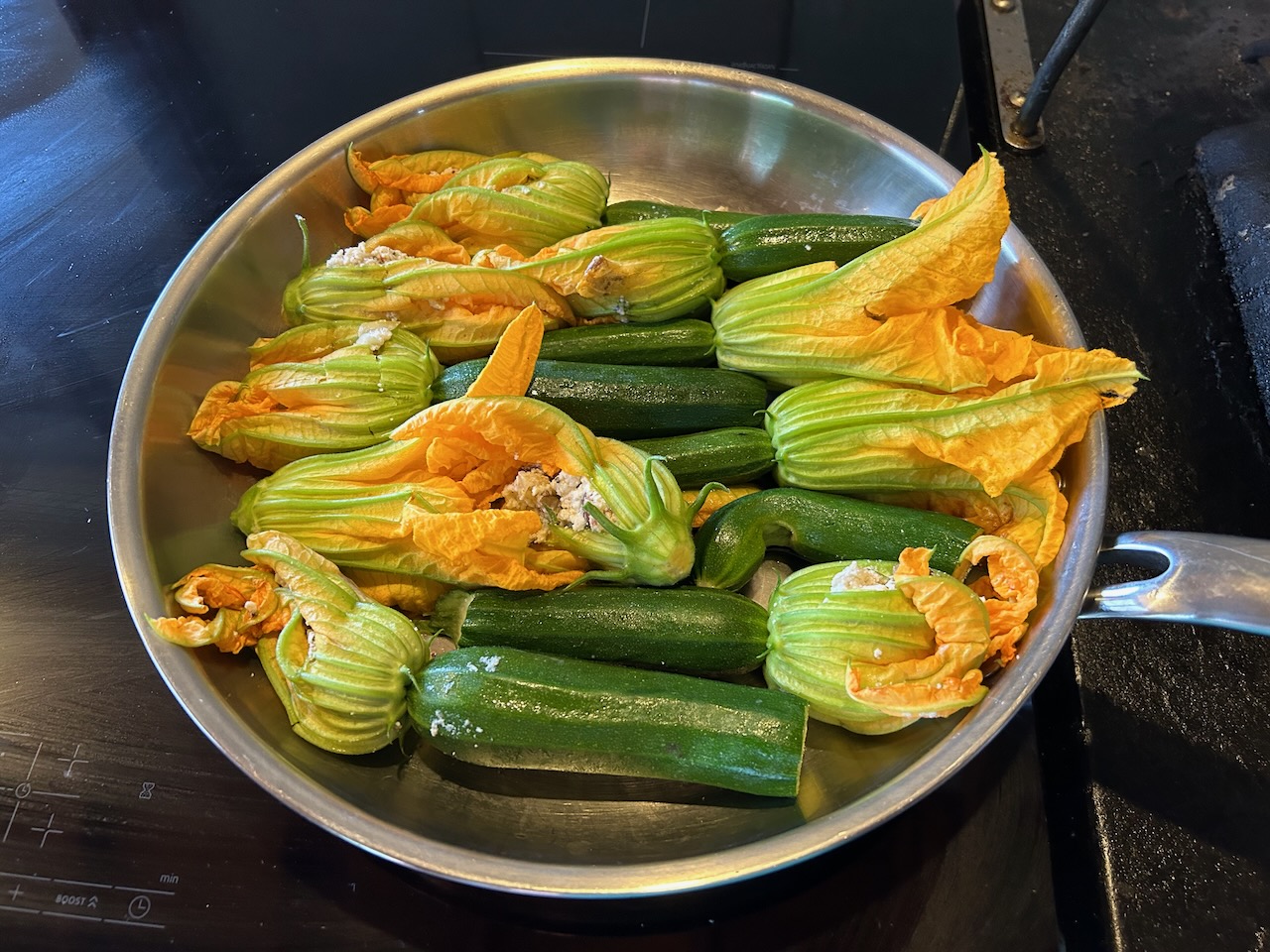
The zucchinis are in full flower now. They are the first of the summer vegetable plants to come on. I make an effort to pick the small emerging fruit as soon as it flowers. I pick the fruit with the flower still on and use them for stuffing.

I stuff them with a mixture of mostly ricotta, but with added gorgonzola, diced fetta, plus a few capers, olives and artichoke hearts. Then pan fry them for a few minutes and finish them off by steaming them with the lid on and a splash of white wine.

We are usually up very early to do the garden work, before the heat sets in, watering, weeding, harvesting etc, then breakfast. We spend the rest of the day keeping to the shade, under the verandah, or inside the pottery shed, out of the heat. This week, I’ve been making clay for the summer school workshops. Mixing, Pugging, blending, and twice pugging, bagging, and then cleaning everything up and mopping the floors spotless. Ready to go again.

Two batches = 250kgs of plastic clay. It’s a big job and takes all day, sometime it’s two half days, with a break over night to recover from the heavy lifting of the 25kg bags of raw material.

I’ve had my old dough mixer for over 45 years, and re-built it twice after fires. It came from a bakery that closed down in Western Sydney out near Parramatta. In it’s first incarnation, I ran it using a petrol engine. Then after the first fire here, I converted it to a 3HP single phase electric motor, with a loose fitted belt as a safety ’slip-clutch’. It is now properly set up with a 3 phase, 5 HP electric motor.

It’s a beautiful old thing and I’m proud that I have been able to rebuild it twice after each fire and keep it going all these years. I still have to make another couple of batches of clay, as we have been over-subscribed for our summer school, and will now be running it 3 times in a row, with a waiting list for another on the way.

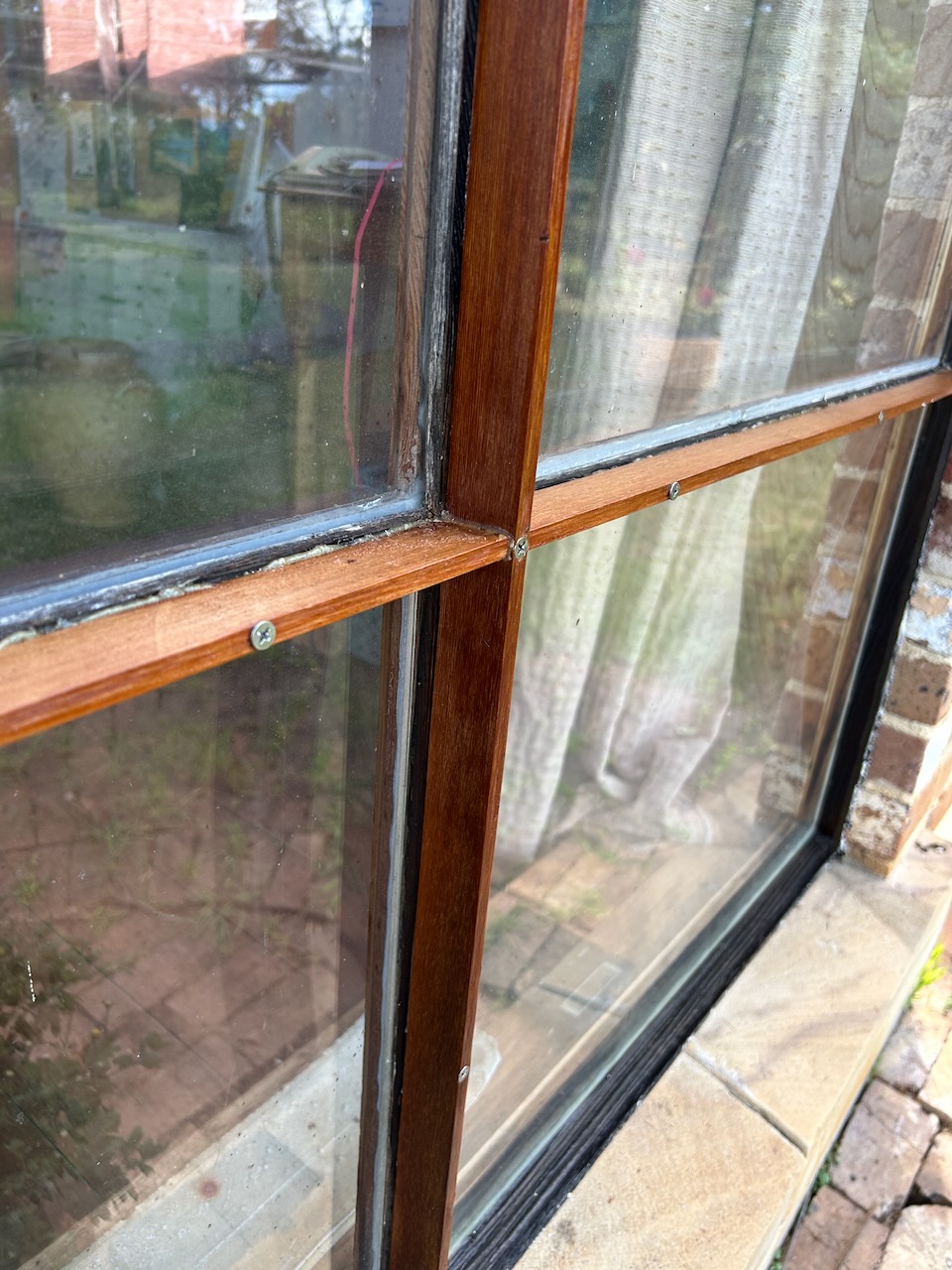
Last week I finally got around to building the stainless steel mesh fly screens for the front windows on the pottery.  I bought the roll of mesh soon after building the pottery, 3 or 4 years ago. But then it rained for the next 4 years, so there was no risk of bush fire for a few years. Now I have finished a lot of the other jobs that needed to be done to finish the pottery. I have finally got my self back to the window fly-screens job. I found that I had some left over ‘merbau’ hardwood decking planks, that I have used to make all the door frames. It has some sort of fire rating and is allowed for door frames. I rip-sawed it down to thin strips and them planed them smooth to make fine battens to hold the SS mesh in place. This will stop sparks getting to the cedar windows when the next fire comes. Hopefully i will be here to start the fire pumps and run the sprinkler systems that I have installed all along the western faces of all the buildings here.

The windows needed to be thoroughly cleaned and then re-painted, to bring them up to scratch, before they would be hidden, and inaccessible behind the fly-screen. It turned out to be a three day job, working only in the mornings, as the afternoon sun beats down on the verandah in the afternoons.

I made home-made gyoza for dinner and spent the afternoons inside the workshop cleaning and restoring the old platform scales that we used to use in the old pottery for weighing heavy bags of raw materials up to 100 kgs. These platform scales were bought at the closing down sale of ‘Coty’ cosmetics in Surry Hills in 1978. They got badly burnt in each of the fires, but are made mostly of cast iron. The damage this time was pretty severe, well beyond me to do anything with then at the time. Just after the fire I had too many very important jobs to do to get us back up and running. I was also pretty run down. But now I’m better and felt ready to give them another a go. Cleaning, grinding, loosening seized parts and then oiling/greasing and re-assembling it all and painting them in traditional black and red livery. The brass work had started to melt and sag. I had to take it all off and hammer it straight again, then polish it back to its gleaming original state.

The next big job on my summer list is to replace all the glass panes in the big arch window in the kitchen of the house. I made this window by hand, 35 years ago, without knowing what I was doing, or how to do it. I learnt as I went along. I taught myself how to steam and bend wood to make the big arch top of the window frame. I ended up making the 200mm x 50mm. arch out of 4 different 12mm x 200mm. planks, all steamed and bent at the same time and then glue-lammed together to keep the tight bent shape of the arch. Steaming and bending such big pieces of wood is a two-person job. I was assisted at that time by my sister-in-law Sue, as Janine and her brother were working on some other project together.

I recently commissioned 12 new double glazed and argon filled panes made from metal coated special low’e’ glass. These will replace the old 3mm plain glass that was all I could afford back in the 80’s. I’ve been told that it would cost me in the vicinity of $20,000 to get a custom built window of these dimensions specially made today.

My aim is to try and get my old cedar window frame re-modelled, extended and strengthened to take the thicker and heavier glass before the end of summer, but there is no rush or rigid time frame, it’ll get done when it’s done. Whenever that is.

I have started by extending the old glazing bars with deeper cedar ribs, glued and screwed onto the old cedar glazing bars. That part is now completed. Luckily, I found that I had quite a few old pieces of western red cedar that I could saw down to size and then plane to do the job, so far at no cost. But I did have to buy new stainless steel screws! 

When I built the original window, I used a waterproof window wood glue called ‘resorcinol’, or some word very similar to that. It was eye wateringly expensive and came in very small packets of 2 parts. One of dry crystals and the other of a liquid, to be mixed and used very quickly after mixing. It was stated to be water proof and capable of taking high stress. It has lived up to its reputation. The window is still strong. I haven’t seen it or heard of it for years, so this time around, I’ve used a 2 part epoxy boat builders wood glue. Lets hope that it last another 35 years.

In this hotter weather, we picked our first tomatoes of the season, from self-sown plants. It’s always a challenge to get a ripe tomato before Xmas. The early seedlings that I planted before leaving to work in Korea, all got burnt off in the severe frost in late September.

I’ve been baking extra loaves of bread to give away as Xmas presents. There are always too many jobs and more work than can be done in a day. I come to enjoy a little nap after lunch too, which doesn’t get anything done quickly, but is very nice and relaxing, almost necessary these hot days.

Nothing is ever finished, nothing last for ever and nothing is perfect.

Clay making and tatami floor tea room

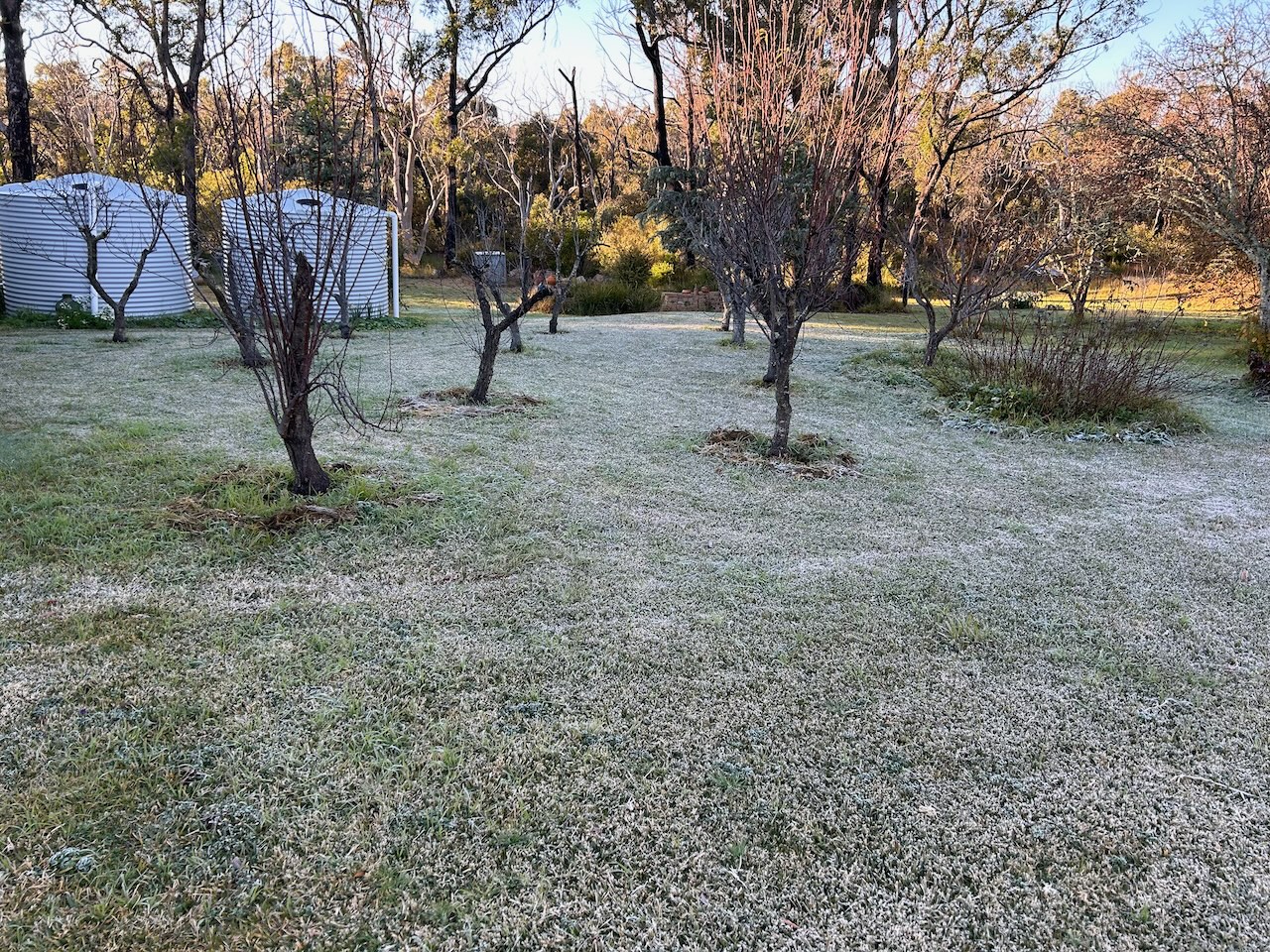
We have been having some good cleansing frosts this last week or so. White and crunchy, this is good to clean out any remnants of fruit fly in the orchard. It also helps to set the chemical clock in the stone fruit trees that need a few hours of very cold weather to make the next seasons flowers fertile. This is called their ‘low chill hours’.

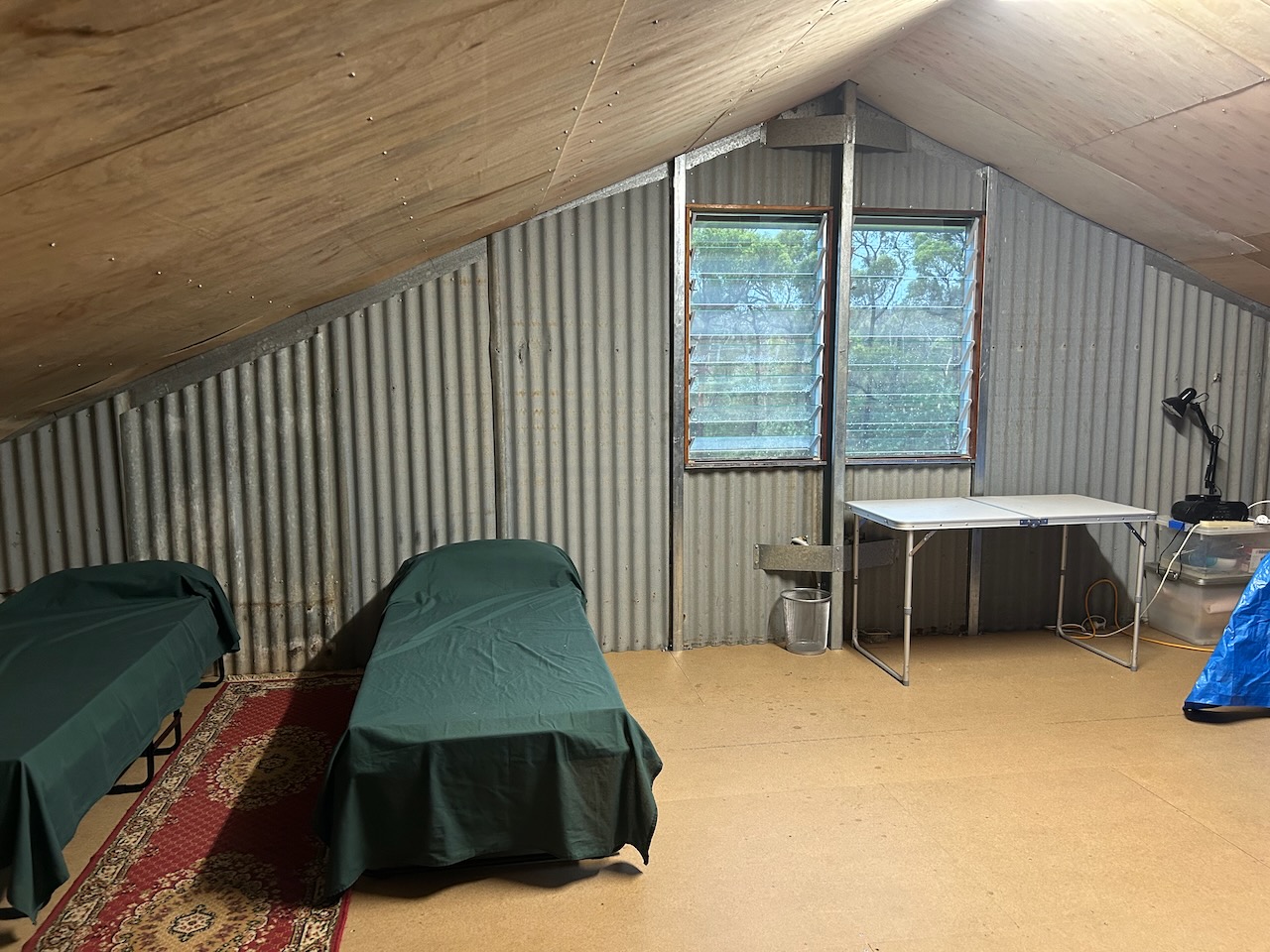
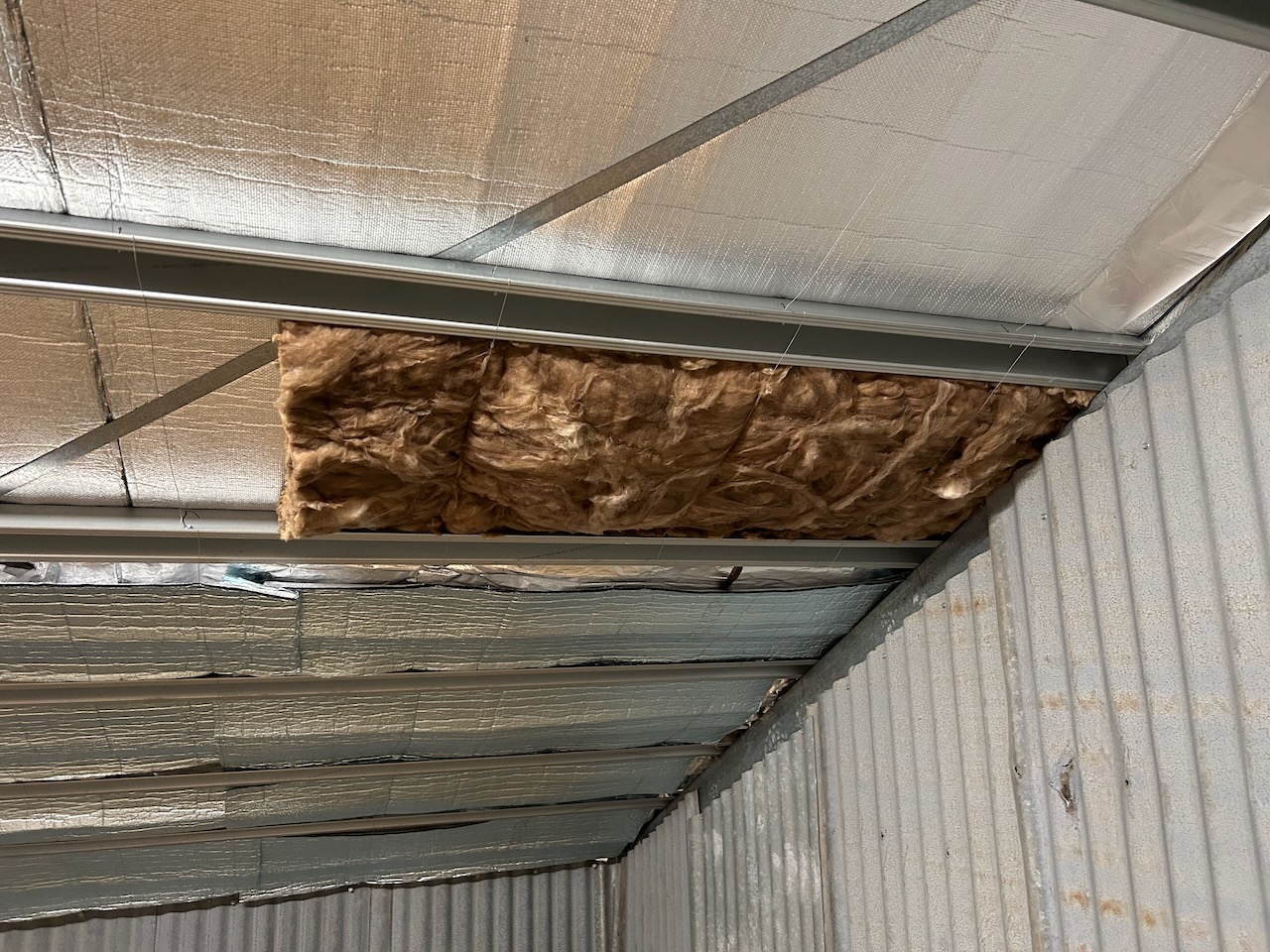
Inside, it’s been a busy time, as usual here. Janine is back from her trip up north, and I have been cleaning out the loft area above the clay making and rock crusher rooms. There is a space up there that is sort of a loft, but it was never intended to be a useful space. Just a way of enclosing the noise and dust from clay making and rock crushing in the small ground floor rooms. The space above them just had ’stuff’ stored up there. Mostly left over insulation bats and silver paper sisalation. Plus half a dozen mixed sheets and off-cuts of thin bracing ply wood, that I had used for the ceilings of the throwing room and gallery.

The only access to this ‘loft’ area was, until recently, by bringing in a ladder. A while ago the idea crossed my mind that we could use it as a place where students could sleep over when they stayed to do wood firings. 

In the past, before the fire, they used to pitch tents in the orchard, or stay in local bnbs. Sometimes, even sleeping in their cars.

We recently built a stair case to get up there safely. Using a lot of scrap timber, heavy duty ply, and our own home grown and milled pine boards that we had left over and stored. It turned out really well and cost next to nothing. I built it in two days with assistance of Janine’s brother John, a retired carpenter. I couldn’t have done it alone. John was the brains and I only assisted.

So while Janine was away I began cleaning it out and used the left over rockwool to insulate the ceiling/roof and then panel it with the ply wood. Amazingly, I didn’t have to buy anything to do the job. I was able to do it all by using what was already stacked up there! Even down to the box of ’TEK’ screws.

I started by building a safety railing/balustrade along the edge, using some off cuts of poly carbonate from the car port wall. 

Stuffing the rockwool into the roof was a bit like easing a compliant orangutang into the roof cavity, all soft and fury.

I used old tomato stakes from the garden to act as the extra several pairs of hands needed to hold up the ply wood, while I got the first few roofing screws into the sheets to secure them in place.

We were gifted the tatami mats from a lovely friend who didn’t need them anymore. They work really well in our new loft space. Both as a tea room space and as a place where students can choose to sleep, if needed.

We have also installed 2 single beds up there as well, on the other side.

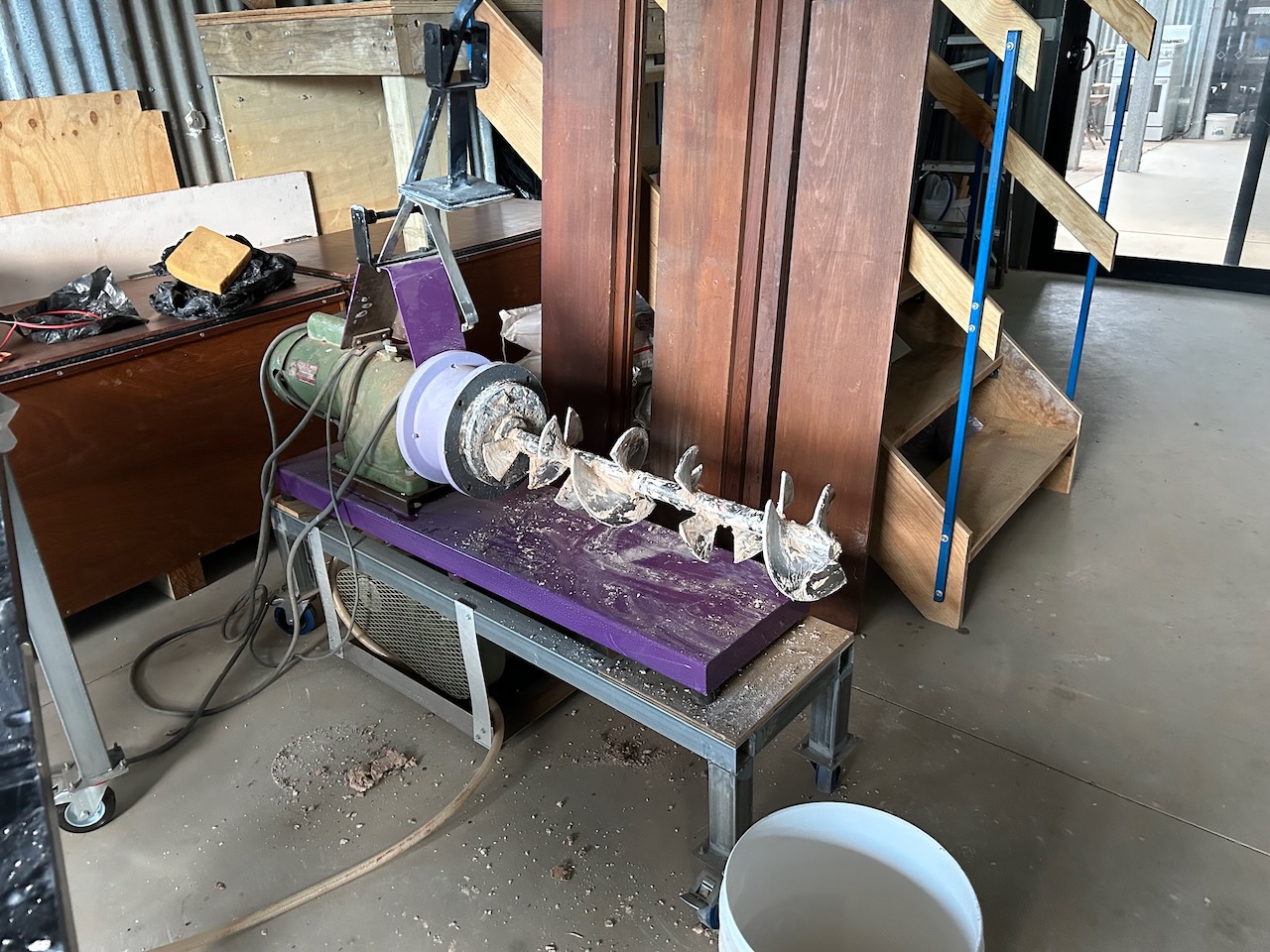
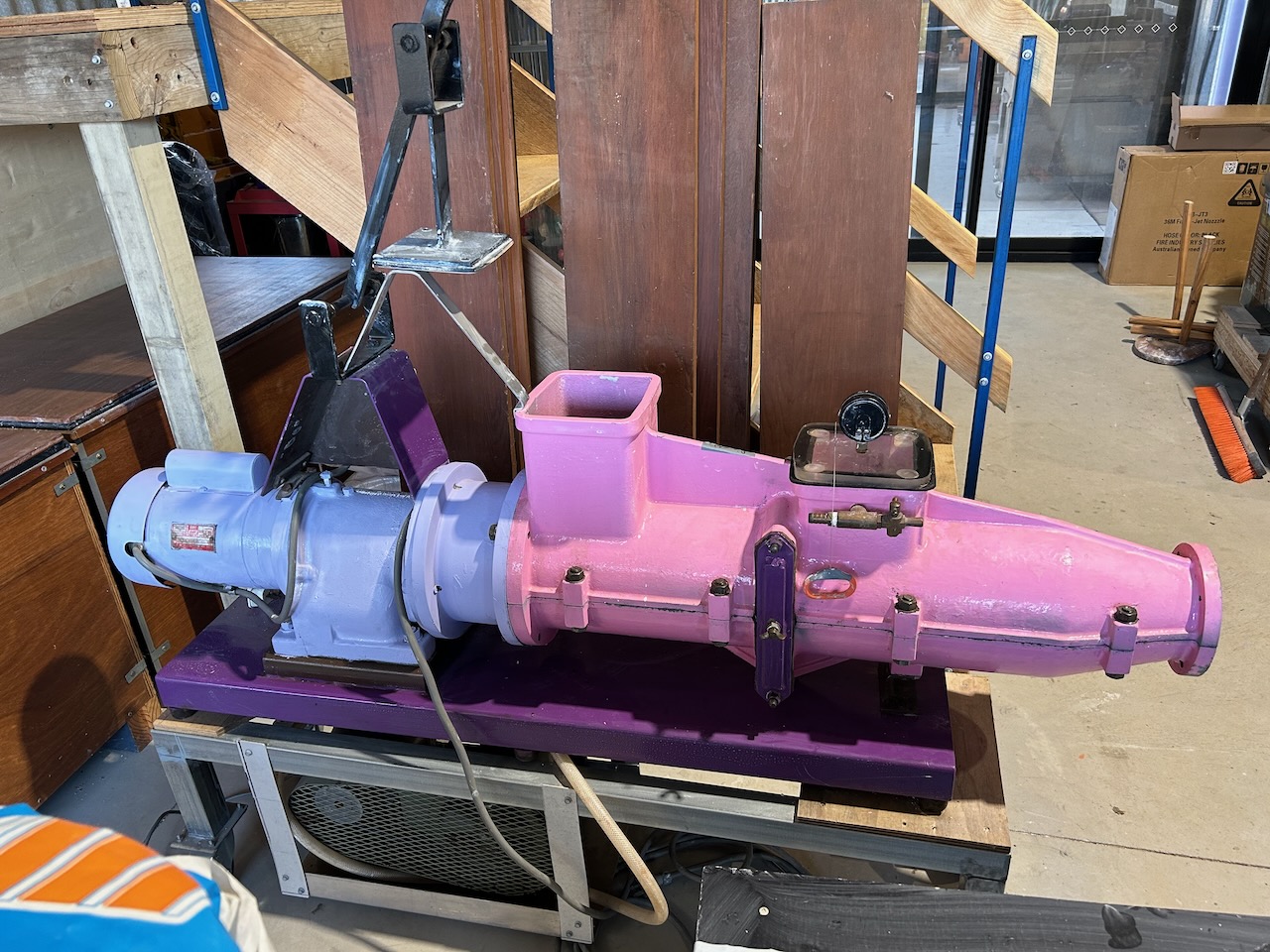
A couple of years ago, I bought an old Venco pug mill from my friend John Edye, who has retired from making now. I cleaned it of aluminium corrosion and painted the inside with metal primer. I have use it for 2 years now and this week, I pulled it down, and cleaned it out to change clay bodies, and inspect the lining.

I was so happy to see that the wire brushing and priming that I had done previously was holding very well indeed. Nothing needed doing. So I put it all back together again and made a new batch of wood firing clay body for an up-coming workshop.

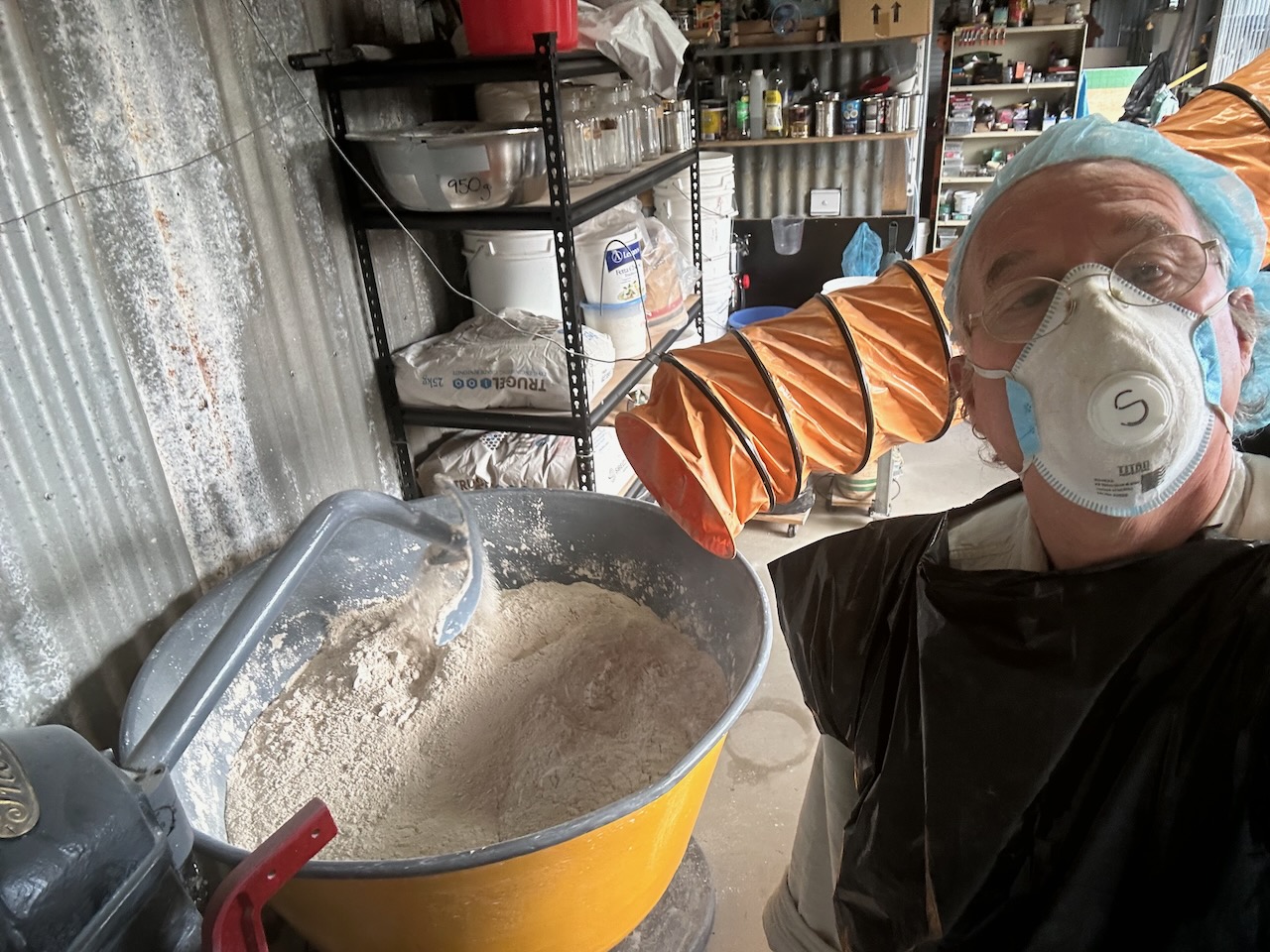
Clay making is a dusty business. I wear some OH&S clothing to minimise the dust in my hair and on my clothes. There are probably expensive versions of this stuff, but I use a garbage bag with holes cut out for my head and arms, then a theatre hair net and a standard dust mask. I have an exhaust fan with a flexible ’snorkel’ that hovers over the mixer and sucks most of the airborne dust out of the room. It works

After all the clay has been twice pugged, bagged and stored. We move all the machines out of the way and mop the floor clean, before reinstating everything as it was before and ready to go again.

Winters End – The Last Truffle of the Season

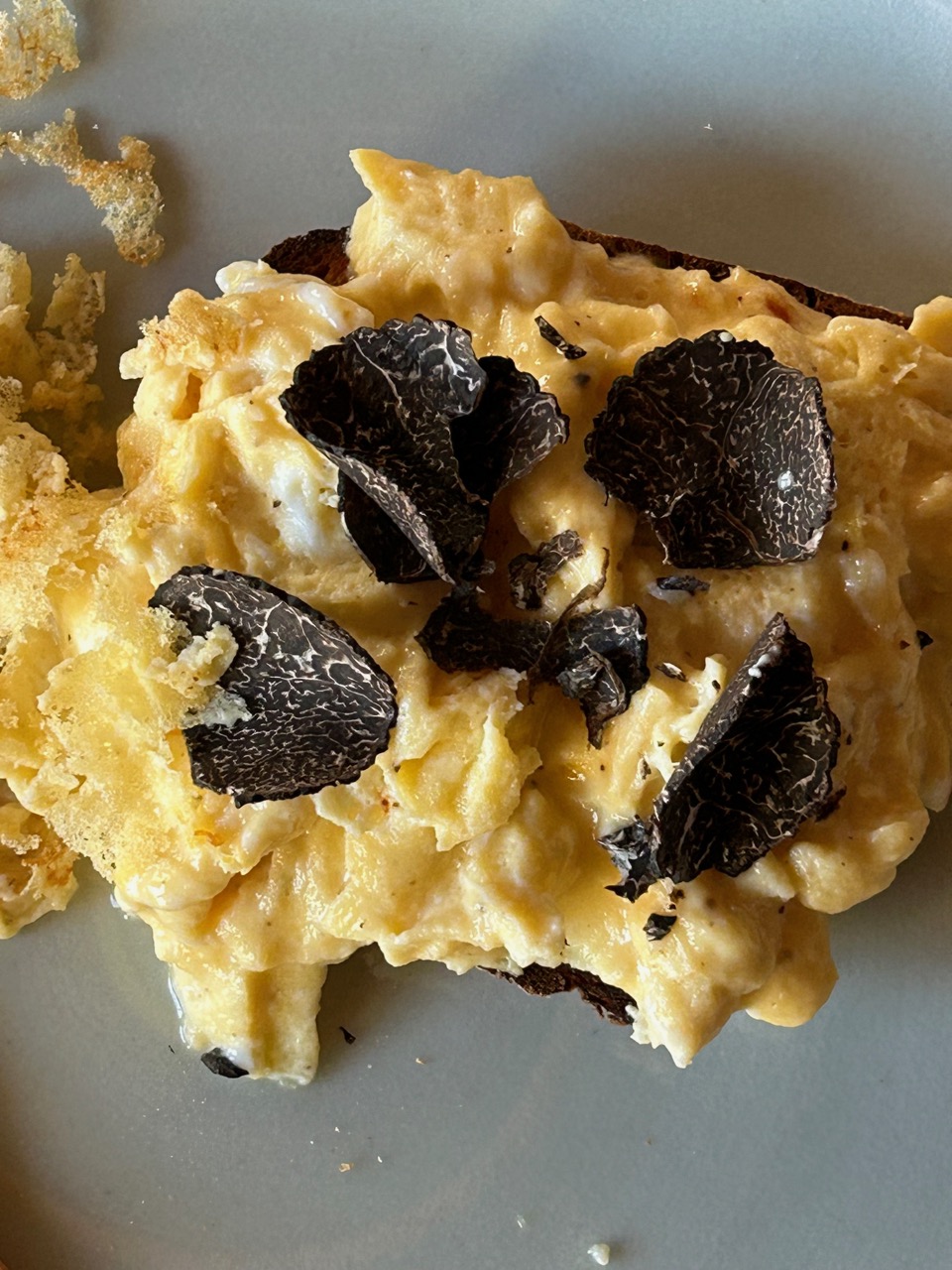
Today we finished off the last truffle of the season. It was romantic, mysterious, fragrant, exotic and delectable. It really elevates the humble scrambled egg into something special without taking anything away, just adding loads of romance and aroma. The warmth of the freshly cooked eggs releases so many aromatic oils and esters from the tiny black fungus. It fills my nostrils as I bend over doing the shaving. It’s a good thing that we only get to eat these delicious little morsels in the winter months, otherwise we may become somewhat blasé about it all. As it is, they are still a very special seasonal treat, If somewhat expensive. We can only afford to live this decadent gourmet lifestyle on our frugal budget because we have a son in the industry.

We are also probably making our last batch of marmalade too, as we have picked most of the Seville oranges now and eaten nearly all of the other citrus fruit. Although this is the beginning of spring, it is also the end of winter in another way, so it’s the end of the winter crops like citrus. We try and live with the seasons, so that’s it for the big citrus splurge in our diet. 

It is one of the blessings of living in the Southern Highlands, that we have 4 distinct seasons. For instance, this morning we had another frost. This might possibly be our last really cold morning, but you never know with the climate emergency developing as it is, anything could happen.

I peel off the thin yellow layer of the skin without taking too much of the pith. I want the pith off!  With my pile of curly peels, I end up with what can only be called ‘bitter and twisted’ .

Janine removes the pith and cuts up the juicy centre to add to the pan. The first pan is on for 30 mins. before we get the 2nd pan on the stove and the difference in colour is dramatic, it  gets richer and deeper as it cooks. We try to use as little sugar as possible, while not making it too bitter and acidic, we also need enough sugar to make it ’set’. It takes about an hour of steady simmer to get it to thicken sufficiently. It’s worth all the effort, it tastes delicious, with just the right consistency. Seville oranges aren’t all that nice on their own. They are OK, but they really come into their own when it comes to making marmalade.

The stone fruit orchard is growing up well. This is its 3rd year and the trees are starting to look a lot more settled and established, with thicker trunks. I have been pruning them into open vase shapes where possible, but some of them have a very narrow vertical habit. They are all grafted onto ‘dwarf’ rootstocks, so they are keeping to a compact size. Most of them are now about 1.5 to 1.8 metres high, with an expected total height of 2.5 metres eventually. But I am well aware that plants can’t read their own labels! So there are bound to be variations.

We had a really great 1st Weekend workshop in the new pottery. It worked very well. The new studio is a great space to teach in. The light is good and the layout works ergonomically for 10 people, 8 students and 2 teachers. After everyone left I got stuck in and started making more pots for myself. The Open Studios, Arts Trail is coming up at the end of the year, so I need to get back to work making pots for that. I started back at it by making 30 straight sided mugs.

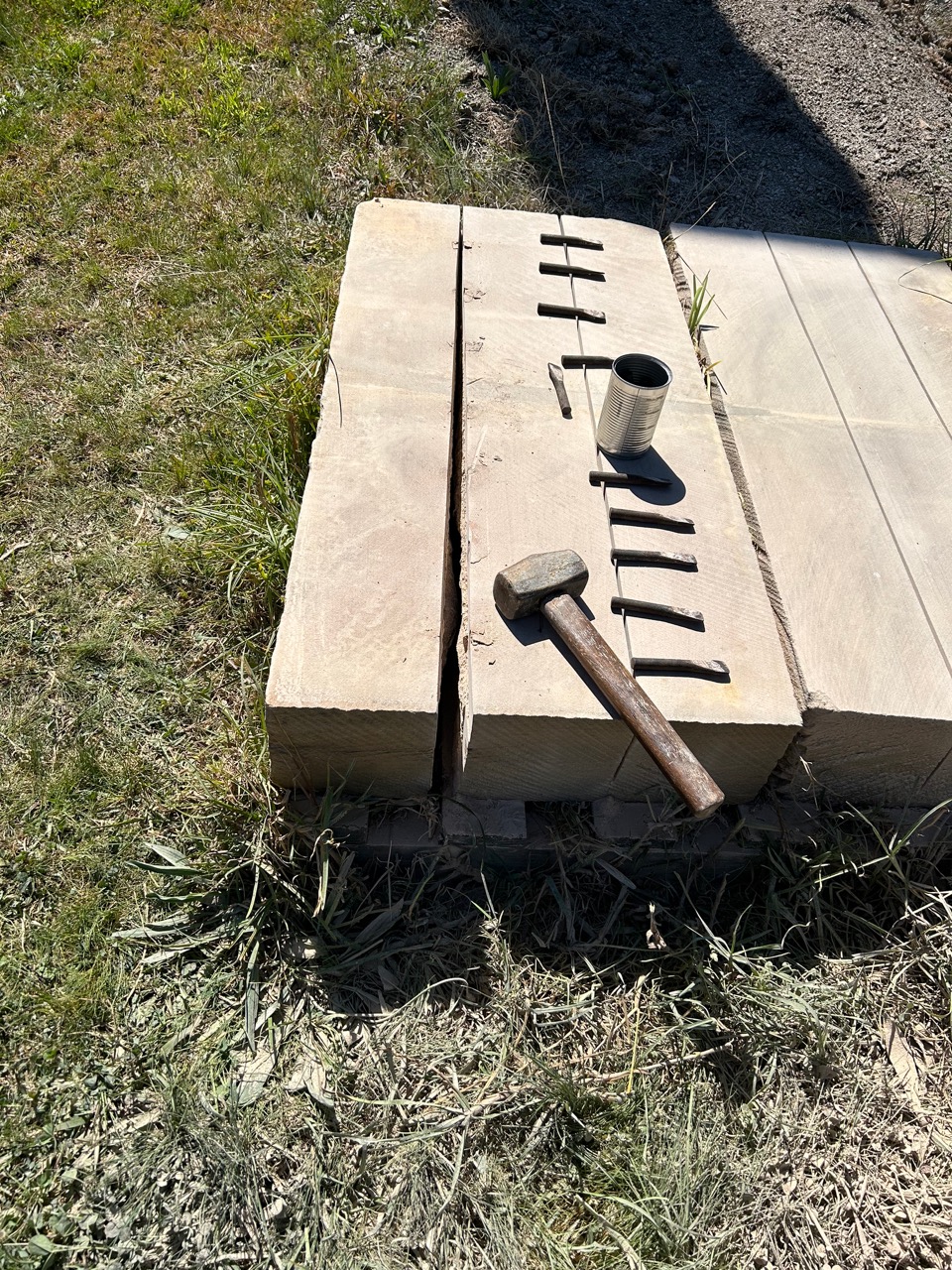
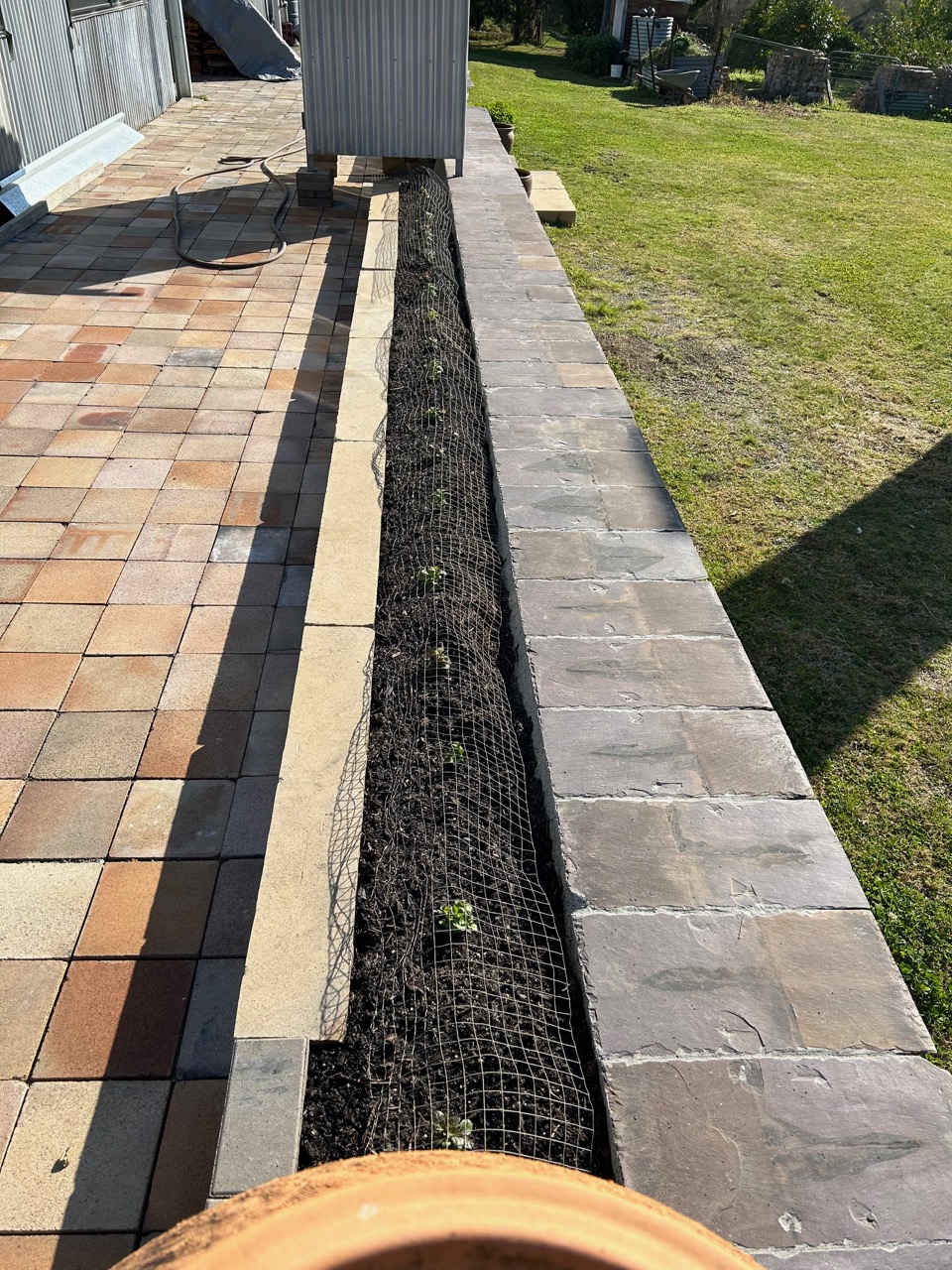
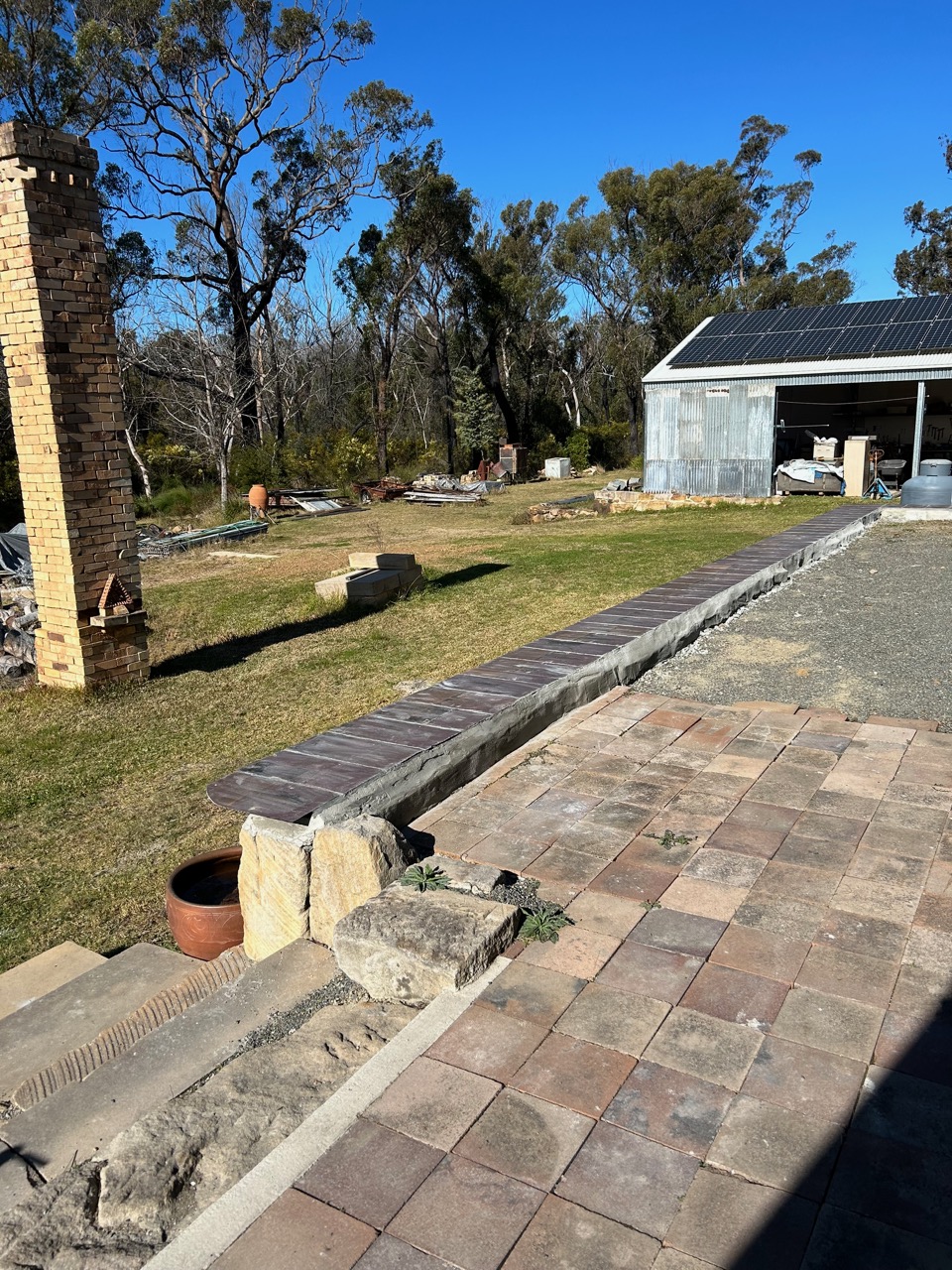
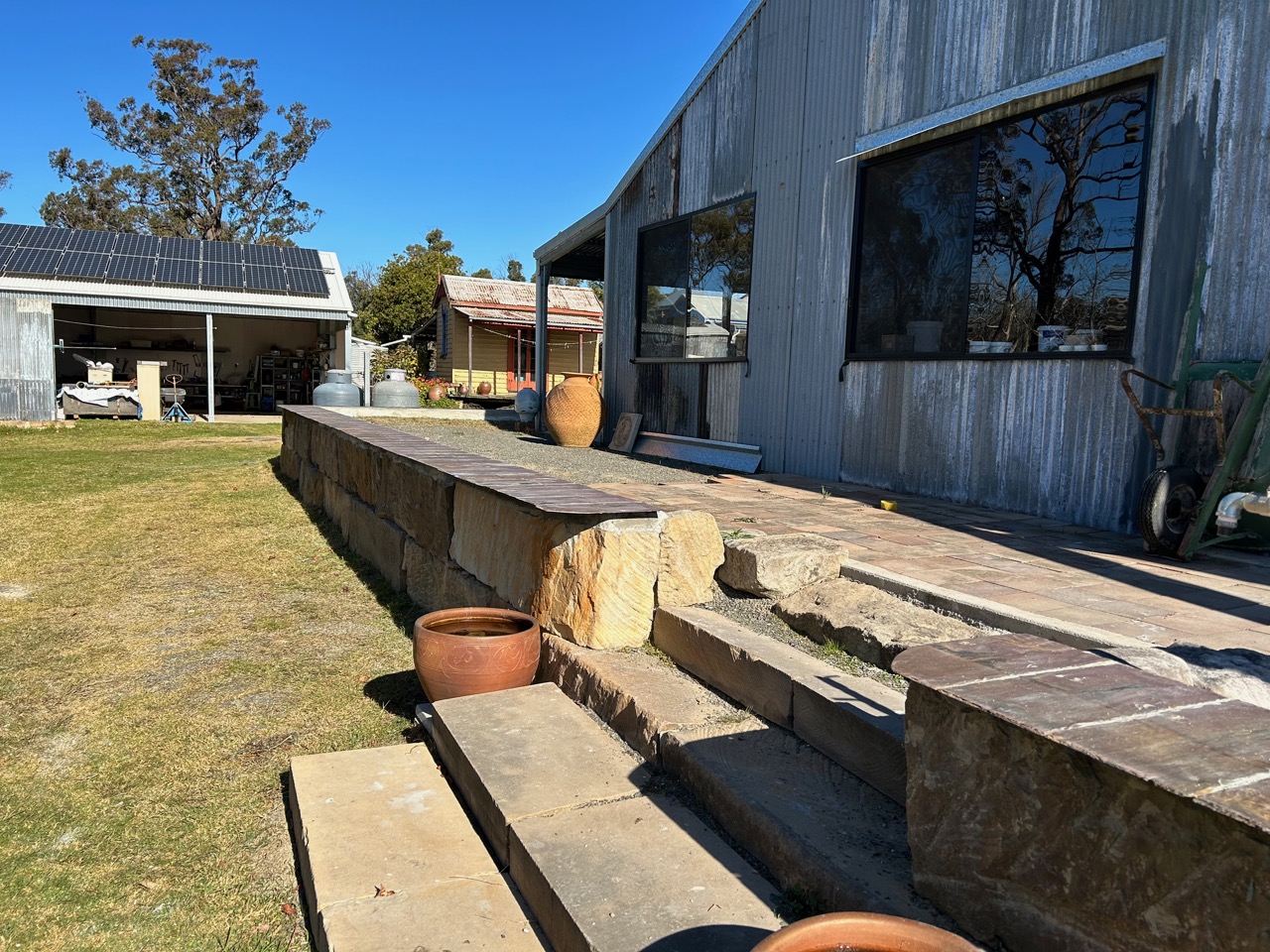
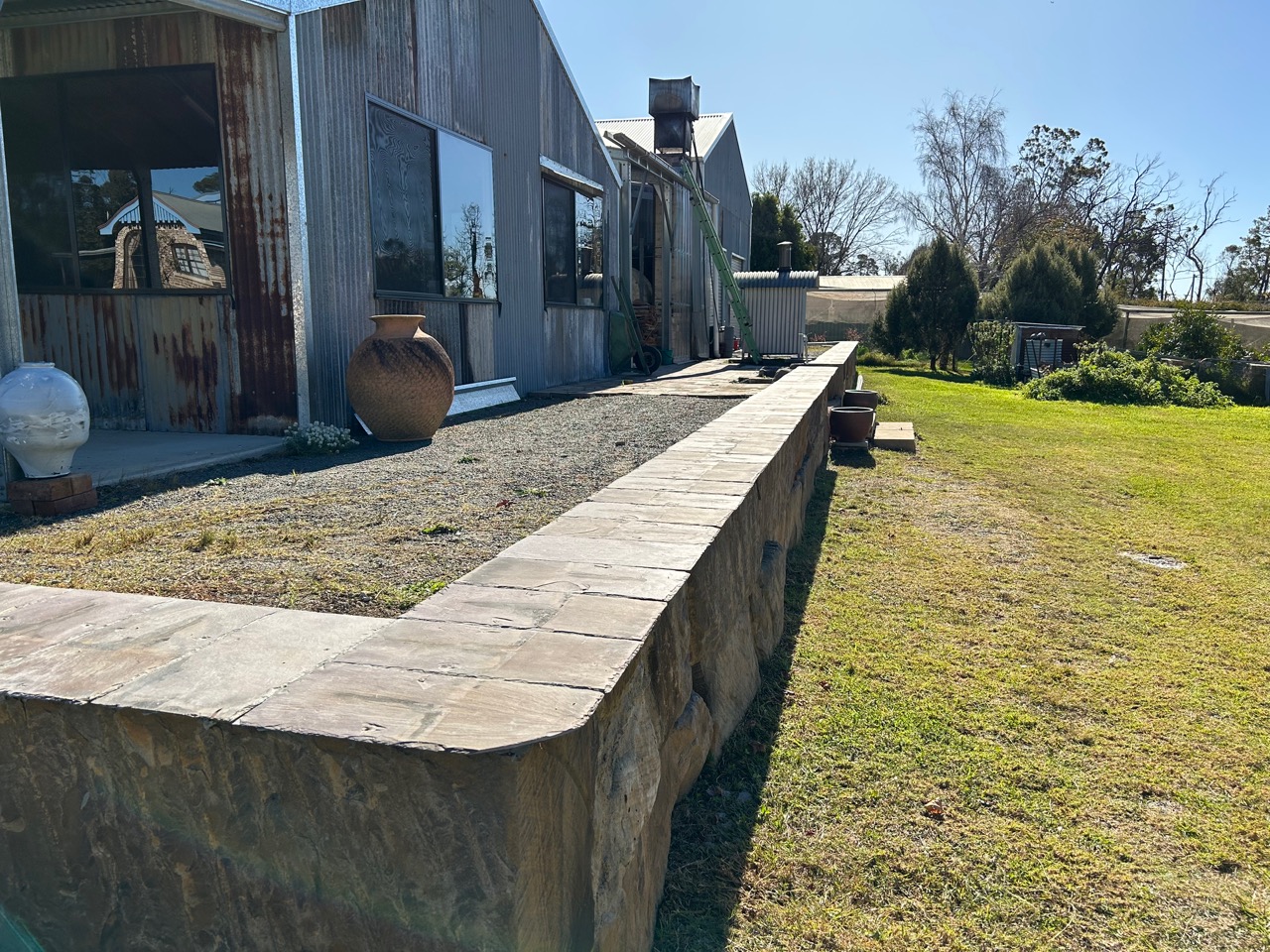
I spent a few days since the recent weekend workshop, in the afternoons, in my spare time, splitting and dressing sandstone blocks, to make some garden bed edging along the recently finished slate capping on the big sandstone retaining wall around the new pottery. It’s just another one of those jobs that has been in the offing and waiting for the ‘right’ time. I chose this ‘right’ time from what is left of my other time! Once the little wall was in place I shoveled in a load of top soil and planted seeds and a few seedlings to make the edging look a bit more settled and finished. I sprinkled in a packet of English Cottage Garden seed mix for good measure and 30 caper seeds, one every 600mm. Capers need an elevated, well drained, sun baked, dry, harsh environment to thrive. They take 2 years to establish, then persist for many more as long as they are cut back and pruned hard in the winter to stimulate good growth in the spring and summer, as flowers and fruit are produced on the new years growth. The elevated and exposed wall seemed like a pretty good place to try them out. I have read in a few books that they thrive on top of stone walls in the Med’s dry summers. I have no expectations, but if something comes of it, I’ll be pleased. If not, then I’ll chalk it down to another one of life’s enriching experiences. The stones look nice anyway, regardless of whether the plants grow or not!

After the soil was shoveled into the new beds, Edna the chicken, who had been helping me all day, came along and decided to help me some more by scratching a lot of it out again. I had to make some impromptu wire covers to protect the small seedlings from being excavated!

I’m happy with the result. 3 days work and $50 bucks goes a long way. I’m hoping that it will look greener in time for the November Arts Trail, Open Studios event.

After the long weekend Open Studio Sale

As soon as the Pop-Up long weekend Open Studio sale was over, we got busy tackling the next big urgent job.

That job is dealing with the cracking and spalling of the big sandstone blocks that we used to make the retaining wall behind the pottery.

I knew when I bought them that they were rejects. I naively thought that they were cheap because they were split in an irregular way and not square, but tapered. That didn’t worry me, as I could arrange them so that they had a reasonably flat and square face outwards. I could hide the unevenness in behind the grave back-fill.

However, as it has transpired, the real problem with them, and the reason for them being very cheap, is that they are not hard sandstone, but rather soft and sugary.

Bummer! 

Over the past 3 years that they have been sitting there year in, year out, through the rain storms and winter frosts, they have begun to spall. Water soaks in to the porous stone and when the frosts come and the ice expands, bits of the face split off. Recently we noticed that the blocks were beginning to split down the centre, not just the face and edges. This is serious stuff. If not dealt with immediately, the stones will start to loose their stability.

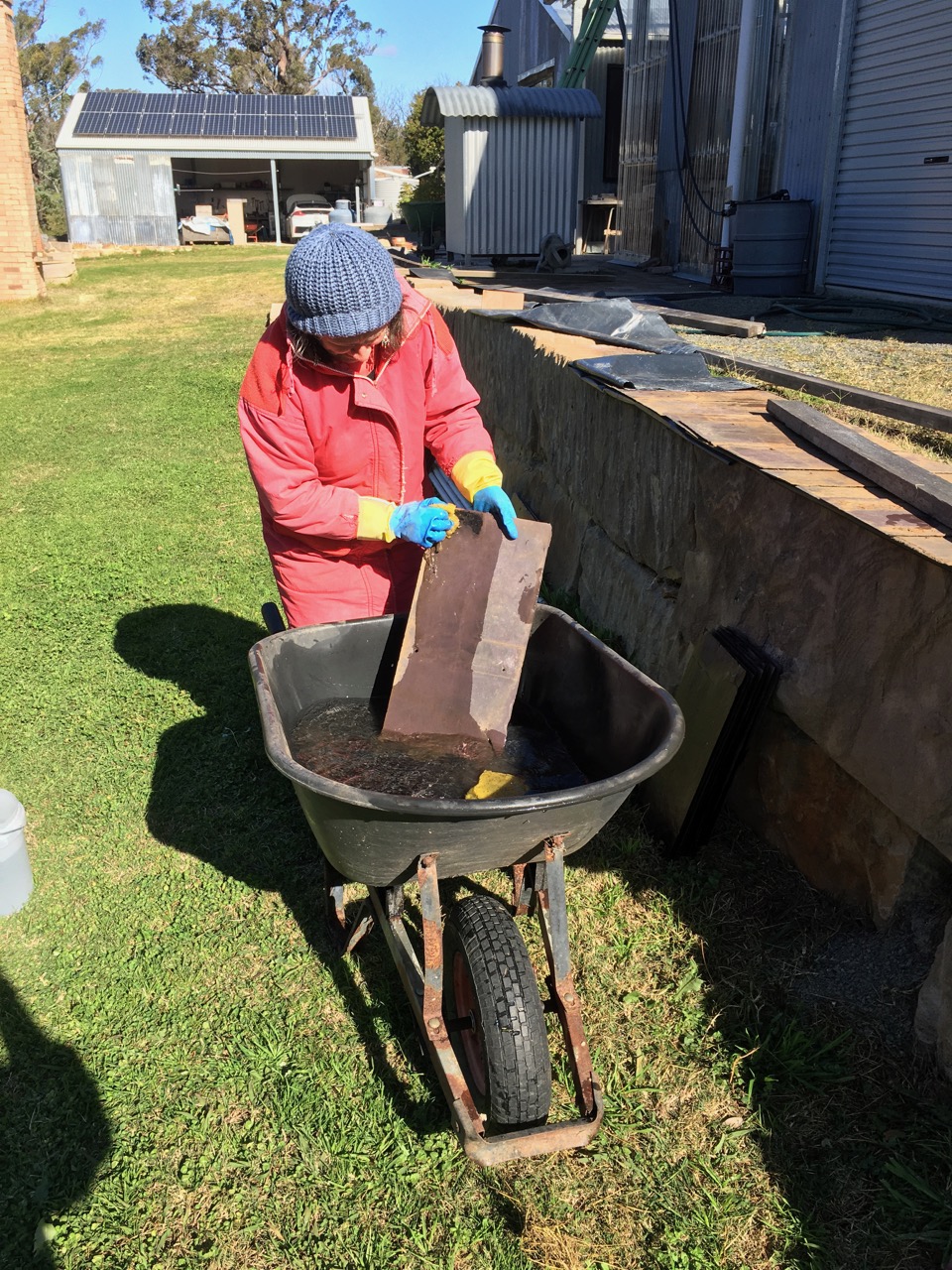
I decided that the best approach would be to cap the stones with some sort of waterproofing system. We had a load of old roofing slates stacked away under the railway station. They came off the roof of my brothers house before it was demolished many years ago. We always intended to use them as floor tiles, but never did. So we have plenty of these old weathered slates. We needed to get them out from under the floor and give them a good scrape and clean, then a good scrub and a wash to get all the grunge of history off them, so that we could get the cement to stick securely. 

We spent 2 half days fettling and washing the slates. A cold, wet job for the first of winter after a cracking good frost.

I took the truck down to the sand and gravel yard each day to pick up half a tonne of sand and 7 bags of cement each day for the 3 days that it took us to get the job done. We employed a young, local guy to give us a hand, as we are getting too old for this kind of heavy work on our own these days.

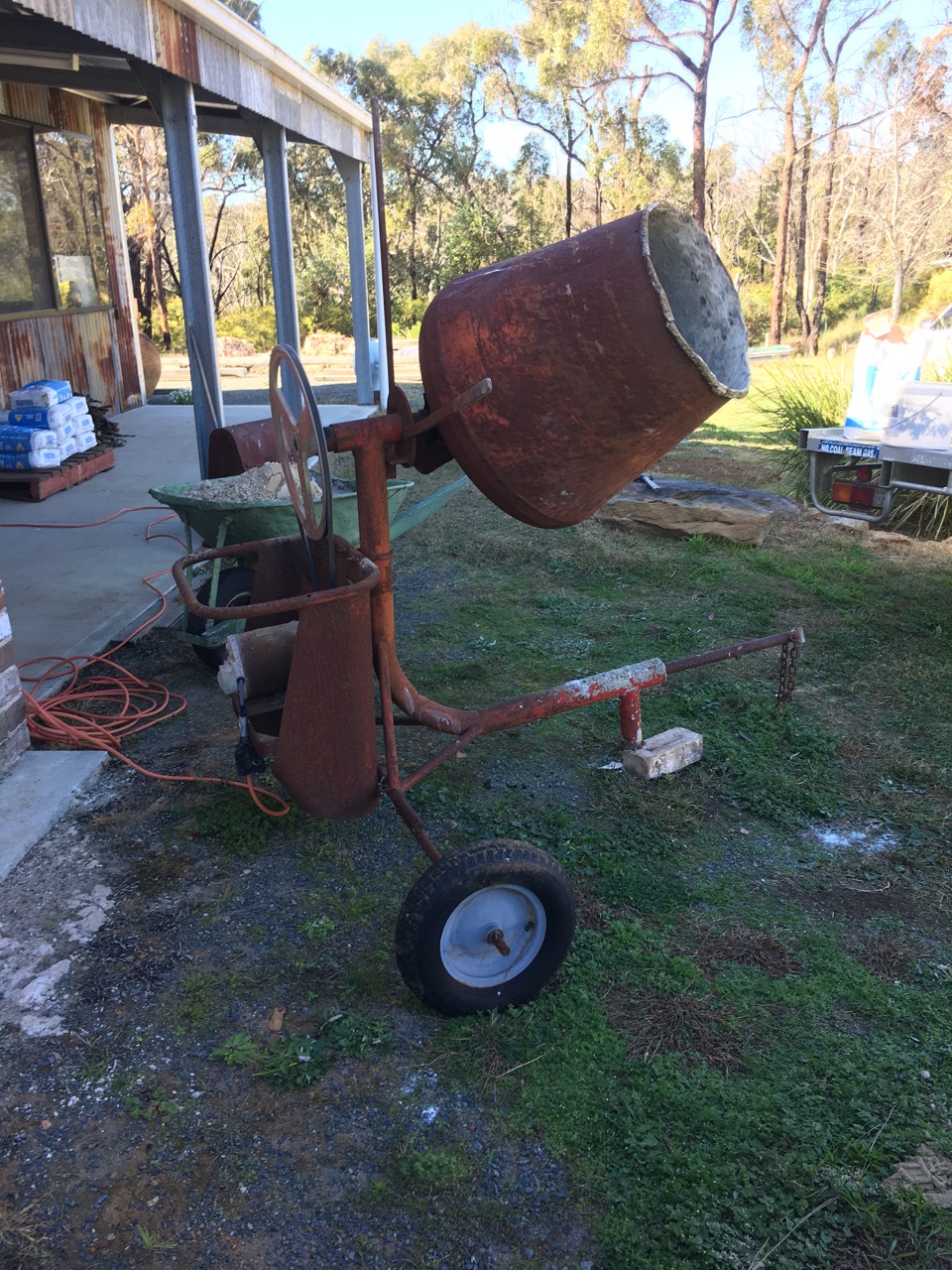
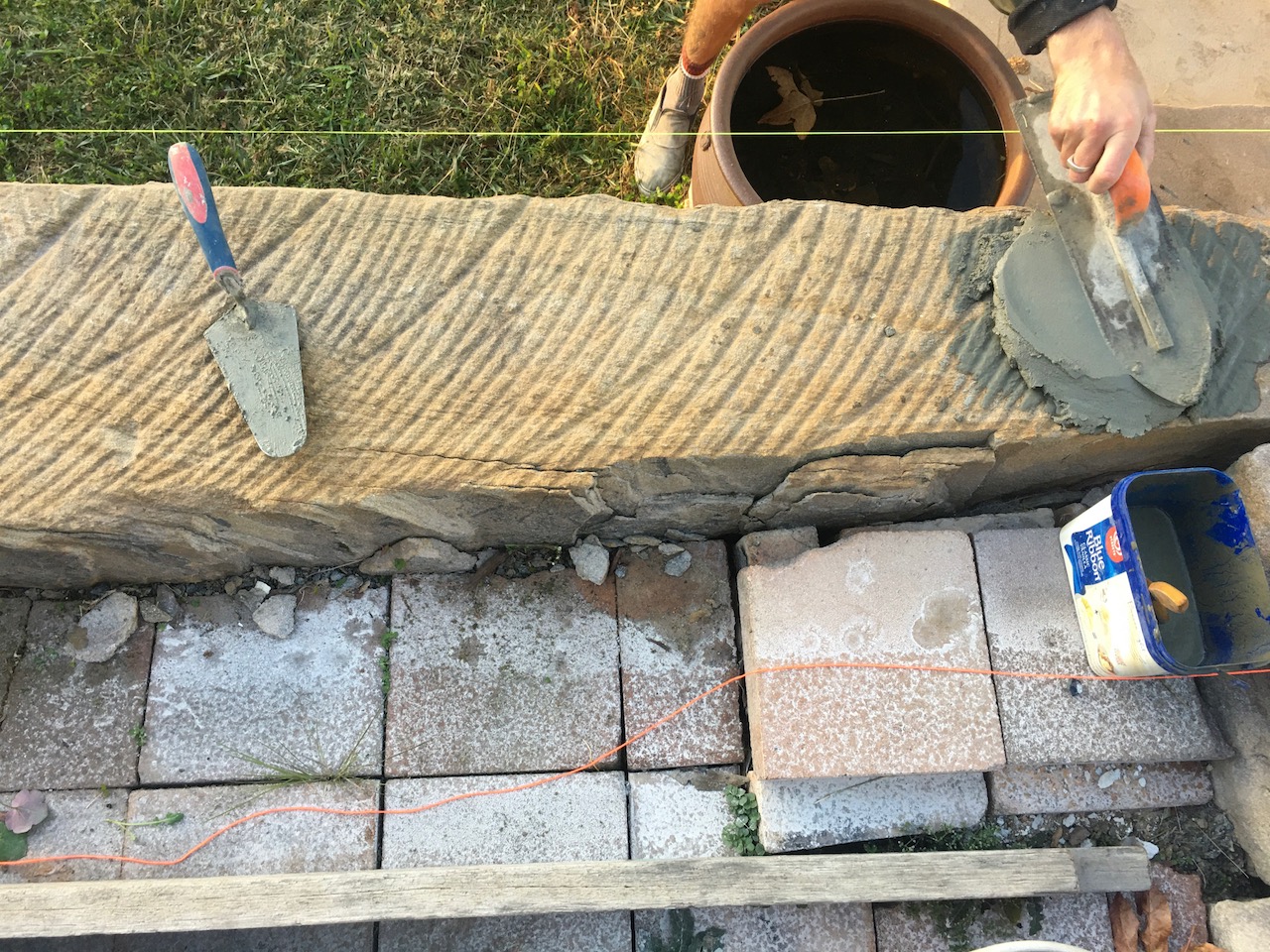
Using our very old ‘wabi-sabi’ Steam-Punk cement mixer that we bought 2nd hand for $50, 35 years ago. We mixed 14 loads a day and got through 1  1/2 tonnes of sand and 20 bags of cement to render a 70mm thick bed of mortar over the stones to get a continuous straight level, thick enough to be water proof and strong enough to cap the stones and support the slate capping.

Time will tell if this has worked well enough to deter any further spalling. I did notice that there was enough embedded heat energy in the stones, such that after the frost melted in the morning, the slates were very soon dry, except where the edge extends over the stonewall to create a clear drip line. The extended slate stayed wet, frozen and cold.

We still have a lot of paving to do, but everything in its own time. This job was an absolute priority now that winter is here and the frosts are back.

Preparing for the first wood firing of the year.

This week is the mid point of autumn, Half way between the equinox and the solstice.

The weather is certainly a lot cooler and we notice that the days are so much shorter. I really like this slightly cooler alternative the long days of summer. Our summer wasn’t so hot as it used to be during the decade of el-nino years. These last few summers have been so much nicer, cooler and wetter, everything has turned green and grown its head off. We have harvested more tomatoes then we have ever grown. It seems that all the planets aligned for the tomatoes. I haven’t counted the bottles, but there must be over 40 jars. Quite enough to last us well over 12 months, possibly even 2 years?

We went to Canberra over Easter for the National Folk Festival.

We caught up with people that we haven’t seen for over 4 years, as we were confined to home because of;

1.  The fire, 

2. The on-going clean-up,

3. The rebuilding,

4. Covid, followed by a year of lock down. 

It’s only now that we feel that we have the time, space and safety to go out again. Womad was on again this year, but we chose to stay home, save time and money and get on with some of the long list of jobs. However, we decided to go to Canberra for ‘The National’, as we can drive to Canberra in just 2 hours in our electric car. Travelling to Adelaide for Womad is looking more and more extravagant and carbon intensive, regardless of whether we drove or flew, we were responsible for burning loads of carbon each way. I just can’t justify it anymore.

The long weekend of music was wonderful, so many great acts, too many to list, but a few stood out.

The ‘We Mavericks’, Lindsay Martin and Virginia vigenser, were excellent. We have had them here in our home to perform for us in one of our house concerts a few years back. I believe that we were their second only performance together. They get better and better.

Billy Bragg was also really good. He was the best that I have ever seen him. Powerful voice, smack on key and few very powerful, short spoken interludes between songs, on why we should care about the state of things and the world. He also explained what he is doing to make a difference. Very inspiring. However, it crossed my mind that he must owe a tremendous carbon debt?

We also enjoyed Gleny Rae Virus, Leroy Johnson, (above) the Park Ranger from Mutawintji National Park out near Broken Hill, and Farhan Shah & SufiOz. singing Sufi devotional chants. + many more.

Back at home we have been Splitting wood for the kiln firing, and working in the garden. 

We met up with our friends Susan and Dev in Canberra, and they called in here on their way home to give us a hand with those jobs.

My friend Len Smith also called in and we had a little reunion. As Len, then Janine and finally myself, were Susans teachers at different times in her life, at different colleges.

Together, we ripped out 3 beds of waning tomatoes, that had reached the end of their productive life and added them to the compost heap.

Afterwards, I planted out lettuce and radish seeds as well as lettuce and spinach seedlings.

The garden suddenly looks a bit more loved again after a few weeks of minimal up-keep and absence.

My last job was to plant out 160 of our own self grown and stored garlic cloves. I should have been onto this a month ago, but better late than never.

I did two rows of 80, one of our purple garlic and the other of our white skinned variety. They have started to shoot from their skins. A very good sign that they are ready to be planted out now!

Everything takes time and time needs to be made or created by making decisions about what is most pressing and needs to be to be done NOW.

Tomorrow it is back into the pottery to unpack and repack the electric kiln for yet another bisque. Learning to Juggle my time and energy has been a life long exercise in developing this skill for me.

I want to do so much each day, Even summer days aren’t long enough. I need to triage my desires to fit my capacity to actually achieve outcomes. Added to this, I really don’t know what I’m doing most of the time.  I’m reasonably well trained in making pottery, and I have taught myself to grow vegetables and orchard fruit trees, but I have such a low basic understanding of building techniques and mechanical engineering, I just muddle through as best that I can. I rely on asking more knowledgeable friends for advice on what they would do, or where is the best place to buy the correct parts.

I’m so grateful to all of my friends for the advice and help that they have given so generously over the years.

When we built the new ‘kit-form’ tin shed for the new pottery. I paid a bunch of so called ‘expert’ tin shed builders to come onsite and erect the kit. They had experience and all the fancy gear to do the job. A bobcat loader, a scissor lift gantry and a truck load of power tools. They put the frame up OK. It is at least level and vertical. But when I asked them to screw on all the 2nd hand, grey re-cycled old rusty gal iron sheeting that I had collected to give the shed some character, they did the worst job that you could imagine. They chose to use roofing screws without any rubber ring to seal out the weather, and as a consequence, all the walls leaked in heavy weather. The windows weren’t ‘flashed-in’ correctly or at all, and leaked. The cement slab was cast with a definite hollow in the centre. The verandah wasn’t ’stepped-down’ 50 mm to stop water blowing in under the doors, so that when it rained hard, the building leaked, all the water ran to the centre of the building and pooled there. I’ve spent over a year discovering all these faults, omissions and bad workmanship and then correcting them as best that I can. If only I’d known something more about the building trades, I might have spotted these faults occurring and got them seen to at the time. But I trusted them. BIG mistake.

Our previous three potteries that burnt down were all home made on a shoe string budget mostly out of wood and other materials that we could scrounge off the side of the road on council clean-up day, or from the tip. They too had character, but a very different character. This last shed is so much better in all sorts of ways, but mostly it will be easier to defend against fire. Metal clad, metal frame with metal lining and the cavity stuffed full of insulation. All the previous buildings were made of wood and therefore were very flammable.

It seems that I have discovered all the problems with the poor workmanship in this shed now. I’ve discovered all these faults bit by bit over time and fixed them myself. The builders have shot through. There is something to be said for self-reliance.

Do it yourself, do it right the first time. I do it to the best of my ability. If it isn’t the most professional job, at least it is mine and any mistakes are honest ones. The stuff that I do has my character printed all over it. I own my mistakes, my lack of skill and my incompetence, but in the end I figure it all out and I can live with the result. At least I’m not upset with myself for ripping myself off. AND everything is done on a minuscule budget. We have never earned much money, so have learnt to live very frugally.Everyone seems to be obsessed with money these days, as if it solves everything. I heard on the news that the 3 richest Australians have more money than the bottom 10% of the nation. Pretty shocking! It’s a shame that there isn’t a way of making life a little bit more even and equitable for the disadvantaged. The Lovely and I have done very well for ourselves, being able to have built a simple, largely non-acquisitive, low carbon, organic lifestyle here, without ever having had a ‘real’ job. We’ve managed to ‘get away with it’ for all this time, living an engaged, creative, self-employed, part-time amalgam of a life. Without credit card debt or interest payments, doing almost everything ourselves. Living within our self-determined means. We’ve never been on the dole and never asked for handouts. Money may be essential in the modern world, but we don’t let it ruin our lives.

As an example of this frugal self-reliance I recently fixed up an old Chinese wood splitter. It needed a new/old/2nd hand starter and air cleaner to get the engine going again. That wasn’t too difficult. I just stole the parts off another old ruined motor that was in the barn. Best not to throw things out if they might have useful parts on them to keep another machine going for a few more years, There is a lot of embodied energy stored in those old bits of machinery. So it’s better to try to repair something old and get extra life out of it, than to give in and buy a new one. It’s also much, much, cheaper

Once I got the engine working, I decided to make it into a bigger splitter with a longer stroke. All cheap Chinese hydraulic splitters have a 600 mm. (2 ft.) hydraulic ram. That is the upper limit of their log capacity. My new kiln has a fire box length of 690/700 mm. (2’ ft, 4” inches). To give the splitter a longer stroke I decided to cut 75 mm. (3” ) off the cutting wedge to make it shorter ,and therefore add extra length to the logs that can be split.

I wasn’t sure that it would work, but it seemed a lot easier than cutting the end off the frame and welding a new section of RSJ onto the frame to make it a longer machine. 

By shortening the blade I achieved the same outcome with much less work. But an hour on the angle grinder was a bit of a chore, as 20mm thick steel plate doesn’t cut easily.

You can see in this image that the blade used to go all the way to the bottom of the backing plate. 

Scrooge’s technique of making a bigger splitter out of an old small one.

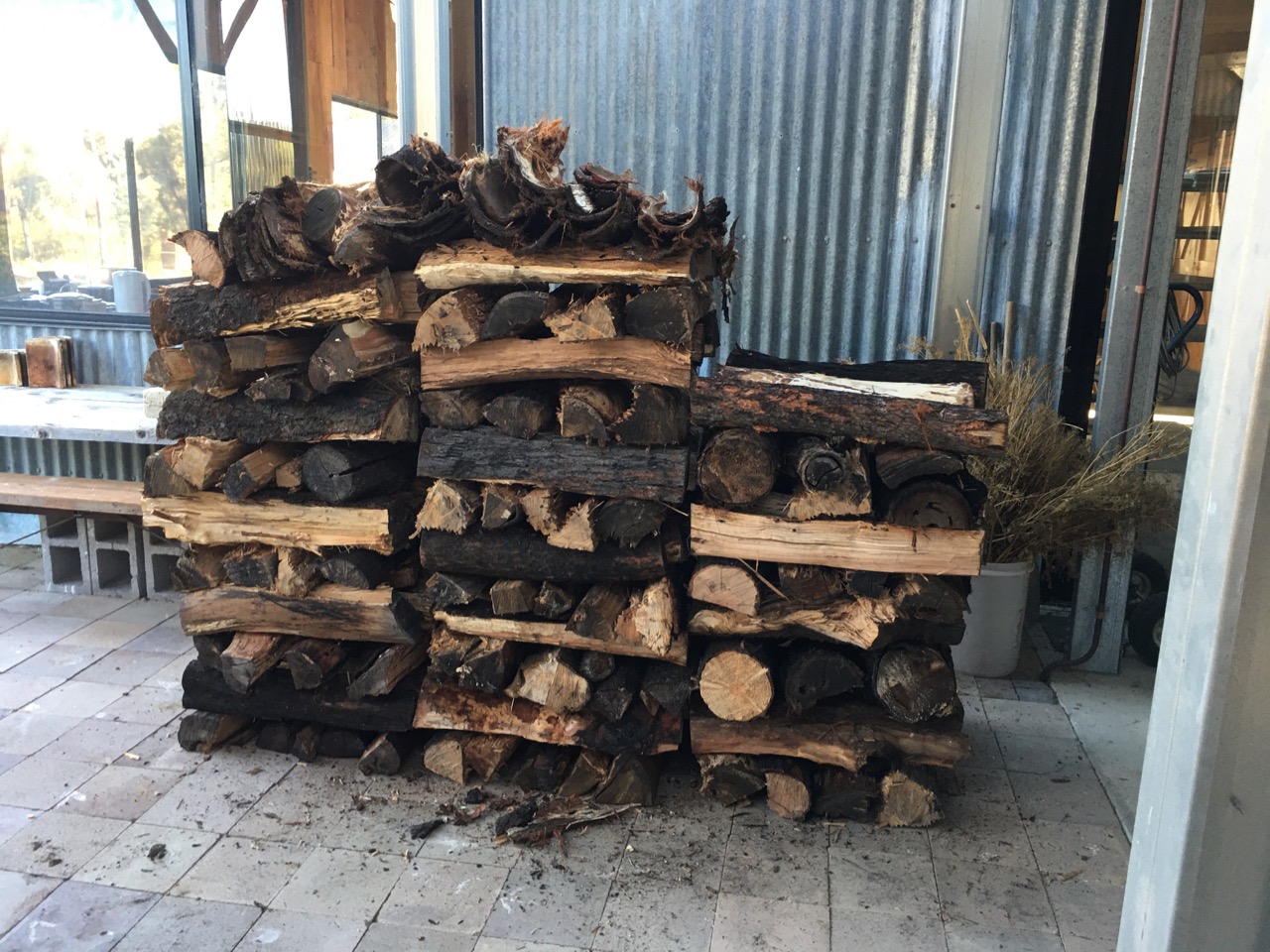
The old small engine managed the longer wood OK. I filled the truck with wood cut and split to 675mm long.  That is about enough to fire the kiln to stoneware in 14 hours.

2 1/2 stacks of Hob wood,  

A couple of piles of smaller kindling lumps for firing on the floor,

and then a couple of stacks of thinner side stoking wood for the 2nd chamber. Thanks to Dev and Susan.

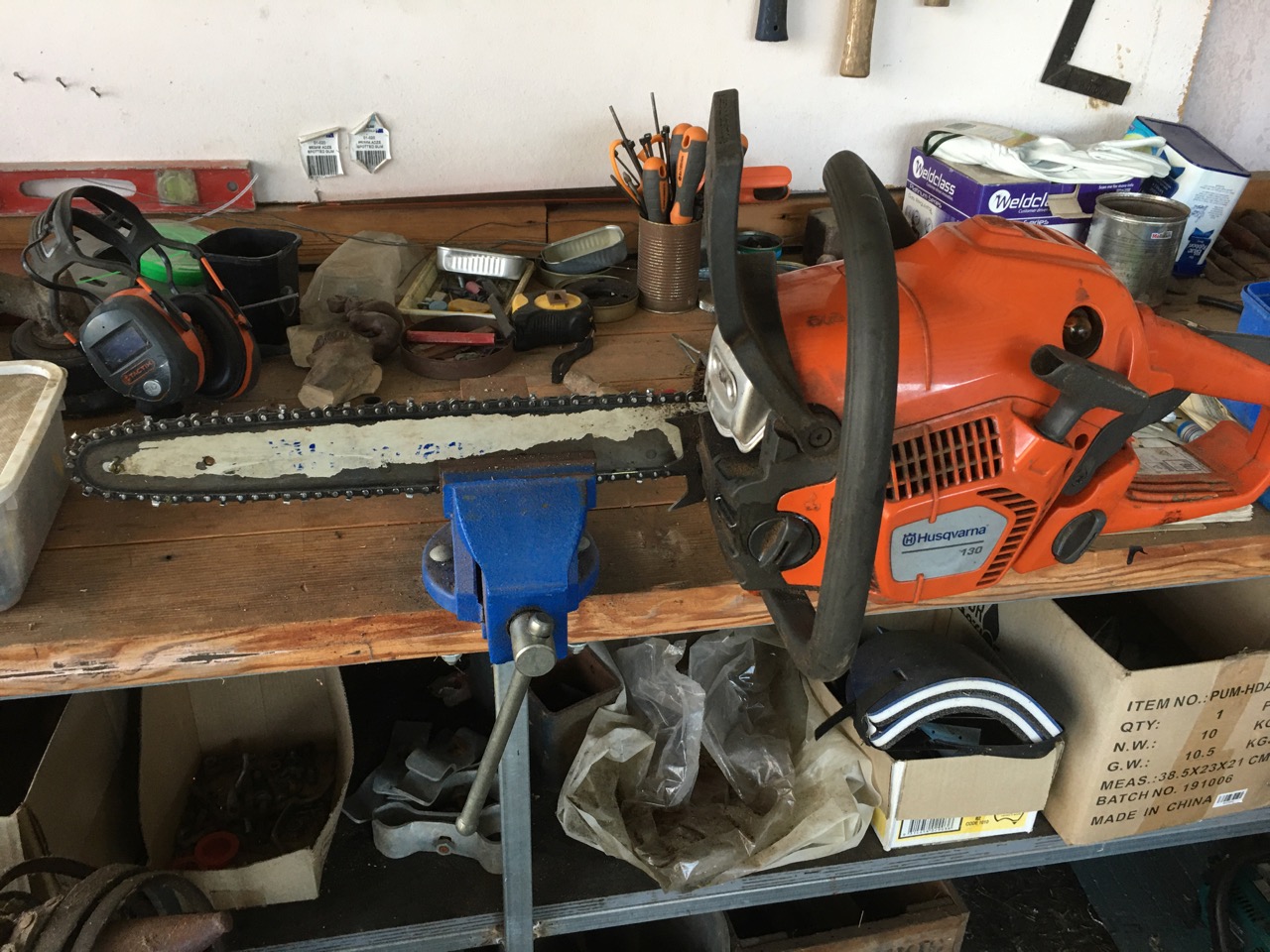
I finish the day by servicing the chain saw. Best to do it when it’s fresh on my mind, even though I’m tired from all the work, fixing the splitter, then testing it out and finally stacking all the wood.

I hate it when I go to use the saw and find that it is blunt and needs servicing, So I do it straight away. Sharpen the chain, blow out the air filter, rotate the bar, fill with 2stroke and bar oil.

It doesn’t take so long and everything is ready to go again, — except me!  I need a rest.

Half a Kilometre of Fencing Completed

A little while ago, I was travelling along in this chaotically hectic life thinking that I’d be making pots in the 2nd half of January.

But the appearance of the deer in our yard have changed everything.

Out neighbour saw a large buck with antlers in his yard last week. We have had the doe and fawn. So if there is a doe and a buck… then there will soon be a lot more. 

We needed to act quickly.

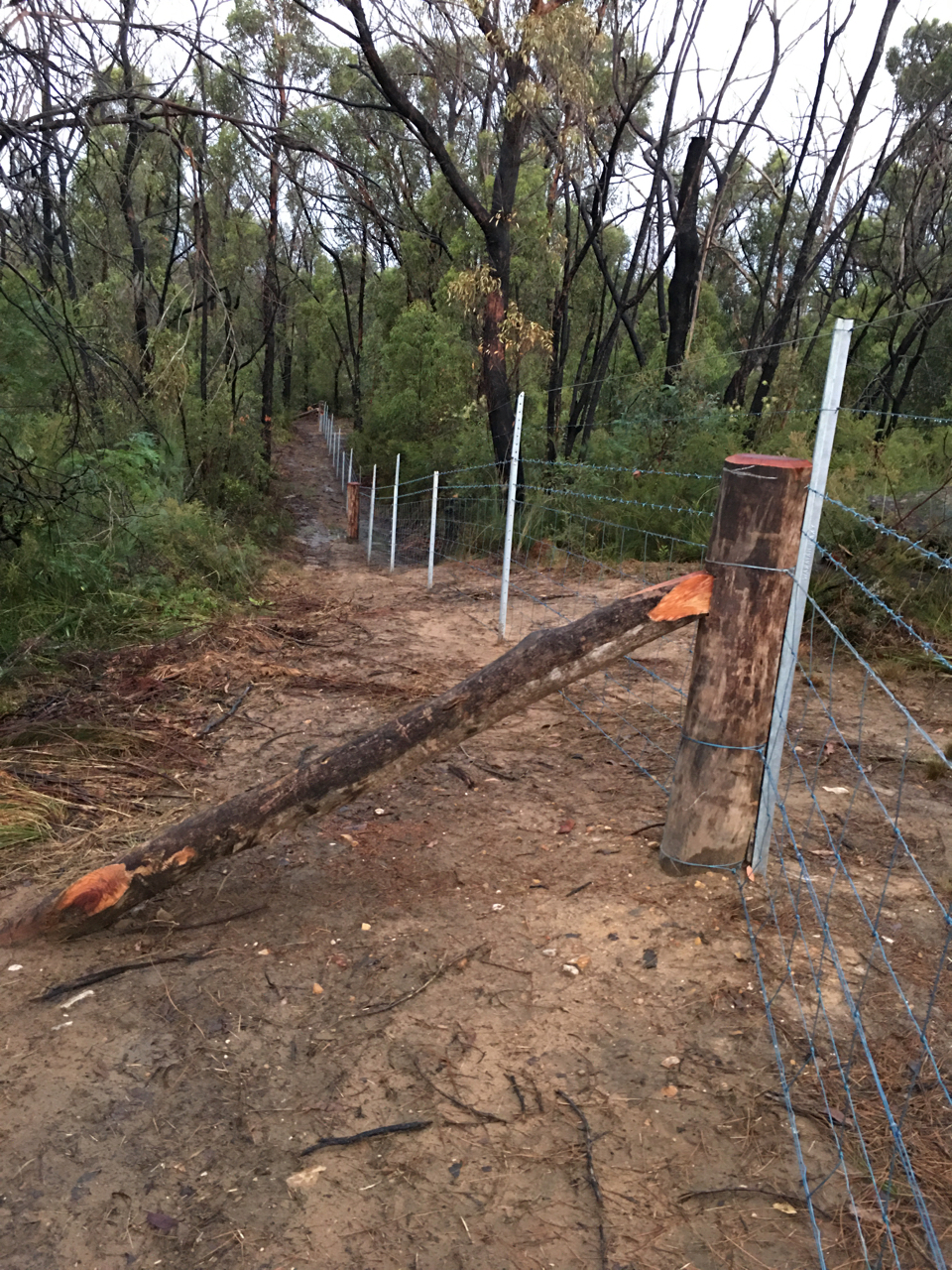
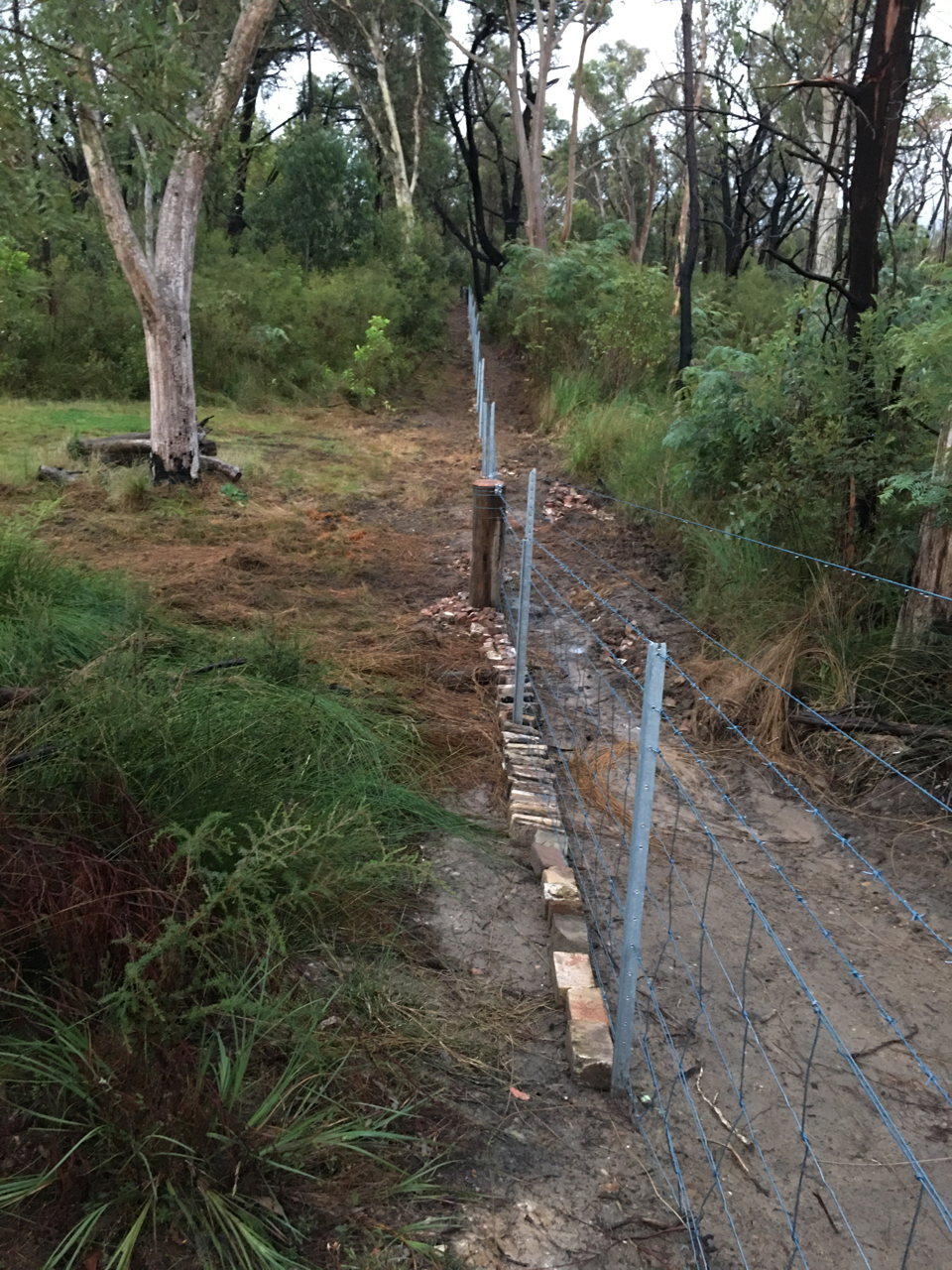
We have now completed the complete perimeter fence of one half of our land. A few years ago we only had one side fence put up by our only neighbour to keep their dog in.

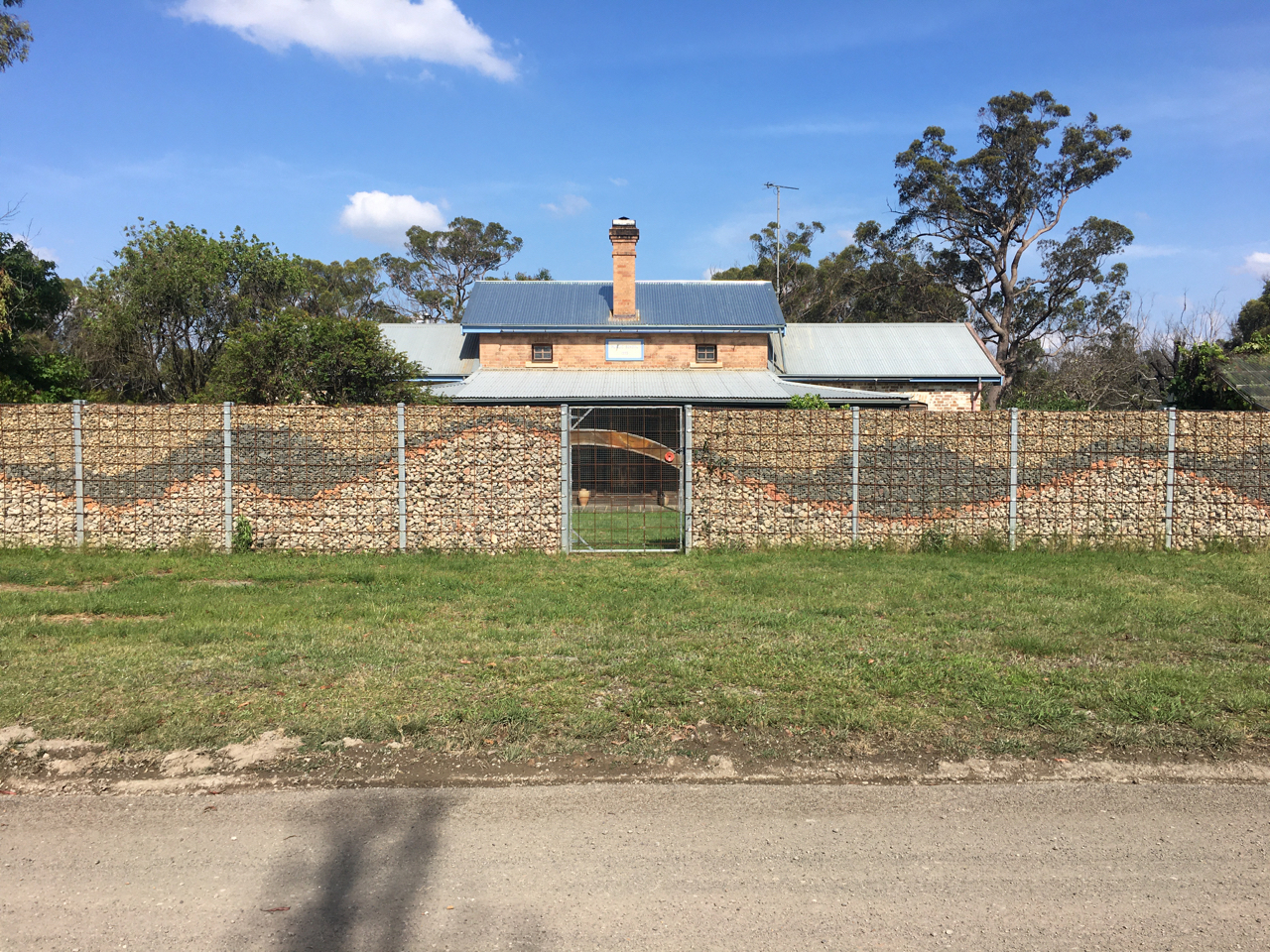
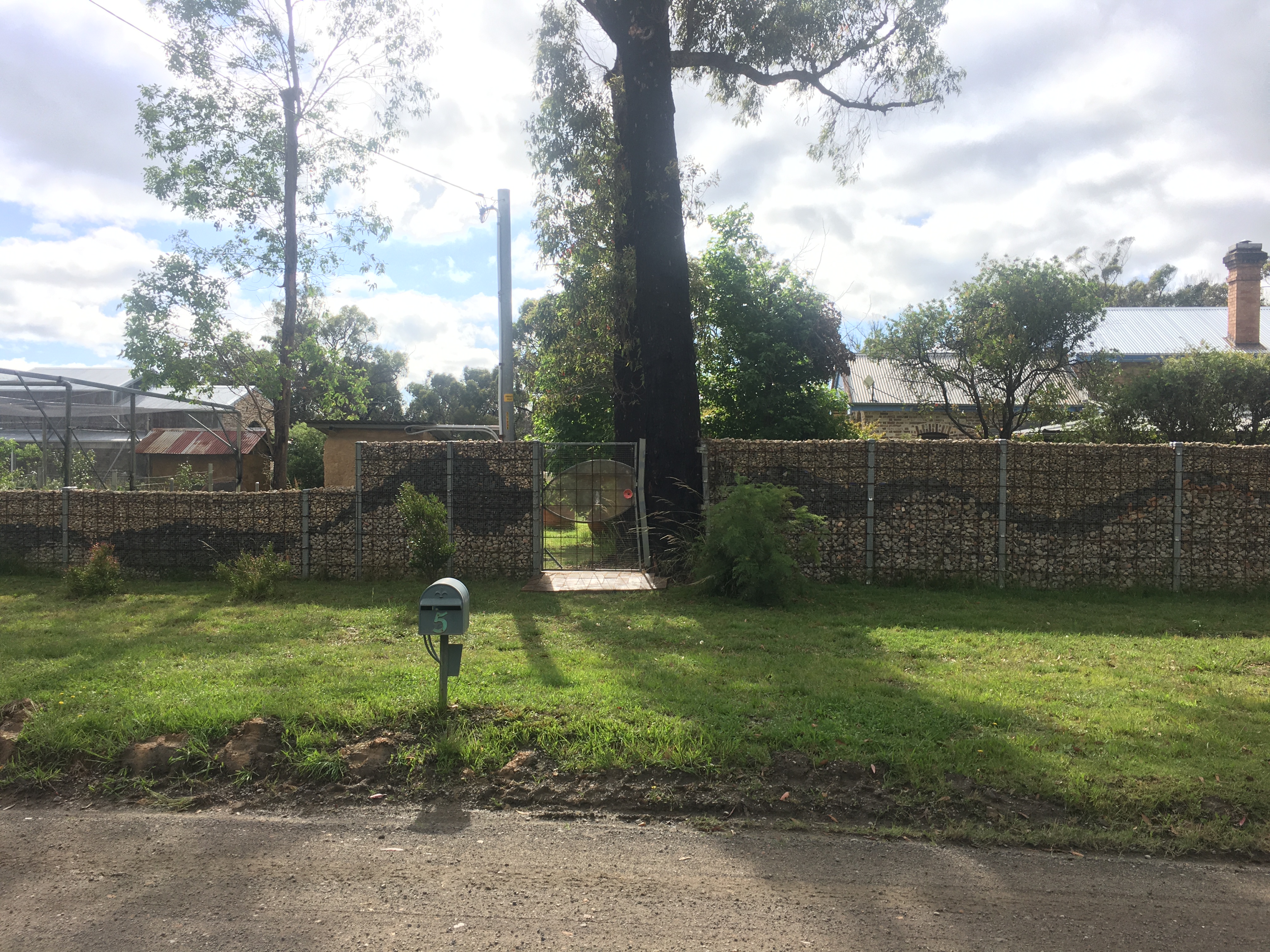
Then after the fire, while we were waiting for the council to approve our re-building plans and waiting for our tin shed kits to be delivered, we decided to use the time to put up the stone and steel gabion wall out the front. This is to act as a radiation barrier in the next fire event. 

Now we are the proud owners of just over 510 meters of perimeter fence. It’s been a lot of work. At first, I thought that I might not be up to it, But it went well enough because I didn’t over-do it. I paced myself. However, I wouldn’t want to do it again. I was working close to my limit. In the end the effort was worth it to preserve our fruit trees and garden that we have spent over 45 years cultivating. Only time will tell if it is enough of a deterrent to encourage them to dine elsewhere?

I’m really glad that it’s over.

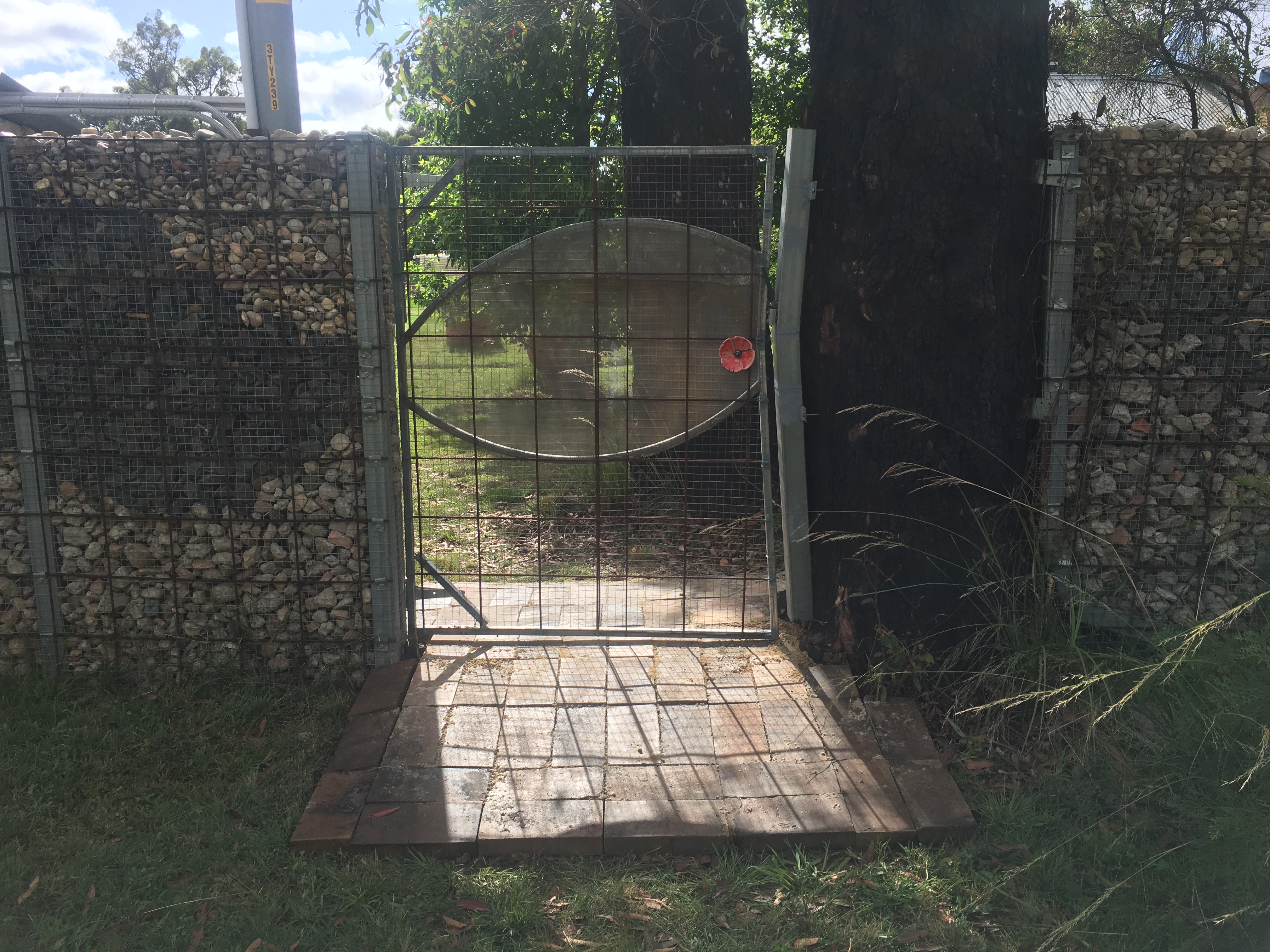
  Starting at the gabion wall on the street front, we had to cross the culvert ditch and make it deeply deer proof. So we installed a swinging gate to allow for the clearance of flood debris.

Then down between the two dams.

Then down to the back lane/firetrail.

Then along the back boundry, and through the key-line dam system overflow.

And finally up to the existing neighbours fence.

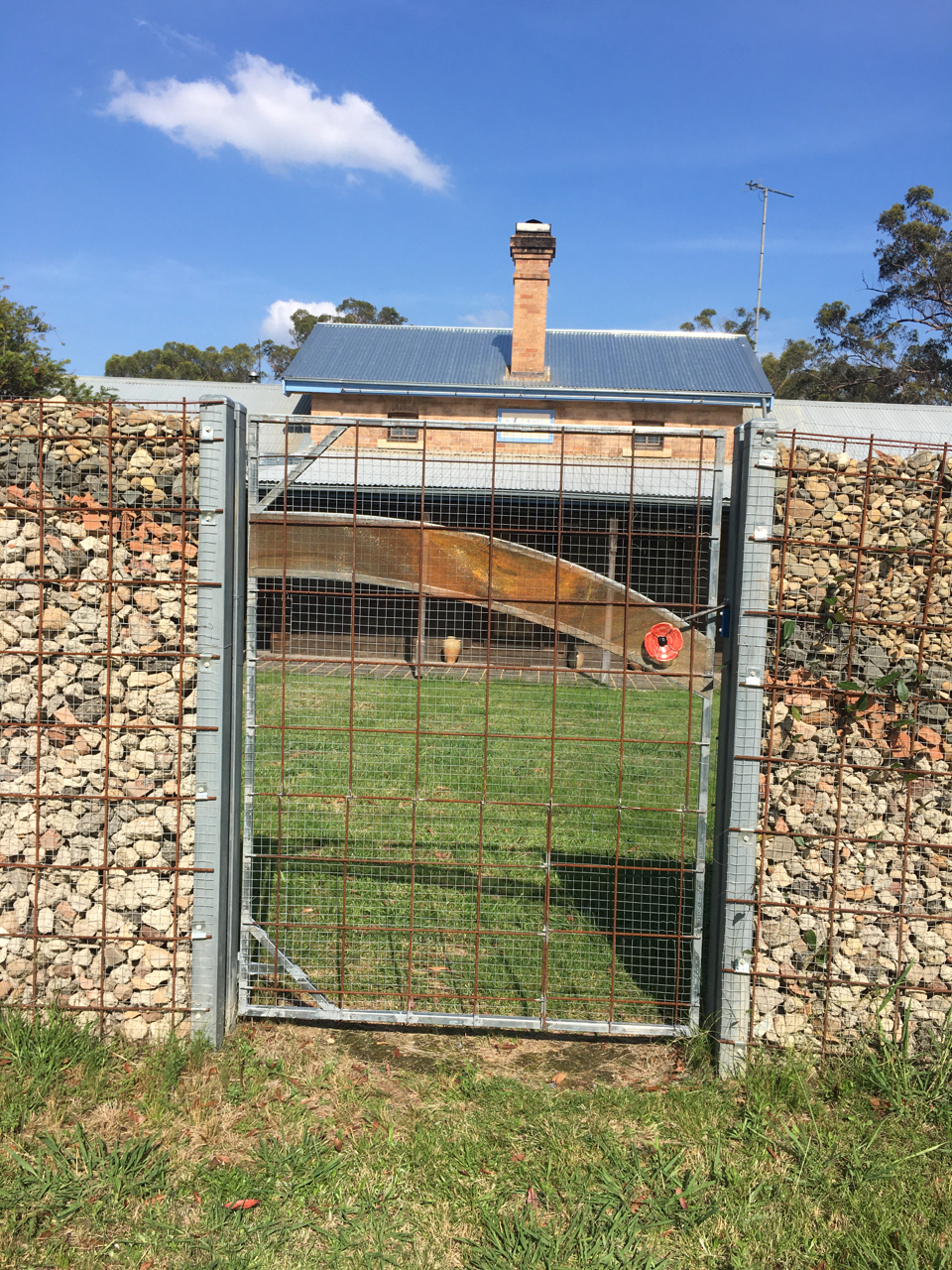
Having completed the fencing the only weak spot in our defences were the openings in the gabion wall where I never got around to making the gates. There are 2 drive in gateways, and two walk through openings. One directly in front of our front door, and the other next to the electrical meter box for access for the electrical services people.

I have spent the last few days making gates for those vulnerable openings. I now have 3 completed. The last one will have to wait, as I really need to get back to work in the pottery.

If the deer arrive in the mean time. I’ll just have to drop everything and weld up that last set of double gates to close off the 7.6 meter wide main drive way.

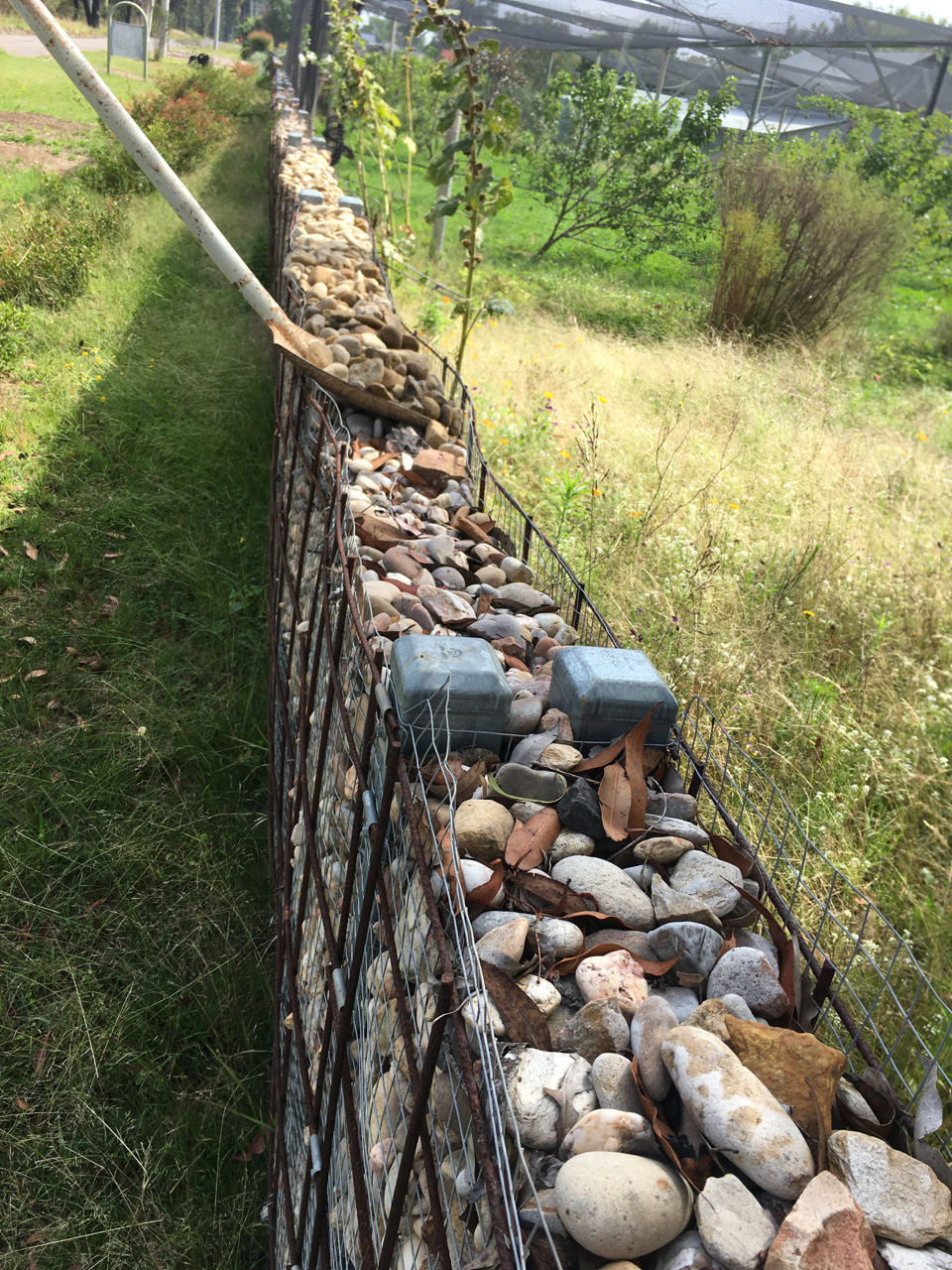
Now that the gates are in, it made me look closely at the gabion wall, which I hadn’t being paying much attention to recently.

I noticed that the stones had settled down in some places.

We’ve all read the warning label that “Contents may settle during transport”

Well, our stones have settled while stationary.

The only thing to be done was to make a trip down to the sand and gravel yard and buy another tonne of stones to fill it up again.

Now that it is topped up, it should be all good now for another decade?

A change is as good as a holiday

Over the solstice break, I’ve been having a bit of time off.

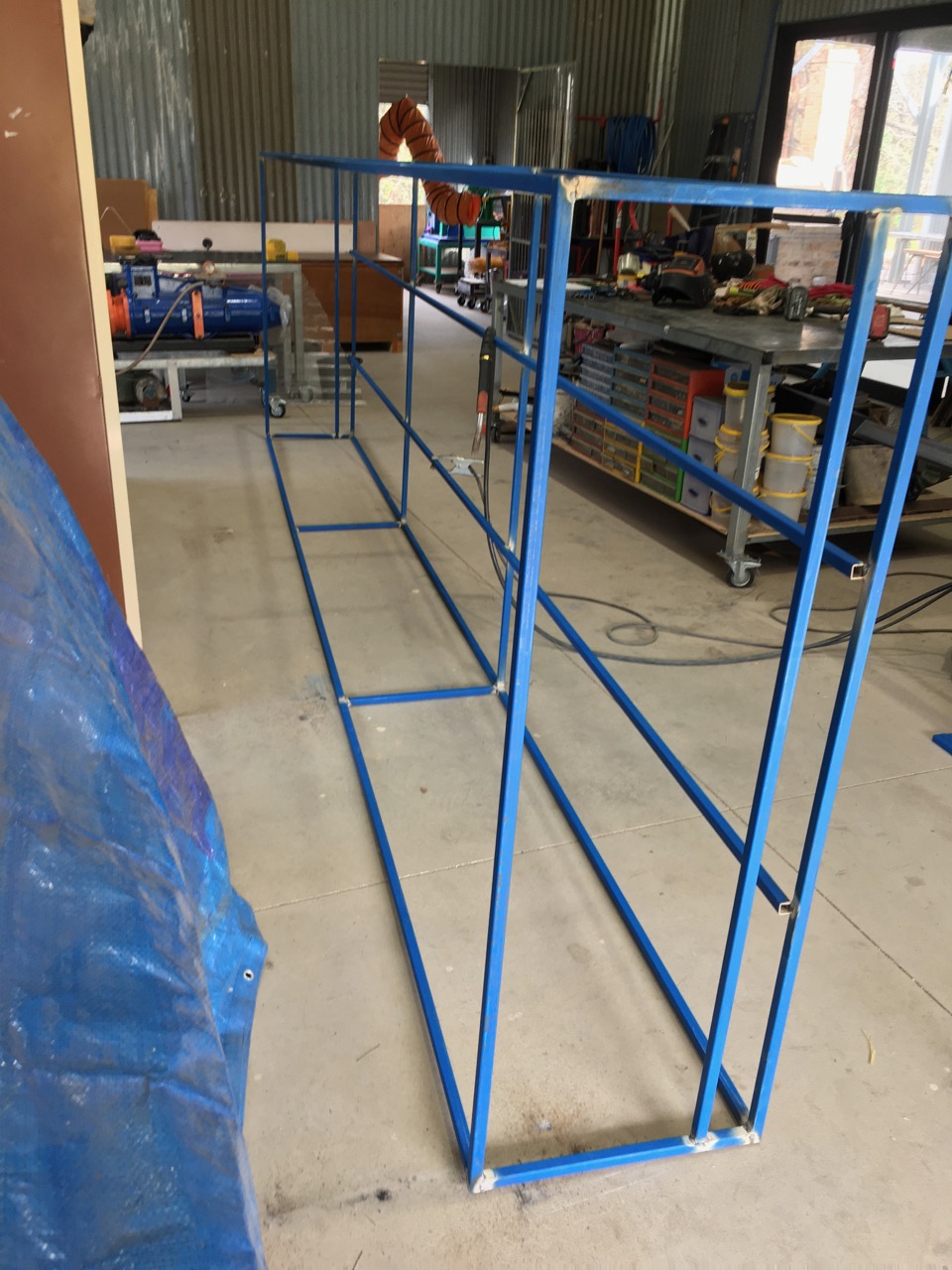
A change is as good as a holiday I’m told. So I took some time out to weld up a steel frame to make a fume extraction hood to go over all the electric kilns.

I have been ‘making-do’ with a bathroom exhaust fan set into the kiln room window, but it doesn’t catch all the fumes.

So we now have a ‘proper’ hood that covers all 3 kilns and there is room for a 4th kiln at the end, if I ever get round to building it.

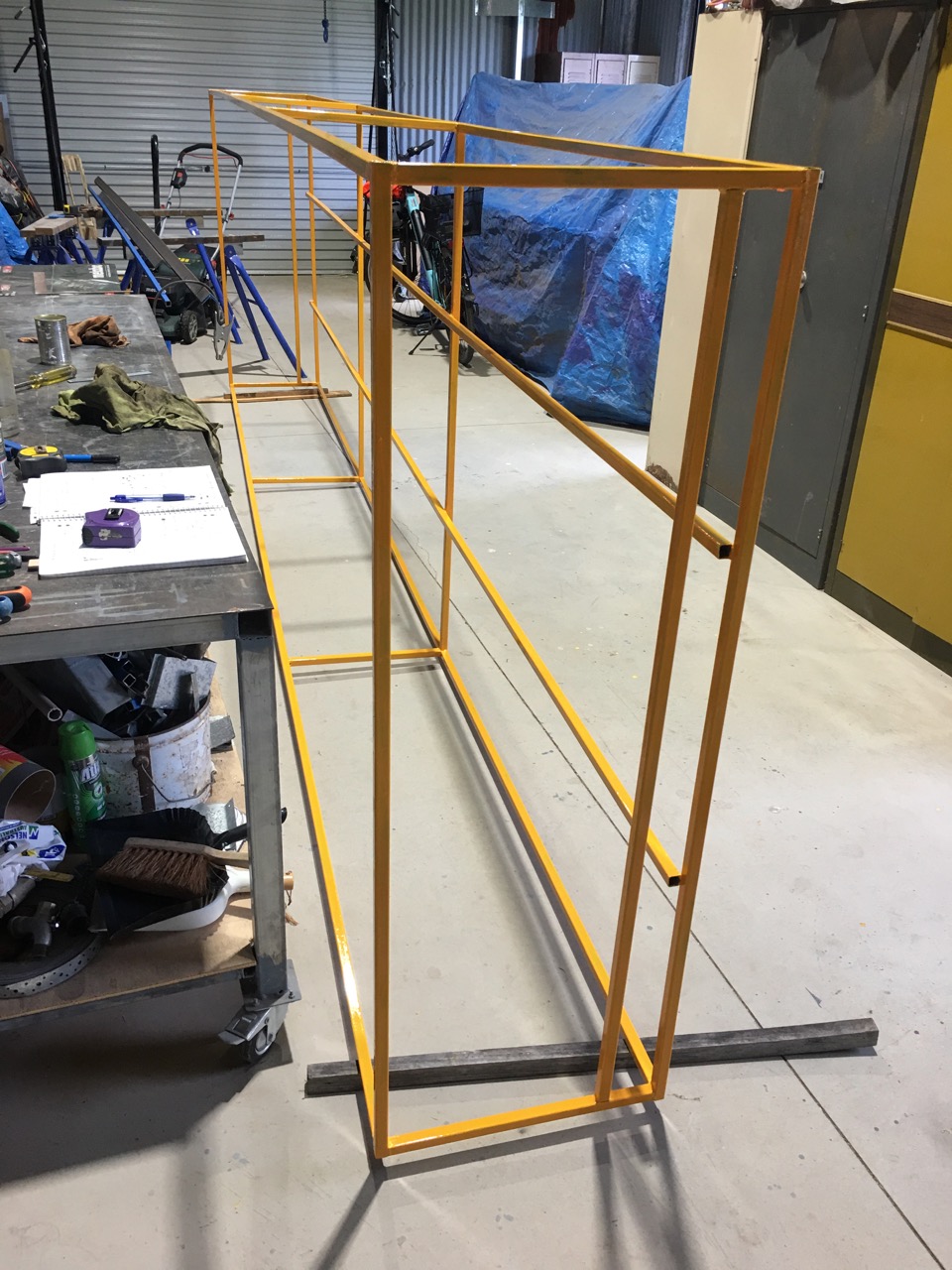
The frame is welded out of 20 x 20 RHS sq. section tube and then primed, undercoated and top coated with a strong yellow industrial grade paint. Something resembling ‘CAT’ Yellow, just to give it that heavy duty industrial look. Actually, I was thinking of the sort of colour that big factories have to paint over-head cranes, gantries and such.

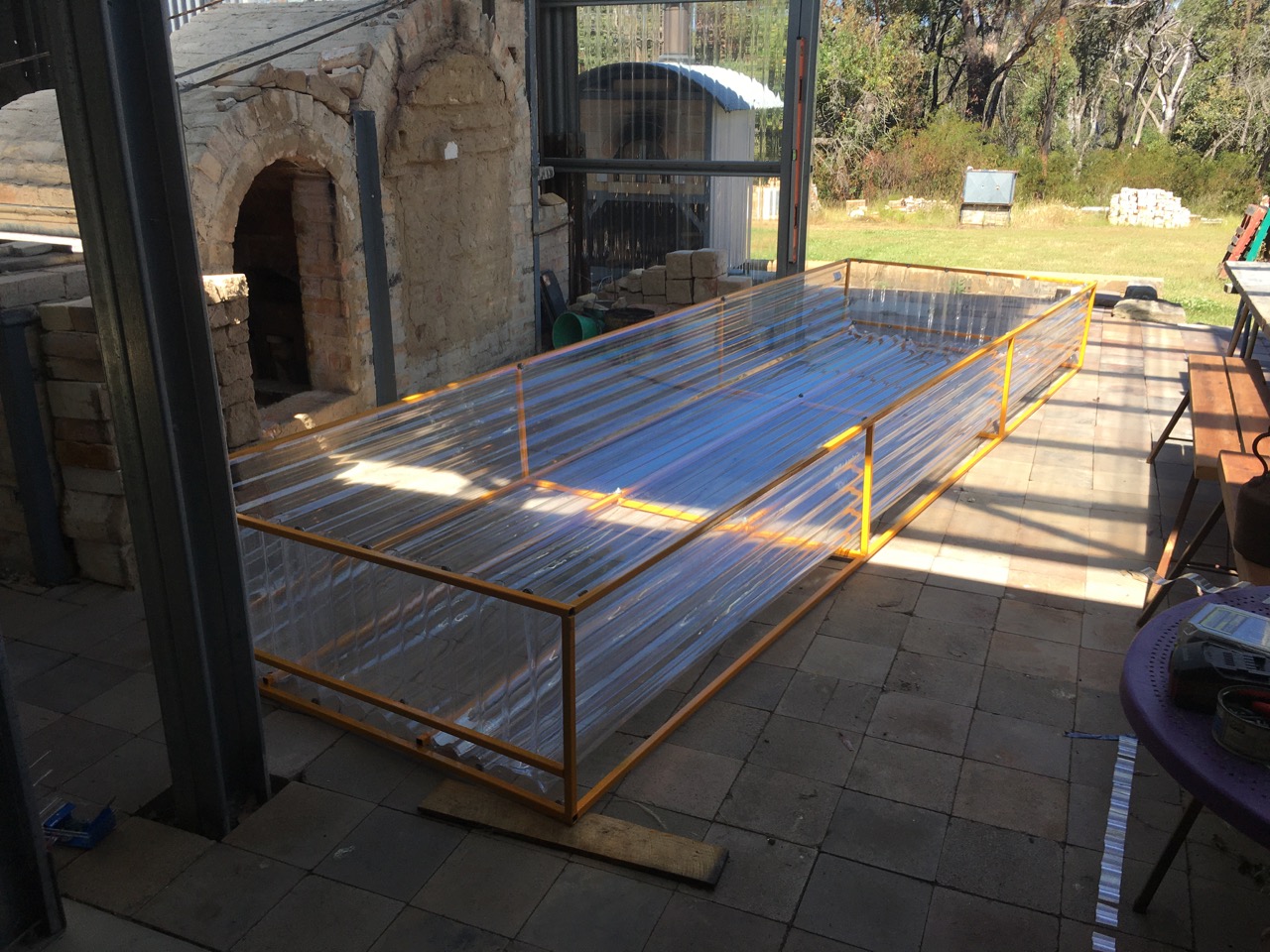
It has turned out to be a massive edifice measuring 4.5 metres long by 1.5 m wide and 500 mm. high.

I had to build a special little trolley to manoeuvre it out of the welding area and into the court yard, where I could rotate it so as to allow me to screw in the poly carbonate lining.

I decided to use light weight RHS construction and poly carb sheeting because of the weight factor. I have to lift it up into the ceiling. But I also noticed after the fire, that poly carb doesn’t burn. It just melts, even at really high temperatures. So I thought that I’d give it a try as a fume hood lining. It wont get too hot, so shouldn’t melt. It is very light weight. It lets the light through, adding to the ambiance of the kiln room. It is cheap compared to any other sheeting. BUT most important of all, it doesn’t rust. The big killer of overhead hoods is the condensation of acid gasses and the rust that they create. This could be a solution?

Time will tell.

My son Geordie and my friend Warren came over for our Solstice lunch get-together, so before we ate, we did the install. It took all of 5 minutes, because I had every thing planned out and ready.

Now, the bathroom fan will be more effective at removing all the fumes from the kilns, and there is room for expansion.

Hopefully, a cheap and effective solution to the kiln vent fume problem.

While we had both Geordie and Warren here, I got them to help us move an exquisite old Japanese cupboard into our bedroom.

We were given this gorgeous old Japanese cupboard by my lovely friend Anne, who I have known for a very long time, getting on for 58 years in fact. Where does the time go?

Thank you Anne!

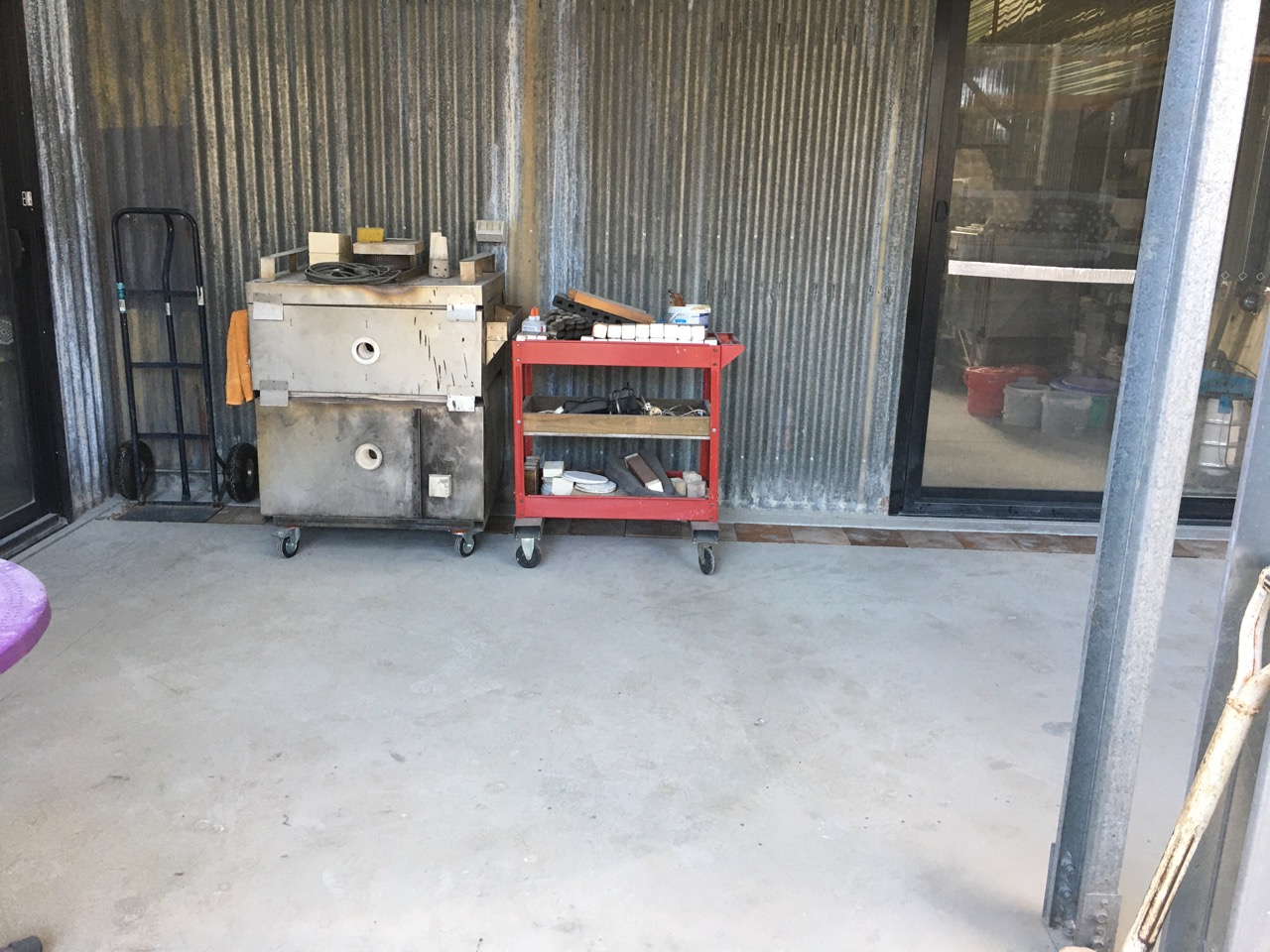
Somewhat disappointingly, we had another flood in the new pottery shed this week. Each time it happens, I look at the causes and find a solution and fix it. This time we had a brief, but severe storm of just 25 mins, but we got 25 mm of rain come down in that short time. It caused the gutters to over flow into the court yard around the kiln. However this time the rain all came it, not from the open wall leading into the courtyard, but deep in the enclosure against the kiln room wall from the gutters that couldn’t cope with the intense volume of water.

It has become apparent that the builders were pretty sloppy with their levels, such that the concrete slab is high at the edges and low in the middle of the kiln/glazing rooms. The result was that all the water flowed in under the gal iron wall and pooled in the centre of the kiln room, with some seeping into the glaze room.

There is absolutely nothing that I can do to change to the contour of the slab to stop this happening again. So my only option is the make a drain that can intercept the water before it reaches the wall and enters the building.

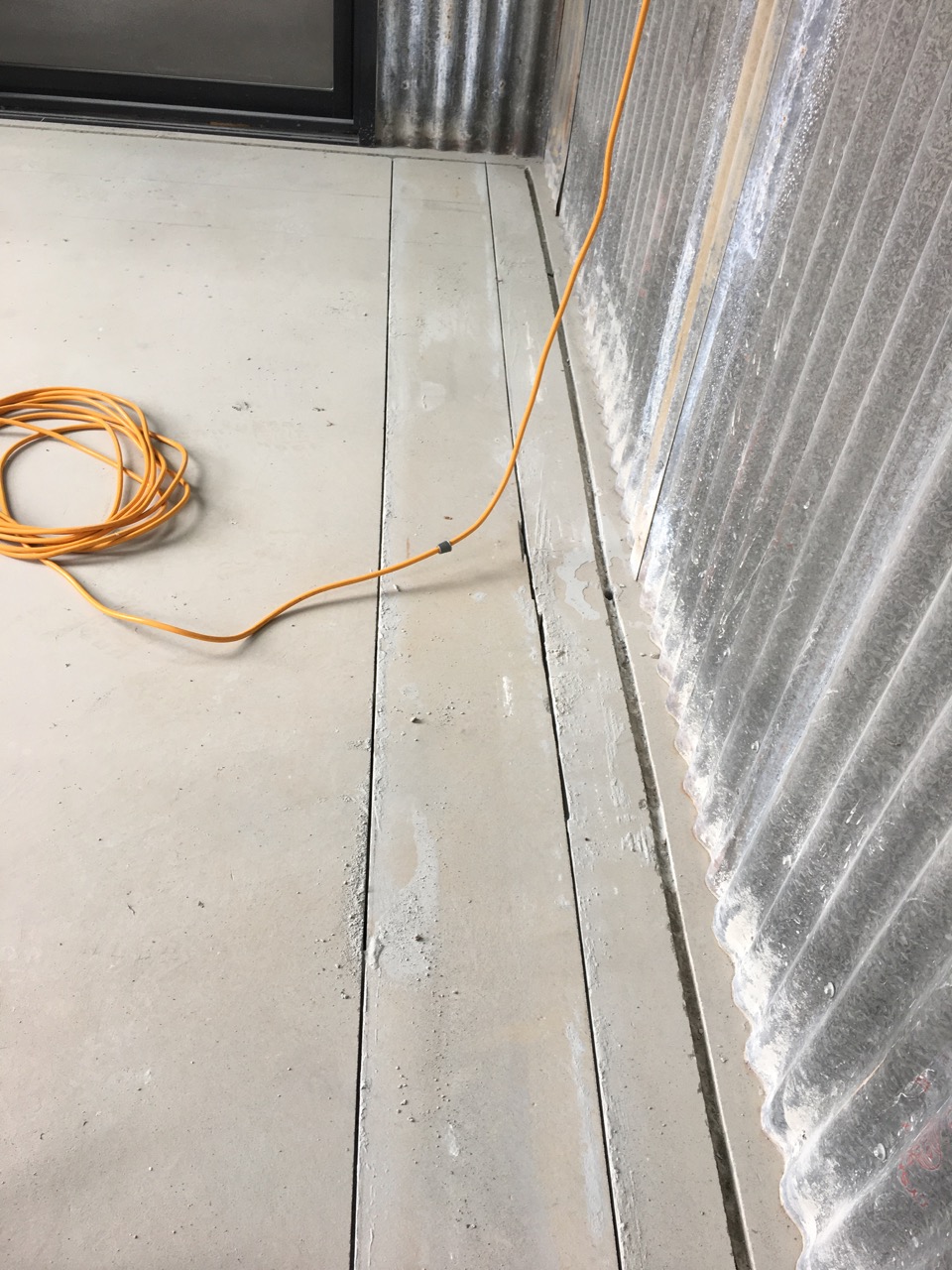
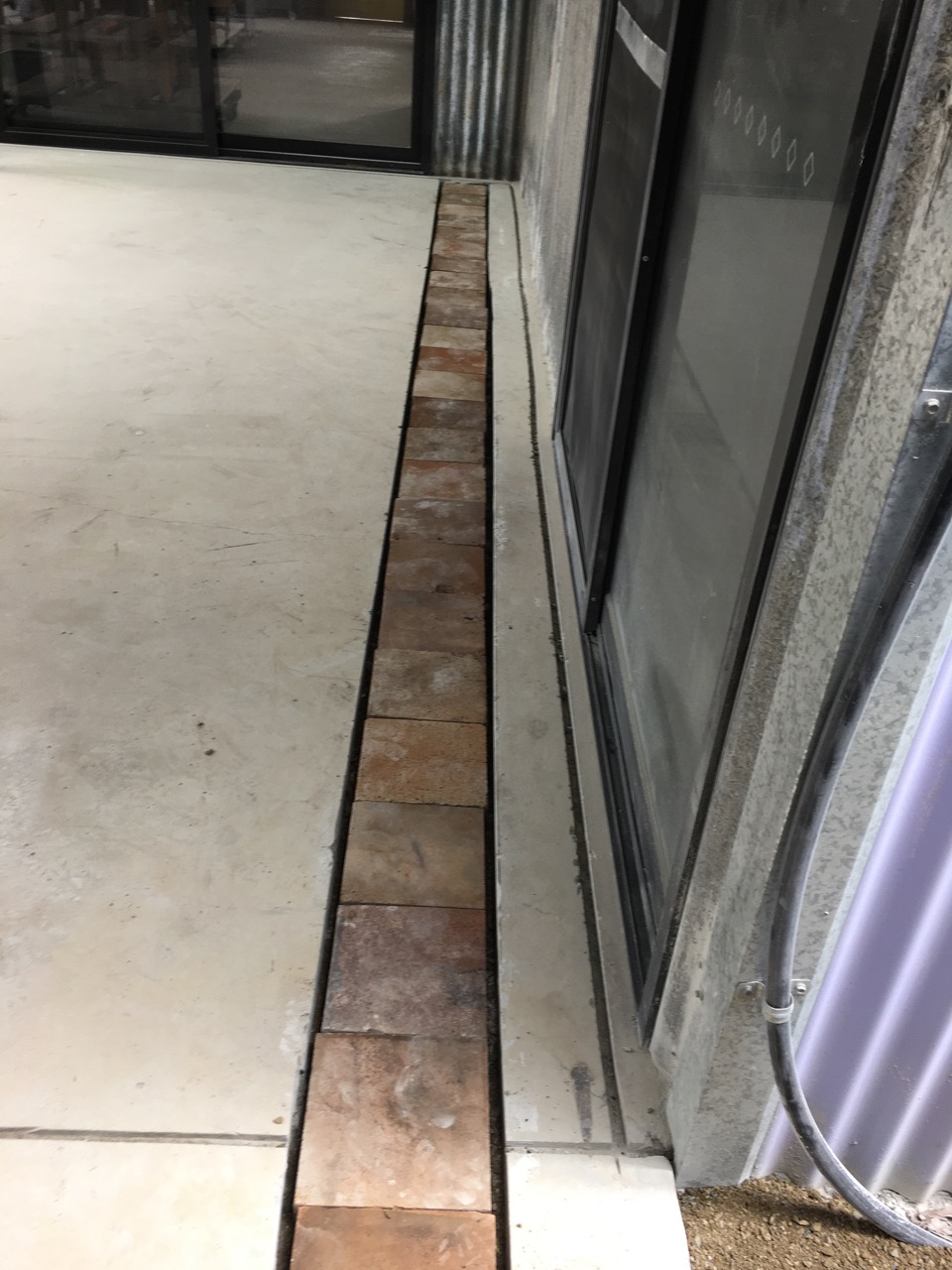
To this end, This morning I used a diamond saw blade to cut two 8 metre long slices through the 115 mm thick concrete slab down to the substrate of compacted rock dust and gravel. It was one of those nightmare jobs that nobody would ever want to do. But someone has to. Meet muggins.

You can see in this image, where I had initially tried (unsuccessfully, as it turned out) to create a small diversion channel around the wall using a circular saw and a friction disc. This wasn’t deep enough to cope with the flood of water from this last storm. I realised that the drain needed to be substantially larger and deeper.

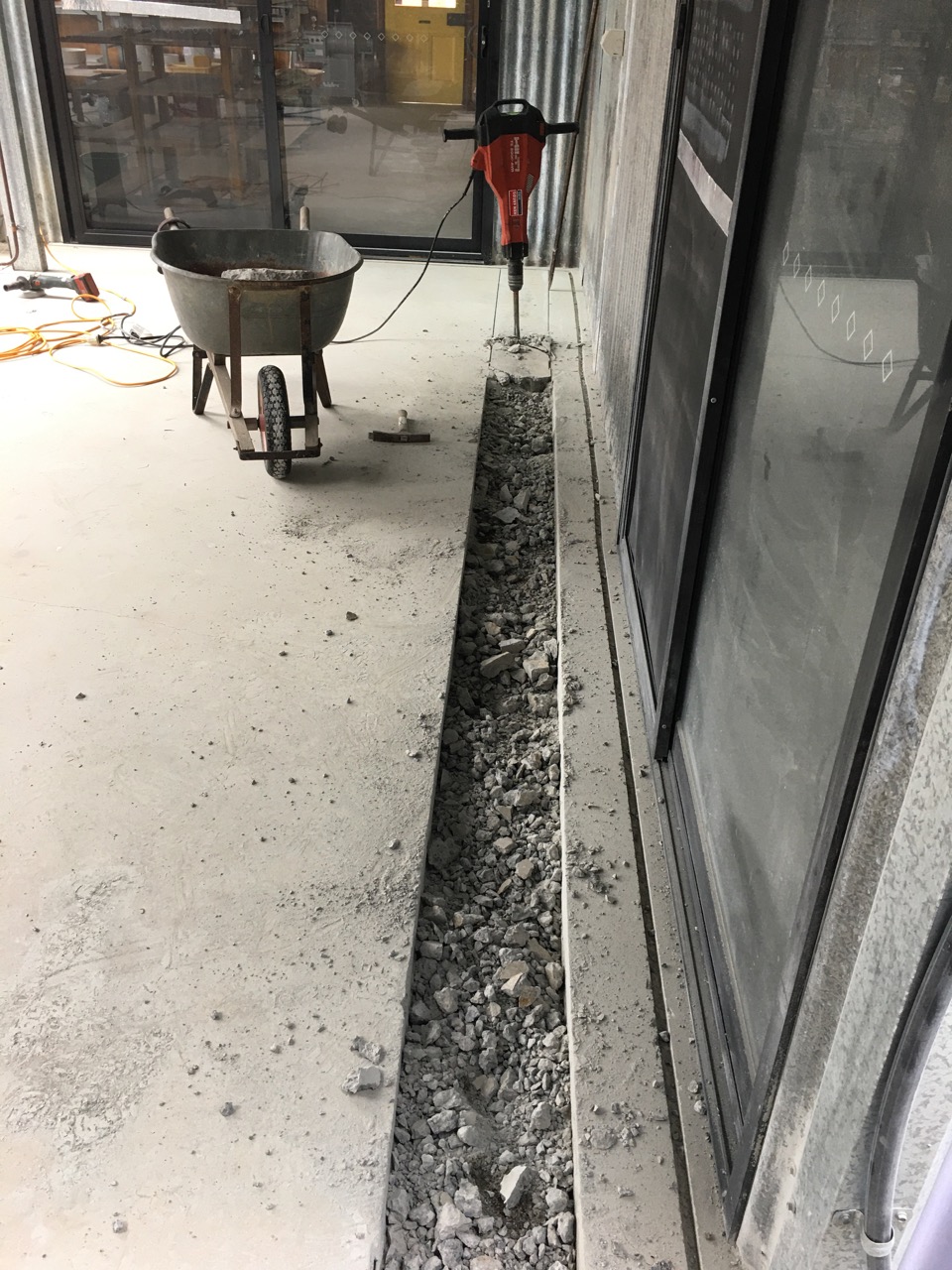
Then, I hired a jack hammer to break up the concrete into rubble. That was another big job.

Finally, I removed the broken ‘rio’ bars and the strip of black plastic waterproofing membrane, and then shovelled out all the larger pieces of crushed concrete and re-installed all the finer gravel.

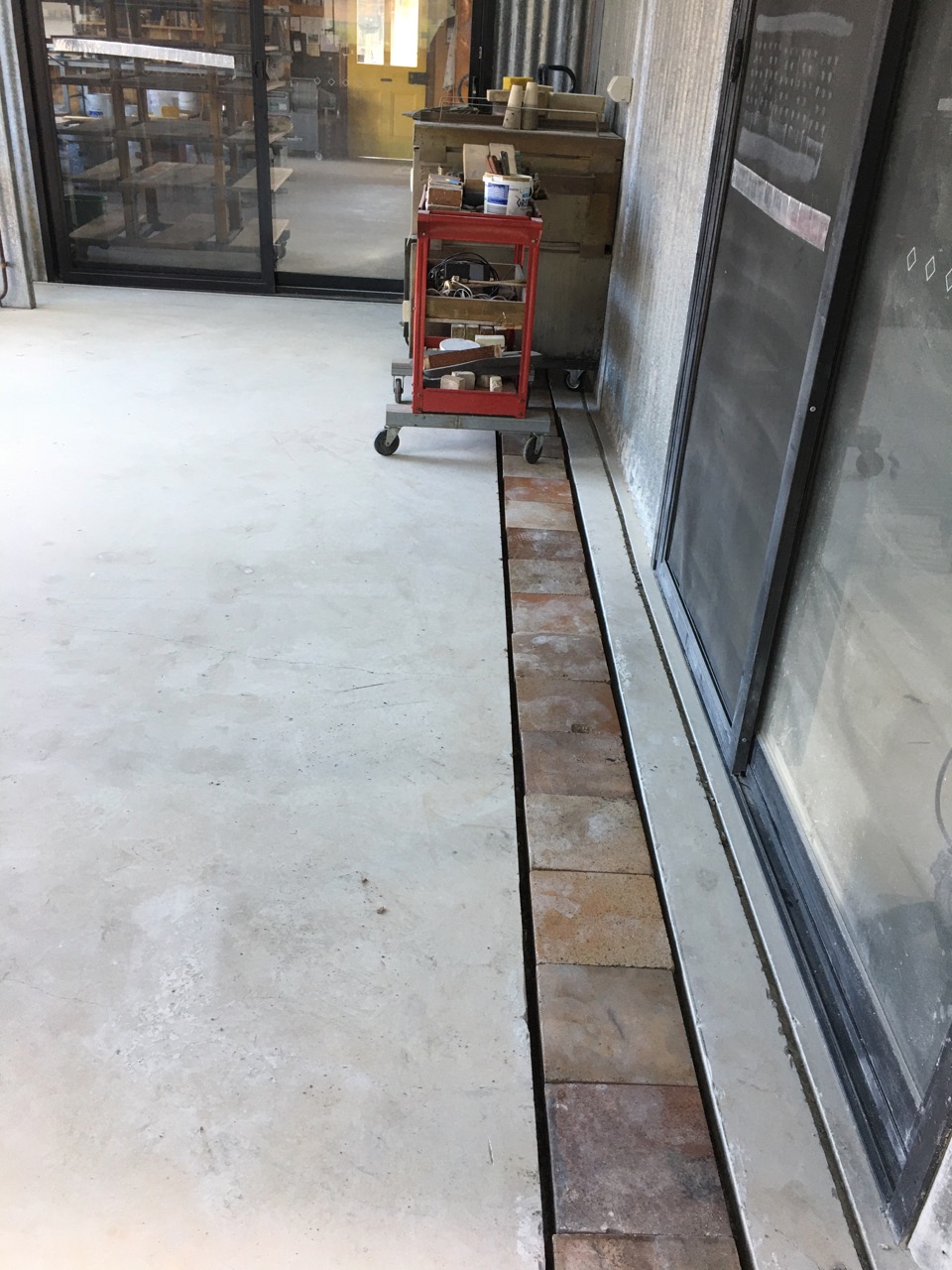
This allowed me to then lay pavers over the rubble to make an ‘agg’ drain.

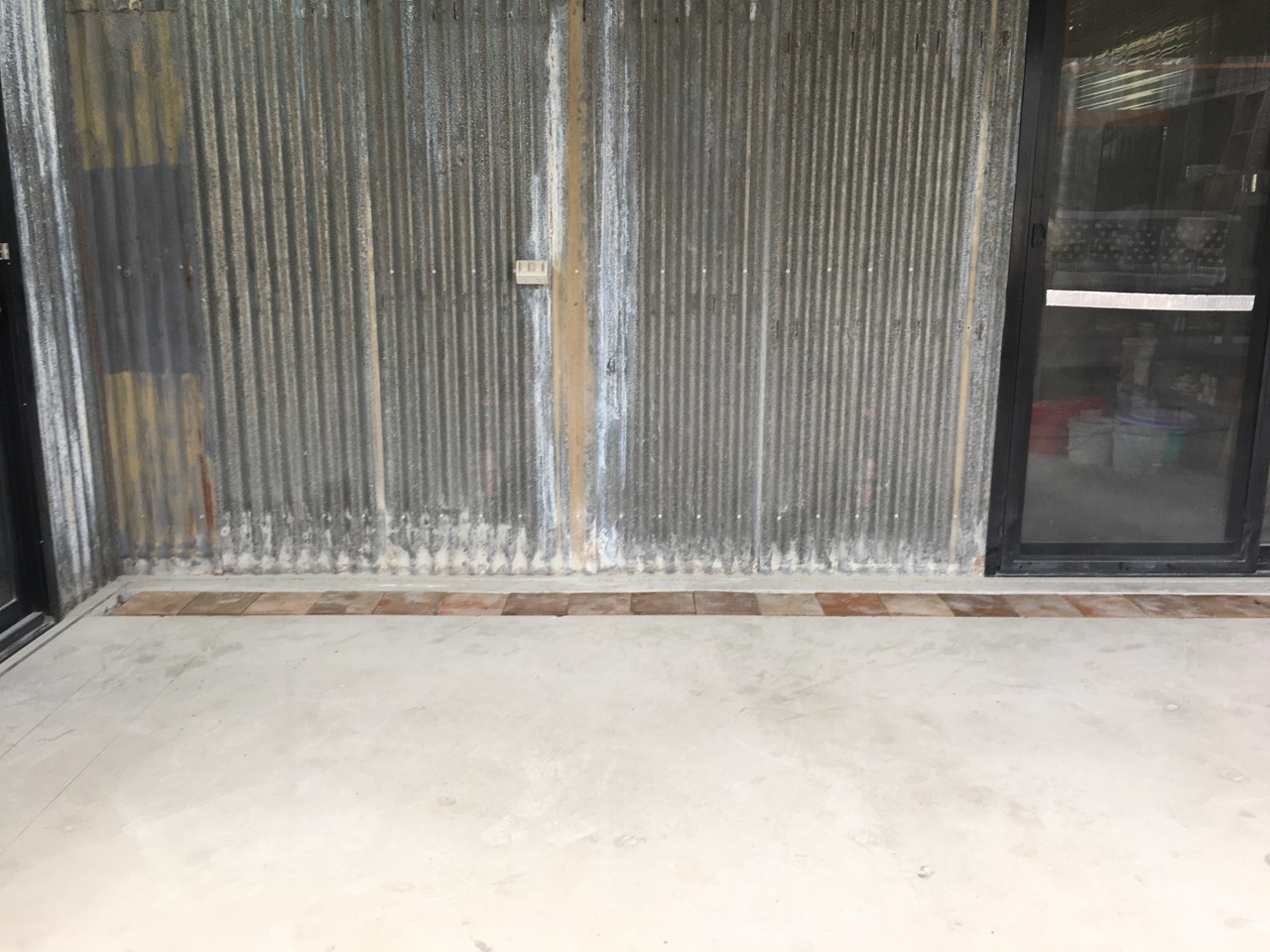
With my remaining energy, I completed the job by laying a line of terracotta pavers to cover the scar, but leaving a gap all along the trench to allow any future flood water to flow down into the rubble drain and seep out along the alley way between the two sheds. Hopefully a simple and effective solution to yet another problem left by our slack and seemingly incompetent builders. ( who have now gone out of business I’m told). I have noticed that any rain that is driven into the courtyard by the storm, just sinks into the porous pavers and their gravel bed. That paved part of the kiln shed/courtyard never holds any water. It’s just a total bummer that the slack builders cast the slab with the fall in the wrong direction.

It’s been a hard day. I’m pretty worn out from the effort of jack hammering, crow-barring and wheel barrowing all the broken-up concrete out of the trench, but very happy with the out come, now that it’s done!

I’m hoping that it will work.  I’m getting too old for all this strenuous high energy stuff.

I need to lay down.

Young People Today!

I had to go to the service station yesterday. 

I needed to put some more petrol in my car. 

Because I only go to the petrol station once every 3 or 4 months to put a small amount of petrol in the plug-in electric hybrid car. I always forget where the switch is, to open the petrol cap cover.

In our old petrol powered car, I used to go the garage and get petrol almost every week, so I knew where the lever was. It was on the floor next to the drivers seat.

Now, because this car is so different — all electric everything. I have to remember to look for the special button to do the job.

Previously, I was only putting $20 in to last 3 months, but with the recent outbreak of war in Ukraine, the petrol company has been forced into ‘Putin’ the price up. 

I put $30 in this time. I’ll see how long it lasts. This is only the 3rd time I’ve been to the petrol station this year. It remains a quaint and unusual event for me.
This electric car is beautiful to drive. So silent, but with heaps of torque. All you hear is some faint tyre noise, depending on the road surface. On the newer, smooth road surfaces, it is silent.

I’m pleased to be able to drive home and plug it in to the solar panels for a re-charge. If the sun isn’t shining, we still plug it in, and charge it off our Tesla battery. In this way we can use yesterdays stored-up sunshine.

I’m very pleased to say that even during winter, with shorter days and a lot of rain so far this year, we are still over 95% self powered. We can run our house, charge our car, plus run the pottery and even fire the small electric kiln on our 6 kW of solar PV. 

So far this year, we have paid just $75 for electricity from the grid, and this was our first power bill in 16 years since we installed the first 3 kW of PV panels. This bill was largely due to the fact that the feed-in tariff has been reduced to just 7 cents per kW/hr this year, while the cost of green electricity has increased. The feed-in tariff won’t be going up any time soon, if ever. So we have to cut our cloth accordingly. Up until recently, we were getting 20 cents per kW/hr for our electricity, and getting the best part of $1,000 per year in rebates.

However, because I have been doing a lot of regular firings in our electric kiln, we have therefore used a lot more electricity than we normally would. This is becauseI have been working on my Show at the Sturt Gallery. It has taken a lot of research and testing to get this new body of work completed. I haven’t made pots like this before. I haven’t decorated my work with brushwork like this before, I haven’t used most of these clay bodies before and I haven’t fired this wood kiln before. Almost everything is new and therefore un-tried. It was a lot of work to get it all together in time, involving a massive amount of glaze and body testing and test firings. Hence the large power bill. So this is why it is so rewarding to realise that we were able to cover over 95% of it with our own self-generated power.

All this testing also has another more important purpose. I need to make the specially commissioned work as my part of The Willoughby Bequest for The PowerHouse Museum. My original idea all went up in the flames, so I have had to find a new approach, and this new work is my way into that place.

The show at Sturt gallery has been well received. It’s been open for a week now and they have sold 17 out of the 23 pieces. So that is a very good result and I’m very happy with that. I’m very happy with the work and I think that it stands up well. It expresses both my angst and trauma, but also the terrible beauty and energy of intense fire.

We have passed the shortest day, but the weather is still getting colder, as it does. There always seems to be a bit of a lag from the shortest day to the depth of winter. The reverse is also true for the longest day and the hottest weather. So it is now time to do the winter pruning of all the grape vines and deciduous fruit trees.

This was always such a big job in the past with all our stone fruit trees being over 40 years old. They had grown quite massive. Now, post fire, and all new dwarf fruit trees planted in the new orchard, it will not be such a big job, as the trees are still quite small and should remain that way. No more ladder work for pruning.

The first, earliest, peach tree has suddenly broken into flower. This is a strong reminder that I need to get on with it, stop lazing around, and get all that pruning done.

All this cold weather, frosty nights and chilly mornings has inclined me to make a few curries. They are a good comfort food, warming and filling, without being too bad for you. Veggie curries are great, I have been trying to use mostly what we have growing in the garden, which at this time of year must include broccoli, cabbage and even a few Brussel sprouts. I even managed to used most of our own spices.
This Asian influenced meal had the last 9 small tomatoes from the garden, our garlic, chilli, lime leaves, curry leaves, coriander and the last two small capsicums. All from the garden. I had bought a few pieces of fresh ginger, galangal and turmeric from the green grocer because we cant grow these plants in our garden here, even in summer. We had 3 curries over the week. Each one was slightly different, from Thai to Indian. Curry seems to be more warming than other meals.
Maybe it’s all that chilli?

On Sunday I was up before dawn and drove up to the North side of Sydney, a few hours drive away. Up to Oxford Falls. A place where I used to live. I grew up and went to school there. I used to live at number 41 Oxford Falls Road. This time I went to the far opposite end of that long road to collect some old and rusted galvanised iron roofing so that I can rebuild my wood fired kiln’s wood shed and finally create a new and hopefully permanent home for the rebuilt big hydraulic wood splitter.
It was a really lovely sky at dawn with the horizon turning from grey to pink for those precious few minutes. 

I had been given a tin roof off an old chicken farm shed. I was told about it a couple of years ago, when we were casting about looking for old re-cycled roofing iron to use as cladding on our new pottery shed. I wanted to use all old, grey, weathered and slightly rusty re-cycled gal sheeting on this new building to make it look more in keeping with all the other old buildings on our site. Our home is the Old School building from 1893 and we also have the old railway station built in 1881. I managed to save both of these buildings from the fire. We wanted to keep the heritage look and feel of the place and a brand new shiny corrugated iron pottery shed would stand out like dogs balls, I managed to find just enough old, weathered roofing to complete the job while I was still waiting for the roof to be taken off the Chicken shed in Oxford Falls.

That roof was finally replaced this year. Too late for me to use in the new pottery, but just in time for me to use to re-build the dedicated wood shed for all the large billets of timber that are required to be split, stacked and dried for use in the wood fired kiln. I’m quite fond of the old heritage buildings and their ‘settled-into-the-environment’ look, so it is appropriate for me to build the new wood shed out of old and slightly rusted stuff.

When I drove into Oxford Falls Road, the road I grew up on, but where I left to find my own way in life in 1972. I found some old memories flooding back. I remembered that we used to walk down the road a few miles to get to the creek at the bottom of the hill and go yabbying. A yabby is a fresh water crayfish. This time, instead of turning to go up the hill to where my parents old house was. I turned the opposite way and crossed over the ford just above the falls and went West.

I hadn’t been here since I was in my teens and used to drive the family truck down here with my grand father, to collect chicken manure from his friends egg farm. My Granddad was a very committed organic gardener, health food devotee, and a strict vegetarian. He brought my mother up that way, and she me. In fact, my grand parents lived behind our house. The two houses back to back, on different streets but with a common back yard joining them. This back yard was huge, as land sizes were very generous in those post (WW II), war days. That shared back yard was dedicated in the most part to a huge vegetable garden and a few fruit trees. And, of course two massive compost heaps.

It was a regular chore to go with granddad and shovel chicken manure from the deep litter floor of the chook sheds when there was a change over of birds and the various sheds were empty for a short while. We had to take it in turns either holding the bag open or digging the manure and wood shaving mixture into the hessian bags, then lugging them out and up onto the truck. I shared this job with my older brother for a few years until he eventually left home and I was old enough the get my drivers licence and took over the driving. Old man Rigby, who owned the farm and my granddad were great friends. They were about the same age and shared the same interest in ‘health foods’, as they were called back then. Old Mr Rigby baked his own bread. As did my grand mother and she taught my mum. She then taught me. I still make most of our bread, as well as grow my own organic vegetables. Family traditions are passed down in this way. Give me the boy till he is 7!

Well, you can image my surprise, when I turned into the driveway of the site to collect the old roofing iron to find that it all seemed strangely familiar. I recognised the old shed with the hand split stone walls. It all came flooding back. I’ve been here before. Almost everything is different now, but the old shed is the same, just more dilapidated, but I remember that Old Mr Rigby lived in there. The first room served as his kitchen and his office, it’s now the pottery studio. The remaining bigger part of the old shed was his machinery shed. It’s now got one of my wood  fired kiln designs in there. Who could possibly imagine that !

I remember sitting in that room waiting while Mr Rigby and my Grand Father chatted on about compost and other organic gardening stuff. I was bored. I wanted to get going, so that I could go to the beach. I didn’t take sufficient interest in their healthy organic gardening and wholemeal bread baking chat. My Granddad was probably thinking…

Young People today!