We will be open for the next two weekends in November, 16th/17th. for the Southern Highlands Arts Trail then the ACA Open Studios, Ceramics Arts Trail that is happening Nationally on the 4th weekend of the 23rd and 24th of Nov.
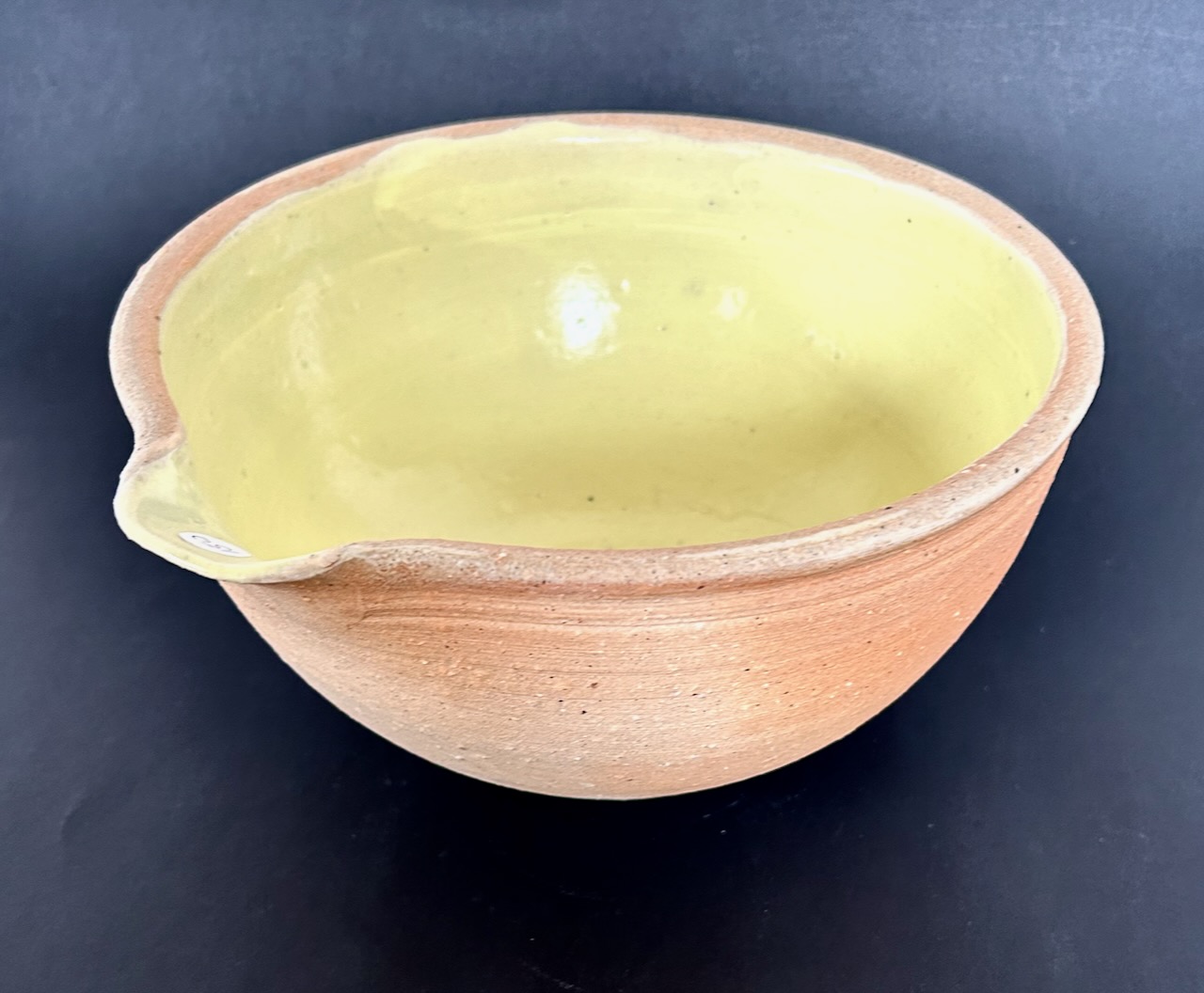
We have plenty of pots in the gallery, floral bowls, and Mixing bowls.
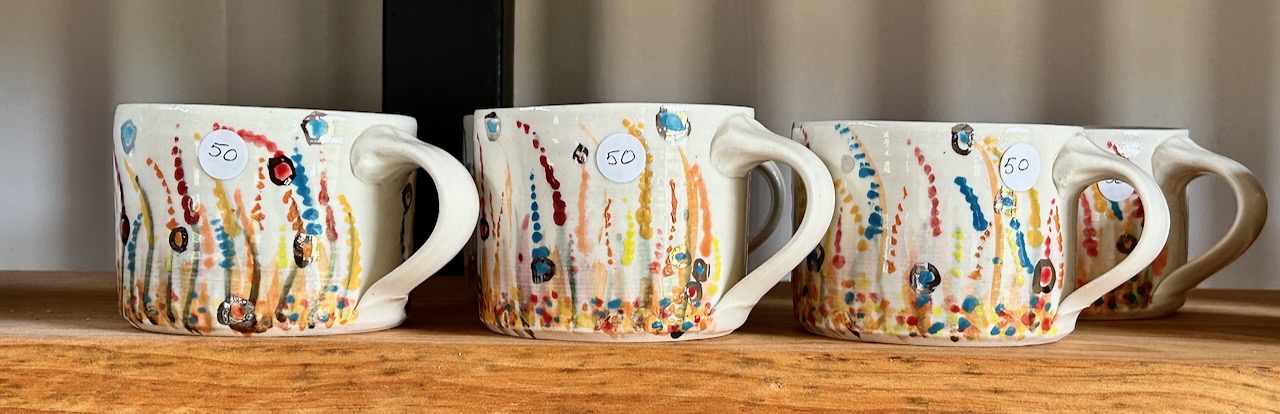
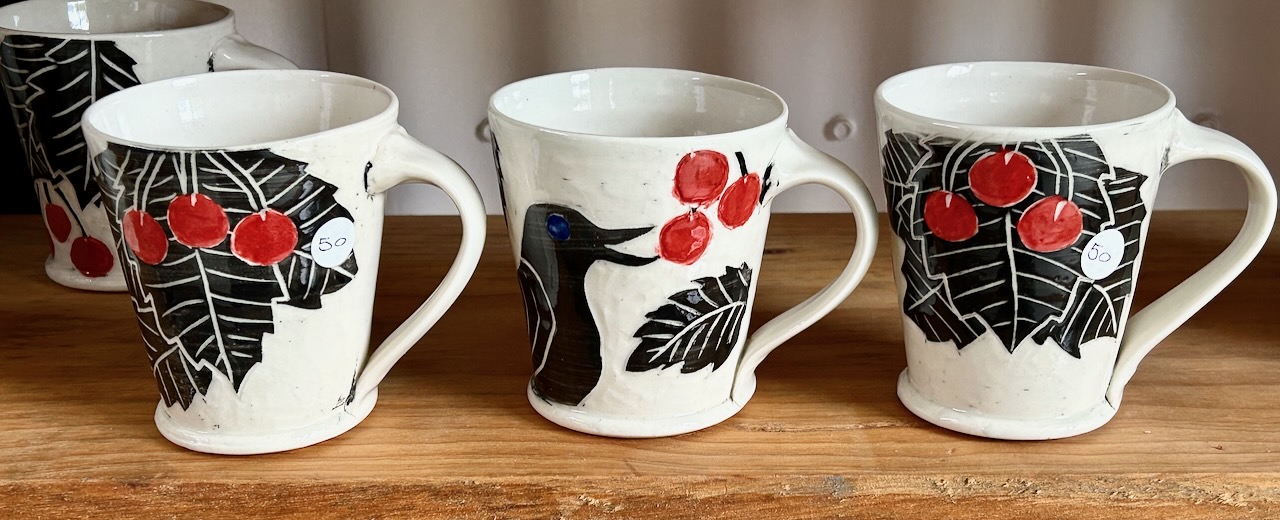
Celadon mugs, Floral mugs, Sgraffito mugs and Sgraffito plates.
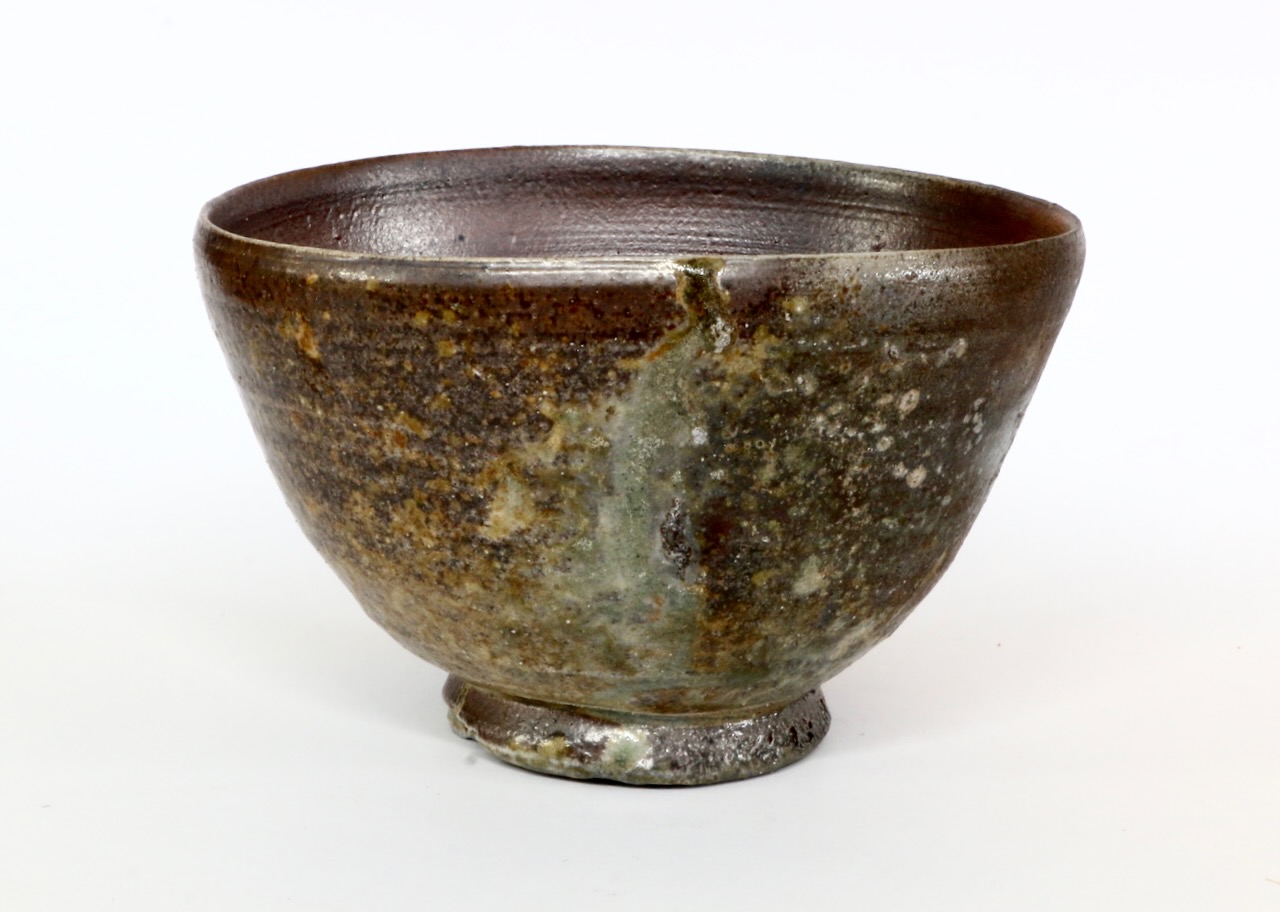
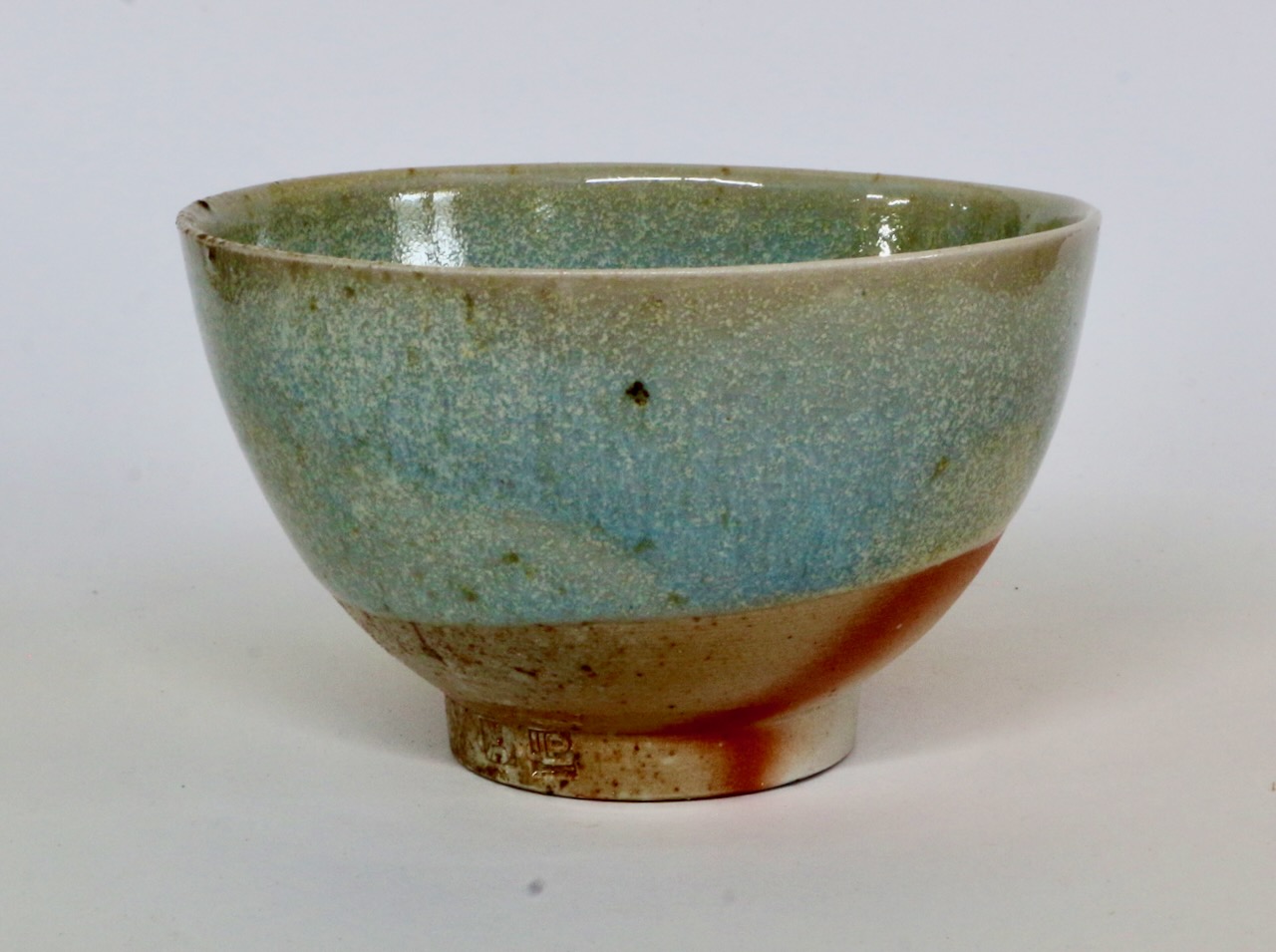
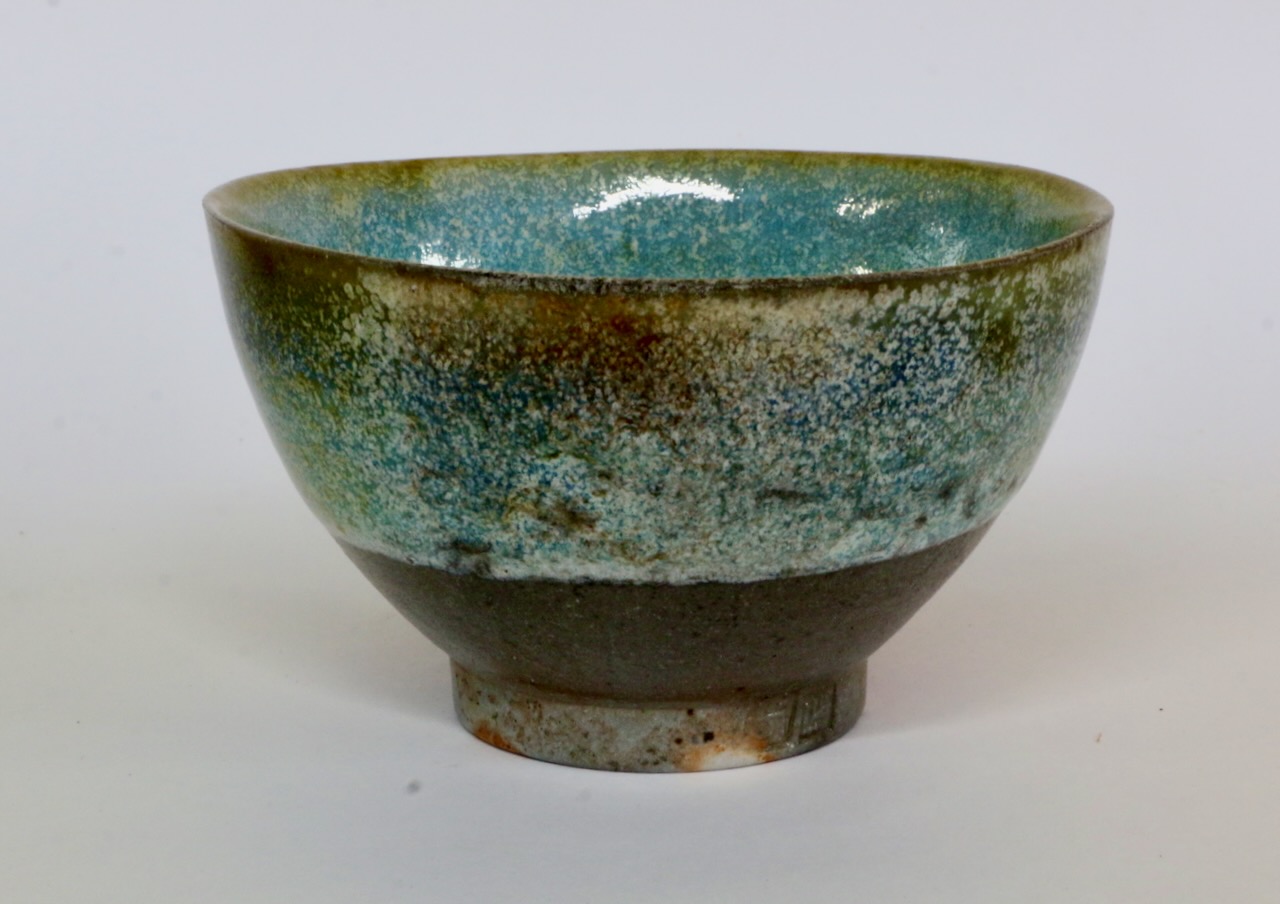
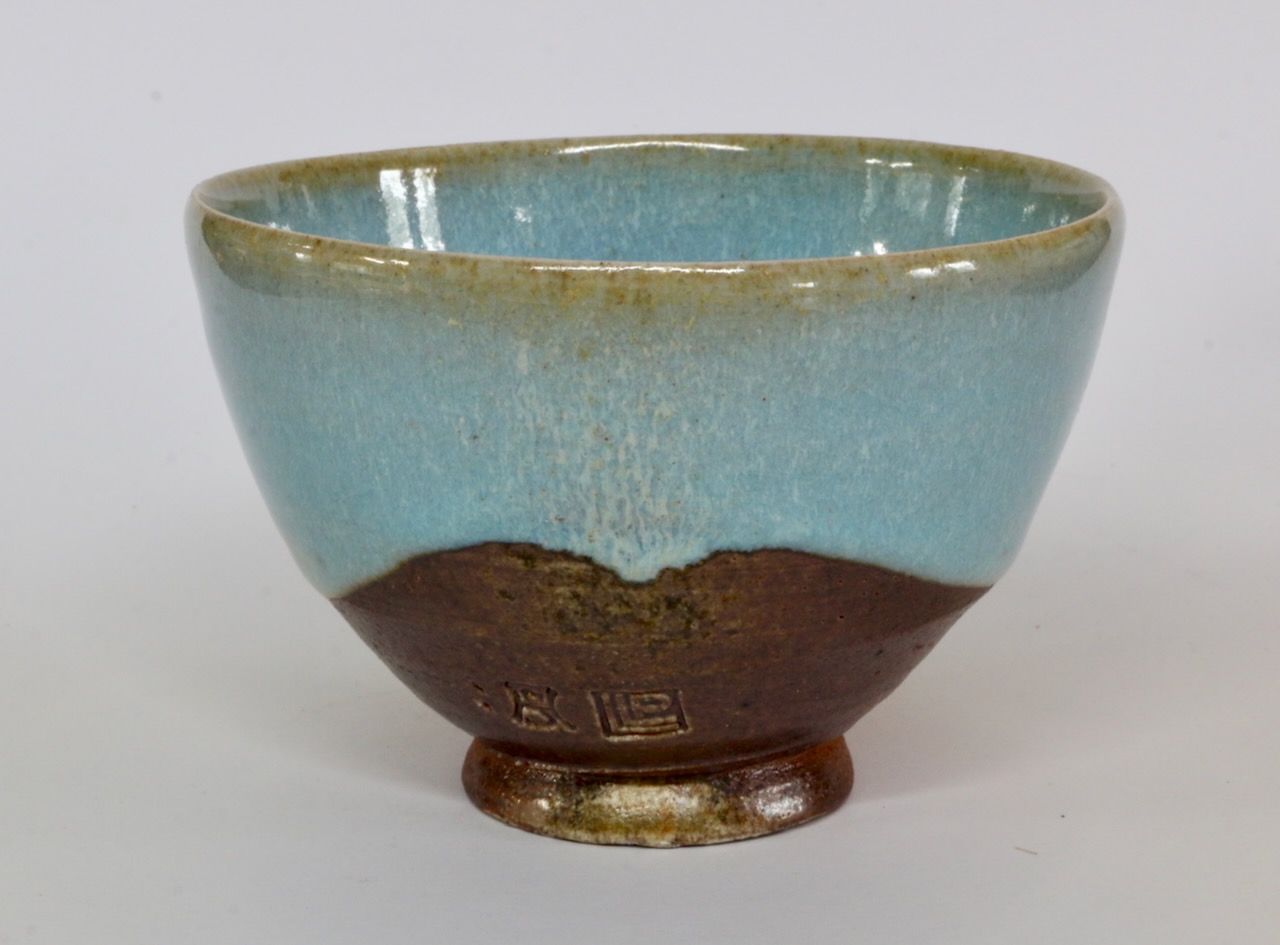
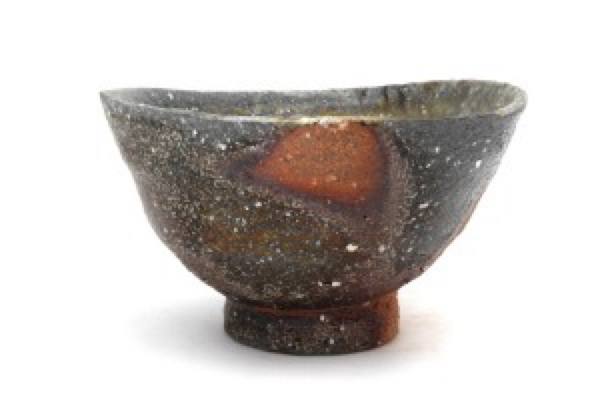
I have some unglazed, wood fired Tea bowls that I have been fettling and finishing during the week.
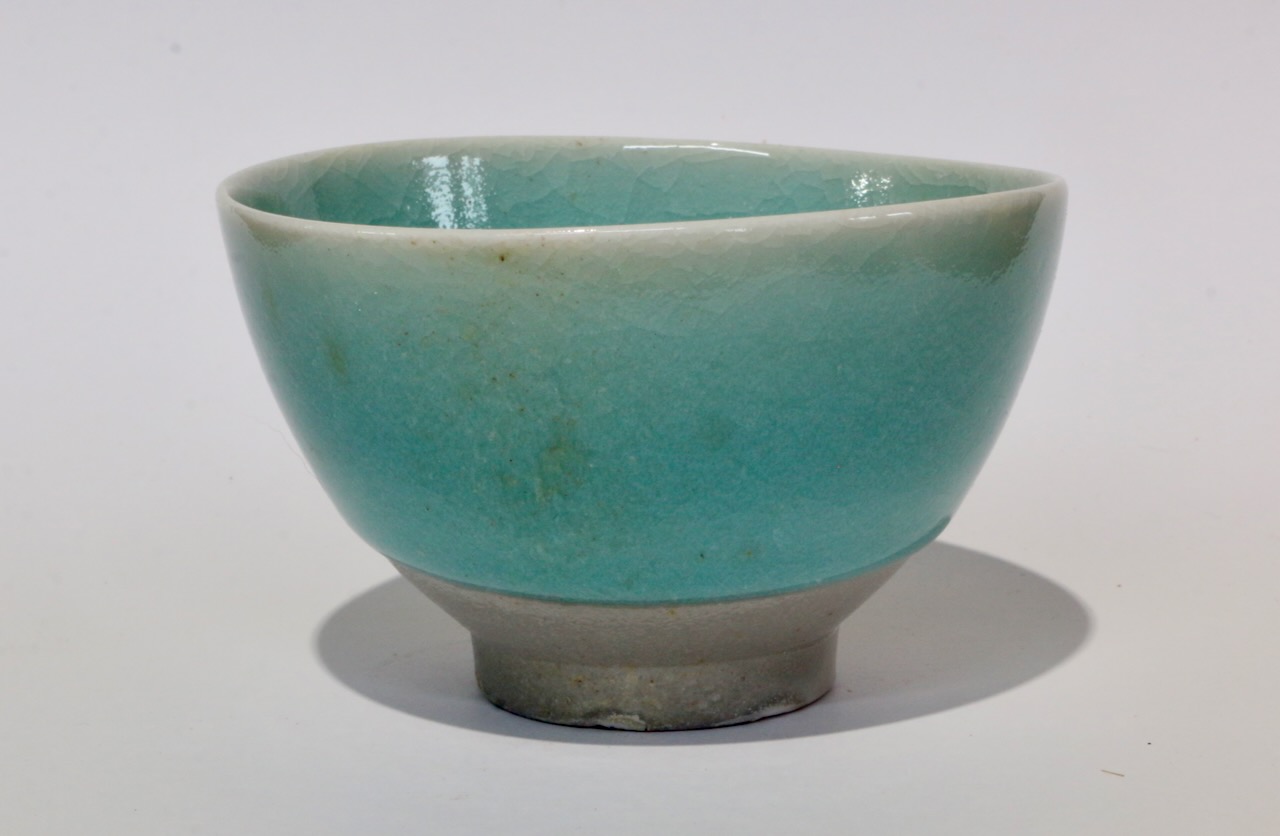
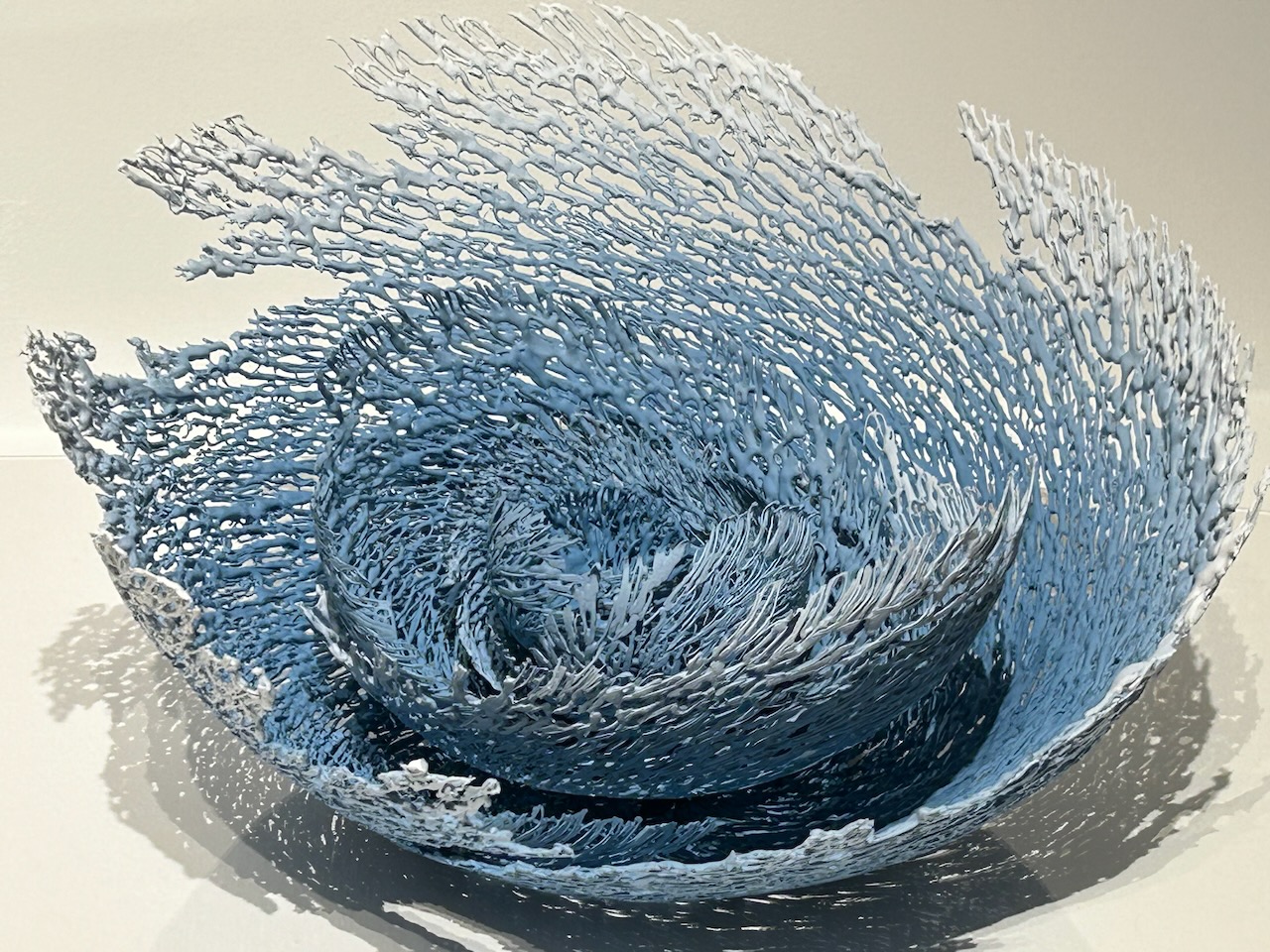
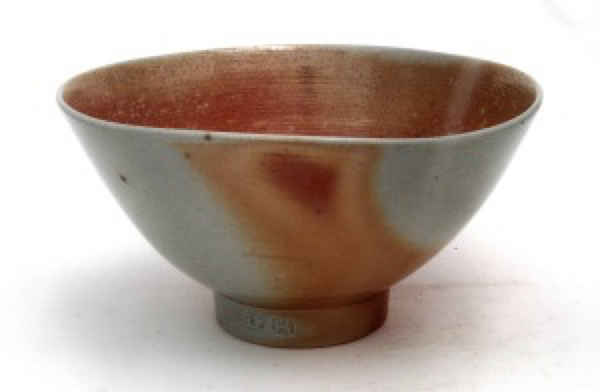
And some wood fired porcelain bowls, glazed with traditional blue celadon. This bowl has some carbon inclusion in the exposed body and is quite subtle and very beautiful in a restrained sort of way.
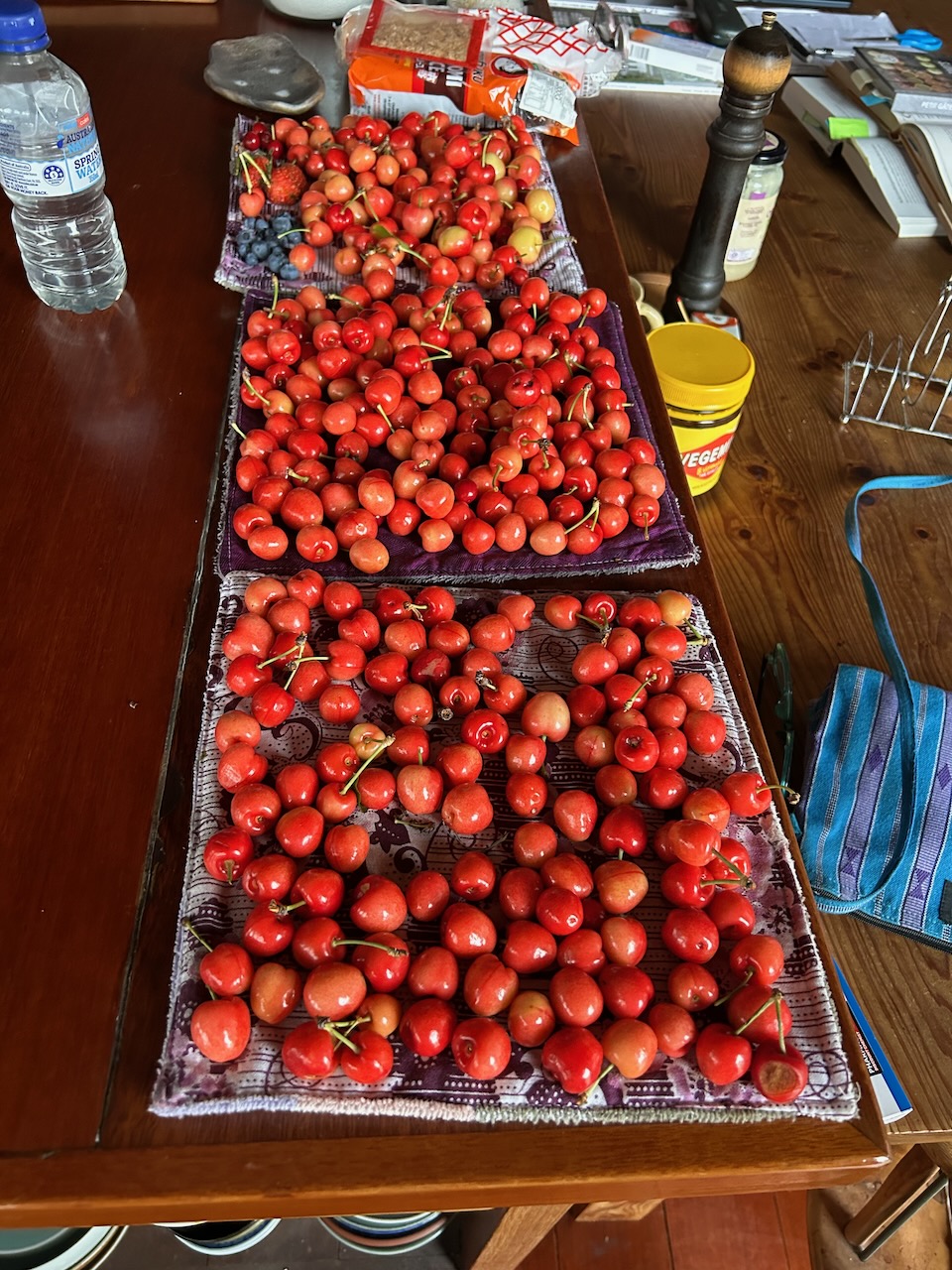
The cherry crop is in full swing just now and we are able to pick a kilo of cherries every few days. We had bowls full of cherries on offer to our visitors last weekend.
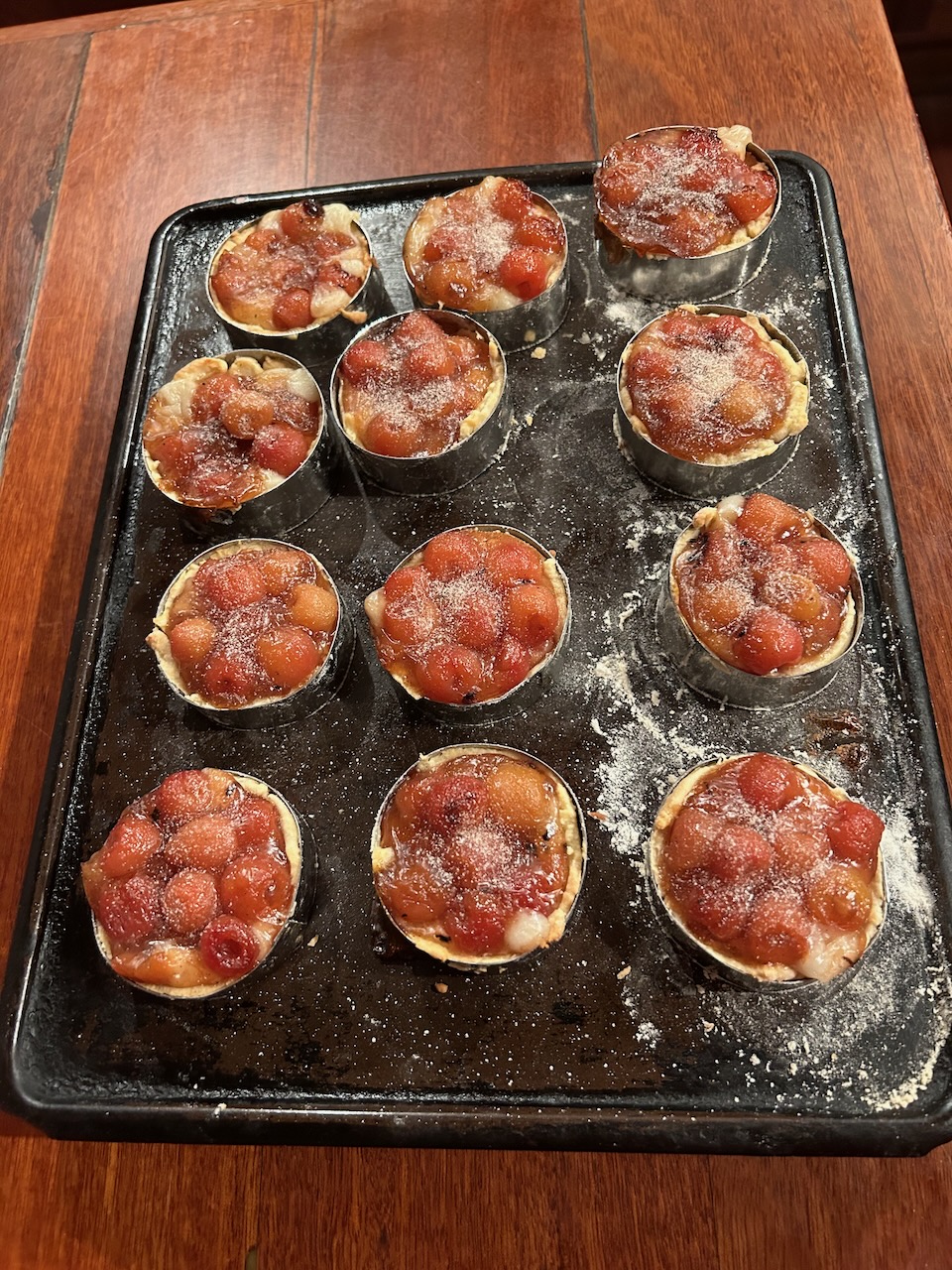
As we have eaten our fill of fresh cherries, during the week I made home made cherry pie and cherry tarts – because I can!
This is the only week of the year when we can do this. So I make an effort and do it. What else are evenings for?
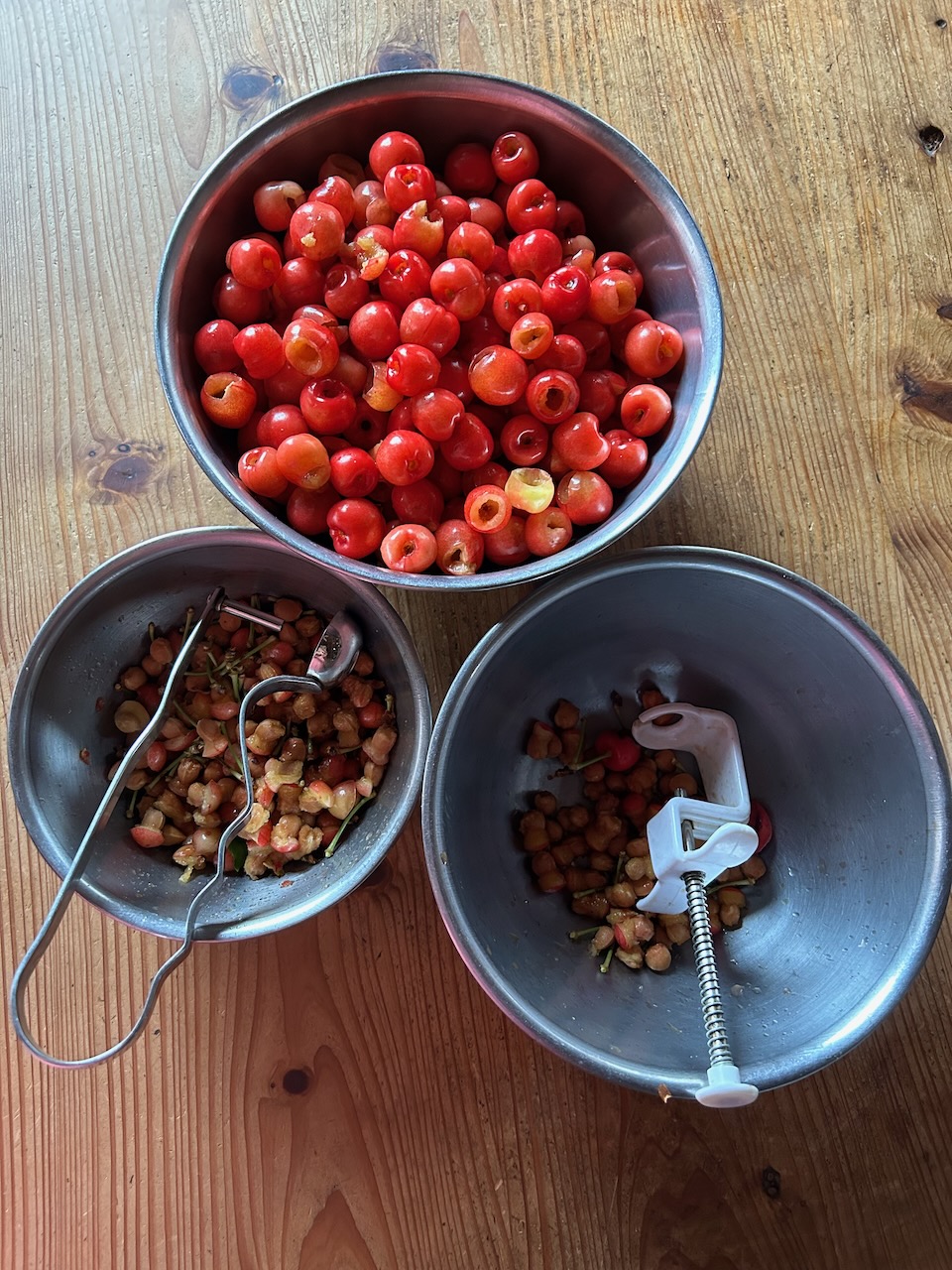
The recipe optimistically said that it takes 15mins to de-pip a kilo of cherries. It too Janine and I 30 mins. 4 times longer, but worth it. Nothing worse than biting into a delicious looking cherry tart and breaking a tooth on a rouge cherry stone.
I made the recipe with only half the sugar and it is just about right for my taste. I made an almond short crust pastry, quite a bit of fiddling around, but the end result is vaguely sweet, pleasantly soft and slightly crunchy.
I had to go to the workshop and make a dozen stainless steel tart rings. I found a little piece of stainless off-cut, sliced it up in to strips and spot welded them together into small 60 x 20 mm tart rings. Waste not, want not.
Nothing is perfect, nothing is ever finished, and nothing lasts forever.
We will be part of the Southern Highlands Arts Trail – Open Studios on the 2nd, 3rd and 4th weekends in November.
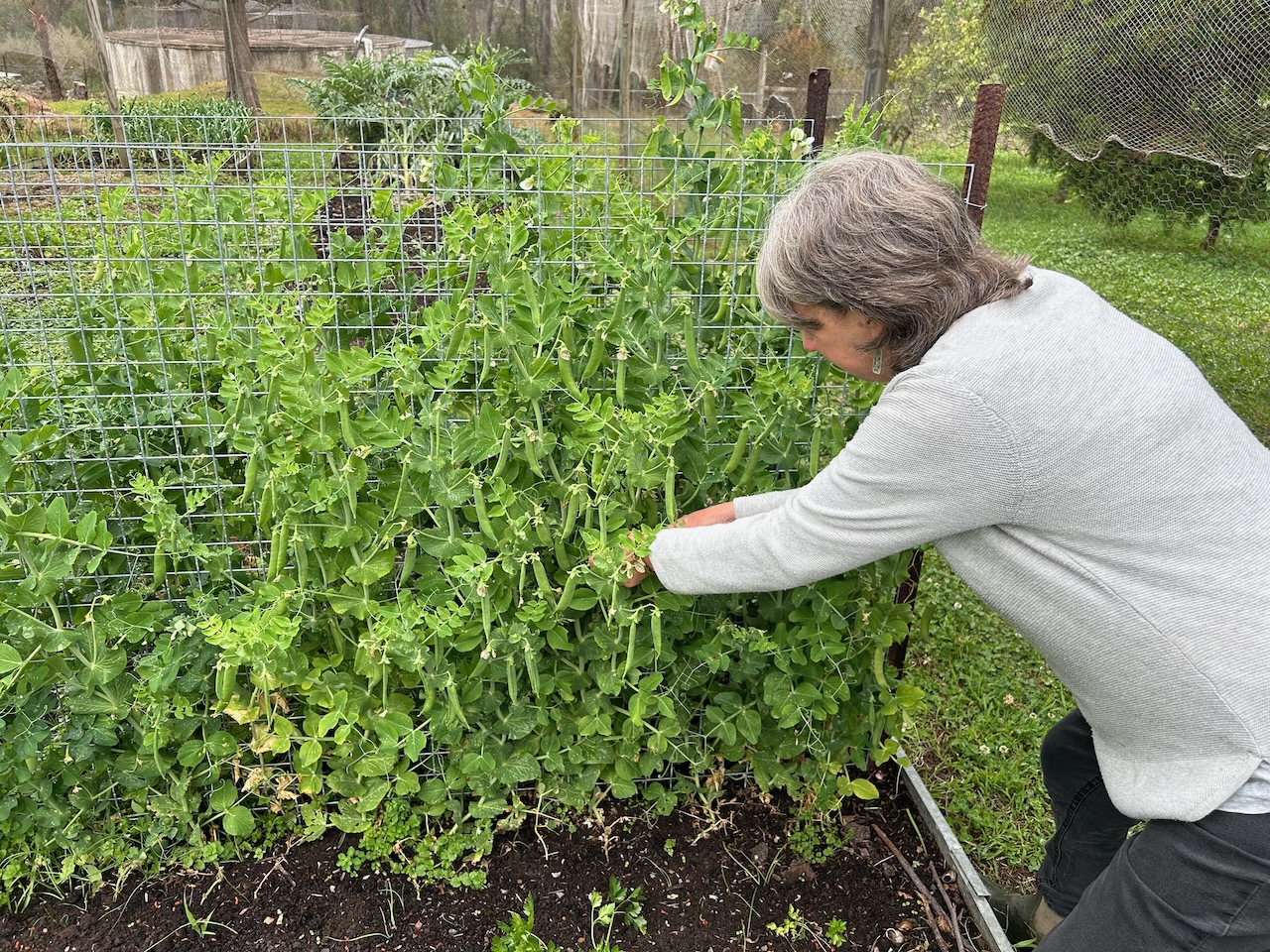
I’m back from my work in Korea and I hit the ground running. All the seeds and seedlings that I planted in late August, just before I left for Korea, were all burnt off in the severe frost event that swept through here in early September. However, all the over-wintering vegetables like peas, broad beans, asparagus and the brassicas are all thriving. So that is what we are eating at every meal these days.
Because we only eat what we grow, our diet tends to go in long stretches of similar meals, we vary the actual mix for variety but I’ll be glad when the first of the summer crops comes on. That is always zucchini, they are so fast out of the starting blocks, along with radishes.
However, I know that I’ll be glad to see the last of the ratatouille based summer meals and we can taste that first cauliflower again as the seasons come around. I think that it is a universal human failing to want what you don’t have. No matter how many cabbages I grow, I still hanker for a banana or a pine apple every now and then.
At the moment, I am just loving the smell of the tomato foliage as I brush past it when weeding. The smell of tomato leaves offers such promise of fresh salads and the long hot days of summer to come.
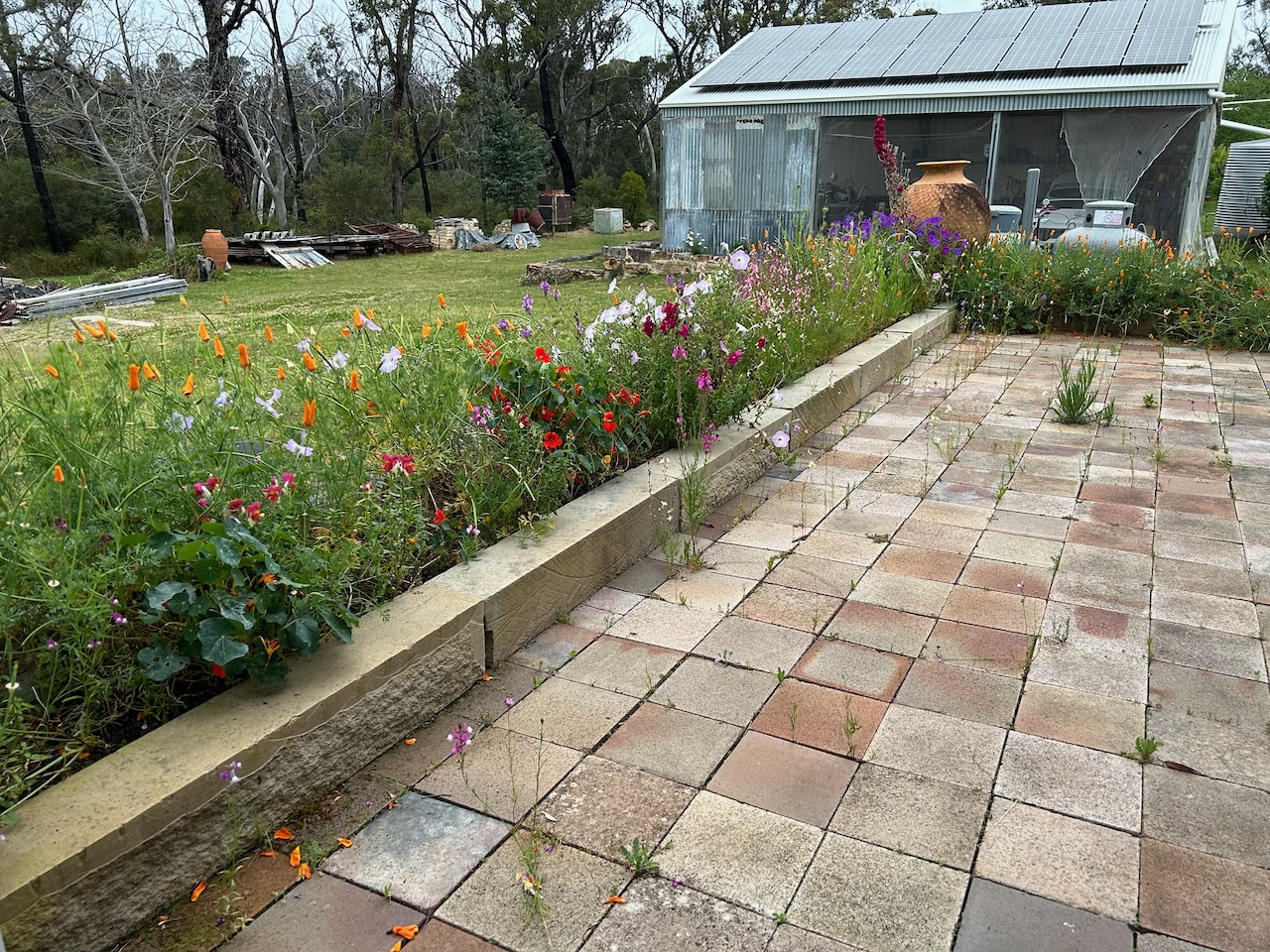
The more established spring flowers in the flower beds around the pottery were not affected by the frost, and have gone on to bloom there little buds off. Its very cheerful and uplifting to look out the studio window and see a vista of spring blooms.
After the frost. Janine went out and bought some more early seedlings to get a bit of a head start for the summer garden, and now that I’m back, I spent all of my first few days planting seeds, weeding, mulching and mowing to get the place ready for the Open Studios Arts Trail, that is being held on ther last 3 weekwnds of November. But also to guarantee our summer food supply security.
Janine transplanted some wild self-sown spinach seedlings, but they didn’t all take. I filled in the gaps inbetween with some extra seeds. The vegetable garden is looking good again with all the red poppies in flower now. The bees are going full speed ahead. Their little yellow saddle bags are full and bulgeing with pollen.
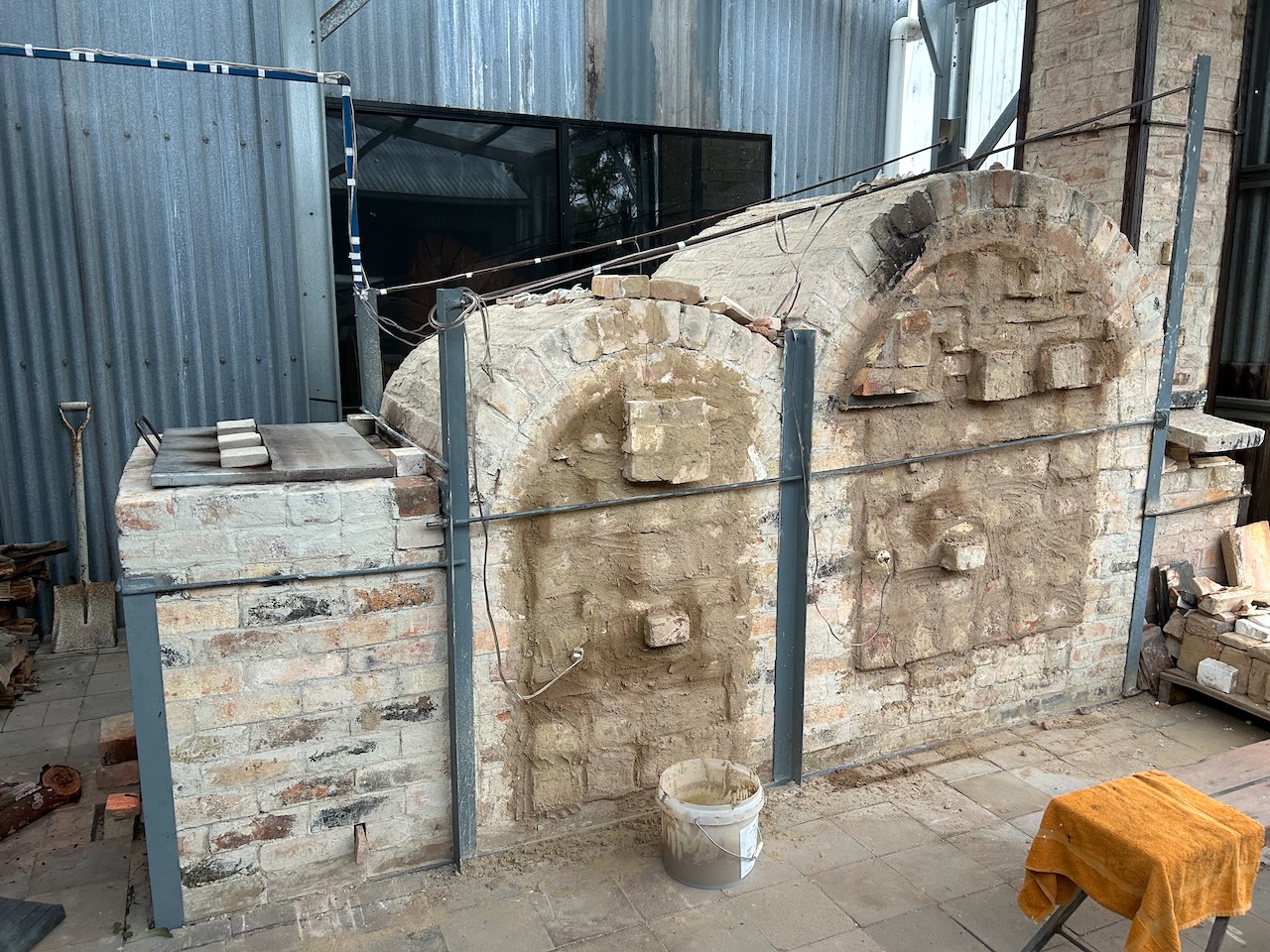
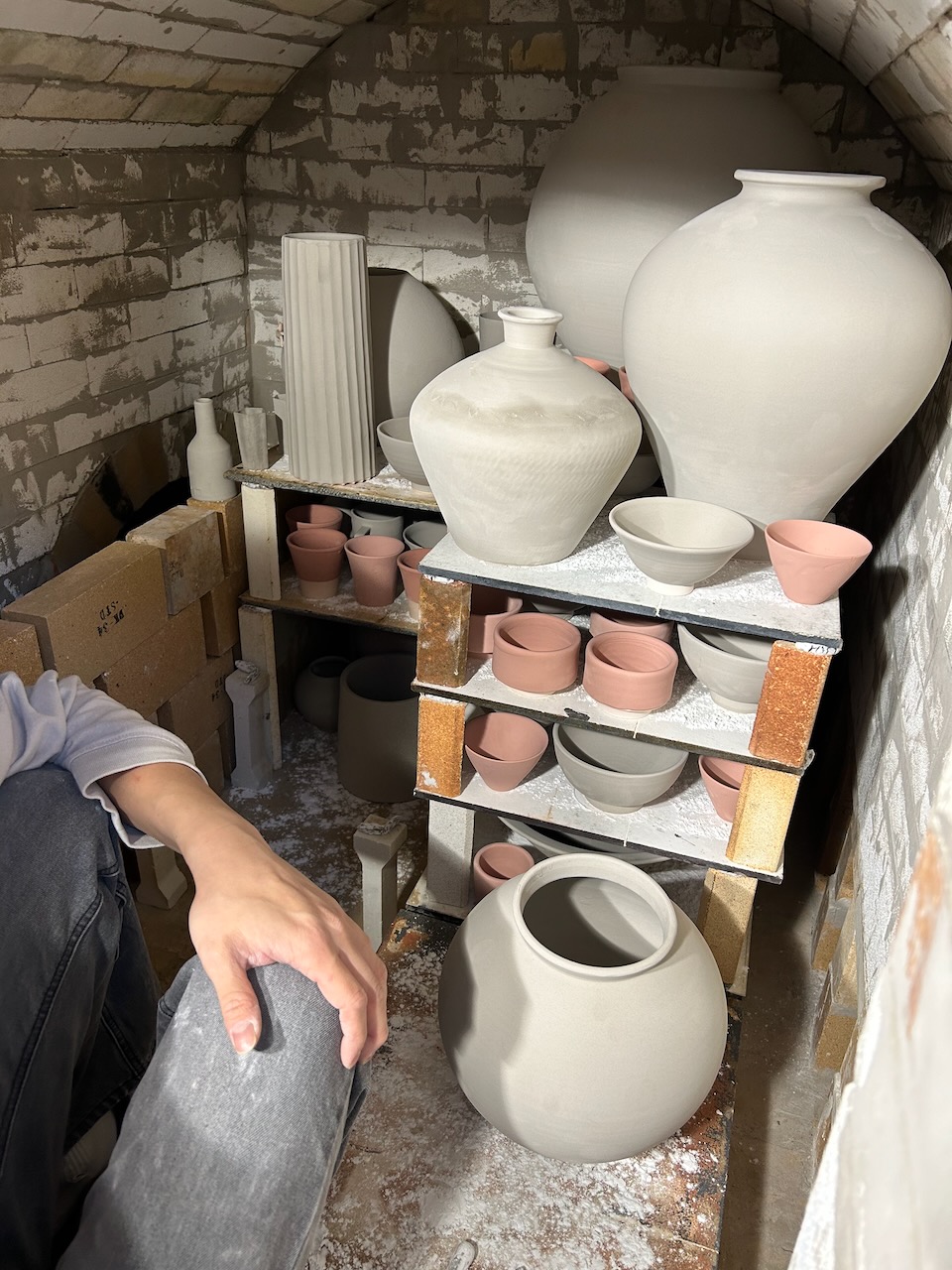
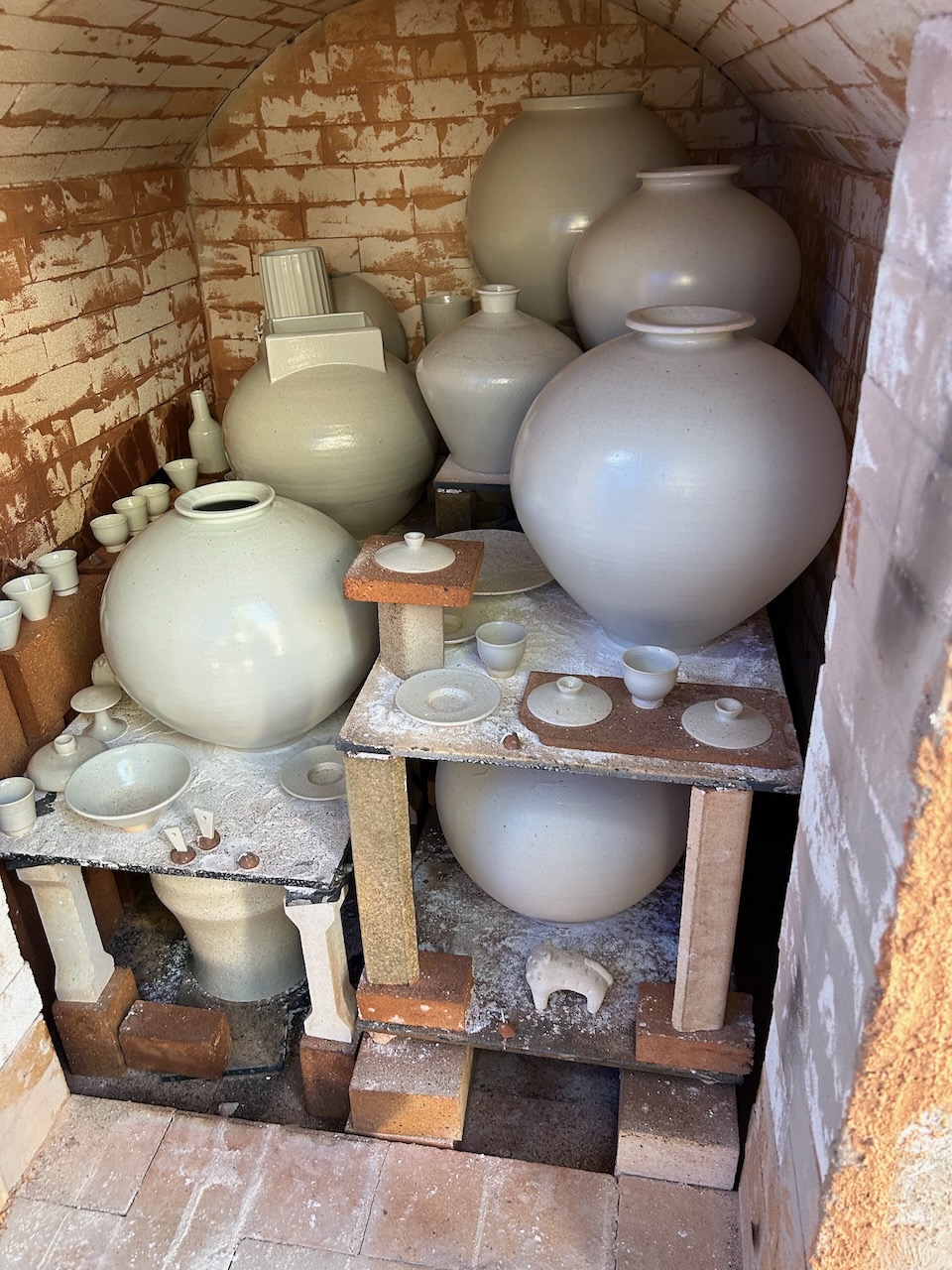
We already had a lot of pots made for the open studio sale before I left for Korea, but there was also a lot of bisque ware that I had prepared for a wood kiln firing, but I just couldn’t fit it in before I had to leave. So now that I’m back I have glazed all that work and packed the wood kiln.
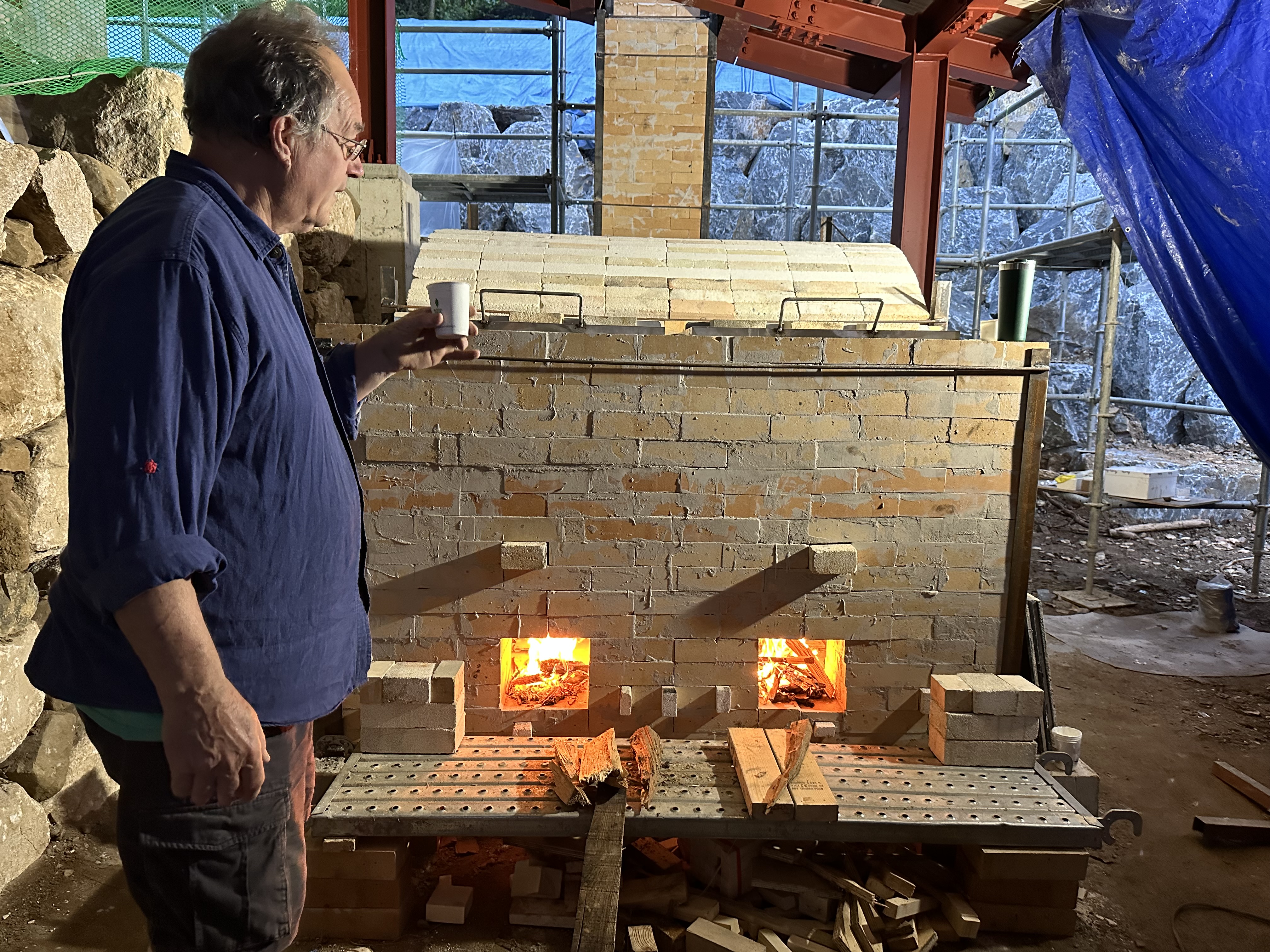
13 hours to 1300. I think that I have finally found to best way to burn my pre-burnt and charred dead forest of kiln fuel timber.
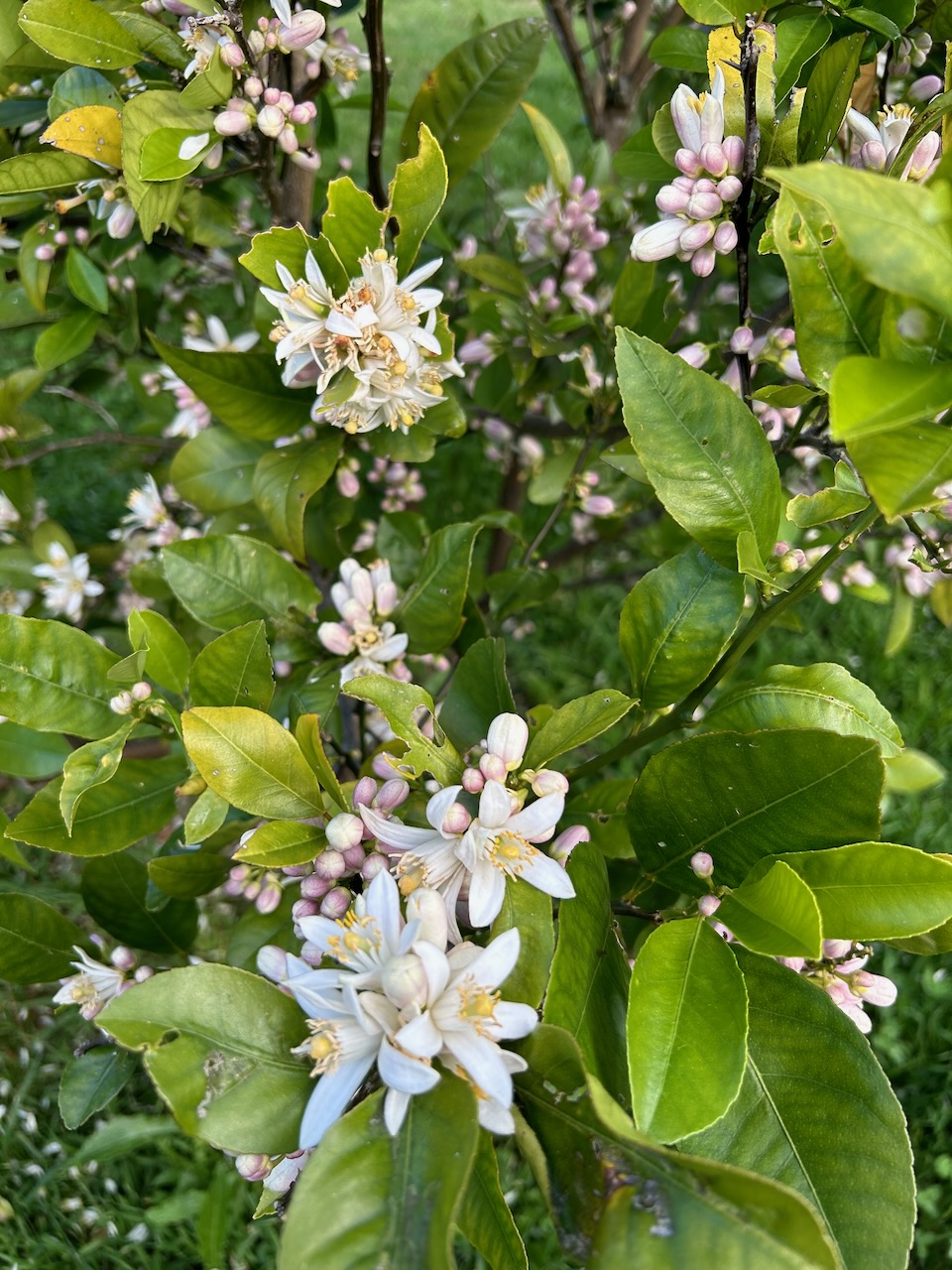
The citrus grove is in full bloom and you can smell the fragrance of the citrus flowers from the pottery, if the wind is in the right direction.
We will be open for three weekends in November, 9th/10th and 16th/17th. for the Southern Highlands Arts Trail then the ACA Open Studios, Ceramics Arts Trail that is happening Nationally on the 4th weekend of the 23rd and 24th of Nov.
Keep us in mind and call in if you can. We have some lovely work to show you.
After the successful firing of my kiln, which could have been better, but served well as a proof of concept firing. I have a couple of other jobs lined up while I’m in Korea. One of them was for an institution, but the person in charge hadn’t applied for permission to build a kiln there until last week, so no permission was forthcoming – at least not in time. I couldn’t build a kiln in an institution without permission, just in case it was refused, or so slow in coming that it would be approved for the next financial year, either way. I wouldn’t be able to get paid for any work done now. So I decided to move on to the next job.
One of the potters working on the big kiln in Bangsan Porcelain Village, named Mr Kim tells me that he has built a downdraught firebox wood kiln at this home on the east coast, but it didn’t work all that well. We have been discussing this over dinner in the evenings. I show him my plans for the Bangsan kiln and all the mathematics that I use to work out all the dimensions for the various openings, firebox, flues, throat and chimney etc. He asks me to come with him after this job here is over, he’ll drive me to his place and I can look at his kiln and make any suggestions that I can think of to help him improve it. He tells me that he’ll drive me back again afterwards as well. This is good news, as my suitcase is now approaching 30 kgs with the load of sericite stones that I have recently added to it. Catching public transport is a bit of an ordeal with such a heavy bag. I decide to go through it and jettison everything that is not essential. I get rid of 5 kgs in that effort.
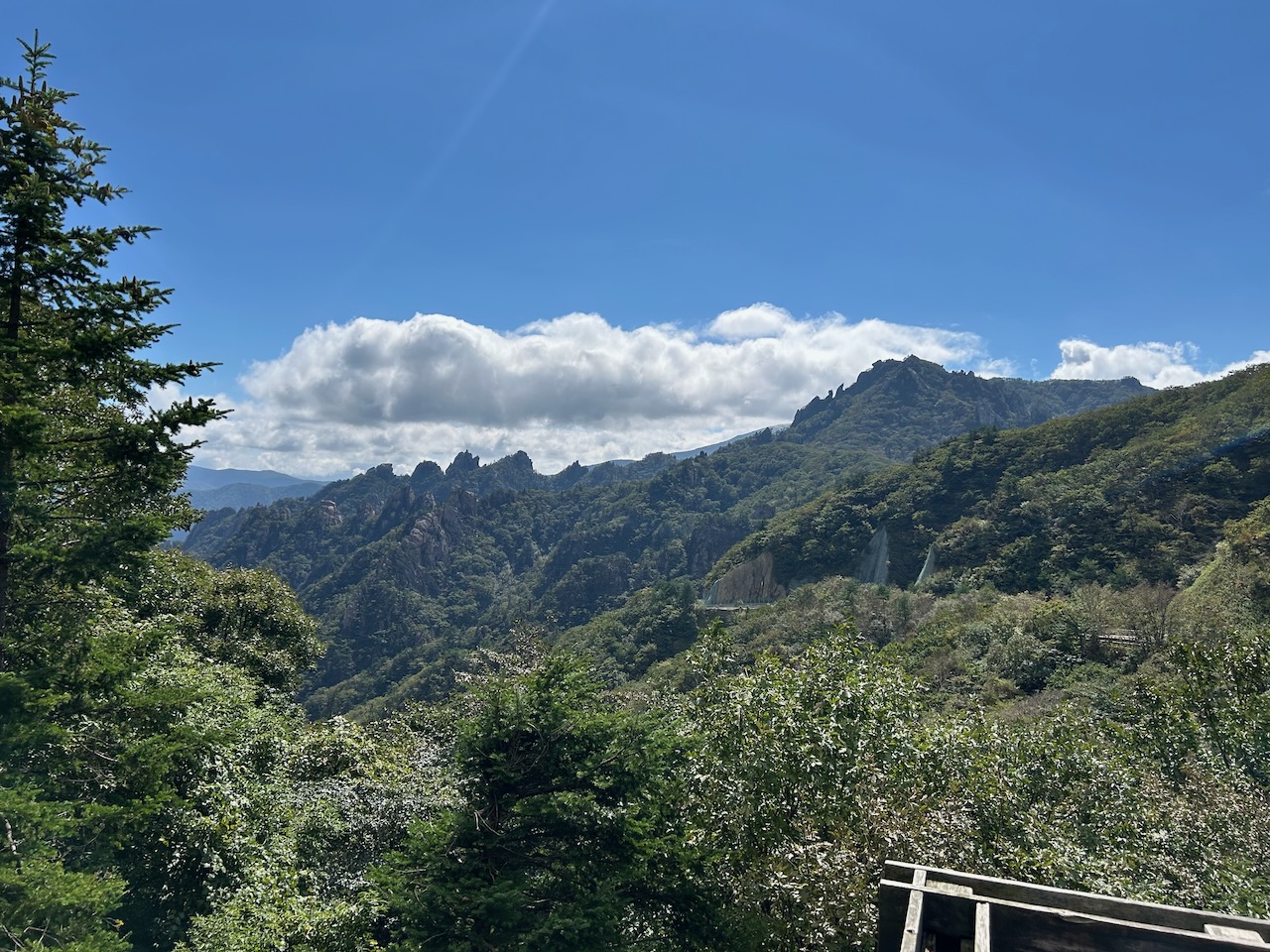
We set off to cross the country, over the mountain range that runs down this part of South Korea. We stop at a famous lookout to view back to where we have just come.
I look over the edge of the viewing deck and unsettlingly, I can see what appears to be the previous wooden deck that has collapsed into the ravine below us!
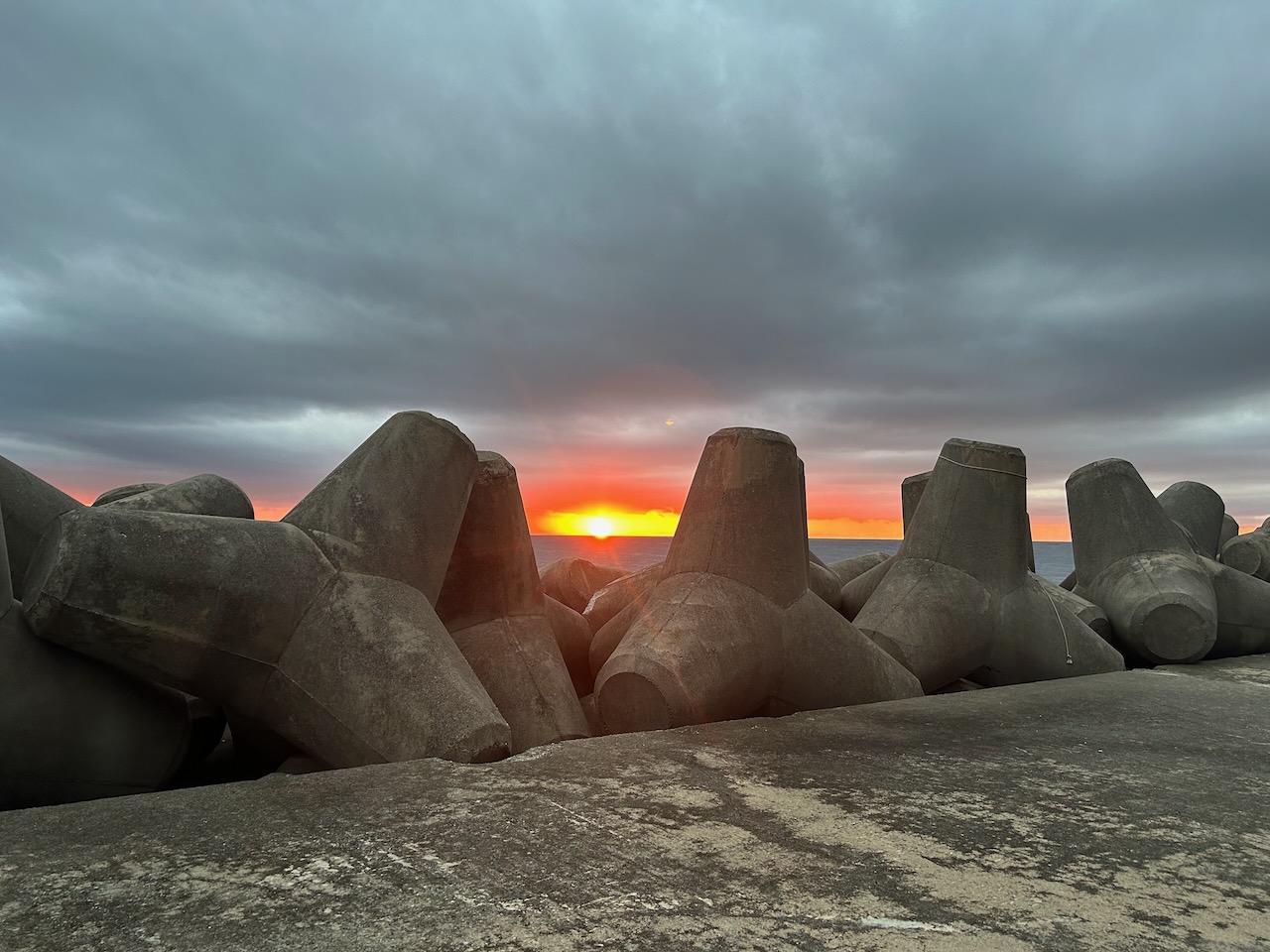
The trip is several hours to the East Coast and it turns out that Mr Kim owns a hotel and restaurant on the top of a cliff over-looking the sea. He tells me that I can stay in one of the empty rooms for the next few days while he shows me around. We dine in the restaurant run by his daughter and son-in-law and the next day at dawn we are off for a walk down to the harbour to see the sun rise.
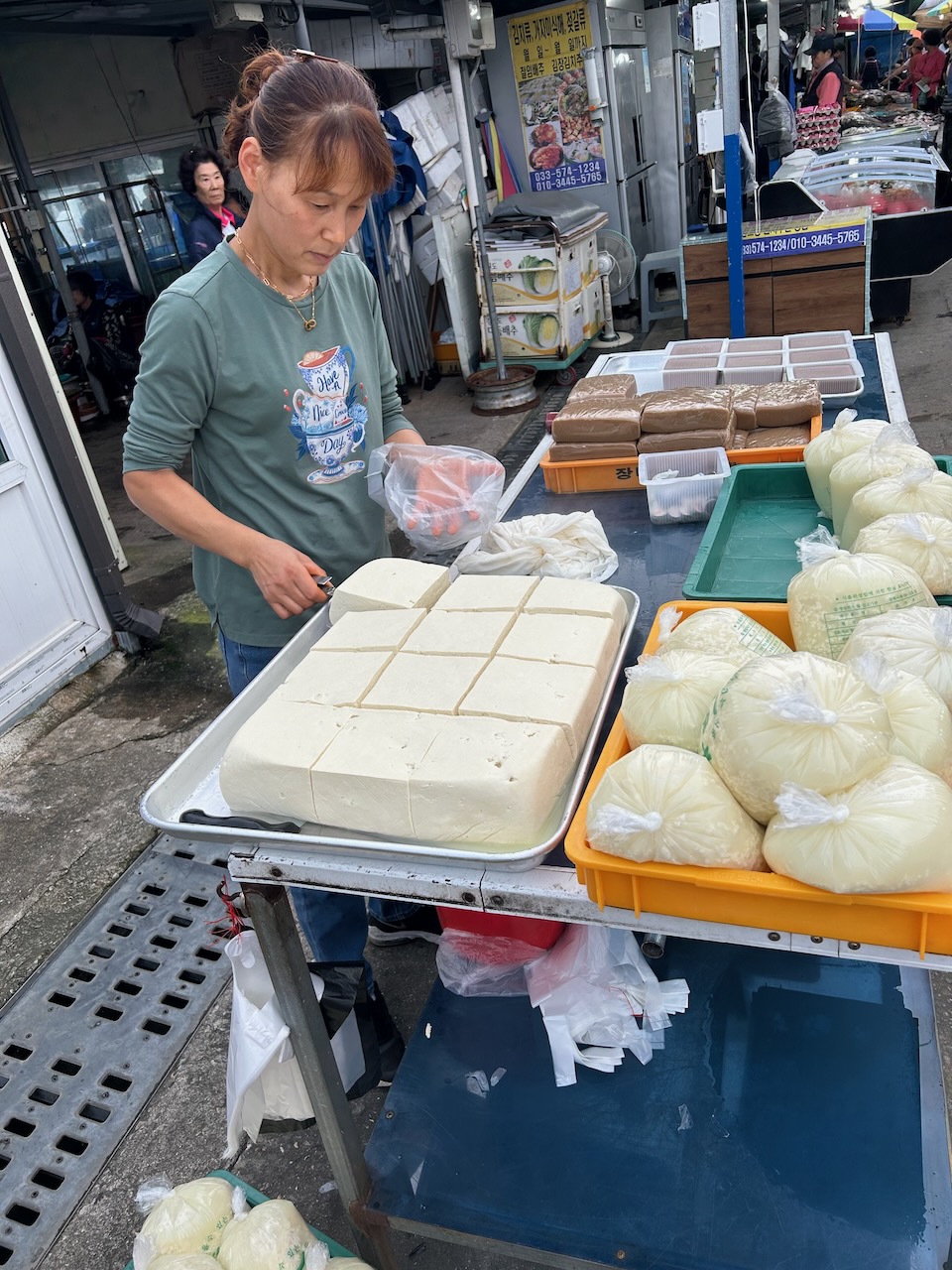
After our walk, mr Kim takes me to the local fish markets, where we buy fish, tofu, vegetables, chillies and pickles for the restaurant.
If you ever think that you might need 20 kgs of dried chillis. I know where to get it.
Mr Kim tells me that he built the hotel 20 years ago, and moved his growing family here from their first home that he built up in the mountains an hour inland from here. He studied architecture and engineering at university and set up his practice high in the mountains where they were snowed in for 3 months of the year. It is a very old subsistence farming area with a lot of ’National Trust’ Listed and preserved farm buildings that date back hundreds of years. These old farm houses were preserved because the climate is so difficult up there, no one could be bothered to pull them down and rebuild on the site. Mr Kim operated his practice during the winter lock-down through the internet. Korea has really excellent internet coverage and speeds. He and his wife raised 3 children up there. He tells me that he will take me up there to see the old place. He still owns it. He tells me to bring a jacket.
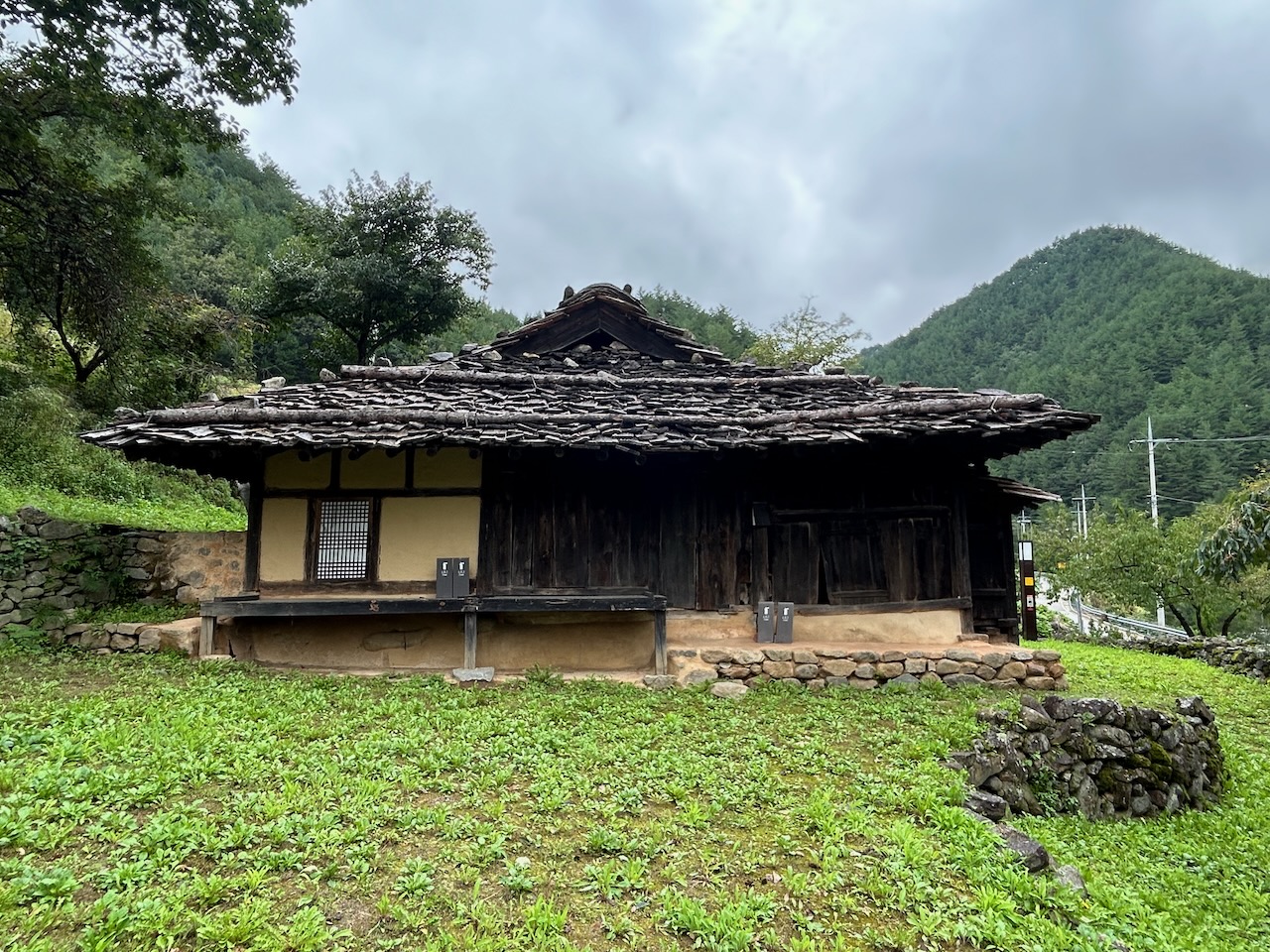
We drive up the narrow, winding, mountain roads full of mist and fog, the air is getting colder. I can feel the chill in the air deepen. I’m glad that he warned me to bring a jacket. We drive for an hour or so until we crest one of the mountain peaks and discover a clearing with a very ancient farm house on it. There are row upon row of stone buttressed retaining walls to make garden beds on the steep hilly terrain. Generations of farmers have toiled here in this soil, so high up on this mountain. I can feel the aches and pains of all this endeavour, solidly secreted in this soil, and in these terraces.
The old house is a combination of earth and timber. The roof is made of timber shingles that have been split from massive slabs of wood. It’s a beautiful old farm house.
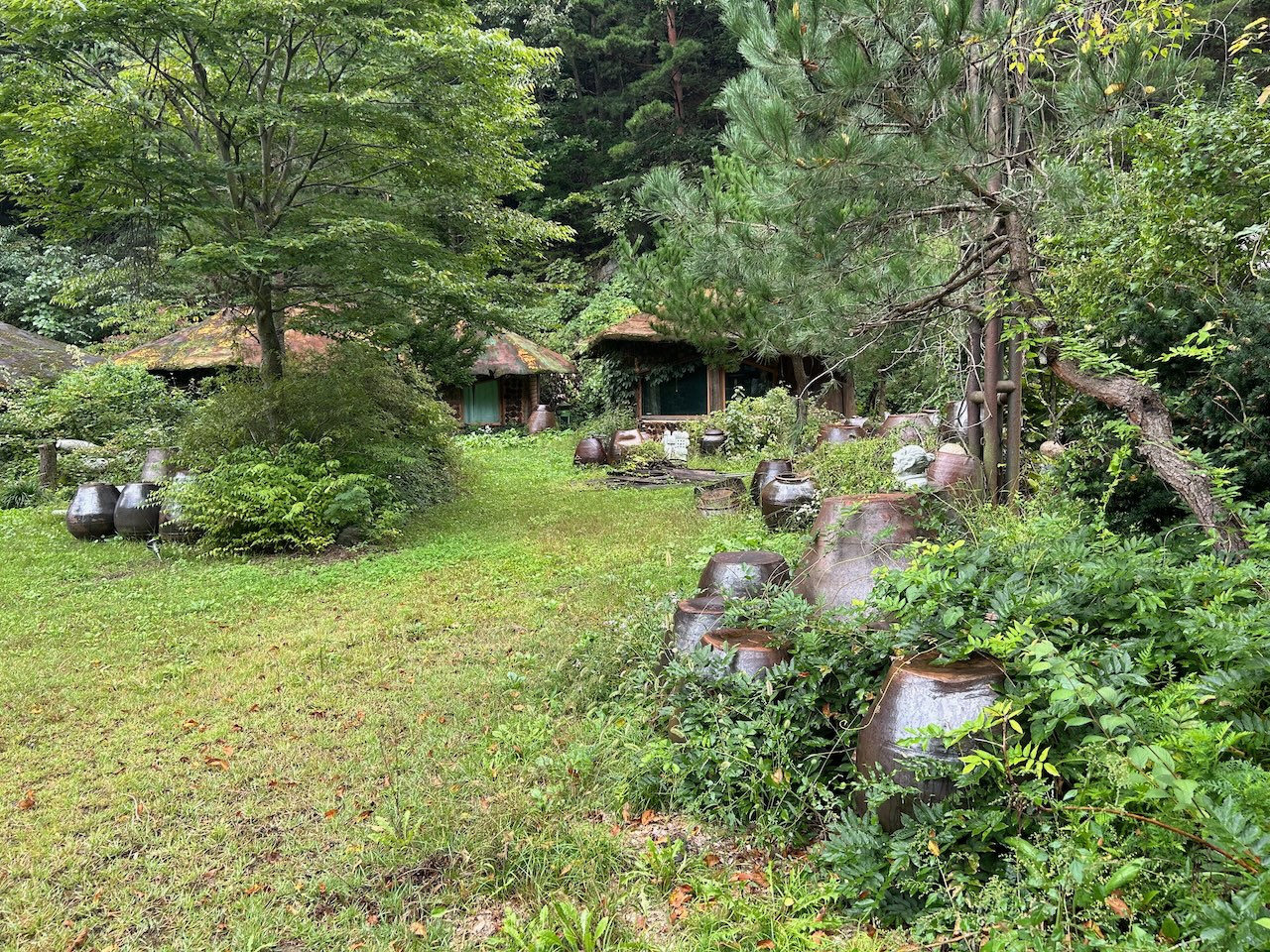
We drive on over the next hill and come to a stop in the narrow street. He hops out and ushers me across a narrow little bridge over a torrent and into a grassy clearing between a few old hexagonal pavilions. There are row upon row of old ongi jars lined up around the edges of the grassy clearing. It hasn’t been mowed for some time and everything is quite derelict looking – but very familiar.
I’m struck by an intense feeling of deja vu!
I turn to him and say the strangest thing. “I’ve been here before”. I’ve lived here! Actually, I’ve slept in that building over there and had a meal in that building there!”
It’s so unbelievable. I can’t believe it. At first, I’m not even sure if what is coming out of my mouth somewhat unintentionally is really true, but the more that I look and take it all in, the more that I’m sure. Yes. I’ve stayed here! But this place is so remote! It’s almost impossible!
Mr Kim is taken aback. His eyes are wide. He is shocked at what I’m saying, and so am I, Because it couldn’t possibly be true. Am I just joking?
Is there some sort of lost-in-translation effect happening? He doesn’t believe me. He tells me “No one comes up here. There is nothing here. Most of these farms are abandoned. How could it be?”
I’m perfectly sure of it now, as I look around and take in more of the details, it is all coming back to me. Yes! I’ve stayed here 8 years ago! Mr Kim looks puzzled, then his face lights up. “Yes, of course. I let a young potter live here 8 years ago rent free, if he rebuilt my wood fired kiln for me in lue of rent.” He was Mr Jaeyong Yi!
When I came to Korea for the first time in 2016, my translator, guide and driver. Ms Kang SangHee drove me up here from Cheongsong way down south. We were on a mission to find ancient sites where sericite porcelain was first developed. I had met Mr Jaeyong Yi down there in Cheongsong. He had invited us to stay with him in his house, in the mountains, as it was on our way to Taebaek up north to visit another sericite location. I wrote all about that adventure up here in Taebaek, back then in my first Korean blog,
’The Kim Chi Chronicles – part 3, 16/9/16 on <’tonightmyfingerssmellofgarlic.com’>
Mr Jaeyong Yi was most hospitable and looked after us very well at that time. The grounds are not as well kept anymore, now that no one lives here. But it still has a charm about it.
We walk around and laugh at the impossibility of it all and the absurdities of life.
Our next stop is to drive down the coast for another hour farther south to catch up with an old friend that we both know. HyeJin Jeon, was a PhD student in the Yanggu Porcelain Research Centre in Bangsan some 6 or 7 years ago. I bumped into her a couple of times on different trips to Korea during her studies there. We became friends and kept in touch by email over the years. She graduated with her PhD a few years ago, and has recently been appointed as the Professor of Ceramics at the Gangneung University on the East Coast. Its not that far further south from where we are.
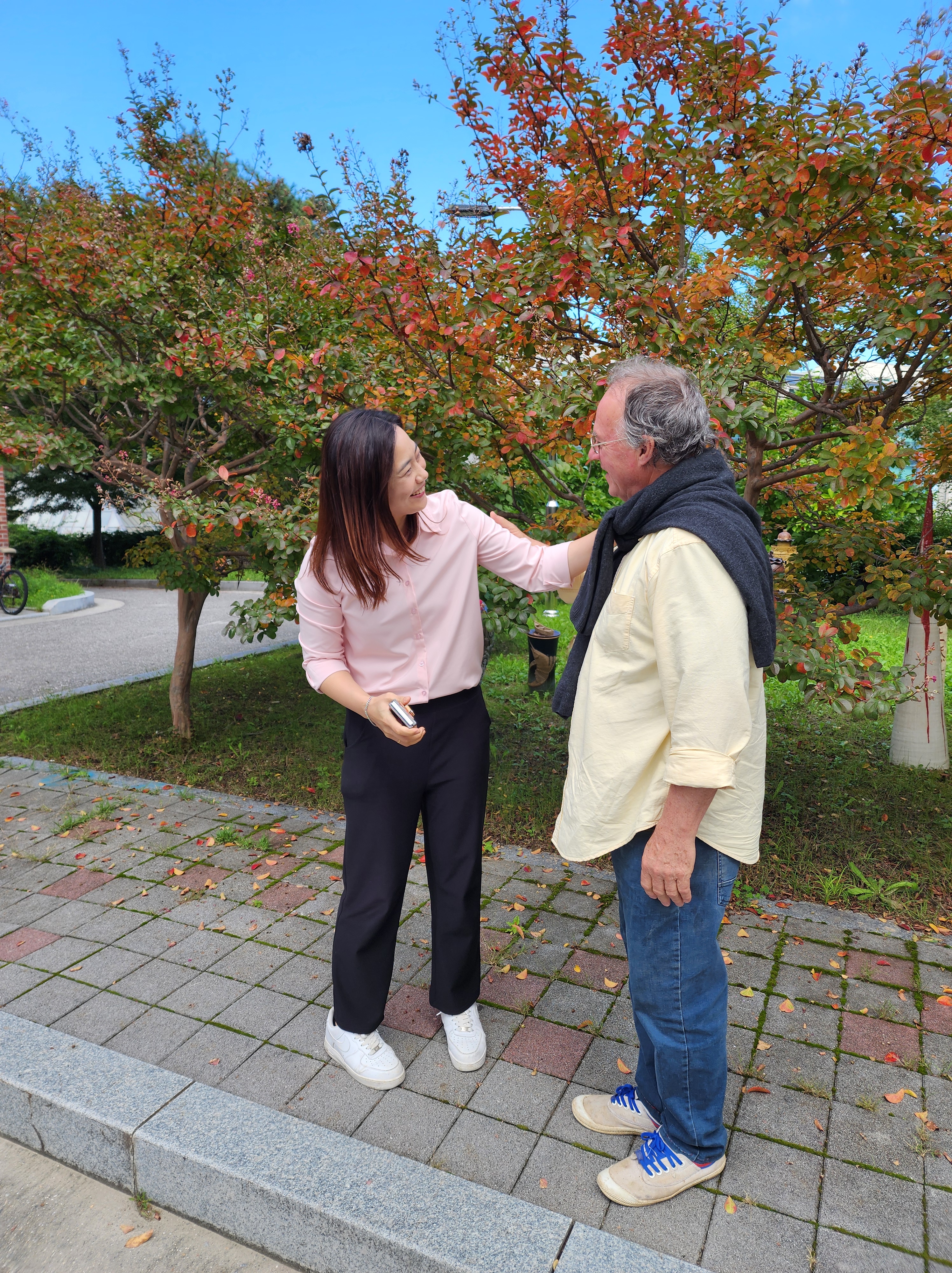
HyeJin Jeon is very pleased to see us and gives me a big hug. It’s been 6 years since I last saw her in Bangsan.
She shows us around her faculty, then the three of us spend the day going around all the Museums and ancient buildings in Gangneung city. We stay on for dinner and drive home in the dark. It was very nice to catch up after so long. I’m pleased that she is doing well.
The next day, Mr Kim shows me his kiln, I go over it, I measure all of its critical features and then spend an hour drawing up a sketch and working out the exact proportions of its openings. I come to the conclusion that the flue needs to be bigger, much bigger. Bigger by 3 times! This is the major problem. But the fire box could also be larger again by half as well. These alterations wont be easy, but are doable. I also suggest that it might be better in the long run if he starts again from scratch. I give him the plans for my kiln that I built in Bangsan as a starting point to help him get the best outcome. He looks at my page of calculations and announces. “ You are not just an artist, you are a scientist!”
Instead of driving me back up to Bangsan, after some discussion, we decide that it will be best if Mr Kim drives me to the local station, so that I can catch a train across to Yeoju and visit both Mr Lee JunBeum and my old friend, former driver, translator and guide, Kang SangHee.
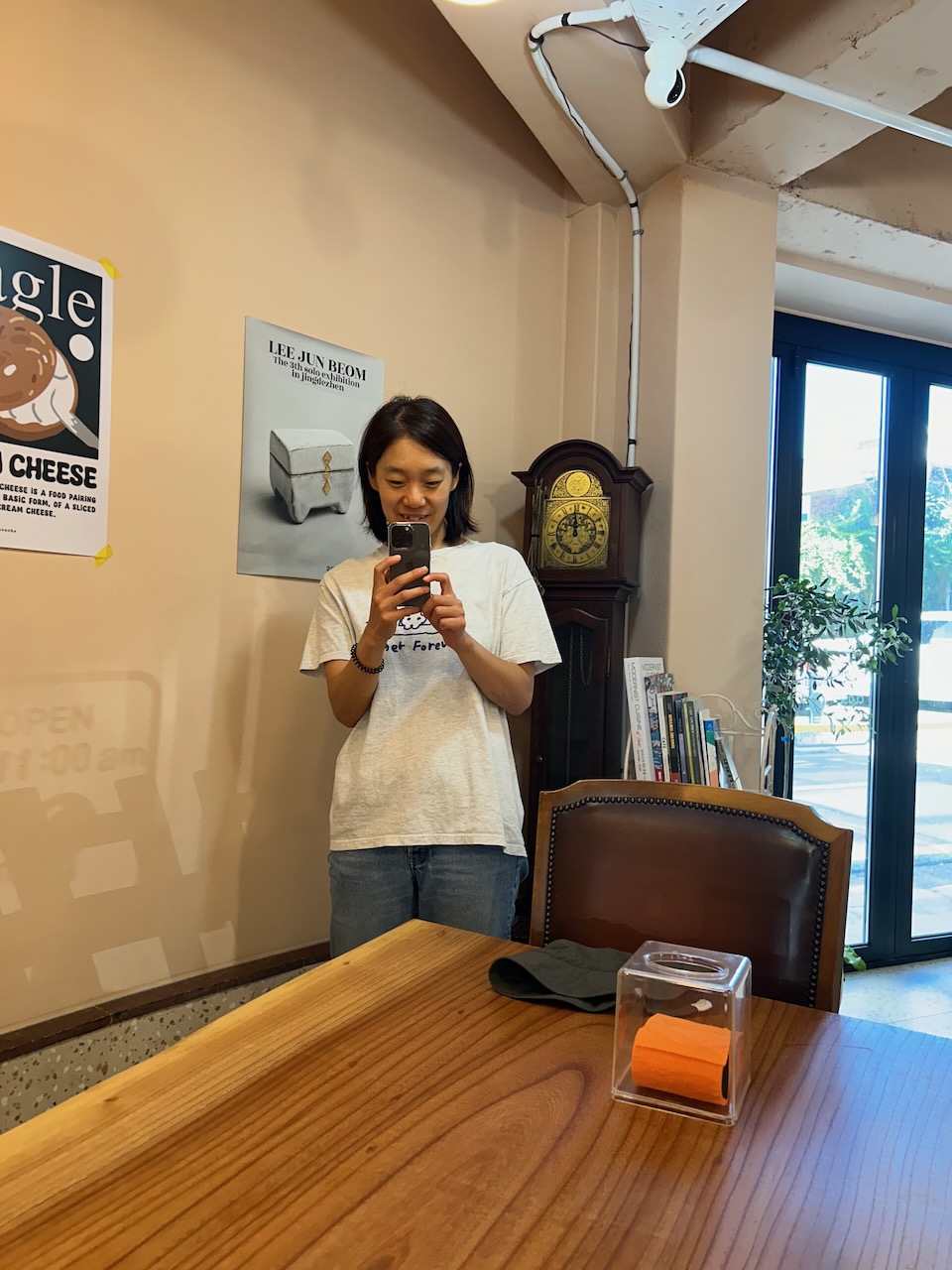
It’s good to see Ms Kang SangHee again too, I catch her taking my picture when I’m not looking, so I reciprocate.
We meet up in Mr Lee’s wife’s cafe and bakery, where Ms Kang is helping her bake the days bread.
We spend the day travelling to all 3 sites of the ceramics Biennale. There are some very impressive ceramics on show. Later, I am able to help JunBeom with his new kiln. The least that I can do to show my appreciation for all his help.
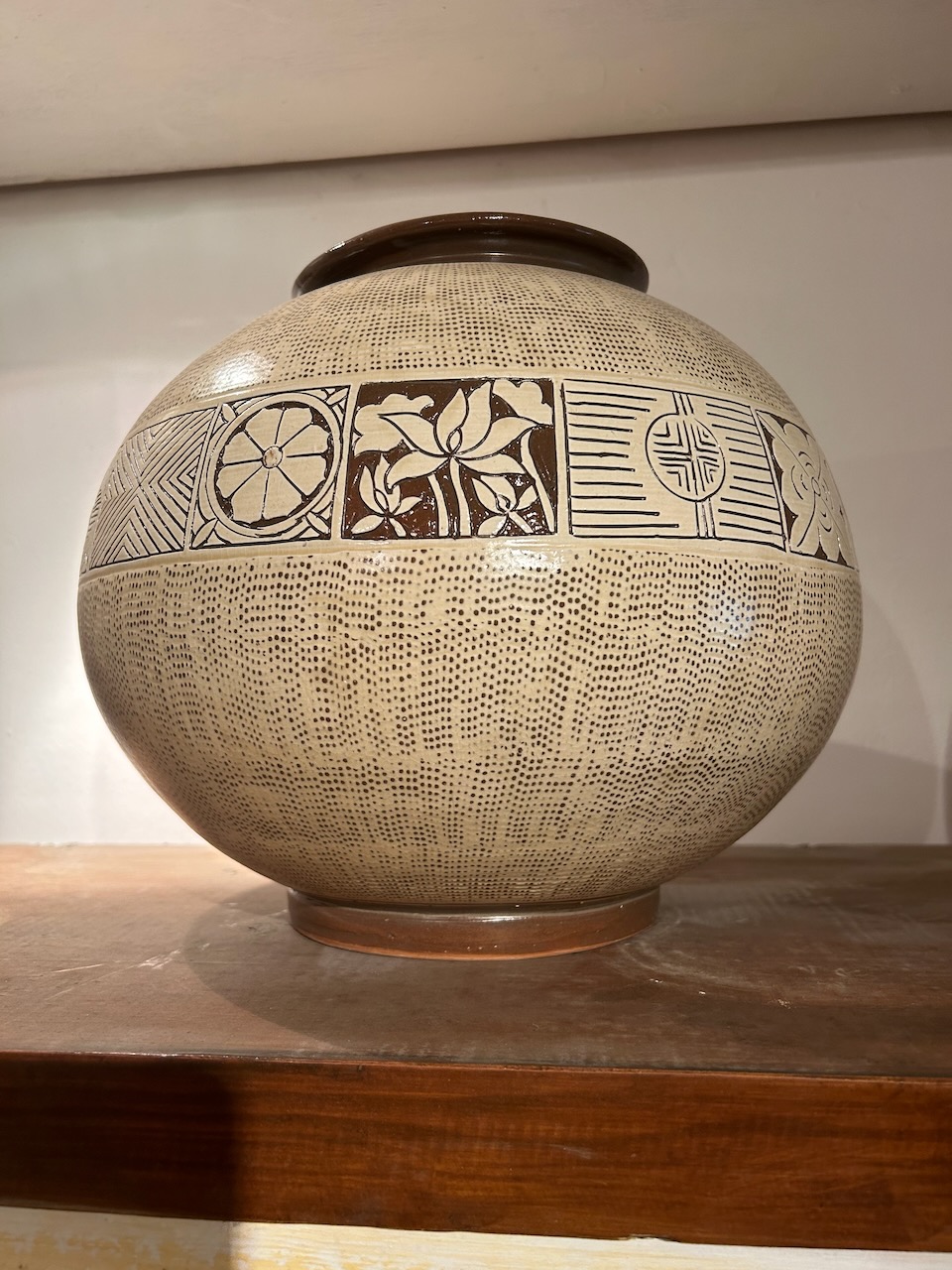
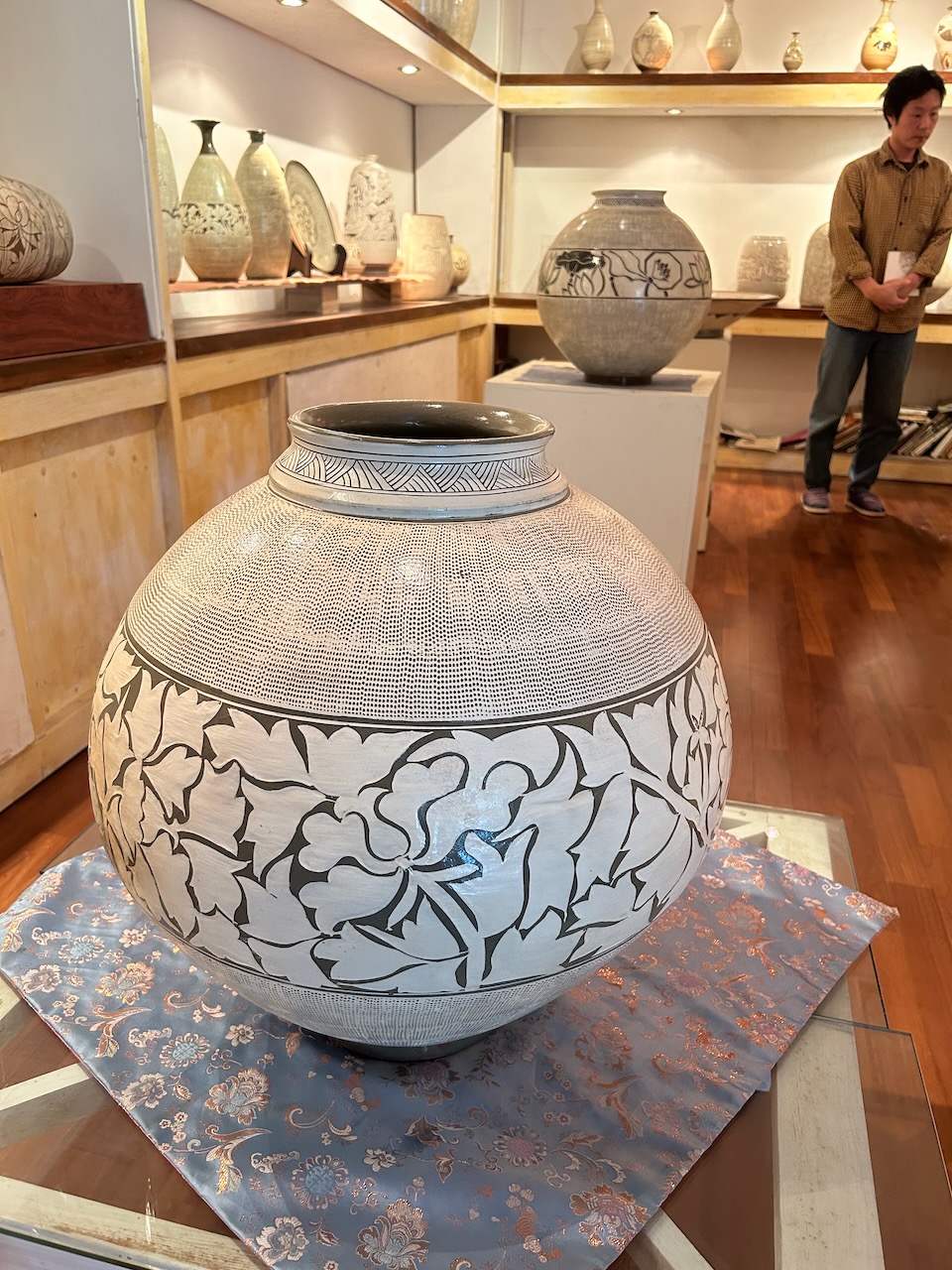
The next day JunBeom and Yoomi drive me to visit the National Treasure potter of traditional sgraffito slip decoration, called Buncheong.
His name is Park Sang Jin and they get a long chat in Korean, insight into which I get through occasional translations from Jun Beom, then we all get a guided tour of his workshop, gallery and kilns.
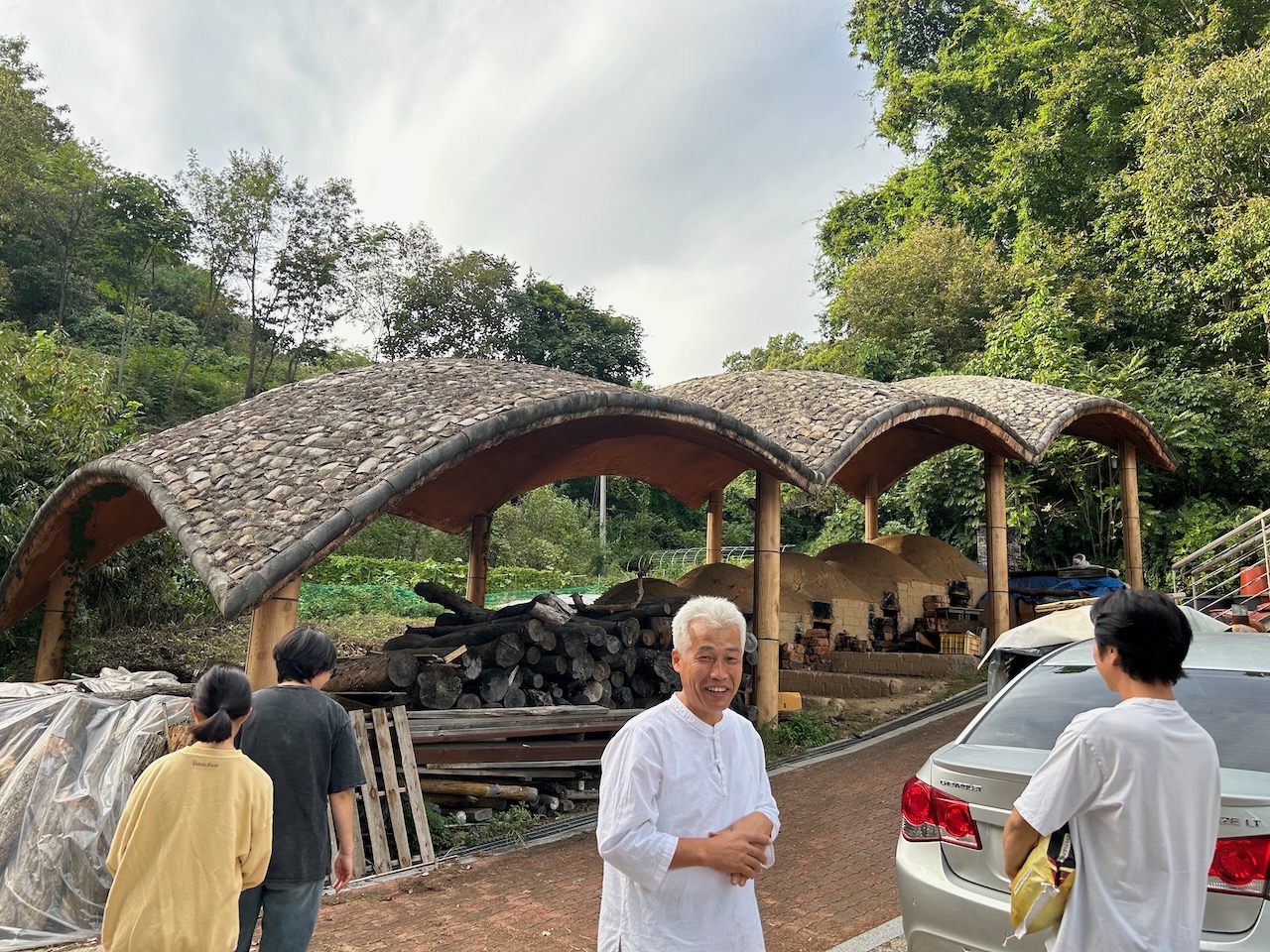
On my last day in Korea we travel south to the city of Andong to visit the other Mr Kim, Kim SangGe, we worked closely together on the Bangsan kiln and he invited me to visit him if I was ever in Andong. He has an amazing roof structure over his workshop and kiln shed. Possibly cast concrete, but with a decorative layer of old weathered and broken roof tiles applied as a kind of mosaic. It’s really beautiful. Artists are just so imaginative and creative in everything that they do. I wish that I’d thought of doing that! Mind you, I don’t have access to thousands of old weathered and broken roof tiles, nor the funds to have an undulating concrete roof cast in-situ. Not the sort of thing that I could ever own, but I’m very pleased to be able to visit.
Mr Kim Sang Ge, serves us a special tea made from dried Tibetan chrysanthemum flowers. Interesting, but not particularly flavourful or tasty. He asks if I like it, and I reply yes – just to be polite, what else can I say? He then gives me the whole packet. I thank him warmly, but I know that I can’t bring it back into Australia, so I give it to Jun Beom when we get home. It was very generous of him and I appreciate that.
Mr Kim led the kiln building team that built the 5 chamber kiln in Bangsan that Janine and I experienced firing back in April this year, see my blog entry; <Kiln Firing in KoreaPosted on 13/05/2024>
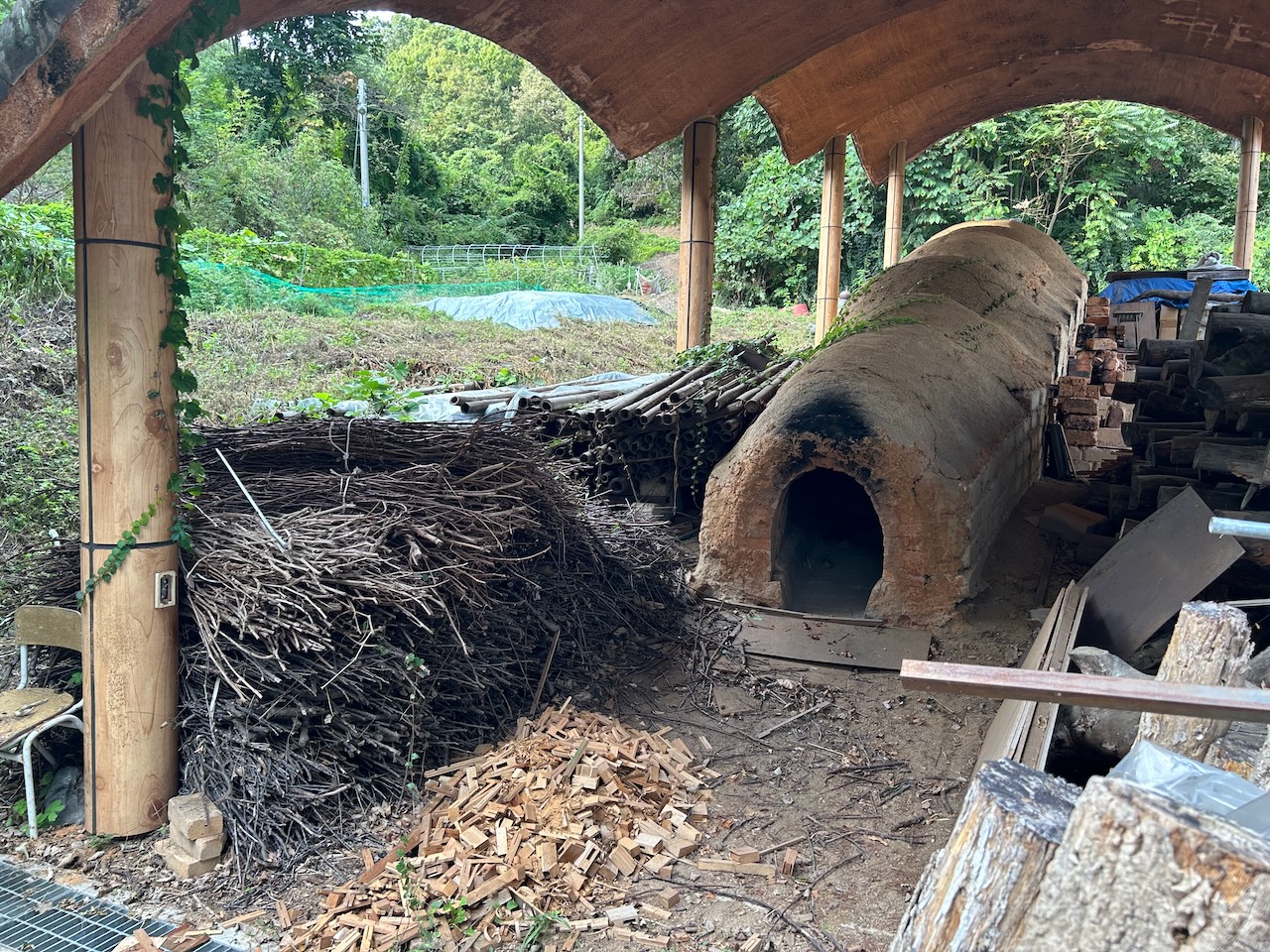
Mr Kim’s kiln is made from thousands of hand made cone shaped raw clay fire brick blocks to form the domes of each chamber, plus an equal number of rectangular blocks used for the walls.
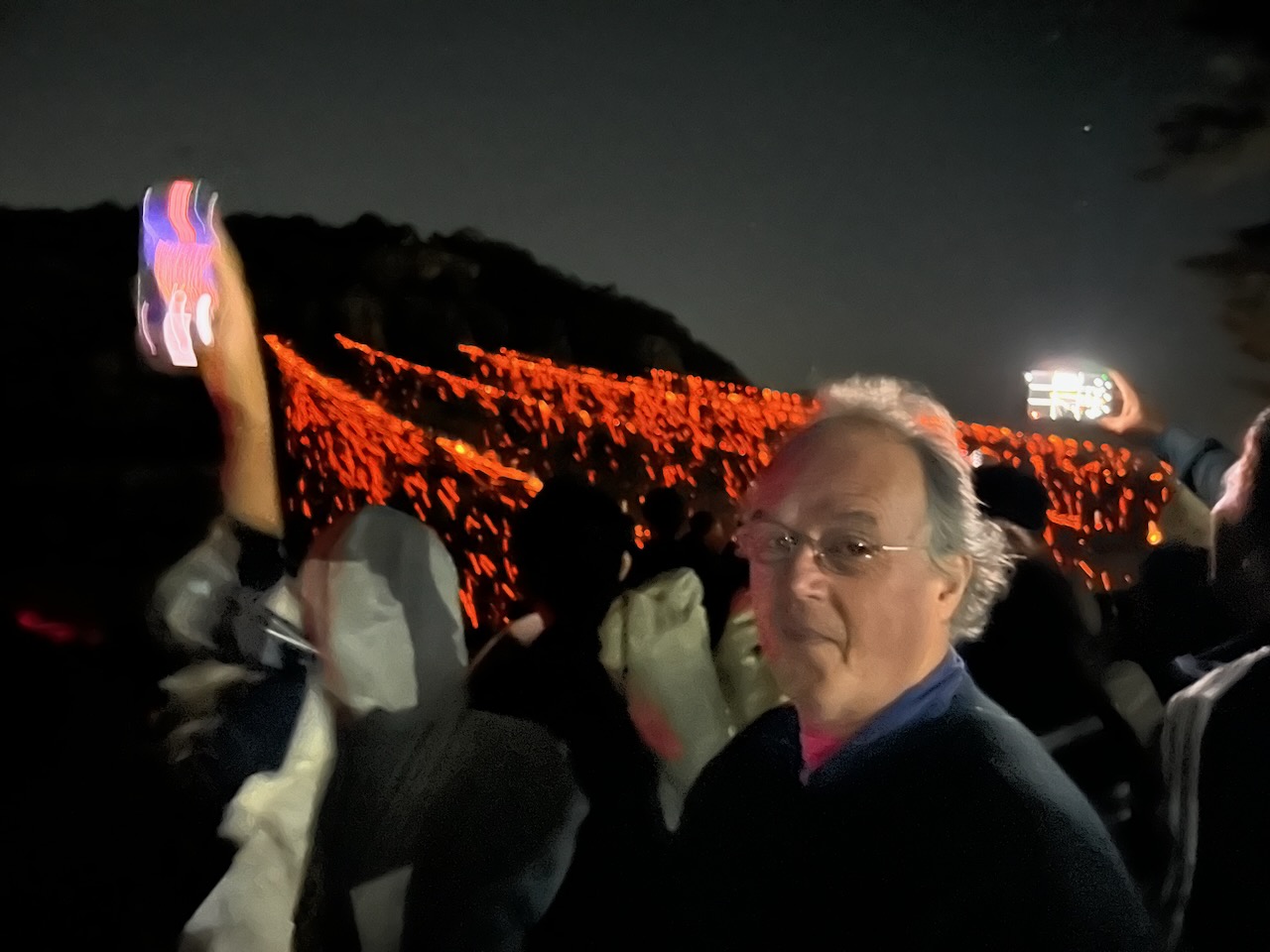
Mr Kim takes us to see the spectacular fire ceremony that takes place this time each year as part of the Traditional Harvest Festival in Andong. There is a tiny traditional Hanok Village of small, earth and timber, thatched roofed buildings, set in the bend of a river, opposite some steep cliffs. it’s an idillic spot, exceptionally beautiful. Each year at this time the ancient founders of the village are remembered by hoisting ropes up across the river, over to the cliffs and hanging burning hand made flares made from leaves and twigs. The sparks flutter down from the ropes into the river in the night sky. It’s quite dramatic. There are no modern fireworks going ‘bang’! Just the gentle cascade of sparks down from the sky.
I’ve been so lucky to have been able to witness so many wonderful things on this trip. Not my usual artist in residence stay in just one place or a simple conference presentation. One of my planned kiln jobs evaporated, but was replaced with a multitude of very different experiences. I am very grateful to all my Korean friends! Thank you!
Nothing is perfect, nothing is ever finished, and nothing last forever.
In the evenings after the days kiln work and dinner, we are all allowed into the Porcelain Museum pottery room, so that we can all make some pots to put in the first firing of my kiln. I don’t know whose idea this was, but it’s a very good one. Everyone has contributed to its construction, and as it’s such an unusual kiln for these parts. It’s a very good idea for everyone to get to see a pot of theirs fired in it. NO Pressure!
It turns out that there are two ‘National Treasure’ potters in our crew here. But everyone is a famous potter from their own regional district. They all come together to do these big kiln building events at special places around the country. A loose conglomerate of like minded and highly skilled artists all contributing their own particular skill set to these big projects.
We pack the kiln with our bisque fired and glazed pots, with other contributions from the research students as well. There is only just enough pots to fill the kiln. I could have fitted more work in if there was any. But there is just enough.
Interestingly, they don’t use digital pyrometers or pyrometric cones here. Traditional firing is judged by colour, sound, smell, smoke and flame. Using years of experience with a particular type of kiln, to judge the progress of the firing. They do however use small glazed tiles as draw trials to gauge the degree of glaze melt, and something that I haven’t come across before, and that is the use of a small amount of stiff glaze paste, that is rolled between the fingers into a small length of pasta sized rod and set in some wadding. This little 3mm dia. rod of glaze will melt at top temperature and fall over, in much the same way that we use pyrometric cones as pyroscopes.
I suddenly realise that I’m really out of my depth here. I usually rely on a digital pyrometer to tell me how I’m going. Now I have to go back to basics and look and listen very closely to the fire to make my decisions. Luckily I’ve also done this before too, so I’m OK, but would prefer the reassurance of a pyrometer to confirm my decisions. Until very recently, we used ‘handheld’, battery operated, digital meters. This meant that you had to go over to where it was and switch it on, to see the LCD display the temperature. They are cheap – very cheap – $10 to $15, pretty reliable and because they are intermittent, they teach you how to look and listen to the kiln, to watch the fire and see how the wood is burning. How the flame is developing, and not just stare at the screen. Since the big fire here. We lost everything, and I bought 240 volt LED permanent temperature displays, online from China for $30, so I have recently become addicted to screen watching in my dotage. Luckily, I still retain some of my mental capacities, well learnt and polished to a finely detailed finish. So just like my stick welding skills, my firing skills are soon retrieved from the dustbin of the recesses of my mind.
In the late 1960’s, when I built my first kiln. No one owned a pyrometer. They were just so expensive. They were totally out of reach. I made a lot of mistakes along the way, but I learnt a lot. I wouldn’t recommend this learning strategy. Using an intermittent pyrometer is the better way to learn so much faster and without the losses that I incurred. My first pyrometer was an analogue, needle indicator, galvanometer. They were quite inaccurate and it taught me not to trust them. A wise decision. They are nearly always wrong. I use them to tell me if i’m going in the right direction. Up or Down. That’s it! I leave the decision as to wether the kiln is finished or not to the use of draw trials, test rings and pyrometric cones.
It is very important to me to fire this kiln well, not just get it to temperature, but do it in a steady, constant, reduction, so that all the usual reduced stoneware glazes that they use here will come out as they expect. BUT, most importantly, to fire the kiln with as little smoke as possible. As that is the main reason for me to be here doing this. This kiln is a demonstration of low emission wood firing.
I must admit that as the only fuel here is 5 year old very dry and seasoned pine wood, that burns very fiercely and fast, I have my work cut out to keep the kiln in reduction, but to minimise the smoke at the same time. As it turns out, I can never get to the stage of filling the hobs with progressively combusting wood, as it is designed to do. I ask if there is any hard wood available and I’m told that it can be obtained, but not at short notice. In fact hard woods like oak and acacia are cheaper than pine, so they will get some in for the next firing. But for now, I have to carefully juggle the wood level in the fireboxes. This means constant attention to detail, so this is not really a Laid Back Wood Firing at all, but a rather busy one. AND, not a smokeless wood firing, as the cover of my book in Korean translation falsely claims!
I manage it reasonably well, but each time I stoke and there is a little burst of pale grey/brown smoke from the chimney. There a howls of jeering from the kiln builders next door. However, although it is smoke, it is nowhere near the column of black smoke that issues from the traditional kilns here. Young Mi, one of the resident researches here translates for me during the firing. She tells me that the jeers are just in good humour, and that the chatter is all about how little smoke there actually is and how clean it is. I have surprised them.
Another resident confides in me that he expected to see flames come leaping up out of the fire box as soon as I lifted the lid. He is also surprised how enclosed, slow and gentle the firing process is.
These 4 images by Kim Young Mi.
I prepared 8 stacks of timber for the firing, expecting to use it all, but as it turned out, I only got to use just over half of it. In the afternoon, when I go to look in the spy hole, all the little glaze rods have melted. The firing is over in just 9 hours. Too quick! I didn’t realise how fast the temperature was rising without a pyrometer. The colour in the chamber is still looking rather yellowish, and doesn’t have that bright pale glow that I’m used to. I wonder what temperature that glaze stick actually melts at?
Note to self! Next time I come here for a firing I’ll bring my own pyrometric cones and a hand held digital pyrometer.
The firing turns out OK. The glazes are pale, grey-blue celadons and off-white, grey/white guans. As I only burnt 4 stacks of wood, possibly 250 kgs of wood, there is no obvious ash deposit, just a little dusting of ash on the glazes facing the fire.
The bottom back shelf is under-fired, but I can remedy that by firing a bit slower and also adjusting the bag wall gaps and height. I hope to be invited back to fire it a couple of times in quick succession, at some later stage, to get to tune it and get an even temperature throughout.
Meanwhile, life goes on in the rest of the village, with the rice harvest in full swing, and autumn vegetables ripening in peoples gardens. I’d love to get in there and pick some of those beautiful vegetables.
Work has been progressing on the big kiln next door. It is more or less finished, but may need some extra work on it. I’m not too sure there. It will certainly need to be pre-fired to remove all the arch shuttering that is built into each of the 5 chambers. It’s a massive kiln!
Who knows if, or when I’ll be back? What does the future hold. Watch this space
Before I leave this beautifully creative place, I make my usual pilgrimage up the mountain to the ancient site where all the sericite porcelain stone was stock-piled in ancient times. The site has been tragically decimated by a local former. I imagine to stop it being declared an historic ‘National Trust’ site of importance? The whole site was bulldozed some years ago, but remnants remain in the soil. Particularly after heavy rains, the white stones stand out from the brown soil and are easily collected. I make a point of hiking up there and seeing what is available for me to collect. I return with 10 to 15 kgs of stones in my back pack and start the process of meticulously scrubbing the stones to remove any particles of dirt. Then I rinse then several times, until the water runs clear. Finally I soak them overnight in bleach to kill anything that might be harmful to the environment in Australia when I return.
Back home, I put them through the jaw crusher and then into the ball mill and let the slurry sit and flocculate for a month or two, before stiffening and plastic ageing before use sometime next year.
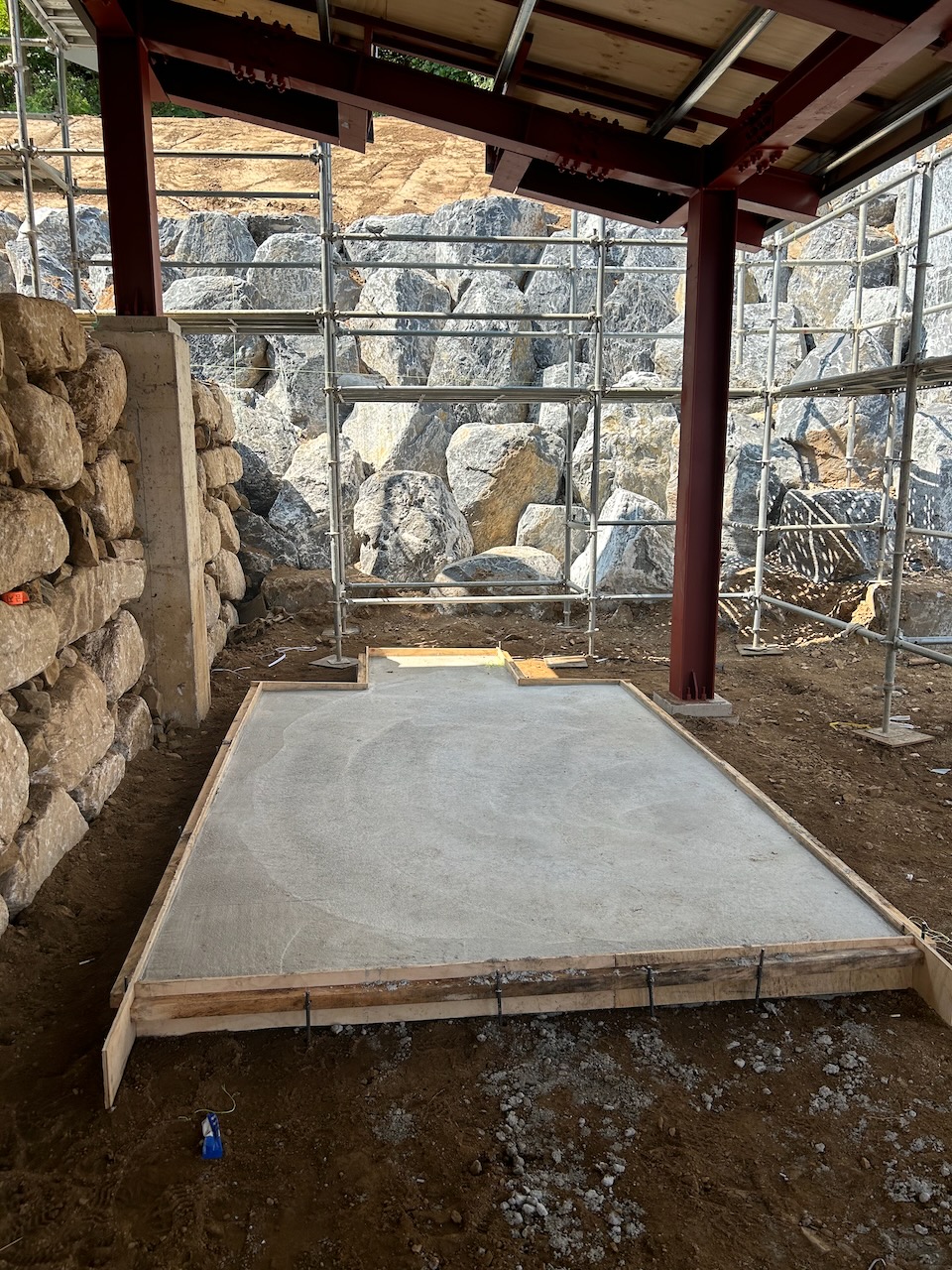
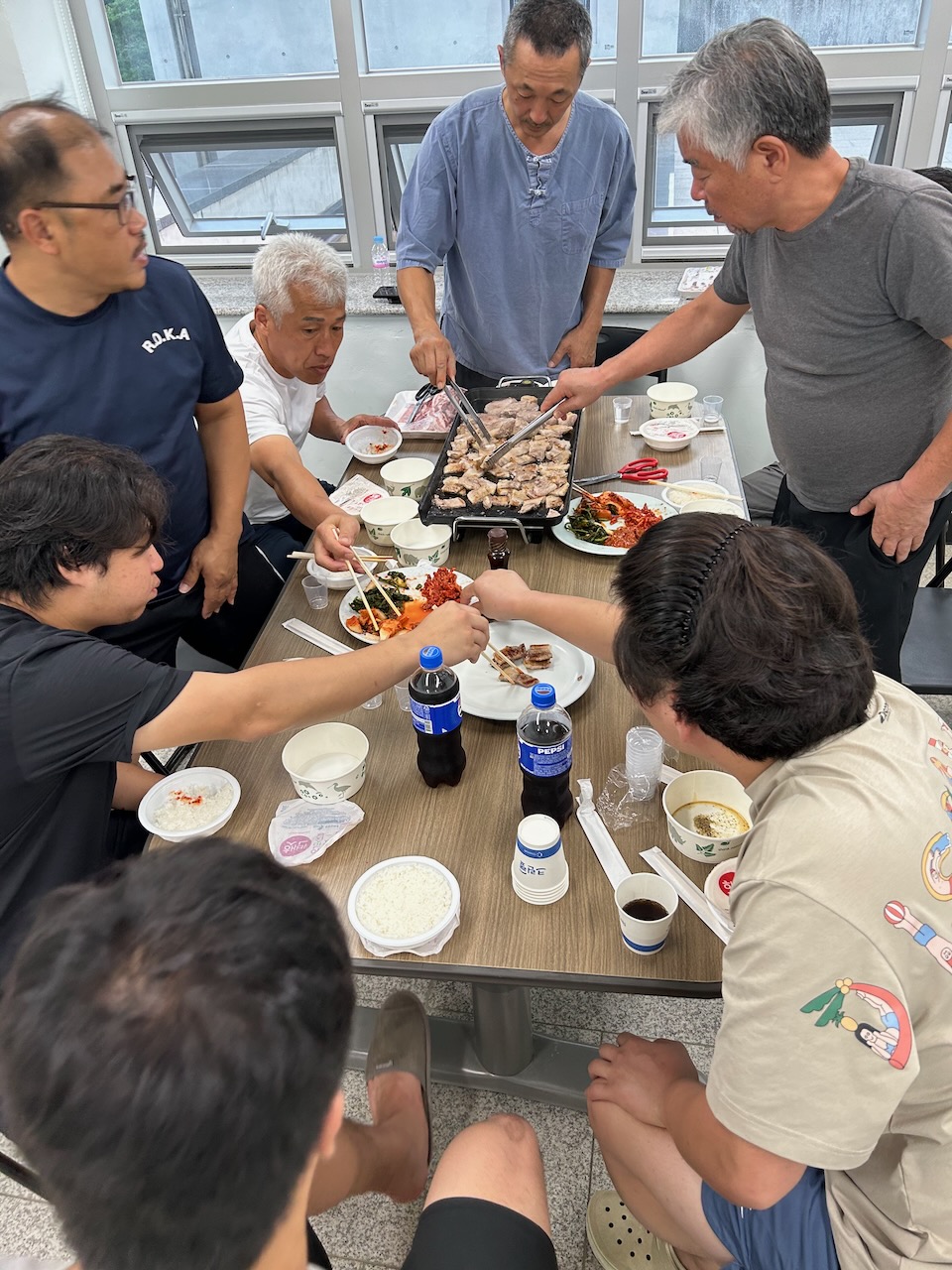
Because the kiln shed wasn’t finished on time, the team of 8 professional kiln builders that are contracted to build the massive North Korean designed 5 chamber kiln that is going in the new shed next to mine, are all sitting with nothing to do for a couple of days, as the slab for their kiln hasn’t even been cast yet. The slab for my kiln was cast the day before I arrived, but as they were still finishing the roof of the shed I wasn’t allowed on site because of the danger of falling objects. So nothing happened for the first day for any of us. We all went into the nearest big town half an hour away to buy groceries for the coming week.
There is almost nothing fresh available here in this little village. There is a junk food ‘convenience store’ that mostly sells soft-drinks, tinned coffee, beer and cigarettes, and a very small ’supermarket’ where you can drop off the first word and buy dried and canned foods that aren’t particularly super in degree or range.
No one sells fresh vegetables, and understandably so, as everyone here, with exception of the dozen museum staff and research students, is involved in farming vegetables. I suppose that they either grow what they need themselves, or swap with neighbours who do. Either way there is nothing fresh in the two tiny shops here.
In the bigger nearby town of Yanggu, there is a choice of bigger grocery shops and one real supermarket. We travel there and get a weeks supply of almost everything that we can think of, that we might need to feed ourselves for the coming week. We spend about $700 on these 3 trolleys of various food items. It even includes shoju and beer! I notice that they sell red wine in there. So return by myself while the others are loading the cars, and buy 4 bottles of red wine, mostly of cheaper origins like Chilean and South Africa There is nothing from Australia available.
I don’t enjoy shoju at all, but quite like the fermented rice wine called makoli and the local beer, but I feel that there might be an occasion when there will be an opportunity to share some claret in the coming evenings together. It turns out that I’m spot on with this decision. The bottle doesn’t go very far when shared 9 ways!
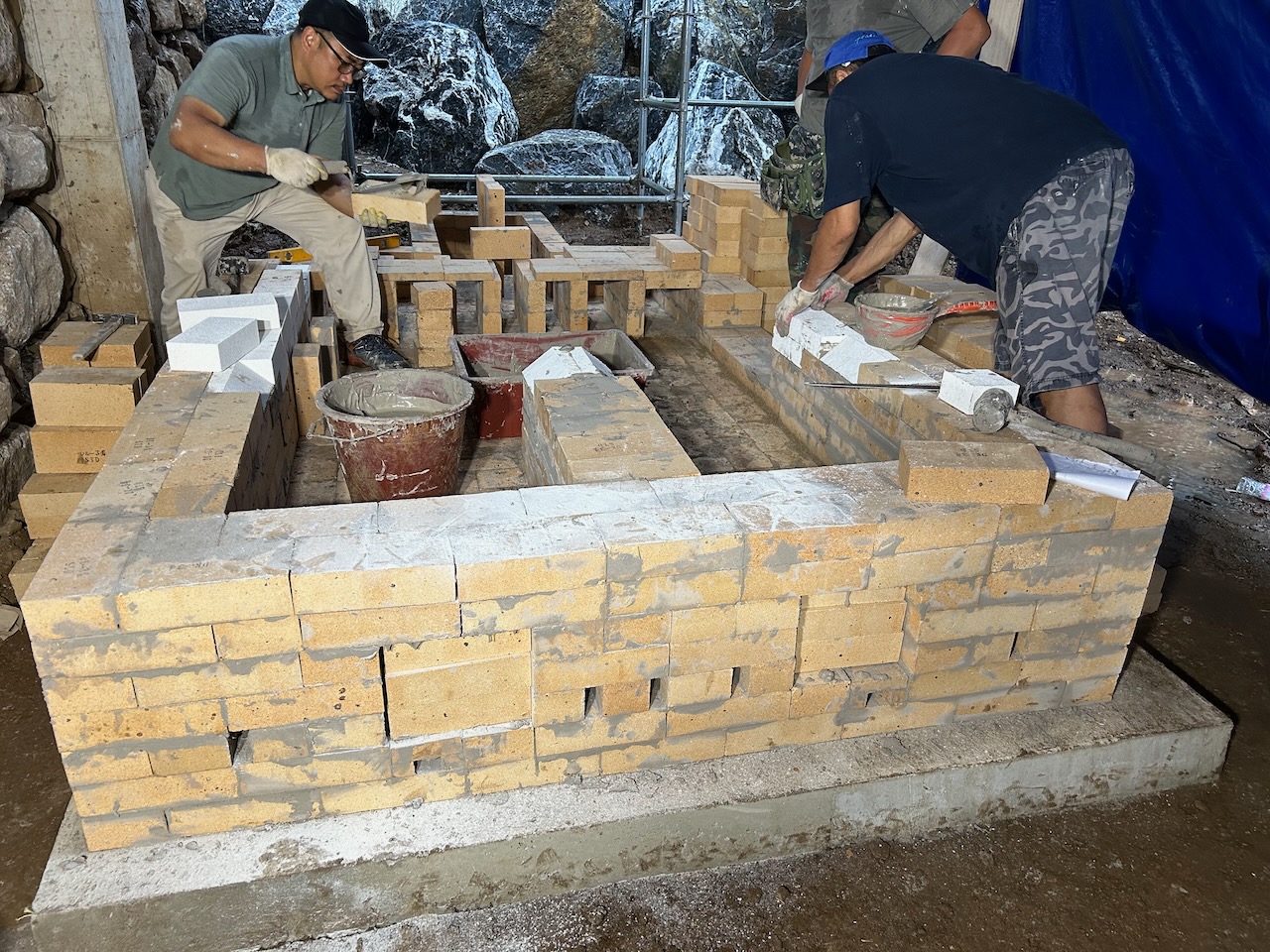
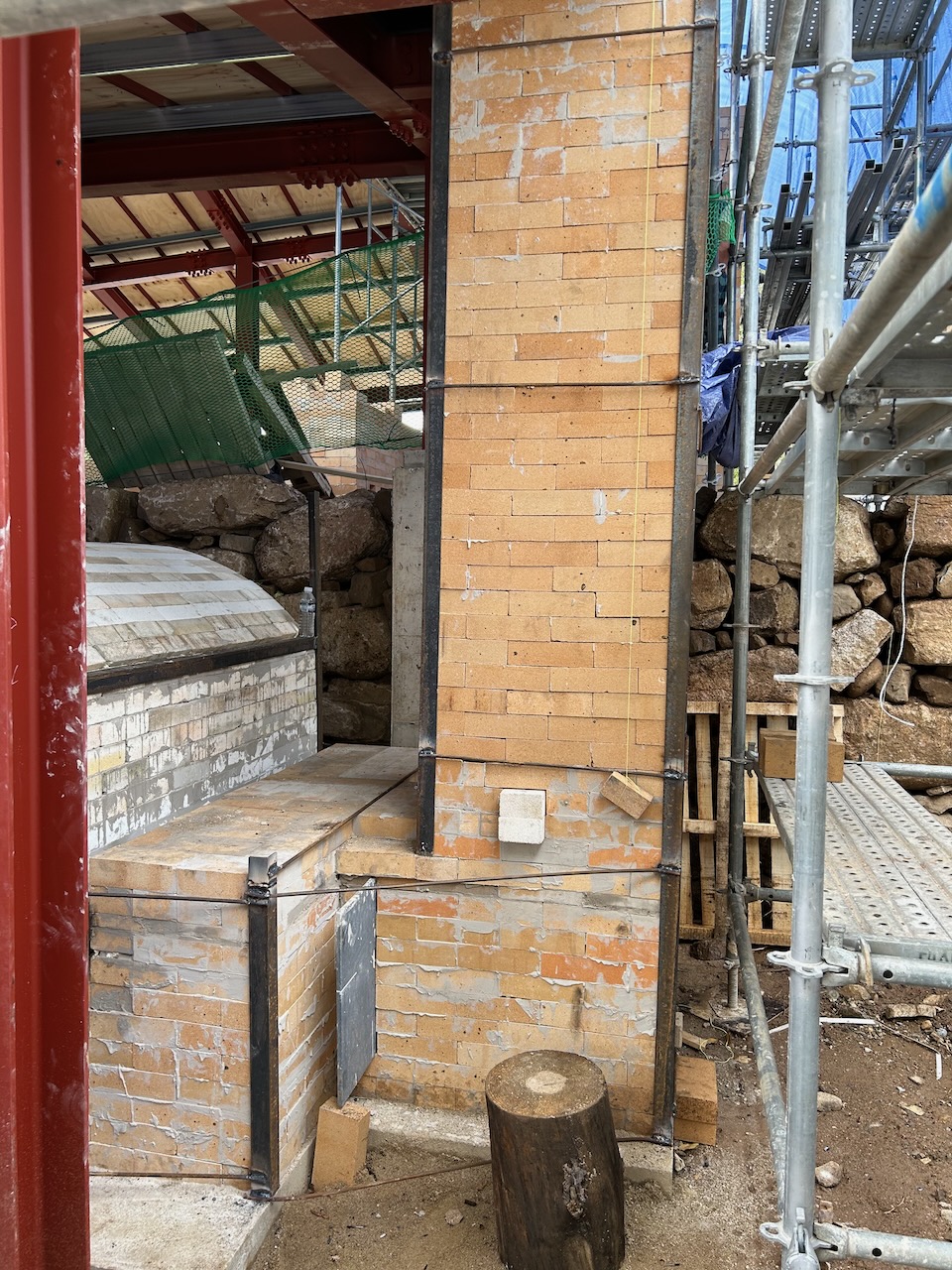
The first day of brick laying, with many helpers goes really fast and I lay out the parameters for the design and using a string line and plumb bob weight, I make sure that the chimney will be directly below the roof opening. This laying out is the slowest part of kiln building. Getting everything square and level before we start.
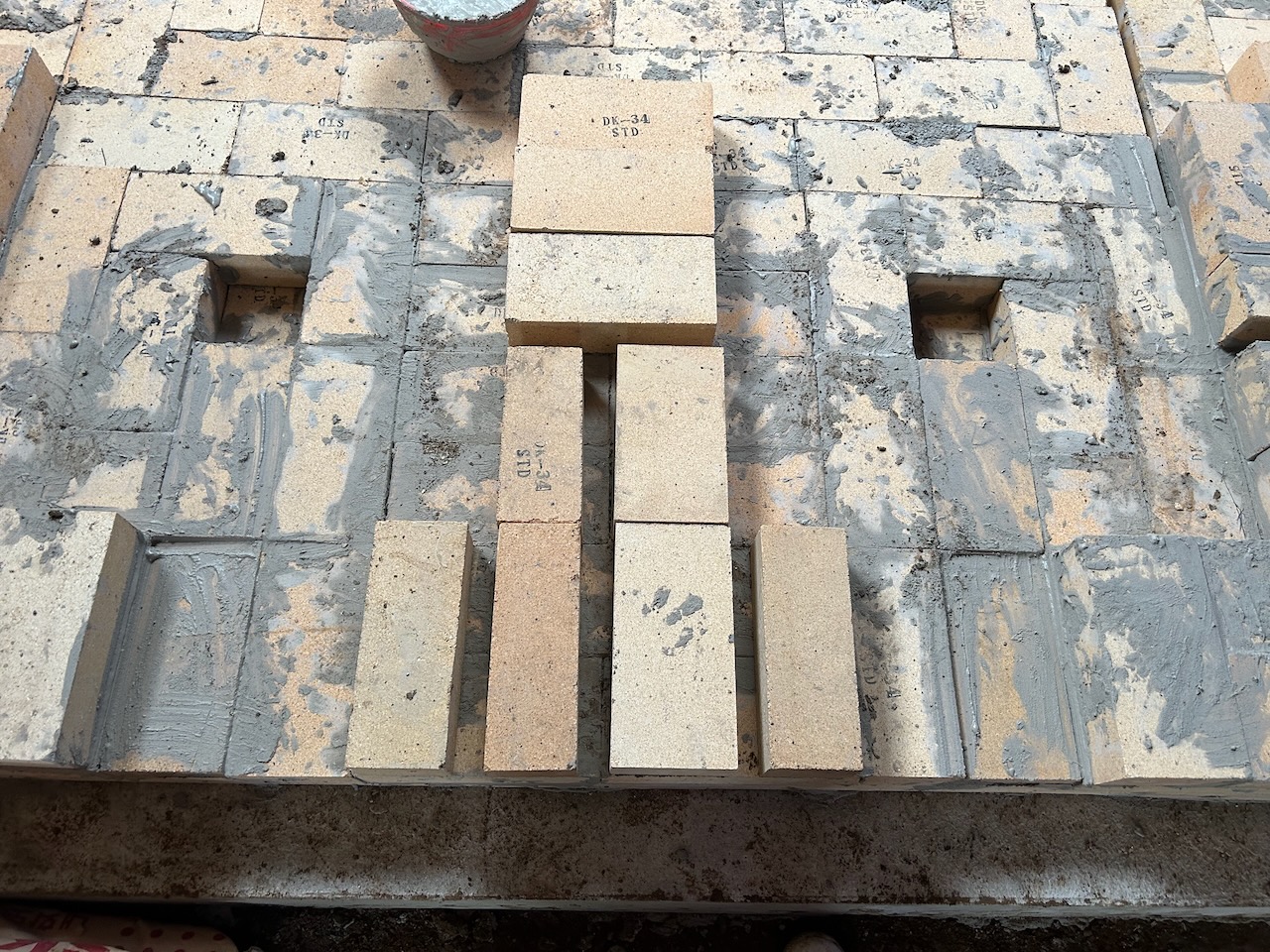
Many hands make light work and we lay the two floor layers in record time. I introduce these Korean professional kiln builders to ‘herring bone’ pattern floor bricklaying technique. They don’t seem to recognise what I’m doing, but using my phone and a translation app, I explain it to them as best that I can, and one of them googles/navers it and announces that it is called herring bone, and they all nod approval, discussing it in detail in Korean chatter as we work. This pattern helps to avoid any straight through cracks developing from left to right or front to back as the kiln shifts and moves as it expands and contracts during its firings.
2 days later, I notice that they have decided to use it in the base pattern of brickwork of their kiln foundations as well!
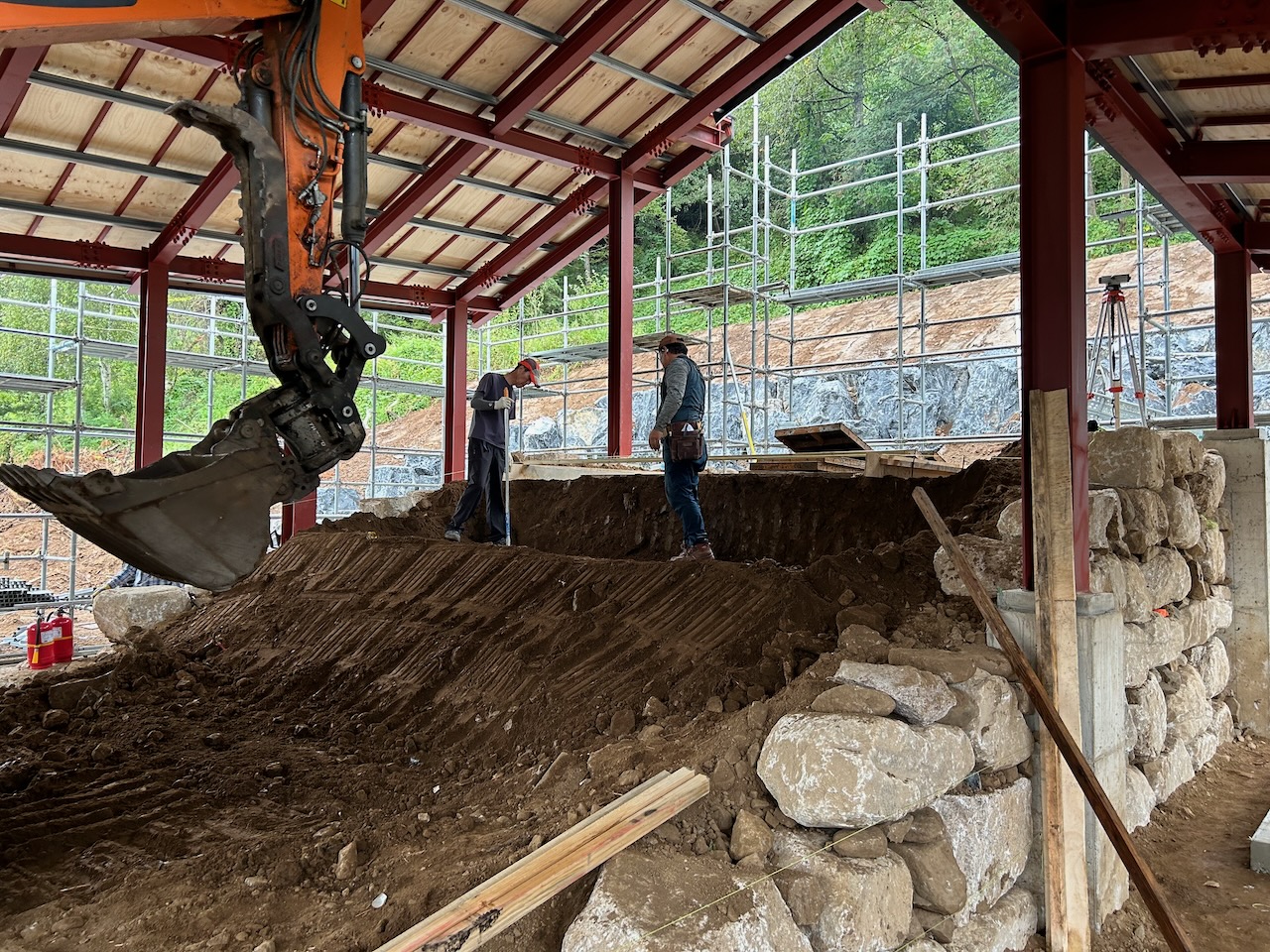
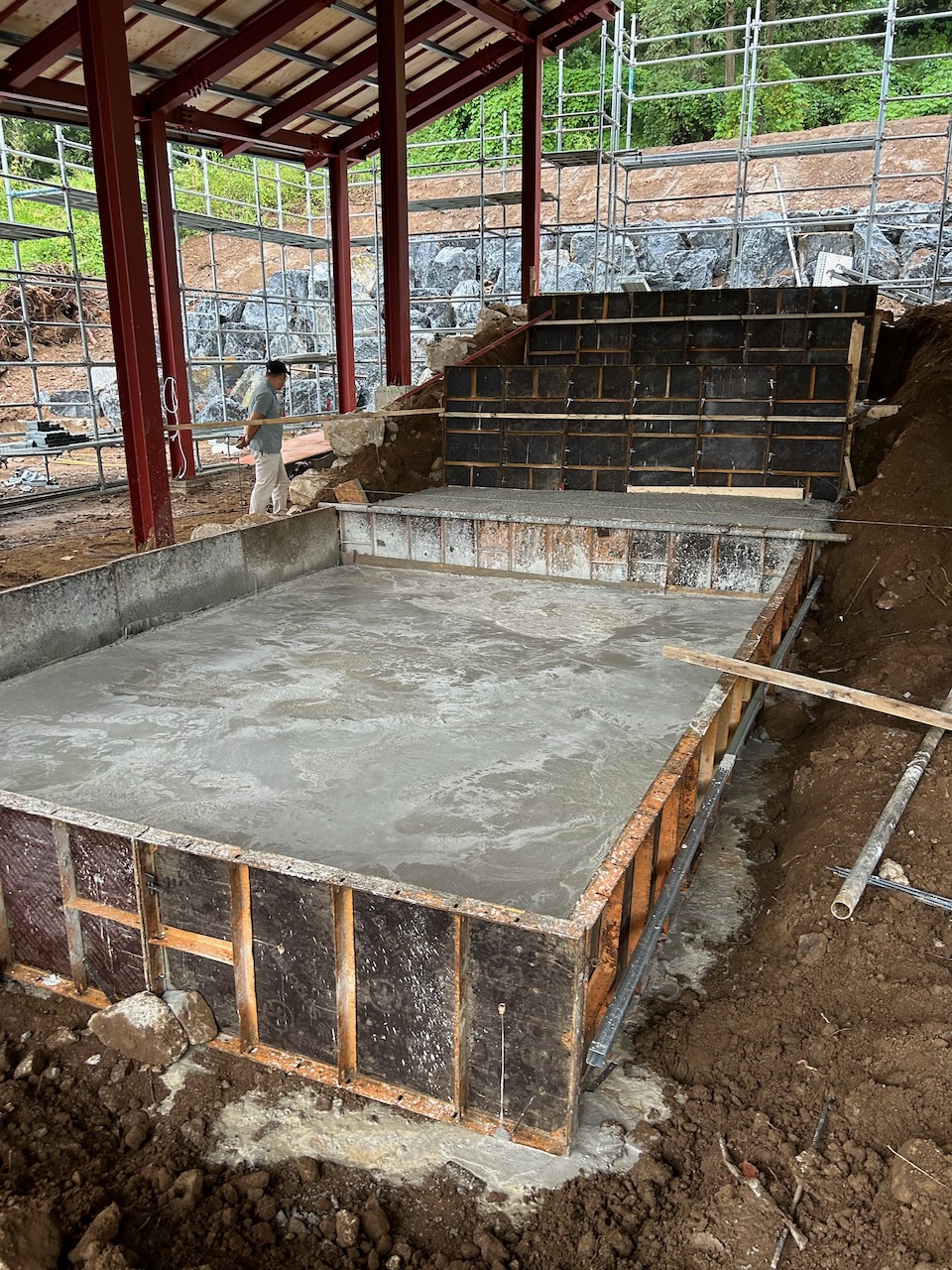
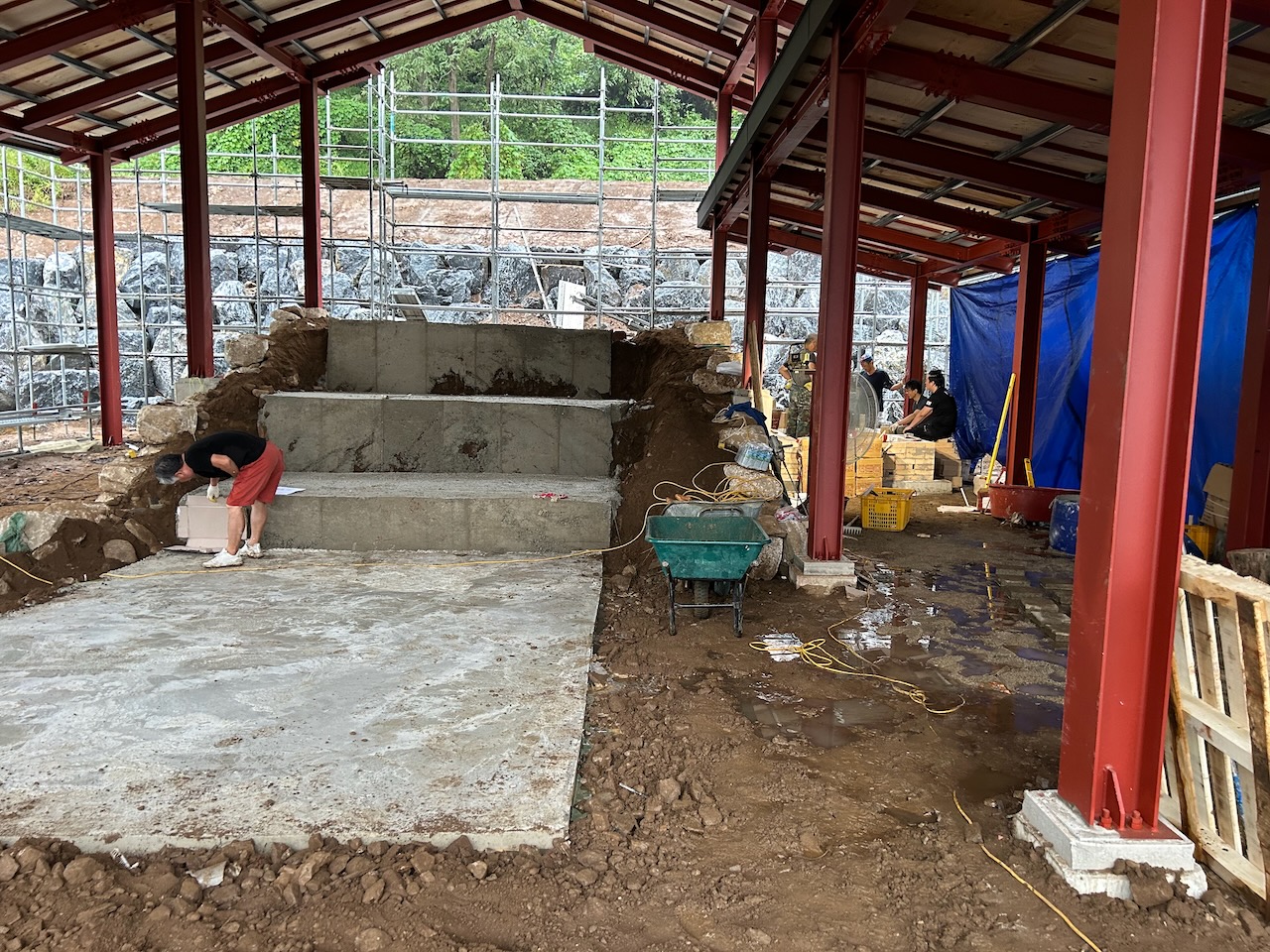
I get this unexpected extra manpower help with my brickwork, as the slab for the big kiln next door is not yet cast. In fact, the local builders are still relocating soil for the earth ramp of the man-made slope and then framing the formwork for the slab. Unbelievably, they get the freshly tamped earth roughly level and tamped down, then all framed-up with formwork and the cement cast by late in the afternoon. I’m pretty amazed by this fast work. However, I do notice that there is no steel mesh used in the slabs, and with it cast on top of freshly placed earth substrate, Will it crack in due course? I have no idea, but hope for the best. These Korean workers sure are fast. Going on this, I can only suppose that there is no steel in my slab either.
I am working flat out, as fast as I can to lay down bricks in their final positions to be laid with mortar seconds later, by one of my several helpers. They are professionals and are so quick. I’m hoping that I don’t make any mistakes working at this speed, as there is no room for any error. It gets particularly stressful when I have to lay out all the mouse holes and tertiary air inlets in under the floor and in the first layer of the walls. They need to be precisely positioned to work effectively, and I have no time to second guess if they are exactly right or not. working with four bricklayers calling for bricks keeps me thinking of four different parts of the kiln at once. Mouse holes, stoke holes, tertiary air inlets, flue holes and the door openings are all required in this first layer, and all at the same time. I’m used to working at a much slower pace and thinking everything through thoroughly. There is no time to think here at this speed. Luckily, I’ve done this before a time or two, so everything goes well.
By the end of the second day, we have the walls well and truely started and up a few courses. I have the luxury of having two of these enthusiastic helpers dedicated to using both of the diamond saws, cutting the hard fire bricks to special sizes to facilities the special openings that I need for the tertiary air inlets. These guys have never seen a kiln like this one with so many holes in it. Traditional wood kilns here are very basic in their construction, often, just straight through tunnels, or multiple chambers, one after the other with only the flue holes to think about. They keep asking me how it will all work, and I am at a loss to be able to explain the intricacies of the design to them with my limited Korean and just some charades to do the explaining. It will have to wait until dinner time, when I can get out my lap top and show them some images of finished examples. Everyone here has a phone with a translation app. I’m constantly turning round to face a phone screen to talk into, to give yet another explanation of a detail in the brick laying pattern.
I briefly have these 7 blokes on my team, and there is just one bloke stripping the form work and measuring the step dimensions and figuring out the layout for the big North Korean designed kiln next door. The cement slab is still fresh, soft and still very wet.
The next day, They are all going flat out on the big kiln, sorting out the necessary steps up the slope and making sure that the first layers will match the brick dimensions needed to align with the next step of brickwork. It’s a massive job. The kiln will have 5 chambers and a huge firebox with two arched openings at the front. They waste no time, and with 8 skilled workers the job flies up.
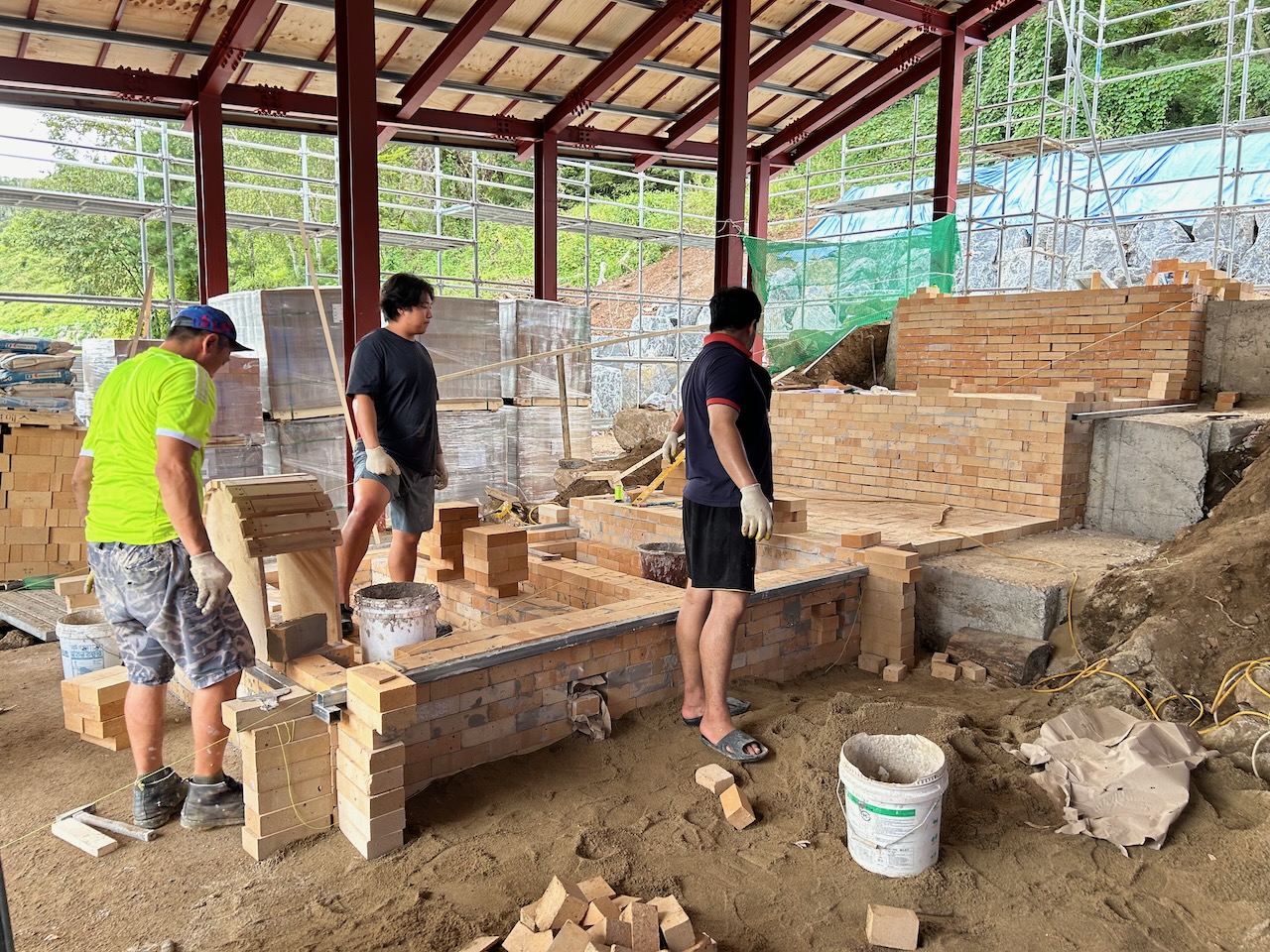
I am left to work on slowly on my small kiln, with occasional help from one of the bigger kiln team and someone to cart bricks and cut special shapes on the diamond saw when necessary. We work well together, and there is a lot of laughter, good natured banter and good will towards me. At the end of each work session, there are more questions about how it will work. I suspect that they think that I’m a bit mad, or at least quite quirky, expecting the fire to burn up-side-down and not roast my head off as a soon as I open the stoke-hole lid in the top of the fire box. Fire always burns upwards in their experience.
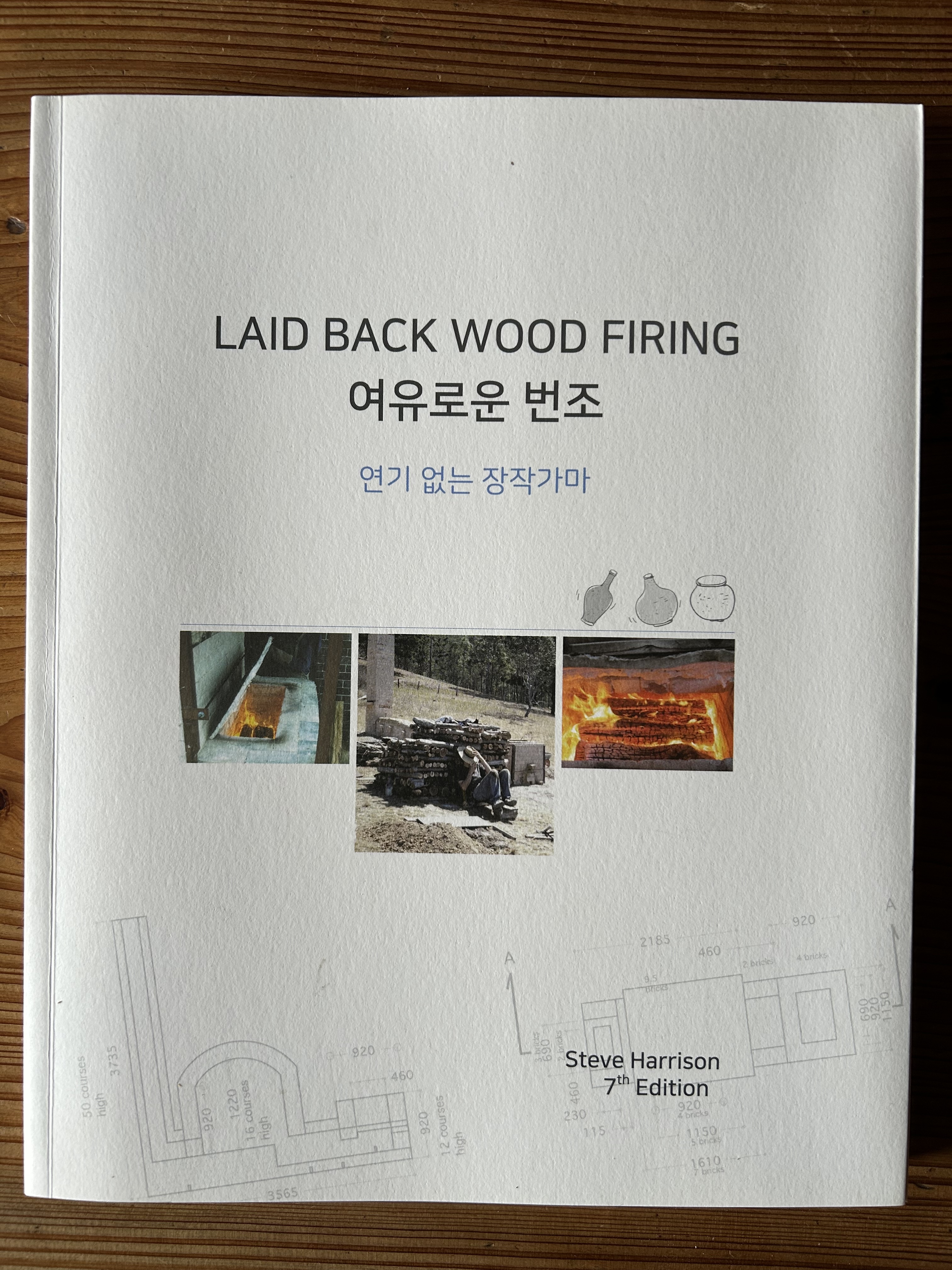
None of them has read my book on downdraught fire box kilns that The Director here of the Research centre has had translated into Korean about 5 or 6 years ago. Not a big seller apparently, among the traditional wood kiln building community?
I ask Mr Jung, The Director of the Porcelain Museum and Research Centre, to bring a copy of the book over to the kiln site, the next time that he visits, he does and it is passed around at morning tea time. A couple of the guys flip through the pages, but I don’t think that any one actually reads it in any detail. After dinner, I get out my lap top and show them images of other projects like this one to help explain what I’m try to achieve.
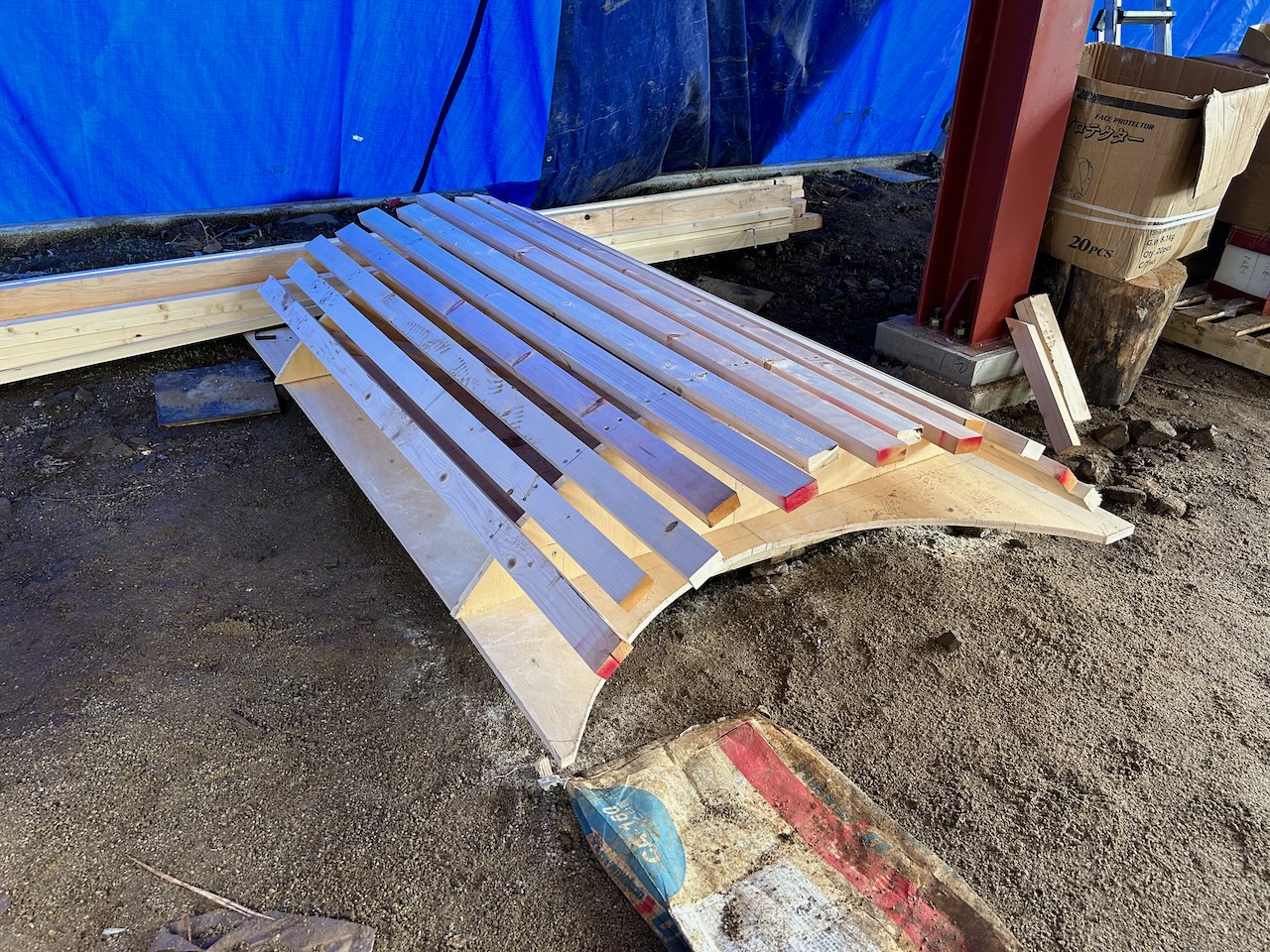
I build an arch formwork and set it in place on a stack of firebricks, using hand cut special wooden wedges that I place on top to adjust the formwork to the exact level needed, and also to allow me to pull them out and drop the wooden form work down free of the finished brick arch, to allow me to slide the formwork out of the chamber. This excites a little bit of interest in a couple of the bigger team, as they don’t appear to have ever seen this before.
I have read in older books, perhaps Leach’s Potters Book? That they just leave the form work in place in the big oriental kilns and burn it out later, before the first firing. I though that this was a bit wastefull. So I have never done this, always removing the formwork to be used again in another kiln in the future. When I tap out the wedges and drop the form work, there is a little intake of breath and a smile from Mr Kim who is assisting me at the time. He smiles broadly and taps me on the shoulder, thumbs up. He’s impressed. word spreads and my position in the social order rises slightly. At dinner, some one asks me how old I am. I tell them I’m 72, nodding all round. From this time onwards, I’m always ushered through doorways first and given the front seat in the car when we go somewhere. I’m accepted as one of them as a professional kiln builder, but I’m also the oldest member of the team. So as such I garner a little bit of extra respect as well.
I finish the brickwork on my kiln by the end of the week and start to engage with all the multitude of little jobs that are needed to complete the kiln. I need make a load of ceramic buttons to attach the ceramic fibre insulation to the firebox lids. I also need to get a local company to cut and fold some thin stainless steel sheet to make the fire box lids.
I ask to be given a lift into the bigger nearby town of Yanggu, to buy steel angle iron and round bar to weld on the bracing. It all goes pretty smoothly, and in a couple of days the kiln is all braced in steel. Using a little portable stick welder I slowly work my way around the kiln, cutting and fitting the pieces together. I haven’t used a stick welder for 20 years. I’m a bit rusty on it, but it soon comes back to me. I’ve only used much more modern MIG and TIG welders in my kiln business for the past couple of decades. I have been spoilt by their speed and convenience, but I manage.
In some miraculous way, I manage to weld the 10mm dia. steel rod handles onto the 0.8mm. thick, or should I say thin, stainless steel sheet lids, using the little stick welder. This isn’t normally possible. The heat needed to melt the 10mm steel handle, is far too hot for the thin sheet and would normally burn a hole clean through the thin sheet. I’m aware of this, so prefabricate a small piece of angle iron backing plate that I clamp inside the lid to absorb most of this excess heat. I do burn a couple of small holes through here and there, but mostly it works well and I get the impossible done before lunch. More kudos from the pros on site.
They are treating me as an equal. It’s turning out to be a very good job.
There is a world-wide phenomenon in international popular music that has taken the world by storm in the past decade or so called K-pop. A style of popular Korean music, loosely based on traditional Korean music styles, but greatly influenced by loads of Western music styles like hip hop, R&B, rock, jazz, even gospel, reggae, electronic dance, folk, country, disco, and classical. Every body seems to know about K-pop, this Korean cultural export.
I don’t know much about K-pop and Korean popular music, I come here to study ceramics, so I thought that I’d call this blog K-pot! On my first visit to Korea, 8 years ago, I wrote a blog called ‘The Kim-chi Chronicles’ (Sept 2016), This blog is its latest incarnation.
This is my 7th visit to Korea, since I first came here in 2016. I was here only 6 months ago for a ceramics conference, where I presented a paper on low emissions wood firing. This involves using a kiln with a downdraught firebox (Bourry box) which is capable of firing with relatively little smoke. Of course there is always some smoke when burning wood, but this style of kiln design keeps it to a minimum most of the time.
In Australia, where I have done most of my research, I use hard wood, eucalyptus trees for fuel. Eucalypt hard woods are heavy and dense. They burn slowly and steadily. Perfect conditions for low smoke emissions. Here in Korea, they have a lot of different softwoods in the form of pine trees/conifers. They burn fast and furiously, so it is a challenge to minimise smoke during firings.
People here have asked me what is the secret addition that you have incorporated into the kiln? As if there is some sort of afterburner, that they can add to their own kiln to clean it up. There is no secret addition! It is a complete kiln design incorporating the virtues of the down draught firebox that burns the wood more or less in stages, so that there is no intense emission of volatiles that causes smoke in most other kilns.
So I am here again in Bangsan, in the Yanggu Porcelain Village, this time not as an artist-in-residence, as I have been in the past, but as a kiln building tradesman, a glorified refractory bricklayer. I have been tasked with the job of building a small kiln here that demonstrates that wood burning kilns can be fired with a minimum of smoke.
This project was first floated way back in 2018, when the director of the Yanggu Porcelain Museum and Research Centre, Mr Jung Do-Sub, asked me if I would be interested in such a project. The Museum had purchased the rights to publish my book, Laid Back Wood Firing, and had it translated into Korean. They have also published my other books ‘5 Stones’, and ‘Rock Glazes, Geology and Mineral Processing for potters’.
Unfortunately, The translator took someone else’s advice and renamed the book “Smokeless Wood Firing”. Which is of course not true. all wood creates some smoke when being burnt. My project is to keep the smoke to a minimum. Calling the book ‘smokeless woodfiring’ only creates false expectations, and room for criticism and disappointment.
As a result of the books’ publication, there was some interest in getting one of my kilns built at the Yanggu Research Centre as a demonstration model. Like other places in the world, There is a growing interest in cleaning up the environment, at least from the grass roots level, not from there polluting industries, who are being dragged kicking and screaming to be made to be kept to account. It is this citizen-lead interest that is putting pressure on political leaders to make some sort of gesture to seem to be doing something, while still taking large donations from the polluters to keep the status quo.
The result is a very slow transition to clean up the environment. The results can be seen here in this tiny, remote village. When we were last here before ‘Covid’, in early 2019. The streets were being dug up and gas pipe lines being installed to every home and business. Previously, most home heating and commercial cookery was being done using pressed coal briquettes. Dirty, inefficient and polluting. The immediate result is much cleaner air.
These days the smoke from the wood fired kilns looks just as polluting, now that the residents have paid to have cleaner gas installed, to eliminate their smoke, why shouldn’t the residents want cleaner air, and less smoke pollution from every source? The traditional kilns here are very smokey, producing black smoke all the way through the firing schedule, from start to finish, particularly at the end of the firing, when the extra chambers of the climbing kilns are being fired by ‘side stoking’ methods.
There are two climbing kilns here in the centre of the village behind the research Centre and Museum. One of them right next to an ancient kiln site, where porcelain has been made since the beginnings of porcelain making here, hundreds of years ago. With an ancient tradition of pottery making here in the village, using these old kilns going back many hundreds of years, it’s hard to suddenly say NO! Just stop doing it. So the Director of the Museum, was thinking a decade in advance of this possible occurrence.
He managed to secure access to an abandoned military base, a few kilometres out of town, up a small valley, well out of the village, where a new
Smoke from one of the traditional kilns here.
‘Porcelain Village’ is being built. When I first arrived here 8 years ago, in this new development, the buildings were still very new and my room still smelt of fresh paint, and all the facilities were still being installed in what had been the officers quarters. One of the stone barracks was being converted to a meeting room and coffee shop. The Museum director had big plans to build several different styles of kilns out here to add to the research facilities available to the students. That has since then, mostly all come to pass. However, the plan keeps changing and expanding and getting more complex. The Museum Director is a very smart guy, a good strategic thinker and politically very savvy.
The first kiln built up in the valley was a tunnel kiln. I didn’t see this kiln being built, as I have been away for 5 years because of the COVID lockdown, and then the huge catastrophic bush fires that burnt our pottery. It has taken me 5 years to recover, so that I could finally accept Mr Jung’s offer to come and build them one of my kilns.
The second kiln built here was a traditional low-firing, earthenware wood kiln, the design of which, originated in Jeju Island off the far South Coast of Korea. It is built out of basalt stones. The only available material on Jeju Island, so is limited to very low firing temperatures. A kind of tough earthenware. Hand made fire bricks stacked to dry in front of the Jeju basalt stones kiln
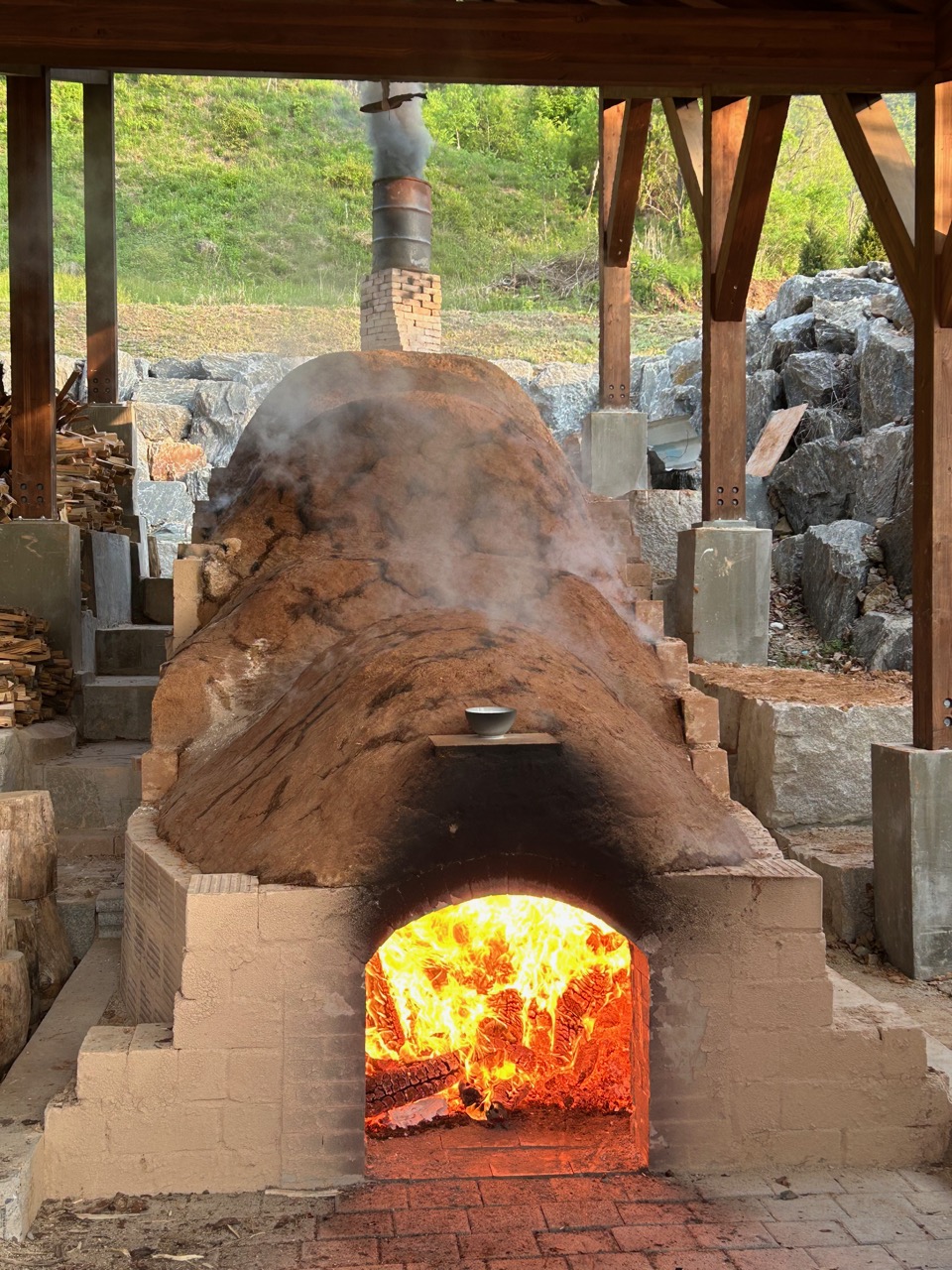
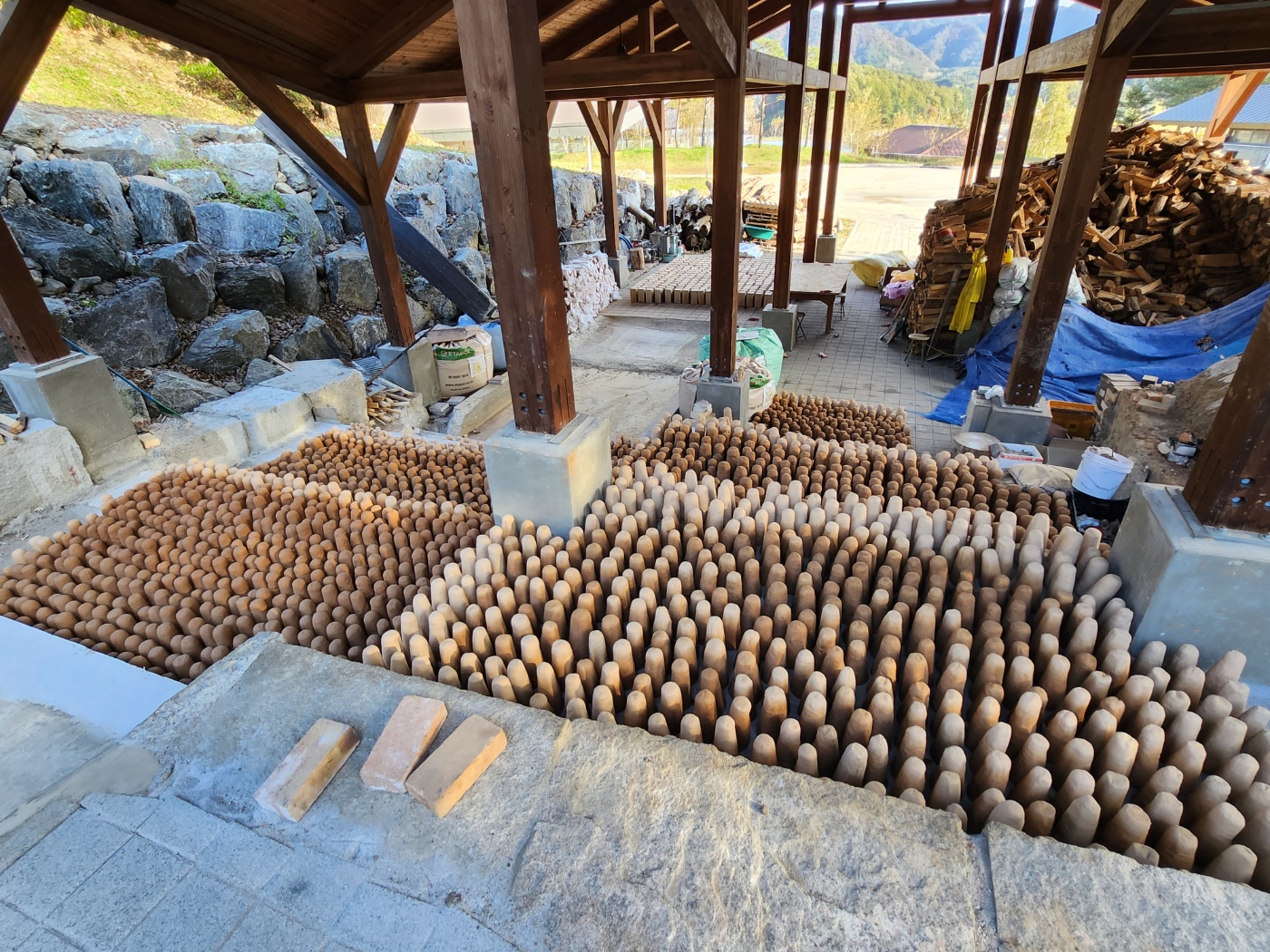
The third kiln built here was a traditional 5 chambered climbing kiln, built almost entirely out of hand made blocks and bricks for the walls, and hand rolled cones of local fire clay for the dome and arches.
Hand made clay cone shaped bricks set out to dry in the kiln shed.
The 5 chamber domed climbing kiln getting ready for its first firing
There are 3 independent, self contained workshop/residencies for artists and their families, and another building with 4 bedrooms and 4 studios, suitable for single student residents. Each of the studios has it’s own electric kin and pug mill. There is a huge communal clay processing and kiln firing building with 2 large gas kilns, and finally a very large conference/residence building that can sleep up to a dozen people with large multiple bathroom, toilets, and even a sauna and laundry.
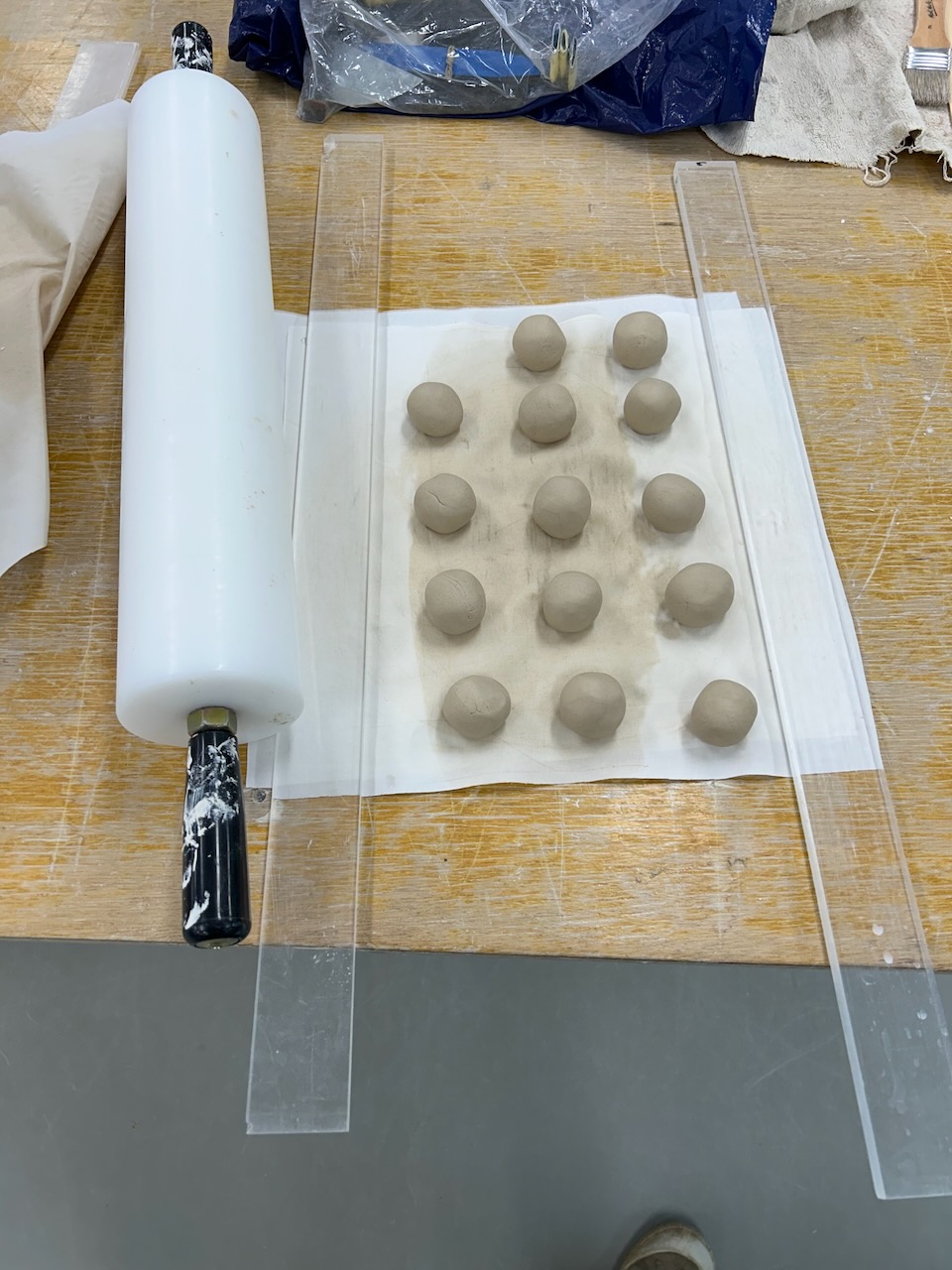
As far as I can ascertain, all the residents/students here have already completed MA hons degrees from their university, and have come here to study for up to 5 years to gain their PhD in porcelain research. It appears that they get rent free access to all the facilities here and only have to pay for their gas and electricity bills. An amazing deal. Such great support for the Arts here! In exchange, they are expected to take part in communal activities like the making of the hand made fire bricks for the last kiln built here. or making the years supply of small test tiles for glaze testing.
There are plans for the local government to develop and sell off several privately owned and developed house and pottery studio sites, next to the research facilities. There may be up to 8 or 10 of these house sites. 2 of them have now been taken up, and buildings are currently underway. It will become a small porcelain village and creative community.
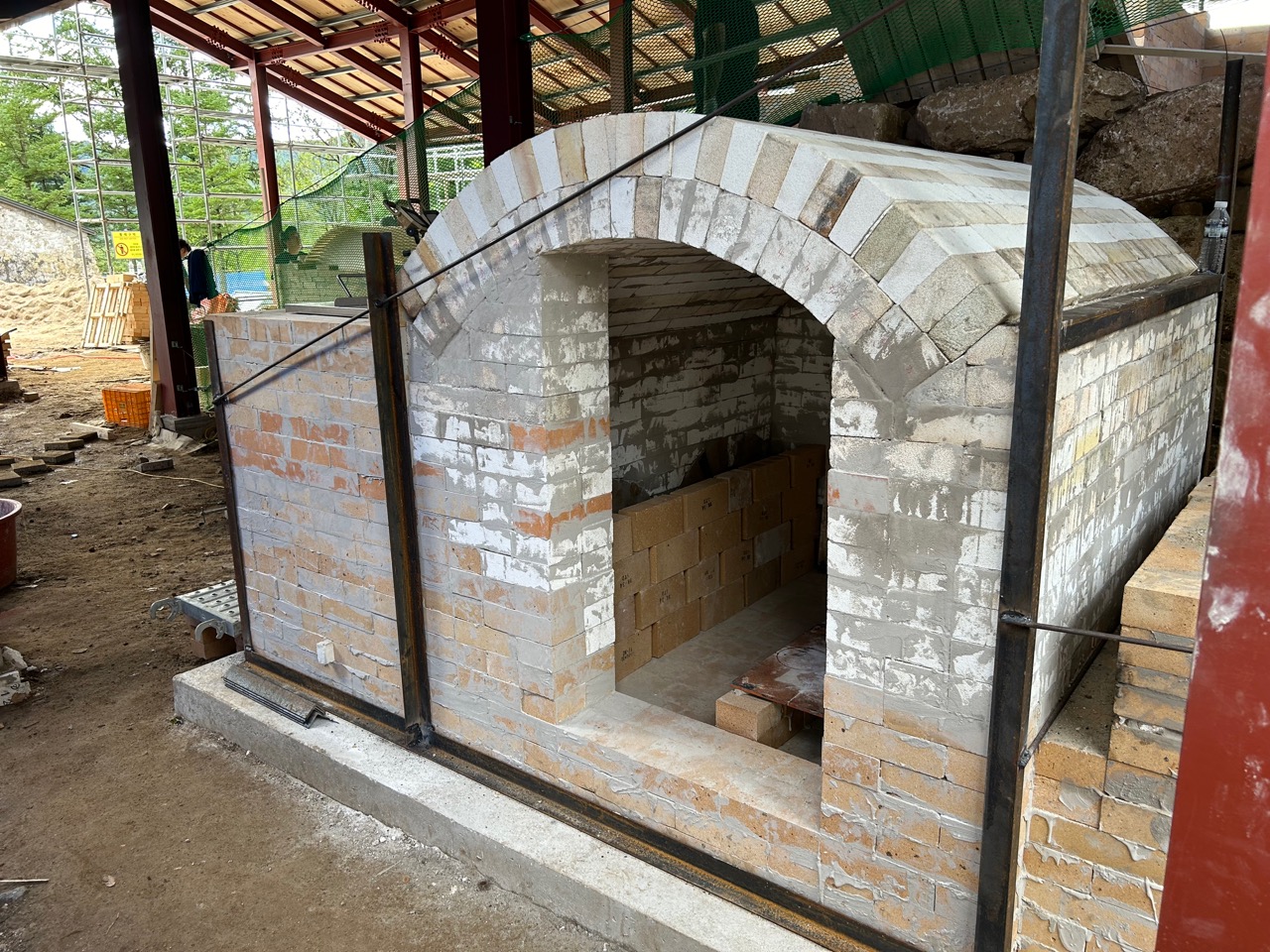
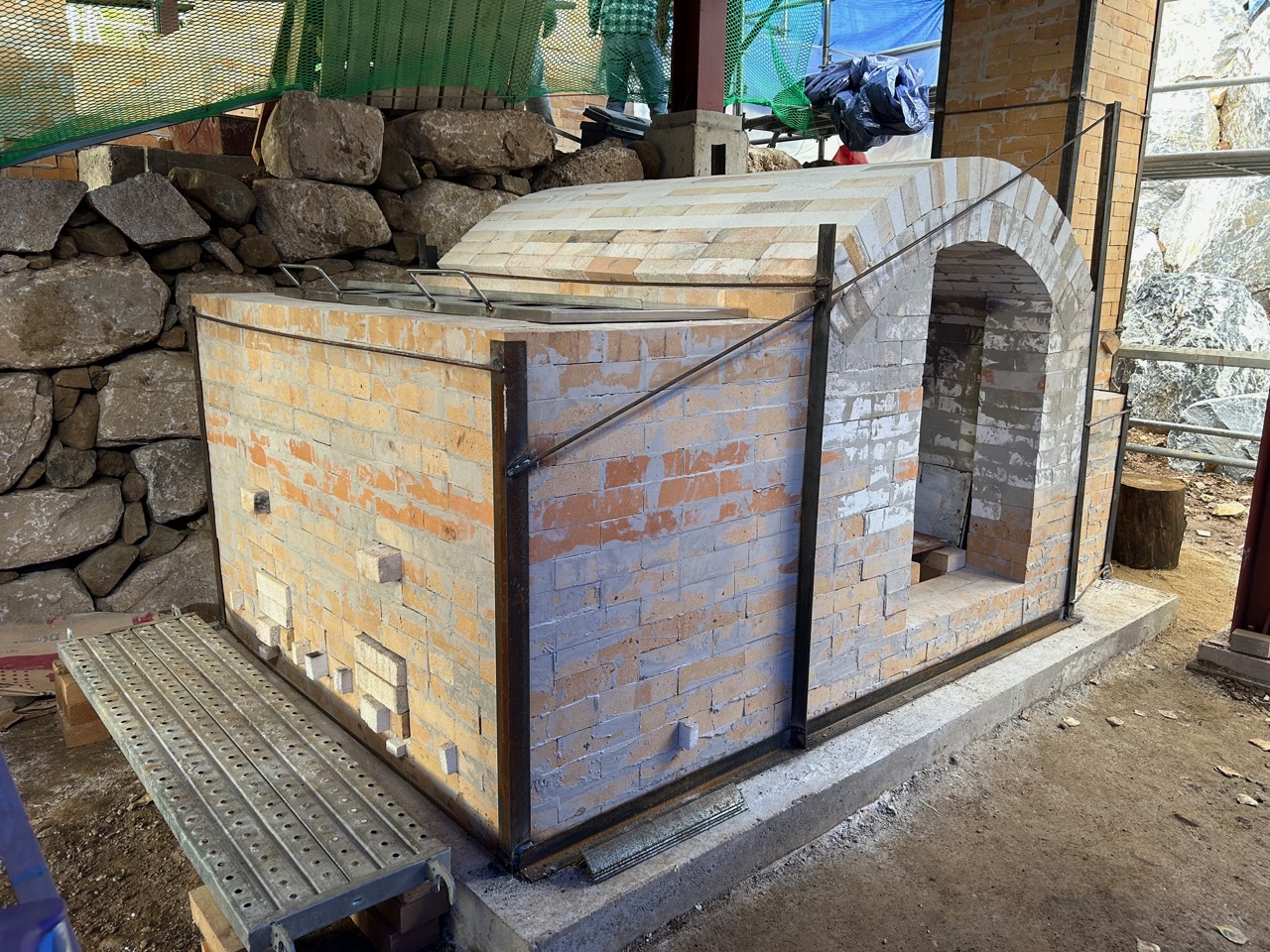
My wood fired kiln is small compared to the vast climbing kilns here. But it is actually quite a large kiln of 85 cu. ft. or 2.5 cu. m. Very large for a single potter to fill regularly in Australia. However, I expect that it will be filled by group effort here, just like all the other big kilns. Mine will be the 5th wood kiln to be built on site here. A demonstration model of what might be possible in terms of reducing smoke pollution in wood firing, while still achieving reduced stoneware wood ash effects.
I only hope that it all goes to plan, However, I am mentally prepared to accept some smoke, as all the wood here is very dry pine, that will burn intensely, so I will have my work cut out to get a good clean result. I will be severely embarrassed if it all ends up going pear shaped in the firing. So far the kiln looks good and is built to the specifications that I usually rely on when designing similar wood kilns. But knows what will happen when I fire it with very dry pine fuel. I can only guess, but I imagine that there will be some smoke.
My finished kiln with 2 Bourry style downdraft fire boxes side by side. Ready for K-pot firing. I have to wait and see what my decisions were like.
I have always been interested in living gently. All my ceramic work incorporates this philosophy, this respect for the environment. My lifestyle choices include growing my own food, generating my own solar power, collecting my own drinking water, building my own hand-made house from local materials, and growing my own fuel for my kiln. So when it comes to making my work. I choose to make it from locally available materials that I can find around me, in my immediate locality, wherever this is possible. This grounds me in my environment. It also severely limits what I can make, however, this is not a problem, it is an intriguing challenge that engages me on many levels physically, mentally and spiritually. I dig my native ceramic materials locally, within a 50 km radius of where I live. This has enabled me to develop my own unique quality of wood fired porcelain, proto-porcelains and blackware made from these special native stones. The Essential nature of this enterprise is about a respectful interaction with my environment, in this locality. When I was young I wanted to believe that there were some absolutes in life. I wanted to believe that there could be a definition of such concepts as truth and beauty. I’ve come to realise that there will not be any absolutes in my life other than old age, incontinence and death, possibly taxes. I have had to come to terms with the fact that good and evil, truth and lies, beauty and ugliness are all relative and coexist in each of us, all of the time. I accept this duality and embrace the angst that comes with the rejection of false certainties.
We have lost our bush land, we are loosing our native animals. The corner shop has gone. We are forced to drive in a car to a distant, edge of town, shopping mall to get to a bank and supermarket. Our neighbours houses have locked gates and shuttered windows. In short we are loosing our society. Everything has changed in my lifetime, and I don’t see it as better. I go to great lengths to avoid supporting the shopping mall. I search out the remaining family owned small businesses, the butcher, baker, fish monger and the greengrocer, to do my trade We have worked to become largely self-reliant with most of our food from our garden and orchards, but we still need to buy some protein.
We are no longer a nation of makers, we are all being corralled into becoming a nation of consumers. I reject this coercion. I will not buy vinyl coated chip-board and plastic, throw-away rubbish from Ikea or the hyper-mall. This apparent convenience is ruining the world. I want real things in my life, things that are beautiful as well as useful and that will last a lifetime if needed. I enjoy engaging with the patina of age and the mundane chips and tears of a life well lived on objects that I have come to love and respect.
Being brought up in a loosely Buddhist/Quaker household, I was probably the only 7 year old in my primary school who knew the whereabouts of the Dalai Lama, or even who he was. Not that I thought that this was in any way important at the time, but looking back now it seems a bit weird? Given this starting point, it should be no surprise that my first pot in 1959 was an interpretation of a Tibetan butter lamp. It’s amazing what kids pick up from parents conversations. Not that I knew much about Tibetan butter lamps, but it is quite interesting to me on reflection, that this is what I chose to make, sitting in the gutter of the dirt road in front of where we lived and picking out fresh wet clay from the gutter after a rain storm. I suppose that it supports Loloya’s assertion that the man is made in the child before his seventh year. My mother kept that pot all her life and after her death, I discovered it amongst her personal treasures, tucked safely away, wrapped in cotton wool, in a box in her wardrobe. So it came back to me and I still have it. At that time, in this family setting, it was not the pot that was important, but the activity of its making and the effect that the pot and its creation would have on the maker and the people who used it, which was up for discussion and appreciation. Around this time it became clear to me that the best things in life were not things at all.
Rachel Carson was a hot topic in 1962. I was 10 and old enough to be expected to help shovel manure into the ‘turned’ compost heap for the large, extended-family vegetable plot that fed us all. In 1972 I had decided that I wanted to be a professional potter and was at Art School, starting to wonder where I would be living and how I could achieve a passive, independent existence as an artist. The Vietnam War was in full swing. I registered as a Conscientious Objector and the ‘The Club Of Rome’ released ‘Limits to Growth’. I decided that I could only hope to achieve financial, artistic and food security if I chose to live out in the country where land was cheaper and the air and water cleaner. These events and others like them ground my cultural lens and set its focal length. So now when I think about firing my kiln, I first think how important it is to fire as cleanly as possible, as I would be the first one to be concerned, if my neighbour were to create a lot of unnecessary smoke and pollution in his day to day life. I don’t see that being involved in a creative activity gives us some sort of carte blanche or ‘get out of jail free card’ to pollute.
I also think about how I can use as little wood as possible while still being able to see that my pot is obviously wood fired. I don’t buy my wood from a merchant. I grow it, cut it and split it myself. I have a finite amount of energy, everything that happens here is facilitated by human effort. However, I do use a few machines these days to help me do the heavy work as I get older. I have replaced my original old, hand cross-cut saw with a chain saw. The block buster with a hydraulic splitter. The water bucket with a pump. Hand and foot mixing my clay with a pug mill. I am not a luddite, but I am aware that everything has an environmental cost. However, as I age I need to reduce the physical strain on my body if I’m to continue to keep working and creating beautiful objects into the future.
I have an image of what I want to create. I chase it. It is beautiful, but elusive. I can never achieve what is in my minds eye, but I keep prosecuting the illusion that it is possible. I like the intimacy of the bowl form. It is small, round and engaging when cupped in the hands. I love them as objects, the symbolism of sharing, the embedded meaning of the food container, nourishment and sustenance. I love the rich history of the peasant rice bowl and the Japanese tea bowl. They are omnipresent at every level of my life. I eat and drink from my bowls every day
This image that I have of a beautiful bowl worthy of contemplation has a gentle wood fired and flashed surface. A surface that I have worked at developing over the past forty five years of my creative practice, where my selected local timbers, when burnt in my hand made kiln, leave their delicate ash patterns on the surface of my locally sourced, water-ground native porcelain stone clay bodies. This subtle wood fired ash glazing of the ceramic surfaces at high temperatures develops a wide range of colours, textures and patinas that are not usually seen on porcelain.
I think a lot about my firing process and the best way to get the soft, delicate and engaging surfaces that are tactile and suited to being hand held and smoothly functional as well as endeavoring to exploit Asian aesthetic concepts of irregularity. This porcelain is not from the moulds of Sèvres or Meissen. This work has a proud Southern Hemisphere heritage.
I also think about the effect that my firing will have on others, my neighbours and finally myself and my family. Will these small bowls that I am making have any genuine useful place in society? Will the viewer appreciate the philosophical meaning embedded in their making? I certainly hope so, but nothing is certain.
It has been said that the most rare and expensive commodity today is time. My methods are fully hands-on, antiquated, quaint and oh, so very slow, so my output is quite small. These objects are time solidified and made manifest. Beautiful, unique things like these take time to be brought to life, and more time to be given a useful life in daily use, so that they develop their mundane scars and patina of use. They grow and develop with time, just as they require time to be fully appreciated by use and enquiry.
The unexamined bowl, is a bowl not worth living with. You can buy those bowls at Ikea.
Steve Harrison Opening Statement – Towards a Greener Wood Firing Practice.
I have been wood firing for over 50 years now. Gosh, how time flys. I never thought that I’d live this long, never mind still be wood firing at this age. But Peter Rushforth was still wood firing right up until a few years before his death in his 90’s.
I became interested in firing my pots with wood while I was in art school at the old ESTC in 1971. There was no wood fired kiln at East Sydney back then. In fact there were no student built kilns there at all. However, I changed all that when I started teaching there in 1974. I built half a dozen wood fired kilns. In fact ESTC, got a reputation as the place to go if you wanted to learn about wood firing, at that time. This reputation was further enhanced when Bill Samuels joined the staff a few years later and built a tunnel kiln.
Returning to 1971, I realised while I was still a student that if I wanted to fire with wood, it would have to be in a self made kiln, built in my parents back yard. I had very tolerant and supportive parents! I was drawn to the quiet, natural qualities of wood firing. No one was wood firing back then in 1970, but I was influenced by my reading of books on Japanese tea wares. The pieces that I was drawn to were all wood fired, from Iga and Shigaraki, through Shino wares to Bizen pieces. All my teachers, Peter Rushforth, Col Levy and Derek Smith were firing with oil fired kilns. Bernie Sahm was firing with coke and later LP gas. Shiga Shigao, with whom I did my apprenticeship a few years later, was also firing with LP gas. So to fire with wood, for me, meant going it alone. Luckily, I had my partner Janine king who was also keen to fire with wood.
The only pottery book on the market at the time was Bernard Leach’s ‘A Potters Book’, everyone had a copy. It was required reading. In there Leach states that he built his first wood fired kiln in Japan as a student. It was a complete failure. He failed to get to temperature and also managed to burn down the kiln shed and studio in the process! He tells how wood firing is dirty, smoky, very difficult and exhausting. Possibly so, but Leach was an English Gentleman, not used to any hard physical work. He and Hamada, later built a 3 chamber climbing kiln, when he returned to England to set up the Leach Pottery in St Ives, but soon converted it to oil firing. Wood firing was just too demanding and difficult.
Leach states: “The reluctance of many kilns to rise above 1200oC to 1300oC has been to many another potter besides myself a cause for anxiety and even desperation. The firing is the climax of the potter’s labour, and in a wood fired kiln of any size it is a long and exhausting process. Weeks and months of work are at stake. Any one of a dozen things may go wrong. Wood may be damp, flues may get choked, bungs of saggars fall, shelves give way and alter draughts, packing may have been too greedily close, or for sheer exhaustion one may have snatched an hours sleep, handing over control to someone else and things begin to move, to warp and to bend, the roar of combustion takes on a deeper note—the heavy domes crack and tongues of white flame dart out here and there, the four minute stokes fill the kiln shed with bursts of dense black smoke and fire. Even in the east, where hand work is usual and labour specialised, a big kiln firing has the aspect of a battle field where men test themselves to the utmost against the odds. This may sound like discouragement, but it is the simple truth”.
Having read all this, it seems that all of the Australian potters followed suit.
The only wood fired kiln in Sydney when I was a student was at the University of NSW, in the Industrial Arts Dept. It was fired just a few times a year. Ivan McMeekin forbade any outside visitors to firings. Possibly on OH&S grounds. But especially students from the National Arts School, who he looked down on as being a bit radical and not properly trained. However, I used to turn up for the night shift after 5 pm when he had gone home, and made friends with some of the students. Ron Balderston and Geoff Crispin. I still see Ron, we became friends. I learnt a lot there. I sat quietly, was respectful and did a large share of the wood carting and stacking to earn my keep.
What I learnt at the uni of NSW, was that wood firing can be a quiet, easy, relaxed, efficient and a clean way to fire pots. It can be a beautiful experience! If you prepare yourself well, with all your wood cut, split and stacked next to the kiln, and if the kiln is built in a well planned, decent space with room around it and well ventilated. It is a remarkably satisfying experience. Whether this is how it is for you is entirely up to you to get your preparations in order. We have come a long way since Leach in the 1940’s.
I believe that it is widely understood by those who know me, that I am a Greenie! I am always looking for better, cleaner, more environmentally friendly ways to fire my kilns.
It is generally understood here how wood firing can be carbon neutral. The carbon in the wood fuel comes from the air and is returned to the air when burnt. If the tree is not burnt, but left to rot in the forest, all the carbon is still return to the environment, but on a longer time frame. However, cutting forest to burn as fuel can be an environmental disaster. Just think of Queenstown in Tasmania!
It all depends on how you go about obtaining you wood fuel, and how you choose to burn it. Janine and I are lucky enough to own our own forest, that we have nurtured and lightly harvested for its dead wood for almost 50 years. 48 to be precise.
But being carbon neutral is not what occupies my attention these days. There is the problem of particulate emissions from our chimneys, This is going to be a big issue into the future, not just smoke from chimneys, but the very fine PM2.5 particles. I understand that Canberra has now banned wood burning stoves within the city boundaries because of the health issues. Potters who claiming that “I only reduce at night”, or “I Live out in the country side” doesn’t remove the problem. It isn’t a responsible or thoughtful answer.
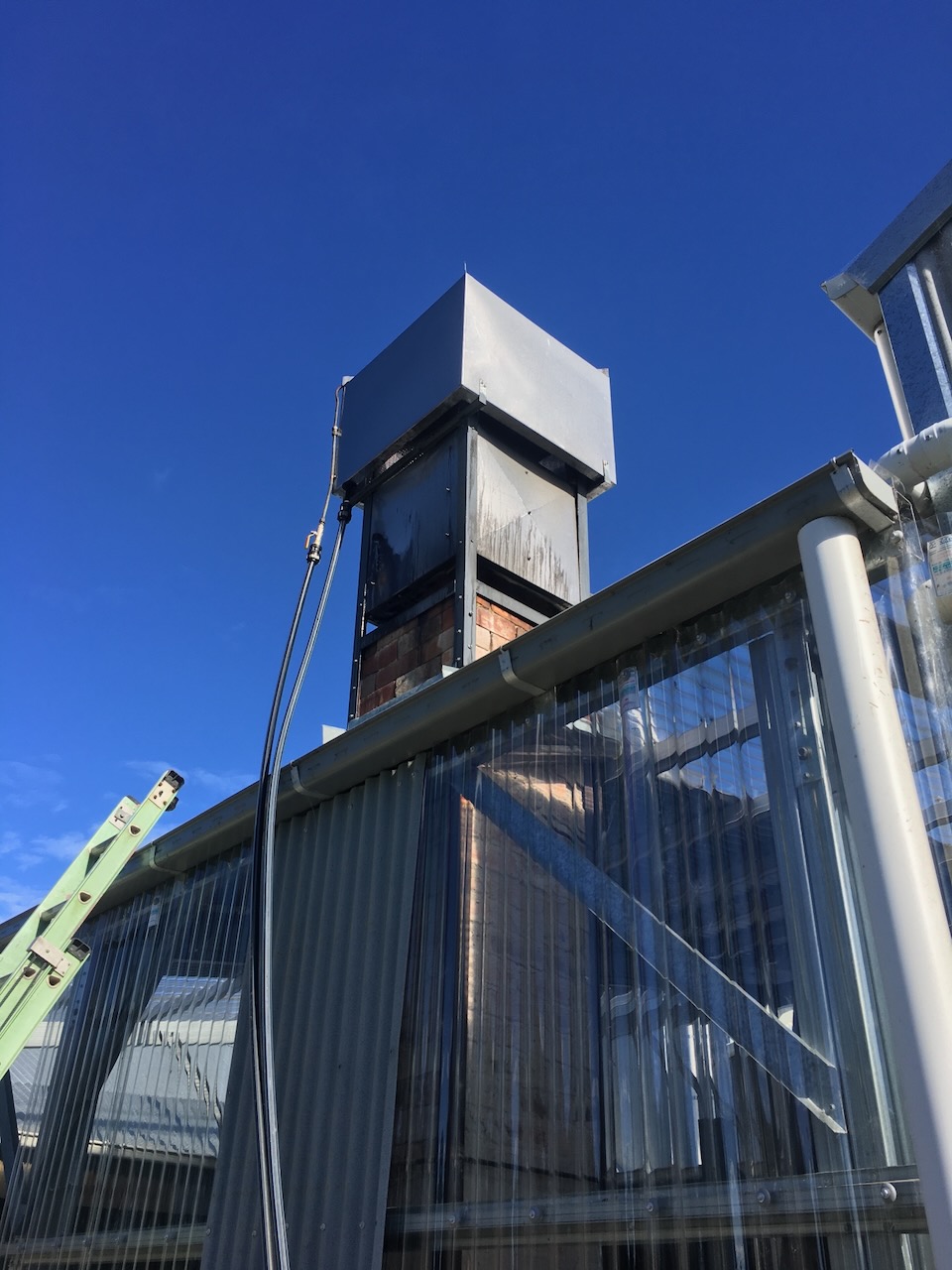
Over the last couple of years, I have been experimenting with an afterburner/spark arrestor/scrubber on top of my chimney. This is my attempt to reduce my particulates. It’s a work in progress at this stage, but I believe that I’m making some progress.
Stainless steel ‘Scrubber’ installed on top of the chimney.
We all have to do our bit to keep the environment as clean as possible while still living a creative life. I chose to fire my kilns very quickly to minimise the destructive environmental effects of my work. Janine’s little wood fired kiln fires in just 5 hours, my larger brick kiln is fired for about 15 hours. But I use a down draught fire box (Bourry Box). This makes for a relatively clean firing. It doesn’t put a lot of ash on the pots, but it ‘flashes’ the glaze surfaces, and enhances the look and feel of the pots. I really appreciate these minimal ash effects on my glazes. Just look at the work of Gwen Hanssen Pigott. Beautiful, elegant, lightly flashed wood fired surfaces.
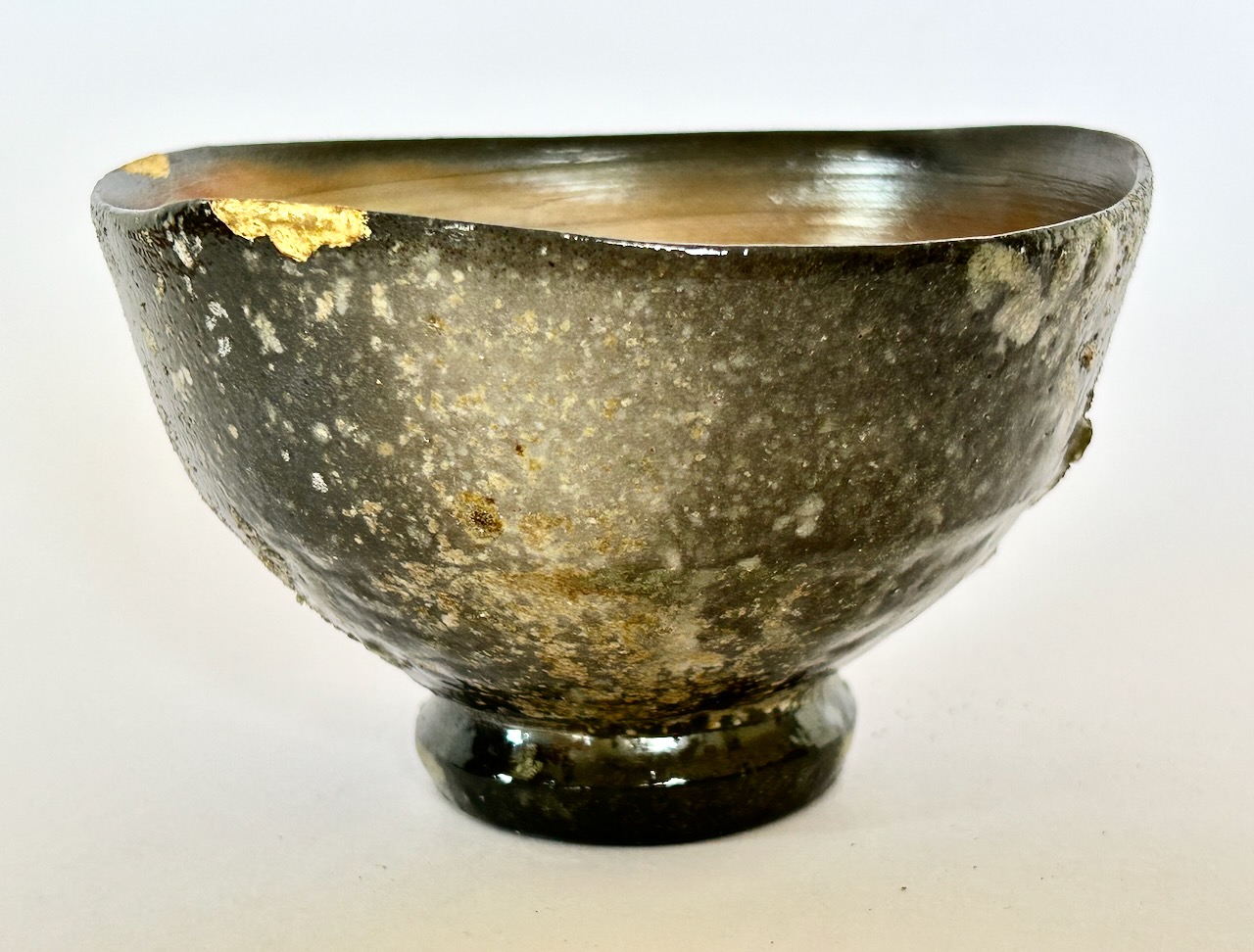
I really love the delicate ash deposit that I get on the surface of my celadon glazes. it enhances them. It doesn’t detract in any way. Of course, right at the front of the setting where the ash and embers meet the first rows of pots. A lot can happen there. This is a place I call the ‘Zone of Death’, because a lot of pots are sometimes reduced to shards there, but ever so beautiful shards they are! These pieces can be just as interesting and dramatic as any pot from a 5 day firing, but without the emissions. See my piece titled ‘Damaged Goods’, as an example of this kind of fired surface.
Unglazed porcelain bowl with minor kintsugi repair.
Gathered here tonight are a representative sample of all of the different approaches to wood firing. It’s a very rich and varied field of artistic endeavour, and it’s so good to see so much great work all in one place. Long may we continue to stoke the fires of our creative desires.
Here we are in the first week of spring and the hot weather was very welcome, but unseasonably hot for this time of year. Just more evidence of global heating and what’s in store for us in the future?
I have given the peaches, nectarines and almonds a 2nd spray of copper Bordeaux mix to try and minimise leaf curl and shot hole fungus spores. It needs to be done once a month during the growing season. Actually, the recommendation is for every 10 days, but who has the time? And too much copper spray drift can build up in the soil and become toxic over long periods of time. So I just do the minimum.
I don’t think that I can ever eliminate it here, just keep it under control to minimise the damage. The trees don’t seem to suffer from it too much later in the season. Perhaps it has a lot to do with the cold damp nights in early spring?
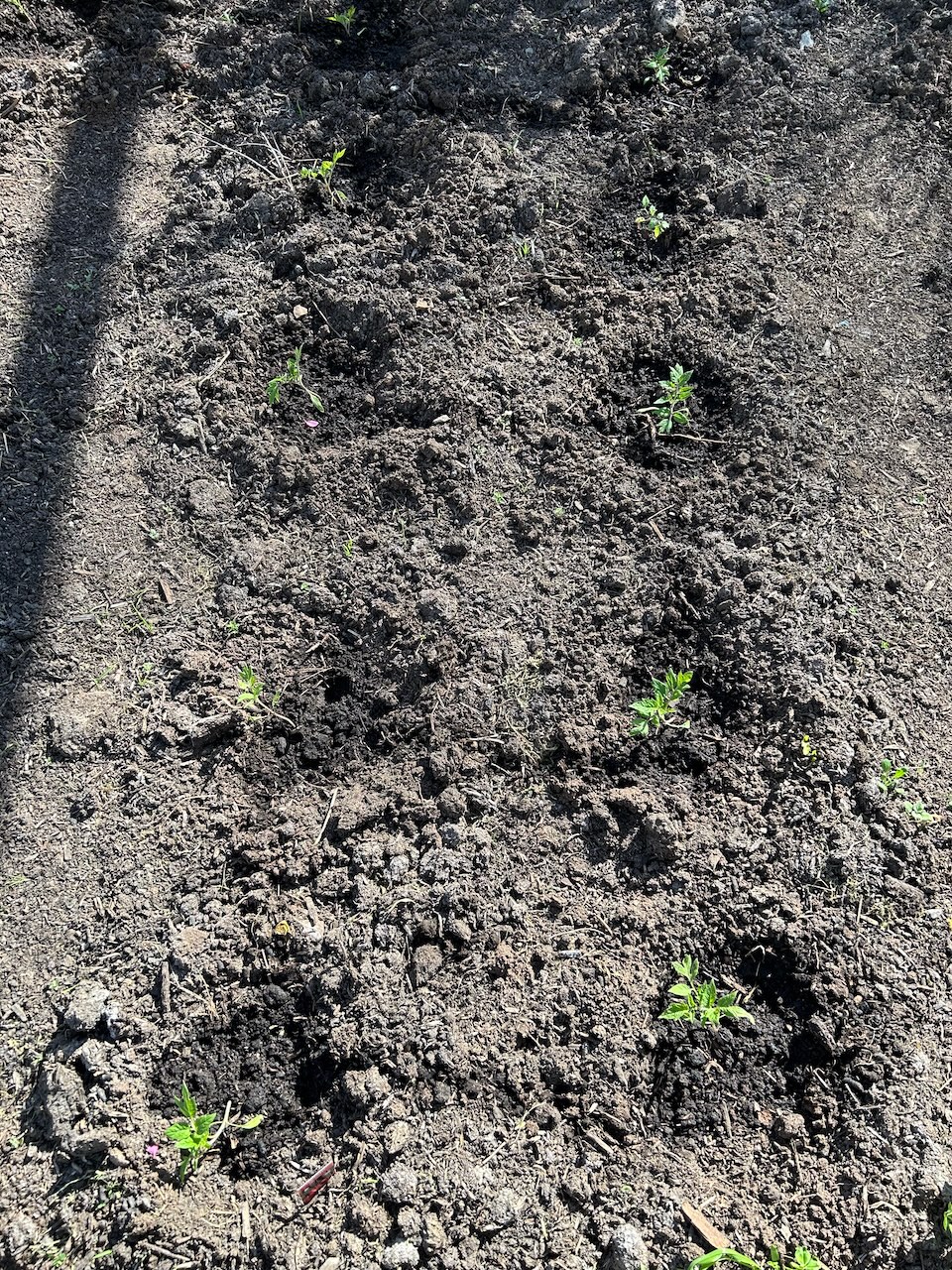
Because of the warm weather. I planted out tomatoes, zucchinis and cucumber seedlings. Plus peas, beans, sweet basil, lettuce and radish seeds. Then last night we had a cracking frost. The Weather Bureau only forecast 2 degrees for Bowral, our nearest town with a weather station, and we are usually one or two degrees warmer than that. But not so last night. However, I checked the seedlings and they are all OK in the protective cocoon of the plastic bird netting frames that cover both the orchard and vegetable garden. Lucky!
The Flanders poppies have now started to open and will be with us for the next few months. They need disturbed soil to germinate, so do best in the vegetable garden, because the soil is regularly turned over while weeding and planting. I established them in the new orchard and they did well for the first year, but as I haven’t cultivated in there since, only mown, all their seeds are lying dormant in the soil, with no new plants germinating in there.
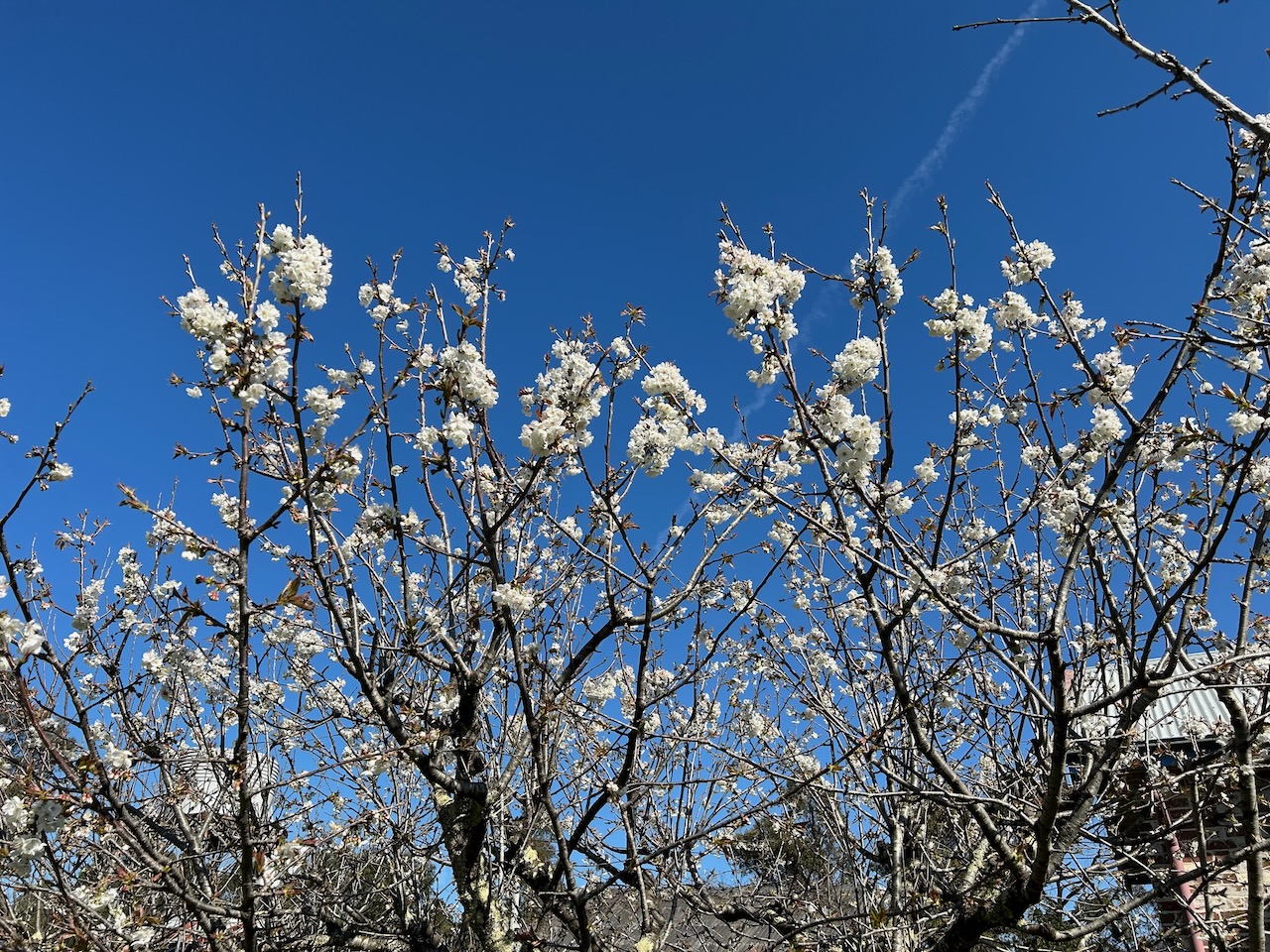
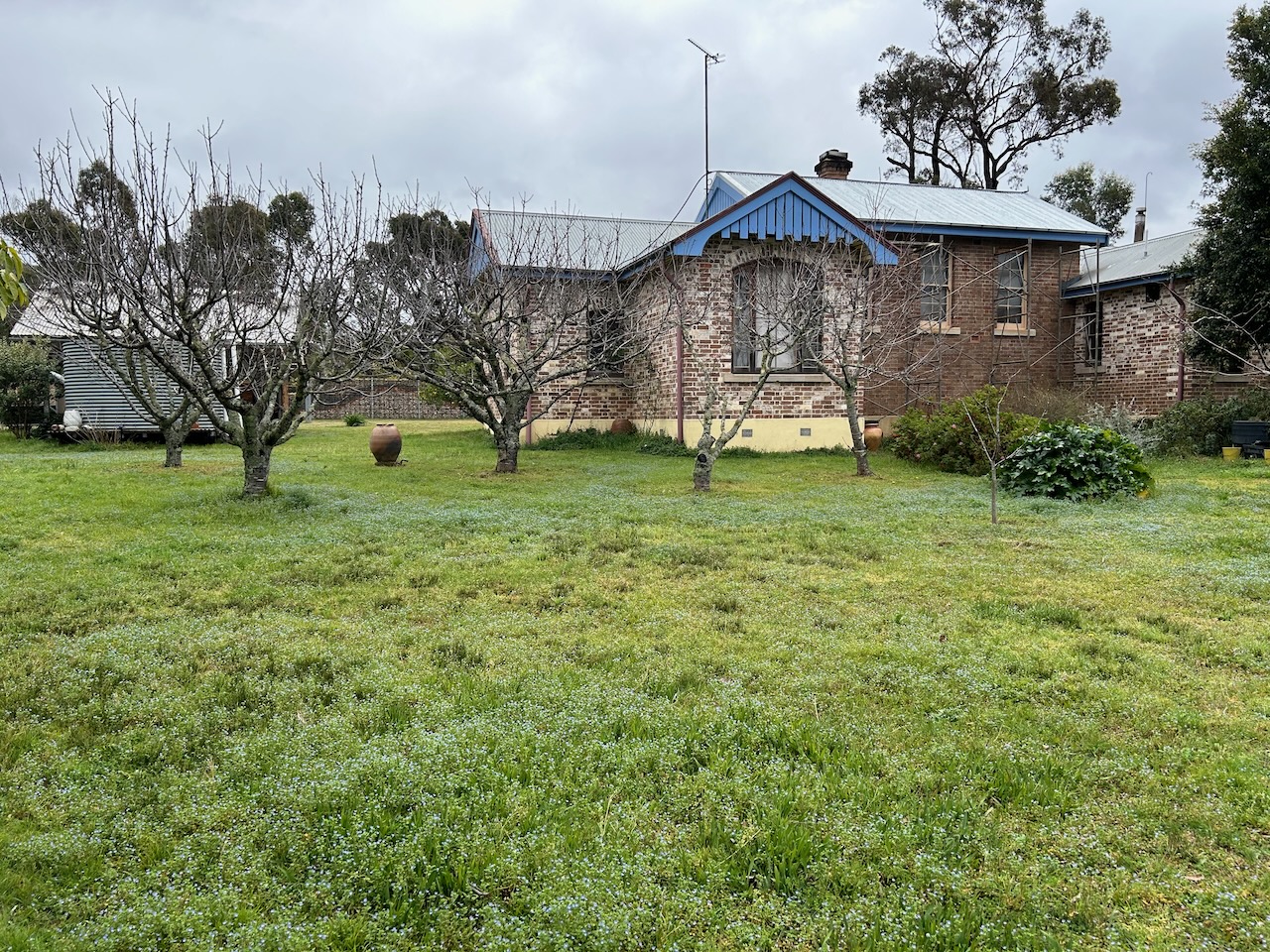
The Cherry trees are in full bloom now as is the avocado tree. Every thing is responding to the warmth. There is so much optimism in the air now. Life is returning to all the formally dormant plants. I took a picture of the lawn behind the house. I use the term ‘lawn’ very loosely. It is actually a stretch of self sown wild grasses and weeds that we keep mown. This stretch of mown weeds has just erupted on a blue haze of tiny flowers in huge swathes. The flowers are microscopic, but there are millions of them. I tired to photograph it, but the effect on the light out there just doesn’t show up a clearly in the image. Janine tells me that it is called ’Speedwell’, but our neighbour, John Meredith used to call it ’The blue pimpernel’. What ever it is, it’s very pretty on mass.
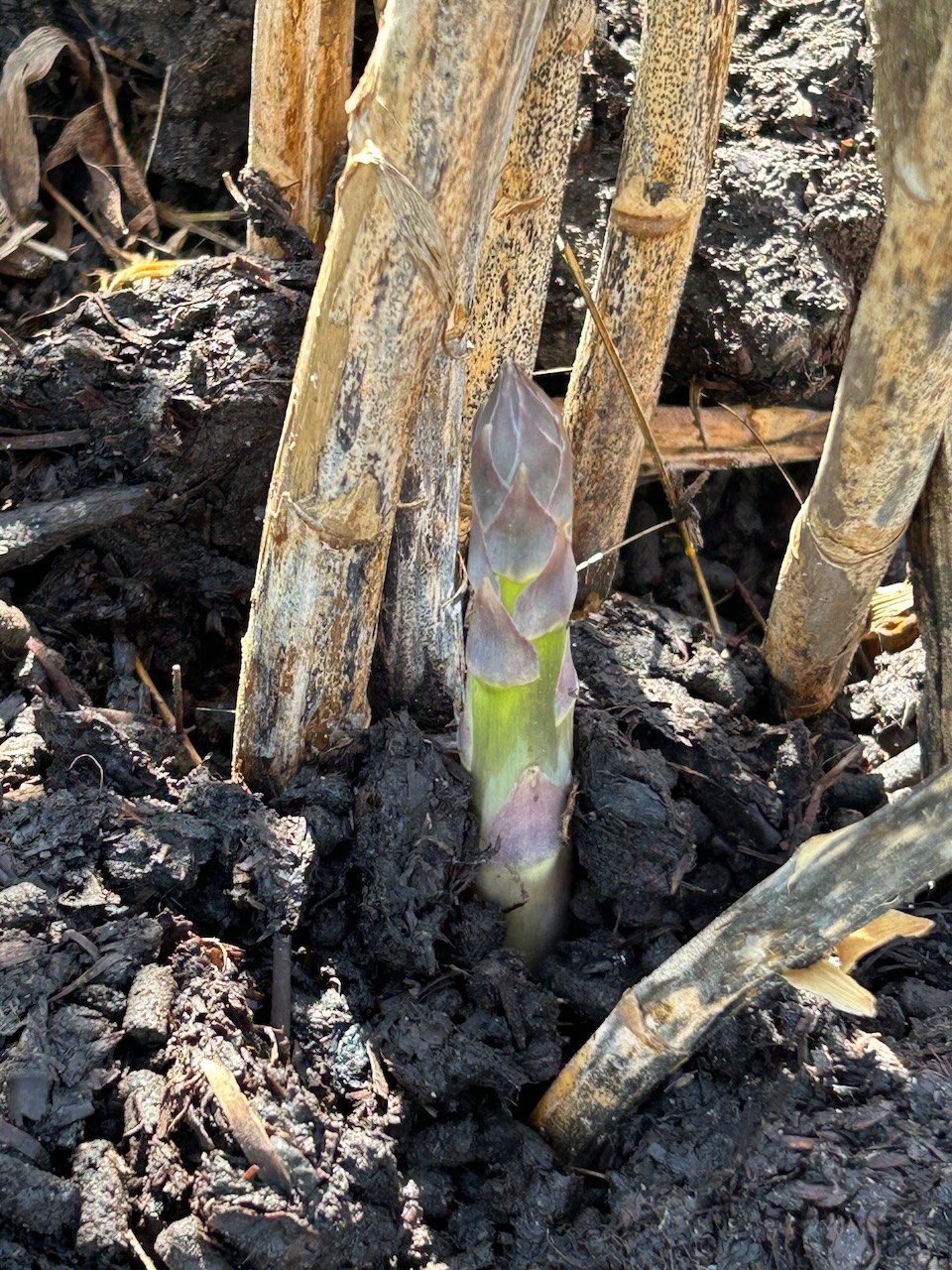
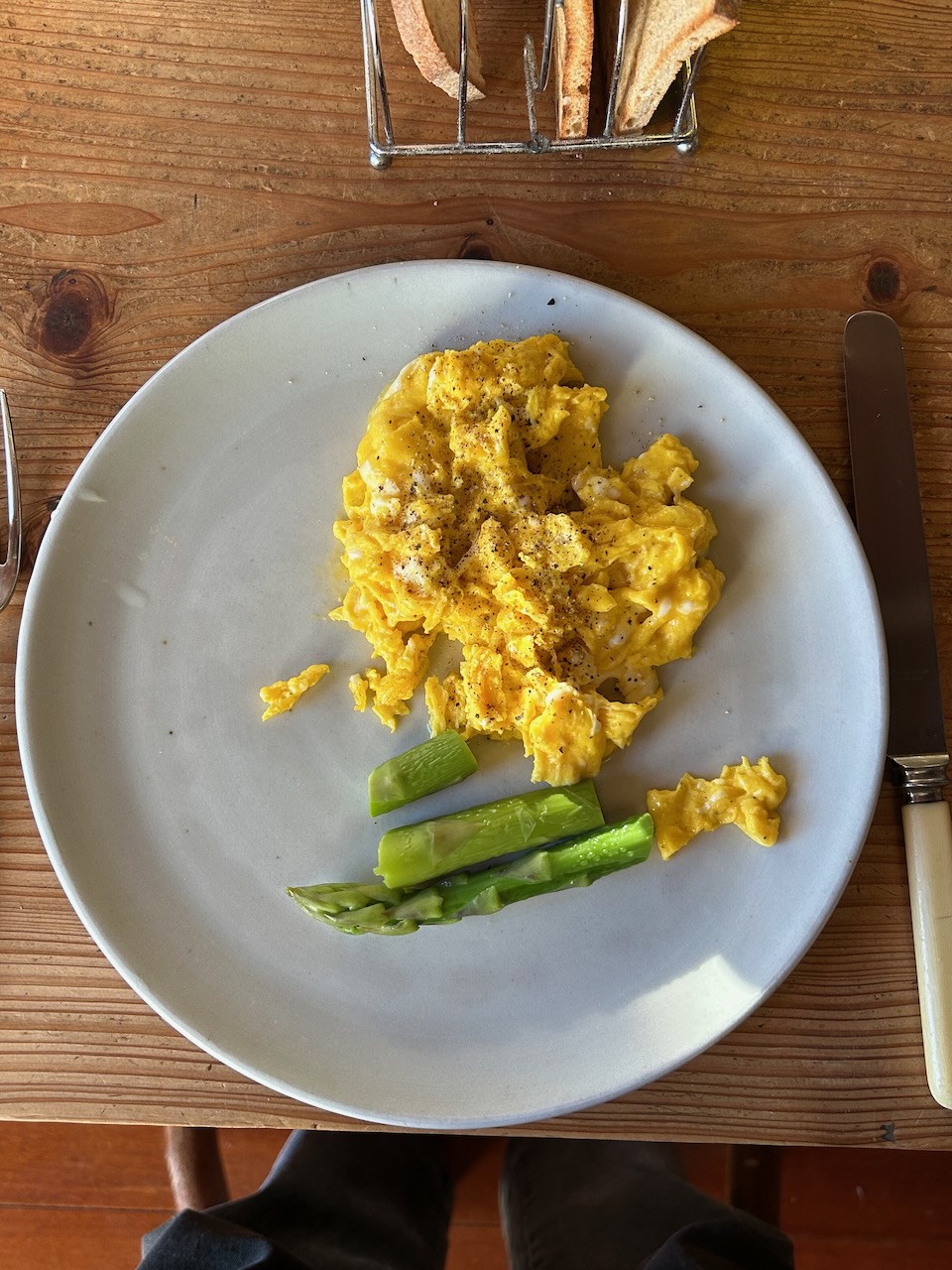
We have just completed the last of 5 in a row, weekend workshops. Quite a busy time for us. It’s nice to have a bit of ’spare’ time now, so I’m back in the garden, just in time for spring. The asparagus is just starting to pop up, just a few at a time, here and there. The real season is still a couple of weeks off as yet, but I’m picking the biggest ones to have with our breakfast eggs.
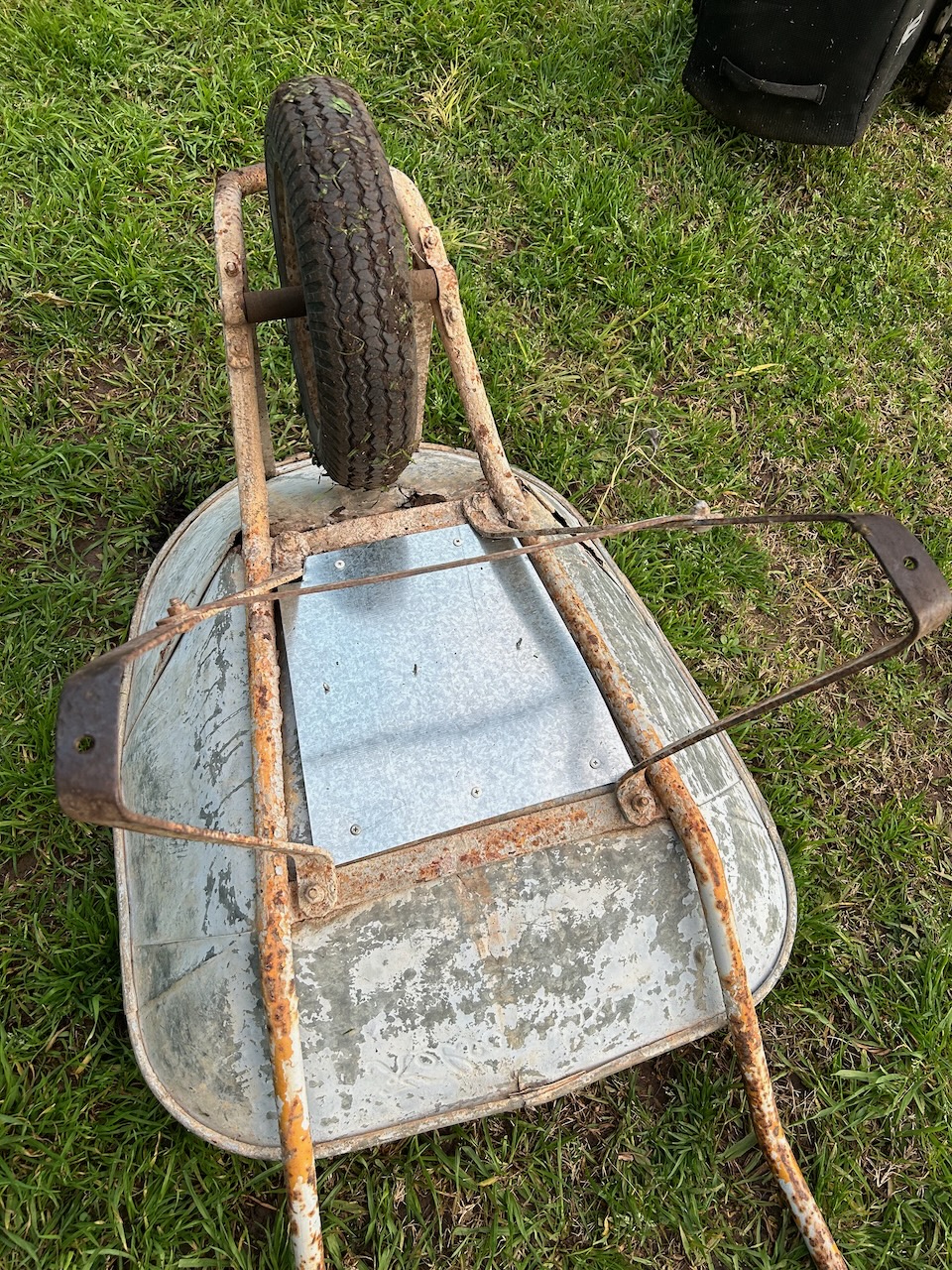
Now that I have just a smidgen of spare time, I have mended the old wheel barrow. We bought this wheel barrow in 1976 or ’77? More or less the first year that we arrived here. We had worn out two 2nd hand ones previously. Purchasing this one was a real statement of ‘We have arrived, and we intend to cultivate this derelict place’. The bottom got rather scratched over the years and had started to rust out, becoming wafer thin and flimsy. I hate to see waste, so I stepped in and made a new base plate for the tray and fitted new bearings into the wheel hub. It’s all good for another couple of years till the next part wears out.













































 Tonight my Fingers Smell of Garlic
You must be logged in to post a comment.