My project to introduce clean, low emissions, wood fired kiln technology to Korea has gone pretty well. The third firing that I did using local hard wood was excellent. In fact, better than I had hoped for. I was actually surprised how well it went. I’m a cautious person, So I was a bit surprised, I wasn’t going to dare to change anything, just stick to my technique and decisions. It worked! So that was good!
I’m always prepared for things to go wrong when trying new things. Very few things in life ever turn out perfectly, and this last firing came close, but the was no cigar! The bottom back shelf was still a little bit under-fired. However, no-one complained!
The day after the kiln was unpacked, I went down to the kiln shed early the next morning, before work, and took out the bag wall. I eliminated one complete layer off the top, and removed one full brick from the cross-section. I re-arranged the smaller number of fire bricks with bigger gaps between them, so as to allow more flame to pass straight across the bottom of the chamber and allow more heat to the bottom back shelf.
Over the three firings that I did here, I got better results each time, as I tuned the kiln settings and chose better wood, more appropriate to fire cleanly in this design of kiln.
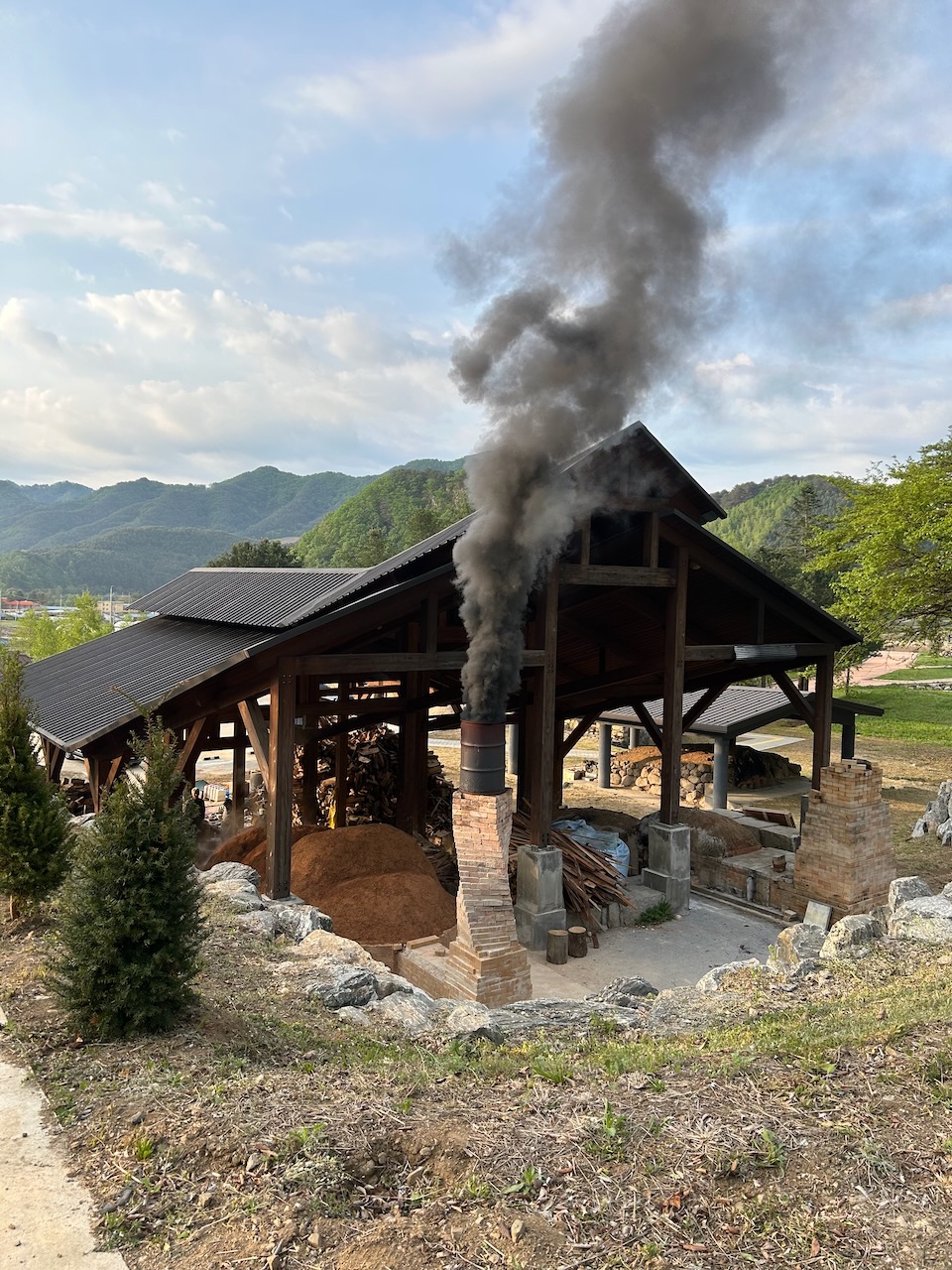
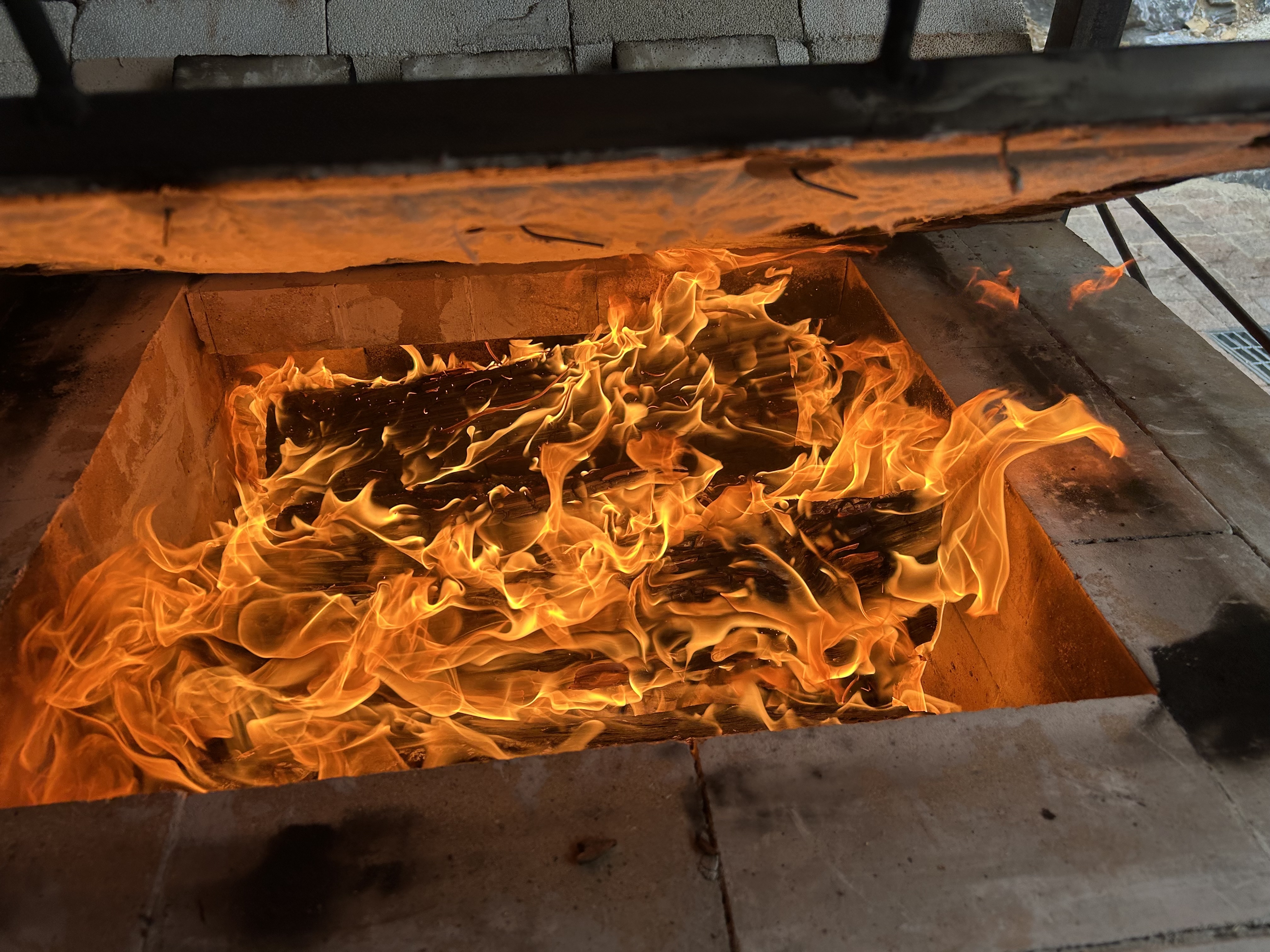
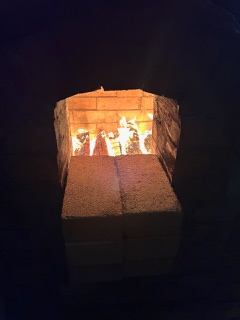
Below is an image of my kiln firing to stoneware in reduction near top temperature. There is no smoke coming from the top of the chimney.
My chimney isn’t particularly tall, but it is wide. Short and thick, does the trick! Or so I’m told!
I calculated the height and cross-section of the chimney based on theory. The total volume of the hot gasses enclosed in the chimney volume, as opposed to the same volume of cold air on the outside. Chimneys work because the cold air outside is forced in at the firebox by air pressure, and this pushes the lighter hot air up and out of the top of the chimney. It’s all about volume, not just height.
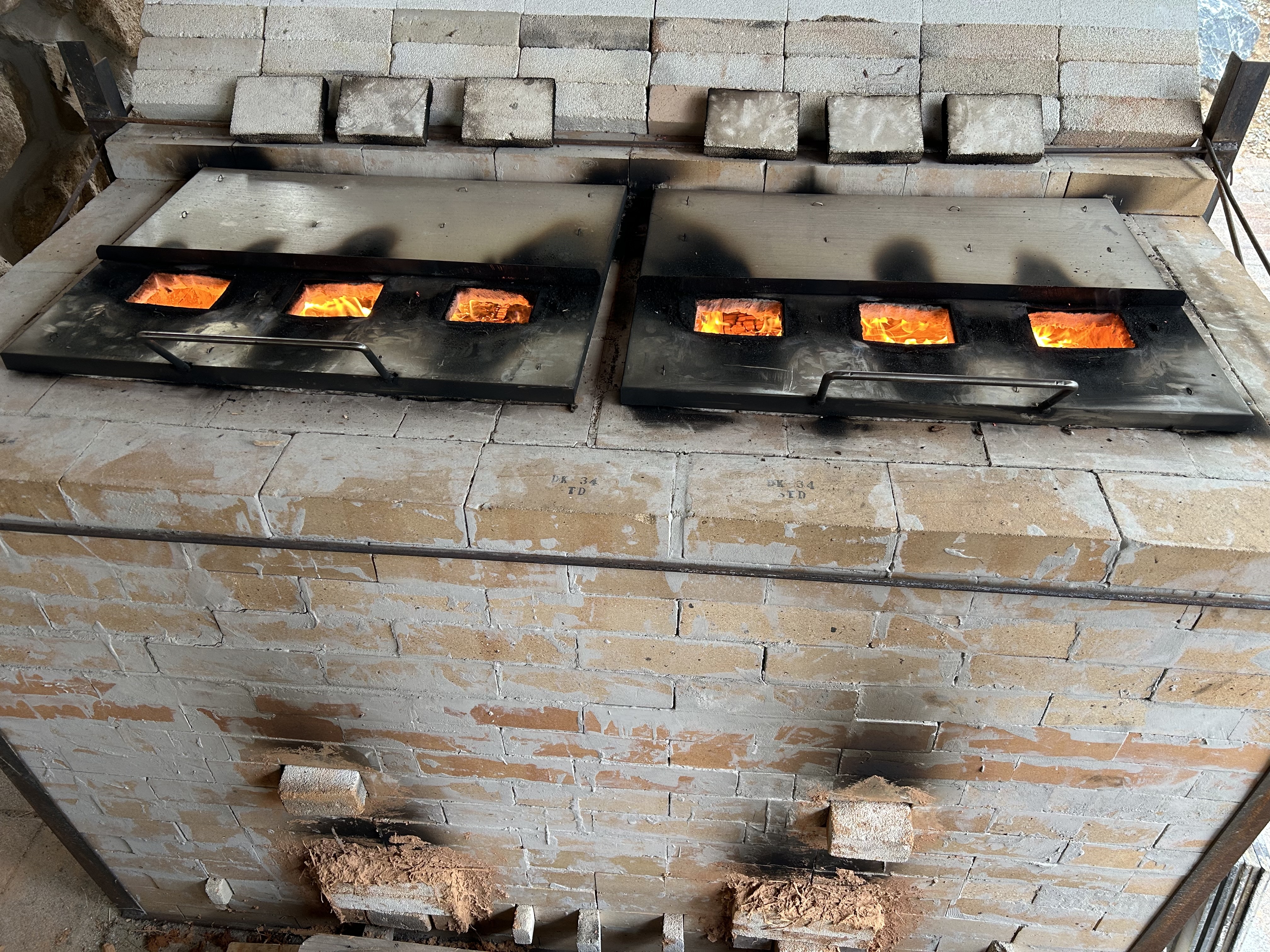
Below is the traditional kiln next to mine being fired the traditional way. Koreans are used to making loads of smoke. It just seems so natural to them. They were quietly amazed that I could fire with so little smoke and still reduce. One of the traditional kiln firing team, A National Treasure potter from his own local region, went straight home and built a copy of my kiln for himself. So I consider that a success!
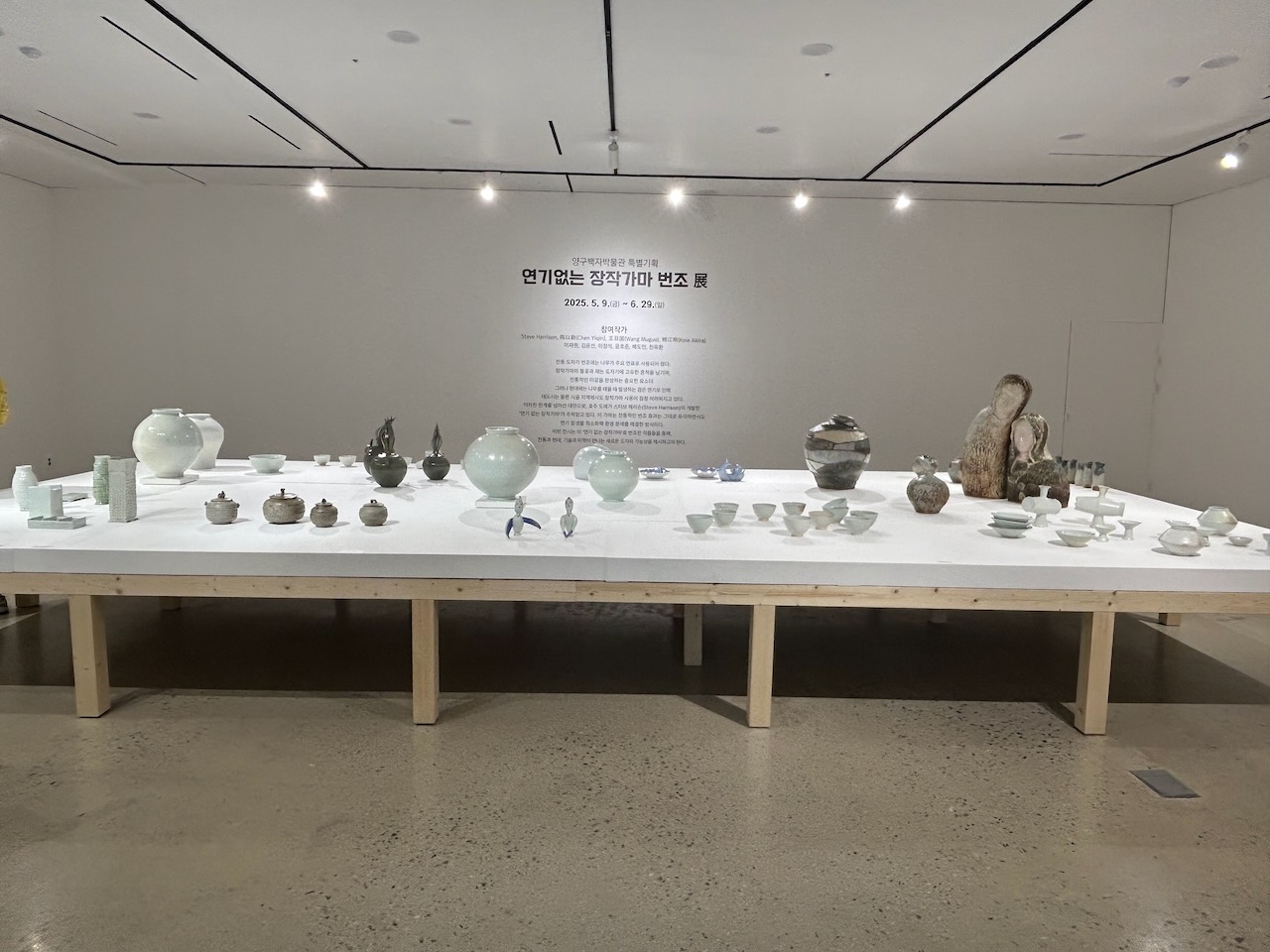
So my introduction of new ideas, with appropriately successful results, was well received. My host, Mr Jung, had organised the local TV station to make a documentary film about my visit, the firings and the subsequent exhibition of the fired works. Several international potters from France, Japan and China were invited to make work for me to fire, as well as a few local potters. After the kiln was unpacked and the work fettled, it was put on show in the Porcelain Museum. The exhibition is on until late June in the Porcelain Museum. The Museum Director released a short promotional video of the firing in time for the exhibition opening, which he posted up on-line and got over 4,000 hits the first day. So he is very happy.
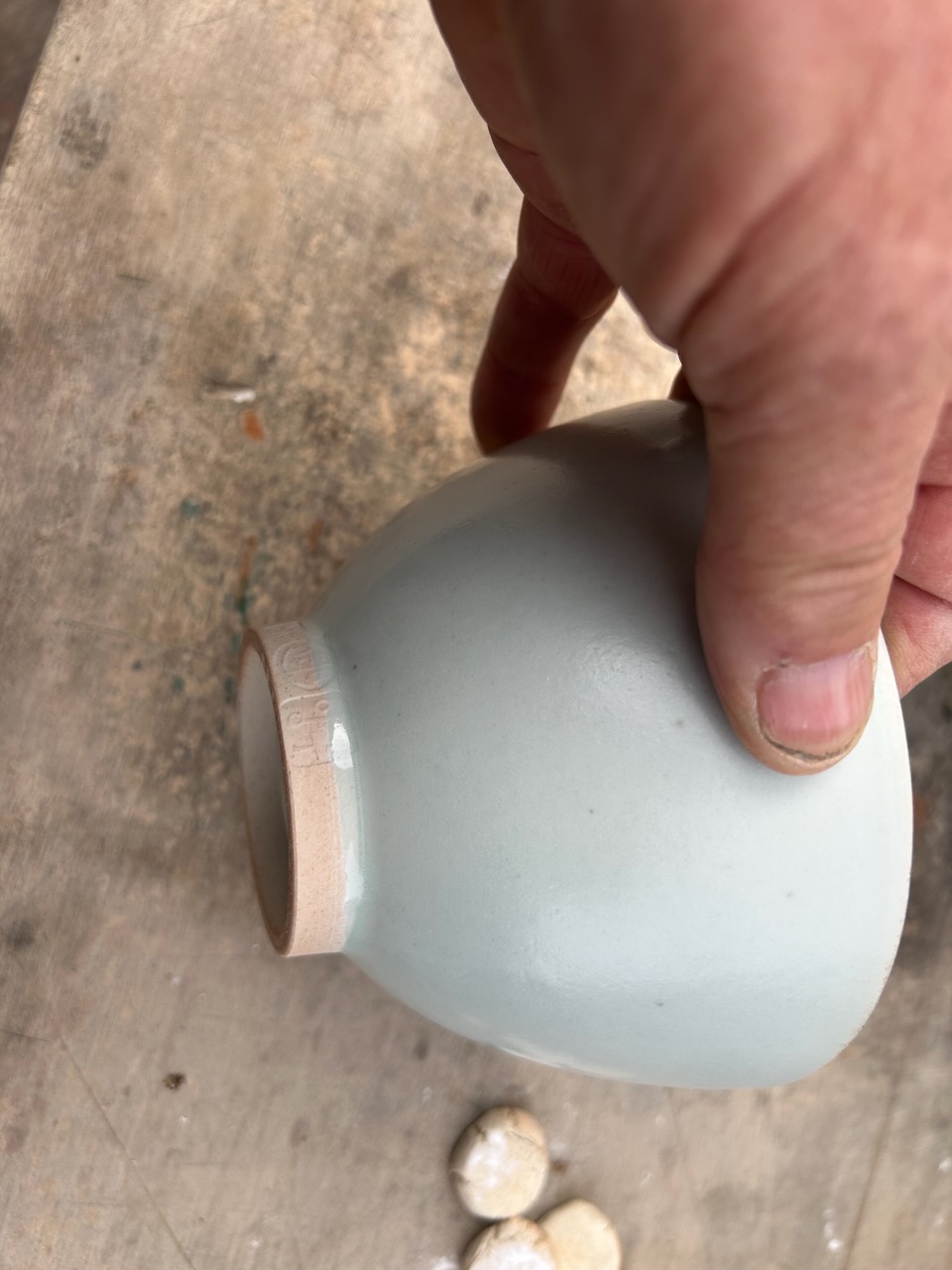
One of my bowls from the firing, with the Korean location name stamp and my name in Korean
The Staff of the Museum took me out to dinner after the event. They are all such a pleasant bunch of people, I really enjoy their company, They are great people. As I don’t have more than a simplistic grasp of ‘Airport’ Korean. All our conversations are carried out using translation software on our phones. The local Korean app is called ‘Papago”.
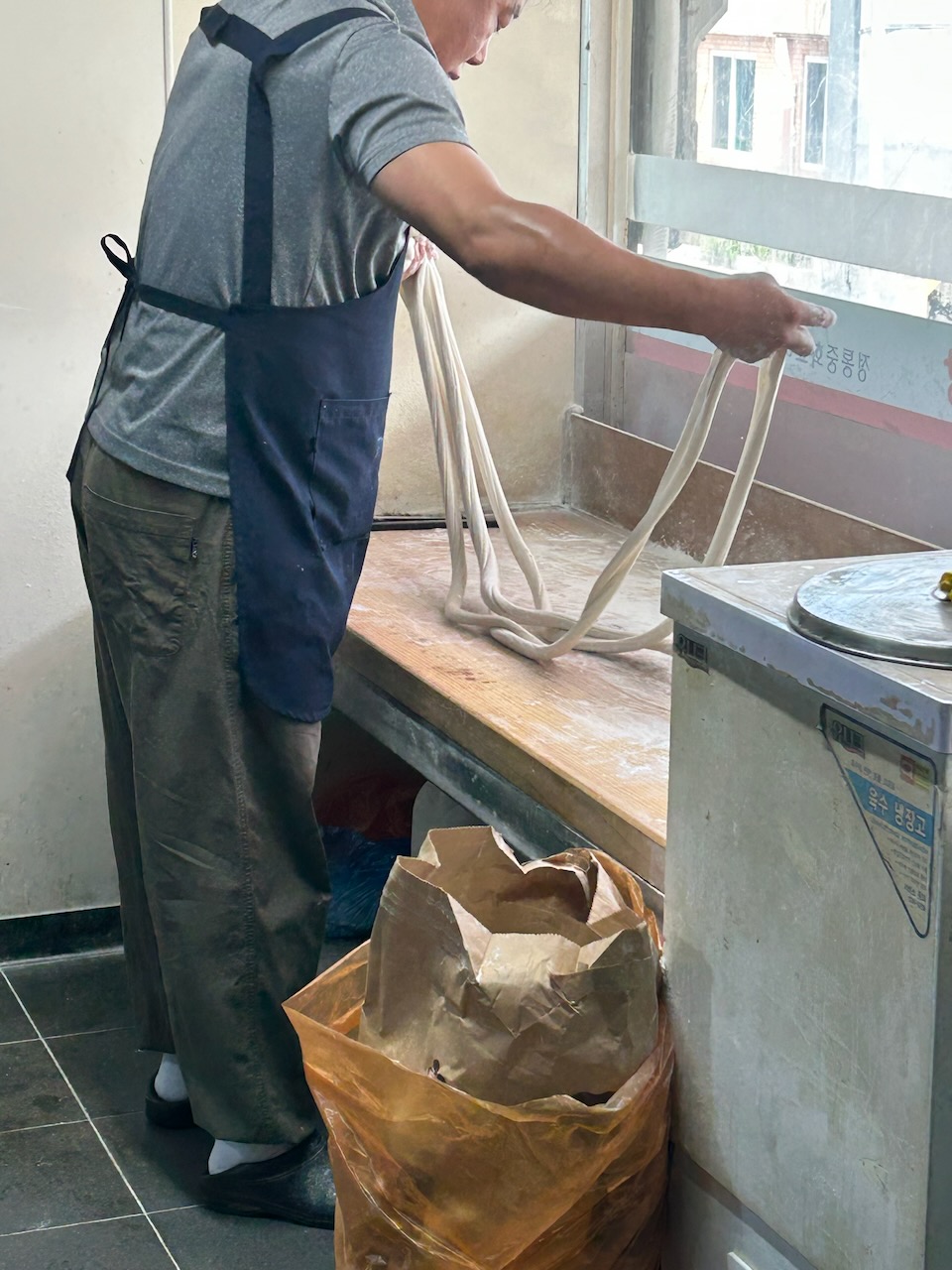
We went to a local restaurant where the chef makes his own hand made noodles. It’s worth going there just to watch him work. It’s an entertainment in itself!
Before I left, I made my usual pilgrimage up the mountain to the historic site where porcelain stone can be picked up off the ground. I collect a bag full each visit, (10kg) take it back to my room and wash it thoroughly, scrub it well, to get any dirt off the stones, then soak it in chlorine bleach over night to make sure that they are sterile, before bringing them home. It only needs to be put through the rock crusher, then the ball mill with enough water to make a slip, and then stiffened back up to a plastic state before throwing it on the wheel.
Throwing stones! Powdered porcelain stone mixed with water, nothing else!
There is nothing quite like sericite. It’s such a unique material.
After finishing my work at the Porcelain Museum, I travelled up to the northern suburbs of Seoul, to meet up with my friend Sang Hee. She took me to her mothers farm, where we spent the morning weeding some of the rows of vegetables.
And a salient reminder that you never step over a fence line here! Even though you are in the suburbs. Not everywhere has been thoroughly de-mined and checked to make it 100% safe.
My last day was spent in Seoul, getting ready to fly out the next day. I went into the tourist area and got a couple of new name stamps made, as I lost all my older name and workshop stamps in the big fire.
Another very rewarding trip in every way. I’m so lucky to be able to do this work!
Nothing is ever finished, nothing is ever perfect and nothing lasts!
I’m working in Korea in this little artists village community on the edge of a country town. There have been potters here making and mining porcelain stone for 800 years. The village is located away from the township, such that the smoke from the traditional wood fired kilns is not a concern for the township residents. It was great forethought in its time to start to locate all the wood kilns up into this side valley.
But it doesn’t stop there, this has been a long-term plan and as with all long-term plans, it is evolving and adapting with current thinking and social mores. Hence my involvement here with the constriction of my low-emissions wood kiln firing designs and techniques. I was commissioned to start this work here, back in 2019, I was all set to come, but before I could start, we had the fire, then covid intervened. So I was unavailable for some years. But I’m back here again now the the plan is back on track.
My demonstration firing was very successful. In previous firings here the only fuel available to fire the kilns with was very dry 5 year aged local pine. The standard fuel here that everybody uses. It is a statement of fact here that dry pine is the only fuel that works in a kiln!
Last year when I was travelling around, I visited a famous potter’s studio, where they fired with wood. He had built a special pine fuel drying kiln, to desiccate his very thinly split fuel. He told me that it was his special secret, and that only desiccated pine could raise the temperature of the kiln easily. Other potters struggle with ordinary wood, but he had discovered the answer. I decided not to mention that I sometime throw water over the dry pine to get a better result! He had no concerns about making smoke. That was taken as a norm. All kilns make smoke, don’t they!
In the kilns that I have built here, the 5 year seasoned pine burnt furiously and it was very difficult for me to minimise the smoke. I managed it, but wasn’t at all happy with such dry volatile fuel. I enquired about alternatives. There is hard wood available in the form of oak and acacia. But no one uses it for kiln firing as it doesn’t work!!! That was the local opinion anyway! Meaning that it doesn’t work in the traditional kiln designs, used here, using traditional techniques. I thought that it might just be ideal for my purposes, for use in the down draught firebox.
For this most recent firing I had requested that both pine and oak be available, to give me options. There is also the possibility of using local acacia wood, But I was told that this is not considered be be a useful fuel for kilns. That made me more interested in trying it out. I said that it is one of the better fuels back in Australia, but that hasn’t cut any ice here as yet – apparently.
When I arrived, the oak and pine were stacked neatly in front of the kiln. A lovely sight. I started by using just 100% oak. Initially, I found that the oak burnt black and then smouldered. Just as everyone else had found. But I was perfectly sanguine about this, because my local stringy bark timber back in Australia does the same. In fact the locals wouldn’t cut it for use in their open fire places because of this. I quickly found that a blend of 80% oak with 20% pine was a good combination to get started with, using the flashy pine to keep the oak burning. This combo worked well from 700 up to about 1000 oC, when I cut the use of the pine back to just 10%, and finally at 1100oC, I was using straight oak.
This series of combinations got the kiln firing well, while still burning quite cleanly with almost non-existent traces of smoke from the chimney. Just the occasional waft of pale grey smoke.
Problem solved. I was able to fire up to cone 9 in reduction with virtually NO smoke, while firing in reduction. This is a notable achievement here. A lot of chatter and comment, firing in a wood fired kiln with no smoke, by using the oft’ maligned local oak. Applause all round. Who’d have thought?
Maybe the local acacia might even have been better? But that is a project for another visit.
There are two ceramic university campuses that are keen to follow up on this, as they are located in cities, and there is no possibility of being able to make smoke in their location. Downdraught oak firing might just do the trick.
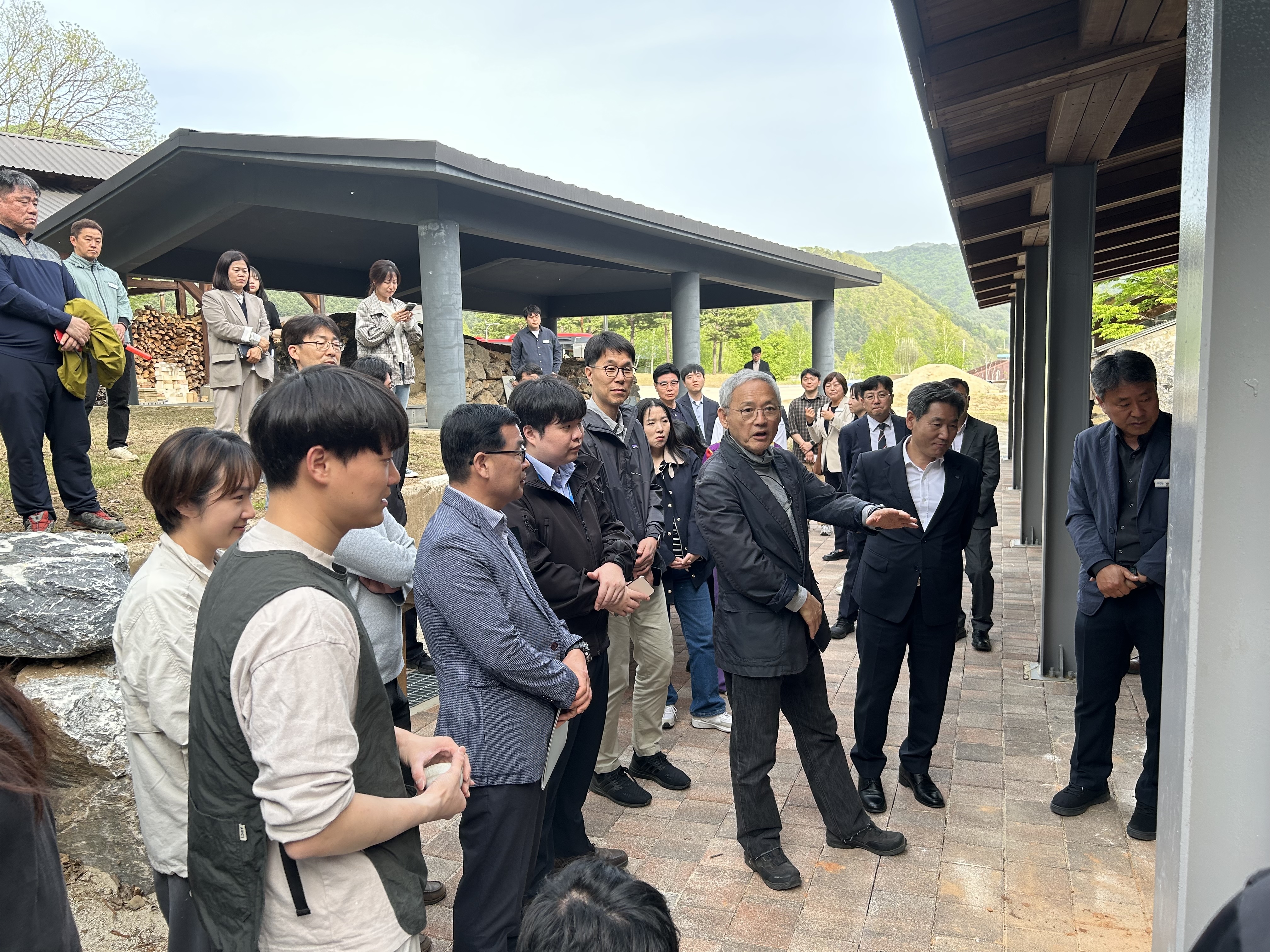
Word gets about it seems. During the cooling period I got news that the opening of the kiln would have to be delayed from one day to the next, then from the morning of the appointed day, to the afternoon, as the Federal Minister of Culture wanted to be there to see the results unpacked, and he could only be available in the afternoon of the 8th. So when in Rome… I delayed the opening at his masters pleasure.
I’m certain that this is no accident. Of course, I don’t know, but it smacks of ‘realpolitik’ strategising. I’d bet that the Director of the Museum has organised this as a media event to promote the Museum. Politicians fund the things that they see, are involved in, understand, AND if it looks like a successful vehicle to advantage their own career. They want to be seen associated with it.
Just a thought! Call me cynical! But…
I remember some years ago. I collected some porcelain stone from here and took them back to Australia and made a large bowl out of them. I glazed the bowl with a subtle blue celadon glaze that I made incorporating kangaroo ash. A kangaroo had died on my property, so I calcined it and retrieved the local source of phosphorous from the bones. Phosphorous is known to enhance the optical blue in certain pale iron glazes like celadon.
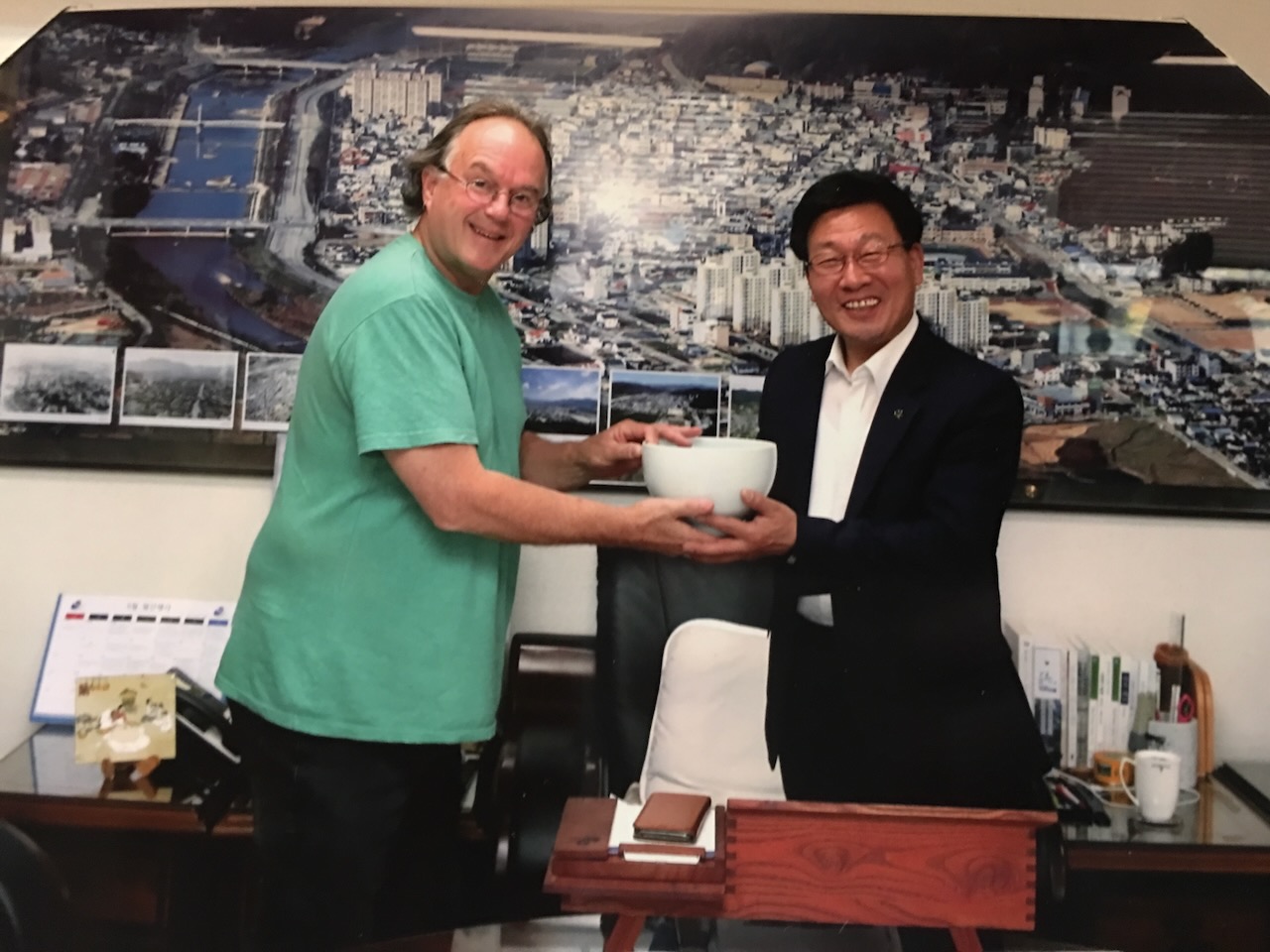
I gave it as a gift to the Museum Director along with the story. This was my own private Cultural Exchange project. His Korean stones collected from this historic site, made into a pure sericite clay body glazed with my Australian kangaroo blue glaze. He loved it. He was so taken by it that he called the Premier and made an appointment for us to meet him and make the bowl a gift to him. Thus bringing the Museum into his field of vision.
We turned up just before the appointed time for our 15 mins of fame, and were eventually ushered into the Official Office along with newspaper reporters, translators, aids and other staff. I was duly introduced to the Premier, a little bit of small talk. He had been very well briefed and made appropriate comments. Then it was down to brass tacks. I handed over the bowl and he graciously accepted it on behalf of the Korean People. He said straight away that he knew next to nothing of Ceramics, but understood the significance of the effort that had gone into such an art work and its cultural exchange significance. He thanked me again and shook my hand. There was a flurry of flash bulbs going off to record this staged event.
He asked me how I came to be researching Korean Porcelain from this remote place. I replied that Korean porcelain is unique in the history of world ceramics. I came here because of the history of the place and the pots that were made here. You can only learn so much from books. I had to come to experience it. He smiled, so you knew about Korean porcelain from back in Australia? I said yes, once I learnt about it, I had to come. The Porcelain Museum here is one of the very few places in the world where this kind of study can take place. Mr Jung, The Director, is very supportive, open and inclusive. He runs a great institution.
The Premier was reflective for a second, then said. I believe that you can build pottery kilns that fire with wood and make no smoke. This is important for the environment. Mr Jung has asked me for more funding for this kind of project. If the Museum is so famous internationally, attracting research like yours,
I will fund it!
The next day, the newspapers had the Premier on the front page announcing the success of his funding initiative for his international artistic ceramic exchange program, for the very successful, now internationally recognised, Yanggu Porcelain Museum. Every one wins. The Premier gets all the credit and is in the paper looking like a hero. The Museum Director got his funding. I enjoyed the research and achievement of making the lovely bowl. The premier mentioned before we all left, that the best place to keep such a unique bowl, would be in the porcelain museum.
Back to the present time and hence the sudden flush of offers of work to build similar such kilns from established potters and university campuses. Once it is shown to work, it gets it’s own legs. Word travels fast. These days it travels electronically with likes and re-postings. It’s very fast.
The Minister of Culture is coming for a visit to the Museum and will be at the opening of the kiln. The kiln has cooled more than enough waiting for him to arrive. I’m introduced to the minister, he asks me in Korean – if I can speak Korean. I recognise the phrase, so I’m onto it, but my recall of Korean standard reply phrases is so slow, that before I can make my clumsy reply, he already knows my answer, so swiftly continues in English. “So we will have to speak in English then!”. I nod my thanks.
We make some small talk. He’s been briefed on hisc way here about the nature of the project and asks me if it is going well and I reply yes. That’s the depth of our interaction. That was my 15 seconds of fame! The photographers elbow in and I’m shifted sideways. The minister looks quizzically at the kiln and my Jung explains something in Korean. The Museum team are then given the go-ahead to unpack the kiln.
The firing is unpacked and everyone ‘oohs’ and ‘arrhs’, the other potters here each look in and turn to me with BIG smiles and thumbs-up. Huge sigh of relief. Everyone is all smiles. The pots are mostly well fired, but I’m interested in the minutiae of the detail. I’m looking not just for colour, but for the depth of colour in the celadons. Not just a shiny surface, but a certain quality of soft melt and satiny quality there. I want to get in and see the flame path and the flashing on the exposed surfaces and kiln shelves. Where is the ash deposit and how has it melted. None of this is possible with 50 people crowding around and flash guns going off.
Its a bit like a crime scene or perhaps an archaeological dig. You don’t want a rabble of untrained people trampling all the evidence and the details. Just like an aboriginal tracker, I want to read the ephemera, the subtle traces and shadows, but that isn’t going to happen. The pots are whipped out and shown to the Minister, with total disregard of their place in the kiln and their fire face and lee side qualities.
It’s just a little bit of a shame, as I’d like to learn more than I am able to in this situation. Looks like I’m the only one who isn’t ecstatic! I am really pleased that everyone else is so happy with the result, but I know that I can do better. But I need to read the surfaces to be able to learn what I need to be better at it the next time round.
In a perfect world, I’d like to go slowly and examine each pot in detail. These pots aren’t just trophies and trinkets, they are also part of my research, or at least they were when they went in! But this has become a media event now, and that is also very important, possibly more important, because it may well result in continued or even better funding into the future. A topic far more important than one firing and a few glazed pots.
The firing is a success, no doubts. Everyone is happy. They all leave feeling uplifted and maybe just a little bit happy and warm inside to know that they have been somewhere where there is some sort of mysterious, but positive, environmental action taking place. Even though they don’t understand what it is.
Back at the Museum tomorrow, I’ll have to have a quiet look at all the work as we are setting up the show. But the exact context will be lost, however, I can fill in some of the missing info using my experience. I’m so pleased that everyone is happy, but I could have learnt more to help them with the next firing, as the kiln still needs some fine tuning.
What I could see quite clearly, was that the oak ash was very refractory. I’m guessing that it is very high in SiO2. We may need to burn a bit more pine in the mix to introduce some CaO (calcium flux) into the eutectic to get a softer surface from the ash deposit. I was burning 20% pine in the early stages without smoke. I might have to keep that up for the whole firing? As pine ash has a lot of calcium in it.
All grist for the mill in the future. I could also see that the floor at the back was still a little bit under-fired, so I was up at 5,30 this morning and went down to the kiln and took out the bag wall and rebuilt it one layer lower and with one full brick removed, to make larger gaps. I will see how this works after the next firing. I also placed one brick in the middle flue hole to force the flame out to the corners more. All little fine adjustments that I hope will make it fire more evenly.
Another option for the refractory silicious ash problem might be to place a few tiny pre-fired stoneware cups containing a spoon full of Na2CO3 (washing soda) in the front of the kiln. This will mimic a few years of charcoal built-up and decomposition at high temperatures, where sodium vapours are released from the burning embers. The soda will sublimate and slowly volatilise throughout the firing, reacting with the silicious ash as it is being laid down and help it to melt. or I hope so anyway. Everything is an experiment!
I could also use common salt to get a similar effect, but sodium chloride creates a slightly different look. I don’t want to change the look of the ceramic surface from wood fired into salt glaze pots. But anything and everything is worth a try. At least once. I first came across this light salting technique being used in La Bourne in France, back in 1974, where they had been doing it for centuries. As a naive student, I thought that it was a very clever idea that I hadn’t come across before. Many potters have used it since. In fact, it has become part of the standard repertoire.
With the influence of the Minister of Culture on the front pages and the release of the TV doco soon, there will almost certainly be more enquiries about this firing method. It is my intension to try and leave the kilns here in good condition and with useful, technically accurate kiln firing logs that the students here can use to do their own firings in the future. Hopefully we can work together ‘virtually’ via ‘Kakao’ talk or Zoom to achieve the best result possible. It could be a whole lot easier if they would just read the book, or at least the first chapter on how to fire!
All that is required now is for some young enterprising Korean potter to pick it up and run with it, develop a small business building these kilns for whoever wants one.
Maybe firing a downdraught fire box kiln with local oak will become a thing? I have shown that it is possible. It is now one other possible strategy for potters and academics in the field, to follow to be able to keep on wood firing here into a cleaner, carbon constrained, and environmentally friendlier future.
All I need to do now is to introduce them to the concept of the after-burner/scrubber to minimise PM 2.5 particulates, not just smoke. But that is a bridge too far at this time and for this visit.
I’ve been invited back to Korea to build and fire another of my low-emission wood fired kilns and to do another demonstration firing of one of my previous kilns. The first of these firings was filmed by Korean TV for a documentary to be shown later in the year.
The firing for this kiln was done using the same 5 year old, very dry seasoned pine timber, that I used last year with the other kiln that I built.
It’s a considerable challenge to burn very dry timber like this, loaded with volatile resins, and not make loads of smoke. Not the best fuel for a clean, low-emission kiln firing demonstration. But that is what I was given to work with, so I did my best. It is possible to keep it fairly clean, but there is definitely some smoke. It takes a lot of skill.
Not recommended for the beginner. Still, everyone seems to be happy enough. The results were excellent!
It is possible to wet the wood to slow down the combustion and clean up some of the potential smoke, because water actually aids combustion when it is introduced at temperatures above 1100 oC. It’s hard enough too explain this concept of ‘water gas’ to students in Australia, using English language, which I’m better at than I am at Korean. Impossible using ‘kakao’ translation app in Korean. I started to try, but gave up after a few minutes.
A week later, I moved from Yanggu to Bangsan and went to work on my other kiln job.
While I was doing the 2nd demo firing, a famous celadon potter from down south drove 8 hours up to see and experience the firing. He had read the Korean translation of my book ‘Laid Back Wood Firing’ and was very keen to see it in action. He was clearly impressed, as he offered me a job to come back and build one for him later in the year. I declined. I have had 3 offers of kiln building work here this trip and two on the last trip. This could be my new Korea.
But I’ve decided that I’m too old for this sort of thing now. Kiln building is to labour intensive, it’s hard on my back. Especially on all the lower than waist height layers of brickwork, and it’s also somewhat stressful for me to organise all the important details in another language. There are tight deadlines and budgets, and doing it all using the phone translator app adds to the complications. I don’t need to do it to make a living any more.
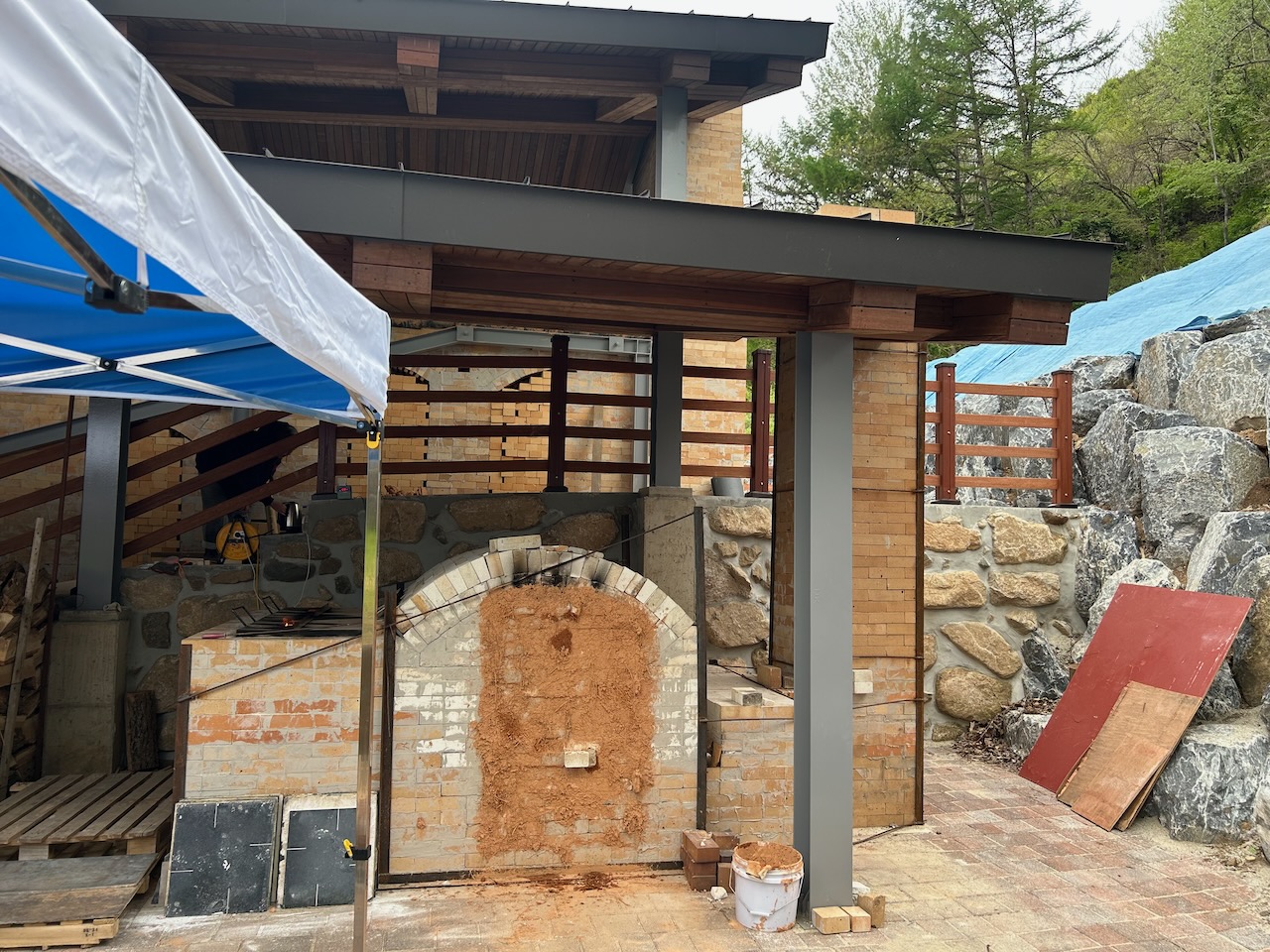
I only came to do this job as a favour for my friend here, Mr Jung, the Director of the Yanggu Porcelain Museum and Research Centre. He has always been so supportive of me in my porcelain research interests. Mr Jung is keen to promote cleaner wood kiln firing. Tradition wood kilns here belch black smoke from start to finish. The two old traditional kilns built in the museum grounds in the township of Bangsan can’t realistically be fired anymore, because of residents complaints about the smoke. They are beautiful objects, like sculptures in their own right. The museum is located right on the main street, in the centre of town, making the smoke problem difficult to ignore. If I lived next door, I’d complain too.
2 items of beauty.
As with all things, these matters are complicated. Porcelain has been mined here and pots made and fired on this site for 800 years. It’s a hugely important cultural site. That’s a lineage impossible to ignore. However, the times they are a chang’in. Every one is aware of our carbon constrained, global heated, industrially damaged climate now, and air pollution is a huge problem, particularly in Seoul. There was a time when I first visited here, that everyone claimed that all the pollution was blown in by the westerly wind from China. It wasn’t Korean pollution! A convenient excuse to do nothing. (No-one seemed to notice that the wind wasn’t a problem on Sundays when there was much less diesel traffic in the city). But people have wised up. They want change. They want cleaner air.
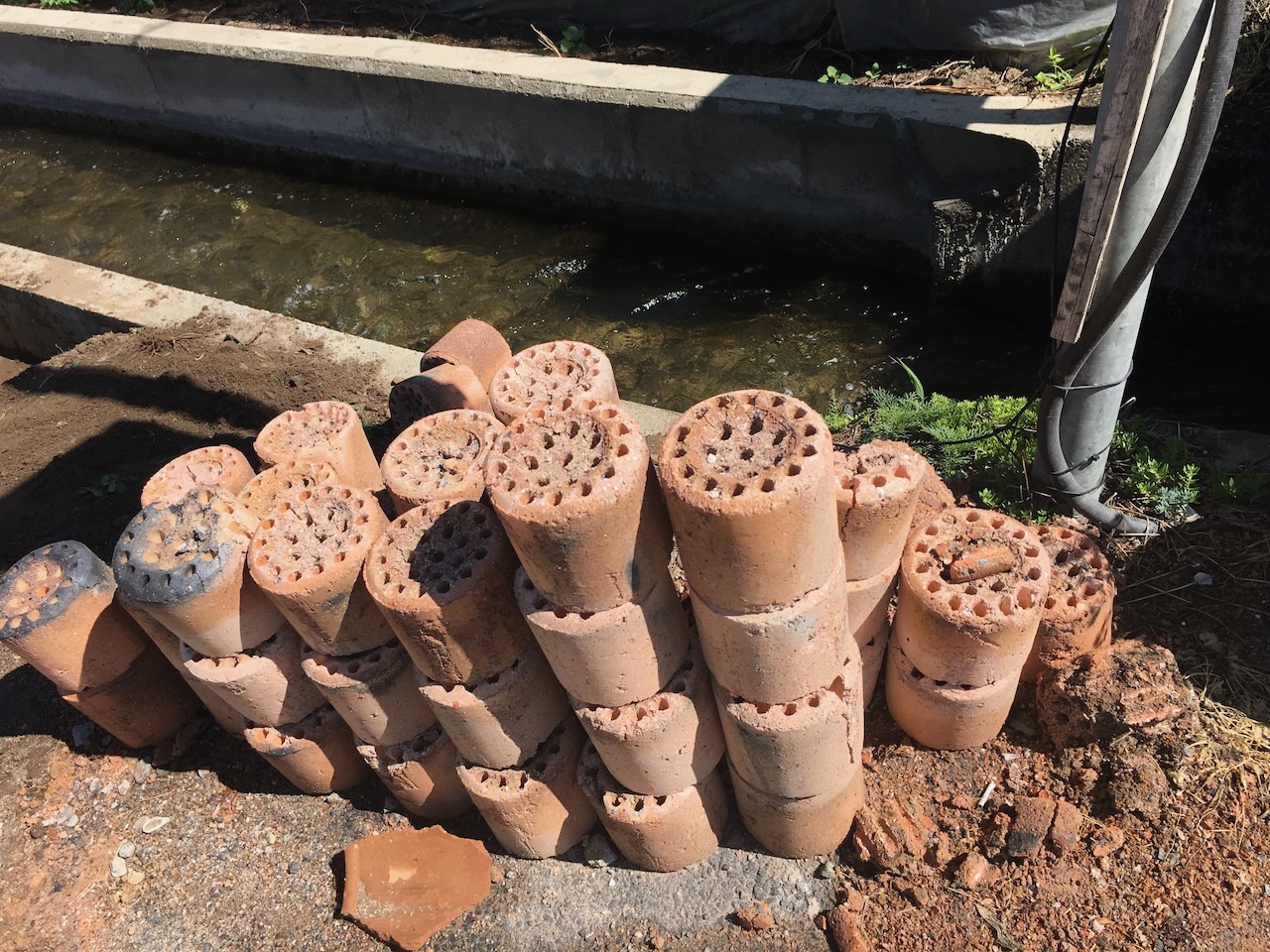
Just after my first visit here, some years ago, burning pressed coal briquettes was banned as the main heating and cooking method here. The government did this by bringing gas to the town. They weren’t so stupid as to just ban coal. (See below). They offered a solution first up. Janine and I were working here at the time, and were particularly impressed by the speed and efficiency of the operation. The gas installers team progressed from one end of the main street to the other, about half a kilometre, digging the trench, laying in the pipes, installing side take-off lines to each house, company, or cafe as they progressed, testing the section, then back filling and finally re-tarring the road surface as they went, from laneway to laneway, in 50 metre sections, day after day. The whole street was done while we were there. No one was inconvenienced for more than a day or two.
I reflected on this and couldn’t help but think of Australia and making the comparison. It took 2 months for our local council to re-work the intersection of the street entry into our village at the level crossing. Less than 50 metres of tarred road. Terms like glacial come to mind. I think that the difference is that here, Korean’s work on contract and our local council workers were on wages, so no rush.
The lord Mayor of Brisbane also comes to mind, declaring homelessness illegal in Brisbane. Genius! give this man a PhD and a Nobel Prize! He did absolutely nothing to offer any alternative. No grand plan. No long-term thinking. No considered strategy. No forethought. No low income housing construction budget. Just get that problem out of my sight. I can only hope that he will ban cancer and war next!
No wonder we are the big brown dumb land that sells black and red dirt.
Back in The Porcelain Research Centre, the Director had a grand plan that involved long term thinking and strategy. The old disused army barracks on the far edge of town, up in a seperate little spur valley became available. He somehow organised to get it included into the Museum plans and therefore long term budget. Over the years he has relocated all the wood kilns and several more as well, to make a small porcelain village. With specialised facilities for wood firing. both traditional and modern innovative designs.
There are 6 seperate, self contained house/studio buildings, for research students and their families, a central communal meeting place/cafe, A huge accomodation block for visitors and guests during big events, Plus a seperate family guest house.
On this visit, I got to see inside the huge new, almost complete, student residency building, with 6 self contained single studios and living quarters, 3 either side of a massive central kiln room and glazing lab. Korean students can come to study for periods of 1 to 3 years. Foreign students can come from 1 to 3 months.
The construction phase is almost complete. They are just doing the landscaping now. This is becoming a very impressive place to come and study.
As I understand it. Local Korean ceramic students that are accepted into the program here are usually supported by their university to come here for higher degree research study up to 3 years for a PhD. They don’t have to pay any rent, but they have to cover the cost of their own firings and food. I’m unaware of the cost for international students, as the building isn’t ready yet, so there haven’t been any so far.
I’d come and work here again, as an artist in residence, if I didn’t now have an even better studio and creative environment back at home in my new workshop, just sitting there waiting for me. Now Janine and I are in a position to invite students to come and work and study in our studio from time to time. Regrettably, we can’t off the same standard of on-site accomodation as they do in Korea.
New Student accommodation building.
Is there any wonder that I love coming here to this supportive, creative, artistic environment so much?
Apparently numbers are beautiful, and can be fun!We had a visit from one of my very earliest students, who I hadn’t seen since graduation almost 50 years ago.
She had trained in maths at uni, but ended up teaching maths at school. This didn’t seem to be sufficiently rewarding to her, so she came into the Art School to train as a potter, teaching maths part-time to support herself during this 2nd lifestyle choice of vocation as a mature age student.
We had an interesting catch-up and she explained to me that numbers have a personality and are beautiful. She told me that she could look at a number and know a lot about it from its ‘character’, or something akin to its ‘personality’?
Numbers are like people, you can learn a lot about them just by the way that they look.
I’m not a maths person myself. However during our conversation, I started to understand a little bit more about the look of numbers and learnt that I do have some little bit of insight into numbers. When I was at school, we had to learn maths by rote. I never felt the desire to enquire further. So unlike my experience of learning about ceramics, which I couldn’t stop thinking about, pondering, romancing etc. in my spare moments.
These days, I usually only use numbers to defend myself. ie. to add up the bill and check it for accuracy. But I sometimes use my limited maths to understand the chemistry of clays and glazes, ie. Brongniarts formula, Segar formula, and electric kiln wiring calculus to build heating element systems. They are not ‘fun’ jobs, this is strictly work. So some of that rote learning does get regurgitated and applied to real-life practical questions. I’m pleased that I am able to put my mind to it successfully. So numbers are useful, but I don’t romance them.
However, I was amazed to find that although I know next to nothing about maths and have little interest in it, I do know something about the look of numbers. When I say, the look of numbers, what I’m referring to is the insight that you gain through familiarity, like the look of words. I may not know how to spell some words, but when I write them down, I can tell that they look either wrong or right. So I recognise that I do know more than I realise.
Here are some of the numbers that first came to mind, and that I realised that I knew the look of pretty well;
0, (zero) having read the book ’The nothing that is!’. I learnt that as a species we learnt to count to to describe and tally the things that we owned. Goats, for example. If I only own one goat, then I pretty well always know where it is. but if I was and early human learning to convert from hunter gathering to residual farming and herding, then I would need to be able to know exactly how many goats I had, where they were, and if one was missing, so counting became a useful and necessary asset.
It’s not a long stretch of the imagination to think about the farmer who owned no goats, didn’t need to count, so it took a very long time for the concept of ‘0’ zero to come into existence. No one really ever needed to specifically count the fact that they didn’t have anything. Who would believe that someone could write an interesting book about nothing!
Well, Robert Kaplan, that’s who! “The nothing that is- a natural History of Zero”.
3, my favourite number. Because there is something odd about it.
21, how old my truck is
61, the route that Bob Dylan metaphorically revisited.
66, the highway that black Americans used to escape, persecution, rape and lynchings, and sang about in the early blues.
666, the number of the beast!
667, the neighbour of the beast!
2000, the cost of registering, green slipping, insuring, and putting 2 new tyres on my old truck to get it through rego inspection today. I own it outright, but this is the cost of renting it back from the institutions that allow me to drive it on the roads.
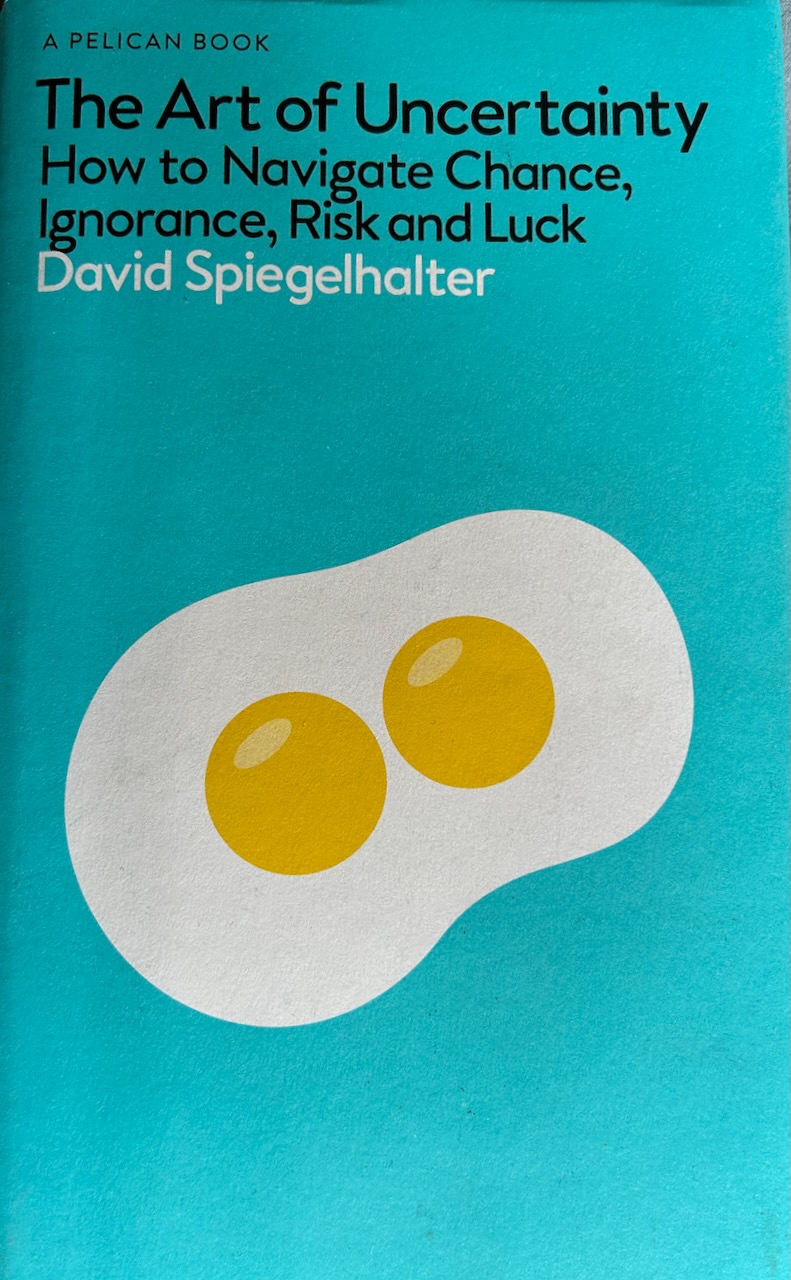
I’m reading a book at the moment, all about probability! It’s a really interesting read. I’m enjoying it and even though its a very thick book, about 2” or 50mm thick. I’m racing through it, but I’m not sure that I’ll finish it. A week ago I would have said with certainty that I would have finished it quickly, but having read most of it now, I’m rather reluctant to make such a bold claim. I’m uncertain. The first thing I learnt from reading this book was that probability probably doesn’t exist!
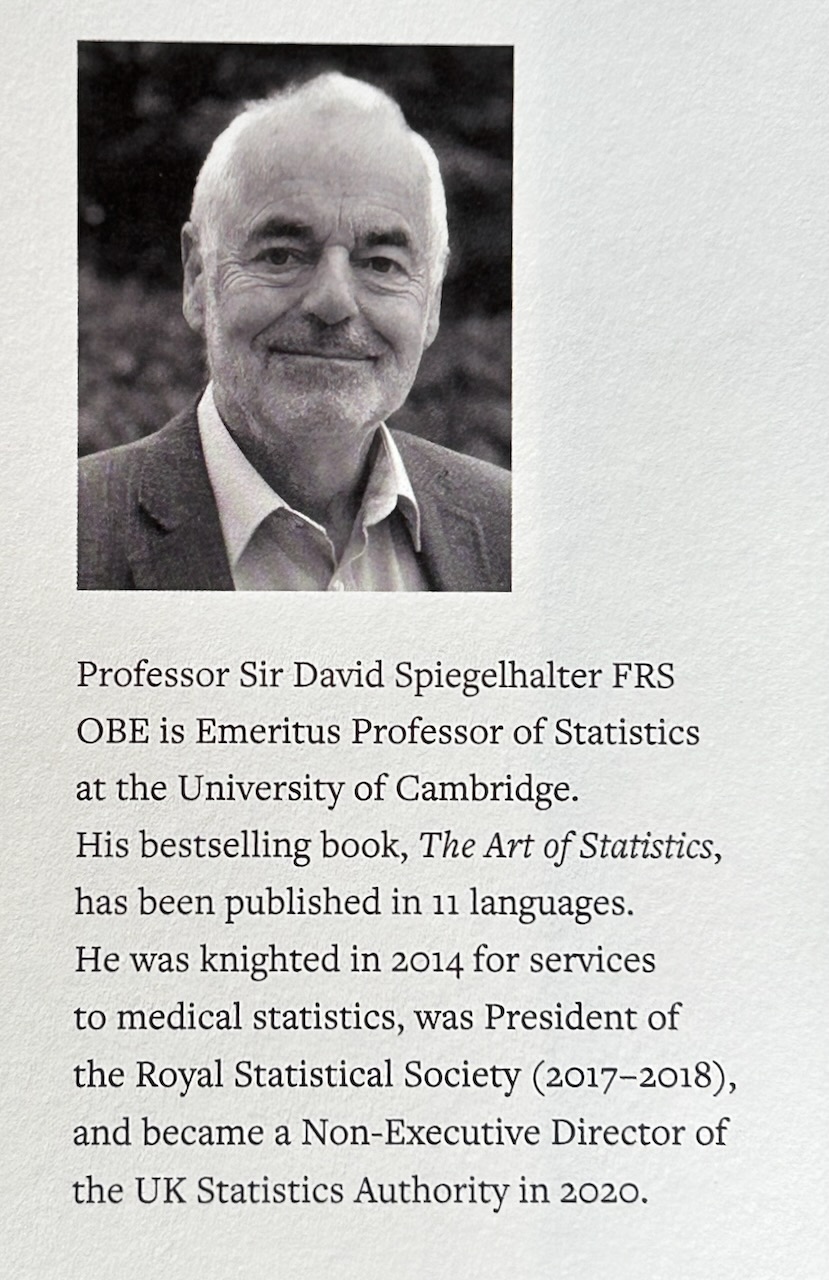
‘The Art of Uncertainty’ is written by Sir David Spieglehalter FRS OBE, Emeritus Professor of Statistics at Cambridge University. Someone to take seriously indeed. The sub-title of the book is ‘How to Navigate Chance, Ignorance Risk and Luck’. I was lucky enough to navigate across it by chance and took the risk to disabuse my self of some of my ignorance.
I’ve never been a person blessed with a sense of certainty, I’m probably more of the perplexed personality type – if there is such a one? So I have really enjoyed reading Prof Spieglehalter’s explanation of chance, ignorance risk and luck. There is so much to it. After explaining each topic, he gives an example from real life, then reduces every example to a mathematical model basis, which is also really fascinating. I’ve never been that interested in maths, but Prof Spieglehalter explains it so well, I could follow most of it.
“Why probability probably doesn’t exist (but it is useful to act like it does)
Life is uncertain. None of us know what is going to happen. We know little of what has happened in the past, or is happening now outside our immediate experience. Uncertainty has been called the ‘conscious awareness of ignorance — be it of the weather tomorrow, the next Premier League champions, the climate in 2100 or the identity of our ancient ancestors.
In daily life, we generally express uncertainty in words, saying an event “could”, “might” or “is likely to” happen (or have happened). But uncertain words can be treacherous.
Attempts to put numbers on chance and uncertainty take us into the mathematical realm of probability, which today is used confidently in any number of fields. Open any science journal, for example, and you’ll find papers liberally sprinkled with P values, confidence intervals and possibly Bayesian posterior distributions, all of which are dependent on probability.
And yet, any numerical probability, I will argue — whether in a scientific paper, as part of weather forecasts, predicting the outcome of a sports competition or quantifying a health risk — is not an objective property of the world, but a construction based on personal or collective judgements and (often doubtful) assumptions. Furthermore, in most circumstances, it is not even estimating some underlying ‘true’ quantity. Probability, indeed, can only rarely be said to ‘exist’ at all. All of statistics and much of science depends on probability — an astonishing achievement, considering no one’s really sure what it is.”
Life is uncertain. All models are wrong, but some are more useful than others!
As probability probably doesn’t exist. I’m probably not too sure what the last chapter will tell me. If I finish the book!
We probably really don’t know much at all. Get used to it.
Nothing is ever finished, nothing is perfect and nothing last forever.
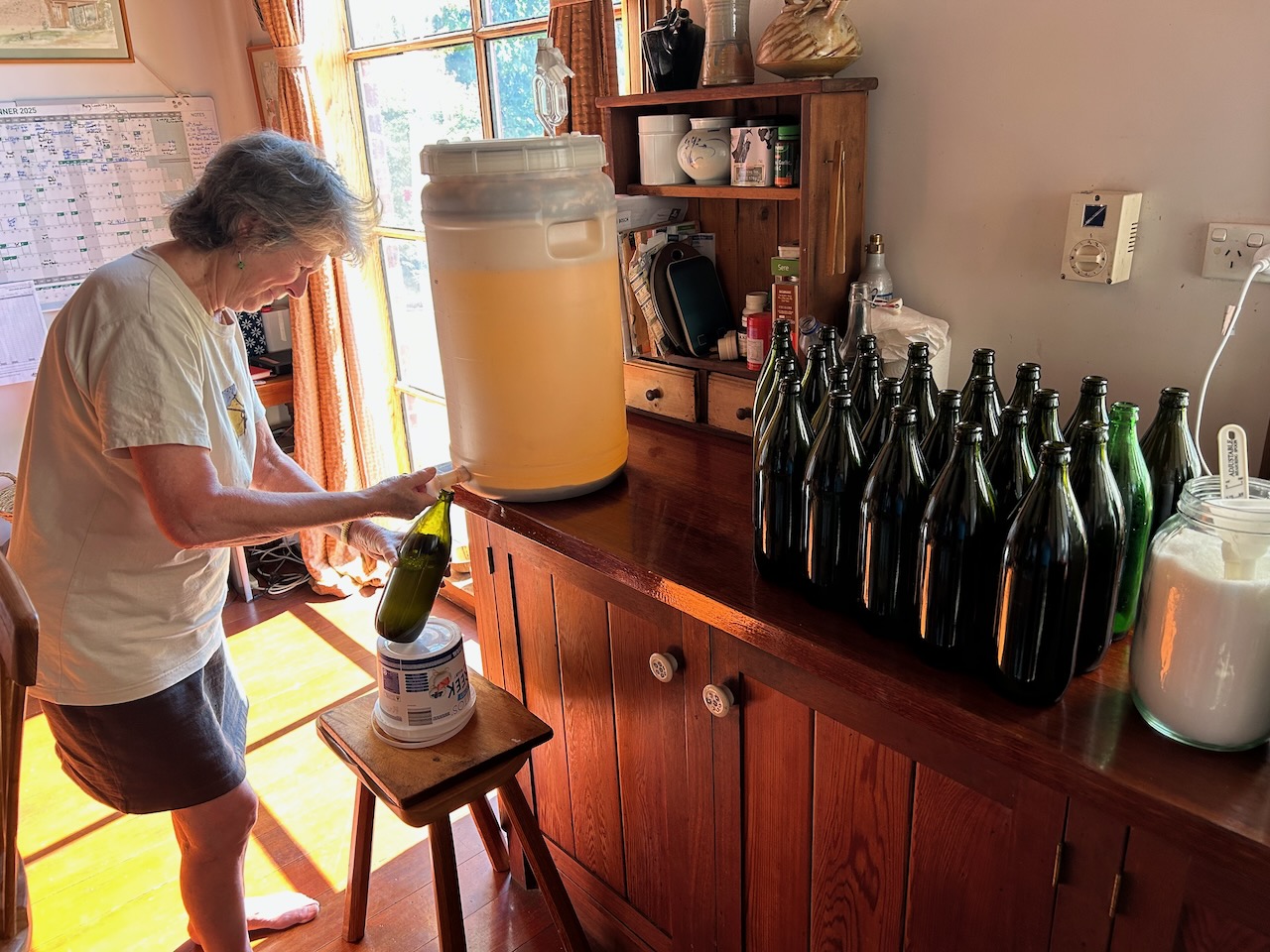
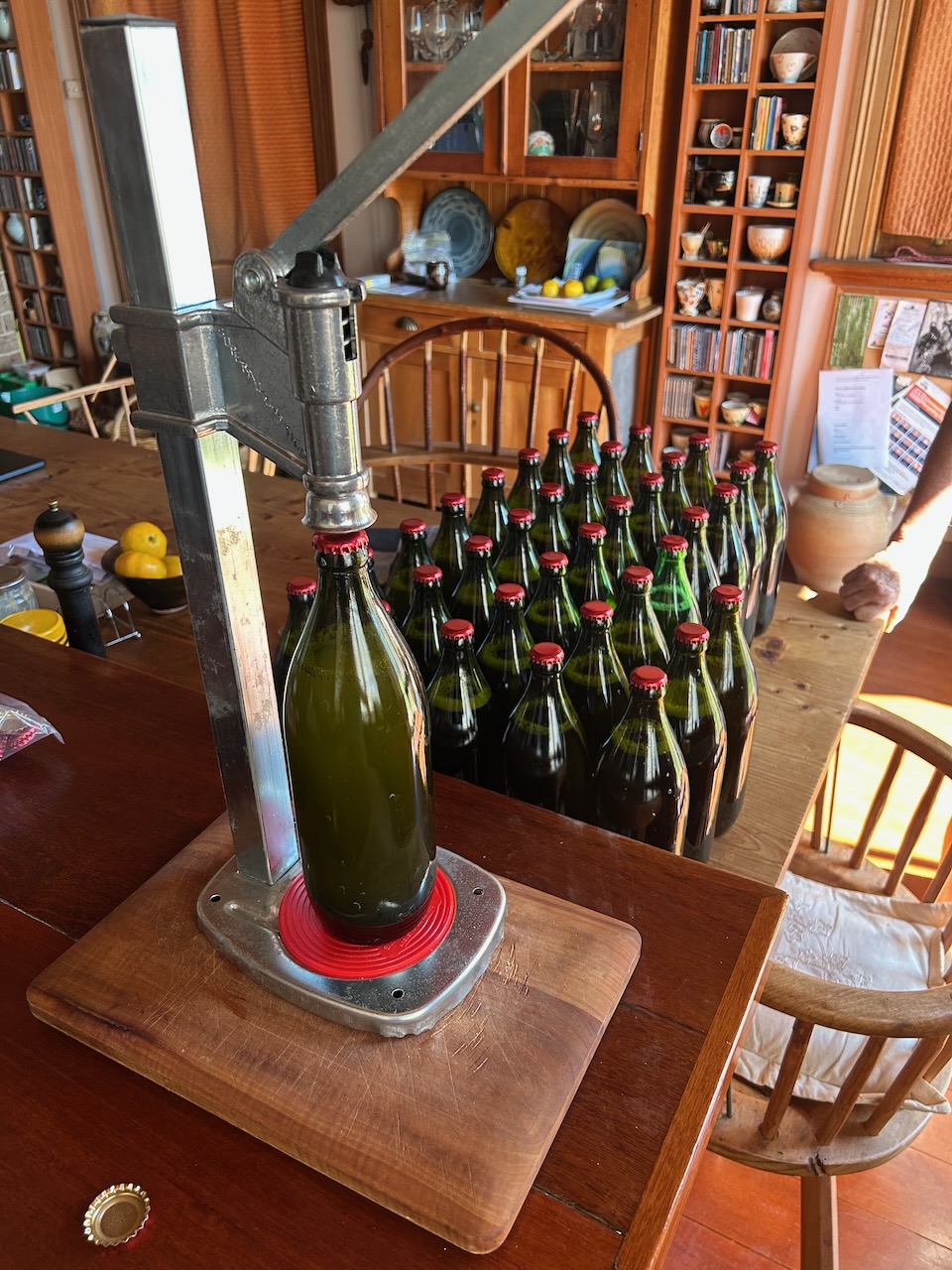
Exactly 8 weeks ago today, Janine and I harvested all of our apples and pears. We juiced them and used ‘Moet and Chandon’ champagne yeast to ferment them all into cider.
Now, 8 weeks on, the ferment has completely died down and used up all the available sugary nutrient in the juice. Now that it is completely still, it is safe to bottle it. We must make sure that it is fully fermented out, so that it wont keep on fermenting and explode the bottles.
I remember back in my childhood in the 60’s, stories of exploding ginger beer bottles that had too much sugar in them.
We have been making our own cider here for almost 50 years now, ever since we planted our first orchard and got a reasonable crop of apples.
This is our first vintage of cider in ten years now, because the orchard was burnt out in the big bush fires of 2019, but before that, there was a ten year draught that made it very hard to keep the fruit tress alive , never mind getting a good crop off any of them.
So this is our first really good cropping year from the newly planted fruit trees in the new orchard five years on.See; It’s almost autumn, Time to make cider.Posted on
I have just spent two days hand weeding and digging over the pottery verandah garden bed. It had gone completely feral and needed a good sorting out. All of the spring and summer flower display was mostly over and I’m hoping that all those flowers dropped a load of seeds down into the bed, so that now, given a bit of free space and sunlight, they will germinate and grow a new generation of flowers to welcome visitors along the driveway past the new pottery. I spent a long time on my hands and knees, making sure that I got the majority of the couch grass and kikuyu runners out of the soil.
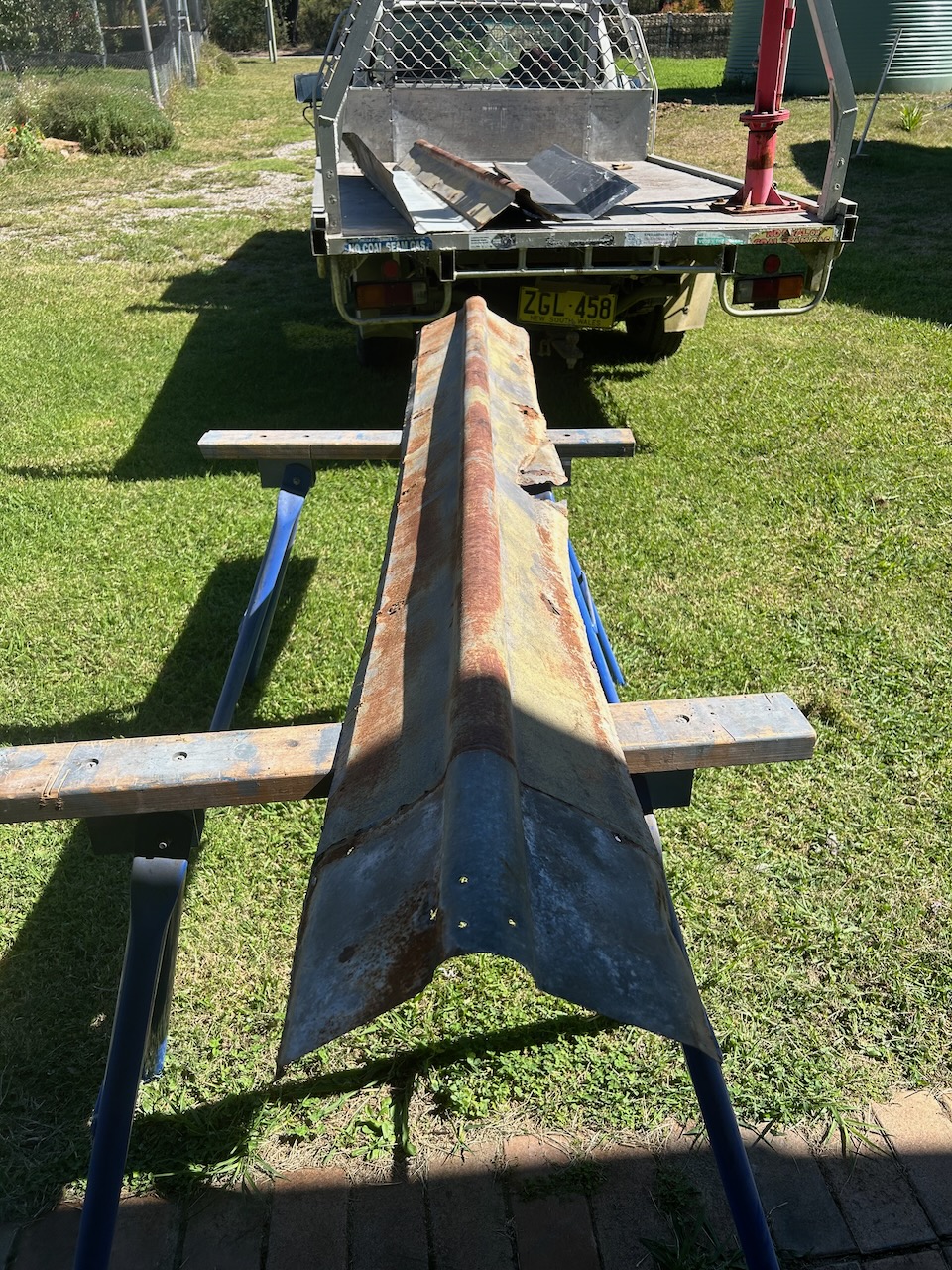
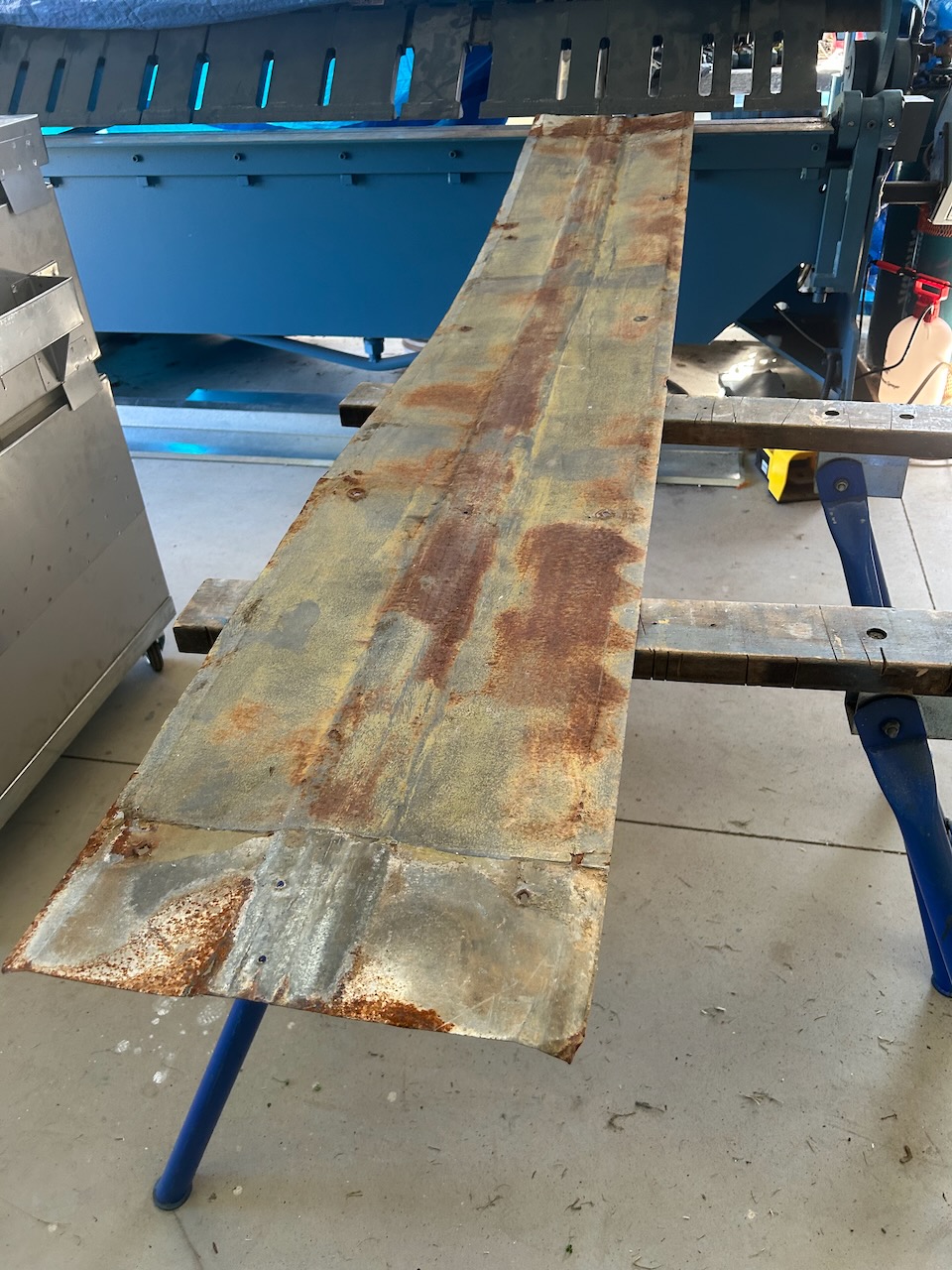
To prevent the grass runners from returning and growing back into the freshly weeded soil. I needed to make a border edging along the beds. In the vegetable garden, I made galvanised iron sheeting edging strips from off-cuts of galvanised flat plate that were left over from kiln jobs in the past. A very productive re-use of what was waste material.
These days I don’t have off-cuts any more, but Janine reminded me that I had stacked up half a dozen lengths of old recycled roofing iron ridge capping that might be usable.
I got stuck in and flattened it all, split it in two long lengths, and then folded a strengthening right angle edge on one side so that i could bury it half way into the soil to delineate the garden bed, but most importantly to cut off access to the grass runners from growing back into the beds. I dug in a ute load of compost, watered it well in, so now will wait to see what germinates.
Re-use, re-cycle, re-purpose!
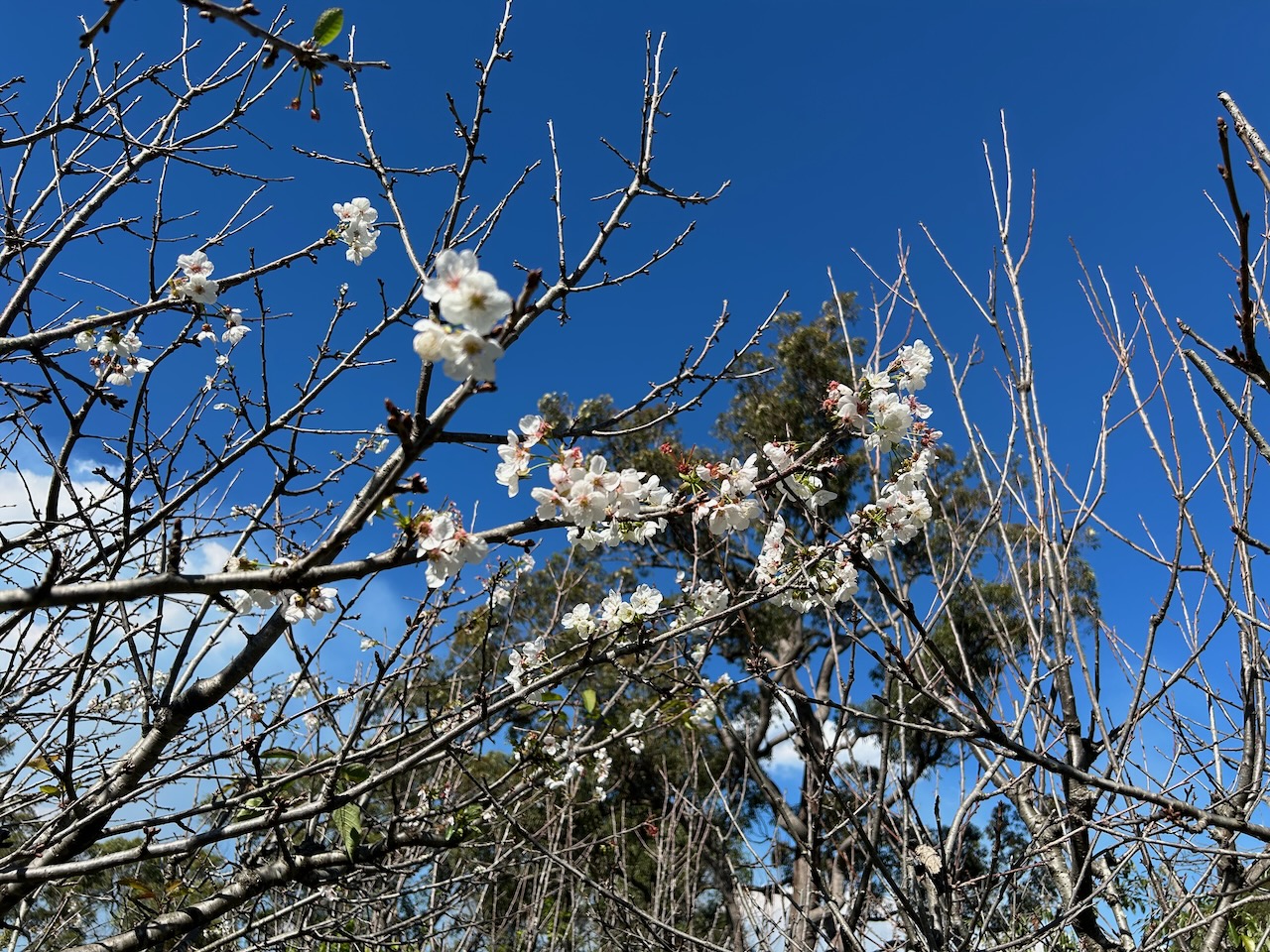
One of our cherry trees has decided to flower again in autumn. I think that it had a few cold nights, followed now with some warm weather, and that was sufficient to reset the biological clock thinking that winter is over and time for the spring flowering. We have had this sort of thing happen in the past. Particularly with the ‘low-chill’ cultivars.
Winter hasn’t arrived yet, so I wonder if this tree will still flower as normal in 4 months time when spring does actually arrive?
In the pottery, I have retested the rock glaze tests that i started exploring a few weeks back. This time, I have made larger sized samples to see the quality of the glazes better. All 3 have potential, but still need further testing to get them ‘right’.
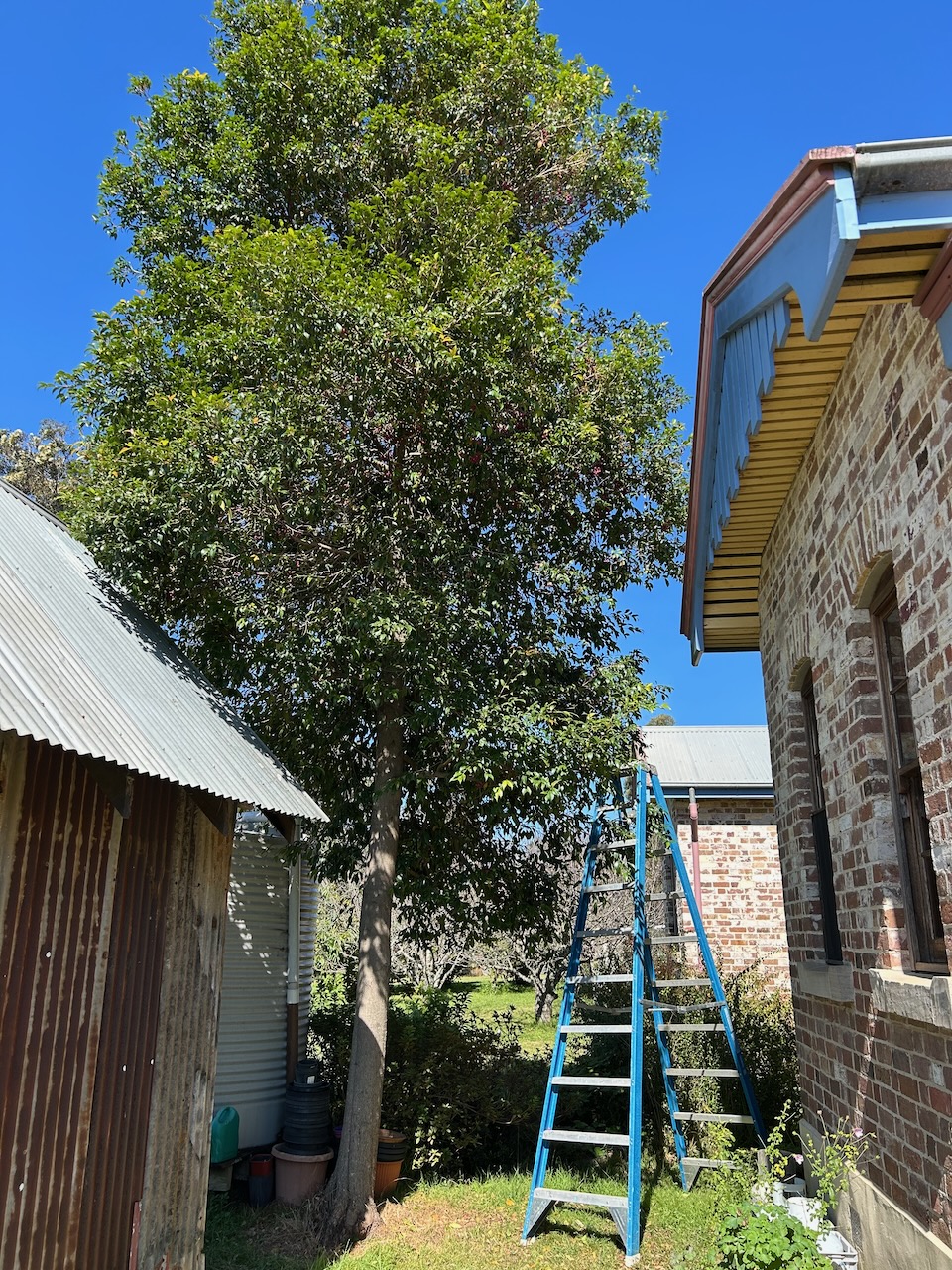
After washing and sterilising all the glass bottles for the cider bottling this morning. I had and hour to wait for the sterilising process to complete, and could hear the birds in the lillypilly tree next to the house. I asked Janine if she wanted to make some lillypilly jelly, so got out the 3 metre step ladder and climbed up into the canopy to fill a bucket with fruit. The fruit only starts 4 to 5 .metres off the ground. The tree is much taller then the house.
After we had bottled all the cider, Janine boiled up the berries and started the process of making the jelly. It takes two days. Tomorrow to sieve out the skins and stones from this batch, then re-boil it and set it up in a cheese cloth to drip out to clear jelly.
Nothing is ever finished, nothing is perfect and nothing lasts.
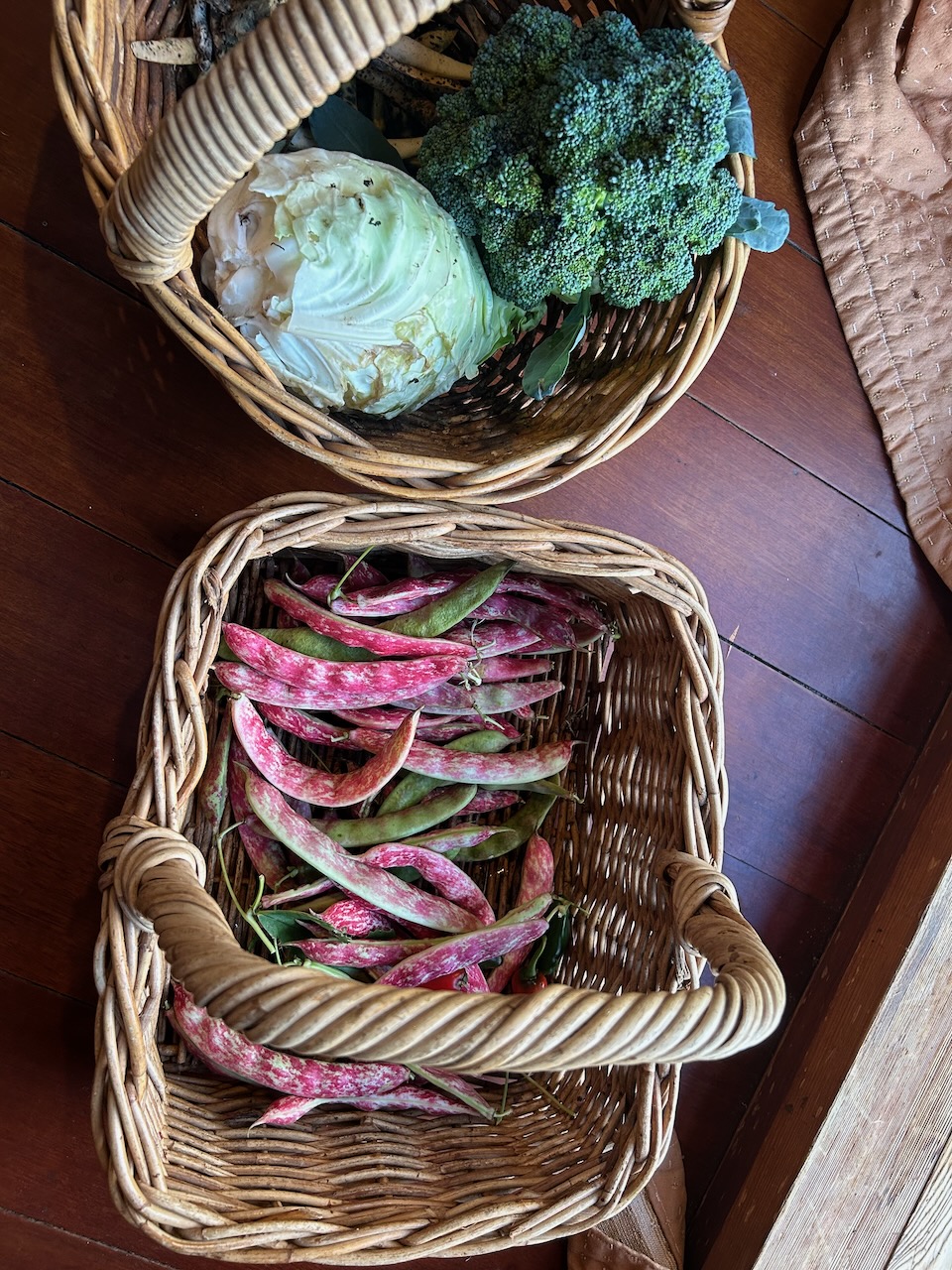
We have just harvested the first cabbage and first broccoli of the autumn. I planted a range of brassica seeds on boxing day. The first batch were all dug out by the blackbirds, so when I re-planted the 2nd sowing, some time later. I also covered the bed with bird netting to stop a repeat of the blackbirds scratching out the seeds. Blackbirds don’t want the seeds, they just like to scratch into freshly worked and composted soil looking for worms. This little hiccup set me back a few weeks, so our first cabbage is a bit late arriving.
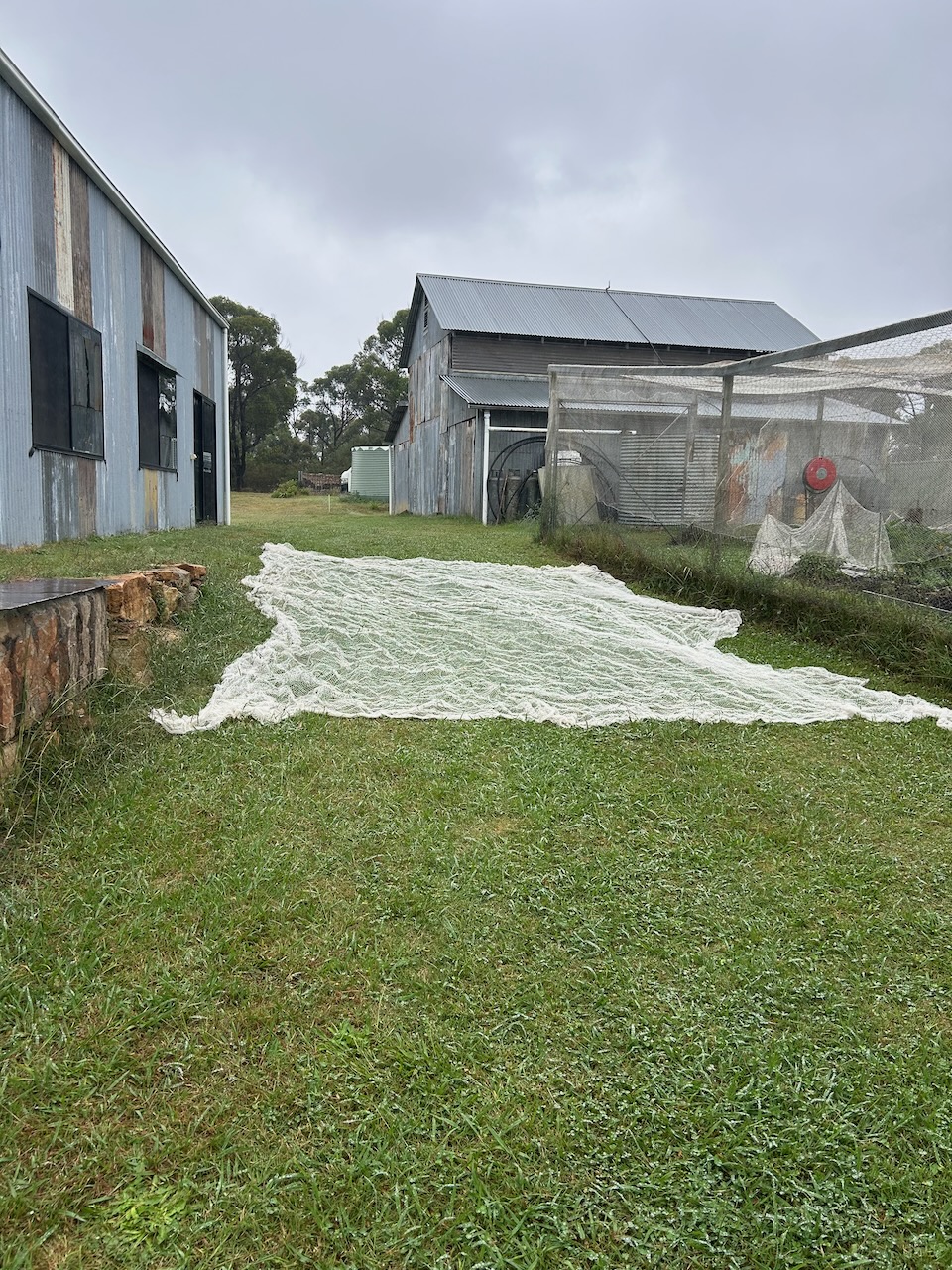
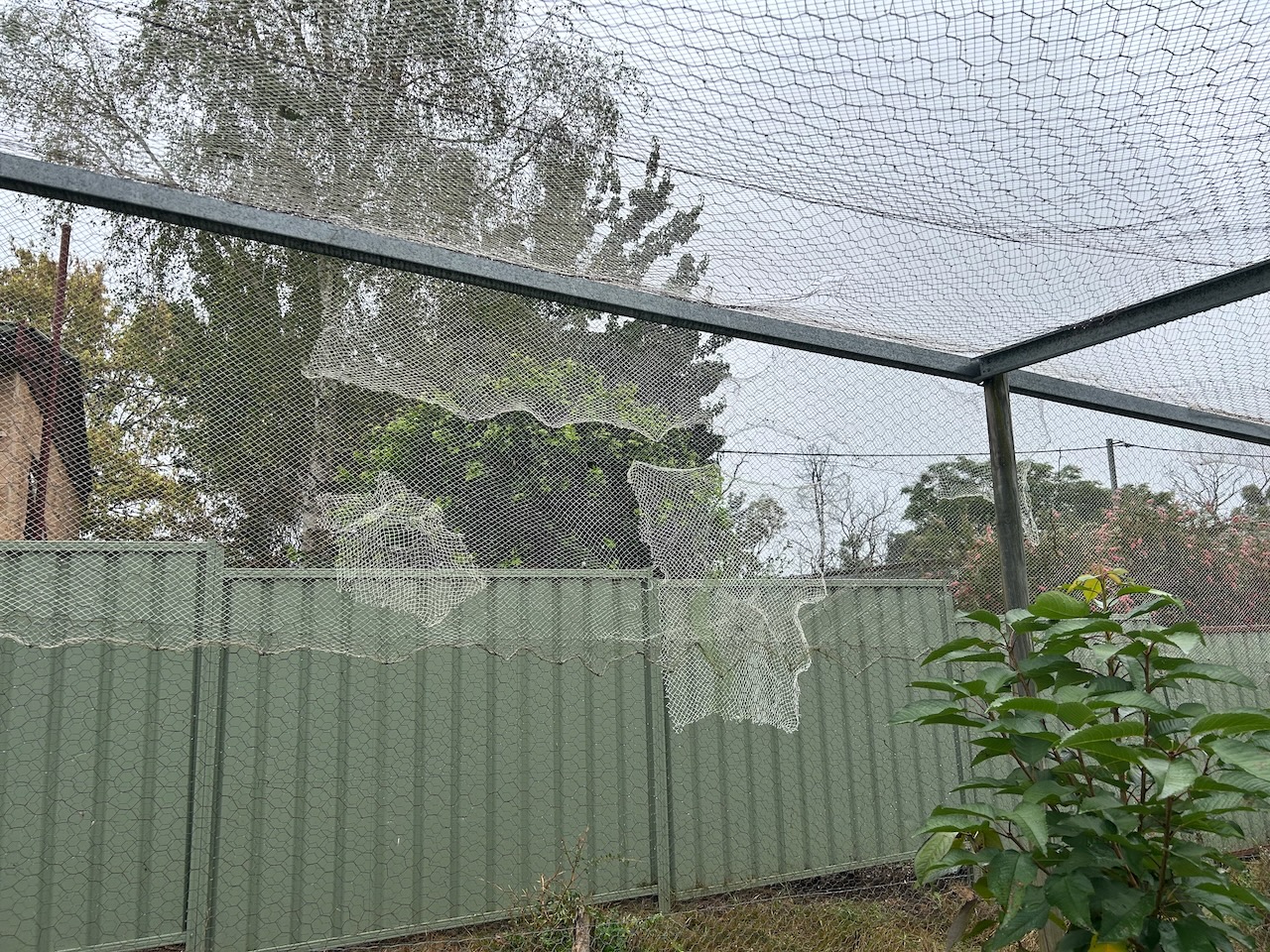
I have now repaired all the melted sections of the plastic netting over the vegetable garden. Almost total replacement at both ends that were worst hit by the fire, then applying patches to the large holes in the other walls, and finally stitching together the small 50mm to 100mm holes that are scattered all over the enclosure walls and roof. I purchased a commercial size roll of 100metres by 10 metres of netting over 30 years ago to cover the vineyard at harvest time. The netting that is over the veggie garden now is all that is left over from that time. It had a 10 years warranty against going brittle with the ultra violet light. So I’m very pleased that it has lasted so long. However, it is getting very brittle and the galvanised steel netting is all rusted through in places. So a total rebuild is in order, but I’m not too sure that I can manage that big a job these days, or if it would even be wise to attempt it at my age, having just turned 73, I shouldn’t be up and down ladders for days on end.
I made an Australian version of oka-nomiyaki pancake. Of course it is not really an okonomiyaki, as I don’t have mountain-potato starch, or almost any other authentic Japanese ingredients, but I do the best that I can with what I have. The super-fresh garden ripe cabbage makes it really fresh, crisp and delicious. The broccoli goes into a veggie stir fry along with all the other garden delights of the current season and some tofu for protein. Vegetable gardening, which mostly involves a lot of weeding, mowing and watering, suddenly becomes so worthwhile when you are harvesting such beautiful produce each afternoon, freshly picked ready for dinner. Our food has carbon metres, not miles!
I have also planted another 4 different varieties of seed garlic in the garden, just to see if any of therm are well adapted to grow here in the future.
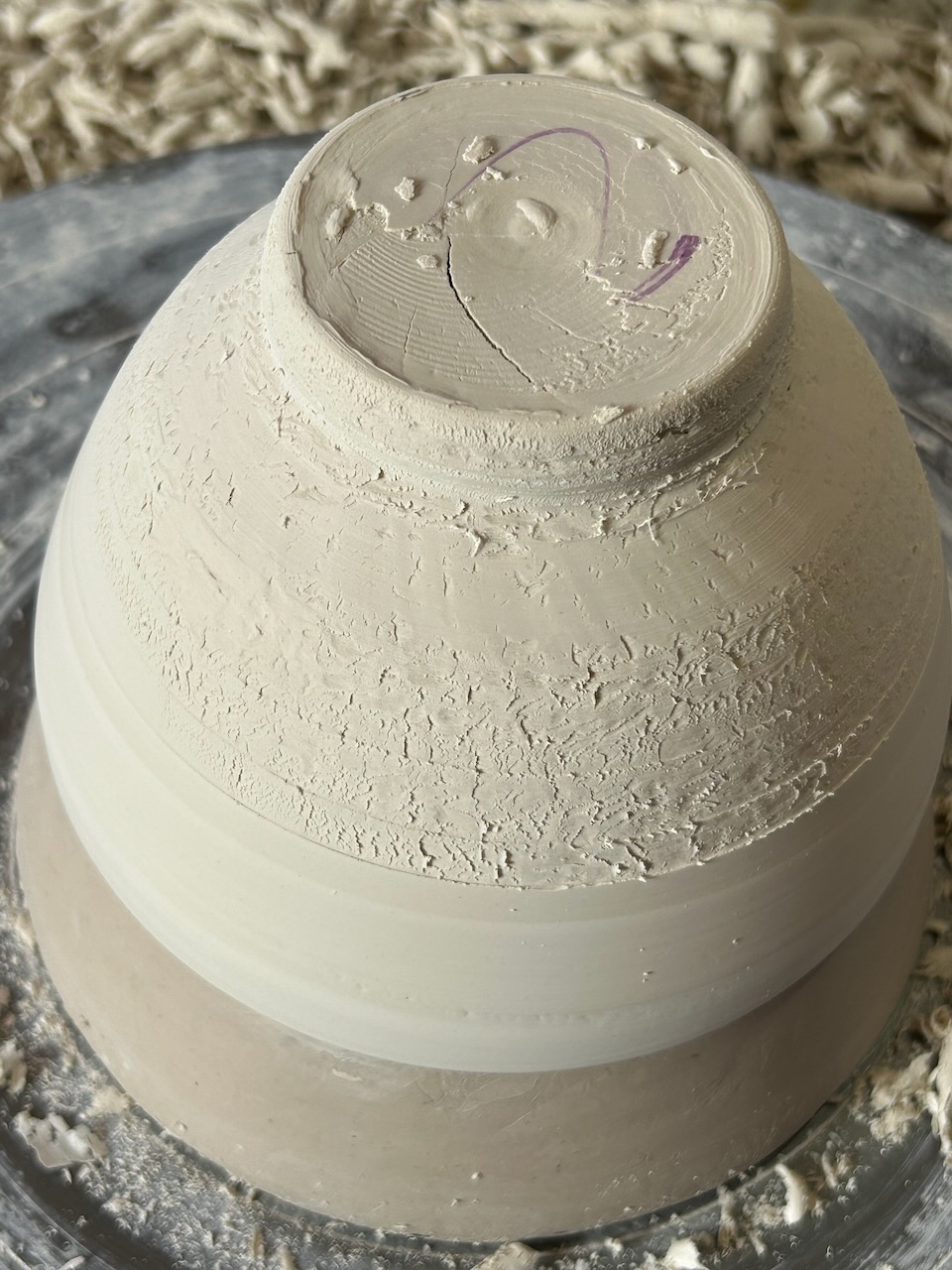
In the pottery, I have been throwing some sericite porcelain stone bodies. This stuff is so short that I have to make the wall bases thick to hold the form up. That then means a lot of turning to get the pot thinner again. This weird stuff tears and rips as the turning tool cuts into it – unless it is turned quite firm and almost dry. But then there is the dust to contend with, so I like to do it while it is still a bit damp, but then it chips a lot. It becomes a two stage process. Roughing out the mass of extra thickness, drying some more, then final turning. I get to do a lot of slaking and re-cycling of turnings.
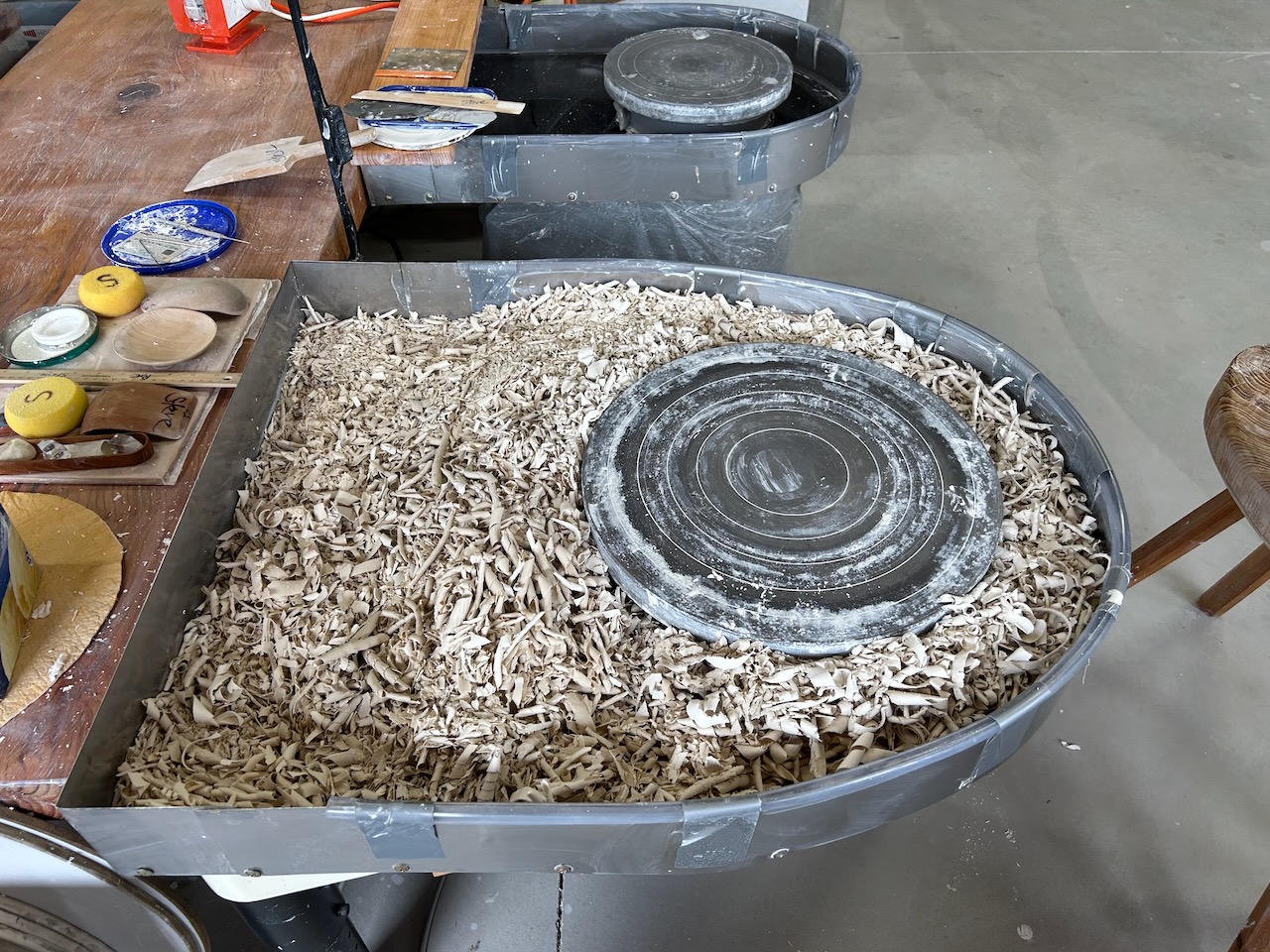
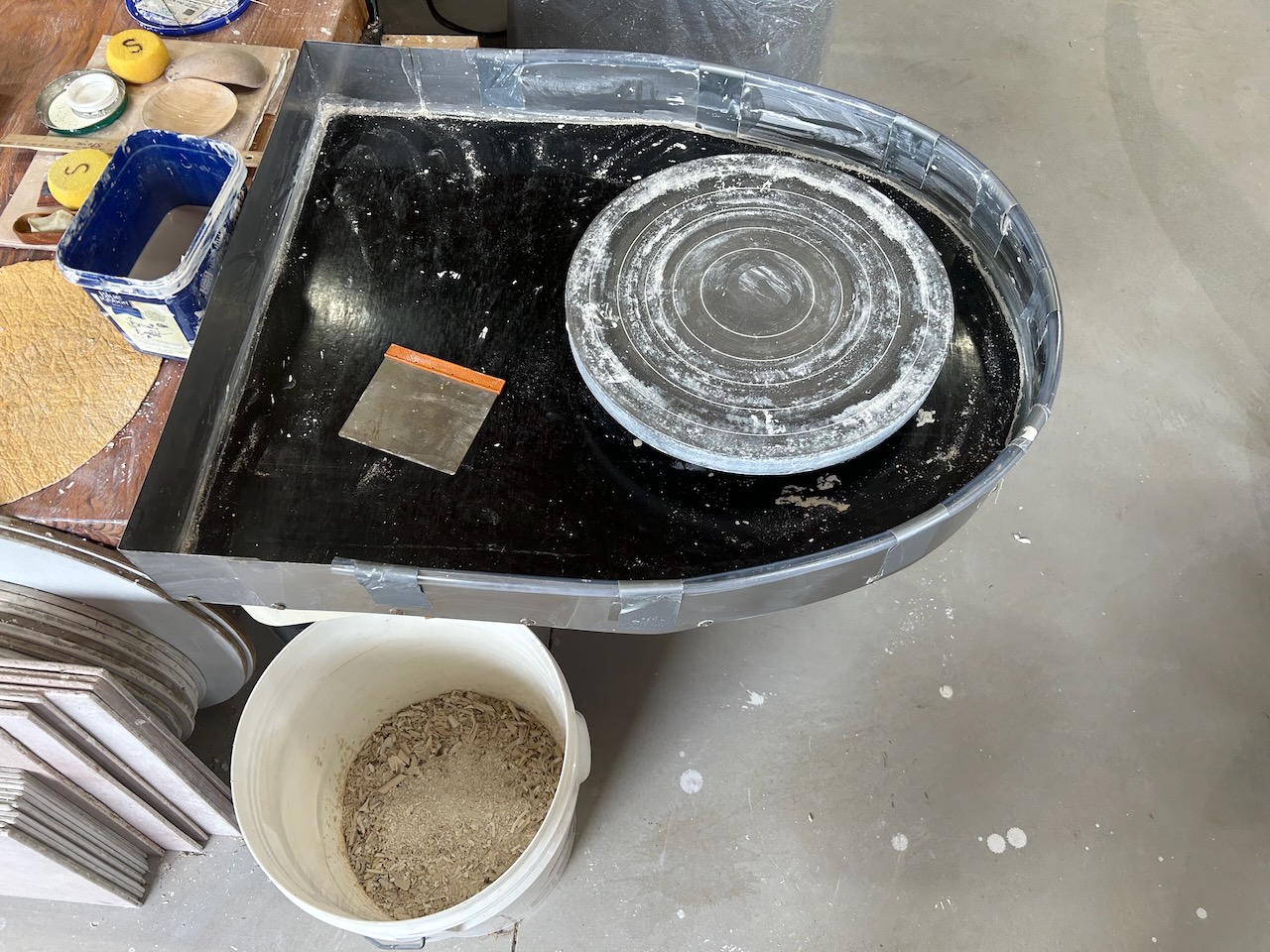
I have built an extra-large tray for my shimpo, but with this porcelain, I still fill it very quickly. This image is of the trimmings from just 15 small 150mm. bowls.
It all goes into the mixer pug and is recycled, ready for throwing again the next day, although leaving it to age a little bit and ‘recover’ would be even better, but because I use a dozen different mixtures and recipes, it is easy to loose track, with too many small packs of different clays hanging around. So I prefer to use up each batch all in one go as soon as possible.
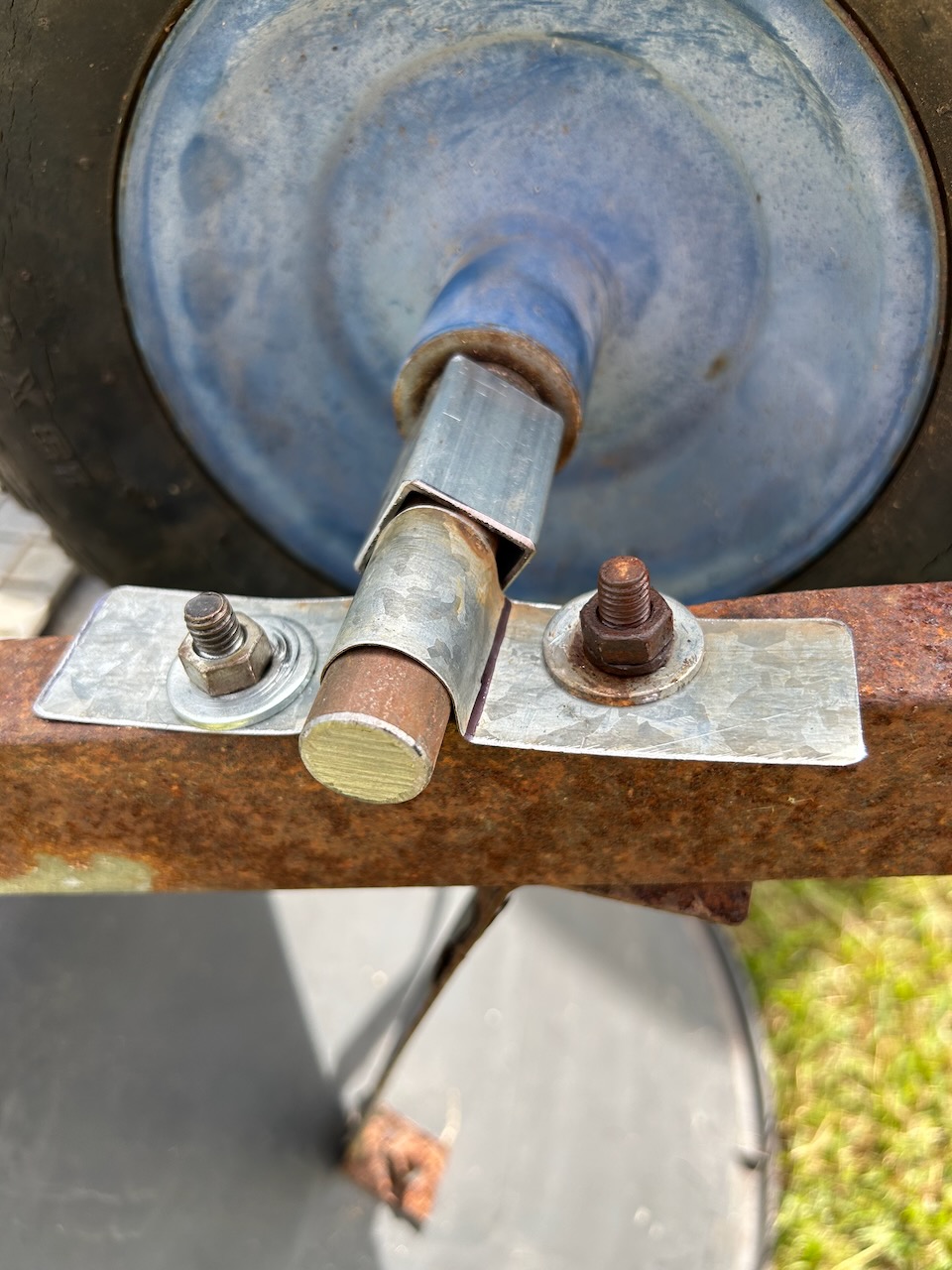
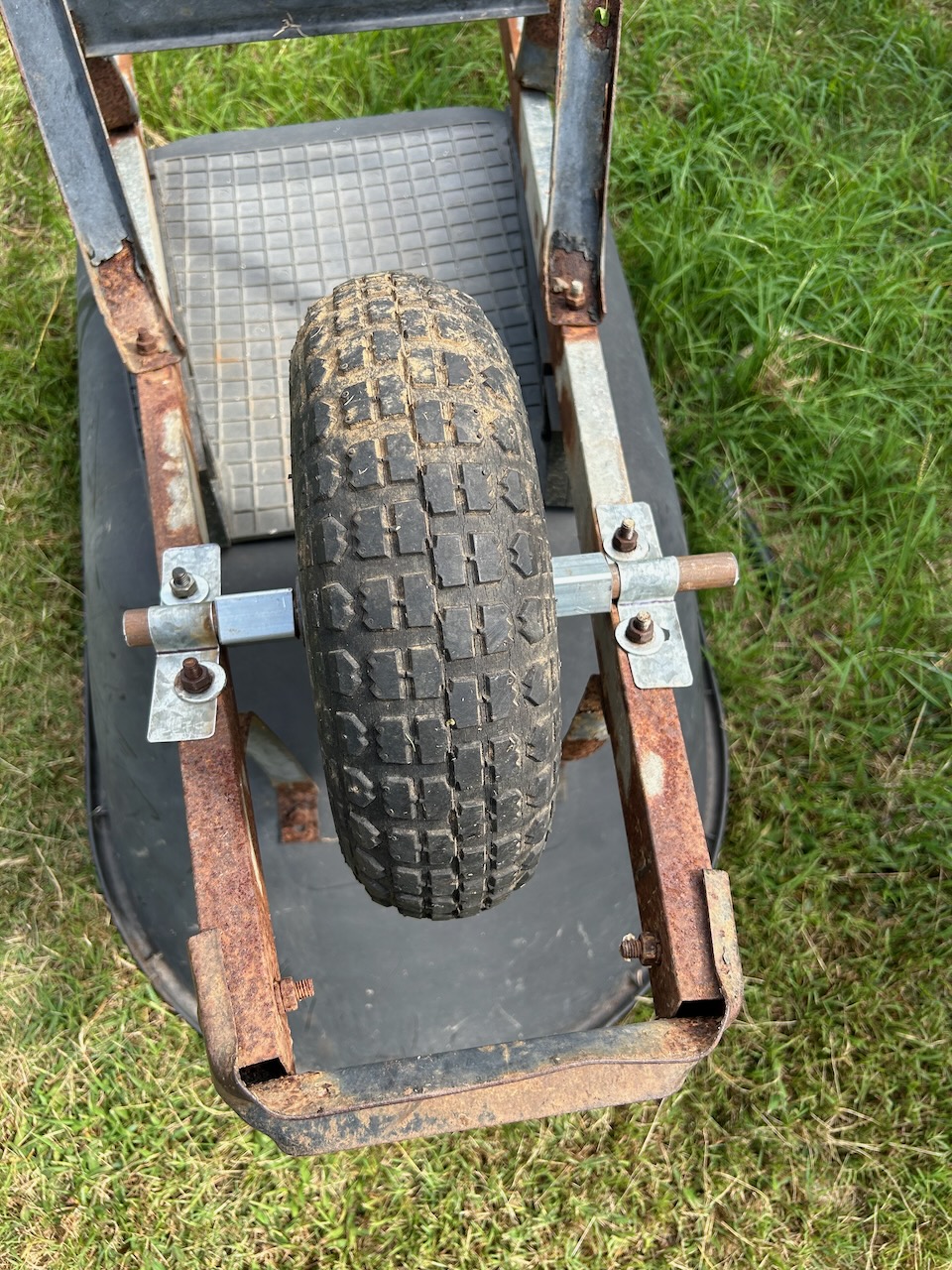
The tyre on the old wheel barrow went flat last week. I took it to the tyre place to get a patch or a new inner tube, but they told me that the tyre wasn’t worth working on and I’d need a new tyre and a new inner tube – at a cost of $78! As the old metal rim is quite rusty, I decided that I might just as well buy a whole new wheel unit from the big hardware chain for $32! But then I remembered that I had a complete wheel off a buggered trolly that I picked up off the side of the road on council clean-up day. It is 25mm smaller in dia. but still holds air pressure well, so I had to change the shaft size and make some new brackets to hold it on, out of scrap tin plate. 20 mins later we are all back in business and good to go. It’s not perfect, but it works. Recycle, reuse, repurpose!
The Japanese have a word ‘Mottainai’ – too good to waste!
A botched up job that will keep all of this useful material out of the waste stream and land fill for another decade. I actually picked this whole wheel barrow up off the side of the road in the village some years ago on Council clean-up day, when the owner decided that it was just junk, because the tyre was flat. I took it home and just pumped it up. It worked! And has been working hard here for all those years of reprieve since then – and now still continues to be useful. Waste averted, Mottainai!
Nothing is ever finished, nothing is perfect and nothing lasts.
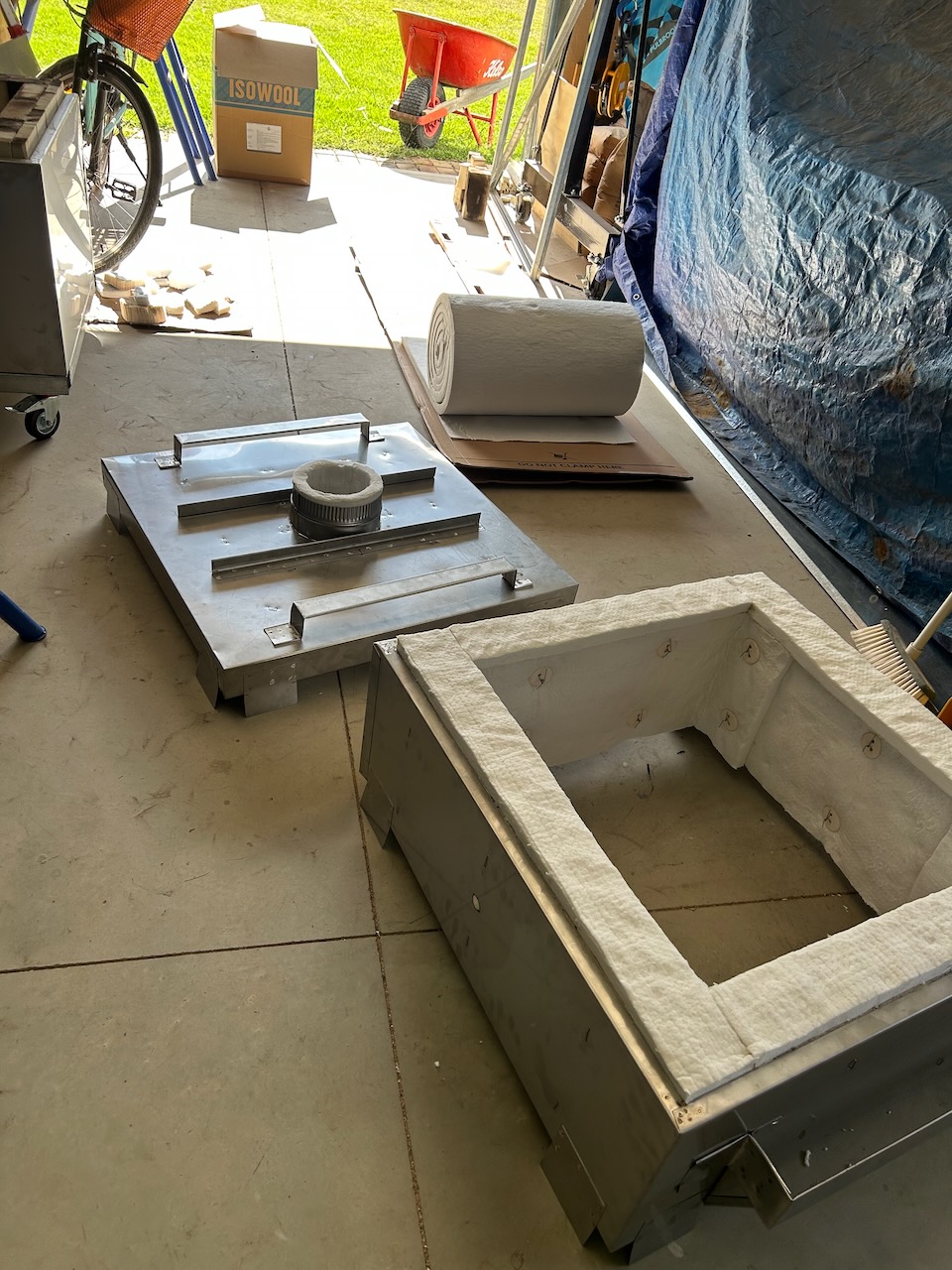
I’ve just completed the first firing in the new version of the small portable wood fired kiln that I have built for a friend.
This kiln is a little bit different from the ones that I used to build for a living before the fire.
In this case, I’m building it as a favour for an old friend. To repay an old debt. No money is changing hands.
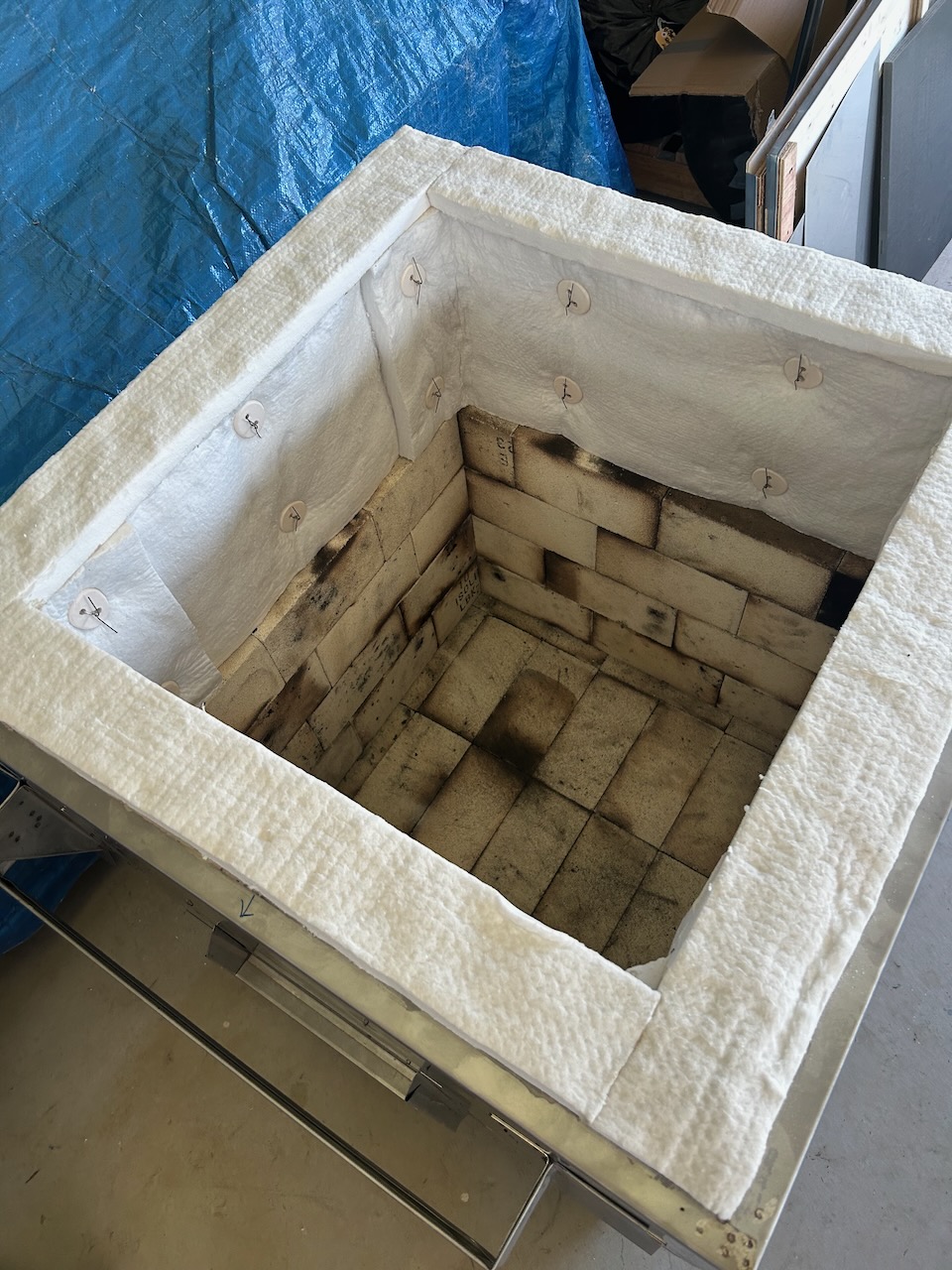
I’m also using up a lot of old refractory bricks and fibre that I had in stock before the fire, and which subsequently got burnt, but were largely unaffected by the fire, as they are ‘refractory’ after all. They are scorched black in places and impregnated with a lot of soot and carbon, where the cardboard packaging burnt off.
I’m confident that they will be fine. This first test firing will burn off all the carbon and return them to pristine white, albeit with a little bit of flashing and wood ash decoration.
The purpose of the test firing is to make sure that the kiln will get to stoneware temperature easily, just like all the others that I used to build. In this current kiln, I have made changes that allowed me to use up a lot of the left over materials, this makes the kiln just a little bit different in dimensions, so testing is required.
I sharpened my designers pencil and had a good long think about how I could use up what I had to the best advantage, and still have much the same outcome. As the old saying goes. There is more than one way to skin a cat. Who’d want to skin a cat anyway! weird! Anyway, this kiln looks pretty much the same as all the others, superficially at least, but all the critical dimensions are kept in the same relationship, so it ought to work OK.
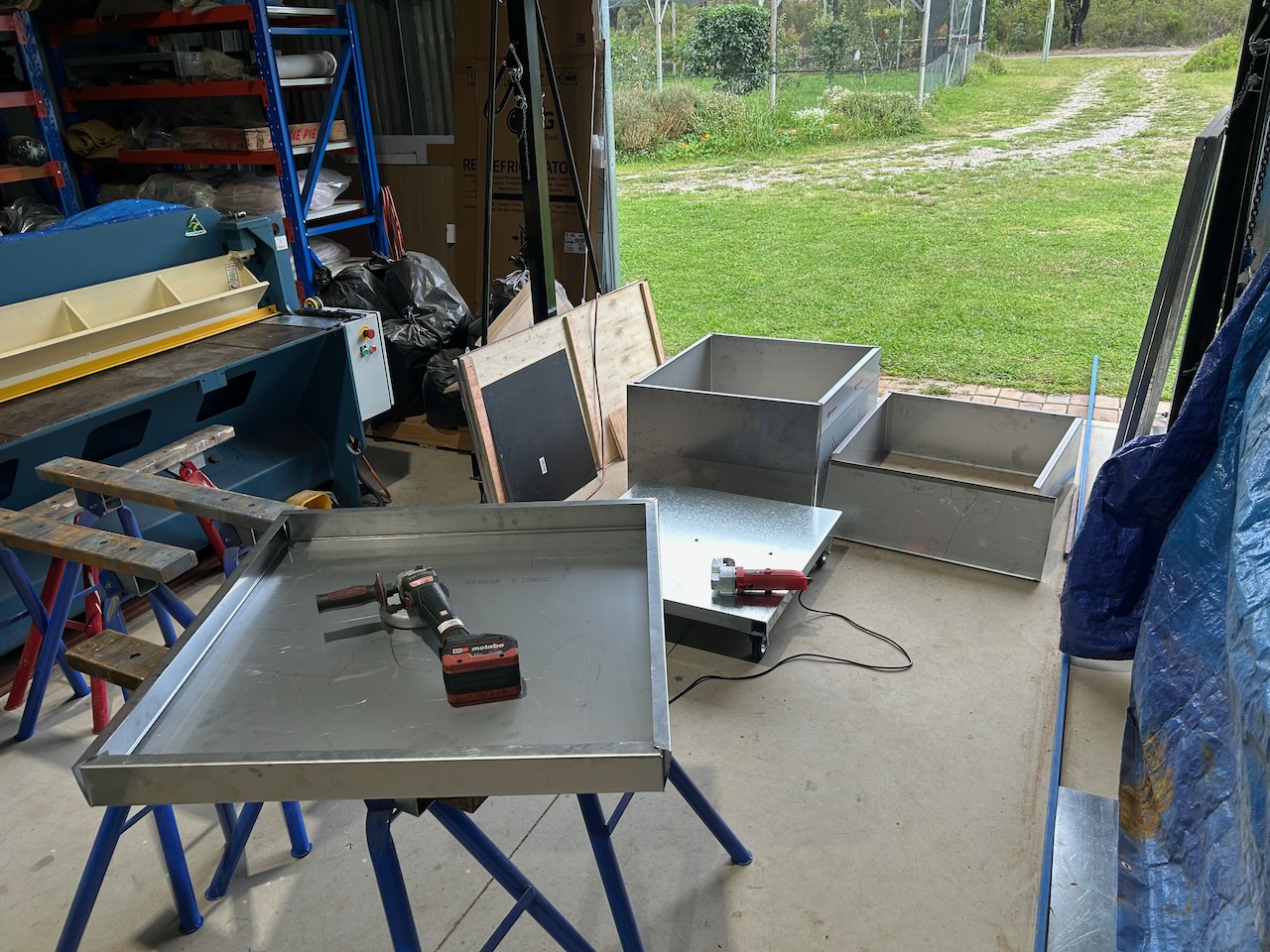
I started by redesigning how I cut the frame out from the standard 2440 x 1220 mm sheets of Stainless steel. I thought it through and started from the out side measurements of the sheets and worked back inwards. In this way, I was able to use every last millimetre of the material, with minimal leftover off-cuts. I am still using the same 450 x 450 size kiln shelf as the setting and the height is still more or less 450 mm high in the setting. Only I can see where the changes are, and I’ve done a work-around so that it doesn’t matter or affect the outcome too much. Or, at least that is what I thought, hence the need for a test firing. I’m actually a little bit pleased with myself, if I do say so myself.
I hate wasting precious material like stainless steel. Of course, I always managed to use up all the off-cuts from the previous kilns in subtle ways, right down to making throwing tools out of the smallest little pieces. So no more stainless steel throwing tools for sale or give-aways anymore.
This cunning use of everything made me re-design the handles, reinforcing angle brackets and support lugs etc that I have on the kiln. They don’t look so different, but still do their job effectively.
All the bricks look a bit ‘dirty’ but are brand new. These are the equivalent of RI 23 insulating refractories. Good for firing to stoneware in fast firings. They are not very suitable for long, high temperature firings, as they would shrink a bit. but not so in this fast firing kiln.
I made some more ceramic buttons to keep the fibre in place. I also made a new stainless steel grate from old burnt stainless steel rod that was in the pottery when it burnt down. It looks a bit rusty, but it would look very black and rusty after the first firing anyway.
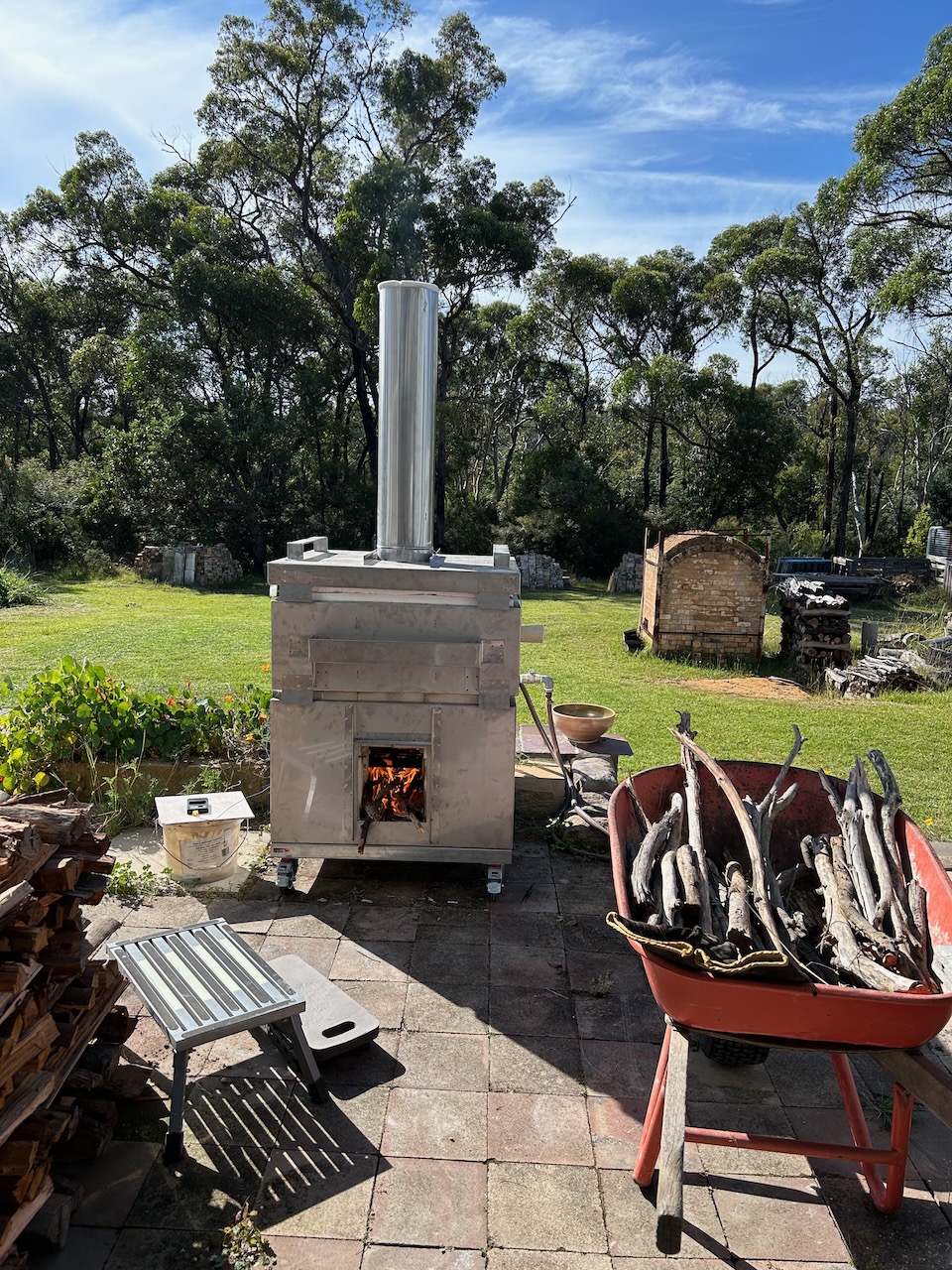
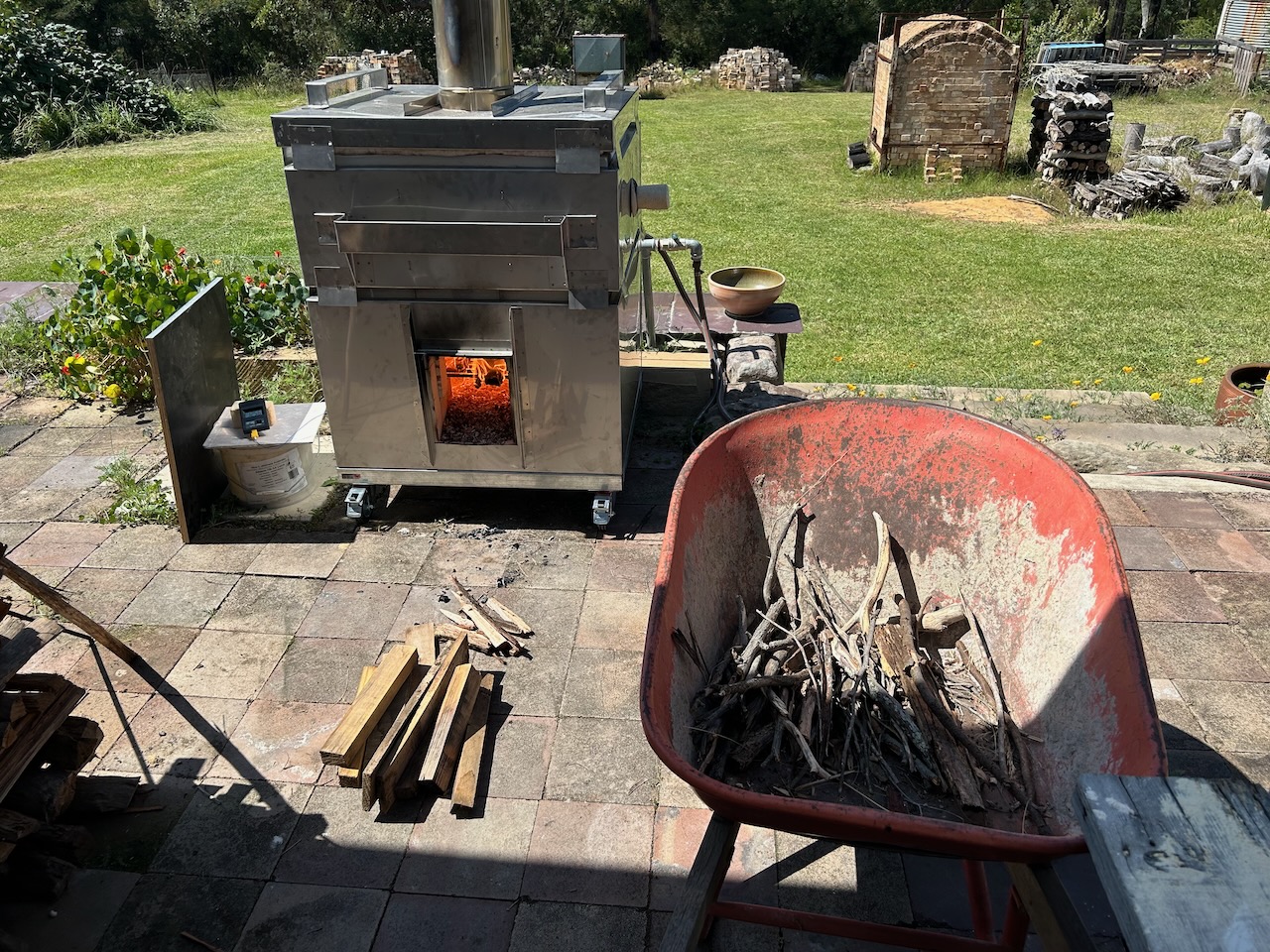
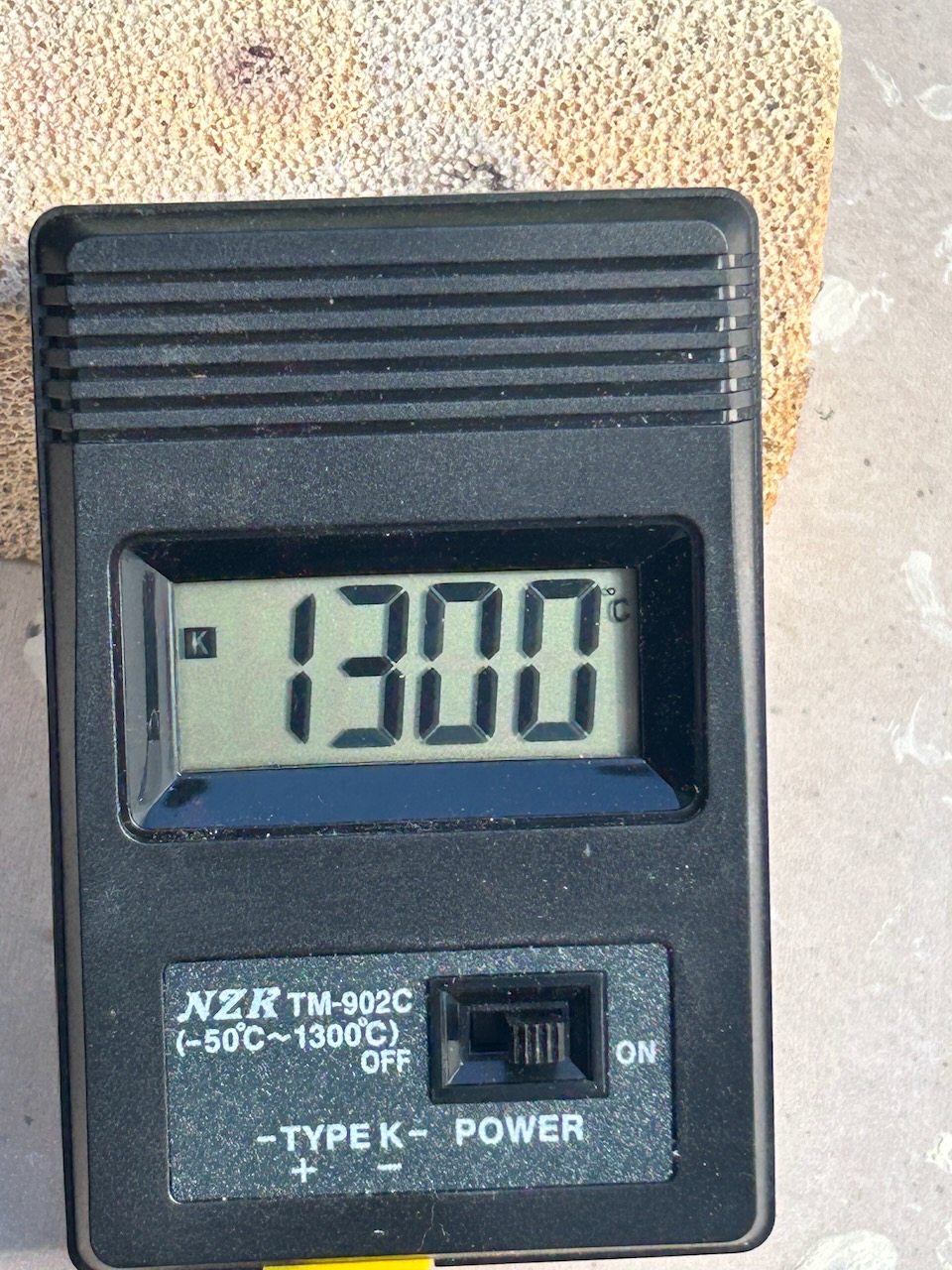
The test firing went very well. I got it up to 1300 in just over 3 hours and 15 mins. I used 2 wheel barrow loads of wood to get it up to temperature.
Just a few skerricks of wood left at the end of the firing. A lucky guess !
A nice resolution for an example of necessity being the mother of invention. This new design variation will be my new standard design.
If I ever make another one!
Good thing that I don’t have many friends 🙂
Nothing is ever finished, nothing is perfect and nothing lasts.
It’s March and autumn is supposed to be here, but it has been delayed by Global Heating! We are having some of the hottest recorded days for this time of year. We are used to the long ‘Indian Summer’ season transition, but this is the heat that we used to expect in the middle of summer.
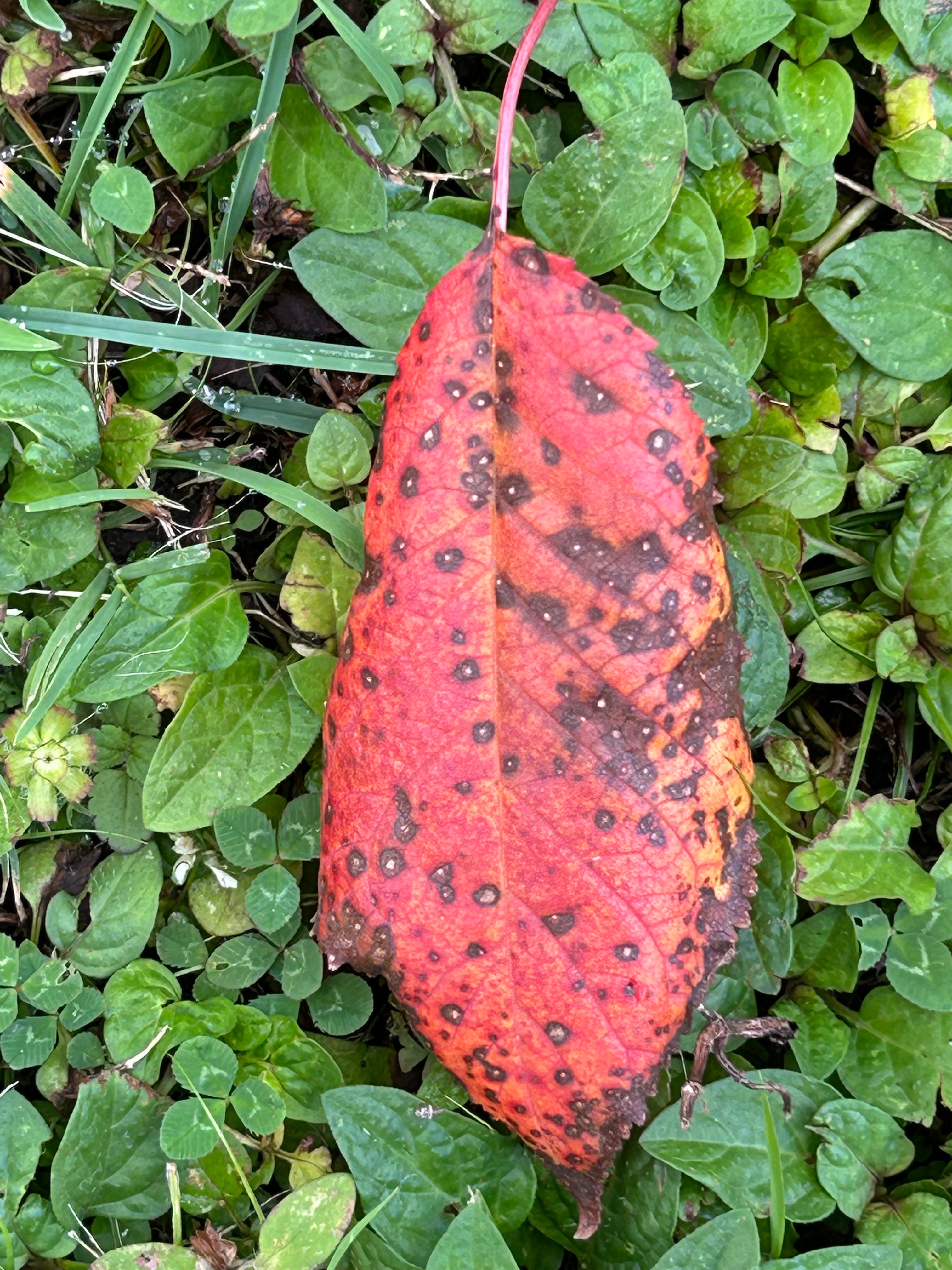
The cherry trees have lost all their leaves. They are the first to bud-up in the spring and the first to drop their leaves in Autumn.
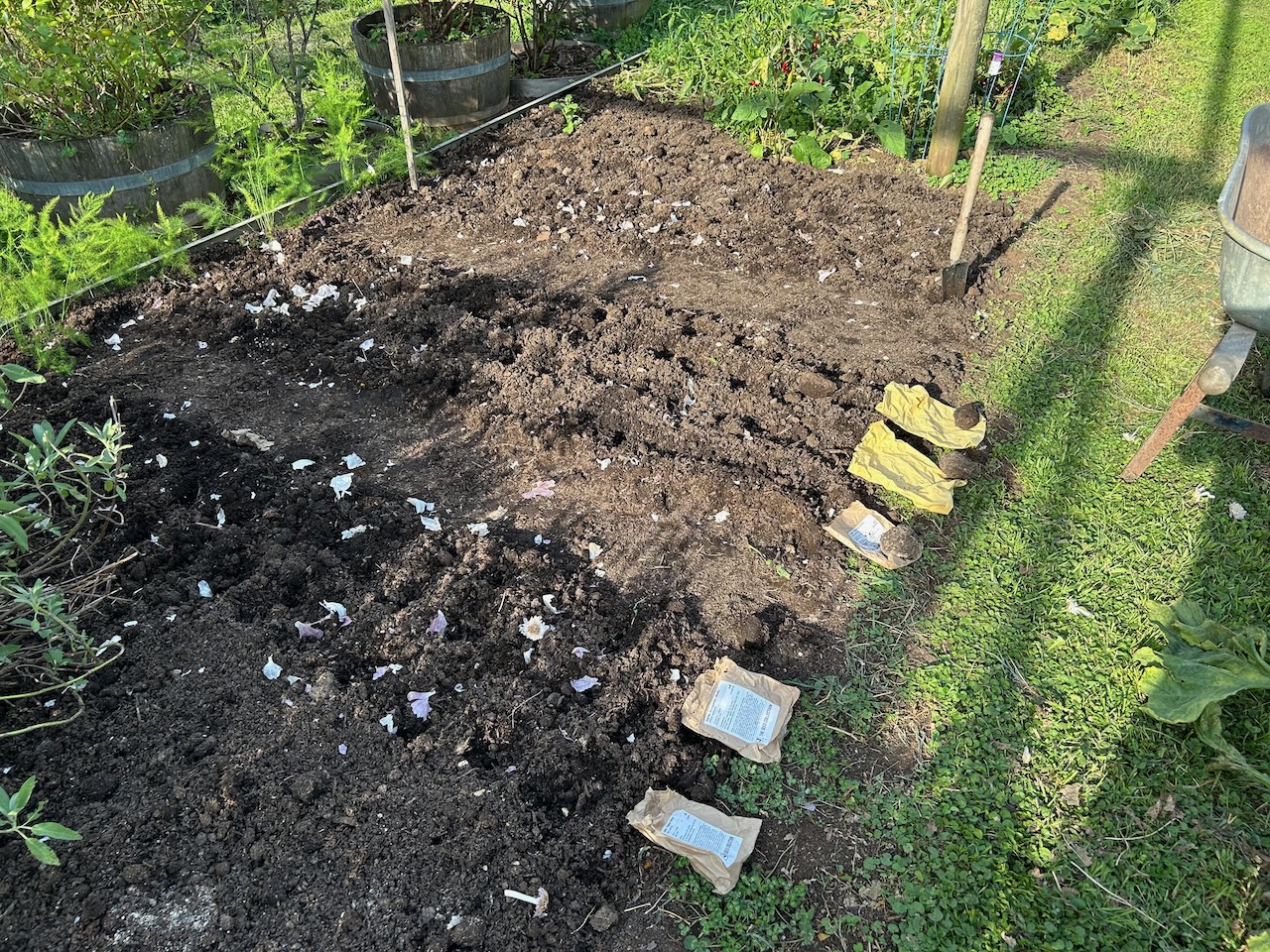
March is the month to plant garlic. The small cloves that we missed picking 6 months ago have shot up in the places where we left them invisibly underground. Their tender, slim, green aromatic shoots are a very good sign that it’s time for garlic to grow again. They have decided! I planted 5 rows of our own, best-of-crop, home-grown garlic, the largest knobs from last year.
I planted about 15 cloves to a row, that’s about 70 plants, if they all do well. I left a gap, for a place to stand while weeding the crop as will be necessary several times over the next 6 months.
Then I planted 4 rows of commercially grown varieties of seed garlic. This year I’m growing ‘Rojo de Castro’ ‘Dynamite’ and ‘Spanish Roja’. Just to see if they will do well or even better than what we already have.
I left another walking gap for weeding and watering, then another 3 more rows of other bought seed garlic varieties. ‘Dunganski’, and ‘Festival’. Our very good friend Anne, organised a bulk purchase for a few of us in the ‘seed-savers’ group. I’m always interested in trying something new. Thank you Anne!
I always plant the best of last years harvest, whatever variety(ies) that is, very often a mix of what grows best here over the decades. All self selected, simply by growing well with large easy to peel large cloves. These new varieties all have a red, or pinkish hue, simply because I like the look of them when hung up in the kitchen drying and waiting to be used.
Whatever does well and grows best will be added to our localised crop for the following season. Life goes on. All the same as before, but with small changes and additions and hopefully improvements.
In the pottery I have been collecting, crushing and ball milling a few new local rocks for testing as glaze material.
As soon as the heat subsides, I’ll be firing the small portable wood fired kiln, filled with test bodies and glazes, to prepare for the firing of the big wood kiln over the winter months.
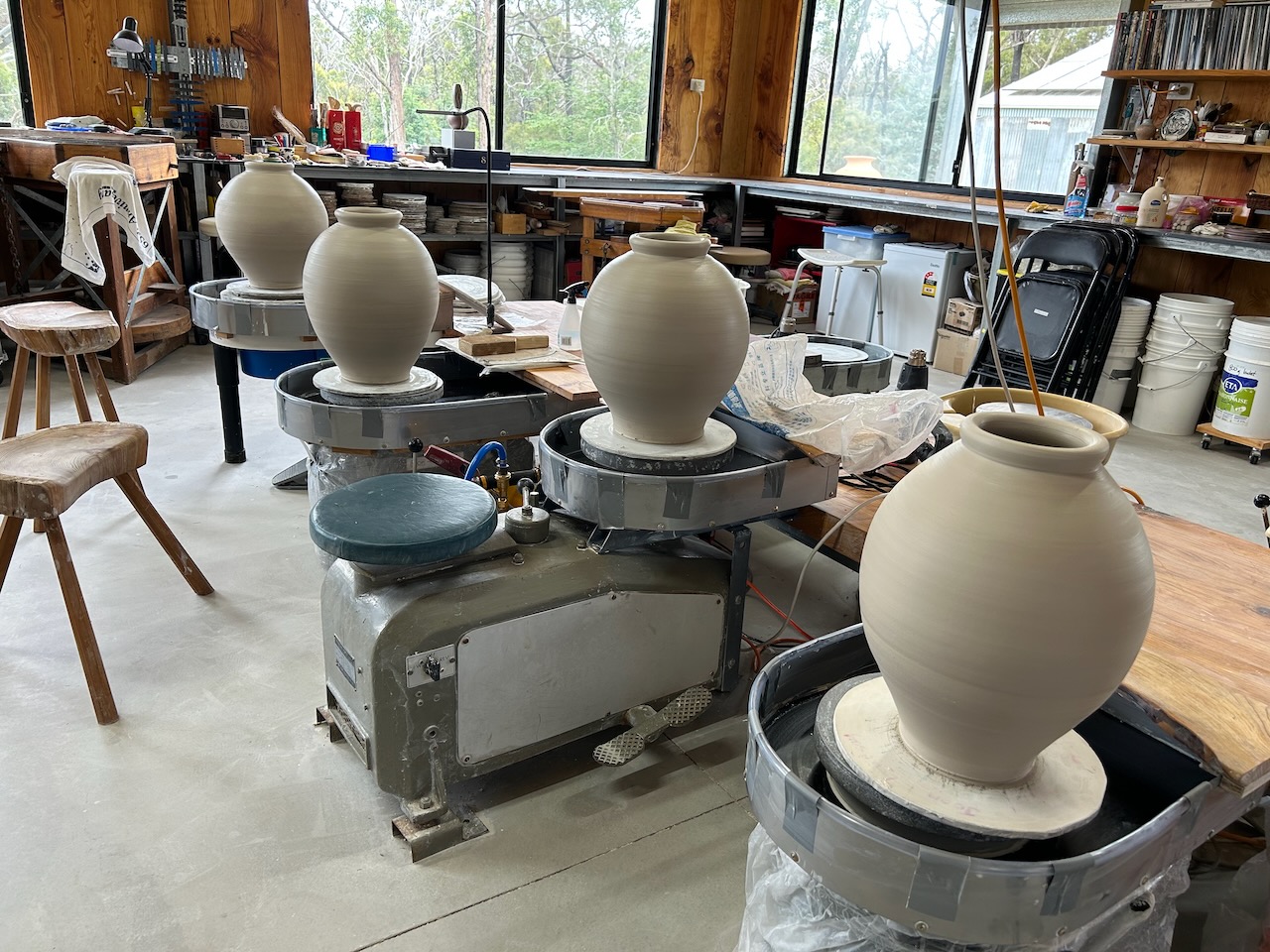
After the ‘big-pot’ throwing Summer Schools that we held here over January and February. I had about 80 kgs of the special course grained/textured clay left over. So I decided, rather than store it away somewhere, I would be better off to use it up making a few big jars for myself. I have always liked the traditional Korean ‘Moon Jars’, so I decided to have a go at making a few Korean inspired big round jars. They are NOT Moon jars, but my interpretation of the big, round, pale glazed form.
Janine decorated some of them for me using her carved/sgraffito through slip technique.
I have continued planting brassicas since Xmas day, when I planted the first seeds. I have planted 8 to 10 plants of mixed types each month to ensure a continuing crop of cauliflowers, broccoli, cabbage, Brussel sprouts and kohlrabi through out the autumn/winter.
I noticed today that the first broccoli head is forming on one of the first plantings.
I have to grow them under protective netting for the first few weeks to a month, to stop the black birds and bowerbirds from digging them out and eating the tops off them. The vegetable garden was completely covered in a mix of galvanised and plastic netting. But in the catastrophic bush fires of 2019 the heat of the fire melted the plastic netting on the west and east faces. All the birds were burnt in that fire, so there was no immediate need to repair the netting. EVERYTHING else was so much more important, like rebuilding.
Now the birds are recovering and breeding up in numbers, coming back into our area. They have figured out that they can squeeze in through the gaps in the melted areas. So I have booked a friend to come and help me next week to get up on our tall step ladders and re-cover the burnt out sections with new netting. A big job that in the past I would have thought nothing of doing by myself with the occasional helping hand from Janine in the difficult areas, pushing up from underneath with a broom to get an even cover. Luckily, a very nice couple donated a huge amount of plastic bird netting from their farm, when they took down their orchard cover and moved into a smaller holding. We are very happy to use this re-cycled netting, both galvanised and plastic. Nothing wasted. Recycle, re-use, re-purpose.I may be old and stupid, but still just smart enough to know that I don’t want to do this job all by myself anymore. It’s just one of those endless series of jobs that we have to tackle everyday to keep on living here in this self-reliant, low-carbon, organic, minimal consumerist muddle.
Nothing is ever finished, nothing is perfect and nothing lasts!
We have had our Hyundai ‘Ioniq’, plug-in electric hybrid car for 6 years now and it has all been a good experience, even better actually, A great experience!
This car has exceeded our expectations. We have settled into a routine with it now. We can drive anywhere locally on the battery, doing our local shopping and social visits very comfortably. If we need to go further afield, no problem, the petrol engine will bring us home.
We always charge at home from our solar PV panels. We have never been to a charging station. We have taken it on longer trips up the Queensland twice and down to Canberra several times. For these trips, we rely on the petrol engine. However, these trips are seldom done and are the exception.
For those interested in facts and figures. My log book tells me that by January 2025, we had traveled 64,000kms and spent a total of $1,860 on fuel. That’s about 34 kms to the dollar, or if petrol is $1.80 per litre, then we are getting about 61 kms to the litre. NOT 6 but 61! Most of that fuel was purchased on those long trips.
We are in the habit of putting $20 to $30 dollars worth of fuel in the car about 4 times a year. When we first purchased it. I filled the tank on the way home, as per normal practice with a new car. Big mistake! It took us almost a year to use up that fuel. It was sitting there going stale in the tank for most of the time. Stale fuel can be a big problem, so we have not done that since, unless we are planning a long trip.
When fully fueled up with a full battery and a full tank. The fuel/trip computer tells me that we can go 1,150 kms!
The Ioniq, is a medium sized car, but is the biggest car that we have ever owned. It’s vast and comfortable compared to the little 3 cylinder Japanese 900 CC Daihatsu, Charade and Sirion, cars that we have had previously. These were very fuel efficient, very tiny, very nippy and could find a tiny parking space anywhere. I like the driving feel of the small cars, but I love driving the Hyundai. It’s so smooth, quiet and comfortable.
We have had no issues with it. Although, maybe just one, when rats are some part of the electrical wiring system. It cost us $600 to find the fault and get it repaired. Not too bad in the scheme of things, as the mechanic told us that several cars that he had looked at and quoted on recently were written off because of the cost of repair from rats eating the wiring loom. We were lucky!
Since then, I have begun opening the bonnet as soon as we get home, and fitting a bright LED light in the engine compartment, fitted with a 24 hour timer, so that is switches on at dusk and off at dawn, all automatically. That makes the engine compartment an unpleasant place to be for a rat. It also allows engine heat to dissipate readily, making it even less hospitable.
I love my plug-in electric car, so much so, that in December I bought a new fully electric Fiat 500e ‘bambino’. That classic little Italian car from the movies. First produced post-war, in the 50’s, and has been in production right through until today. In various models. This brand new electric version is incredibly cute. It can go 300kms on a full charge, which is enough to drive to Sydney and back.
I installed a new 3 phase, 40 amp, charger for it, It just plugs into the already existing 3 phase power socket on the wall in the carport. So I can charge it at home on sunshine. It takes from 3 to 4 hours from empty to fully charge. We can do this overnight from our home ‘powerwall’ batteries, using yesterdays sunshine, or during the day directly from the sun. However, I usually top it up any time there is plenty of sun that we are not getting very much money for when we sell to the grid.
The Fiat only seats 2 realistically, although it has a back seat and 4 seat belts, the back seat is only for child sized passengers. I’ve put the back seats down to double the boot space. So now it’s a two door, two seater hatch.
Its incredibly powerful. The torque is amazing, and can pin you back in your seat. But this is normal for all electric cars. They have loads of torque! It’s the classic small, nippy car that I have always loved to drive, but now I drive on sunshine!
So now, after a couple of months of ownership, I can say that it is fantastic, and does everything that we need to do. However, if I had to do a thousand kilometre drive to Melbourne or Queensland for some reason, I’d take the Hyundai for the long haul comfort and leg room.
We are very pleased to be a fully solar powered household. We can run the House, Pottery, Kilns and 2 cars on our solar. I even got a $350 cheque from the electricity company last week, for all our unused excess. This will reduce in Winter, but so far, we have never paid an electricity bill since 2006/7, when we installed the first solar PV panels.
Even when the fire burnt down our pottery in 2019. With our first PV installation gone, we were without solar for 3 quarters of billing periods. However, we had such a good unclaimed credit on our bill at the time, that we were able to go that whole time just using up our credit. We had new solar panels installed before the end of the year, and we were back on deck before the credit ran out.

































 Tonight my Fingers Smell of Garlic
You must be logged in to post a comment.