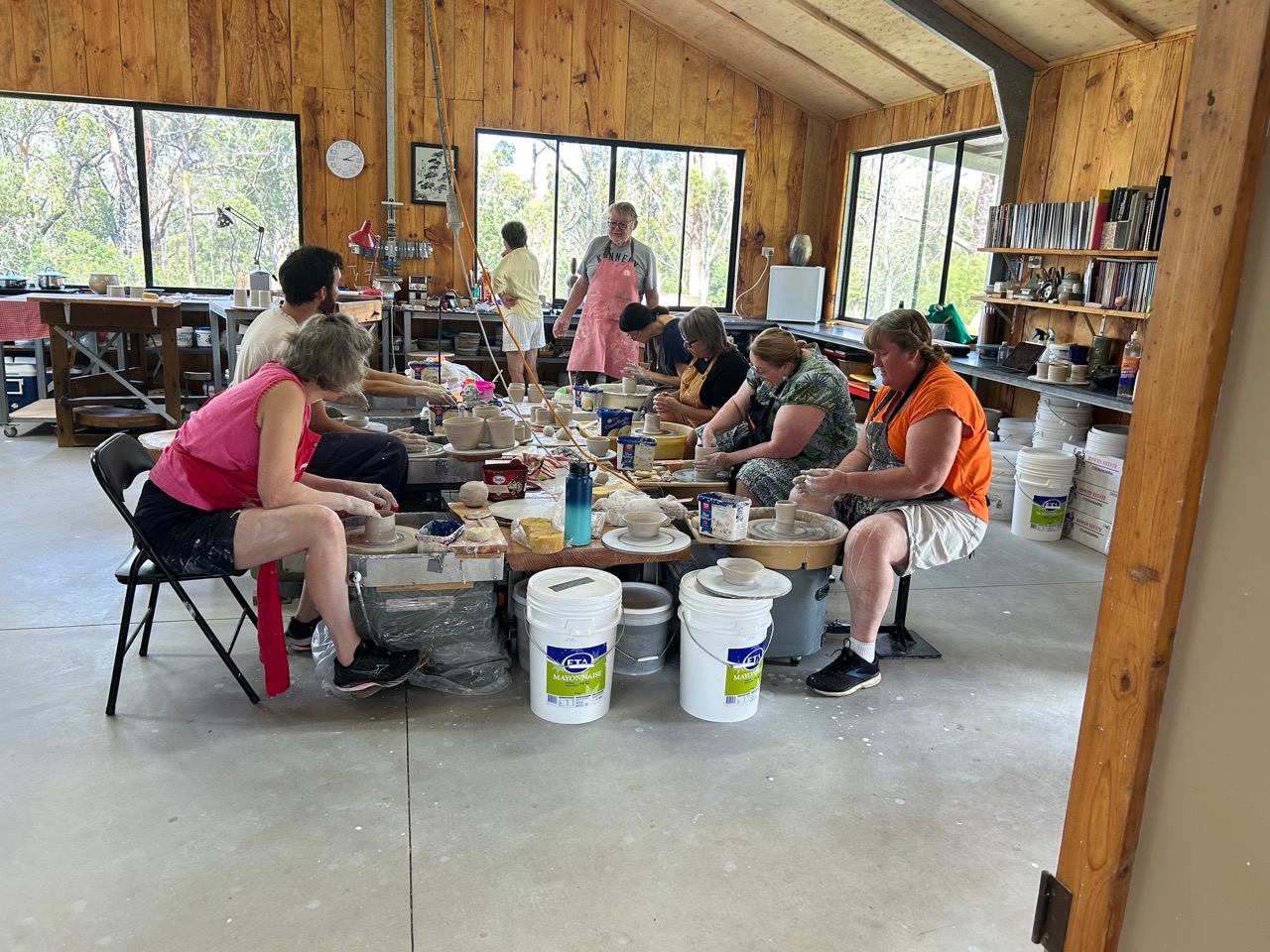
We have just completed another weekend workshop. This time a throwing class. I advertised one and filled two weekends, so we will back in the studio again with the 2nd group next weekend for the 2nd one.
Everyone seemed to enjoy them selves and got something out of it. We had Len Smith here with us for the weekend to have 3 tutors for the 8 students. Len has so much teaching experience, it’s great for the students to have a third point of view. He’s also great company.
I spent the week pugging clay and prepping the throwing room, and during the time in-between, I kept on with my sgraffito decoration, and got a solar powered, stoneware glaze firing done.
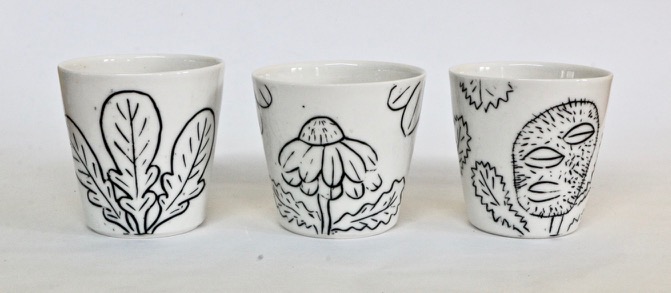
These red and black cups are experiments in a combination of Sgraffito and inlay.
Just black slip inlay on these cups.
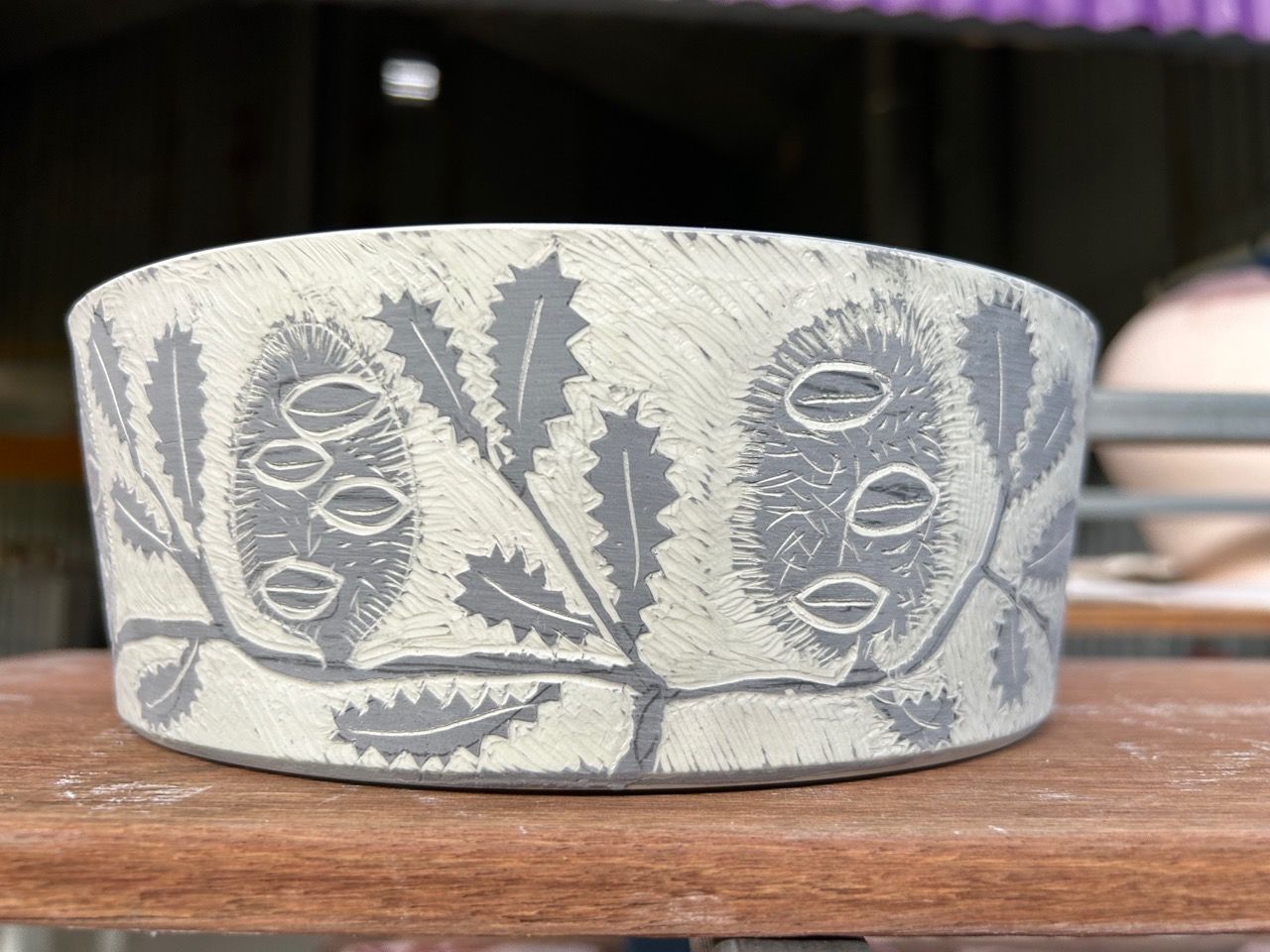
Just sgraffito on this bowl
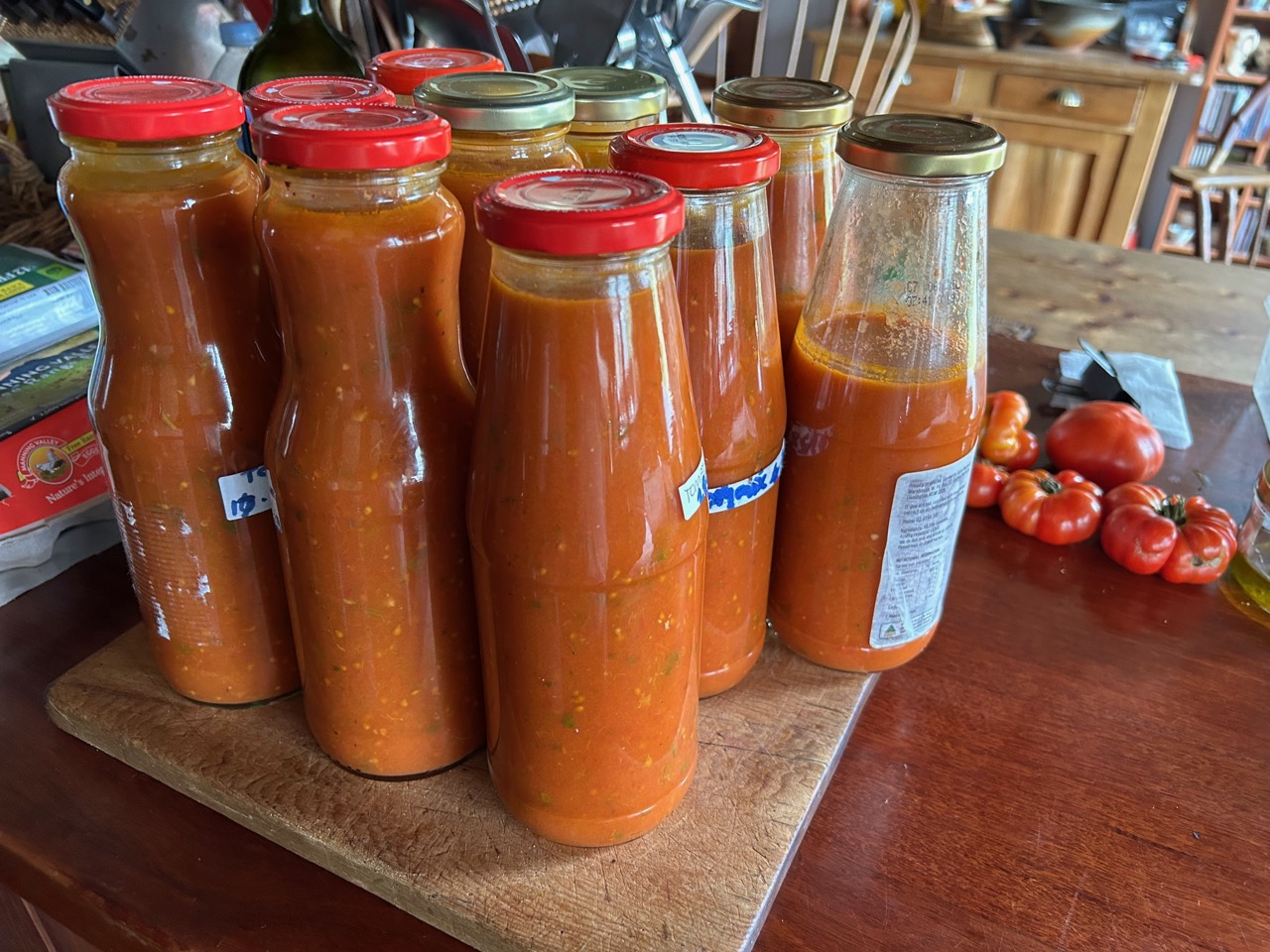
In the evenings, I made another batch of tomato passata. I have now run out of our re-cycled ‘pop top’ jars and so I have started to use the old ‘Fowler’s’ vacuum jars with clip top lids. I made a 7 litre boiler full, and reduced it down to 5 litres, enough to fill 7 of our No.27 Fowler’s jars. I have no idea how Fowlers came up with their numbering system, but as they are so old, I suspect that it represents fluid ounces?
I Googled it and 27 imperial fluid ounces = 770 mls. So that sounds like it ought to be right.
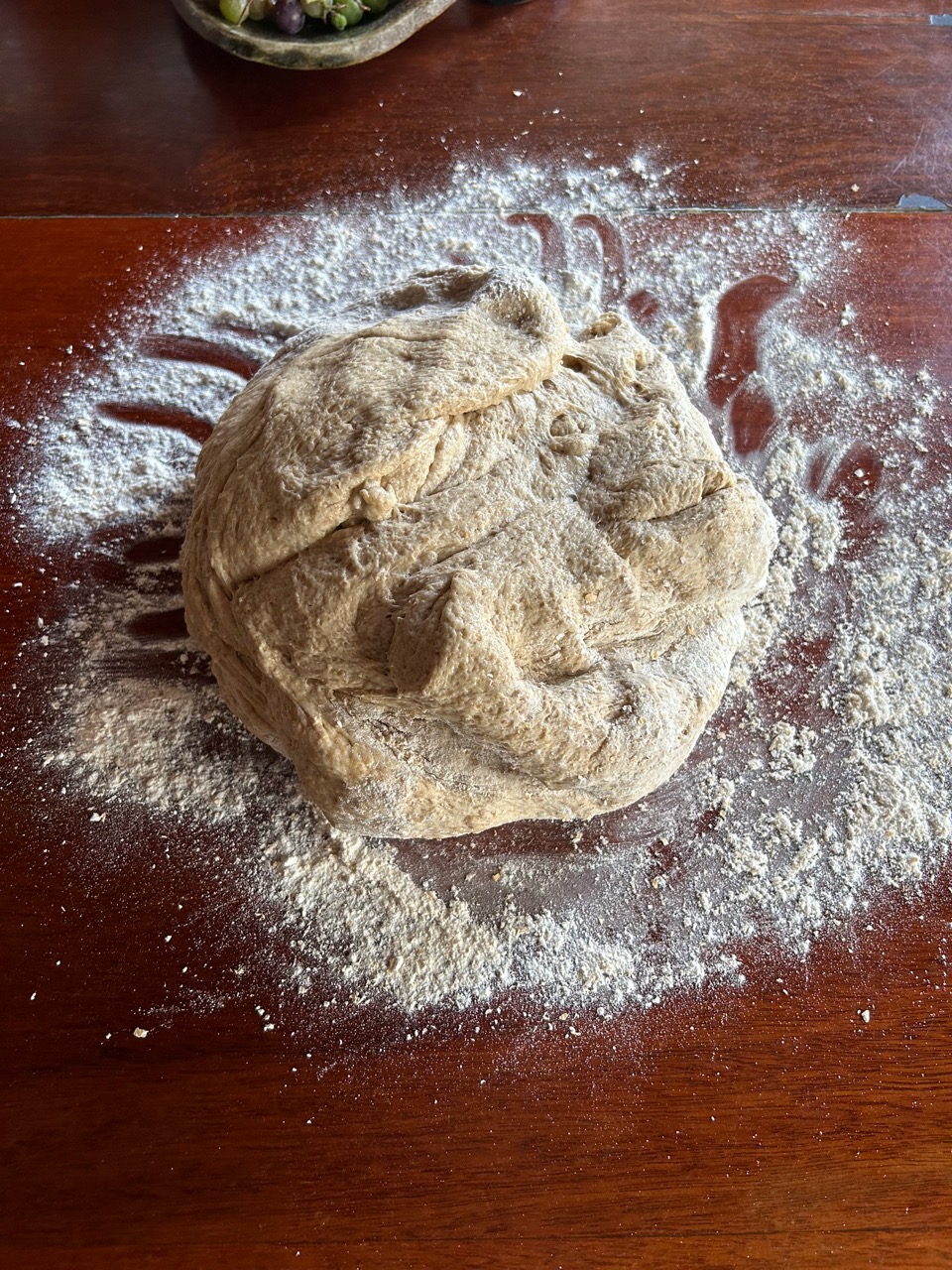
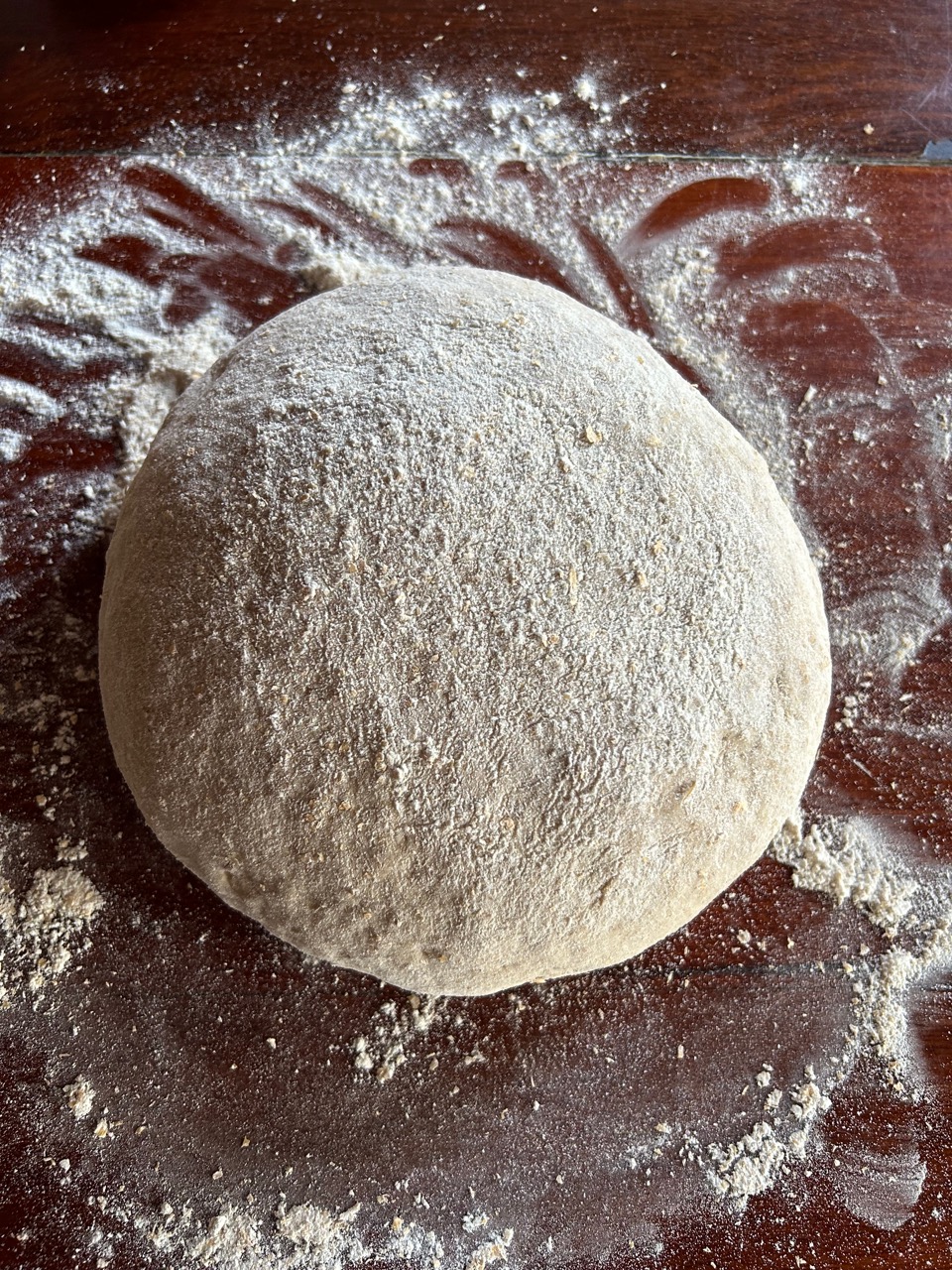
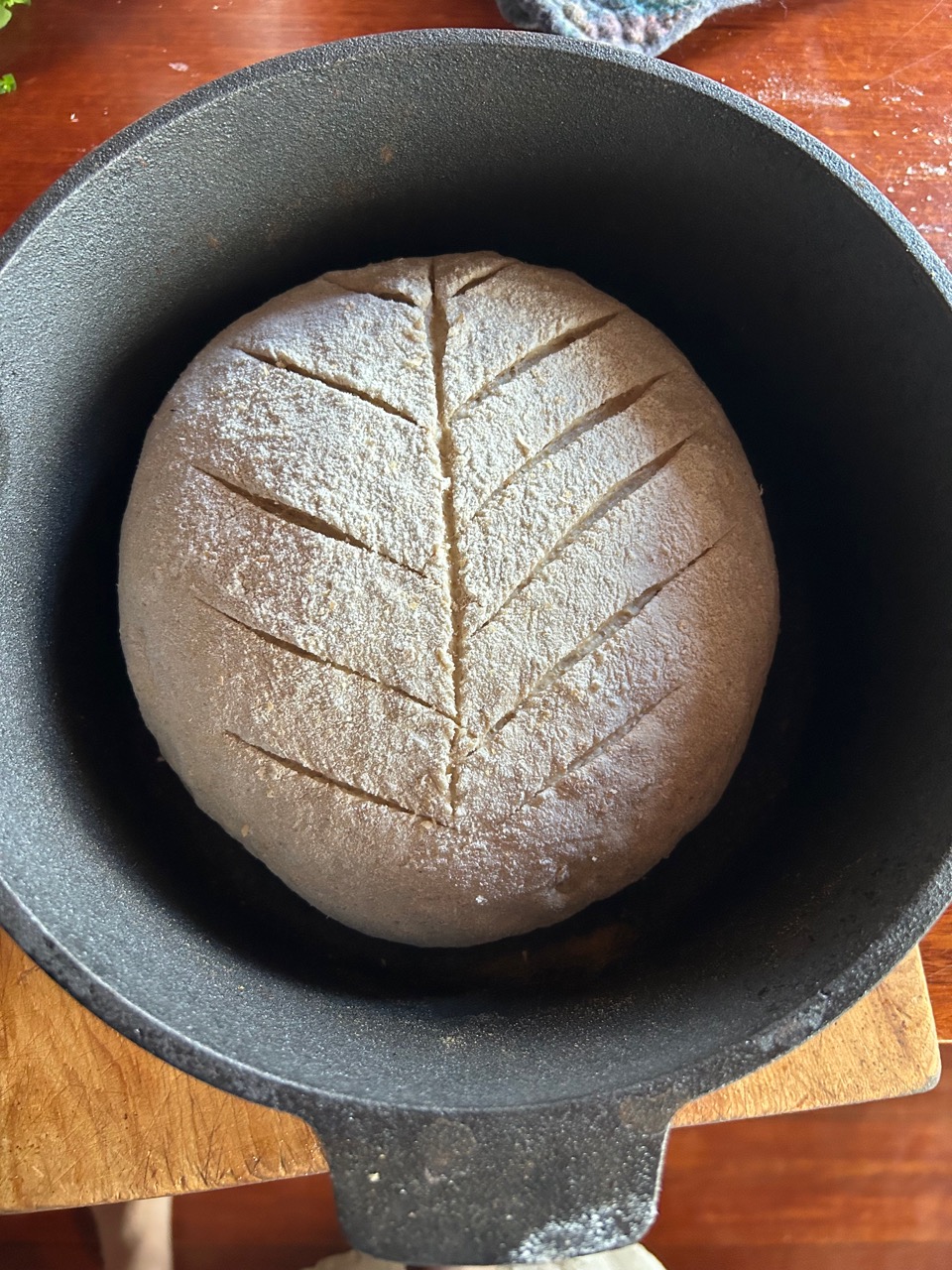
I also made this weeks loaf of rye bread.
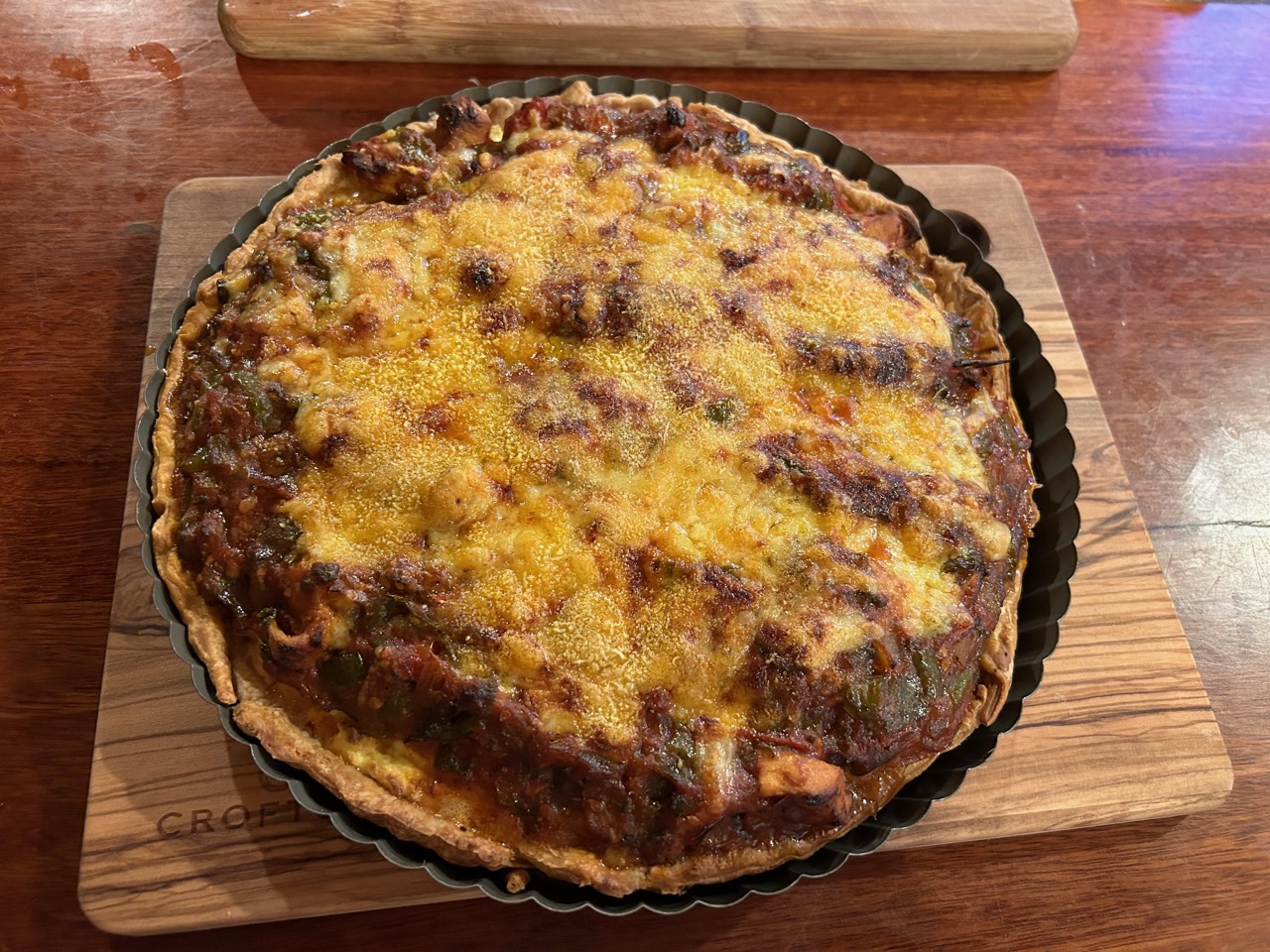
For the workshop lunch, I made a flan or tart with a baked cottage cheese base and a ratatouille topping. That didn’t last very long.
The coming week will be more of the same as we repeat it all over again.
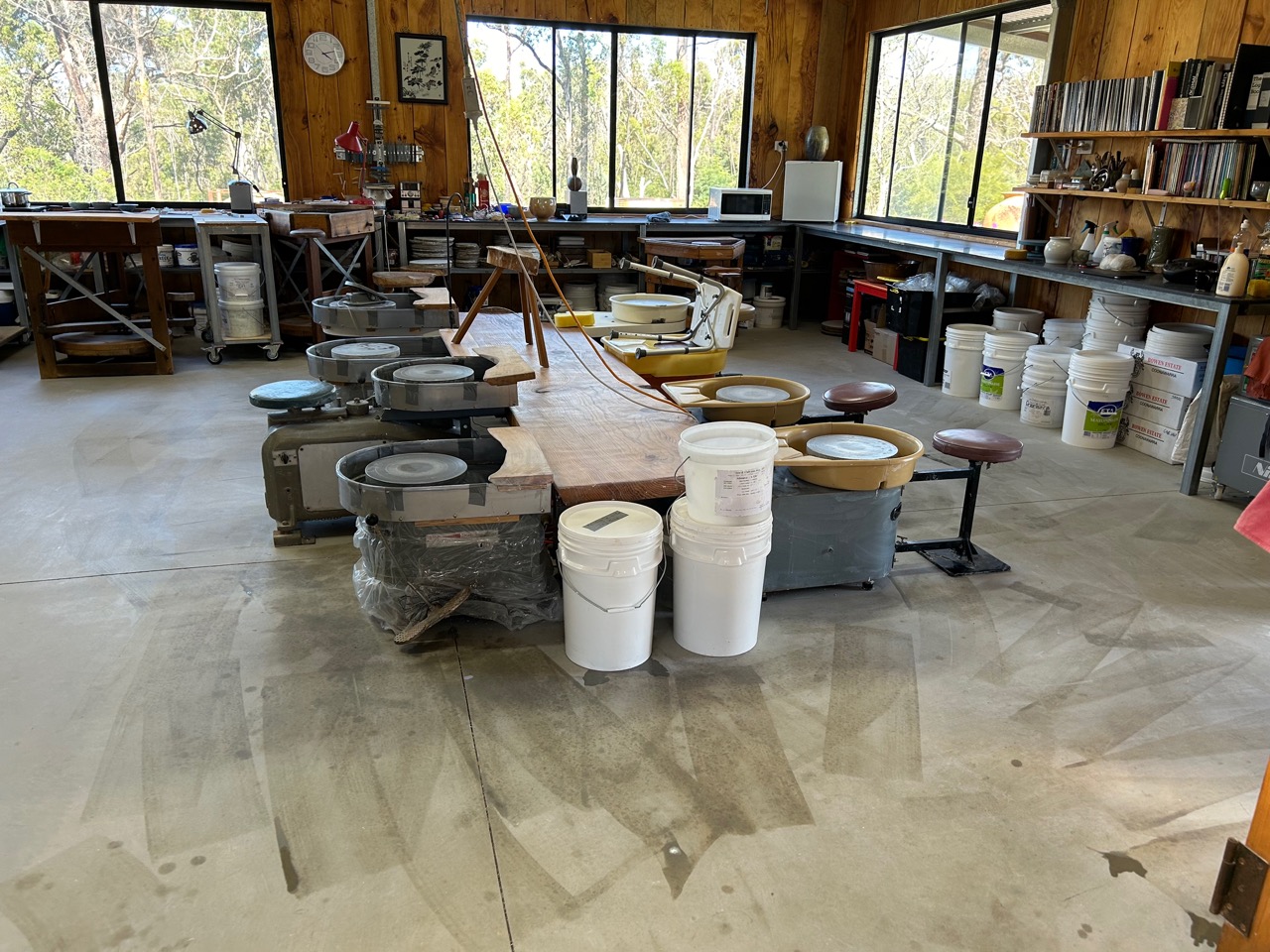
The workshop is all cleaned and mopped and ready to go.
The workshop looks beautiful tonight in the glow of the pink sunset.
It’s the end of summer, and all of the fruit is finished in the orchards, this month we have been busy with other jobs.
I have been going to build a new chicken run and chook house for a long time. The old one was very small, built in just one day straight after the fire by our good friends Cintia and Andy who came to volunteer their help at what ever was most needed. The old, very solid, and palatial chicken house was attached to the garden shed, which was part of the pottery extension. In the fire everything burnt to the ground.
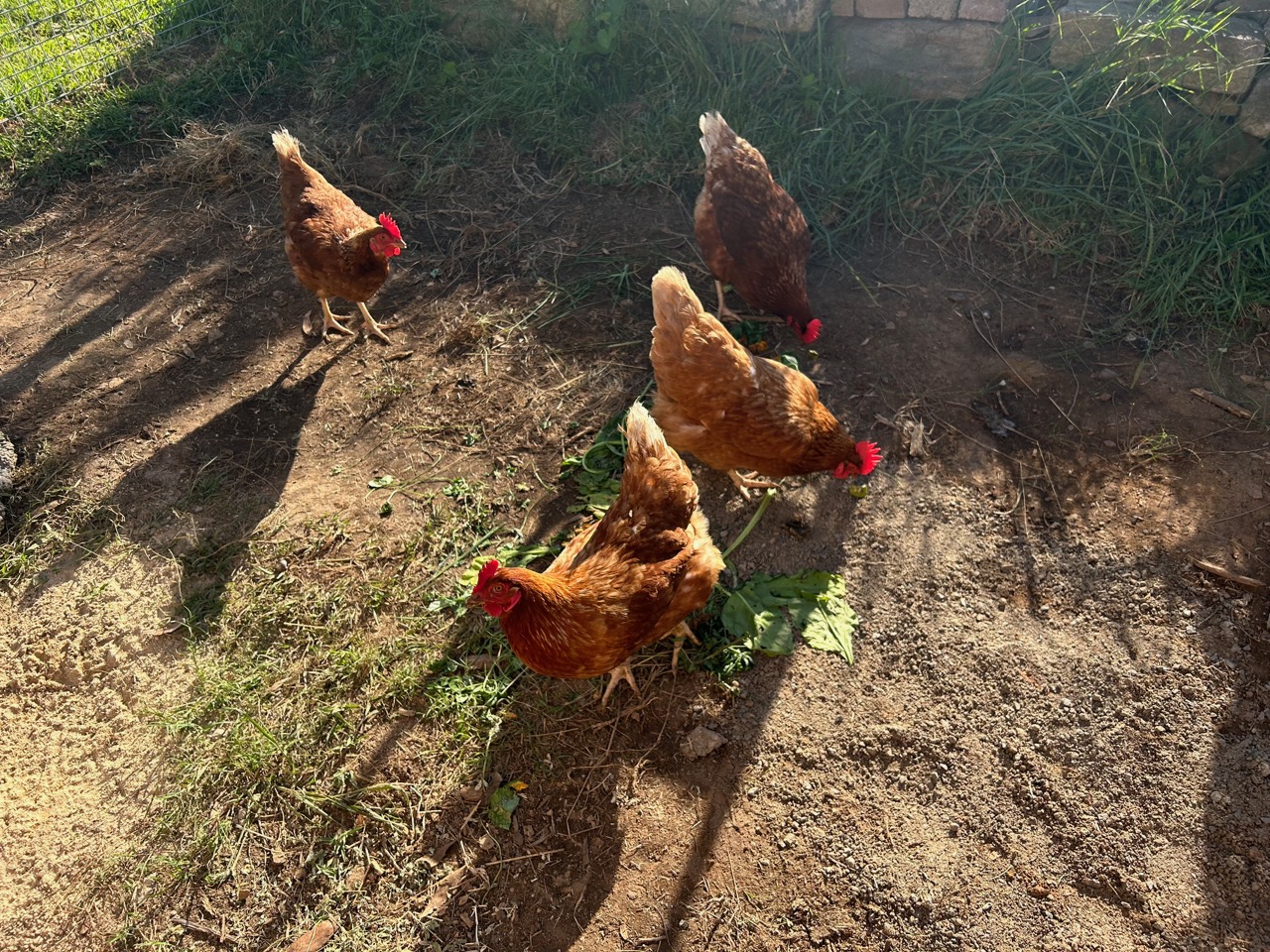
Andy and Cintia knocked up the replacement house out of whatever we could find on site that wasn’t burnt. At 1.8 metres square, it wasn’t really very big, but was OK for just 2 surviving chooks.
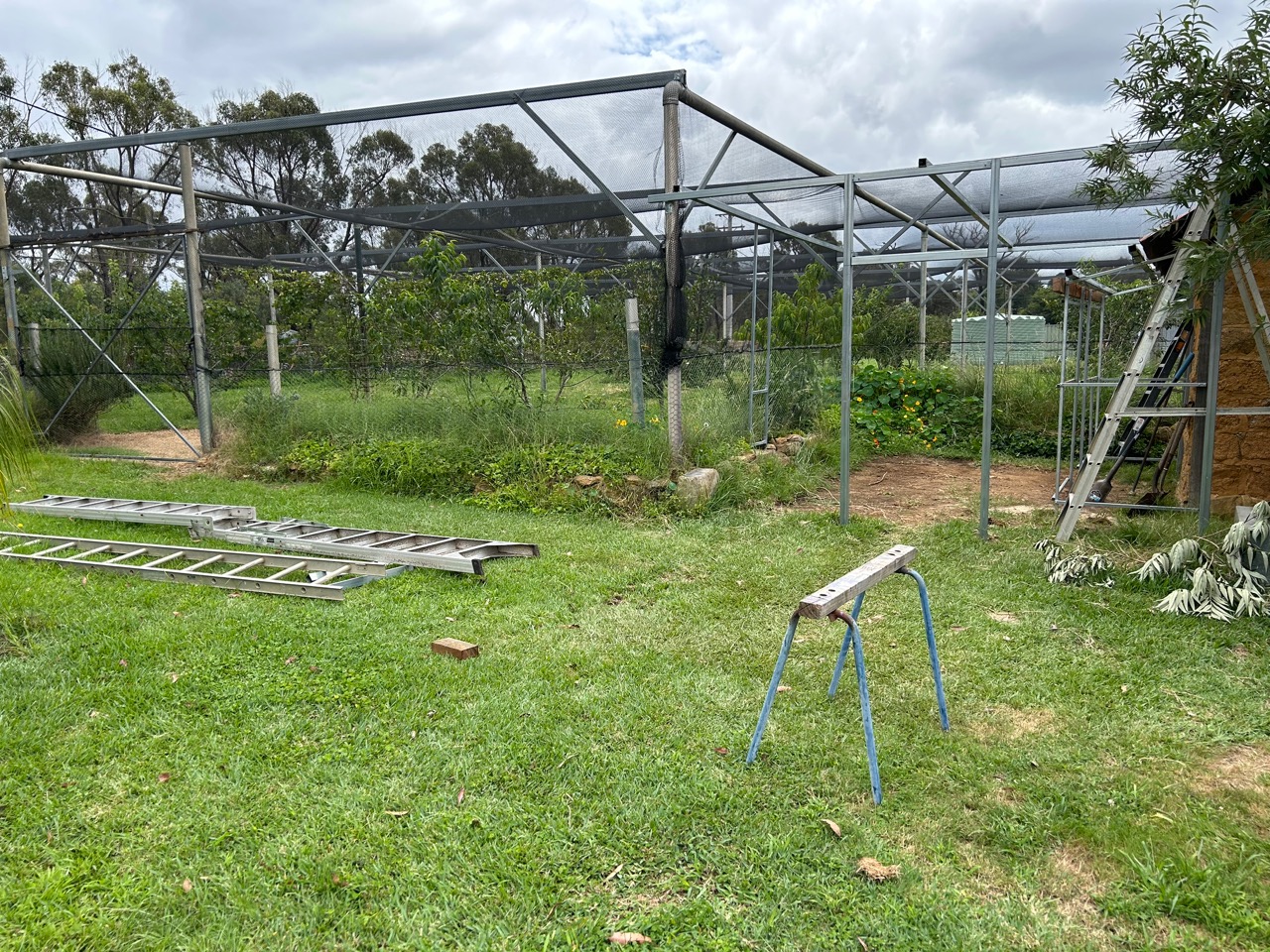
This weeks new chicken mansion is built into the gap between the new orchard and the old mud brick garden shed. It has access through a small gate into the covered orchard, where the chickens can explore and scratch all day in safety, without being swooped on, or chased by local dogs or foxes.
Janine suggested to paint it pink, so I thought to name it ‘Gallus Hilton’. Then she thought it might be better pale mauve, So it might get called ‘The Gallus Palace’.
What ever we call it, the new chook shed and run is the best one of the 4 that I have built here over the 48 years here. It’s still rusty recycled iron colour. I re-used the old corrugated roofing iron that we took off the Old School roof when Andy helped me to re-roof it last year. 130 year old roofing iron still has a lot of life left in it yet, as well as so much embedded history on this site.
It did occur to me that it is a bit strange that a man over 60 might need 4 different ladders to build a simple chook shed
This new run is 6m x 4m. So plenty big enough to be comfortable if we are away and they are locked in. It is completely fabricated out of steel, so shouldn’t burn in the next fire.
When its too hot outside in the middle of the day or raining, then I divide my time between the kitchen preserving excess garden produce, or over in the pottery.
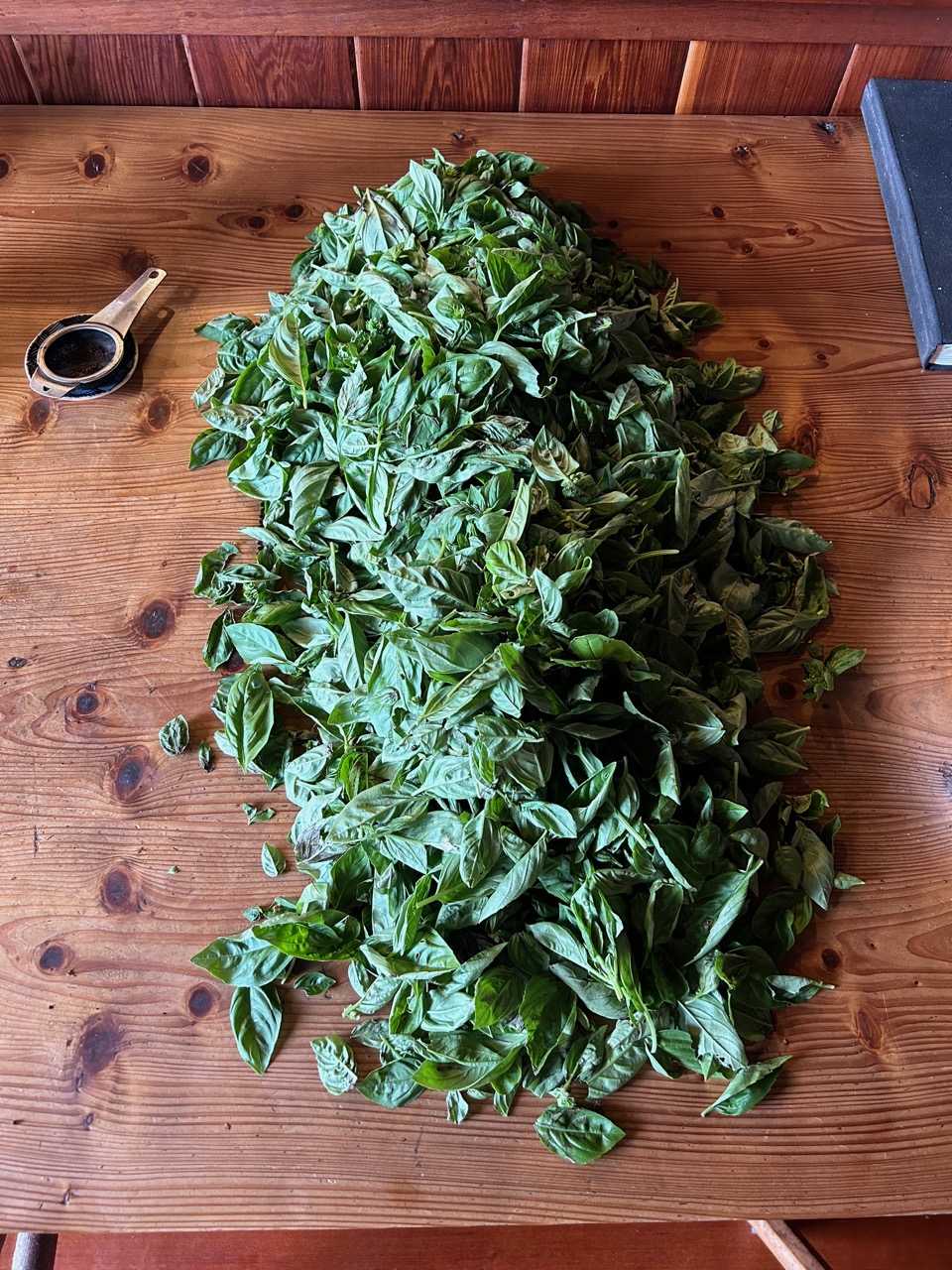
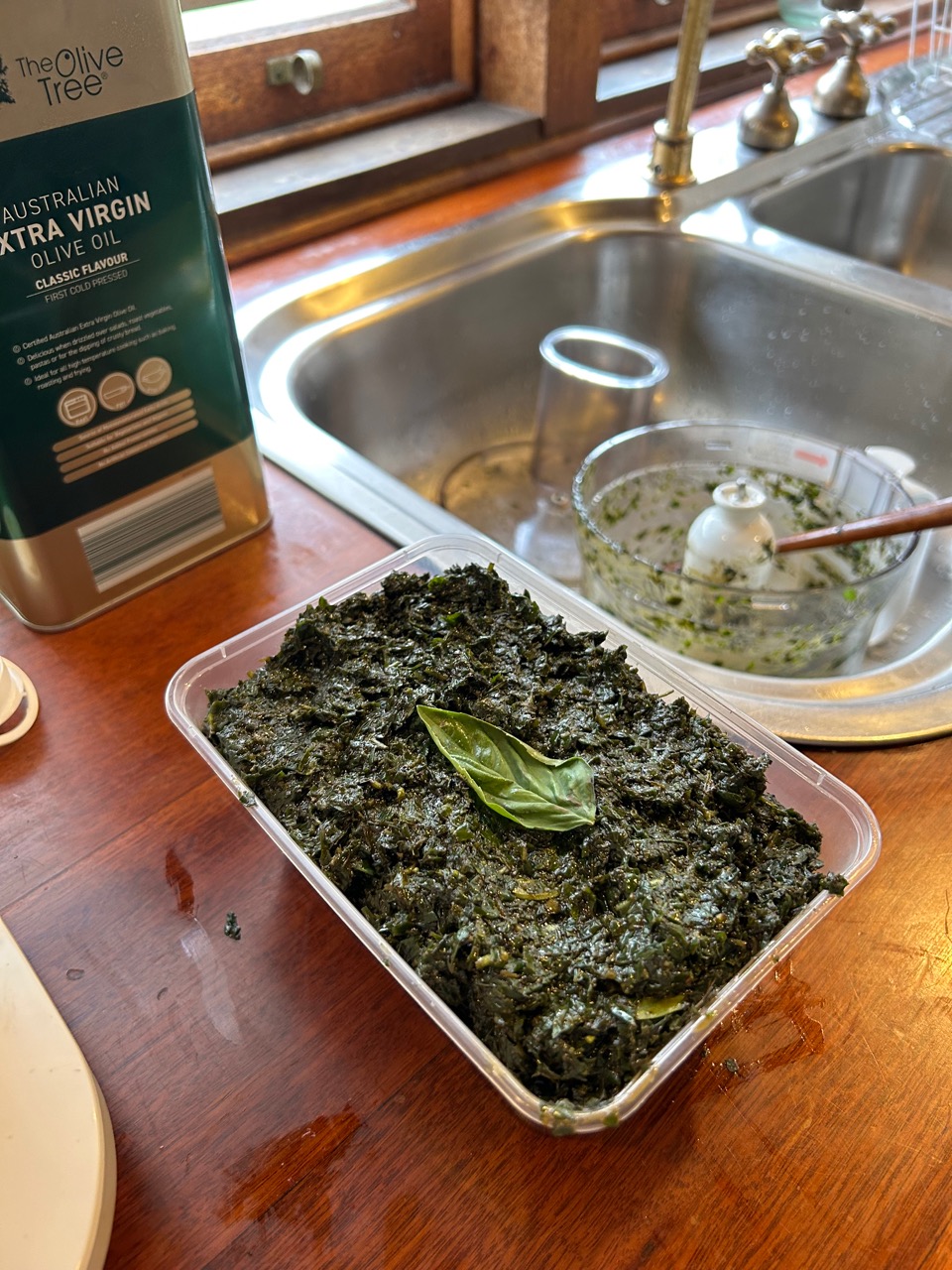
The sweet basil crop in peaking just now in the garden, so its time to make pesto.
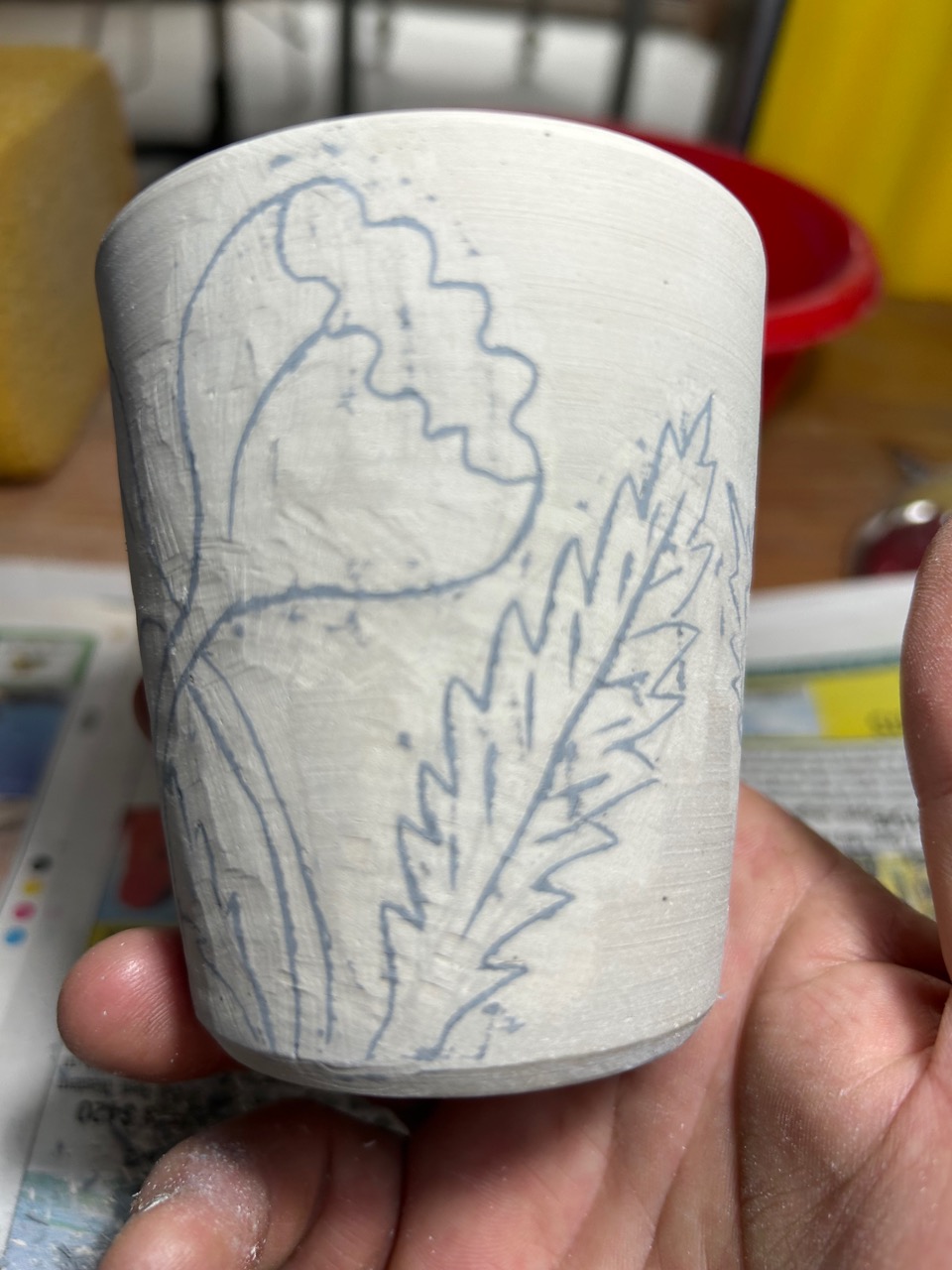
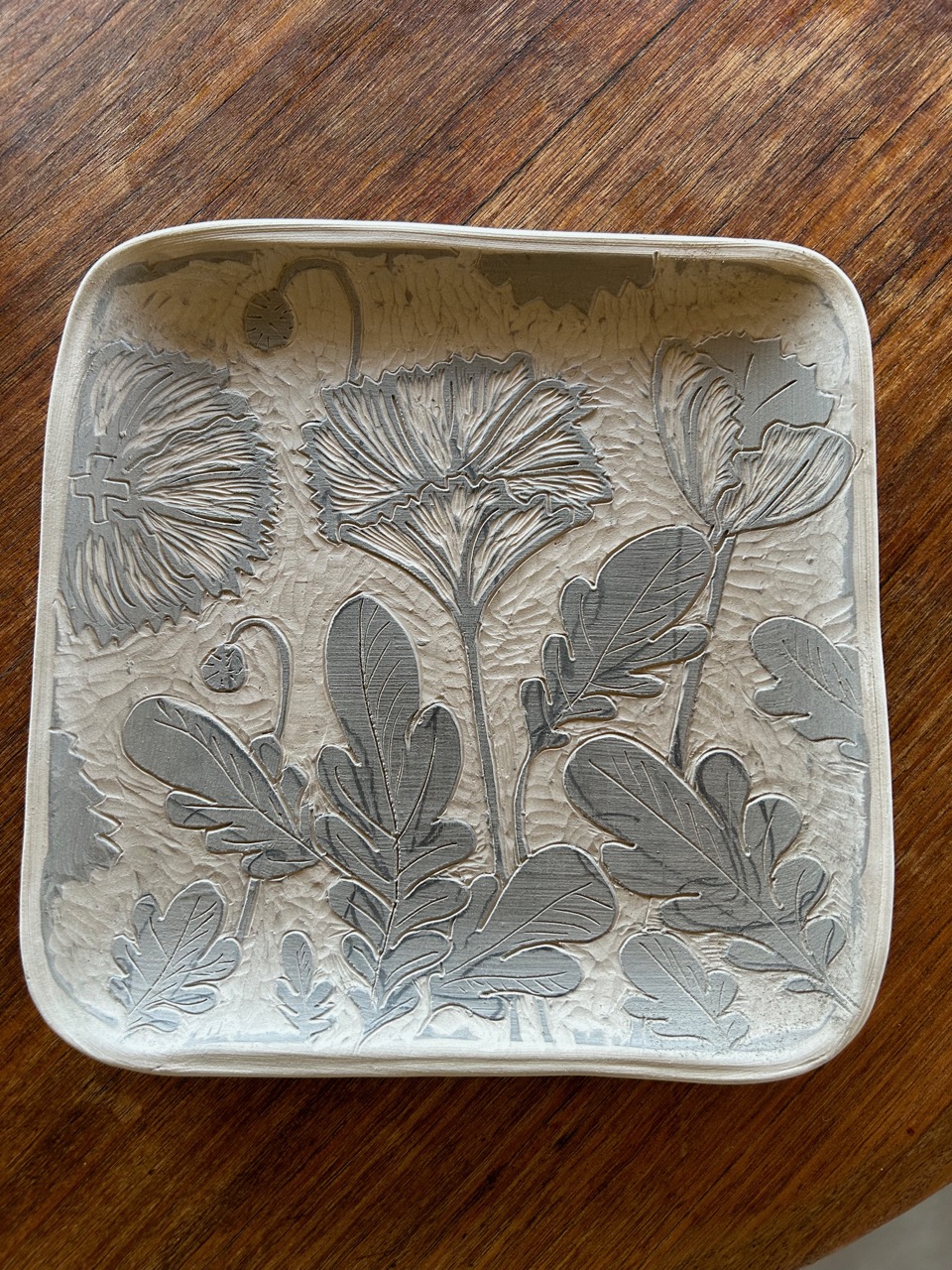
In the pottery, I’ve been extending my sgraffito on sericite work to include the negative/positive slip inlay. I tried mixing the two techniques and introducing some underglaze colour as well. I don’t know how these will turn out, as I’m packing the glaze kiln tomorrow.
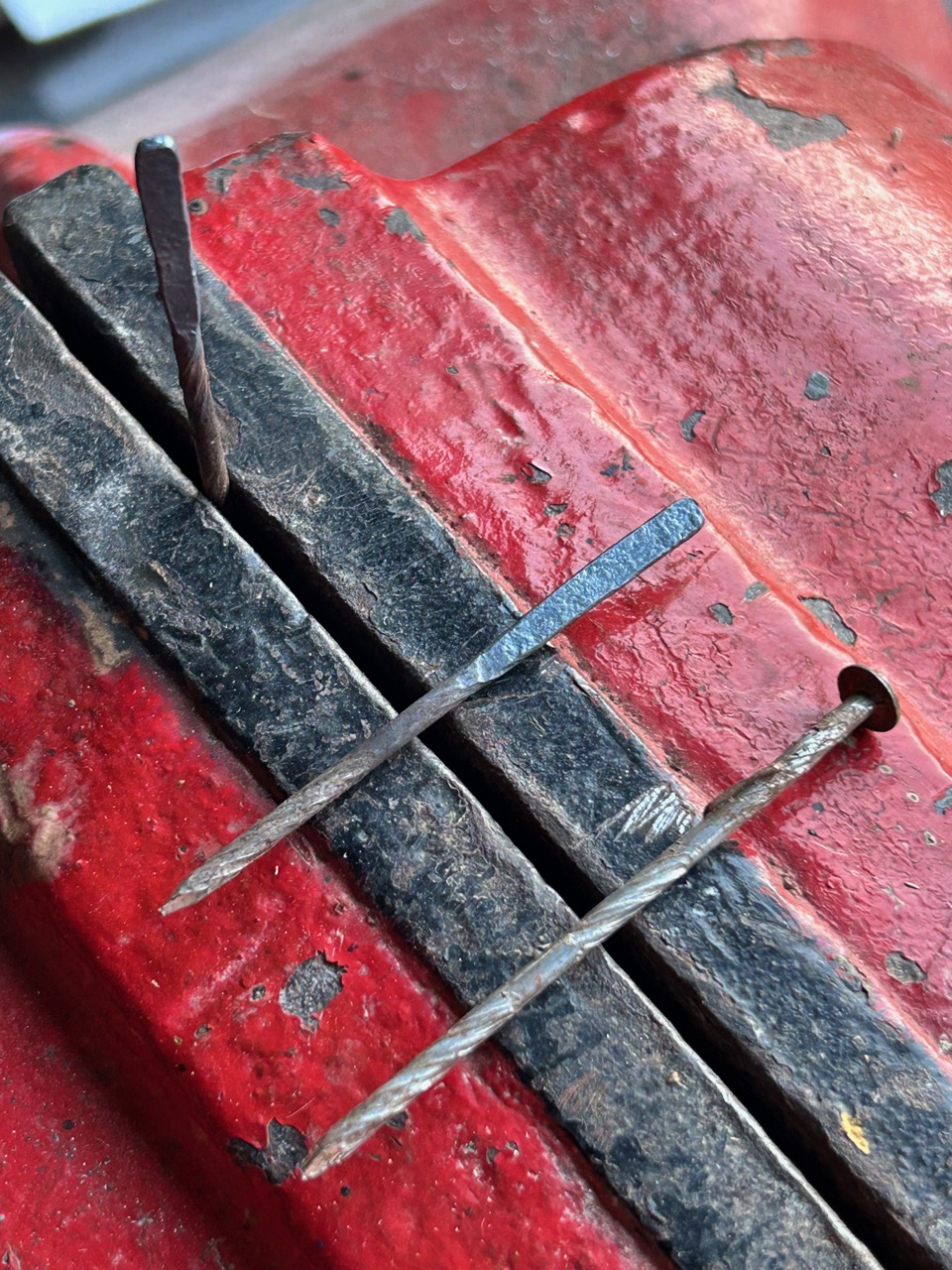
I’ve found that the sorts of sgraffito tools for sale here are somewhat limited, so I have been forging and hammering my own from rusty nails. They are rather nice, somewhat rustic and I can make them any size.
Janine has been using our current excess of passion fruit to make passion fruit and cream flummery. It’s quite easy to make, just passion fruit and cream whipped up together and then frozen. Janine takes it out of the freezer every so often and re-whips it to keep it light and fluffy while it freezes.
It goes quite well with our excess of blueberries as a desert.
A recent article in ‘Nature’ magazine indicates that we may already have passed 1.5 degrees of warming in around 2012. Using a unique sponge that grows in the sheltered waters of the Caribbean. Researchers have calibrated its growth over the past 300 years. Using the analysis of isotopes of calcium and strontium that the coral-like sponge lays down at slightly different sea temperatures. The article suggests that we have been underestimating the actual degree of global warming by half a degree, and that we are actually approaching close to 2oC in warming.
Apparently there is/was a really serious lack of iodine in the soils of Switzerland, which over centuries had caused severe goitre in the population. The Swiss used to have the highest level of Cretinism in the world because of this missing trace element in their soils. Most of the country was scraped clean of its top soil during the great ice age. The only part of the country that didn’t suffer this debilitating disorder was in the low lying areas, where the soils hadn’t been so depleted.
All sorts of explanations were put forward.
“landscape, elevation, atmospheric electricity, snow melt, sunlight (too much and too little), ‘miasma’, bad beer, stagnant air, incest and ‘moral failure’. They collected information on the minutiae of life in affected areas, then cross-referenced their reports, following the contemporary medical wisdom which held that all diseases had multiple causes. Did groundwater interact with sunlight to produce goitre? Might a certain combination of air pressure and elevation create a cretin? In 1876, a list of the most promising theories was published; it featured forty different hypotheses.”
All wrong. It wasn’t until 1915, that a local doctor proposed that it was caused by a lack of iodine, and was shouted down. However, Eventually another doctor in an isolated area did a few unauthorised experiments in his remote local area, adding very small amounts of iodine to salt and distributing it in his local area, and miraculously, the goitres disappeared and no more cretin children were born. It seems amazing that it was just 109 years ago that this breakthrough occurred.
There is a very sad film made in 1933 by Luis Bunuel, called ‘Land without bread’ about a very remote area, high in the basque country of Spain. In part, it mentions the terrible effects of goitre, where the same problem as afflicted the Swiss also occurred. Isolation and subsistence farming being the principal reasons.
Australia has very ancient soils that are largely depleted of iodine, goitre was a problem here for some people in the early days of development here, Those who were living away from the coast, and didn’t eat fish. During the last century iodine deficiency almost disappeared here because during the time of glass bottle milk deliveries, all the bottles were recycled and sterilised using iodine, so infinitesimal amounts of iodine were left as a residue in the bottle after cleaning and refilling. This was just the right amount to keep us all in good shape.
When glass bottles were phased out in the mid 70’s in favour of single use plastic, Thyroidism and goitre were reported to be on the increase again. So in the decades since, doctors have been recommending that industry, and people in their homes, use iodised salt to correct the deficiency. It has worked.
I don’t buy commercial bread, I bake my own – sans salt, nor do I buy any mass produced/baked food items, or ready-made/junk food, so my embedded salt intake is low. I buy iodised salt. However, because I don’t use much table salt with my meals and I don’t usually cook with it. I have to make sure that I do get that very small trace of iodine in my diet. Fish is our main source of protein, so that helps, but I also buy kelp powder to use at the table. This seems to keep my blood pressure is on the low side. At my last test it was 101 over 62, which is on the lower side of normal, and I have just enough iodine. It seems to work.
Life is a big experiment and there are no certainties, except death and taxes. Our income is so low that we don’t have to pay high taxes, but that still leaves death as a possibility?
Nothing is ever finished, nothing is perfect and nothing lasts forever.
We have been dealing with all the fruit and nuts that are maturing in the orchards during January. The peaches and plums are now finished. One particular peach tree has fruit that is SO fragrant that after we picked them and set the basket down in the kitchen overnight, in the morning the house was filled with the most exotic floral fragrance. This was a very beautiful experience. So simple, yet so rewarding. Sometimes it’s the most mundane and unexpressed events that leave an indelible impression.
These newly planted fruit trees in the new orchard are now 4 years old and are all recently developed fruiting cultivars, grafted onto dwarf root stocks, so they will not grow more than 2.5 metres tall. They are also all warm weather adapted, needing less ‘chill’ hours than the old varieties. Some of our older fruit tress planted over 40 years ago, had stopped setting fruit in most years, as with the increase in average temperatures due to global heating. We don’t get frosts like we used to, so they didn’t get the required number of ‘chill’ hours over winter, making the flowers infertile.
They are all growing well and are producing more fruit than we need. Previously, in the old orchard, all the trees were out in the open and too tall to net, so the birds ate most of the fruit. This new orchard is now fully netted, so we don’t share any of the fruit with the birds. Added to this, these new cultivars have been bred to carry very heavy crops. I will need to go through the orchard and thin out the crop in the early stages next season, to keep it down to a manageable level for just the two of us.
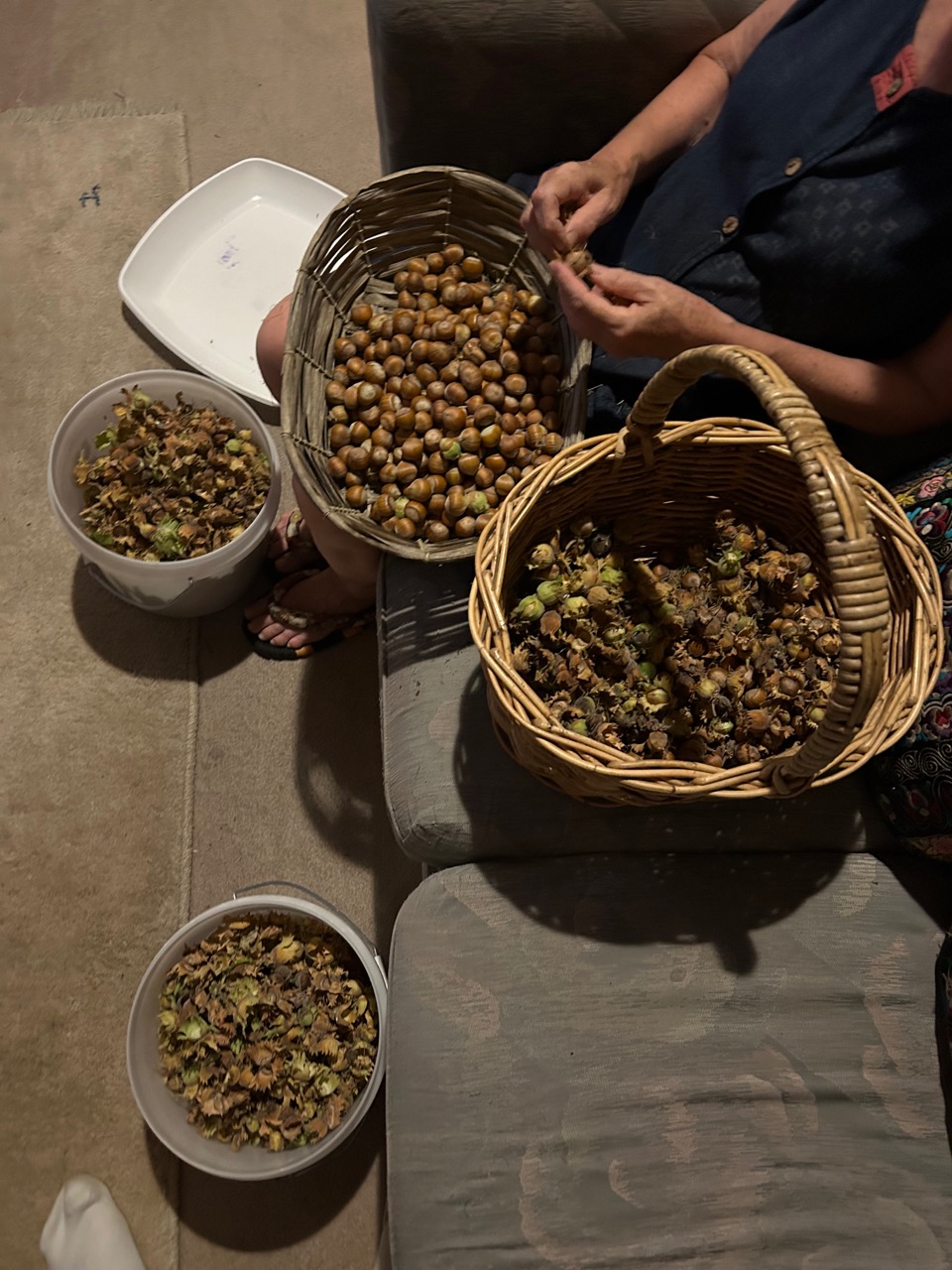
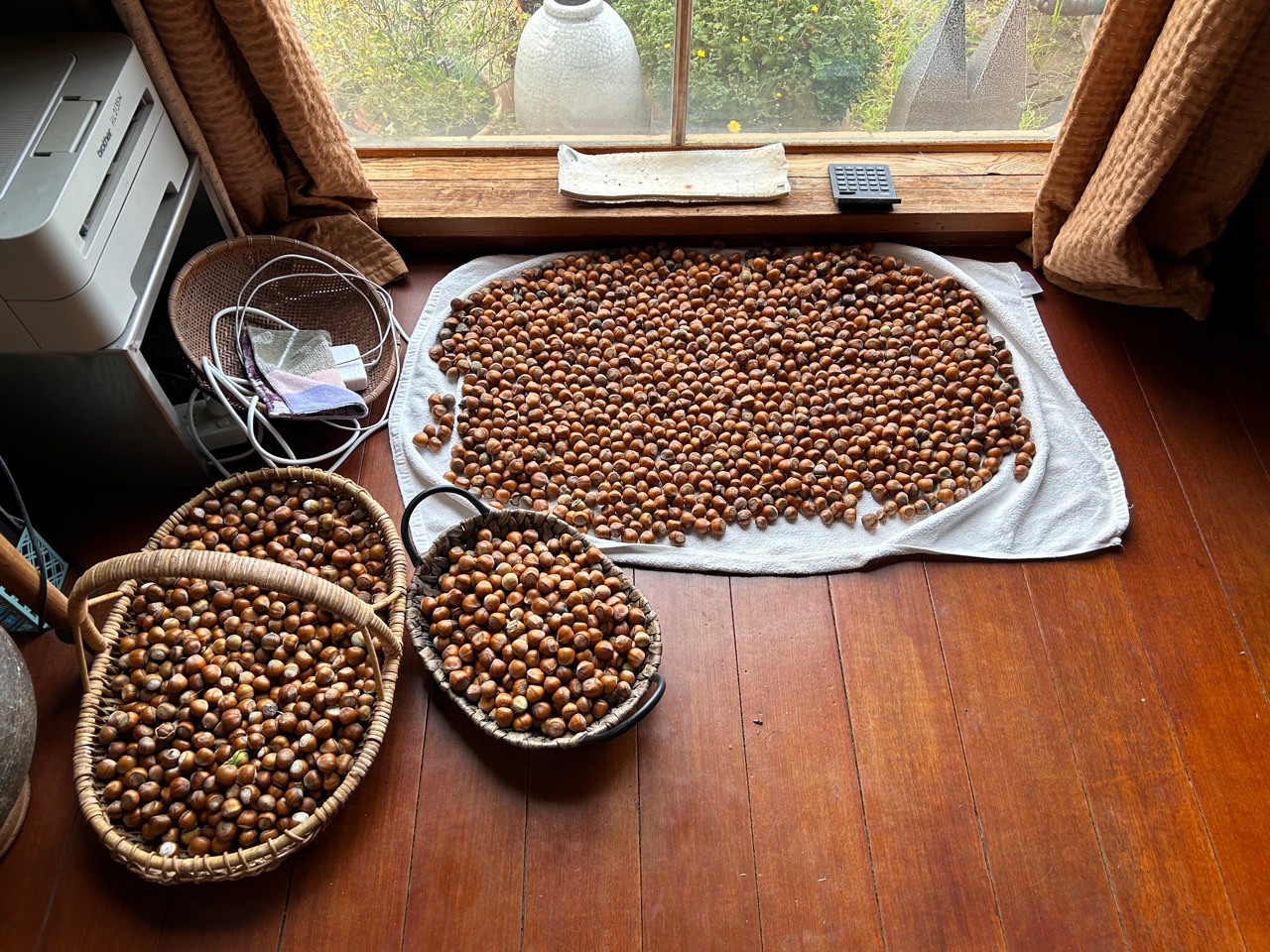
We are spending some time in the evenings, if there is anything on the idiot box, half-watching and shelling the hazel nuts. Some of the shell casing fragments end up on the floor. Janine warns me as I walk past her in bare feet, to watch out, as there are some nut cases on the floor. I reply, Yes. I’m one of them!
At this time of year, I’m certainly a nutter, so I tend to concentrate on the shelling rather than the on-screen rubbish. As the trees mature year by year, some were burnt to the ground by the fire, the hazelnut crop gets bigger. It will take a dozen evenings to get all the shelling done. So far we have de-skirted all the nuts, then put the shell out to dry for a week or so. Now we are starting on the shelling. A couple of evenings of shelling reduces a wicker basket full of nuts to one bowl of kernels. These then need to be roasted in the oven to bring out the true hazelnut flavour that we all know. After roasting, the result is about 700 grams of nuts ready to eat. Quite a bit of effort for such a small amount of nuts. We could buy them for a few dollars! But that is not the point. We don’t live and work like this for money. This is just a small part of our experiment in living a self reliant life of minimal consumption in a carbon constrained and over-heating world.
Of course, it’s not all effort, there is the reward of these amazing, home grown, unsprayed, non-toxic, scrumptious nuts. They will keep for months like this, but don’t usually get the chance, as they are too delicious.
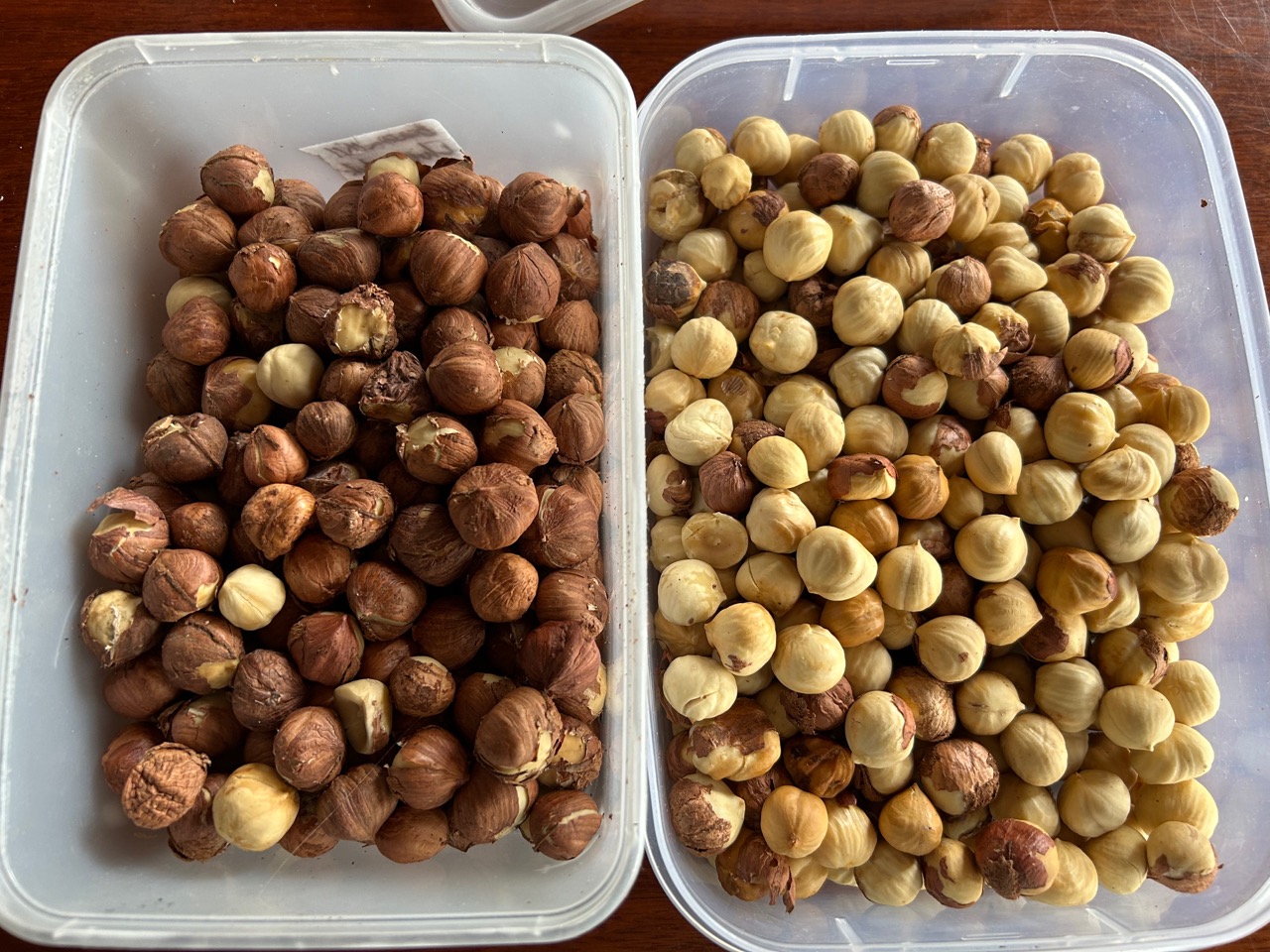
The hazels on the left are roasted and ready to eat, but haven’t had their ‘paper’ shell coating removed as yet. On the right side are the roasted ‘cleaned’ nuts.
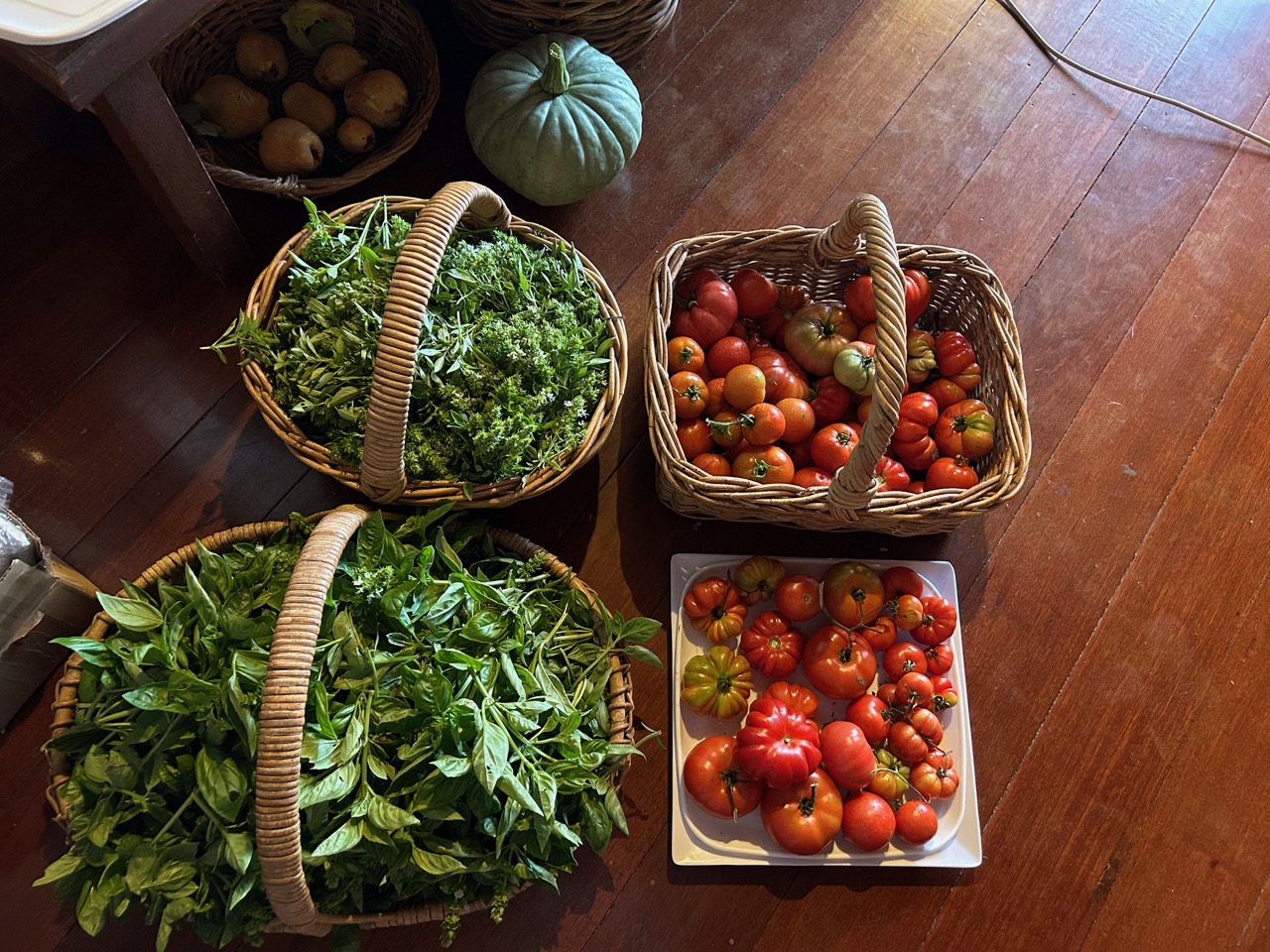
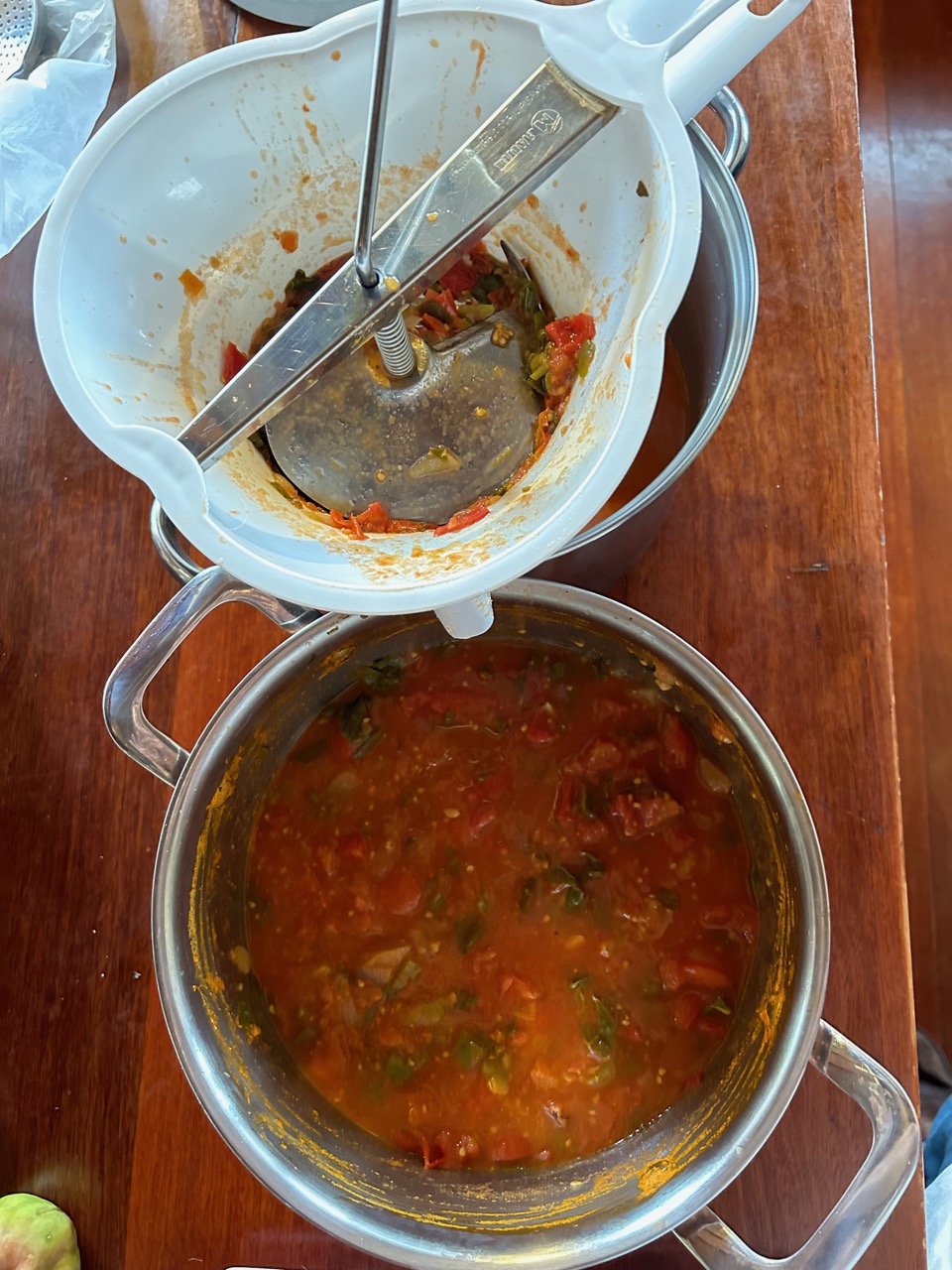
The vegetable garden has started to produce baskets filled with tomatoes every few days. I have just made the first batch of passata from the first three baskets full of tomatoes, 8 litres after sieving through the moulli to get all the skins and a lot of the seeds out. This made 10 bottles in this round, but there will be a lot more to come if this weather keeps up with the warm and wet conditions?
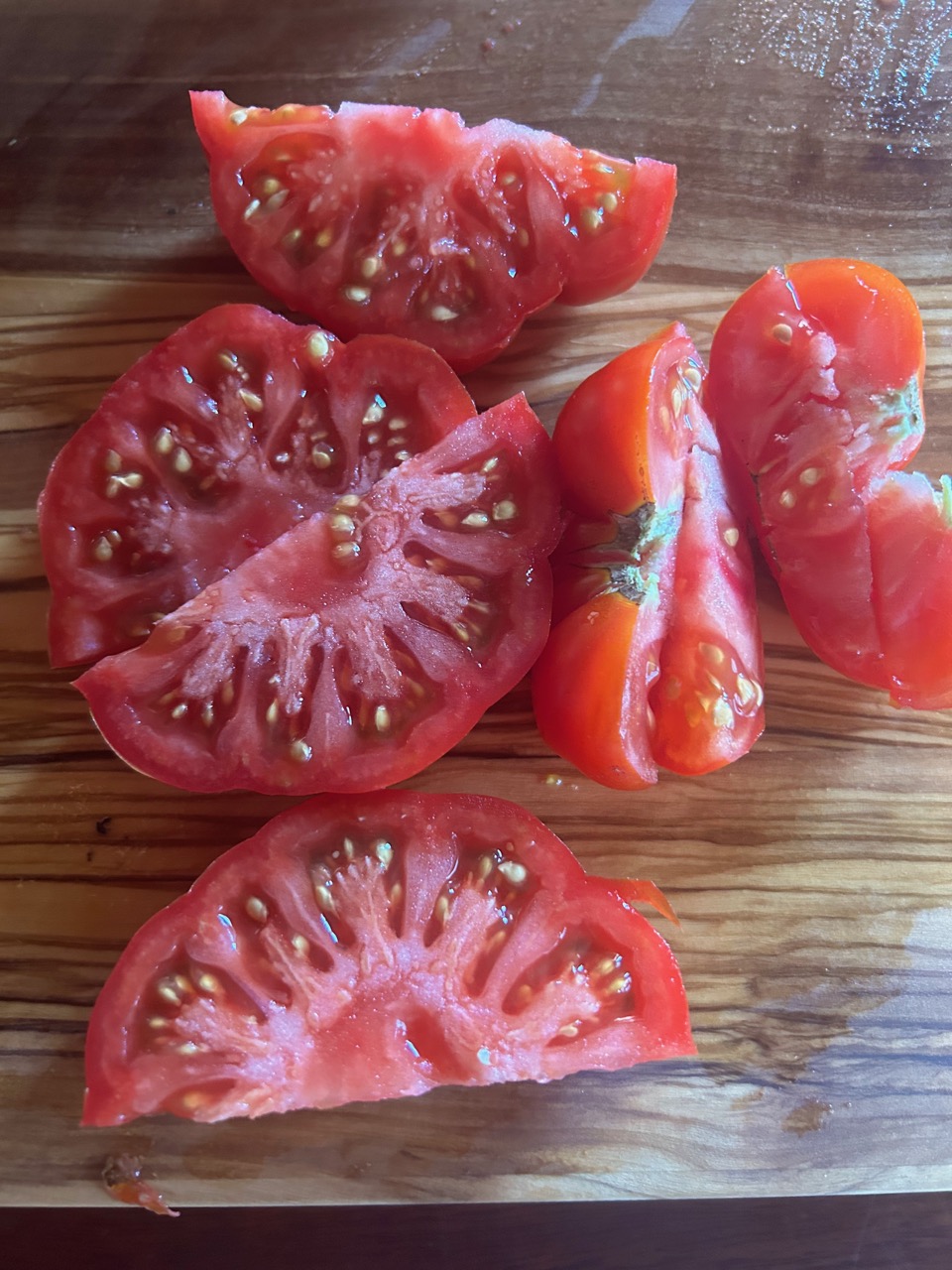
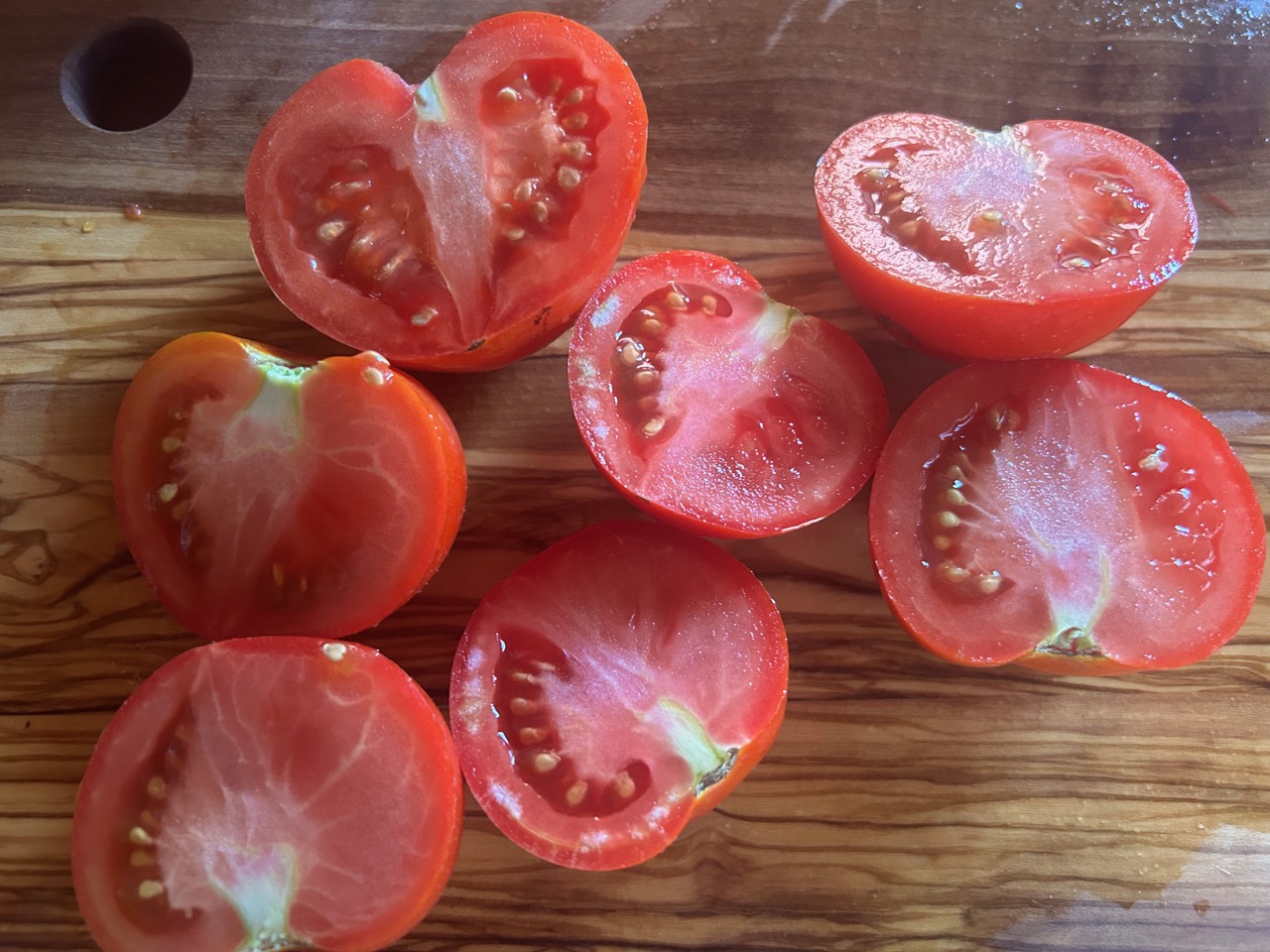
I usually grow a few old fashioned varieties of tomatoes. They are solid, firm, fruits with few internal spaces more flesh and less juice. Having a mix of varieties helps to insure that something will do well, even if others don’t. Also, wild germinated plants come up when they are ready and the soil temperature and moisture levels are right.
I also grow a few Grosse Lisse plants and some little gourmet salad varieties that come back up from self-sown seed each season. There are always plenty of them coming up everywhere, so if they are growing in the wrong place. I just weed them out, but if I can work around them, then they get to stay and be productive.
Rouge de Marmande
Mortgage Lifter
Beefsteak
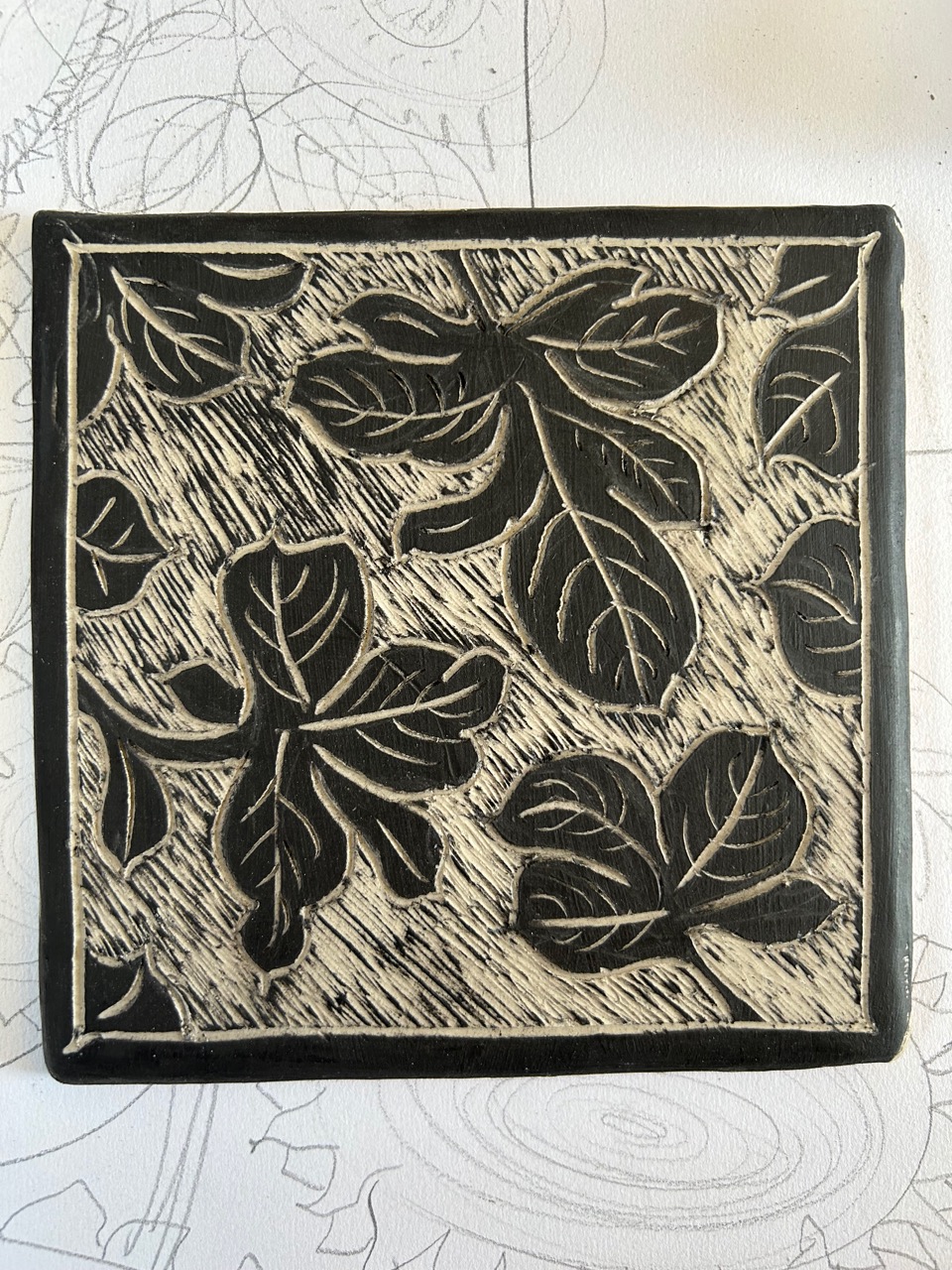
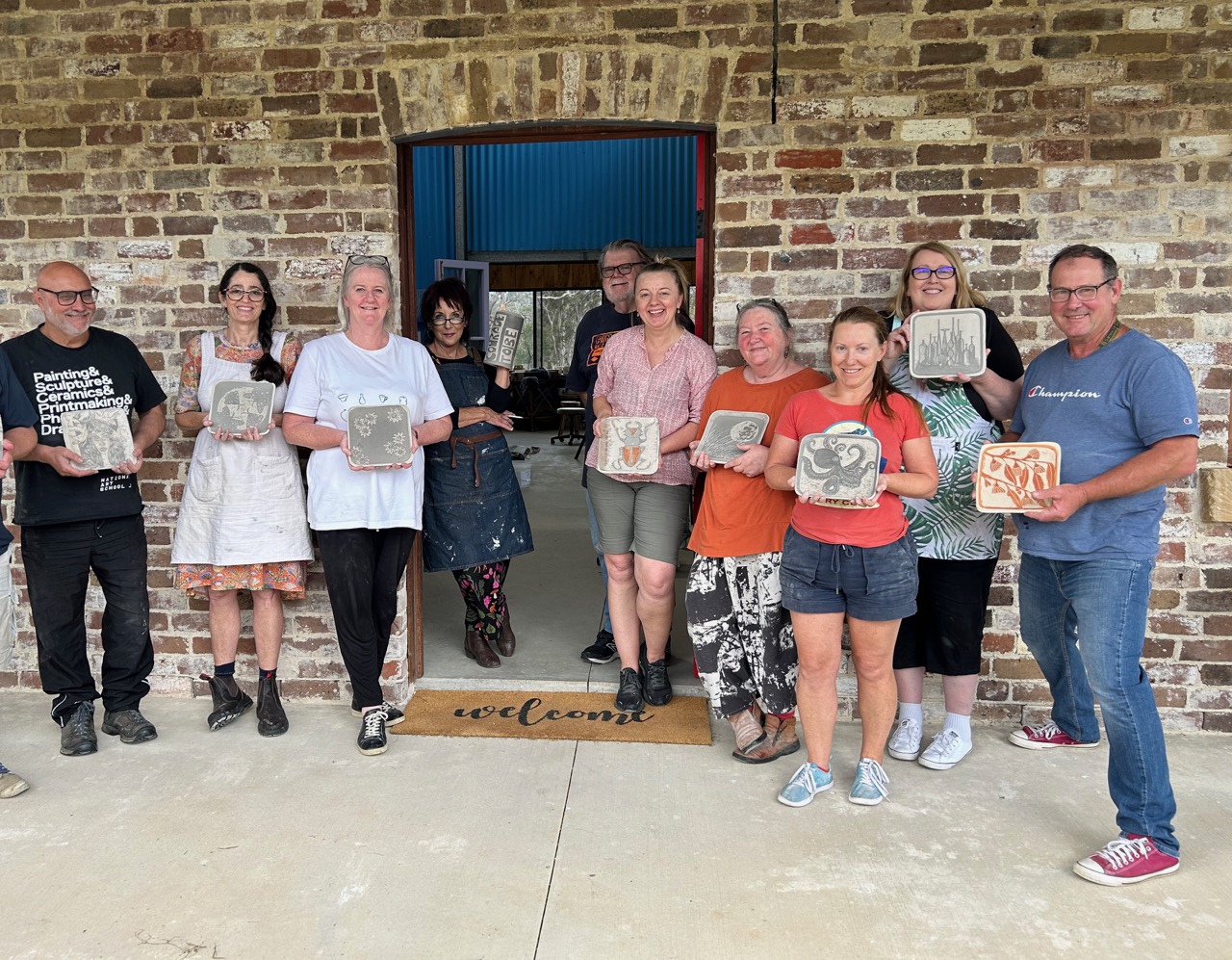
In between all of this, we’ve been back in the pottery during the hottest part of the day. We had a special sgraffito workshop for all the local artists, who usually meet in the Village Hall every Monday for an Art Class, so last week they all came here instead and decorated a tile that Janine and Ingrida, the leader of the group, had made a few days before. Later in the week, I spent a couple of days making new batches of clay for the upcoming throwing workshops in March.
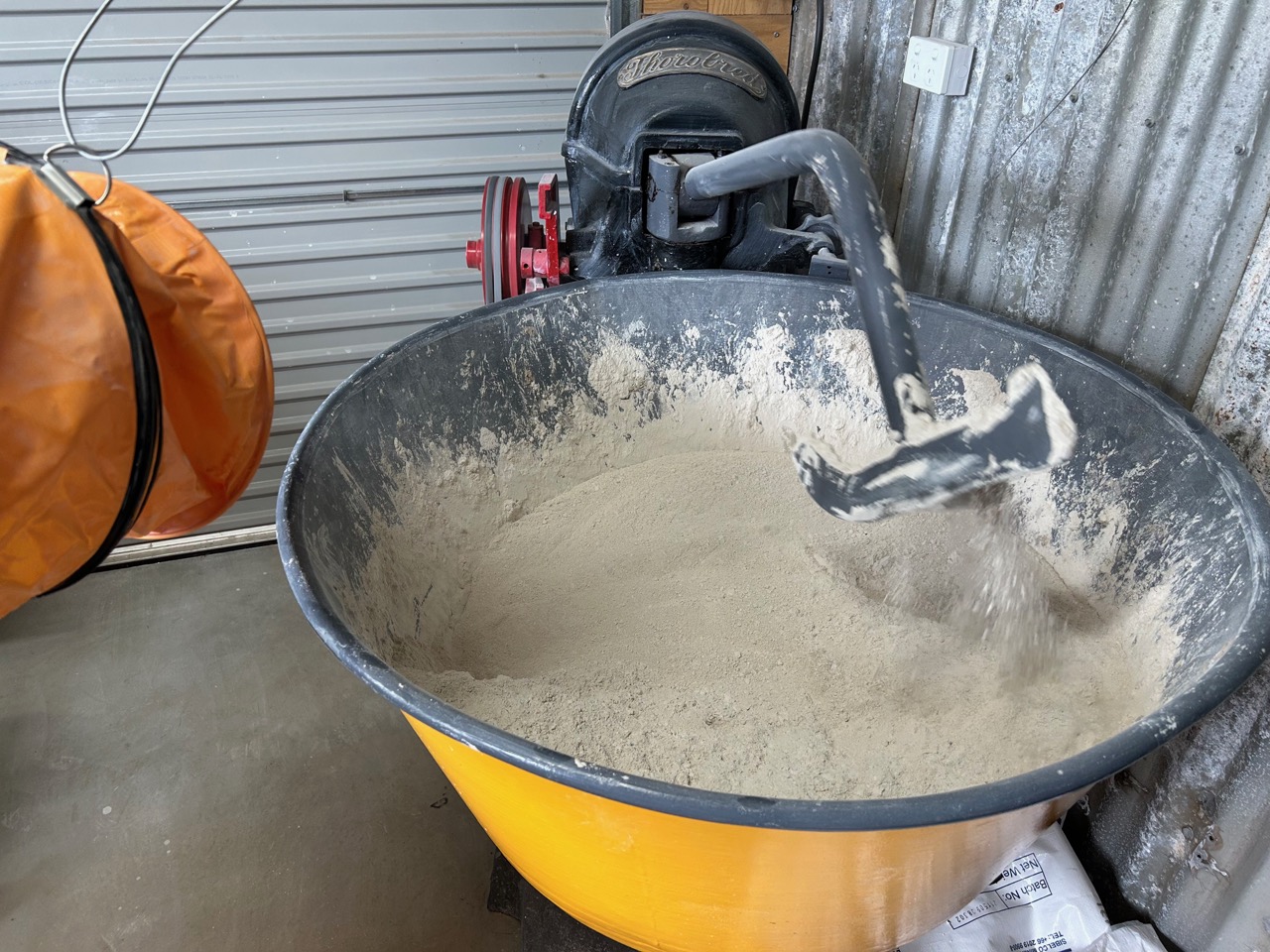
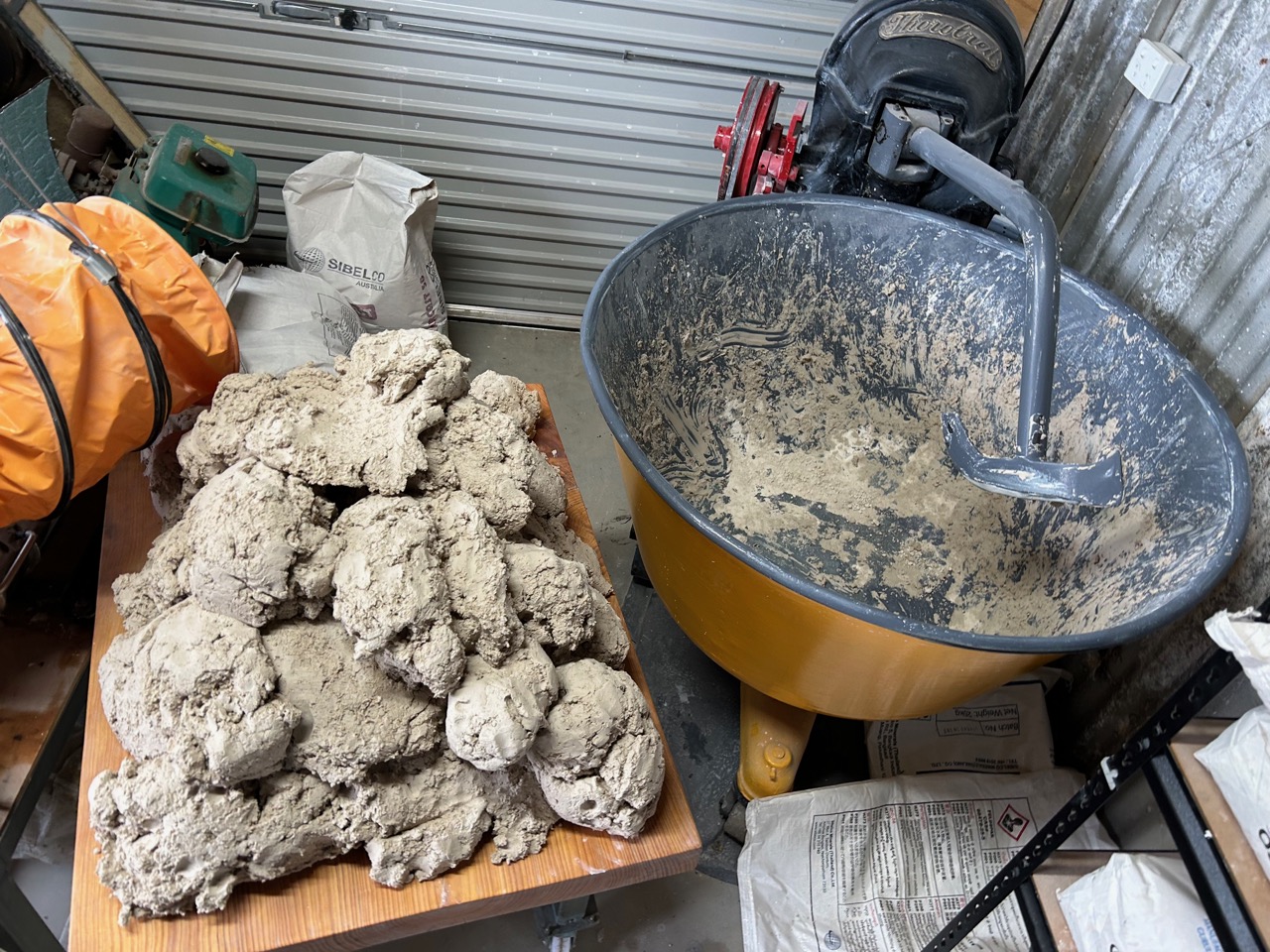
The clay is all pugged once through the purple vacuum (3 1/2”. 87mm.) pug that we keep for white stoneware clay. This pug was gifted to us from a close friend who hadn’t used it for some years. It came with a name ‘Pugsly’, so we’ve keep the name. The 3 1/2” or 87mm dia. pugmill is so much slower than the larger 4” or 100mm. pugmills. It still surprises me how much difference 12mm. in dia. can make. When we use the smaller ‘Pugsly’ purple pug, it takes me 2 days to do all the pugging instead of just one day.
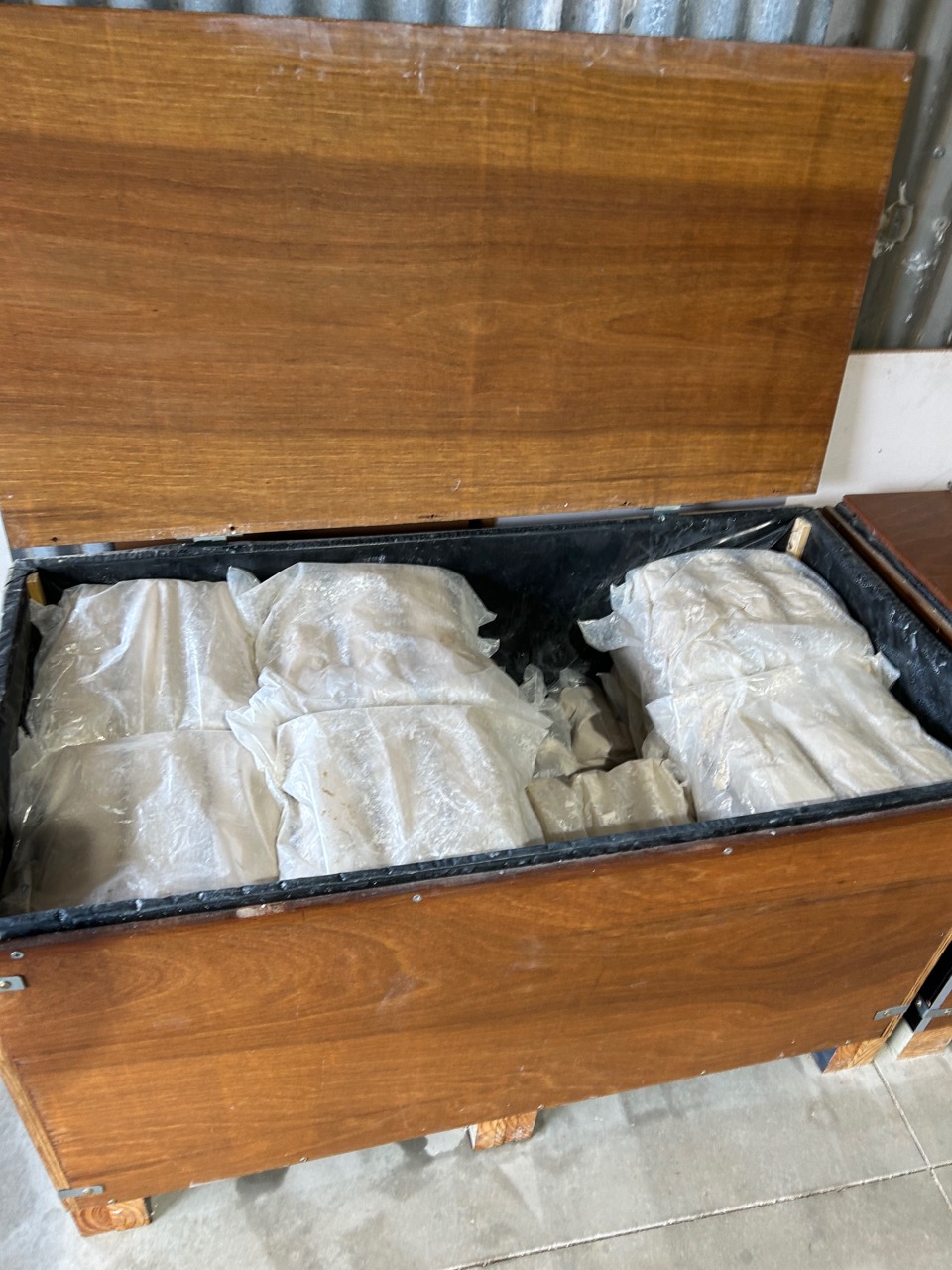
I wrap all the clay in plastic overnight, then the next day, I cut a small slice off the ends of all the pug sausages, and process all those small sliver ends together to make a new extruded pug of clay that is a mix of all the previous pugs from different batches. I repeat this procedure of slicing off all the ends and mixing and re-pugging, until all the clay is processed. This is my way of ensuring that all the clay that I finally pug and bag is pretty much homogeneous. The finished clay is bagged and stored in a plastic lined clay box to keep it cool and dark while it ages and sours.
When full, the clay box holds about 400 kgs of clay. I make new batches of clay when the box is half full. In this way, there is always some older, aged, clay ready to use.
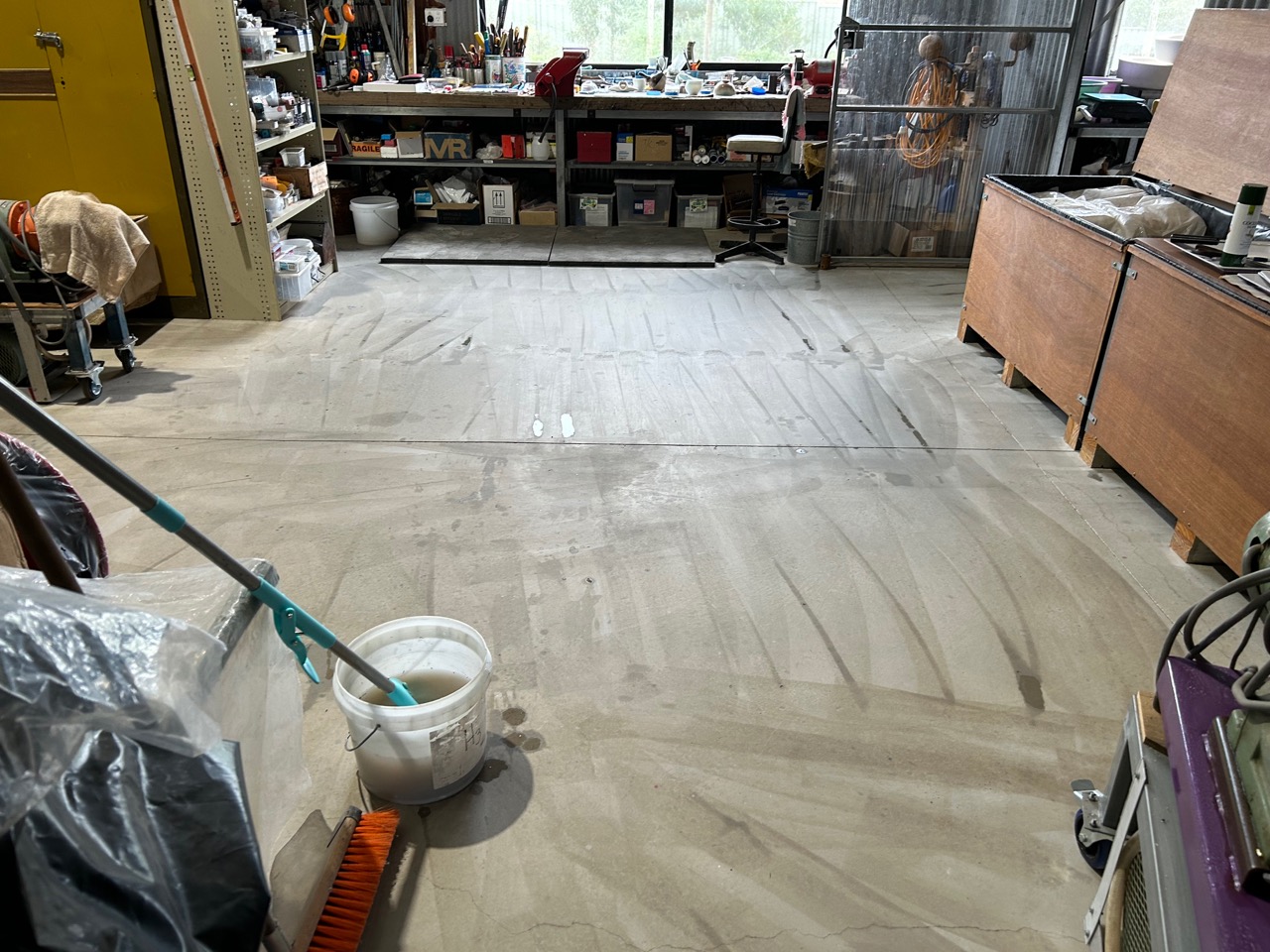
After I finish pugging, I wheel all the machinery out of the way, and mop the floor until it is clean and free of clay dust. Then I wheel all the machines back into place ready for the next time.
It’s a bit of a chore to clean-up and mop the floor at the end of a long day, but it has to be done to keep the workshop hygienic and workable.
I saw this podcast link in ’Nature’ magazine today. Nature is a science journal that reports on various issues relative and important to scientific research.
I have subscribed to various science journals during my life. I prefer to read about scientific research than the trivia of day to day politics and its meaningless point scoring.
It reminded me of a research project that I did at the National Art School, way back in the 1970’s.
I was contacted by a guy from an aluminium mining company, who explained that new environmental laws were going to cost the company a lot of mullah to comply with.
He explained that the main by-product of aluminium processing is red mud. The red mud is essentially red iron oxide and some other clay-like minerals that are extracted from the bauxite to gain the aluminium oxide. Bauxite ore is an almost equal mixture of iron and aluminium with some aluminosilicates related to clay.
It occurs widely as little red spheres. It is deadly to walk on, as it rolls around freely like ball bearings. I have found loads of small deposits of bauxite all around my shire here while I have been doing my own ceramic material research. The parent mineral is everyday clayey soil, which when exposed to tropical weathering conditions of very wet weather and high temperatures, can have almost everything leached out of it. Every mineral and element that can be dissolved in water, gets leached out over time and is evaporated up wards through the soil profile, and washed away, so all the alkalis, alkali earths and silica are removed, leaving largely iron and alumina.
The process of extracting the alumina leaves the iron deposited as a slurry it in huge lakes or dams. These never fully dry out properly to become solid and stable. The company wanted to know if I could find a productive use for this semi dried slurry cake?
I couldn’t. It was too high in iron to make any sort of useful glaze and had absolutely no plasticity, to make it into any kind of interesting form. The best solution I could find was to mix it with a little bit of clay and silica, then fire it in a heavy reduction atmosphere to turn the refractory iron oxide into an active flux that would bind all of the other impurities with the clay and silica to form a solid black block.
I suggested that the company might build a brickworks on the site and start producing black bricks. The guy scoffed at my idea, asked if I was joking and I never heard from them again. No payment was even forthcoming. Thus ended my early flirtation with big business.
Now 40 years on there might just be a solution in the pipeline? Not a big deal in the scheme of things, but every little bit of progress counts towards a better, cleaner future. Only the first 10 minutes of the podcast is about green steel production.
There were two other interesting science based items that have stuck in my mind from the last year of Royal Society meetings. Just in case you are unsure about ‘The Royal Society’, it’s not a monarchist support group, or Charlie’s cheer squad. In fact it is a society to promote science.
Wikipedia tells us;
“The society fulfils a number of roles: promoting science and its benefits, recognising excellence in science, supporting outstanding science, providing scientific advice for policy, education and public engagement and fostering international and global co-operation. Founded on 28 November 1660, it was granted a royal charter by King Charles II as The Royal Society and is the oldest continuously existing scientific academy in the world.[2]
I have been honoured to be invited to give two lectures to the Southern Highlands branch of the Society in the last decade.
At one meeting last year, we had a lecture from the redoubtable Ken McKracken, about long term climate effects caused by sun spots and other celestial effects. The essence of the talk that I took away was this. There are very powerful long term effects on the earths climate that have various cycles, from one year to decades, to centuries, up to 20,000 years. One in particular runs over approximately 30 years, and evidence was presented from earth core samples that showed pollen and other markers that there is a general oscillation from above average to below average rain fall, alternating over this 30 year cycle. The upshot being, we have just finished a 30 year dryer cycle and are entering the next 30 year wetter cycle. I was a touch sceptical, but as this year was meant to be the return of El Nino and a hotter dryer period according to the BOM. It certainly started off that way. Hot and dry, so much so that i stopped work on other projects and spent time finishing off the bush fire protection system o nthe barn and pottery. However, since then all we have had is wet, wet, wet. Maybe I’m inclined to take more interest and will follow this thread of thought over the next few years.
Of course, I am fully aware of Aristotle’s warning that one swallow does not a summer make.
Then, just this morning I see this article in The Guardian, discussing the possible breakdown of the current El Nino before the end of the year and the return of yet another La Nina event next year.
Another interesting talk at the Royal Society came from a scientist involved in nuclear fusion research. We have been told that a break-through in nuclear fusion is just 20 years away, and we have been told this repeatedly for the past 60 years. In this lecture we learnt that it might be up to 100 years away, so that was refreshingly new. He explained that when the break-through comes it will very likely involve the development of hundreds of small fusion reactors, rather than one big one, largely because the reactors will only run for a few days or weeks, and then need to be shut down to be rebuilt over years. So a lot of reactors will be needed to keep a steady supply. Most interestingly to me, was his statement that because the fusion process releases such unimaginably large amounts of energy so quickly. It won’t all be able to be used in real time, so there will need to be a lot of research put in to develop very large scale batteries to store it and release it steadily over time.
Keeping in mind that fusion research has already cost, and will cost multi billions, trillions and gazillions of dollars more. It crossed my simple mind that wouldn’t it be better to just abandon the most expensive part – which is the fusion research, and just go straight to the more useful and affordable battery research, as we already have very cheap solar and wind forms of electricity generation?
Oh! and the last point he mentioned was that because current fusion research indicates that these reactors need a steady supply of radioactive tritium gas to make the fusion process work, then the reactors become highly radioactive, just like todays ordinary fission reactors. So a very long and costly process to repair and rebuild them each time they are shut down. Ignore rightwing shock jocks and their politician cronies telling us that fusion power is clean and avoids the radioactive concerns associated with todays fission reactors!
I can’t see it ever happening, not in 20 or even 100 years, but as I won’t see either of these time frames come to fruition, it won’t be a concern for me. I can see a place for big battery research though.
I said above that there would be no recipes. BUT…
Just to show that even Greenies can lie just as well as any politician, here is a recipe for zucchini fritters from the garden!
We all have so many of these lovely, productive fruits at this time of year, its hard to keep up with them at times. One reliable stand-by is zucchini fritters.
We were invited to go to a friend’s 60th birthday party in the Village Hall at the weekend. We decided to take along our contribution in the form of these fritters
Have about equal amounts of zucchinis and potatoes, although you can eliminate or minimise the potato if you want to reduce your carbs.udo If you do you’ll ned to add some other form of plasticiser to bind it all together – a little flour perhaps?
As these were not for home consumption to be served directly to the dinner plate, Where it would be OK to be a bit fragile and crumbly, but needed to be a little more robust, Janine used equal proportions.
Grate the zucchinis and place in a bowl, take out one handful at a time a squeeze all the moisture out of the pulp and place in the mixing bowl.
Pre-boil the potatoes and mash them, add to the zucchini. Season to taste as you prefer, salt, pepper, chilli flakes, sesame seeds, finely chopped cornichons, parsley and or sweet basil?
Make the mixture into small balls and roll in polenta, this gives a nice crunchy texture to the coating after pan frying in a little sesame oil or olive oil.
Janine and I have been kept very busy dealing with all the summer produce from the garden and orchards. Nothing new there. We’ve been doing it for almost 50 years. But this last few years/summers, have been hot and wet, so everything has grown it’s head off. It’s a lot to keep up with. Especially as we age and find it harder to drum up the energy. The intention and enthusiasm is still strong, so we need to find ways of working smarter.
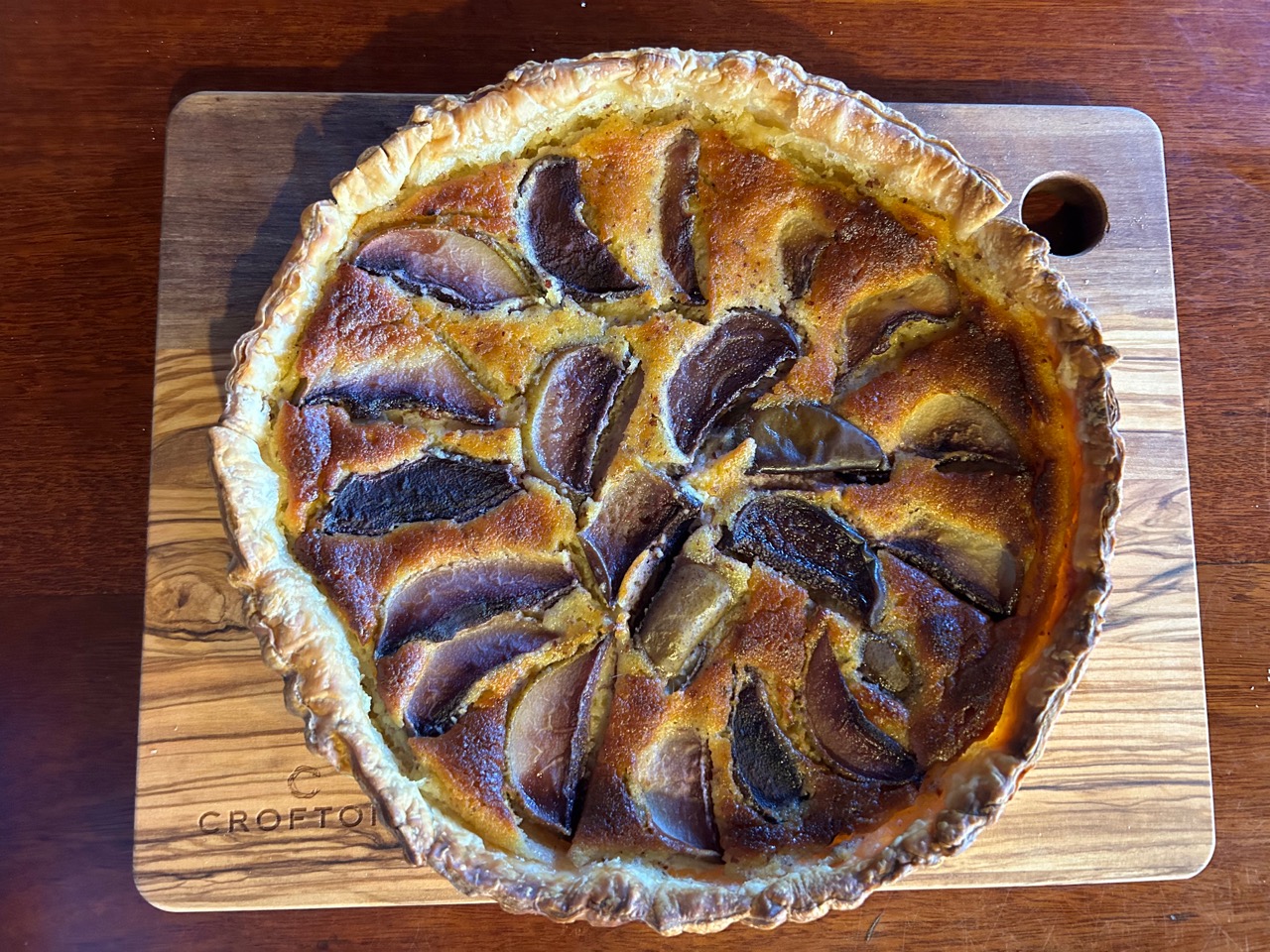
I cooked up a few early hard pears from the orchard in some red wine with a spoon full of sugar and a fragment of cinnamon bark, then laid them into an almond flan. Pretty yummy for morning tea. This is one of the best reason why we garden! So that we can eat amazing, wholesome, natural, un-sprayed fruit flans.
We had the organic gardening group here last weekend to help is with several gardening jobs around the property.
I spent a few hours picking citrus stink bugs off the citrus trees with the assistance of our friend Helen from the group We half filled a bucket with the little buggers.
A bucket half full of stink bugs in a solution of detergent and bleach.
There are 16 trees in the citrus grove, so it took a while. I also pruned off a lot of the taller branches from the bigger trees, to keep them within standing reach. I’m too old to climb ladders now – unless I really need to.
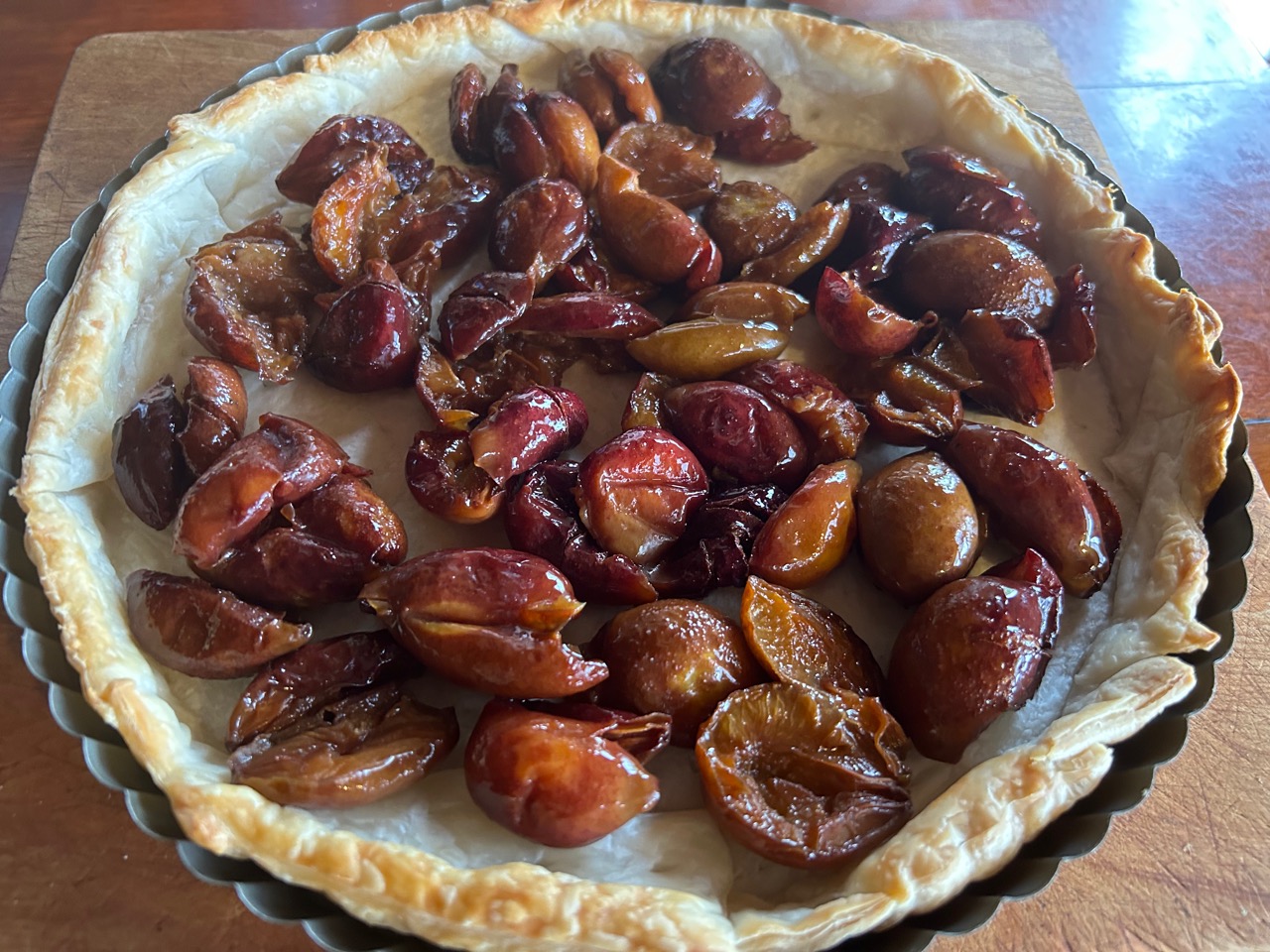
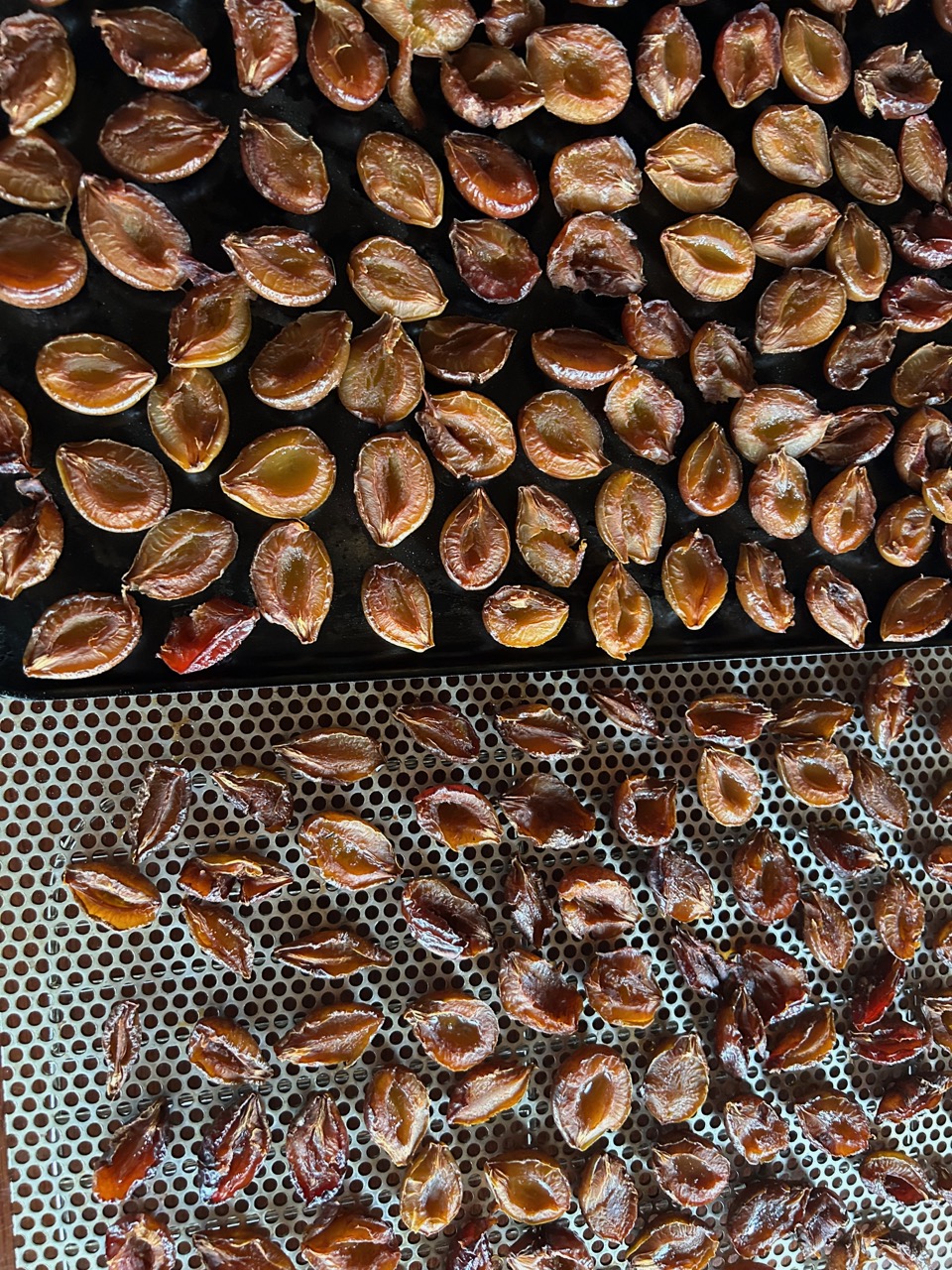
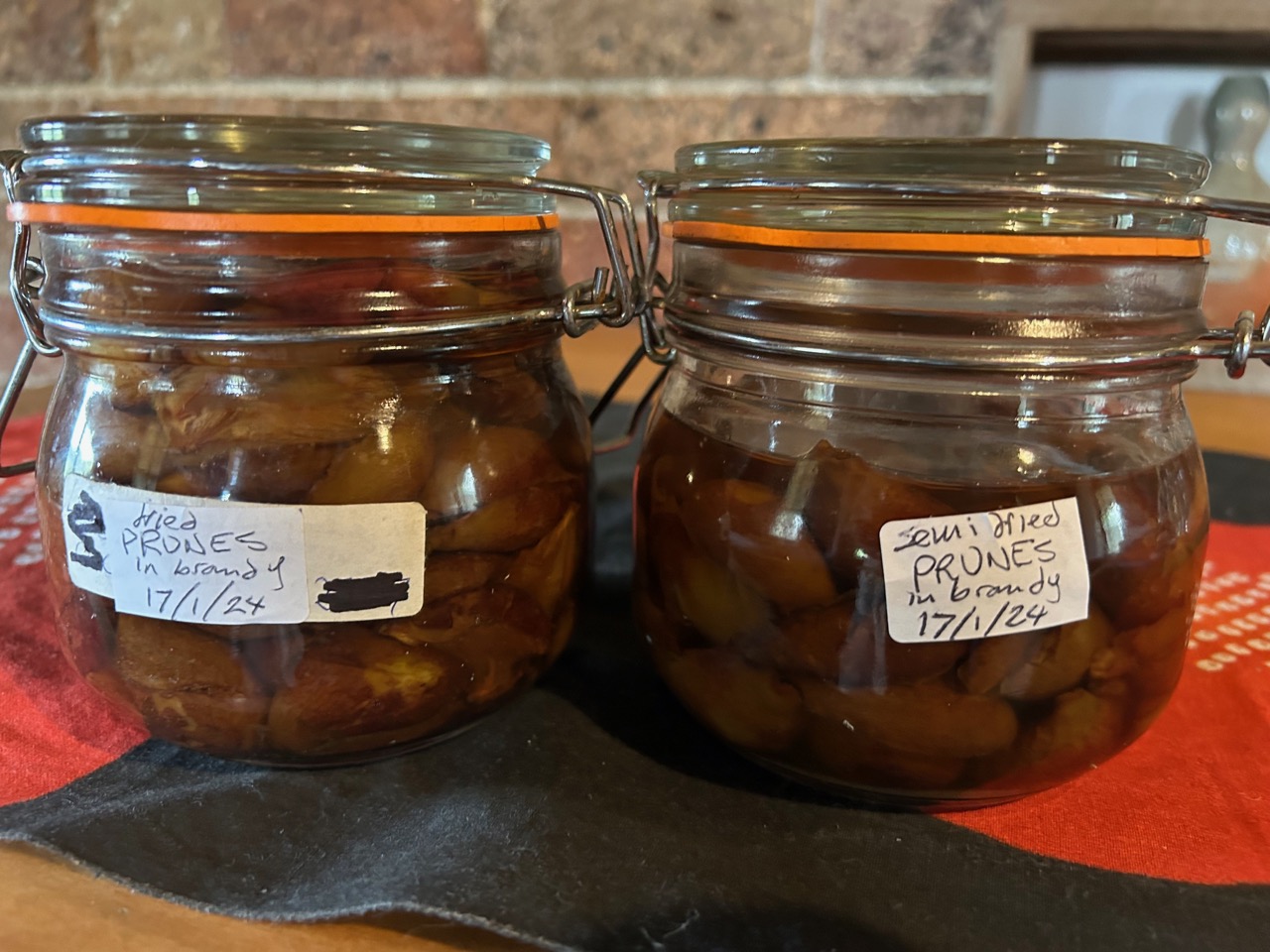
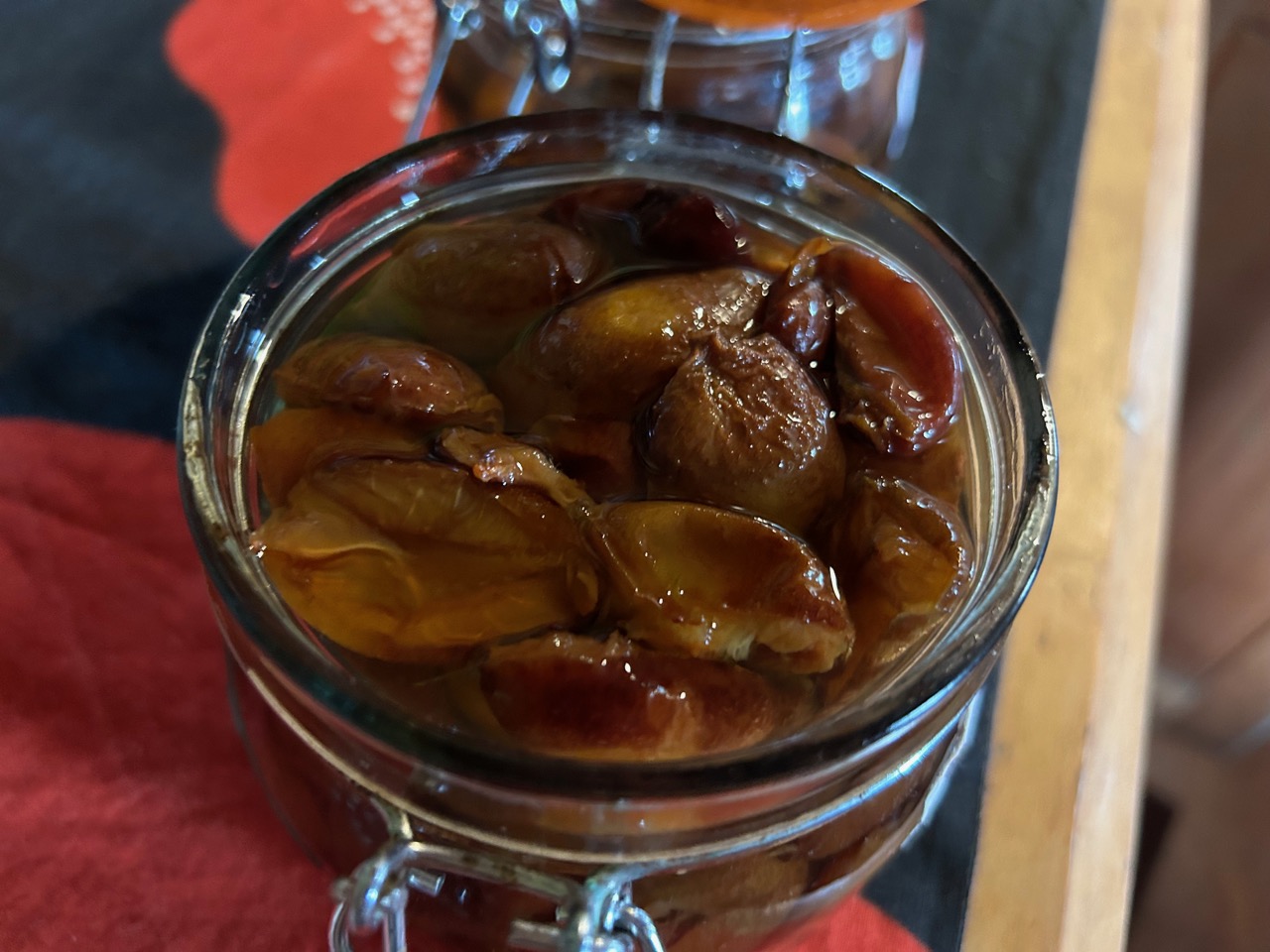
I picked all the prunes of the d’Agen tree and filled a 1/3 of a bucket. I cut them in half and semi-dried them in the oven. It took a couple of sessions. I made a cottage cheese and prune tart with some of them and bottled the rest in brandy for a similar use later in the year.
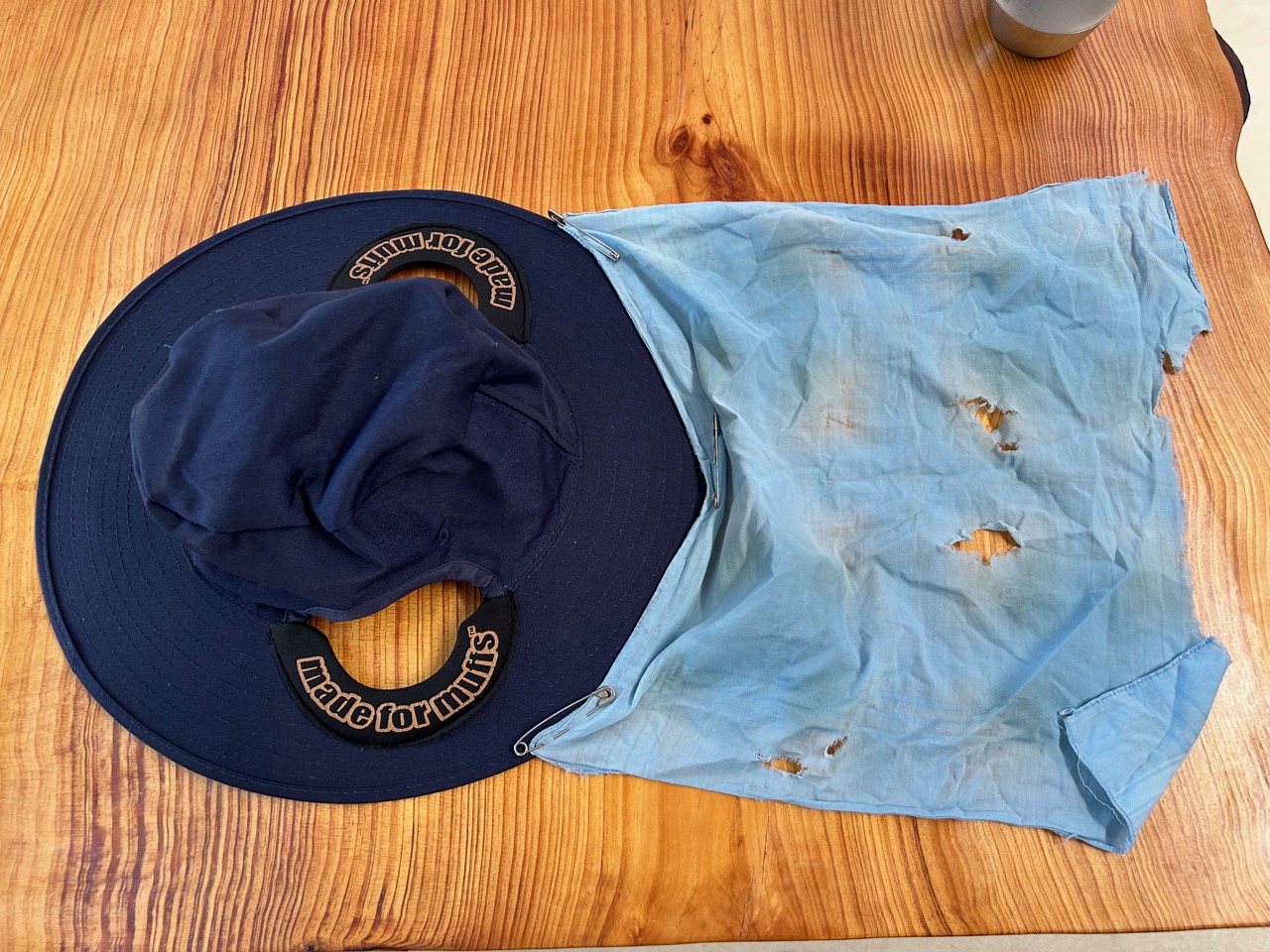
While climbing through the spiky branches of some of the citrus trees, looking for bugs and sniping off tall shoots. I managed to tear my ancient gardening straw hat and hanky combo to shreds. This hat and even older hanky (which was bright fire-engine red in its youth) was my ‘legionnaires’ head and neck shade when working outside The straw hat was 2nd hand about 7 yeas ago, so has earned its keep. I decided that it was past repair now, having seen so many summers of use, and it was 2nd hand to begin with, so I composted it!
I splurged and bought a brand new ‘ear-muffler-compatible’ work hat and added another one of my very old hankies as a neck shade. I recycled our son Geordie’s old nappy safety pins off the old hat. Re-purpose, re-use, and re-cycle. In fact, something old, something new, something repurposed, something blue. A true marriage of convenience. Those nappy pins have served us well, as our son is 40 years old now! If I keep them long enough, they can work just as hard on their last job, keeping my incontinence nappies in place in another 10 or 15 years when I become senile?
Our visiting organic gardener friends did some weeding and pruning in the veggie garden, and a few of them harvested all the fallen hazelnuts from under the trees so that we can get in there and mow the long grass. They also pruned off all the vigorous extraneous shoots from their bases. Hazels want to become dense hedges. It’s their nature. Up until the fire in 2019, we had cut them all back to just one main leading shoot and stem or trunk. But after the fire, they were burnt to ground level, so had to regrow from scratch. We were too busy rebuilding to worry about pruning the hazels. I was just glad to see them regrow. When I get the time??? – if ever, I’ll get stuck in there and cut them back to just one leader.
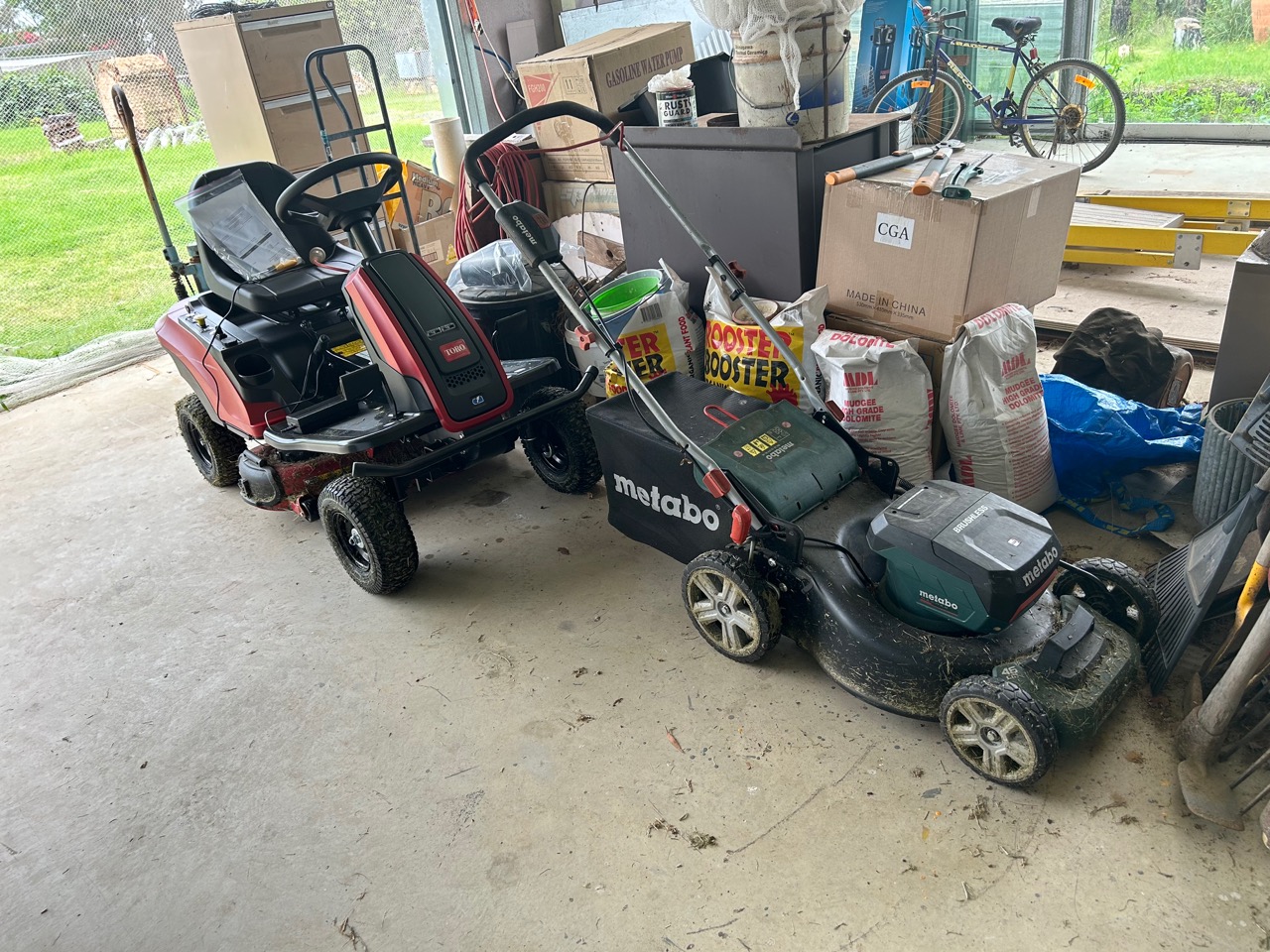
The petrol powered, ride-on mower, has broken two drive belts in two weeks. These modern belts seem to last only 8 to 9 years these days. It took several days to get them ordered in and fitted on each occasion, so the grass had grown very high and lush in its absence.
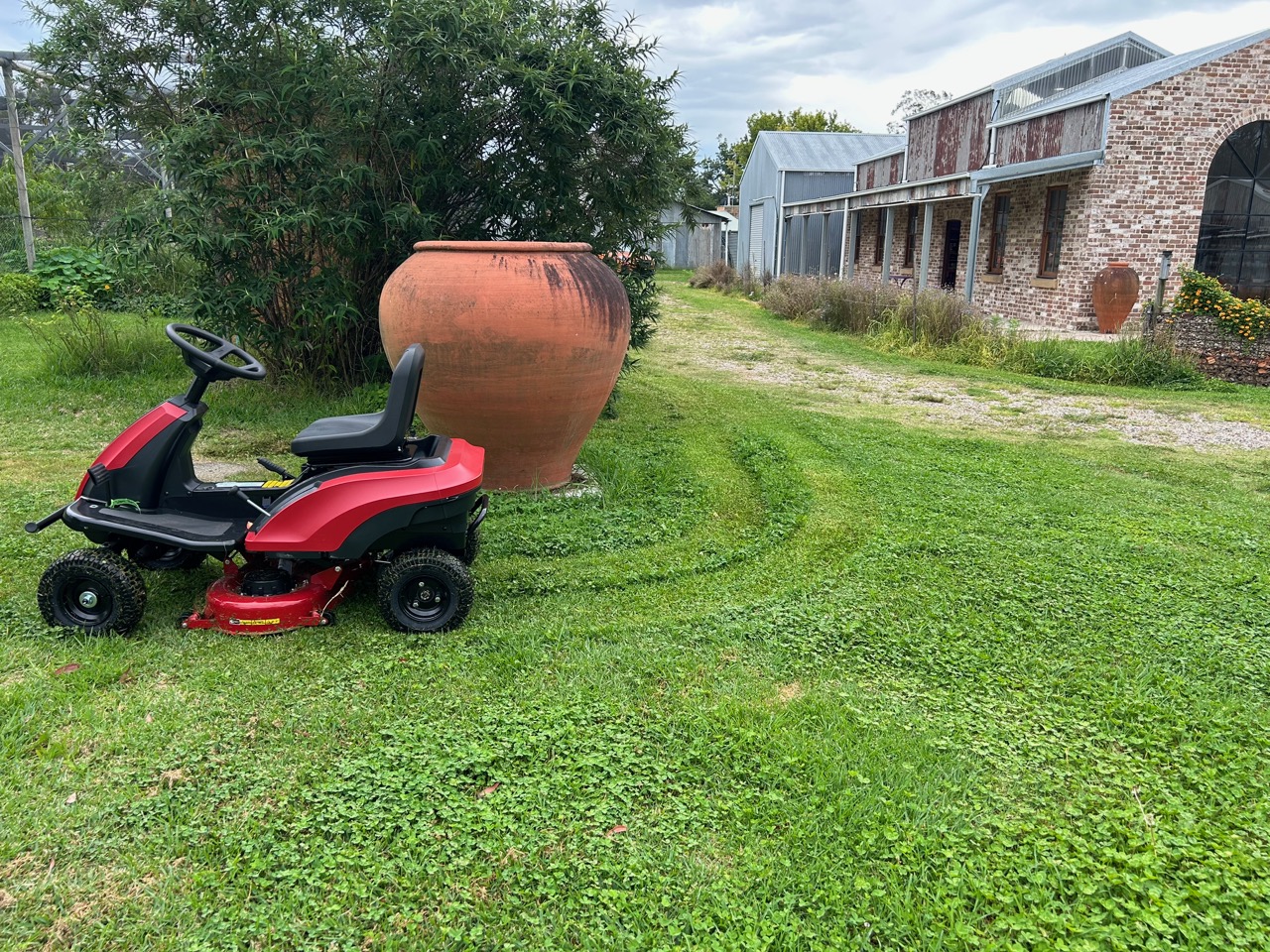
We have just completed a further step in our drive to go completely solar electric. I bought an electric ride-on mower. I have only had it for one day so far, and it did some pretty heavy mowing through dense grass. I got 1 hr, 20 mins of mowing out of the battery, ( that’s enough on a hot day) and almost completed all the ‘tame’ flat lawn around the house. I’ll report back in a month or so and give a follow-up on its performance. We now have a solar electric ride-on, push mower, strimmer, and chainsaw.
I haven’t given any up-date on our plug-in electric hybrid car recently. Nothing to report. It has just had its 5th year service, and has exceeded our expectations. It works perfectly. It does everything that we need and ask of it. We occasionally have to put some petrol in the fuel tank. About $20 to $30 every quarter, as it is a plug-in hybrid. But for the most part, we drive 90/95% of the time on our own solar roof top electricity. It was a perfect choice for us. I’m so glad that we did it when we did. This model is no longer available. They are all fully electric now and cost twice as much! Our early adoption of solar electric driving has proved to be a good decision.
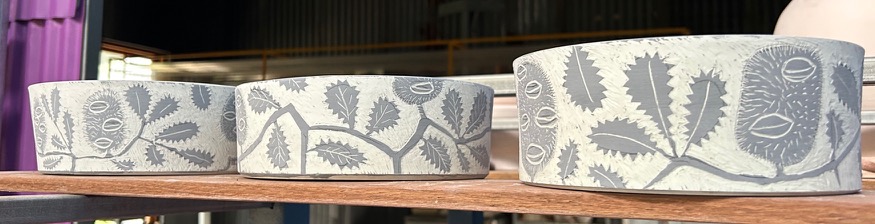
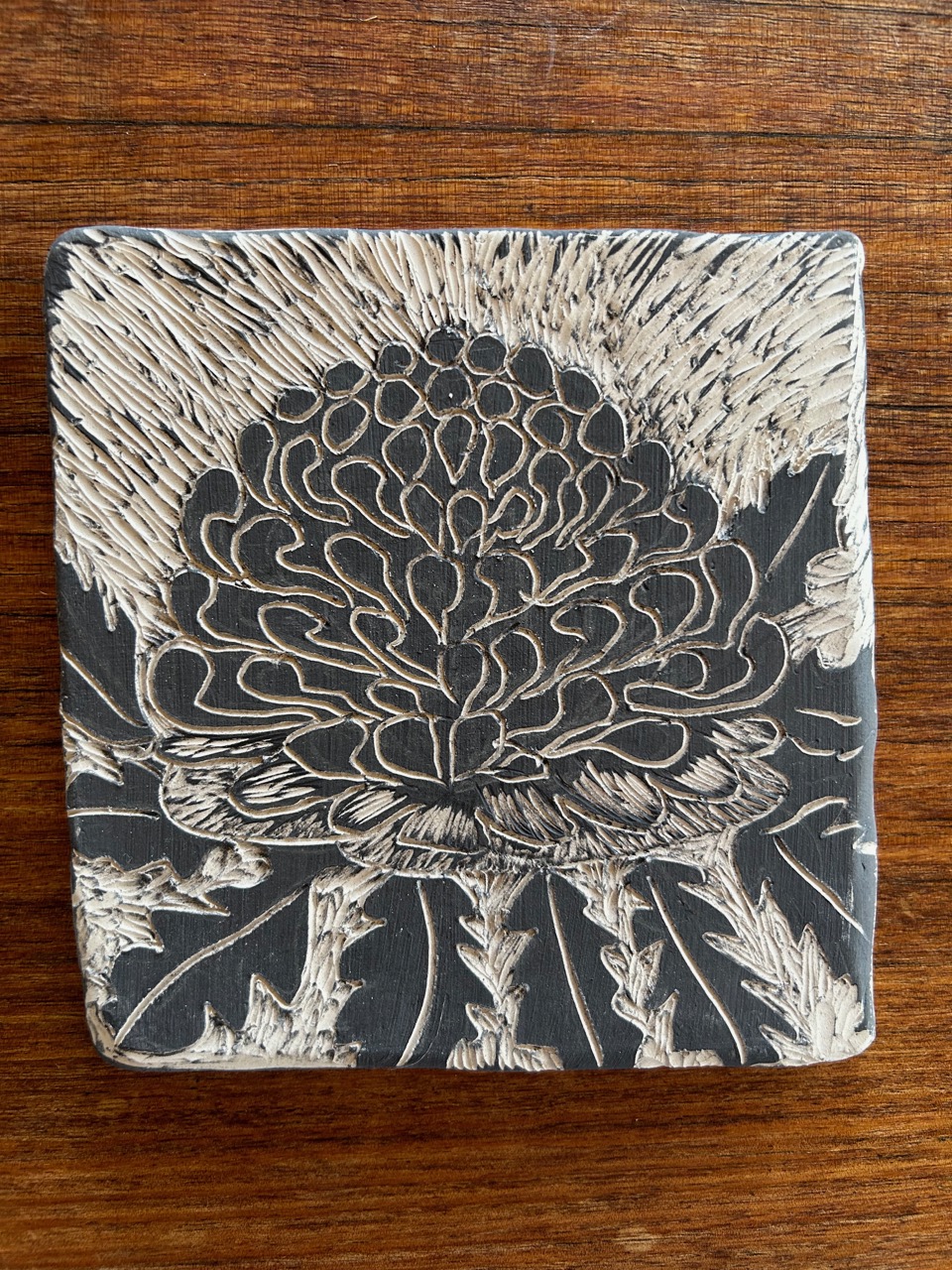
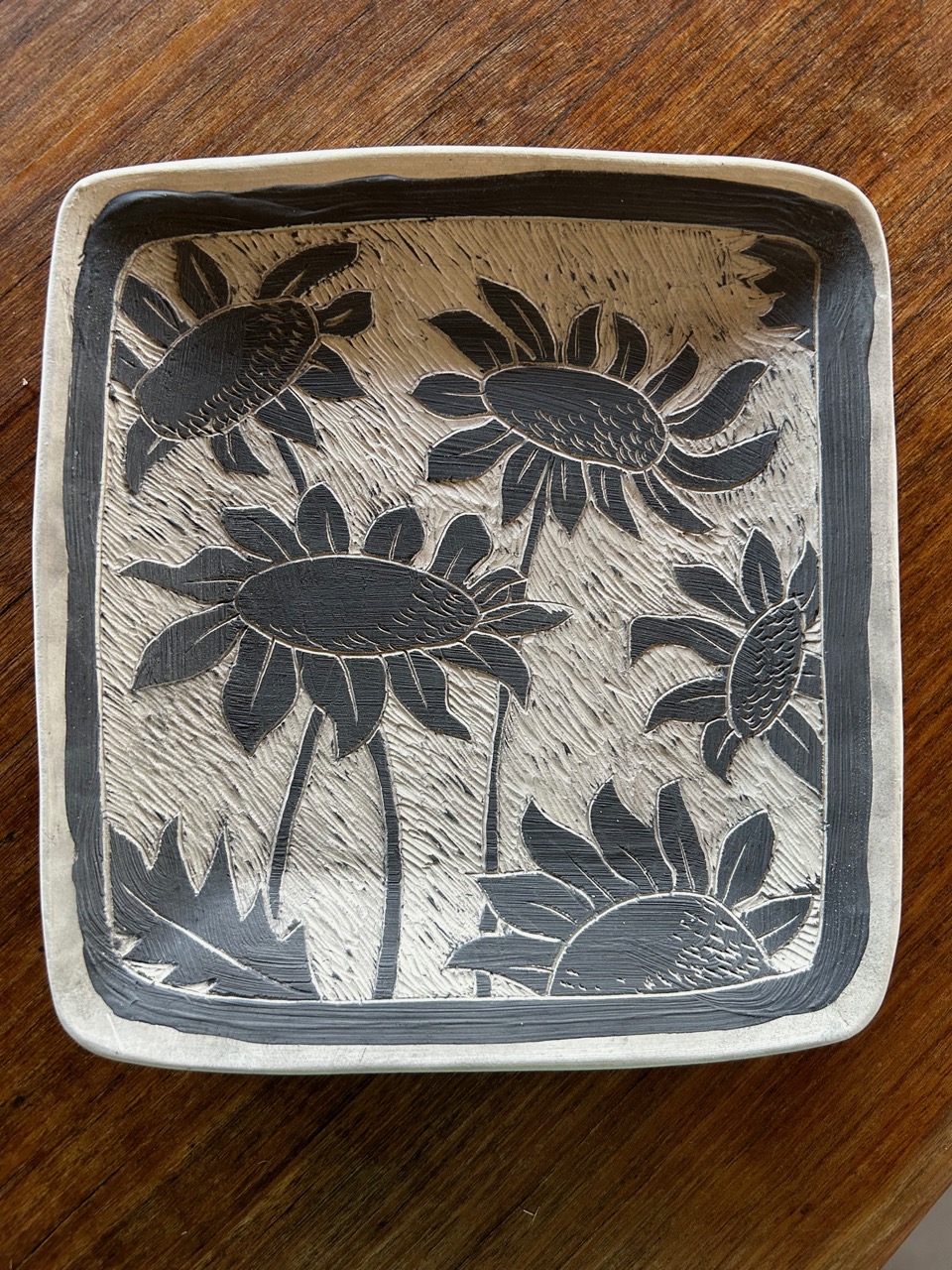
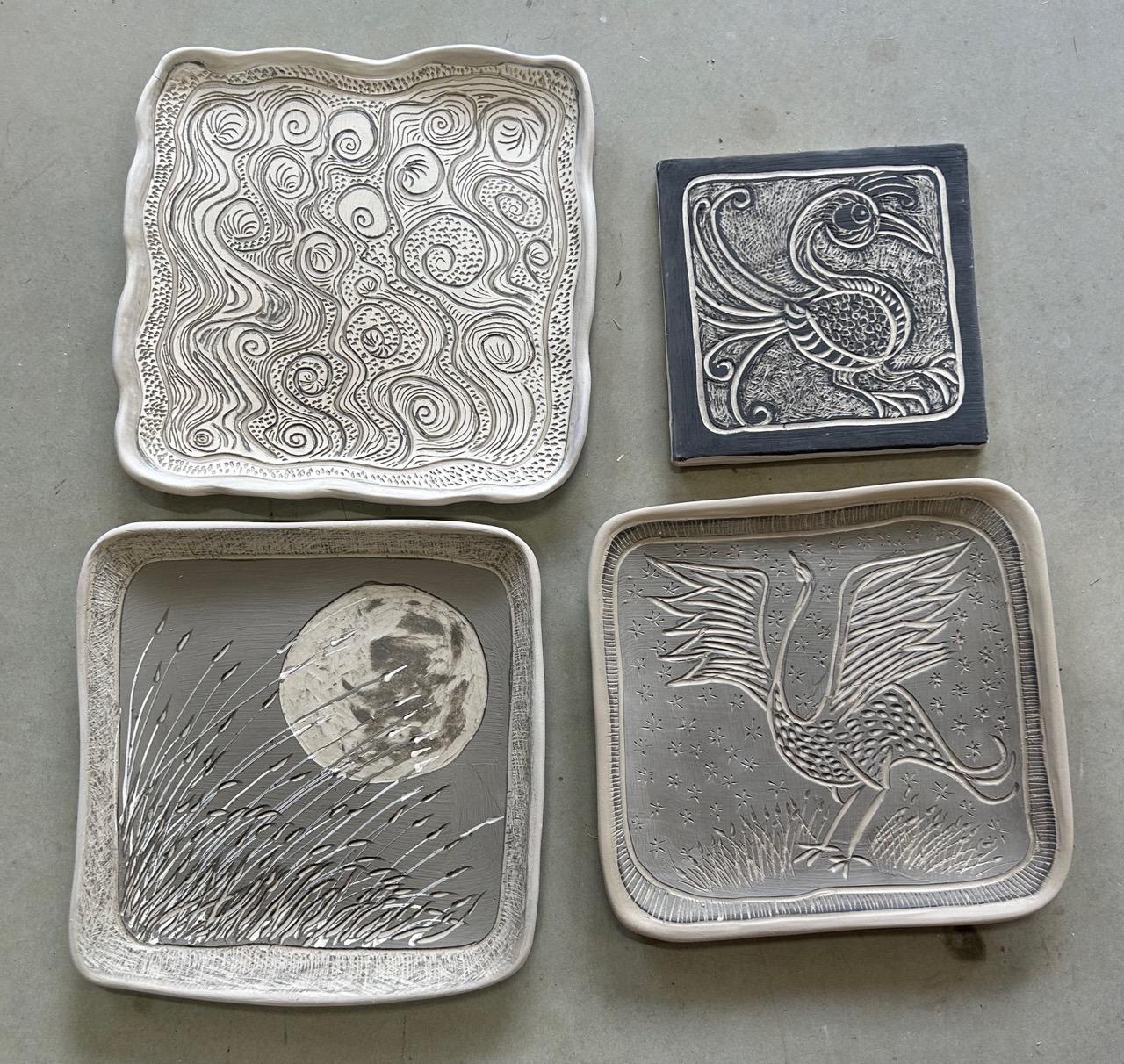
We have been having 30oC days recently, so in the heat of the day, when it is too hot to be outside in the garden. I spend a few hours in the pottery, continuing with the sgraffito work that we started, inspired by Warren Hogden a couple of months ago. All the early work on tiles and square plates made at Warren and Janine’s weekend workshop, were all fired at cone 6, 1200 oC.
All the work that I have been making since then is all sericite porcelain, so I’m hoping that there will be a nice graphic interface with the light shining through the translucent porcelain body from the inside, creating a lovely glow, and vice versa.
I’m really enjoying it. It’s a lot of fun, and such a change for me.
I missed most of the free-for-all shit-fight that is Xmas shopping this year.
The week before Xmas, Wednesday or Thursday Janine and I were pruning some extravagant growth from the shiraz vines, to make it easier to weed the garden beds. Nothing happened! 3 days later, on Sunday morning, I woke with tightness across my chest, head ache and achy bones. We had been to the Village Xmas party the night before, so I thought ‘COVID’!
Rat test all clear, next day worse, 2nd RAT test, all clear again. Next day no better, so went into town to get a PCR test, as RAT tests aren’t all that reliable. The local duty doc says “probably flu!” The next day, PCR returns all clear, for Covid, RSV and Flu. So it’s something else? About this time the back of my arm began to ache, so I show’d Janine, and she said Ouch! That looks terrible. I’d been out driving and noticed that the sun on my driving arm made it hurt.
So then I’m thinking that it’s all about some sort of chemical burn from an unknown toxin of animal or vegetable origin? (I eliminated mineral.) First thoughts were venom, but spiders, scorpions, snakes all leave puncture marks and the initial strike is painful. I felt nothing.
So, my next thoughts were plant sap. I know that the thick white sap from figs and some weeds, like dandelion can cause skin burns, but these grape vine tendrils were 1.2 metres up off the ground, away from all weeds.
The scratch pattern suggests scraping across something. At first I was at a loss to think of ‘what’ and ‘how’, but pretty sure that it was some sort of contact dermatitis from a toxic plant sap?I’ve been pruning grape vines for 40 years and never experienced anything like this before. Now 2 weeks on its settled down and is no longer so red and angry looking, and the clear pustules have gone. My GP comes back to work on the 2nd, so I have an appointment with him then. But it’s left me living with the symptoms of flu or COVID, even though it isn’t that. I have achy joints, electric blue razor sharp headache, and feeling pretty tired most of the time.
Of course, I googled it and the best match I could find was ‘Rhus tox tree’, but we don’t have one of those in our place.
However, I think that I’ve finally got it sorted out.
As I read on, I discovered that some of our edible garden vegetables are capable of irritating skin and causing ‘phytophotodermatitis’. It’s a special combination of first getting in contact with the offending sap, then getting strong sun exposure after that. If the plants have any ‘furocoumarins’ then the skin becomes very sensitive to sunburn. Hence phyto-photo-dermatitis. Once burnt, there is no treatment, you just have to sit it out – in the shade!
The most common garden plants that contain furocoumarins are the ‘Apiaceae’ family represented by parsley, celery and parsnip. Who’d have thought? The other family is ‘Rutaceae’, containing rue and citrus plants. In fact, one of the names for this phytophotodermatitis is ‘Margarita burn’, from sucking on limes in the hot sun! I kid you not! Some people can get burnt from the lime juice on their skin in full sun.
Who could have imagined that my lovely vegetable garden, normally such a safe place of creativity and enjoyment, would turn out to be so toxic to me? So it finally all fell into place. I was pruning the side of the vines alongside the veggie garden beds. Janine worked on the other, more open, north side. I got a few scratches on my arm from the short stubs of the pruned vines, just enough to rough up the skin a bit, but no pain. No reason to take any notice. I carried out the prunings up the row, then on the return trip down the row, in the opposite direction, to cut more, I had to walk past the seeding heads of a bed of parsnips and parsley, exactly at the same height as my shoulder and its receptive skin. No reason to take any notice. Apparently there is a wild parsnip that is known to be very toxic, but even domestic parsnips still carry some furocoumarins.
The perfect storm comes about when; It’s hot and I work in a singlet, arms and shoulders exposed, I get a few light scratches from dead vine stubs Nothing worthy of noticing. Brush against garden parsnip flowering heads. No reaction then either. BUT!
Wait 2 days, then and go out driving in bright sunshine, in the middle of the day, exposing my right side driving arm to full sun. That is when my arm started to hurt for no apparent reason. None of the critical events were obviously linked, so few clues to go on. But now that I have educated my self on this issue,
I’ll be wearing long sleeves when working near parsley, parsnips and celery in the future.
Having spent a week in bed, with the symptoms of what I first imagined were the same as covid, but with sun burn on one arm, it’s been a very quiet one for me. The big solstice day fell just at the end of the week, so I was able to take part in our beautiful family Xmas lunch of baked garden vegetables in a honey soy dressing, with a garden/orchard salad of red plums with cucumber, capsicum, tomato, red onion and parsley. All really delicious, cooked on sunshine and no animals were hurt in this meal.
We’re trying hard to keep it all simple, but somehow, Xmas has morphed into a time of extravagant excess for so many. Loads of junk changes hands, some of it doesn’t even last the day and is destined to go straight to landfill. We don’t want to add to the miss-treatment/torture of caged animals, nor wrap/package things needlessly. I sound like a real killjoy, but I’m not. I want to give time and love and caring conversation instead of ‘things’. Stuff doesn’t really fill any emotional gap in any stocking. I’m not being mean spirited either. I give the equivalent amount of money to a charity instead. I just want to do as little damage to the earth as is possible while still living a ‘normal’ 1st world life style, although mine is a strange, green influenced, non-consumerist, carbon constrained, hybrid 1st world life style.
I’m sure we’ve all been at the supermarket and thought, well, I could just pop these last few things in the basket and be out of here. But I don’t want to buy my mushroom or meat in a shrink-wrapped plastic packet. It’s unnecessary, wasteful and environmentally damaging. The only option then is to to check out, go to the other shop in town and buy the meat un-packaged from the butcher, and the mushrooms un-packaged in a loose fill paper bag from the grocer. It’s easy enough to do, but takes loads of energy and is quite time consuming. It also means driving further and finding a parking space 3 times! If I were driving on petrol, it would be a waste of fuel.
I am no saint. I often fail my own test. but when I am on my own, feeling OK and on top of things, I find myself doing the rounds of 3 supermarkets, the butcher and the green grocer. I go with a list for each one. I don’t look left or right. If I can’t find the item or anyone to ask, I leave without it. They loose. I don’t really need all that much anyway. Most of what I buy is discretional/peripheral. However I do like to make a rendezvous with the fish truck that comes up from the coast each week. That is our main source of protein. Most of the rest of our food comes from our garden.
It’s not unusual for me to go to only 2 isles in a big supermarket. I make a ‘Bee-line’. Go for what I came for. I refuse to be distracted. I leave. I have no respect for the price gouging, profit-at-all-costs, main-street-wrecking, rip-off tactics of the big 2 supermarkets. I only go there for one or two products that I can’t find anywhere else. I’d be happy not to go there at all. However, I’m only human and essentially lazy, just like most people. I really have to push myself to shop as little and as ethically as possible. It’s just that I was brought up to think ‘green’ about all my life choices. Environmentalism is very deeply embedded in my psyche. I can’t help myself.
Trying to shop ethically is hard, time-consuming and ultimately very unrewarding. because no matter what you buy, there is that feeling that I could have done better, or, maybe I shouldn’t have bought it at all.
Life is strange, there are no instructions, no right answers (left answers may be less damaging?) and life is a constant source of learning by failure and experience! I’m doing the most that I can with the least that I have. It’s the journey. Who’d have thought that shopping was hard and gardening was dangerous!
Nothing is ever finished, Nothing is perfect, and Nothing lasts.
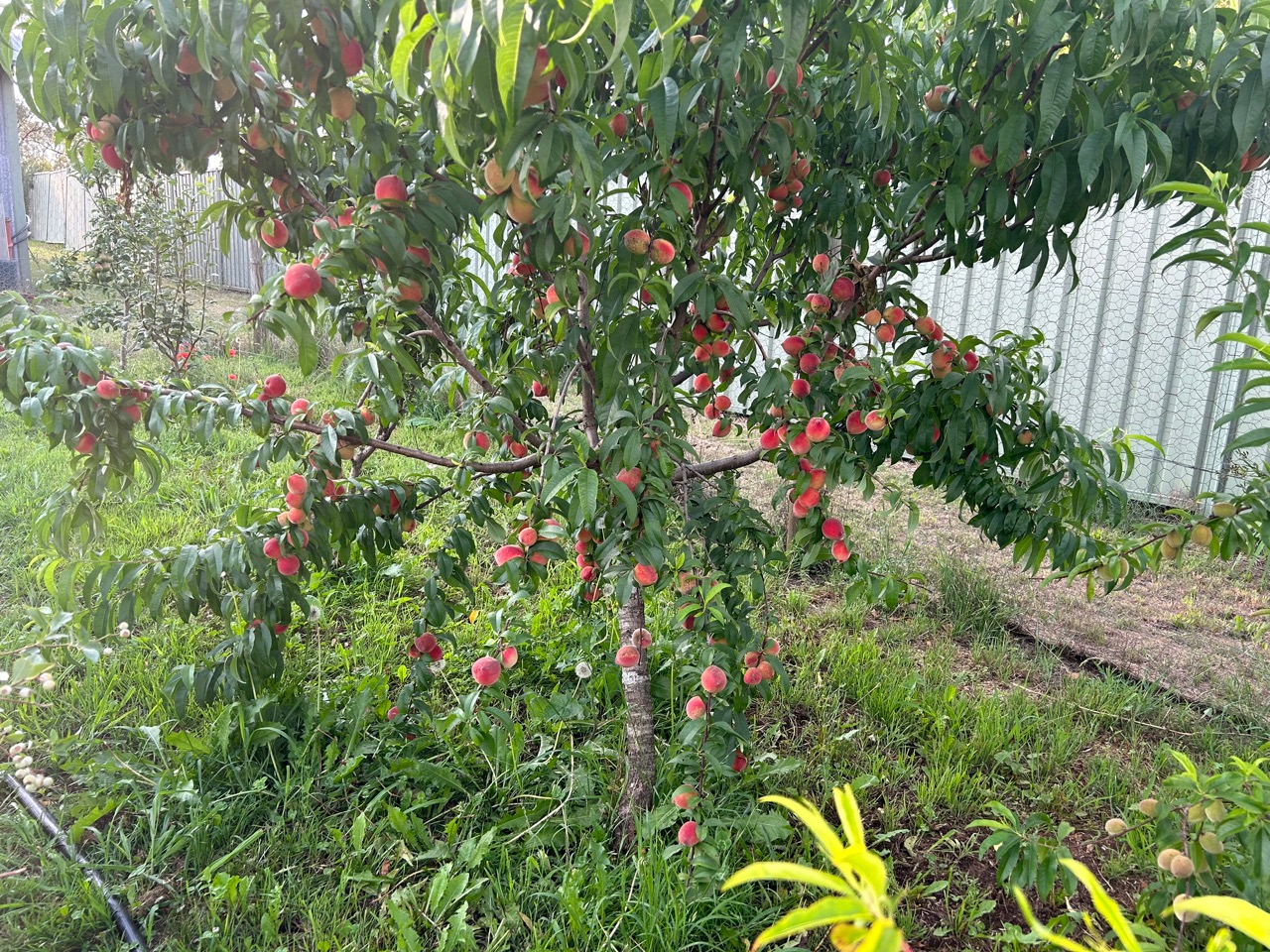
December brings on the summer and the stone fruit harvest. We have all of the newly planted, now 4 years old. stone fruit trees in the new post fire orchard coming into fruit. We chose to plant all dwarf rootstock, low chill, hot weather tolerant, varieties. They are doing really well and everyone of them has fruit on them this year. Some of them set fruit from year one, but as this isn’t good for the health of the tree, I picked all the fruit off, bar one piece, just get a taste of what was to come. Fruit trees do better if they are left to grow on for a few years and put all their energies into developing a sound, strong branch structure and deep root system. As their first 3 years were all very wet here with the la nina event coinciding with their planting, They grew very well indeed and we hardly had to water them very often.
So now we have a surfeit of peaches and nectarines, on these pretty little bundles of red and green. All the fruit needs to be eaten now or very soon, so we have fruit salad for breakfast.
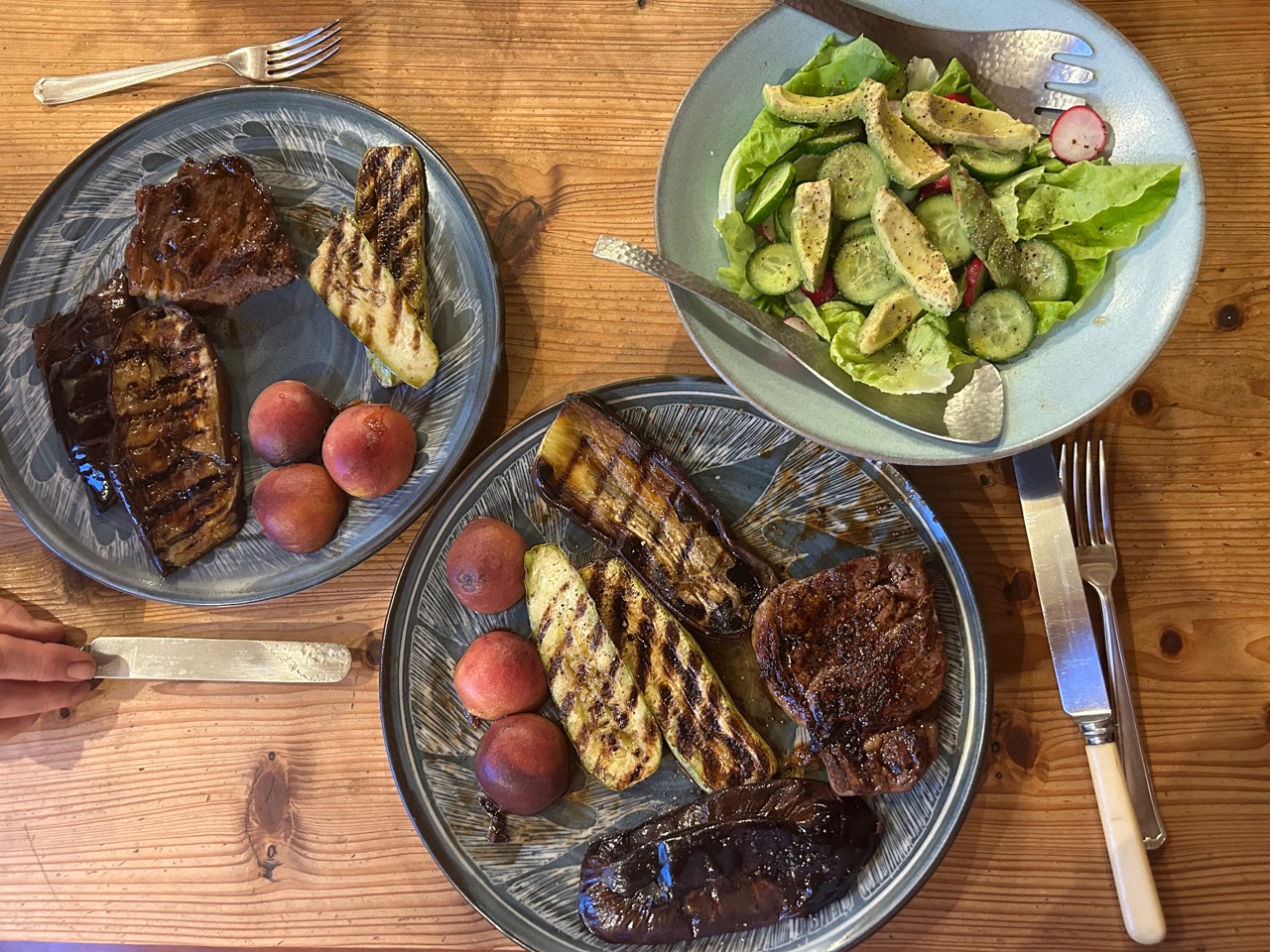
BBQ’d peaches and or nectarines with dinner, and stewed fruit for desert. There is always a pressing problem with the fruit fly. I was a bit slow in getting all the fruit fly trap and lures re-charged with refreshed baits this year, so there is a bit of fly in the fruit. We cut this out and cook it up to kill the wrigglers. The rest of the otherwise undamaged fruit is stewed for breakfast or desert.
This old fly trap has about 100 dead male fruit flies in the bottom from the early spring flourishing. I empty them out and replace the old bleached white bait with a new bright pink one. We have about 14 of these traps of various ages. I bought a few new ones each year, as the orchard grew. now I just buy refills for the bait.
You can tell their ages by the bleached out colour of their lids.
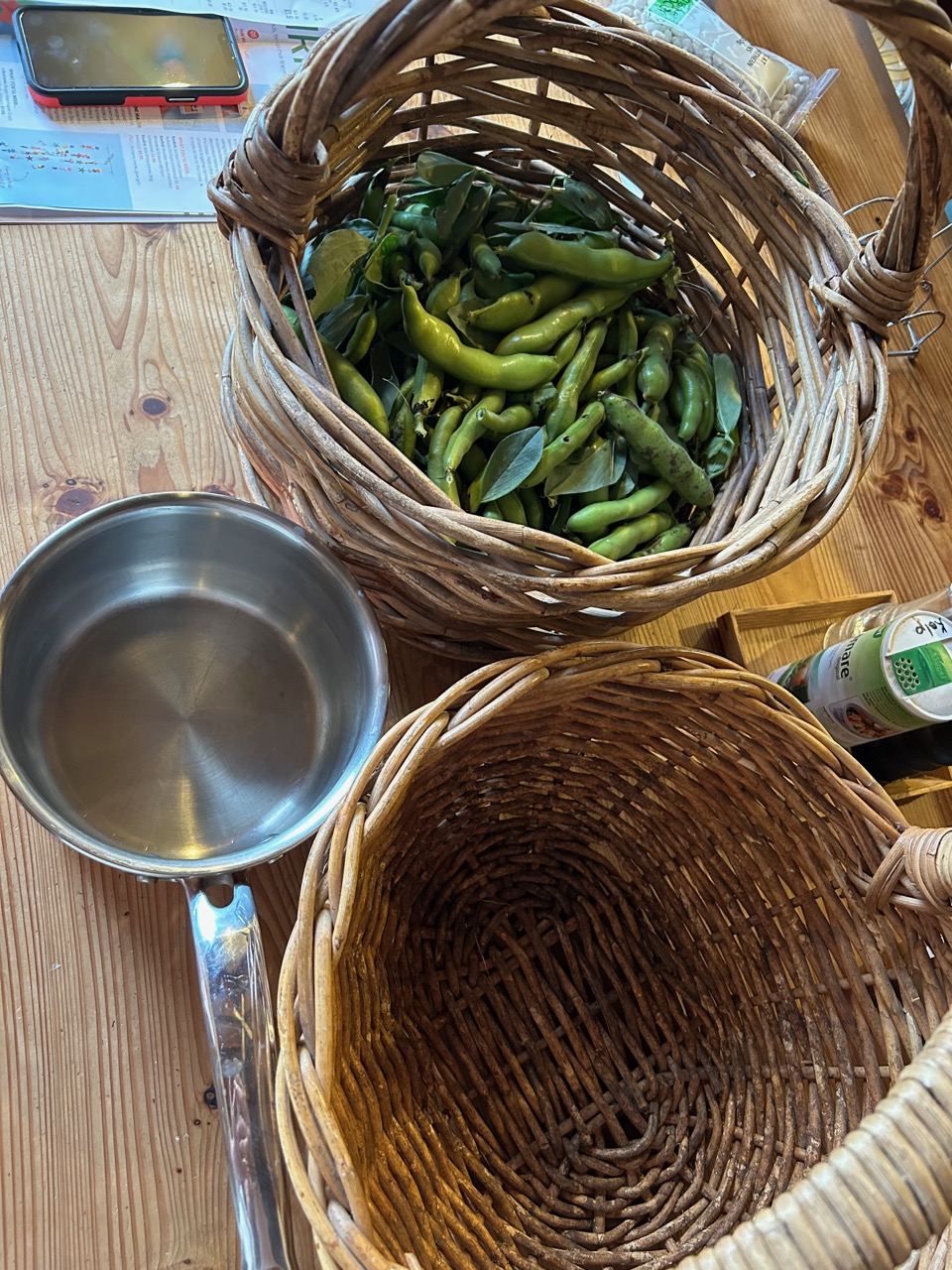
We picked the very last of the broad beans. I thought that I had picked them all last week, but I only had a boy-look. Janine went back through the crop and found another meal for us. I decided to cook that very old favourite of pork and beans. So called favourite of the cowboys on the trail in the old west. I first became aware of this combination watching old black and white western cow boy movies as a kid. I had no idea what it all meant, but it did cross my mind briefly – very briefly. Why were they eating pig when they were herding cattle?
Why weren’t they herding pigs if that is what they wanted to eat? Fortunately, my nascent and emerging tiny brain managed to accept and cope with this difficult dilemma, and moved on.
Now fast forward to my early interest in cooking and coming across the wonderful Italian recipe of chorizo, beans and tomatoes, obviously with extra chilli and garlic, it goes without saying. It’s become one of our springtime/hungry gap favourites. The beans are usually all dried from last summer, as is the bottle of reduced tomato sugo or passata. As we don’t have our own pig, just chickens. I use what we have in the fridge. At this time, we only have some bacon, so that is what I use. With the shops being a good 50 km round trip away, we don’t drive there frivolously. So bacon it is.
Home grown beans, home grown sweet basil, home grown garlic and home made passata from home grown tomatoes. WARNING! A pig was harmed in the making of this meal.
Desert is fresh picked cling stone yellow fleshed peaches soused with a dash of amoretto half an hour before. Perfection!
These days I’m up in the early mornings from 5.30 and work outside until the sun gets too hot, possibly around 9.00am. Sometimes I am out in the garden working, or more recently. I have been updating our fire fighting capacity with extra sprinklers on the walls of the pottery, barn and big work shed. I have installed the ‘spare’ fire fighting pump that I used to transfer water from dam to dam.
It is now more or less permanently in place to protect the pottery and barn with a high pressure water sprinkler system. This system used to be powered by an electric pump, I found out at my expense that electric pumps are useless in an emergency, even though I have solar power and a battery, when the fire came and burnt the pottery, it shorted out the power to the barn and only then did it catch fire.
So now everything is dual powered. We have electric pumps for hand watering the garden beds and running the roof cooling sprinkler on top of the roof. But for fighting is completely petrol driven and independent. Because you cant let petrol engines sit idle. They need to be started and run regularly. I have every thing in a dual system now, so that I can start up the fire pump when we are both want to water the garden and orchard trees at the same time. The fire pump handle that duel drain on its reserves of power with no problem, whereas the one horsepower electric pump struggles.
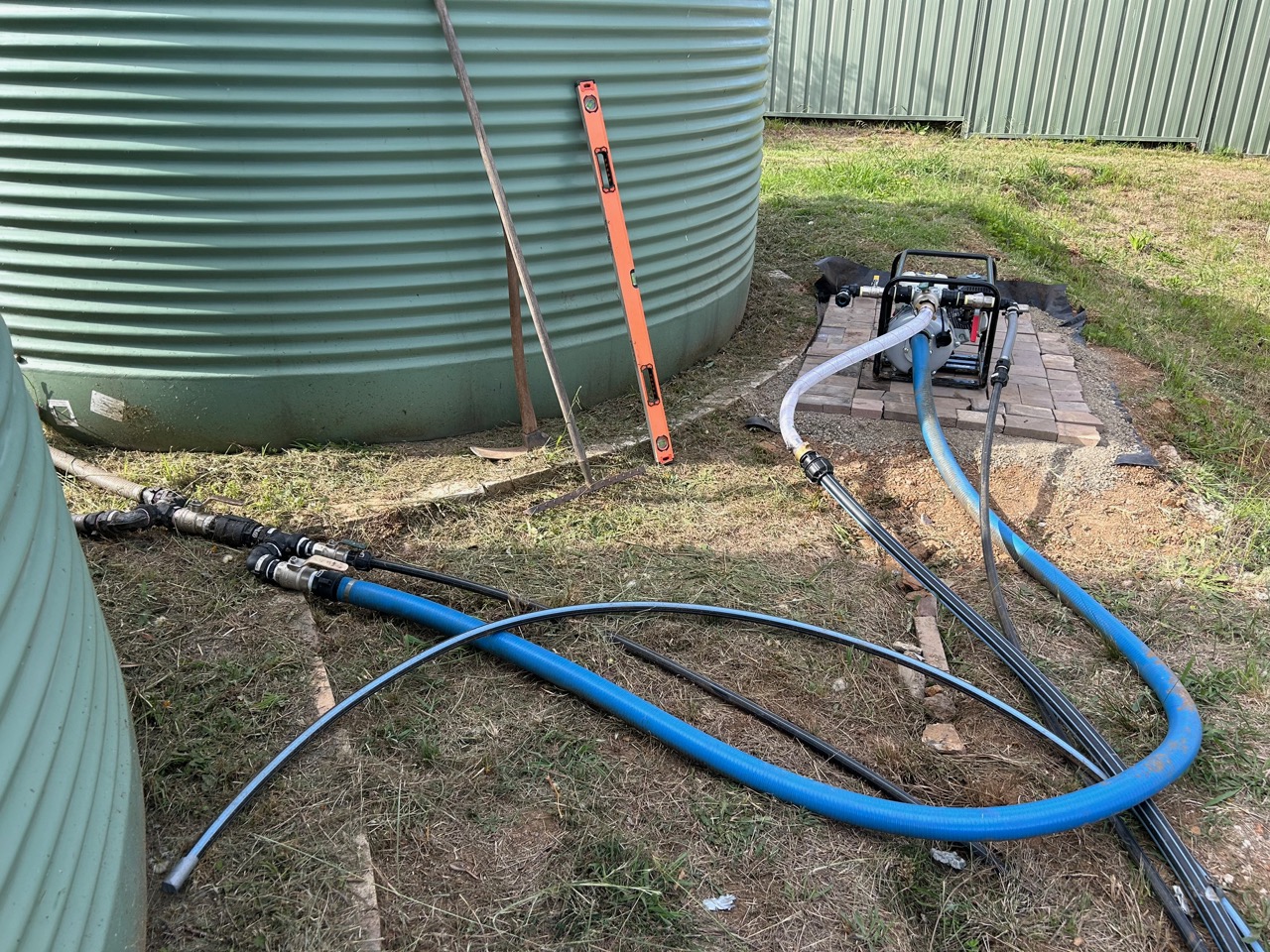
Inspired by all the talk of the Roselle spaghetti junction new motorway tunnel. I installed my own water fed spaghetti junction.
Situated directly behind, and close coupled to, the two 25,000 litre water tanks, it should be safe from fire there? Only time will tell. If you look hard at the image of the pottery shed, you will see the water misting out of the wall sprinklers along the verandah and up on the roof.
I’ve been spending the hottest part of the day inside working on the ongoing sgraffito project. I’ve finally run out of pre-slipped, press moulded dished and tiles. I’ll have to get on the wheel again soon and make more shapes to decorate.
We have been going through a very dry time recently, with the onset of the summer heat and reports confirming that we are entering another el-nino period.
All a bit glum really, but then the rains finally came. We had about 150mm. that’s about 6 inches in the old money. I had recently spent a few days pumping water from one almost empty dam up to another, slowly accumulating what was left of our water in the 4 dams, all eventually up to the one small dam near the house, where we have both a high pressure, petrol driven, fire fighting pump, and a small electric pump that is mostly used for watering the garden.
I managed to get that little dam about 1/4 to 1/3rd full. not a bad effort. That would have been just enough to see us through the first half of summer.
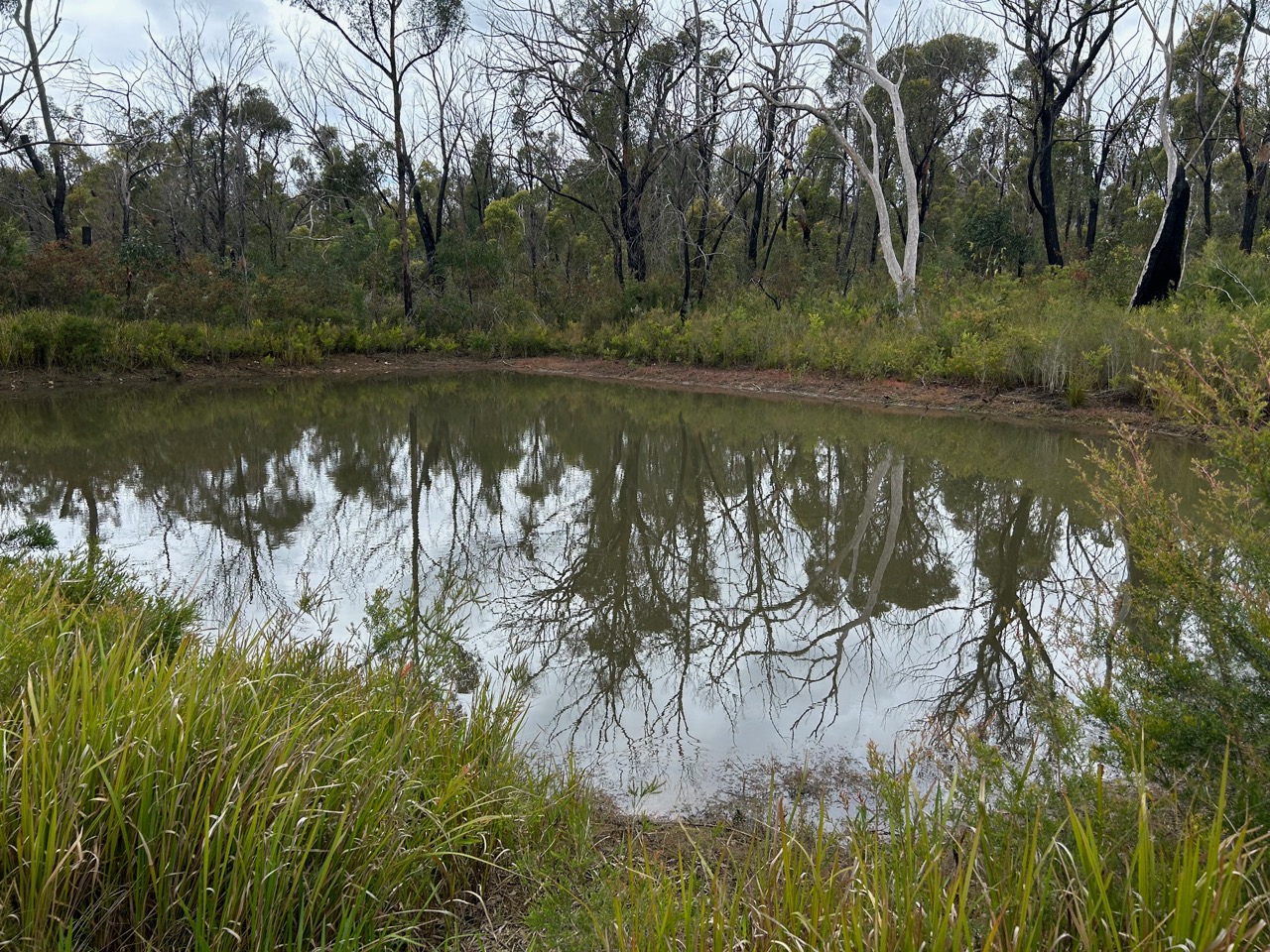
Before the rains.
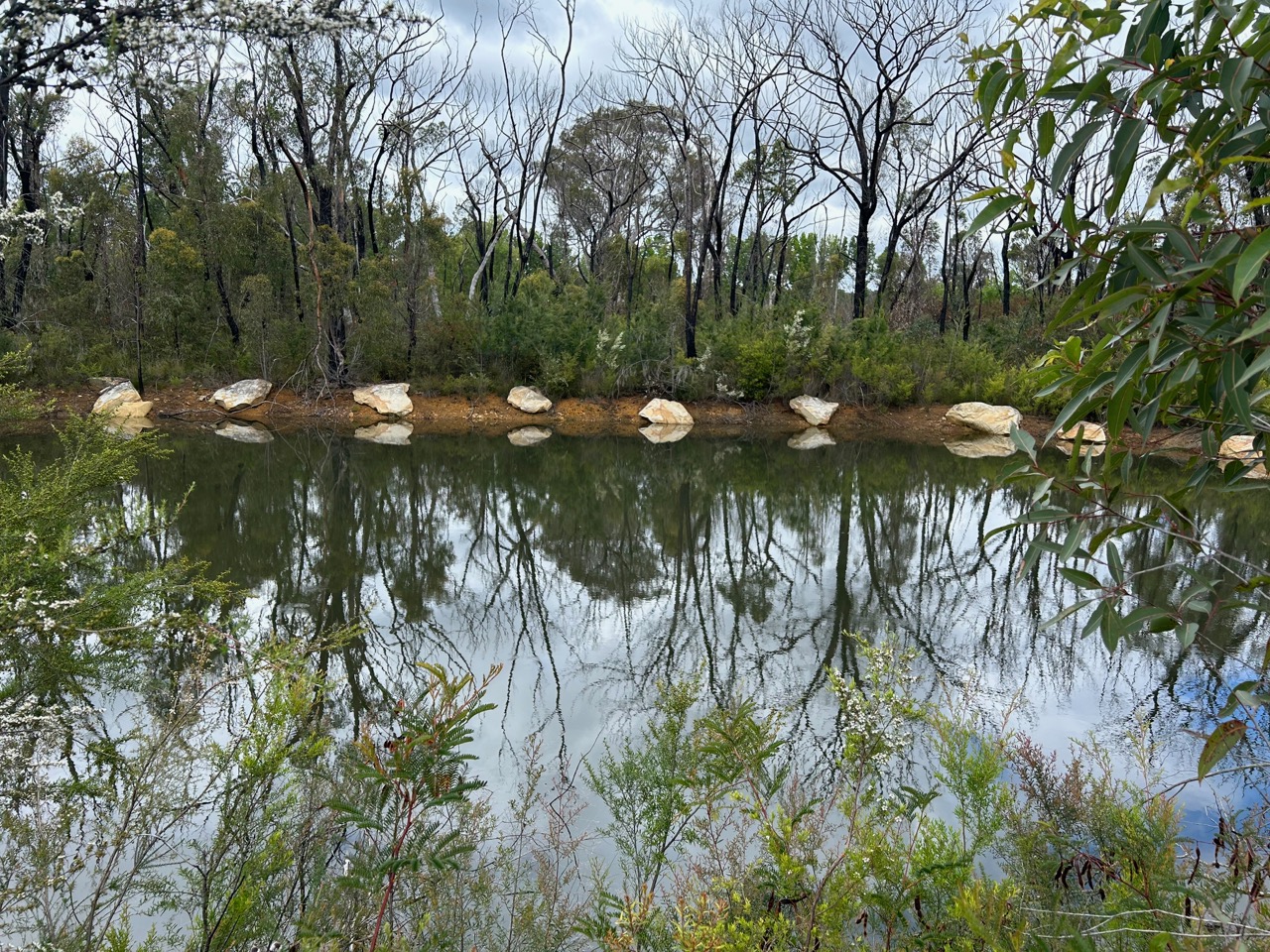
After the rain.
But now, since the down pour, we have 4 dams all about 3/4 full. The little house dam that started from 1/3rd full, over flowed down into the next dam in the series. A lot of that water I pushed up hill 2 weeks ago flowed back. A waste of a couple of gallons of petrol. I still buy petrol for the pumps, the chain saws, the mowers and diesel for the tractor. So we are not fully weaned off the dirty oil economy. I worked out recently that I spend a little bit more money on the fuel for the mowers and chain saws, than I do putting petrol in our Plug-in hybrid car, simply because we make sure that we keep the car fully charged off our solar panels, so we rarely ever need to put petrol in it. About $30 every 3 months, where as I spend about $100 twice a year filling up the fuel drums for the garden appliances.
We have recently bought a solar charged electric push mower, plus a whipper-snipper thingy, and a solar charged electric chain saw. So I expect that my visits to the petrol station will decrease accordingly. I still need diesel for the tractor and petrol for the ride on mower.
Since the weekend workshops of the last two weekends, Janine and I have spent a good part of each day during the week in the pottery consolidating our sgraffito skills and developing a few new designs, to include in our next batch of work. I would have liked to spend more time in the pottery, being creative and self absorbed. Once you start to draw and decorate the surface, the time just flashes past and it gets late so early. We have to stop to do the watering. There will be more time tomorrow to get a bit more done. There is always enough time for everything. We just have to learn to allocate out time and and as we age to allocate our limited energy.
There is so much to do around the garden and orchards. We have had to start watering by hand again since the rains stopped and the temperature has been going up – just touching on 40 degrees today. Even hotter in the west. Hand watering all the gardens and orchard trees. It takes us both over an hour to do a quick once-over, just to keep everything alive. It takes a lot longer to give specific beds a really good soak while we are at it.
We could probably buy vegetables much cheaper from one of the rip-off, price gouging supermarkets. But they wouldn’t so clean, fresh, healthy, organic and immediately delivered straight from the garden and onto the plate. There is something so very, even intensely, powerful in growing your own food. Not just the self reliance of it, but the intimate nature of the activity. It grounds me here in this place. I’m intimately here and now on this ground. This has become my little all-encompassing environment. My statement of belonging. I’ve sculptured this place into being as what is is now. It’s peaceful, abundant, pretty, and very functional as a home art space and garden.
We are just coming to the end of ‘the hungry gap’. That time of the year when most of the winter food in the garden is coming to an end, but the new spring planted summer crops haven’t started producing yet. We have been eating the last of our carrots, beetroots and cabbages, and have just picked the last of the broad beans along with the first of the new season zucchinis. Tomatoes have set on the bushes, but are still very green. It is always a challenge to get one ripe red tomato before Xmas.
maybe not this year, due to our being away and not getting that head start early on at the end of winter, or the first weeks of spring.
One very nice treat for this time of the year is the summer fruit crop. We are harvesting strawberries, blue berries, peaches, nectarines and plums. That equals fruit salad for breakfast for the next month.
I love the summer garden, but I don’t like the 40 degree days, or the potential for bush fires that are always in the realm of possibility when the wind picks up from the west.
We have just completed the second weekend workshop based around the decorating technique of sgraffito.
We had the same teaching team here as last week. We had so many enrolments in that first workshop, that we were able to book out the next weekend as well.
The workshop was led by Warren Hogden who has been using this technique very effectively, and so beautifully and expressively for some time. He was accompanied by Janine who also decorates her work using this technique. We had Len Smith here who assisted those who who wanted to concentrate on throwing rather than slab work. My role was the teachers assistant or TA. I kneading the clay, made up balls of clay ready for throwing, I also made, dried and slipped the dozen 150mm. sq. tiles in advance for the first experimental project of the day, and I also made a dozen 250mm sq. press-moulded dishes for the participants to try out their designs on, on the larger and slightly curved edges. Each of the students made a couple of flat ware dishes early on, so that they would be stiffened and ready for decorating on the 2nd day.
The first day was quite busy with so much to get done, but on the second day, the workshop took on very quiet atmosphere with everyone deeply engaged in their creative ideas and scratching decoration. For this workshop, we interpret the term sgraffito to mean applying a dark slip over a pale clay and then scratching back through the dark layer to reveal the contrasting paler body underneath. I made up a batch of our standard white stoneware clay body for these workshops, and we really got through a lot of clay with the clay box almost empty by the end of the 2nd weekend. I’ll have to get off my lazy butt and make another 3 batches of clay to get it ageing ready for next series of workshops, early next year. I make up 3 x 125kg batches of clay through the dough mixer and vacuum pug mills and mix in the recycled throwing slip from the last batch. This makes up to around 400kgs of plastic clay and takes me all day to weigh, mix and pug once through the mill, then half a day the next day to re-pug, blend, bag and store back in the clay box.
Sgraffito means scratch in Italian. It is a very old Italian technique of decorating a wall using two layers of contrasting plaster, then scratching back though the top layer to reveal the contrasting colour beneath. Used to create bas-relief sculptured surface on Wealthy peoples grand palazzi. It is used by potters to create a flat, 2D graphic decorative design as decoration on pots and tiles.
I looked it up in the Oxford Dictionary, It tells me that it was first used in English in 1730 as ‘sgrafit’ to describe black and white painting. Then in 1862 as ‘sgraffiato’ which meant to scratch. By 1900 it was used in North Devon potteries to describe incised wares.
Everybody did a lot of scratching over the weekend, decorating at least one tile and 2 slab dishes. Janine also demonstrated two layer a two layer decorating, using 2 different slips on over the other, allowing a 3 tone image. Warren demo’d using terra sigillata with sgraffito and a combination of the two slips, black and terra sigillata together with a scratched through design. All in all, a lot to take in in one go!
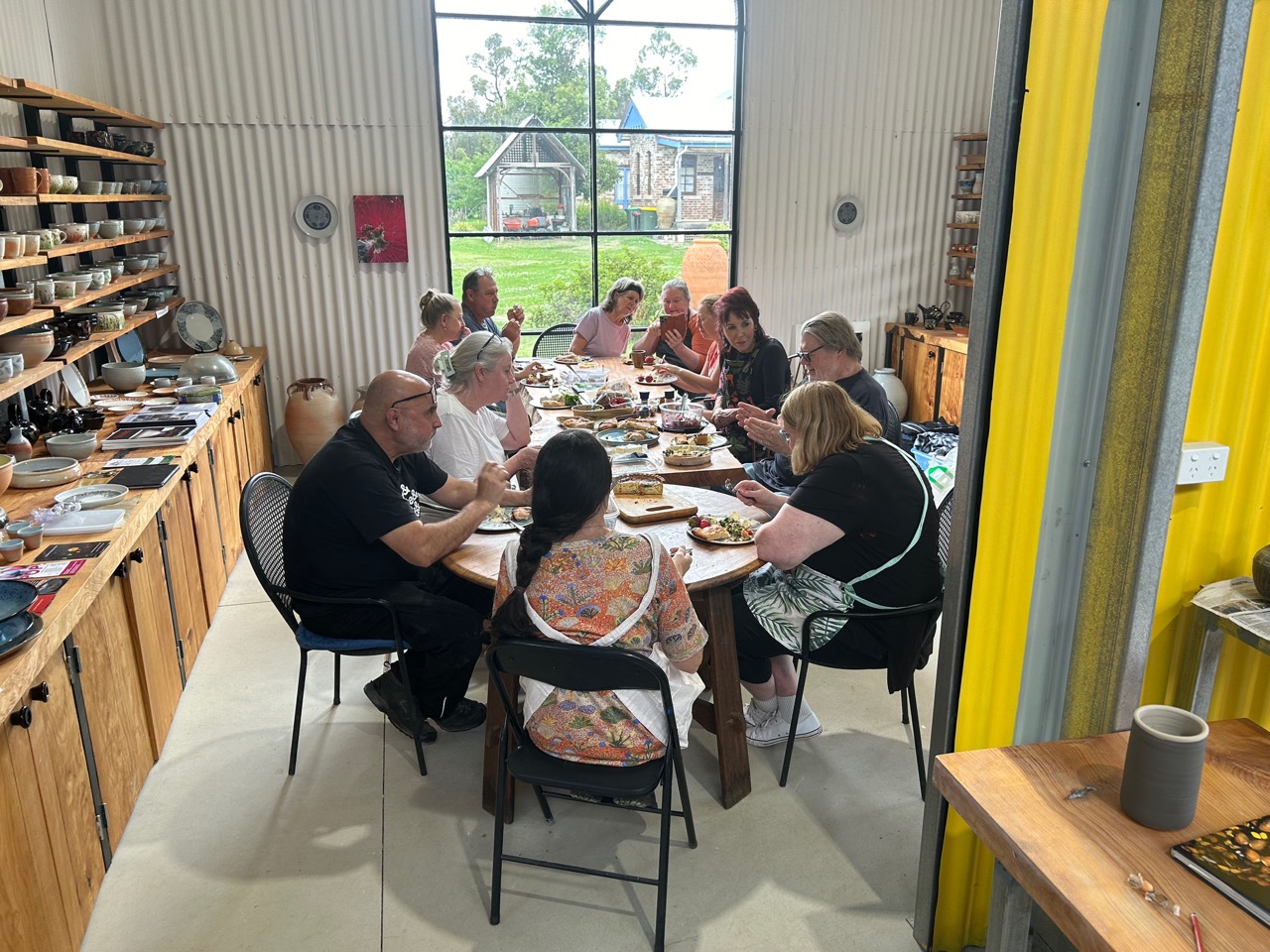
Everyone contributed to a sumptuous lunch each day with so much lovely food appearing on the long table in the gallery each lunch time. A big thank you to everyone who came along and made it all happen and for it to be such a rewarding experience for us all.
There is so much to learn, We only just scratched the surface!















































 Tonight my Fingers Smell of Garlic
You must be logged in to post a comment.