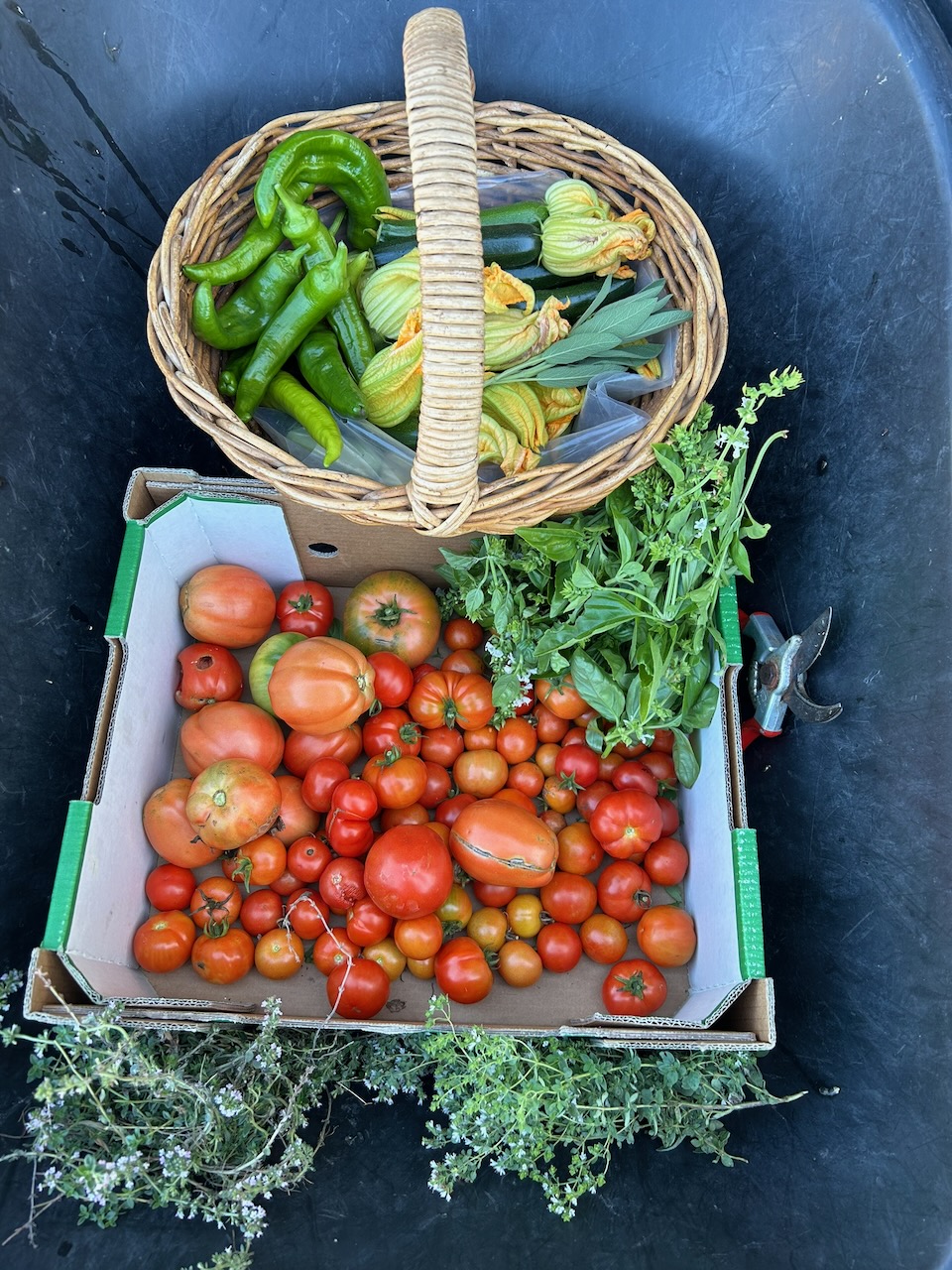
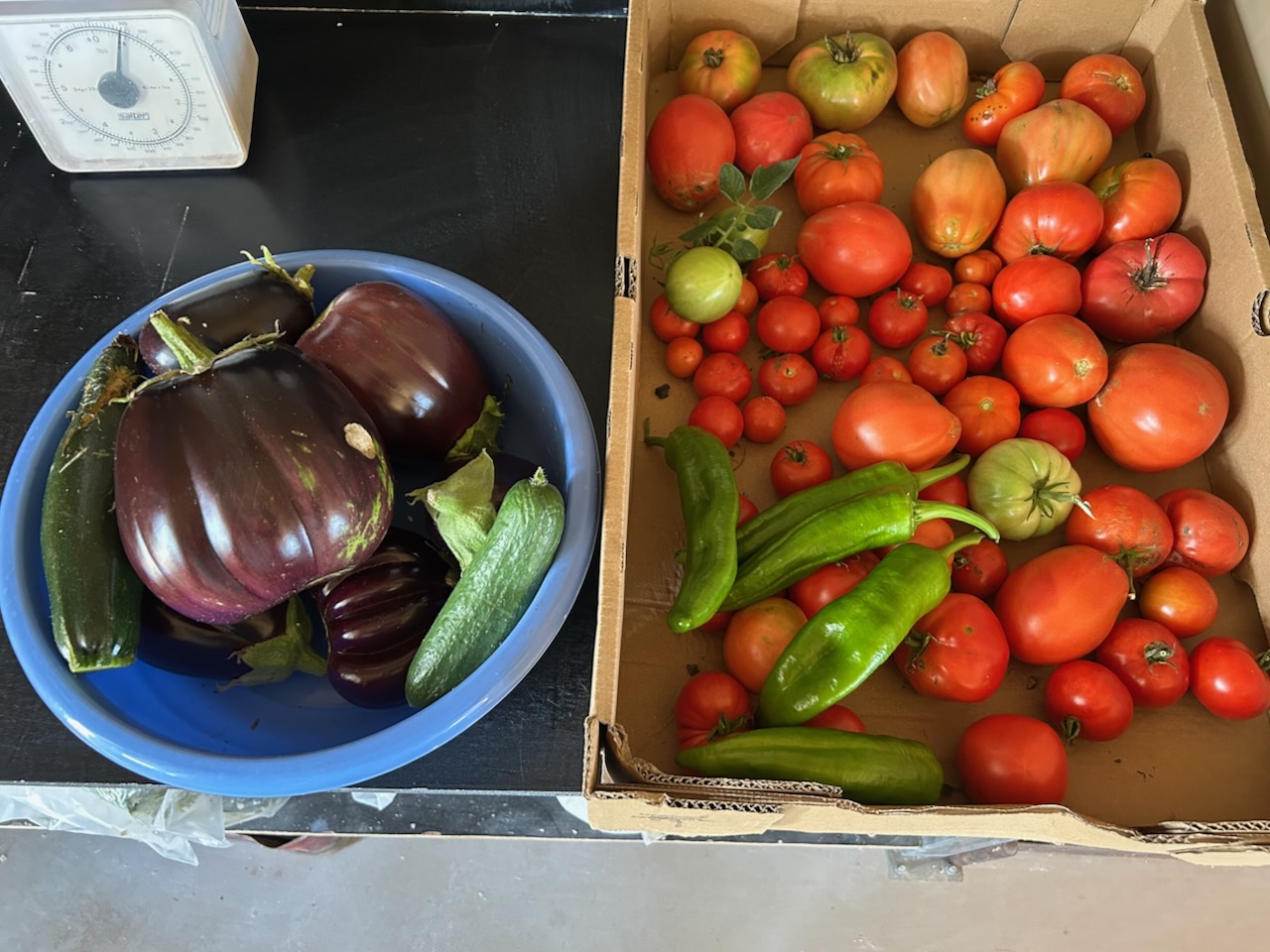
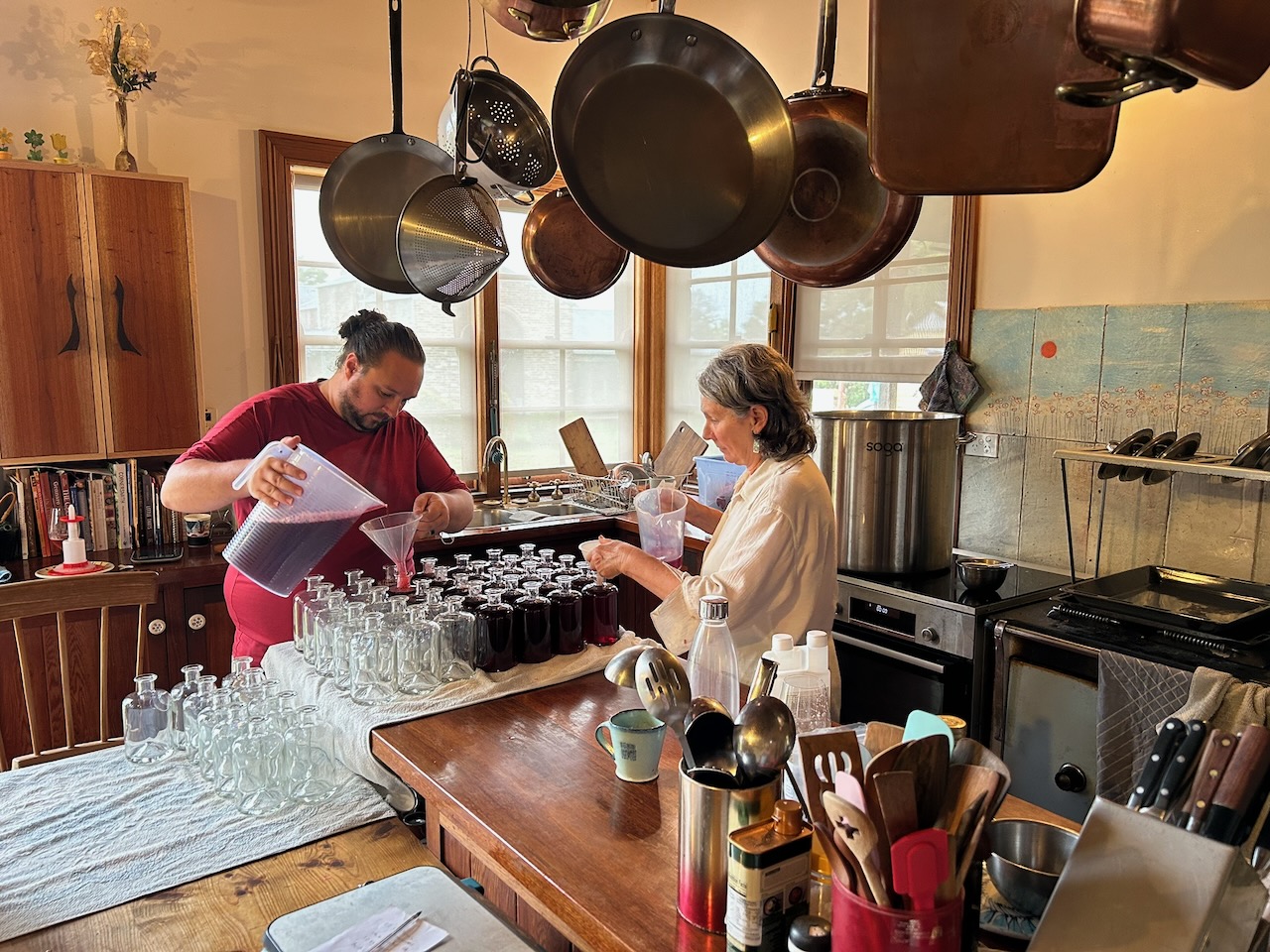
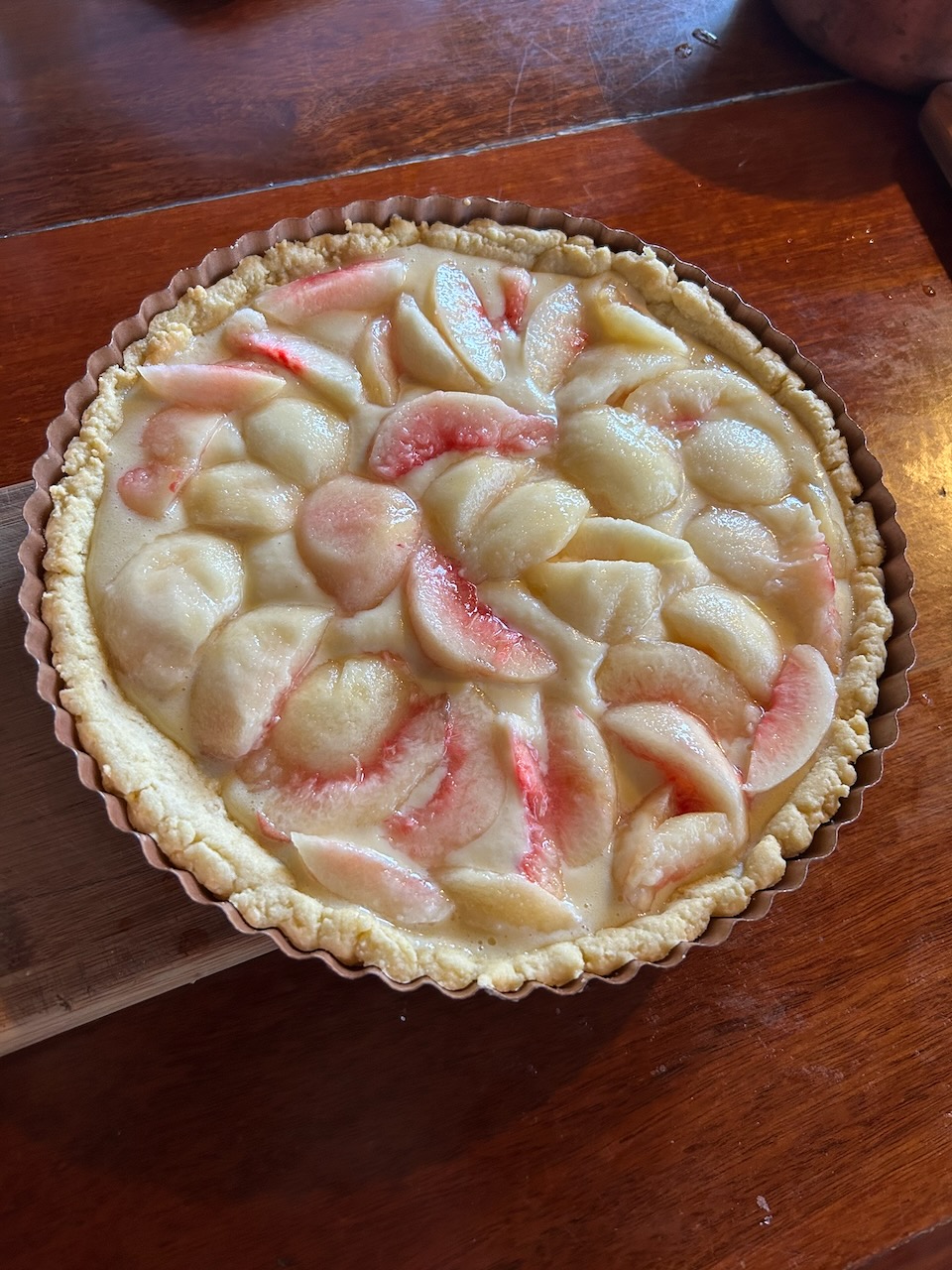
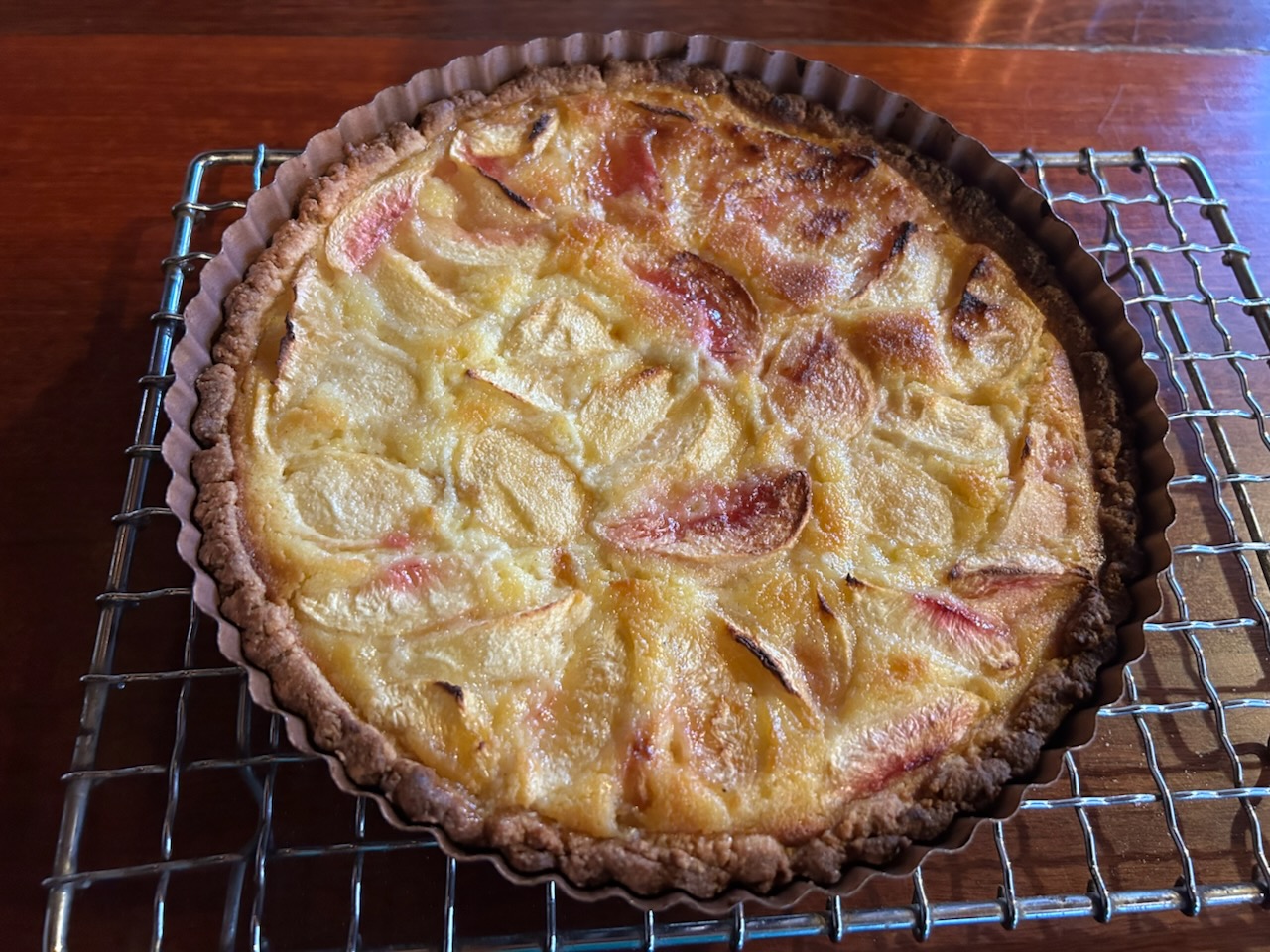
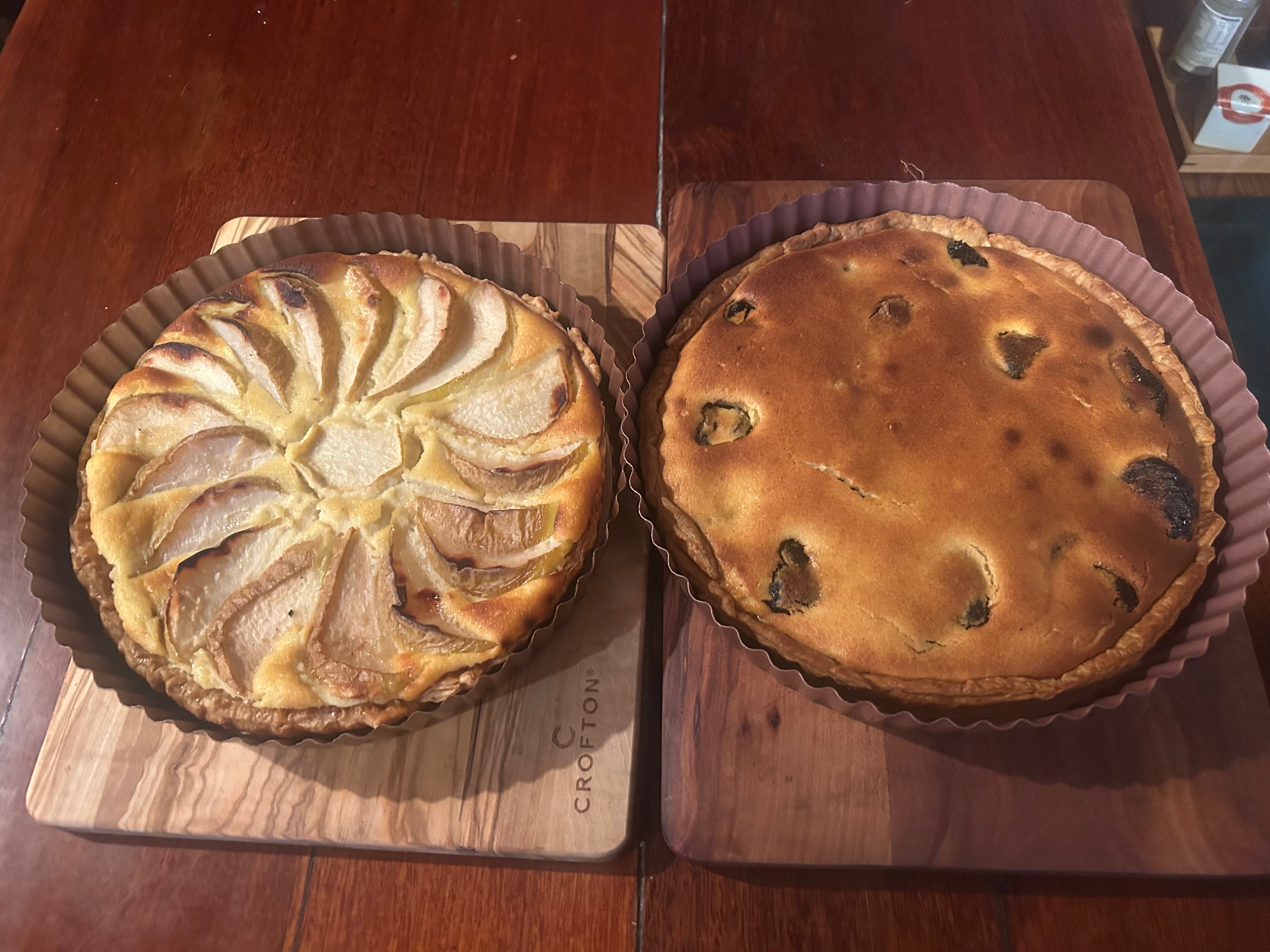
We have picked the first red tomato of the summer, well before Xmas. Always an achievement, but not so special these recent years, as with accelerating global heating, we are so much hotter and everything in the garden is ripening earlier.
When we moved here to the highlands in 1976, we couldn’t get a ripe berry off our newly planted berry canes until January. These days the berry crop is all over and gone well before Xmas.
We are harvesting peaches, apricots, the last of the late sour cherries, as well as strawberries and blueberries. We don’t make any pots over December and January, as we are full time involved in managing the fruit from the orchards and the summer flush of vegetables.
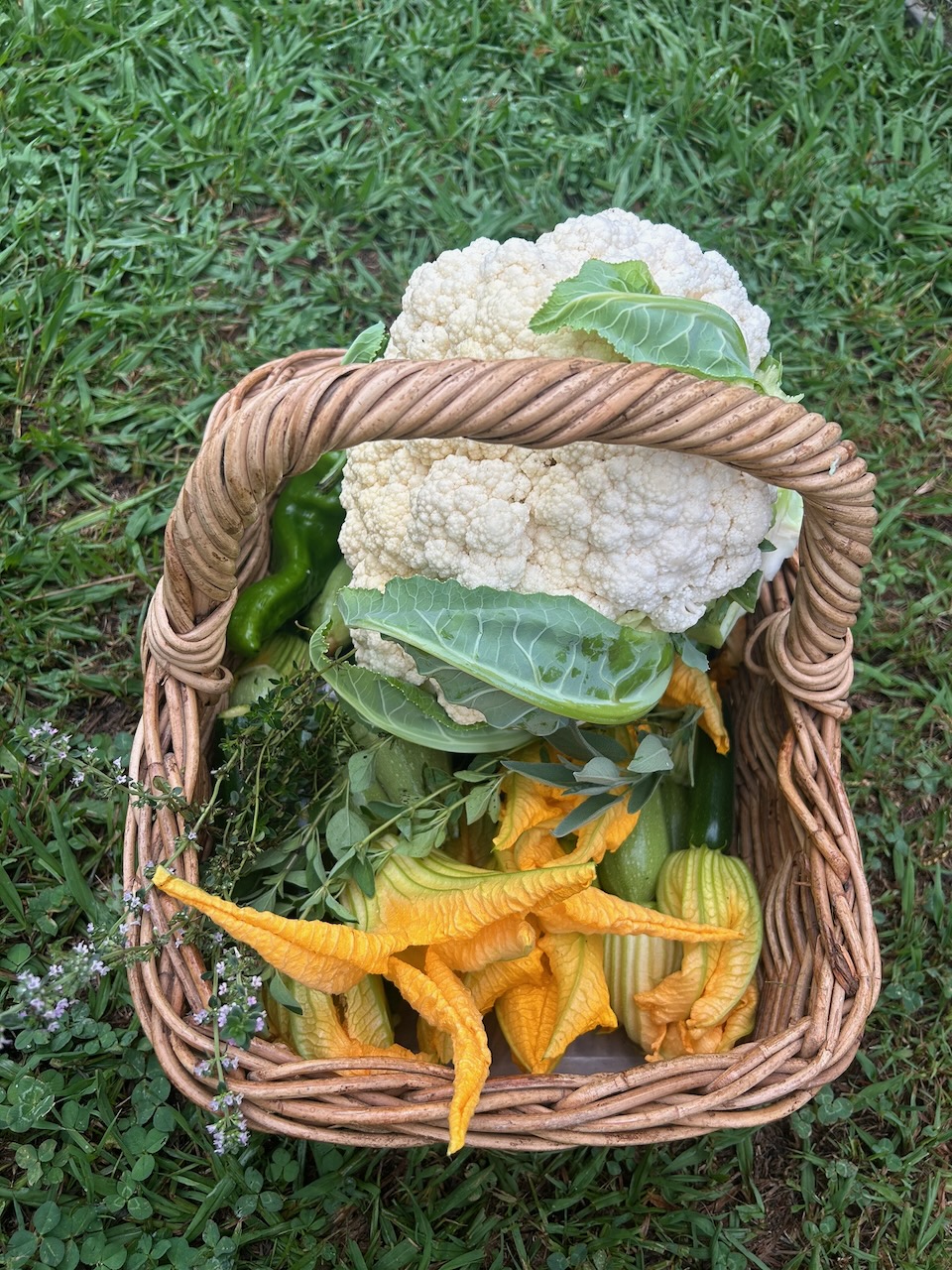
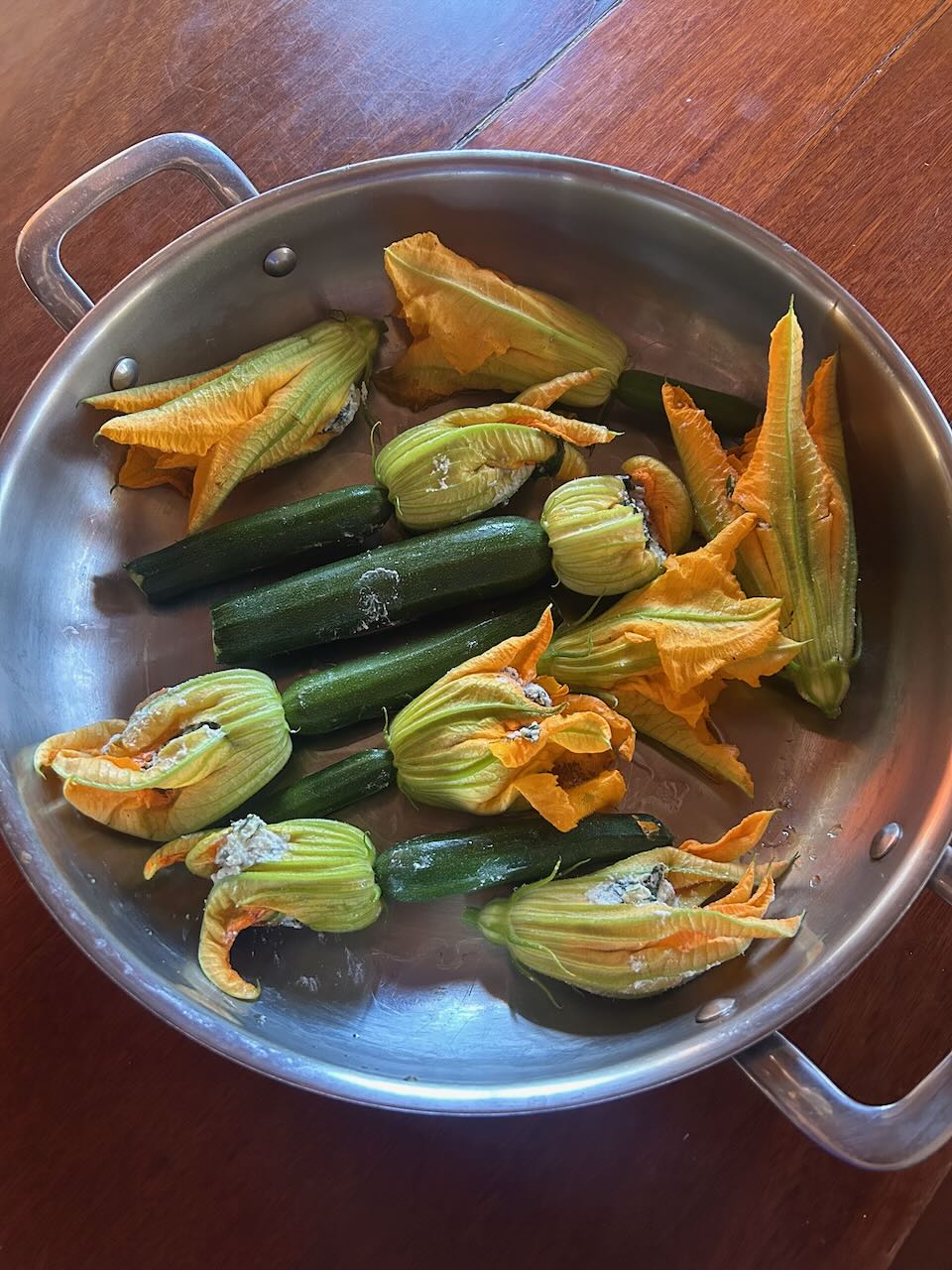
The zucchinis are going mad, so we are having a few meals of stuffed zucchini flowers. It’s a lovely summer time light meal. It achieves 2 important outcomes, by picking the flowers off the plant with the nascent fruit attached behind, it makes a colourful and delicious meal, but it also takes the fruit off so early that they don’t get a chance to explode into marrows if you just glance away for a moment or loose concentration, zucchinis fill out so very fast! Managing zucchinis means defusing them every morning early before they expand like The Big Bang!
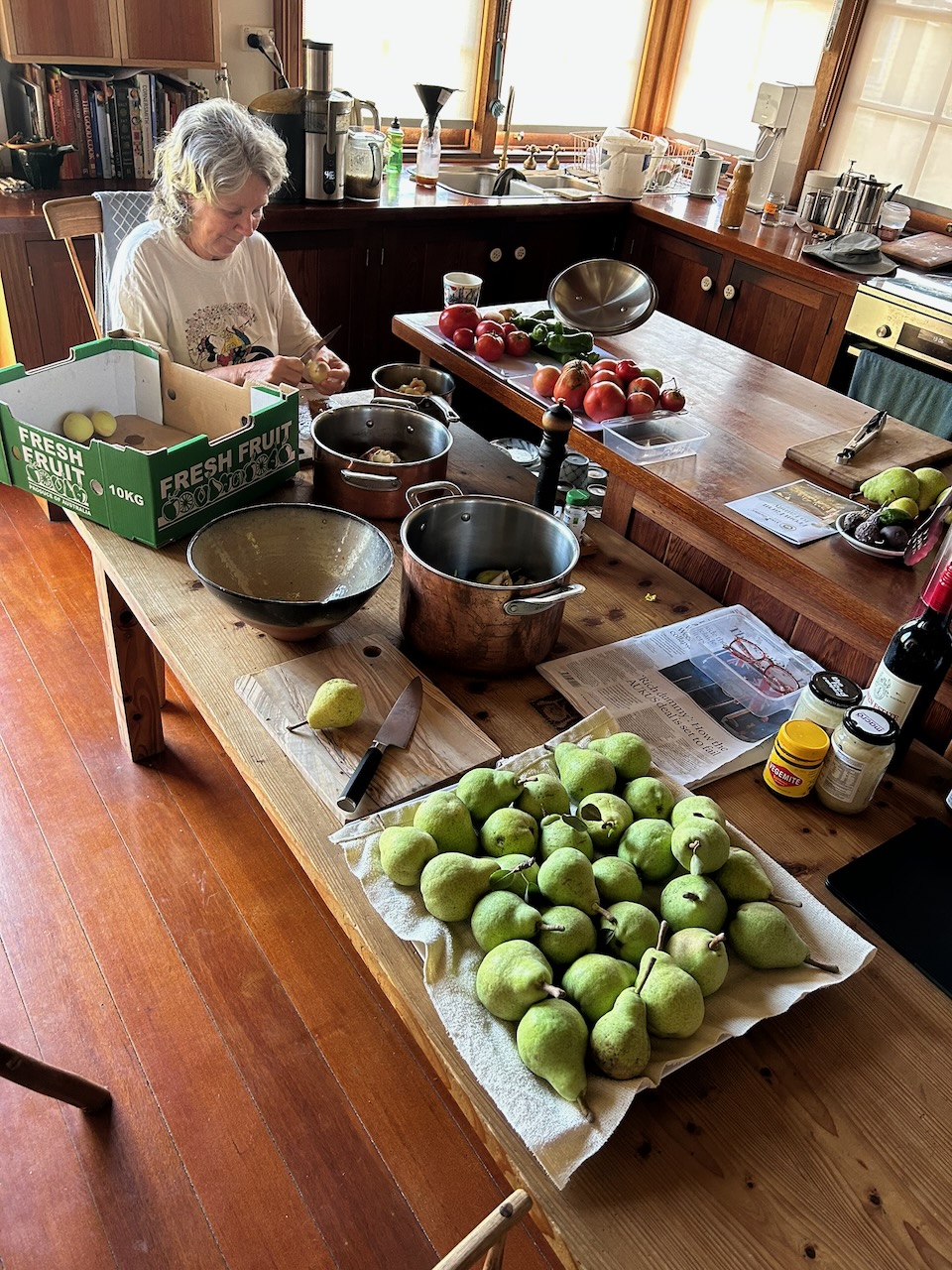
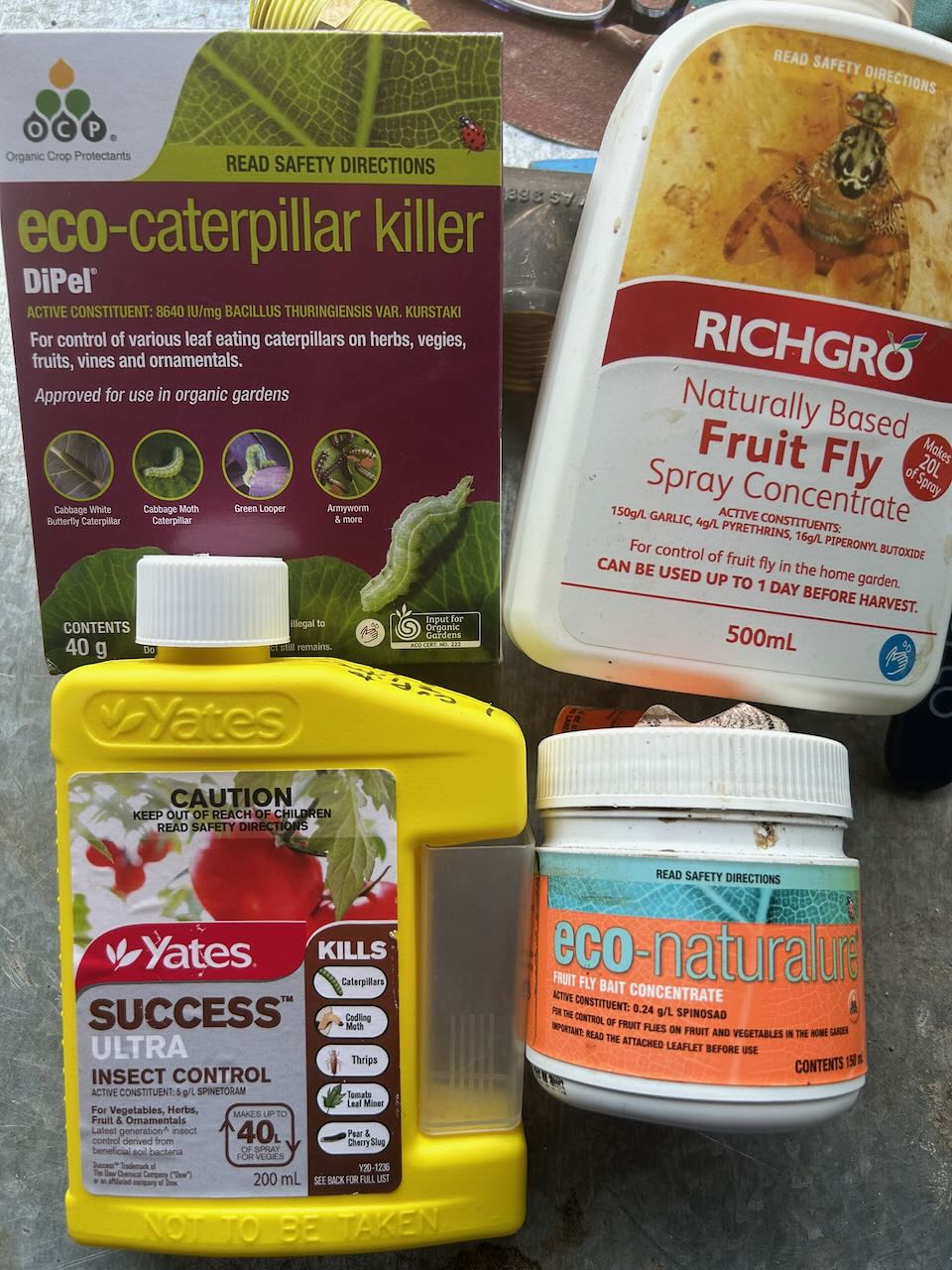
The heat also means fruit fly problems, we get in early in October/November with ‘DAK’ pots, male fruit fly lures, and protein lures for the female flys. I also spray a ‘spinetoram’ soil bacteria and dipel bacteria for the codling moths. I also place codling moth lures in half a dozen of the various trees that are susceptible to codling moth, like apples, pears and quinces. Everything we do is approved for organic gardening. Still, with all this effort, we still get fruit fly strike. It’s important to pick the fruit early and cook it to preserve it either in the freezer or in ‘Vacola’ vacuum jars, and stored for later in the year.
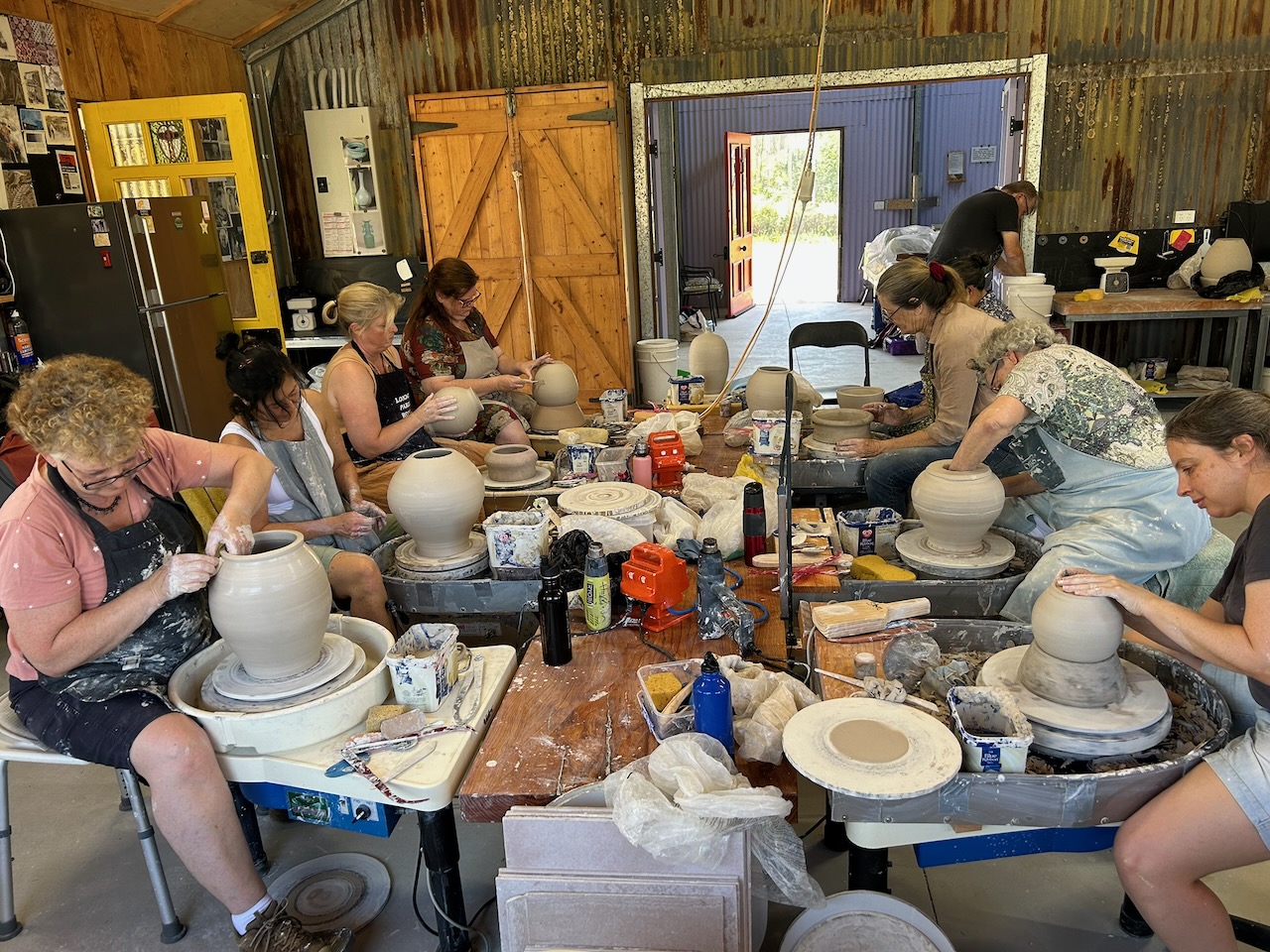
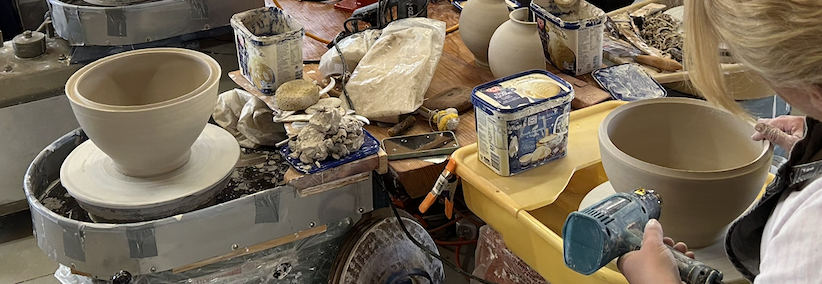
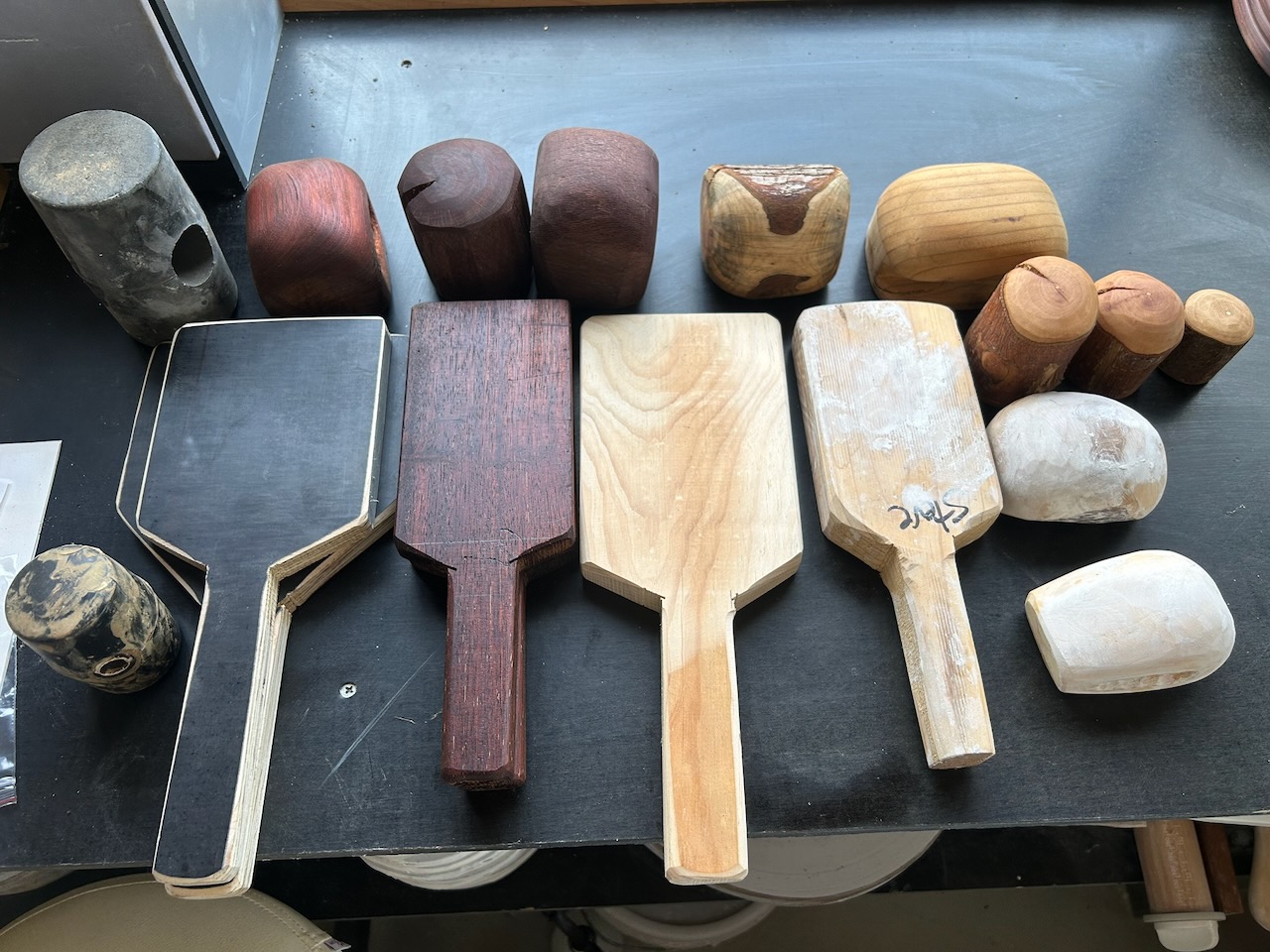
Last weekend I ran a couple of pottery ’tool-making’ workshops. I take small groups of 5 or 6 potters through the steps in making their own tools specific to their particular needs and preferences. There are at least a dozen specific tools that anyone could choose to make but to be realistic, a novice tool maker can only realistically achieve 3 or 4 really nice and well crafted tools in a day, so you have to chose what is most appealing and useful ti you. I don’t expect everyone to finish every tool on the day, but if all the roughing out is done and only the fine finishing is left to do. It’s best to take it home and do all that time consuming fine sanding and oiling at a later time. Best to make use of my skills and my workshop equipment to get as much done here as is realistically achievable in the time.
Making your own tools gives you 2 important outcomes, firstly the tool will be exactly what you want and need, unlike some of the rubbish that is sold in the ‘basic’ pottery tool set sold in the cheap shops. The only good item in that plastic bag is the sponge! the rest all need work. The best thing to do with badly designed tools is to cut them up or down to make them more appropriate. Don’t be afraid, just cut it, grind it, file it or whatever until it does the job that you want. If you can’t make it work for you, just put it away and make a good one from scratch.
This is the 2nd important outcome. It gives you the skills and insight to design and make the exact tool for you for that particular job. If it doesn’t work, then you know how to re-shape it until it does work how you want. Just because you bought it – possibly at great expense – from a reputable craft shop, doesn’t mean that it will be the best shape for you. If it doesn’t work, don’t hesitate. Don’t waste time struggling with it. Take the initiative, cut it up or grind some off it, or possibly just put it in the ‘Down-To-Experience-Bucket’ and make a proper one.
There is also a 3rd benefit. Making your own tools can be virtually free by recycling scrap material. There is a huge sense of satisfaction in sitting back and admiring a beautifully crafted tool that you made yourself from a branch off a fruit tree growing in your garden. Home grown organic tools. AND, so rewarding and satisfying. Making your own things feeds your soul. Re-use, re-purpose, re-cycle.
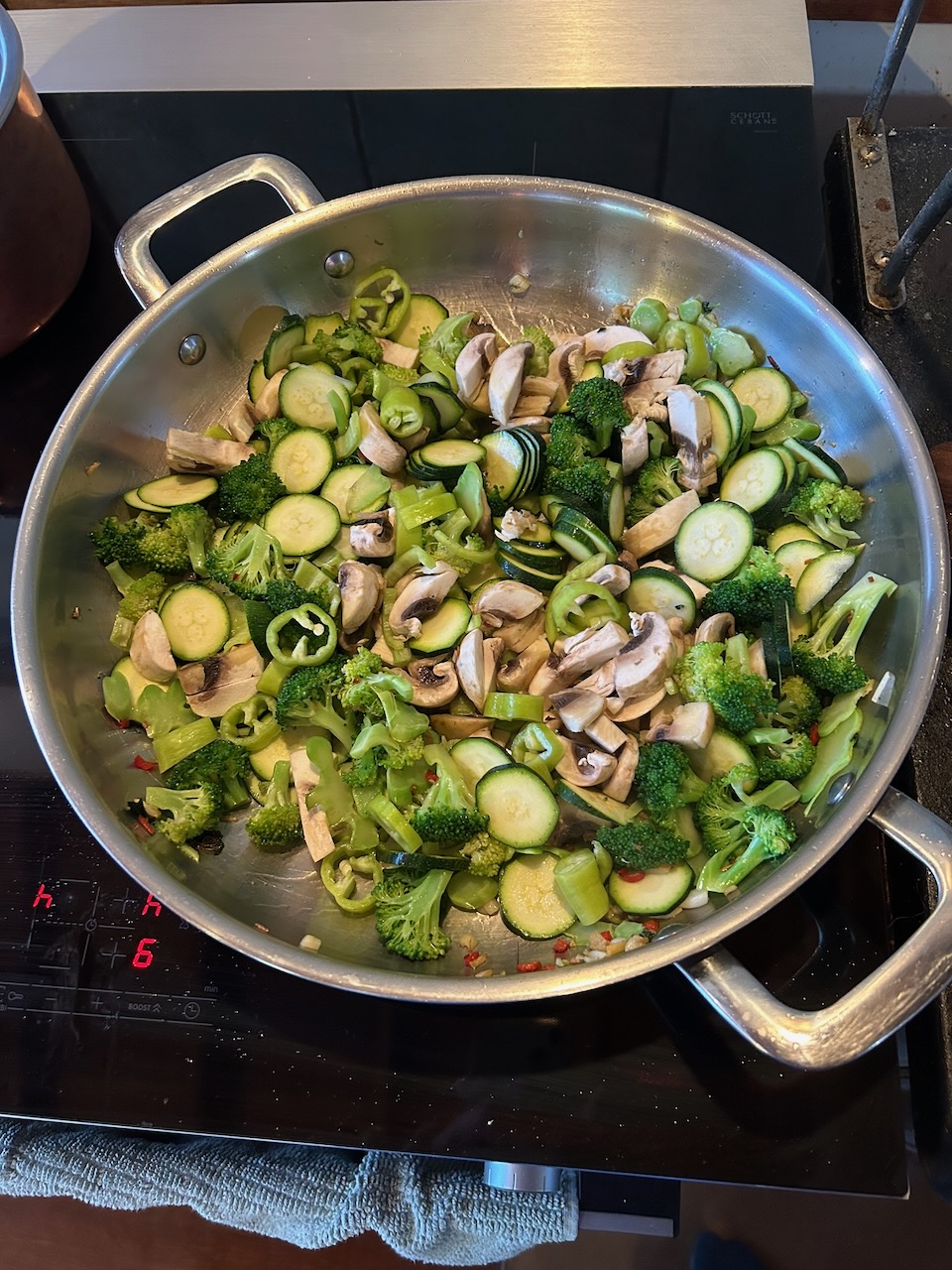
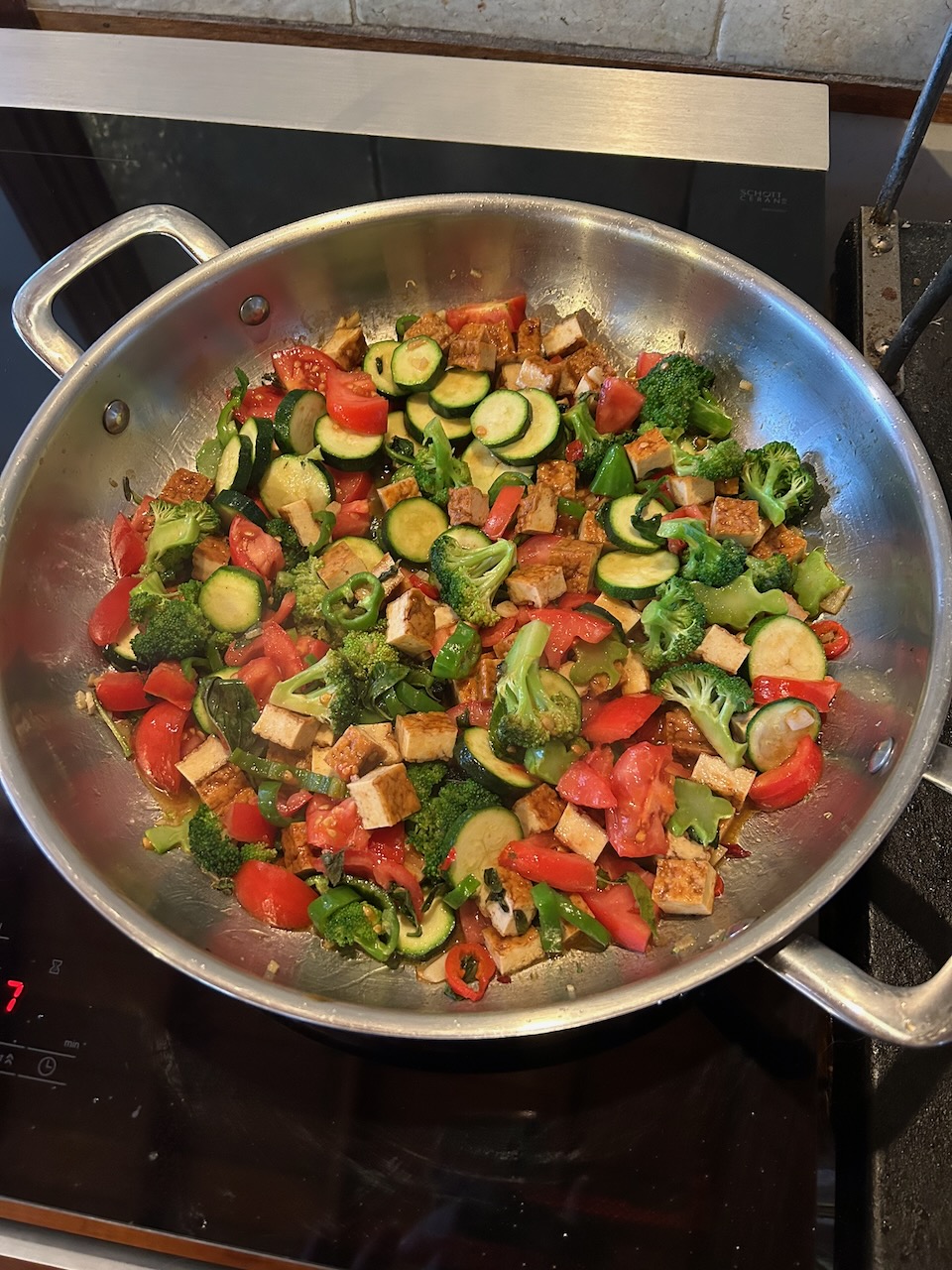
I made a stir fry of garden veggies and tofu for dinner to feed my soul and my belly.
Nothing is perfect, nothing is ever finished and nothing lasts.
Now that the Arts Trail, Open Studios weekends are over for another year, it’s time to start thinking about the next December Weekend Workshop and January Summer School.
I’m planning to offer a one day tool making workshop on the first weekend in December, Saturday 6th. Tool Making. The cost is $150. (1 day)
As these workshops often fill up. I may offer another one later on in the year? If there is sufficient interest.
Those of you who have attended our workshops in the past, will know that Janine and I make most of our own tools and equipment, from simple cutting wires and turning tools, through to the extreme of making our own fire bricks to build our own wood fired kiln. We have even built our own workshop buildings over the years. We have a go at everything. We try to be as self-reliant as we can be, without being fanatical and boring.
For this workshop, I’m planning to demonstrate making a range of simple tools from throwing tools and profiles, to turning tools, paddles, small callipers and stainless needle tool, turning tools etc.
Its a one day workshop and all the materials are included, recycled cedar and pine wood, stainless steel and galvanised steel, fruit tree prunings, nylon line, etc.
No experience necessary, but it would be an advantage if you were interested in learning to use some power tools like a jig saw, bench grinder and electric sander, etc. it make the work quicker, But this is not necessary.
You don’t have to use power tolls. If you are squeamish about power tools. There are slower alternatives using just all hand tools, but this will be much slower. You won’t necessary get every project finished. I’m happy to set you up with these hand tool alternatives. You can finish them at home – if needed. Hand-working and especially the hand-finishing, sanding/filing/oiling, can be the most rewarding part.
10 am till 4 pm. Please bring something to share for lunch.
We have a fridge to store perishable food items, and we provide a hot water urn, plus tea and coffee provided.
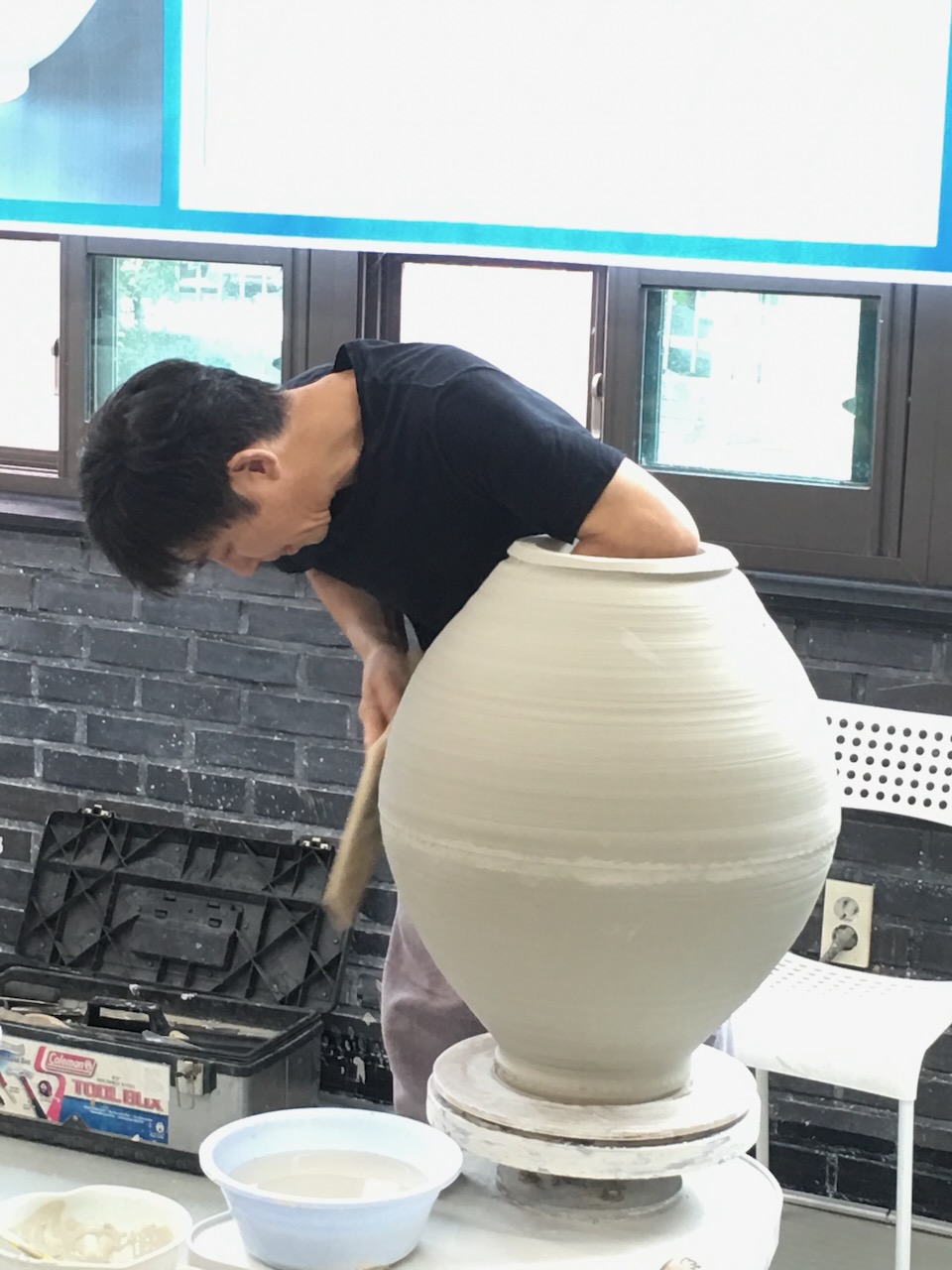
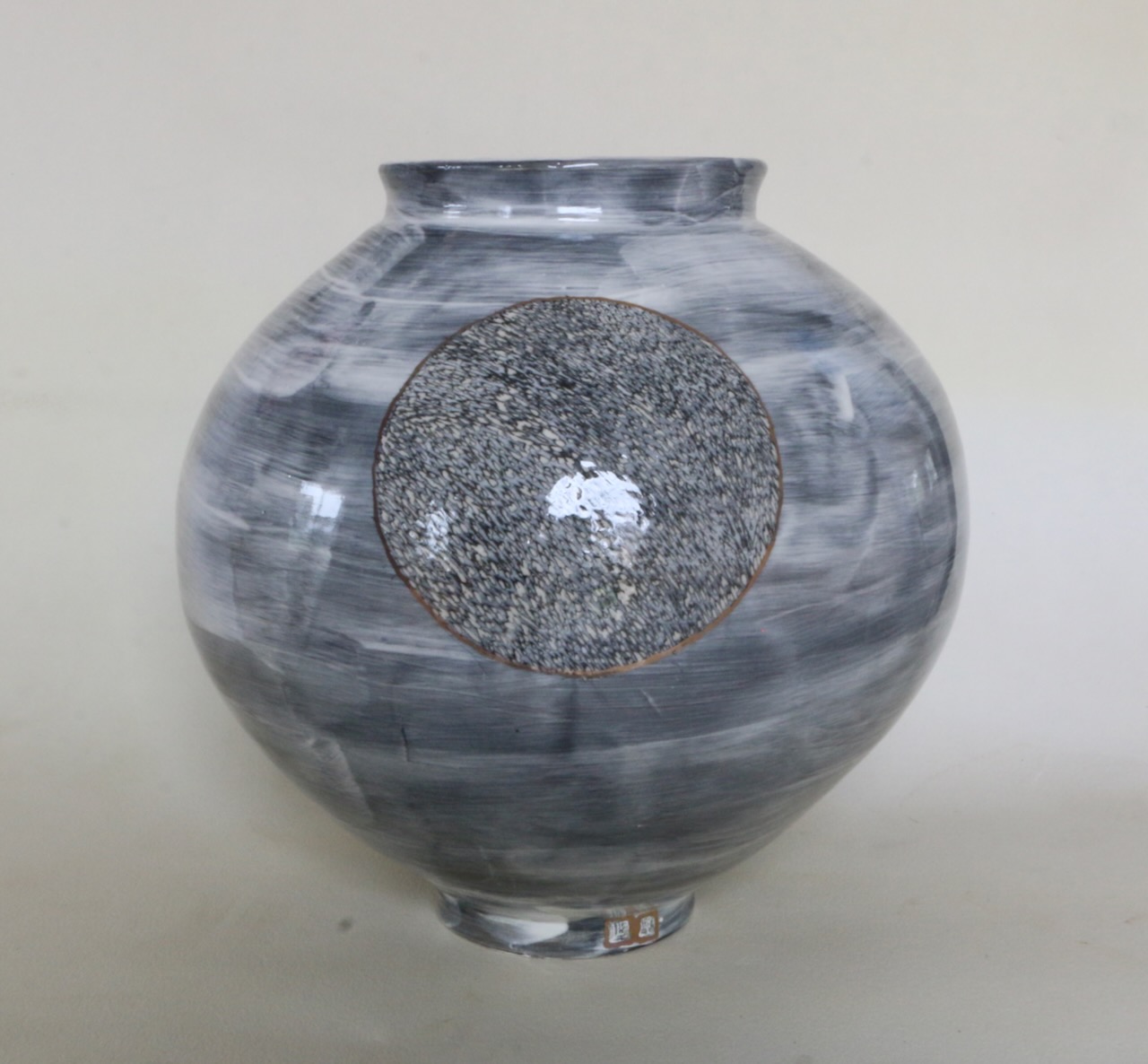
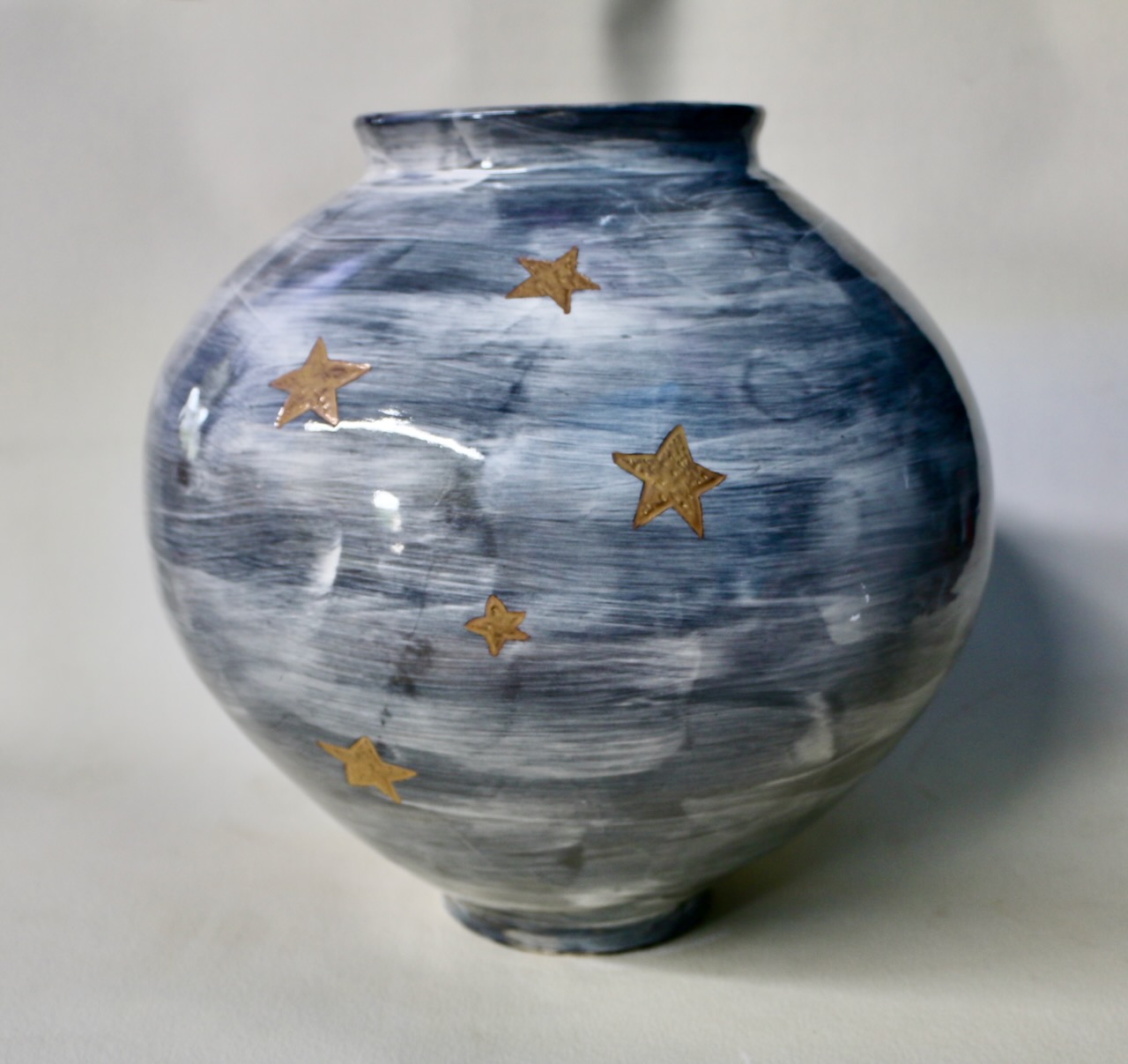
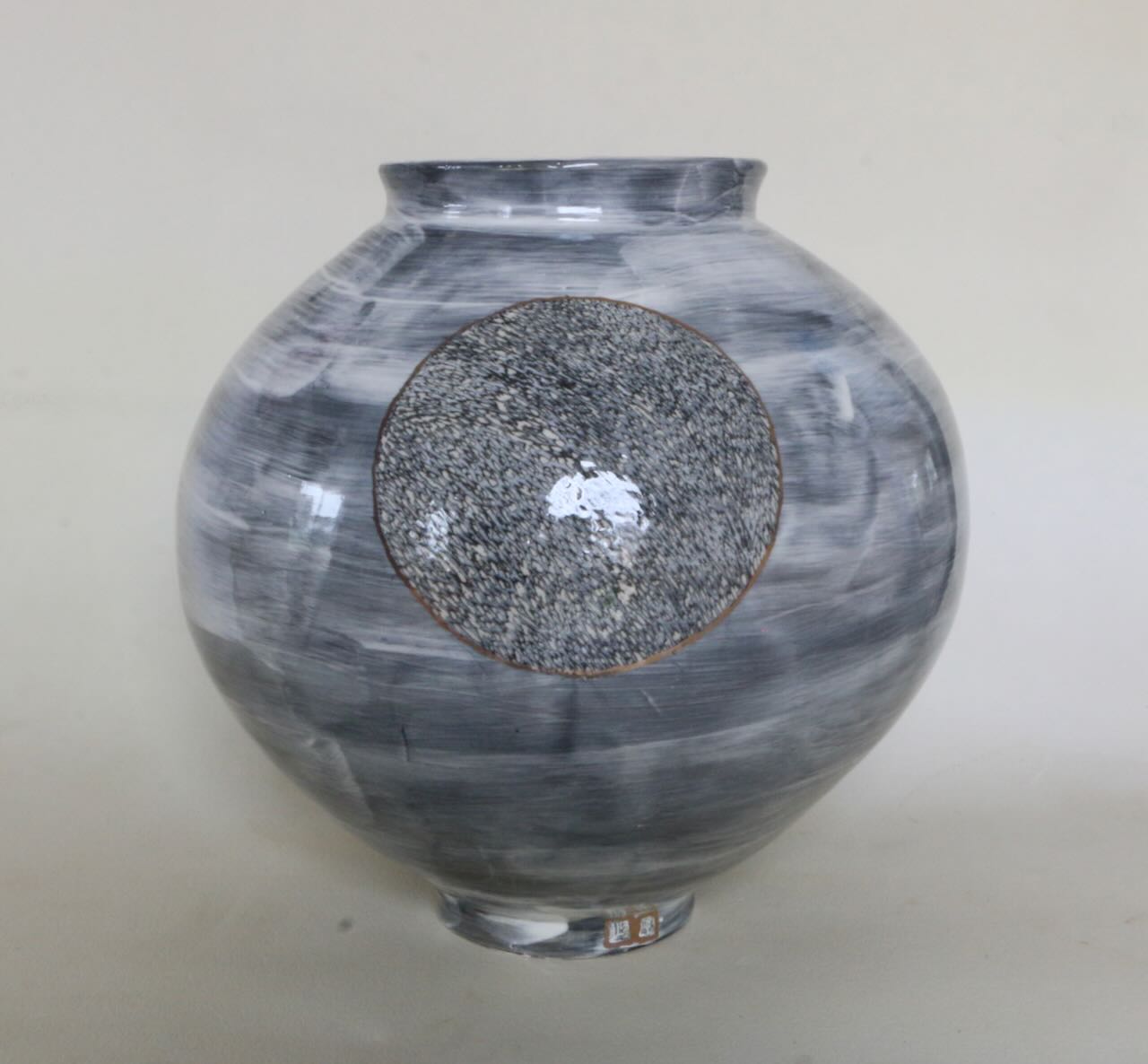
January Summer School. Joined forms. Throwing Korean inspired, Australian ‘Moon Jars’. (4 Days)
This is an intermediate to advanced wheel throwing workshop. You must be able to centre and throw 3 kgs on the potters wheel.
4 days from January 3rd to 6th. Cost $600
I’ll be providing our own specially developed, textured clay body specifically prepared in-house for the throwing of larger items.
10 am till 4 pm . Please bring something to share for lunch.
We have a fridge to store perishable food items, and we provide a hot water urn plus tea and coffee.
Places are limited, so first in best dressed.
later in the year, I’m thinking about offering other courses;
Geology/rock glazes for potters course (3 days, one weekend, plus an extra Sunday.).
Domestic ware, repetition throwing to a specific weight and size. An exercise in discipline. (2 days)
Throwing for wood firing. (2 days)
Stoneware Wood firing (3 days) winter time only. (one weekend, plus an extra Sunday.)
Please reply if you are interested in either of these 2 workshops, and I’ll put you on my waiting list.
If we can get enough numbers, the workshops will run.
Best wishes Steve
Dr. Steve Harrison PhD. MA (Hons) hotnsticky@ozemail.com.au blog; tonightmyfingerssmellofgarlic.com Potter, retired kiln surgeon, clay doctor, wood butcher and Post Modern Peasant.
Gundungurra/Dharawal Country I acknowledge the traditional custodians of this land, and recognise that sovereignty was never ceded and that we are all on stolen land.
I pay my respects to Elders, past, present and emerging.
Don’t read on unless you want to learn something about clay.
Janine and I have been teaching weekend workshops these last couple of weeks, and all of the preparation that goes into that to make sure that everything runs smoothly keeps us very busy. The whole exercise takes us 5 weeks in total. However, there is still time for other fun things like the garden, chickens and cooking
Over the week in between the two weekend workshops, I re-cycled all the clay from failed and re-cycled practice pieces that had made their way into the clay room to be stiffened up in the plaster basins. I have 5 large plaster tubs sitting in the direct light of the North facing window, this keeps them dry and ready for use, most of the time. Plaster saturates quite quickly if thin slip is poured into them, but they cope very well with soft plastic slumped pots that just need stiffening up. 20 mins on each side on a dry plaster batt, is all they need and it’s well and truely ready to wedge up and use again.
At the end of the workshop, I get everyone to collect all the trimmings, turnings, scraped-off batt bases and thick slurry from their throwing water tub, and pour it all into a tall 20 litre bucket. 8 potters can fill it up pretty quickly. I let it sit and soak for a day or two, to make sure everything is equally softened, I like to get it to a thick and creamy consistency, not unlike Greek yoghurt – with some lumps.
I then transfer it all onto the plaster drying tubs. It takes 3 days to get stiff enough to lift it out and stand it up. This allows more air to circulate around the soft, barely plastic clay, so as to dry it out faster. The plaster basins then need a few days in the sun to dry out again. When we do back to back weekend workshops, the plaster does get saturated and ‘tired’! However, it always recovers with a few days of sunshine.
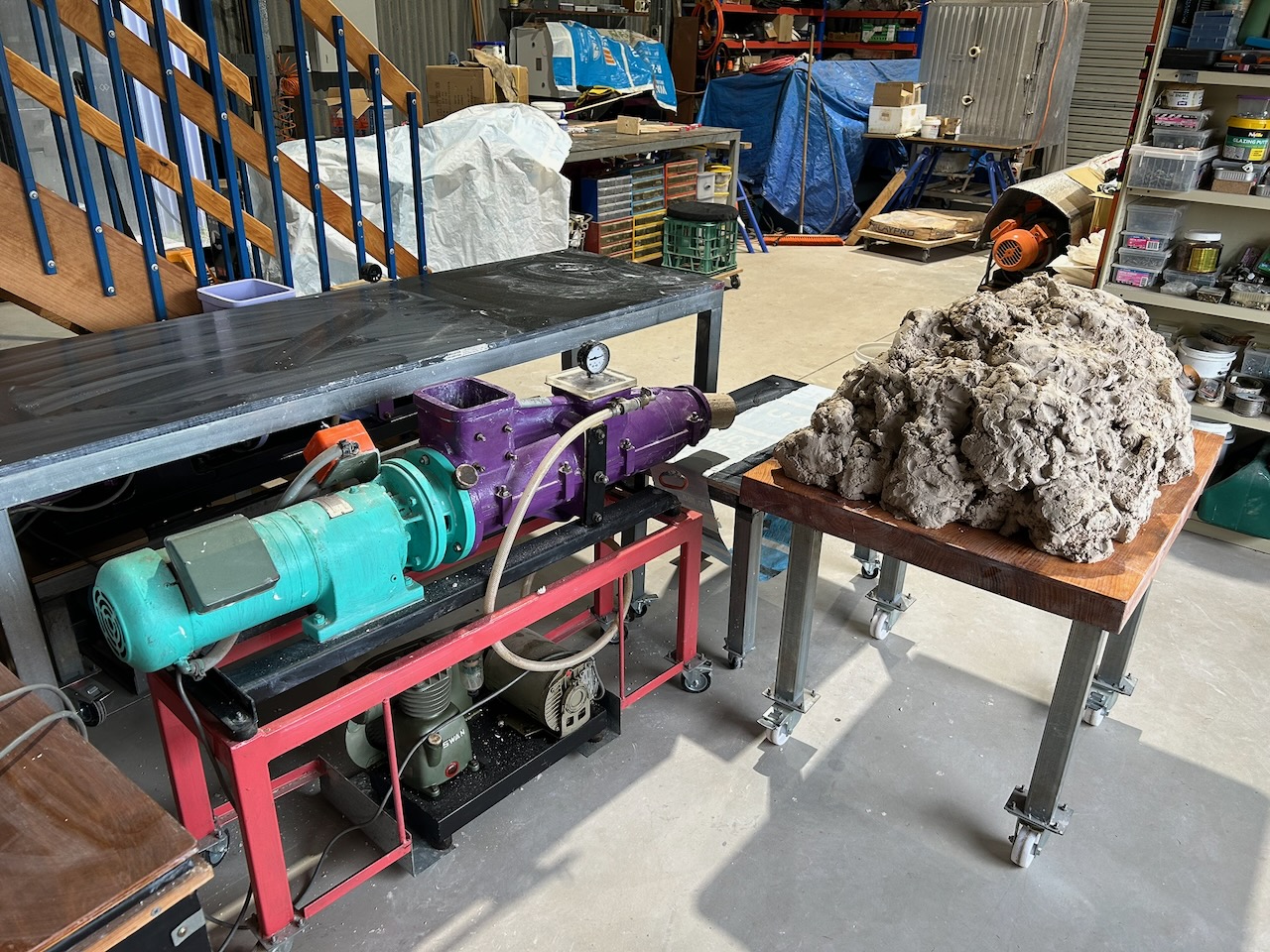
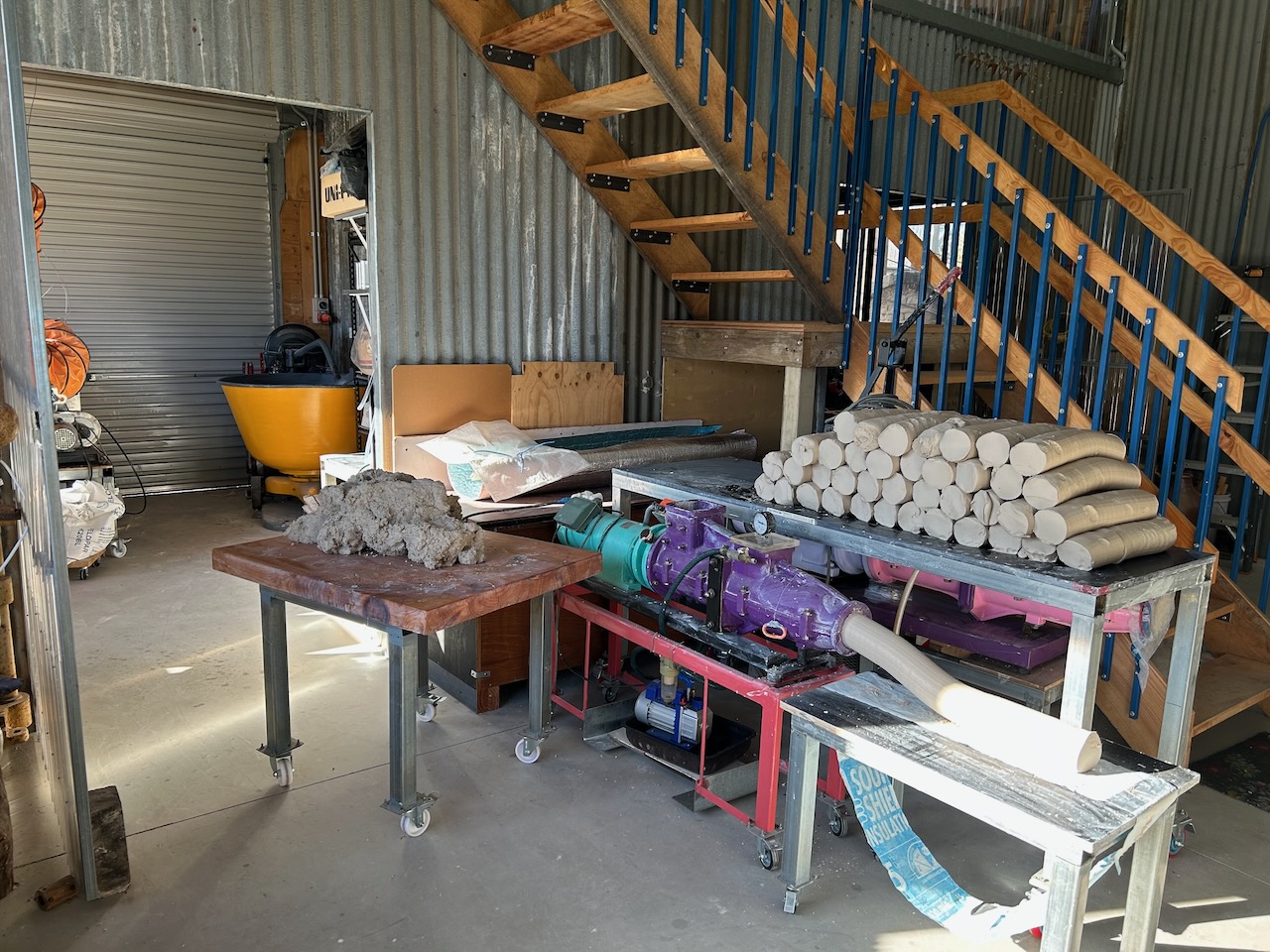
Once stiff enough, I put it back through the pug mill, extrude it and bag it ready for re-use. It’s easy mindless work. However, I say that in the full knowledge that it is only so if you already know exactly what you are doing and have done a lot of it before. There are so many little signs and issues that you need to know and be aware of to understand about pug mills and recycling clay. The joys and sorrows of owning a pug mill!
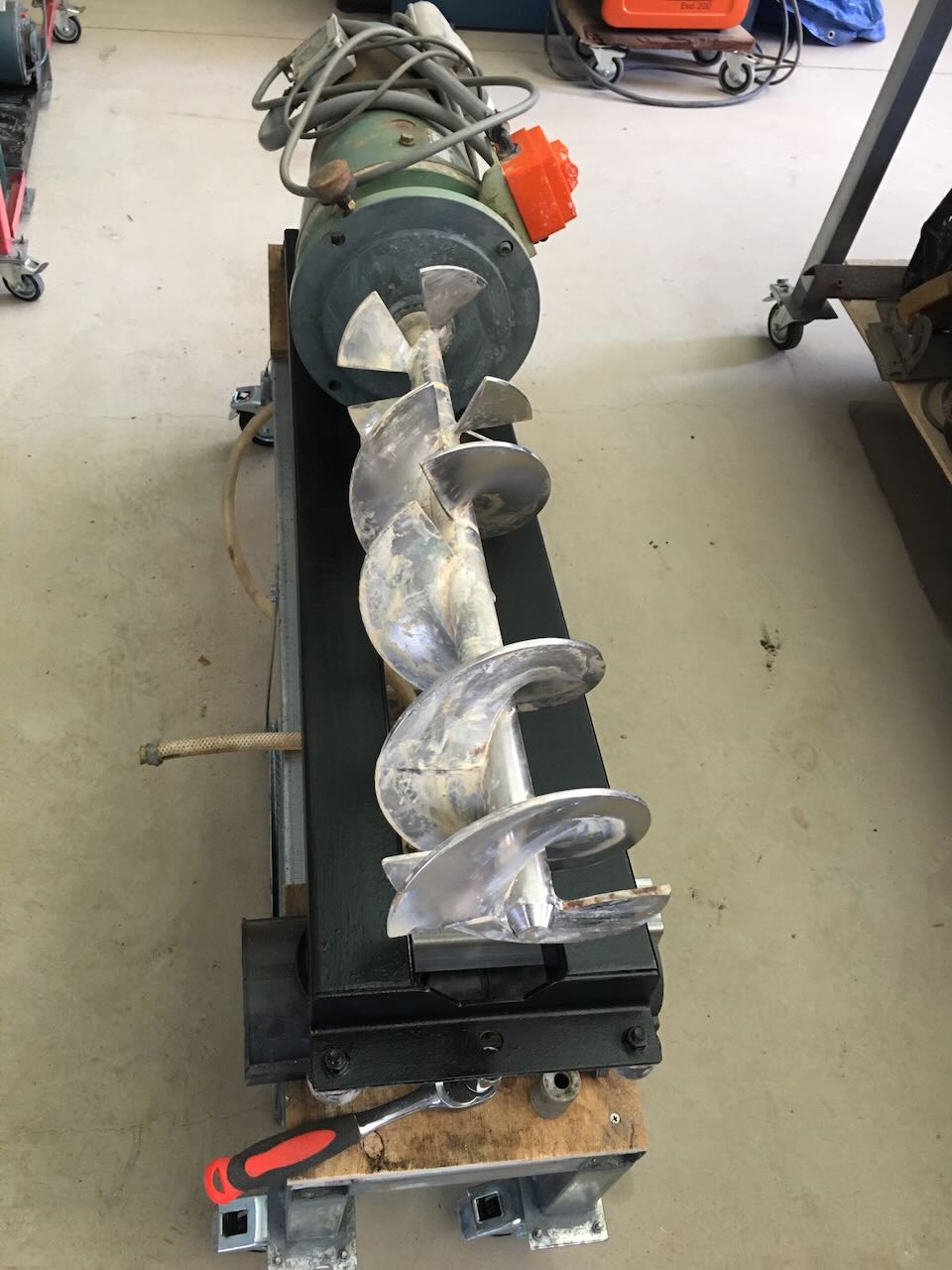
The clay can’t be either too soft or too hard, or the mechanism of the pug mill won’t work. A pug mill is in essence, a long tube with an Archimedes spiral inside. This spiral blade pushes the clay through the barrel. Some parts of the spiral at the beginning are removed to make the spiral into a series of spiralled chopping blades. This chops up the clay, mixing both hard and soft parts evenly, then the later, complete spiral section of the auger pushes and compresses the clay out the other end. Some of the better pug mills have a screen or screens half way along the barrel so that the clay is pushed through the mesh and comes out the other side as clay spaghetti. This exposes any trapped air bubbles which are then sucked out of the pug mill barrel by a vacuum pump, before the clay is recompressed and continues along the barrel.
There can’t be any little bone dry edges that have dried out too far. They are rock hard and dry and will clog up the vacuum screens. I have to constantly check when running my fingers through the thick slurry, that there are no small tools, profiles, kidney shapes, or chamois strips left behind by my students. Any of these will grind the exercise to a rapid halt. Requiring the pug mill to be stripped down, dismantled, cleaned, the offending ‘rubbish’ removed, then checked and rebuilt. It’s the best part of a full days job to to a thorough clean out. If it’s only a chamois, sometimes, I can get away with just removing the blocked vacuum screens, cleaning them only and reassembling. This is still a good hour or so.
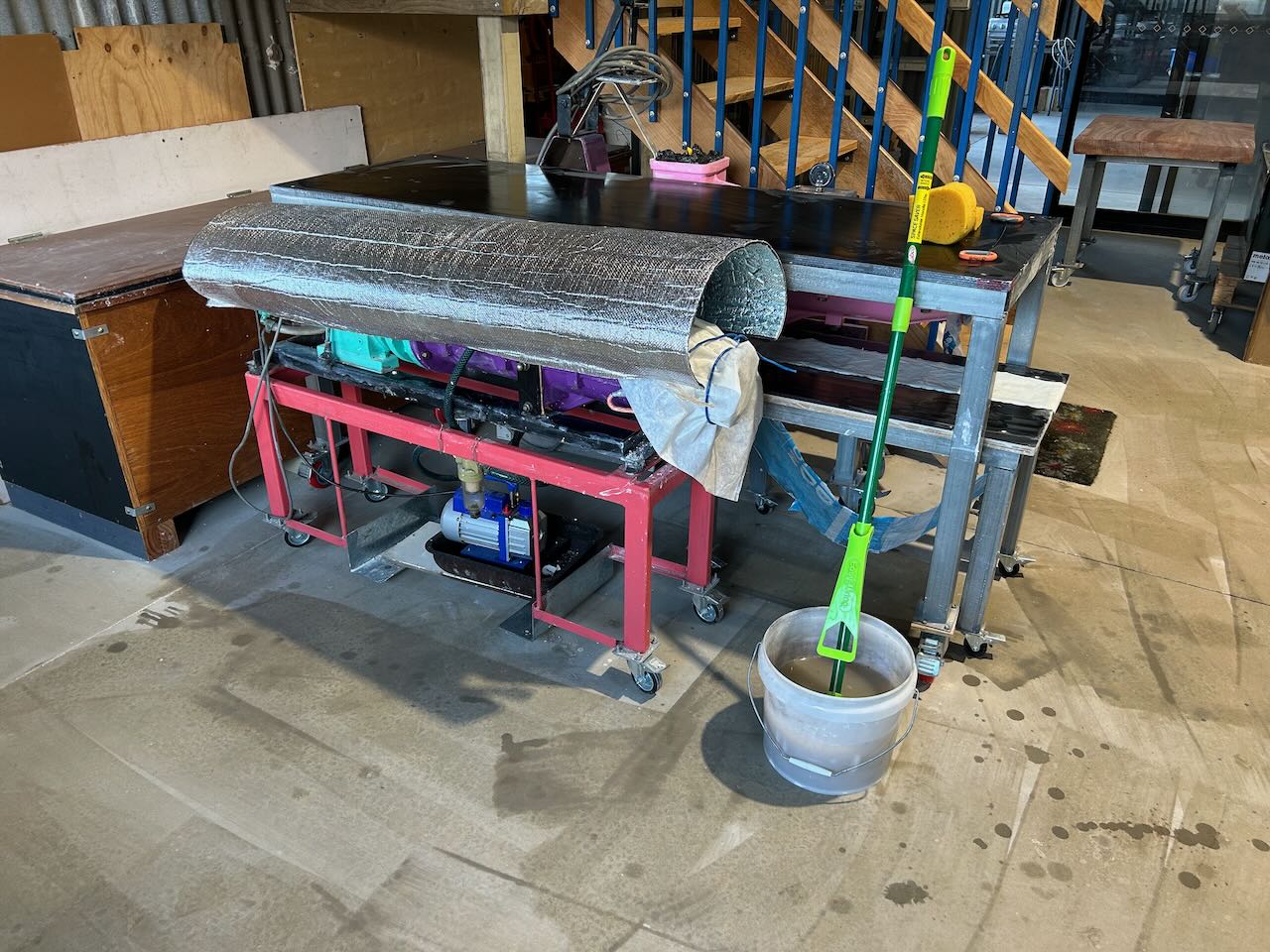
In the picture above, the orange vertical plate on the side of the blue pug mill barrel, half way along the barrel is where the vacuum screens are located and can be removed for cleaning. The white lid on top of the barrel is where the vacuum chamber sucks out the air. The vacuum pump is located in a box slung underneath the pug mill trolley, which is on castors for easy manoeuvring.
So far, I’ve been very diligent in checking all the recycled clay pretty thoroughly, so I haven’t had any ‘accidental’ issues in the last few years. I did discover, quite early on that the new pottery shed, with its north orientated, solar passive design, does get a lot of direct sunlight in onto the clay processing area in mid winter. I’ve learn’t from hard experience that direct sunlight like this can cause the pug mill barrel to heat up and sweat moisture out of the clay on one side, which then condenses and trickles down to the bottom of the barrel. The end result is dry hard clay in one part and slurry in another. The dry, very stiff nuggets of hard clay get forced onto the fine mesh of the vacuum screens and clog it up. The rheological nature of the thin wet slurry in the other part of the barrel doesn’t have the cohesive strength to force the hard clay through. A complete strip down is required. This is a lesson that I learnt the hard way.
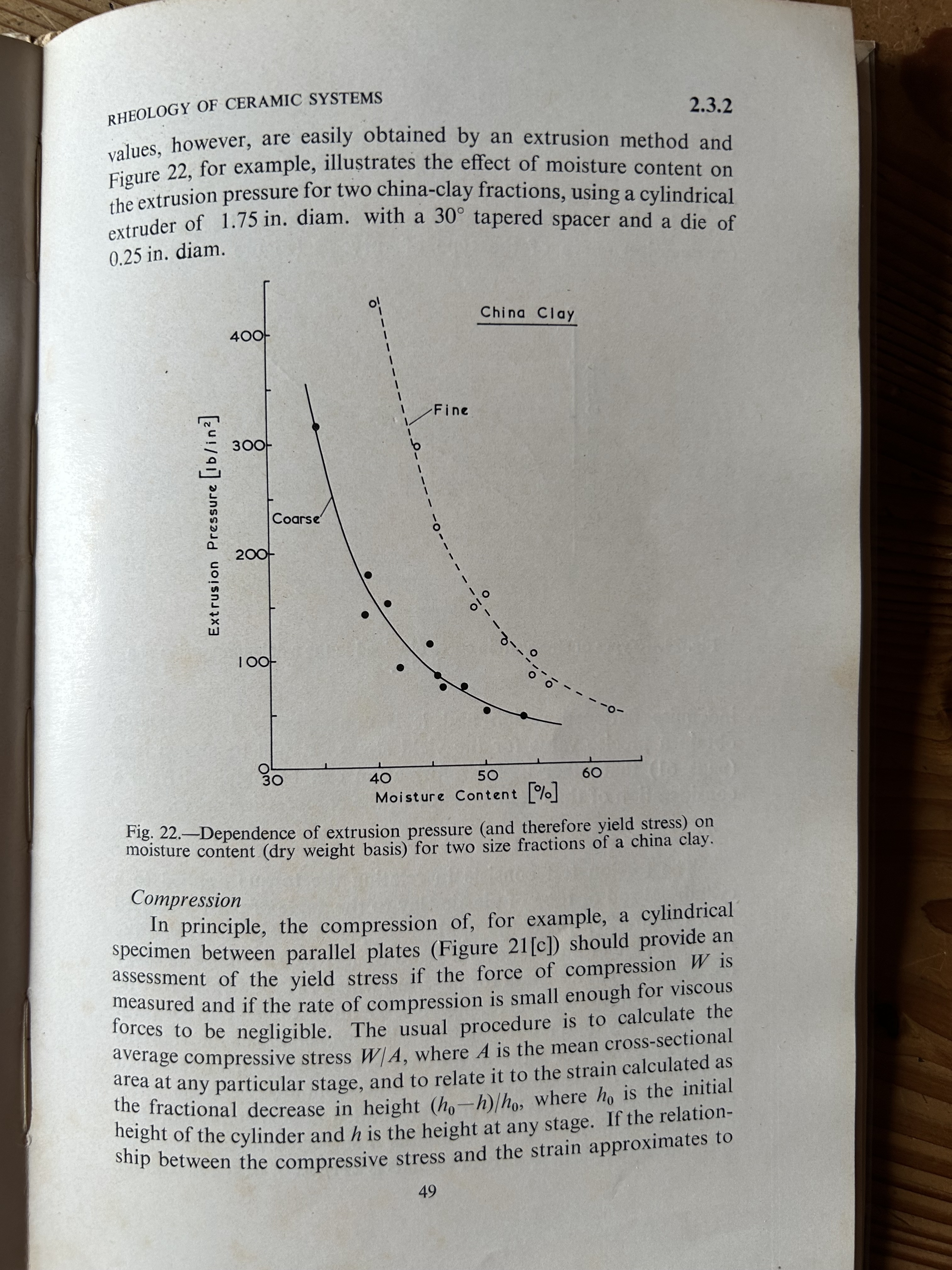
Rheology is a very interesting subject in itself. Clay can be either too soft or too hard to stick together and be ‘worked’ or shaped successfully. There are limits called ‘Atterberg’ limits that have been determined, which predict the upper and lower limits of water content in clay. If too wet, it just sloshes around and won’t hold a shape, when too dry, it is just crumbly granules. We need the ‘Goldie Locks’ range for our clays to ‘work’ successfully. For pressure extruding the range is somewhere between 17% and 60%,. That’s such a huge range. See graph. For pugging, it needs to be in a narrower range of 20% to 30%. depending on the inherent plasticity and texture of the clay body. For throwing clay on the potters wheel, it is often closer to 20 to 22%. I have found in practice over the decades that my wrists have their own personal Atterberg limit of around 25% water content or even a little bit softer rather than stiffer.
Some people say that you should work to your strengths. I think the opposite, I work to my weakest point, and as that is my ancient wrists. I have adjusted my clay body recipes over time to include more very fine plastic particles, slightly more course non-plastics and more fine sand. This combination allows me to make softer clay mixtures that are still easy to pug and easy to throw on the wheel when very soft. I am limited by what is still available on the market here. So many materials that we used to be able to get have been removed from the market, as the Australian companies that own clay mines were purchased by multinational players who shut them down to force us to buy their imported products.
Luckily, I was trained in the 60’s and 70’s when clay technology was still taught in Art School. I even went on to teach it myself for a few decades. So, I can develop and test my own clay body recipes. A skill soon to be completely lost, as us oldies retire and die out. I can still obtain Australian mined and milled ceramic materials from NSW, Vic and Qld, but the options are constantly diminishing. When I have been shown commercial plastic clay bodies over the years, I have always found them to be far too stiff for my wrists to feel comfortable with. Possibly because of a lifetime of damage due to hard work with my arms, wrists and hands?
So dry lumps of clay on the pug mill screens stops everything in it’s tracks, until the screens are removed and cleaned, and this can be a big job, depending on the maker and model of the pug mill. We are lucky here in Australia to have the ‘Venco’ company, who under the direction and vision of Geoff Hill, manufactured pottery equipment here since the 70’s. His version of ‘Harry Davis’s, genius design’ of vacuum pug mill was an excellent piece of machinery. The smaller, cheaper, models require that the entire machine be diss-assembled to get to the singular screen. However, the larger, and more expensive models are designed so that the screens are accessible from the outside of the barrel and can be accessed directly for cleaning.
So now I have learnt to keep my pug mills covered with silver insulation foil when not in use, and this has solved the condensation problem. There is always something new to learn, even after 50 years!
Once pugged and bagged, It’s not the end. Good clay that has been well made needs to be nurtured a little. Clay is alive, in the sense that it contains live microbes, or should if you want it to develop the best possible plasticity. We live in the bush here in Balmoral Village. There are few Government services. There is no Town Water Supply available. So we have to collect rain water in dams and water tanks. Water stored in the ground has more bacteria live organisms than Chlorinated and sterilised city water. My clean rain water will allow the naturally present bacteria and other organisms to grow and develop in the clay. This might sound shocking, but it is just natural. Clay ‘ages’ as the organic action develops between the clay mineral particles. The water is drawn closer to the surface of the fragments and the air is slowly excluded and passed to the surface by capillary attraction. In this slow gentle way, clay develops its full plasticity. It is very noticeable after say 3 months. But a year is better! Of course, no-one in their right mind would make clay and then not use it for 3 months! Would they??? Yes muggins does. I have stored and aged porcelain bodies up to 15 years.
There is a distinct difference in the clay after a period of ageing. Clay body made with chlorinated water inhibits the natural growth and ageing, so does not develop the same plasticity.
In the old pottery, there were a lot of eucalypts growing around the building, and consequently there were a lot of gum leaves in the rain water. These made the water a little acid with their tannin. It turns out that tannic water is just about the very best additive that you can put into clay to improve its plasticity. Our gum leaf infused tannic rain water was a pale, transparent grey/brown colour. Some fancy companies that manufacture commercial Porcelain bodies, buy in, at great expense, a product called ’Totannin’, that does much the same thing. Our clay really responds to any time left wrapped in plastic bags, sometimes double bagged, for long term storage. Then stored in a cool dark place and not touched for as long as you can bear it.
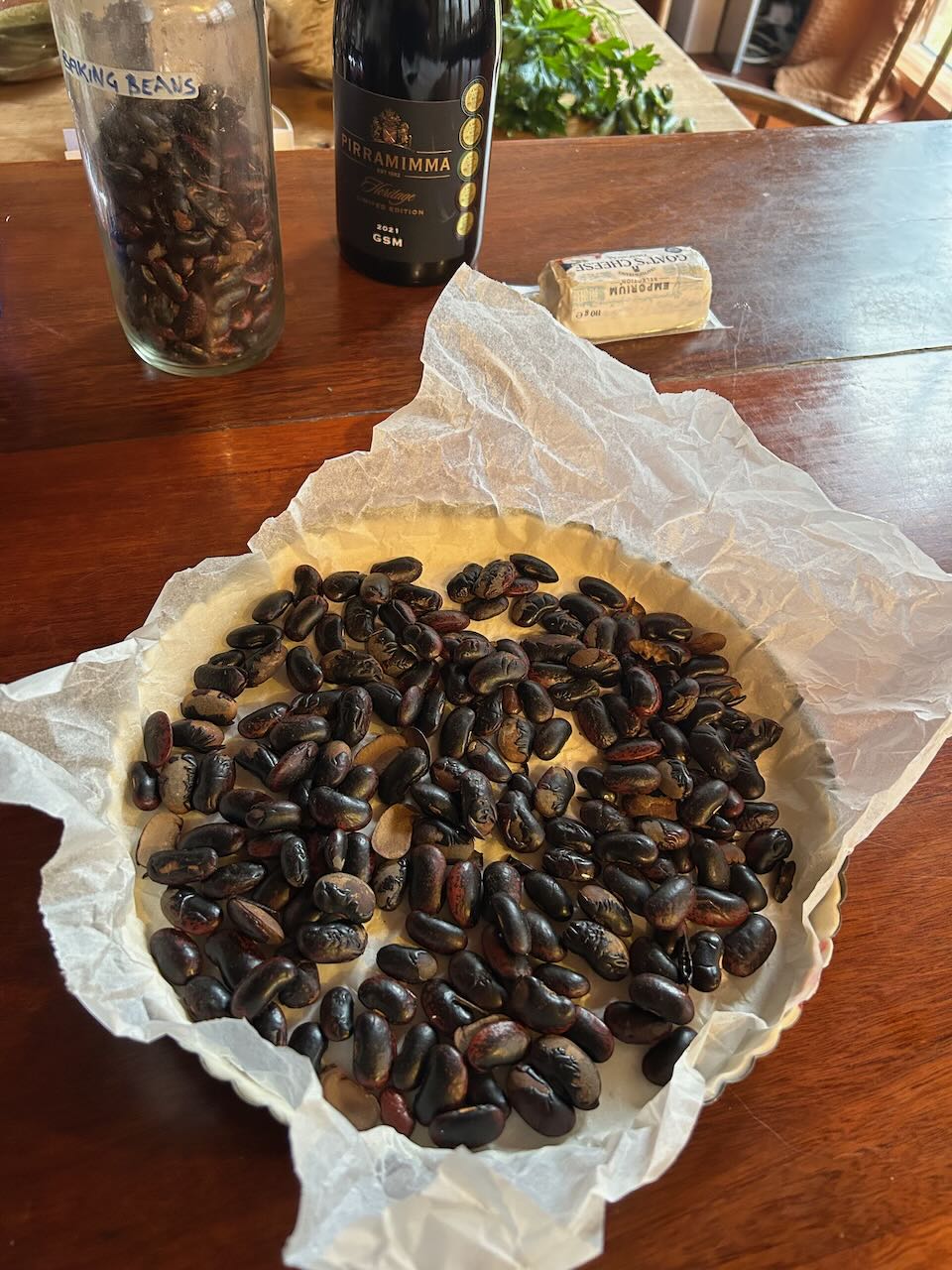
Each Friday evening, before the workshops, I bake a loaf of bread and a tart. This time, its beetroot and French goats cheese over a bed of slow cooked onion jam. This has always proved to be a very popular lunch contribution at the workshops. Every one brings something to share for lunch. There is always just a bit more than we need. Everyone eats well and the selection is broad, varied and delicious.
We spent the first day on the wheel, throwing all the forms that we will work with on the following day. I demonstrate each step in the process on each day.
Teaching a throwing school in winter is always just a little bit of a challenge. The pots don’t want to dry out over night to stiffen up to the point where they can be turned, trimmed, manipulated and handled with ease.. I get the pots to dry faster, by stoking up the slow combustion stove to the max, and keep it going well into the night, to ensure that the pots evaporate off enough of their moisture to be workable. It’s a juggling act, but I manage to muddle through, and at the end of the weekend, everybody gets to take home their finished works.
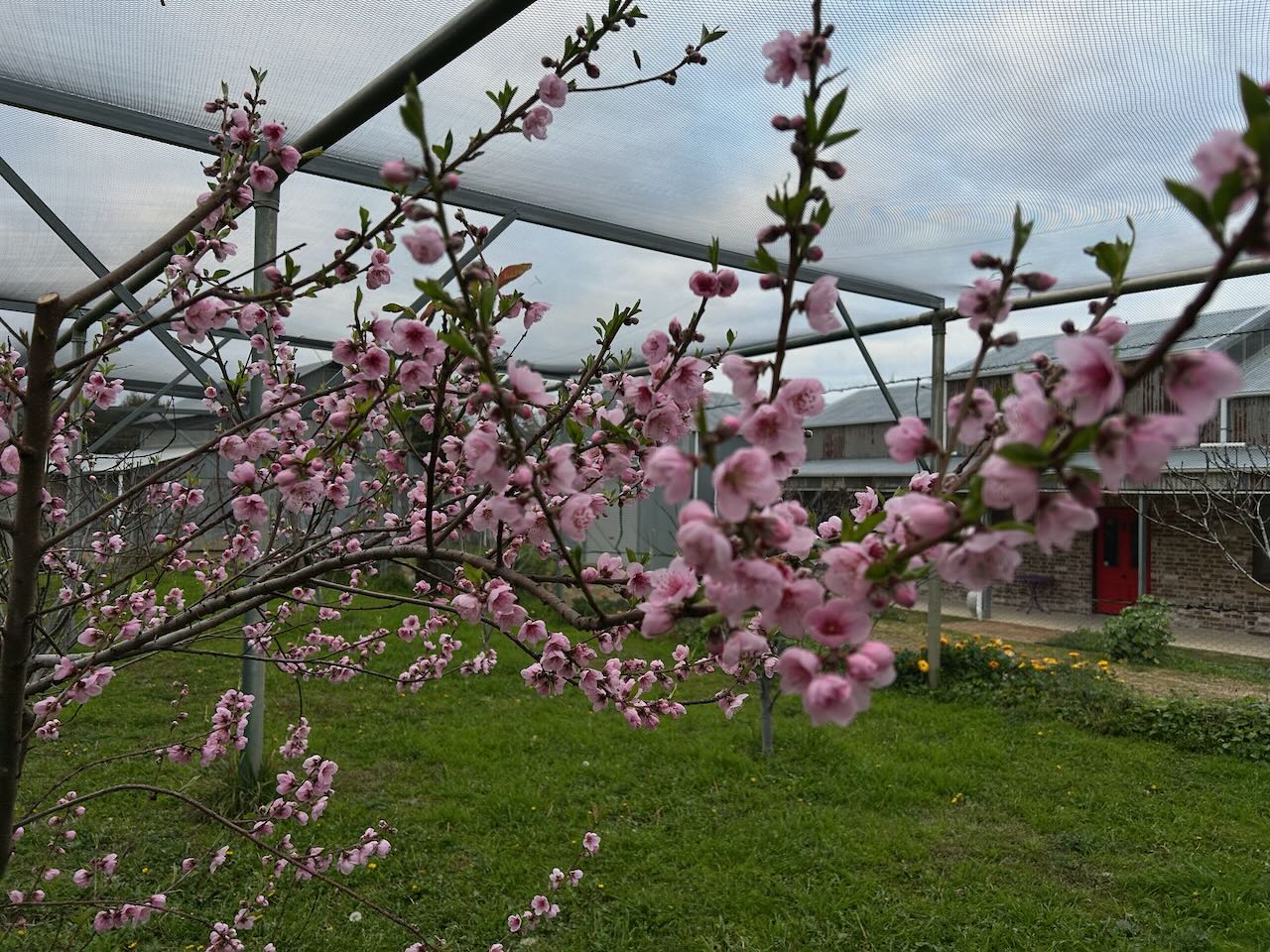
In the orchard, the early peaches and nectarines are flowering. There is only 3 more weeks to spring, and lots of plants are starting to come back to life, buds are swelling and even the lawn is starting to grown again. This last part isn’t so thrilling though, as this means a few hours of lawn mowing several times a week.
Spring blossom always offers up so much positive energy, the a promise of warmer weather and a bountiful harvest to come.
Nothing is ever finished, Nothing is ever perfect and nothing lasts.
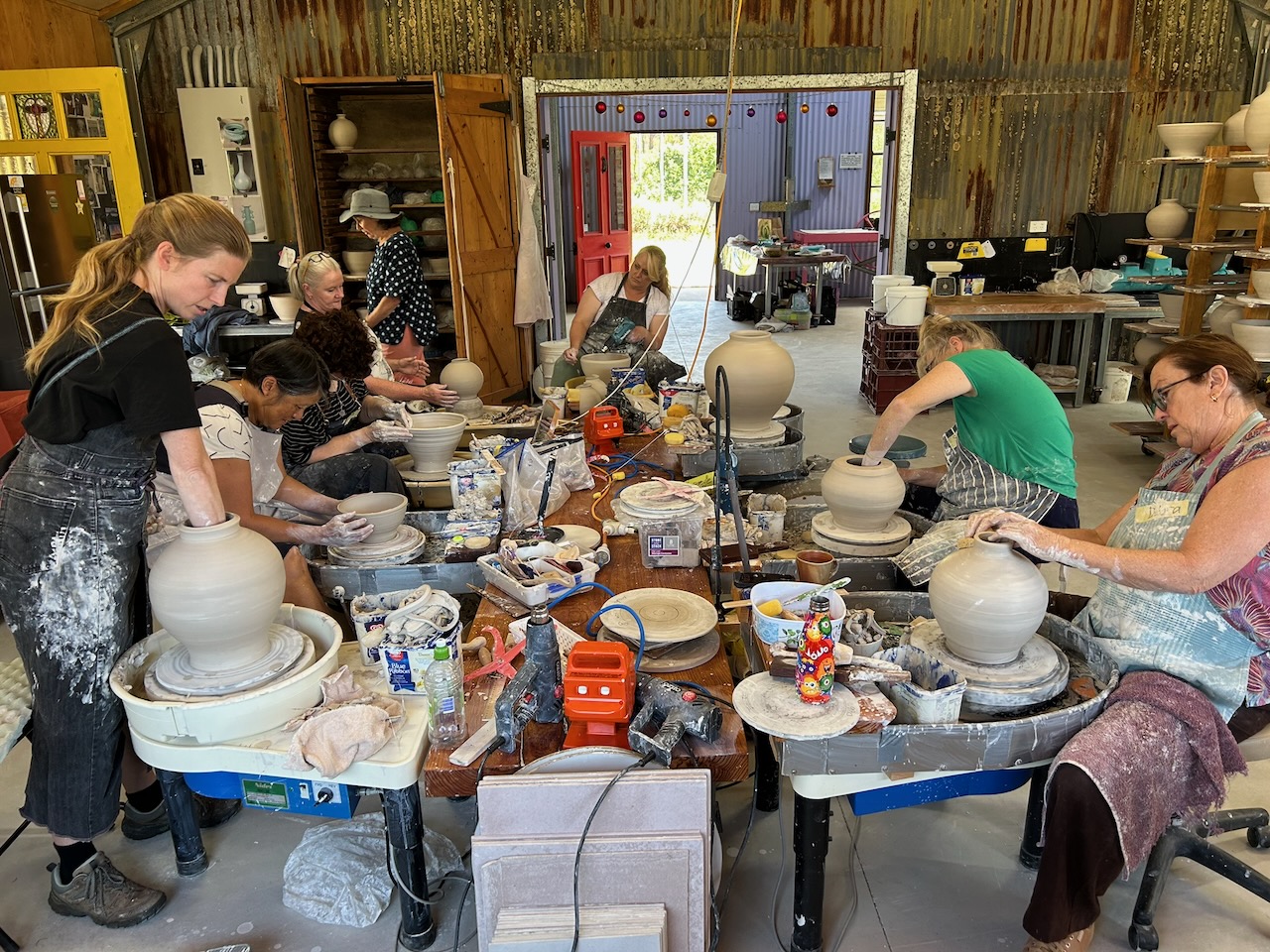
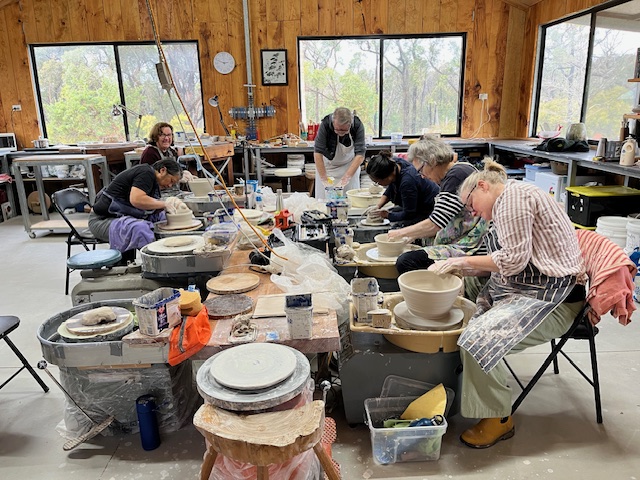
We have just completed another weekend workshop. This time on the topic of throwing. Moving on from rock glazes to wheel work.
I advertised one weekend and filled the next weekend as well. We also have a waiting list for a third weekend, which, if we fill it will need to be at the end of this month on the 23rd/24th, as all other weekends are fully booked.
These images taken by Janine king
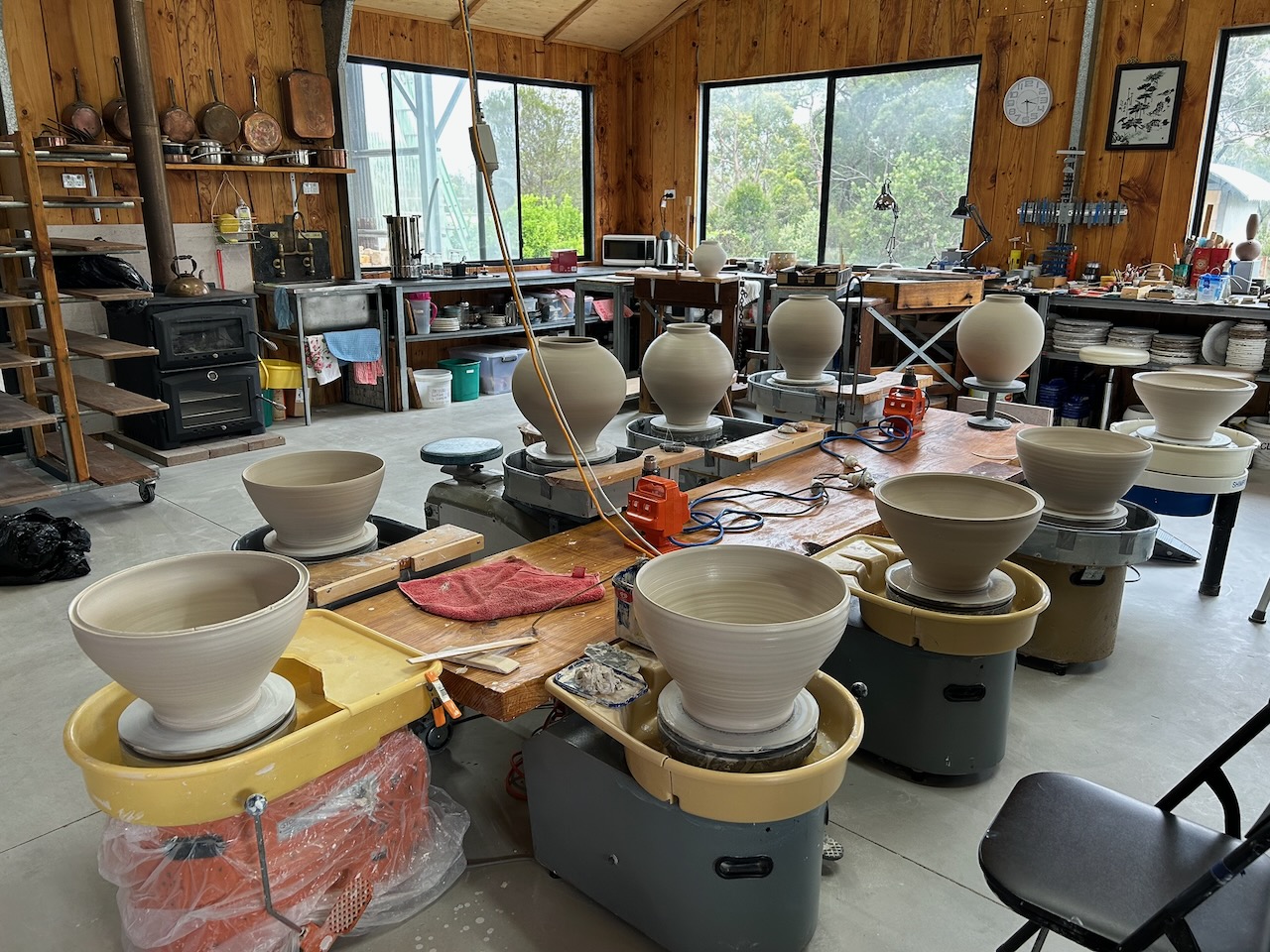
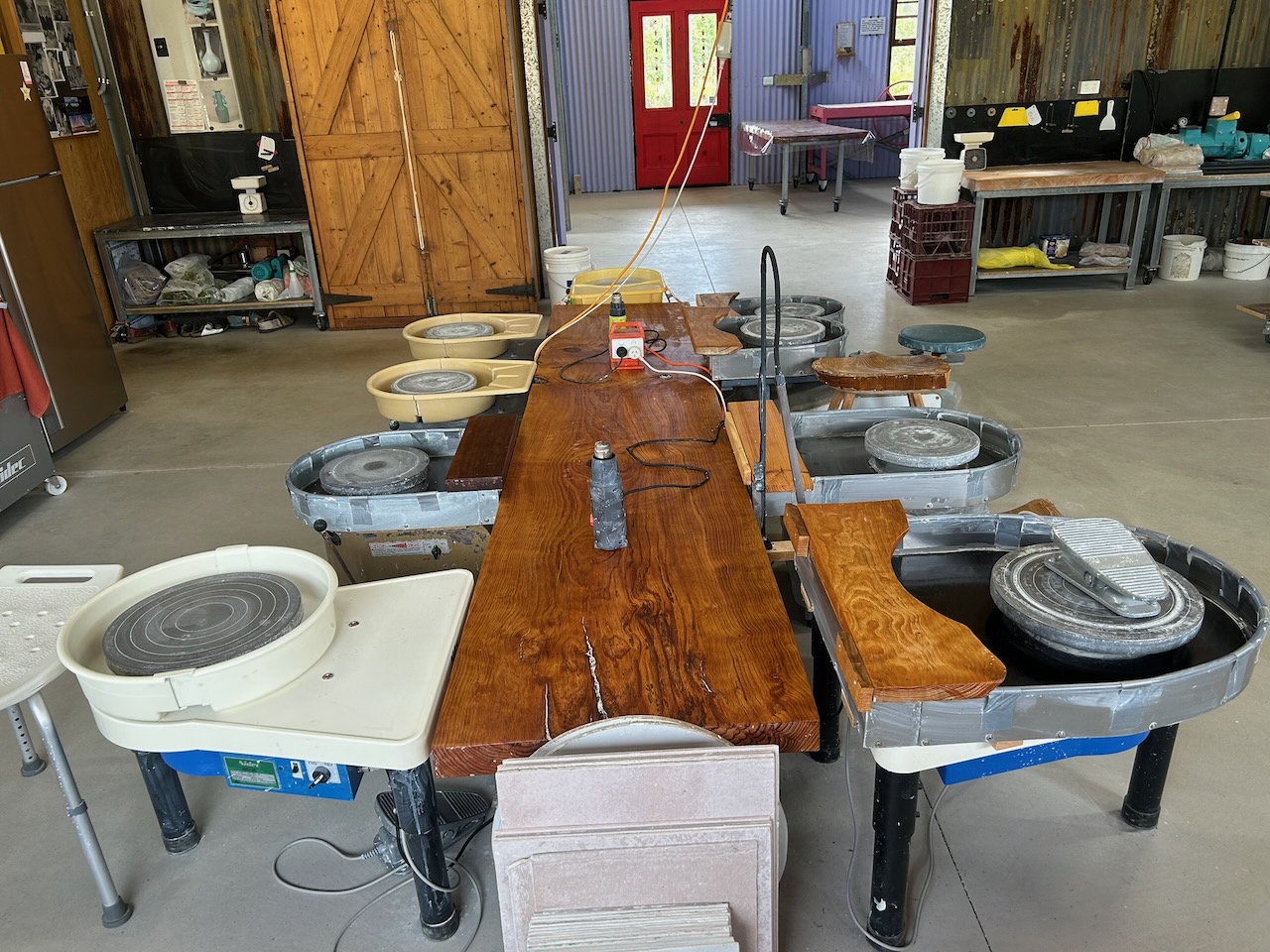
We have 12 potters wheels in the pottery now. 3 kick wheels, that no-one except Janine and I know how to use. They are quite simply the best way to make beautiful sensitive pots, in a slow gentle mindful way. But no one seems interested to learn about them. However, we have had 2 students over the past series of workshops that have had a go on them. AND, I believe enjoyed it! They made some beautiful pots on them.
We also have 9 Japanese shimpo electric wheels. Electric wheels are what everybody is used to using. When I did my apprenticeship with a Japanese potter. I had to learn to use the Japanese ‘shimpo’ style wheel. I’d never seen one before. I had to get used to sitting cross-legged on the workshop floor, with the wheel sunken below floor level. It was a difficult thing to learn as a 20 year old who wasn’t used to sitting and working cross-legged. However, I did develop an appreciation of the compact nature of the shimpo wheel design and the quality of the engineering.
We have one from every series of the shimpo wheels that they have produced, from the 1960’s through to the 2020’s. (RK 1, 2, and 3). One of the older shimpos is a bit worse for wear and difficult to use, so that is my demonstration wheel. That leaves 8 good ones for student use. So we can enrol 8 students in each throwing workshop.
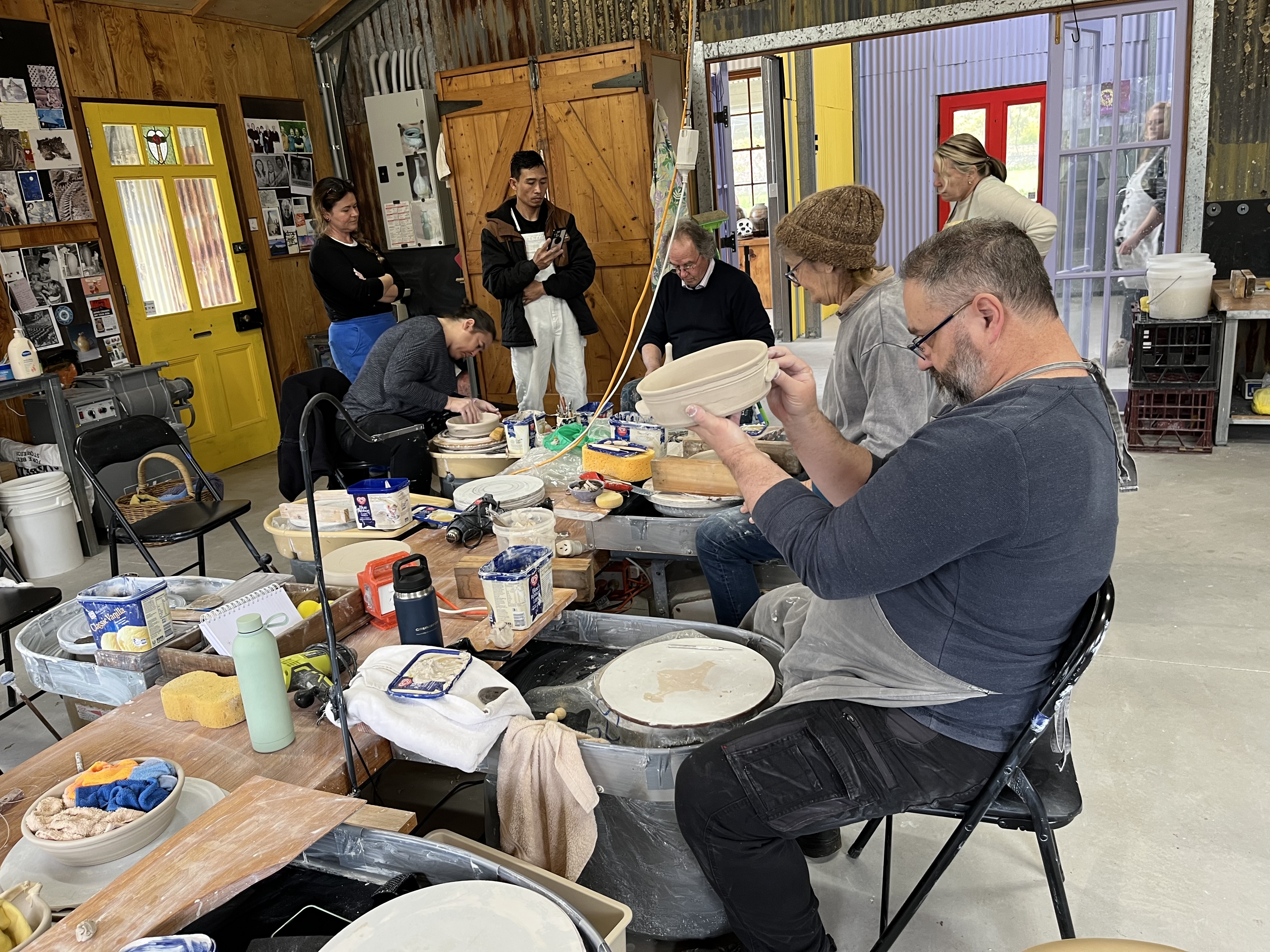
This series of workshops is based on the topic of kitchen wares, baking dishes, mixing bowls and mortars and pestles, etc.
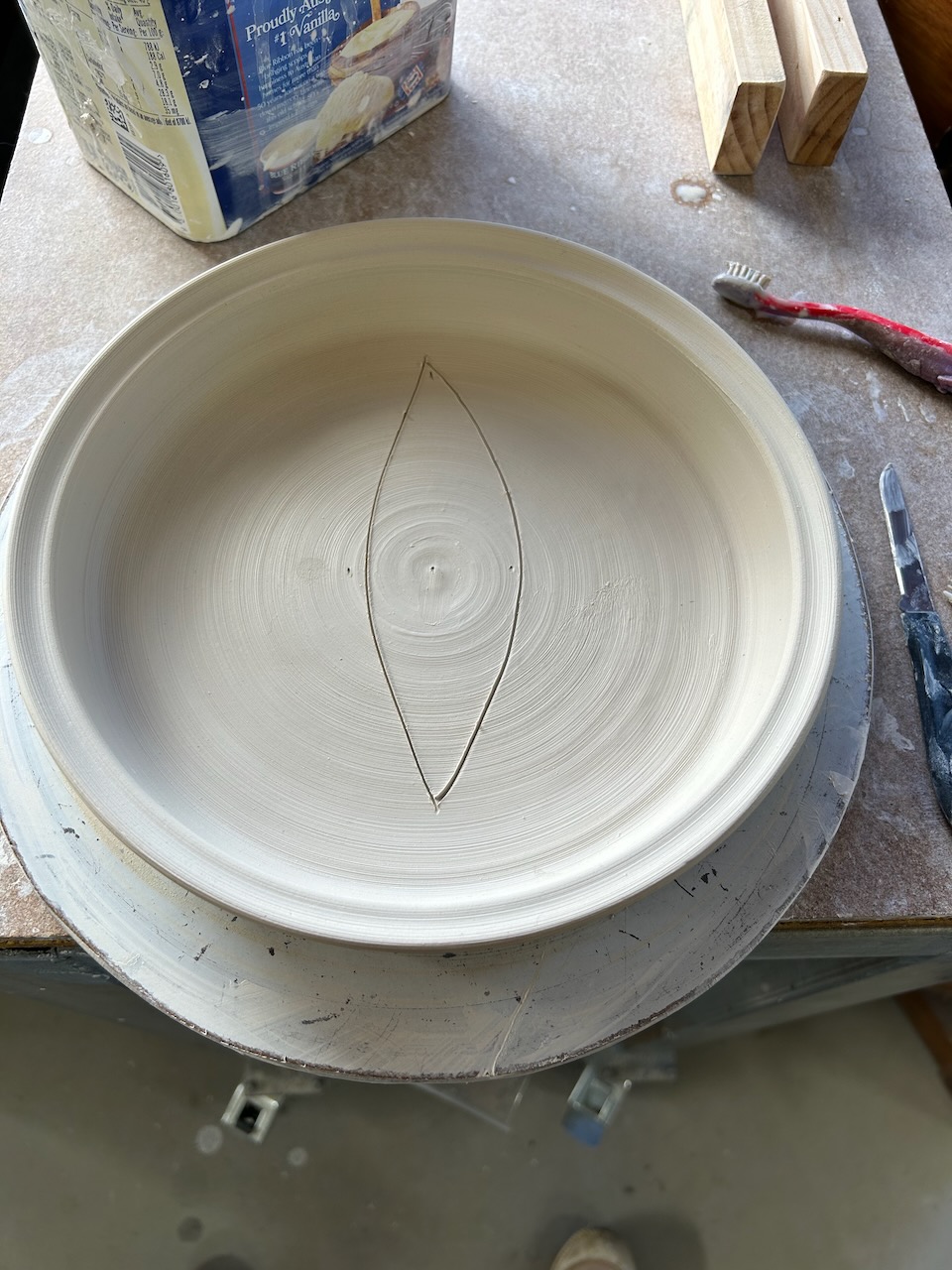
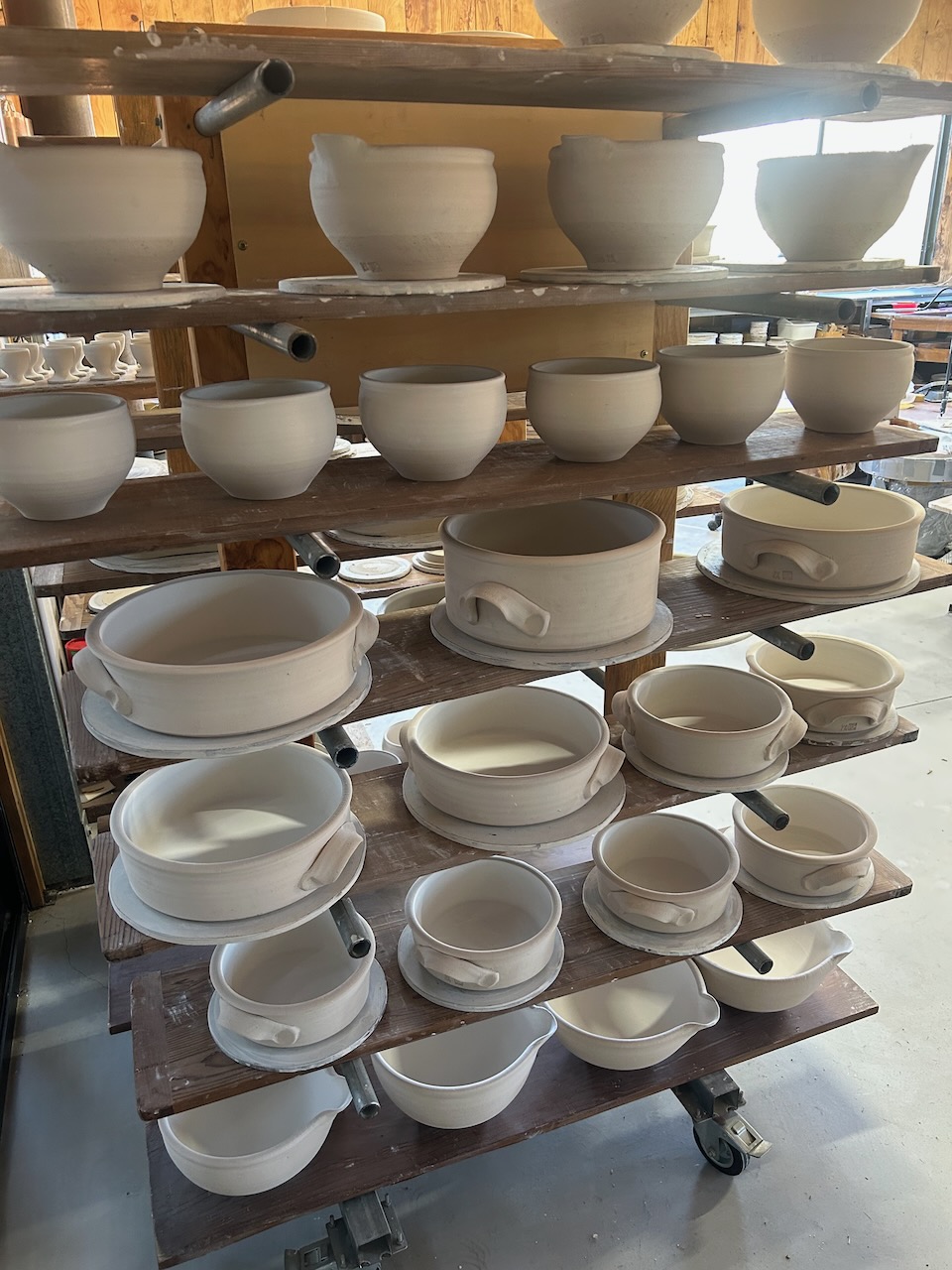
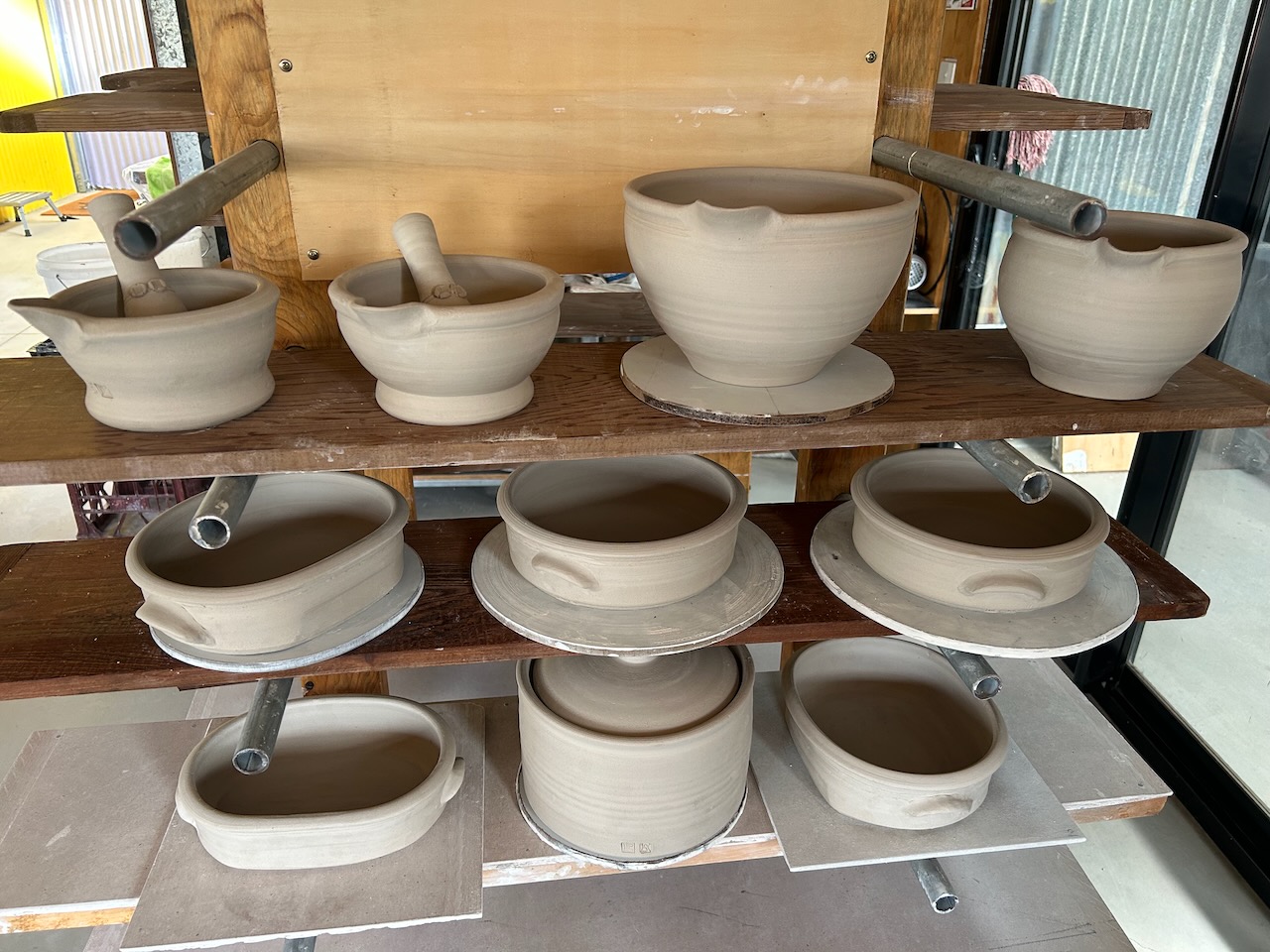
I demonstrated making both round and rectangular baking dishes, by cutting out sections and hand-building the pot back together again in the new ‘squared-off’ shape. The simplest method is to cut a single ‘leaf’ shaped hole in the centre of the dish. I call this the ‘melanoma’ cut. As it’s the cut of choice for skin cancer surgeons when removing melanomas. This is simple, neat and easy, but it creates the greatest stress in the bottom of the dish. This method has given me the most grief with cracking during drying. But it does give you a very elegant, long narrow dish, excellent for baking a whole fish!
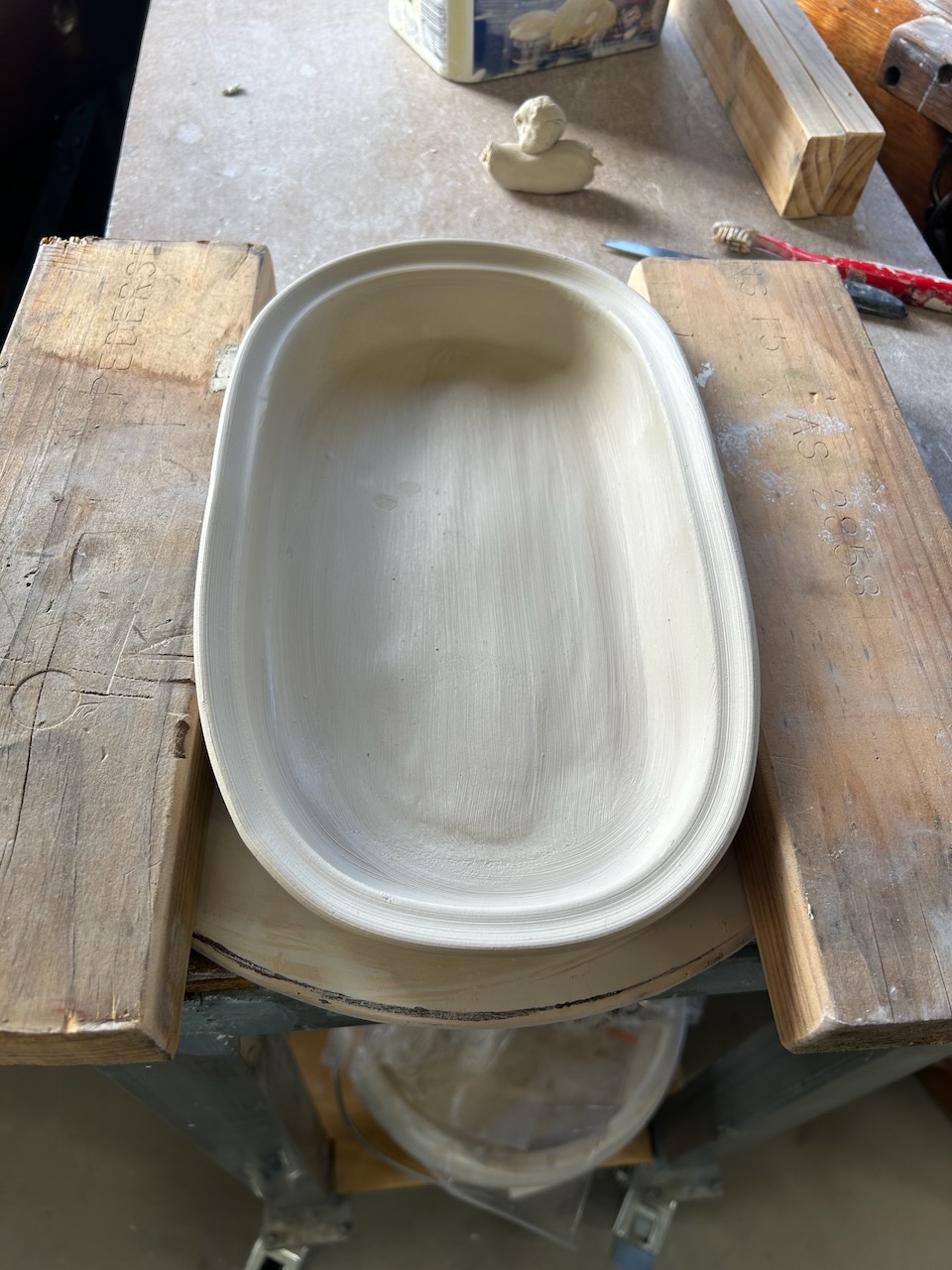
A more successful method, from my experience, is to make two cuts, one on either side of the pot and push the sides in to fill the void. The ‘amphora’, or balanced cut. This creates a lot less stress in the body of the dish, and is therefore less prone to cracking and is more successful. The most successful and least stressful, is simply to squeeze to pot together between two blocks of wood, and then smooth out and flatten to rumpled base inside. All good techniques, worth practising.
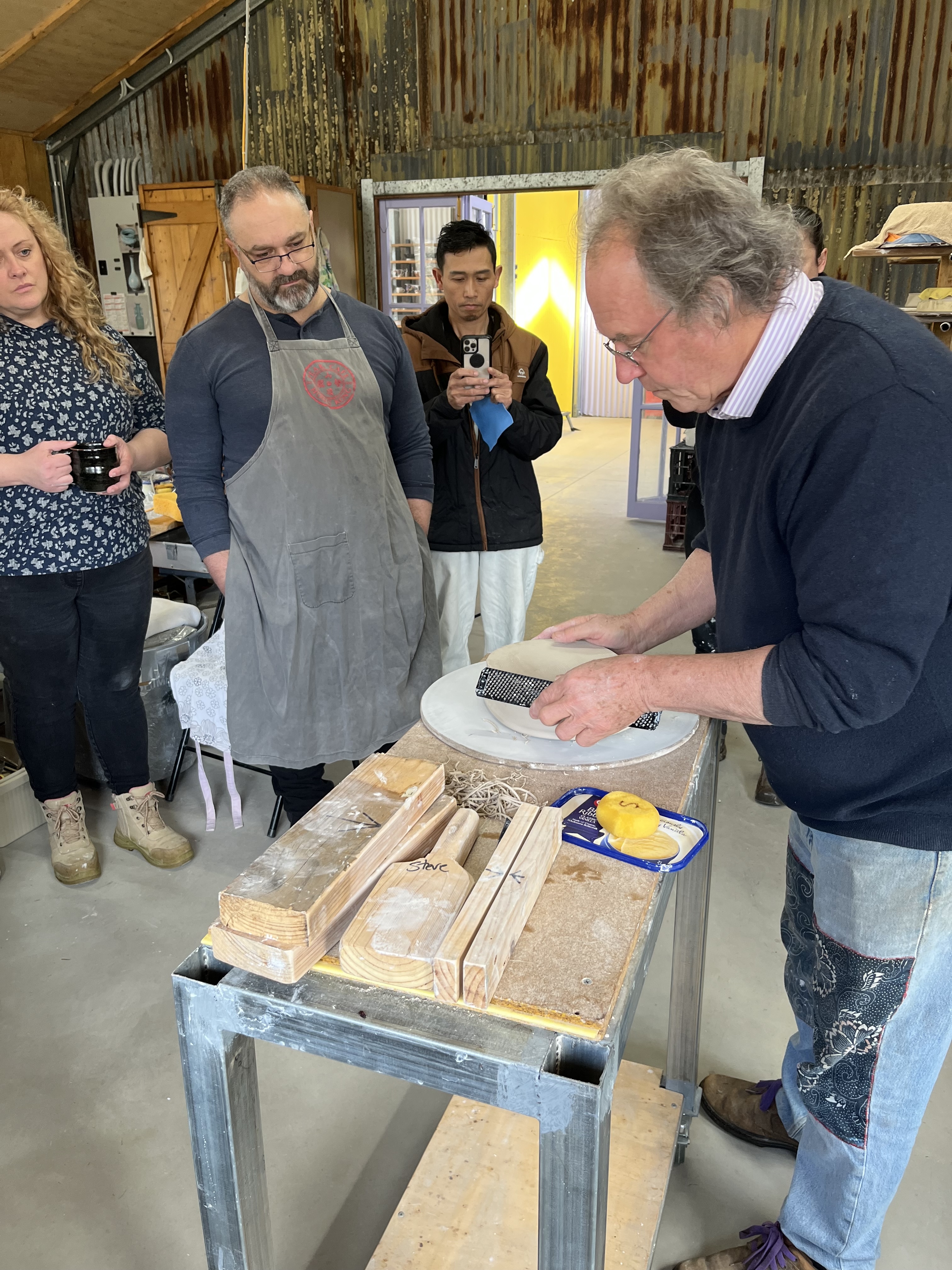
Although we start with regular round pots. They must be re-shaped into ovals while still damp and soft enough to rework. Oval and rectangular baking dishes can’t be turned in any normal way on the wheel once they are shaped, so I’ve learnt to trim the foot by hand using a ’sur-form’ blade, readily available from hardware shops. It’s careful use, followed by a light soft spongeing creates a nice, smooth, serviceable finished edge with undercut.
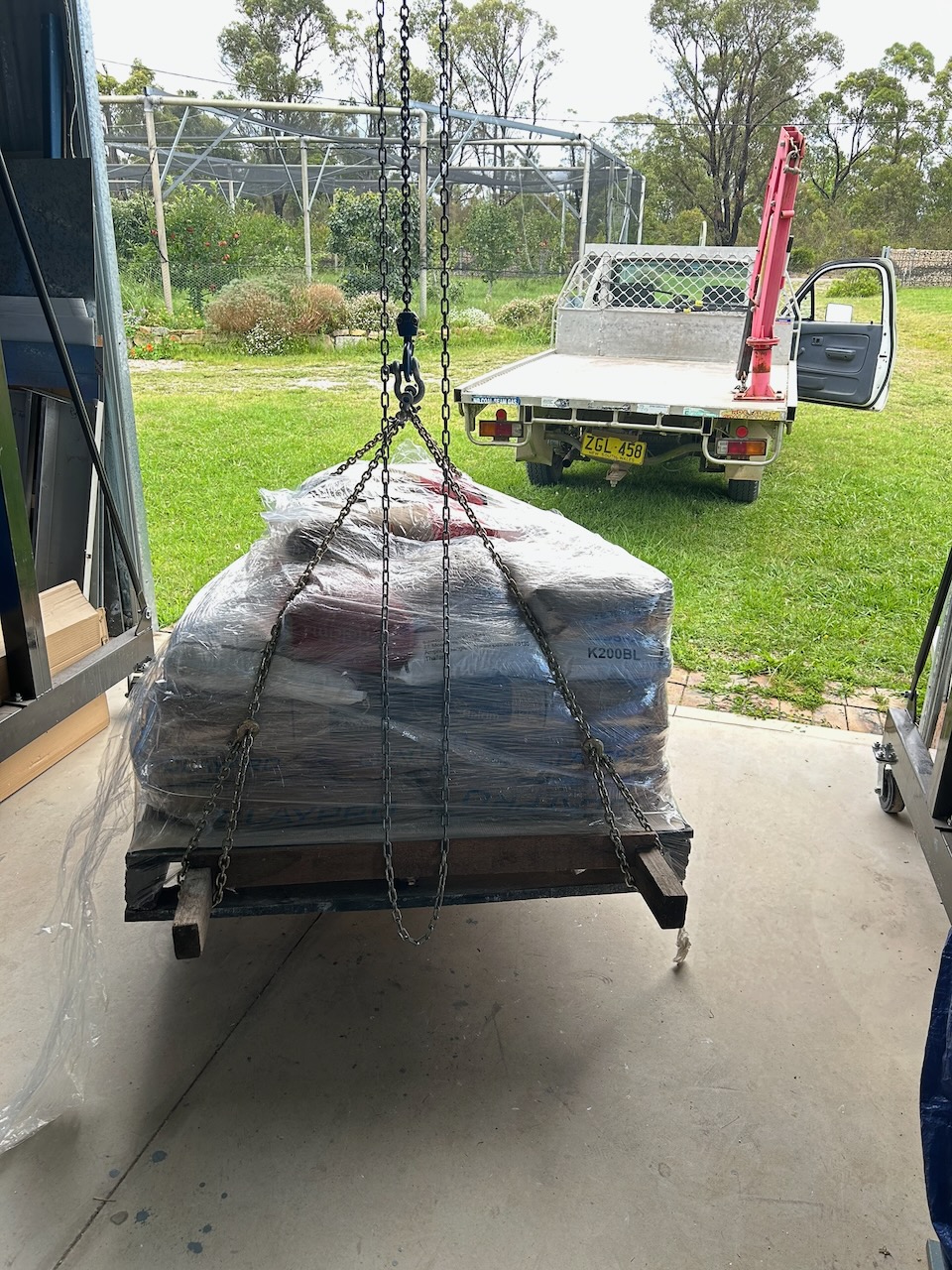
At the end of the day/weekend, all the shelves are groaning under the weight of over 120 kgs of freshly thrown and turned kitchen wares. There are only 3 bags of clay left on the pallet at the end of the second day. Everybody really got stuck in and made the most of the creative, learning and experimental environment. I encourage everyone to push their skill levels and not to feel too precious about any pot. Stay detached emotionally from your work. Feel free to just squash it up if it isn’t going well and make another one. A better one! It’s a much better way to learn. We all have to learn to practice detachment. It’s a learnable skill. Have many goes at the technique, until you get it right. Don’t feel precious, just squash it up and start again, practice makes perfect. And of course, it is of no cost o the student, as I’ll be the one to stiffen up all the slops and failed attempts. Stiffening the slurry of rejects and turnings on plaster batts during the week, re-pugging and re-bagging ready for another life.
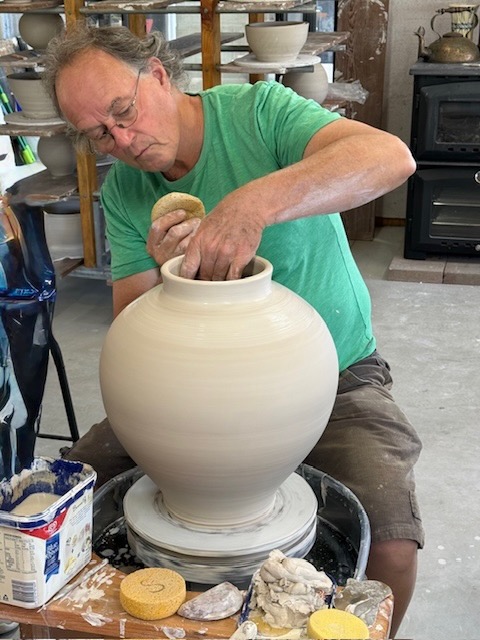
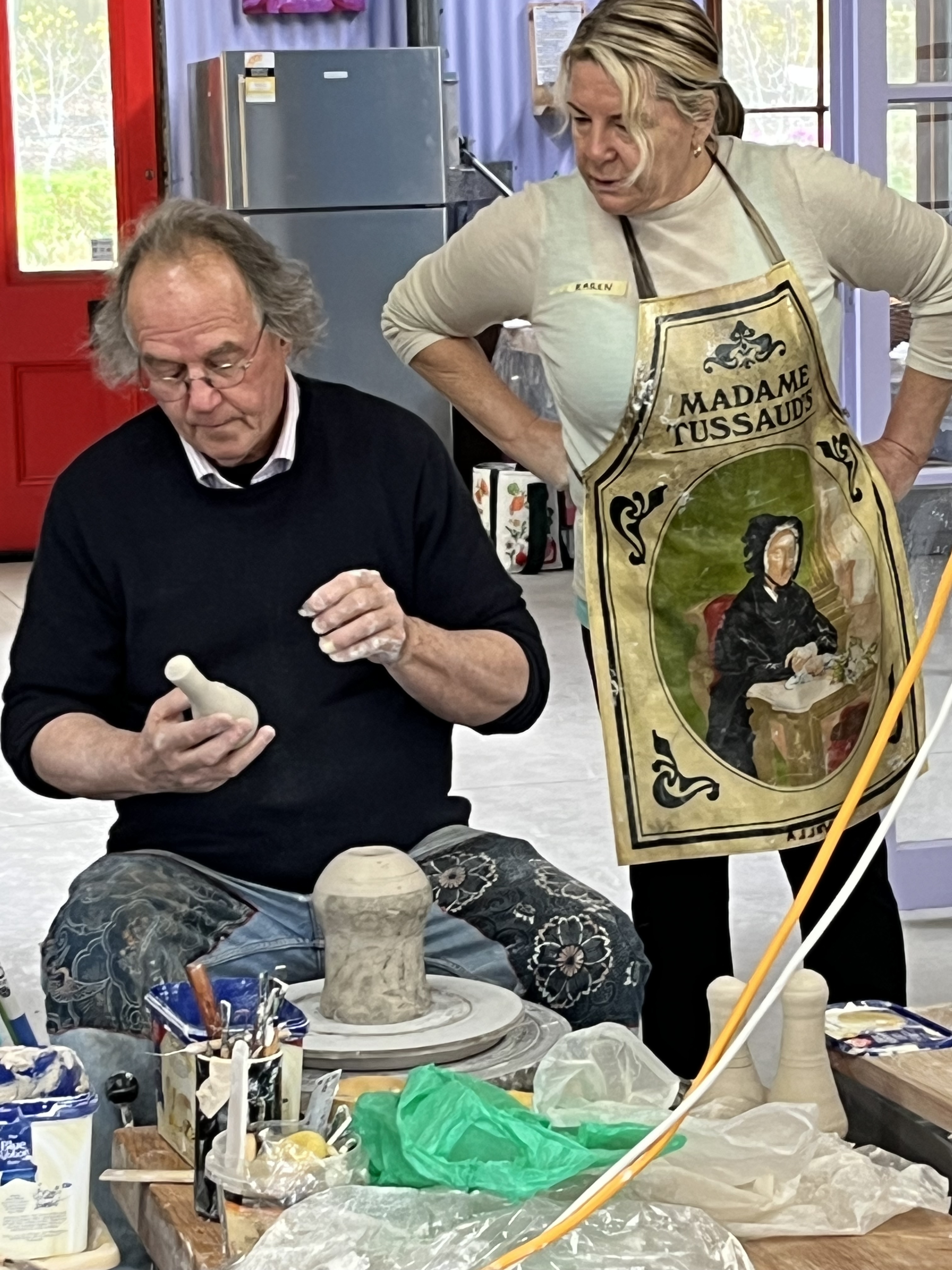
I also demonstrated making mixing bowls and mortars and pestles. I like to ‘pull’ a spout into the wall of these pots. It’s very practical, but really enlivens the form and gives them great character.
Everybody is encouraged to bring something to share for lunch each day. We have quite a sumptuous feast, sitting at the big table in the re-arranged gallery room. Good wholesome food, good conversation and great atmosphere. Lunch is concluded, when our resident barista ‘Len’ makes everyone a coffee. Then it’s back to work.
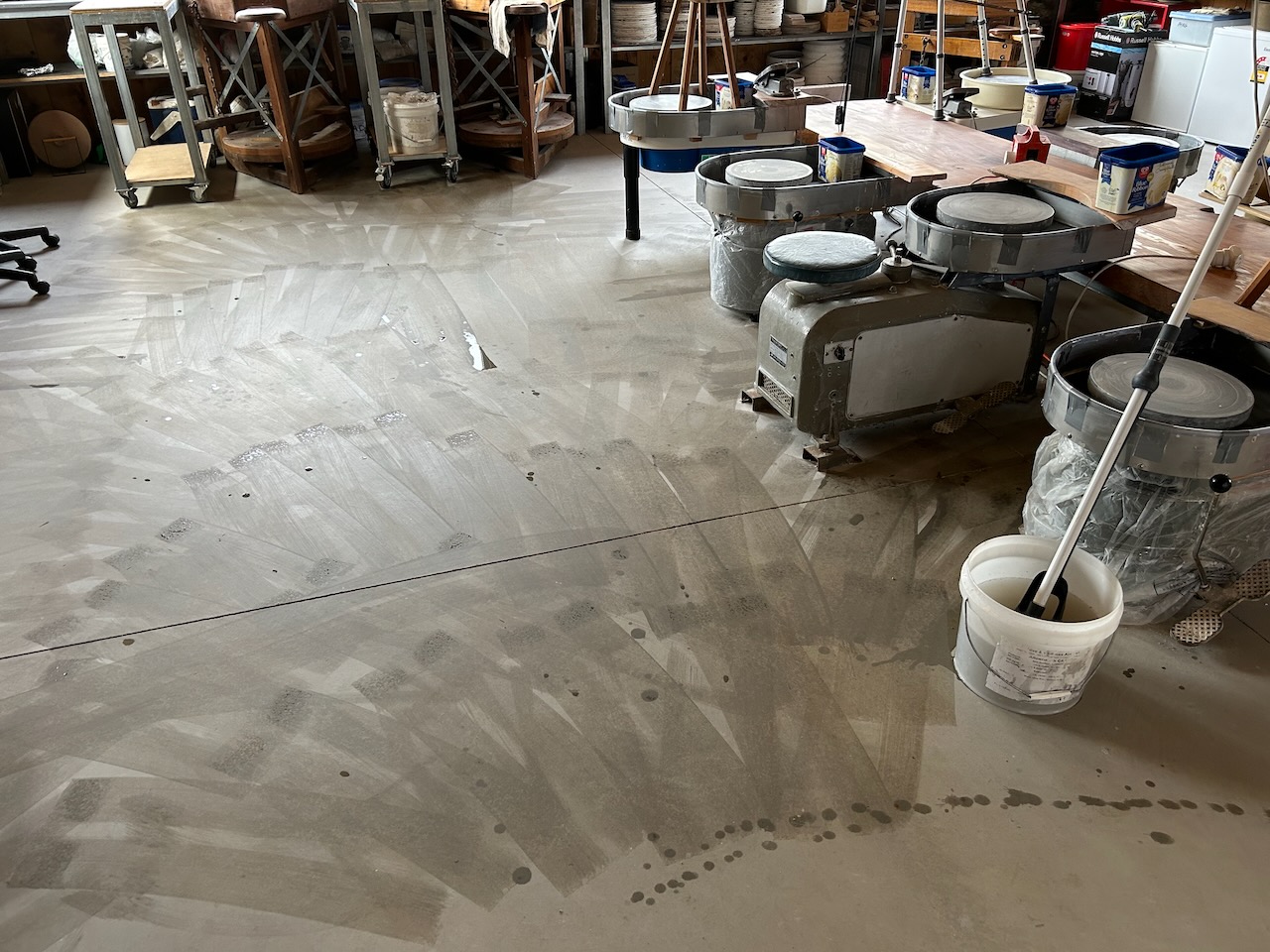
I ask every one to help clean up their mess at the end of each day, and they do a pretty good job, but there is always more clayey smears all over the floor afterwards. The more you look, the more you find. So when it is all over, I give the floor a final spongy mopping over again, cleaning the water bucket regularly to get as much of the clay dust up off the floor as possible. It’s worth the extra effort, as otherwise, clay dust gets everywhere, and is very fine, so we have to take care with all of our OH&S efforts to keep a clean environment for the benefit of the next group of students – and ourselves.
The weather forecast for this last weekend was pretty poor. 35 mm of rain on Sat and 15mm. on Sunday. We got it all and more! With 63 mm in total over the 2 days. One person even got bogged when leaving on Sunday afternoon. I had to dig out the mud from behind the wheels from the hollows that they had sunk in, and shovel in coarse gravel, so as to get sufficient traction to reverse out of the boggy saturated soil, next to the driveway. An intense way to end a great weekend of learning and sharing. Thank you to everyone who came and made it special.
I appreciate being in the presence your positive creative energy.
Nothing is perfect, nothing is ever finished and nothing lasts. Enjoy the moment.
Last week I was busy making clay for the fast approaching, up-coming weekend workshops. I made half a tonne of special clay body with a bit of extra grit, adding some more ‘tooth’ to the usual reliable body that I make up for us.
It took me two days. I can make up a quarter of a tonne of clay each day from scratch, pug it twice to ensure even mixing, then re-pugged through the Venco Vacuum pug mill and finally bagged and stacked. Along with sorting materials, weighing out, mixing, pugging and finally cleaning up, I have to have a day off in-between to catch up and to avoid over-doing it. Suddenly a week has gone by, but now it’s all done and ready for the next couple of workshops. We are pretty self reliant in the pottery here. Using our own electricity, our own rain water, using all the machinery and equipment that I have either made, re-purposed or re-built after the fire. I’m fairly proud of this minor achievement of self-sufficiency.
This week we have been very busy with all sorts of little jobs. We ate the last of our late season tomatoes. Surely this must be the last of the late crop. I’m not expecting the last 3 green toms to ripen very well, so these half dozen little self sown gems will probably be it. And very nice too. We cant expect to see another ripe tomato here until just before Xmas if all goes well with the spring planting for next summer’s crop. This must be some sort of record for us, eating home grown red ripe tomatoes for the garden in the last week of July.
What we are getting a lot of from the garden are cauliflowers, broccoli and Brussels sprouts, all the usual winter fare. last night I harvested the first pick of parsnips for our baked veggie dinner. Cauliflowers, broccoli, Brussels sprouts, parsnips, potato, pumpkin and onion, baked in the oven and then dressed in a cheesy béchamel source. A lovely, warming, winters dinner.
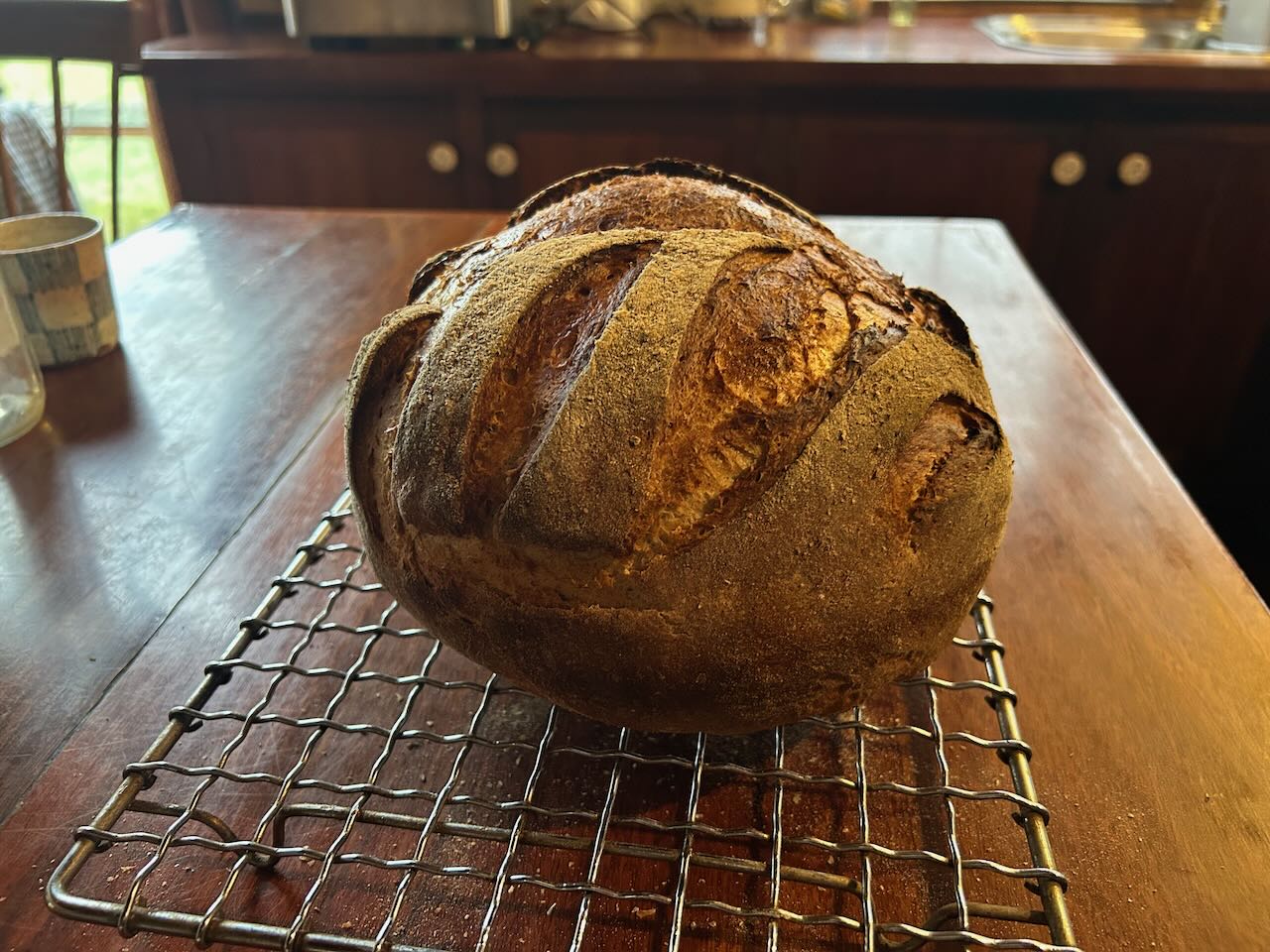
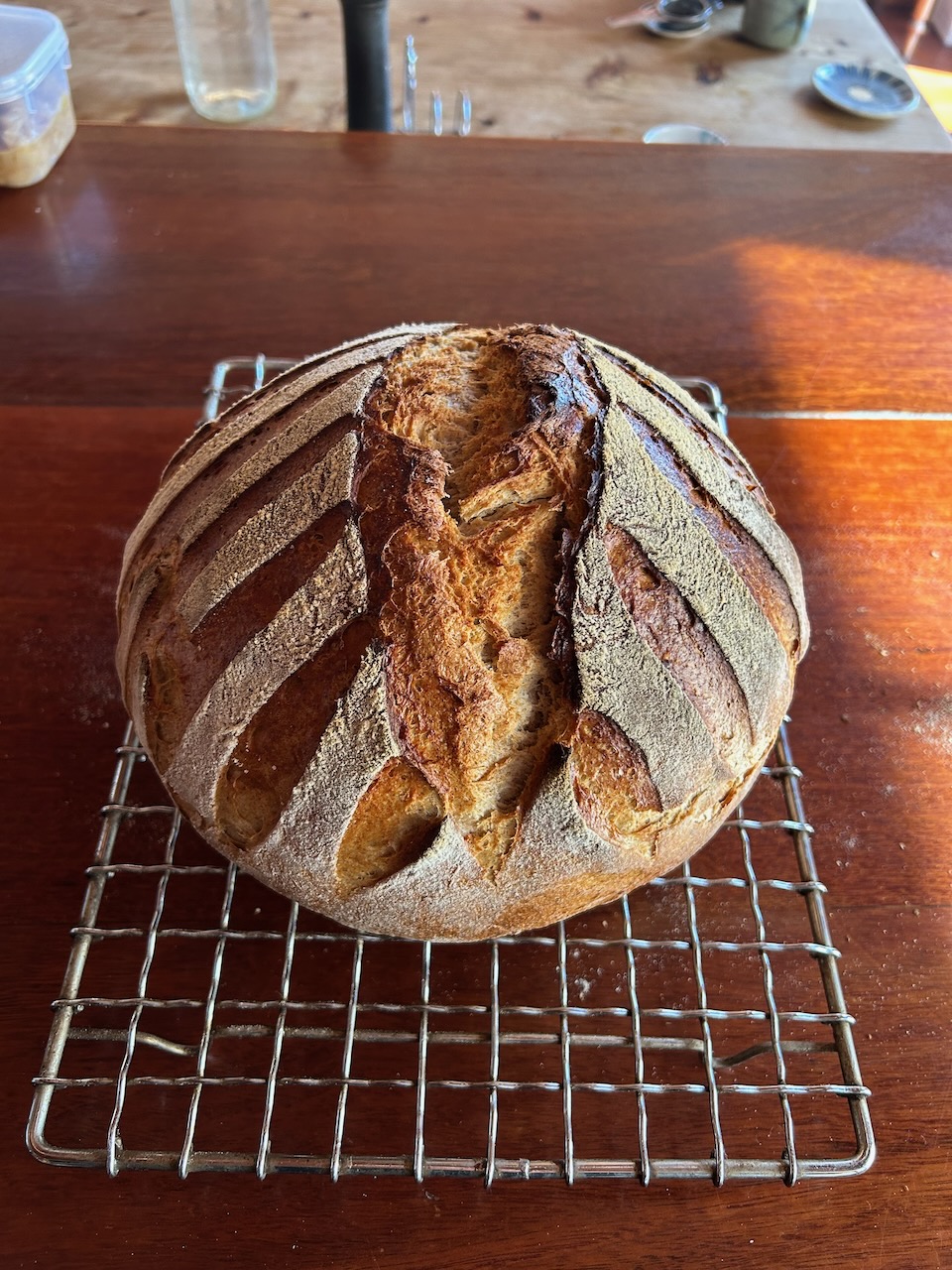
This weeks loaf of rye bread was the usual beauty. All crusty and solid dense rye inside. I use 50% of wheat flour as well so as the get it to rise, as there is very little gluten in rye flour, but it has fantastic flavour. I’m using locally grown and milled organic stone ground flours from the wheat belt of NSW. All grown, harvested and milled on site on the family farm.
This week we also hosted a weekend workshop, but held mid-week, Tuesday to Thursday for a student from FNQ. I had offered a glaze workshop last year, but only got 3 replies, and only one who paid. so it was cancelled. Not enough to make it worthwhile to run it. One potter enquired as to when the next one would be offered. I told her that it wouldn’t. Then she asked how much it would cost for me to do a private one-on-one workshop. She applied for a grant, was successful and so she was here this week. A year later than originally offered.
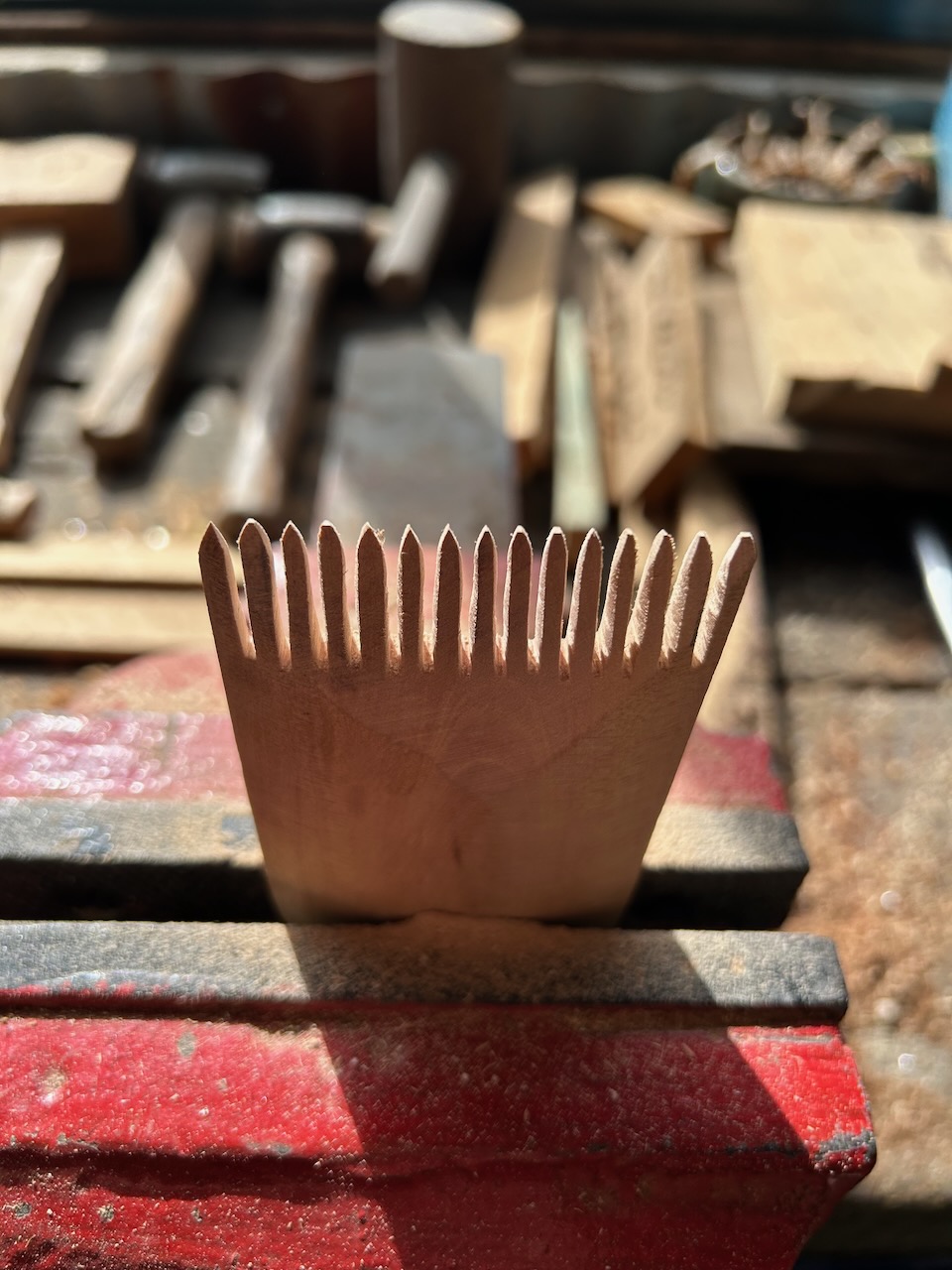
I spent Tuesday morning waiting for her to arrive from Queensland sieving wood ashes from the various fires, stoves, burn piles and kiln fireboxes, ready for use in our testing. I still had a little time, before she arrived, so decided to make a wooden pottery tool. At the last throwing workshop, my good friend Len Smith left behind a wooden comb that turned up in the throwing water. I really liked it and had got used to using it. It’s very comfortable in the hand and very useful. I really like it and was sad to have to give it back when Len next visited for the recent wood firing a week or so back. I decided to make one for myself, so I set to it and in half an hour I had one made. Not as good as Len’s, but I think that it is workable. and most importantly, it’s home made onsite from scrap wood. Not as good as the bought one perhaps, but individual, personal and much more meaningful. It still needs a little bit more sanding and finishing, then some vegetable oil, and it’s ready to go.
When my student arrived from the airport, we had lunch and spent the afternoon doing a geology tour of the Southern Highlands, collecting samples and talking geology, analysis and geological maps on the short drives in-between sites. Day two was spent crushing and milling our samples in the morning and then making glaze tests in the afternoon. We finished the weighing out in the late afternoon, having completed 13 test tiles, half for oxidation and half destined for reduction firing. We packed both the electric kiln and small gas kiln with our test tiles before dinner. The solar electric kiln was fired over night used the days stored sunlight energy from our battery, while we fired the small portable gas kiln during the evening into the night, a 3 hour reduction firing from 6 till 9.00PM.
Day three morning was spent unpacking the kilns, debriefing on the results, and then a theory class on glaze technology, choice of materials, Segar Formula and loads of other relevant related glaze topics. We finished on que at lunch time, in time for her return to the airport for her flight home. A fully packed, midweek-weekend, intensive crash course in geology, rock glazes and using collected ‘wild’ local materials. Ashes, gravels, arkose, clays and rocks, all alchemically metamorphosed from road side dirt into shiny glazes.
We have just completed the 3rd of our Jan/Feb summer school series. Just 1 to go, starting on Friday.
We have had 3 great classes with a bunch of wonderfully talented and enthusiastic students – as they all-ways are every time. It’s such a privilege to be able to work like this, passing on what we have learnt over our lifetime, to enthusiastic potters, keen to learn the techniques that we have accumulated during our careers, and to sample a bit of what we do here. Between us, Janine, Leonard and I have notched up a total of about 150 years of ceramic practice and experience.
The last of the wild poppies are in their final fling of exuberant and cheerful rich red colour. These ones have come up, self sown, wild, in the cracks in the paving around the pottery.
Even though everything is more of less completed around the pottery, it still takes us a day to set the studio up for a workshop, prep all the clay, clean the batts and pot boards etc, then do some cooking to share for our joint lunches. Afterwards, there is a day to recycle the abandoned pots, crushed and soaked in the left over throwing slip, and wash everything down. The next day, I transferred all the re-cycled clay slip/slop/slurry from the 20 litre buckets into the plaster batts in the clay room to stiffen-up for re-pugging.
I have 5 big plaster tubs/batts on a shelf in front of the huge north-facing window in the clay room, they get baking hot in the sun and are almost always very dry and receptive to stiffen up our recycled clay slip/slop/slurry.
However, 30 litres of fairly thin slurry does set them back a bit in the drying stakes.
Today I dug out all the very soft plastic mass, in its slightly stiffened, but still very wet plastic state and piled it up in lumps on the pugging table to air dry. Once the plaster is saturated, it keeps the clay damp, so best to get it out and get it air drying. This has proved tot be the fastest way to deal with so much slurry. I also need the plaster tubs dry again for Friday’s next onslaught of failed experiments from the last 3-day summer school.
Everything will be in order by the time the next class starts tomorrow.
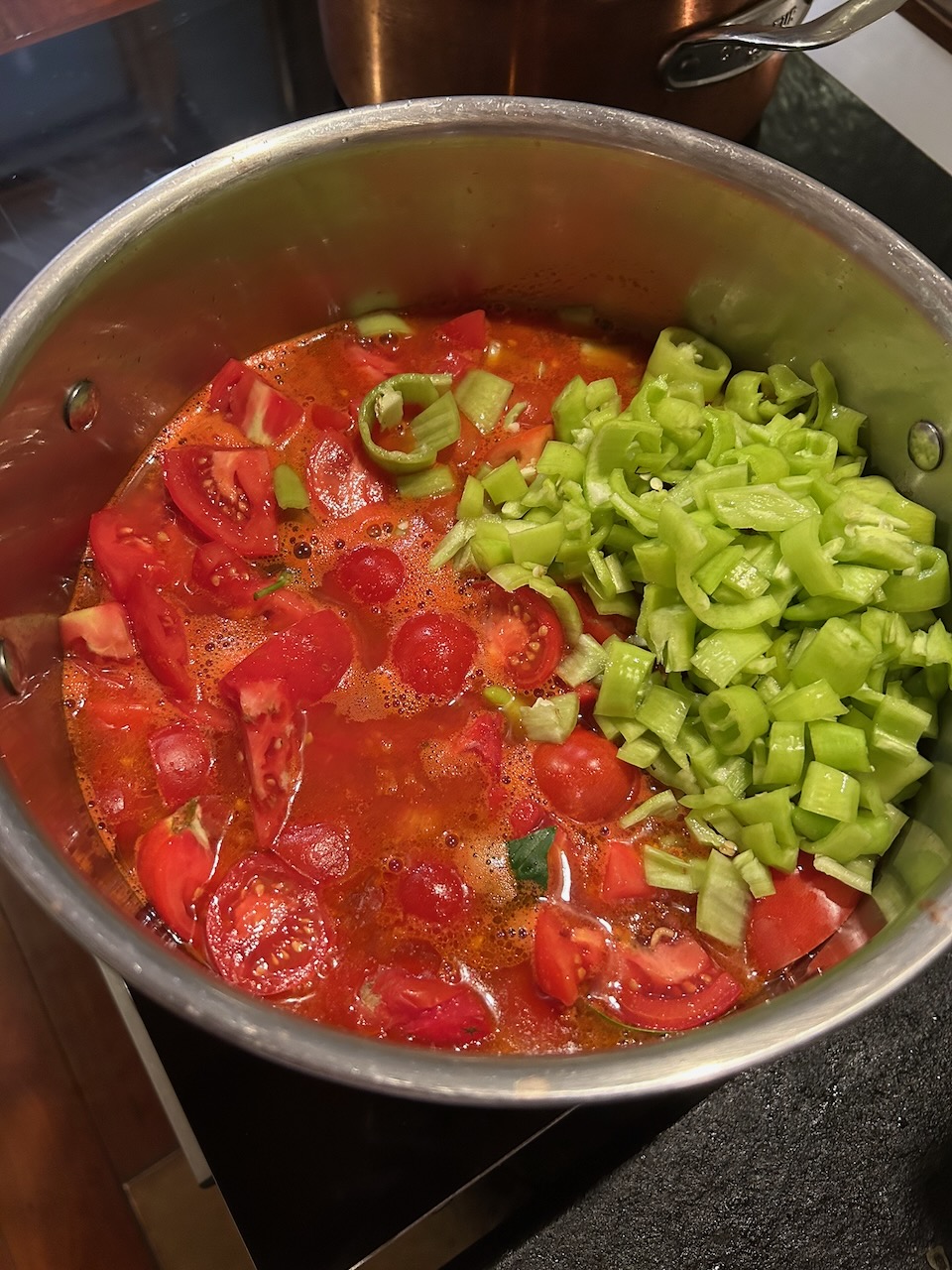
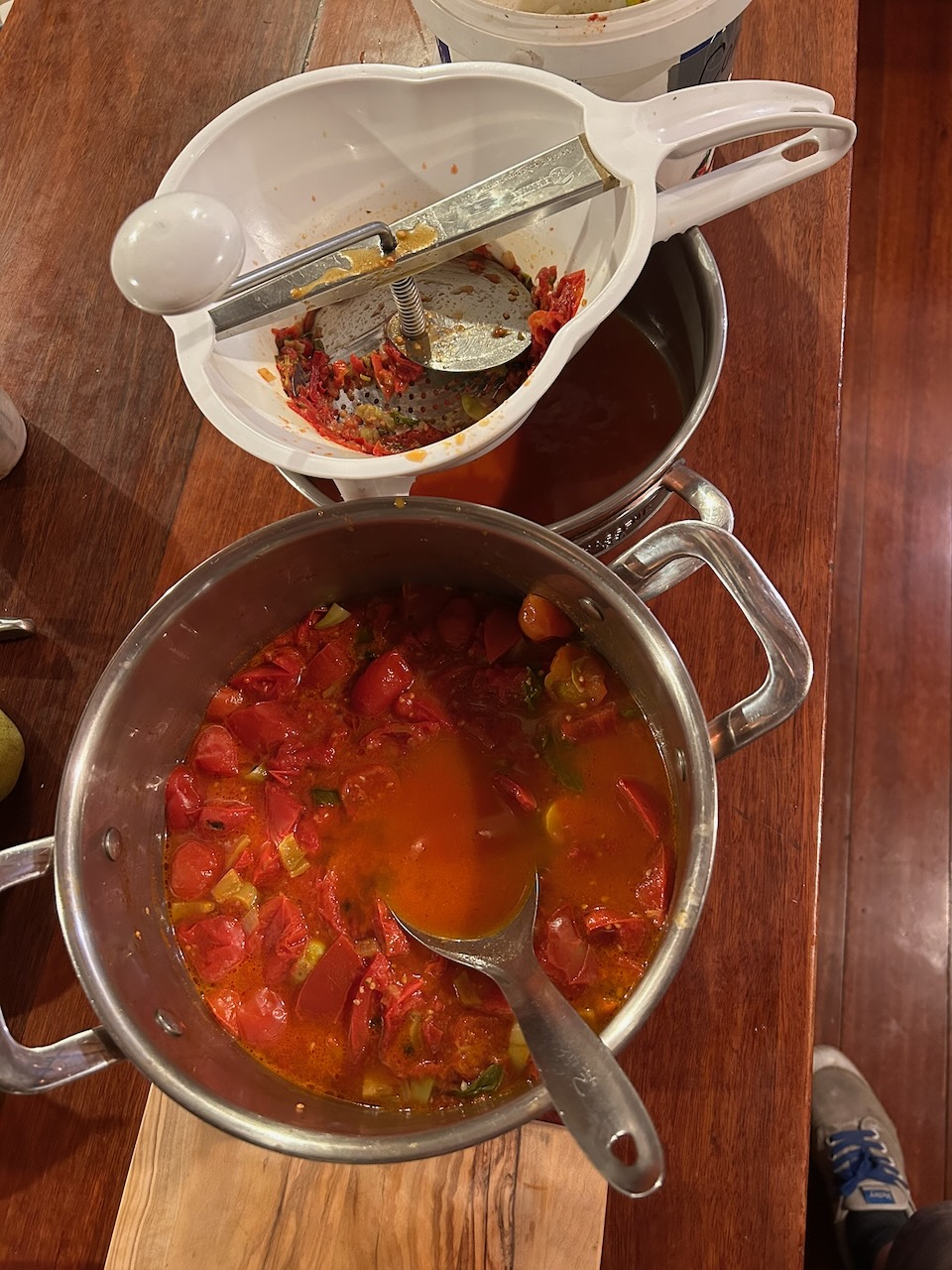
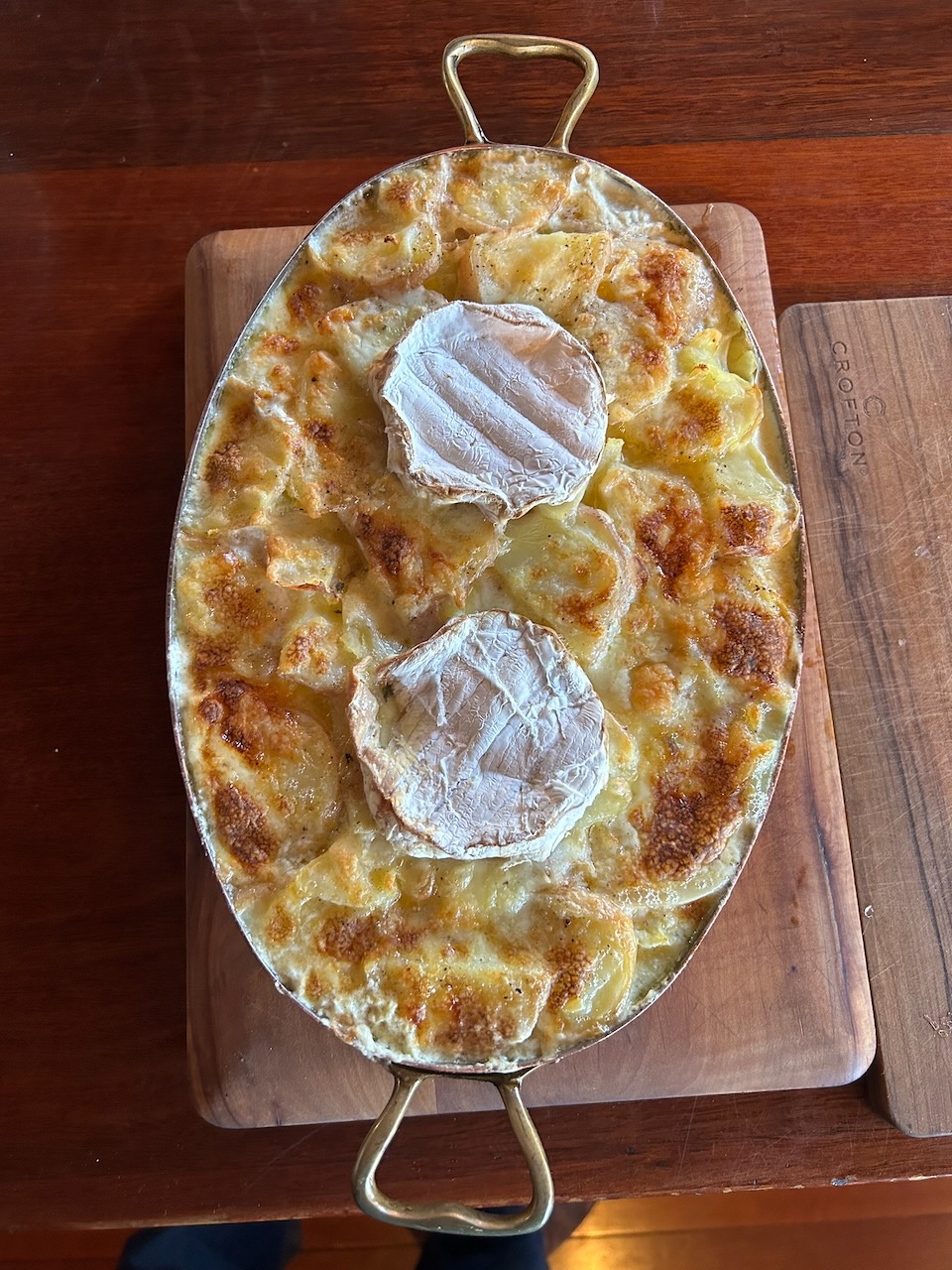
After the cleaning I baked another loaf of bread and cooked a potato dauphinoise for dinner finishing it off with a whole camembert sliced on top. The garden is revelling in all this warm weather and occasional storms. The self-sown tomatoes are small but prolific. I found the time in the evenings to make my first batch of tomato, garlic, capsicum and basil passata. 10 litres of sliced tomatoes boiled down in their own juice and then reduced by half to concentrate the flavour.
The bread turned out well – as usual. I’ve got it nailed now. Success every time. but I’m still trying variations, and different brands of flour. I’ve ended up with a 50/50 blend of wheat and organic stone ground rye flours.
There are so many vegetables coming from the garden in summer, we give a lot away, and do a lot of preserving. We also eat as much as we can.
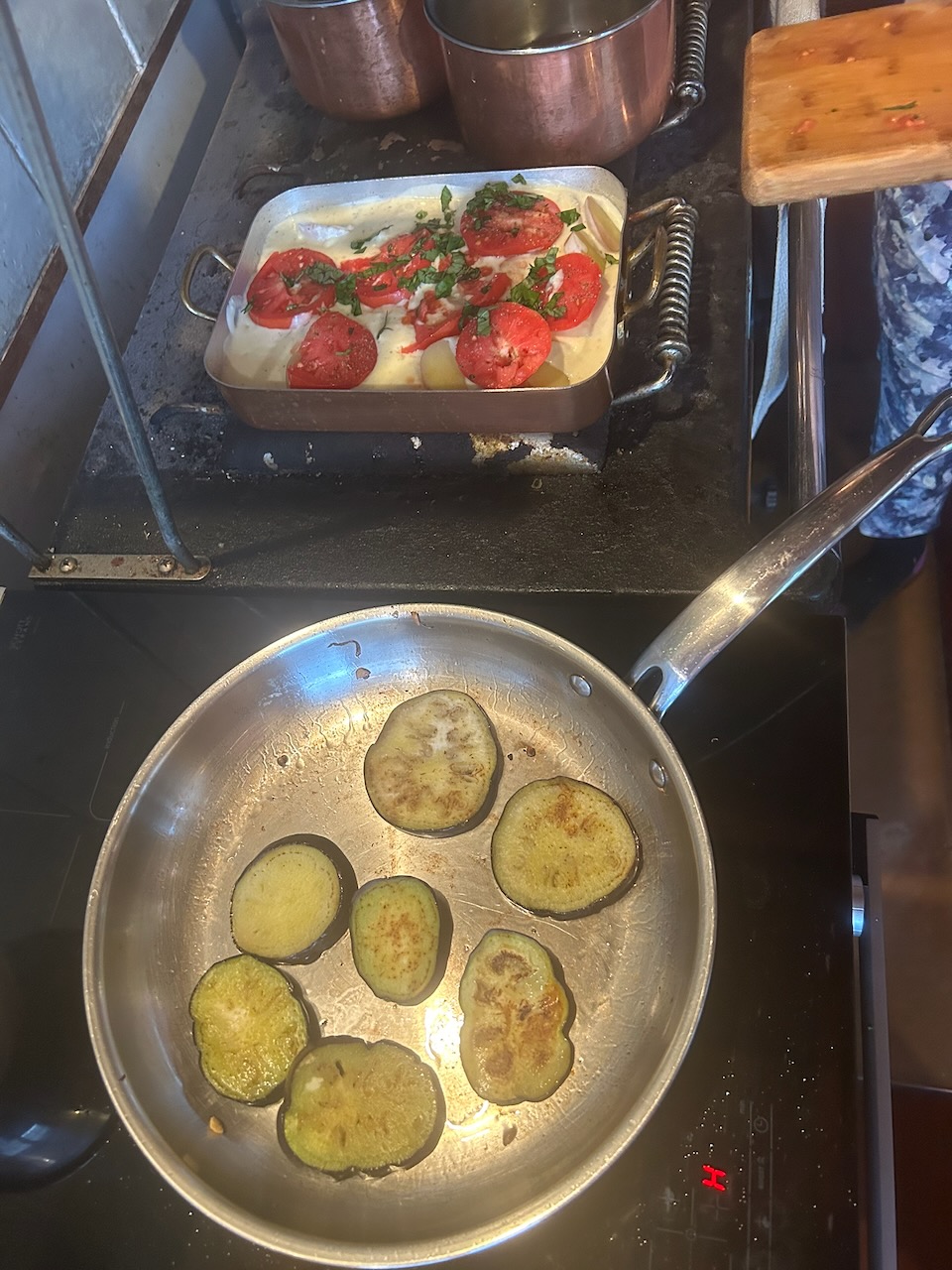
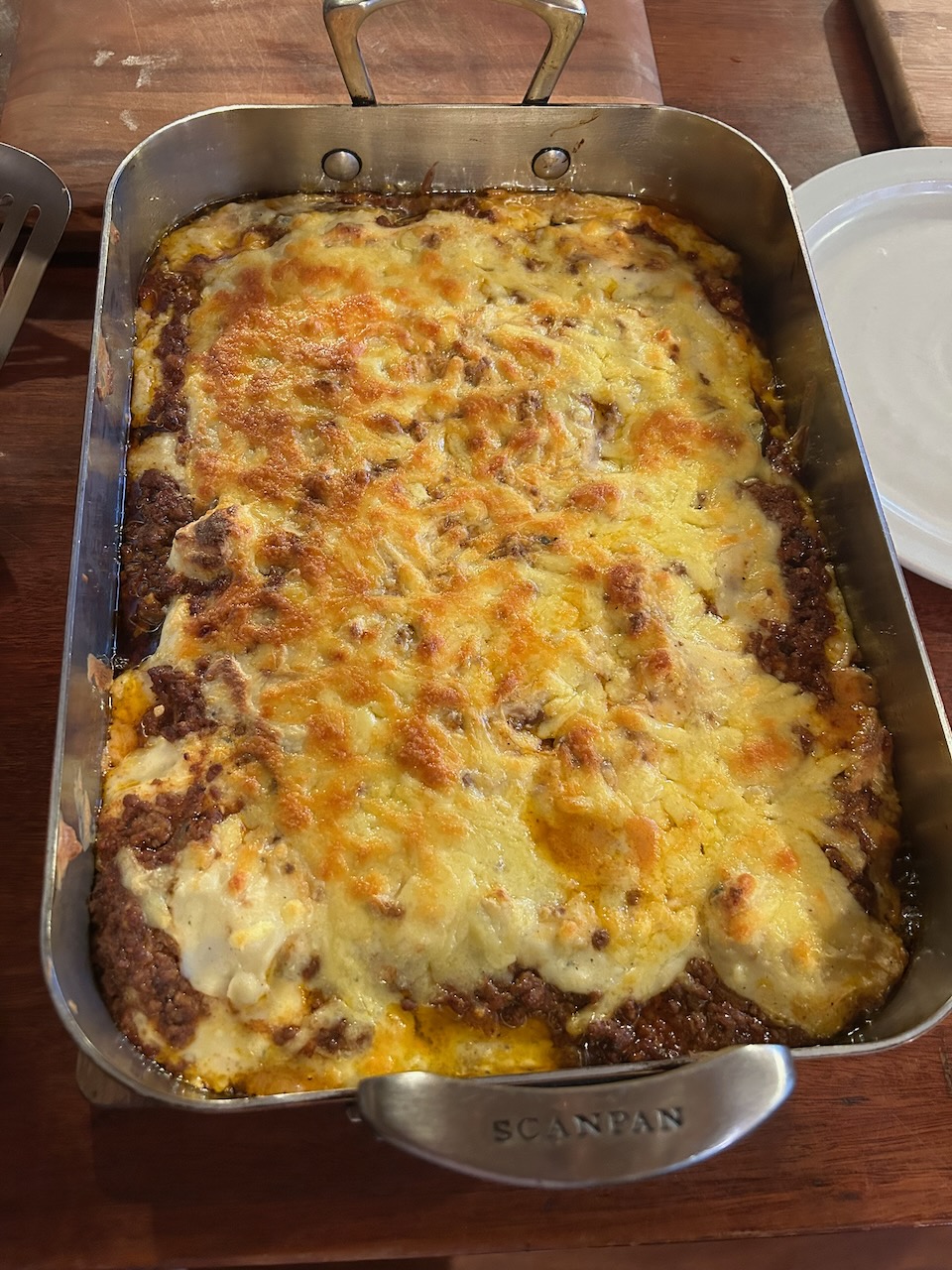
Nina and I worked together to make a sort of Greek inspired moussaka dish. I did the tomato/meat sauce and Nina did the béchamel topping. Working together made it so much quicker. Everything from the garden, egg plants, zucchinis, garlic and last years passata.
It was so nice on a cool rainy evening, we’ll be doing it again.
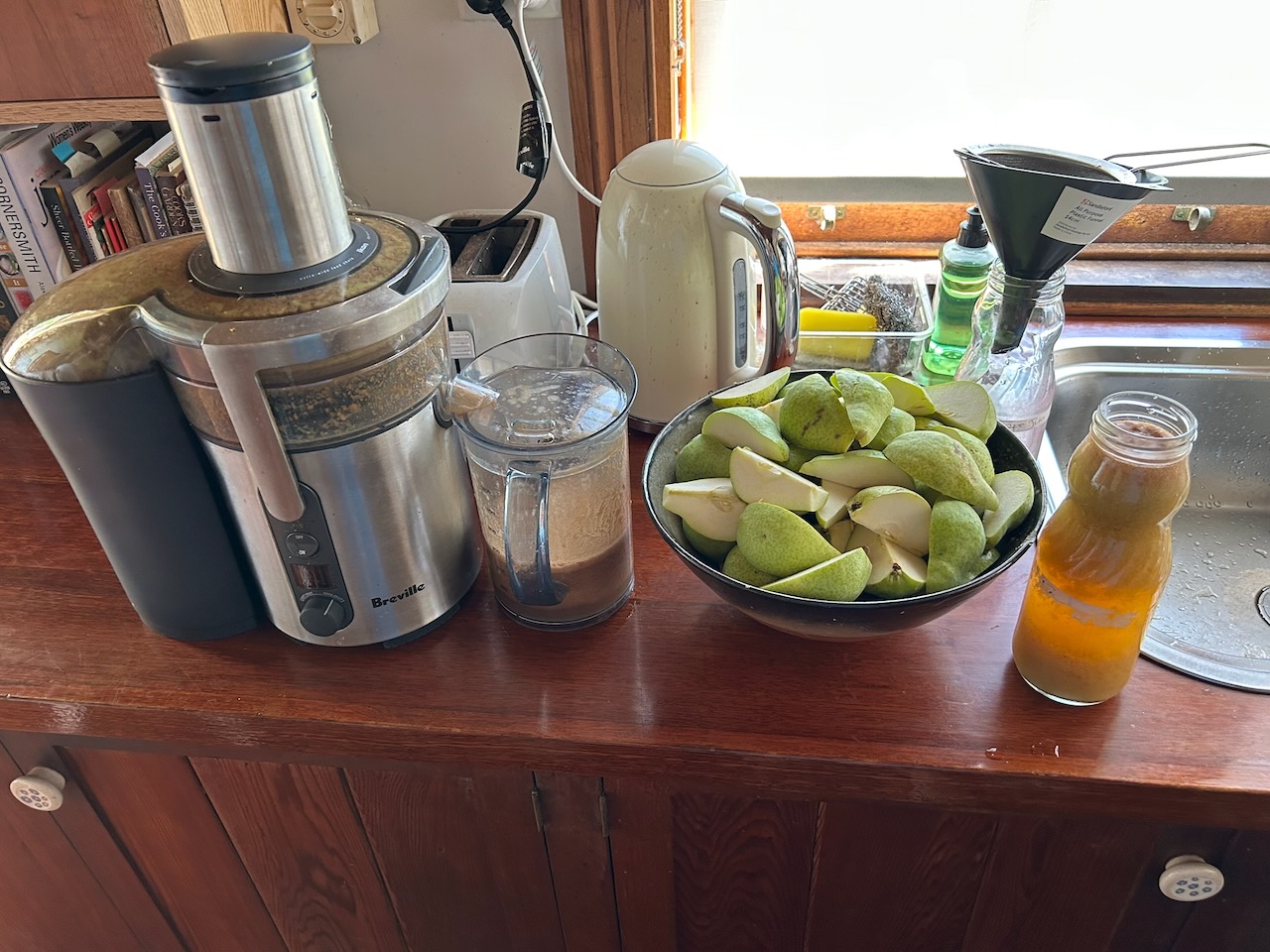
We are continuing to cube and roast pumpkin with olive oil, garlic and a sprinkle of salt. Everything is working, we are well, although quite tired from the intensity of the work load with the workshops, added to the summer harvest work, which can’t be put off or delayed. After next weekend’s workshop, I might try and make some cider from the apple and pear crop that is peaking at the moment.
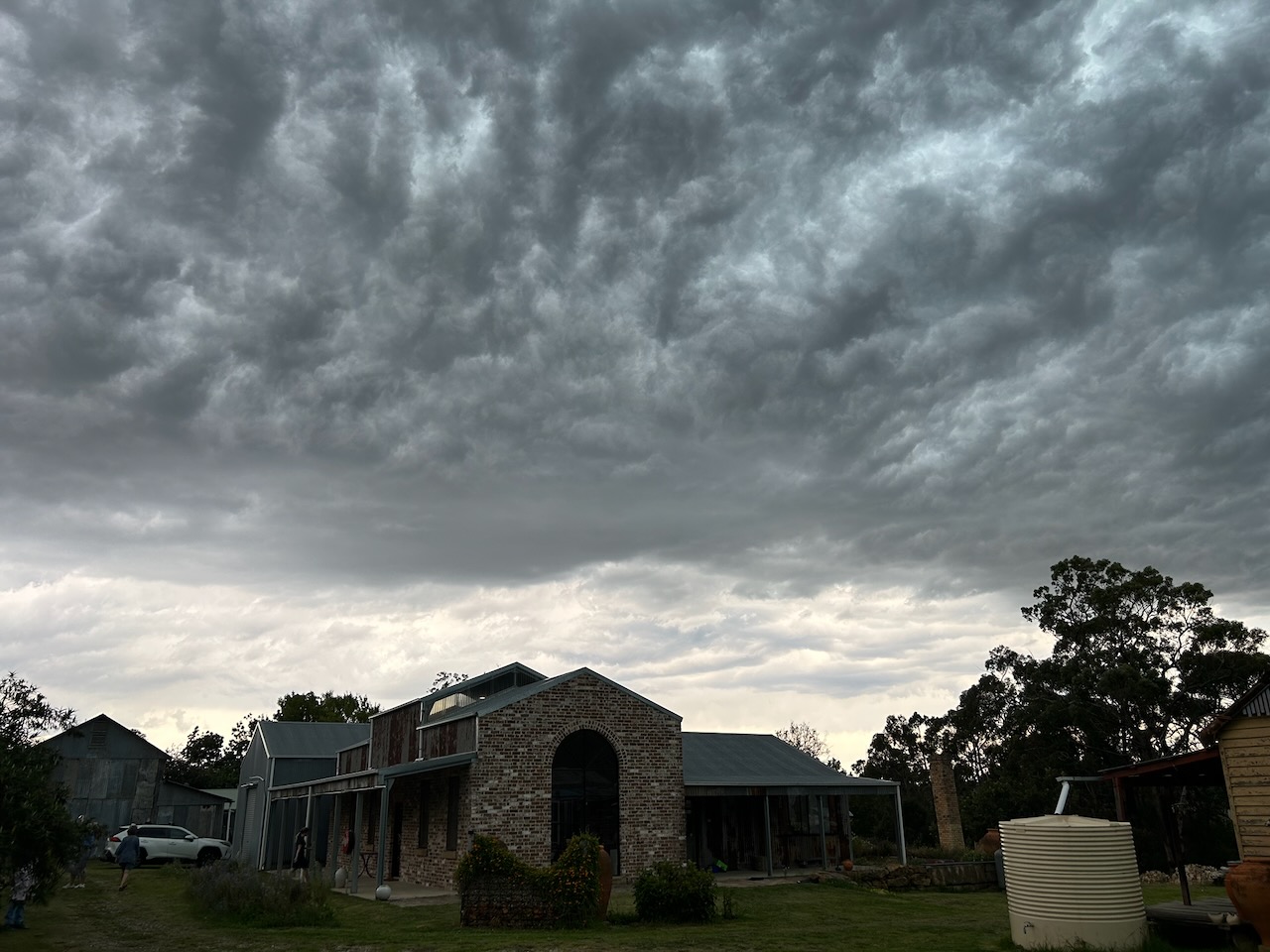
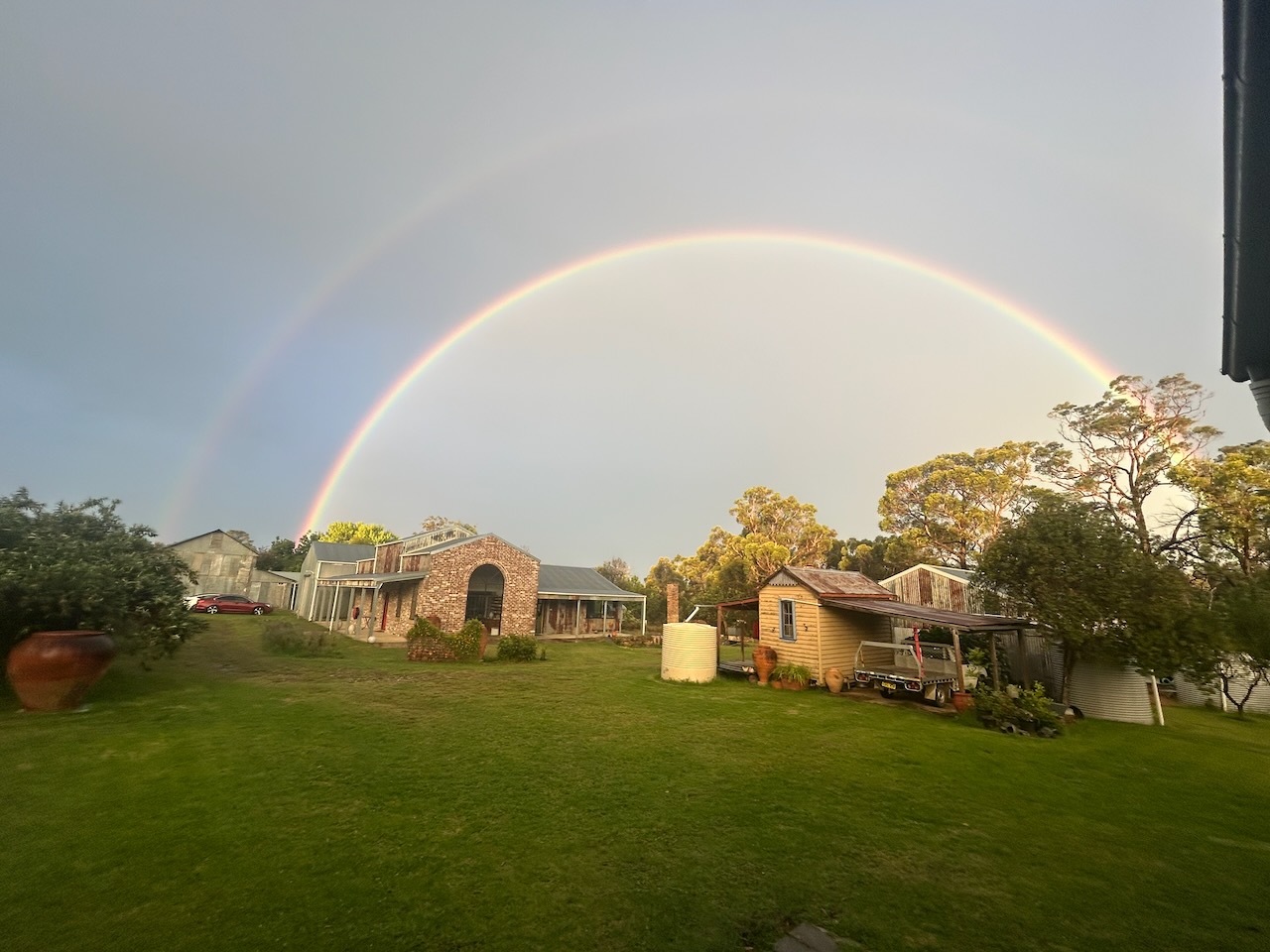
Is there a pot of gold at the end of the rainbow, in the new pottery? Hit by the end of the amazing double rainbow. I rushed down there to check it out. I went to the decorating cupboard where I keep all the pure gold leaf for use in kintsugi. But no pot of gold!
I could swear that I had a full fresh book of gold leaf in there, but NO! all gone.
I think that we got the wrong end of the rainbow. It sucked up all my gold and dropped it over the rainbow, somewhere else. Possibly in Kansas?
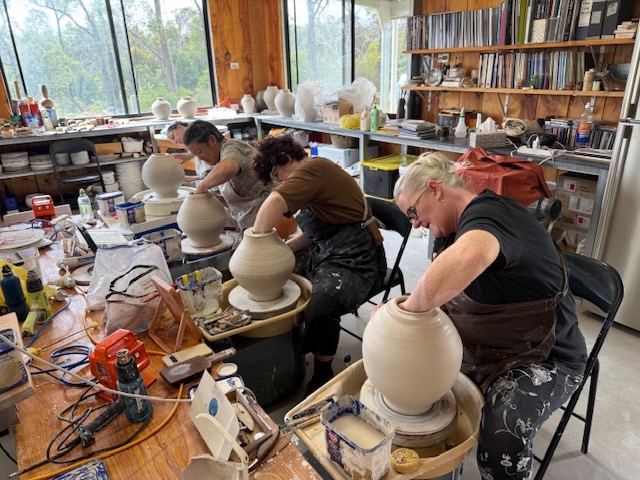
We have been very busy with our summer schools since the beginning of January. I originally advertised one Summer School to teach the making of larger forms on the potters wheel by ‘top-hatting’ and ‘coil-&-throw’ techniques. We got such a massive response to my add that we could program 4 summer schools of 3 days each, and lined them up with a few days in-between. Two in January and two more in February. We only have 8 potters wheels in our workshop, and we got over 30 replies so I had to run 4 schools and space them out.
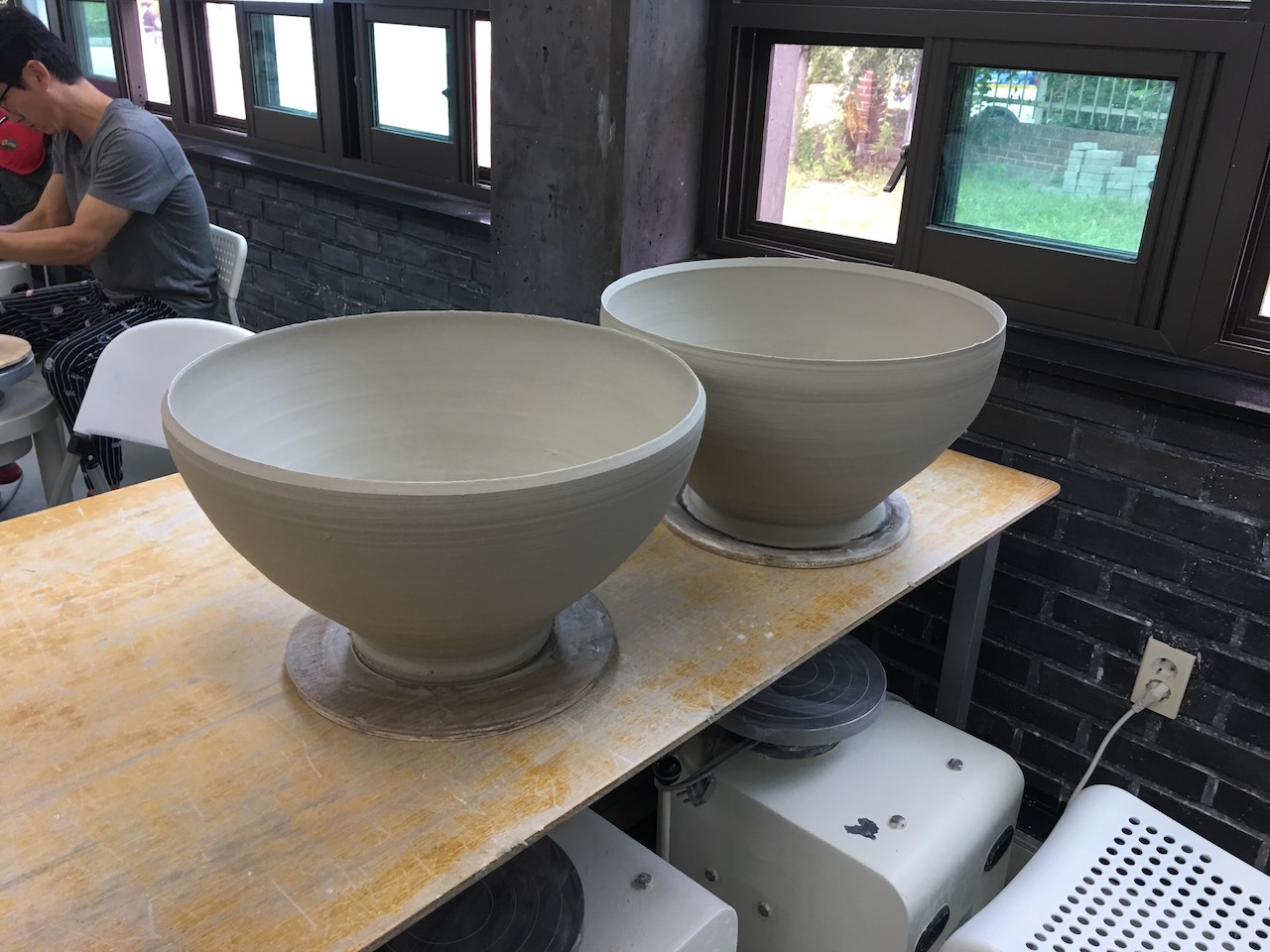
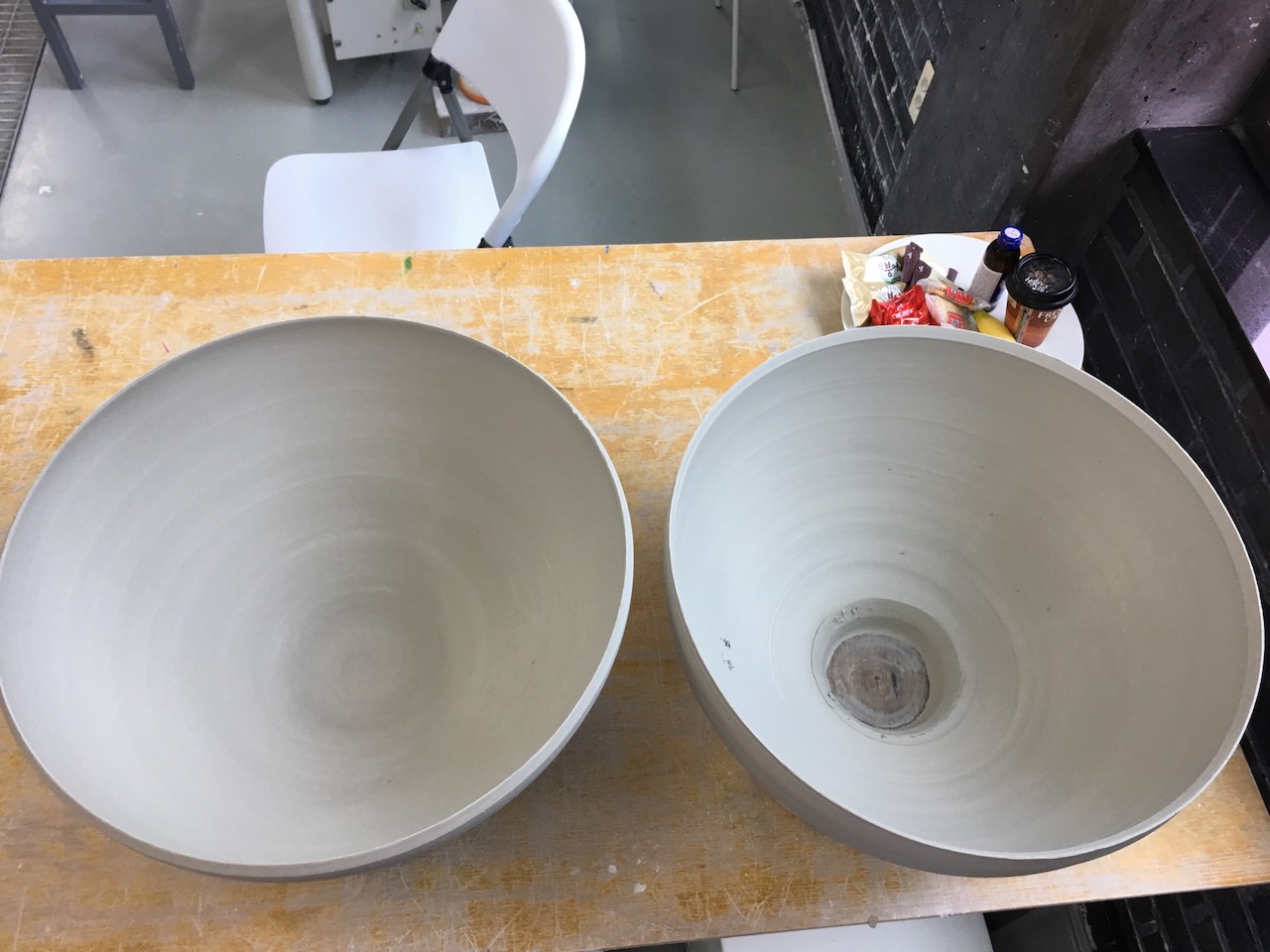
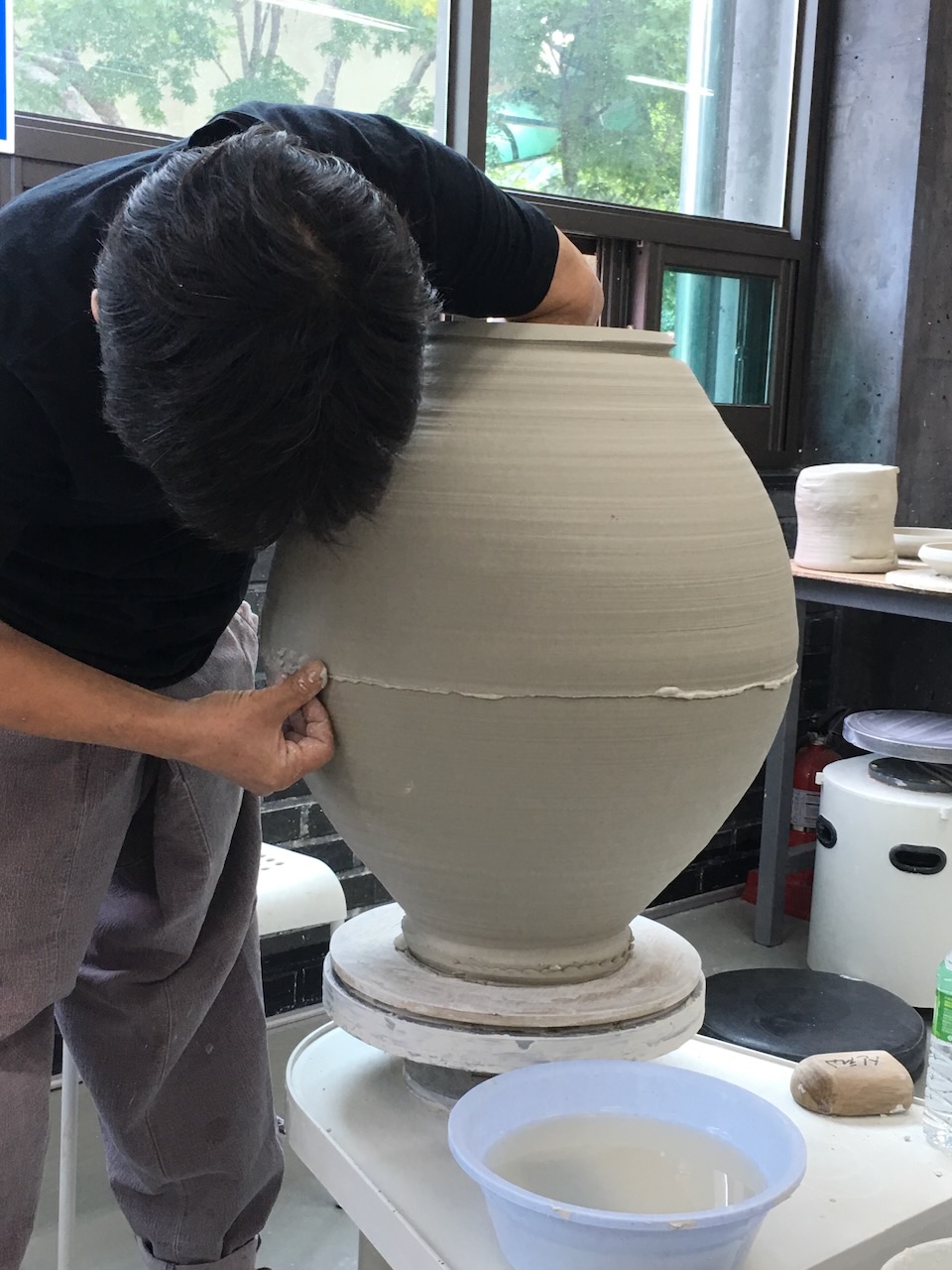
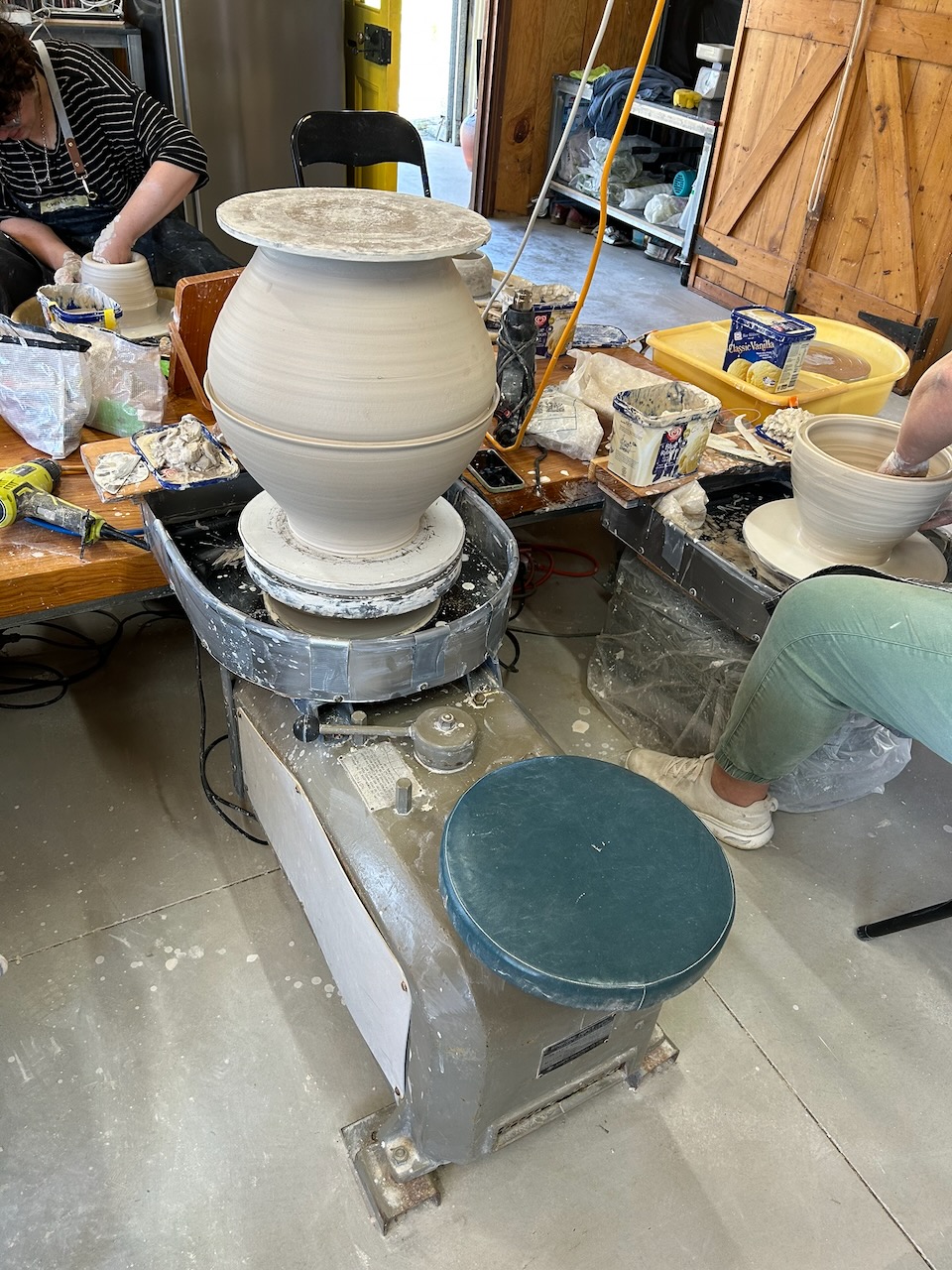
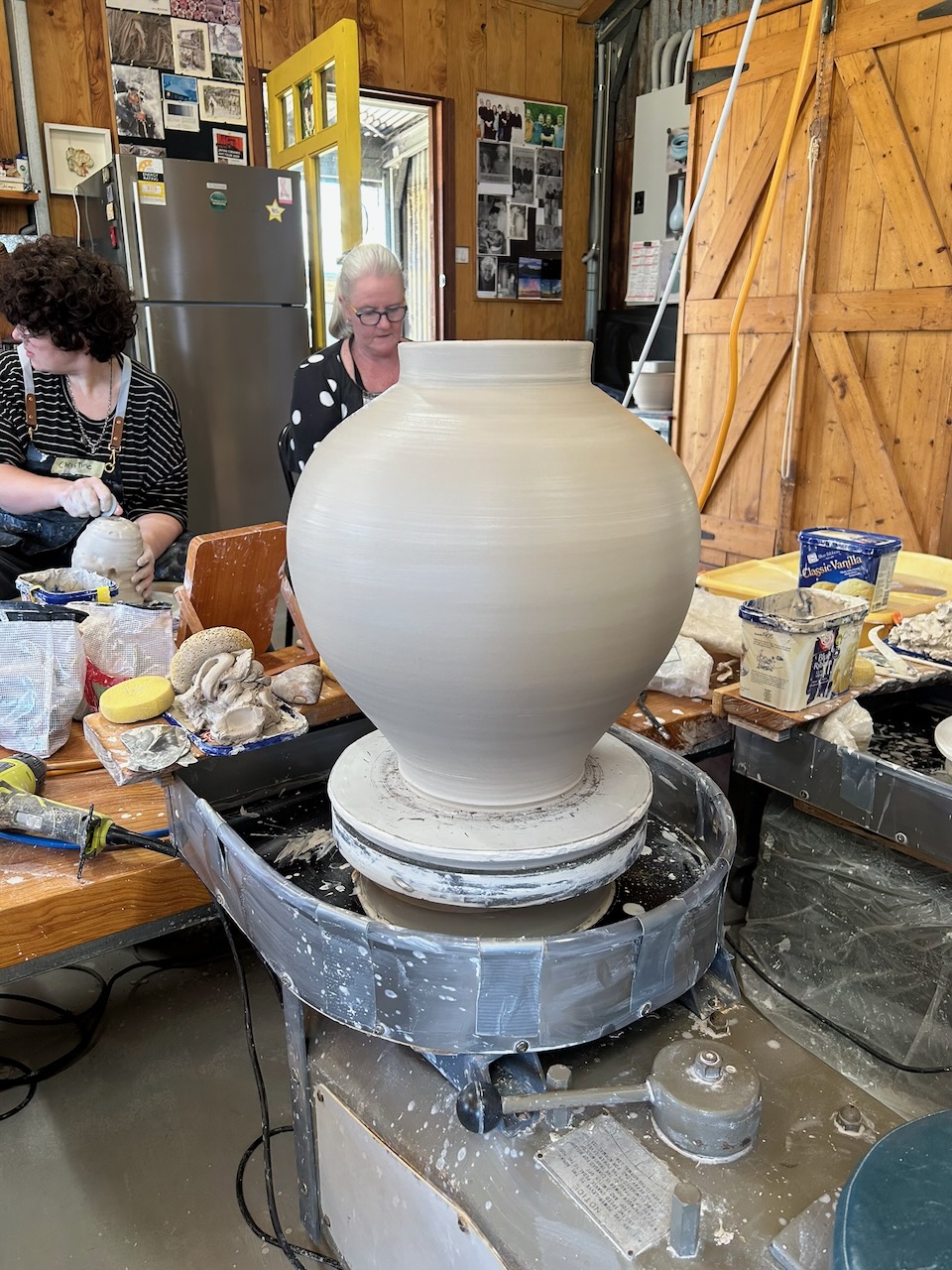
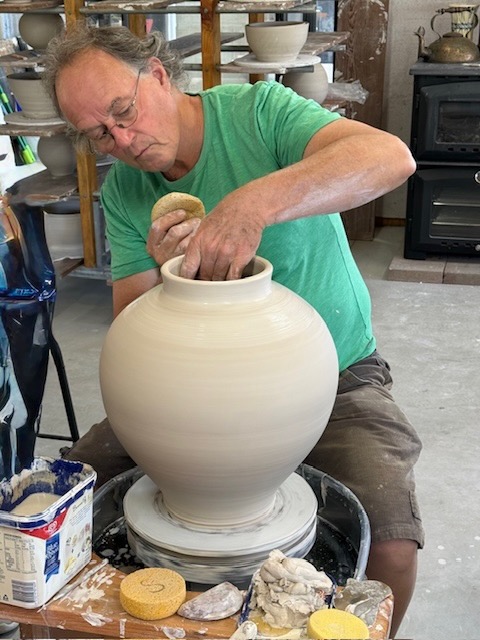
Top-hatting is a technique of placing one thrown form on top of another to make a larger pot than you might otherwise be able to throw in one piece. It can involve the stacking of multiple forms to gain extra height. Coil and Throw technique involves throwing a substantial base for the pot and then adding a coil of clay to the top and throwing that coil up to become the wall of the pot, extending the height. This technique can be repeated several times to make a taller pot.
We got such a massive response to my add that we could program 4 summer schools of 3 days each, and lined them up with a few days in-between. 2 in January and 2 more in February. As we only have 8 potters wheels in our workshop, and we got over 30 replies, that meant staging 4 consecutive schools.
I made up some clay specially designed for big pot throwing by joining techniques, slightly softer than usual and with added ‘tooth’ and ‘grit’ for structure and good drying and firing of the larger forms. I originally made 400kgs of clay, thinking that it would be sufficient for the 4 workshops, but I was way out in my estimations. The first two workshops used up nearly all of my stash, so I was back in the clay making shed the next day to make up another 400kgs for the next two in February. I like the clay to get a little age on it to improve its work-ability, 3 months would be good, 3 years even better, but needs as needs must. One month in this case will have to be enough.
Clay develops its plasticity by the intimate mixing of water molecules in-between the infinitesimally small clay particles. The best way to achieve this is to make a ‘slip’. A very watery mixture of clay and water, to get the water into, and in-between the clay crystals, which in their purest form are flat and hexagonal shapes. It takes a very long time for the water to penetrate the ‘pack of cards’ structure of the clay particles and individually flake off the crystals one at a time to get that intimate mixing of clay and water that is required to appreciate the very best potential of any particular clay.
I don’t have that luxury of time in this instance, so I am using powdered clay material that I bought in, in 25kg paper bags. I’m using a mixture of all Australian clays from Victoria, NSW and Qld. to get a good blend of the required properties that I need. It’s getting very difficult to buy Australian raw minerals and clays these days, as the multi-national mineral companies have bought up most of the clay mines and shut them down, forcing us to buy their imported products from overseas. We are not short of clay here, but we have been locked out of access to our own resources. Welcome to the future!
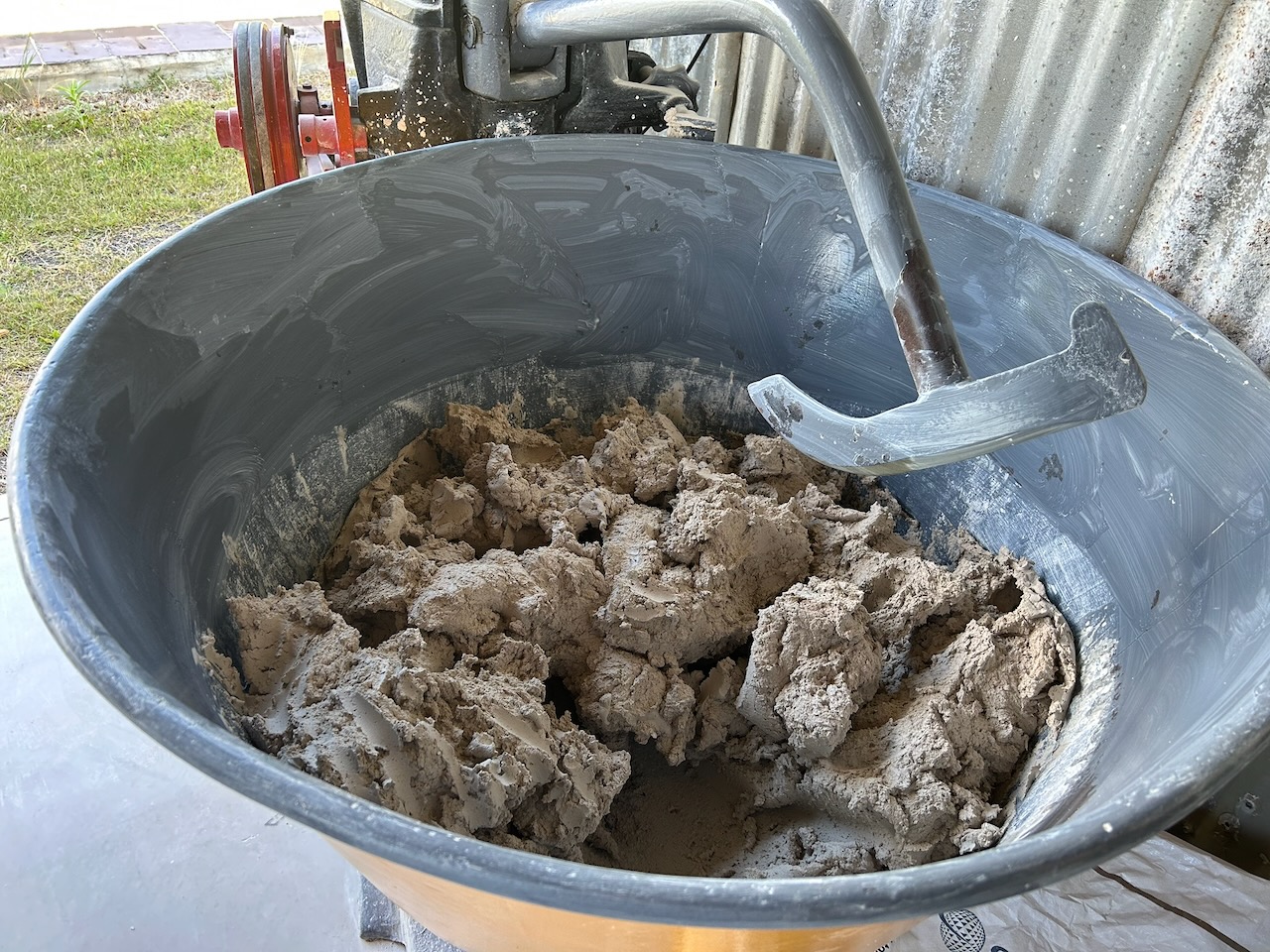
I mix the various minerals together in an old recycled bakery dough mixer. I have owned this machine for over 40 years. It has gone through 2 fires and been rebuilt each time. Luckily, it is very well made, mostly of cast iron frame, but the fabricated steel sheet bowl was very badly split and warped after the last fire and needed a lot of work to re build it, and get it back into action. see my blog post from 4/6/21 “Our Old Twice Burnt Dough Mixer Proves to be a ‘Phoenix’ mixer”. I use a blend of recycled clay slip and the new powders to get the best outcome that I can from this compromise of speed, quality and efficiency.
I use a few tricks of the trade to get the best possible result out of my available materials. I use water from the dam and rain water from the old pottery shed water tank that is full of gum leaves that creates a very useful tannic acid water that is ideal for making clay. It is a transparent pale grey and has a very low pH so that when mixed with white kaolin, it attaches to the clay particles and flocculates the clay mass, which settles tightly in the bucket leaving only crystal clear water on top. It is also ‘live’ as it has all sorts of microscopic organic matter and bacteria in there, which helps age the clay. City water that is full of chlorine is pretty much sterile and kills off any live matter that may help the clay mature and become more plastic and workable.
I have a ‘snorkel’ fitted to a fan in the wall that sucks all the fine dust out of the clay mixer room to keep me safe while I’m working in there, but I also wear protective gear as well. Afterwards, once the clay is all wetted, ‘plastic’ and ‘pugged’ into sausages. I cut all the ends off the stacked pugs and re-pug it all again to make sure that there is a consistent mix of all the 3 different batches of clay represented in each bag of finished clay body.
It is bagged and stacked to ‘age’ and the floor is wet mopped twice to collect all the clay dust off the floor and make the work space clean and safe again.
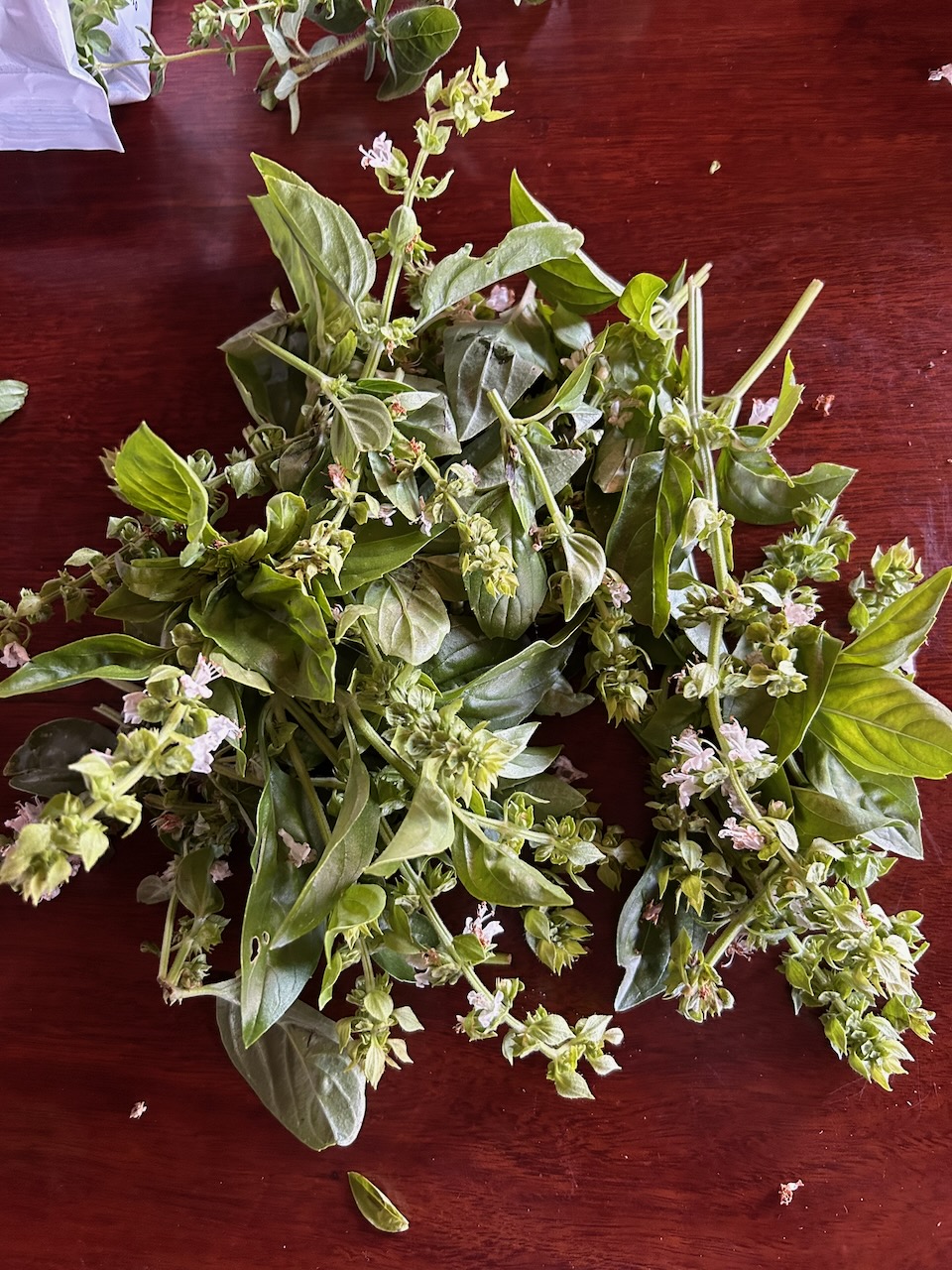
In the garden, we are picking the last of the blueberries, the first of the egg plants, and we are mid season for zucchinis. The tomatoes are coming on quite strong now and we have started to make our first batches of tomato passata for the summer. Every meal from now on will be some sort of variation of ratatouille in all its various forms. What else can we do when the garden is full to bursting with tomatoes, aubergines, zucchinis and basil? We try and give away as much as we can, but everyone in the village has an excess of tomatoes and zucchinis at this time of year.
Our breakfasts and deserts are mostly of fruit these days. November brings on the berries, December is the month of cherries and apricots, January for plums and peaches, February is all about apples and March for the last of the pears.
We have filled 3 summer school workshops of three days each, learning coil and throw, plus top-hatting techniques. It’s a kind of hybrid combination of of hand building on the wheel.
I have 4 more names on my waiting list, for a 4th workshop during the 2nd week of February, 7th, 8th and 9th of Feb.
If you are interested, there a still 4 places left. Please let us know if you are interested.
If we can get 8 names on the list, then we will run the 4th workshop. Then that will be it for the year as far as coil and throw technique is concerned. In March or April, we may do throwing flatware, dishes, plates and platters. Then possibly a glaze workshop concentrating locally sourced and collected stones, gravels and ashes.
The second workshop on the 11th to the 13th of January is also now FULL
I have started a new waiting list for a third workshop for sometime early in February, yet to be determined. I already have 3 names, but need 8 to run the course.
Janine, Len Smith and I will be offering a 3 day throwing workshop over the summer break. Jan 6th to 8th.
We will be teaching throwing techniques for beginners and intermediate level, aimed at making larger forms.
This is NOT a Masterclass for advanced throwers. This workshop is aimed at beginner to intermediate level.
You will need to be able to center clay on the wheel, from there on we will help you make some larger forms, demonstrating exercises to give you confidence to tackle slightly larger projects. Progressing from whatever your current level of skill is.
I will be demonstrating a series of techniques such as top hatting and coil and throw building techniques.
We will also be demonstrating construction techniques, assembling your thrown sections together to build slightly more complex or larger pieces. We will help you work at your own pace to gain confidence and increase the complexity of your forms, or the height and scale of your pots, as you choose.
The workshop runs for three days from 10 till 4pm on Monday 6th of January to Wednesday 8th of January.
Clay is provided, you will need to bring your throwing tools and lots of batts, a dozen or more. If you own an electrical heat gun, you can bring it along with your tools.
Tea and coffee are provided, please bring something to share for lunch.
Numbers are Limited, as we only have 8 wheels in the studio. First in best dressed.
Cost $375 for three days. Enrollment is confirmed after payment is made.
Here we are in the first week of spring and the hot weather was very welcome, but unseasonably hot for this time of year. Just more evidence of global heating and what’s in store for us in the future?
I have given the peaches, nectarines and almonds a 2nd spray of copper Bordeaux mix to try and minimise leaf curl and shot hole fungus spores. It needs to be done once a month during the growing season. Actually, the recommendation is for every 10 days, but who has the time? And too much copper spray drift can build up in the soil and become toxic over long periods of time. So I just do the minimum.
I don’t think that I can ever eliminate it here, just keep it under control to minimise the damage. The trees don’t seem to suffer from it too much later in the season. Perhaps it has a lot to do with the cold damp nights in early spring?
Because of the warm weather. I planted out tomatoes, zucchinis and cucumber seedlings. Plus peas, beans, sweet basil, lettuce and radish seeds. Then last night we had a cracking frost. The Weather Bureau only forecast 2 degrees for Bowral, our nearest town with a weather station, and we are usually one or two degrees warmer than that. But not so last night. However, I checked the seedlings and they are all OK in the protective cocoon of the plastic bird netting frames that cover both the orchard and vegetable garden. Lucky!
The Flanders poppies have now started to open and will be with us for the next few months. They need disturbed soil to germinate, so do best in the vegetable garden, because the soil is regularly turned over while weeding and planting. I established them in the new orchard and they did well for the first year, but as I haven’t cultivated in there since, only mown, all their seeds are lying dormant in the soil, with no new plants germinating in there.
The Cherry trees are in full bloom now as is the avocado tree. Every thing is responding to the warmth. There is so much optimism in the air now. Life is returning to all the formally dormant plants. I took a picture of the lawn behind the house. I use the term ‘lawn’ very loosely. It is actually a stretch of self sown wild grasses and weeds that we keep mown. This stretch of mown weeds has just erupted on a blue haze of tiny flowers in huge swathes. The flowers are microscopic, but there are millions of them. I tired to photograph it, but the effect on the light out there just doesn’t show up a clearly in the image. Janine tells me that it is called ’Speedwell’, but our neighbour, John Meredith used to call it ’The blue pimpernel’. What ever it is, it’s very pretty on mass.
We have just completed the last of 5 in a row, weekend workshops. Quite a busy time for us. It’s nice to have a bit of ’spare’ time now, so I’m back in the garden, just in time for spring. The asparagus is just starting to pop up, just a few at a time, here and there. The real season is still a couple of weeks off as yet, but I’m picking the biggest ones to have with our breakfast eggs.
Now that I have just a smidgen of spare time, I have mended the old wheel barrow. We bought this wheel barrow in 1976 or ’77? More or less the first year that we arrived here. We had worn out two 2nd hand ones previously. Purchasing this one was a real statement of ‘We have arrived, and we intend to cultivate this derelict place’. The bottom got rather scratched over the years and had started to rust out, becoming wafer thin and flimsy. I hate to see waste, so I stepped in and made a new base plate for the tray and fitted new bearings into the wheel hub. It’s all good for another couple of years till the next part wears out.
You must be logged in to post a comment.