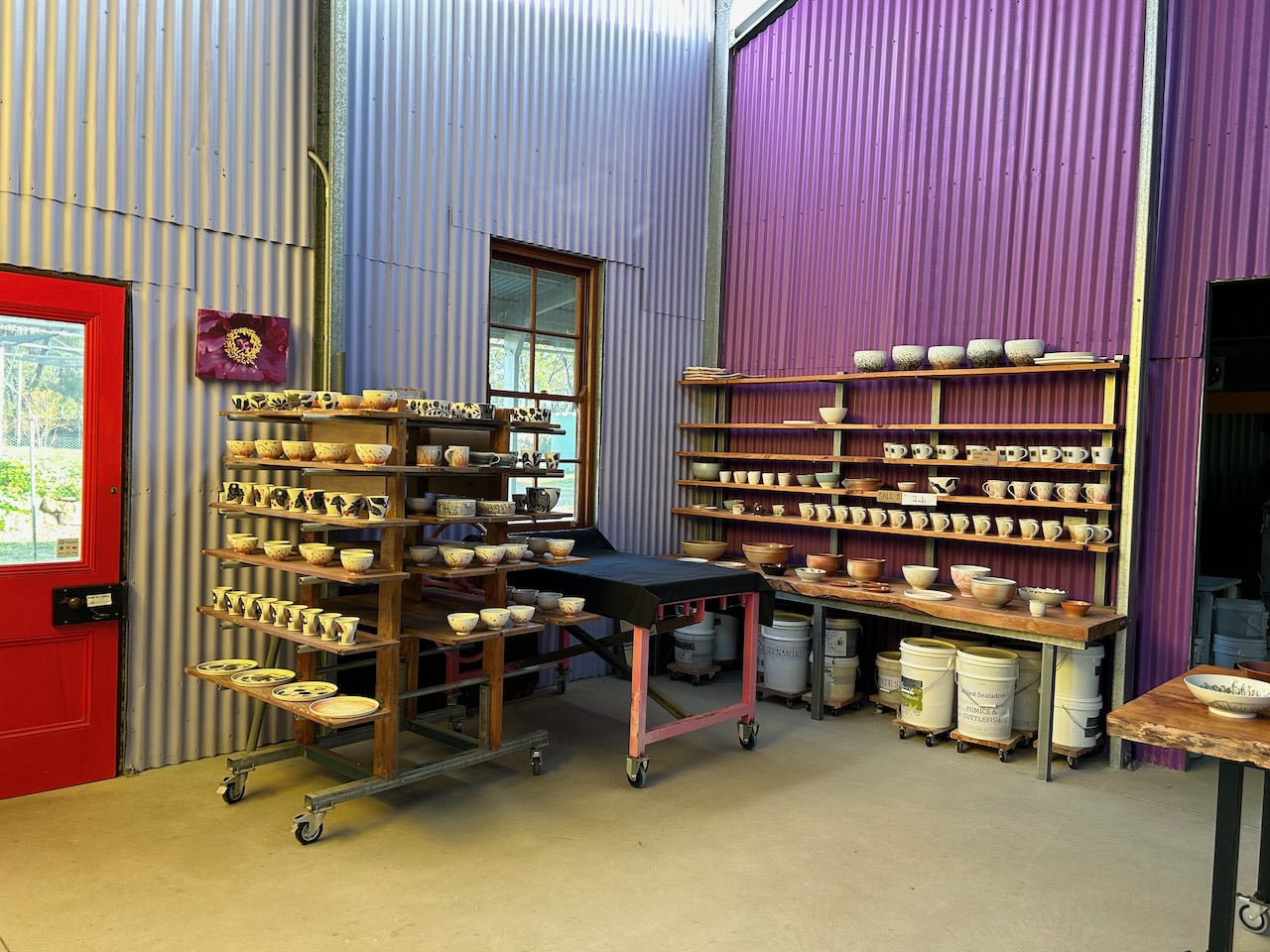
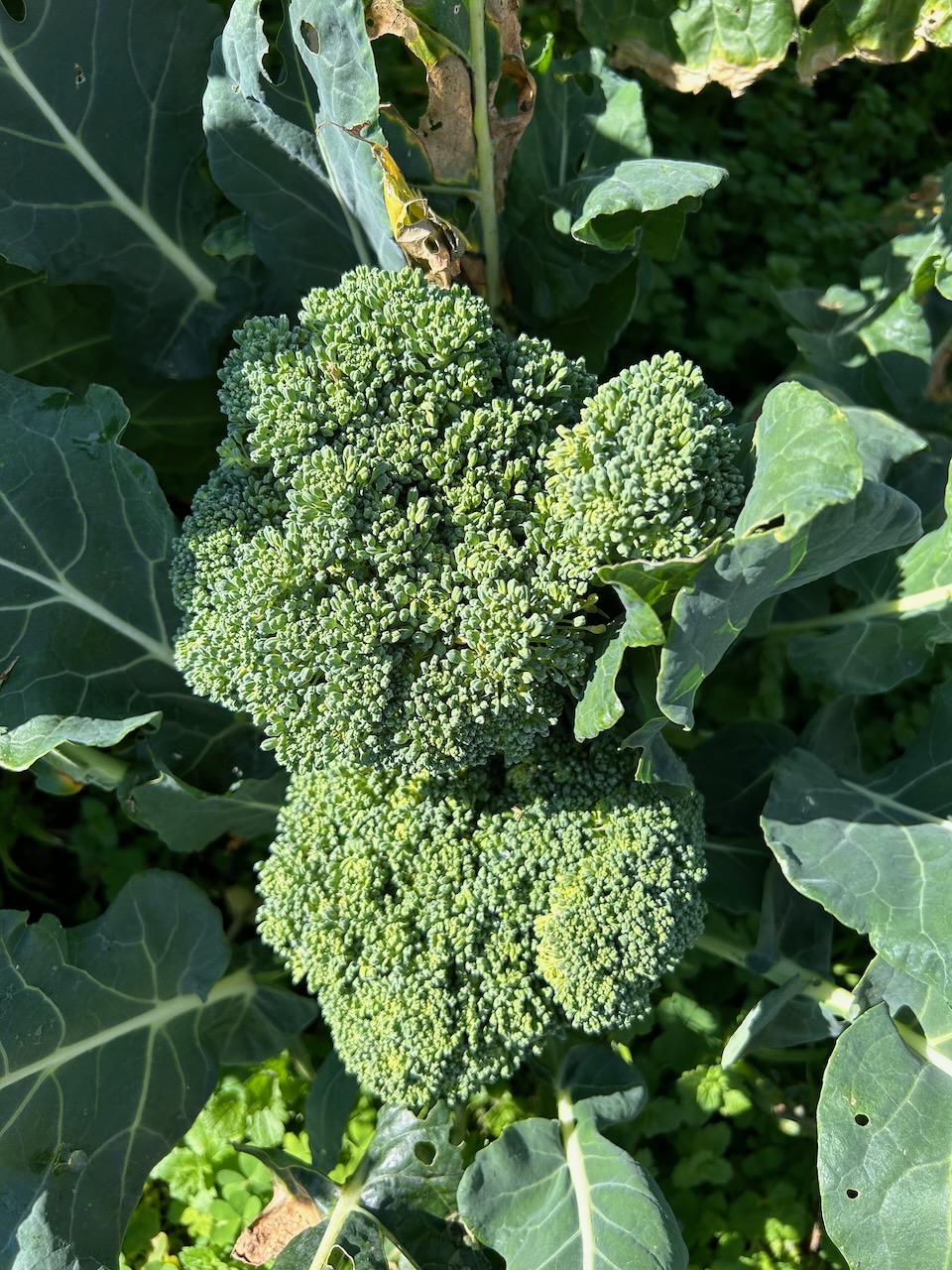
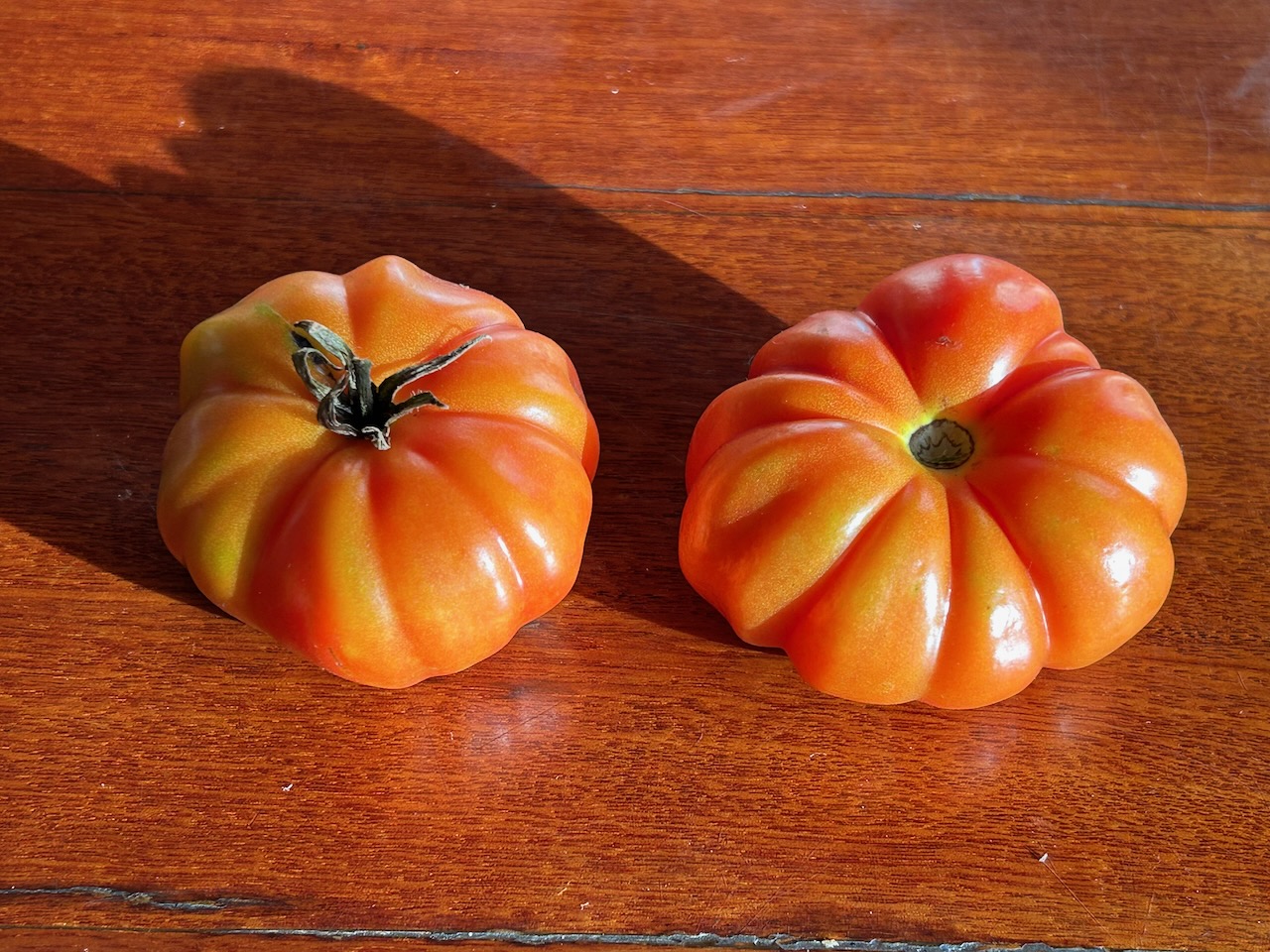
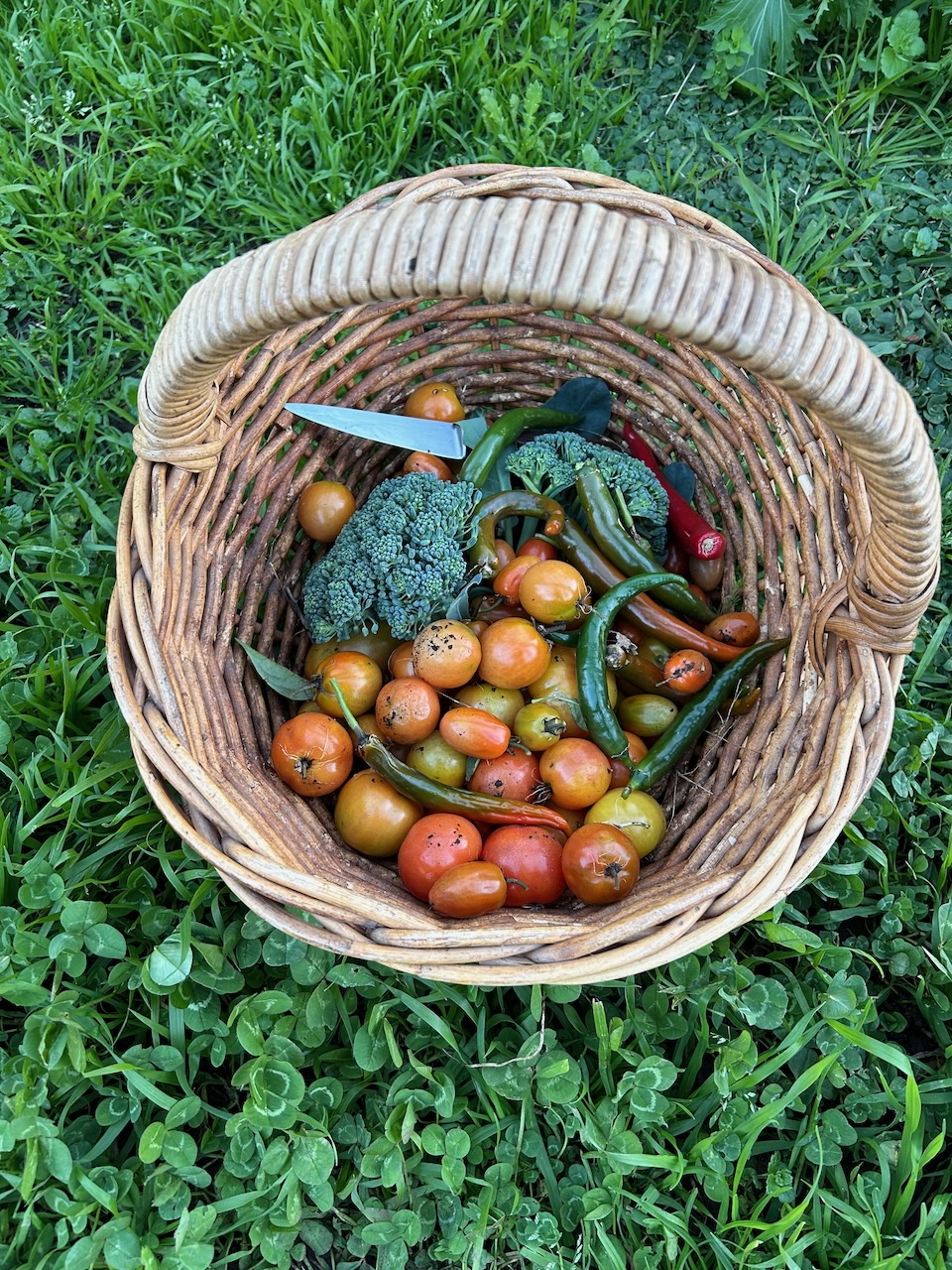
The shelves have been re-stocked. The Pan Forte cake is mixed and is ready to bake. The coffee is freshly ground.
We are ready for the 2nd Open Studio Sale Weekend starting tomorrow. What could possibly go wrong? Hopefully nothing, as we had 22mm of rain yesterday which has freshened up the garden and topped up the water tanks.
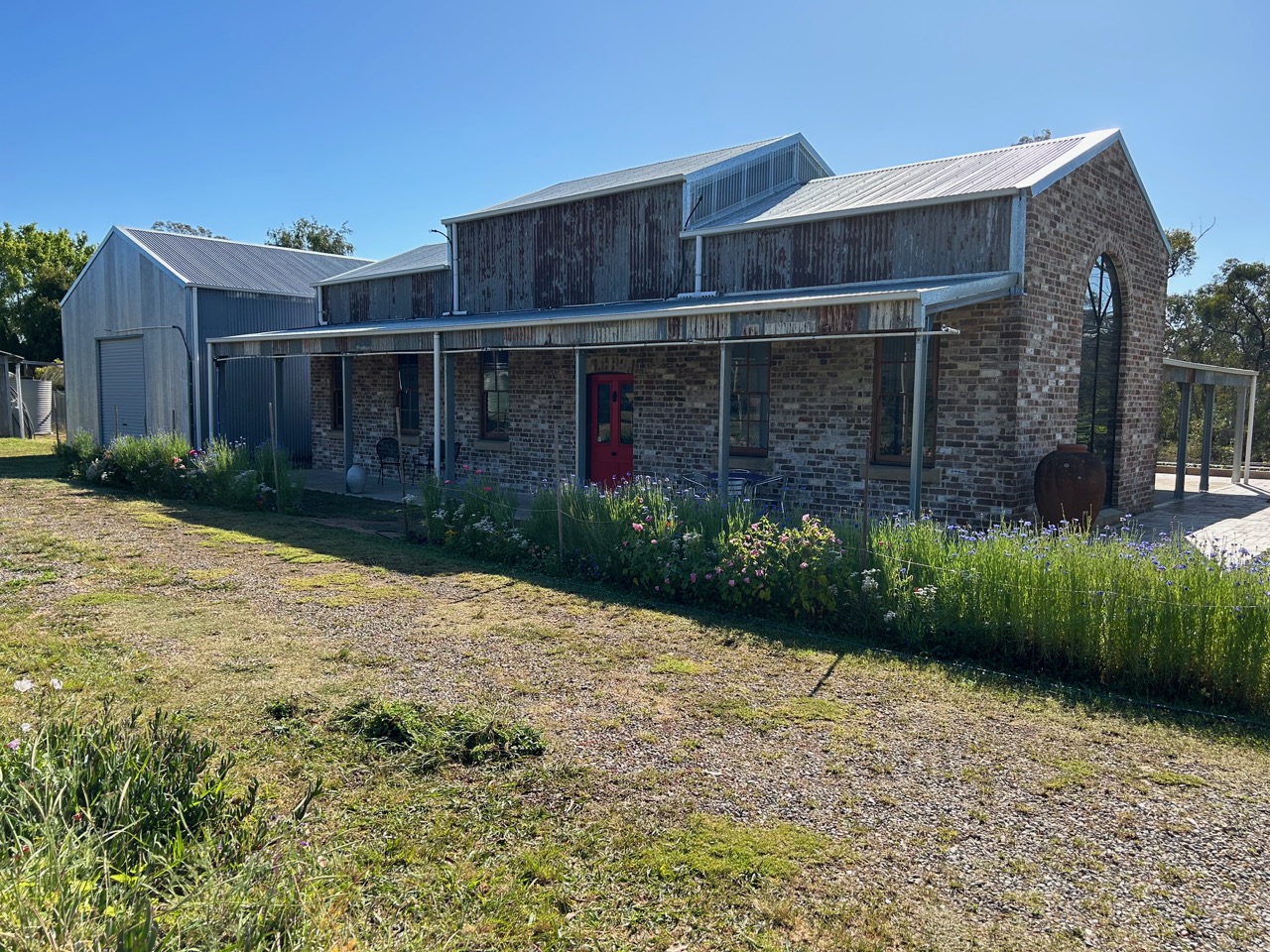
Today started with a heavy mist from yesterdays rain. Regrettably, the rain wasn’t strong enough to flood the gutters and pour down the dirt road and flow into our dam. Most of it soaked in, but that is also very good for the garden and all our fruit trees, some of which had started to drop fruit in the prolonged dry spell. The lawn had turned brown and started to ’crunch’ underfoot it was so dry. However, it is amazing what a little rain will do. What was left of the burnt off grass has turned to a flush of green again over night. One blessing is that as it is only millimetres high, it doesn’t need mowing. There is always a bright side. The welcome rain has watered the english cottage garden flowers along the front of the pottery, so everything is looking bright and perky.
All the shelves are full and the gallery is looking good.
Call in and see us over the weekend if you are in the area. Stop for some cake and coffee if you have time, we’d love to catch up.
The veggie garden has been woefully neglected recently. It still feeds us well from our previous plantings, but because we were away for a lot of August and September. It was pointless planting any seeds in such dry weather, and then not being here to water and nurture them. So we missed out on our spring planting this year. I would normally have started seeds off in mid to late August, and then planted out in late September while keeping an eye on the frosts and possibly using our portable home made closh system of wire and shrink-wrap frames. However, as we have been so busy since our return, I have only just found time to work in the garden again. i found time in-between pumping water uphill to weed out and replant a few beds.
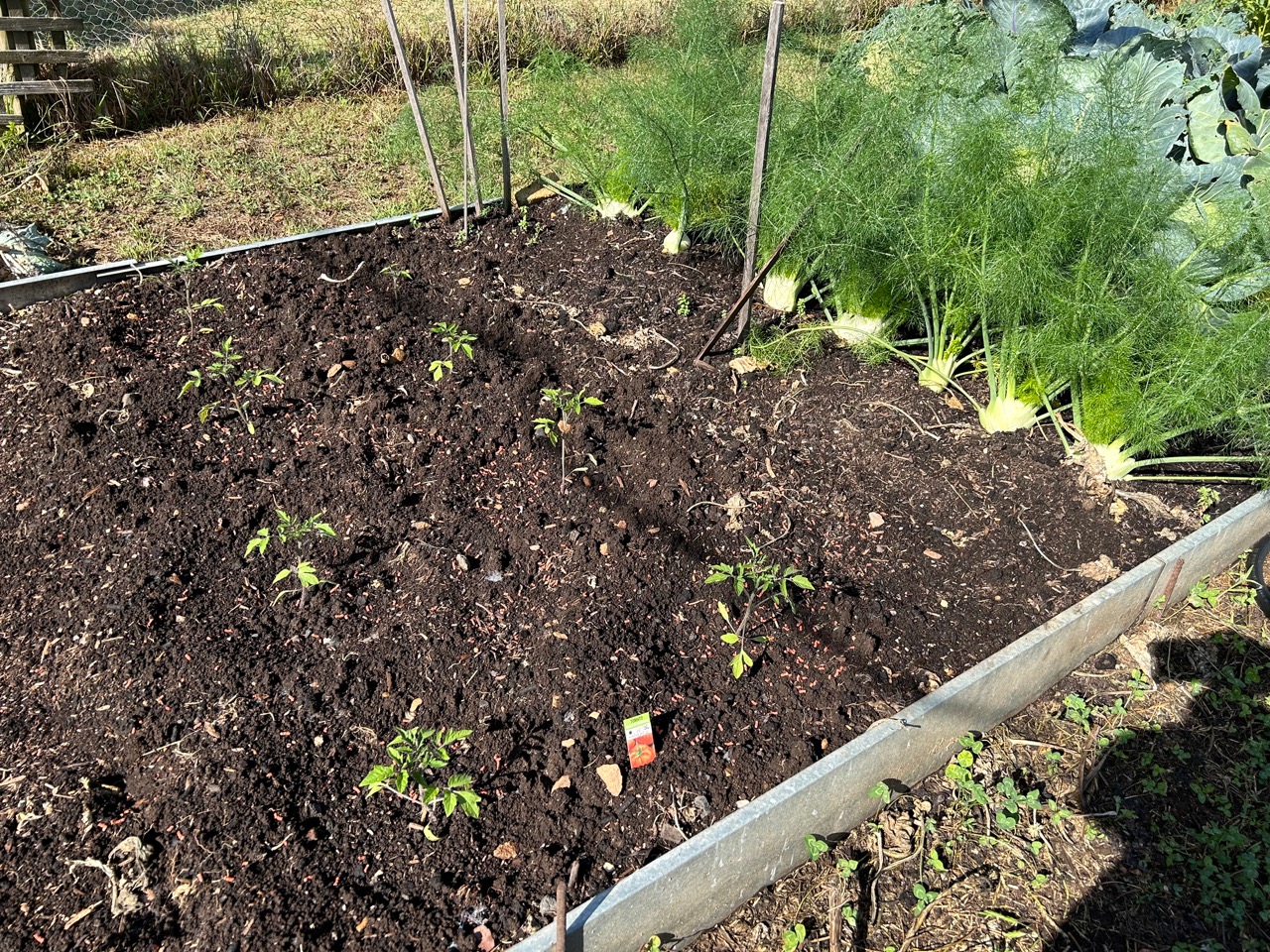
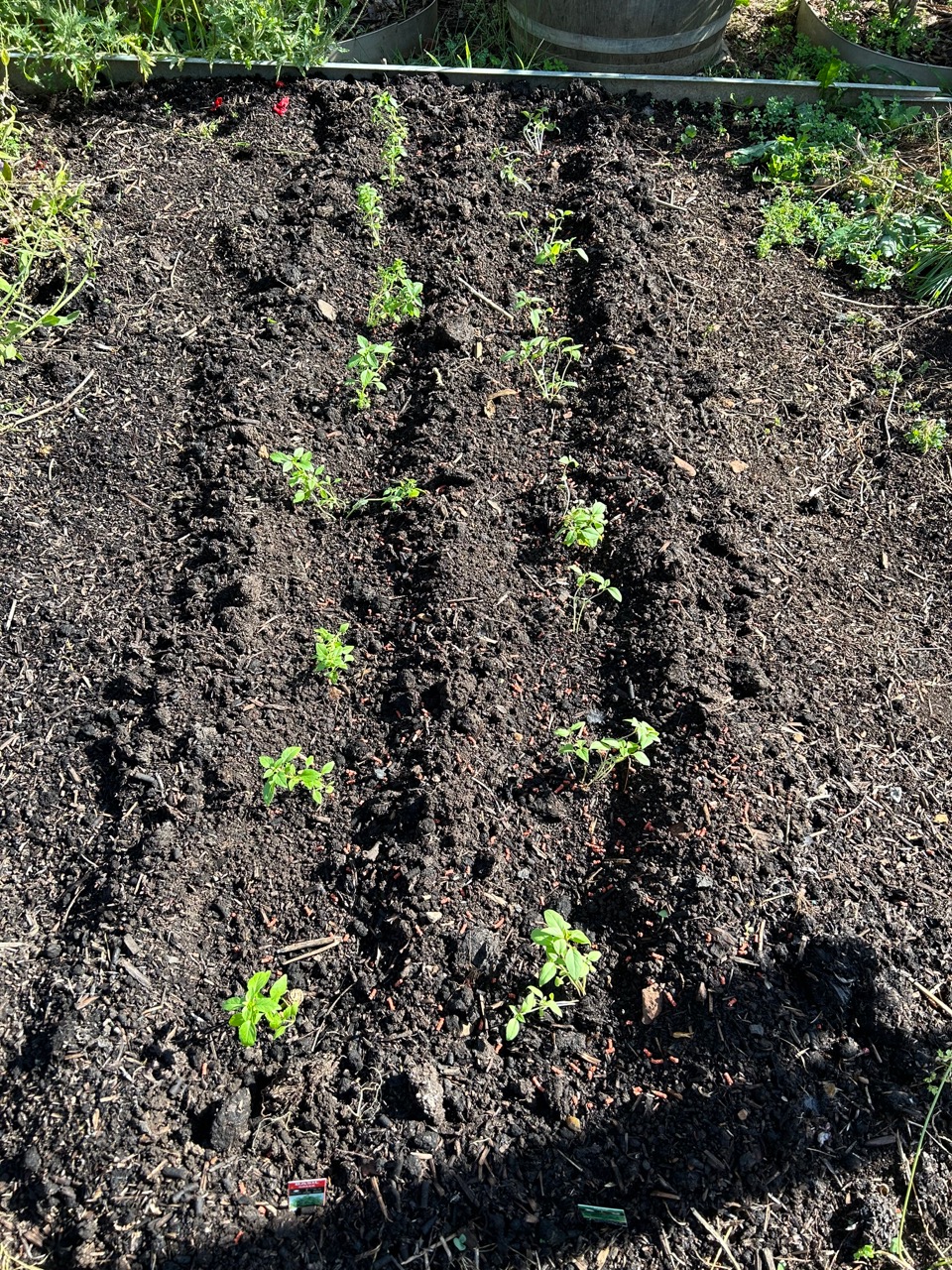
I have had to resort to buying seedlings in punnets this year, so as to get some advanced tomatoes in the ground, along with zucchini, egg plants and lettuce. I also planted out seeds of the same for a follow up planting in December. It will be a smaller vegetable garden this summer. But you can’t do everything.
Buying punnets is a bit of a come-down, but I’m only human and needs as needs must. My own home grown seedlings are on their way.
Nothing is ever finished, nothing is perfect, and nothing lasts. Enjoy the moment.
The first Open Studio Weekend is over. One more to go!
We had a very slow day on the Saturday, as it was raining hard on both sides of us in Picton and Bowral. So visitors were reluctant to leave home, and few and far between. We had just a few brave people venture out. One visitor from Picton had gone to an Open Garden event, but it was so miserable in the pouring rain, that she gave up and decided to come and visit us for some indoor, dry and warm, entertainment.
The Sunday Open Studio was much better, quiet in the morning, but it picked up after lunch and we were almost busy dealing with a steady flow of visitors in the afternoon. We hope for better weather and more visitors next weekend. However, if it is going to rain, I’d prefer it to pour down, flood the gutters and stream down into the dam.
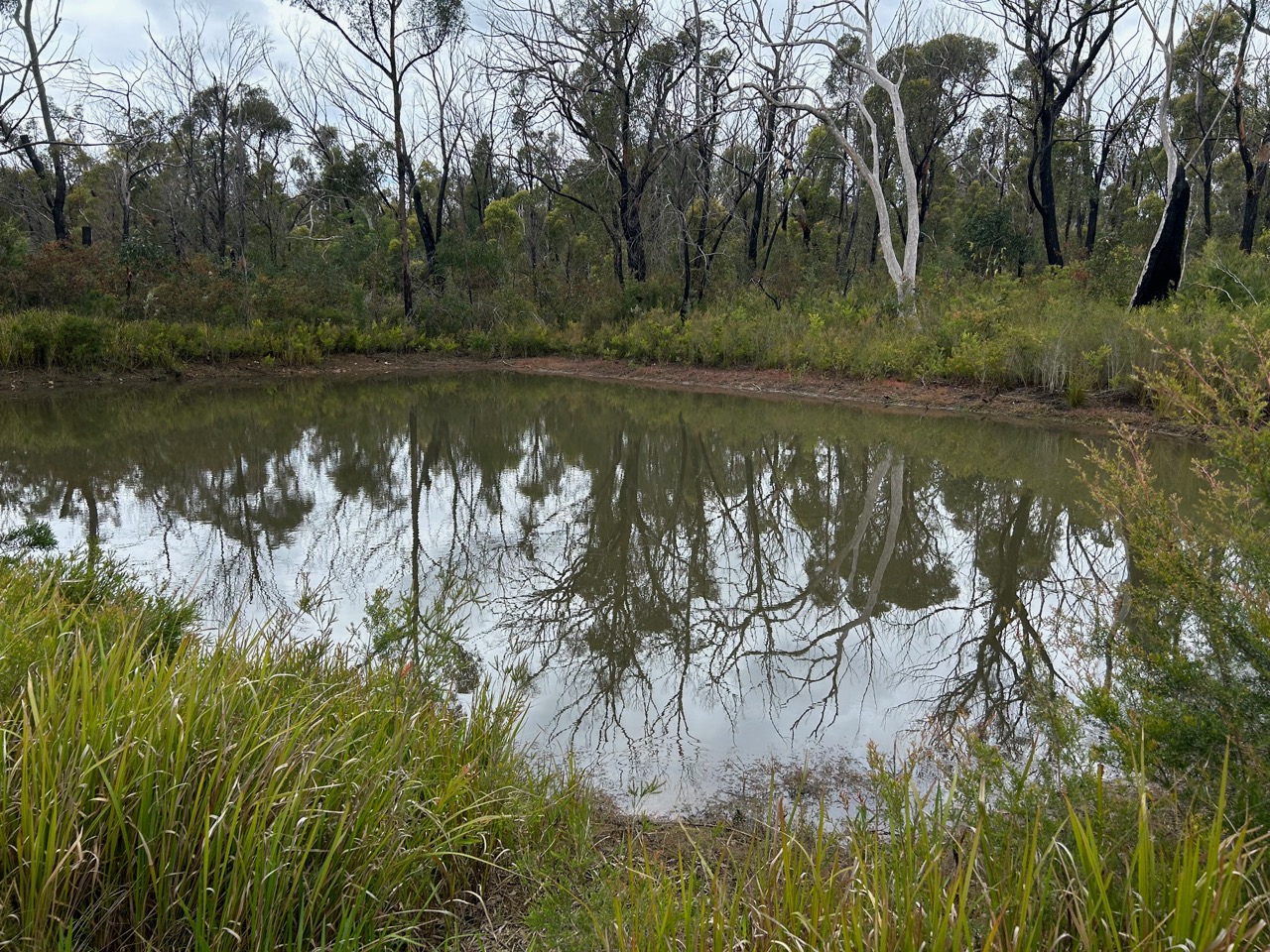
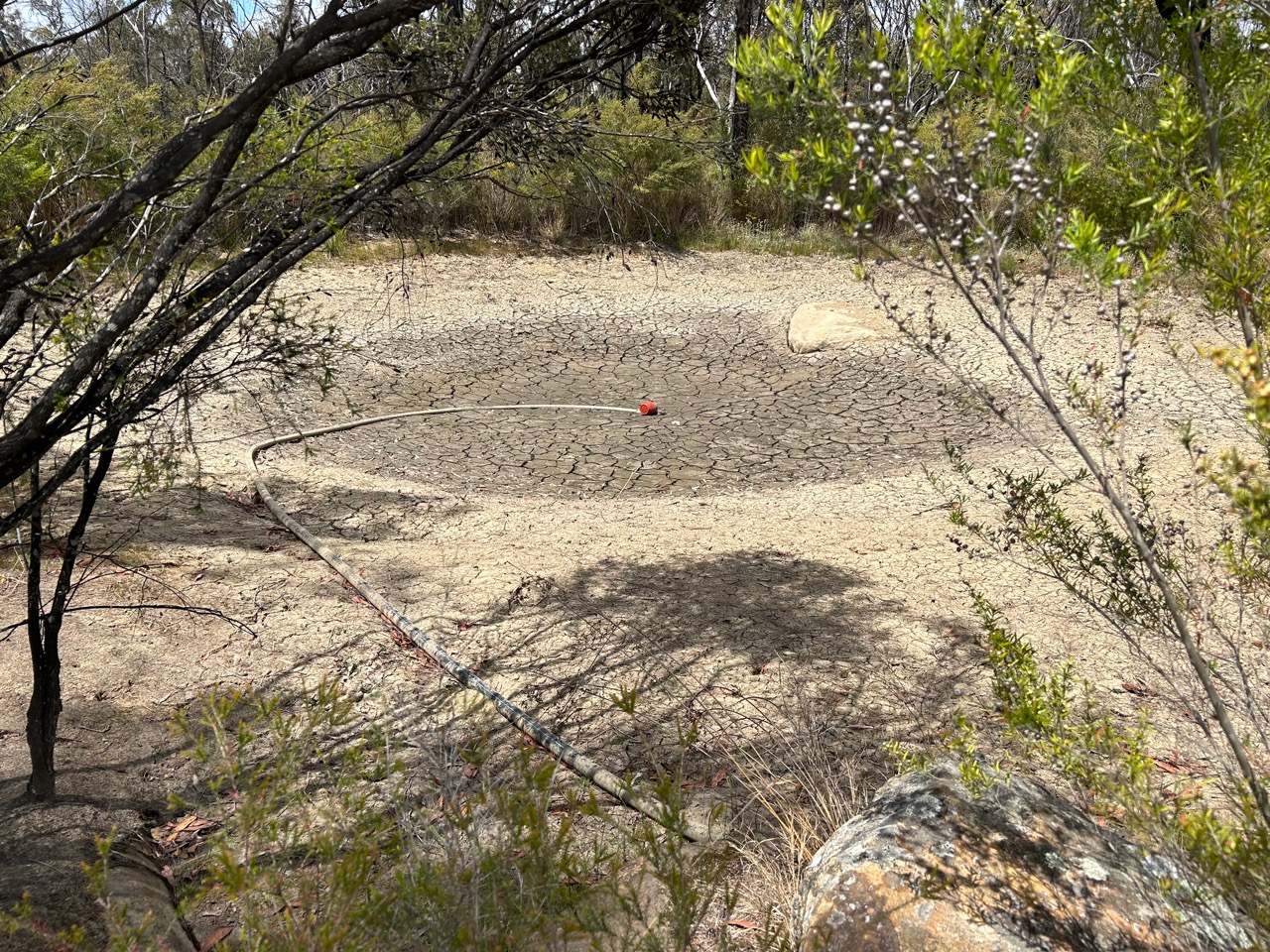
Of course, as usual, it didn’t rain here at all, just a few light passing showers throughout the day. Our top dam, the one closest to the house, that rely on for irrigation and fire fighting water is bone dry. The foot valve for the pump is sitting high and dry on top of the caked and cracked mud. This dam still had a very small amount of water in it when we left for our time away in New Caledonia and then Brisbane. However, we got a call from our lovely neighbour one day to tell us that she had tried to water the garden for us, but no water was coming out of the hose. I knew knew why. I expected it to run out and dry up at any moment. but there was nothing that I could do at a distance.
Starting on the Monday morning, with the news of so many houses burnt down in the north of the state in the terrible bush fire there. I wasted no time in preparing ourselves for the next bushfire – whenever it happens. Maybe sooner than later? With the bushfire season now upon us in earnest. I was straight into action working on all those jobs that I had put off during the recent three wet years.
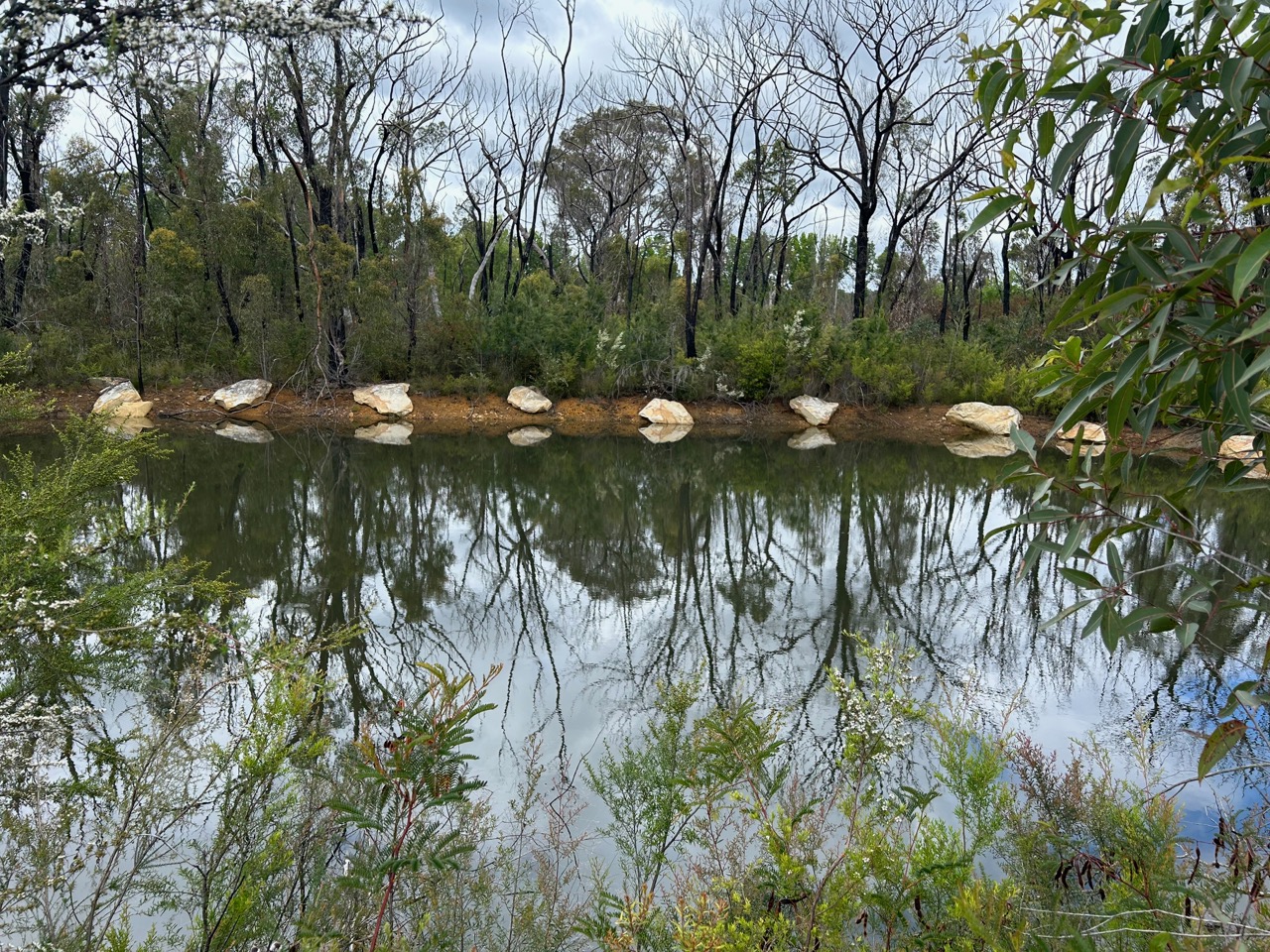
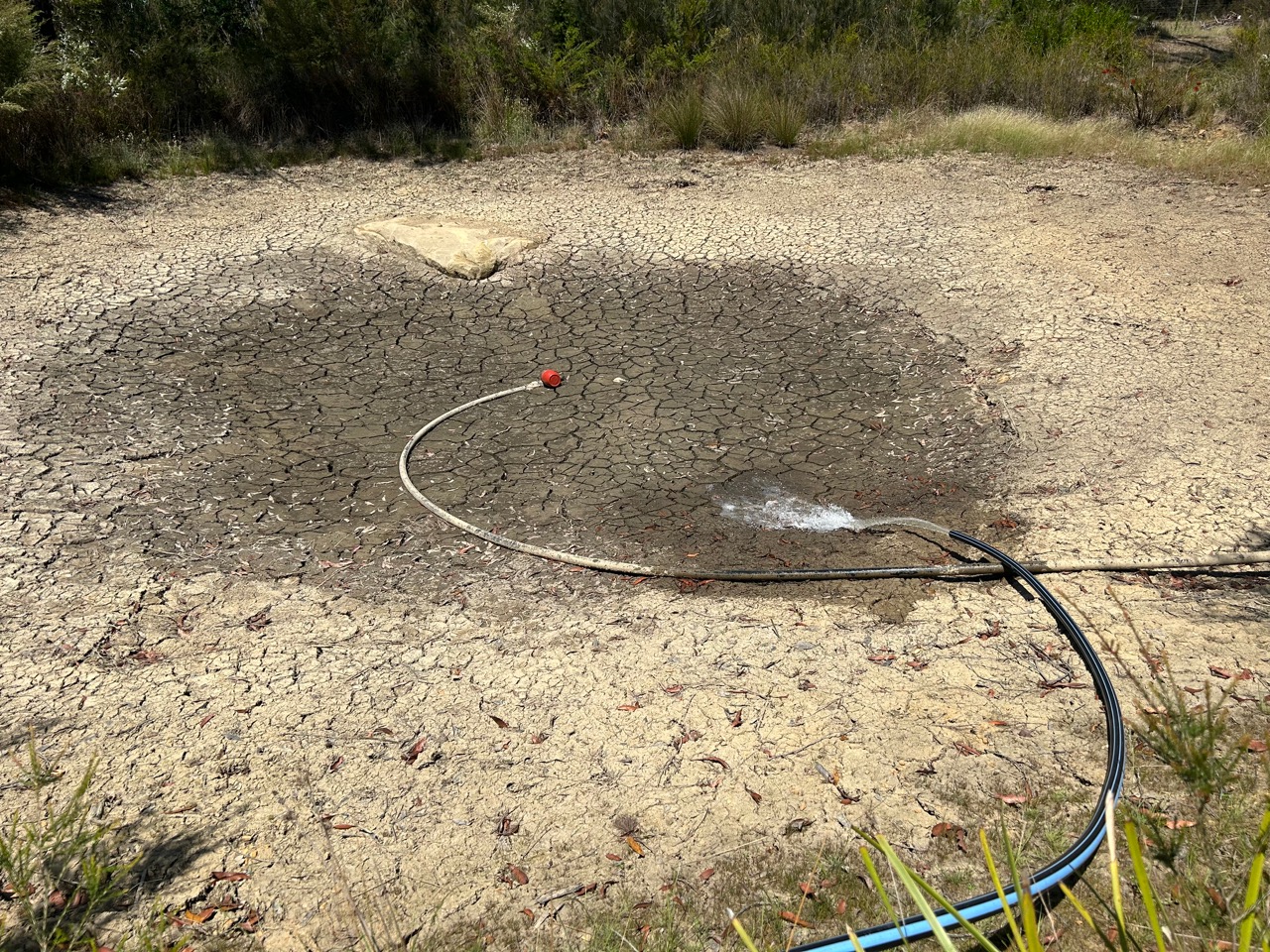
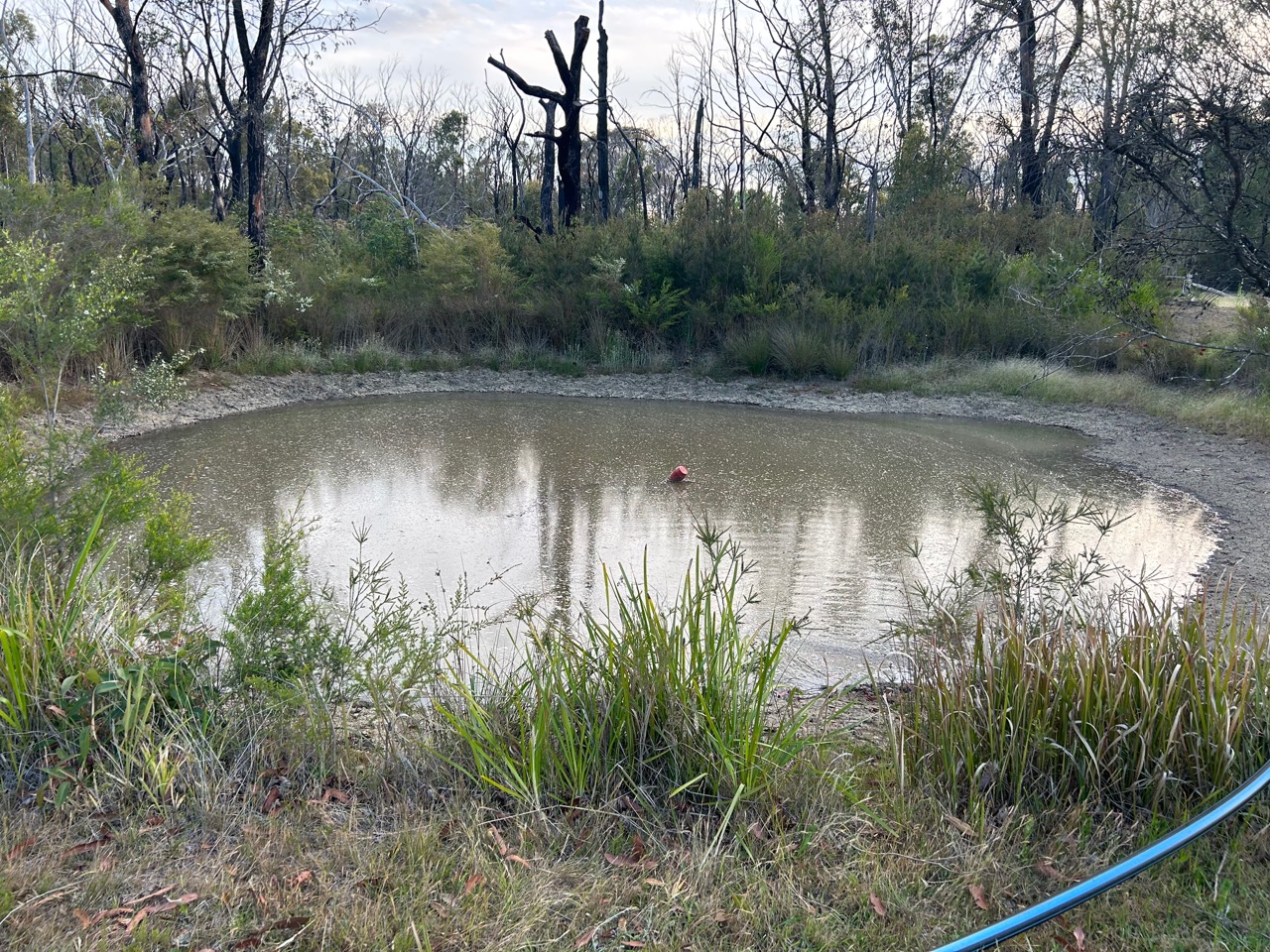
We have 4 dams, built in a key-line system. I moved the high pressure, petrol driven, fire fighting pump, down into the bottom dam, which is nearly empty, but still has some water in it, right at the bottom. I built a jerry-rig, improvised system of poly pipe lines to convey the water from this little bottom dam, up to the larger, middle dam. A day of running the pump moved most of the water up the hill to the next dam. I left just 300 mm of water in the bottom of that dam for the yabbies, to keep them safe over summer. If it does dry out completely, they will bury them selves in the mud.
From the bottom dam, up to the middle dam. This larger middle dam also has next to nothing in it, just 300mm deep in the middle, but every drop counts in summer. Especially when a bush fire is in the offing.
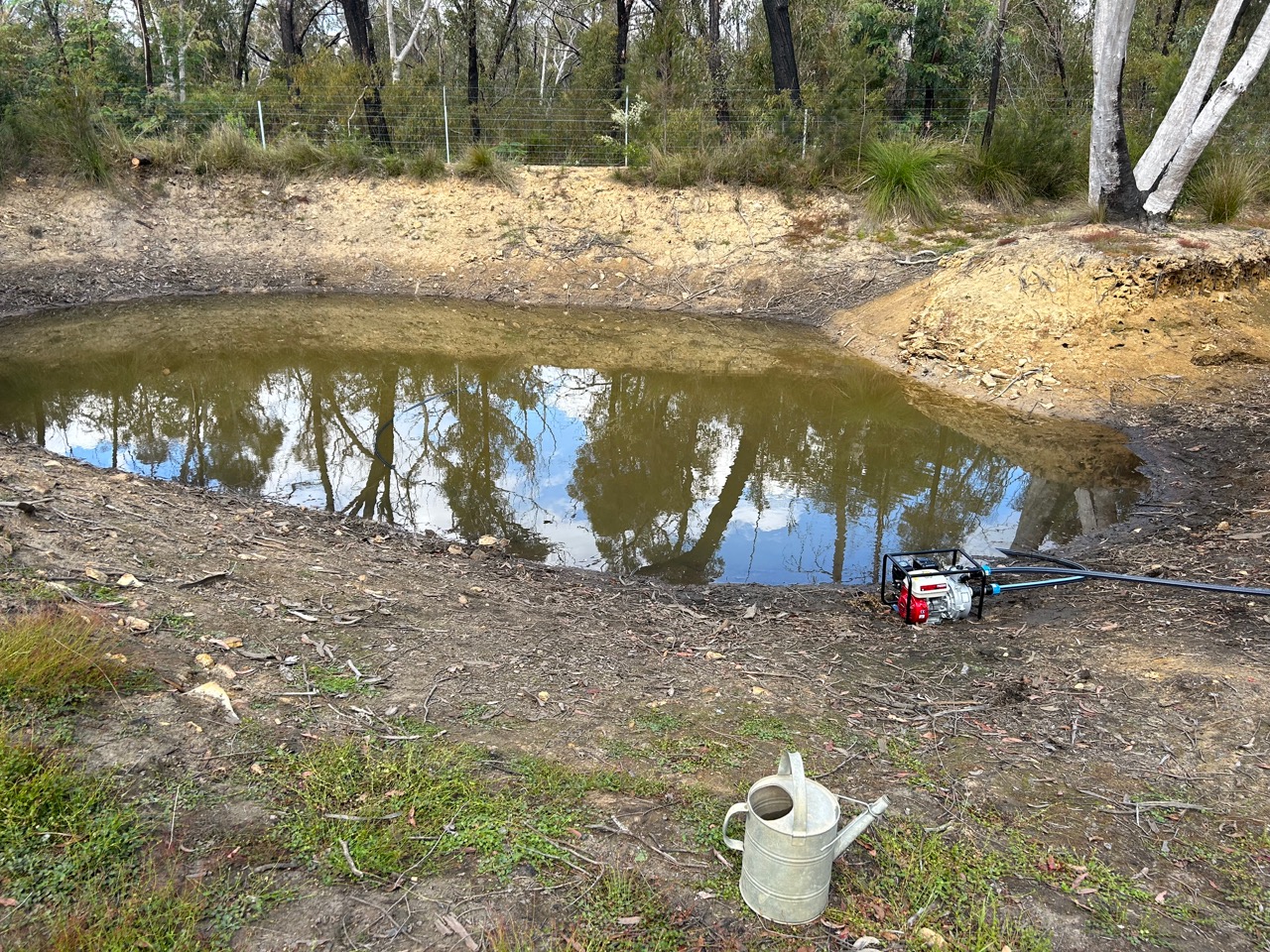
Neither the bottom dam or the middle dam, has a functioning pump on them at the moment, so moving all the available water up to the top dam, where I have both petrol and electric pumps installed gives me access to whatever water is left to us over the hot dry summer for fire fighting. Also, concentrating all our water in one place minimises the losses from evaporation.
Once the bottom dam was more or less empty. I carried the petrol pump up and into the middle dam, re-arranged all my Heath Robinson, improvised piping and began pumping from the middle up to the top dam. I’ve been on my very own personal, localised, ‘Snowy Hydo 2′ project here for two days now and all the water hasn’t been relocated yet. It’s a slow job, moving thousands of litres of water, up hill through a 40mm dia pipe. I hope to finish it off tomorrow.
From the middle dam up to the top dam.
The little top dam is now half full with all the accumulated water from the other dams, it will keep us safe into January. Then?
While all this was going on. I was also working on the new fire fighting sprinkler system along the verandah and roof of the new pottery building, and also rebuilding the burnt out sprinkler system on the barn. It worked perfectly during the fire, and saved the barn for burning, but when the power failed and the electric pump stopped, the plastic pipe system melted. I will be installing a petrol driven, high pressure, fire fighting pump in this system when I’ve finished pumping all the dam water uphill.
The roof and wall sprinklers all rebuilt and up and running again now.
Nothing is perfect. Nothing is ever finished, and nothing lasts.
However, I feel safer knowing that I have water in the system available to use to fight the next fire,
and a reasonably functional system in place that I hope will be able to cope with whatever nature throws at us
I make sure that I use the fire pumps often over the summer months to irrigate the garden and orchards.
In this way, I always know that the pumps are in reliable working order, then if one of them gives some trouble with the irrigation, I can step in and fix it well before there is any emergency, when there is no time for fixing things. Everything must work perfectly and immediately.
Since the last fire 4 years ago, I have installed 45,000 litres of tanks in front of the Barn, dedicated to the fire pump for the pottery and barn system. I have also installed 30,000 litres of new water storage tanks on the old Railway Station and car port with its own fire pump.
We are much better prepared now than we were 4 years ago. This is self reliance!
As the weather has been cold. We decided to have a baked dinner. This months meat meal is a very small piece of fillet steak.
Baked with a load of vegetables from the winter garden, and of course, a Yorkshire pudding in the old fashioned tradition of using all the meat juices from the baking pan. The proper way! After baking, the meat is placed in the warming oven to rest, while the baking dish is then reused to bake the ‘pudding’.
Non of those shop bought, frozen, pissy little cup cake things, masquerading as Yorkshire pudding, to be microwaved to a perfection of stogy, doughy sog.
The batter for proper Yorkshire pudding has to be made up and hour or so at least before hand. It’s the first thing that you have to do before starting to get a baked dinner ready. Even before washing and prepping the veggies, or spiking the meat with cloves of garlic. It has to be mixed and left to rest, then stirred occasionally throughout the baking time, so as to get a light and fluffy pudding with a thin crispy top.
recipe;
2 table spoons full of plain flour
1/2 a cup of milk
2 eggs
(See previous blog post 17/08/2014. ‘Don’t get to know the farm animals too well’)
Janine learnt this method from my Yorkshire mother, who learnt it from her mother etc.
She was a good student and makes a very nice Yorkshire pudding. My mother would approve.
It ends up being a huge meal, but we have been working hard, cutting and splitting fire wood all day, so it’s very tasty and easy to eat.
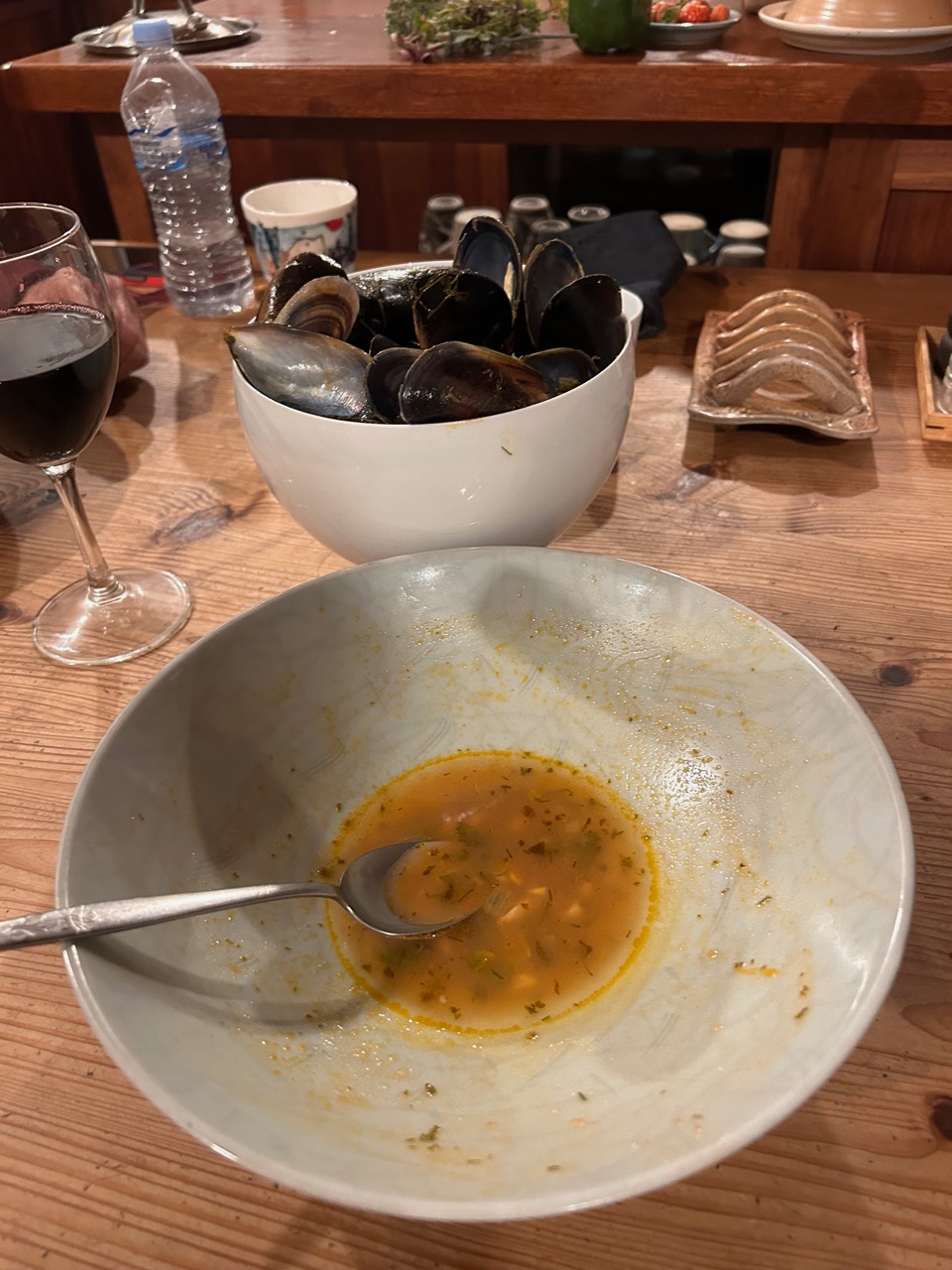
I also made a lovely mussel soup this week. I used a lot of fresh herbs from the garden, some white wine and a bottle of our preserved tomato passata from last summer.
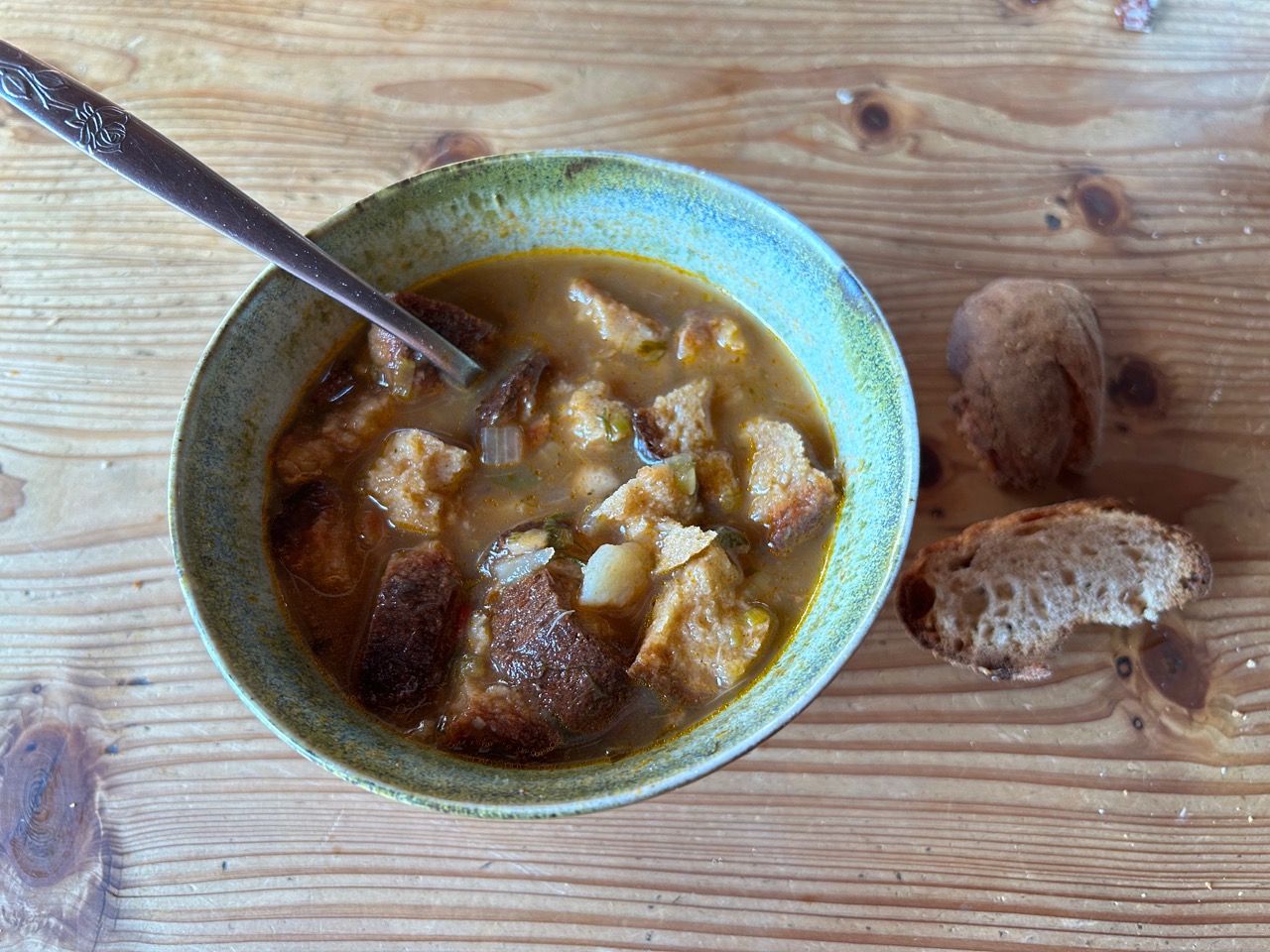
It was very good with the mussels, and with a lot left over in the pan, made a warming lunch time soup the next day.
After eating all of the mussels, there was a little soup left in the bowl, so I was inclined to engage in the ancient French tradition of ‘faire Chabrol’.
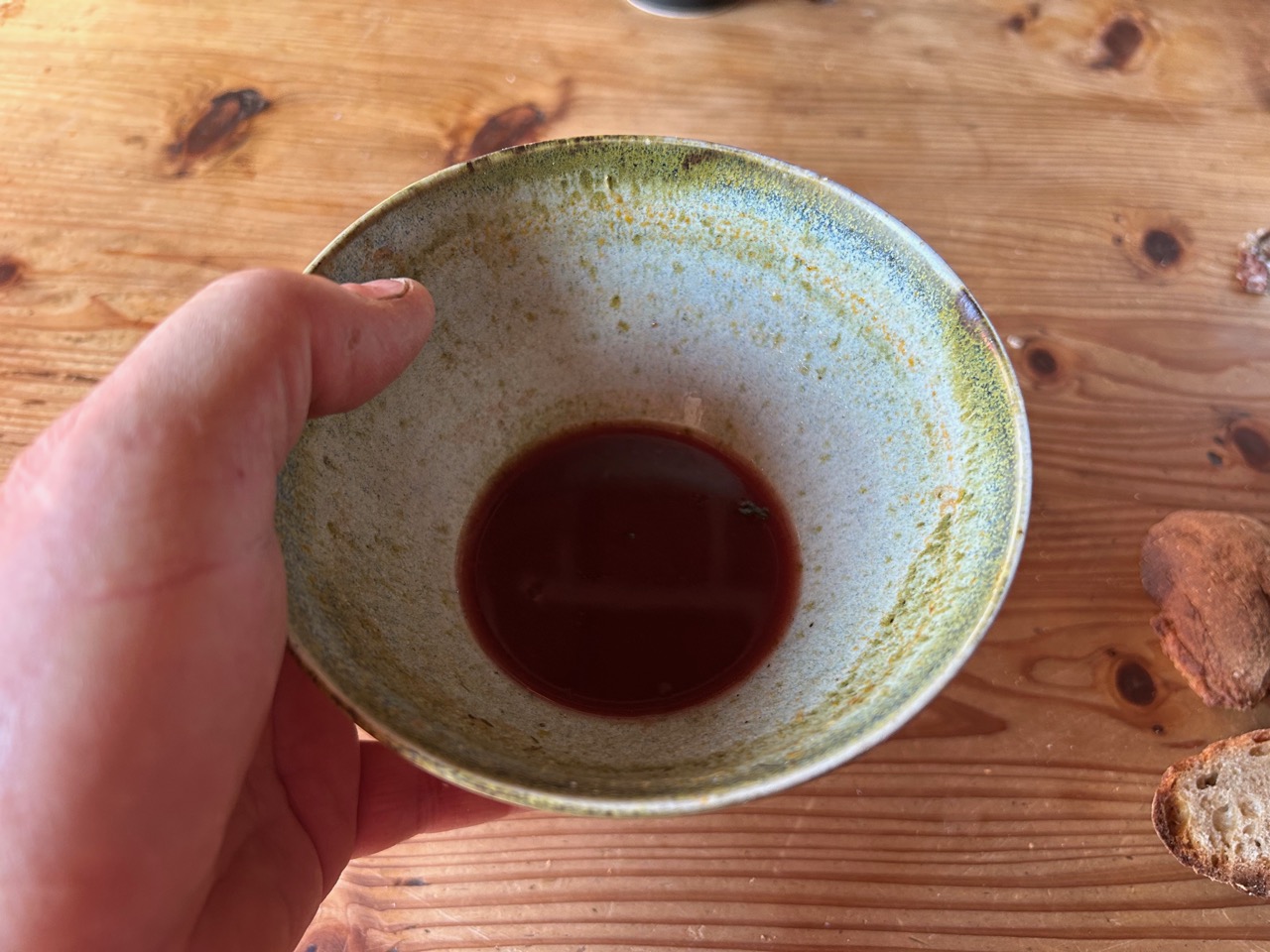
By pouring a little of my red wine into the bowl and drinking the mixture straight from the bowl.
I’m warned that this is not a practice to engage in, in polite society. It’s strictly for peasants. Welcome to the home of the Post Modern Peasant.
It’s catching!
The next day at lunch, we had the same broth, sans mussels. But in another very old tradition, I added broken pieces of old bread into the soup to fill out the meal. And, in keeping with the tradition, I finished with a little red wine. Faire chabrot!
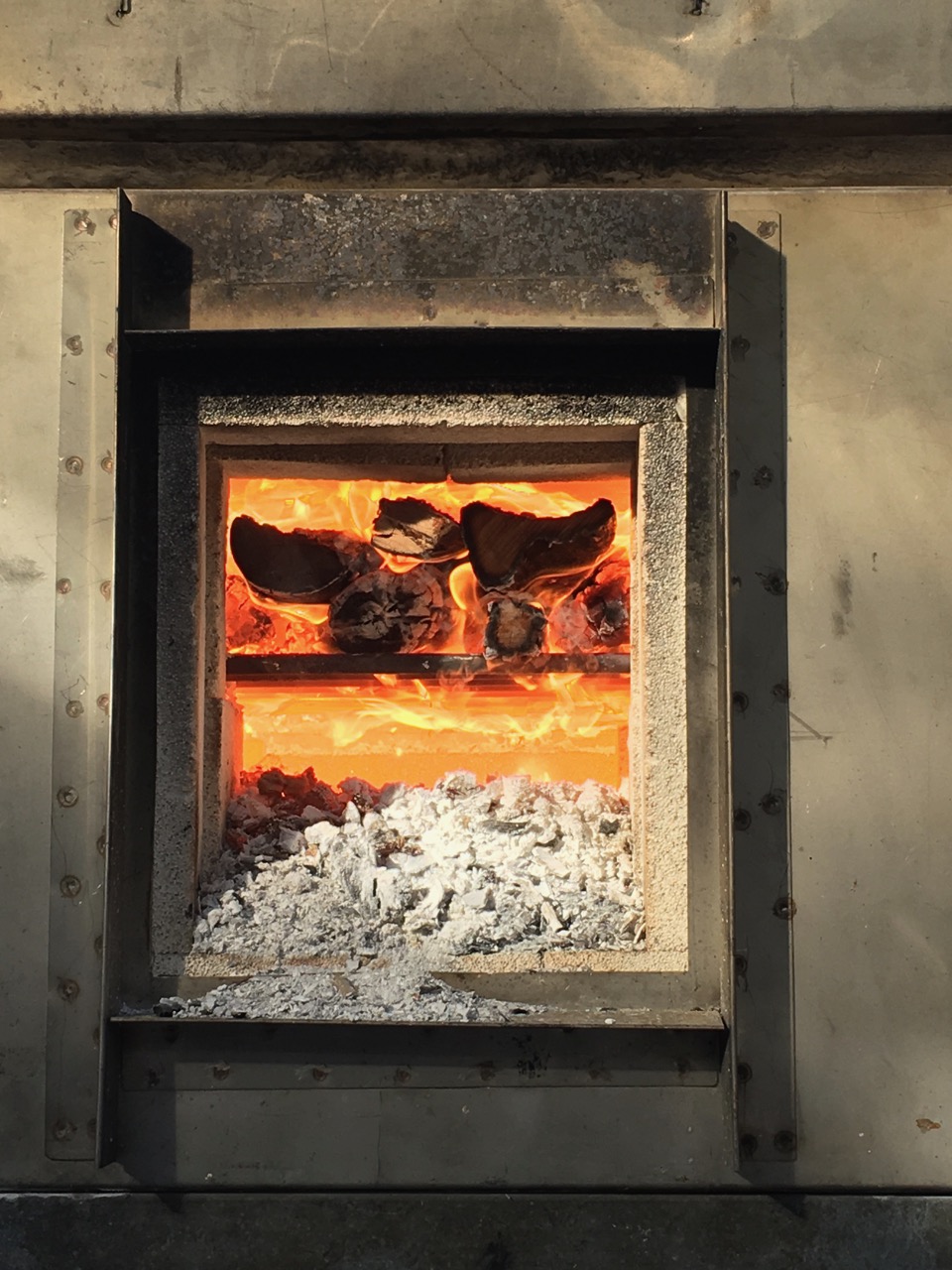
We fired the big wood kiln last weekend, then during the week, Janine packed and fired the little portable wood fired kiln.
We have put the Sturt ’Terra Nova’ show up and it is going well, with a big turn up at the opening. We got to catch up with loads of people that we only usually see at conferences, and as I don’t go to a lot of conferences, nor do I go to ‘openings’ to do ‘networking’. Well, I don’t get to catch up like this very often. It was really good.
Our next big event on the horizon is the ‘Pop-Up’ Artists Open Studios Arts Trail, that will be on the long weekend of the 10th, 11th, and 12th of June. Hence the flurry of firing activity now in preparation. We have been making all year, and firing in the smaller kilns, the solar PV fired electric kilns. We don’t fire the wood kilns over the hotter part of the year, and certainly not during the fire-ban season. So it’s all go now.
Using a combination of elm garden prunings and some thinly split eucalypt (many thanks to our friends, Susan and Dev, who helped split a lot of side stoking wood with us a month or so ago.) Janine was able to fire up to Stoneware in reduction in 4 1/2 hours. A perfect firing for a little portable kiln.
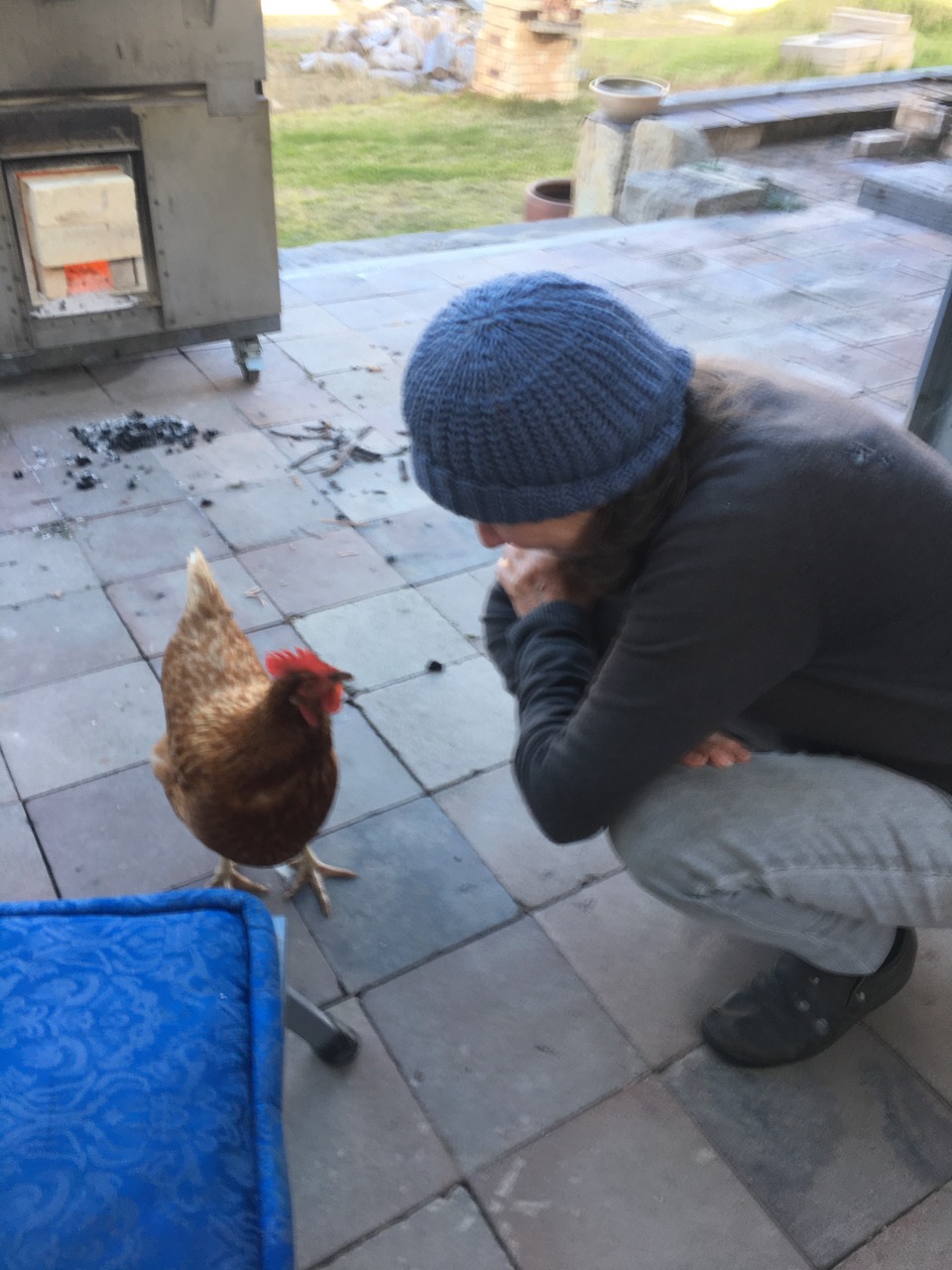
At the end of the firing, Edna the chicken came to check it out. Janine and Edna had a little chat, cooing and clucking together. The gist of it was probably around the matter of if there was anything for a chicken to eat?
I have been packing the big wood kiln again for another firing this coming weekend. The slowest part of packing the big wood kiln is rolling out all the thousand little clay balls of wadding. Each pot has to sit on a ring of little balls of refractory wadding to stop it sticking to the kiln shelf. Over time, and many, many, firings the kiln shelves get a coating of molten fly ash from the burning wood, and if the pots aren’t held up off the shelf, they will fuse together at high temperature becoming a monolithic whole.
First chamber finished and clammed up.
I think that I probably spend a quarter of my time rolling out these little balls, only to throw them away after the firing. Actually, Janine re-uses them as aggregate in the bottom of planter pots around the garden. However, when we first set out on this creative journey, back in the early ’70’s, because we had very little money and couldn’t afford to buy the very expensive kiln shelves that we needed to pack the big wood kiln. As a work-around solution, we decided to make our own. This was a very tricky bit of ceramic chemistry, and only one other husband and wife couple of potters, Harry and May Davis in New Zealand were doing it. We went to work with them to get some insights, and came back and made our own kiln shelves for next to nothing in terms of cash outlay, but a lot of time invested.
The cost of the high alumina grog used to make refractories was prohibitive, so we made our own. For every firing in the little test kiln that we had, I used very high quality, high alumina kaolin from Mudgee. Puggoon 157 kaolin, purchased directly from the mine not too far away, to make the wadding balls. After firing, instead of throwing them out. I put them through the rock crusher and turned them into high alumina crushed grog. All the failed experimental kiln shelves were also put back through the crusher, mixed with more kaolin 50/50 and used again. Eventually we had enough kiln furniture to fire the big 300 cu. Ft. wood kiln at next to no cost. They weren’t very good, but just good enough and this exercise in self reliance got us going. We still have them, but they are rarely used these days, because the new silicon carbide kiln shelves from China are both affordable and excellent quality.
Photos of me, as a much younger man, making kiln shelves, taken by Janine King
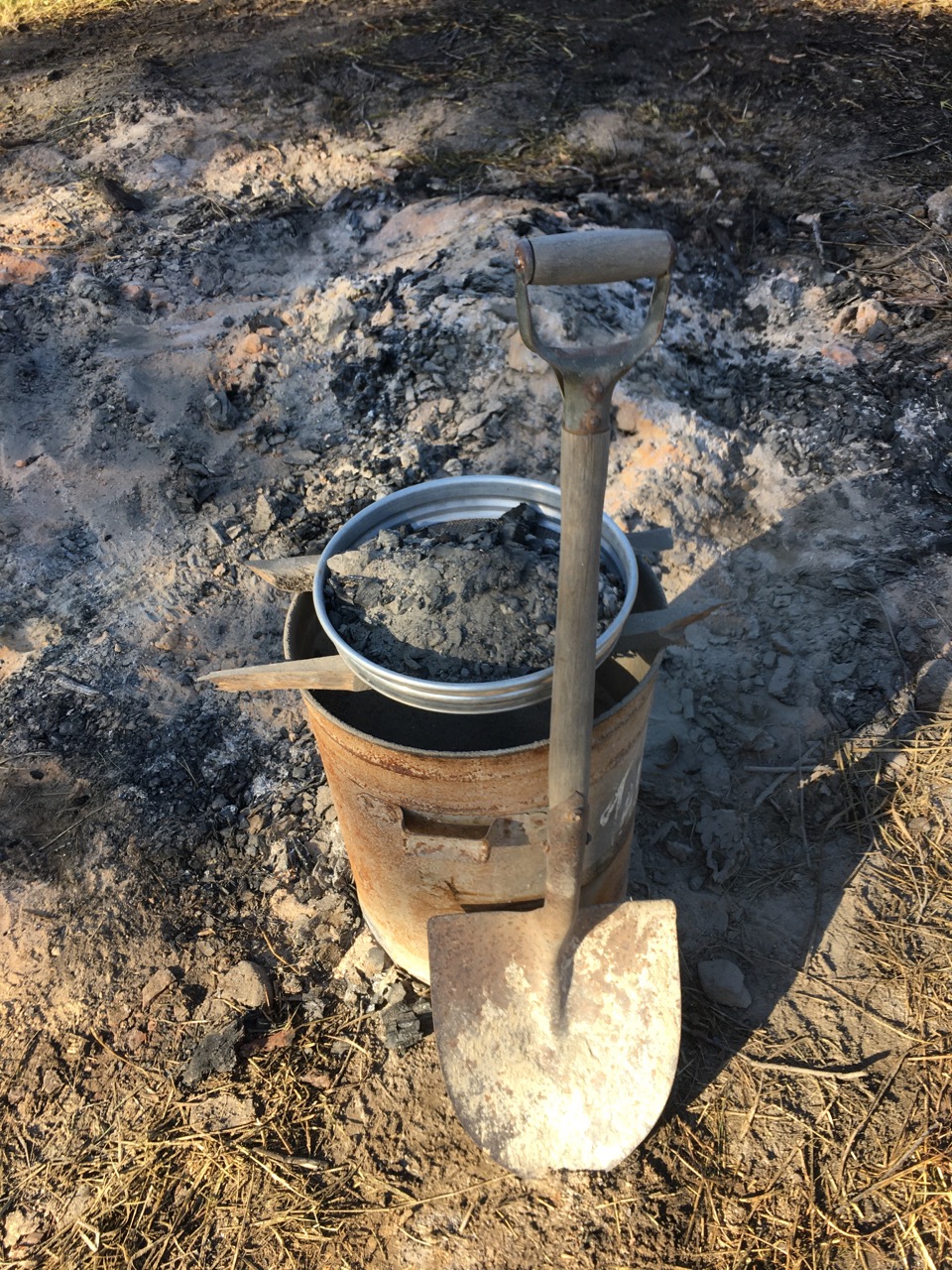
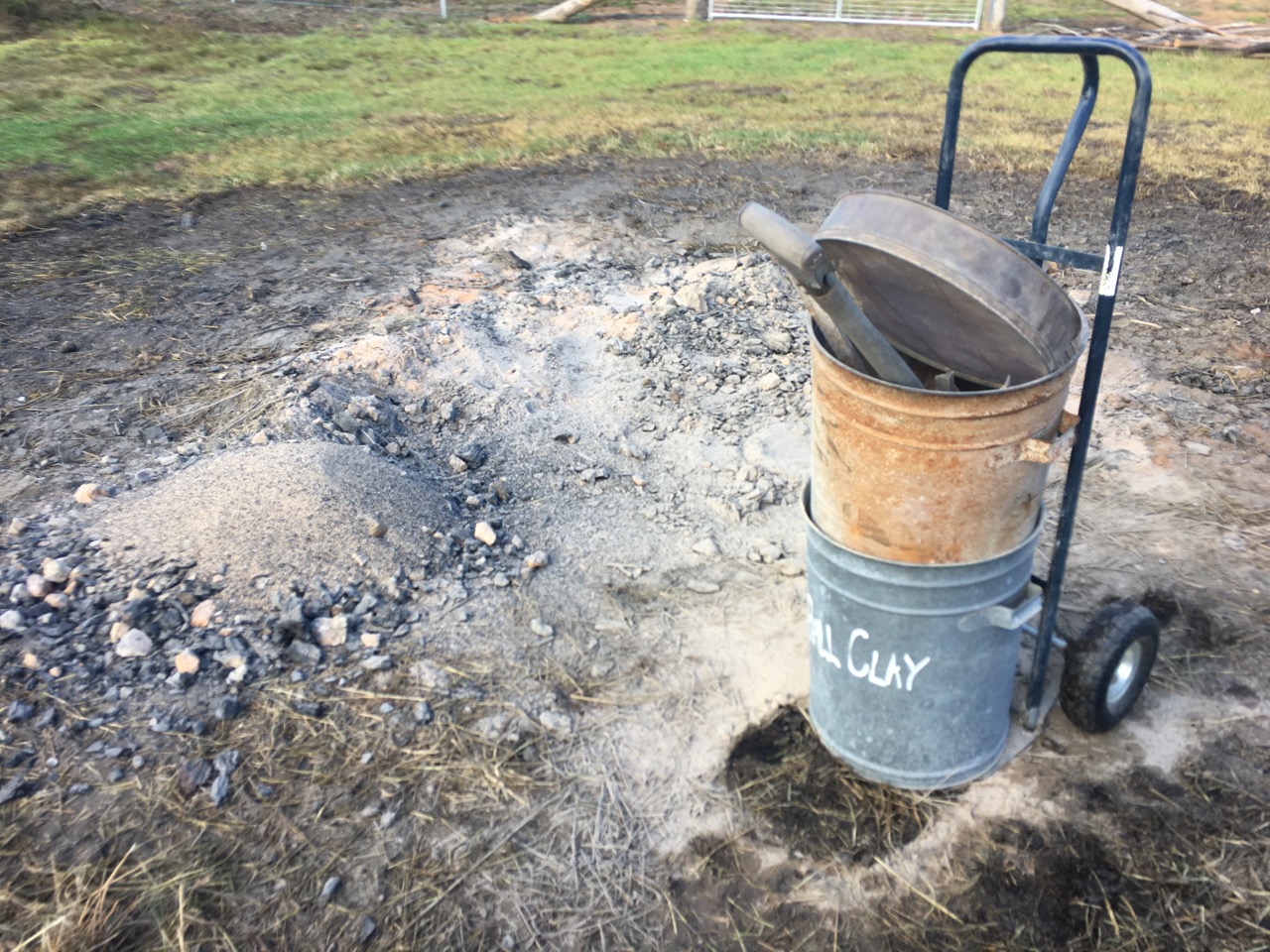
It’s a few days since the fire died down, I’ve been out there in the paddock collecting the ash for use in glazes. If I try to get there and dig up the ash before it is mostly cooled. I can get burnt, so I must be careful. I wear my oldest thick soled boots, as the ash and charcoal from the burn pile holds its heat in the ground for ages. I have melted the soles of my boots in the past, going in too soon.
If I wait for too long for it to cool, then there may be a strong wind, and that will simply blow away the finest particles of ash, scattering them all around the grassed area. Worse still, is rain, as that will dissolve and rinse away the solubles in the ash. Its the solubles that are the fluxes, and these are so important in ash. They are what makes ash melt and be so useful in glazes. It’s also important to me to be as self-reliant as possible, so I don’t want to waste this important potential resource. Doubly so in this case, as there are no more pine trees left on our land. The bush fire here was so hot and intense, that it killed every single one of them, and I haven’t seen any seedlings germinating out of the ashes in any of the paddocks. It’s the end of an era here.
In fact we did have a little shower of rain on the 2nd night after the fire was finished, so some of the usefulness of the exercise will have been lost. I won’t know how much was lost, until I get it all sieved, processed and tested to find out. I suspect that it will be too far gone to be useful to me as a glaze ingredient, but that wont stop me processing it to find out. We only have a burn pile like this once in a decade where we burn off stumps and big logs. It was the big pine logs that made this burn pile ash so attractive, as pine ash is very different to the hard wood eucalypt ash that we collect from the slow combustion kitchen wood fired stove every week. The slow combustion stove works best on hard wood fuel, and that is what we have plenty of here. Now especially since the fire leaving so many dead gum trees to deal with.
The ash from our Caribbean pine trees here is clearer, paler and more fluid than the ash from our local stringyback and bloodwood eucalypts. Their ash melts to a matt yellow/mustard colour, and is rather more firm, being lower in the alkalis than the pine. They are both good, just different.
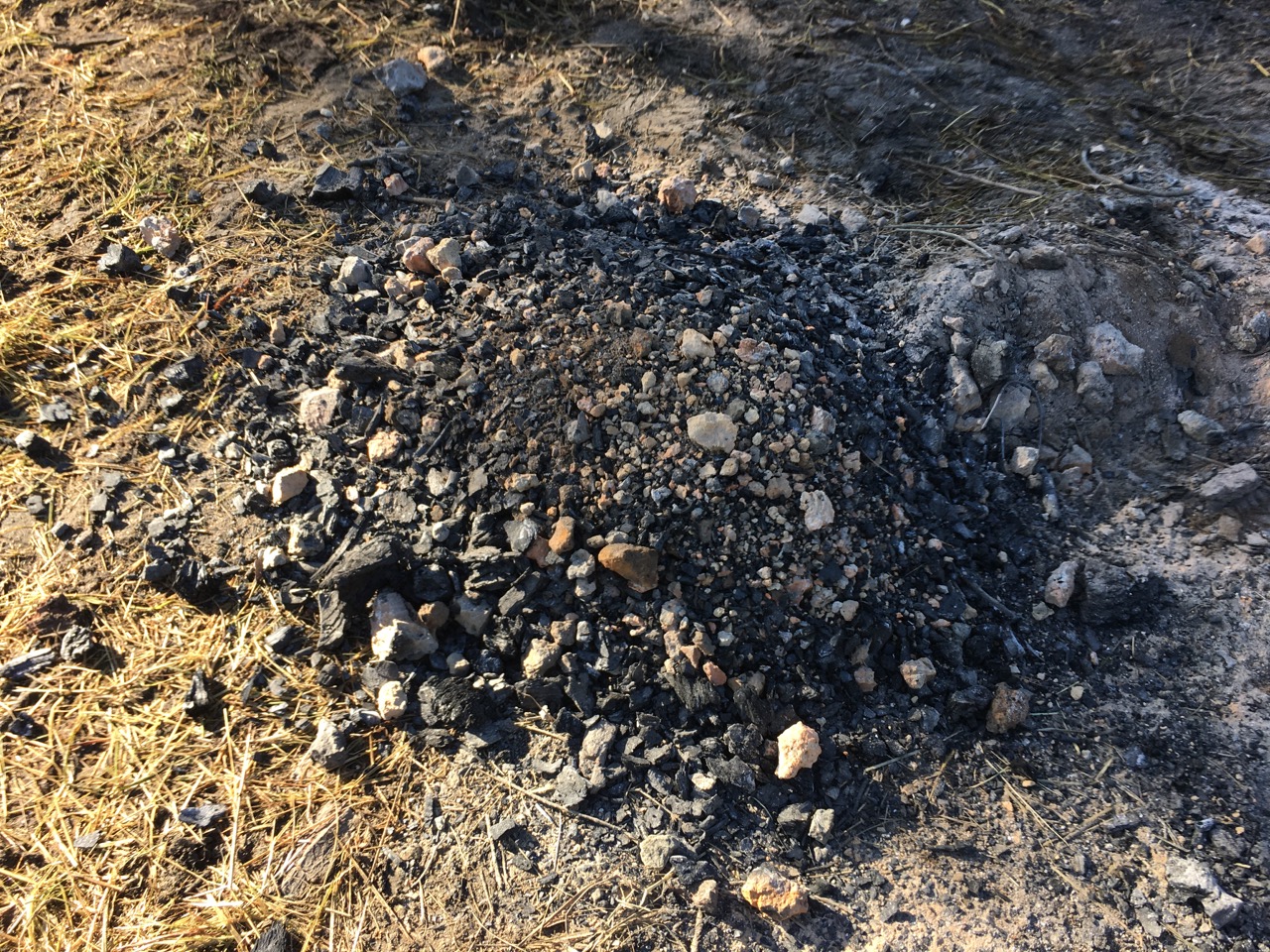
I set about digging into the pile of still warm ash and charcoal and found it littered with calcined lumps of subsoil from the tree roots and stumps. Not a good sign. I was hoping for a deeper cover of fine white ash before hitting the heavier stuff. Pity!
I started by sieving the ash through the first 6mm screen to get rid of the big chunks of soil and charcoal, then down through the next 2.5mm screen.
I filled a large metal garbage bin with this first pass. I use a very old and slightly ruined bin for this, as if the ash turns out to be still a bit too hot, it will melt a plastic bin, or burn the zinc off a good bin.
As the burnt pile of ash decreases, the pile of discarded sievings increases.
The second pass is through a finer sieve. It can’t be too fine at this stage as ash is very sticky, and will clog up a very fine sieve. I use a 40# lawn or about half a millimetre, as the ash will pass through this fairly easily. It’s a stainless steel sieve that went through the fire in one of the sheds that burnt down, but not too hot, as the fine mesh didn’t crumble. All my other sieves that were burnt, were completely ruined.
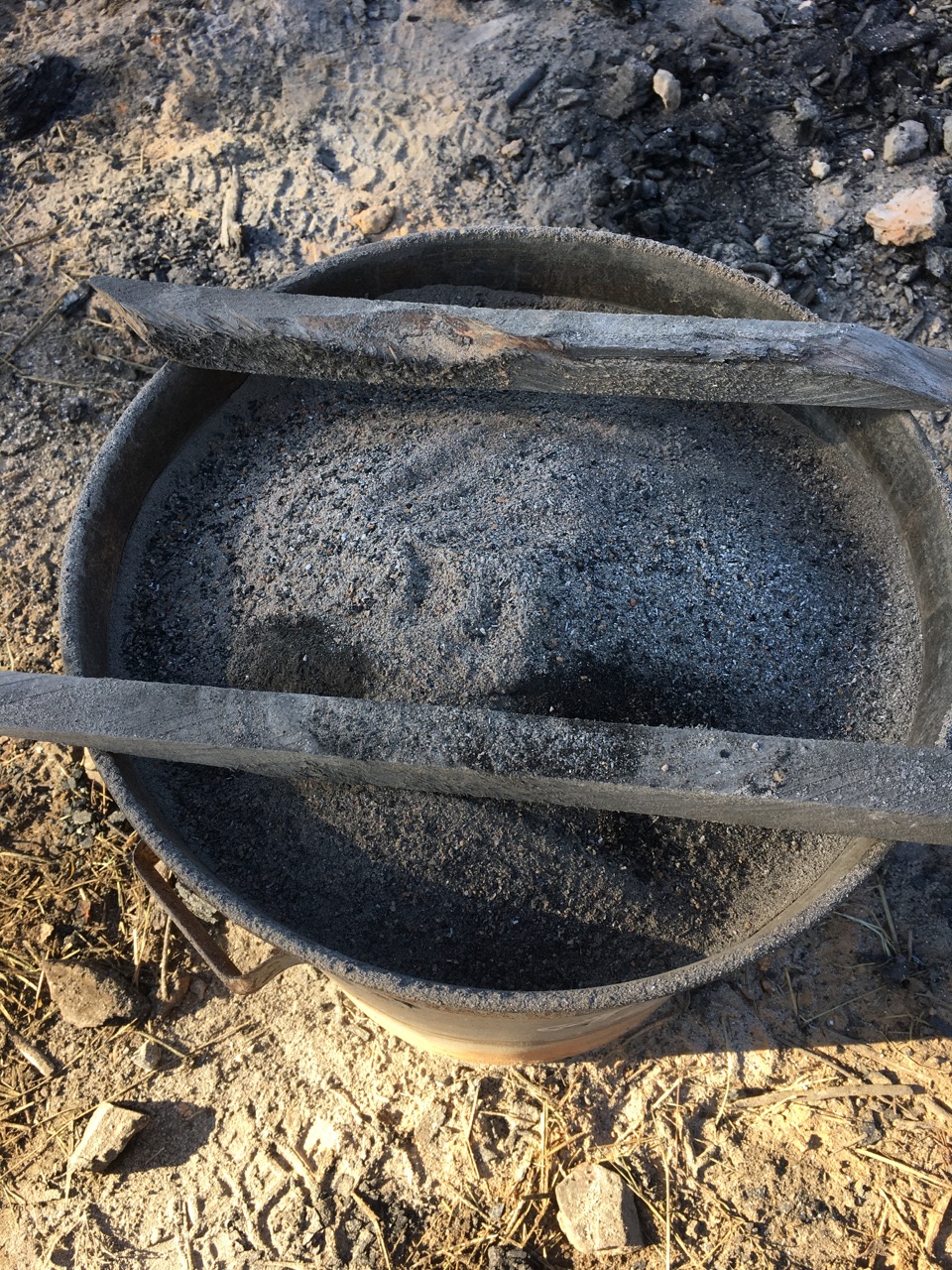
I shovel the coarse ash out of the first bin and back through the fine mesh into the second bin. 1 1/4 bins of coarse ash becomes 3/4 of a bin of fine ash. The discard pile grows as the fine detritus mounts up on top.
Mission accomplished for the time being. The next step is to wash the ash with water to get it to pass through a 100# sieve. But that is for another day. At least this garbage can full of dry ash will keep indefinitely in the storage room, safe from the vagaries of the weather.
All packed up and ready to go. This much ash will last a few years of glaze making.
Nothing is perfect, nothing is ever finished and nothing lasts.
This week we have been hard at it everywhere, in the garden, in the pottery In the kitchen.
We thought that we had harvested the last couple of wheel barrows of tomatoes, but then we looked again and there were more.
Janine made two seperate 1 gallon boilers of passata, which I put through the mouli sieve and then reduced down to 1 gallon, or 4 1/2 litres of fine liquid, which Janine then reduced down further on the wood stove each night progressing a bit at a time until we had just 2.5 litres of dense concentrate, down from 11 litres of initial pulp. It takes a couple of nights to get through it all. It’s better than trying to find the non-existant intellectual shows on the idiot box.
While the wood stove is hot after dinner is cooked, it’s a shame not to use up all that potential heat embedded in the stove. It not just cooks the dinner, it warms the house and heats the hot water tank. So to get an extra bit of benefit from it is very frugal and efficient. F@#k the gas companies and energy retailers, gouging excess profits from the misery of war and bad forward planning. We are very lucky here to have been through a terrible fire that has left us with thousands of dead trees in our forest that I couldn’t have ever brought myself to cut down in their prime. But now that they are dead from the bush fire they need to be cleaned up to make the place safe again. Fuel for the rest of our lives. As I said, very lucky. You have to look on the bright side.
We were a bit shocked when Janine had to re-arrange the pantry cupboard to fit these recent jars in. We discovered that we now have 79 jars of passata. We could easily go into business selling this stuff. It’s not as if we are not eating our fare share of tomato and egg for breakfast, tomato salad for lunch, tomatoes in ratatouille for dinner, as well as giving away tomatoes to everyone who calls in and visits
But still they come ripening, even now in this cooler weather. However, they must come to an end soon, as the night time temperature is dropping rapidly down to 3oC this week. Soon there will be frosts again and that should put an end to it.
I was so looking forward to the start of tomato season back in November/December. I could just brush the young leaves and smell the tomato fragrance that promised so much. Now I don’t want to touch the leaves so much any more. I’ve had my fill. This is the reality of living with the seasons. The promise, then the first taste — so good, then the glut, and now enough.
I’m sure that we will appreciate the bottled tomatoes over winter in all manner of cooked dishes, to add and extend flavour to almost anything. Passata is a useful and flexible as chicken stock. We have some of that in the freezer too.
We have already picked another few baskets full of prime ripe red produce to make the next batch. Anyone want any tomatoes?
In the pottery, I cleaned out the small Venco pugmill that I use for porcelain. It was starting to allow a few small bits of dryish crumbs through the screens and into the extruded pugs. It has been a year since I last cleaned it out. Unless you use it every day or at least every week. Bits dry out inside the barrel and eventually cause trouble. I hadn’t pugged any porcelain since last year. So now is the time to deal with it. Starting out fresh for the coming work load through till Xmas.
I have found that it is easiest as a two day job. Strip it down last thing in the afternoon, Scrape off all the easily accessible plastic clay. Leave it over night to dry out, then scrape off all the dry clay, and finally sponge it until it is all clean, then reassemble, first thing in the new day.
I have been throwing some gritty clay, making some rough textured bowls for the wood firing.
I have also been making some porcelain dishes for the wood kiln as well.
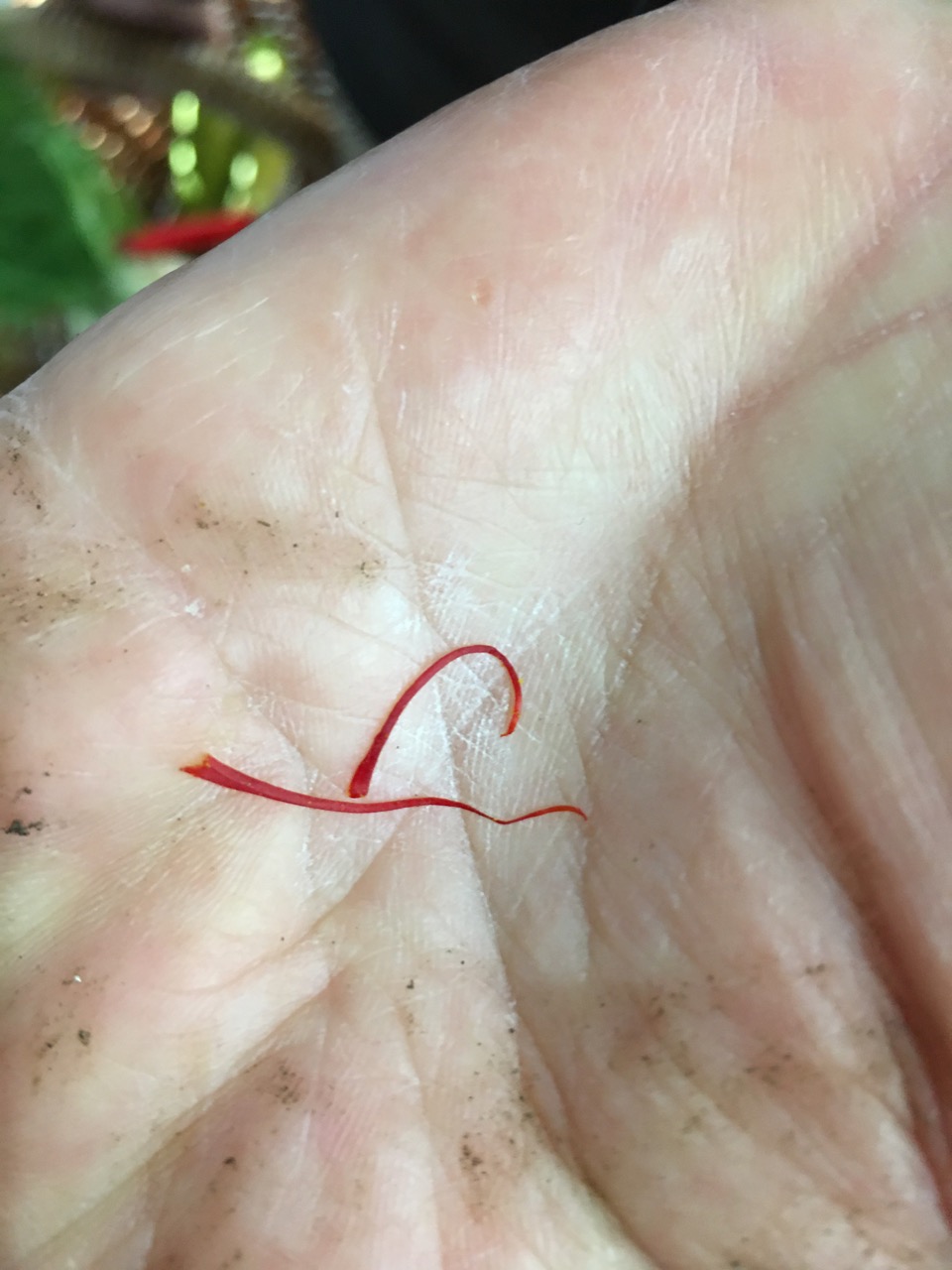
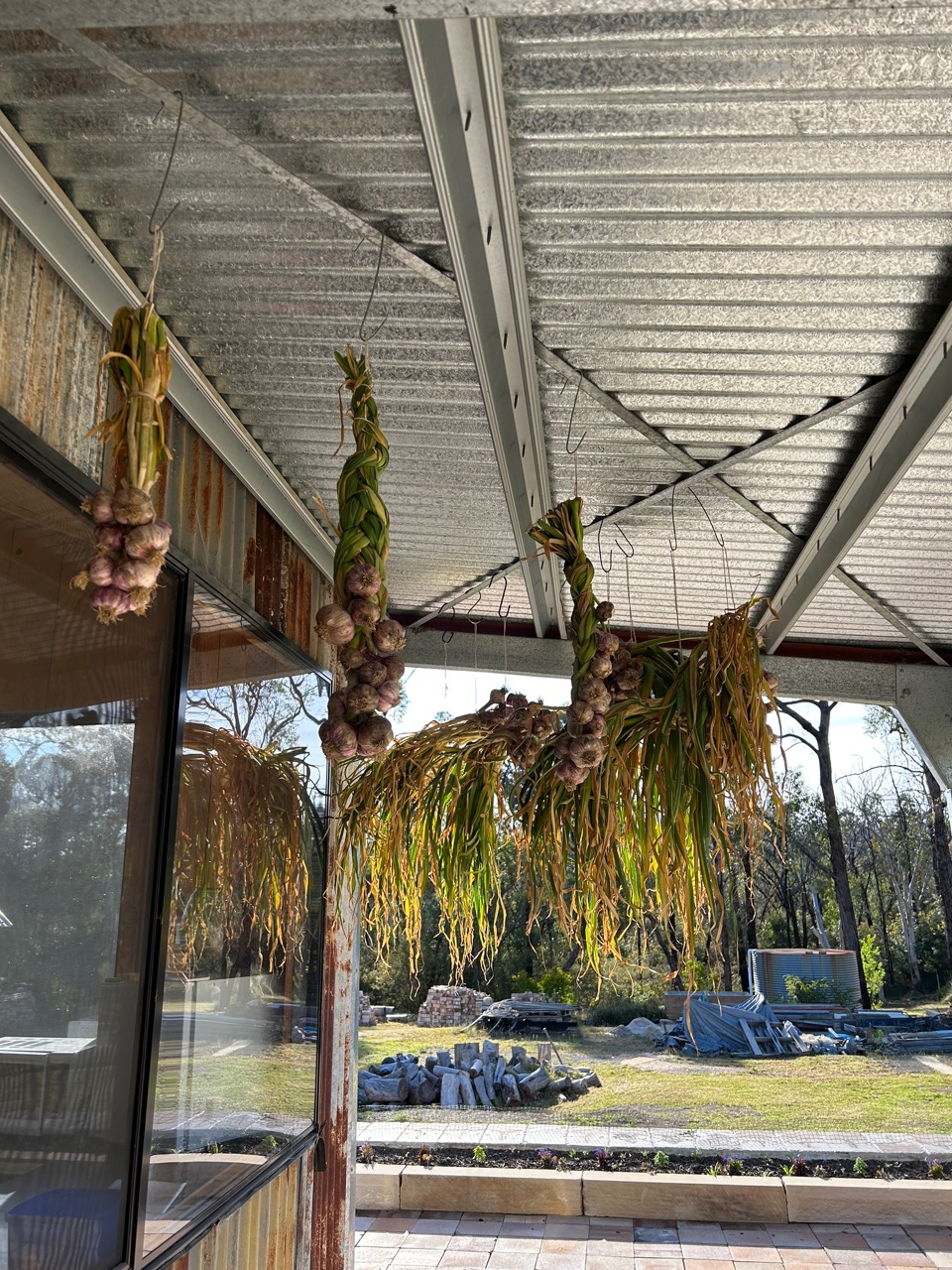
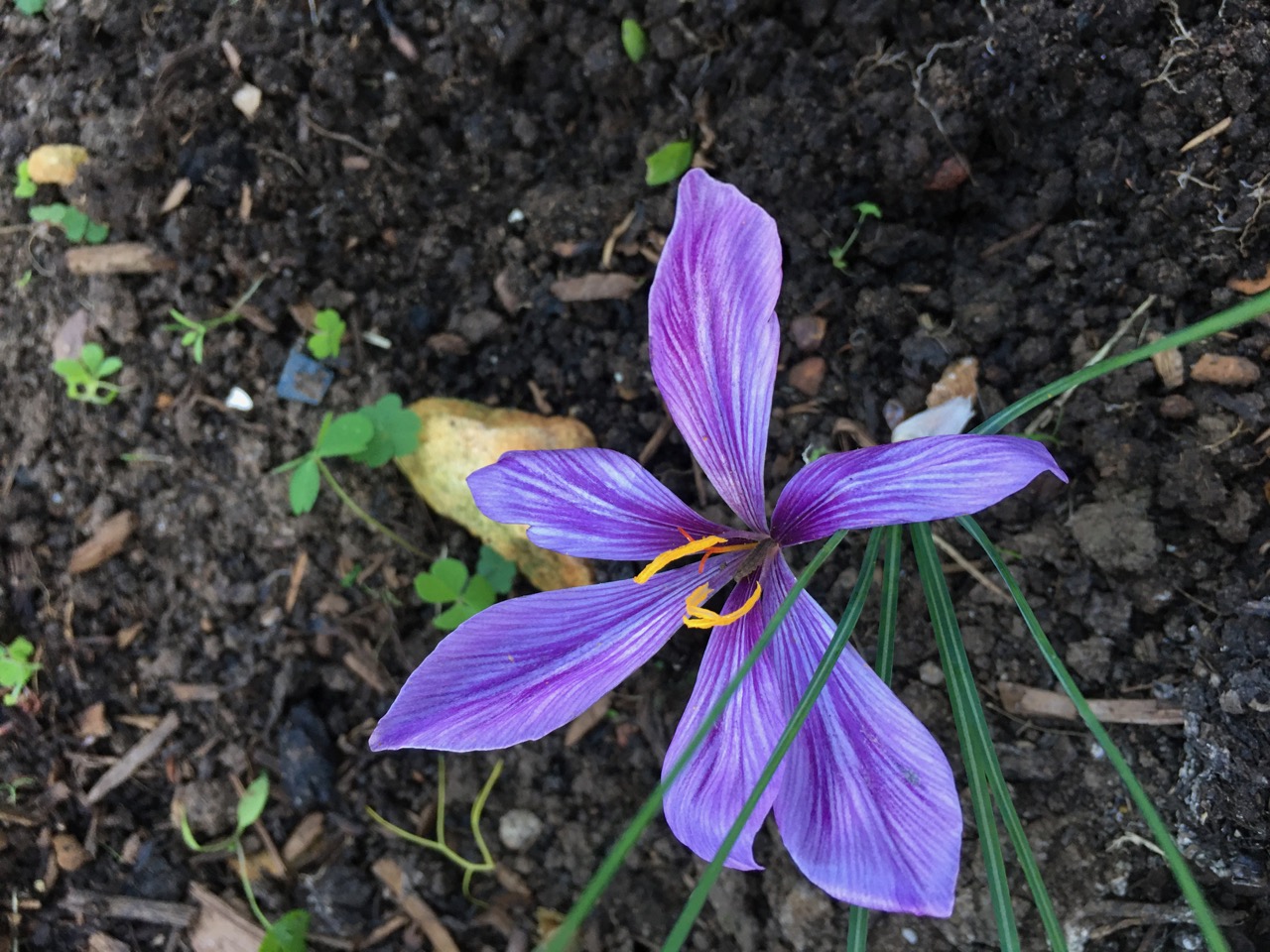
Back in the vegetable garden we found a great surprise! Our first crocus flower. Janine picked out our first two saffron stamens. We ate one each, just to see if we could taste the fine flavour. We couldn’t. But we did get just a little hint of orange colour on our tongues. Hopefully there will be more to follow, as we have 20 crocus bulbs in the garden. We might double our harvest each year? We might eventually even get enough to be able to taste it.
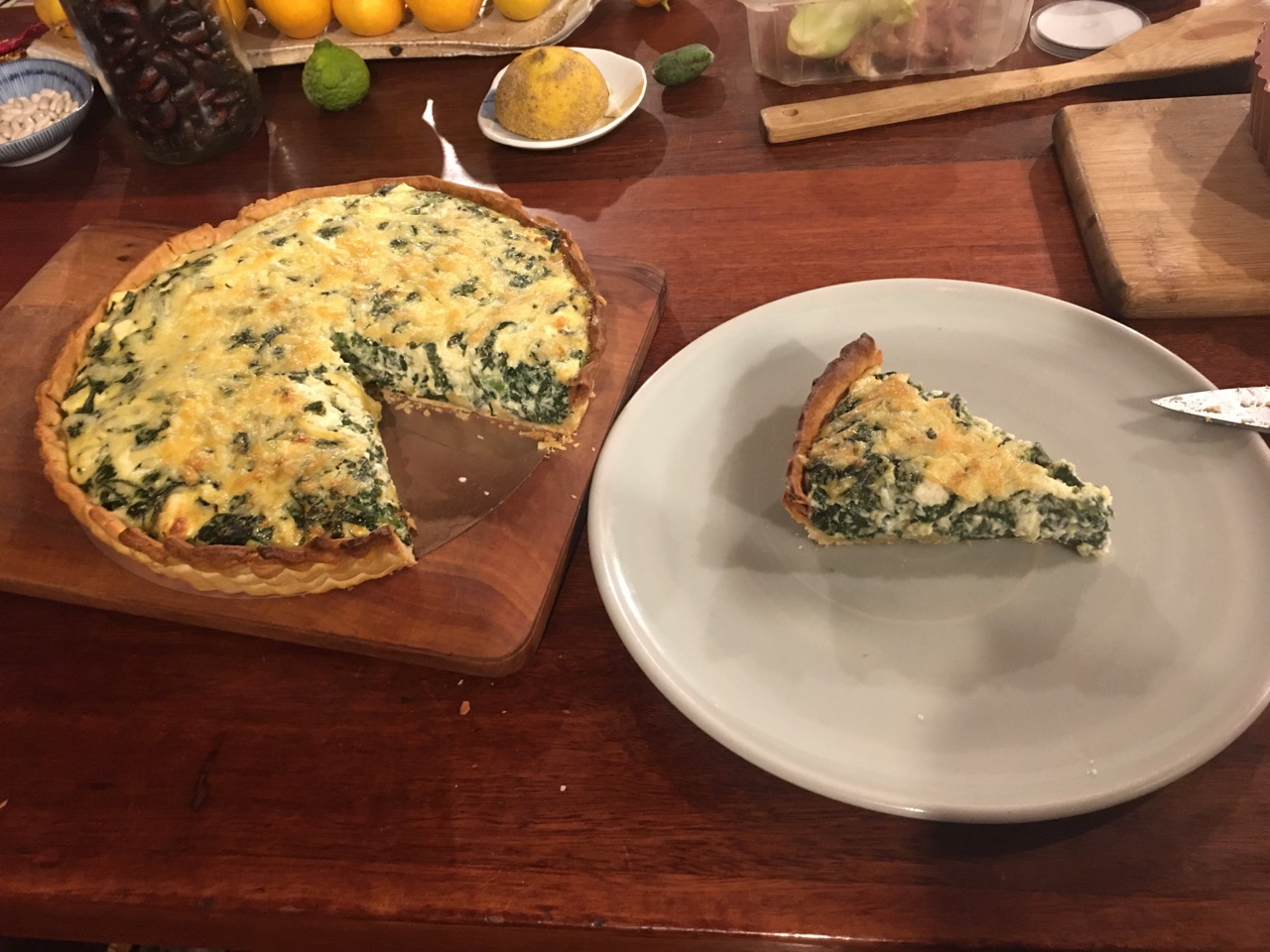
I made a bush tucker pie for dinner from our massive crop of wild warrigal greens – native spinach. It turned out really well. Cooked with 3 cheeses and one egg to bind it. Not a tomato in sight!
This week is the mid point of autumn, Half way between the equinox and the solstice.
The weather is certainly a lot cooler and we notice that the days are so much shorter. I really like this slightly cooler alternative the long days of summer. Our summer wasn’t so hot as it used to be during the decade of el-nino years. These last few summers have been so much nicer, cooler and wetter, everything has turned green and grown its head off. We have harvested more tomatoes then we have ever grown. It seems that all the planets aligned for the tomatoes. I haven’t counted the bottles, but there must be over 40 jars. Quite enough to last us well over 12 months, possibly even 2 years?
We went to Canberra over Easter for the National Folk Festival.
We caught up with people that we haven’t seen for over 4 years, as we were confined to home because of;
1. The fire,
2. The on-going clean-up,
3. The rebuilding,
4. Covid, followed by a year of lock down.
It’s only now that we feel that we have the time, space and safety to go out again. Womad was on again this year, but we chose to stay home, save time and money and get on with some of the long list of jobs. However, we decided to go to Canberra for ‘The National’, as we can drive to Canberra in just 2 hours in our electric car. Travelling to Adelaide for Womad is looking more and more extravagant and carbon intensive, regardless of whether we drove or flew, we were responsible for burning loads of carbon each way. I just can’t justify it anymore.
The long weekend of music was wonderful, so many great acts, too many to list, but a few stood out.
The ‘We Mavericks’, Lindsay Martin and Virginia vigenser, were excellent. We have had them here in our home to perform for us in one of our house concerts a few years back. I believe that we were their second only performance together. They get better and better.
Billy Bragg was also really good. He was the best that I have ever seen him. Powerful voice, smack on key and few very powerful, short spoken interludes between songs, on why we should care about the state of things and the world. He also explained what he is doing to make a difference. Very inspiring. However, it crossed my mind that he must owe a tremendous carbon debt?
We also enjoyed Gleny Rae Virus, Leroy Johnson, (above) the Park Ranger from Mutawintji National Park out near Broken Hill, and Farhan Shah & SufiOz. singing Sufi devotional chants. + many more.
Back at home we have been Splitting wood for the kiln firing, and working in the garden.
We met up with our friends Susan and Dev in Canberra, and they called in here on their way home to give us a hand with those jobs.
My friend Len Smith also called in and we had a little reunion. As Len, then Janine and finally myself, were Susans teachers at different times in her life, at different colleges.
Together, we ripped out 3 beds of waning tomatoes, that had reached the end of their productive life and added them to the compost heap.
Afterwards, I planted out lettuce and radish seeds as well as lettuce and spinach seedlings.
The garden suddenly looks a bit more loved again after a few weeks of minimal up-keep and absence.
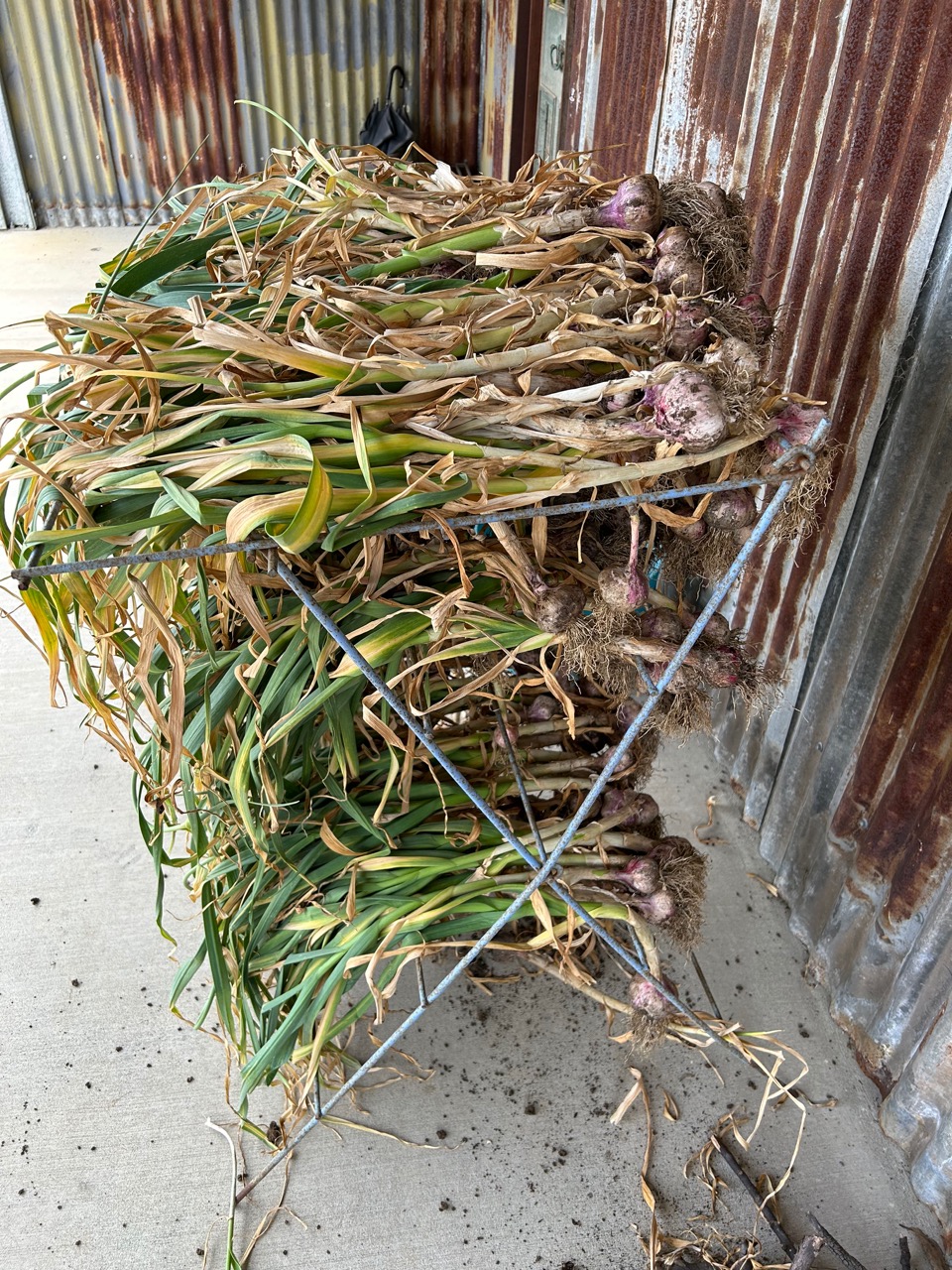
My last job was to plant out 160 of our own self grown and stored garlic cloves. I should have been onto this a month ago, but better late than never.
I did two rows of 80, one of our purple garlic and the other of our white skinned variety. They have started to shoot from their skins. A very good sign that they are ready to be planted out now!
Everything takes time and time needs to be made or created by making decisions about what is most pressing and needs to be to be done NOW.
Tomorrow it is back into the pottery to unpack and repack the electric kiln for yet another bisque. Learning to Juggle my time and energy has been a life long exercise in developing this skill for me.
I want to do so much each day, Even summer days aren’t long enough. I need to triage my desires to fit my capacity to actually achieve outcomes. Added to this, I really don’t know what I’m doing most of the time. I’m reasonably well trained in making pottery, and I have taught myself to grow vegetables and orchard fruit trees, but I have such a low basic understanding of building techniques and mechanical engineering, I just muddle through as best that I can. I rely on asking more knowledgeable friends for advice on what they would do, or where is the best place to buy the correct parts.
I’m so grateful to all of my friends for the advice and help that they have given so generously over the years.
When we built the new ‘kit-form’ tin shed for the new pottery. I paid a bunch of so called ‘expert’ tin shed builders to come onsite and erect the kit. They had experience and all the fancy gear to do the job. A bobcat loader, a scissor lift gantry and a truck load of power tools. They put the frame up OK. It is at least level and vertical. But when I asked them to screw on all the 2nd hand, grey re-cycled old rusty gal iron sheeting that I had collected to give the shed some character, they did the worst job that you could imagine. They chose to use roofing screws without any rubber ring to seal out the weather, and as a consequence, all the walls leaked in heavy weather. The windows weren’t ‘flashed-in’ correctly or at all, and leaked. The cement slab was cast with a definite hollow in the centre. The verandah wasn’t ’stepped-down’ 50 mm to stop water blowing in under the doors, so that when it rained hard, the building leaked, all the water ran to the centre of the building and pooled there. I’ve spent over a year discovering all these faults, omissions and bad workmanship and then correcting them as best that I can. If only I’d known something more about the building trades, I might have spotted these faults occurring and got them seen to at the time. But I trusted them. BIG mistake.
Our previous three potteries that burnt down were all home made on a shoe string budget mostly out of wood and other materials that we could scrounge off the side of the road on council clean-up day, or from the tip. They too had character, but a very different character. This last shed is so much better in all sorts of ways, but mostly it will be easier to defend against fire. Metal clad, metal frame with metal lining and the cavity stuffed full of insulation. All the previous buildings were made of wood and therefore were very flammable.
It seems that I have discovered all the problems with the poor workmanship in this shed now. I’ve discovered all these faults bit by bit over time and fixed them myself. The builders have shot through. There is something to be said for self-reliance.
Do it yourself, do it right the first time. I do it to the best of my ability. If it isn’t the most professional job, at least it is mine and any mistakes are honest ones. The stuff that I do has my character printed all over it. I own my mistakes, my lack of skill and my incompetence, but in the end I figure it all out and I can live with the result. At least I’m not upset with myself for ripping myself off. AND everything is done on a minuscule budget. We have never earned much money, so have learnt to live very frugally.Everyone seems to be obsessed with money these days, as if it solves everything. I heard on the news that the 3 richest Australians have more money than the bottom 10% of the nation. Pretty shocking! It’s a shame that there isn’t a way of making life a little bit more even and equitable for the disadvantaged. The Lovely and I have done very well for ourselves, being able to have built a simple, largely non-acquisitive, low carbon, organic lifestyle here, without ever having had a ‘real’ job. We’ve managed to ‘get away with it’ for all this time, living an engaged, creative, self-employed, part-time amalgam of a life. Without credit card debt or interest payments, doing almost everything ourselves. Living within our self-determined means. We’ve never been on the dole and never asked for handouts. Money may be essential in the modern world, but we don’t let it ruin our lives.
As an example of this frugal self-reliance I recently fixed up an old Chinese wood splitter. It needed a new/old/2nd hand starter and air cleaner to get the engine going again. That wasn’t too difficult. I just stole the parts off another old ruined motor that was in the barn. Best not to throw things out if they might have useful parts on them to keep another machine going for a few more years, There is a lot of embodied energy stored in those old bits of machinery. So it’s better to try to repair something old and get extra life out of it, than to give in and buy a new one. It’s also much, much, cheaper
Once I got the engine working, I decided to make it into a bigger splitter with a longer stroke. All cheap Chinese hydraulic splitters have a 600 mm. (2 ft.) hydraulic ram. That is the upper limit of their log capacity. My new kiln has a fire box length of 690/700 mm. (2’ ft, 4” inches). To give the splitter a longer stroke I decided to cut 75 mm. (3” ) off the cutting wedge to make it shorter ,and therefore add extra length to the logs that can be split.
I wasn’t sure that it would work, but it seemed a lot easier than cutting the end off the frame and welding a new section of RSJ onto the frame to make it a longer machine.
By shortening the blade I achieved the same outcome with much less work. But an hour on the angle grinder was a bit of a chore, as 20mm thick steel plate doesn’t cut easily.
You can see in this image that the blade used to go all the way to the bottom of the backing plate.
Scrooge’s technique of making a bigger splitter out of an old small one.
The old small engine managed the longer wood OK. I filled the truck with wood cut and split to 675mm long. That is about enough to fire the kiln to stoneware in 14 hours.
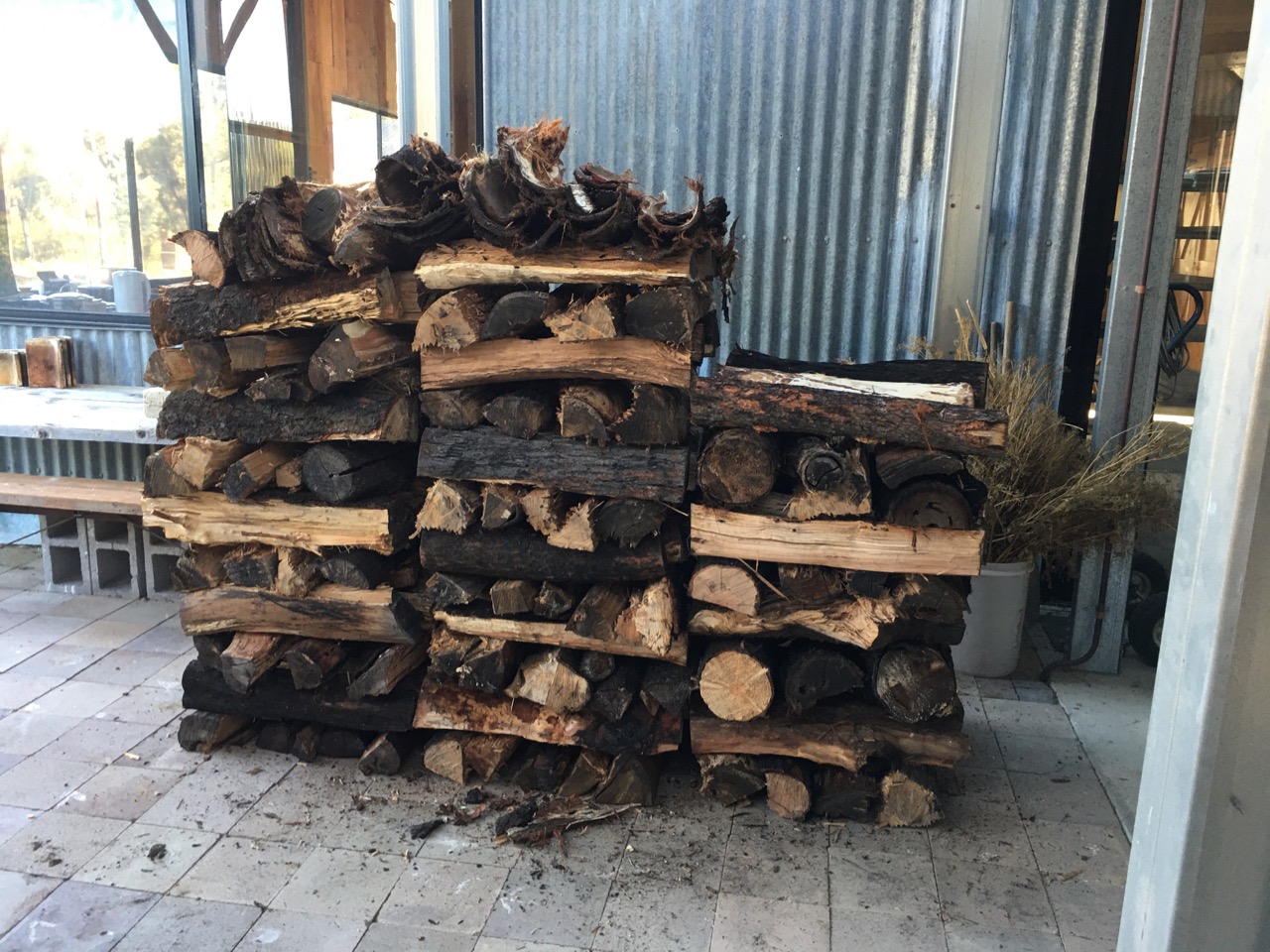
2 1/2 stacks of Hob wood,
A couple of piles of smaller kindling lumps for firing on the floor,
and then a couple of stacks of thinner side stoking wood for the 2nd chamber. Thanks to Dev and Susan.
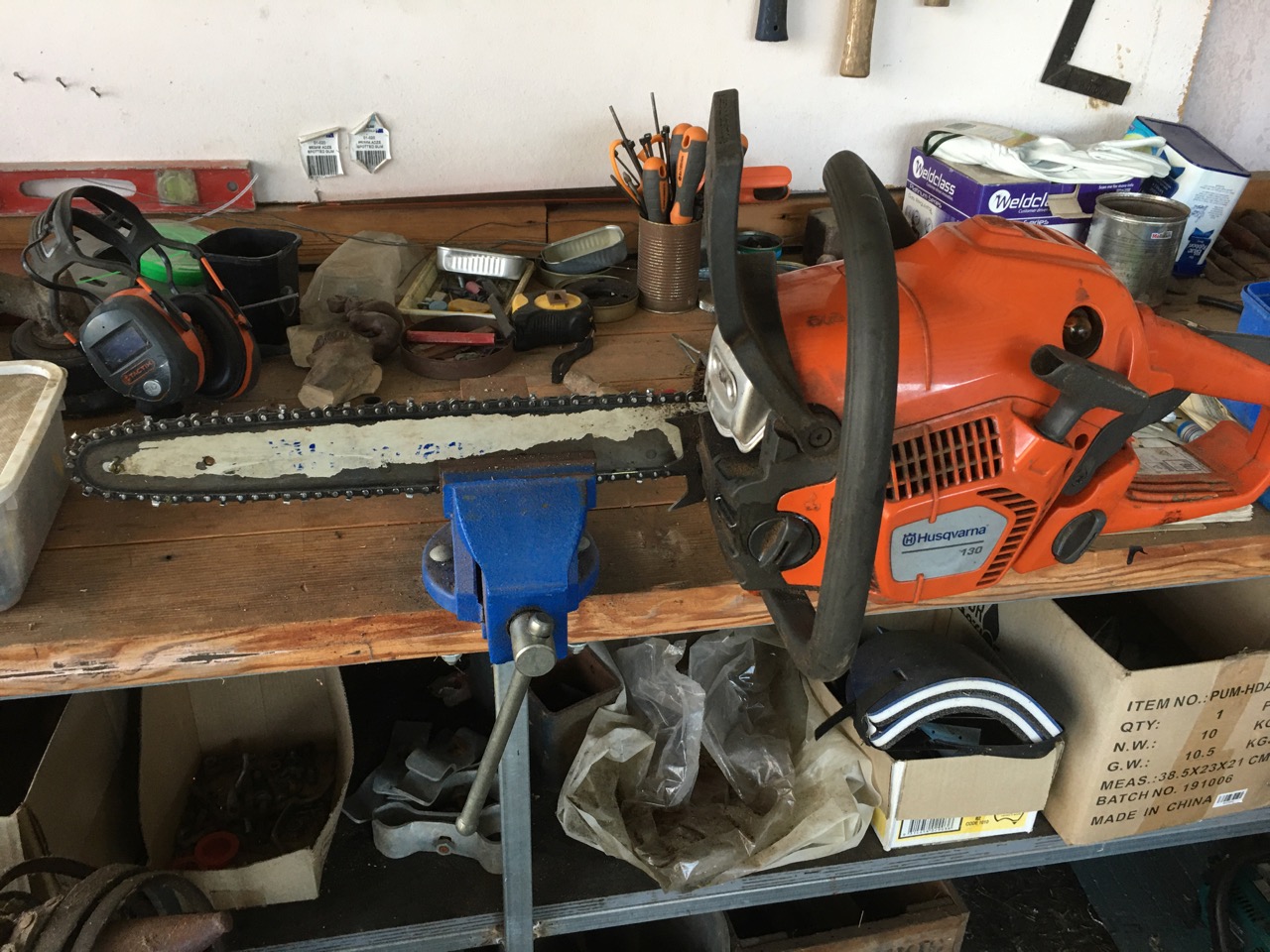
I finish the day by servicing the chain saw. Best to do it when it’s fresh on my mind, even though I’m tired from all the work, fixing the splitter, then testing it out and finally stacking all the wood.
I hate it when I go to use the saw and find that it is blunt and needs servicing, So I do it straight away. Sharpen the chain, blow out the air filter, rotate the bar, fill with 2stroke and bar oil.
It doesn’t take so long and everything is ready to go again, — except me! I need a rest.
We are almost half way through autumn now, the Indian summer is over and the weather has turned cooler. No more 30 degree days. This past week has been steadily in the 20’s and with rain or showers almost every day. However there are bright sunny patches in between. I’ve been working my way through the big pots that I threw to begin this throwing session, bisque firing them in the electric kiln using only pure sunshine. The recent addition of extra solar PV panels last year, bringing us up to 17 kW total and the addition of the 2nd battery, means that we are able to fire without any withdrawal from the grid. I can even fire both electric kilns to bisque at the same time, or just one kiln to stoneware. This is a great sense of independence.
With the price of gas having gone up from $1.75 a litre last year to $2.50 this year with no additional increase in the production cost. It’s just profit gouging and it’s a complete rip off.
So I’m very proud to be able to fire my kilns with my own sunshine. And drive my car off it as well! It’s amazing that there is enough to go around, but we still export our excess on the days when we are not firing. We even manage to export a little in the early stages of the firing.
This is from our most recent electricity bill. Our daily usage is down to 0.76 kWh per day. Down from 1.64 kWh per day the previous year. When we were doing more firings.
The average Australian 2 person household like ours is using 17.6 kWh per day. So, it seems that all our efforts to tread gently in the world are paying off. We run a very efficient, low energy house hold.
Some time later this year, or maybe next, We will be getting rid of our old LP gas kitchen stove. That is our last big investment in our conversion to fully solar electric living. I’m waiting for induction cookers to become more widely available and hopefully a lot cheaper. I have already installed a twin induction cooktop in the pottery. It was only $350. Very affordable.
A sign that autumn is well under way here is the change in the Cherry trees, as they shut down and prepare for winter. They are early to fruit in spring, and correspondingly, the first to loose their leaves in the autumn. Our bedroom looks out on to the Chekov orchard. We currently have a carpet of yellow leaves out side our window, that is slowly turning brown.
Janine has been collecting more hazel nuts. So far she has picked up 3 baskets full, and there are still more to come. First, she shells them, then checks them for nuts, by bouncing them on the table. If they bounce, they are empty and are discarded. Not worth the energy to crack them to find them empty. The full shells are then cracked open and the nuts are dried in the sunny window for a while. Later she roasts them in a pan on the stove to bring out that superb hazelnut flavour. It’s an ongoing job that is spread over a couple of months. Fitted in here and there whenever the time allows. Most often in front of the idiot box — if there is anything at all worth wasting time on, which is an increasingly rare event
The hazels have already started flowering again. The male ‘catkin’ flowers are out now. I often wonder why? As the female flowers don’t come out until the trees are dormant and have lost all their leaves. The female flowers are quite insignificant and very hard to see, just a pin head sized red dot. They don’t attract any pollinators at all and are wind pollinated, so we have planned out our hazel nuttery of a dozen trees, in such a way as all the best pollinator varieties are up-wind of the predominant winter gales that blow the male pollen down among all the waiting and fecund female flowers.
This is the Hazel nuttery and I am the Nutter. Two of these hazels were bought with an inoculation of French Black truffle spores. So we have some vague hope of truffles in the future — maybe? I planted a dozen different truffle inoculated trees of various types and they all got burnt to the ground in the fire. Only 3 trees re-shot from their root stocks. As truffles are a fungus that lives underground. I’m hopeful that the spores are still active and will one day produce a little surprise for us. But I’m not holding my breath.
In the pottery, I have been making smaller pots that are quicker to dry, so that they will all be ready for a wood kiln firing after Easter. I’m not sure if my skin is getting thinner and less robust with age, or these recent clay body experiments are just more aggressive, but I’ve found that I’m wearing away the skin on my finger tips so much more readily than I used to when I’m turning.
I used to only wear rubber ‘finger stalls’ when turning rather dryish hard stone porcelain bodies. Now I find that I have to wear them all the time when turning.
I’m really pleased with my home made larger format wheel trays that I built for the shimpo wheels. I can turn for an hour without filling them up. They hold 50 bowls worth of turnings.
I have also been throwing on my kick wheel as well. It has a decent sized tray. I made 50 bowls on it yesterday. I started with a dry tray and ended with an almost dry tray. I have learnt to throw with a minimal amount of water. Just a few drips and splashes make their way off the wheel head.
Our local council is offering a bulky rubbish clean-up day this week. So the village has been dragging out it’s unwanted lumpy rubbish on to the side of the road to be taken away. Furniture, mattresses, electrical appliances, etc., it’s all piled up in clumps out in the street.
We have nothing to put out, But I make a point of riding my bike along the street to get a good look at everything that there is out there for the taking.
I went back with my truck and picked up 3 wheel barrows. One had a flat tyre and ruined wheel bearings. I pumped up the tyre and it held air over night, that was good, so I bought a pair of wheel barrow bearings for $6 each and in 15 mins, I have a perfect wheel barrow ready for work.
The 2nd one had a broken tray, but everything else was good, so off with the tray and back on the clean-up pile. A new replacement tray is $59, so I ordered one. The 3rd one is old and has been used for concrete, but works well. No issues there. Good to go.
Three wheel barrows for $70.
Reuse, repair, re-purpose and re-cycle. I’m happy.
I’ve been back in the pottery on the wheel on and off all last week, but also fitting in some pressing needs to complete preserving and pickling, tomatoes mostly. We must have sufficient for almost 2 years now. It’s been such a huge crop and they’re still coming.
In the pottery I have been making baking dishes and Grandma style large mixing bowls with a pouring spout. They are fun to make and were very popular last year. I sold out, with only one small mixing bowl left in stock after Xmas. I make them out of my rough crushed shale clay mix. It wood fires really well and has an open texture that is really good for oven use.
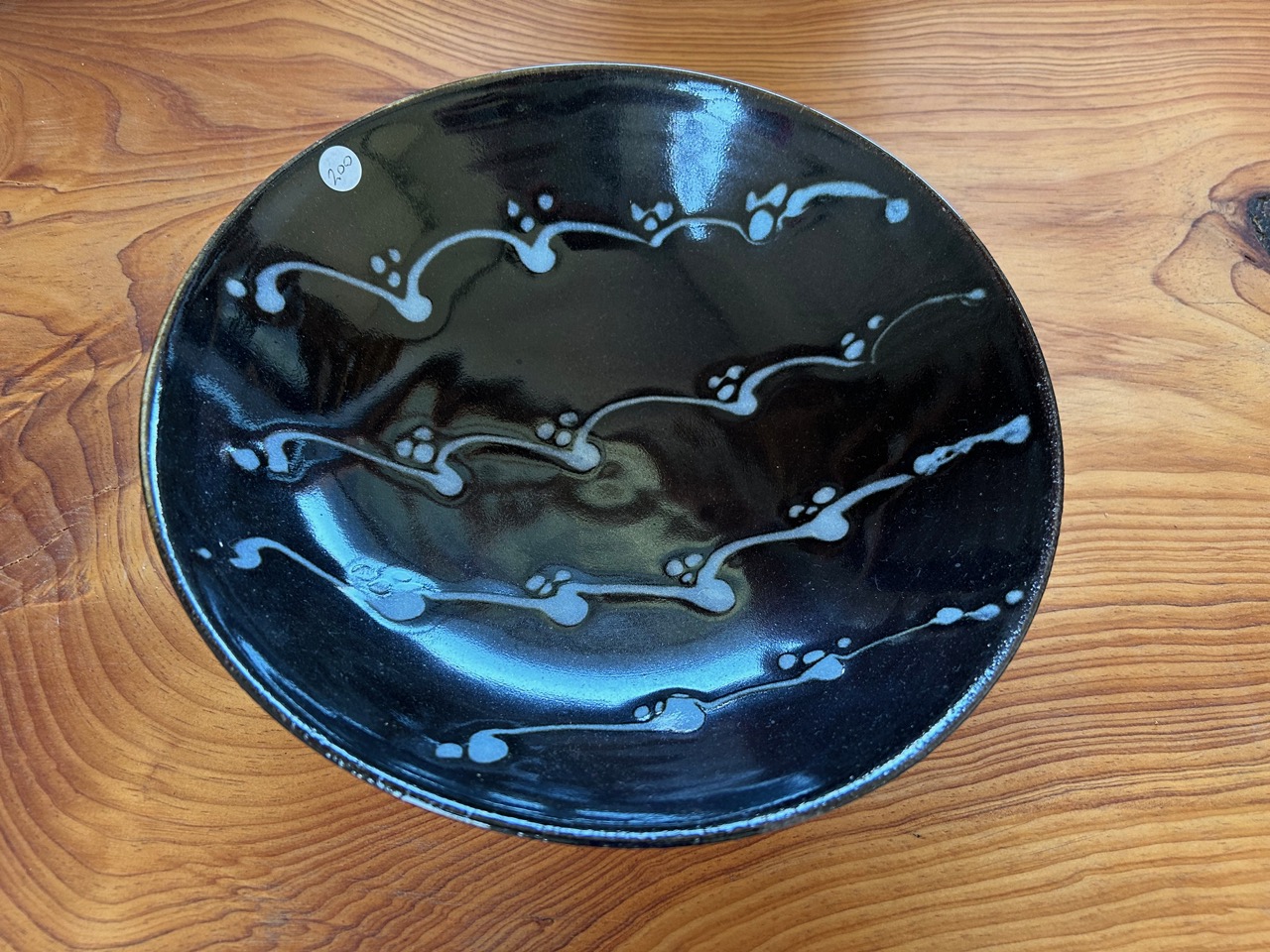
I’ve made them in 3 sizes, S, M, L. This is one from last years batch, beautiful flashing on the body and glaze from the wood firing.
The old style cooks mixing bowls also all sold out. I remember fondly the one that my Mother used all her married life. It was exactly the same as the one her mother had, both brought over from England on the ‘Orient’ Line ships at different times.
I decided to make these so that I could have one for myself, but I sold them all, so maybe there will be one left from this batch? I usually end up with pots that are second grade pieces, with some tiny fault, Our kitchen is full of pots like this. That’s how we get to keep them.
On this side of the drying rack, I have also made 3 bathroom sinks for a customer who lives locally and asked specifically for a sink with one of my rock glazes on the inside and unglazed and wood fired on the out side. I couldn’t do that order till now, as it is not realistic to try to fire the wood kiln over the hot dry summer. Just too much risk of fire bans coming into force half way through the firing. That would be a disaster too awful to think about. So we just don’t attempt to fire during the hotter months.
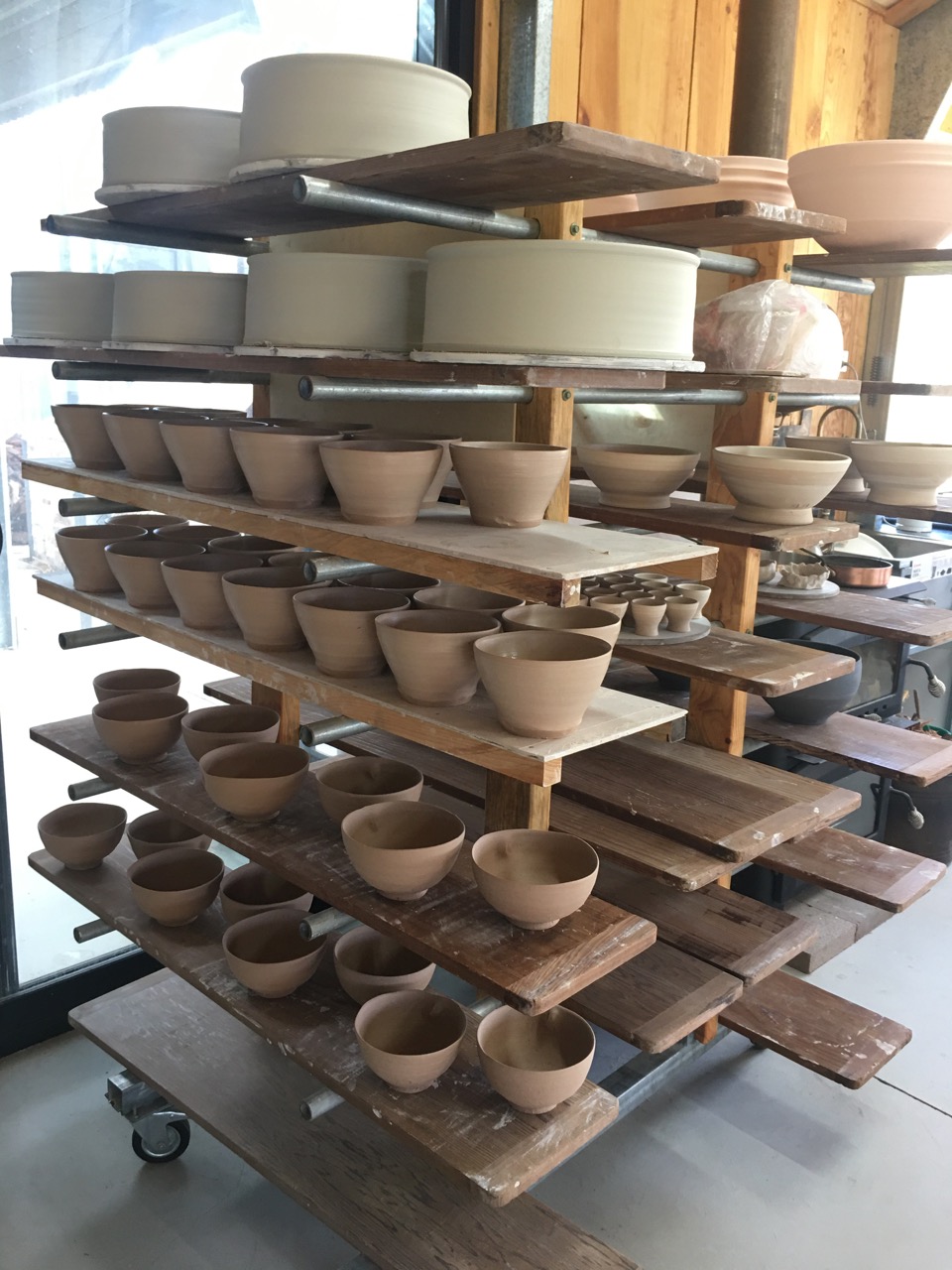
Some of the bigger mixing bowls are quite large, measuring 300mm. dia. and are made from 5 kgs of clay. My ageing wrists are not happy with wedging 5 kgs any more, so I wedge the clay up in two smaller lumps of 2.5 kg. Then join them back together on the wheel. I learnt to ‘slap’ the plastic clay into the centre of the wheel with my hands while still dry. No water involved in this centering technique.
The first 2.5kg lump is slapped into place and rounded off while I rotate the wheel head very slowly. Not using the motor at all, just a slight flick of the wrist as I lift my hands up. This turns the wheel head just 10 mm. each time , so that the next ‘slap’ will be an equal distance apart , so the clay slowly finds the centre. Once it is just about right. I add the 2nd 2.5 kg lump and start the centering all over again.
Once the whole 5 kgs are centred, then it is time to punch out the centre, slowly and gently, bit by bit. Lots of little hits while the wheel is very slowly rotated, just as with the first stage of the technique.
Once the lump is opened up evenly. I ‘slap’ the outside again with both hands evenly to get the lump back into a tight cylinder again.
The 5kgs are now centered, tightly bonded to the batt, and opened up ready to throw in a conventional way. The great beauty of a technique like this, is that half of the throwing is now complete, certainly the difficult and very stressful and high energy centering part, and the clay is still dry and ‘fresh’. With no water added up until this point, the clay hasn’t had a chance to get soggy and tired. It is also possible to stop at this point and take a little rest if you are new to the technique and need to rest your self for a minute or two. This is not advisable if you have already wet the clay and started throwing.
Once you have wet the clay to smooth out the surface and start the throwing proper, it’s best to just carry on and not stop for any reason.
Meanwhile in the kitchen, I have been dealing with the great tomato explosion. This week besides making more passata, I made a couple of batches chilli jam. My friend Ian gave me his recipe, which has a lot less sugar and a little more spice than the one I got off the internet some time ago.
2 Kilos of tomatoes boils down to just 4 small glass jars of chilli jam once it has been reduced and concentrated.
Janine has been shelling and roasting the first few basins full of our hazelnut crop. Unlike tomatoes, there is no urgency to deal with nuts. Once they are collected and inside, they are safe. We have a dozen hazel nut trees and a dozen almonds. The almonds have not recovered well from the fire and are struggling, fighting off an attack of ‘shot hole’ fungus in this damp summer weather.
On the other hand the hazels were more of less burnt to ground level, but they are a smaller and very robust plant, perhaps more suited to be used as a hedging bush. This years crop is our best yet.
Once roasted, they become really flavourful. Before that, they are pretty dull. We don’t salt them for health reasons.
Finally it’s time to cook dinner. Tonight it will be baked, stuffed, ripe, red capsicums. I used a vegetable and herb mix, so it’s a vegetarian meal tonight, as it so often is most nights.
This is a small part of our attempts to be both creative and self reliant while treading as lightly as we can in this carbon constrained world.
Nothing is perfect, nothing is ever finished, and nothing lasts.
We have spent the past week continuing to work on the new fence.
The fence is now finished the construction phase and we have been getting on with cutting up the dead trees that had to be removed to clear a straight line for the fence.
I had to have a few days off to rest my back and forearms that got a bit over worked.
I estimate that I have now cut and stacked 1200 to 1500 billets of timber. Enough for 2 years firewood, if not more. Of course some of them are only small, down to 50mm dia.
But some are up to 450mm dia. I cut up the whole tree. Nothing wasted.
All the felled trees that were within 50 metres of the house are now cleaned up, cut to stove lengths and stacked near the wood shed, ready for use in the winter.
The other trees that were felled are all still stacked along side the fence line. I may get around to getting out there, right down the back and cutting them up.
However, experience has taught me that by the time I have used up all these stacked timber billets, All the logs laying on the ground will have been degraded by the white ants.
There are still so many standing dead trees within just a few metres of the gateway through the new fence that I will most likely be choosing to work on those trees.
Each morning we get up early and do a few hours work wheelbarrowing broken bricks down the back to fill in the deep gaps under the fence.
This is to stop animals from shinnying underneath the fence in the lowest spots. We have almost finished this job. Maybe just one more cool morning’s work.
Once all the gaps are filled with brick bats and rubble, I start carting some left over crushed gravel from the pottery site footings, down to the fence line.
This gravel and dirt mix will cover the crushed bricks and level out the surface to make it easier in the future to keep the fence line mowed and clear of re-growth.
After lunch, it’s too hot to work outdoors in the full sun for us oldies. So we retire indoors to work on other projects in the shade.
I’m currently working on welding up a set of 3 gates to complete the fence line securely. Our neighbour on the back fence line saw a full size stag in his yard the other day.
I really need to get this unscripted and unfunded crisis done and dusted as soon as I can, so that I can get back to my real work in the pottery.
In the evenings we make Tomato passata, Plum sauce and Onion jam. These all need to be made and stored away for later use to make the best of our excess produce.
Bottling tomato passata
Plum sauce bottled and cooling.
At this time of year every meal starts to take on a certain ratatouille aspect. Tomatoes, basil, capsicum, zucchini, and squash.
Summer garden Ratatouille with steamed fish and hand picked capers in a white wine reduction.
Garden beetroot, home made onion jam, and 2 cheeses tart.
Desert is freshly picked blueberries baked into a tart. We are picking 3 kgs every few days at this time of year. Some get preserved for later in the year. Some eaten fresh for breakfast, some are used in cooking like this and the rest are given away to neighbors and friends.
It’s a tough life, but we just have to work our way through it.
You must be logged in to post a comment.