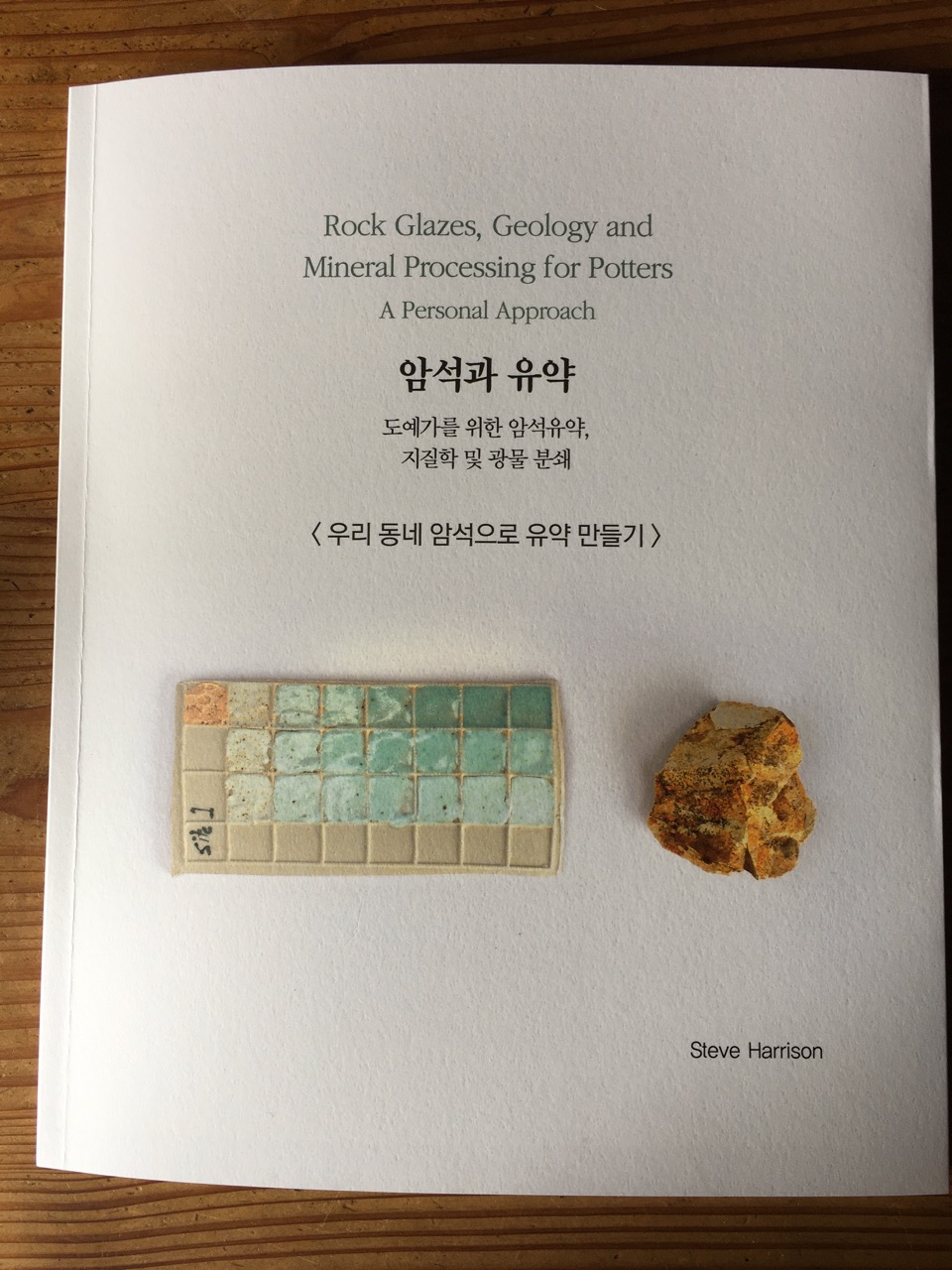
This week I received a box in the mail from Korea. It contained copies of my latest book translated into Korean.
I was such a poor student of English at school. I’m somewhat surprised that I have become a published author of multiple books in 3 languages!
Even my English teacher from High School was surprised, to the extent that when I met him 10 years after leaving school, at a reunion, he didn’t believe me when I told him.
I don’t blame him.
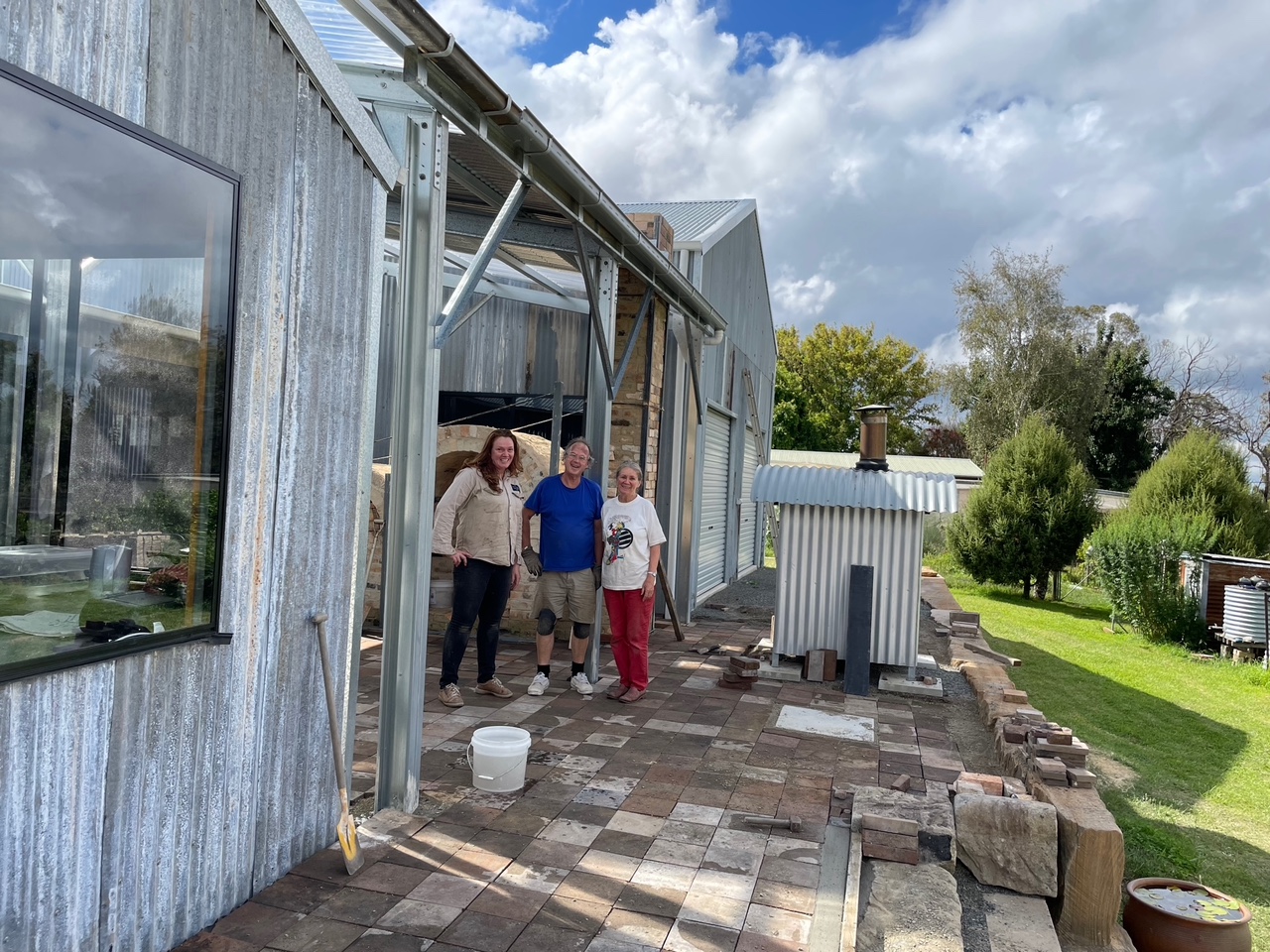
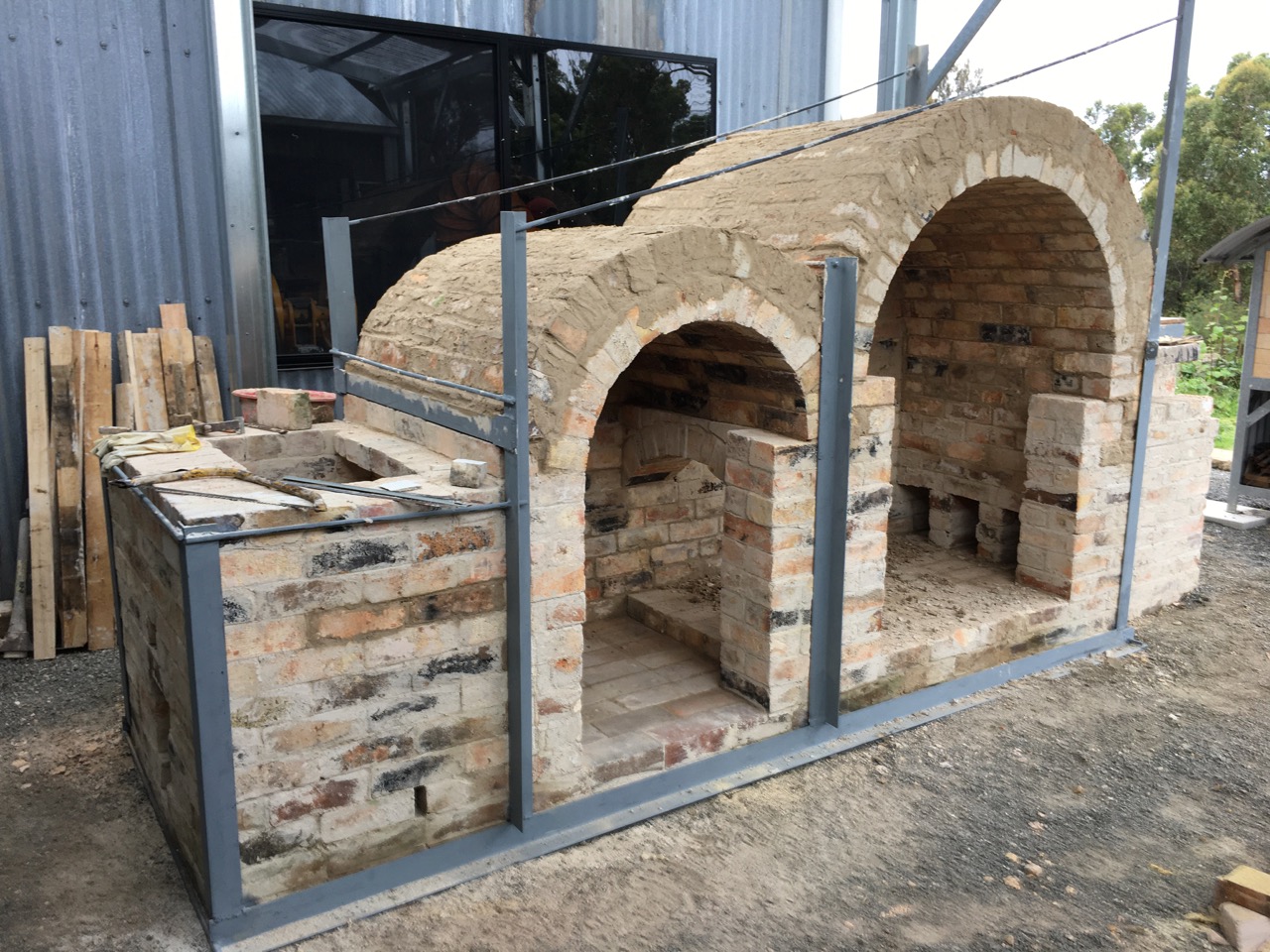
My work building our wood fired kiln continues. This last week I have finished the chamber arches with Janine’s help.
Adding their second layer of insulation bricks and welding on the steel bracing.
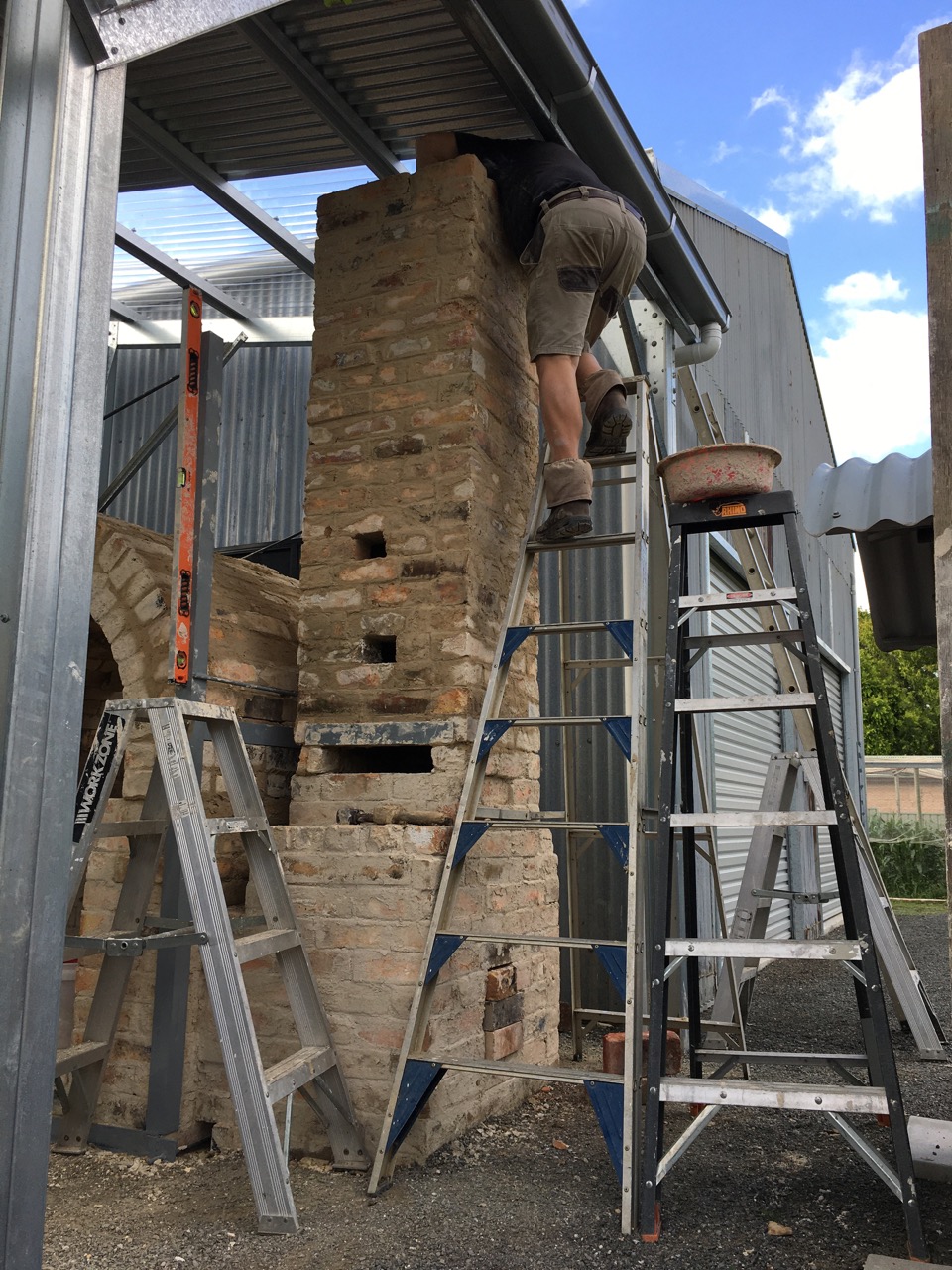
I also started work on the chimney with the help of my good friend Warren on the weekend.
The chimney is almost at the height that I can’t build anymore courses until I cut a hole in the roof to allow it to go through.
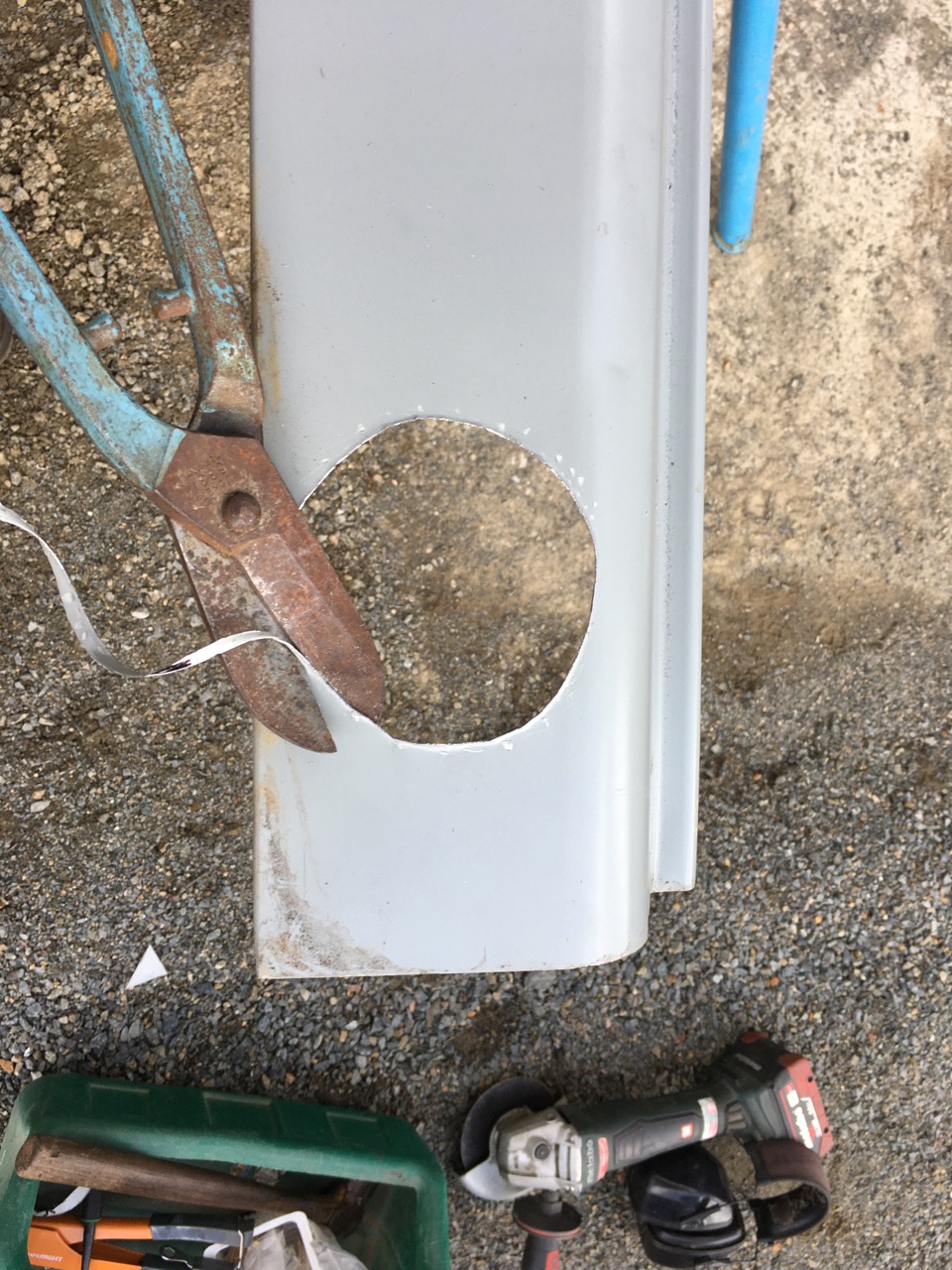
This will involve fabricating some specialised pieces of galvanised sheet metal ‘flashing’, custom fitted to the brick courses just above the tin roof to keep the rain out.
I hope to complete the chimney this week. More ladder work!
I have declared myself an honorary 59 year old for the past week to allow me to keep climbing ladders 🙂
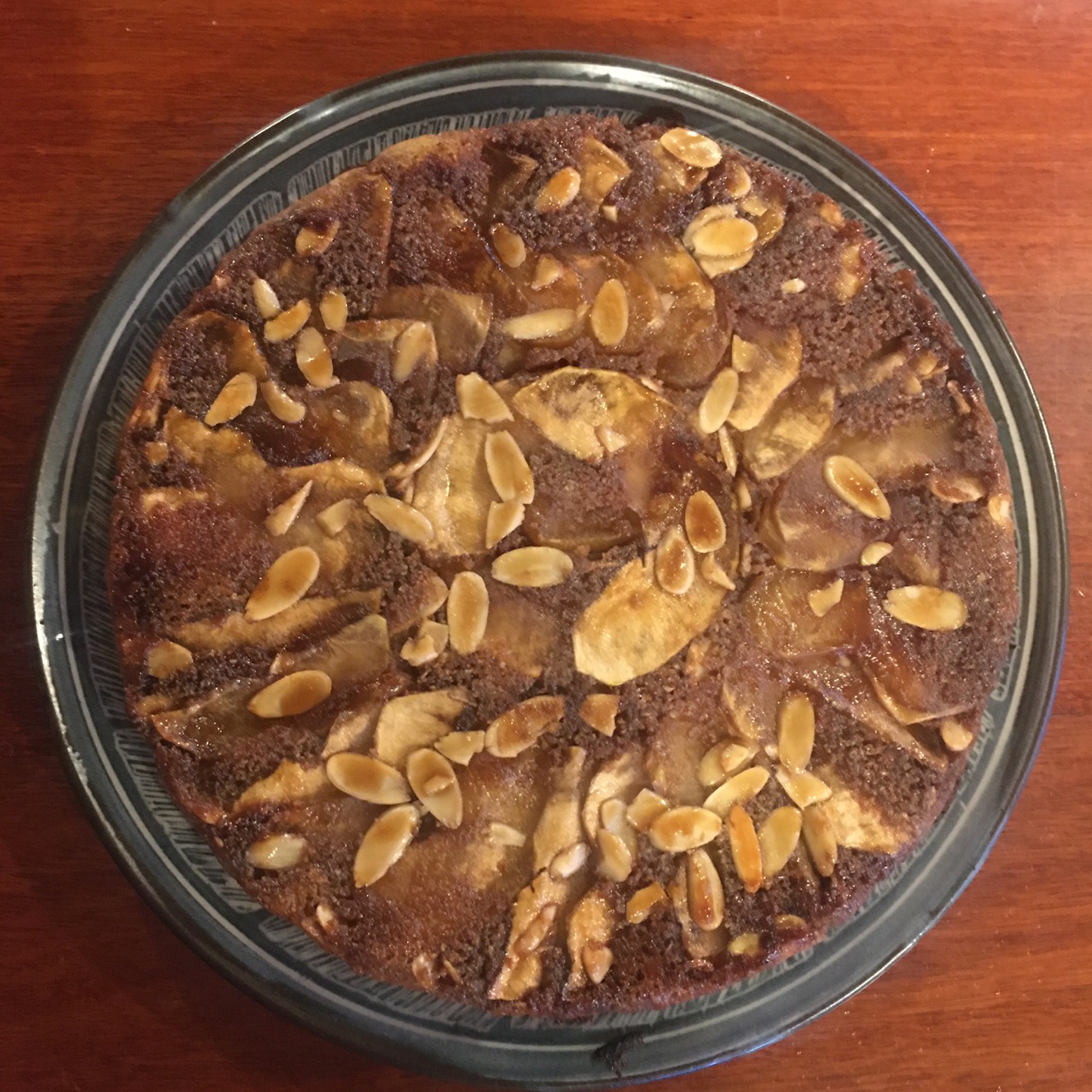
We have now picked nearly all the apples and I cooked another apple and almond flan tartin for our weekend guests.
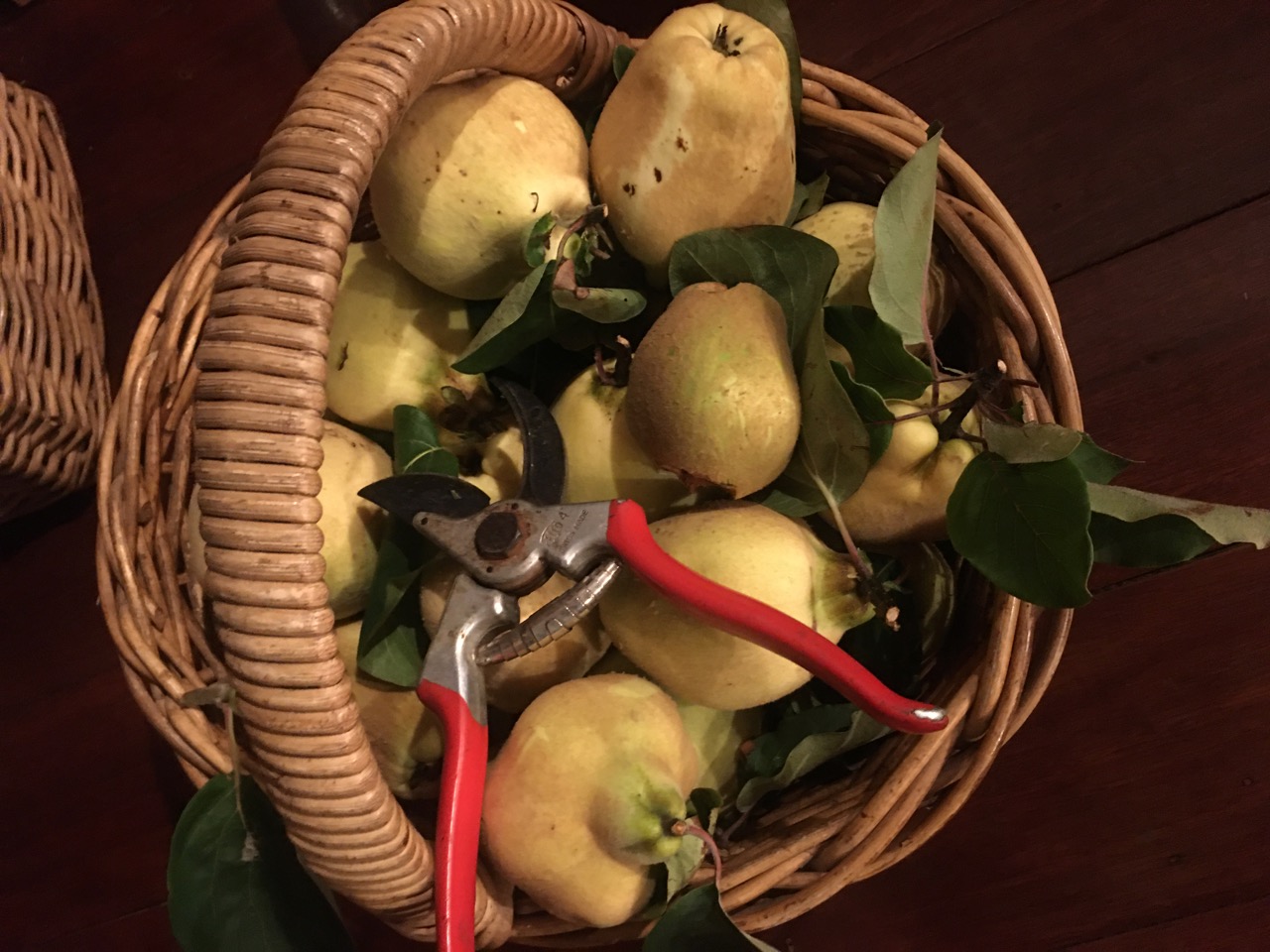
I also made the first batch of baked quinces, as the birds had decided that it was time to start eating them, dropping a lot of them onto the ground with just a few holes pecked into them.
They need to be dealt with pronto, or the damage soon spreads and they go bad quickly. I wouldn’t mind so much if they ate the whole thing, but they just peck a hole into the fruit to get to the seeds inside. If the fruit drops, they just watch it fall and start on another. At least the rabbits eat some of the fallen fruit. Quince fed rabbit sounds pretty good!
I wash the fluff off the skin, then peel and core, chop into 4 pieces for small fruit, or 8 pieces for the larger ones. I simmer them for 20 mins in a sugar syrup of 120 grams of sugar per litre of water. This syrup is less than half strength of the recipe ! Use enough water to cover the volume of fruit. Add a few cloves, star anise, a cinnamon stick, and half a small bottle of maple syrup. Once softened a little, transfer to a large baking dish and bake for 2 hours in a low oven at 160oC until nearly all the liquid has evaporated. Remove the aromatics and bottle in sterile jars while hot from the oven. I think that they are ready when they start to catch just a little on the tips and have turned a beautiful reddy/orange colour.
The fragrance is spectacular and the taste is amazing. Can be eaten just like this, or can be enhanced a little with the addition of some pouring cream, plain yoghurt or ice cream.
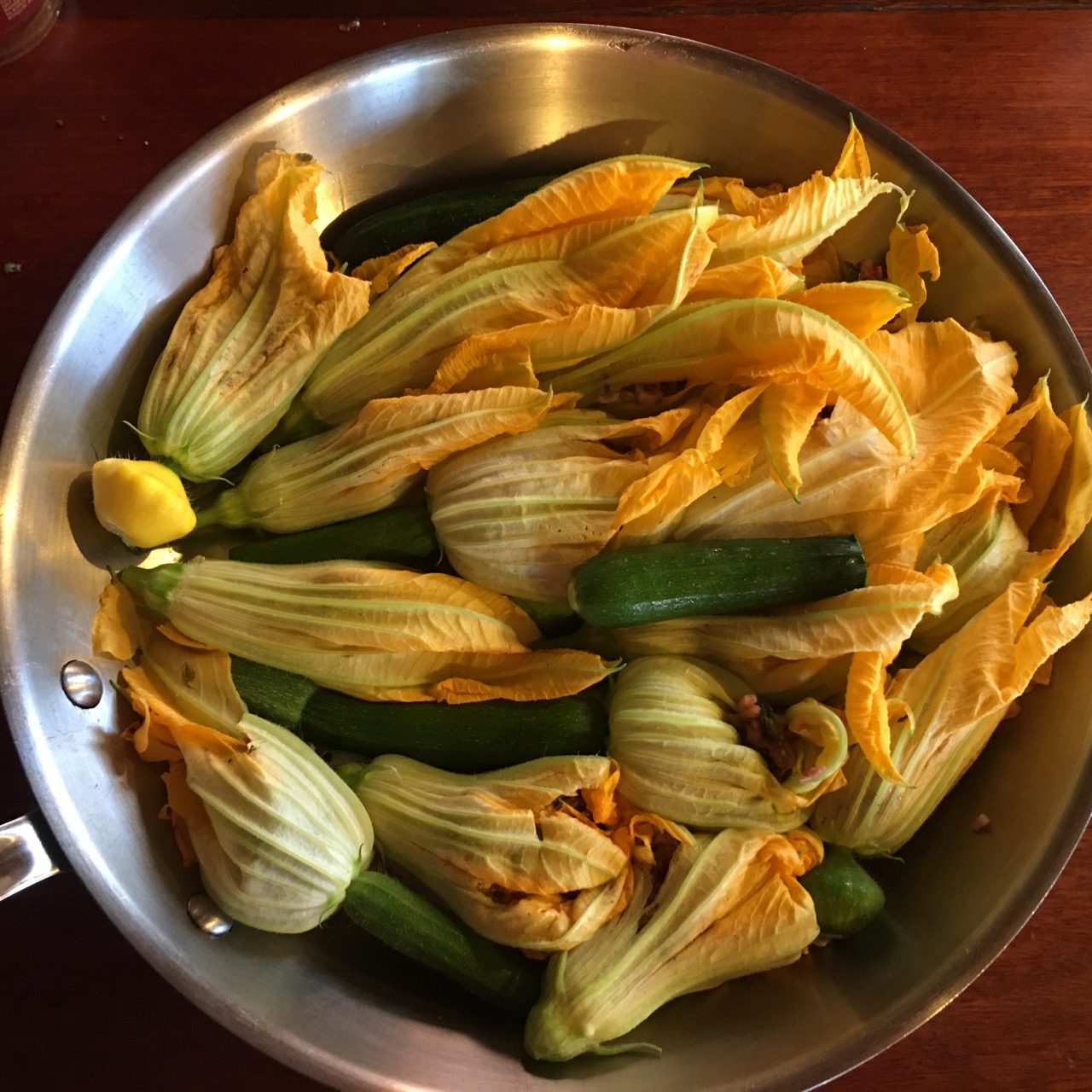
I also managed to find just enough zucchini and squash flowers, both male and female to make up the numbers, so that I could make stuffed zucchini flowers for dinner. I wasn’t expecting to find so many suitable flowers this late in the season, so wasn’t prepared with suitable quantities of cottage or other suitable cheeses. Instead I used a tub of left over risotto from the fridge. extended with some boiled lentils and a few olives. It made up the distance.
This last week also brought a little bit of excitement into our dull, plodding, Post Modern Peasant lives. The State Government Funded green waste clean-up program commenced, for all the dead and damaged trees in people yards that were created by the 2019 Black Summer catastrophic bush fires here in the Southern Highlands.
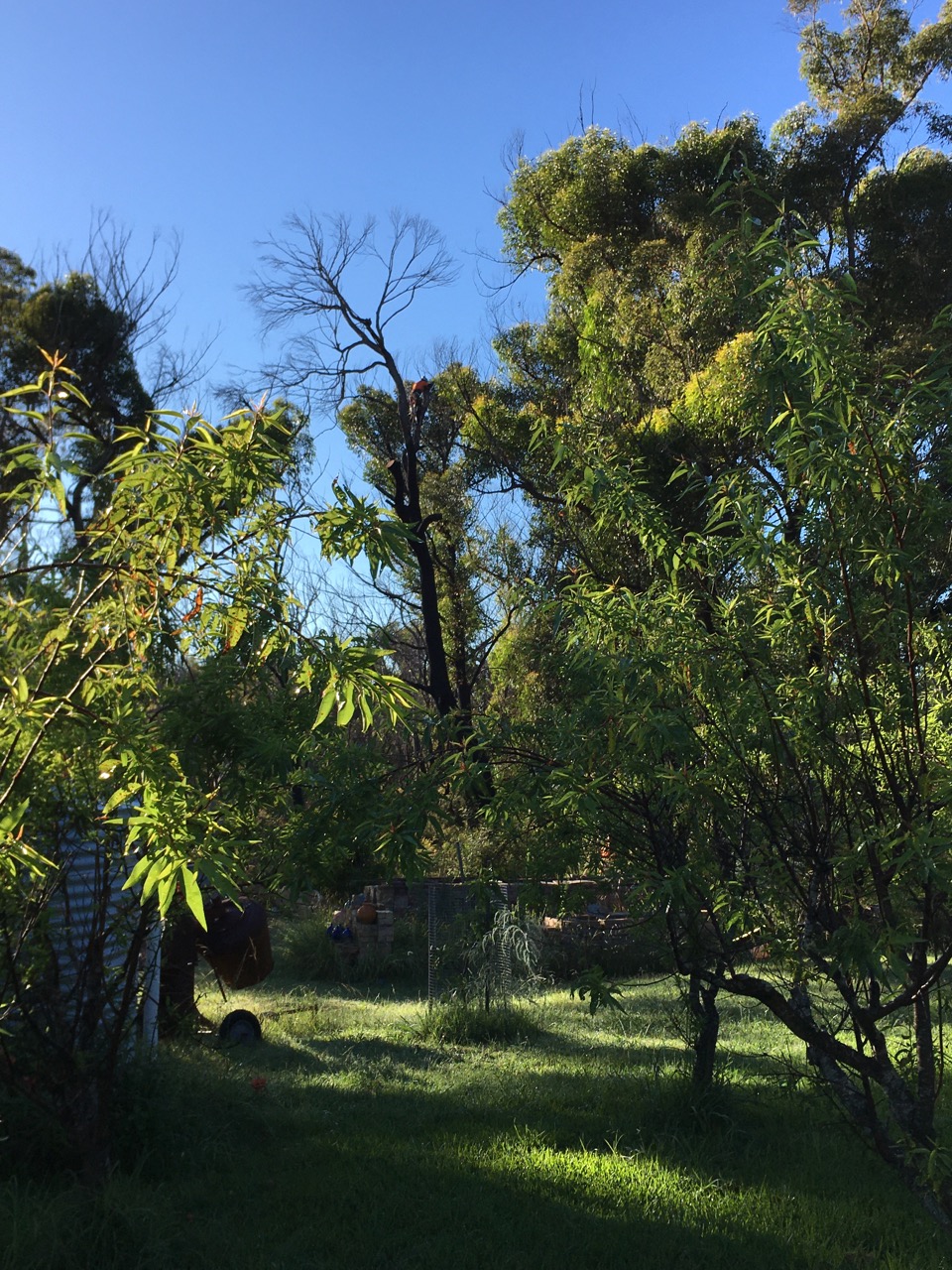
We had a team of half a dozen blokes here for two days, lopping, topping and chopping dead trees. Some were completely removed and the stumps ground out, but most were pruned back to make safe habitat trees for wild life.
They shortened and made safe 15 trees and took down 3 or 4 smaller ones in the immediate vicinity of our back yard orchards, where we work and mow.
The purpose of the exercise is to get most of the smaller dead branches down out of the canopy so that it is safe to walk around underneath them in our garden. We had already dealt with the most pressing and difficult problem trees in our front garden 2 years ago at our own expense. I wasn’t prepared to survive the fire and then be killed by a falling branch.
It’s only taken 26 months for the State Government to implement this emergency safety solution into place. I wonder how long it takes them when they take their time 🙂
We still have 3 acres, or one and a bit hectares of dead forrest that is continually dropping dead branches. We just don’t go there, and if I have to, I wear a hard hat.
It’ll be unsafe for the next couple of decades as the dead branches slowly rot and fall. But what can you do? It’ll cost many thousands of dollars to get them all pruned safely.
All this continued wet weather has filled all the dams to over-flowing, as well as all the water tanks. Everything is saturated. the ground is seeping water from every ledge and embankment.
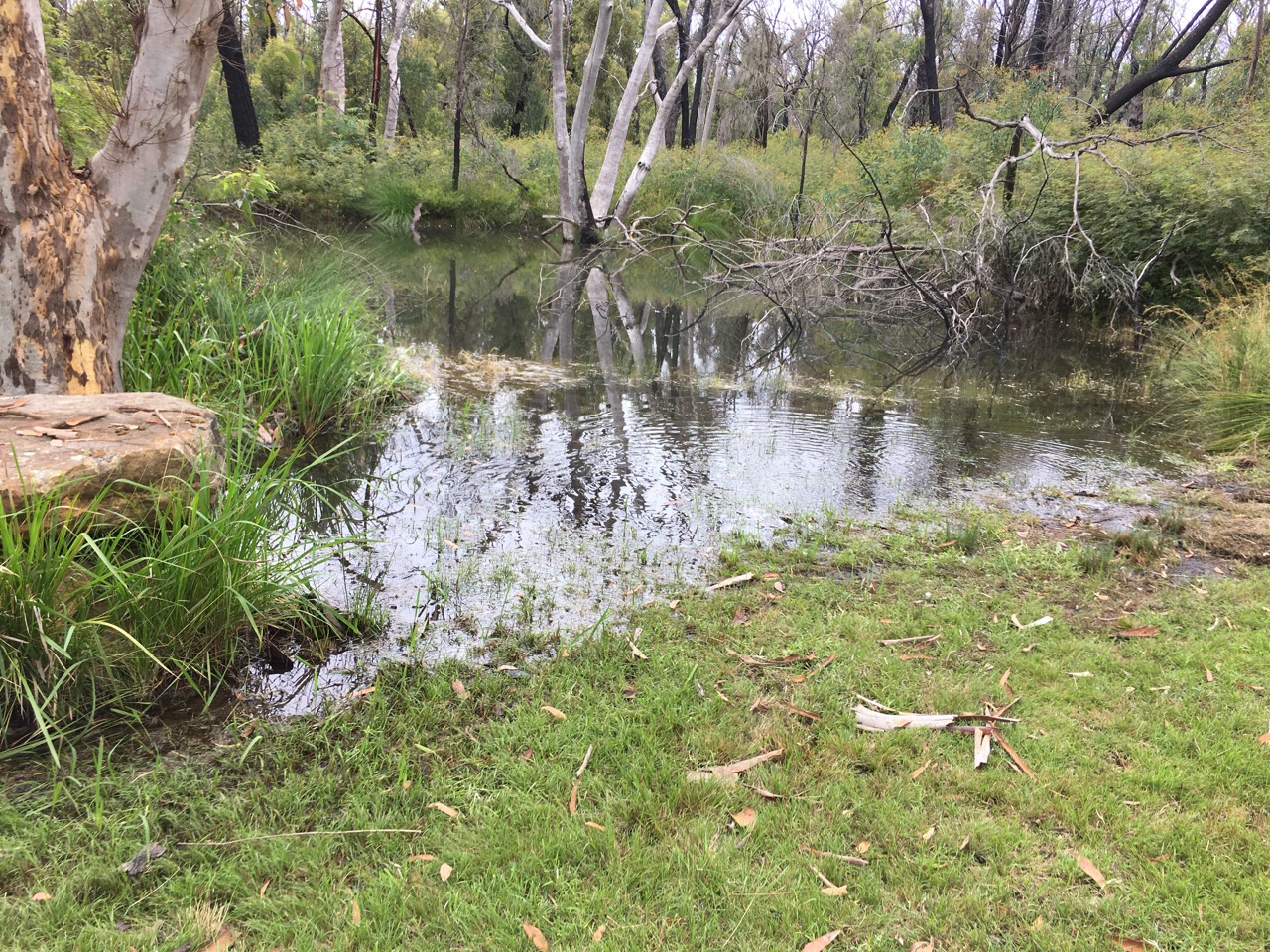
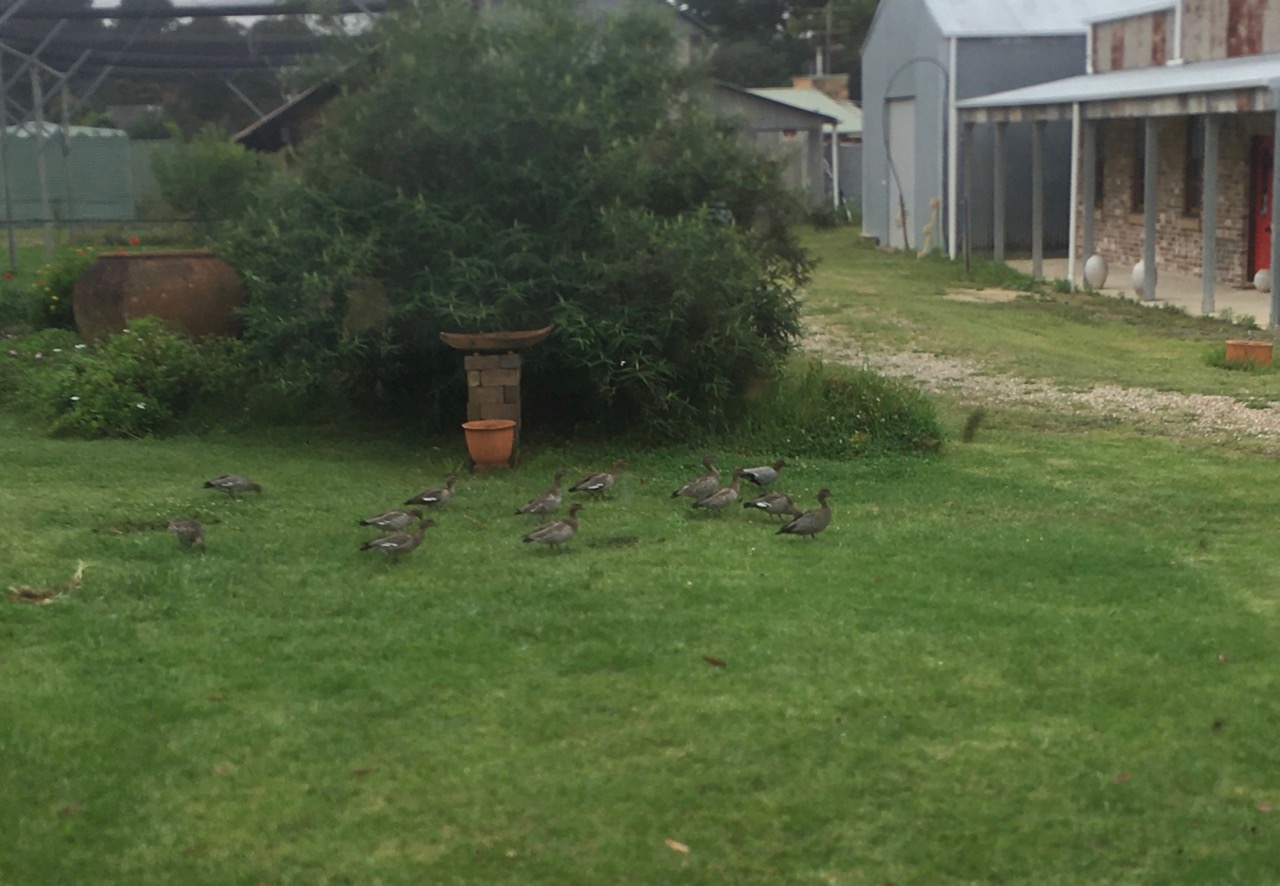
The edge of this dam slopes gently down towards the deep area. I mowed about 2 metres into this flooded riparian zone just a couple of weeks ago. Now its totally under water.It is so wet everywhere. It’s great weather for ducks. We have now got over a dozen mature wood ducks grazing the lawns every morning. These would have been some of the tiny little hatchlings that we saw a few months ago. They are looking great and very healthy wandering around eating the lush grass growth. They alternate between the dams and the huge expanse of lush grass that we now have. Unfortunately, they don’t eat enough to keep the grass down low enough to save us from having to mow the grass. It’s a full days job every week.If we don’t keep up to it, it can get out of control and then its much harder to mow, as the mower can’t cut through thick, deep, long, wet grass.
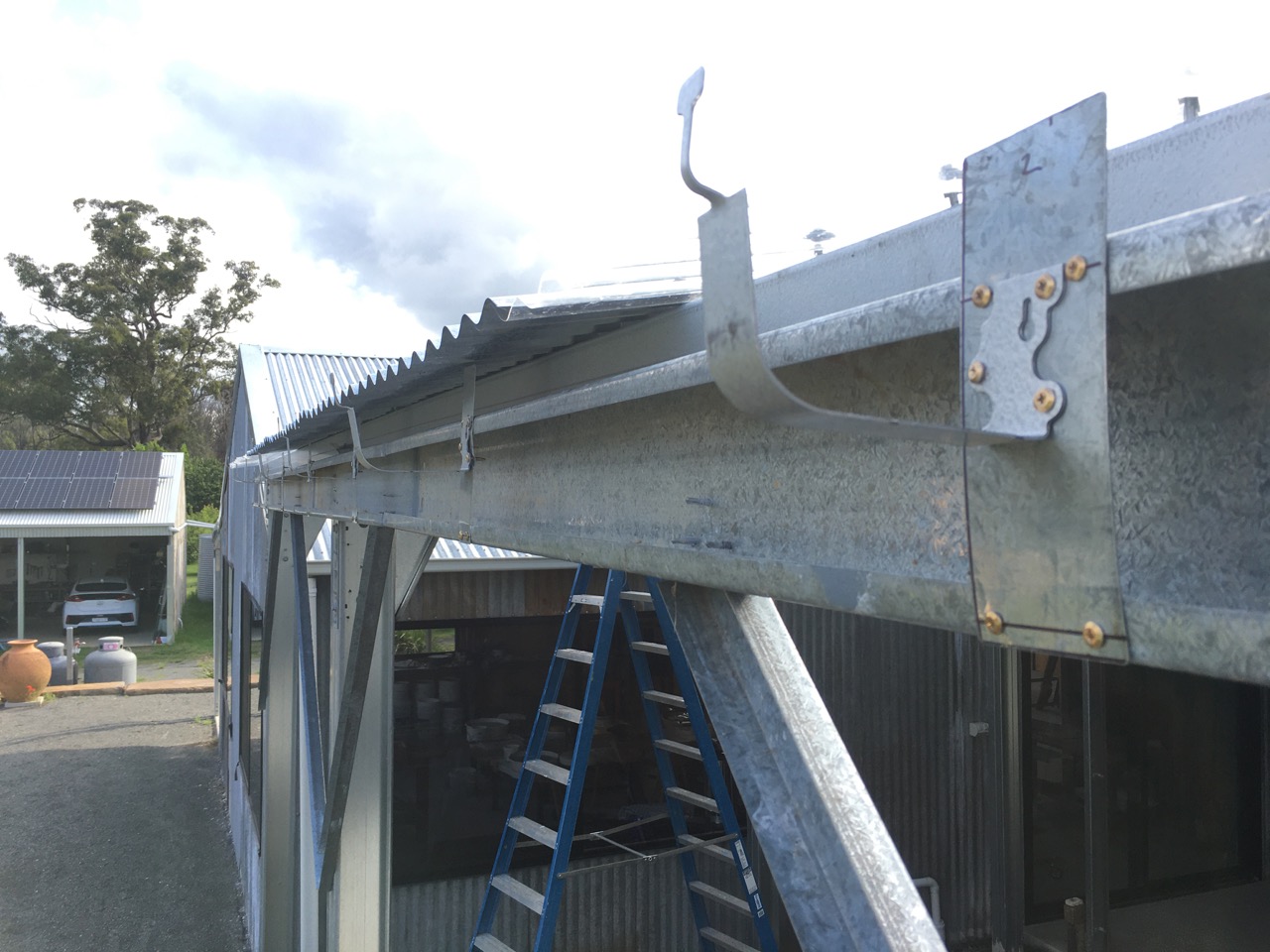
Today I finished installing the guttering on the new kiln shed roof. I spent a day making special metal brackets to span the gap of the ‘C’ section purlins, to support the new gutter with the correct fall.I interrupted the former down pipe that took water straight down the wall from the big shed roof. down into the underground piping system that takes it all down to the big concrete water storage tank. The big shed down pipe now empties onto the kiln shed roof, and then collects with all the water off the kin roof, down the new gutter and back into the old plastic down pipe system. Neat.
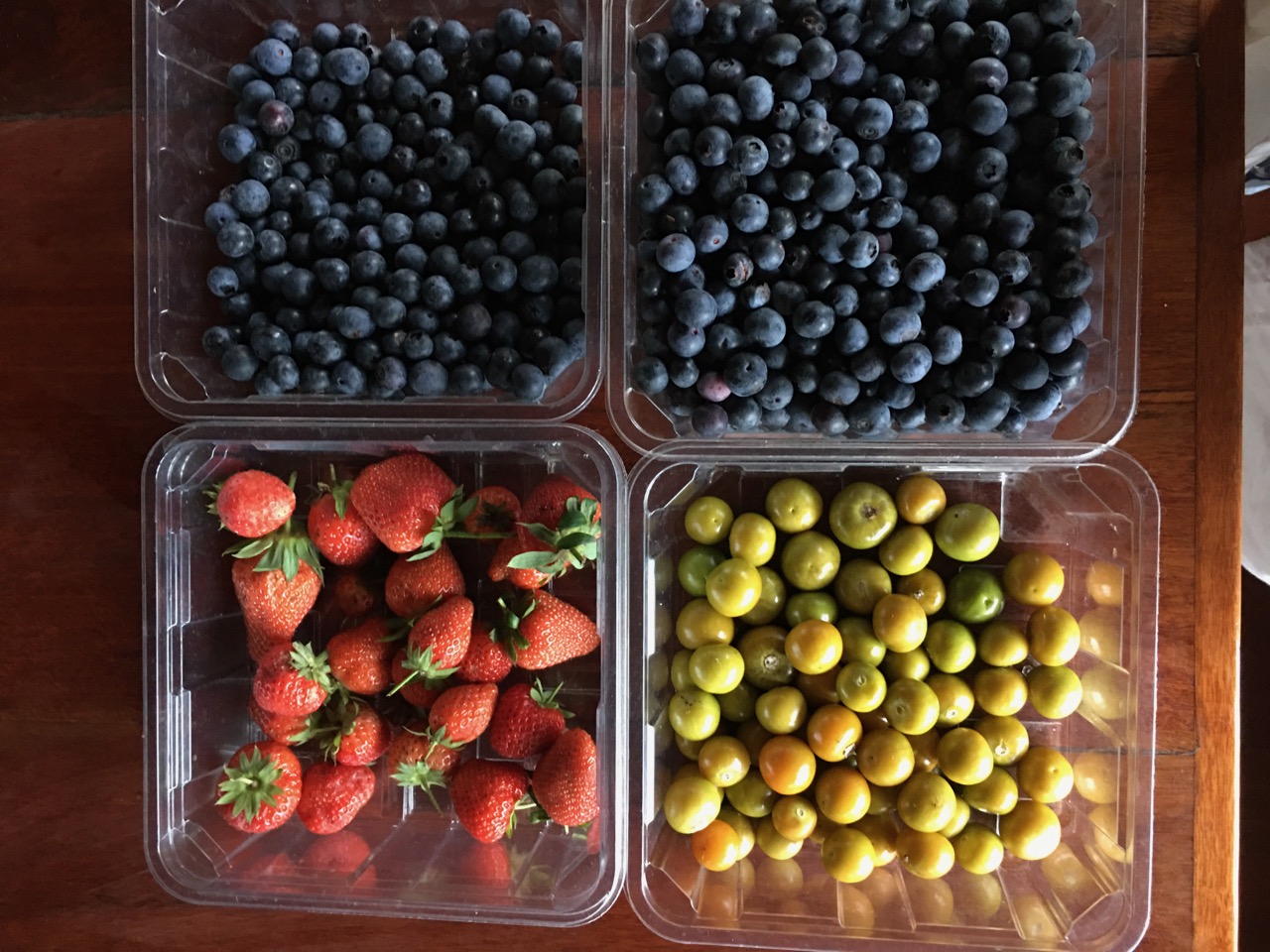
The loganberries have finished now, but the Chinese gooseberries have started and the blue berries are in full season, along with the strawberries. So we are having a lot of fruit salads for breakfast and I have a new variation on berry tart. Strawberry, blueberry and gooseberry tart.
On Wednesday we drove for 4 1/2 hours up to Gloucester to pick up an old Leach potters wheel that was given to me by an old friend, Griselda Brown. We knew Griselda back in the 70’s when we both lived on the outskirts of Sydney. Griselda had studied at the old ‘East Sydney Tech’ Art School where Janine and I both studied with Peter Rushforth, Bernie Sahm and Derek Smith, only Griselda had gone through some years earlier than us, in the mid 60’s.Griselda used to visit us out at Dural, where we had built a big 3 chamber wood fired climbing kiln. She had studied with Michael Cardew in Cornwall after finishing her course here and had a love of wood firing, but was not in a position to build her own wood fired kiln herself. We filled that gap. When Griselda went to Cornwall, she thought that she would be working in the pottery, but Cardew issued her straight into the kitchen and explained that his wife wasn’t living there and her job was to make his meals and clean the house. She could come to the pottery once all her domestic jobs were done! Griselda bought one of the early Leach style potters wheels from J. H. Wilson in Canterbury, who built them here under licence from the Leach Pottery in Cornwall. She had this wheel all her life and as she is considerably older than us now. She is retired and the wheel was sitting idle.It has the full copper tray, with drain pipe and overflow spigot, to stop any water going over the wheel head bearing. It’s in very good condition mechanically, but the wood work has suffered recently as it was stored out in the weather for a while.
When I got it home after our marathon 9 hour drive, the next day, I took the wheel head off and cleaned all the turnings and dust out of the top bearing mount. Gave it a blast with compressed air, oiled the bearing and installed a rubber flange over the shaft to stop any more dust getting to the bearing in the future. Then I made a new plastic collar for the copper tray, as the original copper collar is very low to allow for access to the grub screws holding the wheel head on.
Interestingly, I have never seen an Australian Leach wheel with the wheel head held on with grub screws, needing an Allen key to remove them. This is the fourth different mechanism that I’ve come across used on these wheels over their 25 year history. My first wheel had the wheel head screwed on with a large 1” thread cut into the shaft and head. Then another one had a morse taper and just pressed on, then the third one had a shallow taper and a ’T’ bar pushed through the shaft. After sanding and a couple of coats of tung oil it looks and works great. I sanded the very rusty wheel head to remove a lot of the pitted rust, and then gave it a coat of rust converter to stabilise the corrosion, and finally a light coat of zinc primer to keep it in good nick. I’ve owned 5 of these wheels over my life and tragically lost them all in the past 3 previous fires. I just can’t be trusted with them! I tried a few different ways of looking after the cast iron wheel heads over the years, and this is the best. However, the main point is to always wash the wheel head clean and dry it after use. Most potters wouldn’t be so bothered, but I use white clay and porcelain, so I can’t have rust in the tray or on the wheel head.I’ve always had two of these wheels in use, One kept strictly for porcelain, and the other for stoneware. It’s easier this way and saves a lot of time spent in thorough cleaning between clays.I’m really pleased to have the chance to own and use this wheel that belonged to my friend from a long time ago.
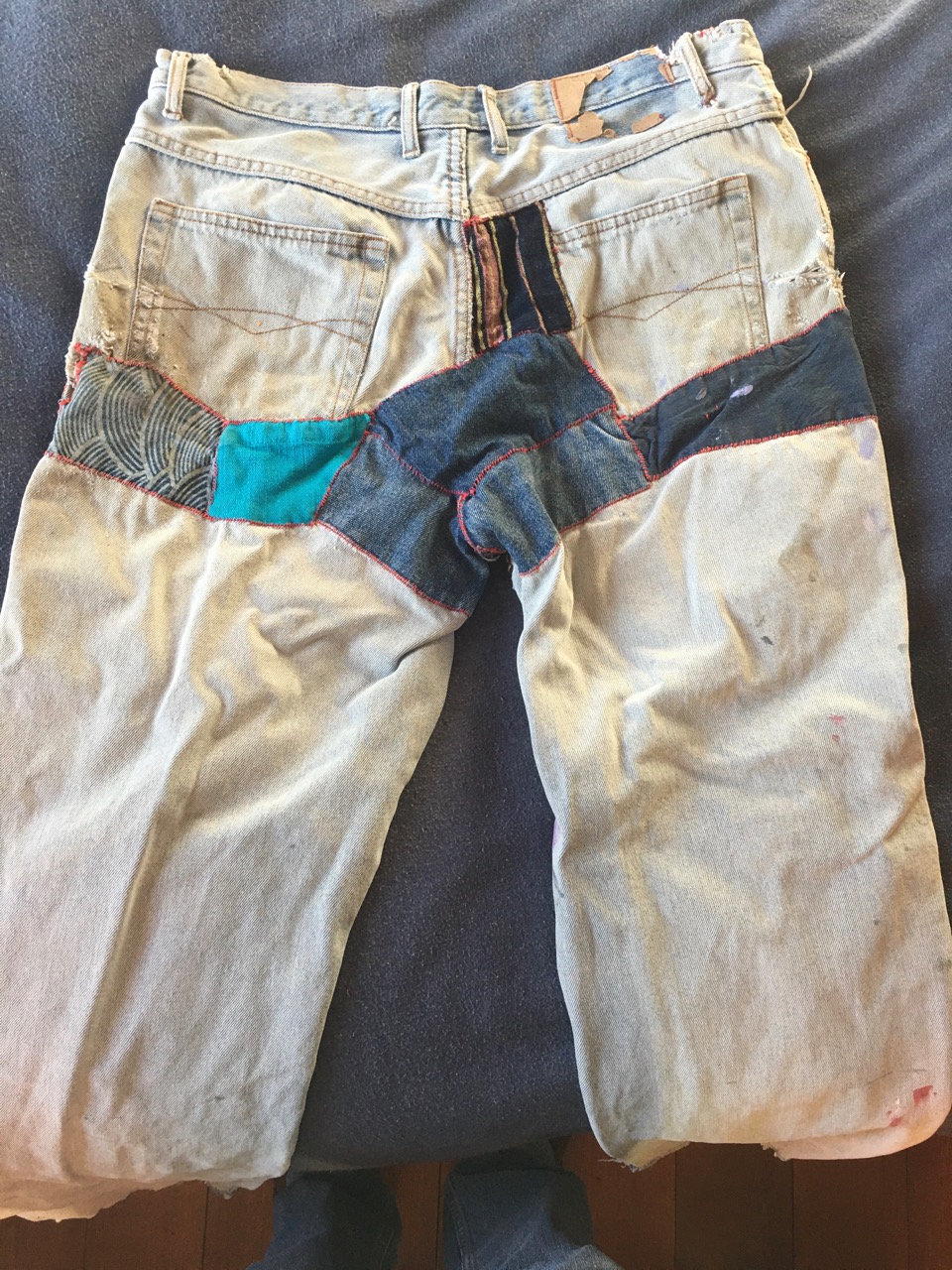
Each week I attempt to crush and mill another local igneous rock for use as a glaze ingredient.This week I stopped off on the way to Mittagong Post Office to collect another stone, on the hill behind the post office.I passed it through the rock crushers that I have pains-takingly restored after the fire. Luckily, all these machines are made of very solid steel plate or cast iron, but more importantly, they were situated in the breezeway between the two buildings. Being largely out in the open with very little flammable material around them, just a polycarbonate roof over them. So they didn’t get too hot.They weren’t warped or melted. This meant that I was able to restore them, not just scrap them.New motors, bearings, seals, pullies and belts were required. The metal work was largely saved because I poured used engine oil all over them, straight after the fire and before it rained on them. With the assistance of my friends Warren Hogden and Len Smith, Along with my friend Dave and his crane truck, we were able to lift them out of the rubble and up to a safe place, out of the way of the demolition crew and then tarp them in their oily state. This was just enough protection to stop them from rusting and flaking really badly. One very important aspect of my philosophy of self-reliance is never throwing anything out simply because it is no longer fashionable or is showing signs of wear. I keep working on my possessions, maintaining and repairing them, until they are really worn out, or past repair. In this regard, I have spent a lot of time patching and stitching my worn out work clothes and repairing some of my treasured pottery machines. Particularly the rock crushers. These things are as scarce as hen’s teeth and really worth working on. The Japanese have a word, ‘mortainai’ that means ‘making do’, I have written about it on this blog previously. It really sums up this repair and reuse philosophy.A year of part-time evenings has seen both my work jeans and the rock crushers back at work. These jeans are many years old and have patches over their patches, over their patches, especially on the knees.
My jeans mostly wear out at the knees and thighs, I have also had to reline the pockets, as the pockets are made from the lightest grade of cotton cloth that wears out in no time flat if you keep your car keys in there.
It’s just one more example of built in obsolescence. A product designed to fail. The retailers hope that i will just ditch the whole pair and buy another – in the latest fashion style! Well I won’t and don’t. I repair, re-use and re-cycle. I like to make them last me a decade. They start out as being for ‘best’ , going out etc. Then after a couple of years, they start to get a bit past their shiny best, they are worm in the pottery and for gardening. Finally after another 3 or 4 years, they are reduced to the welding workshop, rock crushing and angle grinding. This really takes it’s toll and they require more patches more often. In the past I have finally given up on them when I grew out of them and had to go up to another size. Then they became rags for painting and cleaning. These days I don’t get any bigger, so size isn’t the death knock that it used to be. Hence I a back log of three pairs of these patched jeans that just keep on being repaired and worn again and again.
But its not just the pockets, knees and thighs. They also wear out in the butt.
I think that ongoing hand stitched repairs like this are an important aspect of my creative expression. I exhibit my pots , but no one ever sees these creative endeavours. They are strictly utilitarian and for home use only, but this doesn’t meant that they are any less important. I kintsugi my pots and I patch my clothes. It’s the same thing.
After I had got the rock crushers going. I left it at that, as I wasn’t ready to crush any stones at that time. But the machines were ready. At least I thought so. I didn’t have the time to test them all out with rocks. I didn’t even have any rocks at hand to try out. I was satisfied when the new motors were installed and the new drive belts were fitted in place, just to see the machines rotate successfully. That was all I got to do. Now is the testing time.
Straight off, there was one casualty. The smallest laboratory jaw crusher just doesn’t seem to work at all. I got it 2nd hand from a junk yard. I tested it, the motor ran, the shaft turned, it whirred and clanked, but now that I go to use it, nothing happens when I put rocks in. They just sit there bouncing around. Luckily, I only paid $250 for it. I’ll need to pull it to bits and find out why. But that will have to wait till later, much Later… I have other machines that do actually work and they are enough to get me started. What’s most important is that I can get some local stones powdered so that I can get a glaze firing full of test pieces done.
There were a few hiccups with the other machines before I got them all working. The big jaw crusher was found to be running back wards. I hadn’t noticed this when I first wired it up, as the degree of oscillation movement is very slight, but the first time I put stones in it, I noticed that it was very slow to engage with the rocks, it still crushed the chunks down to blue metal sized pieces, but very slowly. It was really only because I know this machine very well as I have rebuilt it previously over years and am familiar with it, such that I noticed its lack of performance. Luckily, it is a simple exercise to reverse polarity of a 3 phase motor. It works properly now.
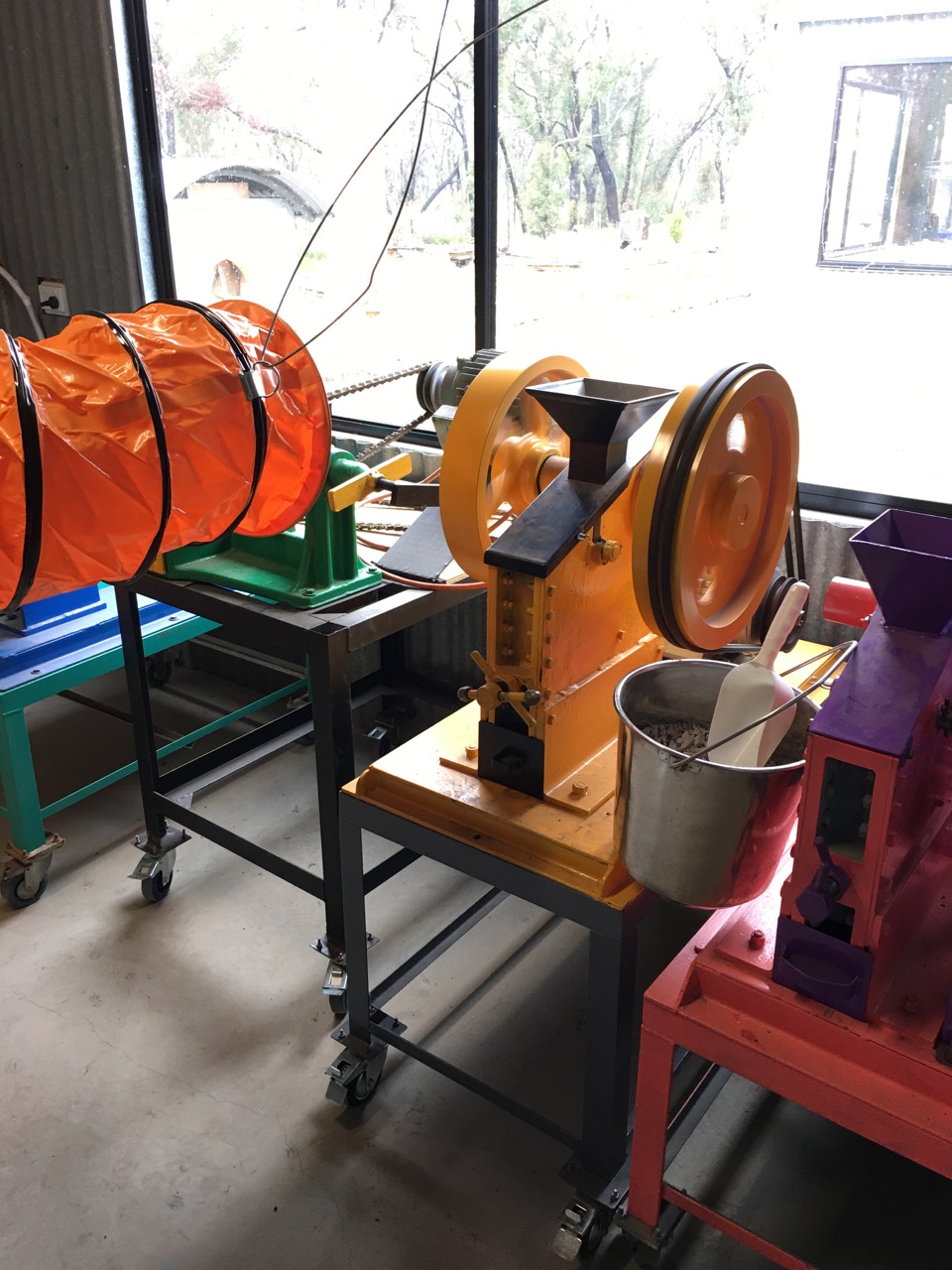
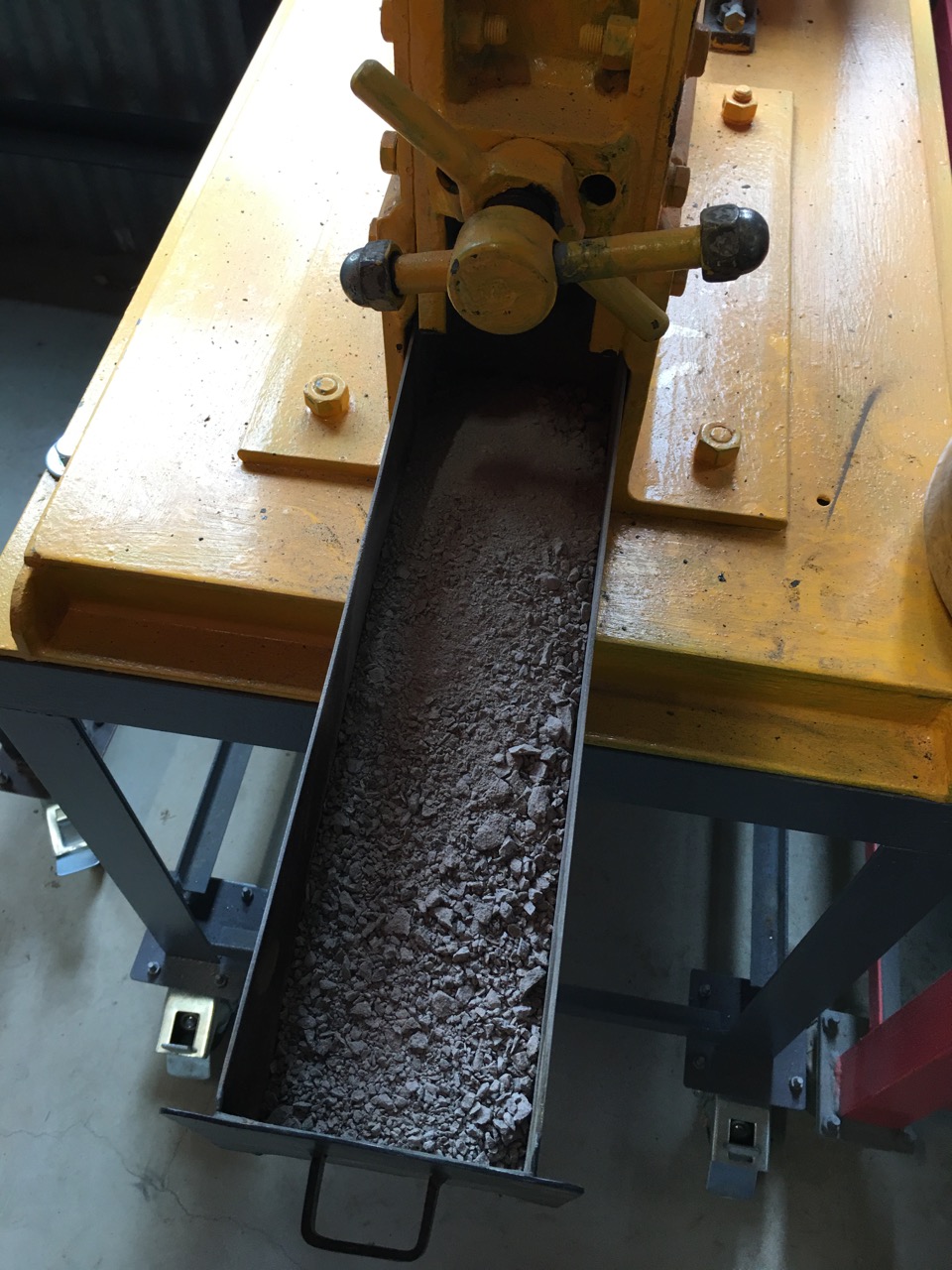
The small jaw crusher, which I use as a 2nd stage crusher, takes the blue metal sized lumps and reduces them to grit.
This little machine is now painted industrial yellow, but was formerly dark blue and orange in the old pottery. Me painting my machines a different colour is a bit like a lady dyeing her hair. A change is as good as a holiday. It cheers me up to see all the brightly coloured machines. Like big kid’s toys!
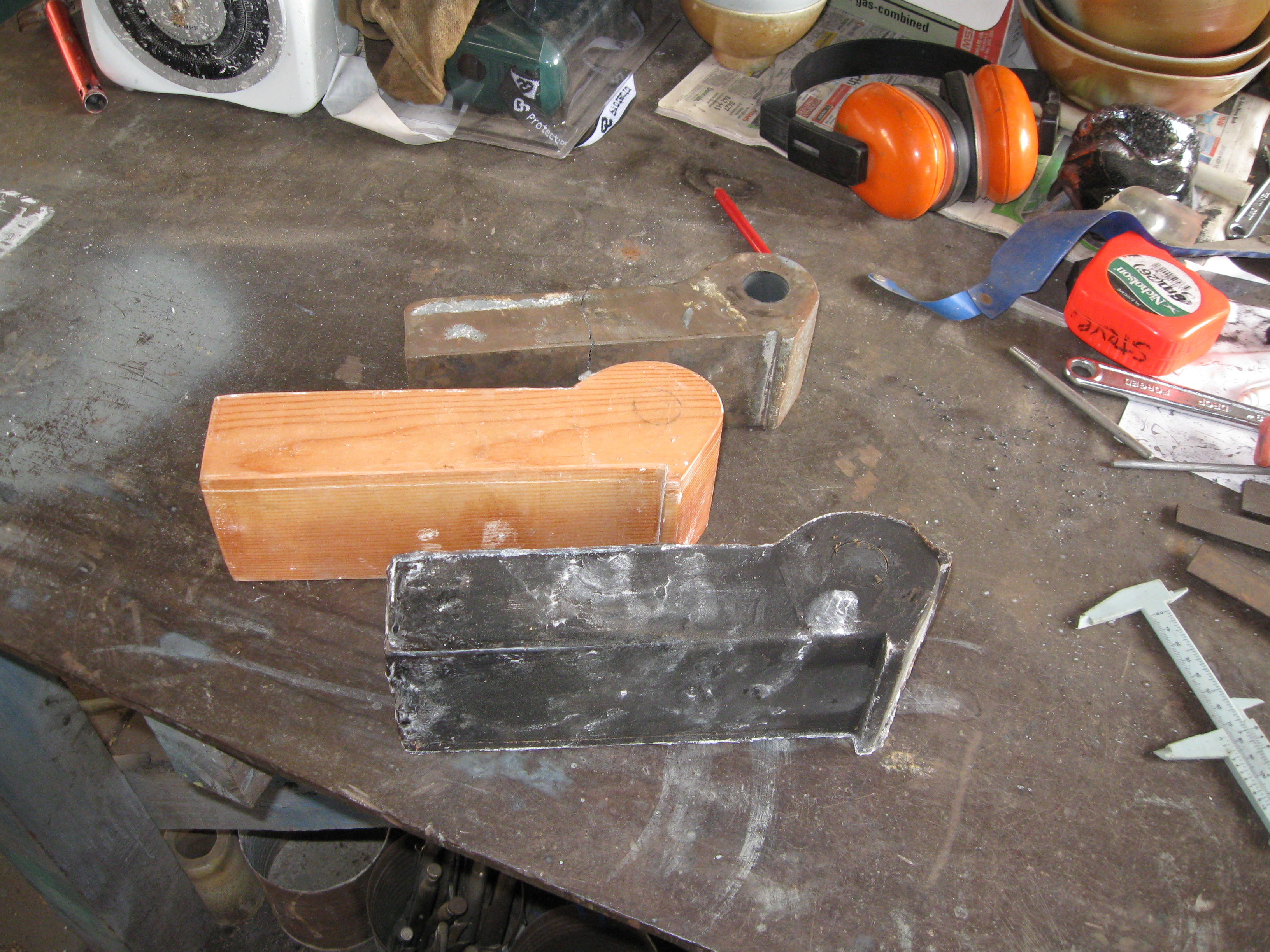
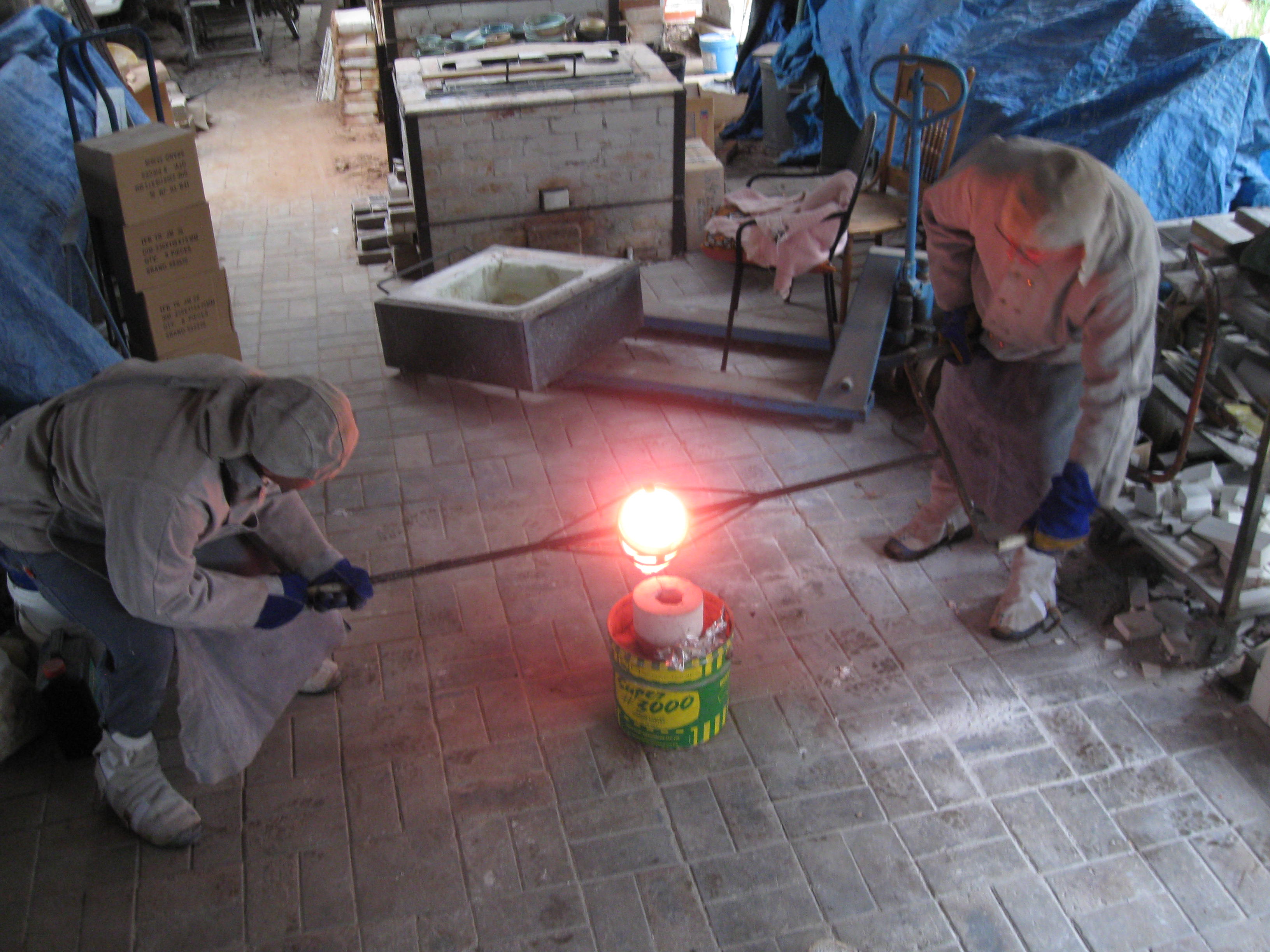
I move the negative-pressure ventilation, dust extraction hose from machine to machine. I have found that the end of the tube is quite friendly and affectionate. If I get too close to the end of the bright orange ducting, it attaches itself to me with the pressure of the suction. It’s not too strong and easy to remove from my shirt, but it is very friendly and persists in wanting to get attached to me. It’s quite amusing. It keeps on seeking out my shirt every time I get close while I’m working. I keep brushing it off, it keeps wanting to nuzzle-up and attach itself to me. Maybe it’s my pottery-workshop-cabin-fevor, after all these months of lock-down. Janine says that I need to get out more! But it’s nice to be wanted! 🙂 The output of this machine is from 6mm down to dust. I bought the little, now-yellow, crusher direct from the manufacturer, ‘Van Gelder’ back in 1983. When we used to make things here in Australia back in those days. This company has now gone to the wall. It’s a shame, as it was established back in the 1800’s to support the late gold rush and the follow-on mining activities here. They were located in Silverwater in what used to be Sydney’s industrial manufacturing heartland. The owner at the time said that they were just hanging on, all the workers were getting old and heading for retirement. He wasn’t sure how he was going to pay out all the retirement funds. He told me that he would probably sell the site and move out of the city to some where much cheaper. Before I left with my brand new crusher – which is still the most expensive piece of pottery equipment that I ever bought. He added my name and the serial number of my machine into his manufacturing log book. It was a quarto sized, beautiful old leather bound journal, that was showing a lot of wear around the edges. It contained a list of every machine that had ever been built by that company. I felt honoured to be on that historical list. It has occurred to me since then, whatever happened to that company’s records and in particular, to that journal? In 2009, the cast iron static jaw broke in half, presumably from metal fatigue? I googled ‘Van Gelder’ and found them up in Gosford. We had an email exchange, but the new owner was completely disinterested in helping me out by selling a new jaw. In fact almost rude. Such a different experience from the old owner! So I decided that I’d make my own – only better than the original. Cast iron is brittle and not the best choice for a machine part that is under constant impact. I decided to make a new one myself. I tried casting one in bronze. I started out by making a wooden replica that was 17% larger. Making a plaster cast of that wooden piece, then casting a copy of that wooden one in wax, so that I could do a lost wax bronze casting.
The original is at the top. the larger wooden model is in the centre. The cast wax model is at the bottom. I built a small foundry, and with the assistance of my good friend Warren, we cast a blank, which needed a lot of machining.
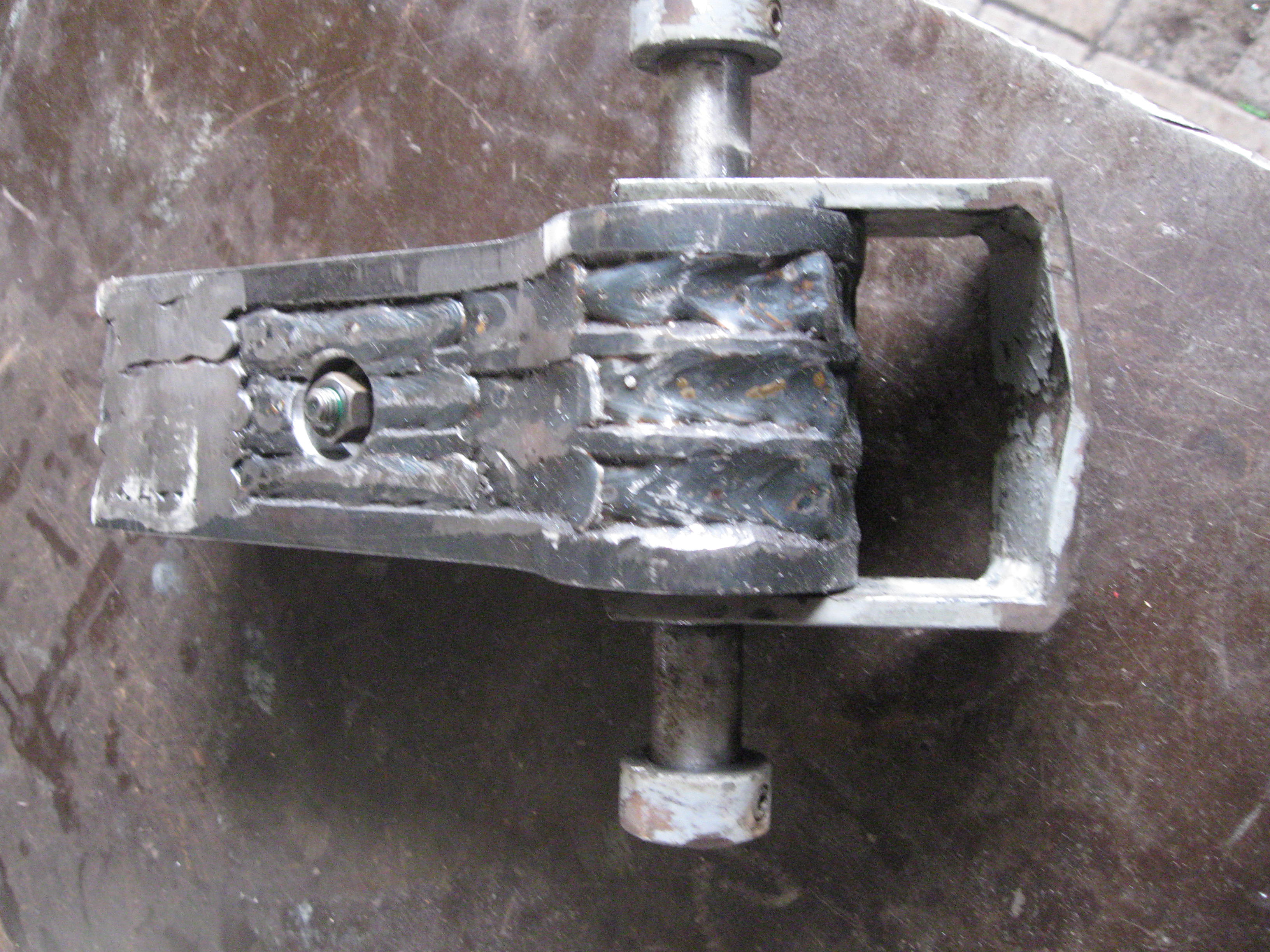
I decided to also make another jaw out of steel. I made the steel jaw out of a series of 3/4” or 19mm. steel plates welded together to make up the 3” or 76mm thickness of the jaw. I was able to drill out the hole for the shaft in each plate before I welded the plates together and then ground them down to a smooth finish where it was necessary to fit the housing. This was quicker and easier for me to complete. This new jaw is still going strong. I had never attempted to weld 3/4” steel plate before. I was really chuffed that it worked. I decided to go with the steel jaw instead of the bronze jaw.
So it’s working again now beautifully. Producing a grit that is suitable to go into the disc mill.
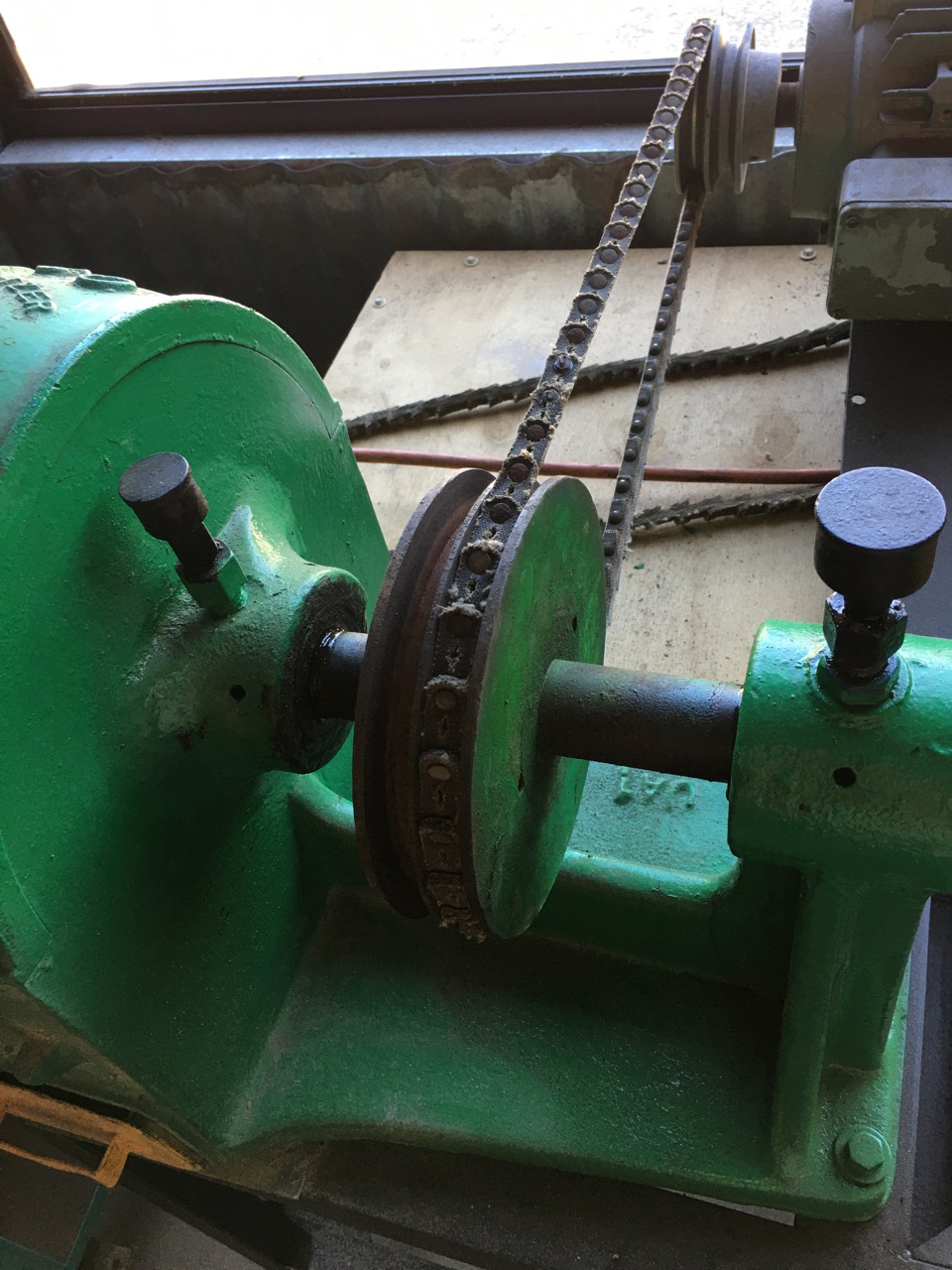
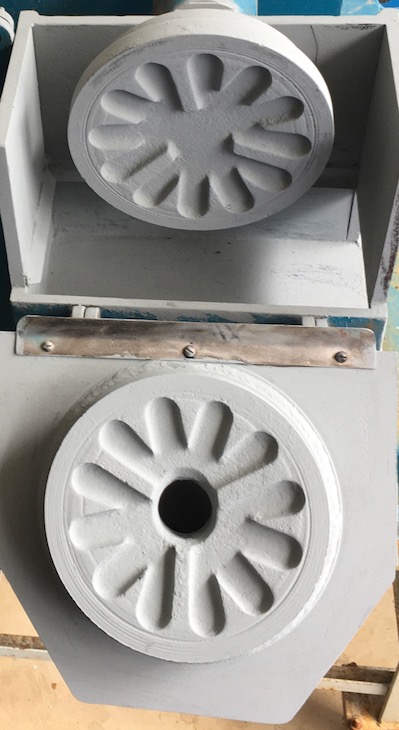
The grit from this small Van Gelder crusher is then reduced further in the ‘Bico’ disc disintegrator mill, down to something close to a sand-like size. Interestingly, ‘Bico’ crushers are still available in the USA. I googled them, they are still in business and the identical machine is still for sale on their web site in a slightly newer version. I bought mine many years ago 3rd or 4th hand, no history and unmounted. It obviously hadn’t been used for a long time and was seized up, but I managed to get it moving again after a bit of work.
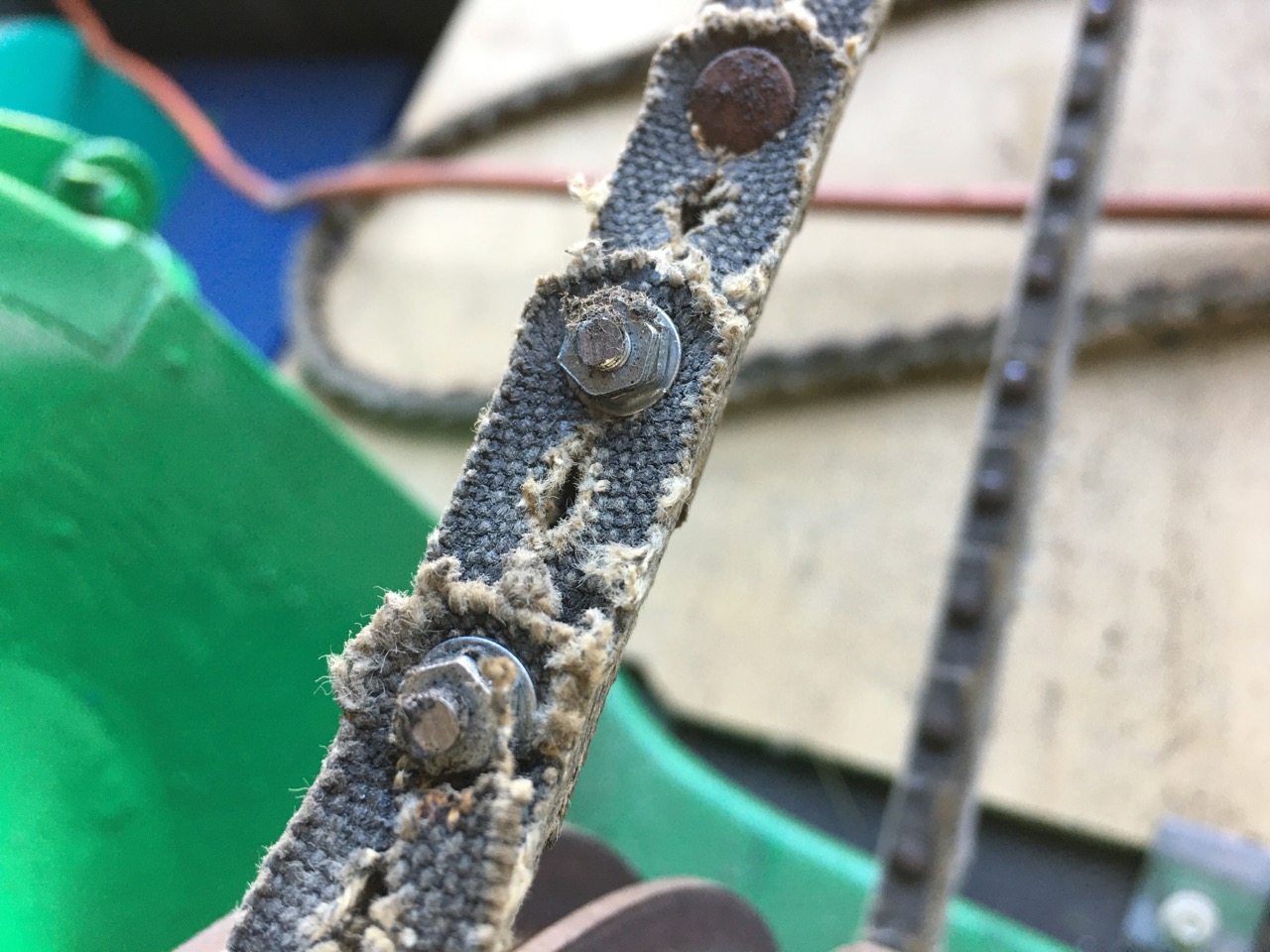
To get this disc mill working again, I also had to learn how to make, break and fit segmented leather drive belts, as the drive pulley is completely enclosed within the cast iron frame of the machine. I had to thread one open end of the broken belt through the frame and then rejoin the belt. I couldn’t find any way to extract the rivets easily from the segmented belt, so I just cut the head off two of the rivets and then replaced them with small bolts and washers. It seems to have been successful. It works! But I’m not too sure for how long?
I put ‘locktite’ on the threads, so I’m hoping that they won’t come loose during work.
This sandy stone grit then goes into the ball mill for 4 hours to be ground down to fine dust, ready to be made into glaze.
It’s quite a process and takes all day. And just like a time-saving kitchen appliance, it needs to be cleaned up after use. This cleaning and relocating of the ‘friendly’ dust extractor proboscis from machine to machine takes more time than the actual crushing.Such is modern convenience.
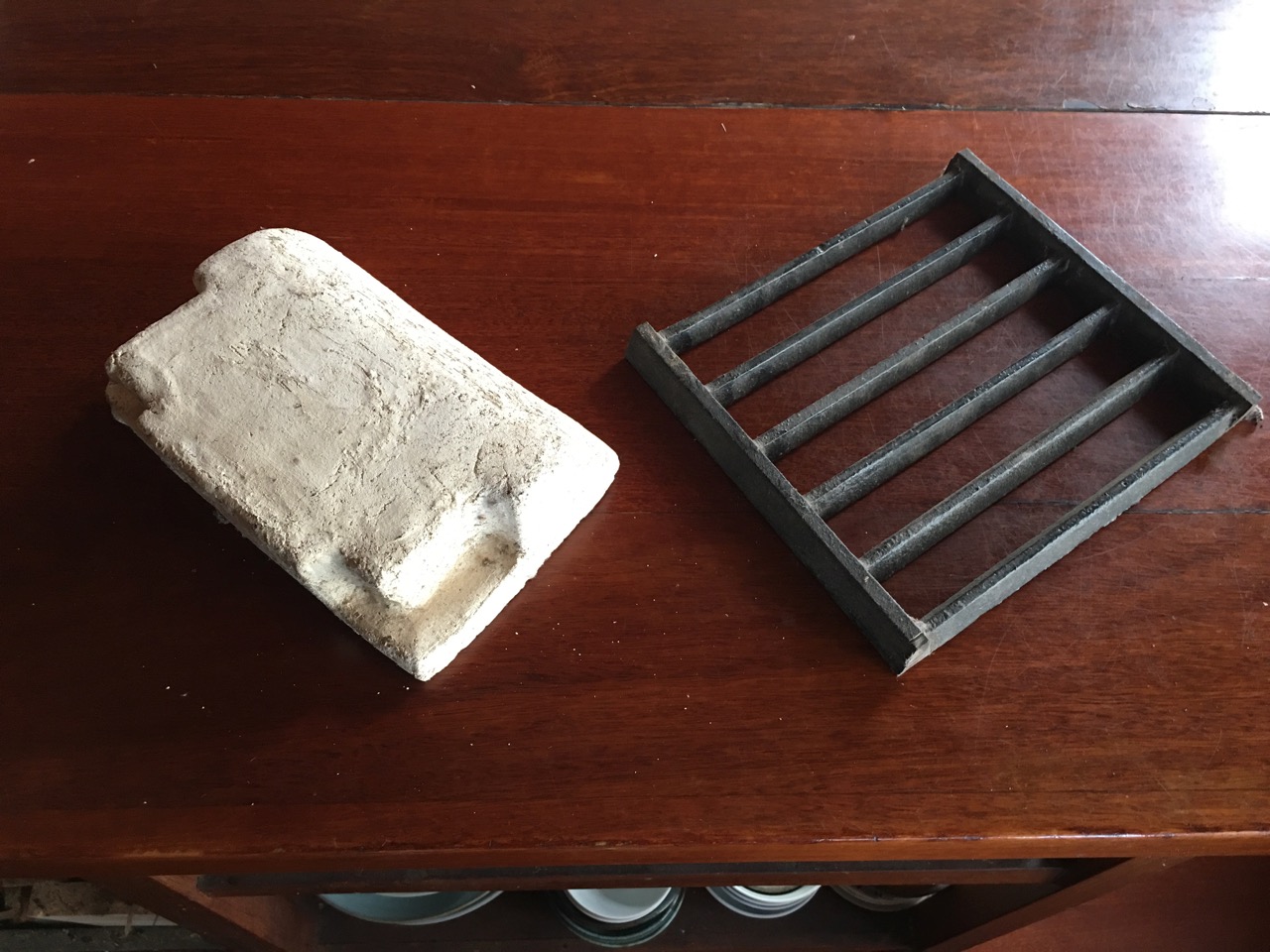
Our 45 year old wood fired kitchen stove is again in need of some repair.I have been working on this stove for 35 years. It was already out of production when we bought it second hand from a local farmer in the 70’s.The first thing to go was the cast iron grate under the firebox. My enquiries revealed that the Northburn company was bought out by Rayburn and closed down years before, but that there was still some spare parts available in the UK. An estimate for a new cast iron grate was more than the whole stove! I quickly realised that I would be needing more of these replacement ash pit grates in coming years. So I had better solve the problem now, and importing the last one from England wasn’t going to be the long term answer.
I worked out that cheap, local, cast iron drain covers could be cut up into 3 section and yield a decade of spares for $10. $3.33 each. About a dollar a year seemed good value. I have been using this solution ever since. When the fire brick in the front of the fire box crumbled, I reassembled the bits and filled in the missing parts with fresh clay and made a plaster cast of it. After that I was able to pop out a few each decade and pre-fire them in our potters kiln always keeping a few in stock under the kitchen hot water cupboard. Interestingly, the home made ones lasted longer than the original. Perhaps because I made ours out of my best home made high alumina grog and sillimanite clay mix that I used to make our own kiln shelves. Good stuff, and seemingly better than the original.
At some point in the past, many years ago I replaced the fibre rope seal around the hot plate. As this was almost certainly made of asbestos, given its age. I took it very seriously and got Janine out of the house. closed the doors and windows to stop any draughts, then soaked the fibre with water to kill dust. I wore long sleaves and a hospital theatre hair net cap and a dust mask. I lifted the wet but stiff fibre rope out and placed it into a plastic bag, sponged down the whole stove top and replaced the seal with modern kevlar fibre rope stove door seal. Then washed my clothes. The next part of the fire box to crumble was the fire wall between the fire box and oven. This was a thick cast iron sheet of metal. As it cracked up and started to fall apart I was wondering how I could get another one cast in cast iron. Then I thought, if I could use a home made kiln shelf in its place. I cut up a big 400mm x 400mm. kiln shell to custom fit the exact shape of the original. it fitted in pretty well. Snugly in fact. I thought that it might last a few months, giving me time to find a long term solution. To my surprise, it is still there and the stove works perfectly with its new heat shield. Its been in use for many years now, so will probably last for quite a while into the future. I have plenty more to replace it when the time comes. I was less successful with the large single piece fire box brick that makes up the left side of the firebox. it is a couple of inches thick and deeply embedded into the structure of the stove, such that to take it out and replace it would be a total rebuild job. Being the lazy opportunist that I am I decided that I would just repair the crumbled hole with a home made ceramic fibre and clay castable to fill the gaping hole, then cover the entire surface with another kiln shelf. This one needed to be longer then ti is wide, and a bit thinner to fit in easily. I found that I had a commercial kiln shelf of just about the right dimensions and cut it to fit. It worked perfectly for a few months and then cracked in half, then the two halves cracked, and so on… Yesterday it became apparent that it had all fallen to pieces the night before during the cooking of dinner. I extracted the parts and not having any other commercial shelves that were easily adapted since the fire cleaned up out. I decided to do a bit of a Japanese inspired ‘mottainai’ repair and stich it all back together with some old kanthal high temperature kiln element wire. ‘Mottainai’ is a bit hard to translate , but loosely means that something is too good to waste, so a little effort is worth being put in to save it and restore it, It also implies a bit of ‘waste not, want not’ and a stitch in time etc. It suits my life philosophy of living gently and minimal consumption.It survived last nights dinner cooking firing, so I’m hopeful that since it is now made up of several pieces instead of being one large sheet, it is now comprised of many expansion joints. It might work. I hope so. This was a first class commercial kiln shelf, supposedly with very good chemistry and excellent thermal shock resistance, but it seems a little bit too thin to take the combination of heat shock and small occasional impacts from wood stoking. I’m even more impressed with my own home made kiln shelf on the opposite side of the firebox that has been taking the same impacts and heat shock stresses for some years now.
Janine and I bought a very old and well used bakery dough mixer back in 1978. This was a time when a lot of old, small, family run bakeries were being forced out of business by the big multinational food corporations, and a trend towards people buying mass produced bread in super markets, rather than going to the small family bakery.We didn’t have 3 phase power back in those days, so I adapted the dough mixer to run on the power from a 5HP petrol engine interfaced through a rather snazzy torque converter. The sort of thing that adapts automatic gear boxes to engines in cars. I was given it, so didn’t realise how expensive they were. We used that dough mixer in conjunction with a 200 mm. Venco de-airing pug mill for 5 years to mix all our clay bodies. Tragically, That pottery burnt down in 1983. That was a timber building and was totally destroyed by the fire. What was really amazing, was that I was able to rebuild both the pug mill and the dough mixer from the melted and charred remains. I spent a lot of time working on that equipment to get it going again. Luckily this machine was housed in a corner of the building with 2 sets of glass double doors on the corner, so as to allow for good ventilation. As this part of the building had very little wood in it, the machine didn’t get too hot during the fire and none of the cast iron parts cracked. The shaft of the dough mixer got rather bent during the fire, so had a very noticeable wobble in it when I got it going again, but at least I got it going. It was a bit of a mess, but I managed to keep it going for the next 36 years. After that fire, I converted it to a 3 hp single phase electric motor. The biggest motor that you can plug into a 15 amp power point, as that was all the power that we had at the time. It only just managed to do the job, as it wasn’t really powerfull enough, but I was carefull with it and nursed it along. I set it up with a home made, somewhat loose, slip-belt clutch as torque converters are so expensive.
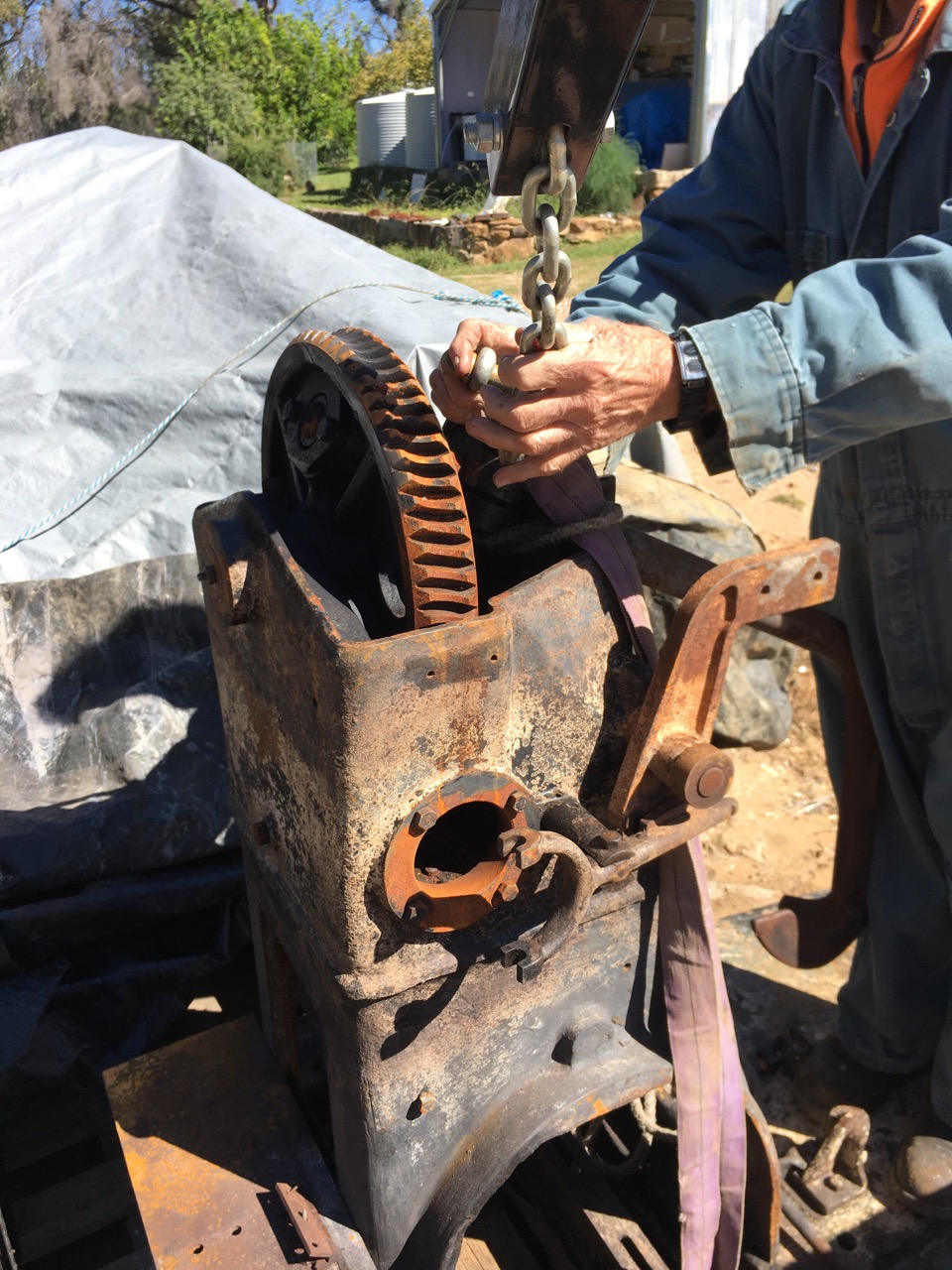
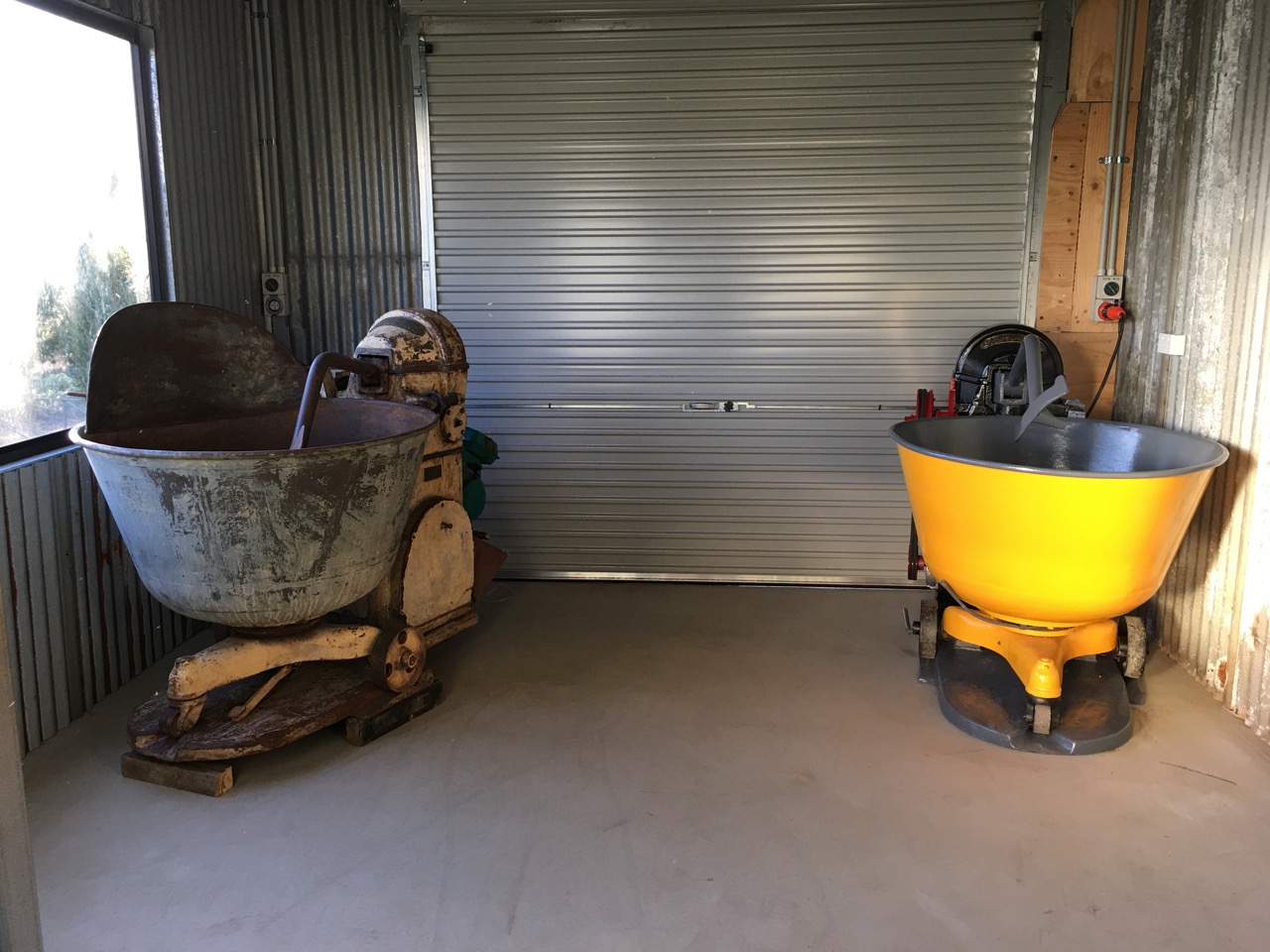
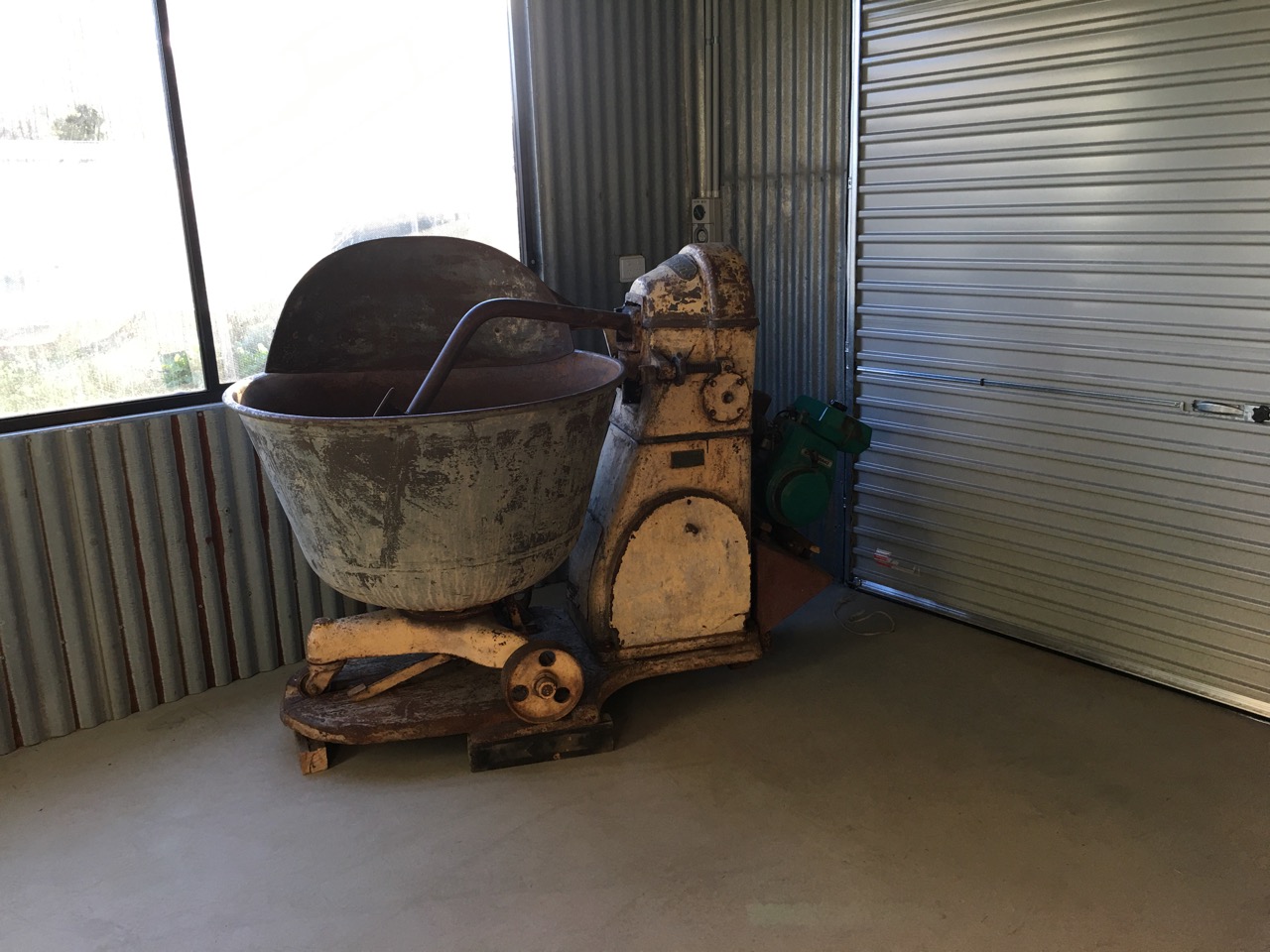
After this last fire in 2019, The machine really got cooked, That’s it in the centre of the picture above, in the burnt out shed. Fortunately, the fire didn’t crack the castings. However, this time the main shaft was so badly bent, that it wouldn’t even rotate. I gave up on it, as I had so much to do to rebuild the new pottery shed that I couldn’t see myself ever really finding the time to fix it. Then, when my friend John Edye retired. I was able to buy his dough mixer. Very lucky timing. I didn’t have a pottery to put it in at the time, but bought it anyway, to make sure that I had it ready for when I could install it. As it happened, John also had loads of other jobs to do, so it sat there for several months, before we could find a mutual time that suited us both, for me to go and collect it. In the interval, my friend Ross turned up one day, He is a really amazing person, who has so much knowledge and life experience with machinery. He saw me working on some of my ruined gear and asked what I planned for the dough mixer. I told him that I had given up on it for the time being, but couldn’t bring myself to abandon it. Ross had a good look at it and said that he thought that he could extract the main shaft from the gearbox and straighten it in his hydraulic press. He had done other jobs like that in the past. So I said “yes please, have a go at it”. I know that I won’t get around to it for a long time – if ever. Luckily, I had poured spent engine oil all over most of the machines to stop them from rusting too much and greased all the bearings to prevent them from siezing up, so as to preserve them until I could find the time to get to them and try to fix them. I also bought a massive tarpolin to cover them. This turned out to be a smart move, as they remained there, under cover, for over a year. I found out through this experience that there is a massive amount of condensation under a plastic tarp, so all the machines that wern’t oiled were very badly rusted. We worked on the dough mixer. Ross and I were able to dismantle all of the moving parts that still moved, and Ross took the main shaft home with him. He called a few weeks ago to say that it was now back in a good shape. Not perfect, but very good. We water-blasted the carcas to remove all the old oil, carbon, ash and burnt paint from it and I moved all the other bits inside, to keep them dry while I set about re-assembling the gearbox and all other moving parts. Ross organised a new oil seal and I had removed the main bearings and soaked it in oil to rinse clean and preserve them.
At this point, it’s looking a bit like a burnt out darlek!
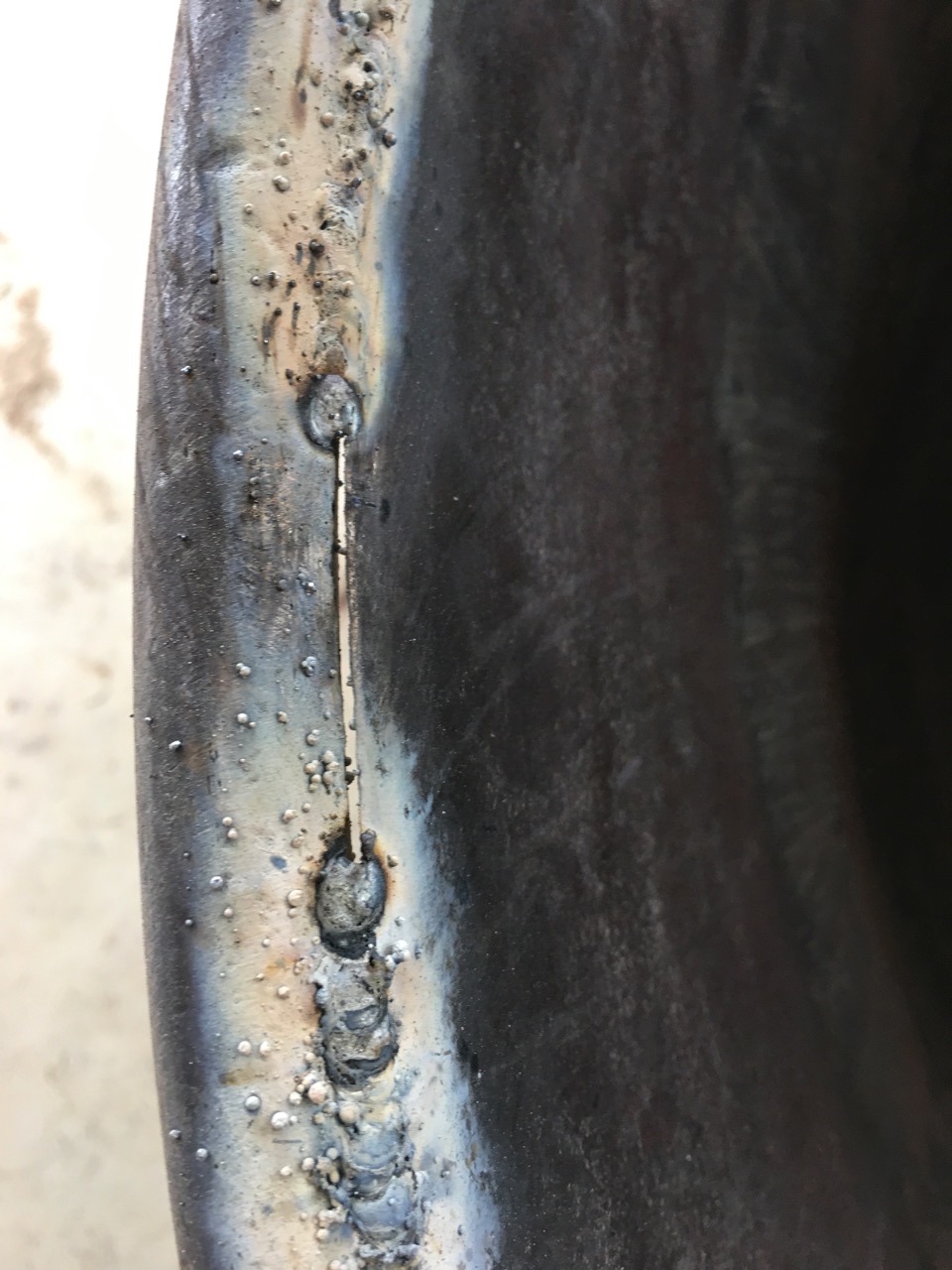
A new 3 phase electric motor, a good clean, some rust converter and a coat of zinc primer and it starts to look as though it will go again. The mixing bowl on the other hand had copped a bit of a hiding. It was split in 4 places around the rim and was no longer completely round, in fact it was a little bit heart shaped. I spent some time on it, a bit at a time, clamping it back in shape and tack welding it together, getting it as round as possible, then welding all the splits back solid again.
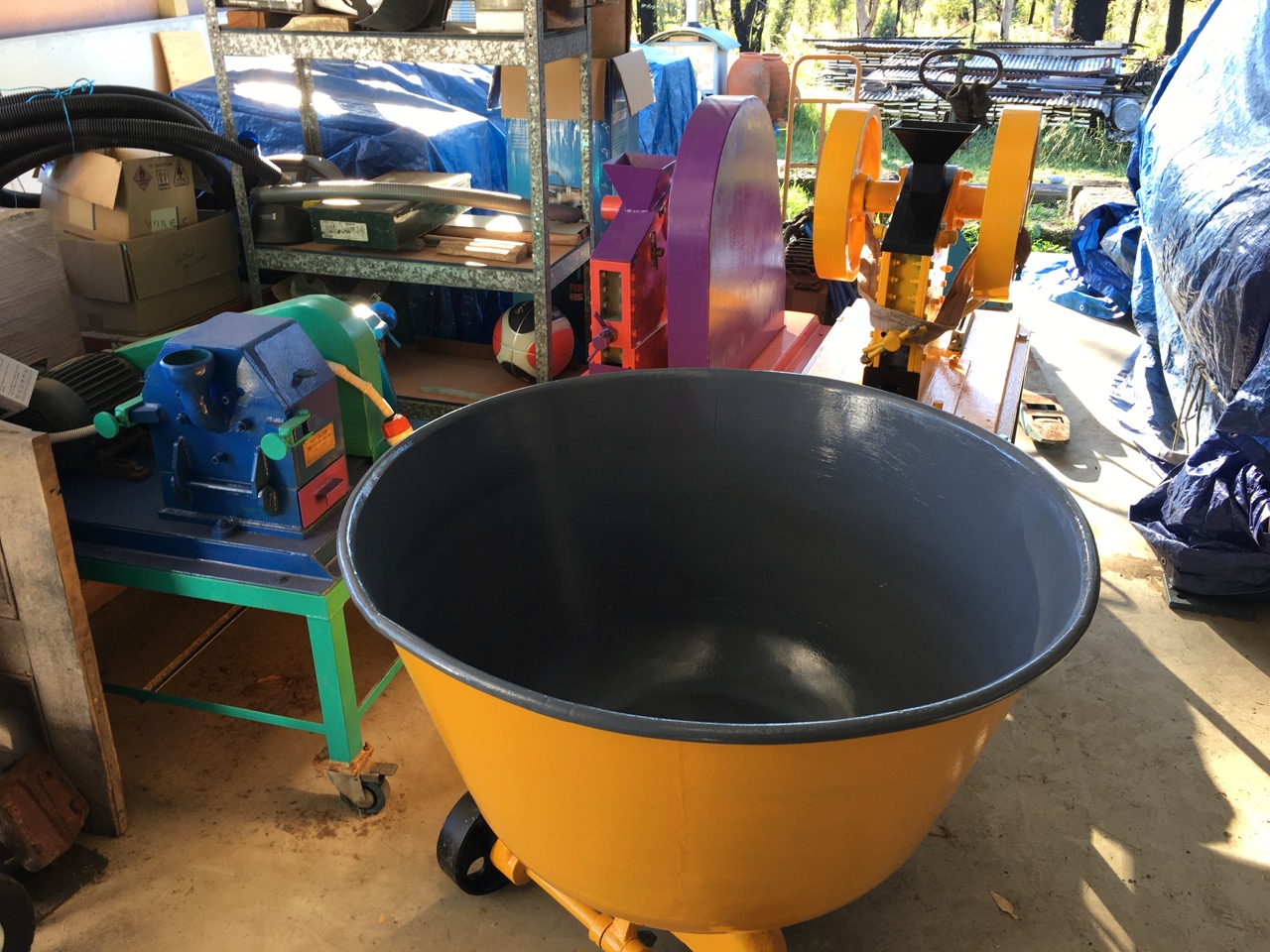
After a week of nights, doing all the usual things, rust converter, penetrol sealer, zinc primer, several top coats of hard gloss oil paint and its looking great.
Everything is coming together now. The housing, gearbox and mixing arm have been given their severel top coats and are looking good. I bought a new 3 phase motor, new drive belts and electricals, so when I plugged it in the first time, and it actually went – I was really moved that it was back from the dead. Again! Thanks to Ross!
Now I need a pug mill and we are back in business, ready to make clay again. This restored ‘phoenix like’ twice burnt, and twice restored dough mixer sits in the same room as John Edye’s mixer that I bought when I had absolutely no idea that mine might be recoverable. Hints of ‘two-sheds Jackson’ here. Steve ‘two-mixers’ Harrison. Weirdly, my old ruined one is now ready to work before I have finally gotten around to finishing cleaning out and painting the bowl of John’s machine.
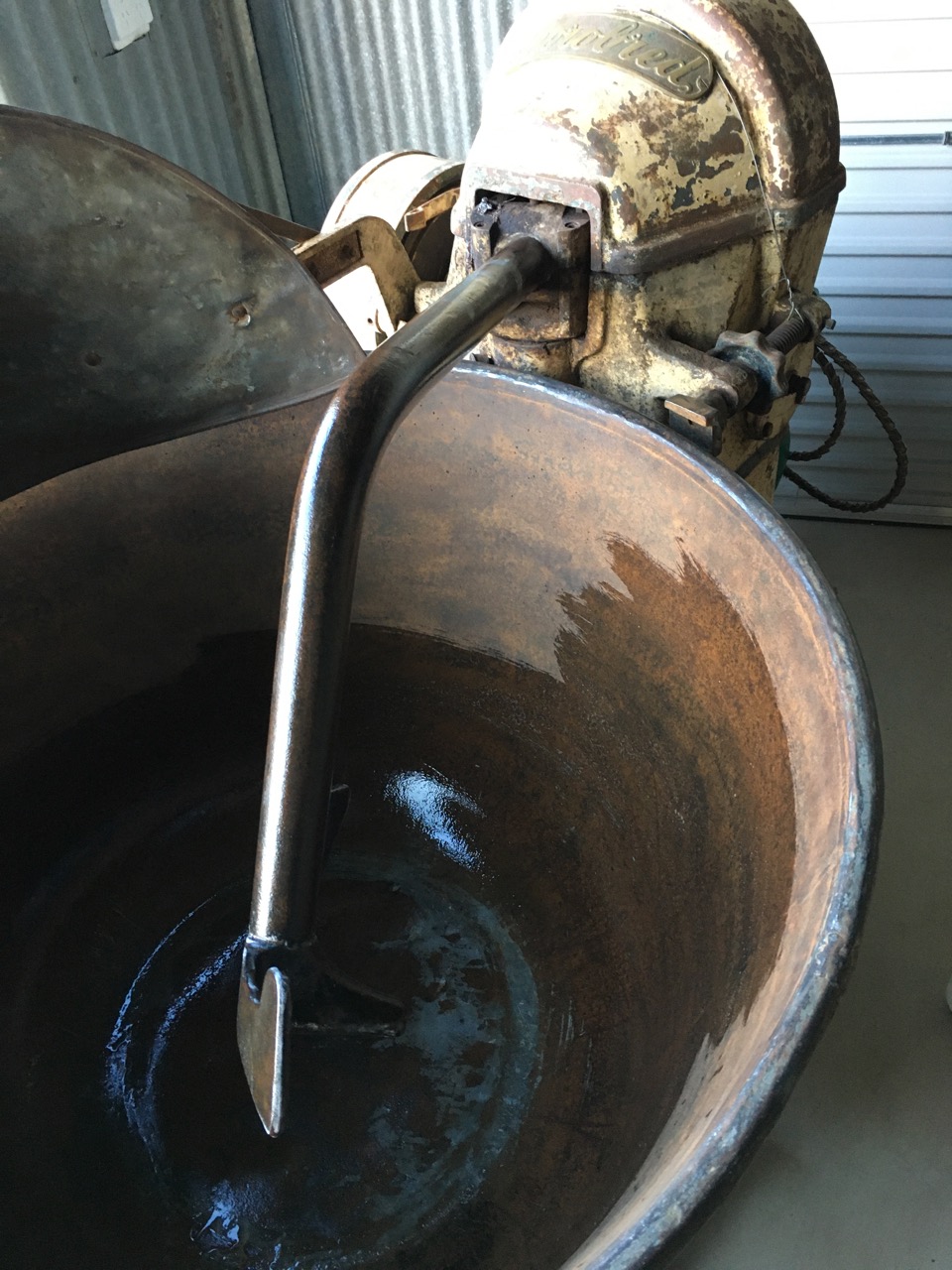
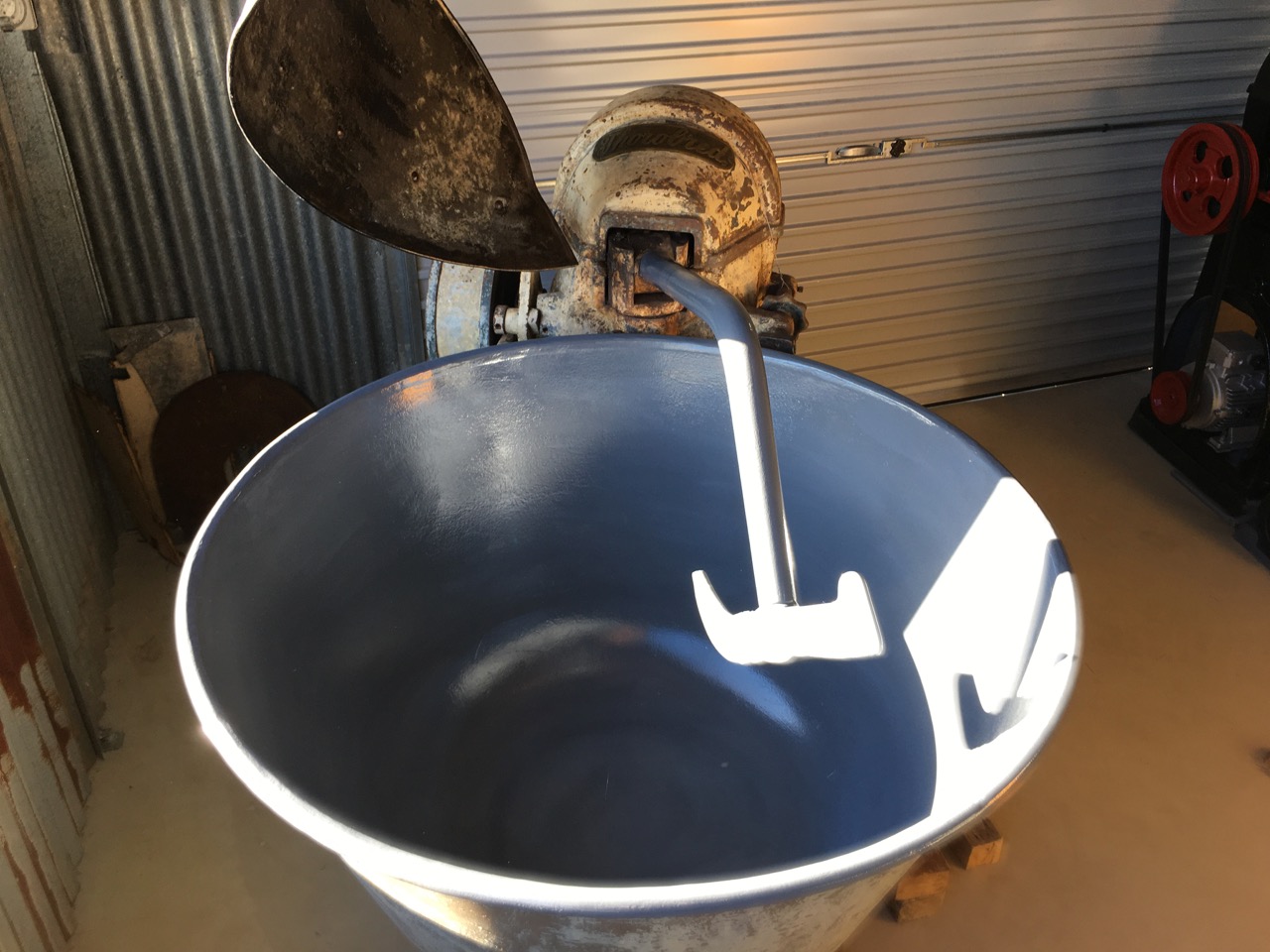
Rust converter being applied inside the bowl and the mixing arm to neutralise the rust, by converting the iron oxide that is very susceptible to oxidation with air when it gets wet, and converting the iron oxide to iron phosphate, which is quite stable and inhibits further rusting. However. The iron phosphate really needs to be sealed with a water impermeable membrane. In this case it also needs to be fairly impact and wear resistant. I have found that an oil based, high zinc, machinery paint works quite well. Well, similar stuff that I used in 1983, the first time that I restored this mixing bowl worked really well and lasted for 36 years! Of course, there is no guarantee that anything on sale today will last as long.
The bowl after rust conversion. I sent this image to John and we both agreed that the inside looked al to like an ancient ‘hare’s fur’ tenmoku glazed tea bowl.
As the year has dragged on into 18 months since the fire. We are flat out busy with the re-building project. We had a slow start waiting for the insurance company to decide what to do, then putting plans to Council for building approval. Everything takes time. We weren’t sitting on our hands during this waiting period. We shifted the burnt out orchard and all its well composted and richly fertile soil up the hill so that we could build the new pottery on the old orchard site. We were able to get that done before the end of winter, so that we could plant all the new bare rooted fruit trees before bud burst.
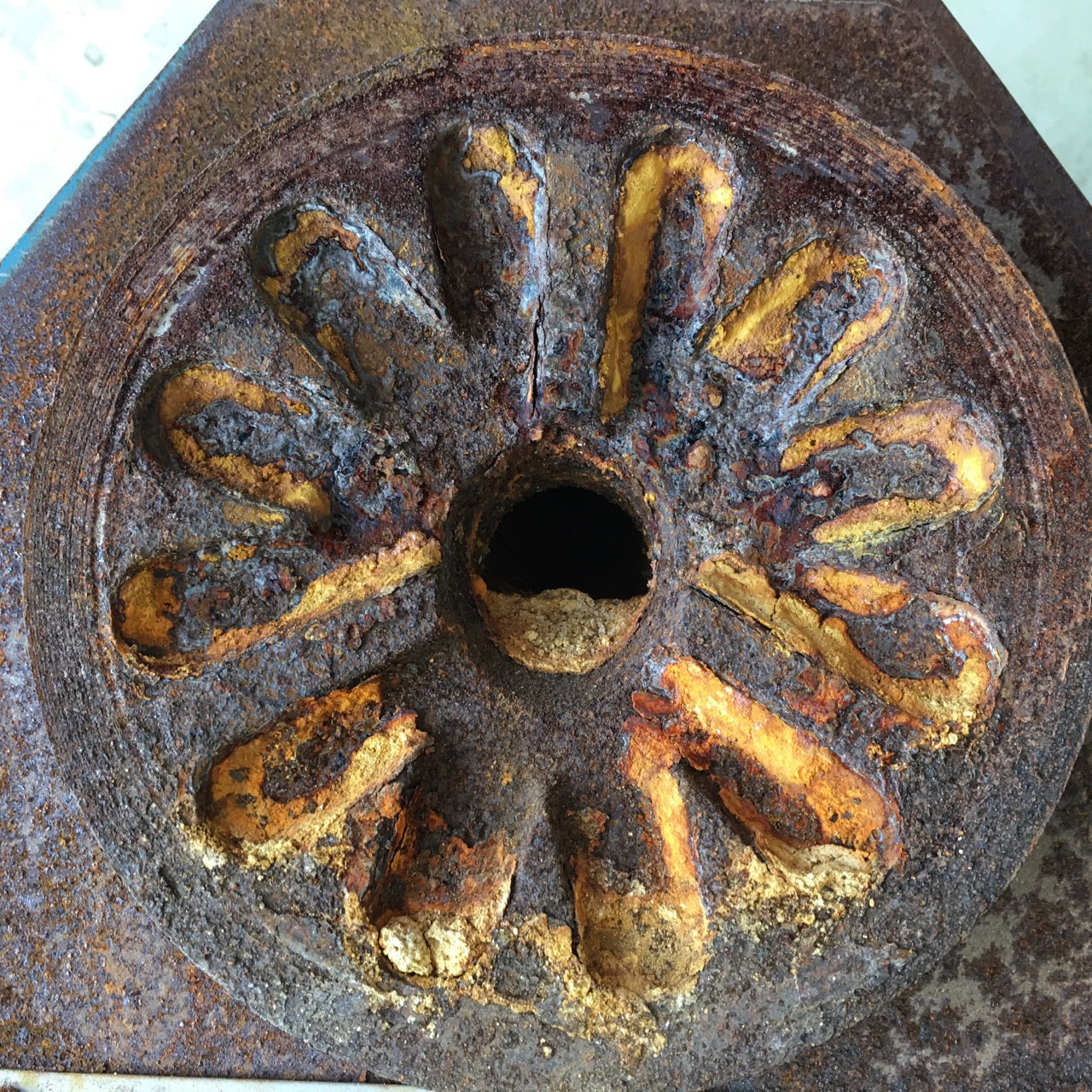
Although we spend every day working on the building, there is always a few minutes or and hour here and there that can be stolen from the shed project to work on restorring these odd bits of old machinery. I found a couple of unloved bits of machinery that were worth restorring. One was so corroded that it took an angle grinder and then a hammer and cold chisel to clean the rust and scale out and get it unseazed and rotating again. I have become a lot more familiar with bearings, oil seals, gear boxes and pulleys these days.
This is about as bad as it gets before the rust eats through the wall of the machine.
After chipping away at the flakey scale, then attacking it with an angle grinder with a rotary brush, then finally hitting at the stubborn bits with a hammer and cold chisel…
It has come good and has now had a coat of rust converter, phosphoric acid.
There isn’t much that an angle grinder, wire brush, hammer & chisel, then a few coats of rust converter and primer can’t fix. – and a week of evenings!
John Edye, eminent potter and my Friend and collegue of over 40 years has retired from making pots. When I heard that he was retiring last year, I got in touch and asked what he was intending to do with all his equipment. I was very lucky that I was first to ask. As we lost almost everything to the fire in December 2019, It crossed my mind that he may be interested in selling some of it to me. I was particlarly interested in getting a dough mixer for my clay making. As our old one has now gone through two fires, in 1983 and again in 2019. I was lucky enough to get it going again in ’84, although it was quite wobbly afterwards. After this last fire the burning roof beams fell in on it and the main shaft was so badly bent, that I couldn’t rotate anymore.
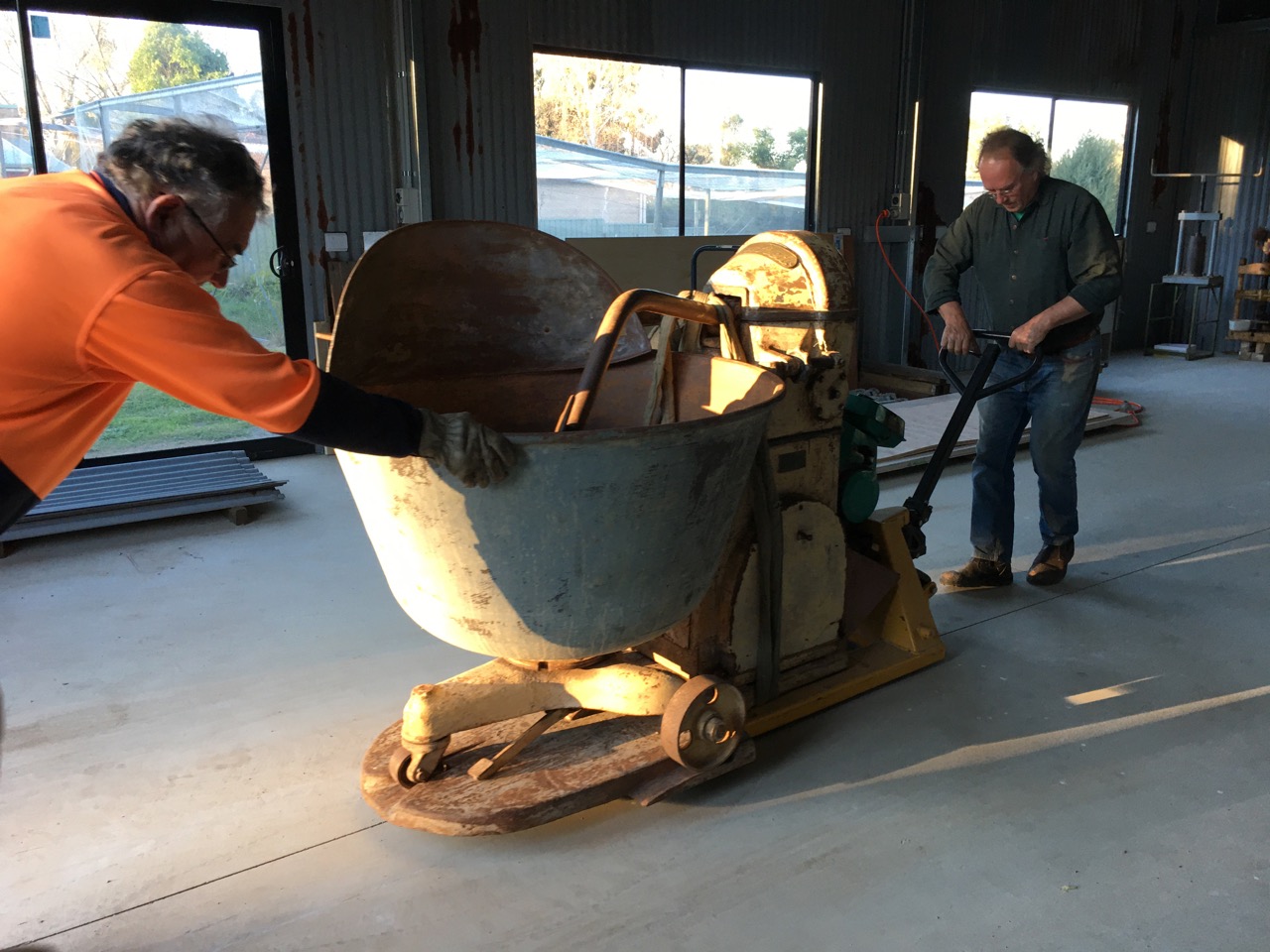
We bought John’s dough mixer, damp cupboard and some pot boards. It was a bit of a job getting them out of John’s very beautiful, but remote country property, deep in the wet forested gullies between Kulnurra and Wollombi. John was well prepared and had all the gear up on pallets, or steel pipe rollers. My friend Dave has a truck with a pal finger crane, so we were able to get in there and lift the gear out. Everything was much easier at my end, as I have a concrete slab floor for the first time in my life and a pallet lifter trolley to move heavy bits of machinery.
John’s mixer in its new home, with a nice view from the window.
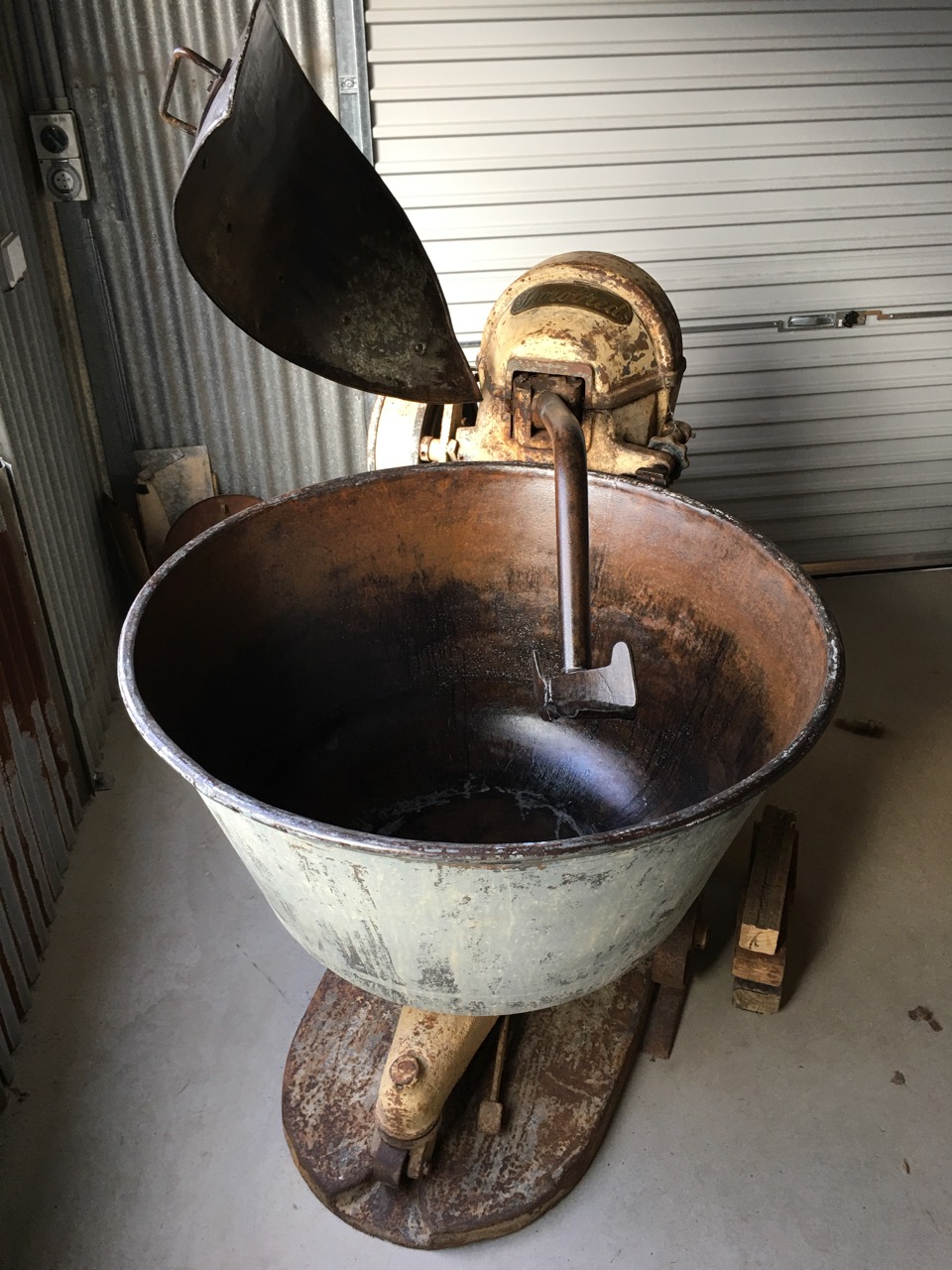
I have started to grind and clean the inside of the bowl. It’s had its first coat of rust converter. it still needs a couple of top coats of a hard wearing oil-based machinery paint to suppress the rust.
I have also been offered a pug mill, shimpo wheel, Leach style kick wheel and various other bits and pieces of pottery gear from other friends who have surplus equipment, are also retired or are choosing to go smaller, but these are yet to arrive here.
The crusher room in the machinery shed is filling up slowly as I tinker away in my spare time after work between midnight and dawn as I slowly pull apart, clean or replace, then reassemble and finally paint this diverse collection of antique crushers and grinders. This is such a different aspect of my philosophy of self reliance, but actually quite rewarding and enjoyable.
I have painted them up in bright colours like big toys – just to cheer me up a bit.
I need to stop lazing around and get some real work done! The pottery studio needs to be finished, as this is the last room to be completed. Then we can apply to the Council Inspectors to get our final inspection and a Occupation Certificate. I know that there will be many little items that will need to be done and ticked off to get it all through. I just don’t know what they will be yet, not until the inspectors tell me what are.
I have moved on to a good place this week. I have started to work on the wood work phase, lining the pottery studio with our own timber boards. I am much happier working with wood rather than steel. I can work with steel perfectly well, but I like the feel and smell of freshly worked wood. It’s somehow very satisfying. I have spent the past few days planing the pine boards that we milled out of our burnt pine trees last year.
I was tempted to call this post ‘Just Plane Board’. Not because, I’m just plain bored, but because ‘All I do is just plane boards’ all day long. Doing just this, I quickly wore out the old plainer blades, they were mostly pretty blunt from from doing a lot of work in the past, so I had to change them over, which wasn’t too hard. I found, without too much surprise, that the work went so much easier with the sharper blades, but after a few hours, it slowed down again. This 130 year old home grown Caribbean pine is very solid timber, very tough to mill and now just as tough to plane. I’m only 1/4 of the way through this job and I can see that I’ll soon need to change the blades in the planer again. I can only take 1/4 of a millimetre off the boards with each pass. Anything more stalls the machine and activates the overload switch.
I am quite capable of sharpening knives, scissors, tin snips and small hand planer blades. Any blade up to 100mm. wide. Above this length, it gets tricky, as my widest honing stone is 80mm. so after that I have work diagonally or lengthwise for the longer blades. This works well with hand held sharpening of curved chef’s knives. Geordie (my son, who is a chef) and I used to do a sharpening session every few months or so, and did all our kitchen knives in one big session. We got quite good at the fine grinding and gentle finishing on the 4 graded Japanese whetstones, ranging from 400# to 8000# grit.
However. When it comes to a very thin straight planer blades, these are called knives in the industry, then what I need is a very long stiff jig that I can bolt the blade onto to keep it stiff while grinding it. as these long knives are 330 mm long but only 1.5 mm thick x 200 wide. To hone a long thin and flexible knife like this, I would need a long grinding stone and then a very long honing stone, As the planer blades are 330 mm long, so I will need a honing stone at least this long, preferably longer. I don’t know if there are even stones this long available. Obviously there must be, because these blades are being manufactured somewhere. However, I suspect that these kinds of knives are sharpened in the industry on rotary grinders and honers.
My first thought was to contact the original retailer, only to find that they had discontinued this model of machine a decade ago and no longer carry any spare parts for it any more. I’m not surprised, it’s only a cheap hobby machine. I should have spent the extra money and bought a better quality ‘name brand’ that would still be available. I went on line to see if there were any non-branded, no-name products that might suit my machine. My initial search didn’t bring up anything that might fit this model. So with this option eliminated, I have to find a way of getting the only blades that I have resharpened.
The is a new shop in Mittagong specialising in sharpening tools! I noticed its sign in the street a while ago and made a mental note. I called in there today and asked if he could sharpen my planner knives. He couldn’t. Not only couldn’t he do it but the place that he sends difficult jobs to get sharpened professionally doesn’t do these very long thin knives either. They only do the thicker, stronger machine knives. So I was feeling a bit snookered. but my enthusiasm wasn’t blunted, in fact I’m keen to have a go at building a jig to hold them firmly supported while I pass them over my own bench grinder. It can’t be that difficult – can it? It’s the final honing of them on a 200mm long, or should I say 200 mm short, stone that is going to be the hard part.
The worst that can happen is that the knives shatter while I’m grinding them. If that doesn’t happen, then the next worst thing that will happen, will be that they aren’t completely even, or have a few rough areas along the knife edge. Well, as long as they are sufficiently keen and sharp enough to take off the circular saw blade marks, then that will be fine by me. Any little rough areas on the blade that leave long straight grooves in the wood can be sanded down with the belt sander. I’m doing this anyway because of the current state of the blades.
As the building of the new pottery shed has progressed in fits and starts, I have been busy on several fronts, working behind the scenes doing several jobs in preparation to keep the build progressing, by making windows and doors etc. Two weeks ago it was the stormwater plumbing and at the end of the week, the Council Building Inspector came out and passed the building up to the frame stage and also passed my underground storm water plumbing.
The last two items to be completed and inspected will be the sink, grease trap and drainage/absorption trench. I asked the inspector if i could do all this work myself and he said yes. I can do it all, I don’t need a plumber to sign off on it. So next week I will attempt to dig an adsorption trench 600mm. x 600mm. x 10 metres long and bury the plastic hoops necessary to create a legal drainage system for the sink. I have done all this before over the years, firstly for the first bathroom at the front of the house in 1980, and then again for there new kitchen/laundry/bathroom extension in 1990. It’s not rocket science. Just grunt.
The last inspection will be the final inspection. This will be after the electricians have been and the shed is lined inside with insulation in the walls and with the brickwork completed on the front wall. This will take some time to get done.
This last week I was hanging doors on the front and side verandahs. This has been one of those little jobs that have been idling along in the back ground for the last couple of months. I collected these couple of old doors years ago, just because they were really beautiful objects, even though I didn’t need them at the time. They were too good to pass up.
These days when I drive past piles of other peoples junk on the foot path, waiting for council clean-up. There is nothing worth taking home and re-cycling. It is all just so much plastic and chip board pulp waiting for land fill. The only lasting thing about Ikea furniture is the allenkey!
I found one of these old doors 20 years ago, in ‘condom ally’ in Darlinghurst, not far from the National Art School. I used to go there because it allowed all day parking for free at time when there was no space in the Art School. Someone had dumped the door on the side of the ally. I don’t know which house it came from, but it must have been posh as the door is massive. 2.1 metres x 1.2 metres and 55mm. thick. All in Australian cedar, but it had had a hard life and was pretty knocked around. The top two wooden in-set panels in the 4 panel door were smashed out. I saw it and put it up on my roof rack straight away. It sat there all day without being stolen back. So I drove home with it that night.
It sat in the wood shed for years and survived the fire last year. Our friend Megan Patey came to volunteer here one day earlier in the year and asked for a suitable job. So Janine and Megan cleared out the years of built up clutter that had made it’s way into the wood shed and Megan dragged out these two doors. That was a couple of months ago, and I have been tinkering away on them ever since.
The other door was collected off the side of the road on a Council Clean-up day. I saw it and stopped. Checked it out. It was dirty and damaged with the glass panes broken and missing, but it still had one small lead light intact on the top left side. The other 4 panes were smashed. I could see that it was made of Californian red wood timber and was massively thick at 65mm thick! It’s the thickest door I’ve ever handled. It was also stored in the back of the wood shed and survived the fire. So now I know why I saved them all those years ago. I would need them for this last pottery building.
I started cleaning them both back, removing decades of built-up dirt and layers of paint. some of it possibly lead based, considering their age. I worked out side and wore a mask and gloves, just in case. The big cedar door didn’t look good after cleaning. it was too far gone. A lot of splits and cracks and weathering. I decided that the best option was to paint it. I filled all the cracks with polyester gap filler mastic and undercoated it.
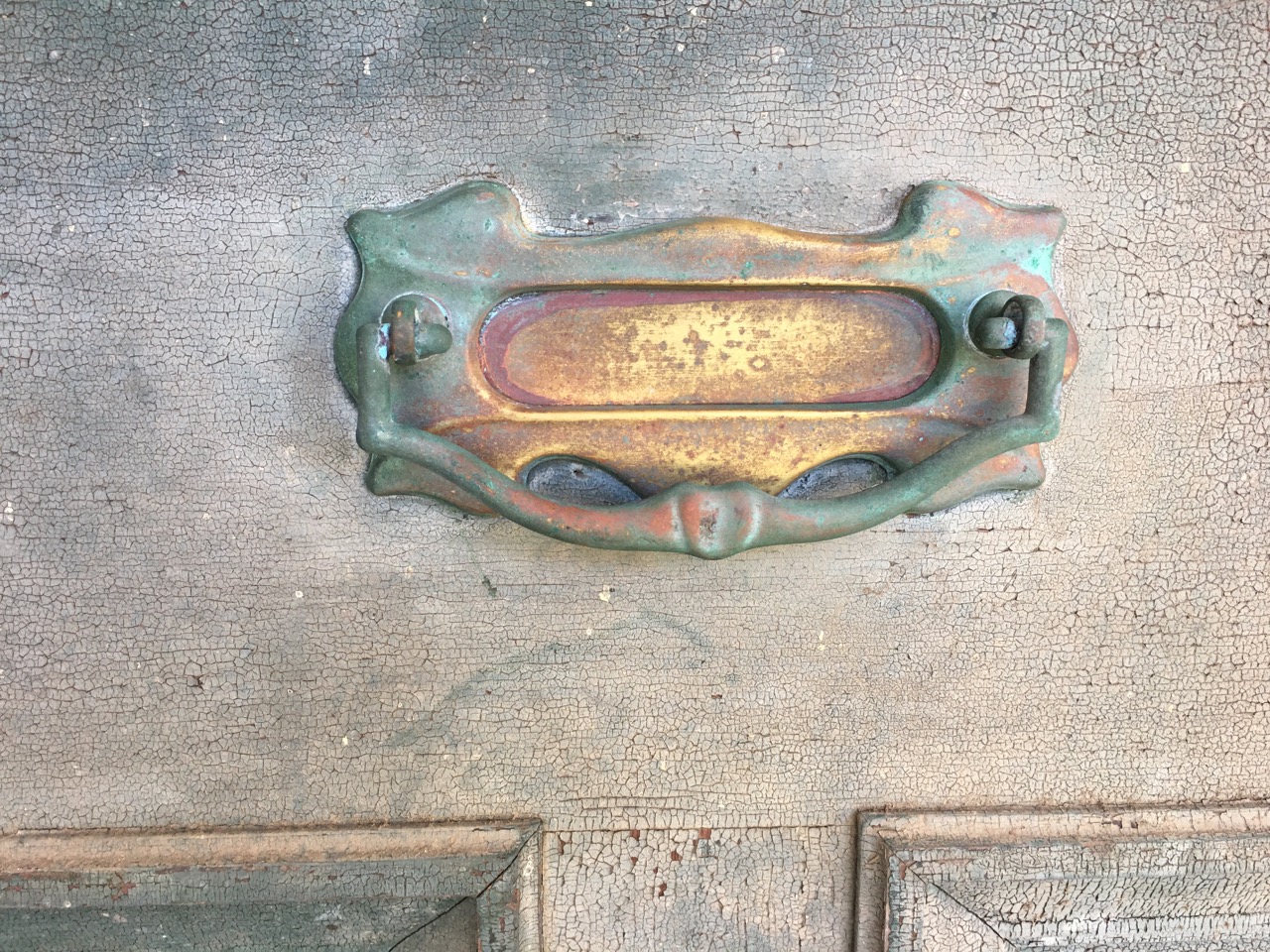
The other door was quite badly weathered on the outside face, to the extent that the patina of crackled and flaked paint and slightly exposed patches of bare wood had a very subtle ‘wabi-sabi’ feeling about it. This green-yellow-mustard-grey-brown patina of multi layered flaking paint matched some of the old rusted galvanised iron that I had collected. This combination was too good to waste. I decided there and then that this was the gal iron for the verandah where this door would be hung.
I prised the wooden beading out of the frame holding the lead light in place and moved it to the centre position, then got two new plain glass panes to fit the other two spaces where the other lead lights had been smashed. It came together quite well I think.
The door knock and letter box slot are just the right combination of yellow brass, red copper oxide and green copper verdigris.I fitted two large panels of laminated safety glass in to the middle two openings. They had been wood in the past, but rather than having wood there. I decided that the door worked better with glass in this instance.
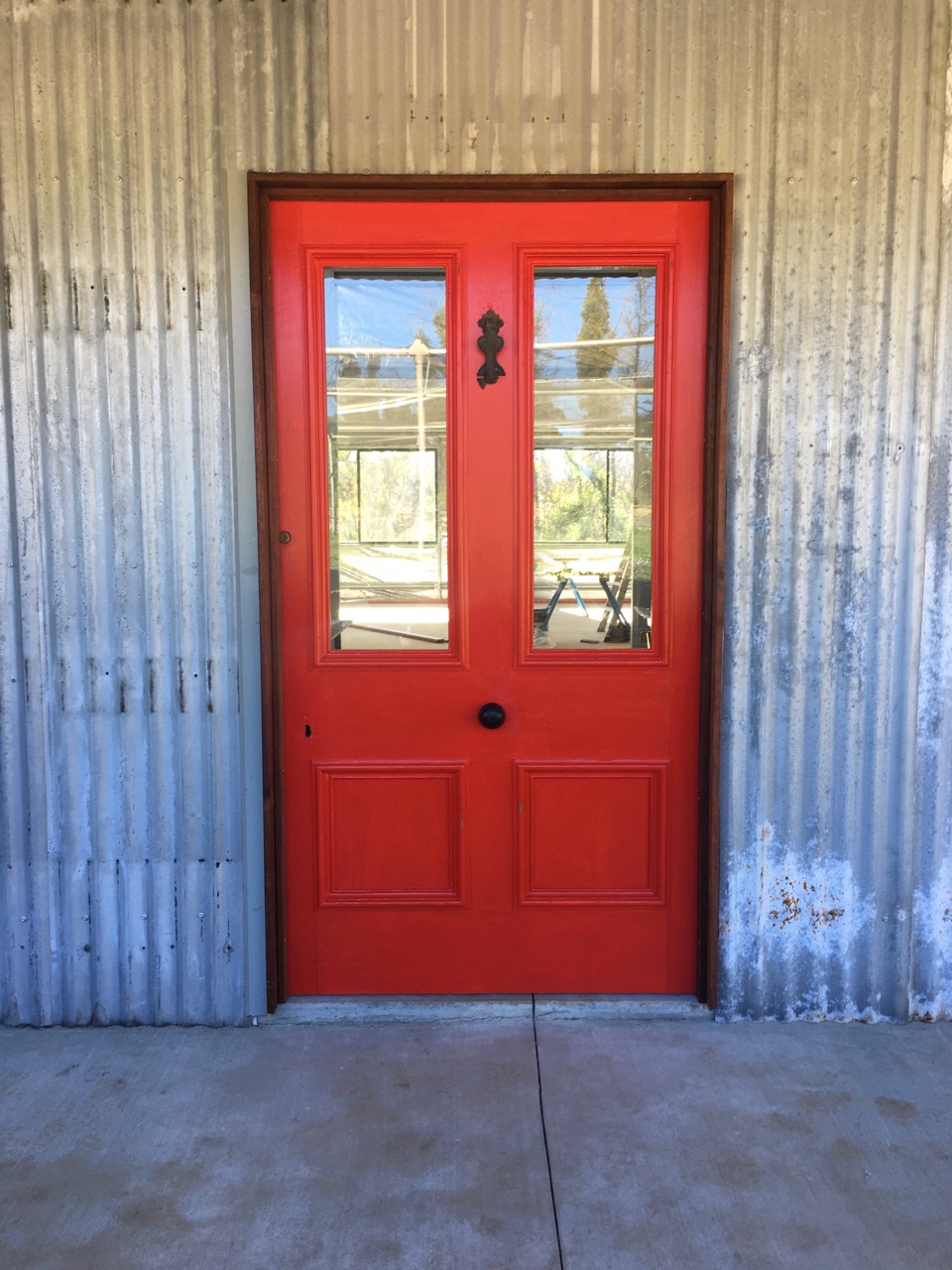
I decided to paint the massive cedar door bright red and use it as the front door facing the street. It looks good, but strong red needs a little bit of black to contrast against it. So I fitted a very old lock that I scrounged way back in the 70’s. I could never find a place for this lock, as it was just too big for any normal door. Finally it has found its place in life. I see a red door and I want to paint the lock black!
My friend Jack Cookson, and I made a key for it.
I think that it works well with the old cast iron door knob, that came off the side door to the old pottery. I recovered this from the ashes after the fire, along with the old cast iron knocker. Just enough black to off-set and highlight the bright red. A little of the old incorporated into the new.
Here again, I decided that the door worked better for us here with glass in the two upper panels rather than wood.
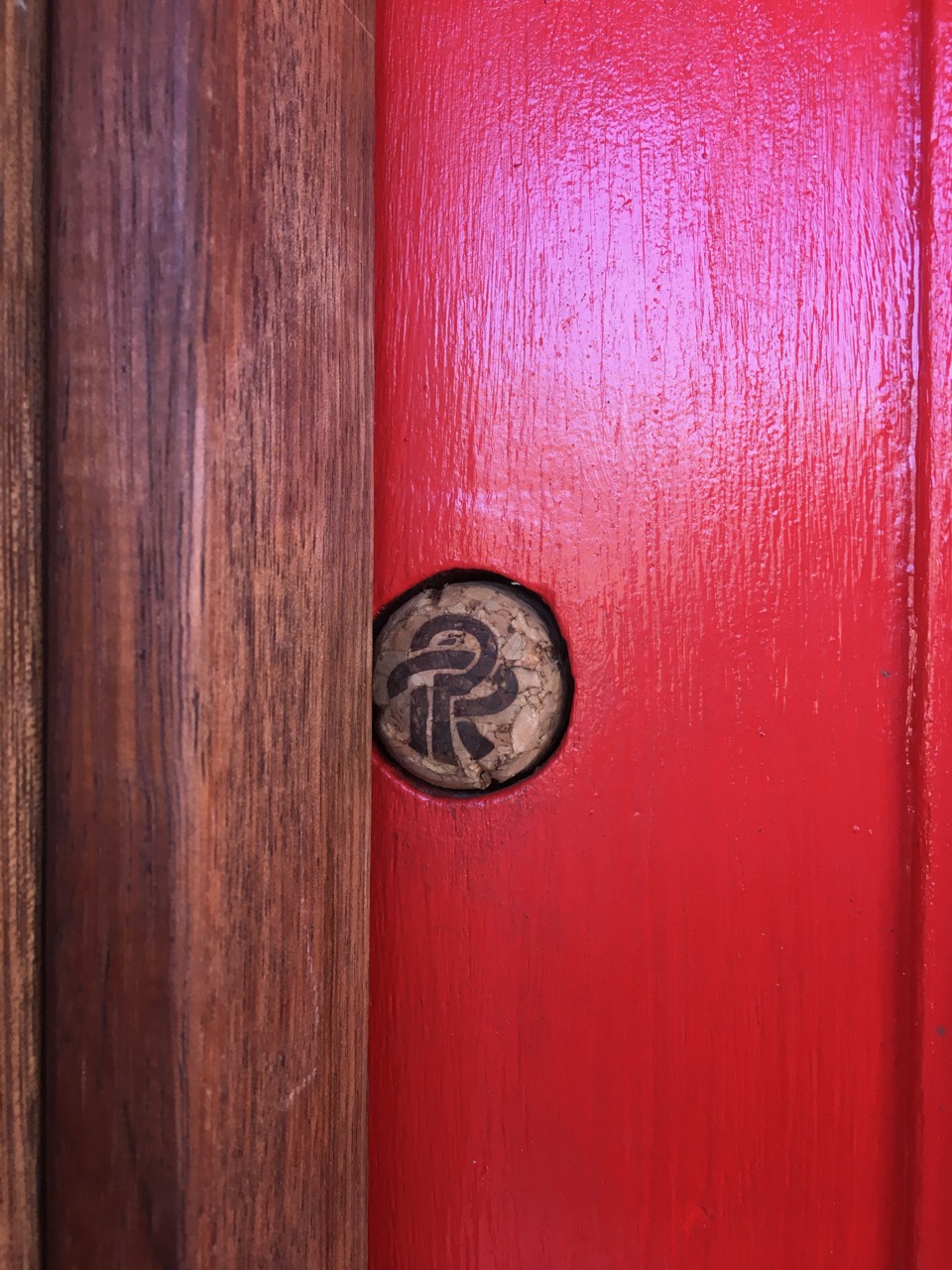
Where the latch key lock should have been. There was a circular hole in the door, regrettably, much too close to the door frame to fit a standard ‘lockwood’ style lock. So I decided to deal with the hole by filling it. My very good friend Warren recently came to give us a hand for a few days of his Xmas holidays. So generous of him! We got a lot of stormwater plumbing done. Warren came bearing gifts! One of his clients had given him a bottle of French ‘Pol Roger’ Champagne for Xmas and he decided to bring it down and share it with us. It was very nice. I saved the cork. Janine realised that the initials on the cork ‘PR’ was not too dissimilar to the clay stamp that our teacher, good friend and mentor Peter Rushforth used on his work, so I incorporated the cork into the door as a little tribute to Peter and Bobby.
This new pottery now has embedded into its structure a load of references and links to our personal history, and our friends past and present. We are ever so grateful to all of you out there who have turned up to give us a hand along the way on this difficult and trying journey.
Nothing is ever finished, nothing is perfect and nothing lasts.
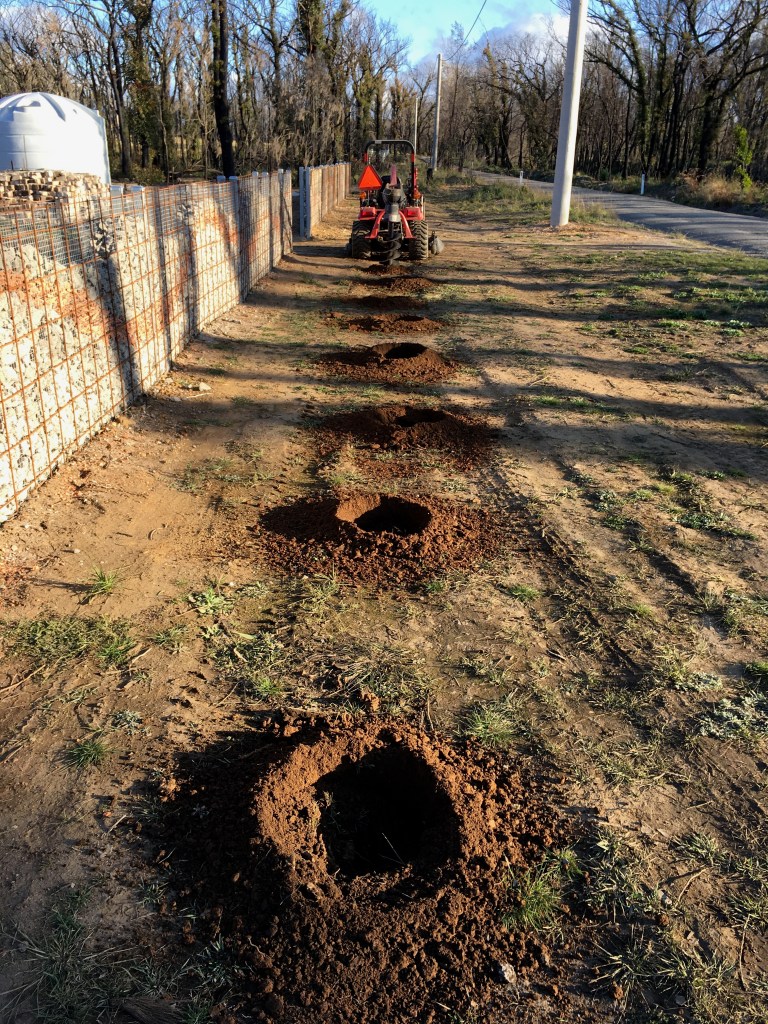
We have been continuing to work on our ceramic wall along the front of our property. We have 120 metres of frontage to the street. It’s my intention to replace the old fence with something that is more fire proof for when the next fire comes, sometime in the next decade? The original fence was the old style post and lintel, but being timber and being 127 years old, there were only 3 substancial morticed posts left in the ground when we arrived here in 1976. We know from these relics that it was a 3 rail fence. The very last post burnt in this last fire and smouldered all the way down into the ground leaving a perfectly round hole where it once stood. This new fence is designed to be as fire resistant as possible, hence the steel posts welded in pairs to seperate the front hot face from the back cooler side, to stop the metal bending over in the heat. I have also filled each post with sand and rammed it solid to give the post a solid thermal mass, so that it wont heat up to deformation temperature in the short time that a fire front passes. I looked at all the ruined fences around here, post fire, and timber completely disapears, it’s also very expensive. Cliplok metal fence systems just buckle and collapse and arn’t cheap. Full masonary walls are OK, but are the most expensive in both labour and material. There is also the drawback that a masonary wall needs an engineered footing of reinfored concrete and steel, all more expense. I have been trying to think of very cheap/cost effective solutions to all our rebuilding problems/opportunities, solutions that we can live with aesthetically and also aford. As well as this, everything has to be as fire resistant as is possible. I decided on my poor man’s imitation gabian wall idea, as it met all my requirements of cost and fire resistance. I also need everything that we do to be as beautiful, or at least as interesting as possible. To this end, I decided to fill the gabian sections with re-cycled building agregate in a moving wave pattern, as this is the cheapest ceramic fill available and this makes up about 50% of the wall. We also used 30% of black ballast rock for contrast, as this is also relatively cheap at $70 per tonne. The black wave runs as a countrepoint to the grey concrete wave. We crushed up some old terra cotta to make a colour change and a bit of detail. This is about 5% of the wall and is free, but took some time as we smashed it all up by hand with hammers, as all my rock crushers were burnt in the fire. The terra cotta is placed in ‘lenses’ in some parts of the wall, to hint at a sedimentary reference in the landscape here at the edge of the Sydney sandstone basin. To finish off the wall, we bought a small amout of round, water-worn pebbles to fill up the last 10 to 15% of the wall volume, to cap off the wall. These pebbles are the most expensive part of the wall at $90 a tonne, but we limited our use of these to just a few tonnes to minimise the cost. These pale pebbles accomodate the sweeping wave of energy in the wall pattern and bring it back to equilibrium and tranquility. The dark energy sweeps and undulates through the stoney medium, it represents my dark times, it’s always there, but rarely breaks the surface, the steady, even, bright whiteness nearly alway prevails over the dakness.
We have now completed all the 1200mm high wall sections, about 90 metres, at a cost of $1200 for the fill, this was possible because the steel yard where I have bought all my steel for the past 40 years, donated $2000 of credit into our account to help us in our re-building. We now have 90 metres of interesting and fire resistant fence. The real cost is in the labour that we, and a lot of friends, have put in to make it happen. One very good thing about building such a fence as this is that we can turn up and do a bit when ever we have a day ‘off’, and time to spare. The last 30 metre section of the wall will be built 1800mm high in front of the house to give us extra protection from the ground fire in the next fire event. We have also planted a lilli-pilli hedge all the way along the wall to give somewhere for the little birds to live. Lillipillis are reasonably fire tollerant. They don’t add to the spread of flme. They have small leathery leaves that tend to just shrivel instead of burning. We hope that they will act as an ember filter in the next fire event, as well as acting as a safe bird habitat in the mean time.
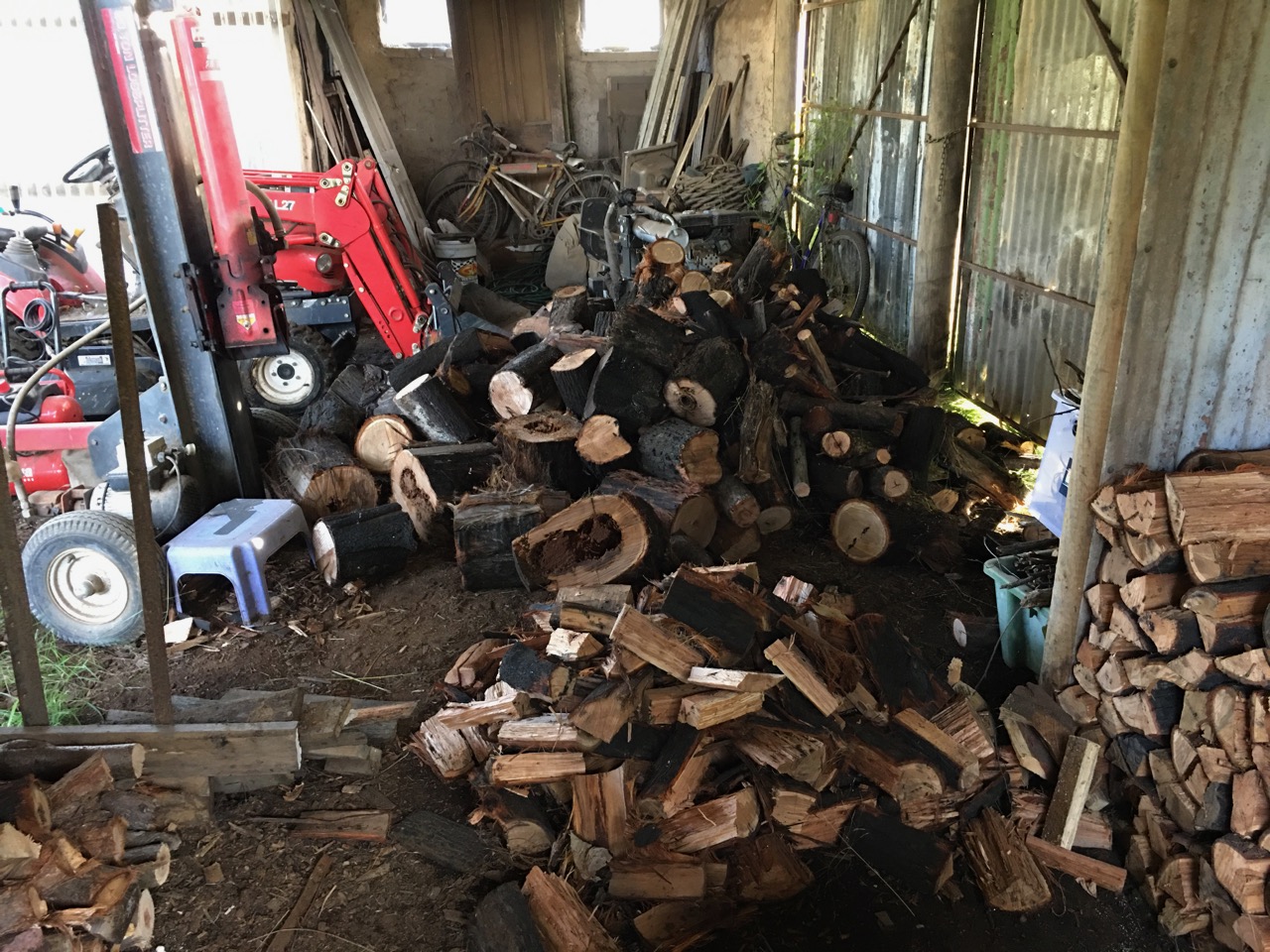
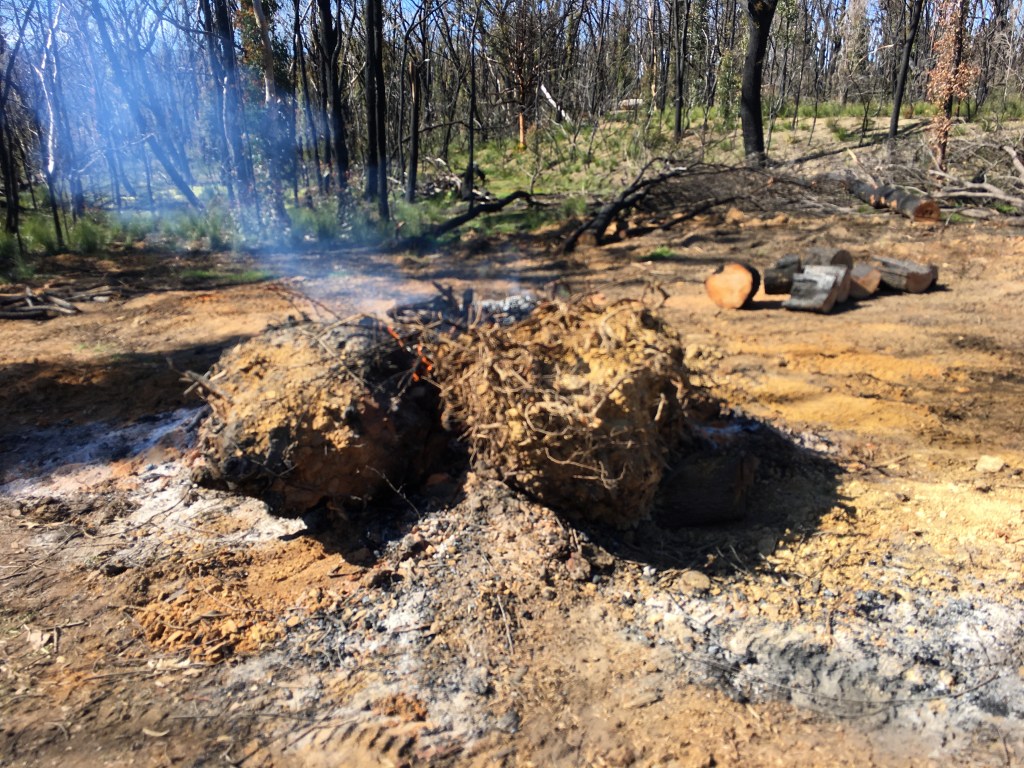
Other than that, we have been continuing to burn off the piles of burn trees, twisted branches and clayey root balls that are left over from the 16 truck loads of fire debris that we dumped on our spare block next door. This is where we used to stack all our fire wood, well away from the house. We very good strategy as it turned out, as all 50 tonnes of wood that we had stock piled ready for the kiln and house use in the coming years was all destroyed in the fire. Not one stick of wood was left on our land after the fire had pased through. As we cleaned up after the fire, we cut any straight sections of tree trunks into kiln sized lengths and stacked them. All the twisted, forked and nasty bits have been burnt in 10 tonne piles over the winter. Each pile left a few ugly root balls that didn’t burn, so the last time we had the excavator here, we had Ross collect all these remnant bits together and make a new, last pile. We needed to get this burnt before the spring and the new fire restrictions period begin. We lit it last week and it burnt for 3 days. We now have only two ugly clay and stone packed root balls that didn’t burn. I may be able to knock them about with the tractor to shake off some of the soil and rocks to get them seperated, so that they can be burnt at some later date. It has been a mamoth task to get all these piles burnt and cleared away over the winter, while also getting the orchard built and planted before bud burst. We have run to a tight schedule.
Everything is starting to come together now. We have a delivery date from the steel rolling company for delivery of our steel shed frames on the 19th of September, so just 3 weeks left for us to finish all the fences and garden. before the building work commences. I have worn through 4 pairs of heavy leather gloves, two pairs of light gardening gloves, ruined one straw hat and worn though 3 pairs of jeans, patched the knees and worn through those patches and re-patched them from thigh to knee, ready for the next onslaught of hard work. I hate to throw out anything that still has life left in it. I like to get at least 5 years of hard wear out of a pair of jeans before thay are relagated to kiln factory rags. I am very grateful to be able to live this life of frugal creativity.Nothing is ever finished, nothing is perfect and nothing lasts.
Someone recently told us that we shouldn’t be climbing up ladders after we turned 60!!!!!That was 8 years ago. I re-roofed the old pottery and re-guttered the barn, both shortly before they burnt in December.The barn is now re-roofed and re-guttered. I’ve spent a lot of time up ladders since then, cleaning gutters and doing all the various maintenance jobs.I own a lot of ladders. Different lengths and formats for different jobs, ranging from one to six metres long. I’m up and down all day. Good thing that I was only just told that I should have stopped all this almost a decade ago.
Recently I have been building a metal frame to hold up the 2nd hand and recycled, plastic, bird-proof netting, that was donated to us for the new orchard cover. This involved burying 100mm dia. metal posts in the ground to 600 mm deep and then installing cross-members between them, also 100mm. dia. I bought a truck load of 40 second hand metal pipes, 5.5m long that were recovered from the HMAS Melbourne before it was scrapped. They had been used as irrigation pipes before I got them. I only needed to cut off the thick reinforcing rings off the end of each pipe to get the joints to fit on the pipes.
Warren suggested that we should get orchard framing made into an olympic demonstration sport! I could see that these old pipes would work OK for my purposes, as they came with an assortment of 90 degree elbows and some ‘Tee’ section joints.The last part was to lift up 8m long galvanised steel beams, 100mm x 50mm. These were quite heavy and unwieldy. Because I’m cautious. I went out of my way to buy yet another ladder, this time a 3mm tall step ladder, so that I wouldn’t have to stand on the last top step of my biggest 2.4m. step ladder, to get those heavy beams up on top of the 3.5m. high pipework frame.
I thought that I was doing quite well for an old guy. This higher ladder gave me a much better and safer working position while I screwed all the beams down to the frame securely.Of course I didn’t attempt do this on my own. I had my best friend Warren here to help me.We got all the beams up in one day! I’m very leased with my new tall ladder. So much safer than standing on the top step of the shorter one.
Yesterday, while moving a little short step ladder in my workshop. I bumped a gas bottle and knocked a steel beam off a tall shelf.It came down on my head, splitting it open with lots of bright red sauce. I saw stars, but remained conscious on the floor. I managed to get myself to the house and Janine drove me to Emergency where I got 10 stitches in my head.Ladders are so dangerous! Especially those little short plastic ones.
You must be logged in to post a comment.