
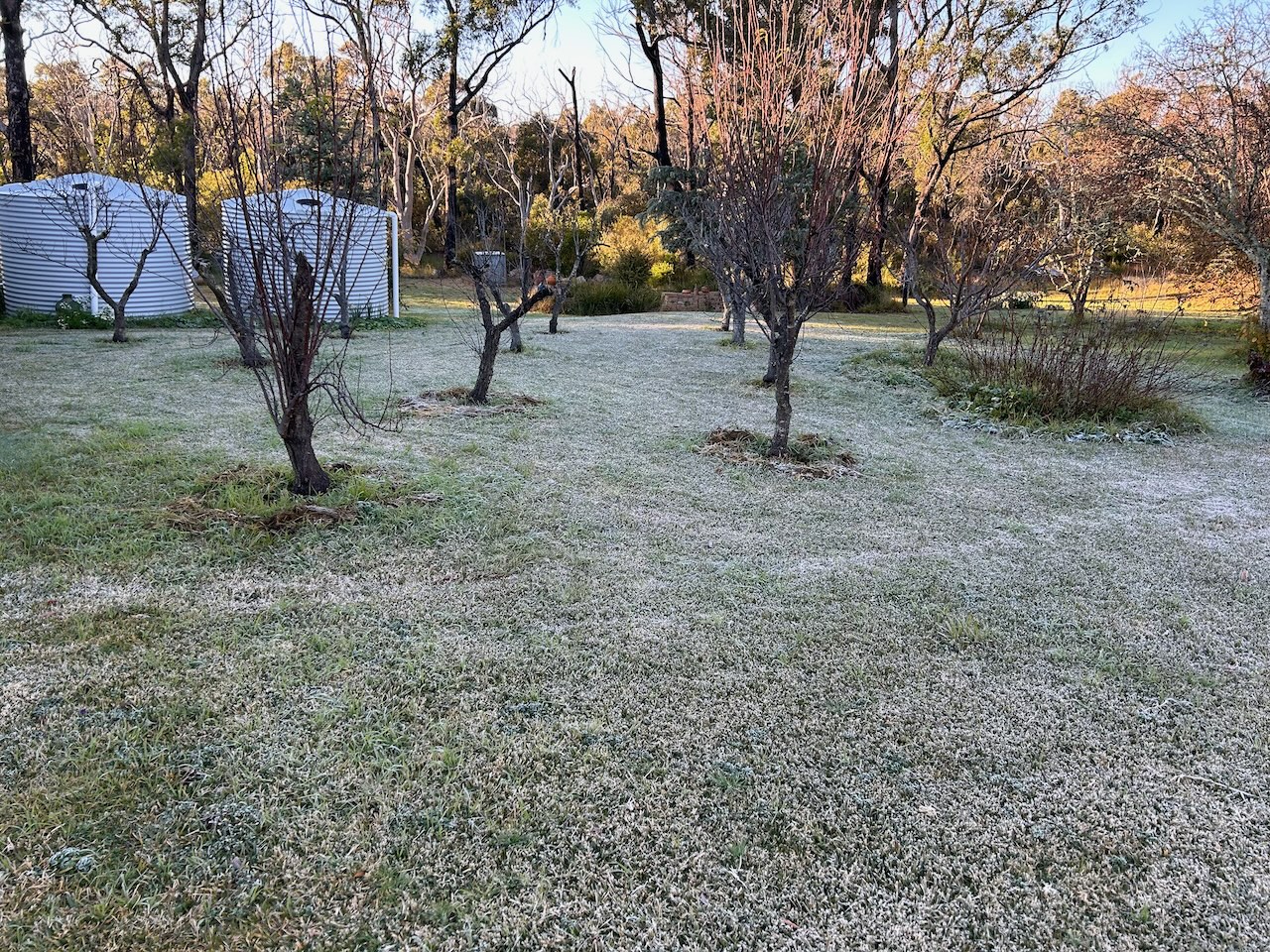
At the start of this month we had the first buds and then flowers open on the earliest peach tree. Luckily I thought to spray all the fruit trees with lime sulphur last month, as that has to be done before bud burst. I really need to get in there and finish the winter pruning. I have done all the peaches and cherry trees in the veggie garden netted area.
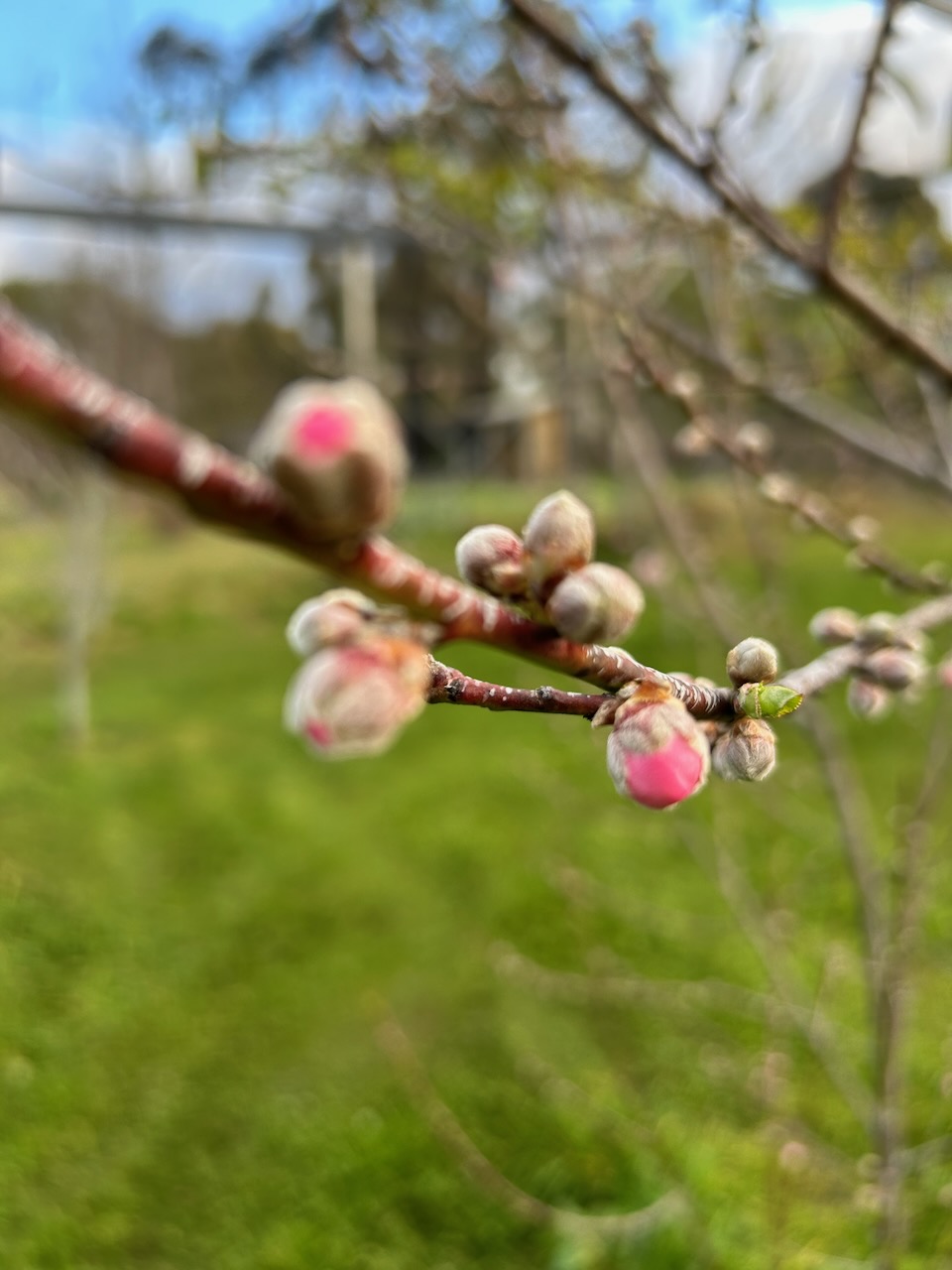
June for spraying lime sulphur, July for pruning, August to start spraying copper (Bordeaux) for leaf curl fungus. Winter is a busy time when nothing is happening!
There is a lot of work in being low impact, organic, nature friendly and carbon neutral. I haven’t had any spare time to do any composting around the fruit trees so far. So I will give them a hand full of chicken manure and some dolomite and wood ashes this time round. All of the chicken run scratch litter and manure mix has been going around the almonds trees so far this year. With only 4 chooks, there isn’t a lot to go round and with over 60 fruit and nut trees to manage, I buy a few bags of dynamic lifter composted chicken manure pellets, so as to give every tree a bit of a boost. They all get a good dose of wood ash in sequence throughout the winter, as we clean out the ashes from the various wood stoves and burn piles.

The wheel barrow has a garbage tin full of wood ash, a bag of composted chook pooh pellets and a bag of dolomite. I work my way about the orchard spreading the goodness around the drip line.
Janine harvested our Purple Congo potatoes, I caught her down gleaning the last of them from the southern end of the garden, just before I got stuck in and weeded and tilled it over, then covered it in compost to put it to bed to fallow until spring.

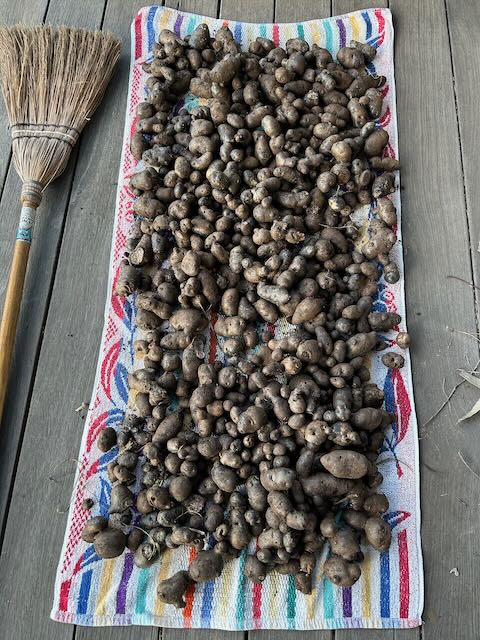
When we were in Germany a decade ago, we stayed with an extended family of potters who had gleaning rights with a local farmer, a concession that had been going on for generations I believe.
We spent a day helping them glean a paddock that had been harvested of its potatoes, but there were lots of undersized or slightly damaged ones that were there for the picking.
I remember seeing a Van Gogh painting of ‘The Potato Gleaners’, and there we were in Germany engaging in this very ancient practice. I really enjoyed it, fore-stalling waste. I wrote about it at the time on my blog. Gleaning is a very ancient right. It was established in France in the 1500’s and protected by the constitution. Today, I suppose that the equivalent would be dumpster diving? No need for either of us here to dumpster dive, because we have developed this positive, creative, environmentally friendly lifestyle. We grow all of our own green food, vegetables and fruit.
It’s a lot of work, but very rewarding when I get to look at what I’ve achieved after a day of work in the garden. The effort gives me a lot of pleasure, even though I have all the aches and strains from the work, but then I think of all the loads of vegetables flowing to us over the year, and there is always a bit of excess to share with our neighbours. Planting seeds is such a positive, hopeful and uplifting act of rebellion.

Broad beans, garlic and brassicas are all growing well, and planted in series to ensure a continuous supply of some sort of food throughout the seasons.
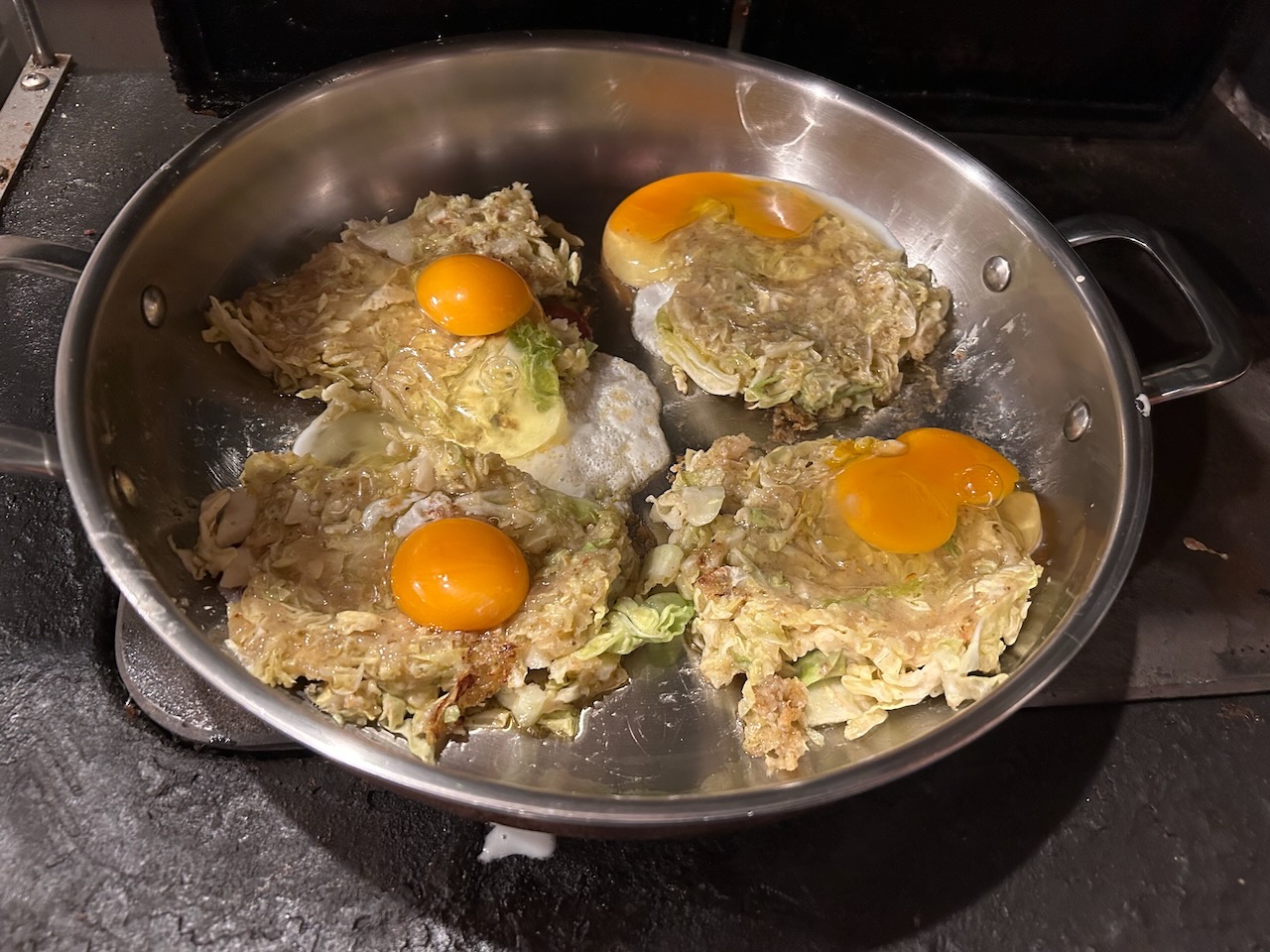
Now in mid winter, there are plenty of cabbages, cauliflowers, broccoli and brussel sprouts. One delicious option for us is to make okonomiyaki. The Japanese traditional cabbage pancake. We are not au fait with all things Japanese, but I have a keen interest in the culture and I have visited many times to study ceramics there. Okonomiyaki is a quick and easy meal that uses cabbage in a different and interesting way.
I’m told that okonomiyaki is literally translated as ‘you choose what you want’. Yaki means cooked or burnt as in pottery being yaki, or fired, and there is the character for ‘no’, which means ‘of’ stuck in the middle, so maybe ‘oko’ and ‘mi’ are to do with you and choose?
I take it to mean that I’m cooking a cabbage pancake and you can choose to add whatever you want to go in the mix. But it’s always cabbage, egg and pork!
The Koreans have a similar traditional cabbage pancake made with kinchi pickled cabbage, ‘panjun’ (sp) not too sure about the true pronunciation or the spelling there, but it tastes delicious no matter how you spell it..
Although there are minor differences throughout Japan from north to south, okonomiyaki remains pretty much the same everywhere. I’ve had it in Mashiko to the north of Tokyo and also in Arita in Kyushu in the far south. I first tasted it in Imbe in 1986, more or less smack in between. Always delicious and very recognisable.
Apparently within Japan there is hot debate between various cities such as Osaka and Kyoto, as to who makes the better and most ‘authentic’ okonomiyaki. As an outsider, I have no opinion on the matter. I love them all.
My Japanese friend has suggested to me that it should be made with grated Japanese mountain potato starch, to get the best texture, but as that isn’t readily available here, that I have been able to find. She told me that I can mix in a small % of tapioca starch to give the mix a creamy texture.
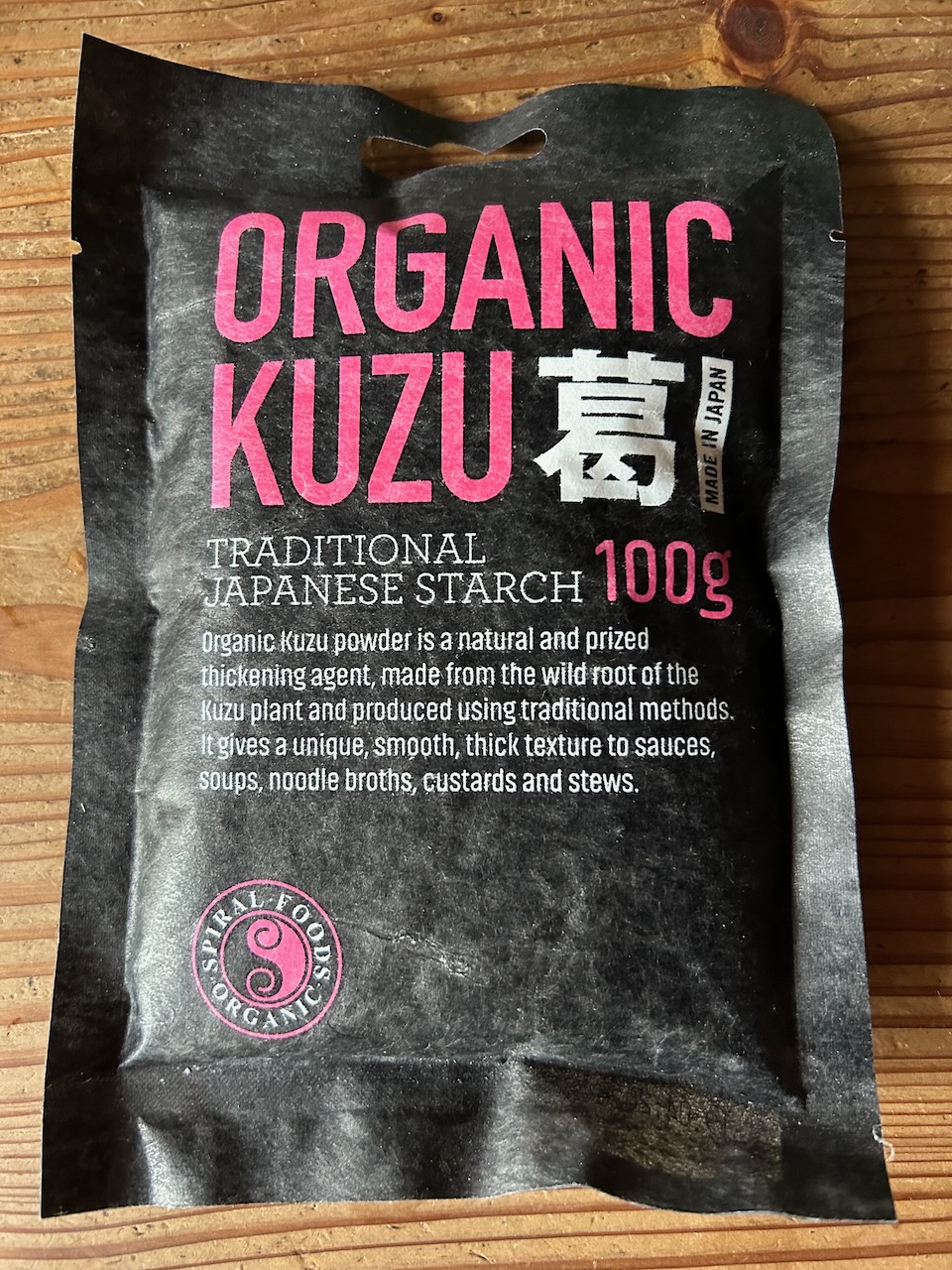
I tried Japanese kuzu powder and corn flour, but that made the pancake too sticky and glutinous. My okonomiyaki is an Australian multi-cultural work in progress. The home grown organic cabbage is really the high light, freshly picked and snappy crisp, it’s great. I’ve tried different varieties of cabbage, the best ones are the light and slightly curly types like savoy. Dense cabbages like red cabbage need to be par-boiled to soften them beforehand otherwise they are still a bit tough and chewy after the quick light cooking of the pancake.


The traditional recipe calls for a thin slice of pork and then an egg cracked over the top towards the end of cooking. I have plenty of fresh eggs, but not always fresh, thinly sliced pork. However, I can usually find some Italian style, dried, salted and lightly smoked, thin slices of pork in the deli shop. That makes a suitable substitute. No self-respecting Japanese person would recognise the mess that I end up serving, but it tastes OK, it’s fresh and it’s healthy. Ne!
It’s been an honour, joy and privilege to have had the pleasure of managing and curating these 7 acres, along with Janine for the past 48 years. I am so lucky to live and work in such a great place.






 Tonight my Fingers Smell of Garlic
You must be logged in to post a comment.