
I fired my wood fired kiln a week or so ago. It was a very good firing. I’m quite pleased with the results. Of course there were a few 2nds, as there always are, however, on balance. I got a lot of very nice pieces out of the kiln. The clay bodies worked very well and I achieved a lovely red/orange flashing colour on the clay.

So that was very nice to see , and I look forward to developing those clay bodies into the future, as they are exactly what I like about wood fired pots, unglazed outside and fire-flashed. All the domestic pots in this firing were raw glazed. ie. glazed when they were still wet or damp from the potters wheel, and then dried out and fired without a bisque firing. A raw glazed firing starts off very slow and gentle, just like a bisque firing, because it is. Then it ends like a stoneware glaze firing. It saves a lot of energy and work in packing, and unpacking, the kiln twice.
However, only certain glazes can be adapted to work as raw glazes. The recipe needs to contain about 20% of clay or thereabouts. This is required to allow the glaze to shrink onto the pot as it itself shrinks as it dries out. Otherwise the glaze will flake off. There is a particular quality of high clay glazes. They contain a lot of alumina. This means that some glaze chemistries, that require high silica content cannot be made very easily. The are a few work-arounds like adding bentonite instead of kaolin, but there are limits to far you can take this successfully. I’m working on it.
Some of the most interesting pots in the firing were my Australian versions of Korean influenced ‘Moon Jars’. The moon jar is a significant cultural object in Korea. They have been made for centuries for the Royal Family, and more recently are quite sought after in contemporary Korean middle class homes.
Interestingly, the porcelain clay for these ancient cultural masterpieces was mined in a very small village in the central north of what is now South Korea. This is the very same village where I have been going to study and carry out some of my research for the past decade in Korea. I’m honored to have a few of my porcelain pieces on show in the Porcelain Museum on site there. It’s such an inspiring place and the single stone, weathered sericite, porcelain clay is amazing.
Having worked there on a number of occasions now. I can’t help but be inspired by these magnificent objects. I can’t bring myself to make copies of them, it wouldn’t fitting for me, sitting here in Australia, as an Australian, appropriating their finest cultural heritage. And what’s more, probably doing it badly.
But I can’t resist the temptation to have a go at a big round jar influenced by the Korean moon jars. so I made my own Australian version. This series of homages are not made from porcelain, nor are they spherical and white – glowing like the full moon. I have made mine as a different kind of ‘moon’ jar. I threw them in white stoneware, coated them in black slip, and then again in white slip, so that I could do some sgraffito carving through the surface. A technique that I have become fond of in recent years.
During the long, high temperature, wood kiln firing, the combination of ash and the slip coatings combined to turn the surface a lovely green/grey/black/white/brown/orange, depending on where they were placed in the two different chambers for each of the firings. They bear no resemblance to the big, fat, round, glowing, white Korean porcelain full moon jars. These are definitely my own interpretation. They couldn’t possibly be confused as culturally appropriated local copies!
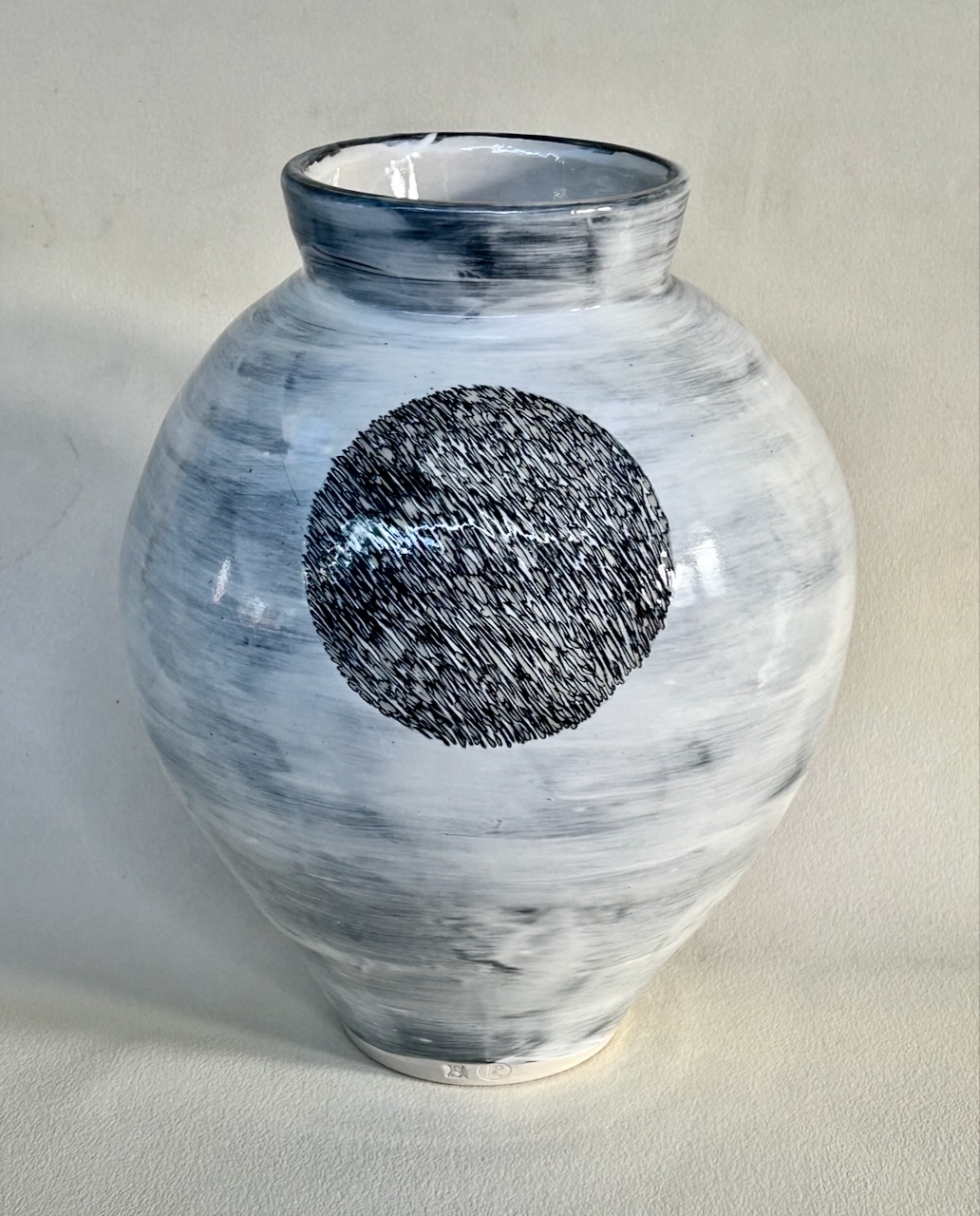
Full Moon jar

Moon shine vine. Decoration by Janine King.

Phases of the moon Jar

Phases of the Moon Jar II

Clouds over the moon

Phases of the moon III
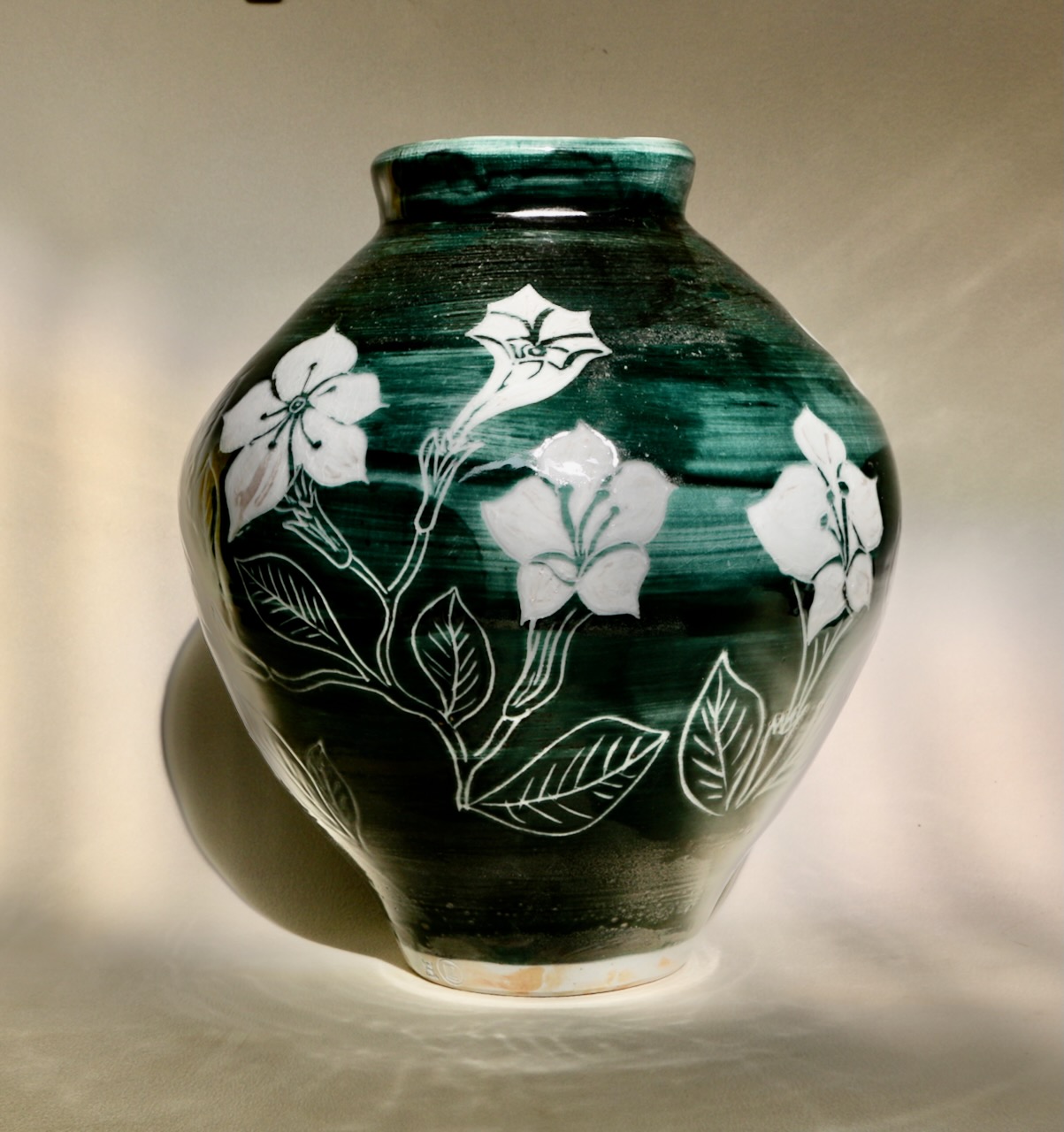
Moon Flower jar

Man on the moon jar.
A very different ‘riff’ on the subject of the Moon Jar
 Tonight my Fingers Smell of Garlic
You must be logged in to post a comment.