
With the Middle East War, Everybody is worried about petrol!
Except us.It has been over 12 months since I last up-dated my electric car review. I’ve also added all the other electric devices that we have included in our life over the past 20 years, just to fill in the picture a little bit more.
We first installed solar panels back in 2007, as soon as we could. We had to wait for the price to come down to a level where we could afford them. That price point came for us in 2005, but there were no licensed solar electricians to be found around us here in the Southern Highlands. Our electrician was enrolled to do the course and up-date his license, but we had to wait for him to finish his course and get qualified. We were his first job!. We started with just 3000 watts. 3 kW. We chose to buy Australian made PV panels from BP solar, made in Sydney. It cost more to buy Australian made panels, but we thought that it was the ethical thing to do to employ other Australians. Simplistic, naive? but socially aware, environmentally engaged, optimistic, Greenie thinking. Call me stupid, but who else is going to employ (y)our kids if we don’t choose to do it ourselves?
We have since expanded our PV up to 17 kW in 3 stages over the 20 years, as the price came down we went from 3 to 6 to 12 to 17.5. BP solar is gone – turned evil and departed for the dark side. Our later panels we made in Adelaide by ’Tindo’ solar. Again more expensive than the Chinese options, but, as above, Simplistic, naive, socially aware…
We have been slowly converting our life over to solar electric power since then, replacing older worn out appliances with electric versions as it became necessary. 40 years ago all electricity was generated from coal, so we made sure not to use very much. When solar and wind power began to become available in the Australian market. We asked our supplier to sign us up. They told us that there was a waiting list that we could go on. We’d have to wait. Eventually we were allowed to subscribe up to only 10% of our bill to ‘green’ power. Which turned out to be a bit of a con-job, as a lot of that electricity was coming from Snowy hydro, which is actually coal power.
Water is pumped up hill over-night using excess off-peak coal power to top up the reservoirs, then dropped down during peak periods to supply the breakfast and dinner peak needs. The coal generators run day and night at a steady rate which meets the average needs of the system. The coal lifted extra water is used to top up the deficit during peak times.
As more wind and solar farms were installed. We were told that we could increase the green power percentage of our bill. I rang and spoke to a representative of the power company and asked to be sent out the ‘green’ contract to sign. They posted me a dirty, black, coal-power 100% coal contract! I rang again and repeated the fiasco. Again they sent out the cheaper dirty coal power contract. It was many percentage points cheaper than the expensive green option. I guess that most customers would see that and stay dirty?
I was told that the green power contract requests were over subscribed, so they were desperately trying to get people stay with the coal. As they were financially committed very long term to coal generation, and hadn’t seen the green revolution coming, then when it was biting at their heels, they then had to try desperately to dissuade people from changing.
We changed! And we paid.
We didn’t trash any working appliance or vehicle. We changed slowly as the need became apparent. One appliance at a time. To date we have change both cars over to electric vehicles. We now have an electric ride-on mower, an electric push mower, and an electric whipper snipper gadget for the edges and tight spots.
We have also installed induction cook tops in the house and pottery. There is very little here that still uses carbon based power. We do still have the petrol powered fire fighting pumps, for safety reasons to do with being totally independent with high powered pumps. The equivalent electric powered fire pump would need to be 3 phase, and that would mean digging a lot of trenches around the block to install underground power cables. But crucially, we don’t have a 3 phase battery, so we would be very vulnerable when the grid goes down in a fire. NOT an Option!
So the petrol pumps remain. However, we only ever put one, or possible two, litres in them each year. They don’t need very much petrol. Unless there is a fire! I start them up every now and then to do irrigation, just to know that they are in good nik. They just sit there as an insurance policy against disaster. It’s instructive to know that a 4 litre tank-full of petrol in one of our 6.5 HP fire fighting pumps lasts about 4 hours on full throttle. The fire peak of a bush fire lasts about 30 minutes. Having done this research in person in a real life(or death) situation. I can tell you that one litre of petrol is all you need to save your life!
So back to a review of our electric cars;
We have had our Hyundai ‘Ioniq – 1’, plug-in electric hybrid car for over 7 years now and everything about it has been a very good experience! It’s a very old design these days compared to modern standards. We were early adopters. The Ioniq series is now up to Ioniq 9!
This car has exceeded our expectations. We have settled into a routine with it now. We can drive anywhere locally on the battery, doing our local shopping and social visits very comfortably. If we need to go further afield, no problem, the petrol engine will bring us home. This car design is a decade old, so the battery is small compared to more recent arrivals. The battery takes us between 40 and 70 kms, depending on load and whether we are driving up hill or down dale. In comparison, the recently released Kia EV 4, does over 600 kms!
We have always charged the car at home from our solar PV panels. We have never been to a charging station. We have taken it on longer trips up the Queensland twice and down to Canberra several times. For these trips, we rely on the petrol engine. However, these trips are seldom done and are the exception.
For those interested in facts and figures. My log book tells me that by March 2026, we had travelled 67,400kms and spent a total of $2,143 on fuel. That’s about 1.5 to 2 litres per 100km, depending on how much you pay for fuel.
We are in the habit of putting $20 to $30 dollars worth of fuel in the car about 4 times a year. When we first purchased it. I filled the tank on the way home, as per normal practice with a new car. Big mistake! It took us almost a year to use up that fuel. It was sitting there going stale in the tank for most of the time. Stale fuel can be a big problem, so we have not done that since, unless we are planning a long trip.
When fully fuelled up with a full battery and a full tank. The fuel/trip computer tells me that we can go 1,150 kms! It’s so smooth, quiet and comfortable to drive. I love it. I’d have no hesitation in buying another.
I love Janine’s plug-in electric car, so much so, that in December 2024 I bought a used, fully electric Fiat 500e ‘bambino’. This recent electric version of the old classic ’50’s design is incredibly cute. It can go 300kms on a full charge, which is enough to drive to Sydney and back.
It charges in 3 hours from 20% up to 80% on my roof top solar, but can also charge overnight from our battery if needed. I usually plug the cars in mid-morning, when there is plenty of sun that we are only getting 5 cents per kW/hr for when we sell to the grid. So it’s better off in my car. I charge it up about once a week. With the two back seats folded down, I can stuff an amazingly large packing case in the back. I surprised myself what I can get in there.
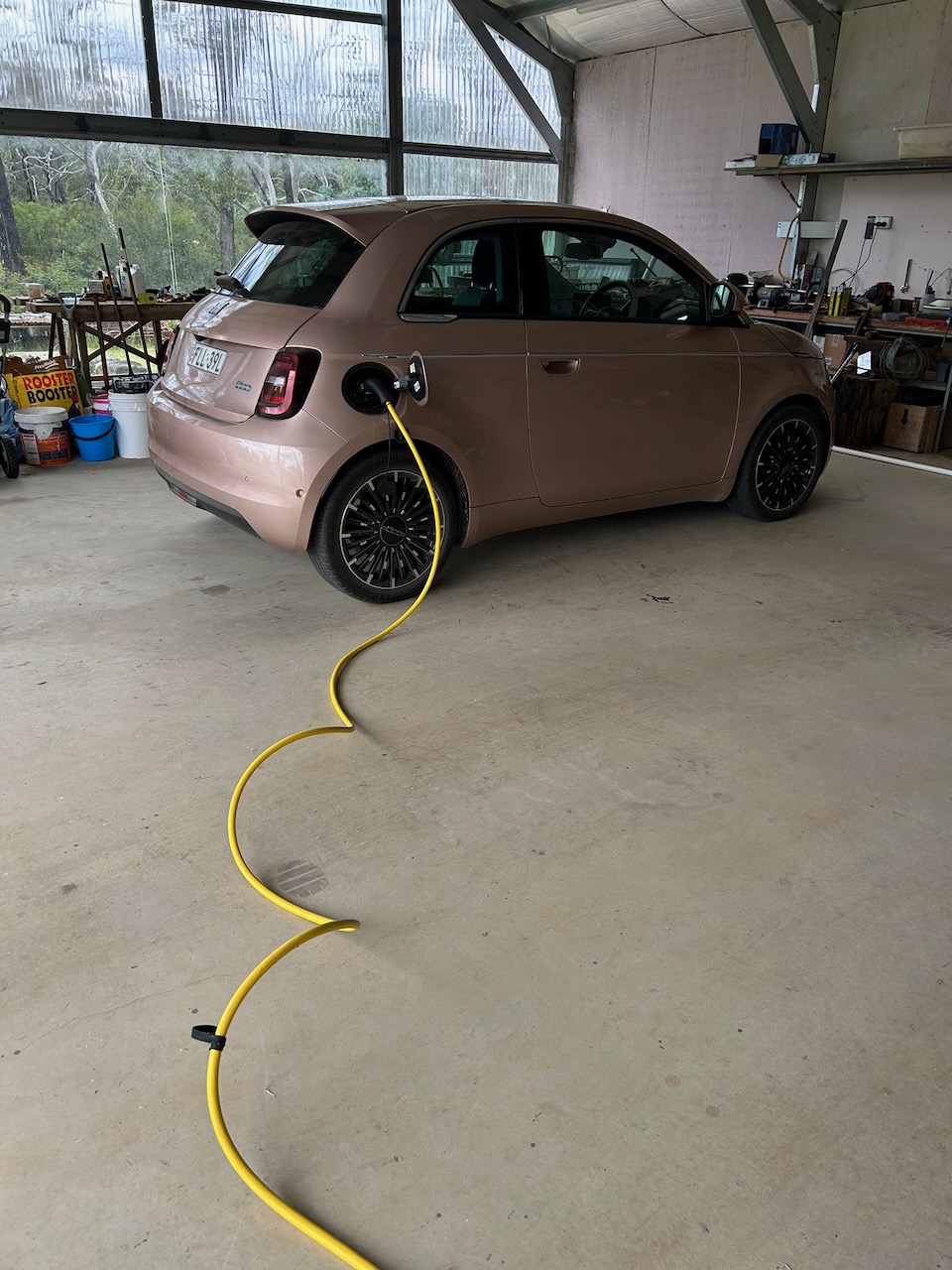
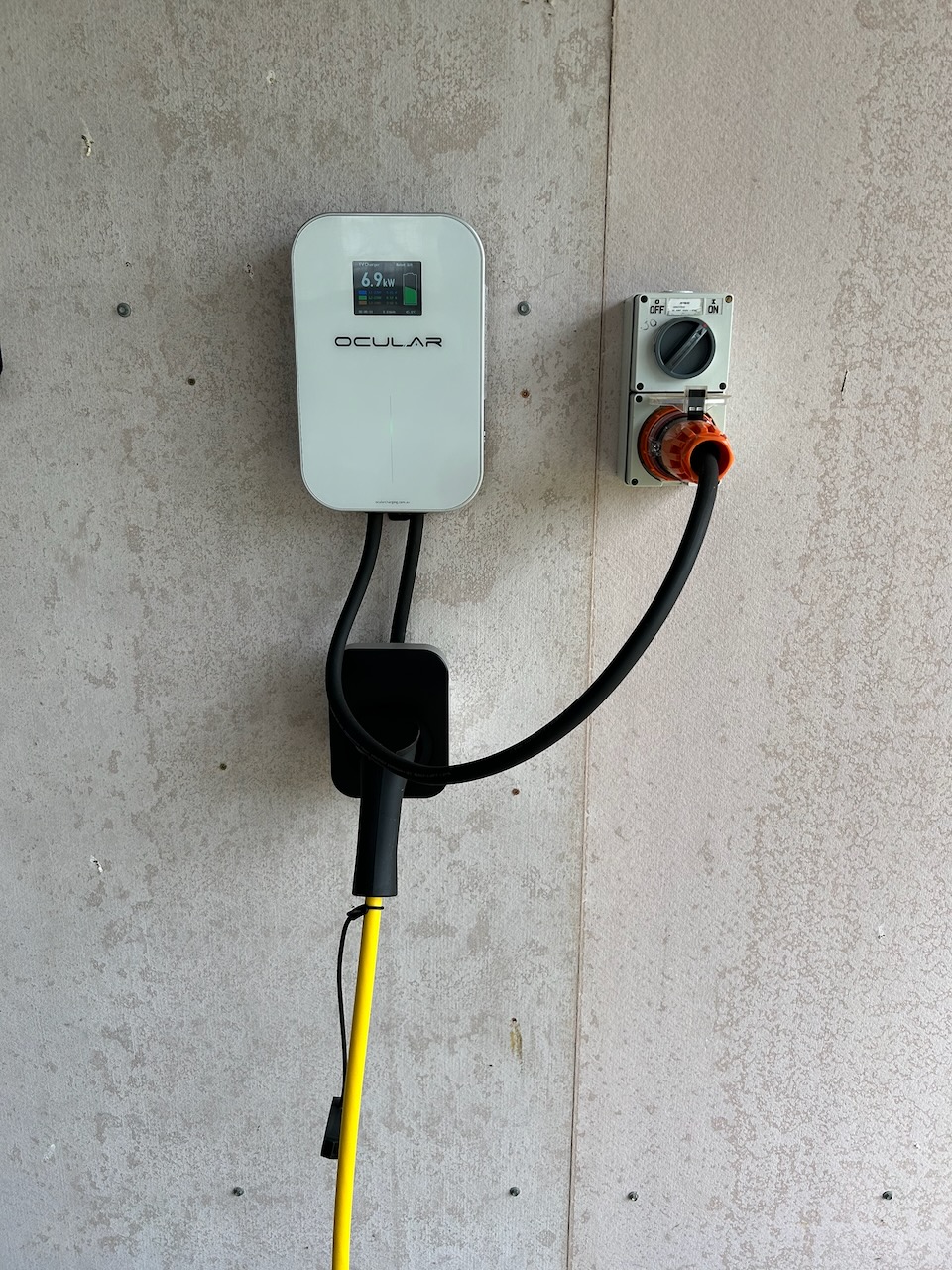
When you install solar, its like pre-paying all your electricity bills into the future all at once. In that way, my Solar power is completely free, but if you want to consider the price of the power I’m using myself instead of selling it, then the cost foregone, at 5cents kWh, that is $2 per fill. or about $100 per year for fuel, instead of buying petrol at who knows what price these days, as it goes up every week. That’s the new Trump price!
This little Fiat is the classic small, nippy car that I have always loved to drive, but now I drive on sunshine! Very tiny, very nippy and I can find a parking space anywhere. I like the engaged driving feel of this small car.
So now, after a year and a half of ownership, I can say that it is fantastic, and does everything that I need to, and want to do. And, it has only cost me approximately $100 in solar electricity each year. Fuel Crisis! What fuel crisis? I think that Trump’s war in the Middle East might push a few more people who were thinking about getting an electric car, to now make the change?
One new development for us is the fact that our local mechanic is now a fully qualified electric vehicle workshop. So the once a year check up is only a few kms away. We also know Paul very well, as he went to school with our son Geordie.
We are very pleased to be a fully solar powered household. We can run the house, the pottery, 3 electric Kilns and 2 cars on our solar. We even get a small payment every 3 months from the electricity company, for all our unused excess. We have not paid an electricity bill since 2006/7, when we installed the first solar PV panels.
The middle east war disaster will definitely affect us, but not as much as it otherwise might have.
We are careful to manage our solar power each day, or week, depending on what we are planning to do in the coming days, and what the weather holds. I choose when it will be best to fire the kilns, as kilns chew up a lot of power, so we try not to charge the car and fire the biggest of the electric kilns at the same time. If there is going to be rainy or cloudy weather. I stagger our usage to minimise our wasted excess. I have learnt that I can fire 2 bisques at the same time, or just one glaze, same power more or less, or I can fire one bisque and charge one car. etc. Having the 2 batteries also helps us to manage the odd spot of poor weather, as we can use yesterday’s sunshine to top up what we are doing.
I find it an interesting challenge, to use all of our solar power, so I don’t have to sell much at the low price. But, at the same time, I don’t want to have to buy any power from the grid. Even though I have a 100% green power contract. When I buy in electricity it costs me over 40 cents kWh. That’s the cost of green energy these days. So I would have to sell 8 times more electricity back to the grid to cover my usage.
The quest is to get to be as close to break even point as possible, without going over at all. I don’t want to give any excess away if I can, but worse would be to have to buy some back in. So I juggle the kiln firings and the car charging to fit the available sunshine.
Even when the fire burnt down our pottery in 2019. With our first PV installation gone, we were without solar for almost 3 quarters of billing periods. However, we had such a good unclaimed credit on our bill at the time, that we were able to go that whole time just using up our credit. We had new solar panels installed before the end of the year, and we were back on deck before the credit ran out. Of course, we only had the one electric car back then and no pottery workshop. So no kiln firings!
We have always been very conscious of living sustainably, so have built a very energy-efficient household over the decades. If we were not potters, I think that we could run our house on 3kW of solar PV quite comfortably. But with 2 electric cars, that would be better at 6kW. I’ve seen adds for 6 kW of Solar PV for $3,000. Can’t say if the deal was any good or not, but the price of solar is always coming down.
 Tonight my Fingers Smell of Garlic
You must be logged in to post a comment.