
I’ve been making of big round jars influenced by Korean ‘Moon Jars’. I’ve been fascinated by them for years, ever since I traveled and studied in Korea when I got to see them up close in the National Museum and also in potters workshops. I tried my hand at making my own version when I came back and have dabbled in making something inspired by them since.
Recently I taught a couple of workshops on the techniques that are used to create big round jars. After the workshops were over, I kept on going.
In the workshops, I made it easier and more achievable for everyone involved, by setting the starting point at 1.5 kgs. Nearly everyone enrolled in the workshops could manage this weight of clay. A lot of nice pots were made, but nothing too big. The more advanced throwers, were encouraged to progress in 1 kg increments, some reaching up to 4 or 5 kgs. Excellent! So encouraging for everyone in the room there to see that develop. However, we all progressed at our own rate.
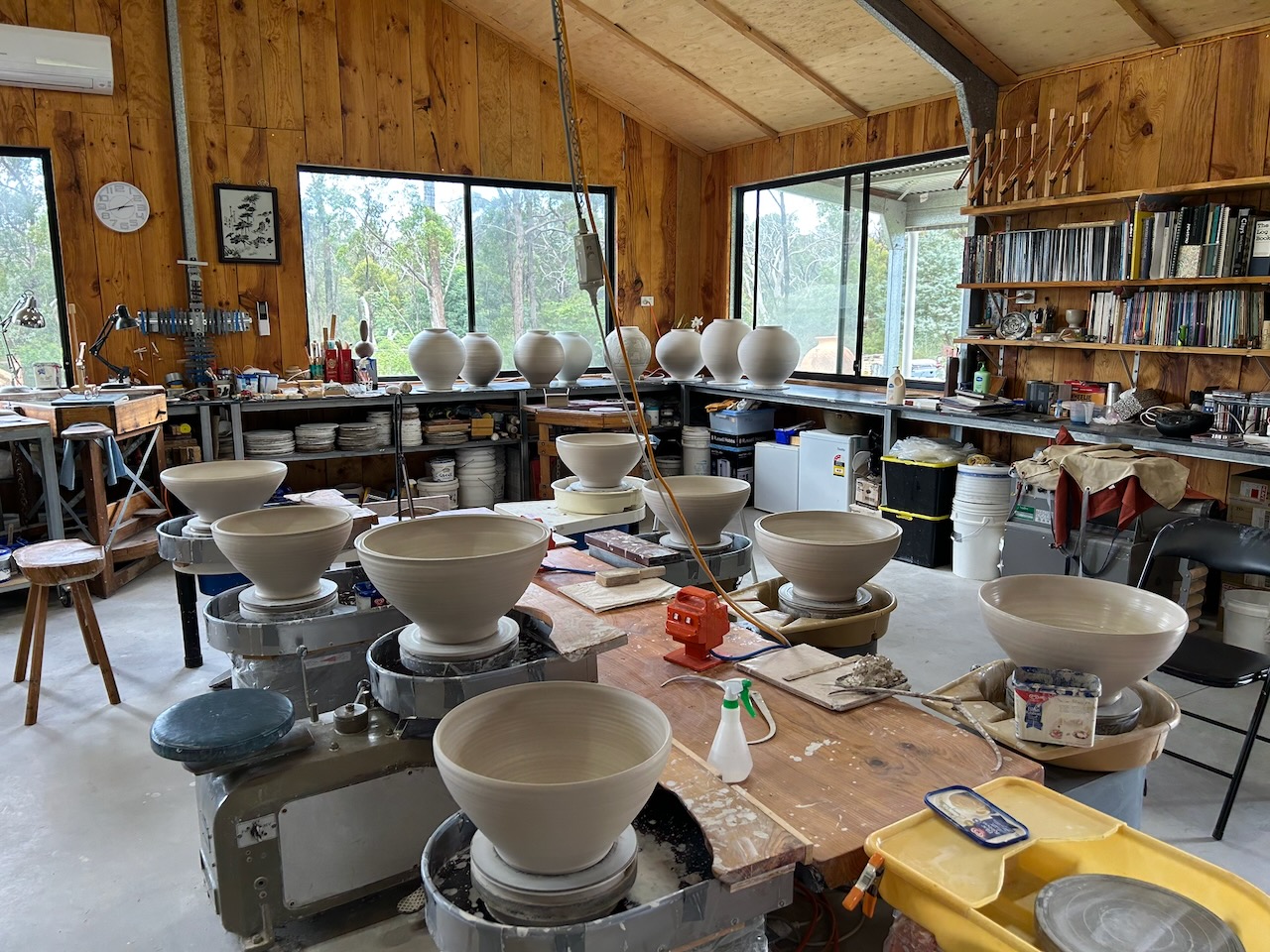
After the workshops were over, I kept on practising. I worked my way up from 4 kgs to 5, 6 and 7, then 8 kgs. over a week or two. I could feel my skill level, confidence and success rate increasing and as I focussed on the end point of the big, open, wide bowl, that becomes 1/2 of the finished big round form. I made over 40 of these multi-kilo half-pot bowl forms and then a day later, I flipped one bowl over onto the other half, and assembled a (hopefully) beautiful sphere shape. As this is the technique used by the ancient potters. Finally turning a small foot to give the form lift and elegance. Some of my attempts were more successful than others. A few were pretty good, but not sufficiently elegant enough. but that is what keeps me trying.
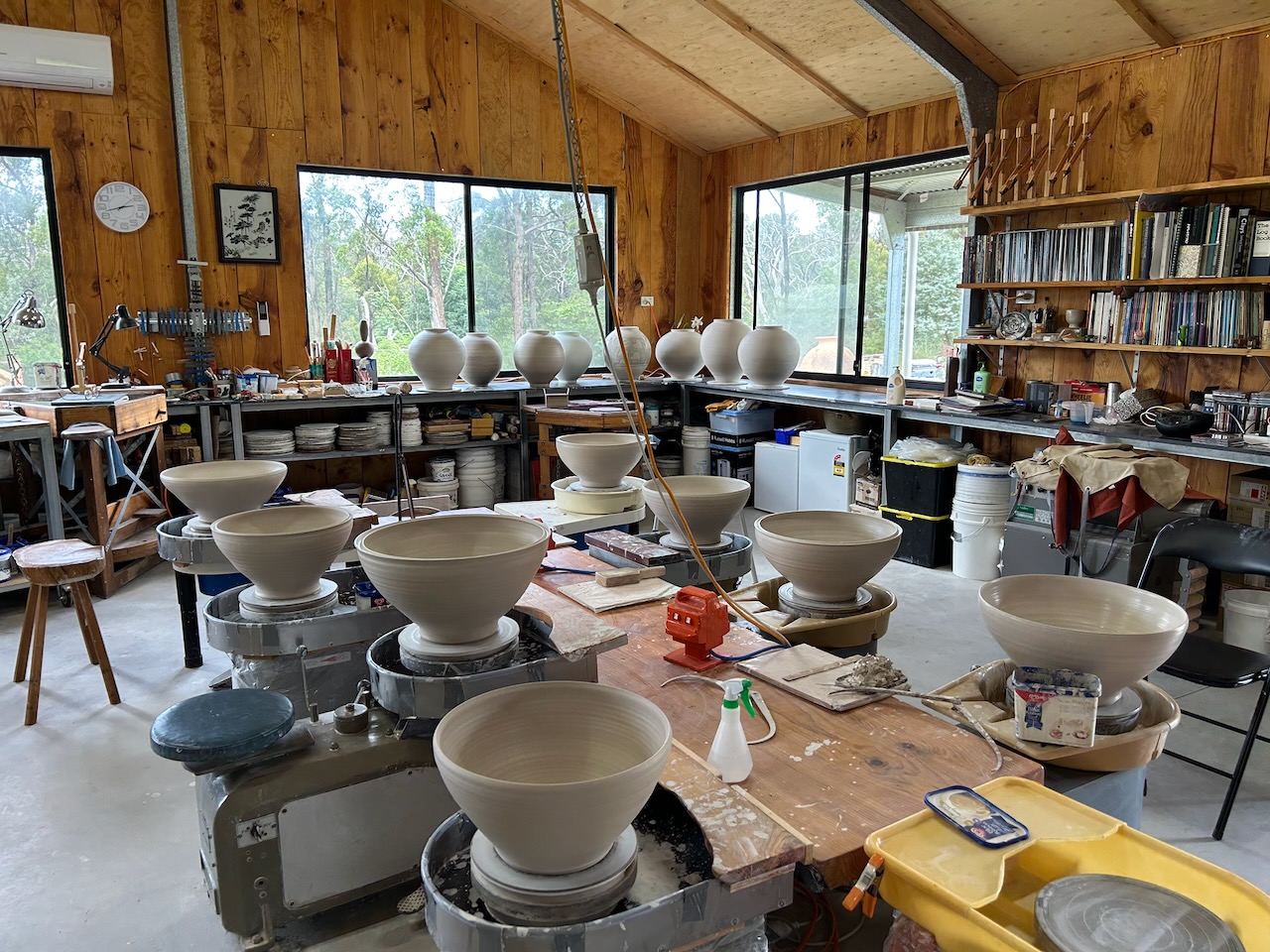
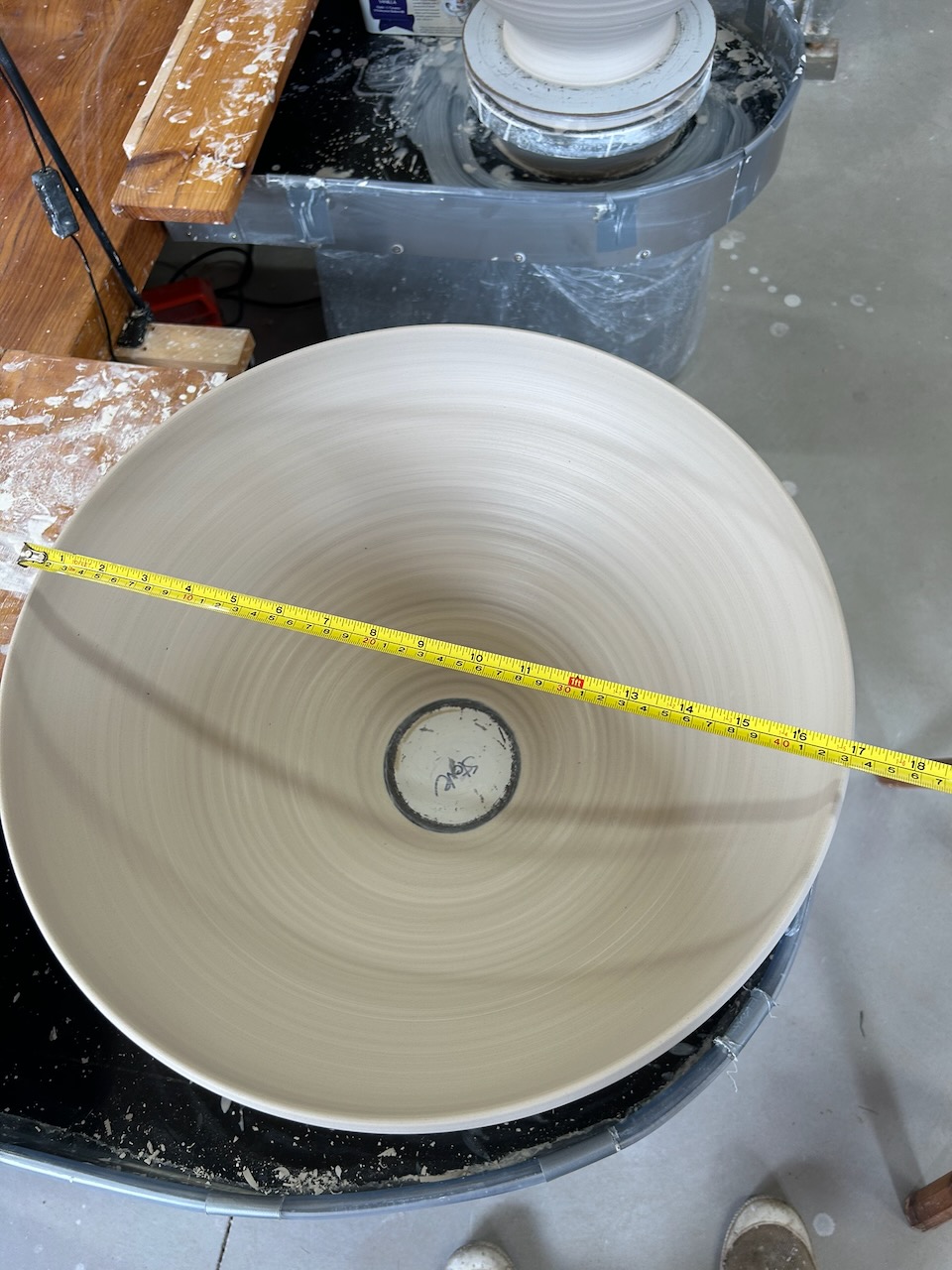
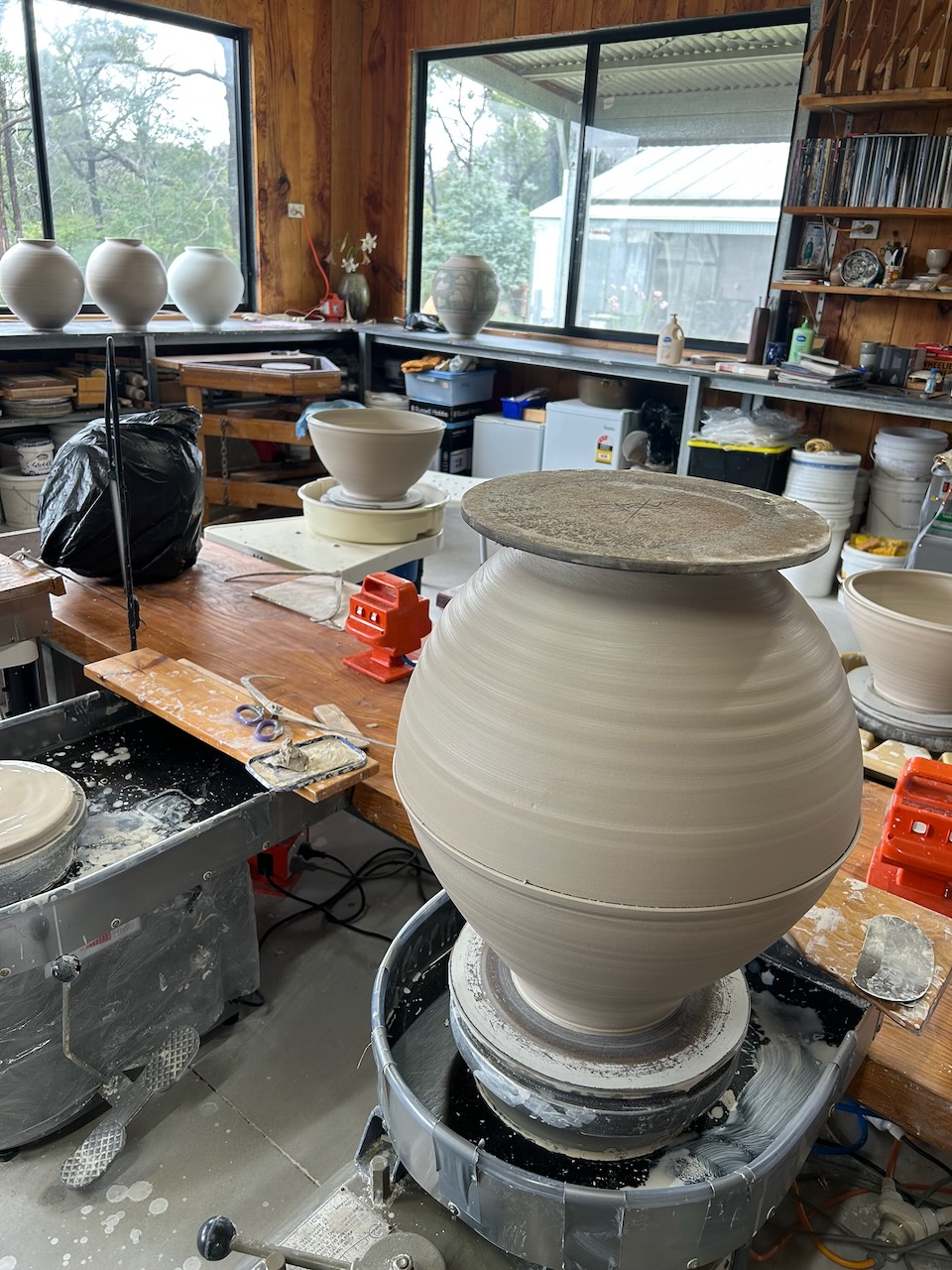
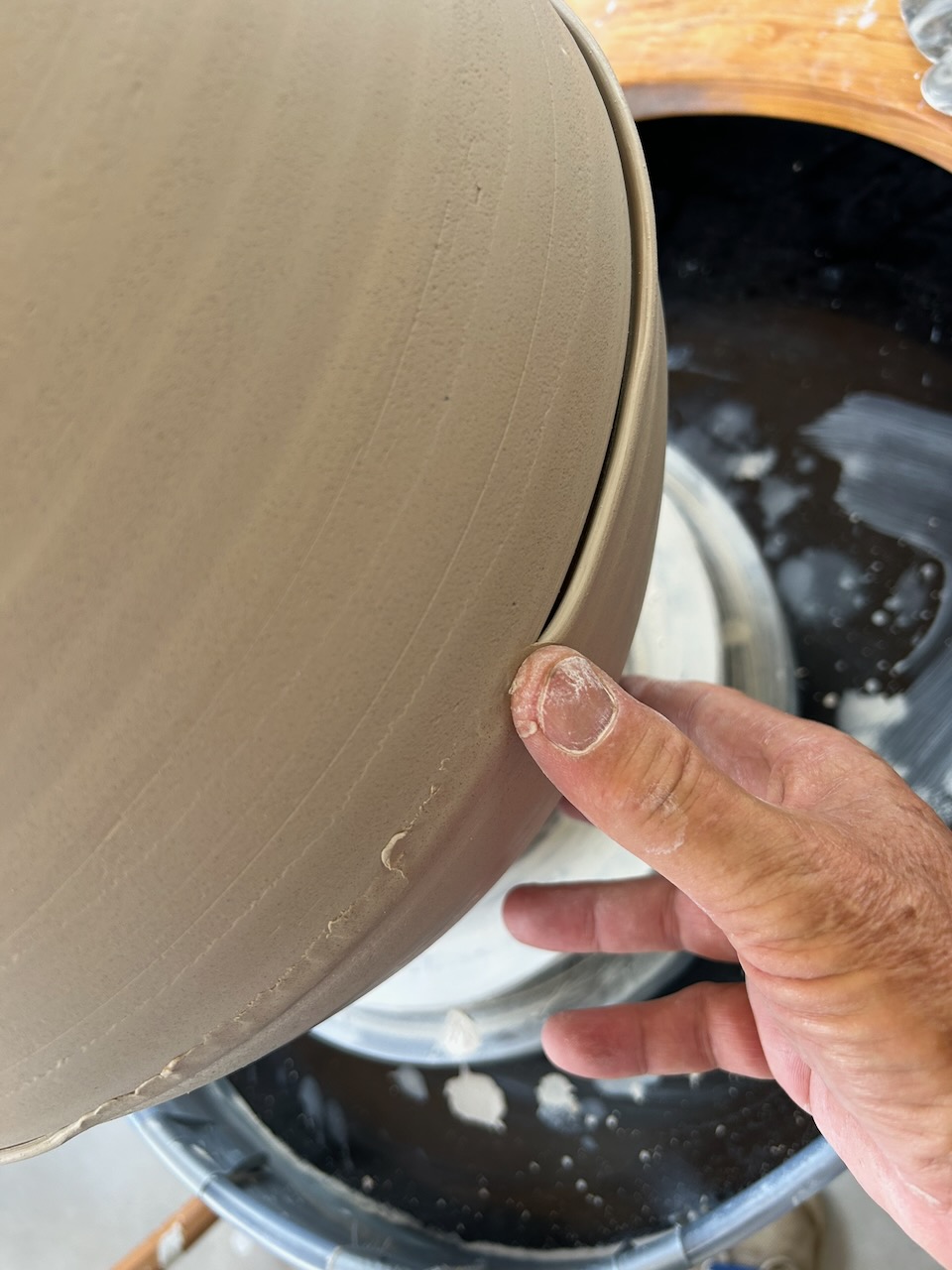
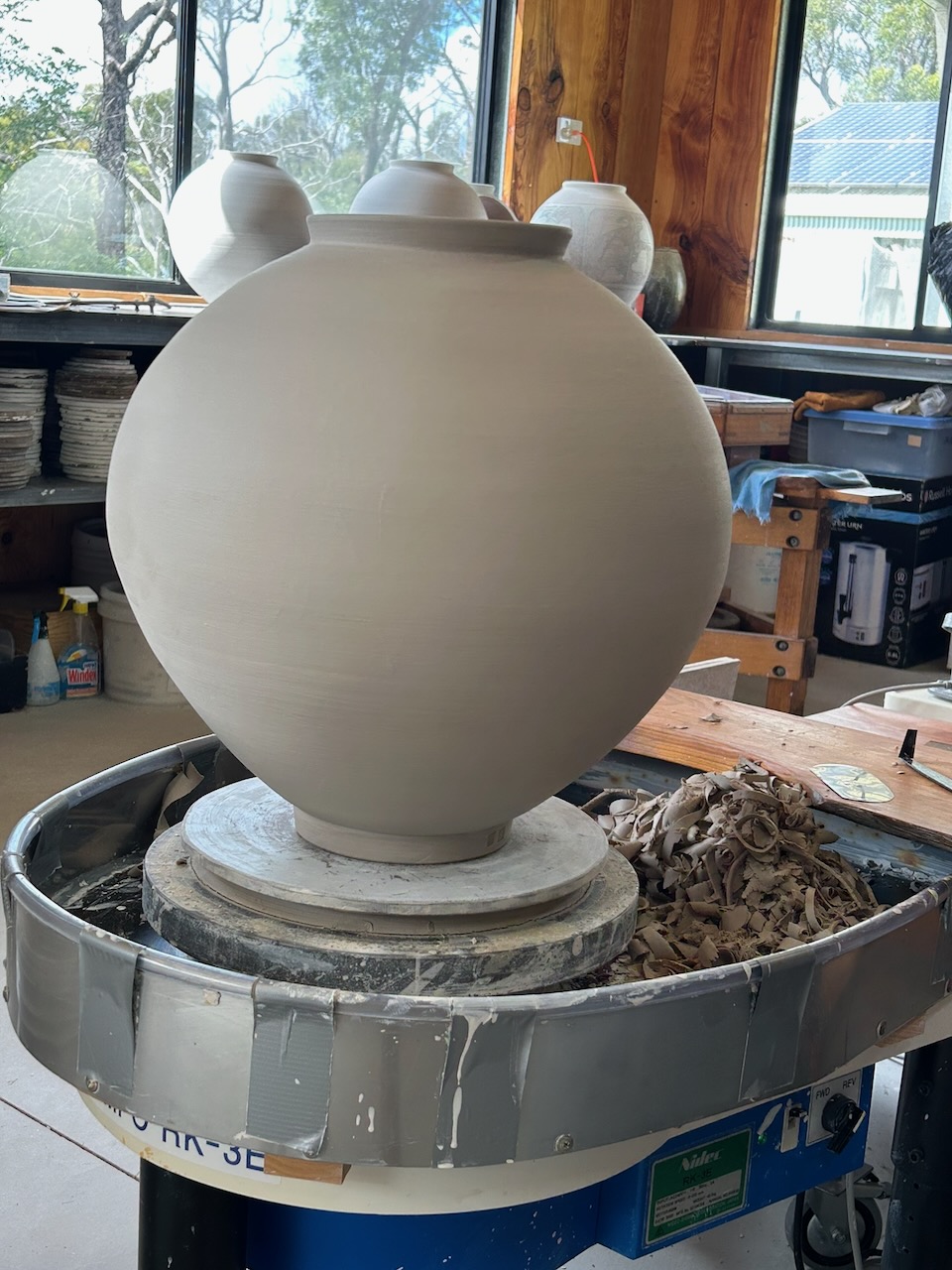
I’ve sold most of last years jars, so I’ve been keeping on with this now for another 5 weeks and made good progress. Well, as far as I’m concerned, I have. Others may differ! I haven’t ever been, and never will be, a ‘gun’ thrower. I never wanted to be. However, when I was younger and stronger, I did make large jars for a few years, and taught big pot throwing workshops, but these were mostly always in terracotta, using the coil and throw technique, a very different technique and medium. Those pots were all garden pots. That technique was ideal for someone like me who needed to take my time. To work slowly and intuitively. I’m never quite sure what I’m doing and if I’m making progress. I need time to absorb and evaluate. It doesn’t come naturally to me. I struggle. I’m not a performer. I hate the lime light. I need to make my mistakes in private. Learn from them and try again. I wish I was talented or gifted like some of my peers. But I’m not and I’ve come to be OK with that. I’m a slogger, who battles on and learns slowly through my misadventures. Slow learner! But I get there.
I did eventually make a stoneware, vitreous, water tank for the house, that is still in use today. 40 years old and it hasn’t rusted out like all the other old tin tanks!
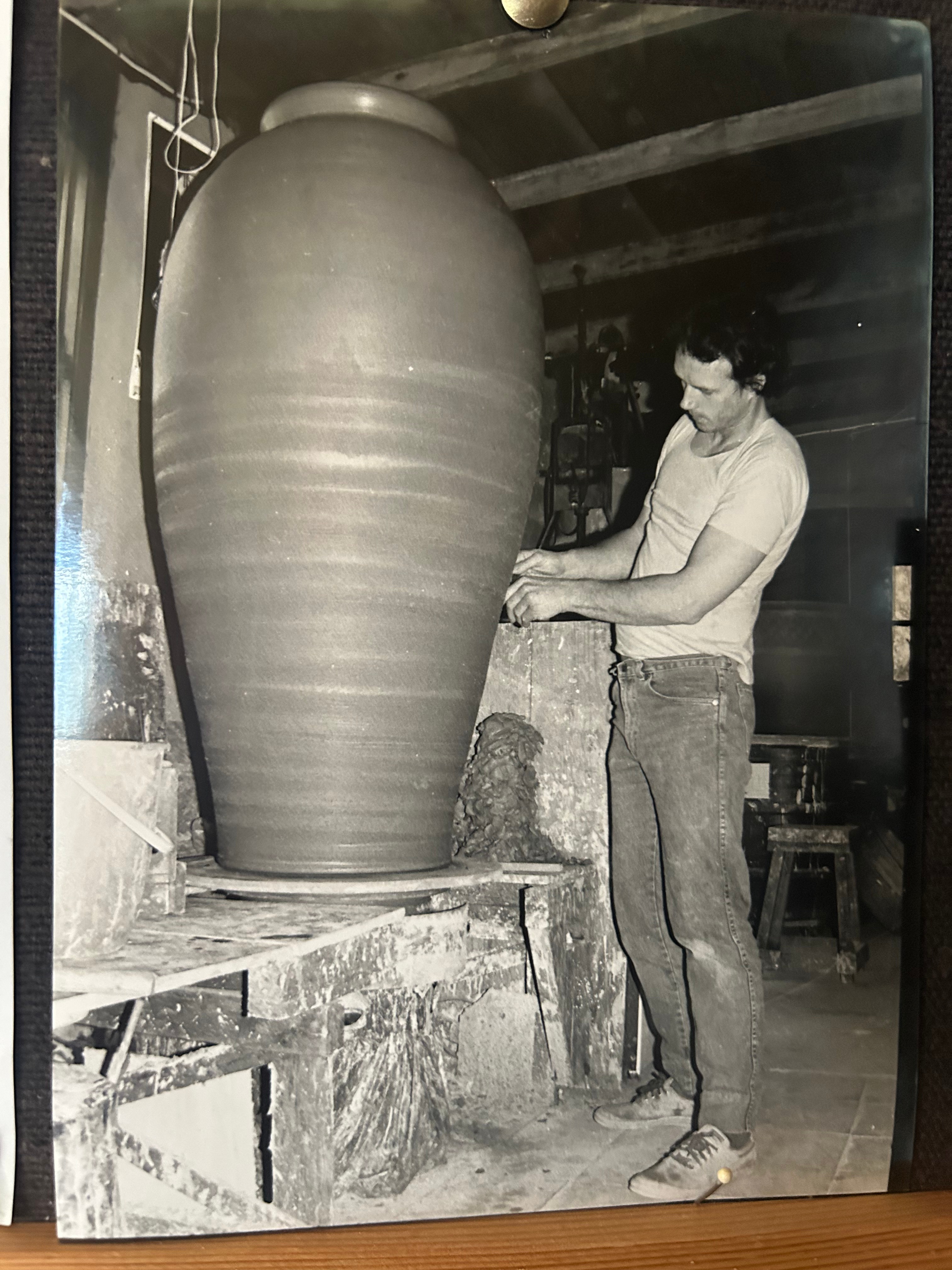
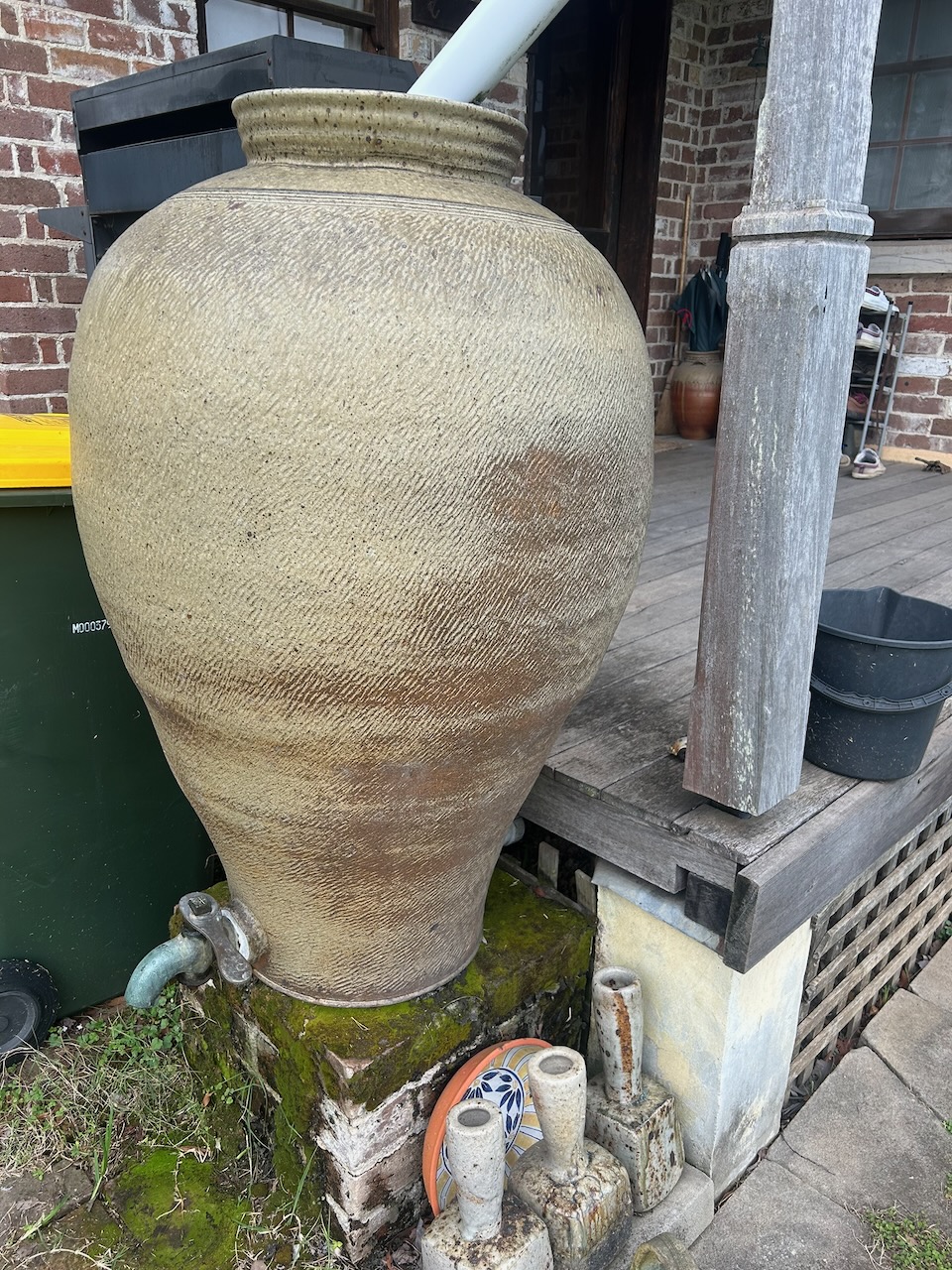
Other than that, I’ve always made small delicate porcelain bowls and other domestic wares. But now, after a decade and 8 visits to Korea, and much thought and study. I have, at this late stage in my life, become interested in the ancient cultural pottery form of the traditional Moon Jar. So exquisite, so impressive, so big, yet subtle. Fat, round, fecund and feminine. I love them. I love the poetry inherent in the form. They are so romantic and impossible! But also scary! Such a challenge.
Who could have imagined making the impossible? A huge, possibly 18 to 20 kilo jar, out of the most difficult and unpromising non-plastic material like fine white porcelain? Someone hundreds of years ago. Not only that. But they threw those impossible forms on a wooden kick wheel with very little momentum! This is the work of Masters.
Moon Jars weren’t called Moon Jars way back in time when they were made. The name is a recent addition. Originally, they were simply called ‘big white jars’. They were made exclusively for the Emperor and his entourage. They are said to embody the main elements of Joseon Dynasty Confucian philosophy, frugality, austerity and purity. I can identify with the first two.
They were eye wateringly expensive in their time. The clay was mined in and around the tiny village of Bangsan, way up in the mountains. A remote place, hundreds of kilometres away from Seoul. Where the only activity was growing rice and vegetables along the river flats – that is until the porcelain stone was discovered.
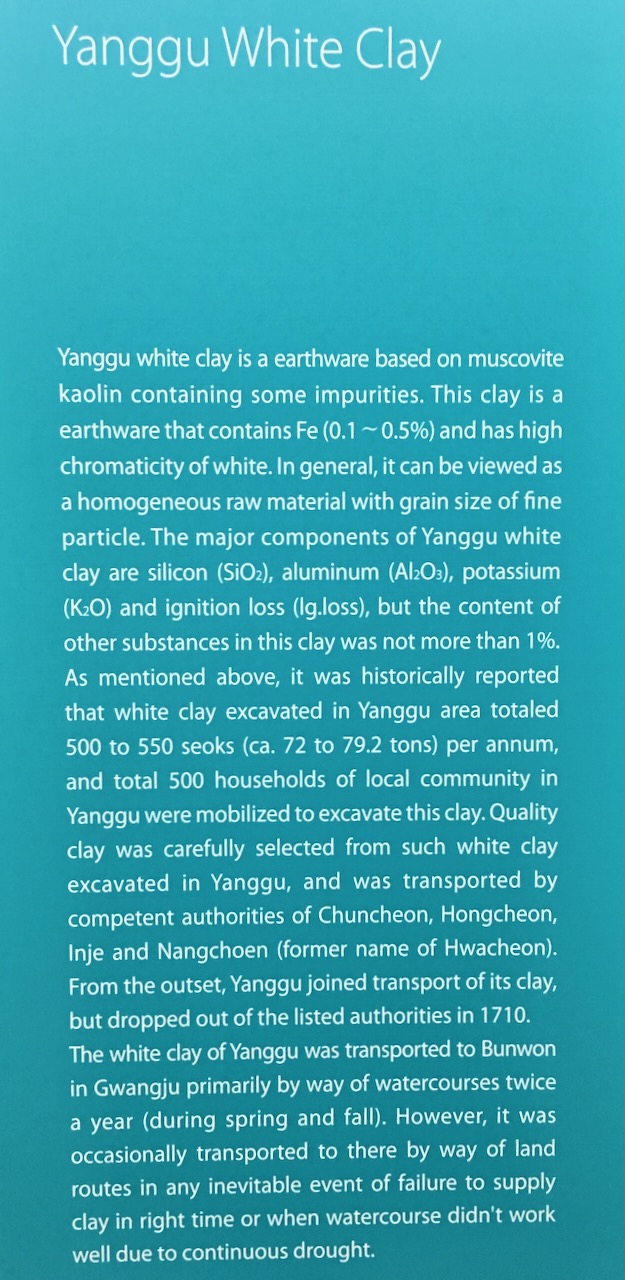
Information board from the Yanggu Porcelain Museum.
Over time, an industry developed in mining, processing, testing and then shipping the pure ‘sericite’ stone, all the way to Seoul. There was no direct road route. So in the wet season, the clay was shipped down the river, on a very long, circuitous route, around and around, from one river to another, and eventually across the country, to Seoul. In the dry season, it was carried by porters overland, which was more expensive and took even longer. It made the production of ‘Court’ porcelain very exclusive, highly desirable and very expensive. Such pots were not for the general population. Not even merchant use. This was the realm of royalty, it’s privileges and excesses.
Records show that the clay, actually weathered sericite stone, for the making of white porcelain in Korea has been mined for the past 650 years, since 1371 in the one location. This unique porcelain stone was mined in an area/county called ‘Yanggu’. Right in the centre of Korea, and not too far from the current DMZ. Luckily for me. It is located on the southern side of the border. Who knows what is on the other side of the hill? Other than land mines! I have come across notices on fences up there, written in Korean, that when translated using my phone app. Read ‘Beware of land mines’. Do not cross!
I’ve visited this place many times over the past decade. Collected geological samples. Had them analysed, studied and compared the stones with others from different sites in Korea and also from sites in other countries. China, Japan, Cornwall and Australia. I have collected over a dozen different porcelain stones over the years, from 5 different countries. I’ve examined them, worked with them, ground them up and made porcelain bodies from them. Thrown them and turned them. Eventually, when I had achieved some success in this epic 15 years struggle to understand ’sericite’, I had a major exhibition of this Artistic Research in Watters Gallery back in 2017, that show was 15 years in the making, and some of those special, unique, pieces of my hand made, single stone, ground porcelain ended up in the New South Wales Art Gallery collection as well as in the Powerhouse Museum in Sydney. I’m really thrilled about that!
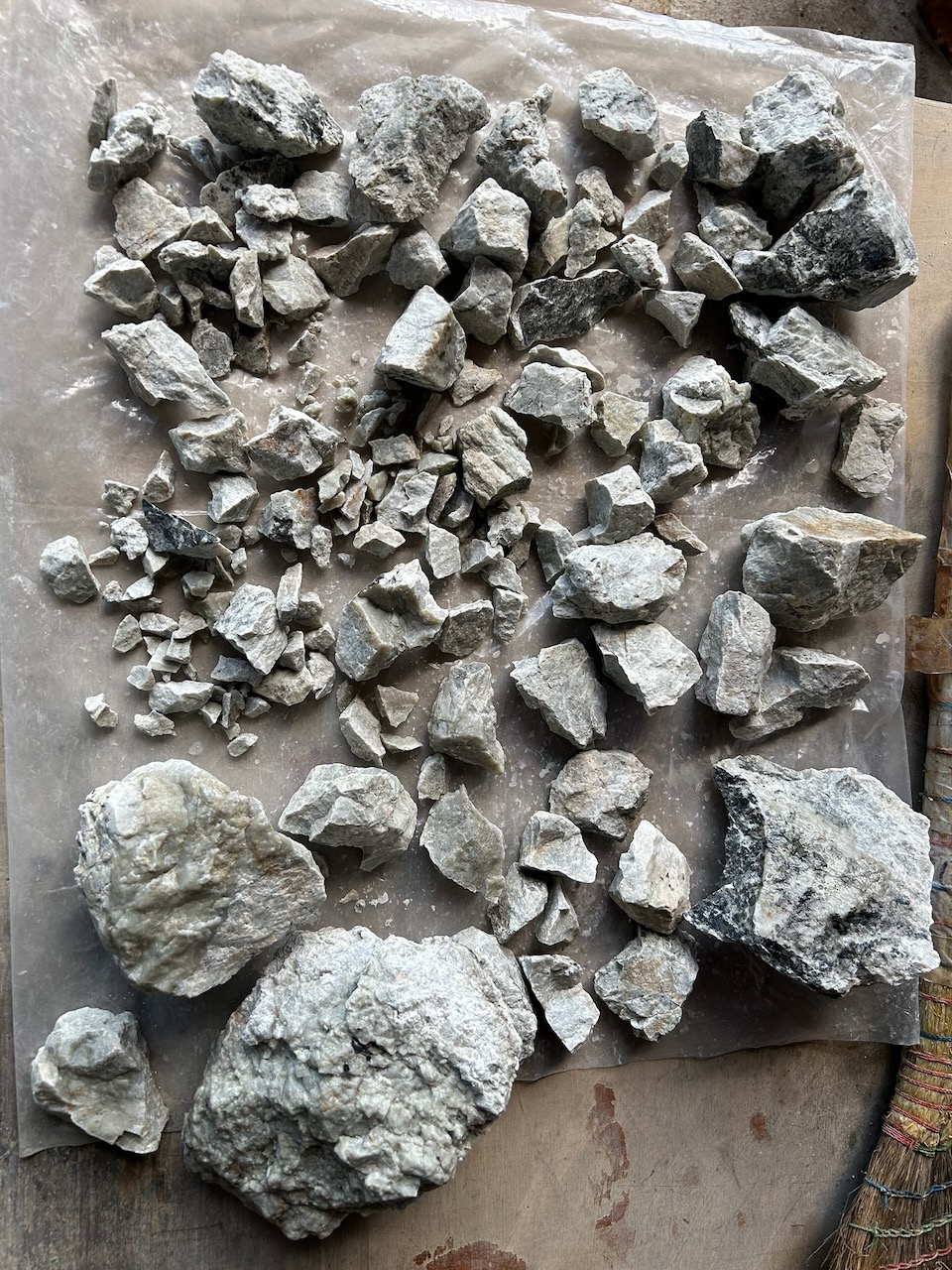
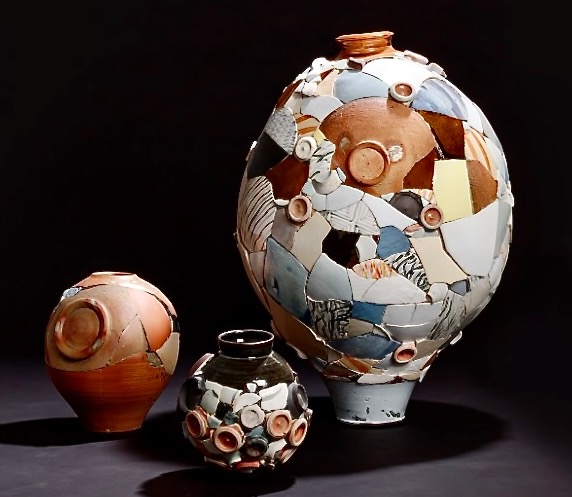
Korean sericite stones. 3 jars constructed from broken shards, collected from the old pottery studio ashes after the fire.
Image from the Powerhouse Museum collection.
I’m thinking that I might keep on making these big round jars for some time. Until I’m satisfied that I really understand them. Eventually, if I’m lucky, I may end up with enough good ones to get an exhibition together. I love the form. It’s so full, round and generous. The Koreans revere them. Every potter there has a go at it. It’s a perennial project in Ceramic Art School courses. Some students continue on and make a name for themselves as Moon jar makers. There are a lot of very beautiful pots out there made by younger highly skilled, competent makers. I was lucky to spend a week watching Mr Chul Shin making his version of Moon Jars. Mr Chul has a very distinctive studio in the icheon Pottery village.
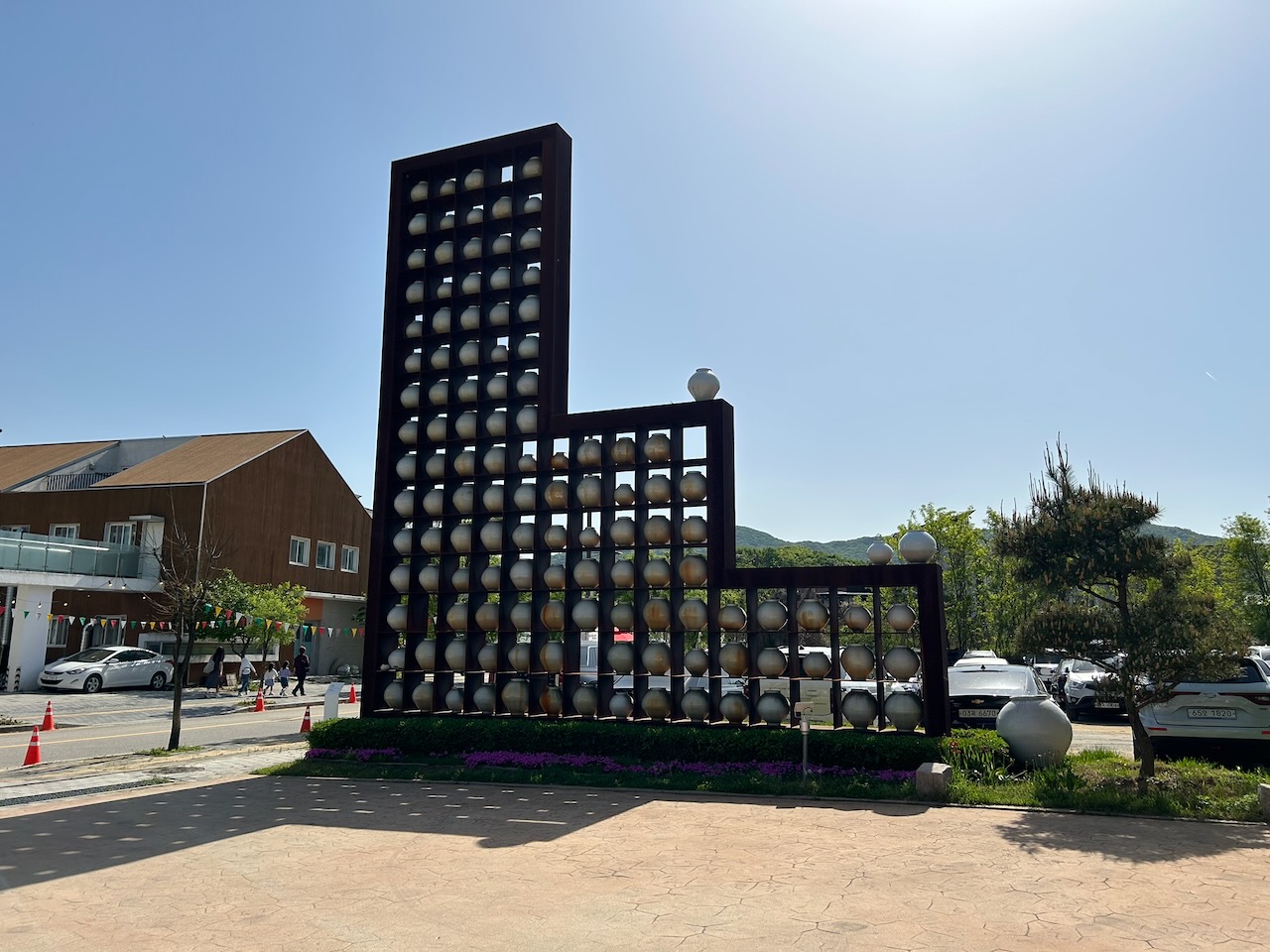
He told me through an interpreter, that it was not until he had made a thousand that he became confident.
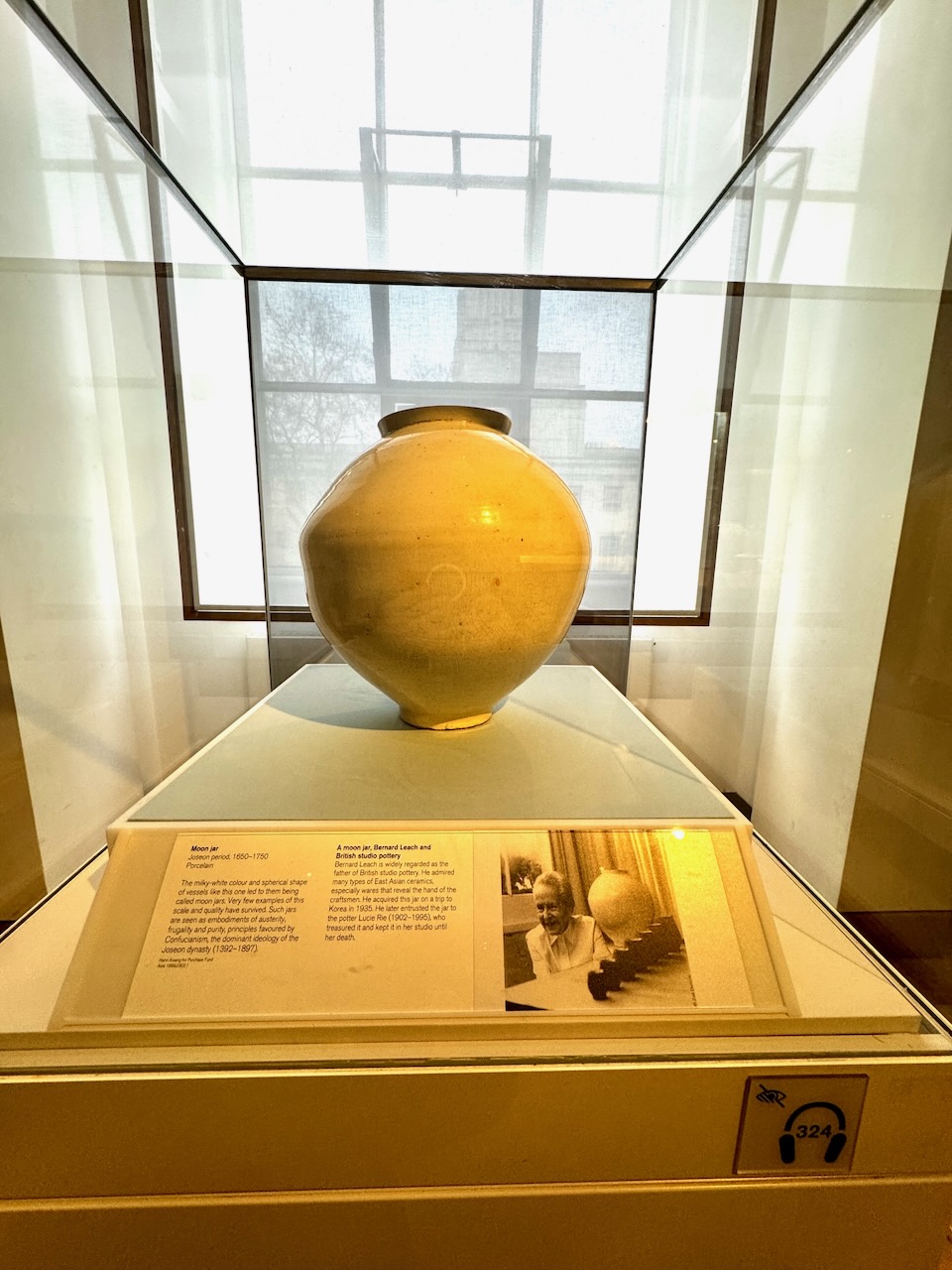
These jars have become Korean cultural icons. It wasn’t always so, When Bernard Leach visited Korea in the early part of last century, he found one for sale in a bric-a-brac shop for a few hundred won. Today they sell for 4.5 million US dollars. His bargain purchase jar is now housed these days in the British Museum. But spent most of it’s life in Britain in the home of Lucie Rie on loan from Leach, until her death.
My artist friend Anne was in the British Museum yesterday and sent me some images back. I have been there twice to see this jar myself over the years, but it wasn’t until I started to get seriously interested in them and started to try and understand them and make them that I wanted to learn more. I have looked at Anne’s images quite closely now and can see so much more that I hadn’t taken in, in my previous visits there. Images by Anne Spencer.
Isn’t it interesting how we travel through life in a kind of blur, not really taking in all that we see. Just impressions. It takes intense scrutiny to really see with intent. I know that I can only spend a couple of hours in any gallery or museum, before I start to develop Museum blindness or fatigue. I need to go out and sit outside. Go for a coffee or have lunch, then I can go back in and look for another hour. Then that’s it. If I stay longer, I’ve learnt that I’m just wasting my time. I need a couple of days or more, to really see the parts of a museum that really interest me. To really take it in! Maybe it’s just me? My limited ability to really see and understand? My acuity and skills of perception are apparently stuck in first gear.
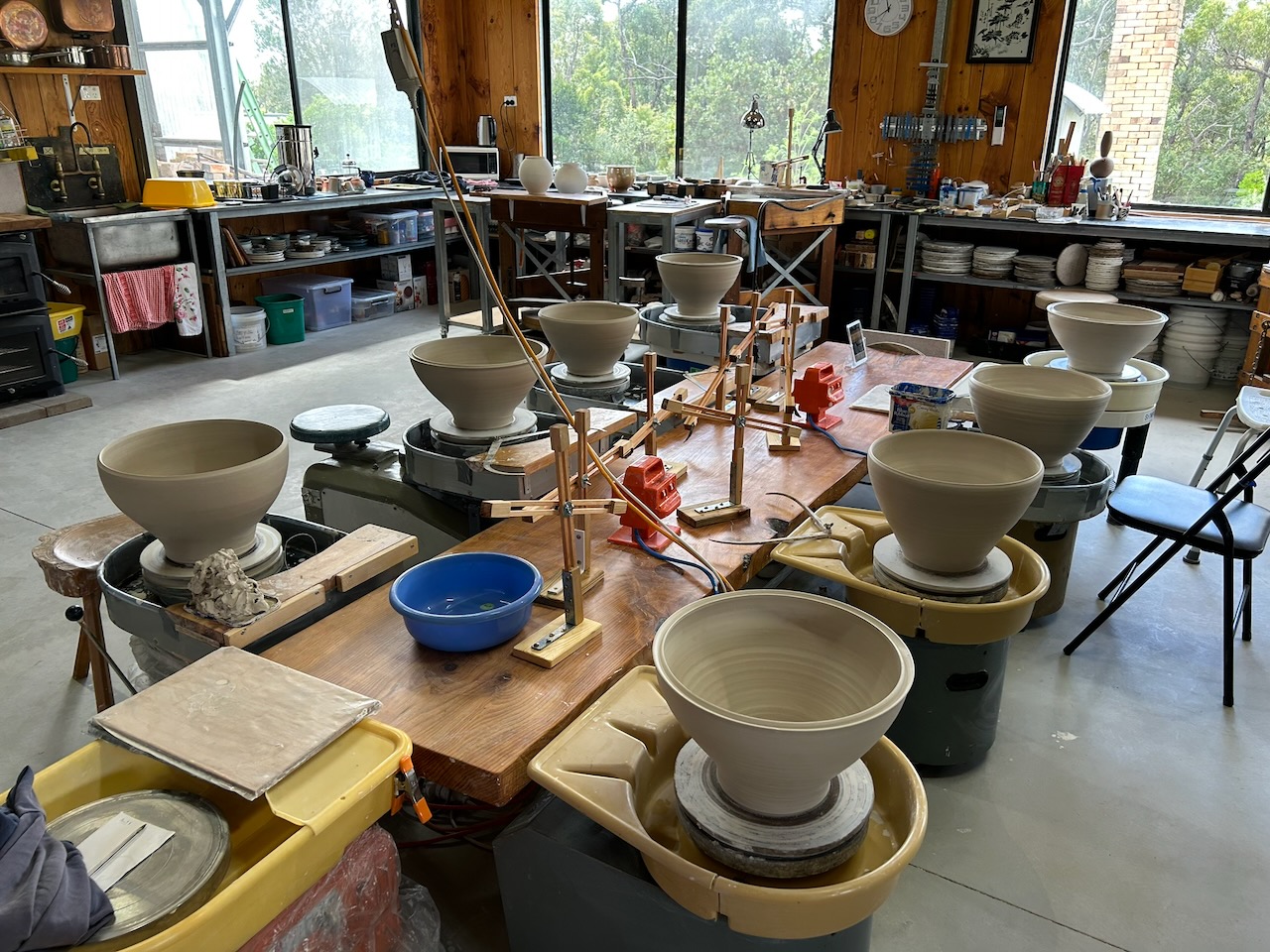
I learnt more from Anne’s photos this morning than I did in my previous 2 visits to London to see the actual jar. The difference being that I am now totally involved in trying to really ’see’ them completely, to understand them, as I try to make something of my own, that has that unique special quality. My insights have expanded exponentially. This is directly related to my attempts to re-created the fullness of the form on the wheel – and failing, then doing it all over again. Slowly burning in those necessary synapse connections and pathways.
I have to admit that I really still don’t quite know what it is that I need to know. I haven’t quite ‘got it’ yet. Maybe another 40 ‘halves’ will get me closer. Half a tonne of clay may not be enough. I’m feeling more and more like I will need another half tonne and another 40 goes to really get to grips with it?
Looking closely at Anne’s Images, I can now see more of the subtleties that I missed before. I’m taken particularly with the rough texture of the body, the inclusions of organics that have burnt out. The subtle crazing where the glaze is just a bit thicker. I can also make out the slight differences in the atmospheric body and glaze colour development across the pot due to differences in the firing. I’m suspecting at this stage that this pot was possibly fired in an oxidising atmosphere early on in the firing, then going through a period of neutral atmosphere, eventually ending up in a reducing atmosphere towards the end of the firing. That’s my guess. Based on my knowledge of how ancient multi-chamber kilns were often fired.
I’ll only know once I’ve given it a go with my own clay and kiln, then I can re-asses and maybe try something else. And for what really? Just the academic reward of figuring some thing so esoteric out to a level of my own satisfaction. If I ever get a show together. I’m prepared to witness people walking past them and not taking much of it in. Just as I have done all my life up until now!
I’m fully aware that studying just one pot will not tell me enough. I need to see as many as I can to make a more balanced judgement. So far I’ve seen 3 in real life. not enough. There are about 20 or so of them out there, but they are all spread all over the world. The one I saw in the Yanggu Museum two years ago was more reduced, with the glaze showing a pale limpid celadon where it was thicker around the rim. Unfortunately, the only photo I could get was under a very yellow artificial light, so the jar looks rather blond.
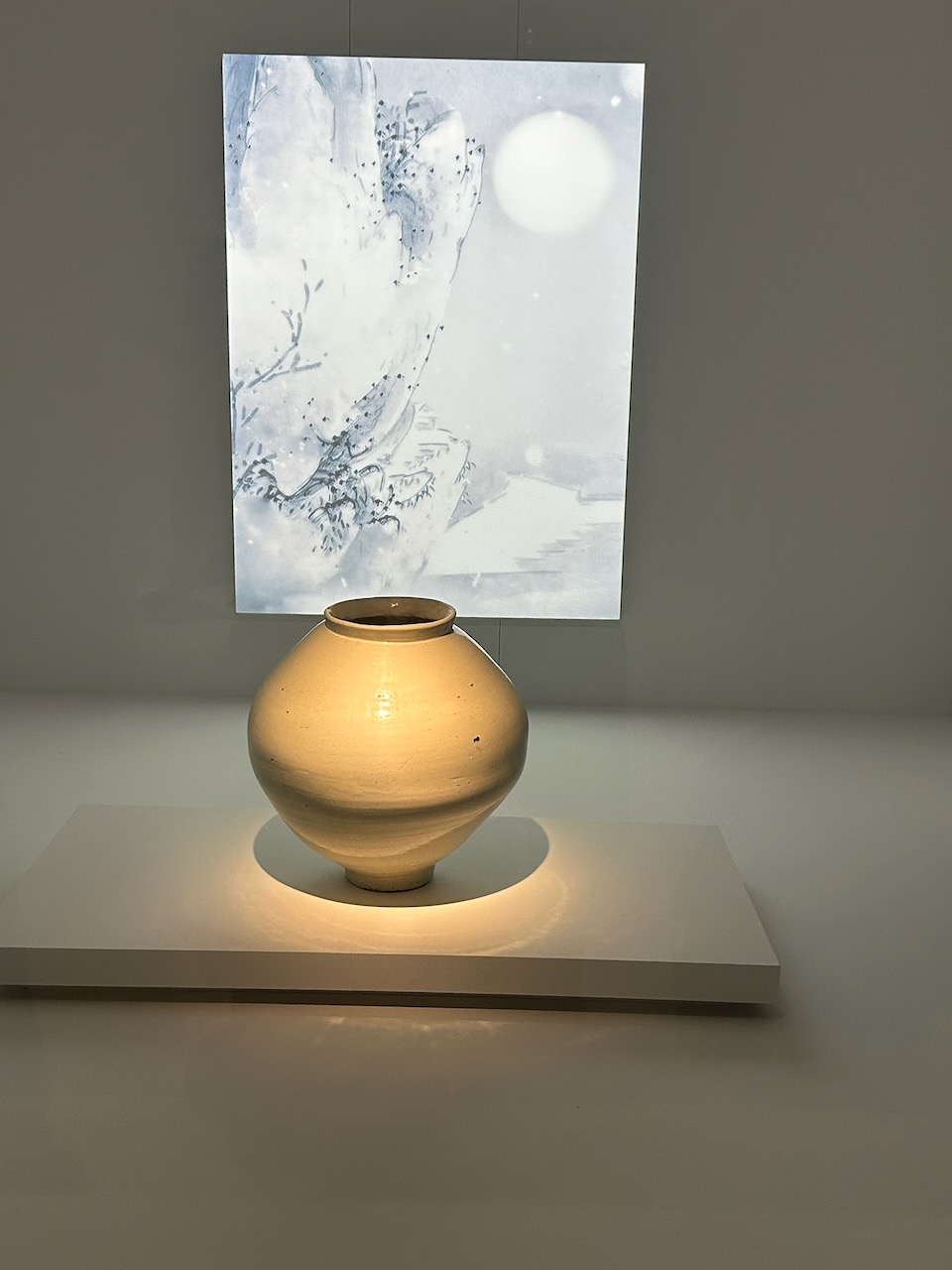
However, in the end it doesn’t really matter how many I can see and study. What is most important, is that I can make something that I’m happy with and which represents my relationship with the this iconic piece of pottery. It’s hard to define the ‘feeling’ of a pot. Its neigh impossible to recreate that ‘feeling’ in ceramics. Principally because it is so ephemeral, so always changing with the light and with my moods. Always varied and different. It’s not the destination any more really, it’s all about the journey. This is the madness, looking for poetry in a ceramic form.
I’m also very aware that it is important not to make some sort of poor copy, or worse, a pastiche. I need to develop my own Australian version of this big round fat form. I’m working on that. Janine and I have been treating the surface of these full, round forms with black and white slips, then carving through them sgraffito style, to create our own version of the form. Something that relates to the original and shows it some respect and honour, but is in essence some thing of mine too. At the moment, I’m making them all black with black slip, then carving back to relieve a pale moon in the night sky. A moon within the moon jar form. Working in reverse like this came to me as I pondered the fact that we are here in the opposite hemisphere, up-side down and with the seasons reversed. So a reversal of the aesthetic seemed appropriate. I might call the show “a view from below”, or maybe not?
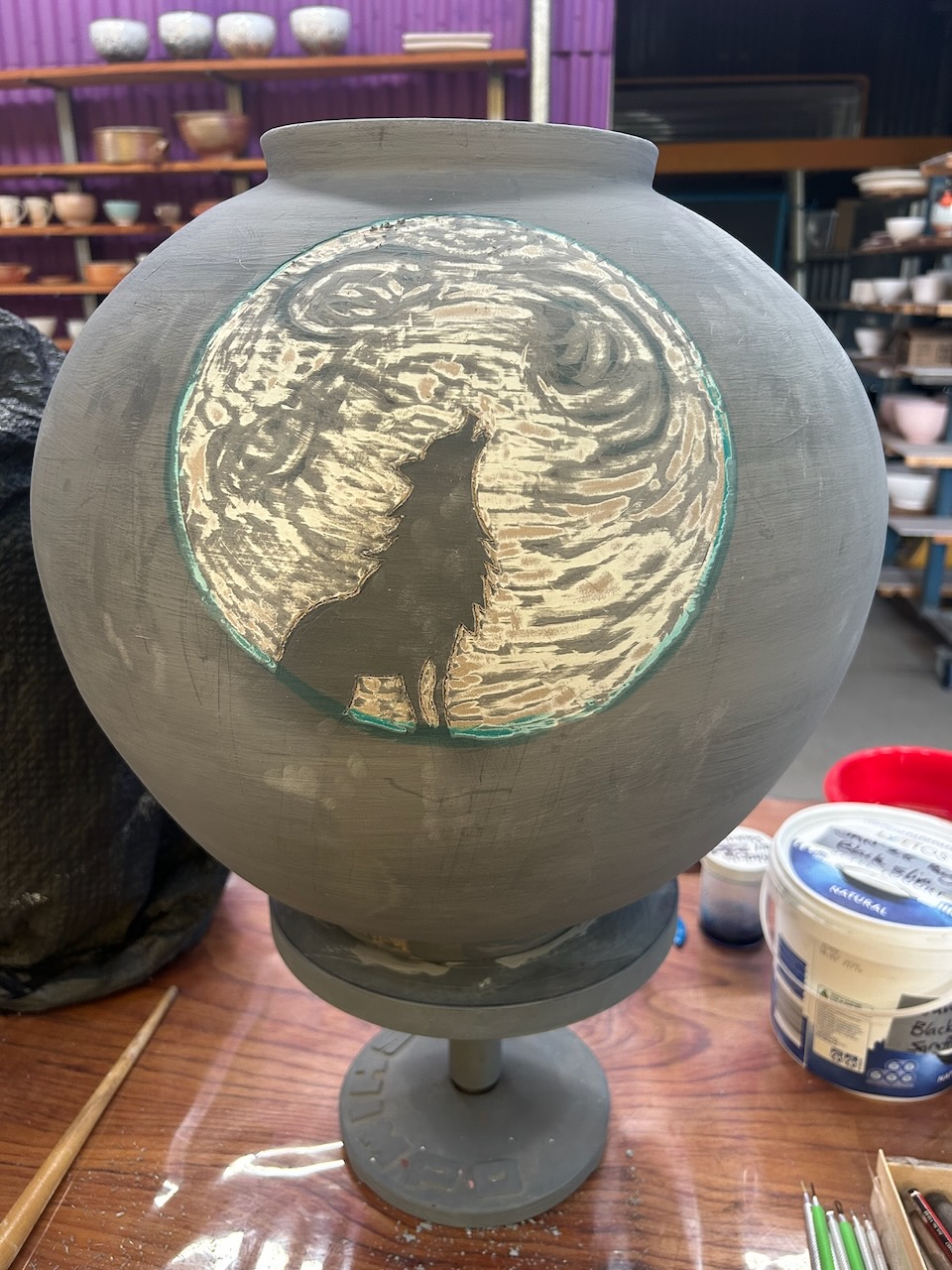
‘Howling at the Moon’ – Jar. A self portrait!
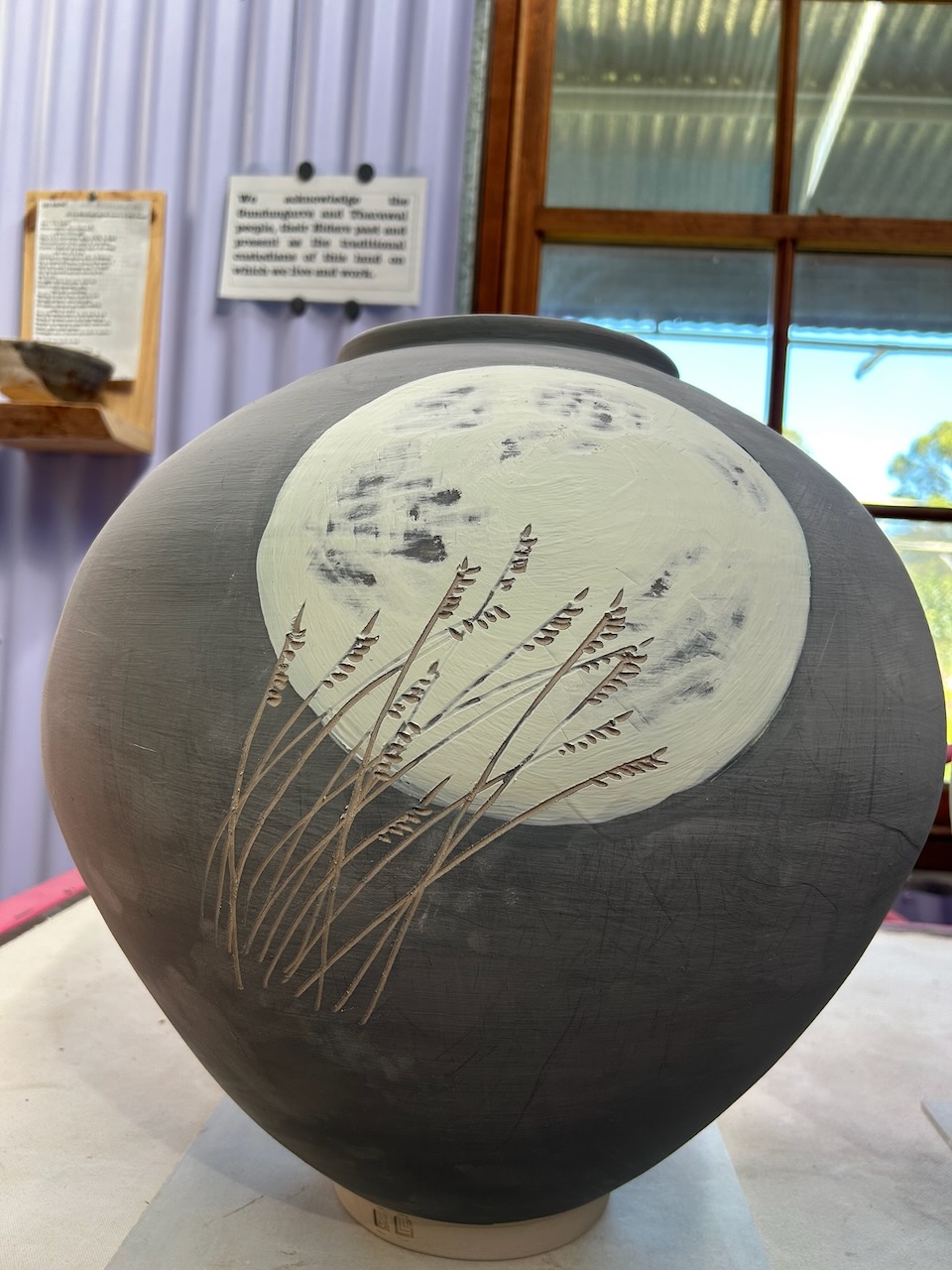
‘Autumn Moon’ – Jar. A jar for this season right now.
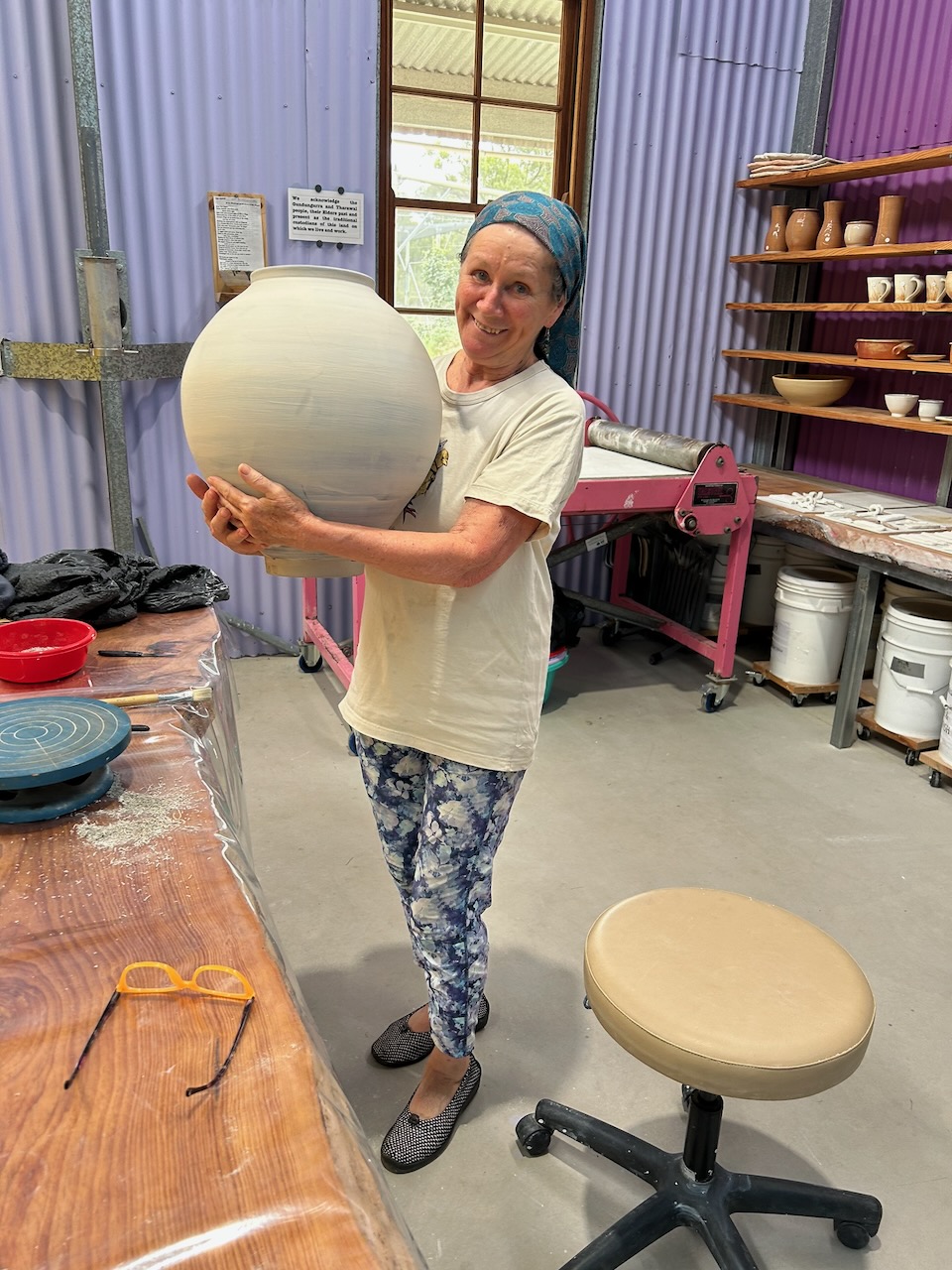
We are working collaboratively on some of the forms, and others I’m finishing on my own. I am certainly doing all the throwing of these recent forms. It’s a great journey and we have no idea where it is all going, and that’s good. I like that.
Nothing is ever finished, nothing is perfect and nothing lasts.
 Tonight my Fingers Smell of Garlic
You must be logged in to post a comment.