
It is quiet, eerily quiet.
The only noise that I can hear is the sound of the ice under my feet crunching as I walk down to the pottery. It is 5.00 am and pitch black this wintery morning. No stars, so there must be a lot of cloud? It’s too early even for the birds to be stirring and beginning to make their first tentative calls.
I love these early starts. The air is very cold and crisp. My noise hurts in the minus degrees air. fortunately there is no wind, so I’m lucky. It could be colder.
I’m fumbling trying to light a match wearing gloves, but I do it, and the little kindling fire slowly spreads and comes to life. There is a strong draught in the firebox because I had the kiln lit and firing yesterday evening through into the night, preheating all the raw glazed pots, I have to be careful not to heat the kiln too fast, as the raw pots may still have a small amount of water in them that can easily turn to steam, expand and blow the pot up. This would be a disaster, not because I might loose a single pot, but because the explosion would spread shrapnel like fragments and even larger chunks of rubble through out the kiln chamber and bits would land in almost every open bowl-like form. I’d need to stop and unpack the whole kiln and start again.
By staying up last night keeping a small kindling fire going, I had the kiln up to just above 100 degrees centigrade, sufficient to dry all the pots out thoroughly. I preheat into the dark, leave it to sit and sweat while I have dinner and then I’m back down here to keep the fire alive for a few more hours. This gentle start to the firing is very important and can’t be rushed. I’m used to sitting in the dark, all my wood kiln firings start and end in the dark.


The firing goes well, everything is prepared in advance, all the different sizes of wood, from kindling through floor wood onto hob logs, it’s all cut and stacked next to the kiln. I have my tea making gear ready. Thick, warm, long, leather gauntlet gloves, initially to keep my hands warm, but later to stop them getting too warm or even burnt while stoking. A few hours later, Janine and Len arrive, I’m just about ready to go to hobs with the stoking and shortly afterwards to start reduction. Janine cooks breakfast for us, we have bacon and eggs, then toast and marmalade with coffee. A great start to a good firing. I love my home made marmalade!
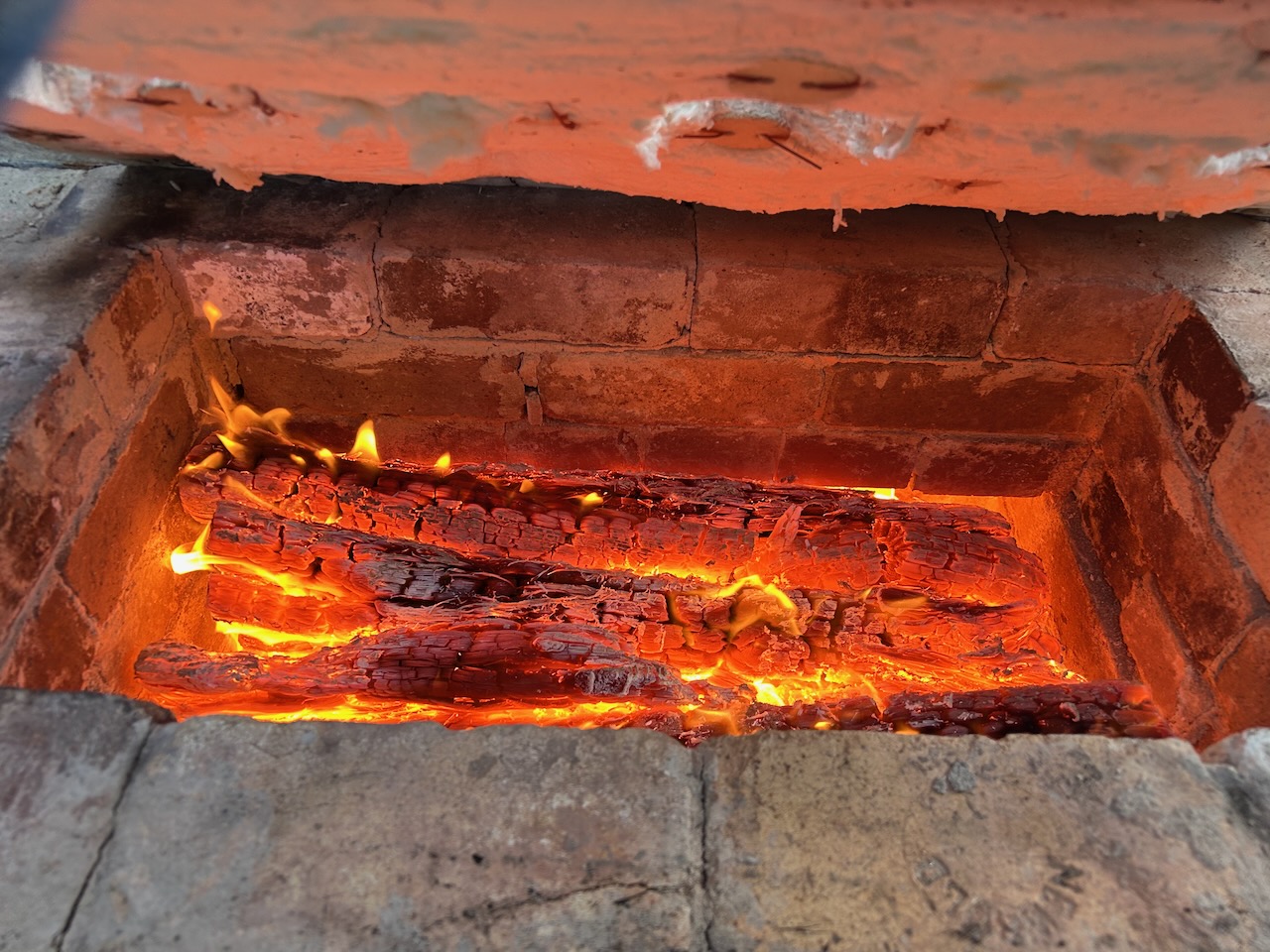
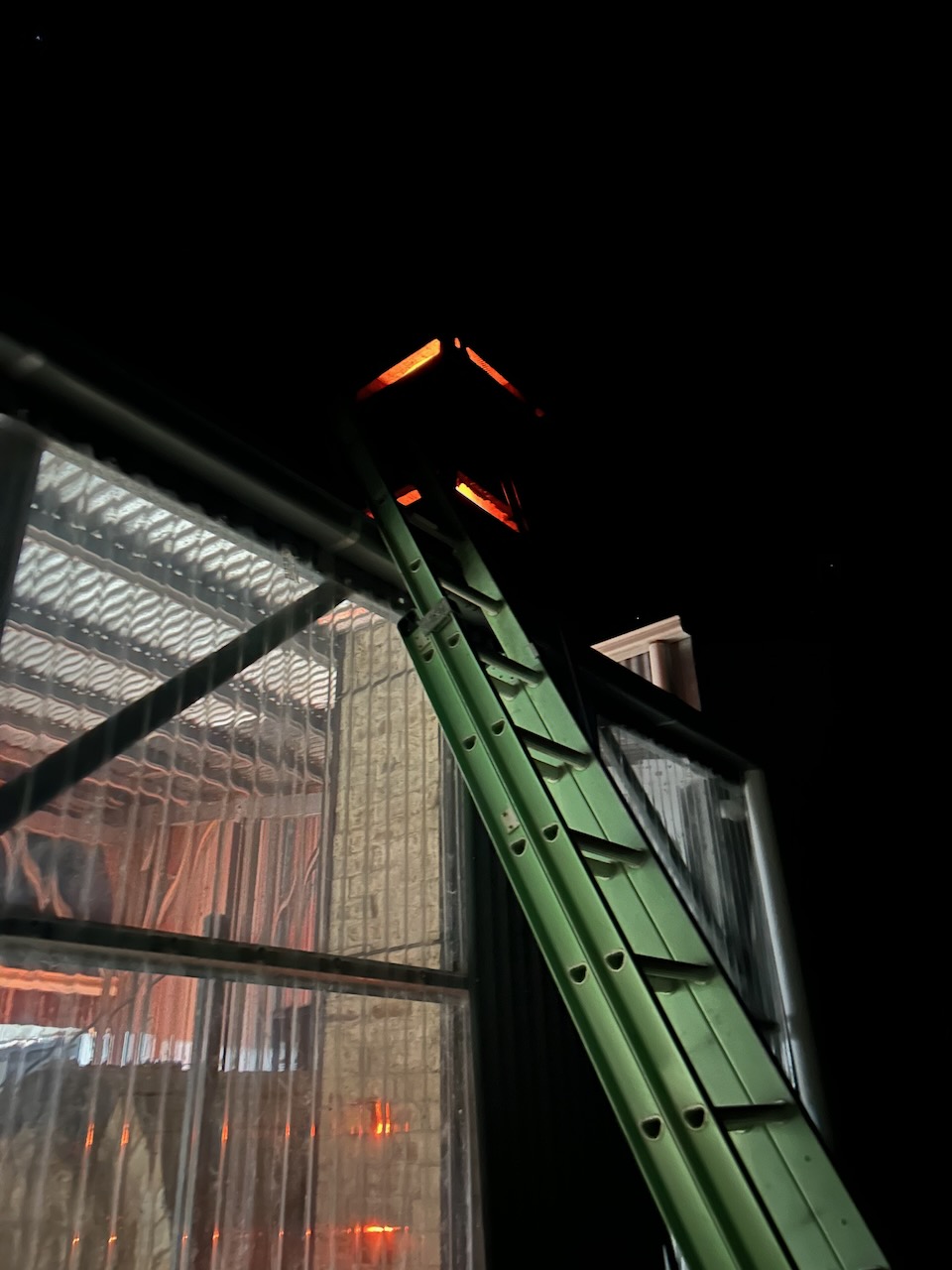
I stoke the fire box, keeping it full to the top, and this generates a consistent level of reduction. I initially use some thinner sticks of 75mm up to 100 mm. diameter, stoking every 15 mins, but as the kiln get hotter, I soon move on to the heavier thicker logs of 100 to 150 mm diameter, and eventually up to 200mm diameter. these burn consistently over a longer period, so I only have to stoke every 30 to 45 mins. The biggest and thickest logs can burn for up to 1 hour, keeping a steady reduction atmosphere and a gentle temperature rise. This is kept steady and even for the following 10 hours, while maintaining a pretty clean chimney. Something that I’m proud of. Minimising any smoke and using my afterburner and scrubber on top of the chimney to minimise any PM 2.5 particulates escaping to the environment.
I have spent the past few years experimenting in new ways to pack and fire this kiln. There are so many variables, but a steady reduction atmosphere is a necessary constant for good clay and glaze colour. I fire for about 14 or so hours. I finish up around 8 pm, but need to hang around for another hour for the burning down process, before closing the damper in the chimney. I will leave the scrubber running for another hour while I go up to the house for a glass of wine to celebrate and a bit of chat. Later, I return to the pottery to check on everything, switch off the scrubber pump and all the lights and lock up. I have to leave the scrubber water pump running for an extra hour or so, to make sure that it doesn’t over heat from the hot air coming up the chimney during cooling. I don’t want to melt the delicate brass spray nozzle.
A while ago, I made enquiries about getting a stainless steel version of the same fitting, but the guy wanted $250 for it. Extortion! It’s better to replace the brass one every few years at just $10.
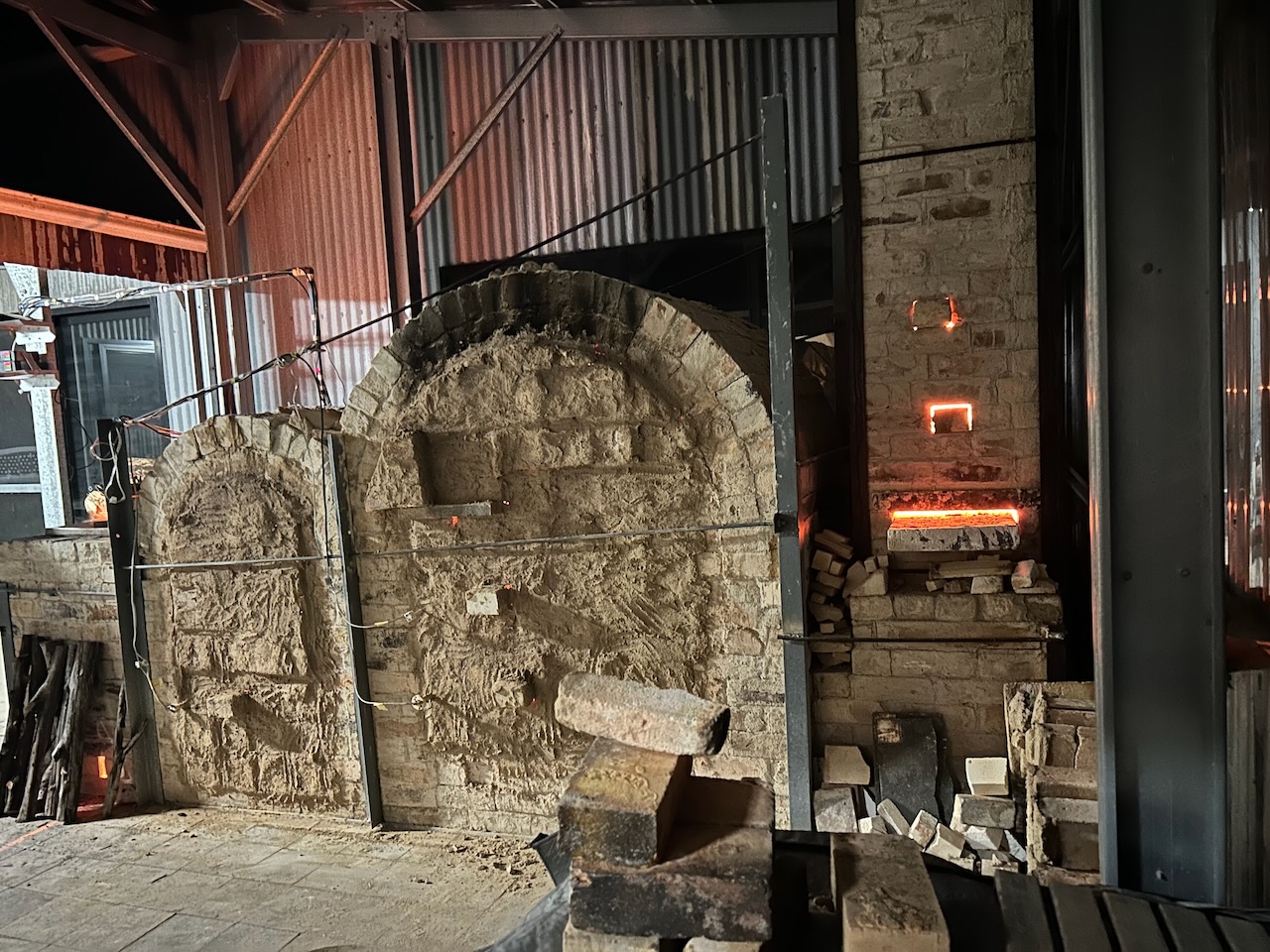
Wood firing is such an old fashioned occupation. I love it, not because of its long history, or its hands on haptic rewards, or because it is a way of avoiding the use of fossil fuels, nor its DIY economical kiln structure investment of 2nd hand fire bricks, making it economical, but in essence, it’s simply because of the quality of the pots that I can make by doing it. It is all of the above of course, all rolled into one experience, but it’s the beautiful ash enhanced surface on the pots that keeps me doing all the extra work involved in their creation.
However, having said that, I’m also really engaged with minimising my carbon foot print, so burning wood that I have grown myself, from my own forest is an achievement. I’m so privileged, not many people can claim that. Wood is a form of stored carbon extracted from the air, which when burnt, returns to the air. A beautiful, virtuous circle. It almost entirely eliminates fossil fuels. However, although I use a solar-electric chain saw to cut up the smaller logs and I split the timber using a solar-electric splitter that I re-built myself from a burnt out petrol model, (re-use, re-cycle, re-purpose.) which runs off our solar PV electricity. I still have a big petrol powered chain saw and I cart the logs on my old 21 year old petrol powered ute, but this is extremely minimal fossil fuel use for a kiln firing. Maybe one day there will be an electric ute? Nothing is perfect, so I’m happy with where I am at the moment. I have attempted to do all this so far on a low budget working in the arts.
Winter is the season for wood firing and also for spending the long evenings cooking in the kitchen. We light the wood fired kitchen stove each evening in the winter, which heats the room, but also heats our hot water from the ‘wet-back’ boiler in behind the firebox, while I am cooking our dinner. Winter is also citrus season. So marmalade making is on the agenda.
Making marmalade is such an old fashioned thing to do. It’s sort of a grandma’s thing really, young people don’t seem to know much about it. but I love the stuff, so I have taught myself to make it reasonably well. Every batch is slightly different as I experiment, trying to learn whatever there is to be learnt. My methods are also different from Janine’s, so we have various jars of different marmalades. I like testing out all the various marmalade making techniques. It’s a real learning curve. Exactly the same as when I’m wood firing. Everything is a bit of an experiment.
I can’t really bring myself to want to do exactly the same thing every time. I love to experiment, trying different ways of packing the kiln, different shelf layouts, experiment with different clay bodies, decorating techniques, choice of timbers and wadding. Everything makes a difference. Before the 2019 fires, the last kiln that I had, was there for 15 years, altered a coupe of times, but in continuous use. I got to know it well, I was able to get some really nice pots out of it. This new kiln is a learning experience. I haven’t had a kiln exactly like this before, so I’m only just getting to know it now after 5 or 6 years.
Packing and firing is a little bit stressful. There is a months work at stake, as the wood kiln is so much bigger than the electric kilns, and all the little changes that I decide to make will have unknown consequences. Hopefully they will lead to something better, but not always. I just have to decide to take the plunge. Wood firing to me is akin to pruning the orchard. That might sound strange, but it has similarities. I’ve been doing both for 50 years and still don’t know exactly what I’m doing with either. There are so many variables that I don’t understand fully, but there is no point in procrastinating. I just make the decision and go for it.
With pruning, each tree is different. I’ve done it before, but was it right?. I have to get over 60 trees pruned. I don’t have unlimited time, so I have to make decisions, and fast. I decide and then do it. I open the centre to let light in, take off any dead wood, remove all the water shoots and crossed branches, reduce top growth by 2/3 to keep the tree manageable and prune to an outward facing bud. That’s it! It’s simple! But which bud, and at what height, how much to take from the centre, which of the two crossed branches to remove and which to keep? I’m never sure. But I choose and do it.
The same with packing the kiln. I can think about it for a long time, but still not know if it is the best option or not. So I’ve learnt to just do it and accept the consequences. Occasionally I unpack a bit and re-do it, but not often. I do take photographs as I pack though, so that I will be able to remember what it was that I did, 3 days later, after I unpack and study the results. If it doesn’t turn out how I imagined or hoped, no worries, it was a learning experience. Hopefully there are enough good ones to make it feel like it was all worth it.
Sometimes the pots turn out not at all like I was expecting, so I’m not too thrilled. However, it is a case of not seeing what I was expecting to see. After cleaning, fettling and grinding their bases, I get a better look at them and start to see their good points. They are often quite good, just not what I was anticipating. I end up well pleased with the fresh surface quality and I learn something new. So it’s all good.
 Tonight my Fingers Smell of Garlic
You must be logged in to post a comment.