
I’m reading a book at the moment, all about probability! It’s a really interesting read. I’m enjoying it and even though its a very thick book, about 2” or 50mm thick. I’m racing through it, but I’m not sure that I’ll finish it. A week ago I would have said with certainty that I would have finished it quickly, but having read most of it now, I’m rather reluctant to make such a bold claim. I’m uncertain. The first thing I learnt from reading this book was that probability probably doesn’t exist!
‘The Art of Uncertainty’ is written by Sir David Spieglehalter FRS OBE, Emeritus Professor of Statistics at Cambridge University. Someone to take seriously indeed. The sub-title of the book is ‘How to Navigate Chance, Ignorance Risk and Luck’. I was lucky enough to navigate across it by chance and took the risk to disabuse my self of some of my ignorance.
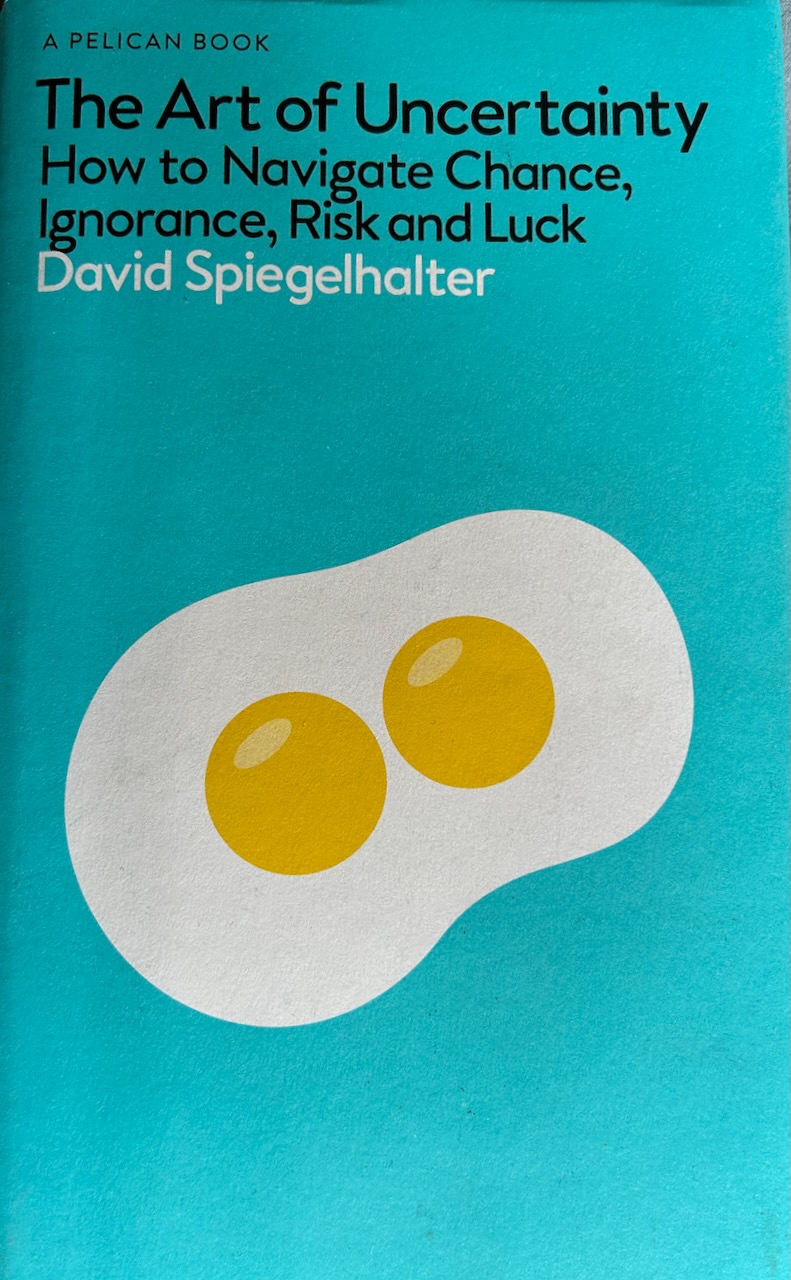
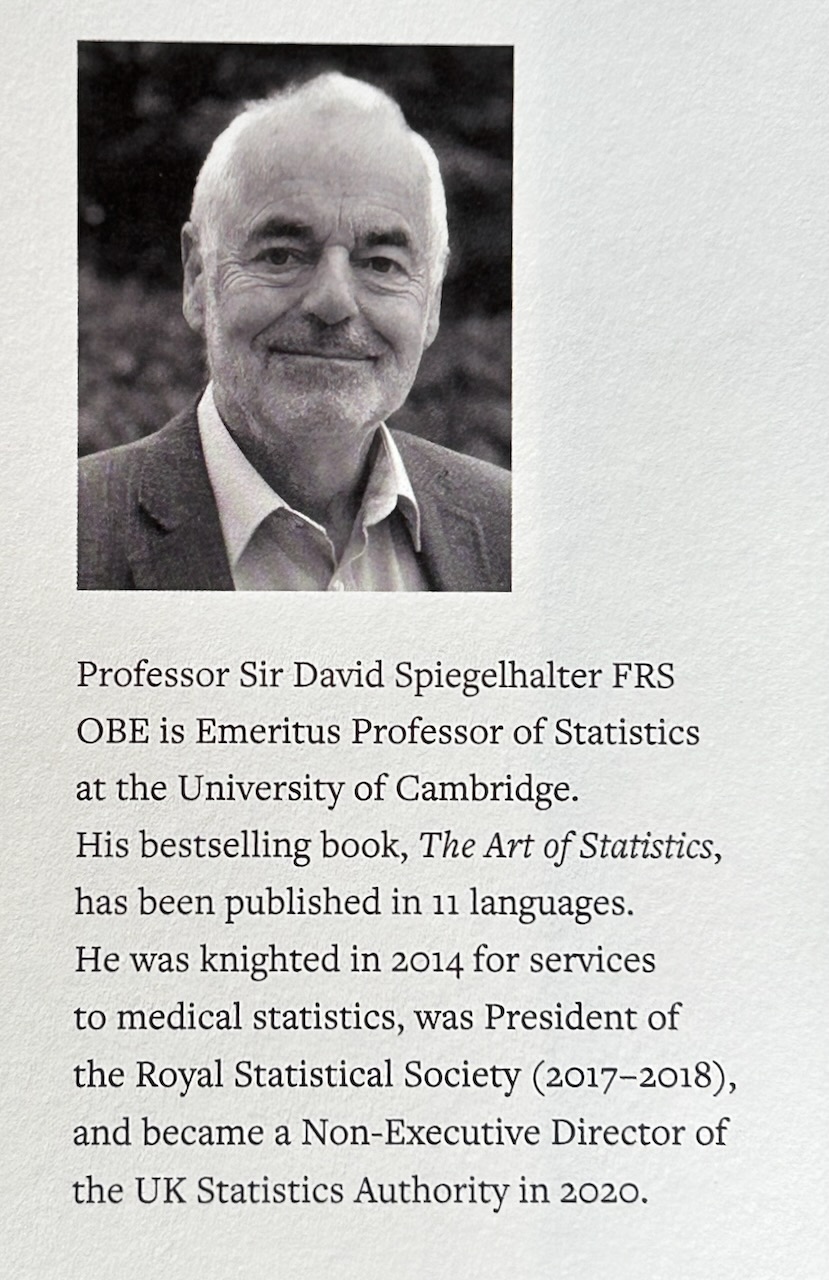
I’ve never been a person blessed with a sense of certainty, I’m probably more of the perplexed personality type – if there is such a one? So I have really enjoyed reading Prof Spieglehalter’s explanation of chance, ignorance risk and luck. There is so much to it. After explaining each topic, he gives an example from real life, then reduces every example to a mathematical model basis, which is also really fascinating. I’ve never been that interested in maths, but Prof Spieglehalter explains it so well, I could follow most of it.
“Why probability probably doesn’t exist (but it is useful to act like it does)
Life is uncertain. None of us know what is going to happen. We know little of what has happened in the past, or is happening now outside our immediate experience. Uncertainty has been called the ‘conscious awareness of ignorance — be it of the weather tomorrow, the next Premier League champions, the climate in 2100 or the identity of our ancient ancestors.
In daily life, we generally express uncertainty in words, saying an event “could”, “might” or “is likely to” happen (or have happened). But uncertain words can be treacherous.
Attempts to put numbers on chance and uncertainty take us into the mathematical realm of probability, which today is used confidently in any number of fields. Open any science journal, for example, and you’ll find papers liberally sprinkled with P values, confidence intervals and possibly Bayesian posterior distributions, all of which are dependent on probability.
And yet, any numerical probability, I will argue — whether in a scientific paper, as part of weather forecasts, predicting the outcome of a sports competition or quantifying a health risk — is not an objective property of the world, but a construction based on personal or collective judgements and (often doubtful) assumptions. Furthermore, in most circumstances, it is not even estimating some underlying ‘true’ quantity. Probability, indeed, can only rarely be said to ‘exist’ at all. All of statistics and much of science depends on probability — an astonishing achievement, considering no one’s really sure what it is.”
Life is uncertain. All models are wrong, but some are more useful than others!
As probability probably doesn’t exist. I’m probably not too sure what the last chapter will tell me. If I finish the book!
We probably really don’t know much at all. Get used to it.
Nothing is ever finished, nothing is perfect and nothing last forever.
 Tonight my Fingers Smell of Garlic
You must be logged in to post a comment.