
Back in 2019, just before the fire destroyed my life. I was commissioned by the PowerHouse Museum in Sydney to create new ceramic work for their collection.
A patron named Mr Willoughby, left his estate to the PowerHouse Museum with instructions that It be used to commission new ceramic and glass works of art for their collection. I was lucky enough to be one of the 6 artists selected to make those works.
I received the commission just before the fire. so I rang the Museum and a offered to return the commission, as I knew that it would take my a long time to re-build my workshop and life, before I could even consider making special new work.
I was a mess after the trauma of fighting the fire, loosing the battle, and running for my life, with my hair on fire, to climb into my kiln and hide in there while the inferno passed over me. That kiln saved my life, but left me shattered. I had no time to de-breif, I started the clean-up operation straight away the next day, and it has never stopped to this day. We are still finishing off the new buildings to make them long term sustainable.
I suffered a lot of Post Traumatic Shock (PTSD) that lasted 4 years, until I could get the correct psychiatric help – EMDR – trauma therapy. I decided to make some new pieces for the Museum collection, that responded to my situation, some 3 years late!
This is downloaded from my artists statement on the Museum’s web site;
Full Artist Statement ‘Self Portrait’ by Steve Harrison
‘I’ve finally completed the commission for the Powerhouse Collection. I was chosen as 1 of the 6 artists to make new work for the collection, as part of the ‘Willoughby Commission’, way back in 2019, just a few weeks before my workshop and studio were destroyed in the 2019 catastrophic bush fires. It has taken me over 3 years to get back on my feet with a functioning creative workspace. I have spent the last 12 months since then assembling this new work. My original thought was to make beautiful porcelain bowls that encapsulated my love of a quiet, gentle and sustainable approach to life and making. But all that was dashed in the fires, when all my lifetime collection of ceramic materials, kilns and buildings were destroyed in just one day. I stayed to defend and save my house but suffered considerable trauma in the process. I have created this new work for the collection to reflect the chaos and destruction that I endured. I decided to work with the many hundreds of shattered pieces of broken pottery that littered the site after the fire. A few pieces were broken but had the potential to be repaired using the ancient Japanese technique of kintsugi – gold repair. These few small bowls, although damaged, had the potential to be recovered with patient attention to detail. Kintsugi expresses a desire to ‘honour’ a damaged, but still lovely object by giving it time to be rebuilt, and eventually to possibly become even more beautiful than before, because of the time and effort spent on it. I spent some months, part-time, cleaning, repairing and re-constructing missing parts of these bowls to make them ‘complete’ again. They are whole again, although different from before. Damaged and altered, changed from what they were, but in some ways ‘enhanced’ and given a lot of love and care, they are somehow more beautiful, but in a completely different way. They became symbols of my journey to recovery. This work of slow repair and enhancement gave me to idea to create new pieces that didn’t previously exist but created from the mixed shards sieved from the ashes of the ruins. Completely new work, but made from a composite of all my old work. It’s been a very slow and tedious job of work, assembling a thousand small, burnt, broken and shattered shards all back together in a new combination to make ‘compendium’ pieces of my life’s work. Each shard needs to be held in place until the glue sets, so only a few shards can be added each day. I’m calling them ‘abstracts’, not because they have any relationship to modern painting, but because an ‘abstract’ is the first part of an academic thesis, which summarises the contents of the entire paper. In this case, these newly constructed vessels comprise many small shards of my work made at different times over my career, mostly sifted from the ashes of the old pottery after the fire, but also containing a few new post fire pieces as well. In this sense they are a summary of my life’s work, presented in a new form. An auto biography, or a ‘self-portrait’ in ceramics perhaps? They contain a small part of every phase of my career from my earliest days here, through to the present. Just as I have rebuilt my shattered and damaged self through a lot of trauma therapy since the fire, I am mostly better, but still carry a bit of lingering damage with me. I’m repaired and reconstructed, but different.
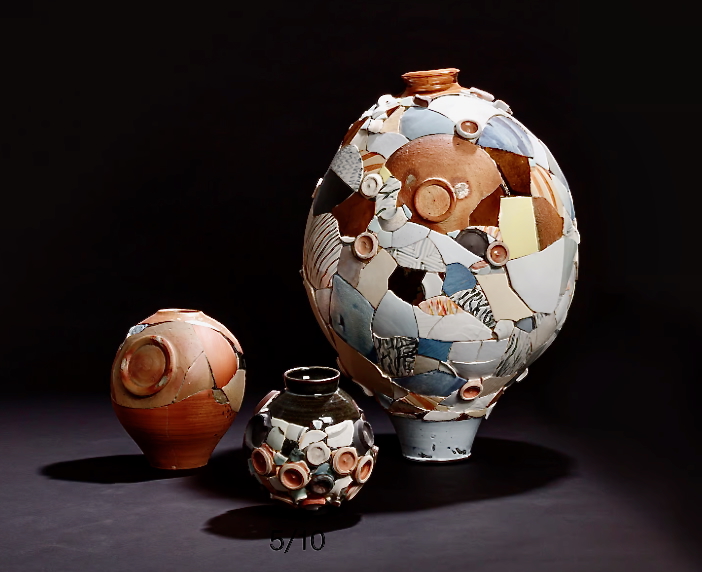
‘Self Portrait 1’ by Steve Harrison
OBJECT NO. 2024/78/1
Harrison has lived and worked in Balmoral Village near Mittagong, in the Southern Highlands, New South Wales, for almost 5 decades, pursuing a simple life of self-sufficiency and commitment to his local community. His interest in single-stone hard paste porcelain led to extensive travels and research of porcelain clays and processes in Japan, China, Korea and Britian, building bonds of fellowship with the international potter community. He has intensely explored the regional geology of Mittagong and Joadja Valley, focussing on sericite, and mica-based stones, to create his own clays, glazes and then bowls and jars fired with locally sourced wood or solar-powered electricity. While the forms of the simple vessels he has made over the years have changed, they have all been testaments to his life-long quest for the essence of porcelain clay and delight in the ‘subdued beauty’ of natural materials. Harrison’s vessels have seen many exhibitions at galleries such as the Kim Bonython, Legge and Watters galleries in Sydney and his works are in major Australian galleries and museums. Harrison has often augmented his works of clay with words crafted to express the relationships between the pieces, his life, the history of ceramic art, the state of the world and its fragile environment. ‘Self Portrait 1’ and ‘Self Portrait 2’ were commissioned just before the most severe bush fires of 2019 destroyed his pottery in December that year. A particularly ferocious fire almost claimed Harrison’s life, as it climbed over a thin skin of a makeshift kiln-like shelter assembled a day earlier, a last minute ‘plan B’. These works are entirely unique in Harrison’s creative output, in their concept, circumstances of production and the large scale of ‘Self Portrait 1’. Assembled from surviving fragments and shards of diverse vessels he made during his life as a potter, in Harrison’s own words, they are an ‘abstract’ or ‘compendium’ of his life’s work: ‘This work was commissioned just a few weeks before my workshop and studio were destroyed in the 2019 catastrophic bush fires. It has taken me over 3 years to get back on my feet with a functioning creative workspace. I have spent the last 12 months assembling this new work. My original thought was to make beautiful porcelain bowls that encapsulated my love of a quiet, gentle, and sustainable approach to life and making. But all that was dashed in the fires, when all my lifetime collection of ceramic materials, kilns and buildings were destroyed in just one day. I stayed to defend and saved my house but suffered considerable trauma in the process. I have created this new work to reflect the chaos and destruction that I endured. I worked with the many hundreds of shattered pieces of broken pottery that littered the site after the fire…to make ‘compendium’ pieces of my life’s work… an auto biography, or a ‘self-portrait’ in ceramics…Just as I have rebuilt my shattered and damaged self through a lot of trauma therapy since the fire, I am mostly better, but still carry a bit of lingering damage with me. I’m repaired and reconstructed, but different.’ [1] Born of a natural disaster that has changed Harrison’s life irrevocably, the three jars and five bowls in the two complementary installations are extraordinary assertions of the truth Harrison saw in Bernard Leach’s belief that pottery and its traditions are a part of our cross-cultural inheritance, an expression of the hidden potential in our clays and rocks, and an essential avenue to a unity of life and beauty. Within this context, ‘Self Portrait 1’ and ‘Self Portrait 2’ offer the story of Steve Harrison’s remarkable life positioned between a self-professed idyl of a ‘modern peasant’ and destruction, between beauty and ugliness; together they stand as a powerful poem written in clay about his, and our, place in the world, and ultimately, his hymn to survival.
[1] Email correspondence with curator, 2023
Eva Czernis-Ryl, Curator, 2024
 Tonight my Fingers Smell of Garlic
You must be logged in to post a comment.