
Lowe and Lee Gallery
Fire and Ash – Sept 2024
Steve Harrison Opening Statement – Towards a Greener Wood Firing Practice.
I have been wood firing for over 50 years now. Gosh, how time flys.
I never thought that I’d live this long, never mind still be wood firing at this age.
But Peter Rushforth was still wood firing right up until a few years before his death in his 90’s.
I became interested in firing my pots with wood while I was in art school at the old ESTC in 1971.
There was no wood fired kiln at East Sydney back then. In fact there were no student built kilns there at all.
However, I changed all that when I started teaching there in 1974. I built half a dozen wood fired kilns. In fact ESTC, got a reputation as the place to go if you wanted to learn about wood firing, at that time. This reputation was further enhanced when Bill Samuels joined the staff a few years later and built a tunnel kiln.
Returning to 1971, I realised while I was still a student that if I wanted to fire with wood, it would have to be in a self made kiln, built in my parents back yard. I had very tolerant and supportive parents!
I was drawn to the quiet, natural qualities of wood firing. No one was wood firing back then in 1970, but I was influenced by my reading of books on Japanese tea wares. The pieces that I was drawn to were all wood fired, from Iga and Shigaraki, through Shino wares to Bizen pieces. All my teachers, Peter Rushforth, Col Levy and Derek Smith were firing with oil fired kilns. Bernie Sahm was firing with coke and later LP gas. Shiga Shigao, with whom I did my apprenticeship a few years later, was also firing with LP gas.
So to fire with wood, for me, meant going it alone. Luckily, I had my partner Janine king who was also keen to fire with wood.
The only pottery book on the market at the time was Bernard Leach’s ‘A Potters Book’, everyone had a copy. It was required reading. In there Leach states that he built his first wood fired kiln in Japan as a student. It was a complete failure. He failed to get to temperature and also managed to burn down the kiln shed and studio in the process! He tells how wood firing is dirty, smoky, very difficult and exhausting. Possibly so, but Leach was an English Gentleman, not used to any hard physical work. He and Hamada, later built a 3 chamber climbing kiln, when he returned to England to set up the Leach Pottery in St Ives, but soon converted it to oil firing. Wood firing was just too demanding and difficult.
Leach states: “The reluctance of many kilns to rise above 1200oC to 1300oC has been to many another potter besides myself a cause for anxiety and even desperation. The firing is the climax of the potter’s labour, and in a wood fired kiln of any size it is a long and exhausting process. Weeks and months of work are at stake. Any one of a dozen things may go wrong. Wood may be damp, flues may get choked, bungs of saggars fall, shelves give way and alter draughts, packing may have been too greedily close, or for sheer exhaustion one may have snatched an hours sleep, handing over control to someone else and things begin to move, to warp and to bend, the roar of combustion takes on a deeper note—the heavy domes crack and tongues of white flame dart out here and there, the four minute stokes fill the kiln shed with bursts of dense black smoke and fire. Even in the east, where hand work is usual and labour specialised, a big kiln firing has the aspect of a battle field where men test themselves to the utmost against the odds. This may sound like discouragement, but it is the simple truth”.
Having read all this, it seems that all of the Australian potters followed suit.
The only wood fired kiln in Sydney when I was a student was at the University of NSW, in the Industrial Arts Dept. It was fired just a few times a year. Ivan McMeekin forbade any outside visitors to firings. Possibly on OH&S grounds. But especially students from the National Arts School, who he looked down on as being a bit radical and not properly trained. However, I used to turn up for the night shift after 5 pm when he had gone home, and made friends with some of the students. Ron Balderston and Geoff Crispin. I still see Ron, we became friends. I learnt a lot there. I sat quietly, was respectful and did a large share of the wood carting and stacking to earn my keep.
What I learnt at the uni of NSW, was that wood firing can be a quiet, easy, relaxed, efficient and a clean way to fire pots. It can be a beautiful experience! If you prepare yourself well, with all your wood cut, split and stacked next to the kiln, and if the kiln is built in a well planned, decent space with room around it and well ventilated. It is a remarkably satisfying experience. Whether this is how it is for you is entirely up to you to get your preparations in order. We have come a long way since Leach in the 1940’s.
I believe that it is widely understood by those who know me, that I am a Greenie! I am always looking for better, cleaner, more environmentally friendly ways to fire my kilns.
It is generally understood here how wood firing can be carbon neutral. The carbon in the wood fuel comes from the air and is returned to the air when burnt. If the tree is not burnt, but left to rot in the forest, all the carbon is still return to the environment, but on a longer time frame.
However, cutting forest to burn as fuel can be an environmental disaster. Just think of Queenstown in Tasmania!
It all depends on how you go about obtaining you wood fuel, and how you choose to burn it. Janine and I are lucky enough to own our own forest, that we have nurtured and lightly harvested for its dead wood for almost 50 years. 48 to be precise.
But being carbon neutral is not what occupies my attention these days. There is the problem of particulate emissions from our chimneys, This is going to be a big issue into the future, not just smoke from chimneys, but the very fine PM2.5 particles. I understand that Canberra has now banned wood burning stoves within the city boundaries because of the health issues. Potters who claiming that “I only reduce at night”, or “I Live out in the country side” doesn’t remove the problem. It isn’t a responsible or thoughtful answer.
Over the last couple of years, I have been experimenting with an afterburner/spark arrestor/scrubber on top of my chimney. This is my attempt to reduce my particulates. It’s a work in progress at this stage, but I believe that I’m making some progress.
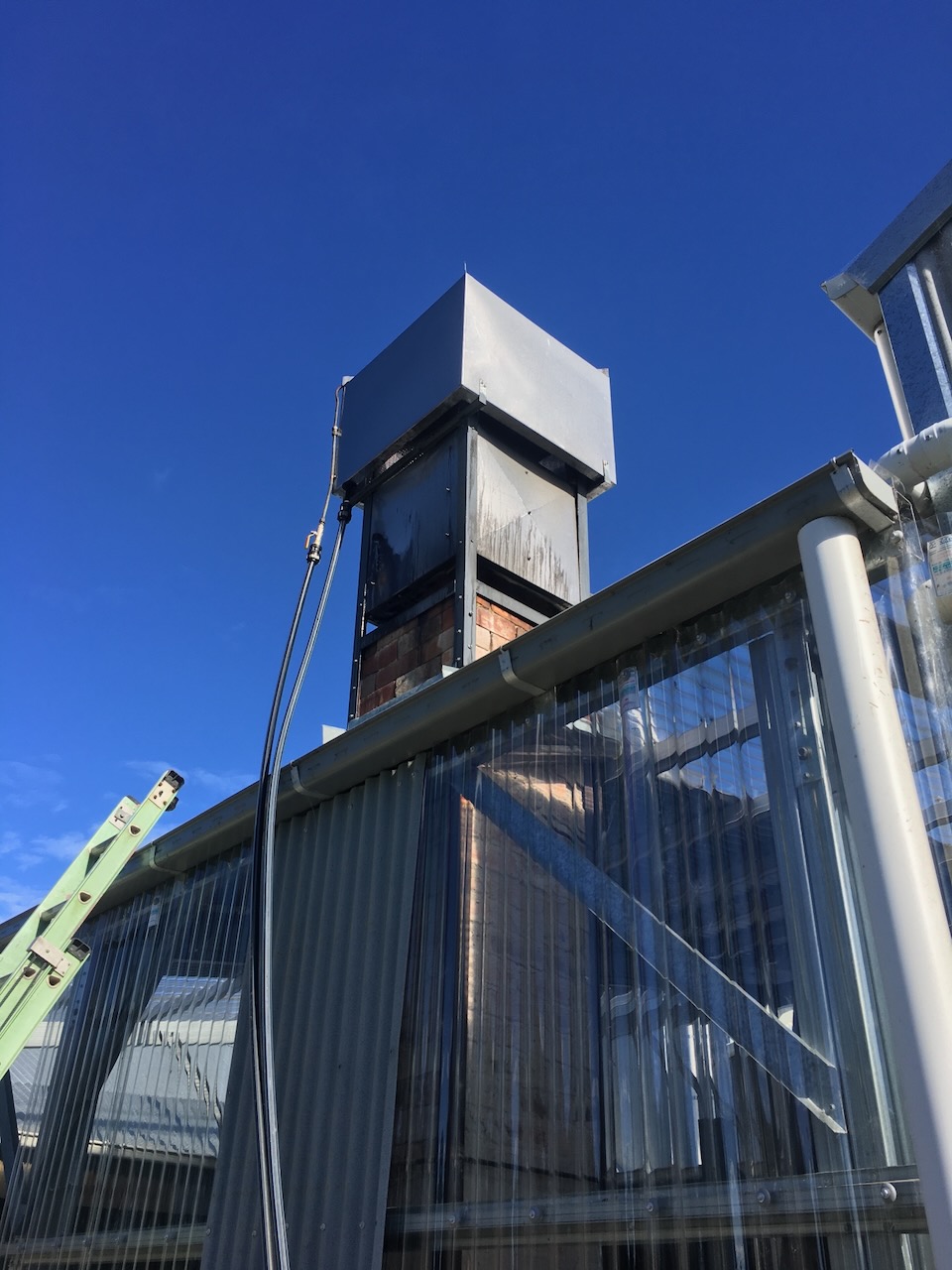
Stainless steel ‘Scrubber’ installed on top of the chimney.
We all have to do our bit to keep the environment as clean as possible while still living a creative life. I chose to fire my kilns very quickly to minimise the destructive environmental effects of my work. Janine’s little wood fired kiln fires in just 5 hours, my larger brick kiln is fired for about 15 hours. But I use a down draught fire box (Bourry Box). This makes for a relatively clean firing. It doesn’t put a lot of ash on the pots, but it ‘flashes’ the glaze surfaces, and enhances the look and feel of the pots. I really appreciate these minimal ash effects on my glazes. Just look at the work of Gwen Hanssen Pigott. Beautiful, elegant, lightly flashed wood fired surfaces.

I really love the delicate ash deposit that I get on the surface of my celadon glazes. it enhances them. It doesn’t detract in any way.
Of course, right at the front of the setting where the ash and embers meet the first rows of pots. A lot can happen there. This is a place I call the ‘Zone of Death’, because a lot of pots are sometimes reduced to shards there, but ever so beautiful shards they are! These pieces can be just as interesting and dramatic as any pot from a 5 day firing, but without the emissions. See my piece titled ‘Damaged Goods’, as an example of this kind of fired surface.
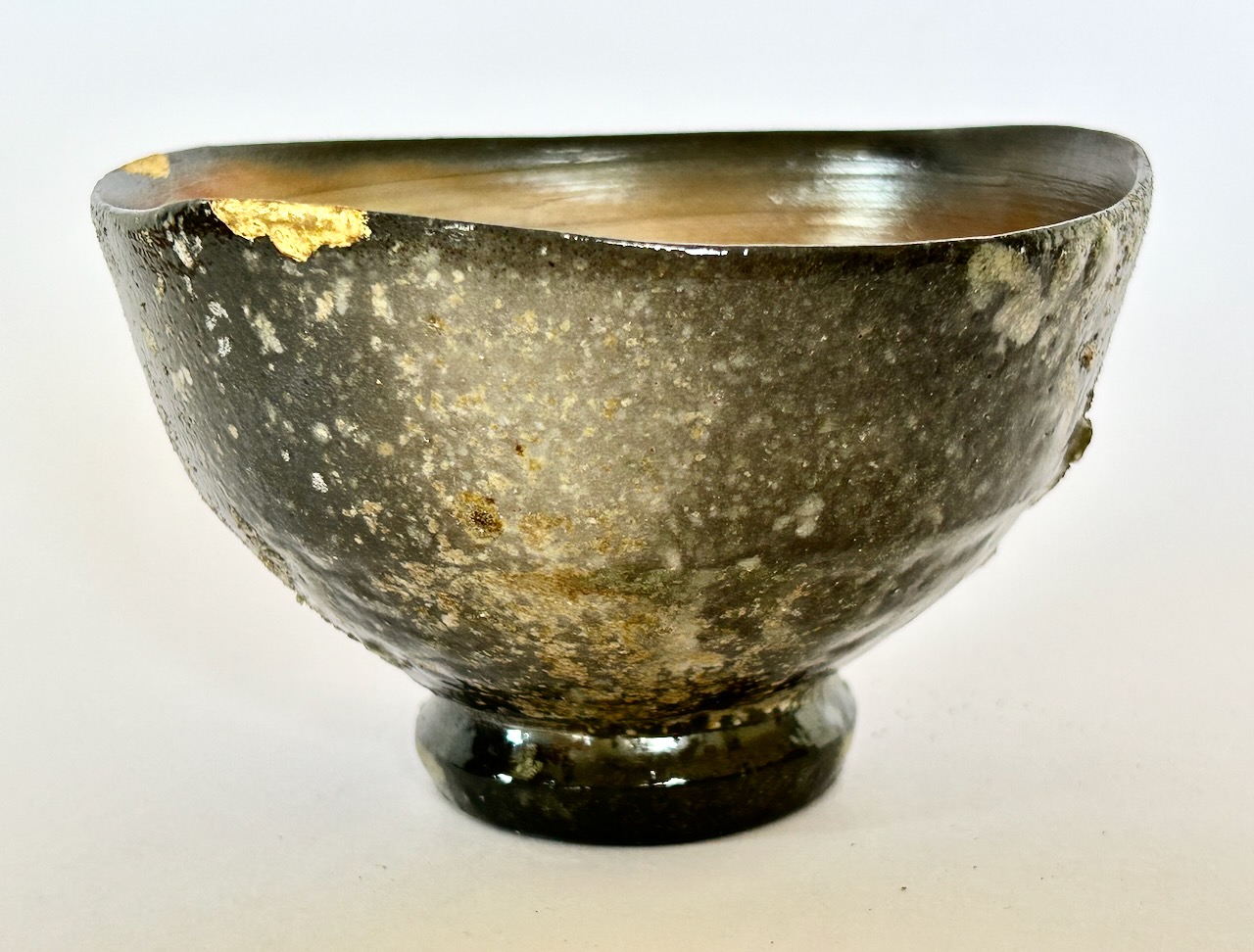
Unglazed porcelain bowl with minor kintsugi repair.
Gathered here tonight are a representative sample of all of the different approaches to wood firing. It’s a very rich and varied field of artistic endeavour, and it’s so good to see so much great work all in one place.
Long may we continue to stoke the fires of our creative desires.
 Tonight my Fingers Smell of Garlic
You must be logged in to post a comment.