
I recently bought an old Shimpo RK1 potters wheel from a friend.
It probably dates to the 70’s. These wheels were manufactured from 1958, probably up to the late 70’s or very early 80’s?
The smaller RK2 wheel was released in 1967 and became the standard wheel from that time on. The RK2 was smaller, lighter, more portable and cheaper than the RK1.
These larger and very much heavier RK1 wheels were built on a cast iron shell, making it quite stable, but very, very heavy. The RK1 has a kind of gearbox to increase torque when making very large pots, and the torque is finely adjustable using a handle on top of the casing to make the subtle changes needed, without stopping the wheel.
It’s a bit of a dinosaur. In fact I have only ever seen 3 of them in Australia. Les Blakeborough had one in the Sturt pottery workshop in Mittagong when I worked there in 1972. He had a special extra-large copper tray custom made for it. I’ve never seen anything else like it. My teacher Shigao Shiga had one in his studio when I was his apprentice in 1973, and Peter Rushforth had one in his later studio in Shipley. This one could possibly have been Shiga’s old one passed on to him, as they were close friends.
I missed out on getting my hands on all of these wheels when they changed hands, so I was pleased to see this one come up for sale recently.
I don’t think that it has had too much use, as it’s in good mechanical condition for such an old wheel. They were originally supplied with only a small splash guard in front of the wheel head, as were the original RK2 wheels in the 60’s. It was another 10 years before they started producing wheels with plastic trays – probably for the hobby market? All Japanese pottery studios in the early years had the wheel set down under the floor, and the potter sat cross-legged on the floor and bent forward to lean over the wheel head at floor level. Hence the arm bolted onto the foot pedal to reach up to floor level to control the speed. I had to learn to sit cross-legged just like this when I was an apprentice. As a 21 year old, it was a bit of a shock, and my legs went numb quite quickly. It took me months to get used to it. As I wasn’t accustomed to sitting cross legged on any floor, at any time. If I dangled my legs down into the wheel enclosure, they would get saturated with throwing water/slip. So I quickly learnt to throw with a minimal amount of water/slip. To this day, I still throw with almost no water.
The splash guard and it’s mountings were missing from this wheel when I bought it. This type of potters wheel is meant to be mounted in an enclosure to catch all the slip spray and turnings. I had two such enclosures in the old pottery, one for each of the smaller, more compact RK2 shimpo models that I owned back then. RK2 and RK2 super.
The good side was that you could work all week and the turnings would just pile up around the machine. Friday afternoon was the time to clean out the enclosure. The bad side was that you couldn’t change clays very easily. I use a lot of different clays/porcelain stone pastes these days and need to keep all the turnings and slip separate. So a full tray suits me better. Unfortunately, the plastic ones usually supplied with modern shimpo wheels a tediously small and so cramped that I can’t fit my fingers down into the gap to clean out the turnings. So I am forced to have to dismantle the tray to remove the turnings every few minutes, it’s so tedious.
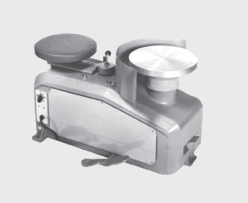
The marketing picture of the original RK1 from their website shows the wheel with its wheel head splash guard.
I have built new custom built trays for half of my Shimpos so far. It’s just one of those jobs that is on-going and a work in progress. I’ll get them all done in due course.
There was no easy way to fit a tray onto this old RK1 wheel with its sloping frame casting. So I had to weld up a support frame and drill and tap threaded holes into the cast iron casting to fix the new tray securely in place.
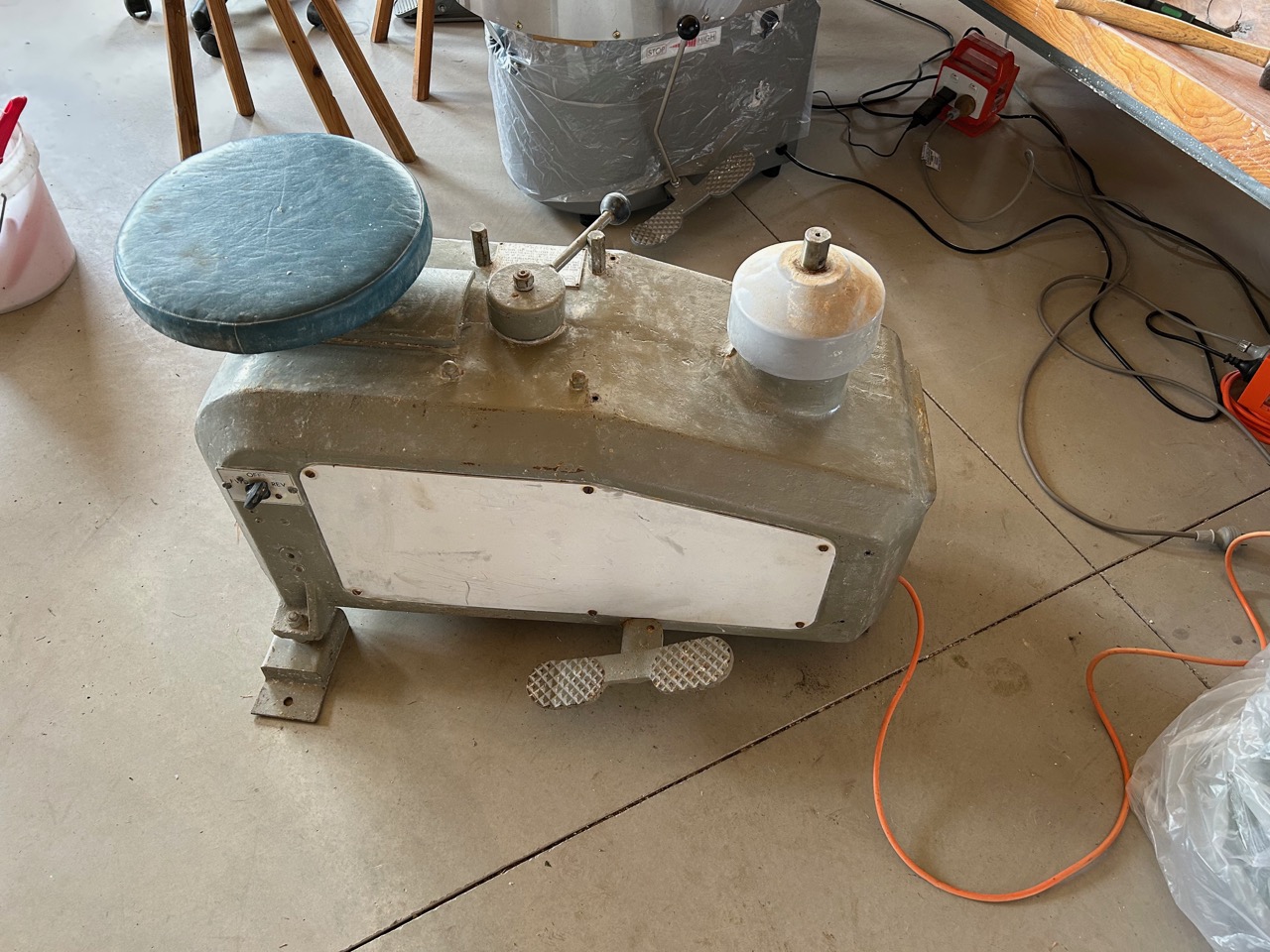


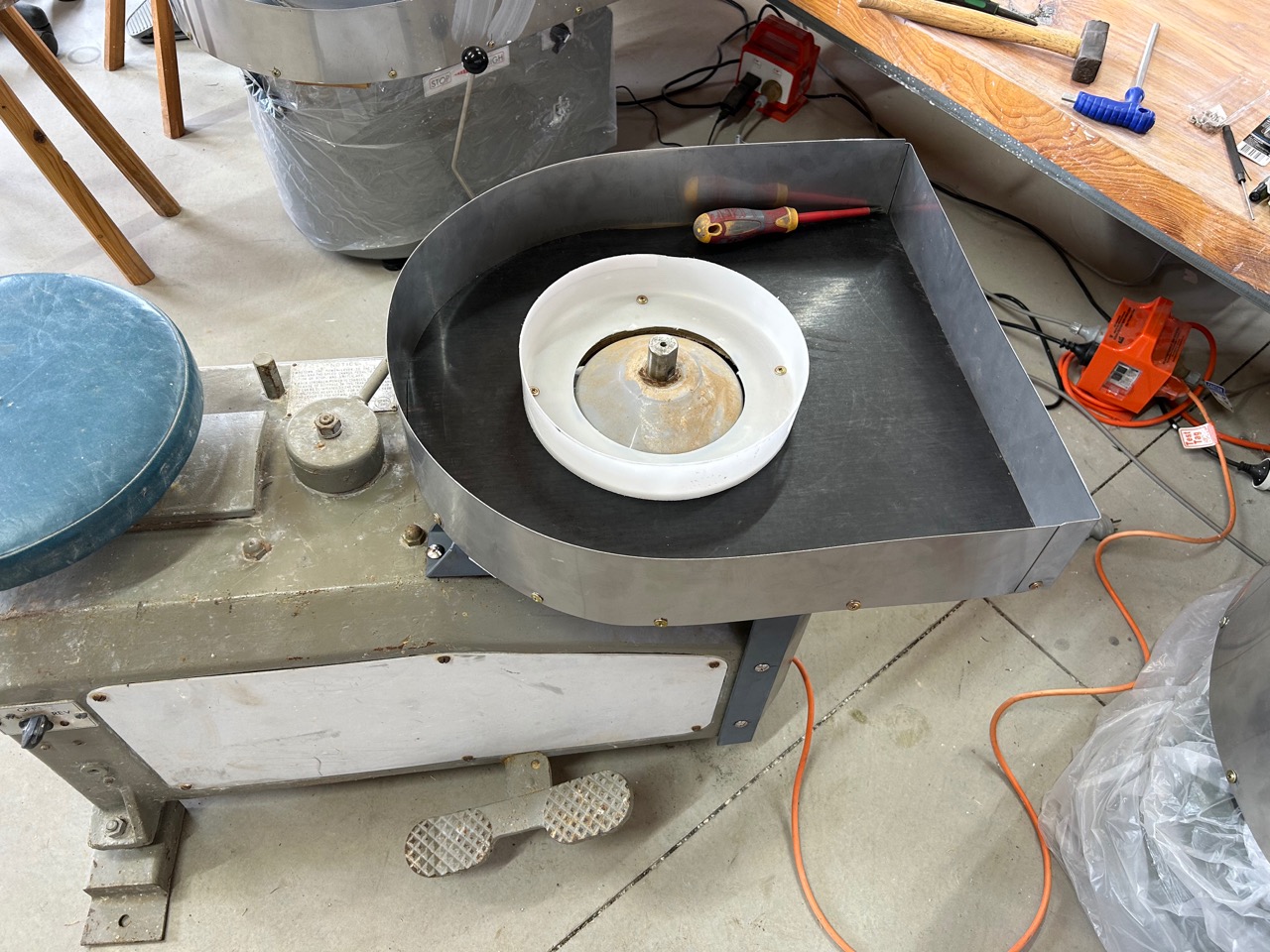
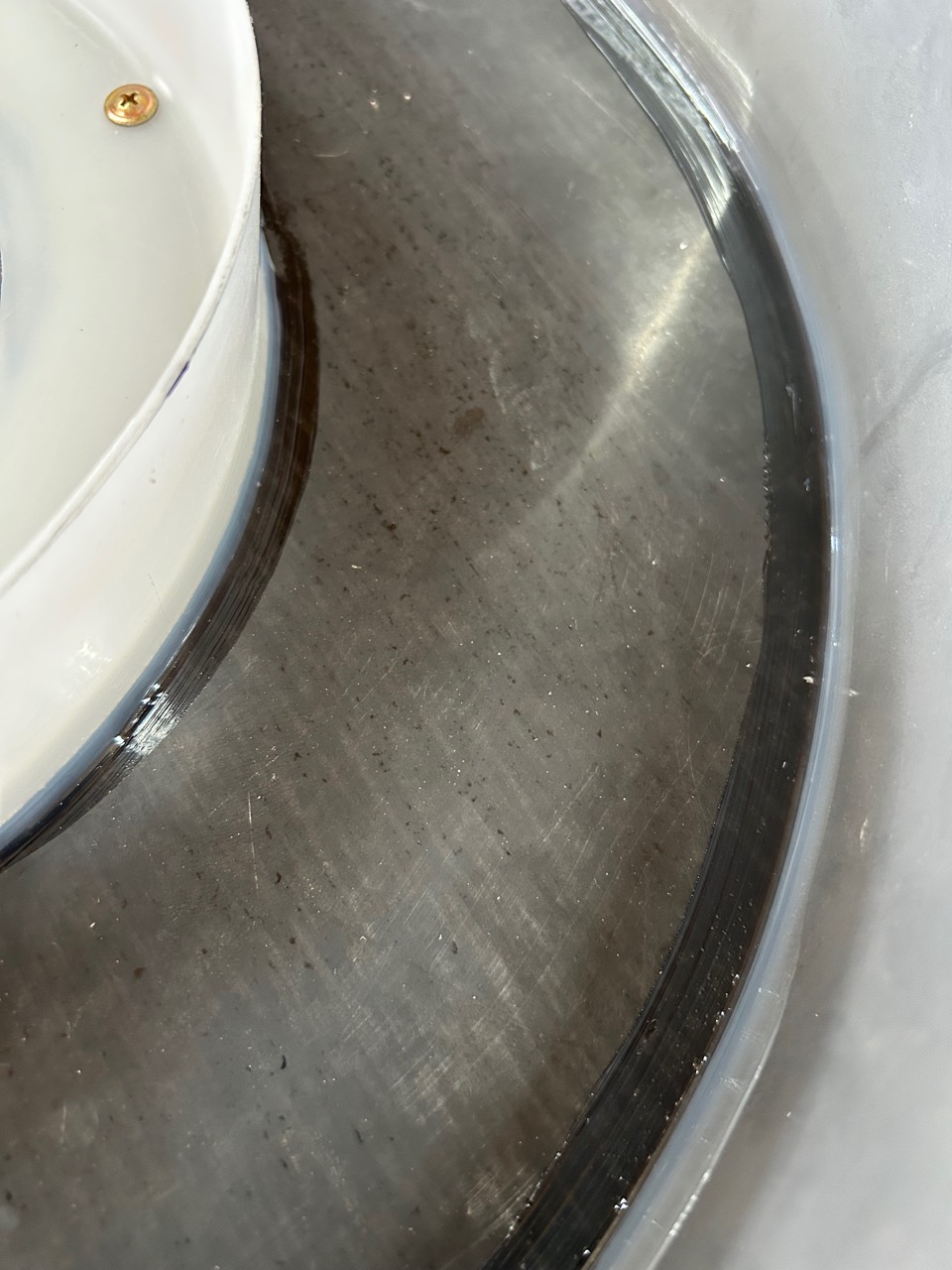
I siliconed all around the edges of the tray where the waterproof ply meets the stainless steel wall, and then glued on a strip of clear poly tubing all around the top of the steel edge to make it more comfortable for the user. I also used the base of a plastic bucket to make a protective guard around the shaft to keep water and turnings away from the bearings I screwed this down and siliconed it to the base as well. All good.

I made a wooden tool shelf for the end of the tray with an arc cut out to match the wheel head to allow for big batts when throwing platters.
The finished product in place and working. We now have 8 wheels up and running in time, ready for the first weekend throwing workshop, this coming weekend. This workshop was organised by invitation only, for those potters who came and helped us clean up after the fire. This one is free, as my thank you gift to those helpers. The next workshops will be advertised here to allow anyone who wants to, to apply. I’ve asked around and made a few enquiries. I’ve decided to charge a fee that is at the lower end of the current market price. I’ll be charging $125 per person per day.
I see these proposed intermittent workshops, spread out throughout the year, as being my part-time job in retirement.
I’ll be teaching other workshops as well as throwing in the coming year;
There will be throwing for wood firing, using my specially developed clay bodies.
Weekend wood kiln firings. Spread over two weekends, first weekend for packing and firing, then the following Sunday to unpack and debrief on the work.
One day geological field trip to collect samples followed by rock glaze testing and firing
Glaze theory and testing. + plus other topics as they appear appropriate or are requested.
Janine and I have acquired a lot of experience and skills over the years. We were trained in the 70’s when everything was done the old fashioned way and skills and theory were taught in greater detail than is done today. We are keen to pass on some of these skills before we expire.
The modern pottery workshop access classes, or potters wheel experience classes, don’t tend to teach much, if any, theory these days. We hope to fill part of that need.
 Tonight my Fingers Smell of Garlic
You must be logged in to post a comment.