
Our old singular surviving chicken, Edna, has been quite lonely recently, since the death of her sister chook, Gladis. She is getting quite old now for an Isa Brown chicken, she is about 4 years old and has been laying less eggs month by month this year. About one or two per week, which is normal for this breed at 4. If we had a rooster, she’d be a great grand chicken!
Recently she has gone off the lay entirely as she goes through the moult. She is putting so much energy into growing new feathers, that it takes all the protein that she can muster. Hence, no spare protein, no eggs. We have been feeding her extra tit-bits of meat in her diet to help her along, increasing the protein in her diet. She just sits in the corner of the courtyard all day. She has lost her inquisitiveness and desire to get out and scratch and forage. She looks a bit lonely and sad. But I could be overlaying that reading onto her. She’s probably perfectly happy? Who would know?
This shortage of eggs coming from the hen house has led me to enquire about another source of eggs. We have got a couple of dozen now and then from our neighbour Paul, who has more than he can eat just now. I have also investigated buying eggs from the various stores and supermarkets around town. But buying commercial eggs is fraught with difficulties. The big commercial producers who control the market have recently bribed the government in some way or other to change the law regarding the food labeling laws on eggs.
It seems that now with this change, the definition of ‘Free Range’ chickens is meaningless, with so many birds to the hectare (when allowed out). It looks like a concentration camp for chickens and not much better than being caged. Caged birds can be stocked at a rate up to 20 chicken to the sq. m. According to ‘Choice’ magazine.
I could never buy any caged eggs, in my mind it’s akin to torture. Even ‘Barn raised’ chickens at 4 chickens per square metre. That’s 50cm x 50cm of space per chicken. No free space at all. No way to be able to move around freely. They have debased terms like ‘Free-Range’ and ‘barn raised’, it sounds like it might be a nice environment. It’s not.
Having grown up with chicken in the back yard when I was a kid, they were always locked up at night to keep out dogs and foxes, but then let out every day to free range around the back yard all day. They would put themselves to bed at dusk. The big wire-netted yard allowed them to move around freely, but safely, until they were let out. We seemed to always have about a dozen or so. We shared the common back yard with my grand parents, who lived behind us in another street.
My grandfather managed the chickens for my Mom. He obtained fertilised eggs when we had a broody chook, as we didn’t have a rooster. It was his job to sort out the young roosters and dispatch them as needed, as half of the eggs would hatch out as males. I learnt from him the basics of chicken management, although I never saw him kill them. He kept that away from us.
So when Janine and I came to live here, it just seemed the most natural thing to build a chicken coop and get a few chooks. We’ve had them in our yard for most of our life. We got our first chickens from our neighbour John Meredith. He kept Old English Game Fowl. We learnt a lot from him, It was the first time that I had lived with a rooster. We were far enough from any neighbours, that it was legal to keep a rooster. The rooster was always so protective of his girls.
One evening we were ready to go out at dusk and tried to close the chicken coop door, but the rooster was stubbornly refusing to go inside, standing just a little bit away from the door and making a bit of a racket. We couldn’t coax him in. When suddenly one lone chook came running across the yard from some distance away, where she had lost track of time and didn’t realise that it was dusk. Once she was safely inside, he went in and we could close the door. He knew all his girls weren’t in yet, there was still one missing, so would not let us lock her out. I don’t think that chickens can count. I know that some birds can, but not up to 12. so he must have recognised her absence by look or personality?
In the mid ’80’s, we had the amazing Sally Seymour come and stay with us for some time. She taught us so much country ‘Lore’. A better, cleaner way to dispatch a chook, and she also taught us dry plucking, so much neater and cleaner. So many little tips and tricks, we owe her so much. You can check out Sally and John Seymours books at Sally’s web site in Wales. <https://www.pantryfields.com/sally-seymour>
So, with Edna off the lay, I went looking for an ethical egg, or dozen. The best bet was from our neighbour paul. But after that it was to the shops. I started looking closely at egg boxes, reading the fine print. People can buy a dozen caged eggs for $4.50 per dozen, although I couldn’t. I love my chickens. I’d hate to think of them locked into a tiny wire cage box for 2 years then slaughtered, having never been able to run around in the grass or take a dust bath. it’s cruel.
Next comes the ‘Barn laid’ eggs from chickens crammed into industrial sheds. Read this as locked in a big tin shed, under artificial lights, 20 hours of light per day, with 30,000 other hens with hardly enough room to turn around. This is just as unacceptable to me.
Then there comes the BIG lie. The huge commercial/political con job called ‘free range’. These days it seems any crammed unpleasant space filled with chickens seems to be legally marketed as free range. I looked at a lot of egg boxes in the supermarket to see how many chickens they had per hectare.
‘Choice’ magazine had an article about the chicken industry. It was quite shocking to me. <https://www.choice.com.au/food-and-drink/meat-fish-and-eggs/meat/articles/free-range-chicken> It’s worth a read.
Are ‘free range’ chickens really allowed to range around freely. Some ‘free range’ egg producers claim 25,000 hens to the hectare is free range. Some boxes also add the caveat of “when allowed out”, (see the Choice article above) so again, they spend their lives in crammed spaces. These aren’t really free range at all. This is just marketing double-speak and advertising mumbo-jumbo to try and trick you into thinking that the chickens are living a natural life. They are not. This is just linguistic promiscuity.
Real free range is where chickens are allowed to roam free on pasture all day. To scratch for bugs and worms, to dig holes and take dust baths. They should have enough space to form little clusters or flocks and move independently around the paddock at their will.
I started to look closely at the boxes of eggs available in the supermarket, grocery store and green grocers. I read all the blurb on the labels. I found various cartons of eggs in different shops around town, that seemed to fit my version of free range requirements.
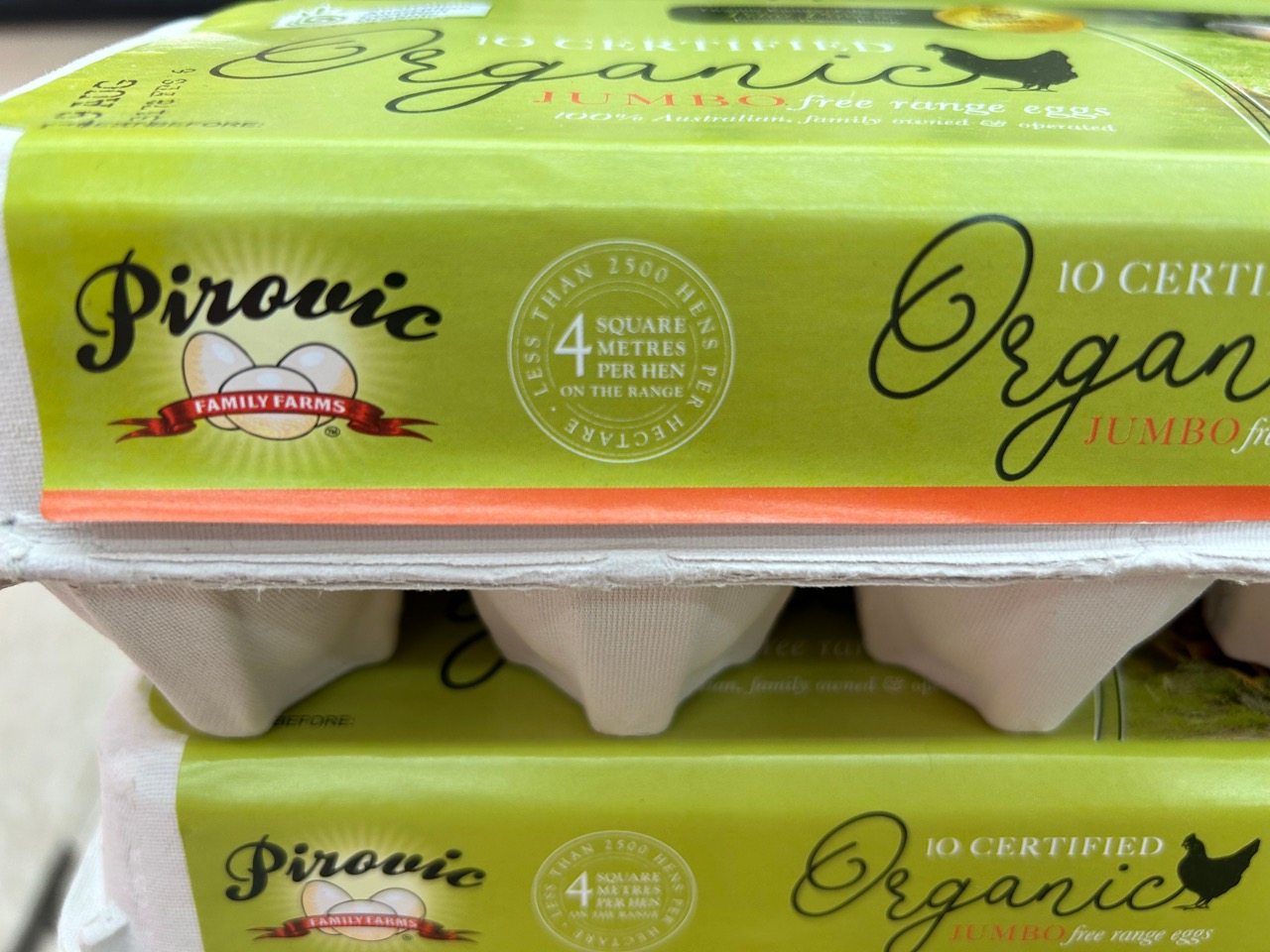
This box claims to hold less than 2500 birds per hectare, which seems quite OK. But could be better.

Farmer Rod’s brand claimed 1250 hens per hectare and are labelled ‘pasture raised’. Great, that sounds good. I’d like to check it out a bit more and make sure that it is all it claims to be.,

but then I saw, Hunter Valley eggs.
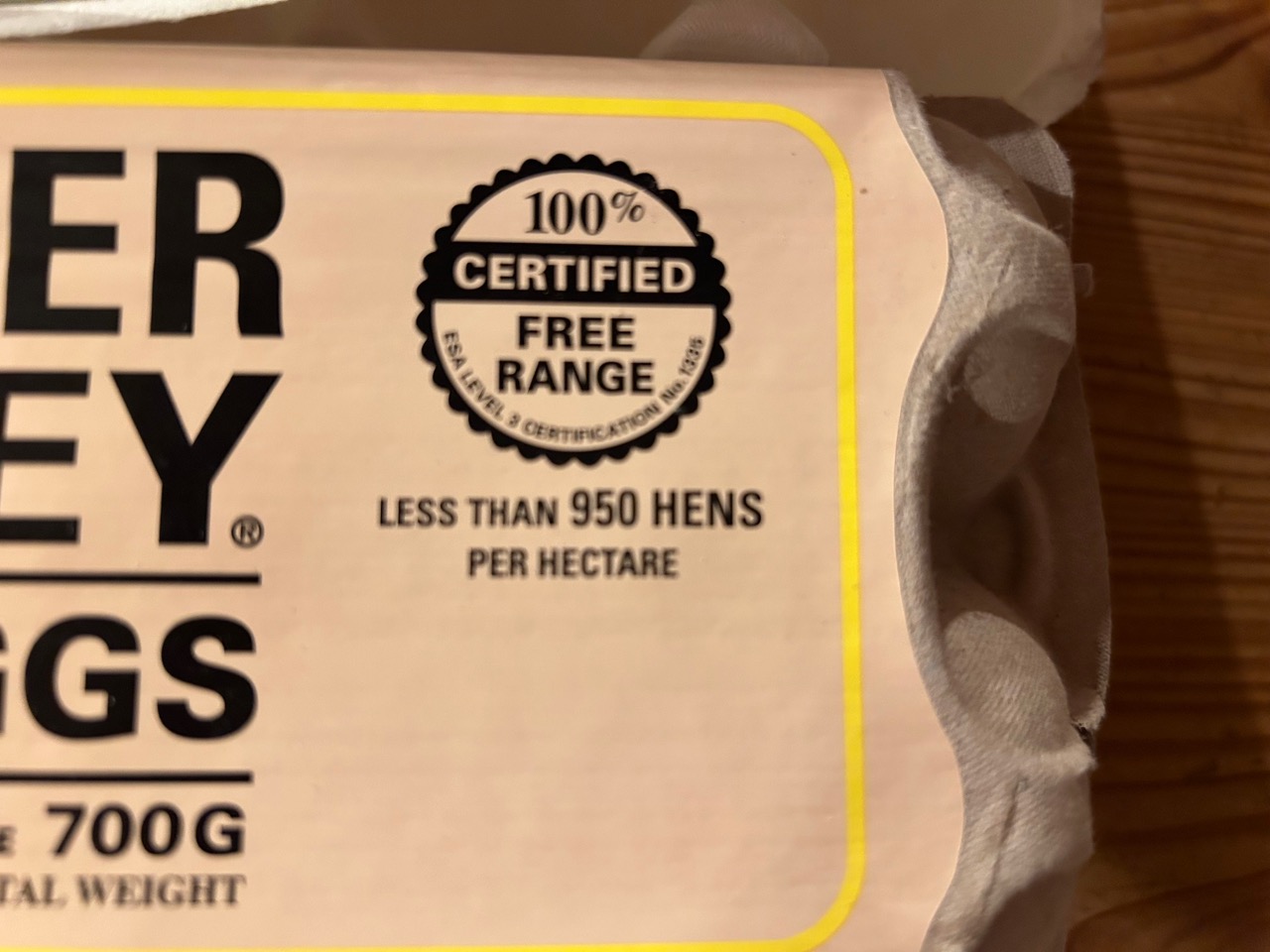
Free Range hens stocked at 950 chooks per hectare. That’s even better. but is it true? I have no idea. I really hope so. The web site says a lot about being certified and hens raised to industry standards. Oops! that’s a bad sign! ‘Industry standards’ are very low and they are always lobbying for higher numbers and lower standards. Call me callous and cynical, but I don’t trust big business, their ‘Industry Standards’, along with industry ‘self-regulation’. It has proved over and over again to be worthless posturing.
I moved along to the next best box. Its packaging claims 750 chickens per hectare.

I googled the company and found out that it is an olive growing company. They run their chickens in amongst the rows of olive trees in big mobile trailers. Or so they say. It all looks credible, but I notice that on the label, it also states “when outdoors”! Oops, why would they not be out doors if they are free range? The images on their web site didn’t show any big sheds, just mobile trailer laying boxes! I refer you to the ‘Choice’ magazine article again. It could well mean that they never get to go outside at all according to Choice. Moving along.
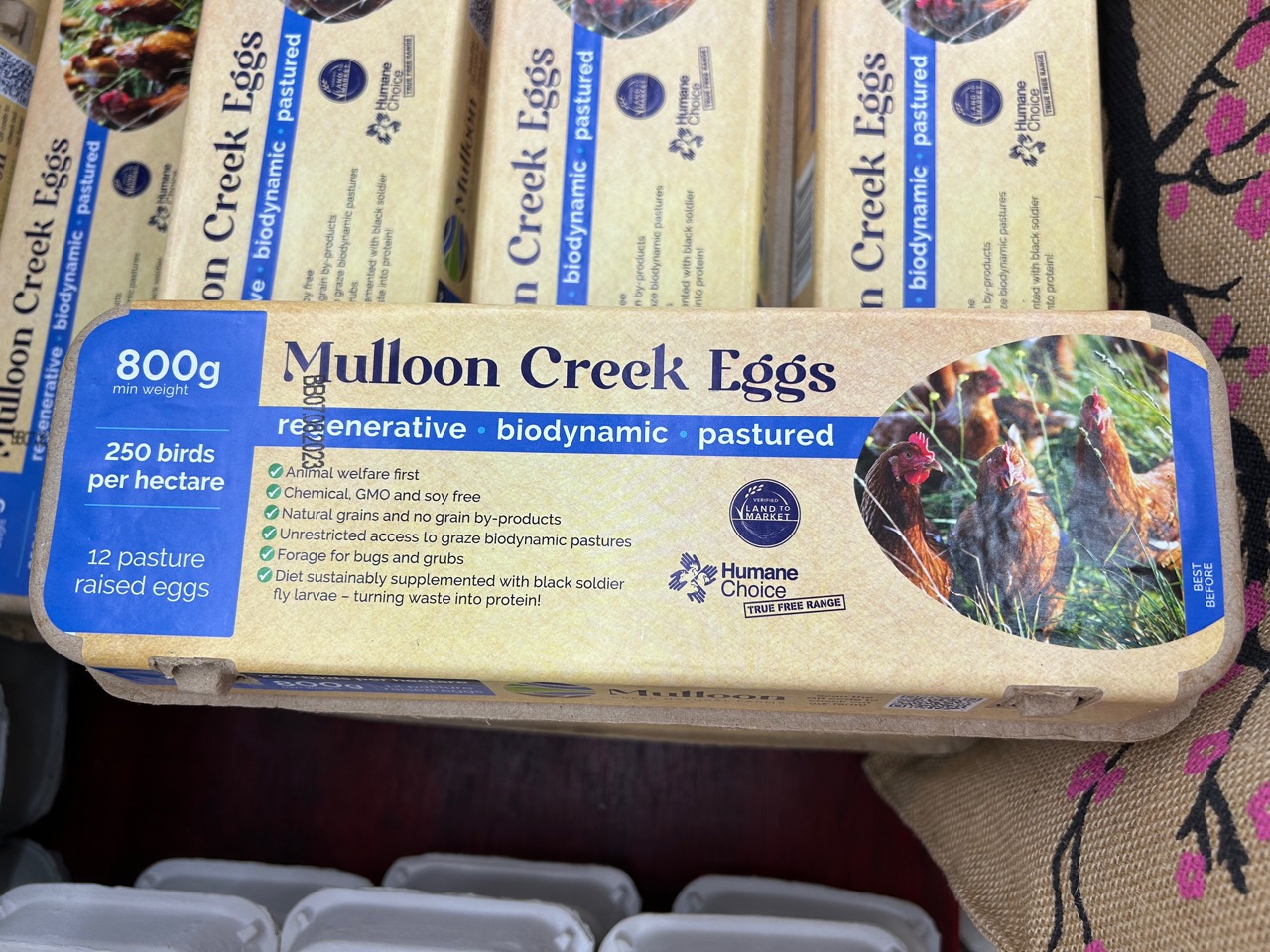
Mulloon Creek eggs look to be very good. Their labeling ticked all my boxes. I was going to buy these eggs. But then I saw Kangaroo Valley eggs. Check out their web site, it is very impressive. It looks to be completely ethical. Or have I just been conned by sophisticated marketing and advertising goobaldygook!
The best that I could find was a local farm run by a husband and wife couple who appear to be both teachers. So it appears that they leave the chickens out to roam throughout the day while they are at work teaching, but they have 3 ‘maremma’ guard dogs in with the flock. They also employ casual staff to help guard the hens. it all sounds pretty reasonable and they are local to me.
They claim just 40 chooks per hectare, and from the images on the web site, it looks like that. No big sheds in sight in the aerial photographs.

So this was my choice. I didn’t worry about value for money comparisons. I am prepared to pay a proper price for a properly raised happy chicken. The most expensive eggs were the olive farm organic eggs at over $1 each. However, the local Kangaroo Valley eggs were higher mid range price. A good find. and will be our fall back position when we don’t have sufficient eggs from our own girls, but they are in limited supply, so the Mulloon Creek will be my next best choice.
We usually keep between 2 and 4 chickens here on our 2 hectares. That’s a stocking rate of 1 to 2 chooks per hectare! I think that because chickens are birds, they prefer to flock together, so a few more wouldn’t be a bad thing, even a good thing, but we just don’t need more than 2 eggs a day each, so we need to keep our flock small.
At the moment we only have our singular, lonely chicken, named Edna, but I have just bought 3 more ‘point-of-lay’ pullets. That should keep us in eggs for another 3 years or so. There will be a difficult week here while Edna turns nasty and beats up all the young pullets to establish the pecking order. We keep them all in the house all day to sort it out and to get the new girls used to where they now live, sleep, feed and drink. Once habitualised to this new norm, we will let them out all day confident that they will return to the chook house at night to be locked in and kept safe from the foxes.
I don’t like to see chickens fight and peck each other. I really feel for the littlest one who cops it from all the others, but it’s not up to me. It’s chickens own way of sorting things out and best to let them get on with it and don’t try and interfere. But i can’t hang around down there with them too much, it distresses me. So I keep away, just turning up to give them feed and clean water morning and evening.
Once we start to let them out, we will have to start training them to come when they are called and recognise their name. This is done with careful, slow and persistent food bribery. Giving them little tit-bits when they come. Once one of them get the idea in her head that it is worth her while coming. All the others start to realise that she is getting fed, so competition cuts in. They can’t stand to miss out, so they all start to come when called- just in case there is a food reward at the end. it works!
Yes Janine, I’m coming. Diner’s ready!
 Tonight my Fingers Smell of Garlic
You must be logged in to post a comment.