
I’ve been invited back to Korea to build and fire another of my low-emission wood fired kilns and to do another demonstration firing of one of my previous kilns. The first of these firings was filmed by Korean TV for a documentary to be shown later in the year.


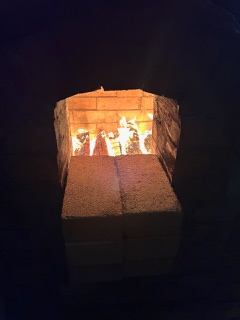

The firing for this kiln was done using the same 5 year old, very dry seasoned pine timber, that I used last year with the other kiln that I built.
It’s a considerable challenge to burn very dry timber like this, loaded with volatile resins, and not make loads of smoke. Not the best fuel for a clean, low-emission kiln firing demonstration. But that is what I was given to work with, so I did my best. It is possible to keep it fairly clean, but there is definitely some smoke. It takes a lot of skill.
Not recommended for the beginner. Still, everyone seems to be happy enough. The results were excellent!
It is possible to wet the wood to slow down the combustion and clean up some of the potential smoke, because water actually aids combustion when it is introduced at temperatures above 1100 oC. It’s hard enough too explain this concept of ‘water gas’ to students in Australia, using English language, which I’m better at than I am at Korean. Impossible using ‘kakao’ translation app in Korean. I started to try, but gave up after a few minutes.
A week later, I moved from Yanggu to Bangsan and went to work on my other kiln job.
While I was doing the 2nd demo firing, a famous celadon potter from down south drove 8 hours up to see and experience the firing. He had read the Korean translation of my book ‘Laid Back Wood Firing’ and was very keen to see it in action. He was clearly impressed, as he offered me a job to come back and build one for him later in the year. I declined. I have had 3 offers of kiln building work here this trip and two on the last trip. This could be my new Korea.
But I’ve decided that I’m too old for this sort of thing now. Kiln building is to labour intensive, it’s hard on my back. Especially on all the lower than waist height layers of brickwork, and it’s also somewhat stressful for me to organise all the important details in another language. There are tight deadlines and budgets, and doing it all using the phone translator app adds to the complications. I don’t need to do it to make a living any more.
I only came to do this job as a favour for my friend here, Mr Jung, the Director of the Yanggu Porcelain Museum and Research Centre. He has always been so supportive of me in my porcelain research interests. Mr Jung is keen to promote cleaner wood kiln firing. Tradition wood kilns here belch black smoke from start to finish. The two old traditional kilns built in the museum grounds in the township of Bangsan can’t realistically be fired anymore, because of residents complaints about the smoke. They are beautiful objects, like sculptures in their own right. The museum is located right on the main street, in the centre of town, making the smoke problem difficult to ignore. If I lived next door, I’d complain too.

2 items of beauty.
As with all things, these matters are complicated. Porcelain has been mined here and pots made and fired on this site for 800 years. It’s a hugely important cultural site. That’s a lineage impossible to ignore. However, the times they are a chang’in. Every one is aware of our carbon constrained, global heated, industrially damaged climate now, and air pollution is a huge problem, particularly in Seoul. There was a time when I first visited here, that everyone claimed that all the pollution was blown in by the westerly wind from China. It wasn’t Korean pollution! A convenient excuse to do nothing. (No-one seemed to notice that the wind wasn’t a problem on Sundays when there was much less diesel traffic in the city). But people have wised up. They want change. They want cleaner air.
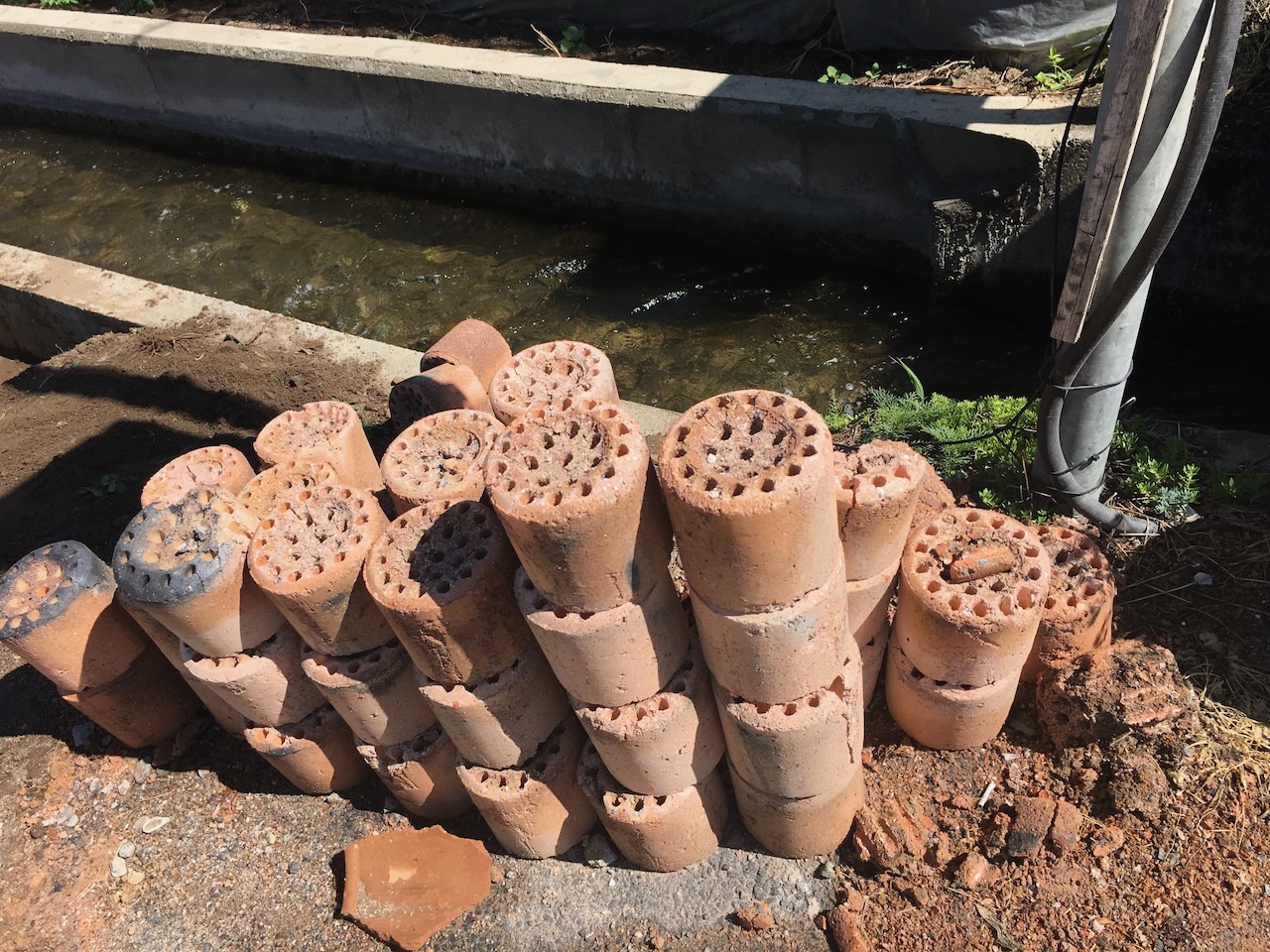
Just after my first visit here, some years ago, burning pressed coal briquettes was banned as the main heating and cooking method here. The government did this by bringing gas to the town. They weren’t so stupid as to just ban coal. (See below). They offered a solution first up. Janine and I were working here at the time, and were particularly impressed by the speed and efficiency of the operation. The gas installers team progressed from one end of the main street to the other, about half a kilometre, digging the trench, laying in the pipes, installing side take-off lines to each house, company, or cafe as they progressed, testing the section, then back filling and finally re-tarring the road surface as they went, from laneway to laneway, in 50 metre sections, day after day. The whole street was done while we were there. No one was inconvenienced for more than a day or two.
I reflected on this and couldn’t help but think of Australia and making the comparison. It took 2 months for our local council to re-work the intersection of the street entry into our village at the level crossing. Less than 50 metres of tarred road. Terms like glacial come to mind. I think that the difference is that here, Korean’s work on contract and our local council workers were on wages, so no rush.
The lord Mayor of Brisbane also comes to mind, declaring homelessness illegal in Brisbane. Genius! give this man a PhD and a Nobel Prize! He did absolutely nothing to offer any alternative. No grand plan. No long-term thinking. No considered strategy. No forethought. No low income housing construction budget. Just get that problem out of my sight. I can only hope that he will ban cancer and war next!
No wonder we are the big brown dumb land that sells black and red dirt.
Back in The Porcelain Research Centre, the Director had a grand plan that involved long term thinking and strategy. The old disused army barracks on the far edge of town, up in a seperate little spur valley became available. He somehow organised to get it included into the Museum plans and therefore long term budget. Over the years he has relocated all the wood kilns and several more as well, to make a small porcelain village. With specialised facilities for wood firing. both traditional and modern innovative designs.
There are 6 seperate, self contained house/studio buildings, for research students and their families, a central communal meeting place/cafe, A huge accomodation block for visitors and guests during big events, Plus a seperate family guest house.
On this visit, I got to see inside the huge new, almost complete, student residency building, with 6 self contained single studios and living quarters, 3 either side of a massive central kiln room and glazing lab. Korean students can come to study for periods of 1 to 3 years. Foreign students can come from 1 to 3 months.
The construction phase is almost complete. They are just doing the landscaping now. This is becoming a very impressive place to come and study.
As I understand it. Local Korean ceramic students that are accepted into the program here are usually supported by their university to come here for higher degree research study up to 3 years for a PhD. They don’t have to pay any rent, but they have to cover the cost of their own firings and food. I’m unaware of the cost for international students, as the building isn’t ready yet, so there haven’t been any so far.
I’d come and work here again, as an artist in residence, if I didn’t now have an even better studio and creative environment back at home in my new workshop, just sitting there waiting for me. Now Janine and I are in a position to invite students to come and work and study in our studio from time to time. Regrettably, we can’t off the same standard of on-site accomodation as they do in Korea.

New Student accommodation building.
Is there any wonder that I love coming here to this supportive, creative, artistic environment so much?
 Tonight my Fingers Smell of Garlic
You must be logged in to post a comment.